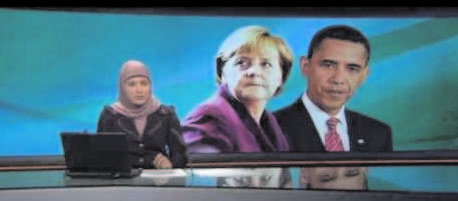
Tag: Angela Merkel

  • German lawmakers overwhelmingly back Greek bailout, clearing path for loans

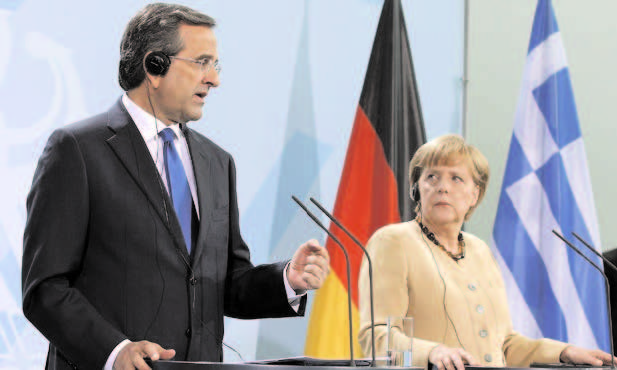
    BERLIN (TIP): German lawmakers overwhelmingly approved another bailout for debt-ridden Greece on Wednesday, August 19, removing the last major obstacle for Athens to receive an emergency infusion of funds to avoid an imminent default, a Los Angeles Times report says.

    The Greek government is now expected to receive an installment of loans just in time to repay a debt owed to the European Central Bank on Thursday. Missing that deadline would almost certainly result in Greece stumbling into a default and then a disastrous exit from the Eurozone, the group of 19 nations that share the euro currency.

    Athens and its European partners agreed to the three-year, $95-billion bailout package last week — Greece’s third international rescue in five years. But the deal still required approval by several national parliaments to take effect, most notably in Germany, where many lawmakers are hostile to shelling out more money to save a country they view as irresponsible and unreliable.

    Dozens of representatives have voted against bailouts for Athens in the past, most recently in a preliminary vote last month, when 60 members of Chancellor Angela Merkel’s ruling party bucked her authority and said no to a new rescue package.

    But the wide margin of approval Wednesday, by a tally of 453-113, with 18 abstentions, attested to the chancellor’s hold on power and, especially, the influence of her popular hard-line finance minister, Wolfgang Schaeuble, one of Greece’s toughest critics.

    Although Schaeuble has said publicly that kicking Greece out of the Eurozone might be preferable to another bailout, he urged the Bundestag, Germany’s lower house of Parliament, to ratify the new rescue plan “in the interest of Greece and the interest of Europe.”

    Analysts predict that the economy will continue to shrink this year and next. But Schaeuble insisted that the new rescue plan offered the path to Greece’s renewal, even though the two previous bailouts, which ran on similar lines, failed.

  • Greeks  Votes “No” to EU demands – Syriza readies IOU currency

    Greeks Votes “No” to EU demands – Syriza readies IOU currency

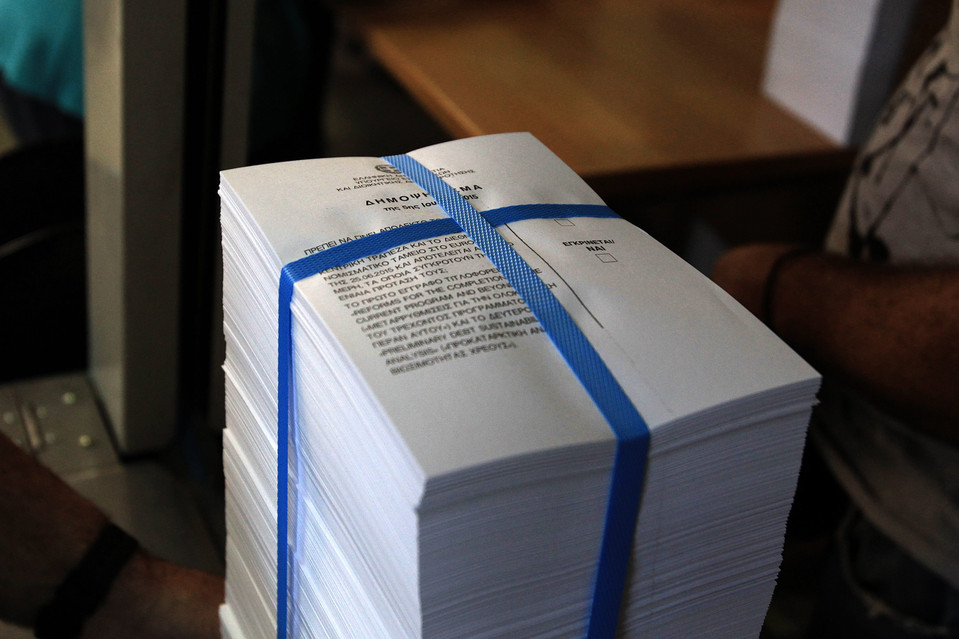
    ​Greeks have voted and have rejected the “ridiculed” austerity demands of Europe’s creditor powers by a stunning margin, sweeping aside warnings that this could lead to the collapse of the banking system.

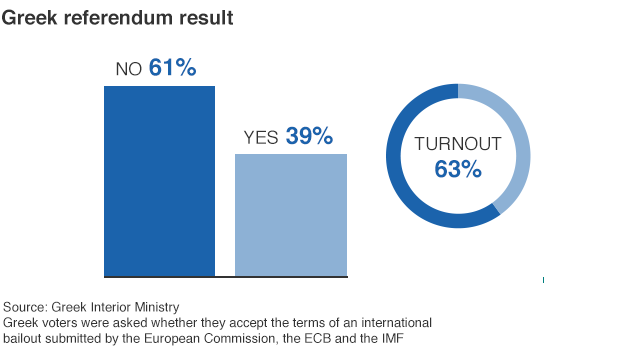
    The final result in the referendum, published by the interior ministry, was 61.3% “No”, against 38.7% who voted “Yes”.

    Greece’s governing Syriza party had campaigned for a “No”, saying the bailout terms were humiliating.

    Greek Prime Minister Alexis Tsipras said late on Sunday that Greeks had voted for a “Europe of solidarity and democracy”.

    “As of tomorrow, Greece will go back to the negotiating table and our primary priority is to reinstate the financial stability of the country,” he said in a televised address.

    “This time, the debt will be on the negotiating table,” he added, saying that an International Monetary Fund assessment published this week “confirms Greek views that restructuring the debt is necessary”.

    Alexis Tsipras has called the eurozone’s bluff – and it appears to have gone his way. There is still a 39% of the Greek nation deeply unhappy with what has happened. And the government will have to unite a divided country.

    4 out of 10 Greeks did not want this situation where they might have to exit the EU. More than that, a deal with the eurozone has to be struck fast.

    Greek banks are running critically low and will need another injection of emergency funds from the European Central Bank.

    Greece’s Finance Minister, Yanis Varoufakis called the eurozone’s strategy “terrorism”.

    The banking crisis and tax revenues plummeting amidst the instability, Greece’s economy has weakened again, making a deal even harder to reach.

    European Commission President Jean-Claude Juncker said he was consulting the leaders of eurozone member states, and would have a conference call with key EU officials and the ECB on Monday morning.

    French President Francois Hollande and German Chancellor Angela Merkel are scheduled to meet in Paris on Monday.

    A summit of eurozone heads of state has been called for Tuesday, June 7.

    The European Commission – one of the “troika” of creditors along with the IMF and the ECB – wanted Athens to raise taxes and slash welfare spending to meet its debt obligations.

    Greece’s Syriza-led government, which was elected in January on an anti-austerity platform, said creditors had presented it with an “ultimatum”, using fear to put pressure on Greeks.

    The Greek government’s opponents and some Greek voters had complained that the question in Sunday’s referendum was unclear. EU officials said it applied to the terms of an offer that was no longer on the table.

    The turnout in Sunday’s referendum was 62.5%.

  • Berlin to meet US ambassador over spying reports: Source

    Berlin to meet US ambassador over spying reports: Source

    BERLIN (TIP): German Chancellor Angela Merkel’s chief of staff will meet the US ambassador on July 2 to discuss allegations that US spies bugged senior government ministers, a German government source said.

    In the latest twist in an ongoing scandal over extensive US spying in Europe which has caused outrage in Germany, media reported that the US National Security Agency (NSA) had bugged the economy and finance ministers.

    “The Chancellor’s Chief of Staff has invited US Ambassador John Emerson to a meeting because of the new bugging revelations. The conversation is due to take place on Thursday afternoon,” the source told Reuters.

    Privacy is a particularly sensitive issue in Germany due to its experience of extensive surveillance by the Stasi secret police during the Cold War and the Gestapo in the Nazi era. The scandal, triggered by revelations from former NSA contractor Edward Snowden, has caused a chill in relations between Berlin and Washington.

    Germany’s Sueddeutsche Zeitung daily and broadcasting network ARD reported that the NSA targeted 69 telephone and fax numbers in the German government administration.

    They based their reports on documents released on the Wikileaks website.

    Among the officials targeted were the economy minister and as well as several deputy ministers, the reports said.Asked about the reports, Economy Minister Sigmar Gabriel said he was most worried by the risks of industrial espionage, particularly given the links his ministry has to companies.

    “It is an absurd carry-on,” Gabriel told ARD television.

    Interior Minister Thomas de Maiziere, responsible for security issues, said Germany would look at the latest allegations.

    “We have become more distrustful,” he said.

    The role of Germany’s spies has also been in the spotlight since reports surfaced earlier this year that its BND foreign intelligence agency had cooperated with the NSA.

  • Greece defaults on IMF payment !!!

    Greece defaults on IMF payment !!!

    Greece became the first developed country to default on the International Monetary Fund, as the rescue program that has sustained it for five years expired and Greece’s last-minute overtures to international creditors for financial aid on Tuesday, June 30, were not enough to save the country.

    The Washington-based fund said the Greek government failed to transfer €1.55 billion ($1.73 billion) by close-of-business on Tuesday—the largest, single missed repayment in the IMF’s history.

    Fears of a Greek default have unnerved financial markets on concerns that it would ultimately lead to the country’s exit from the euro common currency. The fate of Greece’s membership in the 19-nation currency bloc still hangs in the balance ahead of a referendum on Sunday when Greek citizens will vote on whether to accept the austerity terms of continued international aid.

    An opinion poll published on Wednesday in the Efimerida ton Syntatkton newspaper, said 54 percent of Greeks plan to oppose the bailout proposal against 33 percent in favor. Late yesterday, June 20, Greek officials were also raising doubts over their plans for a referendum planned for Sunday, in which the government had asked its citizens to vote against pension cuts and sales-tax increases demanded by its creditors.

    However a breakdown of the results compared with a poll taken before the decision on Sunday to close Greek banks showed the gap between the “yes” and “no” votes narrowing slightly.

    IMF spokesman Gerry Rice said Greece can now only receive further funding from the global lender once the arrears are cleared. He confirmed that Greece asked for a last-minute repayment extension earlier on Tuesday, June 30, which the fund’s board will consider “in due course.”

    in Berlin, Chancellor Angela Merkel and other senior officials sought to lower expectations for a quick resolution to Greece’s financial crisis.

    Before Greeks have voted on the measures demanded by creditors, “we will not negotiate about anything new at all,” Ms. Merkel said. Her deputy and coalition partner, Sigmar Gabriel of the Social Democrats, urged Greece to cancel the referendum altogether. “Then one could very quickly gather for talks, initial talks. If that’s not the case, then we should certainly do this after the referendum,” Mr. Gabriel said.

    European stocks and bonds fell amid the uncertainty and the euro declined against the U.S. dollar.

    In Washington, President Barack Obama played down the potential impact of Greece’s worsening crisis on the U.S. and broader global economy. “That is not something that we believe will have a major shock to the system,” he said.

    Treasury Secretary Jacob Lew has been urging his European counterparts to press ahead with bailout talks to find a “pragmatic compromise” that includes both tough economic overhauls and debt relief, to prevent Europe’s economic problems from dragging on U.S. growth.

    The expiration of the existing bailout and a default on the IMF aren’t expected to have immediate consequences for Greece’s economy. Its banks have already been ordered closed until Monday, after the European Central Bank capped emergency loans to Greek lenders over the weekend. Cash withdrawals by Greeks have been limited to €60 a day for each account-holder since Monday.

    On Wednesday, Jul 1, the focus will again be on the ECB, whose governing council is due to meet in Frankfurt.

    The council, which includes central bankers from the eurozone’s 19 member states, is reluctant to take any additional steps for now that would inflict more pain on Greek banks—for instance, by forcing them to pay back the outstanding loans just days ahead of the referendum, people familiar with the matter said, despite a growing level of impatience over the central bank’s exposure to Greece.


  • GREECE NEEDS DEBT DEAL THIS WEEKEND, EU LEADERS WARN

    GREECE NEEDS DEBT DEAL THIS WEEKEND, EU LEADERS WARN

    BRUSSELS (TIP): The leaders of Germany and France warned Greece that it must reach a debt deal with its creditors at “decisive” talks on June 20 to avert default and a possible euro exit.

    Angela Merkel and Francois Hollande sang from the same hymn sheet after yet another meeting of eurozone finance ministers broke down Thursday without an agreement to free vital bailout funds.

    Athens needs the money to cover a huge 1.5 billion euro ($1.7 billion) IMF debt bill that falls due on June 30, failing which its position in the single currency and even the European Union could be at risk.

    “We have to keep working because time is pressing and the Eurogroup (eurozone finance ministers) on Saturday will have a decisive importance,” chancellor Merkel said early Friday after an EU summit in Brussels.

    “All the leaders supported the idea that everything must be done to find a solution on Saturday.”

    The French president said he would help work for a “durable” deal for Greece, whose leftist government has haggled over reform demands from its EU-IMF creditors since its election in January.

    “I consider that the meeting on Saturday is crucial because time is up on June 30, when the Greeks must meet their payment obligations, there are national parliaments that have to meet,” he said.

    The talks between the finance ministers of the 19-country currency union had been meant to produce a deal that EU leaders could rubber stamp at their summit.

    But they broke down acrimoniously, with Greece and its creditors even producing rival plans for the ministers amid differences on pensions, value added tax and spending cuts.

    The EU leaders held two hours of unscheduled talks on Greece at their summit on Thursday.

    EU president Donald Tusk ruled out the possibility of a special summit of eurozone leaders like the one he called on Monday in a futile bid to resolve the crisis.

    “Another Eurosummit is not foreseen. Leaders expect the Eurogroup to conclude this process at their meeting on Saturday,” he tweeted.In a sign of the passions involved, dozens of anti-austerity protesters waving Greek flags gathered at the police barricades around the summit and chanted slogans against the “Troika”, as the three creditor institutions used to be known, an AFP reporter said.

    Greece needs creditors to unlock the remaining 7.2 billion euros in its bailout to pay the IMF at the end of the month but the lenders have refused until Athens agrees to new reforms.

    Marathon meetings between Greek Prime Minister Alexis Tsipras, whose anti-austerity Syriza party won elections in January, and the heads of the European Commission, European Central Bank and International Monetary Fund, Greece’s main creditors, ended with no deal on Thursday morning.

    Tsipras earlier insisted that a deal was still possible. “After the comprehensive Greek proposals, I’m confident we’ll reach a compromise that will help the eurozone and Greece to overcome the crisis,” Tsipras said as he arrived at the summit.

    The IMF meanwhile said that it believes Greece will make the payment. Talk of a default is “all speculation, because we’re expecting the payment to be made on June 30 and that’s what the Greek authorities have said publicly,” said IMF spokesman Gerry Rice. Rice added that if the payment is missed Greece will immediately be declared in arrears, cutting its access to IMF aid.

    New plans submitted Sunday by Greece would produce eight billion euros in additional funds, mostly through new taxes on the wealthy and businesses, VAT increases and a cut in defence spending.

    But in counter-proposals handed to Greece on Wednesday, creditors called for further savings on pensions, higher VAT for restaurants, and for defence expenditure to be slashed by 400 million euros instead of the proposed 200 million euros.

  • Why I will not waive  my gas subsidy

    Why I will not waive my gas subsidy

    You have asked the rich and affluent people of India to waive off their share of subsidy on gas cylinders used by them in their homes and help in nation building.

    I, for one would definitely prescribe to your view and gladly do so. In return, I would like all of you esteemed gentlemen and ladies who run our great country to also reciprocate our generous offer.

    If only, every corporator, MLA, MP, and Minister could also waive off his gas subsidy, we the people of India would be very proud of you and salute you.

    You would be setting an example to the citizens of India. Most of you have declared incomes running into a few crores while contesting the elections.

    When will the day come when you will think of our poor brethren and waive off all the perks that you enjoy because of your position.

    When will you stop voting unanimously for a pay hike for yourselves, while bitterly fighting against all other issues in Parliament?

    When will we see you act as responsible citizens and fight over issues rather than take party based decisions?

    Let me tell you, dear Sir, the Chancellor of a super power like Germany Ms. Angela Merkel rides on a public train to work, whereas in our country everyone from the Prime Minister, to the Members of Parliament, even down to the Zilla Panchayat President is allocated a car which is paid for from the coffers of our country which is filled generously by the tax payers money.

    You incur thousands of rupees worth of telephone bills, electricity bills, free accommodation in luxury bungalows, avail free travel on public transportation, go on foreign jaunts on flimsy excuses and we the people of India pay for it.

    When will you be a proud Indian and pay for all these facilities availed by you?

    You get admitted to luxury hospitals for even a headache and especially when a probe is launched against you for any misdemeanor. Even there, you get the best beds and facilities free of charge.

    Pray, tell me, Sir “When will you pay for these privileges?”

    You travel in air conditioned railway coaches and fly first class in planes even when you are not on official duty. It is us, the citizens of India who pay the fare for you.

    Everyone, who is anybody, stakes his claim to fame by clamoring for “Z Class” security when the actual risk assessment for that person is zero. We, the people of India pay a fortune for your security.

    Alas, what a travesty of our times! That you who should be protecting the nation are being protected by the common man at his cost.

    There are people in India who cannot even afford one meal a day and do not even have the strength to complain about it. Sadly, while you enjoy a cup of coffee bought at a princely sum of Rupees One or a full meal at Rupees Twelve at the Parliament canteen in air conditioned comfort and cannot be bothered about these trivial issues.

    When shall you pay the full cost of a meal without passing on the bill to your countrymen?

    Sir, I am just an ordinary citizen of India who dutifully pays his Income tax, Service Tax, Value Added Tax, Wealth Tax, Corporation Tax, Automobile Registration Tax and Property Tax which goes up to nearly 50 percent of our hard earned money while you enjoy the benefits of these taxes and live a privileged life because every citizen of India pays for your privileges.

    The day all of you forego and waive all the unnecessary perquisites bestowed upon you by laws enacted by you would be a proud one in our nation’s history.

    The day, you gentlemen who have been elected to power by the people to govern our nation become responsible citizens of INDIA will be a milestone in our history. That day, all of us will definitely waive off our gas subsidy.

    Yours sincerely,

    An honest and dutiful citizen.

    (Sumith S. Rao is a well known Mangalore based businessman and a former President of the District Small Scale Industries Association.)

    (Source: Mangalore Today News Network)

  • Germany drops probe into alleged US tapping of Merkel cellphone

    Germany drops probe into alleged US tapping of Merkel cellphone

    BERLIN (TIP): Germany’s chief prosecutor has dropped a probe into the alleged tapping of chancellor Angela Merkel’s mobile phone by US intelligence agencies, his office said on June 12.

    “The chief federal prosecutor has closed the investigation over suspected spying on a mobile phone used by the chancellor by US intelligence services … because the allegation cannot be proven in a legally sound way under criminal law,” it said in a statement.

  • WORLD HOROSCOPE

    WORLD HOROSCOPE

    Ganesha says my devotee Bejan Daruwalla is cut to the bone. He is truly devastated. He is shattered. The blowing to smithereens of innocent lives, specially children, religious intolerance, violence, are the main causes for it.

    By Western Astrology, Saturn will be in Sagittarius from December 25, 2014 to December 19, 2017, and THAT WILL REALLY DECIDE WHETHER GENUINE SPIRITUALITY AND TOLERANCE OR BIGOTRY, VIOLENCE, FANATICISM, HATRED WILL WIN. WE ARE AT THE CROSS ROAD OF THE FUTURE.

    Blind, senseless hatred will start lessening and withering and reducing from October 2016 to October 2017, thanks to the relationship of Jupiter, the good guy with Saturn. Your Ganesha devotee takes his stand here. He owes it to himself and to humanity. These words are written on February 3, 2015. May all the Energies go with it? I repeat the fate of the world hinges on Saturn between December 25, 2014 to December 19, 2017.

    There is also a very positive side to Saturn in Sagittarius by Western Astrology. Saturn is karma and dharma. Saturn is, ‘Duty, the stern voice of the daughter of God’. By Modern Astrology Saturn is a key planet for universal consciousness. Universal consciousness helps us to evolve and be what we are capable of becoming. Saturn in Sagittarius can launch us to salvation itself is my prediction in the name of Ganesha.

    Success in law, foreign affairs, aviation and space research, meditation, yoga, neuroscience, brain, output of genes. Susy is the nickname of Supersymmetry, the Higgs Boson, which will crunch time for humanity’s understanding of the universe. Research into Susy will be made, thanks to Saturn.

    Tourism, Pilgrimages, mountaineering, rituals and rites connected with fire and light and explosives, great showmanship in truly practical as well as spiritual matters and a mountain load of money will all go together.

    If I marry Saturn in Sagittarius with Jupiter in Virgo, Western Astrology, the health scene for the whole world will improve tremendously. The saying ‘cleanliness is next to godliness’ will be close to the truth. Gyms, health clinics, health resorts, alternate medicine, all forms of healing such as reiki and yoga and acupuncture and breathing systems will get a new and different impetus and promotion. Wellbeing will be the motto of the world. Therefore we have much to look forward to as Saturn will be in Sagittarius from December 25, 2014 to December 19, 2017.

    [quote_box_center]Other salient features for all of us:[/quote_box_center]

    1. Narrowness and excessive caution will actually stifle your relationships.
    2. Your greatest lesson is to deal with the other’s point of view. Master key.
    3. Like those with Saturn in Libra, you too will have to deal with the real world, though, in all fairness, you can be idealistic.
    4. Communication- gaps will be your undoing.
    5. Try not to fight over property matters, as it will make you writhe in agony. Settle it judiciously.
    6. Travel with your friend/ mate/ business associate is your best bet to happiness.
    7. By December 19, 2017, we should be rid of attack from terrorists and bigots and the self-righteous who think that they alone are right and everybody else completely wrong. In short we can expect people to keep an open mind.

    Once again I am giving the landmarks of the important years for humanity and extending it a little more at considerable energy and cost. Actually it drains me out. The other important points start from number 7.

    1. 2021, watermark for technology.
    2. 2033, important for technology and genetics.
    3. 2035-2037, crucial for chemicals and experiments about life and living, Jupiter in Cancer, Saturn in Virgo.
    4. 2040, relationships taken to the next level, Jupiter and Saturn in Libra, year marks justice for the whole world .Yes, Ganesha says this is my devotee’s mighty prediction.
    5. 2045, another unimaginable breakthrough in technology, space travel, brain mapping, time warp galaxies, Jupiter in Aquarius, Saturn in Sagittarius.
    6. 2047, all of the above will be superbly analysed, organized, methodized, mapped out in complete detail and most importantly put and harnessed to the greatest use for the greatest number of people. It is the high point or the tipping point for the service to the wide cosmos.
    7. 2049 is excellent for managing your life intelligently and calculatedly
    8. 2053 to 2055 thanks to chemicals and radiation and light. God will introduce himself in a totally unique way. Yes this is my vision. I may be right or wrong
    9. Surprisingly enough just as I was writing about this vision the badge with the holy number 786 popped out of my American ephemeris. This has given me conviction and confidence. I cannot explain it logically.
    10. From February 2080 to 2090 nature will reveal herself in a totally different way and manner. It is as if nature will be wearing clothes of a different fashion and colour. More than this I cannot say.
    11. The year 2100 shows Jupiter and Saturn in the sign Libra by Western Astrology. This means poise, balance, equilibrium, joy and above all the beginning of an era of peace and plenty. It also marks a period of remarkable evolution in the next 100 years. This is certainly the limit of my vision as granted to me by my Lord and Master Ganesha. His is the last word.
    12. Ganesha says my devotee Bejan has worked his heart out for the prediction that between March 23, 2020 and March 8, 2023 consciousness will win over ignorance, freedom will win over captivity, law and order will win over anarchy, open mind will win over closed mind and narrowness, comfort and security and speed will win over air crashes and pilot errors.

    Many truly amazing events will happen. For example, the Ganges will be cleansed. Thought transfers and healing by and through the mind, germ and bacteria free world, devi worship, very surprisingly there could be a cleansing of our mind itself. Artificial implants of new memories, climate control. The secret of having a smooth, delightful, trouble free and joyous relationships will be discovered. That to me is more important than evolution itself. The many layers of consciousness will be explored and laid out before us so that we can choose according to our personal frequencies, layers of knowledge and intuition and finally it could lead to the very existence of God. These predictions will hold true between December 25, 2014 to March 8, 2023. I agree that this is a long shot. But events happen in a chain reaction over a period of time. I admit I am human. All the predictions will certainly not come true. But it is the wish and command of my Lord and Master Ganesha that I should lay my predictions before you.

    [quote_center]

    Special note:

    Brain hecking, putting on a “thinking cap” to increase brain power, is also another wondrous and awesome technological possibility of our Aquarian age.

    [/quote_center]

    RUSSIA

    Your Ganesha devotee is writing this forecast on March 18, 2015. Putin had simply disappeared for the last 10 days and has surfaced today March 18, 2015. Putin is a Libra. But he is totally unpredictable because of Pluto, the planet of power in Leo, the sign of power. This makes Putin powerful but dogmatic, wilful and ready to play all sorts  of games. The next 4 years will mark the end of Putin the politician. Russia however will be able to make some progress economically and socially. Russia has staying power which is perhaps the key to survival and success. Russia under Putin comes under Gemini, Aquarius and Scorpio. Not a very easy time for it. Conditions and strong disciplinary action will take a huge toll. I report it as I see it. Like my great Hanuman I too am humble and submissive. No pretentions to greatness. Russia might have a money squeeze.

    INDIA

    As you know dear readers I have met Narendra Modi twice and predicted his premiership. India will go from strength to strength. From September 2015 to December 20, 2017 India will be zooming ahead despite terrorism, jealousies within the BJP, Hinduvata and all the fanaticism regarding all the religions. The enemies of Modi will be within his own party. Modi is a man with a vision. At the same time Modi must teach the minister in his party to be open, tolerant and fair minded. Yes our economic situation will improve vastly, the Ganges will be cleansed (I admit that to me also the Ganges is holy and mighty). The common man as well as the industrialists will thrive under the leadership of Modi. At the same time your Ganesha devotee  openly and humbly admits that from December 22, 2017 to March 23, 2020 there could be a complete overhauling of values and power and politics in India. IT IS THIS PERIOD WHICH WILL FINALLY DECIDE THE FUTURE OF INDIA. There may be a complete change in the attitude of the Indians and the way the world looks at India. But the final result will be a mighty powerful India which will take its rightful place in the world. It is during this time that India will definitely be the super power of the world. At the same time India will pay the price for it. I am 83 years old. Nothing comes without a price. It will be spirituality and the tolerance of Indian culture which will finally make India very powerful but very human. I openly admit that all my predictions do not come true. Tolerance is the key.

    Ganesha warns that for, both India and America, air crashes, natural calamities, undercover activities, espionage, secret enemies, riots and rebellion could take a heavy toll. This is a nasty and ugly picture. But, there is also, as said earlier a brighter side to it. Both of the predictions are very possible. That’s real life. Life and politics is complicated and convoluted (complex). There are no easy answers. March, June, September and December are the tough and critical months.

    PAKISTAN

    Nawaz Shariff is good for Pakistan. This Capricornian is practical and therefore open to reason and has commonsense. Pakistan is a Sagittarian country. The military leader of Pakistan is a Gemini. Around 2017 I see a good future for Pakistan. After 30 long years I had been to Pakistan in 2014, thanks to my patron Byram Avari. I found the people very friendly and hospitable.

    ISRAEL and IRAN

    Prime Minister Benjamin is a Taurus and Israel is a Taurean country. Therefore he got re -elected recently. Benjamin must learn to let go a little and be flexible. Iran has a new leader in Hussain Rohan. Rohan is a Scorpio the exact opposite of Benjamin who is a Taurean. But I believe given compromise and understanding peace is possible. If I could I would lock both these leaders in a room and tell them very sweetly, do not come out till you have signed a peace treaty. This might be my fantasy. I admit it.

    America, Russia, Brazil and Africa: Cancerian country America(Born July 4) will have sinew and muscle power. China will not be able to get better of America. Leo Obama will prove his mettle. For America I take three signs Cancer, Gemini and Sagittarius. The actual mix is my very own. America will lead the world. That says it all. Obama is a Leo. Ganesha says that this will be a great and glorious period for Obama and America. But America will be involved in many skirmishes and attacks by terrorists. Yes America has many enemies. America must never drop its guard. America must always be completely alert. For all its faults and foibles America is the best bet for a safe world.

    Brazil and Africa are the surprise packages, not China.Yes strange as it may seem, there is a possibility of a compromise among Afghanistan, USA, Pakistan and India. This may seem like pipe dream. But if the Israeli leader Ben could go to Chancellor Addenhaur of Germany after the holocaust, the Taliban too can sit across the table and come to some sort of understanding. With the given time and the right climate, the impossible can be made possible. This is very possible by 2018, latest. 2017 could well show the way.

    GERMANY

    I go with my gut feeling. The gut feeling is something like a powerful brain in the stomach. My gut feeling is that the Cancerian German chancellor Merkel has a very important role to play on the chess board of politics. I am convinced that she is a woman of destiny. This is what I have to say to her, “Listen sweetheart, you are more brilliant and powerful than you think and therefore shoot straight and fast. Victory is yours.”

    (The author is an internationally acclaimed astrologer and has predicted correctly on men and matters; on nations and issues; on events and happenings. He can be reached at info@bejandaruwalla.com and on phone no.(011) – 91-98-25470377.)

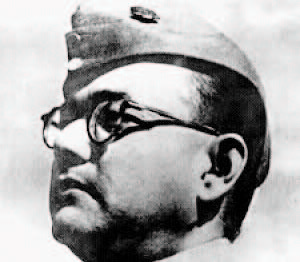
  • NETAJI FILES LOCKED UP IN KOLKATA’S SECRET CELL

    NETAJI FILES LOCKED UP IN KOLKATA’S SECRET CELL

    KOLKATA (TIP): The Nehru regime snoop reports that have rocked the country are only a trickle from the reams of classified documents on Netaji still locked away in a ‘secret cell’ in Kolkata.

    Sixty-four files pertaining to Subhash Chandra Bose — including intelligence reports on surveillance over his relatives between 1947 and 1968 — are still being kept secret by the Bengal government, says Netaji’s grandnephew Abhijit Ray. “The two files whose contents created a sensation last week are locked up in a safe at the Special Branch office on Lord Sinha Road. There are at least 62 other files in the same office, referred to as ‘home cell department’ of West Bengal, that are yet to be disclosed,” Ray said.

    Netaji researcher Anuj Dhar, who calls the secrecy over Netaji files the “biggest cover-up in the history of modern India”, confirmed the existence of these 64 files. “The reference to these files is made in the status report of the Mukherjee Commission,” said Dhar, adding that the contents that went public last week were photocopies of two such files.

    As demand for declassification of files gains momentum, Kolkata-based NGO India’s Smile — that had filed a PIL in Calcutta high court on January 6, 2014, seeking declassification of secret documents on Netaji and INA — filed supplementary affidavit on Thursday, stating that the Bengal government had 64 secret files in its possession but was denying its existence.

    In reply to an RTI, the state government had on February 25, 2014, said that it did not have any secret files on Netaji and that all files it had had been declassified. However, only a month later, on March 24, 2014, a letter (ref no. 921-PL/PF/14M-H/14) written by the home department, police establishment branch, at Nabanna, states that files on Netaji may be available in a hidden location. “I am directed to say that no information regarding this matter is available at this end and to say that the required information may be available from secret cell of this department,” an assistant secretary of the home department wrote.

    “This obviously means Netaji files are kept at the Special Branch office in Lord Sinha Road. Yet, the state government has been mum on the matter for years,” said Rajeev Sarkar, chief functionary officer of the NGO.

    Netaji’s grandnephew, Chandra Bose, is livid over the state government’s silence. “I find it incomprehensible that while Modi could pry out 40 minutes from his busy schedule — that included a meeting with German chancellor Angela Merkel — to meet Surya Bose and listen to the demand for declassification, chief minister Mamata Banerjee could not even spare time to make a statement on the burning issue,” he said.

    Netaji’s niece Chitra Ghosh said she was extremely disappointed that the state government was still holding on to the classified files.

  • EU LEADERS DAMPEN GREEK HOPES FOR BAILOUT RELIEF

    EU LEADERS DAMPEN GREEK HOPES FOR BAILOUT RELIEF

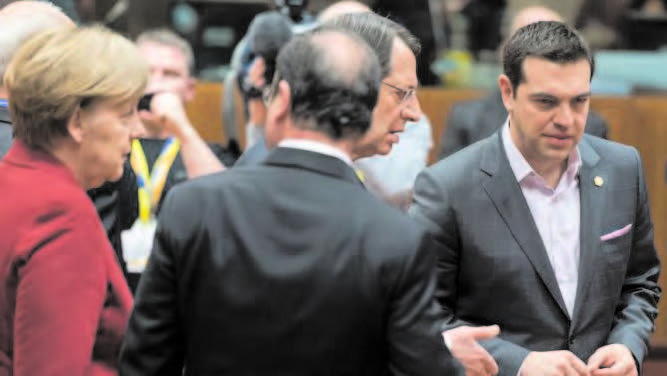
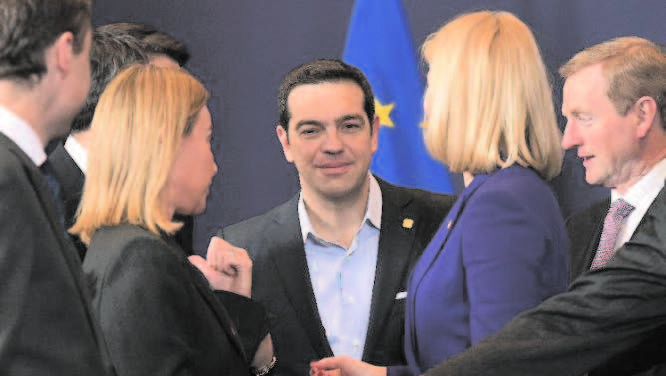
    BRUSSELS (TIP): Exasperated leaders of the European Union pressed the Greek prime minister to speed up plans to improve his country’s balance sheet in a meeting that stretched into the early hours Friday.

    ”A deal is a deal,” Dutch Prime Minister Mark Rutte said ahead of the meeting, reflecting frustration among many leaders at an EU summit about the pace at which Greek Prime Minister Alexis Tsipras is implementing a Feb. 20 agreement to push through reforms in exchange for their help in keeping Greece solvent.

    Tsipras strode into the summit beaming and defiant, saying it is the rest of Europe that needs more ambition.

    ”The European Union needs bold political initiatives,” he said.

    Hanging over the summit of 28 heads of state and government are fears that the hard line of the Greek government formed in January could cause the country to drop out of the euro, something that would trigger a crisis for the currency shared by 19 nations.

    Tsipras made a last-minute request for a mini-summit Thursday night with half a dozen top EU officials. Those officials agreed to the meeting _ over the objections from some of the other leaders, who complained they were being left out _ but made it clear they have no intention of re-negotiating the terms of the Greek bailout. ”There can be a solution only on the basis of the agreements reached in the eurogroup,” Merkel said, referring to the meeting last month of the eurozone’s 19 finance ministers.

    ”Progress,” added the head of the eurogroup, Jeroen Dijsselbloem. “That is not going to happen tonight.” 

    In addition to Merkel and Tsipras, the meeting included French President Francois Hollande, European Central Bank President Mario Draghi and EU President Donald Tusk. None of the EU leaders gave any indication that they were willing to make concessions.

    “We can always have political discussions if that alleviates the pain, but there will be no changes,” Finnish Prime Minister Alexander Stubb said.

    Tsipras, brushing aside the criticism, insisted his government will end austerity and increase social spending. On Wednesday the Greek parliament approved an anti-poverty bill. It was the first piece of legislation that his government has put through _ and it did so without full consultation from its creditor partners.

    Greece’s economic policies drew criticism even from nations outside the eurozone. British Prime Minister David Cameron marveled Thursday at how poorly the Greek economy has fared compared to his own.

    ”When I first came here as prime minister five years ago, Britain and Greece were virtually in the same boat. We had similar-sized budget deficits,” he said. ”The reason we are in a different position is we took long-term, difficult decisions and we had all of the hard work and effort of the British people.” 

    French President Francois Hollande said that if Greece wants to spend more it needs to find the money inside its own borders.

    ”That the Greek government makes an effort for the poor is not shocking to me. What we ask Greece, is that it asks the richest to pay taxes,” he said.

    Greece is banking on the fact that its European partners all want to keep the eurozone intact, fearing that if Greece pulls out others might as well.

    ”Nobody wants a so-called Grexit and everybody wants to avoid this risk,” Tusk said.

  • Austria passes ‘law on Islam’ banning foreign money for Muslim groups

    VIENNA (TIP): Austria’s parliament passed a law on February 24 that seeks to regulate how Islam is administered, singling out its large Muslim minority for treatment not applied to any other religious group.

    The “Law on Islam” bans foreign funding for Islamic organisations and requires any group claiming to represent Austrian Muslims to submit and use a standardised German translation of the Koran.

    The law met with little opposition from the overwhelmingly Roman Catholic population, was backed by Austria’s Catholic bishops, and was grudgingly accepted by the main Muslim organisation. But it upset Turkey’s state religious establishment.

    “We want an Islam of the Austrian kind, and not one that is dominated by other countries,” said Sebastian Kurz, the 28-year-old conservative foreign minister – formally the minister for foreign affairs and integration – who is easily Austria’s most popular politician.

    Austria’s half a million Muslims make up about 6 percent of the population and are overwhelmingly the families of Turkish migrant workers. Many of their imams are sent and financed by Turkey’s state religious affairs directorate, the Diyanet.

    Mehmet Gormez, head of the Diyanet, said before the law was passed that “with this draft legislation, religious freedoms in Austria will have fallen back a hundred years”.

    Austria’s biggest Islamic organisation, IGGiO, accepted the law, but its youth arm opposed it, as did the Turkish-financed Turkish-Islamic Union in Austria (ATIB), which runs many mosques and has vowed to challenge the bill in the Constitutional Court.

    RELATIONS UNPROBLEMATIC 

    While the government has said Islamist militancy is on the rise, and around 170 people have left Austria to join jihadists in Syria or Iraq, Austria has experienced no Islamist violence of note, and relations with the Muslim community have been relatively unproblematic. Unlike France, Austria has not banned Muslim women from wearing full-face veils in public.

    Nevertheless, the opposition far-right Freedom Party, which opposed the bill as too mild, attracts about 25 percent support with an anti-immigrant stance that is also highly critical of Islam. Meanwhile, the ruling Socialist and conservative parties struggle to muster a majority together.

    Austria’s neighbour Germany has also experienced an upsurge of anti-Islam sentiment in the form of the weekly PEGIDA protests in Dresden.

    These have, however, been met with much larger anti-racism demonstrations and a robust response from Chancellor Angela Merkel, mindful of Nazi Germany’s persecution of Jews, who asserted that “Islam belongs to Germany”.

    The Austrian government says the new law strengthens Muslims’ legal status, for example by guaranteeing Islamic pastoral care in hospitals and the army, and protecting Muslims’ rights to eat and produce food according to Islamic rules.

    The bill updates a “Law on Islam” dating from 1912 that was intended to guarantee the rights of Bosnia-Herzegovina’s Muslims in the Austro-Hungarian empire. Turkey’s Gormez, who had attended centenary commemorations for the 1912 law, said its replacement would disregard the “morals and laws of coexistence” that Austria had established a century ago.

  • Ukraine ceasefire falls apart – Kiev says cannot withdraw heavy weapons

    Ukraine ceasefire falls apart – Kiev says cannot withdraw heavy weapons

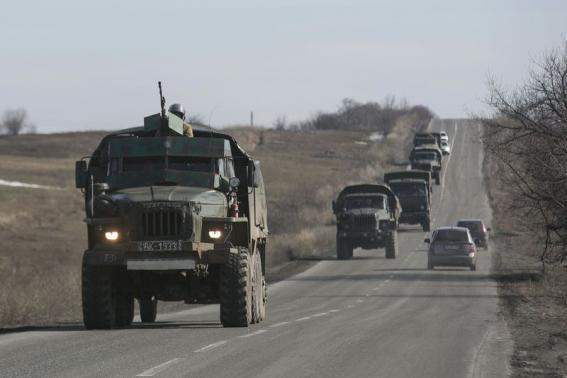
    Kiev accused pro-Russian rebels of opening fire with rockets and artillery at villages in southeastern Ukraine on Monday, all but burying a week-old European-brokered ceasefire deal.

    The Ukrainian military said it could not pull weapons from the front as required under the tenuous truce, as long as its troops were still under attack.

    Ukraine’s currency, nearly in freefall this month, fell a further 10 percent on Monday on fears that the truce could collapse. The central bank said it would tighten currency rules to sustain the hryvnia. The value of Ukrainian debt also fell, with bonds now trading at 40 cents in the dollar.

    The reported shooting came closer to killing off the truce, intended to end fighting that has killed more than 5,600 people, which rebels ignored last week to capture the strategic town of Debaltseve in a punishing defeat for Kiev.

    Kiev and its Western allies say they fear the rebels, backed by reinforcements of Russian troops, are planning to advance deeper into territory the Kremlin calls “New Russia”. Moscow denies aiding the rebels.

    Fighting has diminished since Kiev’s forces abandoned Debaltseve in defeat last Wednesday, and there were hopeful signs for the truce over the weekend, with an overnight exchange of around 200 prisoners late on Saturday and an agreement on Sunday to begin pulling back artillery from the front.

    But Kiev said on Monday that two of its soldiers had been killed and 10 wounded in overnight fighting.

    “Given that the positions of Ukrainian servicemen continue to be shelled, there cannot yet be any talk of pulling back weapons,” spokesman Vladislav Seleznyov said.

    Dmytro Chaly, spokesman for the Ukrainian military in the port of Mariupol, a city of 500,000 people which Kiev fears will be the next target, said rebels opened fire in the afternoon with Grad rockets, artillery and tanks on villages nearby.

    Anatoly Stelmakh, another military spokesman, said rebel forces had attacked the village of Shyrokyne on the coast road towards Mariupol overnight.

    “The fighters have not stopped their attempts to storm our positions in Shyrokyne, in the direction of Mariupol. At midnight armed groups again attempted unsuccessfully to attack our soldiers. The battle lasted half an hour.”

    Rebel commander Eduard Basurin denied rebel fighters had launched any such attack, and said the situation was calm. “At the moment all is quiet, there is no shelling,” he told Reuters.

    The head of the Kiev-controlled Donetsk regional police, Vyacheslav Abroskin, said one police officer was killed and two wounded in Mariupol in a shootout when they stopped a militant “reconnaissance group” carrying explosives in a car. One of the rebels was also killed.

    UNJUSTIFIABLE AND ILLEGAL

    Western countries still hope the truce can be salvaged if the rebels halt, now that they achieved their objective at Debaltseve last week. The foreign ministers of France, Germany,Russia and Ukraine will meet on Tuesday in Paris to try to get the peace deal back on track, a French diplomatic source said.

    But Germany, whose Chancellor Angela Merkel was the driving force behind the peace deal, said in unusually strong terms that it was now clear that the ceasefire was not being implemented.

    British Prime Minister David Cameron said any further attempt to expand rebel territory would be met with fresh Western sanctions on Moscow: “Far from changing course, Russia’s totally unjustifiable and illegal actions in eastern Ukraine have reached a new level with the separatists’ blatant breach of the ceasefire,” he told parliament.

    Nevertheless, the U.S. ambassador to NATO Douglas Lute said it was still too early to “give up hope on the ceasefire” and Russian President Vladimir Putin told state television the deal was the right way to resolve the crisis.

    There were signs, however, that a deal reached late last year to ensure Ukraine receives gas from Russia was also in jeopardy. Last week, Kiev cut back supplies of gas to rebel-held areas and Moscow said it would supply some gas to the rebels directly. On Monday, Ukraine’s gas company said Russia had failed to deliver some supplies Kiev had paid for in advance.

    In Debaltseve, now under rebel control, thousands of civilians who were trapped through the storming of the town are still living in cellars in the ruins. No one has tallied the civilian dead from last week’s assault.

    Nina Shono, 80, one of eight people sheltering in a basement beneath the ruins of their five-storey apartment building, made soup and baked bread on a homemade wood-burning stove in the darkness while a rat scampered in a corner.

    “When we were bombed, we were praying and I was crossing myself, everything was collapsing. One explosion. The second explosion, the third. But we are still sitting here,” she said.

    In the biggest rebel stronghold Donetsk, occasional artillery fire could be heard through the night and on Monday morning, although it was not clear who was firing and it was far less intense than before the truce.

    The separatist press service DAN reported two homes destroyed by shelling on the city’s outskirts overnight.

    Nearly a million people have been driven from their homes by the war between pro-Moscow separatists in eastern Ukraine and government forces. Rebels say they launched their advance because previous battle lines had left their civilians vulnerable to government shelling.

    Donetsk resident Sergei, 52 said he could do no more than hope that the truce would work out. “No one knows what will happen with the way the sides are behaving,” he said.

    Kiev fears unrest could spread to other parts of the mainly Russian-speaking east, where its troops are in control and most residents are loyal but violent separatist demonstrations have occasionally flared in the past year.

    Two people were killed on Sunday in Kharkiv, 200 km (125 miles) from the war zone, in a blast at a pro-Ukrainian rally. Kiev said it had arrested four suspects who had received weapons and instructions in Russia.

  • Greece, Euro Zone Agree Four-Month Loan Extension

    Greece, Euro Zone Agree Four-Month Loan Extension

    Brussels: Euro zone finance ministers agreed in principle on Friday to extend Greece’s financial rescue by four months, averting a potential cash crunch in March that could have forced the country out of the currency area.

    The deal, to be ratified once Greece’s creditors are satisfied with a list of reforms it will submit next week, ends weeks of uncertainty since the election of a leftist-led government in Athens which pledged to reverse austerity.

    “Tonight was a first step in this process of rebuilding trust,” Jeroen Dijsselbloem, chairman of the 19-nation Eurogroup, told a news conference. “We have established common ground again to reach agreement on this statement.”

    The agreement, clinched after the third ministerial meeting in two weeks of acrimonious public exchanges, offers a breathing space for the new Greek government to try to negotiate longer-term debt relief with its official creditors.

    But it also forced radical young Prime Minister Alexis Tsipras into a major climbdown since he had vowed to scrap the bailout, end cooperation with the “troika” of international lenders and roll back austerity.

    European Union paymaster Germany, Greece’s biggest creditor, had demanded “significant improvements” in reform commitments by Athens before it would accept an extension of euro zone funding.

    The two main combatants around the table put a radically different gloss on the result.

    “Being in government is a date with reality, and reality is often not as nice as a dream,” German Finance Minister Wolfgang Schaeuble told reporters, stressing Athens would get no aid payments until its bailout programme was properly completed.

    “The Greeks certainly will have a difficult time to explain the deal to their voters,” the conservative veteran said.

    Greek Finance Minister Yanis Varoufakis said the talks had shown elections could bring change to Europe. He insisted he had averted “recessionary measures” and said the government still hoped to raise the minimum wage and rehire some public sector workers.

    “Nobody is going to ask us to impose upon our economy and society measures that we don’t agree with,” Varoufakis said.

    The euro rebounded against the dollar and global equity markets surged to record closing highs while Greek government bond yields fell on optimism for a debt deal.

    REFORM LIST

    The accord requires Greece to submit by Monday a letter to the Eurogroup listing all the policy measures it plans to take during the remainder of the bailout period.

    If the European Commission, the European Central Bank and the International Monetary Fund are satisfied, euro zone member states will ratify the extension, where necessary through their parliaments.

    Euro finance ministers may sign off on the deal on Tuesday via a teleconference. However, if there are doubts they would reconvene in Brussels, officials said, a conditions insisted upon by Spain, whose government also faces a radical leftist insurgency at an election later this year and is keen that Tsipras gets no special treatment.

    Irish Finance Minister Michael Noonan voiced caution, telling reporters: “It’s an important first step that we hope will lead to a successful second step on Monday night/Tuesday morning, but then of course there’s a third step with ratifications in parliament.”

    With the 240 billion euro EU/IMF bailout programme due to expire in little more than a week, Tsipras had requested a six-month extension of a loan agreement but Germany and its allies objected to the initial formulation of the request.

    Greece’s partners insisted on the shorter period and tied further disbursements to a satisfactory review at the end. They also obliged Athens to commit to fully funding any new spending measures and obtaining approval from its lenders.

    The ECB said there would be no need for Greece to impose capital controls restricting cash withdrawals after the deal.

    An ECB source said the bank’s governing council was ready to resume accepting Greek government bonds as collateral for lending once necessary steps were taken for the extension and the bank determined there was a “great likelihood” that Greece would achieve a “positive conclusion” to its rescue programme.

    TRUST IN SHORT SUPPLY

    The complex document was crafted in preliminary talks among Varoufakis, Schaeuble, Dijsselbloem and IMF Managing Director Christine Lagarde.

    Finance ministers from other euro zone states insisted on more guarantees that Greece would meet the bailout’s strict conditions on budget discipline and economic reforms.

    Tsipras had a long telephone call with Germany’s Angela Merkel on Thursday and has spoken repeatedly to the leaders of France and Italy in the search for a solution that allows his radical government to fulfil election promises.

    Euro zone officials said Greece’s track record and the combative behaviour of its new leaders had undermined their confidence in whether Athens would deliver what it agrees to in talks with the other countries sharing the euro.

    That drove ministers to make Greece hand over custody of nearly 11 billion euros in aid earmarked for stabilising its banks to the euro zone’s rescue fund.

    “We wanted to make sure that the … money for Greek bank recapitalisation is for that purpose, not for recapitalisation of the government,” Dijsselbloem said.

    Some pointed comments were directed at Varoufakis, an outspoken Marxist economist and blogger, and his casual style. “Even hardliners like us have to give the benefit of the doubt to a communist in a Burberry scarf,” an official of one hawkish European country joked.

    Adding to pressure to reach a deal, Greek savers have withdrawn their money from the banks at an accelerating pace despite government assurances that there is no plan to introduce capital controls to stem the outflows.

    Deposit outflows rose to a total of over 1 billion euros in the past two days, some of the highest daily levels seen this year, three senior banking sources told Reuters.

    Greeks were nervous before a three-day weekend, given memories of capital controls imposed in Cyprus in 2013 over a long weekend, a senior banker said. Monday is a public holiday.


  • Greek PM edges towards bailout deal

    Greek PM edges towards bailout deal

    BRUSSELS (TIP): Greece’s new Prime Minister Alexis Tsipras edged closer to securing a massive overhaul of its huge bailout on February 12 after making his case to sceptical EU leaders including German Chancellor Angela Merkel.

    Tsipras, the leftist leader elected by austerity-weary Greeks last month, agreed that Athens would start technical talks with eurozone partners on Friday in a bid to find common ground before a last ditch meeting of finance ministers on Monday.

    But with Greece facing a possible exit from the euro when its 240-billion-euro ($270-billion) EU-IMF bailout expires at the end of February, Tsipras kept talking tough during his first summit with the other 27 European Union leaders.

    “Greece will not blackmail or be blackmailed,” Tsipras said in a press conference after the talks in Brussels.

    He insisted that Greece would ditch the hated “troika” of creditors — the EU, IMF and European Central Bank — which oversees the bailout programme and carries out inspections to see that Greece is living up to its punishing reform commitments.

    “Forget the programme, it no longer exists. The troika doesn’t exist either,” Tsipras said.

    But he said that he discussed with his counterparts the possibility of a six-month bridging programme to give Greece time to work on a different programme that would be acceptable to its creditors, and “find an end to the crisis.”

    – Merkel ‘amicable’ –

    Germany has been the strongest opponent of Tsipras’s plans, adding to anger in Greece against Europe’s biggest economy, which many in Athens blame for imposing years of austerity since the country’s first bailout in 2010.

    But Merkel suggested a “compromise” was possible and spoke of a “friendly” encounter with Tsipras in Brussels, during which they shook hands in front of the cameras.

    “We greeted each other amicably, I congratulated him on his election,” said Merkel, fresh off the plane from Minsk where she helped broker a peace deal for the conflict in Ukraine.

    “On my part I showed my willingness to cooperate. Now we have to see which points we can agree on.”

    The more positive mood saw Greek shares surge over 6.0 percent while European stock markets rose and the euro was firmer against the dollar.

    It was a far cry from the previous night in Brussels, when six hours of tense talks between Greek Finance Minister Yanis Varoufakis and his eurozone counterparts broke down acrimoniously without even agreeing on how to word a joint statement.

    But on Thursday, Tsipras and Eurogroup head Jeroen Dijsselbloem agreed to renew efforts to “start work on a technical assessment of the common ground between the current programme and the Greek government’s plans,” a step that had nearly been agreed on Wednesday.

    – ‘Optimistic’ Europeans –

    Under the Greek proposals, Athens would stick to 70 percent of the programme but it would overhaul the remaining 30 percent which it sees as damaging to growth and toxic on issues including the new government’s plans to raise the minimum wage.

    Athens also wants a bridging loan until September to buy time to hammer out a new reform and bailout package, and to offer debt swaps based on economic performance as the Greek economy moves out of recession.

    Other European leaders said they were hopeful of a deal before Monday, likely the last chance for an agreement if it is to have time to be passed by eurozone parliaments.

    “It’s my understanding that the discussions between Tsipras and Dijsselbloem were quite constructive and good,” Finnish Prime Minister Alexander Stubb, usually a strong advocate for austerity, told AFP.

    “At the end of the day, no one should underestimate the capacity of the Eurogroup meeting to find a solution and I’m carefully optimistic that something will come out over the weekend.”

    Grumbling continued however over the collapse of Wednesday’s talks, with European sources telling AFP there had originally been an agreement on a joint statement with the other ministers, but that it was torpedoed by Tsipras after his finance minister spent 30 minutes on the phone with him to confirm.

    German Finance Minister Wolfgang Schaeuble had already left on the understanding the statement had been approved, they said.

    Greek sources denied this account and said Germany had tried to insert new wording.

  • Kerry travels to Ukraine as US weighs sending arms

    Kerry travels to Ukraine as US weighs sending arms

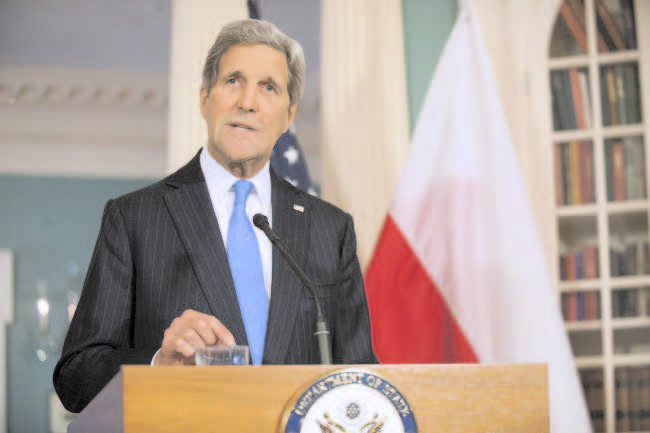
    KIEV (TIP): US secretary of state John Kerry is in Ukraine to show support for the embattled government as the Obama administration weighs sending arms to Kiev to help it fight Russian-backed separatists.


    Amid a fast-moving flurry of international diplomacy, Kerry arrived in Kiev today bringing with him a modest amount of $16.4 million in new US humanitarian aid, but also the potential for lethal weaponry that the country’s leaders say they desperately need to defend themselves and turn back renewed rebel pushes in the east.


    Officials with Kerry said he would discuss those needs with Ukrainian officials as well as new initiatives to resurrect a moribund ceasefire and resume a political dialogue to end the conflict. Kerry is one of three top administration officials in Europe this week with a primary focus on Ukraine. Outgoing defense secretary Chuck Hagel is already in Belgium attending Nato meetings in Brussels, where Vice President Joe Biden is expected on Friday. Biden and Kerry will join forces in Germany at an international security conference in Munich, expected to be dominated by Ukraine and western tensions with Russia.


    Yesterday, President Barack Obama’s pick to run the Pentagon told Congress he is very inclined to support lethal weapons transfers to Ukraine.


    The comments were the latest signal the White House may reverse its opposition to arming Ukraine to help its struggling military repel Moscow-backed insurgents despite concerns that might escalate the conflict, turn it into an overt proxy war with Russia and set Washington at odds with its European partners.


    German Chancellor Angela Merkel, a key ally in pressuring Russia to end its support for the rebels, has said there is no military solution to the crisis and that Germany will not supply weapons to Ukraine. In Ukraine, President Petro Poroshenko said his government badly needs lethal aid to help repel the separatist attacks in the conflict that that has left 5,300 people dead.

  • GERMAN, FRENCH LEADERS TAKE UKRAINE PEACE PLAN TO MOSCOW

    GERMAN, FRENCH LEADERS TAKE UKRAINE PEACE PLAN TO MOSCOW

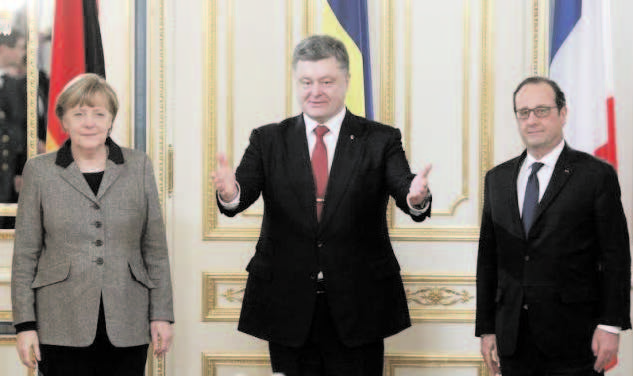
    KIEV (TIP): The leaders of Germany and France announced a new peace plan for Ukraine on February 5, flying to Kiev with a proposal they would then take on to Moscow.


    The coordinated trip by Chancellor Angela Merkel and President Francois Hollande comes as rebels advanced on a railway hub held by Ukrainian troops after launching an offensive that scuppered a five-month-old ceasefire.


    The importance of reaching a deal was demonstrated by a dramatic collapse in Ukraine’s hryvnia currency, which lost nearly a third of its value after the central bank halted daily auctions at which it sold hard currency to banks.


    With Washington moving towards a decision soon on arming Ukraine, US Secretary of State John Kerry also visited Kiev on Thursday. He had no plans to go to Moscow and was not involved in the Franco-German initiative, although he supported it.


    Moscow said it hoped talks with Merkel and Hollande would be “constructive”.


    German government sources said the key problem for resuming peace talks was that the current front line no longer tallies with what was agreed at talks in Minsk, Belarus, last year. One idea was that a new attempt at a ceasefire should take in the current front line, which reflects rebel gains.


    For talks to begin anew, Kiev would have to accept that the separatists now control several hundred square kilometers more than agreed in Minsk – – without Kiev having to give up its claim to these areas as part of the Ukrainian state.


    In the end, the goal of the peace process should be the restoration of Ukraine’s territorial integrity, the sources said.


    Ukrainian Prime Minister Arseny Yatseniuk said Kiev would not consider any peace plan that casts doubt on the nation’s territorial integrity, sovereignty or independence.


    The Franco-German plan looks like an eleventh-hour bid to halt the escalation of the conflict ahead of diplomatic deadlines likely to make east-west confrontation even worse.


    Peace talks collapsed on Saturday in Belarus and EU leaders are expected to consider new sanctions against Moscow next week.


    “Together with Angela Merkel we have decided to take a new initiative,” Hollande told a news conference. “We will make a new proposal to solve the conflict which will be based on Ukraine’s territorial integrity.” 


    He and Merkel met President Petro Poroshenko in Kiev on Thursday and were expected to go to Moscow to see Russia’s Vladimir Putin on Friday.


    Poroshenko said the talks “gave hope that there will be a result in a ceasefire”, his office said in a statement.


    Hollande said earlier: “For several days Angela Merkel and I have worked on a text … a text that can be acceptable to all.” 


    German Foreign Minister Frank-Walter Steinmeier played down the prospect of a breakthrough: “I don’t want to talk about the chances (of success). At this stage there is hope, rather than chances.” 


    NATO says Russia has sent weapons, funds and troops to assist the rebel advance, negating a ceasefire in eastern Ukraine where war has already killed more than 5,000.

  • US warns cost of Russian actions in Ukraine will ‘rise’

    US warns cost of Russian actions in Ukraine will ‘rise’

    WASHINGTON (TIP): The United States gave a clear signal January 28 that Russia will face further sanctions for what the White House says is Moscow’s role in fueling violence in eastern Ukraine.


    Following a telephone call between US Vice President Joe Biden and Ukrainian President Petro Poroshenko, the White House condemned “Russian-backed separatists” and the “heavy toll that the Russian-backed offensive in the east was having on Ukraine’s civilian population.” 


    “As long as Russia continues its blatant disregard of its obligations… the costs for Russia will continue to rise,” Biden was reported to have told the Ukrainian leader.


    Late Tuesday President Barack Obama and German Chancellor Angela Merkel discussed the “significant increase” in violence in Ukraine and warned Russia would be held accountable.


    “The two leaders expressed concern about the significant increase in violence in eastern Ukraine and Russia’s material support for the separatists,” a White House statement said.


    “They agreed on the need to hold Russia accountable for its actions.” Western sanctions and a slide in oil prices have plunged Russia into recession and seen Standard and Poor’s slap a “junk” rating on Moscow’s foreign currency debt.


    Pro-Russian rebels in Ukraine last week defiantly pulled out of peace talks and promised an offensive on a strategic government-held port city that provides a direct land bridge to Ukraine’s Russian-occupied Crimea peninsula.


    Russia denies backing the eastern insurgents and says that measures against it are designed to undermine President Vladimir Putin’s 15-year rule. Obama has issued an executive order prohibiting trade with Crimea, the Black Sea peninsula that Moscow annexed from Ukraine in March.


    Two dozen people — including Russians and separatists — have also been added to a US blacklist, subjecting them to travel bans and assets freezes.

  • 15,000 join anti-Islam protest in eastern Germany

    15,000 join anti-Islam protest in eastern Germany

    DRESDEN , GERMANY (TIP): A record 15,000 people marched in eastern Germany against “asylum cheats” and the country’s “Islamisation” in the latest show of strength of a growing far-right populist movement, says an AFP report.

    Chancellor Angela Merkel earlier cautioned Germans against falling prey to xenophobic “rabble-rousing”, reacting to the nascent movement called “Patriotic Europeans Against the Islamisation of the Occident” or PEGIDA.

    “The people are with us!,” the group’s founder Lutz Bachmann shouted at the crowd, celebrating a 50-percent rise in attendance since their last “Monday demonstration” in a series of rallies that started only in October.

    “Everywhere now, in every news rag, on every senseless talk show, they are debating, and the most important thing is: the politicians can no longer ignore us!” Bachmann told the mass of people, many waving the black-red-gold national flag.

    “We have shown by taking another ‘little stroll’, and by growing in numbers, that we’re on the right path, and that slowly, very slowly, something is beginning to change in this country,” Bachmann bellowed to loud cheers yesterday.

    Since the protests have rapidly grown in size and spawned smaller clones in half a dozen cities, a debate about immigration and refugees has gripped Germany, a country whose Nazi past makes expressions of xenophobia especially troubling.

    Politicians have been stunned by the emergence in the city of Dresden of the nationalists who march against what they consider a broken immigration and asylum system and who vent deep anger at the political class and mainstream media.

    The demonstrations have flared at a time when Germany, Europe’s biggest economy, has become the continent’s top destination for asylum seekers, and the world’s number two destination for migrants after the United States.

    The influx of refugees from Syria, Iraq, Afghanistan and several African and Balkan countries has strained local governments, which have scrambled to house the newcomers in old schools, office blocks and army barracks.

    One demonstrator, Michael Stuerzenberger, said he does not oppose asylum for refugees but asserted that “70 percent of people claiming political asylum here are economic refugees. We don’t want to stay silent about this anymore.”

    “We don’t want a flood of asylum seekers, we don’t want Islamisation. We want to keep our country with our values. Is that so terrible? Does that make us Nazis? Is it a crime to be a patriot?”

    While several known neo-Nazis have been spotted in the PEGIDA crowds, the rallies have been dominated not by jackbooted men with shorn heads but by disenchanted citizens who voice a string of grievances.

  • PM MODI RETURNS FROM BRAZIL AFTER ATTENDING BRICS SUMMIT

    PM MODI RETURNS FROM BRAZIL AFTER ATTENDING BRICS SUMMIT

    NEW DELHI (TIP): Prime Minister Narendra Modi returned to New Delhi last night after attending theVIth BRICS Summit in Fortaleza in Brazil. On his way back, Modi made a transit halt at Frankfurt and had a telephonic conversation with German Chancellor Angela Merkel. The Prime Minister complimented the German Chancellor on the splendid victory of the German football team and also conveyed his good wishes to Chancellor Merkel on her 60th birthday which was yesterday.

    The Prime Minister conveyed that India regards Germany as a very important partner and that his Government will work closely with the German side to strengthen and deepen the bilateral strategic partnership. He invited the German Chancellor to visit India in 2015 for the third meeting of the India Germany Consultations. She accepted his invitation. The two leaders also briefly discussed areas of bilateral cooperation including through skill development. During his visit, Modi had bilateral meetings with leaders from Russia, China, Brazil, and South Africa.

    Prime Minister also had an opportunity to interact with eleven South American leaders at the meeting between BRICS and South America hosted by Brazilian President Rousseff. This was the first occasion when an Indian Prime Minister had an opportunity to meet so many South American leaders at one place. The visit of Prime Minister Modi is being termed as a very important and fruitful one as far as the diplomatic gain to India is concerned.

  • PM MODI DEPLOYS DEFT DIPLOMACY

    PM MODI DEPLOYS DEFT DIPLOMACY

    NEW DELHI (TIP): “Had a telephonic conversation with Chancellor Merkel. Wished her on her birthday and congratulated her on Germany’s win at the FIFA World Cup,” tweeted prime minister Narendra Modi. For a prime minister who people said was more interested in the economy and domestic politics, Modi appears to be enjoying himself hugely on the international stage, and judging by reports, quite good at it.

    If there was any awkwardness over the fact that Merkel had stood him up at dinner last Sunday, Modi did not let it ruffle him or tie up his diplomacy. In fact, in Fortaleza and Brasilia this week, Modi played the bigger game with two important counterparts, Xi Jinping and Vladimir Putin. (He’s no slouch in the sartorial department either, whether in a pink kurta in Berlin or a casually draped scarf in Brazil).

    Xi Jinping set a cat among the pigeons by inviting Modi over to Beijing for the APEC summit. The US and other western countries will find it extraordinarily hard to resist bringing India into the APEC tent after this. For India, an entry into APEC will allow Modi to integrate India more closely into the global system, make the changes in India’s tariff structures and other systems of economic governance he needs to bring India’s rates to Asean levels.

    At some point, India might even make the grade to the transpacific partnership (TPP). But APEC is the gateway to TPP. Notwithstanding the critics, the BRICS Bank is the biggest challenge to the Fund/Bank sisterhood. India didnt really stand a chance about hosting the headquarters, so Modi didn’t waste precious capital on it. It was always going to be headquartered in Shanghai. This was also agreed to by the UPA government.

    In any case, China as the largest BRICS economy and the deepest pockets is naturally going to dominate the Bank despite the fact that everybody has an equal share. But an Indian will head the Bank for the first six years. In all these decades, no Indian has ever headed the IMF or World Bank. And the chairmanship will be a rotational thing. That’s a big deal for India and will overshadow critics who wonder whether the new bank will fund projects in Arunachal Pradesh.

    India doesn’t even go to the ADB for that. The Modi-Xi tango would not be unnoticed in Washington and important as the US Congress takes a call on increasing India’s voting power in the IMF. On a more political front, Modi has agreed to visit China and Xi will be in India in September — before Modi flies off the Washington DC to meet Barack Obama and after he makes his first trip to see Shinzo Abe. India needs all three — China, Japan and US to fulfil its developmental goals.

    Modi is playing a deep political game as he opens India for business with all three. His effusiveness with Vladimir Putin incorporated more layers. Russia is indeed India’s oldest partner, as Modi informed Putin. But beyond the nuclear energy, Kudankulam and defence supplies, India signaled solidarity with Russia at a time when Putin is a bad name in the west for his Ukrainian misadventure. After Russia signed a $400 billion gas deal with China and help out the promise of weapons sales to Pakistan, India has worried that its old friend might end up in the Chinese basket.

    That would have adverse implications for India in the long run. Putin can expect a fulsome welcome when he visits in December. Modi has ordered a reset of relations with the US, necessary after the last few bad years. How Washington responds to Modi will determine the strategic matrix India’s new PM is working on.

  • Ukraine’s president shakes up military leadership

    Ukraine’s president shakes up military leadership

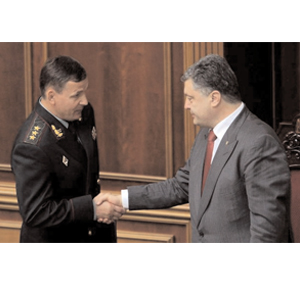
    KIEV, UKRAINE (TIP): Ukrainian President Petro Poroshenko shook up his faltering military on July 3, appointing a new defense minister and top general while speaking angrily about the years of decay and corruption that left the forces unable to deal effectively with the well-armed eastern insurgency. His tougher tone, analysts say, reflects public pressure to continue the fight against the insurgents in the regions bordering Russia — even with a rickety military that’s had little success. Poroshenko denounced the “complete collapse” of the government’s ability to supply the armed forces in a sometimes angry, finger-wagging speech in parliament.

    He won quick approval for his choice of former top police official Valery Heletey as defense minister, replacing Mikhailo Koval. He also tapped Lt. Gen. Viktor Muzhenko as chief of the military’s general staff and Yury Kosyuk, an agriculture magnate and one of Ukraine’s richest men, to oversee defense issues in the presidential administration and to help “purge the army of thieves and grafters.” Accusations of corruption have been rife as Kiev’s operation against the rebels continues.

    “Today the revival of the army is starting from scratch, an army which is capable of fighting and winning,” Poroshenko said in parliament. Poroshenko’s shakeup underscores the complex job he faces of making peace overtures and at the same time suppressing the insurgency that threatens to tear his country apart or create a permanent twilight zone beyond government control. Other pressures come from outside: Ukraine and the West say Russia is helping arm the rebels and letting its citizens cross the border to fight, while key allies France and Germany are pushing Poroshenko to pursue talks over attacks. President Barack Obama consulted with German Chancellor Angela Merkel by phone Thursday about how to get peace talks back on track. The White House said they discussed diplomatic efforts to bring about a lasting ceasefire and agreed that the US and Europe should levy further costs on Russia if it doesn’t de-escalate the situation quickly.

    Poroshenko’s forceful words and demeanor Thursday contrasted with his emphasis on starting a peace process voiced in his inaugural address June 7. He declared a unilateral cease-fire for 10 days in hopes rebels would lay down their arms and join talks. But the ceasefire was repeatedly violated and ultimately expired. Foreign ministers from Ukraine, Russia, Germany and France are pushing to get talks going again by Saturday, with the aim of achieving a cease-fire honored by both sides. Rebels in the eastern regions of Donetsk and Luhansk, where more Russian speakers live, have declared independence and occupied government buildings.

    The insurrection, in which more than 400 people have died, started after pro-Russian President Viktor Yanukovych was driven from office by a protest movement among people wanting closer ties with the European Union instead of Russia. Russia called Yanukovych’s ouster a coup by radical nationalists and seized Ukraine’s Russian-speaking Crimea region. Poroshenko was elected in a special election May 25 to replace Yanukovych and faces high expectations. “The level of impatience in society is very high,” said Alyona Getmanchuk, director of the Institute of World Policy research institute in Kiev.

    “They want to see results.” Getmanchuk said Poroshenko is careful to meet with a wide range of people, a habit he cultivated when serving as foreign minister in an earlier government, and knows what people are thinking. News media and traffic on social media urge action. The mood was underscored when members of volunteer battalions demonstrated in front of his office, demanding an end to the cease-fire. Getmanchuk cautioned that much of the desire for action is based on fear of Russia and anger at the loss of life suffered already, and “doesn’t consist of serious analysis of possible consequences.

    ” In Donetsk many people just want the fighting to be over. The city center was the scene of a gunfight in broad daylight Tuesday when separatists from the selfdescribed Donetsk People’s Republic attacked a police building, “We are tired of war. Our only wish is for all of this to be over so we can work in peace,” said Anton Orlets, a 58-yearold businessman. He expressed “hope that the new appointments will help the Ukrainian army achieve success, which so far has not been terribly noticeable in Donbass.”

  • US SAYS RUSSIA HAS ‘HOURS’ TO EASE UKRAINE CRISIS

    US SAYS RUSSIA HAS ‘HOURS’ TO EASE UKRAINE CRISIS

    PARIS (TIP): The United States warned Russia on june 26it had only “hours” to prove it was helping disarm Ukrainian insurgents whose separatist drive has reopened a Cold War-style chasm in East-West ties. US Secretary of State John Kerry’s warning came a day before Ukraine’s President Petro Poroshenko signs the final chapters of an historic EU accord that nudges his country toward eventual membership and pulls it firmly out of Russia’s reach.

    Poroshenko also intends to get German Chancellor Angela Merkel and French President Francois Hollande to join him for a second round of telephone diplomacy with Russian President Vladimir Putin in two days. Putin came under intense pressure from both European leaders and US President Barack Obama on Wednesday to rein in separatist fighters over whom he denies exerting control.

    Obama said sweeping economic sanctions were imminent unless the Kremlin stopped “the flow of weapons and militants across the border”. US Secretary of State John Kerry was even more explicit in Paris on Thursday following talks with French counterpart Laurent Fabius.

    “We are in full agreement that it is critical for Russia to show in the next hours, literally, that they’re moving to help disarm the separatists, to encourage them to disarm, to call on them to lay down their weapons and to begin to become part of a legitimate process,” Kerry said. The State Department added that sanctions would be also discussed by EU leaders on Friday when they sign the full Association Agreement with Ukraine that was ditched by the ousted pro-Russian president in November and now lies at the heart of the raging crisis.

    The punitive steps under deliberation would target Russia’s financial and defence sectors at a time when its export-dependent economy is on the verge of slipping into another recession. US media reports said one particularly painful step under consideration would prohibit the export of technology that could help Russia explore for oil and gas in the Arctic — a major ambition of powerful stateheld energy firms.

    But 11 weeks of fighting that has already claimed more than 435 lives and brought factories in Ukraine’s economically vital eastern rustbelt to a virtual standstill continued today despite the ceasefire agreement. A spokesman for Ukraine’s “antiterrorist operation” said 10 paratroopers were wounded in rebel attacks on government roadblocks on Thursday. Ukrainian media reports said gunmen had also attacked a small airport overnight in the flashpoint village of Kramatorsk.

  • G7 threatens Russia with more curbs

    G7 threatens Russia with more curbs

    BRUSSELS (TIP): World leaders urged Vladimir Putin on June 4 to stop destabilizing Ukraine or face further sanctions as they met without a Russian president for the first time since the 1990s. Putin reached out a hand despite being banned from the Group of Seven summit following Russia’s annexation of Crimea in March, saying that he was ready to meet Ukraine’s president-elect. But G7 leaders said that while they still hoped for “constructive” talks with Putin on the sidelines of D-Day commemorations in France on Friday, Moscow could face further punitive measures.

    In a joint communique they said Putin must recognize the results of Ukraine’s May 25 presidential election, won by Petro Poroshenko, stem destabilization in the east of the country, and pull Russian troops back from the border. “Actions to destabilize eastern Ukraine are unacceptable and must stop,” the group said. “We stand ready to intensify targeted sanctions and to implement significant additional restrictive measures to impose further costs on Russia should events so require.”

    The leaders have warned Russia that manipulating energy supplies to intimidate one’s neighbours is unacceptable and that they need to diversify their energy systems to avoid getting blackmailed. “The use of energy supplies as a means of political coercion or as a threat to security is unacceptable,” a draft G7 summit statement seen by AFP said. Russia supplies about 30% of Europe’s gas, with about half of that transiting Ukraine. Obama has shown no signs of wanting a meeting with Putin despite the fact that both will be in Normandy to mark the 70th anniversary of the World War II D-Day landings in Europe.

    Other G7 leaders whose economies are more exposed to Russia than Washington took a softer tone. German Chancellor Angela Merkel said that European leaders would “take stock” of Russian actions at a summit end June and “reflect which further sanctions are necessary”. But Merkel, who is due to meet Putin in France, said that “the main thing is to be constructive” and that further sanctions would take effect only if there had been “no progress whatsoever”.

    French President Francois Hollande – who is scheduled to have separate dinners with both Putin and Obama in Paris on Thursday – agreed that “dialogue and deescalation must be encouraged”. British PM David Cameron said he would be taking a similar message to Putin when he meets him also on Thursday. Putin hinted that he could meet both Poroshenko and even Obama, saying “I don’t plan to avoid anyone”.

    But he taunted the United States and waved away allegations of Russian military meddling in eastern Ukraine. “Proof ? Let’s see it!” he said. “The entire world remembers the US secretary of state demonstrating the evidence of Iraq’s weapons of mass destruction, waving around some test tube with washing powder in the UN Security Council,” Putin said.

  • Putin wants troops out of Ukraine’s east

    Putin wants troops out of Ukraine’s east

    DONETSK (UKRAINE) (TIP):
    Russian President Vladimir Putin said on May 1 that Ukraine should withdraw its military from the eastern and southern regions of the country, a statement that could bolster antigovernment insurgents who are seizing buildings. Hours later, Ukraine’s acting president ordered that the military draft be renewed, citing “threats of encroachment on the nation’s territorial integrity” and interference by Russia in its internal affairs.

    Moscow has consistently denounced Ukrainian security forces’ largely ineffectual operation against the eastern insurgents and warned they should not commit violence against civilians. In a telephone conversation with German Chancellor Angela Merkel, Putin said the removal of military units was the “main thing,” but it was unclear if that could be construed as an outright demand.

    Oleksandr Turchynov’s conscription order marked a turnaround for the country, which last year announced plans to end military conscription in favor of an all-volunteer force. His order did not specify where conscript-bolstered forces could be deployed. The renewal of military conscription affects only men 18 to 25 years old. Earlier in the week, the acting president said police and security forces had been effectively “helpless” against insurgents in the Donetsk and Luhansk regions, the heart of the unrest, and that efforts should be focused on preventing the instability from spreading to other parts of the country.

    In the regional capital city of Donetsk, anti-government demonstrators took over the regional prosecutor’s office Thursday. Several dozen riot police standing guard at the office fired stun grenades and tear gas when some at the front of the crowd of several hundred people attempted to force their way into the building. As the confrontation escalated, some in the crowd threw rocks and managed to wrest away shields from police.

    An Associated Press reporter saw a handful of officers being dragged away and beaten by members of the crowd. Hundreds of onlookers accompanying the protesters shouted slogans and hurled abuse. A car outside the building blared out patriotic World War II music. Inside, a passenger waved a flag bearing a doctored image of Soviet leader Josef Stalin in a black vest and holding a machine gun superimposed with the words: “Death to Fascism.”

    Upon occupying the building, protesters discarded the Ukrainian flag and replaced it with that of the Donetsk People’s Republic — a movement that seeks either greater autonomy from the central government, or independence and possible annexation by Russia. Donetsk is the heartland of support for Russia-friendly former President Viktor Yanukovych, who was ousted in February after months of protests in the capital.

    Opponents of the government that succeeded him have seized buildings in about a dozen cities and towns in eastern Ukraine. Local news website Novosti Donbassa reported that earlier in the day around 30 armed men arrived in six cars in the town of Amvrosiivka, which lies close to the Russian border, and took over the city council and forced the mayor to resign. On Wednesday, insurgents took control of the customs-service building in Donetsk and city hall in Alchevsk, an industrial center of about 110,000 people, adding to the scores of buildings taken by the separatists over the past month in the east, where a dozen cities are now in the hands of the separatists.

    There has also been a spate of reported kidnappings of pro-government politicians. The Svodoba nationalist party said a local party branch leader in Kostiantynivka, 65 kilometers (40 miles) north of Donetsk, initially managed to fight off attackers at his home but was taken away as he was phoning for help. Turchynov has twice proclaimed “antiterrorist” operations to regain control of the east, but to little effect.

    Unlike many recent seizures of the government offices, the assault on the prosecutor’s office appeared to have been spearheaded by people armed with little more than sticks. However, at least one young man was seen with a handgun tucked into his trousers, and at least one firebomb was thrown at the building. The armed element of the insurgency is focused on Slovyansk, a city 110 kilometers (70 miles) north of Donetsk in which seven European observers from the Organization for Security and Cooperation in Europe remain held by pro-Russia gunmen.

    Merkel on Thursday again called Putin and asked for his assistance in freeing the group, Merkel spokeswoman Christiane Wirtz said. Russia denies allegations from Kiev and the West that it is influencing or fomenting strife in eastern Ukraine. The Kremlin confirmed the conversation and said Putin stressed “the main thing was for Ukraine to withdraw its troops from southeastern Ukraine, stop the violence and quickly start a broad national dialogue on constitutional reform.” In Washington, the second-ranking official of the North Atlantic Treaty Organization said the alliance now feels compelled to start treating Moscow as an adversary.

    “In central Europe, clearly we have two different visions of what European security should be like,” Alexander Vershbow, the deputy secretary-general of NATO, said in a question-and-answer session with reporters. He said Russia’s annexation of Crimea and its apparent efforts to manipulate turmoil in eastern Ukraine have fundamentally changed the NATO-Russia relationship.

  • Obama, Merkel talks focus on Ukraine as rebellion spreads

    Obama, Merkel talks focus on Ukraine as rebellion spreads

    KIEV (TIP): US President Barack Obama and German chancellor Angela Merkel will discuss the escalating Ukraine crisis on May 2 after Kiev brought back military conscription and a pro-Russian rebellion in the east threatened the ex-Soviet republic with disintegration.

    The White House meeting between Obama and Merkel will be their first since the start of the unrest and Russia’s annexation of Crimea in March. Kiev’s decision to reinstate conscription, decreed by interim president Oleksandr Turchynov, came after insurgents tightened their grip over more than a dozen eastern cities and towns.

    Around 300 militants hurling petrol bombs and bricks stormed the sixstorey prosecutor’s building in Donetsk, beating up outnumbered riot police and stripping them of their shields and batons. Ukrainian media reported that a prosecutor’s office in the town of Horlivka and a police station in Krasnoarmiysk were also overrun. The violence took place as mass pro- Russia rallies were held in Donetsk and in annexed Crimea.

    Gunfire and heavy detonations were heard on Friday just to the north of Ukraine’s rebel-held town of Slavyansk, insurgents and AFP journalists said. A helicopter was earlier also seen circling low in what appeared to be part of an attack by Ukrainian forces, said the rebels, who had set a roadblock on fire to produce cloaking smoke. Kiev’s Western-backed government has admitted its security forces are helpless to halt the expanding rebellion it accuses Moscow of masterminding. Turchynov on Wednesday accused law enforcement units in the east of “inaction” or even working with the rebels in an act of “treachery”.

    He also put Ukraine’s current army of 130,000 on “full combat alert” because of fears an estimated 40,000 Russian troops massed on the border for the past two months could invade. In his conscription order Thursday for Ukrainian male reservists aged 18- 25, Turchynov said his government was trying to counter “the deteriorating situation in the east and the south”. The mounting insurgency and building seizures “threaten territorial integrity”, a statement from his office said. Russia’s foreign ministry said any effort by Kiev to intensify its military operation “against its own people” in the east could have “catastrophic consequences”. Amid the spiralling crisis, Germany stepped up its appeal to Russian President Vladimir Putin to help free seven OSCE inspectors held in Slavyansk by the rebels — four Germans, a Pole, a Dane and a Czech.

    In a phone call, Merkel “reminded President Putin of Russia’s responsibilities as an OSCE (Organisation for Security and Cooperation in Europe) member and called on him to use his influence”, her spokesman said. The Kremlin said both leaders emphasised the “mediating potential of the OSCE” in calming the crisis in Ukraine. German Foreign Minister Frank- Walter Steinmeier was to discuss the hostage crisis with his Swiss counterpart Didier Burkhalter, the current OSCE chief, in Bern on Friday. Putin reiterated his call for Kiev to end its military operation trying to counter the pro-Russian rebellion. That drew an incredulous reaction from the White House. A spokesman said: “That was a rather remarkable statement… (that) called on Ukraine to remove its forces from its country, which is preposterous, if you think about it.”