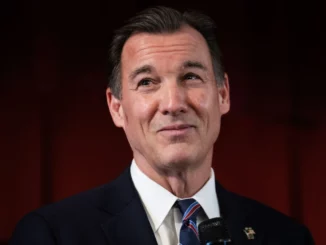
The Indian Panorama was one of the first newspapers to endorse Tom
Updated February 15, 2024
NEW YORK (TIP): Tom Suozzi won back New York’s 3rd Congressional District seat that he earlier held for three terms. He defeated his less-known Republican rival Mazi Pilip, Nassau County legislator, by a double-digit margin.
He flipped a Republican held seat which became vacant when the disgraced George Santos was expelled from Congress.
CNN projected Suozzi’s victory at about 10.30 pm on Tuesday, February 13, and said Mazi had conceded defeat.
Even though media reports said it was going to be a close race, Suozzi prevailed easily. The contest for this congressional seat had national stakes because Republicans enjoy only a razor-thin majority in the House. Under national media glare, the contest also attracted big spending by both candidates and their parties.
In every campaign speech Suozzi hammered home the point that amid growing polarization in the country, he is the one with a record of working across the aisle.
In his victory speech, Suozzi stressed his campaign trail theme of bipartisan cooperation.
“There are divisions in our country where people can’t even talk to each other. All they can do is yell and scream at each other,” he said, acknowledging the demonstrators who interrupted his speech, shouting against his support to Israel. “That’s not the answer to the problems we face in our country. The answer is to try and bring people together to try and find common ground.”
“The way to make our country a better place is to try and find common ground. It is not easy to do. ” Suozzi told supporters at his election night party in Woodbury.
Suozzi is a friend of the Indian community which has a major presence in Nassau County. He served as Mayor of Glen Cove before being elected Nassau County Executive. He was elected to Congress from New York Congressional District 3 in 2016 and was re-elected in 2018 and 2020. He did not contest in 2022 for the NY3 seat he held because he ran for New York State governor.
Trained as an attorney and CPA, Tom Suozzi has committed his 30-year public service career to delivering for his constituents. His philosophy of working with anyone who shares his goal of solving problems and delivering for his constituents has guided his career and led to notable accomplishments on issues including protecting the environment, common-sense gun safety, full access to reproductive health care, immigration, caring for our veterans, affordable healthcare, and fiscal responsibility.
The Indian Panorama was one of the first media houses to endorse Suozzi way back in early December soon after he received the Democratic nomination.
Journalists Beyond Borders to be launched at the event graced by leading media persons
February 16, 2024
NEW YORK (TIP): The Editor-in-Chief of Blitz India, Mr. Deepak Dwivedi, will be the keynote speaker at a major media event co-organized by the Consulate of India and The Indian Panorama on February 26. Mr. Dwivedi will speak on ‘Indo-US relations with Emphasis on Cooperation in Trade and Commerce, and with a Special Reference to SDGs’. It is a topic close to the heart of this veteran journalist and academic who launched Blitz India as the country’s first chronicler of development news.
Blitz India CEO Mr. Sandeepp Saxena, accompanying Mr. Dwivedi on the US visit, will introduce the pioneering newsweekly as an effective platform to channel all efforts in India towards the implementation of Sustainable Development Goals (SDGs).
Blitz India has several editions in India and its UK edition was launched last year. Its US launch is scheduled to be launched on February 25 at the 18th-year Gratitude Gala of The Indian Panorama.
The February 26 event to be presided over by Consul General of India in New York, Ambassador Binaya Srikanta Pradhan, will also witness the formal launch of body of journalists by the name ‘Journalists Beyond Borders’(JBB), founded in July 2022 by Prof Indrajit Singh Saluja, chief editor of The Indian Panorama. JBB aims to unite the fraternity of journalists the world over to protect and promote through journalism human rights, human values, and world peace. Its greater mission is to use the power of the press to educate people everywhere on the values of non-violence, peaceful coexistence, clean environment, and health for all.
Four persons to be honored for their singular achievements
Guest of Honor Ambassador Binaya Srikant Pradhan, Consul General of India at New YorkGuest of Honor US Congressman Tom Suozzi (NY District 3)
February 16, 2024
By Parveen Chopra
HICKSVILLE, NY (TIP): The Indian Panorama is celebrating its 18th year of publication with a Gratitude Gala on February 25 in a grand way. Says its Founding Editor and Publisher Prof Indrajit Singh Saluja, “I want to celebrate community, and say my heartfelt thanks to our readers, friends, supporters, and advertisers for the love and support they have blessed us with all these years.”
Prof. Indrajit Saluja has become synonymous with his weekly newspaper, a labor of love. He is not only an eminent editor but also a well-respected community leader who has forged links across the ethnic and political spectrum. His friends, supporters, and who’s who of the community are set to grace the gala at the glittering Pearl Banquet Hall in Hicksville not only to felicitate The Indian Panorama but also to wish him a long life on his 80th birthday.
Dignitaries
Presiding the delightful event will be Hon. Ruchira Kamboj, India’s Ambassador to the United Nations, the first woman diplomat to hold that position.
The new Consul General of India in New York, Ambassador Binaya Srikanta Pradhan will be offered a welcome toast by the community at the event.
The newly elected Congressman, Hon’ble Tom Suozzi, whom the Indian Panorama endorsed on the first day of his campaign, has promised ‘my loyal friend’ Prof Saluja that he will be there to personally thank Long Island’s Indian community, with whom he has forged bonds over the years.
Honorees
The four eminent people to be honored at the gala with whom The Indian Panorama has had a long association, are:
Dr. V.K. Raju -Life Achievements Honor
Dr V.K. Raju – Life Achievement Honor award. The President and Founder of the Eye Foundation of America, he has a mission to eliminate childhood blindness from the world. He has helped start two eye hospitals in India and held free eye camps in 30 developing countries.
Mrs. Ranju Batra – Excellence in Promotion of Diplomacy Award
Mrs. Ranju Batra – Excellence in Promotion of Diplomacy Award. She is the Chairperson of Diwali Foundation USA which holds the Diwali Stamp – Power of One awards event at the UN every year to honor diplomats. She also led the campaign to get USPS to release the Diwali stamp.
Mr. Harry Singh Bolla – Excellence in Entrepreneurship Award
Mr. Harry Singh Bolla – Excellence in Entrepreneurship Award. He is the Founder and CEO of Bolla Oil Corporation which runs a chain of gas stations and convenience stores in the New York area. Through his Bolla Charity Foundation, he gives back to the community here and extends help to the needy in India.
Mrs. Purnima Desai – Excellence in Culture Award
Mrs. Purnima Desai — Excellence in Culture Award. As Founder and President of Shikshayatan Cultural Center and Sriniketan Foundation, she has been instrumental in encouraging and supporting Indian culture through music and arts training and events. She has also produced and directed over a thousand cultural programs.
Blitz India US launch
Mr. Deepak Dwivedi, Chairman and Editor-in-Chief, BlitzIndiaMr. Sandeepp Saxena, CEO, BlitzIndia
The Indian Panorama’s gala event will also get an international sheen. The US edition of Blitz India will be jointly launched by its Chairman and Editor-in-Chief, Deepak Dwivedi, CEO Sandeepp Saxena, and Prof Saluja. Blitz India, the country’s first chronicler of development news, has several editions in India and was launched in the UK last year.
Mr. Parveen Chopra, Founder of ALotusInTheMud.com
At the event for the ages, Prof Saluja will also introduce ALotusInTheMud.com, founded by his friend, Mr.Parveen Chopra. Launched at the Indian Consulate in January, 2023, Lotus is a web magazine presenting free content on wellness and spirituality, a first by an Indian American.
The attendees at the gala will also be welcomed and entertained with both traditional Indian and contemporary touches.
About Prof Saluja
Prof. Indrajit S Saluja, Publisher & Chief Editor, The Indian Panorama
For Prof Saluja, The Indian Panorama is an expression and extension of his love for India as well as a platform to project the rich South Asian culture and how our successful community has made a place in the melting pot of America. A trilingual, he has also helped start newspapers in Hindi and Punjabi.
Started 18 years ago in New York, The Indian Panorama also has a Dallas edition now. It reaches the Indian diaspora in the entire US and the world. Its editorial content is the right mix of community news as well as Indian and American current affairs.
Indefatigable Prof Saluja’s spirit and intensity of work belie his years. He came to the US over 20 years ago after having a long career as a Professor of English Literature at leading colleges in India. Alongside, he founded a prominent monthly magazine titled ‘Punjab Beat’.
Robert Frost’s words “The woods are lovely, dark and deep, but I have miles to go before I sleep”, aptly characterize Prof. Saluja’s journey in life.
Globalization has bred apprehension among self-appointed custodians of religion that their people are losing faith in old orthodoxies.
“Analysts of early globalization told us that the unimpeded progress of a homogenizing juggernaut of culture would sweep everyone up in a common coil. But the process has also produced an intensified, even irrational, sense of a religious community and hostility towards others who are our fellow citizens, our neighbors, our friends, and our allies. The closing in of the Indian mind has pushed away syncretism and embraced tribalism around totems.”
By Neera Chandhoke
It is, perhaps, the greatest paradox of our times that the advent of globalization in the 1980s and liberalization/privatization in India in the early 1990s has not been accompanied by the expansion of imagination and cosmopolitanism, but by the closing in of community boundaries. From the 1950s onwards, scholars and statesmen focused on ‘composite’ or ‘syncretic’ culture.
In his 1987 essay, Prof Rasheeduddin Khan, who taught at the Centre for Political Studies, Jawaharlal Nehru University, had written that the Indian civilization was profoundly influenced by the Indo-Aryan stream, which provided the Vedic philosophy, and the Indo-Muslim strand, which was based on the intertwining of the Bhakti Movement and Islamic Sufism. He wrote: “It is not surprising… to realize that the composite culture in India originated in an environment of reconciliation rather than refutation, cooperation rather than confrontation, coexistence rather than mutual annihilation of the politically dominant Islamic strands.”
Khan and other authors, including Aziz Ahmed, did not deny that there was violence between Hindus and Muslims in the medieval period. They creatively drew our attention to the fusion of two cultures in the creative field and in everyday life. The former was manifest in architecture and painting, the latter in shared worship at Sufi shrines and the increasing adoption of Urdu as the language of communication across vast swathes of India.
Since the 1990s, the eruption of ethnic wars across the world and the rise of Hindutva in India have consigned this notion to the margins of history. No one wants to remember the syncretism that the postcolonial generations were brought up on. Religious communities have shut their doors and hatched them down against the Other — now defined as the enemy.
This seems paradoxical in the context of the rapid transmission of the trans-border flow of information, new symbols, new ways of communication and new ways of producing and consuming things. We witness an immediacy to history. It brings wars in Ukraine and the Gaza strip right into our homes. We see the Oscars along with audiences in the west, read the same books, watch the same television series and movies and listen to the same music. Conflict zones in critical sites, as well as celebrations, are as real to us as our own sites of conflict, award ceremonies, sports, reading habits and music. We participate in political protests across the world; we follow the same fashion styles; we adhere to the same canon of aesthetics. There is no refuge, no safe haven against the violence we witness on our television screens.
But globalization, which has produced its own discontent, has also intensified insecurity and anxieties about collective identity. We are back to the early decades of the 19th century, when Raja Ram Mohan Roy asked the question: Who are we? Roy used the wisdom of ancient sacred texts to critique extant practices, such as rituals, superstitions, fasts and belief in false prophets. He initiated a major movement of social reform against Brahmanical domination, gender discrimination and irrational customs.
Today, we see the reinforcement of the same Brahmanical domination in the return of rituals, temple worship, fasts and the entry of saffron-clad ‘godmen’ in politics. The rediscovery of Hinduism in the 19th century brought social reform; the Hindutva campaign of the contemporary era has reinforced orthodoxy amidst globalizations.
Analysts of early globalization told us that the unimpeded progress of a homogenizing juggernaut of culture would sweep everyone up in a common coil. But the process has also produced an intensified, even irrational, sense of a religious community and hostility towards others who are our fellow citizens, our neighbors, our friends, and our allies. The closing in of the Indian mind has pushed away syncretism and embraced tribalism around totems.
Communities are, however, an invention. The hardening of boundaries is a reaction to factors that range from the insecurity that the community’s identity is in danger to the silver tongue of demagogues. This community rejects ‘strangers’. We have lost our syncretic culture and, alongside, we have lost our ability to be human: to suffer the pain of others, to shed tears with them, to rejoice in their victories, to be saddened by their defeats. We have, above all, lost the spirit of tolerance enunciated by Emperor Akbar.
Akbar’s tolerance was described in the memoirs of his son and successor Jahangir: “Followers of various religions had a place in the broad scope of the peerless empire — unlike other countries of the world, like Iran, where there is room for only Shi’ites, and… Turan (Central Asia), where there is room for only Sunnis. Just as all groups and practitioners of all religions have a place within the spacious circle of God’s mercy, in accordance with the dictum that the shadow must follow its source, in my father’s realm, which ended at the salty sea, there was room for the practitioners of various sects and beliefs, both true and imperfect, and strife and altercation were not allowed. Sunni and Shiite worshipped in one mosque and Frank and Jew in one congregation. Utter peaceableness was his established way.” We ignore this message only at our own peril.
Globalization has not spurred cosmopolitanism; it has bred apprehension among self-appointed custodians of religion that their people are losing faith in old orthodoxies, and that the radical project of challenging caste, class and patriarchal hierarchies in a global civil society will strip these ‘defenders of the faith’ of power.
In the process, we have become lesser human beings.
The media is dumbfounded at how Suozzi won in an increasingly red district. The answer is simple: follow policies and programs that make common sense and benefit the people, and you will have their vote. Tom Suozzi has just proved that point to the nation!
“There is little doubt that Suozzi won in a Republican majority district because of his sensible stand on several issues. He didn’t shy away from discussing the border crisis. For many of the residents in the Bellerose-Floral Park area, the migrant crisis is no longer an issue affecting Texas or Arizona. The migrants are at their doorstep as the city has housed hundreds of them on the grounds of the Creedmoor Psychiatric Center. It has unsettled many of the residents in the area, who are concerned about the safety and security of their families. The recent attack on NYPD cops has only heightened their apprehensions about the soundness of policy the Biden Administration is pursuing. The Eastern part of Queens is home to a large number of immigrants from around the world. Yet, they are not ready to endorse the current wave of illegal migration that is rocking many parts of the country and inflicting heavy financial burdens on taxpayers. Mr. Suozzi truly understood the pulse of the people in that regard and distanced himself from Biden’s policies.”
By George Abraham
Mr. Tom Suozzi, who recently won the special election to replace George Santos, the disgraced Congressman, stood at his campaign headquarters in Bayside Terrace, addressed his supporters last Friday, and urged them to go out and knock on doors. While speaking, he said, “There is said to be no Chinese dream or French dream or Russian dream but only American dream and let us keep that alive.” It is a slogan that we hardly hear from many of the progressive democrats who portray this country as inherently racist and beyond redemption. He also talked about finding solutions to the array of problems the country is facing rather than keeping bickering and engaging in a never-ending turf battle.
Undoubtedly, Suozzi’s message resonated with the electorate in Long Island and the eastern part of Queens comprising the New York District 3, and he won a great victory. Pat Mathew, a resident of New Hyde Park, summed up the reason for his victory and said: “I am a registered Republican, and along with 3 of my friends, we cast a vote this time for Suozzi. He is a known quantity and not part of the extreme leftwing fringe of the Democratic Paty”.
There is little doubt that Suozzi won in a Republican majority district because of his sensible stand on several issues. He didn’t shy away from discussing the border crisis. For many of the residents in the Bellerose-Floral Park area, the migrant crisis is no longer an issue affecting Texas or Arizona. The migrants are at their doorstep as the city has housed hundreds of them on the grounds of the Creedmoor Psychiatric Center. It has unsettled many of the residents in the area, who are concerned about the safety and security of their families. The recent attack on NYPD cops has only heightened their apprehensions about the soundness of policy the Biden Administration is pursuing. The Eastern part of Queens is home to a large number of immigrants from around the world. Yet, they are not ready to endorse the current wave of illegal migration that is rocking many parts of the country and inflicting heavy financial burdens on taxpayers. Mr. Suozzi truly understood the pulse of the people in that regard and distanced himself from Biden’s policies.
The Asian Indian community, known for its hard work and disciplined living, is increasingly wary of the rising crime in their neighborhoods. Even riding the subway in New York has become a life-challenging experience as many people are pushed in front of the oncoming trains, and some have paid with their dear lives. Many immigrants who have come ashore have fled crime and violence in their own homelands. America was a breath of fresh air, a nation that respected individual liberty and freedom. The Constitution guaranteed protection for the lives and property of every citizen. However, the progressive policies of those governing us appear to be ripping apart that safety and security layer we took for granted. The defunding of the police movement and the cash bail reform in New York have all contributed directly or indirectly to the lawlessness that is taking place before our eyes. Suozzi once again rose to that challenge and positioned himself on the side of the citizens who were concerned about the rising crime in the neighborhoods.
Moreover, the labor movement has also embraced him as someone who champions their cause. He supports a higher minimum wage, which could be a double-edged sword if that results in reduced labor participation or higher prices. Nevertheless, he argued that one may not be able to survive in New York with the current wages. He also agreed that higher taxes and rampant inflation are putting undue hardships on the middle class.
Although the Asian Indian community is generally in agreement with most of the policy positions by Suozzi, there is a fringe group among the Hindu community from the North that posted negative comments across social media. One of them wrote, “No Indians should vote for Suozzi as he is anti-India and anti-Hindu. He wrote a letter against the revocation of the 370 article and refused to retract”. Their ire towards Suozzi is palpable because he stood for the human rights of all people in India, including the Christians and Muslims. Many of these Hindutva Vadis want it both ways: they want all the freedom and opportunities as minorities in the U.S. but are unwilling to grant the same rights to the minorities in India. They are mostly aligning themselves with the Christian nationalists in America while remaining silent on the onslaught of Hindu fundamentalists who are destroying churches and persecuting Christians. Their duplicity on this issue is hardly surprising! However, most South Asians sided with Suozzi because of his even-handed human rights and religious freedom policies.
It is obvious that People want the gridlock in Washington to end, and towards finding effective solutions to improve the lives and safety of every citizen of this nation. The media is dumbfounded at how Suozzi won in an increasingly red district. The answer is simple: follow policies and programs that make common sense and benefit the people, and you will have their vote. Tom Suozzi has just proved that point to the nation!
Let the ongoing protest not fester into a wound that becomes gangrenous
“This protest could become a golden opportunity for PM Narendra Modi if he decides to turn the tables — offer ‘Modi ki guarantee’ to the farmers as well. Accept their demands; make them feel victorious. There is nothing that an Indian farmer won’t give when he feels heard and honored.”
Rajesh Ramachandran
It is the kinnow season, and the fruit is sold at the doorstep for Rs 50 a kilo. Well, nothing out of the ordinary for most of the readers who are consumers. But this year’s kinnow crop has a story of toil and tears. The fruit is selling at Rs 3-10 in the Abohar mandi, which is probably the biggest kinnow trading place in the world. What is being sold by the farmer for Rs 3 is being bought at Rs 50 by the consumer from the rehriwala in Chandigarh. If this anomaly does not call for a strident agitation, what does? And that’s what is happening at the Punjab-Haryana border.
Verghese Kurien ensured that all that was sold by a farmer was bought by an organization that made profit and distributed it in terms of a better price for the farmer’s produce.
Gurpreet Singh of Patti Sadiq village in Abohar tehsil of Fazilka district wants answers to this basic question. The Union Government had honored him with a national award for his successful farm diversification efforts. There cannot be a better example of a progressive and articulate farmer than Gurpreet, who has done his masters and then bachelors in education and yet chose to be a full-time farmer. He diversified into kinnow from the wheat-paddy cycle, keeping 20 of the 27 acres of his ancestral land just for the fruit crop. But he is thoroughly disappointed.
All he has got is Rs 10.30 per kg of kinnow, which is just one-fifth of what the consumer pays the retailer. Punjab Agro, which entered the market in November-December, Gurpreet claims, has skipped his farm and bought the fruit from political influential people at the rate of Rs 12.60 per kg. His claims are unverified. But the fact is this year, the crop is good. And suddenly, all the buyers who had paid Rs 27/kg last year, encouraging the farmers to grow kinnow vigorously, have vanished. It could be because of higher import duty levied by a neighboring country. But these reasons are just excuses for the ears of the farmer, who is reduced to penury for the fault of having a bumper crop.
The fact remains that what is bought at one end of the chain for Rs 3 is sold at the other at Rs 50 within a distance of 300 km. The Punjab farmers who are protesting at the Haryana border are seeking a correction to this fundamental flaw in the Indian agri-commodity market. The city slickers who incessantly attack Punjab’s farmers for demanding a legal guarantee for the minimum support price (MSP) and those who justify the abominable use of drones against protesters should pause and wonder: will they sell their products or services below the cost price? Will they suffer seeing their products being resold for 5-18 times the original price without an iota of value addition in their own neighborhood?
Gurpreet, the progressive farmer who cares for his land, soil and water table and is concerned about the water-guzzling paddy crop, has a fairly simple solution — marketing and value addition through research and development. The Bharat Ratna for agriculture scientist Dr MS Swaminathan could not have come sooner (this time around, Gurpreet has not made money from his crop, going by the Swaminathan comprehensive cost formula). But there is another greater Ratna of Bharat, who needs to be talked about in the context of Gurpreet’s concerns about marketing — Verghese Kurien.
He ensured that all that was sold by a farmer was bought by an organization that made profit and distributed this profit in terms of a better price for the farmer’s produce. Can there be a greater model for agricultural marketing than Amul? What Amul’s producer-shareholders have received is what every Indian farmer deserves. Unless the produce is bought at the farmgate at a profit, the Indian farmer will be reduced to begging for government intervention and legal guarantees.
India is the biggest buyer of edible oil with an annual import bill pegged at $20 billion, yet sunflower seed farmers had to block roads at Shahabad near Kurukshetra in Haryana last year to get what is their due — the MSP of Rs 6,400 per quintal at which the government was supposed to buy the crucial commodity that burns a hole in the consumer’s pocket. That year, farmers sold their mustard crop to traders at Rs 4,400 per quintal when the MSP was supposed to be Rs 5,450 (Nous Indica: ‘Pamper the farmers, make them rich’)
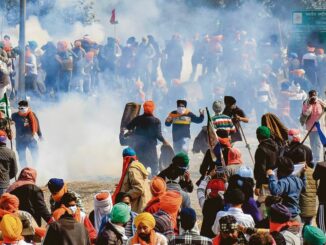
Every year, there are some farmers who dump their produce on the roads or run tractors over vegetables or fruits to make visuals that would pry open the eyes of the government. They obviously don’t find a way out other than the MSP backed by a legislation and assured procurement. The pro-government economists and commentators who talk about a fiscal disaster and throw numbers totaling many lakhs of crores of rupees do not even understand that the consumer is already paying those many lakhs of crores and much more without farmers getting any of it. If the market is playing foul, it’s the responsibility of the government to discipline it, offering sustainable profits to the producer. And if he does not get it, he will block the road at an opportune moment when the government is most vulnerable. It is obvious that the empowered farmers of Punjab are talking for all their brethren across the country and trying to corner the government, making it commit the blunder of tear-gassing them using drones and suffer a public relations disaster. This is legitimate oppositional politics. Sadly, a protester died of a heart attack at the Shambhu border on Friday, adding to the government’s discomfiture in the run-up to the polls.
At the same time, this protest could become a golden opportunity for PM Narendra Modi if he decides to turn the tables — offer ‘Modi ki guarantee’ to the farmers as well. Accept their demands; make them feel victorious. There is nothing that an Indian farmer won’t give when he feels heard and honored. Let the protest not fester into a wound that becomes gangrenous.
It is said that my dear mentor, Tip O’Neill, the legendary Speaker of our House of Representatives, said “money is the mother’s milk of politics.”
For democracy to function, we must have political parties to offer up their best candidates that can champion what their party’s platform is. Political parties to do their necessary work require money – from the rich to the poor – be it $5 or $5Billion.
Integrity of the electoral politics is the business of every nation state, to make sure only a nation’s citizens are voting, and that the ballot box is not tampered with. This includes the necessity to block foreign money from playing in one’s political process – for to permit same would be to allow a nation to surrender its sovereignty at the ballot box.
That said, our Supreme Court in “Citizens United” ruled that “independent expenditures, including those made by corporations, do not give rise to corruption or the appearance of corruption.” By so doing, it held that “Political Speech” is a core part of “Free Speech” of every American, and permitted non-candidate controlled entities to put their message out so long as it was not coordinated or controlled by the candidate running. This created “soft money,” which is undisclosed to the public, as opposed to “hard money,” which is disclosed, regulated and limited, but can be used by the candidate as she or he wishes. While Citizens United brought calls of “the sky is falling,” today after a decade, the proof is that money generally favors – albeit, not by much – the party in power. So, the sky did not fall.
India’s Supreme Court’s holding, while altruistic, stands as a weak dam to hold back the citizenry of India’s powerful desire to do what they wish to do to support those they wish to support.”
Mired in controversy since its inception, the electoral bond scheme for political funding has been annulled by the Supreme Court. A five-judge Constitution Bench headed by Chief Justice DY Chandrachud said the scheme was violative of the right to freedom of speech and expression under Article 19(1)(a) of Constitution, adding that the fundamental right to privacy also included the citizens’ right to ‘political privacy and affiliation’. The court has directed the State Bank of India (SBI) to disclose the details of each electoral bond encashed by various parties over the years.
The verdict is a big blow to the BJP-led NDA in the run-up to the Lok Sabha elections. Notifying the scheme in January 2018, the Modi government had touted it as a ‘transparent’ alternative to cash donations made to political outfits. Then Finance Minister Arun Jaitley had exuded confidence that the electoral bond scheme would considerably cleanse the political funding system. However, the initiative ran into rough weather over allegations of ‘selective confidentiality’ and denial of a level playing field.
The government’s insistence on ensuring the anonymity of the donors and keeping the citizens in the dark struck at the heart of the scheme, whose avowed main objective was transparency. Paradoxically, the government itself was in a position to access the donors’ details by demanding their data from the SBI. The Opposition had every reason to tear into the scheme as the BJP grabbed the lion’s share of the bonds, even as the Election Commission of India (ECI) adopted an evasive approach. Last year, the apex court had rapped the ECI for not maintaining data on funding received through electoral bonds despite the interim order it had passed in April 2019. It is hoped that the poll panel and the SBI will finally lift the dubious veil of secrecy and make the details public.
Ratha Saptami or Surya Saptami marks the birth of Surya to sage Kashyapa and his wife Aditi and hence celebrated as Surya Jayanti. A legend is narrated by the Kamboja empire’s King Yashovarma, a noble king who had no heir to rule his kingdom. On his special prayers to God, he was blessed with a son.
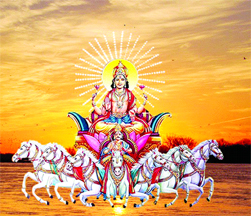
Ratha Saptami, also rendered Magha Saptami, is a Hindu festival that falls on the seventh day (saptami) in the bright half (Shukla Paksha) of the Hindu month Magha. It is symbolically represented in the form of the sun-god Surya turning his ratha (chariot) drawn by seven horses (representing the seven colors) towards the northern hemisphere, in a north-easterly direction. It also marks the birth of Surya and is hence also celebrated as Surya Jayanti (the sun-god’s birthday). Ratha Saptami is symbolic of the change of season to spring and the start of the harvesting season. For most Indian farmers, it is an auspicious beginning of the New Year. The festival is observed by all Hindus in their houses and in innumerable temples dedicated to Surya, across India.
Sun worship is deep rooted in the Vedas of the Hindu religion and its antiquity also relates to several mythologies of the world such as that of China, Egypt and Mesopotamia. The Gayatri Mantra japa – the sacred Vedic chants to Savitr (the Vedic sun god) – is popularly recited by adherents. As Puranic Hinduism evolved, the worship of the sun was consolidated.
Religious significance
The symbolic significance of the ratha and the seven horses reigned to it is that it represents the seven colors of the rainbow. The seven horses are also said to represent the seven days of a week starting with Sunday, the day of Sun god Surya. The chariot has 12 wheels, which represents the 12 signs (each of 30 degrees) of the Zodiac (360 degrees) and constituting a full year, named Samvatsara. The Sun’s own house is Leo (Simha) and he moves from one house to the next every month and the total cycle takes 365 days to complete. The Ratha Saptami festival seeks the benevolent cosmic spread of energy and light from the sun god. Ratha Saptami also marks the gradual increase in temperature across South India and awaits the arrival of spring, which is later heralded by the festival of Gudi Padwa, Ugadi, or the Hindu lunar New Year day in the month of Chaitra.
Sun worship
On the day of Surya Saptami, the Sun God is offered Arghya with Ganges water. Praise the Sun God with lamps, camphor, incense, red flowers etc. Praise should be done facing the sun. It does not cause physical skin diseases etc. Sun has great importance in ancient astrology and modern science. The Sun is considered to be the one who gives life to the flora and fauna. Surya Purana should be recited on this day. The charioteer of the sun is believed to be Arun, who is paralyzed. Children are mute and paralyzed at birth. Lord Surya removes these defects with his light.
Legend
A legend is narrated by Yashovarma, the king of the Kamboja kingdom, a great king who had no heir to rule his kingdom. On special prayer to God, he got a son. The king’s vow did not end here, as his son was seriously ill. A saint who went to the king advised that his son should worship Ratha Saptami and Surya Saptami with reverence to get rid of his past sins. Once the king’s son did this, his health recovered and he ruled his kingdom well.
Sun temples
There are Surya temples all across India where Ratha Sapthami is fervently celebrated. However, the most famous one is the World Heritage Site of the Konarak Sun Temple, in Konark, Odisha. Besides Konark, there is another sun temple in Odisha, the Biranchinarayan Temple, Buguda, Ganjam District. There are sun temples in Modhera, Gujarat, created by king Bhimdev of the Chaulukya dynasty, in Arasavalli, Andhra Pradesh and in clusters of Navagraha temples in Tamil Nadu and Assam. The Sun Temple at Martand (Jammu and Kashmir) and Sun Temple of Multan are temples, which were destroyed during Muslim conflicts in the past.
Religious observances
Vishnu, in his form as Surya, is usually worshipped on this day. Usually, Rathasapthami begins in households with a purification bath (bathing is also done in a river or sea) by holding several Ekka (Calotropis Gigantea) leaves on their head while bathing and chanting a verse which is supposed to invoke the benevolence of the deity in all that one indulges in during the rest of the year. Argyam or (Tharpanam) (water held in the palms) is offered to the sun god on this day while chanting hymns are performed to the sun god. It also involves doing a puja with the ritual Naivedhya (food offering to God), and offering of flowers and fruits. Important prayers offered to the Sun god on this occasion are the Adityahridayam, Gayathri, Suryashtakam, Surya Sahasram namam. The preferred time for the pooja is within one hour after sunrise. In places like Mysore and Melkote, ceremonial processions carry the Surya Mandala – the icon of Surya.
Arka (in Sanskrit, meaning a ray or flash of lightning) leaves,also called Aak in Hindi, Ekka (in Kannada), Jilledu in Telugu, Erukku in Tamil and Calotropis Gigantea (bowstring hemp) in English. Arka is also a synonym for Surya or Sun. Its significance to sun god could be compared to the significance of tulasi (Ocimum tenuiflorum) leaves to Vishnu. Arka leaves are also used for worship of god Ganesha known by the name Arka Ganesha and also for Hanuman worship. Its stems, called samidha (sacrificial offerings of wood) are used for the yajna ritual as a sacrificial offering to a ritual fire. Its shape is said to represent the shoulders and chariot of sun god. Its use during the ritualistic ceremonious bath involves placement of seven leaves – one on the head, two on the shoulders, two on the knees and two on the feet. On this day, in South India, Kolam is drawn with coloured rice powder depicting a chariot and seven horses as symbolic of the Ratha Saptami. Cowdung cake is also burnt at the centre of this depiction and milk boiled on the fire is offered to the sun god. In some of the important Vaishnavite temples such as the Tirumala, Srirangam, Srirangapattana and Melukote, Ratha Saptami is one of the important festivals of the year. The ratha yatra of Veera Venkatesha of Sri Venkatramana Temple in Mangalore is held on this day and is famously known as Kodial Teru or Mangaluru Rathotsava.
Situated at an altitude of 2730 m above sea level, Gulmarg is a popular skiing destination located in Pir Panjal Range of Union territory of Jammu and Kashmir. Surrounded by snow-covered lofty Himalayas, meadows of flowers, deep ravines, evergreen forested valleys, Gulmarg also has the world’s second-highest Gondola ride.
Gulmarg is one of the top honeymoon destinations in India. Gulmarg has also been developed as an adventure hub as the Indian Institute of Skiing, and Mountaineering is located here. A lot of courses on trekking, mountaineering, skiing, and snowboarding are offered by IISM. There are a lot of other private tour operators in Gulmarg as well, which provide similar courses and facilities for skiing and snowboarding. Known for its scenic beauty, Gulmarg has also been a popular destination for shooting various Bollywood films.
Gulmarg Gondola
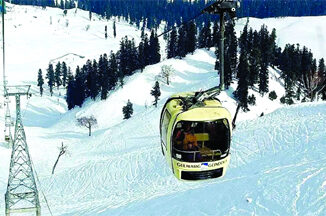
Gulmarg Gondola is the second longest and second highest cable car in the world and the prime attraction Gulmarg is known for. Divided into two phases, it ferries almost 600 people per hour to and from the Apharwat Mountain, which is where most of the winter sports happen in Gulmarg.
Phase 1 of Gulmarg Gondola ferries people from Gulmarg Resort to Kongdoori Station (middle station). It starts at 2,990 m and has a vertical rise of 400 m. Every hour it ferries 1500 people to the height of 3100 m from where several easy runs for skiing are accessible.
Phase 2 of Gulmarg Gondola connects Kongdoori Mountain to Apharwat Peak. The cable car ascends 1,330 vertical metres to a height of nearly 4,000m and carries 600 people per hour. After arriving at the station, you can further have a 30 minutes trek to reach the mountaintop. From here the LOC or the Line of Control is visible.
The Gulmarg Gondola affords a magnificent view of Nanda Devi, LOC, and Pir Panjal range. Apart from cherishing the beauty of Himalayan ranges, tourists can enjoy other activities like horse riding and snow skiing.
Kongdori Phase 1
Kongdori Phase 1 in Gulmarg is the initial stage of the Kongdori Gondola, one of the highest cable cars in the world. Situated in the Pir Panjal range, this phase is the starting point for an exhilarating journey that provides breathtaking views of the snow-covered peaks. Visitors can access the Kongdori Phase 1 from Gulmarg and experience the charm of the meadows and dense forests during the ascent. The cable car ride from Kongdori Phase 1 to Apharwat Peak unfolds panoramic vistas, making it a must-visit destination for nature enthusiasts and adventure seekers alike.
Apharwat Peak
Situated at a height of 4200 metres above the mean sea level, Apharwat Peak in Gulmarg is one of the most breathtaking places. Remotely positioned near LOC with Pakistan, the region receives heavy rainfall and is covered in snow for most of the year. Apharwat Peak is where winter sports in Gulmarg takes place.
Imbued with snow-clad mountains and surrounded by pearly white meadows, the area is a perfect honeymoon destination and the most picturesque tourist spot in Srinagar.
Drung Waterfall (Frozen Waterfall)
The Drung Waterfall is an extremely popular tourist attraction located in the Tangmarg tehsil of Gulmarg, Baramulla. A cascading waterfall set amidst majestic mountains, it freezes completely during winter due to the extremely low temperature. This frozen waterfall is a must-visit in the area. The cascading waterfall mixes with the water that originates from the magnificent glaciers and makes for an unforgettable sight. During the summers, one can spend some quiet time here while enjoying views of the waterfall, lakes, streams, surrounding greenery as well as explore the caves. The area is even more breathtaking during the wintertime when everything is frozen; the waterfall freezes as it comes down, forming icicles. Even the lake and streams freeze, though they remain accessible, and one can have some fun in the ice-cold waters if brave enough! There are stalls around that serve tea and snacks for people to have while they take in the magnificent scenes. There is also a small temple in the vicinity.
Skiing in Gulmarg
Gulmarg is a hill town in Jammu and Kashmir which is lately gaining a lot of popularity for its ski terrain. Ideal for both amateur and professional skiers, the place has several skiing operators and institutes that can tutor you on the same.
Gulmarg is normally blessed with unbelievable amounts of snow. It ranks in the realms of Utah and Niseko in the snowfall stakes. The average annual snowfall is not well documented, but it is thought to be about 14 metres, while in the year 2004 it came around 20 metres.
Alpather Lake
Alpather Lake is a high altitude lake set between the twin Apharwat Peak in Gulmarg. It is popularly known as the Frozen Lake as it remains completely frozen from November to June. It is popular for the one-day trek which starts from Gulmarg and covers a distance of almost 13km.
The one-day trek to Alpather Lake from Gulmarg is a must-try for adventure seekers. The trek is moderately difficult and covers a distance of about 13 km, following the route from Gulmarg to Khilanmarg, Apharwat Ridge and finally, Alpather Lake. The trek offers a challenging yet fulfilling experience and is the perfect way to explore the beauty of the surrounding area.
In winter, the frozen lake is a surreal sight with ducks walking on the ice instead of swimming in the water. The stark beauty of the frozen lake is a sight to behold and is a must-visit for those looking to escape the hustle and bustle of city life. During summers, the lake is surrounded by a lush landscape of flowers and trees, making it a perfect place to relax and enjoy the beauty of nature. Source: Holidify.com
The writing is on the wall for Paris Saint Germain (PSG) as French forward Kylian Mbappe has dropped a transfer bombshell on Thursday. Tipped to join La Liga giants Real Madrid in the next transfer window, PSG superstar Mbappe has informed officials at the Paris-based club that he wants to leave Parc des Princes this summer. Real Madrid can sign their long-term transfer target Mbappe on a free transfer prior to the start of the new season.
As per the latest developments in the Mbappe transfer saga, the French captain is planning to leave PSG when his contract expires at the end of the season. One of the finest players in the modern era of the beautiful game, Mbappe arrived in Paris from Monaco back in 2017. The 25-year-old extended his contract from 2022 until 2024. However, Mbappe has declined to activate a clause that would have allowed him to stay another year at PSG.
According to a report filed by The Athletic, it has been learned that Mbappe has communicated his decision to PSG. Though Mbappe has informed PSG about parting ways, terms of his exit are yet to be fully agreed in Paris. An official announcement is expected once the situation is finalised in next few months. A source close to PSG also told news agency AFP that Mbappe intends to leave the Paris-based club when his contract expires at the end of the season.
Mbappe earns around €200m per year and Real Madrid have emerged as the frontrunners to sign the wantaway PSG star. According to multiple reports, Mbappe is expected to take a pay cut to join record-time European champions. Mbappe has guided PSG to five Ligue 1 titles. The former Monaco star has netted 20 goals in the league this season. Mbappe-starrer PSG will host Nice on Friday. The French club is leading the Ligue 1 standings by 11 points.
RAJKOT (TIP)– Captain Rohit Sharma and middle-order batter Ravindra Jadeja smashed defiant hundreds to drag India out of the doldrums and into a comfortable 326/5 on the opening day of the third Test against England on Feb 15. India were reeling at 33/3 inside the opening hour after Mark Wood proved the value of extra pace on a docile track at the Saurashtra Cricket Association Stadium.
Rohit and Jadeja rebuilt the innings with a 204-run stand to drag the hosts back into the contest. Jadeja, who was batting on 110 at stumps, his fourth Test hundred, with nightwatchman Kuldeep Yadav on one at the other end, departed for 112 early on the second day of the Test.
Rohit’s stellar 131 contained three sixes, 14 fours and plenty of drama.
The opener suffered a blow to his helmet, was dropped in the slip and succeeded in having an lbw decision against him reversed en route his 11th Test hundred innings.
With the five-match series poised at 1-1, Rohit’s decision to bat on a flat surface was hardly surprising but Wood tormented the batters with his express speed.
The fast bowler had Yashasvi Jaiswal (10) caught in the slip in his second over and Shubman Gill fell caught behind for a duck in Wood’s next.
England captain Ben Stokes, playing his 100th Test, introduced spin in the ninth over and was rewarded immediately as Tom Hartley dismissed Rajat Patidar for five.
Wood continued to bowl with relentless hostility at the other end, hitting Rohit on his helmet grille on one occasion. The opener got a life on 27 when he edged Hartley and Joe Root spilled the catch at slip.
Rohit was adjudged lbw to James Anderson but the decision was reversed after replays confirmed the ball had hit bat first.
Rohit and Jadeja denied England a breakthrough in the second session dragging India back into the contest. Rohit took 157 balls to bring up his hundred and the muted celebration indicated his resolve to carry on but Stokes and Wood combined to scupper that plan.
The short-ball tactics they pursued against Rohit paid off as the batter slapped the ball from Wood to Stokes at midwicket.
Debutant Sarfaraz Khan shrugged off early jitters and raced to a 48-ball fifty before his entertaining knock of 62 was cut short.
Jadeja was on 99 when his hesitation led to Sarfaraz being run out. A furious Rohit was seen hurling his cap on the floor in the pavilion after the dismissal. Wicketkeeper Dhruv Jurel also made his Test debut for India in the match. Source: Reuters
The Indian men’s team felt the absence of star doubles duo of Satwiksairaj Rankireddy and Chirag Shetty as it suffered a narrow 2-3 loss to China in the Badminton Asia Team Championships group tie at Shah Alam on Feb 15.
Star shuttlers HS Prannoy and Lakshya Sen won their singles matches but China fought back with wins in the two doubles contests to make it 2-2. National champion Chirag Sen then lost 15-21 16-21 to Wang Zheng Xing in the fifth match as India conceded the tie.
Already through to the knock-out stage, India finished second in the group, with China taking the top spot.
Walmart has sourced goods worth over USD 30 billion from the Indian market in the last two decades for its global operations, a company official said on Tuesday. Now the Bentonville-headquartered firm has a goal to triple its sourcing of goods from India up to worth USD 10 billion per year by 2027, said Walmart Inc Executive Vice President, Sourcing Andrea Albright.
Walmart is encouraging MSMEs (Micro, Small and Medium Enterprises) and entrepreneurs with proper training and believes that there is a tremendous opportunity to continue to contribute to India’s growing economy, she said.
The company has been doing business in India for the last 25 years, Albright said.
“We have already sourced more than USD 30 billion in products from India,” she said speaking at the Walmart Growth Summit.
The company is building an ecosystem and taking a people-led approach to connect its work across the country.
“Investing in high growth markets like India helps us strengthen our relationships with established suppliers, but also developing relationships with new ones to build long-term surety and diversity and global supply,” she added.Under its Walmart Vriddhi initiative, which is designed to support MSMEs in modernising, expanding, and reaching their domestic ambitions, the company has trained 50,000 people so far, Albright added.
“That is an amazing achievement. We have hit this goal early,” she said, adding, “Our focus is to recruit and train new suppliers to fulfil our purchase orders around the world. These orders often lead to the creation of new jobs. It also allows our suppliers to invest back in their local communities.” Source: PTI
The US economy managed to shake off Wall Street’s gloomy forecasts and dodge a long-predicted slump last year — but the same can’t be said for two other members of the G7. Japan and the UK are both officially in recession, according to figures published Thursday, after Gross Domestic Product (GDP) fell for two consecutive quarters to close out 2023. Japan had the second-largest economy until 2010 when it was surpassed by China. Last year, Japan’s nominal GDP was USD 4.2 trillion, while Germany’s was USD 4.4 trillion (or USD 4.5 trillion, depending on the currency translation).
The data show how the Japanese economy has increasingly lost competitiveness and productivity, while the population is shrinking as Japanese people age and have fewer children. Immigration is one possibility for addressing Japan’s labor deficit, but the country has been highly unaccepting of foreign labor, except for temporary stays, leading to accusations of discrimination and a lack of variety.
Because nominal GDP is measured in dollars, a lower Japanese yen played a significant role in the country’s slip to fourth position. However, experts believe Japan’s relative weakness is due to a declining population as well as lacking productivity and competitiveness.
Real GDP is a measure of the worth of a country’s goods and services. The yearly rate represents what would have occurred if the quarterly rate had lasted a year.
Japan has long been seen as “an economic miracle,” emerging from the ashes of WWII to become the world’s second-largest economy after the United States. This continued until the 1970s and 1980s. However, for the majority of the past 30 years, the economy has developed only marginally, primarily languishing in the doldrums since the bursting of its financial bubble in 1990.
The Japanese and German economies are driven by robust small and medium-sized firms with high productivity.
Germany, like Japan in the 1960s-1980s, surged ahead for the majority of this century, dominating global markets for high-end products such as luxury vehicles and industrial gear, selling so much to the rest of the world that exports accounted for half of its GDP.
However, its economy, which was among the worst performers in the world last year, dropped by 0.3% in the fourth quarter.
After Japan, Britain’s economy entered a recession in the second half of 2023, presenting a difficult backdrop for Prime Minister Rishi Sunak, who has promised to boost growth ahead of the projected 2024 election.
The Office for National Statistics (ONS) reported that gross domestic product (GDP) declined by a worse-than-expected 0.3% in the three months to December, after falling by 0.1% between July and September. The ONS reported that economic output declined by 0.1% in monthly terms in December, following a 0.2% increase in November. According to the ONS, the manufacturing, construction, and wholesale sectors contributed the most to the fall in GDP.
According to the ONS, the fourth-quarter GDP decrease was the largest since the first quarter of 2021. Britain’s economy has remained stagnant for nearly two years. The Bank of England expects it to pick up somewhat in 2024.
Source: Agencies
The Reserve Bank on Feb 15 asked card network Visa to stop making payments through intermediaries to entities which do not accept card payments, saying a large amount of funds are involved in the activity without legal sanction, according to sources.
As per information available, only one card network has operationalised this arrangement in the country so far, the Reserve Bank of India (RBI) said without naming Visa. However, sources said the card network is Visa.
Visa did not immediately offered any comments, but indicated it may come with one later. The central bank said as the matter is under detailed examination, the card network has been advised to keep all such arrangements under abeyance, till further orders.
“It has come to the notice of RBI that a card network had an arrangement that enables businesses to make card payments through certain intermediaries, to entities that do not accept card payments,” the central bank said in a statement.
Wall Street banks are ramping up efforts to attract new business in India, as billions are set to flow into the country’s trillion-dollar sovereign debt market following the inclusion of nation’s bonds in global debt indexes.
Morgan Stanley, Barclays Plc., Citigroup Inc. and Deutsche Bank AG are among institutions that have, or are in the process of engaging with global investors who could potentially invest large amounts of money in India, according to people familiar with the matter.
Barclays is hosting a roadshow with key India finance ministry and central bank officials in Mumbai and New Delhi this week, while Morgan Stanley is set to hold one in London, after having conducted a roadshow in Asia. Citibank has already held calls with global investors regarding operational procedures and is planning additional meetings, said the people, asking not to be identified because the matter is private.
This flurry of activity comes ahead of the addition of the nation’s sovereign bond market to JPMorgan Chase & Co’s global debt indexes from June, a move that may lure up to $40 billion of inflows. Foreigners own just above 2% of the government bonds, leaving ample room for more buyers. India’s bonds are held mostly by local investors and this marketing campaign by foreign banks reflectthe nation’s weight in the index, which is at par with China.
Global funds have already begun to increase their holdings of index-eligible bonds since JPMorgan’s September announcement, adding 665 billion rupees ($8 billion) of holdings, data from the Clearing Corp. of India show.
While many large foreign institutional investors have a presence in India, smaller funds are not registered. A targeted approachs via calls, roadshows and one-on-one meetings is being used to lure first-time investors from financial hubs such as Hong Kong, London, Singapore, Dubai and New York, the people said. Source: Bloomberg
The centre of our Milky Way galaxy is home to a supermassive black hole that is spinning so quickly that it is warping spacetime into an oval form resembling a rugby ball. The result is based on a thorough analysis of X-ray and radio measurements from NASA’s Chandra X-ray Observatory, an X-ray telescope in space. The giant black hole, known as Sagittarius A* or Sgr A* is located about 26,000 light-years away from Earth.
“Black holes have two fundamental properties. The first is their mass, or how much they weigh. The second is their spin, or how quickly they rotate. Determining either of these two values tells scientists a great deal about any black hole and how it behaves,” NASA explained.
Scientists have been unable to determine Sgr A*’s exact rotational speed, but they are certain that it weighs roughly four million times that of the Sun. This new study utilizes a method based on material movement towards and away from the black hole to calculate the spin rate of Sgr A* using X-ray and radio data.
The results show that the black hole is spinning very fast. The American space agency stated, “Scientists think that it is rotating so quickly that it is warping spacetime around it into a shape that looks like an American football.”
The concept of time paired with the three dimensions of space is called spacetime. Although black holes have long been known to have this ability, there is now substantial proof that the black hole in the Milky Way galaxy is doing so.
“Our work may help settle the question of how fast our galaxy’s supermassive black hole is spinning. Our results indicate that Sgr A* is spinning very rapidly, which is interesting and has far-reaching implications,” said Ruth Daly of Penn State University, who is the lead author of the new study.
The spinning of a black hole also has several other implications. It can act as an important source of energy. Extraction of spin energy from spinning supermassive black holes can result in narrow outflows in the form of jets. Although Sgr A* is not very active right now, this new discovery suggests that it may become more so in the future.
“A spinning black hole is like a rocket on the launch pad,” said Biny Sebastian, a co-author from the University of Manitoba in Winnipeg, Canada. “Once the material gets close enough, it’s like someone has fueled the rocket and hit the ‘launch’ button.”
According to the space agency, if the properties of the matter and the magnetic field strength close to the black hole change in the future, part of the enormous energy of the black hole’s spin could drive more powerful outflows. If the star wanders too close to the black hole, this source material coming from gas or from the remnants of a star will be torn apart by the black hole’s gravity. Source: NDTV
OpenAI is testing “memory” for its AI chatbot ChatGPT, which will allow the bot to remember information about you and your conversations over time.
You can explicitly tell ChatGPT to remember something, ask it what it remembers, and tell it to forget conversationally or through settings.
“You can also turn it off entirely. We are rolling out to a small portion of ChatGPT free and Plus users this week to learn how useful it is. We will share plans for broader roll out soon,” OpenAI said in a statement.
“ChatGPT’s memory will get better the more you use it and you’ll start to notice the improvements over time”.
The users can turn off memory at any time. While memory is off, they won’t create or use memories. “If you want ChatGPT to forget something, just tell it. You can also view and delete specific memories or clear all memories in settings,” the company informed. If you’d like to have a conversation without using memory, use temporary chat.
Source: IANS
San Francisco (TIP)- Meta-owned WhatsApp is reportedly working on a new ‘favourite contacts filter’ feature, allowing users to prioritise their conversations and offer greater control and efficiency in the messaging experience. The new feature spotted by WABetaInfo mentioned that it will appear with a dedicated chat filter in a future update of WhatsApp Web.
According to the report, the new feature will allow users to choose their favourite contacts and let them manually add the ones they care about most, and easily access them through a dedicated filter.
“By allowing users to mark specific contacts as favourites, WhatsApp enables them to prioritise key conversations, ensuring quick and easy access to those they frequently interact with,” the report said.
“The introduction of favourite contacts not only simplifies the process of reaching out to frequently contacted users but also adds a layer of customisation, allowing them to improve their messaging experience to suit their preferences,” it added.
Meanwhile, WhatsApp is reportedly preparing to allow third-party messaging apps on its platform, ahead of the European Union’s Digital Markets Act (DMA) that will come into force in March.
Dick Brouwer, an engineering director at WhatsApp, told Wired that the company is ready to offer interoperability on the platform with over 2 billion users.
“There’s real tension between offering an easy way to offer this interoperability to third parties while at the same time preserving the WhatsApp privacy, security, and integrity bar. I think we are pretty happy with where we have landed,” he was quoted as saying in the report.
Source: IANS
Scientists have developed a new Artificial Intelligence (AI) model to predict treatment outcomes of tuberculosis (TB) patients, an advance that may lead to personalised treatments for the bacterial disease.
The study, published in the journal iScience, analysed multimodal data including diverse biomedical data from clinical tests, genomics, medical imaging and drug prescriptions from TB patients.
By analysing data from patients with varying levels of drug resistance, the researchers discovered biomedical features predictive of treatment failure.
They also uncovered drug regimens effective against specific sets of drug-resistant TB patients.
“Our multimodal AI model accurately predicted treatment prognosis and outperformed existing models that focus on a narrow set of clinical data,” said Sriram Chandrasekaran, corresponding author and associate professor at the University of Michigan, US.
“We identified drug regimens that were effective against certain types of drug-resistant TB across countries, which is very important due to the spread of drug-resistant TB,” added study first author Awanti Sambarey, a postdoctoral fellow at the University of Michigan.
Using AI, the team examined more than 5,000 patients.
“This is real-world data we’re talking about, so patients from different countries have different admission protocols. We worked with more than 200 biomedical features in our analysis; we examined demographic information such as age and gender as well as prior treatment history,” Sambarey said.
“We also noted if the patients had other comorbidities, such as HIV, and then we worked with several imaging features such as their X-ray, CT scans, data from the pathogens, drug-resistance data, as well as genomic features and what mutations the pathogen had,” she said.
The researchers noted that it is very difficult clinically to look at the data all together. That is where the role of AI comes in handy.
The team also studied the impact of the type of drug resistance present.
“You can look at a specific snapshot of the data, such as genomic features and find what mutations the infecting pathogen had, and ask what some of the long-term treatment implications are,” Sambarey added.
The researchers found that certain drug combinations worked better in patients with some types of resistance but not others, leading to treatment failure. They also found that drugs with antagonistic pharmaceutical interactions could result in worse outcomes.
“Using AI to weed out antagonistic drugs early in the drug-discovery process can avoid treatment failure down the line,” Chandrasekaran noted.
“Instead of a one-size-fits-all treatment approach, we hope that the study of multimodal data will help physicians treat patients with more personalized treatments to provide the best outcomes,” Sambarey added. Source: PTI
Researchers at the University of Queensland have demonstrated the vital role that saturated fatty acids play in the brain’s storage of memories. A new cure for neurodegenerative illnesses may now be possible, thanks to research conducted by Dr Isaac Akefe of the Queensland Brain Institute at the University of Queensland. He has also discovered the genes that underlie the process of memory creation. The findings were published in the EMBO Journal. “We’ve shown previously that levels of saturated fatty acids increase in the brain during neuronal communication, but we didn’t know what was causing these changes,” Dr Akefe said. “Now for the first time, we’ve identified alterations in the brain’s fatty acid landscape when the neurons encode a memory. “An enzyme called Phospholipase A1 (PLA1) interacts with another protein at the synapse called STXBP1 to form saturated fatty acids.”
The brain is the body’s fattiest organ, with fatty compounds called lipids making up 60 per cent of its weight. Fatty acids are the building blocks of a class of lipids called phospholipids. The work done in Professor Frederic Meunier’s laboratory has shown that STXBP1 controls the targeting of the PLA1 enzyme, coordinating the release of fatty acids and directing communication at the synapses in the brain. “Human mutations in the PLA1 and STXBP1 genes reduce free fatty acid levels and promote neurological disorders,” Professor Meunier said.
“To determine the importance of free fatty acids in memory formation, we used mouse models where the PLA1 gene was removed. We tracked the onset and progression of neurological and cognitive decline throughout their lives. We saw that even before their memories became impaired, their saturated free fatty acid levels were significantly lower than control mice. This indicates that this PLA1 enzyme, and the fatty acids it releases, play a key role in memory acquisition.” Source: ANI
A simple blood test can help detect several important biological processes that are active during the months before a heart attack, suggests a study. Heart attacks are the most common cause of death in the world and are increasing globally. Many high-risk people are not identified or do not take their preventive treatment.
Now, researchers at Uppsala University in Sweden have found that the blood test can predict if you are at an increased risk of having a heart attack within six months.
The problem, according to the researchers, is that risk factors have previously been verified in studies involving five to ten years of follow-up, where only factors that are stable over time can be identified.
“However, we know that the time just before a heart attack is very dynamic. For example, the risk of a heart attack doubles during the month of a divorce, and the risk of a fatal heart event is five times as high during the week after a cancer diagnosis,” said cardiologist and professor of epidemiology Johan Sundstrom.
“We wanted to develop methods that would enable the health services to identify people who will soon suffer their first heart attack,” Sundstrom said, in the paper published in the journal Nature Cardiovascular Research.
The research group had access to blood samples from 1,69,053 individuals without prior cardiovascular disease in six European cohorts. Within six months, 420 of these people suffered their first heart attack. Their blood was then compared with blood from 1,598 healthy members of the cohorts. Source: IANS
INGREDIENTS
1 kilograms fish fillets, 1 cup ghee, 4 teaspoon powdered, turmeric, 5 chopped onion, 2 teaspoon coriander powder, 6 cloves, 1 cup beaten yoghurt (curd), 2 tablespoon sultanas, 5 cup basmati rice, 1 teaspoon salt, 5 tablespoon cashews, 4 teaspoon Red chilli powder, 2 inches cinnamon, 5 chopped tomato, 3 litre water
For Marination
1 teaspoon powdered turmeric
2 ml lemon juice METHOD
– Mix the marinade ingredients, lemon juice and turmeric and rub into fish fillets. Keep aside for about 30 to 45 minutes.
– Heat 2 tablespoon ghee in a pan. Saute rice for about 10 to 15 minutes. Add 2 teaspoon salt, 1 teaspoon turmeric powder and 3 litres of warm water. Mix gently and bring to a boil.
– Lower the flame and cover pan with a lid and cook till water is absorbed. Heat 1 cup of ghee. Fry the sultanasa and remove. Add cashewnuts and fry till golden brown. Fry onions in the same pan till golden brown. Add chilli powder, coriander powder and 3 teaspoon turmeric powder. Add 8 to 10 teaspoon of water and the whole spices. Mix well.
– Fry for about 3 to 4 minutes, stirring all the time. Add the fish pieces along with 2 teaspoon salt and saute for about 5 to 8 minutes. Pour 1 cup of water and bring it to a boil. Add tomatoes and curd. Reduce heat and cook till gravy thickens. Grease a heavy bottomed pan with 1 tablespoon ghee. Spread the fish pieces, rice and reserved sultanas and cashewnuts in layers. Repeat until the topmost layer is rice garnished with sultanas and cashewnuts. Cover pan and cook over low heat for 5 to 8 minutes. Remove and serve hot, garnish with fried onions or spring onions.
Are you faithfully treating your acne but still seeing new breakouts? Your skin care routine could be to blame. Here you’ll find some skin care habits that can worsen acne and dermatologists’ tips to help you change those habits.
Try a new acne treatment every week or so.
This approach can irritate your skin, which can cause breakouts.
Woman rinsing face with water
Washing your face throughout the day can irritate your skin and cause acne breakouts.
What to do instead: Give an acne treatment time to work. You want to use a product for 6 to 8 weeks. It takes that long to see some improvement. If you don’t see any improvement by then, you can try another product. Complete clearing generally takes 3 to 4 months.
Apply acne medication only to your blemishes
It makes sense to treat what you see, but this approach fails to prevent new breakouts.
What to do instead: To prevent new blemishes, spread a thin layer of the acne medication evenly over your acne-prone skin. For example, if you tend to breakout on your forehead, nose, and chin, you would want to apply the acne treatment evenly on all of these areas of your face.
Use makeup, skin care products, and hair care products that can cause acne
Some makeup, along with many skin and hair care products, contain oil or other ingredients that can cause acne breakouts. If you continue to use them, you may continue to see blemishes. What to do instead: Use only makeup, sunscreen, skin, and hair-care products that are labeled “non-comedogenic” or “won’t clog pores.” These products don’t cause breakouts in most people.
Share makeup, makeup brushes, or makeup applicators
Even if you use only non-comedogenic products, sharing makeup can lead to blemishes. Acne isn’t contagious, but when you share makeup, makeup brushes, or applicators, the acne-causing bacteria, oil, and dead skin cells on other people’s skin can wind up in your makeup. When you use that makeup, you can transfer their bacteria, oil, and dead skin cells to your skin. These can clog your pores, leading to breakouts.
What to do instead: Make sure you’re the only person who uses your makeup, makeup brushes, and makeup applicators.
Sleep in your makeup
Even non-comedogenic makeup can cause acne if you sleep in it.
What to do instead: Remove your makeup before you go to bed. No exceptions. If you’re too tired to wash your face, use a makeup remover towelette. Just make sure it’s a non-comedogenic towelette.
Wash your face throughout the day
Washing your face several times a day can further irritate your skin, leading to more breakouts.
What to do instead: Wash your face twice a day — when you wake up and before you go to bed. You’ll also want to wash your face when you finish an activity that makes you sweat.
Dry out your skin.
Skin with acne is oily, so it can be tempting to apply astringent and acne treatments until your face feels dry. Don’t. Dry skin is irritated skin. Anytime you irritate your skin, you risk getting more acne.
What to do instead: Use acne treatments as directed. If your skin feels dry, apply a moisturizer made for acne-prone skin. You’ll want to apply the moisturizer twice a day, after washing your face.
Signup to our Newsletter!
Don’t miss out on all the happenings around the world