Following the triumphant landing of Chandrayaan-3 near the lunar south pole, India is charting a bold course for its future in lunar exploration. The Indian Space Research Organisation (Isro) has set its sights on a series of more complex and ambitious lunar missions, aiming to eventually send astronauts to the Moon by 2040.
Union Minister of State for Science & Technology, Dr. Jitendra Singh, recently revealed that the roadmap for India’s forthcoming moon exploration endeavors is currently being conceptualised. This comprehensive plan includes feasibility studies for further robotic missions involving orbiters, landers, and rovers. These missions are expected to pave the way for advanced objectives such as lunar sample collection and return missions, which will serve as precursors to human landings on the Moon’s surface.
Tag: Apple News
-
India has plan to explore the Moon beyond Chandrayaan-3
-

Dr. Inderpal Singh Chhabra Takes Over as President of AAPI-QLI
LONG ISLAND, NY (TIP): Eminent physician Dr. Inderpal Singh Chhabra has taken over as President of AAPI-QLI , a chapter of national AAPI. AAPI of Queens and Long Island is a Not-for-Profit Organization, representing all Physicians of Indian Origin in Queens and Long Island, NY. It was started in June 1995, under the leadership of Dr. Narendra Hadpawat. AAPI Queens and Long Island (AAPIQLI) represents the interests of all physicians of Indian Origin in its area including providing Continuous Medical Education (CME) and engaging in charitable activities for the benefit of our community at large. Since its inception there has always been a strong alliance with and support from National AAPI, the largest ethnic Physicians Organization in USA
According to the information available on the AAPI-QLI website, this “organization has been growing rapidly in membership and is well accepted by all other local and national professional organizations. From the very beginning the leadership has put heavy emphasis on transparency and the democratic process, which are the main ingredients for its enormous success. AAPI of Queens and Long Island currently represents over 800 active physicians and donates more than $60,000 annually for charitable purposes. It is also, one of the largest chapters of National AAPI.AAPI-QLI is a vibrant chapter of AAPI. Namaste and a heartfelt welcome to this distinguished assembly at AAPIQLI. It is a privilege to stand before you today as we applaud the progress and dedication of the Indian medical community thriving in Queens and Long Island.”
In his presidential speech, Dr. Chhabra emphasized on the mission and vision of the organization.
“In the vast landscape of healthcare, we honor the unwavering pursuit of knowledge by our colleagues. The collaborative endeavors of our colleagues pave the way for transformative breakthroughs. Let us acknowledge and celebrate the spirit of cooperation propelling medical progress.
Let’s be mindful that we operate in the United States, our karma Bhoomi. Addressing public health necessitates championing preventive measures and community engagement. AAPIQLI is proud to host and sponsor a number of Health fairs in our communities.
In my role as President of this esteemed organization, I am committed to bringing you education on cutting-edge healthcare, including emerging technologies like artificial intelligence, to tackle the pressing issue such as physician burnout.In conclusion, let this gathering catalyze continued collaboration, innovation, and advocacy in the field of medicine. Together, we can shape a healthier and more resilient future for our communities.
Thank you, and may our shared commitment to health and healing propel us to new heights in the service of humanity. Jai Hind and God bless America!”
-

Natural painkillers in your kitchen
With a substandard and a sedentary lifestyle, popping medicines has become a part our everyday humdrum. We don’t even think twice before gulping down a Saridon or a Crocin but what we don’t realize is how toxic such dependence can become. ‘Let food be thy medicine and medicine be thy food’, said Hippocrates. So, here we list down foods that act as natural pain killers and the good news is – they do not have side effects.
Tart Cherry
We may not know this but tart cherries are very good at relieving pain. They contain antioxidant compounds called anthocyanins which help in suppressing inflammatory compounds and pain.
Turmeric
The ingredient that gives turmeric its yellow colour is spice curcumin. It has anti-inflammatory properties that are comparable to over-the-counter antibiotics medicines available. It is effective in alleviating joint and muscular pain and swelling.
Ginger
Anti-inflammatory properties of ginger can help alleviate pain from arthritis, stomach ache, chest pain, menstrual pain and even muscle soreness.
Red Grapes
This, too, is a not-so-popular remedy for pain. It contains an antioxidant compound called resveratrol that gives it its red colour. Resveratrol helps in maintaining cartilage health, preventing joint and back pain.
Peppermint
Peppermint is known for its therapeutic properties as it helps in relieving muscular pain, toothache, headache and pain in nerves. It helps ease digestion and stomach problems. Besides, it also has a soothing impact on your mind and memory. -
Viruses living in human gut play a quiet role in stress management, finds study
While viruses are typically viewed as harmful to health, a subset of viruses residing in the gut might play a crucial role in stress regulation. According to a new study, this discovery contributes to the growing body of evidence indicating that interactions between the gut and the brain influence human behaviour. This research potentially paves the way for treatments targeting viruses within our bodies for stress-related conditions.
While previous studies have primarily focused on the changes in gut bacteria composition in response to stress, this new research sheds light on the “virome,” an area that has been largely unexplored in understanding its interaction with bacteria and its impact on stress-related health and diseases.
Dr Nathaniel Ritz from the APC Microbiome Ireland research centre at University College Cork emphasised the potential of targeting the virome to alleviate the effects of stress.
The study, led by Ritz and his colleagues, specifically focused on a subset of viruses known as bacteriophages, which infect and replicate alongside bacteria.
Chronic social stress exposure in mice resulted in alterations in the composition of both the viruses and bacteria in their guts. Subsequent experiments involved harvesting viruses from the faeces of unstressed, healthy animals and transplanting them into mice subjected to chronic social stress.
The findings, published in Nature Microbiology, suggested that these transplants reduced stress hormone levels and mitigated depression- and anxiety-like behaviours in the mice.
While further research is required to determine the potential benefits of virus transplants for humans with stress-related conditions, this study provides early evidence that gut viruses are involved in stress response, and manipulating them could hold therapeutic promise. -

New heart treatment to help grow a replacement valve inside body
Replacement heart valves that grow inside the body may be a step closer to reality. Researchers at the Imperial College London and Harefield Hospital in the UK have developed a novel treatment that harnesses body’s natural repair mechanisms to build a living heart valve.
The results are published in the journal Communications Biology.
“The aim of the concept we’ve developed is to produce a living valve in the body, which would be able to grow with the patient,” said Yuan-Tsan Tseng, a biomaterials scientist working at the Imperial’s National Heart and Lung Institute and the Harefield Heart Science Centre.
Heart valve replacement is a life-saving treatment, but it is rarely a long-term solution. Both mechanical and biological valves have their own drawbacks. Patients with mechanical valves must take drugs for the rest of their lives to prevent blood clotting.
Biological valves, on the other hand, only last between 10 to 15 years. The treatment is particularly challenging for children with congenital heart defects, as the valves do not grow along with their bodies and must be replaced several times before they reach adulthood.
The new procedure begins with a nanofibrous polymeric valve, but made from a biodegradable polymer scaffold rather than a durable plastic.
“Once this is inside the body, the scaffold recruits cells and instructs their development, so that the body works as a bioreactor to grow new tissues,” Tseng explained. “The scaffold gradually degrades and is replaced by our body’s own tissues.”
The scaffold material used to make the valve is the key innovation. “It has the capability to attract, house, and instruct appropriate cells from the patient’s own body, thereby facilitating tissue generation and maintaining valve function.”
The team transplanted the valve into sheep and monitored for up to six months.
“The valves performed well,” Tseng said. “They continued to function for the six months of the trial, and also showed good cellular regeneration.”
In particular, the study shows that the scaffold was able to attract cells from the blood stream which then developed into functional tissues, a process known as endothelial-to-mesenchymal transformation.
“We’ve also seen nerves and fatty tissues growing in the scaffold, as we might expect in a normal valve.”
Meanwhile, the polymer could be seen degrading to make way for the new tissue.
“If there was no regeneration, the valve would fall apart as the polymer degrades. But what we see is continuing functionality, and that means cell regeneration is taking place over time. That proves that our idea of in-vivo regeneration is working.”
More work is required to determine exactly which processes are causing the polymer to degenerate and how closely it is linked to tissue regeneration.
“But the tissue regeneration is definitely sufficient to cover the structural integrity and functionality of the valve,” Tseng said. The team aims to get regulatory approval for the first clinical trials, hopefully in the next five years or so. Source: IANS -

Aloe vera benefits for face and skin
Aloe Vera, the modest houseplant is a ‘miracle,’ wonder plant, often hiding in plain sight. Having been around and used as a medicinal herb, it nourishes the body from the inside – it is rich in nutrients, aids in improving digestion and even boost immunity. Aloe Vera can be used topically too, i.e., its gel can be used to enhance one’s skin, especially the face and the hair.
However, before we get into the essential reasons and health benefits of Aloe Vera, let us first learn how to extract Aloe Vera gel directly from the plant. If you have an Aloe Vera plant at home, select its fatter leaves or stems and cut it from the base. Or you may pull the leaves from their bottom. Be careful as the plant has thorns.
Helps soothe sunburn
Aloe Vera gel has cooling properties and is anti-inflammatory. Hence, it is one of the most natural remedies for sunburn or burnt skin. Applying this gel helps with a protective layer for the skin, and it also helps to retain moisture. It is rich in antioxidants and minerals that boost the healing process. So now you can maintain your summer skin health using aloe vera.
Helps to moisturize the skin
Unlike regular, market-bought moisturizers, Aloe Vera gel when used as a moisturizing gel doesn’t leave a greasy film on the face and the skin. In fact, it does just the opposite – it unclogs the pores and softens the skin.
It can be used as an aftershave treatment. This is because the Aloe Vera gel helps to keep the skin hydrated and heals burns by razors and smaller nicks & cuts. It also helps treat dry skin.
Boosts healing of wounds
It is now a known fact that Aloe Vera is highly beneficial for burns, cuts, and other injuries. This is because Aloe Vera boosts the healing of wounds, i.e., reduces the time of healing. This is true especially in the case of 1st degree and 2nd-degree burns. It’s a great skin burn treatment. It also helps to speed up skin cell reproduction as much as eight times. Aloe Vera is also known to penetrate the epidermis, i.e., the outer layer of the skin faster than water.
Fights skin-ageing
Aloe Vera gel has vitamin C and E, beta-carotene in abundance. Therefore, it has anti-ageing properties. It also contains antimicrobial properties and is anti-inflammatory. It also helps to eradicate skin blemishes and diminish age lines. Additionally, it helps to increase the production of collagen in the body and skin elasticity.
Reduces infection and acne
Those who suffer from acne will find respite in Aloe Vera. It helps in gentle cleansing, and its antimicrobial properties treat pimples without causing any damages to the skin. It is an antiseptic that allows protection against bacteria. Aloe Vera contains polysaccharides and gibberellins. These help in the growth of new cells and at the same time, reduce inflammation and redness. It also works as an astringent that reduces the size of pores, flushing out the excess sebum, microbes, and dirt. -

Pepper Roast Chicken
INGREDIENTS
8 chicken thighs, 1 teaspoon black pepper, 1 teaspoon, coriander powder, salt as required, 40 curry leaves, 1/2 teaspoon black mustard seeds, 1 teaspoon tamarind extract, 1 tablespoon finely chopped curry leaves, 4 tablespoon coconut oil, 1 teaspoon cumin powder, 1 teaspoon turmeric, 2 cloves, minced garlic, 2 sliced green chilli, 1 medium chopped onion, 1/4 cup chopped coriander leaves
METHOD
– Preheat oven to 420F.
– Line a baking tray with parchment. In large mixing bowl combine chicken, 2 tbsp oil, 1/2 tsp of black pepper, turmeric, cumin and coriander.
– Add salt to taste, half of the garlic, ginger and curry leaves. Mix well, cover and marinate in refrigerator for 1/2 hour.
– To cook chicken, spread it in a single layer on baking tray, scraping up all the marinade over it. Oven roast for 20 min or until lightly browned and crisped.
– Warm remaining oil in deep skillet over medium heat. Add mustard seeds, let splutter 30 sec. Add remaining garlic, ginger, curry leaves, saute for 1 min.
– Add onions, saute for 5-7 min until they are softened and lightly browned. Add remaining turmeric, black pepper, cumin and coriander as well as more salt if necessary. Cook 1 min.
– Mix in the tamarind extract or lemon juice, water and chicken with all it’s juices. Reduce heat to low and cook covered for 12 – 15 min, stirring occasionally.
– The sauce should be very thick and clingy at this point. Fold in the fresh coriander, slivered curry leaves and fresh sliced chili, serve. -
Non-gym weight loss tips
Be the boss of your TV remote and turn it off
According to a Food Quality & Preference study, people who dine in a loud and noisy setting are less likely to really taste what they’re eating. People tend to overlook the subtle flavours of the food and eat more when they eat while watching TV. So, switch that TV off and enjoy your food. You will feel fuller, more satiated and less tempted to binge on seconds and thirds.
Don’t eat at your desk
According to a study published in The American Journal of Clinical Nutrition, people who eat in front of the computer are ‘distracted eaters’ and find it hard to recall what they eat. Thus, they tend to overeat mindlessly. So, simply go to your pantry, sit in a group, enjoy eating your food, and avoid mindless munching.
When shopping, eat first and shop later
If you shop on an empty stomach, chances are you’ll be tempted to binge at the food court later on. Nibble on a snack or a two before you hit the malls and stores. This will help you stay away from impulsive and unhealthy food choices. Or better still? Munch on an apple and eat it all the way while shopping.
Plan ahead and prepare a shopping list
Pen down all the items you need and stick to your food list. Shopping without setting a goal in your mind may tempt you to buy things that you don’t need. Not only will this keep clutter at bay, it’ll also help you stick to planned, balanced meals – all on a budget that’s healthy for your wallet as well. -

Ranbir Kapoor undergoes extensive vocal training for Ramayana
The pre-production of Nitesh Tiwari’s Ramayana, starring Ranbir Kapoor, is reportedly in full swing. As per an India Today report, Ranbir will undergo extensive vocal training to play the part of Lord Ram in the film as Nitesh wants Ranbir to sound ‘different’. The film also stars Sai Pallavi and Yash as Sita and Ravan, respectively.
As per the report, the Dangal director is leaving no stone unturned and is doing ample homework. It claimed that he has created a separate team for the diction and dialogue department, which will work closely with the actors. According to the report, Ranbir has already been put on to a diction expert who will ensure that his dialogue delivery aligns with the director’s vision. They claim there’s also a special emphasis on costumes.
India Today quoting a source stated, “Ranbir has a certain baritone and a way of speaking his lines. It is symbolic and if you have even closed your eyes, you can recognise a dialogue purely based on Ranbir’s voice. In Ramayana, Nitesh wants to make sure he sounds different from the characters he’s played in the past. Being a versatile actor, he is enjoying this process of trying something new.” -

Hrithik-Deepika’s ‘Fighter’ song ‘Bekaar Dil’ added to film 2 weeks after release
Hrithik Roshan and Deepika Padukone’s ‘Fighter’ is currently running in theatres. It released on January 25. Now, ahead of the much-awaited Valentine’s Day, the film’s director Siddharth Anand treated the viewers with yet another track. Titled ‘Bekaar Dil’, the makers will release the song in theatres on February 9.
The makers of ‘Fighter’ are gearing up to release the romantic song ‘Bekaar Dil’in the theatres on Friday. The song has already garnered love from audience across. Siddharth Anand shared the announcement on his X handle on Thursday and wrote, “The love anthem from Fighter – #BekaarDil in Cinemas all over India from the Friday. After many years this is happening..a song is added into the film 2 weeks after release! And!! Watch #ishqjaisakuch 1 minute AFTER the end titles!! Wait for it!!! It’s worth it (sic)!”
Meanwhile, ‘Fighter’ successfully completed two weeks of theatrical run. On its 14th day in theatres, the aerial actioner saw a slight slump in collections in India. Now, all eyes are on the weekend to see if there would be an incline in numbers. ‘Fighter’ grossed over Rs 300 crore at the box office worldwide and is still going strong.
In India, the film is marching towards the Rs 200-crore (net) mark and is expected to touch the milestone in less than a week. On Day 14, February 7, the film is estimated to have earned Rs 2.75 crore (net) at the domestic box office.
The 14-day total collection of ‘Fighter’ now stands at Rs 184.50 crore net in the country. On February 7, the film had an overall occupancy of 10.17 per cent in India.
Produced by Viacom18 Studios and Marflix Pictures, the film has references to the 2019 Pulwama attack, 2019 Balakot airstrike and 2019 India-Pakistan border clashes. -

Kevin Spacey returns to big screen as hitman in Peter Five
The trailer of director Michael Zaiko Hall’s Peter Five Eight, starring Kevin Spacey, Rebecca De Mornay, Jet Jandreau and Jake Webber, was released on Tuesday. The film marks a comeback for Kevin, who was cleared in a UK court in July last year for sexually assaulting four men. The trailer sees him play a hitman in his comeback role.In the trailer, Kevin s character Peter can be seen disposing of a body, holding a woman at knifepoint and referring to himself as a ‘fallen soul.’ The trailer reveals that he infiltrates a small town at the behest of his boss to murder a real estate agent with a dark secret. He’s also shown to be spending the night with Rebbeca’s Brenda in a brief, raunchy scene. He later clicks photographs of her with Jet’s Sam. But things turn sinister when a mystery man calls Peter and asks him to ‘make it messy.’ It also shows how Sam is also involved in something shady. The film’s tagline, which DailyMail reports had a budget of $5-10 million, reads “In this town, nothing is what it seems.” Director Michael also told the publication, “Rebecca De Mornay, Jake Weber and Jet Jandreau all play wonderfully in this world – while Kevin Spacey has crafted a unique and memorable character for his fans to enjoy.” The film is slated to release on March 22. Kevin rose to fame for his roles in films like American Beauty and shows like House of Cards. However, in 2017, he was accused of abusing his fame and power to carry out nine assaults on four men. Kevin denied the allegations, insisting that the claims were for ‘money.’ In July 2023, he was cleared of the charges in the UK. He was sacked from House of Cards when the allegations first surfaced and was edited out of Ridley Scott’s film All The Money In The World.
-

Spider-Man actor to star in Romeo and Juliet
Tom Holland is making a theatre comeback with Shakespeare’s classic Romeo and Juliet. The Spider-Man star will return to London’s West End for his role as Romeo Montague in a new theatrical production. Starting Saturday, May 11, Romeo and Juliet will run through Saturday, August 3, at Duke of York’s Theatre in London. It is produced by the Jamie Lloyd Company, famous for its adaptation of plays like Sunset Boulevard, The Effect, and Cyrano de Bergerac.
Recently, the director of the Holland-starrer Romeo and Juliet theatrical adaptation, Jamie Lloyd, revealed his excitement over the White Lotus star’s casting in his production. “Tom Holland is one of the greatest, most exciting young actors in the world. It is an honor to welcome him back to the West End,” he said in a statement, per Independent. -

Alison Brie, Dave Franco to feature in horror film ‘Together’
Hollywood actor-couple Dave Franco and Alison Brie are set to star together in an upcoming horror film. Titled Together, the movie will be directed by debutant writer-director Michael Shanks.
Though the details of the plot have been kept under wraps, the movie is based around co-dependency and will be told in a unique way. Franco and Brie, who tied the knot in 2017, most recently collaborated for romantic comedy Somebody I Used to Know, which was released in 2023. The duo also starred together in The Little Hours and The Disaster Artist in 2017, as well as The Rental (2020), which marked Franco’s directorial debut. They will also produce Together along with Picturestart, Tango, 1.21 and Princess Pictures. Franco recently starred alongside Kristen Stewart in studio A24’s Love Lies Bleeding, which had its world premiere at the Sundance Film Festival. Brie will be next seen in American streamer Peacock’s limited series Apples Never Fall, also starring Annette Bening, Sam Neill and Jake Lacy. -
‘I’d spent years trying to get Barbie going’: Margot Robbie
Margot Robbie-starrer Barbie was the biggest blockbuster of last year. The actor who also produced the film, has now opened up about overcoming ‘actor crisis’ filming began on Barbie in an interview with Los Angeles Times. Writer-director Greta Gerwig also recalled the time when the actor was having a meltdown on the prospect of taking on the role.
Speaking with Los Angeles Times, Margot Robbie said, “I went to Greta’s house and had that crisis. I’d spent years trying to get this movie going. And suddenly we’re going to shoot the thing. I was like, ‘Oh my God, I dunno how to do this.’ It happens before every single movie I’ve ever done. A few weeks out, I have this meltdown where I’m like, ‘What am I doing? I don’t know how to act. Everyone’s going to suddenly realize that I can’t do any of this, and it’s going to be terrible.’ And then it is just sheer panic.” -
Alia Bhatt comes onboard for crime series Poacher as executive producer
Prime Video recently announced that actor, producer and entrepreneur Alia Bhatt has come onboard as executive producer for its upcoming Amazon Original series, Poacher.
An investigative crime series based on true events, Poacher, unearths the largest ivory poaching ring in Indian history. Emmy-award winning filmmaker Richie Mehta has created, written and directed the series, which boasts of a diverse and talented cast, comprising Nimisha Sajayan, Roshan Mathew and Dibyendu Bhattacharya in pivotal roles.
Poacher, which unfolds primarily in Malayalam, Hindi and English, is set to premiere on February 23.
Talking about coming onboard as the executive producer for Poacher, Alia Bhatt says, “Being part of this incredibly significant project is an honour, for both me and the entire team at Eternal Sunshine Productions. The impact of Poacher was deeply personal, and Richie’s portrayal of the urgent issue of wildlife crime resonated strongly with me and the team. The storytelling genuinely moved me, especially knowing it’s based on true events that sheds light on brutal crimes occurring in our forests. I am confident that Poacher will serve as an eye-opener, delivering a powerful message to be more compassionate and considerate towards all living beings. It’s a call to embrace co-existence and I am genuinely thrilled to be collaborating with Richie, QC and Prime Video and to contribute to this narrative.” -
Esha Deol announces divorce after 11 years of marriage
Esha Deol and husband Bharat Takhtani announced their divorce after 11 years of marriage. The couple issued a joint statement saying that the separation is “amicable”.
Esha is the daughter of Bollywood couple Dharmendra and Hema Malini.
“We have mutually and amicably decided to part ways. Through this shift in our lives, the best interests and welfare of our two children is and will be of utmost importance to us. We’d appreciate our privacy is respected,” says the statement issued to Delhi Times. -

Decisions of Sonia-led panel ruined economy, says FM
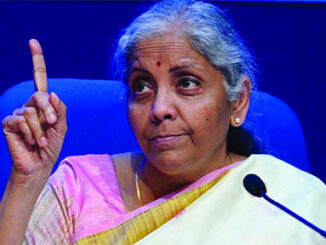
New Delhi (TIP)- Finance Minister Nirmala Sitharaman, speaking in the Lok Sabha on Friday, Feb 9, attacked Congress leader Sonia Gandhi, calling the National Advisory Council (NAC) headed by her an “unconstitutional” body which took decisions that “ruined the economy” during the UPA regime.
She apportioned blame on Sonia and her MP son Rahul Gandhi for pressuring then Prime Minister Manmohan Singh. Sitharaman was replying to a motion to discuss the “White paper on Indian economy and its impact on the lives of people” in the Lok Sabha. The House adopted the motion by a voice vote.
“Sonia was an extra-constitutional and unaccountable person who oversaw this mismanagement as we joined the fragile five economies,” Sitharaman alleged, adding, “The governance was under pressure of this extra-constitutional authority. The NAC okayed 710 files. What authority did it have? It was worse than a kitchen cabinet. While Manmohan was abroad, an ordinance was torn up (by Rahul) insulting their own PM.”
“The UPA regime always put family first and left the country in dire straits. It took us 10 years of dedicated effort to get the economy back on rails. Nothing in this white paper is baseless,” she added.
The minister accused the UPA of ignoring the national security while the environment ministry had become a bottleneck. “There was a critical shortage of military equipment. India had a policy to not develop border areas. We brought down environmental approvals from 316 days to 70 days. You wanted the public distribution system scrapped. We restored it,” the minister said.
From 2005-14, only 102 cases under the PMLA reached the level of prosecution. “We gave independence to the ED and asked them to stop money laundering. Following this, 1,200 cases reached the prosecution stage,” she said.
Earlier, Congress leader Adhir Ranjan Chowdhury called the white paper a “granary of concoctions and a mountain of lies”.
He said in 1947, the per capita income was Rs 247 and in 2011, it rose to Rs 64,361. “Poverty reduced from 65 per cent in 1947 to 27 per cent in 2011-12. Life expectancy improved and literacy rates grew. It was the Congress which brought the green revolution, land reforms and created IITs and IIMs,” he added. Source: TNS -

RS passes Bill to curb exam malpractices, paper leaks
New Delhi (TIP)- The Rajya Sabha on Friday passed the Public Examinations (Prevention of Unfair Means) Bill, 2024. The law which aims to curb irregularities in public examinations was passed by the Lok Sabha on February 6. Union Minister for Minister of State for Personnel, Public Grievances and Pensions Jitendra Singh, replying to the debate on the Bill said the legislation will protect students who are the “architects of new India and who will also be determining the face of India in 2047.”
Singh also said that the “first-of-its-kind in history” law will not penalise bonafide students.
The Bill penalises any person or persons resorting to unfair means with a minimum imprisonment of three years which may extend to five years and with fine up to Rs 10 lakh. The law also prescribes a higher sentence ranging from three to ten years if a company providing services for the exam is involved. For organised rackets involved in unfair means, the Bill prescribes a minimum sentence of five years which can extend up to ten years with a fine of up to Rs 1 crore. Unfair means under the proposed law is defined to include leakage of question paper or answer key, tampering with answer sheets including Optical Mark Recognition (OMR) response sheets, manipulation in seating arrangements, allocation of dates and shifts for the candidates among others.
Congress leader Digvijaya Singh who supported the Bill called for a review of online examinations. “Online examinations have become a platform for corruption. Companies that have been blacklisted in one place conduct their business elsewhere. I would request the minister to stop conducting online examinations and instead have offline exams,” he said.
The Statement of Objects and Reasons of the Bill states that malpractices in public examinations lead to delays and cancellation of examinations adversely impact the prospects of millions of youth. Since technical education is in the concurrent list, a central legislation on the subject would mean that states have to adopt the legislation.
Parliament passes three bills on J&K
The Parliament cleared a bill to add four groups, including Paddari and Pahari in the list of Scheduled Tribes in Jammu and Kashmir.The house approved the Constitution (Jammu and Kashmir) Scheduled Tribes Order (Amendment) Bill, 2024, which adds two other communities — Gadda Brahmin and Koli — to the Scheduled Tribes list. The Upper House also cleared The Jammu and Kashmir Local Bodies Laws (Amendment) Bill, 2024 and the Constitution (Jammu and Kashmir) Scheduled Castes Order (Amendment) Bill, 2024 by voice vote.
The Lok Sabha had cleared the bills earlier this week.The Jammu and Kashmir Local Bodies Laws (Amendment) Bill-2024 seeks to provide reservation to Other Backward Classes in panchayats and municipalities in Jammu and Kashmir and bring consistency in the local body laws of the Union territory with the provisions of the Constitution. Currently, there is no provision for reservation of seats for OBCs in panchayats and municipalities in Jammu and Kashmir.
The Constitution (Scheduled Castes) Order (Amendment) Bill, 2024, adds Valmiki community as a synonym of Chura, Balmiki, Bhangi, and Mehtar communities in the list of Scheduled Castes in Jammu and Kashmir.The bill seeks to amend the Constitution (Jammu and Kashmir) Scheduled Castes Order of 1956, which lists the castes deemed to be Scheduled Castes in Jammu and Kashmir, and Ladakh.
The three bills were taken simultaneously for discussion and passage in the Upper House. -

Madrasa demolition sparks violence in Uttarakhand’s Haldwani, 6 dead
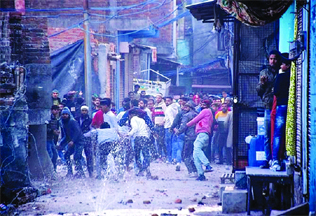
Haldwani/New Delhi (TIP)- Six “rioters” were killed in violence that broke out over the demolition of an illegally built madrasa, officials said as curfew remained enforced in Uttarakhand’s Haldwani town.
More than 60 persons were hurt on Thursday, Feb 8, as local residents hurled stones and petrol bombs at municipal workers and the police, forcing many police personnel to seek refuge in a police station which the mob then set on fire.
Chief Minister Pushkar Singh Dhami visited Haldwani, meeting some of the injured. He termed the violence a “planned attack”, and said the stockpiling of arms, stones and petrol bombs suggested this.
“Women police personnel were brutally thrashed. They even tried to throw a journalist into the flames… Every rioter involved in arson and stone pelting would be identified and strictest action taken against them,” Dhami.
Altogether, six “rioters” were killed, SP (City) Harbans Singh said. Three others were said to be in a critical condition.
A day after the clashes, with curfew in force since 9 pm on Thursday, Haldwani’s Banbhoolpura area looked deserted. Stones were strewn on the streets and there were charred remains of torched vehicles.
On Friday, 9, Feno further incident of violence was reported from the locality where the madrasa – which included a “structure” where prayers were held.
Over 1,000 police personnel remained deployed in the town, close to Nainital, officials said. The demolished structures were on government land, and municipal workers and police acted after court orders, they said.
The officials said stones were thrown at them from rooftops, where they appeared to have been stocked. Some of the alleged rioters killed in the violence had gunshot wounds.
Curfew has been lifted from outer areas of violence-hit Haldwani in Uttarakhand, after tension prevailed in the town following the demolition of an “illegally built” madrasa and an adjoining mosque. However, curfew remains in force in Banbhoolpura area. -

India has nearly 97 crore voters now, up 6% from 2019, says EC
New Delhi (TIP)– The Election Commission on Friday said nearly 97 crore Indians will be eligible to vote in this year’s Lok Sabha elections. It also said over two crore young electors in age group of 18 to 29 years have been added in the voters’ list. There has been a six per cent increase in registered voters from 2019, when the last Lok Sabha polls were held. The registered voters then were 91.20 crore. “The largest electorate in the world – 96.88 crore are registered to vote for the forthcoming General Elections in India,” the EC said. The gender ratio has increased from 940 in 2023 to 948 in 2024, the poll panel said.
The Commission has put special emphasis on purity and health of the electoral roll along with disclosures and transparency in the revision of electoral rolls, an official pointed out. Chief Election Commissioner Rajiv Kumar had explained at a press conference in Pune the various tasks involved in revision of electoral rolls along with participation of political parties at every stage. Over 2.63 crore new electors have been included in the electoral roll, out of which around 1.41 crore are women who surpassed the newly-enrolled male voters (1.22 crore) by over 15 per cent, the poll authority said.
The EC also underlined that effort were made to support persons with disabilities (PwD) by flagging around 88.35 lakh such voters in the electoral roll database. This, it said, will ensure accessibility and inclusivity on polling day. In 2019, voters who had identified them as persons with disability stood at 45.64 lakh. After a thorough house-to-house verification, names of over 1.65 crore deceased, permanently shifted, and duplicate electors were deleted from the electoral rolls. “This comprehensive cleanup ensures the integrity and purity of the electoral process. It includes 67.82 lakh dead voters, 75.11 lakh permanently shifted or absent voters and 22.05 lakh duplicate voters,” it said. According to data shared by the EC, the number of third gender voters increased from 39.68 thousand in 2014 to a little over 48,000. At the same time, more than two crore young electors, spanning the 18-19 and 20-29 year age groups, have been added to the electoral roll. Over 10.64 lakh advance applications were received from those above 17 years of age for enrolment in the voters list. People who are not yet 18 will automatically get their voter identity cards once they attain the age of voting if they apply in advance. While 1.85 crore voters have been identified as above 80 years of age, the total number of ‘centenarian’ (those who are 100 years and above) stood at 2.38 lakh. EC considers those who are 80 years and above as senior citizens. -
Money laundering case against NCB ex-top cop for Rs 25-crore bribe demand from SRK’s family
The Enforcement Directorate has registered a money laundering case against former Mumbai NCB zonal director Sameer Wankhede taking cognisance of a CBI FIR in an alleged Rs 25-crore bribe demand from superstar Shah Rukh Khan’s family to spare his son in a drugs case, official sources said Saturday, Feb 10.
The central agency has booked the case under the Prevention of Money Laundering Act (PMLA), they said.
Some former Narcotics Control Bureau (NCB) officials have also been summoned.
Wankhede, a 2008-batch Indian Revenue Service (IRS) officer of the Customs and Indirect Taxes cadre, has moved the Bombay High Court seeking protection from any coercive action by the anti-money laundering agency.
He was booked by the CBI in May last year on charges of seeking Rs 25-crore bribe for not framing Shah Rukh Khan’s son Aryan Khan in the drugs-on-cruise case, officials had said.
Aryan Khan was arrested in the alleged drug bust case on the Cordelia cruise ship on October 2, 2021.
The Central Bureau of Investigation (CBI) booked Wankhede and others for alleged criminal conspiracy (120-B IPC), and threat of extortion (388 IPC) besides provisions pertaining to bribery under the Prevention of Corruption Act on a complaint from the NCB.
A year later, the NCB filed a charge sheet in the drugs-on-cruise case against 14 accused but gave a clean chit to Aryan Khan.
The much-hyped case took a twist when an ‘independent witness’ had claimed in 2021 that Rs 25 crore was demanded by an NCB official and other persons, including a witness Gosavi, to let off Aryan Khan.
The NCB later conducted an internal vigilance probe against Wankhede and others and shared the contents with CBI leading to registration of a case against him.
Source: PTI -
‘Won my heart’: RLD chief hints at poll alliance with BJP
Rashtriya Lok Dal chief Jayant Chaudhary on Friday, Feb 9, signalled positive outcomes for the ongoing Lok Sabha pre-poll alliance talks with the ruling BJP saying the government had won his heart by honouring his grandfather and late Prime Minister Chaudhary Charan Singh with the Bharat Ratna.
“Dil jeet liya,” Jayant, currently part of the anti-BJP INDIA bloc, said on X today after the news broke. Describing the feeling as one of absolute elation, Jayant said today was a big day. “It is an emotional moment for me, a memorable occasion. I thank President Droupadi Murmu, the Government of India and especially Prime Minister Narendra Modi for the decision to honour Chaudhary Charan Singh ji with the Bharat Ratna,” Jayant said.
Asked if he would ally with the BJP, Jayant said, “Koi kasar rehti hai? (is anything left to be said?”. He, however, added that he was yet to announce any alliance. Importantly, Bihar Chief Minister Nitish Kumar, chief architect of the INDIA bloc, also returned to the BJP-led NDA days after the announcement of the Bharat Ratna for late OBC icon from the state Karpoori Thakur.
Parallel to the BJP-RLD talks, YSRCP chief YS Jagan Mohan Reddy also met Prime Minister Narendra Modi in Parliament today just two days after TDP president N Chandrababu Naidu held parleys with BJP president JP Nadda and Union Home Minister Amit Shah. Source: TNS -

Valentine’s Day: Annual festival to celebrate romance, love, friendship and admiration
Valentine’s Day falls on February 14. This year, the day will be observed on Wednesday. On this day lovers express their affection with greetings and gifts. Given their similarities, it has been suggested that the holiday has origins in the Roman festival of Lupercalia, held in mid-February. The festival, which celebrated the coming of spring, included fertility rites and the pairing off of women with men by lottery. At the end of the 5th century, Pope Gelasius I forbid the celebration of Lupercalia and is sometimes attributed with replacing it with St. Valentine’s Day, but the true origin of the holiday is vague at best. Valentine’s Day did not come to be celebrated as a day of romance until about the 14th century.
Across the globe, candy, flowers and gifts are exchanged between loved ones, all in the name of St. Valentine.
But who is this mysterious saint and where did these traditions come from?
The Legend of St. Valentine
Where did Valentine’s Day originate from? The history of the holiday—and the story of its patron saint—is shrouded in mystery. We do know that February has long been celebrated as a month of romance, and that St. Valentine’s Day, as we know it today, contains vestiges of both Christian and ancient Roman tradition. But who was Saint Valentine, and how did he become associated with this ancient rite?
The Catholic Church recognizes at least three different saints named Valentine or Valentinus, all of whom were martyred. One legend contends that Valentine was a priest who served during the third century in Rome. When Emperor Claudius II decided that single men made better soldiers than those with wives and families, he outlawed marriage for young men. Valentine, realizing the injustice of the decree, defied Claudius and continued to perform marriages for young lovers in secret. When Valentine’s actions were discovered, Claudius ordered that he be put to death. Still others insist that it was Saint Valentine of Terni, a bishop, who was the true namesake of the holiday. He, too, was beheaded by Claudius II outside Rome.
Other stories suggest that Valentine may have been killed for attempting to help Christians escape harsh Roman prisons, where they were often beaten and tortured. According to one legend, an imprisoned Valentine actually sent the first “valentine” greeting himself after he fell in love with a young girl—possibly his jailor’s daughter—who visited him during his confinement.
Before his death, it is alleged that he wrote her a letter signed “From your Valentine,” an expression that is still in use today. Although the truth behind the Valentine legends is murky, the stories all emphasize his appeal as a sympathetic, heroic and—most importantly—romantic figure. By the Middle Ages, perhaps thanks to this reputation, Valentine would become one of the most popular saints in England and France.
Origins of Valentine’s Day
While some believe that Valentine’s Day is celebrated in the middle of February to commemorate the anniversary of Valentine’s death or burial—which probably occurred around A.D. 270—others claim that the Christian church may have decided to place St. Valentine’s feast day in the middle of February in an effort to “Christianize” the pagan celebration of Lupercalia. Celebrated at the ides of February, or February 15, Lupercalia was a fertility festival dedicated to Faunus, the Roman god of agriculture, as well as to the Roman founders Romulus and Remus.
To begin the festival, members of the Luperci, an order of Roman priests, would gather at a sacred cave where the infants Romulus and Remus, the founders of Rome, were believed to have been cared for by a she-wolf or lupa. The priests would sacrifice a goat, for fertility, and a dog, for purification. They would then strip the goat’s hide into strips, dip them into the sacrificial blood and take to the streets, gently slapping both women and crop fields with the goat hide. Far from being fearful, Roman women welcomed the touch of the hides because it was believed to make them more fertile in the coming year. Later in the day, according to legend, all the young women in the city would place their names in a big urn. The city’s bachelors would each choose a name and become paired for the year with his chosen woman. These matches often ended in marriage.
A Day of Romance and Love
Lupercalia survived the initial rise of Christianity but was outlawed—as it was deemed “un-Christian”—at the end of the 5th century, when Pope Gelasius declared February 14 St. Valentine’s Day. It was not until much later, however, that the day became definitively associated with love.
During the Middle Ages, it was commonly believed in France and England that February 14 was the beginning of birds’ mating season, which added to the idea that the middle of Valentine’s Day should be a day for romance. The English poet Geoffrey Chaucer was the first to record St. Valentine’s Day as a day of romantic celebration in his 1375 poem “Parliament of Foules,” writing, “For this was sent on Seynt Valentyne’s day / Whan every foul cometh ther to choose his mate.”
Valentine greetings were popular as far back as the Middle Ages, though written Valentine’s didn’t begin to appear until after 1400. The oldest known valentine still in existence today was a poem written in 1415 by Charles, Duke of Orleans, to his wife while he was imprisoned in the Tower of London following his capture at the Battle of Agincourt. (The greeting is now part of the manuscript collection of the British Library in London, England.) Several years later, it is believed that King Henry V hired a writer named John Lydgate to compose a valentine note to Catherine of Valois.
Who Is Cupid?
Cupid is often portrayed on Valentine’s Day cards as a naked cherub launching arrows of love at unsuspecting lovers. But the Roman God Cupid has his roots in Greek mythology as the Greek god of love, Eros. Accounts of his birth vary; some say he is the son of Nyx and Erebus; others, of Aphrodite and Ares; still others suggest he is the son of Iris and Zephyrus or even Aphrodite and Zeus (who would have been both his father and grandfather).
According to the Greek Archaic poets, Eros was a handsome immortal played with the emotions of Gods and men, using golden arrows to incite love and leaden ones to sow aversion. It wasn’t until the Hellenistic period that he began to be portrayed as the mischievous, chubby child he’d become on Valentine’s Day cards.
Greetings and Gifts
In addition to the United States, Valentine’s Day is celebrated in Canada, Mexico, the United Kingdom, France and Australia. In Great Britain, Valentine’s Day began to be popularly celebrated around the 17th century.
By the middle of the 18th, it was common for friends and lovers of all social classes to exchange small tokens of affection or handwritten notes, and by 1900 printed cards began to replace written letters due to improvements in printing technology. Ready-made cards were an easy way for people to express their emotions in a time when direct expression of one’s feelings was discouraged. Cheaper postage rates also contributed to an increase in the popularity of sending Valentine’s Day greetings.
Americans probably began exchanging hand-made valentines in the early 1700s. In the 1840s, Esther A. Howland began selling the first mass-produced valentines in America. Howland, known as the “Mother of the Valentine,” made elaborate creations with real lace, ribbons and colorful pictures known as “scrap.” Today, according to Hallmark, an estimated 145 million Valentine’s Day cards are sent each year, making Valentine’s Day the second largest card-sending holiday of the year.
Valentine’s Week
While Valentine’s Day falls on February 14, the excitement for the month of love begins in the week before. There are seven days dedicated to celebration of love before Valentine’s Day. It starts from February 7. These seven days of love are Rose Day (February 7), Propose Day (February 8), Chocolate Day (February 9), Teddy Day (February 10), Promise Day (February 11), Hug Day (February 12), and Kiss Day (February 13).
Rose Day
Rose Day falls on February 7 annually. It is the first day of the Valentine’s Week. On this day, couples exchange roses or send a bouquet to their loved ones. People also gift someone they like or adore with flowers to mark this occasion. While people generally gift their partners roses on this day, it shouldn’t stop you from surprising your love with a bouquet of their favourite flowers. Different colours of roses hold a special meaning on this day. For instance, red signifies love, yellow stands for friendship, pink signifies appreciation and admiration, and more.
Propose Day
Propose Day is the second day of Valentine’s Week. It falls on February 8. As the name suggests, it is the day for people to confess their feelings or pop the big question to their love interest – you can ask a potential partner to be your partner or to marry you. However, you should confirm that your partner wants you to ask this question before jumping the gun and putting them in an awkward position.
Chocolate Day
Chocolate Day is the third day and falls after Propose Day on February 9. On this day, people gift chocolates to their partner, crush or love interest. Some also prepare handmade chocolates or make an assortment of their partner’s favourite candies as a gift. In case, your loved one doesn’t like sweets, you can give them their favourite snack as a present.
Teddy Day
Teddy falls on February 10. It is the fourth day of the Valentine’s Week. People in love surprise their partners on this day by gifting them with adorable plushies or teddy bears. It is believed that a cuddly toy would help your partner destress or forget their worries as the present will remind them of your love.
Promise Day
Promise Day falls on February 11. It is the fifth day of the Valentine’s Week. On Promise Day, people make promises to love and cherish each other through thick and thin, strengthen their bond, be a cheerleader, and give support in difficult situations. This promise or commitment helps them show their partner the intensity of their love for them.
Hug Day
Hug Day is the sixth day of Valentine’s Week and falls on February 12. A hug is a comforting gesture, and when one receives it from their loved ones, it helps remove all worries from their mind. After all, physical affection works wonders when language fails to express our true feelings. Therefore, on Hug Day, partners hug each other to comfort each other and promise to be the light in each other’s darkest days.
Kiss Day
Kiss Day is celebrated a day before Valentine’s Day. It falls on February 13. People in love seal their relationship with a kiss on this day or show affection for their partner with this act of love. -

The decline of America’s leadership
Washington is failing to use its leverage in the international environment
“Actions speak louder than values, and Washington is failing to leverage its standing in the international environment, thereby empowering polarization politically, economically and culturally. The U.S. withdrew from the Trans-Pacific Partnership that emphasized human rights, transparency and liberal democracy, and also from many other international obligations. While it sought international dominance, domestic polarization induced ideological separation, rendering cooperation in its two-party system non-existent.”

By Krishnan Srinivasan The traditional strengths of America are its values platform, its military power, its pivotal position in the global financial system, and as a technology pioneer. The energetic pro-American lobby in India advocates ever-closer engagement with the United States, rejecting arguments about its diminishing influence.
This is contradicted by authoritative commentators such as Ian Bremmer (“The US is already the world’s most divided and dysfunctional advanced industrial democracy”), Laura Kuenssberg (“Western leaders in 2024 [are] grappling with a world where other dominant countries are less attached to conventional international rules”) and Andrew Whitehead (“America’s democracy seems to have lost the ability to renew itself”) with former U.S. President Donald Trump and current President Joe Biden in the race for a second presidential term.
These experts are supported by Jonathan Freedland (“Not for nothing is there serious concern in the US that January 2025 could open a new chapter of US authoritarianism, even an American dictatorship), Frank Gardner (“The past 12 months have seen a number of setbacks for the US, Europe and other major democracies on the international politics stage…they point to a shifting balance of power away from the US-dominated, Western values that have held sway for years. On many fronts, the wind is blowing in the wrong direction for Western interests”) and Niall Ferguson (“The harsh reality is that the US is no longer very good at getting B to do something that B would not otherwise do”) which is more than evident in Israel’s Gaza war. Ferguson adds that in purchasing power parity, China, in 2023, had an economy that was a fifth larger than that of the U.S. To him American problems were illegal immigration and deficits in the rule of law, secondary education, public health, new technologies, and the national debt rising to $32 trillion.
After the Second World War, the U.S. shaped the rules-based international system. A rules-based order is an abstract concept; in practice it was neither centered on rules nor was it entirely global. It was a power-based system established by the U.S. and its allies, and Washington considered itself exempt from its norms, particularly those prohibiting interference in the internal affairs of other countries. The American wars in Afghanistan and Iraq dissipated America’s credibility due to its emphasis on military expeditionist, evidenced by about 750 military bases in 80 countries, though Al Jazeera says the number “may be even higher as not all data is published by the Pentagon”.
Actions speak louder than values, and Washington is failing to leverage its standing in the international environment, thereby empowering polarization politically, economically and culturally. The U.S. withdrew from the Trans-Pacific Partnership that emphasized human rights, transparency and liberal democracy, and also from many other international obligations. While it sought international dominance, domestic polarization induced ideological separation, rendering cooperation in its two-party system non-existent.
In the West and parts of Asia, open liberalism and globalization made links of community, family and society brittle, with many feeling excluded from economic progress. Individual freedom was juxtaposed against state, society and law, and the movements of people have resulted in a backlash against immigration, feeding populist movements. The exercise of power is insufficient to be a dominant geopolitical player; legitimacy is also necessary. The most powerful leaders still crave legitimacy both at home and abroad.
There is now a shift in power equations, with challenges to the legitimacy of institutions and leaderships. Mr. Trump and his supporters openly question the validity of the U.S.’s electoral system. American soft power, such as its entertainment industry, which is non-government and unregulated, balances some negativity, as do enduring alliances in Southeast Asia and Europe, though U.S. complicity with Israel’s violence against Palestinians has scrambled all its pre-existing policies in West Asia.
The leaders of China and Russia are determined to maintain their authoritarian regimes and seek to reshape the international system, using trade, pressure and diasporic ties to obstruct the spread of western democratic values that have held sway for decades. In parts of Asia and Africa, western liberalism is often interpreted at worst as a smoke screen for neo-imperialism, and at best as an insensitive expression of American and European arrogance. And although there is no chance of dethroning the international financial settlement infrastructure soon, BRICS’ policies seem to herald a contest between local currencies and the dollar because the risks in the current dollar-centric system are unacceptably high.
U.S.-China security and economic competition is the central issue in the world today, and will be potentially dangerous in the years to come. China campaigns to project power with traditional and non-traditional techniques, such as the Confucius Institutes, TikTok and gaming. Its prowess in high technology and geo-engineering inspire admiration, along with its programme of overseas infrastructure financing unmatched by any other country. Due to internal dissonance, the U.S. has failed to assume leadership in Artificial Intelligence when compared to China and the European Union, which are setting the standards.
Whether or not the U.S. remains “the indispensable nation”, as former U.S. Secretary of State Madeleine Albright termed it, India should develop an advantageous relationship with America while keeping in mind its deficiencies.
(The author is a former Foreign Secretary of India)