NORTH CHESTERFIELD, VA (TIP) : An Indian American couple has been convicted of forcing an immigrant relative to provide labor and services at their store, and gas station including working as the cashier, preparing food, cleaning and managing store records.
Harmanpreet Singh, 30, and Kulbir Kaur, 43, were convicted by a federal jury last Friday in connection with their operation of a gas station and convenience store in North Chesterfield, Virginia, according to a press release from the US Attorney’s Office, Eastern District of Virginia.
A sentencing hearing is scheduled for May 8. Singh and Kaur face a maximum penalty of 20 years in prison, up to five years of supervised release, a fine of up to $250,000, and mandatory restitution for the forced labor charge.
The evidence presented at trial demonstrated that, between March 2018 and May 2021, the couple forced Singh’s cousin to provide labor and services at Singh’s store, including working as the cashier, preparing food, cleaning, and managing store records.
Singh and Kaur used various coercive means, including confiscating the victim’s immigration documents and subjecting the victim to physical abuse, threats of force and other serious harm and, at times, degrading living conditions, to compel him to work extensive hours for minimal pay.
In 2018, the defendants enticed the victim, then a minor, to travel to the United States with false promises of helping enroll him in school, the release stated.
After arriving in the United States, the defendants took his immigration documents and immediately put him to work. They also left the victim at the store to sleep in a back office for days at a time on multiple occasions.
They limited his access to food, refused to provide medical care or education, used surveillance equipment to monitor the victim both at the store and in their home, refused his requests to return to India, and made him overstay his visa.
The evidence further showed that Singh pulled the victim’s hair, slapped and kicked him when he requested his immigration documents back and tried to leave, and on three different occasions threatened the victim with a revolver for trying to take a day off and for trying to leave.
“These defendants engaged in an egregious bait-and-switch, luring the victim with false promises of an education in the United States and instead subjecting him to grueling hours, degrading living conditions, and a litany of mental and physical abuse,” said US.
Attorney Jessica D. Aber for the Eastern District of Virginia.
“The defendants exploited the victim’s trust and his desire to attend school in the United States, and then inflicted physical and mental abuse against him, all so they could keep him working for their profit,” said Assistant Attorney General Kristen Clarke of the Justice Department’s Civil Rights Division.
“Human trafficking is a disgraceful and unacceptable crime, and this verdict should send the very clear message that the Justice Department will investigate and vigorously prosecute these cases to hold human traffickers accountable and bring justice to their victims.”
Tag: Apple News
-

Indian American Virginia couple convicted of forced labor of relative
-

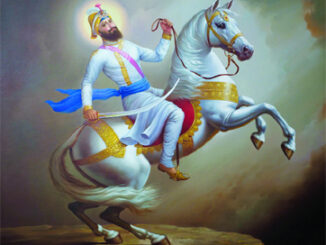
Guru Gobind Singh: The Saint Soldier and founder of Khalsa Panth
Guru Gobind Singh Sahib, the 10th master of the Sikhism, was born on 7th day of the month of POH, samvat 1723, (22nd December, 1666 AD ) at Patna Sahib in Bihar. Guru ji was a great revolutionary whose greatest achievement was the creation of the Khalsa Panth on Baisakhi Day of 1699 at Anandpur Sahib in Punjab. Guru ji was a linguistic familiar with many languages Iike, Persian, Arabic, Sanskrit as well as his native Punjabi. Guru ji codified Sikh law,wrote martial poetry and music ,fought many battles and won. Guru ji wrote the renowned holy Granth called the Dasam Granth.The noted prayers included in this Granth are Jaap Sahib, Chandi Di Vaar, Tav-Prasad Savaiye, Zafarnamah, Bachittar Natak, Akal Ustat, Chaupai Sahib and more.
Guru Gobind Singh Sahib Ji was a revolutionary prophet who practiced his spiritual ideals to counter the forces of tyranny and injustice. Tyranny in all its forms – social, political, and religious was to be countered and annihilated. A state which could not provide basic human rights, social justice, equality and religious freedom was to be opposed. A God oriented person, owed primary allegiance to God, truth, conscience and morality. Guru Gobind Singh was concern were universal, integrated and without any boundaries. The martyrdom of Guru ji’s father, mother, four sons and hundreds of followers for the lofty ideals of freedom, justice and righteousness were unique in the annals of human history. Guru Gobind Singh Ji ignited that spark in human nature that inspired mankind to build lives of compassion, love and commitment to justice and also to suffer and make sacrifices for the cause of righteousness.
Sir J. D.Cunningham, the noted author of the book “, History Of The Sikhs”,wrote about Guru Gobind Singh Sahib Ji as under:
A living spirit possess the whole Sikh people and the impression of Guru Gobind Singh Ji has not only elevated and attired the constitution of their minds but has operated materially and given amplitude to their physical frames ,”The Khalsa ideals transformed the life, outlook and aspirations of the people and imparted a new direction to Indian history”.
In the words of Gurudev Rabindra Nath Tagore, “Guru Gobind Singh Ji appeared on the Indian National scene with the message of militarism of the community for the defence of social equality and religious freedom. In order to execute his plan, Guru Gobind Singh Sahib Ji unified the Sikhs, taught them how to face any crisis calmly and boldly and generated a new hope and confidence “.
Guru Gobind Singh Sahib Ji came to reside Anandpur Sahib along with his parents, when he was a child of 7 years old. After some years, a deputation of Kashmiri Pandits came to Anandpur Sahib and met his father, the 9th Sikh Guru, Shree Guru Tegh Bahadur Sahib ji. They narrated the cruel acts of Mughal rulers towards the Hindu community and sought Guru Ji’s help. Guru Tegh Bahadur Ji became silent and was absorbed in deep thoughts. Guru Gobind Singh ii,who was, at that time, a child of just 9 years of age, asked his father about the reason for his silence. Guru Tegh Bahadur Ji explained that these helpless people from Kashmir had no one to protect their Dharma. The sacrifice of a great and brave soul was needed.The child, Guru Gobind Singh Ji, immediately Said ,”Who can be more brave and greater than you? Please have mercy on them and do what is necessary to protect “Hindu Dharma “.
Guru Tegh Bahadur Ji was pleased to hear this and went to Delhi to sacrifice his life only to save the Hindu Dharma. The Mughal emperor Aurangzeb asked Guru Ji to either embrace Islam or face death.Guru Tegh Bahadur ji replied, “My religion is most dear to me. I am not afraid of death ” At this, Aurangzeb ordered the execution of Guru Tegh Bahadur Ji.
Guru Ji was to be beheaded at the Main Bazar of Chandni Chowk, Delhi.At the Chandni Chowk in Delhi, where the great Gurudwara Sri Sisganj Sahib stands today, was the place chosen for Guru Ji’s execution. Guru Tegh Bahadur Ji died a hero’s death. Guru ji’s execution only strengthened the resistance against Aurangzeb’s religious fanaticism. When Guru Gobind Singh was told that no one came forward to protest because of the fear of death, Guru Ji declared that he would lay the foundation of the Khalsa Panth and would train it in such a way that it’s members would be ready to sacrifice everything for the right cause.
Guru Gobind Singh Ji’s creation of Khalsa Panth in 1699 AD , on the Baisakhi day at Anandpur Sahib was an event of world significance. Noted historian Arnold Tonybee has called it the precursor and forerunner of Lennin’s communist party two centuries later in the history, an idealistic minority fighting with the weapons of adversity in the name of God , for the sake of majority.
Guru ji baptised the 5 chosen Sikhs by administering Amrit ,prepared by a double edged sword,sweetened by dissolving “Battashas ” in to the water, to them.They were called as the five chosen loved ones, Panj Pyare.
They were given the surname of Singh, and were called as Khalsa, the army of lord God:
“Khalsa Akalpurkh Ki Fauj,
Pargatiyo Khalsa,
Parmatam Ki Mauj!’
(KHALSA is the army of the eternal God raised by him out of his pleasure)
Guru ji held his Chosen five in so high esteem that he knelt before them and asked them to initiate himself into the Khalsa Panth in the same manner as he had done them. Guru ji was then administered Amrit in the same way and was given the surname Singh (Previously Guru ji’s name was Gobind Rai)
The Khalsa, with God’s light shining within was meant to be a global society. They were not to form a separate denomination as that was totally against the Guru Ji concept of universal brotherhood. The creation of the Khalsa Panth was a crowning event of Guru Gobind Singh ji’s life. Ideologically, the creation of the KHALSA PANTH aimed at a well balanced combination of the ideals of Bhakti and Shakti, of moral spiritual excellence and militant valour and heroism of the highest order. They were expected to salute one another with words,
“Wahe Guru Ji Ka Khalsa
Wahe Guru Ji Ki Fateh!”
This was meant to remind that they were knighted as God’s soldiers to carry out his mission and that victory was theirs.
But the Khalsa, the ‘Singhs”, were not to be merely soldiers. It was imperative that they must at the same time be saints deeply devoted to God, singing his hymns as composed by Sikh Gurus, observing the daily religious discipline prescribed in Rahit Maryaada of the Khalsa Panth and bearing a high moral character. Guru Gobind Singh Ji, though, was a matchless warrior, always remained a Saint at heart.Guru ji was a Saint who had dedicated himself to God,a God intoxicated philosopher Guru ji was a sincere lover of mankind who wanted to see all manmade differences created by barriers of formal religion and social distinctions brought in by caste, to be oblitered from the society.
Guru ji left for his heavenly abode on October 7th, 1708 at a place, Naded, in Maharashtra due to a conspiracy hatched against him by Nawaab Wazir Khan of Punjab. Guru ji,before leaving for his heavenly abode, declared that the Sikh community be guided by the decisions of “Panj Piayrey”, the chosen five, chosen from among the devotees. Guru ji handed over the stewardship of the Sikh Panth, the Sikh way of life, to holy Guru Grant Sahib Ji .Those, who wished to seek God ,can find him in the holy Guru Grant Sahib. Ji.
In conclusion, it can be said that Guru Gobind Singh Sahib Ji, the son of martyred Guru Tegh Bahadur Ji, the great grandson of 5th Sikh Guru, Shree Guru Arjan Dev Ji, who also attained martyrdom at Lahore .(Guru Arjan Dev Ji was martyred for compiling the 1st official version of the holy scripture called the Adi Granth, which later was expanded in to the holy Guru Granth Sahib Ji.), laid at the altar of Almighty, all that that he could call his own, his father, mother, his four sons and even his entire life for the freedom of all including those who considered themselves his enemy.
The man and his philosophy
A divine messenger, a warrior, a poet, and a philosopher, Guru Gobind Singh molded the Sikh religion into its present shape, with the institution of the Khalsa fraternity, and the completion of the sacred scripture, the Guru Granth Sahib, in the final form that we find today. Before leaving his mortal body in 1708, Guru Gobind Singh decreed the Guru Granth Sahib as the next and perpetual Guru of the Sikhs.
It may not be out of context to consider that throughout the chronicles of human history, there has been no individual who lived a life more inspirational than Guru Gobind Singh. He is variously revered as Sarbans Dani (the merciful donor, who sacrificed his all), Mard Agamra (man without any parallels), Shah-e-Shahenshah (emperor of emperors), Bar do Alam Shah (ruler of both worlds), amongst others.
It is said that after the martyrdom of his father, Guru Teg Bahadur, the tenth Master declared that he would create such a Panth (community/society), which would challenge the tyrant rulers in every walk of life to restore justice, equality and peace for all of mankind. Via institution of the Khalsa in 1699, Guru Gobind Singh Ji infused the dual spirit of a saint and a soldier in the minds and hearts of his followers to fight oppression in order to restore righteousness (Dharma) and to uplift the down-trodden people in this world.
As a prophet, the Guru is unique. His teachings are very scientific and most suitable for all times. Unlike many other prophets he never called himself God or ‘the only son of God.’ Instead he called all people the sons of God sharing His Kingdom equally. For himself he used the word ‘slave’ or servant of God.
A splendid Divine Light shone in the darkness of the night. Pir Bhikan Shah a Muslim mystic performed his prayers in that Easterly direction (instead of towards the West, contrary to his daily practice), and guided by this Divine Light, he travelled with a group of his followers until he reached Patna Sahib in Bihar. It was here that Gobind Rai was born to Mata Gujri. It is said that Pir Bhikan Shah approached the child and offered two bowls of milk and water, signifying both the great religions of Hinduism and Islam. The child smiled and placed his hands on both bowls. The Pir bowed in utter humility and reverence to the new Prophet of all humanity.
Gobind Rai was born with a holy mission of which he tells us in his autobiography “Bachitar Natak” (Wonderous Drama). In it Guru Ji tells us how and for what purpose he was sent into this world by God. He states that before he came into this world , as a free spirit he was engaged in meditation in the seven peaked Hemkunt mountain.
Early Life
Gobind Rai’s father, Guru Teg Bahadur, the Ninth Guru, was then travelling across Bengal and Assam. Returning to Patna in 1670, he directed his family to return to the Punjab. On the site of the house at Patna in which Gobind Rai was born and where he spent his early childhood now stands a sacred shrine, Sri Patna Sahib Gurdwara, Bihar.
Gobind Rai was escorted to Anandpur (then known as Chakk Nanaki) on the foothills of the Sivaliks where he reached in March 1672 and where his early education included reading and writing of Punjabi, Braj, Sanskrit and Persian. He was barely nine years of age when a sudden turn came in his life as well as in the life of the community he was destined to lead.
Kashmiri Brahmins come to Anandpur
Early in 1675, a group of Kashmiri brahmins under the leadership of Pandit Kirpa Ram, mad in desperation by the religious fanaticism of the Mughals General, Iftikar Khan, (he had threatened them with forced conversion to Islam) visited Anandpur to seek Guru Teg Bahadur’s advice. Aurangzeb had ordered the forced conversion of all Hindus and thought that if the respected Kashmiri brahmans accepted Islam, others in the country would be easily converted. They had been given six months to decide or suffer the consequences. Time was running out!
As the Guru sat reflecting what to do, young Gobind Rai, arriving there in company with his playmates, asked why he looked so preoccupied. The father, as records Kuir Singh in his Gurbilas Patshahi 10, replied, “Grave are the burdens the earth bears. She will be redeemed only if a truly worthy person comes forward to lay down his head. Distress will then be expunged and happiness ushered in.” “None could be worthier than you to make such a sacrifice,” remarked Gobind Rai in his innocent manner. Guru Teg Bahadur advised the brahmins to return to their village and tell the authorities that they would accept Islam if Guru Teg Bahadur could first be persuaded to do so.
Soon afterwards the Guru with a few followers proceeded to the imperial capital, Delhi. After watching the tortured deaths of three of his followers he, as well, refused to convert and was beheaded on November 11, 1675. The 13 year old Gobind Rai, ordained as the next Guru before his father departed Anandpur, was formally installed as Guru Gobind Singh on the Baisakhi day of March 1676. In the midst of his engagement with the concerns of the community, he gave attention to the mastery of physical skills and literary accomplishment. He had grown into a comely youth spare, lithe of limb and energetic.
He had a natural genius for poetic composition and his early years were assiduously given to this pursuit. The Var Sri Bhagauti Ji Ki, popularly called Chandi di Var. written in 1684, was his first composition and his only major work in the Punjabi language. The poem depicted the legendary contest between the gods and the demons as described in the Markandeya Purana. The choice of a warlike theme for this and a number of his later compositions such as the two Chandi Charitras, mostly in Braj, was made to infuse martial spirit among his followers to prepare them to stand up against injustice and tyranny.
For the first 20 years or so of his life, Guru Gobind Singh lived peacefully at Anandpur practicing arms and exercises to complete his training as a soldier.
He also studied Persian and Sanskrit and engaged 52 poets to translate the Hindu epics. Stories of ancient heroes were translated into Punjabi in order to create the martial spirit among the Sikhs. The Guru also wrote several compositions including Jaap Sahib, Akal Ustat and Sawayas during this period. He also established a Gurdwara at Paonta Sahib on the banks of the river Jamna.
Stay at Paonta Sahib
Much of Guru Gobind Singh’s creative literary work was done at Paonta he had founded on the banks of the River Yamuna and to which site he had temporarily shifted in April 1685. Poetry as such was, however, not his aim. For him it was a means of revealing the divine principle and concretizing a personal vision of the Supreme Being that had been vouchsafed to him. His Jap Sahib, Swayas and the composition known as Akal Ustat are in this tenor.
Through his poetry he preached love and equality and a strictly ethical and moral code of conduct. He preached the worship of the One Supreme Being, deprecating idolatry and superstitious beliefs and observances. The glorification of the sword itself which he eulogized as Bhagauti was to secure fulfillment of God’s justice. The sword was never meant as a symbol of aggression, and it was never to be used for self-aggrandizement. It was the emblem of manliness and self-respect and was to be used only in self-defence, as a last resort.
Martial training
During his stay at Paonta, Guru Gobind Singh availed himself of his spare time to practice different forms of manly exercises, such as riding, swimming and archery. His increasing influence among the people and the martial exercises of his men excited the jealousy of the neighbouring Rajput hill rulers who led by Raja Fateh Chand of Garhwal collected a host to attack him. But they were worsted in an action at Bhangam, about 10 km north-east of Paonta, in September 1688. Soon thereafter Guru Gobind Singh left Paonta Sahib and returned to Anandpur. The Guru and his Sikhs were involved in a battle with a Mughal commander, Alif Khan, at Nadaur on the left bank of the Beas, about 30 km south-east of Kangra, in March 1691.
Describing the battle in stirring verse in Bachitra Natak, he said that Alif Khan fled in utter disarray “without being able to give any attention to his camp.” Among several other battles that occurred was the Husain battle (20 February 1696) fought against Husain Khan, an imperial general, which resulted in a decisive victory for the Sikhs.
Following the appointment in 1694 of the liberal Prince Muazzam (later Emperor Bahadur Shah) as viceroy of north-western region including Punjab, there was however a brief respite from pressure from the ruling authority. In Sambat 1756 (1699 A.D), Guru Gobind Singh issued directions to Sikh sangats or communities in different parts not to acknowledge masands, the local ministers, against whom he had heard complaints. He asked the Sikhs to send their offerings directly to Anandpur.
The Masands
The Guru received various complaints against the priests, masands who robbed the poor Sikhs and misappropriated the collections. Guru Sahib abolished this order and severly punished the miscreants. Hereafter, the faithful were to bring their offerings directly to the Guru at the time of the annual Vaisakhi fair. The Guru wanted to create a strong self-respecting community. He inspired the Sikhs with courage and heroism and a life of simplicity and hard work. He started an arms factory at Anandpur in order to manufacture swords and lances needed for his soldiers. Once when the Brahmins insisted that he should offer worship to goddess Durga in order to seal victory, he agreed and kept up the farce till nothing came out of it. At the crucial moment, the Guru unsheathed his sword exclaiming, “The sword is the Durga which will give us victory over our enemies.
Sikhs, he instructed, should come to Anandpur straight without any intermediaries. The Guru thus established direct relationship with his Sikhs. The institution of the Khalsa was given concrete form on 30 March 1699 when Sikhs had gathered at Anandpur in large numbers for the annual festival of Baisakhi.
Creation of the Khalsa
An open air diwan was held in Kesgarh Sahib at Anandpur. The Guru drew his sword and in a thundering voice said, “I want one head, is there any one who can offer me?”
This most unusual call caused some terror in the gathering and the people were stunned. There was dead silence. The Guru made a second call. Nobody came forward. There was still more silence. On the third call there raised Daya Ram, a khatri of Lahore who said, “O true king, my head is at your service.”
The Guru took Daya Ram by the arm and led him inside a tent. A blow and thud were heard. Then the Guru, with his sword dripping with blood, came out and said, “I want another head, is there anyone who can offer?” Again on third call Dharam Das, a Jat from Delhi came forward and said, “O true king! My head is at thy disposal.” The Guru took Dharam Das inside the tent, again a blow and thud were heard, and he came out with his sword dripping with blood and repeated, “I want another head, is there any beloved Sikh who can offer it?”
Upon this some people in the assembly remarked that the Guru had lost all reason and went to his mother to complain. Mohkam Chand, a calico priner/tailor of Dwarka (west coast of India) offered himself as a sacrifice. The Guru took him inside the tent and went through the same process. When he came out, he made a call for the fourth head. The Sikhs began to think that he was going to kill all of them.
Some of them ran away and the others hung their heads down in disbelief. Himmat Chand, a cook of Jagan Nath Puri, offered himself as a fourth sacrifice. Then the Guru made a fifth and the last call for a fifth head. Sahib Chand, a barber of Bidar (in central India), came forward and the Guru took him inside the tent. A blow and thud were heard.
The last time he stayed longer in the tent. People began to breathe with relief. They thought may be the Guru has realised “his mistake” and has now stopped.
The panj pyare
The Guru now clad his five volunteers in splendid garments. They had offered their heads to the Guru, and the Guru had now given them himself and his glory. When they were brought outside, they were in the most radiant form. There were exclamations of wonder and the sighs of regret on all sides. Now people were sorry for not offering their heads.
Since the time of Guru Nanak, Charan Pauhal had been the customary form of initiation. People were to drink the holy water which had been touched or washed by the Guru’s toe or feet. The Guru proceeded to initiate them to his new order (Khande di Pauhal) by asking the five faithful Sikhs to stand up. He put pure water into an iron vessel or Bowl (Batta of Sarbloh) and stirred it with a Khanda (two edged small sword). While stirring the water with Khanda, he recited Gurbani (Five Banis- Japji, Jaap Sahib, Anand Sahib, Swayas, and Chaupai). Sugar crystals called ‘Patasas’ which incidently the Guru’s wife, Mata Sahib Kaur, had brought at that moment, were mixed in the water.
Amrit Sanchar
The Guru then stood up with the sacred Amrit (nectar) prepared in the iron bowl. Each of the five faithful, by turn, each kneeling upon his left knee, looked up to the Master to receive the divine amrit. He gave five palmfuls of Amrit to each of them to drink and sprinkled it five times in the eyes, asking them to repeat aloud with each sprinkle, “Waheguru Ji ka Khalsa, Waheguru Ji Ki Fateh.” (This means: Khalsa belongs to God and all triumph be to His Name) Then he anointed with five sprinkles in the hair.
In this way Amrit was administered to the five faithful from the same bowl. After that he asked them to sip Amrit from the same bowl to signify their initiation into the casteless fraternity of the Khalsa. All the five faithful were baptized in this way by the Guru who then called them the ‘PANJ PYARE’ or Five Beloved Ones.
He gave them the appellation of Singhs (Lions) and they were named from Daya Ram to Daya Singh, Dharam Das to Dharam Singh, Mohkam Chand to Mohkam Singh, Himmat Chand to Himmat Singh, and Sahib Chand to Sahib Singh. The Guru then addressed them as the supreme, the liberated ones, pure ones and he called them The Khalsa.
Guru asks for Amrit
After the Guru had administered Amrit to his Five Beloved Ones, he stood up in supplication and with folded hands, begged them to baptize him in the same way as he had baptized them. He himself became their disciple (Wonderful is Guru Gobind Singh, himself the Master and himself the disciple). The Five Beloved Ones were astonished at such a proposal, and represented their own unworthiness, and the greatness of the Guru, whom they deemed God’s Vicar upon earth. They asked him why he made such a request and why he stood in a supplicant posture before them. He replied,” I am the son of the Immortal God. It is by His order I have been born and have established this form of baptism. They who accept it shall henceforth be known as the Khalsa. The Khalsa is the Guru and the Guru is the Khalsa. There is no difference between you and me. As Guru Nanak seated Guru Angad on the throne, so have I made you also a Guru. Wherefore administer the baptismal nectar to me without any hesitation.” Accordingly the Five Beloved Ones baptized the Guru with the same ceremonies and injunctions he himself had employed.
The rise of the Khalsa
The Guru was then named Gobind Singh instead of Gobind Rai. Guru Gobind Singh was the first one to take Amrit from the Khalsa, the Five Beloved Ones. About 80,000 men and women were baptized within a few days at Anandpur. “The creation of the Khalsa was the greatest work of the Guru. He created a type of superman, a universal man of God, casteless and country less. The Guru regarded himself as the servant of the Khalsa. He said, “To serve them pleases me the most; no other service is so dear to my soul.” The Khalsa was the spearhead of resistance against tyranny.” (Miss Pearl, S. Buck)
The creation of the Khalsa created a sense of unity among the Sikhs and their supporters. This unity and the resulting perceived strength in the Sikhs did not go well with the local rulers. The continuous gatherings at Anandpur sahib and the presence of many thousands of the congregation, some armed with fierce weapons caused anguish with the surrounding hill Rajas. These developments most alarmed the caste ridden Rajput chiefs of the Sivalik hills. They perceived the Sikhs as lower caste beings who had posed no danger to their authority. However, the creation of the Khalsa changed that. Firstly, it disturbed their system of discrimination and division; secondly, they could see that the forces of the Guru were becoming dangerous in number and in armaments.
Siege of Anandpur
They hence rallied under the leadership of the Raja of Bilaspur, in whose territory lay Anandpur, to forcibly evict Guru Gobind Singh from his hilly citadel. Their repeated expeditions during 1700-04 however proved abortive. The Khalsa forces were too strong to be dealt with by the hill Rajas. They at last petitioned Emperor Aurangzeb for help. In concert with contingents sent under imperial orders by the governor of Lahore and those of the faujdar of Sirhind, they marched upon Anandpur and laid a siege to the fort in May 1705.
Over the months, the Guru and his Sikhs firmly withstood their successive assaults despite insufficient amounts of food resulting from the prolonged blockade. While the besieged (Sikhs) were reduced to desperate straits, the besiegers (governor of Lahore) too were exhausted at the courage of the Sikhs. At this stage the besiegers offered, on Oath (promise) of the Qur’an, safe exit to the Sikhs if they quit Anandpur. At last, the town was evacuated during a night of December 1705. But as the Guru and his Sikhs came out, the hill monarchs and their Mughal allies set upon them in full fury.
Sikhs tricked by the Mughals
In the ensuing confusion many Sikhs were killed and all of the Guru’s baggage, including most of the precious manuscripts, was lost. The Guru himself was able to make his way to Chamkaur, 40 km southwest of Anandpur, with barely 40 Sikhs and his two elder sons. There the imperial army, following closely on his heels, caught up with him. His two sons, Ajit Singh (born. 1687) and Jujhar Singh (born. 1691) and all but five of the Sikhs fell in the action that took place on 7 December 1705. The five surviving Sikhs commanded the Guru to save himself in order to reconsolidate the Khalsa. -

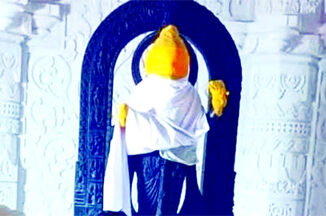
Ram Lalla idol installed in sanctum sanctorum
As part of the elaborate rituals leading up to the Pran Pratishtha ceremony to be held on January 22, the idol of Ram Lalla was placed in the ‘Garbha Griha’ of the Ram Temple in Ayodhya on Thursday, January 18, amid joyous chants of ‘Jai Shri Ram.’
The statue of Ram Lalla sculpted by Karnataka sculptor Arun Yogiraj has been selected for installation at Ram Temple.
The ‘parisar pravesh’ (temple entry) of the idol of infant god Ram, or Ram Lalla, took place in Ayodhya on Wednesday, January 17, the second day of the weeklong rituals in the run up to the January 22 consecration ceremony that will be presided over by Prime Minister Narendra Modi.
The 51-inch idol was brought on an open truck from Vivek Srishti Trust, an International Yoga and Meditation Institute, where it was carved by renowned sculptor Arun Yogiraj of Karnataka, to the sanctum sanctorum of the Ram Temple amid chants of “Jai Shri Ram” by devotees.
The idol was covered throughout the 10-km journey.
Before reaching the temple site, the vehicle also stopped at the historic Hanuman Garhi temple (Lord Hanuman is considered the protector of Ayodhya). Seven women performed ‘kalash pujan’ on the bank of the Saryu, collecting water from the river in copper pitchers and taking them to the Ram Mandir.
Anil Mishra, member of the Shri Ram Janmabhoomi Teerth Kshetra Trust and the jajman (host) of the seven-day long rituals, joined the women in the ritual. This water will be used to bathe the deity.
A second silver idol of Ram Lalla was taken around the temple campus for ‘parisar bhraman’.This small idol, placed in a flower palanquin, was created as a substitute for the new idol to perform Vedic rituals and was carried by temple priests.
“As the new idol weighs 150kg, it will not be feasible to relocate/shift it several times during the ‘pran pratishtha’ ceremony. So, as a substitute, a small silver idol has been prepared. If required during the ceremony, this silver idol will be shifted to perform vedic rituals,” said office bearers of the Trust.
This smaller idol will also be seated in the sanctum-sanctorum of the Ram Temple. According to the Trust, the Vedic rituals of worshipping 16 pillars and four gates of the Yagya Mandap of the temple were performed.
Meanwhile, Ram Mandir Construction Committee Chairman Nripendra Mishra has said that the construction of the sanctum sanctorum is complete. “The temple of Ram Lalla will have ‘garbhagriha (sanctum sanctorum)’, five mandaps and that temple will be on the ground floor. That temple is complete,” he told ANI.
Quiet flows the Saryu as ‘Sabke Ram’ towers over Ayodhya
In line with the ‘Sabke Ram’ philosophy reflecting the universality of devotion to Lord Ram, Ayodhya continues its centuries-old bond with amity, the crowning glory of which is set to be the Pran Pratishtha (consecration ceremony) here on January 22.
Even the turbulence of the ‘Mandir Andolan’ during the late 1980s and early 1990s could not melt the ties between Hindus and Muslims of Ayodhya who have lived together for centuries in the erstwhile capital of Awadh, known for its cultural synthesis and communal harmony.
“The strong bond between Muslims and Hindus can be understood from the fact that key litigants in the Ram Janambhoomi- Babri Mosque case, Hashim Ansari and Mahant Ramchandra Paramhans, fought the case bitterly in court but were friends once they stepped outside,” said Azim Siddiqui, a teacher and social worker.
“The duo travelled to court in the same rickshaw for the case and returned together after the hearings. Even as hundreds of kar sewaks and leaders of Hindu organisations arrived in Ayodhya to launch the movement in 1990, Ansari and Ramchandra Paramhans remained friends. When Paramhans died in 2003, Hashim wept and attended the last rites,” Siddiqui said. Decades later, Hashim Ansari’s son Iqbal Ansari, a former litigant and now an invitee to the ceremony, said, “A large number of devotees from across the country will visit Ayodhya after inauguration by Prime Minister Narendra Modi. It will generate employment; the people of Ayodhya also want development. Hindus and Muslims are interdependent for livelihood, there should be no tussle on religion or temple.”
“The Muslims accepted the Supreme Court verdict awarding the land to the Hindus for the construction of the temple. There was no protest by the Muslims against the SC ruling. There is peace and harmony in the city,” Iqbal Ansari further said as a group of Muslims were seated around a bonfire lit on the pavement outside his house in Panji Tola.
Vouching for the harmony in the city, a trader, Khaliq Ahmed, said, “The flowers, garlands, scarves, sindoor (vermillion), incense stick, khadau (footwear) and dresses for the deities installed in the temple and other articles required for religious rituals are supplied by the Muslims. The economy of Muslims and bhakti of the Hindus is interdependent in Ayodhya. No one can break this relationship. Ayodhya is the land of Ram, it’s land of tranquility and peace. The relation between the two communities is amazing.”
Delving into the history of this relationship between the communities, Siddiqui said, “Around 1772, the first nawab of Awadh (Saadat Ali Khan) established Faizabad, now renamed Ayodhya, as his capital on the bank of the River Ghaghara (known as Saryu locally in Ayodhya). The city developed under the second Nawab Safdarjung. His successor Shuja- ud- Daula developed it as a centre of trade and culture. Several structures, including Gulab Bari, Moti Mahal and the tomb of Bahu Begum, market and roads were constructed in the city.”
“The Nawabs gifted land to the Hindus for the construction of temples and mutts. The land on which famous Hanumangarhi temple is located was also donated by the Nawab. He also gave funds for construction of the temples. The bond with Muslims and Hindus is strong since the Nawabi era. The turbulence of Ram temple movement during the late 1980s and 1990s could not melt the ties between the two communities,” Siddiqui added.
Similarly Khaliq Ahmed underlined the ethos of peaceful co-existence in the temple town.
“There are several mosques in Ayodhya. Daily namaz and azan is being performed in these mosques. In various countries, mosques have been attacked and restrictions have been imposed on namaz but, in Ayodhya, the Muslims are going fearlessly to mosques to offer namaz,” Khaliq Ahmed said. Mohammad Ashraf, owner of a wholesale egg shop located 500 metres from Ram Janambhoomi area, said, “We are living with the Hindus since generations, our relations did not sour during the Ram temple movement. We respect Lord Ram as well as the faith of the Hindus.”
The comment comes even as the state government machinery is working round the clock to give final touches to preparations for inauguration of the Ram temple by Prime Minister Narendra Modi on January 22.
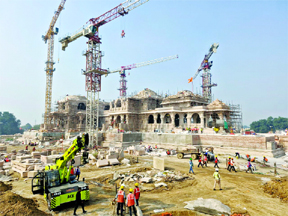
Hordes of workers are laying tiles on the pathway leading to the newly constructed Ram temple. A trimmer is pressed to grind the stone and plaster model to shape the design. The sound of machines and dust fills the area.
Ayodhya Waqf Board president Azam Qadri said, “Ayodhya is revered by Muslims as well. A large number of Muslims visit Ayodhya to pay obeisance at Hazrat Sheesh Alaihis Salam Dargah. PM is working for the development of all communities. He should pay attention to the development of the Muslim spots as well.”
Shia cleric Maulana Sayyad Shamim Haider Rizvi said, “The Muslim community welcomes the inauguration of the Ram temple and development of the religious place. The temple may pave way for communal harmony and restoration of the Ganga -Jamuni Tehzeeb.” “Crores of Hindus have faith in Ram temple. Hindus living in Ayodhya are celebrating the construction of the temple. The Muslims will join the celebration,” said Dr Adeel Mustafa, a medical practitioner. Sayyad Ashfaq, who runs an English language coaching centre in Ayodhya, said, “We welcome the launch of development projects in Ayodhya. Construction of the Ram temple will benefit all communities and castes residing in the district.”
Source: HT and agencies -

Architecture of Ram Mandir Ayodhya
By Dr. Ujjwala Anand Palsuley
After a struggle of around 500 years, finally, our generation is fortunate to see the expedited process of the temple construction of Shri Ram Mandir at the birthplace of Maryadapurushottam Prabhu Shri Ram. In modern times, with the contribution of scholars like Senior Archaeologist B. B. Lal., K.K. Mohammad, and others, one could consolidate the traces of earlier temple remains. The image of the current temple was released somewhere in the 1980s while progressing the long ongoing movement of temple construction.
The original design for Ram Mandir was devised in 1988 by the Sompura family of Ahmedabad headed by Chandrakant Sompura who is the chief architect of the temple assisted by his two sons, Nikhil Sompura and Ashish Sompura. These Sompuras have contributed to the design of over 100 temples worldwide for at least 15 generations, including the Somnath temple.
The question raised by many people about the ‘design’ of the Ram temple. There are many assumptions made by people and ‘opinions’ are available widely. The hypothesis of many is that Shri Ram mandir at Ayodhya is made to look like Somnath temple, in Gujarat. Both these temples have a special place in the hearts of the people. Both of these are hundreds of kilometers away and were constructed after independence in 1947 to reinstate the pride of Hindus and mark the epitome of Hindu beliefs.
However, there is a logical explanation about the architectural style selected for these temples, and also there is a reason why these two are similar. These reasons are beyond their current political patronage.
This article attempts to describe the architectural style of the new Ram temple and its nuances. It gives a detailed account of the religious and architectural continuity of heritage in this region.
1. Spiritual significance of Ayodhya
The Sapta Puri (seven cities) are a group of seven Hindu tirtha, or holy pilgrimage sites, located in India. Pilgrimage to these sites is said to bless the pilgrim with moksha (liberation from the cycle of birth and death).
So Ayodhya is the first out of 7 important places for Hindus for spiritual liberation. Every Hindu wishes to visit these seven cities in their lifetime even in modern times.
Ayodhya is the place where Shri Rama was born. The modern town is located on the banks of river Sharayu. There are over 100 temples in this town, a few of these are the Temple of Rama and his wife Sita, called the Kanak Bhavan; the Hanuman temple called the Hanuman Garhi on top of a hill where, apart from a Hanuman statue in a sitting posture, there is also a 6 inches (15 cm) tall image of Hanuman always bedecked by flowers; the Kshireshwaranath temple of Sita, established by Kausalya, Rama’s mother. In addition, there are several kunds and ghats with linkage to characters; such as the Brahma kund built in honor of Brahma’s visit here, Sita kund, Bharat kund, Lakshman ghat where Lakshman, Rama’s brother took a bath, Rama ghat (also called Swargadwar meaning gateway to heaven).
2. History of the region of Ayodhya
Ayodhya, meaning unconquerable, has been part of India’s oral history through its epic- Ramayana, which was the capital of the legendary Ikshvaku kings of Kosala, including Rama. 6 According to the Ramayana, Ayodhya was founded by Manu, the progenitor of mankind, and measured 12×3 yojanas in area. 7 Both Ramayana and Mahabharata describe Ayodhya as the capital of the Ikshvaku dynasty of Kosala, including Rama and Dasharatha. The Purana-Pancha-Lakshana also describes the city as the capital of Ikshvaku kings, including Harishchandra.
Buddhist Pali literature like Samyutta Nikaya and the Vinaya Pitaka mentions this city named Saketa near Shravasti which is believed to be the city of Ayodhya. Jain Prakrit-language texts mention this city called Saketa (Sageya or Saeya in Prakrit) as an important city of the Kosala Mahajanapada. Fourth century onwards, multiple texts, including Kalidasa’s Raghuvamsha, mention Ayodhya as another name for Saketa.
The later Jain canonical text Jambudvipa-Pannati describes a city called Viniya as the birthplace of Lord Rishabhanatha, and associates this city with Bharata Chakravartin; the Kalpa-Sutra describes Ikkhagabhumi as the birthplace of Rishabhadev. The index on the Jain text Paumachariya clarifies that Aojjha (Aodhya), Kosala-puri (“Kosala city”), Viniya, and Saeya (Saketa) are synonyms. The post-Canonical Jain texts also mention “Aojjha”. For example, the Avassagacurni describes it as the principal city of Kosala, while the Avassaganijjutti names it as the capital of Sagara Chakravartin. The Samyutta Nikaya and Anguttara Nikaya mention that Buddha resided at Saketa at times. The early Jain canonical texts (such as Antagada-dasao, Anuttarovavaiya-dasao, and Vivagasuya) state that Mahavira visited Saketa; Nayadhammakahao states that Parshvanatha also visited Saketa. The Jain texts, both canonical and post-canonical, describe Ayodhya as the location of various shrines, such as those of snake, yaksha Pasamiya, Muni Suvratasvamin, and Surappia.
Archaeological and literary evidence suggests that the site of present-day Ayodhya had developed into an urban settlement by the 5th or 6th century BC. The site is identified as the location of the ancient Saketa city, which probably emerged as a trade center located at the junction of the two important roads, the Shravasti-Pratishthana north–south road, and the Rajagriha-Varanasi-Shravasti-Taxila east–west road. As a busy town frequented by travelers, it appears to have become important for preachers such as Gautama Buddha and Mahavira.
It continued to be an important center during the Maurya rule and was part of the Magadha Empire. Excavations at Ayodhya have resulted in the discovery of a large brick wall, identified as a fortification wall by archaeologist B. B. Lal. This wall was probably erected in the last quarter of the third century BC. After the decline of the Maurya empire, Saketa appears to have come under the rule of Pushyamitra Shunga. The first-century BC inscription of Dhanadeva suggests that he appointed a governor there. The Yuga Purana mentions Saketa as the residence of a governor and describes it as being attacked by a combined force of Greeks, Mathuras, and Panchalas. Patanjali’s commentary on Panini also refers to the Greek siege of Saketa.
The Vayu Purana and the Brahmanda Purana also state that seven powerful kings ruled in the capital of Kosala. The historicity of these kings is attested by the discovery of the coins of the Deva dynasty kings, including Dhanadeva, whose inscription describes him as the king of Kosala (Kosaladhipati). The east–west route connecting Pataliputra to Taxila, which earlier passed through Saketa and Shravasti, appears to have shifted southwards during this period, now passing through Saketa, Ahichhatra, and Kanyakubja.
After the Deva kings, Saketa appears to have been ruled by the Datta, Kushan, and Mitra kings, although the chronological order of their rule is uncertain. Historian Bakker theorizes that the Dattas succeeded the Deva kings in the mid-1st century AD, and their kingdom was annexed to the Kushan Empire by Kanishka. Saketa appears to have remained a prosperous town during the Kushan rule. Before or after the Kushans, Saketa appears to have been ruled by a dynasty of kings whose names end in “-Mitra”, and whose coins have been found at Ayodhya. They may have been members of a local dynasty that was distinct from the Mitra dynasty of Mathura. These kings are attested only by their coinage: Sangha-mitra, Vijaya-mitra, Satya-mitra, Deva-mitra, and Arya-Mitra; coins of Kumuda-sena and Aja-varman have also been discovered.
Later, an important development during the Gupta time was the recognition of Saketa as the legendary city of Ayodhya. The 436 AD Karamdanda (Karmdand) inscription, issued during the reign of Kumaragupta-I, names Ayodhya as the capital of the Kosala province, and records commander Prithvisena’s offerings to Brahmins from Ayodhya. Later, the capital of the Gupta Empire was moved from Pataliputra to Ayodhya. Paramartha states that King Vikramaditya moved the royal court to Ayodhya. Xuanzang also corroborates this, stating that this king moved the court to the “country of Shravasti”, that is, Kosala. A local oral tradition of Ayodhya, first recorded in writing by Robert Montgomery Martin in 1838, mentions that the city was deserted after the death of Rama’s descendant Brihadbala. The city remained deserted until King Vikrama of Ujjain came searching for it, and re-established it. He cut down the forests that had covered the ancient ruins, erected the Ramgarh fort, and built 360 temples.
After the fall of Harsha’s empire, Ayodhya appears to have been variously controlled by local kings and the rulers of Kannauj, including Yashovarman and the Gurjara-Pratiharas. Archaeological evidence including images of Vishnu, Jain Tirthankaras, Ganesha, the Sapta Matrikas, and a Buddhist stupa suggests that the religious activity in the area continued during this period. The latest remains of the temples, idols, and symbols found on site, are majorly from the Gurjara-Pratihara period in Ayodhya.
This gives a brief justification of the architectural style selected for the new temple to be constructed at Ayodhya at Ram Janmabhoomi.
3. Gurjara-Pratihara Dynasty
The Gurjara-Pratihara was a dynasty that ruled much of Northern India from the mid-8th to the 11th century. They ruled first at Ujjain and later at Kannauj. The Gurjara-Pratiharas were instrumental in controlling Arab armies moving east of the Indus River. Nagabhata-I (730–760 AD) defeated the Arab army which attacked India under Junaid and Tamin. In the Gwalior inscription, it is recorded that Gurjara-Pratihara emperor Nagabhata “crushed the large army of the powerful Mlechcha king.” Kannauj became the center of the Gurjara-Pratihara state, which covered much of northern India during the peak of their power, c. 836–910.
Some temples made by Pratihara kings are Teli-ka Temple in Gwalior Fort , Bateshwar Temples Morena and Osian Jain Temple near Jodhpur.
4. Brief about the Maru Gurjara style of temple architecture in India
Maru-Gurjara architecture or Solaki style is the style of West Indian temple architecture that originated in Gujarat and Rajasthan from the 11th to 13th centuries, under the Chaulukya dynasty also called Solaki dynasty. The ancient name of Rajasthan was Marudesh while Gujarat was called Gurjaratra. The term “Maru-Gurjara” was coined by art and architectural historian Madhusudan Dhaky, who also coined the terms “Surara”, “Maha-Maru”, and “Maha-Gurjara” to describe other historical styles of Western Indian architecture. The Maru-Gurjara style is a synthesis of the Maha-Maru style of Marwar region in Rajasthan and the Maha-Gurjara style of Gujarat.
Although originating as a regional style in Hindu temple architecture, it became an especially popular temple style and mainly under Jain patronage later spread across India, then later to diaspora communities around the world. The style developed from that of the dynasties preceding the Solankis, mainly the Gurjara-Pratihara dynasty, and the local dynasties under it. Many of the broad features of this earlier style are continued in the Maru-Gurjara style.
The beginnings of the new style can be seen in the small Ambika Mata temple in Jagat, Rajasthan. The earliest inscription here records a repair in 961 which was well before the Solankis came to power.
This style of temple architecture is another form of the Nagar style of architecture preceding to this like the Chandela temples of Khajuraho. As per George Mitchell, in the Jagat temple (and others he names) “the Pratihara style was fully evolved in its Western Indian expression”. The main temple characteristic of these temples is that the shikhara has a curvilinear shape. In later examples, free-standing Kirti-Toranas and a Kunda or a temple tank could be found at the front of the temples. It started as a regional form but soon acquired supra-regional dimensions.
The Maru-Gurjara temples have 3 divisions in their elevation, namely, The pitha, The main hall called mandovara, and the shikhara. The whole temple stands on a khara-sila which is similar to the Jagati of the other Nagar temples.
The mandovara is the temple wall of the Maru-Gurjara temples. It has 3 main sections, namely, The vedhi-bandha is a series of binding moldings around the main portion of the wall, The Jangha is the main part of the wall, and the varandika is the series of moldings in the form of cornices. The varandika is finally topped by a projecting sun shade in the shape of ribbed tiles, known as khurachadya. Shikhara-At the base of the shikhara is the rathika bearing an image of a deity. The curvilinear shikhara is topped by a massive amalaka over which rests the candrika (capstone) and kalasha.
Gudha-mandapa: The roof of the mandapa is either the phamsana (stepped-pyramidal) or samvarana (bell roof).
The tangled carvings on the walls of the temples demonstrate that the art of sculpture had attained its height. The heavy carvings on the ceilings of the Mandapa create a distinctive style of these temples. The decorative themes include lines of horse riders, elephants, and kirttimukhas. No surface is left undecorated. The heavy sculptural treatment of the architecture indicates a link between Maru-Gurjara architecture.
A few of the earlier temple made by the Maru-Gurjara dynasty are:
The Somnath temple, dedicated to Shiva, was the most famous in Gujarat but was very largely destroyed by the Ghaznavid ruler Mahmud in a raid in 1024–1025 CE. It was then rebuilt but sacked again when the Delhi Sultanate conquered the area at the end of the 13th century. The ruins have recently been restored and rebuilt in what is intended as the Solanki style. The Sun Temple, Modhera, Gujarat, was built in 1026–27 CE, just after Mahmud Gazni’s raid. The shikhara is now missing, but the lower levels are well-preserved, and there is a large step well tank of the same period in front of the temple. There is a large detached mandapa between the main sanctuary building and the tank, which is slightly later. The carving of all parts is extremely luxuriant and exquisitely refined in the rendering of detail.
This style of architecture is also adopted by many Jain temples in Gujarat and Rajasthan and has been followed till today. A few famous temples are Dilwara Temple at Mount Abu, The Ajitanatha Temple, the largest and earliest of the cluster of Taranga Jain temples, constructed in 1161, Kumbharia Jain temples- a complex of five Jain temples in Kumbhariya, Banaskantha district built between 1062 – 1231 CE, the Bhadreshwar Jain Temple, constructed in 1248, The clustered group of Girnar Jain temples constructed from 1128, 1231, 1453 and another 15th-century. Many of these temples are destroyed during Islamic invasions.
5. Ram Mandir at Ayodhya
The original design for Ram Mandir was planned in 1988 by the Sompura family of Ahmedabad. However, it went through certain changes in 2020, including the Vastu shastra and the Shilpa shastras. The Sompuras have contributed to the design of over 100 temples worldwide for at least 15 generations, including the Somnath temple.
Salient Features of Shri Ram Mandir
The Shri Ram Janmabhoomi Temple construction is managed wholly by the Shri Ram Janmabhoomi Teerth Kshetra Trust. The estimated cost of the temple’s construction is expected to range between Rs 1,400 crore to Rs 1,800 crore.
Architecture of Main Temple
The Ram Mandir in Ayodhya is designed in traditional Nagar architectural style with a Maru Gujarat sub-style. The temples are built with stone or brick on a square or rectangular plane with shikhara located in the center. In this architectural style, the temple is surrounded by small towers called Mukha Mandapa.
A few facts stated by the trust are
The temple is in the traditional Nagar style. The temple has a length (east-west) of 380 feet, a width of 250 feet, and a height of 161 feet. It is three-storied, with each floor being 20 feet tall. There will be a total of 392 pillars and 44 gates in the temple.
The Garbha-griha will have a Ram Lalla, in a child form. Shri Ram Darbar will be housed on the first floor. Five mandaps will adorn the temple-Nritya mandapa, Ranga mandapa, Sabha Mandapa, Prarthana mandapa and Kirtana mandapa.
All the pillars and walls of the temple are decorated with statues and sculptures of gods, goddesses, and other figurines very peculiar feature of the Maru Gurjara style of Temple architecture. Temple is housed on a high platform i.e. Jagati. Entry to the temple is from the East side and there will be a flight of 32 steps, the name of the main entry is Sinhadwar. The temple is universally accessible to make sure that even the elderly and physically challenged will be taken care of. The prakara or the enclosure wall around the temple is square with each side measuring 732 m and the width of this is 14 feet. The four corners will have four temples of the deity Sun, Bhagawati, Ganapati, and Shiva. On the northern side of the complex is Annapoorna goddess’s temple. And the southern side will have the Hanuman temple. Sita kund is also part of the complex, which also has a mythological significance.
The temple complex will also have temples dedicated to Valmiki, Vasishtha, Vishwakarma, Agastya, and Shabri along with Devi Ahilya. The ancient temple of Shiva which was on site already been renovated with Navratna Kuber Tile in the southwestern part and a statue of Jatayu is also been installed there.
The temple is constructed using all the modern scientific knowledge of services and support systems keeping the material authentic and traditional Indian material used for temples in India. It is said that the stone is brought from Bundelkhanda, granite from Karnataka, Marble from Makrana, Balua stone from Bharatpur, timber for doors from Ballarsha, masons for carving from Hyderabad, masons from Tamilnadu, and Odisha. The inclusion of soil from Thailand in the consecration ceremony symbolizes a global recognition of Lord Rama’s legacy. It transcends geographical boundaries, reinforcing the universal appeal of Ayodhya as a spiritual center. The temple is constructed using traditional Indian materials, using indigenous technology, however, special attention is given to the environment and water conservation.
In conclusion, along with being a testament to religious faith, Shri Ram Mandir stands as an architectural marvel. The temple, with its rich symbolism and cultural resonance, stands as to endure legacy of Rama and the collective spirit of the devotees involved in its creation. The temple architecture truly justifies the style of architecture of the archaeological findings as well as the following temples constructed during the period from the 7th to 11th century which is also a significant timeframe when other eminent temples were constructed by Maru Gurjara kings in the region.
As a living spiritual heritage of India, the temple endures the legacy of Shri Rama. This temple will go a long way in making Ayodhya the spiritual capital of India.
(The author is amongst others a Conservationist, Ph. D. in Dravidian and Khmer temple Architecture, Cambodia and Founder of Samrachana –
Heritage Conservation & Research Initiative, Pune.) -
Contributions of Guru Gobind Singh
Guru Gobind Singh succeeded his father Guru Teg Bahadur at the age of 9. His teachings were different from his predecessors’ – he believed that no power could exploit the Sikhs.
He spent his childhood years studying Persian and Sanskrit, and was skilled in the art of war. His mission was to uphold right in every place and destroy sin and evil. In 1699 he chose the festival day of Vaisakhi as the occasion to transform the Sikhs into the Khalsa, a family of soldier saints. Guru Gobind Singh introduced many of the customs that Sikhs practise today.
Sikhs who have been through the Amrit ceremony of initiation become Amritdhari, initiated Sikhs. They take new names and wear the 5 Ks – five physical symbols that Sikhs must wear.
He declared the the Sikh holy book as his successor instead of a human being. The Guru Granth Sahib would thus be the Sikhs’ guide forever. Sikhs give it the same status and respect as a human Guru.
In 1699 the tenth guru, Guru Gobind Singh, chose Vaisakhi as the occasion to transform the Sikhs into a family of soldier saints, known as the Khalsa Panth.
Guru Gobind Singh founded the Khalsa in front of thousands at Anandpur Sahib.
During the Vaisakhi festival Guru Gobind Singh came out of a tent carrying a sword. He challenged any Sikh who was prepared to give his life to come into the tent. The Guru returned alone with his sword covered in blood. He then requested another volunteer and repeated the same action four times until five men disappeared into the tent. The crowd was very concerned until they saw five men return wearing turbans with the Guru.
These five men became known as the Panj Piare, or ‘Beloved Five’.
The men were then baptised into the Khalsa by the Guru. He sprinkled them with Amrit (‘immortalising nectar’: the Sikh term for holy water) and said prayers. This is the basis of the Sikh baptism ceremony.
Vaisakhi is celebrated in much the same way as Gurpurbs. Gudwaras are decorated and visited. Parades, dancing and singing happen throughout the day. Many Sikhs choose to be baptised into the Khalsa brotherhood on this day.
The festival is marked with nagar kirtan processions: processions through the streets (nagar means “town”) which form an important part of Sikh culture and religious celebrations.
Kirtan is a term meaning the singing of hymns from the Guru Grath Sahib, the Sikh holy book. Celebrations always include music, singing and chanting scriptures and hymns.
The processions are led by traditionally dressed Panj Piaras.
The Guru Granth Sahib will be carried in the procession in a place of honour.
Amrit Ceremony
Sikhs who have been through the Amrit Ceremony of initiation, or Amrit Sanskar, become baptised Sikhs, take new names, and wear the 5 Ks.
The Amrit Ceremony is the initiation rite introduced by Guru Gobind Singh when he founded the Khalsa in 1699. A Sikh can go through this initiation as soon as they are old enough to understand the full committment that they are making.
The ceremony takes place in a Gurdwara, before the Guru Granth Sahib, and in the presence of 5 initiated Sikhs (who represent the Panj Piyaras, the first 5 Sikhs to be initiated). During the ceremony, hymns are recited from the Sikh scripture, prayers are said, and the principles of Sikhism are affirmed. Then amrit is prepared. Amrit is a mixture of sugar and water that has been stirred with a double-edged sword. The candidates for initiation drink some of the amrit from the same bowl, and have it sprinkled on their eyes and hair.
Each then recites the Mool Mantra (the fundamentals of Sikhism). There are readings from the Guru Granth Sahib and an explanation of rules of Sikhism.
The ceremony ends with the eating of the ceremonial karah parshad. Parshad is a sweet tasting food which has been blessed. It is made from semolina, sugar and ghee.
Khalsa initiation
The 5 Ks date from the creation of the Khalsa Panth by Guru Gobind Singh in 1699.
The Guru introduced them for several reasons:
– Adopting these common symbols would identify members of the Khalsa
– Because all members of the Khalsa wear the 5 Ks the members of the community are more strongly bound together
– Each K has a particular significance. The meaning of the 5 Ks
The 5 Ks taken together symbolise that the Sikh who wears them has dedicated themselves to a life of devotion and submission to the Guru. The 5 Ks are 5 physical symbols worn by Sikhs who have been initiated into the Khalsa.
The five Ks are:
– Kesh (uncut hair)
– Kara (a steel bracelet)
– Kanga (a wooden comb)
– Kaccha – also spelt, Kachh, Kachera (cotton underwear)
– Kirpan (steel sword)
Various reasons and symbolisms have been put forward for the Sikh practice of keeping hair uncut.
– Throughout history hair (kesh) has been regarded as a symbol both of holiness and strength.
– One’s hair is part of God’s creation. Keeping hair uncut indicates that one is willing to accept God’s gift as God intended it.
– Uncut hair symbolizes adoption of a simple life, and denial of pride in one’s appearance.
– Not cutting one’s hair is a symbol of one’s wish to move beyond concerns of the body and attain spiritual maturity.
– A Sikh should only bow his head to the Guru, and not to a barber.
– It is a highly visible symbol of membership of the group.
– It follows the appearance of Guru Gobind Singh, founder of the Khalsa.
– Sikh women are just as forbidden to cut any body hair or even trim their eyebrows, as Sikh men are forbidden to trim their beards.
Kara – a steel bracelet
– A symbol of restraint and gentility.
– A symbol that a Sikh is linked to the Guru.
– It acts as a reminder that a Sikh should not do anything of which the Guru would not approve.
– A symbol of God having no beginning or end.
– A symbol of permanent bonding to the community-being a link in the chain of Khalsa Sikhs (the word for link is ‘kari’).
– The Kara is made of steel, rather than gold or silver, because it is not an ornament.
Kanga – a wooden comb
– This symbolises a clean mind and body; since it keeps the uncut hair neat and tidy.
– It symbolises the importance of looking after the body which God has created. This does not conflict with the Sikh’s aim to move beyond bodily concerns; since the body is one’s vehicle for enlightenment one should care for it appropriately.
Kachha – special underwear
– This is a pair of breeches that must not come below the knee. It was a particularly useful garment for Sikh warriors of the 18th and 19th centuries, being very suitable for warfare when riding a horse.
– It’s a symbol of chastity.
Kirpan – a ceremonial sword
There is no fixed style of Kirpan and it can be anything from a few inches to three feet long. It is kept in a sheath and can be worn over or under clothing.
The Kirpan can symbolise:
– Spirituality
– The soldier part of the Soldier-Saints
– Defence of good
– Defence of the weak
– The struggle against injustice
– A metaphor for God
For a Sikh the fact that the Guru has instructed the Sikhs to wear the 5 Ks is an entirely sufficient reason, and no more need be said. The symbols have become greatly more powerful with each passing year of Sikh history. Every Sikh remembers that every Sikh warrior, saint, or martyr since 1699, and every living member of the Khalsa, is united with them in having adopted the same 5 Ks. -

LUNAR NEW YEAR CELEBRATION BLENDS EAST AND WEST
- By Mabel Pais
The New Jersey Symphony (NJPAC) presents a special performance celebrating the Lunar New Year and ringing in the Year of the Dragon, featuring conductor Yue Bao and pianist Tony Siqi Yun, on Saturday, February 3, 2024, at 7:30 pm.
First developed by music director Xian Zhang in 2019, the Lunar New Year Celebration honors the start of the Chinese calendar by weaving together the best in classical music from the East and the West. Guest conductor Bao leads a program that includes “Yellow River Boatman’s Song” from Xian Xinghai’s ‘Yellow River Concerto,’ one of the most famous pieces to come from China in the 20th century, and ‘Spring Festival Overture’ by Li Huanzhi, who was influenced by Xian.
In addition to playing the ‘Yellow River Concerto’ selection, Yun will perform the “Allegramante” movement from Ravel’s Piano Concerto in G, showing the versatility of this rising star in classical music, who won the Gold Medal at the First China International Music Competition in 2019. The performance also includes selections from Huang Ruo’s ‘Folk Songs for Orchestra,’ Dvořák’s Slavonic Dance No. 8, Verdi’s “Va Pensiero” from Nabucco, and Zhou Tian’s ‘Gift.’
The Symphony will be joined by the Peking University (PKU) Alumni Chorus, which consists of former members of PKU’s student choir alongside singers from the Chinese community in New York and New Jersey. The evening will also feature a performance by the Edison Chinese School Lion Dance Team.
Pre-Concert Cultural Exchange
All Concert ticket holders are invited to attend a pre-concert Cultural Exchange Festival in the lobby with musical performances, crafters, demonstrations and more, starting at 6 pm.
More information and concert tickets are available njsymphony.org/lny.
Lunar New Year Celebration VIP Event
Patrons can enhance their concert experience with the Lunar New Year Celebration VIP Event. In addition to the concert, the VIP event adds early access to the pre-concert Cultural Exchange Festival preferred seating for the concert, an after-party with sumptuous desserts, and additional VIP perks such as a VIP reception before the concert and valet parking. More information and event tickets are available at njsymphony.org/lnycelebration.
PROGRAM
Pre-Concert Cultural Exchange Festival
Lobby – 6 pm
For more information and concert tickets are available njsymphony.org/lny.
2024 Lunar New Year Concert Celebration
Year of the Dragon
Yue Bao conductor
Tony Siqi Yun piano
Peking University Alumni Chorus
Edison Chinese School Lion Dance Team
New Jersey Symphony
Newark → Saturday, February 3, 7:30 pm, New Jersey Performing Arts Center

NJ Symphony with Lunar New Year Performers in Concert (Credit/ njpac.org) Li Huanzhi Spring Festival Overture
Xinghai “Yellow River Boatmen’s Song” from Yellow River Concerto
Ravel “Allegramente” from Piano Concerto in G
Ruo Huang Selections from Folk Songs for Orchestra
I. Flower Drum Song from Feng Yang
IV. Girl from the Da Ban CityDvořák Slavonic Dance No. 8, Op. 46
Verdi “Va Pensiero” from Nabucco
Traditional Jasmine Flower Song
Zhou Tian Gift
For more information on concerts and tickets: njsymphony.org/events
2024 Lunar New Year Celebration VIP Event
Saturday, February 3 at 6 pm | New Jersey Performing Arts Center in Newark
Join the NJ Symphony in celebrating the Year of the Dragon at the New Jersey Symphony’s Lunar New Year Celebration VIP Event. The celebration continues the Symphony’s tradition, started by Music Director Xian Zhang, of blending music from East and West in a celebration of cultural collaboration. Net proceeds from this event will raise critical funds that support Xian Zhang’s artistic vision. You won’t want to miss it!
Your full-night VIP event ticket includes:
Pre-concert Cultural Exchange Festival with crafters from the Zhejiang province in China, musical performances on traditional Chinese instruments, dancers, singers and a Qipao fashion show!
Lunar New Year Celebration Concert with preferred seating (Under the baton of conductor Yue Bao, the Symphony will perform selections from Huang Ruo’s Folk Songs for Orchestra and Zhou Tian’s Gift, plus perennial favorites like Spring Festival Overture. Rising star pianist Tony Siqi Yun will perform selections from the Yellow River Concerto and Ravel’s Piano Concerto in G.)
After-Party with sumptuous desserts!
VIP perks such as access to an exclusive reception, valet parking and premier concert seating.
For more information, contact Jesse Goodale, Manager of Special Events, at events@njsymphony.org or at 973.735.1729.
TICKETS & MORE INFORMATION
For more information about the New Jersey Symphony, visit njsymphony.org or email information@njsymphony.org.
Tickets can be purchased by phone 1.800.ALLEGRO (255.3476) or at njsymphony.org.
The New Jersey Symphony
The Emmy and Grammy Award-winning New Jersey Symphony is redefining what it means to be a nationally leading, relevant orchestra in the 21st century. The Symphony is renewing its deeply rooted commitment to diversity, equity and inclusion by championing new, and often local, artists; engaging audiences for whom the inspiring depth and breadth of classical music will be a new experience; and incorporating the broadest possible representation in all aspects of the Symphony’s organization-all to better reflect and serve its vibrant communities. Since 2021, Music Director Xian Zhang has worked together with composer, violinist, educator and social-justice advocate Daniel Bernard Roumain, the orchestra’s Resident Artistic Catalyst, to offer programming that connects with diverse communities in Newark and throughout New Jersey.
Connect with NJ Symphony:
njsymphony.org
@NJSymphony on Facebook, Instagram, TikTok and X, formerly known as Twitter
@NewJerseySymphony on YouTube
Email: information@njsymphony.org
(Mabel Pais writes on Social Issues, Spirituality, The Arts and Entertainment, Education, Cuisine, Health & Wellness, and Business)
-

Global Dissemination of India’s Educational Transformation: The initiative of Embassy and EdCIL in Promoting the National Education Policy (NEP)
GUATEMALA CITY (TIP): The Embassy of India in Guatemala organized a seminar on January 17, 2024, centered around the theme “Leveraging the National Education Policy-2020 of India for Furthering Bilateral Educational Relations.” The event saw physical participation of approx. 50 esteemed dignitaries, educational leaders and academics from Guatemala with virtual presence from El Salvador and Honduras. The seminar was focused on highlighting India’s commitment to promoting international collaboration in education.
The National Education Policy (NEP) of 2020 in India marks a transformative shift in the country’s education landscape, emphasizing holistic and flexible learning. Its requirements include the restructuring of curriculum frameworks, promoting multi-disciplinary studies, and fostering critical thinking skills. The NEP aims to align education with the evolving needs of the 21st century, nurturing creativity, and encouraging a deeper understanding of subjects. Its importance lies in creating an inclusive and equitable educational system that addresses diverse learning needs. The success of the NEP is evident in its emphasis on skill development, flexibility in choosing subjects, and integrating technology into education. The Indian government committed to generate a well-educated populace contributes to economic growth, innovation, and global competitiveness. Moreover, the NEP enhances the appeal of Indian institutions, making them attractive to foreign students seeking a dynamic and forward-thinking educational environment. The emphasis on research, innovation, and global exposure positions India as an educational hub, fostering international collaboration and cultural exchange.

The seminar on National Education Policy 2020 of Govt of India received an overwhelming response from the audience. EdCIL (India) Limited plays a pivotal role in the successful implementation of the National Education Policy (NEP) in India. As a premier government-owned consultancy organization, EdCIL is actively engaged in providing expert guidance and support in various aspects of education policy execution. Its role spans from facilitating policy advocacy to aiding in the development of educational infrastructure. EdCIL contributes to the NEP by assisting in the formulation and execution of policies related to curriculum design, teacher training, and educational technology integration. The organization’s expertise in project management and educational consultancy is harnessed to ensure effective implementation at various levels of the education system. EdCIL’s commitment to fostering excellence in education aligns seamlessly with the objectives of the NEP, making it an instrumental partner in reshaping and revitalizing the Indian education landscape.
The Embassy of India assumes a crucial role in disseminating the National Education Policy (NEP) globally, underscoring India’s dedication to holistic and innovative education. To proficiently convey the transformative changes ushered in by the NEP, the embassy relies on the expertise of EdCIL (India) Limited. EdCIL’s extensive background in educational consultancy and project management positions it as a valuable collaborator in elucidating the fundamental features and advantages of the NEP to an international audience. Harnessing EdCIL’s support allows the embassy to effectively communicate information about the NEP, spotlighting its progressive strategies in curriculum design, teacher training, and technology integration. EdCIL’s assistance guarantees a thorough and accurate representation of the NEP’s goals, contributing to a nuanced understanding of India’s initiatives for educational reform on the global platform.

Participants from Guatemala during the Seminar During the seminar, Dr. Manoj Kumar Mohapatra, the Ambassador of India to Guatemala in his welcome address, underscored the rapidly growing bilateral relations between India and Guatemala and the significance of leveraging India’s robust education system to strengthen bilateral relations. He extended a warm invitation to Guatemalan students to explore the diverse educational opportunities available in India. Mr. Manoj Kumar, Chairman & Managing Director (CMD) of EdCIL (India), presented the Opening Remarks, emphasizing the transformative aspects of India’s National Education Policy-2020. He highlighted the adaptability of the Indian education system to modern trends while maintaining its cultural roots. Mr. Kumar also discussed the collaborative efforts needed to enhance educational ties between the two nations. The President of CEPS – Council of Private Higher Education in Guatemala, M.A. Walter Ramiro Mazariegos Biolis, addressed the gathering, expressing his support for strengthened educational partnerships. President Biolis assured the collaboration of Guatemalan universities and academic institutions, as well as government bodies, to facilitate a seamless exchange of students and ideas between the two countries. Dr. B Chandrsekhar, Executive Director (ED) of EdCIL (India), delivered a comprehensive presentation highlighting the unique features of the Indian education system. Dr. Chandrsekhar discussed the emphasis on inclusivity, affordability, and quality in Indian education, making it an attractive option for international students. He encouraged collaboration in research and academic programs between Indian and Guatemalan institutions.
The Embassy will host a meeting involving the Rector of San Carlos University, Guatemala, and EdCIL in the first week of February 2024 to delve deeper into the potential impact of the National Education Policy on enhancing the education system in Guatemala. Embassy further extended an open invitation to foreign students, including those from Guatemala, El Salvador and Honduras, to explore the rich tapestry of educational opportunities in India, shaped by its ancient traditions and modern advancements. India welcomes students from around the world to embark on a transformative journey of learning and personal growth within its diverse and vibrant academic landscape.
-

Embassy of India Facilitates Tech Collaboration and Infrastructural Initiatives in Guatemala and El Salvador
GUATEMALA CITY (TIP): India, under the visionary direction set by Hon’ble Prime Minister Shri Narendra Modi on 3T (Tourism, Technology & Trade), has positioned itself as a formidable player in the global arena across various technological domains during last decade. In this direction, a team of Bharat Electronics Limited (BEL), a Navratna PSU under the Ministry of Defence, Government of India is currently Guatemala to pave the way for a substantial venture in the country, focusing on a comprehensive site survey for a forthcoming 170MW solar energy project. The site survey is being designed to intricately assess and analyze potential locations that can optimally harness solar energy for efficient power generation. This thorough examination includes an in-depth analysis of solar irradiance levels, topography, weather patterns, and environmental considerations. The ambitious 170MW solar energy project is poised to make a substantial contribution to Guatemala’s energy requirements, delivering clean and sustainable power to support the nation’s developmental needs. This collaborative venture underscores the commitment of the Indian government to contribute to Guatemala’s economic growth, energy security, and sustainable development. Beyond being a significant stride for BEL in the renewable energy sector, this project symbolizes a milestone in Guatemala’s journey towards a greener and more sustainable energy future. The presence of BEL in this significant endeavor reflects the shared vision of India and Guatemala in fostering technological advancements and addressing the global imperative of sustainable energy solutions.

Presentation by representative of Bharat Electronic Limited at the Business Meet organized by Embassy of India on 12 January 2024 India has witnessed rapid progress in electronics and telecommunications, fueled by the ‘Make in India’ initiative, which has boosted indigenous manufacturing and innovation. Central America recognizes the significance of advanced technologies like electronics, defense, aeronautics, and radar technology for regional development. Local companies understand the potential of these sectors in improving connectivity, communication networks, and access to digital services, fostering economic growth, education, and healthcare. Governments emphasize enhancing defense and security infrastructure, with growing interest in aeronautics and radar technology for transportation, disaster management, and surveillance. Acknowledging these needs, the Embassy of India facilitated a Business Meet on January 12, 2024, connecting local authorities, companies, and experts in these crucial sectors.
In a concerted effort to disseminate crucial information and catalyze the advancement of indigenous technology, the Embassy proactively sought the participation of a representative from Bharat Electronics Limited (BEL) to address a gathering of Guatemala companies in the sector of telecommunication, defense systems, engineering goods and security systems. Representative from Bharat Electronics Limited (BEL) delivered a succinct presentation, acquainting the audience with BEL’s diversified expertise in areas such as homeland security solutions, smart cities, e-governance solutions, space electronics (including satellite integration), energy storage products (including e-vehicle charging stations and solar), network and cyber security, railways and metro solutions, airport solutions, Electronic Voting Machines, telecom products, passive night vision devices, medical electronics, composites, and software solutions. Notably, there was a keen interest among the participants, particularly inquiring about smart cities and security-related technologies.

Signing of LoI between COITZA and BEL for 170MW of Solar Power Project Under the astute guidance of Dr. Manoj Kumar Mohapatra, the Indian Ambassador to Guatemala, the Embassy of India has played an active and pivotal role in organizing such insightful events aimed at disseminating valuable technology to the host country. It has been learned that the Embassy, in collaboration with Lakshmi Capital, an Indian company, is spearheading various infrastructural projects in the region, anticipating an investment of USD 6 billion. Advanced negotiations with the Government of El Salvador have resulted in the initiation of a metro line project and the supply of 5000 buses, representing a substantial investment of USD 1 billion. A Letter of Intent has already been signed between the parties. Similar discussions are underway with the Government of Guatemala for projects such as a metro line in Guatemala City, a train line across the country, and solar power initiatives. Furthermore, the Embassy is actively engaged in progressing discussions and is on the verge of signing a Letter of Intent with the Mayor of Xela for projects encompassing cable cars, the supply of 700 buses, installation of a hydraulic turbine, and project on solid waste management. These collaborative initiatives not only bolster the growing bilateral relations between India and Guatemala but also leverage India’s robust technological capabilities to fortify these ties.
-

Iran-Pak clash adds to the chaos
Kickerline: Tangled and multi-layered geopolitics of West Asia has entered the South Asian strategic calculus
It may be inferred that both Iran and Pakistan have acted to establish the credibility of their deterrence posture. However, given the shadowy nature of terror-related intelligence inputs and the identity of the main state actors behind proxy groups, it is difficult to arrive at an objective and informed assessment on whether the actions by the two states were measured and appropriate, or impulsive.

By C Uday Bhaskar In a couple of dramatic developments last week, Iran launched air attacks on its nuclear-armed neighbor Pakistan and was subjected to tit-for-tat strikes. Though billed as counter-terrorism operations, the use of missiles and fighter jets raised concerns that the conflict could escalate into a war. However, both nations have now agreed to defuse tensions. On January 19, Pakistan stated that it desired to work with Iran in “the spirit of mutual trust and cooperation” and would strengthen coordination on counter-terrorism.
Whether China will use its leverage in the region to promote stability or discord, driven by Beijing’s penchant to fetter India, remains a moot point.
There is an ironic twist in the way Iran and Pakistan are responding to perceived threats from terror groups across their border, given that both nations have honed the strategy of covert state support to non-state entities engaged in terror activities to advance their geopolitical objectives. The Iran-Pakistan border areas are largely inhabited by a restive Balochi population that has been ruthlessly oppressed by both states to quell separatist aspirations. Over the last few decades, the Shia-Sunni theological divide has fueled terror groups that are also influenced by religious fervor in the extended West Asian region, where the Iran-Saudi geopolitical and socio-religious competition has a long history. Another significant factor is the age-old Arab-versus-Persian ethnic fault lines and Iran’s distinctive strategic identity and aspirations in the Islamic world.
In the current instance, despite the welcome turn of events wherein a potential Iran-Pakistan crisis was averted, it is evident that the tangled and multi-layered geopolitics of West Asia has entered the South Asian strategic calculus and this will pose many challenges to India in the near future. The extended region that encompasses South and West Asia was convulsed in recent decades by the tectonic events of 1979 — the overthrowing of the Shah of Iran and the emergence of political Shia-Islam; the Soviet invasion of Afghanistan that brought the Cold War to the region; and the rise of militancy-cum-terrorism symbolized by Kalashnikov-wielding mujahideen driven by religious zealotry.
India felt the negative effects of the 1979 upheaval in the early 1990s. Following the Soviet withdrawal from Afghanistan, a triumphant Pakistan, which had supported the Afghan mujahideen, stepped up its anti-India terror activities and the erstwhile state of Jammu and Kashmir was badly scarred.
More recently, the October 7, 2023, Hamas terror attack on Israel and the disproportionate reprisal that Tel Aviv is prosecuting have had a non-linear consequence that has adversely impacted the world at large. This is manifested in Houthi attacks on global merchant shipping, and once again, a non-state entity with state support (Iran) has posed an intractable challenge to the major powers and the safety of critical SLOCs (sea lines of communication).
Iran’s locus in the larger southern Asian strategic template, Tehran’s nuclear aspirations and anxieties, its deeply ingrained anti-US/anti-Israel orientation and the proximity to both China and Russia will shape the regional strategic framework in the years ahead. This, in turn, will have acute relevance for India, given China’s ambitions related to Beijing’s Belt and Road Initiative (BRI) that has the Xi Jinping imprimatur. Both Iran and Pakistan have critical areas to advance BRI objectives.
Thus, it is instructive that Beijing was seen as the preferred mediator for defusing the current Iran-Pakistan situation, and while there has been no official confirmation, the possibility that China had a quiet role in lowering the bilateral temperatures remains high. Whether China will use its leverage in the region to promote stability or discord, driven by Beijing’s penchant to fetter India, remains a moot point, but it will be a significant element in the affairs of the subcontinent.
Iran’s mid-January counter-terror actions, which included strikes against Iraq, Syria and Pakistan, mark a departure from the norm that Tehran had followed until now. The use of air power and precision-guided weapons could become the new benchmark for such exigencies. While Tehran has claimed that it took action based on intelligence inputs in each case, domestic political compulsions are also significant drivers.
Early in January, a terrorist attack in Kerman, southeast of Tehran, resulted in the death of nearly 100 people at a memorial for Iran’s top commander Qasem Soleimani. Subsequently, the ISIL/ISIS claimed responsibility for this dastardly attack, making it clear that Iran had to take action against ISIS to assuage the anger and grief of its citizens. In the case of Pakistan, the rationale offered by Iran is that it was targeting bases of the Jaish al-Adl, a Sunni Baloch armed group operating from Balochistan (formerly designated as Jundallah) that was involved in a mid-December attack in the Sistan province. The January 16 attack was purportedly carried out to pre-empt another strike.
It may be inferred that both Iran and Pakistan have acted to establish the credibility of their deterrence posture. However, given the shadowy nature of terror-related intelligence inputs and the identity of the main state actors behind proxy groups, it is difficult to arrive at an objective and informed assessment on whether the actions by the two states were measured and appropriate, or impulsive.
Dissuading non-state terror groups through resolute military action can be protracted and costly and yield negative returns, as demonstrated by the US-led ‘global war on terrorism’ in the wake of the 9/11 attacks.
Jittery deterrence holds even greater significance in a troubled region armed with weapons of mass destruction, and the Iran-Pakistan tit-for-tat attacks provide valuable crisis management lessons for regional policymakers.
(The author is Director, Society for Policy Studies) -

Killer drones, rockets, loitering munitions used against Baloch militants in Iran: Pak military
ISLAMABAD (TIP): Pakistan military Thursday said it used multiple weapons, including killer drones, to carry out effective strikes against hideouts inside Iran used by militants of two leading Baloch terrorist groups responsible for recent attacks in the country.
“The precision strikes were carried out using killer drones, rockets, loitering munitions and stand-off weapons. Maximum care was taken to avoid collateral damage,” according to a statement issued by the Inter-Services Public Relations (ISPR), the military’s media wing.
It said that “hideouts used by terrorist organisations namely Balochistan Liberation Army (BLA) and Balochistan Liberation Front (BLF) were successfully struck in an intelligence-based operation codenamed Marg Bar Sarmachar’.” The targeted hideouts were being used by notorious terrorists including Dosta alias Chairman, Bajjar alias Soghat, Sahil alias Shafaq, Asghar alias Basham and Wazir alias Wazi, amongst others, it said. It asserted that Pakistan Armed Forces remain in a perpetual state of readiness to ensure safety of Pakistan citizens against acts of terrorism.
“Our resolve to ensure that the sovereignty and territorial integrity of Pakistan is respected and safeguarded against any misadventure, remains unwavering. We reaffirm our determination to defeat all enemies of Pakistan with the support of the people of Pakistan,” the ISPR said.
However, it also said that for going forward, dialogue and cooperation is deemed prudent in resolving bilateral issues between the two neighbouring brotherly countries.
Meanwhile, Iran’s official news agency ‘IRNA’ reported that nine people were killed in the attack targeting a village in the city of Saravan, with Iranian Interior Minister Ahmad Vahidi saying all the dead ?were foreign nationals. (PTI) -

India to send back 276 Myanmarese soldiers who fled to Mizoram last week
AIZAWL (TIP): India will send back 276 Myanmarese soldiers who fled to Mizoram last week following gunfights with an ethnic insurgent group, an official said on Sunday.
With this repatriation, which will continue for two days — Monday and Tuesday, more than 600 Myanmarese soldiers who fled to Mizoram will be sent back to their country, he said.
The 276 personnel will be airlifted by Myanmar air force planes from the Lengpui airport near Aizawl to Sittwe in the neighbouring country’s Rakhine state, the Assam Rifles official told PTI.
They entered Bandukbanga village, located at the India-Myanmar-Bangladesh trijunction, in southernmost Mizoram’s Lawngtlai district with arms and ammunition on 17 January and approached the Assam Rifles, she said. They were taken to the nearby Assam Rifles camp at Parva, and later the majority of them were shifted to Lunglei, she added. They have been under the supervision of the Assam Rifles since then, the official said.
These 276 soldiers were brought to Aizawl over Saturday and Sunday for their transport to Myanmar from the Lengpui airport, she said.
The group is headed by a colonel, and has 36 officers and 240 lower-rank personnel, officials said. Since November, 635 Myanmar soldiers have fled their country and entered Mizoram after their camps were overrun and captured by ethnic armed organisations and pro-democratic forces, officials said.
Of them, 359 soldiers have already been sent back to their country, they said.
While 104 Myanmar army personnel were sent to the border town of Moreh in Manipur from different places in Mizoram by Indian Air Force (IAF) helicopters in November, 255 soldiers were moved via the Lengpui airport by Myanmar air force planes on January 2 and January 9, they said. Mizoram shares a 510-km-long border with Myanmar. (PTI) -
Pakistan makes U-turn, says will restore full diplomatic ties with Iran
NEW DELHI (TIP): Two days after Iran attacked terrorist hideouts in Balochistan, following which Pakistan downgraded ties and retaliated by attacking a border area in the neighbouring country, Pakistan took a U-turn on Friday and said it was willing to restore full diplomatic relations.
In a telephonic conversation with Iran’s foreign minister Hossein Amir Abdollahain, Pakistan’s foreign minister Jalil Abbas Jilani expressed his country’s readiness to work with Iran on all issues based on mutual trust and cooperation. He also underscored the need for cooperation on security issues. Jilani also spoke about restoration of full diplomatic ties with Iran, implying that Iran’s Ambassador to Pakistan would return to Islamabad and Pakistan’s Ambassador to Iran would return to Tehran.
“Pakistan’s foreign minister stressed that respect for territorial integrity and soverignity must underpin this cooperation,” said the spokesperson of Pakistan’s Ministry of Foreign Affairs.
The two foreign ministers also agreed that working level cooperation and close coordination on counter terrorism and other aspects of mutual concern should be strengthened. Both of them also agreed to de-escalate the situation.
It may be recalled that after Pakistan retaliated and attacked a bordering area in Iran which led to the deaths of nine people (all Pakistanis), Iran had summoned Pakistan’s Charge d’Affaires in Tehran to protest against the attack. -
Teen dies in Maldives after Muizzu govt delays permission for his medical evacuation using Indian Dornier aircraft
NEW DELHI (TIP): In a rather tragic incident a 14 year old Maldivian boy died amid allegations that President Mohammed Muizzu denied permission for the use of an Indian Dornier aircraft that could have potentially saved his life, local media reported.
Maldives President, Mohamed Muizzu, office issued a statement on the demise of a child (in the aftermath of Indian Dorniers not being given permission). “Government has asked authorities to revise and modify the current protocols surrounding the emergency transfers of patients,” the statement read. This comes at a time when President Muizzu has set a March 15 deadline for 88 Indian personnel, who are associated with the two Dornier aircraft and one helicopter service that they use for humanitarian assistance and medical evacuation, to leave the country. The Dornier aircraft, produced by Hindustan Aeronautics Limited (HAL) and provided by India, has been used extensively in the island nation for humanitarian purposes. (AFP)
Prachanda expresses concern over recruitment of Nepalis by Russian Army to fight in Ukraine
KATHMANDU (TIP): Nepal Prime Minister Pushpa Kamal Dahal ‘Prachanda’ on Sunday expressed concern over the woes faced by Nepali youths in Russia after being recruited in the Russian Army to fight in Ukraine and asked Moscow to immediately stop the practice.
Talking to reporters at the Tribhuvan International Airport upon returning home after attending the 19th Summit of the Non-Aligned Movement (NAM) in Kampala, Prachanda said that he was trying his best to stop it since the government has no policy to allow Nepalis to join the military force in any other countries except India and the UK.
“The government is very much concerned and serious regarding the reports that Nepali youths are recruited in the Russian forces and mobilised in the Russia-Ukraine war. We don’t have such a policy on behalf of the government,” Prachanda said.
In Kampala, Nepalese Foreign Minister N P Saud told Russia’s Deputy Foreign Minister Vershinin Sergey Vasilievich not to recruit Nepalese nationals into the country’s Army and to help repatriate those who have already joined the forces, according to the private secretariat of Saud. (PTI) -

As Gaza deaths top 25,000, Hamas defends Oct 7 attacks that sparked current conflict with Israel
PALESTINIAN TERRITORIES (TIP): Palestinian militant group Hamas on January 21 defended its October 7 attacks on Israel but admitted to “faults” and called for an end to “Israeli aggression” in Gaza, where the health ministry said the death toll passed 25,000.
Southern Gaza is the latest focus of Israel’s battle to destroy the Islamist group responsible for the deadliest attack in the country’s history. In its first public report on the attacks that began the war, Hamas said they were a “necessary step” against Israeli occupation of Palestinian territories, and a way to secure release of Palestinian prisoners. Israeli Prime Minister Benjamin Netanyahu later vowed “complete victory” and said his government would not accept Hamas’s conditions for releasing hostages still held in Gaza.
Hamas’s 16-page report admitted “some faults happened… due to the rapid collapse of the Israeli security and military system, and the chaos caused along the border areas with Gaza”.
The report did not make clear why it was issued now, more than three months into the war that began when militants broke through Gaza’s militarised border to attack Israelis and foreigners in the streets, in their homes and at an outdoor rave party. This resulted in the deaths of about 1,140 people, mostly civilians, according to an AFP tally based on official Israeli figures. With the border fence broken during the attacks, anybody could enter Israel.
Accounts of sexual violence emerged but the scarcity of survivor testimonies and the lack of forensic evidence made it difficult to assess their scale.
Naval bombardment : Militants seized about 250 hostages during the attacks, and Israel says around 132 remain in Gaza. At least 28 of them are believed to have been killed, according to an AFP tally based on Israeli figures.
Hamas — considered a “terrorist” group by the United States and European Union — said in the report its fighters were committed to “Islamic values”, and if civilians were targeted “it happened accidently and in the course of the confrontation with the occupation forces.”
In response to the attacks, Israel has launched a military offensive that has killed at least 25,105 people in Gaza, mostly women and children, according to the latest toll issued on Sunday by the health ministry in Hamas-run Gaza.
In early January, Israel’s military said the Hamas command structure in northern Gaza had been dismantled, leaving only isolated fighters.
But witnesses told AFP Israeli vessels were bombarding Gaza City and other areas in the north early Sunday. Hamas has also reported heavy combat in the north.
The Israeli army said it “eliminated a number of terrorists” in the main southern city of Khan Yunis and killed 15 militants in northern Gaza over the past day. Netanyahu is under intense pressure to return the hostages and account for security failings surrounding the October attacks.
In a video statement released after the Hamas report, he said that “in exchange for the release of our hostages, Hamas demands an end to the war, the withdrawal of our forces from Gaza”, the release of Palestinian prisoners and guarantees that Hamas would stay in power. “If we accept this, our soldiers have fallen in vain,” Netanyahu said. “If we accept this, we won’t be able to guarantee the safety of our citizens.”
The United Nations says about 1.7 million people have been displaced in Gaza, with about one million crowded into the Rafah area of Gaza’s south near Egypt.
(AFP) -
Iran-backed militants strike US-led coalition base in Iraq
WASHINGTON (TIP): Iran-backed militants launched ballistic missiles at a base hosting US forces in western Iraq, causing one Iraqi and possible American casualties, the US Central Command said January 20. “Multiple ballistic missiles and rockets were launched by Iranian-backed militants in western Iraq targeting Al-Assad Airbase,” CENTCOM said in a social media post, which placed the time of the attack at 6:30 pm Baghdad time (1530GMT) Saturday evening. Most of the projectiles were intercepted by the base’s air defense systems but “others impacted on the base,” the statement said.
“A number of US personnel are undergoing evaluation for traumatic brain injuries. At least one Iraqi service member was wounded,” it added.
Since mid-October, there have been dozens of attacks on US and coalition forces in Iraq and Syria, deployed there to fight jihadists of the Islamic State group.
Most have been claimed by “Islamic Resistance in Iraq,” a loose alliance of Iran-linked armed groups that oppose US support for Israel in the Gaza conflict.
The group said in a press release Saturday that it had carried out the latest attack.
The use of ballistic missiles marks an escalation in the attacks on US forces in Iraq and Syria, who had previously been targeted with lower-tech rockets and drones.
Saturday’s air base attack comes amid soaring tensions in the Middle East following the outbreak of the Israel-Hamas war on October 7.
Ain al-Assad air base hosting US forces in Iraq in the western Anbar province. Image used for representation. With every strike and counterstrike, Israel, the US and Iran’s allies inch closer to all-out war. Five members of Iran’s Islamic Revolutionary Guard Corps were also killed in a strike Saturday in Damascus that Tehran blamed on Israel, threatening reprisals.
Last Monday evening, Iran itself launched a deadly strike in northern Iraq’s autonomous Kurdistan region, saying it had targeted a site used by “spies of the Zionist regime (Mossad).”
Washington has on several occasions launched strikes of its own, which it has said were to impede further assaults or to prevent imminent attacks.
According to the Pentagon, dozens of US personnel have been lightly wounded in previous attacks since late October.
(AFP) -

Strike kills Hezbollah fighter, civilian in Lebanon, amid seeming Israeli shift to targeted killings
SIDON (TIP): An Israeli airstrike hit two vehicles near a Lebanese army checkpoint in south Lebanon on January 21, killing a Hezbollah member in one car and a woman in the other and wounding several other people, Lebanese state media and health officials reported.
The strike appeared to be part of a shift in Israeli strategy toward targeted killings in Lebanon after more than three months of near-daily clashes with Hezbollah militants on the border against the backdrop of the war in Gaza.
Hezbollah announced that one of its members, identified as Fadel Shaar, had been killed in the strike in the town of Kafra.
Several hours later, Lebanon’s National News Agency reported that a civilian woman wounded in the strike, Samar al-Sayyed Mohammed, had died of her injuries.
Local civil defense and hospital officials said several others were wounded.
Video from the scene showed a passenger sedan in flames next to a small truck stopped in the middle of the road.
The Israeli military did not comment on the strike.
Since the outbreak of the Israel-Hamas war on Oct. 7, Hezbollah forces have engaged in near-daily clashes with Israeli troops along the border.
While the clashes had previously been limited mainly to a narrow strip within a few kilometers (miles) from the border, Israel in recent weeks appears to have moved to a strategy of targeted killings of figures from Hezbollah and allied groups, sometimes hitting in areas relatively far from the border, as was the case in Sunday’s strike.
On Saturday, another strike near the Lebanese port city of Tyre killed two people in a car — one of them a Hezbollah commander — and two people in a nearby orchard. The commander, Ali Hudruj, was buried Sunday in south Lebanon. The other occupant of the car, tech sector businessman Mohammad Baqir Diab, was identified as a civilian and was buried in Beirut on Sunday.
On Jan. 2, a presumed Israeli airstrike killed a top Hamas official, Saleh Arouri, in a suburb of Beirut, the first such strike in Lebanon’s capital since Israel and Hezbollah fought a brutal one-month war in 2006.
Speaking at Hudruj’s funeral Sunday, Hezbollah Member of Parliament Hussein Jeshi said Israel had “resorted to the method of assassinating some members of the resistance” to compensate for being unable to reach a military victory against Hamas after more than 100 days of war in Gaza. The Lebanese militant group said in a statement later Sunday that it had launched an attack against the town of Avivim in northern Israel in retaliation for the strike in Kafra and for other “attacks that targeted Lebanese villages and civilians.”
Israel did not comment on the strike specifically but announced it had struck Hezbollah targets in several locations in Lebanon on Sunday. It later said that an anti-tank missile had hit a house in Avivim and no injuries were reported.
With dangers of a regional conflict flaring on multiple fronts, officials from the United States and Europe have engaged in a flurry of shuttle diplomacy in recent weeks between Israel and Lebanon, attempting to head off an escalation of the conflict into a full-on war on the Lebanese front. (AP) -
Officials report at least 13 dead in shelling of a market in Russian-occupied Ukraine
KYIV (TIP): At least 13 people were killed January 21 by shelling at a market on the outskirts of the city of Donetsk in Russian-occupied Ukraine, local officials reported Sunday.
A further 10 people were injured in the strike on the suburb of Tekstilshchik, said Denis Pushilin, head of the Russian-installed authorities in Donetsk. He said that the shells had been fired by the Ukrainian military.
In a preliminary toll the Donetsk mayor Alexei Kulemzin had earlier reported eight dead in the shelling on the northeast of the city.
The Ukrainian city fell under the control of pro-Moscow separatists in 2014 and is regularly targeted by Kyiv’s forces.
During the night of January 1 four people died and 13 were wounded, including journalists, in strikes on Donetsk, the Russian-controlled authorities said.
Kyiv has not commented on the event and the claims could not be independently verified by The Associated Press.
Emergency services continue to work on the scene, Pushilin said. (AFP) -
Iran launches satellite in new aerospace milestone
TEHRAN (TIP): Iran’s Revolutionary Guards launched a research satellite January 19, a minister said, putting it into a higher orbit in a new milestone for its aerospace programme that has faced Western criticism. The United States has repeatedly warned Iran against such launches, saying the same technology can be used for ballistic missiles, including ones designed to deliver a nuclear warhead. The Islamic republic says its satellite and rocket launches are only for civil or defence purposes, denying any ambition to develop a nuclear weapons capability.
“The Soraya satellite of the Iranian Space Organisation… was successfully launched with the Ghaem-100 satellite carrier of the Islamic Revolutionary Guard Corps,” the official IRNA news agency said. “This is the first time that Iran has successfully placed a satellite in orbits higher than 500 kilometres (310 miles),” IRNA said.
The news agency cited Telecommunications Minister Issa Zarepour as saying that the satellite, which weighs about 50 kilograms (110 pounds), was put in orbit 750 kilometres above Earth.
Locator map for Iran with its capital, Tehran. (AFP) -
Kidnapping of five sisters sparks outcry in Nigeria
ABUJA, NIGERIA (TIP): The violent abduction of five young Nigerian sisters near Abuja has sparked a national outcry and raised fears about insecurity in the country’s capital.
The sisters were seized at the start of the year by armed men who burst into their home just 15 miles (25 kilometres) from Abuja city centre, a family member told AFP.
She said the attackers killed one of the sisters, 21-year-old Nabeeha Al-Kadriyar, when a ransom deadline passed. Negotiations were ongoing for the release of the others.
Kidnapping for ransom has been a major problem in Nigeria with criminal gangs targeting highways, apartments and even snatching pupils from schools.
After public outrage over the sisters’ case this week, President Bola Ahmed Tinubu condemned what he called the “recent spate of kidnappings and bandit attacks”.
First Lady Remi Tinubu also voiced concern, while politicians and the media questioned the government’s strategy after gangs targeted parts of the heavily-guarded Federal Capital Territory, which is as big as some states but run by a minister rather than a governor.
One tabloid declared at the weekend that Abuja was “under siege”.
‘Lie low, buy time’
The Nigerian risk consultancy SBM Intelligence told AFP it had documented 283 people abducted in the Federal Capital Territory alone over the past year.
Some experts believe the country’s economic crisis is driving a rise in kidnappings as desperate Nigerians turn to crime for income. SBM analyst Confidence MacHarry said insecurity around the capital has been growing for years.
“It’s been getting worse for some time,” he said, citing a 2022 attack on a prison on the outskirts of Abuja as a landmark moment. Gunmen bombed their way into Kuje jail and freed hundreds of inmates in the raid claimed by Islamic State-allied jihadists.
The minister for the Federal Capital Territory has urged residents not to panic and promised to find a solution. MacHarry said the government needed a consistent approach and warned periodic crackdowns on criminals in Abuja’s satellite towns were not working.
“All the bandits have to do is lie low and buy themselves time,” he said. (AFP) -
Investigation under way after China school fire kills 13
YANSHANPU (TIP): Authorities in central China’s Henan Province were on January 21 looking into the cause of a night-time fire that killed 13 schoolchildren as they slept in a dormitory.
The inferno, which took place at the Yingcai School in Yanshanpu village, was reported to the local fire department at 11:00 pm (1500 GMT) on Friday and was put out around 40 minutes later, official news agency Xinhua said.
Thirteen students died in the accident, while one other person suffered injuries.
Dozens of police were in and around a cordoned-off area near the school on Sunday morning, AFP journalists saw. An official at the scene told AFP: “There is an investigation ongoing inside. Nobody can go in.” Several windows on the side of the school were broken — the only obvious signs of a major accident at the building.
Vertical metal bars covered the school’s windows, AFP saw, while a permanent sign on the building’s facade read: “Enter the kindergarten happily and go home happily.”
A teacher at the school told state-run Hebei Daily that all the victims were from the same third-grade class of nine and 10-year-olds.
On Sunday morning, a row of shops next to the school stood mostly shuttered, while a small clinic in a crumbling courtyard building appeared unattended.
A few locals went about their day and a couple of children played as police cars made loops around the cordoned-off area.
Some people passing by Sunday morning stared at the scene, and one man at an auto workshop across the street told AFP that he had been unaware of the fire until the following morning.
Authorities in the area are investigating the fire’s cause, and at least one person linked to the school has been detained, Xinhua reported Saturday.
No official explanation of the precise cause of the deadly blaze has yet been provided, although some domestic media reports suggested it was related to an electric heating device.
Yanshanpu village lies on the outskirts of Nanyang, a city of nearly 10 million people about 850 kilometres west of Shanghai.
Police stand guard after a school was engulfed by fire in Yanshanpu in China’s Henan province on January 20, 2024.
Little information about the boarding school is publicly available, though social media videos published earlier showed young children including kindergarteners wearing smocks with the school’s logo as well as older children learning calligraphy. (AFP) -

Legislator Davis Commemorates Martin Luther King Day at Hempstead Village March

Photos: Office of Legislator Scott M. Davis HEMPSTEAD VILLAGE, NY (TIP): Nassau County Legislator Scott M. Davis (D – Rockville Centre) joined with community leaders and government colleagues on Monday, Jan. 15 for the Village of Hempstead’s annual Martin Luther King, Jr. Day of Reflection march through Hempstead Village and ceremony at Hofstra University.
Legislator Davis was joined at the event by New York State Senator Kevin Thomas; Hempstead Village Mayor Waylyn Hobbs, Jr.; Deputy Mayor Jeffrey Daniels; and Village Trustees Clariona Griffith, Kevin D. Boone, and Noah Burroughs. The ceremony featured keynote speaker Pastor-elect Curtis Brown of the Rising Star Baptist Church and a panel discussion focused on Dr. King’s legacy in the Mack Student Center. The event also honored the family of New York City surgeon Dr. Emil Naclerio, who saved Dr. King’s life in 1958 after he was stabbed in the chest while signing copies of his first book.
“Through his fearless efforts to eradicate injustice and racism from our society, Dr. King established a model for the pursuit of a more equal and inclusive society that is followed to this day,” Legislator Davis said. “It was truly a pleasure to be a part of this great tradition in Hempstead Village that celebrates the life and legacy of a singular civil rights pioneer in the history of our nation.”