Tag: Apple News

  • Israel at a crossroads after apex court verdict

    Israel at a crossroads after apex court verdict

    Israeli observers don’t feel that the court judgment would end the present domestic turmoil.

    By Vappala Balachandran

    Four developments, directly or indirectly related to the Israel-Hamas war, have taken place this week. On New Year’s Day, Israel’s Supreme Court pronounced the long-awaited judgment on the amendment passed by the parliament on July 24, 2023. In an 8-7 verdict, the court struck down the Netanyahu cabinet’s amendment to the ‘basic law’ that had removed the court’s power to declare the government’s decisions as ‘unreasonable’. This amendment had triggered 10-month-long protests and created unprecedented fissures within the Israeli society before the brutal Hamas attack of October 7, 2023.

    On January 2, Israel assassinated Saleh al-Arouri, deputy head of the political bureau of Hamas and co-founder of its military wing Izzedine Al-Qassam Brigades, in a drone attack while he was holding a meeting in Beirut. Some other high-ranking Hamas members were also killed. This made Lebanese Prime Minister Najib Mikati condemn the strike as an ‘Israeli crime’ aimed at dragging Lebanon into a “new phase of confrontations” in the present war. Al-Arouri was second only to Hamas chief Ismail Haniyeh and was the operational link with Hezbollah leader Hassan Nasrallah. Yahya Sinwar and Al-Arouri were reportedly leading the present phase of the war in Gaza.


    Israel is considering contesting South Africa’s suit at the International Court of Justice, filed on December 29, 2023, for an urgent order declaring that Israel had breached its statutory obligations under the Genocide Convention during its war in Gaza. The Netanyahu government is particularly sore with South Africa for comparing the plight of Palestinians with that of the Blacks in South Africa during the apartheid era. Israeli paper Haaretz reports that the name of American lawyer Alan Dershowitz is being considered for the hearing.

    The fourth development is the reported decision by the US authorities to reduce their naval presence in the region by the withdrawal of US aircraft carrier Gerald Ford and its task force from the West Asian seas, leaving only one carrier, Dwight D Eisenhower, there. Israeli media has attributed this setback to the ‘tense’ Biden-Netanyahu exchanges on the Gaza war, his ‘dismissive’ attitude towards the Palestinian Authority (PA) and the statements of Netanyahu’s right-wing colleagues about the future management of Gaza by excluding PA.

    The January 1 court judgment must be studied in the peculiar background of Israel not having a written Constitution, although United Nations Resolution 181 on the partition of Palestine (November 1947) and Israel’s declaration of independence (May 1948) had envisaged the drafting of a Constitution. This was not done due to many reasons. Firstly, the draft prepared by Shalom Zvi Davidowitz, an American rabbi living in Israel, contained many references to God which were opposed by the ‘secular’ lobby.

    According to historian Anita Shapira, discussions in 1949-50 did not settle anything and reached a deadlock. Hence, the first Knesset decided on a compromise resolution by Israeli politician Yizhar Harari that instead of a single document, a series of ‘basic laws’ would be written by the future Knessets. This was called the ‘Harari Resolution’. As a result, 11 ‘basic laws’ were written between 1958 and 1992. Israel is guided by these laws.

    Shapira also quoted Israel’s founding father David Ben-Gurion, a ‘lifelong’ socialist, who spoke against having a written Constitution due to a peculiar reason — that Israel did not have its ‘Aliyah’ (migration) yet. She also felt that Ben-Gurion was trying to avoid internal quarrels, especially with religious parties.

    Suzie Navot, Vice-President of Israel Democracy Institute, quoted Ben-Gurion: “Let them come, let them make Aliyah, and then we’ll see. If all of them come from America, we will have a Constitution like America’s. If all of them come from Russia, perhaps we will have a different Constitution.” She added that the religious parties felt that they already had a “Constitution, the Torah, and there was no need for another one written by human beings”.

    Israeli observers do not feel that the court judgment would end the present domestic turmoil. They quote Netanyahu’s statement (July 28, 2023) that Israel would enter ‘uncharted territory’ if the court struck down his amendment to the highly contentious ‘reasonableness’ law. When asked whether he would abide by the court ruling to strike it down, he refused to say anything. But his party Likud said it was “unfortunate that the court decided to issue a ruling at the heart of the societal disagreement in Israel when IDF soldiers from right and left are fighting and endangering their lives”.

    The Times of Israel (January 2) said the country could “plunge into a full-scale constitutional crisis”. Justice Minister Yariv Levin, the main force behind this legislation, defiantly said that the court judgment would not “stop PM Netanyahu’s coalition from responding”. He did not say how the government would respond. However, Benny Gantz, who joined the government on a wartime, emergency basis, called for the court’s decision to be respected.

    Others were more specific. While one group of Israel watchers felt that Netanyahu’s all-out war against Hamas, despite international opprobrium over civilian deaths in Gaza, was meant to revive his domestic popularity, which was badly scorched by the protests, others said that he was already in the campaign mode. The Jerusalem Post, in an op-ed written before the court verdict, said Netanyahu “has made little secret of his plan to remain in office after the war”. The latest ploy is to declare that only he could stop another Oslo process —he is the only leader who can prevent the Americans (Biden) from imposing the ‘two-state’ solution.

    As such, his campaign pitch to the ‘rightist’ lobby would be that if it votes for someone else, such as Yair Lapid, Benny Gantz, Naftali Bennett or Yossi Cohen, it will get ‘another Oslo’. His argument would be that only he can stop that from happening.

    (The author is a former Special Secretary, Cabinet Secretariat, Government of India)

  • Civil society under siege, in India

    Civil society under siege, in India

    ‘Our findings suggest that organizations that were actively fighting against communalism were the most significantly under attack’

    By Rahul Mukherji & Aditya Shrivastava

    A free civic space regulated under constitutionally guaranteed principles is the essence of democracy. India is lucky to have an unusually diverse and vibrant civil society. However, constitutional freedoms are themselves under siege. It will be important to recognize and protect these freedoms by social and political forces who repose their faith in the Constitution. The anti-communal and progressive civic space is under the most serious attack by the state. This is also the section of society that will unite against Hindu nationalism under any party that offers the prospect of secularism, interpreted assarva dharma sama bhava (equal respect for all religions), and citizen well-being with economic growth.

    The scale of attack
    We explored the range of instruments deployed by the state to limit the civic space of 15 organizations, small and big, relying on domestic and foreign donations. These organizations include the well-known ones that have been attacked such as Amnesty International, the Centre for Equity Studies, Citizens for Justice and Peace, Lawyers Collective, Centre for Promotion of Social Concerns and Act Now for Harmony and Democracy (ANHAD), among significant others, who will remain unnamed.

    The organizations we studied were viewed as being either neutral, moderate, or strong regarding their views on minority rights, Dalit rights, Adivasi (tribal) rights and equity promotion.

    Our findings suggest that organizations that were actively fighting against communalism were the most significantly under attack. We coded the attacks on a scale where a high level of attack has occurred on organizations that have not only run out of funds but also whose leaders have either been sent to prison or have charges that can potentially incarcerate them. These would include organizations such as Citizens for Justice and Peace (CJP), Amnesty India, Oxfam, Centre for Equity Studies and Lawyers Collective.

    Moderately attacked institutions are those whose activities have been severely curbed because of multiple attacks by the state. These organizations have almost come to a grinding halt. They include the Centre for Policy Research (CPR) and a significant non-governmental organization (NGO) with American funding working in the non-communal space. Moderately attacked institutions also include fiercely anti-communal NGOs such as ANHAD. Some of the organizations in this area are even neutral on the anti-communal issue. An analysis of the moderate section in our scale suggests that the civic space has shrunk to such an extent that the Indian state is not even leaving a non-communal organization such as the CPR alone. The current chair of the Economic Advisory Council to the Prime Minister and the Deputy Chairman of the NITI Aayog chaired by the Prime Minister are both from the CPR. One of the allegations against the CPR appears to be that it had some connections with Adivasi rights movements that impacted the mining interests of the tycoon Gautam Adani.

    Institutions that have been impacted by relatively low levels of attacks are generally not active in the anti-communal area, even though they may be pursuing significant human rights causes. These are institutions that have been attacked by just one instrument. The woes of organizations such as Navsarjan, which is a leader in Dalit rights, and Save The Children’s work on child rights are less compared to the ones that have been hit moderately or at a high level. We also found that the disciplining instruments deployed by the state can impact organizations. Greenpeace, for example, has transitioned from one that faced high intensity attack to one that now faces a low level of attack by our definition.

    In the process, Greenpeace had to change its identity from one that was strong on its rights-based mobilization towards advancing environmental concerns and Adivasi rights to one that has become much more lukewarm in that regard.

    A range of instruments
    We now turn to the variety of instruments that are being deployed. Attacks with penal consequences that can lead to imprisonment are charges of money laundering and investigations. We have not included the Unlawful Activities (Prevention) Act in our analysis and restricted ourselves to actions that largely afflict NGOs. The amendments, in 2019, to the Prevention of Money Laundering Act, 2002, brought through the Finance Act enabled the Department of Revenue to work with a broader definition of proceeds of crime. This has resulted in the now well-known attacks on NGOs and Opposition politicians by the Enforcement Directorate.

    The Emergency-era law from 1976, the Foreign Contribution (Regulation) Act, 2010 (FCRA), was made stringent in 2010 under the United Progressive Alliance government, and again under the Bharatiya Janata Party (BJP) government in 2020. The BJP has used both the 2010 and 2020 provisions to take the right of NGOs to access foreign funds away from about 18,000 organizations between 2015 and 2022. Curiously enough, the FCRA’s impact on foreign funding of political parties has been considerably weakened over time. But the same instrument has now been deployed with lethal effect on NGOs. Apart from the FCRA provisions, foreign donors are also intimidated by a Prior Reference Category List of around 80 internationally reputed donors who are monitored and intimidated for pursuing any human rights related causes.

    Under the FCRA, the Central Bureau of Investigation (CBI) too is empowered to investigate NGOs and their personnel with lethal impact. For example, the CBI has filed a supplementary charge sheet against Amnesty India and its chair of the Board, Aakar Patel. Such an action can have penal consequences. And the tedious process itself is punishment.

    Domestic funding of non- and anti-communal NGOs is also under siege. Sections 12A and 80G of the Income-Tax Act provide tax exemptions for NGOs and donors, respectively. The 2020 amendments now make renewals of 12A and 80G certificates mandatory every five years. And donor data including their PAN card numbers must be made available to the Ministry of Finance. These provisions enable the state to intimidate domestic donors who wish to fight communalism and crony capitalism.

    When the state has no excuse to penalize NGOs, it uses income-tax surveys as a way of collecting data that can be used to further escalate and institute more cases either by the CBI or the Tax Department.

    Building on the Opposition’s stand
    The last bastion and ray of hope for India’s democracy is its civic space. It is under serious threat. In the 2023 Assembly elections, the Congress’s leaders (and now Chief Ministers) Siddaramaiah (Karnataka) and A. Revanth Reddy (Telangana) both took a clear secular position alongside welfare pledges that mobilized the anti-communal civic space against the BJP. Picking strong regional leaders will be critical for INDIA. Whether it was the “Eddelu Karnataka” (Wake-up Karnataka) or similar social movements in Telangana, they had one thing in common. Secular and progressive social and political forces came together in both these States. The Opposition INDIA bloc will not only need to fight like a single party. It will also need to mobilize the anti-communal and progressive civic space in its favor to save democracy.

    (Rahul Mukherji is Professor and Chair, Modern Politics of South Asia, South Asia Institute, Heidelberg University, Germany. Aditya Shrivastava is German Chancellor Fellow, South Asia Institute, Heidelberg University, Germany)

  • The See Saw called 2023, some sparkles and some tears

    The See Saw called 2023, some sparkles and some tears

    The century will be infamously remembered for the 2 devastating wars….Russia-Ukraine & Israel- Hamas. Their ripple effects have been game changing for the world both geopolitically & geoeconomically. Energy & food security and its weaponization, dedollarization, terrorism, wars are factors that have reshaped the world dynamics in the last 2 years.

    By Priti Prakash

    Time is all powerful. It is said to be a healer, and so I believe. It’s never possible to talk of all what happened in the fleeting year in this small space but amplifying what have become memories will surely play some small role in glorifying them in the pages of history.

    As I pen down my year roundup, everything blurs in before the humanitarian crisis unfolding with the war in West Asia. On the very Christmas eve Israel carried out the deadliest of attacks on the refugee camps killing 100 people. It’s nothing but a massacre carrying on for the last 3 months. As the world celebrates the new year this part of humanity is crying, weeping over the loss of their loved ones, running to save their lives amidst the disaster and destruction spread around them. It’s hell broken loose there. With the rest of the world reduced to spectators, with a few failed efforts against the adamancy of the Israeli PM Netanyahu, the conflict is dangerously engulfing the entire West Asian region. Every day is an evolving condition, each day the conflict has a new development.

    The century will be infamously remembered for the 2 devastating wars….Russia-Ukraine & Israel- Hamas. Their ripple effects have been game changing for the world both geopolitically & geoeconomically. Energy & food security and its weaponization, dedollarization, terrorism, wars are factors that have reshaped the world dynamics in the last 2 years.

    Domestically, Indians had their share of moments of pride and also of misfortunes. I am not a pessimist but human sufferings do tend to disturb and take precedence. Manipur was in flames and human rights were violated, on the other hand India successfully landed on the Moon. Sadly, our women wrestlers protested for days against a predator public representative to finally see themselves only resigning from a bright career which any sportsperson takes years and endless hard work to build. They were so helpless that they decided to give up their medals and awards. That for ‘respect of women’ and games.

    The recently concluded assembly elections in 4 states were an equal shocker. Much to the surprise of Congress and psephologists BJP won the 3 main Hindi belt states of Rajasthan, Chhattisgarh and Madhya Pradesh having only lost in Telangana in the South. These 3 states hold the key to 2024 general elections that have now sealed BJP’s incumbency at the national level next year as India goes to polls.

    Delhi had its fair share of limelight as pollution like every season broke a record high with AQI touching 400+. Living a healthy life is a huge ask in these modern times when with all the technological advances stubble burning the conventional way isn’t going anywhere. Sprinklers or no sprinklers.

    Speaking of tech, ChatGPT and AI were the new discovery and challenges too. AI is a two-edged sword that stands to benefit as well as put mankind to severe threats and disadvantages. Humans can be replaced with AI involving much lesser cost. As the threats are equally serious in nature the world is finding ways and laws to regulate its free and uncontrolled effects.

    What we need to seriously worry is Climate Change. Much touted at various international fora and matter of global discourse it’s more of lip service detached from tangible outputs. Paradoxically, the developed countries that are responsible for the climate crisis unfolding in the underdeveloped and developing countries that are bearing the brunt of drastic climate downside like floods, torrential rains, quakes, droughts and acute temperature fluctuations. Wonder if it’s now late enough to reverse the change nature is manifesting.

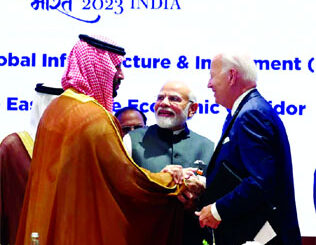
    It was India’s moment with G20 this year. New Delhi hosted the mega event and delivered a successful G20 Joint Statement with full consensus of all countries and inclusion of Africa in the group. The clout of India was on display when US President along with his European and Gulf countries counterparts displayed exceptional bonhomie. G20 was also an opportunity to give a major infrastructural boost to the country as various other meetings were held in different states showcasing their culture and boosting tourism too.

    How did India fare on the world stage! The last months have seen some tensions between India -Canada and India- US relations relating to the cases of the alleged killing of Khalistani terrorist Hardeep Singh Nijjar on Canadian soil and a plan to kill Gurpatwant Singh Pannun on US soil. Canada -India relations saw a setback with dismissing additional diplomats that took a hit on the consular services of both countries. With China, 15 rounds of border talks haven’t yielded any result and China refuses to retreat from occupied Indian territory, although trade continues to flourish between both the countries.

    India’s relations with its neighbors have seen ups and downs. Sri Lanka was visited by Chinese Research Ship with India resisting. New Delhi was visited by Bangladesh, Nepal Prime Ministers. With a pro-China govt in Maldives, Indian troops have been ordered to leave Male that has the possibility of India – Maldives relations growing sour. With political unrest in Myanmar how will India respond will be seen particularly with the problem of refugee influx from Myanmar into Indian border states staring in our face. Bhutan has approved building a 1000 km border village at its border with India that will facilitate a buffer with India countering China. In Pakistan, with the return of Nawaz Shariff and likelihood of his being the economically battered country’s next leader, the future might hold some glimpse of better times. Afghanistan having the Taliban in power and its embassy in India not formally functional as such, despite Taliban sources claiming normalcy, we wonder if Indian government’s stand on recognizing the terror outfit will see any change in 2024.

    Meanwhile, the Indian Navy officials languishing in Qatar jails have got a little respite with their death sentence being commuted to life imprisonment. Expecting a pardon from the Qatari Emir, a usual practice of pardoning prisoners on Qatar’s National Day, the families of these officials are waiting in hope. It’s a test of India’s clout and PM Modi’s personal capital with the Gulf’s richest nation’s leader. I am sure we are not asking for too much.

    It would be amiss if the state of Press is not mentioned here. The fourth pillar of democracy, the vigil keepers, the messengers, as they are called, have had their share of rough rubbings with the govt. 2023 saw journalists being rounded up, harassed, threatened, killed and the news organizations raided, access to Parliament curtailed for reporting facts and ground reality. Newsclick being one of the targets to be silenced, its Editor still is behind bars, their computers, digital gadgets and cameras confiscated and charges fabricated against them. The takeover of major media houses by corporate has changed media landscape totally. Mass job losses, contractual working and the sword of recently passed 3 criminal bills has announced the death knell of press freedom. Wonder how long will the few independent digital platforms or journalists survive, come 2024 elections. The G model says use media for winning elections and dump them once you are there.

    A few months to go for General Elections 2024 and the stage is set for India to witness a mega event of the inauguration of the magnificent Ram temple at Ayodhya. This will set the agenda for 2024 elections. With the BJP win in the 3 Hindi heartland states its already half work done. The numbers will decide the power of the opposition and other parties that have come together to fight BJP and its Hindutva agenda in 2024.

    Right now, people need employment, poverty alleviation, respite from inflation, jobs and social security. Hope, the year 2024 brings in the much-needed balm. Let’s be the change makers.
    (The author is a Journalist / Blogger / Travel enthusiast)

  • Shaping a Harmonious 2024: A Call for Global Unity and Empathy

    As we embark upon the threshold of another new year, the year 2024, it’s crucial to ponder the image we wish to paint upon the canvas of the future. Do we aspire to witness a world embroiled in relentless conflicts, plagued by divisions between the privileged and the disenfranchised? Or do we collectively yearn for a world where unity reigns supreme, where the resonance of shared humanity echoes louder than the discord of disparity?

    The responsibility to shape the world we yearn for lies squarely in our hands. Let us fervently strive to erect a world where the ethos of one global family, as espoused by the ancient Indian wisdom—’Vasudhaiva Kutumbakam’ (the whole world is one family)—is not merely an ideal but a lived reality. But where do we commence this monumental undertaking? It commences from the grassroots—the underprivileged, the impoverished, the marginalized, and the ailing individuals who are in dire need of attention, support, and compassion.

    One of the cardinal pillars of nurturing a more equitable world rests on bridging the gaping chasm between the affluent and the impoverished. It is imperative that those blessed with financial stability and governmental influence extend their hands in support of those grappling with adversity. Only when this disparity is alleviated can we envisage a world with reduced conflict and enhanced livability.

    The task at hand necessitates a collective readiness and unwavering commitment. We stand at the crossroads of history where the echoes of past conflicts reverberate in our collective consciousness. The devastation wrought by world wars and the ongoing conflicts in regions like Europe and the Israeli theater stand as stark reminders of the catastrophic toll of discord. It is our solemn duty to ensure that the pages of history are not marred by similar tragedies in the future.

    Imagine a world where the resonance of unity drowns out the cacophony of conflict. A world where the basic needs of every individual are met with dignity and where compassion serves as the guiding light for every decision. This is the world we should strive to build—one where disputes are resolved through dialogue and empathy rather than through violence and animosity.

    This transformation necessitates a paradigm shift—a shift from self-interest to collective welfare, from division to unity, from indifference to empathy. Governments, organizations, and individuals must collaborate synergistically, pooling their resources and expertise to uplift the downtrodden and pave the path for a more harmonious coexistence.

    Let us commit ourselves to a world where diplomacy triumphs over aggression, where compassion supersedes apathy, and where the downtrodden are uplifted through collective efforts. Each one of us holds the power to contribute towards this vision, whether through philanthropy, advocacy, volunteering, or simply fostering a culture of understanding and inclusivity in our communities.

    The canvas of 2024 remains blank, awaiting strokes of benevolence, unity, and empathy. As we step into this new year, let us pledge to paint a picture where humanity stands united, where conflicts are relegated to the annals of history, and where the indelible colors of compassion and solidarity illuminate our shared journey ahead. The world of our dreams is within reach—let us seize this opportunity to transform it into a tangible reality. Let us welcome, in this spirit, the New Year 2024.

  • Shielding SEBI: On Supreme Court’s ruling and SEBI probe

    SC should have pushed it to do more while not reviewing policy actions

    The Supreme Court of India’s ruling on a batch of petitions, filed in the wake of a U.S.-based short seller’s allegations of malfeasance including stock price manipulation at the Adani group of companies, has squarely tossed the ball back to the markets regulator’s court. The Court has opted to subordinate petitioners’ entreaties to protect larger public interest to its chariness to substitute “its own wisdom over the regulatory policies” of the Securities and Exchange Board of India. In its 46-page order, the Bench headed by Chief Justice of India D.Y. Chandrachud is emphatic in observing that “SEBI has prime facie conducted a comprehensive investigation” that “inspires confidence”, and that “the facts of this case do not warrant a transfer of investigation from SEBI” given that “prima facie no deliberate inaction or inadequacy” was found in the regulator’s conduct of its probe. Strikingly, the Bench has completely skirted the fundamental questions that the Court-appointed Expert Committee in its May 2023 report had opted to leave as a ‘matter between SEBI and the Court’ — the determination of possible violations pertaining to minimum public shareholding and related party transactions. The Bench has instead seized upon prayers urging the Court to direct SEBI to revoke its amendments to the Foreign Portfolio Investors Regulations and Listing Obligations and Disclosure Requirements — amendments that were at the heart of petitioners’ submissions of regulatory failure — and roundly denied them on grounds that there was neither “any illegality”, nor were the norms “capricious, arbitrary or violative of the Constitution”.

    The ruling has also done little to assuage investors’ concerns about SEBI’s approach to getting to the bottom of the allegations raised by Hindenburg Research in its January 2023 report. Without elaboration on any of the regulator’s findings, the Court has blandly observed that “SEBI has completed 22 out of the 24 investigations into the Adani group” and that completion of the remaining two “are pending due to inputs being awaited from foreign regulators”. The Bench has directed SEBI to complete these “expeditiously”. While the Court’s reluctance to review the policy actions of a ‘specialized regulator’ is understandable, the decision to leave the crucial question of SEBI’s perceived tardiness in investigating allegations of corporate malfeasance and market manipulation by a large conglomerate back to the remit of the very same watchdog hints at a degree of judicial abstinence that may only undermine the larger public good. The Court is surely aware of past instances where it has found SEBI wanting in alacrity of enforcement, a facet flagged by the experts’ panel appointed in this case as well. After all, ‘justice must not only be done, but it must also be seen to be done’.
    (The Hindu)

  • Wealthy Indian-origin couple, daughter found dead in US

    Wealthy Indian-origin couple, daughter found dead in US

    BOSTON (TIP): A wealthy Indian-origin couple and their teenage daughter were found dead in their USD 5 million mansion in the US state of Massachusetts in an apparent domestic violence incident, according to media reports.
    The bodies of Rakesh Kamal (57), his wife Teena (54) and their 18-year-old daughter Ariana were found in their Dover mansion around 7.30 pm on Thursday, Norfolk district attorney Michael Morrissey said.
    Teena and her husband, who also went by Rick, had previously run a now-defunct education systems company called EduNova. The district attorney, who described the “terrible tragedy” as a “domestic violence situation”, said a gun was found near the husband’s body. He declined to say whether all three family members were shot dead, and by whom, a newspaper reported. The couple appeared to have faced financial problems in recent years, online records show.

  • Indian-origin real estate developer charged with perpetuating USD 93 million fraud scheme

    Indian-origin real estate developer charged with perpetuating USD 93 million fraud scheme

    NEW YORK (TIP): An Indian-origin real estate developer has been charged by federal authorities in the US with perpetuating a USD 93 million fraud scheme. Rishi Kapoor, a Miami-based developer, faces charges filed by the Securities and Exchange Commission on Wednesday, January 3.
    The SEC announced that it obtained an asset freeze and other emergency relief concerning the alleged USD 93 million real estate investment fraud perpetrated by Kapoor. The SEC also charged real estate company Location Ventures, its affiliate Urbin and 20 other related entities in connection with the fraud scheme, a statement said.
    According to the SEC’s complaint, from approximately January 2018, until at least March 2023, Kapoor and certain of the defendant entities solicited investors by, among other things, making several material misrepresentations and omissions regarding Kapoor, Location Ventures, Urbin, and their real estate developments.
    The false statements allegedly included misrepresenting Kapoor’s compensation; his cash contribution to the capitalization of Location Ventures; the corporate governance of Location Ventures and Urbin; the use of investor funds; and Kapoor’s background.
    (Source: PTI)

  • Sikh medic Dr. Amritpal Singh Hungin knighted by King Charles III

    Sikh medic Dr. Amritpal Singh Hungin knighted by King Charles III

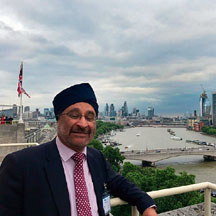
    LONDON (TIP): A British Sikh senior medical professional with over 30 years of general practice (GP) experience has been knighted by King Charles III in the 2024 New Year Honors list. Dr Amritpal Singh Hungin, Emeritus Professor of General Practice at Newcastle University, received a Knighthood for services to medicine on Friday night, including nearly 30 Indian-origin healthcare professionals, philanthropists and community activists honored for their selfless service to society.

    Selfless service

    Dr Amritpal Singh Hungin, Emeritus Professor of General Practice at Newcastle University, received a Knighthood for services to medicine
    Nearly 30 Indian-origin healthcare professionals, philanthropists and community activists honored for their selfless service to society
    Professor Pali Hungin, as he is known, was the founding Dean of Medicine at Durham University and a former president of the British Medical Association (BMA). “The New Year’s Honors List recognizes the exceptional achievements of people across the country and those who have shown the highest commitment to selflessness and compassion,” said British Prime Minister Rishi Sunak. “To all honorees, you are the pride of this country and an inspiration to us all,” he said.

    Among the British Indian Officers of the Order of the British Empire (OBEs) include Baldev Parkash Bhardwaj for services to the community in Oldbury, West Midlands; Dr Dipankar Datta, Chair of the South Asia Voluntary Enterprise, for services to charity; Munir Patel, CEO of XRAIL Group, for services to rail exports; Dr Shriti Pattani, President of the Society of Occupational Medicine, for services to occupational health; Rajwinder Singh, Principal Project Sponsor of the Prison Infrastructure Team at the UK’s Ministry of Justice, for public service; Vinaichandra Guduguntla Venkatesham, CEO of Arsenal Football Club, for services to sport.

    The Cabinet Office said more than 1,200 recipients had been awarded this year for their exceptional achievements, including Members of the Order of the British Empire (MBEs) conferred upon a cross-section, including British Indians such as Dr Sanjay Bhandari, Chair of anti-racism charity Kick It Out for services to sport and Jayshree Rajkotia, Trustee and Vice Chair of the Bharatiya Vidya Bhavan, UK, for services to Indian culture.

    Other Indian-origin recipients of MBEs include Tajinder Kaur Banwait for services to business and to the beauty industry; Dr Manav Bhavsar for services to healthcare, particularly during Covid-19; Nilesh Bhasker Dosa for services to social equality; Dr Dinendra Singh Gill for services to pre-hospital and trauma care in Wales; Dr Gian Parkash Gopal for services to the Hindu community and to multi-faith Cohesion in Oxfordshire; Jasdeep Hari Bhajan Singh Khalsa for charitable services to the Sikh community; Dr Meenakshi Nagpaul for services to the NHS; and Satish Manilal Parmar for public service, among others. Healthcare and charity work also dominates among the Indian-origin Medalists of the Order of the British Empire (BEMs) such as Chandra Shekhar Biyani for services to medical education and Harbaksh Singh Grewal for services to charity.
    (Source: PTI)

  • Indian American legal scholar Ved Prakash Nanda dies

    Indian American legal scholar Ved Prakash Nanda dies

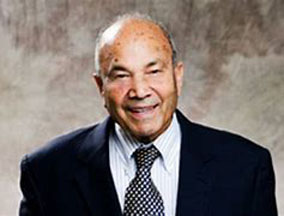
    DENVER (TIP) : Noted Indian American legal scholar, Professor Ved Prakash Nanda passed away on January 1. Indian Prime Minister Narendra Modi, Home Minister Amit Shah and External Affairs Minister S Jaishankar among others condoled his death.
    Nanda, who was awarded Padma Bhushan, India’s third highest civilian honor in 2018 for his contributions to literature and education was a Distinguished University Professor and Thompson G. Marsh Professor of Law at the University of Denver, Colorado.
    He founded the International Legal Studies Program there in 1972 and directed the Ved Nanda Center for International and Comparative Law established in his honor by alumni and friends, who have also endowed a professorship in his name.
    He received Honorary Doctor of Law from Soka University, Tokyo, Japan, and Bundelkhand University, Jhansi, India, and has taught and lectured at several universities in the US and abroad, according to his official profile.
    Nanda was also an Honorary Professor of Law at the University of Delhi, India. He held many leadership positions in the global international law community, including the World Jurist Association, American Society of International Law, International Law Association, American Law Institute, and the American Bar Associations Human Rights Center and Section of International Law.
    He also served as a US delegate to the World Federation of the United Nations Associations in Geneva and on the governing council of the United Nations Association of the USA.
    Nanda was an officer and board member in several international and national NGOs. He was the Chair of the Uberoi Foundation for Religious Studies.
    Nanda received numerous national and international awards and authored or co-authored 24 books and over 225 chapters and law review articles in international and comparative law, writes a column for the Denver Post, and is a regular commentator in both the electronic and print media.
    The American Bar Association International Law Section conferred on him the Louis B Sohn Award, for distinguished, longstanding contributions to the field of public international law in 2018.
    Expressing his grief over Nanda’s demise, Modi said Nanda’s work highlighted his commitment to legal education. “Deeply saddened by the passing away of Professor Ved Prakash Nanda Ji, a distinguished academic whose contributions to the legal field are invaluable. His work highlights his strong commitment to legal education,” Modi posted on X.
    “He was also a prominent member of the Indian diaspora in USA and was passionate about strong India-USA relations. Condolences to his family and friends. Om Shanti,” the PM added.
    “Deeply anguished by the demise of Prof. Ved Prakash Nanda Ji, an internationally acclaimed legal scholar. The illustrious career of Nanda Ji was shaped by his academic rigor and profound commitment to legal education,” Shah wrote.
    “A prominent member of our diaspora in the US, Prof Nanda Ji left an indelible mark in fortifying the Indo-US relationship. My heartfelt condolences to his family, friends and admirers. Om Shanti,” he added.
    “Grieved to learn of the passing away of Professor Ved Prakash Nanda ji,” wrote Jaishankar. “Had the privilege of knowing him over many years. His contribution to the India-US relationship will always be remembered.”

  • 2 Indian-origin men arrested for committing Visa fraud in US

    2 Indian-origin men arrested for committing Visa fraud in US

    BOSTON (TIP): Two Indian-origin men have been arrested and charged with one count each of conspiracy to commit visa fraud in the US.
    Rambhai Patel, 36, and Balwinder Singh, 39, allegedly staged armed robberies so that “victims” could apply for immigration benefits, the US Attorney’s Office for the District of Massachusetts said on Friday, December 29. Patel was arrested in Seattle on December 13, 2023, and following an initial appearance in the Western District of Washington, he was ordered detained pending trial. Singh was also arrested on the same day in Queens, and had his initial appearance in the Eastern District of New York.

    While Singh appeared in federal court in Boston on Friday afternoon, Patel is expected to appear at a later date in the same court.
    According to the charging documents, beginning March 2023, Patel and his co-conspirators, including at times, Singh, set up and carried out staged armed robberies. These were carried out at eight convenience/liquor stores and fast food restaurants across the United States, including at least four in Massachusetts.
    It is alleged that the purpose of the staged robberies was to allow the clerks present to claim that they were victims of a violent crime on an application for U non-immigration status (U Visa).
    A US Visa is available to victims of certain crimes who have suffered mental or physical abuse and who have been helpful to law enforcement in the investigation or prosecution of criminal activity.
    In the course of the alleged staged robberies, the “robber” would threaten store clerks and/or owners with an apparent firearm before taking cash from the register and fleeing, while the interaction was captured on store surveillance video.
    The clerks and/or owners would then wait five or more minutes until the “robber” had escaped before calling police to report the “crime”.
    The “victims” are alleged to have each paid Patel to participate in the scheme. In turn, Patel allegedly paid the store owners for the use of their stores for the staged robbery. The charge of conspiracy to commit visa fraud provides for a sentence of up to five years in prison, three years of supervised release, and a fine of $250,000.
    Sentences are imposed by a federal district court judge based upon the US Sentencing Guidelines and statutes which govern the determination of a sentence in a criminal case.
    The details contained in the charging documents are allegations, and the defendants are presumed innocent unless and until proven guilty beyond a reasonable doubt in a court of law, the attorney’s office said.
    (Source: IANS)

  • Indo-British Sikh woman ‘Polar Preet’ claims record for fastest solo ski across Antarctica

    Indo-British Sikh woman ‘Polar Preet’ claims record for fastest solo ski across Antarctica

    LONDON (TIP): Having already broken two Guinness World Records for polar exploration, British Sikh Army medic Harpreet Chandi has said she now has a third one.
    By covering 1,130 km of Antarctic ice in 31 days, 13 hours and 19 minutes, Chandi, also known as Polar Preet, claims she has become the fastest woman to ski solo across Antarctica, media reported.
    “I’m tired but so glad I made it. This was completely different to my last expedition… I completely pushed myself to my limits on my last expedition, a speed attempt is completely different,” the 34-year-old said, speaking from the South Pole. “After my last expedition, I knew I could cope well on the ice which gave me the confidence to tackle this head on,” she added.
    The Guinness World Records will need to verify the claim, which can take several months, and if confirmed, it would beat the previous record holder, Canadian Caroline Cote, by a day, 14 hours and 34 minutes.
    For the trek, Chandi left the Hercules inlet on the Ronne ice shelf on November 26, and arrived at the South Pole at 2.24 am UK time on December 28.
    She skied for between 12 and 13 hours a day on average and pulled a 75 kg sled that had everything she needed to survive behind her.
    “It was definitely not a sprint, but I had to constantly weigh up my effort and how long I would ski for each day. Too long or too fast and I was going to burn out. Too slow or finish too early and I’d miss out on the record,” she told the media.
    Calling Antarctica an amazing place and glad that it allowed her a safe passage, Chandi said: “It’s an absolute privilege to be here. It is not a place any person can conquer; it is a place you treat with respect and hope it allows you safe passage.”
    Chandi is on a career break from military service where she was a physiotherapist providing rehabilitation for injured soldiers and officers.
    Speaking about her journey, she said her focus was on what she could control, not what she couldn’t.
    “I couldn’t control the conditions — the blistering sun, the whiteouts, the temperatures of minus 30 degrees C, but I can control how I dealt with them. Just keep taking it one step at a time,” Chandi, who was named Member of the British Empire recently, said.
    Also honored as ‘woman of the year’ at the Women in Defense Awards 2022, Chandi made history by becoming the first woman of color to complete a 700-mile Antarctic journey — solo and unsupported — to the South Pole in 2021. Chandi said she never thought she would return to Antarctica this year but returned after realizing that this expedition was just not about pushing herself, but also about inspiring others to challenge their boundaries, and break their barriers. “One of my biggest motivations in those dark times on the ice is the thought of inspiring others to face their own challenge,” she said.

  • Indian-American medical biller arrested for stealing more than USD 1 million

    Indian-American medical biller arrested for stealing more than USD 1 million

    NEW YORK (TIP): A 61-year-old Indian-origin medical biller has been arrested for stealing more than USD 1 million from doctors who provided medical care to injured workers in New York, according to the Attorney General’s Office here. Amrish Patel and his two companies—Medlink Services and Medlink Partners—were charged on Wednesday with 27 felony counts for the thefts they allegedly committed from January 2012 through January 2019, New York Attorney General Letitia James announced.  Patel and the companies were charged with one count of insurance fraud in the first degree, one count of grand larceny in the first degree, one count of grand larceny in the second degree, one count of grand larceny in the third degree, one count of scheme to defraud in the first degree, 11 counts of falsifying business records in the first degree, and 11 counts of workers’ compensation fraud. He was released with electronic monitoring and a USD 1,00,000 bond. Patel, who provided billing services to a Brooklyn-based orthopedic surgery practice, submitted falsified claim forms to the New York State Insurance Fund (NYSIF) to steal at least USD 1.1 million in workers’ compensation reimbursements for himself. “Doctors and health care professionals provide crucial care to our communities, and they rely on accurate and ethical billing to sustain these services and ensure our wellbeing,” said Attorney General James.

    “When money is illegally diverted away from doctors and providers, all New Yorkers suffer as a result. Fraud of any kind will never go unchecked in our state, and my office will continue to use every measure to hold accountable those who seek to cheat New Yorkers for personal gain. I thank our partners for their invaluable support and collaboration on this case,” James said.

    “Fraud in any part of the workers’ compensation system is detrimental to trust and hurts the entire system, including medical providers, carriers, businesses, and injured workers,” said NYSIF Executive Director and CEO Gaurav Vasisht. “I am thankful for the collaboration of the Attorney General and Inspector General’s offices on this investigation,” Vasisht said.

    “Workers’ compensation fraud is not a victimless crime,” said New York State Inspector General Lucy Lang.

    “The defendant compromised the integrity of this crucial safety net when he took advantage of his trusted position to ensure accurate billing for medical providers and health insurers. I am grateful to the Office of the Attorney General and the NYSIF for their partnership in rooting out this fraud.” Starting in 2011, Patel and his companies handled billing services for a Brooklyn-based orthopedic surgery practice and were responsible for submitting billing for surgeries related to work-related injuries under the New York State Workers’ Compensation Law.

    Under the law, authorized providers are reimbursed for their treatment of injured workers by the insurance carrier for the employer. In total, Patel allegedly stole at least USD 1.1 million in payments originally intended for three doctors for services provided between January 1, 2012 and January 4, 2019.

    Patel was arraigned on January 3 in Albany City Court. He was later released with electronic monitoring and a USD 100,000 bond.
    (Source: PTI)

  • Indian-origin Jashanpreet Singh appointed as Canada jail officer

    Indian-origin Jashanpreet Singh appointed as Canada jail officer

    VANCOUVER (TIP): A 24-year-old man, who is the son of a retired Assistant Sub-Inspector (ASI) of Muktsar Police, has become a Correctional Officer in Canada’s Vancouver.
    A Correctional Officer supervises prisoners during work assignments, meals and recreation periods.
    Jashanpreet Singh Brar had gone to the Maple country on a study visa in August 2017. He was an alumnus of Bhai Mastan Singh Public School here. After completing his study in Canada, Jashanpreet worked part-time as a security officer and an executive at a liquor store.
    His father Kaur Singh Brar said, “I am feeling proud that my son is following in my footsteps. I had joined the state police in 1992 as a constable and retired as an ASI. My son has today (January 2) joined the duty as a Correctional Officer in Canada. My daughter is also settled in Canada and working as a private dentist. Both of my children were brilliant in their studies.”
    “We belong to an agrarian family of Kotli Sanghar village. None of us had earlier got a government job abroad.”
    I am feeling proud that my son is following in my footsteps. I had joined the state police in 1992… My son has today (January 2) joined duty as a Correctional Officer in Canada. — Kaur Singh Brar, father of Jashanpreet

  • LOOKING AHEAD 2024: 2024 predictions by ‘new Nostradamus’: PM Modi’s re-election, Putin’s death, cyber attacks & more

    LOOKING AHEAD 2024: 2024 predictions by ‘new Nostradamus’: PM Modi’s re-election, Putin’s death, cyber attacks & more

    A renowned psychic, referred to as the ‘Prophet of Doom,’ has revealed a set of predictions for the upcoming year, foreseeing an end of India and Russia’s ‘friendship’, Russia-China alliance, widespread cyber attacks, cure for cancer, earthquakes in US and Italy, and more.
    Hailing from Southampton, Craig Hamilton-Parker, a 69-year-old spiritual medium, asserts his ability to glimpse into the future. Collaborating with his wife Jane, he has a track record of accurately predicting significant events such as the pandemic, Brexit, Donald Trump’s presidency, and even the demise of Queen Elizabeth II.
    In a recent release of predictions, Craig, dubbed as ‘new Nostradamus’, unveiled expectations for the next 12 months in a two-hour YouTube video.
    Among these forecasts are forecasts of major floods engulfing London and Europe, the emergence of a new pandemic originating in Australia, and the passing of Russian President Vladimir Putin.
    At the start of the clip Craig states, “The predictions here are going to be kind of 2024 probably round to about 2026.”
    “I think after 2026 we’re going to see some very positive things starting to happen in the world, but up until then, I feel it’s still a rocky path,” he added.
    Craig’s prognostications weren’t entirely pessimistic; he also foresaw a simultaneous rise in spirituality and the discovery of a cure for cancer.
    “This is all going to be tied in with artificial intelligence, and I feel that something major is going to be discovered straight away in 2024,” he explained.
    “Many advances in the medical field and care, advances in Alzheimer’s as well, which would suit me well because I am getting there,” he quipped.
    From cyber threats to medical breakthroughs, Baba Vanga’s cryptic predictions for 2024 Here’s a look at some of the key predictions made by the new-age Nostradamus:
    India-Russia ties to end
    Craig Hamilton-Parker’s predictions touch on a wide range of topics, and one of his visions revolves around India’s destiny. He foresees a future where India’s borders will expand, making it one of the world’s dominant nations. While the exact timeline remains uncertain, this expansion is anticipated to have a profound and positive impact on the world. “In the far future, India will expand its borders and will be one of the dominant countries in the world with a very positive effect upon the world’s future,” he said in his YouTube channel.
    One striking prediction is India’s shift in geopolitical alliances. Historically, India has shared a close friendship with Russia, but according to Hamilton Parker, this enduring relationship is destined to change. “India will break its ties with Russia. There has been a long-term friendship between India and Russia. With the growing friendship between Russia and China is against India’s interests. So, I am seeing India breaking from Russia. It will establish stronger relations with America, with Britain and it will buy its arms away from Russia,” he predicted.
    He added, “India will come to blows with China and Russia over Pakistan. It is going to start as a political argument. I think there’s going to be a great deal of argument in 2024 between India and Pakistan. I can’t see a full war happening there but there is going to be major disputes.
    There’s going to be a breaking between India and Russia because of this.”
    Pakistan will eventually merge with India
    Amid political tensions between India and Pakistan, a prediction anticipates a substantial flood in Pakistan. Although the timing remains unclear, the vision hints at a massive flood event in the future. In this scenario, India is predicted to extend humanitarian assistance to its neighboring nation. This gesture could potentially serve as a catalyst for improved political relations, creating opportunities for both countries to rebuild trust.
    “Coming back to the Pakistan thing, there’s going to be a big flood in Pakistan. I’ve mentioned before in my environmental predictions. I am not quite sure when it’s going to be. There’s going to be a huge one day in Pakistan. But I sense it could be one in 2024 and India helps, India offers aid.
    Although this conflict on a political level, it’s like something happens where India can almost offer a hand of help,” the New Nostradamus predicted.
    “Long term, India and Pakistan will become friends again and ultimately I see Pakistan merging with India,” he boldly predicted.
    Ground-breaking Indian innovation
    India is foreseen as a center of innovation and advancement, with Hamilton-Parker’s predictions suggesting groundbreaking inventions and solutions in the realm of renewable energy, specifically focusing on solar power. The vision indicates that India is poised to venture into new frontiers in energy generation, aiming to diminish its reliance on conventional fossil fuels as the global trend leans towards transitioning away from them.
    He predicted, “I see coming out of India too as a new invention or some new sort of way dealing with solar power. An innovation in these areas. A non-dependence on oil. As the world starts to turn back towards oil, I see India beginning to come up with new ways of dealing with it. A new kind of IT discovery. India comes up with a new way of doing it.”
    Modi will be re-elected in 2024
    According to the predictions, Prime Minister Narendra Modi will persist in guiding the nation and embark on significant endeavors to modernize the government. These initiatives will target the eradication of corruption within government bodies and the police force, fostering a system that is more transparent and accountable.
    “I see Modi still in power so he would be re-elected I see Modi undertake moves to modernize India’s government too It’s a big move to strip out Craig who is dubbed the ‘new Nostradamus’, also predicted a Russia-China alliance. “Back in 2015, I started to say that I saw that Russia and China would form an alliance, and this is beginning to happen. So one of my first predictions is about this Russian and China alliance, which I think is very important at the moment,” he said in the video on his YouTube channel.
    “I said at the time that the Russian economy would be seen to shrink over the coming years and would do an arms deal with China, and sadly, that’s beginning to happen, particularly over the Ukraine war,” he added.
    Craig also predicted the death of Russian president Vladimir Putin saying he ‘hasn’t got long’. He added, “I sense his death is imminent, this could be the changing point, this could be what finishes it all. The [Russia-Ukraine war] will drag on after Putin’s death but that will be the death knell of the war an agreement might be made once he is gone.”
    Nevertheless, Hamilton-Parker did mention that the individual assuming the role of Russian president would be ‘equally problematic,’ specifying his prediction that the successor would be ‘a woman.’
    Trump to be elected as President of USA
    Craig Hamilton-Parker’s prediction for the November 2024 election foresees challenges and attempts to delay or stop the election, with a perceived crisis surrounding Joe Biden. Despite legal challenges and efforts to alter federal law, he anticipates that these attempts will fail, ultimately resulting in a closely contested victory for Trump, with a significant shift in the black vote seen as a decisive factor in his favor.
    “I feel that a black woman will help Trump get back into power. It’s the black vote that is ultimately going to swing that little edge,” he stated.
    Still talking about the US, Craig talks about the potential of Islamic terror attacks, including a hijacking of a plane. “There’s going to be terrorist attacks around the world and I feel America is going to get its share as well sadly. In another video I talked about a plane hijack and it could be this happening in America. Not a 9/11 type thing, this is more like something with hostages,” he said.
    Apart from the election, Craig also predicted possible terror attack in Las Vegas and possible shooting by multiple gunmen in Texas. “It feels like a sporting event, maybe a gun attack on a sporting event in America,” he said in the YouTube video.
    The new-age Nostradamus also spoke at length about America’s economy in 2024, infrastructure woes, society polarization, and more.
    Elections in UK and divorce of Prince Harry and Meghan Markle
    Craig predicts that Rishik Sunak will ‘cease to be the prime minister’ of UK in 2024 and he foresees the Tories emerging victorious in the upcoming UK election. “A big swing towards the Labour party, but I feel nonetheless that people don’t have the confidence in Keir Starmer, if Labor do win Keir won’t stay in power for very long, he will be removed,” he said.
    “I feel the Tories will just scrape in, even though the polls at the minute say completely the opposite, but I feel there is a lot happening between now and then, a lot of shifts in power, new people coming into play, Nigel Farage maybe in the future,” he added.
    Craig predicts a rise in tension between Prince Harry and Meghan Markle, he clarified, “That relationship will ultimately result in a divorce.” Speaking about Meghan, the psychic added, “I feel she’s going to be exposed for telling lies, perhaps in secret recordings or something like that.”
    “Stay away from London,” Craig warns. “I see lots of troubles in London.” The psychic says this could include terrorist attacks during busy shopping times, such as Christmas Talking about the ongoing war between Israel and Hamas terrorist in Gaza, Craig predicted a continued mass exodus of people from Gaza to Egypt and Jordan. He also predicted the ‘systematic destruction’ of Gaza from north to south. “Nothing will be usable in Gaza. Gaza is going to be undermined. All the infrastructure, all the sewers will be destroyed. All the major buildings will be destroyed. There will be no water, no sewage, no electricity. It will just be a city of rubble. It will become uninhabitable and that’s why people fleeing to Egypt won’t come back,” Craig said, adding that a ‘huge refugee crisis’ will emerge out of the war.
    “I can’t see a Palestinian state. I can’t see the formation of a Palestinian state. I see the war escalating, extending into Lebanon, extending into West Bank. I see the crisis escalating into an all-eight war between Israel and the Islamic world. This is the big thing the world has feared. I see it coming,” Craig added.
    Cyber attacks, natural disaster and new pandemic
    Craig also forecasted that in 2024, there will be a ‘significant’ number of cyber attacks occurring globally. “We’re going to see spyware, a big spyware release will happen. There’s something going to happen that will bring down some banking systems,” he said.
    Craig claimed that 2024 will witness numerous natural disasters worldwide, including earthquakes in both America and Italy. He stated, “I feel that America is going to get quite a big earthquake, and it’ll go all along the west coast and as far as Mexico City. I don’t see everything collapsing…but I feel there is a big one coming this year.”
    He also stated that he envisions ‘big floods’ sweeping through London and Europe, with a particular impact on Germany. More alarmingly, he added that he anticipates a tsunami striking Australia.
    “I see quite a lot of overwhelming flooding coming through Europe and the UK as well. I see another tsunami this time though it’s in the Pacific, and I saw the Australian coast affected,” he said.
    Craig also mentioned a series of events unfolding in Australia in the coming years, including wildfires, floods, an explosion in the Great Barrier Reef, and the emergence of a new pandemic originating in the region.
    “Not in 2024 but in the future I see another pandemic rising, out of Australia, this is a bacterial infection of some sort, the world will beat it, it won’t be as extreme as Covid. I see fires around Canberra and I saw flooding around Tasmania, apparently this already happened. Someone said to me because I made this prediction a few weeks ago, so maybe that’s already happened I don’t know,” he said.
    In 2017, he made a chilling prediction that a flu pandemic would eventually sweep across the world, and by 2020, Covid-19 indeed spread globally.

  • LOOKING AHEAD 2024: 2024 is a Record year for Elections

    LOOKING AHEAD 2024: 2024 is a Record year for Elections

    2024 will be a record-breaking year for elections. Around the world, more than 2 billion voters in 50 countries will head to the polls, according The Center for American Progress, a US policy institute, .
    The United States, India and Mexico are among the countries holding national elections in 2024.
    Here’s a roundup of some key dates.
    United States election
    The US will head to the polls on 5 November, 2024.
    More than 160 million Americans are registered to vote. They’ll be choosing the 60th US president, who will serve in the White House for four years, from January 2025. Incumbent President Joe Biden hopes to secure a second term in office, while former President Donald Trump is hoping to secure a second, non-consecutive term.
    India election
    India’s election, between April and May 2024, will be the world’s largest, according to Chatham House, a UK policy institute .
    More than 900 million people are registered to vote in India, out of a population of 1.4 billion. Current Prime Minister Narendra Modi hopes to be re-elected for a third five-year term. India is the world’s largest democracy and also an “increasingly important geopolitical actor” globally, Chatham House says.
    Mexico election
    On 2 June 2024, Mexicans will head to the polls. The country has almost 100 million voters and they will elect a new president to serve a six-year term.
    For the first time in Mexico’s history, the two leading presidential candidates are women, explains the Wilson Center, a US think tank. The candidates are Claudia Sheinbaum Pardo, former mayor of Mexico City, and former senator Xóchitl Gálvez.
    Ballot papers across Mexico will also include votes to fill more than 20,000 public positions – a record for the country.
    European Union elections
    In the EU, 2024 elections for the European Parliament will take place between 6 and 9 June 2024.
    More than 400 million voters will elect 720 members of the European Parliament across 27 member countries.
    Because the EU election crosses so many borders, it will be the world’s biggest transnational election, reports French news channel France 24.
    South Africa election
    South Africa’s election in 2024 is expected to be the country’s most important for 30 years.
    The African National Congress (ANC) party has governed the country since 1994, when apartheid ended and Nelson Mandela became South Africa’s first Black president.
    Now there’s uncertainty about whether the ANC can keep its majority, reports Bloomberg. A coalition government in South Africa looks possible, believes polling organization Ipsos – but “not guaranteed”.
    More than 26 million South Africans are registered to vote, according to the Electoral Commission of South Africa.
    Other 2024 elections
    Elections in 2024 will also take place in Taiwan, Indonesia, Russia, Iran and Pakistan.
    Changes in policy, government regulation, interest rates and other areas could make 2024 a “tumultuous year,” Bloomberg suggests. The backdrop of war and economic shocks heightens potential geopolitical risks.
    Geopolitical risk
    In its Chief Risk Officers Outlook 2023, the World Economic Forum finds that continuing volatility in geopolitical and geoeconomic relations between major economies is the biggest concern for chief risk officers in both the public and private sectors.
    Most survey respondents for the report are expecting “upheavals at a global scale”.
    This is “unsurprising given the ongoing war in Europe and continuing US-China economic tensions”, the Forum says. But it also indicates a growing “adversarial” trend in international economic relations. Higher business costs, trade restrictions, market instability and “sharp swings in policies” are some of the factors underpinning this, the Forum finds.
    Source: Weforum.org

  • LOOKING AHEAD 2024: Where is the global economy heading in 2024?

    LOOKING AHEAD 2024: Where is the global economy heading in 2024?

    If you’re looking for a one-word summary of what lies ahead for the world economy in the coming year, it could well be “volatility”. One of the biggest sources of this volatility will be geopolitics, according to the chief economists surveyed for the World Economic Forum’s latest Chief Economists Outlook.
    But the situation is also nuanced, the report suggests. More positive shifts appear likely, including drops in inflation and a slowdown in interest rate rises.
    Here are the key findings from the Chief Economists Outlook.
    The global economy will weaken in the coming year, according to 61% of the chief economists surveyed for the report.
    Uncertainty is a key factor – as it was when the May edition of the Chief Economists Outlook was published. Fears of a global recession are falling, but concerns are rising about China’s economy, which recently dipped into deflation.
    Geopolitical and domestic political issues are other unsettling factors. Nine out of ten economists surveyed for the report believe geopolitics will create economic volatility in the year ahead.
    Domestic politics could also stoke economic volatility according to 79% of respondents, with the impending US electoral cycle likely a driver of this sentiment.
    Regional economic outlooks
    There is a “a growing divergence in growth prospects around the world,” the Chief Economists Outlook says.
    Asia is seen as having the strongest growth prospects – particularly South Asia, where 92% expect moderate or strong growth this year. Over half expect strong growth, up from 36% in the May edition of the report.
    However, expectations around China have slumped. Only 54% expect moderate or strong growth there in the rest of 2023, down from 97% in the May edition. And there’s little anticipation of that changing in 2024.
    “Besides the slower-than-expected rebound of domestic consumption earlier this year, China’s economic prospects have been clouded by deflationary pressures and signs of fragility in the crucial real estate market,” the report says. “Trade volumes have also slumped, with imports down by 12.4% and exports by 14.5% in the year to July 2023.”
    The outlook for the US economy has improved markedly since May, with around 80% of those surveyed expecting strong or moderate growth this year and next, up from about 50% in May.
    Europe is facing weak or very weak growth this year, according to 77% of those surveyed. But the picture could change notably in 2024, with just 41% expecting weak growth then.
    For the Middle East and North Africa, 79% expect moderate or strong growth in 2023 and 2024, up by 15 percentage points from May.
    Inflation and interest rate pressures easing
    Optimism emerges when it comes to the outlook for inflation, with 86% of chief economists believing the worst of the global inflationary surge will have subsided in a year’s time.
    Expectations around monetary policy fall into line with this, with 93% of respondents expecting the pace of interest rate rises to slow in inflation-prone economies. There is also likely to be less synchronization of monetary policy across central banks, four-fifths of chief economists say.
    “However … the mood remains very cautious,” the report adds. “Monetary policy is therefore likely to be carefully calibrated in the months ahead, as central banks navigate delicate domestic and global economic conditions,” including climate change, shifting demographics and deepening geopolitical and economic fractures.
    Expectations on US inflation have improved, with 54% of chief economists surveyed now expecting moderate or lower inflation there, up from 32% in May. But Europe is still seen as heading for high or very high inflation this year, according to 70% of respondents.
    China faces a different problem, with signs of deflationary pressures being reflected in the results: 81% of chief economists anticipate low or very low inflation this year, up from 48% in May.
    Economic blows impact global development
    Hopes of achieving the UN’s Sustainable Development Goals (SDGs) by their 2030 deadline are put in doubt by the headwinds the global economy is facing.
    Nearly three-quarters of respondents think geopolitical tensions will hinder progress towards global development targets in the next three years, while 59% expect tighter financial conditions to have the same effect.
    The UN’s Sustainable Development Report presents a similar picture, finding that there has been a ”worsening trend” on many SDGs since 2020, including eradicating extreme poverty and reducing food insecurity.
    Annual investment is $4 trillion below where it needs to be to meet the SDGs, compared with a $2.5 trillion shortfall when the SDGs were adopted in 2015, the UN Conference on Trade and Development says.
    Finding ways to mobilize finance could help turn this around. Private capital could make the biggest impact in developing countries’ digital transformation, energy, food and climate efforts, according to the chief economists, with knock-on benefits across development areas. Source: Weforum.org

  • LOOKING AHEAD 2024: Post-G20 triumphs, how India’s diplomatic landscape shifted in 2023 and challenges ahead in 2024

    LOOKING AHEAD 2024: Post-G20 triumphs, how India’s diplomatic landscape shifted in 2023 and challenges ahead in 2024

    The year 2023 will go down as a landmark year for India. There were singular achievements like the moon landing on the dark side and the brightness of an extremely successful G20 Summit. The effort to become a voice of the Global South was successful. Both the Global South Summits before and after the G20 summit revitalised Indian credentials. The success in bringing the African Union into the G20 through a hard-won consensus and ensuring that the interests of the developing countries were not lost sight of while countries grappled over the Ukraine crisis were indeed proud moments.
    The signing of the India-Middle East-European Connectivity Corridor (IMEC) was a significant development, opening up huge possibilities to the west of India. The decision that India would host the Quad summit in 2024 added heft to India’s stature. Between the conclusion of the G20 Summit and the end of 2023, however, a dynamic time for the international order ensued. Nothing is static, and things often happen suddenly.
    Four significant aspects during the last quarter of 2023 have a bearing on India’s policies as they head into 2024. First, the sudden attack by Hamas on Israel surprised many. It altered the dynamics of peace for economic development in the region. The focus on countering terror, humanitarian relief, and the re-emergence of deep-rooted animosities divided the world once again. A US area of dominance in which India was an important part now has China and Russia making inroads. Iran is an important player too. The power equations have altered, and question marks on the IMEC, US influence in the area, and the commitment of Saudi Arabia and the UAE to the peace process now cause anxiety.
    The Indian policy of countering terror and yet humanely supporting Palestine and seeking a two-state solution remains a conundrum. This is not India’s alone, since the US itself is similarly caught. Israel is unresponsive to US overtures. What is worse is that the Global South, which India stitched together developmentally, is now ruptured geopolitically. Not all South countries are on the same page regarding the Israel conflict, including the Arabs.
    As India salvages the development agenda from the Ukraine crisis at the G20, now, a renewed effort to rescue it from the depredations of the Palestine issue and Hamas in West Asia is required. Secondly, is the climate crisis. The impact of changing climate leading to floods, earthquakes, volcanic eruptions, cyclones, and the like is rising. While disaster management has improved, it has not curtailed the number of natural disasters. This impact of climate change requires greater capacity, both financial and human, to deal with resilience in the face of disaster and its risk mitigation. Indian efforts to nudge the Coalition for Disaster-Resilient Infrastructure ahead would now be tested.
    Secondly, the Climate Change Conference of Parties (COP28) in Dubai revealed the fissures between oil-producing countries and green lobbies. The effort to nudge high coal consumers like India into phasing out continued. The dichotomy of holding a COP amidst oil-producing countries and then expecting to have restrictions on the use of fossil fuels was a foolhardy decision. It was not of India’s making, and India did well at COP28 in adopting a lower profile, protecting its interests in coal transition, rather than phasing out. India stuck to its hard-won gains at the G20 on renewable energy and had them included in the declaration.
    However, there is no new money flowing in this direction even with the creation of a loss and damage fund. India would need to look at its partnership with other developing countries and introduce financing elements that would support the climate transition and the achievement of the SDGs, both of which are lagging severely behind their targets.
    The third aspect is the Indo-Pacific. The Biden-Xi summit in San Francisco on the sidelines of the APEC in November tried to reduce the confrontation while keeping the competition and cooperation alive between the two. Cooperation was evident at COP28. China seems to have gotten the US to quieten down on Taiwan; Chinese aggression in the Philippines is becoming bolder, and the Philippines’ vessels are being interdicted from supplying their outposts on various shoals. This is no longer a cold conflict but a daily problem in the seas off the Philippines. The US is joining the Philippines in bold statements. Japan is offering the Philippines assistance under its new official security assistance. India is willing to provide more defence supplies to the Philippines and is not curtailing the visit of its warships on goodwill missions to the country. The heat expected around Taiwan is now actually testing resilience in the Philippines. ASEAN seems muted, and it remains to be seen what the Quad will do and what the tipping point would be if a Philippine vessel is sunk by Chinese action.
    Fourthly, India would like the Quad to continue its ASEAN engagement. The Quad summit in 2024 would find practical means to implement the various ideas agreed upon.
    The parallel Indo-Pacific Economic Framework, which the US shepherded, is facing hiccups on the trade side in which India is not a partner. On other aspects, India, in particular, seeks a semiconductor supply chain with its Quad partners, as well as the critical minerals initiative. These would remain important aspects to pursue for India.
    The year 2024 is election time for India and the US. Japanese elections are scheduled for 2025 but given the falling popularity of Kishida and problems within his own party, could well see a 2024 election. In Australia, the lower house election is due. Quad partners will look internally, and the Quad Summit is pushed to later in 2024. Quad collaboration below the summit level must continue enthusiastically and robustly.
    The next step for India’s Global South credentials is to hold the long-delayed India Africa Forum Summit IV. It was due in 2020 and delayed by the pandemic. The African Union Commission was then busy with other delayed summits. India should work towards a functional IAFS IV summit rather than a big bang event. The agenda set at the G20 could be used to contemporise the India-Africa relationship, which is so well exemplified through the recent visits of the presidents of Tanzania and Kenya.
    Source: Firstpost

    (The writer, Gurjit Singh, is a former ambassador to Germany, Indonesia, Ethiopia, ASEAN and the African Union. He tweets @AmbGurjitSingh. Views expressed in the above piece are personal)

  • LOOKING AHEAD 2024: Shifting landscape of global job market in 2024

    LOOKING AHEAD 2024: Shifting landscape of global job market in 2024

    The year 2023 has been marked by disappointments in the job market, with reduced increments, fewer vacancies and rampant layoffs affecting thousands of individuals. As we stand on the brink of 2024, the trend of economic challenges and job market uncertainties seems set to continue.
    In a recent development, Paytm, an Indian fintech and payments giant, has made headlines by laying off 1,000 employees. The reason behind this strategic move is to boost efficiency by integrating artificial intelligence (AI) tools to handle repetitive and mundane tasks. According to Paytm, AI has proven to be more effective than human counterparts in certain job functions. This move by Paytm reflects a broader trend seen across industries, where companies are focusing on cutting expenses, maximising savings and doing more with less. The wave of austerity is evident in major global banks including UBS, Credit Suisse, Wells Fargo, Citigroup, Morgan Stanley, Bank of America and Goldman Sachs, which collectively cut 60,000 jobs in 2023.
    Challenges in the banking sector
    The banking sector, facing difficult times, has witnessed a decline in earnings over the past two years. Investment bankers, in particular, have experienced reduced income due to a decrease in deal-making and public listings. With fewer companies going public and investors opting for safer bets, banks are resorting to laying off employees to protect their profit margins. A recent report highlights the challenges faced by major global banks, emphasizing a trend of plummeting fees and the need for cost-cutting measures to maintain profitability. This transformation is not limited to the banking sector; it extends across various industries and is characterised by a global effort to protect profit margins by reducing headcounts.
    Impact on different sectors
    The tech sector stands out as one of the hardest-hit industries, with over 4,00,000 employees worldwide losing their jobs. Non-essential goods sellers, such as car companies like Ford and furniture retailers like IKEA, have also faced significant layoffs. Even the healthcare sector has not been spared, with companies slashing over 20 per cent of their staff on average.
    In a surprising development, the Big Four accounting firms – Deloitte, EY, KPMG, and Pricewaterhouse Coopers – have collectively let go of over 3,00,000 employees in 2023. This mass exodus is attributed to a changing job market landscape with firms responding to economic slowdown and advancements in technology.
    The job market transformation is a result of two key events – the economic slowdown and the rise of new technologies like artificial intelligence. These factors have led to significant changes and churn in the job market leaving fewer opportunities for human employment.
    Future of jobs
    A survey conducted by the World Economic Forum involving 800 companies across 27 industries and 45 economies reveals a complex picture. While these companies plan to create 69 million new jobs by 2027, they also anticipate eliminating 83 million positions, resulting in a net reduction of 14 million jobs.
    As we navigate through 2024, the job market is expected to become more competitive. Companies will prioritise versatile skillsets and individuals are urged to adapt, acquire new skills, and position themselves as valuable assets in the evolving workplace.

    Roles in artificial intelligence and machine learning, sustainability, business intelligence analysis, information security analysis and renewable energy engineering are expected to be in high demand. The job market is evolving and individuals with expertise in these areas will be sought after in the changing landscape.
    The job market of 2024 is characterised by challenges, transformations and a growing reliance on technology. While the wave of layoffs initiated in 2023 may persist, individuals can navigate these changes by embracing skill development and staying adaptable in the face of evolving job market dynamics.
    Hiring intent in India Inc will rise in 2024 but IT jobs to remain scarce: Report
    India’s hiring landscape is poised for growth in 2024, with overall intent increasing 19 percent compared to the previous year, according to a report by recruitment platform Taggd.
    The manufacturing sector leads the way with a robust hiring intent of 25 percent, underscoring a positive outlook for industrial expansion.
    Manufacturing companies plan to hire 15-30 percent more graduates from the 2024 batch than they did from the 2023 batch, indicating a positive trend in the manufacturing sector, the report, titled ‘India Decoding Jobs 2024’ noted. It was launched today at a Confederation of Indian Industry (CII) event. The Banking, Financial Services, and Insurance (BFSI) sector also stands out with a substantial 25 percent hiring intent, indicating a strong focus on talent acquisition in the financial domain.
    Similarly, the automotive industry is set to witness a 20 percent surge in hiring intent, reflective of the sector’s anticipation of increased demand. The Internet business and Global In-house Centre sectors share a promising outlook, with a significant hiring intent of 20 percent, highlighting the continued importance of technology and global operations.
    Meanwhile, the pharmaceutical industry displays a 16 percent rise in hiring intent, emphasising sustained growth in the healthcare sector.
    “In the last 8-10 months, we have absorbed the impact of the global slowdown. Much of it came with the normalisation of hiring in sectors like IT. We do believe that the numbers being predicted in the report are inclusive of all global parameters that we know can impact hiring, at least at this point. The offshoots of the global slowdown do not seem to be significantly affecting hiring in 2024,” Devashish Sharma, CEO at Taggd, told Moneycontrol.
    Hiring in IT to remain subdued
    The information technology (IT) sector showed a more conservative hiring intent increase of 3 percent, potentially reflecting a nuanced approach amid evolving industry dynamics.
    While volume growth in most IT companies has been impacted, salaries for IT employees have increased by approximately 15 percent, offering some support. On the other hand, non-IT hiring is experiencing growth, particularly in smaller towns.
    Top IT services firms are projected to hire between 50,000 and 100,000 employees during fiscal year 2024, representing a significant decline from the net hiring of over 250,000 in the previous year.
    “If we look at the hiring numbers, they will reach a normalised rate within the next six to nine months. Though the demand may not touch the post-pandemic ramp numbers this year, the demand for tech talent will continue from non-IT sectors, where digital initiatives are bringing up new opportunities,” Sharma said.
    Remote work to decline, diverse hiring anticipated
    In 2023, the employment landscape witnessed a predominant trend towards hybrid work models, constituting 56 percent of hiring intent, while 37 percent opted for traditional office-based setups, and 7 percent embraced remote work.
    A nuanced shift is anticipated in 2024, as the hybrid model strengthens its position at 60 percent, indicating a further embrace of flexible work arrangements.
    Work from office-only scenarios is expected to register a decline to 33 percent, reflecting a strategic balance, while the remote work component remains steady at 7 percent. The report said this points towards an evolving approach to work modes, emphasising the adaptability and resilience of organisations in shaping the future of work.
    In 2024, the projected diversity percentages for the workforce signify a positive evolution, with an expected increase in female representation to 36 percent, while the male percentage is anticipated to decrease to 64 percent. The current workforce distribution stands at 33 percent females and 67 percent males.

  • Rewind  2023: Major healthcare developments that made headlines this year

    Rewind 2023: Major healthcare developments that made headlines this year

    A lot of happened in the healthcare sector this year. The year began with a major earthquake in Türkiye and Syria and it ended with the horrific war in Gaza. This year, the world also witnessed many other crises, conflicts, and the continuing threat of disease outbreaks and climate change.
    The world also witnessed some positive developments. The year 2023 was a record year for disease elimination, with several countries eliminating infectious diseases.
    Here are some of major developments that made headlines this year:
    Outbreaks
    This year saw a record-breaking resurgence of many infectious diseases – anthrax, chikungunya, cholera, Crimean-Congo haemorrhagic fever, dengue, diphtheria, influenza, RSV – that needed a coordinated regional and global response. Other outbreaks included Lassa Fever in Nigeria and Ebola disease in Uganda, as well as Marburg virus disease in Equatorial Guinea and the United Republic of Tanzania.
    COVID-19 and mpox
    Amidst all the crises, there has also been positive news this year. In May, following the convening of the relevant Emergency Committees, WHO’s Director-General declared an end to two Public Health Emergencies of International Concern: COVID-19 and mpox, while also stating that the threats from both are not over.
    “With a continued threat of COVID-19, and the looming threat of an influenza pandemic, WHO continues to expand its networks to track respiratory pathogens with pandemic potential, utilizing its Global Influenza Surveillance and Response System and CoViNet to monitor the evolution of these pathogens, conduct risk assessments, and prepare for a potential vaccine when the need arises,” WHO said in a statement.
    Climate change and health
    In a historic first, the organizers of COP28 hosted a dedicated health day in response to the climate-related health crisis affecting at least 3.5 billion people – nearly half of the global population. Extreme heat, weather events and air pollution caused millions of deaths in 2023, putting enormous pressure on health systems and workforce.
    A new COP28 UAE Declaration on Climate and Health was signed by over 130 countries at the UN Climate Conference. The Declaration advocates for a rapid increase in political and financial commitments, and concrete action to protect people from the devastating health impacts of the climate crisis.
    Disease elimination
    The year 2023 was a record year for disease elimination, with several countries eliminating infectious diseases.
    In March, WHO certified Azerbaijan and Tajikistan malaria-free, followed by Belize in June.
    Egypt became the first country in the world to achieve “gold tier” status on the path to eliminating hepatitis C – an important milestone towards the goal of achieving full elimination of the disease before 2030. This is an astonishing turnaround for a country that had one of the world’s highest rates of hepatitis C infection less than 10 years ago, WHO stated.
    As of today, 50 countries have eliminated at least one neglected tropical disease (NTD), in line with WHO’s target of having 100 countries achieve this milestone by 2030. Ghana, Benin, Mali, Iraq, Bangladesh, and the Lao People’s Democratic Republic all eliminated neglected tropical diseases in their countries.
    Delivering vaccines
    As of November 2023, 72 percent of people worldwide had received at least one dose of a COVID-19 vaccine, with 13.6 billion doses administered around the world, preventing severe illness and hospitalizations for millions of people.
    “We began to see promising signs of recovery in levels of childhood immunization after the backsliding that occurred during the COVID-19 pandemic. Earlier in the year, global partners announced “The Big Catch-up”: a coordinated effort to reverse the declines in childhood vaccination, strengthening health systems and working towards a future where no child dies of a vaccine-preventable disease,” WHO stated.
    Another important milestone during the year was WHO’s recommendation of a new vaccine for malaria prevention, providing hope to bolster malaria prevention and save hundreds of thousands of young lives in the African Region. There are now two life-saving vaccines that are safe and effective in preventing malaria in children.
    A new dengue vaccine was recommended for introduction in settings with high disease burden. The new vaccine offers hope against the mosquito-transmitted infection, of which half of the world’s population is estimated to be at risk.
    There was promising news in the fight against meningitis, as WHO prequalified a novel meningococcal conjugate vaccine and issued a policy for its use in the countries of the African meningitis belt, which are affected by seasonal epidemics. According to WHO, Men5CV has the potential to drastically change the fight against meningitis, as it is expected to be more affordable and accessible to countries in the meningitis belt than other available vaccines.
    Non-communicable diseases
    In a first, WHO released its first-ever report on the devastating global impact of high blood pressure: 1 in 3 adults are affected by the condition. The report indicated that approximately 4 out of every 5 people with hypertension are not adequately treated, but if countries can scale up coverage, 76 million deaths could be averted between 2023 and 2050.

    The new WHO Global status report on road safety 2023 shows that, since 2010, the number of annual road traffic deaths has fallen by 5% to 1.19 million.
    An estimated 101 million people in India were detected with diabetes, 136 million were found to be prediabetes and 315 million people from hypertension in 2021, a first-of-its-kind study by ICMR-INDIAB, which measured the prevalence of metabolic non-communicable diseases (NCDs) in India.