Tag: Arun Jaitley

  • MOST LIVE ON LESS THAN RS 200 A DAY IN 7 OUT OF 10 RURAL HOMES

    MOST LIVE ON LESS THAN RS 200 A DAY IN 7 OUT OF 10 RURAL HOMES

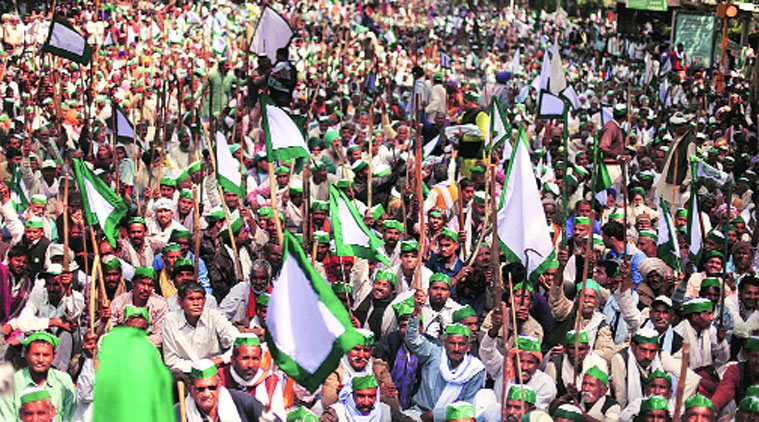
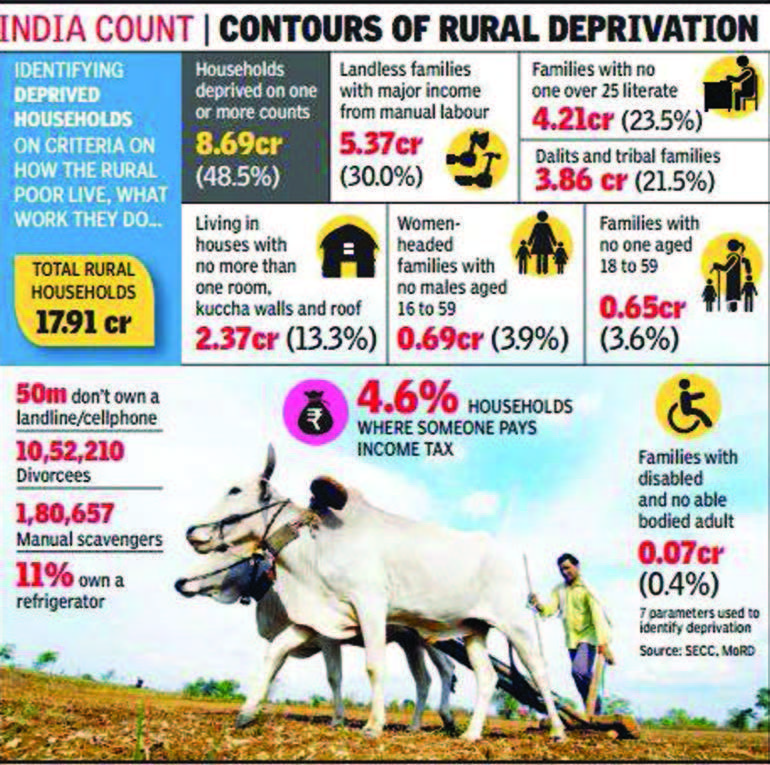
    NEW DELHI (TIP): A worrying picture emerged on last week as the government released new data which showed that rural India accounted for 73 per cent households and 74 per cent of these survived on a monthly income of less than Rs 5,000 of its highest earner.

    According to the data, 51 per cent of the households are engaged in casual, manual labour and 30 per cent in cultivation. Provisional findings of the Socio Economic Caste Census (SECC) recognise “multidimensional” aspects of poverty and will form the basis for determination of beneficiaries of government schemes in rural areas. Conducted between 2011 and 2013, it will facilitate identification of the poor and deprived in rural areas.

    The census covered 24.39 crore households across the country – 17.91 crore are rural households. The highest number of rural households are in Bihar – 90 per cent. The census also showed that 21.53 per cent of rural households belong to the Scheduled Caste/Scheduled Tribes. The contentious caste break-up data was not released. “This is the jurisdiction of the DG Census. It is for him to decide what he thinks about it. This is entirely in the DG’s domain. Only he can comment on it. Only he can satisfy your queries,” Rural Development Minister Birender Singh said while releasing the data with Finance Minister Arun Jaitley. “The name of the report indicates (caste), but caste is not reflected in our data… still the name is Socio Economic and Caste Census,” he said. When the SECC process began in 2011, OBC leaders of parties like the SP, RJD, JD(U) pressed for enumeration of caste on the lines of the 1931 census.

    There was division even in the UPA whichwas in power then. Those opposed to it had cautioned that findings of the caste census could lead to new demands for reservation.

    According to the SECC data, 31.26 per cent of the total rural households can be broadly identified as “poor”‘ where the main earner has an “insecure and uncertain” source of income and the household lives in a “one room house with kutcha walls and kutcha roof”.

    This figure is the Rural Development Ministry’s internal assessment and will not be released officially. Sources said this is because it has been left to states to determine their own poverty ratios using the findings of this census. It is not the mandate of the ministry under this census to determine overall BPL figures, sources said. As many as 74.49 per cent rural households survive on a monthly income of less than Rs 5,000 of its highest earner. The largest number of such households is in Chhattisgarh – over 90 per cent. Five percent of rural households derive salaries from government jobs, 1.11 per cent from public and 3.57 per cent from private sources. Overall, 94 per cent of households own houses, but only 17.70 per cent of SC and 10.50 per cent of ST households have their own houses.

    Only 4.58 percent of rural households pay income tax. The findings show 56 per cent households are landless and 70 per cent of SC households fall in this category. In rural households, 38.27 per cent are “landless households deriving major part of their income from manual casual labour”. The highest are in Tamil Nadu (55.80 per cent) and Bihar (54.33 per cent). The largest proportion of households with “destitute/living on alms” is in Orissa. The census distributed rural households into three categories: those that have to be compulsorily excluded; those that have to be compulsorily included; and those that fall in-between, which were then ranked based on seven deprivation criteria.

    Information was collected on a range of parameters at the individual and householdlevels like occupation, education, disability, religion, SC/ST status, name of caste/tribe, employment, income and source of income, assets, housing, possession of consumer durables and non-durables and land owned. Those to be automatically included are households without shelter, destitute living on alms, manual scavengers, primitive tribal groups and legally released bonded labourers.

    This figure has been pegged at less than 1 per cent. In this, 0.11 per cent of SCs and 0.46 per cent of STs have been automatically included. The automatically excluded constitute 39.4 per cent of the total rural population and include households with any of the following: motorised vehicles, mechanised agricultural equipment, kisan credit card with credit limit of Rs 50,000 and above, households with any member as a government employee, households with non-agricultural enterprises registered with the government, any family member earning more than Rs 10,000 a month, those paying income/professional tax, living in houses with three or more rooms with all having pucca walls and roof, owning a refrigerator, landline phone, possessing irrigated land etc.

    Finance Minister Arun Jaitley said, “It’s after seven-eight decades that we have this document after 1932 of the caste census… It’s going to be a very important document for all policy makers both in central and state governments… this document will help us target groups for support in terms of policy planning.”

    “It is also a document which contains various details with regard to the specifics of regions, communities, caste groups, economic groups and give us an opportunity to measure the progress which households in India have made. Who are the ones who have qualitatively moved up in terms of quality of life and who are the ones in terms of geographical regions, social groupings which in future planning need to be targeted,” he said.

    The ministry’s internal poverty estimate from the census is similar to that of the Rangarajan committee, a technical experts group set up by the UPA government in 2012 after criticism that the poverty line had been pegged much lower than it should have been by the Tendulkar committee. According to the Rangarajan committee, the percentage of people below the poverty line in 2011-12 was 30.95 in rural areas and 26.4 in urban areas as compared to 25.7 and 13.7 respectively as per the Tendulkar methodology.MOST LIVE ON LESS THAN RS 200 A DAY Stats

  • Gold scheme may cap deposit at 100gm

    NEW DELHI (TIP): The government is expected to limit deposits under the proposed gold deposit scheme at 100 grams to deal with concerns that the plan meant to put brakes on import of the precious metal may turn into a tool to convert undeclared assets into legitimate wealth.

    Sources said the proposal has been discussed but a decision is yet to be taken. “We are looking at various options,” said an official. Others, however, pointed out that the contrary to what many believe, the proposed scheme has safeguards built into it through deposits only via banks where an individual has an account. “It automatically ensures that KYC (know-your-customer) norms have been followed and there is a history available with the bank,” said a source, familiar with the plan.

    Finance minister Arun Jaitley had announced the gold deposit scheme in the budget with a view to mop up unused and idle assets, primarily from households, and offer 3-4% return to depositors. Under the Income Tax Act the returns are already tax-free, something that the consultation paper released recently reconfirmed.

    After garnering gold from households as well as temple trusts, the government is hoping to send it for recirculation into the system, which is expected to reduce imports and ease pressure on the overall economy.

    Sources, however, said RBI needs to settle a few issues before the government finalizes the scheme. The central bank, for instance, has not agreed to treat the gold mopped up by banks for meeting regulatory requirements such as maintenance of cash reserve ratio.

  • Centre keen on evolving political consensus on labour reforms

    Centre keen on evolving political consensus on labour reforms

    NEW DELHI (TIP): After burning its fingers with the land bill, the NDA government has signalled it will try to build a wide political consensus instead of rushing through the much-awaited labour reforms that will affect a 48.7-crore domestic workforce.

    An inter-ministerial panel headed by finance minister Arun Jaitley will negotiate with trade unions and other stakeholders while senior BJP managers are expected to reach out to Congress, SP and Trinamool among other parties, in a marked shift with the government earlier preferring the ordinance route, which the Opposition called “bulldozing tactics”.

    Sources say the Centre has lined up sweeping amendments in labour laws to woo investments with changes aimed at drastically curbing rampant strikes, diminishing the influence of trade unions and making the labour market more flexible.

    Plans are also afoot to create simpler norms for small scale industries to boost Prime Minister Narendra Modi’s ambitious “Make in India” manufacturing campaign.

    But the ruling dispensation has decided to be cautious. “These reforms are in the proposal stage, and tripartite discussions are on. We are not in a hurry,” union labour minister Bandaru Dattatreya had said after announcing the panel last month. As the confrontation between the government and the Opposition escalated over the land ordinance, the passage of the real estate and Goods and Services Tax bills got blocked. The land ordinance also drew flak from NDA allies and RSS-affiliated labour and farmer bodies. The Modi government enjoys an overwhelming majority in the Lok Sabha but is likely to remain in minority in the upper House till 2019. The government’s excessive use of ordinances earned it a word of caution from the President.

    “We have several plans and proposals for bringing structural changes in the labour sector but how and when to push them, would be a political call,” said a senior government official.

  • Suit Boot Ki Sarkar Versus Soojh Boojh Ki Sarkar

    Suit Boot Ki Sarkar Versus Soojh Boojh Ki Sarkar

    NEW DELHI (TIP): After his return from the nearly two-month-long political sabbatical on April 16, Congress vice-president Rahul Gandhi has been unsparing in his attacks on Prime Minister Narendra Modi and his government over issues concerning farmers, landless laborers, netizens, middle-class home buyers, fishermen, ex-servicemen, Dalits and now sanitation workers.


    This appears clearly to be part of a grand strategy to reach out to different sections, that once comprised the support base of the Congress but which gradually shifted their loyalties to different parties, in a desperate bid to revive the party’s sagging fortunes after its worst ever electoral defeat in 2014 Lok Sabha elections.


    In the case of striking sanitation workers in Delhi, Gandhi attacked the ruling Aam Aadmi Party (AAP), which had eaten into the Congress vote-bank in the assembly elections early this year. The Congress is desperately seeking to regain its space in Delhi from the AAP.


    The new-found aggression by taking different communities into account has given a fresh lease of life to the Congress after a series of electoral setbacks. It appears to have regained some ground at least in Parliament where its aggressive tone on various issues, especially plight of farmers and the land acquisition bill, has put the BJP-led government on the defensive.


    While Congress president Sonia Gandhi had led the Opposition from the front in the first part of the budget session, the second half saw a combative Rahul launch stinging attacks on the Modi government.


    The Congress has already launched a countrywide agitation against the NDA government’s policies on farm, land and labor reforms, issues the party hopes will help reconnect with its eroding traditional support base. The party has maintained its opposition to the land bill was non-negotiable and it would go to any extent to ensure it is withdrawn and provisions of the original UPA law restored. It has vowed to champion the cause of tribals and forest dwellers both in Parliament and on the streets.

    Rahul, too, has plunged headlong into the battle since his return with a countrywide padyatra that he launched from Vidarbha in Maharashtra on April 30 to support the cause.


    His advocating net neutrality was seen as an attempt at an image makeover as Rahul had so far chosen to stay away from all forms of

    social media. Similarly, after the middle class completely deserted the Congress, Rahul’s assurance to fight for their cause is clearly an attempt to seek rapprochement. Sonia had on many occasions in the past stressed the need to address the aspirations of the middle class.


    The Dalit outreach has been planned in order to win back the support of the community which has shifted its allegiance to the Bahujan Samaj Party for years now. However, a major chunk of the Dalit vote bank both in Uttar Pradesh and Bihar gravitated towards the BJP in the 2014 Lok Sabha elections. A buoyed BJP is now eyeing Bihar, where assembly elections are due in September-October this year, and has stepped up its efforts to woo the Dalit and Mahadalit communities.


    Also, Rahul’s repeated “suit-boot ki sarkar” barbs at the Modi government has prompted many senior ministers to return the fire. Finance minister Arun Jaitley hit back, saying there is a “difference between a national duty and disappearance for a jaunt” and that theirs is a “soojh-boojh ki sarkar” (a wise government).

  • Govt to save Rs 1,500 cr from new note printing lines

    New Delhi (TIP): The government is expected to save foreign exchange worth Rs 1,500 crore by commissioning two new bank paper lines in Hoshangabad and Mysore for indigenously printing Indian currency.

    The New Bank Note Paper Line of 6,000 million tonnes (MT) capacity at Security Paper Mill
    (SPM), Hoshangabad in Madhya Pradesh will be inaugurated tomorrow by Finance Minister Arun Jaitley, while the Bank Note Paper Line in Mysore with 12,000 MT capacity is expected to be commissioned by the year end.

    “The combined savings of foreign exchange from these two Bank Note projects will be about Rs 1,500 crore in the coming years,” a finance ministry said in a statement.

    The production of the Bank Note paper from these two units will reduce the import considerably, it said.

    This will also reduce possibility of diversion of the paper supplied by the foreign suppliers to the other destinations for the purpose of generating the fake currency, it said.

  • GOVERNMENT TO SET UP DEBT AGENCY

    GOVERNMENT TO SET UP DEBT AGENCY

    NEW DELHI (TIP): The government is going ahead with its plans of setting up a Public Debt Management Agency (PDMA) and will start a dialogue with the Reserve Bank of India (RBI) after the budget session of Parliament.

    Sources said the government plans to proceed with the setting up of PDMA in a “phased manner” to ensure that the transition is smooth and there is no disruption.

    Last week, finance minister Arun Jaitley sought to comfort the RBI, which had protested against government’s plans to take away some of its powers. The PDMA had emerged as key sticking point in the relationship between the RBI and the Finance Ministry.

    Sources said the government had examined several options for a smooth transition of the borrowing programme from the RBI to the new agency but had to drop the idea as several complications were pointed out. One of the suggestions that had emerged was to use the manpower of the RBI, which handles borrowings, to do the job on behalf of the new agency. The move to have a separate agency to handle public debt has been in the works for more than a decade but progress has been limited.

    “It was pointed out that there would be several complications. We will start the negotiations with the RBI for setting up of the PDMA in a phased manner,” said an official, who did not wish to be identified.

    Initiating the debate on the Finance Bill, Jaitley had announced his intent to drop amendments to the RBI Act, which would have taken away the central bank’s role in regulating government borrowings by setting up a new Public Debt Management Office. The plan to transfer some of RBI’s powers to the Securities and Exchange Board of India had also been dropped.

    The moves followed a protest by RBI governor Raghuram Rajan, which resulted in Jaitley stating that the government would ready a roadmap to set up a debt management agency.

    “Since RBI has been handling public debt management, the government in consultation with the RBI will prepare a detailed roadmap, separating the debt management function and the market infrastructure from the RBI and having a unified financial market,” Jaitley said. The FM had proposed setting up of the PDMA in his 2015-16 budget speech.

    “One vital factor in promoting investment in India, including in the infrastructure sector, is the deepening of the Indian Bond market, which we have to bring at the same level as our world class equity market,” FM had said.

  • International transactions will be transparent by 2017: Jaitley

    NEW DELHI (TIP): Arun Jaitley also asked Enforcement Directorate to avoid overkill and ignore trivialities. Union FINANCE Minister Arun Jaitley on Friday said “Rupee has kept pace with the dollar in last few months.”

    Jaitley, when asked about the black money issue, said “Need law to prevent money laundering; target is to make all international transactions transparent by 2017.”

    Jaitley clarified that “New law on undisclosed income and assets abroad to be taken up in Parliament next week.”

    He also asked Enforcement Directorate to avoid overkill and ignore trivialities.

    Jaitley cautioned “Serious offenders should be brought to book; 121 prosecution cases filed against those caught with black money abroad.”

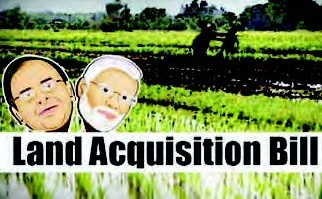
  • Govt likely to delay land bill

    Govt likely to delay land bill

    NEW DELHI (TIP): The government is taken aback by events following the suicide of a farmer at the Aam Admi Party (AAP) rally.

    The Opposition in Parliament squarely blamed the “anti-farmer” policy of the Narendra Modi government  for  driving farmers to take the drastic step.

    Consequently, there is perceptible worry among BJP ministers and MPs that it could cast shadow on the government’s plans to legislate a bill to replace the land acquisition ordinance, which had to be re-promulgated. The government did not place the bill in the Rajya Sabha because it does not have majority there.

    There is every possibility that the bill will not be allowed to come up in the Upper House again, said BJP floor managers.

    Given the political atmosphere following the suicide episode, the government itself could decide not to bring the bill to replace the ordinance until the fag end of the session, which ends in the second week of May.

    As yet, however, there is no indication that Modi will back down on his resolve on the matter though he may want more safety measures to end the distress of farmers.

    In fact, shortly before he addressed the Lok Sabha on Thursday, Modi met seniors ministers Rajnath Singh, Arun Jaitley, Venkaiah Naidu and Nitin Gadkari to formulate the government’s response. The PM’s line was that the issue of farmer suicides should not be allowed to be mixed up with the issue of amending the land acquisition law passed by the UPA, which is blamed for hurdles in acquiring land for key infrastructure project.

    In keeping with the PM’s statement that “we have to find a way and we can’t leave farmers helpless”, the government might re-examine relief package for agriculturists, which have been announced from time to time. An all-party meet could also be called on the subject. As a counter measure, the BJP has blamed Congress for the suicide, saying misrule by the previous Congress-led UPA is responsible to present situation. Over 3,000 farmers have committed suicide in the past three years and nearly three lakh farmers took their lives since 1995, according to the National Crime Research Bureau.

    The five worst-hit states are Maharashtra, Andhra Pradesh, Karnataka, Madhya Pradesh and Kerala. Maharashtra alone has recorded over 10,000 suicides between 2011 and 2013. Its Marathwada region has seen over 200 suicides in three months.

    “It should be our determination to find a solution to this problem. The issue has been there for long, we will take all good suggestions: For years the issue of farmers committing suicide is a matter of great concern,” Modi said on April 23.

  • India’s Land Acquisition Act: Bonanza for Rulers & their Financiers

    India’s Land Acquisition Act: Bonanza for Rulers & their Financiers

    India has a long history of its ruler’s fascination with farm land. Whether it was ancient Kings or Moghuls or British invaders turned rulers as well as the current rulers after independence; every one has been robbing the farmers of their land in broad daylight by claiming that they are doing it for the sake of development.

    Let us have a close look at the largest democracy of the world. India is a country of 1.35 billion, where 665 million practice open defecation against 37 million doing so in China. India has the world’s largest army of 85 million child labor out of 830 million poor living in extreme poverty. India’s elite, world famous billionaires, part of the 56 million rich Indians, live side by side with almost a billion poor and treat them as sub humans who are viewed as burden for the country.

    A former diplomat, politician, author and thinker Pavan Varma wrote in his book “Being Indian” that in the Indian elite “there is a remarkable tolerance for inequality, filth and human suffering”. He adds that “concern for the deprived and the suffering is not a prominent feature of the Indian personality. The rich in India have always lived a life, quite oblivious to the ocean of poverty around them”. Less than 10-15 minutes from every slum in any major city of India there are very expensive heavily guarded residential areas with mini palaces costing from a few million dollars to $1 billion Mukesh Ambani’s Palace. One city: two universes.

    India’s Land Acquisition Act was enacted in 1894 by British rulers. It gave unlimited power to the government to acquire any land. The Act allowed governments all over India to acquire land from the public. After independence India adopted the same Land Acquisition Act and no one bothered to make any changes in it because it was an easy way for the politicians and corporations to make money. The only person who lost money and livelihood was the individual and his family whose land was acquired. In 1985, an amendment made it easier for politicians and corporate to take over land at throw away prices. “Whenever it appears to the [appropriate Government] the land in any locality [is needed or] is likely to be needed for any public purpose [or for a company], a notification to that effect shall be published in the Official Gazette [and in two daily newspapers circulating in that locality of which at least one shall be in the regional language], and the Collector shall cause public notice of the substance of such notification to be given at convenient places in the said locality.” Practically for 66 years, from 1947 to 2013, every political party and at the center as well as all the states chose not to do anything and has been using this law as a source to generate black money to fight elections. It was only in 2013, the Congress led United Progressive Alliance (UPA) brought in “The Right to Fair Compensation and Transparency in Land Acquisition, Rehabilitation and Resettlement Act 2013. Although this also has some major flaws but it was the first time that some one thought of protecting the farmers, tribals and landless poor. However, UPA could not implement this law as it lost power and in 2014 a new government under Modi was installed at the center by the corporate world.

    Corporations and politicians all these years, in daylight robbery, after taking over farm land at throw away prices, have been getting the “land use” changed overnight and land becomes 1,000 to 10,000 times more its original price. Then the scam of acquiring Panchayat land or Shamlat land that is owned by the entire village marked for animal grazing especially for marginal farmers and landless owners of a few animals has been going on for over a century. This is done by the prospective buyer with bribes to revenue officials, from Patwari, Gram Panchayat members, Nayab Tehsildar, Tehsildar, District Collector, to ministers and judges, in case if a petition against an allotment is made for stay and, of course, the Chief Minister of the State who gets his/her share before any one else and only then a green signal is issued to go ahead with the project. Now after acquiring the farm land, to get its “land use” changed the buyer once again pays bribes to Chief Minister of the State, the District Collector, the Minister concerned, never forgetting the judicial officials in case a petitioner approaches the court for stay. The buyer also pays the usual development charges as per the rules.

    Farm Land has always been the biggest black money source for every ruling party in every state. If a serious investigation is done one can find how the real estate companies came into existence and some of the famous 5 star hotels, resorts, malls, luxury farm houses and residential complexes were built on farm land as well as Shamlat or Panchayat Land. The worst part is the farmers and their family members who used to own this land are now working as help- gardener, watchman, cleaner, cook and drivers on these properties.
    The forest land on which millions of people specially tribal and landless villagers depend for their survival by collecting minor wild oil seeds, herbs, fruits and flower, is much easier to acquire. Bribe all the concerned politicians, bureaucrats, Judges and environmentalists and get the land for a paltry sum per year on a per yard lease for 99 years. There is absolutely no need to buy and spend money on stamp papers etc.! And, in the long rum, have it to yourself, almost for free.
    Every central and state government in India believed that it owned the country’s resources. That is the reason we had numerous scams under Congress, Janata Party and BJP governments and their allies. But this time BJP that has come to rule the country at the Center as a single party with a massive majority for any party, after 30 years, has gone a step forward. It is openly sending a message that they own the resources. BJP must understand that “Country’s resources belong to the people and the land owned by farmers must remain with the farmers.” Let them decide what is to be done with the resources in the best interest of the country. Let the issue be decided by the majority of India’s citizens, not by the 1% that own the politicians and are trying to take over the country.
    Governments in India have always advanced the argument that the land is required for public use. That, it is required to build infrastructure- roads, bridges, power plants etc. That the land is required for the vital defense projects. For each of these projects that go in to private sector, the players get their profits. Even in case of government projects, governments get to recover the cost through various taxes. Where is the need to provide land at subsidized rates to any of them? The Indian industrial houses -Reliance, Adani, Tata, Jindal, Ruia etc have unprecedented political access and power. All these corporations, unlike East India Company, do not have their private army but soon will be making all kinds of warheads, missiles, helicopters, airplanes, ammunition and other sophisticated military gadgets because BJP’s Finance Minister Arun Jaitley has increased the FDI limit to 49% from 26% for defense industry. Just a few days before the budget the institution of Lobbyist ( Middleman) has been legalized in India for deals with the government, including defense deals. Now there won’t be any shortage of Radias openly operating in the corridors of power to influence law makers for favors for their corporate clients. Do these multi-billionaires really need to be given land at a subsidized rate?
    Even after Congress party’s catastrophic defeat in 2014 due to rampant corruption and massive scams the country’s crony capitalists are unlikely to suffer as a result. The nexus between business and politics, today under BJP rule, is as tight as it has ever been. BJP spent Rs 32,000 crore to bring Narendra Modi to power with massive corporate donations. BJP is estimated to have spent at least Rs 6,200 crore on print and broadcast advertising alone. Of these donations, around 90% comes from unlisted corporate sources who will be rewarded when the times comes. May be, under Land Acquisition Act it is pay back time for BJP to its financial supporters with cheap land besides the Rs. 62,398.6 crore for 2014-2015, the revenue government is expected to forego because of exemptions and deductions given to corporates.

    Modi’s Finance Minister Arun Jailey is bringing down the Corporate Tax from 30 per cent to 25 per cent in the next four years. In USA where the corporate Tax is 35% according to CAG ; US Corporation’s effective rate of tax was 12.1% in 2011 that is 40 years low. If the effective rate in USA is 12.1% in India it has to be under 10% or in some cases 0 because Indian Corporations are more innovative; they get subsidized loans, land, electricity, break on all kinds of taxes including custom, excise, dividend tax and can book their profits in foreign countries by over invoicing or under invoicing and route it back through government approved Mauritius route. Besides with the plethora of credits and deductions in tax code they buy super luxury cars, luxury homes & farm houses, air planes, yachts and expensive holidays abroad in their corporation’s name for their personal, family, executive and for the use of politicians and top bureaucrats. Interestingly, the bigger the corporate the more deductions and exemptions they take.!
    PM Modi has been going to every country in the world and telling investors: ‘Come to India; make in India; we will give you cheap land and labor’. PM Modi is certainly not lying. After robbing the farmers of their land, the farmers and their family members will have no choice but to become cheap laborers for his financial supporters- the MNC’s and the local industrial houses.
    (The New Jersey based author is a regular contributor to The Indian Panorama. He can be reached at davemakkar@yahoo.com)

  • ARUN JAITLEY PUSHES US FOR TOTALIZATION PACT

    ARUN JAITLEY PUSHES US FOR TOTALIZATION PACT

    NEW DELHI (TIP): Finance minister Arun Jaitley has urged US authorities to create a framework that would help Indian workers to get back $3 billion annually, which they contribute as social security in the US.

    “A related issue is totalization. Indians contribute — according to research done by Jacob Kirkegaard at the Peterson Institute — about $3 billion annually to the US government by way of social security contributions, which they will never receive back,” Jaitley said in a speech in Washington on deepening India-US economic ties.

    “This is like an aid programme that Indian workers run for the US government. I would urge the US administration to create a framework and start a process so that we can rectify what is really a very unjust situation. I am confident that the US will take up this matter soon,” he said.

    India has been pushing to sign a totalization agreement with the US but Washington has repeatedly rejected such a proposal. Jaitley detailed the steps being taken by the government to boost growth and benefit from the demographic dividend. He said the potential of India is considerable and the government plans to raise growth to a sustained double-digit trajectory and, hence, realizing the demographic dividend. “The US can both contribute to this process as well as participate in the opportunities that the Indian future will create. In these and other endeavours, the US will continue to remain India’s key strategic ally and partner… The basis for a 21st century relationship for a 21st century country has been established. Let us build on it. Chalein Saath Saath.”

  • RBI GOVERNOR GETS DEATH THREAT FROM IS

    MUMBAI (TIP): Reserve Bank of India (RBI) Governor Raghuram Rajan recently received a death threat from a purported Islamic State (IS) email account that is being accessed from across the globe.

    The governor received the threat on his official email address last month from isis583847@gmail.com—an account which the police said had been opened from Australia, Canada, Italy, Germany, US, Nigeria, Poland, Belgium, Hong Kong and Ukraine in a span of a few days.

    While security measures at the RBI has been beefed up, Mumbai Police Commissioner Rakesh Maria has asked the Cyber Crime Investigation Cell to conduct thorough investigations.

    The RBI refused to comment on the issue, but inside sources confirmed that Rajan was currently in the US along with Union Finance Minister Arun Jaitley to attend the World Bank group meeting in Washington. Without elaborating on the details of the e-mail, police sources said the IS warned Rajan that he would be eliminated as a contract had been received to execute him.

  • PRIME MINISTER TURNS TO BUREAUCRACY TO MAKE GOVERNMENT SHINE

    NEW DELHI (TIP): As his government heads towards completing one year in office, Prime Minister Narendra Modi is looking again to his bureaucrats to put in their best to bring back shine to the image of the BJP government.

    In his third such interaction since he became the prime minister, held on April 1 Modi assured them that they need not fear taking “honest decisions” as some officials expressed fear over repercussion and scrutiny in the future.

    Both Modi and Finance Minister Arun Jaitley, who was also present, told the officials that they were looking into the problem of filing of frivolous complaints against them, employing the Right to Information Act.

    But they must work fast for an effective campaign to showcase the achievement of his government in the last 11 months, Modi told the officials. In particular, the prime minister mentioned the success of coal block auctions and the Pradhan Mantri Jan Dhan Yojana.

    “The prime minister once again urged all secretaries to consult each other regularly, to eliminate silos, if any, and speed up the process of decision-making,” an official statement said.

    He underlined that a “communication gap” in “this team was absolutely untenable”, it added. Modi’s interaction came on a day when three more senior IAS officers from Gujarat cadre were appointed as joint secretaries in the Union Government, taking the number of Gujarat cadre officers in Delhi to over 20.

    Known as trusted lieutenants of Modi, G C Murmu, principal Secretary to the chief minister, was appointed as joint secretary expenditure, R P Gupta, principal secretary, civil supplies as joint secretary coal and Rajkumar, principal secretary agricultural, as joint secretary economic affairs.

    These officers will join other Gujarat cadre colleagues in Delhi, including A K Sharma, P K Mishra and Rajeev Topno, who are in the Prime Minister’s Office. Besides, Hasmukh Adhiya was deputed last year as finance secretary and Gauri Kumar is secretary cabinet (co-ordination).

    Soon after taking over as the prime minister on May 26 last year, Modi had met all the secretaries on June 4 and told them to fearlessly take decisions and that he would back them.

  • AMIT SHAH REVAMPS BJP NATIONAL EXECUTIVE

    AMIT SHAH REVAMPS BJP NATIONAL EXECUTIVE

    NEW DELHI (TIP): The first meeting of BJP’s new national executive finalised on March 12 by party president Amit Shah is expected in the first week of April in Bangalore.

    Shah finalised the party’s 111-member national executive, which includes top party leaders including Prime Minister Narendra Modi and former prime minister AB Vajpayee besides a host of top party leaders.

    All the eight chief ministers of BJP-ruled states and two deputy chief ministers, including that in Jammu and Kashmir where the party shares power with PDP, besides 24 former chief ministers and three former deputy chief ministers are permanent invitees to the national executive.

    The BJP chief has also made 40 senior leaders from across the country special invitees to the national executive.

    The new list comes ahead of the party’s national executive meeting and party’s restructuring by Shah.

    Among those who are part of the new national body include party veterans LK Advani and Murli Manohar Joshi, besides Union ministers Rajnath Singh, Sushma Swaraj, Arun Jaitley, M Venkaiah Naidu, Nitin Gadkari, Ananth Kumar, Thawarchand Gehlot, Jagat Prakash Nadda, Ravi Shankar Prasad, Kalraj Mishra, Narendra Singh Tomar, Harsh Vardhan, Bandaru Dattatreya and Radha Mohan Singh. However, HRD minister Smriti Irani and minority affairs minister Najma Heptulla are among the prominent faces who have been dropped from party’s national executive . Even Mathura MP Hema Malini and BJP’s Mumbai spokesperson Shaina NC did not find mention in the list.

    Others include Yashwant Sinha, Vinay Katiyar, CP Thakur, Jual Oram, SS Ahluwalia, Vijay K Malhotra, besides Hukumdev Narayan Singh, L Ganeshan, Lalji Tandon, O Rajgopal, Tathagat Roy, Gulab Chand Katariya and Subramanyam Swami.

    Ministers Mukhtar Abbas Naqvi, Dharmendra Pradhan, Rajeev Pratap Rudy, Prakash Javadekar, (Gen) VK Singh, Suresh Prabhu, Birendra Singh, Piyush Goyal and Nirmala Sitharaman are also part of the new executive.

    Other leaders like Varun Gandhi, Tapir Gaon, Vijay Goyal Satpal Maharaj, Vishnubhushan Harichandan, Vijay Mahapatra and PK Krishna Das, V Shanmughanathan, are also its members.

    Party’s firebrand leaders like Yogi Adityanath and Navjot Singh Sidhu are part of the executive, while another such leader Sadhvi Niranjan Jyoti is a special invitee.

    All the BJP chief ministers Shivraj Singh Chauhan, Raman Singh, Vasundhra Raje Scindia, Anandiben Patel, Raghuvar Das, Devendra Gandadharrao Fadnavis, Manohar Lal Khattar and Laxmikant Parsekar, besides deputy Chief Ministers Fracesco De D’souza and Nirmal Singh are also invitees. Besides, all Legislative Assembly and Legislative Council party leaders, state presidents of all states, all General Secretaries (Organisation) will be special invitees in National Executive.

  • BUDGET 2015-16 GOES FOR GROWTH, INVESTMENT

    BUDGET 2015-16 GOES FOR GROWTH, INVESTMENT

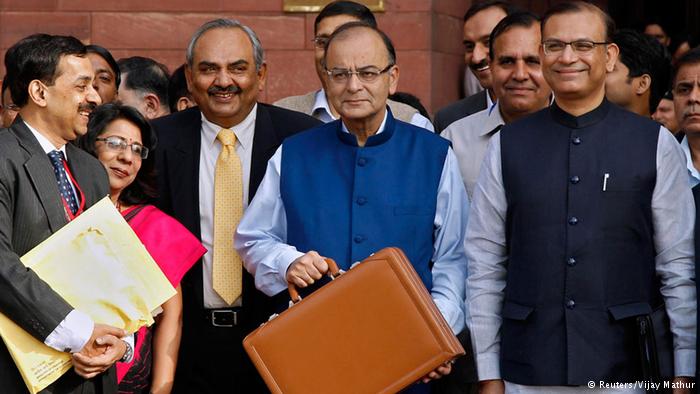
    NEW DELHI (TIP): Finance Minister Arun Jaitley on Feb 28 announced a budget that put boosting growth before painful reforms, slowing the pace of fiscal deficit cuts and seeking to put domestic and foreign capital to work.

    In his first full-year budget since Prime Minister Narendra Modi’s landslide election victory last May, Jaitley said India’s economy was about to take off. Modi tweeted that the budget would “further reignite our growth engine”.

    Billed as a test of the nationalist premier’s willingness to reform a $2 trillion economy with a bloated public sector and weak private investment, the budget was short on structural reforms and contained revenue targets some called unrealistic.

    It drew a mixed reception from economists, with some calling it a path to an investor-friendly India, but others seeing a missed opportunity to tackle deep-seated structural problems.

    “Definitely far from what some were hoping would be an event similar to the game-changing budget of 1991 which ushered in India’s economic liberalisation,” said Devika Mehndiratta, senior economist at ANZ research.

    Apparently anticipating such barbs, Jaitley, 62, said his government had acted “rapidly” to right the course of Asia’s third-largest economy.

    “People who urged us to undertake ‘big bang’ reforms also say the Indian economy is a super giant, which moves slowly but surely,” Jaitley told parliament as he wrapped up a 90-minute speech.

    Jaitley promised higher investment in India’s decrepit roads and railways, offered the carrot of tax cuts to global companies and the stick of tighter rules to get Indian tycoons to invest at home rather than stash wealth abroad. Tax evaders face jail sentences of up to 10 years, he warned.

    The tax changes and tougher enforcement would raise $2.5 billion next year, he said. Tax receipts overall would rise 15 percent and government asset sales would raise $11 billion -goals that past experience shows may be hard to meet.

    Although Jaitley forecast that growth would accelerate to 8-8.5 percent in the fiscal year starting in April, up from 7.4 percent this year, the budget contained little obvious support for Modi’s call to “Make in India”.

    “It assumes a questionable growth rate, relies too heavily on divestment to meet fiscal targets, does not address the revenue deficit issue head on and leaves the good things for the future,” said Arvind Sethi, CEO of Tata Asset Management.what will be cheaper 2015-16 Budget what will be expensive 2015-16 Budget

    Capitalizing on windfall savings stemming from cheaper oil imports, Jaitley was able to ramp up infrastructure investment without slashing spending on politically sensitive subsidies and welfare schemes.

    ROOM FOR RATE CUTS?

    Jaitley forecast inflation at 5 percent by the end of the fiscal year ending March 2016, undershooting the Reserve Bank of India’s 6 percent target and creating room to cut interest rates. Annual inflation was 5.1 percent in January.

    But he pushed back by a year, to 2017/18, a deadline for cutting the fiscal deficit to 3 percent of gross domestic product. In 2015/16, the deficit will be 3.9 percent of GDP, above the 3.6 percent target inherited from the last government.

    In volatile trading, the Nifty ended 0.7 percent higher after having briefly fallen into the red on his comment that the fiscal deficit would slip.

    Ratings agency Moody’s gave the budget a cool reception, saying it was neutral for India’s credit and left stabilising government finances at the mercy of economic growth. Moody’s rates India at the lowest notch of investment grade.

    “We were not expecting big bang reforms,” said Atsi Sheth, a Moody’s sovereign ratings analyst. “The big bang reforms are also not desirable because they have a higher chance of rollback. “

  • India budget ‘a step in the right direction’  – Realistic Approach

    India budget ‘a step in the right direction’ – Realistic Approach

    The 2015 budget “will further reignite our growth engine, signaling the dawn of a prosperous future,” wrote PM Modi on Twitter, referring to his government’s recently unveiled budget, widely viewed as business-friendly.

    On February 28, Finance Minister Arun Jaitley announced a host of new measures in the government’s first full budget, including increased spending in infrastructure, a universal social security scheme and an unprecedented corporate tax cut to 25 percent over the next four years. Jaitley said India was “about to take off” and it was time for a “quantum leap” on reforms.

    The finance minister also said he expects the country’s GDP to grow between 8 and 8.5 percent year-on-year, adding that a double digit growth rate may be achievable soon. The announcement comes a month after India’s Statistics Office unveiled changes in the way it calculates the country’s GDP.

    There were high expectations on the newly released budget as Modi’s ruling BJP party swept to power nine months ago on promises of reviving the country’s sluggish economy. Last year’s “mini budget” – unveiled by the ruling BJP in July – had been viewed by analysts as lacking on key issues.


    Full report to follow in the Friday Print Edition

  • Income Tax Expectations: Here’s What India Wants

    Income Tax Expectations: Here’s What India Wants

    A survey carried out by industry body Assocham has found that a majority of salaried employees want Finance Minister Arun Jaitley to increase the income tax exemption in the forthcoming Budget.

    A hike in income tax exemption from Rs. 2.5 lakh to Rs. 3 lakh will lead to savings of up to Rs. 5,000 for those who fall in theRs. 2.5 lakh to Rs. 5 lakh tax bracket. Those in the Rs. 5 lakh to Rs.10 lakh tax bracket will save up to Rs. 10,000, while those in the highest tax bracket can save up to Rs. 15,000.

    Any increase in exemption in income tax would leave more money in the hands of people and will increase their purchasing power, Assocham said.

    If Mr Jaitley hikes income tax exemption limit, it will be for the second time in two years that salaried employees will get a relief on taxes.

    The other big expectation is about exemption on housing loans. 78 per cent of those surveyed want interest exemption on home loans to go up to Rs. 5 lakh from Rs. 2 lakh.

    Property prices in the country have gone up sharply over the years and many individuals have to pay large amounts as interest for home loans. Exemption on interest on home loan was hiked by Rs. 50,000 to Rs. 2 lakh in the previous Budget.

    A large number of respondents in the survey also voted for hiking exemption limit under section 80C of the Income Tax Act; the section makes investments worth Rs. 1.5 lakh on saving instruments such as fixed deposits, national saving certificates and public provident funds exempt from taxes.

    “Hike in exemption limits will boost the savings rate in the Indian economy to 35 per cent of GDP from below 30 per cent currently,” said Assocham secretary general D S Rawat.

    88 per cent of respondents want the government to reduce the record-high duty on gold import. Import duty on gold was hiked to 10 per cent in 2013 when the economy was struggling with a high current account deficit and volatile rupee.

    Nearly 82 per cent of the salaried class expects a separate deduction of Rs. 50,000 for the payment towards annuity or pension plans. Deduction of the amount paid towards annuity plans u/s 80CCC and NPS u/s 80CCD come under the threshold limit of section 80C currently.

    Around 55 per cent of the survey respondents were between 25 and 29 year-old; 26 per cent fell between 30 and 39 years; 16 per cent were between 40 and 49 years. The survey was carried out among employees from 18 broad sectors, with maximum share contributed by employees from IT/ITes sector (17 per cent). It was conducted across Delhi, Mumbai, Kolkata, Chennai, Ahmedabad, Hyderabad, Pune, Chandigarh, Dehradun, etc. About 500 salaried employees from the different sectors were covered by the survey from each city on an average.

  • DAY AFTER DEEPAK PAREKH FIRE, JAITLEY DEFENDS GOVT

    DAY AFTER DEEPAK PAREKH FIRE, JAITLEY DEFENDS GOVT

    NEW DELHI (TIP): Finance minister Arun Jaitley on Feb 19 countered the criticism over “growing impatience” in the corporate sector and instead said that the Narendra Modi government has been criticized for moving “too fast”.

    The minister’s statement came a day after HDFC chairman Deepak Parekh’s comments about changes not reflecting on the ground nine months after the Modi government got a decisive mandate in the Lok Sabha elections.

    Although he refused to answer questions related to Parekh’s comment, Jaitley said: “We have to actually see what are the various steps that we have taken and the community of investors both within and outside the country watch us. In the first instance, what is the credibility of this government? What is the decisiveness of our decision making process? What is the process by which government treats business? And it’s an irony that after having seen lethargic governments, you today have a government which is criticized for being too fast.” Without naming any political party, Jaitley also lashed out at the opposition that has attacked the government for taking ordinance route, particularly the one dealing with land acquisition. He justified the decision to promote businesses and to expedite infrastructure projects including affordable housing for the poor in urban areas.

    Referring to the views of the opposition the finance minister said, “Why you bring ordinances, you should wait till the cows come home and everybody can be settled and decisions can be taken. So in fact one great criticism which has come is you should have waited and not acted fast.” 

    He said that sections those who have an “ideal constituency” and vested interest to keep India “poor and keep poor as poor” won’t support such changes that would bring more investment from within and abroad. Jaitley said that the government is determined that the starting point of eradication of poverty will start with getting investment. Defending the crucial ordinance, the minister said that apart from promoting business and investment, acquisition of land is not for “industrial hubs” but “industrial corridors” that will bring huge economic benefits to the poor and locals. Jaitley said that in the past few years, too many self goals have been scored that has impacted investment flow to the country. Referring to the contradictory views of former environment minister Jayanthi Natrajan and Congress vice-president Rahul Gandhi on stalled green clearances for projects for “collateral reasons”, the minister said there were two versions. First one, the decision to hold back clearances was on account of “dishonest consideration” and the second view is that the party dictating not to give clearances for “political positioning”.

  • A LOT IN PIPELINE FOR INVESTORS, SAYS JAITLEY

    A LOT IN PIPELINE FOR INVESTORS, SAYS JAITLEY

    DAVOS (TIP): Attending the World Economic Forum (WEF) here to showcase India as an investment destination, finance minister Arun Jaitley on January 21 promised India has a “lot in the pipeline” for global investors even as he plans to take up with Switzerland the issue of black money stashed in banks there.

    Jaitley, who marks a high-power Indian presence that includes power minister Piyush Goyal and top industrialists and bankers, is slated to meet his Swiss counterpart Eveline Widmer-Schlumpf when the issue of black money in Swiss banks will figure.

    The finance minister said the ongoing meet of the rich and the powerful would be an opportunity for India where a lot is happening. He said that competing economies are mostly not doing so well and if India continued in the course that it had taken in the last seven, eight months, “there is a lot that we can attract”.

    Shortly after arriving here, Jaitley said he would tell the investors that the government has done a lot and a lot is in the pipeline. Therefore, both the government of India and India as a state have embarked on a particular course and “this is what we are likely to do. So this is an opportunity to showcase India.”

    Jaitley, who will be here till January 23, said he would discuss the issue of black money with his Swiss counterpart when they meet on the sidelines of the WEF meet. He is expected to seek Swiss cooperation regarding details of Indian citizens holding unaccounted money in Swiss banks and ways to repatriate that money.

  • Kiran Bedi joins BJP with Chief Ministerial  ambition

    Kiran Bedi joins BJP with Chief Ministerial ambition

    BJP chief Amit Shah presents a bouquet to Kiran Bedi to welcome her into the party during a press conference in New Delhi.

    NEW DELHI (TIP): Not unexpectedly, former Team Anna member Kiran Bedi on Thursday, January 15, joined the Bharatiya Janata Party (BJP), and laid bare her chief ministerial aspirations before party president Amit Shah as she marked her “40 years of experience in administration” and ability to “extract work” from people.

    Apart from Bedi, other well known women leaders, too, may join the BJP. Former Samajwadi Party MP and actor Jaya Prada and former Aam Aadmi Party leader Shazia Ilmi are in talks to join the BJP.

    Bedi was the first woman IPS officer. She joined the service in 1972. She made a high-profile entry into the BJP in the presence of Shah and Finance Minister Arun Jaitley during a press conference at the party’s Ashok Road headquarters.

    While the BJP was reluctant to disclose the seat identified for launching Bedi in the polls, the social activist used her introductory statement to pitch herself as an experienced administrator.

    “I have 40 years of administrative experience, now I am here to present my experience to Delhi,” she told the gathering.

    “I can work and know how to get work done from others. Together we will work and extract work from others as well.”

    The former top cop had met Prime Minister Narendra?Modi along with Shah before becoming a BJP member.

    She said she was inspired by Modi’s leadership qualities which prompted her to take a plunge into politics.

    The anti-corruption crusader stressed she was on a “mission mode” and would work towards a steady, stable and corruption-free government.

    Shah praised Bedi, saying that she would strengthen the BJP’s Delhi unit and offer “constructive contribution” in elections and government formation.

  • RBI CUTS RATES; HOME, CONSUMER LOANS TO COST LESS

    MUMBAI (TIP): Reserve Bank of India governor Raghuram Rajan cut key interest rates — for the first time in almost two years — by 25 basis points about a fortnight ahead of the monetary policy review on February 3. Home and consumer loan rates are set to fall, as is the cost of capital for doing business.

    The RBI had been under growing pressure from industry and reportedly the government to lower rates in the hope that it would stimulate growth. There had been speculation in the media that the finance ministry was unhappy with Rajan for being too focused on keeping inflation in check, and ignoring the need to get the economy back on track.

    Raghuram Rajan RBI

    Banks have responded to the mid-term move by bringing down lending and deposit rates and are forecasting more rate cuts in coming months.

    Government-owned United Bank of India and Union Bank of India were the first off the block, nipping the base rate by 25 basis points to 10%. The base rate is the benchmark rate set by every bank to which the pricing of all its floating rate loans is linked.

    Other large lenders are expected to follow suit. State Bank of India chairman Arundhati Bhattacharya said that a cut in rates was on the bank’s horizon and there was some preparedness to do so but the timing would be decided by the asset-liability committee. HDFC vice chairman and CEO Keki Mistry said lenders were expected to pass on benefits of lower interest rates to customers by February.

    Finance minister Arun Jaitley, who had been making a case for lower interest rates, said the move would provide a fillip to the economy directly by increasing the private sector’s ability and willingness to spend. “It should also help indirectly by improving the balance sheet of the corporate sector and banks, facilitating an increase in the demand and supply of credit,” said a statement from the FM. While the lower inflation numbers and drop in international crude prices have worked in favour of a rate cut, what appears to have emboldened RBI to go in for a mid-term move is the sharp fall in inflation expectation in RBI’s household survey.

    The RBI decision came as a surprise although Rajan had indicated in the last policy review in December that he would be open to reducing rates early- 2015 even “outside the policy review cycle if the current inflation momentum and changes in inflation expectations continued”. Extending his wishes to the people on Thursday on the occasion of Makar Sankranti, Pongal and Uttarayana, Rajan said,
    “Inflation outcomes have fallen significantly below the 8% targeted by January 2015. On current policy settings, inflation is likely to be below 6% by January 2016. These developments have provided headroom for a shift in the monetary policy stance”. According to data released by the government, retail price increase as measured by the consumer price index was 5.2% in December — much below RBI’s best case scenario as forecast in its monetary policy.

    Market dealers said another trigger for the RBI decision might have been the release of the US Fed’s ‘Beige Book’ Wednesday night showing some slowdown in growth in oil-producing areas in the country, an effect of the recent crash in crude oil prices. It also revealed little pressure on wages or prices to rise. All these indicated that rates in the US may not rise as quickly as expected now.

  • NITI AAYOG repalces Planning Commission;  Indian American Arvind Panagariya appointed vice-chairman

    NITI AAYOG repalces Planning Commission; Indian American Arvind Panagariya appointed vice-chairman

    NEW YORK (TIP): Columbia University economist Arvind Panagariya will be the first vice-chairman of the National Institution for Transforming India (Niti) Aayog, which will have two full-time members — economist Bibek Debroy and former DRDO chief VK Saraswat, a statement issued by the Prime Minister’s Office (PMO) said Monday, January 5.

    Panagariya, 62, is a professor of economics at New York’s Columbia University, a former chief economist at the Asian Development Bank and has also worked with the IMF, WTO and World Bank in various capacities.

    A staunch advocate of free-market economics, Panagariya has over the last two years been writing advisories to the BJP about how to manage the fiscal situation, sources said.
    The PMO also nominated home minister Rajnath Singh, finance minister Arun Jaitley, railways minister Suresh Prabhu and agriculture minister Radha Mohan Singh as ex officio members.

    Transport minister Nitin Gadkari, HRD minister Smriti Irani and social empowerment minister Thawar Chand Gehlot will be special invitees of the Niti Aayog that replaces the 65-year-old Socialist-era Planning Commission.

    Prime Minister Narendra Modi will head the body and its governing council will include all chief ministers and lieutenant governors, in line with the PM’s thrust on cooperative federalism that advocates involving states in the Centre’s decision making.

    However, two elected chief ministers — of Delhi and Puducherry — will not be members of the new Niti Aayog.

    The Article 239 of the Constitution defines both Delhi and Puducherry as Union Territories and therefore, their administrators — lieutenant governors — will be members of the panel.

    Under the article, a law providing for assembly in Delhi was enacted in 1991. “As per law, Delhi is a Union Territory. It has been rephrased as National Capital Territory,” said SK Sharma, former secretary of Delhi Legislative Assembly.

    Government sources said that three more members will be appointed to the Niti Aayog soon. In all, the government plans to appoint five full-time members and two part-time members, who are expected to be representative for the academic world.

    Panagariya and other full-time members are expected to join office at Niti Bhawan,erstwhile Yojana Bhawan, in a couple of days.

    Officials could be seen Monday sprucing the rooms, lying vacant for the last eight months, for the new members.

    The government, meanwhile, archived the website of the Planning Commission, and an announcement on Twitter handle Niti Aayog said: “Administrative reforms are underway.

    The NITI Aayog website will be ready in a few days. The process for Transforming India has begun!”

    A new website of Niti Aayog will be launched once the new vice-chairman joins office as officials in Yojana Bhawan does not have authority to issue directions, sources said.

    The reason is that the government has not notified new business of transaction rules for Niti Aayog.

    Officials said Niti Aayog will primarily be an advisory body without having power to allocate funds. The government has allocated the fund disbursement job to the finance ministry, which is also mandated to generate revenue.

    Before the National Democratic Alliance (NDA) government came to power, the Planning Commission used to allocate funds to all central ministries and the state governments.

  • PRESIDENT SIGNS ORDINANCES ON INSURANCE, COAL SECTOR REFORMS

    PRESIDENT SIGNS ORDINANCES ON INSURANCE, COAL SECTOR REFORMS

    NEW DELHI (TIP): Paving way for additional foreign investment in insurance and to move ahead with the re-allocation of cancelled coal mines, President Pranab Mukherjee on Friday signed the two ordinances in this regard. The government had decided to promulgate these ordinances to move ahead with reforms in the two sectors, as respective bills could not get through during the just-concluded Parliament Session that ended on December 23. The President has signed the two ordinances, press secretary Venu Rajamony said. The Cabinet had had approved promulgation of the Ordinance on Insurance Bill and re-promulgation of the Coal Ordinance on Wednesday, a day after the conclusion of the Winter session of Parliament. Finance Minister Arun Jaitley had expressed the hope that hiking of the foreign investment cap in the insurance sector to 49 per cent, which has been pending since 2008, will result in capital inflow of $6-8 billion. Earlier, this foreign investment limit was capped at 26 per cent. “The Ordinance demonstrates the firm commitment and determination of this government to reforms. It also announces to the rest of the world including investors that this country can no longer wait even if one of the houses of Parliament waits indefinitely to take up its agenda,” he had said.

  • GOVT PUSHING TO COMPLETE ROAD PROJECTS ALONG CHINA BORDER

    GOVT PUSHING TO COMPLETE ROAD PROJECTS ALONG CHINA BORDER

    NEW DELHI (TIP): Defence Minister Arun Jaitley on November 7 said the government is working towards an early completion of 22 border roads prioritised by the Army. The government is intensely monitoring the road projects entrusted for speedy completion with the Border Roads Organisation, Jaitley informed the Parliamentary Consultative Committee on Friday. The 22 road projects were among the 73 Sino-Indian border roads running a total length of 3,812 kilometres which the government had identified almost a decade ago. However, a mere 17 of them covering 590 kilometres were completed, as a series of bottlenecks crippled the progress of other projects. Director General of BRO Lt Gen AT Parnaik told the panel that the projects were hit by delays in getting forest and wildlife clearances, trying terrain conditions, hard road structures, extreme weather conditions limiting the working periods, paucity of construction materials and natural disasters.

  • Army admits to killing Budgam boys

    Army admits to killing Budgam boys

    SRINAGAR (TIP): The Army on November 7 accepted that it had mistakenly killed two boys in central Kashmir’s Budgam district recently, and promised a transparent and time-bound probe into the incident. Addressing a press conference at the 15 Corps headquarters here, Northern Command chief Lt Gen D S Hooda said: “We take responsibility for the death of the two boys in Kashmir.

    We admit that a mistake was made, and that a transparent investigation will be taken up.” Assuring that such incidents would not happen in future, he said, “We are aiming to complete the inquiry within days and not months. Hopefully, if all goes well and all the witnesses come in, we will have completed the inquiry in the next 10 days. Around 15 civilian witnesses have recorded their statements, apart from those from the Army.” The commander also announced a compensation of Rs 10 lakh to the families of the deceased, and Rs 5 lakh for injured. “We would like to assure the families of our fullest support and cooperation. We are committed to rehabilitation and full recovery of those injured,” he said.

    He also said the military unit involved in the incident, the 53 Rashtriya Rifles, has been replaced with troops from 25 Rashtriya Rifles. On Monday, Defence Minister Arun Jaitley had also promised action against those found guilty. “The Budgam incident in the Kashmir Valley is highly regrettable. A fair inquiry will be held and action taken against those found guilty,” he had tweeted. Faisal Bhat (14) and Meraj-ud-Din Dar (20) were killed when soldiers fired at the vehicle they were travelling in after they allegedly refused to stop at an Army checkpost in the Chatergam area of Budgam on Monday evening.

    Two more boys—Zahid and Shakir— were critically injured in the incident and are undergoing treatment at Army hospital here. Basim Amin, the fifth boy who accompanied his friends, had a providential escape and returned home safe. All five belonged to the Nowgam area on the outskirts of the city.There has been huge outrage over the killings, with all the political parties cutting across ideologies demanding the severest punishment for the accused soldiers.

    THE INCIDENT

    Faisal Yousuf (17) and Mehraj-u-din Dar (21) were killed and two others were injured when troops of 53 Rastriya Rifles, manning a checkpoint at Chattergam village in Budgam, opened fire on a car they were travelling in on November 3

    The incident had triggered widespread
    outrage across the Valley

    While the J&K police have registered a murder case, a Colonel of the Rashtriya Rifles is holding probe into the circumstances which led to the killing

  • FINANCE MINISTER SIGNALS LOWER RATE, CHEAPER FUNDS

    FINANCE MINISTER SIGNALS LOWER RATE, CHEAPER FUNDS

    NEW DELHI: Finance minister Arun Jaitley on November 5 told industry captains that he expects the cost of capital to come down, a statement which CEOs read as a signal to a rate cut in the coming months. The issue of high cost of capital, mounting bad debt in public sector banks and infrastructure gap came up for discussion during Jaitley’s closed-door meeting with a group of Indian and foreign CEOs, including Bharti Group’s Sunil Mittal, Religare’s Malvinder Singh and Etihad Airways president and CEO James Hogan.

    Source present in the meeting told TOI that some of the foreign CEOs raised concerns over the steep rise in nonperforming assets of banks, and the minister responded by saying that the government is taking steps to address the concern. On October 24, Jaitley had made a case for an interest rate cut by the Reserve Bank of India in an interview to TOI. “Currently, interest rates are a disincentive. Now that inflation seems to be stabilizing somewhat, the time seems to have come to moderate the interest rates,” the minister had said. Despite inflation moderating to a five-year low, the RBI has so far resisted the temptation.

    But, given the surplus cash in the system, the cost of funds for companies raising loans has come down in recent days. Corporate chiefs see a rate cut by the central bank as the best way to step up investment in the economy. “It may be time for the RBI to think of a rate cut,” Mahindra group chairman Anand Mahindra said. Pointing out that inflation is moderating, he added, “The need of the hour has changed and it is time to start looking at supporting growth.” Mahindra sought relief for automakers in the form of lower excise duty. Uday Kotak, vice-chairman and MD of Kotak Mahindra Bank, also pitched for a rate cut.

    “The RBI should be considering a rate cut between December and February. The macroeconomic conditions have improved significantly now.” Kotak said with the Modi government kick-starting the economic reforms process, the economy has started to pick pace. However, he added that one should not expect an immediate recovery. “It has to be seen as a marathon, rather than a sprint.” Kotak added that the Indian economy should see an average growth of 6.5% over five years. Sunil Mittal, chairman of Bharti Enterprises, also hoped that a rate cut happens soon. “Once the finance minister asks for it, he speaks for the nation.”

    The telecom czar said that the new government has moved ahead with “some big reforms” which have led to a movement in the Indian economy. “But just give it some time for a pick-up.” Rahul Bajaj, chairman of Bajaj Auto, said further steps are required to give a big thrust to the economy. “They cannot happen all of a sudden.” He said interest rates should be lowered, though the final call remains with RBI governor Raghuram Rajan.