EDINBURGH (TIP): Scotland’s proindependence leader Alex Salmond said the “eyes of the world” were on a momentous referendum next week as officials reported record numbers registering to vote on breaking away from the United Kingdom. Salmond said the September 18 vote would be “a process of national empowerment”, as new figures came out showing a record 4.3 million people had registered to vote — higher than for any previous elections in Scotland. “Scotland is on the cusp of making history.
The eyes of the world are upon Scotland,” Salmond, Scottish First Minister and the head of Scotland’s current devolved government, said in an Edinburgh speech. “On September 18, we the people hold our destiny in our own hands.” British media said new figures meant 97 percent of the electorate had now registered to vote, including many 16- and 17-year-olds who are allowed to take part under referendum rules.
Polls show Scottish voters are almost evenly divided between the “Yes” and the “No” sides although one survey so far has put the pro-independence camp just ahead of the unionists. The most recent, published on Wednesday by Scotland’s Daily Record newspaper, showed 53 percent against independence and 47 percent in favour, without counting undecided.
The vote would bring to an abrupt end a 307-year-old union between England and Scotland and create the newest state in Europe since the disintegration of Yugoslavia. – ‘Huge pressure on Madrid’ – 100 journalists from around the world were present at Thursday’s press conference, with many asking about what Scotland’s relation to their country would be. Many nations with separatist movements are following the campaign closely, including Spain where the government has ruled out a referendum for Catalan independence or devolution. On Thursday hundreds of thousands of Catalan nationalist demonstrators, some waving the blue and white Scottish flag, filled the streets of Barcelona in a mass rally to demand a vote like Scotland’s. “People in Catalonia don’t necessarily want independence but they want to have the right to vote.
And they see that here it’s possible,” said Carles Costa from TV3 public television in Catalonia, who was at Salmond’s press conference. “A ‘Yes’ vote would put a huge pressure on Madrid. Scotland is not a remote country somewhere in the world. It’s just next door,” he said. “Even with a ‘No’, people in Catalonia will say, ‘Why is this not possible in Spain?’” But Shuhei Nakayama from Japanese broadcaster NHK said most people in Japan had “a confused idea of the situation”.
“Most don’t know Scotland is already a region with many powers. Some think it’s a country already as they have a football team,” he said. “It’s very interesting to see a nation that might break away without any violence,” he said. The campaign — and the promise of greater devolution if the “No” camp wins the vote — has also bolstered demands from local authorities for greater powers within England and Wales. Deputy Prime Minister Nick Clegg is on Friday expected to launch a report calling for a major programme of devolution within England after the next general election in May 2015. – ‘Responsible and prudent’ – International Monetary Fund on Thursday warned that a vote for independence would raise “complicated issues” and could upset financial markets.
“While this uncertainty could lead to negative market reactions in the short term, the longer term will depend on the decisions being made during the transition,” IMF spokesman Bill Murray said. The Royal Bank of Scotland has said it would relocate its registered offices in case of a “Yes” vote, saying this was the “responsible and prudent thing to do,” but underlining it would not mean moving jobs south. RBS was bailed out by the British government following the 2008 financial crisis and its announcement came after London-based Lloyds Banking Group also said it had plans on possibly switching key operations from Scotland to England.
Edinburgh-based RBS is 81-percent owned by the British state, which also retains a 25-percent stake in bailed-out Lloyds. Big business leaders have mostly lined up against independence, although the chief executive of Scotland’s largest fund manager, Aberdeen Asset Management, has said that an independent Scotland would be “a big success
Tag: Banking
-

SCOTLAND READY TO MAKE HISTORY: INDEPENDENCE LEADER
-

Senator Tony Avella- the man you can trust to be on your side
Remember to vote for Tony Avella on Tuesday, September 9
Senator Tony Avella has dedicated his life to fighting for middle-class families and progressive Democratic values. Senator Avella’s distinguished public service career began over 30 years ago as an aide to New York City Council Member Peter Vallone, Sr. Senator Avella later served as an aide to Mayors Koch and Dinkins and as Chief of Staff to the late State Senator Leonard Stavisky and to State Senator Toby Stavisky. Prior to seeking public office, Senator Avella served in numerous capacities as a civic activist and was a member of Queens Community Board #7. In 1997, Senator Avella was awarded New York State’s Community Service Award for his numerous volunteer and civic endeavors on behalf of all New Yorkers.
In 2001, Senator Avella won election to the New York City Council in the 19th District – Northeast Queens and was re-elected with an overwhelming majority in both the 2003 and 2005 elections. As a member of the City Council, Senator Avella served as Chair of the Zoning and Franchises Committee and was a member of five Council committees: Higher Education, Housing and Buildings, Fire and Criminal Justice Services, Land Use, and Veterans.
Senator Avella was also the founder and Chair of the first Italian-American Caucus of the City Council. During his tenure on the Council, Senator Avella authored several important pieces of legislation. Signed into law in 2005, his “Demolition by Neglect” bill enabled the Landmarks Preservation Commission to prevent the willful destruction of our City’s treasured landmarks by unscrupulous property owners. Senator Avella’s legislation was strongly supported by 46 preservation and civic groups including the Landmarks Conservancy, the Historic Districts Council and the National Historic Trust.
As a trusted public servant, Senator Avella has made fighting over-development and protecting our quality of life his top priorities. In the City Council, Senator Avella led the fight citywide against overdevelopment, the proliferation of McMansions, and other major abuses of the City’s building and zoning codes. In an effort to preserve the unique residential character and quality of life in neighborhoods throughout the City, Senator Avella helped create new zoning districts such as R2A, which prevents the construction of McMansions, rezoned major portions of his district as well as numerous other neighborhoods in the City, and enacted citywide amendments to the “Community Facilities” section.
Senator Avella’s hard work resulted in the first real changes in the City’s zoning code in over 40 years. In addition to his efforts to stop out-ofcharacter construction, Senator Avella was at the forefront of the battle to reform the City’s Department of Buildings and the Board of Standards and Appeals. Senator Avella was also the acknowledged leader in the City Council for landmark preservation, animal welfare, good government, and Veterans’ issues and benefits. As a member of the City Council, Senator Avella refused the “lulu”; an additional taxpayer funded salary increase in return for loyalty to council leadership instead of taxpayers.
Senator Avella fought against and subsequently refused the 25% City Council pay raise, which he considered unethical. Senator Avella was honored by numerous fraternal organizations, civic associations, sports and school/educational groups. Senator Avella has received such honors as the “Friend In High Places Award” from the Historic District Council, the Community Mayor’s Humanitarian Award, the coveted Lucy G. Moses Preservation Award from the New York Landmarks Conservancy, and the Benefactors’ Award from the Alley Pond Environmental Center.
In 2009, Senator Avella received the “New York City Human Rights Award” for obtaining the highest score of elected officials in New York City on the Human Rights Project’s report cards. A city-wide human rights coalition with over 100 groups from all over the City, the Human Rights Project is the lead organization of the New York City Human Rights Initiative.
First elected to the State Senate in 2010, Senator Avella, as a freshman senator, was appointed ranking member of the Cities and Environmental Conservation Committees, and has served on the Education, Aging, Banking, and Veterans, Homeland Security and Military Affairs Committees. His reputation as a staunch reformer has helped to bring real change to Albany.
As a state Senator, he is proud of bringing ethics reform to New York’s Capitol, and has again refused any “lulus” for his committee positions. A strong advocate for reform and transparency in government, Senator Avella is fighting to transform the State Senate so that it works for the people once again. Senator Avella spent his first few years in Albany fighting for the people that elected him. He is proud to have voted for four on-time budgets without raising taxes. As ranking member of the Environmental Conservation Committee, he lead the fight in advocating for a ban on hydrofracking, an extremely dangerous drilling practice that poses a risk to local water supplies.
He introduced and passed in the Senate legislation that would equalize co-op and condo property tax assessments with one-two and three family homes and help lower costs at the gas pump. Re-elected by an overwhelming majority in 2012, Senator Avella has continued his dedicated service to the people of the 11th Senatorial District. He has continued to fight for progressive legislation by working to increase the minimum wage, pass the SAFE Act – the toughest gun control laws in the nation, and implement Universal Pre-K. He has prioritized women’s rights by fighting for and co-sponsoring the Women’s Equality Act.
He is an avid advocate for animal rights, having introduced multiple bills in support of the protection of animals, as well as sounded the alarm against animal rights violations. During this past legislative session, Senator Avella passed seventeen bills, four of which have been passed in the Assembly and two of which have been signed into law. He currently serves as the Chair of the Social Services Committee, Vice-Chair of the Environmental Conservation Committee, and is a member of the Transportation, Education, Codes, Housing, NYC Education, Insurance, Judiciary and Banks Committees. Senator Avella is a graduate of Hunter College of the City University of New York.
He is a lifelong Queens resident and currently resides in Whitestone with his wife Judith. Avella has been endorsed by a number of Unions which include Local 246 , SEIU Automotive/Mechanical, Motor Vehicle Operations Union Local 983, 1199 SEIU, United Healthcare East, Communications Workers of America (CWA) District 1 Retail, Wholesale and Department Store Union (RWDSU), Plumbers Union Local 1, International Union of Elevator Constructors (IUEC), Uniformed Firefighters Association of New York (UFA-NYC), Uniformed EMTs, Paramedics & Fire Inspectors – Local 2507, FDNY, Fire Alarm Dispatchers Benevolent Association, FDNY, New York State Troopers, Council of Administrators and Supervisors, Nassau County Sheriff’s Correction Officer Benevolent Association, Correction Officers Benevolent Association (COBA), NYC Patrolmen’s Benevolent Association (PBA), Public Employees Federation (PEF), New York State Supreme Court Officers, New York State PBA, New York State Nurses Association, New York State Police Investigators Association. Mayor Bill de Blasio and Congressmember Steve Israel are among the elected officials who have endorsed Tony.
The organizations which have endorsed him are League of Humane Voters; League of Conservation Voters, Empire State Pride Agenda, Citizens Union and Sierra Club. -

PM ‘JAN DHAN’ YOJANA LAUNCHED; 1.5 CRORE BANK ACCOUNTS OPENED IN A DAY
NEW DELHI (TIP): Prime Minister Narendra Modi on Aug 28 launched his government’s mega scheme ‘Jan Dhan Yojana’, declaring that it was aimed at eradicating financial untouchability by providing bank accounts to the poor. On the inaugural day, a record 1.5 crore bank accounts were opened across the country, the largest such exercise on a single day possibly anywhere in the world.
Unveiling the scheme within 100 days of forming the new government, Modi said, it will cover 7.5 crore people by January 26, 2015, who will be provided zero-balance bank account with RuPay debit card, life insurance cover of Rs 30,000 in addition to accidental insurance cover of Rs 1 lakh. Later the account holders will be provided an overdraft facility of up to Rs 5,000. “If Mahatma Gandhi worked to remove social untouchability, if we want to get rid of poverty, then we have to first get rid of financial untouchability.
We have to connect every person with the financial system. And for that this programme has been given impetus,” he said, adding, “when a bank account is opened, it’s a step towards joining economic mainstream.” Modi recalled the bank nationalization of 1969 with the avowed objective of spreading the reach of financial system to the doorsteps of poor. “But I regret to say that after 68 years of independence, not even 68 per cent of population is covered by the banking system,” he said.
The scheme was simultaneously launched at multiple places by 20 chief ministers, several Union ministers, including information minister Prakash Javadekar at Pune, law minister Ravi Shankar Prasad at Chennai, external affairs minister Sushma Swaraj at Bhopal, home minister Rajnath Singh at Lucknow and HRD minister Smriti Irani at Surat. There were in all 600 programmes and 77,852 camps on the opening day to open bank accounts. Modi said history has been created in the banking system with opening of over 1.5 crore account in a day.
Besides, a record has been created by providing 1.5 crore accidental insurance covers of Rs 1 lakh. The Prime Minister described the occasion as a festival to celebrate the liberation of the poor from a poisonous cycle (“Vish-chakra se gareebon ki aazaadi ka parv”). “Banks have assured me they will do this work before January 26. Those who oppen accounts by January 26, 2015 over and above the the Rs 1 lakh accident, they will be given life insurance cover of Rs 30,000.
This will help the poor family,” he said. In the third phase, he said, these account holders would also be provided micro-pension facility. “I believe when a person opens a bank account then he or she takes the first step to get connected with the economic system. Today the 1.5 crore family who got connected with the economic system this will give a boost to the economy,” he said. Going forward, he can avail Rs 5,000 loan from the bank, the Prime Minister said, adding, this facility would be available after six months of opening of the bank account.
Expressing satisfaction at a number of records being broken today, the Prime Minister said the nationwide success of the enrolment drive today would give confidence not just to the officials of the department of financial services and banking sectors, but also to officers across the Union government, that they can successfully achieve the goals that they set for themselves. “Never before would insurance companies have issued 1.5 lakh accident insurance policies in a single day. Never before in economic history would 1.5 lakh bank accounts have been opened in a single day. “Never before has the government of India organized a programme of such scale — over 77,000 locations — with the participation of so many chief ministers, Union ministers, government and bank officials,” the Prime Minister said. -

Jan Dhan scheme to help poor open bank accounts: PM
NEW DELHI (TIP):
Prime Minister Narendra Modi on August 15 launched ‘Pradhan Mantri Jan Dhan Yojana’ to help the poor open bank accounts which will come with the facility of a debit card and an insurance cover of Rs 1 lakh. “We want to integrate the poorest of the poor with bank accounts with Pradhan Mantri Jan Dhan Yojana,” he said in his maiden Independence Day address to the nation. Observing that people have mobile phones but not bank accounts, Modi said, the scheme will help in bringing the benefits of formal banking system to them.
“Today there are crores of families which have mobile phones but no bank accounts. We have to change this. The economic development must benefit poor and it should start from here,” he said. Under the Jan Dhan Yojana, he said, “the person who will open bank account will get a debit card and the family will get Rs. 1 lakh insurance cover. This will help the family to tide over the unforeseen eventuality.”
The Union Cabinet has already cleared the two-phase financial inclusion scheme under which bank accounts will be opened for 15 crore poor persons with an overdraft facility of Rs 5,000 and accident insurance of Rs. 1 lakh. The scheme, to be pushed by the government in a mission mode, seeks to provide two accounts to 7.5 crore identified households by August 2018.
The main features of the scheme include Rs. 5,000 overdraft facility for Aadhar—linked accounts, Ru Pay Debit Card with inbuilt Rs. 1 lakh accident insurance cover and minimum monthly renumeration of Rs. 5,000 to business correspondents who will provide the last link between the account holders and the bank.Caste, communal violence stalls progress, says Modi
Modi asked the nation to eschew caste or communal violence as stalled the growth of the nation. “Let us affirm that we will be free from these tensions,” Narendra Modi said. Earlier, he had arrived at the Red Fort and hoisted the National Flag from there. In the course of his speech, he tried to address a wide-range of issues before the nation.
-

BUDGET A VALIDATION OF UPA POLICIES: CHIDAMBARAM
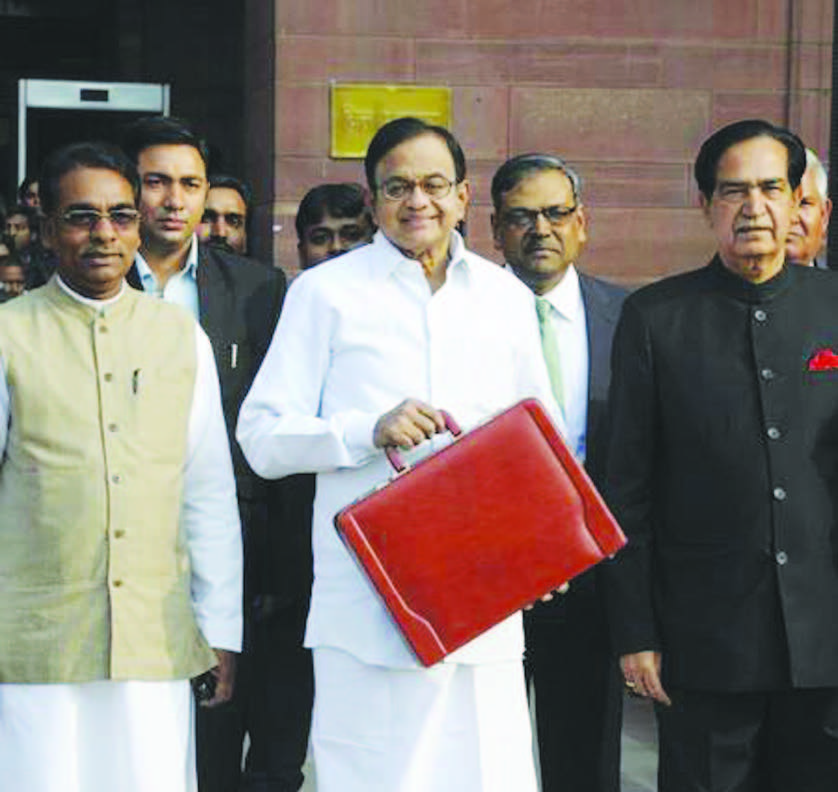
NEW DELHI (TIP): Former finance minister P Chidambaram, who presented the interim budget ahead of the Lok Sabha polls, has said he is happy to find the BJP government’s first Budget validating the figures presented by him. “The imprint of the UPA government’s policies can be found throughout the Budget speech and in the budget documents,” Chidambaram said in a statement. He said it’s not possible to come out with a “Congress- Mukt Budget”.
“Welcome to the real world… BJP sought a mandate for Congress-Mukt Bharat.My friend, Arun Jaitley, would have realised that it is not possible to have even a Congress- Mukt Budget,” the former finance minister said. He said Arun Jaitley’s Budget has the imprint of UPA policies on fiscal consolidation, GST, FDI cap in insurance and social sector schemes. “I am glad that Arun Jaitley has acknowledged the basic validity of the numbers presented in the Interim Budget for 2014-15 and has stuck to them…He has also maintained the tax revenue estimates for Corporation Tax, Customs and Service Tax,” he said. Chidambaram referred to the numbers with regard to the fiscal deficit at 4.1% and revenue deficit of 2.9% (marginally lower than 3%).
Mamata: Budget visionless
KOLKATA: Chief minister Mamata Banerjee came down heavily on the NDA for what she called a ‘visionless, missionless and actionless’ budget as far as the common man is concerned. According to her, the first Union Budget tabled by the Narendra Modi government can’t stimulate growth or lead to development of the poor. “We heard about a strong and vibrant India before the government came to power.
We thought that it will be delivered to provide good governance. But from the beginning, we are getting disappointed. Only one positive sign of the new government is established in two budgets that they have become a government of the FDI, by the FDI and for the FDI. Already, there is FDI in the retail. Now FDI is increased to 49% in Defence, and Insurance Sectors. In addition, disinvestment in banking sector is up to 49%. -

Indian-American Coalition endorses Rep. Jim Himes for Re-election
NEW YORK (TIP): Citing Rep Jim Himes’ support of the Indian American community and his dedication to the legislative issues at the Capital, a group of Indian Americans joined together to host a reception and fundraiser at the Hampton Inn and Suites in Stamford on June 26th evening.
At a well attended program, Himes thanked the gathering and took several questions from the audience which included the new immigration reform which is under consideration, job creation in Connecticut and banking issues. Early this month, GOPIO-CT, one of the community groups in Connecticut, honored Rep. Himes as Friend of India at its annual awards banquet.
“Congressman Himes is in two important House Committees, Financial Services and Permanent Select committee on Intelligence and we want him there,” said Dr. Thomas Abraham, who co-hosted the event. “I think if he continues to do so, it will benefit our country and Connecticut” Dr. Abraham added. Viresh Sharma, who is a registered Republican from New Canaan, has said that he supports Himes for his work in Washington DC and his record for the last six years. Over a dozen people served as cohosts and supporters for the event which raised funds for Himes’s reelection bid.
-

Saleem Iqbal President & CEO HAB BANK, New York
On behalf of HAB BANK, I would like to extend Independence Day greetings to our community in the tri-state area. As we celebrate Independence Day this year, we can take pride in our achievements as a community despite the challenges that lie ahead. We have, in a short span of time, been able to establish ourselves as a community engaged at so many levels, culturally and economically, and determined to pursue our American dream of achieving success in our adopted homeland. Our South Asian community has become part and parcel of our great country and collectively, we will continue to uphold and preserve American values and tradition of democracy in the years to come.
HAB BANK, since is inception in 1983 as a New York State chartered bank, has played a vital role in nurturing communities through its network of branches in New York, New Jersey, and California. We are proud to be first bank in the U.S. solely focused on meeting and serving the banking needs of South Asian community working and living in the Tri-State and greater Los Angeles areas. We are honored to join in celebrating our Nation’s birthday. May we come together in the enduring spirit of America to achieve our dreams and aspirations.! I wish you all the best for a happy Fourth of July. May God Bless all those who serve, and may God Bless the United States of America!
-

Top Senator proposes first 100 days action plan for India-US
WASHINGTON (TIP): A powerful American Senator has proposed “100 days action plan” for the Modi government and the Obama administration to “refresh” the India-US relations. Senator Mark Warner, who is the Democratic co-chair of the Senate India Caucus, has suggested the Modi government to modify the defense-offset regime, agreeing to build community colleges in India, lifting the foreign direct investment caps in some of the sectors, and announcing a new electronic payment systems.
In the first 100 days of the Modi government, Waren has proposed to the Obama administration to name a senior official for defense trade, review tourist visa policies and access to high skill visas. Among other action plans for the first 100 days, he has advised the Modi government and the Obama administration to announce a joint energy project, convene a meeting of India-US strategic dialogue, hold bilateral talks on Afghanistan, restart negotiations to achieve a bilateral investment treaty (BIT), re-launch the defense policy group, and establish a publicprivate working group on infrastructure investment.
“I believe we have an opportunity, in the early days of the new Indian administration, to refresh the US-India relationship and work cooperatively to make progress that will benefit both of our countries,” Warner said in a fourpage 100-days action plan. As a co-chair of the US Senate India Caucus for several years,Warner has been working with US and Indian government officials and business leaders to address important issues for both countries, including education, skills development, infrastructure and energy.
“However, over the last 18-24 months, the relationship lacked a catalyst.With this month’s historic Indian election, we can harness the enthusiasm of the Indian people to boost our partnership. “We can use the first 100 days to move from dialogue to action and build a path forward for more ambitious cooperation,” he said. “There are many areas where a partnership between our countries would serve goals on both sides, and if the respective administrations choose just two or three deliverables to shoot for in the first 100 days, we could provide the business community on both sides a new optimism that we can work together and get things done,” Warner added.
In his action plan,Warner has proposed that the India-US Strategic Dialogue this year be held in New Delhi, instead of Washington DC as originally scheduled. “Since the new Indian government will just be getting started, holding the Dialogue in Delhi will be less disruptive to organizing meetings and will provide both sides the opportunity to meet and get to work early in the term on joint initiatives,” he said. India and the US have meandered through several rounds of stop and start negotiations about how to proceed with BIT, he said.
“Announcing that both sides will sit down and negotiate a framework would boost confidence that a BIT is possible. A BIT would provide important protections for investors, help unleash needed investment, and provide a level playing field for both countries,” he added. The Obama administration, he said, should name a senior-level official who reports directly to the secretary of defense to lead the defense trade and technology Initiative.
“Under Ash Carter’s leadership this was one of the most successful programs and helped shepherd billions of dollars of defense deals through the pipeline as well as clearing out inefficiencies on both sides of the US-India defense trade to make defense trade simpler, more responsive, and more effective,” Warner said. Warner said the US should conduct a review of visa policies with an eye toward further opening of global entry and trusted traveler programs for frequent travelers, including business leaders and investors.
“A review of policies for high-skill employees would help ensure companies in both countries have access to talent to help US companies and the American economy grow and innovate and encourage more joint research and cooperation between universities,” he said. An agreement to increase travel and tourism between the two countries would increase more people to people interaction, he argued. For the Modi government, he said lifting FDI caps in some of the sectors that have been under discussion for years would be a positive signal to foreign firms that India was again “open for business.”
Specifically, defense, insurance, railways, e-commerce and banking sectors are ripe for reform, he said. Warner said India and the United States share a unique bilateral relationship. “As the world’s oldest and largest democracies there are many areas in which our strategic interests combine, and when we find ways to cooperate and work together both of our countries benefit,” he said. “The historic and sweeping election that has made Narendra Modi Prime Minister of India is a testament to a thriving democracy and a signal that the people of India are ready for economic growth and productivity,” he added.
-

Austerity blame-game dominates EU candidates’ debate
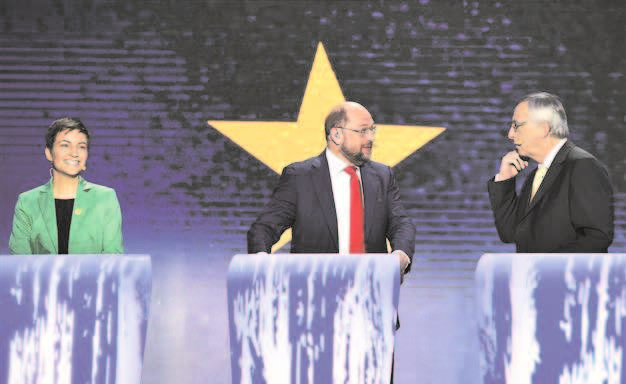
BRUSSELS (TIP): The five top candidates to head the European Commission swapped accusations on Thursday over the impact of Europe’s austerity measures and the role played by banks in sparking the economic and financial crisis. In an often heated debate in Brussels, several candidates were forced onto the backfoot by Greek radical-left leader Alex Tsipras, who wasted no time in denouncing “catastrophic austerity policies” and demanding an exit from “debt paranoia”.
Conservative leader Jean-Claude Juncker, the former prime minister of Luxembourg who headed the single-currency Eurogroup for eight years, pounced on Tsipras’s remarks, rejecting the suggestion he had not acted in the best interests of Greece. “I worked for years, day and night, to prevent Greece leaving the eurozone,” Juncker said, adding that he had done everything in his power to help the ailing country while endeavouring to get its public finances in order.
Guy Verhofstadt, the candidate from the centre-right liberal grouping ALDE, mocked Tsipras’s suggestion that banks and EU banking policies were to blame for southern Europe’s economic woes. “In Greece, in Italy, it wasn’t a matter of banking, but bad policies on the part of your political parties,” Verhofstadt told Tsipras, defending the need for fiscal discipline in the EU as it struggles to move out of recession.
“You need fiscal discipline, otherwise you cannot have growth… and that means making no new debt,” Verhofstadt said, adding that the best way forward was to make the most of the EU’s common market by removing economic barriers within the 28-member bloc. Greens leader Ska Keller, the only woman in the race to become the next president of the European Commission, said that more austerity in the EU would “worsen the situation”, but called on member states to do more to invest in “sustainable jobs” in renewable energy.
Socialist leader Martin Schulz, the outgoing president of the European Parliament, agreed the EU had made a mistake in “unilaterally cutting” spending, but pointed to the fight against tax fraud and tax evasion as the best way of providing relief to state coffers. The debate was the first of its kind to include all five parties in the running for the Commission presidency, which is the highest executive position in the EU.
In a break from earlier formats, three of the candidates spoke English, while Juncker chose French and Tsipras used Greek. The event, broadcast from the European Parliament building in Brussels by 50 TV stations and a variety of radio stations and websites across Europe, was moderated in English by an Italian journalist. With 10 days left in the European parliamentary election campaign, all eyes had been on Tsipras, the former communist who had previously eschewed public debates.
– Call for a common immigration policy –
One of the only two moments of policy agreement in the debate came when discussing the EU’s policy setting on asylumseekers, following another shipwreck off the coasts of Italy this week which claimed 17 lives. Verhofstadt, a former Belgian prime minister, said that part of the problem was the EU’s lack of a common legal immigration policy, which in turn exacerbated the problem of illegal arrivals.
Tsipras argued it was “unacceptable… to allow the Mediterranean to turn into a graveyard”, saying Europe needed to become “synonymous with solidarity”. Keller called the absence of a coordinated immigration policy a “scandal”, while Juncker agreed that the time had come for “a European law dealing with migration”, urging EU members not to cut their aid budgets to better assist people before they undertook the perilous journey across the Mediterranean.
The candidates also concurred on the responsibility on the part of EU member states to appoint one of them, as the leaders of political groupings in the European Parliament, to replace current Commission President Jose Manuel Barroso after the May 22-25 poll. Under new rules, member states are required to “take into account” the results of parliamentary elections in appointing the new Commission chief. However, it remains unclear whether that amounts to a legal obligation to appoint party leaders.
“It is finished the idea that the Commission president would be the result of a backroom deal — this is finished,” Schulz said. “If they really dare to nominate another (candidate), the answer is quite clear: you will get no majority in the European Parliament.” Juncker agreed, saying that to not appoint a party leader would be a “denial of democracy” and would imply that European citizens no longer mattered in the EU.
-

Xoom Announces Instant Deposit Service to HDFC Bank Accounts in India
SAN FRANCISCO, CA (TIP): Xoom Corporation (NASDAQ: XOOM), a leading digital money transfer provider, announced, March 31, a partnership with HDFC Bank Limited (NYSE: HDB), by offering instant deposits to INR denominated HDFC Bank accounts in India. This breakthrough service allows Xoom customers to instantly deposit money directly into their recipients’ HDFC Bank accounts in India. The instant service is available 24 hours a day, seven days a week, 365 days a year–even on banking holidays.
“Unlike other transfer services to India which typically take five days or more, Xoom is relentlessly working towards providing ‘instant’ for all of our services, and we are excited to launch instant deposits to HDFC Bank,” said Julian King, Senior Vice President of Marketing and Corporate Development for Xoom. “This is great news for people who send money to HDFC Bank accounts. Now NRIs can send money anytime, anywhere from their computer, mobile phone or tablet and their bank deposits reach their recipients’ HDFC Bank account instantly.”
“At HDFC Bank, we are consistently looking at new ways in which we can make a difference in the lives of our customers. Through this tie-up with Xoom we will be able to provide this breakthrough service of instant deposits,” says Mr. Rajender Sehgal, Group Head, Financial Institutions Group, HDFC Bank. “We look forward to bringing a whole new world of convenience and flexibility to our account holders, allowing them to receive money from the US in a secure manner, at any time of the day or night. Xoom provides great locked-in exchange rates for money transfers to India, and there is no fee when customers send more than $1,000 and pay with their U.S.-based bank account. Plus, Xoom continues to provide fast bank deposits within four hours to all other banks in India, including to NRE and NRO accounts, when sent during bank processing hours in India. Customers can also download the Xoom App for Android and iOS mobile devices for free. Visit https://www.xoom.com/india for more information.
About Xoom
Xoom is a leading digital money transfer provider in 31 countries, focused on helping consumers send money in a secure, fast and costeffective way using their mobile phone, tablet or computer. During the year ended December 31, 2013, Xoom’s more than one million active customers sent more than $5.5 billion to family and friends. The company is headquartered in San Francisco and can be found online at www.xoom.com.About HDFC
Promoted in 1995 by Housing Development Finance Corporation (HDFC), India’s leading housing finance company, HDFC Bank is one of India’s premier banks providing a wide range of financial products and services to its 28.5 million customers across hundreds of Indian cities using multiple distribution channels including a pan-India network of branches, ATMs, phone banking, net banking and mobile banking. Within a relatively short span of time, the Bank has emerged as a leading player in retail banking, wholesale banking, and treasury operations, its three principal business segments.The Bank’s competitive strength clearly lies in the use of technology and the ability to deliver worldclass service with rapid response time. Over the last 19 years, the Bank has successfully gained market share in its target customer franchises while maintaining healthy profitability and asset quality. As of December 31, 2013, the Bank had a distribution network with 3,336 branches and 11,473 ATMs in 2,104 cities/towns. For the quarter ended December 31, 2013, the Bank’s total income was INR 127.39 billion (`12,739.0 crore) as against INR 108.18 billion (`10,818.1 crore) for the quarter ended December 31, 2012.
Net revenues (net interest income plus other income) were INR 67.83 billion (`6,783.1 crore) for the quarter ended December 31, 2013, as against INR 59.09 billion (`5,909.4 crore) for the corresponding quarter of the previous year. Net Profit for the quarter ended December 31, 2013, was INR 23.25 billion (`2,235.7 crore), up by 25.1% over the corresponding quarter ended December 31, 2012. Total income for the year ended March 31, 2013, was INR 419.175 billion (`41,917.5 crore). Leading Indian and international publications have recognized the Bank for its performance and quality. For more information please log on to: www.hdfcbank.com
-

Seminar on Banking & Taxation
NEW YORK (TIP): New York seniors held a seminar on Banking and Taxation on Wednesday, February 26 at Panchmukhi Hanuman Temple, Glen Oaks. Shashikant Patel briefly explained about NRE, NRO, FCNRE accounts, updated tax deduction rules and filing tax returns.
Gopi Udeshi covered Banking safety at ATM, online banking, direct deposits as well recurring payments from bank accounts and safe deposit rules in India and USA, importance of living will and beneficiary name. Well known CPA/Tax Auditor Mr. Dwarka Kalantry spoke about Tax planning for seniors.
-

US attorney probes Mt. Gox, bitcoin businesses
NEW YORK (TIP): Manhattan attorney Preet Bharara has sent subpoenas to Mt. Gox, other bitcoin exchanges, and businesses that deal in bitcoin to seek information on how they handled recent cyber attacks, a source familiar with the probe said on Wednesday.
In the attacks — known as distributed denial of service attacks — hackers overwhelmed bitcoin exchanges by sending thousands of phantom transactions. At least three exchanges were forced to halt withdrawals of bitcoins on February 7, including Mt. Gox, which was the largest at the time. Mt. Gox never resumed service before going dormant on Tuesday, leaving customers unable to recover their funds.
The Tokyobased company’s chief executive, Mark Karpeles, said earlier on Wednesday that he is working with others to solve the problems. “As there is a lot of speculation regarding Mt Gox and its future, I would like to use this opportunity to reassure everyone that I am still in Japan, and working very hard with the support of different parties to find a solution to our recent issues,” Karpeles said in a statement posted on the Mt. Gox website.
A spokesman for Bharara declined to comment. Bitcoin, a form of electronic money independent of traditional banking, relies on a network of computers that solve complex mathematical problems as part of a process that verifies and permanently records the details of every bitcoin transaction that is made. At current prices, the bitcoin market is worth about $7 billion. Investors deposit their bitcoins in digital wallets at specific exchanges, so the Mt. Gox shutdown is similar to a bank closing its doors — people cannot retrieve their funds.
While proponents of bitcoin hail its anonymity and lack of ties to traditional banking, regulators have become increasingly interested in the digital currency due to its usage by criminal elements and its volatile nature. It has been a rough month for bitcoin investors, with cyber attacks on several exchanges, a sharp fall in bitcoin’s value, and rising pressure from regulators. Bitcoin’s price varies by exchange, but the losses were most dramatic on Mt. Gox, where it fell to about $135 from $828.99 before February 7. “Mt Gox has been broken and it was obvious there was something really bad going on there for nearly a year.
They were processing withdrawals very slowly and generally being very opaque about what was going on there,” said Mike Hearn, a bitcoin developer in Zurich, Switzerland. A second source familiar with the case said US federal law enforcement is investigating Mt. Gox. A third source said the US Federal Bureau of Investigation was monitoring the situation. Japan’s finance ministry and police are also looking into the abrupt closure of Mt. Gox, according to the Japanese government’s top spokesman.
MALLEABILITY
Bitcoin has gained increasing acceptance as a method of payment and has attracted a number of prominent venture capital investors, including Andreessen Horowitz and Union Square Ventures. The digital currency has also caught the eye of hackers. The recent cyber attacks exploited a process used by some bitcoin exchanges that introduced “malleability” into the code governing transactions, experts said. Simply put, this allowed hackers to slightly alter the details of codes to create thousands of copies of transactions.These copies slowed the exchanges to a crawl, forcing them to independently verify each transaction to determine what was real and what was fake. A document circulating on the Internet purporting to be a crisis plan for Mt. Gox, said more than 744,000 bitcoins were “missing due to malleability-related theft,” and noted Mt. Gox had $174 million in liabilities against $32.75 million in assets. It was not possible to verify the document. If accurate, that would mean approximately 6 percent of the 12.4 million bitcoins minted would be considered missing.
Developers are working on fixes to bitcoin’s software to guard against cyber attacks, though many larger service providers have already implemented such changes, according to Gregory Maxwell, one of the bitcoin software’s core developers. He said some malleability in the software protocol was necessary — for example, in transactions where multiple people can put in money, but the transaction is not valid until enough funds are contributed. “None of these fixes are especially complicated, but because the correctness of the software is important we use a conservative release process that avoids rushing anything out,” Maxwell said, adding that the bulk of the recent work on the software is being done by four people.
BITSTAMP
Jacob Dienelt, who trades bitcoins and sells paper bitcoin wallets, said people he knows in the bitcoin community in New York stopped using Mt. Gox when the exchange halted dollar withdrawals several months ago and said all withdrawals had to be in bitcoin. Dienelt said has not been subpoenaed. With Mt. Gox’s shutdown, Bitstamp has handled the most volume in the last two days, with more than 165,000 US dollar transactions, according to Bitcoincharts. Bitstamp had temporarily halted customer withdrawals earlier this month, citing “inconsistent results” and blaming a denial-ofservice attack.The price of bitcoin was lately at $588 on Bitstamp, up about 7% on the day. “Right now is a sweet buying opportunity. I don’t think you’re going to see bitcoin go this low for awhile — if ever again,” said Jordan Kelley, chief executive of Robocoin, which launched the world’s first Bitcoin ATM in Vancouver, Canada, in the fall. “The more that bitcoin is on the front pages, the more that people are discussing it and educating one another, the better for the currency.” Kelley said Robocoin has not been subpoenaed in the US regulatory probe; nor has New York-based exchange Coinsetter, according to a spokesperson. Bitstamp did not respond to requests for comment.
-

Dragnet Nation’, by Pulitzer Prize Winner Julia Angwin – Be Warned About Dangers of PCs / Mobile Phones Being Hacked
While driving back from Long Island on Monday, February 24, I listened to an absolutely fascinating interview of Pulitzer Prize winning journalist Julia Angwin, author of Dragnet Nation, on the issue of privacy and cyber crime.
I was amazed at how easy it is for your personal financial information to stolen if you use mobile phones for your banking transactions – in particular if you use the Android operating system. There was a program on TV recently which showed how your laptop or mobile phone could be hacked within 15 seconds of your activating it in Sochi for the Olympic Games.
Certain hi-tech global firms (and I worked for one such) instruct their consultants / executives going to China / Hong Kong / Russia / Eastern Europe to only carry essential information on a separate PC. Once back in the US these are to be trashed or the drives completely reformatted – the danger of worms and viruses is so great that the danger of contamination is not worth it. BTW those in the US need not be ‘holier than thou either’.
When the People’s Republic of China ordered a Boeing transport for their President, Boeing based in the good old US of A sent the order with so many bugs pre-installed that the Chinese trashed the plane after discovering hundreds of them. Now we in India buying defense hardware from either the US or the Soviet bloc should be fully aware that it is possible that in the era of cyber warfare the sellers can render them non-functional anytime, if they want to.
I hope our Italian barmaid’s Congress Party government in India is doing something about it. When Narendra Modi becomes Prime Minister, let us hope that he brings in some top flight IT cyber crime expert ‘ethical hacker’ types to assist him. The BJP is largely known (ahem!) for good solid Hindutva bhaiyya types of limited education and not for techno nerds of Silicon Valley.
-

Interim Budget 2014: Cars, consumer durables to be cheaper
NEW DELHI (TIP): Financial markets went in for the interim budget with little expectation, and rightly so, as finance minister P. Chidambaram was not expected to tinker with the existing tax laws. But he still had room to manoeuvre and propose changes that will have an impact on your money, well, for at least three months of the next financial year. The markets were looking for the government to contain its deficit under the budgeted target of 4.8% of the gross domestic product (GDP) for the year.
The government managed to restrict the fiscal deficit to 4.6% of the GDP, and now expects it to come down further to 4.1% in the next fiscal. Therefore, the two very important indicators—the fiscal deficit and the current account deficit which were worrying the financial markets and individuals alike—are now in a much better shape than a year ago, though the improvement under both the heads can be debated. Beyond this critical number of fiscal deficit, there was not much that markets were looking for.

As a result, the BSE S&P Sensex closed with a modest gain of 0.48%. However, there were some surprises for individuals. If you plan to buy a new car, there is good news as excise in this segment has been reduced, and so they are likely to be cheaper. There is also relief in store for those struggling with the burden of education loans, taken up to 31 March 2009. We take a close look at some of the proposals that will have an impact on your pocket.Relief on student loans
The budget has extended the education loan subsidy scheme with some significant benefits. The finance minister has proposed a moratorium wherein you will not have to pay the interest on your education loan taken before 31 March 2009. The government will shoulder the burden of the outstanding interest portion as of 31 December 2013. From January 2014 onwards, you pay. Given that these loans were taken about four-and-a-half years back, borrowers are likely to have finished their education and moved on to jobs or are at least looking for one.The difficult economic scenario in the country, with the GDP growth having fallen from 6.7% in FY09 to a budget estimate of 4.9% for FY14, jobs are not that easy to come by. Says A. Krishna Kumar, managing director and group executive (national banking), State Bank of India (SBI): “This is definitely a good move and will ease pressure on those who are still looking for jobs.” It is too early for banks to know exactly how much this liability is. SBI’s Kumar says, “We are yet to calculate the exact impact on our outstanding education loans.” The government has given an estimated benefit of around Rs.2,600 crore to about 900,000 borrowers. How does this work for you? We take an example using a calculator on Punjab National Bank’s website. Let’s assume, you took an education loan of Rs.10 lakh in April 2007 for a two-year course.
The interest rate was 12% per annum for 10 years with no processing fees. Your equated monthly instalment (EMI) per month was likely around Rs.14,350. Let’s say, you got a job after two years and started to repay the loan. But in December 2012, you lost your job and have not been able to pay the EMI since. In this case (assuming that the bank hasn’t invoked the guarantee or declared the loan as a bad debt), your outstanding EMIs for 12 months (as on December 2013) would be about Rs.1,72,200. Of this, the interest would be Rs.63,710. As the proposal suggests, the government will pay this outstanding interest on your behalf.
You will, however, have to start paying from January 2014. More details are awaited. Also, the relief is only for the outstanding interest and not the principal. Your final benefit will depend on the terms of the loan— when you took the loan, the interest rate, the period for which you haven’t paid, and others. It would be pre-emptive to say that this move will result in borrowers becoming complacent and the unpaid dues in this segment going up. Moreover, these loans are not a big portion of banking credit.
Cheaper wheels
Another piece of good news came by the way of the proposal to reduce the excise duty for the auto sector till 30 June. The excise duty has been reduced from 12% to 8% on motorcycles, scooters, small cars and commercial vehicles—such as Maruti Suzuki India Ltd’s Alto, Hyundai Motor India Ltd’s i10, Tata Motors Ltd’s Indica, Bajaj Auto Ltd’s Pulsar and TVS Motor Co. Ltd’s Wego.For large and mid segment cars, the reduction is from 27% or 24% to 24% or 20%; and for sports utility vehicles (SUVs), from 30% to 24%. According to Prabhudas Lilladher Pvt. Ltd, the benefit is expected to be Rs.1,500-2,000 for two-wheelers and Rs.15,000-20,000 for small cars.
SUVs should be cheaper by Rs.48,000-60,000, but “given the current slowdown, the automakers may not be able to pass on the entire benefits for SUVs”, says Surjit Arora, research analystinstitutional equities, Prabhudas Lilladher. This may generate more demand and improve sales. Yaresh Kothari, research analyst-automobiles, Angel Broking Ltd, says, “It is a positive announcement for the sector. The cut in excise duty will be passed on to the consumer. Historically, they (auto manufacturers) have always done it. The benefit will differ based on the price of the vehicle.”
Says Suresh Sadagopan, a Mumbai-based financial planner: “It’s a one-time kind of savings possibility in the short term. If you plan to buy, try and cash in on this benefit before 30 June.” Consumer goods For the mobile handset segment, the finance minister announced that excise duty for all categories of handsets will now be 6% with central value-added tax (Cenvat) credit or 1% without it. Last year, the excise on mobile phones priced above Rs.2,000 had been raised to 6% from 1%, upsetting the industry as the cost of smartphones went up. The reduced excise, however, may not mean cheaper phones.
“This will not have any significant impact on prices as it will reduce costs marginally given the competition from Chinese manufacturers and the grey market,” says Hemant Joshi, partner, Deloitte Haskins and Sells. Cenvat credit essentially means that a manufacturer can set off excise or service tax paid on the input cost—for example, of raw materials— against its total excise liability. “This may give an edge to domestic manufactures as importers will continue to pay 6%,” says Bipin Sapra, tax partner, EY.
Two domestic phone manufacturers—Micromax and Karbonn—were the third and fourth largest mobile handset sellers in India with 10.1% and 9.1% market shares, respectively, at the end of the December-2013 quarter, according to International Data Corp. The leader is Samsung, followed by Nokia. The finance minister also proposed to reduce the excise duty on capital goods and consumer nondurables from 12% to 10% for items falling under chapters 84 and 85 of the Central Excise Tariff Act.
“What this means is that prices of some products such as basic machinery and electronic goods will be affected,” says Sapra. Prices of items such as washing machines, vacuum cleaners, computers, transistors, batteries, software, basic landline telephones, computer disks, knitting machines, etc., may go down if manufacturers choose to pass on the benefit. Super-rich surcharge The surcharge on the super-rich remains. Last year, a 10% surcharge was applied to those with taxable income above Rs.1 crore. This onetime move was supposed to be only for the assessment year 2014-2015, and was in addition to the education cess of 3%.
The surcharge and income tax rates will continue for the purpose of deduction of tax at source from salaries during the financial year 2014-15, and for computing the “advance tax” payable during that financial year on current incomes. “Practically, the income tax rates, including surcharge, will apply for tax withholding or payment of advance tax. Salaried individuals who pay taxes every month will have to pay this surcharge till the time the new government drops it.
But non-salaried individuals, who pay advance tax only in September, may not have to pay the additional surcharge at all if the new government drops it,” says Kuldip Kumar, executive director, PwC India. According to the Finance Bill, the total amount payable as income tax and surcharge shall not exceed the total amount payable as income tax on a total income of Rs.1 crore by more than the amount of income that exceeds Rs.1 crore. Here’s an example.
The tax liability on a taxable income of Rs.1 crore is around Rs.29 lakh. So, if the income is even Rs.10 more than Rs.1 crore, the tax liability will go up by only Rs.10 and not Rs.2.9 lakh. Overall, while the finance minister managed to deliver on his promise of containing expenditure, the reduction in excise duty on various items and relief on education loans will also benefit a key constituent in elections—the middle class. The excise relief will lapse if the new government decides against it. Investors and consumers now have to wait till the new government presents its budget for the full year and give a fresh direction to economic policy and tax laws.