Tag: BJP

  • Anandiben bows out as Gujarat CM; Shah to pick her successor

    Anandiben bows out as Gujarat CM; Shah to pick her successor

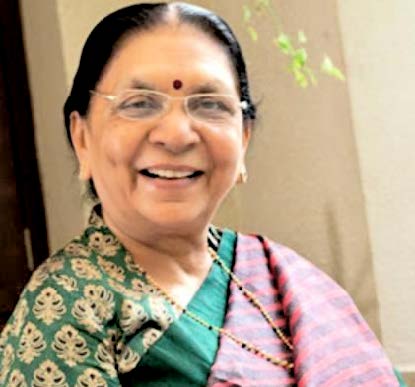
    GANDHINAGAR/NEW DELHI (TIP): Gujarat Chief Minister Anandiben Patel on August 2 submitted her resignation to Governor O P Kohli hours after the BJP Parliamentary Board accepted her offer to quit and authorised party president Amit Shah to pick her successor to lead the party in 2017 polls.

    Nitin Patel Frontrunner for the Post AHMEDABAD (TIP): Nitin Patel, considered No. 2 in the cabinet of outgoing chief minister Anandiben Patel, seems to be emerging as the consensus candidate for the chief minister’s post in Gujarat, with state Bharatiya Janata Party (BJP) president Vijay Rupani withdrawing from the race and the party ruling out the candidature of national BJP president Amit Shah. The Patel factor also seems to be tipping the scales in the favour of the 60-year-old Gujarat health minister.

    Anandiben, who will turn 75 this November, handed over the resignation letter to Kohli in the presence of ministers and party leaders at Raj Bhavan in the evening. Kohli has asked her to continue until the new cheif minister takes charge.

    “Anandiben has submitted her resignation to the governor,” state unit BJP president Vijay Rupani told reporters after coming out of Raj Bhavan.

    Earlier in the day, the BJP Parliamentary Board which met in Delhi authorised Shah to pick Anandiben’s successor after accepting her offer to resign.

    The meeting of the Parliamentary Board, which was chaired by Shah and attended by Prime Minister Narendra Modi, appointed Union Minister Nitin Gadkari and BJP general secretary Saroj Pandey as party’s central observers to hold consultations with the MLAs for electing the new leader.

    Shah will be travelling to Gujarat tomorrow where he will hold consultations with party leaders and attend the Legislature Party meeting, likely to be held on Friday to elect the new leader.

    AnandibenThough her departure was anticipated, the first woman chief minister of Gujarat had offered to step down on Monday ostensibly due to her age, as she is turning 75 soon.

    Meanwhile, the political circles are abuzz with the likey choice of her replacement.

    According to leaders in BJP, the decision on Anandiben’s successor could be taken within the next two days.

    “We are yet to decide the time of the Legislature body meeting (to elect new leader) as state Observer Nitin Gadkari is busy. It (meeting) can happen any time after 3 PM tomorrow or even a day after. Our national president Amit Shah will decide it as he is arriving here tomorrow,” said state unit BJP in-charge Dinesh Sharma.

    He said the Legislature Party meeting to decide the next CM will be held in the presence of state Observers as per the process.

    Parrying a query on likely contenders for CM’s post, Sharma said, “A party worker will be chosen as next chief minister.”

    Interestingly, state unit BJP chief Vijay Rupani whose name is in the reckoning for the post besides others, virtually ruled himself out of the race, saying he would like to work for the party organisation.

    “I have told the party leadership that I would like to work for the organisation,” Rupani said.

    Names of “number two” in state Cabinet and incumbent Health minister Nitin Patel, Union minister Purshottam Rupala and Assembly Speaker Ganpat Vasava, a tribal leader, are still doing the rounds.

    Nitin Patel, who is considered to be the front-runner, said, “the party Central leadership will decide on who will be the chief minister.”

    Anandiben, meanwhile, issued advertisements in newspapers here today listing the works done during her two-year tenure.

  • DALIT MAN DIES IN CUSTODY IN KANPUR, ENTIRE POLICE POST SUSPENDED

    DALIT MAN DIES IN CUSTODY IN KANPUR, ENTIRE POLICE POST SUSPENDED

    KANPUR (TIP): All 14 policemen at a police post in Kanpur were suspended and a murder case was filed against one of them, after a young Dalit man was found dead in custody.

    Kamal Valmiki, who was around 25 years old, was brought to the police station two days ago for questioning about a theft in the area. On Aug 5, his family was informed that he has died. His body was found hanging in a room inside the police post.

    The family, however, alleges that he died due to severe beating.
    While the postmortem report is yet to come, the family has alleged that the police tried to hush up the death and initially sent the body for postmortem under a false name. The local police claimed it was a case of identity goof-up – the man whose name was mentioned in the papers was Raju, who had committed suicide while in custody.

    “The family has said that a constable had taken Valmiki for questioning and then this incident took place,” said Shalabh Mathur, a senior officer of the city police. “On basis of their complaint, we are registering a case of murder and the entire police chowki has been suspended. If other police personnel are involved we will act against them too,” he added.

    A case of kidnapping has also been filed against all the policemen because Raju, who the police claimed had died, cannot be traced. “Death in police custody is a very serious offence and we will spare no one in this case,” state police Javed Ahmed has said. Later in the evening, there was tension in the area as Kamal Valmiki’s relatives and locals clashed with the police. The police had to use batons to control the mob. The action against the policemen comes as the ruling Akhilesh Yadav government is under fire from the Congress and the BJP for the law and order situation in the state – an issue that is expected to spell trouble for it in next year’s assembly elections. Dalits, who form 26% of the state’s electorate, are already in protest mode following the increasing instances of cow vigilantism across the country. In July, four young Dalit men were stripped to the wait, beaten and hauled around tied to an SUV after they were accused of cow slaughter in Gujarat’s Una, triggering massive Dalit protests.

    Source: NDTV

  • GST USHERS ONE INDIA, ONE TAX REGIME

    GST USHERS ONE INDIA, ONE TAX REGIME

    NEW DELHI (TIP): After being subject to months of haggling and histrionics, the Goods & Services Tax (GST) finally had its historic day in the Rajya Sabha with the passage of the Bill to amend the Constitution, paving the way for what is popularly referred to as the concept of “one nation, one tax.”

    Barring the AIADMK, which staged a walkout on the plea that it violated federalism, all others, including the Congress, voted for the Bill.

    Led by the former Finance Minister P. Chidambaram, the Congress, supported by members of some other parties, made a valiant effort to extract an assurance from Finance Minister Arun Jaitley that as and when he would introduce the subsequent legislation to operationalize the GST, it would be as finance rather than money bills. This was to ensure that they would also be voted in the Rajya Sabha.

    However, Jaitley refused to yield, stating that he could not give a commitment on future legislation whose contours would be decided by the Centre and the States together.

    The Rajya Sabha passed the constitutional amendment by two-thirds majority, as all parties, except the AIADMK, pledged support. The amendments moved by Jaitley were also put to vote. The Bill will now be returned to the Lok Sabha for its approval.

    The constitutional amendment will enable both the Centre and the States to simultaneously levy the GST, which will subsume all indirect taxes currently levied, including excise duties and service tax. It will be levied on consumption rather than production.

    Two components

    The GST will have two components keeping in mind the federal structure of India: the Central GST (CGST) and the State GST (SGST).

    The shift to the GST regime will lead to a uniform, seamless market across the country. It will be a uniform rate, will check evasion, and boost growth rates, Jaitley said initiating the debate.

    Earlier in the day, lead speaker for the Congress, Chidambaram, made it clear that the main Opposition party will support the long-pending Bill only if the government gave firm assurances on two things: keeping the GST rate capped at 18 per cent in the subsequent legislation needed for the GST’s roll-out and bringing forth these as financial bills rather than money bills, which the Upper House will not just discuss but also vote on.

    Jaitley hopes GST rates will be moderate

    The Union Finance Minister also refused to give an assurance on demands put forth by Congress leader P. Chidambaram and others but did give the Rajya Sabha his word that the government will go by the Constitutional provisions and precedents at the time of bringing in the subsequent GST Bills.

    Congress voted in favor

    The Finance Minister said that his discussions with States led him to believe that the rates would be moderate and less onerous than the combined burden of the Central and State taxes on goods and services, which comes at present rates to about 27%. However, he said that it was not possible for him to give an assurance on legislations that had not yet been drafted. Before the Bill was put to vote, the AIADMK members staged a walkout from the House.

    Putting on record that the GST was originally initiated by his predecessor, Chidambaram, Jaitley expressed gratitude to leaders of all political parties for the consensus that he was able to build on the Bill. “A legislation of this kind cannot be made on the basis of a partisan approach…,” he said.

    The Indian Panorama received some reactions to the GST Bill which was passed in the Rajya Sabha unanimously on August 3.

    K Ganesh
    K Ganesh

    K Ganesh says: “The passage of the Goods and Services Tax (GST) Bill in the Rajya Sabha is a progressive measure as it can facilitate seamless movement of goods across inter-state borders enabling better efficiency and spurring growth of the (eCommerce) sector. However, like every regulation, it needs to be implemented correctly, and should not make lives of eCommerce players even more complicated by burdening them with more administrative hassles,” said K Ganesh, Serial Entrepreneur, Partner – GrowthStory and Promoter of sector leaders such as BigBasket, Bluestone, FreshMenu, Housejoy, Homelane, Portea etc. “For the consumer, the price points of many products should come down or remain at the current levels (depending on the GST rates) as there will be free flow of credits since the total indirect tax cost embedded in the price (of products) is likely to decrease”.

    Hari Menon
    Hari Menon

    Hari Menon, CEO, BigBasket commented: “The passage of the Goods and Services Tax (GST) Bill in the Rajya Sabha is a progressive reform, and we welcome it. If implemented correctly, it will bring relief from one of the key issues faced in the e-commerce segment – cascading taxes. We are hopeful that in the long-run the creation of a unified marketplace will reduce the tax burden, inventory cost and logistical issues; and ensure seamless movement of goods across the country. This will help bring efficiency, transparency and boost profitability and growth of the sector.”

    Dhiraj Agarwal
    Dhiraj Agarwal

    Dhiraj Agarwal, Co-Founder, Campus Sutra observed: “From the point of e-commerce there are two points in which we are awaiting clarity. First being mechanics of GST across each state as online orders are not location dependent. Secondly, as a fashion e- commerce player we are eagerly waiting to see whether apparel continues to be in the necessity category and hence attracts a lower GST than the standard rate.”

  • GST Deadlock: PM Modi Meets Top Minister To Firm Up Strategy

    GST Deadlock: PM Modi Meets Top Minister To Firm Up Strategy

    Prime Minister Narendra Modi on Friday night held a meeting with the top minister of his cabinet to firm up strategy for the long-awaited Goods and Service Tax (GST) bill.

    According to reports, the government will most likely table its proposal for the tax reform to the Rajya Sabha on Tuesday.

    Meanwhile, Union Finance Minister Arun Jaitley and Chief Economic Adviser Arvind Subramanian have been busy in holding several rounds of exhaustive negotiations with leaders of Congress and other parties, including the Samajwadi Party, the Janata Dal-United and the Communist Party of India-Marxist.

    “We have our fingers crossed,” Jaitley said in a statement to the media.

    Of the 32 parties, 30 are now supporting the bill.

    Discussion on the matter is going on with different political parties to build a consensus. The government is hopeful of passage of the Bill,” Minister of State for Parliamentary Affairs Mukhtar Abbas Naqvi told reporters outside Parliament on Friday.

    “Most of the parties are on board,” he added.

    Dubbing the GST as an “instrument of growth”, the Congress, however, said on Friday that it must be passed but it must be practically implementable.

    “There is no final assurance yet given to government either by Congress or other Opposition parties,” Congress spokesman Randeep Singh Surjewala told a press conference.

    The Congress leader said that “issues” are still being deliberated and the party is willing to negotiate.

    The party, however, welcomed the Union cabinet’s decision to approve key changes in the proposed legislation, including dropping the proposed one per cent additional tax on inter-state sale.

    Congress sources said party Vice President Rahul Gandhi also expects a positive outcome from these consultations, which have entered a “decisive and positive phase”.

  • MAHADAYI AGITATION TURNS VIOLENT IN KARNATAKA

    MAHADAYI AGITATION TURNS VIOLENT IN KARNATAKA

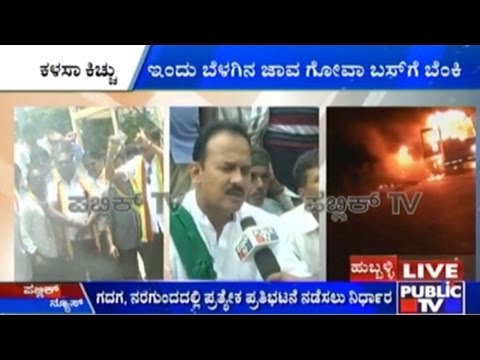
    BENGALURU (TIP): Normal life was thrown out of gear in several districts across north Karnataka as the ongoing agitation for Mahadayi waters took a violent turn on Thursday.

    While angry mobs attacked government offices and set two police jeeps on fire, two students attempted suicide by consuming poison to protest the Mahadayi Water Dispute Tribunal’s interim order against release of 7.56 tmc ft of water to Karnataka for the Kalasa-Banduri canal project.

    Worst affected were Gadag, Hubbali, Dharwad, Haveri, Belagavi along with parts of Vijaypura and Bagalkot districts as all commercial activity and logistics came to a standstill. Police had to resort to lathicharge as several places to quell angry mobs that were going on a rampage; more than a dozen persons are said to have been injured in the police action and over 50 protestors have been taken in custody. Rasta-roko demonstrations were also staged in the southern parts of the state such as Bengaluru, Kolar, Chikkaballapur, Bengaluru Rural and Ramanagara districts by farmer groups and Kannada activists.

    With the agitators blocked National Highway-4 at Hubbali and Dharwad in the morning the Goan government announced a temporary suspension of its bus operations to the state. In Nargund town, two students — Nandish Mathad and Channabasava Charntimath — attempted suicide during a public demonstration. Violence erupted in Navalgund with the agitators settting ransacking a BSNL office and setting three vehicles including two police jeeps on fire.

    While the agitation against the tribunal’s interim order grew stronger in north Karnataka with the activists demanding resignations of Karnataka MPs, a mud-slinging match broke out among the three political parties — Congress, BJP and the JDS.

    Taking off from Karnataka CM Siddaramaiah’s statement (made before he left Brussels to see his ailing son) that the tribunal should have released 7.56 tmc ft of Mahadayi water to meet the drinking water needs of twin cities of Hubbali-Dharwad and Gadag, rural development and panchayat raj minister HK Patil said: “We have been seeking water that would flow into the sea, but this was not considered by the tribunal. People will get angry when attention is not paid to ground reality and truth. We have not got justice from the tribunal.” Stating that the tribunal’s order was not final and was questionable, Patil said: “We will explore all legal options including going to the Supreme Court against the tribunal’s order.”

    Source: TOI

  • Government reaches out to Opposition, Cong signals all-clear next week

    Government reaches out to Opposition, Cong signals all-clear next week

    NEW DELHI (TIP): Efforts to hammer out a consensus on the long pending Goods and Services Tax bill gathered momentum on July 28 for its likely tabling in the Rajya Sabha next week with the government reaching out to opposition parties even as the Congress described the exercise as “constructive and positive”.

    Finance Minister Arun Jaitley and Chief Economic Adviser Arvind Subramanyam on July 28 held several rounds of talks with leaders of Congress and other parties including the Samajwadi Party, JD(U) and CPI(M).

    Former Finance Minister P Chidambaram, Anand Sharma and Leader of the Opposition in Rajya Sabha participated in the discussions with Jaitley. There were two rounds with the Congress leaders.

    “Serious effort is being made to bring a consensus on the GST bill,” Sharma said without disclosing details on whether the Congress was insisting on its standing about putting a cap on the levy in the Constitution bill.

    Congress sources said party Vice President Rahul Gandhi also expects a positive outcome from these consultations. They said the discussions have entered a “decisive and positive phase”.

    “Talks are on with various parties on GST and so far things are moving forward as expected,” a senior government functionary said adding the effort is on to present it in the Rajya Sabha next week.

    Sources say Jaitley told the opposition leaders that government wants to bring consensus on the GST and was ready for talks with any leader even during the weekend to hear out and address their concerns on the issue.

    A top congress leader, however, said they were awaiting the draft of the legislation after “extensive talks” with the government and hoped for a “positive outcome”.

    At the meeting of Business Advisory Committee (BAC) of Upper House today evening, the GST bill was not discussed as it has already earmarked five hours for the bill last week.

    Jaitley also met SP leader Ram Gopal Yadav and CPI(M) general secretary Sitaram Yechury and held talks with other leaders also.

    Sources add that the government is also in touch with AIADMK chief J Jayalalithaa on the key bill. Prime Minister Narendra Modi talked to Yadav when the Rajya Sabha was adjourned briefly during the Question Hour. Modi remained seated in the House during the brief adjournment and spoke to Yadav and another SP member Neeraj Shekhar.

    Meanwhile, five parties, including the Left, on Thursday asked the Centre to assure states that their financial needs will be taken care of before the GST Bill is brought, which they allege seeks to take away states’ right to raise resources.

    This was conveyed by them to Jaitley when leaders of the parties in Rajya Sabha belonging CPI(M), CPI, Trinamool Congress, Samajwadi Party and BJD met him.

    CPI(M) leader Sitaram Yechury said the Constitution amendment bill would make the states “to come with a begging bowl to the Centre, placing them at the Centre’s mercy.”

    He said the GST Bill would deprive the states of their “right to raise resources” through sales tax, surcharge or cess.

    “The state governments will be deprived of their only right to raise revenue as this right will be abolished with the Bill” as they would not be able to impose any cess even during an emergency or natural disaster, he said, adding that this was conveyed to the Finance Minister at the meeting.

    “The GST Bill is only meant for imposing a tax. It does not deal with Centre-State relations. So, a resolution has to be found outside the Bill and the government has to come out with an assurance,” the CPI(M) leader said, adding that “we will have to see how the government addresses this issue.”

    Regarding the meeting, Yechury said “we were merely informed about the discussion the government had with the Congress. There was no scope for a discussion.”

    He also said there is “nothing in writing so far” on what the latest bill actually says.

    Accusing the Narendra Modi government of going by the strength of the parties in Parliament to hold discussions on the GST Bill, he said “so we are immaterial in terms of number of seats we have. It is a game between the BJP and the Congress”.

    Asked whether Jaitley indicated by when the bill will be brought to Rajya Sabha, the CPI(M) leader said “there is no indication. It will all depend on what is happening between the BJP and the Congress.”

    The government is working to address the concerns raised by opposition parties, including Congress, on the Constitution (122nd Amendment) Bill, known as the Goods and Services Tax (GST) Bill. The Bill seeks to introduce a system for uniform taxation across the country and has been pending for a long time.

  • Self-inflicted injuries: BJP’s anti-Dalit moorings laid bare

    Self-inflicted injuries: BJP’s anti-Dalit moorings laid bare

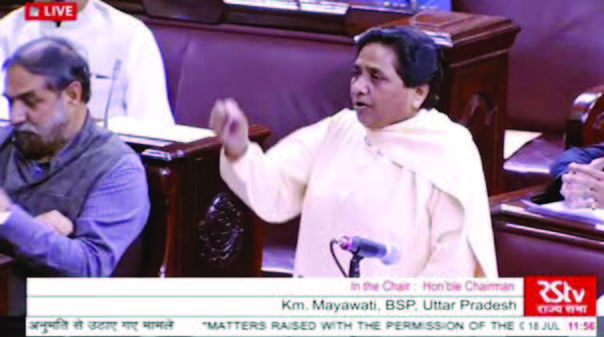
    The BJP has just done a Bihar in Uttar Pradesh. In Bihar, its electoral prospects were damaged by no less than the RSS chief. In UP, a middling BJP leader called Mayawati, Dalit icon B R Ambedkar’s self-anointed legatee, words that shouldn’t be used even in drawing room conversation. The BJP has been swift in expelling the leader but it remains to be seen whether this is perception management to control the damage not just in UP but also Punjab, a state with the country’s highest Dalit population simultaneously going to the polls.

    But for this intemperate statement, the BJP had learnt from the Waterloo in Bihar. It was luring away Mayawati’s lieutenants, started cobbling a Bihar-type grouping of backward caste leaders, party chief Amit Shah made the mandatory pilgrimage to a UP Dalit’s house and Prime Minister Narendra Modi inducted five Dalits in his first Cabinet reshuffle. However, Dalit ferment is underway elsewhere too, beginning with Rohith Vemula’s suicide. Mumbai saw a massive Left-Dalit rally against the demolition of Ambedkar Bhavan and large parts of Gujarat shut down against the public flogging of Dalits by vigilantes of a self-styled cow protection unit.

    The BJP has scored all these self goals with no provocation from any quarters. Rather the heightened social and religious tensions in several parts of the country are due to the BJP’s upper caste-centric mindset and the low standards in public speaking set by its senior leaders. From Punjab to Maharashtra, the BJP has single-mindedly pushed a vigilante-led cow protection agenda that ignores the reality on the ground. As for using offensive words, wasn’t it junior Minister V K Singh who described journalists as “presstitutes”? And didn’t the Prime Minister term a fellow-politician’s companion as “50 crore ki girlfriend”? As no party can afford to be counted without the Muslim and Dalit votes, the BJP had no choice but to act contrite to keep the latter in good humor. As political temperatures rise in UP and Punjab, time will tell whether the expulsion of the UP BJP leader was a sincere effort to discipline the cadres.

  • 50 Lakh Reward For Dayashankar’s Tongue | Jannat Jahan

    50 Lakh Reward For Dayashankar’s Tongue | Jannat Jahan

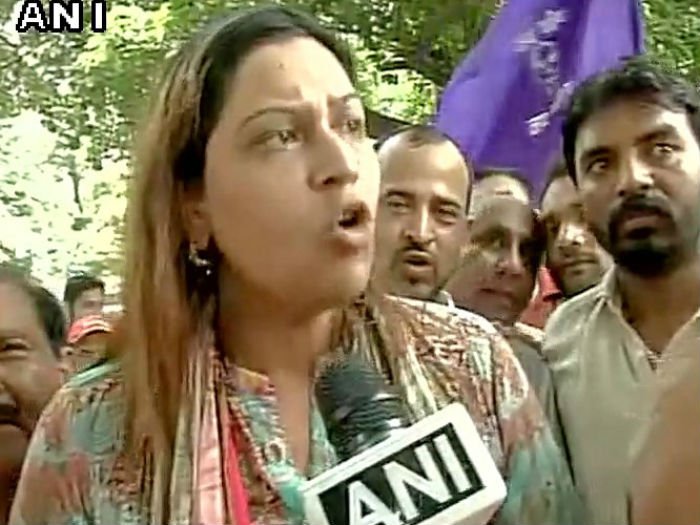
    Following Dayashankar’s “prostitute” remark targeting Former Uttar Pradesh Chief Minister Mayawati, BSP Chandigarh Unit Chief Jannat Jahan has offered a reward of 50 lakh to anyone who gets her Dayashankar’s tongue.

    In a statement he made on July 20, Dayashankar had compared BSP supremo with a prostitute saying, “Even a prostitute fulfils her commitment after she is paid. But Mayawati sells party tickets to anyone who paid her the highest amount. If someone gives her Rs 1 cr for a ticket she will give it to other person who is offering Rs 2 cr. Mayawati has become worse than a prostitute and abandons the ideals of Kanshi Ram.”

    A public outcry followed the incident and which led to Dayashankar’s removal as BJP UP Vice President.

    An FIR was lodged against him under section 153A,504,509 IPC and 310 under the SC/ST act.

  • @NarendraModi – Engaging Africa….

    @NarendraModi – Engaging Africa….

    I returned from a very successful Africa visit, where I got to interact with political and business leaders across four nations. My visit began in Mozambique and ended in Kenya. The other two nations visited were Tanzania and South Africa.

    Naturally, the economic agenda of the visit was high on the priority of my delegation and I. In all the four nations I went, ways to deepen our economic cooperation and improve trade ties were comprehensively discussed.

    With Mozambique, I see a great scope for wide ranging economic cooperation. Mozambique’s strengths are also the areas of India’s need. And, what Mozambique requires, is available in India. We want to fast track cooperation in the field of agriculture and food security. There is a rich potential to deepen cooperation in skill development and healthcare as well.

    In South Africa, President Zuma and I addressed a business forum, where both Indian and South African CEOs were present. India and South Africa enjoy historical people-to-people and economic ties. 

    You would be delighted to know that India-South Africa bilateral trade has grown by 380% over the last few years. There is continuous flow of investments both ways. Many Indian companies are active in South Africa and vice versa.

    However, we do not want to stop here. The scope of bettering this cooperation is increasing by the day. And, India and South Africa are uniquely positioned to complement each other.

    I see India and South Africa working together in areas like defence, dairy, IT, skill development to name a few.

    The third nation I visited, Tanzania, has a healthy economic relationship with India and this relationship is growing. Our annual trade is on the rise and so are Indian investments. I told President Magufuli that India will be a trusted partner in Tanzania’s development priorities. With Tanzania, the scope of cooperation in the fields of agriculture, energy, natural gas, economic capacity building is immense. India is also ready to meet the healthcare priorities of the Tanzanian government, including supply of medicines and equipment.

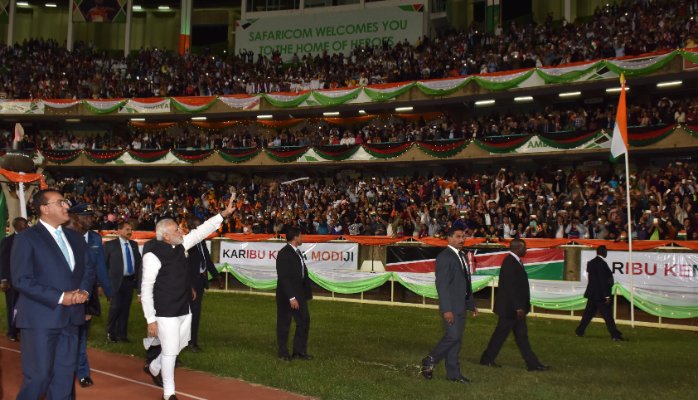
    My visit to Kenya was memorable because of the wide range of programme and the comprehensive level of discussions with President Kenyatta, particularly on trade and the economy. President Kenyatta and I addressed a business summit and even met Kenyan as well as Indian innovators before the summit.

    It is a fact that the India-Kenya friendship is a win-win situation for both our nations. Together, this partnership can be beneficial for India, Kenya and the rest of the world. 

    Here are some of the avenues of cooperation that I highlighted:

    I also extended India’s deepest appreciation and total support for the ‘Make it Kenya’ initiative of the Kenyan government. This is a wonderful effort to raise the economic potential of Kenya and provide opportunities for the Kenyan youth.

    In conclusion, I wish to state that together, India and Africa constitute a third of humanity. Africa is at the core of our foreign policy. Last year, I had the honour of welcoming African heads of state for the India-Africa Summit. This was the start of new era in India-Africa ties and will lead to empowerment of the youth both in India and across Africa.

  • PORTFOLIOS OF MODI CABINET 2.0

    PORTFOLIOS OF MODI CABINET 2.0

    PRIME MINISTER NARENDRA MODI – Personnel, Public Grievances & Pensions, Department of Atomic Energy, Department of Space, All important policy issues, and All other portfolios not allocated to any Minister

    CABINET MINISTERS

    Rajnath Singh: Home Affairs

    Sushma Swaraj: External Affairs

    Arun Jaitley: Finance Corporate Affairs

    M. Venkaiah Naidu: Urban Development; Housing and Urban Poverty Alleviation; Information & Broadcasting

    Nitin Jairam Gadkari: Road Transport and Highways Shipping

    Manohar Parrikar: Defence

    Suresh Prabhu: Railways

    D.V. Sadananda Gowda: Statistics & Programme Implementation

    Uma Bharati: Water Resources, River Development and Ganga Rejuvenation

    Jual Oram: Tribal Affairs

    Dr Najma A Heptulla: Minority Affairs

    Ramvilas Paswan: Consumer Affairs, Food and Public Distribution

    Kalraj Mishra: Micro, Small and Medium  Enterprises

    Maneka Sanjay Gandhi: Women and Child Development

    Ananth Kumar: Chemicals and Fertilizers; Parliamentary Affairs

    Ravi Shankar Prasad: Law & Justice; Electronics & Information Technology

    Jagat Prakash Nadda: Health & Family Welfare

    Ashok Gajapathi Raju Pusapati: Civil Aviation

    Anant Geete: Heavy Industries and Public Enterprises

    Harsimrat Kaur Badal: Food Processing Industries

    Narendra Singh Tomar: Rural Development;

    Panchayati Raj; Drinking Water and Sanitation

    Chaudhary Birender Singh: Steel

    Radha Mohan Singh: Agriculture & Farmers Welfare

    Thaawar Chand Gehlot: Social Justice and Empowerment

    Smriti Zubin Irani: Textiles

    Dr. Harsh Vardhan: Science and Technology Earth Sciences

    Prakash Javadekar: Human Resource Development

  • PM Modi’s new cabinet has strong RSS imprint

    PM Modi’s new cabinet has strong RSS imprint

    The RSS’s imprint got deeper on the Narendra Modi government with as many as six parliamentarians with strong links to the BJP’s ideological mentor finding place in theexpanded union council of ministers .

    While veteran RSS pracharak Anil Madhav Dave got Independent charge of the environment ministry, five others out of the 19 new ministers have roots in the right-wing organisation.

    The RSS – which played a crucial role in the BJP’s victory in the 2014 Lok Sabha polls — was pleased with the choice of new ministers but maintained it was “the prerogative of the government.”

    “They have several compulsions, could be elections or other political decisions, which have to be borne in mind while accommodating people. It is not for us to comment. Yes, Dave was a pracharak. He has worked very closely with the Sangh,” a senior RSS functionary said.

    He, however, added that Dave has been a BJP member for a long time and a Rajya Sabha member as well. “It will not be right to call him a Sangh karyakarta anymore.”

    When the Modi government took oath in May 2014, the RSS influence was evident from the induction of at least nine Cabinet ministers and at least three ministers of state who were RSS pracharaks, those who are given the task of spreading the organisation’s ideology.

    There were at least a dozen others who were not full-time RSS pracharaks but were associated with the Sangh through its students’ wing, the ABVP.

    On the last count, more than third of the 66 members in the council of ministers –before the expansion — had an RSS background. The proportion continued in the latest expansion as well.

    With the Prime Minister himself being an RSS pracharak, his ministers have never shied away from projecting their association with the organisation.

    Among the newly inducted ministers with RSS background is Mahendra Nath Pandey, the new minister of state for human resource development who was an active participant in the movement for constructing a Ram temple in Ayodhya.

    Inducted as the new minister of state for textiles from Uttarakhand, Ajay Tamta, also has a RSS background and participated in the Ram Janmabhoomi temple agitation before plunging into electoral politics.

    Rajen Gohain, the new minister of state for railways, was one of the founders of the BJP in Assam.

    A die-hard Sangh activist, he was a known RSS face at the organisation’s training centre in Hojai of Nagaon district. At RSS rallies, he was regularly spotted in the outfit’s trademark khaki shorts.

    Faggan Singh Kulaste, another newly inducted junior minister from Madhya Pradesh, was also an RSS activist.

    BJP ally Shiv Sena, however, was critical of Modi’s choice.

    “In Nehru and Indira Gandhi’s cabinets, there used to be stellar ministers with people like Dr Babasaheb Ambedkar to Babu Jagjivan Ram and Yashwantrao Chavan. A portfolio like human resources development (HRD) gained prominence only because of PV Narasimha Rao; similarly, the world learnt of India’s finance ministry only after Manmohan Singh helmed it,” the Sena said in its mouthpiece Saamna on Wednesday.

    “But now, such leaders of such caliber are not to be found. Hence, Modi has to shoulder the burden of his responsibility all by himself.”

    There were signs of discontent within the BJP, too.

    “I do not know why I was dropped. I never had any issues or problem with Modi or party president Amit Shah,” Mansukhbhai Vasava, who was dropped as minister of state for tribal affairs, said.

  • Cabinet Reshuffle: Modi hits refresh button

    Cabinet Reshuffle: Modi hits refresh button

    NEW DELHI (TIP): Prime Minister Narendra Modi on July 5 went for a sea change in his team as he shuffled portfolios of many of his prominent ministers.

    The most unexpected was the shifting of Smriti Irani from human resource development (HRD) to the unglamorous textiles ministry. Prakash Javadekar whose elevation to the cabinet rank on Tuesday took many by surprise replaced Irani as the HRD minister.

    Newly appointed minister Anil Madhav Dave was appointed environment minister in place of Javadekar.

    Ravi Shankar Prasad is the new law minister, replacing DV Sadananda Gowda who was shifted to the statistics and programme implementation ministry. Minister of state for railways Manoj Sinha was promoted and given independent charge of communications, while Prasad retained the charge of electronics and information technology.

    Urban development minister M Venkaiah Naidu was divested of the parliamentary affairs portfolio and given charge of the information and broadcasting ministry, which was earlier with finance minister Arun Jaitley.

    Chemicals and fertilisers minister Ananth Kumar was another gainer as he got the additional charge of parliamentary affairs.

    The changes were announced hours after Modi expanded his council of ministers, inducting 19 new faces as junior ministers and dropping five.

    Shortly after the swearing-in at Rashtrapati Bhawan, Modi told his cabinet colleagues at a meeting that he had little time in hand and they should be prepared for “big changes” in their portfolios.

    Though there was no change in the top four portfolios — home, external affairs, finance and defence —the Prime Minister delivered a clear message through major changes in portfolios of prominent ministers: that they should stay clear of controversies.

    Irani had a controversy-riddled tenure that started with question marks about her academic credentials but soon turned into frequent face-offs with the academia.

    Gowda was unable to strike a positive chord with the judiciary, which has been upset with the government’s perceived attempt to interfere in judicial appointments. He courted controversy recently after he sought the law commission’s report on the implementation of the uniform civil code.

    Gowda has been shifted from law to the less important statistics and programme implementation. Junior foreign minister General VK Singh too was engulfed in controversies as his remarks drew frequent criticism of the government. The former army chief was stripped of independent charge in the statistics and implementation ministry. Portfolios of rural development minister Birender Singh and steel minister Narendra Singh Tomar were swapped.

    New junior minister Vijay Goyal will head the sports and youth affairs ministry, which has been vacant since Sarbanand Sonowal shifted from the Centre to become Assam chief minister.

    Minister of state in the finance ministry, Jayant Sinha, was shifted as junior minister in the civil aviation department. Santosh Gangwar and Arjun Ram Meghwal are new ministers of state in the finance department.

    Journalist-politician MJ Akbar was appointed junior minister in the external affair ministry. Five-term MP SS Ahluwalia was made minister of state for agriculture and parliamentary affairs.

    Among NDA allies, RPI’s Ramdas Athawale became junior minister in the social justice and empowerment ministry while Apna Dal’s Anupriya Patel got health and family welfare. The reshuffle was viewed as an exercise aimed both at pleasing voters in states headed for elections next year as well as speeding up efforts to boost economic growth.

    Among those dropped was Mansukh Bhai Vasava, a junior minister in the tribal affairs ministry that has in the past locked horns with Javadekar, mostly over tribal rights and diversion of forest land for industry. At least seven of the new ministers are from states going to elections next year and five from the Dalit community, part of the BJP’s plan to appeal to the scheduled castes in Uttar Pradesh and Uttarakhand. The states vote next year and have a substantial population of scheduled castes. With the expansion, the size of Modi’s cabinet has swelled to 78 — one of the biggest in years and a far cry from Modi’s 2014 election promise of “minimum government and maximum governance”.

  • Modi expansion: Shiv Sena roars, Akali Dal chooses silence

    Modi expansion: Shiv Sena roars, Akali Dal chooses silence

    When asked to comment on the recent changes at the Centre, a Shiv Sena leader observed: “It was the BJP government’s expansion, not the NDA’s”. NDA coalition partners have reason to be unhappy. They have not just been left out in the ministry expansion; they were neither consulted nor briefed. Basic niceties and coalition dharma, it appears, are no longer in fashion. By now reconciled to the way it is treated in “Modi Durbar”, the Akali Dal leadership has stopped complaining. Only the Shiv Sena makes public its anger at the deliberate neglect. Unafraid of jeopardizing its arrangement in Maharashtra, the Shiv Sena’s reaction varied from “we do not beg for Cabinet berths” to questioning the caliber of Modi’s ministers. In the BJP’s growth and expansion scheme in states, allies serve a limited purpose.

    BJP leaders’ arrogant behavior annoys the Shiv Sena but the Akali Dal has apparently learnt to put up with it. Whatever the portfolio, it appears content with the Badal bahu’s adjustment in the ministry. The Centre’s “discrimination with Punjab” used to be a recurring theme of Chief Minister Badal’s speeches at one time. It is a different tune he plays today. If he does make a demand – like seal the border – it is more to shrug off responsibility for the drug menace than genuinely find a solution. Larger issues – terror attacks, neglect of agriculture, meagre hikes in MSPs, river cleanup, Central stand on SYL etc – no longer agitate the Badals as they did in the past. Only Delhi Akali leader Manjit Singh GK has shown some courage while accusing the Modi government of having “the same mindset as the Congress on the issue of the 1984 anti-Sikh riots”.

    The RBI has pointed to a loss of Rs 12,000 crore of bank loans in the wheat procurement in Punjab, but both the Central and Punjab governments have failed to come clean on the issue. A cover-up in this day and age does not last long. An otherwise aggressive Akali leadership turns meek while taking up Punjab’s legitimate demands with the Centre. It has a right to keep its peace with Modi but, as a Congress leader has pointed out, Punjab is under-represented at the Centre.

  • Nitin Gadkari’s visit to give new momentum to India’s ties with the US in infrastructure sector

    Nitin Gadkari’s visit to give new momentum to India’s ties with the US in infrastructure sector

    WASHINGTON (TIP): Indo-US cooperation in the vital infrastructure sector will get a new impetus when Road Transport, Highways & Shipping Minister Nitin Gadkari arrives here July 9 for official talks with his counter-part US Secretary of Transportation, Anthony Foxx on a wide range of projects of mutual interest.

    Gadkari will be particularly looking for widening and deepening the scope of Indo-US cooperation in innovative technologies for improving highway development, road engineering, road safety and development of green fuels in automobile sector and electric vehicles.

    During his interaction with the US captains of trade and industry and pioneers in the maritime sector, Gadkari will highlight investment opportunities in the Indian maritime sector and invite US investments in building ports, port-led industrialization, coastal economic zones, construction of new berths/terminals in existing ports like JNPT, Mumbai and Kandla Ports, capital and maintenance dredging, mechanization, hinterland connectivity and evacuation infrastructure, ship building, ship repairing and ship recycling.

    Gadkari has envisaged 50-60 Billion USD foreign investment for infrastructure and another 100 Billion USD towards industrial development for port-led economic growth in the maritime sector and inland waterways, water transport, coastal and cruise shipping and solar and wind energy generation to further boost the country’s growth momentum. He hopes to add two percentage points in India’s GDP through creating world-class infrastructure. India clocked 7.6 per cent growth rate in 2015-16 when there was a global slowdown.

    More than 150 projects were identified under the ambitious Sagarmala Programme at the recent Maritime India Summit in Mumbai. India has 7,500 Kms. long coastline, 212 ports, 70 coastal districts, one Billion tone cargo handling currently, 111 waterways and 90 % of export-import trade (by volume) handled at ports. There is a huge potential for tapping hundreds of islands and lighthouses for tourism.

    Gadkari will hold bilateral talks with the US Secretary of Transportation Anthony Foxx in Washington on July 11 aimed at strengthening and expanding India’s relations with the US by enhancing bilateral cooperation in infrastructure sector.

    At the US department of Transportation, Gadkari will witness Modal Presentations by Federal Highway Administration, US Maritime Administration and National Highway Traffic Safety Administration.

    His itinerary in Washington includes a talk on “A window into India’s Infrastructure Development “organized by Atlantic Council, a Washington-based think tank.

    The Indian delegation accompanying Gadkari will give presentations on port-led development, inland waterways development and highway infrastructure, logistics at a luncheon roundtable with investors and infrastructure companies arranged by the US India Business Council (USIBC). Gadkari will be accompanied by Alok Srivastava, Additional Secretary (Shipping), Rohit Kumar Singh, Joint Secretary (Highways),Abhay Damley, Joint Secretary (Transport), PS Vaibhav Dange & OSD (Shipping) Rajgopal.

    The Indian ambassador to the US Arun K Singh will be hosting a dinner in hour of the visiting union minister where he will meet US Congressmen and senior US officials and prominent Indian community members.

    During his visit to New York on the second leg of his week-long official trip, Gadkari will visit New York City state transport department to understand intelligent transport management, city traffic management and control centre and other technology- based transport solutions.

    In the commercial capital of the US, Gadkari will also have a series of interactions with investors at the meets organized by the Indo-American Chamber of Commerce, J.P. Morgan, Goldman Sachs and US Indian Business Council etc.

    Some of these interactions will be a follow up of the deliberations at the Maritime India Summit in Mumbai where a large number of US companies had evinced keen interest inpromoting bilateral cooperation with India in Maritime sector.

    Gadkari will invite US companies for technology cooperation in road and highway building, road engineering, innovations in automobile sector, road safety and green fuels.

    After a two-day stay in New York where the Overseas Friends of BJP have organized a reception in his honour, Gadkari will visit St. Louis to understand Inland Waterways System on world famous Mississippi River by undertaking a boat trip.

    On the next leg of his visit to San Francisco, Gadkari will have talks with senior officials from the California Transportation Agency, and departments of International Affairs and business development.

    He will also visit Tesla, manufacturers of quality electric cars, and hold a meeting with investors and interact with TiECharter members over dinner. TiE is global organization of entrepreneurs with over 12,000 members.

    Gadkari will have interaction and visit Oracle and Bloom Energy and later attend a community reception organized by the OFBJP. The OFBJP in Los Angeles has organized a reception in his hour.

  • Congress a Non-Entity, AAP making BJP very Nervous in Gujarat

    Congress a Non-Entity, AAP making BJP very Nervous in Gujarat

    There is a famous Modi Model which has been ideated, projected and sold by Narendra Modi, which was lapped up by a large number of people and was the reason for his ascension to Prime Minister. This Modi Model was camouflaged into a robust model of development and Zero Tolerance for corruption. Decisive and strong leadership is an integral part of that model. But this model has another side, which, like Anurag Kashyap’s film, is dark and edgy; in that part, there are no democratic bones in its body. There is no place for disagreement and dissent. And that is the part that is coming to the fore now.

    The first sign of nervousness in the opposition camp and the first sign of victory are complimentary to each other and happen simultaneously. The BJP has ruled Gujarat long enough to get delusional about its own immortality in the state. Modi won the state for the BJP for three consecutive terms and before him, the BJP won twice despite being faction-ridden. But since Modi moved to center and Anandiben Patel took over the reins of the government, there are clear indications of BJP losing ground and she is nowhere close to what Modi was.

    Ideally, the Congress should have been the perfect replacement. By now, they should have successfully challenged the BJP and left it feeling insecure. Unfortunately, the Congress in last 20 years or so has been reduced to a non-entity. It has ceased to even be a political party. This has created a vacuum in the political space. It is this vacuum which AAP is filling up very fast. It is emerging as a real alternative. They are taking up small and big issues on behalf of the common citizens of Gujarat and fighting it out in the streets for them.

    It is this fighting spirit which has made the BJP nervous. Therefore, in this context, when traders of Surat district invited Arvind Kejriwal for a meeting and interaction, and he readily accepted, Anandiben Patel had sleepless nights and finally the Vice chancellor of the university that was selected as the venue announced that the permission for the venue of the meeting was being revoked. Anandiben Patel did not stop there. She threatened the traders’ association and they were reprimanded for daring to call Kejriwal to Gujarat. They were told that their business would be ruined if they went ahead with the function. The President of the Association was also asked to give in writing that he had been misled by the AAP. Poor man had no option but to capitulate.

    The Vice Chancellor said that the venue could not be given for political activities. The gentleman has forgotten that the same venue was used by the BJP and Congress in the past many times. He also said that university had no idea that Kejriwal was coming for the meeting.

    It is rather clear that the BJP is nervous with the exponential growth of AAP.

    AAP also wanted to hold a protest in Bhavnagar in February about the corruption charges against Anar Patel, the Chief Minister’s daughter, but permission was not granted. Yet again AAP volunteers were detained. In Saurashtra, our planned Padyatra in April to save Gauchar or land for grazing by cows was not allowed. Senior leader of the AAP Gujarat unit Kanubhai Kalsariya was arrested and then got bail.

    So now there is a pattern. Under the Indian constitution, every citizen and group has every democratic right to protest against the government. As long as such protest is peaceful and doesn’t resort to violence or doesn’t threaten the sovereignty of the country, the government of the day has no reason to stop a protest from taking place.

    Unfortunately, during the Modi regime, the state has turned into a police state. All voices of dissent are muzzled. Disagreement is strongly disliked by the BJP government. There is a long list of government officers who had to pay a heavy price for the disagreement with then Chief Minister Modi. Many landed in jail. The non-governmental organizations that exposed misdeeds of Modi government are being hounded even now. Several cases are lodged against them and their finances have been choked by the government. This is dictatorship in democratic attire.

    Unlike her predecessor, Anandiben is not a charismatic leader; she does not have a similar grip over the administration and the party. She is perceived as a weak Chief Minister who is struggling with intra-party factionalism. AAP’s rise has made her very nervous in a state which in the last 20 years has not seen a robust opposition. But like AAP in Delhi, which is fighting the relentless onslaughts of the Modi government, AAP’s Gujarat unit will withstand BJP’s intimidating tactics and dirty tricks.

    AAP is not like the Congress that it will buckle under the BJP’s pressure. Anandiben might be smiling with the cancellation of Kejriwal’s meeting in Surat but AAP will come back strong soon with a massive mobilization and Kejriwal leading the rally. That will be the crushing blow to her corrupt regime. It is just a matter of time.

  • After CEA, Swamy hits out at another bureaucrat

    After CEA, Swamy hits out at another bureaucrat

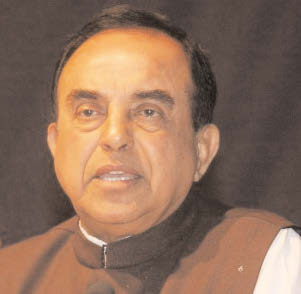
    NEW DELHI (TIP): BJP MP Subramanian Swamy on June 23 appeared to target Economic Affairs Secretary, Shaktikanta Das, which prompted Finance Minister Arun Jaitley to call it an “unfair and false” attack. Hurling veiled charges at Das, Swamy, in a morning post on his Twitter handle, said there is a “property deal case pending against him (Das) for assisting PC (Congress leader P Chidambaram) swallow Mahabalipuram prime locations”.

    The Rajya Sabha member demanded that Das, an IAS officer of the 1980 batch, be repatriated to Tamil Nadu, his home cadre.

    Jaitley, who is on a five-day official trip to China, tweeted: “An unfair and false attack on a disciplined civil servant in the finance ministry”.

    The finance minister had earlier stated that political leaders should refrain from taking on officers restrained by their office compulsions.

    Das is the latest among the senior bureaucrats and technocrats Swamy has targeted of late, which is turning out to be an embarrassment to the BJP.

    On Wednesday, Swamy took on Chief Economic Advisor Arvind Subramanian, demanding that he be sacked for taking an anti-India position on the Intellectual Property Rights issue at the United Nations. He had also charged Subramanian with encouraging the Congress party to take a stiff stand on the GST Bill, which is still pending in Parliament.

    Jaitley had defended Subramanian saying the CEA enjoyed “full confidence” of the government and his advices on several occasions had been of “great value”. When asked to comment on Jaitley and the BJP not endorsing his views on Subramanian, Swamy said, “Let him (Jaitley) say what he wants… I have nothing to do with what Jaitley says. I can talk to the party President or the Prime Minister.” “Will talk to them when required, right now it’s not needed as I have said what I had to say,” he insisted.

    An unrepentant Swamy added to his Wednesday’s rant against the CEA and said he was willing to “suspend” his attack on Subramanian provided the government still considers him
    “patriotic” despite his “anti-India stand”.

  • BJP neta: 1L award for Rahul clue

    BJP neta: 1L award for Rahul clue

    BHOPAL (TIP): Heaping more embarrassment on BJP after it lost a Rajya Sabha seat to Congress in Madhya Pradesh, a senior leader and state spokesperson of the party announced a Rs 1 lakh award to anyone who discloses whereabouts of Congress vice-president Rahul Gandhi during his “energizing” foreign trips.

    As the statement stirred controversy, Congress called it a cheap publicity stunt and BJP distanced itself from the statement, saying it was his personal view.

    Chairman of MP Urja Vikas Nigam Vijayendra Singh Sisodia took cue from social media campaigns to raise questions on Rahul Gandhi’s foreign trips. “Where has Rahul Gandhi gone? Anyone who can track the address or provide information, I will reward him with Rs 1 lakh cash (Rahul ka pata batao, ek lakh rupiya pao),” said Sisodia.

    Taking a jibe at Congress leaders, who were trying to defend Rahul, Sisodia said few months back when Rahul went abroad, Congressmen said he’s doing a ‘meditation’ course and will return energised.

  • GST WITHOUT THE CONGRESS? NEW MATH IN THE RAJYA SABHA

    GST WITHOUT THE CONGRESS? NEW MATH IN THE RAJYA SABHA

    NEW DELHI (TIP): The recent Rajya Sabha elections have given the BJP and allies a numerical edge over the Congress-led UPA in the Upper House, where the government hopes to finally push through the Goods and Services Tax or GST bill in the Monsoon session of Parliament.

    After a meeting with state finance ministers this week, Union Finance Minister Arun Jaitley expressed relief at a broad consensus over GST, which affects a unified tax regime in the country.

    The Congress, which has so far stalled the GST bill in the Rajya Sabha, is still adamant that it will not support it without amendments it wants and the question being asked is – can the government pass the bill in the Monsoon session even if the Congress opposes it?

    “The government will try to get everyone on board but if the situation comes we are ready,” Mr Jaitley told NDTV recently.

    The BJP and its allies, along with seven nominated members are now a bloc of 81 lawmakers. The UPA has 68. Others, the non-NDA and non-UPA parties are 91 lawmakers.

    On GST, parties that have traditionally allied with the Congress are not necessarily on the same page. The Nationalist Congress Party, Trinamool Congress, Samajwadi Party, Janata Dal (United), Bahujan Samaj Party and the Biju Janata Dal have already announced their support for the bill.

    These parties together have 60 MPs, which means that GST has the avowed support of 141 lawmakers in the 245-member Rajya Sabha.

    The anti-GST club has 80 – the Congress’ 60 and 20 others including the Left and Lalu Yadav’s RJD, which opposes the bill even though whose partner JDU led by Bihar Chief Minister Nitish Kumar supports it as GST benefits Bihar.

    A constitutional amendment needs two-thirds of the House to support it, which means the government needs 164 votes. Enter J Jayalalithaa’s AIADMK, with 13 lawmakers. It opposes the bill because GST will bring losses for states like Tamil Nadu which are manufacturing states. But the government still hopes to bring the AIADMK on board. If it does, it will be just 10 short of a two-thirds majority. If the AIADMK abstains, the strength of the house will be down to 232 and the two-thirds magic mark will be at 155. The government will then be short of 14 votes.

    Among the undecided are parties like the YSR Congress, Telangana Rashtriya Samiti, Janata Dal Secular and Independents, together six lawmakers.

    The worry for the government is that even if it collects adequate support for the bill, the Congress could stall it simply by disrupting House.

    Keenly watched is the stand nominated MPs like Sachin Tendulkar and actor Rekha will take.

    Will they stay loyal to the Congress which nominated them or end up helping the government with crucial votes?

  • AAM AADMI PARTY SUSPENDS ALKA LAMBA AS PARTY SPOKESPERSON

    AAM AADMI PARTY SUSPENDS ALKA LAMBA AS PARTY SPOKESPERSON

    NEW DELHI: The Aam Aadmi Party on Thursday suspended MLA Alka Lamba @LambaAlka from the post of party spokesperson, for two months.

    Lamba was reportedly removed as AAP spokesperson over her statement that Gopal Rai was “relieved” of the transport portfolio on Tuesday because of the Anti-Corruption Branch (ACB)’s investigation into corruption charges related to favouring an app-based premium bus service.

    Reacting to her suspension, Lamba said that she is a disciplined worker and will abide by the party’s decision. “If I have made a mistake unknowingly, I am ready to repent,” Lamba tweeted on Thursday.

    On June 14, Gopal Rai had quit as transport minister citing his health, even as the opposition BJP and Congress termed it a fallout of the ACB’s investigation.

    Rai refuted the allegations levelled by the opposition parties saying that he quit solely on health grounds.

    “Some people are spreading rumour that I have resigned due to Premium Bus Scheme. There has been no corruption in this scheme and my resignation has no connection with it,” the former transport minister tweeted.

    The portfolio of the transport department has now been given to his cabinet colleague Satyendar Jain, who already holds key portfolios of PWD, health, power and home.

  • GHOST OF 1984 ANTI-SIKH RIOTS CONTINUES TO HAUNT KAMAL NATH

    GHOST OF 1984 ANTI-SIKH RIOTS CONTINUES TO HAUNT KAMAL NATH

    NEW DELHI/MUKTSAR (TIP): The ghost of anti-Sikh riots continued to haunt Congress leader Kamal Nath despite his giving up charge of poll-bound Punjab with his political rivals stepping up attack and demanding filing of a case against him.

    On his part, the former union minister and his party rejected reports that he was asked to resign in view of the controversy surrounding him and that he did it on his own volition so that attention is not diverted from issues facing Punjab.

    Congress’ @INCIndia face in Punjab and former Chief Minister Capt Amarinder Singh came to Kamal Nath’s defence saying he had done a gracious thing by his resignation but maintained that had he continued also “there would not have been any difference”.

    On Sunday, Kamal Nath was appointed as General Secretary and given charge of both Punjab and Haryana. He resigned last night as in charge of Punjab, which goes to polls next year, in the wake of rivals targeting him on the issue of riots.

    Akali Dal leader and Punjab Chief Minister Parkash Singh Badal today attacked Kamal Nath saying his exit “vindicated” the stand of his party that 1984 Sikh carnage was a “deep rooted conspiracy” of Congress party to “butcher of innocent” Sikhs.

    “Kamal Nath was reluctant to accept this post because of his guilty consciousness’ owing to his role in massacre of thousands of innocent Sikhs,” Badal alleged on the sidelines of Sangat Darshan programme in Malout Assembly constituency.

    He alleged Kamal Nath could not “muster the courage” to face people of state who were well aware of his role in this “barbaric holocaust” of Sikhs.

    However, Badal said that the people of state in general and Sikhs in particular would never forgive Kamal Nath and other leaders of his party who had “planned and executed this heinous carnage”, which was a dark spot in the entire history of India.

    The Aam Aadmi Party (AAP), which is trying to make inroads into the state in the next year’s Assembly elections, also joined the attack on the Congress leader.

    It claimed victory over his resignation and demanded that an FIR be registered against Kamal Nath in the Gurudwara Rakabganj Sahib in which two Sikhs were burnt to death in 1984.

    After its persistent pressure, the Congress had to sack Kamal Nath, the AAP said claiming it was an “acceptance” of defeat. “Two Sikhs were killed in the incident. So Kamal Nath is also responsible for it as he was their leader. This is an insult to the law.”

    “By merely tendering resignation does not absolve Kamal Nath from the charges and he should be tried for murder and chargesheet should be filed at the earliest,” said AAP leader and lawyer H S Phoolka, who has been fighting for the 1984 anti-Sikh riots victims. He said the role of Kamal Nath has never been investigated.

    Talking to media, Kamal Nath rejected reports that he was asked to step down as General Secretary in-charge of Punjab and said he quit to ensure that attention was not diverted from the issues affecting the state.

    He denied that Congress President Sonia Gandhi asked him to quit the post, adding that she understood the reasons he gave in his letter to the party to step down as in-charge of Punjab. “I called Rahul Gandhi and told him I am sending the letter…I read him the letter. He told me to send it to the Congress President…I called Sonia Gandhi and told her that this is in the interest of the party and we should not let them use this politics,” he said.

    Kamal Nath said Gandhi spoke with him again after she received the letter and told him that “well if this is your reason, fine.”

    On being asked whether he was forced to step down as the in-charge after allegations over his role in the anti-Sikh riots resurfaced, the senior-most Lok Sabha MP wondered why the issue of his alleged role in the riots was being raked up after 32 years. He said the Nanavati Commission which investigated the anti-Sikh riots had absolved him.

    “It is nothing but a political ploy to divert from the real issues. There was an adjournment motion on which Akalis spoke, L K Advani of BJP spoke. No one pointed fingers at me,”
    he said.

    He claimed that the real issues affecting Punjab such as drugs, farmer plight, mis-governance are being ignored. Responding to a poser on a letter reportedly written by his former Cabinet colleague M S Gill, Kamal Nath said he never raised the issue of 1984 riots with him when they were Cabinet colleagues nor in the Cabinet. Gill had yesterday described his appointment is akin “rubbing salt on wounds”.

    Kamal Nath rejected suggestions that the Nanavati panel absolved him due to ‘lack of evidence’. He said the report should be read in its entirety.

    The Congress veteran said he was at the Rakabganj Gurudwara near Parliament House after he was told that a crowd had gathered here. He said that policemen at the scene asked him to engage the crowd till reinforcements arrived. “I left as soon as I saw the reinforcements arrive,” he said.

    Senior Congress spokesperson Anand Sharma also defended Kamal Nath saying he resigned “on his own volition” anguished over the “mischievous” campaign against him by opponents regarding the 1984 anti-Sikh riots.

    Talking to media, Sharma dismissed suggestions that the Congress buckled under pressure to replace him and insisted that the “dishonest, perverse, and mischievous” narrative by opposition against him was done with an eye on elections.

    Replying to questions, he, however, made it clear that Kamal Nath continued to be the AICC General Secretary in charge of Haryana.

    Reports earlier quoting party’s chief spokesman Randeep Surjewala had it that Nath had resigned as General Secretary of the AICC.

    Asked about the AAP’s charges against Nath, Sharma said AAP has “no credibility and has an opportunistic agenda” and was targeting the Congress leader with an eye on polls…”

    “The demand to reopen cases is ridiculous because there is no case ever. You cannot reopen which does not exist”, he said when asked about the AAP demand.

    Maintaining that Kamal Nath is the senior-most member of the Lok Sabha, who has also been party General Secretary and Union Minister, Sharma said that he decided to quit “out of his anguish” after being “condemned day in and day out despite being not guilty”.

    Source: PTI

  • 2-Day BJP Conclave Concludes

    2-Day BJP Conclave Concludes

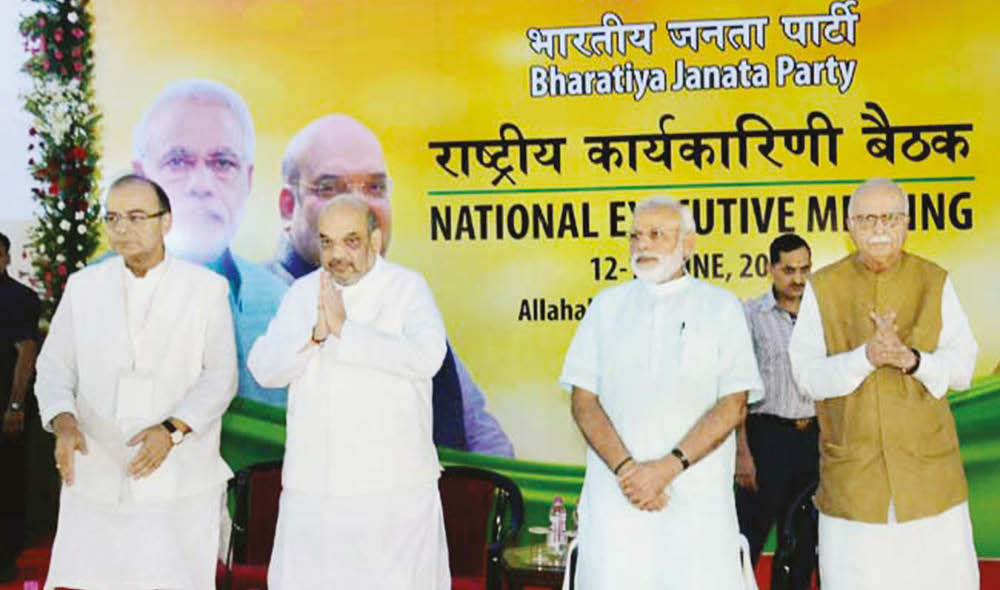
    ALLAHABAD (TIP): The Two-day conclave of Bharatiya Janata Party (BJP) concluded here Monday, June 13. High on the agenda was a strategy for the 2017 assembly elections in Uttar Pradesh, Punjab, Uttarakhand, Manipur and Goa. Of all the States going to polls in 2017, the State of Uttar Pradesh is of the greatest strategic importance for BJP. If the party is able to perform as it did in the Lok Sabha elections, it will contribute greatly to its strength in the Rajya Sabha where as of now the combined opposition is in a position to stall the BJP. Thus, the main thrust of the party leadership has been to strategize for a win in Uttar Pradesh.

    Senior Cabinet ministers, chief ministers of BJP-ruled states, party MPs and other senior leaders are participating in the conclave.

    Sources said PM Modi asked BJP office bearers to take forward what has been achieved. There is a need to constantly innovate in today’s politics. An organization and its working style should change with the political situation, he reportedly said.

    Briefing the media in the evening, senior BJP leader and Union Minister Ravi Shankar Prasad said the BJP “maintained balance between rural and urban development, reform and public welfare, connection between defense and foreign policy”.

    He quoted party chief Amit Shah as saying that the victory in Assam had opened the “gateway to the north east” for the party. Mr. Shah, he said, expressed confidence that the party will return to power in UP in 2017 and at the Centre in 2019 as well.

    The party discussed a strategy for Assembly elections in Uttar Pradesh and four other states – Punjab, Himachal Pradesh, Uttarakhand and Goa. Om Mathur, PM Modi’s key man in UP, said: “Many issues were discussed at the meet but the main focus was on UP polls due next year.”

    Sources in the BJP, however, say a decision on who will be the party’s chief ministerial candidate in the two key states will be taken in due course.

    The BJP has brought several new faces to its National Executive — including Himanta Biswa Sarma, who defected from Congress to BJP and played a key role in its big Assam win, and former Uttarakhand chief minister Vijay Bahuguna, a new entrant to the party.

  • AKALI DAL, BJP DISTANCE THEMSELVES FROM ‘#UDTAPUNJAB’ ROW

    AKALI DAL, BJP DISTANCE THEMSELVES FROM ‘#UDTAPUNJAB’ ROW

    CHANDIGARH (TIP): Punjab Deputy Chief Minister and Akali Dal President Sukhbir Singh Badal on June 9 asked the opposition to stop spreading canards about a ban on the release of ‘#UdtaPunjab’ movie. “It is absurd even to suggest a governmental intervention at this stage,” he said. “Neither Chief Minister Parkash Singh Badal nor I, nor anyone else at political or administrative level in the government or the party has seen the film.

    “So how can we take a call on whether or not the film would affect the peaceful atmosphere in the state by hurting the sentiments of Punjabis through a vulgar and humiliating presentation of the present day Punjab and Punjabis?” Sukbbir said in a statement.

    The BJP also distanced itself from any role in the CBFC’s objections to the film’s content. “The government of Punjab and the political alliance of Akali Dal-BJP in the state have neither written any letter nor issued any statement (regarding the film). It is without any reason or logic, or due to vested interests, that our name is being dragged into this controversy,” said Vineet Joshi, assistant media adviser to the Punjab government and a BJP leader.

    Meanwhile, the Bombay High Court on June 9 heard objections raised by the producers of the film Udta Punjab against cuts suggested by the Central Board of Film Certification (CBFC) and also heard the body’s justifications for the same.

    The High Court sought an explanation from the Censor Board over its insistence on deleting the Punjab signboard in the film that deals with drugs. The CBFC submitted that all 13 changes, including deletion of Punjab in the film title, suggested by its revising committee were justified and proper.

    Phantom Films and producer VikasBahl moved the HC against the 13 suggestions.

    A Division Bench of Justices SC Dharmadhikari and ShaliniPhansalkar Joshi heard senior counsel Ravi Kadam appearing for the producers and Advocate AdvaitSethna representing CBFC.

    The senior counsel said the cuts suggested by the body were central to the film. He argued that the standards of certification should evolve. The modern audience was mature and would not get depraved by references to drugs in the film.

    Advocate AdvaitSethna, on the other hand, said that the cuts were suggested on the grounds of sovereignty, integrity and morality laid down by the law. The film was not suitable for unrestricted exhibition, he said. The court then asked how the integrity of the state would be affected by just pulling down one signboard.

    The court also mentioned the film Go, Goa, Gone and said movies had got away with much worse in the past.

    Politics has hotted up in Punjab on the issue. Punjab Congress president Amarinder Singh on June 9 announced he would release uncensored copies of Bollywood movie ‘Udta Punjab’ in Majitha town near Amritsar on June 17. The Congress leader said: “Majitha town, like Mexico, is the epicenter of drugs trade in Punjab. It was decided to release the movie there.” The movie’s release is scheduled for June 17.

    AAP convener and Delhi Chief Minister Arvind Kejriwal wondered whether the word Punjab would be also removed from the national anthem. Kejriwal, whose party is looking to make inroads in the upcoming Punjab Assembly polls, claimed that by censoring the movie themed on drug abuse, the BJP-Akali Dal has “accepted defeat.”

    “The way censorship is being done, the BJP, Narendra Modi, and Akali Dal have accepted their defeat in Punjab. Now the worry is how big would be their defeat. Will they be reduced to three seats like in Delhi?” he said.

    In the entire film world in India, voices of resentment against PahlajNihalani, the president of the Certification and Censor Board have been growing with every passing day. However, given the past record of Central government which did not yield to cancel appointment of Gajendra Chauhan as Director of Film Institute, it appears unlikely that PahlajNihalani would be removed. Thus, both sides have to be prepared for a long drawn battle.

  • ‘RADICAL CHANGES’ IN FILM CERTIFICATION SOON, SAYS ARUN JAITLEY

    ‘RADICAL CHANGES’ IN FILM CERTIFICATION SOON, SAYS ARUN JAITLEY

    NEW DELHI (TIP): Amid a raging row over “Udta Punjab”, information and broadcasting minister Arun Jaitley on June 9 said movie certification norms have to be liberal and “some very radical changes” will be announced over the next few days.

    In his first comments on the row sparked by cuts sought by Central Board of Film Certification on Udta Punjab, a film that potrays the problem of drug addiction in the state, he said, “I won’t say its overboard. I don’t know this case because I have not seen this film in question.”

    Stating that he was “not satisfied” with the existing system of film certification, Jaitley said there are some changes that are about be made.

    “There is a well documented report by Shyam Benegal, the first part which has come to me which is under consideration. Over the next few days we are going to announce some very radical changes in that,” he said.

    The committee, he said, has suggested some changes.

    “You will probably have a system where you will have to have a certificate. The correct word is certification and not censorship. Certification norms will have to be liberal,” he said speaking at the Indian of the Year Award by CNN TV18 Group.

    The CBFC has contended that Udta Punjab, a drug-themed crime thriller which is due to be released June 17, needs several cuts on the ground that it casts the state in a bad light by giving an impression that most of them are addicts. The numerous cuts sought sparked a confrontation between Bollywood filmmakers, the censor board and political parties. On the row, Jaitley said, “I think that we are overstating it because at the end of the day you have a Board which takes a view which may be a little conservative view but then at the appeal tribunal with an appeal it can get disposed off. My experience has been almost everything then gets cleared.”

    Trying to play down the controversy, he said there are people in the system whose attitude may be little more conservative. “But then there are internal checks and balances.”

    “For instance I look at the big picture and the big picture is a certification board, we popularly call it censor board and you have the appeal tribunal. Now, whenever you have a problem at the level of the first body, people go to the next slab and almost in 99 per cent of the cases, with or without some changes it gets cleared by the next body,” he said.

    “Udta Punjab” literally means “Flying Punjab”, a reference to the inebriating effects of drugs.

    Source: PTI

  • SWAMY FIRES ANOTHER SALVO AT RAJAN

    SWAMY FIRES ANOTHER SALVO AT RAJAN

    NEW DELHI (TIP): Firing yet another salvo at RBI Governor Raghuram Rajan, BJP MP Subramanian Swamy on June 9 alleged that the former IMF chief economist had planted “a time bomb” in the Indian financial system that will explode in December.

    Swamy, who had last month written twice to Prime Minister Narendra Modi seeking ouster of Rajan for keeping interest rate high, took to Twitter to criticise the Governor.

    “R3 (Raghuram Rajan) planted a time bomb in our financial system in 2013. It is timed for December 2016. The redeemable USD 24 billion in f.e. to be paid out by banks,” he tweeted.

    He did not specify further. The ‘f.e’ in the tweet apparently refers to foreign exchange.

    There was no immediate response to the query sent to RBI spokesperson Alpana Killawala in this regard.

    On May 26, Swamy had levelled six allegations against Rajan, including that of sending confidential and sensitive financial information around the world, and asked the Prime Minister to sack him immediately.

    Prior to that, Swamy had claimed that Rajan was “mentally not fully Indian” and alleged that he has “wilfully” wrecked the economy.

    On Swamy’s earlier comment, Rajan yesterday said, “There are certain allegations which are fundamentally wrong and baseless and addressing them would amount to giving them legitimacy.” He further said: “I think when you think about Indianness, when you think about love for your country, it’s a very complicated thing. For every person, there is a different way that you show respect for your country… my mother-in-law will say karmayogi is the way to go — do your work.” The Governor clarified that he “welcomes genuine criticism of our policy, but will not address ad hominem attacks” or allegations against him as an individual instead of the policies and the position he holds.

  • SWAMINARAYAN IDOL IN RSS DRESS AT SURAT SCHOOL KICKS UP ROW

    SWAMINARAYAN IDOL IN RSS DRESS AT SURAT SCHOOL KICKS UP ROW

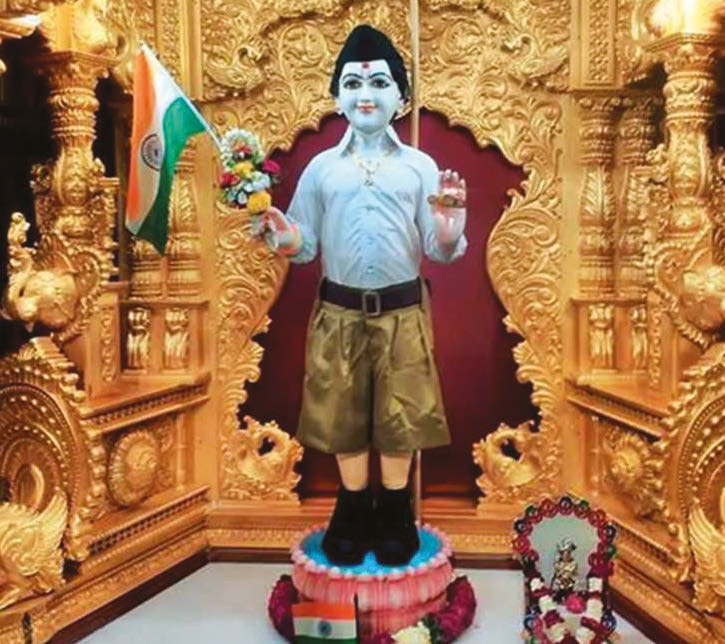
    AHMEDABAD (TIP): A controversy has erupted after a Surat-based temple dressed up the idol of Lord Swaminarayan in RSS uniform with Congress terming it as very unfortunate.

    The issue came to light after a picture, in which Lord Swaminarayan can be seen donning the Sangh outfit –white shirt tucked into a baggy khaki shorts with black cap and black shoes on — went viral on social media platforms last evening. The idol is also seen holding the national flag in one hand.

    According to Swami Vishwaprakashji of the temple, which is situated in Laskana area of Surat, the dress was gifted by a local devotee a few days back.

    “We have a common practice of presenting the God’s idol in various dresses. This RSS uniform was given to us by a devotee. We do not have any other agenda. We did not know that it will create a controversy,” Vishwaprakashji said.

    Even as the temple authorities denied having any intention of endorsing the views of the right-wing organisation, Congress leader Shankersinh Vaghela said temple authorities must refrain from such activities.

    “What do you want to prove by dressing up the God in khaki shorts? I pity those who have done that. Today, you have dressed the Lord in RSS uniform, tomorrow you will dress the idol in BJP’s uniform. This is very unfortunate,” Vaghela said.

    Gujarat BJP chief Vijay Rupani also said that it should not have been done. “I am really surprised. If at all it was done, I don’t approve of it,” he said.