Tag: BJP

  • SC to hear plea to ban websites with jokes on Sikhs

    SC to hear plea to ban websites with jokes on Sikhs

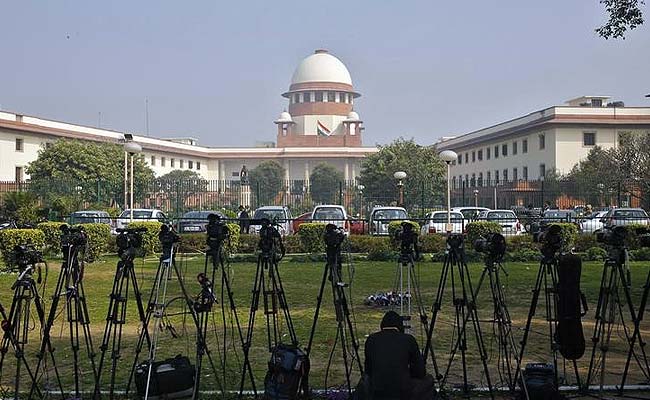
    New Delhi, October 30: The Supreme Court will look into a plea for a ban on websites carrying jokes on Sikhs, as a lawyer-petitioner told the apex court on Friday the community was projected as people of low intellect, stupid and foolish with such jokes.

    As petitioner Harvinder Chowdhary urged for directions to ban webites spreading jokes on Sikhs, an apex court bench of Justice T.S. Thakur and Justice V. Gopala Gowda asked her why she wanted such a ban as “this (Sikh) community is known for a great sense of humour and they also enjoy such jokes”.

    “This is only an amusement. Why you want it to be stopped,” Justice Thakur said while seeking to understand the rationale behind the ban plea.

    “All jokes relating to the Sikh community should be stopped. My children are humiliated and feel embarrassed and they don’t want to suffix Singh with their name,” she argued.

    Chowdhary said whenever she travelled in public transport, including Delhi metro, she came across instances where even on trivial issues people were ridiculed while citing jokes relating of the Sikh community.

    Referring to a recent comment by Prime Minister Narendra Modi during electioneering in Bihar that Bihar residents were the most intelligent people, the petitioner said it reflected as if other communities were not intelligent.

    As Justice Thakur responded that the prime minister would say the same thing about Sikhs if he went to Chandigarh, Chowdhary said the prime minister would not say so because the BJP was in rift with its ally, Shiromani Akali Dal.

    Urging the court to direct the government to clamp down on the more than 5,000 websites like www.jokes duniya.com/category/sardar-jokes.htm, the petitioner said, “They are criticising one community and it should stop.” Naming a number of websites carrying Sikh-centric jokes, Chowdhary sought directions to the Telecom Ministry to install filters to weed out jokes relating to the community.

    She said these websites created public nuisance under Section 268 of Indian Penal Code and it was a crime under the cyber laws.

    The court directed for further hearing of the matter on November 16 as she wanted to file some more documents in support of her plea.

    The Santa Banta jokes stay for now.

  • Supreme Court Vs Legislature | Who will Guard  the Guards is the Question

    Supreme Court Vs Legislature | Who will Guard the Guards is the Question

    The Supreme Court sent shockwaves down the spine of the elected executive by declaring the 99th constitutional amendment to set up the National Judicial Appointments Commission (NJAC) as unconstitutional and void as it “violates the basic structure of the constitution”. This comes from the Constitution Bench with a majority – 4:1 in favor of the rejection of NJAC.

    I agree that with only judges-appointing-judges part it does not leave room for something to be added. As the lone dissenting judge Justice J Chelameswar writes: “There is no accountability in this regard. The records are absolutely beyond the reach of any person including the judges of this Court who are not lucky enough to become the Chief Justice of India. Such a state of affairs does not either enhance the credibility of the institution or is good for the people of this country.” The Supreme Court judges are the guardians of our Constitution. What happens if a Collegium turns rogue? As the Roman poet Juvenal wrote: “Quis custodiet ipsos custodes?” (“Who will guard the guards?”)

    Now what the basic structure states in layman language. Judges are to be appointed by the President of India after consultation with the Chief Justice of India and what it has become is that the Chief Justice of India will appoint the Judges and the President of India signs the file. It is worth mentioning here that 90% of the Presidents of India come from the Legislature.

    The five-judge Supreme Court’s verdict did raise some questions on the judiciary. The NJAC law was passed with overwhelming majorities in both houses of parliament and by 20 state assemblies clearly showing the will of the elected, though it may not be the will of the people.

    Is the constitution a subject matter of Individual interpretation or is it a rule book in Black penned by the founding leaders of our Country? 

    What triggered curiosity was the passage by Justice Kehar in the Judgment where he wrote, “It is difficult to hold that the wisdom of appointment of judges can be shared with the political executive. In India, the organic development of civil society has not as yet sufficiently evolved. The expectation from the judiciary, to safeguard the rights of the citizens of this country, can only be ensured, by keeping it absolutely insulated and independent, from the other organs of governance.”

    Does this mean we are a backward civil society or that we simply lack wisdom? I agree with the statement and here is why we need to understand how our society votes when it comes to the elected. 70% of the voters base their decision on caste, party or religious views instead of the right candidate. Yes, we get easily fooled and now the elections seem to be about who not to vote for rather than who to vote for and yes, we can vote an anarchist to absolute majority.

    Arun Jaitley states “democracy can’t be the tyranny of the unelected”. In a Facebook post titled “The NJAC Judgement – An Alternative View”  Mr. Jaitley said the opinion of the Supreme Court is final, but not infallible. Let us ask ourselves, the government can make any rule, any law and the statement only shows legislatures’ unfulfilled ambitions. Mr. Jaitley, Democracy cannot be the tyranny of the elected.

    Citing another important reason for striking down the NJAC law was the Emergency of 1975-77, imposed by the then Congress government. The Constitution Bench opined that it is important that the government does not  have any role in the appointment of judges. It was the imposition of Emergency that gave birth to the collegium system.

    Those opposing the Collegium system say that this kind of a system is  unheard of in most parts of the world in which  judges appoint  judges through a selection process.

    Another comment on collegium system by Jailey creates bias. He tried to elegantly create confusion about the appointment of judges in one sentence: “Collegium is like a Gymkhana club in which existing members appoint new members”.

    What was the 99th amendment (NJAC)?The NJAC will have six members: The Chief Justice of India (CJI), two senior most poise judges of the Supreme Court, the Law Minister and two “eminent persons” selected by a panel comprising the CJI, the PM and the Leader of the largest opposition party (LOP). But then came the crunch. Any two of these six members could veto an appointment.

    The judgment made it clear that it was opposed to the Law Minister being a member of the panel, as his very presence would impinge on the principle of the independence of the judiciary and be contrary to the separation of powers. And the presence of the Prime Minister and the leader of the opposition in the panel to select the judges was also viewed negatively.

    Then, there is another reason which cannot be ignored. The government is the largest litigant in the country and has the dubious distinction of losing 80% of the cases in the Supreme Court. Government presence and interference could pull strings on judiciary.

    What’s Next?  On November 3, a five-judge Constitution Bench will consider suggestions on improving the Collegium system, and has invited submissions from the government and other stakeholders. The Constitution Bench chose to take this route as it quashed the NJAC and ordered revival of the Collegium system.

    Ruling that the primacy of the judiciary in judges’ appointments was embedded in the basic structure of the Constitution, it said these appointments will continue to be made by the Collegium system in which the CJI will have “the last word”.

    read-more

  • BJP says Arun Shore is no longer party member

    BJP says Arun Shore is no longer party member

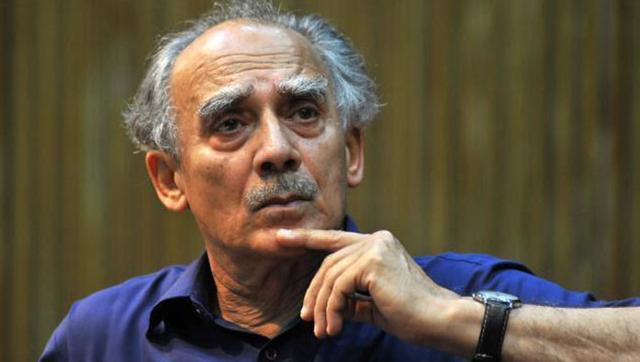
    Arun Shourie, who had launched a stinging attack on the Modi government on Monday, Oct 26, is no longer a member of the BJP, the party said as it sought to dismiss the criticism of its one-time influential leader who was also a minister in the previous NDA government.

    BJP general secretary Arun Singh said Shourie’s membership ceased after he did not renew it during the recent membership drive.

    All members have to renew their membership after every six years and Shourie did not do so this time round, he said.

    “Arun Shourie is no more a BJP member. He did not renew his membership,” he said.

    At a news conference in the party headquarters, Union minister Venkaiah Naidu rejected Shourie’s attack on the government, saying “his views are shared neither by the party nor by the public.”

    “I do not agree with this. This is not the opinion of party nor public,” he said in a brief response.

    Shourie, a strong supporter of Modi during the Lok Sabha election campaign last year, had said the Centre believes that managing economy means “managing the headlines” and that people had started recalling the days of former Prime Minister Manmohan Singh.

    “The way to characterize policies of the government is — Congress scaled plus a cow,” he had said.

    Rejecting the charge, Naidu said there has been “no scam, no scandal and not even one mistake” under the government and BJP had been winning elections across the country.

    “We are a democracy, he (Shourie) has his opinion, but the country’s opinion is different,” Naidu said, adding the people were supporting the Prime Minister in all parts of the country.

  • Musharraf equates Bal Thackeray with Hafiz Saeed, calls Osama a Hero

    Musharraf equates Bal Thackeray with Hafiz Saeed, calls Osama a Hero

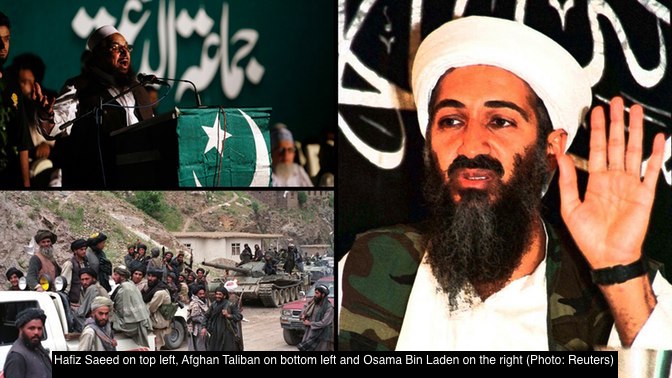
    In an interview to a Pakistani channel, Pakistan’s former president General Pervez Musharraf made scathing comments about Bal Thackeray and Pakistan’s support to extremist outfits in the past. Haqqani is our hero of 1980s & Osama was our hero. Yes, CIA’s as well. (al-Qaida chief Ayman) al-Zawahiri was our hero,” he added while referring to the Pakistan introduced religious militancy from 1979.

    Comparing Hafiz Saeed with RSS and Shiv Sena, former Pakistan president Parvez Musharraf said that those demanding action against Jamaat-ud-Dawah chief in his country were toeing in the Indian line.

    He said Afghan and Kashmiri mujahideen were their heroes in the 1990s, but the situation has now changed while referring to Saeed “I do not want to discuss this (Saeed) issue,” Musharraf shot back at his interviewer on a popular Pakistani TV channel on Saturday night. “Since India is going after this, we are also following them.”

    Musharraf rantingly asked the interviewer to ascertain what RSS was doing in India. “They do not play cricket with us. You saw what happened with (Pakistan cricket board chief) Shahryar Khan,” he said. “The face of (ex-Pakistan foreign minister Khurshid Mahmud) Kasuri’s book release organiser was blackened. Ghulam Ali’s concert was banned and he was thrown out.”

    “This is what is happening there. Are we catching any Sena leader? Was not Bal Thackeray a terrorist… did anybody catch him… a serving Army colonel was involved in the Samjautha blast in which 100 (sic) Pakistanis were killed. You are talking about Saeed, give us that Colonel,” he said.

    He cited PM Narendra Modi and his Cabinet’s presentations to the RSS brass to draw a link between Shiv Sena’s protests against Pakistan’s and BJP’s parent organisation.

    He cited Pakistan’s support for the US-backed Afghan war and said the atmosphere changed after 1979 when Islamabad introduced religious militancy in its favour to throw the Soviets out. “We brought mujahideen from around the world. We trained the Taliban… and sent them in. They were our heroes. (Afghan warlord Jalaluddin) Haqqani is our hero of 1980s. Osama (bin Laden) was our hero. Yes, CIA’s as well. (al-Qaida chief Ayman) al-Zawahiri was our hero,” he acknowledged.

    But he added that the atmosphere has changed now. “The hero has become a villain.”

    He said a similar thing was replicated in Kashmir in the 1990s. “A freedom struggle started there in the 1990s. They (Kashmiris) were killed badly. Indian Army killed them, they came to Pakistan. We gave them heroes’ reception.”

    Musharraf acknowledged Pakistan trained and supported Kashmiri rebels. “They were mujahideen who would fight the Indian Army for their rights. LeT was formed along with 10-12 such groups,” he said. He called these groups their heroes who were putting their lives at stake. “Now this has converted into terrorism.”

  • Annexures to NN Vohra committee report on politician-criminal nexus Missing?

    Annexures to NN Vohra committee report on politician-criminal nexus Missing?

    With the arrest of underworld don Chhota Rajan in Bali (Indonesia), a report from Vohra Committee which had the names of politician-underworld nexus has regained focus.

    The alleged annexure contains details of the nexus between politicians, bureaucrats and criminals, the Congress has said there is no harm in making these files public.

    The Government set up the N. N. Vohra Committee in July 1993 following the Mumbai bomb blasts in March of that year, to take stock of all available information about the activities of the crime syndicates/mafia organisations which had developed links with, and were being protected by Government functionaries and political personalities. The Vohra committee submitted its report in 1993 in the wake of the Bombay blasts taking off all the available information about “the activities of crime syndicates/mafia organizations which had developed links with and were being protected by government functionaries and political personalities.”

    But the then Congress-led Central government obtained a stay-order from the Supreme Court in the year 1996 against making annexure to NN Vohra committee report public. The Supreme Court had ruled that it would be “severely and detrimentally injurious” to public interest if annexures to the N N Vohra Committee report, containing details of the alleged nexus between politicians, bureaucrats and criminals, were disclosed.

    In 2012, RTI activist Subhash Chandra Agrawal filed a RTI application demanding the full report of the Vohra committee. In an order passed by the then information commissioner Sushma Singh on May 10 2012, she directed the home ministry to provide the annexures to RTI activist Subhash Chandra Agrawal within two weeks.

    On June 27, 2012 MHA under Congress Government denied any such annexure being on record.

    Now, the main question is if there was no such annexure/s, then how and why the then Central government obtained stay-order against making the said documents public?

    Congress now has switched its stand and Congress leader Digvijaya Singh told Times Now, “There is no harm in releasing this report,” while former home minister RPN Singh said “I don’t know about the report but If there is anything to suggest a link between politicians and criminals then action should be taken if any politician or bureaucrat is hand in glove with any terrorist organisation then action must be taken.”

    Meanwhile BJP leader Siddharth Nath Singh said the government will look into the matter and give a structured response. “The Government is sensitive about these matters and there is zero tolerance towards tolerance,” Singh told TIMES NOW.


  • BJP breathes easy as RSS chief backs reservations

    BJP breathes easy as RSS chief backs reservations

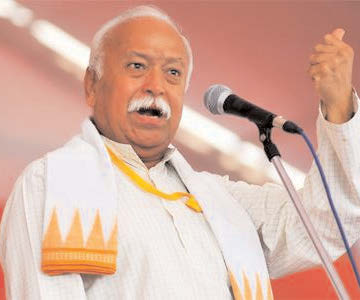
    NAGPUR (TIP): RSS chief Mohan Bhagwat on October 22 expressed support for reservations provided for under the Constitution, in a big relief to BJP which is having to fend off accusations of being “anti-quota” during the crucial Bihar polls.

    The RSS chief began his annual Dussehra speech by praising Ambedkar. “He made a life-long struggle against the injustice of social inequality and made provisions in the Constitution thereby eradicating those discriminations from political and economic spheres of our national life,” Bhagwat said in what read like an endorsement of the reservations provided for under the Constitution for the socio-economically underprivileged- in other words, SCs/STs and the OBCs.

    The speech was marked by praise for Modi government, absence of any reference to the recent flare-up in communal tensions in certain parts, criticism of judiciary for meddling with the rituals of Jains and an appeal for framing a policy for population control by disregarding ‘vote bank’ politics.

    Significantly, Bhagwat stressed the importance for dialogue for bringing about a change in customary religious practices and cultural tradition. “We should not be guided by cheap popularity or political incentives. What is truthful and just should be our guiding principle. By adopting a compassionate approach towards every section of society, we can change their approach through a friendly and respectable dialogue,” he said. Although he made the remark in the context of a court verdict banning Santhara – the custom of Jain elders fasting themselves to death — it was at odds with the usual right-wing pitch of early enactment of the Common Civil Code.

    For BJP, the remarks on reservation could not have been more timely. Its chief opponents in Bihar, RJD boss Lalu Prasad and chief minister Nitish Kumar, have cited Bhagwat’s advocacy for a review of the working of quotas to accuse BJP of being anti-quota and seek to mobilize Dalits and OBCs against the party. BJP chief Amit Shah has dismissed the charge by declaring party’s “unequivocal support” to quotas and even RSS, uncharacteristically, came out with a statement to say the same. However, opponents have refused to let go of the matter.

    In fact, in his speech Bhagwat stressed that the year happens to mark the 125th birth anniversary of Ambedkar, and even quoted his powerful predecessor, M S Golwalkar, to describe the framer of the Constitution as “confluence of Acharya Shankar’s sharp intellect and Tathagat Buddha’s unbounded compassion”.

    Bhagwat’s speech, 90th by a chief of the parent Hindutva outfit, came just before the Bihar battle enters the terrain BJP considers to be more friendly.

    Bhagwat also gave a big thumbs up to the Narendra Modi government endorsing that it was moving in the right direction and should deliver results soon. “When we ponder over the present situation in the country, we get a very optimistic and soothing view. The atmosphere of disappointment and lost faith, which existed couple of years back, has evaporated.

    An atmosphere of expectations has come to the fore, generating a sense of optimism that such expectations shall be fulfilled,” said the RSS chief, the remark contrasting so starkly with the perception about rise in communal tension in certain parts.

  • VK Singh sparks row with ‘dog’ remark on Dalit deaths, apologizes

    VK Singh sparks row with ‘dog’ remark on Dalit deaths, apologizes

    NEW DELHI (TIP): BJP’s run of controversial statements continues with minister of state V K Singh’s ill-phrased comment that the government cannot be held responsible if a stone is thrown at a dog – in the context of the murder of two dalit children in Faridabad – inviting a storm of criticism from opposition parties. Though Singh tried to initially defend his remarks, by late evening he apologized for them. Sources said his fuller apology came after BJP chief Amit Shah spoke to him.

    “I will be very clear on this that in case, because of this mixing up of two things, which someone else has done, if somebody’s feelings have been hurt, I am apologizing for it. Because some people have created a totally different picture altogether, which was never there. I had no intention of hurting anybody. Because of this imaginative linking of somebody if somebody’s feelings have been hurt, I apologize whole-heartedly,” Singh told ANI before flying to Thailand on a ministerial assignment.

    The opposition pounced on Singh’s comments and demanding he be sacked. The issue resonated in Bihar as well where RJD chief Lalu Prasad came down heavily on the minister and BJP at a time when the NDA feels a significant section of dalits are finally moving towards it. Singh’s made the controversial remarks when he was in Ghaziabad, the constituency he represents in the Lok Sabha.

  • CBI TO PROBE ATTACK ON DALIT FAMILY IN FARIDABAD, RAJPUTS FLEE VILLAGE

    BALLABHGARH (TIP): As scores of Dalits gathered in Sunpedh on Wednesday, a day after two Dalit children in the village were burnt alive in an attack by Rajputs on their family, the Haryana government said it would recommend a CBI probe into the incident.

    Villagers blocked the Delhi-Agra highway for most of the day in grief and anger, with the bodies of two infants who died on Tuesday placed on blocks of ice. They allowed the children to be buried only after meeting with the district administration.

    On Wednesday morning, the bodies of three-year-old Vaibhav and nine-month-old Divya, wrapped in white sheets, were brought to the village from AIIMS. A crowd first gathered in support of their father Jitender, and soon swelled after Dalits from other villages arrived and demanded stringent action against the guilty.

    After protesting at the bypass for a few hours, the demonstrators began to march from Jaat Chowk in Sunpedh till the Faridabad highway. The highway was blocked for over two hours before the Faridabad administration spoke to the family and asked them to form a committee of six people to put forth the demands.

    The crowd, however, had to be pushed away with force while at least 300 policemen from Faridabad and Gurgaon were deployed to maintain security. An additional five battalions of reserve forces were also called in.

    Around 6 pm, the family finally started the last rites of the two children who were buried in an empty plot near the village. Jitendra’s wife Rekha
    (23) is still battling for life in Delhi’s Safdarjung Hospital. Police on Tuesday arrested four named by Jitendra in the FIR.

    Also on Wednesday, politicians from across party lines made a beeline for the village, including Congress vice president Rahul Gandhi, Union Minister of State and Faridabad MP Krishan Pal Gujjar, CPI(M) leader Brinda Karat and AAP leader Ashutosh.

    Gandhi arrived with Haryana Congress chief Ashok Tanwar and Congress leader Shakeel Ahmed. Speaking to the family, Rahul said: “If you are weak you can be crushed. This is the attitude shared by the Prime Minister, Haryana Chief Minister, BJP and the RSS. They have been killed for no fault of theirs except that they were poor.”

    Gandhi also objected to a reporter’s query on allegations that his visit was a mere ‘photo opportunity’. “This is insulting when someone says it when someone comes here. It is not insulting to me. It is insulting to these people. What is a photo op. What you mean? People are dying. I will keep coming to such places,” Gandhi said. Source: The Indian Express

  • RSS Chief plays down communal attacks

    RSS Chief plays down communal attacks

    Since Prime Minister Modi and his ministerial colleagues have chosen to report to the RSS and invite its inputs on policy issues, it is important to take note of RSS chief Mohan Bhagwat’s annual Vijayadashmi address, delivered at Nagpur on Thursday and telecast live by Doordarshan despite Opposition protests last year. While his emphasis on “unity in diversity” is welcome, Mohan Bhagwat has, without naming any of the recent incidents – killings of writers and rationalists, beef and ink attacks and the Dadri lynching – said that “small incidents” were being “blown up”.

    He chose to give an indirect message to hardliners in the Sangh Parivar and other outfits by saying that his organization believed in “cooperation and coordination” and “such small incidents do not affect Indian and Hindu culture.” While Mohan Bhagwat talks of inclusivity being “the core of our culture”, the Union Culture Minister is known to violate the basic values of Indian culture very time he opens his mouth. Prime Minister Modi, BJP chief Amit Shah and Finance Minister Jaitley too have reacted to these incidents but none has given the recalcitrant ministers, MPs and MLAs a message strong enough to silence them and others. The latest to display characteristic insensitivity is Union minister VK Singh, who, reacting to the burning to death of two Dalit children in Haryana, said: “If someone throws stones at a dog, the government is not responsible”. For the benefit of the BJP in Bihar, Bhagwat did not say anything damaging. He did not touch on the reservation issue. But there seems no one to control the likes of Gen VK Singh and Kiren Rijiju, who too has been encouraged to make irresponsible comments about north Indians.

    If so many loose cannons have sprung up creating social tension, it is because there is no fear of the law or disciplinary action. If Bhagwat considers the recent incidents, which have forced writers to return their awards, as “small”, then he is not expected to contain the elements threatening India’s culture of tolerance and liberalism. His silence on the Shiv Sena, which has launched a hate campaign against anything and anyone Pakistani, is understandable, but not desirable.

  • President Mukherjee questions rising intolerance in India

    President Mukherjee questions rising intolerance in India

    Hours after another black ink incidence, President Pranab Mukherjee issued another statement on rising intolerance by fringe elements in the country.

    Backdrop: The President’s strong words on the need to maintain pluralism and dissent in the society come against the backdrop of series of hate incidents including in Mumbai where BJP ally Shiv Sena forced cancellation of a music concert by Pakistani legend Ghulam Ali and talks between Indian and Pakistani cricket board Chiefs and blackened the face of Sudheendra Kulkarni. Earlier in the day, a handful of activists allegedly belonging to a right-wing organisation blackened the face of independent MLA of J-K Assembly Sheikh Abdul Rashid using paint, ink and mobil oil protesting against his hosting a beef party in Srinagar earlier this month.

    Addressing a gathering organised by Nayaprajanma, a local weekly newspaper in West Bengal, he expressed apprehension about “whether tolerance and acceptance of dissent are on the wane?”

    He said: “Our collective strength must to be harnessed to resist evil powers in society.  Indian civilization has survived for 5000 years because of its tolerance. We have a Constitution that accommodates all these differences. Hope Mahamaya – the combination of all positive forces would eliminate the Asuras or divisive forces.”

    The official handle of President of India tweeted: “Remember teachings of Shri Ramakrishna Paramhansa ‘Jato Mat Tato Path’  As there are a number of beliefs, there are a number of ways. Humanism and pluralism should not be abandoned under any circumstance.  Assimilation through receiving is a characteristic of Indian society.”

    Earlier this month, President Pranab Mukherjee said the core values of diversity, tolerance and plurality of Indian civilisation must be kept in mind and cannot be allowed to be wasted, in remarks that come against the backdrop of the Dadri lynching over rumours of beef eating.

    “I firmly believe that we cannot allow the core values of our civilization to be wasted and the core values is what over the years the civilization celebrated diversity, promoted and advocated tolerance, endurance and plurality. These core civilization values keep us together over the centuries. Many ancient civilizations have fallen. But that is right that aggression after aggression, long foreign rule, the Indian civilization has survived because of its core civilizational values and we must keep that in mind. And if we keep those core values in mind, nothing can prevent our democracy to move,” he said.

  • Shiv Sena brings disrepute to the world class Mumbai

    Shiv Sena brings disrepute to the world class Mumbai

    Shiv Sena is in the news, and for all the wrong reasons. Acting as law makers and law enforcement on  certain issues, Shiv Sena during the last few days, have protested against some programs and forced their cancellation .In one case, Shiv Sainiks even blackened the face of the organizer of a program and threatened him with dire consequences.

    The first in the series, during the last one month, was protest against a concert by Ghulam Ali, the famous Pakistani Ghazal singer. Now, Ghulam Ali is not just a Pakistani citizen. He is  a world citizen. He is known as Ghazal King all over the world. As a man, too, he is hugely loved simply because he is humble and affectionate.

    The second incident related to the release in Mumbai of a book written by Khurshid Mahmud Kasuri, a former Pakistan Foreign Minister and now a leader of Imran Khan’s party Tehrique Iqbal.

    The Shiv Sainiks smeared the face of the organizer of the book launch, a former BJP ideologue Sudheendra Kulkarni and said it was a form of “peaceful protest” against Pakistan.

    The latest in the series was  forcing cancellation of Indo-Pak rock band show in Ahmedabad on Sunday, October 11.

    Going by the history of the Shiv Sena, one would not be surprised with  their conduct. But then what happens to Mumbai and the people of Mumbai who feel ashamed of having such elements in the world class city?The Shiv Sena  has not done any proud to a city which the world knows and possibly dreams of as  a glorious world by itself.

    It becomes the duty of the government  to rein in the “anti-social elements”. There should be zero tolerance for those who try to be the arbiters of law, more so when the Shiv Sena is part of the government at both the State of Maharashtra and at the Center.

  • Does India’s nuclear doctrine need a revision?

    Does India’s nuclear doctrine need a revision?

    India’s first nuclear test in 1974 called smiling Buddha in Pokhran desert was, for tactical reasons, characterized as “Peaceful Nuclear Explosion”. The second series of five nuclear tests in 1998 (Pokhran II) was again accompanied by a statement from the then PM Vajpayee attesting to lack of aggressive intent. The 2003 Indian nuclear doctrine went a step forward and made a written unilateral concession about India’s adherence to “No First Use” Doctrine. Since then a lot of debate has gone into the rationale, the need and the necessity for India to revise her Nuclear Doctrine and posture. Some foreign policy mandarins have tried to argue that India does not need to make any changes in the 2003 version of the doctrine. Though the election manifesto of the BJP prior to May 2014 Lok Sabha election noted the need to take a relook at India’s nuclear doctrine, subsequent statements by the PM nipped it in the bud.

    Site of India's first nuclear test in 1974 called smiling Buddha in Pokhran desert
    Site of India’s first nuclear test in 1974 called smiling Buddha in Pokhran desert

    While looking at the nuclear scenario, India has to take the contemporary threat perception and other geo-political factors into account while revising her strategic nuclear policy. It will be a good idea for India to periodically revise her nuclear doctrine every 10-15 years based on the geo-political situation. A lot has already changed since 2003. There is nothing sacrosanct about revising a document that was essentially tactical in nature. Newer nuclear threats have emerged from both the nuclear neighbors, China and Pakistan that mandate that India revise her nuclear doctrine and posture in order to avoid future nuclear blackmail.

    China has significantly diluted its “No first use” nuclear doctrine over the years. China has no intention of exercising restraint in the growth of its nuclear weapons program till the other two nuclear weapons superpowers (US and Russia) have brought down their number of nuclear weapons to China’s level. China has started deploying its nuclear powered submarines in the Indian Ocean region.

    Pakistani Nuclear program was initiated in 1970s by ZA Bhutto after Pakistan’s defeat in Bangladesh war of independence in 1971. His famous statement in 1965 in UNSC was about waging a thousand years war against India. Later on he talked about eating grass and obtaining Nuclear weapons. Pakistan’s nuclear weapons program has been, is and will remain an India-centric nuclear toy in the hands of ISI/GHQ/Pakistani military as the civilians do not control the program. From the beginning Pakistani nuclear program has had Chinese footprints all over.

    While Pakistan’s economy goes south, it remains a rentier state having extorted $31 billion from the US since 9/11. Pakistan keeps on getting tranches of money from the Kingdom of Saudi Arabia under an all-weather Sunni Alliance. Pakistan and ZA Bhutto had proudly proclaimed Pakistan’s nuclear weapons as “Islamic bomb” having been financed by Islamic money from KSA. Last year, Pakistani PM was able to obtain $ one billion from Saudi Arabia at a time when Pakistan’s economy took a hit. Money will never be a problem for Pakistani nuclear establishment as it grows at a disproportionate rate.

    Pakistani ballistic missile program has also heavily borrowed from China and North Korea since the 1990s. Hate IX (Vengeance-IV) Nasr was purpose built to carry tactical nuclear weapons (sub kiloton yield) over short range of 60-90 kilometers. On March 9 2015, Pakistan successfully tested the Shaheen-III surface-to-surface ballistic missile, capable of carrying nuclear warheads to a range of 2,750 km. Shaheen III nuclear capable missiles increase the range of Pakistani nuclear missiles to include the entire Indian land mass and the Indian Eastern naval command based in Andaman & Nicobar Islands. Pakistani has recently become the beneficiary of Chinese nuclear powered submarines that definitely pose a threat to India for her second strike capabilities.

    General Khalid Kidwai who was the director of Pakistani Army’s Strategic Planning Division (SPD) for a period of 15 years, in an open meeting in March 2015 at the Carnegie Endowment for International Peace, in Washington DC aggressively articulated Pakistan’s new offensive nuclear doctrine and posture. He brazenly threatened India with the first use nuclear attack threats painting a new picture. From the initial posture of credible minimum deterrence, Pakistan has moved to the concept of “Full Spectrum Deterrence” which envisages aggressive and offensive use of nuclear weapons by Pakistan against India in a number of scenarios. Not only Pakistan has linked its full spectrum nuclear deterrence doctrine with resolution of J&K dispute in its favor, Pakistan has threatened to use nuclear weapons against India if its tentacles in Afghanistan are cut off. Extra-territorial linkage with loss of its assets in Afghanistan widens the role for nuclear weapons under the new Pakistani doctrine.

    Pakistan has already developed tactical nuclear weapons to be used in the war theater on the mechanized divisions of Indian armed forces. Ostensibly, Pakistan has justified use of tactical nuclear weapons as a policy against Indian Army’s imaginary “Cold start doctrine” which was never officially promulgated.

    Pakistan is the only country that has single-handedly blocked an international agreement on FMCT while feverishly increasing its fissile material production. While traditionally cited figure is Pakistan has 90-110 nuclear weapons, reality has changed during last few years. The Pakistani nuclear armada is the fasted growing in the entire world with production of 10-20 new nuclear weapons every year.

    Pakistani state has brazenly and repeatedly indulged in nuclear blackmail and rent collection over the last several decades. This Pakistani behavior will NOT change only the sponsors and the rent-payers will change over time.

    There is NO reason for India to remain complacent while the nuclear threat perception changes. The PM will do a yeoman’s service to long-term strategic security of Indian nation if he revisits the Indian nuclear doctrine and allows it to grow some teeth. A number of remedial steps can be taken including discarding the meaningless no-first use doctrine to safe-guard nation’s security. Victors always write the history and India has lost repeatedly in history making.

  • 41 WRITERS RETURN INDIAN AWARD IN PROTEST

    41 WRITERS RETURN INDIAN AWARD IN PROTEST

    NEW DELHI (TIP): Many in India’s literary community are disgusted. Dozens of writers say every day brings more evidence of intolerance and bigotry going mainstream — a man lynched allegedly for eating beef, an atheist critic of Hindu idol worship gunned down — all met by a deafening silence from the government.

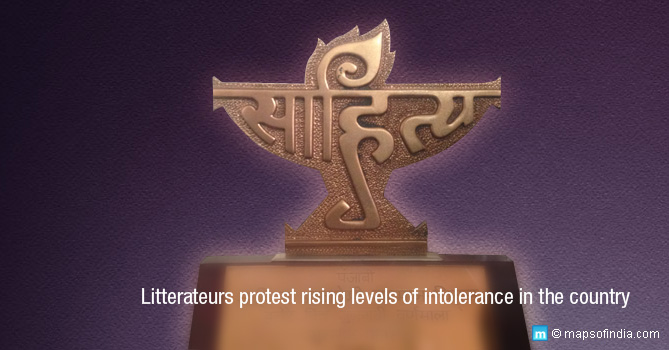
    As of October 14, 41 novelists, essayists, playwrights and poets had returned the awards they received from India’s prestigious literary academy to protest what they call a growing climate of intolerance under Prime Minister Narendra Modi’s government.

    The writers are also angry that India’s Sahitya Akademi, or National Academy of Letters, has said little about the murder of the well-known rationalist Malleshappa Kalburgi, an award-winning Kannada-language writer, gunned down in August for his writings against superstition and false beliefs.

    The government has dismissed the writers’ protests, questioning their motives and accusing them of being politically motivated.

    “If they say they are unable to write, let them stop writing,” culture minister Mahesh Sharma told reporters.

    The writers say they cannot remain mute spectators to numerous incidents of communal violence, attacks on intellectuals and increasing curbs on free speech.

    “It’s become a question of an individual’s right to speak, to think, to write, to eat, to dress, to debate,” said Maya Krishna Rao, a playwright and theater actress, who returned her award to the academy this week.

    When Modi won a landslide victory in May 2014, many voiced fears of right-wing Hindu nationalism leading to communal violence and religious intolerance. Modi, who had spent years dodging allegations of failing to stop riots in Gujarat state in which around 1,000 Muslims died, assured the nation that he was prime minister for all and would work for everyone.

    But the last year has seen a rising crescendo of violence by Hindu fringe groups, trying to force a regressive Hindu nationalism on all, causing fear among India’s minority communities. State governments ruled by the BJP have cracked down on cow slaughter, and even buffalo meat, a key source of protein for poor Muslims and lower caste Hindus, has become scarce. The ban on cow slaughter has given rise to Hindu vigilante groups and mob violence has risen. Last month a Muslim man was lynched in northern India over false rumors that his family had eaten beef for dinner.

    On Wednesday, in response to persistent demands that the prime minister break his silence on the lynching, Modi said the mob killing was “sad and undesirable,” but added that his government could not be blamed as the local administration was responsible for the state.

    Last week, well-known writer Nayantara Sahgal returned her academy award, triggering the return of awards by other writers. Sahgal, a niece of India’s first prime minister, Jawaharlal Nehru, is known as a fiercely independent political writer who had crossed swords with her cousin and another former prime minister, Indira Gandhi, when she imposed a state of emergency in India in the mid-70s.

    Referring to recent violence by Hindu groups, Sahgal said in an interview to The Indian Express newspaper that there was “an attempt to blow up the idea of India and to put in its place a kind of travesty of Hinduism, a kind of monoculture, which has nothing to do with Hinduism.”

    Sahgal’s views are echoed across the literary spectrum.

    Ghulam Nabi Khayal, a Kashmiri language writer, said earlier governments would try to restore peace in situations of communal conflict.

    “But that’s no more the case with the rise of Hindu rightwing BJP,” Khayal said in Srinagar. “For the past one year, the Indian state has become suffocating and extremely intolerant.”

    The government was “now brazenly and institutionally backing this communal hatred,” he said, justifying his decision to return his award.

  • Sena likens NCP to blood sucking leech

    Sena likens NCP to blood sucking leech

    MUMBAI (TIP): In a vitriolic attack on Sharad Pawar for equating the Shiv Sena to “ants that will be stuck to jaggery of power,” the ruling alliance partner on Friday described NCP as “blood sucking leech” waiting to join hands with the BJP to be a part of Maharashtra government.

    “Before calling others ants, it would have been better if Pawar had self-introspected. The NCP is infamous for sucking the blood of Maharashtra like leeches. These are leeches whose stomach will remain empty despite sucking out all the blood of the state,” the Sena said in stinging remarks in an editorial in party mouthpiece ‘Saamana’.

    Pawar had recently said that power was like a block of jaggery and termed the BJP and Shiv Sena as ants drawn to it, sucking as much sweetness as they could.

    On Pawar’s taunt that Sena was hungry for power and would not “dare” to leave the government, the Sena said the Maratha strongman first needs to answer why the NCP stuck to power with the Congress for 10 years, despite being humiliated several times by its ally.

    “You spoke of (Congress president) as being a foreigner, but ate Italian pizza with her for 10 years. Congress leaders accused the NCP of corruption. (Former Maharashtrachief minister) Prithviraj Chavan abused the NCP time and again. But the way the NCP still stuck to power is nothing but a miracle,” the editorial said.

    The Sena claimed that Pawar is waiting for an opportunity to come to power.

    “The truth is that Pawar is only waiting for an opportunity to come to power in the government after the Sena-BJP alliance breaks,” it said.

    “After the (Maharashtra) Assembly polls (last year), this was the same NCP that tried to cling onto the ‘pro-Hindutva’ BJP like ants,” the Sena said.

  • Shiv Sainiks blacken Sudheendra Kulkarni’s face over Kasuri’s book launch in Mumbai

    Shiv Sainiks blacken Sudheendra Kulkarni’s face over Kasuri’s book launch in Mumbai

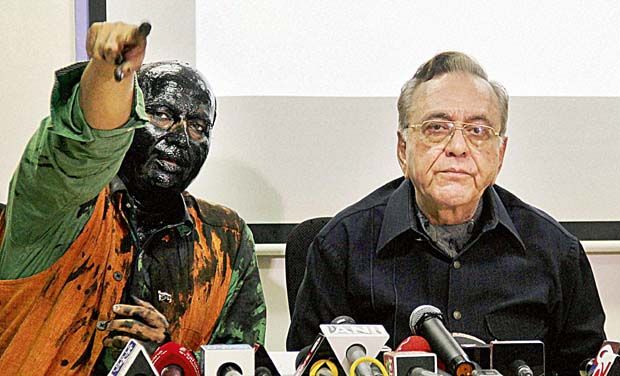
    MUMBAI: Shiv Sainiks poured black paint on Sudheendra Kulkarni, former aide of Atal Bihari Vajpayee and LK Advani, in Mumbai on Monday morning, Oct 12, in protest against the launch of former Pakistan foreign minister Kurshid Mahmud Kasuri’s book ‘Neither a Hawk Nor a DoveAn Insider’s Account of Pakistan’s Foreign Relations’ that Kulkarni organised, embarrassing the BJP-led state government.

    Sudheendra Kulkarni, the chairman of the Observer Research Foundation was dragged out of his car by 7 men near his residence and verbally abused before his face and head were blackened by Shiv Shainiks.

    Kulkarni refused to be cowed down and addressed a press conference with Kasuri where both condemned the attack.

    News reports quoted Kulkarni as saying that he was attacked by members of the Shiv Sena, which has opposed the event and has threatened to disrupt it.
    former BJP ideologue Sudheendra Kulkarni, with face blackened by Sena activists, and former Pak foreign minister Khurshid Mahmud Kasuri at the latter’s book release function in Mumbai_0_0


    Meanwhile, reacting to the ink attack on Kulkarni, senior Shiv Sena leader Sanjay Raut said “smearing ink is a very mild form of democratic protest.”

    “We don’t know if ink or tar was smeared. Nobody can foretell how public anger will explode,” Raut said

    Kulkarni had met Shiv Sena chief Uddhav Thackeray on Oct 11, but said that he did not get any assurances from him. He was reported to have said that the event would go on despite the threat.

    On Oct 12, two Sainiks were arrested. who dragged Kulkarni out of his car near his residence and verbally abused him before pouring black oil paint on his head.


  • BJP MLAs IN J&K ASSEMBLY THRASH LEGISLATOR WHO HOSTED ‘BEEF PARTY’

    BJP MLAs IN J&K ASSEMBLY THRASH LEGISLATOR WHO HOSTED ‘BEEF PARTY’

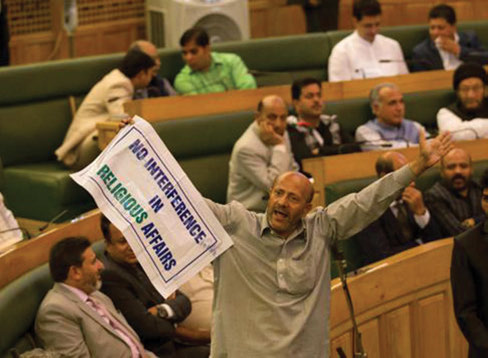
    SRINAGAR (TIP): BJP legislators thrashed an independent MLA for hosting a beef party as the Jammu and Kashmir assembly grounded on October 8 opposition-backed bills aiming to overthrow a decades-old ban on cattle meat in the state.

    Lawmakers from the ruling party threw kicks and punches at Engineer Rashid a day after he reportedly served beef kebabs and patties on the lawns of the state legislators’ hostel in protest against the prohibition on cow slaughter that has triggered debates and communal concerns in parts of the country.

    Rashid said he didn’t wish to offend anyone and hadn’t broken any rules as the Supreme Court this week suspended the colonial-era beef ban under the state’s Ranbir Penal Code (RPC) for two months after separate wings of the J&K high court gave conflicting orders on the issue.

    “Nearly six to eight BJP members grabbed me and kicked and punched me,” the MLA told the media. “Is this democratic behaviour? And you expect separatists to join this assembly.”

    The Langate legislator has been in the news for leading protests against the ban and also courted controversy this month when he demanded that the remains of terrorist Afzal Guru, who was executed for his involvement in the 2001 Parliament attack, be returned to his family in the Valley.

    Amid the uproar, separate opposition bills seeking amendments to the RPC to decriminalise cattle slaughter were not taken up by the assembly on Thursday despite being listed for discussion, prompting criticism from the National Conference, Left and Congress leaders.

    Speaker Kavinder Gupta adjourned the House for the day at 1.30 pm, the schedule followed in the assembly during the current session, despite opposition leaders seeking more time to discuss the issue.

    “It seems that you have already decided to adjourn the house as the chief minister has left the House,” an angry Omar Abdullah, NC leader and former chief minister, told the Speaker. “This seems to be a way to save their chairs.

    This government is hiding behind you.”

    The beef ban controversy has emerged as a nettlesome test for the ideologically divergent PDP and BJP that tied up to form the J&K government this year after voters delivered a fractured mandate.

    “You cannot manhandle an MLA,” said chief minister Mufti Mohammad Sayeed of the PDP as he condemned the attack on Rashid.

    The incident comes against the backdrop of a raging debate across the country over cow slaughter with hardline Hindu organisations pushing for a nationwide ban and minority groups resisting the move. Last week, a mob dragged a Muslim man out of his home in an Uttar Pradesh village and bludgeoned him to death with sticks and stones over suspicions that he butchered a calf.

    The beef row snowballed in Jammu and Kashmir after a division bench of the high court instructed authorities to strictly implement the ban, an order that drew sharp reactions from separatists and several minority groups who called it “interference in religious affairs” and sought revocation of the law.

    The laws governing slaughter of cows, bullocks and buffaloes vary from state to state. Jammu and Kashmir has a 10-year jail term for flouting the ban, while many northeastern states are allowing slaughter of all three.

  • Bihar Polls – ‘Litti pe Charcha’ in Times Square – Advantage BJP

    Bihar Polls – ‘Litti pe Charcha’ in Times Square – Advantage BJP

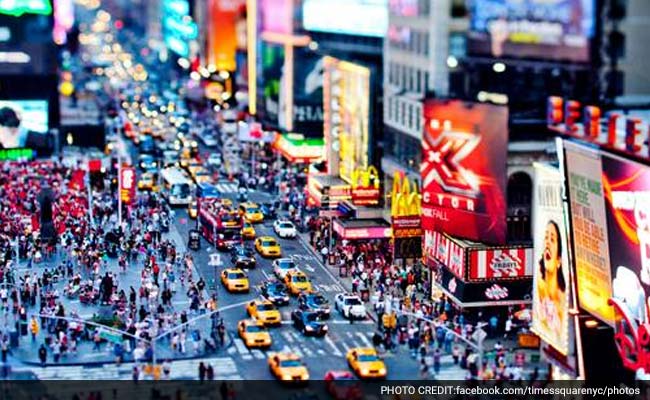
    Several members of the Indian community gathered at the Times Square in New York to hold discussions about the upcoming Bihar elections and voice their expectations from a future government over improving the economic and employment scenario in the state.

    Dubbed as ‘Litti Pe Charcha’, named after a popular dish in Bihar and in a similar vein to Prime Minister Narendra Modi’s ‘Chai Pe Charcha’, the discussion brought together over 200 members of the Indian community in the iconic tourist destination yesterday to talk about the elections and send a message to the youth in the state to exercise their right to vote.

    The discussion centered around key issues impacting Bihar such as unemployment, corruption, education, poverty, migration, health, law and order and agriculture.

    Representing ‘Vote For India’ Manik Tyagi said Indians in the US are concerned over the situation in Bihar and the lack of employment even as the youth is willing to return to the state if the security situation and investment climate improves.

    Anil Sharma, who represented HiPac, a large group of Non-Resident Indian (NRI) youth, talked about the underutilisation of human resources in Bihar.

    Others participating in the discussions said that the election is crucial for the state’s future growth and economic development.

    Similar gatherings have been planned across the US.

    Voicing their support for a BJP-led government in the state, some participants said Bihar should leverage PM Modi’s leadership and focus on economic development.

  • BJP urges EC to withdraw FIR against Amit Shah

    BJP urges EC to withdraw FIR against Amit Shah

    NEW DELHI (TIP): BJP on Oct 8 approached the Election Commission seeking immediate withdrawal of an FIR against party chief Amit Shah for his “Chara chor” (fodder thief) remark against RJD chief Lalu Prasad and demanded action against officials working “under pressure” of the state government. A delegation of party leaders, led by Union minister M Venkaiah Naidu, drew EC’s attention to the alleged hate speeches of Prasad and AIMIM chief Asaduddin Owaisi and sought strong action against them for their remarks.

    “In Bihar, an unnecessary FIR has been registered against BJP President Amit Shah. We feel it is done under pressure from the local government.

    “An FIR has been registered against the president of a national party. It is very objectionable. We have brought it to the notice of EC and put forth the facts and requested EC that they should hold an immediate inquiry and this FIR should be withdrawn,” Naidu told reporters.

  • THE POLITICS OF BEEF

    THE POLITICS OF BEEF

    On Sept. 28, in a village less than 60 miles from New Delhi, a Hindu priest announced in a local temple (under threat by some hot heads, he claims) that a Muslim family was consuming beef.

    Shortly afterward, a frenzied (Hindu) mob, wielding sticks, swords and cheap pistols barged into the family’s house and pulled out Akhlaq & his 22-year-old son, Danish, accusing the family of having slaughtered a cow and consuming it. They beat the men with such rapturous fury that within minutes the father was dead and his son in a coma.

    Times cannot be treated as normal if the President of India feels the need to issue a public advisory. What can explain the inexplicable silence of the otherwise hyper-expressive Narendra Modi.

    While, leaders of the political parties have left no stone unturned in trivializing the issue. PM Modi did not issue a single tweet, nor posted a Facebook statement expressing regret or offering condolence for this dead citizen.

    The Prime Minister finds himself unable to condemn utterances of his own party leaders & ministers. Isn’t this what happened in Godhra, when Modi was the Chief Minister.

    PM Speaks – Only too little too late 

    Less than 24 hours after the President’s subtle reprimand, India’s Prime Minister did speak – Not against the murderers of Akhlaq. Not even on the provocative comments by his party men/women in Dadri. No, not even on the urgent need to put an end to beef politics. All this can wait. After all, elections in Bihar happen just once in five years.

    Its all Politics for Narendra Modi – Why else would he choose an election rally to indirectly mention the incident. What are the compulsions of Narendra Modi who has brought to his party 284 seats in the Lok Sabha?

    Why Laloo alone comes to his mind; and people like Mahesh Sharma, Sanjeev Balyan, Sakshi Maharaj, Yogi Adityanath, Sangeet Som, Azam Khan and AIMIM leader Assaduddin Owaisi are allowed to get away with their shameless statements?

    Akhlaq’s family members can wait. And the President of India should learn to wait. Prime Minister of India is busy consolidating his position. And for this he must win Bihar. India’s core civilizational values can wait too

    While only hinting on the raging row over the Dadri lynching incident, Prime Minister Narendra Modi said Hindus and Muslims should decide whether to fight each other or together overcome poverty while asking the people to ignore “irresponsible” statements of politicians.

    Its to be noted that the above statement comes at his 4th Bihar election rally this week and that too after blowing all the jibes on the beef row towards BJP opponents like Laloo.

    “The country has to stay united,” Modi asserted. “I have said it earlier also. We have to decide whether Hindus should fight Muslims or poverty. Muslims should decide whether to fight Hindus or poverty,” he added.

    The silence does not douse flames, it fans conspiracy theories

    Adding Fuel to the Fire – Our Politicians whom ‘WE’ elected

    Why are these shallow leaders not expelled? Every time a party has been questioned, their answer has been simple -point fingers at the other parties.

    Outrageous Things Leaders Have Said – For the record, BJP leads here. 

    Mahesh Sharma 

    Modi’s Culture Minister & BJP Leader Mahesh Sharma, a moral idiot recently opined that India’s late President Abdul Kalam was patriotic “despite being a Muslim,” and dubbed the vicious beating an “accident.” He consoled the family by noting that at least the 17-year-old daughter of the slain man was untouched!

    Azam Khan
    Uttar Pradesh minister Azam Khan took one step further and wrote to United Nations on the condition of Muslims in India.

    He goes on further to hint on a new partition of India, “There should be a round table conference on what will be the new map of India and how people will live in the country” and “Aaj poori duniya dekh rahi hai ki Babri se le ke Dadri tak ka mansooba kya tha”.

    He clubs the incident with the demolition of Babri Masjid to harness the power of hatred.

    Sangeet Som 

    BJP MLA Sangeet Som, infamous for making controversial speeches during the 2013 Muzaffarnagar riots & one of the accused, declared, “Agar nirdoshon ke khilaf karyawahi ki gayi, to munh-tod jawab hamne pehle bhi diya hai aur abh bhi dena jante hain (If action is taken against innocent, we have given a befitting reply earlier and can do so again). We can give a reply whenever we want.” He made this statement at a temple on the outskirts of Bisara, near where the incident occurred.

    Asaduddin Owaisi

    “This murder was premeditated. He has been killed in the name of religion. It is an attack on our community. It cannot be an accident. All of this is being propagated by the state and central governments,” Owaisi says. The Hyderabad MP also questioned Prime Minister Narendra Modi’s silence on the killing. “This mother has seen her son getting beaten to death in front of her. Where are his condolences?”

    Owaisi also slammed Union Minister Mahesh Sharma for describing the killing in the Dadri village as “an accident”. “He is the country’s Culture Minister. It is unfortunate that a minister who has taken an oath on the Constitution does not have the courage and intellectual honesty to condemn the incident unconditionally.”

    Tarun Vijay 

    BJP MP Tarun Vijay said, it wasn’t the Hindu community’s responsibility to maintain peace and the Muslim community should remain mute.

    “Why responsibility to keep peace and maintain calm is always put on the Hindus alone? Be a victim and maintain silence in face of assaults!!” tweeted the former editor the Rashtriya Swayamsevak Sangh (RSS) weekly in Hindi, Panchajanya.

    Muslims & Minorities in India – whatever the politicians may think – have a right to live with their heads held high as anyone else. They cannot & must not be ‘dumped’ or ‘subdued’.

    As Indians we need to fix our dysfunctional democracy. The idea of democracy cannot begin and end with elections alone. Until then we will continue to lose lives like Mohammad Akhlaq’s because of let’s call it “the politics of food “.

    Is anyone there listening???

  • Indian American Muslim Council Condemns Dadri Mob Killing

    Indian American Muslim Council Condemns Dadri Mob Killing

    NEW YORK:  The Indian American Muslim Council (IAMC), a US based advocacy group, has strongly condemned the anti-minority violence in India, in the form of a mob lynching of a Muslim man and his son in Dadri, Uttar Pradesh, over mere suspicion of having eaten beef.

    “Beyond the mob’s inhuman behaviour, it is alarming to note that the police have sent the meat from the victim’s refrigerator to a forensic lab to be tested, out of apparent respect for the mob’s feelings,” a statement posted on the IAMC website said.

    “This effectively turns the victim into the accused, despite the fact that even if the family were in possession of beef, they were not in violation of the Uttar Pradesh Cow Protection Act,” the statement added.

    The IAMC also accused the authorities for their inaction, calling on the media to “expose the larger design behind the incident”. The State Government is of Samajwadi Party (SP) & the Centre or National Government is of Bharatiya Janata Party (BJP), both SP and BJP have been found responsible for the mass violence that claimed over a 100 lives and resulted in the displacement of over 50,000 people in Muzaffarnagar in 2013 by The Sahay Committee.

    A week ago, Mohammad Akhlaq, a resident of Bisara in Greater Noida, was dragged out of his house after a mob of over 200 people alleged he had killed a cow in his house. They beat Akhlaq to death, while his 22 year-old son Danish was injured and is in critical condition. Another son of Mohammed Akhlaq is a serving corporal in the Indian Air Force.

    The IAMC said the incident was made to appear like a spontaneous act of violence by an unruly crowd but there are strong indications that this was a planned act.

    Indian-American Muslim Council (IAMC) is the largest advocacy organization of Indian Muslims in the United States with chapters across the nation, “dedicated to safeguarding India’s pluralist and tolerant ethos”.

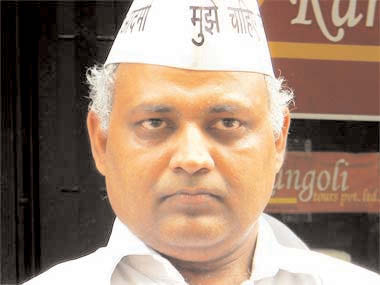
  • AAP Leader Somnath Bharti gets bail in the domestic violence and attempt to murder case

    AAP Leader Somnath Bharti gets bail in the domestic violence and attempt to murder case

    AAP leader Somnath Bharti on Tuesday, Sep 6, termed the domestic violence and attempt to murder case against him as a “BJP-sponsored litigation” and had sought bail again before a Delhi Sessions court.

    Additional Sessions Judge Anil Kumar after hearing the arguments on bail yesterday had reserved the order and granted him bail today.

    During an over two-and-a-half hearing on bail plea, advocate Vijay Aggarwal appearing for Bharti claimed it was a case of an “on-and-off relationship” which was blown out of proportion due to political motives and alleged that it was a “BJP-sponsored litigation”.

    “I am an MLA and have to look after the work of my constituency. I have deep root in the society and if granted bail, I will not flee from the justice…Everyone recognizes me where will I escape,” he said.

    “I will join the investigation as and when called by the Investigation Officer and there is no point of influencing the witnesses. If court wants, it can bar me from leaving Delhi or it can confine me at my residing place that is Malviya Nagar constituency,” the lawyer said.

    While citing some transcripts of recorded phone calls and SMSs exchanged between Bharti and his wife Lipika Mitra, he said “the dog in question ‘Don’ was being fed by Lipika, then how can it bite her? She also kept wearing all the jewellery, which meant these were with her.”

    The lawyer also alleged it was Lipika who had threatened to cut herself after which Bharti had called her mother and brother to intervene and settle the matter.

    “Both (Lipika and Bharti) kept on talking in normal terms even after the complaint and FIR was registered. This shows that everything was normal,” he said.

    Opposing Bharti’s plea, Additional Public Prosecutor Shailendra Babbar said when Bharti was not in police custody he tried to misuse his liberty.

    Maintaining that Bharti’s conduct has been “very dubious”, the prosecutor asked “what would he do if he is granted bail.

    “In case he is enlarged on bail, he would influence the witnesses as he is a very influential man. There are witnesses who are not coming forward to depose because of his influence. Granting him bail will hamper investigation which is at a primitive stage,” Babbar said.

    The AAP MLA was arrested in the wee hours on 29 September after the apex court ordered him to surrender.

    Bharti had on 23 September moved the apex court seeking protection from arrest in the case and a direction to restrain the police from arresting him till his plea challenging the High Court order was decided.

    The Supreme Court, however, had on 1 October denied interim bail to AAP MLA and sought the presence of his wife before it to explore the possibility of mediation.

    On 22 September, the Delhi High Court had rejected Bharti’s plea for anticipatory bail, observing that the allegations against him were backed by “documentary proof”.

    Terming the allegations against the legislator by his wife as “very serious”, the high court had said she has been tolerating his “cruelty” and “brutal assault”.

  • Go Beyond Rhetoric | Systemic coordination is required for Swachh Bharat

    Go Beyond Rhetoric | Systemic coordination is required for Swachh Bharat

    In one year the Swachh Bharat Mission has created a buzz in the urban areas about the need for sanitation, thanks to an increased spending on advertising, but a systemic plan to clean India is not yet in place, leave alone concrete results on the ground. One of Narendra Modi’s key projects, it is not much different from Nirmal Bharat Abhiyan and the Total Sanitation Campaign of the past. With his cultivated gift for marketing, the PM has managed to bring the subject to national attention. Rhetoric apart, the Modi government reduced the budgetary spending for the clean India campaign from Rs 4,260 crore in 2014-15 to Rs 2,625 crore in the latest budget, hoping to meet the funding gap through a Swachh Bharat cess and corporate social responsibility contributions, and by coaxing states to chip in. This makes the fund flow uncertain.

    Secondly, there is no assessment of the magnitude of the challenge. The only data available for Swachh Bharat is about the number of toilets built and the money spent. Of the six crore toilets constructed in the past one year, 1.3 crore are defunct, according to media reports. Other requirements like sewerage, waste treatment and disposal, and water supply have not been made available along with toilets. To provide end-to-end solutions, coordination is important among various Central and state departments. The Union Ministry of Drinking Water and Sanitation looks after sanitation in the rural areas and the Ministry of Urban Development in the urban areas, while the HRD Ministry builds toilets in schools. There are separate plans for smart cities and smart villages. All these require coordination and the pooling of resources.

    Concepts of sanitation are deeply rooted in a society’s cultural values. However, public health experts are unanimous that sanitation, or lack of it, is linked to infant mortality, malnutrition, cognitive development and economic productivity. Three lakh children are lost to diarrhea every year. States have yet to realize the importance of sanitation. It is treated as a Central hobby-horse. Even the BJP-ruled states have not shown particular enthusiasm for the PM’s pet project.

  • Learn ABC of the Grammar of Governance

    Learn ABC of the Grammar of Governance

    During his US visit, Prime Minister Narendra Modi conveyed to his audience: “Reform in governance is my No 1 priority. We are for simplified procedures, speedy decision making, transparency and accountability.” As the Chief Minister of Gujarat, Modi was a
    “governance”addict. On his assuming Prime Ministership, “governance” became India’s flavor and the Center’s guiding mantra. The stated objective was to have a “governance architecture” that put people at the centre of the development process. The President’s address to Parliament in June last year also laid down the motto: “Minimum government, maximum governance”.

    However, even after 16 months there is no such governance architecture or blueprint. In the upper echelons of decision making, there is mixup of government and governance, as if both are the same. They are not. Governance is not just government; it is bureaucracy, laws, rules, policies, programs, processes and procedures. It is far more than that. In a democracy like India, governance should be “society-centered”. It should include the government, which is its dominant part, but transcend it by taking in the private (farming, business, industry) and voluntary sectors (civil society). All the three are critical for sustaining human, economic and social development.

    Governments create a conducive political, administrative, legal and living environment. The private sector promotes enterprise and generates jobs and wealth, while the voluntary sector educates and mobilizes citizens’ groups to participate in economic, social and political activities. Each has weaknesses and strengths, so governance is facilitated through a constructive interaction among all three. While government is a politico-bureaucratic entity, governance is a joint venture encompassing all. The difference is huge.

    Being a joint venture, governance should adhere to the basic functional norm of involving stakeholders in decision-making and implementation processes. The Modi government made a false start by putting out a “secret” Intelligence Bureau report condemning several civil society organizations and eminent opinion leaders who differed from government policies as “anti-national” and accusing them of thwarting India’s development! Since then, many NGOS are being harassed by abusing the Foreign Exchange Management Act and other laws. The voluntary sector, except the RSS as well as its affiliate “think-tanks” and individuals, are out of the reckoning as far as “governance” is concerned. As for farmers, they are treated more as mendicants than partners. The elitist vision of the BJP and its leader is replete with bullet trains, state-of-the-art highways, smart cities, insulated industrial corridors and “Digital-India.” These are far removed from the deprived lives of a majority of farmers. Agriculture, which accounts for 60 per cent of India’s population, and from where the poorest draw sustenance, is only an add-on in the scheme of things. In business and industry, it is “big-is-bountiful” and “small-is-not-beautiful”. This has been demonstrated during Modi’s high-profile foreign visits and the mad hunt for big-ticket FDIs. Last year, on the launch of the “Make-in-India” campaign at Delhi, about 10 big industrialists on the dais pledged to invest billions of Rupees. The same scenario was repeated while kick-starting the “Digital-India” initiative and billions were again promised. As if only big-ticket investors alone are “partners in development.” The grammar of good governance is about socio-economic harmony, arising out of the smooth interface between government, civil society, farming and business communities. Unless this is achieved across the board, no amount of reforms can bring about achche din. As to “minimum government, maximum governance,” David Thoreau wrote over a century ago: “That government is the best which governs the least.” Conversely, “that government is the worst which governs the most.” The latter seems to be true of India. The Union Territory of Chandigarh is also a case in point. From 1952 to 1966, Chandigarh was the capital of Punjab and its citizens were represented in the state’s Legislative Assembly. A Chief Commissioner headed the local administration. When the undivided Punjab was divided, both Punjab and Haryana claimed the new city for its capital. Pending the resolution of the issue, Chandigarh was made a Union Territory, with its administration functioning directly under the Centre. While the UT lost representation in the Assembly, it has a Member of Parliament. Till May 31, 1984 Chandigarh had an Administrator designated as the Chief Commissioner. On June 1, 1984, the Governor of Punjab took over as the Administrator and the Chief Commissioner was re-designated as the Adviser to the Administrator. This was a prelude to Operation Blue Star.

    The stated reason was to facilitate “co-ordination” between the districts of Punjab and the capital in Chandigarh. This ad hoc measure became permanent. The Governor of Punjab is the head of the UT Administration, though it is the Adviser who runs the show. The Municipal Corporation of Chandigarh (MCC) came into existence on May 24, 1994. Several functions were transferred from the Chandigarh Administration to it through notifications issued on September 28, 1995 and May 16, 1996. The elected body of the MCC came into being in December 1996. The first thing it did was to stall the decision to levy property tax on commercial and residential buildings in the city, thereby triggering a duel between the UT Administration’s bureaucratic and political wings that continues till date. The transfer of functions was a half-hearted affair. The bureaucratically run Chandigarh Administration  retains the bulk of the assets, including near-total control of funds and resources. Chandigarh has five governments/power centers: The Union Home Ministry, the Punjab Raj Bhavan, the UT Secretariat, the MP and the MCC. Things have been falling between several stools. In Chandigarh, Modi’s motto looks reversed to “Maximum government, minimum governance”!

    By M.G. Devasahayam (The author is a former IAS officer of Haryana Cadre, now settled in Tamilnadu)

  • Jaitley releases ‘Vision Document’ for Bihar poll

    Jaitley releases ‘Vision Document’ for Bihar poll

    PATNA (TIP): Taking a potshot at the ‘Grand Alliance’ of the RJD, JD(U) and Congress in Bihar, BJP leader Arun Jaitley today said they were running a “three-legged race” that cannot be won even as he warned voters of “anarchy” and “jungle raj” if the rival coalition came to power.

    Releasing his party’s ‘Vision Document’ for the upcoming Bihar Assembly poll, Jaitley also promised that the BJP-led National Democratic Alliance (NDA) would help bring the state out of its backwardness and put it on the path of progress and development as had happened in Madhya Pradesh under the BJP rule.

    Charging that the grand alliance was a contradictory coalition, he said, “Participants of the grand alliance are opportunists. Political consistency is not their virtue. There can be no other result but to push Bihar into anarchy in case they win.”

    Jaitley, the Union Finance Minister, said that while one could never comprehend an alliance between the BJP and Congress, it was even more difficult to imagine the followers of Ram Manohar Lohia joining hands with the Congress given their differing thoughts and ideologies.

    “We see such political inconsistency and such a contradictory alliance. A three-legged race cannot be run and even if it is run, it cannot be won,” he said.

    Jaitley also attacked Bihar Chief Minister Nitish Kumar, saying that he had allied himself with the creators of ‘jungle raj’.

    Despite Kumar having won the last three polls in Bihar on the promise of freeing the state from ‘jungle raj’, Jaitley claimed that nothing would change under a coalition of which Lalu Prasad was a part.

    He also slammed Lalu Prasad for his attack on the BJP over the reservation issue in the wake of RSS chief Mohan Bhagwat’s call for a review of the quota policy.

    “The RJD knows it cannot win on the issue of development and that is why it is trying to divide society over other issues,” alleged Jaitley.

    Talking about the ‘Vision Document’ for Bihar, he said it was for ushering in development in the state through the creation of roads and infrastructure, agro-based industry and employment opportunities. He also talked about Bihar’s rich human resources and agriculture to propel such progress.

    “The Centre will always stand behind Bihar to help it. If a BJP-led government is formed in Bihar, which we hope will happen, Bihar will rewrite its history,” he said.

  • CASTE IN MIND, BOTH ALLIANCES DECIDE TICKETS

    CASTE IN MIND, BOTH ALLIANCES DECIDE TICKETS

    NEW DELHI (TIP): Prime Minister Narendra Modi and Bihar Chief Minister Nitish Kumar may refrain from invoking caste in the Bihar polls and choose to talk development, but getting the caste equation right seems to have been the principal factor in ticket distribution by the rival alliances.

    If the forward castes have walked away with about 86 seats of the 214 for which BJP-led NDA has named its candidates so far, the Grand Alliance has given 63 seats to Yadavs alone as it tries to ensure that the state’s most numerically strong caste continues to back it.

    The upper castes do not constitute more than 14 per cent of the electorate but the NDA has allocated them 40 per cent of the seats so far, an indication of its reliance on them in a state where they form the core support base of BJP.

    With BJP making concerted efforts to lure Yadavs and giving them 22 seats, RJD’s Lalu Prasad has gone out of the way to keep them on his side and allotted 48 seats from his party’s quota of 101 to the backward community.

    Forming about 12-14 per cent of the population, Yadavs’ solid support is key to the Nitish-Lalu combine’s efforts to retain power.

    Interestingly, Muslims, who are about 17 per cent, seem to have got a raw deal not only from NDA but also the Grand Alliance whose leaders have traditionally enjoyed strong support among them.

    RJD and JD-U together have given them only 23 seats out of the 202 they are fighting.

    Sources in both parties claimed it was done as they apprehended communal polarisation if the minority community got “high visibility”. NDA has given Muslims only 9 seats so far.

    Congress has named 10 Muslim nominees out of the 41 seats it is contesting in alliance with the two Bihar satraps. The competition between the two alliances to win over Mahadalits, who have so far backed Mr Nitish Kumar and are now being wooed by NDA’s Jitan Ram Manjhi, and extremely backward castes show in ticket allocation with both of them giving away large number of seats to these groups.