Tag: BJP

  • Survey gives BJP, allies 154 seats in Maharashtra

    Survey gives BJP, allies 154 seats in Maharashtra

    NEW DELHI (TIP): A survey carried out in Maharashtra ahead of the October 15 assembly elections has given BJP and allies 154 of the 288 seats, but Shiv Sena leader Uddhav Thackeray tops the popularity chart as chief ministerial candidate.

    Incumbent Prithviraj Chavan is the second choice for chief minister though his party Congress is predicted to get an abysmally low 25 seats.

    Percentage wise, BJP has been placed way ahead of its rivals by 36.50 per cent votes followed by 17.10 per cent of Shiv Sena and 11.97 per cent of Congress.

    The survey conducted by ‘The Week’ and Hansa Research, paints a gloomy picture for Sharad Pawar’s NCP, which is projected to get only 17 seats and 5.85 per cent votes.

    Pawar is the fifth choice for the chief minister’s post and stands behind MNS leader Raj Thackeray and BJP’s Devendra Fadnavis.

    Shiv Sena is predicted to be the second largest party after BJP with 47 seats, while Maharashtra Navnirman Sena, according to the survey, is likely to get 10 seats. MNS is predicted to get 5.11 per cent votes. The survey has given 20 seats to Independents with 4.71 per cent votes and 15 to other parties with 6.79 per cent votes.

    After 15 years of running coalition government in Maharashtra, Congress and NCP have parted ways and BJP-Shiv Sena’s old alliance has also fallen apart paving the way for a five-cornered contest, with MNS being the fifth player which has recently made noises favourable to Shiv Sena.

    BJP is going to polls with smaller “Mahayuti” allies. It has worked out a seat-sharing deal with Mahadeo Jankar’s Rashtriya Samaj Paksha, Raju Shetty’s Swabhimani Shetkari Paksha, Shiv Sangram and RPI.

    PARTIES IN THE FRAY
    BJP, SHIV SENA, NCP, CONGRESS & MNS

  • CEASE FIRE

    CEASE FIRE

    Both sides need to serve national interest, not pride

    The Indian Defense Minister has warned Pakistan if it persists with its ‘adventurism, our forces will make the cost… unaffordable’. With a heavier Indian presence along the border, the cost has already become unaffordable for Pakistan. Unfortunately, with a weak government there and a military establishment that has an axe to grind, few in Pakistan are likely to be bothered by the cost in terms of civilian or even military casualties. That is the dynamics that has determined India-Pakistan relations, post Musharraf. As to what exactly is happening on either side of the border is hard for anyone not inside the top security echelons to know. But who fired the first bullet is not what matters. What matters is who has the confidence to hold fire, even momentarily, to give ceasefire a chance. The government in India is stable and secure, headed by a Prime Minister against whom one charge that cannot be leveled is of being weak or unsure. In fact, ever since Modi took over, the Indian response on the border has been unusually strident. Certain utterances by the Home Minister, or even the Defense Minister and a few other BJP leaders, referring to a changed and strong government in India are, therefore, jarring. It gives the impression that some of the decisions may be determined by the fact that the BJP leadership wants to be seen as strong, and not guided purely by security calculations. India may have the ability to respond overwhelmingly to any military initiative by Pakistan, but it stands to suffer on many counts in Jammu and Kashmir, which has seen a relatively peaceful period and is going to the polls. On its part, the Opposition too has been making matters worse by saying the government is doing nothing.

    Civilians are dying on both sides, and that is not collateral damage, as both armies would have us believe. It is targeted firing, and is doing good to neither side. As things stand, only one side has the stature to exercise restraint. India has sent Pakistan the message that needed to be conveyed. Now let us not make the message the news.

    (The Tribune, Chandigarh)

  • GOVT PLANS DIAMOND HUB IN MUMBAI

    GOVT PLANS DIAMOND HUB IN MUMBAI

    NEW DELHI (TIP): The government is discussing a plan to set up a special zone with tax benefits for diamond import and trading in Mumbai, to try and develop the country’s financial capital as a rival to Antwerp and Dubai, which are currently trading hubs for the precious stone.

    Commerce & industry minister Nirmala Sitharaman held preliminary discussions with commerce secretary Rajeev Kher and revenue secretary Shaktikanta Das last week and asked officials to work out a possible road map, sources familiar with the development said.

    Gems & Jewelry Export Promotion Council’s (GJEPC) estimates suggest that in volume terms, 85% of the global cutting work takes place in India. At the same time, around 15% rough diamond is imported directly from the producing countries, while a majority is shipped in from the trading hubs.

    “A trading hub in India will mean that the role of middlemen is limited and the concerns over invoicing, that we often hear from tax authorities, are reduced,” said Parag Parekh, vice-chairman of GJEPC, which is pushing the plan. Parekh said the Bharat Diamond Bourse in Mumbai’s Bandra Kurla Complex has been suggested as a possible option.

    An official, however, said discussions on the likely location have not yet started and initially the government is looking at the package of measures that may be needed. The move to set up a special notified zone was first proposed by a task force headed by Anup K Pujari, the then director general of foreign trade, but the UPA failed to decide on it, prompting the BJP government to revisit it.

    An official said the move may help check China’s growing influence in the area as some Chinese companies had started acquiring shares in mines in Africa and are also pursuing direct deals with governments there for the supply of rough diamonds.

    The task force had suggested several tax-related moves, including duty-free re-import quota for cut and polished diamonds up to a specified level and fixing the net income, while allowing payment of taxes only on invoices raised to Indian companies. Similarly, easier valuation norms at ports had also been recommended. The task force had also suggested a shift to a presumptive taxation regime in the long run, with easier rules introduced for the time being.

  • BJP poised to create history in Haryana elections: Survey

    BJP poised to create history in Haryana elections: Survey

    NEW DELHI (TIP): A new poll shows that the Bharatiya Janata Party (BJP) is likely to score an outright win in the upcoming assembly election of Haryana on the back of a Modi wave. If it does win, it will be the first time for the BJP, which has had a poor record in assembly elections in the state (barring the period between 1977 and 1979 when it was a part of the Janata government in the state). The survey, conducted by Instavaani, a high-speed polling technology of the Bangalorebased Fourth Lion Technologies, reveals that prime minister Narendra Modi’s appeal to voters has carried over from the general election. To be sure, the poll was restricted to urban Haryana— the 2011 Census pegged the proportion of urban population in the state at 34.79%. Experts say that if the survey is any dipstick of BJP’s fortunes in state, it would be a unique win considering the party has no local face in the state, has been power at the centre for less than five months and has campaigned solely on the strength of the Modi brand. The BJP is facing off against the Indian National Lok Dal (INLD) and the Congress, the party that has ruled the state for 10 years and faces significant anti-incumbency, according to the experts. Instavaani polled 1,181 respondents in 20 urban constituencies of the state, and 46% of the respondents said they would vote for the BJP. While only 17% said they would vote for the incumbent Congress in the state, 10% claimed they would vote for Om Prakash Chautala-led INLD. Significantly, the survey was carried out on 8 October, a day after the prime minister completed all his election rallies in Haryana. According to the survey, corruption allegations against the Bhupinder Singh Hooda-led Haryana government and Modi’s election rallies (he has held over a dozen in the state) are the two main reasons for BJP’s “substantial margins” in the state. Experts concur. “The two factors— allegations of corruption against the Congress party and the effect of Modi’s rallies—fit very much into the narrative of the voter choices in the national elections. Even during national elections, our findings showed that people were not ready to trust the Congress,” said Manisha Priyam, a New Delhi-based political analyst. She is also the India coordinator of the London School of Economics’ EECURI (Explaining Electoral Change in Urban and Rural India) project. “In Haryana too, we are seeing something similar. The charges of corruption against the ruling state party are creating a mood for change and the BJP seems to be the only option which may benefit from it, given the INLD too is facing the same allegations as the Congress,” Priyam added. Chautala, a former chief minister, has been convicted and sentenced to a 10-year jail term in a corruption case involving the recruitment of teachers for government schools. He is campaigning while on bail for medical treatment. The survey also showed that voters in Haryana preferred the same party in the state and the centre. In the outgoing assembly, the Congress has 40 seats, INLD 31, the Haryana Janhit Congress (BL) six and the BJP only four. Haryana goes to polls on 15 October, with more than 16.31 million voters set to elect 90 legislators. The results will be announced on 19 October. Priyam added: “If the BJP wins these elections without a local leader in the state, that would be a tectonic shift in India. No political party, including the BJP, has ever won state elections without a local leader.”

  • No Poll Code Violation in Haryana Nod to Vadra-DLF Land Deal, says EC

    No Poll Code Violation in Haryana Nod to Vadra-DLF Land Deal, says EC

    NEW DELHI (TIP): A controversial land deal involving Robert Vadra, son-in-law of Cong chief Sonia Gandhi, which was sanctioned recently by the Haryana government does not violate election rules, the powerful Election Commission has decided.

    Haryana, ruled currently by Gandhi’s party, votes on October 15 for its next government.

    In a recent election rally in the state, Prime Minister Narendra Modi said the Election Commission should scrutinise the deal, which, he alleged, was pushed through in a hurry to benefit Vadra.

    “Despite the Model Code of Conduct, the son-in-law was given land. They know after the results he won’t be given anything,” the Prime Minister had said. “The Election Commission should take cognizance and appropriate action in this regard.” (In Haryana Campaign, PM Modi Brings Up Vadra Land Deal)

    The PM’s party, the BJP, had described the legitimization of the deal between Mr Vadra and real estate major DLF as “a parting gift” from the state’s Congress government to the party’s First Family.

    Haryana Chief Minister Bhupinder Singh Hooda said Mr Modi’s speech was “factually incorrect and far from the truth,” and the deal was cleared following proper procedure in July before model code of conduct kicked in.

    The deal had been described as illicit in 2012 by senior Haryana bureaucrat Ashok Khemka, who alleged that the rules were being bent for Mr Vadra on account of his hefty connections. Khemka cancelled the mutation of the 3.5 acres sold by Vadra in 2008 to DLF — the mutation means the land title is officially transferred in local records to register the new owner. He was transferred three days later. The Haryana government said an inquiry had found his allegations to be baseless. In July this year, the mutation was sanctioned by the state government.

    Congress seeks PM’s apology

    The Congress on October 9 stepped up attack on Prime Minister Narendra Modi demanding an “apology” from him as Election Commission ruled that there was no violation of model code of conduct by the Haryana Government in clearing the land deal involving Robert Vadra. Party spokesperson Anand Sharma alleged that Modi was “embarrassing” the position of the Prime Minister by repeatedly making “false allegations” and he should stop doing it. “BJP has egg on its face after the EC’s order. Narendra Modi, being the Prime Minister of the country, gave a very irresponsible statement and made allegations against Haryana Chief Minister Bhupinder Singh Hooda. Will the Prime Minister now seek apology from the Chief Minister and people of Haryana for making wrong statements,” Mr. Sharma told reporters here. Maintaining that it
    “belittles” the high post if somebody in the seat of Prime Minister keeps making false allegations, the Congress spokesperson said, “Modi should apologise to Haryana Chief Minister.” Election Commission had on Wednesday ruled that there appears to be no violation of the model code of conduct by Haryana government in clearing the land deal between Sonia Gandhi’s son-in law Robert Vadra and real estate major DLF.

  • Featured: He CAME, he SPOKE, he CONQUERED

    Featured: He CAME, he SPOKE, he CONQUERED

    NEW YORK (TIP): Yes, it is Narendra Modi, Prime Minister of India. All Indian Americans are familiar with that name, for good or for bad, mostly for good, though.

    Modi was in New York from September 26 to 29th afternoon, before he left for Washington to enjoy the hospitality of US President Barack Obama in the evening and a bilateral talk the next day, before flying back to India.

    Much before he arrived in the US, Indian Americans had set out to give him a hero’s welcome. A trusted friend of Modi, Dr. Bharat Barai, was tasked with arranging a massive community reception to Modi which he did, with the help and cooperation of a devoted band of people. It was a colossal effort to have around 20,000 people come to Madison Square Garden to give a rousing reception to Modi, an icon for many, particularly from his community and place, Gujarat, a state which he governed with appreciable growth for around 12 years.

    And why not! Modi was coming as Prime Minister of India to a country which had denied him a Visa since 2005 for his alleged role in not preventing killings of people from a particular community in Gujarat when he was the chief minister of that state in 2002. His admirers here gloated that US had no option but to welcome him now that he was coming to the United Nations as India’s Prime Minister, whose party had got a massive support of the people of India and was catapulted in to power, with total command over government, without having to depend on allies’ support as was the case when Atal Behari Vajpayee formed a BJP led government in 1999 which lasted its full term of 5 years, to 2004.

    So, here was a man who represented a democratic country -the largest democracy in the world- with 1.25 billion people. How could the US ignore Modi whose country was poised to become an Asian giant and the second largest economic power in the world by 2050? No way! So, Obama invited Modi over to the White House for a private dinner. It was another matter that the invited dignitary was fasting on account of Hindu festival of Navratras and he would not eat. By the way, Modi has been observing Navratra fasts for the past 40 years, insiders said.

    So, Prime Minister Narendra Modi arrived on September 26. He was given a rousing welcome at the JFK airport in New York. My good friends, Narain Kataria, Arish Sahani and Jagdish Sewhani arranged to have a large number of people gather at the airport to give a warm welcome to Modi. So, we had the chant of “Modi, Modi” which surely pleased the man, given to showmanship, which explains his admiration for film actors, like Amitabh Bachchan, and of course, some others.

    And while in New York, Prime Minister of India, Narendra Modi left no one in doubt that he was a better performer than any in the world. A perfect juggler, a consummate magician, a pied piper of India.

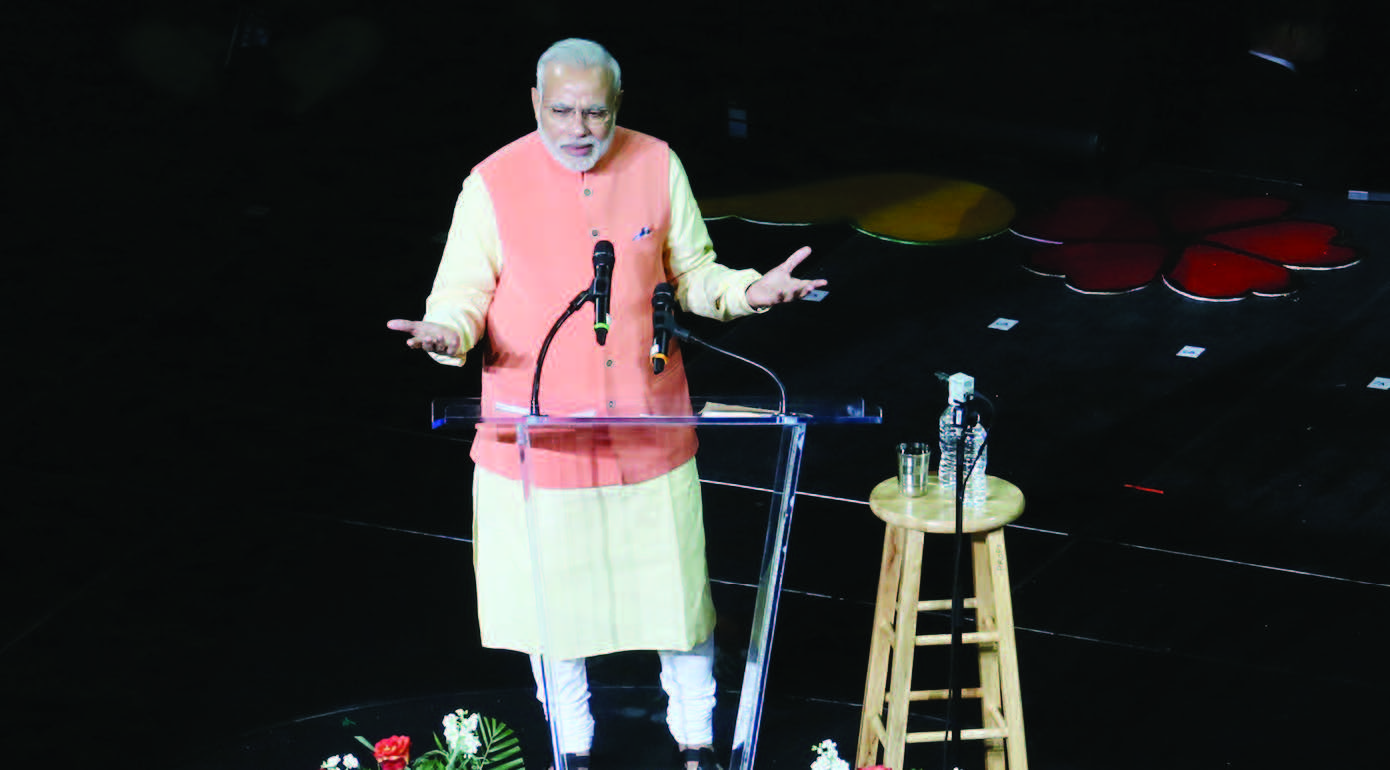
    I found many acknowledging Modi’s felicity of expression which allowed him to connect with people immediately. He speaks in the language and diction that people at all levels commonly understand. He relies on simple words and home truths to deliver his ideas home. Again, he has mastered the art of delivery. His body language is extremely expressive and impressive. During the more than 90 minutes speech he delivered at the Madison Square Garden on September 28th, not a soul could have looked at the watch. Not one could have yawned, out of boredom. None would have thought of anything but what Modi was saying. The eyes of all remained fixed on the man in the center of the arena. Such was the grip of the man. And whatever he said seemed to come straight out of his heart. He pumped into his speech his heart, his mind and his vocal cords-delivering the “very best”.

    Now see what he said. First, India can and will achieve the greatness that it once had. Second, we have a huge human resource capital in the form of a young India, with 60% of population under the age of 35. No other country in the world has such human resource. Third, we have brains. Example, our scientists succeeded in the Mars mission in the first attempt itself, a feat which even US could not perform. Modi took pride in mentioning that India’s Mars mission cost peanuts when compared with the money spent by countries like USA on similar missions.

    Yes, we can. But how can we do it? He did offer Namo Mantra for that. He spoke of the defects in the system in the country and said the system that stood in the way of quick progression had to be demolished. He spoke of the futile, cumbersome and irrelevant laws which needed to be consigned to dust bin. He spoke of the massive investment required for development. And he invited Indian Americans as also the whole world to come and invest in India. Also, he gave a call to “make in India”.

    Modi was particularly appreciative of the Sikhs, in his speech. He spoke of the great sacrifices the Sikh Gurus had made. He also recalled the sacrifices of the Sikhs in the freedom struggle of India. He spoke of the brave Sikh soldiers in the Indian armed forces and said the nation is proud of the Sikhs who have always stood by their motherland, come what may.

    Modi simply created a vision. He came up with ideas that won attention and admiration of many. He wove dreams that all would love to own. He assured the gathering of around 20,000 at the famous Madison Square Garden which somebody christened as “Modison” Square Garden that India was on a fast track to development. Then he made some announcements to please the locals, too. He told them he was taking care to ensure there is no harassment at the airports in India of Indian Americans visiting India. He also said he knew of problems with getting visas. He said there will be no delays any more in obtaining a visa. Also, he said the clubbing together of OCI and PIO was being worked out and soon the problems arising out of OIC/PIO will be over. He also announced visa on arrival for US nationals on the pattern of some 9 countries whose citizens are entitled to get tourist visa on arrival in India. Surely, the local crowd was pleased.

    The magician Modi wielded his wand for more than 90 minutes and left the gathering charmed and captivated. Yes, he came, he spoke , he conquered the hearts of Indian Americans who had come from far and near to have his darshan and hear him speak. But before he left, the gathering burst in to Modi chant, just as it had when he had arrived. And, believe me, Modi must have enjoyed the chant. The “Modi” chant must have been music to his years.

    During the course of his stay in New York from 26th September to 29th September afternoon, Modi attended a large number of events, met a number of people from all walks of life which included world leaders, his counterparts from neighboring countries Sri Lanka and Nepal, US lawmakers and officials, captains of business and industry, community leaders, religious leaders and eminent people- both Indian Americans and others, and discussed a variety of issues.

    We bring our readers here a few pictures of Modi’s New York visit. All pictures have been provided by The Indian Panorama special photo journalist Mohammed Jaffer.

    Modi pays homage to victims of 9:11 at the 9:11 memorial at ground zero on September 27th 2014.

    Prime Minister Modi speaking at Global Citizens Festival at Central Park in NYC on 27th September, 2014

    Modi addresses the 69th United Nations General Assembly. He called for a relentless fight against terrorism and the Security Council

    Madison Square Garden on September 28

  • BJP TO ROLL OUT BIG GUNS FOR ASSEMBLY POLLS

    BJP TO ROLL OUT BIG GUNS FOR ASSEMBLY POLLS

    NEW DELHI (TIP): With Dussehra over, BJP will get into campaign mode for the Haryana and Maharashtra assembly polls on a war footing.

    Prime Minister Narendra Modi and his senior ministers will have little time for anything else, criss-crossing the two states over the next two weeks, addressing rallies. BJP plans to hold at least four big rallies a day in each state till campaign ends for the October 15 polls.

    Modi will begin his charge on Saturday morning from Karnal in Haryana and move to Maharashtra to address three rallies in Beed, Aurangabad and Mahalakshmi (Mumbai). The PM will address 8-10 rallies in Haryana and around 22 in Maharashtra.

    Two senior ministers — home minister Rajnath Singh and external affairs minister Sushma Swaraj — will be all over Haryana on Saturday, holding four rallies each in the state. Singh will be at Radaur, Kalayat, Julana and Jakholi Rai while Swaraj will address rallies in Kalka, Thanachhapar, Shahbad and Gohana. Singh will address about 15 rallies in each state.

    The party has decided to have Swaraj, who belongs to Haryana, focus on the state where BJP is contesting on its own and is aiming to replace the Congress government. Similarly, road transport minister Nitin Gadkari has been asked to concentrate on Maharashtra, his home state, where BJP is contesting without its 25-year-old partner Shiv Sena this time.

    Swaraj is scheduled to address about 22 rallies in Haryana and will be in Maharashtra only for a day on October 6, attending three rallies. She will take a break from campaigning as she is travelling abroad between October 8 and 10. Gadkari is expected to address about 36 rallies in Maharashtra.

    Party veteran L K Advani will address six rallies in Maharashtra and two in Haryana, while Murli Manohar Joshi will address two rallies in Maharashtra and one in Haryana.

    Urban development minister M Venkaiah Naidu is slated to spend four days in Maharashtra and two in Haryana. Other ministers who will address a few rallies in both states are chemical and fertilizer minister Ananth Kumar, HRD minister Smriti Irani and social justice minister Thawar Chand Gehlot. Party chief Amit Shah will address about 15 rallies in each state.

    The party has roped in all its chief ministers to ensure its good governance campaign is showcased. Goa CM Manohar Parikkar will focus on Maharashtra while Madhya Pradesh CM Shivraj Singh Chouhan will spare three days for Maharashtra and one for Haryana. Rajasthan CM Vasundhara Raje has three days in Maharashtra and two days in Haryana, Chhattisgarh CM Raman Singh and Gujarat CM Anandiben Patel will each spend two days in Maharashtra. On an average, the chief ministers will address three rallies a day, party vice-president M A Naqvi said.

    Not to forget its star power, BJP has roped in actor-turned-MPs Hema Malini, Vinod Khanna and Shatrughan Sinha to campaign in both states.

  • Govt slammed over live telecast

    Govt slammed over live telecast

    The live telecast of RSS chief Mohan Bhagwat’s address in Nagpur by Doordarshan today stoked a controversy with opposition slamming the government for “misusing” the state broadcaster while BJP defended it.

    Congress spokesman Sandeep Dikshit termed the hour-long telecast as a “dangerous tradition”, saying RSS is a controversial religious and political organisation.

    “It is a dangerous tradition. This is not an organisation which is completely neutral. It is a controversial organisation,” he said, adding it is a political decision of the government.

    His party colleague Abhishek Manu Singhvi feared that from now on, the country would be ruled through the official media “for Nagpur, by Nagpur and of Nagpur”.

  • SHARAD PAWAR: NO GROUSE AGAINST SONIA, CHAVAN TO BLAME

    SHARAD PAWAR: NO GROUSE AGAINST SONIA, CHAVAN TO BLAME

    PUNE (TIP): NCP chief Sharad Pawar said on October 3 he holds no grouse against Congress president Sonia Gandhi as she was not responsible for breaking the 15-year-old Congress-NCP alliance in Maharashtra. Putting the blame on outgoing chief minister Prithviraj Chavan, he indicated that his party will pose difficulties for his election bid from the Karad South constituency.

    “I found (Sonia) undoubtedly positive about continuing the alliance. I have not even uttered the name of Rahul (Gandhi) in this regard,” he said to journalists’ questions. He was addressing a press conference ahead of NCP’s convention in Pune. NCP has withdrawn its candidate from Karad South, but party workers say they will support sitting Congress MLA Vilasrao Patil-Undalkar, who is contesting as an independent. Pawar said, “I felt my party should not contest against the (former) CM. Undalkar has requested our support. A decision will be taken at the local level.”

    The NCP chief ruled out joining hands with BJP to form government. “We have been hearing these rumours since 1999… Our target is very clear. We want a clear majority in the state,” he said. He said the new generation of politicians had no communication between them. “I had a good personal rapport with Bal Thackeray. But today, I have no communication with the current generation of Thackerays. There is a generation gap.”

    On irrigation schemes, he said some people were creating a false impression about them in the state. “The state government had to go ahead with the projects to claim its right over water. Project cost increases if there are delays,” said the NCP president.

  • Chautala meets supporters despite Delhi HC notice

    Chautala meets supporters despite Delhi HC notice

    JIND (TIP): Former Haryana chief minister Om Prakash Chautala, out on bail on health grounds, met his supporters, days after he and the CBI were put under notice by the Delhi high court on a plea seeking directions to the politician to surrender. Indian National Lok Dal (INLD) chief went to residences of his supporters in Jind besides visiting the party’s election office.

    INLD is fighting a battle for the October 15 assembly polls in alliance with Shiromani Akali Dal (SAD) after being out of helm of affairs for a decade. “Chautala arrived here last night. He met party workers and this morning left for Uchana to take a round of the village,” said a party spokesman.

    Chautala, however, maintained distance from the media. At the residence of an INLD supporter in the city he had breakfast. His supporters were seen touching his feet and offering him garlands. Chautala also visited the residence of a BJP leader on Gohana road where two saffron party politicians announced that they are joining the INLD.

    Ucahana in the Jat heartland from where his grandson and country’s youngest MP Dushyant is fighting his maiden assembly battle against Congress-turned -BJP leader Birender Singh’s wife Prem Lata.

    On October 1, the Delhi high court had issued notice to CBI and Chautala after senior advocate Vivek Tankha appearing for the petitioner lawyer contended that Chautala intends to
    “misuse the grace period of 17 days given to him to surrender” by planning to campaign during the period. While issuing notice to CBI and Chautala, the court had questioned, “Why has CBI not taken note of all this (election campaign)? CBI does not seem to be aggrieved by this.” The court also questioned the maintainability of the application. The petition had also contended that Chautala is “misusing the orders of the court and taking the court for a jolly ride, thereby abusing the process of law”.

    According to the petition, Chautala, who has been convicted and sentenced to 10 years jail term in a teachers’ recruitment scam case, was granted bail on medical grounds on May 21, 2013 and since then he has been out by extending it on the same ground.

  • INDIA’S FARM SOPS UNDER LENS AT WTO

    INDIA’S FARM SOPS UNDER LENS AT WTO

    NEW DELHI (TIP): The United States and Pakistan have questioned several of India’s farm trade policies, including its land holding laws and the subsidy mechanism at the World Trade Organization, which is the latest assault being faced by the country after it raised the red flag over domestic support to farmers in Bali.

    Since the Bali ministerial meeting last December, WTO members have repeatedly put the lens on India’s farm sector policies, especially those related to exports and the scrutiny has only gone up since the BJP government blocked a deal on trade facilitation this July, arguing that it will not back it till concerns over domestic support for public stockholding are sorted out.

    In a document released by WTO on Wednesday, Australia and Brazil’s attempts to get some answers to their concerns over the export subsidy for sugar once again come through. In a detailed questionnaire, they not only asked about the support that is provided, but Australia has reiterated that the subsidy is not compatible with WTO rules.

    Similarly, the US and Canada have expressed concern over India exporting subsidized wheat and the Americans have even given a detailed cost analysis, which includes calculations from Comptroller & Auditor General’s report. The government has, however, parried the questions and did not disclose the data, arguing that the tender process was underway.

    In fact, several countries have blocked India’s attempts to push through the plan to allow limitless minimum support price (MSP), arguing that it will help it export subsidized grains into the world market, and distort the price. The government has been exporting excess stock of wheat to reduce the burden on overflowing silos, raising fears that subsidized grains are being sold in the international markets.

    Pakistan – which was part of the coalition that was pushing the food subsidy proposal at the WTO but walked out at the last minute – has also alleged that India is following a “double subsidization” process, which means that subsidized inputs such as power and fertilizer are given to farmers along with MSP to offer an assurance to buy the rice and wheat. While India countered it by saying that the policies were in line with the WTO agreement on agriculture, the US and Pakistan have sought detailed data, arguing that India is the largest rice exporter in the world.

    For the US, even the farm holdings and land laws in India are a big area of concern as data released by India has showed that between 2000-01 and 2010-11, there was a spurt in the proportion of land with marginal and small farmers, while the population of those with large farms went down. India has responded by saying that this is due to an increase in the holdings or population with existing hereditary laws.

  • The Making of NAMO

    The Making of NAMO

    A Hindu pracharak becomes Prime Minister of India. Here are milestones in his journey of ascension to the pinnacle of power through landslide election victory in the 16th General Election of the world’s largest democracy.


    arendra Modi was born on 17th Sept 1950 in a middle class family of grocers in the small town of Vadnagar- the Temple Town of ancient India which is Varanasi of Gujarat. The town has a long and varied history. Sharmistha Lake, Hatkeshvar Mahdev and artistic Toran Gate are hallmarks of the past glory of the capital of Anart Province. Chinese traveler Yuan Swang visited this town in the sixth century. Akbar’s music maestro Tansen came to normalcy after listening to perfect Meghmalhar singing of Naggar girls Tana and Riri. Poet Narsinh Mehta ‘s son got married to Vadnagar Naggar Community’s bride here. Small town boy Narendra Modi imbibed the past glory of his birth place in Mehsana district of Gayakwad princely state in Gujarat. Modi became a member of RSS in childhood and acquired deep understanding of Hinduism, reading Hindu Scriptures and literature of Swami Vivekananda. He left home with the consent of his parents at a young age of 17 in search of his life’s mission. He traveled extensively and spent some time in the Himalaya , meditating in the tradition of Buddha who has influenced his life and thought considerably. Returning home after some time, he became a PRACHARAK with Rashtriya Swayamsevak Sangh in 1972. He stayed with his maternal uncle in Ahmedabad and helped him selling common people’s popular drink, tea, a job which he had done before in his father’s tea stall at the Vadanagar Railway station. One astrologer who was dinner guest at their family house in Vadnagar predicted to his mother that some day her son Narendra will either be a great sage of Shankaracharya’s caliber or supreme commander of the nation if he enters politics. Jawaharlal Nehru was supreme commander in Prime Minister’s position in those days in India. Savarkar’s message to Hinduise politics and militarise Hinduism appealed to young Narendra. He worked underground during the emergency period 1975-1977 and went jail briefly.
     

    Then, Jan Sangh adopted a new name BJP after losing partnership in the government with the collapse of Prime Minister Morarji Desai’s government . Narendra Modi actively participated in all activities of BJP especially Advani’s Rath Yatra and Unity pilgrimage of Murli Manohar in 1989-90. He was assigned the responsibilities of General Secretary in Gujarat and subsequently at the national level. Modi acquired mastery in public relations and party organization. His contribution in the capacity of General Secretary was well noticed by party stalwarts Advani and Vajpayee. He did not contest any legislative election and had no experience in any capacity in government when one day in the first week of October, 2001, Prime Minister Vajpayee asked him to be the Chief Minister of Gujarat in replacement of Keshubhai Patel who had received more complaints than complements in his handling of problems in the aftermath of earthquake in Kutch -Bhuj area on the Republic Day in January, 2001.

    A Timeline : 
    October 7,2001 Modi takes oath of office of Chief Minister. He is not a member of the legislative body.
    ● Feb.24,2002 : He is elected from Rajkot constituency . Next day he is officially admitted into membership of Gujarat Assembly.
    ● Feb 27,2002 . At Godhara Station in South Gujarat 59 passengers including women and children are burned down by the terrorist group which praised Bin Laden and his methods of terrorism. Those killed were active members and volunteers of Hindu organizations .In retaliation riots spread in Ahmedabad and elsewhere in Gujarat. Both Hindus and Muslims became targets of each others’ wrath for weeks .Media all over the world gave coverage of these events in their own ways.
    ● April 12,2002 BJP High Command meeting in Goa where discussion on the riots remained major issue, some demanded removal of Modi . Narendra Modi offered his resignation . Prime Minister Vajpayee was not soft towards Modi but Advani was firm on not accepting Modi’s resignation.
    ● July 19, 2002 C.M. Modi dissolved assembly and opted to seek new mandate
    ● December 15, 2002 . Favorable election results: BJP won 127 seats out of 182 assembly seats. Modi took oath for the second time in the presence of the Prime Minister. First time in India, a Prime Minister attended oath ceremony of a state chief minister. The Modi Government received national and international praise for restoration programs of earthquake disaster. Seminars for continuing education for elected assembly members and EGovernance were Modi’s new initiatives. Prime Minister Vajpaiyee invited the dynamic C.M. Modi to be in his entourage of Russia visit. Modi observed keenly Russian growth model . He vowed to make Gujarat a shining super state in India . The first vibrant Gujarat festivity program in 2003 attracted attention of investors . Progress
    Person Modi visited China, Japan and other countries to promote investment in Gujarat.
    ● May 21,2005. Rajiv Gandhi Foundation awarded Modi Government for the most well managed State.
    ● December 25,2007: Modi takes oath for the 3rd time after election victory.

    2012: 

    Modi became Chief Minister of Gujarat for the fourth time. In a lighter vein, he stated: ‘ I will remain CM for ever’.
    But Modi was destined for a higher position, as the stranger had once predicted.
    In September, 2013, Bharatiya Janata Party named him the party’s candidate for prime
    Minister’s position. Modi had already nominated to lead the election campaign. With every passing day, it became clearer that Modi had succeeded in convincing voters of India that BJP could bring about a change to their advantage. Some doubted BJP could have the numbers to forma government with its allies, not to speak of forming a government on their own.
    Some simply could not bear to see BJP in power. Eminent Economist Nobel Laureate A.K. Sen wrote: “I do not want Modi to be my Prime Minister “.
    However, voters of the largest democracy in the world countered him : “WE WANT MODI TO BE
    OUR PRIME MINISTER.”
    And there he is. Let us wait and watch his work.

  • BJP GIVES ULTIMATUM TO SHIV SENA OVER SEAT-SHARING

    BJP GIVES ULTIMATUM TO SHIV SENA OVER SEAT-SHARING

    NEW DELHI (TIP): Setting itself on a confrontation path with its oldest ally, BJP on September 18 gave Shiv Sena an ultimatum to agree on a seat-sharing formula for the coming assembly elections or face a break-up of the alliance. Having jacked up its demand for contesting 135 of the 288 seats, which has been rejected by Shiv Sena, senior BJP leaders have communicated to Sena chief Uddhav Thackeray to decide by this evening whether his party was willing to conform to a “mutual and respectable” seat-sharing formula.

    The BJP’s ultimatum comes against the backdrop of party president Amit Shah’s tough talk this morning in Kolhapur in Maharashtra that there will be no compromise at the cost of selfrespect. Top BJP sources said that the party was upset that Shiv Sena, an ally of 25 years, has not given any response to the proposal sent by it on the higher number of seats it wanted to contest in the coming elections. In the 2009 elections, the BJP had contested 119 and the Sena 169 seats. However, this time the alliance “Mahayuti” has been broad based with the inclusion of four more parties –RPI (Athawle), Rashtriya Samaj Paksha, Swabhimani Shetkari Paksha and Loksangram.

    The BJP sources said the party was awaiting a reply from Uddhav Thackeray and decided to make clear its position because time was running out.The party was particularly peeved that Thackeray has not responded to or was not in communication with the BJP leadership ever since the demand for 135 seats was put forth to him. In fact, without responding to BJP’s demand directly, he went public earlier this week on rejecting it. They also said that they were keen on an alliance but the party cannot wait endlessly. A decision has to be taken as a strategy has to be worked out on the basis of the seat sharing formula of the alliance, they said.

  • By-poll results shock BJP

    By-poll results shock BJP

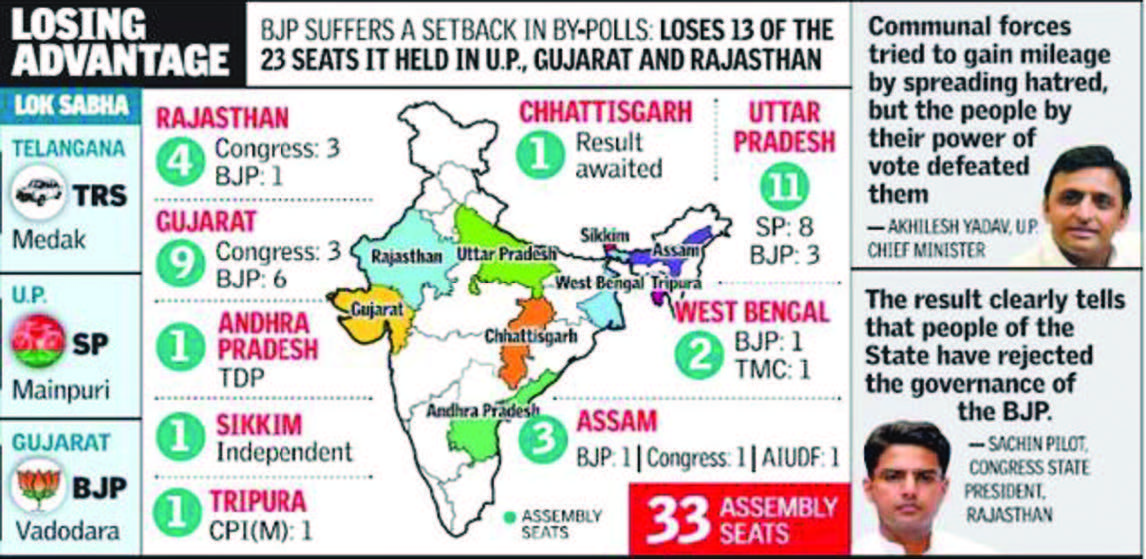
    New Delhi (TIP): The results of the Assembly byelections have come as a blow for the BJP in Uttar Pradesh, Rajasthan and Gujarat — the states it had swept in the Lok Sabha polls four months ago — losing 13 of the 24 seats held by it. Of the 32 Assembly seats across nine states for which counting of votes was held today, the BJP won 12, Congress seven and Samajwadi Party eight while TDP (Andhra), Trinamool Congress (West Bengal), AIUDF (Assam) and CPM bagged one each. One seat in Sikkim was won by an Independent.


    This is the third consecutive setback for the saffron party after its disappointing performance in Assembly byelections in Bihar, Uttarakhand, Karnataka and Madhya Pradesh in the past two months. All 11 seats in Uttar Pradesh, Gujarat (9) and Rajasthan (4) were held by the BJP and the bypolls were necessitated after the sitting MLAs were elected to the Lok Sabha. It was Uttar Pradesh — the party’s recently acquired stronghold where the BJP managed a near-total sweep in the LS elections — that delivered a humiliating blow to the saffron party as it lost seven of the 11 seats held by it, including the one held by its ally, the Apna Dal.


    The BSP’s absence in the byelections had made it a virtual straight fight between the SP and the BJP in the politically crucial state. BJP strongman Amit Shah was credited with crafting the spectacular win for his party in UP in the Lok Sabha polls. The party lost six out of 13 seats in Rajasthan and Gujarat, where it’s in power. Lost for words, BJP leaders could not even blame rival parties for playing foul in the elections. Senior BJP leader Rajiv Pratap Rudy said the results “deserve a small introspection”. “This is not a national mandate. It is a localised issue.


    Surely, it is a wake-up call for better planning in the upcoming Haryana and Maharashtra Assembly elections,” he said. Senior leader Uma Bharti dismissed questions about efficacy of the “Modi wave” saying “state leaders and workers need to introspect.” It was a significant comeback by the SP, which won eight out of 11 seats in Uttar Pradesh —and the Congress, which trounced BJP on three out of four seats in Rajasthan. “The people of the state have given a befitting reply to the communal forces and clearly expressed their desire for harmony and brotherhood,” said a beaming UP CM Akhilesh Yadav.


    Among BJP’s big losses is the Rohaniya seat, which falls within Modi’s parliamentary constituency Varanasi. The saffron party just about managed to hold to its own in Modi’s home state Gujarat, winning six out of nine seats. Rajasthan Chief Minister Vasundhara Raje was left re-faced as the Congress won three out of four seats. One of the seats — Surajgarh—was being contested by her close aide Digambar Singh who lost to Shravan Kumar of the Congress by 3270 votes.


    The BJP had swept the Lok Sabha and Assembly elections in the desert state earlier this year. High on the win, Rajasthan Congress chief Sachin Pilot advised the “BJP to take a lesson from these elections and introspect” The BJP retained Kota South, losing Surajgarh, Weir and Nasirabad to the Congress. The only silver lining for the BJP was the inroads into WB where it has won Basirhat Dakshin (South) seat.

  • AFTER BY-POLL SETBACK, BJP BLINKS ON SEAT-SHARING WITH SHIV SENA

    AFTER BY-POLL SETBACK, BJP BLINKS ON SEAT-SHARING WITH SHIV SENA

    Mumbai (TIP): Late on September 17 night, the BJP drew up a list of 119 seats that the party would like to contest in next month’s state elections in Maharashtra. It is seen as a climb down from the 135 it was insisting on a few days ago. Since then, however, it has suffered reverses in by-elections giving ally Shiv Sena an advantage in tough negotiations over seat-sharing.


    After a meeting at Union Minister Nitin Gadkari’s Mumbai residence on Wednesday night, attended by senior Maharashtra unit leaders, the BJP said it wanted its 25-year alliance with the Sena to continue. “We have sent a list of 119 seats to central leadership… 135 seats was just an estimate. We have communicated this to the Sena. Discussions will go on as far as distribution of seats is concerned,” BJP leader Sudhir Mungantiwar said. Earlier in the evening, sources said, BJP president Amit Shah had met central party leaders OP Mathur and Rajiv Pratap Rudy after the Sena, emboldened by the BJP’s losses in Tuesday’s by-elections, blandly stated that it will contest more seats than the BJP.


    Sena MP Sanjay Raut said his party wanted the alliance to continue, but on its terms. “In Maharashtra, the chief minister will be from the Shiv Sena and we will contest more seats. There will be no change in that,” he said. The BJP earlier argued that its superior performance in the national elections four months ago has earned it the right to an equal number of seats to contest. It had suggested a formula that the two partners contest 135 seats each in the 288-member state Assembly and leave 18 for their smaller allies.


    The Sena insisted that it must continue to be the senior partner in the state and contest more seats, at least 155. It said the by-election results vindicate its stand that the general elections will have no bearing on state elections. The stakes are high as the party with the most legislators will have the bigger claim to the Chief Minister’s post if the alliance wins.


    DON’T LET SUCCESS GO TO YOUR HEAD: SENA TAUNTS BJP


    The BJP’s losses in by-elections has further emboldened its partner in Maharashtra, the Shiv Sena, to blandly state that it will contest more seats than the BJP in next month’s state elections. Sena MP Sanjay Raut today said his party wants the 25-year alliance to continue, but on its terms. “In Maharashtra, the chief minister will be from the Shiv Sena and we will contest more seats. There will be no change in that,” he said. This morning’s issue of the Sena magazine “Saamna” cautioned the BJP against taking “voters for granted.”


    It praised Prime Minister Narendra Modi, saying he should not be blamed for the by-election setback. But it also said, “The by-election results are a lesson for the Maharashtra elections,” adding, “Each election comes with its tides and tides change after every election. Vidhan Sabha elections cannot be fought on the basis of the Lok Sabha wave.” The sub-text was that the BJP cannot count on the “Modi wave” to win the Maharashtra elections. Shiv Sainiks across the state have backed their chief Udhav Thackeray in his tussle with the BJP over seat sharing and say they are gearing up to win 150 of the 288 assembly seats. “There is only one wave in Maharashtra, the Shiv Sena wave,” said Sanjay Raut.

  • BJP GETS THE JOLT IT DESERVED

    BJP GETS THE JOLT IT DESERVED

    The folly of polarization boomerangs

    Normally no great importance is attached to by-elections in this country which should explain why no Prime Minister has ever canvassed during them. Interestingly, Congress president Sonia Gandhi and her son and party vice-president Rahul Gandhi have stuck to this routine even after losing power. During the most recent by-elections to 33 assembly and three parliamentary seats, the Congress’ First Family chose to be abroad.


    38


    It must have regretted this because it lost the opportunity to celebrate the jolt the Bharatiya Janata Party has suffered exactly four months after its spectacular success in the parliamentary poll under Narendra Modi’s leadership. Particularly prominent is the saffron party’s overwhelming defeat in the politically key state of Uttar Pradesh where it had won 71 of the 80 Lok Sabha seats on May 16. This time around it has surrendered eight of 11 assembly seats to the Samajwadi Party that rules the state even though the latter’s own record is conspicuously poor.

    Even more hurtful to the BJP is that the Congress that was virtually wiped out in the Lok Sabha elections has wrested from it three assembly seats each in the BJP’s bastions, Rajasthan and Mr.Modi’s Gujarat. In UP, however, the Congress has drawn a complete blank. Having slid in nine of the 10 states where by-elections were held, the BJP has a cause for comfort only in West Bengal, where it has wrested a seat from Chief Minister Mamata Banerjee’s Trinamool Congress. From the day the Modi government came to power, there have been 50 by-elections across the country.


    39


    Of these the BJP and its allies have won only 18 and lost all others. The reason for this serious setback is crystal clear and it is writ large on the political landscape.Mr. Modi may have spoken about development and good governance in the past. Those in charge of the by-elections or chief campaigners in the by-elections never used these expressions. Arrogantly confident of coming to power in this most populous state in 1917, the BJP adopted the wrong, disruptive and dangerous strategy of polarization along religious lines. “Love jihad” was one of its favorite slogans.

    As time passed, the tone of the BJP’s UP leaders – such as the president of the party’s state unit, Lakshamikant Bajpai, and the saffron-clad Yogi Adityanath, a five-time MP and the principal campaigner in the state – became more provocative and indeed poisonous. It is noteworthy that neither Prime Minister Modi, nor party president Amit Shah, nor any other senior leader did anything to restrain the Hindutva hotheads. On the contrary, their silence greatly encouraged those spewing venom.

    The situation is not without irony. At a time when Bajpai and Yogi Adityanath were shouting hoarse about “love jihad”, an oxymoron that is supposed to mean that Muslims were busy luring Hindu women to marry them and then convert to Islam, the country’s Home Minister and a former president of the BJP, Rajnath Singh, told a press conference that he didn’t know what “love jihad” was. Exactly at that time, Sakshi Maharaj, another saffron-wearing BJP leader in UP, harangued his audience and the media not only about “love jihad” but also about “education in terrorism”.

    He thundered that madrasas were teaching “terrorism” to their pupils and “motivating” youth to lure women of other religions with “offers of cash awards – Rs 11 lakh for an affair with a Sikh girl, Rs 10 lakh with a Hindu girl and Rs 7 lakh for a Jain girl”. Not to be left behind, Usha Thakur, a BJP MLA in Madhya Pradesh who is also the vice-president of the party unit in the state, made another startling disclosure: At the prolonged Hindu festival of Garba, according to her, Muslims joined in large numbers. Consequently at the end of this festival every year, four and a half lakh Hindu women were converted to Islam.

    Yogi Adityanath reaffirmed that wherever in India the proportion of Muslims in the population was 35 per cent or more “non- Muslims could not be safe”. At this stage no less a person than Union Cabinet minister Maneka Gandhi intervened to declare that “profits made from the trade in slaughtered animals was financing terrorism” and to demand that the slaughter of all animals should be “banned completely”. If this strange and highly controversial statement went relatively unnoticed the reason is that by-election results had started coming and it was immediately obvious that the electorate in UP had rejected with contempt the BJP’s strategy to polarize and divide the country along religious lines.

    An accompanying development of significance is that the Election Commission took note of some of Yogi Adityanath’s “hate speeches” and “use of religion for electoral purposes”. He has been asked to explain why requisite action should not be taken against him. An earlier FIR against the BJP’s national president Amit Shah, issued by the UP police, was set aside by a district judge. The critically important need now is for the BJP to abandon its dangerously disastrous electoral strategy of polarization that has already boomeranged.

    So Mr. Modi must give priority to this for two reasons, and make up his mind on the subject because he alone can take crucial decisions. The first reason is that assembly elections are due in Maharashtra and Haryana very soon, and the saffron party would be courting huge trouble if it repeats in these two states what it did in UP. It should fully exploit the heavy anti-incumbency the Congress has piled up against itself in both these states. The second reason is that in view of the worsening of the overall situation, our duty is to promote communal harmony, not communal hatred.

    (The author is a senior journalist and editor.)

  • TIME’S OVER FOR HMT WATCHES AFTER 53 YEARS

    TIME’S OVER FOR HMT WATCHES AFTER 53 YEARS

    NEW DELHI/ BANGALORE (TIP): A few decades ago, watches in India meant HMT. It was a prize gift, the sort of thing that parents would promise to give their offspring if they did well in board exams or that would be handed down from father to son, typically at the son’s wedding. It’s ad punchline portrayed it as “timekeepers to the nation” and nobody suggested that was hype. But time’s up for the iconic brand that was launched in 1961 as part of the government’s efforts to build a modern India.

    Like the Ambassador, another marquee brand of the licence-permit era, its clock has finally wound down. Saddled with losses for more than a decade, the government is set to shut down HMT Watches, which was restructured in 1999 to stop the HMT companies from bleeding. But little has changed. During 2012-13, the latest period for which data is available, the ailing public sector company had losses of Rs 242 crore on revenues of Rs 11 crore. Data in the government Public Enterprises Survey shows, the company employed 1,105, which included 181 executives. In contrast, Titan’s watch business reported sales of Rs 1,675 crore during the year.

    HMT virtually had a free run since it was set up in 1961 and set up the country’s first watch manufacturing unit in Bangalore in collaboration with Citizen Watch Co. In fact, it claims many firsts to its credit — the automatic day-date watch to the first Braille and quartz watches. But it was the quartz watches that proved to be its undoing along with the entry of several new players in the 1980s, who brought in newer designs and more modern production techniques.

    HMT is said to have been hobbled by slow decision making, often associated with PSUs. As a result, several attempts to boost the company’s performance including capital infusion didn’t work. During UPA government’s term, HMT Watches was referred to the Board for Reconstruction of Public Sector Enterprises, which recommended revival. While the UPA refrained from deciding on the issue, the BJP government decided to go ahead with a tough decision.

  • BJP Global Convener, Overseas Affairs Vijay Jolly calls upon Indian Americans to extend a tumultuous welcome to Modi

    BJP Global Convener, Overseas Affairs Vijay Jolly calls upon Indian Americans to extend a tumultuous welcome to Modi

    I.S. Saluja

    Vijay Jolly, BJP Global Convener, Overseas Affairs was on US Tour from August 18 to 30 to drum up support for Modi’s reception in New York on September 28. He visited, in all, 12 locations in Canada and USA. The US locations included Los Angeles, Dallas, Atlanta, Chicago, New York, New Jersey and Washington He was accompanied on the visit by Rajyavardhan Rathore, Member of Parliament.


    11
    Vijay Jolly and Rajyavardhan Rathore with Ambassador Mulay and members of Indian American community at the lunch hosted by the Consul General in honor of the visiting leaders L to R: Pam Kwatra, Vijay Nahata, Jagdish Sewhaney, Prof. Indrajit S Saluja, Vijay Jolly, Rajyavardhan Rathore, Ambassador Dnyaneshwar Mulay, Chandrakant Patel, Atma Singh, Harry Bolla


    One of his engagements in New York on August 26 was a meeting over lunch with India’s Consul General Dnyaneshwar Mule at the latter’s residence where I was also invited as were some more members of the Indian American community. Since we have known each other for some time now, there was an air of informality between us when I asked him for an interview for The Indian Panorama. I must thank him for his appreciation of the publication which he said he read on line every week. When asked the purpose of his visit to Canada and USA, he said, it was to galvanize the overseas units to work for the success of the civic reception planned for Modi in New York on September 28.

    To my question as to what he thought was the response of the Indo Canadian and Indo American community to Modi’s visit to USA, he said people were excited and keen to come to New York to see him. He added, “However, we know the place (Madison Square Garden) cannot hold beyond 18,000 and feel sorry for many who may not be able to get the tickets to come in”. Asked what he felt was the implication of Modi’s visit at the invitation of President Obama, he said, the visit of Prime Minister of India to the United States at the invitation of President of USA signifies a lot.


    12
    Vijay Jolly (center) and Rajyavardhan Rathore, M.P. (Right) with Ambassador Dnyaneshwar Mulay


    To put in a few words, it signals the desire of the United States to have friendly and close ties with India. Vijay said he was sanguine the meeting between India’s Prime Minister and US President will strengthen the already strong ties between the two nations and lead to greater cooperation in various fields. As Vijay Jolly was leaving, he turned to me and said, “Mark my words. Modiji will get a tumultuous welcome in USA, the kind of which was never accorded to a Prime Minister of India in USA”.

  • IN NEW DING TO CREDIBILITY, HARYANA GOVERNMENT TOLD TO CANCEL DLF DEAL

    IN NEW DING TO CREDIBILITY, HARYANA GOVERNMENT TOLD TO CANCEL DLF DEAL

    Chandigarh (TIP): The Haryana government has been ordered to cancel the allocation of 350 acres of land in Gurgaon to real estate major DLF. The verdict of the Punjab and Haryana High Court further will add another ding to the credibility of the state’s Congress government, which has been accused of allowing sweetheart land deals between DLF and Robert Vadra, the entrepreneur son-in-law of Congress president Sonia Gandhi.

    The assignment of 350 acres of prime property in the Wazirabad had been challenged by villagers who claim they were told that the government was acquiring their land for a recreational park. Instead, the land was given to DLF which planned to develop golf courses and villas for commercial sale. The state government headed by Chief Minister Bhupinder Singh Hooda had also been accused by the villagers and activist-turned-politician Arvind Kejriwal of favouring DLF over two other bidders for the same property.

    The court on September 3 has asked the government to invite fresh bids for the property. The government’s consultants valued the land and set a reserve price of nearly 1700 crores. When only DLF was deemed eligible by a government committee, its bid which was almost identical was accepted – so the government appears to have accepted a poor offer.

    In a statement, DLF said it is waiting for a copy of the verdict and it would ” like to clarify that the said land was allotted to DLF after two rounds of International Competitive Bidding process.” Ashok Khemka, a senior bureaucrat in Haryana who handled land records in an earlier posting has alleged that the Hooda administration allowed Mr Vadra to strike illicit land deals in Gurgaon which allowed him windfall gain.Mr Khemka has alleged a long campaign of vendetta by the government, which transferred him.

    The government has rejected the charges and has declared Vadra’s deals with DLF were clean. Haryana votes soon for its next government. The BJP won seven of the state’s 10 seats in the national elections that were held in May.

  • HJC parts ways with BJP, joins hands with Venod Sharma’s party

    HJC parts ways with BJP, joins hands with Venod Sharma’s party

    CHANDIGARH (TIP): Snapping a three-year-old alliance with the Bharatiya Janata Party (BJP), the Kuldeep Bishnoi-led Haryana Janhit Congress (HJC) on Aug 28 joined hands with former Congress MLA Venod Sharma’s Haryana Jan Chetna Party (HJCP) for the upcoming assembly elections in Haryana.

    Bishnoi and Sharma jointly made this announcement while interacting with mediapersons here. Hitting out at the BJP, Bishnoi said: “BJP ka to ye culture hi raha hai jhooth bolna aur dhokha dena. Jo Vajpayee, Advani aur Murli Manohar Joshi (top BJP leaders) ke nahi huye, Charan Singh, Devi Lal, Bansi Lal aur Om Prakash Chautala ke nahi huye, vo hamare kaise honge (it’s been the BJP’s culture to betray and tell lies).” “Aur kyonki hamein yeh pata tha ke yeh ab hamein dhokha denge, hamne likhit samjhota kiya, par inhon ne phir hamein dhokha diya (Since we knew that the BJP would betray us, we went in for a written agreement, but the BJP still betrayed us).” Claiming that it was unprecedented in Indian politics that a written agreement was made for an alliance, Bishnoi said the BJP again showed its true colours.

    “BJP dhokhebaz hai aur iska ghamand saatwein aasmaan pe chadh gaya hai, aur ghamand to Ravana ka bhi tuta tha (The BJP is treacherous and its arrogance has gone skyhigh. But even the arrogant Ravana was humbled).” Bishnoi claimed that though the HJC went the extra mile to maintain the alliance, the BJP cheated it at every step. “Inhone har pal, har kadam par mera gala ghotna chaha, aur hum sahan karte rahe, par ab pani sar se upar chala gaya hai (The BJP tried to stifle us, and we kept tolerating them. But now all limits have been crossed).” He, however, avoided naming BJP leaders who were opposed to the alliance. Replying to a question on a likely alliance with former minister Gopal Kanda’s Haryana Lokhit Party, he said he could not comment on it at present.

    Regarding the new alliance’s manifesto and seatsharing, Bishnoi said it would be worked out in the days to come. Meanwhile, former Ambala MLA Venod Sharma, who also addressed mediapersons on the occasion, said Haryana would now witness an HJC-HJCP wave as the BJP did not even have candidates for all 90 seats. He said the alliance, if voted to power, would abolish the interview system in government jobs and the practice of re-employment of retired employees. “The HJCP would release its own manifesto during its rally at Ambala on August 31, though the alliance would have a common manifesto too,” Sharma said.

  • Advani, M M Joshi axed from BJP parliamentary board

    Advani, M M Joshi axed from BJP parliamentary board

    NEW DELHI (TIP): The generational shift in BJP was complete on August 26 with its founders Atal Bihari Vajpayee, L K Advani and Murli Manohar Joshi being dropped from the BJP parliamentary board, the highest decision-making body headed by BJP president Amit Shah, which has the stamp of Prime Minister Narendra Modi all over now.

    In a token gesture, ailing Vajpayee along with Advani and Joshi, for long the BJP’s ‘Trimurti’, now figure in the new five-member ‘margdarshak mandal’ (guiding group) after being associated with the party for nearly four decades. Three-time Madhya Pradesh chief minister Shivraj Singh Chouhan and party general secretary J P Nadda are the new entrants to the BJP parliamentary board which was reconstituted by newly-appointed chief Amit Shah. The two have also been included in BJP’s central election committee, which decides on the party candidates to be fielded in elections.


    42
    MM Joshi


    The 12-member parliamentary board chaired by Shah now has Modi, Rajnath Singh, Arun Jaitley, Sushma Swaraj, Venkaiah Naidu, Nitin Gadkari, Ananth Kumar, Thawarchand Gehlot, Shivraj Singh Chouhan, Jagat Prakash Nadda and Ramlal as its members. New BJP president Amit Shah initiated the changes after consultations with top BJP leaders and Prime Minister Narendra Modi. For the two veterans, who were not considered for positions of power in the new saffron regime because they were over 75 years, this will be a far more significant blow.

    For Advani, the exclusion from the board is part of a procession of setbacks that the veteran has suffered since he was overruled on whether Narendra Modi should be projected as the party’s PM candidate. The leadership had also shrugged aside the argument of Advani’s loyalists that he should be sponsored for the post of Lok Sabha Speaker. “When a generational shift has taken place and when need for accommodating fresh energy and ideas has finally been recognized, we need to make room for others who are more in tune with the requirements of the changed times,” a senior party leader said.

  • Cong, BJP wrangle over booing of Opposition CMs

    Cong, BJP wrangle over booing of Opposition CMs

    After Hooda, jeers for Jharkhand CM at PM function * Prithviraj Chavan skips Modi event

    NEW DELHI (TIP):
    Maharashtra chief minister Prithviraj Chavan on August 21 boycotted both the government functions in Nagpur and refused to share the dias with Prime Minister Narendra Modi in the wake of heckling of non – BJP chief ministers by BJP workers in recent past, in such programmes. Chavan kept away from the inauguration of the Mouda Super Thermal Power Project Phase I, and later also skipped the function for laying the foundation stone of the proposed Nagpur Metro project.

    The guardian minister for the district, Nitin Raut, also refused to share the dais with Modi. The minister for social justice, Shivajirao Meghe received Modi at the airport on behalf of the state government, in keeping with protocol. The decision came after two other chief ministers, Bhupinder Singh Hooda of Haryana and Hemant Soren of Jharkhand, were booed by Bharatiya Janata Party (BJP) supporters at meetings addressed earlier by the Prime Minister.

    Chavan himself was heckled by BJP activists at a function attended by Modi in Raigad last week. Chavan accused the BJP of politicising the Prime Minister’s public events ahead of assembly polls. “I have decided not to attend the Prime Minister’s function because of the incidents that took place in recent days,” he said. A group of Congress supporters, meanwhile, staged a demonstration with black flags near the venue of a function attended by the PM.

    Hemant Soren booed
    Crowds heckled Jharkhand chief minister Hemant Soren in the presence of Prime Minister Narendra Modi on Thursday, the third instance of public humiliation of opposition leaders, fuelling talk over whether there was a BJP design to undermine the chief ministers in some election-bound states. The crowd, comprising mainly BJP supporters, booed and kept shouting “Modi, Modi” throughout Soren’s speech at a public rally in Ranchi.

    At one point, he asked the gathering to forget the political rivalry for a day, but that further irked the 70,000-odd crowd and the booing became louder. “Political powers keep changing; we need to respect the dignity of this stage,” Soren said, which irked the crowd of about 70,000 even more and led to louder chants. The reaction of the crowd appeared to have taken the chief minister by surprise, causing some errors in his speech. Soren mistakenly referred to Modi as the president at least five times.

    Modi was in Ranchi to inaugurate a substation of the Power Grid Corporation in the district. Later, the ruling Jharkhand Mukti Morcha (JMM) took a strong stand and said the party will not let the BJP hold such events in the state in future. Asking Modi to apologise to the public and leaders of Jharkhand and Haryana, the party’s national general secretary Supriyo Bhattacharya said the BJP should learn how to control its men.

    CM Soren too criticised the incident calling it a “pre-planned stunt by the BJP” and “an insult of the federal structure”, a reference to Modi’s repeated assertions that his government believed in “cooperative federalism” and taking along all states. “The PM must look into it… the federal system he talks about. I feel it is like raping the system, the tradition of the federal system.

    There is a plan to break it.” Soren had earlier asked the Prime Minister’s Office (PMO) to ensure no ‘Hooda-like incident’ occurs at the event in Ranchi. The JMM had said that in case of any such incident the party would take strong steps. The BJP has reacted to the incidents saying its government gives due respect to all CMs.

  • BJP SOLD FALSE DREAMS, SONIA SAYS

    BJP SOLD FALSE DREAMS, SONIA SAYS

    NEW DELHI (TIP):
    Congress chief Sonia Gandhi on August 20 slammed the Narendra Modi government for peddling the schemes and policies of UPA as its own, saying the rival which came to power by selling “false dreams” was now propagating falsehoods. Speaking at a conclave of women workers on the occasion of Rajiv Gandhi’s birth anniversary, Sonia said, “We (UPA) did so much but some people laid a trap that misled the people.

    Our work was ignored and those who showed false dreams sneaked ahead.” Keeping the pressure on the Modi regime, the Congress chief and former PM Manmohan Singh later spoke about rising communal incidents in different parts of the country at a function to confer the Rajiv Gandhi communal amity award to noted film director Muzaffar Ali. Sonia tore into the NDA government by telling the women’s gathering that the rival was unable to shed its habits and was showing the schemes of UPA as that of NDA.

    Alluding to the PM’s stress on sanitation and toilets in his I-Day speech, she asked, “Who started Nirmal Bharat Abhiyan in every village? Who made construction of toilets a part of MGNREGA?” With loud cries of “we” in response, Sonia said Congress also championed the cause of women’s empowerment, listing initiatives like domestic violence law, women’s share in family inheritance, self-help groups as well as old-age pension and appointment of India’s first woman President and Speaker.

    Sonia told workers that election victory and defeat were part of the game but the party would stick to its principles, listing women’s quota as its priority. “Today, we are in opposition but we will not back out on our pledge and will put pressure on NDA to pass the women’s quota bill,” she said. Rahul Gandhi said sexual assault and rapes had to be exterminated from society.

    He lamented that people worshipped women as goddesses but also perpetrated sexual crimes on them. He accused BJP of wanting to keep women at home, without power and education, while Congress wants them to be free and empowered. Meanwhile, Manmohan Singh expressed concern over rising communal incidents, saying it pointed to the need for greater effort to build bonds of trust and friendship between communities.

  • Vijay Jolly calls on US Congressmen & Chairman Foreign Affairs Committee Mr. Edward R. Royce

    Vijay Jolly calls on US Congressmen & Chairman Foreign Affairs Committee Mr. Edward R. Royce

    LOS ANGELES (TIP):
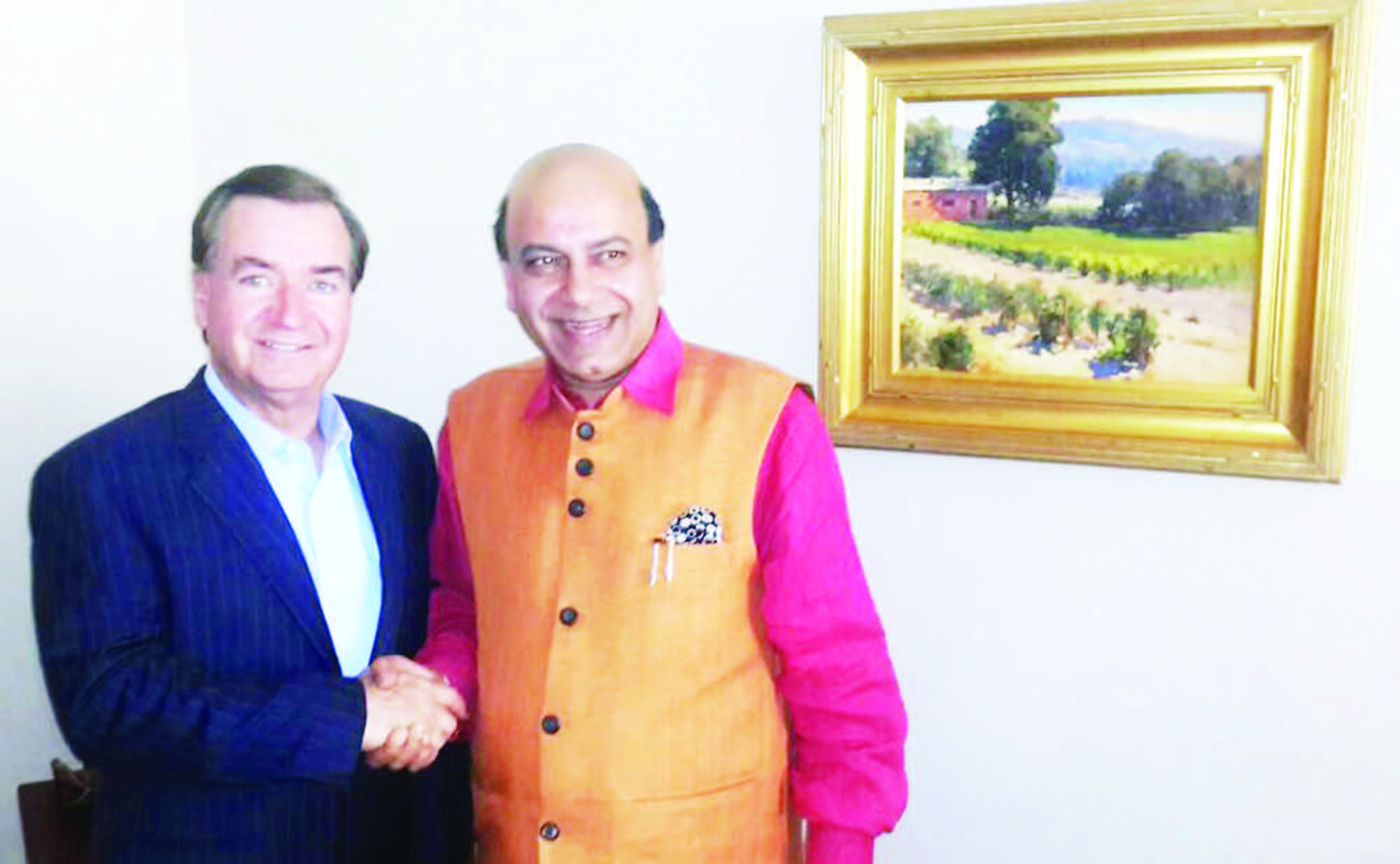
    OFBJP Global Convenor Vijay Jolly arrived here August 20th, from Vancouver to a rousing welcome at LA Int’l Airport. OFBJP US President Chandra Kant Patel, LA Convenor P. K. Nayak along with a large contingent of BJP supporters received OFBJP leader Jolly with bouquets. Vijay Jolly drove to the residence of US Congressmen & Chairman Foreign Affairs Committee Edward R. Royce here. Both leaders had a 45 minutes long meeting on Indo-US relations.

    They also discussed the forthcoming US visit by Indian Prime Minister Narendra Modi latter in the month of Sep 2014. Edward Royce is also the Chairman of India Caucus in US. Congressman expressed a keen desire to meet & welcome PM Modi along with Foreign Affairs Committee members in Washington D.C. Jolly promised to convey this to the Indian officials arranging the PM’s US visit. Jolly also extended an invitation to the Congressman to attend the Sunday 28th September public program organized by Indian American Community Foundation for NAMO Swagatam at Madison Square Garden, New York. He accepted the invite with a smile & warm handshake.

    Vijay Jolly also visited the LA Chino Hills located BAPS Swami Narayan Temple and offered floral greetings on behalf of BJP President Amit Shah. Swami Sarv Darshan, head of the BAPS temple blessed the OFBJP leader and his mission in US. Latter in the evening a grand public program organized in support of NAMO’s September visit was addressed by Jolly in downtown Los Angles. Jolly attended a successful OFBJP Vancouver, Canada program celebrating 68th India Independence Day at Surrey in British Columbia .

    The Indian Consul General Ravi S. Aisola attended the program. A book in Punjabi language on PM Modi was released by Jolly at a crowded public program. A large contingent of Indians led by Aditya Tawatia, OFBJP President Vancouver and owner of Radio India Maninder Gill pledged to participate in the NAMO program in US on 28th September, 2014 in New York.

  • India must never be a ‘Hindu Pakistan’

    India must never be a ‘Hindu Pakistan’

    By Inder Malhotra

    Modi should restrain Bhagwat & others

    Mr. Bhagwat at first propounded the strange theory that since every citizen of America is called American and that of Germany is known as German, every citizen of Hindustan “must be called a Hindu”. Someone should explain to this learned gentleman that by his own logic citizens of Hindustan should be known as Hindustanis, not Hindus”, says the author

    When Narendra Modi was swept to power spectacularly just over three months ago high hopes of an early improvement in both development and governance were accompanied by some fears that Hindutva hotheads and other extremists in the Sangh Parivar might try to queer the pitch by promoting the cult of “Hindu Rashtra”. Sadly, this seems to be coming to pass, not by the efforts of only foot soldiers and fringe elements.

    The minister of state in the Prime Minister’s Office (PMO) was the first to talk of repealing Article 370 of the Constitution that gives the state of Jammu and Kashmir a special status. This produced a reaction in the sensitive state so vehement that the state’s Chief Minister, Omar Abdullah, and his father and then Union Cabinet minister Farooq Abdullah, even threatened secession.

    This did not deter another minister to propose that it was time to have a uniform civil code, inviting another furore. Then something startling happened, of all places, in Goa. A BJP leader there announced that Mr. Modi would make India a “Hindu State” before the end of his first term. He was upstaged by the state’s Deputy Chief Minister, who blandly stated that this was already the case. Obviously, no one took him seriously because the international president of the Vishwa Hindu Parishad, Ashok Singhal, mounted the rostrum to declare that the Muslims had citizenship rights in this “Hindu” country, but they also had the duty to accept Hindutva’s doctrines and demands.

    One specific demand he made was that, the Babri Masjid at Ayodhya out of the way, “the Muslim community should willingly give up two other mosques in the holy cities of Varanasi and Mathura”. In Parliament and elsewhere Opposition members and people continued to ask Prime Minister Modi to say something about these “objectionable and divisive” declarations but he continued to maintain his eloquent silence.

    A few of those who claimed to know him pointed out that to remain silent was both his strategy and style. This reading seemed to be correct. For Parliament’s first session ended on a very sharp note just before Independence Day. The Congress and other Opposition parties condemned his government for having encouraged both polarisation and increasing communal violence since its very formation. His ministers retorted that the greatest communalist in the country was the Congress. But while speaking from the ramparts of the Red Fort, the Prime Minister dealt with the burning issue very briefly.

    He appealed to everyone to embark on a ten-year moratorium on all violence whether the “poison” be casteism, communalism, regionalism or discrimination of any kind because all these “are obstructions in our way forward”. This attracted no criticism although some did ask: “Why should there be a moratorium for a limited number of years? Why not get rid of all these evils permanently”? Ironically, it was at this precise moment that the leadership of the campaign to Hinduise the Indian state – that under the Constitution has to be secular – was taken over by the chief of the Rashtriya Swayamsevak Sangh (RSS), Mohan Bhagwat.

    He is the head of the entire Sangh Parivar of which the Bharatiya Janata Party is but one member. Nor has it gone unnoticed that the new BJP president, Amit Shah, who is also the right-hand man of Mr. Modi, has given the RSS representation in his team that is greater than ever before. Mr. Bhagwat at first propounded the strange theory that since every citizen of America is called American and that of Germany is known as German, every citizen of Hindustan “must be called a Hindu”.

    Someone should explain to this learned gentleman that by his own logic citizens of Hindustan should be known as Hindustanis, not Hindus. No America would call himself/herself as an “Am” or the German as “Ger”. If every Indian is called a Hindustani there would be no problem. Followers of the Hindu religion in this country are a huge majority of over 80 per cent. But the rest are Muslims, Christians, Sikhs, Jews, Parsis and so on. To call them Hindus would be an invitation not to a disaster but to a catastrophe.

    Probably for this reason the RSS chief changed his tune. “Hindustan (he has stopped using the names India or Bharat)”, he proclaimed, “is a Hindu state and Hidutva is the identity of our nation … and it (Hinduism) can incorporate in itself other religions”. No fewer than seven political parties, including the Congress, the Samajwadi Party and the CPM, have lambasted Mr. Bhagwat for planning to “impose Hindu majoritarianism” on the country. Several Opposition leaders have called him “Hitler” and a radical Sikh organisation, Dal Khalsa, has declared that it would not allow the RSS to “foist its fascist agenda on Punjab”.

    This said, one must add that communalism of every religious community is equally dangerous and deplorable. The entire Kashmiri Pandit minority was hounded out of the Kashmir valley two decades ago. The Pandits have become refugees in their own country, and their return to their homes remains problematic. Some Sikhs in Punjab have made a film glorifying the assassins of Indira Gandhi that cannot but cause trouble.

    In all fairness, it must also be recognised that the Congress that ruled the country for the last 10 years must accept its share of responsibility for encouraging the votaries of Hindutva. It always declared that its fight against the BJP was a contest between secularism and communalism. But, as former Defence Minister A. K. Antony, who investigated the causes of the Congress party’s electoral debacle has admitted, the Congress’ practice of secularism was more rhetorical than real.

    The country perceived it as the “appeasement of Muslim minority”. Whatever might have happened in the past, the two sides must learn a lesson from what the Pakistani Taliban have done to that Islamic country in the name of Islam. India doesn’t deserve that.