Tag: Canada

  • Two Indian cities at high risk of terror strike

    Two Indian cities at high risk of terror strike

    LONDON (TIP): Two Indian cities -Imphal (ranked 32) and Srinagar (ranked 49) have been named to be at “extreme risk” of a terrorist attack, mainly aiming to cause mass casualty and destroy public transport networks.

    According to an analysis of the terror risk to 1,300 commercial hubs and urban centres around the world, populations and businesses in 113 Indian cities have been identified to be at some risk – high, medium or low risk of facing terrorist attacks.

    The next major Indian city after these two that faces a terrorist threat is Chennai even though the risk quotient has been marked as medium risk.

    Bangalore is the fourth most prone city even though it is placed at 204th in the global threat list followed by Pune and Hyderabad at 206th and 207th respectively

    Cities like Nagpur (ranked 2010) and Kolkata (2012) have been found to face a higher risk of a mass attack by terrorists that the usually expected targets like Delhi (447) and Mumbai (298).

    Around 64 cities around the world are at “extreme” risk, with most in the Middle East and Asia – and three in Europe.

    London ranked as low as at 400 due to the lack of a terror incident since the 7/7 bombings while Paris has soared into the top 100 cities following the Charlie Hebdo shooting, according to Verisk Maplecroft’s new Global Alerts Dashboard (GAD).

    Arvind Ramakrishnan, head of Maplecroft India said “When it comes to Imphal and Srinagar, terrorist attacks aren’t on commercial targets as much as against the security forces. However n most of the other metropolitan cities, the targets are both to cause mass casualty and cripple its commercial hubs. Public transport networks in India are also prime targets”.

    Ramakrishnan added “The Mumbai attack in 2008 was the turning point for India. But lack of intelligence sharing among states is a big worry. Law and order is still a state subject in India and political rivalries across states leads to state intelligence agencies not sharing actionable data. Virtually all police forces in India lack modern equipment and adequate manpower to counter a terrorist threat. This brings down the overall morale of the force. India does not face threats from cross border terror organisations but also from home grown ones like the Indian Mujahideen”.

    Charlotte Ingham, head of security analytics at Maplecroft UK said in total, 64 cities are categorised as
    ‘extreme risk’ in an online mapping and data portal that logged analysed every reported terrorism incident since 2009.

    Based on the intensity and frequency of attacks in the 12 months following February 2014, combined with the number and severity of incidents in the previous five years, six cities in Iraq top the ranking.

    Over this period, the country’s capital, Baghdad, suffered 380 terrorist attacks resulting in 1141 deaths and 3654 wounded, making it the world’s highest risk urban centre, followed by Mosul, Al Ramadi, Ba’qubah, Kirkuk and Al Hillah. Ingham said “just because a city in India hasn’t seen a terrorist attack in a while does not mean it isn’t potentially facing one. The rankings are based on the frequency and intensity of attacks.

    Belfast has been named as the most dangerous city in Europe while Baghdad topped the list worldwide.

    Outside of Iraq, other capital cities rated ‘extreme risk’ include Kabul (13th most at risk), Mogadishu in Somalia (14th), Sana’a in Yemen (19th) and Tripoli in Libya (48th).

    However, with investment limited in conflict and post-conflict locations, it is the risk posed by terrorism in the primary cities of strategic economies, such as Egypt, Israel, Kenya, Nigeria and Pakistan that has the potential to threaten business and supply chain continuity.

    “An estimated 80% of global GDP is generated from cities,” states Ingham. “Visibility of the sub-national differences in terrorism levels should be an imperative for multinational organisations looking to understand and price the risks to assets, employees and supply chains”.

    As Africa’s largest economy, Nigeria’s role as a commercial hub is central to economic growth across the region. Because of Boko Haram 13 out of the 24 Nigerian cities experienced a significant increase in the intensity and frequency of terrorist attacks compared to the previous quarter.

    Paris (97th and ‘high risk’) has experienced one of the steepest rises in the ranking, reflecting the severity of the terrorist attack in January 2015 that left 17 people dead. The risk level in Paris is representative of a wider trend for Western countries, including Belgium, Canada and Australia, where the level of risk in key urban centres is substantially higher than elsewhere in the country”.

  • India at 100 on human capital index, Finland leads pack

    GENEVA (TIP): India has been ranked at a lowly 100 position on the global Human Capital Index, which measures countries on development and deployment of human capital.

    Finland has topped the 124-nation list. India is ranked lower than all its BRICS peers — Russia, China, Brazil and South Africa – – and smaller neighbours like Sri Lanka, Bhutan and Bangladesh. But Pakistan follows at 113.

    In the top 10 of the list, compiled by the World Economic Forum (WEF), Finland is followed by Norway, Switzerland, Canada, Japan, Sweden, Denmark, the Netherlands, New Zealand and Belgium. WEF said the list has been compiled on the basis of 46 indicators about “how well countries are developing and deploying their human capital, focusing on education, skills and employment”. “It aims to understand whether countries are wasting or leveraging their human potential,” it added.

    On India, the report said that although the educational attainment has improved markedly over different age groups, its youth literacy rate is still only 90 per cent, well behind the rates of other emerging economies.

  • Hindu chariot processions planned in 3 Florida cities

    Hindu chariot processions planned in 3 Florida cities

    NEVADA (TIP): Ratha Yatras (Hindu Festival of Chariots) have reportedly been planned in the three cities of Florida (USA).

    Starting with Clearwater Beach on May 10, this annual parade will reportedly be held on the Daytona Beach on May 23 and Jacksonville Beach on August 15. It is like getting a taste of India and Hinduism without leaving Florida.

    According to reports, Clearwater Mayor George N. Cretekos will be attending the Clearwater Beach festival and it will include “Free 5 Course Feast”, kirtan, cultural program and parade.

    Meanwhile, Hindu statesman Rajan Zed applauded efforts of the organizers and Florida community to realize these wonderful festivals, exhibiting the richness of Hinduism.

    Rajan Zed, who is President of Universal Society of Hinduism, further said that it was important to pass on Hindu spirituality, concepts and traditions to coming generations amidst so many distractions in the consumerist society. Zed stressed that instead of running after materialism; we should focus on inner search and realization of self and work towards achieving moksh (liberation), which was the goal of Hinduism.

    Rath Yatra is said to be the oldest known parade in the world and it is believed that pullers of this Lord Jagannatha’s chariot receive immense spiritual benefit. Popularized outside India by International Society for Krishna Consciousness founder A.C. Bhaktivedanta Swami Prabhupada, this annual parade festival has reportedly been held annually in over 50 major cities in USA, Canada, Europe, etc., since 1960s.

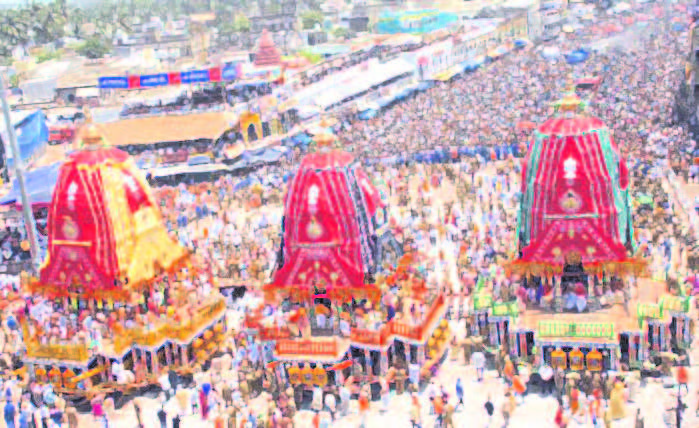
    The original Ratha Jatra is held on a grand scale in Puri (Odisha, India), where the presiding deities of Sri Mandira-Jagannatha, Balabhadra and Subhadra-with celestial wheel Sudarshana are driven on the chariots to about two miles north Gundicha temple in an elaborate ritual procession, where the huge colorfully decorated chariots are drawn by thousands of devotees. After a stay for seven days, the deities return to their abode in Sri Mandira. A glimpse of Lord Jagannatha on the chariot is considered to be highly auspicious and even a touch of the chariot is believed to yield benefits equivalent to several pious deeds. Many poets have written its glories. This year, it will be held on July 18.

    Rajan Zed points out that ancient Hindu scripture Katha Upanishad talks about the concept of chariot, where soul is the deity, body is the chariot, and intellect the charioteer. Skanda Purana glorifies Rath Jatra’s sanctity.

  • Strategic Autonomy as an Indian Foreign Policy Option

    Strategic Autonomy as an Indian Foreign Policy Option

    [quote_right]For a large country like India, which has the potential of becoming a big power in the future, strategic autonomy is a compelling choice. By virtue of its demographic, geographic, economic and military size, India must lead, but does not have yet the comprehensive national power to do so. It cannot subordinate itself to the policies and interests of another country, however powerful, as its political tradition and the functioning of its democracy will not allow this. India may not be strong enough to lead, but it is sufficiently strong not to be led”, says the author.[/quote_right]

    In the joint statement issued during the Indian prime minister’s visit to France in April, the two sides reaffirmed “their independence and strategic autonomy” in joint efforts to tackle global challenges. In the French case, as a member of NATO it is not so clear what strategic autonomy might mean, but in our case it would essentially mean independence in making strategic foreign policy decisions, and, consequently, rejecting any alliance relationship. It would imply the freedom to choose partnerships as suits our national interest and be able to forge productive relationships with countries that may be strategic adversaries among themselves.

    In practical terms, this means that India can improve relations with the United States of America and China while maintaining close ties with Russia. It can forge stronger ties with Japan and still seek a more stable relationship with China. It can forge strong ties with Israel and maintain very productive ties with the Arab world, including backing the Palestinians in the United Nations. It means that India can have strategic partnerships with several countries, as is the case at present with the US, France, Germany, the United Kingdom, the European Union, Russia, China, Japan, Brazil, Saudi Arabia, Australia, Canada, Kazakhstan, Afghanistan, Vietnam, Iran and the like.

    It means that India can be a member of BRICS and the RIC dialogues, as well as IBSA, which exclude the West, and also forge closer political, economic and military ties with the Western countries. Our strategic autonomy is being expressed in other ways too. India is a democracy and believes that its spread favors its interests, but it is against the imposition of democracy by force on any country. If the spread of democracy is in India’s strategic interest, using force to spread it is against its strategic interest too, as is shown by the use of force to bring about democratic changes in West Asia by destroying secular authoritarian regimes and replacing them with Islamic authoritarian regimes. Likewise, India believes in respect for human rights, but is against the use of the human rights agenda to further the geo-political interests of particular countries, essentially Western, on a selective basis.

    For a large country like India, which has the potential of becoming a big power in the future, strategic autonomy is a compelling choice. By virtue of its demographic, geographic, economic and military size, India must lead, but does not have yet the comprehensive national power to do so. It cannot subordinate itself to the policies and interests of another country, however powerful, as its political tradition and the functioning of its democracy will not allow this. India may not be strong enough to lead, but it is sufficiently strong not to be led.

    India preserved its strategic autonomy even in the face of severe technology sanctions from the West on nuclear and missile issues. It preserved it by not signing the non-proliferation treaty and continuing its missile program. By going overtly nuclear in 1998, India once again exercised its strategic autonomy faced with attempts to close the doors permanently on its nuclear program by the permanent extension of the NPT and the comprehensive nuclear test ban treaty and fissile material cutoff treaty initiatives.

    In some quarters in India and abroad, the idea of strategic autonomy is contested as another manifestation of India’s non-aligned mindset, its propensity to sit on the fence, and avoid taking sides and assuming responsibility for upholding the present international order as a rising power should. These critics want India to join the US camp more firmly to realize its great power ambitions. These arguments ignore the reality that while the US has been crucial to China’s economic rise, China has been sitting on the fence for many years, even as a permanent member of the UN security council. Far from sacrificing its strategic autonomy, it has become a strategic challenger of the US.

    To be clear, the US government has officially stated its respect for India’s position on preserving its strategic autonomy, and denies any expectation that India would establish an alliance kind of relationship with it. It is looking for greater convergence in the foreign policies of the two countries, which is being realized.

    During Narendra Modi’s visit to the US in September, 2014, and Barack Obama’s visit to India in January this year, a strategic understanding on Asia Pacific and Indian Ocean issues, encapsulated in the January 2015 joint strategic vision for the Asia Pacific and the Indian Ocean has emerged. This document suggests a shift in India’s strategic thinking, with a more public position against Chinese maritime threat and a willingness to join the US in promoting partnerships in the region.

    Modi chose a striking formulation in his joint press conference with Obama in September when he said that the US was intrinsic to our Look East and Link West policies, which would suggest a growing role for the US in our foreign policy thinking. During Obama’s January visit, the joint statement noted that India’s Act East policy and the US rebalance to Asia provided opportunities for India, the US and other Asia-Pacific countries to work closely to strengthen regional ties. This was the first time that India implicitly endorsed the US rebalance towards Asia and connected our Act East policy to it.

    Rather than interpreting it as watering down our strategic autonomy, one can see it as strengthening it. So far, India has been hesitant to be seen drawing too close strategically to the US because of Chinese sensitivities. China watches closely what it sees are US efforts to rope India into its bid to contain China. At the same time, China continues its policies to strengthen its strategic posture in India’s neighborhood and in the Indian Ocean at India’s expense, besides aggressively claiming Indian territory.

    By strengthening relations with the US (which is strategically an Asian power), Japan and Vietnam, and, at the same time, seeking Chinese investments and maintaining a high-level dialogue with it, India is emulating what China does with India, which is to seek to build overall ties as much as possible on the economic front, disavow any negative anti-India element in its policies in our neighborhood, but pursue, simultaneously, strategic policies intended to contain India’s power in its neighborhood and delay its regional extension to Asia.

    In discussing the scope of our strategic autonomy, one should recognize that the strength of US-China ties, especially economic and financial, far exceeds that of India-US ties. India has to be careful, therefore, in how far it wants to go with the US with a view to improving its bargaining power with China. The other point to consider is the US-Pakistan equation. The US has just announced $1 billion of military aid to Pakistan; its position on the Taliban is against our strategic interests in Afghanistan; its stand on Pakistan’s sponsorship of terrorism against us is not robust enough.

    To conclude, strategic autonomy for India means that it would like to rely as far as possible on its own judgment on international issues, balance its relations with all major countries, forge partnerships with individual powers and take foreign-policy positions based on pragmatism and self-interest, and not any alliance or group compulsion.

    (The author is former foreign secretary of India. He can be reached at sibalkanwal@gmail.com)

  • A Poetical Bonanza dedicated to ‘Peace & Unity’

    A Poetical Bonanza dedicated to ‘Peace & Unity’

    Community activist Pervaiz Alam and poet and Chief Organizer Noor Amrohvi lighting the candle to inaugurate the Mushaira
    Community activist Pervaiz Alam and poet and Chief Organizer Noor Amrohvi lighting the candle to inaugurate the Mushaira

    I have  almost been a regular at  the event of the events, the famous Noor Amrohvi poetical extravaganza, the annual mushaira. Noor is a consummate artist. A little crazy like most artists, he gives out his best whatever the circumstances, wherever it may be and whenever it may be. Mian, hum na sudharenge. Every time he organizes a mushaira, a lot many poets and a lot many guests come to hear the poets. When all is done and everybody is gone, Noor finds time to mull over kya khoya kya paaya and finds he is a little poorer, finance wise, but surely not in experience, pleasure and wisdom. He takes tremendous joy in getting financial beating, year after year.

    Surender Sharma, the king of poets
    Surender Sharma, the king of poets

    I don’t know how long  he can afford to take that kind of joy. Chaliye, bahut rona dhona hua. Let us all salute Noor for whatever he has been doing for the community and for the fine  world  of poetry.

    Noor Amrohvi
    Noor Amrohvi
    Seema Naqvi, a poet from Canada
    Seema Naqvi, a poet from Canada

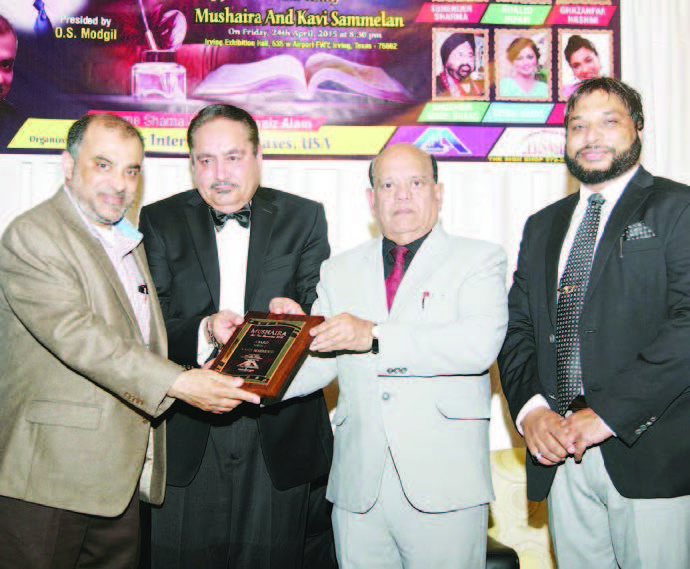
    It is the fifth year of the Mushaira or Kavi Sammelan held under the auspices of Al Noor International. No doubt a memorable event. The hallmark of this year’s Kavi Sammelan was that reputed poets from India were invited. The local poets participated. It was very wise on the part of the management to separate this year’s Mushaira into two sessions. One was held on April 23 exclusively allocated to the local poets. A dinner was also hosted in honor of both the local and guest poets on this evening.

    The second or the main part was held on April 24 which was in honor of the guest poets. It was held in a lavishly decorated spacious hall in Irving with a capacity of some 1000 guests to be accommodated. The hall was almost filled by the people who had come all the way in rainy evening to listen to the lyrics and poetic compositions of the famed poets from India.

  • Nepal a rubble house as the Worst earthquake in 80 years kills more than 5800

    Nepal a rubble house as the Worst earthquake in 80 years kills more than 5800

    KATHMANDU (TIP): The April 25  earthquake and its aftershocks have turned one of the world’s most scenic regions in the world  into a desolation and devastation.

    [quote_box_right]

    • More than 5,800 are confirmed dead as per the official death toll
    • Nepal’s PM says death toll could more than double
    • More than 14 international medical teams in search-and-rescue operations
    • India, US, Britain, UAE, Poland, France, Swiss, Israel, Italy, Canada & UN all providing support to Nepal

    [/quote_box_right]

    Thousands of people have lost their lives and thousands more have been injured in a 7.8-magnitude earthquake that hit Nepal’s capital Kathmandu and its surrounding areas. Mount Everest was also struck by deadly avalanches after the quake on Saturday.

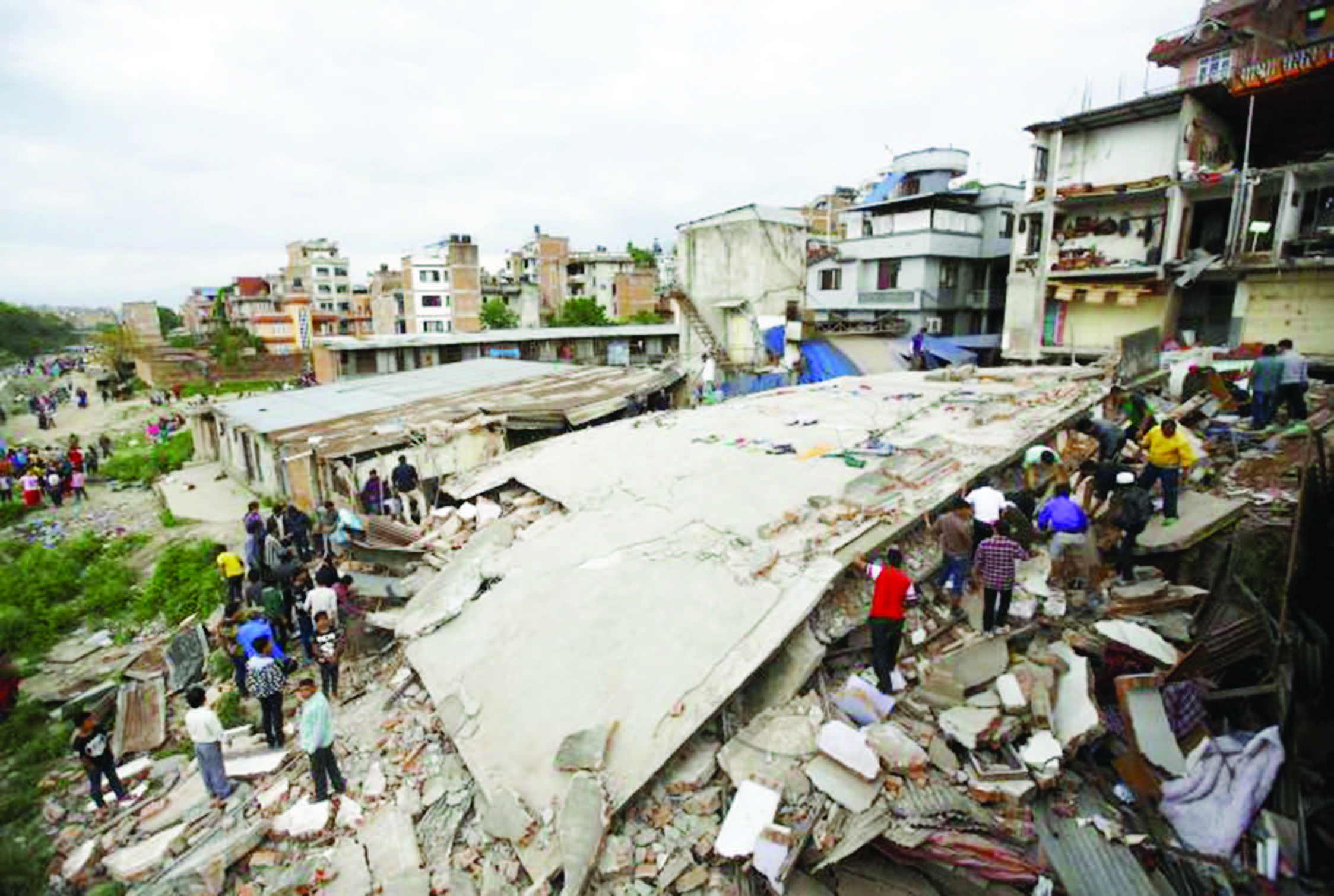
    Rescue crews and residents in Nepal began the desperate search for survivors near the capital of Kathmandu. The devastation is massive with flattened homes, buildings and temples, causing widespread damage across the region and killing more than 5800 and rising.

    Whole streets and squares in the capital of more than 1 million people were covered in rubble. Stunned residents stared at temples that were once part of their daily lives and now were reduced to nothing.

    Locals and tourists ferreted through mounds of debris in search of survivors.

    Officials have warned that the number of casualties could rise as rescue teams reach remote mountainous areas of western Nepal.nepal

    “Our estimates are not looking good. We are thinking that 10,000 to 15,000 may be killed,” said Gen. Gaurav Rana, who is leading the nationwide rescue effort.

    Rana acknowledged that massive temblor left officials struggling to cope with the aftermath – including the risk of disease and growing public anger at the pace of the rescue effort.

    “There is unrest, and we are watching it. Yes, there is the threat of an epidemic, and we are watching it,” he said.

    Rana said he understood how many people “would be angry” about the government’s response, stressing that the army was working with the police to “identify local hot spots and control.”

    [quote_box_center]India gives massive help[/quote_box_center]

    A defense ministry handout shows teams from the National Disaster Relief Force (NDRF) and Indian Air Force material on their way to earthquake-hit Nepal. Indian planes were the first to land in Kathmandu with water, food, earthmoving equipment, tents, blankets, mobile hospitals, specialized rescue teams and specialized manpower to help restore electricity supply-a combination of rescue and relief.

    Indian planes were the first to land in Kathmandu with water, food, earthmoving equipment, tents, blankets, mobile hospitals, specialized rescue teams and specialized manpower to help restore electricity supply-a combination of rescue and relief. Increasingly, as Nepal’s only airport gets crowded with flights from other nations, India has been moving most of its material by road to Nepal.

    National Disaster Response Force (NDRF) teams, a home ministry force, have fanned out beyond Kathmandu to try and reach wrecked villages and hamlets lying in inaccessible and remote parts.

    Military helicopters have conducted reconnaissance flights, and what they report about the extent of the devastation is said to be pretty grim.

    Alongside, showing his personal involvement in the relief effort, Prime Minister Narendra Modi, in a series of tweets on 27 April, thanked the NDRF teams, armed forces, doctors, volunteers,
    “enthusiastic youngsters”, state governments that were helping out, the media (“they are bravely covering the disaster from the ground”), and saluted “the resilience of our sisters & brothers in Nepal & parts of India, for their courage in the face of disaster”.

  • WHY INDIA MATTERS TO CANADA

    WHY INDIA MATTERS TO CANADA

    For two countries that Prime Minister Stephen Harper calls “natural partners” in a new global economy, Canada and India might appear to share a rather meek business relationship.

    Not even one per cent of Canadian exports currently ship to India, with goods exports around $3.1 billion in 2014 – less than one-sixth what Canada exports to China.

    Promising to open India to global commerce, Indian Prime Minister Narendra Modi’s historic three-day Canadian tour this week seeks to change that.

    His trip ends a 42-year dry spell since a head of state from the world’s largest democracy visited to talk bilateral relations.

    As Harper pushes for a free-trade pact with Modi, Canadian economists and business leaders representing South Asian professionals lay out their case for why India is a social, political, cultural and economic force that matters.

    1. A hot opportunity

    “Let’s not forget there’s a race to get to India’s door,” says Jaswinder Kaur, director of the Canada-India Centre of Excellence in Ottawa.

    “We’re competing against Japan, the French, the Australians, and this is an opportunity for Canada to demonstrate how we can contribute and make a true partnership.”

    Canada’s Global Markets Action Plan identified India as a priority market, with a burgeoning economy and roughly 11 million people under 30 entering the workforce each year.

    India has for years remained the largest market for Canada’s pulses (grain legumes such as lentils and peas), and Canada also supplies lumber and potash.

    “But are Canadian companies ready to do business?” Kaur says. “That’s where the real work is going to begin.”

    The International Monetary Fund projects that by 2016, India’s GDP growth will outpace that of China’s becoming the fastest-growing major economy in the world.

    In the meantime, two-way bilateral trade has grown to $6 billion, up 47 per cent since 2010, when trade was around $4.09 billion.

    2. Energy demands

    Much has been made, Kaur notes, of Modi “shopping for uranium” as part of this Canadian tour.

    India needs the radioactive element to feed its nuclear reactors, and Canada has a vast supply.

    ‘Mr. Modi will be looking for a signed contract for Canada to be a supplier of uranium, as India desperately needs energy as it expands.’ – Elliot Tepper, Carleton University South Asian studies professor

    If Ottawa allows, Saskatchewan-based Cameco Corp. could resume uranium exports to India following a ban 40 years ago, when India was accused of testing a nuclear weapon in 1974, and then again in 1998, using Candu technology supplied by Canada.

    “Since then, our relations have slowly climbed back up to the point where we have a nuclear agreement,” said Elliot Tepper, a South Asian studies professor at Carleton University.

    “Mr. Modi will be looking for a signed contract for Canada to be a supplier of uranium, as India desperately needs energy as it expands, and wants to rely more on nuclear power.”

    Meanwhile, Canadian natural gas and oil will continue to be useful resources to India.

    3. Young population

    The under-35 demographic represents more than 65 per cent of India’s population, and many of them are migrating from rural areas to cities searching for education and employment, both of which Canada can help supply.

    Open for business. India’s Prime Minister Narendra Modi addresses the world’s largest industrial technology fair, the Hannover Messe, in Hanover, Germany, earlier this month. He has been on something of a world tour, trying to drum up industrial investment in job-hungry India.

    Modi’s “Make in India” initiative is encouraging international firms to set up manufacturing plants in India to spur job creation at home and become a low-cost alternative to China.

    Flipping the saying that China will grow old before it grows rich, Gary Comerford, president of the Canadian Indian Business Council, believes

    “India will grow wealthy before it grows old.”

    Over the last decade, he says, a large number of Indians have “pulled themselves out of poverty” and into a rising middle class.

    “And that means they’re consuming,” Comerford says of the next generation of big spenders. “They’re getting a fridge, a TV, a cellphone.

    “If you take that sheer population of 1.2 billion and convert it into a consuming group, as well as being an economic powerhouse, it will be a political powerhouse as well.”

    4. Cross-cultural understanding

    India remains a democracy with a “remarkably pluralistic society,” which Canada can appreciate as a state that welcomes diversity as a foundation of the country, says Tepper.

    Two business-friendly PMs, India’s Narendra Modi and Canada’s Stephen Harper chat at the G20 summit in Australia in November. (The Canadian Press)

    “That makes our two countries both natural allies and rather special in terms of the states of the world,” he says, adding that the two countries have worked together quietly for years on such things as counter-terrorism and sharing concerns about violent extremists.

    University of Toronto professor Kanta Murali, who analyzes Indian politics at the Centre for South Asian Studies, points to a 1.2 million-strong Indian diaspora in Canada as “central to the excitement surrounding Modi’s visit.”

    A shared history under British colonial rule, a broadly English-speaking population and a democratic system add to a sense of kinship, adds Comerford.

    5. A knowledge economy

    According to Dherma Jain, president of the Indo-Canada Chamber of Commerce, more than 15,000 Indian students have decided to pursue foreign studies at universities and colleges in Canada.

    Modi’s visit is expected to seal some educational co-operation agreements such as twinning programs, Tepper said.

    “Canada will be providing expertise that India invites as it wants to upscale its own capacity, from technology to agriculture, and attracting people to come to Canada instead of going elsewhere,” he said.

    India is interested in harnessing green tech as well, notes Karunakar Papala, chairman of the Indo-Canada Ottawa Business Chamber, which represents some 600 business owners in the capital.

    Modi’s plan for India to develop 100 high-tech “smart cities” that are more energy and resource efficient, could benefit from Canadian know-how. (The Indian prime minister made a similar pitch when he visited Germany recently.)

    “Solar technologies, green technologies, Canada has got a lot to offer there,” Papala said.

  • RBI GOVERNOR GETS DEATH THREAT FROM IS

    MUMBAI (TIP): Reserve Bank of India (RBI) Governor Raghuram Rajan recently received a death threat from a purported Islamic State (IS) email account that is being accessed from across the globe.

    The governor received the threat on his official email address last month from isis583847@gmail.com—an account which the police said had been opened from Australia, Canada, Italy, Germany, US, Nigeria, Poland, Belgium, Hong Kong and Ukraine in a span of a few days.

    While security measures at the RBI has been beefed up, Mumbai Police Commissioner Rakesh Maria has asked the Cyber Crime Investigation Cell to conduct thorough investigations.

    The RBI refused to comment on the issue, but inside sources confirmed that Rajan was currently in the US along with Union Finance Minister Arun Jaitley to attend the World Bank group meeting in Washington. Without elaborating on the details of the e-mail, police sources said the IS warned Rajan that he would be eliminated as a contract had been received to execute him.

  • Class action lawsuit against Facebook to begin in Vienna

    Class action lawsuit against Facebook to begin in Vienna

    Max Schrems, the Austrian law graduate spearheading a class action lawsuit against Facebook for alleged privacy breaches, said ahead oft he preliminary hearing in Vienna on Thursday said he hoped to send a message to US-based online companies who think “you can do anything you want in Europe.”

    The 27-year-old accused the social networking site of taking a “Wild West” approach to data protection. Schrems and 25,000 other Facebook users are suing the website for a range of rights violations, from the “illegal” tracking of their data under EU law to Facebook’s involvement in the PRISM data collection program of the United States National Security Agency (NSA).

    “Basically we are asking Facebook to stop mass surveillance, to (have) a proper privacy policy that people can understand, but also to stop collecting data of people that are not even Facebook users,” Schrems told French news agency AFP.

    Schrems has brought the case against the company’s European headquarters in Dublin, which registers all account outside the United States and Canada – amounting to about 80 percent of Facebook’s 1.35 billion users. The case was filed in Vienna, as all EU countries are compelled to enforce court rulings from any other member state. 

    The judges will also rule on Facebook’s claim that the suit is inadmissible under Austrian law, an objection described by Schrems’ lawyer as without “any substance.”

    The plaintiffs are asking for 500 euros ($540) each in damages – a symbolic amount, as per Schrems’ explanation, the case is not about getting rich, but rather “about the principle that fundamental rights have to be applied.”

    The suit has garnered a huge amount of interest from all over the world. Within days of launching the case last August, Schrems was overwhelmed by the thousands of people from Europe, Asia, Latin American and Australia who wanted to take part. In the end, he limited the number to 25,000 participants, but a further 55,000 have already registered to join the proceedings at a later stage.

    The case landed in the European Court of Justice (ECJ) after the Irish authorities refused to open a probe into the alleged violations. The ECJ’s decision, which is expected in 2016, could have far-reaching implications for American tech companies operating in Europe.

  • Sim Bhullar makes history as the first Indian American to play in the NBA

    Sim Bhullar makes history as the first Indian American to play in the NBA

    Sacramento Kings’ Sim Bhullar became the first person of Indian descent to play in an NBA game. The Indian American makes history when he appeared in the game against the Minnesota Timberwolves for only 16 seconds as the clock wound down in the final quarter.

    Still, clearly aware of the moment’s significance, Sacramento fans gave him a standing ovation as he made his way onto the floor.

    The 22-year-old Sim Bhullar, was born in Canada after his parents migrated there from Punjab, India.

    Sim signed up with an NBA team, joined the Kings last week on a 10-day contract. He played his college ball at New Mexico State, went undrafted and spent this past season playing for the NBA Development League’s Reno Bighorns, where he averaged 10.3 points, 8.8 rebounds and 3.9 blocks.

    “I told him to enjoy the ride,” his teammate, Omri Casspi, said, per ESPN.com. “You got 2 billion Indians looking up to you. Be the best role model you can be and have fun with it.”

    Casspi was the first Israeli-born player in the NBA, so he certainly had a unique perspective on the moment.

    While it remains to be seen if Bhullar will stick with the team beyond this season—at 7’5″, the team would probably love for him to pan out at center—he’ll always have a slice of NBA history to look back on. He’ll also likely become a hero to Indians around the globe.

    The NBA has over 100 active players from 37 countries other than the US. While basketball is not as popular in India as it is in other Asian countries—particularly China—it’s quickly growing in popularity there, as it is in many other countries around the world.

  • End of turban trouble in UK

    End of turban trouble in UK

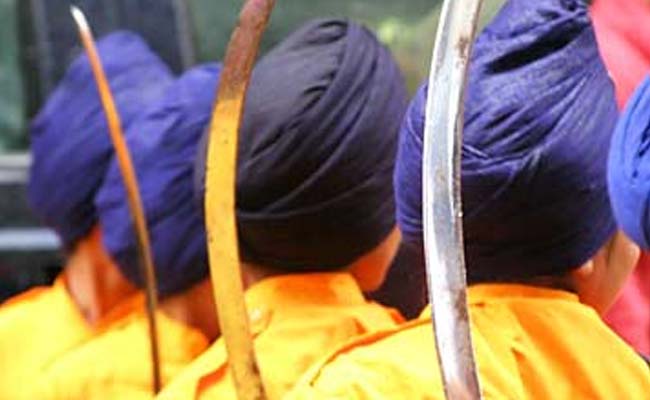
    CHANDIGARH (TIP): In the run up to general elections in the UK scheduled for early May, the 7.5-lakh strong Sikh community there has got a gift in the shape of a new law that allows turban in all industries.

    So far, Sikhs were exempt from wearing safety helmets in some industries like construction, but were required to wear safety helmets in others like factories, warehouses and transport. The issue of wearing safety helmets instead of turbans had been haunting Sikhs since the passing of the Employment Act, 1989 by the UK Parliament. Though turban-wearing Sikhs were exempted from wearing safety helmets at construction sites, safety standards set up in other workplaces over the years did not offer the same provision.

    It meant that members of the Sikh community were unable to follow their chosen professions because of the insistence on the need to wear safety helmets, which obviously cannot be worn on top of a turban. Even simple jobs like truck driving were out of bound for Sikhs because of the rules.

    An amendment to do away with the anomaly was introduced to the Deregulation Bill by the government with cross-party support in March 2014. The Bill was finally granted Royal Assent on Thursday, making it into a law. There will, however, still be limited exceptions, such as for specific roles in the armed forces and emergency response situations.

    Welcoming the move, The Sikh Council UK spokesperson Gurinder Singh Josan said, “The move will open new avenues for close to 2.5 lakh turban-wearing Sikhs in the UK. We campaigned for the change. The UK is a torch-bearer when it comes to giving Sikhs their rights. We wish countries like Canada follow suit.” 

    Lord Indarjit Singh of Wimbledon, who spoke in favour of the amendment in the House of Lords, said, “It was a much awaited move. The looming elections helped fast-forward the process and we welcome it.”

  • Aamir Khan and Kamal Hassan inaugurate FICCI FRAMES 2015 in Mumbai

    Aamir Khan and Kamal Hassan inaugurate FICCI FRAMES 2015 in Mumbai

    MUMBAI (TIP): It’s that time of the year again. The onset of a much-awaited spring in New York and a long, hot summer in Mumbai.

    The 16th Annual FICCI FRAMES conference on the Media & Entertainment (M&E) industry is back at the Rennaissance Hotel & Convention Centre situated on the picturesque Powai lake in Mumbai.

    It’s Wednesday, March 25th 2015; Day 1 of the event, and in addition to the locals, NRIs and other business visitors from USA, UK, Canada, Australia and other countries are here again in full strength; veterans from the media business, aspirants in the field of entertainment, panelists, delegates, you name it, the conference has them all.

    About FICCI FRAMES 2015

    FICCI FRAMES is Asia’s largest global conference on the business of Media and Entertainment. Spanning three days, the conference covers the entire spectrum of the M&E industry, with back-to-back presentation sessions, panel discussions & master-classes focused on micro-specializations such as film, television, radio, print, internet/digital media, animation and gaming among others. This highly-anticipated & most-respected industry event currently draws over 2,500 participants from all over the world, with India & USA together accounting for over 90% of the attendees.

    The list of known names at the conference reads like a virtual Who’s Who of the global M&E industry. Attendees get to rub shoulders and interact one-on-one with top achievers in the business; for 2015, the list of presenters & panelists boasts includes Aamir Khan, Kamal Hassan, Ayushmann Khurana, Abhishek Bachchan, Irrfan Khan, Vishal Dadlani, Abhay Deol, Kalki Koechlin, Rohan Sippy, Siddharth Roy Kapur, Arjun Kapoor, Vikas Bahl, Suhel Seth, Ramesh Sippy, Guneet Mongia, Devendra Fadnavis, Rajyavardhan Singh Rathore, Gen. V. K. Singh, Harit Nagpal, Sudhanshu Vats, Gaurav Gandhi, Mukesh Bhatt, Ashish Kulkarni, Sundeep Nagpal, Viraf Patel, Karan Bedi, Kamlesh Pandey, Anjum Rajabali, to name a few.

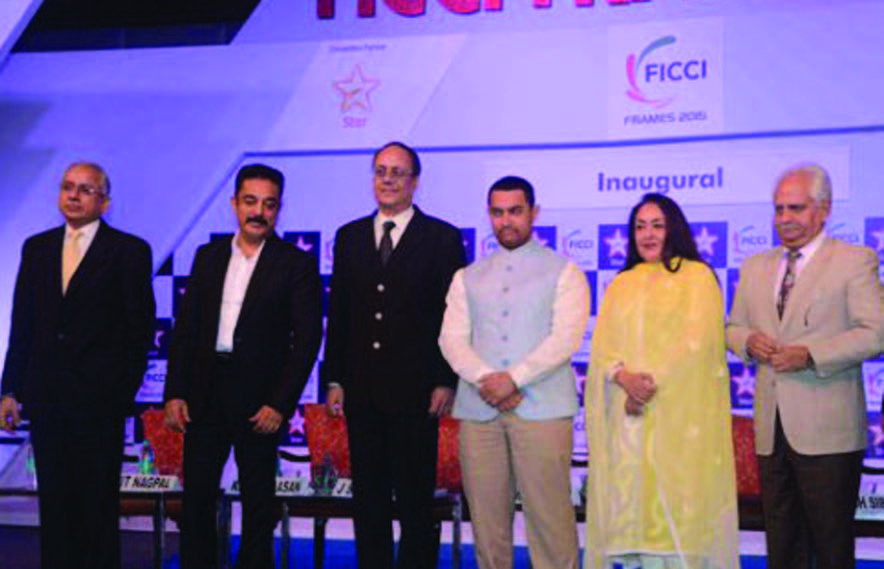
    Day 1 of the event saw the inauguration with Aamir Khan lighting the ceremonial lamp. This was followed by the welcome address from Jyotsna Suri, Vice President, FICCI. Harit Nagpal, CEO & MD, TataSky, delivered the theme address next.

    The FICCI-KPMG 2015 report on the Indian Media & Entertainment industry was officially released after Harit’s address; the highlight of this report is the growth registered by various disciplines within the industry.

    This was followed by opening remarks from Ramesh Sippy, Co-chair, FICCI Entertainment Committee, and Kamal Hassan. Aamir Khan was next with an interactive session with the audience.

    This inaugural session was followed by a series of presentations, panel discussions & master-classes. Detailed coverage of these sessions along with interviews of key presenters & panelists will be provided at the end of the conference.

    The list of media corporations at this year’s convention includes BBC, Discovery Networks, Disney India, Fox Star Studios, Phantom Films, NDTV, Excel Entertainment, Star India, Dharma Productions, TataSky, Viacom 8, Zee TV and Balaji Telefilms, among several others.

    The convention also features national and international government bodies such as the Consul General of USA, Consul General of Canada and the Ministry of Information and Broadcasting (India).

    Finally, there are a number of M&E-centric corporations with booths at the event, looking to showcase a wide range of industry tools & accessories such as film-making & broadcasting equipment, studio apparatus, animation tools, software solutions & related technology.

    About FICCI

    Established in 1927, FICCI (Federation of Indian Chambers of Commerce & Industry) is the largest and oldest apex business organization in India. FICCI’s history is closely interwoven with India’s struggle for independence and subsequent emergence as one of the most rapidly growing economies globally. FICCI plays a leading role in policy debates that are at the forefront of social, economic and political change.

    A non-government, not-for-profit organization, FICCI is viewed as one of the major voices of India’s business and industry. It works closely with the government on policy issues, enhancing efficiency, competitiveness and expanding business opportunities for industry through a range of specialized services and global linkages. Partnerships with countries across the world carry forward it’s initiatives in inclusive development, which encompass critical issues such as health, education, livelihood, governance & skill development.

    Through its 400 professionals, FICCI is active in 38 sectors of the economy. FICCI’s stand on policy issues is sought out by think tanks, governments and academia. Its publications are widely read for their in-depth research and policy prescriptions. FICCI has joint business councils with 79 countries around the world. Its publications are widely read for their in-depth research and policy prescriptions.

    The Media & Entertainment Division of FICCI serves a vital link between the media & entertainment industry, Information & Broadcasting Ministry and global interests in this vibrant sector.

    Media & Entertainment Division is an active division organizing the FICCI-FRAMES, conducting & releasing pioneering studies in the sectors, assisting in policy decisions and helping scale up the industry through various initiatives.

    This division is guided by the chairman Mr. Uday Shankar and co-chairman Mr. Ramesh Sippy.

  • KOMAGATA Maru apology

    Governments apologising for acts committed generations ago do give a veneer, even if superficial, of turning a new page on the blemished past, but there’s competing politics involved. For the large Punjabi community in Canada, the long-sought apology from their adopted country for the Komagata Maru incident is not just about pride. It is a desire of acknowledgement of being part of the fabric and, hence, deserving of the nation’s acceptance that one of their own was wronged. Political parties well recognise the importance of symbolism, but only if expediency and emotional appeal carry enough weight to pull along non-supporters. In faraway Punjab, where seeking an apology and not apologising is often the measure of an MLA, the Vidhan Sabha has asked the Stephen Harper government to apologise for the 1914 incident.

    The “White Canada” policy that intended to keep Indians out was challenged when 376 aspiring immigrants, mostly Punjabis, reached Vancouver aboard the Japanese ship. They were denied entry on the basis of the continuous journey regulation and forced to leave after two months. Upon their return to India, 19 died in firing by the British troops. This racist colonial oppression bolstered the realisation that if you are not free at home, you are not free anywhere. Komagata Maru and the Ghadar movement also changed the image of Punjab, which was seen as being inclined towards the British unlike Bengal.

    The city of Vancouver has apologised, as has the province of British Columbia. Harper did say sorry for Komagata Maru, but not in Parliament. Since Narendra Modi’s visit to Canada is scheduled from April 14 to 16, the first such trip by an Indian PM since 1973, it is a good time for Ottawa to make amends. If a section feels an apology can change racial attitudes, what’s the harm in offering it?Backing the community in Canada is well taken, but not the Punjab lawmakers’ belief in symbolism. Their resolution, by the way, had no mention of whether the British should apologise for the killings. They haven’t done it for Jallianwala Bagh too. Maybe another quick resolution on the last day of the next session.

  • Soon, you could drive from Europe to US

    WASHINGTON (TIP): Plans for a new high-speed transport corridor that could potentially link London and New York by rail and superhighway have been unveiled. The idea, dubbed the Trans-Eurasian Belt Development (TERP), would see a high-speed railway and motorway built from Eastern Europe, across Siberia and over the Bering Strait to Alaska. Vladimir Yakunin, the head of Russia’s state railways, told a meeting of the Russian Academy of Sciences that the project could link existing networks and supercharge global economic growth. It would also feature oil and gas pipelines to connect Russia’s petro-industries more directly to the rest of the world. “This is an inter-state, inter-civilization, project. It should be an alternative to the current model, which has caused a systemic crisis. The project should be turned into a world ‘future zone’, and it must be based on leading, not catching, technologies,” he said, according to the Siberian Times newspaper. The plan was developed by the transport boss alongside the rector of Moscow State University, Viktor Sadovnichy and academic Gennady Osipov.

    Alaska is already connected to the US by superhighway through Canada, along the Alaksa Highway — though there is no passenger rail network. The highway links to US interstate network which can take motorists to all corners of the US and beyond.

    In eastern Europe the EU is drawing up plans for a high-speed rail corridor to connect the Baltic states to western Europe’s rail network — which runs through the Channel Tunnel to London. North American passenger rail are comparatively undeveloped. Plans drawn up by President Obama to develop high- speed rail corridors across the US .

  • India’s emergence as a major player good for world: Ambassador Richard Verma

    India’s emergence as a major player good for world: Ambassador Richard Verma

    NEW DELHI (TIP): Envoys of six leading world powers — US, Japan, China, Britain, Germany and Canada- hailed, March 14,  India’s emergence as a major player at the “global high table” and complimented the new government for its efforts to stimulate economic growth, says a PTI report.

      The Ambassadors and High Commissioners said India’s role was crucial in combating major challenges facing the globe such as terrorism and climate change while noting that the country has huge untapped potential in trade and economic spheres.

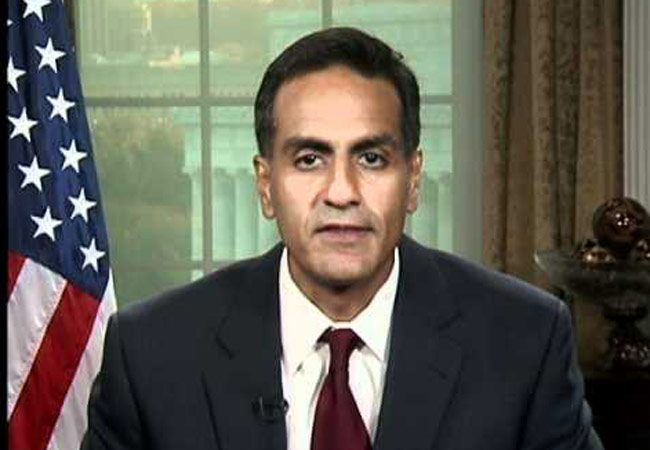
      US Ambassador Richard Verma said the strategic partnership between the two countries has moved into a new phase and that the visit here by President Barack Obama had led to breakthroughs on a number of issues.  

    “Our strategic partnership has moved into a new phase, a more mature one that I would characterize as “strategic plus”.

     Our leaders share an understanding that if our democracies work in tandem, we can have a positive impact on global peace, democracy and economic prosperity,” Verma said addressing the India Today conclave.

    He said since Prime Minister Narendra Modi visited the US in September last year, both sides have “convened, signed, and cooperated on no fewer than 30 dialogues, declarations, and agreements.”

    On India-US partnership on clean energy, he said over USD 2.4 billion has been “mobilized” to invest in clean energy projects.

    “We have agreed to make concrete progress this year towards phasing out hudrofluorocarbons under the Montreal Protocol as well as pursuing a strong global climate agreement in Paris this year,” he said adding US has offered its support to Indian cities to combat air pollution.

    He said last week, a team of experts from the US Environmental Protection Agency met with senior officials and experts of the Ministry of Environment and the Central Pollution Control Board.

  • US man rescued trying to walk from Detroit on frozen lake to Canada

    Detroit (TIP): A 25-year-old American man was rescued by the US Coast Guard after he tried to walk from Detroit to Canada across a frozen lake, officials said on Mar 12. The man was found on Mar 11 on Lake St. Clair, which borders the United States and Canada, about 1.5 miles (2.4 km) from shore by a lookout assigned to the Coast Guard Cutter Neah Bay, a 140-foot ice-breaking tug, the Coast Guard said.

    “He was suffering from hypothermia and disoriented,” said Chief Petty Officer Lauren Jorgensen, a Coast Guard spokeswoman.

  • Pakistan man accused in US consulate plot arrested

    TORONTO (TIP): Canadian immigration officials have arrested a Pakistani man who they say was plotting to attack the US consulate and other buildings in Toronto’s financial district.

    The Immigration and Refugee Board of Canada said at a hearing March 11 that Jhanzab Malik told an undercover police officer about his plan to build remote controlled bombs to blow up the US consulate and other buildings.

    The board says he is a self-proclaimed supporter of the Islamic State and al-Qaida and told the officer that he attended training camps in Libya.

    Malik, who came to Canada as a student in 2004, was arrested Monday.

    The Canadian government is looking to deport him. It wasn’t clear why he hasn’t been charged. He has been ordered detained.

  • Iqbal leads Bangladesh to important win over Scotland

    NELSON (TIP): Tamim Iqbal came agonisingly close to scoring Bangladesh’s first World Cup century as his side completed a six-wicket win over Scotland in their Pool A clash at Saxton Oval in Nelson on Thursday.

    Iqbal scored 95, while Mohammad Mahmudullah (62) and wicketkeeper Mushfiqur Rahim (60) also contributed as Bangladesh achieved 322-4, their highest successful run chase in one-day internationals.

    Shakib Al Hasan (52 not out) and Sabbir Rahman (42 not out) guided Mashrafe Mortaza’s side home with 11 balls to spare to cap off the perfectly timed run chase.

    The victory put all the pressure on England for their showdown with Eoin Morgan’s side on March 9 in Adelaide, with Bangladesh now on five points and level with third-placed Australia, while England have two.

    Both have just two games remaining to play.

    Scotland had been well placed to achieve their first World Cup victory, days after throwing away the opportunity against Afghanistan, after Kyle Coetzer had scored a career-best 156 in his side’s 318 for eight.

    The 30-year-old’s innings was the first World Cup century by a Scotland batsman and also the highest score by someone from an associate nation at the global showpiece.

    It also ensured his team posted their highest score against a Test nation.

    Coetzer, who was named man-of-the-match, shared in a 141-run partnership with captain Preston Mommsen (39) and 78 runs with Matt Machan (35) to anchor the innings.

    Scotland enjoyed their third 300-plus score in one-day internationals, having also achieved the mark against Ireland in 2011 and Canada in 2014.

  • EU leaders debate new anti-terror measures

    BRUSSELS (TIP): Galvanized by the recent terror attacks in France, European Union leaders on February 12 debated a range of ambitious steps to better protect their 28 nations, including exchanging airliner passenger manifests, tightening controls at the border and combating extremism on the Internet.

    EU President Donald Tusk, the summit meeting’s host, said he would seek agreement on a “work plan to step up the fight against terrorism.” The bloc’s top official for counter-terrorism warned member governments last month that “Europe is facing an unprecedented, diverse and serious threat.”

    Counter-terrorism policy shot to the top of the EU agenda following the Jan. 7-9 terror attacks in Paris against a satirical weekly, a policewoman and a kosher grocery store that claimed a total of 17 victims. The three gunmen, who proclaimed allegiance to Al-Qaida in Yemen and the Islamic State group, were also shot dead by French police.

    The attacks mobilized France and other EU countries to seek more effective ways to deal with armed Islamic militancy, especially the problem of radicalized European-born Muslims who go to fight in Syria or Iraq and then return home.

    The attacks in the French capital “were a game-changer” for EU counter-terrorism policy, said Alexandra de Hoop Scheffer, senior trans-Atlantic fellow and director of the Paris office of the German Marshall Fund think tank. To prepare for Thursday’s summit in Brussels, EU foreign, finance and interior and justice ministers drew up recommendations on what to do.

    But as the leaders met, some officials urged caution. Finnish Prime Minister Alexander Stubb said it was imperative to strike “a careful balance between civil liberties and security.” European Parliament President Martin Schulz, who addressed the summit, told a news conference afterward that rashly limiting individual rights in the name of boosting public safety would play right into the terrorists’ hands by discrediting Western-style democracy.

    “We need to be a state of law and democracy,” Schulz said. “We need to protect our values.”

    Some of the steps the leaders were expected to consider:

    AN EU-WIDE PASSENGER REGISTRY TO SHARE INFORMATION ON AIR TRAVELERS 

    “It sounds crazy, but we don’t have that system within the EU, though we have it with the U.S., Canada and Australia,” said de Hoop Scheffer. An earlier attempt to launch an EU-wide exchange of air traveler data for prevention, detection, investigation and prosecution of terrorist offenses and other serious crimes died in the European Parliament in 2013 when a committee rejected it on civil liberties grounds.

    On Wednesday, European Parliament members, by a 532-136 vote, pledged to work toward getting a passenger name record program enacted by the end of 2015, but insisted the EU simultaneously rewrite its rules on data collection and sharing to ensure legally-binding protections.

    Even that wasn’t sufficient for Europe’s Greens, who opposed the resolution, saying it gave “carte blanche for EU governments to scale back personal freedoms.” The Greens said it would be more effective to conduct targeted surveillance on individual suspects already known to authorities.

    TIGHTER BORDER CHECKS ON TRAVELERS 

    Twenty-six European countries, among them 22 EU nations, have abolished passport and customs controls among one another in what’s commonly known as the “Schengen area.” According to EU officials, current identity checks on European travelers leaving or re-entering the area are often cursory.

    Gilles De Kerchove, the EU’s counter-terrorism chief, has called for the swift implementation of a new screening system to detect suspicious travel movements, and suggested it is also time to change some of the rules governing the Schengen area.

    FIGHTING THE USE OF THE INTERNET TO SPREAD RADICAL IDEAS 

    A draft statement prepared for Thursday’s summit calls for measures to “detect and remove Internet content promoting terrorism and extremism,” including reinforced cooperation between public and private sectors and a coordinating role for Europol, the EU’s law enforcement agency.

    “Preventing radicalization is a key element of the fight against terrorism,” the draft statement says. It also calls for development of communication strategies to promote tolerance, non-discrimination, fundamental freedoms and solidarity throughout the EU, and use of education, vocational training and rehabilitation to limit the lure of radicalization, including for people in prison.

    If all three of the major proposals are adopted, “the EU would be better equipped” to deal with the terrorism challenge, said de Hoop Scheffer.

    The EU leaders were expected to consider other measures as well, including better coordination among existing institutions like Europol, Eurojust _ the EU-wide agency of prosecutors, police and investigating magistrates _ and the bloc’s counter-terrorism coordinator.

  • A BENEVOLENT LAW ABUSED – Racketeers use SIJS to make big money

    A BENEVOLENT LAW ABUSED – Racketeers use SIJS to make big money

    [vc_row][vc_column width=”2/3″][vc_column_text]

    It has been said the crooks will always find creeks to enter any system in the world. And when the system is welcoming and benevolent, the infiltration is much easier. Special Immigrant Juvenile Status law (Please read the article below by eminent attorney Anand Ahuja on page 6) was enacted with a humanitarian objective to provide protection to those minors who are victims of domestic abuse. Over the years, the law stands abused. It has become a booming business in many countries to push young boys and girls, mainly boys (77%), in to the United States territory and make them take advantage of SIJS.

    The Indian Panorama Investigative team came across quite a few people in Queens and Long Island in New York who are part of the thriving racket to smuggle in young boys and girls from India. The reports received by us indicate that it is a big business in many South Asian countries, in particular, India, Sri Lanka and Pakistan as also in many other countries across the world. We were taken for a shock to get to know how elaborate the racket’s dragnet is, which involves agents in countries from which the young people are sent, agents at the Mexican side of the US border who help them cross over in to the United States, agents in the US who manage a guardian for the boy/girl and so on so forth. All this involves huge money. In India, the price to send a young boy or a girl in to USA is anywhere between $80,000 to $100,000.

    Another shocking revelation was the involvement of church in this racket. During our talk with some who are involved in the racket told us, on condition of anonymity, that at least, one    priest from a Christian Church in New York and a Sikh priest from a Sikh Gurudwara in Arizona are actively involved in running the racket. The authorities do not suspect the priests of any wrong doing and the latter take advantage of it. Our source told us that the Christian Priest who is based in New York and comes from Punjab, India, visits his home state in India to “recruit” the youth who want to come to USA. It was pointed out to us that the pries has been making regular trips for the job. He arranges the incoming youth’s stay and finds him a guardian. Interestingly, all the young people who come here and come to have guardians, work and stay elsewhere, not necessarily with their guardians. The person agreeing to be a guardian to a youth is offered a payment of between $5000.00 to$10,000. The attorney’s fees is anywhere between $3000.00 and $5000.00. We were also told about two attorneys whose services the priest utilizes regularly. Also, there are some attorneys who specialize in such cases. The gentleman who offered to be guardian to a young man confided in us that the young man had disappeared and that he had to report the disappearance to the court.

    The malaise is much deeper and goes beyond simple monetary racket. It has serious implications for America’s security. With ISIS and Al Qaeda stepping up recruitment of young people from all over the world, USA is threatened as never before because of such soft laws  which allow easy infiltration in to the country. Our source, on condition of anonymity, told us that he had come to know that the enemies of USA are all set to push in young people in to USA to carry out their agenda in America, which is to harm the country in every way.

    A thorough investigation by the US administration  agencies concerned in to the racket and  the possible infiltration of enemies of USA in to the country, taking advantage of the benevolent soft humanitarian laws needs to be  done sooner than later. And the earlier, the better.

    [/vc_column_text][/vc_column][vc_column width=”1/3″][vc_column_text]

    (National Juvenile Justice Network)  (The Pew Charitable Trusts: May 9, 2013)

    Hundreds of thousands of youth (under age 18) attempt to enter the U.S. every year. Some come with their families, others alone, either of their own will seeking jobs, protection and family reunification or they are smuggled into the country for sweatshop labor or sexual exploitation. The exact number of children who attempt to enter the country is unknown. In 2005 granted legal permanent resident (LPR) status to 175,000 children under 14 years of age and to 196,000 youth ages 15 to 24. Twenty thousand youth ages 17 and under were accepted as refugees and 2,000 were granted asylum in the same year. Customs and Border Protection (CPB) apprehended almost 122,000 juveniles in the U.S. in 2004. Of this total, 84.6 percent were released back to Mexico, or in rare cases to Canada.

    [/vc_column_text][vc_column_text]

    (The Migrationist: August 8, 2013)

    Each year, thousands of unaccompanied alien children
    (UACs) risk harrowing journeys and travel alone to seek refuge in the United States. These children come from all over the world for many reasons, including to escape persecution in their home countries, to reunify with family members and to look for a better life. In recent years, the U.S. government has had roughly 6,000-8,000 of these children in its care and custody each year. While these children may be as young as infants, most (approximately 70 percent) have been between the ages of 15 and 17. -Women’s Refugee Commission

    [/vc_column_text][/vc_column][/vc_row]

  • DEFLATION ALARMS RING LOUDER AS EU, CHINESE FACTORIES STRUGGLE

    DEFLATION ALARMS RING LOUDER AS EU, CHINESE FACTORIES STRUGGLE

    LONDON/SYDNEY (tip): European and Chinese factories slashed prices in January as production flatlined, heightening global deflation risks that point to another wave of central bank stimulus in the coming year.


    While the pulse of activity was livelier in other parts of Asia — Japan, India and South Korea — they too shared a common condition of slowing inflation.


    Central banks from Switzerland to Turkey via Canada and Singapore have already loosened monetary policy in the past few weeks.


    The European Central Bank also announced a near-trillion-euro quantitative easing programme in a bid to revive inflation and drive up growth, though much of the bloc’s Purchasing Managers’ Index survey was collated before that announcement.


    “There are a lot of places where central banks are focusing on easing rather than anything else. In the euro zone the ECB is going all-out now,” said Jacqui Douglas, senior global strategist at TD Securities.


    “Looking at the rest of Europe we are expecting more easing from Sweden and Norway, that is where most central banks are leaning right now. There is no real rush to move ahead with rate hikes.” 


    Markit’s final PMI reading for the euro zone, published on Monday, was 51.0, in line with the flash estimate. Although at a six-month high, it was only just above the 50 mark that separates growth from contraction. In December the index came in at 50.6.


    Worryingly for policymakers, firms cut prices in January at the steepest rate since mid-2013. Data on Friday showed annual inflation was a record-equalling low of -0.6 per cent in January across the 19 nations using the euro.


    In Britain, manufacturing grew slightly faster but factories cut prices at the fastest pace since 2009. The Bank of England will keep interest rates at a record low until at least October, later than previously thought, a Reuters poll found last week.


    “With oil prices having stabilised at around $45 per barrel now, it seems likely that lower oil prices should continue to enable manufacturers to lower prices and so support demand,” said Paul Hollingsworth at Capital Economics.


    Still to come later on Monday is a sister manufacturing survey from Markit covering the United States, as well as the Institute for Supply Management’s US factory index, which is forecast to have slipped to 54.5 in January from 55.1.


    Easing China? 


    Earlier, a pair of surveys from China showed manufacturing struggling at the start of 2015 in the world’s second biggest economy.


    The Chinese HSBC/Markit PMI inched up a fraction to 49.7. But of more concern the official PMI, which is biased towards large factories, unexpectedly showed activity shrank for the first time in nearly 2-1/2 years.


    The reading of 49.8 in January was down from December’s 50.1 and missed a median forecast of 50.2. The report showed input costs sliding at their fastest rate since March 2009, with lower prices for oil and steel playing major roles.


    Ordinarily, cheaper energy prices would be good for China, one of the world’s most intensive energy consumers, but many economists believe the phenomenon is a net negative for Chinese firms because of its impact on demand.


    The PMIs only fuelled bets on a weaker yuan and that more monetary easing was in store in Beijing too.


    “China still needs decent growth to add 100 million new jobs this year, plus China is entering a rapid disinflation process,” ANZ economists said in a note to clients.


    “We (think) the People’s Bank of China will cut the reserve requirement ratio by 50 basis points and cut the deposit rate by 25 basis points in the first quarter.” 


    The downdraft has also spread into China’s hitherto buoyant services sector, the lone bright spot in the economy last year. Service activity expanded at its lowest level in a year.


    Slightly better news came from Japan, where the central bank has been pursuing an aggressive bond-buying campaign for over a year in a bid to revive growth and shake the country out of decades of deflation.


    The final Markit/JMMA PMI edged up in January as the sustained weakness of the yen drove up exports. Improving exports were also a feature of South Korea’s PMI which returned to growth for the first time in five months.


    India’s manufacturing activity continued to grow, though the headline index eased a touch but importantly for the prospect of more policy stimulus, cost pressures were the mildest in 70 months as commodity prices fell.

  • Indo-Canadian Financial Planner Arvindbhai Bakorbhai Patel charged in Ponzi scheme

    Indo-Canadian Financial Planner Arvindbhai Bakorbhai Patel charged in Ponzi scheme

    Former B.C. Coast Capital Savings mutual fund salesman faces 32 Securities Act charges in$110M scheme


    TORONTO (TIP): An Indian-origin former financial planner has been charged with 32 counts of Securities Act violations in Canada for advising clients to invest


    in a $110-million fraudulent scheme operated by a former Vancouver notary, a media report said Thursday, February 5. Arvindbhai Bakorbhai Patel, who worked as a British Columbia Coast Capital Savings financial planner, convinced about 90 investors to place nearly $29 million with former notary public Rashida Samji, who is facing 28 criminal charges of fraud and theft, CBC News reported.”I feel betrayed by a friend, and also I feel morally responsible for introducing my daughter to this scheme and losing her money,” Victor Vishwanathan, who is among 15 alleged victims of Patel, was quoted as saying.Last month, the British Columbia Securities Commission fined Samji$33 million for running a ponzi scheme. The commission, said that investors believed they were providing financial backing for the expansion of foreign wineries built by the Mark Anthony Group.


    They were told the money would be used as collateral for loans, but it remained in Samji’s trust. The company had no idea its name and reputation were used in association with the scheme.The charges against Patel carry maximum penalties of $3 million and up to three years in prison.

  • Political shadow boxing, threat & reality

    Political shadow boxing, threat & reality

    “The American invasion of Iraq cost the lives of millions of children. Whatever the changing definitions of terror, it is children that are so often the forgotten victims of conflict – regardless of the perpetrator”, says the author.

    Well, heaven preserve us: the most useless “peacemaker” on earth has just used an Arabic acronym for the greatest threat to civilisation since the last greatest threat. Yup, ol’ John Kerry called it “Daesh”, which is what the Arabs call it. It stands for the “Islamic State in Iraq and the Levant”. We prefer Isis or Isil or the Islamic State or Islamic Caliphate. Most journos prefer Isis because – I suspect – it’s easier to remember. It’s the name of an Egyptian goddess, after all.

    It’s the name of a university city’s river. Many an American scribe has questioned why Kerry should be using this goddam Arabic lingo – although we use Fatah for the PLO. It, too, is an acronym which, translated, means “the Party for Palestinian Liberation”. And in 2011, we called Tahrir Square in Cairo “Tahrir”, only occasionally reminding readers and viewers that it, too, meant “liberation”. None explained why the place was important: because this was the square mile of Cairo in which was based the largest British barracks and into which the Brits – during their much-loved occupation of Egypt – refused to allow any Egyptian to walk without permission. That’s why it was called Tahrir – liberation – when the Brits left.

    That’s why Hosni Mubarak’s attempt to prevent the protesters entering the square in 2011 placed him firmly in the shadow of Egypt’s former colonial masters. But why do we care what the great leaders of the West (or the East for that matter) actually say, when we all know it’s the kind of material that comes out of the rear end of a bull? Let me give you an example from Canada. Two years ago, the country’s Foreign Affairs Minister, John Baird, closed Canada’s embassy in Tehran because he feared his diplomats might be harmed. “Canada views the government of Iran as the most significant threat to global peace and security in the world today,” he quoth then – although CBC broadcasters have dug up a Foreign Ministry report which reported the biggest threat to the Tehran embassy was an geophysical earthquake.

    Since then, as the Toronto Star’s pesky columnist Thomas Walkom has pointed out, the Canadian Prime Minister Stephen Harper – whose pro-Israeli policies might earn him a seat in the Israeli Knesset -has discovered more threats. Russia under Vladimir Putin, Harper says, “represents a significant threat to the peace and security of the world”. The aforesaid Baird, taking his cue, no doubt from our own beloved Prince Charles, compared Putin’s Russia to Hitler’s Third Reich. More recently, Canada’s defence minister, Rob Nicholson, described the men of Isis (or Isil, or the Islamic State, or the Islamic Caliphate, or Daesh) as “a real and growing threat to civilisation itself”.

    The war against Isis/ Isil/ IS/ IC/ Daesh, he informed the people of Abu Dhabi, was “the greatest struggle of our generation”. Well, blow me down.Wasn’t Iran the greatest threat, ever since 1979? Wasn’t Abu Nidal, the Palestinian gun-for-hire? Wasn’t that British prime minister chappie, with the habit of saying “absolutely” and “completely” over and over again, convinced that Saddam was the greatest threat to our civilisation or generation, what with all his WMDs and links to Al-Qaida and tubes from Niger, and so on? For that matter, wasn’t Osama bin Laden’s Al-Qaida – the very bunch which morphed into Isis/ Isil/ IS/ IC/ Daesh in Iraq – the greatest threat to our civilisation/generation? Yet now, when the Iranian air force has joined the battle against Isis/ Isil/ IS/ IC/ Daesh alongside the US, Britain, Canada, Australia, old Uncle Tom Cobley and all, Kerry, in “Daesh” mode, tells us that the Iranian military action in Iraq (in any other circumstances, a ruthless assault on Iraq’s sovereignty) is “positive”. And Kerry, remember, was the fellow who told us last year that America was going to attack the regime of Bashar al-Assad, the greatest enemy of Isis/ Isil/ IS/ IC /Daesh – whom Obama reprieved in favour of bashing Isis/ Isil/ IS/ IC/ Daesh itself – with its ally Iran described by Canada’s Baird only two years ago as “the most significant threat to global peace and security in the world”.

    But what the hell … Don’t we live in a world where Save the Children (American branch only, you understand) gave an award to the same former British prime minister quoted above? Having given a prize to the man who encouraged George W Bush to embark on an Iraqi invasion which cost the lives of tens of thousands of children, surely this fine charity (again, the American branch only) must reinvent and re-name itself “Abandon the Children”. And by the way, one of the ex-PM’s supporters blandly told Channel 4 not long ago that our British “peace envoy” had travelled to the Middle East more than 160 times.Which means, doesn’t it, that our Middle East envoy had left his station in the Middle East more than 160 times! But again, what is a child’s life worth? In 2002, a Israeli missile attack on a Gaza apartment block killed a Palestinian militants but also 14 civilians, including several children.

    The Bush administration, draw in your breath here, folks, and grit your teeth, said that this “heavy-handed action” did not “contribute to peace”. Wow, now that was telling them. Killing kids is a bit heavy-handed, isn’t it? And I can see what the Bush lads and lassies meant when they said that eviscerating, crushing and tearing to bits a bunch of children didn’t really, well, “contribute” towards peace. It’s important, you see, to realise who our enemies are. Muslims, Iranians, Iraqis, Syrians, Russians, you name it. Not Israel, of course. Nor Americans. Think generational. Think civilisation. Think the most significant threat to global peace. Daesh. Isn’t that the name?

    (The author is an English writer and journalist from Maidstone, Kent. He has been Middle East correspondent of The Independent for more than twenty years, primarily based in Beirut) British English. (Source: The Independent)

  • Ebola vaccine trial halted for checks after joint pains

    Ebola vaccine trial halted for checks after joint pains

    GENEVA (TIP): A clinical trial of an Ebola vaccine developed by Merck and NewLink has been halted temporarily as a precautionary measure after four patients complained of joint pains, the University of Geneva Hospital said on December 11. “They are all fine and being monitored regularly by the medical team leading the study,” it said in a statement. The human safety trials, which began in Geneva on Nov. 10, are due to resume on Jan. 5 in up to 15 volunteers after checks to ensure that joint pain symptoms in hands and feet were “benign and temporary”, the hospital said.

    Fifty nine volunteers have been vaccinated so far. The Geneva researchers reported on Dec. 2 that the first people vaccinated with the experimental Ebola shot had seen no serious side effects so far, but a few experienced mild fever. On Thursday, it said that four patients had reported joint pains in the second week that had lasted a few days. This first phase of the trial had been due to continue for another week. “The Geneva team has decided to allow time to understand what is happening. This precaution of momentarily suspending the trial is habitual and classic in all clinical trials,” the researchers said.

    The team was in close contact with researchers in the United States, Germany, Canada and Gabon who are carrying out the same trial with the Merck and NewLink vaccine, it said. “These centres have not observed symptoms of inflammation in their volunteers to date,” it added. Marie-Paule Kieny, vaccine expert at the World Health Organisation (WHO), told a news briefing that the delay would allow time to see how widespread the problems are. But it was expected that after the delay the trial will be able to continue as originally planned, she said. “It’s not a setback, not at all,” Kieny said in Geneva.

  • Belgium seeks to have potato fries declared cultural heritage

    Belgium seeks to have potato fries declared cultural heritage

    BELGIUM (TIP): There are few things people agree on in linguistically divided Belgium, but an effort to get Belgian potato fries recognized as global cultural heritage and put it on a par with Peking opera and the Argentinian tango may get unequivocal support. Belgian fries are traditionally sold, in a paper cone, in a “fritkot”, generally a shack or trailer. There are some 5,000 of these in Belgium, making them 10 times more common, per capita, than McDonald’s restaurants in the United States.

    To become recognized by the United Nations’ cultural arm Unesco, they need to be endorsed by a minister of culture, and Belgium has three of them. The government of the Dutch speaking region of Flanders recognized Belgian fries as an integral part of national culture this year, and the French- and Germanspeaking communities are expected to debate the issue next year. UNAFRI, the national association of fritkot owners, which started the drive, says the unpolished establishments are uniquely Belgian, combining the country’s embrace of chaos with a dislike of corporate uniformity. “A cone of potato chips is Belgium in miniature.

    What’s astounding is that this way of thinking is the same, notwithstanding the different communities and regions,” said spokesman Bernard Lefevre. Many tourists join the locals in the long queues at popular Brussels fritkots such as Frit Flagey and Maison Antoine. “Before I came here, one of the only things I knew about Belgium was that they liked their fries, so I think they are pretty much there already,” said Rachael Webb, a visitor from Ottawa, Canada, holding a cone of fries