Tag: Canada

  • Justin Bieber charged with assault in Canada

    Justin Bieber charged with assault in Canada

    TORONTO (TIP): Canadian police charged Justin Bieber on January 29 with assaulting a limousine driver in Toronto in December, the latest in a string of legal troubles for the young pop star.

    The incident happened in the early hours of December 30, when the limousine picked up six people including Bieber, 19, outside a Toronto nightclub, police said in a statement. Bieber struck the limousine driver on the back of the head several times during an altercation on the way to a hotel, police said.

    The driver got out and called police, but Bieber left before they arrived, according to the statement. A Canadian lawyer for the pop star issued a statement that said Bieber is innocent and because the matter is before the courts, it would be inappropriate to address the specifics of the allegation. Bieber’s legal team expects the matter will be treated as a summary offence, the equivalent of a misdemeanor in the United States. The pop star is scheduled to appear in a Toronto courtroom on March 10.

    Bieber was charged after appearing at a Toronto police station on Wednesday evening. He arrived in a black SUV and was met by a crowd of journalists and screaming fans, who braved temperatures of minus 10 Celsius (14 Fahrenheit). Wearing a baseball cap on backwards and hooded black coat, Bieber was mobbed by photographers and fans pushing for a closer look as bodyguards and police officers cleared a path for him to enter the station.

    Facing florida charges

    Bieber has been in trouble with authorities in the United States this month. He was charged with driving under the influence in Miami after police say he was caught drag racing a rented Lamborghini. Police said Bieber told them he had taken prescription medicine, smoked marijuana and consumed alcohol.

    According to court records, he pleaded not guilty on Wednesday to those charges. If convicted, Bieber could face up to six months in prison, although experts say he is likely to receive a lighter sentence because it would be his first offence. Bieber is scheduled to make a court appearance on February 14 to formally answer those charges. He was also charged with driving on an expired license and resisting arrest.

    Also on Wednesday, an online petition asking the administration of President Barack Obama to deport Bieber from the United States following his Miami arrest passed the 100,000-signature threshold required for a White House response. Bieber is unlikely to be deported because federal law dictates that a visa can only be revoked or denied for a conviction of a violent crime with a minimum one-year prison sentence.

  • London ‘Run for Unity’a Grand Success: Jolly

    London ‘Run for Unity’a Grand Success: Jolly

    Gujarat Leader Amit Thaker mandated for organizing ‘Run for Unity’ globally

    NEW DELHI (TIP): Encouraged by the success of London Run for Unity, OFBJP Convener Vijay Jolly announced January 29 that “Run for Unity” programs will be organized in various countries soon.

    Jolly mandated OFBJP Co-Convenor & Gujarat leader Amit Thaker to coordinate globally the “Run for Unity” programs. Thaker will plan, propose, organize & coordinate all such programs in close association with OFBJP units in USA, UK, Norway, Sweden, Denmark, Nepal, Mauritius, Canada, Kenya, Nigeria etc.

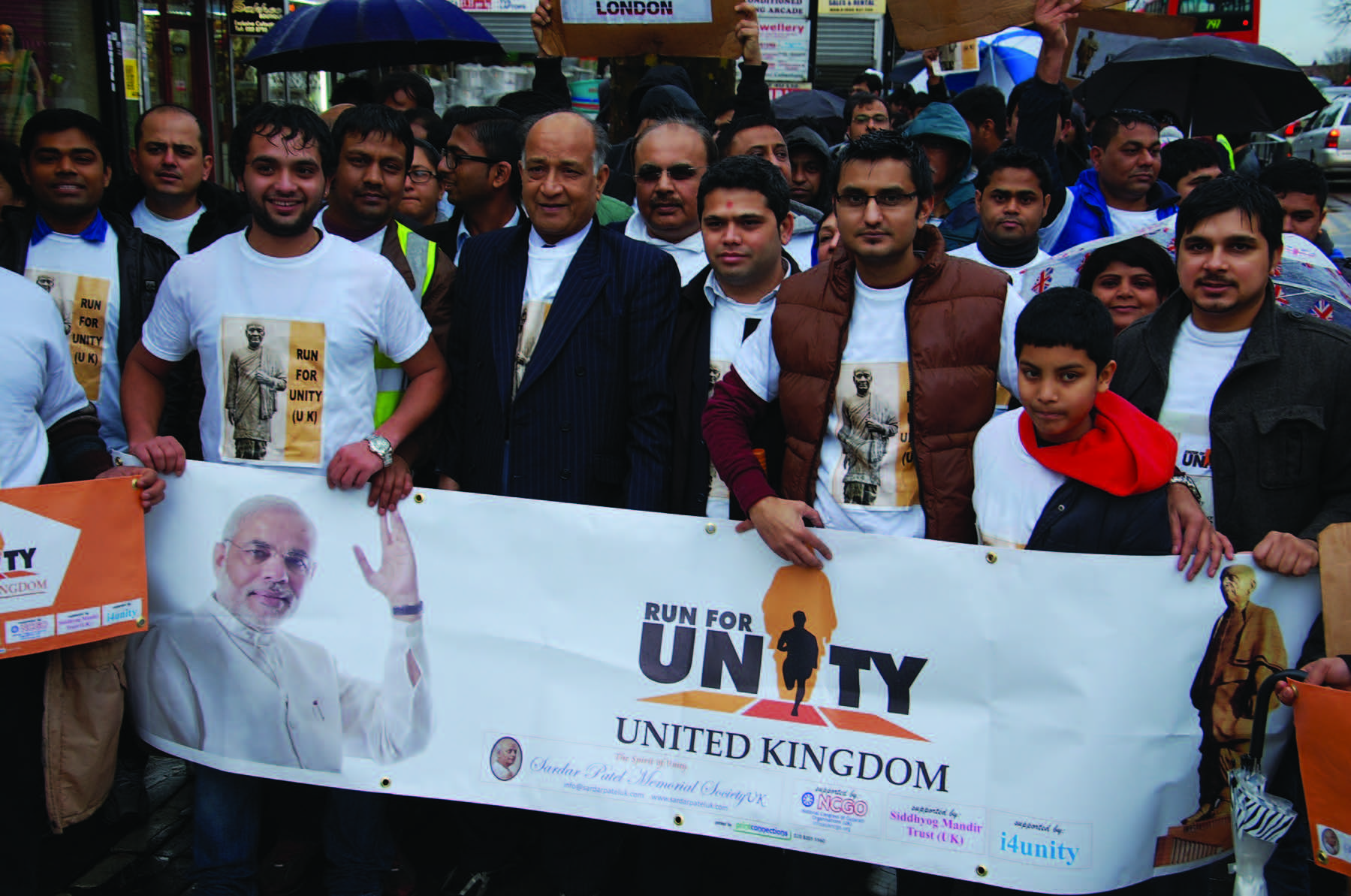
    Jolly claimed that “RUN FOR UNITY” recently organized in London attracted a large crowd of NRI’s. The UK program was organized by “14 – Unity” a young professional group in UK led by dynamic Nachiket Joshi, OFBJP Central Committee Member (Bharat) and permanently based in London. Gujarati, Punjabi and English British leaders participated along with young boys & girls.

    Over 1000 strong crowd and participants walked in pouring rain wearing raincoats & carrying umbrellas in severe cold London weather, stated OFBJP leader Vijay Jolly. Cheering for “Modi” and national unity, wearing T-shirt of Sardar Patel’s image, the ‘London Run for Unity’ was flagged off by Bob Blackman, British MP & Chairman of All Party Parliamentary Group for British Hindus.

    Bob, in his speech on the occasion pledged British support for Modi and hoped that trade between UK & India will increase “ten -times” in case Narendra Modi became PM of India. Muhammad Butt, leader of London Council, Lord Sardar Singh, Virendra Sharma South Hall MP, C.B. Patel Chairman Asian Voice & Gujarat Samachar, Lalu Bhai Parekh (OFBJP, UK President), Councilor Darshan Grewal (OFBJP-UK Vice President), P.G. Patel Chairman SPMS, UK, Mahendra Jadeja Sec. Gen. of NCGO, C.J. Robheru, Narendra Thakran, Vinod Halai, Dr. M. Ambekar etc. participated in the historic program in London.

  • FOREIGN RELATIONS OF INDIA

    FOREIGN RELATIONS OF INDIA

    India has formal diplomatic relations with most nations; it is the world’s second most populous country, the world’s mostpopulous democracy and one of the fastest growing major economies. With the world’s seventh largest military expenditure, ninth largest economy by nominal rates and third largest by purchasing power parity, India is a regional power, a nascent great power and a potential superpower.

    India’s growing international influence gives it a prominent voice in global affairs. The Economist magazine argues, however, that underinvestment in diplomacy and a lack of strategic vision have minimised India’s influence in the world. India is a newly industrialised country, it has a long history of collaboration with several countries and is considered one of the leaders of the developing world along with China, Brazil, Russia and South Africa (the BRICS countries). India was one of the founding members of several international organisations, most notably the United Nations, the Asian Development Bank, G20 industrial nations and the founder of the Non-aligned movement.


    32
    India has often represented the interests of developing countries at various international platforms. Shown here is Prime Minister Manmohan Singh with Dmitry Medvedev, Hu Jintao and Luiz Inácio Lula da Silva during BRIC summit

    India has also played an important and influential role in other international organisations like East Asia Summit, World Trade Organisation, International Monetary Fund (IMF), G8+5 and IBSA Dialogue Forum. Regionally, India is a part of SAARC and BIMSTEC. India has taken part in several UN peacekeeping missions and in 2007, it was the secondlargest troop contributor to the United Nations.[12] India is currently seeking a permanent seat in the UN Security Council, along with the G4 nations. India’s relations with the world have evolved since the British Raj (1857–1947), when the British Empire monopolised external and defence relations. When India gained independence in 1947, few Indians had experience in making or conducting foreign policy. However, the country’s oldest political party, the Indian National Congress, had established a small foreign department in 1925 to make overseas contacts and to publicise its freedom struggle.

    From the late 1920s on, Jawaharlal Nehru, who had a longstanding interest in world affairs among independence leaders, formulated the Congress stance on international issues. As a member of the interim government in 1946, Nehru articulated India’s approach to the world. India’s international influence varied over the years after independence. Indian prestige and moral authority were high in the 1950s and facilitated the acquisition of developmental assistance from both East and West. Although the prestige stemmed from India’s nonaligned stance, the nation was unable to prevent Cold War politics from becoming intertwined with interstate relations in South Asia.


    33

    In the 1960s and 1970s India’s international position among developed and developing countries faded in the course of wars with China and Pakistan, disputes with other countries in South Asia, and India’s attempt to balance Pakistan’s support from the United States and China by signing the Indo- Soviet Treaty of Friendship and Cooperation in August 1971. Although India obtained substantial Soviet military and economic aid, which helped to strengthen the nation, India’s influence was undercut regionally and internationally by the perception that its friendship with the Soviet Union prevented a more forthright condemnation of the Soviet presence in Afghanistan. In the late 1980s, India improved relations with the United States, other developed countries, and China while continuing close ties with the Soviet Union. Relations with its South Asian neighbours, especially Pakistan, Sri Lanka, and Nepal, occupied much of the energies of the Ministry of External Affairs.

    In the 1990s, India’s economic problems and the demise of the bipolar world political system forced India to reassess its foreign policy and adjust its foreign relations. Previous policies proved inadequate to cope with the serious domestic and international problems facing India. The end of the Cold War gutted the core meaning of nonalignment and left Indian foreign policy without significant direction. The hard, pragmatic considerations of the early 1990s were still viewed within the nonaligned framework of the past, but the disintegration of the Soviet Union removed much of India’s international leverage, for which relations with Russia and the other post-Soviet states could not compensate. After the dissolution of the Soviet Union, India improved its relations with the United States, Canada, France, Japan and Germany. In 1992, India established formal diplomatic relations with Israel and this relationship grew during the tenures of the Bharatiya Janata Party (BJP) government and the subsequent UPA (United Progressive Alliance) governments.

    In the mid-1990s, India attracted the world attention towards the Pakistan-backed terrorism in Kashmir. The Kargil War resulted in a major diplomatic victory for India. The United States and European Union recognised the fact that Pakistani military had illegally infiltrated into Indian territory and pressured Pakistan to withdraw from Kargil. Several anti-India militant groups based in Pakistan were labeled as terrorist groups by the United States and European Union. India has often represented the interests of developing countries at various international platforms. Shown here are Prime Minister Manmohan Singh with Dmitry Medvedev, Hu Jintao and Luiz Inácio Lula da Silva during BRIC summit in June, 2009. In 1998, India tested nuclear weapons for the second time which resulted in several US, Japanese and European sanctions on India.

    India’s then-defence minister, George Fernandes, said that India’s nuclear programme was necessary as it provided a deterrence to potential Chinese nuclear threat. Most of the sanctions imposed on India were removed by 2001. After the 11 September attacks in 2001, Indian intelligence agencies provided the U.S. with significant information on Al-Qaeda and related groups’ activities in Pakistan and Afghanistan. India’s extensive contribution to the War on Terror, coupled with a surge in its economy, has helped India’s diplomatic relations with several countries. Over the past three years, India has held numerous joint military exercises with U.S. and European nations that have resulted in a strengthened U.S.-India and E.U.-India bilateral relationship. India’s bilateral trade with Europe and United States has more than doubled in the last five years.

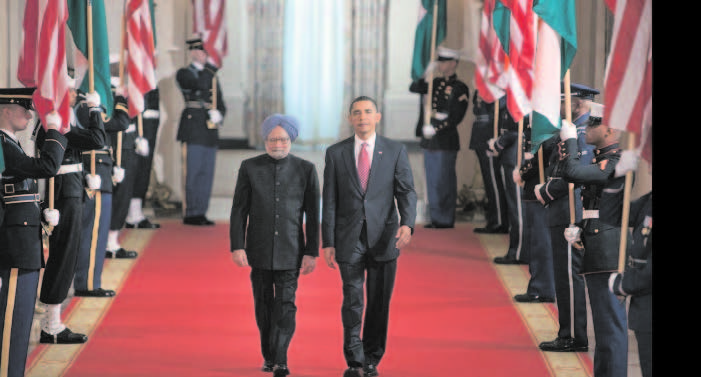
    India has been pushing for reforms in the UN and WTO with mixed results. India’s candidature for a permanent seat at the UN Security Council is currently backed by several countries including France, Russia,[50] the United Germany, Japan, Brazil, Australia and UAE. In 2004, the United States signed a nuclear co-operation agreement with India even though the latter is not a part of the Nuclear Non- Proliferation Treaty. The US argued that India’s strong nuclear non-proliferation record made it an exception, however this has not persuaded other Nuclear Suppliers Group members to sign similar deals with India. During a state visit to India in November 2010, US president Barack Obama announced US support for India’s bid for permanent membership to UN Security Council as well as India’s entry to Nuclear Suppliers Group, Wassenaar Arrangement, Australia Group and Missile Technology Control Regime.

  • A Panegyric for Arnab Goswami?

    A Panegyric for Arnab Goswami?

    B.V. Rao, editor of Governance Now, explains the name and the phenomenon – Time’s Now’s Arnab Goswami – to a childhood friend who lives in Canada. Readers will surely find the piece a refreshing reading.

    Dear Sharda
    Sometime ago during a Googlegroup discussion you innocently asked: “But who is Arnab?” In India not knowing Arnab is against national interest. You are lucky you live in Canada. But if you don’t want to be deported on arrival on your next visit, you better pay attention to this complimentary crash course on the subject.

    Arnab, as in Arnab Goswami, is India’s most-watched prime time news anchor and editor-in-chief of Times Now. But designations don’t even begin to describe him or what he is famous for. You must have heard about hurricanes Katrina and Sandy. Arnab is also a storm, a news-storm that hits India every night via his show, the “Newshour”.

    Nobody is quite sure how, but somehow Arnab gets to know the questions that the “whole nation” wants answers for, or the sinners the nation wants hanged before midnight that night. In effect then, Arnab speaks for a “billionplus people” each time he takes centre-stage. I can’t say for sure if he took this burden upon himself voluntarily or if his employers made it a contractual obligation. Whatever it is, the fact is that Arnab has come to relish asking the most “simple and direct” questions to the most dubious people demanding instant answers to complex problems because the “nation wants to know” and it wants to know “tonight” as in right now.

    That’s how impatient India has become while you’ve been away, Sharada. The Newshour airs on weekdays from 9 pm and continues till Arnab’s pleasure lasts. Often the show stretches up to 10.50 pm. That’s actually “News hour-and-threequarters- and-then-some” but I guess Arnab has not asked himself a “simple, direct” question: how many minutes make an hour? That, or his primary school maths teacher is not his viewer. In which case it is safe to say Arnab speaks for a billion-plus minus one Indians. You will see that at the altar of national interest it is not just the hour that is stretched.

    About two decades ago, Dileep Padgaonkar was the editor of the Times of India owned by the Jains of Bennett & Coleman who also own Times Now. Padgaonkar had pompously proclaimed that he held the second most important job in the country after the prime minister’s. Arnab hasn’t said it, but I think he disagrees with Padgaonkar on the pecking order: it’s now the prime minister who holds the second most important job in the country. Hence Arnab runs the show like he would run the country or like the prime minister should but doesn’t.

    You see, Sharada, there’s an awful lot of stuff the nation wants to know by nightfall but our prime minister isn’t much of a talker. Arnab fills the need gap. He opens his show with a passionate agenda-setting preamble that spells out all the problems of the day and how he wishes to solve them. We gratefully receive this wisdom and call it Arnab’s Address to the Nation, a prime ministerial duty that has fallen on his broad shoulders because the real guy has abdicated it. Let me tell you this, however. Arnab is a very reluctant power-grabber. It is not his intent to upstage the prime minister or make him look silly.

    He gives the prime minister an entire day to prove his worth and gets to work only at 9 pm when it is clear that the latter can’t handle stuff. He then solves all outstanding national issues of the day in just one 110 minute-hour of feverish debates where he grills the skin off the back of everybody who dares to stand in the way of India’s national interest. He is unrelenting in his pursuit of the truth and doesn’t give up unless everybody has agreed with him.

    “I am worried”, “I am concerned”, “I won’t let you politicize”, “I don’t agree”, “you can’t get away….” are some of the phrases he uses to suggest he is in complete control and that endears him to a nation starved of decisionmakers. Arnab hates home work. He wants to settle everything here and now, tonight. As a result, in Arnab country, there is no trace of the policy paralysis that has grounded the prime minister in the real country. Here you get resolutions, decisions, orders, diktats, judgments, justice and denouements all in one place, one show, by one man.

    The only people paralyzed are the subjects of his grilling and the bevy of experts he gathers around himself, not because he needs them, he doesn’t, but because it must feel awfully good to invite experts and out-talk them on national prime time. Like confused baboons trapped in little boxes, the experts, who are neatly arranged around Arnab’s own imposing self in the centre of the screen, keep staring into nothingness most of the time. Yes, you get the drift, Sharada, Arnab is the main dish here. The rest are just intellectual dips. For most of their airtime the experts keep putting up their hands or calling out “Arnab….Arnab….” to indicate they want to make a point. Arnab is too engrossed in disagreeing with what he has not allowed them to say to care too much. Some clever guests try to appeal to his Assamese roots by hailing “Ornob…Ornob”.

    He ignores them as well. Nationalism, after all, is above parochialism. The cleverer among them have cracked the code: they just agree with Arnab in exchange for a little extra air time. These are usually the people who have paid close attention to Arnab’s Address to the Nation and picked up the right cues on what to say that will get them his benefaction. It is tough to figure out why Arnab needs any experts at all because he knows the answers to all his questions. Times Now insiders say that more often than not he finds questions to the answers he already has. On his show, politicians can’t politicize, bureaucrats can’t beat around the bush, sportspersons can’t play games and lawyers can’t use legalese.

    In fact anybody who is good at something can’t do what they are known to do, to the extent that even civil society can’t be civil, especially if it wants to get a word in sideways. Everybody has to be direct, honest, blunt and keep things simple because that is what the (one-man) nation wants. Corruption, political expediency, opportunism, forked tongues, doublespeak, dishonesty and hypocrisy, are red rags to Arnab. He takes them head-on with the help of his reporters who keep throwing up “documentary” evidence ever so often to expose scamsters. Usually this is a thick sheaf of indistinguishable papers that Arnab holds up threateningly. It could be a bunch of used airline e-tickets for all we know, but since we don’t, he waves the sheaf confidently in the face of the enemies of the nation and it is generally assumed he’s got some incendiary stuff in there. Arnab’s problem-solving repertoire is not restricted to national boundaries.

    In fact, he is at his best when dealing with nations that have evil designs on India. The patriot in Arnab is best aroused when he is dealing with that evil, failed, rogue nation called Pakistan. He deals with Pakistan like no prime minister has ever been able to or decimates it like no Army has ever managed to. Each time a blade of grass bends to the breeze on the LoC, Arnab breathes fire at Pakistan for trying to sneak in terrorists into the country. He lines up a battery of serving and retired generals of Pakistan and conducts the verbal equivalent of a summary execution. Yet, the same generals keep resurfacing on Arnab’s show each time he feels the urge to have a Pakistani or two for dinner. This causes much wonderment among Newshour hounds on the masochist streak that makes the Pakistani generals offer themselves up as bait repeatedly.

    So, it is assumed the money must be good. But since Arnab insists that Pakistan is the way it is only because the generals have sold their country cheap, it is unlikely he is blowing his budget for this routine cross-border target practice. Of course, left to Arnab Pakistan would have existed only as the largest crater on earth since the meteors wiped out all life on the planet. Yes, he would have nuked it many times over by now. The Times of India, the country’s oldest English newspaper and the mother brand from the Times Now stable runs Aman Ki Aasha (Hope for Peace), the widely-acclaimed campaign for ending India-Pakistan hostilities. Just as Arnab doesn’t seem to know of this campaign, the Times of India seems quite oblivious of the fact that the last time there was absolute peace on the LoC was when Arnab took a two-week holiday in early September.

    It could be the marketing genius of the Times group to milk the issue from both ends or it could also be that their internal boundaries are not as porous as our LoC. Apart from conducting war exercises against Pakistan, Arnab land is eyeball-toeyeball with China, exposes the double standards of America in almost anything it does and highlights the hypocrisy of racist Australia which loves the education dollars from India but not the brown students who come along with. His blood boils so much when an old Sikh is roughed up by a bunch of racist women in the UK that he almost gets the whole of Punjab to rise in revolt against the Indian government’s inaction–even though there is nothing it can do as the gentleman is a citizen of the said country–or builds a tide of emotional revulsion against “inhuman” Norway for snatching an infant from his Indian mother’s custody for alleged physical abuse.

    I can go on and on, Sharada, but everything good must come to an end and so must my Arnab eulogy. So, in short and in conclusion, here’s what I have to say: Arnab is not just the editor-inchief of Times Now. He’s India’s protector-inchief. He is the guy who is keeping India safe while you are away on selfish pursuits. You are lucky you can get away by not knowing him.For a billion-plus Indians, minus of course his maths teacher, that is not even a distant option. Because, truth told, Arnab is the best we have got!

  • Canada names park after first Sikh settler

    Canada names park after first Sikh settler

    AMRITSAR (TIP): To commemorate contribution of Sikhs in Canada’s development, the country has named a new park in the city of Calgary after the legendary farmer Harnam Singh Hari, the first Sikh to tame the harsh climes of frigid Alberta province in 1909. Alberta’s minister of human services Manmeet Singh Bhullar, who was in Amritsar on Tuesday, told TOI that the park was dedicated to Hari and his family, who identified fertile farmland and set the pace of agricultural progress in the province. Manmeet accompanied Alberta premier Alison Redford on an official visit to India to set up a trade office for his province in Delhi. With plans to enhance trade and investment opportunities between Alberta and Punjab, the two visited the Golden Temple on Monday to pay obeisance.

    Bhullar spoke about Sikhs’ selfless service in Canada. “We have wings named after Guru Nanak Dev in almost all major hospitals in the country. Sikhs are enjoying great prosperity because of principles learnt from their forefathers, teachings of Gurus and inspiration from the divine,” he said. In reply to a question about Canada’s province of Quebec where the Parti Quebecois government is likely to introduce a bill to regulate religious symbolism, Bhullar said, “Even if they introduce the bill, Canadian Charter will overrule it as it has always protected minority religious and equality rights.”

    Redford told TOI that she has signed two MoUs with Punjab government to boost cooperation and enhance trade and investment activities between the two states. “These agreements are focused on agriculture and animal genetics and would help increase trade in dairy production and piggery. Setting up of an agricultural working group is in the pipeline to encourage communication on projects of importance,” said the Alberta premier.

    Alberta Premier woos Punjabis
    Impressed with the institution of langar (community kitchen), Alison Redford served the devotees in the Golden Temple on Tuesday. “In Alberta, I have visited many temples but visiting Golden Temple, and to see the same spirit of service and worship was an honour,” Alison remarked. Referring to Redford’s keenness in langar, Bhullar, in a lighter vein, said, “Alberta is a major producer of lentils and she got to see where the lentils from Canada go – in feeding tens of thousands of people every day.”

    According to Redford, “India is not only a big market for lentils and other products, but there’s also a close commercial relationship between people in Punjab and Alberta.” She also said that Alberta’s large Sikh community contributes actively to political, social and business activities and thus, help making the province one of the best place to live, work and raise a family.

  • FY14 marine product exports set to rise 23% to Rs 26,750 crore

    FY14 marine product exports set to rise 23% to Rs 26,750 crore

    CHENNAI (TIP): Export of marine products is expected to touch $4.3 billion (Rs 26,750 crore) in 2013-14, an increase of 23 per cent compared to a year ago. The increase comes despite the US, Canada and Japan’s stringent regulations in recent months. One major contributor to growth is new markets and another value-added products, said an officer at the Marine Products Export Development Authority, under the commerce ministry. After announcing the 19th edition of the Indian International Seafood Show, January 10-12, in Chennai, Chairman Leena Nair said the Indian seafood sector had grown 20-22 per cent in three years, despite major hurdles.

    In the last two years, the sector saw the countervailing and anti-dumping duty by the US, as well as quality regulation from Canada and Japan.N Ramesh, director, marketing, added the $4.3-billion goal during the current financial year was achievable. Value-added products are gaining momentum, said Nair. These were five per cent of the seafood exports three years ago, but now are 17 per cent. The target is to increase it to 30 per cent and then 50 per cent in three-five years, said Ramesh. Abraham J Tharakan, president, Seafood Exporters Association of India, said over the years the sector had added capacity to export value-added products. India has been exporting these to China and Thailand, where they are converted into ready-to-eat and ready-to-cook products.Ramesh said in two-three years the sector had entered markets such as Africa, Commonwealth of Independent States and southeast Asia. These form 16 per cent of the export turnover.

  • Dr. Jit Chandan – A Game Changer

    Dr. Jit Chandan – A Game Changer

    Most people read history. Few people write history. Very few people make history. Extremely few people change the direction of history. Dr. Jit Chandan is one of those few people whose efforts at making change for the better are well recorded by history. His contributions in the service of community are deeply written in the sands of time, not to be erased by time or winds of change. By the time Dr. Chandan was about 20 years of age, and after completing his B. Sc. degree from Punjab University at Hoshiarpur, Punjab, he left for England in 1957 to pursue higher studies. In the 1950s, there were very few Indians in UK. There were just a few Indian students, a few businessmen and a few immigrants from Kenya. The only Gurudwara in the country was two floors in a 5-6 story building owned by Maharaja of Patiala, in the area of Shepherds Bush in London.

    There were other groups of Sikhs in various cities and especially in Birmingham, Leeds, Wolverhampton, Southall and perhaps at some other places where they celebrated Guru Nanak Dev Ji’s birthday and other religious functions such as Baisakhi in rented halls. Dr. Chandan was the main religious speaker at these functions. He spoke about the lives and teachings of our Gurus. He strongly felt that we should have our own Gurudwaras to promote our religious philosophies among ourselves and among locals. The local Sikh community enthusiastically responded to these dreams and suggestions. Sometime in early 1960, Dr. Chandan formed The Sikh Missionary Society (currently known as Sikh Cultural Society) and started a quarterly Sikh journal “The Sikh Courier”, along with Dr. Ajit Singh Battu (currently in Sudbery, Canada).


    20
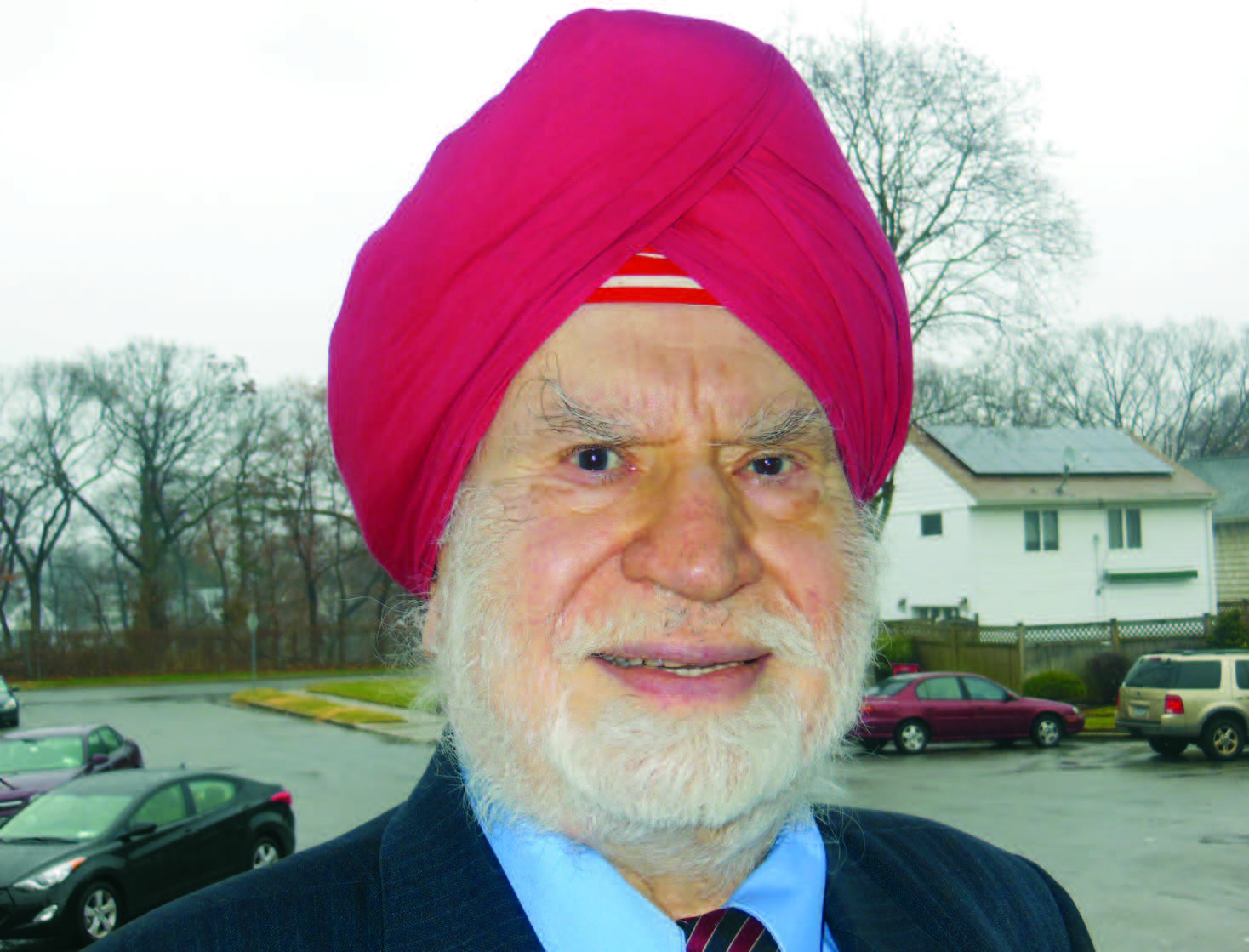
    Among the many who are Dr. Chandan’s friends is the present Prime Minister of India, Dr. Manmohan Singh. (A file photo)

    It was a tough journey and it created many financial difficulties. However, with the grace of God and financial help from the Sikh community, the journal kept on going. Mrs. Pamela Wylam joined the editorial board and the journal grew in quantity and quality. Dr. Chandan delivered motivational speeches at Grupurab functions urging Sikhs to contribute one week’s wages to build Gurudwaras. With much effort a beautiful and spacious Gurdwara was built at Birmingham. That was a good beginning. Now Sikhs have over 250 Gurudwaras in the country. As destiny would have it. Dr. Chandan was awarded a coveted and meritorious King George VI Memorial Fellowship award to study at Columbia University in New York in 1963. This Fellowship was unique in the sense that it was the only scholarship awarded to students of Commonwealth countries studying in England and this year was India’s turn.

    When Dr. Chandan left England for America, the management of the Sikh Cultural Society and that of the journal The Sikh Courier was taken over by S. Amar Singh Chhatwal with S. Tirath Singh Lalvani being the President of the Society. Mr. Chhatwal served the interests of the journal and the Sikh community with great devotion for many years until his death a few years ago. When Dr. Chandan came to America to study at Columbia University in New York in 1963, there were very few Indian families and even fewer Sikh families and there was no Gurudwara in the city. Only two Sikh names come to mind, namely Mr. D. W. Singh and Mr. S. S. Sarna. Mr. Sarna was a well established business man with the company name being “Bells of Sarna”. Sikhs celebrated Guru Nanak’s birthday in Indian Consulate in 1963. A few Indian students formed an Indian Students Association at Columbia University and Indian movies were shown on Sundays at the campus.

    The year 1964 brought in a few more Sikhs at the World’s fair and a few more at the Indian Consulate. From that point onwards they started talking about founding their own Gurudwara. Some of the original Sikh thinkers in this regard were Dr. Harbans Singh, Mr. Kirat Singh Sethi. Mr. J. S. Premi, Dr. Jodh Arora, Mr. Bhalla, Mr. I. J. Singh, Mr. S. S. Sarna, Dr. Gurcharan Singh and Dr. Chandan, of course. They started to hold Sunday meetings in St. Michael’s church in Flushing and then at Knights of Columbus, also in Flushing. Sometime in late 60s or early 70s they negotiated and acquired a church on 118 Street in Richmond Hills and converted it into a Gurudwara. They also formed the Sikh Cultural Society with S. S. Sarna as President and Dr. Chandan as Secretary. They also started a journal “The Sikh Message” with Dr. Chandan as the editor. Dr. Chandan was instrumental in promoting the Sikh faith through the Gurudwara as well as through speaking at various churches.

    Dr. Chandan continues his endeavors in the service of Sikh community and the Sikh faith, and Indian community at large in America as well as in India. He has set himself a goal to serve the poor children of India in providing them with resources for quality education. In fact, his desire to serve the poor and the needy to have education dates back to the 80’s when he associated himself with Delhi based Relief Committee that supports the education of poor children. This committee, formed in the wake of anti-Sikh riots in Delhi and elsewhere, with the primary objective of supporting the families of those killed in the riots, is managed by Nishkam Seva Center, headed by Bhai Mohan Singh. In 2012, there were 350 such students from all religions, who were being educated by Niskam Seva Center. Speaking about the quality of being charitable, Dr. Chandan said, “I can relate charity to my faith- Sikhism. The primary principles of my faith are- Kirat karni, vand chhakna and naam japna.

    It is interesting to note that naam japna comes after honest living and sharing with others. “Another well known phrase in our social parlance is dasan nohan dee kirat kamayee karnawhich means following the highest work ethics. I follow my faith, to that extent. I am always ready to help the needy.” Dr. Chandan says, after he retires, he plans to get actively involved in India, particularly in Punjab and the neighboring states to providing primary education to poor children. Asked how he would achieve his objective, he said, “I have earmarked some financial resources for this purpose. I will seek the help of such institutions as Akal Academy, Nishkam Seva Center and others to assist me in utilizing these resources honestly and for the sole purpose of educating poor children.” To the question whether or not he was spiritual and how very important it was to be spiritual, Dr. Chandan said, “There is a lot more intended to look within to have the qualities of a spiritual person.

    I am spiritual, to an extent”. And he added,” With the current state that the world is in where materialistic comfort is considered to be supreme by any means, the sense of contentment is missing. It is a sense of spirituality that brings contentment which is the source of all other qualities that make a human being decent. We all want a peaceful world, and spirituality is the sine qua non for it”. Dr. Chandan is currently a full tenured professor of strategic management at Medgar Evers College, City university of New York and served as the chair of the Department of Business Administration at the college. He is known to be a very successful professor and is respected as a motivational lecturer. Dr. Chandan has authored and co-authored 12 books in the various areas of management. He also writes Punjabi poetry as a hobby and is an active member of such Punjabi organizations as Punjabi Sahit Academy and Punjabi Sahit Sabha. Both organizations hold monthly poetry recital meetings. He is highly community oriented and worked closely with Dr. Surinder Malhotra in Indian National oversees Congress (INOC) in the service of community and developing closer ties between India and America. Dr. Chandan was born in 1937 in Jahania Mandi in district Multan, which now forms part of Pakistan. His father, Gurdit Singh, a landlord, moved to Hoshiarpur in Punjab in India in the wake of partition of India in 1947. Chandan got his school and college education in Hoshiarpur. Having done his B.Sc. from Panjab University in 1956, he moved to England for higher education. Married in 1968 to Sandesh, the couple has a son and a daughter.

  • Salman Khurshid’s Call to Expatriates to Help Build India’s Brand Image

    Salman Khurshid’s Call to Expatriates to Help Build India’s Brand Image

    NEW DELHI (TIP): Minister of External Affairs Sh. Salman Khurshid, has exhorted the overseas Indians to become India’s best ambassadors to spread and popularize the country’s values, beliefs, culture and heritage overseas. Presiding over the session on ‘India Soft Power’ on Day-2 of Pravasi Bharatiya Divas 2014, Khurshid called upon the delegates to be active in social networking to enable India to build its brand name and image so that deeper economic engagements are concluded with overseas economies, irrespective of their size.

    Addressing the session, Kapil Sibal, Minister of Communication & Information Technology and Law & Justice said, the present aspirational India will begin to inspire the remaining part of the globe by 2025, as it will have 90 crore people in the working age population, throwing a lone challenge for successive governments to provide infrastructure and growth opportunities for the people to realize their collective potential. Sibal said that by 2020, 60 crore Indians would have migrated to large cities, embracing latest technologies with the best of education at their command.

    This would create windows for them to unleash their potential and make India a hub to interact and interconnect with the rest of the world. The revenue generated in 2006 through IT &ITEs was estimated at $40 billion which has gone up to $100 billion now. Of this, $75 billion was contributed by export earnings. This was indicative of the strides made by the Indian economy, he added. Sibal complimented the diaspora present at the convention, saying that it epitomized India’s soft power and has done India proud and hoped that it continued to serve India. Minister of Culture, Smt Chandresh Kumari Katoch in her presentation, stated that the Indian diaspora should actively spread its civilization, heritage and cultural ethos in their host countries and organize promotional events.

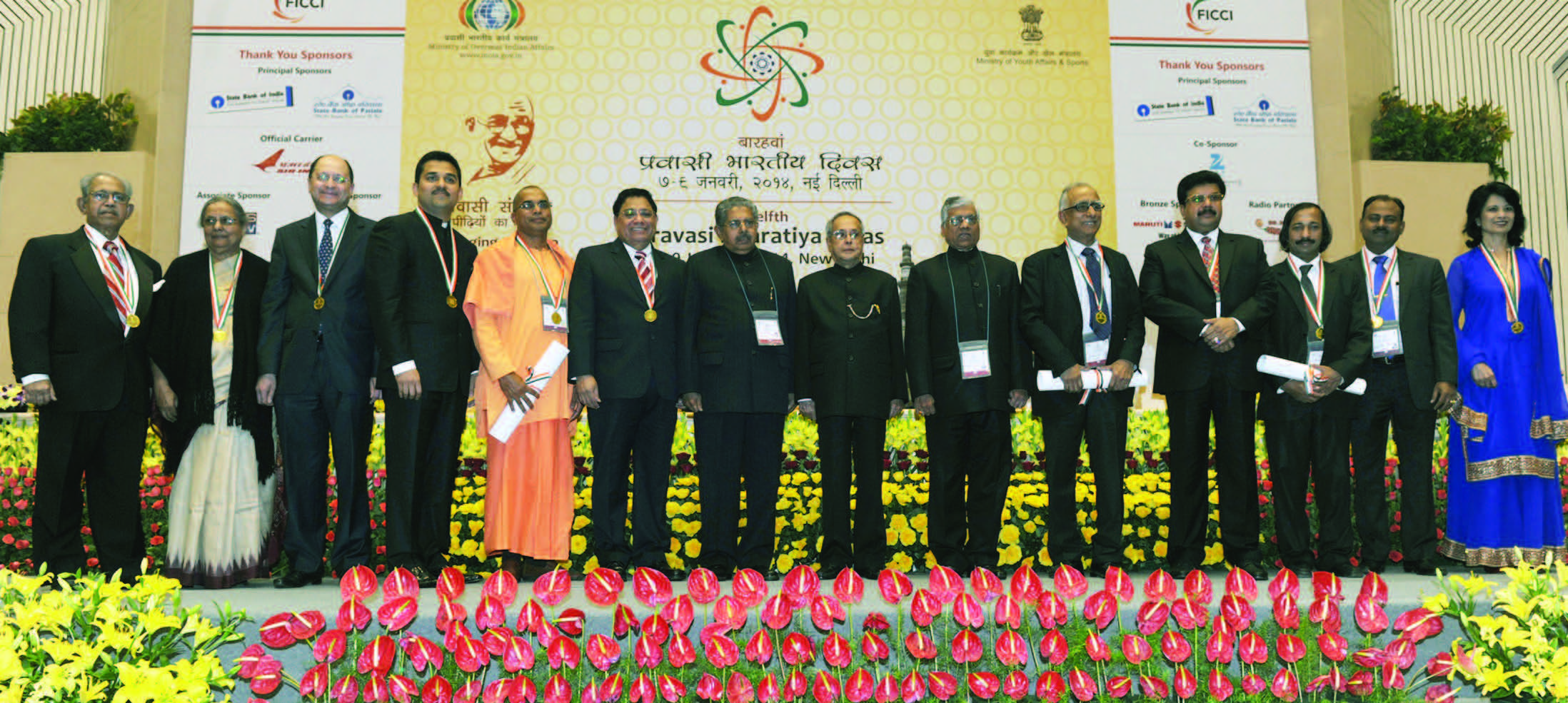
    Pravasi Bharatiya Samman Awards Winners
    The President of India Sh. Pranab Mukherjee has conferred Pravasi Bharatiya Samman Awards to thirteen NRIs, PIOs and Organisations for their outstanding and illustrious contribution in the country of their residence as well as to India in different spheres of their activity.

    Sr. No Name Country Description
    1 Ms Lisa Maria Singh Australia Public service and fostering friendly relations between India and Australia.
    2 Mr. Kurian Varghese Bahrain Business for enhancing India’s image and for
    Promotion better understanding of India abroad.
    3 Mr Vasdev Chanchlani Canada Community service and fostering ties between India and
    Canada.
    4 Ramakrishna Mission Fiji Community service and philanthropic activity and
    enhancing India’s prestige abroad.
    5 Satnarainsing Baldewsingh Netherlands Public service and developing closer ties
    between India and South Africa.
    6 Bikas Chandra Sanyal France Education and culture and enhancing India’s image.
    7 Sasindran Muthuvel Papua New Guinea In the field of Public service.
    8 Shihabudeen Vava Kunju Saudi Arabia Community service and promoting ties between India and the Kingdom of Saudi Arabia.
    9 Ela Gandhi South Africa Public service, enhancing India’s image and promoting ties between India and South Africa.
    10 Dr. Shamsheer Parambath United Arab Health business and in promoting Better understanding of India
    11 Shailesh Lakhman Vara United Kingdom Public service and in promoting ties between India and the people of U.K.
    12 Dr. Parthasarathy Pillai USA Science and for fostering closer relations between India and USA.
    13 Renu Khator USA Education and enhancing India’s prestige abroad.
  • Stockton Sikhs travel to Florida to confer a Special Award on Professor Harold A Gould

    Stockton Sikhs travel to Florida to confer a Special Award on Professor Harold A Gould

    DELRAY BEACH, FL (TIP): Pacific Coast Khalsa Diwan Society, Stockton travelled to Delray Beach, Florida on December 13 – 15, to honor its commitment to recognize scholarly studies on Sikh Pioneers in America, their pluralistic conception of Indian nationalism, and their lobbying efforts to involve the US government in securing freedom for India. The Society celebrated 100th Anniversary of Stockton Gurdwara last year from September 22-to October 13, 2012. More than two dozen scholars from America, Canada, Britain, and India joined in presenting their papers on evaluating the role of Ghadr movement in instilling passion for freedom in Indians who had been living a wretched life under the British rule in India.

    But one very accomplished scholar who keenly wanted to join the historical event, but could not travel from Florida to Stockton due to the old age and sickness of his wife. He is none other than Professor Harold A. Gould who taught for 23 years in the University of Illinois in Champaign-Urbana, and since 1991, has been a Visiting Professor of South Asian Studies at the University of Virginia in Charlottesville. The Pacific Coast Khalsa Diwan Society considered Gould’s book, Sikhs, Swamis, Students and Spies: The India Lobby in the United States, 1900-1946, as one of the profoundest studies about Indian Pioneers journey in America. Dr. Gould makes groundbreaking disclosures about United States of America’s role in pressurizing Britain for freeing India after World War II.


    14
    Professor Gould, with his award and family at his home in Delray Beach, Florida

    The Pacific Coast Khalsa Diwan Society established links with the local Sikhs of Florida and invited them to the event that took place on December 14, 2013 from 2 PM- 5 PM. Dr. Ravinder Mahal, Dr. Sirtaz Sibia, Attorney Arvind Singh, American Sikh Fateh Singh and many other prominent members of Florida Sikh Society attended the event. Professor Gould’s son Armeen Gould specially came from Pittsburgh to make arrangements for the function along with his sister, and brother in law . The delegation to Florida comprised of Stockton Gurdwara President, Amrjit Singh Panesar, General Secretary Daljit Singh, Executive member and former president Harnek Singh Atwal, Centennial Committee Chairman Manjit S. Uppal, Centennial Coordinator Bhajan Singh and Centennial Conference Convener and media coordinator Dr. Amrik Singh. Dr. Amrik Singh started the program by introducing Dr. Harold A Gould and his sterling scholarship in South Asian Studies.

    He recounted how Stockton Gurdwara has been integral to starting an organized freedom movement from the Pacific Coast and how its founder president, Harvard educated Professor Teja Singh was instrumental in creating support of President Woodrow Wilson in declaring right to self-determination and freedom as integral to human progress. When the question of sending delegates to Peace Conference in December 1918 came in focus, the fund collected for establishing a Gurdwara in Berkeley, were instead used for representing India at Versailles Peace Conference. He also brought to the attention of audience prominent visitors like Sarojani Naidu in 1929, Mrs. Vijay Lakshmi Pandit in 1946 and 1948 to Stockton Gurdwara.

    Amarjit Singh Panesar briefly described lives of Sikh Gurus and their teachings for recognizing equality, liberty and fraternity in all human beings. Bhajan Singh then presented a slide show that captivated the audience for about an hour. Manjit S Uppal described in detail about Stockton Gurdwara’s effort to continue the legacy of Sikh pioneers in uniting and awakening a sense of self – esteem in people living on the margins of the society. The society thanked Dr. Ravi Mahal for inviting the delegation to Florida Gurdwara and honoring Professor Gould there on Sunday, December 15, 2013. The visit created a lot of goodwill and interest in history of Indians in America for more than hundred years.

  • American Association of Cardiologists of Indian Origin Honors 4 at 2013 Fall Meeting

    American Association of Cardiologists of Indian Origin Honors 4 at 2013 Fall Meeting

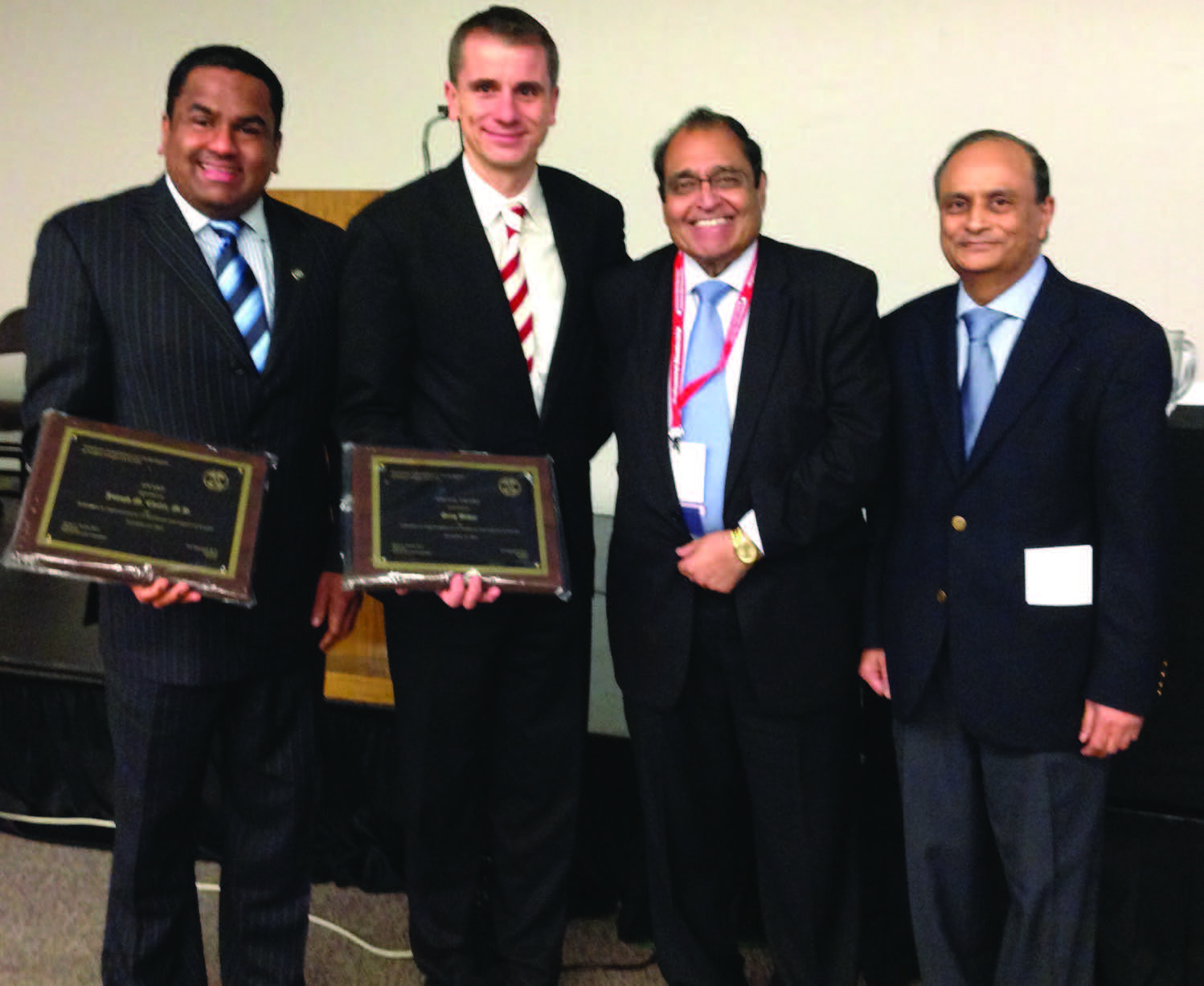
    DALLAS (TIP): American Association of Cardiologists of Indian Origin (AACIO), at its Fall meeting December 4, honored Greg Behar, President and CEO of Boehringer lngelheim Pharmaceuticals, Inc., Dr. Joseph M. Chalil, Associate Director, Health Science Executives, Boehringer Ingelheim USA, and Dr. Dinender K. Singla, a graduate of Post Graduate Institute of Medical Education and Research, Chandigarh, India for their achievements in the field of Cardiology.

    In addition, AACIO Young Investors Award was given to Dr. Ganesh Athappan and the Dr. Madhukar Deshmukh awards were given to Dr. Forum Kamdar and Dr. Manavjot Siddhu. AACIO awards the Dr. Krishna Ramaswamy and two Dr. Madhukar Deshmukh Young Investigator Awards at the AACIO dinner meetings held each year during the American College of Cardiology and the American Heart Association annual convention in March and November. The finalists presented their abstract at the meeting and each received $1000.00 award and a plaque The Fall 2013 annual event, organized by AACIO in coordination with Texas Indo- American Physicians Society (TIPS), North East Chapter and American Association of Physicians of Indian Origin was held at the Dallas Convention Center Theater Complex in Dallas, TX on November 17th, and was attended by over 200 physicians from around the nation.

    Dr. Navin Nanda, the Founding President and Chairman of the AACIO Board of Directors, while lauding honorees for their contributions and achievements, said, “AACIO is proud to honor some of the stalwarts of the pharmaceutical industry like Greg Behar and Chris Kaplan as well as some of the upcoming personalities like Jo Chalil. They have made significant contributions to medical therapeutics in the area of cardiology.” Dr. Nanda is a Distinguished Professor of Medicine and Cardiovascular Disease, Senior Scientist, Minority Health and Research Center and UAB Center for Aging, and UAB Comprehensive Cardiovascular Center, University of Alabama at Birmingham, Alabama. Dr. Ravi Jahagirdar, President Elect, who had represented AAPI at the event, congratulated AACIO for its consistent good work, both in the academic and the applied fields, and reaching out successfully to American Heart Association, and working in tandem with them in many spheres.

    He had special praise for the three Scholarship Awards that are given out each year to young aspiring medical students for poster sessions and in investigative sectors. “We at the national AAPI are proud of these activities,” he said. Dr. Jahagirdar, who will assume charge as the president of the national AAPI in June next year, pledged AAPI’s continued support in the future. In his inaugural address, Dr. Kul Aggarwal, president of AACIO, and Professor of Clinical Medicine, University of Missouri and Chief, Cardiology Section, Harry S. Truman Veterans Hospital, Columbia, Missouri, stated that AACIO provides a central forum for physicians and scientists of Indian origin, living in the United States, who have interest in Cardiovascular Medicine. “Indian Cardiologists are playing an increasingly important role in the provision of Cardiovascular services and also as academic thought leaders in the United States. We are proud of our colleagues.

    AACIO is your organization and joining it adds strength to all of us,” he said. The American Association of Cardiologists of Indian Origin (aacio.org) was formed in 1986 and after crossing puberty, the organization has reached the excited stage of youth after nineteen years. A Symposium, which was part of the meeting was organized by Drs. Navin C. Nanda and Kul Aggarwal. In his insightful presentation on “Newer anticoagulants in the management of a trial fibrillation and stroke prevention” Dr. Sanjeev Saksena, Clinical Professor of Medicine, Rutgers-RWJ Medical School Medical Director, Piscataway, New Jersey, Electrophysiology Research Foundation, Warren, New Jersey & Editor-in- Chief, Journal of Interventional Cardiac Electrophysiology, provided an overview of modern trends. Dr. Amit Khera, Associate Professor, Director, Preventive Cardiology Program, Program Director, Cardiology Fellowship and Dallas Heart Ball Chair in Hypertension and Heart Disease, UT Southwestern Medical Center, Dallas Texas, addressed the audience on “Emerging therapies in dyslipidemia management, beyond statins.” Dr. Nanda educated the audience on “Choice of anti-platelet therapy in acute coronary syndromes.”

    With more than 15 years in the pharmaceutical industry, Greg’s experience includes leadership roles in marketing, sales, business operations and general management. Greg joined Boehringer lngelheim in 2009 as Corporate Vice President of the Cardiovascular and Metabolic Franchise. That same year he became Vice President, Corporate Division Prescription Medicine, leading 14 countries including Northern Europe, Canada and Australia. Prior to Boehringer lngelheim, Greg worked at Novartis Pharma AG in roles of increasing responsibility in Spain and at global headquarters in Switzerland. Another honoree, Dr. Singla has received numerous honors and awards, and has been invited to give talks throughout the world. He also served as a chair/co-chair for scientific meetings, and well published in various peer reviewed journals. He is funded by the National Institute of Health and the American Heart Association grant awards since 2004.

    He has served as an editorial board member for different journals, and is the current Academic Editor for Plos one and Associate Editor for Canadian Journal of Physiology and Pharmacology. Srinivas Reddy Gunukula serves on the Board of Directors of The Heart Hospital Baylor Plano and Director of Center for Advanced Cardiovascular Care at the Heart Hospital McKinnney Campus. He is well known among the Cardiology community in Dallas. Dr. Joseph M. Chalil is a Fellow of American College of Healthcare Executives and is Board Certified in Healthcare Management. He serves as Co-Chair, AAPI Industry Physician Committee and Scientific Advisor, AAPI Cardiovascular, Diabetes and Stroke Network. Dr. Chalil holds three US Patents involving usage of sensors inside Human Body in addition to other applications. His research background includes Clinical Trial Management in Cystic Fibrosis, Multiple Myeloma, and publications in American Journal of Respiratory and Critical Care Medicine. The Asian American Business Development Center, NY has awarded Dr. Chalil the 2013 Outstanding 50 Asian Americans in Business Award. He is a Visiting Professor at various Universities and serves on various company Boards. He is an expert in US Healthcare policy and a strong advocate for patient centered care.

  • April to be Sikh Heritage Month in Ontario

    April to be Sikh Heritage Month in Ontario

    TORONTO (TIP): The month of April in the Canadian province of Ontario will be observed as Sikh Heritage Month every year. A bill brought by Brampton New Democrat Member of Provincial Parliament (MPP) Jagmeet Singh to have April recognised as Sikh Heritage Month was approved Tuesday in the legislative assembly of Ontario, the Brampton Guardian reported Thursday. Singh had introduced the bill in the assembly last April. He said that April is an important month for the Sikh community as the festival of Baisakhi is celebrated in this month, which also marks the creation of the Khalsa.

    Sikh Canadians widely celebrate Baisakhi, also known as Khalsa Day. “This will be an opportunity to remember, celebrate and educate future generations about Sikh Canadians and the important role that they have played and continue to play in communities across Ontario,” Singh was quoted as saying after the bill was passed. “Sikh Canadians have made significant contributions to Ontario’s social, economic, political and cultural fabric,” said Singh. Statistics Canada puts the Sikh population in Ontario at nearly 180,000 based on the 2011 National Household Survey.

  • Patiala Police denies releasing a list of NRIs involved in International Drug Racket

    Patiala Police denies releasing a list of NRIs involved in International Drug Racket

    Harjit Singh Dhesi

    DALLAS (TIP): The arrest of a dismissed Punjab Police officer involved in an international drug racket on November 11near the Haryana-Delhi border has given rise to a variety of news relating to involvement of many NRIs in the racket. The arrested Ex-deputy superintendent of Punjab police Jagdish Bhola is reported to have stated, according to a police officer who requested for anonymity, that the markets spanned up to Britain, Canada and European countries and quite a few well known NRIs were part of the racket. A Canadian newspaper carried the news that Patiala police which had arrested Bhola has identified over 30 non-resident Indians (NRIs), who acted as active and passive couriers for him. There was mention of some of the names in the news report.

    Among those mentioned were John Singh Gill, Jaswinder Choker, and Major Nat who claimed their innocense. According to information available with The Indian Panorama, when Sacramento based journalist representing Ajit of Jalandhar asked the Patiala Police Chief, the Senior Superintendent Hardial Singh Mann whether or not the police had released a list of NRIs supposedly involved in the drug racket, the SSP said that the Police had not released any list carrying the names of persons in question.

    The attorney for John Singh Gill decried such rumors, which he said, were aimed at tarnishing the fair image of his client. A friend of John Singh Gill said it was the handiwork of those who are envious of John Singh Gill who has come to occupy a fair name and position in the community and is known as one of the best promoters of the game of Kabaddi. He added that it is by sheer dint of hard work that Gill, Choker, Nat and people like them came to acquire respectability and commanded admiration of the community. He condemned those who were trying to damage their image by spreading rumors.

  • Govt imposes $792 million additional penalty on RIL

    Govt imposes $792 million additional penalty on RIL

    NEW DELHI (TIP): The government has slapped an additional penalty of $792 million on Reliance Industries for producing less than targeted natural gas from its eastern offshore KG-D6 block. A notice disallowing $792 million out of the cost already incurred on the Bay of Bengal fields was sent to RIL on November 14, an oil ministry official said here. With this, a total of $1.797 billion penalty in form of cost being disallowed, has been levied on RIL for producing less than targeted output during the past three years.

    The company has till date spent $10.76 billion on the block, which it can contractually recover from sale of oil and gas. It is obliged to share the profits with the government only after recouping those expenses. The official said the cost has been disallowed as RIL and its partners BP plc of UK and Canada’s Niko Resources did not drill the committed number of wells, which led to output dropping by over 80 per cent from the main Dhirubhai-1 and 3 (D1&D3) gas fields in the KG-D6 block. D1&D3 fields have in the first fours years of production (2009-10 to 2012-13) produced a total of 1.853 trillion cubic feet of gas, 1.196 Tcf short of 3.049 Tcf that RIL had committed to produce in the 2006 development plan. But for the first year, the output has lagged the targets in all subsequent years, which has led to a huge chunk of facilities built lying unutilized, the official said.

    RIL had built facilities to handle 80 million standard cubic metres per day of gas from D1&D3 but the present output is just 8.78 mmscmd. As per the production sharing contract, RIL and its partners BP Plc and Niko Resources are allowed to deduct all of the capital and operating expenses from sale of gas before sharing profits with the government. Creation of excess or unutilized infrastructure impacts government’s profit share and this is being sought to be corrected by disallowing part of the cost. According to the approved field development plan, the output should have reached 80 mmscmd last fiscal. The government had previously issued a notice to RIL disallowing $1.005 billion in cost for shortfall in production during 2010-11 and 2011- 12. ($457 million for 2010-11 and the rest $548 million for 2011-12).

  • Sri Lanka rights abuse allegations divide Commonwealth

    Sri Lanka rights abuse allegations divide Commonwealth

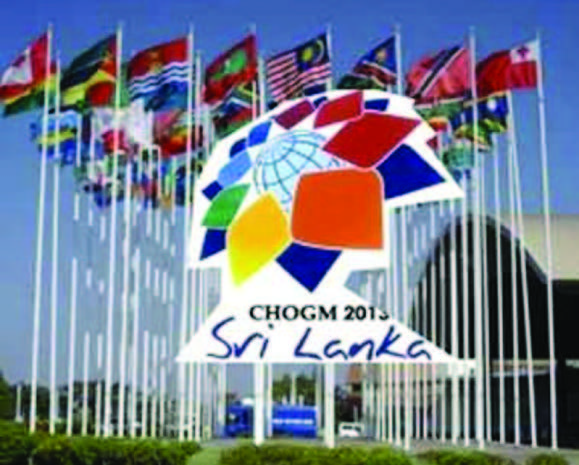
    COLOMBO (TIP):THE heads of government of the 53 nations of the Commonwealth come together every two years for a summit. This time, several have decided to stay away, to boycott the gathering in Sri Lanka. The prime ministers of Canada, India and Mauritius say they cannot take part. Their basic complaint: Sri Lanka’s President, Mahinda Rajapaksa, should not have been allowed to host the Commonwealth and then take over for the next two years as chairperson of an organisation committed to values of democracy and human rights which he is accused of flouting. Other leaders are still coming, despite pressure on them to join the boycott.

    So Britain’s Prime Minister, David Cameron, has flown in from neighbouring India, although his counterpart, India’s Manmohan Singh, has pulled out. Mr Cameron says it’s better to engage and ask tough questions rather than risk making the Commonwealth irrelevant as an organisation. The case against Sri Lanka’s government stems partly from allegations against the security forces of war crimes, including the killing of civilians, rape and sexual violence against women, particularly during the final months in 2009 of a civil war against Tamil separatists. Critics also say there is considerable evidence of abuses both then and more recently, including the abduction or “disappearance” of opponents and the murder of journalists. The government in Colombo rejects all these allegations, a denial repeated to me in a BBC interview by the country’s minister of mass media and information, as Commonwealth leaders arrived in the country.

    Test of will

    “We wanted zero civilian casualties,” said the minister, Keheliya Rambukwella, who is the government’s spokesman. He added that it was well documented that the Tamil Tigers or LTTE, whom he called “terrorists”, “used civilians as human shields”. The minister also rejected demands from Britain’s prime minister. David Cameron is calling for an end to the intimidation of journalists and human rights defenders, action to stamp out torture, demilitarisation of the north and reconciliation between communities. Mr Cameron says there needs to be a thorough investigation into alleged war crimes, and that if it does not happen rapidly, then an international independent investigation will be needed.

    The Sri Lankan government accuses him of colonialism, of trying to dictate to a sovereign nation and of abusing his invitation to come to Colombo to discuss the issues on the formal agenda of this summit. But that agenda includes debate over what should replace the United Nations Millennium Development Goals when they expire in 2015. That may allow any leader in the room to raise a whole host of human rights concerns, precisely because they are central to many people’s belief that you cannot eradicate poverty without at the same time upholding rights, including the freedom to make political choices and freedom of speech. Some people ask whether or not anyone would notice if the Commonwealth disappeared.

    Supporters argue its achievements are often ignored. They point to a strong set of rules on democracy and elections: Commonwealth observer missions often play a significant role in limiting or preventing ballot-rigging. Military takeovers are punished. Thirty years ago many Commonwealth countries were ruled by men in uniform. Not any more. The Commonwealth is also much more than a club of political leaders. Its grassroots organisations, bringing together civil society groups around the globe, or professional associations exchanging best practice, or promoting trade are often more effective than gatherings of the political elite.

    Small states also value the collective political weight they can sometimes exert via the Commonwealth in a world where their voices might otherwise be drowned out. Critics, on the other hand, assemble lists of Commonwealth failings. Many have to do with promises made by leaders and then broken. Other charges involve rules which are not rigorously enforced. The current controversy over the decision to meet in Colombo is seized on by the critics as further evidence the Commonwealth is all too flexible when it comes to sticking to its principles. This year’s new Commonwealth Charter commits leaders to uphold these principles.

    So this summit will be seen by many as a test of the Commonwealth’s real commitment to values and a test of its collective will.

  • International Conference confers the title ‘Gyani’ on Max Arthur Macauliffe

    International Conference confers the title ‘Gyani’ on Max Arthur Macauliffe

    MONTREAL (TIP): An International conference was held in MontrealSept 20- 22, 2013to formulate methodology for interpreting hymns of the Guru Granth Sahib. The conference was dedicated to the Max Arthur Macauliffe Centennial. Scholars from Canada, USA and UK made presentations to highlight the inadequacies of the available translations of the Sikh scripture on Sept 20-22, 2013. They discussed the criteria that must be met when interpreting the scripture of the Sri Guru Granth Sahib. In his Keynote Address Dr. Devinder Singh Chahal quoted Max Arthur Macauliffe who first time pointed out the lack of understanding of the universal message of the Guru. Macauliffe was the first to serve as the gateway to promote Sikh teachings to the West. Dr. Avtar Singh Dhaliwal from North Carolina, USA stressed “Explicative Methodology for Interpreting Gurbani”. Dr. Kulbir S Thind, from California, USA titled his presentation as “Some Pitfalls of Translation of Aad Guru Granth Sahib into English”. Prof. Davinder Singh Chahal, from Laval, Quebec, Canada discussed “Application of Science and Logic in Interpreting Gurbani”.


    img23
    Max Arthur Macauliffe, born in Ireland is best known as English translator of the Sikh scriptures and historian of early Sikhism. The International Conference on interpreting Gurbani held in September, 2013 in Montreal was dedicated to the Max Arthur Macauliffe Centennial.

    Dr. Harbans Lal, from Texas, USA stressed that translations must always be consistent with Gurmat doctrines. Using many illustrations he stressed that the Guru’s hymns use metaphors to make their meanings relevant to all cultures and all times. Dr. Lal dedicated his paper to the Macauliffe Centennial. Devinder Singh Sekhon, from Brampton, Canada illustrated examples of incorrect splitting of Larivar (continuous text) caused errors in the interpretation of Gurbani. There were other presentations such as “Exploration of Gender Equality in Sikhism” by Lovpreet Kaur from Wolverhampton University, UK; “Amrit Bani as a Trajectory of a Distinct Identity” by Charan Singh of Ashwa, Canada. Prof. P.S. Bhandari, Montreal, Canada presented a slide show depicting of photos the Guru Granth celebrations in Montreal. The conference was organized by the Institute for Understanding Sikhism (IUS) and supported by local Gurdwara. It started with informal discussion at a dinner on September 20 and ended with a roundtable discussion on September 22, 2013.

    The conference unanimously passed two resolutions.
    1. It was resolved that ‘Formulation of Methodology for Interpreting Gurbani’ by world class scholars is urgently needed. The resolution was moved by Dr. Kulbir Singh Thind, San Mateo, USA and seconded by Dr. Teja Singh, Brampton, Ontario, Canada and approved unanimously by the attendees with voice vote.
    2. It was unanimously passed to bestow the honorific title of GYANI upon Max Arthur Macauliffe for his contributions to Sikhi (Sikhism) and introducing Sikhism to the English speaking people of the West. He will now be known as Gyani Max Arthur Macauliffe. The resolution was moved by Dr. Harpal Singh Buttar of Ottawa, Canada and seconded by Dr Teja Singh of Brampton, Ontario, Canada and was passed unanimously.

  • Police arrest 348 in global child porn investigation

    Police arrest 348 in global child porn investigation

    TORONTO (TIP): More than 300 people, including teachers, coaches and doctors, have been arrested worldwide on child pornography charges after a Canadianled investigation. Toronto police said on Thursday the arrest of 348 people, including 108 in Canada, 76 in the United States and 164 in other countries from Spain to Australia, came after a threeyear investigation of a Toronto company that distributed child porn. “Of concern to the investigators was the number of people (arrested) who have close contact with children. The arrests included 40 school teachers, nine doctors and nurses, 32 people who volunteered with children, six law enforcement personnel, nine pastors or priests, and three foster parents,” Inspector Joanna Beaven-Desjardins, head of Toronto’s Sex Crimes Unit, told a news conference.

  • Substantial Foreign Direct Investment in the United States: Report

    Substantial Foreign Direct Investment in the United States: Report

    WASHINGTON (TIP): The United States has been the world’s largest recipient of foreign direct investment (FDI) since 2006. Every day, foreign companies establish new operations in the United States or provide additional capital to established businesses. With the world’s largest consumer market, skilled and productive workers, a highly innovative environment, appropriate legal protections, a predictable regulatory environment, and a growing energy sector, the United States offers an attractive investment climate for firms across the globe.

    Foreign direct investment in the United States is substantial
    ● In 2012, net U.S. assets of foreign affiliates totaled $3.9 trillion. The United States consistently ranks as one of the top destinations in the world for foreign direct investment (FDI), with inflows totaling $1.5 trillion in FDI just since 2006. For 2012, FDI inflows totaled $166 billion.
    ● The U.S. manufacturing sector draws a considerable share of FDI dollars, led by pharmaceuticals and petroleum and coal products. Outside manufacturing, wholesale trade; mining; non-bank holding companies; finance and insurance; and banking receive the greatest shares of foreign investment.
    ● Investment flows into the United States come mostly from a small number of industrial countries. Since 2010, Japan, Canada, Australia, Korea, and seven European countries collectively have accounted for more than 80 percent of new FDI. Although still small, flows from emerging economies like China and Brazil are growing rapidly.

    Foreign direct investment benefits the U.S. Economy
    ● In 2011, value-added by majority-owned U.S. affiliates of foreign companies accounted for 4.7 percent of total U.S. private output.
    ● These firms employed 5.6 million people in the United States, or 4.1 percent of private-sector employment. About one-third of jobs at U.S. affiliates are in the manufacturing sector.
    ● These affiliates account for 9.6 percent of U.S. private investment and 15.9 percent of U.S. private research and development spending.
    ● In the 2008-09 recession and subsequent recovery, employment at U.S. affiliates was more stable than overall private-sector employment. As a result, U.S. affiliates’ share of total U.S. manufacturing employment rose from 14.8 percent in 2007 to 17.8 percent in 2011.
    ● Compensation at U.S. affiliates has been consistently higher than the U.S. average over time, and the differential holds for both manufacturing and non-manufacturing jobs. Looking ahead, the United States will remain an attractive destination for foreign investment, and this investment will help bolster our economy. However, we need to continue to nurture and build upon the underlying strengths of the U.S. economy that make firms want to invest here; including an open investment regime, a large economy, a skilled labor force, community colleges, world-class research universities, predictable and stable regulatory regime, adequate infrastructure, and new energy sources.

  • Sri Lanka rights abuse allegations divide Commonwealth

    Sri Lanka rights abuse allegations divide Commonwealth

    COLOMBO (TIP):THE heads of government of the 53 nations of the Commonwealth come together every two years for a summit. This time, several have decided to stay away, to boycott the gathering in Sri Lanka. The prime ministers of Canada, India and Mauritius say they cannot take part. Their basic complaint: Sri Lanka’s President, Mahinda Rajapaksa, should not have been allowed to host the Commonwealth and then take over for the next two years as chairperson of an organisation committed to values of democracy and human rights which he is accused of flouting. Other leaders are still coming, despite pressure on them to join the boycott. So Britain’s Prime Minister, David Cameron, has flown in from neighbouring India, although his counterpart, India’s Manmohan Singh, has pulled out. Mr Cameron says it’s better to engage and ask tough questions rather than risk making the Commonwealth irrelevant as an organisation. The case against Sri Lanka’s government stems partly from allegations against the security forces of war crimes, including the killing of civilians, rape and sexual violence against women, particularly during the final months in 2009 of a civil war against Tamil separatists. Critics also say there is considerable evidence of abuses both then and more recently, including the abduction or “disappearance” of opponents and the murder of journalists. The government in Colombo rejects all these allegations, a denial repeated to me in a BBC interview by the country’s minister of mass media and information, as Commonwealth leaders arrived in the country.

    Test of will
    “We wanted zero civilian casualties,” said the minister, Keheliya Rambukwella, who is the government’s spokesman. He added that it was well documented that the Tamil Tigers or LTTE, whom he called “terrorists”, “used civilians as human shields”. The minister also rejected demands from Britain’s prime minister. David Cameron is calling for an end to the intimidation of journalists and human rights defenders, action to stamp out torture, demilitarisation of the north and reconciliation between communities. Mr Cameron says there needs to be a thorough investigation into alleged war crimes, and that if it does not happen rapidly, then an international independent investigation will be needed. The Sri Lankan government accuses him of colonialism, of trying to dictate to a sovereign nation and of abusing his invitation to come to Colombo to discuss the issues on the formal agenda of this summit. But that agenda includes debate over what should replace the United Nations Millennium Development Goals when they expire in 2015. That may allow any leader in the room to raise a whole host of human rights concerns, precisely because they are central to many people’s belief that you cannot eradicate poverty without at the same time upholding rights, including the freedom to make political choices and freedom of speech. Some people ask whether or not anyone would notice if the Commonwealth disappeared.

    Supporters argue its achievements are often ignored. They point to a strong set of rules on democracy and elections: Commonwealth observer missions often play a significant role in limiting or preventing ballot-rigging. Military takeovers are punished. Thirty years ago many Commonwealth countries were ruled by men in uniform. Not any more. The Commonwealth is also much more than a club of political leaders. Its grassroots organisations, bringing together civil society groups around the globe, or professional associations exchanging best practice, or promoting trade are often more effective than gatherings of the political elite. Small states also value the collective political weight they can sometimes exert via the Commonwealth in a world where their voices might otherwise be drowned out. Critics, on the other hand, assemble lists of Commonwealth failings. Many have to do with promises made by leaders and then broken. Other charges involve rules which are not rigorously enforced. The current controversy over the decision to meet in Colombo is seized on by the critics as further evidence the Commonwealth is all too flexible when it comes to sticking to its principles. This year’s new Commonwealth Charter commits leaders to uphold these principles. So this summit will be seen by many as a test of the Commonwealth’s real commitment to values and a test of its collective will.

  • Sikhs in Thousands Attend ‘Justice Rally’ in Geneva

    Sikhs in Thousands Attend ‘Justice Rally’ in Geneva

    ‘Sikh Genocide Petition’ Submitted to UN

    GENEVA (TIP): The Justice Rally held in front of the UN office in Geneva was attended by thousands of Sikhs from across Europe, the US and Canada. The rally was organized by Sikhs for Justice (SFJ) Movement Against Atrocities and Repressions (MAR) with the support of Gurudwara management committees from across Europe. November 01 rally before UN was one of the biggest rallies ever held before UN in Geneva. SFJ coordinators Avtar Singh Pannun of New York and Sukhwinder Singh Thana worked tirelessly past several weeks to organize the rally and toured the UK and Europe to gather support from the local Sikh community. Doctor Bakhshish Singh Sandhu, SFJ Coordinator also traveled to Geneva to attend the rally. According to SFJ coordinators, the rally before UN woke the world community that organized killing of Sikhs during November 1984 was Genocide and not riots. A delegation comprising of representatives of SFJ, MAR, AISSF and European gurudwaras personally filed the “Sikh Genocide Petition” in the United Nations Human Rights Council. The delegation included SFJ legal advisor Gurpatwant Singh Pannun, SFJ Coordinator Avtar Singh Pannun, Harminder Singh Khalsa of MAR, Doctor Karj Singh Dharamsinghwala of AISSF, Jatinder Singh Grewal of SFJ and Jasbir Singh Delhi.


    img17
    SFJ legal advisor Gurpatwant Singh Pannun and SFJ Coordinator Avtar Singh Pannun display the petition submitted to UN Office in Geneva

    Jasbir Singh Delhi a resident of California, who is main witness against Congress leader Tytler also traveled across Europe to gather community support for the Genocide petition and rally before UN. According to Jasbir Singh Delhi, the victims of November 1984 have approached United Nations for justice because all the attempts to obtain justice in India have failed and organizers of November 1984 are rewarded by India instead of being prosecuted. Addressing the rally, SFJ Coordinator, Avtar Singh Pannun stated that for past 29 years Sikh community has been demanding justice for India’s crimes of November 1984. Now we have approached the UN and global community for recognition of November 1984 Sikh Genocide. According to Sukhwinder Singh Thana, SFJ Coordinator, Sikh community have come together in demanding justice and UN intervention on the issue of November 1984 Sikh Genocide. Doctor Bakhshish Singh Sandhu of SFJ stated that filing petition before the UN on the issue of November 1984 is just the first step in seeking justice and recognition for Sikh Genocide. With the help and support of Sikh community worldwide, we will have to take the matter to all international forums. Tejinder Kaur from Surrey, Canada, traveled all the way to Geneva for submission of the petition and to participate in the rally. She also addressed the rally, saying: “I was just 13 years old when this massacre took place and daughter of a senior Indian government official. That was the moment in my life, to discover my identity as a Sikh.” SFJ legal adviser Gurpatwant Singh Pannun, who had been touring various European countries for the last few weeks, claimed that this signature campaign has once again focused the Sikh Diaspora on the issue of demanding justice for the victims of the November 1984 killings.

  • BULLETT RAJA to Open in US before India

    BULLETT RAJA to Open in US before India

    NEW YORK (TIP): Bollywood fans in America will now get to see the muchtalked- about new film BULLETT RAJA starring Saif Ali Khan and Sonakshi Sinha before audiences in India will. Directed by National Award winner Tigmanshu Dhulia, the Fox Star Studios film will release a day early in the U.S. on Thursday, November 28, on Thanksgiving Day. BULLETT RAJA’s release date in India, Canada, and other countries remains Friday, November 29. This explosive new entertainer also stars Vidyut Jamwal, Jimmy Shergill, Gulshan Grover, and Raj Babbar. Bullett Raja is the story of a common man, Raja Mishra, who transforms into a dreaded gangster of the Hindi heartland. A victim of the system and chained by it, Raja’s life changes as he takes on those that rule and shakes the very foundations of the nexus of the police, the government, and the industrialists. As he rises and revolts against the system becoming an outlaw, Bullett sets ablaze the nexus and changes the landscape forever. The powers that be, fight back in a compelling struggle for power and money against the backdrop of personal ambitions, greed and revenge. Redefining love, friendship and loyalty, Bullet Raja creates a world, where a common man, tests his endurance and fortitude against the very system he once obediently followed and then declared a war on it! Directed by National Award winner, Tigmanshu Dhulia, Bullett Raja toplines leading Indian stars- Saif Ali Khan and Sonakshi Sinha.

  • History making Indian Diwali at Times Square mesmerizes visitors

    History making Indian Diwali at Times Square mesmerizes visitors

    NEW YORK (TIP): Diwali maybe a month away but for Indian Americans at Times Square, festivities started as early as September 22 when the entire cast of Besharam made a special appearance at the ‘Maharashtra Tourism Diwali at Times Square’. But Diwali at Times Square was much more than just the special performances from the Besharam team. Roughly about 30,000 people attended the Diwali event on Sunday at the busiest area for pedestrians in the world where 3,00,000 people visit every day. In a bid to tap major international source markets and increase tourist arrivals, the Maharashtra Tourism Development Corporation (MTDC) participated in the early Diwali celebrations. Speaking on the occasion Minister for Tourism, Government of Maharashtra, Chhagan Bhujbal said, “Due to this event, the image of Maharashtra is going to be boosted in all international markets, not just in the USA. We want foreign tourists to come to Maharashtra, explore its rich cultural heritage and UNESCO world heritage sites like Ajanta, Ellora and Elephanta caves.


    img010

    They should also visit Tadoba Tiger Sanctuary, near Nagpur, where any tourist would spot tigers. It is my pleasure to invite all international tourists to indulge in the luxurious Deccan Odyssey train which covers the beautiful Maharashtra.” Mr. Satish Soni, Director – Tourism, Government of Maharashtra said, ‘It’s an extravagant event for Maharashtra tourism in a foreign land. We are glad at its grand success as thousands of people visited and enjoyed the event at the magnificent Times Square. We appeal to the people of the world to come to Maharashtra for an unforgettable experience. “There were many enquiries for the Deccan Odyssey train followed by the wildlife reserves, mostly from foreigners and local Americans,” said one of the organizers at the tourism booth. The festivities showcased Indian music, cuisine and fashion. Times Square between 45th to 47th streets was bustling with tourists and visitors dressed in traditional attire as they lined up to get the saffron Kolhapuri turbans, pointed mustache masks, Gandhi caps and chudis (bangles). The cultural festival included dance, diya, rangoli painting, Indian arts and crafts, fashion show, photo booths with ethnic outfits, celebrity autograph/photo booth and much more. The event saw some famous dancers performing Lavani, and other well-known Marathi dances styles, Bhangra, fusion etc.


    img11

    Dhol – Tasha and Tutari enthralled the crowds eagerly waiting to catch a glimpse of their favorite Bollywood stars. Groups like Sangharsh and Sankalp promoted Govinda festival by forming human pyramids. Late in the evening at the Light Up Times Square concert had the music maestro Shankar Mahadevan also created a sensation through his voice and musical troupe. “Where in my dreams did I think that I will sing Ganpati bhajan at Times Square,” said Mahadevan. The concert also saw Canada based group Culture Shock perform live on a mix of songs. Although Indian Americans dominated the crowd many tourists as well as local Americans enjoyed the festivities. “This is my first ever encounter with India. I have heard a lot about the country that it is colorful and vibrant but experienced it for the first time. I loved the energy and the sense of community and also the samosas. My next holiday destination is India for sure,” said Suzan Lew. The festival encountered mixed reactions from the Indian Americans. “Diwali is a festival of lights and what better place to celebrate than Times Square. It is like a mela out here, I have never seen such a crowd in the US. Only Indians can party like this, I am proud to be an Indian,” said Pragya Mahajan who wore a saffron turban. “Celebrating Diwali at Times Square is celebrating the cultural capital of the world (India) at the cultural capital of the United States,” said Sunny Doshi, a new Jersey resident.

    While there were positive responses to the event, many Indian Americans were disappointed with the ‘westernized’ Diwali celebrations and poor management. “Speakers at the very end did not work. We tried to go forward but feared stampede and because there were no screens to look at we headed back,” said Reetu Kumar who had come with her 68 year old grandmother. The night culminated into the star studded performances from Bollywood actors Ranbir Kapoor, and debutant Pallavi Shardha who made a special appearance along with Rishi and Neetu Kapoor to promote their upcoming film Besharam. The crowd gathered at Times Square went ballistic on catching a glimpse of one of Bollywood’s most eligible bachelors. Dressed in a black ‘sherwani’, the young Kapoor danced and interacted with his fans as his father recalled visiting the city years ago and expressing gratitude for the adulation shown to him and his family. Congratulating Maharashtra Tourism for its achievement, Rishi Kapoor said, “I am proud to be a part of Maharashtra.” Complimenting ASB Communications and Event Guru, Shankar Mahadevan said, “Congratulations for pulling this off. To do this at Times Square was close to impossible. God bless”. “I came to the USA over 36 years ago and I still remember being awed by Times Square when I first saw it. I told myself even at that time that I will showcase the diversity and richness of India at this location. I am so thankful to all those who came here today. I am equally thankful to Maharashtra Tourism Development Corporation, Air India, MoneyGram, DishWorld, Wells Fargo, Bank of Baroda and all other sponsors without whose support this event would not have been possible”, said Neeta Bhasin, President, ASB Communications, the conceptualizer of the event.

  • Sunil Dutt(1929-2005)

    Sunil Dutt(1929-2005)

    Founding Patron of Nargis Dutt Memorial Foundation
    Afilm artist, director and producer, agriculturist, political and social worker, and fighter against religious fanaticism, Sunil Dutt was born in 1929 in Jhelum (now in Pakistan). Mr. Dutt acted in nearly 84 movies, produced eight movies and directed six movies and won Filmfare Best Actor award twice for the films, Mujhe Jeene Do and Khandan. Important international film landmarks include entry of Mujhe Jeene Do at Cannes Film Festival, 1964; Yaadein at Frankfurt International Film Festival, 1967 (Won Grand Prix Award); and Reshma Aur Shera at Tashkent Film Festival and Berlin Film Festival, 1972. After serving as the Sheriff of Bombay, Mr. Dutt was elected to the eighth Lok Sabha in 1984, re-elected for a second term in 1989, and a third term in 1991.

    He organized and led Mahashanti Padyatra from Mumbai to Amritsar in 1987, traveling 2,000 kilometers with daughter Priya and 80 other individuals for peace and harmony in Punjab; undertook a peace march with 14 persons and Priya in 1988, from Nagasaki to Hiroshima (Japan) covering 500 Kilometers for world peace and nuclear disarmament. After the 1992-93 Hindu-Muslim riots he resigned as a Member of Parliament in protest aginst the riots. In 1999, he was elected to the 13th Lok Sabha. In May, 2004, he was once again elected to the 14th Lok Sabha and served as the union Minister for Youth Affairs & Sports. In 1958, he married Nargis Dutt. They have three children, two daughters, and a son, the actor Sanjay Dutt. Mr. Dutt was a Patron of the Spastic Society of India. Following his wife’s death, he made a film, Dard Ka Rishta on cancer and its cure and donated its profits to Tata Memorial Cancer Hospital and offered the film free to Bangladesh for raising funds for cancer treatment; brought drugs from U.S.A for India’s first bone marrow transplant operation at Tata Memorial Cancer Hospital; established the Nargis Dutt Memorial Foundation in U.S.A., U.K., Canada, Germany and Holland and with the help of this fund, supplied medical equipments worth 5 million U.S. dollars to different charitable hospitals in the country for treatment of cancer.

    He received numerous awards and honors including the Padma Shri in 1968; ” The Shiromani Award ” by the Institute of Sikh Studies; ” The Order of the Peoples ” National Award by the All India Artiste Association, Simla, 1984 for work in the field of cancer treatment and aid for physically handicapped; ‘ The Man Of The Year ‘ Award for 1987 for contribution to the field of cinema, social arts and politics by Marine Lines Jaycees, Mumbai; ” The Khan Abdul Gaffar Khan Award ” for International Peace & Communal Harmony, Unity and National Integration., by Alaami Urdu Conference, New Delhi, 1988; ” The National Integration Award ” from Priyadarshini Academy, Mumbai in July 1989 for outstanding contribution to the cause of National Integration; ” The Maulana Abul Kamal Azad Award ” for National Integration and Communal Harmony in 1997; ” The Great Son of the Soil Award ” by All India Conference of Intellectuals, 1997; ” The Rajiv Ganghi National Sadbhavana Award ” in 1998, by the late Dr. Shankar Dayal Sharma, former President of India for promoting peace, harmony, fought against violence and terrorism; and ” The Lifetime Achievement Award ” by Screen Videocon for services to the Film Industry, 1999. And, after Sunil Dutt died in 2005, the illustrious daughter of illustrious parents, Priya Dutt, the present Member of Parliament took upon herself to carry forward her late mother’s vision. She has given to the Foundation all her attention and time, with the result that the Foundation could achieve splendid goals. Here are some of her thoughts.

  • Legendary Bollywood stars to perform at the Iconic ‘Diwali at Times Square’

    Legendary Bollywood stars to perform at the Iconic ‘Diwali at Times Square’

    NEW YORK, NY (TIP): The iconic and history-making ‘Diwali at Times Square’ on Sunday, September 22, 2013 will witness participation of some of the biggest stars of Bollywood, the organizers, Event Guru and ASB communications, announced here on September 12. The event is sponsored by Maharashtra Tourism, Air India, MoneyGram, Royal Albert Palace, Wells Fargo and Bank of Baroda. So do mark September 22nd2013 in your calendar because that is the day when you will get to experience and savor the cultural potpourri that is India in Manhattan when Times Square celebrates Diwali. First time ever this historic event is being celebrated at the largest and the most popular cross road of the world – Times Square.

    The first-of-its-kind international initiative to promote Indian culture, heritage and diversity will span Broadway from West 45th to West 47th street. The event will take place from 11am to 6pm, followed by the ‘Light Up Times Square’ concert which will showcase live performances from some of the biggest names in Bollywood. All present will get a peek at the cultural kaleidoscope that is India by savoring Indian music, dance, food and films. The Title Sponsor of the show Maharashtra Tourism will be showcasing the much talked about and looked forward to Deccan Odyssey train through a re-creation of the same. All present will also be given an opportunity to take home a little bit of the Indian culture through an interactive exercise by the presenting sponsor Air India, wherein, they could learn how to drape the saree. Apart from this they will also get an opportunity to learn how to wear a turban or even learn how to play the dhol (Indian drum). A spokesperson for the organizers, giving details of entertainment segment said, “To kick start entertainment we shall have the melodious and ethereal voice of Shankar Mahadevan resonate in Times Square and enthrall all those present with his most popular songs medley.

    As if that wasn’t enough we shall have Ranbir Kapoor, the heart throb of India, the maverick superstar whose lineage boasts of the likes of Prithviraj Raj Kapoor, Raj Kapoor and Rishi Kapoor. “Ranbir Kapoor will perform and interact with the audiences present about his new film Besharam. And over and above all this pulsating entertainment we will get to see the most popular Bollywood couple Neetu and Rishi Kapoor accompany him on stage too. Pallavi Sharada, the debutante heroine of the film, will also perform on a song from Besharam. If this isn’t enough to give you an adrenaline rush then you will be jolted into a musical culture shock by the famous group from Canada Culture Shock. So do come one and all and share in this fantastic free for all experience of Dilwali at Times Square on 22ndSepetmber 2013. For further inquiry do visit www.diwalitimessquare.com and facebook.com/DiwaliTimesSquare

  • India pays homage to those killed in the 9/11 terrorist attack

    India pays homage to those killed in the 9/11 terrorist attack

    NEW YORK, NY (TIP): On the 12th anniversary of the September 11 terror attacks that killed nearly 3,000 people India announced its participation in the Queen Elizabeth II September 11 Garden as one of the commonwealth nations. The announcement was made by Consul General of India in New York, Ambassador Dnyaneshwar Mulay, at a prayer meeting organized for those who lost their lives in the deadly attack. The British Garden at Hanover Square- a triangular slip of greenery at Pearl and Hanover streets- was commissioned by the British Memorial Garden Trust and given to the city in memory of British citizens who lost their lives during the attacks of September 11 2001 and in the ensuing wars.


    img26
    A view of the gathering

    However in August of 2011, the purpose of the garden was expanded to honor victims from the Commonwealth nations. “We are deeply honored and touched that India has chosen to join us at the Queen Elizabeth II Garden September 11. When we started in 2002 we wanted something to honor back then the British society. However, over the years it became clear that our mission was much wider than just British nationals and changed it to much wider Commonwealth nations,” said British Memorial Garden Trust Chairman, Victor Stewart. He added, “We believe that it is very important that Commonwealth nationals in this international city have a common place that they can go to and reflect upon our common heritage.” “So far Commonwealth nations who have participated include Australia, Canada, New Zealand, Jamaica and now, it is India.We would like all Commonwealth nations especially those affected by 9/11 to participate,” said Vice Chairman, British Memorial Garden Trust, Rodney Johnson.

    Condemning the terrorist attacks, Ambassador Mulay stated, “The Queen Elizabeth II September 11 garden is built in the memory of those who sacrificed their lives in the 9/11 terrorist attacks. India lost about 47 people and this number does not include people who died outside the building or people who are not accounted for and so we thought it is a good gesture to participate and pay homage to people who died.We had a request from the chairman of the garden and we readily agreed.” At the event, Ambassador Mulay recited a Sanskrit prayer to pay homage to those who died in the terrorist attack. Approximately 2996 people were reported dead in the multiple attacks. “We are gathered here to essentially pray for those who sacrificed their lives irrespective of their nationalities or religion and also take this opportunity to condemn all form of terrorism,” said Ambassador Mulay. Those who spoke on the occasion, besides Ambassador Mulay, included Attorney Ravi Batra, George Abraham, and Jagdish Sewhany.

  • Sam Kannappan elected to NCEES

    Sam Kannappan elected to NCEES

    HOUSTON (TIP): The 92nd Annual Meeting of National Council of Examiners for Engineering and Surveying (NCEES) held in San Antonio, Texas recently has elected Sam Kannappan, a noted Indian-American community activist of Houston, Texas as its zonal Secretary/ treasurer, a press release said. Sockalingam Sam Kannappan, Chairman of Enforcement Committee, of Texas P.E. Board was elected Secretary and Treasurer of Southern Zone (SZ). South Zone has 18 boards under its control. NCEES is the American National Professional Engineers (PE) Board coordinating 50 national P.E. Boards, Puerto Rico and Virgin Islands. Engineering organizations from Canada, Mexico, Japan and other countries work with NCEES. Members of each state PE Board are appointed by their respective state governors. The requirements to receive a license to practice engineering such as education, examination and experience are decided by the Board.

    NCEES conducts examination for fundamental (FE) and Professional Examination (PE) through four zones. Kannapan was also recently made a board member of Texas Onsite Wastewater Treatment Research Council by Texas Governor Rick Perry. Kannappan is a registered Professional Engineer in Texas with 25 years of experience in design, analysis, and software development for the petrochemical, refinery, and pipeline industries. He graduated with Masters Degree in Mechanical Engineering from the University of Texas at Austin. He is a leading consultant in pipe design especially in designing piping under very high temperatures and pressures. He specializes in Finite Element Analysis and Fracture Mechanics methods to determine remaining life of a pressure component. He is author of text book “Introduction to Pipe Stress Analysis”. Kannappan, a native of Nattarasankottai in Sivaganga district of Tamil Nadu is the founder of Sri Meenakshi temple in Houston, Texas.