Tag: Canada

  • Rajasthan’s Blue City A Painter’s Canvas

    Rajasthan’s Blue City A Painter’s Canvas

    Colourful cityscape
    The silky sand dunes of the Thar Desert dotted with camels basking in the sun, towering forts and palaces glistening in red sandstone and the narrow lanes leading to shops that open into an alluring world of handicrafts are some of the welcoming sights here. We were fortunate to have a host-cum-tour guide to walk us into different eras every time we stepped inside historical monuments, temples and gardens.

    Madan Lal Jangid, a 69-year-old French professor, entrepreneur, researcher and an avid traveller could not be dismissed as one of those guides who takes tourism to be a revenue-making business. “I cannot wrap up the history of a place in 45 minutes, make money and let you go feeling satisfied. I remember when a diplomat from Canada had been here, we spent at least 4-5 hours in Mehrangarh Fort discussing the many stories behind every pillar and rock.

    That is how you connect; summarising a history in stock-and trade terms is a fruitless exercise,” asserts he. Our car moved through the nooks and crannies of the city in a way that the seat’s window became a frame to the colourful images outside running past one after the other. From veiled women keeping up with their husbands’ pace, the paan wala sprinkling water on the cascading betel leaves, little boys encircling foreign tourists to that old woman under the shade of the Clock Tower with a heap of coloured shoelaces awaiting buyers; the transition seemed like we turn pages in a photo album.
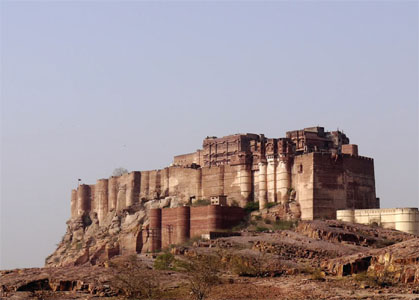
    The Royal quarters of Mehrangarh Fort
    The mighty walls of the Mehrangarh Fort have many secrets buried inside. Maintained by the present generation of Marwar Kings, Maharaja Gaj Singh II, the expansive courtyards, exquisite palatial spaces like the Moti Mahal (Pearl Palace), Phool Mahal (Flower Palace), Sheesha Mahal (Mirror Palace), and hidden balconies for women to listen to court proceedings, chambers and galleries enrich the fort’s heritage. Our host informs us that this is the only fort where you will find the provision of an elevator allowing people to not worry about any physical barriers during their tour. There is yet another purpose of the elevator; it leads you to the Mehran Terrace, a roof-top restaurant where people take delight in indulging in the traditional Rajasthani thali.

    And what better way to admire the beauty of a worldclass historical monument than sitting on the terrace beneath the twinkling stars and dim-lit candles on the dining table? On reaching the top floor, the view of the entire cityscape is breathtaking.

    All the gates of the fort are visible and the panoramic view seems sketched on a blue canvas. Blue, because the cluster of buildings are bathed in that colour and there is a reason too. The colour was earlier identified with a certain privileged section of society, a marker of a higher caste but slowly as civilization grew, such social indicators ceased to have any significance. Subsequently, blue emerged as the universal colour of all communities irrespective of distinctions. Jodhpur is not only known as the ‘sun’ city, it is also referred to as the ‘blue’ city, like Jaipur is the Pink City.

    Jaswant Thada
    Located half way up the road that climbs onwards to the Mehrangarh fort is Jaswant Thada. Immaculate in white marble, this mausoleum was built in the year 1899 in the memory of Maharaja Jaswant Singh II. A tomb with an array of domes is the crematorium for Jodhpur rulers. As the sun rays kiss the milky surface of the monument, the memorial comes alive in a glaze and its intricate carved jalis (screens) emit a glow.

    The grandeur of Umaid Bhavan
    This palace was born out of a crisis. When consecutive seasons went without rain, a famine-like situation arose that threatened the economic lives of people. Maharaja Umaid Singh decided to construct a palace that would not only relieve employment worries but also remain a monument of symbolic value for years. A visionary and benevolent king succeeded in his famine-relief policy that provided employment to thousands for a period of almost two decades from 1929-44. Anecdotes are many when it comes to discussing the Umaid Bhavan (initially called Chittar Palace for it stood on the Chittar Hills). The Art Deco furniture and impeccable interiors were originally crafted by Maples of London but unfortunately all furnishings could not reach the Palace.

    In the wake of World War II, the furniture-laden ship succumbed to a tragedy and was sunk by the Germans en route to India. Nothing could deter the Maharaja’s plans and in came a Polish artist and refugee from war-torn Europe, Stephen Norblin, who mended what was wrecked.

    Familiar with the work of Art Deco connoisseurs, Norblin did not fail the King. As you look through the paintings (essentially inspired by the episodes of Ramayana), gaze at the artefacts ranging from antique clocks (some in the shape of railway locomotives and others in windmills) to ornate ceilings; you would be quick to notice a harmonious “blend of occidental symmetry and oriental texture,” in the words of our host. Umaid Bhavan has been divided into three sectionsone portion is dedicated to the museum and exhibition area, the other is converted into a hotel and the third segment is owned by the current family of the royals headed by Maharaja Gaj Singh II.

    Clock Tower and marketplace
    Rajasthan is a land that celebrates colour and what better way to explore it than doing the rounds of the market area on the Nayi Sadak with the huge Clock Tower in the backdrop. Once you take a left from the Nayi Sadak, you reach the inviting world of lac bangles sparkling in embedded mirror work and bold colours almost blinding you at first sight. A walk through the Lakhara Bazaar reminds you of Delhi’s Chandni Chowk where everybody is scuttling around but with a sense of purpose. With bandhej designs, tie-dye prints, ethnic footwear and all things jodhpuri, you are bound to go neck-deep in shopping. Amid all the chatter of the localites, bickering of buyers and sellers, frying of ‘mirchi’ vadas and mawa kachoris (chilli-infused snacks) Jodhpur brightens up in the evenings. Biting into one of the spicy vadas, our host shared a trivia, “Rajiv Gandhi loved the mirchi vadas here and would never leave the city after every visit without his share of the popular snack”.

    Mandore Garden
    Gardens are supposed to make you feel happy but I entered into the gates of the Mandore Garden with a heavy heart. It was once a prominent entry point to the Mehrangarh Fort but today stands like an ordinary gateway. Its walls embossed in palm prints continue to speak of the cruel ritual of sati (burning of wives in the funeral pyre of their dead husbands) rampant during the time. Once inside, between the crevices of lush green trees you can catch a glimpse of the Mandore temple that is believed to be named after Ravana’s wife, Mandodari. On one hand, while a woman is a symbol of divinity, she is also subjected to atrocities like sati and dowry deaths; a conundrum unresolved.

  • Musharraf to return to Pakistan on Mar 24

    Musharraf to return to Pakistan on Mar 24

    ISLAMABAD (TIP): Pakistan’s former military ruler Pervez Musharraf would return to the country on March 24 to lead his party in upcoming elections, ending his nearly four years of self-imposed exile in Dubai and London. Musharraf, 69, will return to the country intent on leading his party in upcoming elections, a statement released by him said.

    Musharraf plans to fly on a commercial airline into Karachi on March 24, then attend a rally attended by 50,000 people including more than 200 Pakistani expatriates from the US, Canada, the UK and the UAE, the statement was quoted by the CNN as saying.

    He plans to lead his party, the All Pakistan Muslim League into Pakistan’s general elections, which are slated for May.

    In 1999, the then chief of Pakistan’s army became its president in a bloodless military coup. Musharraf, who stepped down as President in 2008 after he was threatened with impeachment, has earlier brushed aside questions on whether he would be arrested on his return in connection with several cases against him, including the case related to the assassination of former premier Benazir Bhutto.

    Pakistan Peoples Party leaders have said that Musharraf would be arrested as soon as he lands as he is wanted by authorities in connection with Bhutto’s assassination. Musharraf has set several dates for his return to Pakistan in the past but put off his homecoming after he was threatened with arrest. An anti-terrorism court has declared Musharraf a “proclaimed offender” or fugitive for refusing to cooperate with investigators probing Bhutto’s death in a suicide attack in Rawalpindi in December, 2007. Musharraf has been shuttling between London and Dubai after he went out of Pakistan in exile.

  • 26 Kg Heroin Seized- Drug Dealer Arrested, Says He Supplied Heroin To Boxer Vijender

    26 Kg Heroin Seized- Drug Dealer Arrested, Says He Supplied Heroin To Boxer Vijender

    CHANDIGARH (TIP): In a massive drug haul, the police recovered heroin worth Rs 130 crore from a flat in Zirakpur, Mohali. The police has alleged that boxer Vijender Singh’s wife’s car was found outside the Zirakpur flat and heroin was also recovered from another car. But it is not confirmed if it was from the boxer’s wife’s car. Police said that one person arrested on March 3, Anup Singh Kahlon, is linked to Vijender Singh and another boxer Ram Singh. The accused has alleged that he supplied small amounts of heroin to Vijender and Ram.

    Sources said they will be calling in the boxers for questioning. SSP Fatehgarh Sahab Hardyal Mann Singh says the investigations are on. “Nothing can be ruled out and we are probling the links between the accused and the boxers.” Sources also added that the accused is allegedly part of a bigger international drug peddling racket. Reportedly Kahlon is a truck driver in Canada and is part of a drug network in Punjab. Meanwhile, Vijender’s coach Gurbaksh Sandhu has expressed shock at the news. Vijender won a bronze medal at 2006 Asian Games in Doha, a bronze at 2008 Beijing Olympics and is the first Indian boxer to win an Olympic medal. The boxer was also honoured with Rajiv Gandhi Khel Ratna award and was 2009 top-ranked boxer in middle-weight category.

  • India Sixth Most Favourable Nation For Americans: Poll

    India Sixth Most Favourable Nation For Americans: Poll

    WASHINGTON (TIP): India is the sixth most favourable nation for Americans, while at least eight out of 10 do not like Pakistan, making it the third most unfavourable nation after Iran and Korea, according to a latest poll.

    According to the Gallup Polls, nearly seven (68 per cent) out of every 10 persons interviewed for the poll favoured India, thus ranking it sixth after Canada (91 per cent), Great Britain (88 per cent), Germany (85 per cent), Japan (81 per cent) and France (73 per cent).

    In fact Israel, the traditional American ally ranks seventh after India with 66 per cent while Mexico get only 47 per cent favourable votes. Opinion about Russia is equally divided among favourable and unfavourable rating while 52 per cent of the Americans put China in the unfavourable category. Nine out of 10 Americans have an unfavourable view of Iran, making it the worst rated country out of 22 surveyed. Seven other countries – Libya (72 per cent), Iraq (76 per cent), Afghanistan (80 per cent), the Palestinian Authority (77 per cent), Syria (75 per cent), Pakistan (81 per cent) and North Korea (84 per cent)– also receive unfavourable ratings of 70 per cent or more. “Eight countries with the most negative ratings are currently or over the past decade were involved in wars, disputes, or turmoil — in a number of instances, in ways that are hostile to the US,” Gallup said. It said the currently “hostile” category includes Iran and North Korea.

    Libya was hostile toward the US under the government of Muammar Gaddafi and more recently Ambassador Christopher Stevens and three other Americans were killed there. “The US-Pakistani relationship is beset with rockiness despite the strained cooperation between the two on military matters. Americans also strongly favour Israel’s enduring conflict with Palestinian Authority,” the survey said.

  • Valentine’s Day

    Valentine’s Day

    Every February 14, across the United States and in other places around the world, candy, flowers and gifts are exchanged between loved ones, all in the name of St. Valentine. But who is this mysterious saint, and where did these traditions come from? Find out about the history of this centuriesold holiday, from ancient Roman rituals to the customs of Victorian England.

    The Legend of St.Valentine

    The history of Valentine’s Day– and the story of its patron saint–is shrouded in mystery. We do know that February has long been celebrated as a month of romance, and that St. Valentine’s Day, as we know it today, contains vestiges of both Christian and ancient Roman tradition.

    But who was Saint Valentine, and how did he become associated with this ancient rite? The Catholic Church recognizes at least three different saints named Valentine or Valentinus, all of whom were martyred. One legend contends that Valentine was a priest who served during the third century in Rome.

    When Emperor Claudius II decided that single men made better soldiers than those with wives and families, he outlawed marriage for young men. Valentine, realizing the injustice of the decree, defied Claudius and continued to perform marriages for young lovers in secret.

    When Valentine’s actions were discovered, Claudius ordered that he be put to death. Other stories suggest that Valentine may have been killed for attempting to help Christians escape harsh Roman prisons, where they were often beaten and tortured.

    According to one legend, an imprisoned Valentine actually sent the first “valentine” greeting himself after he fell in love with a young girl–possibly his jailor’s daughter–who visited him during his confinement.

    Before his death, it is alleged that he wrote her a letter signed “From your Valentine,” an expression that is still in use today. Although the truth behind the Valentine legends is murky, the stories all emphasize his appeal as a sympathetic, heroic and–most importantly–romantic figure.

    By the Middle Ages, perhaps thanks to this reputation, Valentine would become one of the most popular saints in England and France.

    Origins of Valentine’s Day: A Pagan Festival in February
    While some believe that Valentine’s Day is celebrated in the middle of February to commemorate the anniversary of Valentine’s death or burial–which probably occurred around A.D. 270–others claim that the Christian church may have decided to place St. Valentine’s feast day in the middle of February in an effort to “Christianize” the pagan celebration of Lupercalia. Celebrated at the ides of February, or February 15, Lupercalia was a fertility festival dedicated to Faunus, the Roman god of agriculture, as well as to the Roman founders Romulus and Remus.

    To begin the festival, members of the Luperci, an order of Roman priests, would gather at a sacred cave where the infants Romulus and Remus, the founders of Rome, were believed to have been cared for by a she-wolf or lupa. The priests would sacrifice a goat, for fertility, and a dog, for purification.

    They would then strip the goat’s hide into strips, dip them into the sacrificial blood and take to the streets, gently slapping both women and crop fields with the goat hide.

    Far from being fearful, Roman women welcomed the touch of the hides because it was believed to make them more fertile in the coming year. Later in the day, according to legend, all the young women in the city would place their names in a big urn. The city’s bachelors would each choose a name and become paired for the year with his chosen woman. These matches often ended in marriage.

    A Day of Romance
    Lupercalia survived the initial rise of Christianity and but was outlawed—as it was deemed “un- Christian”–at the end of the 5th century, when Pope Gelasius declared February 14 St. Valentine’s Day. It was not until much later, however, that the day became definitively associated with love.

    During the Middle Ages, it was commonly believed in France and England that February 14 was the beginning of birds’ mating season, which added to the idea that the middle of Valentine’s Day should be a day for romance. Valentine greetings were popular as far back as the Middle Ages, though written Valentine’s didn’t begin to appear until after 1400.

    The oldest known valentine still in existence today was a poem written in 1415 by Charles, Duke of Orleans, to his wife while he was imprisoned in the Tower of London following his capture at the Battle of Agincourt. (The greeting is now part of the manuscript collection of the British Library in London, England.) Several years later, it is believed that King Henry V hired a writer named John Lydgate to compose a valentine note to Catherine of Valois.

    Typical Valentine’s Day Greetings
    In addition to the United States, Valentine’s Day is celebrated in Canada, Mexico, the United Kingdom, France and Australia.

    In Great Britain, Valentine’s Day began to be popularly celebrated around the 17th century. By the middle of the 18th, it was common for friends and lovers of all social classes to exchange small tokens of affection or handwritten notes, and by 1900 printed cards began to replace written letters due to improvements in printing technology.

    Readymade cards were an easy way for people to express their emotions in a time when direct expression of one’s feelings was discouraged. Cheaper postage rates also contributed to an increase in the popularity of sending Valentine’s Day greetings.

    Americans probably began exchanging hand-made valentines in the early 1700s. In the 1840s, Esther A. Howland began selling the first mass-produced valentines in America.

    Howland, known as the “Mother of the Valentine,” made elaborate creations with real lace, ribbons and colorful pictures known as “scrap.” Today, according to the Greeting Card Association, an estimated 1 billion Valentine’s Day cards are sent each year, making Valentine’s Day the second largest card-sending holiday of the year. (An estimated 2.6 billion cards are sent for Christmas.) Women purchase approximately 85 percent of all valentines.

  • 55 % Indian-Americans Own House In US, Says Census Bureau Report

    55 % Indian-Americans Own House In US, Says Census Bureau Report

    WASHINGTON (TIP): Indian-Americansmay have the distinction of being thehighest-per capita income group amongethnic communities but they lag far behindtheir European counterparts when it comesto owning a house in the US.According to the ‘HomeownershipAmong the Foreign-Born Population: 2011’,released by the Census Bureau, 55 per centof the Indian-Americans own a house oftheir own while 45 live in rentedaccommodation.Foreign-born owned households with ahouseholder from Europe were the mostlikely to be owned free and clear (40 percent), while foreign-born owned householdswith a householder from Africa were theleast likely to be owned free and clear (14per cent), it said.

    Of the 20 country-of-birth groups withthe largest number of foreign-bornhouseholds in the US, several countriesfrom Europe along with Canada had thehighest homeownership rates.Over 70 per cent of foreign-bornhouseholds with a householder fromCanada (71 per cent), Germany (72 percent), Italy (79 per cent), and the UnitedKingdom (73 per cent) were owneroccupied.By comparison, less than one-third of theforeign-born households with ahouseholder born in the DominicanRepublic (25 per cent), Guatemala (30 percent), and Honduras (31 per cent), wereowner occupied. Italy and Germany werealso among the country-of-birth groupswith the highest percentage of ownedhomes that were owned free and clear.About half of foreign-born householdsthat were owned and had householdersfrom Italy and Germany owned their homesfree and clear (55 per cent and 51 per cent,respectively).

    “Homeownership is a goal shared bymany residents of the United States, bothnative- and foreign-born, citizen andnoncitizen,” said Elizabeth Grieco, chief ofthe Foreign-Born Population Branch at theCensus Bureau.”For immigrants in particular – whomaintain nearly one in seven households inthe US – making the transition from renterto homeowner represents a significantinvestment in the United States,” Griecosaid. This report found that foreign-bornnaturalized citizens were more likely to owntheir homes than foreign-born noncitizens.In naturalized citizen households, 66 percent were owner-occupied.

    That compareswith 34 per cent of noncitizen households.Rates of homeownership among foreignbornhouseholds also increased with timespent in the United States. Among foreignbornhouseholds with a householder whoentered the US before 1980, nearly threefourthswere owned rather than rented.Among households headed by someonewho entered the US since 2000, only onefourthwere owned.According to the brief, just 10metropolitan statistical areas accounted forabout half the nation’s foreign-bornhouseholds in 2011, led by New York andLos Angeles, each of which had more thanone million foreign-born households.Rounding out the top five were Miami,Chicago and Houston. Nearly half, or about45 per cent, of the metropolitan areas in theNortheast, particularly in New York andPennsylvania, exceeded the nationalhomeownership average for foreign-bornhouseholds of 52 per cent.

  • Indian Constitution

    Indian Constitution

    When India gained freedom from the British on August 15, 1947 there was the need to regulate the meaning of freedom.Therefore, to have a set of rules and regulations that would guide the nation, the Constituent Assembly met on December 9,1946.The Constituent Assembly was convened and appointed a committee with Dr. B.R.Ambedkar as Chairman to draft the Constitution. Borrowing from the Constitutions of other countries, for example, the parliamentary form of government from Britain, supremacy of judiciary from the United States, federal system with a strong centre from Canada, directive principles of state policy from Ireland, the idea of concurrent powers and co-operative federalism from Australia, the system of procedure established by law from Japan, the Indian Constitution is an amalgam of all these. The Indian Constitution, the longest in the world, consist 397 articles and 12 schedules which provides for a single citizenship for the whole of India.The constitution of India was originally written in English It gives the right to vote to all citizens of 18 years and above, unless they are disqualified. Fundamental rights are guaranteed to the citizens, equality of religion and so on.

    National motto:
    Satyameva Jayate (In sanskrit it means Always Truth Alone Triumphs)

    The Great Indian Flag:
    This is an ancient Indian symbol associated with the powers and changes of nature. Officially, the Orange color stands for Courage and sacrifice. The White color signifies Peace and truth. While Green symbolises Faith and Chivalry. It is the duty of every Citizen to realise the significance of our flag and pay the honour and respect its commands.

    Official language:
    Hindi,English Having being declared a Democratic Republic, the people starting governing themselves according to the Constitution written by the Constituent Assembly. With this, Republic Day became the most important day in the history of India. It is therefore natural that the festivities for the day are a lot more elaborate than that for Independence Day.

  • Indian Air Force receives first Boeing C-17 for flight testing by the US Air Force

    Indian Air Force receives first Boeing C-17 for flight testing by the US Air Force

    LONG BEACH, CA (TIP): The Indian Air Force (IAF) has received the first Boeing C-17 strategic airlifter for flight testing by the US Air Force (USAF). The sleek piece of technological sophistication, the machine has a 77 ton payload. It was received on behalf of the IAF by Air Commodore Sanjay Nimesh, air attache in the Indian embassy in Washington, and some IAF officers who have been stationed here to oversee the completion of the project and for training. This is the first of the 10 C-17 Globemaster III airlifters that India is buying for $4.1 billion in accordance with a 2010 government-togovernment agreement and under the US government’s foreign military sales (FMS) program. Boeing has delivered the aircraft on time and has promised to deliver four more this year and the remaining five in 2014 as per the agreement. Once inducted, it will be the IAF’s largest transporter. “It was exciting to see the C-17 fly again, this time with Indian Air Force markings, and we look forward to the day that the first IAF C-17 flies over India,” Air Commodore Nimesh observed. The aircraft will now enter a US Air Force flight test program at Edwards Air Force Base in Palmdale, California, as per the FMS arrangement with the USAF. It would be formally handed over to IAF in June after it completes the flight tests. The USAF is separately training some 100 IAF personnel, including pilots and technical crew. The agreement to buy the C 17 was formalized after the aircraft’s trials in hot and cold and low and high altitude trials in India, including landings and takeoffs at the short 4,620-footGaggal airfield in Himachal Pradesh. The aircraft was then commanded by Col Kelly Latimer, a former NASA pilot now with Boeing as a test pilot. “The C-17’s ability to operate in extremely hot and cold climates; transport large payloads across vast ranges; and land on short, austere runways makes it ideal for India’s airlift needs,” said Nan Bouchard, Boeing vice president and C-17 program manager. “We value our continued partnership with India and the US government and will provide dedicated support as India’s first C-17 enters flight testing,” he added. The aircraft flies with a joystick, just as a fighter jet does, and is easier to fly than similar aircraft, Air Chief Marshal F.H. Major, during whose tenure as IAF chief the selection process was done, had then told India Strategic magazine ( www.indiastrategic.in). Apart from the pilot and co-pilot, the aircraft carries two loadmasters, but can do with one thanks to its onboard crane and roller floor.

    The pellets for the C-17 and the Lockheed Martin C-130J Super Hercules which IAF has already acquired are common and can be moved from one aircraft to another with ease. Also, although the C 17 is a long-range aircraft, it can be refueled midair. India’s defence ministry signed an agreement with the US government on June 15, 2011, to acquire 10 C-17s, making India the largest customer for the aircraft outside the US.

    The governments finalized the FMS contract on June 6, 2012. Boeing has delivered 250 C-17s worldwide, including 218 to the USAF active duty, National Guard and Reserve units. A total of 32 C-17s have been ordered by/ delivered to Australia, Canada, India, Qatar, the United Arab Emirates, Britain and the 12-member Strategic Airlift Capability initiative of NATO and Partnership for Peace nations. Boeing will support the IAF C-17 fleet through the Globemaster III Integrated Sustainment Program (GISP) Performance- Based Logistics contract. The GISP “virtual fleet” arrangement ensures mission readiness by providing all C- 17 customers access to an extensive support network for worldwide parts availability and economies of scale. This brings spares and support closer to the point of use and makes the C-17 more affordable to own and operate, according to a Boeing statement.

  • ING Exits Life Insurance In India

    ING Exits Life Insurance In India

    MUMBAI (TIP): Dutch financial services group ING has exited its insurance business in India selling its 26% stake in ING Vysya Life Insurance to its joint venture partner Exide Industries in a deal that valued the company at Rs 1,100 crore. Exide is now looking for a foreign insurer who will buy the 26% stake. Although a minority shareholder, holding the maximum permissible 26% stake, ING group controlled the life insurance operations for over a decade even as Indian shareholding changed several hands. A statement issued from Amsterdam said that ING’s exit from the Indian life insurance joint venture is part of the previously announced intended divestment of ING’s Asian Insurance and Investment Management businesses.

    “The process for the remaining businesses is ongoing. Any further announcements will be made if and when appropriate. Subject to regulatory approvals, the transaction is expected to close in the first half of 2013,” said the statement. The valuation of the deal has surprised industry insiders. “Prima facie a valuation of Rs 1,100 crore seems to be less considering that this is a 10-year old company where the promoters have invested more than Rs 1,000 crore,” said an industry official. Industry officials also feel that the coordinated exit of financial investors gives an impression that these were structured investments where returns are not entirely market linked. However, industry persons also point out that in an exit deal the Indian partner is on a strong footing as partners have the right of first refusal.

    In a statement to the stock exchanges, Exide Industries said: “The company, currently owner of 50% of the equity capital of ING Vysya Life Insurance (IVL), has in-principle decided to acquire the remaining 50% of the equity capital of IVL (26% from ING group, 16.32% from the Hemendra Kothari group and 7.68% from the Enam group) for an aggregate consideration of Rs. 550 crore approximately, subject to regulatory approvals.” Hemendra Kothari and Enam had picked up stakes in the company as financial investors in recent years. ING is the third insurer to exit India after the opening up of the sector. Australian insurer AMP in a joint venture with Sanmar was the first to sell out to Reliance Life Insurance.

    Some years later American insurer Chubb exited its joint venture with HDFC following disagreement with its partner who later tied up with Ergo. Last year US insurer New York Life sold its stake in Max New York Life to Max which later sold its stake to Japan’s Mitsui. Following the global financial crisis, several insurers have tempered their expansion plans. At present, North American insurer Manulife and Samsung Life of Canada are actively pursuing a presence in India. ING, which has a presence in banking, will continue to retain its presence. “Today’s agreement does not impact ING Vysya Bank, a publiclylisted Indian bank in which ING has a 44% stake, nor ING’s fund management business in the country,” the statement added.

    Automotive battery manufacturer Exide is a Rajan Raheja group company and has a market capitalisation of over Rs 10,000 crore. The company got into the life insurance business by buying out GMR group. GMR group, which along with Vysya Bank, was the original partner of ING had acquired a majority stake after ING acquired controlling stake in Vysya Bank. Vysya Bank had gradually diluted stake in favour of GMR to avoid falling foul of regulation which did not permit foreign partners holding 26% to invest in their joint venture partners. Of the 24 life insurance players in the country, two companies— Life Insurance Corporation (LIC) and Sahara India Life Insurance Co—are running the business without foreign partners.

  • Bank of India CMD to meet US Clients

    Bank of India CMD to meet US Clients

    NEW YORK, NY (TIP): Bank of India Chairperson & Managing Director Mrs. V.R. Iyer, Executive Director Mr. N. Seshadri and General Manager (International) Mr. S.K. Datta, are scheduled to visit New York on January 30th and 31st to meet US clients and attend an Investors’ Meet.

    It will be Mrs. Iyer’s first visit to New York after she took over as CMD of Bank of India on November 5, 2012. Mrs. V. R. Iyer took over as Chairperson & Managing Director of the Bank of India on 5th November, 2012.

    Prior to this assignment, Mrs. Iyer was Executive Director of Central Bank of India from September 01, 2010 till she joined Bank of India. Mrs. Iyer, born on June 1, 1955 is a post-graduate in Commerce with CAIIB. She started her career in Union Bank of India in 1975. In her long career spanning 33 years, has had good stint in branch banking having worked in very large and extra large branches.

    She has extensive exposure in Credit Department, Credit Monitoring Department and has contributed significantly in setting up of Risk Management Department, rolling out CBS, alternate channels and various other e-initiatives. Mrs. Iyer served as Deputy General Manager (Information Technology) during 2006-07 before getting elevated as General Manager in January, 2008 and was holding the portfolios of Information Technology and Risk Management.

    Mrs. Iyer was elevated as Executive Director of Central Bank of India with effect from 1st September, 2010 where she looked after Credit, Treasury, Forex, IT, CBS, Risk Management and Inspection & Audit portfolios. Mr. N. Seshadri took over as Executive Director of Bank of India on 1st November, 2010. Earlier, he was General Manager at the Canara Bank. Born on 30th April, 1953, Mr. Seshadri joined Canara Bank as an officer in 1975. He has held several distinguished positions in the Bank’s hierarchy in a career spanning 35 years. MBA and a certified Associate of the Indian Institute of Bankers, Mr. Seshadri has worked extensively throughout the country and abroad

    About Bank of India in USA

    Bank of India, US Center is having three offices. New York Branch and San Francisco Agency are in operation since December 1978 and December 1977 respectively, whereas Cayman Island branch has been functional since September 1980. In U.S., Bank of India’s activities cover businesses related to Letter of Credit, issuing guarantee and offering advisory services, ECB loans, acquisition finance, trade finance Certificate of Deposit and effecting remittances. New York Branch is the main contributor for the business of the Center.

    The Branch is FDIC insured and offers various services as mentioned earlier. San Francisco Agency pursues trade finance and Wire Transfer as its main line of business. The US Center’s contribution was 6.45% in the total business mix of bank’s global operations. The Business mix increased by 32% in 2011-12, from USD 5.6 bn to USD 7.4 bn. The center contributed to 26% in the total business mix of bank’s foreign operations in the financial year 2011-12.

    FACTORS FOR SUCCESS
    Leveraging the India Advantage
    As is estimated, by 2025, India’s economy is projected to be the third largest in the world. This provides a huge potential for business growth.
    NRI Services The Bank has state of the art technology platform for NRI service and convenience. Funds from USA to India are remitted within one working day. Bank also provides free of cost remittances of funds to any of its branches for making various NRI deposits in India.
    Trade Finance/Credit
    This is the Bank’s major thrust area and contributes substantially to both revenue and profit growth. The bank facilitates trade finance and funds credit needs of India -based businesses both in and outside India.
    Technology
    With implementation of Straight Through Processing software in 2008 at US Center, Bank of India is offering hassle-free state of the art money transfer facilities with competitive charges.
    Strong parental support and strong local management
    Bank of India has a strong customer base in India. Over 106 years old, the Bank has a network of over 4000 branches in India and 50 Offices abroad across all the continents.

    All the branches of the Bank are fully computerized and domestic branches are under Core Banking network.
    Future Plan
    US Center has achieved a business growth of 24% in Customer Deposits and 23% in Advances during the three quarters of December 2012 over March 2012, and this robust growth is expected to continue in the coming years. In fact, American Continent is one of the priority areas for Bank of India. As part of the growth strategy in the Continent, Bank plans to open offices in Canada and Brazil and a Rep Office in New Jersey.
    Leading from the Front
    Bank Of India’s global operations are headed by the Chairperson-cum- Managing Director Smt. V.R. Iyer along with three Executive Directors Mr. N. Seshadri, Mr. M. S. Raghavan and Mr. B. P. Sharma. The US Center is making impressive strides under the able leadership of its Chief Executive Mr. Bhuwanchandra B. Joshi, who has been at the helm of US Center since June, 2012. An amiable person, he is always welcome in business, professional and social circles.

  • Pakistan’s Crisis Could End In A Military Coup

    Pakistan’s Crisis Could End In A Military Coup

    ISLAMABAD (TIP): Experts are not ruling out the possibility of a military takeover in Pakistan after the country’s top court ordered the arrest of the PM. Antigovernment protesters continue with their sit-in outside parliament. An anti-government protest in Islamabad enters its third day as tens of thousands of people demand the resignation of the Pakistan People’s Party’s (PPP) government and that an “impartial,” interim government backed by Pakistan’s powerful army and newly-independent judiciary be formed.

    The so-called “long march” is led by a moderate Pakistani-Canadian cleric Tahirul- Qadri, who is demanding major reforms in the electoral system of the country ahead to this year’s parliamentary elections. The cleric has threatened to storm the parliament if his demands are not met. The political turmoil in the Islamic Republic worsened with the Supreme Court’s order on Monday for the arrest of Prime Minister Raja Pervez Ashraf on corruption charges. Ashraf and his party assert their innocence.

    Pakistan’s non-governmental Human Rights Commission of Pakistan (HRCP) said in a statement following the Supreme Court order that the arrest order of the prime minister threatened the democratic set up of the country any derailment of the democratic system at this juncture will imperil Pakistan’s integrity and undermine the prospects of the future generations,” HRCP chairperson Zohra Yousuf said in statement on Tuesday.

    ‘Orchestrated’
    Many analysts in Pakistan believe it is no coincidence that the apex court ordered the prime minister’s arrest at a time when the agitation against his government is at its peak. “Tools of the establishment have now been exposed,” Asma Jahangir, prominent human rights activist and former president of the Supreme Court Bar Association, told the media at a press conference in Karachi on Tuesday. She said Tahir-ul-Qadri’s “long march” and the court’s order appeared “preplanned.” Supporters of President Asif Ali Zardari’s PPP government are of the view that the judiciary, backed by the army and its Inter- Services Intelligence (ISI) spy agency, are trying to undermine the supremacy of parliament and civilian democracy. In a controversial verdict in June last year, the Pakistani Supreme Court disqualified former Prime Minister Yousuf Raza Gilani from holding office, following a contempt conviction two months earlier.

    An ‘unpopular’ government
    But experts say that the new crisis seems to be more detrimental than the previous ones, as the country is heading towards general elections. They say that Qadri’s sudden arrival from Canada to Pakistan and the success of his well-financed campaign looked all well-timed. “Most people in Pakistan think Qadri is being backed by the Pakistani establishment, particularly the Pakistani army,” Ghazi Salahuddin, a senior journalist in Karachi, told DW, adding that the possibility of the military coup in this situation could not be dismissed. Pakistani has seen three military coups throughout its 65-year history.

    Analysts say Pakistani generals call the shots even when the civilian government is in power. Salahuddin was of the opinion that the government had become extremely unpopular and a lot of people did not want to see them in power anymore. He, however, criticized the way in which Qadri was trying to dislodge the government. “The PPP’s governance has been dismal over the last five years. The Quetta killings and the way the government dealt with it made people angrier with the government. It is true that this government has been shaken,” Salahuddin commented. Independent researcher and political activist Sartaj Khan believes the liberal intelligentsia is opposing Qadri because he challenges the status-quo.

    “The liberals want to save the corrupt PPP government and are ready to tolerate it for another five years in the name of ‘fake democracy.’ What is important about the antigovernment protests is not who Qadri is but what he stands for. People are fed up with this system,” Khan told DW. He said that PPP supporters were trying to scare people with the idea of military rule in the country to prolong their rule. But Islamabad-based human rights activist Tahira Abdullah said that the democratic process would take time, and would only be possible through elections. “We know that the rulers are corrupt but people can vote them out in elections. Only regular elections can guarantee good governance,” she said.

    Regional implications
    Experts say the US, Pakistan’s biggest aid donor, is closely observing the deepening crisis in the nuclear-armed state. Recent border clashes between South Asian arch rivals Pakistan and India have also alarmed the US and other Western countries whose armed forces are preparing to leave Afghanistan in 2014. Tensions between India and Pakistan can have a negative impact on the stability of Afghanistan and its peace process. Experts point out that political chaos in a volatile country like Pakistan and its tensions with India are disturbing not only to the region but to the entire international community. “Pakistan’s history is marred by these kinds of political crises. The international community does not trust us. The regional situation is very complex. The recent political developments in Pakistan cannot be looked at in isolation,” Zaman Khan, a Lahore-based activist, told DW. Nuclear-armed Pakistan is struggling with a weak economy and bloody Islamist insurgency led by the Taliban.

  • Rapes In India

    Rapes In India

    “Women are part of the human body. If one part of the body suffers, the whole body suffers. The main source of rapes in India is the electoral practice. Democracy in India is mainly by the elite and for the elite”, says the author, a celebrated Canadian writer.

    The rape on the 16th of December 2012 in New Delhi has shocked India. The victim, a 23 year old medical student, was brutally beaten and molested by six men. She was raped in New Delhi in a moving bus that had tinted windows. She and her male friend were beaten up with iron rods, and thrown off the bus on a highway. She received injuries on her face and stomach. When doctors could not stabilize her condition, she was airlifted to a hospital in Singapore where she died. She was able to give her statement twice before death.
    Her death prompted soul-search in a nation where sexually assaulted victims are condemned. This stigma discourages victims from going to receive justice for fear of exposing their families to ridicule. Under such circumstances, police are also to be blamed because they shirk their duty of registering cases. Police often let the victims and families sit in their stations for hours day after day which is disgraceful after going from one hospital to another for examinations, finding lawyers and facing the shame. Police officers in India expect bribes just to register a case.

    It is widely known in India that police officers normally arrest innocent persons and use the tactics of falsehood and torture to get consent from them. These improperly trained and improperly educated police officers usually have the backing of people in power.

    This corruption and attitude of society forces women to be silent. If any case of any brave woman reaches court, she gives up in frustration because such cases drag on for years. Sonia Gandhi, president of the Congress, the ruling party of India, demanded speedy action in this case. The Government of Prime Minister Manmohan Singh is to be congratulated for setting up a toll free hotline to give fast help to rape victims. India needs also fast-track courts for rape-related victims because the judicial system is notoriously slow and discouraging. Indian culture puts women on a pedestal of goddesses, but the streets and work places of these goddesses are not safe.
    Kavitha Rao from Canada on January 2, 2013 in The Nation states that “Every Indian woman has one thing in common: they have almost certainly experienced some kind of sexual harassment. If you are an Indian woman in a public place, you are forever on edge, looking out for men standing too close, wondering if that grope on a crowded bus was accidental. ” There is also violence against women in dowry related cases. Only a few such domestic violence incidents are reported.

    Then there are incidents of kidnapping, and acid attacks. It is estimated that in India every 22 minutes a woman is raped and every 58 minutes a bride is burnt in dowry matters. Associated Press states that “women face daily harassment across India, ranging from catcalls on the streets, groping and touching in public transport to rape”. It was reported in the media about “A global poll by the Thomson Reuters Foundation in June found that India was the worst place to be a woman because of high rates of infanticide, child marriage and slavery.” Faiz Jamil, a reporter with the BBC from Delhi writes for CBC News of January 4, 2013 that “since 2009 when I started my work, I’ve read almost daily about these kinds of crimes happening around the country, and these are just the ones that are reported.” It has been pointed out that just New Delhi, where 18 million live, a little more than half of the population of Canada, has the highest number of sex crimes in comparison with other cities of India. Rape cases are reported on average one in every 18 hours.

    Delhi is said to have earned the title of the rape capital of India. Indian media reports such cases nearly every day. It is noted that one in three rape cases is a child. Asia News of December 30, 2012 reports that the possibility of a rapist being convicted is less likely in India. Moreover rape is on the increase in the country A latest rape has caused epilepsy to a child.

    This case from Ahmedabad is affirmed by the The Times of India of January 2, 2013. The victim was brutally assaulted by her neighbor when she was only ten years old. Her rapist was sent to a ten year jail sentence but the trauma did not leave her. “Three to four times a week, she suffers from epileptic attacks after which she remains unconscious for a long time.

    It is difficult to imagine that just two years back she was a bright, happy child who used to love going to school.” The Hindu of January 2, 2013 informs that “The National Human Rights Commission has issued a notice to the Superintendent of Police of Karnataka’s Bidar district, returnable in four weeks, on the rape of a five-year-old girl allegedly by two men who are yet to be arrested.” It is stated that “She was sleeping in her house when two unidentified persons took her away to a farm land and sexually assaulted her.” There was an attempt to rape a sixteen year old girl in another part of the country. She was burnt by the rapist on the day when attackers in Delhi were being driven to court.

    Days after this brutality, another woman was raped in a neighboring state and dumped in Delhi. However, police is a cog in the wheels of corruption. The main source is the body of law-makers. This toxin organ of the nation’s body needs healing badly that can be done easily through ballots, and the implementation of laws.
    Corrupt and convicted citizens should not be allowed to run for public offices. To change it, the country needs a revolution and that revolution can be by women themselves. Several law-makers and others in public offices are the gods of corruption. One way to make the streets and working places free from danger for women is to deny criminals the ability to contest elections. Indian parliaments have criminals who know how to exploit police for their own benefit.

    The Canadian Press reported on January 6, 2013:
    “On Friday, the court dismissed a petition asking it to suspend Indian lawmakers accused of crimes against women, saying it doesn’t have jurisdiction, according to the Press Trust of India. The Association for Democratic Reforms, an organization that tracks officials’ criminal records, said six state lawmakers are facing rape prosecutions and two national parliamentarians are facing charges of crimes against women that fall short of rape.” “According to the Election Commission, every one of India’s leading political parties has fielded candidates accused of sexual crimes against women in the past five years. and two members of India’s parliament are facing rape charges.”. It is also important to hire more women police officers.

    At present there are hardly any women seen in police uniforms on the streets of India. Women feel more comfortable in making a report to female officers. Charanjit Kaur, the sister of another rape victim in another part of India said that the male police officer on duty asked vulgar questions when they approached him for help. He asked her to describe graphically what and how it happened in detail. The victim committed suicide because there was no one to listen to her. There is a long list of victims who committed suicide because of the justice system that causes shame and frustration.

    Rape is a terror and terror is the extreme form of fear. Rapists should be treated like any other terrorist. Raping women is terrorism and terrorism is a mindless attack on humanism.
    The rape of Mathura in the late 1970s is a classic example of injustice. The constable who raped her in the police station was acquitted because he said that she had consented that was manifested by lack of injuries and her alarms within the police station.

    Just to rape a victim in a police station under such circumstances is the misuse of authority, but the law did not take this fact into account. Asian Centre for Human Rights has urged the government to declare the 29th of December as the National Day on violence against women to bring more awareness in society. It is not the time for India to hide its weaknesses. Rather this is the time to bring this growing cancer in society onto the table of the public view to get rid of this toxin. There should not be any shame in discussing this subject publicly.
    On the other hand, it is a shame to hide it and let it develop further to eat into the bones of peace of nearly half of the population.

    The sad part is that there are hardly any debates on the family environment in which rapists are nourished. It is also sad that no one talks and takes action for reforming the political system to get rid of criminal law-makers. It is again sad that there is no talk of reforming the judicial system, except that the justice should be fast and more reachable.

    All these reforms are left to the elected politicians and convicted law-makers who find ways to remain in power. What India needs is the implementation of the laws. It is a question of human rights. Women deserve to be treated equally before laws. They have every right to be peaceful and free to move around the streets safely. Representatives are elected and governments are formed to save the citizens from external aggressions as well from internal fears.

    These women who are attacked have the right to take their governments or elected leaders to court for their physical and emotional damage from sexual assault. There must be ways to hold the government or the state responsible and accountable for failing to protect citizens. Movies are also to be blamed for portraying women as sex objects, and providing violence for entertainment. It includes stories as well as photography and songs. There are then videogames. Another culprit is the family environment. To raise a family couples are not required to read even a single pamphlet about parenting. There are laws for teachers, babysitters, for adopted parents, but nothing for the spouses who want to have children.

    Rape is a terror and terror is the extreme form of fear. Rapists should be treated like any other terrorist.
    What India needs is to bring down the status of women as goddesses to the status of a human. Women are human who also feel pain when they are tortured. It has been hinted that the glorification of a violent masculinity is largely responsible for attacks on women, though I don’t see any heroism in rapes. Raping women is terrorism and terrorism is not heroism, but a mindless attack on humanism.

    Women are part of human body. If one part of the body suffers, the whole body suffers. There is no peace in personal life as well as in the life of a nation if any part would suffer. The main source of this suffering is the electoral system that suffers from elitism. Presently, India has more or less the democracy of the elite. To change this elitism it is necessary to eliminate the law-makers who use their caste, religion or language to come to power. The electorate should elect those who are the best for the job, not because of their affiliation to the same cast or religion. The electorate should read the pages of their past to know if they were involved with corruption, particularly with sex-related scandals. The step that the Government of Prime Minister Dr. Manmohan Singh has taken by establishing a toll-free hotline is the first and the right step in the right direction. Every child in every family and school should be encouraged to memorize the toll free number, and the steps to take in an emergency. However, for a lasting health of the nation, the electorate should be careful in electing the candidates who are involved with rape-related cases. If somehow they get elected, they should be forced to resign through peaceful public demonstrations, and any available legal way.

  • Dr. Sukhvinder Ranu Nostalgic about India, Tradition, Values

    Dr. Sukhvinder Ranu Nostalgic about India, Tradition, Values

    Dr. Sukhvinder Ranu is among those successful professionals who fully enjoyed the love and affection of a joint family. A son of High School teacher, Sardar Gurnam Singh, Dr. Ranu grew up in a family that valued higher education. Inspired by family traditions and equally influenced by his elder brother, Dr. Amrik Singh Ranu who worked as a medical doctor, he not only chose the medical profession for himself but also excelled in it. Today he is settled in Garden City Park, Long Island, New York with his wife and two young children while maintaining a close contact with his 84 year old father who lives in Vancouver, Canada with Dr. Ranu’s sister and mother.

    Born in village Sarhala Ranuan in the famous Banga Tehsil of district Nawan Shahr in Punjab, Ranu completed his medical degree from Government Medical College at Patiala, Punjab and gave a helping hand to his elder brother in his private clinic. After a brief stint of working in a government hospital at Soondh in Nawanshahr district, Dr. Ranu moved to Canada in 1990 to join his parents where he soon realized that a better career awaited him in the USA. He moved to New York in 1995 to do his residency as a Pediatrician. He joined the State University Health Science Center in Brooklyn, NY. Dr. Ranu emerged as a respectable name in the field of Neonatology. Serving in the Department of Pediatrics at Kings County Hospital Center in Brooklyn, NY, he is helping the community as a specialist who takes care of the new born and the prematurely born babies. As a neonatologist, he evaluates, stabilizes, and treats infants who require medical intervention, including premature babies, babies who need help to breathe at birth, and babies born with lifethreatening medical conditions.

    Content with his professional life, Dr. Ranu is involved in a number of social and professional organizations. In recent years Dr. Ranu got increasingly involved in community service. He regularly participates in social and cultural celebrations organized by various organizations. Earlier this year he was elected as the president of India Association of Long Island, the premier organizations of Indian American population in Long Island area with a membership of 1600. The association is the largest group of Indian American population in New York Metro region

    representing people with roots in India irrespective of their religious or political affiliations .He is also a board member of American Association of Physicians of Indian Origin, Queens and Long Island, which is a professional organization supported by more than two thousand physicians from Queens and Long Island. A cheerful family man Dr. Ranu attributes his successful medical career to his family. He likes to spend time with his wife Darshan, a housewife and sons Ashvinder who is doing major in Psychology and Business Administration at Stonybrook University, preparing to be a lawyer and Akaashdeep who is in High School and plans to go in to medical profession.

    Speaking about his wife, Darshan, Dr. Ranu said his wife enjoyed the role of a housewife. To her tending her husband and two young sons is a pleasure she loves to indulge in. However, she has diverse interests. As the First Lady of the India Association of Long Island, Darshan has been working closely with IALI’s Women’s Forum that aims at educating and updating women members on various important issues, including family’s health. Because of her leadership role, the participation of women in the Forum activities tripled. An achievement, in deed. The Ranu family is fond of traveling and seeing places. They have been to most parts of the US, Canada and Mexico. Dr. Ranu has a passion for nature photography and has a rich collection of photos on various moods of nature.

    Q. How do you describe yourself?

    DR. RANU: I am a physician specializing in Neonatology-looking after ailments of premature and newborn babies. I work hard to ensure that the society is blessed with healthy new citizens who could meet the expectations of the future. I am a family man who is blessed with two school going children. I am fortunate to be receiving the love and affection of my mother and father who live in Vancouver, Canada.

    Q. How do you define success?

    ANS: I think I am a successful professional working as an Assistant Professor in medical field. I enjoy my job teaching young physicians in New York. I have a happy family who make me feel very content with life.

    Q: What was your family’s contribution in shaping your life?

    ANS: I learned from my father that education is very important for succeeding in life. He retired as a principal of a High School and inspired me to do well in my school and college. I was a bright student who had not much difficulty pursuing the medical career. I also followed my elder brother, who owned his medical practice, and helped him for a few years in his clinic.

    Q: How did you arrive in America? What challenges you faced here?

    ANS: In the Eighties I graduated from medical school and got employment in a government hospital in Punjab. Meanwhile my father immigrated to Canada to live with my sister. He wished me to live with him. In order to get my father and mother’s affection and with a desire to stay close to them I decided to move to Canada. Afterwards I moved to New York to pursue higher studies in Pediatrics and specialize in Neonatology.

    Q: What is your future plan?

    ANS: I would like to continue working in the hospital but also would like to work towards setting up my own practice. I am also interested in social and community service. I want to spend more time in community organizations. As a leader in the India Association of Long Island I will continue play a role in mobilizing our people for good cause and hold meaningful activities.

    Q: Is there something you miss in your life?

    ANS: Our community is known for successful professionals. Indian American doctors and professionals are highly respected in this country.We are dedicated to our family values and keep our unique culture alive in this country. Though we are very successful in our professions we are deprived of the social warmth that is easily available back home in India. People of my generation clearly view the changing values in this country with a lot of concern. In spite of our commitment to Indian values I feel that the younger generation of Indians,who are born and raised in this country, are not fully aware of our traditions and care little about concerns and feelings of their ageing parents. This situation bothers me a lot.

    Q: What is your message for the younger generation?

    ANS: I would like to advise the younger generation to be sensitive about their family values and traditions. They shouldn’t deviate from the culture of their parents and grand parents. I would be very happy if the younger generation would continue our tradition to look after their elders without sending them away in long term care facility. Our elders deserve a lot of love and care because they had sacrificed a lot to ensure good future for their offspring.

  • Foreign Tornados

    Foreign Tornados

    The world’s high-risk tornado corridors are in the United States, Bangladesh, and Eastern India, but tornadoes can pop up almost anywhere, if the conditions are right. Other sites where tornadoes also appear include southern Canada, Europe, Asia, and Australia. In 2012, confirmed fatalities worldwide occurred in Poland, Japan, Indonesia, and Turkey. On February 24, a strong tornado struck South Sulawesi province in Indonesia, killing five people and damaging 98 structures. On April 9, a tornado struck a construction site in Elazƒ±ƒü Province, Turkey, killing at least six people and injuring seven others. Several homes were destroyed along the tornado’s seven-mile-long track. On July 14, a group of tornadoes hit the northern region of Pomerania in Poland, killing a 60-year old man in Wycinki and injuring at least 10 other people.

  • 1984 Violence against Sikhs in India: Sikhs For Justice submits Genocide Petition to Obama Administration

    1984 Violence against Sikhs in India: Sikhs For Justice submits Genocide Petition to Obama Administration

    NEW YORK (TIP): “A Petition has been tabled before Obama Administration urging to recognize the organized violence perpetrated against Sikhs during November 1984 as “Genocide”. With more than 46000 signatures (29,000 online and 17000 on paper), the Sikh Genocide Petition is the first ever petition submitted to the US administration on the issue of November 1984 violence against Sikhs”, says a press release issued by Attorney Gurpatwant Singh Pannun Legal Advisor to the Sikhs For Justice, a Human Rights Advocacy group based in New York. The rights group “Sikh for Justice” (SFJ) announced to converge at Capitol Hill on February 01, 2013 during the Constituent Work Week of the House of Representative to lobby in support of the Sikh Genocide Petition. The US Department of State’s Bureau of Democracy, Human Rights and Labor is expected to respond on the Sikh Genocide petition.

    Headed by Assistant Secretary of State Michael Posner, the Bureau deals with issues relating to the international human rights violations and crimes against humanity. Posner, a lawyer by profession, before being appointed as Assistant Secretary of State, was the Founding Executive Director and President of Human Rights First, a US based NGO which believes in U.S. government’s full participation in the international human rights system. In support of the Sikh Genocide Petition, SFJ submitted “1984 Yes it is Genocide” Report to the Assistant Secretary of State Michael Posner. The 300 page report consists of evidence showing that Sikhs were killed in large numbers in those 19 states of India where Congress (I) was in power during November 1984 and role of Congress leaders in inciting and organizing violence with intent to destroy the Sikh community.

    The detailed accounts provided in the report show that over 30,000 Sikhs were killed; thousands of women were raped; hundreds of Gurudwaras were burnt and more than 300,000 were displaced during the first week of November 1984. Referring to the Article 1 and 2 of the UN Convention on Genocide, SFJ’s legal advisor Gurpatwant Singh Pannun who practices human rights law, stated that United States is under an obligation to recognize the November 1984 violence against Sikhs as “Genocide”.

    The obligation under the UN Convention to recognize the Genocide transcends the economic status and trade ties with the country where the Genocide took place, added attorney Pannun. After exhausting all the judicial remedies and perplexed by the continuous impunity to the perpetrators by the successive regimes during the last 28 years, attorney Pannun stated that Sikh community is approaching international forums to seek justice and recognition of November 1984 Sikh Genocide. Petitions relating to violation of Sikh human rights and denial of justice have been filed with the Parliaments of Canada, Australia and United Kingdom exposing the extent of violence against Sikhs during November 1984 and refuting the official narrative which terms it as “anti Sikhs riots of Delhi”.

  • UBS to Pay $1.5 Billion to Settle Libor Charges

    UBS to Pay $1.5 Billion to Settle Libor Charges

    NEW YORK (TIP): UBS AG became the second bank to settle accusations that it tried to rig benchmark interest rates, agreeing to pay roughly $1.5 billion in a deal with authorities in multiple countries that points to a broader manipulation scandal than previously known. As part of the deal, UBS acknowledged that dozens of its employees were involved in widespread efforts to manipulate the London interbank offered rate, or Libor, as well as other benchmark rates, which together serve as the basis for interest rates on hundreds of trillions of dollars of financial contracts around the world. UBS’s unit in Japan, where much of the attempted manipulation took place, pleaded guilty to one U.S. count of fraud.

    Authorities on Wednesday, December 19 painted a picture of “routine and widespread” attempts by UBS employees to rig Libor and the euro interbank offered rate, or Euribor. The U.K. Financial Services Authority said it had identified more than 2,000 such attempts between 2005 and 2010 with the participation or awareness of at least 45 UBS traders and executives. Regulators on Wednesday released a trove of internal UBS emails and other communications-many of them colorful and expletive-laden-in which bank traders, sometimes with the knowledge of their managers, sought to manipulate the rates in order to boost their trading profits or mask the Swiss bank’s mounting financial problems in 2008. Adding to the severity of the allegations, British and Swiss authorities said UBS engaged in collusive efforts with other financial institutions to rig the benchmarks.

    Among other things, the Swiss bank made “corrupt brokerage payments” to so-called inter-dealer brokers to reward them for helping to coordinate attempted manipulation among multiple banks, the FSA said. In September 2008, for example, an unidentified UBS trader told a broker that he wanted to “do one humongous deal with you,” according to the FSA. “I’ll pay you, you know, $50,000, $100,000…whatever you want…. I’m a man of my word.” UBS traders and outside brokers referred to each other by nicknames such as “Superman,” “Captain Caos” [sic] and “the three muscateers” [sic], the FSA said. Regulators said the extent of the collaboration between UBS employees and the outside brokers suggests that banks might have been successful in their attempts to manipulate Libor-as opposed to merely trying unsuccessfully to fudge the rate. UBS acknowledged the regulators’ findings.

    “We are disappointed to discover what happened,” UBS Chief Executive Sergio Ermotti said in an interview. “We are taking responsibility for what happened.” In the U.S., law-enforcement authorities on Wednesday are expected to arrest people with ties to UBS, likely representing the first time that anyone faces criminal charges stemming from the long-running rate-fixing investigation, according to people familiar with the case. The UBS settlement-which UBS reached with the U.S. Justice Department and Commodity Futures Trading Commission, the U.K. FSA and the Swiss Financial Market Supervisory Authority-is likely to be followed by a string of deals between big banks and regulators in coming months. Until Wednesday, only one other bank, Barclays BARC.LN +2.05% PLC, had settled charges that it tried to rig benchmark rates. Barclays last June paid roughly $450 million to resolve the investigations.

    An ensuing public furor over the scale of the wrongdoing and the involvement of senior bank executives, both of which Barclays acknowledged, led to the abrupt resignations of Barclays’s chief executive and his top deputy, as well as the bank’s chairman. UBS is paying a fine that is more than triple what Barclays paid, despite previously having reached partial immunity agreements with authorities in the U.S. and elsewhere. The penalty’s size partly reflects authorities’ conviction that the Swiss bank was near the center of the scandal, with employees helping to coordinate attempted rate-manipulation at other banks, according to people briefed on the investigation. Among other things, UBS was accused on Wednesday of trying to manipulate the Japanese yen iteration of Libor.

    As part of the settlements, UBS acknowledged on Wednesday that its employees repeatedly tried to manipulate multiple versions of Libor and Euribor. The FSA described the culture of rate manipulation as “pervasive,” noting that “the manipulation was conducted openly and was considered to be a normal and acceptable business practice by a large pool of individuals.” As a result of the fine, UBS said on Wednesday it expects to report a loss for the fourth quarter of up to 2.5 billion Swiss francs ($2.3 billion). Mr. Ermotti said that 36 people left the bank, most of them earlier this year, as the bank cleaned house after completing its internal investigation into the rate-rigging allegations. He said he doesn’t expect additional departures because nobody connected to the scandal remains at UBS. Mr. Ermotti added that he hopes the settlement closes a difficult chapter in the Swiss bank’s history.

    In the past 15 months, UBS has been battered by a $2.3 billion rogue-trading scandal, has been forced to exit large portions of its investment banking business, and now is caught up in the rate-rigging scandal. “It allows us to move forward,” he said. “I’m confident that we have identified over the last years the issues we need to address.” The guilty plea by UBS’s Japanese subsidiary is a milestone in authorities’ efforts to crack down on banks for improper behavior during the financial crisis. It is extremely rare for authorities to pursue criminal sanctions against large companies. Indictments are often regarded as a death sentence for institutions, especially those like banks that rely on market confidence and a steady stream of funding from potentially skittish investors. Ultimately, authorities decided on a compromise approach by charging UBS’s Japanese unit but not the Zurich-based parent company.

    In a sign of what authorities view as UBS’s centrality, one of the bank’s former Tokyo-based traders, Thomas Hayes, was arrested last week by British fraud prosecutors as part of their investigation into rate-rigging, according to people familiar with the case. Mr. Hayes hasn’t been charged with a crime, but U.K. authorities are examining whether he played a role coordinating attempted manipulation among multiple different banks, these people said. Mr. Hayes, who also worked at Citigroup Inc., C +0.79% hasn’t been available for comment. The investigations over banks’ attempted rate-rigging kicked off in April 2008, after articles in The Wall Street Journal raised questions about the reliability of Libor.

    Since then, it has mushroomed into arguably the marquee financial scandal of recent times. The day that the Journal’s first story was published, a UBS manager-in a communication to a trader documented in the settlement-referred to a “great article in the WSJ today about the Libor problem.” Two hours later, the FSA said, the manager asked the trader to boost the bank’s Libor submissions in an apparent effort to rig the rate. Libor, Euribor and their brethren are calculated every weekday by panels of banks. Each bank estimates what it would cost to borrow from fellow banks. Those estimates are compiled into an average, stripping out the highest and lowest figures. The result underpins interest rates on everything from residential mortgages to corporate loans to complex derivatives. Banks tried to manipulate the benchmarks for at least two reasons, according to regulatory filings in several countries.

    Barclays, for example, at times understated its borrowing costs during the financial crisis to assuage concerns that higher costs were a sign of financial distress. Separately, traders at UBS and Barclays, and possibly other banks as well, sought to manipulate rates to increase profits on their portfolios of derivatives and other products whose values are tied to the benchmarks. In addition to Barclays and UBS, more than a dozen other banks remain under investigation by authorities in the U.S., U.K., Switzerland, the European Union, Japan, Canada and other countries. In addition to Libor and Euribor, the Tokyo interbank offered rate, known as Tibor, also faces scrutiny. Royal Bank of Scotland Group RBS.LN +2.41% PLC is likely next in line to settle the allegations, with a deal expected early in 2013, according to people familiar with that investigation.

  • World Kabaddi Cup a Step in the Right Direction

    World Kabaddi Cup a Step in the Right Direction

    The ancient game of Kabaddi is enshrined permanently in the mind of every son of the soil Punjabi. In olden times, it used to be played on the dusty grounds of village common land. There used to be no hard and fast rules of the game. Sometimes the raiders indulged in tactical cheating during chanting of words “Kabaddi Kabaddi” or “Kaudi Kaudi”. In Punjabi style one raider was the attacker and one defender used to stop him. A deliberate touch by a raider targeting two attackers resulted in the point going to the defenders. In a reverse situation, if two stoppers tried to stop the raider one after the other or simultaneously, the point went to the raider.

    Throwing the opponent, raider or defender, out of the ground resulted in a point. This has always been the game of strength, stamina, lung power and agility on the part of the raiders and the defenders. Prior to the independence of India, this game was quite popular in all the five administrative divisions of the Province of Punjab. It was more popular in Lahore and Jalandhar divisions and least popular in Ambala division.

    But now it is popular all over the Indian Punjab and is played equally passionately across the Radcliffe Line in Pakistan’s Punjab. Needing just a pair of shorts and not even requiring formal shoes, this used to be and still is a very inexpensive game. But in order to stay physically fit, the player has to be given strength and stamina building diet and exercise. In olden times a lot of stress was laid on eating butter.

    This culture still prevails, but now some of the athletes are eating a lot more diverse diet. During the nineteen fifties, a lot of Sikh youths settled in the United Kingdom. At about the same time and a decade and two later, Sikh Diaspora spread to Canada also. These expatriate Sikhs passionately love Kabaddi. When they visit their ancestral homes in India, they want to see Kabaddi being played in their respective villages. In order to see that they spend quite a considerable amount of money to arrange Kabaddi tournaments in their mostly non-descript villages. These impromptu tournaments have become very popular in the rural areas of the Punjab.

    In the last two decades there were hundreds of such tournaments held in villages all across Punjab during the six month window from October to April. As the game is flourishing, rules are also getting defined and enforced meticulously. Now the raider has to return to the dividing line in half a minute. Crossing to one’s own side after touching a defender at any spot, other than the designated return line, results in a point being awarded to the defender.

    Slapping the opponent, raider or the defender, results in point being awarded to the opponent. Sensing the enormous popularity of Kabaddi, the Punjab Government in India decided to embrace it. Deputy Chief Minister Sukhbir Singh Badal started the first edition of World Kabaddi Cup in 2010 in a grand style. The matches were held over several venues all over the Punjab. Kabaddi is now played regularly in Pakistan, the United Kingdom, Canada and the United States. India won the inaugural cup and a handsome amount of money.

    The tournament was telecast by PTC TV channel all over India and in several countries, where PTC’s footprint exists. Last year (2011) saw more teams participating. Nice arrangements were made for board and lodging of the teams. Italy was a surprise entry into the semifinal. Several players from the United States and the Canadian teams were disqualified after being found positive in dope tests. In addition to men, several women’s teams were also invited to participate. This created gender equality in this hitherto rural sport. India had a decisive edge in women’s group. In the year 2012, the “Third World Cup Kabaddi Tournament” was held from the first to the 15th of December. The matches were spread in several locations all over the state.

    A glittering several hours long opening ceremony was held in Bathinda on December 1st. The other venues included the holy and premier tourist city of Amritsar, Gurdaspur, Chohla Sahib (Tarntaran), Jalandhar, Hoshiarpur, Fazilka, Faridkot, Mansa, Sangrur, Ropar, Bathinda and Ludhiana. In the men’s category in addition to the host nation India, Argentina, the USA, Canada, England, Scotland, Norwey, Italy, Sierra Leone, Kenya, Iran, Afghanistan, Pakistan, New Zealand and Srilanka accepted the invitation to participate.

    In the women’s section, USA, Canada, England, Denmark, Malaysia, Turkmenistan and India participated. Nepal eventually failed to show up for the matches. The winning team in men’s section in 2012 was offered two crore of rupees and the runners-up team was offered a prize of one crore of rupees. The team finishing at number three was offered half a crore of rupees. These are indeed huge prizes unseen in the history of the game. There have been some problems in the organizational structure of the tournament.

    The buildings of the stadiums are quite good, but the playing fields left much to be desired. Barring a couple of stadiums in Amritsar and Ludhiana, rest of the playing fields were devoid of a decent grass cover and the soil was very hard. Kabaddi players in the European and American countries are used to play on lush green grass turfs. When they are made to play on hard dry soil, their performance level suffers. That is one reason as to why the Canadian and the American teams could not perform to their capacity.

    The teams that entered the semifinal included three teams from Asia. These are Iran, Pakistan and India. The fourth qualifier was the Canadian team. The team from the USA was narrowly beaten by Iran. Both India and Pakistan toyed with their semifinalist rivals. Indian crushed Iran and Pakistan mauled team Canada. In the women’s group also the competition in 2012 was of a much higher level. The Canadian and the Malaysian teams consisted of mostly players of Indian descent. The out of practice Canadian girls played poorly, but the hard working Malaysians covered themselves with glory and entered the final. Two European teams, the English and the Denmark teams also were impressive. Turkmenistan team was very good too. But the Indian players were outstanding.

    This successfully conducted tournament is likely to boost the economy of Punjab. A lot of tourists have been visiting the state to watch this tournament. Some of the participating teams are staying behind in Punjab to play in several village level tournaments to be held in the months of December and January. The two African teams Kenya and Sierra Leone are also staying behind to get more match practice and to master the finer points of the game.

    Both finals and the grand closing ceremony were held in the multipurpose Guru Nanak Stadium in Ludhiana on the night of Saturday December 15th. In the men’s final India crushed arch rivals Pakistan by 59 points to 22. Canada crushed Iran on December 13th in Jalandhar to win the third place and a prize of one hundred thousand dollars. In the final of women’s category on December 15th, in a one sided encounter India toyed with Malaysia.

    The third place in women’s group was won by Denmark by defeating England on December 13th. This was a very closely contested match. The young school and college going girls from Denmark impressed everyone. The dazzling closing ceremony was dominated by the film industry of Bollywood. Katrina Kaif was the star of the night. Film and pop singers Diljit Singh and Sukhvinder Singh kept the jam-packed stadium entertained. Punjab’s most popular TV anchor Satinder Satti was the master of ceremony. In the end there was an impressive show of fireworks. At the end the flame was extinguished, with a promise to hold another edition in 2013. Katrina Kaif and troupe entertain at one of the venues

  • Nasa Photo Error Puts Mount Everest In India

    Nasa Photo Error Puts Mount Everest In India

    KATHMANDU (TIP): The world’s highest mountain should not be hard to spot but American space agency Nasa has admitted it mistook a summit in India for Mount Everest, which straddles the border of Nepal and China. The agency said on its website that Russian cosmonaut Yuri Malenchenko’s snap from the International Space Station, 370 kilometres above Earth, showed Everest lightly dusted with snow.

    The picture spread rapidly via Twitter and was picked up by media around the world, including the USbased magazine The Atlantic, astronomy website Space.com and US cable news channel MSNBC. But Nepalis smelt a rat and voiced their suspicions on social media. Journalist Kunda Dixit, an authority on the Himalayas, tweeted: “Sorry guys, but the tall peak with the shadow in the middle is not Mt Everest.” Nasa confirmed on Thursday that it had made a mistake and removed the picture from its website.

    “It is not Everest. It is Saser Muztagh, in the Karakoram Range of the Kashmir region of India,” a spokesman admitted in an email to AFP. “The view is in mid-afternoon light looking northeastward.” He did not explain how the picture from the space station, a joint project of the US, Russia, Japan, Canada and Europe, had been wrongly identified. Everest, which is 8,848 metres (29,028 feet) high, is an sought-after photographic target for astronauts in orbit but is tricky to capture, according to astronaut Ron Garan, who lived on the International Space Station last year. “No time is allotted in our work day normally for Earth pictures. So if we want to capture a specific point on the ground we have to first know exactly when we will fly over that spot,” he told The Atlantic.

  • UN Secretary General Unveils the Aakash2 Tablet at the United Nations

    UN Secretary General Unveils the Aakash2 Tablet at the United Nations

    UNITED NATIONS (TIP): On the occasion of India’s Presidency of the UN Security Council, the Permanent Mission of India to the United Nations, New York hosted a special event to unveil and launch the world’s most cost competitive tablet Aakash2 at the United Nations on November 28. Secretary General of the United Nations, H.E. Mr. Ban Ki-moon, was the Chief Guest at the Special Event, which was attended by a packed audience of 500 plus invitees, including 65 Ambassadors/PRs, media delegates, NGOs and select members of the Indian communityIn his remarks, Secretary General H.E. Mr. Ban Ki- moon congratulated India on its Presidency of the Security Council during an ‘extremely challenging month’ and emphasized that India was a critical player on security issues.

    Terming India as a ‘superpower on the information superhighway’, he appreciated the launch of technologies such as the Aakash2, which helped bridge the digital divide. Calling them as ‘great enablers’ with potential to transform people’s lives, he encouraged partners around the world to work with the United Nations to help young people reach for the sky and meet their dreams. In his welcome address, Ambassador Hardeep Singh Puri, Permanent Representative of India to the United Nations in New York, noted that the device represented the ‘actualization of an idea of development innovation’ which had the potential to fundamentally alter the development discourse.

    Emphasizing that the innovation seeks to empower and give access to quality education for all, he called for the need promote research and innovation in national institutions and create an eco-system of excellence right from the elementary level up to the institutions of high-end research and innovation. He emphasized that by partnering with key initiatives such as these, the UN development system would be able to ‘force multiply’ to achieve the MDGs of universal education and global partnership. The architect of the device and CEO of Datawind, Mr. Suneet Singh Tuli, who flew in from Canada for the launch at the UN, also made a presentation and outlined that purpose of the device was not to create an ‘Ipad killer’ but to create a device for the most needy sections of society at costs that they could easily afford.

    Terming it a product of ‘frugal innovation’, Mr Tuli outlined that the device incorporated that best of innovative hardware design with a unique business model, and reflected Government of India’s commitment to eliminating illiteracy by equipping all 220 million students in India over the next 5 years with low cost computers & internet. An extremely interactive and interesting Q & A Session followed the presentations, in which several member states termed the device as ‘revolutionary’ especially from the perspective of requirements of developing countries and the need to replicate such technological innovations within the multilateral development agenda of the UN, which places increasing emphasis on public private partnerships.

    The full video of the event is available at the weblink: http://webtv.un.org/search/ban-ki-moon-launch-theaakash2- tablet/1995233558001?term=aakash2.

  • MoneyGram Launches ‘Bringing You Closer’ Global Holiday Campaign

    MoneyGram Launches ‘Bringing You Closer’ Global Holiday Campaign

    DALLAS: MoneyGram (NYSE: MGI), a leading global money transfer company launched November 15 an integrated, multi-platform advertising and marketing campaign for the holiday season. MoneyGram’s “Bringing You Closer” campaign is designed to build consumer preference for the company’s money transfer services during the holiday period, which typically experiences seasonal increases as consumers around the world send money to loved ones. “We are committed to bringing customers closer throughout the year, and the holidays are an especially important time when the gift of money takes on a cultural significance for our global audience,” said Juan Agualimpia, executive vice president and chief marketing officer of MoneyGram. “This campaign represents a comprehensive effort to generate consumer awareness and reinforce our brand positioning through a variety of marketing assets and channels that foster consumer preference during the season.” MoneyGram will deliver its global message to consumers through a combination of television, print, and radio spots, point-of-sale marketing, grassroots public relations, and interactive online components.

    Traditional advertising efforts:
    ● Television, print, and radio ads will feature MoneyGram’s unique brand identity, with signature energy globe and free-flowing line drawings that evoke the spirit of Christmas by depicting families sending love across the globe and bringing them closer during the holidays.
    ● Ads will air on television, on radio, and in print in multiple countries across the globe.
    ● MoneyGram is also expanding outside of traditional marketing activities into the online space through various interactive activities.

    Interactive online initiatives:
    ● A video contest on MoneyGram’s Facebook page will invite consumers in select countries to share their favorite holiday memory. Two winners will be selected to each receive a round-trip airfare voucher to bring them closer to friends and family.
    ● MoneyGram is sponsoring a similar contest in the Philippines, inviting overseas Filipino workers to submit a one-minute video to the MoneyGrado Facebook page describing what it would mean for them to spend the holidays with their family. One grand prize winner will receive a round-trip flight to the Philippines to celebrate the holidays with family and friends.
    ● A Holiday Card promotion to enable Facebook users to send a fun and creative photo or video greeting card to friends and family through MoneyGram’s Facebook page.

    Grassroots public relations:
    ● Consumers will be invited to sing favorite holiday songs for a chance to appear in a video “mash-up” of recordings from events in the U.S, U.K. and Italy. The final version will be uploaded to YouTube, highlighting the cultural diversity of MoneyGram consumers during the holiday season.
    ● As many of our customers look to connect with their friends and family around the holidays, MoneyGram services continue to bring people closer together,” said Agualimpia. “MoneyGram is dedicated to serving the needs of consumers so families around the world can enjoy this cherished time of year.” For more information on MoneyGram’s “Bringing You Closer” Holiday campaign, visit MoneyGram’s Facebook page.

    About MoneyGram International
    MoneyGram International, a leading money transfer company, enables consumers who are not fully served by traditional financial institutions to meet their financial needs. MoneyGram offers bill payment services in the United States and Canada and money transfer services worldwide through a global network of more than 293,000agent locations — including retailers, international post offices and financial institutions — in 197 countries and territories. To learn more about money transfer or bill payment at an agent location or online, please visit moneygram.com or connect with us on Facebook.

  • 15 Ground-Breaking Documentaries premiered at SAFF’s 9th Annual International Film Festival

    15 Ground-Breaking Documentaries premiered at SAFF’s 9th Annual International Film Festival

    NEW YORK,NY (TIP): Despite the Hurricane Sandy onslaught, a large number of people attended the Sikh International Film Festival at the Asia Society to celebrate and commemorate Sikh art, culture, leadership, and films on Saturday, Nov. 3. Presented by the Sikh Art & Film Foundation (SAFF), the film festival premiered 15 short films and documentaries featuring Sikh stories from across the globe, from both established and emerging filmmakers. Short films were shown from noon to 2 p.m.; short documentaries from 3 to 5 p.m., and premiere documentaries from 7:00 to 9:00 p.m. The event culminated with an after-party and awards ceremony from 9:00 p.m. to midnight. The winners were:
    Brendan Nehmias for “Humble the Poet” – Best Short Film Michael Singh for “Visionary” – Best Short Documentary

    Winning films in the category of Best Short Film and Best Documentary were recognized with cash prizes that totaled $15,000.

    Five films made their World Premiere at Sikh International Film Festival 2012 including: Oak Creek: In Memoriam, from award-winning filmmaker Valarie Kaur (Divided We Fall), a recently completed short documentary commemorating the tragic shootings at Oak Creek; We Are Sikhs: a Poem, a short by Amardeep Kaleka, whose father was killed at Oak Creek; The Volunteers, British director Mark Hammett’s short feature about a young nursing home volunteer learning about Sikhs during World War II and the Burmese War; Injustice 1984, a film by Jarnail Singh which uncovers ugly truths behind the 1984 massacre from one family’s perspective, and The Sikhs of Kabul, a hard-hitting look at the minority Sikh population still living in Kabul, Afghanistan, where, during Taliban rule, they fell to the lowest rungs of society, and remain confined to a compound. Making its U.S. Premiere was Hola! The Mighty Colors, filmmaker Teena Kaur’s story about the Sikh celebration.

    Other titles shown were the short Humble the Poet about the tattooed hip-hop artist who is also a practicing Sikh in Toronto; Namrata, a true story of Namrata “Mona” Gil, an abused Sikh woman who becomes a police officer in Canada; The Visionary, a new film by controversial director Michael Singh; Sikhs@War, the story of the Sikhs who were recruited to fight for the Allies during WWI and WWII; #MyTurban, interviews with prominent Sikhs that were created from a social networking initiative; Beyond the Gardens’ Wall, about the harsh treatment of Sikh and Chinese immigrants who came to work in British Columbia in the early 1900s; Kartiviya, a short narrative film about a New York Sikh cab driver and grandiose promises made by a passenger; Remembrance: A Sikh Story about Sikhs in the Great Wars, and Five Folds, a narrative father-son drama.

    During the 7:00 p.m. documentary premiere series, the Sikh Art & Film Foundation premiered a multi-million dollar public service announcement campaign called Be Proud, created by Gurbaksh Chahal, Be Proud Foundation Founder and Founder & CEO of RadiumOne. The Be Proud campaign, created in the wake of the tragic Gurudwara shootings of six innocent Sikhs in Wisconsin in August, will begin airing nationwide in mid-November 2012, bringing its anti-hate, pro-unity message to Americans from all walks of life. The campaign, which is backed by renowned figures such as Sir Ben Kingsley, Deepak Chopra, Jay Sean, Gurinder Chadha, Kabir Bedi, Vikas Khanna, RDB, Anupam Kher, Lisa Ray,Priyanka Chopra, Eva Longoria, and Aamir Khan, is about eliminating hate with the “unifying truth that we are all a little different and we should be proud of what makes us unique,” according to Mr. Chahal. Be Proud will also be recording videos at the Gala that will be used on the Be Proud website, www.beproud.org.
    The Sikh International Film Festival was founded in 2003 to create awareness and pride in the diversity, culture and history of the Sikhs, a people rooted in the Punjab region of South Asia who practice the world’s fifth largest religion. Announcing the 2012 Film Festival and Sikh Heritage Gala, Tejinder S. Bindra, President of the Foundation, said, “In offering this year’s excellent lineup of films and events and sponsoring the Be Proud campaign, we renewed our mission to demonstrate Sikh culture and stand with our partners in declaring that intercultural understanding, fighting for the oppressed, and respect for each other’s differences are not just our core Sikh values, they are also our American values.”

    The Film Festival was sponsored by Habib Bank. The bank’s Senior Vice President Rizwan Qureshi, in his brief remarks extolled the work being done by the Sikh Art & Film Foundation and said Habib Bank was happy to associate itself with the organization.

    The Guest of Honor, Pratap Singh Bajwa, a Member of India’s Parliament was moved to see the plight of Sikhs in Afghanistan in the documentary ‘The Sikhs of Kabul’. He said he would take up the cause of Afghanistan Sikhs with the Prime Minister of India and make sure effective steps are taken by government of India to help them.
    Among the more prominent Sikhs present included hotelier Sant Singh Chatwal and Master Card CEO Ajay Banga.

  • The United States and India: A Vital Partnership in a Changing World

    The United States and India: A Vital Partnership in a Changing World

    The issue that I’ve been asked to address today — India’s rise and the promise of U.S.-Indian partnership — is one of those rarest of Washington species, especially ten days before a Presidential election, a genuinely bipartisan policy priority. I have been fortunate to play a small role in building our relationship with India over the past five years, spanning two U.S. Administrations, including the completion of the historic civil nuclear agreement by then-President Bush and Prime Minister Singh in 2008, and the landmark visits of Prime Minister Singh to the U.S. in 2009 and President Obama to India in 2010. I just returned from another visit to New Delhi, at the end of a fascinating trip across Asia, surely the most consequential region of the world in the new century unfolding before us.

    I remember well all the questions that spun around our relationship four years ago, as the Bush Administration gave way to the Obama Administration. Would we “re-hyphenate” relations with India, and see India mainly through the prism of preoccupations in Afghanistan and Pakistan? Would we be tempted by visions of a “G-2” world, subordinating relations with India to the significance of a rising China? Would India see as clearly as others how important its role in the world was becoming, and see beyond its G-77 past to its G-20 future? Would Indians embrace the rising responsibilities that come with rising influence?

    Debates were held. Papers were written. Hands were wrung. But together we’ve largely moved beyond those honest questions and concerns. Of course some suspicions linger, and some differences persist, which is only natural. Of course we have a great deal more work to do. But there is growing confidence in both our countries about what my longtime colleague and friend, India’s National Security Advisor Shivshankar Menon, has recently described as a steady convergence of interests and values. Indians and Americans, it seems to me, understand that the only “hyphen” we will pursue with respect to our relationship is the one that links the United States and India.

    The essence of the vital partnership that we’re building lies in a simple truth. For the first time, for both of us, our individual success at home and abroad depends significantly on our cooperation.

    Progress between us won’t always be measured in dramatic breakthroughs, like President Bush’s civil-nuclear initiative, or dramatic moments, like President Obama’s declaration of support for India’s permanent membership in a reformed UN Security Council. It won’t be measured in diplomatic honeymoons which never end. It won’t be measured in some special alchemy that magically transforms strategic convergence and powerful aspirations into meaningful cooperation.

    The real measure of progress in our increasingly vital partnership will instead be steady focus, persistence, hard work, systematic habits of collaboration, and methodically widening the arc of common interests and complementary actions. With that in mind, let me highlight quickly three important dimensions of the work — and the promise — that lies ahead of us: strengthening strategic cooperation; building shared prosperity; and deepening people to people ties.

    I. Strategic Cooperation

    First, as India’s recent economic rise has expanded its role and deepened its stake in shaping the international system, we are counting on India’s rise as a truly global power — one that looks east and west, a strategic partner for economic growth, security, and the provision of public goods.

    Last December in Pune, I spoke to Indian international affairs students. I told them that the U.S.-India relationship must be a cornerstone of the Asia-Pacific century ahead. And as the world’s economic and strategic center of gravity shifts east, the United States is not the only nation emphasizing its role as a resident diplomatic, economic and military power in the Asia-Pacific. India’s distinguished former Foreign Secretary, Shyam Saran, has also observed that India’s own engagement in East Asia reflects “the concept of the Asia-Pacific, which hitherto excluded India, expanding westwards to encompass the subcontinent as its integral part.”

    India and the United States have a powerful and shared interest in an Asia-Pacific where economic interdependence drives growth and shared prosperity … where disputes are resolved peacefully… where rules are respected and patterns of political and economic behavior favor openness. So we are working to define a shared agenda to help achieve and assure those goals.

    India has shown increasing signs that it intends to build on its longstanding “Look East” policy. I came away from my recent visits to India and Burma with renewed admiration for the East-West connectivity agenda India’s leadership is advancing across Southeast Asia. India is revitalizing centuries-old commercial ties with countries to its east and making headway on an Indo-Pacific corridor through Bangladesh and Burma that connects South and Southeast Asia.
    India just hosted the Mekong-Ganga ministerial meeting and held 2+2 consultations with Japan, and next week will host the U.S. and Japan for trilateral consultations. The ASEAN-India Summit will come to New Delhi this winter. Some may dismiss India’s efforts to become more embedded in the regional diplomatic architecture of the East Asia Summit, ASEAN Regional Forum and APEC as maybe good for India’s hotel industry, but really just so many talk shops. But consider this: last week, India’s External Affairs Minister was in Brunei celebrating $80 billion in India-ASEAN trade this year — up 37% in the last year alone. We should all find talk shops as profitable as these.

    We all obviously also have to keep a very careful eye on less promising trends across the region, and the revival of old animosities that can quickly undermine the promise of economic interdependence and easy assumptions about shared prosperity. Recent frictions in both the East China Sea and the South China Sea are a sobering reminder of how fast nationalism and maximalism can rear their heads. All that should simply reinforce the interest of the U.S. and India in encouraging dialogue and diplomacy, instead of intimidation and coercion.

    Looking westward, both the United States and India have a strong interest in a peaceful, stable future for Afghanistan. The same week the U.S. and Afghanistan signed the Strategic Partnership Agreement in May, New Delhi hosted the inaugural meeting of the India-Afghanistan Partnership Council and in a few weeks President Karzai will pay a return visit to Delhi. India and the U.S. share a long-term commitment to pursue sustainable economic growth, strong democratic institutions and an Afghan-led process of peace and reconciliation — commitments reflected in the first United States-India-Afghanistan trilateral dialogue in September.

    For our part, the United States will lead a security transition in — not a departure from — Afghanistan. As Secretary Clinton has made clear, none of us can afford to repeat the mistakes that followed the Soviet exit from Afghanistan. With coalition forces drawing down, Afghanistan will need massive private investment and far greater economic linkages to its neighbors.

    India has committed more than $2 billion in development assistance to Afghanistan since 2001, building on ties that go back to the early Indus Valley civilizations. Even without direct access to India’s growing markets, Afghanistan already sends one quarter of its exports to India. Extending trade and transit agreements outward to India and Central Asia will allow Afghan traders to return to the marketplaces of Amritsar and Delhi. In June, when India hosted its own investment conference with Afghanistan, attendance far outstripped expectations, reminding us how organic these connections are. There has also been good progress on the proposed Turkmenistan-Afghanistan-Pakistan-India (TAPI) pipeline, though a great deal of work still lies ahead. The vision of a “New Silk Road” is not a single path, it is a long-term vision of economic, transit, infrastructure and human links across Asia. And India is its natural engine.

    Deeper defense and security ties have become another leading indicator of a burgeoning strategic partnership. As India’s military influence grows, our hope is that our partnership can become one of our closest in the region. We are united by our experience of tragedy and terror, shared threats in Afghanistan and a shared vision for a peaceful and open Asia-Pacific. We are proud of our robust counterterrorism cooperation, which simply didn’t exist until a few years ago — and now extends to all levels of policy and law enforcement.

    Since 2008, India has bought over $8 billion in U.S. defense equipment, up from effectively zero less than a decade ago. When we complete delivery of India’s $4 billion in C-17 aircraft, our combined fleet will represent the largest air lift capability in the world. These are indispensable assets for global response to crisis and disaster; last year’s delivery of the C-130J Hercules came just in time for rescue operations after the Sikkim earthquake. Our military services conduct some of their largest joint exercises with India, including over fifty formal engagements in the past year. As our defense relationship evolves from “buyer-seller” to co-production and joint research, we will be ambitious, and we ask India to be equally ambitious in sharing this vision of a new security partnership with the United States.

    As our partnership matures, we will continue to seek India’s help in building what Secretary Clinton has called “a global architecture of cooperation.” While it is true that the international architecture has sometimes struggled to keep up with the emergence of a rising India, it is equally true that India has sometimes bristled at the burdens of global leadership. Both need to change, and both, I would argue, are changing. As President Obama said in his 2010 address to the Indian Parliament, the United States looks forward to “a reformed UN Security Council that includes India as a permanent member.”

    But India is not waiting for a permanent seat to begin exercising leadership. The list of India’s global contributions is long and growing: deep engagement in the Global Counterterrorism Forum … tough votes at the IAEA against Iran’s failure to meet its international obligations, and a lowering of dependence on Iranian crude … election support in Egypt … and peacekeepers around the globe. In the UN Human Rights Council, India made a powerful call for enhanced efforts to achieve reconciliation and accountability in troubled Sri Lanka. While we certainly don’t agree on everything, or see eye-to-eye on every issue, what matters is that India is continuing to use its resources and standing to help others enjoy the peace, prosperity and freedom its own people have worked so hard to achieve for themselves.

    II. Shared Prosperity

    The second critical area of cooperation is economic, consistent with Secretary Clinton’s greater emphasis on economic statecraft in America’s relationships around the world. But in this case, it is also a reflection of India’s vast potential and the realization that America’s and India’s long-term economic interests are essentially congruent and mutually reinforcing.

    Each of us is eager to put to rest questions about our economic staying power. In America, we obviously have to continue to put our own economic house in order. India has seen currency devaluation and high inflation, and its economic growth has slipped. We can and must help each other grow, and prove our doubters wrong.

    India’s modernization and the lifting of hundreds of millions of its own citizens out of poverty rightly remains the focus of the Indian government. In this endeavor, India has no more important partner than the United States. Our total direct investment in India in 2000 was $2.4 billion. By 2010, it was $27 billion. By the way, over roughly the same time period, the stock of Indian direct investment in America grew from a little over $200 million to nearly $5 billion – more than a twenty-fold increase. So we have literally never been so invested in each other’s success.
    Our economic relationship is very much a two-way street. Both of us are focused on attracting growth and investment to our shores. An Indian-owned Tata factory in Ohio puts thousands of Americans to work, part of the over 50,000 jobs Indian firms have created in the United States. And the opportunities for small, medium and large American businesses in India are staggering. While it’s well-known that India is projected to be the world’s third-largest economy by 2025, what is less well-known is that 90% of India is still without broadband; that 80% of the India of 2030 hasn’t yet been built, according to McKinsey; that India plans to invest one trillion dollars on infrastructure in the next five years alone. That is why Maryland Governor Martin O’Malley visited India, and came back with $60 million in two-way business. That is why Kentucky Governor Steve Beshear visited India three times and helped bring about a $7 billion private sector energy deal. That is why Norfolk has a sister-city alliance with Kochi in Kerala that has helped Virginia export nearly $300 million in goods to India each year.

    Of course, for our companies to provide the technology and expertise to help India prosper, India’s government must create an environment that encourages growth. That is why India’s recent easing of some restrictions on Foreign Direct Investment are so promising. Indian multi-brand retail, aviation, power grid and broadcasting companies and markets will be more open to investment, technologies, and best practices from all around the world. It will be easier to bring food to market. India’s Commerce Ministry estimates these changes will create 10 million jobs for its young and growing population. As encouraging as these changes are, we all know there is more to do to bring predictability to the Indian market — for India’s sake and for the sake of our economic relations.

    Greater economic openness is not a concession to the United States. It is one of the most powerful tools India has to maintain and expand its growth. In New Delhi last week, I urged my Indian counterparts to address non-tariff barriers, favoritism for local companies, restrictions on foreign investment and intellectual property protection — because progress and predictability will only shore up India’s economic foundations.

    So will a U.S.-India Bilateral Investment Treaty. We are aiming for a high-quality agreement that expands on recent reforms to provide still greater openness to investment; strong rules to protect investors and guarantee transparency; and effective means for resolving disputes should they arise.

    So will the Infrastructure Debt Fund, a consortium of Indian and American corporations and banks — created by the U.S.-India CEO Forum to finance India’s massive investment in roads, grids, seaports, airports and all the necessary building blocks of a modern economy.

    And so will a steady supply of energy. The Civil-Nuclear Initiative still holds remarkable promise for the people of India and the United States. Without diminishing the very real and often frustrating challenges we have faced, both our governments are now engaged in realizing the practical benefits of the civil-nuclear agreement, especially reliable electricity for India’s homes and businesses. Our companies are making good headway in negotiations with their Indian counterpart to complete pre-early works agreements by the end of this year. In June, Westinghouse and India’s Nuclear Power Corporation took important early steps that will lead to Westinghouse nuclear reactors in Gujarat. We hope General Electric can follow suit. The Indian government has clearly indicated that nuclear energy will remain an important part of India’s energy equation, and we are equally committed to expanding cooperation in other areas, from wind and solar energy to natural gas and biofuels.

    Of course, there is still more we can do. If we do not seize these economic opportunities, others will, and we will fall behind. Japan, Canada and the European Union are all moving to open up trade with India. Our goal should be to think ambitiously about the opportunities we can offer our businesses — including our small business and globalized entrepreneurs — through deepened economic engagement with India.

    III. People-to-People

    As important as economic resources and capital are, India has no greater resource and no richer source of capital than its own people. That brings me to my third area of cooperation: people-to-people ties. Some might think this “soft” or besides the point with hard security issues at stake. Diplomatic and economic dialogues are critical, but they are not enough for a twenty-first century friendship like ours. As Secretary Clinton has said, our greatest friendships have never been confined to the halls of power. They live also in the aspirations and interactions of our people. The phrase “people to people” actually covers tremendous ground in our relationship: science and technology, educational exchange, civil society engagement and innovation. The organic growth of people-to-people ties is what has set the pace in our relationship for many years, and our governments are only now catching up.

    The talents of the Indian diaspora are creating wealth from Calcutta to California. At a time when Indian immigrants comprised less than 1% of America’s population, they founded more than six percent of America’s startups, and over thirteen percent of the startups in Silicon Valley that powered our economy through the 1990s. We can all be proud of the successes of Indian-Americans in the U.S. and their contributions in boardrooms, classrooms, laboratories and now in the governor’s offices of South Carolina and Louisiana.

    We support student exchanges because we know from experience that today’s participants become tomorrow’s constituents for a strong U.S.-India relationship — from business leaders like Ratan Tata, educated at Harvard and Cornell; to statesmen like India’s External Affairs Minister, SM Krishna, a Fulbright Scholar who studied at Southern Methodist University in Dallas and George Washington University just up the street.

    In 2011, we held a U.S.-India Higher Education summit to usher in a new era of government support for people-to-people ties. 100,000 Indian students study in the U.S. every year, and we created a program called “Passport to India” to increase the numbers of young people heading in the other direction to learn and serve. A common determination to educate our children is one more tie that binds America and India together.

    And when tragedy strikes, as it did last August at a Sikh Temple in Oak Creek, Wisconsin, we come together to mourn and to heal. American police officers risked their lives to stop the gunman before he could do any more harm. The President personally reached out to India and to Indian-Americans, calling the Sikh community, “a part of our broader American family” and ordered flags to be flown at half-staff at every U.S. federal building in America and every U.S. mission around the world. The First Lady went to Wisconsin to show her support in person. The powerful response to this tragedy showed the very values of tolerance that the gunman sought to threaten. These, too, are values that Indians and Americans share.

    Conclusion

    While the potential of our bilateral relationship is limitless, I want to assure you that my remarks this morning are not.

    Much is possible as we deepen strategic cooperation and strengthen our economic and people-to-people ties. But we have to tend carefully to our partnership. Further progress is neither automatic nor pre-ordained. Keeping a partnership on track between two proud, noisy democracies takes vision and steady commitment. It’s a little like riding a bike; either you keep peddling ahead, or you tend to fall over.

    I remain an optimist about what’s possible for Indians and Americans. The truth is that there has never been a moment when India and America mattered more to one another. And there has never been a moment when partnership between us mattered more to the rest of the globe. As two of the world’s leading-democracies and most influential powers, we can help build a new international order — in which other democracies can flourish, human dignity is advanced, poverty is reduced, trade is expanded, our environment is preserved, violent extremism is marginalized, the spread of weapons of mass destruction is curbed, and new frontiers in science and technology are explored. That is the moment, and the promise, which lies before us.

    (Speech delivered by US Deputy Secretary of State William J. Burns at Center for American Progress, Washington DC October 26, 2012)

  • Hurricane Sandy ‘Frankenstorm’ may Pound the U.S. East Coast before

    Hurricane Sandy ‘Frankenstorm’ may Pound the U.S. East Coast before

    NEW YORK (TIP): After dropping heavy rains in Jamaica and slamming the Bahamas, leaving 21 dead, Hurricane Sandy may possibly hit the East Coast near Halloween, according to some meteorologists, who have dubbed it ‘Frankenstorm.’
    While Hurricane Sandy heads north, a winter storm is heading east,while cold air is coming south from Canada, reports the Daily Mail.

    If all three meet on Tuesday, in New York or New Jersey, there could be heavy rain, extreme tides and snow. Hurricane Sandy may land somewhere from Virginia to New England on Monday or Tuesday, so some East Coast cities are preparing for the worst.

    Weatherman Chad Myers, who works for the National Oceanic and Atmospheric Administration (NOAA), wrote on his Twitter page: “After 26 years in TV weather and two years with NOAA, Sandy may pose the greatest risk to human life that I have seen. Pls keep up.”

  • AS I SEE IT A Liability for Our Nuclear Plans

    AS I SEE IT A Liability for Our Nuclear Plans

    In the context of the ongoing debate on Kudankulam, the question of nuclear liability has come to the fore again. As a person who has been engaged with this question almost 50 years ago, I would like to throw some light on the subject. As a lead member of the Indian team negotiating the Tarapur contract with the Americans, it fell to my remit to address this matter. General Electric and Westinghouse, who were the serious bidders, explained to us the practice in the United States whereby the owneroperator of the plant assumed the nuclear liability risk. The operator indemnified suppliers of equipment because the financial risk of a nuclear accident, though very remote, could not be reasonably factored in by the chain of suppliers involved in a nuclear project, in their contracts. The owner-operators of nuclear power plant, who were mostly investor-owned utilities, were asked to take insurance up to a limit available in the market. The U.S government assumed liability beyond the insurable limit up to another limit set under the Price- Anderson Act, passed by the U.S Congress. The limit set under the Price-Anderson Act has been increased progressively from time to time.

    General Electric, chosen to build Tarapur, wanted an indemnity protection similar to what it was extended in the U.S. Initially, it insisted that there should be legislative protection. On the Indian side, we felt it was premature to pass a law as we were then thinking of building only a small number of nuclear power units to demonstrate the economic feasibility of nuclear power under Indian conditions. We persuaded G.E. that a protection in the contract, which was in any case approved by the Government of India, would be adequate. When an agreement with the Atomic Energy of Canada Ltd. (AECL) was drawn up for building the first two reactors at Rajasthan, a similar indemnity protection was extended to AECL and its suppliers. Since India took up building nuclear power units of its own design, indemnity protection has been a part of nearly all supply contracts.

    One may ask, in hindsight, if India did the right thing in extending such nuclear liability protection in the past. If we had not done so, we would not have been able to import our first two reactors from the U.S., nor the second pair from Canada. There is no doubt whatever that India gained a great deal by building the Tarapur reactors with U.S. collaboration. India learnt early the problems of operating nuclear power units in our grid systems and also in managing a complex nuclear installation with our own engineers and technicians. In the case of cooperation with Canada, India was able to get the basic knowhow of the pressurized heavy water reactors (PHWR). Thereafter, we progressed on our own to design and build 16 PHWRs in seven locations. Now we are building four 700 megawatt PHWRs of our own design. Four more will follow soon and possibly another four will also be built, thus making a total of 12 PHWRs of 700MW each. Therefore, early cooperation with Canada helped us to become a designer and builder of nuclear power plants.

    Let us look at the way an owneroperator manages a nuclear power plant. Even where a plant has been supplied by a single entity under a turnkey contract, many vendors, often running into thousands, would have supplied many components. During operation, the operator incorporates many changes and modifications to improve the reliability, ease of operation and efficiency. They may or may not have been done in full consultation with the original suppliers of equipment. Chances that sub-suppliers would be consulted on changes are very small. Moreover, nuclear power plants operate for 50 years or longer; our first two Tarapur reactors have in fact completed 43 years. So on objective grounds, the operating entity being solely responsible for nuclear liability is grounded in sound reason. There are about 430 reactors operating in 30 countries the world over. All of them, without exception, have been built under arrangements where nuclear liability flows to the operator. The operator, depending on the political system prevailing in the country, covers the risk to the extent possible by insurance. The government of the country takes up the liability beyond the insurance limit; it may also define an upper limit to its own liability, through legislation. Under the Convention on Supplementary Compensation, a multilateral convention, participating states can also share the liability risk to a defined extent.

    nuclear liability Act whose primary purpose was to ensure prompt compensation to any member of the public who might have suffered injury, death or damage to property due to a nuclear accident. Much of the debate in India took place in the context of the Bhopal tragedy, which was also being considered by Parliament at the same time. In this atmosphere, the legislation that was passed included a right of recourse for the operator against the supplier in case of latent or patent defects or willful misconduct. We must remember that for our own projects based on our own technology, we depend on a large number of Indian suppliers. The value of these contracts may run into several hundred crores or maybe as low as a crore or less. These suppliers cannot be expected to cover themselves for large value risks of long duration. Therefore, under the rules to be drafted, the Department of Atomic Energy has tried to inject realism by defining the duration of the risk to be the product liability period or five years, whichever is less, and a cap on the risk being the value of the contract. We find that long-standing suppliers of DAE and NPCIL are unhappy to go along even with these caps, as they feel that carrying large contingent liabilities on their books hurts their credit ratings. They, therefore, prefer to move to nonnuclear activities, even though they have acquired valuable nuclear expertise on work done earlier.

    In much of the debate in the media and in our courts, it is often suggested that the nuclear liability legislation has been written to suit foreign MNCs. The fact is that after 2008, when India signed nuclear cooperation agreements with the U.S, France and Russia (and some other countries), not even one contract for the import of reactors has been signed to date. With France, discussions have covered technical and safety issues, and commercial discussions are in progress now. In the case of the U.S., the discussions are still on technical and safety issues. Only in the case of Russia was an agreement signed in 2008 for Units 3 and 4 at Kudankulam, essentially as an extension of the agreement covering Units 1 and 2. Prices have been derived for Units 3 and 4 using the earlier price as a basis. The loan agreement also is based on the earlier pattern.

    The 2008 agreement The 2008 agreement provides that India would extend indemnity protection for Units 3 and 4, on the same lines as Units 1 and 2. I had in fact negotiated the earlier agreement in 1988, in keeping with the prevailing international practice. If India wants the Units 3 and 4 agreement to comply with its 2010 liability legislation, there is a danger that the entire 2008 agreement may be reopened.

    Some of our legal experts point out that the law of the land is “Polluter Pays”. This may be so on paper. In practice, all our thermal power stations are putting out carbon dioxide, which is a pollutant. Are they paying for that? Similarly, all our cities are putting out sewage and solid waste to the environment. Again, sadly, they are not paying for that. In fact nuclear energy poses the least pollution hazard; there is no fly ash, acid rain, or carbon dioxide released into the environment. Units 1 and 2 of Kudankulam were built under a contract entered into in 1988 (and renewed in 1998), before our liability legislation of 2010. We are finding great difficulty in moving ahead with Indian designed and built projects due to some of the provisions of the 2010 legislation. We must arrive at a solution whereby electric power generation growth is assisted to the maximum extent possible, while ensuring that the safety of the people is in no way adversely impacted. With regards to Kudankulam 1 and 2, the delay of one year has already pushed up the tariff from Rs. 3 per KWH to Rs 3.25 per KWH. Any further delay will similarly increase the cost of power to the consumers.

  • Quran-burning US pastor barred from entering Canada for debate

    Quran-burning US pastor barred from entering Canada for debate

    TORONTO (TIP): The US pastor known for burning Qurans and inciting unrest in the Middle East was barred on Thursday from entering Canada, where he was set to attend a potentially divisive debate with a imam, Canadian media reports said. Terry Jones was blocked at the USCanada border in Windsor, Ontario, because of a previous legal infraction in the United States and because the German government has issued a complaint against him, the Canadian Broadcasting Corp said. Jones told the CBC that he would seek legal counsel on whether to appeal what he said was a “grievous act” against free speech. “We are going to head back to Florida now and we are going to check whether we are going to appeal that,” he said. The Canadian government said it does not comment on individual cases and that border officials determine the entry of any individual on a case by case basis. “Every person seeking entry to Canada must demonstrate that they meet the requirements to enter the country,” said Julie Carmichael, spokeswoman for public safety minister Vic Toews. Jones was scheduled to debate a Toronto imam, a Sikh leader and a Muslim author on Thursday evening on the grounds of the Ontario provincial legislature in Toronto, according to local organizers. The once little-known pastor sparked riots in Afghanistan two years ago when he burnt copies of the Quran to mark the anniversary of Sept 11, 2001 attack on the World Trade Center in New York. He also promoted the film “Innocence of Muslims” this year, which Muslims said insults the Prophet Mohammed. The film sparked unrest across Middle East. The US ambassador to Libya and three embassy staff were killed in September when Islamist gunmen, blaming the US government for the film, stormed the US consulate in Benghazi.