Tag: China

  • US Team with two Indian Americans win International Mathematical Olympiad after 21 years

    US Team with two Indian Americans win International Mathematical Olympiad after 21 years

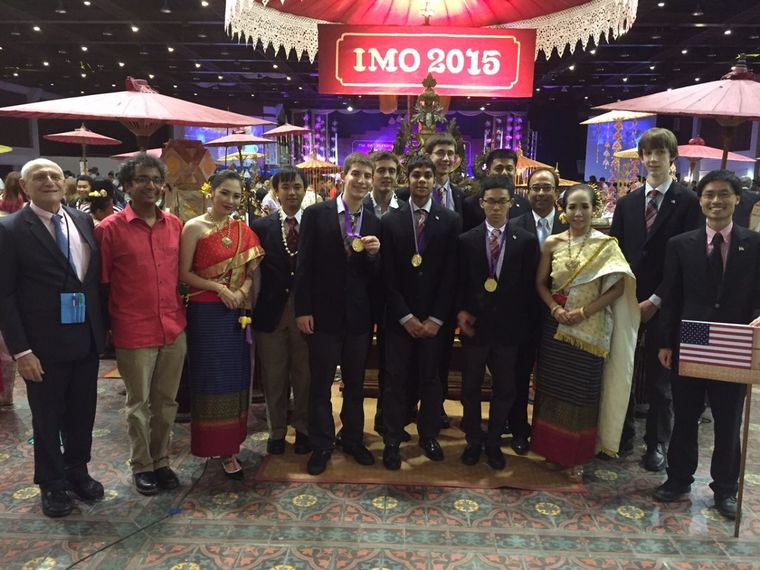
    The United States is number one in math after 21 years. A six-person team of young adult Americans Team USA led by Carnegie Mellon professor Po-Shen Loh bested teams from China, South Korea, and more to win the 2015 International Mathematical Olympiad (IMO) held in Thailand this month which was hailed as the “hardest ever” competition by The Guardian.

    The White House even tweeted, “Go Team USA! America took first place in the International Mathematical Olympiad for the first time since 1994,” with an attached photo of a letter of congratulations from President Barack Obama.

    Indian Americans Shyam Narayanan, 17, and Yang Liu, 18, were part of the six-member team that rose to the top at the IMO, a feat that hasn’t been accomplished by the U.S. team since 1994.

    Narayanan’s parents are of Indian origin while Liu’s father is Indian  and his mother is chin ease.

    Members of the U.S. team included Ryan Alweiss, Allen Liu, Yang Liu, Narayanan, and David Stoner, all of whom were awarded gold medals; and Michael Kural, who earned a silver medal, just one point away from the gold.

    According to the Mathematical Association of America (MAA), the competition involves six problems taken in sets of three during 4.5 hour sessions (held across two days)—no calculators. Each team member attempts the problems, and team totals are based on the number of points each individual scores. The US earned 185 to take the gold while China earned runner-up honors with 181. It’s the US’s fifth victory overall. China has the most competition wins with 19 all-time, including winning four of the last five competitions heading into the 2015 edition.

  • China provides $10 mn to Pakistan for rehabilitation of IDPs

    ISLAMABAD (TIP): China on July 17 pledged to provide$10 million to all-weather friend Pakistan for the rehabilitation of people displaced due to military operations in the restive tribal region, officials said.

    The agreement to provide the special grant was signed between Chinese ambassador Sun Weidong and secretary economic affairs division Muhammad Saleem Sethi here.

    “China firmly supports the efforts of Pakistan to safeguard its national security and the Chinese side will continue to provide assistance within its capacity for the reconstruction and livelihood improvements of the Federally Administered Tribal Areas (FATA),” according to a statement by the Chinese embassy.

    An official of finance ministry said that the grant from China will be utilised for the assistance of people of tribal areas who have suffered due to war on terror.

    Over a million people were forced to flee their homes when army launched operation in the Taliban stronghold of North Waziristan last June.

    More than 90 per cent of the district has already been cleared of militants and the government had launched a programme for the phased return of people to their areas.

    Last year also, the Chinese government provided $10 million to help the internally-displaced persons (IDPs).

    Chinese president Xi Jinping visited Pakistan in April and announced the $46 billion China Pakistan Economic Corridor in April.

  • Indian faces up to 10 yrs in China jail for ‘terror links’

    Indian faces up to 10 yrs in China jail for ‘terror links’

    BEIJING (TIP): The Chinese authorities informed the Indian embassy on July 16 that the Indian detainee held for “links to terror group” along with eight others was being charged for violating criminal laws that could result in jail sentence of three to 10 years. The charges include distributing videos and material related to terrorism and involvement in terrorist activities, sources said.

    The Indian in the group was identified as Rajiv Mohan Kulshrestha by the Gift of Givers Foundation, the NGO that had organized the excursion, and Indian officials are expected to meet him after the formalities related to consular access. The embassy has sought and obtained consular access to provide Kulshrestha with a lawyer.

    Shameel Joosub, relative of three of the detained tourists, said officials of the South African embassy in Beijing, who visited the detainees, confirmed that they were watching videos of the 12th century Mongol king, Genghis Khan.

    There is an ongoing dispute between China and Mongolia about Khan’s origins, with China saying he belonged to its Inner Mongolia province, and Mongolia claiming him as its own.

    “The embassy went down to Ordos and they established they were saying they watched propaganda videos, not Islamic videos, in their hotel room. We know they were watching a Genghis Khan documentary. We’re not sure where it came from,” Joosub told a South African publication. Under Chinese law on counter-terrorism, watching videos on terrorism can result in law violation and legal action, Global Times newspaper quoted Li Wei, an expert on counter terrorism, as saying.

    Chinese authorities often detain and arrest people in Xinjiang province, which is the site of major terrorist activities, for watching videos related to terrorism.

    “From what the embassy guys tell us, who were the only ones allowed to see them, they didn’t watch anything funny. They’re not sure why they’re being held,” Joosub said. Six Britons deported early on Thursday reached UK. The five South Africans are expected to return home on Friday. The British govern ment has sought clarification from Chinese authorities about the reasons for the detention, a report from London said.

    The other detainees include five South Africans and three Britons, while six other British nationals were deported, the British embassy in Beijing confirmed.

  • India to build next aircraft carrier with US technology

    India to build next aircraft carrier with US technology

    NEW DELHI (TIP): India and the US have worked out the terms of reference for building the next Indian aircraft carrier with US technology.

    This has been pushed through after the visit of US defence secretary Ash Carter. As both countries prepare for a September round of strategic dialogue in Washington DC, India is preparing to send a team to speed up talks on the aircraft carrier and the Light Combat Aircraft jet engine, which is also slated to be built with US assistance.

    The agenda has been set in the two summits held in September and January, but the key will be checking off the ambitious bucket list of projects.

    This will be the first strategic dialogue to be held in the new 2+2 format, including the foreign and commerce ministers. From the US side, it will be John Kerry and Penny Pritzker, commerce secretary, rather than Michael Froman their chief trade negotiator, who is generally believed to take a dim view of India and its trade practices. The US and India are expected to take forward earlier agreements on smart cities, which is likely to get priority.

    This year India-US relations will be tested on climate change as the Paris climate change summit, COP 21 looms. India will be under unprecedented pressure to declare ambitious emission targets. Climate change is a legacy issue for Barack Obama and he’s expected to push hard.

    China has been smarter – first, by clinching a climate deal with the US during Obama’s visit, and second, by declaring their INDC (intended nationally determined contributions) just before a meeting with the French president, which made it seem like it was a special gesture by China. India tried to match it somewhat with an energy deal when Barack Obama visited India.

    Even though India is far below China on per capita emissions, India will be cynosure of global, particularly US attention when it does finalize and announce its INDC. Officials expect this to be done in the coming weeks.

  • Iran’s Nuclear Deal

    Iran’s Nuclear Deal

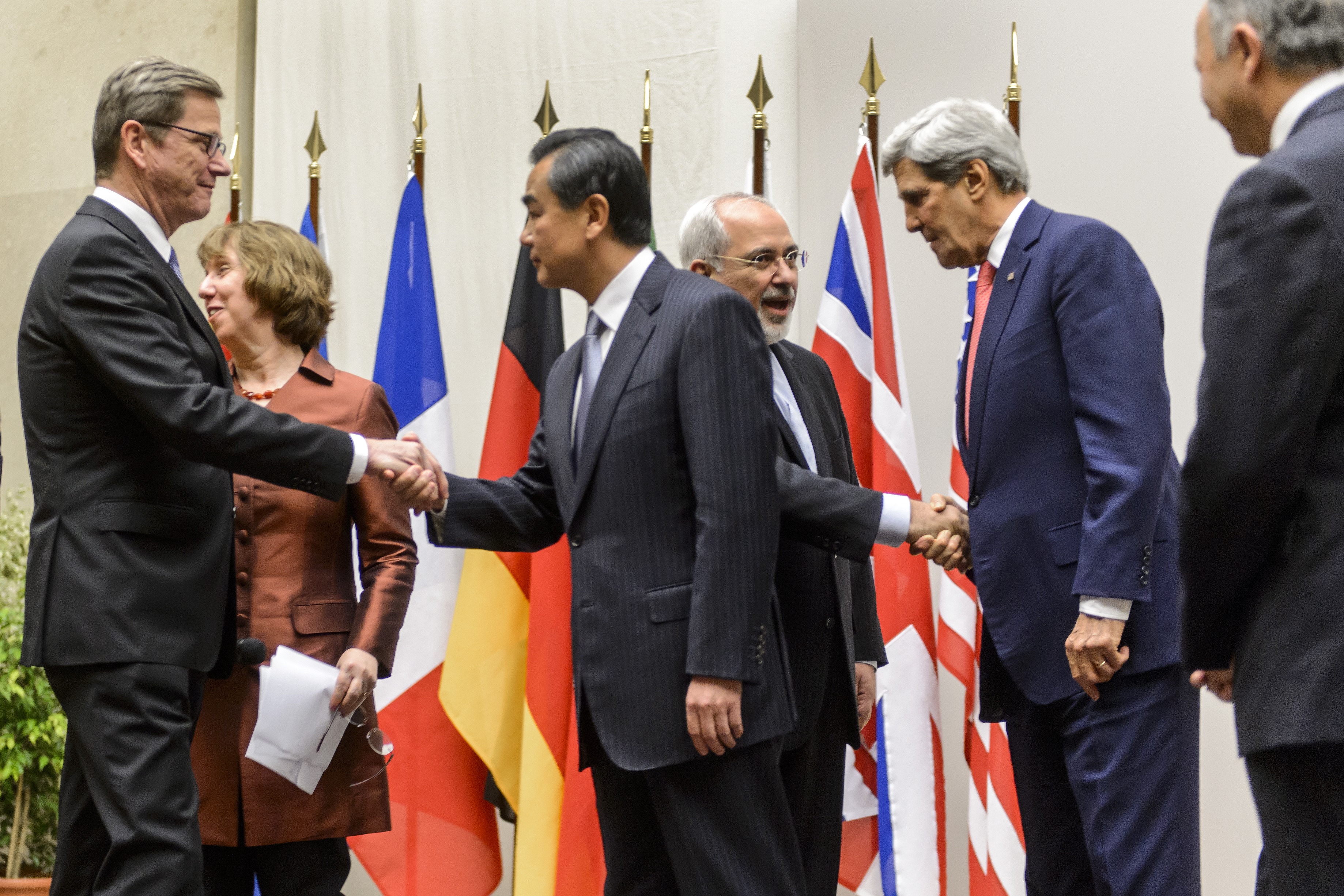
    Iran and six world powers sealed a historic accord to curb the Islamic Republic’s nuclear programme in return for ending sanctions, capping two years of tough diplomacy with the biggest breakthrough in decades.

    Diplomats reached the deal in Vienna on Tuesday, July 14, their 18th day of talks.

    US President Barack Obama said it blocks “every path to a nuclear weapon” for Iran, while Iranian foreign minister Mohammad Javad Zarif called it a “win-win”.

    Banks including Goldman Sachs Group Inc. and Barclays Plc say it would take 6-12 months for the holder of the world’s fourth largest crude reserves to revive production by about 500,000 barrels a day. Sanctions cut the country’s crude exports by more than half from a peak of more than six million barrels a day in the 1970s.

    With new oil flows expected to hit an oversupplied market, Brent, the global benchmark, fell as much as 2.1% to $56.63 a barrel in London and was trading $57.87 at 9.02pm India time. Iran’s benchmark TEDPIX Index, led by oil and gas companies, advanced 0.3% at the close, the highest since April.

    In China, Europe and Russia, the agreement will be welcomed by companies eager to access an untapped market of 77 million people. With an economy bigger than Thailand’s and oil reserves rivalling Canada’s, Iran is the most important market still closed to major equity investors, according to investment bank Renaissance Capital.

    Ending economic penalties could open Iran’s stock market to investors in early 2016, Renaissance’s Charles Robertson and Daniel Salter wrote in a report on Monday. Inflows could total $1 billion in the first year, they said.

    Oil-importing countries such as India should use the period of subdued oil prices to strengthen their monetary policy framework along with fuel pricing and taxation reforms, the International Monetary Fund (IMF) recommended in a report released, coincidentally, on Tuesday.

    Low oil prices could boost India’s gross domestic product (GDP) by 0.4-0.6 percentage point over this year and next.

    Boon for oil importers

    India follows the US, China and Russia in energy use, accounting for 4.4% of global energy consumption. Petroleum product consumption in India has been growing. According to the oil ministry, it grew 3.14% to around 163.17 million tonnes in 2014-15.

    In its report tiled Global Implications of Lower Oil Prices, IMF said: “Oil importers, in deciding how much of the windfall to save, should balance rebuilding policy space with managing domestic cyclical risks. Those with significant vulnerabilities should save much of the windfall, while those facing large output gaps should spend it.”

    It added that “countries should use this period as an opportunity to strengthen their monetary policy frameworks; evidence of second-round disinflationary effects could open space for reducing policy rates in some countries”.

    The fund said countries such as India will reap modest benefits from lower global oil prices as it does not fully pass on the benefits to consumers. While lower oil prices are expected to boost global growth by one percentage point in 2015 and 2016, the IMF said India’s GDP is expected to get a boost of between 0.4 and 0.6 percentage point in the same period.

    The multilateral agency is right to point out that governments like India may be absorbing the benefits of lower oil prices to meet their budget deficit targets and are not passing on the benefits to consumers, which could be less growth-inducing, said Madan Sabnavis, chief economist at CARE Ratings. “There is nothing wrong or correct about it. The Indian government has a huge subsidy burden and it is using the opportunity to correct it,” he said.

    Low international crude prices have helped the National Democratic Alliance (NDA) government bring retail inflation below 5%, better its fiscal deficit target of 4.1% of GDP for 2014-15, and bring the current account deficit to 1.6% of GDP in the January-March quarter, against 2% in the preceding three months.

    “Low oil prices provide a window of opportunity to undertake serious fuel pricing and taxation reform in both oil-importing and oil-exporting countries,” the report said.

    In October, the government freed diesel prices. When crude oil prices fell, it cut fuel prices but simultaneously raised excise duties. This way, the government garnered additional revenue, while resisting the temptation to fully pass on the benefit of lower crude oil prices.

    Crude oil prices in the Indian energy basket averaged at $61.75 per barrel in June, against $84.16, $105.52, $107.97 and $111.89 in 2014-15, 2013-14, 2012-13 and 2011-12, respectively.

    The fall in prices has also presented countries such as India an opportunity to revise terms of imports. India has made a pitch for price and terms correction with the Organization of the Petroleum Exporting Countries (Opec) and has asked for a concession rather than having to pay the so-called Asian premium.

    “India alone is not going to benefit. Japan, China, Korea are also going to benefit. We are talking together at many forums and will be raising it together as well. We are the largest buyers for the Opec, so we need a favourable treatment and things are on right track. There is a positive signal from the seller side also,” said oil minister Dharmendra Pradhan in a 16 June interview.

    India is one of the major consumers of Opec’s production, with the group accounting for 85% and 94% of India’s crude oil and gas imports, respectively.

    “This is a very good time to review this practice and to provide more fair conditions for all parties,” Fatih Birol, chief economist at Paris-based International Energy Agency (IEA), said in an interview published on 2 July.

    Bouyed by the subdued crude oil prices, the 2015-16 budget has estimated India’s subsidy bill at Rs.2.43 trillion, around 9% less than the revised estimate of Rs.2.66 trillion for 2014-15.

    The petroleum subsidy is estimated at Rs.30,000 crore for 2015-16, 50% less than the revised estimate of Rs.60,270 crore. The difference between market prices and retail fuel rates—to be borne by oil marketing firms this fiscal year—is estimated at Rs.42,500 crore.

    The budget has earmarked Rs.22,000 crore for subsidy on domestic cooking gas and Rs.8,000 crore for kerosene. While petrol and diesel prices are deregulated, the prices of domestic cooking gas and kerosene continue to be set by the government.

    The Iran deal

    Full implementation depends on Iran meeting obligations to curb its nuclear programme and address concerns about possible military dimensions of its work. Iran has until 15 December to answer 12-year-old questions about its weapons capabilities. Once inspectors verify compliance, the oil-rich nation will be allowed to ramp up energy exports, re-enter the global financial system, and access as much as $150 billion in frozen assets.

    “This is probably going to go down in history as one of the biggest diplomatic successes of the century,” Ellie Geranmayeh, a policy fellow at the European Council of Foreign Relations, said by phone from London.

    Congress has 60 days to review the document in Washington, where it will meet resistance from lawmakers who oppose making any nuclear compromises with Iran.

    Israel, which has threatened military action to prevent Iran from getting a nuclear bomb, said it will use “every means” possible to persuade Congress to reject it, though Obama vowed to veto such a move. The House and Senate would each need a two-thirds majority to override a veto.

    Israeli Prime Minister Benjamin Netanyahu denounced the deal as a “historic mistake”, saying in a statement that “sweeping concessions were made in all areas meant to block Iran from the ability to arm itself with nuclear weapons”.

    Should the agreement survive review, it would become one of the biggest foreign policy achievements for Obama, who kicked off the initiative with a call to Iranian President Hassan Rouhani nearly two years ago. The US cut diplomatic ties with Iran in 1980, after revolutionaries seized the American embassy in Tehran and held hostages for more than a year.

    Iran agreed to cut 98% of its stockpile of enriched uranium and eliminate two-thirds of its centrifuges, according to a copy of the accord obtained by Bloomberg.

    “This is a sign of hope for the entire world,” European Union (EU) foreign policy chief Federica Mogherini said in Vienna. “And we all know this is very much needed in these times.”

    Relief, including sales of aircraft by companies including Boeing Co., would be phased in after 15 December if Iran complies. The United Nation’s (UN) International Atomic Energy Agency will negotiate access to all suspect sites, including military bases such as Parchin.

    Once UN monitors verify Iran has taken all steps to curb its nuclear activities, the US and the EU will also lift restrictions on most of its financial institutions except those sanctioned for terrorism or human rights abuses. Iranian banks, including the central bank, will be able to process transactions once again through SWIFT, the leading global financial messaging system, US officials said.

    The US and the EU will also allow any nation to buy Iranian oil and ease curbs on trading refined products, chemicals and natural gas. Iran holds the second largest gas reserves in the world, after Russia.

    “If Iran violates the deal, all these sanctions will snap back into place,” Obama said at the White House.

    The UN ban on conventional weapons imports and exports by Iran will remain in place for five years, while the UN embargo on ballistic missiles will hold for eight years, according to the draft. The unilateral US arms embargo will stay in place.

    Utpal Bhaskar is with Mint. Bloomberg’s Stepan Kravchenko in Vienna, Nafeesa Syeed in Dubai, Gregory Viscusi in Vienna, Kambiz Foroohar in New York and Angela Greiling Keane in Washington and Mint’s Asit Ranjan Mishra in New Delhi contributed to this story.

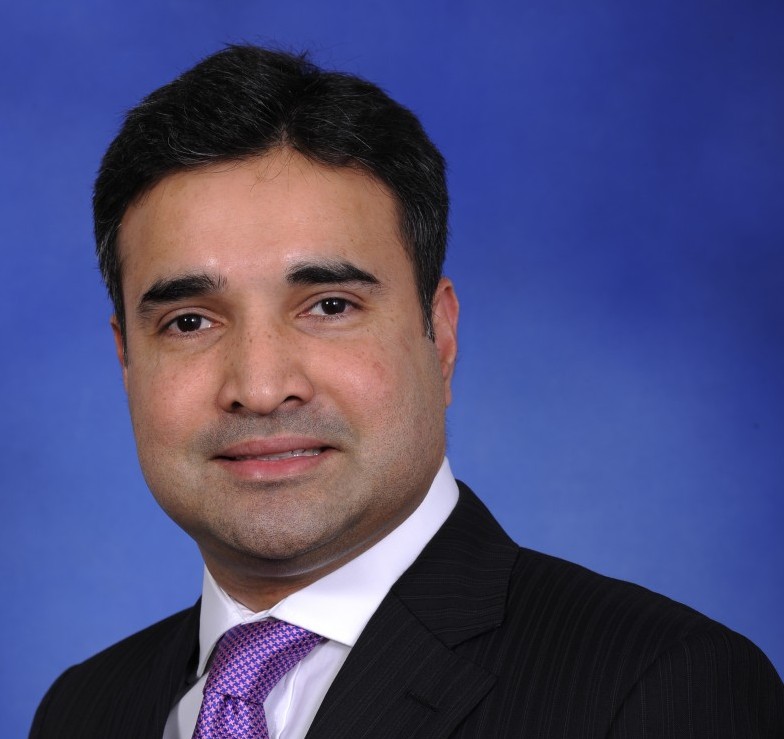
  • Ari Sarker Named MasterCard Co-President for Asia-Pacific

    Ari Sarker Named MasterCard Co-President for Asia-Pacific

    MasterCard recently announced the appointment of two Co-Presidents for the Asia/Pacific region – Ling Hai and Ari Sarker. The reorganization is in recognition of the growing importance of Asia/Pacific as a whole as it houses two of the region’s biggest markets – China and India – and reflects a more focused approach for these diverse markets.

    Ari Sarker will lead the South East Asia and South Asia region. He has been with MasterCard for over four years and was most recently MasterCard’s Division President for South Asia and Country Corporate Officer, India. He also has over 22 years of experience spanning the finance, commercial, and M&A sectors in senior management roles across key markets in the Americas, Europe and Asia Pacific.

    Parker will be based in Singapore. They succeed Vicky Bindra, president, Asia/Pacific, who will be leaving the company.

  • IMF DOWNGRADES 2015 OUTLOOK FOR GLOBAL GROWTH TO 3.3%

    IMF DOWNGRADES 2015 OUTLOOK FOR GLOBAL GROWTH TO 3.3%

    WASHINGTON (TIP): The US economy’s stumble at the start of 2015 is dragging down the world’s growth prospects, the International Monetary Fund said on July 9.

    The IMF forecasts 3.3 per cent global growth this year, down from the 3.5 per cent it predicted in April. The main culprit: The American economy, world’s biggest, shrank at a 0.2 per cent annual rate from January to March, hurt by nasty weather. The IMF last month cut the outlook for US growth to 2.5 per cent in 2015, from April’s 3.1 per cent. The US economy grew 2.4 per cent in 2014.

    The fund expects the US economy to grow 3 per cent in 2016.

    IMF research chief Olivier Blanchard downplayed the wider economic impact of the Greek debt crisis and the possibility that Greece could be forced to abandon the euro currency. “The effects on the rest of the world economy are likely to be limited,” he said.

    The IMF expects global growth to improve to 3.8 per cent next year.

    Meantime, America’s first-quarter troubles are pinching its neighbors.

    The IMF trimmed Mexico’s 2015 growth forecast to 2.4 per cent from 3 per cent and Canada’s to 1.5 per cent from 2.2 per cent.

    The multinational lending agency kept its forecast for China’s economic growth unchanged at 6.8 per cent this year and 6.3 per cent in 2016.

    The Chinese stock market has plunged, with the Shanghai Composite index down 30 per cent from its peak less than a month ago. But Blanchard said: “We don’t see it as a major macroeconomic issue.” That is because ordinary Chinese mostly did not spend the paper gains in their stock portfolios as shares climbed to dangerous heights over the past year; so they are not likely to cut back now. Moreover, Blanchard said, the stock market is small compared with the size of China’s economy, the world’s second largest.

    The IMF predicts the eurozone will grow 1.5 per cent this year, unchanged from April’s forecast; Japan will grow 0.8 per cent, down from an April forecast of 1 per cent; and the Brazilian economy will shrink 1.5 per cent, a downgrade from April’s forecast for a 1 per cent
    drop.

  • Philippines warns China flouting UN maritime laws

    Philippines warns China flouting UN maritime laws

    THE HAGUE (TIP): The Philippines has appealed to an international tribunal to declare China’s claims to most of the South China Sea illegal, warning the integrity of United Nations’ maritime laws is at stake.

    In opening comments to the tribunal in the Hague on yesterday, foreign secretary Albert del Rosario said the Philippines had sought judicial intervention because China’s behaviour had become increasingly “aggressive” and negotiations had proved futile.

    Del Rosario said the UN’s Convention on the Law of the Sea, which the Philippines and China have both ratified, should be used to resolve their bitter territorial dispute.

    “The case before you is of the utmost importance to the Philippines, to the region, and to the world,” del Rosario told the tribunal.

    “In our view, it is also of utmost significance to the integrity of the convention, and to the very fabric of the legal order of the seas and oceans.”

    China insists it has sovereign rights to nearly all of the South China Sea, a strategically vital waterway with shipping lanes through which about a third of all the world’s traded oil passes.

    Its claim, based on ancient Chinese maps, reaches close to the coasts of its southern neighbours. The Philippines, Vietnam, Malaysia, Brunei and Taiwan also have claims to parts of the sea, which have for decades made it a potential military flashpoint.

    Tensions have risen sharply in recent years as a rising China has sought to stake its claims more assertively.

    Following a stand-off between Chinese ships and the weak Filipino Navy in 2012, China took control of a rich fishing ground called Scarborough Shoal that is within the Philippines’ exclusive economic zone.

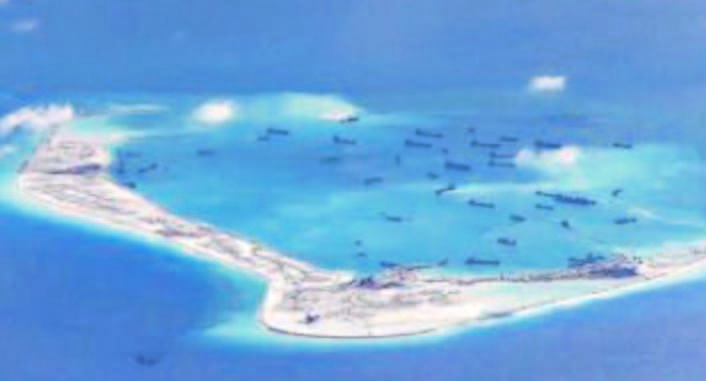
    China has also undertaken giant reclamation activities that have raised fears it will use artificial islands to build new military outposts close to the Philippines and other claimants.

    China has rejected all criticism over its actions, insisting it has undisputed sovereign rights to the sea. However del Rosario told the tribunal in the Hague that China’s argument of claiming the sea based on “historic rights” was without foundation.

    “The so-called nine dash line (based on an old map used by China) has no basis whatsoever under international law,” he said.

  • US: More than 21 million affected by government data breach

    US: More than 21 million affected by government data breach

    WASHINGTON (TIP): Hackers stole Social Security identification numbers and other highly sensitive data from more than 21 million people, the Obama administration said July 9, acknowledging that the breach of US government computer systems was far more severe than previously disclosed.

    The scope of the data breach, believed to be the biggest in US history, has grown dramatically since the government first said earlier this year that hackers had gotten into the Office of Personnel Management’s personnel database and stolen records for about 4.2 million people.

    Since then, the administration has acknowledged a second, related breach of the systems housing private data that individuals submit during background investigations to obtain security clearances.

    That second attack affected more than 19 million people who applied for clearances, as well as nearly 2 million of their spouses, housemates and others who never applied for security clearances, the administration said. Among the data the hackers stole: criminal, financial, health, employment and residency histories, as well as information about their families and acquaintances.

    The new revelations drew indignation from members of Congress who have said the administration has not done enough to protect personal data in their systems, as well as calls for OPM director Katherine Archuleta and her top deputies to resign. Yet Archuleta insisted she would not step down. In a conference call with reporters, Archuleta said the hackers also got hold of the user names and passwords that prospective employees used to fill out their background investigation forms, as well as the contents of interviews conducted as part of those investigations.

    Yet the government insisted there were no indications that the hackers have used the data they stole.

    Numerous US lawmakers have said China was behind the attack. But Michael Daniel, president Barack Obama’s cybersecurity coordinator, said the government wasn’t yet ready to say who was responsible. Officials have acknowledged that the same party was responsible for both of the breaches, which took place in 2014 and early 2015. Investigators previously told The Associated Press that the U.S. government was increasingly confident that China’s government, and not criminal hackers, was responsible for the extraordinary theft of personal information.

  • ASIA MARKETS ON BACK FOOT AHEAD OF GREECE VOTE

    ASIA MARKETS ON BACK FOOT AHEAD OF GREECE VOTE

    HONG KONG (TIP): Asian markets retreated on July 3  ahead of the weekend’s Greek referendum that could decide its eurozone future, while Shanghai plunged more than seven percent, at the end of a torrid week for mainland investors.

    Wall Street ended in the red as a strong increase in US jobs was overshadowed by the Greek crisis and stagnant wage growth.

    Tokyo eased 0.36 percent as the yen edged back up against the dollar, Hong Kong eased 0.12 percent and Sydney slipped 1.27 percent, while Seoul dropped 0.16 percent.

    Shanghai tumbled 7.13 percent, with the mainland market pummelled by profit-taking and margin traders calling in their bets. The Shenzhen Composite Index, which tracks stocks on China’s second exchange, dived 6.96 percent.

    With Greeks heading to the polls Sunday, analysts said investors were in a holding pattern until they had a better idea about the country’s future.

    Greek Prime Minister Alexis Tsipras broke off debt reform talks Saturday and called the plebiscite on creditors’ proposals — leading it to default on a loan repayment on Tuesday.

    European leaders have warned that the poll is effectively an in-out vote on Greece’s future in the eurozone.

    “There could be some hesitation from investors” ahead of the Greek vote, Chris Weston, chief market strategist at IG in Melbourne, said.

    “Markets just want to see it getting solved so the contagion effect can be mitigated and we can move on to other things.”

    The EU and IMF added to pressure Thursday, slashing Greece’s growth forecasts for this year and warning it will need tens of billions of euros over the next three years to stabilise its finances.

    US data showed the economy created a solid 223,000 jobs in June and the unemployment rate fell to 5.3 percent from 5.5 percent. However, the report also said hourly earnings were flat compared with May, while the estimates for job growth in April and May were cut.

    The Dow dipped 0.18 percent, the S&P 500 eased 0.06 percent and the Nasdaq dropped 0.10 percent.

    The soft wage data led investors to ease back on their bets for a September Federal Reserve interest rate rise, with speculation now for a December lift-off.

    That pushed the dollar lower, buying 122.95 yen in Asia, against 123.07 yen in New York and well off the 123.54 yen earlier Thursday in Tokyo.

    The euro fetched $1.1089 and 136.32 yen against $1.1086 and 136.43 yen Mainland Chinese markets resumed their sharp downward spiral, with Shanghai now down almost 30 percent from its June 12 peak.

    It had risen more than 150 percent over the previous year but economists say it has been hit by fears stocks were overvalued, profit-taking and margin traders unwinding their positions.

    Interventions by authorities including a surprise interest rate cut at the weekend — the fourth since November — and relaxing rules on margin trading have failed to arrest the declines.

    “Chinese brokers may still be looking at reducing their risk exposure by closing more margin debt,” Bernard Aw, Singapore-based strategist at IG Asia, said.

    Gold fetched $1,166.37 compared with$1,161.50 late on June 2.


  • China says 6.5 quake hits far western region of Xinjiang

    BEIJING (TIP): A magnitude 6.5 earthquake shook buildings in China’s far western region of Xinjiang on July 3, sending people out onto the streets, but there were no immediate reports of casualties from the sparsely populated area surrounding the epicenter.

    The quake hit Pishan county in the Hotan region of Xinjiang at a depth of about 10 kilometers shortly after 9am on Friday, the China Earthquake Networks Center said.

    “Buildings were trembling and people rushed to the streets,” said Jin Xingchang, an express courier in Hotan city, about 15 kilometers away from Pishan.

    The mostly ethnic Muslim Uighur area of Pishan is at the southern edge of the Taklamakan desert near the border with India, and is abundant in mineral resources including coal, crude oil, natural gas and jade.

  • TERROR TALKS TOP PM’S CENTRAL ASIA VISIT

    TERROR TALKS TOP PM’S CENTRAL ASIA VISIT

    NEW DELHI (TIP): As Prime Minister Narendra Modi heads for Central Asia, the first PM to visit all the five ‘Stans’ in one shot, India is hoping political outreach, counter-terrorism cooperation, energy and soft power will overcome the challenge of physical connectivity with the region.

    PM is expected to visit Uzbekistan and Kazakhstan on his way out to Russia, and Turkmenistan, Kyrgyzstan and Tajikistan on his return journey. The growing threat of extremist terrorism, of the kind unleashed by Islamic State is perceived as a clear threat by these states — they have watched with concern, thousands of their young citizens travelling to Iraq and Syria to join IS. The prospect of IS taking root in these countries is real. India hopes to engage these countries in a deeper conversation on counter-terrorism. “They are worried about radicalization, and we hope to be able to cooperate and look for solutions together,” said government sources.

    Energy has always been an attractive draw between India and Central Asia but there is the challenge of getting that energy to India. That will be the focus of conversations in both Kazakhstan and Turkmenistan. Many pipelines, including TAPI, have been the subject of intensive discussions, but there has been little progress so far. India already has a uranium supply agreement with Kazakhstan.

    The Afghanistan situation post-2014 will be a common thread in the discussions. There is a resurrection of Taliban forces, even in their regions which means all countries involved have an interest in Afghanistan’s immediate future. The bigger aim behind Modi’s visit is to reclaim politically a part of India’s near neighbourhood. India has always believed this to be its strategic backyard, but in recent years, Central Asia has built very close trade and security links with China. India cannot possibly replace China, or compete with such a large presence, but New Delhi hopes to be a viable alternative in the region.

  • India to be among top three economies globally by 2030: Report

    NEW YORK (TIP): Emerging markets are expected to grow faster than developed economies, and India is likely to become the third largest economy by 2030 in the world after China and the United States, says a report.

    According to the Economist Intelligence Unit (EIU), emerging markets are expected to grow faster than developed economies, and as a result developing countries such as China and India are likely to overtake current global leaders such as the US, Japan and Western Europe.

  • Putting India Emphatically on Global Map – Part 2

    Putting India Emphatically on Global Map – Part 2

    Continued from Putting India Emphatically on Global Map – Part 1

    It defies logic that a country that is considered as our most serious adversary and whose policies in our region has done us incalculable strategic harm should have been accepted as India’s strategic partner during Manmohan Singh’s time. Such a concession that clouds realities serves China’s purpose and once given cannot be reversed. Pursuant to discussions already held during the tenure of the previous government, the Chinese announced during Xi’s visit the establishment of two industrial parks in India, one in Gujarat and the other in Maharashtra, and the “endeavour to realise” an investment of US $ 20 billion in the next five years in various industrial and infrastructure development projects in India, including in the railways sector. The Chinese Prime Minister’s statement just before Modi goes to China on May 14 that China is looking for preferential policies and investment facilitation for its businesses to make this investment suggests that the promised investment may not materialise in a hurry. While the decision during Xi’s visit to continue defence contacts is useful in order to obtain an insight into PLA’s thinking and capacities at first hand, the agreement, carried forward from Manmohan Singh’s time, to explore possibilities of civilian nuclear cooperation puzzles because this helps to legitimise China’s nuclear cooperation with Pakistan.

    Even as Modi has been making his overall interest in forging stronger ties with China clear, he has not shied away from allusions to Chinese expansionism, not only on Indian soil but also during his visit to Japan. During his own visit to US in September 2014 and President Obama’s visit to India in January 2015, the joint statements issued have language on South China Sea and Asia-Pacific which is China-directed. A stand alone US-India Joint Vision for Asia Pacific and the Indian Ocean Region issued during Obama’s Delhi visit was a departure from previous Indian reticence to show convergence with the US on China-related issues. India has now indirectly accepted a link between its Act East policy and US rebalance towards Asia. The Chinese have officially chosen to overlook these statements as they would want to wean away India from too strong a US embrace. During Sushma Swaraj’s call on Xi during her visit to China in February 2015 she seems to have pushed for an early resolution of the border issue, with out-of-the-box thinking between the two strong leaders that lead their respective countries today. Turning the Chinese formulation on its head, she called for leaving a resolved border issue for future generations.

    It is not clear what the External Affairs Minister had in mind when she advocated
    “out-of-the-box” thinking, as such an approach can recoil on us. That China has no intention to look at any out-of-the-box solution has been made clear by the unusual vehemence of its reaction to Modi’s visit to Arunachal Pradesh in February 2015 to inaugurate two development projects on the anniversary of the state’s formation in 1987. The pressure will be on us to do out-of-the-box thinking as it is we who suggested this approach. China is making clear that it considers Arunachal Pradesh not “disputed territory” but China’s sovereign territory. This intemperate Chinese reaction came despite Modi’s visit to China in May. The 18th round of talks between the Special Representatives (SRs) on the boundary question has taken place without any significant result, which is not surprising in view of China’s position on the border. The Chinese PM has recited the mantra a few days ago of settling the boundary issue “as early as possible” and has referred to “the historical responsibility that falls on both governments” to resolve the issue, which means nothing in practical terms. As against this, India has chosen to remain silent on the China-Pakistan Economic Corridor (CPEC) which will traverse territory that is legally Indian, and which even the 1963 China-Pakistan border agreement recognises as territory whose legal status has not been finally settled. The CPEC cannot be built if China were to respect its own position with regard to “disputed” territories which it applies aggressively to Arunachal Pradesh. Why we are hesitant to put China under pressure on this subject is another puzzle.

    Modi’s visit to Seychelles, Mauritius and Sri Lanka in March 2015 signified heightened attention to our critical interests in the Indian Ocean area. The bulk of our trade- 77% by value and 90% by volume- is seaborne. Modi was the first Indian Prime Minister to visit Seychelles in 34 years, which demonstrates our neglect of the Indian Ocean area at high political level and Modi’s strategic sense in making political amends. During his visit Modi focused on maritime security with agreement on a Coastal Surveillance Radar Project and the supply of another Dornier aircraft. In Mauritius, Modi signed an agreement on the development of Agalega Island and also attended the commissioning of the Barracuda, a 1300 tonne Indian-built patrol vessel ship for the country’s National Coast Guard, with more such vessels to follow. According to Sushma Swaraj, Modi’s visit to Seychelles and Mauritius was intended to integrate these two countries in our trilateral maritime cooperation with Sri Lanka and Maldives.

    In Pakistan’s case, Modi too seems unsure of the policy he should follow- whether he should wait for Pakistan to change its conduct before engaging it or engage it nevertheless in the hope that its conduct will change for the better in the future. Modi announced FS level talks with Pakistan when Nawaz Sharif visited Delhi for the swearing-in ceremony, even though Pakistan had made no moves to control the activities of Hafiz Saeed and the jihadi groups in Pakistan.

    The Pakistani argument that Nawaz Sharif was bold in visiting India for the occasion and that he has not been politically rewarded for it is a bogus one. He had a choice to attend or not attend, and it was no favour to India that he did. Indeed he did a favour to himself as Pakistan would have voluntarily isolated itself. The FS level talks were cancelled when just before they were to be held when the Pakistan High Commissioner met the Hurriyet leaders in Delhi. Pakistan’s argument that we over-reacted is again dishonest because it wanted to retrieve the ground it thought it had lost when Nawaz Sharif did not meet the Hurriyet leaders in March 2014.

    Modi ordered a robust response to Pakistani cease-fire violations across the LOC and the international border during the year, which suggested less tolerance of Pakistan’s provocative conduct. We have also been stating that talks and terrorism cannot go together. Yet, in a repetition of a wavering approach, the government sent the FS to Islamabad in March 2015 on a so-called “SAARC Yatra”. Pakistan responded by releasing the mastermind of the Mumbai attack, Lakhvi, on bail and followed it up by several provocative statements on recent demonstrations by pro-Pakistani separatists in Srinagar, without any real response from our side. Surprisingly, in an internal political document involving the BJP and the PDP in J&K, we agreed to include a reference to engaging Pakistan in a dialogue as part of a common minimum programme, undermining our diplomacy with Pakistan in the process.

    Pakistan believes that it is US intervention that spurred India to take the initiative to send the FS to Pakistan, which is why it feels it can remain intransigent. Pakistan chose to make the bilateral agenda even more contentious after the visit by the FS by raising not only the Kashmir cause, but also Indian involvement in Balochistan and FATA. On our side, we raised the issue of cross border terrorism, the Mumbai terror trial and LOC violations, with only negative statements on these issues by Pakistan. Since then the Pakistani army chief has accused India of abetting terrorism in Pakistan. The huge gulf in our respective positions will not enable us to “find common ground and narrow differences” in further rounds of dialogue, about which the Pakistani High Commissioner in Delhi is now publicly sceptical.

    Even though one is used to Pakistan’s pathological hostility towards India, the tantrums that Nawaz Sharif’s Foreign Policy Adviser, Sartaj Aziz, threw after President Obama’s successful visit to India were unconscionable. He objected to US support for India’s permanent seat in the UNSC and to its membership of the Nuclear Suppliers Group (NSG). He castigated the Indo-US nuclear deal, projecting it as directed against Pakistan and threatened to take all necessary steps to safeguard Pakistan’s security- in other words, to continue to expand its nuclear arsenal.

    Chinese President Xi’s April 2015 visit to Pakistan risks to entrench Pakistan in all its negative attitudes towards India. The huge investments China intends making through POK constitutes a major security threat to India. China is boosting a militarily dominated, terrorist infested, jihadi riven country marked by sectarian conflict and one that is fast expanding its nuclear arsenal, including the development of tactical nuclear weapons, without much reaction from the West. President Ashraf Ghani’s assumption of power in Afghanistan and his tilt towards Pakistan and China, as well as the West’s support for accommodating the Taliban in Afghanistan with Pakistan’s help will further bolster Pakistan’s negative strategic policies directed at India. Ghani’s delayed visit to India in April 2015 has not helped to clarify the scenario in Afghanistan for us, as no change of course in Ghani’s policies can be expected unless Pakistan compels him to do by overplaying its hand in his country. Modi is right in biding his time in Afghanistan and not expressing any undue anxiety about developments there while continuing our policies of assistance so that the goodwill we have earned there is nurtured.

    Prime Minister Modi, belying expectations, moved rapidly and decisively towards the US on assuming office. He blindsided political analysts by putting aside his personal feelings at having been denied a visa to visit the US for nine years for violating the US law on religious freedoms.

  • Indian Americans Preet Bharara & Rakesh Khurana honored with Carnegie’s ‘Great Immigrant’ award

    Indian Americans Preet Bharara & Rakesh Khurana honored with Carnegie’s ‘Great Immigrant’ award

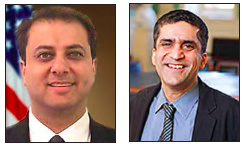
    NEW YORK (TIP): The Carnegie Corporation has announced the 2015 “Great Immigrant”: The Pride of America” awardees. These are the individuals who have helped advance and enlighten our society, culture, and economy. Preet Bharara, U.S. Attorney, Southern District of New York is among 38 eminent personalities selected as 2015 ‘Great Immigrant’ honorees, on the eve of the nation’s birthday on July 4th by Carnegie Corporation.

    The other Indian American awardee, Rakesh Khurana is the Marvin Bower Professor of Leadership Development at Harvard Business School (HBS), professor of sociology in the Faculty of Arts and Sciences (FAS), and co-master of Cabot House and dean of Harvard College.

    “Our founder, Andrew Carnegie, came to this country as the son of impoverished immigrants and grew up to become one of the greatest contributors to American industry and philanthropy,” said Vartan Gregorian, President of the Corporation. “His devotion to U.S. democracy stemmed from his conviction that the new infusion of talent that immigrants bring to our country keeps American society vibrant.”

    The 38 Great Immigrants honored this year come from more than 30 countries around the world and represent leadership in a wide range of professions.

    They include:

    • Preet Bharara S. Attorney, Southern District of New York (India)
    • Geraldine Brooks Pulitzer Prize-winning Author, Journalist (Australia)
    • Thomas Campbell Director and CEO, The Metropolitan Museum of Art (England)
    • Rabia Chaudry Attorney, Civil Rights Activist (Pakistan)
    • Mica Ertegun Interior Designer (Romania)
    • Stanley Fischer Economist; Vice Chair, Board of Governors, Federal Reserve System (Israel)
    • Jonathan Hunt Fox News, Chief Correspondent (Canada)
    • Malek Jandali Composer, Pianist (Syria)
    • Rakesh Khurana Professor, Dean, Harvard College (India)
    • Marie-Josée Kravis Economist, Philanthropist (Canada)
    • Nastia Liukin Olympic Medal-winning Gymnast (Russia)
    • Bette Bao Lord Author, Human Rights Advocate, Philanthropist (China)
    • Ali Malekzadeh President, Roosevelt University, Chicago (Iran)
    • Silvio Micali Turing Award-winning Professor of Computer Engineering (Italy)
    • Lorne Michaels Peabody Award-winning TV Producer (Canada)
    • Franziska Michor Vilcek Prize-winning Professor, Computational Biology (Austria)
    • Anchee Min Author (China)
    • Sharmin Mossavar-Rahmani Philanthropist; Chief Investment Officer, Private Wealth Management Group, Goldman Sachs (Iran)
    • Firouz Naderi Director, Solar System Exploration, NASA Jet Propulsion Laboratory (Iran)
    • Azar Nafisi Author, Scholar (Iran)
    • Craig Nevill-Manning Engineering Director, Google (New Zealand)
    • Maria Otero U.S. Under Secretary of State for Civilian Security, Democracy, and Human Rights (Bolivia)
    • Eddie Pérez Bullpen Coach, Atlanta Braves (Venezuela)
    • Ilana Rovner Judge, U.S. Court of Appeals, Seventh Circuit (Latvia)
    • Arturo Sandoval Grammy Award-winning Jazz Trumpeter (Cuba)
    • Madhulika Sikka Vice President, Executive Editor, .Mic (India)
    • Thomas C. Südhof Nobel Prize-winning Neuroscientist (Germany)
    • Antonio M. TagubaS. Army Major General, Retired (Philippines)
    • Ann Telnaes Pulitzer Prize-winning Political Cartoonist (Sweden)
    • Thalía Singer, Actress (Mexico)
    • Tuyen Tran Vilcek Prize-winning Fashion Designer (Vietnam)
    • Abraham Verghese Physician, Professor, Author (Ethiopia)
    • Eugene Volokh Professor, Legal Scholar, Blogger (Ukraine)
    • Arieh Warshel Nobel Prize-winning Biochemist (Israel)
    • Raffi Yessayan Judge, Massachusetts Superior Court (Lebanon)
  • Hong Kong not to go US way on gay marriages

    BEIJING (TIP): Hong Kong is unlikely to follow the US example of allowing gay marriages, its Equal Opportunities Commission has said. The political system in the city, which is witness to pro~democracy agitation, is not yet ready for same sex marriage, the Commission’s head, York Chow Yat-ngok, said.

    “Just look at how legislators view equal rights for gays and lesbians, not to mention marriage. How much support would you say there is among the legislators? I am not too optimistic about this,” Chow said in a radio show.

    There may be differing opinions on same-sex marriage among the legislators, but the majority will not be in support of the idea of legalizing it, he said. In fact, he did not expect it to happen in his life time.

    “I don’t know how long I will live. I am quite old now,” he was quoted as saying by South China Morning Post.

    Hong Kong is regarded as an international city with a vast expatriate population, and a strong sense of democratic rights.

    The Commission had no power or mandate to push forward the same-sex marriage law in Hong Kong, he said, adding that it is only the legislative council which can deal with the subject of legalizing gay marriages.

    In fact, a recent proposal to outlaw sexual discrimination did not received enthusiastic public support while the local courts also took a “passive” approach towards it, he said.

  • Indian American Professor R Paul SIngh named World Agriculture Prize laureate

    Indian American Professor R Paul SIngh named World Agriculture Prize laureate

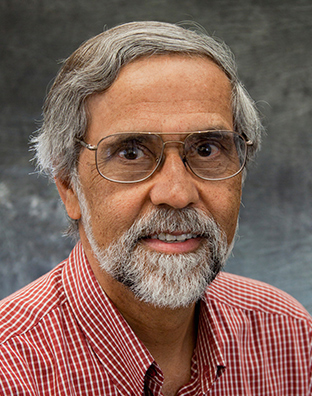
    Indian American Professor Emeritus R. Paul Singh who has held dual appointments in the departments of Biological and Agricultural Engineering and of Food Science and Technology at the University of California, Davis, has been named as the 2015 Global Confederation for Higher Education Associations for Agriculture and Life Sciences World Agriculture Prize laureate.

    The award was announced at the annual GCHERA conference, held June 24-26 at the Holy Spirit University of Kaslik, Jounieh, Lebanon. Formal presentation of the award will take place Sept. 20, during a ceremony at Nanjing Agricultural University, Jiangsu Province, China.

    “I’m deeply humbled and honored, upon receiving news of this award,” Singh said. “I’m proud of my students, postdoctoral fellows and visiting scientists for their numerous contributions to our research program. I’m also indebted to my UC Davis colleagues for their consistent support, which has allowed me to pursue my research and teaching activities in food engineering.”

    Singh earned a bachelor’s degree in agricultural engineering at India’s Punjab Agricultural University, then a master’s degree and Ph.D. at the University of Wisconsin-Madison and Michigan State University, respectively. He joined the UC Davis faculty one year later, in 1975.

    “For over four decades, Professor Singh’s work as a pioneer in food engineering has been improving lives the world over,” said UC Davis Chancellor Linda P.B. Katehi. “This prestigious, and well-deserved, honor is a testament to the importance of his research, and UC Davis is tremendously honored to call him a member of our faculty.”

    Singh became recognized for a body of research in areas such as energy conservation, freezing preservation, postharvest technology and mass transfer in food processing. His research on airflow in complex systems helped design innovative systems for the rapid cooling of strawberries, and his studies on food freezing led to the development of computer software that is used to improve the energy efficiency of industrial freezers. Under a NASA contract, his research group created food-processing equipment for a manned mission to Mars.

    He has helped establish and evaluate food-engineering programs at institutions throughout the world, including in Brazil, India, Peru, Portugal and Thailand. As of June 2015, his 115 video tutorials have been viewed more than 150,000 times by individuals from 193 countries.

    In recent years, his research focused on the physical mechanisms responsible for the digestion of foods in the human stomach, with an eye toward developing the next generation of foods for health.

  • India ranks 143rd on global peace index topped by Iceland

    India ranks 143rd on global peace index topped by Iceland

    India ranks a lowly 143rd on a global peace index, lagging way behind the likes of Bhutan, Nepal, Sri Lanka and Bangladesh with Iceland emerging as the most peaceful nation in the world.

    According to the nonprofit Institute for Economics and Peace, Iceland, the thinly populated island in the midst of the North Atlantic has retained its place as the most peaceful country in the world.

    The institute released its Global Peace Index for 2015 recently, which ranks 162 nations around the globe based on factors like the level of violent crime, involvement in conflicts and the degree of militarisation. The nations are given a score on that basis. The more the score, the less peaceful the country is.

    India is ranked at 143 on the index with a score of 2.504. “The number of casualties from internal conflict also rose in India where a Maoist insurgency stills runs rife. The downgrade in India’s score is tempered, however, by an improvement in political stability. The world’s second most populous country witnessed an historic election in 2014 as the Bharatiya Janata Party secured India’s first one-party majority since the mid-1980s,” the report said.

    Six out of the top 10 most peaceful countries were European, with Denmark and Austria holding the second and third spots.

    “Europe maintained its position as the most peaceful region in the world, supported by a lack of domestic and external conflicts,” the report said.

    Pakistan fares badly ranked at 154 with its score deteriorating on the back of a worsening of its perceptions of criminality, as a result, the country remains second from the bottom in South Asia.

    “The country’s dire domestic security situation continues to be hampered by the presence of Islamist militant groups. Even though the number of deaths from internal conflict did not worsen significantly over the past twelve months, Pakistan suffered a handful of high-profile incidents — most notably the separate attacks on Jinnah International Airport and an army-run school in Peshawar,” the report said.

    Afghanistan remains the most lowly ranked in South Asia at 160. Bhutan (18), Nepal (62), Bangladesh (84) and Sri Lanka (114) are all ranked above India, Pakistan and Afghanistan.
    US is also ranked at a lowly 94 scoring badly in terms of militarisation, homicides and fear of violence. China is ranked 124.

    Syria and Iraq where the Islamic State terror group has taken over large swathes of land are at the bottom of the table as the least peaceful countries.

  • Business leaders urge G20 to push digital economy, e-commerce

    ISTANBUL (TIP): An influential group of business leaders have urged the G20 to improve the global trade system for the emerging digital economy as well as focus on reforms to ensure strong and sustainable growth.

    The group known as B20, met in Turkey on the sidelines of the G20 sherpas meeting and discussed the recommendations which would be finalised for the G20 leaders meeting in November. It called for eliminating data flow restrictions and softening regulations on data privacy to decrease the cost of doing business. It said customs regimes must be harmonized to ensure that bottlenecks to e-commerce are minimized and transactions are made more predictable.The G20 comprises the largest and emerging economies, which account for 85% of global GDP and 75% of world trade. It comprises the US, the UK, the European Union, India, Argentina, Australia, Brazil, Canada, China, France, Germany, Indonesia, Italy, Japan, South Korea, Mexico, Russia, Saudi Arabia, South Africa and Turkey.

    “Harmonize customer protection rules, specifically on core issues relating to purchase processes, to better facilitate e-commerce efforts and eliminate costs and administrative difficulties,” it said in its draft recommendations.

    According to estimates, the digital economy is expected to contribute $4.2 trillion or more than 5% of GDP for the G20 countries in 2016 and is growing at 10% annually. Cross border e-commerce accounts for 10-15% of total e-commerce volumes, depending on the region. By 2025, annual global cross-border e-commerce revenues could swell to between $250 billion and $350 billion-up from about $80 billion now, according to Mckinsey Global Institute and BCG analysis. The B20 has six task forces on infrastructure and investment, trade, financing and growth, anti-corruption, employment and small and medium enterprises and entrepreneurship. Each of the task forces made specific recommendations to improve business prospects within the G20, which would help lift GDP growth.

    It called for reaffirming the commitment to rollback of existing protectionist measures, particularly non-tariff barriers and said the G20 must start taking distinct actions by eliminating localization barriers to trade as a first step. Numerous reports show that G20 governments are not adhering to their standstill and roll back commitments with regards to regular tariff barriers, the B20 said.

    “Non-tariff barriers can have a much greater negative impact on GDP growth than tariffs. The benefits of reversing all barriers introduced between 2008 and 2013 is at least $460 billion increase in global exports, a $423 billion increase in global GDP and 9 million jobs supported worldwide,” it said. The B20 strongly backed the creation of an enabling environment for increased flow of private funds into more sustainable infrastructure. It said there is a need to increase the number of projects developed through public-private partnerships (PPPs) and build capabilities of governments to deliver PPPs.

  • Saudi Arabia loses spot as top crude supplier to India, China

    NEW DELHI : Saudi Arabia lost its spot last month as (TIP)India’s top oil supplier to Nigeria for the first time in at least four years, according to ship tracking data compiled by Reuters, as the world’s top crude exporter struggles to maintain market share in Asia.

    The OPEC kingpin also fell behind Russia and Angola as the biggest crude supplier to China last month, official data showed this week.

    The Middle East country’s failure to maintain its position in some markets comes despite it leading a strategy by the Organization of the Petroleum Exporting Countries (OPEC) to keep output high to drive out competitors.In India, refiners have been switching out of long-term contracts with Middle East suppliers in favour of spot purchases, often African oil.

    A glut of African cargoes has emerged as the US shale boom cuts American demand and accelerated as OPEC keeps output high.

    The share of African oil, mainly from Nigeria and Angola, jumped to 26 per cent of India’s total imports in May, up from around 15.5 per cent in April and the highest in more than four years, according to tracking data on tanker arrivals.

    At the same time, the Middle East share fell to 54 per cent in May from 61 per cent, with Saudi Arabia supplying some 7,32,400 barrels per day (bpd) compared with Nigeria’s 7,45,200bpd.

    The shift comes as the gap between the international benchmark Brent and the Middle East price marker narrows. The premium for Nigerian crude over Brent has plummeted in recent months, making it more attractive.

    “This gives advantage to the complex refiners like Reliance to buy superior grades of oil like those from Nigeria at discounted rates,” said Ehsan Ul Haq, senior consultant at UK-based consultant KBC Energy Economics.

    Reliance Industries got about a quarter of its oil in May from Africa, the highest in at least three years.

    Indian Oil Corp aims to get 70 per cent of its oil needs through term volumes compared to 80 per cent last year, including a deal with Kuwait halved to 1,00,000bpd.

  • 1% of Chinese on drugs as synthetic substances sold over internet

    BEIJING (TIP): China has admitted for the first time that one out of every 100 Chinese is a drug user. It said that the total number of drug users could be 14 million, which comes to one percent of the 1.4 billion Chinese citizens. The number may be higher if only the adult population is taken into account.

    The sharp increase in drug addiction is driven by the easy a availability of synthetic drugs like methamphetamine, which is widely marketed and sold over the Internet. In fact, 80 percent of new drug users in 2014 were those addicted to synthetic substances.

    Revealing another shocking facet of the drug situation, the National Anti-Drug Commission, said that nearly 56 percent of the drug users were in the productive age group of 18 to 35. Even government officials, businessmen and celebrities have fallen prey to it, Liu Yuejin, deputy director of the commission, lamented.

    An estimated 463,000 people began started using narcotic substances last year, he said.

    “Compared with taking traditional drugs, such as heroin and opium, using methamphetamine can easily bring on mental problems,” Liu said. “The addicts find it difficult to control themselves and are prone to extreme and violent acts, including murder, kidnapping and injuring others.”

    The police has Police officers identified more than 100 cases of violent crimes that were caused by meth abuse across 14 provinces between January and September 2014. This is more than the total number in the previous five years, according to the health ministry.

    The government said there are three million “registered drug users” but the total number of addicts could be 14 million. Nearly half of the registered users are addicted to synthetic drugs which is different from organic drugs like heroin. “Under the pressures of rampant drug smuggling and strong domestic market demand, China is facing the grim task of curbing synthetic drugs, which young addicts increasingly use,” Liu said. China had been meeting annually with the US, Russia, Myanmar and Vietnam to exchange information and discuss combating cross-border drug-related crimes, he said.

    China is working with neighboring countries to collect intelligence and conduct joint operations, while focusing on smashing drug-trafficking rings and arresting major drug lords, he said.

    Song Zengliang, a senior official at the ministry’s Narcotics Control Bureau, said in an earlier interview that much of the methamphetamine is smuggled into China through border areas such as Yunnan province and the Guangxi Zhuang autonomous region.

  • China says ‘Golden Triangle’ source of most dangerous drugs

    BEIJING (TIP): China says Southeast Asia’s lawless `Golden Triangle’ region remains the overwhelming source of the heroin and methamphetamine used in the country.

    A Cabinet report on China’s drug situation released Wednesday underscores the threat posed by the region incorporating parts of Laos, Myanmar and Thailand, despite efforts at cross-border cooperation.

    It said that 90% of the 9.3 tons of heroin and 11.4 tons of methamphetamine seized in 2014 came from the area that borders China’s southern province of Yunnan.

    The report is the government’s first comprehensive look at drug use in China, where synthetic drugs such as methamphetamine and ketamine have overtaken heroin in popularity. It said China has about 3 million registered drug users, but estimates of those who have tried drugs run as high as 14 million.

  • Swaraj meets Chinese counterpart, raises Lakhvi issue

    Swaraj meets Chinese counterpart, raises Lakhvi issue

    NEW DELHI (TIP): External Affairs Minister Sushma Swaraj on June 25 raised with her Chinese counterpart Wang Yi China’s blocking of India’s move in the UN for action against Pakistan over 26/11 mastermind Zaki-ur-Rehman Lakhvi’s release, saying it was at “variance” with progress in ties.

    In the meeting held on the sidelines of an international donors conference in Kathmandu, Swaraj told the Chinese Foreign Minister that Lakhvi was “no ordinary terrorist” as he masterminded the Mumbai terror attack in which more than 166 people were killed.”The External Affairs Minister raised the issue of Zaki-ur-Rehman Lakhvi on the stand China has taken on this matter in the United Nations 1267 committee. She said both India and China have been victims of terrorism and therefore there should be no distinction made between good terrorists and bad terrorists,” External Affairs Ministry Spokesperson Vikas Swarup said.

    “She said China’s stand on the matter appears to be at variance with the excellent progress otherwise being achieved in India-China bilateral relationship,” Swarup said.

    He said Wang assured Swaraj that China opposes all forms of terrorism and that he will look into the matter.

    “He (Wang) assured that there was no reason why India and China could not cooperate more closely on anti-terrorism efforts,” Swarup said.

    At a meeting of the UN Sanctions Committee, India had sought action against Pakistan for release of Lakhvi in the 26/11 trial in violation of a UN resolution but the Chinese representatives blocked the move on grounds that New Delhi did not provide sufficient information.

    Lakhvi, the mastermind of the 26/11 terror attack, was released from a Pakistani jail in April. The UN Sanctions Committee met at India’s request last week.In a letter to the current Chair of the UN Sanctions Committee Jim McLay, India’s Permanent Representative to the UN Asoke Mukherjee last month had said Lakhvi’s release by a Pakistani court was in violation of the 1267 UN resolution dealing with designated entities and individuals.

    The sanctions measures apply to designated individuals and entities associated with terror groups including al-Qaeda and LeT, wherever located.

  • US, China bridge some economic differences in Washington talks

    US, China bridge some economic differences in Washington talks

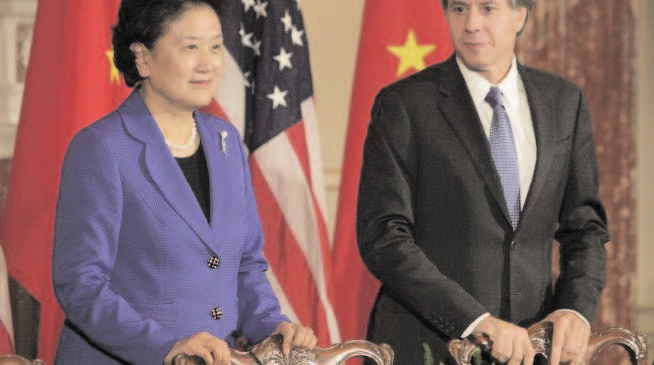
    WASHINGTON (TIP): US and Chinese negotiators bridged some differences over economic policy in annual bilateral talks Wednesday, even as the two countries continue to wrestle with major strategic disagreements.

    Both sides suggested they closed gaps in talks on a bilateral investment treaty (BIT) following the talks.

    And Washington appeared more ready to support a major step in the internationalization of the Chinese yuan, its inclusion in the basket underpinning the International Monetary Fund’s SDR currency.

    But there was little sign that Washington was ready to embrace China’s new Asian Infrastructure Investment Bank, which the US says risks undermining social and environmental standards for loans established by the World Bank.

    US treasury secretary Jacob Lew said at the end of the two-day US-China Strategic and Economic Dialogue that China had agreed to hold off on interventions in the foreign exchange markets to manage the yuan’s value except in situations of “disorderly market conditions.”

    China also agreed “to actively consider” additional steps to move the yuan, which the US has long criticized is forcefully kept undervalued, to a market-based exchange rate.

    Lew also welcomed China’s commitment to begin publishing economic data to meet a key IMF standard by the end of 2015.

    “It is in China’s own interest to adopt the transparency standards of major reserve currencies.”

    Earlier this year Beijing asked the IMF to consider including the yuan, also called the renminbi, in the basket on which the SDR is based. That would constitute a major recognition of the yuan as one of the 10 most important currencies in the world.

    Chinese vice premier Wang Yang confirmed that Washington had shown support for the yuan’s consideration by the IMF, a decision likely to take place only next year.Wang also said the two sides had placed high priority on the BIT, as they weigh each others’ proposed “negative list,” a register of business sectors they want to keep protected from foreign investment.

    The two sides committed to “improve the negative list offer with a view to reaching a mutually beneficial and high-standard treaty,” he told reporters after the meeting.

    The talks, which deal with a broad range of often technical issues, appeared to avoid flashpoint economic issues, like the AIIB that Beijing has launched, and the Trans-Pacific Partnership, the US-driven free trade area that notably excludes China, the second-largest US trade partner.

    A key new complaint at the top of the US list in economic and trade issues, cyber-spying and cyber-theft of secrets and intellectual property from US companies that is allegedly backed by the Chinese government, was discussed, according to Lew.The two sides “had candid conversations about standards of behavior in cyberspace. We agree that there is value in bilateral and international cooperation on these issues,” he said.

    Wang meanwhile said that Washington had acknowledged its complaints about US economic policy, and would weigh the impact of its expected monetary tightening on the rest of the world.

    “The United States will pay attention to the impact of monetary policy on international financial systems and promised increased investment, national savings, a reduced deficit… and fiscal sustainability over the medium term,” Wang said.

  • US says Iran nuclear deal deadline may ‘slip’

    US says Iran nuclear deal deadline may ‘slip’

    VIENNA (TIP): High-stakes talks to nail down a historic deal with Iran to curtail its nuclear programme may “slip” past a June 30 deadline, a top US official admitted on June 25 ahead of crunch weekend negotiations in Vienna.

    “We may not make June 30, but we will be close,” the senior official told reporters as top US diplomat John Kerry prepared to head Friday for what could be the last talks between Iran and global powers on the deal.

    The official said the target date to finalise the historic deal — the main outlines were agreed in April in Lausanne, Switzerland –would only “slip” by a few days.

    “The intent of everybody here — the P5+1, the European Union, Iran — is to stay until we get this done, or find out we can’t. And our intent is to get it done,” the official told reporters, asking not to be named.

    Others, including Iranian Foreign Minister Mohammad Javad Zarif, who is due in Vienna on Saturday, have said the deadline may be missed by a few days but until now Washington had insisted it still aimed to get a deal on schedule.

    “We can truly see a path forward that gets us to a very good agreement here. We know what the pieces of it are,” the US official said, adding that in the end, Iran was facing
    “critical choices.”

    Kerry, addressing reporters after unveiling an annual rights report, said he was “always hopeful… I’m not conferring optimism, but I’m hopeful.”

    Iran, which has engaged in something of a rapprochement with the West since the election of President Hassan Rouhani in 2013, denies wanting nuclear weapons, saying its nuclear programme is exclusively peaceful.

    Under the Lausanne framework, which was also agreed several days late, Iran will downsize its nuclear activities in order to make any attempt to make a nuclear weapon all but impossible.

    This includes Iran cutting the number of centrifuges enriching uranium, which is used in nuclear power but also for a bomb when highly purified, as well as slashing its uranium stockpiles and changing the design of a new reactor.

    In return, UN and Western sanctions that have caused Iran major economic pain would be progressively lifted, although the six powers insist they can be easily “snapped back” in place if Tehran violates the accord.-

    – Spanners in the works –

    French Foreign Minister Laurent Fabius will also arrive in Vienna on Saturday, an aide said Thursday, while a source in Brussels said EU foreign policy chief Federica Mogherini was expected “this weekend.”

    The mooted final accord between Iran and the “P5+1” — Britain, China, France, Russia and the United States plus Germany — will be a highly complex agreement 40-50 pages long, including several appendices.

    It will set out an exact timetable of sanctions relief and reciprocal steps by Iran, as well as a mechanism for handling possible violations by either side.

    Tricky issues include how UN sanctions might be re-applied, the reduction of Iran’s uranium stockpile and its future research and development on newer, faster types of centrifuges.

    Iran must also address lingering questions about the possible military dimensions of its nuclear program to the satisfaction of the UN watchdog, the IAEA.

    Amid unease in Iran’s conservative-dominated parliament that Tehran is giving too much away, the country’s supreme leader, Ayatollah Ali Khamenei, on Tuesday appeared to throw several spanners in the works.