Tag: David Cameron

  • British government blocks MPs from quizzing spy chief

    British government blocks MPs from quizzing spy chief

    LONDON (TIP): The British government has blocked a parliamentary panel from questioning the head of domestic spy agency MI5 about the Edward Snowden leaks, the committee chairman said today, branding the decision “not helpful”. MI5 Director General Andrew Parker had been called before the home affairs committee to expand on evidence he gave to lawmakers last month about the intelligence released by the fugitive former US analyst. However, Home Secretary Theresa May, the interior minister, has written to the committee to decline the invitation, saying she did not believe it was “appropriate or necessary”. Prime Minister David Cameron also declined a request to question his national security adviser, Kim Darroch.

    Committee chairman Keith Vaz, a lawmaker with the opposition Labour Party, said he was “disappointed” by the responses, “which are not helpful to the committee’s inquiry into counterterrorism”. He added: “Ministers should take care not to dictate to parliamentary committees which witnesses can be called and for what reasons. “Witnesses, no matter how senior, should not be afraid of answering questions from MPs.” Parker appeared before parliament’s intelligence and security committee (ISC) in November, alongside the chiefs of the MI6 external spy agency and the GCHQ listening agency, for an unprecedented televised grilling. That was sufficient scrutiny, May argued, adding: “I do not believe that it would be appropriate or necessary for the oversight provided by the ISC to be duplicated by another committee.” The spy chiefs made headlines when they claimed that Al-Qaeda and other enemies were “lapping up” Snowden’s revelations about the extent of surveillance by the United States and its allies, and were using them to change the way they operate.

  • Nelson Mandela dies at 95

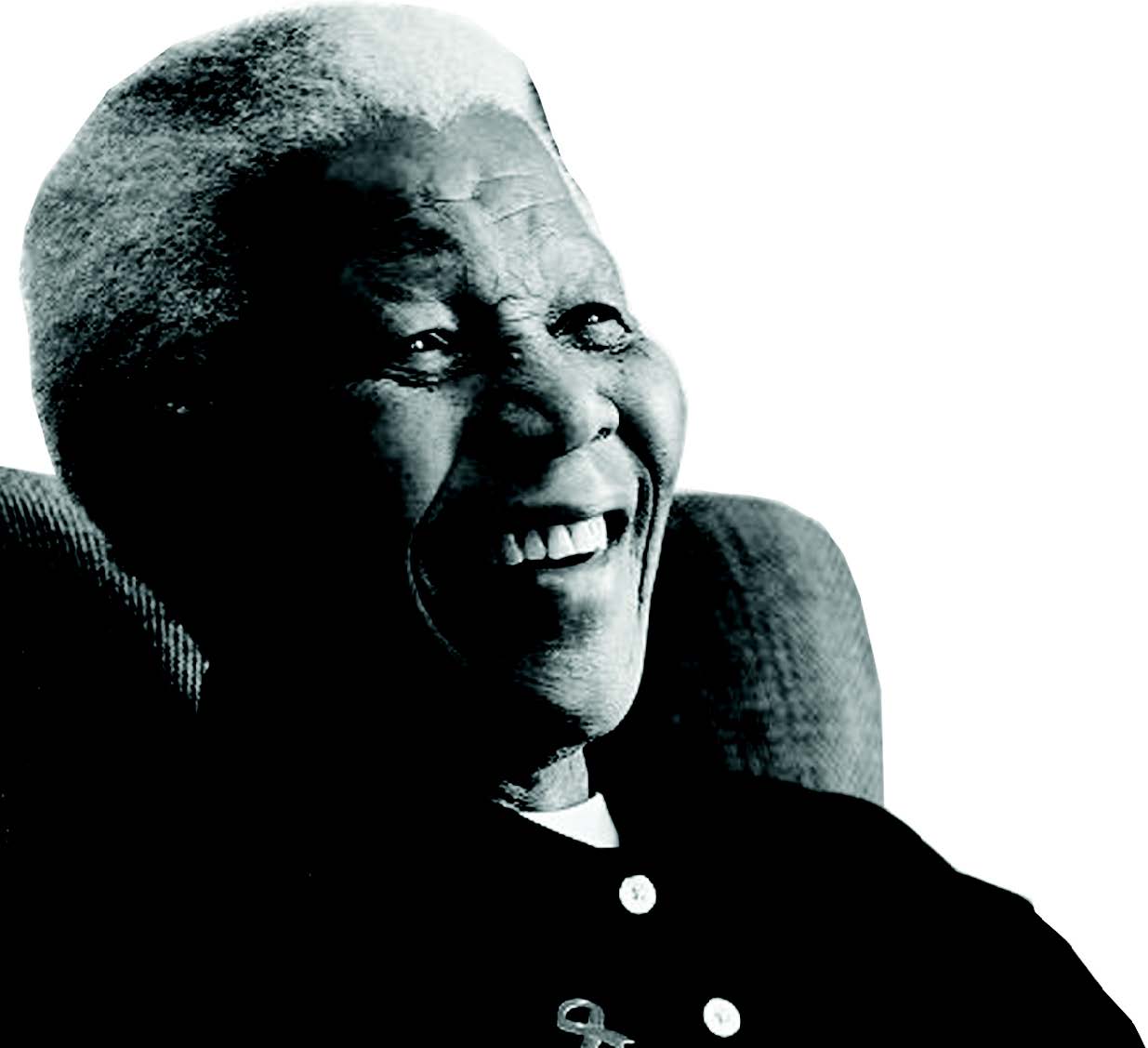
    Nelson Mandela dies at 95

    World Leaders pay Tribute to the Anti-apartheid Icon and Father of Modern South Africa

    JOHANNESBURG (TIP): Nelson Mandela, the revered South African anti-apartheid icon who spent 27 years in prison, led his country to democracy and became its first black president, died Thursday at home. He was 95. “He is now resting,” said South African President Jacob Zuma. “He is now at peace.” “Our nation has lost its greatest son,” he continued. “Our people have lost their father.” A state funeral will be held, and Zuma called for mourners to conduct themselves with “the dignity and respect” that Mandela personified. “Wherever we are in the country, wherever we are in the world, let us reaffirm his vision of a society… in which none is exploited, oppressed or dispossessed by another,” he said as tributes began pouring in from across the world. President Obama said his first political action was an anti-apartheid protest inspired by Mandela, who “achieved more than could be expected of any man.”

    “I cannot fully imagine my own life without the example Nelson Mandela set,” he said. Though he was in power for only five years, Mandela was a figure of enormous moral influence the world over – a symbol of revolution, resistance and triumph over racial segregation. He inspired a generation of activists, left celebrities and world leaders star-struck, won the Nobel Peace Prize and raised millions for humanitarian causes. British Prime Minister David Cameron said of Mandela, ‘A great light has gone out’. British flag at 10 Downing has been lowered in honor of the departed leader Mandela, a former president, battled health issues in recent months, including a recurring lung infection that led to numerous hospitalizations. With advancing age and bouts of illness, Mandela retreated to a quiet life at his boyhood home in the nation’s Eastern Cape Province, where he said he was most at peace. He was later moved to his home in the Johannesburg suburb of Houghton, where he died. Despite rare public appearances, he held a special place in the consciousness of the nation and the world.

  • Historic call: UK PM rings up Rouhani

    Historic call: UK PM rings up Rouhani

    LONDON (TIP): In a historic first, David Cameron on November 19 became the first British PM to call an Iranian president in more than a decade. Cameron spoke to Hassan Rouhani by telephone on Tuesday afternoon ahead of negotiations over Tehran’s nuclear ambitions in Geneva this week. A Downing Street spokesman said “The two leaders discussed the bilateral relationship between Britain and Iran welcoming the steps taken since President Rouhani took office, including the appointment of non-resident Charges d’Affaires last week”.

    On Iran’s nuclear programme, the Downing street spokesman said “both leaders agreed that significant progress had been made in the recent Geneva negotiations and that it was important to seize the opportunity presented by the further round of talks”. The PM underlined the necessity of Iran comprehensively addressing the concerns of the international community about their %nuclear programme including the need for greater transparency. On Syria, there was agreement on the need for a political solution to end the bloodshed”. Rouhani also gave details of the phone call on his Twitter feed, saying the two leaders discussed “way to create a positive atmosphere to address concerns on both sides on the nuclear issue”.

    Three days of highlevel talks between representatives from Iran and the P5+1 %group of nations earlier this month failed to achieve a breakthrough. In September, President Barack Obama and Rouhani made history with a phone call, thawing three decade freeze between US and Iran. It was the first time that leaders from the US and Iran had directly communicated since the 1979 Iranian revolution. UK said is committed to negotiating a peaceful diplomatic settlement that gives the world confidence that Iran’s nuclear programme is for purely peaceful purposes. UK recently appointed Ajay Sharma as the UK’s non-resident Charge d’Affaires to Iran.

    On October 8, Britain’s foreign secretary Willian Hague announced that the UK and Iran had agreed to appoint nonresident Charges d’Affaires as an important step towards improving the bilateral relationship. “Mr Sharma’s appointment will enable the UK to have more detailed and regular discussions with Iran on a range of issues, including conditions under which our Embassies could eventually be reopened. Mr Sharma will be based in the UK but will travel regularly to Iran.” UK said. Mr Sharma has significant experience of Iran and the region.

    He is currently head of Iran department at the Foreign and Commonwealth Office and served previously as deputy head of mission in Tehran. On his appointment, Mr Sharma said “I am very much looking forward to renewing direct UK contact with the Iranian Government and society. This is very much in the interests of both our countries. I hope to make my first visit to Tehran as non-resident Charge later this month”.

  • Historic call: UK PM rings up Rouhani

    Historic call: UK PM rings up Rouhani

    LONDON (TIP): In a historic first, David Cameron on November 19 became the first British PM to call an Iranian president in more than a decade. Cameron spoke to Hassan Rouhani by telephone on Tuesday afternoon ahead of negotiations over Tehran’s nuclear ambitions in Geneva this week. A Downing Street spokesman said “The two leaders discussed the bilateral relationship between Britain and Iran welcoming the steps taken since President Rouhani took office, including the appointment of non-resident Charges d’Affaires last week”.

    On Iran’s nuclear programme, the Downing street spokesman said “both leaders agreed that significant progress had been made in the recent Geneva negotiations and that it was important to seize the opportunity presented by the further round of talks”. The PM underlined the necessity of Iran comprehensively addressing the concerns of the international community about their %nuclear programme including the need for greater transparency. On Syria, there was agreement on the need for a political solution to end the bloodshed”.

    Rouhani also gave details of the phone call on his Twitter feed, saying the two leaders discussed “way to create a positive atmosphere to address concerns on both sides on the nuclear issue”. Three days of highlevel talks between representatives from Iran and the P5+1 %group of nations earlier this month failed to achieve a breakthrough. In September, President Barack Obama and Rouhani made history with a phone call, thawing three decade freeze between US and Iran.

    It was the first time that leaders from the US and Iran had directly communicated since the 1979 Iranian revolution. UK said is committed to negotiating a peaceful diplomatic settlement that gives the world confidence that Iran’s nuclear programme is for purely peaceful purposes. UK recently appointed Ajay Sharma as the UK’s non-resident Charge d’Affaires to Iran.On October 8, Britain’s foreign secretary Willian Hague announced that the UK and Iran had agreed to appoint nonresident Charges d’Affaires as an important step towards improving the bilateral relationship.

    “Mr Sharma’s appointment will enable the UK to have more detailed and regular discussions with Iran on a range of issues, including conditions under which our Embassies could eventually be reopened. Mr Sharma will be based in the UK but will travel regularly to Iran.” UK said. Mr Sharma has significant experience of Iran and the region. He is currently head of Iran department at the Foreign and Commonwealth Office and served previously as deputy head of mission in Tehran. On his appointment, Mr Sharma said “I am very much looking forward to renewing direct UK contact with the Iranian Government and society. This is very much in the interests of both our countries. I hope to make my first visit to Tehran as non-resident Charge later this month”.

  • David Cameron, Manmohan Singh meet, discuss trade ties

    David Cameron, Manmohan Singh meet, discuss trade ties

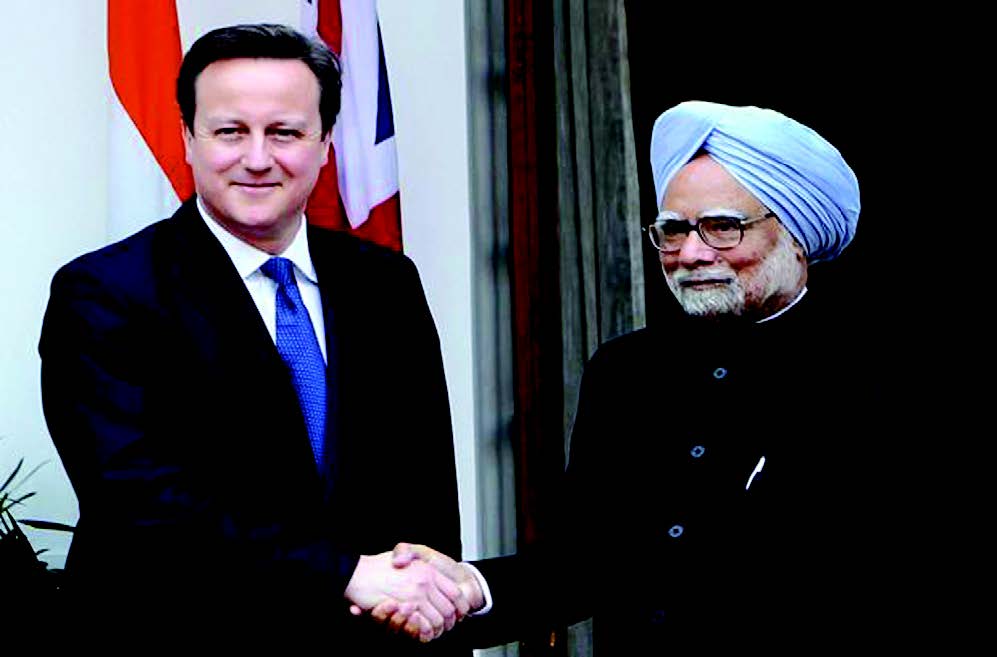
    NEW DELHI (TIP): India and Britain reviewed bilateral economic ties on November 14, including plans for setting up an economic corridor linking hub Bangalore and India’s financial capital Mumbai, people familiar with the matter said. The two countries also discussed the importance of an India-European Union broad-based trade and investment agreement—the subject of negotiations since 2007. The discussions came up during talks between visiting British Prime MinisterDavid Cameron and his Indian host Prime Minister Manmohan Singh.

    Cameron is on a brief visit to India on his way to Colombo for the three-day Commonwealth Heads of Government Meeting (CHOGM) starting Friday. Cameron’s current visit is his second this year and third in three years. The British Prime Minister was in New Delhi in February with a large business delegation.

    Both the leaders were “happy at the progress that has been made; the terms of reference for the feasibility study of the BMEC (Bangalore-Mumbai Economic Corridor) have been finalized”, one of the people aware of the development cited earlier said. The corridor is expected to be like the $90 billion (around Rs.5.7 trillion today) Delhi-Mumbai Industrial Corridor that India is building with Japanese help. It covers 1,483km and incorporates nine mega industrial zones of 200-250 sq. km, a high-speed freight line, three ports, and six airports. The aim of the project is to develop new industrial cities to expand India’s manufacturing and services base. Singh and Cameron also went over the progress in bilateral relations since the latter’s visit in February, a second person aware of the developments said. “Both leaders expressed satisfaction that despite the continuing global economic slowdown and the euro zone difficulties,

    India-UK trade ties have been resilient,” this person said. “Investments on both sides have also progressed satisfactorily. They felt that there was a need to take this process further through increased interaction in various fields, and regular steps and measures to continue this positive momentum.” Britain’s total foreign direct investment in India since April 2000 totals about $17.08 billion. Some 700 Indian companies have set up base in Britain, according to Indian foreign ministry figures. Other engagements of Cameron in New Delhi included a meeting with Indian business leaders. At the meeting,

    Cameron said he respected Singh’s decision to not participate in CHOGM in Sri Lanka, but added that he was in favour of participating in such multilateral events as it provided an opportunity to focus attention on issues like human rights. “I think the advantage of going to a multilateral organization is that you can help lead it. I think, actually, going to Sri Lanka will help to shine the light on some issues,” Cameron was cited as saying by PTI. “I totally respect the decision (by Singh to not go)…it’s a decision that they have to make.” Singh decided on 10 November to not go for CHOGM due to pressure from Tamil parties in India who say Sri Lanka’s President Mahinda Rajapaksahas not done enough to re-integrate Sri Lanka’s Tamil minority into the national mainstream since the end of the nearly three-decade-old civil war in May 2009. Tamils in India, who share close cultural ties with Sri Lankan Tamils, are also upset with Sri Lanka’s majority Sinhala community for alleged atrocities committed during the last phases of the civil war.

    The ruling All India Anna Dravida Munnetra Kazhagam party in Tamil Nadu and the opposition Dravida Munnetra Kazhagam are demanding a complete boycott of CHOGM by India. The country is being represented at the meeting by foreign minister Salman Khurshid. In his comments to Indian businessmen, Cameron also said he was open to meeting Gujarat chief minister Narendra Modi, the prime ministerial candidate of India’s main opposition Bharatiya Janata Party.

    Modi was treated as a pariah by European nations, including Britain, due to his allegedly turning a blind eye to the communal riots in Gujarat that saw the deaths of an estimated 2,000 people, mostly Muslims, in 2002. Two British Muslims were among those killed in the riots, sparked allegedly by a Muslim mob setting fire to a train carriage carrying Hindu pilgrims.But in October last year, Britain announced it was ending a 10-year boycott of Modi, following which British High Commissioner to India James Bevanmet the Gujarat chief minister. Asked if he would like to meet Modi in the near future, Cameron said, “In time, yes. It’s good to meet. We have an approach of meeting all politicians and leaders. In the end, it will be for the people of India whom to elect. But I’m open to meeting elected leaders.”

  • Sri Lanka rights abuse allegations divide Commonwealth

    Sri Lanka rights abuse allegations divide Commonwealth

    COLOMBO (TIP):THE heads of government of the 53 nations of the Commonwealth come together every two years for a summit. This time, several have decided to stay away, to boycott the gathering in Sri Lanka. The prime ministers of Canada, India and Mauritius say they cannot take part. Their basic complaint: Sri Lanka’s President, Mahinda Rajapaksa, should not have been allowed to host the Commonwealth and then take over for the next two years as chairperson of an organisation committed to values of democracy and human rights which he is accused of flouting. Other leaders are still coming, despite pressure on them to join the boycott.

    So Britain’s Prime Minister, David Cameron, has flown in from neighbouring India, although his counterpart, India’s Manmohan Singh, has pulled out. Mr Cameron says it’s better to engage and ask tough questions rather than risk making the Commonwealth irrelevant as an organisation. The case against Sri Lanka’s government stems partly from allegations against the security forces of war crimes, including the killing of civilians, rape and sexual violence against women, particularly during the final months in 2009 of a civil war against Tamil separatists. Critics also say there is considerable evidence of abuses both then and more recently, including the abduction or “disappearance” of opponents and the murder of journalists. The government in Colombo rejects all these allegations, a denial repeated to me in a BBC interview by the country’s minister of mass media and information, as Commonwealth leaders arrived in the country.

    Test of will

    “We wanted zero civilian casualties,” said the minister, Keheliya Rambukwella, who is the government’s spokesman. He added that it was well documented that the Tamil Tigers or LTTE, whom he called “terrorists”, “used civilians as human shields”. The minister also rejected demands from Britain’s prime minister. David Cameron is calling for an end to the intimidation of journalists and human rights defenders, action to stamp out torture, demilitarisation of the north and reconciliation between communities. Mr Cameron says there needs to be a thorough investigation into alleged war crimes, and that if it does not happen rapidly, then an international independent investigation will be needed.

    The Sri Lankan government accuses him of colonialism, of trying to dictate to a sovereign nation and of abusing his invitation to come to Colombo to discuss the issues on the formal agenda of this summit. But that agenda includes debate over what should replace the United Nations Millennium Development Goals when they expire in 2015. That may allow any leader in the room to raise a whole host of human rights concerns, precisely because they are central to many people’s belief that you cannot eradicate poverty without at the same time upholding rights, including the freedom to make political choices and freedom of speech. Some people ask whether or not anyone would notice if the Commonwealth disappeared.

    Supporters argue its achievements are often ignored. They point to a strong set of rules on democracy and elections: Commonwealth observer missions often play a significant role in limiting or preventing ballot-rigging. Military takeovers are punished. Thirty years ago many Commonwealth countries were ruled by men in uniform. Not any more. The Commonwealth is also much more than a club of political leaders. Its grassroots organisations, bringing together civil society groups around the globe, or professional associations exchanging best practice, or promoting trade are often more effective than gatherings of the political elite.

    Small states also value the collective political weight they can sometimes exert via the Commonwealth in a world where their voices might otherwise be drowned out. Critics, on the other hand, assemble lists of Commonwealth failings. Many have to do with promises made by leaders and then broken. Other charges involve rules which are not rigorously enforced. The current controversy over the decision to meet in Colombo is seized on by the critics as further evidence the Commonwealth is all too flexible when it comes to sticking to its principles. This year’s new Commonwealth Charter commits leaders to uphold these principles.

    So this summit will be seen by many as a test of the Commonwealth’s real commitment to values and a test of its collective will.

  • David Cameron, Manmohan Singh meet, discuss trade ties

    David Cameron, Manmohan Singh meet, discuss trade ties

    NEW DELHI (TIP): India and Britain reviewed bilateral economic ties on November 14, including plans for setting up an economic corridor linking hub Bangalore and India’s financial capital Mumbai, people familiar with the matter said. The two countries also discussed the importance of an India-European Union broad-based trade and investment agreement—the subject of negotiations since 2007. The discussions came up during talks between visiting British Prime MinisterDavid Cameron and his Indian host Prime Minister Manmohan Singh. Cameron is on a brief visit to India on his way to Colombo for the three-day Commonwealth Heads of Government Meeting (CHOGM) starting Friday. Cameron’s current visit is his second this year and third in three years. The British Prime Minister was in New Delhi in February with a large business delegation. Both the leaders were “happy at the progress that has been made; the terms of reference for the feasibility study of the BMEC (Bangalore-Mumbai Economic Corridor) have been finalized”, one of the people aware of the development cited earlier said.

    The corridor is expected to be like the $90 billion (around Rs.5.7 trillion today) Delhi-Mumbai Industrial Corridor that India is building with Japanese help. It covers 1,483km and incorporates nine mega industrial zones of 200-250 sq. km, a high-speed freight line, three ports, and six airports. The aim of the project is to develop new industrial cities to expand India’s manufacturing and services base. Singh and Cameron also went over the progress in bilateral relations since the latter’s visit in February, a second person aware of the developments said. “Both leaders expressed satisfaction that despite the continuing global economic slowdown and the euro zone difficulties, India-UK trade ties have been resilient,” this person said. “Investments on both sides have also progressed satisfactorily. They felt that there was a need to take this process further through increased interaction in various fields, and regular steps and measures to continue this positive momentum.” Britain’s total foreign direct investment in India since April 2000 totals about $17.08 billion. Some 700 Indian companies have set up base in Britain, according to Indian foreign ministry figures. Other engagements of Cameron in New Delhi included a meeting with Indian business leaders. At the meeting, Cameron said he respected Singh’s decision to not participate in CHOGM in Sri Lanka, but added that he was in favour of participating in such multilateral events as it provided an opportunity to focus attention on issues like human rights. “I think the advantage of going to a multilateral organization is that you can help lead it. I think, actually, going to Sri Lanka will help to shine the light on some issues,” Cameron was cited as saying by PTI.

    “I totally respect the decision (by Singh to not go)…it’s a decision that they have to make.” Singh decided on 10 November to not go for CHOGM due to pressure from Tamil parties in India who say Sri Lanka’s President Mahinda Rajapaksahas not done enough to re-integrate Sri Lanka’s Tamil minority into the national mainstream since the end of the nearly three-decade-old civil war in May 2009. Tamils in India, who share close cultural ties with Sri Lankan Tamils, are also upset with Sri Lanka’s majority Sinhala community for alleged atrocities committed during the last phases of the civil war. The ruling All India Anna Dravida Munnetra Kazhagam party in Tamil Nadu and the opposition Dravida Munnetra Kazhagam are demanding a complete boycott of CHOGM by India. The country is being represented at the meeting by foreign minister Salman Khurshid. In his comments to Indian businessmen, Cameron also said he was open to meeting Gujarat chief minister Narendra Modi, the prime ministerial candidate of India’s main opposition Bharatiya Janata Party. Modi was treated as a pariah by European nations, including Britain, due to his allegedly turning a blind eye to the communal riots in Gujarat that saw the deaths of an estimated 2,000 people, mostly Muslims, in 2002. Two British Muslims were among those killed in the riots, sparked allegedly by a Muslim mob setting fire to a train carriage carrying Hindu pilgrims.But in October last year, Britain announced it was ending a 10-year boycott of Modi, following which British High Commissioner to India James Bevanmet the Gujarat chief minister. Asked if he would like to meet Modi in the near future, Cameron said, “In time, yes. It’s good to meet. We have an approach of meeting all politicians and leaders. In the end, it will be for the people of India whom to elect. But I’m open to meeting elected leaders.”

  • Sri Lanka rights abuse allegations divide Commonwealth

    Sri Lanka rights abuse allegations divide Commonwealth

    COLOMBO (TIP):THE heads of government of the 53 nations of the Commonwealth come together every two years for a summit. This time, several have decided to stay away, to boycott the gathering in Sri Lanka. The prime ministers of Canada, India and Mauritius say they cannot take part. Their basic complaint: Sri Lanka’s President, Mahinda Rajapaksa, should not have been allowed to host the Commonwealth and then take over for the next two years as chairperson of an organisation committed to values of democracy and human rights which he is accused of flouting. Other leaders are still coming, despite pressure on them to join the boycott. So Britain’s Prime Minister, David Cameron, has flown in from neighbouring India, although his counterpart, India’s Manmohan Singh, has pulled out. Mr Cameron says it’s better to engage and ask tough questions rather than risk making the Commonwealth irrelevant as an organisation. The case against Sri Lanka’s government stems partly from allegations against the security forces of war crimes, including the killing of civilians, rape and sexual violence against women, particularly during the final months in 2009 of a civil war against Tamil separatists. Critics also say there is considerable evidence of abuses both then and more recently, including the abduction or “disappearance” of opponents and the murder of journalists. The government in Colombo rejects all these allegations, a denial repeated to me in a BBC interview by the country’s minister of mass media and information, as Commonwealth leaders arrived in the country.

    Test of will
    “We wanted zero civilian casualties,” said the minister, Keheliya Rambukwella, who is the government’s spokesman. He added that it was well documented that the Tamil Tigers or LTTE, whom he called “terrorists”, “used civilians as human shields”. The minister also rejected demands from Britain’s prime minister. David Cameron is calling for an end to the intimidation of journalists and human rights defenders, action to stamp out torture, demilitarisation of the north and reconciliation between communities. Mr Cameron says there needs to be a thorough investigation into alleged war crimes, and that if it does not happen rapidly, then an international independent investigation will be needed. The Sri Lankan government accuses him of colonialism, of trying to dictate to a sovereign nation and of abusing his invitation to come to Colombo to discuss the issues on the formal agenda of this summit. But that agenda includes debate over what should replace the United Nations Millennium Development Goals when they expire in 2015. That may allow any leader in the room to raise a whole host of human rights concerns, precisely because they are central to many people’s belief that you cannot eradicate poverty without at the same time upholding rights, including the freedom to make political choices and freedom of speech. Some people ask whether or not anyone would notice if the Commonwealth disappeared.

    Supporters argue its achievements are often ignored. They point to a strong set of rules on democracy and elections: Commonwealth observer missions often play a significant role in limiting or preventing ballot-rigging. Military takeovers are punished. Thirty years ago many Commonwealth countries were ruled by men in uniform. Not any more. The Commonwealth is also much more than a club of political leaders. Its grassroots organisations, bringing together civil society groups around the globe, or professional associations exchanging best practice, or promoting trade are often more effective than gatherings of the political elite. Small states also value the collective political weight they can sometimes exert via the Commonwealth in a world where their voices might otherwise be drowned out. Critics, on the other hand, assemble lists of Commonwealth failings. Many have to do with promises made by leaders and then broken. Other charges involve rules which are not rigorously enforced. The current controversy over the decision to meet in Colombo is seized on by the critics as further evidence the Commonwealth is all too flexible when it comes to sticking to its principles. This year’s new Commonwealth Charter commits leaders to uphold these principles. So this summit will be seen by many as a test of the Commonwealth’s real commitment to values and a test of its collective will.

  • UK PM cites Ramayana as he seeks to boost ties with India

    UK PM cites Ramayana as he seeks to boost ties with India

    LONDON (TIP): British PM David Cameron has described his country’s relationship with India as “the great partnership of the 21st century” and said the UK needs to “continue to do everything” to further build it. “There is great excitement about our economies. India invests more into the UK than the rest of Europe put together,” he said at a Diwali reception at his residence on Wednesday night. “Britain is one of the top three investors in India.” Cameron spoke about the shared history, language, love for sport and cooperation between universities of the two countries to highlight “strong and vibrant” ties. He said he was looking forward to his third visit to India as the PM and also seeing his counterpart, Manmohan Singh. “It’s a huge pleasure to go back to India.” Cameron described Ramayana relevant even more in modern times and said the UK can learn from it. “When I look at the Ramayana and my understanding of the Hindu religion, there is so much you have to say about the importance of family, community, voluntary service —these are all the values that our country needs more of.”

  • Murdoch editors Brooks, Coulson had affair, hacking trial told

    Murdoch editors Brooks, Coulson had affair, hacking trial told

    LONDON (TIP): Rebekah Brooks and Andy Coulson, two former editors of Rupert Murdoch’s now defunct News of the World tabloid, were having an affair at the time their reporters are accused of hacking into phones, a court heard on Thursday. Prosecutor Andrew Edis said the intimacy of their relationship indicated each knew as much as the other about how their reporters were operating. Both have denied conspiring to hack into phones or making illegal payments to public officials.

    “What Mr Coulson knew, Mrs Brooks knew too. What Mrs Brooks knew, Mr Coulson knew too,” Edis told the court. “That’s the point.” Coulson went on to become the chief media spokesman for Prime Minister David Cameron while Brooks, a close confidante to Murdoch, went on to be chief executive of News International, the tycoon’s British newspaper group. The revelation of the affair is likely to bring more embarrassment to Cameron, who has long been accused by critics of being too close to Murdoch’s News Corp media empire.

    Murdoch owns The Sun and Times papers and 39 percent of pay-TV group BSkyB, which opponents say enables him to wield too much political influence in Britain. “Mrs Brooks and Mr Coulson are charged with conspiracy, and when people are charged with conspiracy the first question the jury have to answer is, how well did they know each other?” Edis said. “How much did they trust each other?” The affair went on from 1998 to 2004, Edis told the jury at London’s Central Criminal Court. Brooks and Coulson showed little reaction to the revelation as they sat side-by-side in the glass dock along with six other defendants, including Brooks’s husband Charlie, whom she married in 2009.

    The prosecutor said the relationship was discovered after police found a document containing a 2004 letter on a computer at Brooks’s home. Brooks wrote the letter to Coulson after he tried to break off the relationship, Edis said. “The fact is you are my very best friend, I tell you everything, I confide in you, I seek your advice, I love you, care about you, worry about you, we laugh and cry together,” the letter said, according to Edis who read it out to the jury of nine women and three men.

    “In fact without our relationship in my life I am not sure I will cope.” Edis told the jurors that it was not the affair in itself that was important to the prosecution’s case. “It isn’t simply that there was an affair, it isn’t to do with whether they have sexual relations with one another, (it is to do with) how close were they … and they were very close,” he said

    ‘Dog-eat-dog’

    Revelations about phone-hacking engulfed News Corp during the summer of 2011, forcing the closure of the 168-year-old tabloid News of the World and embarrassing senior politicians and police who were shown to have very close links to press barons including the 82-year-old Murdoch.

    Earlier on Thursday, the jury heard that Brooks and Coulson had authorized huge payments to the man behind the hacking at a time when the News of the World was drastically cutting costs. Brooks and Coulson ordered senior staff to slash budgets but allowed about 100,000 pounds ($161,000) a year to go to Glenn Mulcaire, the private detective who has admitted tapping mobile phone voicemails for their paper. “What was so special about him?” Edis asked the jury of Mulcaire. “Well, what was so special about him was that he was doing phonehacking.”

    The jury were shown emails which Edis said revealed the tight financial restrictions and the pressure Britain’s best-selling newspaper was under to maintain sales. “I am very worried about news desk’s spending, what is going on? It’s a disciplinary situation. How am I going to make myself any clearer?” Brooks wrote in an email to her senior news staff in June 2001 shortly after berating one for spending 7,500 pounds on one story.

  • DSGMC chief told to take off turban at Rome

    DSGMC chief told to take off turban at Rome

    AMRITSAR (TIP): Delhi Sikh Gurdwara Management Committee (DSGMC) president Manjeet Singh GK was asked to take off his turban during a security check at the Rome International Airport in Italy on Aug 6. When he refused, he was not allowed to board the flight. DSGMC general secretary Manjinder Singh Sirsa said they had lodged a protest with the Italian Embassy in New Delhi which had assured him of looking into the matter.

    He said GK, after missing his 1.20 am (IST) flight today, decided to take the next flight scheduled for 6.30 pm (IST). “But with the Italian Embassy expressing its inability to resolve the issue by then, he will now board a flight tomorrow,” he said. GK had gone to Italy to attend a ‘Dastarbandi Samagam’ (turban tying programme). Reacting to the incident, SGPC president Avtar Singh Makkar said he would soon send a protest letter to the Italian Embassy in New Delhi as well as take up the matter with Prime Minister Manmohan Singh. He also said they will dispatch a reminder to British Prime Minister David Cameron, as he had assured the SGPC to take up such issues with member countries of the European Union during his visit to Amritsar some months back.

  • Minister For Special Panel On Terror Cases Against Muslims

    Minister For Special Panel On Terror Cases Against Muslims

    NEW DELHI (TIP): Union minority affairs minister Rahman Khan wants the government to form an allpowerful taskforce to monitor and review terror cases against Muslims, arguing that it is needed to ensure justice for “innocent Muslim youth” languishing in jails after being framed in terror cases. Khan cited the example of the UK which, he said, has formed a task force under Prime Minister David Cameron to ensure there are no excesses in the crackdown on terror.

    “It should be the highest body with powers to review terror cases,” he told TOI, adding it would monitor the progress of cases to sift genuine ones from the trumped up cases. “I am finalizing the proposal and will soon write to the PM and Congress president Sonia Gandhi,” Khan said. Flagging the urgent need for supervision, Khan said many Muslim youth were languishing in jails for extended periods without chargesheets.

    “The existence of the panel will deter police from indiscriminate arrests in terror cases while ensuring that those arrested do get justice,” he said. The minister’s push for the allpowerful panel comes in the backdrop of increasing evidence that Muslim youngsters have generally been at the receiving end of police crackdown. The failure of the cops to nail several terror cases and prolonged incarceration of the accused have led to charges of religious persecution.

    Khan’s suggestion — he is in the process of finalizing the details — could lead to a push for the PM to head the panel so that the oversight mechanism gets the required political heft. However, it would test Congress’s appetite for bold moves in the run-up to the 2014 campaign, given that BJP will seize upon it to accuse UPA of being “soft on terror” and minority “appeasement”.

    Khan said his proposal emanated from complaints his ministry had been received from organizations and parents of terror detainees on a regular basis. “On a visit to London, I raised terror attacks with the UK minister for communities. He explained to me about a task force formed under the PM that comprises various ministers. It is a sort of cabinet subcommittee to review terror cases,” he said. Khan said it was high time the Centre take a close look at terror cases.

    “If people are acquitted after prolonged detention, where do they go for justice? Especially, if they are not compensated? The long years in jail disrupt lives of detainees,” he said. The issue of terror detainees, also raised in UPA coordination committee, has been mired in Centre’s lack of jurisdiction on states.

  • Two more arrested as London terror probe expands

    Two more arrested as London terror probe expands

    LONDON (TIP): British police have made two further arrests and searched multiple properties as they widened their investigation into May 22 fatal hacking to death of a British soldier in broad daylight on a busy London street by two Muslim terrorists, a Fox news report says. The two arrests, of a man and a woman — both 29 — on suspicion of conspiracy to murder, raises the possibility that the gruesome attack was not a so-called “lone wolf” killing as once thought.

    Earlier it had been reported that the attackers were known to UK authorities and one had ties to a radical jihadist group well before the shocking attack that has stunned the United Kingdom and risked inflaming tensions between communities. The two men, who were captured on cellphone video covered in blood and spouting jihadist rhetoric moments after the attack, have not yet been named, although Scotland Yard confirmed that they remained hospitalized in stable condition after being shot by armed police at the scene.

    But the killers, who wielded a machete and a cleaver and were dubbed “sickening individuals” by an incensed Prime Minister David Cameron, were already on the radar of security services, according to the BBC. And Anjem Choudary, the leader of radical Islamist organization al- Muhajiroun — a group banned under antiterrorism laws in the UK — has told Reuters that he knows one of the reported suspects.

    Michael Adebolajo, a Muslim convert from Christianity named by the BBC as one of the attackers, attended a number of the organization’s demonstrations, lectures and activities according to Choudary, although he claimed not to have seen him for about two years. The Ministry of Defense has named the slain soldier as 25-year-old Drummer Lee Rigby, of 2nd Battalion The Royal Regiment of Fusiliers.

    In a statement made outside his Downing Street office after having chaired a meeting of the British government’s COBRA (Cabinet Office Briefing Room A) emergency committee, British Prime Minister David Cameron refused to comment about whether security forces had prior knowledge of the suspects. However, he firmly condemned the attack in Churchillian terms, stating: “We will never give in to terror, or terrorism, in any of its forms.”

    Additionally, the Conservative Prime Minister emphasized that “there is nothing in Islam that justifies this truly dreadful act,” and that the fault lay solely with the attackers. He also noted that more Muslim lives have been lost in terrorist acts than any other religion. President Obama, in a statement May 23 afternoon, condemned the attack in strong terms, and reaffirmed the relationship between the US and the UK, stating: “The United States stands resolute with the United Kingdom, our ally and friend, against violent extremism and terror.

    ” Prime Minister Cameron also praised the bravery of Ingrid Loyau-Kennett, a cub scout leader and mother of two, who got off a bus and tried to reason with the attackers after she tried to help the victim lying on the street. The 48-year-old tried to keep talking to the two attackers before police arrived at the scene near the Royal Artillery Barracks in the neighborhood of Woolwich.

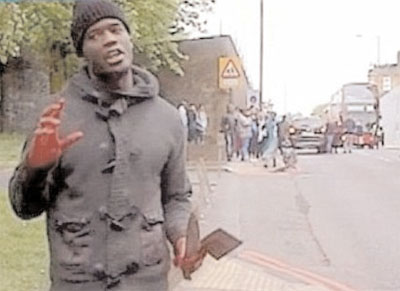
    The British government’s COBRA emergency committee met Thursday after Prime Minister David Cameron said there were “strong indications” it was an act of terrorism, and two other officials said there were signs the attack was motivated by radical Islam. One of the attackers went on video to explain the crime — shouting political statements, gesturing with bloodied hands and waving a meat cleaver.

    Images from the scene showed a blue car that appeared to have been used in the attack, its hood crushed and rammed into a signpost on a sidewalk that was smeared with blood. A number of weapons — including butchers’ knives, a machete and a meat cleaver — were strewn on the street. Footage — obtained by ITV news and The Sun newspaper — showed a man in a dark jacket and knit cap walking toward a camera, clutching a meat cleaver and a knife.

    Speaking in English with a British accent, he apologized that female passers-by “have had to witness this” barbarity, saying that “in our land our women have to see the same.” He gave no indication what that land was as he urged people to tell the government to “bring our troops back.” British troops are deployed in Afghanistan and recently supported the French-led intervention in Mali. “We swear by almighty Allah we will never stop fighting you,” the man declared. “We must fight them as they fight us.”

    The camera then panned away to show a body lying on the ground. Scotland Yard confirmed that counterterrorism officers were leading an investigation into the attack. Commissioner Sir Bernard Hogan-Howe said the two men had been arrested and urged Londoners to remain calm. Both men were hospitalized, one in serious condition. Late Wednesday, riot police fanned out in Woolwich as about 50 men waving the flag of the far-right English Defense League gathered, singing nationalistic songs and shouting obscenities about the Quran.

  • Jallianwala Bagh Killings Deeply Shameful: UK PM

    Jallianwala Bagh Killings Deeply Shameful: UK PM

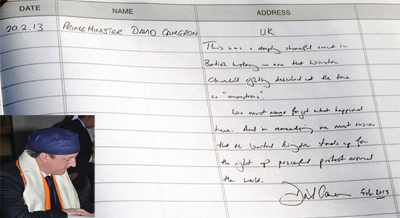
    AMRITSAR (TIP): British PrimeMinister David Cameron visited the site ofa colonial-era massacre in India onFebruary 20, describing the episode as”deeply shameful” while stopping short of apublic apology.On the last leg of a three-day trip aimedat forging deeper economic ties, Camerontook the bold decision to visit the city ofAmritsar and tackle an enduring scar ofBritish rule on the subcontinent, whichended in 1947.Dressed in a dark suit and bowing hishead, he laid a wreath at the memorial tothe victims at Jallianwala Bagh, whereBritish troops opened fire on thousands ofunarmed protesters in 1919.In a message in the visitors’ book, hewrote: “This was a deeply shameful event inBritish history and one that WinstonChurchill rightly declared at the time as’monstrous’.

    David Cameron at Jallianwala Bagh
    “We must never forget what happenedhere. And in remembering we must ensurethat the United Kingdom stands up for theright of peaceful protest around the world.”The number of casualties at theJallianwala Bagh garden is unclear, withcolonial-era records showing about 400deaths while Indian figures put the numberkilled at closer to 1,000.Bhusan Behl, who heads a trust for thefamilies of victims, has campaigned fordecades on behalf of his grandfather whowas killed at the entrance to the walledarea.

    He said he was hoping that Cameronwould say sorry for the slaughter orderedby General Reginald Dyer, which wasimmortalised in Richard Attenborough’sfilm Gandhi and features in SalmanRushdie’s epic book Midnight’s Children.The 1919 slaughter, known in India as theJallianwala Bagh massacre, was describedby Mahatma Gandhi, the father of theIndian independence movement, as havingshaken the foundations of the BritishEmpire.A group of soldiers opened fire on anunarmed crowd without warning in thenorthern Indian city after a period ofunrest, killing hundreds in cold blood.Cameron’s visit and expression of regretfor what happened will stop short of anapology – but will make it clear heconsiders the episode a stain on Britain’shistory that should be acknowledged.

    The gesture, coming on the third andfinal day of a visit to India aimed atdrumming up trade and investment, islikely to be seen as an attempt to improverelations with Britain’s former colonialpossession and to court around 1.5 millionBritish voters of Indian origin ahead of a2015 election.Before his visit, Cameron said there wereties of history between the two countries,”both the good and the bad”.”In Amritsar, I want to take theopportunity to pay my respects atJallianwala Bagh,” he said, referring to thesite of the massacre.Cameron is expected to visit Amritsar’sGolden Temple, a place of pilgrimage forSikhs, and to inscribe his thoughts aboutthe killings in the visitor book.When asked to comment on Britain’scolonial past, he said: “I would argue it’s astrength, not a weakness. Of course thereare sensitive issues, sensitive events, butactually the fact that Britain and India havethis history, have a shared culture and ashared language, I think, is a positive.

    “The British report into the Amritsarmassacre at the time said 379 people hadbeen killed and 1,200 wounded. But aseparate inquiry commissioned by theIndian pro-independence movement saidaround 1,000 people had been killed.Brigadier-General Reginald Dyer, theman who gave the order to fire, explainedhis decision by saying he felt it wasnecessary to “teach a moral lesson to thePunjab”.Some in Britain hailed him “as the manwho saved India”, but others condemnedhim. India became independent in 1947.Many historians consider the massacre aturning point that undermined British ruleof India.It was, they say, one of the moments thatcaused Gandhi and the pro-independenceIndian National Congress movement to losetrust in the British, inspiring them toembark on a path of civil disobedience.

    “Monstrous event”
    Other British politicians and dignitaries- though no serving prime minister – haveexpressed regret about the incident before.In 1920, Winston Churchill, then thesecretary of state for war, called theAmritsar massacre “a monstrous event”,saying it was “not the British way of doingbusiness”.On a visit to Amritsar in 1997, QueenElizabeth called it a distressing episode, butsaid history could not be rewritten.However, her husband, Prince Philip,courted controversy during the visit whenhe questioned the higher Indian death toll.Before he became prime minister, TonyBlair also visited, saying the memorial atAmritsar was a reminder of “the worstaspects of colonialism”.

    In recent years, British leaders havebegun to apologise for some of the excessesof Empire.Visiting Pakistan in 2011, Cameronangered traditionalists at home sayingBritain had caused many of the world’sproblems, including the Kashmir conflictbetween India and Pakistan.When in office, Blair apologised for the19th century Irish potato famine and forBritain’s involvement in the slave trade,while Gordon Brown, his successor,apologised for the fact that British childrenwere shipped to Australia and otherCommonwealth countries between the1920s and 1960s.Britain ruled or held sway in India viathe British East India company from the17th century until 1947.

    India’s colonial history remains asensitive subject for many Indians,particularly nationalists who want Britainto recognise and apologise for its excesses.Others believe bygones should bebygones.”What happened in the past happened inthe past,” Aamir Khan, Bollywood film star,told reporters after a meeting withCameron on Tuesday.”I don’t think we can hold the presentgeneration of Britishers responsible forwhat happened ages ago. It is not fair. Idon’t think that they owe us an apology forwhat happened a century ago.”Cameron has said the two countriesenjoy a “special relationship”, a termusually reserved for Britain’s relations withthe United States, but it is a relationshipundergoing profound change.For now, Britain’s economy is the sixthlargest in the world and India’s the 10th.But India is forecast to overtake its oldcolonial master in the decades ahead andLondon wants to share in that economicsuccess.

  • Navigating The Tricky Passage To India

    Navigating The Tricky Passage To India

    NEW DELHI (TIP):Underscoring India’simportance in Britain’sevolving foreign policypriorities, British PrimeMinister David Cameron wasin India this week for asecond time since assumingoffice in 2010.Though his visit toJallianwala Bagh has evokedmixed reactions in India, hebecame the first servingBritish Prime Minister topay his respects at the site,describing the massacre as “a deeplyshameful event in British history”. He maywell have done this for domestic politicalconsumption.

    Nonetheless, its symbolicimportance should not be underestimated.Cameron is trying to take U.K.-India ties toa new level of maturity and India would dowell to respond adequately.Economic relations were the focus of thisvisit. Accompanying the British PrimeMinister was a large business delegationfrom the U.K. Cameron emphasized thatboth New Delhi and London should removebarriers to cooperation and make it easierto invest in each other.Signaling to Indian investors hisgovernment’s seriousness about the U.K.-India ‘special relationship’, Cameron hasdecided to introduce a same-day visaservice for Indian businesses waiting toinvest in the U.K. He also suggested thatthere is no limit to the number of Indianstudents who can study at Britishuniversities, and to the number that couldstay on and work.

    Seeking partnerships
    Disenchanted with its specialrelationship with the U.S. and disillusionedwith the overly bureaucratic EU, Britain isnow looking to Asia to develop newpartnerships. The aim is to use Asia’seconomic dynamism to help Britain’s statusas a major global economy. The governmenthas decided to inject a “newcommercialism” into the work of theForeign Office. British Foreign SecretaryWilliam Hague has been explicit about theuse of Foreign Office to drum up businessfor Britain, using the country’s extensivediplomatic network to lift its economy.The Conservatives have been clear aboutIndia being a priority for the U.K. sinceCameron’s visit to India in 2006 as theleader of the opposition.

    Mr. Cameron hadwritten fondly of India before his visit:”India is the world’s largest democracy, arapidly growing economy, a huge potentialtrading partner, a diverse society with astrong culture of pluralism and a keyregional player – a force for stability in atroubled part of the world.” He hadsuggested that though Britain’srelationship with India “goes deep”, it”should go deeper”.India and Britain had forged a ‘strategicpartnership’ during former British PrimeMinister Tony Blair’s visit to India in 2005but it remained a partnership only in name.The Conservatives were keen on giving it anew momentum.

    The U.K. is the largestEuropean investor in India and India is thesecond largest investor in the U.K. Indianstudents are the second largest group inBritain. There are significant historical,linguistic and cultural ties that remainuntapped.But the Labor government’s India legacywas very complex and Mr. Cameron’sgovernment needed great diplomaticfinesse to manage the challenges. This wasparticularly true of the issue of Kashmirwhere the Labor government could not helpbut irritate New Delhi. As late as 2009,former Foreign Secretary David Milibandwas hectoring India that the resolution ofthe Kashmir dispute was essential toending extremism in South Asia.

    Traditional approach dropped
    Cameron’s government made a seriouseffort to jettison the traditional Britishapproach towards the subcontinent in sofar as it has decided to deal with India as arising power, not merely as a South Asianentity that needs to be seen through theprism of Pakistan. Cameron made all theright noises in India during his first trip in2010. He warned Pakistan againstpromoting any “export of terror”, whetherto India or elsewhere, and said it must notbe allowed to “look both ways”. He hasproposed a close security partnership withIndia and underlined that Britain, likeIndia, was determined that groups like theTaliban, the Haqqani network or Lashkar-e-Taiba should not be allowed to launchattacks on Indian and British citizens inIndia or in Britain.

    Despite causing adiplomatic row with Pakistan and DavidMiliband calling him “loudmouth”, Mr.Cameron stuck to his comments.More significantly, the British PrimeMinister also rejected any role for hiscountry in the India-Pakistan dispute.In this new phase of India-U.K. ties,economics and trade are likely to dominate.Mr. Cameron has managed to changeIndian perceptions about Britain to aconsiderable extent. If even after this theU.K.-India ties fail to take off, it won’t be forlack of trying by the British PrimeMinister.

  • Thirty Hostages Reported Killed In Algeria Assault

    Thirty Hostages Reported Killed In Algeria Assault

    ALGIERS (TIP)- Thirty hostages and at least 11 Islamist militants were killed on Thursday when Algerian forces stormed a desert gas plant in a bid to free many dozens of Western and local captives, an Algerian security source said. Details remained scant – including for Western governments, some of which did little to disguise irritation at being kept in the dark by Algeria before the raid and its bloody outcome. Two Japanese, two Britons and a French national were among at least seven foreigners killed, the source told Reuters.

    Eight of the dead hostages were Algerian. The nationalities of the rest, as well as of perhaps dozens more who escaped, were unclear. Americans, Norwegians, Romanians and an Austrian have also been mentioned by their governments as having been captured. Underlining the view of African and Western leaders that they face a multinational, al Qaeda-linked insurgency across the Sahara – a conflict that prompted France to send troops to neighbouring Mali last week – the official source said only two of the 11 dead militants were Algerian, including their leader. After an operation that appeared to go on for some eight hours, after Algeria refused the kidnappers’ demand to leave the country with their hostages, the bodies of three Egyptians, two Tunisians, two Libyans, a Malian and a Frenchman were found.

    So too was that of Taher Ben Cheneb, an Algerian whom the security official described as a prominent jihadist commander in the Sahara. The gunmen who seized the important gas facility deep in the desert before dawn on Wednesday had been demanding France halt its week-old offensive against Islamist rebels in Mali. French President Francois Hollande said the hostage drama, which has raised fears of further militant attacks, showed that he was right to send more than 1,000 French troops to Mali to back up a West African force in support of Mali’s government. Algerian government spokesman, who confirmed only that an unspecified number of hostages had died, said the tough response to a “diehard” attitude by the militants showed that, as during its bloody civil war against Islamists in the 1990s, Algiers would not negotiate or stand for “blackmail” from “terrorists”.

    SECURITY IN QUESTION
    The apparent ease with which the fighters swooped in from the dunes to take control of an important energy facility, which produces some 10 percent of the natural gas on which Algeria depends for its export income, has raised questions, however, over the reliability of what was thought to be strong security. Foreign companies said they were pulling non-essential staff out of the country, which has only in recent years begun to seem stable after a decade of blood-letting. “The embarrassment for the government is great,” said Azzedine Layachi, an Algerian political scientist at New York’s St John’s University.

    “The heart of Algeria’s economy is in the south. where the oil and gas fields are. For this group to have attacked there, in spite of tremendous security, is remarkable.” Algiers, whose leaders have long had frosty relations with the former colonial power France and other Western countries, may also have some explaining to do over its tactics in putting an end to a hostage crisis whose scale was comparable to few in recent decades bar those involving Chechen militants in Russia. Communication Minister Mohamed Said sounded unapologetic, however. “When the terrorist group insisted on leaving the facility, taking the foreign hostages with them to neighbouring states, the order was issued to special units to attack the position where the terrorists were entrenched,” he told state news agency APS, which said some 600 local workers were freed.

    A local source told Reuters six foreign hostages had been killed along with eight of their captors when troops fired on a vehicle being used by the gunmen at the Tigantourine plant. The standoff began when gunmen calling themselves the Battalion of Blood stormed the facility early on Wednesday morning. They said they were holding 41 foreigners. In a rare eyewitness account of Wednesday’s raid, a local man who had escaped from the facility told Reuters the militants appeared to have inside knowledge of the layout of the complex and used the language of radical Islam. “The terrorists told us at the very start that they would not hurt Muslims but were only interested in the Christians and infidels,” Abdelkader, 53, said by telephone from his home in the nearby town of In Amenas. “‘We will kill them,’ they said.” Mauritanian agency ANI and Qatarbased Al Jazeera said earlier that 34 captives and 15 militants had been killed when government forces fired at a vehicle from helicopters.

    BAD NEWS EXPECTED
    British Prime Minister David Cameron said people should prepare for bad news about the hostages. He earlier called his Algerian counterpart to express his concern at what he called a “very grave and serious” situation, his spokesman said. “The Algerians are aware that we would have preferred to have been consulted in advance,” the spokesman added. Norwegian Prime Minister Jens Stoltenberg said he had been told by his Algerian counterpart that the action had started at around noon.

    He said they had tried to find a solution through the night, but that it had not worked. “The Algerian prime minister said they felt they had no choice but to go in now,” he said. The incident dramatically raises the stakes in the French military campaign in neighbouring Mali, where hundreds of French paratroopers and marines are launching a ground offensive against Islamist rebels after air strikes began last week. “What is happening in Algeria justifies all the more the decision I made in the name of France to intervene in Mali in line with the U.N. charter,” Hollande said, adding that things seemed to have taken a “dramatic” turn. He said earlier that an unspecified number of French nationals were among the hostages. A French national was also among the hostage takers, a local source told Reuters. A large number of people from the former French colony live in France.

    Algerian Interior Minister Daho Ould Kablia said the kidnappers were loyal to Mokhtar Belmokhtar, a veteran Islamist guerrilla who fought in Afghanistan and set up his own group in the Sahara after falling out with other local al Qaeda leaders. A holy warrior-cum-smuggler dubbed “The Uncatchable” by French intelligence and “Mister Marlboro” by some locals for his illicit cigarette-running business, Belmokhtar’s links to those who seized towns across northern Mali last year are unclear. Britain said one of its citizens was killed in the initial storming on Wednesday and “a number” of others were held. The militants had said seven Americans were among their hostages. The White House said it believed Americans were among those held but U.S. officials could not confirm the number. “This is an ongoing situation and we are seeking clarity,” White House spokesman Jay Carney told reporters.

    FOREIGN FIRMS
    Norway’s Statoil , which runs the plant with BP of Britain and Algeria’s state energy company, said it had no word on nine of its Norwegian staff who had been held, but that three Algerian employees were now free. BP said some of its staff were being held but would not say how many or their nationalities. Japanese media said five workers from Japanese engineering firm JGC Corp. were held, a number the company did not confirm. The Irish government said one Irish hostage was freed. Hollande has received public backing from Western and African allies who fear that al Qaeda, flush with men and arms from the defeated forces of Libya’s Muammar Gaddafi, is building a desert haven in Mali, a poor country helpless to combat fighters who seized its northern oasis towns last year.

    However, there is also some concern in Washington and other capitals that the French action in Mali could provoke a backlash worse than the initial threat by militants in the remote Sahara. The militants, communicating through established contacts with media in neighbouring Mauritania, said on Wednesday they had dozens of men armed with mortars and anti-aircraft missiles in the compound and had rigged it with explosives. They condemned Algeria’s secularist government for letting French warplanes fly over its territory to Mali and shutting its border to Malian refugees. The attack in Algeria did not stop France from pressing on with its campaign in Mali.

    It said on Thursday it now had 1,400 troops on the ground there, and combat was under way against the rebels that it first began targeting from the air last week. The French action last week came as a surprise but received widespread public international support. Neighbouring African countries planning to provide ground troops for a U.N. force by September have said they will move faster to deploy them. Nigeria, the strongest regional power, sent 162 soldiers, the first of an anticipated 906. A day after launching the campaign in Mali, Hollande also ordered a commando raid in Somalia, which failed to free a French hostage held by al Qaeda-linked al Shabaab militants since 2009. Al Shabaab said it had executed the hostage, Denis Allex. France said it believed he had died in the raid.

  • Obama Tells Cameron US Backs ‘Strong’ Britain In EU

    Obama Tells Cameron US Backs ‘Strong’ Britain In EU

    WASHINGTON (TIP): President Barack Obama told David Cameron Thursday the United States backed a “strong” Britain in a strong European Union as his friend gears up for a fateful speech on his country’s EU future. Obama and Cameron spoke by telephone and primarily discussed the bloody hostage crisis in Algeria in which both Americans and Britons were caught up, the White House said in a statement. But Obama also took the opportunity to say that Washington values its closest ally’s position within Europe, amid growing debate on the other side of the Atlantic on Britain’s future relationship with its continental partners.

    “The president underscored our close alliance with the United Kingdom and said that the United States values a strong UK in a strong European Union, which makes critical contributions to peace, prosperity, and security in Europe and around the world,” the statement said. Prime Minister Cameron was forced to delay a speech on Britain’s future position within the European bloc Friday in the Netherlands, following the eruption of the hostage crisis in Algeria. He had been due to set out plans to renegotiate Britain’s EU membership and to repatriate certain powers from Brussels, and then to allow voters to decide on the new terms of the compact in a referendum after elections in 2015.

    Cameron is under fierce pressure from the euroskeptic right wing of his Conservative party to take a stand on Europe and from increasing public hostility towards closer political and financial integration on the continent. But his deputy prime minister and Liberal Democrat coalition partner Nick Clegg has warned against suggesting Britain was heading for the “exit door” of the EU. European powers have also warned against a British exit from the European Union, and some US commentators have suggested that a Britain outside the EU could render Washington’s “special relationship” with London less valuable.

  • Former British PM Margaret Thatcher discharged from hospital after surgery

    Former British PM Margaret Thatcher discharged from hospital after surgery

    LONDON (TIP): Former British prime minister Margaret Thatcher has been discharged from hospital after she underwent a bladder surgery early last week, a media report said on December 30. The 87-year-old baroness had spent Christmas in a Central London hospital after being admitted earlier this month. According to BBC, Thatcher was doing well and left the hospital to “convalesce privately.” It is, however, not clear whether she is now at home. The former Conservative leader was said to be ‘doing well’ after the minor operation. “She’s very tough. The doctors are perfectly happy. They say the operation has been completely satisfactory,” former adviser and friend, Lord Bell was quoted by BBC News as saying, following her operation. Earlier last week, the British Prime Minister David Cameron had tweeted a message to Thatcher after her admission, wishing her a ‘speedy recovery’.

    Thatcher was the UK’s first female prime minister and served three terms, between 1979 and 1990. The veteran ex-premier’s public appearances have been very restricted over recent years due to continued ill health. Her health was thrust into the global spotlight this year when Meryl Streep starred in a controversial Hollywood film about her. The Iron Lady drew criticism from Cameron and others for concentrating on the dementia she has suffered after a series of small strokes. Meryl Streep won an Oscar for the role. Her daughter, Carol Thatcher, has previously spoken of her mother’s struggle with dementia.

  • As I See It:Welcome Change

    As I See It:Welcome Change

    One must congratulate the Government of India for taking the bold step of joining the 138 nations voting ‘Yes’ for the resolution to upgrade Palestine to a non-member observer state in the United Nations.

    What is commendable is that despite India’s recent strategic overtures to the United States and its cooperation with Israel on defense matters, India demonstrated independence and courage in voting for the Palestinians. In the past, while India made some feeble noises in spurts regarding the Palestinians’ cause and about international morality, India’s policy had seen several flip-flops and had lacked boldness. It was the usual customary dubious statements after every incident involving or affecting the Palestinians; the nature and careful wording of the official statements after the fact reflected its spineless foreign policy.

    Gladly, this time it was different. Along with the newly found courage, one hopes that the policy is backed by a firm sense of purpose. This sense of purpose should be revealed in its reaction to America’s actions in Syria, another Arab country. Barack Obama, weighed down by the difficult task of showing results in the domestic economy and particularly in the unemployment rate during his second and last term of presidency, may take cover under results in his foreign policy.

    After his tacit approval of the happenings so far in Syria, he may now plan for a stronger action to dislodge President Bashar Assad. As it is, the effects of the uprising against Assad and the suppression of the unrest by the present Syrian government have been devastating for the people of that country. There is a humanitarian crisis, as US’s ally UK’s prime minister David Cameron has said recently.

    But, it is going to be complicated further by escalating the armed conflict in that country. The first step the US and its allies may take is to deploy surface to air missiles in Turkey, thus dragging the latter into almost a war. Will India show its true mettle by advising its new strategic partner – the US – against any misadventure in Syria? If India believes in the larger issue of peace and justice, it should put it in practice by being able to prevent escalation of the Syrian conflict to Turkey and then its further spread elsewhere. After the George W Bush era, the Americans have agreed, if not very vocally, that the ‘weapons of mass destruction’ theory was a lie. The threat of biological war by Iraq was also an unfounded fear.

    Indian foreign policy had been to keep its lips zipped through the entire episode. It was neither for the Arabs nor against them. Not a good policy for a country that depended so much on the Arab world by importing oil and exporting labor force in large numbers.

    No significant help
    What India got in return was some leniency in the international nuclear power production regime and nuclear reactors that the US and its European allies anyway wanted to sell us during their recessionary times. That a highly risk-prone nuclear power production would not help our energy crunch in any significant way is another matter. Since the fall of Saddam Hussein, the Arab world has seen increasing turmoil and the western world has become bolder in its initiatives in the Arab countries.

    There is a huge room for doubt regarding the genesis of the so-called ‘Arab Spring’. Hosni Mubarak of Egypt was toppled by what seemed like a popular uprising against his rule which lasted over three decades. His replacement, Mohamed Morsi who has enacted draconian laws giving him sweeping powers, does not appear to be any messenger of democracy for the people of that country.

    The effect for the Arab region and the countries nearby has been one of some degree of destabilization. Whatever may have been the demerits of the Hosni Mubarak government, it had an influence in holding the regional countries together. Egypt had a moderating influence in a region that was moving towards increasing fundamentalism. During the entire Tahrir Square movement, India remained a mute spectator, as though a strategy of non-commitment was a prudent policy. It remains unsure even now.

    The fall of and killing of Colonel Muammar Gaddafi of Libya was another sordid saga in which, again, India practiced silence. Gaddafi may have been a dictator, but the situation that has replaced his regime is no better; Libya has not gone any farther after Gaddafi; if any, it has sunk into endless internal squabbles. India did not take any active diplomatic interest to defuse the crisis and better the prospects of the country. Arabs and now Iran are at the receiving end from the western powers that obviously have an eye on the oil resources in this part of the world. Peace, stability and prosperity of that region are in the best interests of India.

    If India does not support their cause out of a sense of helplessness, then the same sense of vulnerability will manifest when it has to deal with the border problems with China and Pakistan and several other issues with Bangladesh, Myanmar, Sri Lanka and Maldives. If an era of toughness and principled stand has indeed commenced for India as indicated in the case of the recent UN vote on Palestine, it is a significant event. India needs to be firm and focused as regards its relations with the outside world. It needs to be candid with its strategic allies like the United States.

  • PM fails UK ‘citizenship test’ on US TV show

    PM fails UK ‘citizenship test’ on US TV show

    LONDON (TIP): It is a test that all Indian and other non-EU citizens have to pass before becoming UK citizens, but PM David Cameron had a tough time answering some key questions on a widely watched American chat show.

    Cameron appeared on the Late Show with David Letterman in what was considered as a risky move, given the host’s biting humour and obvious relish in embarrassing high profile guests. The PM, who in a major speech on immigration in October 2011 said his government was revising the citizenship test to “put British history and culture at the heart of it”, could not answer questions about the Magna Carta and the composer of Rule Britannia.

    After fumbling with questions about British history and culture, Cameron told the host, “You have found me out. I have ended my career on your show tonight”.

    When Letterman asked who composed the music for Rule Britannia after the band struck up the music from the Last Night of the Proms, Cameron replied, “Elgar”. Letterman waited until near the end of the show to point out that Thomas Arne had composed the music, and that the poem was by James Thomson. The host also asked him about the Magna Carta. Cameron said “1215” when asked the date it was signed. But he didn’t know Latin Magna Carta in English meant Great Charter.