Tag: Development in India

  • On his third US tour, Chhattisgarh CM eyes investment in ‘Priority Industries’

    On his third US tour, Chhattisgarh CM eyes investment in ‘Priority Industries’

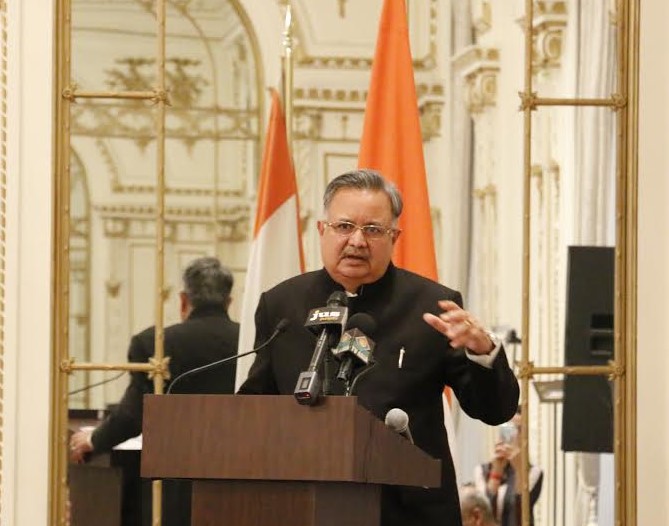
    NEW YORK CITY (TIP): Every time he comes to the US, he ‘takes home something new.’ On his third US tour, Chief Minister of Chhattisgarh, Dr Raman Singh wooed investors to invest in new sectors, highlighting the tremendous potential across those sectors in the state that has been declared as the ‘Best fiscally managed State’ by Reserve Bank of India. Singh, currently on an official tour of the US, highlighted investment opportunities in Chhattisgarh in front of a gathering at the Indian Consulate, New York on November 29. Senior state government officials accompanied him at the interactive luncheon event, jointly hosted by US India Business Council (USIBC) and the Consulate.

    In his welcome address, Subodh Kumar Singh, Secretary to Chief Minister and Commerce & Industries, described how some of the key initiatives under Raman Singh’s leadership including railway network, industrial infrastructure and smart cities in Chhattisgarh has become the main driver of growth and development in the State. He also briefed the audience about the priority industries for investment – food processing, energy, life sciences, defense, information technology, electronics, and manufacturing.

    Dr Mukesh Aghi, President of USIBC in his special remark, stressed on enhanced investment partnership between US and India.

    There was a brief Power Point presentation by Vivek Dhand, Chief Secretary of Chhattisgarh, that highlighted recently implemented reforms including single window system, tax reforms, construction permits, environment & labor reforms, inspection reforms and commercial dispute and paperless courts. Given that the state came into existence only 16 years ago, he took the opportunity to mention that the World Bank has recently ranked Chhattisgarh fourth in Ease of Doing Business as per Ranking 2016 among all Indian states and Union Territories.

    While giving introduction of Dr Raman Singh, the longest ever serving Chief Minister from BJP, Deputy Consul General Dr Manoj Kumar Mohapatra said, “Indo-US relationship is measured by number of visits. In the last two years Prime Minister Modi and President Obama met more than 12 times. That shows the defining partnership.”

    Describing Chhattisgarh as ‘Heart of India’, the Chief Minister said, “I just want to tell you what it was 16 years back and what it is today.” Mentioning the reforms and policies undertaken during his tenure that has made the state a frontrunner in ease of doing business, Dr Singh said, “Chhattisgarh is the best destination for investment not just in the core sectors of mines and minerals but also in areas like IT, engineering and solar energy.”

    Noting that investors may not be fully aware of the investment opportunities in the young, not so known resource-rich state, Dr Singh invited investors to visit Chhattisgarh to see the investment potential of the state. “Come, see, and then invest.”

    A token of appreciation was presented to him by Dr Mukesh Aghi, followed by a Q&A session.

    During the brief Q & A session, Prof. Indrajit S Saluja asked the chief minister to clarify on the allegation of a Rs. 36000 crore scam in the public distribution system in the State. Dr. Singh categorically denied there was any scam. He said it was a conspiracy. 60 lakh families benefitted from the scheme and nobody complained. “Our PDS model is unique. So far, no other state could follow that model”, Mr. Singh said.


    Later, speaking with The Indian Panorama Chief Editor I S Saluja, in an exclusive interview, Dr Singh appealed to the NRIs to invest in Chhattisgarh. “Our state is the destination for investment. You will get all facilities there. The infrastructure is top class. I want investments in sectors like IT, engineering and solar energy. I am sure if they (NRIs) visit the state they will be convinced to invest. So, I want them to visit (Chhattisgarh).”

    When asked if he wants to invite the media to visit Chhattisgarh so that they can project the bright side of the state, Dr Singh said, “Of course. I would invite my media friends here to visit Chhattisgarh. Every year in the first week of November we organize special event to showcase the development activities of our state. I will invite the media from US to come and have a fair idea about our activities.”

    Dr Singh also said that he will ask his officials to be in direct touch with the ethnic media in US for a closer relationship to help boost the image of his state.

  • Portuguese PM to Be Chief Guest at Pravasi Bharatiya Divas

    Portuguese PM to Be Chief Guest at Pravasi Bharatiya Divas

    NEW DELHI (TIP) — Portuguese Prime Minister Antonio Costa will be the chief guest at next year’s Pravasi Bharatiya Divas, the foremost conclave of the Indian diaspora, it was announced Nov. 21.

    “Antonio Costa, Prime Minister of the Republic of Portugal, has accepted an invitation from Prime Minister Narendra Modi, to be the chief guest at the 14th Pravasi Bharatiya Divas Convention to be held from January 7 to 9, 2017, in Bengaluru,” the External Affairs Ministry said in a statement.

    “He will participate in the inaugural session of the PBD convention on January 8 and address the delegates,” it stated.

    Costa, born in 1961 in Lisbon, is the son of writer Orlando da Costa, who was of Goan, Portuguese, and French descent. His mother was Maria Antonia Palla, a Portuguese journalist.

    Costa took charge as prime minister in November last year, creating media headlines in India.

    The ministry statement also said that 36-year-old Michael Ashwin Satyandre Adhin, vice president of the South American nation of Suriname, will be the special guest at the Youth PBD to be held on Jan. 7 in Bengaluru.

    “He will address the young overseas Indian delegates at the inaugural session of the Youth PBD, along with Minister of External Affairs Sushma Swaraj and Minister of State for Youth Affairs and Sports Vijay Goel,” the statement added.

    According to the Indian embassy in Paramaribo, over 230,000 people of Indian origin hailing from Uttar Pradesh and Bihar, and some 50 Sindhi families live in Suriname.

  • India Offers Rs 15 lakh each for young techno innovators

    India Offers Rs 15 lakh each for young techno innovators

    New Delhi, Nov 22 : Have an innovative idea for a device that could provide solution to a medical issue? Then you stand to win a grant of Rs 15 lakh!

    To promote cost-effective innovations in the field of medicine and biotechnology, a government collaboration is awarding several grants worth 15 lakh rupees each to young innovators who can come with solutions to many day-to-day problems.

    Students from school level up to the doctoral level and grass-root innovators can apply for SRISTI-BIRAC GYTI awards by December 30, 2016.

    Winners will be awarded at the Festival of Innovations at Rashtrapati Bhavan in March, 2017.

    The competition is being organised by Biotechnology Industry Research Assistance Council (BIRAC), a government of India enterprise, and Society for Research and Initiatives for Sustainable Technologies and Institutions (SRISTI) to promote frugal innovations in the field of medicine and biotechnology.

    “Fifteen students will get a grant of 15 lakh rupees each for development of the idea or a prototype related to medical or biotechnology field,” Professor Anil K Gupta, President Sristi, told PTI.

    “In addition to this, 100 grass-root innovators will get one lakh rupees each for value addition at different labs,” Gupta said.

    Terming lab innovations and grass-root innovations equally important to create a healthy nation, Dr Renu Swarup, Managing Director, BIRAC said, “India, being a developing nation has problems, which are specific to our country.”

    “Solutions that work pretty well in other parts of the world may not always be the best for us. Medical innovation is expected to come up with feasible solutions for such Indian problems,” Swarup said.

    “Devices, Diagnostics, drugs and vaccines, all require medical innovation equally,” she said.

  • Alex Counts is the new president and CEO of American India Foundation

    Alex Counts is the new president and CEO of American India Foundation

    NEW YORK (TIP): Alex Counts has been named as AIF’s next President and Chief Executive Officer, effective March 29. Courts worked extensively in microfinance and poverty reduction and will continue to build and scale AIF’s presence by leveraging its strong spectrum and networks as well as ensuring that AIF stays at the cutting-edge of innovative solutions for poverty alleviation and economic development in India, said a statement made available to The Indian Panorama by AIF

    After training under Nobel Laureate Muhammad Yunus, the founder and managing director of Grameen Bank, Counts became president and CEO of Grameen Foundation in 1997 where he leveraged a $6,000 seed grant to grow Grameen Foundation to a global leader in international development with a $20 million annual budget.

    Counts’ thought leadership in the field include the award-winning book, Small Loans, Big Dreams: How Nobel Prize Winner Muhammad Yunus and Microfinance Are Changing the World and Voices From the Field, and numerous contributions to The Washington Post, the International Herald Tribune, the Stanford Social Innovation Review, and many more.

    “Alex is a highly regarded development leader who built one of the most successful international humanitarian organizations in the world,” said co-founder of AIF and Co-Chair Lata Krishnan. “He not only has the management experience, passion and drive, but also deep experience in India and South Asia to create the strongest development programs in India.”

    “I am honored to have been selected to lead AIF in its next phase of growth. The achievements and capabilities of this organization are remarkable,” said Counts. “I look forward to leading the team to build on its impressive achievements and become an even more impactful, respected, and resilient organization that disrupts poverty and accelerates poverty reduction in exciting and innovative ways.”

    Counts succeeds M.A. Ravi Kumar, who joined AIF as CEO in September 2012, and led the company through a significant growth trajectory.

    “I’m proud of the AIF team and I’m optimistic about how we will build on a foundation of innovation to succeed in the future,” Kumar said. “It’s been an honor to have led such dedicated teammates for more than three years, and I am deeply thankful to the Board, Trustees, Chapter leaders, volunteers and all supporters and well-wishers.”

    “Alex is a rare professional who combines the drive of a social entrepreneur with the intellect of an academic. We look forward to working closely with Alex to innovate, build and scale AIF across India in the years to come,” remarked AIF Co-Chair Ajay Banga.

  • Indian-American Leader recommends investment in Philanthropy

    Indian-American Leader recommends investment in Philanthropy

    WASHINGTON (TIP): Citing the example of American India Foundation (AIF), dedicated to catalyzing social and economic change in India, an Indian-American business and philanthropy leader has advised donors to treat philanthropy as an investment.

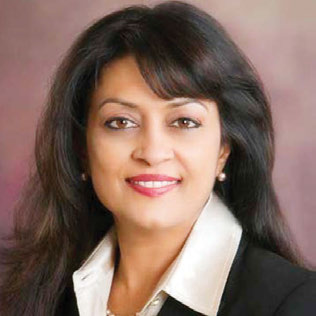
    If one wants to do philanthropy “properly,” one has “to treat it like an investment requiring thorough due diligence and regular goals and metrics tracking and assessment,” AIF Chair Lata Krishnan said in Washington at an event over the weekend.

    AIF has more than 200 people in India who “source and screen” projects, monitor them while they are being implemented and deliver values to “investors,” she said delivering the second American Bazaar Philanthropy Lecture.

    The essence of philanthropy is listening to those in need, she said. “It isn’t about what we want to get done,” said Ms Krishnan. “It is about those who are underprivileged and in need;(and finding out) what do they want, and how can we best deliver that.”

    Ms Krishnan, who co-founded two enormously successful companies with her husband Ajay Shah, stressed the need for bringing business-oriented values to philanthropy, which, she said, is one of the two core things AIF focuses on.

    Ms Krishnan and Mr. Shah along with a friend, bootstrapped SMART Modular Technologies “with only $110,000 in angel funding” in the early 1990s. By 1995, when the duo took the company public, the firm had more than $1 billion in revenue. They sold the company in 2002.

    Currently, she is the chief financial officer of Shah Capital Partners, which invests in technology companies.

    Earlier Ms Krishnan was introduced by US Assistant Secretary for Commerce for Global Markets, Arun M Kumar, one of the highest ranking Indian Americans in the Obama administration.

    “She has pursued with the American India Foundation, a model, a concept of how the diaspora can support development in India in a very organized and professional way,” he said.

    The philanthropy lecture was part of the second American Bazaar Philanthropy Dialogue, whose mission is to bring together stakeholders in the Indian American and South Asian American Philanthropy community.

    The organizations represented included Sehgal Foundation, AIF, Pratham, Ekal Vidyalaya, Global Wheels Foundation, and Association of Indian Muslims, among others.

    Besides Indian American entrepreneur and philanthropist Frank Islam, who was presented the American Bazaar Philanthropy award, the Dialogue also honored three young philanthropists from the South Asian American community.

    They were: Shreya Bhatia, a 17-year-old senior at Thomas Jefferson High School for Science and Technology in Fairfax, Neev Saraf, an 8-year-old from Laurel, Maryland, and Swetha Prabhakaran, of Ashburn, Virginia.

    Ms Bhatia raised $7,000 for the Insight Memory Care Centre, a Fairfax facility dedicated to providing care, support and education to individuals afflicted with the Alzheimer’s disease.

    Saraf raised nearly $40,000 for the Nepal earthquake victims earlier this year.

    Prabhakaran, a 15-year-old junior at Thomas Jefferson, is the founder and CEO of Everybody Code Now! a non-profit working to empower the next generation of youth to become engineers.

  • Philanthropist Frank Islam asks Indian Americans to Invest in Education in India

    Philanthropist Frank Islam asks Indian Americans to Invest in Education in India

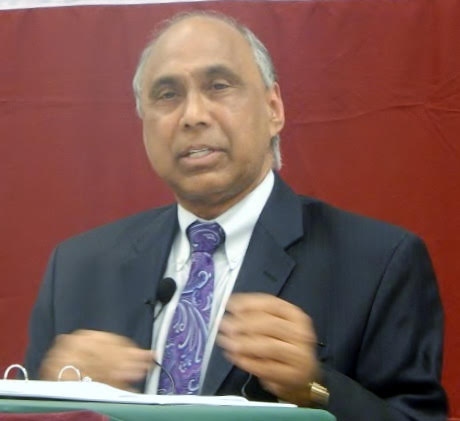
    Entrepreneur and philanthropist Frank Islam would like fellow Indian-Americans to make a strategic investment in education in India as it is the great equalizer and opportunity creator.

    “Supporting educational institutions is one of our highest priorities because education is the key to opportunity and the bridge to the future,” he said during the Second American Bazaar Philanthropy Dialogue and Dinner, organised by an ethnic publication here.

    Dozens of prominent philanthropists, nonprofits, stakeholders and leaders from the South Asian and Indian American philanthropic community attended the dialogue to brainstorm giving.

    Lata Krishnan chair of the American India Foundation delivered the 2nd American Bazaar Philanthropy lecture.

    “While education is important in America, the needs are even greater in India and that is why I am supporting initiatives in India,” Islam said.

    “My intent is to use education as a tool to improve the socio-economic status of the underprivileged in India. My desire is those who benefit will in turn contribute towards social, political, and economic development in India,” he added.

    Azamgarh, Uttar Pradesh, born Islam, has announced a $2 million donation to his alma mater, Aligarh Muslim University, which “shaped my history and my journey and determined my destiny,” for building the Frank and Debbie Islam School of Management.

    The school, Islam said will place emphasis on entrepreneurship and preparing the students at AMU to become entrepreneurial leaders and engage in economic development activities that will create jobs and opportunities for thousands of people throughout India.

    “We see our contribution not as a charity but as an investment that will yield exponential returns,” he said.

    “We not only support AMU, but also give to other educational institutions as well here in US and in India,” said Islam who was presented the American Philanthropy award for his pioneering efforts in the fields of education arts and culture.

    Receiving the award from Arun M. Kumar, US Assistant Secretary of Commerce for Global Markets, Islam told fellow Indian-Americans that they had done well in the US and now it was their turn to do good in India.

    “Let us together change the face of India. One family, one village and one life at a time,” he said. “Let us extend our hope, our help, and our hand so that we can together change the face of the world.”

    Apart from AMU, Islam has made major gifts and supported scholarships at his alma mater in the US, the University of Colorado at Boulder and his wife Debbie Driesman’s alma mater in Canada, Western University among others.

    Underlining the importance of strategic philanthropy, Islam said: “I invest in education and promotion of the arts because these are two of those critical areas. I refer them as pivot points -areas that can be leveraged to build a bigger and better future for all.”

    “Education is a pivot point because it is the great equaliser and opportunity creator,” he said. “Art is also a pivot point because it educates and advances social causes. Art and culture transcend all boundaries.”

    Islam has also given $1 million to the US Institute of Peace, an organization devoted to nonviolent prevention and mitigation of conflict around the globe, “because it’s very much engaged in curbing violent extremism.”

    “In addition they are engaged to make the transition to peaceful and stable democracy,” he said.

  • USAID Woos Indian American Investors for Diaspora Investment Initiative

    USAID Woos Indian American Investors for Diaspora Investment Initiative

    SAN FRANCISCO (TIP): The India Diaspora Investment Initiative, a unique program President Barack Obama unveiled during his visit to India for the Republic Day celebrations, is seeking investment from Indian American and other investors to support sustainable development in India.

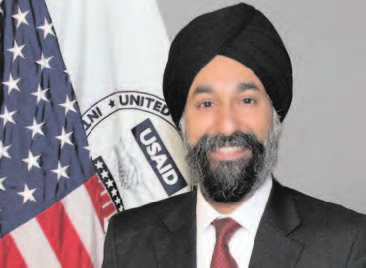
    In an interview to the media here Manpreet Singh Anand, deputy assistant administrator in the Asia bureau of the U.S. Agency for International Development, said that it is the first time an initiative earmarked for a specific diaspora community in the U.S. has been launched by USAID.

    If it is successful, he added, it could be a model for the agency in other countries.

    “It is a new model for development,” Anand said. “It is a more efficient use of resources to leverage innovation through the private sector.” USAID staff has been working on the initiative for about a year, he added.

    India was not a random choice for the initiative.

    USAID said in a fact sheet that there are three factors why India was selected: “An increased desire on the part of Indian Americans to make a development impact in their home country; a strengthened diaspora connection to India after the election of Prime Minister Narendra Modi; and a strong demand from Indian social businesses seeking debt capital to scale up their programs targeting ‘Base of the Pyramid’ populations.”

    USAID, working with a partner – Bethesda, Md.-based Calvert Foundation, a nonprofit with experience in offering “Community Investment Notes” for sustainable development – plans to mobilize at least $50 million in debt financing from private sector financial sector institutions in India and abroad over the next 18 months.

    USAID will provide “up to a 50% credit guarantee” to three non-bank finance companies (Caspian Impact Advisors, Intellegrow and Gramen Impact India) and two Indian banks (YES Bank and Ratanakar Bank), who make the loans to small- and medium-sized enterprises in India.

    Anand pointed out that without USAID’s credit guarantee, the barriers for Indian SMEs to get the loans “would be almost impossible to overcome.” “We want the Indian diaspora to become engaged and stay engaged,” he added.

    It works like this: Investors – Indian Americans or those wanting to support sustainable development in India – purchase a Calvert Foundation Investment Note. Investors can receive fixed interest payments every six months and select investment tenors from one, three, five, seven and even 10 years.

    The notes will be available later this year, Anand said. USAID is negotiating on terms of the loan credit guarantees with all five partners.

    Calvert will make the loans to the Indian NBFCs and banks, which invest in social projects in healthcare, small businesses, education, agriculture, renewable energy, and other priority areas for India. USAID provides its 50% loan guarantee.

    “Our new Indian Diaspora Investment Initiative will allow folks back home to generate a new stream of financing for Indian businesses that are investing in non-traditional, and too often overlooked, markets – from providing healthcare to rural communities, to improving water and sanitation, to opening up those new bank accounts,” Obama told the U.S.-India Business Summit in New Delhi Jan. 26.

    USAID Administrator Rajiv Shah, who in February left the agency, said in India in January, “We’ll match the diaspora community’s immense passion and resources to the small businesses that form the backbone of India’s economy.”

    “By creating a transparent investment vehicle, any investor can contribute to sustainable, social businesses that create jobs and train a new generation of local entrepreneurs.”

    USAID’s annual funding to India -negotiated between the Obama administration and Congress – is currently “just short of $100 million a year,” Anand sadi.

    It is the Indian American’s second stint at the agency. Previously, he was a presidential management fellow in the Office of the Global Development Alliance.

    He also worked as a senior policy advisor on geopolitical and socioeconomic issues at Chevron Corp., was a senior policy advisor for South and Central Asia issues on the U.S. House Committee on Foreign Affairs, and served in the Office of the U.S. Trade Representative.

    Married to a physician, Anand has an MBA and an M.A. in international studies from U.C.-Berkeley and a B.S. in electrical engineering from the University of Texas at Austin.

    Another significant program announced by USAID during Obama’s visit was support of Modi’s Jan Dhan initiative to prioritize financial inclusion for all Indian citizens.

    USAID is partnering with over 20 U.S., Indian and international private sector organizations and the World Economic Forum to extend the ability for Indian consumers and businesses to participate in the formal economy.

    “More than 110 million people have signed up in India (under Jan Dhan) for bank accounts in the last few months,” said Anand, who accompanied Shah and Obama on the India trip in January. “It will really empower consumers in India when they can use cards instead of cash.”

    USAID said that currently only six percent of retail enterprises in India can accept digital payments.

    One particular area of focus for USAID in India is reducing child mortality rates. “India constitutes 24 percent of the preventable under-five deaths in the world,” Anand said. “There’s a lot we can and are doing (to reduce child mortality rates) in India.”

    Last year USAID formed the U.S. Global Development Lab within the agency to leverage science and technology advancements for public-private partnerships around the world, Anand said.

    Experts from Google and other technology companies are forming a think-tank within the agency to work with NGOs to solve some of the most pressing social problems around the world.

    For more information on the Diaspora Investment Note, visit:
    http://www.calvertfoundation.org/india.

  • INDIA’S RELATIONS WITH THE US MUST NOT BE ONE-SIDED

    INDIA’S RELATIONS WITH THE US MUST NOT BE ONE-SIDED

    ‘It is in the interest of both sides that the visit is seen as being successful. Both sides have invested considerable political capital in it…….This rapid exchange of visits and the decisions taken have to be justified, beyond the symbolism, which is no doubt important in itself. This opportunity to impart a fresh momentum to ties should not be missed………. What we need is a pragmatic approach by both sides. On the side this is assured by Modi. He has shown that he is essentially pragmatic. The only principle he is attached to is India First”, says the author. 


    Prime Minister Narendra Modi’s ready acceptance of United States President Barack Obama’s invitation to visit Washington in September 2014 came as a surprise against the background of the visa denial humiliation heaped on him for nine years.


    Modi’s invitation to Obama to visit India as chief guest at our 2015 Republic day celebrations came as an equal surprise, as did Obama’s acceptance at such short notice.


    The messaging from both sides is clear. Modi wants to give a fresh impetus to the India-US relationship, seen as languishing for some time now. Obama has conveyed that he is ready to respond.


    Now that Obama is coming and the two sides want to reinvigorate the relationship, the outcome of the visit will be watched closely not only in India and the US, but internationally too.


    To look ahead, we should look backwards a little bit so that the potential for the future can be seen through a better understanding of the past.


    There are no instant solutions to the issues in India-US relations. The US demands in many cases require policy, legislative and administrative responses by India, not to mention care by us that a balance in our external relations is maintained.


    Obama had said during his visit to India in 2009 that he saw the India-US relations as potentially a ‘defining partnership of the 21st century.’ It is very hard to define what a defining partnership is, but what he meant presumably is that relations between the oldest and the largest democracy, between the world’s foremost economic power and, in time, the third biggest economy will define the contours of international relations in the decades ahead.


    Our leaders say that India and the US are natural partners. This is not borne out objectively by the history of the relationship, the differences that currently exist on a whole host of issues and the inherently unequal nature of the relationship.


    The US is the world’s only superpower with global interests whose contradictory pulls and pressures they have to manage even in our region, and we are not even a credible regional power yet.


    If the argument is that it is the shared values of democracy, pluralism and respect for human rights make us natural partners, then the US relationship with Pakistan and China — often at our cost — which are not democracies, has to be explained. US interests often take precedence over its declared values.


    Even if rhetoric does not measure up to realities, the fact remains that improvement of India-US ties has been the most important development in India’s external relations in the last decade.


    It is the 2005 nuclear deal that opened the doors to a transformative change in bilateral ties. Reflecting the new intensity of bilateral engagement, about 28 dialogues were set up between the two sides covering the fields of energy, health, education, development, S&T, trade, defence, counter-terrorism, nonproliferation, high technology, innovation etc.


    The US now supports India’s permanent membership of the UN Security Council in principle. It is backing India’s membership of the four international export control organisations — the Nuclear Suppliers Group, the Missile Technology Control Regime, the Wassenaar Arrangement and the Australia Group.


    Trade in goods and services between the two countries has grown to almost $100 billion (about Rs 620,000 crore).


    A big breakthrough has been made in defence. In the last five or six years the US has bagged defence orders worth about $10 billion (about Rs 62,000 crore). These include C-130, C-17 and P-80 I aircraft and heavy lift, attack and VIP helicopters. The US has emerged as the biggest supplier of arms to India in this period.


    The US has proposed joint manufacture of several defence items in India under its Defence Trade and Technology Initiative. While India has overcome its mistrust of the US and fears that at critical moments the US may cut off spares for its equipment as part of its liberally used sanctions instrument, India has been reticent in its response to the DTTI, possibly because it is still not convinced that the US will transfer the technologies that India would want or not tag unacceptable conditions to it.


    The US proposed at one time three ‘foundational’ agreements covering the areas of logistics, interoperability and access to high technology equipment, but India has been cautious, presumably because it was concerned about slipping into the US defence orbit and losing its autonomy.


    To balance this, India and the US have been conducting a large number of military exercises, far more than with any other country. The naval exercises in the Indian Ocean to protect the sea lanes of communication are particularly important because of their geopolitical implications. Trilateral India-US-Japan naval exercises have obvious significance.


    In Obama’s second term, however, the ties lost momentum for various reasons. Economic reforms in India slowed down, its growth rates fell, India was seen as reluctant to deepen the strategic partnership, it was lukewarm to the US pivot towards Asia, US nuclear firms saw their business opportunities in India blocked because of our Nuclear Liability Act, major US corporations began campaigning against India’s trade, investment and intellectual property rights policies in the US Congress and instigated investigations into them by the US International Trade Commission and the US Trade Representative.


    The US began criticising India for being a fence sitter, a free-loader on the international system because of its reluctance to uphold it even at the cost of its interests as other Western powers were supposedly doing. This was the sense of the ‘burden sharing’ demand of the US.


    India had its own complaints against the US regarding the implications of the new US immigration legislation for India’s IT industry, the movement of its professionals, the increase in cost of H1B and L1 visas, the totalisation agreement and outsourcing.


    During his Washington visit, Modi struck an unexpectedly good rapport with Obama who accompanied him personally to the Martin Luther King Jr Memorial and later in Myanmar described him as a ‘man of action.’


    Modi clearly signalled during the visit that he intends to reinvigorate bilateral ties and that he views them as vital for his development agenda at home.


    The joint press conference by the two leaders and their joint statement set an ambitious agenda, with many positives, if all goes according to plan.


    The two leaders agreed to increase the bilateral trade five-fold to $500 billion (about Rs 36 lakh crore).


    Modi asked publicly for more openness and ease of access to the US market for Indian IT companies, even if Obama failed to give any response.


    In order to raise investment by institutional investors and corporate entities, it was agreed to establish an Indo-US Investment Initiative led by India’s finance ministry and the US department of treasury, with special focus on capital market development and financing of infrastructure.


    It was also agreed to establish an Infrastructure Collaboration Platform convened by the ministry of finance and the US department of commerce to enhance participation of US companies in infrastructure projects in India.


    Modi invited the US to send two trade missions to India in 2015 focused on India’s infrastructure needs with US technology and services.


    It was decided to activate the Trade Policy Forum that had not been convened for a long time. An empowered annual working group was approved for addressing IPR issues and it was agreed to set up a contact group for implementing the India-US civil nuclear deal.


    US involvement was sought in the railways sector and in smart city projects (Ajmer, Visakhapatnam and Allahabad).


    It was also agreed that USAID will serve as knowledge partner to support Modi’s 500 Cities National Urban Development Mission and Clean India Campaign.


    Obama offered to reinvigorate the higher education dialogue, which has languished. He welcomed India’s proposal to establish the Global Initiative of Academic Networks under which India would invite and host up to 1,000 American academics each year to teach in centrally-recognised Indian universities, at their convenience.


    The decisions and understandings reflected in the joint statement on the energy front are potentially problematic as they could give the US more handle to put pressure on India on climate change issues.


    Both leaders expressed their commitment to work towards a successful outcome in Paris in 2015 of the conference of the UN Framework Convention on Climate Change, including the creation of a new global agreement on climate change.


    The two leaders, in recognition of the critical importance of reducing greenhouse gas emissions and improving resilience in the face of climate change, agreed to ‘a new and enhanced strategic partnership’ on energy security, clean energy, and climate change, to further which a new US-India Climate Fellowship Programme to build long-term capacity to address climate change-related issues in both countries was launched.


    A MoU was concluded between the Export-Import Bank and the Indian Renewable Energy Development Agency, which would make up to $1 billion (about Rs 6,200 core) in financing available to bolster India’s transition to a low-carbon and climate-resilient energy economy, while boosting US renewable energy exports to India.


    Modi and Obama stated their intention to expand defence cooperation to bolster national, regional, and global security. This broad-based formulation has important geopolitical implications. They agreed to renew for ten more years the 2005 Framework for the US-India Defence Relationship with plans for more ambitious programs and activities.


    They welcomed the first meeting under the framework of the DTTI in September 2014 and its decision to establish a task force to expeditiously evaluate and decide on unique projects and technologies for enhancing India’s defence industry and military capabilities.


    To intensify cooperation in maritime security, the two sides considered enhancing technology partnerships for India’s Navy, besides upgrading their existing bilateral exercise Malabar.


    They committed to pursue provision of US-made mine-resistanta ambush-protected vehicles to India.


    On terrorism, they stressed the need for dismantling of safe havens for terrorist and criminal networks, to disrupt all financial and tactical support for networks such as Al Qaeda, Lashkar-e-Tayiba, Jaish-e-Mohammad, the D-Company, and the Haqqani Network.


    The two countries also expressed the intention to start a new dialogue on space situational awareness.


    Obama affirmed that India met MTCR requirements and was ready for NSG membership. Noting India’s ‘Act East’ policy and the United States’ rebalance to Asia, the leaders committed to work more closely with other Asia Pacific countries through consultations, dialogues, and joint exercises. They underlined the importance of their trilateral dialogue with Japan and decided to explore holding this dialogue among their foreign ministers.


    Modi spoke of great convergence on the issue of peace and stability in Asia-Pacific and more joint exercises with Asia-Pacific countries.


    Very significantly, he stated that the US was intrinsic to India’s Look East and Link West policies, according thus a central role for the US in India’s foreign policy.


    They agreed to continue close consultations and cooperation in support of Afghanistan’s future.


    The principal points agreed during Modi’s visit will serve as a guide to what can be realistically achieved during Obama’s visit. To assess that, we should take into account some limitations and negatives that mark the India-US relationship.


    Already, what was agreed to is mostly not capable of quick implementation or rapid results. These are largely medium term objectives and not always clear in implications. In the course of implementation, many issues will provoke internal political debates, will require detailed processing and negotiations, parliamentary approval and intensive diplomatic effort on the international front by both parties. In some cases real differences have been glossed over by use of diplomatic language.


    On IPR issues it will not be easy to reconcile US demands on IPRs and our position that our IPR policies are in conformity with the World Trade Organisation’s Trade-Related Aspects of Intellectual Property Rights agreement. Legal issues involving our courts are involved.


    The USTR decided to put unilateral pressure on India by investigating India’s IPR policies under Section 301, but this has been halted in November 2014 in view of some forward looking announcements by the Modi government. The USTR’s ‘cautiously optimistic’ statements during his Delhi visit in November suggest that the US will wait and watch what the Modi government actually delivers.


    The US Congress has extended the investigation of India’s investment, trade and IPR policies by the USITC by another year.


    On climate change issues, under cover of its ‘political’ agreement with China, the US seems determined to put pressure on India to agree to some reduction commitments. In actual fact, this is political pressure unrelated to the merits of India’s case. Climate change is a multilateral issue, but the US is making it a bilateral one, with the commercial interests of its companies in mind.


    While the US claims that what it is offering under the DTTI has the green light from all those in the US who control technology exports, it can be doubted whether the US will be as liberal in transfer of technologies as it would have us believe. The US record in this regard with even its allies and partners is not inspiring.


    The US has shown no activism in pushing for India’s membership of NSG or MTCR as a start. It is to be hoped that it is not looking


    for a resolution of the nuclear liability issue and the finalisation of the vexed question of ‘administrative arrangements’ that is needed to complete the India-US nuclear deal before


    it does the heavy lifting again to promote India’s membership of the cartels in question.


    Surprisingly, the list of terror organisations against whom US and India have agreed to work together excludes the Taliban, pointing to a crucial difference between the two countries on the issue of accommodating this extremist force with its close Pakistani links into the power structure in Afghanistan.


    In reaching out to the Taliban the US gives priority to orderly withdrawal of its forces from Afghanistan, treating India’s concerns as secondary. The language on Afghanistan in the Modi-Obama joint statement in Washington was remarkably perfunctory.


    Worse, the US wants to retain complete freedom of action in dealing with Pakistan, irrespective of India’s concerns about its continuing military aid to that country. General Raheel Sharif, the Pakistani army chief, was accorded high level treatment during his recent visit to the US, meeting Secretary John Kerry who indirectly endorsed the role of the Pakistani army in nation building and politics by terming it as a truly binding force.


    It is worth recalling that after accepting the invitation to visit India, Obama felt diplomatically obliged to phone Premier Nawaz Sharif to say he could not visit Pakistan now and would do so later.


    The US involvement in developing our inadequate infrastructure — our ports, airports, railways highways etc — seems unrealistic as its companies are hardly likely stand up to international competition in India.


    As regards our nuclear liability legislation, it appears that the US government may be moving away from its fundamentalist position that supplier liability cannot be accepted and may be open to some practical solution to the issue in terms of limiting the liability in time and costs. The lawyers at Westinghouse and General Electric will, of course, have to be convinced.


    This is a highly charged issue politically and it is doubtful whether the decks can be cleared before Obama’s visit. The larger question of the economic viability of US-supplied nuclear power plants remains, not to mention the fact that GE does not have as yet a certified reactor.


    Work on a bilateral investment treaty will take time It appears that our side wants to be able to announce a couple of projects under the DTTI during Obama’s visit. In this connection anti-tank missiles, naval guns, pilotless aircraft and magnetic catapult for our aircraft carrier are being mentioned as possibilities.


    The US would want at least one project to be announced. Defence Minister Manohar Parrikar has let it be known publicly that US proposals are being seriously examined.


    The announcement of a more ambitious Defence Cooperation Framework Agreement valid for another 10 years is a certainty.


    The government’s decision on the GST, raising the FDI ceiling in insurance, the amendment to the land acquisition law are advance signals of its commitment to reform and attracting FDI, which is a positive from the US point of view.


    The emphasis on Make in India and developing India’s manufacturing sector, coupled with a commitment to ease doing business in India, have begun to change investor sentiment towards India, and this creates a better atmosphere for Obama’s visit.


    It is in the interest of both sides that the US President’s visit is seen as being successful. Both sides have invested considerable political capital in it.


    This rapid exchange of visits between the two leaders, leaving little time to process the decisions taken in Washington in September, has to be justified, beyond the symbolism, which is no doubt important in itself. This opportunity to impart a fresh momentum to ties should not be missed.


    But there is need also to be clear-headed about the relationship that is not easy to manage given US power, expectations, impatience and constant endeavour to do things the way it wants.


    It is a bit disturbing that an atmosphere has been created in which the focus is on what we can do for the US and Obama and not what the US must do to meet our needs and concerns. The agenda has become one-sided.


    The US should not expect India to support all its demands and polices, however questionable. India does not have to prove it is a responsible country by supporting even irresponsible US policies. Of course, India too should not expect the US to always adjust its policies to suit us.


    What we need is a pragmatic approach by both sides. On the side this is assured by Modi. He has shown that he is essentially pragmatic. The only principle he is attached to is India First.


    (By Kanwal Sibal who is a former Foreign Secretary of India)
    (British English)

  • IACC organizes Roundtable on Corporate governance development in India

    IACC organizes Roundtable on Corporate governance development in India

    NEW YORK CITY (TIP): “The Chamber of Commerce tries to make the right things happen. What needs to happen in India is the growth of corporations that take their corporate governance seriously, so that the shareholder value is unlocked. It’s our duty to push for better corporate governance in India,” said Rajiv Khanna, President of the Chamber and Equity Partner of Seyfarth Shaw, in his opening remarks to the members of the Chamber.

    “The Indian government has introduced several measures to improve the corporate governance environment in India, including a completely revamped Companies Act and revised corporate governance guidelines. Several other bills are under various stages of consideration which would bring corporate governance norms in India at par with any developed economy. The government of Prime Minister Modi has clearly emphasized its resolve towards improving the corporate governance practices in India,” said Rajiv Khanna, as he welcomed the guest speaker. Sandeep Baldava, partner at Ernst & Young, India, started by thanking the Chamber for hosting a very important discussion, and spelled out the latest changes in corporate governance standards in India.


    11
    India-America Chamber of Commerce hosted a roundtable on corporate governance development in India. President of the Chamber and Equity Partner of Seyfarth Shaw, Rajiv Khanna made the opening remarks . “The Chamber of Commerce tries to make the right things happen. What needs to happen in India is the growth of corporations that take their corporate governance seriously, so that the shareholder value is unlocked. It’s our duty to push for better corporate governance in India”. Seen in the picture, from L to R: Sherry Wang who moderated, Rajiv Khanna who presided and Sandeep Baldava, the guest speaker

    Sandeep addressed, among others, the following issues during the Q&A:

    1. What will the Indian government do to change the problem of concentrated ownership and family rule in India?
    In the new Act, if a single promoter, including the government, has more than 75% of the shares, it needs to offload such access. It helps bring transparency and promote public participation. It also specifies more responsibility for independent directors, which needs to beat least 50% of the board.

    2. What are the major changes of the new Act?
    On the governance side, more responsibilities and clearer management; on the auditor side, monitoring of auditor rotation, more detailed fraud reports, more standardized procedures and budget. In all, 262 sections have been modified.


    13
    A view of the participants

    3. What will the government do to improve the implementation of the reform?
    The reform on paper is the first step in the right direction. For implementation, the new government wants to improve the legal system. It needs further steps, but the first step hasbeen taken.

    4. What does law say about insider trading in India?
    There is no adequate process to deal with it effectively.

    5. What are the differences between India and other major economies? What are the gaps and can they lead to future problems?
    On paper, India is on par with developed economies. Problems may come from implementation. The new government needs to strengthen the enforcement.

    6. What are the new government’s resolves to strengthen implementation?
    Different departments of India have made it clear that they are going to improve the transparency in India. The public has more access to the regulation system. The process has already started in India.

    7. India does not have forensic audits?
    We do not have a system to find out what goes wrong, only the balance sheets and signoffs.

    8. What has been implemented to let the stakeholders know what goes wrong beyond the balance sheets?
    We just launched a security center to welcome investigations from global organizations. Most of the Indian enforcement agencies are trained by the FBI and are equivalent to the FBI. The government has made an effort to introduce skill sets from their resources to detect fraud of the new age. Auditors’ responsibility has been enhanced: they are required to report all fraud.

    9. Between the Second World War and 1991, the U.S. was doing well without India. Why did you make the bold statement that no company could ignore India? Could you give five names of U.S. companies making profit after 1991?
    Microsoft, HP, IBM, Apple, Dell. To this response, Rajiv commented by saying – “It is very sad when a partner of Ernst & Young struggles to give five names of U.S. companies making money in India after 1991. You could easily name five U.S. companies that lost money in the Indian market. My point is that there are problems; the policy has gone way wrong. India overrates itself. It is all about profit.

    You cannot assume companies will come because India makes up 20% of the world population; losses from 20% of the world population can be huge losses. I hope the Modi government will change this.” Sandeep responded by saying, “we often see the negatives. There are positives, like the pharma sector and tech sector I mentioned earlier.What is happening in 10 years in India would take 30 years for markets like the U.S. . You cannot ignore India for its skill sets and man power.”

    10. The auditing process is very costly, and it may hurt the growth of small or medium size companies. Does India have a new approach in the Act to deal with this problem?
    There are mid-sized audit companies that do not cost that much. It is a question of whether the additional cost is worthwhile for a safer and more transparent business environment.

    11. What are the roles and responsibilities of the board and the independent directors?
    The new Act requires 50% of the board to be independent directors on the board. It defines who are the independent directors and the process to fulfill their responsibilities. On paper, the process is clear and at par with other major economies. Today, the challenge is how to find independent directors who are willing to come on board and serve.

    12. How does social media help the prosecution process?
    If people are coming together on social media, they can force the government to take actions.

    13. There are reports that many independent directors are ex-bureaucrats who mainly function as facilitators between government and companies, instead of monitors. So are the independent directors now really acting independently?
    The new government has made an announcement that there should be a coolingoff period between being a bureaucrat and working in a private sector. It has not been formally announced, but it would be 3 to 5 years. Today, there is no cooling-off period.

    14. The independent directors are only getting sitting fees and transportation fees. There is mismatch between the best brains and people willing to spend the time to be independent directors. Is anything being done to remove this problem?
    The Act requires significant improvement of the sitting fee. Now it is 10-15 times the fee that was paid earlier. In terms of involvement, the process is different. There are pre-board meetings and pre-audit committee meetings. They need to go through training to understand the business. They now have rights to appoint consultants and independent agencies, and the payment is supposed to be made by the company. So the power, the payment, and also the expectation from independent directors are significantly enhanced.

    15. If you had the power, what is the first thing you would do to help corporate governance?
    Align the multiple acts that companies need to comply with and implement them in spirit.

    16. Are there any indications that the new Act will be faithfully implemented or will it be just another paper tiger?
    The desire to implement is very strong in the new government. The bureaucrats are more empowered.We strongly believe it will be implemented in a very different manner, on different levels, as it goes forward. The India- America Chamber of Commerce has recorded this discussion and will be sharing it with members of the Chamber and press. The Chamber is now open for new members. For additional details on the membership applications, please contact Rajiv Khanna – rkhanna@seyfarth.com or 212.801.9268 Poonam Jain – nypoonam@gmail.com or 917 453 0953 17598419v.

    About India-America Chamber of Commerce
    The India-America Chamber of Commerce works to promotes business-to-business dialog between the business and policy leaders of India and the U.S. – the two largest democracies in the free world. The Chamber serves as a platform for open and spirited interaction among U.S. and Indian business leaders from the private and public sectors. The Chambers’ monthly meetings include keynote presentations by visiting cabinet ministers, ambassadors and other prominent business leaders from the U.S. as well as India. For additional information check www.indiaamericachamber.com

  • Market Analytics Bangalore

    Market Analytics Bangalore

    The residential market in Bangalore witnessed good activity during October – November 2013; Major Sales were concentrated in East, South and North Bangalore. New Projects were launched in South, East and North Bangalore and are priced at 10-15% below the prevailing market prices by developers such as Kushi, Pensisula, Mantri, Prestige, Shobha and Puravankara Pune-based Gera Developments has planned to venture in South India with its planned residential project of 2,000 units in Whitefield in Bangalore.

    Global investor Xander and Mantri Developers formed an equal JV for Bangalore’s largest residential township of 13 Mn.sq.ft. spread over 120 acres of land located in Hebbal, adjacent to Manyata Embassy Business Park. Raffles Residency Pvt. Ltd. (RRPL) unveiled Raffles Park in Whitefield, its first residential project development in India.

  • Ratan Tata, 8 Indian- Americans inducted in US engineering academy

    Ratan Tata, 8 Indian- Americans inducted in US engineering academy

    WASHINGTON (TIP): Leading Indian industrialist Ratan Tata has been inducted into the prestigious US National Academy of Engineering in the US for his “outstanding contributions to industrial development in India and the world”. Tata, chairman emeritus of the Tata Group, was inducted as one of 11 new foreign associates of the private, independent, nonprofit institution that provides independent advice to the US federal government on matters involving engineering and technology. Besides Tata, eight Indian- Americans were among 69 new elected members taking the total US membership to 2,250 and the number of foreign associates to 211. Addressing the annual meeting of the group on Sunday, NAE president CD Mote Jr lamented that talented engineering workforce was not being given desired priority attention in the US.

    At just four percent, the percentage of US engineering graduates among all its graduates is 1/3 of the European average (13 percent) and 1/6 of the Asian (India, Japan, China, Taiwan, South Korea, and Singapore) competitor average of 23%, he said. As part of its efforts to push its global reach, NAE has started bilateral “Frontiers of Engineering” programmes with India, Germany, Japan, China, and the EU and a new one with Brazil is scheduled for 2014, he said. The new Indian-American members are: Anant Agarwal, president, edX (online learning initiative of MIT and Harvard University) for contributions to shared-memory and multicore computer architectures. Murty P Bhavaraju, senior consultant, PJM Interconnection, Norristown, Pennsylvania for probabilistic reliability evaluation tools for large electric power systems. Ashok J Gadgil, director and senior scientist, environmental energy technologies division, Lawrence Berkeley National Laboratory for engineering solutions to the problems of potable water and energy in underdeveloped nations.

  • INDIA’S JOURNEY TO BECOMING AN ECONOMIC SUPERPOWER

    INDIA’S JOURNEY TO BECOMING AN ECONOMIC SUPERPOWER

    The economic development in India followed socialist-inspired policies for most of its independent history, including state-ownership of many sectors; India’s per capita income increased at only around 1% annualised rate in the three decades after Independence. Since the mid-1980s, India has slowly opened up its markets through economic liberalisation.

    After more fundamental reforms since 1991 and their renewal in the 2000s, India has progressed towards a free market economy. In the late 2000s, India’s growth reached 7.5%, which will double the average income in a decade. Analysts] say that if India pushed more fundamental market reforms, it could sustain the rate and even reach the government’s 2011 target of 10%. States have large responsibilities over their economies.

    The annualised 1999-2008 growth rates for Tamil Nadu (9.8), Gujarat (9.6%),Haryana (9.1%), or Delhi (8.9%) were significantly higher than for Bihar (5.1%), Uttar Pradesh (4.4%), or Madhya Pradesh (6.5%). India is the tenth-largest economy in the world and the third largest by purchasing power parity adjusted exchange rates (PPP). On per capita basis, it ranks 140th in the world or 129th by PPP. The economic growth has been driven by the expansion of services that have been growing consistently faster than other sectors.

    It is argued that the pattern of Indian development has been a specific one and that the country may be able to skip the intermediate industrialisationled phase in the transformation of its economic structure. Serious concerns have been raised about the jobless nature of the economic growth. Favourable macroeconomic performance has been a necessary but not sufficient condition for the significant reduction of poverty amongst the Indian population.

    The rate of poverty decline has not been higher in the post-reform period (since 1991). The improvements in some other non-economic dimensions of social development have been even less favourable. The most pronounced example is an exceptionally high and persistent level of child malnutrition (46% in 2005-6). The progress of economic reforms in India is followed closely. The World Bank suggests that the most important priorities are public sector reform, infrastructure, agricultural and rural development, removal of labour regulations, reforms in lagging states, and HIV/AIDS.

    [5] For 2012, India ranked 132nd in Ease of Doing Business Index, which is setback as compared with China 91st and Brazil 126th. According to Index of Economic Freedom World Ranking an annual survey on economic freedom of the nations, India ranks 123rd as compared with China and Russia which ranks 138th and 144th respectively in 2012. India ranks second worldwide in farm output.

    Agriculture and allied sectors like forestry, logging and fishing accounted for 18.6% of the GDP in 2005, employed 60% of the total workforce and despite a steady decline of its share in the GDP, is still the largest economic sector and plays a significant role in the overall socioeconomic development of India. Yields per unit area of all crops have grown since 1950, due to the special emphasis placed on agriculture in the five-year plans and steady improvements in irrigation, technology, application of modern agricultural practices and provision of agricultural credit and subsidies since the green revolution.

    India is the largest producer in the world of milk, cashew nuts, coconuts, tea, ginger, turmeric and black pepper. It also has the world’s largest cattle population (193 million). It is the second largest producer of wheat, rice, sugar, groundnut and inland fish. It is the third largest producer of tobacco. India accounts for 10% of the world fruit production with first rank in the production of banana and sapota. The required level of investment for the development of marketing, storage and cold storage infrastructure is estimated to be huge.

    The government has implemented various schemes to raise investment in marketing infrastructure. Amongst these schemes are Construction of Rural Go downs, Market Research and Information Network, and Development / Strengthening of Agricultural Marketing Infrastructure, Grading and Standardisation.

    Main problems in the agricultural sector, as listed by the World Bank, are:

  • AGRICULTURE AND RURAL DEVELOPMENT IN INDIA SINCE 1947

    AGRICULTURE AND RURAL DEVELOPMENT IN INDIA SINCE 1947

    Agriculture is the dominant sector of Indian economy, which determines the growth and sustainability. About 65 per cent of the population still relies on agriculture for employment and livelihood. India is the first in the world in the production of milk, pulses, jute and jute-like fibres; second in rice, wheat, sugarcane, groundnut, vegetables, fruits and cotton production; and is a leading producer of spices and plantation crops as well as livestock, fisheries and poultry.

    In the past few years, Indian agriculture has done remarkably well in terms of output growth. The 11th Five Year Plan (2007-12) witnessed an average annual growth of 3.6 per cent in the gross domestic product (GDP) from agriculture and allied sector. The growth target for agriculture in the 12th Five Year Plan is estimated to be 4 per cent. Indian agriculture is benefitting huge from rising external demand and the sector’s wider participation in the global economy.

    In order to boost investments in the sector, the Government of India has allowed 100 per cent foreign direct investment (FDI) under automatic route in storage and warehousing including cold storages. The government has also allowed 100 per cent FDI under the automatic route for the development of seeds. Department of Agriculture and Cooperation under the Ministry of Agriculture is the nodal organisation responsible for development of the agriculture sector in India.

    The organisation is responsible for formulation and implementation of national policies and programmes aimed at achieving rapid agricultural growth through optimum utilisation of land, water, soil and plant resources of the country. arket Dynamics Backed by policy impetus by the Government of India, the country ranks 10th in global agricultural and food exports, as per Economic Survey 2012-13. Agriculture accounts for about 10 per cent of the total export earnings and provides raw material to a large number of industries.

    “Exports of agricultural products are expected to cross US$ 22 billion mark by 2014 and account for 5 per cent of the world’s agriculture exports,” according to the Agricultural and Processed Food Products Export Development Authority (APEDA). Total exports of Indian agri and processed food products from April 2012 to February 2013 stood at Rs 11,254,275.51 lakh (US$ 20.74 billion) as compared to Rs 7,186,784.33 lakh (US$ 13.24 billion) during the same period last year, according to the data provided by APEDA.

    As of March 1, 2013, India has wheat stocks of around 27.1 million tonnes (MT), as against a requirement of mere 7 MT, while total food grains stocks in the central pool (including rice) is estimated to be almost 63 MT, as against a requirement of 21.2 MT. Wheat exports from India are expected to grow by 23 per cent to 8 MT in the financial year 2013-14, on the back of strong global prices and surplus domestic supply. Exports of rice are also expected to cross 10 MT from 7.3 MT during previous year due to robust demand from West Asia, Africa and South-East Asian countries.

    Major Developments and Investments The total planned expenditure for the Ministry of Agriculture has increased considerably to Rs 27,049 crore (US$ 4.98 billion) in the Union Budget 2013-14. The outlay is 22 per cent over the revised estimates of the year 2012-13. Further, the amount of Rs 1,000 crore (US$ 184.32 million) has been allocated to continue support to the new green revolution in Eastern States like Assam, Bihar, Chhattisgarh and West Bengal to increase the rice production.

    An outlay of Rs 500 crore (US$ 92.17 million) is also proposed for starting a programme of crop diversification that would promote technological innovation and encourage farmers to choose crop alternatives in the original green revolution States. Under the Rashtriya Krishi Vikas Yojana, an outlay of Rs 9954 crore (US$ 1.83 billion) and Rs 2250 crore (US$ 414.64 million) have been proposed for mobilizing higher investment in agriculture and the National Food Security Mission respectively.

    A memorandum of understanding (MoU) has been signed between Indian Council of Agricultural Research (ICAR) and Ramakrishna Mission Vivekananda University (RKMVU) for establishment of 632nd Krishi Vigyan Kendra (KVK) in South 24 Parganas district,West Bengal. The ICAR and the World Bank have been implementing a joint National Agricultural Innovation Project (NAIP) in the country to accelerate the collaborative development and application of agricultural innovations.

    Till date, an amount of Rs 727.93 crore (US$ 134.13 million) has been released by the World Bank for the project. The Chennai based Indian Overseas Bank (IOB) keeping its thrust on agricultural lending under priority sector area has proposed to open 15 special agricultural credit branches in Karnataka and Maharashtra. The bank intends to lend about Rs 500 crore (US$ 92.17 million) through these branches.

    Government Initiatives Some of the major initiatives taken by the Government of India are: The Union cabinet has approved the proposal of the department of agricultural research and education under the Ministry of Agriculture for the establishment of the National Institute of Biotic Stress Management (NIBSM) at Raipur, Chhattisgarh during the 12th Five Year Plan at an estimated cost of Rs 121.10 crore (US$ 22.31 million).

    The institute will address the impact of biotic stress and harness potentials of emerging tools of biotechnology in agriculture To provide relief to small and marginal farmers especially in drought prone and ecologically-stressed regions, the allocation for the Integrated Watershed Programme has been increased to Rs 5387 crore (US$ 992.79 million) from Rs 3050 crore (US$ 562.12 million) The National Livestock Mission will be launched in 2013-14 to attract investment and to enhance productivity of livestock, taking into account local agro-climatic conditions.

    Rs 307 crore (US$ 56.58 million) have been provided for the Mission In addition, Government has substantially improved the availability of farm credit and increased minimum Support Price to improve investment in the farm sector. The annual agriculture credit target for the financial year 2013-14 has been fixed at Rs 7,00,000 crore (US$ 128.98 billion) against the target of Rs 5,75,000 crore (US$ 105.95 billion) in 2012-13 The Government of India plans to set up a Regional Rural Bank (RRB) Credit Refinance Fund with a capital of US$ 2.1 billion to disburse short term crop loans to small and marginal farmers Road Ahead The Indian agriculture sector is now moving towards another green revolution.

    The transformations in the sector are being induced by factors like newfound interest of the organised sector, new and improved technologies, mechanised farming, rapid growth of contract farming, easy credit facilities, etc. The Ministry of Agriculture is promoting a new strategy for farm mechanization through its various schemes and programmes.

    A dedicated Sub-Mission on Agricultural Mechanization has been proposed for the 12th Plan which includes custom-hiring facilities for agricultural machinery as one of its major components. In the 12th Five Year Plan, the Government intends to increase the share of expenditure on agricultural research and development (R&D). The Government will focus on strengthening the Agricultural Technology Management Agencies (ATMA) concept through improved integration with Krishi Vikas Kendras (KVKs).