Tag: Perspective Opinion EDITORIAL

  • Finally, a substantive and informative debate

    Finally, a substantive and informative debate

    By Gary Abernathy

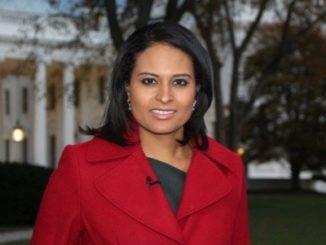
    NBC’s Kristen Welker maintains order for final presidential debate

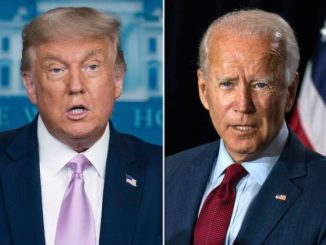
    As always, the “winner” of Thursday’s debate will be largely a matter of partisan opinion. The undisputed winner was journalism. After too many missteps in the Trump era when the media has fallen short of past standards, Welker did a good job of returning some respect to the profession.

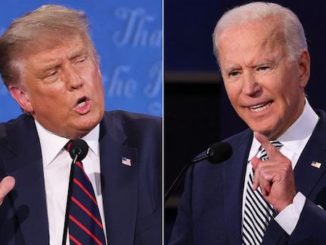
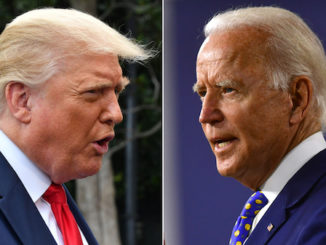
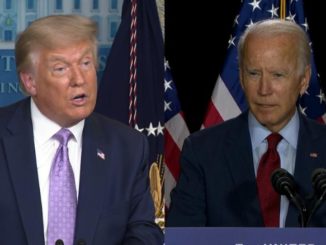
     The debate Thursday night between President Trump and former vice president Joe Biden was so substantive and informative it sometimes bordered on boring, reflecting a level of gravitas we need more of in politics today.

    Trump, of course, can be counted on to bring at least a minimum level of bombast. He has a knack for enlivening things even when it seems safe to nod off. He was determined to inject into this nationwide broadcast claims about the business dealings of Hunter Biden, including allegations that the elder Biden was aware of — and involved in — his son’s business dealings (something Joe Biden has denied).

    Whether Trump laid a glove on Biden isn’t yet clear, but it was to moderator Kristen Welker’s credit that, even if she didn’t invoke Hunter Biden herself, she also didn’t try to stop Trump from doing so. Biden responded mostly by trying to change the subject to Trump’s foreign dealings. Eventually, Biden will need to answer in more detail questions about his son’s foreign business arrangements, and his attempt to blame Russia for these allegations is all but certain to seem obviously nonsensical.

    Over an hour and a half, the debate also covered the pandemic, health care in general, foreign business dealings, the economy, immigration, race relations, climate change, energy and leadership. Viewers were able to hear the stark and substantial differences between the candidates.

    On the more than 500 children separated from their parents at the border, Biden did a good job making the emotional case for the tragedy of such circumstances. But Trump was effective in explaining efforts being made to reunite children and parents and the care that children are receiving in the meantime. And when Trump charged that the Obama administration initially supplied the notorious “cages” that housed children, Biden never answered Trump’s repeated question: “Who built the cages, Joe?”

    On how governors have handled covid-19, Biden scored with his comment that he doesn’t look at states “in the way [Trump] does, blue states, red states,” saying that to him, “they’re all the United States.” Trump’s upbeat outlook on covid-19 may strike some as too rosy, but it stood in contrast to Biden’s “dark winter” and suggestion that Americans are learning not to live with the virus but “to die with it.” Voters tend to prefer optimism to defeatism. And Biden’s late-in-the-game admission, under pressure from Trump, that he would transition the country away from the oil industry might haunt him.

    Trump was good Thursday evening, and probably not just because of the debate sponsors’ decision to mute microphones if necessary to allow for uninterrupted answers. The president took a different approach to this debate than he did to the first one, which was a disaster for him. Trump’s performance Thursday encapsulated what makes him frustrating for those who want him to succeed. This is the version of Trump many of his supporters want to see more often — smart, informed and even presidential. Sadly, he doesn’t show up often enough.

    As moderator, NBC’s Welker offered a master class in handling the two candidates. It stood in sharp contrast to last week’s examples of what not to do at the competing town halls that replaced the canceled second debate.

    Last week, Trump was aggressively — some might say rudely — grilled by NBC’s Savannah Guthrie, who turned what was intended to be an audience-driven event into a one-on-one debate. Bizarrely, Guthrie spent an inordinate amount of time pressing Trump on QAnon, a fringe conspiracy movement most Americans aren’t focused on as an election issue. In the event’s opening minutes, she also demanded that Trump denounce white-supremacy groups, a favorite media topic no matter how many times Trump repudiates them.

    On ABC, meanwhile, Biden was treated like an old friend dropping by for drinks. Moderator George Stephanopoulos never broached reporting in the New York Post and other outlets on emails purportedly obtained from a laptop belonging to Hunter Biden. Stephanopoulos only mildly pressed Biden on whether he would pack the Supreme Court, settling for a “noncommittal committal” that Biden would answer the question before Election Day — depending on how the Amy Coney Barrett nomination turned out.

    These set the stage for how Welker would moderate Thursday’s face-off. She was respectful and tough in equal measure for both candidates, allowing them to make their points but always returning to the topics she wanted addressed. Focusing on the agenda, she put both candidates on the spot. For instance, she hit Trump hard on the allegations of racism frequently leveled against him, but she also pressed Biden on negative consequences of the 1994 crime bill he oversaw as chairman of the Senate Judiciary Committee. And so it went throughout the night, fair and balanced.

    As always, the “winner” of Thursday’s debate will be largely a matter of partisan opinion. The undisputed winner was journalism. After too many missteps in the Trump era when the media has fallen short of past standards, Welker did a good job of returning some respect to the profession.

    (Gary Abernathy is contributing Columnist with Washington Post)

    (Source: Washington Post)


  • The Tribune, true voice of people

    The Tribune, true voice of people

    By Prabhjot Singh

    As the voice of people, the credibility of The Tribune remained unquestionable. Its readers would vouch for its stories. Unlike many other media organizations, The Tribune continued to distinguish itself with its editorial supremacy. While the management generally thrived upon its past laurels, members of the editorial staff took the challenges, including threats not only to their lives but also their families, in their stride to uphold the professional values.

    I am really saddened by an unsavory controversy in social media about The Tribune, an organization with which I have remained associated for more than 40 years. I strongly believe that institutions are much bigger than individuals. Individual come and go but institutions stay. It is not to undermine the contributions of individuals that help in building the institutions. But when individuals, or even some groups or associations,  try to run down credible institutions, it becomes  immense painful.

    Before I joined The Tribune as a Staff Correspondent at Chandigarh, 41 years ago, my association with this great institution was already three years old. Before moving to Chandigarh I worked as a Sports Reporter at Ludhiana. I had the privilege of starting my career with The Tribune under the watchful eyes of a professional giant, Mr Prem Bhatia

    My years with The Tribune were eventful. After more than four decades most of these incidents are still fresh in my memory. Bordering an emotional or traumatic angle, many of these events have been a part of my indelible memory. From trying circumstances of covering militancy in the trouble-torn State, the Tribune group continued to serve its dedicated readership in North India in a  true professional manner. Pressures from both the State and the militants notwithstanding, it stood by its avowed principle of staying apolitical. Curfews and censorships failed to deter from its path of reporting  the developments.

    As the voice of people, the credibility of The Tribune remained unquestionable. Its readers would vouch for its stories. Unlike many other media organizations, The Tribune continued to distinguish itself with its editorial supremacy. While the management generally thrived upon its past laurels, members of the editorial staff took the challenges, including threats not only to their lives but also their families, in their stride to uphold the professional values.

    Besides the professional challenges, The Tribune also had to compete with market forces as some of the leading national media houses also started their editions from Chandigarh. While editorially The Tribune was ahead of its impending challenges, the management was still basking in the glory of monopoly era.

    While the professional competitions were trying  to make dents in  strongholds of The Tribune, the management  was slow to react. Issues about limited visibility of The Tribune publications at popular public spots like Railways Stations, Bus Stands, Airports, Hotels and Libraries were  overlooked.

    While everyone has a right to criticize any individual or a group, but an attempt to tarnish the image of this great institution, The Tribune, and its editorial team, is both unwarranted and deplorable.

    It is pertinent to mention that The Tribune not only faced challenges from strong rival national publications but also had to support two of its sister publications that even after more than 40 years are still dependent upon the mother publication for their survival. While the Punjabi and the Dainik Tribune have struggled throughout, many other vernacular newspapers that came to the region much later have scripted success stories. Some blame must go to the trade unions that have generally been dominated by the loss bearing sister publications.

    It may sound strange but is true that while the employees of The Tribune were required to work and support for the Dainik and Punjabi editions  as well, wage structures of the new publications , though in much lower category under the Wage Board guidelines, were brought at par with the mother publication.

    Incidentally, the City pull outs started in late 90s became self-supporting within a couple of years of their launch. I had the distinction of leading the launch of Chandigarh Tribune that became number one among all City pull outs. And all members of the City team, including its desk staff, worked in total unison to make this experiment successful even after the usual management impediments.

    For any newspaper to grow, editions are launched to expand the paper’s base in the region. Therefore, it was only logical that The Tribune launched its J&K and Uttarakhand editions.

    While doing so, The Tribune Trust left it to the editorial section to decide on the number of pages/paginations.  Historically, The Tribune has been a big paper in J&K even when it was published from Lahore.  So the Trust rightly decided to bring out an edition for the people of J&K. Unfortunately, the edition has had to be closed owing to the failure of the business side, especially the circulation and advertisement departments.  While HT and TOI are viable in Uttarakhand and Daily Excelsior and Greater Kashmir in J&K, The Tribune was rendered non- viable because of the declining advertisement and circulation revenue from the main edition in the past 6-7 years.  The paper was unable  to subsidize the J & K edition and had to close it.

    Handpicked associates of  a former GM , who are now on important positions,  have been using the employees’ union and the website to attack the editorial section and the Trust to divert attention from their own failures and to deflect blame.

    While everyone has a right to criticize any individual or a group, but an attempt to tarnish the image of this great institution, The Tribune, and its editorial team, is both unwarranted and deplorable.

    (The author is a former editor of The Tribune)


  • Are we losing the war against the obscenity of hunger?

    Are we losing the war against the obscenity of hunger?

    By Prabhu Dayal

    The World Food Programme may have got the Nobel Peace Prize, but the world is not winning against hunger

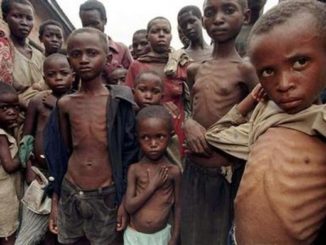
    As the humanitarian organization Mercy Corps puts it, “Hunger and malnutrition are the biggest risks to health worldwide – greater than AIDS, malaria and tuberculosis combined. Globally, food deprivation still claims a child’s life every three seconds and nearly half of all deaths in children under five are attributable to undernutrition”. Eveyone.org, another charity organization says “Every hour of every day, 300 children die because of malnutrition. It’s an underlying cause of more than a third of children’s deaths – 2.6 million every year”. There is an urgent need to take action on war footing against such a situation.

    Since its establishment, the WFP has responded to natural disasters and conflicts around the world. Currently, it is working in a number of countries, and it faces its severest challenges in three conflict-torn countries, namely Yemen, Afghanistan and South Sudan.

    As Mahatma Gandhi had said, there are people in the world so hungry, that God cannot appear to them except in the form of bread. Hunger is one of mankind’s worst enemies and has driven millions of people to desperation; it has also provided the subject-matter for some powerful literature, an outstanding example being the French writer Victor Hugo’s classic ‘Les Misérables’.

    In her article Let Them Eat Bread: The Theft That Helped Inspire ‘Les Misérables’ which appeared in the ‘npr’ (National Public Radio) in March 2017,Nina Martyris wrote:

    On a bitterly cold day in February 1846, the French writer Victor Hugo was on his way to work when he saw something that affected him profoundly. A thin young man with a loaf of bread under his arm was being led away by police. Bystanders said he was being arrested for stealing the loaf. He was dressed in mud-spattered clothes, his bare feet thrust into clogs, his ankles wrapped in bloodied rags in lieu of stockings.

    It made me think,” wrote Hugo. “The man was no longer a man in my eyes but the specter of la misère, of poverty.” In his novel, Hugo portrays the family’s circumstances in these few, short lines: “A very hard winter came. Jean had no work. The family had no bread. No bread literally. Seven children!”

    Jean Valjean is sentenced to five years’ hard labor for stealing a loaf of bread! He attempted to escape four times, and each time his sentence was lengthened by three years; he also received an extra two years for once resisting recapture during his second escape. After nineteen years in prison, he was released, but by law had to carry a yellow passport that announced that he is an ex-convict, an outcast. Hugo uses that loaf to attack society’s criminal indifference to poverty and hunger and to highlight the injustice of the penal system.

    ‘Les Misérables’ should have awakened mankind’s conscience, but one must ask oneself if it has succeeded in doing that. As former US President Dwight Eisenhower said, “Every gun that is made, every warship launched, every rocket fired, signifies in the final sense a theft from those who hunger and are not fed, those who are cold and not clothed”.

    As the humanitarian organization Mercy Corps puts it, “Hunger and malnutrition are the biggest risks to health worldwide – greater than AIDS, malaria and tuberculosis combined. Globally, food deprivation still claims a child’s life every three seconds and nearly half of all deaths in children under five are attributable to undernutrition”. Eveyone.org, another charity organization says “Every hour of every day, 300 children die because of malnutrition. It’s an underlying cause of more than a third of children’s deaths – 2.6 million every year”. There is an urgent need to take action on war footing against such a situation.

    “India is home to a quarter of all undernourished people worldwide, making the country a key focus for tackling hunger on a global scale.”
    India ranks 94 among 107 countries in 2020 Global Hunger Index, even below neighbors like Bangladesh, Nepal and Pakistan
    Picture / Courtesy Akshaya Patra

    We, as individuals, also have a great responsibility. In such trying times, the words of Mother Teresa should guide us: ” If you cannot feed a hundred people, then feed just one.” 

    Thus, the announcement by the Norwegian Nobel Committee on October 9 that the World Food Programme( WFP) has been awarded the Nobel Peace Prize in 2020 is indeed most welcome. The award has been given for its efforts to combat hunger, for its contribution to bettering conditions for peace in conflict-affected areas and for acting as a driving force in efforts to prevent the use of hunger as a weapon of war and conflict.

    The World Food Programme(WPF) has indeed been doing God’s work by providing food aid through the UN system since 1961. Its website mentions: “Every day too many men and women across the globe struggle to feed their children a nutritious meal. In a world where we produce enough food to feed everyone, 690 million people still go to bed on an empty stomach each night. Acute food insecurity affected 135 million people in 55 countries in 2019. Even more – one in three – suffer from some form of malnutrition”.

    Since its establishment, the WFP has responded to natural disasters and conflicts around the world. Currently, it is working in a number of countries, and it faces its severest challenges in three conflict-torn countries, namely Yemen, Afghanistan and South Sudan.

    Announcing the Nobel Peace Prize, the Chairperson of the Committee, Berit Reiss-Andersen said at a news conference: “The World Food Programme plays a key role in multilateral co-operation in making food security an instrument of peace”. She also said that with this year’s award, the committee wanted to “turn the eyes of the world to the millions of people who suffer from or face the threat of hunger”.

    In 2015 the global community adopted the 17 Global Goals for Sustainable Development to improve people’s lives by 2030. Goal Two is ‘Zero Hunger’ which pledges to end hunger, achieve food security, improve nutrition and promote sustainable agriculture. Achieving this goal is the priority of the WFP; if present trends continue, the number of people affected by hunger will surpass 840 million by 2030, or 9.8 percent of the global population.

    It may be mentioned that India has enjoyed steady economic growth and has achieved self-sufficiency in grain production in recent years. Despite this, high levels of poverty, food insecurity and malnutrition persist. The WFP’s website mentions that it has been working in India since 1963, with work transitioning from food distribution to technical assistance since the country achieved self-sufficiency in cereal production. It also says something that should prick our conscience: “India is home to a quarter of all undernourished people worldwide, making the country a key focus for tackling hunger on a global scale. In the last two decades, per capita income more than tripled, yet the minimum dietary intake fell. The gap between rich and poor increased during this period of high economic growth”.

    Coronavirus has further multiplied the challenges which India faces. In the second week of April 2020 itself, the International Labour Organization (ILO) had said that about 400 million workers from India’s informal sector are likely to be pushed deeper into poverty due to Covid-19. There is no doubt that during the past six months, poverty in the country has worsened; so too, has hunger. The Government as well as many NGO’s are grappling with the colossal problem of feeding millions of impoverished people who have lost even their means of earning a livelihood.

    We, as individuals, also have a great responsibility. In such trying times, the words of Mother Teresa should guide us: ” If you cannot feed a hundred people, then feed just one.”

    (The author is a retired career diplomat of India. He can be reached at Prabhu_dayal70@hotmail.com)

    (Courtesy OPOYI)


  • Trump continues to be most unpredictable, as in 2016

    Trump continues to be most unpredictable, as in 2016

    By Ven Parameswaran

    Youth interest in voting has hit its lowest since 2000, GALLUP reports

    Does Ohio provide a model?

    The shy Trump vote is bigger this year…and who falls into this category should terrify Democrats.  I will say it again, folks.  The polling is skewed.  It is a mess.  Either we are right to be highly skeptical and Trump wins an Electoral College landslide, or the pollsters are right and Biden wins landslide.  Young Americans are not excited about this election at all.  They are not planning on voting.  Gallup is reporting the youth interest in voting this cycle has hit its lowest since 2000.  That is in keeping with the results from Democracy Institute’s Patrick Basham, whose polling data, which has been mentioned in The Washington Times and Forbes, suggests there will be one million fewer young people voting this cycle.   Hill-Harris X Research shows younger voters are consistently more likely to say they do not plan to vote.

    Basham spoke with Joseph Cotto about his new data.  Pollwatch had a good thread summarizing the interview.  Democracy Institute’s poll had a sample size of 1500 voters, where Trump leads Joe Biden by one point.  He also noted that the “shy Trump” vote is very much alive and will be bigger this time.  Suburban white women and urban black women are the two groups that are most likely to fall into the shy category for the 2020 cycle.  That latter part should shake Democrats to their core.  And as for Florida, a state that Biden must carry, it could already be out of his reach.  Basham notes Trump cannot fall asleep at the wheel, but things are becoming more comfortable for him in the Sunshine State.  And based on some recent polling from the state, it looks like the tide has shifted solidly in favor of Trump.

    The outcome of Election Day 2020 would seem to be a foregone conclusion if the latest national and battleground polls are any guide as to whether President trump will win in his reelection bid.

    However, the GALLUP poll has just released the results of a new survey that suggests President Trump might have a better shot than you would think.

    Most Americans responded positively to the survey question asking whether they feel better off now than they did four years ago.

    Trump’s odds of winning reelection seem to be growing slimmer by the day—though, it is worth remembering that we have also seen this movie play out before.  This is not the first time that Trump has been in this predicament.

    DOES OHIO PROVIDE A MODEL FOR PRESIDENTIAL VICTORY?

    No Republican has won the Presidency without winning Ohio. Franklin D Roosevelt in 1944, and John F Kennedy in 1960 won without winning Ohio.    President Trump won Ohio by 8 points in 2016.  He accomplished this in spite of stiff opposition from Republican Governor John Kasich.  So far, all indications are Trump will easily win Ohio.  Biden has been visiting Ohio but his reception has been poor.   If Trump wins Ohio like in 2016, it will influence his outcome in Michigan, Pennsylvania, Wisconsin, and Minnesota.

    POINT OF CAUTION IN READING POLLS SPONSORED BY THE MAINSTREAM MEDIA:   

    All these pollsters have been interviewing registered voters  — there are much more registered Democrats than Republicans.   Polling most likely voters may give a better clue.  The undecideds and third parties comprise 10% of final voters.

    (Ven Parameswaran, Chairman, Asian American Republican Committee (Founded 1988), lives in Scarsdale, NY. He can be reached at  vpwaren@gmail.com)


  • Should we Reject Indian-Americans to our legislative bodies?

    Should we Reject Indian-Americans to our legislative bodies?


    By Mike Ghouse

    Why should we support or pull down the Indian -Americans running for US Congress or Senate?

    The answer is simple, almost all Indian Americans have families back in our motherland, and we must support and elect candidates who subscribe to American values. You and I came to America and have cherished this nation for its values of freedom, equal opportunities, equal justice, equal dignity, liberty, and the pursuit of happiness.  We should wish the same for our fellow Indians back home or any people anywhere.

    We must reject those candidates who do not want the same values as the Indians living in India and certainly pull the hypocrites down if they support the fascist Modi regime in India that is lynching, harassing, raping, and killing fellow Indians.  We cannot let our motherland go down the drain with such individuals.

    Law Makers Ro Khanna, Pramila Jayapal, and Kamala Harris have proved to be patriotic Americans fully subscribing to American Values. However, we have to make a critical decision about new candidates running for the legislatures. The questionable man is Sri Preston Kulkarni, a controversial person running for the US Congress from Congressional District 22 from Houston, Texas.

    He is accused of taking donations from the people who run the RSS organization in India. RSS is a paramilitary organization like the Nazis, ISIS, and KKK, which runs the Indian government and believes that the Christians (30 Million) and Muslims (200 Million) who have lived in India from the 2nd Century and 8th Century respectively do not belong in India. Through his minions, Prime Minister Modi, who has similarities with Hitler has given them three choices– convert to Hinduism, live as 2nd class citizens or disappear.

    The ideology of RSS is dangerous to the social fabric of India and detrimental to India’s economic stability and prosperity. Now, it is creeping into America, and we need to stop it.

    I have texted Mr. Kulkarni thrice to answer simple questions. He turned it over to Jack, his field director; both have promised to respond in vain for almost a month.

    Here are few of the several questions I have asked Kulkarni.

    1. If elected, would you initiate a bill in the house about equal rights, equal pay for women and equal justice for all citizens?

    1. If elected, would you support a bill that would require the Indian Government to treat the Dalits, Muslims, and Christians as equal citizens with equal rights and equal justice for all?

    1. If elected, would you support a bill to restore the full freedoms to the People of Kashmir?

    1. If elected, would you encourage the RSS to renounce its extremist ideology and accept Indian Dalits, Muslims, Sikhs, Jews, and Christians as Indians and have equal rights with all citizens?

    1. Should a conflict arise between India and the United States, and Congress is short of one vote for passing the bill, what would be your position?

    Would Kulkarni make the following statements?

    “I am concerned about the violations of religious freedoms in India, particularly against minorities. Being a minority myself, I will not tolerate minorities to be treated like that in any country.  I am appalled to hear the statements like Muslims are termites, and, I will throw the immigrants into the Bay of Bengal is ascribed to the Home Minister of India Mr. Amit Shah a close confidant of Mr. Modi the Prime Minister.”

     “I support the request of the US Government to the Government of India to issue visas to the commissioners of the USCIRF to investigate the human rights violations and earn a clean certificate and or fix the problems and earn a clean certificate – clean chit as they call it in India.”

     “I do not support the exclusionary policies of the RSS, that advocate Indian Christians and Muslims to disappear from India, live as 2nd class citizens or convert to Hinduism. Indeed, I oppose that policy and urge India to have a place among civilized nations.”

    “I urge the Government of India to withdraw the unnecessary citizenship laws like the CAA** – Citizens Amendment Act. It will stop the protests and restore political stability and social unrest. As Americans, we want a stable India to invest and build a healthy relationship.”

    “America is my home and my motherland, and I pledge to defend her constitution.”

    Lastly, talks are going on quietly about booting the Indians out of America if they boot Christians from India.

    Given the unilateral decisions Trump has taken, disregarding the societal norms, and if the White Supremacist take over the governance, all of the Indians maybe kicked out of the nation.

    If we don’t correct the rogues who run the Government of India, we deserve to be kicked out. Modi was not allowed to come to the United States; it may happen again once Trump is gone. Modi should not bring shame to India.

    I love my India and hate to see the RSS extremists destroying her; as an Individual, I will do my share of the work to save my motherland from the men hell-bent on destroying her. All those who are supporting Modi now will come to regret. One by one, he will push the South Indians, then the Bengalis, Marathas, and finally you. All he wants is power. Modi is a power-hungry man. If the country is destroyed, he will walk away with his jhola (shoulder bag) as if nothing has happened; he does not care about Indians.

    (The author is the founder and president of the Center for Pluralism in Washington, DC and offers pluralistic solutions to the media and policymakers on issues of the day. For more information, visit  www.TheGhouseDiary.com)


  • Permanent UNSC membership for India — mirage or achievable?

    Permanent UNSC membership for India — mirage or achievable?

    By Prabhu Dayal
    • PM Narendra Modi advocated India’s inclusion among the permanent members of the UNSC during the 75th session of the UN General Assembly
    • The only increase in the membership of the Security Council came in 1965, when the number of non-permanent members was increased from six to 10
    • Any reform to the Security Council would require an amendment to the UN Charter

    There have been expressions of support for India’s candidature from four out of the five permanent members–USA, UK, Russia and France. But what about China? Given the nature of Sino-Indian relations, it is not surprising that Beijing does not support India’s case. China’s close friendship with Pakistan is a compounding factor in this regard.

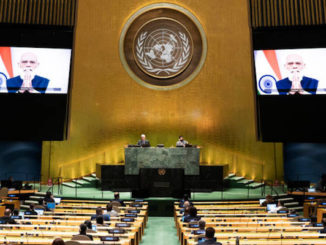
    On September 26, Prime Minister Narendra Modi delivered a virtual address during the General Debate of the 75th session of the UN General Assembly in which he made an impassioned and forceful plea for India’s candidature for permanent membership of the UN Security Council. His speech was brilliant, but when he had finished I was still asking myself this question: Is India’s quest heading anywhere, or is it just a pipe dream?

    The composition of the Security Council was established in 1945. The victors of the Second World War shaped the UN Charter in their national interests, giving to themselves the veto power in the Security Council. Since then the geopolitical realities have changed drastically, but the Council has changed very little. The Prime Minister did well to stress this when he said that the world of 1945 was significantly different from today’s world; the global situation, sources-resources, problems-solutions; all were quite different. Keeping this in mind, he urged that “Reform in the responses, in the processes, and in the very character of the UN is the need of the hour”.

    This was not the first time in recent months that PM Modi had urged the need for UN reforms. It would be recalled that while speaking at the high-level dialogue of the U.N.’s Economic and Social Council (ECOSOC) on July 17 this year, he had said that “Only reformed multilateralism with a reformed United Nations at its center can meet the aspirations of humanity.”

    PM Modi put forward several arguments that make India’s case for permanent membership appear quite strong. Highlighting India’s achievements and role in 75 years of the United Nations, he called for reforms with “changing times” and India’s inclusion in the decision-making process within the global body. He mentioned that India is the largest democracy of the world, with more than 18% of the world population; it had sent its soldiers for about 50 peacekeeping missions; it is also the country that has lost the maximum number of soldiers in the course of establishing peace; even during these very difficult times of the Covid 19 pandemic, the pharma industry of India has sent essential medicines to more than 150 countries. In this context, PM Modi assured that India’s vaccine production and delivery capacity will help all humanity in fighting the COVID-19 crisis.

    Thus, articulating the role being played by India for lending a helping hand to other nations, and putting forward cogent arguments for India to be given a permanent membership of the UN, he asked the General Assembly a very pointed question: “For how long will India be kept out of the decision-making structures of the United Nations?”

    It may be recalled that the only increase in the membership of the Security Council occurred in 1965 when the non-permanent membership was increased from six to 10 members, thus increasing the total strength from 11 to 15 members; fifty-five years have elapsed since then. Thus, PM Modi was right on target when he pointed out that the United Nations in its present form is out of date: “The international community today is faced with a very important question: Whether the character of the institution, constituted in the prevailing circumstances of 1945, is relevant even today”?

    However, the challenges which lie in India’s path should not be underestimated. Any reform of the Security Council would require an amendment to the UN Charter. In this regard, it is useful to remember that Article 108 of the UN Charter states:

    ‘Amendments to the present Charter shall come into force for all Members of the United Nations when they have been adopted by a vote of two thirds of the members of the General Assembly and ratified in accordance with their respective constitutional processes by two thirds of the Members of the United Nations, including all the permanent members of the Security Council’.

    Thus, any reform of the Security Council not only requires the support of at least two-thirds of UN member states, but also all the permanent members of the UN Security Council must also agree to this as they have veto powers. Assuming that India can get the support of two-thirds of the members of the General Assembly, the question which arises is simply this: Will all the Security Council’s permanent members give their nod for adding India as a permanent member?

    India’s quest has to be viewed in a broader perspective. The need for Security Council reform has been actively discussed among the UN member states for quite some time. By 1992, Japan and Germany had become the second and third-largest financial contributors to the United Nations , and they started to demand a permanent seat; so too did Brazil (the world’s fifth largest country in terms of territory) and India (the largest democracy and the second largest country in terms of population) which had emerged not only as the most important countries within their regional groups but also key players in the emerging global scenario. These four countries formed an interest group which came to be known as the G-4.

    On the other hand, their regional rivals opposed the idea of G4 countries becoming permanent members. Italy, Pakistan, Argentina and South Korea formed an interest group, known as the ‘Uniting for Consensus’ (also nicknamed the ‘Coffee Club’) which later grew to around 40 members. The Coffee Club members are opposed to increasing the number of the Security Council’s permanent members while wanting an increase in the non-permanent members category.

    Simultaneously, the African countries also started to demand two permanent seats for themselves, arguing that historical injustices had been done to them, and also that much of the Council’s agenda related to their continent. All these developments have further complicated the situation.

    On their part, the G-4 countries have shown flexibility on the veto issue in their bid to get the United Nations reform process moving. In a joint statement on their behalf delivered by India’s Permanent Representative to the UN Ambassador Syed Akbaruddin at an inter-governmental negotiations meeting in March 2017, the G4 nations– India, Brazil, Germany and Japan–stated that while the new permanent members would in principle have the same responsibilities and obligations as the current permanent members, they shall not exercise the veto until a decision on the matter has been taken during a review. Despite this flexibility, there has not been any progress in regard to the G4 demands.

    There have been expressions of support for India’s candidature from four out of the five permanent members–USA, UK, Russia and France. But what about China? Given the nature of Sino-Indian relations, it is not surprising that Beijing does not support India’s case. China’s close friendship with Pakistan is a compounding factor in this regard.

    There are many who believe that in actual fact, all the P-5 countries have reservations about adding any other country including India to their privileged group. The support extended to India by the US, UK, Russia and France has to be viewed against the background of their being fully aware that in any case, the process of Security Council reform is making no headway whatsoever. Many analysts think that they only render lip service by way of support to India in order to derive political mileage as they are fully aware of the Chinese position. In other words, whether their support is genuine is a matter of debate, for it is extended whilst knowing full well that the Chinese will oppose India anyway.

    Meanwhile, China, the world’s biggest dictatorship sits on the high table as a permanent member of the UN Security Council while India, the world’s largest democracy has to be content with getting a seat on that table from time to time as a non-permanent member. We can raise our voice against this injustice, as Prime Minister Modi has done. However, one cannot say when the winds of change will actually reach the UN Security Council, for diplomacy, like politics is only the art of the possible.

    Prime Minister Modi said in his address: “Today, people of India are concerned whether this reform-process will ever reach its logical conclusion”. He asked:” How long would a country have to wait particularly when the transformational changes happening in that country affect a large part of the world?” His words had a ring of anguish as well as disappointment.

    As I reflect on Prime Minister Modi’s address at the UN, I cannot help reminding myself of a verse from the Rubaiyat of Omar Khayyam:

    “Could thou and I with fate conspire,

    To grasp this sorry scheme of things entire,

    Would we not shatter it to bits–and then

    Remold it nearer to the heart’s desire.”

    (The author is a career diplomat. He can be reached at prabhu_dayal70@hotmail.com)

    (Courtesy OPOYI)


  • Hathras a setback for Hindutva’s social project

    Hathras a setback for Hindutva’s social project

    By Saba Naqvi

    There is an undeniable political vacuum in the space for the Opposition in UP, but even an unrivaled political force has to stand on a structure that has strong foundational beams. The Yogi regime is beginning to disgust its own supporters. As long as the Hindutva wave was moving along smoothly, Yogi was even being spoken of as a possible successor to Prime Minister Narendra Modi in the emerging Hindu rashtra. But the Hathras episode has diminished him.

    The Yogi Adityanath regime in Uttar Pradesh has responded hysterically and undemocratically to the criticism and protest generated by the terrible Hathras case. The state police have now filed FIRs against members of Opposition parties and threatened protesters with sedition charges, even as the chief minister has alleged a conspiracy to trigger caste and communal riots. The touchiness over this case comes from the fact that it has the potential to set back the BJP-RSS socio-political project in the nation’s most populous state. The most tangible damage comes from the fact that the Valmiki sub-caste of the Dalit community, to which the victim belonged, has been overwhelmingly voting for the BJP in recent elections in Uttar Pradesh (unlike the numerically larger Chamars/Jatavs who have traditionally been backers of the BSP led by Mayawati).

    The Hindutva project in Uttar Pradesh rode on upending the state parties that became prominent in the Mandal era, by using cadre, narratives and mobilization, to reach out to non-dominant Dalit and backward caste groups. This was achieved by giving them a sense of belonging and telling them that they were included in the Hindutva project. In some instances, Valmikis were the foot soldiers of anti-Muslim mobilization.

    To give an example from the ground in Moradabad in western UP, a seat with a large Muslim population, in the middle of the minority-dominated part of the town is a Valmiki settlement in an area known as Bhude ka Chauraha. In the 2019 Lok Sabha elections and the 2017 Assembly polls, residents of this Valmiki basti were among the most determined BJP voters and foot soldiers on the ground. They were the new voters the BJP has been getting in its consolidation of power in this electorally crucial state, achieved after consistent cadre outreach by the Sangh Parivar.

    But post Hathras, the manner in which the Thakur community (to which the four rape-murder accused belong) has postured with the patronage of BJP leaders as if they are the aggrieved party with the license to protest their arrests, suggests these fragile gains could be lost. Thakurs make up 7.9 per cent of the population, while Dalits account for 21 per cent. So, the question is that as a politician, why is the CM inclined to give a free pass to his own caste although the BJP got the support of both forward and backward sections of society minus Muslims? The answer lies in the fact that despite being an MP from Gorakhpur, the seat of the Gorakhnath temple that he heads, for five consecutive terms, Yogi Adityanath is not really a politician but a religious mascot who likes to talk tough and give the license to shoot to the police in the state.

    Before he got the state as his stage, stormtroopers of the Hindu Yuva Vahini, a so-called youth organization founded by Yogi Adityanath in Gorakhpur in 2002, went about dispensing vigilante justice and intimidating minorities. On its website, under ‘Type of Business’, the Yuva Vahini calls itself ‘far right Hindu nationalist organization.’ As long as just Muslims were at the receiving end, it did not really jar sensibilities in the now deeply communalized state. But now that it has become clear that crime against Dalits is increasing at an alarming rate, it’s an altogether different matter.

    It is common knowledge in Lucknow and the district headquarters that the CM trusts only members of his own caste, as he was groomed and raised in the Thakur-run Gorakhnath monastic order. As the state will have elections in early 2022, it’s possible that Yogi intends to rely solely on the mix of Hindutva and muscle power that Thakurs supply. The community has clout way beyond its numerical strength; in spite of the abolition of the zamindari system, Thakurs are believed to still own half the agricultural land in parts of Uttar Pradesh.

    But the Hathras incident has served the larger social purpose of shining the arc lights on the dark and regressive social impulses that have got a free run during the reign of Yogi Adityanath. Seeing the pushback from the Thakurs, imagine the scale of the bullying that can go unseen. The outrageous scale of injustice at Hathras also raises the larger question about whether the social gains of the Mandal era were superficial at best, dependent solely on a Dalit figure occupying high office? BSP leader and four-time CM Mayawati did leave monuments and parks; her coming to power did make many Dalits believe they need not sit on the floor if a high-caste individual came by; and once upon a time, she famously jailed all the notorious Thakur strongmen of the state.

    But the palpable regression in the years of BJP rule raises the question about whether she left a lasting legacy or just a lot of statues. Has she hollowed out her own movement by selling tickets and making deals with whosoever could keep her person and assets safe? Or is Mayawati just helpless today, reduced to being a Team B of the BJP? During the Hathras episode, for instance, she made more attacks on the Congress than the BJP.

    There is an undeniable vacuum in the space for the Opposition in Uttar Pradesh, but even an unrivalled political force has to stand on a structure that has strong foundational beams. The Yogi regime is beginning to disgust its own supporters and the pillars holding it up are looking rotten. As long as the Hindutva wave was moving along smoothly, Yogi was even being spoken of as a possible successor to PM Narendra Modi in the emerging Hindu rashtra. But the Hathras episode has diminished him.

    Like Yogi, Modi was not an elected but a selected CM. But Modi would remain in control of whatever image or narrative he wished to project, be it the Hindu Hriday Samrat of the 2002 Gujarat riots or the friend of industrialists by 2007, the liberator of Gujarat, the undisputed leader and so on till he cast his eye on Delhi by 2013. Yogi Adityanath in contrast seems to have lost control of any narrative beyond his open desire to erase the names of Muslim historical figures and eras. From aspiring to be the next Hindu Hriday Samrat, he has been caught out to be a mere Thakur strongman in saffron robes. The ghost of that young woman of Hathras who met such a terrible end will haunt him.

    (Saba Naqvi is a senior journalist)

  • No End to Caste-driven Rape Culture in India

    No End to Caste-driven Rape Culture in India

    By George Abraham

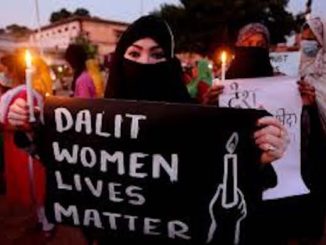
    Manisha Valmiki, a Dalit is yet another victim 

    Even as the United Nations deliberated on the concrete actions that would advance gender equality for women and girls everywhere, marking the 25th anniversary of the Beijing Declaration and Platform for Action – the most comprehensive roadmap for women and girls’ empowerment, the world  watched once again in horror another rape and murder story unraveling in India’s heartland. Any civilized person would shudder at the way this 19-year old Dalit girl was terrorized by four upper caste men in the State of Uttar Pradesh in India.  And one wonders why these brutal and horrific incidents continue to happen in India, especially to the Dalits and backward castes, the lower rung of the despicable caste system that is very much alive and well in India, even  after seventy years of independence!

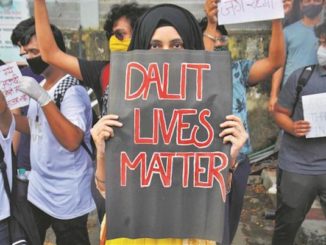
    The latest victim, Manisha Valmiki, a 19-year old, was raped on September 14 in Uttar Pradesh’s Hathras district. The woman’s family told local media that they found her naked, bleeding, and paralyzed with a split tongue and broken spine in a field outside her home. On Tuesday, September 29, she died two weeks after battling severe injuries in a hospital in New Delhi.

    Has anything changed since the infamous ‘Nirbhaya case’? No, the country has not learned anything from that gruesome affair in its aftermath. The barbarity and the bestiality involved in this killing once again showed the depraved and criminal mindsets of those who perpetrated such heinous acts. The ghastly way this woman was raped and murdered has indeed shaken the nation to its core and terrorized the people of conscience across the world.

    To add insult to injury, the Police, who are supposed to be the guardians of fairness and justice, barricaded her family members and locals inside the house and forcibly burned her broken body. The criminal connivance of the U.P. police in siding with the perpetrators of this heinous act has not surprised those observing the deteriorating law and order situation in U.P. The family was not allowed to see their daughter for one last time to say good-bye. As a senior journalist Yogendra Yadav has said, “even criminals are allowed dignified cremation. Here is a rape victim being cremated by police at 2.30 AM without family members”!

    A senior Uttar Pradesh police officer has now said the forensic report has revealed that the victim who succumbed to her injuries was not raped. Citing a lab report, the ADG (law and order) said the cause of her death is an injury on the neck and trauma resulting due to it. It appears to be the case of the law enforcement officers becoming silent spectators for goons and henchmen for the caste-driven hierarchy where people of the lower rung do not stand a chance for justice and fairness. At the same time when we are dealing with this heartbreaking story from Hathras, there is another story from the Balrampur District of U.P., where a Dalit woman died after allegedly gang-raped by two men. At the timing of writing this article, more information on that developing story is still awaited.

    Sadly, Uttar Pradesh is the epicenter of these crimes targeted at these helpless women who were taunted and raped at will, many times, just for the simple reason that they belong to the Dalit community.

    The rape and hanging of two Dalit women from the Katra village in Uttar Pradesh not long ago remains fresh in our memory. The father of one of those girls who was gang-raped and brutally murdered asked the Samajwadi Party leader and member of Parliament Dharmendra Yadav a question “Why I am asked about my caste when I go to the Police? Am I not a citizen of India’? It is time that this pertinent question is answered not just by a few politicians across the party lines but by the nation itself. What happened in Hathras District and Katra village are horrific crimes of brutality against women that should never have happened.

    Millions of Indians everywhere must be feeling the shame of India in the news on the continuing assaults on women. However, these are more than just isolated incidents of criminal wrongdoings, emanating from an entrenched caste-driven mindset of these madmen who feel that they have the God-given right to them and are a privileged sect who can therefore get away with murder. These cases have shocked the nation for many reasons; first and foremost, it once again shows the ugly truth about the age-old caste system that is thriving in India, exploited by various political parties. Shashi Tharoor, a former Congress Minister and Member of Parliament, once was quoted as saying ‘when India casts the votes in an election, it is voting the castes.’ The family of these victims belong to the Dalit community, whereas the perpetrators of this heinous crime belonged to the higher castes. If one looks at history, the Dalits have been at the receiving end for centuries, being discriminated against by the higher castes with impunity, often being harassed and murdered without having a price to pay. Sadly, Uttar Pradesh is the epicenter of these crimes targeted at these helpless women who were taunted and raped at will, many times, just for the simple reason that they belong to the Dalit community.

    This latest incident in Hathras has shaken us all, and though stricter laws have been passed since the Nirbhaya case, rape and abuse of women continue to occur unabated. Recent reports show that one rape is committed every 22 minutes, though, the statistics and official records would never reveal the accurate picture as many of these cases go unreported. The Government data published by the National Crimes Bureau shows that crimes against women in 2019 rose 7% over the previous year. The social stigma attached to rape often silences the victim who might be ostracized or ridiculed if they choose to go public. The law enforcement system is not geared to provide sympathetic ears; if anything, they impart fear.

    The National Campaign for Dalit Human Rights states that over one-sixth of India’s population, some 170 million people, live a precarious existence, shunned by much of Indian Society because of their rank as “untouchables” or Dalits – literally meaning “broken” people – at the bottom of India’s caste system. Dalits are discriminated against, denied access to land and basic resources, forced to work in degrading conditions, and routinely abused at the hands of police and dominant-caste groups that enjoy the State’s protection. Among the Dalit community and its supporters and sympathizers, Dr. Ambedkar’s statement resounds today more than ever; “My final words of advice to you are:  educate, agitate and organize and have faith in yourself. With justice on our side, I do not see how we can lose our battle. The battle, to me, is a matter of joy. This battle is not for wealth or power; it is a battle for freedom. It is a battle for the reclamation of human personality”.

    The growing culture of violence emanates from the wrong-headed sense of ultra-nationalism and majoritarian arrogance that is polarizing the communities and dividing the nation.

    Yogi Adityanath, the Chief Minister of Uttar Pradesh who took reigns of the Government when BJP swept the State elections, has to be held responsible for this terrifying State of affairs with incendiary remarks often denigrating women once when he said, “women are not capable of being left alone and their energy  should be regulated, lest it becomes worthless and destructive”. These statements must be emanating from a dogma he represents that is misogynistic and chauvinistic.

    The growing culture of violence emanates from the wrong-headed sense of ultra-nationalism and majoritarian arrogance that is polarizing the communities and dividing the nation.  It is time for the nation to call upon the Modi Government to stop paying lip service with slogans like “Beti Bachao, Beti Padhao” and provide true leadership in bringing perpetrators of this pervasive rape and abuse of women culture across the country to justice regardless of their party affiliations and oust any government officials who remain stumbling blocks to that effort.

    Let me ask the NRIs who live in this country in their comfort zone, “where is your moral outrage”? We are a community that gets riled up at the slightest form of discrimination or stereotyping in this country of our adoption.  Will we ever show the courage to join this ‘battle for freedom’, as Ambedkar called it, for the sake of India?

    (The author is a former Chief Technology Officer of the United Nations and the Vice-Chairman of the Indian Overseas Congress, USA)


  • Battleground States hold the Key to Victory -US Election 2020

    Battleground States hold the Key to Victory -US Election 2020

    By Ven Parameswaran

    The first Presidential debate on September 29 was watched by 73 million people.   Trump is a gambler, and not just because he owned casinos.  He ran one of the biggest gambles of his life in the debate, and whether it pays off now is very uncertain.    The President’s ultra-aggressive performance in the first presidential debate—aggressive to the point where moderator Chris Wallace had to ask him three times to simply let challenger Joe Biden answer a question—can’t have been an accident.  It was an effort by a candidate behind in the polls to shake up the race by driving home his principal line of attack: that Biden is too weak to be the president of America.

    Trump chose not simply to say that his opponent is too weak, or too old, or too afraid of his party’s left wing, but rather to try to demonstrate it before a world-wide audience by attacking and belittling him.  The subliminal message: If you can’t stand up to me, how can you stand up to the leader of China, or those perpetrating violence in the streets of Portland?

    And perhaps it worked.  Nobody who watched was left in any doubt about the core argument of Trump’s campaign, which is in large measure about the assertion that his foe is not up to the demanding job of sitting behind the Resolute Desk.

    Biden did,  at times , seem taken aback by the relentless ferocity of the onslaught—and if the plan was to get the challenger to overreact by calling the president a “clown,” well, that did happen at one point.  This is what those who call Trump undisciplined don’t entirely grasp:  He is very disciplined in driving home his main message, and will do so again and again, without remorse or apology, as he did Tuesday night.

    It is important to recall how Trump used almost the same technique in defeating 16 Republican candidates in 2016 and Hillary Clinton.  He succeeded in burying Bush and Clinton dynasties, against all odds, including vehement opposition of the mainstream media, continuous investigations, impeachment he has won.  Therefore, it is possible his strategy to defeat Biden could work.

    Trump was able to impress the audience that he was for law and order and strong economy.  He also took credit for appointing 200 judges and 3 Supreme Court judges in his first term (third appointment is in process).

    There was little likable about the presidential persona that came across in the debate stage.  Maybe that does not matter as much as it used to in politics.  Trump has demonstrated that people don’t have to like him to support him.  A common refrain among Trump voters, in fact, is that he is rough and tough, but that they see that as part of his strength.  Yes, they say, he is a bully, but he is our bully.

    Trump’s main strategy is to attract new voters from the uneducated working class located in the battleground states.  If so, his aggressive performance in the debate should help him achieve his goals.  Rush Limbaugh, most popular talk radio host has praised Trump’s debate performance.    As mentioned in my previous dispatches, Trump is not appealing to the elites.

    If Trump knew how to get elected as President in 2016, his strategy to get reelected could succeed.

    (Ven Parameswaran, Chairman, Asian American Republican Committee (founded 1988) lives in Scarsdale, NY.  H can be reached at vpwaren@gmail.com)

  • US Presidential elections: You ain’t seen nothing yet

    US Presidential elections: You ain’t seen nothing yet

    By Prabhu Dayal
    • Winning more votes in the US Presidential election does not assure a candidate victory

    • Biden’s chances of defeating Trump look good, but there’s a long way to go and things can change very quickly

    • One factor which is affecting Trump’s re-election prospects is his handling of the coronavirus pandemic

    It cannot be overstated that U.S. Presidential elections are always contested over a host of political, economic, and social issues on which the positions of both the Republicans and the Democrats have evolved over time. As part of its economic conservatism, the Republican Party supports lower taxes, free-market capitalism, the removal of restrictions and regulations on corporations, and restrictions on labor unions. The party is also socially conservative and supports gun-rights and traditional values with a Christian foundation, such as restrictions on abortion. In foreign policy, Republicans usually favor increased military expenditure and tough action against America’s enemies. Republicans also want restrictions on immigration.
    The Democrats support social programs, labor unions, worker’s rights and work-place safety regulations, disability rights and racial equality and reform of the criminal justice system. They also support abortion rights, LGBT rights and a pathway to citizenship for undocumented workers. In foreign policy, they favor a multilateral approach, from which America under Trump has been distancing itself.


    There are fewer than 35 days to go before American voters decide on November 3 whether Donald Trump remains in the White House for another four years. Given the hugely important role played by the US President on the global stage, psephologists all over the world are working overtime as they try to analyze various trends and developments which could indicate what the final outcome is likely to be. Opinion polls are the flavor of the election season.

    However, experience has shown that opinion polls may give an idea of how popular a candidate is across the United States, but they are not necessarily an accurate way to predict the eventual election result.

    In 2016, for example, Hillary Clinton led in most of the opinion polls and even secured more votes in the election, but she ended up losing to Trump. Thus, even winning more votes in the US Presidential election does not assure a candidate victory.

    One important reason for this is that the U.S. voters do not elect the President and Vice President directly; rather, they do so indirectly through the electoral college system. The electoral college is a body of electors who are elected by the voters in each state every four years for the sole purpose of electing the President and Vice President. The number of each state’s electors equals the sum of its representation in the Senate and the House of Representatives. Currently, there are 538 electors, based on 435 Representatives, 100 Senators from the fifty states and three electors from the Capital, Washington, D.C. An absolute majority of at least 270 electoral votes is required to win the election.

    The three electors were given to D.C. following the Twenty-third Amendment of 1961 which states that the seat of the federal government is entitled to ‘the number it would have if it were a state, but in no case more than that of the least populous state’. The seven least populous states (Alaska, Delaware, Montana, North Dakota, South Dakota, Vermont and Wyoming) have three electors each; thus, Washington D.C. was also given three seats in the electoral college.

    The six states with the most electors are California, (55), Texas (38), New York (29), Florida (29), Illinois (20), and Pennsylvania (20). U.S. territories (Puerto Rico, U.S. Virgin Islands, Guam, Northern Marina Islands and American Samoa) are not entitled to any electors.

    Thus, each state gets a minimum of three electoral votes, regardless of population, which gives states with a low population a disproportionate number of electors per capita. An electoral college member in Wyoming represents only about one-fourth the number of people as compared to an elector from California. This is one factor which explains how a Presidential candidate can secure more electors while winning lesser votes nationally. Over time, people have been migrating to the bigger states like California, Texas or New York which provide better employment opportunities, and as a result sparsely populated states are becoming increasingly over-represented in the electoral college.

    In this regard, another factor which needs to be mentioned is the winner-take-all rule. In all the states except Nebraska and Maine, the party which wins the highest votes wins all of that state’s electors. This gives the bigger states the ability to deliver a large number of votes as a single bloc. For example, even if the Republican Party wins 49% of the votes in Florida while the Democratic Party gets 51%, the latter will win all the 29 electoral seats from that state. This fact also distorts the relationship between votes secured and seats won nationwide.

    Generally, most states always vote the same way (either always Republican or always Democrat). However, there are some states where both candidates stand a chance of winning. These are the states where the election could be won or lost, and they have come to be known as the battleground states (or swing states).

    For the 2020 election, the battleground states (with their electoral numbers) are: Texas(38), Florida(29), Pennsylvania(20), Ohio(18), Michigan( 16), Georgia(16), North Carolina(15), Arizona(11), Minnesota(10), Wisconsin(10), Nevada(6), Iowa(6) and New Hampshire(4). According to analysts, Texas, Ohio and Iowa are leaning towards Trump; in Florida, Georgia and North Carolina there is a toss-up; the remainder are leaning towards Biden.

    It was on account of so many complexities that Hillary Clinton found herself losing the 2016 election to Trump even though she won more votes than him. It may be mentioned, though, that her lead over Trump in the opinion polls had been just 2 percentage points, while Biden leads his rival by at least 7-8 percentage points.

    By that reckoning, Biden’s chances of defeating Trump look good, but there’s a long way to go and things can change very quickly. Betting markets are certainly not writing Trump off just yet, though seasoned analysts are less convinced about his chances of re-election. The Economist says that Biden is very likely to beat Trump, and this view is echoed by ‘FiveThirtyEight’, a well-known US website that does poll analysis. Not surprisingly, Trump has dismissed the opinion polls and forecasts of his defeat as biased and incompetent.

    One factor which is affecting Trump’s re-election prospects is his handling of the coronavirus pandemic; there is dis-satisfaction among voters about the President’s response. Trump declared a national emergency in March and made $50 billion available to states to stop the spread of the virus, after which support for him rose to 55%. However, this support has been waning recently. His response to the pandemic is being increasingly questioned as the death toll rises; it has crossed 209,000 and it is feared that it may reach 230,000 by November 3, the election date.

    Naturally, Trump is worried on this account and wants to show that he is taking decisive action for combating the virus. He is hopeful that ‘Operation Warp Speed’, his administration’s vaccine initiative, can produce something soon which could swing things in his favor. Trump has repeatedly said a vaccine could be ready as soon as October.

    COVID-19 Vaccine. COVID-19 Corona Virus 2019-ncov Vaccine Injection Vials Medicine bottles. Vaccination, immunization, treatment to cure Covid-19 Corona Virus infection. Healthcare And Medical concept

    However, the vaccine is getting mired in controversy even before it has arrived. According to U.S. media reports, the Federal Drug Administration(FDA) has been developing stricter guidelines for the emergency authorization of a COVID-19 vaccine which will include a requirement for a median of two months of data on clinical vaccine trial participants. In other words, the vaccine may not be available before November 3, the date of the election. Trump has dismissed this as a politically motivated move and said that if the F.D.A. does propose such a two-month trial, he may not approve it (i.e. the trial period).Trump said he wants to avoid any unnecessary delay in the release of a vaccine, adding that he has “tremendous trust” in companies working on its development.

    “I don’t see any reason why it should be delayed further. Because if they delay it a week or two weeks or three weeks, you know, that’s a lot of lives you’re talking about,” he said.

    The economy is typically a top voter-issue in presidential elections. Issues that are deeply personal to their everyday lives rank among the most important priorities that influence voters; their pay-cheques often figure at the top of the list of such issues.

    Consequently, having a job is itself an important factor. This aspect has taken on new urgency with millions out of work because of the coronavirus pandemic.

    Another issue that is gaining prominence during the build-up to the election relates to racism. Donald Trump has a history of speech and actions that have been widely viewed as racist or racially charged. Although Trump has repeatedly denied accusations of racism, he is increasingly viewed as championing white supremacy. Several studies and surveys have shown that racist attitudes and racial resentment have fueled Trump’s political ascendance. Thus, matters that impact communities of color are taking center stage in the elections as non-white voters make up about one-third of the 2020 electorate.

    Joe Biden’s decision to nominate Senator Kamala Harris, the first Black woman and first Asian American woman as his running mate is an out-reach to colored voters as well as to women voters.

    In this background, Joe Biden’s decision to nominate Senator Kamala Harris, the first Black woman and first Asian American woman as his running mate is an out-reach to colored voters as well as to women voters.

    It cannot be overstated that U.S. Presidential elections are always contested over a host of political, economic, and social issues on which the positions of both the Republicans and the Democrats have evolved over time. As part of its economic conservatism, the Republican Party supports lower taxes, free-market capitalism, the removal of restrictions and regulations on corporations, and restrictions on labor unions. The party is also socially conservative and supports gun-rights and traditional values with a Christian foundation, such as restrictions on abortion. In foreign policy, Republicans usually favor increased military expenditure and tough action against America’s enemies. Republicans also want restrictions on immigration.

    The Democrats support social programs, labor unions, worker’s rights and work-place safety regulations, disability rights and racial equality and reform of the criminal justice system. They also support abortion rights, LGBT rights and a pathway to citizenship for undocumented workers. In foreign policy, they favor a multilateral approach, from which America under Trump has been distancing itself.

    While the calculations involved in a U.S. Presidential election are not at all simple, present indications are that Trump faces an uphill task for getting re-elected. Interestingly, Trump is sending out signals that he will not accept defeat. In a press briefing at the White House a few days back, he refused to say whether he would support a peaceful transfer of power if he loses November’s election, ignoring a precedent that every other president in American history has accepted.

    As a matter of fact, a crisis is developing on account of the concerns which Trump has repeatedly voiced about postal ballots. He has claimed that the postal-ballot route will be misused by the Democrats, that it will result in voter fraud and thus cause his defeat. However, Ellen Weintraub, commissioner of the Federal Election Commission, has responded: “There’s simply no basis for the conspiracy theory that voting by mail causes fraud.”

    Individual states decide their own voting rules for federal elections in the U.S. About half of the states allow any registered voter to vote by post on request. In the remaining states, you have to have a valid reason for voting by post – such as being over 65, being ill, or being away from the state you are registered to vote in.

    Interestingly, President Trump himself has voted by post in the past, such as in Florida’s 2020 primary election as he is a registered voter in that state but is currently living in Washington DC.

    In the 2016 U.S. Presidential election, about 25% of votes were cast by post. That number is expected to rise this time due to public health concerns over coronavirus. Many states are encouraging mail-in voting, citing the need to keep voters safe from it. They want to prevent large gatherings at polling stations on election day–a justifiable approach given the prevailing situation.

    Moreover, six states will hold “all-mail” ballot elections this November– California, Utah, Hawaii, Colorado, Oregon and Washington. These states will automatically send all registered voters their postal ballots, which then have to be sent back or dropped off on election day – although some in-person voting is still available in certain limited circumstances. More states could follow this route due to public health concerns over coronavirus.

    Although every losing Presidential candidate in U.S. history has conceded defeat once he lost the election, Trump has refused to commit to a peaceful transfer of power in such an eventuality. When a reporter asked him a direct question on this issue, he did not say yes or no; instead, he gave an insight into his thinking and said, ” I’ve been complaining very strongly about the ballots”, adding, ” Mail-in ballots are very dangerous–there’s tremendous fraud involved”.

    At a rally in Newport News, Virginia on Friday 25 September, Trump again refused to say whether he would peacefully transition out of the White House if he loses the presidential election, suggesting he would only do so if he was convinced Democrats and their presidential nominee, Joe Biden, did not cheat. “We’ve gotta watch this ballot scam, because they’re scamming us. And then they say, ‘He doesn’t want to turn over [power].’ Of course, I do. But it’s gotta be a fair election,” Trump told the crowd at the rally. Biden has said that in this scenario he believes the military would be deployed to remove Trump from the White House!

    If he loses the election, Trump may still have some cards up his sleeve. He has said that he believes that the election result could end up in the U.S. Supreme Court. Backed by his battery of attorneys, he is believed to be preparing the groundwork to undermine an election result that does not announce him as victor.

    In this context, importance is being attached to Trump’s selection of Judge Amy Coney Barrett, a favorite of the Republicans as a new Supreme Court Judge. She will take the place of Justice Ruth Bader Ginsburg, a liberal and a Clinton appointee who died recently. Trump has announced that he will try to obtain Senate confirmation for this appointment before Election Day. Biden and the Democrats are urging that the appointment should be made by the winner of the Nov 3 election, but the Senate, which has a Republican majority is likely to go ahead and give the confirmation. This is so because a Supreme Court judge in the U.S. serves for life , and Judge Amy Coney Barret, an avowed Conservative would significantly alter the ideological makeup of the Supreme Court for years to come and ensure that the Republican agenda is not obstructed by the Court.

    For Trump, this appointment could be vital. The US Supreme Court has nine judges. After the death of Justice Ginsberg, there are three judges who are regarded as liberal, while four are conservative.  The eighth is Chief Justice Roberts who has been described as having a conservative judicial philosophy but has also shown a willingness to work with the Supreme Court’s liberal judges. Thus, he has come to be regarded as a swing vote on the Court and Trump cannot rely on him to give a favorable judgement if his own election case is to be decided. Thus, if Judge Barrett is elevated to the Supreme Court, there will be at least five conservative judges, if not six who may side with Trump, which explains his rush to appoint her, as also Biden’s opposition to it.

    To sum up, if you think that the Nov. 3 election battle has become ugly, then I would just say, “You ain’t seen nothing yet”.

    (The author is a retired career diplomat. He can be reached at prabhu_dayal70@hotmail.com)

     (Courtesy OPOYI)

  • Implications of Donald Trump testing positive for COVID-19

    Implications of Donald Trump testing positive for COVID-19

    By Prabhu Dayal
    • Medical experts say that Donald Trump falls in the highest risk category for serious complications from COVID-19 as he is 74 years old and obese
    • A rally scheduled for October 2 in Florida has been cancelled, raising the question of whether COVID-19 will derail the president’s campaign
    • The Democrats have consistently attacked Trump for taking a cavalier approach towards COVID-19

    Immediately after the US President announced that he and his wife Melania had tested positive for COVID-19, Prime Minister Narendra Modi was among the first world leaders to react when he tweeted: “Wishing my friend @POTUS @realDonaldTrump and @FLOTUS a quick recovery and good health”.

    Pakistan’s Prime Minister Imran Khan also tweeted: “Wishing President Trump and First Lady Melania Trump speedy recovery from COVID-19”.

    The editor-in-chief of China’s government-backed newspaper, the Global Times, took a less sympathetic line, suggesting that Trump only had himself to blame for contracting the disease. “President Trump and the first lady have paid the price for his gamble to play down the COVID-19,” tweeted Hu Xijin.

    As CNN put it, “The diagnosis amounts to the most serious known health threat to a sitting American president in decades”.

    Trump is not the first world leader to be infected. British Prime Minister Boris Johnson of Britain and President Jair Bolsonaro of Brazil had both tested positive earlier. However, Trump is older and at higher risk than either of those men.

    In fact, medical experts feel that ‘Trump falls into the highest risk category for serious complications from COVID-19 as he is 74 years old and obese’. Coronavirus has killed more than 212,000 Americans and more than 1 million people worldwide.

    In the ongoing election scenario, this news is not good at all for Trump and it will negatively affect his re-election prospects. Voters will naturally ask: If the President can’t take care of his own health, how will he take care of us?

    On many occasions, President Trump had made statements which showed that he had refused to take COVID-19 seriously. For months, he downplayed its severity, refusing to regularly wear a mask and rejecting the advice of the country’s top medical experts.

    During the recent presidential debate on September 29, President Donald Trump’s family members did not wear masks though attendees were told to do so. According to media reports, some members of the Trump administration who were there were also not wearing masks, while people who were there to support Biden wore masks.

    During the debate, Trump mocked Joe Biden for frequently wearing masks in public. “Every time you see him, he’s got a mask. He could be speaking 200 feet away from it. And he shows up with the biggest mask I’ve ever seen,” he said. Further, he defended his decision to often appear in public without a facial covering, explaining that he wears a mask “when needed.”

    The Democrats have consistently attacked Trump for taking a cavalier approach towards COVID-19, and they will naturally say how right they were! Ironically, Trump told a political dinner just hours before he was diagnosed that the end of the pandemic is in sight.

    As it is, Trump has been trailing in the opinion polls, and analysts also feel that Biden fared better during the presidential debate. So, at a time when the Trump campaign needed to accelerate, it will actually slow down considerably. This is not good news for Trump and the Republicans. A rally scheduled for October 2 in Florida has been cancelled, raising the question of whether COVID-19 will derail the president’s campaign just 32 days before Election Day on November 3.

    However, in an effort to minimize the damage, Trump’s physician Sean Conley has said: “Rest assured I expect the President to continue carrying out his duties without disruption while recovering, and I will keep you updated on any future developments”.

    The first Presidential debate was held recently on September 29. It was widely criticized not just in the US but also in the international media. In the UK, The Guardian described it as a “national humiliation”, while The Times wrote that the clearest loser from the debate was America.” It further said that the event “was not a debate in any meaningful sense” but rather “an ill-tempered and at times incomprehensible squabble between two angry septuagenarians who palpably loathe each other”.

    “Chaotic, childish, grueling” – that’s how French newspaper Libération described the debate, and Le Monde termed it a “terrible storm”, while also saying that the President had sought to “push his opponent off his hinges” with constant interruptions and by mocking his answers. A Russian TV channel described it as a “one and a half-hour exchange of insults”.

    The remaining Presidential debates are scheduled to be held on October 15 and 22 October respectively, but it is not clear now whether they will take place at all. Thus, attention in America and elsewhere will focus on the Vice-Presidential debate between Mike Pence and Kamala Harris on October 7.

    Indians will watch it with interest not just because Kamala  has a connection to India but also because of her meteoric rise from being the daughter of immigrant parents to a potential Vice President and perhaps even a President in the not so distant a future. As the saying goes, ‘Who knows what the stars foretell’?

    (The author is a retired career diplomat. He can be reached at prabhu_dayal70@hotmail.com)


    (Courtesy OPOYI)


  • Donald Trump takes full credit for peace deals between the UAE, Bahrain and Israel

    Donald Trump takes full credit for peace deals between the UAE, Bahrain and Israel

    • Trump has proudly announced that five other Arab countries have also lined up to sign similar peace deals
    • The White House has emphasized that the historic breakthrough was made possible by Trump’s ‘leadership and expertise as a deal-maker
    • There is an old saying: ‘There are no permanent enemies, and no permanent friends, only permanent interests’. Nothing illustrates this better than the evolution of Israel’s relations with Arab countries.       

    No doubt, the two peace deals are a further consolidation of an America-led alliance in countering Iran’s influence in the region. In fact, one factor that has drawn both UAE and Bahrain closer to Israel is the fear of Iran’s growing role in the region. In recent years, Israel-UAE informal relations have warmed considerably and they have engaged in informal cooperation based on their joint opposition to Iran’s nuclear program and regional influence.

    On 15th September 2020, a highly publicized event was held on the South Lawn of the White House in Washington DC. Donald Trump beamed proudly as the Foreign Ministers of UAE and Bahrain signed peace deals with the Prime Minister of Israel. Expectedly, Trump took full credit for these two historic peace deals which he had brokered, and which are being called the ‘Abraham Accords’.

    The Abraham accords made me step back in time and see how things have changed in the Middle East. As a young Indian diplomat, I was sent to Egypt for my first overseas posting. Soon after my arrival in Cairo, Egypt and Israel had signed the historic Camp David Accords in September 1978. These had been brokered by US President Carter and paved the way for the Peace Treaty which was signed in March 1979.

    The Egypt-Israel Peace Treaty ended the state of war that had existed between them since 1948. It made Egypt the first Arab country to recognize Israel, but for the same reason, it became unpopular in most of the other Arab countries. In their view, Sadat had betrayed the concept of Arab unity, and Egypt was suspended from the Arab League in 1979. Most Arab countries severed diplomatic ties with Egypt. It took several years to restore these ties, and as regards the re-admission of Egypt in the Arab League, this did not take place until 1989.

    In sharp contrast with the Egypt-Israel peace treaty of 1979, no such outcry from other Arab countries has followed Israel’s peace agreements with UAE and Bahrain. Saudi Arabia is not officially a party to the agreements, but the kingdom’s close ties with the UAE and Bahrain and Saudi Crown Prince Mohammed bin Salman’s direct contacts with Trump’s son-in-law Jared Kushner do seem to indicate Saudi approval.

    In fact, Trump has proudly announced that five other Arab countries have also lined up to sign similar peace deals, and though he did not name them, some are guessing that they might include Oman, Mauritania, Morocco, Tunisia and perhaps even Saudi Arabia.

    Naming the accords after Abraham has more than symbolic significance, for Abraham is regarded as their patriarch both by the Israelis as well as by the Arabs; both believe that they are descended from him. Thus, the Abraham Accords are an exhortation to Arabs and Israelis–the descendants of Abraham– to live in peace with one another.

    The deals are undoubtedly a diplomatic success for Trump .The White House has emphasized that the historic breakthrough was made possible by Trump’s “leadership and expertise as a deal-maker.” Soon after the UAE-Israel deal was announced, National Security Adviser Robert O’Brien told reporters that he wouldn’t be surprised if the President is nominated for the 2021 Nobel Prize. That has come true, with a right-wing Norwegian politician Tybring-Gjedde nominating Trump. Earlier, Tybring-Gjedde had nominated Trump for the 2018 Nobel Peace Prize for his efforts to bring about reconciliation between North and South Korea, but Trump did not win the Peace Prize. Whether he wins it or not this time remains to be seen.

    No doubt, the two peace deals are a further consolidation of an America-led alliance in countering Iran’s influence in the region. In fact, one factor that has drawn both UAE and Bahrain closer to Israel is the fear of Iran’s growing role in the region. In recent years, Israel-UAE informal relations have warmed considerably and they have engaged in informal cooperation based on their joint opposition to Iran’s nuclear program and regional influence.

    The two peace deals are also a diplomatic success for Israel, especially Prime Minister Netenyahu. For several years UAE and Israel have had many under-the-table contacts. There had been reports that Yossi Cohen, Director of the Israeli Secret Service Mossad secretly visited UAE several times for over a year to broker the accord. With the signing of the deal, all such contacts can now be conducted openly. The deal will lead to stronger economic, political and cultural ties between Israel and UAE. In a significant development, immediately after the deal was signed, the UAE Apex National Investment company signed a “strategic commercial agreement” with Israel’s Tera Group to conduct research into COVID-19 and develop a virus testing device. More such business deals would follow soon.

    Bahrain’s relations with Israel have also strengthened slowly but steadily, partly due to Iran’s aggressive posturing. Although the royal family and many high-ups in the establishment in Bahrain are Sunnis, the majority of Bahraini Muslims are Shiites; it is one of three countries in the Middle East in which Shiites are the majority, the other two being Iraq and Iran. Shias have often complained of being politically repressed and economically marginalized; as a result, most of the protestors in the Bahraini uprising of 2011 were Shiites. Bahrain’s ruling family is believed to be wary of Iran’s propensity to foment sectarian trouble. Notably, Bahrain had hosted the Trump administration’s 2019 “Peace to Prosperity” economic summit to promote its Middle East peace plan. In this background, it was widely expected to follow the UAE in formalizing a peace treaty with Israel.

    On its part, India has welcomed the US-brokered historic accord between Israel and the United Arab Emirates and Bahrain to normalize relations and establish full diplomatic links while also stressing on its traditional support for the Palestinian cause and an acceptable two-state solution.

    The prelude to the Israel-UAE peace deal was a joint statement by these two countries and the US which referred to the suspension of the annexation of the West Bank by Israel, but this aspect was vague and lacked clarity. How long will this suspension be? Significantly, Trump administration officials have refused to clarify how long Israel will suspend annexation of Palestinian land in the West Bank as a result of this deal, and under what circumstances the U.S. would support Netanyahu returning to annexation plans. U.S.

    Ambassador to Israel David Melech Friedman confirmed that the issue could be revisited, which means that the suspension could be revoked.

    Not surprisingly, Iran has condemned these two agreements, as has Turkey. When the Israel-UAE deal was announced, Iran’s Foreign Ministry called the deal a “dagger that was unjustly struck by the UAE in the backs of the Palestinian people and all Muslims,” while Turkey said the peoples of the region “will never forget and will never forgive this hypocritical behavior” by the UAE. Iran’s President Hassan Rouhani has said that the United Arab Emirates and Bahrain will be responsible for any ‘consequences’ resulting from their normalization of relations with Israel. Iran’s relations with UAE and Bahrain had been on a down slide for the past several years. In 2016, Bahrain cut diplomatic ties with Iran and the UAE downgraded relations amid rising tensions between Saudi Arabia and Iran; predictably, these relationships have worsened even further.

    The Palestinians, too have reacted with anger and have rejected the deals. When the UAE-Israel deal was announced, a spokesperson of Palestinian President Mahmoud Abbas called it “treason”. However, their options are quite limited. For example, Palestinian Prime Minister Mohammad Shtayyeh has said that Palestine would boycott the Dubai Expo scheduled for October 2020, but apart from any political points which might be scored, this boycott will not make much difference to the event.

    Frankly, the Palestinian question is no longer central to the foreign policy objectives of many Arab countries, particularly those in the Gulf region. They are grappling with security issues where Iran and Turkey are perceived as playing the role of adversaries. They are also trying to keep pace with technological advances and preparing for the situation after their oil reserves run out. In this regard, they find it advantageous to deepen ties with the US and forge a relationship with Israel.

    No doubt, many in the Arab world still care quite deeply about the Palestinians. However, in the policy formulations of many Arab Governments, the Palestinian issue has shrunk from representing a broader Arab cause to a tragedy that affects mainly the Palestinians.

    Simply put, it may seem unbelievable how the Arab world has changed, but in the regional and global scenario, the changes were perhaps inevitable.

    (The author is a retired career diplomat, now based in Gurugram, India. He can be reached at prabhu_dayal70@hotmail.com)

  • US Election 2020

    US Election 2020

    By Ven Parameswaran

    6 WEEKS TO PRESIDENTIAL ELECTION

    TRAFALGAR GROUP POLL WAS THE ONLY POLL THAT PREDICTED TRUMP WOULD WIN IN 2016.

    IT IS THE ONLY MOST RELIABLE POLL PREDICTING 2020 ELECTION

    “Arizona and Minnesota are in the sights of both parties.  Florida probably is the most important state this year, and both candidates have hit it in recent days.  But in a close race, flipping just one state from Democratic blue to Republican red, or vice versa, could be decisive.  Travel by the presidential and vice-presidential candidates to Arizona and Minnesota shows those are the states that fall most directly into that category.  The Biden campaign thinks it could turn Arizona blue for the first time since 1996, and the Trump campaign is aiming to flip Minnesota red for the first time since 1972.”

    It has been impossible to predict Donald J. Trump.  The major TV networks – CBS, ABC, NBC, CNN, FOX and print media – NYTimes, WSJ, and Washington Post failed to predict 2016 election.    Because Trump has shocked the political scientists and the elites by keep on winning against all the odds.  Trump, who had never run for any elective office announced in 2015 that he was going to run for the President of the USA.  From that time on, the Democrats supported by the mainstream media and the polls sponsored by them have been attacking Trump ignoring the voters.   Trump is running on his performance.  Biden has made Trump the issue.

    TRUMP BURIES CLINTON AND BUSH DYNASTIES

    Trump defeated nine two term veteran Republican  governors of New York, New Jersey, Virginia, Florida, Texas, Wisconsin, Ohio, Arkansas and Louisiana in the primaries.  He also defeated five Republican senators from Kentucky, Pennsylvania, Florida, and Texas.  After that, he had to fight to win the nomination.    Finally, he defeated the most educated and popular Hillary Clinton heavily supported by the mainstream media.  This was a long political process but he buried Clinton and Bush dynasties.

    Michael Moore said before 2016 election: “And if you believe Hillary Clinton is going to beat Trump with facts and smarts and logic, then you obviously missed the past year of 56 primaries and caucuses where 16 Republican candidates tried that and every kitchen sink they could throw at Trump and nothing could stop his juggernaut.

    TRAFFALGAR GROUP POLL – MOST RELIABLE  POLL

    Robert Cahaly, senior strategist for the Trafalgar Group, made a name for himself in 2016 by being the only pollster to correctly show Donald Trump with a lead in Michigan and Pennsylvania – two key states he carried – heading into Election Day.   (He did not poll Wisconsin, another surprising win for Trump.)  Cahaly also showed Trump ahead in North Carolina and Florida, both of which he won, securing his improbable 304-227 Electoral College victory over Hillary Clinton.

    Cahaly managed to pick up support for Trump that all other pollsters missed in employing a unique method that sought to measure support from voters who had been “inactive” in recent election cycles, as well as adding a question to his surveys designed to isolate the effect of social desirability bias among Trump voters—the concept that people won’t tell pollsters their true intentions for fear of being stigmatized or being politically incorrect.

    After asking voters who they were supporting in 2016, the pollster followed up by asking them who they thought their neighbors were supporting, Trump or Clinton.  Cahaly consistently found a high degree of variance between who respondents said they were voting for and who they thought their neighbors were voting for, suggesting there was in fact a “shy Trump effect” at play.

    Two years later, Cahaly’s method once again proved solid.  In one of the most polled races of the cycle, Trafalgar stood alone as the only polling firm to correctly show a Ron DeSantis gubernatorial victory in Florida – as well as Rick Scott winning the Senate race there.  (Both narrow outcomes will likely result in recounts.)

    Trafalgar also correctly predicted Senate outcomes in Missouri, Montana, North Dakota, Texas and West Virginia, making it the most accurate pollster of the cycle among those firms that polled multiple Senate and governor races.

    In the Georgia governor race, Cahaly’s results showed a big win for Republican Brian Kemp over Democrat Stacy Abrams.  The final result, however, was a much closer Kemp victory.  Cahaly gave credit to the Abrams campaign.   They did a great job of registering voters late and bringing lots of new people in the process.

    The same was true in Texas, Cahaly said, where Beto O’Rourke finished just 2.6 per centage points behind Ted Cruz.

    Still, the pollster believes his method and methodology will be more valuable than ever as low voter response rates and social desirability bias continue to present challenges to all pollsters in the future.

    According to the latest Trafalgar polls, Trump is already slightly ahead or tied Biden in all battleground States.   It is important to note that the polls have started tightening.    Between now and the election, the Undecides approximately 10% will influence.     I have noticed the mainstream media and Realclear Politics Average  have been ignoring Trafalgar Group polls because they seem to tell the truth favoring Trump.

    In this era of a deeply and evenly divided electorate, presidential campaigns tend to be won in the margins, not in landslides.  And in recent days, each presidential campaign has shown where it hopes to get a bit of a marginal advantage.

    In the last seven presidential elections, the winner’s share of the popular vote nationally has been 46%, 51%, 53%, 51%, 48%, 49% and 43%.   Although Biden appears to hold a comfortable lead over Trump in national polls at the moment, recent history says there is ample reason to think the race will tighten in the remaining six weeks, and ultimately be decided by the outcome in a few closely divided swing states.

    The Trump campaign senses an opening with Hispanics.  Biden will almost certainly win the Hispanic vote overall, but Republicans think Trump can cut into that advantage.  Last week Trump was in Arizona for a roundtable with Hispanic voters. 

    Biden is playing for some of the blue-collar vote Hillary Clinton lost four years ago.  So Biden held a town hall with voters in Scranton, PA, and declared there that this is “a campaign between Scranton and Park Avenue.”

    The Biden campaign is worried about the level of Black enthusiasm.  Biden will win the Black vote by a wide margin, but lackluster turnout in some places  cost Clinton the election.  Now, the Trump campaign is making a play specifically for more votes among Black men.  In response, Kamala Harris has campaigned in recent days in minority communities in Pennsylvania, Wisconsin and Florida.

    ARIZONA and MINNESOTA

    Arizona and Minnesota are in the sights of both parties.  Florida probably is the most important state this year, and both candidates have hit it in recent days.  But in a close race, flipping just one state from Democratic blue to Republican red, or vice versa, could be decisive.  Travel by the presidential and vice-presidential candidates to Arizona and Minnesota shows those are the states that fall most directly into that category.  The Biden campaign thinks it could turn Arizona blue for the first time since 1996, and the Trump campaign is aiming to flip Minnesota red for the first time since 1972.

    FOLLOWING STATISTICS SHOW HOW RAZOR THIN WAS TRUMP’S WIN IN 2016

                                          CLINTON                         TRUMP

    Arizona                          45.13                               46.67

    Florida                            47.82                               49.02

    Maine 2                          40.98                               51.26

    Maine 1                          47.27                               47.50

    Minnesota                    46.44                                44.92

    North Carolina             46.17                                49.83

    Ohio                                 43.56                                51.69

    Pennsylvania                   47.46                                48.18

     Wisconsin                       46.45                                47.22

    New Hampshire             46.98                                 46.61

    Nevada                            47.50                                 45.98

    COLOR

    White                               39                                       54                             Total 74%

    Black                                91                                         6                               10%

    Latinos                             66                                       28                               10%

    FINAL 2016 VOTE:       48.2                                   46.1     

                                                                      Clinton led by 2.01 points   nationally


    After having botched the entire news coverage of the 2016 election, where all the ‘experts’ repeatedly told the American public that Trump had little to no chance of being the Republican nominee and even less a chance of being elected President, corporate media is back at it again, insisting all is well with the Biden campaign and the Democrats are safely on cruise control to take the White House and the Senate.

    This race is effectively tied today, Trump has momentum and enthusiasm, and Biden is going to have to campaign hard, energize his voters, and earn it if he hopes to unseat the incumbent.   

    (Ven Parameswaran, Chairman, Asian American Republican Committee (founded 1988) lives in Scarsdale, NY. He can be reached at  vpwaren@gmail.com)


  • Ruth Bader Ginsburg: A ‘precise female’

    Ruth Bader Ginsburg: A ‘precise female’

    By Edith Roberts

    This slow talker, ruthless editor and die-hard romantic wanted to make sure that every woman could find her best place, whether in a military-academy classroom, on the floor of a factory or behind the wheel of a minivan. She wanted the women who came after her to have the chance to get things — for themselves, as she did so often for herself — just right.

    The most gratifying words of praise I’ve ever received were also the tersest: “Just right,” penciled in the margin of a draft opinion I had written as a clerk at the U.S. Court of Appeals for the District of Columbia Circuit.

    The author of those words, Justice Ruth Bader Ginsburg, died on Friday at the age of 87. She will be remembered as a woman who always knew exactly what she wanted to say and who worked tirelessly to get everything she did just right.

    In conversation, she often paused for long spaces of time as she considered her next words, making you think she had finished with her train of thought. To fill what you assumed was an awkward silence, you blurted out some ill-considered words — then listened as she proceeded gracefully to her logical conclusion, unfazed by your clumsy interruption. That happened (more than once) at my interview for a clerkship with her on a federal court of appeals in Washington, before she became a Supreme Court justice, and she hired me anyway. Her husband, Marty, said it happened at the dinner table, too, so I suppose she had gotten used to it.

    Her editing style was, well, just as focused. We clerks would send our draft opinions, freshly printed on crisp white paper, into the judge’s office. What we got back looked like a collage: cut-out snippets of white letter paper glued to yellow legal pads, interspersed with blocks of penciled text in the judge’s perfect cursive. But after every scissoring and glue-sticking session came a sit-down with the judge, when she went through what she had changed and why, explaining each decision and showing us how to write more clearly. Over the course of the clerkship, our marked-up drafts became more white than yellow.

    You might think that such a “precise female,” as Justice Harry A. Blackmun called her after her first oral argument before the Supreme Court, might be all intellect and no heart. But Ginsburg was one of the purest romantics I have ever known. Maybe it was because she found her soul mate, Marty Ginsburg, so early on, and because they had such a long and fulfilling marriage. Maybe it sprang from the same source as her love of music, and the delight she took in dressing up as a 17th-century aristocrat — in a brocade gown and powdered wig — to be an extra in an opera.

    Whatever the reason, Ginsburg deployed her eagle eye for details to spot love affairs blossoming around her. My now-husband, Matt, and I were law-school classmates who both ended up as Ginsburg clerks on the U.S. Court of Appeals for the District of Columbia Circuit. We had begun dating, and living together in an apartment he had rented, after Ginsburg hired us but before starting our jobs. Nervous about whether Ginsburg would want personal relationships intruding into the workplace, we kept quiet about our new status and didn’t update my home address or phone number with her secretary. Yet one Saturday morning, early in the clerkship year, a call came to Matt’s apartment from the judge — for me, about one of my cases.

    Far from disapproving of our involvement, the judge was delighted. The more clerk couples, she felt, the merrier. In fact, she once invited us and the two other sets of married Ginsburg clerks (there are probably many more now, if she had anything to say about it) out for a Valentine’s Day dinner at a pan-Asian restaurant. Dessert included specially ordered fortune cookies containing some fairly schmaltzy lines from an Eskimo love song that Matt and I had recited to one another at our wedding — at which a beaming Ginsburg officiated.

    A natural-born judge, she was not at all judgmental. Though she spent most of her career as a women’s rights pioneer, working to ensure that other women would not, as she did, have to hide their pregnancies under baggy clothing to keep their jobs, she never made me feel she disapproved of my decision to exit the full-time legal market for 23 years while raising my children. Instead, she went out of her way to maintain my professional currency, asking me to speak at awards events and to write a biographical entry for her, and recommending me wholeheartedly for the job I eventually returned to.

    This slow talker, ruthless editor and die-hard romantic wanted to make sure that every woman could find her best place, whether in a military-academy classroom, on the floor of a factory or behind the wheel of a minivan. She wanted the women who came after her to have the chance to get things — for themselves, as she did so often for herself — just right.

    (Edith Roberts, the former editor at SCOTUSblog, clerked for Judge Ruth Bader Ginsburg on the U.S. Court of Appeals for the District of Columbia Circuit)

    (Source: Washington Post)

  • The withering ‘idea of India’

    The withering ‘idea of India’

    By George Abraham

    India has never faced a severe crisis to its institutions like this one , to its Courts, Media, Election Commission, or law enforcement mechanisms. They are all in danger of losing their independence while the opposition appeared to be withered and infirm. Unless the country wakes up soon to realize the impending danger, the constitutional republic will continue to be undone, and the fabric of liberal democracy unraveled, replacing the idea of India with the idea of Hindutva.

    However, the Modi administration with the blessings from RSS is busy tearing apart the institutional foundations that have kept India a free and democratic nation with individual rights and equal justice. Their actions are reverberating even across the continents as the Hindutva organizations in the United States were celebrating with pomp and ceremony, the laying of the foundation stone for the Temple in Ayodhya.

    When Jawaharlal Nehru, India’s first Prime Minister, promoted the “idea of India,” it was supposed to be a grand vision for a nation based on diversity. He has done his utmost institutionalizing that great concept working together with great leaders such as B.R. Ambedkar. However, as we celebrate the 74th anniversary of independence from Britain, the history is being rewritten by the Modi Sarkar and their ardent defenders.

    When Nehru made that famous speech on the eve of independence about the “tryst with destiny,” those who felt that religion should be the determinant of nationhood have already left after creating a separate country called Pakistan. The rest of them, including Mahatma Gandhi, rejected the idea of a theocracy but embraced a new vision of “unity in diversity” for people of all religions, regions, castes, and languages.

    However, the Modi administration with the blessings from RSS is busy tearing apart the institutional foundations that have kept India a free and democratic nation with individual rights and equal justice. Their actions are reverberating even across the continents as the Hindutva organizations in the United States were celebrating with pomp and ceremony, the laying of the foundation stone for the Temple in Ayodhya. Notwithstanding the role a secular country should play in a religious ceremony, it begs the question as to why the Times Square digital boards must be lit up for a holy ceremony that should have been conducted with piety and devoutness?

    To an independent observer, it is not Hinduism or Hindu culture that was celebrated in Times Square, but instead, a message was sent to the Muslims and possibly other minorities that they do not matter in the scheme of things in India anymore. And they are stripped of their place in history and relegated to a second-class status and permanent subjugation. Since August 5 also happened to be the first anniversary of the suspension of the civil liberties in Kashmir, Modi and his acolytes are defiantly conveying to the world that India as a pluralistic democracy has been done and is over with.

    The country has been reeling from a COVID-19 crisis with deprivation and miseries all around, especially in rural villages and towns where businesses are shut, and the poor laborers are out of work. The Modi government appears detached and unconcerned while going about their ways to carry on with their saffron agenda. The forces they have unleashed on the nation have started dictating what we should think or say or what is edible to eat.  A sense of fear pervades the society now that even expressing an opinion on social media could invite the wrath of the enforcement directorate or other law enforcement authorities.

    The passing of CAA has brought millions of ordinary people into the streets protesting the discriminatory nature of its provisions based on religion. There were great concerns that CAA, for the first time, has injected the religious component into legislation to differentiate and stigmatize people. At Shaheen Bagh, a neighborhood in South-eastern Delhi, hundreds of people  turned up over nine weeks to take part in an indefinite sit-in until COVID stepped in to prevent its continuation..  Although they were peaceful protests, BJP had no stomach for tolerating any dissent.

    What followed is Delhi riots, and for two days, Delhi police watched passively while rampaging mobs killed, looted, and torched a whole neighborhood. The common refrain was, “teach them a lesson.” Some of the BJP leaders were openly giving inflammatory speeches promoting the riots and defending the culprits. The riots have a lot of similarity to the 2002 pogrom in Gujarat in terms of its ferocity, police complicity, and political patronage,  and appeared to be more strategy-driven to divide and polarize the community to expand their reach and retain power. Today, the narrative is being rewritten to absolve the criminal elements and frame and punish those who have advocated for fairness and equal justice under the law.

    Since independence, the Supreme Court has remained a firewall against abuse of power by the Executive branch and the ruling class elites. The integrity of judges has been a critical component in rendering impartial decisions that have far-reaching effects on society. Judicial independence is vital in reassuring the public that judges would dispense cases with honesty and impartiality in accordance with the law and evidence presented to them. The Supreme court must be free of fear and favor from the Executive; if and only if that is the case will the Court be trusted by the public.

    It appears no longer the case as a tamed Supreme Court that has been rendering decisions in accordance with Government’s wishes. Although the country has welcomed the Ayodhya verdict, the paradox is not lost on anyone. The Supreme Court’s decision to punt the outright violations of the civil rights of the Indian citizens in Kashmir has further stained the reputation of the Supreme court as an independent arbiter who could protect the lives and property of the citizenry or safeguard their civil rights.

    India’s free and vibrant press played a critical role in protecting India’s democracy since its independence. But journalists around the country now feel that they are also under attack. The fourth Estate, as they are dubbed, has an important role to play as regards disseminating information with objectivity and holding the public officials accountable for their actions. Since Modi came to power, his Government has tried to control the news media by berating editors, cutting advertisements, ordering tax investigations, and encouraging their capitalist cronies to acquire the media entities so that they could help build a cult of personality that portrays Modi as the nation’s savior.

    India has never faced a severe crisis to its institutions like this one to its Courts, Media, Election Commission, or law enforcement mechanisms. They are all in danger of losing their independence while the opposition appeared to be withered and infirm. Unless the country wakes up soon to realize the impending danger, the constitutional republic will continue to be undone, and the fabric of liberal democracy unraveled, replacing the idea of India with the idea of Hindutva.

    (The author  is a former Chief Technology Officer of the United Nations and the Vice-Chairman of the Indian Overseas Congress, USA)


  • Shaping India’s Future

    Shaping India’s Future

    By Mike Ghouse

    We need to reassure each other, loudly and clearly, that together as Indians, and we must commit to safeguarding every Indian’s lifestyle, however different that maybe. Together as Indians, we must uphold, protect, defend, and celebrate the values enshrined in our Constitution, a guarantor of the way of life for each one of us.

    India is one of the first nations on the earth to practice Pluralism, i.e., respecting others’ otherness. While the Hindu ethos considers the world as one family, also known as Vasudhaiva Kutumbukum, the Islamic, Christian, and other traditions also subscribe to the idea that we originated from a single couple. Together, these values ‘had’ contributed to India’s post-independence political stability. We have lost those values now.

    As a nation, we were bestowed with diversity; the characteristics of the entire world are contained in our country; India. Collectively we are Adivasis, Atheists, Bahais, Bos, Buddhists, Christians, Dalits, Hindus, Jains, Jewish, Muslims, Sikhs, Tribal, Zoroastrians, and every possible grouping. We are also Brown, Black, White, and Yellow. India ‘was’ indeed God’s own country until recently.

     India is also the first nation on earth where God has placed people of different faiths and races together as a model of co-existence. India has been a beacon of Pluralism, and now the divisiveness, discord, and distrust are causing social instability.

    How do we get out of this?

    On August 15, 2020, we will be celebrating the 74th Independence Day and we need to determine as a nation if we adore our motherland, or is it a political stunt? Our mother wants all of her children to get along with each other.

    Lord Krishna, blessings upon him, whose birth celebrations concluded this week, said, whenever adharma (chaos) takes over a people, I will emerge from among you to restore dharma (righteousness). We hope the time has come for that catalytic change.

    We are not dictatorships or kingships, where an individual dictates how we behave and what we do. We are a democracy, and we decide how we want our nation to be.

    The political leaders are good at coining new phrases without meaning a word of it. The slogan “sab ka saath, sab ka Vikas aur sab ka Vishwas” is pragmatic and is the right attitude to bring prosperity to the nation. Thus far, it is nothing but a political slogan as the leadership has not brought the Indians together, nor has it earned their trust.

    The change begins with leadership  

    Prime Minister Modi is demonstrably dumb, Goonga, as we call in Hindi. When Asifa was raped, and her body was mutilated – when Tabrez Ansari was brutally murdered, and the video was circulated, and when Dalit girls were raped and hung on trees, Modi did not speak. When a church was vandalized, when attempts were made to evict Sikhs from their land as settlers, and about 120 such incidences, the man shamelessly remained silent. However, when he saw the national outrage, he paid lip service and spoke the words he did not mean.

     If Modi were to speak after each incident, the chaos would subside, the lynching of fellow Indians will stop. All he has to say is I will not tolerate any Indian harassing a fellow Indian, and the violators will be punished severely, and follow through it. But will he?

     The change also begins with our children

    As a parent, should you poison your children towards others and screw their lives? The answer should be no, but yet we do it.

    A doctor, a son of my friends’ friend, was a guest at my place for a few weeks while attending meetings related to his residency. At the end of his stay – he said, “I wish my parents had not poisoned me against Blacks, Muslims, Christians, and Jews; everything I have heard from them turned out to be false.” He continued, “I have lived in dorms with others, and now with you, they were plain wrong.”

    He agreed, when you are biased towards others, it affects your work performance. Your relationship with fellow workers will not be clean as you were poisoned against them. You keep a reserve with your fellow worker, and subconsciously, you don’t trust and share everything with them. That attitude reduces your contribution to your work, and you will not be able to serve your employer with full integrity. And when you go home, you are not giving 100% to your family either, and you are obsessed with your hatred towards the other.

    Would you hire someone like that to work for you?

     We have to reject the poison injected into us by our parents, teachers, and religious men. It takes away the joy of conflict-free living.

    A vast majority of us have heard ‘false’ things about others from our friends, news, social media, or our knowledge of others, and we instantly form opinions about others. As responsible individuals, we must strive to strip stereotyping and build pathways to ensure our society is functioning smoothly.

    Our attitudes need to re-align

    As the cities become cosmopolitan, you will not find a place of work, worship, playground, school, restaurant, theater, and other areas of public gatherings where you will not see people of different faiths, and ethnicities are interacting, working, studying, intermingling, playing and even marrying each other.

    These interactions are bound to create conflicts. We must prevent such disputes, so each Indian can live securely with his or her faith, culture, gender, race, sexual orientation, or ethnicity.

     God created each one to be a unique being with our thumbprint, eye print, taste buds, religious buds, and DNA, and we have lost that ideal in the last few years. We cannot force others to do what we want without giving them the same right to tell us what they want us to be.

    A vast majority of us have heard ‘false’ things about others from our friends, news, social media, or our knowledge of others, and we instantly form opinions about others. As responsible individuals, we must strive to strip stereotyping and build pathways to ensure our society is functioning smoothly.

    We need to reassure each other, loudly and clearly, that together as Indians, and we must commit to safeguarding every Indian’s lifestyle, however different that maybe. Together as Indians, we must uphold, protect, defend, and celebrate the values enshrined in our Constitution, a guarantor of the way of life for each one of us.

    Let me state this clearly, “My peace and tranquility hinges on the peace of people around me,” and “My safety is tied to the security of people around me.” It behooves me to build societies where all are secure; it guarantees my security and a tension free life.

    As we learn to respect others’ otherness and accept the God-given uniqueness of each one of us, conflicts fade, and solutions emerge.

    (The author  is the founder and president of the Center for Pluralism. He is a speaker, thinker, author, consultant, pluralist, activist, a newsmaker, and an interfaith wedding officiant. He is committed to building cohesive societies and offers pluralistic solutions to the media, public, and policymakers. More at www.TheGhousediary.com)

  • Should Muslims sacrifice cattle on Eid-al-Adha?

    Should Muslims sacrifice cattle on Eid-al-Adha?

    By Mike Ghouse

    On Friday, July 31, 2020, over a billion and a half Muslims around the world, will be slaughtering millions of goats, camels, and cattle to carry out Abraham’s tradition of sacrificing the symbolic lamb. Is there an alternative to the ritual of slaying animals on Eid Al-Adha, the festival of sacrifice? The answer is yes!

    Rituals are the pathways to accomplish milestones of peace for oneself and with what surrounds one; life and environment. None of us can escape from the ceremonies. Each of us instinctively follows certain routines, from waking up to the time we go to sleep. Whether we shower, eat breakfast, go to the office, or gym, we follow the rituals.

    The essence of Islam is to create cohesive societies where every human feels secure about his/her faith, race, religion, region, or ethnicity. It is time for Muslims to consider the essence of sacrifice rather than the ritual itself.

    Real sacrifice requires us to give up some of what is dear to us. It is about parents going to sleep without food but feeding their kids; it is clothing their kids while waiting to get their own. In the case of extremities, we would instead get the bullet and save our loved ones, we are willing to rescue an individual from a freezing lake risking our own lives, and even strangers do that.

    A thousand years ago, a man’s assets were made up of his goats, camels, and cattle. The ultimate sacrifice one would make was to give away his precious assets in gifts. Today, the most cherished possession is money, and people must be willing to part some of it to give the ability to the receiver to spend on his/her critical needs.

    One of the examples set up for guidance was the test of Abraham’s faith, love, and devotion to God, which humans do routinely, “If you love me, you would do this for me.” A simple assurance would suffice, be it your fiancé, spouse, kids, siblings, or parents.

     It was Abraham’s turn to face the command of God to sacrifice his son. Upon hearing this, he prepared to submit to God’s will and places his son on the block. Right at that moment, a lamb appears as an alternative. Then God revealed to Abraham that his “sacrifice” has already been fulfilled.

    Does God want animals to be sacrificed?

    Not at all. Qur’an, Al-Hajj 22:37 (The Pilgrimage) is clear: “Never does their flesh reach God, and neither their blood. It is only your God-consciousness that reaches Him. It is to this end that we have made them subservient to your needs so that you might glorify God for all the guidance with which He has graced you. And give thou this glad tiding unto the doers of good.”

    The act symbolizes our willingness to give up a part of our bounties to strengthen and preserve the web of the universe and help those in need. We recognize that all blessings come from God, and we should open our hearts and share with others.

    What would you sacrifice instead?

    It is customary for Muslims to sacrifice an animal on the day of the Hajj, a symbolic representation of Prophet Abraham’s act. What are our alternatives?

    We can put that money to a different use that will do greater good like lending to a street hawker who can sell things from a cart and take care of his family or a single mom who can weave baskets or make sweaters to take care of her family. The beauty of this practice is you can make the same money repeatedly work for the common good. Muslims call it Sadaq-e-Jariah, which is continual giving.

    Dr. Nauman Anwar: “Sacrificing animals without making a public spectacle is still a good idea, as long as no wastage of the meat and hides occur. Many Muslim countries have a lot of poverty, and if the meat reaches the deserving population, it will help improve the nutritional status of the poor.

    Let your single sacrifice multiply rather than the one-time sacrifice of animals. Prophet Muhammad had emphasized service to fellow humans as the highest service to God. Quran (4:152) says, if you are kind to your fellow humans, which is my creation, you will earn my grace regardless of your faith.

    Honoring police, firemen, and soldiers

     Every day our police officers and firemen risk their own lives to protect ours, our freedom is protected by our men and women in the uniforms. I urge fellow Muslims to stop and salute every one of these men and women, honoring them for their love for humanity. Better yet, call the firemen, policemen, and let them know that as a Muslim you appreciate their sacrifice, and this festival is about appreciation for such sacrifice.

    I did that in Louisville; within minutes, the officer had emailed the article to his fellow officers, appreciating the Muslims.

    Prophet Muhammad (pbuh) had said the least you can do as a charity is to smile and appreciate the otherness of the others.

     You can wish your Muslim friends by saying, Eid Mubarak, Eid Saeed, Happy Eid, Happy Festivities, etc.

     ( Dr. Mike Ghouse is the founder and president of the Center for Pluralism. He is a speaker, thinker, author, community consultant, pluralist, activist, newsmaker, and an interfaith wedding officiant. More about him at www.TheGhousediary.com)


  • World must seek reparation from China

    World must seek reparation from China

    By Abhijit Bhattacharyya

    Post-Covid, it’s a fit case for the world to demand reparation, as was done after World War I, at the Treaty of Versailles, in 1919. Articles 231 and 232 made Germany sign and pay for the irreparable, willful damage, destruction and death caused to its European neighbors in particular. Germany confessed ‘war guilt’ and agreed ‘compensation will be made for all damage done to civilian population of Allies and their property.’

    “The wheel has indeed turned full circle. After 101 years, reparation today is the sine qua non for a free world facing an autocratic, reckless China which is consistently failing to adhere to, or follow, the canons of collective wisdom, so very essential for the existence, nay survival, of the human race. Will China curtail its expansionist ambitions and avoid taking control of weaker landlocked territory through unfair means? The time for reparation is now.”

    The Covid-19 pandemic has done more damage to the global economy in mere six months than what the two world wars did in 10 years. The Chinese-origin virus has already claimed over six lakh lives, while more than 1.6 crore cases have been recorded so far. There are debts worth billions, nay trillions, of dollars and over 200 countries are on the road to ruin.

    Various sectors are counting the colossal losses, be it banking, transport, shipping, hospitality, core industrial sector or aviation. The key indicators of human welfare — education and health — are in tatters. The future of millions of students across the globe is uncertain. And, the lack of barest human needs — food, housing, clothing and fuel — is plunging millions into poverty.

    Such is the havoc wrought on India that the government has extended free ration to an estimated 80 crore till November this year. The entire Europe’s 50-nation population is 58 crore. All of North and South America’s 37 countries constitute 94 crore people. And India alone faces the daunting task of feeding 80 crore people till November. Isn’t it an indication of an unprecedented economic downturn for India? How will the state fund this mega plan? How will the potentially empty state coffers be replenished once the ‘free ration’ scheme ends? Won’t the beneficiaries demand its extension?

    Understandably, India is in dire straits today, thanks to the seven-decade-long tradition of misconceived and ill-advised appeasement diplomacy, the Hindi-Chini bhai-bhai (Hindustan-Chinese  fraternity) policy, systematically undercutting the economics, polity, commerce, trade, industry and security systems of India.

    Thus, if one were to scrutinize the single most important parameter, gross domestic product (GDP), pertaining to the economics of a nation, there’s little doubt that Indian economy is in free fall, along with that of 200-plus countries — the exception being China.

    The much-touted ‘world is one’ slogan is a reality today. The world is indeed one, because it is sinking as one, sans the Chinese. Beijing is tom-tomming its success in combating, containing and crushing the disease which has ravaged the planet.

    Here, a cursory glance at the 2017 GDP figures of the 15 biggest economies would be relevant: US ($19.48 trillion); Japan ($4.87 trillion); Germany ($3.69 trillion); India ($2.65 trillion); UK ($2.63 trillion); France ($2.58 trillion); Brazil ($2.05 trillion); Italy ($1.94 trillion); Canada ($1.64 trillion); Russia ($1.57 trillion); South Korea ($1.53 trillion); Australia ($1.32 trillion); Spain ($1.31 trillion); Mexico ($1.15 trillion) and Indonesia ($1.01 trillion). All are going downhill.

    Yet, the second biggest economy, as per the 2017 GDP, China ($12.23 trillion), as reported by the China Daily Global Weekly (July 24-30) is on the upswing. Chinese President Xi Jinping met corporate leaders on July 21 “to protect market players and stimulate vitality as the Covid-19 pandemic has hit hard the domestic and global economy.”

    Global economy isn’t just hit hard, it has tumbled. But the Dragon isn’t hit or hurt, as reported by the same daily: “China has become the world’s first major economy that’s shown robust recovery from the impact of the pandemic, with its GDP expanding 3.2% year-on-year in the second quarter, reversing a 6.8% decline in the first quarter.”

    This is a fit case for the world to collectively demand reparation, as was done after World War I, at the Treaty of Versailles in 1919. Two Articles — 231 and 232 — made Germany sign and pay for the irreparable, willful damage, destruction and death it had caused to its European neighbors in particular.

    The prefix ‘re’ became the economic slogan of the destroyed economies — reconstruction, recovery, reparations, retrenchment, repayment of war debts, revaluation of currencies and the restoration of gold standard. The 21st century thus far, however, has seen a war without war. Essentially because there’s hardly any power, outside of Asia, with the manpower to fight a physical war owing to the shrinking demography of the West and the impact of the Chinese virus.

    It’s, therefore, time to demand reparation from China by the top economic powers of the world in unison. The formula could be arrived at by calculating the loss of the notional GDP figure between 2018-19 and 2020-21. Germany confessed ‘war guilt’ under Article 231 of the Treaty of Versailles and agreed to ‘compensation’ under Article 232: “compensation will be made by Germany for all damage done to the civilian population of the Allies and their property.”

    The wheel has indeed turned full circle. After 101 years, reparation today is the sine qua non for a free world facing an autocratic, reckless China which is consistently failing to adhere to, or follow, the canons of collective wisdom, so very essential for the existence, nay survival, of the human race. Will China curtail its expansionist ambitions and avoid taking control of weaker landlocked territory through unfair means? The time for reparation is now.

  • What Sachin Pilot fiasco teaches Congress

    What Sachin Pilot fiasco teaches Congress

    By George Abraham
    The RSS has powerful ideologues, ideology, and cadre, which fuels and propels the BJP.  Until the Congress party makes an earnest effort to create a new cadre of leadership from the grassroots who are truly committed to the dearly held values and principles of the party, those who parachuted to the top using their patronage and money will continue to be easy prey for BJP’s nefarious political games, says the author.

    History continues to repeat itself. It was Karnataka, then Madhya Pradesh and now Rajasthan that is embroiled in a power struggle that could delegitimize an election and undermine the will of the people. What is taking place in India’s political landscape before our very own eyes does not bode well either for democracy or the institutions that support it.

    Sachin Pilot undoubtedly was considered one of the future promises for the Congress party that is increasingly lacked any long-term vision or strategic planning. There is little doubt that the party is mired in the past without necessary grassroots support or needed financial resources. More and more, Smt. Sonia Gandhi, who has rescued the party from its dire straits in the ’90s, appears to be in a caretaker mode. The indecision of the Party hierarchy to fill the void created by the resignation of Rahul Gandhi as Party president has consequences far and beyond, and the Rajasthan crisis plainly points to that.

    Having said that, I am as confused and perplexed as anyone how a bright young man like Sachin Pilot who has become a Member of Parliament at the age of 26 and a Central Minister by 32 appeared to have walked away from a party that nurtured him and made it possible to scale these greater heights. When this crisis started, he held the positions of the PCC President as well as that of the Deputy Chief Minister of Rajasthan.  It is indeed a phenomenal rise for a young man at the age of 42, especially in a country where the patriarchy and age-old wisdom still holds the key to power and prestige.

    It says a lot more about this generation who have become narcissists in their thinking and self-indulging in their behavior.  When one decides to devote his/her lifetime in public service, it is a huge commitment that deserves appreciation and community support.  However, the objective is to ‘serve’ the people, without arrogance and rashness, who entrusts their confidence and vote them into powerful offices.  Mr. Sam Pitroda, who helped transform India’s Telcom sector, said recently, “Values, Character, and fundamentals matter the most in life and leadership. What do you believe in, defines you? Are you for posts and positions or selfless service to people?”

    Today, the number of young leaders in the Congress party lacks any devotion to the ideals that governed the party for a century or more. Even in the best of times, the party had its share of crisis. History is replete with fights by these erstwhile leaders on issues and winning or losing their arguments. However, those conflicts were ideological and often mirroring their deeply held beliefs and reflecting their passion for justice and fairness.

    However, What the Scindias and Pilots are fighting for? Are they advocating any policy differences or expressing concerns that the democracy itself is in peril under Modi-Shah duo or frustrated at the party’s lackadaisical approach to bring the issue into focus? Are they in rebellion because the Congress party has not provided adequate support for the cause of migrant laborers? Or the party has failed to highlight the rising unemployment among the youth? Or they are fleeing the party because it has drifted away from the cherished principles?

    It is none of the above! It is simply blind ambition, hunger for power and greed driving a section of the youth in the Congress party today. It is not difficult to see that these folks owe their rise in power and visibility to patronage.  Rahul Gandhi once said about Jyotiraditya Scindia that he could walk into his home any time of the day. Their proximity has indeed defined their places in the political landscape; however, they appear to have betrayed their trust for sheer opportunism.

    If we recollect, many of these young leaders quickly applauded Prime Minister Modi when Article 370 was revoked. There is a clear indication now that many of them are softening their stand towards the philosophy of Hindutva.  The BJP’s assault on secularism through the weaponization of Hindutva is paying off, as many of them are even reluctant to defend those core party principles. There is a slow drift towards ‘majoritarian thinking’, and any minority accommodation is increasingly seen in a negative light. That explains how easily they could transform their mindset switching to BJP.

    The RSS has powerful ideologues, ideology, and cadre, which fuels and propels the BJP.  Until the Congress party makes an earnest effort to create a new cadre of leadership from the grassroots who are truly committed to the dearly held values and principles of the party, those who parachuted to the top using their patronage and money will continue to be easy prey for BJP’s nefarious political games.

    (The author  is a former Chief Technology Officer, United Nations, and the Vice-Chairman of the Indian Overseas Congress, USA)

  • The BJP’s  hegemonic narrative

    The BJP’s hegemonic narrative

    By Zoya Hasan

    Since 2014, the BJP’s stated objective of a Congress-free India has seen attempts to unsettle and unseat Congress governments in several States. One of Prime Minister Narendra Modi’s first statements after taking over as the chairman of the BJP’s election campaign committee in 2013 was the declaration that getting rid of the Congress would be “the solution to all problems facing the country”. “The Congress party is a burden on this nation,” he said. Since coming to power in 2014, the BJP has been using various means, notably money power and the coercive power of state agencies, to achieve this goal by bringing down elected Congress governments in State after State.

    Ever since the colossal defeat of the Congress in the 2019 general election, there has been a ceaseless debate in the media and in political circles about the future of the Congress party. The defection of Jyotiraditya Scindia to the Bharatiya Janata Party (BJP) and the replication of a similar script by Congress leader Sachin Pilot has intensified this debate which centers around the leadership, organizational and ideological challenges confronting the Congress. After Rahul Gandhi’s resignation as Congress President in July 2019, the party has witnessed disintegration in States including Karnataka, Madhya Pradesh and Rajasthan. Several prominent leaders have quit the party and joined the BJP. Defections, splits and electoral decline are not new phenomena in the party’s long history, but the crisis the Congress faces in the wake of two massive defeats in the last two Lok Sabha elections is unprecedented and has clearly been aggravated by its inability to resolve the leadership issue.

    A clutch of young(ish) leaders close to Mr. Gandhi have resigned. These leaders have caught the media’s attention more than many others who have quit in the last one year. The narrative in sections of the media built around these rebellions is that the Congress mishandled the crisis and the concerns of these leaders regarding the party’s functioning. The dominant argument is that the Congress lacks inner party democracy and hence cannot keep young leaders in its fold. Sections of the mainstream media blame Mr. Gandhi for the crisis and want him to vacate space to make way for other leaders.

    Two important dimensions

    Big-ticket leaders leaving the Congress should be a matter of concern for the party. But to view Mr. Pilot’s rebellion in Rajasthan as only the result of failure of leadership and organizational politics misses two important dimensions of this crisis. Mr. Pilot was willing to sacrifice the government, of which he was the Deputy Chief Minister until a few days ago, because he has differences with Chief Minister Ashok Gehlot. Even though he says he is not joining the BJP, Mr. Pilot does not put much distance between himself and the party. Mr. Pilot made it clear that he was unwilling to settle for anything less than the chief ministership even though he has the support of just 18 MLAs. Mr. Pilot is heading a minority faction but making claims to the top job is a sign of the neoliberal times we live in where ambition trumps commitment to party and ideology.

    The narrative in sections of the media that younger leaders are not allowed to grow in the Congress is not evident from the career graphs of some of these leaders. They had been given top posts by the Congress. That they still chose to rebel is an aspect disregarded in the narrative built up around them. Many of them are exiting the Congress with alacrity because the party is out of power and is not in a position to offer the loaves and fishes of office to leaders waiting in the departure lounge. When the party was in power it could adjust and accommodate conflicting interests and ambitions in multiple ways but it is much harder to do so in Opposition. The BJP, on the other hand, is routinely able to attract disgruntled leaders to its side. Arguably, it has given in to Mr. Scindia’s huge demands in Madhya Pradesh to attract Mr. Pilot in Rajasthan. The bottom line is this: Mr. Pilot’s escapade into Haryana couldn’t have taken off without the BJP’s support. His jaunt to ITC’s Best Western can’t be passed off as a struggle for inner party democracy in the Congress.

    The second and more important dimension of the Rajasthan crisis is the concerted effort mounted by the ruling party to topple the Congress government in the State. The pursuit of this single-minded objective amid the pandemic has been given short shrift in the loud narrative of sections of the media. Since 2014, the BJP’s stated objective of a Congress-free India has seen attempts to unsettle and unseat Congress governments in several States. One of Prime Minister Narendra Modi’s first statements after taking over as the chairman of the BJP’s election campaign committee in 2013 was the declaration that getting rid of the Congress would be “the solution to all problems facing the country”. “The Congress party is a burden on this nation,” he said. Since coming to power in 2014, the BJP has been using various means, notably money power and the coercive power of state agencies, to achieve this goal by bringing down elected Congress governments in State after State.

    Hunt for power

    We have seen many States witnessing a change of guard. In 2016, in Arunachal Pradesh, the BJP backed the rebel Congress faction when deep cracks surfaced within the ruling party. The BJP lost the election but managed to replace the Congress government with its own in Karnataka (in 2019) and in Madhya Pradesh (in 2020). In 2019, the Congress emerged the single largest party in Goa, but the BJP was quick to cobble together a coalition and form a government. Now Rajasthan is on the cusp of change though the game is not over yet.

    In Goa, Karnataka and Madhya Pradesh, scores of Congress legislators were allegedly lured into deserting the Congress which enabled the BJP to gain power after losing in elections. These reports are in the realm of speculation but one thing is clear: the BJP is not short on resources for financing defections given its absolute power at the Centre. The Association of Democratic Reforms estimates that a whopping 95% of all electoral bond money before the 2019 election went to the BJP. The Congress received less than 10% of bond money. The loss of so many State governments further reduces the party’s financial power and the opportunity to generate funds.

    Although the BJP disclaims authorship of this long-running drama, Rajasthan’s political crisis has underlined once again its unscrupulous hunt for power. Given its enviable record in forming governments through political defections, the perception that a government with a clear majority is being deposed may not really matter to the party. However, it should matter to the media. But the media spotlight is not on the BJP’s dubious methods of destabilizing elected governments, but on the disarray in the Congress, which allows the BJP to get away even with constitutional transgressions. Thus far, the Congress has managed to save its government in Rajasthan. Regardless of the final outcome, an obvious conclusion to draw from this crisis would be that the Congress party has to put its house in order to stop further desertions and breakup. It has to bring an end to the unmitigated drift and elect a new president and begin the process of rebuilding the party.

    That so many in the media have seen Mr. Pilot’s unhappiness with the Congress as an example of a talented politician being forced to jump ship to the BJP shows that the BJP’s narrative is completely hegemonic. That so many in the political class (including Congress politicians) and the media are echoing the same line (as though it’s a party line), and are willing to overlook the majoritarian might of the BJP, the illegitimacy of the power grab, and the wholly unjustified attempt to dislodge an elected government betokens a debasement of politics and a disregard for democratic norms that should concern us all.

    (The author  is Professor Emerita, Centre for Political Studies, JNU)

  • The standoff and China’s India policy dilemma

    The standoff and China’s India policy dilemma

    By Antara Ghosal Singh
    “As New Delhi seeks to reset ties with Beijing, it must take note of the ongoing Chinese debate on India”, says the author.

    Despite all the jingoism and rhetoric propagated through its official media, China is actually in a serious dilemma over its India policy. As we, in India, seek to reset ties with Beijing in the post-Galwan era, we should take note of the ongoing Chinese debate on India, factor in its many internal contradictions and perceived vulnerabilities vis-à-vis India, and leverage the same to our benefit.

    For China, which has long been preoccupied with its relentless pursuit to approach the center of the world and in managing a turbulent relationship with the United States, the June 15 incident of a violent face-off between Chinese and Indian troops at the Line of Actual Control (LAC), causing casualties on both sides, came as a big jolt. It brought the national focus back on an otherwise not-so-popular topic of China-India relations. The development took China’s strategic community by storm, while the intense debate and discussions that followed, rather than generating a consensus, brought out China’s many dilemmas vis-à-vis India.

    On one side of the debate are China’s top India watchers such as Lin Minwang and Zhang Jiadong, from Fudan University, and Li Hongmei from the Shanghai Institutes for International Studies (SIIS) among others, who believe that the present conflict is not an “accident” but an “inevitable result” of what they perceive as “India’s long-standing speculative strategy on the China-India border”. From Doklam to Kashmir to India’s “unending infrastructure arms race” at the LAC, they say, Beijing was “fed up” and “had to teach India a lesson”.

    Their key argument is that China-India relations hold no great prospect in the current international situation. There is no possibility of a negotiated settlement of the border dispute any time soon. India is already a “quasi-ally” of the U.S. with no scope for reversal. With opportunities for cooperation at the global level diminishing, regional competition intensifying and the earlier system of effective management of bilateral differences crumbling beyond control, periodic violent conflicts, they predict, are the “new normal” in China-India ties.

    China, they argue, should reconsider its prevalent strategic thinking that India is not its main strategic challenge and, therefore, peace needs to be maintained in its direction as much as possible. Only by daring to fight, by showing strong determination, the will and the ability on the western frontier can China effectively deter its adversaries on the eastern coast. This is also, what they called, the right way to resolve China’s primary contradiction, that is the China-U.S. problem, by first breaking “its arms and legs”.

    To deal with a resurgent India, Chinese hardliners suggest a policy of “three no’s”: “no weakness, no concession and no defensive defense”. In other words, China should take all opportunities to crack down on India, take the initiative to hit it hard whenever possible. This, it is argued, will not damage China-India relations; on the contrary, it will make it more stable. Didn’t the 1962 China-India war help China to maintain peace and stability on the western front for a long time and directly eliminate American and Soviet ambitions to use India to contain China? In this backdrop there is renewed interest among certain sections of the Chinese strategic community to: keep India under control by destabilizing the entire border region, creating tension across the board, from the McMahon Line in the east to the Aksai Chin area in the west; take the initiative to attack and seize territories under India’s control from Kashmir to Arunachal Pradesh, and weaken India internally, by supporting the cause of Maoists, Naga separatists and Kashmiris.

    However, on the other side of the debate are Chinese political thinkers and professors such as Zheng Yongnian and Yu Longyu among others, who in their analysis of the Galwan Valley incident, have been somewhat critical about China’s policies towards India, which they say remain mostly tactical, of a “reactive nature” and are characterized by a “tit-for-tat” approach without any clear strategic intent. This, according to them, stokes extreme nationalism in India and unites the otherwise divided nation against China, which not only harms China’s interests but might eventually draw China into an untimely military conflict.

    They criticize those vying to “teaching India a lesson” as being “short-sighted” and not “psychologically prepared for the rise of India”. China, they argue, lacks understanding of the fact that India, as a rising power, is very important to China and will be increasingly crucial in the future, with China-India relations evolving as the most important pair of relations after China-U.S. links.

    If China-India ties are damaged beyond repair, they warn, India alone or in association with other countries will cause “endless trouble for China”. For instance, an openly hostile India will use every possible means to prevent China from reaching the Indian Ocean. On the other hand, the decoupling of China-India relations will further strengthen the “anti-China alliance” between the U.S., Japan, Australia, Vietnam, Indonesia and other countries, who will actively take the initiative to reshape global industrial chains, use the Indo-Pacific Strategy to check and balance China’s military and economic power, and expand international organizations such as the G-7 to weaken China’s influence in international affairs.

    On a similar note, various commentaries in the Chinese press highlight that downgrading China-India relations to the level of India-Pakistan relations or a ‘Kashmirization’ of the China-India border is easier said than done as this will require a complete reversal of China’s present LAC policy of being “reasonable, profitable and economical”.

    Strategically too, they say, it is “unwise” for China to take the initiative to get into a comprehensive military conflict with India — “a big country with comparable military strength”— at this point in time. The general view among these military analysts is that if China has an advantage in terms of psychology, equipment, and logistics mobilization, India too has advantage on various fronts such as deployment, supply line, practical war experience, topography, and climate, among others. If India’s disadvantage remains in the fact that its capital lies well within the bombing range of China, China’s key disadvantage is its particularly long supply lines. Therefore, if the conflict ends in a short period of time, it will benefit China. But if it is prolonged, China will be disadvantaged.

    If a war starts, they argue, India will make all efforts to prolong it as long as possible, and the U.S. is likely to help India to attain this objective. Even if the two sides ended in a tie, in India it will be counted a victory and the national morale will rise sharply; on the contrary, in China, the morale will decline if it cannot beat India decisively. Therefore, in its effort to “teach India a lesson”, they fear, China might lose more than it would gain.

    The overall consensus within this group is that it is still not the time to ‘resolve’ the India problem. Instead, China, for now, should strive to make India retreat without a military conflict, maintain basic peace and stability at the borders, and, at the minimum, not deliberately push it towards the U.S. Meanwhile, China simultaneously carries out its strategy of weakening India internally by leveraging its social and political differences, completing its strategic encirclement, improving troop deployment in the Tibet region to secure the China-Pakistan Economic Corridor, and stationing Chinese troops in the Gwadar Port (Arabian Sea), so as to secure China’s Indian Ocean sea routes, among other interests. In the words of another Chinese strategist, Yin Guoming, rather than winning a war, China should aim at attaining a comprehensive and overwhelming advantage in geopolitics vis-à-vis India, which cannot be altered by war.

    To sum up, despite all the jingoism and rhetoric propagated through its official media, China is actually in a serious dilemma over its India policy. As we, in India, seek to reset ties with Beijing in the post-Galwan era, we should take note of the ongoing Chinese debate on India, factor in its many internal contradictions and perceived vulnerabilities vis-à-vis India, and leverage the same to our benefit.

    (The author is a Researcher at the Delhi Policy Group (DPG). She is a graduate from Tsinghua University, China and has been a Chinese language fellow at the National Central University, Taiwan. She can be reached at antara@dpg.org.in)

  • How violence makes an alchemic impact

    How violence makes an alchemic impact

    By Mina Surjit Singh
    The notion of power behind the perpetuation of cruelty may be understood as a battle between the violator and his prey. It is a double-edged sword whereby the victim can either turn into a groveling, sniveling, emotional and physical wreck, or rise phoenix-like above his/her humiliation and transfigure into a determined combatant ready to take on the aggressor through dignified retaliatory action or role reversal.

    Whether we fall by ambition, blood or lust,

    Like diamonds, we are cut with our own dust. — John Webster

    Alchemy, by definition, is a seemingly magical process of transformation, creation or combination, a medieval precursor of chemistry concerned with the transmutation of matter and with trying to find a medicine that could cure any disease. In the context of modern day reality overwhelmed by violence, it could well be a search for the philosopher’s stone that could alter the anatomy of violence.

    Violence — the very word conjures up nightmarish visions of sadistic pleasures that challenge the very basis of human dignity and love. It is an endemic ‘pandemic’ that is slowly consuming the world more rapidly than any monstrosity hitherto known. One sees it all around now more than ever before and it is disturbing to know that life and the promise it holds out for us can be so fragile. When one wakes up every day to the reality of a host of injuries and losses on account of territorial disputes, manslaughter, murder, suicide, rape, domestic violence, lynching, acid attacks et al, the human spirit can be severely undermined. When the impact of a thappad (slap) reverberates through concentric circles to land squarely on a face uplifted in trust; when one hears the onomatopoeic Chhapaak of carelessly splashed acid or slush landing on an unsuspecting victim once too often, the alchemy of violence is born.

    A random survey shows that the incidence of violence and trauma — acute, chronic or complex — in our country is as high as one per minute. The tragic deaths of Sushant Singh Rajput, Jayaraj and his son Bennix, George Floyd, the viciousness in the Galwan valley and other such horrifying incidents of unimaginable brutality, are all pretty much symptomatic of what ails contemporary civil society. While acute trauma results from a single incident and chronic trauma is the outcome of prolonged abuse, complex trauma arises from exposure to traumatic events, often of an invasive, interpersonal nature. Besides, there are a host of other afflictions and ailments that threaten to invade our bodies and mind without any warning and their possible prognosis can leave one gravely distressed. Thappad, Chhapaak and the other illustrations mentioned above thus metamorphose into multivalent symbols that float like leitmotif through most narratives of belligerence, with aggression figuring at the bottom of the pyramid of violence and brutality. So, it is important to not only keep oneself informed about the remedial options available and seek the assistance of healthcare professionals, psychotherapists, law enforcing agencies, NGOs etc., but also to generate public awareness and support against such hydra-headed insecurities. Positive action in the face of grave adversity can often alter the basic structures of emotion.

    Violence works in several ways and at several levels — emotional, sexual, verbal and physical. In cases of interpersonal relationships and ‘trauma bonding’ — a strong emotional attachment between the abuser and the abused through intermittent cycles of reward and punishment — the perpetrator develops a stranglehold over his victim by eliciting fear and gratitude for being allowed to survive. But if the abuser gets away with impunity day after day, brutality begins to worm its way into his psyche so insidiously that he is ready to bare his teeth at the slightest hint of resistance or provocation from the stricken. Therefore, the whole notion of power behind the perpetuation of cruelty may be understood as a battle between the violator and his prey. It is a double-edged sword whereby the victim can either turn into a groveling, sniveling, emotional and physical wreck, or rise phoenix-like above his/her psychosomatic humiliation and transfigure into a determined combatant ready to take on the aggressor through dignified retaliatory action or role reversal. Violence, thus, has an alchemic power. While it can galvanize the victim into constructive action for oneself, by some extraordinary alchemy, it can also invest the sufferer with greater resolve to take up the cause of others similarly positioned. Conversely, the transgressor can either be contrite and seek redemption or sink further into the pits of depravity, even necrophilia sometimes and consequently be filled with self-loathing (Manto’s Toba Tek Singh) to a point of self-annihilation. What needs to be remembered then is that, when the thin line between passion and reason gets completely obliterated and the oppressor loses all sense of continence, the effect of the hand that inflicts the blow can very often boomerang on the striker himself and destroy him.

    Violence, per se, is multi-causal. Whether villainy is in a habitual offender’s DNA or triggered by unhealthy competition, whether it is self-inflicted or provoked by an external agency, whether it is related to socio-economic, socio-cultural or religio-political dynamics, or whether it is driven by fear, anxiety, revulsion, anger or revenge, it is self-destructive. If resentment keeps simmering for too long, it threatens to erupt like a volcano and destroy all that is beautiful, leaving behind a trail of cinder and ash. As such, before raising a hand to deliver a fatal blow, the striker must wait for the iron to cool down rather than blow the bellows harder. Humans are no punching bags to vent frustration and inadequacies on. Nor are they percussion instruments to be slapped and banged with rhythmic regularity by warped minds to produce gruesome strains!

    Since our physical appearance is our first introduction to our social milieu, the desire to feel and look good is a natural human desire. Ergo, the maintenance of good mental and physical health, should remain our primary concern. The contribution of healthy physical and nutritional habits to our well-being and our ability to face the world with equanimity thus can never be overemphasized. Hence, to ensure that things don’t fall apart and the center holds, seek if distressed and you shall stumble upon a solution; talk if in need of help and you’ll get a sympathetic ear; send out a smoke signal and you’ll be rescued.

    (The author is Emeritus Professor of English, Panjab University, Chandigarh, India) / Tribune, India

  • Pandemic has ushered in the new normal

    Pandemic has ushered in the new normal

    By Suresh Kumar

    The pandemic unlocked hidden energy in governments. The lethargy and inertia in governance disappeared without any loss of time as the threat to the common man’s life and livelihood was perilous. It led to prompt decision-making, rapid re-formulation of programs and policies to minimize the devastation and provide relief to the vulnerable population.

    The Covid-19 pandemic has wreaked unprecedented havoc on mankind and across nations. The contagion is global, and perhaps, requires a coordinated worldwide response. It has blurred the distinction between the developed and under-developed worlds and seems to be pushing for a new socio-economic world order.

    The devastation caused by the pandemic is debated and feared by everyone. Trade, business and industry have been impacted in equal measure, though agriculture seems to have shown some resilience to beat the ill-effects of the virus. The producers of food grains have so far found their way through the shutdown. They have succeeded in the harvesting of winter crops and the sowing of summer crops despite the pandemic. Even the governments were at ease in distributing grains in the face of broken food supply chains because of sufficient buffer stocks. But the loss of producers of perishable commodities such as fruits and vegetables, dairy and poultry products could not be prevented owing to disruptions in transportation and demand contraction.

    Likewise, loss of jobs, particularly those in unorganized sectors could not be avoided as production processes halted and the markets were closed. Even after unlocking the markets, there are not many buyers due to the declining income and liquidity crunch. The gradual opening of businesses has, however, created hope for many in the MSME sector. The revival of employment in agriculture has somehow shown more promise than the other sectors of the economy.

    Without undermining the losses thrust upon society and the economy, it has to be admitted that the pandemic has compelled the people for a change in behavior that is otherwise difficult to achieve. Avoidance of non-essential travel and luxurious spending, maintenance of social distancing, hand hygiene, and the wearing of the mask or any such thing that keeps one’s health assured or good and saves life are liked or at least not abhorred by the common man. Even those who preferred free loitering in groups are now maintaining social distancing.

    At times, it was difficult to persuade people to take potable piped water connections, build toilets, avoid open defecation, ensure safe food quality and maintain sanitation in galis (lanes) and mohallas (localities). Today, the demand for such basic services has increased. The communities are compelling for the provisioning of these essentials. They are even ensuring surveillance on Covid-19 cases and travelers around their villages or habitations. Health consciousness has risen to a new high. Even the addicts are seeking treatment to return to normal living, much to the detriment of drug suppliers and peddlers.

    The pandemic has propelled the use of digital technology. Fintech, proptech, edutech, and agri-tech are now common in day-to-day conduct of business. Digital education, unknown to over 90 per cent of teachers, is now widely preferred. During the recent harvesting and sowing of crops in Punjab, most farmers were eager to be a part of digital messaging through WhatsApp or other apps. They downloaded e-passes for the sale of their products and used debit/credit cards more often than ever before. The disrupted food supply chains were also kicking, even in containment areas, due to the use of digital technology. The Amazons and Zomatos were able to reach more households despite restrictions.

    Another satisfying change is the decline in avoidable lavish spending on social occasions such as marriages and other such celebrations that are identified as one of the major reasons for the rising indebtedness amongst the farmers and landless workers. The restrictions on social extravaganza, tried many times earlier, succeeded, though forcibly during the pandemic. No policy or programme could achieve this and hopefully, it will be maintained in the future.

    The pandemic unlocked hidden energy in governments. The lethargy and inertia in governance disappeared without any loss of time as the threat to life and livelihood for the common man was grave and hugely perilous. It led to prompt decision-making; rapid re-formulation of programs and adjustment of public policies to minimize, if not avoid, the devastation and provide immediate relief to the affected vulnerable populations. The quick proclamation of lockdown, rapid upgrade of health infrastructure, swift identification and resolution of unrealized problems such as migrant workers and fiscal stimulus are some of the outcomes of a new way of life and, of course, governance.

    The pandemic has surely led to a new normal in our lives. It is different, but not so unusual. It may sometimes appear to be absurd and restrictive, but is not reprehensible or difficult. In many ways, it has taught us discipline, care for one another, use of technology, financial responsibility, and prudence in life. Covid-19 has made us realize values and systems, some of which can be termed as traditional, concerning hygiene, health, education and even society and communities in which we live. ‘Leave your shoes out’; ‘Take off your shoes; ‘Spitting not allowed’ or ‘Wash your hands’, though may appear to be the new normal, are not new or unfamiliar phrases for us. The pandemic has perhaps enforced conduct that requires the use of new techniques and technologies with the widespread adoption of old but otherwise normal systems and practices, which were lost in our pursuits to grow, perhaps unknowingly. The pandemic has driven us to a new world of work and living.

    (The author is Chief Principal Secretary to Punjab CM)

  • Beating China at its game

    Beating China at its game

    Curbs are important, but India must work with other regional & global powers

    By G. Parthasarathy
    We are now seeing the beginning of movements across many parts of the world, and particularly across Asia, objecting to China’s territorial ambitions and its ‘Belt and Road’ infrastructure projects. But, given the size of its economy and its conventional and nuclear weapon capabilities, China’s global influence will remain significant. It will continue to work closely with Pakistan to undermine and contain Indian influence and power. It will also seek to undermine Indian influence in Nepal and Bangladesh. Thus, while our bilateral economic restrictions on China are important, we should remember that China will be influenced only if we work in coordination with other regional and global powers. It is, nevertheless, imperative that military and diplomatic contacts and dialogue with China should continue, while taking appropriate measures to meet the security challenges we continue to face, in Ladakh and elsewhere, across our borders with China.

    Prime Minister  Modi visited Ladakh on July 3 to express the nation’s gratitude to the armed forces and paramilitary for their role in defending the country, while facing serious challenges posed by China. His visit also came in the wake of seething public anger and calls for retribution, because parts of the Galwan valley and the Pangong Tso had come under Chinese control. Referring to China’s perfidy in seeking to expand its land and maritime frontiers, Modi noted: ‘Whenever the obsession for expansionist victories takes over someone, it causes dangers to world peace.’ He pointedly added: ‘Expansionism has been dangerous to mankind.’

    China’s disastrous invasion of Vietnam in 1979, its ill-advised intrusions in Sikkim in 1975, the serious setbacks in its intrusions in Sumdorong Chu in Arunachal Pradesh in 1986, and in Doklam in 2017, have demonstrated that China’s army is not invincible. The Chinese have refused to disclose their casualties in the Galwan misadventure. Reliable western journals have, however, disclosed that 43 Chinese soldiers were killed in hand-to-hand combat. The Chinese must now understand how a relatively small, but determined group of Indian Army soldiers responded strongly, decisively and effectively, when their unarmed compatriots were treacherously killed. Modi pointedly noted that ‘territorial expansionism’ was the biggest threat to humanity. He was alluding to China’s arbitrary territorial claims on virtually all its neighbors, including Japan, Taiwan, Vietnam, Malaysia, Indonesia, the Philippines and even Russia, where some Chinese are now reviving claims to the Russian port of Vladivostok, which has been a part of Russia since 1860! China’s past actions, aimed at expanding its frontiers, will now meet greater opposition from its immediate neighbors, across the western Pacific Ocean. China had thus far overcome such opposition by a policy of ‘divide and rule’, backed by crude threats to those who disagree with it. Its ‘disincentives’ have included crude use of maritime military power against countries like Vietnam, Brunei, the Philippines and Indonesia. The primary motive for such behavior is to have unchallenged access to 11 billion barrels of untapped oil and 190 trillion cubic feet of natural gas in the South China Sea. China has used its powerful navy to take control of vast tracts of the sea, from its ASEAN maritime neighbors.

    Three days after Modi’s visit to Ladakh, NSA Ajit Doval had detailed discussions with Chinese Foreign Minister Wang Yi. India’s Special Representative announced that Doval and Wang Yi agreed to complete the ongoing disengagement along the LAC and ensure de-escalation. This will reduce current tensions, but will it end the repeated violations of the LAC whose contours the Chinese refuse to define? It would require further negotiations to get China to pull out from Pangong Tso. This effort would have to be complemented by active international diplomacy that focuses on Chinese intransigence.

    The leaders of ASEAN member states, meanwhile, have demanded that territorial and other differences should be settled in accordance with the provisions of the UN Convention of the Law of the Seas (UNCLOS). They added: ‘UNCLOS sets out the legal framework within which all activities in the oceans and seas must be carried out.’ The International Court of Arbitration at The Hague had issued a clear ruling in 2016 on a claim brought under the UNCLOS, against China, by the Philippines. The ruling was in favor of the Philippines. While China is a signatory to the treaty, which established the tribunal, it has refused to accept the verdict.

    China cannot be pleased with the international diplomatic fallout of its behavior. US Secretary of State Mike Pompeo launched a scathing attack on China on June 25, averring that the US would deploy additional forces in the Indo-Pacific Region in response to growing Chinese threats to India and other countries. He indicated that he had spoken to his counterparts in the EU about threats China posed to its ‘peaceful neighbors like India’. He also alluded to Chinese threats to Vietnam, Indonesia and Malaysia, and its disregard for maritime frontiers. Pompeo’s words have been accompanied by the unprecedented deployment of two US nuclear-powered aircraft carriers in the Indo-Pacific region. India should, in turn, promote greater maritime cooperation between members of the recently formed Quad grouping, comprising the US, Japan, India and Australia. This grouping is moving towards coordinated actions to counter Chinese territorial threats.

    We are now seeing the beginning of movements across many parts of the world, and particularly across Asia, objecting to China’s territorial ambitions and its ‘Belt and Road’ infrastructure projects. But, given the size of its economy and its conventional and nuclear weapon capabilities, China’s global influence will remain significant. It will continue to work closely with Pakistan to undermine and contain Indian influence and power. It will also seek to undermine Indian influence in Nepal and Bangladesh. Thus, while our bilateral economic restrictions on China are important, we should remember that China will be influenced only if we work in coordination with other regional and global powers. It is, nevertheless, imperative that military and diplomatic contacts and dialogue with China should continue, while taking appropriate measures to meet the security challenges we continue to face, in Ladakh and elsewhere, across our borders with China.

    (The author is Chancellor, Jammu Central University & former High Commissioner to Pakistan)


  • The best way to respond to our history of racism:  A Truth and Reconciliation Commission

    The best way to respond to our history of racism: A Truth and Reconciliation Commission

    To create lasting change in the United States, we must do more than reform the police. We must reconcile with our history — with race and with racism. And to do that, there is no better model to guide us than South Africa’s

    By Olúfẹ́mi Táíwò

    The killings of George Floyd, Ahmaud Arbery, Breonna Taylor and Rayshard Brooks are the latest in a continuing pattern of violence inflicted by state agents and citizens, mostly white, against Americans of African descent. Their deaths have stoked strong denunciations and calls for justice and change, to do something, anything, to put an end to such incidents

    But to date, there has been very little interest in real change from the highest levels of political leadership. Through executive order, the president has issued modest police reforms, and congressional legislation has already stalled. To create lasting change in the United States, we must do more than reform the police. We must reconcile with our history — with race and with racism. And to do that, there is no better model to guide us than South Africa’s.

    We are at a fork in the road of the kind that made South Africa, during the last days of apartheid, opt for the Truth and Reconciliation Commission model as the preferred path to a new society. South Africa chose to enter into the record the ugly history of deprivation, violence and denial of humanity of black people perpetrated by the white-dominated state and other groups within it, so that no one could reasonably disavow what happened or claim ignorance of what was done in their name and to their benefit.

    Every state agent who sought forgiveness from the commission had to give a full account of the crimes they committed as state agents in granular detail and identify their victims’ names, educating the population about how low their society had sunk while apartheid lasted. That is how the truth played out; South Africa now has a full record of this history, for not only South Africans but all who desire access.

    This same process is what the United States needs in order to confront the truth about what it did to black people throughout its history.

    The United States has faced many past forks in the road. At its inception, the country could have gone full steam ahead in building the utopia promised by its founding fathers. Instead, it chose slavery. It had another turning point at the conclusion of the Civil War when it chose white reconciliation at the expense of full citizenship for black compatriots. There was yet another opportunity at the conclusion of the Jim Crow era; again, the United States elided full citizenship for black Americans by taking the easy path of trying to institute progress through litigation that is constantly being challenged and reversed.

    At every step, the United States refused to acknowledge the wrong inflicted on its black citizens. But the nation is once again at a decision point.

    We are dealing with a mind-set — including among nonwhite immigrants — that was constructed in a time of slavery and used to justify the dehumanization of black Americans. Black Americans and we, their immigrant cousins, are never routinely considered to have a place in America’s space. Our citizenship has never been full nor taken for granted: it is always asterisked. This mind-set must be the subject of a national conversation.

    We needed an amendment to the Constitution to secure our citizenship even when we were born on U.S. soil and nonblack immigrants were routinely admitted. We had to have our equality with others litigated in courts. We had to have our right to live anywhere we want and can afford restated and guaranteed by additional legislation and court judgments. We have had our right to vote unimpeded periodically subject to renewal by Congress. And we must continue to suffer the indignities of having our fellow citizens act as if only we have problems.

    Over the past century, other societies realized they had wronged segments of their populace either through racial discrimination, genocide or military misrule. They accepted that they had fallen short of what kind of society they desired to be, and that they had to reconcile with the undeserving victims of their deeds. Reconciliation required acknowledging and atoning for the wrong done — asking for their victims’ forgiveness while resolving never to repeat the wrongs and working to restore their victims to full humanity as fellow citizens.

    The United States and South Africa share similar histories of denying the humanity of black people. In South Africa, there is collective sharing of the burden of what the country did to its black citizens and understanding that black South Africans deserve to be made whole if South Africa is to become the nation of its modern founders’ dreams. South Africa is a long way from realizing this dream, and the reluctance of white South Africa to reciprocate the generosity of the black majority is scandalous. But the foundation laid by the truth remains an indispensable starting point.

    To become the perfect union its founders intended, the United States must make its black citizens whole, without legal equivocations or constitutional hair-splitting. That is the ultimate argument for a Truth and Reconciliation Commission in our land. It is the precondition for a different future.

    (Olúfẹ́mi Táíwò is professor and chair of the Africana Studies and Research Center at Cornell University)

    (Source: The Washington Post)