Tag: Perspective Opinion EDITORIAL

  • Whitewashing India’s Religious Freedom

    Whitewashing India’s Religious Freedom

    Make no mistake about it; Hinduism is a religion of peace like all other religions. The problem is not between people of faith, but the radicals.

    By Mike Ghouse

    India has an impeccable history of welcoming the stranger and giving refuge to the oppressed, rejected and the evicted. She has welcomed Jews, Christians, Zoroastrians and the Baha’is. Indeed, the very first mosque built outside of Arabia was in India by a Hindu King in the state of Malabar. The Tibetan Buddhist refugees found a home in India; the Ahmadiyya Muslims felt secure, so were the displaced Bangladeshi and Afghan refugees.

    This beautiful pluralistic 5000-year-old tradition of India is in peril now. BJP and its affiliates (The Sangh Parivar) that govern India “currently” are hell-bent on destroying that heritage. They want to force non-Hindus into obedience and tell them what they can eat or believe, and whom they can marry or live as 2nd class citizens. They want to free India from Christians and Muslims and plan to convert them by 2025 to Hinduism.  Indeed, the ISIS had given similar options to the Christians and Yazidis.

    Make no mistake about it; Hinduism is a religion of peace like all other religions. The problem is not between people of faith, but the radicals.

    A few Indian American organizations linked to the Sangh Parivar want to whitewash the situation. They want to portray that everything is hunky dory in India.

    Hunky dory it is not, the Congressmen and Senators are fully conversant of the harassment, lynching, raping and killing of Christians, Dalits, Muslims, Sikhs, Atheists and others in India.

    It is time for the Indian Americans to save the honor of India and restore her pluralistic heritage that got derailed in the last four years.

    The prosperity of a nation stands on her two firm legs; economic growth and social cohesion, one will not sustain without the other.

    If the minorities continue to live in apprehension and fear, the whole nation gets engaged in useless battles and the prosperity will come to a grinding halt, and the country will limp until it reaches a new life or loses all that was achieved.

    The confidence of foreign investments in a nation spurs the growth, India’s IT industry, call centers, and businesses have raised the standard of living for many. As long as the investors feel secure about their investments they will pump in more funds. However, when they see chaos emerging with the nations discriminative practices, harassment, lynching, rapes and killing of the minorities, they will pull out and everyone stands to lose.

    It was embarrassing to note the missing presence of India at the religious freedom conference held by the Department of State in July 2018. If the violations continue, India may get stamped as a “Country of Particular Concern” for violations of religious freedom. It will hurt India, particularly the business community and the information technology sector.

    The whitewash report produced by the Hindu America Foundation is understandable. No Indian wants India to lose, but neither should we compromise on the truth to look good. We hope to produce an accurate state of the union; after all, India’s emblem includes the phrase, Satyameva Jayate – Truth triumphs.

    The majority of Indians of all faiths believe in Pluralism, i.e., respecting the otherness of other. It is not Hindus either, but the radicals among Hindus that are causing the problems with the subtle encouragement from the BJP government.

    Quotes from the HAF, reported by Jha;

    “The Indian government provides “unprecedented” religious accommodations to its religious minority population, says a report by a US-based Hindu advocacy group.”

    The truth is far from it. It sounds like the majority is doing a favor to the minorities in ‘accommodating’ them.  It is like saying “we give equal rights to women” who the hell are we to give them their rights, to begin with, the rights were theirs.  Indeed, every Indian is guaranteed those rights; we are all equal citizens. No one has more privileges than the other.

    “To bring greater stability to the region and prevent the growth of radical Islamist and Communist/Maoist terrorism.” This statement is too hypocritical and divisive to exclude radical Hindutva terrorism from the list.  The issue is not with Hindus or Muslims; it is with radicals among them.

    “Overall, it seeks to show the broader story of religious freedom and pluralism in India, which is often not, reflected in the media or US policy circles.” Indeed, India was a pluralist nation until the Hindutva brigade took over the country four years ago. 

    We need to come together and appeal to the Government of India, to issue visas to the commissioners of the USCIRF to investigate the Sikh Genocide, Massacre of Muslims in Gujarat, killing of Christians, Rapes, and lynching of Dalits, and harassment of Sikhs. If the commission gives a clean certificate, it will help boost the investor confidence in India; on the other hand, if India’s record is of particular concern, then it is time to fix it than pretending to be holier than thou.

    I would appeal to the Hindu America Foundation to issue press releases condemning the lynching of Muslims, killing of Christians, harassment of Dalits and Atheists, by condemning each event, it will give them the credibility to be a legitimate pluralist organization for Human rights.

    We will also write a letter urging Prime Minister Modi to speak out forcefully against harassment of any Indian and pledge that no Indian has more privileges than the other. Ambassador Sam Brownback says, if evil acts get condemned as they occur, they will be choked and will not see the light of the day.

    (The author is president of the Center for Pluralism and is committed to fostering cohesive societies where no human has to live in apprehension or fear of the other)

  • Questions of faith at Ayodhya

    Questions of faith at Ayodhya

    We need to carefully understand the issues before the Supreme Court

    By Subramanian Swamy

    This refers to A. Faizur Rahman’s article “The essentiality of mosques” (The Hindu, August 7, 2018). He says that the Supreme Court needs to reconsider the Ismail Faruqui verdict, in which it stated that a mosque is not essential to Islam. Instead of arguing his case, Mr. Rahman blandly states: “A reading of the Koran and authentic traditions of the Prophet make clear the significance of the mosque in Islam.” This is, at best, a circular argument and, at worst, a terrible obfuscation.

    Misreading the Constitution

    It is also a misreading of the Constitution of India to state, as the writer does, that Articles 25 and 26 guarantee Muslims an unfettered fundamental right to pray in a mosque. Fundamental rights in our Constitution are not absolute, and are subject to reasonable restrictions of morality, health, and public order.

    It is now established that Babri Masjid was a structure constructed by invaders, and after demolishing a pre-existing temple. The Supreme Court in 1994 had directed the Allahabad High Court to verify this by scientific methods.

    The High Court then asked the Archaeological Survey of India (ASI) to determine and verify this fact. A team of two top archaeologists, B.B. Lal and K.K. Mohammed, in 2002 deployed the most scientific tools and unanimously concluded that there was indeed an extensive temple complex in ruins under the site where the Babri Masjid structure had stood.

    The High Court accepted this finding and relied on the same in depth in its 2010 judgment of 1,000 printed pages, now available in three bound volumes. It is this judgment that the Sunni Waqf Board has appealed against in the Supreme Court.

    Before the Supreme Court today are two sets of petitions being considered. The first is a civil suit appeal against the High Court judgment, viz., on questions of who the “disputed” Ayodhya site belongs to. The second is my writ petition seeking enforcement of my fundamental right to pray at the site where Rama was born. Many devout Hindus believe that Bhagwan Sri Rama was born at a particular spot in Ayodhya, the then capital of a flourishing kingdom of the Suryavamsa dynasty.

    Imam-e-Hind

    Rama is venerated as Maryada Purushottam and worshipped by Hindus in the north as an avatar of Vishnu, while some Tamil saints known as Nayanmars and Alwars composed many hymns and songs dedicated to his divinity. In that sense, Sri Rama was the first truly national king of India, supra region, supra varna or jati. That is why the poet Mohammed Iqbal called him ‘Imam-e-Hind’.

    The exact spot of the palace where Rama was born has been — and remains — firmly identified in the Hindu mind and is held sacred. This is the very area where stood, from 1528 till December 6, 1992, a structure that came to be known as Babri Masjid, put up by Babar’s commander, Mir Baqi.

    Posed as it is, my petition should prevail in the Supreme Court since my fundamental right is a superior right in law compared to the ordinary right to property as claimed by the Sunni Waqf Board.

    It is thus to forestall the superior right of worship at Ram Janmabhoomi from prevailing, and to buy time till the next general elections, that the lawyers engaged by the Sunni Waqf Board have introduced this new prayer (which was not raised at the High Court level), of setting up a larger Constitution Bench to reconsider the 1994 five-judge Constitution Bench judgment that a mosque is not “an essential part” of the Islamic religion. This is also the view of prominent Islamic scholars.

    To argue otherwise, as Mr. Rahman does, is nothing but a part of a legal strategy to obfuscate and delay the apex court judgment.

    (The author is a member of the Rajya Sabha and a former Union Law Minister)

  • Do sportspersons make good politicians?

    Do sportspersons make good politicians?

    Barring a few exceptions, they were all introduced on the political horizon as “bold and big game-changers”. Finding their wings clipped and sans all powers, they attempted to walk free, only to end up as “loners” and “failures”. What they did on playfields, they could not repeat even one per cent of that in politics. It is all the more intriguing that Indian sports is mired much deeper in politics than the politics of running the world’s biggest liberal democracy. But our sports personalities have failed on that front, too, says the author.

    Politics in sports and sportspersons in politics are two diverse, interesting and highly debatable issues. The emergence of former Test cricketer Imran Khan on the global political scenario has again activated an animated discussion on whether sportspersons make better politicians or not. Never before in the world has a Test cricketer been chosen to lead a country tormented by internal strife, economic turndown, corruption and armed conflict.

    For a sportsperson, building a career in politics on his athletic legacy may not be easy unless he has a high popularity profile, as the shift from the peak of being a sports celebrity to a political bigwig may not be possible without a deluge of publicity and unconditional support from the rank and file of the political outfit he intends to head or lead.

    There have been lots of Olympians and cricketing heroes who wandered into politics and made a name for themselves. Sportspersons-turned-politicians have held limelight all over, including the US, England, Australia, Canada, Japan, India.

    Sprinters Ralph Metcalfe and Jim Ryun, cagers Bill Bradley and Tom McMillen, decathlete Bob Mathias and judoka Nighthorse had successful innings in US politics after successful years in sports.

    Richard Charlesworth of Australia belongs to the rare category of people who excelled not only in more than one sport but also hogged limelight and honor as a trainer, a coach and politician. A Test cricketer, Olympic hockey gold medalist and MP, all made one Richard Charlesworth.

    Then there is Australian aboriginal Nova Perry, an Olympic gold medalist in hockey and Commonwealth Games gold medalist in athletics. She became the first indigenous woman to be elected to the Australian Parliament and later to the Senate.

    Ryoko Tami of Japan, a renowned judoka, who won silver in the Barcelona Olympic Games and gold medals in Sydney and Athens and a bronze in Beijing, turned to politics at the end of her career in sports. She won a seat in the House of Councilors of Japan.

    Before Imran Khan made it to the Pakistan National Assembly, his contemporaries in sports — Sarfraz Nawaz (cricket) and Akhtar Rasool (hockey) — also sat in the Punjab provincial Assembly and held ministerial posts.

    Sports stars-turned politicians: Kirti Azad, Navjot S Sidhu, Pargat Singh, Rajyavardhan S Rathore.

    India has a longer history of sportspersons in politics. There have been numerous instances of eminent sportspersons joining politics, both at the state and national levels. Olympian Jaipal Singh (hockey), Raja Karni Singh, Chetan Chauhan, Kirti Azad, Navjot Singh Sidhu, Sachin Tendulkar, Aslam Sher Khan, Mohammed Azharuddin, Pargat Singh, Dilp Tirkey and Rajyavardhan Singh Rathore are some of the stalwarts, who after or during their innings in sports, dabbled in politics. Their entry was either through established political parties or as independents.

    Kirti Azad (BJP) is a senior politician. His long innings in cricket and then in politics almost brought him to the brink for alleging wrongdoings in the DDCA.

    Why are sports stars damp squibs in politics? Or are they content with just a membership of Parliament or state assemblies?

    Athens Olympic medalist Rajyavardhan Singh Rathore and Test cricketer Navjot Singh Sidhu may be exceptions. Rathore is a part of the Modi ministry. His portfolio is sports. Sidhu is a minister in Punjab. But his portfolio does not include sports.

    It is more than a question of political rehabilitation for those leaving sports and opting for a new career. If politicians are not welcome to national sports federations, how can sports stars expect a warm welcome or assimilation in political administration, is a vexed question.

    The last election to the 15th Punjab Vidhan Sabha was, however, different as not only a large number of sportspersons, but also bureaucrats, technocrats, artistes, singers, academicians, journalists and realtors evinced a keen interest in politics.

    Besides Sidhu (cricket) and Olympian Pargat Singh (hockey), who were successful in the last Punjab Assembly elections, Asian Games gold medalist Kartar Singh (wrestling), Sajjan Singh Cheema (Olympian, basketball) and Gulzar Singh (kabaddi) were in the fray, while several others, including Olympians Surinder Singh Sodhi and Hardeep Singh Grewal and internationals Jagdeep Singh Gill and Asian Games gold medalist Rajbir Kaur Rai (all hockey), did not get a chance to enter electoral politics.

    In all previous instances, sportspersons may have stirred a hornet’s nest here and there, but in the long run, their actions have remained far too small to impact national or provincial politics.

    Barring a few exceptions, they were all introduced on the political horizon as “bold and big game-changers”. Finding their wings clipped and sans all powers, they attempted to walk free, only to end up as “loners” and “failures”. What they did on playfields, they could not repeat even one per cent of that in politics. It is all the more intriguing that Indian sports is mired much deeper in politics than the politics of running the world’s biggest liberal democracy. But our sports personalities have failed on that front, too.

    One may not be able to name a sport that is free from politics. Political affiliations apart, sports administrators defy rules, regulations and guidelines to monopolize state and national sports associations. Governments come and go, but our sports politicians, who have perfected the art of staying in office irrespective of the political party in power, remain indispensable.

    It is but natural to ponder that if our sports are so deep into politics, why sports personalities have been generally non-performers on the political scenario.

    (Source: Tribune)

    (The author is a Chandigarh based senior journalist. He can be reached at prabhjot416@gmail.com)

  • Trump should be Impeached. Are there Republicans with spine who will do it? ​

    Trump should be Impeached. Are there Republicans with spine who will do it? ​

    By M.P. Prabhakaran

    Will some Republicans in Congress prove that they have spine by coming forward to initiate the process of impeachment of Trump? Any effort on the part of Democrats will get nowhere, because they are in a minority in both the House of Representatives and the Senate. The initiative should come from Republicans. They owe it to their country to act before it is too late. And they owe it to the Constitution which they are sworn to “support and defend … against all enemies, foreign and domestic.

    President Donald Trump has already committed crimes that are impeachable under the U.S. Constitution. Apolitical Americans are demanding that he be impeached right away. Are there Republicans with spine in U.S. Congress who will initiate the process of impeachment without wasting any more time? They don’t have to wait until special counsel Robert S. Mueller III completes his investigation into Russia’s meddling in the 2016 presidential election and into the alleged collusion between the Trump campaign and Russia during that election.

    The demand for Trump’s impeachment became louder in the wake of his disgraceful performance at the joint press conference with Russian President Vladimir V. Putin, in Helsinki, Finland, on July 16, 2018. Most Americans were appalled to see the president of their country fawning before the Russian dictator, who is also a murderous thug. They bowed their heads in shame when they heard the president challenge the findings of the intelligence community of his own country, in the presence of the man who has been implicated in those findings. Nothing comparable to that has ever happened in the history of their country, they all say.

    The press conference followed a secret one-on-one meeting of the two leaders, with only two translators present. Except for some stooges of Trump, all Americans had expected him to cancel the hastily arranged meeting, because, only a week earlier, the Mueller investigation referred to above had taken a critical turn: It had indicted 12 officers of the GRU, Russia’s military intelligence service, for their role in their country’s attack on America’s electoral system. The 29-page indictment detailed how these officers, at the behest of their president, hacked into the computers of over 300 people working for Democratic Party candidate Hillary Clinton and of the Democratic Party itself; stole thousands of emails and other documents; and used them to prepare anti-Clinton propaganda material. They opened fake social-media accounts to release the material to the public. (At this writing, Facebook, the social-media site that has the widest reach in the U.S., has announced the closing of 32 fake accounts and their respective web pages, on suspicion of being linked to Russians. The fake accounts were opened to disrupt the mid-term election that will take place in three months.) President Trump, who has been ridiculing the Mueller investigation as a “witch hunt” and the allegations of Russian interference in the 2016 election as a “hoax,” paid no heed to the indictment and went ahead with the planned summit with his favorite Russian dictator.

    Putin could not have asked for a better warm-up to the summit than the Twitter message Trump issued on the morning of the summit. In that message, he blamed the years of tension with Russia on the “foolishness and stupidity” of his own country, as well as the “Rigged Witch Hunt,” meaning the Mueller investigation. Americans are anxious to know what the two leaders discussed at their one-on-one secret meeting. What little they know so far came to them in dribs and drabs from the government-controlled Russian press, not from the free press of their own country. The free press of America, which is the envy of the rest of the world, is being attacked by Trump day in and day out. It puts out only “fake news,” he keeps saying, to the delight of Putin and his ilk. Does Mr. Trump know that an attack on the free press is an attack on the First Amendment rights enshrined in the Constitution, which he has sworn to “preserve, protect and defend.” The time will come when he will be made to pay a heavy price for this deplorable behavior. But the words he uttered at the press conference that followed the Helsinki meet and the way he conducted himself in the presence of the man, who ordered the attack on the democratic foundation of his own country, annexed Crimea, is supporting rebels in Ukraine and defending the murderous Assad regime in Syria, and has poisoned his opponents both at home and abroad, call for action right now.

    Standing next to that man, Trump challenged the conclusion of the Justice Department, the intelligence community and both houses of the legislature of his own country. Their conclusion was that Russia had attacked the United States during the 2016 presidential election. The attack, which took the form of hacking into the digital devices used in the election, was called cyberattack. It was an attack on the very democratic foundation on which the country is built. As such, it was an attack on the country itself. Despite the irrefutable evidence of the attack contained in the indictment, Trump repeated his ridicule that the Mueller investigation was a “witch hunt,” this time in the presence of the man who necessitated it.

    Putin, as was expected, denied that his country had anything to do with the hacking. But he did admit, in his answer to a reporter’s question, that he wanted Trump, and not his Democratic opponent Hillary Clinton, to win the election. The reason for his preference, he added, was that Trump had “talked about bringing the U.S.-Russia relationship back to normal.” To a follow-up question, put to Trump, as to whom he trusted more, Putin or his own intelligence community, Trump gave this reply: “I have confidence in both parties. I have great confidence in my intelligence people, but I will tell you that President Putin was extremely strong and powerful in his denial today.”

    That response, and his responses to many other questions, drew strong protests not only from Democrats, but from some Republicans as well. Some even characterized some of his words “treasonous” and called for his impeachment. Let’s examine whether those words rise to the level of treason.

    “Treason” Under the U.S. Constitution

    Under the U.S. Constitution, “Treason against the United States shall consist only in levying War against them, or in adhering to their Enemies, giving them Aid or Comfort.”

    Russia is the enemy and it has been waging war against the U.S. for some time now. As stated above, it is a new kind of war, something unheard of at the time the U.S. Constitution was written. The term used to refer to it is “cyberwar.” If it can be established that cyberwar falls within the purview of war as defined in the Constitution, President Trump’s performance in Helsinki was treasonous, and the demand for his impeachment is justified. He called Putin’s denial of the cyberwar “powerful;” praised him as a “good competitor,” hastening to add that “the word competitor is a compliment;” and denigrated his own country as “foolish” for allowing its relationship with Russia to deteriorate.

    There was also a moment when he uttered something which even his lackeys back home found loathsome. He did it when Putin offered, while responding to a reporter’s question, to allow the Mueller team to interview the 12 Russians indicted by the special counsel, in exchange for allowing Russian investigators to interview Bill Browder and those close to him. Mr. Browder, a billionaire, born in the U.S. but now a British citizen (which fact Putin didn’t seem to know), has been at the top of the list of Putin’s foreign enemies for 10 years. Trump welcomed what Putin said as “an incredible offer.” If words like these don’t give comfort to an enemy, what will? The charge of treason leveled against Trump is a valid one.

    How did Bill Browder make the list of Putin’s enemies? Browder himself has answered the question in an article, titled “Viewpoint: The View from the Top of Putin’s Enemies List,” published in the July 30, 2018, issue of TIME magazine: “Putin almost never utters the names of his enemies – except for mine, which lately seems to be very much on his mind. Why? Because I am the person responsible for lobbying the Obama Administration to pass the Magnitsky Act in 2012. The law allows the U.S. to freeze the assets and withhold the visas of people who are violating human rights in Russia. The act was named for my lawyer Sergei Magnitsky, who was murdered in a Moscow jail in 2009 after uncovering a massive $230 million Russian government corruption scheme – one we have since traced to Putin’s cronies.”

    Since the passage of the Magnitsky Act, Russia has been reeling from the punishing sanctions imposed on it by the Obama administration, and re-imposed by the Trump administration after a great deal of arm-twisting by both Democrats and Republicans. Several European allies of the U.S. have expressed solidarity with it by passing their own versions of the Magnitsky Act and imposing sanctions on Russia. Many other countries around the world are also in the process of taking similar steps. No wonder Putin detests Bill Browder. Browder’s TIMES article also gives a clue to why Trump did not have a word of a word of criticism for Putin and was obsequious toward him throughout the news conference.

    Trump’s Links to Russian Oligarchs

    Rumors have been rife that Donald Trump’s business activities in Russia were bankrolled by Russian oligarchs. Some of them could as well be “Putin’s cronies” that Browder referred to in his article. The fear of his questionable dealings with those cronies being exposed may be the reason behind Trump’s persistent refusal to release his tax returns. The same fear may be what stands in the way of his confronting Putin for the election meddling. That also explains his tirade against the Mueller investigation which, among other things, has been looking into Trump’s business activities in Russia.

    We will know more about those activities and about Trump’s links to Russian oligarchs as the trial of his former campaign chairman, Paul Manafort, progresses. The trial, in a federal court in Alexandria, Virginia, has entered its second day as I write this. This is the first trial stemming from Mueller’s Russia probe, though the crimes Manafort is charged with have nothing to do with the Russian meddling in the U.S. election. He is charged with tax evasion and bank fraud. The 32 charges he is facing arose largely from his work as a political consultant in Ukraine.

    The star prosecution witness in the case is Rick Gates, Manafort’s longtime partner in the political consultancy work, who had also worked as number two person in Trump’s presidential campaign, when Manafort was its chairman. He stayed on with the campaign even after Manafort was removed from it over his work in Ukraine. While Manafort decided to fight the charges against him, Gates pleaded guilty and offered to cooperate with the investigation. He is now one of the 35 prosecution witnesses.

    Manafort’s main client in Ukraine was Viktor F. Yanukovych, the pro-Russian politician whom he helped to become president of Ukraine in 2010. Since his removal from power in February 2014, Yanukovych has been living in exile in Russia. Manafort also worked for some pro-Russian, pro-Yanukovych Ukrainian oligarchs. Payments for his work came through bank accounts in Cypress. Manafort’s defense team says that they were opened by the Ukrainian oligarchs who were his clients. Ukrainian oligarchs’ links to Russian oligarchs are well-documented. The possibility of some of them being linked to Donald Trump cannot be ruled out. Since the Manafort trial began, Trump has been going berserk. He and his attorney, Rudolph Giuliani, have intensified their tirade against the Mueller investigation. Trump has even asked attorney general Jeff Sessions to call off the investigation.

    Russia’s Offer of “Dirt” on Hillary Clinton

    The media was abuzz throughout last with a new revelation on the controversial meeting Donald Trump Jr. had with a Russian lawyer, at Trump Tower, New York, in June 2016. The lawyer, Natalia Veselnitskaya, reportedly has strong ties to the Kremlin. The meeting was held in pursuance of an email Trump Jr. received from Veselnitskaya, offering some “dirt” on Hillary Clinton. The dirt was supposedly gathered by Russian intelligence. The meeting was attended by high-ranking officials of the Trump campaign, including chairman Manafort.

    Donald Trump had said all along that he knew nothing about the meeting, held at his own New York residence, which was also his campaign headquarters at the time. Michael Cohen, his longtime personal lawyer, confidant and fixer, who fell out with him recently, threw a bombshell last week, saying that Trump was lying. He had prior knowledge of the meeting, Cohen said. If Cohen has concrete evidence to prove it, the Mueller investigation will be a step closer to proving that the Trump campaign did collude with Russia.

    Among the numerous documents confiscated during the FBI raid, in April, on Cohen’s apartment in Manhattan were dozens of tapes containing recorded conversations between him and Trump. It was through the airing of one such tape that another lie of Trump’s got exposed. It pertained to his affair with Karen McDougal, a former Playboy model, and payment to her of $150,000 as hush money to buy her silence about the affair. Until the tape, containing Trump’s conversation with his then-attorney Cohen about how to pay the money, was aired, Trump had kept denying that he had any affair with Ms. McDougal.

    The McDougal story broke out in the wake of the controversy stirred by another Trump lie about his affair with another woman. The woman involved in this was is a pornographic film actress known as Stormy Daniels. The hush money paid to her was $130,000. Here again, the middleman was Michael Cohen. How Cohen raised the money to pay the porn star and what made her break the silence about the affair and expose another Trumpian lie were juicy topics of gossip in the media as well as in political circles. Though the controversy did not derail Trump’s presidential campaign and, later, his presidency, he is not out of the woods yet. Stormy Daniels has taken the matter to court. Michael Avenatti, the attorney who represents her, also represents three other women who claim to have had affairs with Trump. All three, Avenatti said, were paid “hush money” before the 2016 election. We will hear more juicy stories when those cases go on trial.

    Trump was shocked that that his own personal attorney had been secretly taping his conversations with him. He is also afraid that having been a longtime associate, Cohen may spill the beans on many more of his personal, business and political activities during his testimony in the case that will soon come up in the federal court in New York. Investigators are examining Cohen’s role in the payment of hush money to women during the 2016 campaign and whether campaign finance laws were violated. More than anyone else, Cohen knows that he could be implicated in many questionable activities Trump was involved in as a real estate tycoon. So, his offer to cooperate with the investigators is understandable.

    A panic-stricken Trump has launched a Twitter tirade against the Mueller investigation. He is very much aware of the disastrous consequences of what Cohen may reveal to the authorities. His tirade against the investigation has now taken the form of a character assassination campaign against special counsel Mueller himself. His personal attorney now is Rudolf Giuliani, a former New York mayor and himself a federal prosecutor once. Giuliani has been making himself a laughingstock by saying stupid and contradictory things in defense of his client. The latest stupid thing he said is that even if there was collusion between the Trump campaign and Russia, collusion is not a crime. I leave it to legal experts to tutor him on that. What he and his client don’t seem to realize is that their attacks on the special counsel could be construed as obstruction of justice.

    Conclusion

    I can go and on to stress the point that the demand for impeachment of President Trump is a well-founded one. Apart from treason, which we discussed above, “bribery and other high crimes and misdemeanors” are also grounds for impeachment under the Constitution. We already discussed some of the activities and utterances of Trump that fit one or more of those categories. By the time the Muller team completes its work, we will surely learn of many more of the Trumpian activities and utterances that reach the level of impeachability. Remember, we are talking about a man who, according to The Washington Post, utters 6.5 lies a day, on average. He doesn’t know when he lies that some of them could be perjurious, which is another ground for impeachment.

    If the Congress is serious about impeaching Trump, it doesn’t have to wait until the Russia probe is completed. It already has ample bases to initiate the process. Alas, it won’t happen as long as the composition of the Congress is what it is. It is Republican-controlled, and most Republicans are too timid to stand up to Trump. His modus operandi is such that even a mafia don could learn a lesson or two from him. He has been running the country as if it were part of his sprawling business empire.

    Will some Republicans in Congress prove that they have spine by coming forward to initiate the process of impeachment of Trump? Any effort on the part of Democrats will get nowhere, because they are in a minority in both the House of Representatives and the Senate. The initiative should come from Republicans. They owe it to their country to act before it is too late. And they owe it to the Constitution which they are sworn to “support and defend … against all enemies, foreign and domestic.”

    (The author is editor and publisher of The East-West Inquirer. He can be reached at prabha@eastwestinquirer.com)


  • On a positive note:Modi-Khan talk of peace and progress

    On a positive note:Modi-Khan talk of peace and progress

    With Imran Khan’s Pakistan Tehreek-e-Insaf emerging as the single largest party in the General Assembly, his becoming the Prime Minister of Pakistan is a foregone conclusion. Even as Khan extended an olive branch to the Indian establishment in his speeches, Prime Minister Modi too has responded in kind by calling him up and expressing hope for better relations between the two neighbors. This is a good beginning, although too much cannot be read in it.

    The lure of quick emotional appeal by blaming the other side for failures is de rigueur for political players. India and Pakistan have long been on a destructive streak of avoidable escalation of issues and mutual condemnation. Imran Khan’s appeal lies much in him being perceived as an outsider in the power structure of Pakistan, even though he enjoys the support of the most powerful political force in the country, the army. He has shown a willingness to change the narrative that had long confined itself to narrow partisanship. India must respond to it in kind.

    Indeed, Prime Minister Modi, with his penchant for out-of-the-box thinking, could be a willing partner in striving towards greater mutual understanding and peace, even though he has burnt his hands once with his impromptu birthday greetings to Khan’s predecessor. More than grand gestures, incremental gains, made by focusing on details and diplomatic processes, that are likely to yield long-lasting results. But then, the beginning is always in setting the tone, which the two leaders have done. Squandering away yet another chance to bring peace to the subcontinent would be a folly that both India and Pakistan can ill afford. Realistically, the two leaders have begun well, and that is all. They both will need to avoid the temptation of heeding to the hawks and the politician’s urge to seize the spotlight even as they allow diplomats to interact and to work out solutions that become building blocks which would enable the two countries to negotiate the burdens of history by focusing on the present and the future.

    (Tribune, India)

  • Prime Minister Imran Khan

    Prime Minister Imran Khan

    Can he mature fast enough for the requirements of his new office or will he need guidance?

    By S. Akbar Zaidi

    Mr. Khan, till now the vitriolic candidate and opposition leader, will have to mature to be a more sobering influence on government and on his many first-time, overly enthusiastic Ministers who are inexperienced in governance, much like himself. Probably the considerable influence of the military and the judiciary on him will go a long way in helping this. Or, perhaps, the current Mrs. Khan’s visions will now guide his and the country’s future”,says the author.

    While Imran Khan and his Pakistan Tehreek-e-Insaf (PTI) were fairly confident that they would emerge as the largest party in July 25 elections, they could not have imagined that they would make such a strong showing, resulting in Mr. Khan becoming Pakistan’s next Prime Minister. Even some academics, supposedly looking at empirical data, got it very wrong. Although all the results have been neither verified nor notified, and many seats will have to be given up since many contenders, including Mr. Khan who had been leading in all his five constituencies, contested and won from more than one seat, no one is going to dare stand in the way of his greatest, crowning moment.

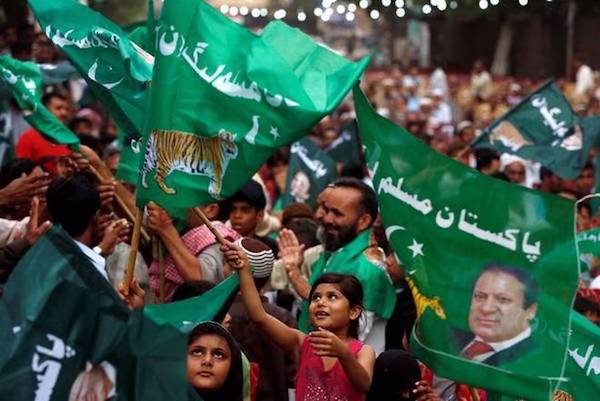
    In many cases, the victory margins of the PTI are huge and impressive. The party has even made considerable inroads into former Prime Minister and Pakistan Muslim League (Nawaz) leader Nawaz Sharif’s fortress of the Punjab, coming a near second. It will probably form government there as well, with many of the Independents and breakaway members. Many key members of the PML(N), including former national and provincial ministers, have been defeated, including in the party’s core constituencies such as Lahore and Faisalabad. The PTI is the first party to be re-elected in Khyber Pakhtunkhwa, increasing its seats. Perhaps the biggest shock has been the rout of the Muttahida Qaumi Movement (MQM) in its perceived stronghold, Karachi, where again the PTI has made significant gains.

    The establishment’s man

    There are a number of reasons why the PTI has won. Some of these are part of Pakistan’s perpetual political economy and are more standard, and there is one possible explanation which is particularly bizarre. It has been clear for many months now that Pakistan’s military establishment, with support from the superior judiciary, did not under any circumstances want Mr. Sharif’s party to win. This establishment went out of its way to ensure that he was disqualified and imprisoned, and that many of his former allies and comrades either joined the PTI or contested as Independents. In southern Punjab, several of Mr. Sharif’s allies abandoned him en masse. Furthermore, the MQM in Karachi was broken up into many groups. There was much prepoll rigging by the military. Independent commentary in the media was controlled and censored and many journalists and media houses were threatened and shut down. Open discussion and those dissenting were threatened in unprecedented ways, reminiscent of Pakistan’s many martial laws.

    Despite being the military’s favorite representative, Mr. Khan must also be given credit for a forceful campaign. He could not have won without believing that he would. He traversed the country, speaking at multiple events on the same day in different cities. While the leaders of other parties did the same, he was more visible on electronic media and had a huge presence on social media. He was also told that it was important to have winnable candidates and advised to take many dubious candidates into his party who were considered electable. Pakistan’s demography — with a large proportion of young and first-time voters, called ‘youthias’, supporting the PTI — is also likely to have worked in Mr. Khan’s favor this time more than in 2013, given a considerably mauled PML(N).

    Another explanation?

    There is yet another reason being given for why Mr. Khan won so convincingly. Many months ago, a married woman and a mother of five, Bushra Riaz Wattoo, had a dream. A resident of Pakpattan in the Punjab, Ms. Wattoo was considered to be a pirni (female spiritual guide). She was believed to have been a ‘modern’ woman once who then turned to Sufism. She told her husband that Prophet Muhammad appeared in her dream one day and asked her to get married to Mr. Khan. This would not only remove all the hurdles in Mr. Khan’s way to become Prime Minister but would also eventually usher in a golden era for Pakistan, she said. It was reported in different newspapers at the beginning of this year that Ms. Wattoo met and told Mr. Khan that he would become Prime Minister only if he got married before January 5. It was later disclosed that having divorced her husband, she married Mr. Khan on or around January 1 this year, and by all accounts her prophecy has come through.

    Mr. Khan has shown himself to be abusive, derogatory, misogynistic, arrogant and dictatorial, all within a few weeks. He has said that feminism degrades motherhood and that liberals ‘seek blood’ and are the most dangerous constituency in Pakistan. At the same time, he has been soft on the Taliban. During his campaign, he stated that he would have a nationalist, anti-U.S. and anti-India foreign policy. He is a born-again Muslim now with a Tasbeeh (rosary) in his hands, a conservative Muslim nationalist who believes in neoliberal economic policies. Since his party has not won a complete majority, he will have to be conciliatory and show a far more inclusive attitude towards other groups in Parliament than he has during his vile campaign.

    On the day after the elections, seven losing parties called the elections rigged. One senior leader called them “the dirtiest polls in the history of Pakistan”, and the PML(N) rejected the results outright. An all-party conference to discuss the results as well as the next step has been called for Friday. It is possible that the opposition parties may have learnt from the tactics of Mr. Khan in the previous Parliament. First, he did not accept the results, and as the enfant terrible, made much of the claim that the 2013 elections were completely rigged. He took his case to the streets in his famous dharna of 2014, and to the Election Commission of Pakistan (ECP). The ECP found almost no rigging during the 2013 elections, and he had to reluctantly accept the results.

    In Naya Pakistan

    The elections might be over — sordid, controversial and rigged as they have been. It is also very clear that Imran Khan is Pakistan’s next Prime Minister. Whether his wife’s prophecy of Pakistan entering a golden era will come true or not in Naya Pakistan will depend, to start with, on how the Prime Minister-designate handles the immediate expected backlash from the political parties which have lost. Mr. Khan, till now the vitriolic candidate and opposition leader, will have to mature to be a more sobering influence on government and on his many first-time, overly enthusiastic Ministers who are inexperienced in governance, much like himself. Probably the considerable influence of the military and the judiciary on him will go a long way in helping this. Or, perhaps, the current Mrs. Khan’s visions will now guide his and the country’s future.

    (The author is a political economist based in Karachi. He teaches at Columbia University in New York, and at the IBA in Karachi)

  • Prime Minister Imran Khan

    Prime Minister Imran Khan

    Can he mature fast enough for the requirements of his new office or will he need guidance?

    By S. Akbar Zaidi
    Mr. Khan, till now the vitriolic candidate and opposition leader, will have to mature to be a more sobering influence on government and on his many first-time, overly enthusiastic Ministers who are inexperienced in governance, much like himself. Probably the considerable influence of the military and the judiciary on him will go a long way in helping this. Or, perhaps, the current Mrs. Khan’s visions will now guide his and the country’s future”,says the author.

    While Imran Khan and his Pakistan Tehreek-e-Insaf (PTI) were fairly confident that they would emerge as the largest party in July 25 elections, they could not have imagined that they would make such a strong showing, resulting in Mr. Khan becoming Pakistan’s next Prime Minister. Even some academics, supposedly looking at empirical data, got it very wrong. Although all the results have been neither verified nor notified, and many seats will have to be given up since many contenders, including Mr. Khan who had been leading in all his five constituencies, contested and won from more than one seat, no one is going to dare stand in the way of his greatest, crowning moment.

    In many cases, the victory margins of the PTI are huge and impressive. The party has even made considerable inroads into former Prime Minister and Pakistan Muslim League (Nawaz) leader Nawaz Sharif’s fortress of the Punjab, coming a near second. It will probably form government there as well, with many of the Independents and breakaway members. Many key members of the PML(N), including former national and provincial ministers, have been defeated, including in the party’s core constituencies such as Lahore and Faisalabad. The PTI is the first party to be re-elected in Khyber Pakhtunkhwa, increasing its seats. Perhaps the biggest shock has been the rout of the Muttahida Qaumi Movement (MQM) in its perceived stronghold, Karachi, where again the PTI has made significant gains.

    The establishment’s man

    There are a number of reasons why the PTI has won. Some of these are part of Pakistan’s perpetual political economy and are more standard, and there is one possible explanation which is particularly bizarre. It has been clear for many months now that Pakistan’s military establishment, with support from the superior judiciary, did not under any circumstances want Mr. Sharif’s party to win. This establishment went out of its way to ensure that he was disqualified and imprisoned, and that many of his former allies and comrades either joined the PTI or contested as Independents. In southern Punjab, several of Mr. Sharif’s allies abandoned him en masse. Furthermore, the MQM in Karachi was broken up into many groups. There was much prepoll rigging by the military. Independent commentary in the media was controlled and censored and many journalists and media houses were threatened and shut down. Open discussion and those dissenting were threatened in unprecedented ways, reminiscent of Pakistan’s many martial laws.

    Despite being the military’s favorite representative, Mr. Khan must also be given credit for a forceful campaign. He could not have won without believing that he would. He traversed the country, speaking at multiple events on the same day in different cities. While the leaders of other parties did the same, he was more visible on electronic media and had a huge presence on social media. He was also told that it was important to have winnable candidates and advised to take many dubious candidates into his party who were considered electable. Pakistan’s demography — with a large proportion of young and first-time voters, called ‘youthias’, supporting the PTI — is also likely to have worked in Mr. Khan’s favor this time more than in 2013, given a considerably mauled PML(N).

    Another explanation?

    There is yet another reason being given for why Mr. Khan won so convincingly. Many months ago, a married woman and a mother of five, Bushra Riaz Wattoo, had a dream. A resident of Pakpattan in the Punjab, Ms. Wattoo was considered to be a pirni (female spiritual guide). She was believed to have been a ‘modern’ woman once who then turned to Sufism. She told her husband that Prophet Muhammad appeared in her dream one day and asked her to get married to Mr. Khan. This would not only remove all the hurdles in Mr. Khan’s way to become Prime Minister but would also eventually usher in a golden era for Pakistan, she said. It was reported in different newspapers at the beginning of this year that Ms. Wattoo met and told Mr. Khan that he would become Prime Minister only if he got married before January 5. It was later disclosed that having divorced her husband, she married Mr. Khan on or around January 1 this year, and by all accounts her prophecy has come through.

    Mr. Khan has shown himself to be abusive, derogatory, misogynistic, arrogant and dictatorial, all within a few weeks. He has said that feminism degrades motherhood and that liberals ‘seek blood’ and are the most dangerous constituency in Pakistan. At the same time, he has been soft on the Taliban. During his campaign, he stated that he would have a nationalist, anti-U.S. and anti-India foreign policy. He is a born-again Muslim now with a Tasbeeh (rosary) in his hands, a conservative Muslim nationalist who believes in neoliberal economic policies. Since his party has not won a complete majority, he will have to be conciliatory and show a far more inclusive attitude towards other groups in Parliament than he has during his vile campaign.

    On the day after the elections, seven losing parties called the elections rigged. One senior leader called them “the dirtiest polls in the history of Pakistan”, and the PML(N) rejected the results outright. An all-party conference to discuss the results as well as the next step has been called for Friday. It is possible that the opposition parties may have learnt from the tactics of Mr. Khan in the previous Parliament. First, he did not accept the results, and as the enfant terrible, made much of the claim that the 2013 elections were completely rigged. He took his case to the streets in his famous dharna of 2014, and to the Election Commission of Pakistan (ECP). The ECP found almost no rigging during the 2013 elections, and he had to reluctantly accept the results.

    In Naya Pakistan

    The elections might be over — sordid, controversial and rigged as they have been. It is also very clear that Imran Khan is Pakistan’s next Prime Minister. Whether his wife’s prophecy of Pakistan entering a golden era will come true or not in Naya Pakistan will depend, to start with, on how the Prime Minister-designate handles the immediate expected backlash from the political parties which have lost. Mr. Khan, till now the vitriolic candidate and opposition leader, will have to mature to be a more sobering influence on government and on his many first-time, overly enthusiastic Ministers who are inexperienced in governance, much like himself. Probably the considerable influence of the military and the judiciary on him will go a long way in helping this. Or, perhaps, the current Mrs. Khan’s visions will now guide his and the country’s future.

    (The author is a political economist based in Karachi. He teaches at Columbia University in New York, and at the IBA in Karachi)


  • Trump’s performance could help Republicans win the mid-term election

    Trump’s performance could help Republicans win the mid-term election

    By Ven Parameswaran
    “If the U.S. economy grew @ 4%, this will make a big headline not only in the USA but the entire world.  U.S. economy is the engine that drives the global economy. President Trump, of course, will take full credit.  He would argue that his economic policies have started finally working for the benefit of America and the world.  Trump’s massive historic tax cuts, deregulations, America first and better terms of trade, and running a lean government are having the positive impact on the economy.

    The government will release the 2nd quarter GDP on Friday, July 27th.  According to the Conference Board, Federal Reserve and the IMF, the GDP growth for the second quarter will be between 4 and 5 per cent. For my analysis, let me take the lowest and the most conservative figure of 4%.  If the U.S. economy grew @ 4%, this will make a big headline not only in the USA but the entire world.  U.S. economy is the engine that drives the global economy.

    President Trump, of course, will take full credit for the robust economy.  He would argue that his economic policies have started finally working for the benefit of America and the world.  Trump’s massive historic tax cuts, deregulations, America first and better terms of trade, and running a lean government are having the positive impact on the economy.

    It is true that the unemployment hit 3.8% in June.  Unemployment amongst the Blacks, Latinos and Women is also the lowest recorded.  Wages have been rising.  The frustrated unemployed who stopped looking for jobs are back now, and the unemployment went up to 4% in July.  Corporate earnings are going up substantially, thanks to the tax cut. Profits accumulated abroad have started coming back because of the tax incentives.  The DOW Jone’s average is up 38% since Trump’s election.

    TRUMP’S NEW WORLD ORDER

    Trump has challenged foreign countries without discrimination.  He has been tough on our closest allies – Canada, U.K., France, South Korea, and Germany.  He has questioned the effectiveness of NATO without strong defense.  He has admonished our allies and members of the NATO for not paying their share of 2% of their GDP.  He was even critical of Germany depending on Russia for importing $600 billion of gas yearly.  He said that Germany as our ally should be buying gas from us.   I must point out that ever since NATO was created in 1949, it has not been able to defend one inch of European territory encroached by the Soviet Union or Russia.  If the Europe had invested in strong defense, the NATO could have been a real tiger, not a paper tiger as now.

    SYRIA:  Trump used the military force twice to punish Syria, whereas Obama failed.   Trump can take credit for defeating the ISIS.  We do not see any more horrible pictures of Americans being killed and hung publicly.

    ISRAEL: Israel was created in 1948.  Trump is the first President to make Jerusalem its capital.  The majority of the UN General Assembly voted against and the fake media warned of crisis.  Trump’s courageous action stands, and Israel is more secure.

    NORTH KOREA:  Trump is the first President to have a summit meeting with the North Korean leader in Singapore.  Trump claims that the denuclearization process has started and could end within a year.  What a change?

    RUSSIA: Trump claims that his summit with Putin has contributed to better relations.  The relationship was almost frozen during Obama’s time.

    PAKISTAN: Trump is the first President to punish Pakistan for encouraging terrorism in Afghanistan.  Pakistan has behaved and for the first time, there is relative peace in Afghanistan.  Trump has also demanded that Pakistan to rid of all terrorists from Pakistan.  Trump is the first President to withdraw military aid to Pakistan.

    INTERNATIONAL TRADE:  Trump has started a revolution in international trade.  He campaigned against all trade pacts including NAFTA, LAFTA, and others.  He believes in America First.  He has been a tough negotiator and if the economy is the mirror, once could say his policy is working.  Today, the visiting Head of the European Union and Trump agreed to the goal of zero tariff.

    MIDTERM ELECTIONS: WHO WILL WIN?

    Trump is the most unpredictable in the world.  All the so-called pundits, mass media, pollsters, politicians all have failed so far. I hate to predict.  But, I can predict they will continue to predict and they will be again proven wrong.  This, however, does not disallow me from making some calculated speculations.  The elites and the coastal States are not going to decide the elections.  Once again, the Middle America and the South will decide.

    Senator Sanders of Vermont, who was stopped by Hillary Clinton, is now emerging as the leader of the Democrats and also attracting Independents.  The party has been going from the left to the left.  The defeat of the old horse, Congressman Crowley in NY, who was in line to become the Speaker, by a newcomer, a Socialist has given a wakeup call to the establishment.  This means, Nancy Pelosi and her old leadership, aging over 70 are dead horses.  Senators Elizabeth Warren, Kamala Harris, and Corker of NJ cannot compete with Sanders and Socialism.  The transformation in the Democratic party has weakened the establishment and it has no place.   We saw the Democrats got elected in Pennsylvania supporting Trump policies. The Independents are looking for the best choice.  THERE IS AN OLD SAYING, THE POCKET BOOK WILL DECIDE THE ELECTION.  If so, the pocket book is the common denominator of winning ticket.  Trump wins.

    Targeting Trump for 24/7 by the mass media and the anti Trumpsters will not help them.  Everybody knew Trump was a playboy and it is not news. Hillary Clinton tried the dirty politics, but Trump blasted her in the debates.  Therefore, no tapes or videos are going to kill the ROBUST ECONOMY. Trump’s popularity, even before the release of 2nd quarter GDP is 48%, higher than that of Obama’s or Bush’s at the same period.  When Trump was elected it was 37%.    But for the fake media, his popularity could have been 65%.  In addition to the Robust Economy and the New World Order, Trump will be credited for nominating two judges to the Supreme Court.  I am confident that Trump’s second nominee for the Court will be approved before the midterm election.  90% of the Republicans approve Trump as of now.  The GOP is most likely to add a couple of more senators and the House will be 50:50, meaning the GOP could end with a narrow lead of one!

    Mueller investigation is a hoax as there is absolutely no evidence of Russian collusion with the Trump campaign.  Professor Allan Dershowitz reputed legal scholar and attorney has written a book on AGAINST IMPEACHING TRUMP and has concluded that Mueller may have no choice but to write a narrative report.

    QUESTIONS DIFFICULT TO ANSWER:

    1. How did Trump give leadership to the U.S. economy?
    2. How Trump, despite challenging all leaders of the world, came out victorious in creating a NEW WORLD ORDER.
    3. What is Trump’s mantra or magic?


    (The author, Chairman, Asian American Republican Committee founded in 1988 came to the USA 64 years ago and lives in Scarsdale, New York. He can be reached at vpwaren@gmail.com)


  • Decoding Trump’s attack on Europe

    Decoding Trump’s attack on Europe

    His incendiary tour of the continent seeks to reverse the gains Europe has achieved over the last 70 years.

    By Ravi Arvind Palat
    Mr. Trump’s blistering attack on European states for not meeting their military spending obligations is misplaced. Not only does he fail to recognize that their military spending has risen since 2014 when they agreed to raise their military spending to 2% of their GDP by 2024 but also that European states are not positioned to be global powers. Unlike the U.S. which is bordered by the Atlantic and Pacific Oceans, Europe has no need for navies to patrol distant oceans and match the U.S. in defense spending. Moreover, rather than spending massively on defense as the U.S. has opted to do, European states provide their citizens with health care, education, and other welfare benefits.
    Far from Russia posing a threat to the Western alliance, the major source of destabilization to the EU comes from the flow of migrants from Africa. In this context, it is not higher military spending by member states that is crucial but the provision of aid. Members of the Organisation for Economic Co-operation and Development had pledged to contribute 0.7% of their GDP as aid to the poorest countries. Germany and the U.K. spend 0.66% and 0.7%, respectively, of their GDP in aid while the U.S. spends a mere 0.18%; Mr. Trump is threatening to slash even that by a third. Spending on aid, especially to African countries, will help stem the tide of refugees coming to Europe far more effectively than policing the Mediterranean.

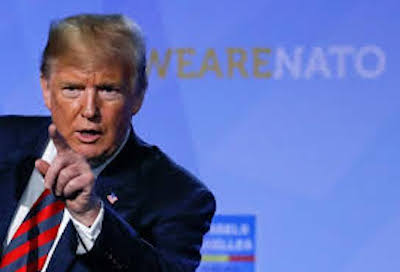
    U.S. President Donald Trump’s incendiary tour of Europe has justly generated extensive coverage for his disregard for diplomatic niceties and attacks on his allies, especially on German Chancellor Angela Merkel and British Prime Minister Theresa May, both of whom are facing stiff domestic opposition. Yet, mainstream commentaries on Mr. Trump’s attacks on the European Union and the North Atlantic Treaty Organization (NATO) do not place the trans-Atlantic relationship in the broader historical context.

    In the first instance, in the aftermath of the Second World War, the U.S. promoted economic integration among its European allies as an essential condition for the post-war revival of world trade. At war’s end, wealth had become concentrated in the new superpower — it accounted for 48% of world industrial capacity and 70% of gold reserves. With the demobilization of some 10 million soldiers in the U.S., the shift to a peacetime economy needed allies to open their markets to U.S. products and investments. Its European allies were too poor to provide a market and the notorious ‘meat-axe’ 80th Congress unwilling to undertake a program for European reconstruction.

    In this context, the U.K. government’s admission in February 1947 that it could no longer intervene in the Greek Civil War provided an opportune moment for U.S. President Harry Truman to follow Senator Arthur Vandenberg’s advice to “scare the hell out of the American people” by manufacturing the Cold War. A Congress that was not willing to aid Clement Attlee’s “socialist welfare state” was eager to rebuild Western Europe and Japan as levees to defend the ‘free world’ against ‘godless communism’.

    Along with NATO founded in 1949 was the Marshall Plan instituted in 1948. It was innovative not because of its size — $17 billion over four years was not substantially more than the $9 billion the U.S. had channeled to its European allies in the previous two years — but because it pressured West European states to reduce tariffs between themselves and to standardize regulations to facilitate the creation of a market viable enough to reap the economies of scale and for U.S. corporations to invest in the continent. This trans-Atlantic U.S. corporate expansion was welcomed by European governments and trade unions as these were the only entities with the funds to create employment.

    Post-war reconstruction

    A trans-Atlantic military alliance and European economic integration were thus the twin projects of a successful post-war reconstruction. Economic integration proceeded rapidly over the last 40 odd years, with the European Union (EU) becoming the largest economy on the planet and thereby threatening the U.S.

    At the same time, the rationale for the NATO military alliance — to protect Western Europe from Soviet expansion and to tie Germany to its neighbors — has largely evaporated with the breakup of the USSR and the dissolution of the Warsaw Pact.

    The Russian angle

    In the context of the current outcry among NATO member states about the Russian annexation of Crimea from the Ukraine, it is important to recall that U.S. President George H.W. Bush and other leaders had assured Russia in 1991 that the trans-Atlantic alliance would not extend beyond East Germany’s borders. Then when Russia was immensely weakened in the 1990s, U.S. President Bill Clinton led the charge to invite states in Central and Eastern Europe into the alliance. It was this expansion that led to a new confrontation with Russia once it had stabilized itself under President Vladimir Putin.

    Nevertheless, there is clearly no Russian threat to Europe. Even in the case of the Ukraine, as Steven Cohen, emeritus professor of Russian studies at New York University, has argued, the crisis was precipitated in 2014 when the EU pressured the Ukrainian government to sign an agreement that would have disadvantaged Russia. When then Ukrainian President Viktor Yanukovych hesitated, he was overthrown by EU- and U.S.-supported demonstrators even though he had signed an agreement brokered by three EU foreign ministers the previous day to form a coalition government. It was this march of NATO to the frontiers of Russia that provoked Mr. Putin to intervene in the Ukraine.

    Recasting security

    Far from Russia posing a threat to the Western alliance, the major source of destabilization to the EU comes from the flow of migrants from Africa. In this context, it is not higher military spending by member states that is crucial but the provision of aid. Members of the Organisation for Economic Co-operation and Development had pledged to contribute 0.7% of their GDP as aid to the poorest countries. Germany and the U.K. spend 0.66% and 0.7%, respectively, of their GDP in aid while the U.S. spends a mere 0.18%; Mr. Trump is threatening to slash even that by a third. Spending on aid, especially to African countries, will help stem the tide of refugees coming to Europe far more effectively than policing the Mediterranean.

    In this context, Mr. Trump’s blistering attack on European states for not meeting their military spending obligations is misplaced. Not only does he fail to recognize that their military spending has risen since 2014 when they agreed to raise their military spending to 2% of their GDP by 2024 but also that European states are not positioned to be global powers. Unlike the U.S. which is bordered by the Atlantic and Pacific Oceans, Europe has no need for navies to patrol distant oceans and match the U.S. in defense spending. Moreover, rather than spending massively on defense as the U.S. has opted to do, European states provide their citizens with health care, education, and other welfare benefits.

    Mr. Trump’s support for Brexit and his humiliating undermining of Ms. May, his outrageous comments on Germany being beholden to Russia and on Ms. Merkel in particular, and his alleged offer of a trade deal to French President Emmanuel Macron if France leaves the EU are all designed to break up the organization so that he can deal from a position of strength with small states. As Britain’s difficulties in exiting the union indicates, supply chains are so integrated across the continent that breaking up the EU would have disastrous consequences for production for all its member states and may even risk a global economic downturn.

    In short, what Mr. Trump is seeking to do is to reverse the gains Europe has achieved over the last 70 years and make it beholden once again to the U.S.

    (The author is a professor of sociology at the State University of New York at Binghamton, U.S.)

    (Source: The Hindu)


  • FIFA was Russia’s coming out party

    FIFA was Russia’s coming out party

    By Prabhjot Singh

    Moscow splurged over $11 bn to make the FIFA World Cup an event to make the ‘planet’ change its outlook about Russia. It worked, leading the FIFA chief to say, “ the whole world fell in love with Russia.’’

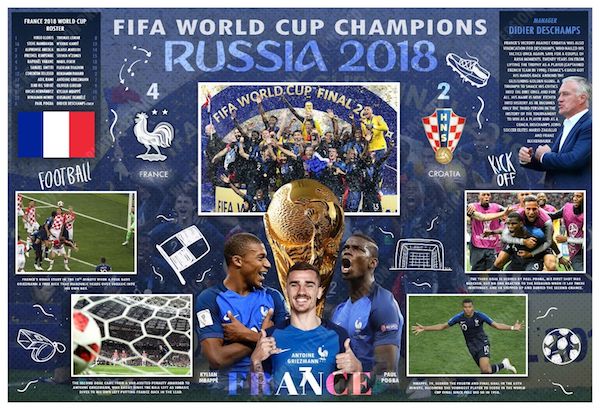
    FIFA World Cup 2018 was an all-European show. If France won the Cup, Russia, the hosts, won the hearts. The Americas — north, south and central — were all cut to size not only on the playfields of Russia but also in politics. It turned out to be a wonderful carnival of fun, sport and politics that witnessed many upheavals, besides showcasing Russia as a modern, dynamic and “normal” nation, ready for inclusion in the global economic, political, and sporting landscapes.

    Not only did all 32 nations that qualified laud the event as the “best ever”, a certificate of appreciation also came from FIFA president Gianni Infantino when he commented “the whole world fell in love with Russia” for hosting the best World Cup ever.

    FIFA World Cup 2018 was no different from the 2008 Beijing Olympic Games and 2016 Rio Olympic Games for grabbing criticism on corruption, organizational lapses and failure to provide “clean, healthy and sporting environs for free and fair competitions”. Intriguingly, at the end of these events, this criticism was changed to praise.

    The allotment of FIFA World Cup 2018 to Russia was not without a controversy. FIFA itself was dogged by allegations of corruption and impropriety. Sepp Blatter, the infamous suspended FIFA chief, was a special guest of Russian President Vladimir Putin.

    Allotment was made in 2011 and Putin had promised that the event would change the way the planet saw his “nation”. He had put in place a mechanism to keep the showcase event of FIFA free from threats of hooliganism, terrorist attacks or disruptions by political activists.

    Russia, an offshoot of the erstwhile Soviet Union, got the World Cup at a time when its relationship with both Europe and the US had touched the lowest ebb in decades. Its recent actions in Syria and Ukraine fractured further these ties.

    But unlike the 1980 Moscow Olympic Games held a year after the invasion of Afghanistan, this FIFA World Cup witnessed no boycotts. It was all the more credible to have a full FIFA house in Russia, especially when the hosts remain on the “suspension list” of the International Olympic Committee. In the last Olympic Winter Games in PyeongChang, Russia was not allowed, though its athletes participated under the banner of Olympic Athletes Russia. The World Cup provided a pleasant change. Between June 14 and July 15, the 64 games played in 11 cities not only saw Iceland making an impressive debut, but also defending champions Germany making an exit after the group matches.

    For Asia, it was Japan that carried the flag to the pre-quarterfinals, as other Asian contenders — Iran, Saudi Arabia and Korea —could not cross the group matches hurdle.

    Though India has seldom qualified for the prestigious FIFA event, it had its nominal representation through Rishi Tej (10) and John K Nathania (11) who were chosen to carry the ball for the games on June 18 and 23 in the Russia World Cup. Besides there were 100-odd football fans from India, including Amitabh Bachchan. There were also some volunteers from India.

    The FIFA World Cup is an event that is as prestigious, if not more, as the summer Olympic Games are. Russia spent more than $11.6 billion on infrastructure for the FIFA World Cup. Four years earlier, it had put in a huge amount for the Winter Olympic Games, an event that at the end soiled its credibility for conspiring to “drug” the games, with critics calling the 2014 Sochi Winter Olympics as “chemist” games.

    Besides the Russian Government’s expenditure on making the World Cup an event to make the “planet” change its outlook about Russia, FIFA’s budget for the just-concluded World Cup was a whopping $1,943 million.

    Compared to it, when Bhubaneswar holds the World Cup Hockey Tournament later this year, the total cost is estimated at about $19 million. The event will be spread over 19 days and feature 16 teams and 36 matches. FIFA World Cup, a 35-day event, witnessed 64 games played in 11 different cities.

    There were nearly half a million football fans, including several thousand from Peru alone, drinking on the streets of Russia, through the World Cup days.

    As the event progressed to its knockout rounds, some icons like Argentina, Spain, Portugal, Brazil and Uruguay made unceremonious exits, losing by results facilitated either by late goals, penalties, own goals or penalty shootouts. There were 29 penalties awarded in the tournament besides “own” goals, including the first goal of the final between France and Croatia. And then, the second goal came from a penalty.

    By the time the tournament reached the semi-final stage, the challenge of Asia, Africa and the Americas had ended. The semi-finals and final were an all-European affair. Though Croatia made it to its first final of a World Cup, it could not stand up to the experience of the French, who won their second World Cup title in 20 years, and thus became only the sixth nation to win the elite soccer tournament two or more times.

    Harry Kane (England), Luka Modric (Croatia), Kylian Mbappe (France) and Thibaut Courtois (Belgium) were adjudged among the best players of this World Cup that also saw the fading away of Lionel Messi (Argentina), even as Cristiano Ronaldo (Portugal) and Neymar (Brazil) may continue to hawk headlines for some more time.

    And who can forget the Croatian President, Kolinda Grabbar-Kitarovic, who spent her own money to travel to Russia, sported the team jersey to watch the “silver team” play the final, from the stands, and greeted and consoled each member of the losing finalist team with a warm hug?

    (The author is a senior journalist. He is executive editor with the PTC TV Channel)

  • Deep state, deeper problems: Pakistan

    Deep state, deeper problems: Pakistan

    Pakistan has been ill-served with the ‘corruption is the only problem’ oversimplification, as elections beckon

    By Husain Haqqani

    It is ironic that Mr. Sharif faces jail ahead of an election that opinion polls indicate his party would win, if voting was free and fair, even as a long list of internationally designated terrorists is free to seek votes. That contradiction is at the heart of why the outcome of the elections is unlikely to change any of the fundamentals of the Pakistan crisis. If the PML-N overcomes all odds and still manages to win, the corruption cases will continue to cast their shadow. If someone like Imran Khan wins with the help of invisible hands, he would start his term under a different cloud.”

    Whatever their outcome, Pakistan’s general election scheduled for July 25 is unlikely to change four fundamental realities. First, Pakistan’s military-led establishment will continue to wield effective power, drawing strength from allegations of incompetence and corruption against civilian politicians. Second, civilian politicians will continue to justify their incompetence and corruption by invoking the specter of military intervention in politics. Third, jihadis and other religious extremists will continue to benefit from the unwillingness of the military and the judiciary to target them as well as the temptation of politicians to benefit from their support. Fourth and finally, Pakistan’s international isolation and economic problems, stemming from its ideological direction and mainstreaming of extremism will not end.

    The conviction of former Prime Minister Nawaz Sharif by an accountability court last Friday has set the stage for him to portray himself as the latest martyr for democracy. He has argued, as others have done before him, that he is being punished not for corruption but for standing up to Pakistan’s invisible government — the military-intelligence combine that has dominated the country effectively since 1958.

    His supporters are willing to ignore the fact that Mr. Sharif’s own political career was launched by the Pakistan Army and the Inter-Services Intelligence (ISI), and the likelihood that allegations of unusual expansion of the Sharif fortune since the family’s advent in politics are true.

    Spotlight on the judiciary

    The conduct of Pakistan’s judiciary in the matter has been far from judicious. The Chief Justice of Pakistan, Saqib Nisar, views himself less as an adjudicator in accordance with the law and more as a super policy maker. He has expressed interest in everything — from water scarcity to running of mental hospitals and prisons. He has taken to touring various government facilities and has even created a fund for the construction of dams. The fund will receive public contributions because the Chief Justice knows the exchequer does not have enough money to build the dams he wants built.

    None of these actions is part of a Chief Justice’s job description, even after recognizing that some judges are more activist than others. Justice Nisar has made his political biases well known and the case against Mr. Sharif proceeded in reverse order. Instead of beginning in a trial court where evidence of his wrongdoing was established beyond reasonable doubt, he was first disqualified by the Supreme Court and then put on trial.

    But perceptions and common knowledge of political corruption cannot be a substitute for following legal principles. Elsewhere in the civilized world, the Pakistani practice of accusing someone of criminal conduct first in the highest court and then demanding that they prove their innocence would be deemed grossly unjust. The fact that this happens only in political cases further strengthens the view that politics, not corruption, is at the heart of such ‘prosecutions’.

    Moreover, the Supreme Court invited representatives of the Military Intelligence and the ISI to help investigate the money trail for Mr. Sharif’s alleged properties in London. This highly unusual procedure itself casts doubt on the real motives behind the former Prime Minister’s trial. The military-led prosecutions of politicians, even when their malfeasance is well known, helps the politicians in building their case that their political conduct is the source of their troubles.

    Pakistan is, therefore, unable to hold the politically powerful accountable through its politicized judiciary. The cynical view of Pakistani politics would be that three decades ago the deep state advanced Mr. Sharif’s political career while portraying Benazir Bhutto’s spouse, Asif Zardari, as corrupt; now Imran Khan is the ‘chosen one’ while Mr. Sharif’s alleged corruption is being targeted.

    Problem with this ‘narrative’

    The military, which now refers to itself as ‘the institution’, has helped build a simplified narrative to justify its constant intervention in political matters as well as to explain Pakistan’s myriad problems. According to this narrative, civilian politicians are incompetent and corrupt, which is the only reason the military needs to periodically intervene to set things right. There is no explanation for how politicians would ever learn the art of governance if they are to be constantly corrected by unelected generals and judges.

    Another part of ‘the narrative’ is the notion that Pakistan’s dysfunction and periodic economic crises are the result of the massive corruption by civilians. Imran Khan and his supporters have been advancing that simplified narrative. Their message finds resonance with those who want to believe that once kickbacks on large projects and their corrupt practices are eliminated, Pakistan would somehow become the land of milk and honey.

    There is, of course, no justification or excuse for corruption but Pakistan has been ill-served with the ‘corruption is the only problem’ over-simplification. Since at least 1990, it has become an excuse to gloss over more significant policy issues that hold Pakistan back. Corruption has been exposed in many countries, from Iceland to China but none of them is as dysfunctional as Pakistan.

    Limiting national discourse to a discussion of corruption makes it impossible for Pakistanis to discuss how jihadi ideology and religious extremism are leading to Pakistan’s isolation. Similarly, Pakistan’s slow growth in exports, for example, is hardly a function of corruption. It reflects low productivity and inadequate value addition which are consequences of poor human capital development and failure to attract investment, among other factors.

    Pakistan is the sixth largest country in the world in terms of population, has the sixth largest army in the world, and possesses one of the largest nuclear arsenals. Yet, it has the highest infant mortality rate; more than one-third of its children between the age of 5 and 15 are out of school. The country’s GDP on a nominal basis ranks 40 out of nearly 200 countries while its GDP per capita stands at 158 out of 216 countries and territories, according to World Bank data.

    None of these facts, however, has found any mention in the election campaign of any Pakistani political party. Although Mr. Sharif’s Pakistan Muslim League (PML-N) and Bilawal Bhutto Zardari’s Pakistan People’s Party (PPP) have at least cared to publish detailed manifestos, Imran Khan’s Pakistan Tehreek-e-Insaf (PTI) published its manifesto on Monday, July 9, less than 20 days before the election. The party feels it only needs Mr. Khan’s charisma and the outrage against corruption or enemies of Pakistan to claim voters’ loyalty.

    Economic woes

    The anti-corruption enthusiasm has sometimes added to Pakistan’s economic woes. Pakistan is currently burdened with compensation payments running into billions that must be made to foreign companies whose contracts were cancelled as part of investigations into corruption of officials involved in awarding those contracts. But fighting corruption is a useful slogan if the deep state wants to avoid fighting all jihadis and does not wish to acknowledge the flaws of its national narrative.

    It is ironic that Mr. Sharif faces jail ahead of an election that opinion polls indicate his party would win, if voting was free and fair, even as a long list of internationally designated terrorists is free to seek votes. That contradiction is at the heart of why the outcome of the elections is unlikely to change any of the fundamentals of the Pakistan crisis. If the PML-N overcomes all odds and still manages to win, the corruption cases will continue to cast their shadow. If someone like Imran Khan wins with the help of invisible hands, he would start his term under a different cloud.

    Pakistan will, unfortunately, not emerge stronger after an election whose winner lacks credibility and whose loser is likely to initiate confrontation with the winner right after polling day.

    (The author,  Director for South and Central Asia at the Hudson Institute, Washington DC, was Pakistan’s Ambassador to the U.S. from 2008-11. His latest book is ‘Reimagi

  • The New Trade Order

    The New Trade Order

    By Philip I. Levy

    Since the start of the year, U.S. President Donald Trump has lashed out at allies and adversaries alike on trade. Often, as with India, the U.S. has pushed for enhanced security cooperation at the same time it declared trade relations a national security threat. The belligerence has left many baffled.

    Some pointers

    A first question is why the Trump administration is launching its trade wars. There are at least three possible explanations worth considering: an actual casus belli, as with complaints about Chinese practices; a phantom casus belli, as in the preoccupation with meaningless bilateral trade deficits; or, finally, it might just be a straightforward desire to block trade.

    The evidence seems to point to the last possibility — simple protectionism. While the U.S. has significant concerns about Chinese economic practices, such as China’s aggressive approach to acquiring intellectual property from American businesses, the administration has been unable to focus its demands on these practices. When, a year ago, China offered a deal to address its steel overcapacity, Mr. Trump reportedly rejected the deal in favor of pursuing tariffs. Nor has the White House been able to prioritize among its global trade concerns. The discord with trading partners such as the European Union and Canada has undercut the possibility of presenting a united front on China complaints.

    Further, the Trump administration’s tariff justifications can shift rapidly. In May-June, the Trump administration extended steel and aluminum tariffs to Canada, among other countries. Ostensibly, the rationale was a threat to U.S. national security. Yet, at the G7 meetings later that month, Mr. Trump seemed to explain the aggressive U.S. stance by citing Canada’s protective dairy regime.

    There is ample evidence that Mr. Trump places a high priority on bilateral trade deficits, which he seems to equate with profit and loss statements. In May, hoping to assuage the President’s concerns, Chinese Vice-Premier Liu. He came to Washington to offer increased Chinese purchases of U.S. goods as a means of resolving the looming tariff threat. The Trump administration initially struck a deal, then reversed it roughly a week later. Countries with which the U.S. runs a trade surplus have also not been immune from trade attacks; Canada is a prime example.

    This then leaves the simpler explanation that Mr. Trump is fond of tariffs and believes that American industry will do better behind a wall of protection. He has been neither coy nor inconsistent about such feelings. When he first announced his intention to apply steel and aluminum tariffs in March, his press secretary was asked about the surprise policy move. She replied, “This is something, frankly, the President has been talking about for decades.”

    Within the system

    The U.S. prides itself, however, on its political system of checks and balances. Even with a protectionist President, how can one individual recraft a country’s long-standing trade position so dramatically? The puzzle deepens when one looks at the U.S. Constitution, which assigns the power to apply tariffs to Congress. And where are international protections against capricious protectionism?

    Domestically, Congress has tried to shift responsibility for trade on to the Executive Branch ever since it engaged in an ill-fated bout of protectionism in 1930. The underlying presumption was that individual members of Congress were more likely to succumb to protectionist pressures from their narrower constituencies, while the President was more likely to consider the broader national interest. Most domestic legislative safeguards, therefore, protected against a president being more liberal than Congress might desire; there are relatively few protections against a President who is more protectionist. Over the years, the legal authorizations for a President to apply protection accumulated, largely unused. Thus, the steel and aluminum tariffs were justified under an obscure provision of the Trade Expansion Act of 1962, a law granting national security powers from the midst of the Cold War. The upshot is that a protectionist President has ample tools at hand.

    Turning to the global trading system, the burgeoning trade war demonstrates its limitations. The General Agreement on Tariffs and Trade and World Trade Organization were never designed to block a major world power from running amok. They relied, instead, on the principal players in global trade respecting the system. Trade disputes were anticipated, of course, but they were intended to be sincere cases of disagreement about rules and acceptable practices. The WTO Dispute Settlement Mechanism cannot act quickly enough to address the mounting spats about trade protectionism emanating from the U.S., a major reason why countries around the world have not waited for verdicts from their WTO complaints and have instead proceeded with retaliation.

    What lies ahead

    Finally, we can ask: what comes next for the global trading system? In the near term, we are likely to see escalation. U.S. tariffs on $34 billion of imports from China took effect on July 6. China has promised equivalent retaliation. Mr. Trump has promised to retaliate against that retaliation.

    The Trump administration also announced its intention to use its national security justification for tariffs on the auto sector. There are reports that Mr. Trump wants such tariffs in place before the U.S. mid-term elections in early November. While such a move would be qualitatively similar to the action against steel and aluminum trade, it would be quantitatively much more significant, given the magnitude of the autos trade. Europe has threatened retaliatory tariffs worth $300 billion should the auto tariffs proceed.

    There is little sign that Mr. Trump will be turned from his protectionist path by earnest explanations of the virtues of trade, though there have been valiant attempts both from the private sector and from members of Congress. If there is to be a change in the U.S. position, it is likely to come from an active reassertion of congressional authority over trade policy. At the moment, that still appears unlikely, but the pressures are mounting.

    Even if the President has trumpeted his passion for protection for years, many in the U.S. assumed he was exaggerating. It is only in the last month or two that the effects of both protection and retaliation have begun to be felt. While some businesses have been helped, many more have been hurt. For example, while there are roughly 140,000 Americans who work in steel production, there are about 2 million who work in industries that use steel as a major input. Those latter industries are beginning to cry for help, along with farmers who are seeing sales lost to retaliatory barriers. Stories such as the relocation of production of Harley-Davidson motorcycles have called into question the President’s claim that protection would revive American manufacturing.

    All this has led to a deeply conflicted Republican Party, which holds a majority in both houses of the legislature. Traditionally, Republicans have been the more pro-business, pro-trade party and members of Congress running for re-election this November were planning to mount a campaign based on unity, tax cuts, and good stewardship of the economy.

    Now those candidates need to decide whether or not to act against their President’s trade measures. If they choose to, they have the power to legislate and block the President’s trade belligerence, at the cost of enraging him. If they choose not to, they will likely disappoint their constituents. Their choice is likely to determine the next turn in Mr. Trump’s trade war.

    (The author is a Senior Fellow at the Chicago Council of Global Affairs and adjunct Professor at the Kellogg School of Management, U.S.)


  • The bilateral limits of hype: on India-U.S. relations

    The bilateral limits of hype: on India-U.S. relations

    By Varghese K. George

    But India-U.S. relations will be better off without hype and grand theories, often encouraged by the government. Otherwise, every rescheduling of a meeting will be interpreted as the collapse of ties. Similarly, avoiding the hyperbole could help manage India’s troubles with Pakistan and China better. The U.S. has overlapping interests with China, and India has overlapping interests with both. The trouble with big-chest, small-heart hyper-nationalism in foreign policy is that it also causes short sightedness. The audacity of hype has its limits.”

    Prime Minister Narendra Modi and U.S. President Donald Trump have both built their politics on the promise of making their countries great again. Placing India and the U.S., respectively, as leaders on the world stage is the stated objective of their foreign policy. The project of regaining national glory is based on another assumption that they inherited a mess from their respective predecessors. Yet another shared trait is their love for spectacle over meticulous, prolonged and often frustrating pursuit of strategic goals.

    Theatre as strategy

    The postponement of the India-U.S. 2+2 dialogue between the Foreign and Defense Ministers of both countries, that had been scheduled for this week, has to be understood in the context of the similar personality traits of Mr. Trump and Mr. Modi. Hugging Mr. Trump may be a good spectacle for Mr. Modi, but the same may not be true for the former. Mr. Trump has set his eyes on spectacles that suit him. Mr. Trump, still basking in the denuclearization deal that he’s said to have struck with North Korea’s Kim Jong-un, is now looking forward to the next big event: a summit meeting with Russian President Vladimir Putin. His every move on the global stage enrages his domestic political opponents and the professional strategic community alike and he is happy, as this keeps his political base constantly on the boil.

    North Korea, Syria, Afghanistan, trade deficit, and all global challenges before America are the faults of his predecessors, he repeatedly tells supporters. Most recently, at the G7 summit in Canada in June, he declared: “I blame our past leaders for allowing this to happen (trade deficits) …You can go back 50 years, frankly.” Such rhetoric may sound familiar to Indians. In Mr. Trump’s war on the legacy of all Presidents before him, India is on the wrong side. The remarkable growth in India-U.S. relations since the turn of the century had been nurtured by three U.S. Presidents, Bill Clinton, George W. Bush and Barack Obama, two Democrats and one Republican who have all been the target of Mr. Trump’s ire. India neither promises him the opportunity of a spectacle nor offers the grounds for destructing the legacy of a predecessor. So, he told Secretary of State Mike Pompeo to deal with North Korea and Russia, and 2+2 with India could wait. “Nobody wakes up in DC daily thinking of India,” says a former U.S. ambassador to India, pointing out that 16 months into the new administration, there is no Assistant Secretary of State for South and Central Asia in the State Department.

    Impact on ties

    To buttress one’s own claim to be a trailblazer by denying the achievements of predecessors may be good political tactics for these leaders but trying to wish away history itself is not a sustainable strategy. Against the backdrop of a programmatic negation of history in both countries, Mr. Trump’s bursts of unhinged rhetoric against China and Pakistan lend themselves to easy and convenient interpretations by supporters of improved U.S.-India ties as moments of enlightenment for the U.S., even as turning points.

    But Mr. Trump cannot undo all the legacy with a magic tweet. U.S. relations with Pakistan and China took shape during the Cold War. Pakistan might be the longest ally of the U.S. after the U.K., first in the fight against communism, and then in the fight against terror that was created in the first fight. China used the Cold War to its own advantage in its ties with the U.S.

    China today threatens the dominance of the U.S., but the America’s security establishment and political elite are obsessed with Russia. India gets caught in that internal American fight too, such as in the case of an American law that now requires the President to impose sanctions on any country that has significant security relations with Russia.

    Mr. Trump sees the challenges posed by China, but not in a manner helpful for India. For, India and China are in the same basket for Mr. Trump on many issues that agitate him. He has repeatedly mentioned India and China in the same breath as countries that duped his predecessors on climate and trade deals. His administration considers India and China as violators of intellectual property laws, as countries that put barriers to trade and subsidize exports and use state power to control markets. The nationalists in the Trump administration, including U.S. Trade Representative Robert Lighthizer, Commerce Secretary Wilbur Ross and White House National Trade Council Director Peter Navarro are all gunning for China, and India is in the same firing line. Many Americans who think that China took the U.S. for a ride — many Democrats among them — suspect that India is trying to do the same thing.

    But there are two constituencies in the U.S. that promote India against China: the Pentagon and the U.S. arms industry. This works to India’s favor. While the Obama administration could not overcome State Department objections to offer India even unarmed drones, the Trump administration has done so, offering armed drones. Here, Mr. Trump is not guided by any grand theories of ‘rule-based order’, etc. that professional strategists talk about, but by the opportunity to sell.

    Given Mr. Trump’s views on trade, American companies that used to argue China’s case are now guarded in their approach. Still, companies such as General Motors and Ford have come out against a trade war with China. This has implications for India too. American companies that eye the Indian market are allies in the pushback against Mr. Trump’s nationalist trade policies. Mr. Modi has realized this dynamic that puts India and China in the same corner in Mr. Trump’s perspective — and that significantly explains his Wuhan summit with Chinese President Xi Jinping, the third big leader who is gaming for the glory of his country.

    War against legacy

    The enlightenment that Mr. Trump purportedly brought on America’s Af-Pak policy also appears to have been short-lived. If one looks at the tough messages from Nikki Haley, U.S. Ambassador to the UN, in New Delhi recently on Pakistan and Iran, it is clear where the political priorities of the Trump administration lies. Here again, Mr. Trump is determined to gut his predecessor’s legacy, a key component of which was rapprochement with Iran. The war in Afghanistan is the worst optics for Mr. Trump’s showman politics, and his administration’s approach has been to sweep it under the carpet. The Pentagon has restricted release of data on the war, but a report last month paints a picture of a deteriorating situation. The U.S.’s ability to arm-twist Pakistan has been limited anyway, and Mr. Trump’s determination to turn the screws on Iran makes it tougher. National Security Adviser John Bolton, who had advocated bombing Iran, believes that a hardline policy against Pakistan is not desirable.

    All told, Mr. Trump might accept Mr. Modi’s invitation to be the chief guest at the 2019 Republic Day parade just ahead of the Lok Sabha campaign, triggering another round of commentary on their ‘body language’ and ‘chemistry’. A series of significant defense purchases and agreements could be concluded in coming months. But India-U.S. relations will be better off without hype and grand theories, often encouraged by the government. Otherwise, every rescheduling of a meeting will be interpreted as the collapse of ties. Similarly, avoiding the hyperbole could help manage India’s troubles with Pakistan and China better. The U.S. has overlapping interests with China, and India has overlapping interests with both. The trouble with big-chest, small-heart hyper-nationalism in foreign policy is that it also causes short sightedness. The audacity of hype has its limits.

    (The author is an assistant editor with The Hindu. He can be reached at varghese.g@thehindu.co.in)

    (Source: The Hindu)


  • Stay, Afghanistan needs you…

    Stay, Afghanistan needs you…

    Filled with remorse, an anguished Afghan hopes Sikhs, Hindus won’t flee what’s their home too

    By Saad Mohseni
    I am not certain if the community can tolerate more pain, but we don’t want them to forget that they represent a legacy that stretches back a thousand years in Afghan history.

    It was a black day. On July 1, a suicide bomber tore into a crowd of Hindus and Sikhs who had collected to meet President Ashraf Ghani in Jalalabad, resulting in the massacre of 19 persons; 10 were badly injured. The pain has been felt and shared by every Afghan I have come in contact with since the attack. The brutal attack claimed the lives of two of the Sikh community’s favorite sons, Avtar Singh Khalsa, the only Sikh candidate running for Parliament in October; and Rawail Singh, a vibrant member of our trying-to-be-more-civil society. We all feel incredible shame that it has come to such a pass.

    I vividly recall Harandar Singh and Amarjeet Singh, my Sikh classmates in primary school at the French Lycee Isteqlal in Kabul, Afghanistan, in the late 1970s. As first cousins, they were inseparable: gossiping, laughing, switching between Farsi and Punjabi without missing a beat. One was quite tall and slim, while the other was darker, shorter and slightly chubby — although I can’t recall which one was which. What I do recall is that their parents, like many Sikhs in Kabul, were involved in the textile business. Anil Kumar, our lone Hindu classmate, came from a well-known family that operated one of Kabul’s better-known movie theatres.

    I would often walk with Harandar and Amarjeet the mile-long distance from our bus stop to school, going past the homes of the few remaining Jewish families adjacent to Flower Street. In the late 1970s, Kabul was a city that peacefully housed Indian communities. The same was true of Ghazni, Kandahar, Jalalabad and all other urban centers of Afghanistan.

    I viewed these boys as lucky to evade religious studies at school, they didn’t have to be subjected to the less-than-competent religious studies teacher, a character who once pulled his belt out to whip a student, only to see his pants fall to his knees. But other than their ‘exotic’ turbans and absence from the compulsory Islamic studies class, Harandar, Amarjeet and Anil were no different to my other friends in Kabul in those years of innocence.

    The 5 lakh-strong community of Sikhs and Hindus was a robust contributor to the private sector: trade, banking, textiles, food and retail. Throughout the city, they left a distinctive mark: an enduring signifier that Afghanistan was once a true crossroads between the Middle East and South Asia. How can I ever forget the exquisite jalebis sold in the Karte Parwan district of Kabul by a Hindu merchant? Or the lively Punjabi music and the bountiful spice shops that were a routine stopover for every Kabul cook. But what was special about them was their ownership of Afghanistan. They seemed to embrace the hybrid identity and took genuine pride in the link to this remote country. They belonged there.

    Afghan historians believe that the first wave of ‘modern’ Hindus arrived during Mahmood Ghaznavi’s reign over a thousand ago. Of course, it should also be noted that huge swathes of modern Afghanistan were ‘Hindu’ prior to the arrival of Islam in the 7th and 8th centuries, alongside Zoroastrianism, Buddhism and paganism.

    The Soviet invasion of Afghanistan and the civil war that ensued brought misery to millions of Afghans — Muslims, Hindus, Sikhs, Jews. Many members of the community were forced to flee the country, but some of them stayed, resolutely. Those who were forced to take refuge outside of Afghanistan took pains to identify themselves as Afghans. This endeared them even more to their fellow Afghans.

    The post-Soviet civil war that devastated Kabul and resulted in the lawlessness that destroyed the social, moral and economic fabric of the nation compelled more Hindus and Sikhs to flee their homes. But again, some of them stayed back.

    The arrival of the Taliban only brought more wretchedness. Hindus and Sikhs were initially forced to wear yellow dresses and turbans and raise a yellow flag on their rooftops. Many, feeling vulnerable, decided that it was finally time to leave. But despite this intolerant and violent environment, some of them still stayed put.

    The defeat of the Taliban regime and the emergence of an independent government in Kabul, committed to the rule of law, gave hope; encouraging many Afghans to believe that this was a new beginning for the country. In 2003, a brave Sikh gentleman stood before a Loya Jirga (grand assembly) of mostly Islamic commanders, politicians and clerics and screamed: ‘It is you Muslims that have ruined my Afghanistan.’ He received a standing ovation because we all knew that he was right.

    The rule of law of the post Karzai era was more myth than reality. Many of their properties, namely in the Karte Parwan district of Kabul, were squatted on and confiscated by warlords or Afghans with strong connections. Given that the community had survived for a millennium through peaceful means, there was no warlord to protect them. Many of them decided to leave the country. But again, some chose to stay.

    There were moments of optimism. To Hamid Karzai’s credit, he appointed Shamlal Bhatija Bhatia, an Afghan Hindu, as Ambassador to Canada — a first in the country’s history, despite the fact that Mr Bhatia’s family had resided in the city of Kandahar for over 350 years. Mr Bhatia regularly pointed out that Ahmad Shah Durrani, the Kandahari founder of modern-day Afghanistan, had based the concept of Afghanistan on inclusion.

    Forty years after I last shared a class with Harandar, Amarjeet and Anil, their community has dwindled from 5 lakhs to only 1,300 — scattered across three Afghan cities. Their numbers, which coexisted with Afghans of all faiths for centuries, has now shrunk to almost nothing.

    I am not certain if the community can tolerate more pain, but we don’t want them to forget that they represent a legacy that stretches back a thousand years in Afghan history.

    And more than ever, Afghanistan needs them to stay.

    (The author is Chairman of Moby Group, the largest media company in Afghanistan)

  • A hard outlook will have pitfalls in Kashmir

    A hard outlook will have pitfalls in Kashmir

     By Arun Joshi

    The state is hurting. Some degree of sensitivity and a ‘highly disciplined’ approach will possibly yield better results. The security forces must remain calm in the event of any provocation.

    Kashmiris happy, somewhat. The PDP-BJP split was much awaited; by people who were unable to reconcile to the rule of the saffron party by proxy. Fear was deeply entrenched in the minds of the locals that right-wing Hindutva forces, with the high pitch for the abrogation of Article 370, may succeed in undermining Kashmir’s special status. Naturally, Kashmiri Muslims were insecure after the alliance came about. And so, it became easier to support the forces of violence, as for them, the PDP had committed an unpardonable sin by shaking hands with the BJP; and getting nothing in return. The first shocker came when the Centre delayed the flood relief package by more than a year after the devastating floods in the autumn of 2014, a couple of months before the Assembly elections that year.

    The PDP-BJP government has disappeared from the corridors of power, but the apprehensions of Kashmiris have not. Aware of political expediencies and vulnerabilities of the parties, they suspect more political compromises may be in the offing. They are waiting and watching the developments very closely. The street mood will be determined by the governance they get, and the way they are treated at their homes, and out on the streets. Kashmiris have become hyper-sensitive about their identity and dignity — siding with secessionist forces is a manifestation of that emotion.

    Some voices in the BJP are linking a ‘hard approach’ toward militants as a way of pulling out Kashmir from the vicious cycle of violence it finds itself in. They believe the militants would/should be hunted and neutralized but forget that this approach prevailed earlier too, and nothing came of it.

    What is really needed is to take into account the attendant pressing matters that have come into play over the past two years — the civilian population, mostly youth with rocks thronging encounter sites and disrupting anti-militancy operations; and the clashes that follow as a result of accidental civilian killings, or what is seen as ‘collateral damage’. Over these two years, the civilian population has identified itself with militants, primarily for two reasons. First, many militants are locals. They are boys they saw in the neighborhood, hence the affinity which exists in the well-knit Muslim society.

    Second, they do not perceive the violent acts as being out of sync with their newly-acquired ethos of resistance. It is a big shift — this ‘new-found’ relationship between the civilians and the militants. In the 1990s, the militants were seen as mujahideen (warriors). There were no doubts. They had picked up the gun and should be ready for the consequences — to die fighting the security forces. Sympathy and sentiment was surely with them, but it was not manifested in the desperate and visible attempts to save them while risking their own lives; as we see now. This is the fundamental truth of the changed situation in Kashmir. The psyche of the common Kashmiri has undergone a sea change.

    Today, the way of looking at the militants has changed, almost hero-like: their arms training may be limited to few weeks, even less, but they are hardened. They have shown their will and grit to fight unto the last. What is more, there is societal approval of their ‘sacrifices’.  Some of them have spurned appeals of their parents to return home.

    Some extraordinary real-life visuals have paled the reel-life images — the mother of Saddam Padder, a top militant of Shopian in South Kashmir recently killed in an encounter, giving a gun salute to her slain son. Her gesture left a deep impact on the minds of youngsters who watched the video that went viral on social media; and is seen as a universal endorsement of militancy by their mothers.

    In such circumstances, reckless actions, with the rhetoric of hard approach, (BJP general secretary Ram Madhav has distanced his party from it) — without taking into account the fallout — have the potential to blow up in the face. The way forward should be specific operations without making much noise. It will help keep civilians out of harm’s way. This is important, because there is widespread impression that the security forces will be striking hard, not necessarily a militant-specific action. It will be deemed as an action against the people who would come to defend them. Stone-throwers will not only seek to disrupt the cordon and search operations — a prelude to the actual gunfight with militants — but also attack patrol parties.

    This phenomenon is interlinked. Militants attack convoys of security forces even as stone-throwers use tactics to distract, thereby creating situations where the Army and police either suffer casualties or inflict casualties. At times, both sides suffer casualties, speeding up the cycle of killings.

    Kashmir-centric parties, the PDP and the National Conference are convinced that the hard approach is not the answer to the problem. Other ways can be found to ease the situation without making the hard approach visible: the security forces must change their attitude towards the public at large. Treating the common Kashmiri with contempt and suspicion will only breed a psyche of resistance and rebellion. A highly disciplined approach would yield better results. Effort should be made to stay calm in the event of any provocation.

    The past cannot be reversed, but the future can be built on, with a new and sophisticated approach.

    (The author can be reached at ajoshi57@gmail.com)


  • Trump disrupts global governance

    Trump disrupts global governance

    By G Parthasarathy

    India has been at the receiving end of Trump’s economic policies of “America first.” His duties on imports of aluminum and steel have resulted in India taking up the issue with the WTO and imposing reciprocal trade curbs on US exports.

    New Delhi has been at the receiving end of Trump’s economic policies of “America first.” Trump’s duties on imports of aluminum and steel have resulted in India taking up the issue with the WTO and imposing reciprocal trade restrictions on US exports. India’s trade surplus with the US in 2017-18 was around $21 billion, barely 5 per cent of the trade surplus of China. But, the Trump administration would evidently like to end GSP trade preferences, accorded to India since 1974, together with demands that India ends restrictions on imports of American dairy products.

    While Trump is proposing tariffs on some $50 billion of Chinese exports, he also supports special treatment for China, while heaping praise on President Xi Jinping. He intervened to reverse a US Congressional ban on ZTE, China’s manufacturer of Android phones, which accepted that it had violated sanctions, by exports to Iran and North Korea.  The US Commerce Department banned US companies from exporting components essential for ZTE’s survival and brought the company to its knees. Trump, however, stepped in, tweeting that he would work with Xi, to reverse the ban.

    With high-level meetings under way, India should respond to Trump’s policies by being judicious in extending support, while seeking a quid pro quo for its actions, which support US policies. Any significant purchase of defense equipment, or civilian transport aircraft should be linked to specific political, economic and security gestures from Washington, while ensuring that US actions do not undermine the India-Russia defense relationship.

    We need to work with Russia and China so that Washington does not take us for granted. Defense Secretary Mattis and Secretary of State Pompeo appear to have a realistic understanding of India’s policies, potential and imperatives.

    We need to keep a close watch on US policies on Afghanistan, where an effort appears under way to mainstream the Taliban. This should not lead to politically equating the Taliban with the legitimate Afghan Government.

    The annual summit meetings of the G7 grouping are marked by camaraderie. They make a significant contribution to issues of global governance, ranging from environment, trade and investment, to peace, stability and security. Trump shook this record by his behavior during and after the G7 summit in Vancouver earlier this month. The summit was marked by simmering tensions on trade relations, with the US unilaterally imposing additional tariffs on imports of steel and aluminum, from its G7 partners. Differences on this issue led to Trump disowning the Summit Declaration he had signed and calling Canadian Prime Minister Trudeau: “Dishonest and Weak.” Outraged European leaders joined ranks, taking exception to Trump’s comments, while Japanese Prime Minister Shinzo Abe, already shaken by Trump’s U-turns on China and North Korea, maintained a silence.

    He revoked US participation in the “Trans-Pacific Partnership”, which sought to integrate the economies of the Asia-Pacific, ranging from Canada and the US to Japan, South Korea and ASEAN markets. China, now pushing for a “Comprehensive Economic Cooperation” agreement with ASEAN and its dialogue partners like India, Japan and Australia, will only increase its economic domination of the Indo-Pacific, by these American actions.

    Other destabilizing Trump policies include his determination to scuttle the North American Free Trade Agreement, his ban on travel to the US by people from six Muslim countries, his imposition of nuclear sanctions on Iran and his insulting labelling of Haiti and countries in Africa as “shithole countries,” which provoked formal protests by six African countries.

    Trump has created new tensions by recognizing the whole Jerusalem as part of Israel, ignoring the global consensus that East Jerusalem would be under Palestinian control in any peace settlement in West Asia.

    Trump’s impetuously ignored the security concerns of key allies South Korea and Japan and went ahead with a summit meeting in Singapore, with North Korean leader Kim Jong Un, whom he had earlier spoken of in derogatory terms. Trump expressed his admiration for the North Korean leader and cancelled longstanding military exercises with South Korea, thereby implicitly accepting the assurances of the North Korean leader that he would end his country’s nuclear weapons program. These actions were ill advised, naïve and undermined the trust that South Korea and Japan had reposed in the US. There is little prospect of North Korea discarding its nuclear arsenal anytime soon. Moreover, one wonders if Shinzo Abe can afford to remain a mere spectator, with China and North Korea possessing missile and nuclear arsenals, with US acquiescence.

    Interacting with well-informed journalists and analysts in the US during a stay at the US west coast, where people voted massively against Trump, one feels that a larger section of people now appear more indulgent towards religious bigotry and racism. There is appreciation of the fact that not only did Trump receive nearly 63 million votes in the presidential elections, but his economic policies, particularly on tax relief, have been accompanied by reduced unemployment, with a booming stock market.  Acceptance and support, particularly amongst small-town white Americans, of Trump’s immigration policies, is evident. A large number of Americans, especially in the mid-west and south, feel that far too much of their national resources has been spent on involvement beyond the country’s borders and that there is, therefore, merit in Trump’s slogan of “America First”. Aspirants for quick “green cards” and those with unrealistic expectations of continuing American “liberalism,” would be well advised to bear this in mind.

    (The author is a career diplomat)

  • Turn the prism of the past

    Turn the prism of the past

    India must view in a new light its ties with both China and Pakistan

    By MK Bhadrakumar
    Succinctly put, China’s initiative to create a trilateral forum to foster amity between Afghanistan and Pakistan has gained traction. In fact, China and Pakistan have agreed to look at extending their $57 billion China-Pakistan Economic Corridor to Afghanistan. To be sure, India-China-Pakistan triangle always brought to bear the regional backdrop. Therefore, we need to comprehend that Chinese policies too cannot be stereotyped through the prism of a bygone era. Regional stability and security providing the external environment in which development objectives are optimally realized becomes a top priority for Chinese policies. Thus, China is acting as a moderating influence on Pakistan.

    Without doubt, a new criticality has arisen in the state of Jammu and Kashmir, but as can happen, ‘sweet are the uses of adversity’ — to borrow from Shakespeare. There are both internal and external factors at work here. The contradictions in the political situation in J&K may ease if a level playing field is made available for all political parties and groups to make a new beginning. It doesn’t have to be the case that things move from the frying pan into the fire.

    One important reason for expressing cautious optimism is that in the external environment, an opportunity is at hand to take a road less travelled by, which could make all the difference. This involves engaging with Pakistan. The political dynamics within J&K invariably have an external dimension and not engaging with Pakistan is untenable. No one probably knows this better than the incumbent Governor NN Vohra in Srinagar, given his vast experience in statecraft. During the transition ahead, it will help matters a great deal if the disconnect between the efforts to shore up internal security and engagement with Pakistan is addressed. Of course, a hugely consequential electoral battle is looming ahead in the country in less than a year, which makes it obligatory for political parties to engage in grandstanding, but again, a non-partisan eye cannot miss the point that the reactions to the latest events in J&K suggest that no one is in any real combative mood. In fact, the mood is somber. There are no victors here. Pakistan was not even dragged into media discourse.

    A question is often put why engage with Pakistan at all, given the past experience? But then, that is a self-serving digression, neither fair nor honest, because engaging Pakistan was never a substitute for doing homework that was also needed on our part, which was never quite forthcoming, for one reason or another. Yet, the past serves a purpose insofar as the scars remind us that we did survive our deepest wounds and it is not only an accomplishment, but an enduring reminder that the heavy toll that life took left us more resilient, and perhaps, better equipped to face the present. The ruins of a stupendous past are all around us today.

    Second, a nation never replays its history. Despite our dogmas regarding Pakistan, that country of yesteryear no longer exists. Pakistan has been in transition with a searing knowledge that the past cannot be altered and is fixed, and the present is its reflecting actuality, while the future remains undefined and nebulous until a part of the present becomes a part of the past so that an unrealized future can become the new present. Plainly put, what is playing out in the Hindu Kush in recent weeks testify to a rethink in Pakistan. Curiously, this rethink is attributed to none other than army chief Gen Qamar Bajwa. With an interim government training its energies on the conduct of the forthcoming election, General Bajwa is having a free hand to withdraw the sticky tentacles of past Afghan policies from the present so that a future dawns for Pakistan in terms of regional connectivity, a flourishing economy and a nation at peace with itself and its neighbors. From the Indian perspective, therefore, it is hugely consequential that General Bajwa has held out positive signals for better relations with New Delhi. The Modi government seems to appreciate it.

    The dramatic happenings of the past few weeks testify to the winds of change sweeping Pakistan-Afghanistan relations, especially the Eid festivities with Taliban fighters and security forces taking ‘selfies’ in cities and towns, and secondly, the killing in Afghanistan of the Pakistan Taliban chief, Mullah Fazlullah, variously described as the mastermind of Pakistan’s suicide culture, in a US drone strike. The latter is particularly important, as evident from Afghan President Ashraf Ghani’s eagerness to personally transmit to General Bajwa the fulfilment of a long-standing Pakistani demand. Ghani expects him to reciprocate.

    Succinctly put, China’s initiative to create a trilateral forum to foster amity between Afghanistan and Pakistan has gained traction. In fact, China and Pakistan have agreed to look at extending their $57 billion China-Pakistan Economic Corridor to Afghanistan. To be sure, India-China-Pakistan triangle always brought to bear the regional backdrop. Therefore, we need to comprehend that Chinese policies too cannot be stereotyped through the prism of a bygone era. Regional stability and security providing the external environment in which development objectives are optimally realized becomes a top priority for Chinese policies. Thus, China is acting as a moderating influence on Pakistan.

    On the other hand, if there was a past when China was indifferent toward India, it is far from the case today. India’s impressive growth is taken seriously by the Chinese. All evidence suggests that despite the drift in the Sino-Indian relationship in the most recent years, the Chinese perception regarding PM Modi remain positive and his reform agenda has consistently drawn praise from Chinese commentators — underscoring faith in him that he is a strong leader who can take difficult decisions leading to a paradigm shift in Sino-Indian ties. Above all, China hopes that a bonding with India — ‘China India Plus’s — can be a game changer in the prevailing international milieu, characterized by anti-globalization trends, protectionism and growing pressure from the entrenched West, which is chary of redistribution of power in favor of emerging powers.

    It is highly significant that in a speech last Monday in Delhi, outlining Beijing’s strategy toward India, Chinese ambassador Luo Zhaohui singled out the idea of creating a new platform of China-India-Pakistan leaders’ meeting under the framework of the Shanghai Cooperation Organisation. Taking into account foreign minister Wang Yi’s recent remarks after the SCO summit in Qingdao that membership of India and Pakistan will strengthen the fight against terrorism and promote India’s connectivity with Central Asia, one can quite figure out the Chinese intentions. The bottom line is that China sees it as in its self-interest that India-Pakistan tensions do not pose a contradiction in its efforts to boost the content and inject new verve into its relations with India.

    Interestingly, Ambassador Luo also revisited the long-standing proposal on signing a ‘Treaty of Good Neighborliness and Friendly Cooperation’ with India. Suffice to say, it will be to India’s advantage if an imaginative approach toward the situation in J&K could run parallel with a diplomatic track attuned to the positive power shift in the region.

    (The author is a former ambassador)

  • Taking the UNHCR report in stride

    Taking the UNHCR report in stride

    The killings of Bukhari and Aurangzeb were meant to provoke New Delhi, which decided to be seen as tough

    By KC Singh
    If India and the US let domestic politics color their approach to the protection of human rights in the 70th year of the Universal Declaration of Human Rights, it would prove that terrorism and illegal immigration have succeeded in making the two major democracies less liberal, says the author.

    The 47-member Geneva-based UN Human Right Council and the UN High Commissioner for Refugees (UNHCR) have been in focus the past week. First came an unprecedented report by the UNHCR Zeid al-Hussein on Jammu and Kashmir (J&K), Pakistan Occupied Kashmir and Gilgit Baltistan. While Pakistani knuckles were rapped mildly, the report, as conceded in its executive summary, is really about “widespread and serious human rights violations’’ in J&K from the death of militant Burhan Wani in July 2016 to April 2018.

    Under separate headings it holds India guilty on account of lack of access to justice and impunity; military courts and tribunals blocking this access, excessive use of force and pellet-guns, arbitrary arrests, including of minors, torture and enforced disappearances, and sexual violence, etc. All through, even UN-listed terror outfits are referred to as “armed groups”. A former Indian diplomat writing elsewhere calls it more akin to a report by Organisation of Islamic Conference than a UN high official. India strongly rebutted it and could have probably ignored it, except that Zeid is on record saying he would recommend to the UN Human Rights Council (UNHRC), which convened on June 18 for one of its three annual sessions, an investigation.

    Two events impinge on this development. One, Jammu and Kashmir has been placed under Governor’s rule with the BJP withdrawing from the coalition government. Two, US Ambassador to UN Nikki Haley announced, at the State Department, US withdrawal from the UNHRC, alleging lack of reform and it having become a “protector of human rights abusers and cesspool of political bias”. Both need closer examination.

    The Trump administration has been threatening to withdraw from the UNHRC for some time, but the decision came a day after Zeid slammed the US for separating children from parents on border with Mexico when apprehending illegal immigrants. The media is also reporting illegal immigrants from India, many from Punjab, held in detention centers under sub-human conditions.

    Republican Senator John McCain, terminally ill with brain cancer but combative as always, tweeted that the “administration’s current family separation policy is an affront to the decency of the American people, and contrary to the principles and values upon which our nation was founded’’. He later went on to oppose Trump’s nomination of Ronald Mortensen to lead the US refugee and migration policy, alleging he lacked empathy for people fleeing oppression. Thus, while the US is right that election to the UNHCR of nations like Venezuela and Congo (though the US omitted mentioning China) hardly makes it the custodian of global conscience on human rights, but neither does the US by its xenophobic immigration control creating gulags for apprehended illegal immigrants qualify it to lecture the council.

    The J&K imbroglio raises many similar questions about India’s trajectory in dealing with terrorism at home. The PDP-BJP alliance raised hope that their Agenda of Alliance would provide a template for resolution of the Kashmir issue. The death of Mufti Sayeed at the beginning of 2016 and a long hiatus before his daughter Mehbooba effectively took charge probably doomed the experiment, if at all had any chance to succeed.

    At the root of the problem was the Modi government’s Pakistan policy of “no dialogue” unless terror ends. On the contrary, the PDP had got elected promising dialogue with Pakistan, more political space even for separatists and improved trade and people-to-people links with Kashmiris across the Line of Control (LoC). The Pakistan army exacerbated these fault lines by keeping up support to militancy, provocatively killing Indian soldiers and turning the LoC into free-fire zone. The Governor’s rule now denies India the argument that J&K has a popularly elected government which is a guardian of people’s rights scrutinizing, if not overseeing, counter-terror operations of security forces. Pakistan, currently a member of the UNHRC, shall use the High Commissioner’s tendentious report and collapse of the alliance to pillory India in coming weeks.

    The Modi government must surely have assessed the profit-loss outcome of its decision. The domestic implications would dominate New Delhi’s thinking as the government heads into literally the last six months of effective rule before the Lok Sabha election process kicks-in. It needs to ensure that no major breakdown of security order in Kashmir occurs till election, particularly during the Amarnath pilgrimage.

    There may be information that leading to parliamentary election in Pakistan in July its army, having a freer hand than normal with a caretaker government in position, is planning to fling every last terror asset across the LoC in a make-or-break gambit. The targeted killing of moderate journalist Shujaat Bukhari and the taped torture and execution of soldier Aurangzeb were intended to provoke New Delhi. A big attack on pilgrims, as has happened in the past, could make the Union Government look extremely ineffective. Governor’s rule is the counter-move to ensure that despite the debate in Geneva on India’s human rights record the Modi government is seen as strong at home.

    If India and the US let domestic politics color their approach to the protection of human rights in the 70th year of the Universal Declaration of Human Rights, it would prove that terrorism and illegal immigration have succeeded in making the two major democracies less liberal. The latest survey by Freedom House, a US think-tank, is called “Democracy in Crisis”. Last year was the 12th consecutive year when nations suffering democratic setbacks outnumbered those gaining. According to Democracy Index of The Economist Intelligence Unit, 89 countries regressed in 2017 and only 27 improved. Globalization and technology in the West and Pakistan-sponsored terror in South Asia are derailing the quest for liberal, law-based democratic rule. If a four-year political alliance between the PDP and BJP, representing disparate views on Kashmir, cannot develop a consensus for bridging the divide, the future is indeed bleak. A fresh attempt at reconciliation seems unlikely until after parliamentary elections in Pakistan and India. Till then, geopolitical haze in South Asia will be thick as the dust that enveloped northern India a week ago.

    (The author is a former Secretary, Ministry of External Affairs, India)

  • Dinesh D’Souza, Once Ousted from Job for Adultery, Now Pardoned by President Trump ​

    Dinesh D’Souza, Once Ousted from Job for Adultery, Now Pardoned by President Trump ​

    By M. P. Prabhakaran

    “Let me put in my two cents worth: Donald Trump issued the pardon because he wants Dinesh D’Souza out there, continuing his favorite job of spewing anti-Obama venom, says the author.

    First, a clarification: The pardon President Trump issued on May 31, 2018, has nothing to do with the adultery Dinesh D’Souza committed a few years ago. The adultery did cost this Indian-American his job as president of an evangelical college in New York. But for Donald Trump, himself an adulterer and philanderer, it’s no big deal. More about the adultery, in a little bit.

    Trump and D’Souza have one thing in common. They both hate former President Barack Obama. Each has been engaged in his own character assassination campaign against Obama for nearly a decade now. Since Obama left office and Trump entered it, the latter added one more goal to his campaign: to erase all traces of the achievements Obama had during his eight years in office. The pardon he issued last month, absolving D’Souza of the crime he committed during the 2012 election, is his way of rewarding him for the stupendous work he did in spreading anti-Obama venom. It is also aimed at enabling him to continue that work. More about the pardon, in a little bit.

    Trump’s destroy-Obama campaign started even before Obama became president, soon after he became the Democratic Party nominee for president. It started with a lie. The lie was that Obama was born in Kenya and hence ineligible even to enter the presidential race, let alone be president. The only basis for Trump’s claim was that Obama, though born to an American mother, had a Kenyan father. And since Trump became president, he has been making every effort to demolish the legacy the Obama presidency has left behind.

    D’Souza Questions Obama’s Patriotism

    Though the lie was exposed, with documents proving that Obama was a native-born American, the fact that Obama was born to a Kenyan father gave both Trump and D’Souza ample material to build a conspiracy theory questioning Obama’s patriotism. Building conspiracy theories based on figments of their imagination has been a favorite pastime of both Trump and D’Souza. To cite a few such theories D’Souza bandied about: Obama is against business because of the anti-colonialist trait in his character, which he inherited from his Kenyan father; the 9/11 terrorist attacks happened because of “America’s moral decadence” caused by liberals; the scandalous incident at the Abu Ghraib, Iraq, prison was the fault of liberals, because the soldiers who did those despicable things, Lynddie England and Charles Graner, were divorced, sex-crazed partiers, acting out “the fantasies of blue [Democratic] America”; the liberal billionaire-financier-philanthropist George Soros, who was a Jewish child in Nazi-occupied Hungary, was really a Nazi collaborator; etc., etc.

    When D’Souza, a native of India who became a naturalized citizen of America, questioned the patriotism of a native-born American, he may have evoked chuckles in many quarters. But he knew full well that playing the patriotism card is the surest way of getting accepted in the ultra-right wing of the Republican Party.

    According to D’Souza, all economic policies Obama adopted, and actions he took in pursuance thereof, could be traced to his anticolonialist mind-set. He dwelt at length on this theorizing in a cover story he wrote for Forbes magazine. The story, titled “Obama’s Problem with Business,” was published in the September 27, 2010, issue of the magazine. It portrays anticolonialism as evil and elaborates on his outlandish idea that President Obama was executing in this country the anticolonial agenda of his Kenyan father. A person born and brought up in a former colony portraying anticolonialism as evil did come as a shock to many. I was one of them. I wrote a response to D’Souza’s Forbes article and published it in this space, on September 21, 2010, under the title “An Indian of Quisling Ancestry Ridicules Obama’s Anticolonialist Ancestry.” The most important point I made in my response was:

    “If anticolonialism is evil, Mahatma Gandhi of India, Jomo Kenyatta of Kenya and even the founding fathers of America were guilty of having espoused an evil ideology.”

    D’Souza’s article in Forbes ended thus: “Incredibly, the U.S. is being ruled according to the dreams of a Luo tribesman of the 1950s. This philandering inebriated African socialist, who raged against the world for denying him the realization of his anticolonial ambitions, is now setting the nation’s agenda through the reincarnation of his dreams in his son. The son makes it happen, but he candidly admits he is only living out his father’s dream. The invisible father provides the inspiration, and the son dutifully gets the job done. America today is governed by a ghost.”

    D’Souza dwelt at length on the same idea in his book, The Roots of Obama’s Rage, published in 2010, and a documentary based on the book, released in 2012. Though many in the country found the idea stupid and sickening, the book sold very well. The documentary, titled 2016: Obama’s America and produced with financial help from another Obama-hating conservative, billionaire Joe Ricketts, “was one of the highest-grossing political documentaries of all time, behind only Michael Moore’s Fahrenheit 9/11,” according to The New York Times. D’Souza was happy to note that spreading hatred for Obama pays.

    The ideas he promoted through his numerous articles, nearly a dozen books, two documentaries (the second documentary, Hillary’s America: The Secret History of the Democratic Party, was released on July 22, 2016) and appearances on radio and television talk shows won him a large following among conservatives in the Republican Party. With the publication, in 2007, of the book What’s So Great About Christianity, he also became the darling of the evangelical wing of the party, making him a much-sought-after speaker at mega-churches in the country. His career also rose meteorically. His new-found status among evangelicals won him the top-most position at The King’s College, an evangelical institution in New York. The presidentship of the college came with a seven-figure salary.

    Extramarital Affair

    But the fame and prestige, which the presidentship of an evangelical college brought him, lasted only two years, from August 2010 to October 2012. On September 28, 2012, the man who masqueraded as a holier-than-thou-Christian was spotted in an un-Christian-like act. He was seen sharing a room with a woman at a hotel in South Carolina. His explanation that he had already been divorced from Dixie Brubaker, his wife since 1992, and that Denise Odie Joseph II, the woman he was with, was his fiancée turned out to be only half-true. Nobody believed, either, his plea that “nothing happened” in the hotel room between him and Denise.

    Reporter Warren Cole Smith from World Magazine broke the story on the illicit affair in the October 16, 2012, issue of the magazine. World is a biweekly Christian news magazine published by God’s World Publications. Smith later discovered that D’Souza filed for divorce from Dixie only on the day his story appeared in World. In the wake of the controversy the scandal stirred, The Smith’s College forced D’Souza to resign.

    I had written an article on the controversy and D’Souza’s fall from grace and published in this space, under the title “Obama-Baiting Indian-American Eased Out of His Job for Adultery.” The article, among other things, said:

    “A man losing his job for an extramarital affair may come as a surprise to many, especially in this day and age. But we are not talking about just any man and just any job. The adulterer we are talking about is one who steadily advanced his career by extolling Christian values and kissing up to the extreme right wing of the Republican Party. And the job he has been eased out of is the presidentship of an evangelical college whose mission statement emphasizes a “commitment to the truths of Christianity and a biblical worldview.”

    That the immoral act took place at the conclusion of an event at which 2,000-odd people had gathered “to hear high-profile Christians speak on defending the faith and applying a Christian worldview to their lives,” as the Smith story, puts it, made it all the more appalling. Dinesh D’Souza was the keynote speaker at the event and Smith’s report exposed his hypocrisy.

    Illegal Campaign Contribution

    It seems 2012 was the cruelest year thus far in D’Souza’s career. While the immoral act mentioned above cost him his job and the prestigious position he enjoyed among evangelicals, an illegal act he committed the same year made him a liability for the Republican Party. Until President Trump came to his rescue, that is. Let’s briefly go through what happened:

    In the 2012 mid-term election in the country, the Republican candidate for Senate from New York was Wendy Long, a friend of D’Souza’s since his Dartmouth College days. Ms. Long had requested him to help her raise campaign funds by appealing to wealthy Indian doctors in Westchester. D’Souza knew that he was the last person whom even Republicans among Indians would lift a finger to help. So, he found another way of helping his friend. He persuaded the woman he was having an affair with (the same Denise Odie Joseph II, married and 22 years his junior, who shared a hotel room with him in South Carolina) and her husband; and another couple (a young employee working under him and her husband) to contribute to Long’s campaign fund. The total contribution came to $20,000. Strictly speaking, there was nothing illegal about it, the legally permitted limit of individual contribution being $5,000. But the $20,000 which the four individuals contributed was reimbursed by D’Souza, as per his prior arrangement with them. In other words, he used the four people as straw donors, a practice prohibited under campaign finance laws.

    Sometime in 2013, when the F.B.I., while going through the campaign records of Wendy Long, spotted large sums appearing in the middle of small contributions. It raised a red flag. On further investigation, the Justice Department was able to trace the source of the $20,000 donation to D’Souza. He was charged with breaking campaign finance laws, “willfully and knowingly,” and causing a false statement to be made to the Federal Election Commission. The fact that his friend lost the election to her opponent, the incumbent Democratic Senator Kirsten Gillibrand, did not make his illegal contribution less of a crime.

    For four months D’Souza refused to plead guilty, arguing that he was a victim of “selective prosecution.” He was being targeted, he said, because he was a “sharp critic of the Obama presidency who has incurred the president’s wrath.”

    Richard M. Berman, the judge who presided over the case, dismissed D’Souza’s arguments as “all hat and no cattle.” On September 23, 2014, he issued his verdict. D’Souza was fined $30,000 and sentenced to five years’ probation, including eight months in a supervised “community confinement center.”

    He was languishing in infamy, at least in the eyes of many, when he received the heart-warming news about his being pardoned by the president. The first thing D’Souza did, after he heard of the pardon, was to send out tweets thanking Trump and railing at President Barack Obama. His tweet to Trump said: “Obama & his stooges tried to extinguish my American dream & destroy my faith in America. Thank you @realDonaldTrump for fully restoring both.”

    The next tweet, sent out on the same day, was directed at Preet Bharara, the Indian-American who prosecuted his case. It read: “KARMA IS A BITCH DEPT: @PreetBharara wanted to destroy a fellow Indian American to advance his career. Then he got fired & I got pardoned.”

    Preet Bharara was the U.S. attorney in New York and the investigation of D’Souza’s wrong-doing was undertaken by his office. Both D’Souza and Donald Trump treated him as their nemesis. As was expected, he became one of the early casualties of Trump’s erase-the-Obama-legacy campaign. No reason was given for his abrupt dismissal. Presidents don’t have to give any reason for dismissing anyone in the executive branch. It was rumored, though, that Bharara’s involvement in the investigation into the Trump campaign’s alleged collusion with the Russian meddling in the 2016 election and his being a protégé of Senator Chuck Schumer, the Democrat from New York who is also the minority leader in the U.S. Senate, had something to do with it. Since his dismissal, Bharara has been a vehement critic of Trump.

    Bharara defended his prosecution of D’Souza via a tweet of his own, which said: “The President has the right to pardon but the facts are these: D’Souza intentionally broke the law, voluntarily pled guilty, apologized for his conduct & the judge found no unfairness.”

    The Real Reason Behind the Pardon

    ​Yes, the president has the right to pardon anyone. But impartial observers can never stop wondering what made him pick D’Souza for this preferential treatment, ignoring all established procedures for granting pardons and disregarding more than 10,000 pending cases that are deserving of presidential pardon. The reason could be, many of them say, that the character assassination campaign against Barack Obama, which D’Souza has been conducting, resonates well with the one Trump has been engaged in. He doesn’t care that his action could be criticized as a clear abuse of president’s pardoning power.

    The New York Times has come up with another explanation: “Maybe the president is sending a signal of loyalty and reassurance to friends and family members who may soon find themselves facing similar criminal charges in connection with the special counsel’s Russia inquiry” (“Dinesh D’Souza? Really?” – editorial, nytimes.com, May 31, 2018). It is relevant to note here that one of the crimes that Trump’s lawyer Michael Cohen is now being investigated for is the same as the one D’Souza was convicted of.

    Let me put in my two cents worth: Donald Trump issued the pardon because he wants Dinesh D’Souza out there, continuing his favorite job of spewing anti-Obama venom.

    (The author is editor and publisher of The East -West Inquirer. He can be reached atmpprabha@juno.com)


    ​​


  • An improbable friendship

    An improbable friendship

    “Donald Trump and Kim Jong-un have stunned the world. They may yet surprise us by pulling off a détente.”

    “With Mr. Trump and Mr. Kim, it is difficult to predict how the process will unfold but it is a new opening. One can almost visualize Mr. Trump and Mr. Kim telling each other as they said their goodbyes in Singapore: “I think this is the beginning of a beautiful friendship.”

    By Rakesh Sood
    “Truth is stranger than fiction, but it is because Fiction is obliged to stick to possibilities; Truth isn’t,” wrote Mark Twain. Nothing proves it better than the summit between U.S. President Donald Trump and North Korean Supreme Leader Kim Jong-un in Singapore on Tuesday. No reality TV show could have scripted an episode with greater suspense and drama than what the two leaders successfully imparted to their meeting.

    Mr. Trump, the 72-year-old leader of one of the world’s oldest democracies, an $18 trillion economy with a 1.3 million strong military, of whom 28,500 troops are deployed in South Korea, and Chairman Kim, at 34 the third-generation leader of a totalitarian state with an impoverished economy estimated at less than $40 billion and a military force of 1.2 million with a newly acquired nuclear capability, make for an unusual couple. And yet, as Mr. Trump said, “From the beginning we got along.” Describing Mr. Kim as “very talented”, he recalled with a degree of empathy that the North Korean had faced a challenge when he took over his country at just 26 years.

    Art of making friends

    Less than a year ago, the heightened rhetoric on both sides had led to growing concerns about the possibility of a nuclear exchange as North Korea ramped up its nuclear and missile testing programs. In September 2017, it conducted its sixth nuclear test, declaring it a thermonuclear device, a claim that has been disputed. However, with a yield of 100-300 kt (kiloton), it marked a significant improvement from earlier tests. Four of the six tests have been undertaken by Mr. Kim with a view to miniaturizing the device to fit a missile warhead.

    Simultaneously, he accelerated the missile program conducting over 80 flight tests during the last seven years, compared to 16 undertaken by his father from 1994 to 2011. At least three new missiles have been successfully tested and inducted. These include the Musudan (around 3,500 km), Hwasong 12 (4,500 km) and Hwasong 14 (around 10,000 km). Last November, Hwasong 15 was tested with a range estimated at 13,000 km, making it clear that North Korea was close to developing the capability to target the U.S. mainland.

    Mr. Trump warned North Korea with “fire and fury like the world has never seen”. North Korea responded by threatening to hit Guam “enveloping it in fire”. Mr. Trump announced that “military solutions are now fully in place, locked and loaded”. The UN Security Council met repeatedly, tightening economic sanctions on North Korea. Mr. Trump described Mr. Kim as a “rocket man on a suicide mission for himself and his regime” while North Korea vowed to “tame the mentally deranged U.S. dotard with fire”. Russia and China appealed for restraint, proposing a “freeze for freeze”, calling on the U.S. to stop military exercises with South Korea in return for North Korea halting its nuclear and missile testing.

    Beginnings of a thaw

    The situation began to change with Mr. Kim’s New Year’s address indicating that North Korea had achieved its nuclear deterrent capability and offering a new opening in relations with South Korea as it prepared to host the Winter Olympics in February. Things moved rapidly thereafter. The two Korean teams marched together at the opening ceremony and the presence of Mr. Kim’s sister, Kim Yo-jong, added a dash of bonhomie to the soft diplomacy.

    Two senior South Korean officials visited Pyongyang in early March. Over a long dinner conversation, Mr. Kim indicated continued restraint on testing and willingness to discuss denuclearization of the Korean peninsula if military threats to North Korea decreased and regime safety was guaranteed. The testing restraint was formally declared on April 21, a week before the summit between the two Korean leaders on April 27 in Panmunjom, which was acclaimed a success.

    The U.S. was kept fully briefed by South Korean officials and in early March Mr. Trump indicated readiness to meet Mr. Kim, leading to heightened speculation about mismatched expectations all around. Even after two visits by Mike Pompeo (first as CIA chief and then as Secretary of State) and the release of three Americans sentenced for spying, there were hiccups when National Security Adviser John Bolton held up the “Libyan model” for North Korea’s disarmament and the U.S. launched air combat exercises together with South Korea. North Korea responded angrily. The summit was put off, followed by an exchange of conciliatory letters between the two leaders amid mounting suspense, and on June 1 the summit was reinstated.

    There have been previous attempts by the U.S. to address concerns regarding North Korea’s nuclear program. The first was the 1994 Agreed Framework after North Korea threatened to withdraw from the Nuclear Non-Proliferation Treaty (NPT). This was annulled by the Bush administration in 2002 with the ‘axis of evil’ speech. Consequently, North Korea withdrew from the NPT. The Six Party talks (second round) were initiated in 2004, resulting in a joint statement the following year reiterating commitment to denuclearization, with a peace treaty and security guarantees to be concluded. The process collapsed when the U.S. imposed new sanctions, and in 2006 North Korea conducted its first nuclear test.

    Changed situation

    Since then, the situation has changed. The old process is dead; North Korean capabilities have grown dramatically, increasing anxiety especially in South Korea and Japan and Chinese worries about U.S. deployment of missile defense in South Korea. There are challenges too. The U.S. would ideally like complete, verifiable and irreversible disarmament as would Japan. North Korea seeks regime legitimacy and regime security together with sanctions relief while reducing its dependency on China. China would like to prolong the process to ensure its centrality. And South Korea would like to lower tensions while retaining the American presence. Reconciling these needs time and sustained dialogue.

    The Joint Statement in Singapore is shy on detail but carries political promise. Instead of obsessing on the nuclear issue, it reflects clear recognition that a new beginning in U.S.-North Korea relations is possible only by replacing the 1953 Armistice Agreement with a permanent peace treaty and that regime security guarantee for North Korea is a prerequisite for denuclearization. Mr. Trump has accepted that the denuclearization process will take time, but he wants to take it to a point that makes it irreversible. The affirmation of the Panmunjom Declaration (signed between the two Korean leaders in April) means that bilateral normalization between the two Koreas will move apace and a meeting involving the U.S. and possibly China to conclude a peace treaty can happen by end-2018.

    Mr. Trump’s unilateral announcements at the press conference are equally promising. He announced suspension of joint military exercises with South Korea and indicated that North Korea would dismantle a major missile engine testing site. There is no sanctions relief yet but given the changing psychological backdrop, it is likely that there may be a loosening by China and Russia.

    Summit diplomacy has a mixed record. In 1972, U.S. President Richard Nixon travelled to China for the first summit with Chairman Mao Zedong leading to a realignment of political forces whose impact is still reverberating. In 1986, U.S. President Ronald Reagan and Soviet leader Mikhail Gorbachev met in Reykjavik, coming close to agreement on abolition of all nuclear weapons till realpolitik eventually prevailed.

    With Mr. Trump and Mr. Kim, it is difficult to predict how the process will unfold but it is a new opening. One can almost visualize Mr. Trump and Mr. Kim telling each other as they said their goodbyes in Singapore: “I think this is the beginning of a beautiful friendship.”

    (The author is a former diplomat and currently Distinguished Fellow at the Observer Research Foundation.  He can be reached at  rakeshsood2001@yahoo.com)


  • No longer seeing eye to eye?

    No longer seeing eye to eye?

    With India recalibrating its relations with other powers, the India-U.S. equation is not quite balancing out

    By Suhasini Haidar

    At his speech at the Shangri-La Dialogue in Singapore last week, billed as a major foreign policy statement, Prime Minister Narendra Modi spoke of India and the U.S.’s “shared vision” of an open and secure Indo-Pacific region. Yet his words differed so much from those of U.S. Defense Secretary James Mattis, who spoke at the same event, that it seemed clear that New Delhi and Washington no longer see eye-to-eye on this issue, and several others as well.

    Oceanic gulf

    To begin with, Mr. Modi referred to the Indo-Pacific, a term coined by the U.S. for the Indian and Pacific Oceans region, as a natural geographical region, not a strategic one, while Mr. Mattis called the Indo-Pacific a “priority theatre” and a “subset of [America’s] broader security strategy” for his military command, now renamed the Indo-Pacific Command. While Mr. Modi referred to India’s good relations with the U.S., Russia and China in equal measure, Mr. Mattis vowed to counter China’s moves in the Indo-Pacific and referred to the U.S. National Defense Strategy released this January, which puts both China and Russia in its crosshairs as the world’s two “revisionist powers”.

    The divergence in their positions, admittedly, are due more to a shift in New Delhi’s position over the past year than in the U.S.’s, when Mr. Modi and President Donald Trump met at the White House. A year ago, the Modi government seemed clear in its intention to counter China’s growing clout in its neighborhood, especially post-Doklam, challenge the Belt and Road Initiative (BRI), and back a Quadrilateral grouping of India, the U.S., Japan and Australia to maintain an open Indo-Pacific. Today, the Doklam issue has been buried, the BRI isn’t as much a concern as before, and the government’s non-confrontational attitude to the Maldives and Nepal indicates a softened policy on China in the neighborhood. Meanwhile, Mr. Modi now essays a closer engagement with Chinese President Xi Jinping and a relationship reset with China after the Wuhan meeting.

    The Quad formation, which is holding its second official meeting today in Singapore, has also been given short shrift. India rejected an Australian request to join maritime exercises along with the U.S. and Japan this June, and Navy Chief Admiral Sunil Lanba said quite plainly last month that there was no plan to “militarize” the Quad. Contrast this with India’s acceptance of military exercises with countries of the Shanghai Cooperation Organisation (SCO), the Russia-China led grouping it will join this week in Qingdao, and one can understand some of the confusion in Washington. Pentagon officials, who had come to accept India’s diffidence on signing outstanding India-U.S. foundational agreements, are now left scratching their heads as India publicly enters the international arena in the corner with Russia and China, while proclaiming its intention to continue energy deals with Iran and Venezuela in defiance of American sanctions.

    Era of summits

    In a world where summits between leaders have replaced grand strategy, the optics are even clearer. Mr. Modi will have met Mr. Xi and Russian President Vladimir Putin four-five times each by the end of the year, if one counts informal and formal summits, as well as meetings at the SCO, BRICS and G-20. In contrast, nearly half the year has gone in just scheduling the upcoming 2+2 meet of Indian and U.S. Ministers of Defense and Foreign Affairs.

    Trade protectionism is clearly the other big point of divergence between India and the U.S., which have in recent months taken each other to the World Trade Organisation on several issues. There has been a surge in disputes between the two countries: on the new American steel and aluminum tariffs, the proposed cuts in H1B professional visas and cancellation of H4 spouse visas, on India’s tariffs and resistance to U.S. exports of dairy and pork products, on Indian price reductions on medical devices, and Reserve Bank of India rules on data localization on Indian servers for U.S. companies.

    The row over Harley-Davidson motorcycles is a case in point, where what should have been a small chink in the relationship has ended up denting the discourse quite seriously. When Mr. Trump announced to Harley executives and union representatives in February last year that he would stop countries “taking advantage” of them, no one in New Delhi paid much attention. Over the year, Mr. Trump grew more vocal in this demand, including twice during meetings with Mr. Modi in Washington and Manila, calling for India to scrap its 75-100% tariffs, given that the U.S. imposes zero tariffs on the import of Indian Royal Enfield motorcycles. Mr. Modi tried to accommodate U.S. concerns, and even called Mr. Trump on February 8 this year to tell him that tariffs were about to be cut to 50%. But after Mr. Trump divulged the contents of their conversation publicly, trade talks were driven into a rut. Officials in Washington still say that if India were to slash its rates, it would see major benefits in other areas of commerce, while officials in New Delhi say that with Mr. Trump having gone public with Mr. Modi’s offer, it would be impossible to back down any further. In fact, a new cess has taken tariffs back up to 70%.

    The biggest challenges to a common India-U.S. vision are now emerging from the new U.S. law called Countering America’s Adversaries Through Sanctions Act and the U.S.’s withdrawal from the Iran nuclear deal with the threat of more secondary sanctions. Both actions have a direct impact on India, given its high dependence on defense hardware from Russia and its considerable energy interests in Iran. In particular, India’s plans to acquire the Russian S-400 missile system will become the litmus test of whether India and the U.S. can resolve their differences. Clearly the differences over a big-ticket deal like this should have been sorted out long before the decisions were made; yet there is no indication that the Trump administration and the Modi government took each other into confidence before doing so.

    In the face of sanctions

    Defense Minister Nirmala Sitharaman’s avowal of the S-400 agreement, and Foreign Minister Sushma Swaraj’s open defiance of U.S. sanctions on Russia, Iran and Venezuela at separate press conferences this month couldn’t have helped. It also didn’t help that owing to Mr. Trump’s sudden decision to sack Rex Tillerson as Secretary of State in March, the 2+2 meeting in April, which may have clarified matters, was put off. The truth is, building a relationship with the Trump administration in the past year has been tricky for both South Block and the Indian Embassy in Washington, as more than 30 key administration officials have quit or have been sacked — they have had to deal with three National Security Advisers, two Chiefs of Staff, as well as two Secretaries of State as interlocutors.

    It is equally clear that the India-U.S. equation isn’t balancing out quite the way it did last year, when Mr. Modi and Mr. Trump first announced the idea of the “2+2” dialogue. Ms. Swaraj, Ms. Seetharaman and their American counterparts have their work cut out for them during their upcoming meeting in Washington on July 6. If a week is a long time in politics, in geopolitics today a year is an eternity.

    (The author is Deputy Resident Editor & Diplomatic Affairs Editor, The Hindu. She can be reached at suhasini.h@thehindu.co.in)


  • Will India join the US in Scientific Revolution?

    Will India join the US in Scientific Revolution?

    Trump has offered India 100% access to all US Technologies and treat India as the closest ally

    By Ven Parameswaran

    Close alignment with the US will strengthen India’s national security and protect its sovereignty.  China will think twice before threatening to attack India. Future wars will be won by whoever has superior technology, says the author

    The US spends half a trillion dollars a year on scientific research—more than any other nation on Earth—but China has pulled into second place, with the European Union, third and Japan, a distant fourth.   China is on track to surpass the US by the end of this year, according to the National Science Board.  In 2016, annual scientific publications from China outnumbered those from the US for the first time.

    “There seems to be a sea change in how people are talking about Chinese science,” said Alanna Krolikowski, a Chinese science expert at Missouri University of Science and Technology. Foreign observers, many of whom were once condescending, now “are rather in awe at what the Chinese policies have accomplished.”

    The scientific advances are a small piece of China’s larger ambitions.   President Xi Jinping aims to supplant the USA as the world’s economic superpower within three decades.  In October Xi vowed to produce “a world-class army by 2050.”  Meanwhile, China is spending more on infrastructure than the US or Europe, and the middle class has ballooned – making relocation more attractive.

    India was ahead of China in nuclear development and could have tested before 1964, when China tested. India was foolish to wait for China to test first; and tested only in 1974.  The US punished India with severe sanctions.  Indian scientists were shut off from all international scientific conventions.  India further tested in 1998 and the US punished with more sanctions.  Thanks to George W Bush for offering India civil nuclear agreement that lifted the sanctions of 3 decades.  India was shut off for 30 years.   Nehru may be held responsible for enabling China to advance ahead of India.

    There is something dangerously wrong with Indian policies.  After 71 years of independence, India is unable to deliver water and electricity 24/7 to all Indians.  Why?   The Indian Institute of Technology is branded No.1 in the world.  At least 50,000 of IIT alumni have settled in the US. As citizens of the USA many of them have performed par excellence in different fields.

    Prime Minister Modi must take aggressive steps to transform India from backwardness to modernization. He should liberalize policies to encourage the USA to invest and participate in the Indian economy.  Modi physically embraced Trump at the White House. He must follow up by India embracing the US and seek full alignment with the USA.    Chester Bowles, American Ambassador to India during Truman’s and Kennedy’s era fell in love with India and recommended a strong partnership with the USA.  But Nehru turned down the offer.    India pretended nonalignment, but it was aligned with the Soviet Union.

    Prime Minister Modi must capitalize on the opportunity President Trump has offered to India in technology, defense, and economic development.   If India gives carte blanche to the USA, India will be modernized within the shortest possible time enabling the US to import consumer and industrial products from India instead of from China.Full access to the latest U.S. technology and investing in research and development can make India compete with China.  India is the youngest country in the world.  India is also the largest English speaking country in the world, second being the USA.    India should be able to create huge employment opportunities for its large supply of engineers, scientists and management professionals.

    Close alignment with the US will strengthen India’s national security and protect its sovereignty. China will think twice before threatening to attack India.  Future wars will be won by whoever has superior technology.   In this context, India should continue to align with Israel, besides, of course, its close alignment with the US.

    (The author, 64 year resident of USA; MBA, Columbia Business School, is a Diplomat-in-Residence and Senior Adviser to Imagindia Institute. a think tank in New Delhi. He can be reached at  vpwaren@gmail.com)

  • How Congress stunned Akalis in Shahkot

    How Congress stunned Akalis in Shahkot

    By Harjap Singh Aujla

    Shahkot by-election in Punjab was caused by the death of an Akali former minister Ajit Singh Kohar. In order to cash in on sympathy wave, the Akali supremo allotted the party ticket to Naib Singh Kohar, son of the deceased. Of course, sympathy was there. The Congress reposed confidence in a rich farmer and local sand mining satrap Hardev Singh Laadi Sherowalia. The Akalis enjoyed initial advantage. Their leadership had the deepest pockets and money makes the mare go. They were getting excellent response, and this was partly due to the feeling of overawe generated by the perception of their power and pelf created over a period of a decade.

    Then the ruling party injected all the ministers into the campaign. They worked day and night like never before. They visited riverine areas near the notorious bed of the polluted Sutlej. This area is famous for illicit distillation of liquor and was heavily patronized by the deceased leader. So far, the Congress was alien to this stronghold of SAD. Some positive response was noticed.

    The team of ministers fanned out in every nook and corner of the constituency. One minister Balbir Singh Sidhu spent two weeks in the campaign. The Akali leadership started poaching the gullible former leaders of AAP. Virtually the entire former leadership of AAP was in the SAD camp. The wealthy strong arm SAD leadership fished for some Congress leaders too, but the traffic became two- way. The campaign was neck and neck and was giving sleepless nights.

    Cabinet Minister Navjot Singh Sidhu was sidelined for a long time. Then some leaders from the Majha Region suggested the induction of Sidhu into the campaign. The strategy worked. Navjot Singh Sidhu campaigned for three days. In his aggressive style he exposed all the weak points of the most powerful brothers in law in Punjab. He highlighted how this family monopolized the TV in Punjab through PTC and Fastway. How the big boss monopolized the transport business by owning 800 luxury buses, like Mercedes Benz European built integrated coaches. He fully exposed how the liquor trade was exploited for financial gains by the previous government. He also explained the phenomena of sand mining for enrichment of the very rich.

    In three days of campaigning by Navjot Singh Sidhu, the tide was completely reversed. The Congress campaign was upbeat. The leaders were relaxed, the battle was almost won.

    As an icing on the cake the Chief Minister Captain Amarinder Singh, on the last day of campaigning, conducted a day long road show on the pot-holed dusty roads of Shahkot constituency. And that is the way it was, the Congress getting 82000 votes trounced SAD by 39000 votes.

    (The author can be reached at harjapaujla@gmail.com)

  • China and South Korea Pushing for Trump-Kim Summit-Advantage Trump

    China and South Korea Pushing for Trump-Kim Summit-Advantage Trump

    By Ven Parameswaran

    China and North Korea want the U.S. to withdraw its base in South Korea and recall 40,000 of its army.  China and North Korea are asking for total denuclearization of the entire Korean Peninsula, including B-52 nuclear equipped bombers in South Korea.  The U.S. could save by withdrawing, provided North Korea fully complies, says the author.  

    The Korean War ended in the Armistice Agreement of 1953.  This Agreement was made possible because V. K. Krishna Menon’s proposal for the repatriation of prisoners belonging to different countries was accepted by the United Nations.  President Eisenhower acknowledged and thanked India for its positive contribution that ended the Korean war.

    President Trump deserves credit for his statesmanship and courage in negotiating with North Korean leader Kim-Jong-Un.   This is made possible only because Ambassador Nikki Haley was able to convince China and Russia to vote for the severest sanctions against North Korea.  Nobody knows why China changed its policy and decided to support the USA against its client State, North Korea.   It must be pointed out that after the severest sanctions, North Korea has had no choice but to depend on China for its existence and political support.  This is the reason Kim-Jong-Un made a private trip to Beijing by train before taking the initiative to seek a summit meeting with Trump.  He also had meeting with Chinese leader Xi, after Trump canceled the meeting.   Does this not show that China is more interested in getting along with Trump, and therefore, was prepared to be tough on North Korea?  What are China’s goals?

    China and North Korea want the U.S. to withdraw its base in South Korea and recall 40,000 of its army.  China and North Korea are asking for total denuclearization of the entire Korean Peninsula, including B-52 nuclear equipped bombers in South Korea.    The U.S. could save by withdrawing, provided North Korea fully complies.  The U.S. Naval power and airpower are second to none and because of the latest and sophisticated technology, the U.S. can win wars without a land base.

    North Korea cannot afford to be the victim of the severest sanctions.  North Korea is interested in economic development.   Therefore, North Korea is trying to demonstrate that it can be trusted by destroying the nuclear test sites in front of the world media.  Kim also created goodwill by releasing the U.S. prisoners.   When Trump cancelled the June 12 Summit, Kim reacted positively.  To prove, Kim of North Korea and Moon of South Korea met again, and the world saw mutual embrace and goodwill.  

    South Korea also seems to be more enthusiastic and positive about making sure the Summit takes place.  Towards this end, Moon has been applying diplomatic pressure on Trump and the U.S. Secretary of State.  

    Trump has reiterated that the U.S. will not remove sanctions until North Korea is ready and willing to denuclearize North Korea first with international inspection control.  Trump has also said that the US will be happy to help North Korea’s economy.  

    So far, Moon and Kim have demonstrated to the world that they are interested in ending the war and signing a peace accord with the approval of the US and China.  Reunification of Koreas is also a possibility in the future as happened with the Germanys.    

    Japan was almost defenseless when North Korea dared to test its missiles over Japanese airspace.  Japan is also interested in denuclearization of North Korea.   

    As of now, it appears that the historic Summit may take place on June 12, 2018 in Singapore, based on President Trump’s decision.  Trump is a tough negotiator.  He has decided to go for the Summit after calling it off.  This is only because he could feel the goodwill generated by South Korea, North Korea and China.   Preparations are going on and the diplomatic intercourse is heavy between Beijing, Pyongyang, Seoul and Washington.  

    President Trump said that he was willing to take the risk for the sake of peace of the Koreas and the world.  If indeed the Summit takes place in Singapore as scheduled, Trump will be cheered by the world.  ” Presidents Bill Clinton, George W Bush, and Obama tried and failed, but Trump succeeded” will be the headline of the world media on the 12th June.    

    This is a great and golden opportunity for Kim-Jong-Un of North Korea to create trust and demonstrate that he really wants peace.  So far, Trump has succeeded in changing the attitude of Kim, who has been uncompromising.  It is heartening to note that Kim changed though he was provoked by John Bolten, National Security Adviser and the remarks by the US Vice President.  

    (The author, a 64-year resident of the USA is a Diplomat-in-Residence and Senior Adviser for the New Delhi Think Tank, Imagindia Institute. He resides in New York, and can be reached at vpwaren@gmail.com) 

  • U.S.-North Korea: a deal that can be done

    U.S.-North Korea: a deal that can be done

    By Zorawar Daulet Singh

    The Korean imbroglio reflects America’s fear of any meaningful adjustment to the global balance of power

    The whirlwind U.S.-North Korean bromance hit a temporary roadblock last week. If American President Donald Trump’s decision to open direct talks with North Korean leader Kim Jong-un a few months ago came as a surprise, last Thursday’s dramatic somersault to pull the plug on a summit that could have ushered in a transformed Northeast Asia will not leave too many scratching their heads. After all, Mr. Trump’s foreign policy since the outset of his administration has swayed erratically between his own pragmatism and the hawkish elements in the larger security establishment. At almost every stage, we have seen Mr. Trump succumb to the default worldview inside his administration and across the broader political spectrum.

    If we accept the proposition that Mr. Trump remains stifled in a national security system still largely dominated by the traditionalists, the question then turns to what the calculus is of the policymakers really playing the strings. The traditionalists, in essence, fear change. Having been accustomed to a unipolar moment — fleeting as it was — when the U.S. held sway over all geopolitical and geoeconomic matters, the changes in the past decade have come as a psychological shock to this self-belief in global preponderance. Mounting evidence of an emerging multipolar world and waning of American relative strength should have prompted a strategic reassessment of the U.S.’s role in the world. Instead, the establishment, despite a popular domestic revolt in the 2016 U.S. presidential election that catapulted Mr. Trump to office, has scoffed at any meaningful adjustment to the global balance of power.

    A viable deal

    North Korea’s search for state security and regime survival is well known. Nuclear weapons, as in most other cases, were deemed the only reliable card to security. Since 2006, when the Democratic People’s Republic of Korea (DPRK, North Korea’s official name) conducted its first nuclear test, the process of nuclearization saw sustained progress over a decade along with ballistic missile testing to demonstrate a path towards a credible deterrence capacity. But it was not until the July 2017 intercontinental ballistic missile (ICBM) test that Washington awoke to the reality of its own homeland being part of a deterrence equation with Pyongyang. The North Koreans shrewdly realized that only the possibility of a direct threat would stir the U.S. into serious talks. And it seemed to work. For after the usual “fire and fury” charade, Washington responded positively to the prospect of a nuclear deal.

    The DPRK, for its part, was actively encouraged by its great power benefactors to pursue such an opening. As direct neighbors of the DPRK, both Russia and China have a self-interest in stabilizing the Korean peninsula and closing an unfinished chapter of the Cold War. South Korean domestic politics too was geared to tap this moment. In short, the regional context was conducive at all levels for a détente and bargaining process to ensue.

    What a deal could look like

    The contours of a deal remain viable. Pyongyang would cease its quest for intercontinental nuclear weapons capability in lieu of a gradual normalization of ties with the U.S. along with a lifting of multilateral economic sanctions. As a result, the DPRK would gain regime and national legitimacy, assurance of survival and an opportunity to economically transform itself. The U.S. could also claim success on several fronts. A deal would confine the DPRK to a regional nuclear power, which also enables Pyongyang to preserve a degree of autonomy from Beijing; it would stabilize the broader Northeast Asian setting and thereby increase the security of its two key allies, South Korea and Japan; and finally, it would eliminate a major potential flashpoint in China-U.S. relations. Such outcomes hardly seem adverse for the US.

    Much attention has also been drawn to the mutually incompatible bargaining postures: the U.S.’s maximalist position of complete de-nuclearization versus the DPRK’s bottom line, which probably reserves the right to retain an undefined level of nuclear weapon capability as an insurance measure of last resort. The issue, however, runs much deeper. The traditionalists in the U.S. establishment fear a shifting status quo that might produce new regional re-alignments or interdependent equations that gradually diminish the cohesiveness of U.S. military alliances in East Asia. For example, it is likely that China and Russia would actively leverage peace on the peninsula to pursue their ambitious geoeconomic plans for the region. Koreans on both sides of the Demilitarized Zone would be spoilt for choice after living under the shadow of prolonged tension and conflict. Put plainly, in the image of an American hawk, successful U.S.-DPRK talks translate to the U.S. no longer being the top dog in Northeast Asia and being compelled to share power and influence with others. But this is precisely what a multipolar world will look like in the foreseeable future.

    An open window

    The rhetoric from both sides suggests that the window for talks remains wide open. Even as he called off the summit on May 24, Mr. Trump maintained a high measure of respect for Mr. Kim and spoke about how a “wonderful dialogue was building up” between the two leaders and that he “very much” looked forward to meeting Mr. Kim in the future. In his oral remarks, Mr. Trump closed by intriguingly hinting that the “existing summit could take place or at a future date”. The DPRK’s response the following day was equally effusive in portraying Mr. Trump as a rousing advocate for change. Pyongyang has drawn a sharp distinction between a “bold” Mr. Trump who dared to tread in a new direction and his hardline advisers. Not mincing its words, the DPRK had previously expressed a “feeling of repugnance” towards National Security Adviser John Bolton and described Vice President Mike Pence as a “political dummy”. Echoing Mr. Trump, Pyongyang concluded its May 25 statement by expressing “an intent to sit with the U.S.” in any format “at any time”, prompting Mr. Trump to welcome the “warm and productive statement” that could “lead, hopefully to long and enduring prosperity and peace.”

    (The author is a Fellow at the Centre for Policy Research, New Delhi)