Tag: Perspective Opinion EDITORIAL

  • Nirav Modi Scam: a case of deceit and plunder of the public exchequer

    Nirav Modi Scam: a case of deceit and plunder of the public exchequer

    There is a pattern to mega fraud cases- involvement of bank officials and government

    By George Abraham
    At present, the bad debt of these Banks is greater than that of the GNP of the 137 countries in the world
    The data shows that between years 2012-2013 and 2016-2017, Indian banks saw a total number of 22,949 instances of fraud, with total losses to the banks amounting to 10.8 billion dollars.
    The deep mystery surrounding some of the biggest fraud cases is that many of these perpetrators were simply allowed to flee the country, including this one! Nirav Modi and his accomplices appeared to have fled India just before Punjab National Bank filed the complaint with the CBI on 29th January 2018.
    The bankruptcy declarations by jeweler Nirav Modi’s companies — Firestar Diamond Inc, A Jaffe Inc and Fantasy Inc — may offer some clues to where the money went in the ₹12,622-crore Punjab National Bank.
    According to a Chapter 11 filing, A Jaffe owes more than $6 million to “unsecured creditors” in the United Arab Emirates (UAE) — Pacific Diamonds and Tricolor Diamonds FZE. The CBI FIR names these two as “exporters” who were beneficiaries of the letters of undertaking issued by the PNB employees accused of perpetrating the fraud along with Modi, his uncle Mehul Choksi, also a jeweler, and their companies.
     Punjab National Bank, India’s second-largest bank, is known as a Public Sector Bank (PSB) whose major shares are owned by the government. That means, when a bank accumulates NPA (non-performing assets) also known as bad debt, it is the Indian taxpayers and the shareholders that ultimately pay the price.

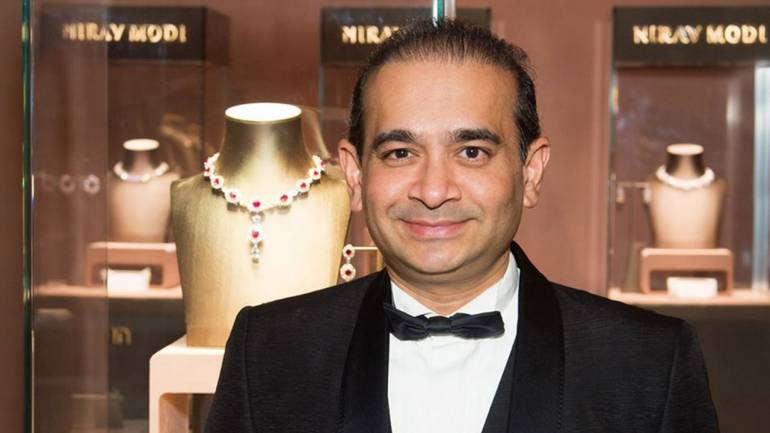
    The fraudulent financial behavior of some of the wealthiest people in India was once again on full display as the diamond jeweler Nirav Modi, a billionaire and the preferred jeweler of celebrities, was accused of orchestrating the biggest banking scam the nation has ever witnessed. He is now a target of the investigation by CBI after Punjab National Bank alleged that Modi and his uncle Mehul Choksi, defrauded the bank to the tune of 2 billion dollars using the cover of several shell companies abroad.

    According to the complaint by PNB, two junior officers of a Mumbai branch of the Bank issued “letters of undertaking” to firms linked to Modi and Choksi for them to obtain credit from overseas branches of other Indian lenders.

    A recent NDTV investigation has also unearthed links between money from Indian Banks allegedly embezzled by the Jeweler Nirav Modi and his US-based companies. In its formal charges, CBI claims that the loans Mr. Modi took from Punjab National bank to pay off his overseas suppliers may have been diverted elsewhere.

    The latest report from New York also indicates that Firestar Diamond Inc., a registered business by Nirav Modi in the U.S. has filed the Chapter 11 voluntary petition for the protection from its creditors. Prime Minister Modi who claimed to be the ‘chowkidar’ of the country has gone relatively silent on this matter other than to make a general statement.

    How is it possible for a businessman in India to defraud a bank of such a large sum of money? Where is the due diligence and what happened to the risk management mechanism? Was the Reserve Bank of India asleep on the wheel?  Why there was no oversight by the Finance Ministry dealing with such a huge transfer of reserve currency? Where is the accountability of the Modi government?

    The deep mystery surrounding some of the biggest fraud cases is that many of the fraudsters were simply allowed to flee the country, including this one! Nirav Modi and his accomplices appeared to have fled India just before Punjab National Bank filed the complaint with the CBI on 29th January 2018. It was reported that top officials including the Prime Minister were made aware of this case that included 42 FIRs on 22nd July 2016. Why then were these perpetrators not stopped from running away that included Choksi (Nirav’s uncle who ran the ‘Gitanjali Gems’) whose spurious activities were already exposed by a whistleblower and was under active investigation?

    This is not the first time since Modi took the reins of the government that a high flying billionaire has evaded justice by escaping abroad before he could be caught. Liquor magnate Vijay Mallya was accused of defaulting on 1.4 billion worth of loans before leaving the country in March 2016. It is not far-fetched to believe that these bad actors might have solicited some inside help that allowed them to leave the country and to stay beyond the reach of Indian jurisprudence.

    Punjab National Bank, India’s second-largest bank, is known as a Public Sector Bank (PSB) whose major shares are owned by the government. That means, when a bank accumulates NPA (non-performing assets) also known as bad debt, it is the Indian taxpayers and the shareholders that ultimately pay the price.

    The data shows that between years 2012-2013 and 2016-2017, Indian banks saw a total number of 22,949 instances of fraud, with total losses to the banks amounting to 10.8 billion dollars. In the last three-and-half years, the government pumped in more than Rs. 51000 crore capital to the public sector banks. They are expected to infuse PSBs with another Rs.2.11 lakh crore in the coming two years. Non-performing assets (bad debt) of the Public sector banks alone are calculated to be around Rs. 7.33 lakh crores as of June 2017, from Rs. 2.78 lakh crore in March 2015.

    Further analysis of the data reveals that the bad debt at these PSBs has increased almost fourfold in the last three years. Significant portions of these bank loans are from Corporates who have borrowed and now unwilling to pay back. Recent research brought out by Ernst and Young said the following: “While corporate borrowers have repeatedly blamed economic slowdown as the primary factor behind defaulting on bank loans, periodic independent audits on borrowers have revealed diversion of funds or willful default leading to stress situations.”

    How do we explain this massive level of willful default other than systematic manipulation of this institution by the rich and well-connected? We are asked to believe that two junior officers in a Mumbai branch of PNB made decisions to transfer 12000 crores of Rupees to a business entity especially dealing with Diamonds where Banks have little or no expertise!

    On the other hand, an ordinary Indian will have such an arduous task on hand if he ventures out into requesting a personal loan from one of these PSBs. Even farmers are often subjected to voluminous paperwork and harsh scrutiny before securing even a small amount in a loan. In case of delay or default, many of them are subjected to harassment, lien attachment on their primary residence and too often have witnessed auctioning off their property. Many of the ongoing suicides are directly attributed to these stressful situations.

    In the meantime, the crony capitalists are getting away with murder. They siphon off the taxpayer’s money often presenting bogus project plans using influential connections in the banking as well as in politics facilitating the process. Upon default, they tend to flee the country and spend their time abroad while enjoying the loot. Recently, it was also revealed that Mr. Vikram Kothari, of the ‘Rotomac Pen’ (a company that manufactures various types of pens), is charged with defrauding Rs 3695 crores from the public sector banks!

    When these banks finally reach a real crisis mode, the government steps in to ‘recapitalize’ or in other words get ‘bailed out’. The process is said to be as follows: through budgetary allocations, the government may buy so many crores of shares, then the banks will further raise additional crores from the market, and the government may issue Bank recapitalization bonds to buy even more shares of the banks.

    Under the Modi regime, the crony capitalism has flourished, and a high transfer of wealth is allowed to take place from the ordinary taxpayers to these wealthy billionaires; many of them hail from Gujarat, Prime Minister’s home state. While poor folks are penalized for not keeping a minimum balance in their government-mandated bank accounts, these so-called industrialists are accorded unprecedented access to public money, without any matching equity, which should have gone to building schools, bridges, health facilities and other infrastructure while creating prosperity for all its citizens.

    It is about time; the Modi government takes a serious look at this mushrooming scandal of deceit and plunder which has grave implications for the financial stability and the well-being of the nation. At present, the bad debt of these Banks is greater than that of the GNP of the 137 countries in the world and a thorough audit of many of these large loans for accountability will very much be in order. But it needs will on the part of the government.

    (The author is a former UN Technical Officer and is presently the Vice-Chairman of the Indian Overseas Congress, USA. He can be reached at gta777@gmail.com)


  • Pak trips on free run: 37-nation Financial Action Task Force to probe terror funding

    Pak trips on free run: 37-nation Financial Action Task Force to probe terror funding

    By G Parthasarathy

    Pakistan will now have to provide a detailed action plan on actions it proposes to take on curbing funding for UN-designated terrorist groups. It would then be placed on the FATF grey list, where its financial flows would be subject to intense international scrutiny. Pakistan would, thereafter, be placed on the FATF “black list” if it fails to present a credible and comprehensive action plan to the FATF by June. This would virtually end any prospect of it receiving adequate financial flows.

    The Financial Action Task Force (FATF), set up in 1989 by the G7 countries, and with headquarters in Paris, acts as an “international watchdog” on issues of money laundering and financing of terrorism. It has 37 members, including all five permanent members of the Security Council, and countries with economic influence all across the world. Two regional organizations — the Gulf Cooperation and the European Commission — are members of the FATF. Saudi Arabia and Israel are observers. India became a full member of the FATF in June 2010. The FATF is empowered to ensure that financing of UN-designated terrorist organizations is blocked. It has the power to publicly name countries not abiding by its norms, making it difficult for them to source financial flows internationally.

    Pakistan is particularly vulnerable to pressures from this task force as the Afghan Taliban, Haqqani network, LeT and JeM — all internationally designated terrorist groups — operate from its soil. Pakistan has long claimed that it has done its best to prevent terrorism emanating from its soil. It has also averred that there is no firm evidence against the LeT and the JeM, even after these groups have publicly acknowledged that they were promoting terrorism in India. Pakistan has also rejected evidence like wireless transcripts of conversations of Jaish terrorists involved in the Pathankot airport and the vast evidence available internationally of the Lashkar role in the Mumbai 26/11 attack. The Americans and their allies have focused attention primarily on Pakistan support for the Haqqani network in Afghanistan.

    Pakistan has believed that sooner, rather than later, the Americans would cut their losses and withdraw from Afghanistan, leaving the country open for a Pakistan-backed Taliban takeover. President Donald Trump, however, made it clear that he was determined that the US would not “lose” in Afghanistan. He is augmenting the US troop presence and moving fast to strengthen the Afghan armed forces, including its air force. American economic assistance to Pakistan has been placed on hold. In addition, the US has mobilized its NATO allies to take a tougher line on Pakistan. The NATO allies are also expanding their deployments in Afghanistan. More recently, the US has initiated moves to get the task force to place Pakistan on its “grey list” at its next meeting in June.

    The American effort in the FATF on Pakistan funding of terrorist groups predictably ran into problems initially. Pakistan had mobilized support from China, the Gulf Cooperation Council led by Saudi Arabia, Turkey and quite evidently Russia to counter the American-led move. Islamabad banked on Russian support, given the bonhomie that Russian foreign minister Sergei Lavrov manifested when he invited his Pakistani counterpart Khawaja Asif to Moscow on the eve of the FATF meeting. Further, despite parliamentary opposition, Pakistan declared, just over a week before the FATF meeting, that it would be deploying additional troops in Saudi Arabia. It clearly expected Saudi support in the FATF after its decision was announced. The Lavrov bonhomie led the inexperienced Khawaja Asif to proclaim hastily and prematurely that Pakistan had succeeded in prevailing over moves to place it on the FATF “grey list” involving monitoring of its international financial flows.

    The Americans responded immediately to these developments. Saudi Arabia and the GCC fell in line with American demands for the FATF to act against Pakistan. European powers like the UK, Germany and France remained steadfast in their determination to corner Pakistan. Russia quietly receded to the background. Recognizing that its support for Pakistan would leave it isolated in the FATF, where it was aspiring to become its vice-chairman at the forthcoming FATF session in June, Pakistan’s “all-weather friend” China pulled back its support for Pakistan. The only country that steadfastly continued supporting Pakistan was Turkey, whose egotistic President Recep Erdogan would certainly not win an international popularity contest today!

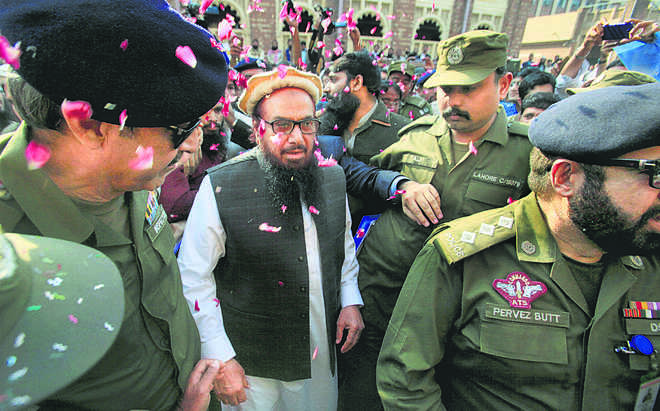
    Pakistan will now have to provide a detailed action plan on actions it proposes to take on curbing funding for UN-designated terrorist groups. It would then be placed on the FATF grey list, where its financial flows would be subject to intense international scrutiny. Pakistan would, thereafter, be placed on the FATF “black list” if it fails to present a credible and comprehensive action plan to the FATF by June. This would virtually end any prospect of it receiving adequate financial flows. There has been disappointment, anger and frustration in Pakistan at the FATF decision. Hardly anyone in Pakistan is prepared to publicly advise that it is time for Pakistan’s rogue army to end support on its soil to armed terrorist groups, acting against India and Afghanistan. While Pakistan recently claimed it had closed Lashkar offices, it was soon found that only the gates of these offices were closed, while routine activities continued inside.

    In these circumstances, India should urge members of the European Union and Japan to join the US and end providing concessional credits to Pakistan. Given its precarious foreign exchange position, Pakistan will inevitably have to go to the IMF for a bailout in a few months. Institutions like the IMF, World Bank and Asian Development Bank need to be persuaded to withhold providing concessional credits to Pakistan, even if it takes some token measures to claim it has acted against UN-designated terrorist outfits. India should urge that no concessional credits should be provided to Pakistan till it dismantles the infrastructure of terrorism on its soil irrevocably. China will not follow suit; but its “aid” for the China-Pakistan Economic Corridor will only increase Pakistan’s already heavy debt burden.

    The withdrawal of Chinese support in the FATF has shaken the Pakistan establishment’s belief that Chinese support to “contain India” has no limitations. China recognizes that backing Pakistan unconditionally in the FATF would not only earn it the ire of the mercurial Donald Trump but would also sully its image internationally. At the same time, this does not mean that there will be any change in China’s policies on issues like declaring Jaish chief Masood Azhar an international terrorist. Moreover, we should also clearly recognize that President Trump’s actions are primarily in response to Pakistan’s support for the Haqqani network in Afghanistan. They are not highly or significantly focused on Pakistan-sponsored terrorism on Indian soil. That is a battle that will have to be fought primarily by us.

    (The author is an Indian career diplomat. He was High Commissioner of India to Pakistan in 1998-2000)


  • JOYS OF VOLUNTEERING

    JOYS OF VOLUNTEERING

    I remember a beautiful inspiring conversation from some 12 years ago, I was one of the few men who volunteered at a women’s conference in Dallas. We had 5000 women coming from all around the world. I was the registrar and had about 10 booths to manage. I walked in at 7 AM, we did not have the registration papers – 4 or 5 senior ladies in their 80’s said they are in the basement of a Church. So, we rode in few suburbans to bring the papers – in the basement, there were about 30 boxes to load…. I was debating how I am going to do this. Before I could do anything, the senior ladies jumped in and started picking two boxes at a time… I could not bear, my culture did not allow me for my seniors to carry that load, and I had to do it. I believe it was Sandra, wife of Judge Barefootsanders who questioned me, young man, I am healthy and active because I do the work and will remain active…. She was awesome! They would not listen and the suburbans were loaded in no time.

    As we were driving back to the hotel, what I heard was an incredible conversation. The ladies were talking about how many hours they served in a Church, Hospital or a School…. I will never forget that conversation and made the determination that I will always be a volunteer till my last breath.

    I read a new piece on Asma Jahangir today (http://centerforpluralism.com/asma-jahangir-human-rights/) the human rights activist. What made her stand up against powers to protect the rights of people who were not related to her? Then I started thinking about Martin Luther King, Gandhi, Mother Teresa and others, why did they not enjoy their lives and were hell-bent on repairing the world? You may be one too constantly serving others for no gain. Then I ask myself, why do I volunteer? Why do I stand up for others? I have gotten threats against my life, screamed at, attacked but never was I discouraged.

    I don’t get a penny either, rather I lose it. My late wife Najma used to say, if you spend half your time working your business, we can live a great life with that money…. There is no answer to it, each one of us is driven by our calling. Different things are important to different people. Money drives some and other things drive others. Those who are driven by money will never understand volunteerism.

    So, I salute the volunteer you, it is a great feeling to serve others, particularly those whom you don’t know and will never see again and never get paid to serve.

    If you are one, share a note.

    (The author is an Indian-American committed to building cohesive societies and offers pluralistic solutions on issues of the day.  As we learn to respect the “otherness” of others and accept the God-given uniqueness of each one of us, conflicts will fade, and solutions emerge. He is the president of the Center for Pluralism in Washington, DC.)

  • Deja vu in Pakistan

    Deja vu in Pakistan

    By Sharat Sabharwal
    The run-up to the 2018 election bears an eerie similarity to the events preceding the 2013 poll. The actors seeking to destroy Nawaz Sharif’s political future are the same, with the addition of the SC and Hafiz Saeed.
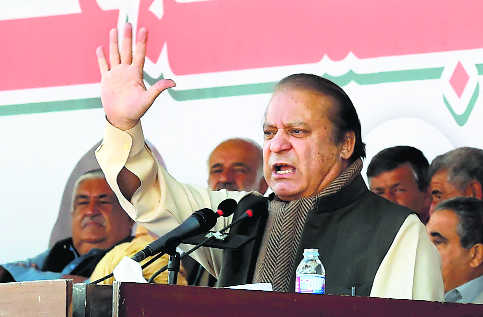
    Disqualified from holding the office of Prime Minister last year by the Supreme Court, Nawaz Sharif has now been barred by the same court from being the head of his party, PML (N). Ostensibly a matter of corruption in high places, his disqualification has a strong subtext of civil-military tussle in Pakistan.

    As the 2013 Pakistan election approached, the security establishment was concerned at the prospect of a Nawaz victory because of his popularity in Punjab that carries more than 50 per cent seats in the National Assembly. The anxiety stemmed from Nawaz’s tense relationship with his army chiefs during two tenures as Prime Minister, his bitterness against the army at his treatment after the 1999 coup and repeatedly professed desire to promote better relations with India. In 2011, Imran Khan, whose Pakistan Tehreek-e-Insaf had failed to make a mark since its founding in 1996, appeared on the scene out of nowhere to relaunch his political career by opposing American drone strikes in Pakistani territory and corruption in the ruling parties. The then DG, ISI, was reported to be the architect of his sudden rise, a move that subsequent events would prove to be farsighted in filling the gap left by the reluctance of the two major parties — PPP and PML (N) — wiser with the experience of the past, to collaborate with the army against each other. Closer to the election, Tahir ul Qadri, a Canada based cleric of Pakistan origin, landed up to push for its postponement. However, these machinations failed, and Nawaz won a third term with a comfortable majority in the election held in May, 2013.

    In this backdrop, the civil-military equation under Nawaz was expected to be anything but smooth. Differences emerged quickly on Musharraf’s trial, policy on terrorism and relations with India. The army managed to secure Musharraf’s exit from Pakistan, prevailed against Nawaz’s misplaced policy of dialogue with the anti-Pak terror groups and systematically undermined his agenda to improve relations with India.

    Imran’s agitation against the alleged rigging of the 2013 election, which kept Nawaz on the back foot vis a vis the army, came a cropper when a judicial commission ruled against him in July 2015. However, the linkage of some offshore companies to the Prime Minister’s family, revealed in the Panama papers, gave Imran and his mentors another opportunity to target Nawaz. In July 2017, the Supreme Court disqualified Nawaz from holding public office. Significantly, the decision was based on the report of a six-member joint investigation team, constituted by the court that included a representative each of the ISI and Military Intelligence. Since these highly disciplined individuals would not have approved the report without a nod from the army leadership, the damning report, combined with the track record of the Pakistan judiciary kowtowing to military dictators, had left little doubt about the fate of the Prime Minister and was an indicator of provenance of the decision to oust him.

    The run-up to the 2018 election bears an eerie similarity to the events preceding the 2013 election. The actors seeking to destroy Nawaz’s political future are the same, with the addition of the Supreme Court and Pakistan’s terror brand ambassador, Hafiz Saeed. The army would be loath to see his return to power. The PPP has sought to exploit Nawaz’s misfortunes for political gains in Punjab, but being an experienced party, would not go the extent of playing the security establishment’s game. That is not true of Imran. Egged on by his ambition, he is blind to the army’s design. Tahir ul Qadri is again around. The security establishment aims to deprive Nawaz of another victory by undermining him in Punjab. Hafiz Saeed’s services have also been enlisted for good measure by releasing him from preventive detention. Though the Election Commission has not recognized his party, Milli Muslim League, because of opposition of the PML (N) government, he could be expected to put up independent candidates to erode Nawaz’s vote.

    Nawaz and his children face charges in an accountability court, with the sword of conviction and imprisonment hanging over their head. Besides depriving him of the presidency of his party, all decisions taken by him in that capacity since July 2017 have also been declared null and void. However, counting on his popularity in Punjab, which he hopes to boost by playing the victim card, Nawaz refuses to desert the field. Attempts to cause any major fissures in his party and wean away his brother, Shahbaz Sharif, have failed so far. Nawaz, being the vote getter, is indispensable to the party. An efficient technocrat, Shahbaz complements Nawaz, but cannot replace him. Deprived of the presidency of PML (N), Nawaz threatens to lead it in the election in his individual capacity in the hope of ruling through a proxy, as he is doing now. If jailed, his loyalists could fight in his name. He thus dares the army to either go the whole hog and stage a coup, inviting international opprobrium, or face the prospect of seeing him rule, even if by proxy.

    The selective accountability that has claimed Nawaz’s head not only implies the departure of an individual from office, but can also target every politician, capable of winning popular mandate and consequently inclined to chart out a course independent of the worldview of the army. Nawaz, after all, was disqualified as per a Zia era constitutional amendment requiring elected representatives to be ‘sadiq’ (truthful) and ‘ameen’ (righteous), subjective criteria that can be used by the Deep State to throw out anyone not in agreement with them. The civil-military imbalance and the resulting dysfunctionality of the state that have become a curse for Pakistan and the region will get redressed essentially by opposition within Pakistan to the stranglehold of their army, with external pressure at best playing a supportive role. Therefore, though a matter internal to Pakistan, the ongoing tussle and its outcome should be of interest to us.

    (The author is India’s former High Commissioner to Pakistan)

  • Primary task at Cong plenary: Rescuing the polity from the creeping authoritarianism

    Primary task at Cong plenary: Rescuing the polity from the creeping authoritarianism

    By Harish Khare
    It is already a matter of considerable dismay that otherwise decent officials, educated aides and learned advisers have acquiesced in the organized worship of a man who grandiloquently pretends to know profoundly about everything, from gaming the examinations to disrupting the economy, even without the benefit of a Harvard education, and making a virtue of “hard work”. From senior most ministers to junior joint secretary, all find themselves subscribing to this “daddy knows best” syndrome, very much reminiscent of the Narayan Datt Tiwari hymns to Sanjay Gandhi during the Emergency days. 
    History of the last hundred years has taught us one simple lesson:  personality cults do introduce undesirable imbalances in the body politic. Personality cult produces very little democratic good; it always ends up badly, even disastrously.      
     The greatest danger we face is Narendra Modi is using all the accruements of democracy to de-legitimize democracy’s good practices and values, and, to turn all its bad habits to  make democratic arrangements look inadequate and unequal to the task of restoration of our national glory.

    The top Congress leaders are due to gather, in a fortnight from now, for their party’s plenary session. Apart from consecrating Rahul Gandhi’s election as the party president, the gathering will need to undertake far more serious a task: they will have to perform a duty to start a conversation with the nation and to take the citizens into confidence on how the entire political system is groaning under the weight of one man — his whims, his fancies, his attitudes and his limitations. The Congress and its leaders need to make a case before the nation as to why the current state of affairs is neither desirable nor acceptable. At the end of this three-day gathering, the Congress should have given the country a good enough reason to look beyond Narendra Modi, as and when the Lok Sabha elections get organized.

    Since it will be a political gathering, there will be plenty of partisanship and mouthfuls of philippics against Narendra Modi, the BJP and the Sangh Parivar. But it would be a waste of time and resources if the Congressmen confine themselves to abuses; it will be an even greater farce and greater shame if the Congressmen were to engage in their familiar weakness for sycophancy. Instead, they have to behave and speak as responsible and reasonable keepers of the best of the constitutional values. As those who claim to be committed to the Idea of India and who subscribe to the Nehruvian virtues, the Congressmen have a sober and serious task at their hands:  a democratic obligation to talk to fellow-citizens as to how we are all mindlessly getting sucked into the small-time viciousness of a small-time man; how as a nation and as a society we are getting infected with pettiness and small-mindedness.  More than that, the Congressmen need to convince the nation that they have the legacy, the leadership, and the experience to rescue us all from this quagmire of petty vindictiveness being palmed off as a new normal.

    We remain — for now — a constitutional democracy; but, all our constitutional arrangements stand diluted and all-out constitutional functionaries — be it the President of India or the Union Home Minister or External Affairs Minister —have been made to feel diminished. The Cabinet system of government has been reduced to a joke that no longer invokes a laugh. The country needs to be told that the fine architecture of checks and balances is in serious jeopardy.

    It is for the Congressmen to enlighten the citizens how all the key relationships in our national scheme of things are being  revised and reduced: first,  the majority-minority equation has been systematically reshaped and the secular commitments stand eroded; second, the Centre-States federal equation has tipped dangerously in favor of New Delhi and the state governments  are being reduced to whining tots; third, the State-Citizen balance has changed  drastically, an all-intrusive Aadhaar arrangement is demanding compliance and surrender of privacy, and, we are beginning to look like a misshapen  authoritarian setup; then, we have the creeping distortions  in the Civil-Army relationship, with the Army in danger of losing its institutional rectitude; and, lastly, the virtual governmental takeover of the electronic media. All these key equations are off the keel. And, our citizens need to be told how these institutional distortions are unknowingly putting the nation on a road to a totalitarian-lite experiment.

    When the Opposition fails to impart a democratic vibrancy to the polity, all other institutions of restraint — like the judiciary, the Election Commission — too feel discouraged; and, independent regulatory authorities like the Reserve Bank of India feel inclined to give in to the government’s unreasonable demands. The Congress, as the principal opposition party, has an obligation to create conditions for robust counterpoises.

    If nothing else, the country needs to be repeatedly educated about the whimsicality that has dictated the (mis) management of the economy, and how all the great projects — like Make in India — stand in tatters; and, more importantly, whether the Congress has an answer to jobless growth and whether the Congressmen can help the country find its way out of a deepening agrarian crisis.

    Notwithstanding the loud chanting of deshbhakti, and balidaan mantras, it is the Opposition’s task to inform the country that we stand isolated in our own backyard because we have needlessly and arrogantly alienated all our South Asian neighbors; and, the nation needs to be educated that India today is less safe than it was five years ago.  The Congress has to introduce the citizens to a new narrative that takes us away from this excessive preoccupation with national security and an unwarranted and unworkable flexing of muscles at home and abroad. We are losing our national self-assurance without making smaller nations in the neighborhood respect us.

    Then, there is a personality overload. A personality cult may have been “normalized” in New Delhi but it remains a personality cult, with all its unhealthy demands on men and institutions. It is already a matter of considerable dismay that otherwise decent officials, educated aides and learned advisers  have acquiesced in the organized worship of a man who grandiloquently pretends to know profoundly about everything, from gaming the examinations to disrupting the economy, even without the benefit of a Harvard education, and making a virtue of “hard work”. From senior most ministers to junior joint secretary, all find themselves subscribing to this “daddy knows best” syndrome, very much reminiscent of the Narayan Datt Tiwari hymns to Sanjay Gandhi during the Emergency days.

    History of the last hundred years has taught us one simple lesson:  personality cults do introduce undesirable imbalances in the body politic. Personality cult produces very little democratic good; it always ends up badly, even disastrously.

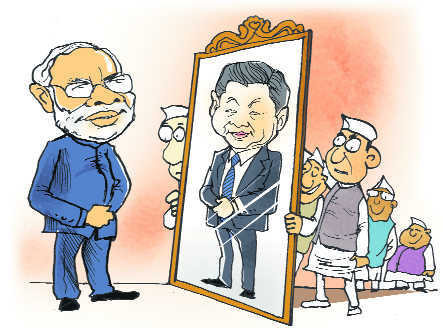
    The greatest danger we face is Narendra Modi is using all the accruements of democracy to de-legitimize democracy’s good practices and values, and, to turn all its bad habits to make democratic arrangements look inadequate and unequal to the task of restoration of our national glory.  Those associated with national security are already muttering that there-is-too-much-democracy claptrap. The next pit-stop in this journey would be to look temptingly at the Xi Jinping kind of authoritarian option.

    (The author is editor-in- chief of Tribune group of newspapers)

  • Listen to the Imploring Voice of the People, Mr. President

    Listen to the Imploring Voice of the People, Mr. President

    By I S Saluja

    President Trump seems convinced that more guns in the hands of more people can secure school and community. In his listening session with survivors of Stoneman Douglas High School Parkland, Florida shooting which resulted in death of 17 young students, Trump suggested arming 20 % to 30 % teachers of a school as a safety measure at a school. Obviously, President is obsessed with the idea of more guns in the hands of more people. I recall how he said he planned to make America great again. One of the ways he suggested was to have more weapons and be the strongest nation in the world. Well, he has a right to his opinion. But so have others.

    Many were surprised at his idea. Many were simply shocked. Many pooh poohed the suggestion, as Sen Nelson who described it as “a terrible idea” later in the evening at the CNN Town Hall in Tallahassee. Even one of the most committed supporters of NRA Sen Marco Rubio, at the CNN Town Hall in Tallahassee scoffed at the idea. He said the job of the teachers is to teach, not to carry guns. At the same time, he expressed fear that an armed teacher may just as well cause another tragedy in having a gun in hand, in the event of an attack at a campus and arrival of a SWAT team who are more likely to act fast on seeing a gun in the hand of a person.

    They are not going to wait to know that it is ateacher who has been given a gun for protection. A teacher at the Town Hall said it plainly that she could not think of carrying a gun. Broward County Sheriff Scott Israel simply laughed at the idea, saying how could a few teachers secure a large school campus.

    What is needed is a common-sense gun control policy. We must respect 2nd Amendment which was passed for the safety and security of people, not for their killing.

    Over the decades since it was passed there have been so many situational shifts that a fresh look has to be given with the objective of ensuring that dangerous guns do not get in to hands of everyone and that our schools and neighborhoods are safe.

    Raising the age limit for securing a gun, background checks, mental health checks and taking off the shelf guns with high caliber could be some solutions to the problem, to begin with. What is needed is loyalty to people of America, not to NRA.

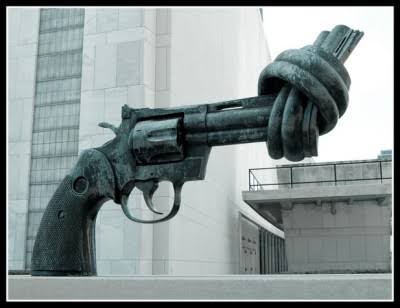
    I will repeat what I had said in an earlier comment, “gun in the hand of a good guy against a gun in the hand of a bad guy” policy does not work. I hope, President of America will listen to the voice of the people.

  • NiravGate: Another Case of Organized Loot

    NiravGate: Another Case of Organized Loot

    India’s biggest lender, State Bank of India has reported 1,069 loan fraud cases in the last five financial years but has not disclosed the amount. That is the magnitude of “accepted failure” in SBI under the Chairmanship of Arundhati Bhattacharya. That is perhaps why she wanted to decriminalize the NPAs so that the likes of Vijay Mallya, Nirav Modi and Mehul Choksi could lead their luxurious life at the expense of a common man.
    After PNB, Bank of Baroda had the highest amount of loan frauds reported, with 44.73 billion rupees from 389 cases. Bank of India ranked third, with loan frauds totaling 40.5 billion rupees from 231 cases.
    It is high time Government came down heavily on this organized loot and prosecuted the higher ups in the hierarchy rather than making a scapegoat of ordinary foot soldiers.

    Categorical Statement by whistleblower Dinesh Dubey on TV explaining how Nirav Modi and Mehul Choksi were helped by the entire Board of Allahabad Bank in 2012-2013 leaves no doubt that the same drama must have been enacted in other Banks at the highest level.

    Dinesh Dubey was the nominee director appointed by the UPA Government on the Board of Allahabad Bank. He had objected to the renewal of loans given to Mehul Choksi and Nirav Modi. His dissent note was not considered by the Board of the Allahabad Bank.

    Dinesh Dubey had written to then RBI Dy. Governor Chakravarty. Except praising Dubey for his alertness, the then Dy. Governor Chakravarty did precious little to stop this loan. Role of then RBI Governor Raghuram Rajan also needs to be probed. The man is conspicuous by his silence in this matter. The RBI also had its nominee Mr. Udgatha as Director on the Board. His reaction to the objections raised by Dinesh Dubey that such sanctions/disbursement do happen in rare cases are equally shocking.

    His charge against then Finance Secretary Takru that he forced him to resign as there was pressure from above is a testimony of involvement of powerful in this scam.

    This clearly shows the entire system was smoothly working to the advantage of scamster/ fraudster Nirav Modi and Mehul Choksi.

    Who were the higher ups who could influence the Finance Secretary?

    Was it Finance Minister Chidambaram? Or PM Dr Manmohan Singh? Or INC President and then de facto PM Sonia Gandhi?  Or Rahul Gandhi who had reportedly inaugurated Nirav Modi’s Delhi show room one day earlier? Or someone from the powerful coterie of Sonia Gandhi such as Ahmed Patel?

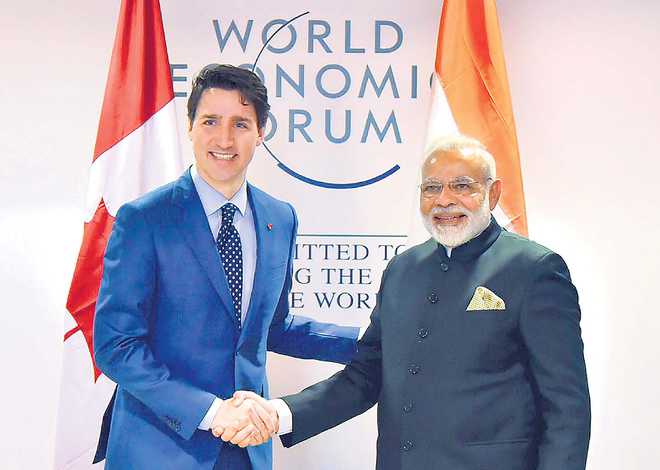
    Even as the Congress targeted PM Modi for being pictured at the World Economic Forum 2018 in Davos, Switzerland, Congress rebel and Rahul Gandhi baiter Shehzad Poonawalla alleged that the Congress President had attended Nirav Modi’s event in 2013:

    #PNBScam began with fraudulent LoUs & transactions which began in 2011 – Just FYI: Rahul Gandhi was spotted at Nirav Modi events – did not know he had interest in bridal jewelry – 2013 Imperial Hotel event in Delhi. SCAM began in 2011- should find out Nirav’s political links https://t.co/SfbIQyIosS

    — Shehzad Jai Hind (@Shehzad_Ind) February 15, 2018

    Challenge to @OfficeOfRG – was he not at Nirav Modi’s event in Delhi’s Imperial Hotel in 2013-SPG details will leave no doubt if made public- #PNBScam started in 2011;Nirav hobnobs with Rahul (whose govt in power) in 2013 ;Rahul had interest in women’s jewelry? Or something else https://t.co/kbg9U8Hr7i

    — Shehzad Jai Hind (@Shehzad_Ind) February 15, 2018

    A thorough, sincere and time bound investigation should reveal the brain and the collaborators in this fraud. This cannot be the brain of a mid-level Deputy Manager like Gokulnath Shetty or Kharat.

    The exposure of various banks is:

    Allahabad Bank: Rs. 4,000 crore

    Union Bank: Rs. 2,300 crore

    Axis Bank: Rs. 2,000 crore

    SBI: Rs.960 crore

    BOI: Rs.300 crore.

    Total: Rs. 9,560 crore.

    Raids on premises of Nirav Modi and Mehul Choksi yielded recovery of 294 fake LOUs and 224 fake LCs.

    It is said that the magnitude of fraud is around Rs. 35,000 crore and not Rs. 11,100 crore as is made out to be. Republic TV is carrying out expose in this regard.

    So far, only 18 PNB officials are suspended. No one has yet been arrested.

    No action has so far been initiated against the members of the Allahabad Bank Board, the then Finance Secretary Rajesh Takru, then Dy. Governor of RBI Chakravarty, RBI Governor Raghuram Rajan for acting as a moot spectator to this loot.

    No investigation has been ordered into other Banks mentioned above.

    Who was that higher authority that was forcing Finance Secretary Takru to silence the dissent towards disbursement of loans to Nirav Modi and Mehul Choksi team? It does not require much of intelligence to infer that similar influence must have been exerted on the Boards of other Banks. If not, they were clearly in cahoot with the fraudsters.

    If one applies for vehicle loan, the Banks cross check the proforma invoice with the dealer. In this case, no such cross verification that is known as ‘confirmation’ in banking parlance, was done by any of these Banks lending money on the basis of LOUs/LCs of PNB is difficult to digest. This cannot be brushed aside as mere failure – systemic or systematic.

    In a FICCI session that was held in Kolkata on July 10, 2017, Arundhati Bhattacharya, Chairman of State Bank of India made a jaw-dropping remark justifying emergence of NPAs: “In India NPA is treated as criminal, which it should not be. There is no permission for failures. Permission to fail is not given by the society. But failures will take place.”

    In its RTI request, Reuters sought data from 20 of India’s 21 state-run lenders and obtained 15 replies.

    PNB topped the list with 389 cases totaling 65.62 billion rupees ($1.03 billion) over the last five financial years, in terms of the total amounts involved. Reuters was unable to obtain a detailed breakdown on the exact nature and method of the loan frauds the banks reported to RBI over the last five financial years.

    After PNB, Bank of Baroda had the highest amount of loan frauds reported, with 44.73 billion rupees from 389 cases. Bank of India ranked third, with loan frauds totaling 40.5 billion rupees from 231 cases.

    India’s biggest lender, State Bank of India has reported 1,069 loan fraud cases in the last five financial years but has not disclosed the amount. That is the magnitude of “accepted failure” in SBI under the Chairmanship of Arundhati Bhattacharya.

    That is perhaps why she wanted to decriminalize the NPAs so that the likes of Vijay Mallya, Nirav Modi and Mehul Choksi could lead their luxurious life at the expense of a common man. And SBI has mastered that skill. SBI has already recovered Rs. 1,772 crore from small depositors in the form of penal charges for not maintaining minimum balance in their savings account during the period April 2017 to November 2017. Tax the poor to pay for the Failure.

    It is high time Government came down heavily on this organized loot and prosecuted the higher ups in the hierarchy rather than making a scapegoat of ordinary foot soldiers.

    (The author is a Chartered Accountant based in Mumbai, India)


  • Russian Meddling with India – Was the 2014 Indian Election rigged?

    Russian Meddling with India – Was the 2014 Indian Election rigged?

    By Dr. Mike Ghouse
    “Do you see a correlation in getting the innocent Hindus to develop anti-Muslims sentiments through the communal riots, leading into to complete takeover of the Uttar Pradesh?  The likes of which were done here in the United States.  Did Russia pay for those riots through the Sangh Parivar organizations to weaken the Indian Democracy?  Both Modi and Trump have a special affection for Putin; and both of them want to emulate Putin, says the author.

    Deepa Seetharam, a reporter from Wall Street Journal called me and asked if I spoke in a rally at White House in September 2016? I said no, and then she reminded me that my name was a listed as a speaker.

    Seetharam wrote in WSJ’s October 30, 2017,  publication, “Representatives from the Facebook page “United Muslims of America” asked Mike Ghouse, an interfaith activist, to speak at a Sept. 3, 2016, event in Washington, D.C. billed as “a peaceful rally, to make mosques and their neighborhood safe!”

    The group sent Mr. Ghouse placards they intended to use that included anti-Trump messages, causing him to back out, he said. “I said they should be more pluralistic, more inclusive because there’s no need to attack Trump,” Mr. Ghouse said. “They wouldn’t, so I didn’t go.” Obviously, I did not speak there either.

    “Some events stoked public discord. At the rally in front of the Islamic center in Houston, about a dozen protesters gathered, some waving confederate flags or holding a sign that said “#WhiteLivesMatter,” according to video footage.”

    Russians had an elaborate plan of pitting one American against the other, their end goal was to weaken democracies and create discord within each nation – their logic was; for Russia to shine, other countries have to be weakened, and Russia will stand out as the strongest nation in the world with a strong man running the nation. Putin is the Czar under his skin.

    CNN reports that “80 times Trump talked about Putin.” Indeed, “Throughout the 2016 presidential campaign, Donald Trump consistently broke from political orthodoxy in his effusive praise of Russian President Vladimir Putin. His glowing statements on Putin have become central in stoking the suspicion that he and his campaign were somehow connected to Russian interference in the election.”

    Narendra Modi in Russia praises President Vladimir Putin’s family for sacrificing lives for the country. Modi praises Putin’s effort in convening 1st Tiger conservation Summit.

    Both Modi and Trump think Putin is awesome, someone to be modeled after, as they want to dictate to the public.

     Senator John McCain said in an interview that Putin is determined to prove to the world that Democracies don’t work. Indeed, that is what the fascists think about democracies – they get their devoted slaves to do whatever they want – attacking others as Sikularist and calling the news that goes against them as fake news.  It’s amazing how many people buy that stuff in India and the United States.

    Both Modi and Trump have resorted to divide and rule policies; they are determined to pit one Indian against the other in case of Modi, and one American against the other by Trump.

    Russians staged “Anti-Trump rallies’ in the name of American Muslims. Perhaps, that may be the reason Trump is so anti-Muslim. Some of the rallies were held against Hillary to give the impression that it is the work of public, and some were devised against Trump just to make it look real.

    What happens in India? Manohar Joshi writes in the Wire, “The fact that communal violence is rising in India is not hidden. Even the government acknowledges that there has been a steady uptick in communal incidents. In response to a question in parliament on Tuesday (February 6), minister of state Hansraj Ahir disclosed that as many as 111 people were killed and nearly 2,500 injured in 822 communal incidents in 2017, as compared to 751 incidents in 2016 that took the life of 97 people and 703 in 2016 when 86 were killed.”

    Did the Russians stage these events? Did they pay these men to stage communal riots and murder people?

    The fake encounters set up by the Gujarat police earned further support for BJP from an average innocent Hindu. Of course, Musharraf’s Kargil invasion strengthened the hold of BJP in power.

    Putin failed in France and Germany but succeeded in Austria, India,United States and other nations.

    Most Indians will resist the idea of an investigation; they simply do not want to believe that the Indian Elections may have been rigged. They are afraid of even exploring the possibilities. If they have lost their loved ones, they would want to know if Russia is paying the goons to create chaos. Is Yogi Adityanath paid agent of Russia?  The purpose of the investigation is to find the truths if they are clean, that would be good news. What if they were not? Should they continue in governing India and continue to pit one Indian against the other?

    Do you see a correlation in getting the innocent Hindus to develop anti-Muslims sentiments through the communal riots, leading into to complete takeover of the Uttar Pradesh?  The likes of which were done here in the United States.  Did Russia pay for those riots through the Sangh Parivar organizations to weaken the Indian Democracy?  Both Modi and Trump have a special affection for Putin; both of them want to emulate Putin.

    Neither Trump nor Modi was expecting to win; all the surveys, reports and polls indicated the win for Congress in India and Democrats in America. Both the men were surprised with the win, let alone land-slide wins.

    The Russians publicized or financed at least 60 events – on all sides of most polarizing issues – before and after the 2016 election.  What about India’s 2014 election?

    Is it worth investigating Russian hand in the mess that is created in India?   Should we save the nation from divisive men? These men will come and go in one or two terms, but it is the common men and women in India that will bear the brunt of their karma.

    (The author is an Indian-American committed to building cohesive societies and offers pluralistic solutions on issues of the day.  As we learn to respect the “otherness” of others and accept the God-given uniqueness of each one of us, conflicts will fade and solutions emerge. He is the president of the Center for Pluralism in Washington, DC.)

    COMMENTS

    Dr. Ghouse’s article invited a quick reaction from a reader. Here is the unedited comment of Desh D Kapoor (desh.kapoor@gmail.com) received at 11.07 A.M., a few minutes after the article was published.

    “This is just a piece of trashy writing based on nothing but conjectures and hyperbole!  Amazed.  In fact, if at all, with Cambridge Analytics (firm that helped Trump) working for Congress, 2019 will be where Foreign meddling (Mani Shankar Aiyar’s home meeting with Pakistani officials – a Trump Tower moment?!) will be tested.

    “In fact, Modi has NEVER appealed on religious basis.  Even the honest Pakistani commentators say that clearly (check Najam Sethi’s analysis post 2014).  But how do you stop the ideologically compromised Indian Muslim commentators who would rather use religion for their own purpose than for the good of the community!  Reminded of the Tata Nano move, where Mamata created issues and Modi brought that in to Gujarat.  The villages near the plant were predominantly Muslim.  And within 4-5 years, their land prices went up 25 times making everyone a millionaire.  When indiscriminate development happens – there is no color.  But who can explain to the ideologically compromised who still hold Mamata as the paragon of virtues as she keeps everyone poor.

    So excuse me, but this Machiavellian piece is not even worth the paper it was probably published on.”

    ********

    We received a rejoinder from Dr. Ghouse at 12.30 P.M. nearly an hour and a half after Mr. Desh D. Kapoor’s comment, which is being published here, without being edited.

    Desh,

    “I wrote the essay as an Indian, and not as a Muslim. I wish you learn to hold on to your communalism and see the validity of the argument.

    “Thank God, none of your relatives or mine were killed by the extremists in Muzaffar Nagar and other riots, but you should be human enough to have empathy for those whose families have suffered. If Russia had paid the goons to lynch and harass fellow Indians, then don’t you think it should be investigated? Are you against finding the truth?

    “The success of a nation hinges on its two solid feet; economic prosperity which brings sab ka Vikas, not just mitron ka Vikas, and the other is sab ka saath, every Indian should feel included – that is a cohesive India, where no Indian feels excluded or lives in apprehension. Both the economy and social fabric must remain intact, one will not happen without the other, otherwise what we will witness would a langda India and ultimately everyone will suffer. Injustice to one is injustice to all.

    “Mani Shankar Aiyar’s meeting at his home has been clarified, you still give it a religious color to it and Modi was too eager to paint it for electoral gains.

    “A true patriot is the one who criticizes the government incessantly to keep them on the toes, on the other hand, if you toe the line of the government and kiss-ass of the leaders, you are not serving the nation.

    “We need to rise about the pettiness and start looking to every Indian as an Indian and be patriotic Indians who think of making India and all her people successful and included.”

    Mike Ghouse

    Mr.  Desh D Kapoor commented at1.04 P.M. 02/19/ 2018. (Unedited)

    “Mike, excuse me, but I don’t give you the right to create your own Halos and abuse others.  From where I see, you are always talking as a Muslim and not as an Indian.  Further, I don’t see you as a secular at all.  I think this self-congratulatory stuff should end if you even want to hold any dialog.  Just like ‘Allah is the ONLY God…” Or “Jesus is the ONLY Savior..” are a non-starter to any useful discussion and inherently Supremacist in ethos – your fetish for constructing your own halo and calling other communal is damning for any dialog and shows your real self.  So, time to stop the tricks! 

    “Like I said, I have never ever seen Modi say anything even remotely communal.  If you have any evidence, then talk.  On the other hand, AIMIM, Congress, Samajwadi and Trinamool folks are rabidly communal.

    “And that leads me to another point – criticizing someone’s Muslim appeasement is not communal.  To be an apologist for Jihad and acting as apologist for communal people in India is inherently Hinduphobic. 

    “It is this realization that has led to the awakening in India.  What you see in the US, is also something similar.  Where the rabid apologists for Islamism in the US left are being trashed all over.  The problem in the US is a little different – because the challenge to Islamic Supremacism (which is what you represent however you may try to camouflage) is actually now coming from the White Supremacists, because left has chosen to back one end of Supremacism (between White/Christian Supremacism and Islamic Supremacism). 

    “In India, most folks who feign Secularism like John Dayal and Taslim Rehmani – are either Christian fanatics (check his hinduphobic testimonies in US) or Islamic fanatics (check how Rehmani declares “We ruled over Hindus for 1000 years”).  And, most common laymen who were not into any religious debate are now waking up to the war of boiling the frog slowly. 

    “So, nice try, Mike.  but you cannot construct your own Halo and wear it.” 


    Dr. Mike Ghouse at 2.27 P.M. 02/19/2018 replied to Mr.Deepak. (Unedited)

    “Desh,

    “Here you go again, you are “assuming’ this, ” Just like ‘Allah is the ONLY God…” Or “Jesus is the ONLY Savior.”

    “You also made an assumption I support ” AIMIM, Congress, Samajwadi and Trinamool folks are rabidly communal.” I don’t, they are indeed communal, except the Congress which has a few rats in it, but the party as such is secular.

    “BJP, on the other hand, is very communal – of the 400 plus candidates they gave tickets to run as their member, there may be one or two Muslims. They found a way to dupe innocent Indians – play the religion card, they fooled once, but could not do it again, but they staged communal riots, ghar wapasi and other tricks to pit one Indian against the other.  You are a journalist, track down the history – the communal riots have occurred with the clear presence of RSS in the town, where they are not, there are fewer clashes.

    “Let me be clear – the problem is not with Hinduism or Islam, Hindus or Muslims, it is the extremist positions that BJP has taken with their fascist political ideology – they want to force what you eat and what you believe down the throats.

    “Modi’s fake reference to Pakistan collusion was communal politics, he generated ill-will among Hindus by the way he presented Mani Shankar Aiyar’s meeting

    Modi wore every headgear wherever he went but clearly refused to wear a cap given by a Muslim.

    “Would you agree that a cohesive India is what we need to work for – that requires that everyone minds his own business, and every Indian would be free to breathe, eat, drink, wear and believe whatever he or she wants to.  Is that the India you want?

    “Mike Ghouse”

    Mr. Desh D. Kapoor countered at 2.47 P.M. 02/19/2018 . (Unedited)

    “Mike, Again – lots of assumptions and lots of “I am Good- You are bad” attitude.

    1. I never said that you support those parties. I said they are communal because they practice appeasement and their politics is purely casteist and communal.
    2. There is no reason to believe that BJP is communal. Looking at candidates purely from religious angle is a sickness and something that plays along with Jinnah’s idea of Equal representation which caused partition. So, not looking at representatives from their religious affiliation is the right and secular way.
    3. Ghar Wapasi is Communal and Conversions / Evangelism is Secular? Really?!! like i said stop the tricks, please. 
    4. RSS and riots: I have read about the riots pretty carefully and I don’t know of a single evidence to say that RSS started any riot.
    5. ban on Beef is a law that BJP did NOT create. It was and you are trying to say that someone should not follow the law? Are you for lawlessness?  I think you need to clear your stand please.
    6. Reference to Pakistan for Collusion by Congress – was “Communal politics”?!! Wow, Really?!! So you equate Pakistani with Indian Muslims?  From how I and most people saw it was – Pakistan means PAKISTAN.. the COUNTRY!  Period!  You see how your slip shows through?  :)

    “I want a cohesive India.  But like MLK Jr said “I want White man to be my brother, not Brother in law”.  From where most Hindus see now – Kalma and the Creed are at the root of Communal violence in India and around the world.  Change the supremacism and peace will follow.  if you try to hood-wink and play such tricks and play vote bank politics (how many Muslims candidate type), then the vote bank of today will go against that politics. 

    “I want an India where development is indiscriminate and blind to the religion or caste.  Where transformation is at the grass root.  And that is where Modi is working on.  So, I will back him to back the India that is the future of the world.  Not one of Congress or pseudo-Seculars who see Muslim communalism in references to Pakistan. Amazed honestly!!!”

    The Indian Panorama invites readers to participate in the debate.


  • A ‘good guy’ with a gun against a ‘bad guy’ with a gun formula does not work, Mr. President

    A ‘good guy’ with a gun against a ‘bad guy’ with a gun formula does not work, Mr. President

    By Prof I.S.Saluja

    US needs to come out of its primitive view on guns

    Another carnage, followed by a spate of condolences and condemnations. President of USA tweets he was sorry for the “terrible” shooting.  ‘My prayers and condolences to the families of the victims of the terrible Florida shooting. …. No child, teacher or anyone else should ever feel unsafe in an American school.’  Easier said, Mr. President.

    But, Mr. President, it is precisely what is happening. Have a look at the sheer number of shootings -18 school shootings in 45 days.  Florida massacre is one of the many tragedies in 2018. Wednesday’s attack in Broward County which killed 17 and wounded 14 was the deadliest school shooting since the 2012 rampage that killed 26 people at Sandy Hook Elementary in Newtown, Connecticut.

    Obviously, Americans are worried. They want safety of their children, not the condolences of POTUS or other lawmakers. They are rightly accusing their President of being soft on gun control. They see their President on the side of NRA, not on the side of the helpless people. And they understand well why a lawmaker will be on the side of NRA.

    People want sensible gun laws in line with the 2nd Amendment. They do not want to see anybody and everybody carrying a gun which they believe and, rightly so, will be a weapon of offense, at any given point of time. They wonder why congress is not even talking about stepping up to prevent attacks like this.

    More than the border wall and the security from illegally entering aliens, Americans need security from their own people who can easily lay their hands-on guns because the law permits them to have them, which they may use to mow down innocent people.

    How long will the lawmakers remain silent spectators to the butchery by gun wielding madmen? They were elected to protect, not to be instruments of torture and death. Wake up friends in the Congress and know what for you are there at the Capitol.


  • Flying on wits alone, Modi’s biases can involve India in Islamic world’s quarrels

    Flying on wits alone, Modi’s biases can involve India in Islamic world’s quarrels

    By KC Singh

    This paradox in Modi foreign policy of selectively engaging Islamic nations, even ostentatiously hugging their leaders, while allowing the fringe at home to bait Muslims can only work fitfully or in the short run, says the author.

    Prime Minister Narendra Modi is three months shy of entering the last year of his term. Post-Rajasthan wipe-out of his party in two Lok Sabha and one legislative byelection — of which even the Congress was confident of winning one — murmurs within the BJP are louder about state of the party and the nation. All leaders use foreign visits to bolster domestic standing as the pageant and protocol, carefully calibrated in advance, rarely goes off-script. But the exercise has diminishing returns once the electorate at home begins to wonder where the promised achhe din are. The recent foray of Modi into West Asia and the Gulf falls into that category.

    A Palestine visit was expected after Modi’s stand-alone visit to Israel and Israeli PM Benjamin Netanyahu’s Indian sojourn last year, with fanfare, including the shutting down of Ahmedabad for street extravaganza. President Mahmoud Abbas of Palestine Authority (PA) has been in power since the death of charismatic Yasser Arafat in 2004. There has, however, been no presidential election since 2005 nor parliamentary polls since 2006. His moral and political authority had dropped perceptively, particularly after his inability to implement the Cairo deal for gaining administrative control of Gaza, run by rivals Hamas. The continued siege of Gaza and sanctions have caused human misery and an explosive situation. Israel has been able to exploit the Palestinian disunity and civil war in Syria to stall any international push for West Asian settlement.

    President Donald Trump opened his presidency by nominating his Jewish son-in-law Jared Kushner to obtain an Israel-Palestine peace deal. But his December 6 decision to recognize Jerusalem as Israeli capital ruffled Arab feathers. Abbas has employed it to reassert control over rival factions by espousing the popular argument that US sponsorship of peace process had now ended. India by sensibly voting for a UN resolution condemning US move kept its door open to the PA. Thus, Modi’s visit was timed well as President Abbas was regaining lost authority. The $50 million developmental aid should keep India’s traditional relations with Palestinians on track. Hamas has, meanwhile, revived links with Iran, overcoming misunderstanding over Iran supporting the embattled Assad regime in Syria. Future course would depend on Abbas holding long-delayed elections to Palestinian parliament and his own office, acquiring control over Gaza and ameliorating the humanitarian crisis and the political fortunes of Netanyahu on way to being indicted for corruption. By its untimely step, the US handed the reward before obtaining Israeli compliance with UN Security Council resolutions, including stopping construction of new settlements in occupied West Bank.

    But by altering standard Indian formulations on the Palestinian issue, especially omitting mention of East Jerusalem as capital of Palestine, Modi succumbed to pro-Israel views in the RSS, which sees Israeli control over ancient lands of Judea and Samaria as analogous to their perception of Akhand Bharat as encompassing South Asia. They ignore that Theodor Herzl, the founding father of Zionism, conceived Der Judenstaat or Jewish Homeland at the beginning of the 20th century as any place on earth to colonize with people of Jewish faith. Even Uganda was considered for resettlement to escape anti-Semitism in Russia and Europe. The World War I and Ottoman Turkey aligning with Germany opened the possibility of Britain allowing European Jews to return to Palestine, post-liberation from Ottoman control.

    This paradox in Modi foreign policy of selectively engaging Islamic nations, even ostentatiously hugging their leaders, while allowing the fringe at home to bait Muslims can only work fitfully or in the short run. His second visit to the UAE was really pegged on laying the foundation stone of a temple in Abu Dhabi and a global summit at Dubai on governance. Hardly any world leaders were visible in the first row, other than local sheikhs. It was vintage Dubai marketing itself as a focal point for global commerce.

    The UAE has had temples for decades, although not in the capital Abu Dhabi. The late president, Sheikh Zayeed, father of Modi’s host Sheikh Mohammed bin Zayed, had in 2001, when I was ambassador to the UAE, allotted land in the capital for a cremation ground, which was to have a small temple. When the then Home Minister LK Advani called on him and thanked him for this gesture, he replied that his family accepted religious pluralism. Thus, the current gesture is a next step in an old tradition rather than some strategic leap in bilateral engagement. In fact, two English television channels, devoted even more vigorously than Doordarshan to spin BJP’s accomplishments, broadcast a clip wrongly showing Sheikh Mohammed chanting ‘Jai Sri Ram’ at a function. As the adage goes with friends like these who needs enemies? The UAE embassy in Delhi and newspapers in the UAE reacted with indignation.

    The Indian purchase of a share in an oilfield and ADNOC, Abu Dhabi’s oil major, participating in Indian oil reserve are old decisions announced during Sheikh Mohammed’s India trip. The UAE and Saudi Arabia are aligned against Iran, exacerbating the Shia-Sunni confrontation, thus splitting the six-member Gulf Coordination Council as, indeed, the Sunni world. Modi laying a wreath at the military memorial in Abu Dhabi, largely honoring the UAE’s dead in their intervention in Yemen and thus in a war against Iranian allies Houthis, would be read by Iran’s Revolutionary Guards as India taking sides. The forthcoming visit of Iran President Hassan Rouhani cannot alter that reality.

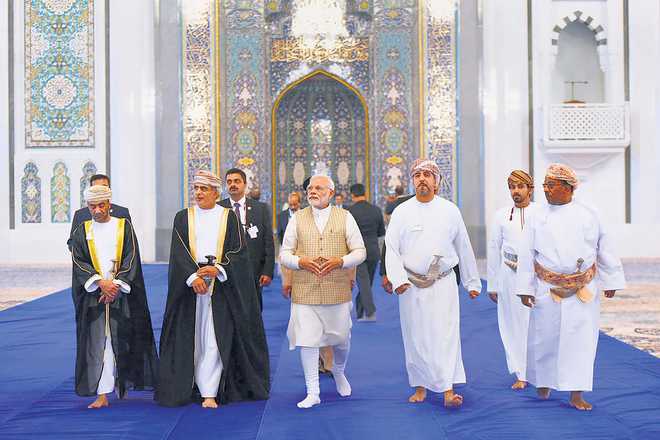
    Leaders who preceded Modi, whether of the Congress or BJP, operated from a shared vision to retain strategic independence vis-a-vis great powers and not get embroiled in Islamic world’s quarrels. Modi tends to play by ideological biases and hope that sequential and tactical moves will paper over strategic weakness in his approach. The UAE would like to create a fissure between India and Iran. Iran would like the reverse. Modi’s last stop was Oman to meet Sultan Qaboos, the last surviving titan of Gulf politics. He has kept Oman neutral in the Gulf nations’ quarrels created by gen-next leaders of the UAE, Saudi Arabia and Qatar. Hopefully, he would have passed that wisdom to his Indian guest.

    (The author is a former Secretary, Ministry of External Affairs, Government of India)

  • India’s Tech Firms Must Re-invent or Perish

    India’s Tech Firms Must Re-invent or Perish

    By Vivek Wadhwa

    “The complacency that caused Japan and South Korea to lose their edge at the end of the last millennium is about to afflict India. This is not to denigrate the talent base in the Subcontinent – Indian digital expertise remains world-class. It is a question of attitude, an unwillingness to face the reality of the industrial shift that is coming.

    There are literally $100bn opportunities elsewhere in the digital space that India has the expertise and capacity to exploit – yet it shows no evidence that it is likely to take them. When I talk to Indian CEOs, they acknowledge the threats of digital transformation, and can see the opportunities for diversification. Yet they turn away from our conversations to focus on closing another legacy outsourcing deal – fiddling while Bangalore burns. (MINT)

    You can see it in their faces, hear it in their voices. The Japanese and Koreans – on top of the world in the 1980s and 1990s – want the good old days back. When I meet Japanese and Korean companies these days I find their executives among the most attentive and determined of any in the world. Years of economic stagnation does that to you. Who doesn’t want to escape from a malaise? Willing alone won’t bring back the boom times – and I’m not yet ready to forecast a Northeast Asian renaissance. What I am ready to do is predict South Asian retrogression.

    The complacency that caused Japan and South Korea to lose their edge at the end of the last millennium is about to afflict India. This is not to denigrate the talent base in the Subcontinent – Indian digital expertise remains world-class. It is a question of attitude, an unwillingness to face the reality of the industrial shift that is coming.

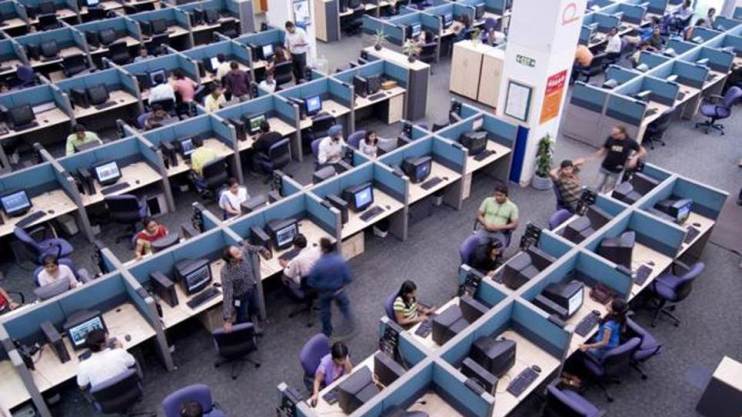
    Much of India’s IT wealth comes from western outsourcing of IT services – managing new and old world corporate IT systems and mainframes upon which they run. Yet about a decade ago, the balance of computing power started to change to favor individual users.

    With the advent of tablets, apps and cloud computing, users have direct access to better technology than their IT departments can provide them. They can download cheap, elegant, and powerful apps on their smartphones that make their corporate systems look primitive. These modern-day apps do not require internal teams of people doing software development and maintenance—they are user-customizable and can be built by anyone with basic programming skills. And with secure cloud computing, companies are doing away with servers, so corporate data centers are shrinking while Amazon, Google, and Microsoft’s data centers expand.

    Gone are the multi-billion dollar outsourcing deals that the Indian outsourcers celebrated every month.

    You can see the signs of stagnation in the layoffs that IT companies are making and in the slowdown in their hiring. You can see the agony in the faces of engineering graduates who are not getting job offers. Fortunately, the western contracts that are keeping the Indian IT sector alive will not disappear overnight. Company IT infrastructure takes decades to deconstruct and corporate IT strategy moves at the rate of molasses. There will be business for Indian IT for a few years more. But the eventual outcome is set, no matter how much they would like to wish it away: today’s IT industry will suffer a steep decline.

    The same technology advances that have decimated the Indian advantage, however, offer a new opportunity that could allow the Indian information technology sector to reinvent itself, even gain the support of Americans who have been rallying against it: to help America modernize its aging infrastructure and enable it to bring manufacturing back from China. Technologies such as robotics, artificial intelligence and inexpensive and powerful sensors enable development of smart cities and automated factories and a wholesale upgrading of national infrastructure. Artificial Intelligence technologies can help analyses massive amounts data and improve decision making in every industry sector.

    There are literally $100bn opportunities elsewhere in the digital space that India has the expertise and capacity to exploit, yet it shows no evidence that it is likely to take them. Instead, many Indian executives seem happy to plough on with more of the same, listening to the warnings without changing course. They claim to be using artificial intelligence tools and entering new markets—but these are just press releases, for marketing purposes. There is a fundamental lack of understanding of the new technologies and appreciation of the emerging market opportunities.

    The dramatic changes to strategy needed to take advantage of the new opportunities and the large-scale retraining of the workforce are not happening. What really worries me is that India IT companies face becoming the Kodaks of tomorrow – anchored to an outdated business model that is destroyed by disruption.

    What I have been teaching executives of companies in Japan and Korea as well as the US and Europe is that to survive the disruptions that advancing technologies are about to cause, and to take advantage of the new trillion-dollar opportunities, companies need to disrupt themselves. They need to do to themselves what startups from other industries are about to do to them: take the offensive with new technologies and business models and enter new markets. They need to challenge the status quo and question the past; behave like startups rather than lumbering giants.

    When I talk to Indian CEOs, they acknowledge the threats of digital transformation, and can see the opportunities for diversification. Yet they turn away from our conversations to focus on closing another legacy outsourcing deal – fiddling while Bangalore burns.

     (The author is a Distinguished Fellow at Carnegie Mellon University at Silicon Valley and author of The Driver in the Driverless Car: How Our Technology Choices Will Create the Future)

  • The Grounding of Air India

    The Grounding of Air India

    By Pulapre Balakrishnan

    “If Air India, nationalized in the 1950s, is now privatized, we would have come full circle. However, its case is more symbolic than substantive. Today there is no dearth of air-travel service providers in India, and the public airline reportedly has less than 15% market share. This is not the case in some other areas of the economy where public provision is fundamental. Take rail travel, which has no substitute. For it to serve its public purpose, the financial health of the Indian Railways is vital”.

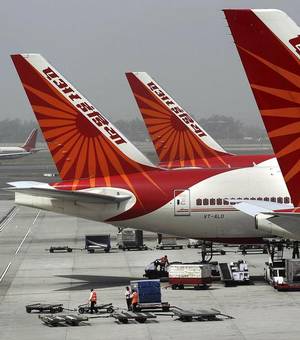
    Having announced its decision to sell Air India, the government is making arrangements to do so. The move itself has come after multiple efforts by successive governments to resurrect the national airline. Though there has been news of it finally turning in an operating profit under a determined CEO, its debt, reportedly a staggering $8.5 billion, must weigh on the minds of a public drawn into a discussion of its future.

    The beginnings

    It is unfortunate that so iconic an entity, once feistily steered by J.R.D. Tata, has met this fate, but it is not uncommon in the history of India’s public sector. To understand this ending, we would have to start at the beginning, and that was with the transformation of the economy attempted in the 1950s. While there were monumental gaps in that attempt, there were also creative innovations, the most important being the public sector. By design, the public sector was to exist along with a private one resulting in what had been referred to as ‘the mixed economy’. To those hankering after institutional purity this was no more than a joke, an arrangement that had strengths of neither full-bodied American-style capitalism nor of out-and-out Soviet-era communism. Half a century later, the Soviet empire imploded and for a brief moment in 2008, the American one teetered on the brink, having been taken there by its vanguard, finance capital. We can now see that the mixed economy, combining the public and private sectors, is superior to one located at either extreme.

    So, if the public sector is a force for the good, why is it that we see Air India, and a section of the rest of the Indian public sector, in so unsound a financial condition? In its early days, the public sector had been quite healthy. This need hardly come as a surprise when we recognize the then Indian leadership’s motive for building one. Stripped of its somewhat ideological construction as straddling ‘the commanding heights’ of the economy, it was to have a central role in the quickening of the economy after 1947. Wrecked by two centuries of colonialism, India’s economy was moribund. The post-colonial Indian leadership had envisaged the public sector as the ship that would steer the economy out of the morass. And they were not wrong.

    Under Nehru, India’s economy rose spectacularly, and public investment was the principal engine of growth in that remarkable phase. Used as we are to Air India having to, at times, borrow even to finance its working capital, it may come as a surprise to know that it was still making profit into the second half of the 1960s. As for the public sector as a whole, during the Nehru era its savings had grown faster than that of the private corporate sector. Actually, to an extent India’s public sector had financed itself.

    Nehru’s speech at the inauguration of the second plant of the Hindustan Machine Tools (HMT) in Bangalore in 1962 is instructive in this regard. He congratulated the workers of HMT for having produced a second plant entirely out of the surplus of the first one. In one stroke, this conveys the rationale imagined for India’s public sector at the moment of its conception. It had been imagined as a source of investible funds for the public purpose. Underlying this was the belief that the private sector may not generate the necessary surplus, especially if the economy was not first quickened through public investment.

    It is noteworthy that in the heyday of the public sector, India’s private corporate sector had not done badly at all. Its investment rose at least much as that of the public, demonstrating that claims of its suppression due to the license-permit raj are exaggerated. It is true that some entities had been excluded by licensing. Licensing was necessary to ensure that resources were used in accordance with the plan for industrialization, but it was the case that private firms receiving licenses benefited greatly from the expansion of the market resulting from public investment. It is perhaps not known widely enough that in the Nehru era India grew faster than China.

    What went wrong?

     So, if the public sector had such a central role in lifting India out of a morass, why are we where we are today? Why is Air India awaiting the gavel? This has entirely to do with politics. Politics underwent a sea change in the second half of the 1960s and with this the de facto status of the public sector was to change. It became the handmaiden of Indira Gandhi’s attempt to gain absolute control. Performance no longer counted, and the public sector was now validated by its very existence. Intimation of the changed policy stance appears in the form of an entry in an ‘Economic Survey’ from the 1980s emphasizing that a large section of employees of the public sector were those absorbed from loss-making units. This was to be a point of no return as the public sector was no longer treated as the fulcrum of the economy but as a political instrument. It was not as if some successes, such as of Maruti Udyog, were not to come yet but the original sense of purpose was lost.

    If Air India, nationalized in the 1950s, is now privatized, we would have come full circle. However, its case is more symbolic than substantive. Today there is no dearth of air-travel service providers in India, and the public airline reportedly has less than 15% market share. This is not the case in some other areas of the economy where public provision is fundamental. Take rail travel, which has no substitute. For it to serve its public purpose, the financial health of the Indian Railways is vital.

    We have reason to believe that this is threatened. The present Minister for Railways has announced that the decay of the capital stock has contributed to reduced safety. In particular that the recent spate of derailments has to do with inadequate signaling equipment and damaged tracks. Scarcity of funds for proper maintenance of the capital stock is directly related to populism. The replacement in 2012 by his party supremo Mamata Banerjee of a Railways Minister who had raised passenger fares demonstrates the role of politics in running India’s public sector into the ground. Unlike the airlines, the railways are a life-line for a large number of Indians, and maintaining their good health is vital to their interest. It is naïve to imagine that the public sector can remain immune to inflation in the economy.

    Meanwhile, an effort to turn around the public sector has come from an unlikely section. The Communists of Kerala, prone to rationalizing inefficiency when it suits their politics, have now embarked upon a revival of the State’s public sector undertakings. This has met with success in a short time, with at least some loss-making units turning profitable. The parlous state of public finances may have forced this political party’s hand but the move itself shows maturity. Hopefully it will serve as a model for the rest of the country. The public sector would be a jewel when worn in the public interest. When it is not, as was the case with Air India, it turns into a millstone around our necks.

    (The author is Professor of Economics of Ashoka University and Senior Fellow of the IIM Kozhikode)


  • A moment for Indian liberalism

    A moment for Indian liberalism

    Is a new liberalism, shaped profoundly by Indian cultural conditions, just round the corner?

    Liberalism is probably more challenged in India today than in any other democracy in the world. Why? First, conservative communities appear to have gained untrammeled power in recent times. Self-proclaimed custodians of caste and religion are perpetually breathing down the necks of young men and women, dictating who they must meet, converse with, befriend and marry, what they should eat, wear, watch or read, whether they can use mobile phones, and even where they can go and when. By encroaching on the most intimate relationships of love and friendship, interfering in matters of pleasure or habit, they suffocate personal freedoms and violate the very basic norms of individual choice.

    Second, people find it increasingly difficult to express themselves freely. A public culture of hurt sentiment, violated collective honor, offence and alleged humiliation and the social and political license to react to it in whatever brutal manner possible have created such a climate of fear that creative artists, intellectuals and even ordinary persons in public conversations hesitate to say what comes to their mind and look over their shoulder to see if big daddy is watching. The threat of social intimidation and legal harassment makes public expression so expensive that people would rather stay silent or remain aloof from public life.

    Third, large corporations and the government have access to virtually every detail about us, making us vulnerable and insecure. Methods of surveillance become more opaque, even as they attempt to make us transparent against our will. The minutest details of one’s private and intimate life are available today to large, powerful organizations at the press of a button. Is it not frightening that to call or visit friends and family, we must undergo CCTV cameras, finger printing and face recognition?

    Fourth, confidence in the rule of law is badly shaken. Is there any assurance that law will be enforced evenhandedly, indeed, that it will be enforced at all? On the contrary, we often fear excesses by official agents at every level of government, worry that power will be abused, that some person in charge of law and order will behave lawlessly, even brutally.

    Freedom to say ‘no’

    What do the power of the state, the community, individual choice and expression have to do with liberalism? Everything. The term ‘liberalism’ has come to mean different things to different people and is associated with: (a) demands for greater overall equality, (b) defense of individual reason and autonomy, (c) a tool against moral conservatism, (d) cosmopolitanism and humanism, and (e) free markets. Overused, it suffers from what happens routinely to words with wide currency: it generates less light, more heat, and even greater cacophony. Yet, a moment’s reflection shows that one value has always lain at its heart: the freedom of an individual to say no; to say that enough is enough and that something ominously coming towards me up close, stalking me, is no longer bearable and must be stopped; that there is a little world of my own, my private universe, that no one may enter if I do not give permission, and a place exists in public for me too that must not be impeded as long as others are not harmed. In my largely private but also partly public world, I must live without fear or favor.

    One such bulwark against habitual and pervasive acts of cruel interference is the dismantling of private armies commanded by powerful custodians of communities and the creation instead of an impartial public power (the state) governed minimally by the rule of law — a law that protects my mini-kingdom, where I am sovereign — and that liberates me from fear itself. But then the same rule of law must also shield me from arbitrary, unexpected and unnecessary acts of state coercion. Whatever else liberalism might come to have mean, it stands for personal freedoms in the face of intrusion by every form of organized power. Indeed, classical liberalism in western societies emerged precisely in response to persistent attempts to throttle the then bourgeoning assertions of individual freedom by oppressive communities, a meddlesome church, and abusive state power.

    In this minimal sense, the term ‘liberal’ no longer has a restricted spatial or temporal application. It has a much wider usage and has resonated in India with acts of renunciatory Brahmins, with movements led by the Buddha and Mahavira, by the early Lingayats, by those inspired by Nanak, Kabir, Akka Mahadevi and Mira as well as Phule and Ambedkar. This ‘thin’ liberalism has nothing uniquely western about it. Indeed, there are modern liberalisms and ancient ones, and just as there have been liberalisms in the past, there will be liberalisms in future. The message in all these is common, clear and simple: don’t force anything down anyone’s throat, stop the deliberate infliction of physical or emotional pain on individuals, especially upon a weaker person, no matter how valuable you believe your cause to be.

    An inevitable revolt

    If the current climate of oppression or violent threats continues, a revolt against the current set-up will invariably arise. Young, self-reflective men and especially women facing continual restrictions, Dalits, lower Other Backward Classes, poor Muslims, people from smaller towns and rural areas will seize the moment, demanding greater opportunity to exercise individual choice and freedom of expression. Is a new liberalism, different from the one articulated by traditional, metropolitan English-speaking elites, shaped profoundly by Indian cultural conditions, just round the corner?


  • Turning the diplomatic prism

    Turning the diplomatic prism

    Dealing with Pakistan; renewing ties with Canada

    By KC Singh
    Pakistan, Trudeau and Khalistanis need to be engaged not pilloried, while detoxifying the nation of bigotry and falsehood”, says the author.
     The one issue that still rankles bilateral relations is the activities of “Khalistani” elements in Canada and their links, if any, with Pakistan’s ISI. It played last year into the visit of Canadian defense minister, Lt Col Harjit Sajjan, when Capt Amarinder Singh literally boycotted him, piqued over the Canadian government denying him a visa before the Punjab election last year.”

    India-Pakistan relations under the Modi government are in a cryogenic state. A muscular response, advocated by PM Narendra Modi, has become not a means, but an end in itself. Despite “surgical strikes” and periodic cease-fire violations, the Pakistan army remains defiant. With elections around the corner in Pakistan and rumors Modi may advance the Lok Sabha elections, the scope for any meaningful dialogue appears bleak.

    India draws much solace from President Donald Trump’s periodic verbal assaults on the duplicity of Pakistani state and military. The US withholding military aid, amounting to $2 billion, including $900 million in coalition support funds to compensate Pakistan for its counter-terrorism operations along the Durand Line (Pak-Afghan border), is a first step to ratchet up pressure on Pakistan. US government sources are telling the media that there is an escalation plan if Pakistan does not heed the warnings. The action that the US seeks is Pakistan severing links with the Taliban and the deadly Haqqani network. The same source told Washington Post that there was “immense” frustration over Pakistan continuing to deny that there were any Pakistani safe havens for these groups.

    Senior US officials touring India recently displayed guarded optimism over change in Pakistani attitude. They take the cue from Pakistan not threatening to disrupt US supply routes via Pakistan. But recent terror attacks in Kabul, where an ambulance bomb caused severe casualties, negate that finding. Earlier a hotel was attacked, frequented by Afghan government officials and foreigners, in which among others, a senior police commander and a member of the High Peace Council were killed. The hotel attack on the topmost floor indicated that the attackers were well briefed as that floor normally is reserved for officials holding sensitive positions.

    Meanwhile, Pakistan blocked access to Hafiz Saeed when a team deputed by the UN Security Council sanctions committee arrived to assess Pakistan’s handling of a listed terror mastermind. Reports keep resurfacing that Pakistan was in the process of allowing the India-specific terror syndicates to enter the political field. This could be a double-edged sword to both legitimize the groups and undercut the Sharif brothers, who control the Pakistan Muslim League (N), in the forthcoming parliament election. China has been more forthrightly defending Pakistani credentials as a nation fighting terror and not abetting it.

    Against this background, two events invite attention. First, the Economist carried a story earlier this month on the reform of Pakistan’s school education. This has gone unnoticed in India as the dominant narrative is that Pakistan is a collapsing state which will soon end up in a big Islamic heap. The story holds a lesson for our Punjab. Under the direct leadership of chief minister Shahbaz Sharif, a private-public partnership (PPP) has successfully developed to rectify the skewed school completion data. The richest Pakistanis have 60 per cent completing nine years of schooling. For the poor, the number is 5 per cent and for the middle income group, a mere 25 per cent. A donation-based citizens’ foundation today has over 2 lakh students in its schools. Similarly, the Punjab Education Foundation, a quasi-independent body, is doing the same work even on a larger scale.

    The PPP works with the Shahbaz government handing over public schools to private partners and then closely monitoring their work while providing some subsidy. A Harvard University study shows that village schools saw 30 per cent higher enrolment after private parties were brought in. It has also been discovered by other studies that teachers on contract, who are paid less, produce as good or better results. A similar revamp of the primary and secondary school education in our Punjab is long overdue. CM Shahbaz takes a three-monthly meeting of all stakeholders to monitor the progress of this reform. Can the Punjab CM, Capt Amarinder Singh, do likewise?

    The other event is the expected arrival of Canadian Prime Minister Justin Trudeau on a five-day visit on February 17. Among other cities he would be visiting Amritsar. The one issue that still rankles bilateral relations is the activities of “Khalistani” elements in Canada and their links, if any, with Pakistan’s ISI. It played last year into the visit of Canadian defense minister, Lt Col Harjit Sajjan, when Capt Amarinder Singh literally boycotted him, piqued over the Canadian government denying him a visa before the Punjab election last year.

    Trudeau’s visit provides a good opportunity for Capt Amarinder to bury the past. Sikhs constitute almost 40 per cent of the total population of Indian diaspora in Canada which numbers over a million. That huge number needs to be engaged and their energies channelized to contribute to Punjab’s development. The population profile of the Canadian Sikh diaspora is different from that in the US. The Canadian Sikhs are more closely linked to peasantry in Punjab. A number of episodes have riled Delhi as the Canadian government is seen as handling mischief-makers with kid gloves. When I dealt with them in 2006-07, the Canadian explanation was that they monitor the goings-on but would only step in if violence or terrorism was imminent. Slogans in favor of Khalistan are really solitary cries for attention. The Canadian Sikh fringe needs to be politically dealt with. Banning their entry into India will only exacerbate the situation.

    If Punjab was the laboratory of the Green Revolution, it now needs to reinvent itself. A revamped education system, a shift away from the rice-wheat agrarian model, laying of food-chain supply network and conservation of water aquifers and adoption of sustainable development goals. It is not a surprise that a recent study showed that South Indian states, which have the advantage of coastlines for connectivity, have cornered the export businesses of India. A new Punjab model could become the 21st century template for the land-locked and largely agrarian economy states of the North.

    The Modi government, having largely ignored rural distress, has awakened post-Gujarat election. Udayan Mukherjee wrote in another newspaper that the Modi government’s strategy was: “more wealth for the rich, Hindutva for the poor”. Religion may be, as Karl Marx quipped, the opiate of the masses. But when used to polarize for electoral gains it can be catastrophic. Thus Pakistan, Trudeau and Khalistanis need to be engaged not pilloried, while detoxifying the nation of bigotry and falsehood.

     (The author is a former Secretary, Ministry of External Affairs)

  • How Trump is making China and India great again

    How Trump is making China and India great again

    With his constant tirades against immigrants, particularly from what he calls “shithole countries”, Donald Trump is giving many countries the greatest gift of all: causing the trickle of returning talent to become a flood”.
    By Vivek Wadhwa
    At the same time, I also realized that protectionist demands by nativists were causing American political leaders to advocate immigration policies that were (and are) choking US innovation and economic growth. The government would constantly expand the number of H1-B visas in response to the demands of businesses but never the number of green cards, which were limited to 140,000 for the so-called key employment categories. The result? The queues kept increasing. I estimate that today there are around 1.5 million skilled workers and their families stuck in immigration limbo, and that more than a third of these are Indians”, says the author.

    “Thank you for what you are doing for America; your successes have put India in very positive light and shown us what is possible in India” said Atal Behari Vajpayee to me in a one-on-one meeting during his visit to the White House in September 2000. He added that he would love to see Indian-American entrepreneurs return home to help build India’s nascent technology industry.

    Bill Clinton and George W. Bush granted him his wish with their flawed immigration policies. The U.S. admitted hundreds of thousands of foreign students and engineers on temporary visas but did not have the fortitude to expand the numbers of green cards. The result was that the waiting time for permanent resident visas began to exceed 10 years for Indian and Chinese immigrants. Some began returning home.

    Now with his constant tirades against immigrants, particularly from what he calls “shithole countries”, Donald Trump is giving many countries the greatest gift of all: causing the trickle of returning talent to become a flood.

    For India, the timing could not be better. With hundreds of millions of people now gaining access to the Internet through inexpensive smartphones, India is about to experience a technology boom that will transform the country itself. And with the influx of capital and talent, it will be able to challenge Silicon Valley—just as China is doing.

    This is the irony of America’s rising nativism and protectionism.

    When I met Prime Minister Vajpayee, I was the CEO of a technology startup in North Carolina. Later, I became an academic and started researching why Silicon Valley was the most innovative place on this planet.

    I learnt that it was diversity and openness that gave Silicon Valley its global advantage; foreign-born people were dominating its entrepreneurial ecosystem and fueling innovation and job growth. My research teams at Duke, the University of California at Berkeley, New York University, and Harvard documented that between 1995 and 2005, immigrants founded 52% of Silicon Valley’s technology companies. The founders came from almost every nation in the world: Australia to Zimbabwe. Immigrants also contributed to the majority of patents filed by leading US companies in that period: 72% of the total at Qualcomm, 65% at Merck, 64% at General Electric, and 60% at Cisco Systems. Surprisingly, 40% of the international patent applications filed by the US government also had foreign-national authors.

    Indians have achieved the most extraordinary success in Silicon Valley. They have founded more start-ups than the next four immigrant groups, from Britain, China, Taiwan, and Japan, combined. Despite comprising only 6% of the Valley’s population and 1% of the nations, Indians founded 15.5% of Silicon Valley startups and contributed to 14% of US global patents.

    At the same time, I also realized that protectionist demands by nativists were causing American political leaders to advocate immigration policies that were (and are) choking US innovation and economic growth. The government would constantly expand the number of H1-B visas in response to the demands of businesses but never the number of green cards, which were limited to 140,000 for the so-called key employment categories. The result? The queues kept increasing. I estimate that today there are around 1.5 million skilled workers and their families stuck in immigration limbo, and that more than a third of these are Indians.

    Meanwhile, I have witnessed a rapid change in the aspirations among international students. The norm would be for students from China and India to stay in the US permanently because there were hardly any opportunities back home. This changed.

    My engineering students began to seek short-term employment in the US to gain experience after they graduated but their ultimate goal was to return home to their families and friends. Human resource directors of companies in India and China increasingly reported that they were flooded with resumés from US graduates.

    For students, the prospect of returning home and working for a hot company such as Baidu, Alibaba, Paytm, or Flipkart is far more enticing than working for an American company. You cannot blame them, especially given that delays in visa processing will lock them into a menial position for at least a decade during the most productive parts of their careers.

    This has been an incredible boon for China. One measure of the globalization of innovation is the number of technology start-ups with post-money valuations of $1 billion or higher. These companies are commonly called “unicorns”. As recently as 2000, nearly all of these were in the US; countries such as China and India could only dream of being home to a Google, Amazon, or Facebook.

    Now, according to South China Morning Post, China has 98 unicorns, which is 39% of the world’s 252 unicorns. In comparison, America has 106, or 42%, and India has 10 unicorns, 4%. An analysis by the National Foundation for American Policy revealed that 51% of the unicorns in the US have at least one immigrant founder. It is clear how shortsighted the US government has been.

    With the clouds of nativism circling the White House, things will only get worse. America’s share of successful technology startups will continue to shrink and Silicon Valley will see competition like never before.

    America’s loss is India’s gain.

    (The author is a Distinguished Fellow at Carnegie Mellon University at Silicon Valley and author of The Driver in the Driverless Car: How Our Technology Choices Will Create the Future)


  • Emergency and Now

    Emergency and Now

    By MG Devasahayam


    The author was District Magistrate of Chandigarh when Lok Nayak Jayprakash Narayan was incarcerated at PGI during Emergency. Over a time, he became an admirer of Lok Nayak and the two exchanged views quite often. -EDITOR

    “As the four senior most judges of the Supreme Court flagged their concern about the institution, it was reminiscent of the Emergency. Most people are these days moving in hushed silence, stunned and traumatized by the goings-on.”

    As I sat glued to the ‘idiot box’ watching the ‘historic’ event of four senior most judges of the Supreme Court ‘paying their debt to the nation’ and placing their case before ‘We, the People’, I was touched by two poignant references by Justice Jasti Chelameswar: “We are all…four of us are convinced that unless this institution is preserved and it maintains its equanimity, democracy will not survive in this country.” And: “We are left with no choice except to communicate it to the nation that ‘please take care of the institution and take care of the nation’… I don’t want another 20 years later some very wise men in this country blame that Chelameswar, Ranjan Gogoi, Madan Lokur and Kurian Joseph sold their souls and didn’t take care of this institution, they didn’t take care of the interest of this nation.”

    My thoughts went back to the special ward in the PGI, Chandigarh, and my conversations with Lok Nayak Jayaprakash Narayan (JP) who was incarcerated there during the Emergency. It was August 6, 1975. As was my wont, I had gone to see JP that morning. He asked me what the date was and I told him. He mumbled to himself that the Supreme Court hearing of the Prime Minister’s appeal against her disqualification by the Allahabad High Court was on the 11th. He asked me about the report of the case. He also asked me as to what was happening in Parliament.

    I could not mislead him by saying that there was nothing special. Hence, I told him about the amendments to the Representation of the People Act by Parliament the day before. He was upset as I narrated one by one the six amendments that had been made. The most prominent was the amendment granting immunity to the PM’s election from being challenged in a court of law. He looked sad and said with a deep sigh that there was no hope now. “Everything is finished. She will be there forever.”

    I also informed him of the convening of the state assemblies on August 8 and 9 and also the likely amendment of the Constitution rendering the elections of President, Vice-President, Prime Minister and Speaker of the Lok Sabha non-justiciable. He was more upset now. He said in a very sad tone: “Democracy is finished completely,” and after a pause, “at least for the present.” He said that his only hope was in the Supreme Court and that too had been shattered. “Now there is nothing to hope for and nothing to live for. This lady has demolished the very edifice of democracy so painfully constructed by her father and myriad others.” I was touched by his sentiments and the way he expressed it. I told him that this was inevitable and one could see it coming.

    But JP did not take it lying down. On August 10, he addressed a letter to the Prime Minister which was delivered to me around noon. In the letter, he had declared that from August 25, he would start a fast-unto-death unless the Emergency was revoked and all detainees released within two weeks. He would not take anything, except water, sour lemon and medicine meant only for ill health. Realizing its disastrous consequences, I rushed to JP immediately and after a sharp wordy duel lasting over two hours, dissuaded him from taking this extreme step. But not before he said these extremely anguished words: “I do not want to live to see the death of democracy before my very eyes. The least I could do would be to deny me that unparalleled agony and die before democracy is dead.”

    Be that as it may, the accuracy of JP’s prediction about the Supreme Court is narrated by Nayantara Sahgal in her book ‘Indira Gandhi’s Emergence and Style’: “The essence of Emergency was the pinnacle-power — a position above the multitude, unaccountable and unchallengeable — it sought to guarantee the Prime Minister. This was accomplished by three amendments to the Constitution and an Act of Parliament. The 38th Amendment put the declaration of Emergency beyond the scrutiny of the courts. The 39th Amendment made election disputes relating to the Prime Minister, President, Vice President and the Speaker non-justiciable. This wiped out the Allahabad High Court judgment with retrospective effect and ensured a Supreme Court judgment in her favor. On 7 November 1975, a 5-judge bench of the Supreme Court upheld the amendments and Indira’s 1971 election to Parliament.”

    Supreme Court judges then had not ‘taken care of the interest of the nation’ and some of them perhaps had ‘sold their soul’. This judgment shattered JP’s will to live and under intense agony and mental pressure, his kidneys, which were already under stress, failed. He took seriously ill which could have been life-threatening. Realizing the enormity of the situation, I initiated a ‘pincer movement’ to pressure the Union Home Ministry and PMO, got JP released on November 12 and sent him post haste to Bombay’s Jaslok Hospital just in time for his kidneys to be treated and life saved. JP lived for four more years, defeated the Emergency and returned India back to democracy.

    Since then, democracy has been limping and in recent years, again in dire danger. Basic violations of the democratic spirit and the crude attempts to legitimize a new type of regime and new criteria of allocation of rights and obligations continue unabated. There is no sense of boundary or restraint in the exercise of power, and there is a striking growth of arbitrariness and arrogance with which citizens are being turned into subjects, meekly accepting party/government diktats. Polarizing agenda, communal hatred, violence, demonetization and Aadhaar are the tools used.

    Reminiscent of the Emergency, most people are moving in hushed silence, stunned and traumatized by the goings-on. There is fear and anxiety all around. Across the nation, groveling administrators, media anchors, academicians, advocates and accountants are vying with each other to sing paeans to the rulers. The bulk of the civil service is crawling when only asked to bend. Higher echelons of the judiciary bow to the rulers and are willing to decree the way they want. Politicians of all hue and color, barring honorable exceptions, lay supine and inactive.

    In the event, India’s precious democracy is in peril again as openly stated by the four wise men of the highest court of the land. As an ordinary citizen, all I can do is to wail in the manner of our forefathers: “Democracy is in peril, defend it with all your might.” And, also salute these four men who have stood high and tall when most others have fallen asunder!

    (The author is a Former IAS officer and District Magistrate, Chandigarh)

  • India@68

    India@68

    Will Modi be India’s Gorbachev?

    Remember, Gorbachev, a modern man heading a medieval Communist Party, introduced Glasnost (Transparency), without exactly working much for Perestroika (Reconstruction) in the 1985-91 era. The result was the dissolution of the “secular” Soviet Union and emergence of an Orthodox Christian Russia on its ruins!
    Modi has often been talking about transparency; and rarely about reconstruction!
    As the year 2018 began, India’s politics is agog with the possible changes in the offing. Despite his currently steamroller majority in the Lok Sabha and the emerging one in the Rajya Sabha (Upper House), Modi appears buffeted more due to the circumstances not of his making but what he inherited. Like the Mahabharata’s great warrior Abhimanyu, he is struggling against seven enemies and he does not, apparently, know how to get out of the booby traps and landmines.
    Follow Story @
    https://www.theindianpanorama.news/featured/perspective-tired-titan-modi/

    As the “Sovereign, Socialist, Secular, Democratic Republic of India” celebrates its 68th anniversary on January 26, 2018, the world’s largest democracy refuses to grow old. It remains young, and, therefore, rather unpredictable, as ever. In fact, India has retained her youthfulness due to this very unpredictability; the vast nation, as sociologists and historians have noted, changes every ninth mile! And you are never sure which India best represents India!!

    When the war-crippled British Raj decided to leave India in 1947, dire warnings were given that the utterly brittle country of nearly 300 million diverse people divided across castes, creeds and customs would not survive for long and fall back upon its familiar, fissiparous path of slavery of another kind. India proved all dystopian warnings wrong.

    Winston Churchill was among the first politicians to predict India’s downfall from the British to the brutish era. The then war-time Prime Minister, who did not want to preside over the liquidation of the British Empire, had claimed that an Independent India would quickly disintegrate and return to the medieval era. Dr. B. R. Ambedkar, as Chairman of the Drafting Committee of the Constituent Assembly, had also expressed apprehension that India could lose her independence and territory once again and even become a dictatorship if she failed to put in checks-and-balances.

    Nothing of the sort has, however, happened. On the contrary, despite odds, India has not only retained her independence, sovereignty and territorial integrity, but has also been a beacon of independence to many “Third World” countries, thanks to its slow but sure progress and prosperity. She has not only emerged as the largest democracy in the world but also the third largest economy, the sixth space power, and an emerging world superpower. In other words, India has been a role model for many a nation the way her greatest son, Mahatma Gandhi, has been a role model for many a country vying for independence from a foreign yoke.

    Of course, the 2,000-year-old Mother India has had to struggle hard to put up the make up of a 20-year-old lady and walk the ramp of world powers. She had her own hours of reckoning, even dictatorship of sorts. She had to fight a war imposed by China in 1962, another by Pakistan in 1965, and a third during the Bangladesh Liberation in 1971. Also, she suffered a major embarrassment during the dictatorial Internal Emergency (1975-77), imposed by the then PM Indira Gandhi. Interestingly, it was also during the same Emergency that Mrs. Gandhi introduced the future seed of Indian politics: the 42nd Amendment to the Constitution, adding the word “secular” to the Preamble. This “secular” word would become the determinant of whither the Republic of India would march in the 21st century.

    For, when Mrs. Gandhi returned to power in 1980 after the brief Janata Party interregnum, she faced unprecedented turmoil in Punjab due to Pakistan-sponsored, financed and supported terrorism in the border state. For the first time, a “secular” India witnessed her Army storming a venerated shrine to flush out militants. India’s secularism was stretched to the limits and the woman who sought to conceive a “secular” India was consumed by the very forces she had unwittingly unleashed.

    Her son Rajiv Gandhi inherited the crown as well as the “secular” thorn from his mother. While he successfully fathered India’s communication revolution, he was also consumed by another kind of terrorism, from the Hindu Tamils of neighboring Buddhist Sri Lanka. Like his mother, he also stretched India’s secularism to the limits by first succumbing to the Muslims in the Shah Bano case and then to the Hindus on the Ayodhya issue.

    All governments that followed the Rajiv Gandhi era since 1989 were products of the struggle between the combination of Hindutva forces on one side and the “secular” ones on the other. This was the era of coalition governments in which alternated political groups led by the rightist Hindutva party, the BJP, and the “secular” fronts, led by the Congress, or ex-Congressmen.

    Interestingly, again, while Indira introduced “secular” content in the Constitution, her son Rajiv succumbed to both the Muslims and the Hindus, in that order, thus changing the very creed of the Congress—only Mahatma Gandhi had changed this creed in 1919 when he turned the Indian National Congress from being a post office to the biggest mass movement for India’s Independence.

    This change of creed became unstoppable. In fact, the Rajiv Gandhi-led Congress seemed to be the last sigh of the Grand Old Party (GOP), having won a massive majority of 404 seats out of 533 in the Lok Sabha (Lower House of Parliament) in 1984, riding a sympathy wave after the assassination of India Gandhi. In Independent India, this was the first election where the people voted on the basis of religion and a pro-Hindu sentiment began to take shape. Subsequently, it evolved further and empowered Narendra Modi to become the PM in 2014, heading the government led by the single dominant party (the BJP alone won 282 seats) after 30 years.

    It is this Republic that India of the 21st century has inherited.

    Where is India headed now?

    As the year 2018 began, India’s politics is agog with the possible changes in the offing. Despite his currently steamroller majority in the Lok Sabha and the emerging one in the Rajya Sabha (Upper House), Modi appears buffeted more due to the circumstances not of his making but what he inherited. Like the Mahabharata’s great warrior Abhimanyu, he is struggling against seven enemies and he does not, apparently, know how to get out of the booby traps and landmines.

    https://www.theindianpanorama.news/featured/perspective-tired-titan-modi/

    Only in the last week, fresh salvos have been fired at him. His friend-turned-foe, Dr Pravin Togadia, International Working President of the Vishwa Hindu Parishad, has gone ballistic against him and his government, even claiming that he could be killed in an organized “encounter” with the police! This demonstrates the internal bickering in the larger Sangh Parivar, and Modi may lose many foot soldiers for the ensuing 2019 General Elections next year, to be preceded by elections to eight state Assemblies. The Rashtriya Swayamsevak Sangh (RSS), which heads the Sangh Parivar, has been claiming to be the only champion of all that was Great in India of the bygone “Golden Age”, the only repository of the Hindu culture and civilization. But, ironically, the once-monolithic RSS is becoming more and more brittle and fissiparous in the image of India of Yesterday that it increasingly represents! The India of Tomorrow is going to be very different and the RSS would, predictably, embrace more and more irrelevance.

    Having known Modi personally since 1998, I can fairly assume that even Modi, apparently, realizes this increasing irrelevance of the RSS in which he cut his political teeth and activism since the early 1980s. A gizmo-loving Modi has almost been a ‘misfit’ in the RSS, being too modern an activist-politician emerging from the Sangh Parivar which has a strangely medieval, even ancient, mindset. But, like Atal Behari Vajpayee before him, he has had to suffer in silence this foot-soldier providing agency. That he is not an ideological junkie was proved when he systematically cut to size and made irrelevant the various Parivar constituents during his Chief Ministership of Gujarat (2001-14).

    And he also, apparently, realizes that the 2019 electoral battle will be very different from the one he won in 2014. Then, he could blame the Congress-led Government of Dr Manmohan Singh for the various ills; now, he cannot blame his own government for multiple failures to keep promises! Ironically, he continues to be the most popular politician in India at a time when his party is losing out, beginning with his home state of Gujarat.

    In other words, Modi’s popularity is independent of his own party’s, that of his government or even of the RSS. In still other words, it is somewhat like “Modi is India and India is Modi”, to borrow a famous phrase from the Emergency era when the then Congress President Dev Kant Barooah pronounced that “Indira is India and India is Indira”!

    A major reason for this overriding popularity of Modi is, apart from his own well-oiled PR network, also the failure of the country’s polity to produce another leader. In 2018, as of now, India is beset with the “There Is No Alternative” (TINA) syndrome. Although Rahul Gandhi, now the Congress President, has been able to revive some confidence during the last six months, he is no match to Modi’s political acumen, machinations and the ability to turn adversity into opportunity. Modi has been a full-time politician, with no baggage attached or inherited, and with no family, whereas Rahul has been a reluctant politician for most of his career.

    And it is Modi, not Rahul, who has actually inherited the political mantle of Indira Gandhi!

    Which takes us to figure out what Modi could do best, and the next.

    In the early 1980s, Indira’s lieutenants like the then Union Minister Vasant Sathe had released trial balloons wondering whether the country could adopt a Presidential system of governance to replace the current parliamentary system. The debate died down with the assassination of Mrs. Gandhi. It has been revived again.

    Can, therefore, Modi introduce the Presidential system? I remember Sathe having told me in the 1980s that, for this, the Parliament will have to merely pass an Amendment to make the President to be elected directly by the people. That is, election to the Presidency and the Lok Sabha will both be direct, and independent of each other. Be that, as it may, India could have in Modi her first President directly elected by the people!

    Clearly, it would be a paradigm shift in the Republic of India which will celebrate its Diamond Jubilee in 2024. Modi has often been talking about how India should celebrate the 75th anniversary of Independence in 2022 and hinted that he could continue to helm the affairs until 2024!

    As the first step towards this ‘destination’, Modi has been advocating holding of elections to the Lok Sabha and the state Vidhan Sabhas, simultaneously, ostensibly to save money. In the first two decades of Independence, simultaneous elections were held, but Indira Gandhi stopped this practice. If Modi revives it, he could have the advantage of superimposing his persona all over the simultaneous General Elections. Since he has no match, he is likely to win a Presidency hands down; and, even if the BJP/NDA lose the poll or majority, he will have the independence of being the elected President.

    Will, then, Modi-as-President be like Trump-as-President?

    Maybe.

    But he also risks becoming India’s own Mikhail Gorbachev! Remember, Gorbachev, a modern man heading a medieval Communist Party, introduced Glasnost (Transparency), without exactly working much for Perestroika (Reconstruction) in the 1985-91 era. The result was the dissolution of the “secular” Soviet Union and emergence of an Orthodox Christian Russia on its ruins!

    Modi has often been talking about transparency; and rarely about reconstruction!

    (The author is a journalist since 1983 and has worked with newspapers, news agencies and magazines in English and Hindi languages. He has contributed articles on diverse subjects. Currently, he is working as Consulting Editor with Business Line, the business daily of The Hindu Group of Publications in India. He is based in Ahmedabad in Gujarat, India. He can be reached at Virendra.pandit@gmail.com)


  • Indian diaspora is growing

    Indian diaspora is growing

    By Mahendra Ved
    The author sees a growing number of overseas Indians is taking part in the electoral process in the countries of their adoption, which, he says is good for them. The Indian diaspora now total 31.2 million. D. Mulay, secretary, Department of Overseas Indians in the Ministry of External Affairs said they were impacting their societies and the economies.

    The growing role of overseas Indians in governance in their adopted homelands raises an interesting question when it comes to the world’s most powerful nation: Can an ethnic Indian be elected the next, or future, president of the United States?

    On his last day at the White House a year ago, president Barack Obama — although his strong endorsement failed to get Hillary Clinton elected as the first woman president — somewhat prophetically said his country could elect “not just a woman president, but could also see a Latino president, a Jewish president and a Hindu president in the future.”

    In a broad sense, Indian American Nikki Haley fits in. Michael Wolff, the author of Fast & Fury: Inside the Trump White House, said she considered herself worthy of the post and that her colleagues thought she was “ambitious and smarter than Donald Trump”.

    Trump had initially considered her as his secretary of state, but eventually sent her as ambassador to the United Nations.

    That Haley, born Nimrata Randhawa, is seen to be in the reckoning within nine months of doing her job is significant. She answers to another of Obama’s approving descriptions, of “mixed-up presidents”. She remains a Sikh while being married to a white Christian American.

    Not a dumb Trump follower, she was critical during the latter’s presidential campaign, receiving media hype for saying the phrase “bless your heart” in response to Trump’s Twitter attacks after she called for him to release his tax records.

    Being called “ambitious” and “smarter than Trump” carries obvious risks. But, she insists that she has no ambitions. “Every position I’ve ever had, people have assumed that I am looking toward something bigger,” she declared on becoming envoy to the UN.

    But, that was on April 4 last year. According to excerpts in The New York Times, Wolff said Haley “decided” by October last year that “Trump’s tenure would last, at best, a single term, and thought she could be his heir apparent”.

    Trump has trashed the book and its writer. Speculation is that Trump could eliminate Nikki, as he has done with many of his team, if he thinks she could block his second term bid in 2020.

    Unlike another Indian American politician Bobby Jindal, who briefly sought the Republican nomination in the 2016 presidential election, Nikki flaunts her Indian origin.

    “I am the daughter of Indian parents who said to me ‘whatever you do, be great at it and make sure people remember you for it’”.

    As a woman, she could have a formidable rival in Oprah Winfrey, who has captured Hollywood’s imagination after her Golden Globes address. Steven Spielberg, Tom Hanks, Meryl Streep — all want “president Oprah Winfrey in 2020”.

    Another Indian American, Aruna Miller, last week filed nomination papers to run for the US Congress from a Congressional seat in Maryland. Two dozen Indian Americans are contesting elections across America and in Canada, there are four Indian ministers.

    Across the Atlantic in Britain, Indian IT czar Narayana Murthy’s son-in-law, Rishi Suna, and Goa-born Suella Fernandes have joined the Theresa May government.

    Her earlier team had Priti Patel. The British Parliament has many Indian-origin lawmakers like Keith Vaz.

    They are among 285 Indian origin parliamentarians across the globe. Past heads of state have included New Zealand’s Anand Satyanand and Singapore’s C.V. Devan Nair. Prime ministers and ministers, who were elected in 19 countries, total more than 70. The recent entrants to the prime ministers’ club are Antonio Costa (Portugal) and Leo Varadkar (Ireland).

    The Indian diaspora now total 31.2 million. D. Mulay, secretary, Department of Overseas Indians in the Ministry of External Affairs said they were impacting their societies and the economies.

    India observed Jan 9 as the day for Indians overseas. The annual Pravasi Bharatiya Divas (PBD) has evolved into a biennial affair. It was held this month in Singapore. Prime Minister Narendra Modi hosted over 141 overseas Indian parliamentarians and mayors from 23 countries. Only sitting members of parliament and mayors — no ministers, heads of government/state or parliament speakers were invited. Delegations came from Guyana, Trinidad, Surinam, Curacao, Jamaica, US, Canada, the United Kingdom, Holland, New Zealand, Switzerland and Fiji.

    As Modi spoke to them, Congress President Rahul Gandhi addressed the Global Organisation of People of Indian Origin in Bahrain the same week, reflecting domestic political interest overseas Indians generate.

    Modi rhetorically said: “No matter where you are, I believe your ancestors will be very happy to see you all here. Your achievements (as legislators in your countries) are a point of pride for us. Even when you are nominated for political office anywhere, we are very happy. You affect geo-politics and the world and frame laws. Indians watching these developments are very happy to hear about your achievements.”

    Unsurprisingly, overseas Indians are seeking voting rights in India. A day before the commencement of PBD, Delhi journalist S. Venkat Narayan filed a public interest litigation before India’s Supreme Court seeking quashing of amendments made in the Citizenship Act in 2004, which deny voting rights to overseas citizens of India (OCI).

    Venkat Narayan said the denial of voting rights to persons

    having OCI status violated fundamental rights as it was “discriminative to a class of citizens of India who are not only being denied equality before law and equal protection of laws, but also rights and freedoms relating to life, liberty and dignity of the individual”.

    From getting elected abroad to seeking a voice in the Indian election, will the wheel take a full circle?

    (The author, NST’s New Delhi correspondent, is the president of the Commonwealth Journalists Association 2016-2018 and a consultant with ‘Power Politics’ monthly magazine. He can be reached at mahendraved07@gmail.com)

    (Source: New Straits Times)


  • Priorities for the United Nations in 2018

    Priorities for the United Nations in 2018

    By Asoke Mukeji
    The author, who was India’s Permanent Representative to the United Nations in New York from April 2013 to December 2015, takes a close look at the issues before the United Nations, and lists the priorities for the World Body in 2018. The three priorities, according to him, are “Completion of process of reforming the UNSC”; “accelerated implementation of the socio-economic goals of Agenda 2030”; and “reforming the Human Rights Council to uphold fundamental human rights and freedoms”.

    As the United Nations (UN) approaches its 75th anniversary in 2020, the world it represents has changed beyond recognition. From its original 51 founding members, the UN General Assembly (UNGA) today has 193-member countries. While the three “pillars” of the UN continue to be global governance in the political, socio-economic, and human rights areas, there is growing restiveness among the majority of the UNGA member states for reforming the UN to reflect ground realities.

    The UNGA’s new assertiveness in influencing decisions on UN functioning was on display during the November 2017 vote in the UNGA on electing judges to the International Court of Justice (ICJ). The unscripted situation, in which India’s candidature enjoyed majority support among the countries in the UNGA, was offset by the power play in the UN Security Council (UNSC), orchestrated by the solidarity of its five permanent members, which prevailed on several other non-permanent members to consistently back the candidate of the United Kingdom. This deadlock was finally resolved through mature diplomacy, with the United Kingdom deciding to concede the election in view of the overwhelming preference of the UNGA. India remained the sole candidate for the fifth ICJ seat, which it duly won, being the only name left on the ballot. This outcome has been greeted in many countries as a harbinger of reforming the UNSC itself by the UNGA.

    The issue of “UN reforms”, articulated by the UN Secretary General Antonio Guterres and endorsed by President Donald Trump of the United States at their joint meeting in New York in September 2016, has received prominence. However, these are reforms of the UN Secretariat, and reflect the interests of the main financial contributors to the UN budget. The intention is to get more “value” for money, with a parallel attempt to ensure that the interests of financial contributors are reflected in the key managerial positions of the Secretariat.

    Member states of the UN represented in the UNGA, on the other hand, are acutely conscious that the UN faces a larger test of its credibility related to its decision-making process and the priorities it gives to its negotiated agendas. In these areas, the impetus for UN reform has to come from the UNGA, and not the UN Secretariat.

    The linkage and inter-dependence between peace and development has been woven into the UN Charter since 1945. The perception that the world needs to “sustain” the peace arrived at after the end of the Second World War by “securing” the peace, created the two main organs of the UN under the UNGA. Realpolitik determined that one organ, the United Nations Security Council (UNSC), mandated by the UN Charter with the “primary responsibility” for maintaining international peace and security, operated on non-democratic principles. This was essentially due to the privilege given by Article 27.3 of the UN Charter to the five permanent members (China, France, Russia, the United Kingdom and the United States of America) to veto any decision of the UNSC without giving any reason or accountability. The other organ, the Economic and Social Council or ECOSOC, responsible for global socio-economic development, was imbued by the democratic principle of one-country one-vote, and adherence to the UNGA’s process of taking decisions by majority voting.

    Due to this dichotomy, the focus of UN reform in the UNGA has been on the UNSC. The emergence of new challenges and threats to international peace and security in the 21st century has been accompanied by the mushrooming of crises across all the continents of the world. These include Europe (Ukraine and Cyprus), Asia (Syria, North Korea, Yemen, Iraq and Afghanistan), Africa (South Sudan, the Democratic Republic of Congo, Central African Republic, and Mali) and Latin America (Haiti and until recently Colombia). The UNSC has been singularly ineffective in resolving these crises, often looking to the UN peacekeeping operations it mandates to perform the role of preventive diplomacy.

    The first priority of the UNGA in 2018, therefore, must be to complete the process of reforming the UNSC. The mandate for this reform was given to the UNGA by world leaders at the 2005 UN Summit thirteen years ago. The Summit had declared that “early reform” of the UNSC was needed to “enhance its effectiveness and the legitimacy and implementation of its decisions.”

    How can the UNGA implement this objective in 2018? The UNGA has made incremental progress in implementing its mandate for UNSC reform. It has already agreed on five key areas for UNSC reforms, as well as on inter-governmental negotiations to conclude these reforms. In September 2015, the UNGA unanimously agreed to consider a text submitted by 122 countries (including permanent members France and the UK) containing proposals on each of the five areas, which would be integrated into a UNGA resolution.

    Before 14 September 2018, when the 72nd Session of the UNGA ends, a minimum of 129 members of the UNGA must table and adopt a resolution amending the UN Charter to reform the UNSC. This will set the timetable for implementing the reforms holding elections to the new seats of the UNSC in 2019, enabling a reformed UNSC to begin operating by 2020, when the UN marks its 75th anniversary.

    The opposition to any such attempt will continue to come from the five permanent members of the UNSC. However, in the UNGA these five countries do not have the veto. A two-thirds majority is needed to adopt such a UNGA resolution. This will set the stage for applying the moral power of the UNGA, based on its broad-based interest in reforming the UNSC, to prevail over the status-quo position of the five permanent members. In this context, introducing a multi-stakeholder campaign, including global thought and business leaders, in favor of a UNGA resolution on reforming the UNSC would accelerate the acceptance of such a resolution by the permanent members. Such an approach paid dividends in the UNGA’s success in September 2015 on agreeing on the ambitious UN socio-economic development objectives contained in Agenda 2030 on Sustainable Development. A multi-stakeholder approach is also built into the UN’s implementation of the Tunis Agenda for a digital global society.

    A second major priority for UNGA member states in 2018 will be to accelerate implementation of the socio-economic goals of Agenda 2030. The overarching goal of this Agenda is the eradication of poverty by 2030. While individual members of the UNGA have agreed to focus on their national socio-economic programs to achieve the targets of the 17 Sustainable Development Goals at the core of Agenda 2030, the time has come for the UNGA to focus attention on two critical “means of implementation” which have been agreed to by all countries to catalyze this process.

    These two areas are financing for development and the application of technologies for development. The way forward has been identified by the Addis Ababa Financing for Development Conference of July 2015, and the UNGA High-Level Review of the Tunis Agenda for a World Information Society in December 2015. At its High-Level Political Forum meeting in July 2018, the ECOSOC and the UNGA will have an opportunity to convene a dedicated forum to assess how global commitments on these two areas are being implemented on the ground in individual member states of the UNGA. This effort must be driven by member states, to ensure that the UN is responsive to their aspirations on the ground.

    A third priority for the UNGA in 2018 is in the area of human rights. Already, calls have been made by the United States for reforming the HRC. These calls should be addressed within the UNGA framework. The UNGA has demonstrated its ability to address concerns expressed by some countries at the profile of countries represented in the HRC. For example, in 2015, Pakistan was unable to get re-elected to the HRC, as was Russia in 2016.

    Reforming the HRC needs to go beyond the representation of countries, and address the ability of the HRC to uphold fundamental human rights and freedoms, as set out in the UN Charter. The UNGA in 2018 must address the actual work being done in the HRC, especially in its Universal Peer Review or UPR process. This process is critical to ensure adherence to the UN Charter’s human rights standards. The fact that the HRC devotes only three hours to the UPR of each of the 193 members of the UNGA is one such issue, since this limited time applied uniformly to all countries being reviewed does not allow either the country being reviewed or the countries reviewing the scope for a focused interactive discussion. Making such reforms in the HRC will enable it to become the main body under the UNGA for human rights issues. This, in turn, will mean that any concern on human rights issues by UN member states should be raised in the HRC, and not in the UNSC, which has been the practice for more than two decades now, resulting in “perilous interventions” in the words of a distinguished Indian envoy to the UN.

    While these three priorities should engage the UN in 2018, the fact that the world is impacted by violent conflict and degrading poverty will ensure that “securing” the peace will have to precede “sustaining” the peace. The experience of multilateral diplomacy over the past seven decades has shown that to sustain peace, the focus has to be on resolving disputes peacefully, as set out in Chapter Six of the UN Charter. Any optimism about the success of the UN to become “fit for purpose” must be based on the convergence of the efforts of the UN Secretary General and the UNGA for preventive diplomacy, giving primacy to the diplomacy of peace over the diplomacy of war.

    (Asoke Mukerji is a former Ambassador and Permanent Representative of India to the United Nations in New York. He can be reached at  1955pram@gmail.com)


  • On Privatization of Air India: Ready for sale

    On Privatization of Air India: Ready for sale

    The decision to allow 49% foreign stake in Air India sets the stage for its privatization

    The Union Cabinet has approved a series of changes in foreign direct investment norms as the government prepares to enter the last lap of its economic policy-setting phase ahead of the 2019 election. Key among these was the decision to allow up to 49% overseas ownership, including by a foreign airline, in Air India. This comes just a little more than six months after the Cabinet Committee on Economic Affairs gave its nod for a strategic disinvestment of the airline. The relaxation in ownership norms clears the decks for possible bidders such as the Singapore Airlines-Tata combine and Jet Airways — with its overseas equity and route partners — to make a more detailed commercial assessment of the investment opportunity the state-owned flag carrier presents. For the fiscally constrained government, the decision couldn’t have come sooner. With the Union Budget due soon and the government woefully short of its budgeted strategic disinvestment goal for the current financial year — as of end-November, only 28% of the targeted ₹15,000 crore had been realized — the hope must be for an accelerated timetable for the stake sale. Still, the fulfilment of a necessary condition for a strategic sale doesn’t automatically become sufficient grounds for a successful privatization. Given the carrier’s accumulated debt of about ₹50,000 crore and the fact that the interest of potential investors is likely to be focused on Air India’s lucrative long-haul international routes and its fleet of more than 40 wide-bodied aircraft, disinvestment will be neither easy nor guaranteed. At the very least, the government needs to set a clear, unambiguous road map for the sale process.

    The other reform cleared by the Cabinet was the crucial decision to put 100% FDI in Single Brand Retail Trading under the ‘automatic’ route, accompanied by the long-sought relaxation of mandatory local sourcing norms. This had been a major issue with potential investors including Apple, which had repeatedly urged the government to take a more benign view given the level of technological advancement incorporated in its products and the difficulty in finding local sources of supply at the requisite scale. The five-year holiday on the 30% local-sourcing requirement is expected to give companies setting up shop here adequate time to identify, train and even technologically assist in the creation of local supply chains. If this decision was going to be made, it is surprising it was not done in November 2015, when the Centre changed tack and opened up single brand retail to 100% FDI. An early decision would have helped, given the sector’s potential for job-creation and technology upgradation. Still, better late than never.

    (The Hindu)

  • Pluralism is the Panacea to Trump’s Profanity

    Pluralism is the Panacea to Trump’s Profanity

    By Mike Ghouse
    As a society, it is our responsibility to keep law and order and faithfully guard the safety of every citizen. Hate is one of the many sources of disrupting the peace in a society and it is our duty to track down the source of such hate and work on mitigating it. Pluralism is a development of an attitude of respecting the otherness of others and accepting the God-given uniqueness of each one of us. You are who you are, and I am who I am; let’s figure it out how to make life easy for both of us, says the author.

    President Trump does not care about anyone but himself; he is reckless and insensitive with his words which cause unwanted social hostility between people and nations. He will be gone when his term ends, but we the people will have to live with the consequences of his words and actions.

    I stumbled across an article in Times of Israel with the actual title, “When Jews came from ‘shithole’ countries.” What caught my attention was the following sentence, “Sarna and Diner both said that similar fears animated the nativism of the 1920’s and today. In both cases, they said, these derogatory comments were based on a few of the other from a foreign culture, who will disrupt white American society.”

    Teresa May, the Prime Minister of United Kingdom expressed the same fear in her speech in Philadelphia to Republicans upon her visit a year ago. She said, “I believe it is in our national interest to do so. Because the world is increasingly marked by instability and threats that threaten to undermine our way of life and the very things that we hold dear.”

    Times of Israel wrote, “While congressmen in the 1920s may not have used Trump’s language, they were also opposed to letting in people from so-called undesirable countries — like Italians, Slavs and Jews from Eastern Europe. Chinese immigrants were banned altogether. Senator David Reed, for whom the 1924 law was named, also wanted to let in more immigrants from “Nordic” countries.”

    “This prejudice had been around for decades before the 1924 law. A report from 1891 prepared by Senator Henry Cabot Lodge lumped Jews, Italians, Poles, and others into “races most alien to the body of the American people.” Times of Israel.

    Recognizing this inherent phobia of a group of people from among the majority of the population, any population for that matter, we wrote at the Center for Pluralism, “The Center is committed to reassuring each other, including the disconnected ones among the White Americans, that together as Americans, we are committed to safeguarding the American way of life. No American needs to worry about losing his or her way of life. As Americans, we uphold, protect, defend and celebrate the values enshrined in our Constitution.

    Although no minorities have made any attempt to change the way of life of the majorities, they need to make extra efforts to reassure the concerned group within the majority that they live their lives, and have not, and will not make any attempt to change the Majoritarian lives. Together let’s preserve America’s greatness that we all cherish.

    The following speech was written for Hillary Clinton hoping she would deliver it; the full speech is at Huffington Post dated November 6, 2016, two days before the elections.

    My priority is to reach out to my fellow Americans who had it good until the disaster from wars brought misery to them; the white Americans. We are going to find ways and means for them to recover from the difficult times they have endured while other Americans have prospered.

    You have two stark choices in front of you; one makes the decisions from the seat of his pants. He does not listen to anyone, does not have the support of a single former President nor does he have the advisement of the sane voices. He can bankrupt the nation and walk away with no consequences, but you may be the one who gets stiffed. Your job and your life is an experiment to him, and the safety of our nation will be subjected to his whims.

    Believe me, the Black Americans, Jewish Americans, Muslim Americans, immigrant Americans, and all other Americans want each one of us to prosper, particularly the disaffected White Americans. Our prosperity hinges on the prosperity of people around us and prosperity of nations around us. None of us will succeed if some of us are left behind.

    I am committed to restoring justice to my fellow Americans who lost their jobs in manufacturing, Americans who live on farms, Americans who do not have an education or technical skills, men and women who are plumbers, electricians, repairmen, drivers, janitors and small business owners, and taking care of them is a priority of my administration. We will restore our glory days, and in the end, no American will be left out.

    Pluralism is the panacea

    As a society, it is our responsibility to keep law and order and faithfully guard the safety of every citizen. Hate is one of the many sources of disrupting the peace in a society and it is our duty to track down the source of such hate and work on mitigating it. Pluralism is a development of an attitude of respecting the otherness of others and accepting the God-given uniqueness of each one of us. You are who you are, and I am who I am; let’s figure it out how to make life easy for both of us.

    The Center for Pluralism will become the energy to give a solid cohesive social structure to our nation. By the year 2025, there will not be an office, school, playground, college, restaurant, theater, train, bus or a workplace where people of different faiths, races, ethnicities, and national origins do not work, interact, play, live and marry together. This is bound to create conflicts in airports, public spaces, boardrooms, and in bedrooms as well as places of worship, workplaces, politics, eateries, and schools.

    We have a responsibility to shape the future of our society, and we will continue to focus our energies on ensuring a safe America, where no one including your kids, grandkids or yourselves has to worry about his/her faith, ethnicity, race, gender or other God-given uniqueness and live his or her life without apprehensions.

    The Center for Pluralism will be an antidote to Anti-Semitism, Islamophobia, Racism, Homophobia, Hindu phobia, Xenophobia, Misogyny and other phobias. Through research and activism, we are establishing a respectful space for the ideals of pluralism with the policymakers, interfaith groups, Republicans and Democrats and of course the media and you!

    (The Washington based author is an Indian American, committed to building cohesive work places, societies and communities and offers pluralistic solutions. He is the founder and president of the Center for Pluralism. He can be reached at mikeghouse@gmail.com)


  • Indian Judiciary in Turmoil

    Indian Judiciary in Turmoil

    ‘No Your Honour!’: An earnest plea to save India’s faltering democracy  

    By George Abraham
    Many of these actions by CJI have created dissension in the ranks that may point to not only selective justice for the powerful and well-connected, but are instances when the very lives of justices are placed on line. Although some may question the rationale for an open news conference, these four judges are known for their impeccable integrity and impartial judgments. It is also apparent that the Supreme Court is currently lacking any mechanism to evaluate the inner workings of the court or streamline the process to resolve deficiencies resulting from wrong decision making, says the author.

    Many newspapers in India on Saturday, January 13th carried the story of disarray in the Supreme court of India with a beaming headline ‘No, Your honour!’.  India has indeed witnessed an extraordinary news conference by four members of the Collegium revealing the skew in the allocation of work and lack of transparency by Dipak Misra, the Chief Justice of India (CJI).

    It has been reported that this is the first time in history that four senior judges – Jasti Chelameswar, Ranjan Gogoi, Kurian Joseph and Madan B. Lokur brought the inner workings of this revered institution to the forefront of the public debate.  The most notable aspect of this development is that these four judges have asserted that they have done this to preserve democracy for India.

    According to Justice Chelameswar, the second senior most judge, “we tried to persuade the CJI to take steps but failed. Unless the Institution of Supreme Court is preserved, democracy won’t survive in this country”. He also added that they were left with no choice and did not want people to accuse those 20 years later that they did not take care of the Institution.

    To the keen observers of the recent political dynamics in the country, this development may not come as a huge surprise. The traditions and protocols that preserved the independence of the Supreme Court have been under siege lately like many other Institutions in the country. For those who are concerned about the very concept of equal justice under law, the Supreme Court in India is found to be their last refuge. If that Institution is also interfered with or politicized, India would join the ranks of banana republics and would effectively cease to be a constitutional democracy.

    The recent turn of events was triggered by the actions of the Chief Justice who started allocating cases of far-reaching consequences without transparency, indicating selective assignment of cases to preferred judges. One of those cases involved the murder of CBI judge B H Loya who was hearing the Sohrabuddin Sheikh Murder trial in which BJP President Amit Shah was accused. He appeared to have mysteriously died in 2014. CJI on Friday allotted a petition seeking independent inquiry into the death to Justice Arun Mishra who is 10th in seniority.

    Then there was the medical admission scam involving sitting and retired High Court judges. They permitted private medical colleges to admit students to MBBS despite Supreme Court bar. Justice Chelameswar set up a bench to hear it, but CJI sent that to another bench saying he alone has the right to draw up the roster. There was also a procedural fight over the norms to appoint HC and SC judges, and CJI sidelined the five-member constitutional bench from such a critical decision making by selecting a small three-judge bench headed by himself.

    Many of these actions by CJI have created dissension in the ranks that may point to not only selective justice for the powerful and well-connected, but are instances when the very lives of justices are placed on line. Although some may question the rationale for an open news conference, these four judges are known for their impeccable integrity and impartial judgments. It is also apparent that the Supreme Court is currently lacking any mechanism to evaluate the inner workings of the court or streamline the process to resolve deficiencies resulting from wrong decision making.

    Although the Modi Government at first declared that the crisis in the Judiciary is an internal problem for their own to resolve, on the following day, the media got the glimpse of Prime Minister’s Principal Secretary Nripendra Misra at the residence of the Chief Justice Misra. However, the report also stated that the gates were not opened. At this point, one can only speculate the role the Government has played muddying the water that could pose a higher risk to the integrity and the independence of the Judiciary.

    It has been quite evident from the recent pronouncements by various BJP/RSS leaders that they are quite unhappy with the current constitution that identifies itself as secular. The Union Minister Ananthkumar Hegde speaking at the meeting of Yuva Parishad said: “I will be happy if someone identifies as Muslim, Christian, Brahmin, Lingayat or Hindu, but trouble will arise if they say they are secular”. Although he later offered a reluctant apology for strategic reasons, he may have been speaking from the mindset of those who are in power today.  They are very well aware of the reality that not only they would require 2/3 majority to change the constitution but also a friendly Supreme Court in case of a judicial review.

    There are growing indications that the Modi government which came to power under the guise of a development agenda is busy laying the foundation for a transformed India based on Hindutva ideology. To accomplish their long-cherished goal of total transformation, they either have to change the Institutions that stand in their way or entirely wreck it.

    Supreme Court is not the only the Institution that is under siege in today’s India. Prime Minister Narendra Modi’s ill-advised demonetization program shed light on the stress and strain that the Reserve Bank of India was placed under along with its Governor Urjit Patel. At one point, tensions have boiled over between India’s central bank and the government over the monetary policy as the country was facing its weakest growth after its much-heralded demonetization policy.  Former Prime Minister Manmohan Singh has often pointed out about the danger to the Banking System due to its constant modification of policies and procedures.

    Another Institution that has come under considerable scrutiny is the Election Commission of India. The so-called delay to hold the election in Gujarat on time appeared to have given a lot of flexibility to BJP to suit its political ends. The ongoing complaints about the EVM machines, though not substantiated, have cast a pall over the integrity of the voting system and the legitimacy of the election itself.

    There are those who fear that the freedom of expression itself is in danger as many in the top leadership of the BJP seem to de-emphasize its importance. Arun Jaitley, the Union minister, is on record saying that freedom of expression should be subordinate to upholding the sovereignty of the nation. There is little doubt that threats to freedom of speech have intensified as right-wing student unions associated with BJP started attacking student assemblies on campuses and supporting the government’s effort to criminalize normal political activity as seditious. The independent media has taken a share of hits as well as in the case of NDTV which was raided in an investigation over bank fraud charges by CBI.

    If democracy has to survive the public has to gain a better understanding of the importance of an independent judiciary, impartial prosecutors and unbiased law enforce enforcement system that can ensure the rule of law and effective protection of fundamental rights and freedoms for every citizen regardless of color, caste, creed or religious affiliations.

    Undoubtedly, Jawaharlal Nehru with the help of other eminent leaders of the independence movement built many of these institutions that stood the test of time. The emerging nations during that period such as Yugoslavia, Egypt, and Ghana failed in this regard, and results are quite evident for all of us to see. Nehru’s vision and leadership were critical in shaping India as we know it today. For BJP, many of these independent institutions remain as stumbling blocks in pushing their agenda through. Only time will tell the fate of many of those revered institutions which form the edifice upon which India stands. In the meantime, I pay homage to those four Jurists whose courage and commitment to preserve our venerable institutions may have given us a ray of hope and probably, few reasons to cheer!

    (The author is the vice-chairman of the Indian Overseas Congress, USA. He can be reached at gta777@gmail.com)


  • Today’s Youth and Swami Vivekananda

    Today’s Youth and Swami Vivekananda

    By Ashok Ojha, Hindi Sangam Foundation

    As we remember Swami Vivekananda on his birthday we can’t stop visualizing his youthful aura and his glowing personality. Swami ji underscored the ideals and high values for the youth to follow. First of all, his focus on patriotism remains very appealing for the young people. Swami ji reflected high energy and charm as he travelled far and wider. He always addressed the youth as  torch bearers for the future.

    “Young people should believe in themselves”, Swami ji said. He pinpointed to self esteem which is most essential for all young people to build in themselves. He knew that youth power was the only hope for India’s future. He called to the youth saying there was no alternative than to use your power and conquer the world. This conquest was very much Indian. It was not to be accomplished by use of the gun but by the force of knowledge.

    Swami ji was a great proponent of Vedic philosophy. He asked the youth to sharpen their mind and invigorate their energy in the service of the Lord. “In our short lifespan the youth must rise and get involved in the welfare of humanity”, he said focusing on the meaningful deeds in life.  He pointed out that the only noble cause made life worth living was service to humanity. “In life, there is no place for fear and the young people should waste no time standing up and get busy in purposeful activities.”

    Swami ji’s raw appeal to the younger generation ignited the nation half a century before it gained independence.

    Since he belonged to the same generation that represented the youth, dynamism and vibrancy, Swami ji’s words influenced people all over India. He continued to inspire the youth until his untimely death at the age of 39. By then he had developed a large following of disciples around the world.

    Today the youth in India is facing many challenges. Swami ji’s message is a guiding force for all. He told the youth to find purpose in life. “Life without a purpose was useless. We must set our objective first then decide a path to follow. With a clear purpose one can get engaged into activities that could drive your life to meaningful goals.”

    Swami Vivekananda attached more importance to self-confidence than even faith in God! He asked everyone to develop self-confidence and compared the lack of self-confidence with not believing in God. According to Swami ji the second principle of life was dedication. Swami ji asked the youth to dedicate themselves to a certain cause and work towards accomplishing the goals with dedication and patience. “Pursuing a challenge with utmost dedication is indeed a road to success for our youth.”

    Swami ji’s clarion call to youth came in Chicago where he challenged the youth to ‘Awake, Arise and continue moving until the goal is reached.’ His Chicago lecture became world famous and increased the respect for India in the world arena. We are celebrating the birthday of Swami Vivekananda today on January 12 that reminds us his messages we should always remember. The youth of the world must continue to work together for a better world. Today there is a greater need to learn from Swami ji. He taught us to be organized and work as a team. In any professional field team work is necessary. The spirit of team work is important for today’s youth to practice and follow, no matter what field of life they wished to pursue. Swami Vivekananda founded  the Ramakrishna Mission where team work for nation building was practiced. He organized the Sanyasis to work towards nation building.

    Swami ji’s social thinking and economic and political thoughts are useful even today. He called for religious harmony and appealed to people to avoid confrontation. Swami ji should be looked upon as a great humanitarian whose wisdom is inspiring to all.

    (The author is a journalist and Hindiphile)

  • Why is Martin Luther King, Jr. Relevant Today?

    Why is Martin Luther King, Jr. Relevant Today?

    By Ashok Ojha, Hindi Sangam Foundation

    Almost half a century ago Martin Luther King, Jr. shook the conscious of the United States of America by launching his movement to empower the poor, the discriminated and marginalized people. The nation was deeply divided between races and classes. King, a priest, challenged the administration of this country and vowed to establish the valued ingrained in the country’s constitution.

    People of all colors and shades identified with the values set by King and took part in his protest movements to demand equality and justice. We celebrate King’s birthday on January 15 and find that his deeds continue to inspire us. As we celebrate the birthday of this great civil rights warrior we realize that his values and goals continue to be relevant and meaningful guiding force. In order to compel the nation change its path of progress King followed the strategies that Gandhi in India had implemented with success. Gandhi led his people to the road to freedom from the British rule. King led a movement very similar to what Gandhi had achieved three decades ago.

    King’s strategy of resistance through non-violence proved very effective. The positive results of Gandhi’s strategy of non-violence sound logical to King. He was certain that violence was not the right path to achieve equality in USA. In order to convince the government in Washington D. C. King made inspiring speeches and led marches. He designed his movement against white supremacists same as Gandhi had asked his people to follow the path of civil disobedience against the British.

    The two leaders were not afraid of sufferings that they invited through their campaigns. They were ready to face violent consequences of their actions. In the end they were certain to compel their opponents change their hearts and minds. Their goal was to establish the power of non-violence which was greater than the power of the gun.

    Gandhi always combined faith in his principle of nonviolence. He was firm in his believe in seeking truth. ‘Truth is God’ was his mantra. King was a godly person, a Baptist minister of black Church who preached for God. He linked the power of God with the power of oppressed people and believed that freedom and equality belonged to them. Like Gandhi King was also a seeker of Truth.

    Inspired by the civil disobedience technic formulated by Gandhi, King asked his followers to boycott the use of segregated buses in Montgomery, Alabama. This was his experiment with truth. He was using the method of noncooperation with the system. His method was so much like that of Gandhi that people called him, ‘The American Gandhi’. However, Gandhi was fighting against the rulers who were outsiders. On the contrary King was bent upon forcing the federal government to do more for people. He knew that the federal government was able to find solutions for many problems that caused poverty and unemployment.

    Neither Gandhi nor King was willing to compromise on their goals. Gandhi didn’t accept anything less than ‘total freedom’. King’s fight for racial equality was aimed at equal rights for Black people. King’s efforts were well rewarded with Nobel Peace Prize in 1964. He focused his fight against poverty and Vietnam War. He targeted his fight on a broader scale to include elimination of poverty and social justice. He aimed at appealing to a broader audience of both Black and White masses.

    In 1964, King received a Nobel Peace Prize for his nonviolent fight against racial inequality.

    In the final years of his life, King’s focus changed to include a resistance to widespread poverty and the Vietnam War. The latter alienated many of his liberal allies.

    Today, civil disobedience continues to be a tool in a democratic society. Oppression of the poor has not stopped. Equality remains noble words in the constitution. King’s philosophy and his path of democratic resistance guides those who believe in struggle for freedom. Gandhi and King experimented with truth and achieved it. But for the oppressed and the poor truth continues to be elusive. The principles of Gandhi and King are strong guiding force for the seekers of change. King was assassinated in Memphis, Tennessee. His death ignited riots in many US cities. His mission is yet to be fulfilled.

    (The author is a journalist and Hindiphile)


  • The Arts are Here to Stay

    The Arts are Here to Stay

    By Carmen Fariña

    When I accepted the job of Chancellor, I knew right away that the arts would be a focal point of my tenure. The arts are not an add-on or simply an extra-curricular activity – a rich arts curriculum strengthens school communities and teaches students skills and passion, cultivates hobbies and can instill confidence and creativity that students will keep with them for the rest of their lives.

    This is evident at PS 111 in Queens. When I visited in September to celebrate the opening of a new cafeteria, I was stopped in my tracks by the sound of students belting at the top of their lungs. I instantly turned around to see where the noise was coming from. As I walked down the hallway, the singing became louder until finally I found the classroom – a group of 25 fourth grade students practicing scales. I interrupted and asked the teacher what they were working on. It was still only the third week of school, but they were already rehearsing for their holiday concert in December. “We have a lot of work to do,” the teacher said with a smile.

    She was right, they had a long way to go. But that didn’t matter, because every student in that classroom was beaming with joy. This was the music teacher’s first year at the school and her class represented the culmination of hard work by the principal, Ms. Jaggon, to revamp the school’s arts instruction.

    Just two years ago, PS 111 was on the State’s list of persistently dangerous schools. The school was also struggling to engage parents and morale was low. Needless to say, a drastic change was needed and the arts have played a critical part in that effort. The school now has a dance teacher and a new dance studio, a visual arts teacher, a music teacher and a theater teacher. Parents are excited to be in the building where student artwork hangs on every wall and a performance or concert happens with great frequency. Most importantly, students have become more confident, motivated and curious to try new things.

    These are the types of investments that we’re seeing schools make in every borough. In fact, over the past two years, school-level spending in the arts has increased by over $45 million. And this year, we have a record high-number of certified arts teachers in our schools – the highest in more than a decade, with nearly 3,000 citywide.

    Schools like PS 111 are the reason this administration invests in the arts each year. Because we know that the arts help strengthen school communities, foster creativity and critical thinking skills and help create an inclusive environment for all students.

    At PS 111, for example, one in five students is an English Language Learners and nearly 40 percent of students have special needs. The arts have played an even more important role in the lives of students like these and their families. This year, we’ve expanded arts programming for ELL students and students with disabilities to nearly 350 schools across the City, more than double the number of schools in 2014-15. These programs also help students learn English and become more confident and expressive.

    When I look at schools like PS 111, I know that our investments in arts go beyond just teaching music, dance, visual arts or theater. Our investments have built stronger ties between families and schools and have opened up new and exciting doors for students, helping them discover passions they never knew they had.

     As we continue to make these investments in the arts, and cultivate partnerships with cultural institutions, I’m also proud that thousands of 7th graders have benefitted from “Teen Thursdays” where they enjoy the incredible museum offerings across our City.  And for the first time, we’re also providing some high schools with additional funding and support so that they can enhance their arts programs and attract more students through competitive auditions. As more schools spend their own resources on the arts programming, it is clear that the arts have become a pillar of instruction in our schools.

    Now, after 52 years of working in New York City schools, I will be retiring in the coming months. It gives me great pride and satisfaction to see this reinvigorated passion for the arts from our youngest learners through high school. The arts are not a frill, and they are here to stay.

    (The author is New York City Schools Chancellor)