Tag: Perspective Opinion EDITORIAL

  • As I See It –  India needs to push for a new deal

    As I See It – India needs to push for a new deal

    It must reopen the discussion on balancing the global intellectual property system with development

    By Padmashree Gehl Sampath

    Global trade and intellectual property are at a crossroads. In a time when multilateral consensus is languishing on a large number of issues, the Trump administration is considering pulling the U.S. out of most free trade agreements on the ground that it needs a more favorable environment for its companies and its people. Much will be written about the carnage as far as jobs, wages and national sovereignty that the current American onslaught on trade deals brings to the fore. Here, I focus on a critical issue — how trade deals are becoming the new Trojan horse to ensure stronger patent protection and continued profits to global companies.

    Problem with trade deals

    A bit about the historical trajectory of events. The Agreement on Trade-Related Aspects of Intellectual Property Rights (TRIPS) embodied an international regulatory regime for the first time, in 1995. Although it represented a major compromise for most developing countries, it was only the starting point for many other nations, which have since then promoted excessive protection of private investor interests through bilateral trade agreements, often at the expense of wider public interests. Corporate libertarians, riding high on increased market power, continue to lobby their governments for absolute protection of intellectual property (IP) rights of corporations.

    For the U.S., which has never made any qualms about the importance of its domestic corporate interests, trade agreements are a prime vehicle to supplant its strong domestic standards of IP protection in partner countries, in a bid to ensure the same level of privileges for its companies abroad. Over the past 20 years, the American strategy has been a neat one: to pursue bilateral agreements with individual countries one by one to ensure stronger IP protection across markets, by sidestepping the multilateral regime.

    Gaming the system

     In an inter-connected and highly globalized world, what goes around comes around quite fast and often with drastic consequences for all. In this case, the crux of the matter lies in how these stronger rules are changing the global corporate landscape. For years now, while patent protection is getting stronger in all sectors in a large number of countries, the conditions for its grant are becoming greatly relaxed. Not only do such lax patenting requirements allow companies to claim patents more broadly — or consecutively, with little show of original effort as in the case of evergreening — but also patents can be claimed on all possible inventions (and discoveries) that are of relevance to the present, and even to the future. A large number of countries have already foregone many degrees of policy freedom by signing up to ‘TRIPS-Plus’ standards of protection. This, in conjunction with other trade measures, is disintegrating existing markets and rigging established rules of the game. A superstar firm today is not necessarily one with the greatest technological breakthroughs or the largest research and development labs, but surely is one that has a large IP portfolio, engages in extensive litigation on patent issues, and thrives on licensing revenues. Noting the gravity of the situation, The Economist in 2016 produced two short opinion pieces on how corporate profits and returns on capital are at near record levels in the U.S. and what might be wrong with it. It argued that established companies are “becoming more entrenched” in existing markets worldwide, and made the case that high profits may be a sign of a sickness rather than growth and called for reining in IP rights.

    At the global level, these sectors are stratified, with profits neatly split up between large corporations and new kinds of non-innovator firms that simply amass patents speculatively in upcoming, promising technologies for spurious returns. The non-innovator companies are the patriciates of the system: when they hit the technology jackpot, they control the market and have the power to shift wealth and control competition. An example that beautifully captures the situation is Qualcomm Inc., an American company that is the legal patent holder of thousands of patents that are considered critical to build mobile phones with wireless technologies, accounting for a total profit of $5.7 billion through intellectual property licenses in 2016 alone.

    Stemming the tide

    For India, the fate of its pharmaceutical and software sectors swings in the balance, and guaranteeing fair and unfettered competition will be critical to ensure that we do not lose more ground to global companies abroad and at home. The United Nations Conference on Trade and Development (UNCTAD)’s recent Trade and Development Report calls for stronger measures to protect domestic sectors against the undue domination of large companies, particularly in high-profit sectors such as pharmaceuticals, media and information and communications technology (ICT), where foreign companies still account for most of the transfer of profits across borders. Warning against trade deals that seek to protect the status quo, the report identifies patents as an instrument of unfair market power across markets. The report uses data for U.S. multinational companies (MNCs) and their foreign affiliates in India to show that patent reforms have led to significant increases in the rates of return to affiliates of American companies by enabling monopoly profits when compared to publicly listed and locally headquartered companies, which are increasingly being left behind. In the pharmaceutical sector, for example, the analysis that ranges 20 years (from 1996) shows that profits of domestic companies are in sharp decline since the late 2000s while those for the American MNC affiliates operating in the Indian market are rising steeply. A similar trend is visible in the ICTs sector as well.

    It is important to take these findings in the broader perspective of what India’s growth drivers will be in the years to come. Our high-technology sectors are already taking a beating because they operate in a volatile global environment. Supporting IP standards that simply follow a ‘winner takes all’ ideology without emphasis on technological advancement and competitive markets will be a regrettable mistake. What India needs right now is a clear and tough stance on intellectual property both in domestic policy and at the multilateral level. At home, support for innovation has to be accompanied with instruments that guard against the misuse of market power, coercive bargaining and aggressive merger and acquisition strategies if local firms should survive and flourish.

    Heated negotiations in the run-up to the upcoming WTO Ministerial Conference in Argentina already show that these issues will be central: there are ongoing attempts by big business to push for new rules in areas such as e-commerce to slice up profit-making opportunities of the future. Other proposals being made will largely limit the ability of governments to constrain corporate behavior in the public interest even if they succeed partially. In such an international context, we need to stop soft-peddling on these issues in the pretense that we aspire to be a major IP player in the same vein as the U.S. What we need is a return to old-fashioned pragmatism that clearly shows the West that India recognizes the fallacy of the current IP system and leads the way to broker a global new deal. This new deal should not only call for a return to business in the WTO by tackling the forgotten issues of the Doha Round but also firmly reopen the discussion on balancing the global IP system with development. That way, even if we don’t win in Argentina, we will have made an ambitious start in redefining the global trade and IP agenda.

    (The author is a policy expert at the United Nations Conference on Trade and Development, is one of the authors of the Trade and Development Report 2017)


  • Gauging the status quo – By M. K. Narayanan

    Gauging the status quo – By M. K. Narayanan

    By M. K. Narayanan
    “Notwithstanding the carefully structured discussions between the two leaders — and while Doklam did not figure in the discussions — relations between India and China are unlikely to show any marked improvement in the near, and perhaps even in the medium, term. For the present, avoidance of a conflict will remain the principal objective on both sides, with China no doubt looking for an expansion of opportunities for trade. The key watchwords would, hence, be peace and tranquility, says the author.


    The Brazil, Russia, India, China and South Africa grouping (BRICS) has since long ceased to be of material significance as multilateral institutions go. The recent BRICS Summit in Xiamen (China) only seemed to confirm this. It suggests that BRICS may be going the way of quite a few other organizations.

    Inconsequential declaration

    Little of consequence appears to have happened, or to have emerged, from the latest summit. The Xiamen Declaration is proof of this. Considering that this meeting was taking place in the shadow of significant global events, notably North Korea’s nuclear provocations and the U.S. response, other serious developments in Asia, including Afghanistan and West Asia, apart from issues of consequence elsewhere, the absence of any reference to these events in the Summit Declaration suggests that BRICS is clearly out of sync with current realities.

    Much has been made by the media about the inclusion of Pakistan-based terrorist groups such as the Lashkar-e-Taiba and the Jaish-e-Mohammed among the many terrorist groups active in the region. It, however, needs to be understood that this was merely a reiteration of something already mentioned in the declaration of the Heart of Asia Conference held in India in December 2016.

    The Heart of Asia declaration had highlighted the ‘gravity of the security situation in Afghanistan and in the region, drawing attention to the high levels of violence caused by the Taliban, terrorist groups including the Islamic State, al-Qaeda and its affiliates, the Haqqani network, Islamic Movement of Uzbekistan, East Turkestan Islamic Movement (ETIM), Lashkar-e-Taiba, Jaish-e-Mohammed, Tehreek-e-Taliban Pakistan, Jamaat-ul-Ahrar, Jundullah and other foreign terrorist groups’. To attach special significance to the inclusion of this passage in the Xiamen Declaration, and view it as China administering a resounding slap on its ally, would be a profound mistake.

    The BRICS declaration is perhaps more significant for what it did not include. Absence of any mention of China’s Belt and Road Initiative (BRI) — even though Beijing sets such great store by it — is one. At this point, one can only speculate on the reason. It is possible that China may not have wanted to introduce a discordant note into the proceedings — knowing India’s reservations regarding the project — of a conference that it was presiding over. Or perhaps, China does not think that BRICS could make a material contribution to the achievement of its objective.

    BRICS’ limited scope

    One takeaway from the conference also could be that China sees little use of BRICS to achieve its geopolitical and geo-economic objectives across Asia and beyond. BRICS as a body can hardly help China in dealing with a knotty problem like North Korea. It has no need for BRICS to deal with problems such as the South China Sea and freedom of navigation on the seas. From its point of view, BRICS is an outlier as far as pressing problem in the region and beyond are concerned.

    BRICS suffers from other infirmities as well. Brazil and South Africa are increasingly becoming peripheral to BRICS’ aims and objectives. Russia is currently more preoccupied with establishing its supremacy in Eurasia, and its interest in BRICS is not of the same order as in the past. This leaves only India, and limits the scope of BRICS to issues and regions such as Afghanistan that have featured in previous BRICS meetings.

    The summit, however, provided an opportunity for leaders to meet and conduct business. For instance, Prime Minister Narendra Modi’s intervention at the BRICS Business Council helped highlight India’s emergence as one of the most open economies on the globe. At the BRICS Emerging Markets and Developing Countries Dialogue, Mr. Modi highlighted India’s long tradition of partnership with fellow developing countries. Among the ten commitments he listed was that of creating a safer world by “organized and coordinated actions on at least three issues: counter-terrorism, cyber security and disaster management”. The Prime Minister also called for a skilled, healthier and equitable world, as also the critical importance of sustainable development goals.

    Bilaterals, Beijing détente

    Considerable significance attaches to the meetings held between Mr. Modi and the Russian and Chinese leaders on the sidelines of the summit. The emphasis during his meeting with Russian President Vladimir Putin seems to have been on the restoration of ties between the two countries to levels that existed in the past. Discussions also centered on ways to boost bilateral trade and investment, especially in the oil and natural gas sectors.

    The meeting with Chinese President Xi Jinping acquired particular significance coming as it did after the over two-month-long stand-off at the Doklam Plateau. The convergence between the two countries on international terrorism at the BRICS Summit seems to have led to a thaw for the time being. Assurances emanating from the meeting, and the adoption of a low-key approach, were aimed at enhancing mutual trust. The intention seemed to be to establish ‘new ways’ to prevent future incidents such as Doklam, and concentrate on essentials needed to establish better relations.

    Notwithstanding the carefully structured discussions between the two leaders — and while Doklam did not figure in the discussions — relations between India and China are unlikely to show any marked improvement in the near, and perhaps even in the medium, term. For the present, avoidance of a conflict will remain the principal objective on both sides, with China no doubt looking for an expansion of opportunities for trade. The key watchwords would, hence, be peace and tranquility.

    The road after Doklam

    It would take much longer for trust to return; as it is, trust between the two countries had begun to be affected as India moved closer to the U.S., strengthened its relations with countries like Japan and Vietnam that were not too well disposed towards China, and participated in multilateral defense exercises which appeared to have an anti-China slant. In the circumstances, restoring trust is not going to be easy.

    In Astana in June this year, when the Indian and Chinese leaders met on the sidelines of the Shanghai Cooperation Organization Summit, the emphasis was on not allowing “differences to become disputes”. This was reflected in the so-called Astana Understanding. Doklam effectively put paid to this. While Mr. Modi is possibly willing to put Doklam behind him, the Chinese are unlikely to do so and are more likely to moderate their response keeping the Doklam incident in mind. China may continue to reiterate the obvious and talk of ‘peaceful co-existence and mutually beneficial cooperation to strengthen bilateral relations’, but India needs to be cautious. China is likely to view India’s actions with even greater suspicion than hitherto.

    The kind of language employed by the Chinese side in the context of the meeting of the two leaders is an index of this. Mr. Xi observed that China and India are “each other’s opportunities and not threats”; India and China “need to show to the world that peaceful co-existence and win-win cooperation is the only right choice for the two countries”; China would like to work with India to uphold the Five Principles of Peaceful Co-existence (Panchsheel), advance political mutual trust, mutually beneficial cooperation and move forward the development of bilateral relations along the right track. This might sound like accenting the positive in Sino-Indian relations and moving to a more calibrated approach, but it does not necessarily reflect any greater willingness on the part of China to see the other side’s point of view.

    Evidently, the China-centric world view will continue to prevail. For the moment, China is anxious to maintain peace on its border with India, as China has lately been sensing opposition to its policies from many other countries, apart from a host of problems in its neighborhood. In totality, these could undermine the Chinese Dream of Mr. Xi. North Korea is perhaps the most vexatious of the problems, one that is happening on China’s doorstep. Smaller countries of Southeast Asia such as Indonesia, and even Singapore and Vietnam, are signaling opposition to China’s restrictions on rites of maritime passage and freedom of navigation in the seas around China.

    China also faces an ever-widening arc of threats from terrorists of different categories such as the ETIM, the Islamic Movement of Uzbekistan and Uighur separatists to its West. With the critical 19th Party Congress set to take place soon, peace and tranquility on its periphery has thus become an imperative necessity.

    (The author is a former National Security Adviser and a former Governor of West Bengal)

  • Bollywood Boulevard: A Journey Through Hindi Cinema

    Bollywood Boulevard: A Journey Through Hindi Cinema

    India’s Identities Through Bollywood Cinema: Panel discussion at Lincoln Center

    By Mabel Pais

    India’s Identities through Bollywood Cinema, was a panel discussion at one of Lincoln Center’s Film Center, in early August.  It explored the Hindi film industry’s (colloquially known as Bollywood) role in uniting Indians from different religious, ethnic, linguistic, economic, and class backgrounds. For over a century Bollywood has attempted to represent the country’s multitude of voices.

    The panel of expert filmmakers, journalists, and academics explored how Bollywood cinema represents India’s various identities and how that storytelling can continue to evolve and include all Indians.

    The moderator, Pulkit Datta, a freelance filmmaker, led the discussion.  He has worked on a wide variety of productions internationally, in addition to writing, directing and producing his own passion projects. Datta is also the Media Producer for The India Center Foundation, a non-profit organization dedicated to promoting dialogue and cultural exchange between the U.S and India.

    Panelists were Tejaswini Ganti (Associate Professor, NYU), Sri Rao (screenwriter/producer), and Anisha Jhaveri (Film Critic, Indiewire).

    Bollywood Boulevard: A Journey Through Hindi Cinema, was the mainstay to the dual events on Bollywood.  Created by MELA Productions in association with Aaditaal Music Project, the song-and-dance presentation debuting in August, was part of Summer 2017 Lincoln Center’s Out of Doors Festival at Damrosch Park.  It attracted over 4,000 patrons.

    Scenes from various Bollywood movies.
    Photos / courtesy Heena Patel, MELA Group
    Scenes from various Bollywood movies.
    Photos / courtesy Heena Patel, MELA Group

    Bollywood Boulevard — a harmonious fusion of live music, dance, and film — led you from the birth of Hindi cinema to present day. You experienced the spirit, artistry, and history of India’s famous film industry from the classics of the black-and-white era and the timeless songs of Bollywood’s Golden Era to the foot-tapping blockbusters of today.

    The event was inspired by the music of R.D. Burman, Lata Mangeshkar, and A.R. Rahman, the dance moves of superstars like Amitabh Bachchan and Priyanka Chopra, and romance as captured by Raj Kapoor and Yash Raj Chopra. It was an escape to grand palaces and mustard fields and dance clubs. Bollywood had captured the hearts of billions across the world over the generations for its vibrance, emotions, and heart-pounding beat that inspired the world’s largest entertainment industry.

    While the performance cast hails from the Tri-state, the project itself was an international collaboration between creatives based in the U.S. and India. Featuring 18 dancers, 9 musicians, digital backdrops and short films, over 100 years of Indian artistry of Hindi cinema was alive during this exuberant stage show. This vibrant group of dancers and musicians took the audience on a journey through time as they captured the history of Bollywood, from black-and-white classics to colorful blockbusters, stringing the spirit and romance of India’s grand palaces, mountain vistas, and sweeping mustard fields to Damrosch Park.

    Bollywood Boulevard demonstrated the magnetic power of Hindi cinema and Indian entertainment. Audience members engaged in the performance by singing along with the singers and dancing in the aisles.

    Lincoln Center not only served as the presenter of the show, but also the lead commissioning partner, breathing life into an idea conceived by Heena Patel of MELA Productions and created in partnership with Rushi Vakil of Aaditaal Music Project.

    “There are so many skilled Bollywood dancers and musicians in the five boroughs and New Jersey – Lincoln Center’s backyard – but with limited professional opportunities. By commissioning this show, it was an opportunity for us to invest in the next generation of creators from this community and showcase what they are capable of,” says Jill Sternheimer, Director of Public Programming at Lincoln Center.

     “Every person involved is an ardent fan of Hindi cinema and their passion could be seen in each aspect of the show,” says India-based executive producer, creator, and music director Rushi Vakil.

    “The premiere was more than what we could have imagined. It truly was an evening of pure love, joy, and beauty, and to see the show so thoroughly enjoyed made all the hard work of the last 8 months worth it,” says U.S.-based executive producer, creator, and dancer Heena Patel.

    Scenes from various Bollywood movies.
    Photos / courtesy Heena Patel, MELA Group

    With the overwhelmingly positive response, Bollywood Boulevard will commence on a tour in early 2018 with a series of performances in February and March in New Jersey, Connecticut, Pennsylvania, and New York before heading across the country later in the year.

    Executive Producer Heena Patel, MELA Productions (USA); Rushi Vakil, Aaditaal Music Project (India)

    Artistic Director Heena Patel; Music Director, Original Music, Background Score Rushi Vakil; Music Team Kanishka Bhatia, Maharshi Patel, Anil Jeengar; Choreographer Rohit Gijare (USA); Assistant Choreographer Aaliya Islam; Scriptwriter Bhargav Purohit (India); Film and Animation Faldu Studio (India); Backdrop Production Nyasa Productions (India); Costume Designer Vaishali Vakil, Kasbee (India)

    Scenes from various Bollywood movies.
    Photos / courtesy Heena Patel, MELA Group

    Dancers included Aaliya Islam, Aria Dandawate, Avinash Gabbeta, Barkha Patel, Bhumit Patel, Bindi Patel, Geatali Tampy, Heena Patel, Manav Gulati, Minal Mehta, Payal Kadakia, Poonam Desai, Pranav Patel, Proma Khosla, Rhea Ghosh, Rohit Gijare, Rohit Thakre, Sean Kulsum

    Musicians included Achal Murthy (Bass), Varun Das (Drumkit), Niranjan Nayar (Guitar), Rohan Prabhudesai (Keyboard), Sanjoy Karmakar (Percusion), Harini (Rini) Raghavan (Violin), Harini (Rini) Raghavan, Harshitha Krishnan, Krishna Sridharan, Neel Nadkarni (Vocals).

    Bollywood Boulevard was commissioned by Lincoln Center for the Performing Arts, along with the Bushnell Center for Performing Arts, and The Jay and Linda Grunin Center, with additional support from the Patels. Additional support for the Lincoln Center presentation came from the India Center Foundation, Anil Bansal, and Raoul Bhavnani.

    For more information on Bollywood Boulevard, please visit: http://bollywoodblvdshow.com/

    (Mabel Pais is a freelance writer.  She writes on the arts and entertainment, health and wellness, social issues and spirituality)

  • New strategy, old game: on Trump and Afghanistan

    New strategy, old game: on Trump and Afghanistan

    By Varghese K. George

    “The Trump administration has presented its plan for Afghanistan as a regional approach — it’s anything but that”, says the author.

    “This is a continuation of the Obama administration’s policy. In 2015 and 2016, it had held back part of reimbursements to Pakistan from the Coalition Support Funds. Though Mr. Trump spoke tough on Pakistan, it is still unclear what could be the tough measures. Mr. White thinks overdoing this could be counterproductive: “Increased pressure is likely to push Pakistan into a corner, unlikely to deliver results in terms of cooperation on critical security issues. The insurgency in Afghanistan is largely organically funded. The safe havens help the Taliban, but I don’t think they are vital to the Taliban. So even if the pressure on Pakistan produces results, I don’t think its impact on the situation in Afghanistan will be significant.”

    “The core goal of the U.S. must be to disrupt, dismantle, and defeat al-Qaeda and its safe havens in Pakistan, and to prevent their return to Pakistan or Afghanistan… And after years of mixed results, we will not, and cannot, provide a blank check (to Pakistan)… As President, my greatest responsibility is to protect the American people. We are not in Afghanistan to control that country or to dictate its future,” said the President of the United States, announcing a “regional strategy” for Afghanistan after the worst year of the conflict. The President was Barack Obama and the year was 2009.

    On August 21, when President Donald Trump unveiled his new “regional strategy” for Afghanistan, it was in large part a reiteration of the above speech in terms of strategic objectives. By now 2016 has become the worst year of the conflict. Mr. Trump’s speech was high on rhetoric and low on detail. Three weeks later, do we know better? Interactions with people close to the subject, including Ahmad Daud Noorzai, head of the office of President Ashraf Ghani of Afghanistan, and Joshua White, who was Director for South Asian Affairs at Barack Obama’s National Security Council, provide some clues.

    Junking timelines

    Mr. Trump’s announcement of military commitment without a deadline in Afghanistan could be a game changer, both agree. “The word on the street is that Afghans are happy. This allows us to create a culture of peace, to build institutions and improve delivery of public services,” Ahmad Daud Noorzai, said during an interaction with a group of journalists and experts at the Afghanistan embassy in Washington last week. He said the most important reason for Afghanistan’s failure to stabilize has been the uncertainty around security.

    Not announcing a timeline is wise strategy, feels Mr. White, who played a crucial role in President Obama’s Afghanistan strategy. “We examined the risk of drawdown and the outcomes looked ugly. Withdrawal would have been unwise. Significant scaling up of American troops would also have been unwise — that is the lesson that we learnt from the surge (in U.S. troop deployment in Afghanistan). We could not have fundamentally changed the balance of power without a large number of forces there forever,” he said in an interview at the Johns Hopkins University, where he teaches now (http://bit.ly/JoshuaTWhite).

    Mr. Noorzai said Mr. Trump’s declaration that the U.S. would go after terrorists has already made a difference on the ground in Afghanistan: “From the military point of view, this is a huge change. This has already impacted the armed insurgents. When your commander-in-chief says to go after the terrorists, the nature of the military presence changes.” So more than the number of American boots on the ground, the nature and quality of America’s military presence has changed, and this could make a difference.

    Pressure on Pakistan

    The most tangible measure against Pakistan came a week after Mr. Trump’s speech as the administration decided to keep $255 million in military assistance to Pakistan in suspension until Islamabad demonstrates action against terrorist groups. This was earmarked in the U.S. budget for 2017. In July, Defense Secretary James Mattis did not provide certification that Pakistan was taking action against the Haqqani network, and held back $50 million from reimbursements to Pakistan for logistical support for the war in Afghanistan.

    This is a continuation of the Obama administration’s policy. In 2015 and 2016, it had held back part of reimbursements to Pakistan from the Coalition Support Funds. Though Mr. Trump spoke tough on Pakistan, it is still unclear what could be the tough measures. Mr. White thinks overdoing this could be counterproductive: “Increased pressure is likely to push Pakistan into a corner, unlikely to deliver results in terms of cooperation on critical security issues. The insurgency in Afghanistan is largely organically funded. The safe havens help the Taliban, but I don’t think they are vital to the Taliban. So even if the pressure on Pakistan produces results, I don’t think its impact on the situation in Afghanistan will be significant.”

    Mr. Noorzai said Mr. Ghani is trying to impress upon Pakistan to make the best use of Afghanistan’s economic potential: “We have excellent relations with the countries on the north, west and south. New trade routes and opportunities are opening up and Pakistan has a lot to gain from it all.”

    Mr. Trump called upon India to play a larger role, but Washington’s expectations from India are very modest. No specific demand for monetary assistance has been made.

    Expectations from India

    The Trump administration, it appears, would like India to help in working with Afghanistan’s domestic factions in widening and buttressing the political legitimacy of the current government, and helping it improve its governance. For his part, Mr. Noorzai finds India’s increasing role in Afghanistan very welcome. “The Indian private sector must come to Afghanistan,” he said. “Start your business, make your profit. We could start with IT, we have so many needs. There is an impression in India that Indians are targeted in Afghanistan; Indians will need as much security as any other, but they can do their business. India needs to create a positive view in the country about Afghanistan so that the private sector understands the economic opportunity in Afghanistan.” Mr. White believes India has been self-restrained — “for good reasons” — in its role in Afghanistan, though from 2012 onwards the Obama administration was open to New Delhi playing any role that it could agree with the Afghan government. “There is value in signaling that the U.S. sees India as a critical partner for Afghanistan. But there is also a risk, because feeding Pakistan’s anxiety about Indian influence in Afghanistan is not necessarily helpful to either Washington or New Delhi,” he said.

    Following Mr. Trump’s speech, Secretary of State Rex Tillerson said India has a role to play in changing Pakistan’s behavior: “India and Pakistan, they have their own issues that they have to continue to work through, but I think there are areas where perhaps even India can take some steps of rapprochement to improve the stability within Pakistan and remove some of the reasons why they deal with these unstable elements inside their own country.”

    Mr. White feels this is continuation of U.S. policy under President Obama: “The Trump administration has spoken more clearly and more directly about safe havens, not only for Afghan-focused groups but also for Indian-focused groups. But again, near the end of the Obama administration there were some strong statements and acknowledgment on that issue, particularly after the Uri attack.” He adds that America always wanted India to remain constantly engaged with Pakistan, “despite the disappointments India and the U.S.” had with Islamabad. There is an unmistakable level of continuity between the Obama and Trump administrations in viewing the India-Pakistan rivalry as a potential nuclear catastrophe. In fact, Mr. Trump mentioned that in his South Asia speech, and he has inherited the idea from the Obama era.

    Not exactly regional

    The Trump administration has presented the new strategy as a “regional” approach, but in the last three weeks it is clear that there is hardly any regional cooperation evolving or to be expected. Russia has termed the strategy a “dead end”, China has said Pakistan should be on board. The administration has acknowledged that Russia will work to undermine America in Afghanistan, but believes that China is interested in stability in Afghanistan. In June, the Pentagon’s half-yearly report on the situation in Afghanistan described India as “Afghanistan’s most reliable regional partner” and noted the interests — conflicting in many cases — of countries such as Iran, Saudi Arabia, China, Russia and the Central Asian states in Afghanistan, not to mention Pakistan. The new strategy does not appear to be addressing this factor and other measures of the Trump administration could aggravate the rivalries. Herein lies the most serious challenge in making any meaningful progress in Afghanistan.

    (The author is a columnist with The Hindu)


  • Trump speaks loud & clear: Do more or face consequences, Pak warned

    Trump speaks loud & clear: Do more or face consequences, Pak warned

    By G Parthasarathy
    Pakistan gives safe haven to agents of chaos, violence and terror.’ He added: ‘We have been paying Pakistan millions of dollars at the same time that they are housing the very terrorists that we are fighting.’ He pledged his support to strengthen the Afghan government, while praising India’s role in Afghanistan and across the Indo-Pacific Region. He made it clear that he would do what it takes to act against ‘Pakistan’s safe havens for terrorist organizations’, like the Taliban. The Secretaries of State and Defense, and the US Commander in Afghanistan have echoed the President’s comments”, the author says, quoting US President Donald Trump.

    After waiting anxiously for six months to learn how the Trump Administration will deal with Afghanistan, Pakistan was rudely shaken when President Trump virtually read out the ‘Riot Act’ to the generals in Rawalpindi and politicians in Islamabad. Never given to sophistry, Trump made it clear that the Af-Pak region is the epicenter of global terrorism, stating: ‘Pakistan gives safe haven to agents of chaos, violence and terror.’ He added: ‘We have been paying Pakistan millions of dollars at the same time that they are housing the very terrorists that we are fighting.’ He pledged his support to strengthen the Afghan government, while praising India’s role in Afghanistan and across the Indo-Pacific Region. He made it clear that he would do what it takes to act against ‘Pakistan’s safe havens for terrorist organizations’, like the Taliban. The Secretaries of State and Defense, and the US Commander in Afghanistan have echoed the President’s comments.

    Shocked by Trump’s condemnation, Pakistan responded by calling a meeting of its military dominated National Security Council (NSC), chaired by stand-in PM, Shahid Khaqan Abbasi. The NSC avoided responding directly to Trump’s remarks. It called instead for ‘eliminating safe havens inside Afghanistan’, with focus on ‘border management, return of Afghan refugees in Pakistan and reinvigorating the peace process, for a political settlement in Afghanistan’. Rather than responding to the view across the world that Pakistan should end support to terrorism, as demanded by Trump, Pakistan is now a nation in denial, changing the narrative from ending terrorism to its ‘sacrifices’ in the ‘war on terror’. The emphasis is not on terrorism, but on getting a dialogue between the Taliban and the Afghan government, in which the Taliban will talk from a position of military strength. In Pakistan’s perceptions, Afghanistan should be its ‘client state’, ruled by universally reviled terrorists it backs.

    Not surprisingly, Pakistan has received backing for its stand from its ‘all-weather friend’ China. Beijing has asked the US to show ‘understanding’ of Pakistan’s views and concerns. Not to be left behind, President Putin’s loquacious special envoy to Afghanistan, Zamir Kabulov, has spoken like the special envoy of the Taliban. US’ NATO allies have pledged to support and supplement the US decision to expand its military presence in Afghanistan. While the US would support a dialogue between the Afghan government and Taliban, Trump has made it clear that while his aims include ‘preventing the Taliban from taking over Afghanistan’, he would only accept ‘elements of the Taliban’ in any political settlement in Afghanistan. The US and its allies will, therefore, not accept a government dominated by the Taliban, as China and Russia would evidently acquiesce in.It is crucial for India to see that it is involved in and influences the emerging political process within Afghanistan, in consultation with the Afghan government. Rejecting US proposals for early dialogue, Pakistan has indicated that it will enter into such a dialogue only after serious consultations with China, Russia and Turkey. It has also indirectly held out the threat that it could close US supply routes to Afghanistan if it finds US actions unpalatable. It remains to be seen how the US reacts to this. The American public and political opinion, especially in the US Congress, are becoming increasingly impatient and angry at Pakistan’s duplicitous role.

    The Trump Administration is said to have consulted Washington’s former Ambassador to Kabul, Zalmay Khalilzad, who hails from Afghanistan, on shaping its Af-Pak policies. Khalilzad has held that Pakistan would ‘test’ Trump’s resolve to implement what he had stated. Khalizad has urged that the increase in the US military presence should be accompanied by a ‘strong diplomatic push’ to coordinate the actions Trump has proposed. He envisages Pakistan-backed attacks by the Taliban and Haqqani Network on American supply lines and advocates precision drone strikes on the Taliban within Pakistan, like the attack that killed the former Taliban chief Mullah Akhtar Mansour in Balochistan. He also recommends US air strikes on terrorist hideouts in Pakistan and initiating action to put Pakistan on the list of states sponsoring terrorism. Most importantly, he urges: ‘Washington should also suspend all American aid to Pakistan and use its influence with the World Bank and the International Monetary Fund to do the same.’ Moreover, he believes that the ISI and other Pakistani officials, with links to terrorist groups, should face travel bans and other US sanctions.

    India would do well to encourage congressional and political opinion in the US to work in the direction Khalilzad has proposed. The Pakistani bluff about closing US supply routes has to be met by the US and its allies resolutely and frontally. The financial sanctions will be particularly effective at a time when the balance of payments position in Pakistan is far from comfortable and the much-touted Chinese assistance for the CPEC is largely made up of tied loans, with a negligible grant element. This credit squeeze on Pakistan could also be extended to loans from Asian Development Bank. The Trump Administration wields substantial clout with the Gulf Cooperation Council (GCC). Leading members of the GCC like Saudi Arabia and the UAE could be very effective in ‘persuading’ Pakistan see reason!

    India can best contribute to the squeeze on Pakistan by proceeding on its present course of replacing SAARC with BIMSTEC as the primary organization for regional cooperation in South Asia, while stepping up trilateral cooperation with Iran and Afghanistan on issues of trade, transit and aid to Afghanistan, despite Tehran’s recent ‘contacts’ with the Taliban. The obvious collusion between the Supreme Court and the military in Pakistan to oust Nawaz Sharif makes it clear that the Pakistan army is going to fully call the shots on cross-border terrorism in J&K and elsewhere in India. There should be no illusions on this score, while determining policies on our relations with Pakistan. It is important that we now finalize an imaginative five-year plan for economic assistance to Afghanistan and coordinate policies with Kabul to deal with Pakistan-sponsored terrorism internationally more effectively. We should also ask ourselves whether any Indian interest is served by denying more military equipment from our stocks of Soviet-era equipment to Afghanistan, especially when two of the four attack helicopters supplied by us to Afghanistan are not operational for want of spare parts.

    (The author is a career diplomat)


  • Murder of Gauri Lankesh is an ominous sign for India’s flailing democracy

    Murder of Gauri Lankesh is an ominous sign for India’s flailing democracy

    By George Abraham

    Gauri Lankesh, a prominent Kannada journalist and a vehement critic of communal politics of the BJP government, was gunned down at her doorstep in Rajarajeswari Nagar in Bengaluru by some unknown assailants.  She worked as an editor in Lankesh Patrike, a Kannada weekly started by her father P. Lankesh and ran her own weekly called Gauri Lankesh Patrike.

    She was known as a fearless journalist and activist who opposed communalization of politics, casteism, and marginalization of minorities in the society. Her forceful advocacy on behalf of Rohingya people is a true manifestation of her deeply held convictions. Death threats or intimidation from any quarters never stopped her from confronting the ever increasing challenges to the freedom of expression by the media, the fourth estate.

    Undoubtedly, journalists, opinion makers, and reporters are being increasingly targeted by Hindu nationalists who are on a crusade to promote their hateful agenda. In the last few years, journalists who appear to be critical of Hindu nationalists have been threatened, berated on the social media, while many women journalists have been threatened with rape and assault.

    India has just celebrated its 70th anniversary of its independence. The Democratic Institutions that were created under the Nehruvian vision are increasingly under threat from right-wing forces that are closely aligned with BJP. The fundamental right to express one’s opinion is under assault as either sedition charges are filed against the individuals or the institution that exercise those rights or the law enforcement mechanism is being manipulated to intimidate and silence those voices.

    Gauri Lankesh’s death appears to be a meticulously planned and executed to silence a powerful voice. The opposing forces could not match her rationale pointing up the dangers of right-wing politics and its possibly disastrous effect on the secular fabric of the nation. Her harsh criticism of prevailing casteism in the society was often directed at Institutions that still harbor those sentiments and made her more of a passionate activist who had little patience for the status-quo.

    This is not the first murder of a rationalist and thinker after the ascension of BJP to the power at the Center. A rationalist professor and thinker M M Kalburgi was murdered in the quaint town of Dharwad. In the neighboring state of Maharashtra, rationalists Govind Pansare and Narendra Dabholkar were also shot, and the one thing that united them all was their strident voices against intolerance and hatred of the right wing ideology.

    It is no more an exaggeration to say that India is governed under a ‘simulated emergency’ without truly declaring it. Shani Prabhakaran, a television reporter from Kerala, spoke candidly about the treatment of the media by the BJP government at a recent seminar in Chicago sponsored by the India Press Club. According to her, as soon as she finished a television segment analyzing the last three years of the governance by the Modi regime, a questionnaire from Delhi had arrived with a number of questions asking her to substantiate each criticism! Commenting on the recent raids, NDTV’s Prannoy said the following ‘our fight is not against the CBI, I-T or the ED but against politicians who were using these Institutions and ruining and destroying our country.’

    The basic responsibility of a journalist is to inform the public free of hype and bias. The fourth estate, as the media is often dubbed, acts as a mirror and a watchdog for the good of the public. However, most of the media in India today are controlled by big corporations whose professional responsibilities of the news outlets they own are intertwined with their business interests. The result is an abject failure in reporting the news with fairness and balance that could prove to be detrimental to a vibrant democratic society.

    Never in the history of India, a governing party had made such blatant attempt to eliminate an opposition party (Congress Mukta Bharat), intimidated and scared Media houses from reporting factual news, invoked colonial-era sedition laws to silence student activists from speaking out or created a hostile environment where these killings go unabated.

    Through her sacrifice, Gauri Lankesh has woken up our conscience once again. She had recognized the fact that our hard fought freedom and liberty, once again is in danger. In her death, our flailing democracy will be missing one of its strongest defenders. May I salute this brave soul for her true grit and passion for justice!

    ‘The power to question is the basis of all human progress’ – Indira Gandhi

    (The author is a former Chief Technology Officer of the United Nations and Chairman of the Indian National Overseas Congress, USA)


  • Decoding BJP after Baba’s conviction

    Decoding BJP after Baba’s conviction

    S Nihal Singh
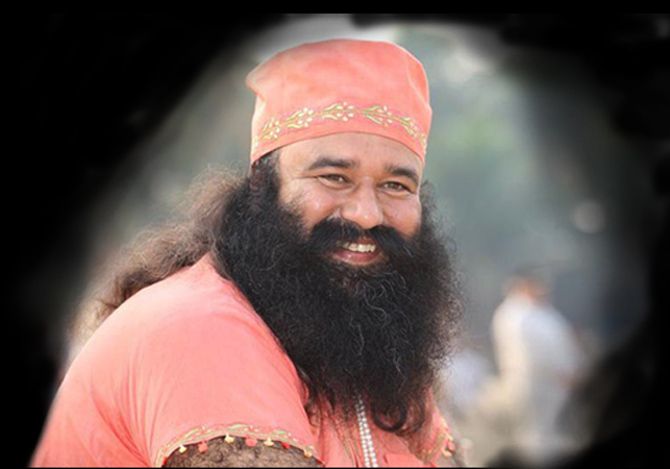
    The BJP has been courting the Babas because it embodies the concept of religious men leading the country rather than its politicians. After the Gurmeet ‘Ram Rahim’ episode, the RSS is in a dilemma and is simply playing along.
    The RSS is still feeling its way to translate its concept of Ram Rajya into reality as it takes time to completely change the narrative.
    Beyond the conviction of Baba Gurmeet Ram Raheem Singh leading to mayhem and deaths in Haryana in particular lies a preview of the RSS-inspired BJP scheme of things for a future India.

    The Baba, with his cult following, was a figure of considerable importance and politicians of all hues humored him for the votes he could deliver. But there was a deeper purpose for the BJP and its Haryana unit to court the Baba because it embodied the concept of religious men leading the country, rather than its politicians. Putting it another way, politicians would rule the country in concert with religious leaders. This is true despite the homilies of Prime Minister Narendra Modi in radio broadcasts and otherwise.

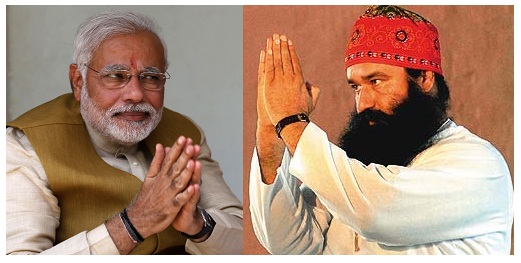
     It is no secret that the Baba endorsed the BJP in the Haryana assembly elections which tipped the scales in its favor. In gratitude, the entire state cabinet went to the Baba’s headquarters to pay obeisance. Besides, photographs of the Baba with Chief Minister M.L. Khattar sweeping the floor and the Sports minister, Mr Anil Vij, with folded hands in his presence after plying him with a check for lakhs of rupees have become iconic images. Prime Minister Modi himself lauded the Baba for his “Clean India” campaign.

    Where does this glimpse of religious leaders at the forefront take India? The RSS itself is confused and seems to be playing the game as it goes along. It is, of course, for a Hindu India or Hindutva as it defines it. Many of the myths it has created about the blissful days of ancient India are common knowledge. We know about planes flying, of heads transposed and plastic surgery as common features of the good old days.

    In building a new India of their dreams, RSS leaders and their BJP followers needed an inventive narrative. The Mahatma was, of course, immediately appropriated. And the BJP raided the Congress repository of heroes on a mass scale. The Congress, after all, was the leader of the independence movement, with the RSS often ambivalent, if not complicit with the British rulers.

    Thus, in addition to the Mahatma, felled by an RSS sympathizer, the BJP appropriated Sardar Vallabhbhai Patel and many others, as the need arose. Its main target was the maker of modern democratic India, Jawaharlal Nehru. He was too cosmopolitan, too influenced by the West for the BJP’s liking, vociferous as it was in striking the nationalist and native pose. The BJP is now in the process of writing a new narrative of modern India in which the towering personality who shaped the country is to be dismissed as one of many former prime ministers, his memorial to be shared by all.

    By all indications, the RSS is still feeling its way to translate its concept of Ram Rajya into reality. The Constitution is one impediment, the judiciary another, and above all the very diversity – in religious, ethnic and other terms – in governing the country. The last task falls into the lap of the Prime Minister, himself brought up in the cradle of the RSS but conscious of the pitfalls of running the country on narrow nationalist and religious lines.

    With the general election of 2019 already looming on the horizon, the contest between the RSS, the legitimizing authority of the Sangh Parivar, and a practicing politician of Mr Modi’s stature is likely to increase. In the end, there must be a compromise between these two poles of power while the larger ideological issue is sorted out.

    What to do with babas and their transgressions is another matter. There are swamis and great religious leaders who lead exemplary lives and do good. But the field has become crowded with charlatans and conmen of various kinds who trade on the gullibility of the poor and their superstitious beliefs to live well and exercise influence on politicians in search of votes. The BJP is particularly susceptible to their wiles because of its own myths and the status it accords to its own concept of a Hindu rashtra.

    Sober thinkers in the Sangh Parivar must realize that it takes time to change the narrative of nearly a century of the independence movement and the glorious decades of Congress rule after India won independence. We still live in a country shaped by the giants of the independence movement, almost all of them belonging to the Congress. Yes, textbooks are being revised to rewrite history to obliterate the long decades of Muslim rule. The beautiful Taj Mahal stands uneasily in the Uttar Pradesh of Yogi Avidyanath.

    The Sangh Parivar is not the first conglomerate to rewrite history.  The Communists in Russia and elsewhere were quite proficient in demolishing old heroes – in Moscow lodged in a park of old curiosities – while Ukraine has also archived its Communist past and the United States is seeking to demolish statues of Confederate greats in the shape of statues of slave owners after they lost the civil war. The Parivar is repeating history with a twist by making Jawaharlal a non-person.

    Future developments in a changing India will depend upon the Parivar leaders in bringing about their revolution of a Hindu India. Like all ideologues, they are men in a hurry – women never play a leading role in their scheme of things – but here again the conflict is between ideology and governance.

    Two people above all will influence the outcome: RSS chief Mohan Bhagwat and Mr Modi, the latter in his political garb. They are unified in their ideology but divided in their responsibilities. We shall not have to wait for long to find out.

    (The author is a renowned journalist)


  • Of Donald Modi & Narendra Trump

    Of Donald Modi & Narendra Trump

    The affinities between Trump and Modi are striking, but none of them bodes well for democracy.

    By A.G. Noorani

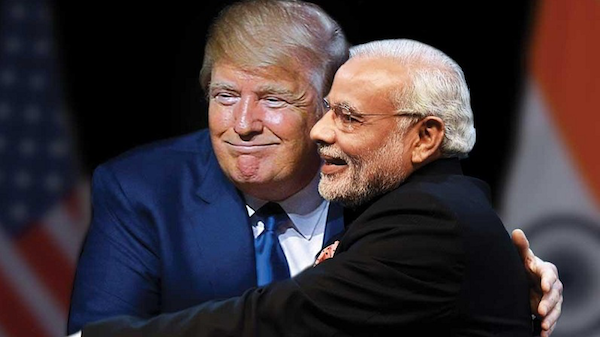
    NO two persons are exactly alike. But Narendra Modi and Donald Trump resemble each other to such a degree that one might as well call them Donald Modi and Narendra Trump. The affinities are striking in their range and depth; and they are disturbing in their potentiality for harm to the national good. This comes out in sharp relief as one lists their traits one by one.

    1. A monumental ego is the most conspicuous quality which Narendrabhai shares with Donaldbhai. From it follow most others.
    2. Demand of loyalty. Trump was clumsy enough to sack the Federal Bureau of Investigation’s (FBI) Director James Comey because he failed to extract from him a pledge of loyalty; itself a highly improper demand. Modi, unable to fire heads of statutory bodies, hand-picked loyalists in advance for sensitive posts. He planted his man Friday Amit Shah as party chief and set up a cabal of fawning Ministers. Never before was the country treated to a daily dose of Ministers praising their chief. Sushma Swaraj stooped so low as to proclaim that Jawaharlal Nehru merely promoted his own image while Modi raised the prestige of the nation. To think that this is the man who sits on the chair on which Jawaharlal Nehru once sat. Not to be outdone by Sushma Swaraj, Rajnath Singh rushed to praise Modi’s Independence Day speech the very next day (“patterns emerging from his address, which reflect his concept of governance almost like mantras”); Ravi Shankar Prasad’s tributes to his master are as regular as they are sickeningly fulsome. As with Trump’s men, Modi’s stooges suffer from acute insecurity.
    3. Both revel in demagogy, laced with fierce personal attacks on opponents and critics. They believe in Balfour’s dictum—speak often and speak for long; and you will acquire the contempt for his audience which every bore has.
    4. Both are coarse and crassly vulgar, in their strict dictionary meaning. They do not care for censure. Modi set the tone with his speeches in Gujarat.
    5. Both spread group hate with abandon.
    6. Both are exclusivist ideologues owning a narrow world view and a narrow concept of nationalism. They regard themselves as the very personifications of their visions.
    7. Insecure as they themselves are, Trump and Modi conduct their pantomimes with obedient advisers. Professionalism is scorned. Uneducated, except in the formal sense, the duo is also uneducable as well. They will not grow.
    8. Egotism breeds ambition. Each, in his own style, seeks to recast the polity anew.
    9. But neither cares to be specific about his program. If reading brings pain to the lips, reflection gives a headache.
    10. Flamboyance in style and escapist vagueness on substance. Slogans pass for policy statements: America First and Sab ka Saath, Sab ka Vikas; Modi fears parliamentary debates and press conferences. He dislikes questions and abhors precision. So does Trump.Such persons find institutions stifling. Trump attacks the United States Congress; Modi plants favorites as heads of cultural and educational bodies in order to bend them to his will.
    11. To be sure, the two adore business and will go all out to make life easier for Big Business, for favorites.
    12. You know the club bore or the dinner party pest who tells any who gives him an ear, “I may not have studied economies; but my first principles are sound. I can fix the system.” Trump and Modi belong to this class.
    13. These “experts” in economies are experts also in foreign policy. Modi and Trump believe in highly personalized diplomacy based on one assumption and one calculation. The assumption simply is that they know better and can manage men and matters. Within weeks of being sworn in as Prime Minister, Modi hosted President Xi Jinping, with results that are there for all to see. Trump went to Saudi Arabia to egg it on in its wild schemes—isolation of Iran and humiliation of Qatar. The calculation is a crafty one. Excursions abroad will impress sceptics at home.
    14. Most remarkably, our arrogant partners in daring enterprises share a love and also a hate. They love Israel. They hate China. In 2013, when he was Chief Minister of Gujarat, Modi denounced China as “expansionist”. Simplistic to the core, they believe that the world would join them in their attempts to isolate the chosen victim, be it Iran or Pakistan. But states follow the national interest; policies of isolation have a short shelf life.
    15. Both are ruthless. Modi lost no time in putting veterans like L.K. Advani and Murli Manohar Joshi in their place though they had run out of steam and posed no danger. Trump has shattered all records of presidential sackings of officials; Stephen K. Bannon, the “Chief Strategist”, being the latest.
    16. A leader’s egotism, dangerous always, becomes a real menace when it is married to a narrow and exclusivist nationalism. Modi never conceals his brand. It is Hindutva “cultural nationalism”. He told the Press Trust of India (PTI) “I am a Hindu nationalist”, frankly and bluntly. Trump flaunts his brand of nationalism, which Charlottesville revealed.
    17. Since the hard core of the constituency is what it is, neither Trump nor Modi can afford to be anything but selective in their censures of wrongs, no matter how grave. Trump’s infamous remarks of August 15 on the outrage at Charlottesville will outlive his Presidency: “You also had people that were very fine people on both sides.” The best comment came from Britain’s Prime Minister Theresa May on August 16: “I see no equivalence between those who propound fascist views and those who oppose them. I think it is important for all those in positions of responsibility to condemn far-right views wherever we hear them.”

    Modi practices his brand of moral equivalence as his speeches during the election campaigns to the Lok Sabha in 2014, in Bihar and in Uttar Pradesh, revealed. Not once has he censured attacks on Muslims specifically, nor has Trump attacked the Klu Klux Klan. Modi dare not censure the Rashtriya Swayamsewak Sangh (RSS).

    1. If the polity is to be recast, it is essential that history is rewritten and national heroes are replaced with votaries of the ideology of hate. The Bharatiya Janata Party (BJP) takes pot-shots at Nehru. Trump plays the same game on George Washington and Thomas Jefferson, as if there was nothing else to them besides ownership of slaves. Modi has sought to rewrite history systematically to exclude Nehru’s role in nation-building, very much as Stalin had history rewritten to wipe out Trotsky’s record. A nation is known by the men it lauds as its heroes. Modi and his BJP-RSS mentors prefer to laud S.P. Mookerjee, Deem Dayal Upadhyaya and V.D. Savarkar.

    The top leadership of the state has it in its power to promote its ideology and to create an atmosphere. In every democracy, the media has sympathizers of both, the ruling party and the opposition. Modi’s regime has created a new class of active supporters in the media on whom it lavishes its largesse. These are noted columnists who never deviate from the party line and have prospered in Modi Raj. TV is as faithful, bar exceptions. They mould a climate. On August 15, the National Public Service announced that the Lincoln Memorial in Washington, D.C., had been defaced by obscene writings drawn with spray paint. A Smithsonian Museum map on Constitution Avenue had received the same treatment.

    1. Besides these dozen and odd affinities lies one which bodes ill for the political system. It is the leader’s belief that he stands apart and above the party. The party derives strength from him; not him from the party. Trump’s recent attacks on the Republicans will soon pass. The party system is strong though the divides are not as sharp and Trump cannot last long. His ratings are abysmally low.

    The RSS is disturbed by Modi’s antics but shrewdly reckons that it has more to gain by him being Prime Minister than by ousting him. Modi’s ratings have suffered, but they remain encouraging enough for him. The opposition has not crafted an alternative and attractive program, nor acquired an inspiring leadership. Modi developed an image of himself as one who will deliver and laced it with Hindutva. Any alternative must meet him on both.

    It saddens one to note that two of the world’s great democracies are led by men intolerant of dissent; driven by a tunnel vision; and made of poor quality fiber, coarse and outmoded.

    “Ye gods, it doth amaze me, /A man of such a feeble temper should/So get the start of the majestic world, / And bear the palm alone.”

    Shakespeare had a conspirator say this of Julius Caesar. What a scornful portrait he would have drawn of sawdust Caesars Trump and Modi.

    (A.G. Noorani, author of a number of books, is a leading constitutional expert and political commentator and contributes regularly to various publications the world over)

    Source: Frontline

    Post comments

  • Viceroy’s House – Featured Article By Mabel Pais

    Viceroy’s House – Featured Article By Mabel Pais

    • “It’s been the most satisfying thing I’ve ever done”

    • “History is written by the victors”

    • “My intention is to examine how someone like me can look at new historical evidence and explore an alternative historical narrative to what I’d been taught as a girl.”

                                                                                                                           Gurinder Chadha

    Gurinder Chadha, the British-raised director of  “Bend It Like Beckham” confesses that “Viceroy’s House” is the story of a Punjabi-British mother who learns about the 1947 partition of India from her 91-year-old mother.  She closes the film,  “Viceroy’s House” with an ode to her grandmother, who sought refuge from Pakistan in India.

    The story is based on the books “Freedom at Midnight” by Larry Collins and Dominique Lapierre and “The Shadow Of The Great Game – The Untold Story Of Partition” by Narendra Singh Sarila.

    _Manish Dayal as Jeet and Huma Qureshi as Alia in “Viceroy’s House.”

    The film’s narrative is fairly evenly split between the political wrangling of the real historical figures upstairs (the British players); and the emotional downstairs (the Indian players) scenes, centered on the fictional romance between Jeet (a Hindu personal valet to Mountbatten played by Manish Dayal), and Aalia (a Muslim translator for Mountbatten’s daughter Pamela played by Huma Qureshi) who is  betrothed to someone else (another Muslim, chauffeur to the Viceroy) and may end up on the opposite side of a new border.

    Famous figures — including Mohandas K. Gandhi (Neeraj Kabi), Jawaharlal Nehru (Tanveer Ghani) and Muhammad Ali Jinnah (Denzil Smith) — are supporting but pivotal players. Impeccable production design and some fine performances, including Gillian Anderson as Mountbatten’s wife, hold this film together.

    • Director – Gurinder Chadha
    • Writers – Paul Mayeda Berges, Moira Buffini, Gurinder Chadha
    • Actors – Gillian Anderson, Michael Gambon, Hugh Bonneville,Manish Dayal, Simon Callow
    • Music – A.R. Rahman
    • Running Time – 1h 46m
    • Genres – Biography, Drama, History

    At a pre-release screening Q&A in New York city, Chadha emphasizes that her mother, 91, when she was growing up in Rawalpindi (now Pakistan) recalls that everyone (Hindu, Muslim, Sikh, Christian) lived side by side very happily with a lot of respect for one another.  Chadha articulates her mother’s words in Punjabi at the Q&A.  In the words of Chadha’s mother, in 1947, the British suddenly did black magic and whatever happened all she knows….. there was a lot of destruction.  Most Indians knew that there was something quite fishy about how partition came about, but no one could quite put their finger on it.

    Gillian Anderson as Edwina, Hugh Bonneville as Mountbatten and Lily Travers as Pamela in “Viceroy’s House.”

    “I decided I wanted to make a film about what I call The People’s Partition,” she explains. “I didn’t just want to explore why Partition happened and focus on the political wrangles between public figures, I also wanted to make sure the audience understood the impact of Partition on ordinary people.”

    Chadha’s ancestors lived in the foothills of the Himalayas, now on the Pakistani side of the border. Her grandparents lived through the tumultuous events which saw sectarian violence between India’s minority population of Muslims (many of whom craved their own homeland) and the Hindu and Sikh majority, bring about the greatest refugee crisis the world has ever seen; in a vast diaspora, an estimated 14 million people were displaced during Partition and up to a million died.

    To make a purely political film, Chadha quips she might just as well have made a documentary. But to reach a broader audience, she needed to entertain as well as educate. “That’s why I chose to interweave these political events with a love story – after all, even when the world is falling apart around our ears, life goes on – people’s hearts endure pain but also have huge capacity for love!”

    As Chadha’s conception of how to tell the story developed, she approached Cameron McCracken (Executive Producer and Managing Director of Pathe in the UK, co-executive producer of Slum Dog Millionaire) to help progress the project.  The combination of British and Indian backers gave Chadha the opportunity to make the kind of film she grew up loving.

    Whilst bowing down to their genius, Chadha sees her movie as being in the same tradition as David Lean’s A Passage To India (1984) and Richard Attenborough’s Gandhi (1982).

    As a writer-director, Chadha has repeatedly translated her personal experience as a Punjabi-British woman into uplifting, crowd-pleasing movies, from her ground-breaking 1993 debut Bhaji On The Beach to her box-office smash Bend It Like Beckham.

    Hugh Bonneville as Mountbatten and Gillian Anderson as Edwina in a scene from “Viceroy’s House.”

    Asked for whom she made the movie, Chadha says that it’s hard to strike those balances between an Indian audience and a western audience.  “In the end,  you have to do what feels right for you and I did what I felt was right for me.  And I so wanted to make the film (to coincide with) 70 years after partition.”

    In any event, what happened in 1947 has been pored over for the last 70 years and Chadha believes her interpretation is not the first and it will not be the last. But at least it will stimulate debate!

    (Mabel Pais is a freelance writer.  She writes on the arts and entertainment, health and wellness, social issues and spirituality)


  • Babas can’t be stopped from political dabbling

    Babas can’t be stopped from political dabbling

    By R K Barik

    The judiciary has put a spanner in the BJP’s plans for Haryana, triggering an outburst from BJP chief Amit Shah. The BJP also faces hurdles in its Baba-first plan in Odisha where Naveen Patnaik has jailed 10 babas on charges of rape and cheating

    What is the mystery behind the Khattar government’s incompetence in handling Gurmeet ‘Ram Rahim’ Singh’s arrest? Is Khattar incompetent or is his administration inept? The real issue is their political design which needs a thorough probe.

    The Haryana CM’s handling of the law and order situation was criticized during the Jat agitation as well. The BJP Government did not restrain the Jat community from causing mayhem in some cities because it is part of the BJP’s political design to create anger in the other communities. That was the BJP’s politics of mobilization of other castes.

    The backroom boys of the BJP have worked out the execution of this plan in India in general and Haryana in particular. They found the Baba useful as he is rooted in the lower strata of society, especially the Dalits and marginalized communities.

    Why do the Babas dominate the local society? While conducting a study into the role of the babas in Odisha two years back I found that they have legitimacy in the prevailing tradition. Traditionally, the baba was a fakir without any wealth and power. With wisdom he helped the local people and earned his livelihoods by taking alms from the poor and rich alike.

    In Punjab and Haryana, the tradition of the Babas started in the similar manner. Capitalism helped the Deras to expand and gain wealth and power while in Odisha the market economy has grown at a slower pace. The Gurmeet Ram Rahims have acquired political power because of powerful politicians who have tried to benefit from their politicized social base. This has brought mafia with them to protect the ill-gotten wealth, women and power. But they do not bother being questioned by the legal society because of the support of police and the administration. This has created havoc in regional politics.

    But our study showed that the Chief Minister of Odisha allowed the police to take action against similar babas and they are now facing the courts. In Haryana, all the ministers led by the CM himself, went to Dera Sacha Sauda. As a result, the verdict against Ram Rahim encouraged his followers to create mayhem while Haryana Police and the paramilitary forces stood as bystanders.

    The BJP government of Haryana imbibed a lesson from Gujarat 2002. The then CM Narendra Modi used his political acumen to allow the dead bodies to from the train fire to go to Ahmedabad which fired the emotions of the Hindu community leading to riots. Again, as in Haryana, the Gujarat police and paramilitary forces stood as bystanders. Modi consolidated the Hindu community votes earning him repeated electoral victories.

    Here in Panchkula, the followers of Ram Rahim were allowed to attack government property, media and ordinary citizens resulting in the killing of 38 people. Ram Rahim was an ardent BJP supporter and his ashram had become the defacto office of the Haryana cabinet. Khattar, like Modi in Gujarat 2002, has no social support. Like Modi he is a pracharak and both are close friends. This riot is a planned and calculated pogrom which may lead to Modi and Khattar trying to consolidate their social base in Haryana.

    Let us examine the case of Odisha where around 10 babas were involved in cases of rape and cheating. Chief Minister Naveen Patnaik was instrumental in putting them behind bars while the BJP opposed the arrests by claiming the action was against Hindus. Patnaik refused to listen to anybody including two of his party MLAs who were ardent supporters of the Babas.

    The persecution of these Odisha babas is going on in the various courts. Here lies the difference in the administrations of Naveen Babu and Khattar.

    Baba politics of Odisha is different from Haryana’s Dera politics. The babas of Odisha do not have a single-caste support whereas the deras here have the support of specific castes. As the BJP is trying to replicate the Gujarat political project in Haryana, it is facing problems from the judiciary, specifically the High Court of Punjab and Haryana. That disturbs the political design of Amit Shah who has already blamed the courts. In Gujarat they got a sympathetic judiciary which helped them build their communal base after the riots organized by the Hindutva forces in 2002. To get justice, victims had to run to the Supreme Court which claimed that there was a failure of natural justice. It reopened the major cases and directed their trial outside Gujarat. In Haryana, they wanted the cult figure of Baba Ram Rahim to support BJP and by implication, the castes supporting Baba backed BJP as well.

    Can the BJP succeed now?  It is a million dollar question. They may take up the cases of the members of the Dera who were involved in violent clashes. That could help the mobilization of caste supporters of the Dera who would then prefer wait for a favorable High Court judge to bail out the Baba rather than try to destabilize the Khattar government. In the case of Odisha, the BJP worked with the Babas who are in jail but they do not have the caste support. That is the fear that is haunting the leaders of the BJP in Odisha. Moreover, Naveen babu does understand their political design he does not want to be the victim of the BJP design as happened in 2002.

    (The author is a Senior Fellow with ICSSR)

  • ‘I don’t share this optimism’

    ‘I don’t share this optimism’

    By Yogendra Yadav
    It is too early to feel elated. There is a VIP track in jail as Sanjay Dutt and Mukhtar Ansari have demonstrated. The episode also reeks of systemic failure and it seems odd that the nation is standing up to applaud a judge who just did his duty. And no one has questioned the death of so many fellow citizens in one police firing.
    The Indian State has personnel, apparatus, intent but no institutions that can undertake routine and regular governance.

    The sentencing of ‘Ram Rahim’ Gurmeet Singh has left us all a little smug. A false godman exposed, his empire about to be dismantled. At least one strand of the politician-baba nexus snapped. The government made to take firm action against violators of rule of law. Finally, if belatedly, the long arm of law has caught up with a high-profile criminal. A step in the right direction, it would seem.

     I do not share this optimism. Not just because this is a very small and tentative step and there is no room for complacency here. Gurmeet Singh has just been convicted by the first trial court; he may soon be out, pending the final disposal of protracted appeals. He may be in jail, but the experience of Shashikala and Sanjay Dutt reminds us that there is a VIP track even inside jails: special facilities, long hospital visits, unusual paroles and what not.

    For me ‘Ram Rahim’ episode stands for our systemic failure. The last one week exposed four dimensions of this failure: system of criminal justice, institutions of governance, political establishment and spiritual guardianship. The more we talk about some individual, episodic success, the more we underline our chronic collective failures.

    It would be odd to speak of the failure of the system of criminal justice in the week when judiciary is about the only institution that has redeemed itself. Everyone agrees and has rightly applauded the judge of the CBI court, Jagdeep Singh, for his courage and rectitude. The role of the Punjab & Haryana High Court must have restored the faith of many citizens, and not just those living in Panchkula, in the constitutional order of things. This also happens to be the week when the Supreme Court has annulled Triple Talaq and has given a stirring, incisive and far reaching verdict in defense of citizens’ personal freedoms under the right to privacy.

    Yet there is something odd if the whole nation has to applaud a judge for performing his normal duty. It is an acknowledgement that routine, regular dispensation of justice is so rare, when the accused happens to be someone as powerful as Gurmeet Singh. We cannot lose sight of the fact that it took fifteen years since the first complaint and nearly ten years of hearing for justice to be dispensed. It reminds us of all the pitfalls that our criminal justice system suffers from: victim’s reluctance to approach police in the first instance, refusal to take cognizance of the first complaint, brazen refusal to record dying declaration of a brave journalist for three weeks, protracted delays, appeals and other ways in which the powerful bend the law. It was a fortuitous coming together of fearless victim, meticulous & honest investigator and an upright judge that brought Gurmeet Singh to the book. This case brings out the capricious nature of our criminal justice system. As any good lawyer would tell you, it’s a lottery.

    The governance failure in Panchkula touched a new low. Everything about the violence on the 25th was known well in advance: the date, the time, the venue and the actors. Thus, the occurrence on the 25th can only be attributed to lack of political will and the reluctant refusal to observe elementary protocols of law & order that were observed, for example, in Punjab. The episode also highlighted another growing institutional deficit: when the top boss blinks, everyone down the line takes a snooze.

    If Haryana government’s inaction highlighted one aspect of government’s failure, its subsequent action highlighted the other dimension. Given the low credibility of Dera’s supporters, no one has yet asked searching questions about the death of 38 persons, one of the highest casualties, in police firing in one incident in recent times. Granting that use of force was necessary and sanctioned to deal with an unruly crowd, the question still remains if force was used as per procedure laid by law. Was the crowd given sufficient & effective warnings to disperse and told about possible consequences? Were all other avenues – tear gas, water cannons, rubber bullets, firing in air — duly exhausted before resorting to firing on the crowd? And, was there even an attempt to fire below the waist, as required?

    Put together, the criminal inaction and action of Haryana government present the picture of a state that withers away, at least momentarily. The Indian State has personnel, apparatus, intent but no institutions that can undertake routine and regular governance.

    The failure of political establishment is deeper than what we think. It is not just the comic, tragic failure of Mr. Khattar and his colleagues ever hopeful of dislodging him. It is not just the brazen collusion between the ruling BJP and Dera Sacha Sauda. We must not forget that all the major parties of Haryana and Punjab including the Congress, the Akalis and the INLD, have been in bed with the Dera at one point or the other in recent history. The BJP is clearly paying back for Dera’s support during 2014 elections, But so did the Congress in 2009 and the INLD before that. Let us not forget that none of the national leaders of any party that matters electorally in this region – BJP, Congress, SAD, INLD, AAP – have had the courage to welcome this verdict. Clearly no one wants to rule out a future deal with the Dera. It’s not just that our political establishment is opportunistic and ethically compromised, above all, this establishment is so weak, ever-dependent on the tiniest vote-bank that comes its way.

    (The author is a politician, psepholigist and academic)

  • In State of bedlam: Governance under question

    In State of bedlam: Governance under question

    By MG Devasahayam

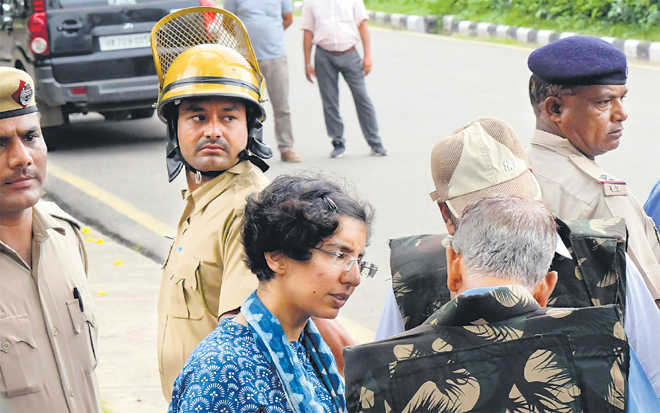
    Before doing so she did not call up the CM, not even the Chief Secretary or Home Secretary. Because there was no need since DM is the final authority. But this very DM had earlier allowed such massive and unruly crowd to assemble inside this small, satellite town of Chandigarh, despite prohibitory orders being in place! This is a clear case of governance failure and the state abdicating its primary role — that of maintaining law and order by taking preventive action, says the author.

    L’affaire Panchkula threw up a strange phenomenon, rather an apparition as to the maintenance of law and order, the primary responsibility of any civilized state. The District Magistrate and the police, representing the state, allowed the unruly crowd to assemble in large numbers. The Punjab and Haryana High Court directed how this crowd was to be controlled and it was the Army that controlled it. A complete role reversal of governance and government!

    Everyone is pouncing on the Haryana Chief Minister. Naturally so, because this is the third time in three years that Khattar has proved his inefficiency. The Rampal incident in November 2014, which left six dead, was the beginning. The breakdown of the official machinery during the Jat agitation in February 2016 was the second. Now, it is the dera havoc in Panchkula and other places in the state that left many dead and bleeding.

    But why is the CM being targeted when the statute is clear on who is responsible for maintaining law and order? Section 144 (1), CrPC, is meant to prevent unruly crowd to gather and indulge in arson and vandalism, and gives power to the DM, or other executive magistrates to issue such direction to ‘prevent obstruction, annoyance or injury to any person lawfully employed, or danger to human life, health or safety, or a disturbance of the public tranquility, or a riot, of an affray’.

    Rule 1.15 of Punjab Police Rule, 1934 (adopted by Haryana) is more specific: ‘The DM is the head of the criminal administration of the district, and the police force is the instrument provided by government to enable him to enforce his authority and fulfil his responsibility for the maintenance of law and order. The police force in a district is, therefore, placed by law under the general control and direction of the DM who is responsible that it carries out its duties in such a manner that effective protection is afforded to the public against lawlessness and disorder.’ Therefore, it is the legally mandated duty of the DM called DC to take decisions and direct all steps to maintain law and order. The police is bound to obey all such directions.

    When a situation becomes serious, as happened during the Jat agitation and now in Panchkula, Section 130 CrPC kicks in. This legal clause states that decision to requisition ‘armed forces’ to disperse ‘violent assembly of people’, which cannot otherwise be dispersed by the police or other forces available, should be taken by the DM. He/she ‘may require any officer in command of any group of persons belonging to the armed forces to disperse the assembly with the help of the armed forces under his command, and to arrest and confine such persons forming part of it….’ Law also says that ‘every such officer of the armed forces shall obey such requisition in such manner as he thinks fit, but in so doing he shall use as little force and do as little injury to person and property, as may be consistent with dispersing the assembly and arresting and detaining such persons’.

    Law and the standard operating procedure are clear. The DM is the competent authority to direct the police and when the situation gets out of civilian control, to requisition the Army by a written order from the Magistrate on duty. The Army is then entirely in control with the officer-in-command in charge. Only that the Army is expected to bring the situation under control quickly and hand it back to the civil authorities and exit the scene.

    The DC Panchkula, Gauri Parasher Joshi, performed her role rather belatedly and yet she saved the situation by pressing the Army into action when violence and arson reigned supreme. After being outnumbered by thousands of dera followers, the police fled the spot, leaving the young officer to almost fend for herself. Left alone with a single PSO, she decided to hand over the situation to the Army, which helped avoid further deterioration of the situation.

    Before doing so she did not call up the CM, not even the Chief Secretary or Home Secretary. Because there was no need since DM is the final authority. But this very DM had earlier allowed such massive and unruly crowd to assemble inside this small, satellite town of Chandigarh, despite prohibitory orders being in place! This is a clear case of governance failure and the state abdicating its primary role — that of maintaining law and order by taking preventive action.

    Fortuitously, the high court took over this role at the nick of time and shot-off a catena of orders: ‘All parties and every section of society should maintain peace and harmony; in case anybody indulges in any kind of violence, arson, loot, etc., he or they should be dealt with firmly by use of force, if necessary; the police force and paramilitary forces would have free-hand to deal with the situation wherever and whenever required against any individual or any section of society or organization; in case of need, the Army shall be deployed and made operational….’

    All these are legally mandated duties of administrative and police officers who belong to the elite services of IAS and IPS, covenanted and protected by constitutional safeguards. Why then have they surrendered to politicians who have come to power at the mercy of rapists, murderers and money-launderers? So much so, the court had to issue such specific directions: ‘In case any politician or anybody else including ministers interferes in the enforcement of law, FIR be registered against him/them… No politician, leader, social worker, spiritual leader, religious leader or any such organization shall make any provocative speech or statement, which may have the tendency to affect public order.’

    This raises a critical question — has the state lost it relevance, or rather has it withered away? Withering away of the state is a concept of Marxism, coined by Friedrich Engels, and referring to the idea that, with realization of the ideals of socialism, the social institution of a state will eventually become obsolete and disappear, as society will be able to govern itself without the state and its coercive enforcement of the law.

    India shifted from equitable socialism to crony capitalism long ago. Under this, state is pandering to cheats, crooks and charlatans who either have big money or control vote-banks. Because ‘god-men’ command both, they are the object of adoration by small men who run the Indian state. As the adage goes ‘when small men cast long shadows, it means that the sun is about to set’. No wonder then that the state is fast withering away!

    (The author is a former Haryana Cadre IAS officer)

  • The cover-up: Demonetization was more pain than gain

    The cover-up: Demonetization was more pain than gain

    If 99 per cent of the demonetized currency has returned to the banks, as the RBI has said, it means the fight against black money through demonetization was not properly thought through. The Prime Minister had declared then: “The Rs 500 and Rs 1,000 notes hoarded by anti-national and anti-social elements will become worthless bits of paper.” That has not happened. This “anti-rich idea”, the “surgical strike” on black money, was successfully marketed by the BJP in the UP and other state elections. The Finance Minister had claimed that Rs 3 lakh crore of black money would get extinguished. Instead just Rs 1,600 crore has not re-entered the banking system.

    The Finance Minister’s claim on the country making digital gains is also untenable. Digital transactions, according to the RBI, fell 20 per cent this April, compared to the previous month. To cover up the embarrassment, Arun Jaitley has changed the narrative: The demonetization objective was to force unaccounted money out of the cupboards and vaults at homes into bank accounts so that tax officials could establish the money trail. His assertion that personal income tax collections have gone up 25 per cent post-demonetization is also open to question. Official tax data indicates the I-T collection rise was higher at 27 per cent a year before. Any fight against black money would be incomplete without first tackling the issues of political funding, benami properties and offshore investments.

    The exercise of extinguishing 86 per cent of the nation’s currency had caused countrywide dislocation and loss of jobs in the unorganized sector, hurt farmer incomes and led to a growth slowdown and some 104 deaths. The RBI ended up spending over Rs 30,000 crore on the printing of new notes and managing the logistics of demonetization. It spent 132.8 per cent more on printing new notes — Rs 7,965 crore during 2016-17 compared to Rs 3,421 crore in the preceding year. Here is an institution that compromised its autonomy, put itself to loss and invited criticism for the shoddy currency replacement work. The inescapable conclusion is: the pain of demonetization was real; the gain remains intangible.

    (The Tribune, Chandigarh)

  • The talaq verdict fallout

    The talaq verdict fallout

    Judicial wisdom, political mischief

    By Harish Khare

    It needs to be noted that the Supreme Court ruling is a very limited intervention in the Muslim “religion” — limited only to a very obnoxious practice; the practice was held unacceptable by the court because it is in violation of the Islamic laws. In any case, progressive, liberal and sensitive voices within the Muslim community have consistently voiced themselves against the obnoxiousness of this practice of instant triple talaq, says the author.

    A socially useful litigation, insisted upon by those intrepid women of the Bharatiya Muslim Mahila Andolan, has produced a Supreme Court ruling, invalidating the practice of instant triple talaq. Lest it be suggested that the court had adjusted itself to the political expediencies of the day, we were curiously but repeatedly told that the judgment was delivered by a Bench that represented five different religious faiths. That was somehow meant to reassure us all. Still, that did not prevent the assorted politicians, from the Prime Minister downward, from overloading the verdict with their political calculations. Some wise and clever RSS functionary was even reported to have pronounced the death of “old secularism.”

    Consequently, we are forced to examine the political context of this consequential judgment. It needs to be noted that the talaq ruling has come soon after we recently courted an elaborate controversy over the Hamid Ansari proposition that the minorities in India had been given reason to feel insecure. Authoritative and angry voices were raised: how dare anyone bring up this disagreeable subject of the minorities’ welfare and insecurity?  The rebuff was laced with a be-grateful-for-what-you-are-allowed-to-have smugness.

    Legal scholars will keep chewing on the jurisprudential nuances of three sets of opinion, the larger question that needs to concern us is: how will the triple talaq ruling add to — or subtract from — the minorities’ sense of insecurity?  True, the honorable judges were not addressing themselves to the minorities’ (in)security but there can be no doubt that this ruling will have complications and consequences in the larger political landscape.

    To begin with, there may be cases of stray Muslim men being criminalized for being in violation of the Supreme Court. The very lumpen elements who had inflicted violence in the name of cow protection would feel emboldened to rework their gruesome energy. The use of violence and aggression against the minorities can now be explained away as sanctioned by the highest court.

    Some voices are already asserting that the ruling is the beginning of the end of what they see as the jumped-up insolence of the Muslims. Others are insisting that the politics of “appeasement” that began with the Shah Bano case three decades ago stands rolled back. This assertion of “appeasement” has been central to the ideological concoction served up by the Hindutva forces; it was meant to denigrate the non-BJP forces and to create certain visceral resentment, inducing a grievance that the majority remains at a clear disadvantage “in our own land”. So, unsurprisingly, the talaq judgment is deemed to be a political statement.

    It needs to be noted that the Supreme Court ruling is a very limited intervention in the Muslim “religion” — limited only to a very obnoxious practice; the practice was held unacceptable by the court because it is in violation of the Islamic laws. In any case, progressive, liberal and sensitive voices within the Muslim community have consistently voiced themselves against the obnoxiousness of this practice of instant triple talaq. So, why this dismay or jubilation?

    Arguably, the constitutional guarantee of freedom of religion does not constitute a blanket protection; nor are the minorities entitled to feel totally beyond the reach of the court’s jurisdiction.  Religious practices and customs can be challenged; and, in each case a determination is to be made by the court whether a practice is essential to the religion. In this limited context, the Muslim community need not allow itself to feel particularly cornered. Yet it is easier said than done.

    Because, on the other hand, there is a sense of satisfaction, even triumphalism, that the Muslims can no longer claim to be beyond the interventionist reach of the State; just as the majority has been repeatedly subjected to —remember the Hindu Marriage Act, the sati, dowry, etc. — the progressive gaze of the law, now the same light of reasoned enlightenment would be focused on the minorities. The hardcore constituency can permit itself a smirk that the Muslims have lost an ill-deserved immunity. A beachhead has been established.

    Indeed, the Hindutva forces have not lost any time in asserting that the triple talaq ruling is only the beginning; and that its old demand for a uniform civil code remains unabandoned. That demand itself is part of an unfinished agenda on what terms of co-existence are to be offered to the Muslims/minorities in India — parity, equality, or subordination.

    That will be the stuff of politics in the months and years to come. Make no mistake about it. Given the BJP’s current political ascendency, the minorities may well be within reason to feel that the ruling party is out to question every single assurance or commitment, even overturn constitutional guarantees. Indeed, the orthodox leadership of the Muslim community may feel besieged but it would be a pity if the maulanas were to spurn the opportunity to raise their game.

    Perhaps the most beneficial side-effect of the triple talaq ruling is that the Supreme Court has reclaimed its status and aura as the principal and only institutional interpreter of the constitutional rights and wrongs. The privacy case verdict on Thursday should be seen as a natural follow-up of the triple talaq verdict. A robust judiciary is central to the restoration of liberal sanity to our polity.

    Those who swear by progressive and liberal values and profess a commitment to secularism and pluralism have an obligation, post-Talaq ruling, to devise new political tactics. It needs to be recognized that the old-fashioned identity politics is becoming increasingly counterproductive. If the orthodox Muslim leadership were to insist on wallowing in its entrenched ill-liberalism of the status quo, it will only enhance the potency of ill-liberalism of the right wing. It is no rocket science that the BJP’s politics is predicated on creating hostility among groups and suspicion in society at large.

    Secular political parties and leaders have to give the Muslim community the confidence to grow out of the maulanas’ sway. The apex court has anchored its verdict on universal moral values; and, the same values can be invoked to insist a fair deal for the minorities in a fair constitutional order, creating “a good society”.

    Before he went rogue in Vietnam, President Lyndon Johnson had defined “a good society” as one in which all citizens and groups “expect justice for themselves and are willing to grant it to others”.  Liberal, democratic and secular voices need to seize the talaq judgment to insist on a renewal of the constitutional core guarantees.

    (The author is the editor-in-chief of Tribune group of newspapers)


  • And the war goes on: On Trump’s South Asia policy

    And the war goes on: On Trump’s South Asia policy

    Donald Trump’s plan for Afghanistan is still too short on specifics

    U.S. President Donald Trump’s decision to deepen the country’s military engagement in war-torn Afghanistan signals a significant shift in the position he has held for years. Mr. Trump had campaigned to end American involvement in foreign conflicts and was particularly critical of the Afghan war, which he said was “wasting” American money. His announcement on Monday of the decision to send more troops to the country reflects a realization that the U.S. does not have many options in dealing with its longest military conflict. This is also a grim reminder of the precarious security situation in Afghanistan. Sixteen years since George W. Bush ordered the American invasion of Afghanistan and toppled the Taliban regime, the insurgents are on the ascendant again. More than half the country’s territory, mostly in rural, mountainous areas, is now controlled by the Taliban, while the Islamic State has set up base in eastern Afghanistan. In recent years, both the Taliban and the IS have carried out a number of terror attacks in the country, including at highly fortified military locations, raising questions about the very survival of the government in Kabul. This is a worry point for Mr. Trump’s generals, who want to avoid the kind of vacuum left behind by the Soviet withdrawal in the late 1980s that plunged Afghanistan into a protracted civil war; the Taliban eventually took over.

    But it is not going to be easy for Mr. Trump. He is the third consecutive American President to send troops to Afghanistan. Mr. Bush and Barack Obama failed to swing the situation sufficiently to ensure a long-lasting difference in Afghanistan’s battleground. It is not clear if Mr. Trump can win a war they lost. His strategy can be summed up as Obama-plus — it builds on the premises of the Obama plan of additional troops and regional diplomacy. But unlike Mr. Obama, who set a timetable for the withdrawal of troops, Mr. Trump is ready for an open-ended engagement. He also said the focus of the American mission should narrow down to fighting terrorists, not rebuilding Afghanistan “in our own image”. Third, Mr. Trump minced no words while calling Pakistan a country that shelters terrorists. He also wants India to play a greater role in providing economic and developmental assistance to Afghanistan. India has welcomed Mr. Trump’s strategy, as the U.S.’s objectives in building a stable Afghanistan and ending Pakistan’s sponsorship of terrorism are exactly in line with India’s own goals for the region. It has, however, correctly reminded Mr. Trump that it does not need his request, never mind his coarse reference to “billions of dollars” made in bilateral trade with the U.S., in order to fulfil its commitment to Afghanistan’s economic development. Such open transactionalism will not serve the U.S.’s efforts in winning allies for its new Afghanistan policy, nor indeed will it further its mission in a country that is not unfairly called the “graveyard of empires”.

    (The Hindu)

  • Trump’s Afghan Shift

    Trump’s Afghan Shift

    By CR Gharekhan

    “Trump’s remarks on Pakistan and India are of obvious importance. A strong pillar of the new strategy, he declared, is to change the approach towards Pakistan. “We can no longer be silent about Pakistan’s safe havens to terrorist organizations”. Pakistan “has much to gain by partnering American efforts in Afghanistan” and much to lose by “continuing to harbor criminals and terrorists”. He did not specify what he would do if Pakistan did not cooperate, but hinted at a cut in economic aid when he stated: “We have been paying billions and billions of dollars at the same time they have been housing the very terrorists we have been fighting”, says the author.

    President Trump revealed his long-awaited strategy for Afghanistan in a prime time speech on national television on August 21. He called it “the path forward in Afghanistan and South Asia”, the first President to so describe it. The timing of the speech was selected, at least partly, to divert attention from the widespread criticism, including by senior leaders from his own party as well as from top business magnates, for his remarks on the Charlottesville happenings. He might have succeeded to some extent in this objective.

    In outlining his approach, he took a 180-degree turn and departed from his long-held and oft-repeated position demanding immediate withdrawal from Afghanistan. He was conscious of that and had the political courage to reverse his stand by not only not deciding to pull out but even announcing an increase in US troop strength. He was conscious of the American people’s strong aversion to sending more troops in harm’s way in faraway Afghanistan. He ignored the advice of Steve Bannon, the ultra conservative and his chief strategic adviser until last week when Bannon was pushed out. He did not mention any figures, though the number 4,000 has been talked. He declared an open-ended commitment, regarding numbers and the time period for troops to remain in Afghanistan.

    He specifically criticized Barack Obama’s unwise decision to announce the withdrawal date and to reduce the request for additional troops by 25 per cent —30,000 instead of 40,000.  Trump has embraced the military’s advice of making the continued stay of troops “conditions-based”, instead of time-based. Before Obama’s speech at West Point, there was intense debate about “time bound” versus “conditions based”, but he made a grave error by taking the time-bound approach. Trump also criticized Obama for pulling out of Iraq in 2011, leaving a vacuum which was exploited by the Islamic State. However, Obama had very little choice in the matter since the Iraqi government and Parliament refused to sign the “Status of Forces Agreement” which was a must for the administration to station troops in a foreign country on a long-time basis.

    In addition to the “conditions-based” approach, Trump assured the military that it will have the resources and operational freedom, including deciding on the rules of engagement, to make the new strategy “work, and work effectively, and work quickly”. This is somewhat on the lines of the Modi government’s carte blanche to the Army to use whatever force is deemed essential to deal with cross-border terrorist attacks. In both cases, time alone will tell if and to what extent the desired result will ensue.

    Trump made it abundantly clear that his strategy demanded identifiable and effective action by the Afghan government. The heaviest burden will be borne by the “good people” of Afghanistan and their armed forces. Categorically ruling out “democracy building” or “nation building”, he made it clear that “our commitment is not unlimited and our support is not a blank check.” He demanded that the Afghan government must carry its share of the military, political and economic burden. He made no mention of the other players — China, Russia and Iran. These three countries have their own strategic interests in Afghanistan, not coinciding with America’s. But they have conflicting concerns. On the one hand, they would be quite happy if America remains bogged down in Afghanistan, bleeding resources. At the same time, they would like to see America pull out completely which would leave the field clear for them to meddle more effectively in Afghanistan. All the three are reportedly in touch with, and even aiding, the Taliban.

    For us, Trump’s remarks on Pakistan and India are of obvious importance. A strong pillar of the new strategy, he declared, is to change the approach towards Pakistan. “We can no longer be silent about Pakistan’s safe havens to terrorist organizations”. Pakistan “has much to gain by partnering American efforts in Afghanistan” and much to lose by “continuing to harbor criminals and terrorists”. He did not specify what he would do if Pakistan did not cooperate, but hinted at a cut in economic aid when he stated: “We have been paying billions and billions of dollars at the same time they have been housing the very terrorists we have been fighting”. This is an unmistaken reference to the earlier refuge to Osama bin Laden and sanctuary to the Haqqani terror network. “That will have to change and change immediately”, he said. “It is time for Pakistan to demonstrate its commitment to civilization, order and peace”.

    Strong words pleasing to Indian ears. One will have to wait and see how much, if at all, Trump’s warning will bring a change in Pakistan’s Afghan policy. Trump’s speech also brings out, unambiguously, that the success of his new strategy will depend to a large extent on Pakistan’s cooperation. This will give considerable leverage to Pakistan that can always depend on the Pentagon which has consistently had a soft corner for the Pakistan army and decides US policy in Afghanistan, like its Pakistani counterpart.

    Trump has made positive references to India, “the world’s largest democracy and a key security and economic partner of United States”. Developing a strategic partnership with India will be a ‘critical’ part of the new South Asia strategy. True to his style, he pointed out that India “makes billions of dollars in trade with United States”, and must do more in Afghanistan, especially in economic assistance and development. Clearly hinting at China, the President spoke of “our shared objectives for peace and security in South Asia and the broader Indo-Pacific region”. We need not get too flattered by Trump’s remarks about India; he will demand a price for all that India seeks from the US in terms of technology transfers and that is as it should be. We will have to calculate how much money to spend in Afghanistan, in addition to the $2 billion already invested.  In all fairness, our help has generated friendly feelings among the Afghan people for India. We have huge interest in ensuring that the Taliban does not come to power either by themselves or as a part of a coalition for which Pakistan has been working for long. We do not want hordes of Taliban descending on Kashmir. But it is highly doubtful if Trump’s so-called new Afghanistan South Asia strategy — shades of Af-Pak-India of Holbrooke’s original mandate? — will prevent, and for how long, the Taliban getting at least a share in power in Kabul.

    (The author is India’s former Permanent Representative to the UN)

  • Readers Write : Killing the innocent: it’s cowardly

    Readers Write : Killing the innocent: it’s cowardly

    By Surjit Singh Flora

    “Revolting”, “cowardly”, and “barbaric” are some of the words leaders worldwide have used to describe the attack in Barcelona that killed 14 people. 100 were injured when a van plowed into pedestrians on Las Ramblas in Barcelona and ISIS claimed responsibility. Of the 14 killed, one was Canadian and four Canadians were injured on Thursday,

    The Prime Minister Justin Trudeau said in a statement released Friday “It was with great sadness that I learned today that one Canadian was killed and four others injured during yesterday’s cowardly terrorist attack in Barcelona. Sophie and I offer our condolences to the families and friends in mourning, and hope for a speedy recovery for the injured Canadians,” Trudeau said. While US President Trump tweeted that the United States condemns the terror attack in Barcelona, Spain, and will do whatever is necessary to help. Be tough & strong, we love you!

    Terrorist ISIS is spreading its clutches around the world This means that ‘Islamic State’ has emerged as the most powerful and terrible terrorist group. ISIS and the clans linked to it do not sit silently in any country after the first attack, instead they keep repeating and look for new areas to attack.

    Occurred in the last two years ISIS and other terrorists carried at least 6-7 attacks in different cities of France and many of the waves of terror that have disrupted European countries in the past 50 years.

    It’s worth mentioning that the terrorists are continuously increasing the scope of their activities. Several people were killed in attacks in France, Belgium and Germany, but Spain had survived so far and during the continuous campaign against the terrorists, 180 people arrested in the last two and a half years. Even then terrorists were able to mount such a big attack.

    Remember that after July 2016, a new strategy has been adopted by ISIS in Europe-  to crush people under fast-moving vehicles. They have carried out many such attacks. This is the 8th such attack in Europe this year.

    Before the recent attacks in Spain, more than 200 people have died in such terror attacks in Stockholm, Nice, Berlin and London, and it is difficult to say where this line will stop.

    For the time being, it seems that the action taken against the militant groups by different countries is being wasted. This is where the hatred against them is growing worldwide, and the image of the common Muslims is also hurt badly.

    This is the reason why many restrictions are being imposed on Muslims in many countries, including the United States.

    Better to stop them wanting to kill innocent people, or to stop them before they act on their intent.

    It is essential that all nations affected by terrorism should unite and formulate a common strategy to counter terrorism so that they can be wiped out. Defeating terrorism requires concerted global effort; it is time to act unitedly against terrorists and terrorism

    Surjit Singh Flora

    6 Havelock Drive

    Brampton, ON L6W 4A5

    647-829-9397

  • The Pathetic & dangerous transformation of India to Crony Capitalism in last 70 years

    The Pathetic & dangerous transformation of India to Crony Capitalism in last 70 years

    By Dave Makkar

    India is in the top ten nations with the widest socio-economic gap. It is an economically, socially and politically failed state for majority of its 1.3 billion citizens; who cannot solve its socio-economic, religious and political problems including its Land dispute with Pakistan since 1948 over Kashmi, says the author.

    India never had a good ruler since independence except for a very brief period Lal Bahadur Shastri and Morarji Desai. All of them including the current PM/Ruler Modi has proved to be the facilitators of crony capitalism. Modi has gone one step further by becoming the first & the last PM of India that put his hand in the mouth of poor to take out what they were eating and took away their professions and openly allowing mob lynching of people. They all have lived/living to the apprehensions of Mahatma Gandhi that he feared India will have English Rule without the Englishmen! India is in the top ten nations with the widest socio-economic gap. It is an economically, socially and politically failed state for majority of its 1.3 billion citizens; who cannot solve its socio-economic, religious and political problems including its Land dispute with Pakistan since 1948 over Kashmir. 

    India’s elite world-famous Billionaires, part of the 56 million filthy rich Indians, are living side by side with almost a billion poor and treat them as sub humans who are burden for the country. It looks like Indian Leadership political, religious and business rather than being ashamed of this, are proud to have more than 800 million Indians living under extreme poverty & inhuman conditions. They have the insanity to say, “India is shining”. A former diplomat, politician, author and thinker Pavan Varma wrote in his book “Being Indian” that in the Indian elite “there is a remarkable tolerance for inequality, filth and human suffering”. He adds that “concern for the deprived and the suffering is not a prominent feature of the Indian personality. The rich in India have always lived a life quite oblivious to the ocean of poverty around them”. Less than 10-15 minutes from every slum in any major city of India there are very expansive heavily guarded residential areas with houses rather mini palaces costing few million dollars to $1 Billion Mukesh Ambani’s Palace. One city: two universes.

    Out of the total budget 74% is used to run the system/government and 38% in debt servicing after adding new borrowing. In real terms, the cost to run the system is 115% and 60% in debt servicing. The non-plan expenditure i.e. just to run the “System” or the government that includes Police, Military, Judiciary, Postal Services, President, Vice President, Prime Minister, 30 Governors (political appointees of the ruling party), 53 Ministries with numerous departments, 1 Department of Atomic Energy, various Commissions/ Committees to accommodate failed politicians, friends & relatives, 543 MP’s, millions of government employees as well as so called Z category security services for rulers, their families & friends practically at all levels.  The new additions under Modi very soon will be Cow Ministry, Ministry to advise people what to eat, what to wear, whom they can marry & how many kids Hindu couples should produce and Ministry of Nationalism; what is national & what is anti-national !

    If Modi had even an iota of Nationalism/Patriotism towards India and love for the less fortunate Indians; he would have cut down the cost of governance of India. He could have announced some measures to at least re-structure the 53 Ministries to cut down their massive size, Complete ban on Official Functions in 5 Star Hotels & Resorts, Abolish Pension for MP’s, Ban on allocation of properties for Political Party Offices, end to VVIP & VIP culture of providing security & subsidized housing, cap on telephone bills, air travel, foreign trips, rail travel of elected & appointed officials and un-necessary appointment of officials under Ministers and various departments, commissions and committees. Can Modi explain how come a law maker is entitled to Pension and princely perks after winning one election only even if he never gets elected again; where as a government servant is entitled to a pension only after 20-25 years of service. Modi could have proposed a road map to cut down the non-plan expenditure from present 74% to at least 60% in next 4 years.

    Modi in his political carrier as Gujarat CM has been a known destroyer of any opposition in his own party as well as leaders of other political parties. He is also known to have least respect for democratic norms and judiciary. Since 2014 Modi is ruling India with the same undemocratic philosophy and destroying all the democratic institutions, judiciary as well as any opposition all over India to make India, “Opposition Free”.

    Congress also tried to destroy opposition parties to make it one party rather one family rule in India and they succeeded to a certain extent only. Recently a writer Apoorvanand wrote about the reaction of Munshi Premchand that “Elimination of Opposition is a Threat to Democracy.”

    Premchand recorded this apprehension in a brief commentary titled ‘Germany Ka Bhavishya’ (The Future of Germany) right after the victory of the Nazi Party in Germany in 1933. “After the landslide victory of the Nazi Party in Germany, the question that arises is will Germany really turn into a fascist regime and will the Nazis be able to hold and consolidate power for at least five years? If it happens and the Nazis get an opportunity to establish themselves, they will suck the democratic life and vision out of Germany through its political and military strength in such a way that not a single opponent of the Nazi Party would be left in Germany for 25 years.”

    It is not necessary to view Premchand’s observation in the context of the present times but the focus of his comment is the forced elimination of opposition before the victory of the Nazi Party. He does not censure the German opposition parties for their inability to protect themselves. He clearly states that the crime was Hitler’s who was phasing out the opposition through undemocratic means. The Nazis had a private army which none of the other political parties in Germany possessed. Premchand unequivocally states that the elimination of opposition should be a cause for worry and one who carries it out must be held responsible for it and must be questioned.

    The process of selling India to Corporate houses started by Congress has been expedited under Modi aka BJP. Modi regime is ignoring the extreme poverty, illiteracy, unemployment and inequality due to the fact that 56 families own 75% of India! Modi was created and installed in a Rs 32,000 crore marketing scam by these very corrupt business houses of India and marketed by Washington based APCO that is PR company of practically all the dictators around the world including all the Muslim Dictators of Middle East. Modi is catering to the elite, establishment & his handlers only with no emotions and responsibility towards the general public especially the farmers and extreme poor of India. Modi is presiding over the half burnt Funeral Pyre of Indian Democracy started by Congress. BJP’s Modi is making sure that it is fully burnt and ashes are immersed in Holy Ganga by sacrificing the left over Democratic norms in this ongoing burning Funeral Pyre of Indian Democracy.   

    Even being 3rd gen RSS/Jansangh/BJP supporter and victim of Indra’s emergency I cannot support the present leaders like Modi, Jaitley, Shah, Smriti, Uma, Adityanath working as facilitators for the New East India Company owned by Adani, Ambani, Tata, Jindal, Ruia’s etc.
    All these corporations unlike East India Company do not have their private army but soon will be making all kinds of war heads, missiles, helicopters, air planes, ammunition and other sophisticated military gadgets because Jaitley has increased the FDI limit to 49% from 26% for this Industry. Just few days before the 2015 budget Middleman/Lobbyist has been legalized in India for deals with the government including defense deals. Now there won’t be any shortage of Radias openly operating in the corridors of power to influence law makers for favors for their corporate clients.

    (The author is a community activist. He can be reached at davemakkar@yahoo.com)

  • Enough is Enough – By Prof. I. S. Saluja

    Enough is Enough – By Prof. I. S. Saluja

    As we celebrate the 71st Independence Day of India, we remember the valiant freedom fighters who made huge sacrifices to make it possible for us to live as a free people in an independent nation. They are the ones who should be worshipped as gods who delivered us from cruel clutches of alien rulers.  They are the ones who should command our admiration and adulation. But what do we see here?

    The present political masters in charge of the nation’s affairs are doing their best to malign them. They are carrying out a sustained propaganda against them. They are removing their mention from history books. They will soon remove their statues and busts which one sees all across India, and even abroad. It suits their politics. But the question is: Does it suit the nation? Does it make the nation any better?

    We have been hearing the word “intolerance” in India for quite some time. We have often seen its manifestation in various spheres- from the world of academics to that of entertainment. We have seen it manifested in every sphere of ordinary man’s daily life. We have heard the voice turning in to a noise in the name of majority and minorities; in the name of regions; in the name of religions; in the name of language and culture. The question is: Is it good for the nation? Is it good for the 1.3 billion people of India?

    On the 70th anniversary of Independence of India, we need to ask ourselves: Was it this kind of independent India that our freedom fighters dreamed of and laid their lives for? We need to ask ourselves: Is it this “Tryst with destiny” that we want? Surely, not. So then, let the voice of reason be raised; let the common people tell their rulers we do not subscribe to your ideology of hatred and intolerance. We want the India that our freedom fighters had dreamed of and fought for. You were nowhere in the struggle for freedom. You were on the other side thinking of yourself only which even now you are doing. Go ahead, go on doing it. But do not try to turn India in to a country of which the souls of freedom fighters will feel ashamed of. Enough is enough.

  • Why Nehru matters more than ever

    Why Nehru matters more than ever

    By Neera Chandhoke
    The belittling of Pandit Nehru is odd, because the standing of the current Prime Minister is not validated by writing out a previous Prime Minister from the annals of history. The future will judge both leaders on their own merit, their success or their failure in managing a complex and plural society, their credentials as democrats, and their political, economic, and strategic visions. Both have a place in modern India. What that place is, will be decided by history”, says the author.

    Unremembering Jawaharlal Nehru is to forget that there is an alternative to narrow nationalism

    Otherwise ordinary ‘first’ speech given by India’s fourteenth President, Ram Nath Kovind, would have gone unremarked, except for one notable omission. The name of Pandit Jawaharlal Nehru, arguably the foremost leader of the freedom struggle, and India’s first Prime Minister, was spectacularly missing from the inventory of prominent Indians listed by the President. Though the government under Prime Minister Narendra Modi has gone to extraordinary lengths to eliminate references to the architect of democratic India, we expect the head of state to stand above partisan party politics. There is cause for disappointment.

    A few days after Mr. Kovind’s speech, the Bharatiya Janata Party (BJP) published a largish booklet to celebrate the birth centenary of Deen Dayal Upadhyaya. In the section on great leaders of India, ‘Mahapurush’, the names of Nehru as well as Mahatma Gandhi are conspicuous by their absence. Almost 10 lakh senior school students in Uttar Pradesh are forced to study the booklet, appear for an exam, and be rewarded if they perform well. Many of the ‘great men’ listed in the booklet have never taken part in the freedom struggle, and never been jailed for combating colonialism, unlike Nehru and the Mahatma. But their names occupy pride of place in oral and written histories authored by the BJP. Leaders who fought for Independence are simply written off.

    The belittling of Pandit Nehru is odd, because the standing of the current Prime Minister is not validated by writing out a previous Prime Minister from the annals of history. The future will judge both leaders on their own merit, their success or their failure in managing a complex and plural society, their credentials as democrats, and their political, economic, and strategic visions. Both have a place in modern India. What that place is, will be decided by history. The current dispensation should take the art of history writing seriously and not reduce it to pamphleteering. History is important for collective self-understanding, because it enables us to understand where we have come from, and how we got from ‘there’ to ‘here’. Without competent histories that allow us to understand our collective past and present, and help us generate visions for the future, entire generations will lose their bearings.

    What the philosopher Jürgen Habermas calls the ‘public use of history’ should be, for this reason, subjected to strong evaluations. Since the craft has a bearing on the human condition, we ought to distinguish between histories that inspire a democratic, critical sensibility to contain and challenge authoritarianism, from those that feed appetites for absolute power. History, of course, must narrate tales of tyrants and despots, so that we take care not to repeat the errors of the past. But it must also chronicle tales of the triumph of the human spirit, and inspire us to struggle against totalitarianism and suppression of individual freedom.

    For the ruling class, history should be important, because it reminds them that absolute power, often won at the expense of human freedom, does not endure. Unexpected moments arise in the life of a society when its members clamor for change, when existing gods are brought down, and new ones erected in their place, condemned to wait for their own downfall. All of us should be wary of changing tides of fortune.

    Fortune, wrote the 16th century political theorist of Florence, Niccolò Machiavelli, is unpredictable and inexplicable. She is an active sharer in man’s making of history, she produces the unforeseen, and she will never be dominated, but will dominate men. That is why Machiavelli advised the Prince of Florence to study history. The public role of history is to remind rulers that fortune is fickle. After all, Nehru, who once led India to freedom, is vilified in his own country by the benighted cyberspace industry. This is short-sighted, because to unremember the man is to forget that there is an alternative to narrow and energy-consuming nationalism.

    Despite all attempts, Nehru continues to be remembered by many for his contribution to the institutionalization of democracy, establishing institutions of excellence, and his conviction that poverty and inequality in India cannot be tackled by the market. There is, however, more to a good society: solidarity with struggling people within and outside the country.

    Nehru, as one of the most distinguished leaders of Third World solidarity, reached out to the rest of the colonized world, and forged a joint front against colonialism and a reinvented imperialism. He was, by temperament and experience, a cosmopolitan. His frequent visits to Europe, his deep familiarity with the past, and his understanding of the contemporary ideologies of the day, from liberalism to Fabian socialism, to communist internationalism, had convinced him that the future of India was incomplete without the liberation of other colonies.

    Nehru’s commitment to the independence of the Third World had been shaped by intellectual journeys through history, as well as participation in a number of international conferences such as the Congress of Oppressed Nationalities in Brussels in 1927. He played a prominent role in the 1955 Bandung Conference, which set the stage for the emergence of a new bloc, and a new ideology in global affairs. Representatives of 29 countries from the global South, comprising well over a billion people, met to consider and debate on how they could help each other to neutralize the harmful effects of colonialism, and bring economic and social well-being to their people. Towering over leaders who had won their political spurs by piloting their countries to independence were Nehru, Kwame Nkrumah, the Prime Minister of Ghana, Gamal Abdel Nasser, the President of Egypt, Zhou Enlai, the Premier of China, and Ho Chi Minh, the Prime Minister of Vietnam. The agenda included every topic over which the colonized and the newly decolonized world had agonized for decades — religion, colonialism, sovereignty, and world peace. The Bandung meeting sparked off reflections on the distinct attractions of non-alignment, and of the strengths that a movement of the non-aligned could acquire in global forums.

    Interestingly, if one strand of anti-colonial nationalism focused on the idea and the imaginaries of the nation, the second moved away from processes of closed identity formation towards other ways of being in the world. Nehru’s cosmopolitanism acknowledged that our political identities are forged in and through conversations not only with people who are like us, but people who belong to other cultures, other countries, other societies, and other traditions, but who are like us in many ways.

    Contemporary history has not treated this statesman kindly. This is a great pity because today’s generation might know what globalization is, but not what cosmopolitanism is about. Even as our society globalizes at a frenetic pace, it has turned inwards and become claustrophobic. History must remember Nehru, he taught us to look outwards, to express solidarity, and to become, in the process, cosmopolitans. We must remember him because we have lost out on something that is rather important, teaching our children that our imaginations and our energies should be harnessed to the cause of the oppressed over the world, that closed-in societies lead to stagnation if not to certain death, and that such societies circumscribe imaginings and truncate visions. We have, perhaps, become lesser human beings.

    (The author is a former Professor of Political Science, Delhi University)

  • The Last Empress of Music

    The Last Empress of Music

    By Mabel Pais

    The golden voice of Asha Bhosle, having been dubbed “the last empress of music,” will be ringing in the concert halls of America at Newark, New Jersey; San Jose, California; and Boston, Massachusetts in August 2017.

    Different moods of Asha Bhosle

    The diva will be accompanied by talented singer Javed Ali and her granddaughter Zanai Bhosle who will also enthrall the audience with her song-and-dance performances.

    Stardust, the iconic Indian entertainment media brand, has been capturing the magic of Hindi cinema and music (Bollywood) over the last 4 decades through the glossy pages of its print magazine and its online portal.

    Asha Bhosle and Zania Bhosle.

    The magazine now carries forward the same magic through live events like film awards and musical concerts, both in India and overseas.

    Stardust has hosted some of the most successful musical concerts in the last 3 years in the United Kingdom. After the unprecedented response to the UK concert last year with 50,000+ live audience participants, Stardust decided to bring the above concept to the USA in August 2017.  It is believed that the USA concerts will be landmark events.

    It is impossible to summarize everything about the wonder called Asha….. but, here’s an attempt….. a career spanning 7 decades, 13,000 songs to her name and still counting, Asha’s musical journey is a milestone in itself.  Quite a rebel in many ways, she has managed to break stereotypes, defied convention and created a genre that is truly Asha!

    Fondly referred to as Ashaji, Bhosle is one of the distinguished voices and icons of the Indian music fraternity who started her career in 1943.  She has done playback singing for over a thousand Bollywood movies.  In addition, she has recorded several private albums and participated in numerous solo concerts in India and abroad.  The vivacious songstress has 13,000 songs cutting across various genres. Renowned for her voice range and often credited for her astounding versatility, Bhosle’s musical work includes film music, pop, ghazals, bhajans, traditional Indian Classical music, folk songs, qawwalis and Rabindra Sangeet.  Apart from Hindi, she has sung in over 20 Indian and foreign languages.

    In 2013, Ashaji made her debut at age 79 as the lead actress in the film Mai, and received critical acclaim for her performance.

    She has been officially acknowledged by the Guinness Book of World Records as the most recorded artist in music history. The Government of India honored her with the Dadasaheb Phalke Award in 2000 and the Padma Vibhushan in 2008.

    Her last performance in New Jersey will take her fans down memory lane. It will be an emotional moment for her and her fans.  But, the melody in her voice will continue to regale the USA audience forever.

    Thank you, Ashaji, for such wonderful memories. Please continue making more of them…

     It was the monsoon of 2007 when a movie was readying for its release. In between the promos, a song caught up the fancy of cine goers – Ek Din Teri Raahon Mei – sung by a young, relatively unknown man was topping the charts. The song soon became a hit and paved the way for one of Bollywood’s most versatile singers, Javed Ali.

    Javed Ali.

    Blessed by a voice of chameleon-like versatility that can charm fans of all kinds of music, Javed was soon favored by top-notch Bollywood music directors in the industry to sing songs ranging from deep soulful melodies like ‘Jashn-E-Bahaara’ (Jodhaa Akbar) to naughty and playful compositions like ‘Tinku Jiya’ (Yamla Pagla Deewana).. Other hits began raking in….. Guzarish from Ghajini, and even Arziyan from Delhi 6, Tu Hi Haqeeqat from Tum Mile, Tum Tak from Raanjhanaa, Jab Tak Hai Jaan title track from Jab Tak Hai Jaan, Ishaqzaade title track from the film Ishaqzaade, Galat Baat Hai from Main Tera Hero, Nagada Nagada from Jab We Met, Tu Jo Mila from Bajrangi Bhaijaan.

    Javed’s Bollywood career began in the year 2000, with Beti No. 1.  He believes that music composers, today, are looking for freshness in voice and therefore his entry in Bollywood.  He has never followed anyone’s style of singing.

    Thanks to his versatility, Javed Ali is brilliant on stage as well. When he is performing, he doesn’t remember who he is and where he is. His body language and attitude change according to the song.

    Never one to fall in the trap of fame, he remains a simple guy, who may turn rock star on stage, but in real life is as connected to music and keen on learning more as he was on the day he began his musical journey.

    The singer is also considering offers of music reality shows for which he has been approached.  He would like to sing Rap because he hasn’t tried it yet.

    Born in a family inclined to music, Javed has always wanted to be a singer. Son of legendary Ustad Hamid Hussain, Javed was trained under Ustad Ghulam Ali.

    Having sung live around the world, his fans abidingly throng to each of his concerts.  Consistent and with a track record of some amazing hits from Bollywood, Javed Ali has a very promising future.

    Zania Bhosle dancing

    Legendary singer Asha Bhosle’s granddaughter Zanai (Anand Bhonsle’s daughter) feels a sense of pressure given the illustrious family of great singers from which she comes.

    There is a sense of pressure as there are expectations from her. She would want to continue singing and work hard towards it. Her grandmother (Ashaji) thinks she has a melodious voice.  But, Zanai adds, that she also wants to be as humble as her grandmother….. who treats everyone equally.

    The 14-year-old singer has recorded a song “Hil Pori Hila” (a modern take on the popular Maharashtrian folk number with the same name) with India’s first transgender band – 6 Pack.

    She believes they (transgenders) are ill treated in society. So, she hopes her song makes a difference in the way transgenders are treated. She feels everyone should be treated equally…..after all, we are all human beings.

    Produced by Y-Films, the band’s song with Zanai was released in 2016.

    Asha Bhosle feels proud to have sung songs for Yash Chopraji and his entire family for so long, and today, her granddaughter has sung for Y-Films, which is backing the 6-Pack Transgender Band. She can’t be happier and is glad that the relationship between them (her and Y-Films) has remained the same ever since.

    The performance schedule of Stardust’s Asha Bhosle and the team concert is as follows:

    San Jose, CA  –  August 12

    NJPAC, NJ    –  August 19, and

    Boston, MA    –  August 20

    For tickets to the NJPAC performance, visit www.njpac.org or call 1 888 go NJpac (1-888-466-5722).

    For information about the events, contact Magna Publishing Inc., New York at 212 725 7833.

    Mabel Pais is a freelance writer.  She writes on the arts and entertainment, health and wellness, social issues and spirituality.
  • Pursued by danger: on the Haryana stalking case

    Pursued by danger: on the Haryana stalking case

    The issue of women’s safety comes under the national limelight with shameful regularity. The recent incident of a woman being pursued at night by men in a car in Chandigarh is a reminder that neither law nor public odium is a sufficient deterrent to such crimes. Two men, one of them the son of the Bharatiya Janata Party’s Haryana State unit chief, have been booked for stalking the woman. They have been released on bail; Section 354D of the Indian Penal Code, which pertains to stalking, is a bailable offence. This has attracted the criticism that the police did not invoke more stringent provisions. It is believed that the police had originally sought to include sections relating to an attempt to kidnap the woman, but dropped the idea. The use of a particular section depends on whether the ingredients of the offence are present in the actions of the accused. The onus is on the Chandigarh police to show that available evidence is limited to the offence of stalking. The claim that there is no closed-circuit television footage from anywhere along the entire route needs investigating. The victim’s presence of mind to call the police in time foiled her pursuers’ designs, but not every woman may survive such an ordeal in the same manner. This is one reason why the police, as well as family and friends of the victim, ought to take complaints of stalking seriously, and act at an early stage.

    As crimes against women go, stalking is far too often dismissed as harmless. However, it is important to understand how traumatic and inhibiting it is for a woman to be pursued with unsolicited interest, and for such stalking to be considered ‘normal’. There are times when stalking contains the seed for a bigger, often violent crime. It should not be forgotten that murders and acid attacks have had their origins in stalking. It became an independent offence in 2013, when the country’s criminal law was amended in the wake of the horrific gang rape of a woman in Delhi in December 2012. The hope that expanding the rigor and scope of penal laws would bring down crimes against women has, unfortunately, been belied often since then. The Chandigarh incident reveals that a sense of privilege, flowing as much from gender as political influence, permeates the offenders’ actions. The victim’s father is a senior civil servant, and it may not be easy to give this case a quiet burial. However, there is another, in fact quite familiar, element: the attempt by quarters close to the accused to cast aspersions on the victim. One can only hope that society has advanced sufficiently to call out such victim-shaming. Stalking tends to dominate the public discourse only when it relates to well-known people or results in violence — this episode should compel a deeper understanding of how widespread this offence is, and how rarely offenders are brought to justice.

    (The Hindu)

  • Are the US and North Korea on the brink of a nuclear war?

    Are the US and North Korea on the brink of a nuclear war?

    By Andrew Griffin

    Reports say North Korea has developed nuclear weapons that can hit US.  Experts, however, say the world is not on the brink of a Third World War.  They say if any war were to happen, it would break out by accident, not by design.

    Donald Trump has said he will launch “fire and fury like the world has never seen”. North Korea has promised to get its revenge “a thousand fold” on the US for any attack. But is the world really on the brink of a Third World War? Experts say probably not, while pointing out that it is easy to see how we might get there. A general consensus is that the US President’s statements are just bluster, although many emphasize the fact that bluster has an unfortunate history of leading to war.

    The new escalation is the latest in an ongoing ratcheting up of tensions between Pyongyang and Washington, and came after a report that claimed North Korea had developed nuclear weapons small enough that they could be flown all the way to the US mainland and detonated there. After that came what prominent arms control expert Jeffrey Lewis has described a “carnival of bellicosity”.

    Trump’s “fire and fury” statement is unprecedented in US relations with North Korea and markedly similar to the kind of rhetoric that emerges from Pyongyang. North Korea appeared to call the US leader’s bluff within hours of his statement, announcing it was exploring the possibility of attacking Guam, a US pacific territory that among other things houses strategic bombers.

    Crucially, this statement appears to have been formulated in response to the US flying two B1-B bombers over the Korean Peninsula on Monday, a repeat of a similar operation carried out in July — and therefore not in response to Trump’s warning. Rex Tillerson, the President’s foreign policy chief, moved to calm the situation and advised the US public not to worry.

    The message of de-escalation appears not to have influenced Trump, however, who woke up and tweeted that the US nuclear arsenal was “more powerful than ever before” — though adding that he hoped never to use it. Nevertheless, the US leader’s shift to outright belligerence towards North Korea has given rise to widespread fears around the prospect of a major global nuclear conflict, the fallout from which would inevitably see the destruction of large parts of the world.

      My first order as President was to renovate and modernize our nuclear arsenal. It is now far stronger and more powerful than ever before….

        — Donald J. Trump (@realDonaldTrump) 1502279793000

    …Hopefully we will never have to use this power, but there will never be a time that we are not the most powerful nation in the world!

        — Donald J. Trump (@realDonaldTrump) 1502280201000

    So, is the world about to get destroyed by a nuclear war?

    No, probably not, according to experts contacted by The Independent. Trump’s comments offer a significant and meaningful change in the rhetoric being exchanged between North Korea and the US — but they appear to be just rhetoric, for now.

    “The first thing I would say is that I’m not sure that Trump’s comments change the fundamental calculus on the Korean peninsula, in the North or in the South,” said James Hannah, assistant head of the Asia program at Chatham House. “What’s obviously changed is the Trump factor and he has in a way emulated the North Korea bellicosity approach.”

    Even the President’s voice is just one among many — albeit that of the Commander in Chief — in the White House, and is by far the most aggressive. Rex Tillerson said there was no “imminent threat” and that “Americans should sleep well at night”, while explaining that the President had adopted such a confrontational tone because this was language that Kim Jong-Un could understand. That does not mean there was no reason to be concerned.

    “Having followed North Korea for a long time, I am getting more worried,” said Aiden Foster-Carter, honorary senior research fellow in sociology and modern Korea at Leeds University. “I worry about rhetoric getting out of control on either side and this leading to a miscalculation of some sort.”

    Professor Foster-Carter stressed that he was not suggesting Trump’s comments or the US approach was anything like that of North Korea, only that there was an increasing degree of public enmity between the two sides. North Korea demonstrates better than any nation that bluster is important.

    “I worry about loose rhetoric,” said Jeffrey Lewis, an adjunct professor at the James Martin Centre for Nonproliferation Studies. “Because I worry that allies or the North Koreans won’t understand that it’s just bluster. But having said that, I don’t believe that it’s evidence that the US is going to attack the North Koreans. In a strange way, it’s reassuring because it’s clear he doesn’t know what to do; if he had some plan to attack them, he wouldn’t be talking about his plan to attack them.”

    Could conflict break out at some point in the near future?

    Perhaps the most terrifying thing about the situation is how impossible that question to answer; there are simply too many disparate elements, each of them unpredictable on their own and amounting to a situation in which almost anything could happen.

    “If the calculus hasn’t changed, what is being introduced is a greater level of unpredictability and rhetorical tension,” says Hannah. “Which has a number of knock-on effects. If the US is unpredictable, Trump supporters might see that as a pro — taking a harder line and putting pressure on the North and conceivably on China, by eventuating the threat. But equally, that unpredictability doesn’t wash well with US allies in the region, like Japan or South Korea. It creates a sort of echo chamber of inflated rhetoric.”

    And with Trump in power, rhetoric tends to dominate the debate — and often become the debate. “If you do raise the rhetoric then I suppose there’s a greater worry that the chance of action in some quarters is increased,” adds Hannah.

    It all really comes down to whether North Korea thinks that Trump’s statements actually mean anything. If he is just blustering — an activity they know well — then very little has changed; if they think that the rhetorical stance is something that puts them in danger, then conflict could arise.

    How might war break out?

    If any conflict were to happen, it is likely that war would break out by accident, not by design. Trump’s comments might be mostly powerful as rhetoric — but wars have been fought over similar rhetoric before. It’s worth noting that, of course, most people are still against the idea of nuclear wars. That is a fairly safe assumption and means that, whatever is said, nobody is going to choose to drop an atomic bomb on another country happily.

    More simplistic military intervention, of the kind that western governments had hoped for when they went into Iraq in 2003, is also probably out of the question. As soon as North Korea felt it was being invaded, it would likely launch attacks on South Korea; if that happened, the big questions of North Korea’s nuclear range would be less important, since Seoul could be hit by simple artillery. The idea of risking those people for an intervention is all but impossible.

    “Worried though I am about Trump I think he would be dissuaded from such a course,” says Professor Foster-Carter. “It would destroy South Korea, it would destroy the alliance; it would be more damaging even than all the conflicts that we’ve sadly grown used to in places like Iraq.”

    But it’s not that simple.

    “It has become more complicated to the point that concerns of miscalculations are higher, so that’s probably where the danger is,” says Hannah. “In a very complicated situation, I think the fear is of an unpredictable misstep or message that triggers some kind of chain reaction by one party or the other.”

    That’s the chief concern about Trump’s comments — that they could be read as a suggestion that something damaging is about to happen, and that they could pre-emptively respond. And with such a swell of aggressive rhetoric swirling around the situation, any individual incident’s importance is going to be far higher.

    The breakdown of negotiations and diplomacy between the US and North Korea also means that any minor event could be significant, since there’s no easy way for either country to address or calm any problem. Between 1994 and 2003, diplomatic agreements froze North Korea’s nuclear development and made it easier for diplomacy to go on between the country and its adversaries on other issues.

    “What that means is when you have a conflict — when there’s a shoot-out on the maritime demarcation line, for instance — you’ve got a way to defuse tension,” said Professor Hazel Smith, author of North Korean Markets and Military Rule. “Today that doesn’t exist. So, if you have a relatively minor incident on the border, which is still disputed, which is still possible, there is a possibility for it to escalate. That’s how wars start. It is dangerous, the situation we have right now, especially when you have so many states with different interests involved.”

    If that war happened, the US would ostensibly win it — that much is obvious, and is a key factor in the US military’s thinking. But that part of the world is surrounded by many of the biggest armed forces in the world, and any conflict would be “very, very bloody indeed”, said Professor Smith.

    So, what is Donald Trump up to?

    It’s possible that Trump’s comments are part of some master plan, unlikely though it might be. And the very fact that he is talking about the country is an important break from the Obama administration’s commitment to what it called strategic patience — but which really “was hard to distinguish from neglect”, says Professor Foster-Carter.

    “Trump to his credit takes North Korea seriously but does it in such an extraordinary manner,” he said. Anyone minded to think of Trump as a strategic genius, may see his latest comments as evidence of a clearly though-through plan.

    Those looking to be sympathetic, may suggest he is trying to match North Korea’s often aggressive commentary with similar attack of his own, or that his lack of care is a result of the “madman theory”, whereby a person behaves so bizarrely that they unsettle opponents and gain power from the perception they might do something crazy.

    In some ways, it has the advantage of helping both sides. Both Pyongyang and Washington are led by men who are interested in making the other out to be evil and unhinged, both want to look strong and both can benefit from giving the appearance that, if prodded, they could trigger a nuclear Armageddon. Those are perhaps less likely than the theory Trump is simply wading into a discussion that he feels strongly about. Thankfully, the US leader is surrounded by people who are slightly more sensible — even if they’re not always able to stop him speaking.

    The idea of the “fantastic, grim scenario” in which the world is pushed to nuclear was is “unbelievably frightening,” says Professor Foster-Carter. “But I don’t think it will happen because I think, hope and pray there’s enough adult supervision — in the military people, like Mattis and McMaster — and there’s no sensible strike option.”

    It’s clear that those generals who now surround Trump — secretary of defense James Mattis, and national security advisor HR McMaster — do not want war, precisely because they are the most acutely aware of the damage it might do.

    “One of the ironies is that it’s the generals that are trying to prevent the outbreak of military conflict — to look at alternative ways of what’s going on,” said Professor Smith.

    Trump’s comments were in part notable because he did not appear to have taken direction on them — and may not have even planned to say it at all. Trump’s unpredictability reflects on the entire situation. The intervention of Rex Tillerson, who is among Trump’s more considered advisors, shows that the White House is still attempting to avoid all out escalation.

    The danger depends in large part on whether those more sober heads can keep Trump calm, and quiet. The former reality TV star’s statement isn’t as significant in what he said as that he was able and willing to say it at all. It introduces a new instability to an already fairly shaky situation, in the form of the most powerful man in the world.

    Who are North Korea’s allies?

    Traditionally, North Korea has received help from countries like Russia and China. It might indeed be China that is at least partly motivating Trump’s recent outburst — playing as it does to his campaign comments about re-negotiating the two countries’ relationship. “I don’t think we’re seeing a US mobilization for nuclear war,” said Hannah.

    “But Trump has invested himself heavily in the North Korea issue as an issue to prove himself. It’s also quite central to his approach to China. And China is a big part of his foreign policy, rhetorically at least.”

    What does it mean for the UK and Europe?

    Very little, both in terms of the immediate danger and the knock-on diplomatic effects. European countries will obviously take a close interest in the latest developments, but they are relatively small players where such matters are concerned. The US is involved because it has become a useful enemy for North Korea, for all sorts of reasons related to the Korean war and events before and since. But the most important countries are generally those around North Korea, including Japan and South Korea — both of which are in easy reach of any weapons and are allies of the US — as well as Russia and China.

    How can we stop it?

    This could have all been prevented in the 1990s. Then, there was an appetite in North Korea for a negotiated solution, and a desire in the US to acquiesce. Such a relatively straightforward solution may no longer be possible to fix a problem like Korea. The country believes, probably rightly, that its nuclear program keeps other countries from launching regime change, meaning its leadership is unlikely to relinquish its huge, atomic bargaining chip.

    So, any security deal — bringing together all of the interested parties, including China, Russia and Japan as well as the US — would have to guarantee that there would be no regime change. That would be unpalatable to the US, since it would mean not only recognizing but committing to perpetuate an oppressive and deadly regime.

    (Source: The Independent)


  • Trump unveils fresh Af-Pak policy

    Trump unveils fresh Af-Pak policy

    Even as Trump takes the hard line against Pakistan backing certain terror groups, there are many US generals who do not wish to antagonize Afghanistan’s neighbor

    By Maj Gen Ashok K. Mehta (Retd)

    While McMaster is echoing Trump’s hard line, there are many generals, including Chairman, Joint Chiefs of Staff, John Dunford who do not wish to antagonize Pakistan and doubt whether a punitive approach can alter the behavior of the Rawalpindi generals. Eventually, the hard line could prevail but how it gets operationalized will be worth watching, says the author.


    The legendary Trump tantrums and tweets have so convulsed the White House that a four-star Marine General, John Kelly, in charge of Homeland Security, had to be transferred to the White House as Chief of Staff to maintain dignity and decorum and keep strategic policy-making insulated from chaos. Take Afghanistan, or Af-Pak. Inter-agency wrangles — between Pentagon, State Department, national security establishment and the CIA — have delayed the Af-Pak policy document. It was due in April but was put on hold as Secretary of State Rex Tillerson wanted to re-hyphenate Afghanistan with Pakistan.

    Gen John Nicholson, US Commander, Resolute Force, in Kabul, who was in Delhi last month, had been told to expect the strategic directive latest by July 18. Instead, on July 19, in a stormy meeting of top generals at the White House presided over by Trump, he demanded to know why the war in Afghanistan was not being won even after 16 years, 2,740 US lives and USD 1 tn. According to one insider account, Trump wanted Nicholson sacked and replaced with his National Security Advisor, serving Lt Gen HR McMaster. The President’s NSC has met thrice seeking out-of-the-box ideas. Trump had famously told visiting President Xi Jinping over dinner that he had left the war-fighting to the generals.

    At the July 19 meeting, Trump did not encounter any unconventional thinking, but was presented three widely accepted options — status quo, ramping up force levels, investing in a political solution. It seems he is incensed with Pakistan for consistently ‘not cooperating’ — after reviewing punitive policy recommendations made by Sen. John McCain, chairman, Senate Armed Forces Committee, following a brief visit last month to Pakistan; former Congressman Larry Pressler; and Lisa Curtis, Senior Director for South and Central Asia at the White House NSC. Trump is likely to get tough with Pakistan.

    The message loud and clear from the White House was conveyed last week by McMaster to Pakistani generals. That Trump will not tolerate any support to terrorists, Pakistan has to change its paradoxical policy of supporting the Taliban, Haqqanis and other groups and has to stop those providing safe havens and support bases to these groups. The bottom line is changing the behavior of the deep state, which no US Administration has been able to achieve. Trump wants to win an unwinnable war hoping a tough and punitive policy on Pakistan’s non-compliance may open the door for better or worse in bringing a chastened Taliban/Haqqani network to the negotiating table. At the last count, the Taliban were in control of 95 of Afghanistan’s 407 districts.

    While McMaster is echoing Trump’s hard line, there are many generals, including Chairman, Joint Chiefs of Staff, John Dunford who do not wish to antagonize Pakistan and doubt whether a punitive approach can alter the behavior of the Rawalpindi generals. Eventually, the hard line could prevail but how it gets operationalized will be worth watching.

    The security situation in Afghanistan is worsening by the day as Kabul awaits Trump’s Ten Commandments. While at the strategic level there is a stalemate, at the tactical level advantage is with the Taliban and their affiliates. Earlier in the year, National Security Adviser Hanif Atmar, speaking at the IDSA, New Delhi, had said that the Afghan National Security Forces (ANSF) were losing on an average 29 soldiers a day fighting Taliban, Haqqanis and the ISIS. In comparison, Indian losses in Kashmir for all of 2016 were 95 combatants. Last three months have witnessed the most horrendous attacks ever — biggest truck bomb explosion in Kabul and the largest assault on an army camp in Balkh province killing hundreds of civilians and soldiers. These have sapped the confidence of Afghans who came on the streets demanding security from the National Unity government (NUG) riven with differences and afflicted by corruption. Meanwhile, the NUG has evolved a four-year (2017-2020) roadmap for enhancing ANSF fighting capabilities as agreed at the Warsaw NATO summit this May. The Americans and the West pay almost the entire cost of Afghanistan security and economy.

    Pentagon’s latest report on Afghanistan states that India is the most reliable friend of the Kabul regime. Prime Minister Modi has repeatedly said that India will stick with Afghanistan through thick and thin. During last week’s US-India Forum at New Delhi, Foreign Minister Sushma Swaraj lauded sacrifices made by the US in preserving the gains of the last 16 years, including peace, security and democracy in Afghanistan. New Delhi’s development assistance for Afghanistan is worth USD 3 bn and is the largest to any country other than Bhutan.

    Pakistan is the stick in the mud. Atmar had made plain that defeat of the Taliban was possible only if the Taliban and Haqqani sanctuaries were dismantled. He claimed that the Afghan Special Forces were the best in the world and the war could be taken to the sanctuaries. Senator Ted Poe has listed two legislations, one declaring Pakistan a state sponsor of terrorism and the other withdrawing the privileged status of Most Favored Non-NATO Ally. Trump advisers are convinced that only coercion and raising the costs for Pakistan will work. Besides curtaining funding, hard options such as surgical strikes against sanctuaries and targeted drone strikes to take out the Taliban and Haqqani leadership are on the table.

    Since 2004, when drone strikes first started against Pakistan, 428 strikes have taken place, the last on July 3 in South Waziristan against ISIS targets. On June 13, US drones struck in Hangu district of Khyber Pakhtunwa, killing Abu Baqar Haqqani, in Pakistan beyond the drone-permissible tribal belt area. This is the second attack outside the agreed drone-strike areas, the last being in Balochistan which took out Taliban supremo Mullah Mansour last year.

    It is estimated that approximately 1,200 to 1,600 terrorists have been killed in drone attacks. Will the drone strikes extend to Taliban and Haqqani sanctuaries on Pakistani soil? Will Afghanistan Special Forces assisted by US Rangers conduct surgical strikes against safe havens? A Trump authorization for either or both these options can be a game-changer. While admiring the chocolate cream dessert at the banquet for Xi, Trump informed him that Cruise Missiles had just attacked the Syrian airbase from where chemical attacks were launched by Assad forces in Syria. How far can Trump go to tame Pakistan to get out of Afghanistan? The long-awaited policy directive will conceal more than it will reveal!

    (The author is a founder-member of the Defense Planning Staff)

  • The empire strikes back

    The empire strikes back

    By Rakesh Sood

    The ‘deep state’ has always worked with a king’s party, and there have always been politicians willing to oblige. Gen. Musharraf had encouraged Chaudhry Shujaat Hussain to set up PML(Q) to wean away Punjab during Mr. Sharif’s exile; Gen. Zia had helped form the PML(F) under Pir Pagara and later Mr. Sharif himself had been a beneficiary. This time, Imran Khan’s Pakistan Tehreek-e-Insaf played the role of the king’s party and the Supreme Court legitimized the ouster. But he too is under investigation. Coups in Pakistan come in different forms and this was a judicial coup, of a judgment reached before the trial was done. But behind it is the ‘deep state’ which exposes the fundamental fault line in Pakistan, of building a state based on faith while denying its civilizational roots.

    Had Nawaz Sharif continued as Prime Minister till 2018, he would have created history by becoming the first Prime Minister to have completed a full five-year term in Pakistan’s 70-year history. As it happens, he still created history, though of a different sort. When he resigned on July 28, he became the only thrice elected Prime Minister who had his tenure cut short each time by ‘the empire’, or the deep state in Pakistan.

    Panamagate

    The Panama Papers leaks in April last year consisted of more than 11 million documents, from the law firm Mossack Fonseca, containing confidential attorney-client information dealing mostly with off-shore entities and bank accounts. Of these, eight pertained to Mr. Sharif, his sons Hassan and Hussain and his daughter and political heir Maryam.

    These revealed four property purchases by the family in London in the 1990s, hardly a secret in Pakistan. Opposition leader, the cricketer-turned-politician Imran Khan, immediately dubbed it ‘Panamagate’ and demanded Mr. Sharif’s resignation.

    As protests mounted, Mr. Khan threatened a ‘lockdown’ in Islamabad. The government imposed Section 144, setting the stage for a confrontation. The situation was similar to the 2014 protests, also led by Mr. Khan together with the cleric-turned-politician Tahir-ul-Qadri, alleging rigging in the 2013 elections that had brought Mr. Sharif to power for the third time. At that time, the army played a role in diffusing the situation. This time, the Supreme Court stepped in to announce the setting up of a five-member bench to hear a bunch of petitions filed by opposition politicians seeking Mr. Sharif’s disqualification on grounds of corruption.

    On April 20 this year, the Supreme Court came out with a split verdict. Two of the judges felt that Mr. Sharif should be disqualified, but the majority view found the evidence insufficient and recommended setting up a Joint Investigation Team (JIT) to examine the issue and submit a report within sixty days.

    Establishment of the JIT was unprecedented in Pakistan’s judicial history. The team included officials from the Federal Investigation Agency, the National Accountability Bureau, State Bank of Pakistan, the Securities and Exchange Commission of Pakistan, and interestingly, an officer each from the Inter-Services Intelligence (ISI) and the Military Intelligence. The 10-volume report, submitted to the Supreme Court on July 10 highlighted irregular movements of large sums of money in the form of loans and gifts between offshore entities in Saudi Arabia, the United Arab Emirates (UAE) and the United Kingdom and recommended re-opening of a number of earlier cases while initiating a clutch of new inquiries.

    The Supreme Court bench reconvened and this time, reached a unanimous verdict, disqualifying Mr. Sharif and Finance Minister Ishaq Dar (his son is married to Mr. Sharif’s daughter) and directing the National Accountability Bureau (NAB) to initiate cases against them, together with Hassan, Hussain, Maryam and her husband Capt. Safdar. Further, NAB is to complete its task within six months, before the elections next year.

    A judicial coup

    Ironically, after all the investigations, the disqualification verdict is based on a technicality. Mr. Sharif stood disqualified for having violated Article 62 of the Constitution which specifies that any member of Pakistan’s National Assembly must be ‘sagacious, righteous and non-profligate, honest and upright’, a provision that had been introduced by General Zia-ul-Haq. The verdict was based on the JIT discovery that Mr. Sharif had been Chairman of Capital FZE, a Dubai-based entity, from August 2006 to April 2014, at a monthly remuneration of 10,000 Dirhams, and this disclosure was missing in the asset declaration filed for the 2013 elections. The Supreme Court had therefore judged Mr. Sharif not to be ‘honest and upright’ and therefore ‘disqualified’ to be a member of the National Assembly. The defense lawyers had pointed out that the company belonged to his son Hassan, that Mr. Sharif had never drawn any remuneration, and the remuneration was notional, needed for the visa when Mr. Sharif was in political exile in the UAE. The Supreme Court interpreted differently; the amount was a ‘receivable’ and therefore ‘an asset’ that should have been declared!

    The NAB will uncover many more skeletons, pertaining to money laundering and corruption, which could lead to imprisonment and fines unless Mr. Sharif is able to go into exile or do a deal. This is why he needs to keep control within the family. Former Petroleum Minister Shahid Khaqan Abbasi has been appointed interim Prime Minister for 45 days while Mr. Sharif’s younger brother Shahbaz resigns from his position as Chief Minister of Punjab, enters the National Assembly and takes over as Prime Minister. In Punjab, there is talk that Shahbaz Sharif’s son Hamza, who is a member of the provincial assembly, will take over as Chief Minister. With 209 seats in the 342-member National Assembly, Mr. Sharif can call the shots as long as the Pakistan Muslim League-Nawaz or PML(N) rallies behind the family. At stake is the Sharif legacy compounded because of lack of clarity about whether the disqualification is permanent or for a finite period. Article 63, also introduced by Gen. Zia, provides for disqualification of an elected member for five years on grounds of ‘contempt of court’ (this was used to dismiss Yousaf Raza Gillani in 2012) but Article 62 does not specify any time frame.

    The irony is that Nawaz Sharif had started his political career with the blessings of the army in the Zia days. He became the Chief Minister of Punjab in 1985 and the ISI helped him cobble together the Islami Jamhoori Ittehad (IJI) coalition which won him his first term as Prime Minister in 1990. Since then, his differences with the Army and the ‘deep state’ have only grown. In 1993, amid increasing differences with Gen. Abdul Waheed Kakar, President Ghulam Ishaq Khan dismissed his government, but Mr. Sharif fought back, and the Supreme Court restored his position. The army then brokered a deal under which both he and the President resigned, ending his first stint. His second stint in 1997-1999 was more turbulent. The nuclear tests of 1998 encouraged him to respond favorably to Prime Minister Atal Bihari Vajpayee’s peace overtures which were derailed by the Kargil conflict. His botched-up attempt to replace Gen. Pervez Musharraf led to the coup in 1999 and the exile for eight years.

    Basic Fault line

    Like Generals Kakar and Musharraf earlier, Gen. Raheel Sharif too was his choice but differences emerged. The army had to dissuade him from going after Gen. Musharraf and he later blamed the army for encouraging Imran Khan’s agitational politics, aimed at weakening the PML(N) hold in Punjab, the largest province which accounts for 183 seats in the 342-member National Assembly. Panamagate was already unfolding when relations with the army worsened with the Dawnleaks incident last October for which the army held his office responsible. His Information Minister resigned and after a prolonged inquiry, his Adviser, Tariq Fatemi, too had to go. Differences on policy approaches with India and Afghanistan had become more pronounced. He wanted to claim credit for the projects under the China-Pakistan Economic Corridor to ensure his re-election in 2018. He had to go.

    The ‘deep state’ has always worked with a king’s party, and there have always been politicians willing to oblige. Gen. Musharraf had encouraged Chaudhry Shujaat Hussain to set up PML(Q) to wean away Punjab during Mr. Sharif’s exile; Gen. Zia had helped form the PML(F) under Pir Pagara and later Mr. Sharif himself had been a beneficiary. This time, Imran Khan’s Pakistan Tehreek-e-Insaf played the role of the king’s party and the Supreme Court legitimized the ouster. But he too is under investigation. Coups in Pakistan come in different forms and this was a judicial coup, of a judgment reached before the trial was done. But behind it is the ‘deep state’ which exposes the fundamental fault line in Pakistan, of building a state based on faith while denying its civilizational roots.

    (The author is a former Indian diplomat, columnist, writer and expert on foreign affairs)