Tag: Perspective Opinion EDITORIAL

  • A case of judicial overreach Inculcating patriotism under court orders

    A case of judicial overreach Inculcating patriotism under court orders

    By Faizan Mustafa

    “Mature democracies do not punish apostasy and blasphemy. Let us see how America dealt with the issue of national symbols. The classic American case is that of Texas v. Johnson where the Supreme Court opined that burning of the American flag is protected by the freedom of speech. The court observed that “the right to differ is the centerpiece of our First Amendment freedoms.”  Nothing is more important in terms of national symbols than the flag of a country. It is indeed the most visible manifestation of nationhood. Forty-eight of the 50 American States had flag protection laws and all these laws were held as unconstitutional”, says the author.

    There is a difference between ‘patriotism’ and ‘nationalism’. It is the former which is compatible with universal liberalism and is an antidote to ‘nationalism’. ‘Constitutional patriotism’ has the potential to reunite India, Pakistan and Bangladesh as for Habermas citizenship does not require that all citizens share the same language or the same religious, ethical or cultural origins. Rabindranath Tagore, author of the national anthem, too did not hesitate in telling Gandhiji that there was a thin line between nationalism and xenophobia and went on to say that to worship my country as God is to bring curse upon it. Tagore was opposed to the triumph of patriotism over humanity and universalism. He was even for ‘destroying nationalism’ to achieve ‘unity of man’.  Thus, Dinanath Batra’s suggestion to the Modi government to drop all references to Tagore in textbooks.

    How other mature democracies respond to the refusal of saluting the national flag, refusal to sing the national anthem and even burning of the national flag needs to be discussed as Justice Murlidharan of the Madras High Court in order to promote patriotism has made singing of the national song mandatory in all schools, universities and even corporate offices. Neither corporates nor universities have the concept of daily assemblies like schools.

    The Madras High Court order is not only an example of judicial overreach but is also based on the flawed idea that patriotism can be inculcated by the force of law. Doubting any citizen’s patriotism is a punishable offence under Section 153B of the Indian Penal Code. In 2016, the apex court had made the playing of the national anthem compulsory in cinema halls but had refused to make the national song singing compulsory. Thus, the Madras High Court went against the Supreme Court and violated the judicial discipline. The court does make an exception for those who have language difficulties or valid objections. But in an era of mob lynching, this exemption will not work. In any case, who will decide on the validity of objections?

    In this case the petitioner was just seeking the award of one mark for correctly answering a question in the teacher’s recruitment examination that Bengali is the language in which Vande Matram was originally written. The answer key had wrongly provided Sanskrit as the correct answer. The court rightly ordered the award of one mark to the petitioner but doing anything beyond this was unnecessary.

    There are sections of the population   which refuse to sing the national anthem and the national song like the Zehovah Witness sect of Christians.  While this author personally has no objection, some Muslims do believe that while singing the national anthem does not violate any fundamental belief of Islam, singing the national song would impinge on their religious beliefs under which they cannot worship anyone other than just one God. Not singing the national anthem does not mean that one is not patriotic. In fact, love for one’s country is indeed half of religion in Islam. The test of patriotism is the sacrifice one is willing to make for one’s country. The freedom of religion guaranteed under our Constitution to not only citizens but even to foreigners does permit them to follow core beliefs of their religion. Followers of Jehovah Witness sect do not sing any national anthem anywhere in the world. Do we have any right to impose our views on them? Can courts compel people to change their religious beliefs?

    Moreover, Vande Matram was not written for India but for the undivided Bengal which includes today’s Bangladesh. The poem was composed by Bankim Chandra Chattopadhya in 1870 and was included in his novel Anandmath in 1881. In fact, Aurobindo had called it the national anthem of ‘Bengal’. It was first sung by Rabindranath Tagore at the session of the Indian National Congress in 1896. We may disagree with those who are opposed to the singing of Vande Matram but we cannot impose our will on them.

    Mature democracies do not punish apostasy and blasphemy. Let us see how America dealt with the issue of national symbols. The classic American case is that of Texas v. Johnson where the Supreme Court opined that burning of the American flag is protected by the freedom of speech. The court observed that “the right to differ is the centerpiece of our First Amendment freedoms.”  Nothing is more important in terms of national symbols than the flag of a country. It is indeed the most visible manifestation of nationhood. Forty-eight of the 50 American States had flag protection laws and all these laws were held as unconstitutional.

    In certain cases, in America attaching a peace sign to the flag; refusal to salute the flag; and displaying a red flag were also protected. In Smith v. Goguen, wearing pants with a small flag sewn into their seat was held as expressive conduct. The Supreme Court held “neither the United States nor any State may require any individual to salute or express favorable attitudes toward the flag.”

    We need not go this far in India. The citizen’s fundamental duties under the Constitution do not mention the national song but talk of reverence to the national anthem. The Prevention of Insults to National Honors Act, 1971, neither mandates ‘standing’ nor ‘signing’ of the national anthem. But it explicitly punishes the burning of the national flag any disrespect to the flag in words or conduct and the national flag includes even a picture or painting of the flag. No Indian disagrees with these provisions.  The Indian law has not yet made the singing of even the national anthem compulsory, what to talk of the national song.  In the Bijoy Emmanul case three students belonging to the Zehovah Witness sect were expelled from the school for not singing the national anthem. The Supreme Court held that these children were exercising their ‘right to silence’ which is implicit in the freedom of speech. The court said: ‘Our tradition teaches tolerance; our Constitution preaches tolerance. Let us not dilute it.’ Though their expulsion was held bad in law, these children subsequently withdrew from the school and never went to any other school. What a disastrous consequence.

    (The author is the Vice-Chancellor of NALSAR University of Law, Hyderabad)

  • Country without a Prime Minister

    Country without a Prime Minister

    By Ayesh Siddiqa

    The real conversation in the drawing rooms these days is whether it is just Mr. Sharif who will be disqualified or whether it would extend to his entire family — two sons and a daughter who are the ones actually named in the Panama leaks. With his eyes already on the 2018 elections, Mr. Sharif would hope that his daughter and political heir, Maryam Nawaz, survives this crisis. If the entire family is disqualified, it will certainly send a signal that things are up for grabs, says the author.

    The office of Pakistan’s Prime Minister is subject to pulls and pressures far in excess of those in other democracies. But even by these standards, Nawaz Sharif is under inordinate stress. He is facing a court case and a scathing media trial.

    A three-member Bench of the Supreme Court is yet to give a final verdict regarding his disqualification. The decision will be based on the report by a Joint Investigation Team (JIT) established by the orders of the court to investigate Mr. Sharif and his family’s assets after the leak of the Panama Papers related to holdings in offshore companies.

    The question now is whether the Chief Justice will give a verdict based on the decision of the three judges or call for a larger Bench. The judiciary might like to get the decision popularly accepted by calling for a larger Bench. It is not as if all onlookers are convinced about the judges or the JIT being bipartisan.

    Odds stacked against PM

    It is a fact that corruption investigations are not easy, especially when the country’s main anti-corruption institutions, the National Accountability Bureau (NAB) and the Federal Investigation Agency (FIA), lack forensic investigation expertise. Even in the case of some of the Sharifs’ assets, the JIT hired the services of a foreign company. Notwithstanding such lacunae, the highest court was willing to open up a Pandora’s box of investigating “a constant murmur nationally as well internationally about respondent No. 1 (Nawaz Sharif) indulging in corruption, corrupt practices and money laundering”. If proven guilty, Mr. Sharif cannot hold office as per Article 62 (1) (f) of the 1973 Constitution as he would be declared as not being sadiq (truthful) and ameen (honest). Even if the judges feel uncomfortable using the JIT report as the basis of their decision, the axe could still fall on Mr. Sharif on the basis of him officiating as a director in a company registered in the UAE while he was heading the government.

    There are today very few people betting on Mr. Sharif completing his term, which if he does, he’d be the first Prime Minister to do. But as far as the popular narrative in the country goes, Mr. Sharif is already gone. The working of the state bureaucracy has already slowed down in anticipation of some transition.

    There are even rumors of Mr. Sharif’s current Interior Minister, Chaudhry Nisar, being favored by both the Establishment and the rival Pakistan Tehreek-e-Insaf party as one of the candidates to replace him while the Pakistan Muslim League (Nawaz) government is allowed to complete the term.

    In any case, there will be no hurry to hold the next elections due to the need for a new delimitation of constituencies based on the recently held census — senior judges believe the delimitation should take place. Meanwhile, Mr. Sharif’s future role in politics will be determined by how far the court proceedings drag and how it turns out personally and politically for him in the months and years to come. What is certain is that Mr. Sharif is not inclined to resign, as was expected of him, but, if it comes to that, to go down as a political martyr — a man politically victimized by non-parliamentary institutions of the country.

    The media campaign aims to make him bleed politically and increase his losses the longer he stays. Interestingly, there are serving state officials in numerous WhatsApp groups who are gently directing conversations in a certain direction, or watching while their partners do the same. It is not that lack of accountability is not a huge problem in Pakistan but that accountability has always been used as a political tool to punish rivals. Hence, ordinary people forgave Dr. A.Q. Khan, the architect of Pakistan’s nuclear program, and accept him as a hero despite his confession on television regarding illegal sale of nuclear technology because in their eyes he did return something for all he took. Also, in the absence of the enactment of a strong law or principle of the rule of law, even courts are perceived by the man on the street as either corrupt or highly political. Moreover, when the law is meant to selectively conduct accountability (excluding the military and the judiciary), many raised eyebrows at an earlier judgment in the Panama Papers case that quoted Mario Puzo’s The Godfather but no law.

    Post-verdict scenarios

    Since the power rests with the judges, their verdict will influence the short- or longer-term future of the Sharif family. The real conversation in the drawing rooms these days is whether it is just Mr. Sharif who will be disqualified or whether it would extend to his entire family — two sons and a daughter who are the ones actually named in the Panama leaks. With his eyes already on the 2018 elections, Mr. Sharif would hope that his daughter and political heir, Maryam Nawaz, survives this crisis. If the entire family is disqualified, it will certainly send a signal that things are up for grabs.

    This means that even if the PML(N) remains, it would be mired in infighting and could be as easily manipulated as the Pakistan Muslim League (Quaid-e-Azam) was. While parts of central and north Punjab will remain aligned with Mr. Sharif, there will much greater activity in south and south-west Punjab where people will be influenced by, as per local political lingo, ‘whichever way the strong wind blows’. This is translated as a clear indication that the Establishment is not in a party’s favor.

    But the process of shifting gears will essentially start with electable candidates moving to another party or contesting elections as independent candidates. In urban centers, the anti-corruption slogan, compounded with the anti-incumbency factor, will play a role.

    The case against Mr. Sharif is indeed critical as the manner in which the court proceeds will determine not only his short- to medium-term political moves but also his long- to longer-term future. If the judges do not appear bipartisan and use the principle of law rather than their opinion — a fashion that dates back to Justice Iftikhar Chaudhry’s days — Mr. Sharif will be perceived as a victim rather than a culprit.

    Even his disqualification will then generate the myth that he was punished for something else rather than what the court and the JIT tried him for. This may not save Mr. Sharif now but will haunt the Establishment in a few years.

     (The author is a Pakistani military scientist, political commentator and an author who serves as a research associate at the SOAS South Asia Institute. She is the author of ‘Military Inc. — Inside Pakistan’s Military Economy’.)

  • Economics crucial for social justice believed Ambedkar

    Economics crucial for social justice believed Ambedkar

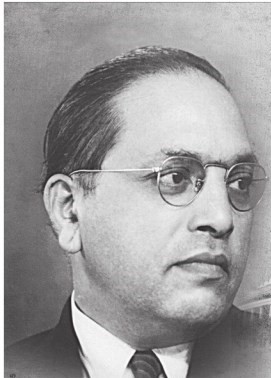
    BR Ambedkar was an original economic thinker who believed in advancing the interests of the Dalits by focusing on the economy. According to him, the economic conditions that affected the Dalits were – monetary circulation in the economy, size of land holdings and the pattern of public finance.

    By Pritam Singh

    In his writings on money, he directly challenged the dominant Keynesian view in the 1930s regarding the delinking of supply of money from gold reserves.  Keynes had argued that due to the development of the monetary- exchange mechanism in advanced capitalist economies such as the UK, there was no need to limit the supply of money by linking it with the gold reserves.  Ambedkar opposed this view not because he had any special fascination with gold but because he considered that delinking of money supply from gold reserves would open the possibilities of excessive supply of money. This, in turn, could lead to financial instability and inflation, says the author.

    Bhim Rao Ambedkar, the chief framer of the Indian Constitution, was also an original economic thinker. The originality of his economic thinking can be interpreted as eclecticism due to his non-adherence to any one particular economic ideology — Marxism, neo-classical economic thought, support for market economy or state regulation. However, behind his eclecticism lies a common running thread in his ideas on different economic issues. That unity was provided by his concern for the Dalit sections of Indian society.

    In adopting this approach, he can be compared with Karl Marx who was ruthless in his rigorous analysis of capitalism. That rigor was not merely an academic enterprise but closely linked with defending the interests of the working class. In both cases —Marx for the working class and Ambedkar for the Dalits — there was no compromise in the objective analysis of the economic conditions to suit any partisan considerations.

    On the contrary, both viewed a scientific examination of the economic conditions as a necessary condition for advancing the interests of the working class and the Dalits (for Ambedkar). In the Indian context, in particular,  and  South-Asian context in general, the social categories of class and caste overlap and interpenetrate each other despite the autonomous status. Three main issues on which Ambedkar focused his intellectual energies were: monetary circulation in the economy, size of land holdings as a part of the broader agriculture strategy and public finance especially the pattern of federal finance.

    In his writings on money, he directly challenged the dominant Keynesian view in the 1930s regarding the delinking of supply of money from gold reserves.  Keynes had argued that due to the development of the monetary- exchange mechanism in advanced capitalist economies such as the UK, there was no need to limit the supply of money by linking it with the gold reserves.  Ambedkar opposed this view not because he had any special fascination with gold but because he considered that delinking of money supply from gold reserves would open the possibilities of excessive supply of money. This, in turn, could lead to financial instability and inflation. From the viewpoint of the poor sections of society, Ambedkar thought that both inflation and financial instability would hit them adversely. The rich might benefit from financial instability by using a range of alternative investment options. The 2007-8 financial crisis of the global capitalist economy, triggered by unregulated financial markets and resulting in huge income and wealth inequalities, is a testimony to Ambedkar’s prophetic insights. For him, the seemingly technical question of money supply and gold reserves needed to be assessed for how these impacted the welfare of Dalits who constituted the bulk of the poorer segment.

    Ambedkar adopted the same method to assess the conditions in India’s rural economy. He argued that fragmentation of land holdings in India was leading to decreasing the average size of land holdings to an economically inefficient level. He advocated consolidation of landholdings in order to increase the average size of a farming unit. On the face of it, this may seem against the interests of small landholders.  However, from the viewpoint of economic efficiency, he did not consider the defense of uneconomic landholding size was in the interests of poor peasantry or landless workers. He, therefore, proposed cooperative agriculture which ensured pooling of smaller units into a bigger unit to avail of the economies of scale.  In his view, cooperative farming was desirable for small landholders and landless workers who were mostly Dalits. In looking at alternative modes of farming and suggesting cooperative farming as the most-desirable system, Ambedkar’s goal was the defense of the economic interest of the Dalits.

    The third major issue Ambedkar examined was the question of public finance, dealing with revenue and expenditure of different layers of governance. His basic premise was that each level of government needed to have appropriate sources of revenue to meet its expenditure obligations. He further argued that along with the quantitative dimensions of revenue and expenditure, it was necessary to examine the qualitative dimensions of the revenue-expenditure pattern. A government may be able to generate generous revenue but it might fritter away that revenue through unproductive expenditure such as luxury spending by ministers and government officials. In contrast, even a modest increase in revenue if spent on public goods such as health and education can have a multiplier effect on improving the quality of life. The provision of such public goods is especially important for the Dalits and other pooper sections of society.

    Ambedkar also examined the impact of centralization versus decentralization on the life conditions of Dalits. From one angle, he seemed to be supportive of centralization but he also considered excessive centralization as a threat. In arguments in support of centralization, he viewed that decentralization could empower the local upper-caste elites more against the Dalits. He viewed centralization as creating conditions for authoritarianism that can weaken democracy.

    In Ambedkar’s view, the weakening of democracy was not in the interests of the Dalits. Precisely for this reason, Ambedkar opposed and defeated a proposal from Jawaharlal Nehru that India’s Constitution could be amended by a simple majority in the Parliament. He viewed Nehru’s proposal as paving the way for increased centralization and succeeded in inserting that a government needed to have at least a two-third majority in the Parliament to make a constitutional amendment. In supporting or opposing centralization, his key concern was the defense of Dalits’ political and economic interests.

    All those who oppose caste and other forms of discrimination need to learn this Ambedkarite method of keeping the concerns of Dalits as the central determining criterion in assessing different policy options.  In the era of global climate change, a creative development of Ambedkar’s ideas is necessary to suggest sustainable and egalitarian modes of economic activities.

    (The author is a Professor of Accounting, Finance and Economics at the Oxford Brookes University, the UK)


  • Bluster as foreign policy – Hostility has left neighbors unmoved

    Bluster as foreign policy – Hostility has left neighbors unmoved

    By Sandeep Dikshit

    Clearly, the comforting words of the American naval officer and the temporary presence of a number of warships in the Bay of Bengal can have no impact on the border standoff on the India-China-Bhutan tri-junction or dampen the Sino-Pakistani tango where Beijing has promised to do the heavy lifting for a massive infrastructure buildup that straddles Indian Kashmir, says the author.  

    An unnamed US navy top brass sought to enlighten us about the end game behind the recent week-long excitement in the waters of the Bay of Bengal involving navies of the US, India and Japan. “They [China] will know that we are standing together and that it is better to stand together,” he said at the end of the war-like maneuvers involving, as breathless defense correspondents put it, three aircraft carriers for the first time.

    Like all naval exercises this comes with a name, this one is called the Malabar. It began in 1992 as India began reaching out to the other side of the Cold War divide and has now assumed proportions that are the interest of every sea-faring nation in the world because it involves Japan, India and the US with a very interested onlooker in Australia, all of whom disagree with Beijing’s modus operandi of reworking the power equations in the region.

    Astute as they are, the Chinese would have noticed that the famed US aircraft carrier Nimitz came for the exercises with a leaner complement of accompanying warships. The Japanese contributed two warships. More than war-fighting machines, they remain symbols of Shinzo Abe’s overturning of Japan’s post World War law forbidding its participation in international conflicts. Australia, which was kept out of the Malabar exercises, is still reorienting its navy for a blue water role.

    Clearly, the comforting words of the American naval officer and the temporary presence of a number of warships in the Bay of Bengal can have no impact on the border standoff on the India-China-Bhutan tri-junction or dampen the Sino-Pakistani tango where Beijing has promised to do the heavy lifting for a massive infrastructure buildup that straddles Indian Kashmir.

    Prime Minister Narendra Modi has recently jet-setted to the US, Russia, Spain, France and Germany, all with a thriving military-industrial complex. Very few have responded to his call to manufacture military hardware on Indian soil, partly because most would not wish to rework their equations with China.

    The belligerent realists who have come to dominate the Indian foreign policy may draw comfort from the Donald Trump’s maiden defense budget that has a few lines about India. So far India has largely bought surveillance and detection equipment from the US while going slow on offensive platforms like fighters, tanks and submarines.

    Both sides have their reasons. The US had abruptly suspended the Malabar exercises after India conducted the nuclear tests in 1998. As part of US sanctions at that time, Pentagon even ordered the British to seize Indian Navy’s helicopters that had come for repairs because they had American parts. India’s strategic planner learnt their lessons. Just like they were left stranded after the US withdrew military assistance in 1965 (and unwittingly left a vacuum filled by the Soviet Union) after India had clashed with Pakistan, they realized military trade with the US can be halted anytime if it conflicts with American foreign objectives.

    The proximity brought about by the foreign policies of successive Indian administrations has caused those apprehensions to recede. There is even talk of the US transferring its F-16 manufacturing facility to India.  But the US will not easily offer any of the top-end offensive military platforms without a demonstrative expression of strategic closeness.

    This could be tactical such as positioning Indian armed forces in Afghanistan. But to get into the real meat of the US arms industry, this is inadequate. Even countries in a client-patronage relationship with the US like Pakistan have been let down on crucial occasions (Kargil War) or rewarded for their occasional usefulness with a few military toys that are grossly inadequate for a full-fledged war.

    The US would ideally like to sink a long strategic hook into India that makes the alliance irreversible. One element — signing of three military agreements — has been on the table since the Manmohan Singh-AK Antony era. The duo withstood immense American pressure to sign these agreements because that would have meant an irreversible entry into critical defense systems that countries with independent foreign policies try to prevent.

    The Modi government has succumbed to the easiest of the three military agreements. But even its complexities have meant that the two sides could not operationalize the pact for the Malabar exercises. The signing of the other two pacts will certainly cause the Russians to turn lukewarm in supplying top-end military hardware to India.

    With neither a credible sea denial strategy in hand or adequate military platforms to deter China, it was inevitable that the bluster in foreign policy would have a short shelf life. The Army Chief made a show of muscularity by dashing to Sikkim when the faceoff with the Chinese began. Three weeks later, he has reverted to expiating on Kashmir.

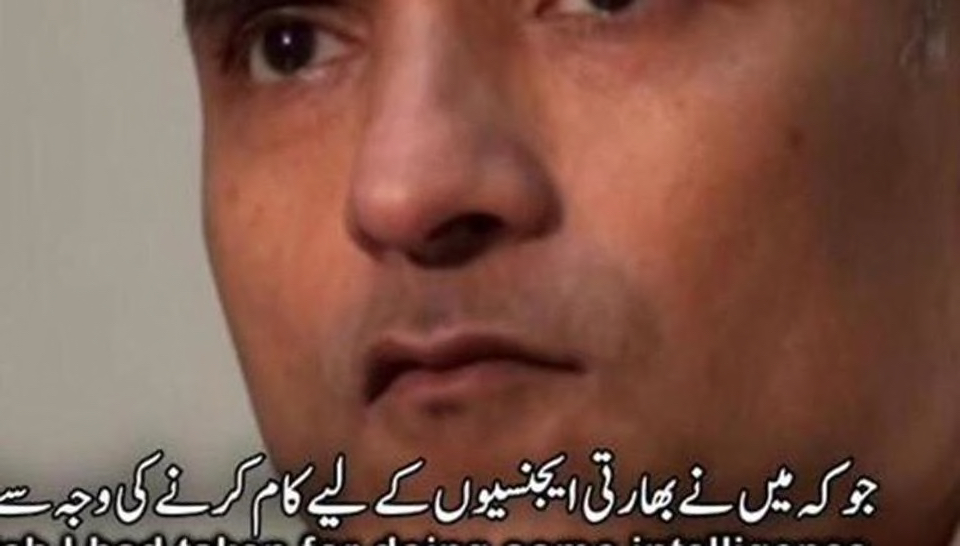
    This approach has brought negative returns with Pakistan as well. High on Chinese backing, utility for the Arabs and Russian mending of fences, Islamabad has little appetite for dialogue on New Delhi’s terms. The attempt to square Pakistan’s meddling in Kashmir with reciprocal interference in Balochistan has suffered a massive blowback with the arrest of the former Indian Naval officer. Nepal too is not looking too good and India has been left with too few diplomatic tools to turn the situation around. The antipathy with China could have been best avoided when Nepal was looking to balance India’s testiness with approaches to Beijing.

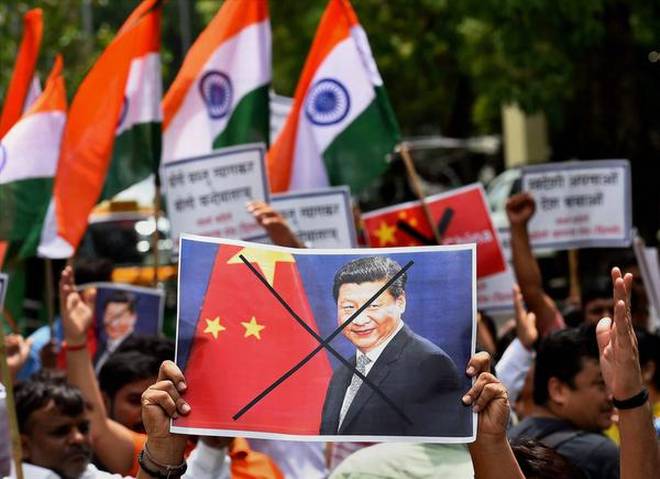
    This cul de sac may have persuaded Foreign Secretary S Jaishankar to complain that the Dokalam military standoff between India and China has blown out of proportion due to “supra-nationalism” — beyond the authority of one national government. Apart from the usual suspects and slogans — boycott of Chinese manufactured goods, annexure of Kailash Mansarovar — the Foreign Secretary may also be hinting at the wind being provided to the sails of hyper-nationalists by foreign strategic experts with the single point agenda of showing up China poorly.

    India has been hedging against Chinese dominance for nearly two decades. But its policy makers eschewed bluster towards China in favor of painstaking incremental diplomatic dexterity. The three years of belligerence may have turned the clock back.


  • After globalization’s promise

    After globalization’s promise

    By Pulapre Balakrishnan

    Recognizing the diminished tempo of globalization, India’s economic policymakers must address the growth of the home market, which is the demand for goods and services emanating from within the country. The immediate points of action and the appropriate instruments can be identified without much strain on our ingenuity. In the short run or the present, when the global economy is sluggish, only domestic investment can move demand, says the author.


    ‘Hyperglobalist’ has been used to describe the dramatic increase in international trade witnessed for about a decade and a half from the early 1990s up to the global financial crisis of 2008. The imagery intended is one of an increasing connectedness among nations leading to a virtuous cycle of economic expansion.

    By a trait common to every generation, we tend to assume that ours is somehow unique, in this case with respect to globalization. However, if we are to take the long view, we would find that this is no more than a conceit. Starting sometime in the last quarter of the 19th century, for close to 50 years, the world saw an expansion in trade that was actually as great or even greater than during the recently concluded phase. Then had also occurred an unprecedented movement of capital and of people. British capital flowed into building the railways across the world, immigrants moved from Europe to the United States and Asian labor was moved to the sites of deployment of western capital.

    End of a phase

    So, the facts are that the world has seen the waxing and waning of global traffic in goods, capital and people. To be precise, the phase of high trade starting 1870 came to an end with the First World War and was to revive, slowly, only after the Second. Then, following the collapse of East European communism in the early 1990s, there was a resurgence in global trade. Now even this phase has somewhat abruptly ended with the global financial crisis.

    Economists who study trade flows have gone to the extent of claiming that hyperglobalisation was a one-time event unlikely to be repeated. Though some may hold that we ought to shun economists offering predictions with as much diligence as we should beware of enemies bearing gifts, it may pay us to heed their prognosis, for were it to be true, it has implications for economic possibilities in India. Note that even if vigor were to return to the global economy 25 years from now, that would still account for a significant chunk of the working life of an Indian, for which period alternative economic opportunities would have to be found.

    Role of technology

    What underlies the skepticism expressed regarding a revival of global trade? The view is based on the observation that especially 19th century globalization was underpinned by technological advances that facilitated trade. The advent of the telegraph is alluded to along with the invention of the internal combustion engine. The former enabled the communications infrastructure intrinsic to trade and the latter enabled the fast, reliable and cheap transportation of goods across seas. These advances, we are told, dwarf anything since, including the Internet, in terms of their capacity to expand trade. And, none is foreseen in the immediate future.

    This account of how advances in technology fueled trade is of undoubted relevance but remains partial in that it leaves out the role of the growth in demand for these technologies. It was, after all, the growing market for British goods as Indian manufacturing was dislodged following military conquest and as British capital flowed into the laying of a rail network in parts of Latin America and Africa that provided the demand for development of cheaper communication and transportation technology. Therefore, it may as well be said that trade expanded as the demand for goods grew. However, it is yet true that when global demand expands, countries can exploit the trade route to grow their economies. This was the great promise of globalization held out to the developing countries in the 1990s. Now, what does all this have to do with us in India today? A great deal, actually.

    The slowdown and India

    If the world economy is set to grow slowly for the foreseeable future, a premise of much of the economic policy in India since 1991 would have to be replaced. It had been assumed then that globalization was here to stay and India had only to hitch onto its current to ride to prosperity. This India has even successfully done in phases since. Now, however, we need to recognize that the game may have changed substantially — even if not irrevocably, as the experts claim. The shift that has taken place is visible most in the IT industry. Quarterly growth only inches forward there and insecurity grips its particularly young workforce. In retrospect, we can see the hollowness of the boast that had made the rounds a decade ago that India need not bother with manufacturing when it could leapfrog into a service economy led by IT exports. Now, “bricks and mortar” is no longer something to be spurned and soiling our hands may be part of the business of earning our living for some time to come.

    Recognizing the diminished tempo of globalization, India’s economic policymakers must address the growth of the home market, which is the demand for goods and services emanating from within the country. The immediate points of action and the appropriate instruments can be identified without much strain on our ingenuity. In the short run or the present, when the global economy is sluggish, only domestic investment can move demand.

    In India, we have been witnessing slowing or depressed private investment for close to five years by now. There is a view that this has to do with tight monetary policy. It is true that the real lending rate for firms has been rising as inflation is falling. Such a policy stance can be justified only by resorting to the claim that the Reserve Bank of India knows something about future inflation that we don’t, in particular that inflation is set to rise again soon. Barring this possibility, there is a case for cutting the repo rate now, and there is a clamor for this. But there are reasons to doubt the potency of such an action, one each from the supply and the demand sides. Given that they hold non-performing assets, the banks are extremely wary of lending. Any significant resumption of lending by banks may be hostage to their first resolving the bad loans problem. Ditto with the firms, which are themselves debt-laden. Are they likely to take on more of it, just because it is offered at a lower rate, before cleaning up their balance sheets?

    On public investment

    Independently of the ‘twin balance sheet problem’, Keynesian economics has long recognized that lowering the rate of interest may not do much for private investment if the expected rate of return is depressed. The slowing of both global trade and domestic manufacturing may have had precisely this effect by lowering the long-term expectations held by private investors. We do, however, know how to buoy up flagging demand. You do this through public investment. In response to the argument heard at the highest level of policymaking that there are no viable projects to be had, one need only refer to a recent news report on the state of our roads and bridges. It is reported that 23 bridges and tunnels on India’s national highways are over 100 years old, of which 17 require rehabilitation or major maintenance. As many as 123 other bridges in the country require immediate attention and 6,000 are “structurally distressed”. Infrastructure is unique in that spending on it raises aggregate demand and when it actually comes on stream, it raises the productivity of investment elsewhere in the economy. ‘Roads and bridges’ are a metaphor for the public infrastructure that the Indian economy can fruitfully absorb today. For the country’s political leadership, the task is no longer to find trading partners to hug but to buckle down to the heavy lifting of expanding physical infrastructure.

    (The author is Professor of Economics, Ashoka University and Senior Fellow, Indian Institute of Management, Kozhikode)


  • Censor Board on rampage as Policing content inconvenient to govt

    Censor Board on rampage as Policing content inconvenient to govt

    The template for the Censor Board was set a few months after the BJP stormed to power in Delhi. So, it should be no surprise that Amartya Sen, one of the earliest critics of the government’s alternative vision of India, should find himself at the receiving end of its ministrations. A documentary on the Nobel laureate has been asked to mute all words anathema to the Modi government: cow, Gujarat and Hindutva. Pahlaj Nihalani’s appointment as the Censor Board chief was payback time for a loyal home boy. After all, his CV boasts of a six-minute campaign video “Har Modi, Ghar Modi” for the 2014 general election.

    Since then Nihalani has not disappointed his mentors and played their political game, albeit with unapologetic stupidity ever since he took over from Leela Samson. It needs to be recalled that Leela Samson quit protesting against “unbearable pressure” to clear a movie by self-proclaimed saint Gurmit Ram Rahim who paid back with crucial political support to the BJP in Haryana and the Akali-BJP in Punjab. In a blatant act of door-keeping for the government, Nihalani had earlier stopped the certification of a film on the 2013 Muzaffarnagar riots that paved the way for the BJP’s electoral sweep in western UP. The Modi government appointee is not just policing political content. He is also bearing down on liberal and broader exploration of issues of gender, sexuality, religion and communalism.

    In other words, the Censor Board’s axe can fall on any view that strays from the Sangh Parivar’s narrow definition of an ideal society. So, Lipstick Under My Burqa was deemed “too lady oriented” and Oscar-nominate Danish Girl “unsuitable for children.” Besides the danger of the government discouraging a scrutiny of its actions, which is the lifeblood of any democracy, technology has outpaced censorship. Documentaries, unlike Bollywood movies, pick up their audiences from online views and the film circuit in Western Europe. Even if the Amartya Sen documentary was completely banned, it would still be viewed and should recoup the investment. The only upshot is that India starts looking like a pale shadow of the countries it criticizes.

    (Tribune India)

  • Institutional equilibrium weakens as a dangerous arrogance of power sets in

    Institutional equilibrium weakens as a dangerous arrogance of power sets in

    By Harish Khare

    “Come July 20, 2017, Modi will have his own President. That would make a qualitative difference to the nature of choices available to the Prime Minister in dealing with friends and foes. Though Pranab Mukherjee was not a difficult President for Prime Minister Modi, nonetheless he could not be called a rubber stamp. Prime Minister Modi or his advisers certainly could not take President Mukherjee for granted — an option that is now open to the Prime Minister. A vital equation in the national power grid will stand definitely tilted, in favor of the Prime Minister, says the author.

    Quietly and perhaps unsuspectedly we are entering a potentially dangerous period in our polity. Not because we have reason to entertain continuous anxiety on our nation’s borders, not because the external environment is deteriorating to our disadvantage, but because internal institutional equations are about to change in a manner that would upset the democratic polity’s equanimity.

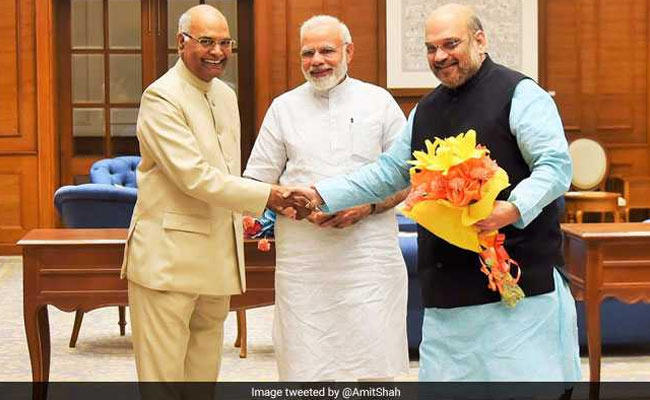
    To begin with, in another seven days we shall know who would be the new Head of our Republic. Barring potential subversion on an extremely large scale, Ram Nath Kovind should be the new tenant of that sprawling real estate property atop the Raisina Hill. The change of tenancy will have its consequences. The equation between the President and the Prime Minister has always been subject to considerable modification and negotiation after every change of players; and, though Rashtrapati Bhavan is not a rival center of power, its occupant —any occupant — can be a source of irritation and frustration for any Prime Minister. Hence, the importance of next week’s presidential poll on the quality of the Prime Minister’s control and power of the Delhi sultanate.

    It is widely accepted by New Delhi’s political cognoscenti that Ram Nath Kovind is Prime Minister Narendra Modi’s personal choice; moreover, it is further suggested that in opting for him, the Prime Minister has cocked a snook at the RSS impresarios, who had different ideas. The RSS-Narendra Modi relationship is up for a revision.

    Like Atal Bihari Vajpayee before him, Modi too has sought to gain a kind of upper hand in the patron-client relationship that defines the RSS-BJP symbiosis. The heart of the matter is that there is an inherent conflict between a prime minister’s constitutional obligations and a swayamsevak’s oath of allegiance to this “cultural body”, with its headquarters in Nagpur. Prime Minister Vajpayee was clear from the very beginning that his constitutional responsibilities and duties would take precedence over the RSS’ expectations and demands; but he had to pay a certain price for clarity and conviction. Modi has played a subtler hand of cultivated ambiguity, humoring the RSS once in a while. But then it is in the nature of office that, sooner or later, a prime minister has to draw a line — for himself and for the Nagpur bosses.

    In opting for Kovind, Modi has drawn a line. This has not gone unnoticed or unresented by the parent body. For a BJP prime minister, the RSS is the elephant in the room and it cannot be ignored. From a different perspective it would appear to be rather ironic that a hope ought to be pinned on a body like the RSS to keep in check a rampant prime minister.

    Come July 20, 2017, Modi will have his own President. That would make a qualitative difference to the nature of choices available to the Prime Minister in dealing with friends and foes. Though Pranab Mukherjee was not a difficult President for Prime Minister Modi, nonetheless he could not be called a rubber stamp. Prime Minister Modi or his advisers certainly could not take President Mukherjee for granted — an option that is now open to the Prime Minister. A vital equation in the national power grid will stand definitely tilted, in favor of the Prime Minister.

    Not only a pocket President, next month the Prime Minister will also be able to get a Vice-President of his choice. Whatever little space the Opposition was able to claim for itself in the Rajya Sabha would get drastically curtailed. And, all said and done, Hamid Ansari did not deny himself the pulpit, from where he spoke out in defense of republican values and democratic sensibilities. This minor source of irritation would also stand taken care of in less than a month’s time.

    And then, later in August, there will be a change of guard at the Supreme Court of India. Institutionally, the higher judiciary remains the only power center that is not easily amenable to the government’s blandishments or brandishments. Of late certain mutedness seems to have crept in the judicial voice. Like any other institution, the judiciary’s spunk is vitally dependent upon the moral fortitude of those who come to man the bench. On this count, there are rumors. Those who believe that a robust and vibrant judiciary remains a necessary condition for a functioning democracy do not feel all that sanguine. The ruling coterie will have less and less reason to worry about a judicial disapproval or rebuff.

    Of course, there is the ruling party itself. For all its appearances as a modern political party, the BJP remains a closed affair. Since 2013, when Narendra Modi crowbarred his way to dominance with the BJP and then went on to graft democratic legitimacy over his leadership by winning the 2014 Lok Sabha poll, the party has allowed itself to be content with a very subordinate voice. The BJP president has no political persona outside Narendra Modi’s shadow. There is no leader left who can be remotely thought of as a potential challenger to Prime Minister Modi’s hegemonic stewardship. Neither Vajpayee nor LK Advani ever enjoyed this kind of sway over the BJP; their leadership was collegiate and they found themselves constrained to share authority. Narendra Modi feels no such handicap.

     Three other democratic institutions — Cabinet, bureaucracy, media — stand cheerfully self-emasculated. Never before was such a convergence of timidity and opportunism seen as now among these three institutions; there seems to be a veritable race to reduce themselves to the role of a spear-carrier for the Prime Minister.

    The sum total of reconfiguration of these institutional equations can only set in motion objective conditions in which an authoritarian temptation becomes a tempting proposition. The Modi government is approaching a difficult phase, when all the promises and pretensions have not exactly worked out. Economically, the jobless growth has a very limited potential for electoral dividends. The entire business community — the corporates, traders, shopkeepers and consumers — is yet to regain its breath after being buffeted twice — first by the demonetization drama and now by the GST tantrums.

    Politically, the Modi establishment has proved itself extremely competent and clever; it feels it has reduced the Gandhis and the Congress and other opposition parties to an ineffectual bunch; it feels doubly sure of its cleverness after having sold the demonetization joke to the masses; it feels it has the momentum — and, history — behind it.

    There is a dangerous edge to this overconfidence. It is morphing itself into a sense of entitlement. Strong-headed leaders tend to arrogate to themselves an aura of inevitability and infallibility. A robust democracy should have available to itself institutions of accountability that ensure that no leader, however powerful and however popular, trips over his own web of megalomania.

    (The author is the chief editor of Tribune group of publications)

  • Dilemma of a two front war

    Dilemma of a two front war

    By Maj Gen Ashok K Mehta (retd)

    Obsessed with Pakistan, India has grossly neglected the real adversary. In point-to-point skirmishes and standoffs, battle- hardened Indian soldiers will deter, if not defeat, the PLA. However, across a broad front spectrum in an unlikely all-out war, it is advantage China, Says the author.

    At a time when China is threatening to teach India another lesson and warning not to engage in a two-front conflict over the standoff in Doklam, our Service Chiefs, it seems, are not on the same page about fighting a two-front war especially as Beijing might try to emulate the New Delhi-Thimpu alliance in “disputed territory” with one with Islamabad in PoK. While General Bipin Rawat has more than once asserted the Army’s preparedness for a two-front war, Air Chief Marshal BS Dhanoa has highlighted the critical shortfall in the number of fighter squadrons — 32 against the required 42 squadrons — to dominate a two-front conflict, saying: “It is akin to a cricket team playing with seven players instead of 11”. The deficiency in air assets has existed for decades but this is the first time an Air Chief has related it to a two-front war.

    The Chief of Naval Staff, Sunil Lanba, when asked about the disparity in preparedness of the services, said: “The way national security is being handled is not commensurate with the security environment which is extremely serious at the moment”. Recently, Gen Rawat told a military audience that the military was not getting enough funds for modernization — repeated ad nauseum by every Chief — due to the perception that expenditure on defence is a burden on the economy. This set the cat among the pigeons as Finance Minister Arun Jaitley, a regular fill-in for Defence Minister, is believed to have told Gen Rawat: “Don’t worry about funds. When you run out, call me”. In the mid-1990s, when the Naval Shipyard order books had gone dry, CNS, admiral Vijay Shekhawat went public about the Navy’s operational deficiencies, prompting Defence Minister Mulayam Singh Yadav to invite him to discuss dwindling fleet numbers. Ad hocism has become the hallmark of modernization of the military.

    Power differential

    The Chinese are constantly reminding India about the power differential — military, economic and infrastructural — between them. Being obsessed with Pakistan, India has grossly neglected the real adversary. The reason for this is the institutionalized absence of strategic thinking and higher political direction of war and conflict in the face of growing threats and challenges to internal and external security. Prime Minister Modi’s boast about big defence reforms is hollow: had he been serious about defence, he would have named a full-time Defence Minister. The appointment of a Chief of Defence Staff has not overcome the hesitation of history — read bureaucracy. The country has never produced a “Defence White Paper” or done a “Strategic Defence and Security” review. Something called the “Raksha Mantri’s Directive” masquerades as higher political direction on deterrence and war. This bit of literature drafted by the military has its origin in 1983, with periodic face-lifts to make it contemporary.

    The Parrikar doctrine covering surgical strikes was included in the Joint Military Doctrine, scripted by the Integrated Defence Staff, which attracted extraordinary flak from the defence community for being substandard. In its present organization, each service essentially fights single-service combat. In the last border skirmish at Kargil, the Army’s operation was called Vijay while the IAF campaign in support was named Safed Saagar. So much for jointness.  So the Raksha Mantri’s Directive passes off as political guidance by the highest echelons of government. When I once asked a former Air Chief how he evolved his service’s span of responsibility, he replied: “Most of the time, from speeches made by the Prime Minister during the Combined Commanders’ Conferences.”

    Are we surprised that while President Xi Jinping who heads the Central Military Commission, has personally ordered and supervised the reorganization of the combat formations facing India, reducing them from three commands to one command — a single Western Theatre Command headed by the powerful Gen Xhao Zongqi — the China front in India is managed by four Army and three Air commands deployed at seven locations.

    Integrated command

    A forward-looking proposal made by a defence committee recommending three integrated operational commands — North, West and South instead of 17 single service commands — was shot out of hand by (no guesses) the Air Force. The CDS and accompanying Joint Staff ordered by the UK in 1984 was a fait accompli. It was introduced by a political class which understood defence and strategic security. In India, countless defence reforms are languishing for want of decision making.

    It is instructive to recall how the two-front strategy was formally enunciated in December 2009 by the Army Chief Gen Deepak Kapoor. It followed the 2008 Mumbai terrorist attack, after Prime Minister Manmohan Singh ordered the Service Chiefs to prepare for war. Defence Minister AK Antony then had “preparation for a two-front war” added in his Directive but did little to implement it. Both in 1965 and 1971 wars with Pakistan despite the collusive threat from China, there was no cross-border intervention by China though sizeable formations of the Eastern Command remained deployed against it and forces could not be switched to the west or east for fighting in East Pakistan in 1971. In a real two-front war, swing forces in east and west will not be able to reinforce either front and only dedicated formations will fight the war. Given the paucity in current force levels, inadequate sophistry of combat support and terrain and infrastructure handicaps, it will be an uphill task to match the PLA’s strength and versatility across a 3,488-km front of undefined borders.

     In point-to-point skirmishes and standoffs, battle-hardened Indian soldiers will deter if not defeat the PLA. Across a broad front spectrum in an unlikely all-out war, it is advantage China unless India is prepared to rethink its “no first use” nuclear doctrine. As an offset in the western front, Gen Rawat has suggested creating a two-front situation for Pakistan: either in Afghanistan or Iran. Doklam may go the 1986 Sumdorong Chu way; the 10-month-long standoff challenging the Chinese intrusion at Thandrong, west of Tawang over the interpretation of watershed, without a shot being fired. India need not invoke its doubtful capacity to fight a two-front war; instead, speedily augment its deterrence against China. This may not win votes for Modi but it will prevent Chinese pinpricks that he famously called “toothache”.

    (The author is a former Major General of the Indian Army, and a radio and television commentator, and a columnist on defence and security issues. He is founder-member of the Defence Planning Staff in the Ministry of Defence)         

  • Making of a monumental crisis

    Making of a monumental crisis

    Parliament must resist a proposed amendment that compromises the 100-m no-construction zone

    By Nayanjot Lahiri

    India’s monuments form an irreplaceable archive of our civilizational heritage. Our pride in our heritage has always been surplus while caring for that heritage suffers a huge deficit. Surely, India’s archaeological heritage, as diverse and priceless as our natural heritage, seventy years after Independence, deserves better than what has fallen to its lot, says the author.

    India’s monumental heritage is on the brink of a shameful shift. The Central government is poised to introduce an amendment to the Ancient Monuments and Archaeological Sites and Remains Act, 1958, in Parliament, which would remove the security net that exists around our nationally protected monuments.

    Endangered structures

    Why is this security net necessary, and why is its proposed infringement shameful? Our protected monuments, from the Taj Mahal to the monuments of Mamallapuram, have a designated prohibited area — at least a 100-m radius — to protect them, where no new construction is allowed. It is similar to the zoning around tiger reserves where the core area is set apart for the animals to live in, and where human disturbance is not permitted. Just as this is done to prevent human-animal conflict, zoning around monuments is necessary to prevent monuments from defacement and to prevent the present from displacing the past by marring historical landscapes. Monuments, it needs to be remembered, are endangered structures and vulnerable to human interference. If tigers have disappeared across large parts of the habitats they occupied even till the early part of the last century, so have several of India’s protected monuments. As it is, there are a mere 3,650 monuments which are nationally protected in a country where the records with the government show some 5,00,000 unprotected and endangered monuments.

    The track record of the government in maintaining our nationally protected monuments, to put it most charitably, is an indifferent one. There are encroachments by government agencies and individuals. The 2013 report of the Comptroller and Auditor General (CAG) noted that of the 1,655 monuments whose records were scrutinized and which were physically inspected, 546 of them were encroached. This may well be because of a lack of basic manpower in the form of monument attendants. In 2010, the Archaeological Survey of India (ASI) stated on record that its staff strength did not permit the deployment of even a single person on a regular full-time basis at more than 2,500 of its monuments. This meant that more than two-thirds of India’s monuments that the Central government is supposed to protect were poorly guarded. At the same time, the CAG pointed to connivance by ASI officials as well. As the files of the ASI reveal, there are also numerous instances where politicians have proactively protected those who have illegally occupied the prohibited zone around monuments.

    The only protection for our defenseless heritage has come from courts of law because there are legal provisions which, at least on paper, prevent the encroachment of the prohibited zone around monuments. The idea itself, that a security net ought to be created around heritage buildings, can be traced to Jawaharlal Nehru. As Prime Minister, he complained to the Union Minister of Education in 1955 that India’s old and historical places were getting spoilt by new buildings being put up around them. In order to prevent intrusions, Nehru suggested that the government “lay down that within a certain area no building should be put up without permission”. An example of his proactive approach in creating such protective barriers is the enclosure encircling the tomb of Abdur Rahim Khan-i-Khana in Nizamuddin. This was built after Nehru had visited the site and suggested that the adjacent grounds be converted into a garden because, as he put it, he did not want the colony of Nizamuddin East to extend into the area around the tomb. This idea eventually found its way into the Ancient Monuments and Archaeological Sites and Remains Rules of 1959 which unambiguously, for the first time, noted a prohibited and a regulated zone around protected sites and monuments.

    Because of these rules, the High Court of Delhi in 2009 struck down all permissions that had been illegally granted by the ASI through an Expert Advisory Committee. As a consequence of this judgment, in 2010, the Government of India set up a committee which recommended a new bill to Parliament. It is now known as the Ancient Monuments and Archaeological Sites and Remains (Amendment and Validation) Act. Unanimously passed in March 2010, this legislation brought the prohibited and regulated zones around monuments within the ambit of the Act itself.

    As a consequence of this statute, the National Monuments Authority was set up. It is shocking that even after these years, a major task of this authority remains to be done, that of preparing heritage bye-laws for nationally protected monuments. If India’s rulers cared at all for our monuments, by now not only would the bye-laws pertaining to the 3,650 national monuments have been prepared, they would also have been tabled in Parliament as was required by law. Instead of expediting the preparation of those bye-laws, the government has sought to dilute the 100 m prohibited area around nationally protected monuments. The proposed amendment aims to allow the Central government to construct within that area all kinds of structures. Incidentally, the Cabinet note shows that the Ministry of Culture, instead of protecting monuments, is now acting a clearing house for the Ministry of Road Transport and Highways. The amendment is necessary, the Cabinet note states, because, among other things, an elevated road needs to be built in front of Akbar’s tomb in Agra! The Ministry of Culture needs to be reminded that it is the nodal agency for protecting our monuments, not endangering them. Otherwise, it is better for the government to abolish this ministry since cultural protection is far from what it seems to be doing.

    One people, two norms

    What makes this amendment shameful is that our Ministers live in the Lutyens Bungalow Zone in New Delhi where overhead metro lines have not been permitted because, quite rightly, they would have permanently marred the aesthetics of the area. Hundreds of crores of rupees have been spent to ensure that there are no ugly railway corridors across that area. Yet, the ruling class has no compunction in pushing for a legislation which would allow overhead contraptions in the vicinity of our national monuments. Does the government believe that the aesthetics around government bungalows matter but not around monuments? Or is it possible that they believe that monuments do not matter and only highways do?

    India’s monuments form an irreplaceable archive of our civilizational heritage. Our pride in our heritage has always been surplus while caring for that heritage suffers a huge deficit. Surely, India’s archaeological heritage, as diverse and priceless as our natural heritage, seventy years after Independence, deserves better than what has fallen to its lot

     (The author is a historian and archaeologist of ancient India and a professor of history at Ashoka University)

  • Another successful visit

    Another successful visit

    Modi-Netanyahu chemistry alchemizes ties

    Judging even by the high standards of personalized diplomacy set in place in the last three years, Prime Minister Narendra Modi’s three-day visit to Israel has to be judged as an astounding success. The Prime Minister was serenaded in lavish terms; the reddest of red carpet was rolled out for him, just as stiff protocol niceties were rolled away to honor him; we are told that the standards and excellence of hospitality and courtesies extended to him were so far reserved only for the mightiest of global leaders. Narendra Modi had always had, reportedly, a special relationship with his Israeli counterpart, based on mutual respect and admiration that leaders reserve for strong, tough practitioners of hard politics. Israel’s Prime Minister Benjamin Netanyahu naturally went out of his way to lionize our Prime Minister; and, it was only natural that the visit should have produced a ‘strategic partnership’.

    A ‘strategic partnership’, in many ways, has become a charming amulet, diplomats have devised to upgrade a relationship. We have, for example, a strategic partnership with the United States, but we have very many valid and legitimate reasons to feel disappointed at Washington’s lack of appreciation of our strategic concerns and sensibilities.  On the other hand, even without a strategic partnership, New Delhi has had a steadily growing, pragmatic, working relationship with Tel Aviv. Both countries have a shared sense of victimhood against global terror. This working arrangement already had in place all the ingredients of a strategic partnership. What the Modi visit has done is to put the de jure stamp on a de facto relationship.

    Over the decades our relationship with Israel had got hyphenated with the knotty Palestine issues. There were both domestic and geostrategic reasons for a cultivated ambivalence; the India-Israel ties were overdue for an upgrade as most of these reasons for diffidence have melted away. Domestically, for the first time New Delhi has is a ruling regime that believes that it does not need to get bogged down by the Muslim community’s traditional sensitivities, at home or abroad. It is this substantive change in our internal political calculus that has lent a new substance to our ties with Israel.

    (Tribune India)

  • The wheeling-dealing world of lobbying – As I See It

    The wheeling-dealing world of lobbying – As I See It

    By Harvinder Khetal

    “A lobbyist is an activist who seeks to persuade government members to enact legislation that would benefit their group. It is inextricably linked to the democratic political process. But equally true is that such petitioners are associated with bribery and looked down upon for endeavoring to influence decisions through wheeling and dealing and wining and dining”, says the author.

     When the Prime Minister of India, the largest democracy in the world, met the President of the USA, the second largest democracy (in terms of population), last week, he got a red carpet welcome and the privilege to hobnob in the White House precincts. Among the other perks that come with the territory, Mr. Modi got to stay in the iconic Willard InterContinental Hotel that is located at a stone’s throw from the presidential mansion in Washington DC. He joined legends who have stayed in this luxurious property and contributed to the historic value of the 200-year-old hotel.

    Due to its ideal location, the hotel has been the center of the US’ social and political scene. And, Willard loves to prop up the fascinating folklore attached with its celebrated guests. It is famously said that Martin Luther King Jr gave the finishing touches to his famous “I have a dream” speech here. Another tidbit: that Abraham Lincoln walked in its corridors before his inauguration.

    Then, due to the goings-on in the hotel because of its strategic location, Willard has also had a role in the legitimization of a word – lobby, as in ‘seek to influence (a legislator) on an issue.’

    Though lexicologists trace the term lobby to the British Parliament, the hotel has been fanning the myth related to its foyer. Most likely, the hotel’s saga helped reinforce and push the word into gaining acceptance worldwide. So, how is the Willard’s lobby related to the term lobbying?

    The story originated during the presidency of Ulysses S Grant (1869-1877). President Grant enjoyed his drink and cigar while relaxing in the hotel lobby. And not-so fortuitously, folks fancying favors, flocked the foyer for a favorable influence on his decision-making. Thus, it came to be said and was even reported in newspapers that President Grant had coined the term by referring to the petitioners as “those damn lobbyists.”

    Of course, now lobbying has evolved into an art that does not necessarily take place in a lobby. A lobbyist is an activist who seeks to persuade government members to enact legislation that would benefit their group. It is inextricably linked to the democratic political process. But equally true is that such petitioners are associated with bribery and looked down upon for endeavoring to influence decisions through wheeling and dealing and wining and dining.  Wheeling and dealing is an attempt to make a deal or get an advantage by using complicated and sometimes unfair or dishonest means. And, to wine and dine someone is to entertain someone to a lavish meal and fine wines, usually with an ulterior motive.

    In this context, I must confess that as a journalist, I have partaken of meals that often exude of a flavor of lobbying. I guess it’s a job hazard that a good professional would know how to deal with objectively.

    Interestingly, the ‘Washington Post’, quoting a Gallup poll, has reported that the occupation most despised in the USA is lobbying. While lawyer jokes are legion and salesmen are lampooned routinely, lobbyists are so despicably low on ethics that they don’t even merit ridicule. The practitioners move around with such fancy titles as ‘government relations officer’.

    No surprise that the Willard has, of late, been choosing to distance itself from the myth related to the coining of the term lobby.

    In India, a public relations firm came for flak and ultimately winded up following the leak of its notorious ‘Nira Radia tapes’. But it is Dhirubhai Ambani who is synonymous with mastering the knack of corporate lobbying. His dealings in the corridors of powerful authorities during the rise of the Reliance group reveal wheels within wheels (hidden or unknown things that influence a particular situation, making it more complicated than it seems at first).

    It seems that the warp and woof (the foundation of any structure or organization) of Ambani’s journey from a schoolteacher’s son to a giant tycoon is cemented by lobbying, along with competence, hard work, management skills and foresight. The phrase warp and woof comes from weaving, in which the warp — the threads that run lengthwise — and the woof — the threads that run across — make up the fabric.

    I got a peep into Ambani’s fascinating and, at times, dark style of functioning on one of my trips abroad as I laid hands on his unauthorized biography ‘The Polyester Prince: The Rise of Dhirubhai Ambani’ by Hamish McDonald. The book is banned in India.

    The book sums up human interactions thus: “Nobody is a permanent friend, nobody is a permanent enemy. Everybody has his own self-interest. Once you recognize that, everybody will be better off.” And, lobbying is justified by quoting Ambani himself thus: “You should not do anything illegal. First of all, the law should be changed.” So, he did exactly what he preached with prowess: by establishing connections with lawmakers.

    (The author can be reached at hkhetal@gmail.com)


  • RARE IMAGES OF DHAKA’S GURDWARA

    RARE IMAGES OF DHAKA’S GURDWARA

    I spent a part of my impressionable years, that is to say, my boyhood school days in Islamabad, West Punjab, Pakistan. During my stay there, I made memorable visits mostly to the northern regions of Pakistan. I also visited the cosmopolitan cities of Karachi and Lahore. I was particularly enamored of Lahore, once a fabled city of the grand Mughals, Sikhs and later of the British Raj where Sikhs, Hindus, Muslims and other ethnic minorities once coexisted amidst great harmony and amity. Lahore in the British colonial days had rightly earned the enviable sobriquet as, “Paris of the Orient” (see the engrossing book, LAHORE: A SENTIMENTAL JOURNEY by PRAN NEVILE, 1993). Even in the late 1960s, it exuded a charm of its own with its Mughal monuments and gardens – the Lahore fort, Shalimar and Shahdara Baghs, Badshahi and Wazir Khan’s mosques, mausoleums of Jahangir and Nur Jahan, Anarkali bazaar and the tree lined Mall, to name a few. However, besides the “Ajab Ghar” (Lahore museum) and “Kim’s Gun” (Zamzama) made famous by Rudyard Kipling, the old Lahore fort along with its Sikh era exhibits which included the priceless collection of the last Sikh Maharaja Dalip Singh’s daughter, Princess Bamba Sutherland, attracted me the most.

    On my very first visit to the Lahore fort, I was drawn to remnants of some interesting, fading Sikh murals on a wall in an inner courtyard. It looked somewhat incongruous in its setting and thus attracted my attention. However, the guide could not say much beyond reluctantly conceding with a grimace that,” woh Sikho ka hai” (those are of the Sikhs). He was neither interested nor knowledgeable in Sikh history. Such a peculiar mindset – one of disdain and denial – was understandable given that in wake of the Partition of British India in 1947, the horrors that befell the Punjab were still fresh. Furthermore, the guide was too eager to point out the Mughal features of the fort in which he was also ill informed. Leaving the fort, I went to see the adjacent, elegant Samadhi (tomb) of the Sikh Maharaja Ranjit Singh (1780-1839), the “one-eyed lion” of the Punjab. My abiding interest in the magnificent, yet short lived Sikh kingdom (1799-1849), and the history of the brave, hardy and industrious Sikhs of the Punjab had begun.

    The Gurdwara seen in a fairly pristine condition in 1950, from the northeast. The architectural details on the exterior of the building can be clearly noted.

    Ranjit Singh was a born ruler. He united the various Sikh misls (tribes) and built a powerful empire in the Punjab, with Lahore as his capital. At its zenith the whole of Punjab, Peshawar up to Khyber Pass, Kashmir, western Tibet (Ladakh) and Sindh was under his sway. In the context of his time, Ranjit arguably possessed the most formidable modern army in South Asia, trained and commanded by some legendary foreign mercenaries – Neapolitan and French officers – some of whom had once served in Napoleon’s army. However, the Sikh court politics and culture remained in a modern era, essentially medieval in character, with its penchant for intrigue, assassination, and dissension and reckless adventurism – initiating the disastrous wars with the East India Company. As a result, the once powerful Sikh kingdom was eventually annexed by the Company in 1849, following the Anglo-Sikh wars, only ten years after Ranjit’s death in 1839.

    Since long, I have been reading up on the history of the Sikhs. Consequently, I have developed a great admiration for a brave, colorful, vibrant, enterprising and gregarious people. Even from the rusticity of the villagers in East Punjab emanate an endearing warmth, gaiety and celebration of life, especially, through their songs and dances during various festivals. On the other hand, the somber, sonorous and lilting devotional Kirtans sung in the Sikh Gurdwara are soulful, seemingly a constant reminder of their past sufferings as a people and their enduring quest for the unity of faith and appeal to the universal brotherhood of Man.

    A distant view of the Gurdwaras, center, seen from the south. Auxiliary buildings and substantial landed property of the Gurdwara can also be observed in this rare photo taken in 1950.

    A word about the Sikh religion. Sikhism is a monotheistic religion which originated in the Punjab in the 15th century, as propounded by Guru Nanak, its founder and first Guru or spiritual teacher. He was succeeded by nine other Gurus. On the death of the 10th Guru, Gobind Singh, the Sikh holy book, Guru Granth Sahib, was declared as the eternal Guru, whereby, its scriptures have become the embodiment of the temporal and spiritual guide of the Sikhs.

    In Bangladesh, there are approximately 7 Sikh Gurdwara (temple) in Dhaka, Mymensingh, Chittagong and Sylhet.  There are 10-12 million adherents to the Sikh faith worldwide.

    In May 2016, Bangladesh Forum for Heritage Studies, an organization dedicated to the promotion of cultural heritage, handed over 4 rare photographs taken in 1950 of the Gurdwara Nanak Shahi (Sikh temple) at Nilkhet, Dhaka, to the Gurdwara Management Committee in a simple ceremony.

    The 4 rare photographs of the Gurdwara of 1950, taken soon after the partition of British India in 1947, documents the main Gurdwara built in 1830, during the East India Company era. The adjacent auxiliary or support buildings, which then housed the Langar-khana (community kitchen and place for free distribution of food) and Musafir-khana (rest-house for guests/pilgrims), were probably also built during the same time as the Gurdwara, as evident from the same architectural pattern. The Gurdwara and the adjacent buildings as seen in these pictures of 1950, appear to have been in a pristine condition then.

    The pictures show the main Gurdwara, a Company era building, with its distinctive Indo-Mughal architectural features (especially the interior). In one of the photos it is interesting to note the presence of Sikh Samadhis (graves) on the compound at the rear end of the Gurdwara. Also, in the pictures can be seen a few male Sikhs. One such photo probably show the then lone Granthi (priest), the brave and dedicated, Bhai Swaran Singh, sitting on an ornate wicker chair with his long, loose hair after a bath. Bhai Swaran Singh stayed back after the partition of 1947, to look after the Gurdwara, when all else had left for India. Sadly, he along with his Bengali Muslim friend were brutally killed during 1971, by the collaborators of the Pakistani Army.

    Photographs collected by the author

    Rear view of the Gurdwara, showing old Sikh Samadhis on the grounds. Closer inspection of the Gurdwara show intricate designs on the building.

    Known today as the Gurdwara Nanak Shahi located in Nilkhet, on the Dhaka University Campus, the original Gurdwara was erected on this spot much earlier as it was deemed a sacred place by the Sikhs. Legend has it that Guru Nanak (1469-1539) on his visit to Dhaka, had stayed at this place to preach Sikhism. And, so did the 6th Guru Teg Bahadur (1621-1675) after him, who also lived in Dhaka for two years. The place was then a Mughal mohallah (locality) and fell under the Sujatpur mouza. A humble Gurdwara was first constructed here by a Sikh devotee, Bhai Natha, during the time of the 6th Guru. The Gurdwara in the photographs date from 1830, when the earlier old Gurdwara buildings were rebuilt along with additional ancillary edifices. Thus, this Gurdwara in Dhaka, is considered by the Sikhs as one of the oldest and holiest in the subcontinent.

    From 1947 until 1964, the Gurdwara somehow managed to stay functional with financial help from local devotees and Sikh pilgrims from India. Monetary donations, however paltry, were also had from Sikh personnel working for UN agencies in Dhaka and the Indian Consulate and overseas Sikhs. However, such funds were insufficient for the overall physical upkeep of the Gurdwara buildings and premises. Consequently, the Gurdwara complex soon started to show signs of neglect and suffered from lack of repair. But the real downturn in the fortune of the Gurdwara started with the state sponsored communal riots in the then East Pakistan in 1964, followed by the Indo-Pak war of 1965, after which hostilities stopped all Sikh pilgrims from India. Therefore, regular funds were seriously affected. Within a very short time the Gurdwara complex bore a dilapidated, forlorn and abandoned look. Invasive vegetation and adverse climatic conditions made things worse. Through all this Bhai Swaran Singh prevailed until killed in 1971.

    On the liberation of Bangladesh, when the Indian Army entered Dhaka on December 16, 1971, Sikh officers and soldiers prayed (gave thanksgiving) in this ruinous Gurdwara. During 1972 some funds were made available, and rudimentary efforts at restoration and cleaning up were conducted. In 1973 some laborers started to demolish a ruined portion of the Gurdwara adjacent to the Arts faculty of Dhaka University. Thankfully, it was stopped before any major damage was done to the remnants of the Gurdwara.

    Finally, through the noble initiative of Sardar Harbans Singh, the then Chairman, International Jute Organization in Dhaka, a major restoration project of the Gurdwara was undertaken in 1988 and completed in 1989. Thus, the Gurdwara was made fully functional as a place of visitation and worship. Funds for this major restoration project were procured by the relentless efforts of Harbans Singh, from overseas Sikh donations. However, while the exterior façade of the Gurdwara has undergone major structural changes, care was taken to preserve the attractive original interior with some changes made in the layout, like the added Parkarma verandah around the holy inner sanctum to provide overall protection to the Sri Darbar Sahib, where the Sri Guru Granth Sahib (holy book) is kept on a new, beautifully carved, high marble kiosk. Wahe Guru! Sat Sri Akal!

    (By Waqar A. Khan –The author is founder, Bangladesh Forum for Heritage Studies)  (Source: The Daily Star / Bangladesh)

  • Reining in China – India must collaborate with Japan, US & EU to counter Chinese influence

    Reining in China – India must collaborate with Japan, US & EU to counter Chinese influence

    By G Parthasarathy

    It is now time for India to work with Japan, the US and the EU to coordinate their efforts to actively promote alternatives to Chinese economic exploitation in Asia and Africa. Moreover, Russia needs to be coopted bilaterally and through funding by institutions like the BRICS Bank and the Asian Infrastructure Development Bank, for constructing transport corridors through Iran to Afghanistan, the Caspian and Central Asia, says the author.


    China has got accustomed to violating India’s territorial integrity in J&K and Arunachal Pradesh. It transgresses international norms by supplying Pakistan with knowhow and designs of nuclear weapons and missiles. Its provocative behavior includes protests over visits by Indian dignitaries to Arunachal Pradesh. China, meanwhile, welcomes political figures from POK and Gilgit-Baltistan on official visits. Beijing also seeks to undermine India’s relations with South Asian neighbors like Sri Lanka, Nepal, Maldives and Bangladesh, backing politicians and political parties known to be less than friendly to India. New Delhi is, however, now reacting in a more measured manner to China’s policy of “strategic containment”.

    Ignoring warnings from China, India reinforced its claims to Arunachal Pradesh by encouraging a high-profile visit to the state by the Dalai Lama, who acknowledges it is an integral part of India. The Dalai Lama pointedly visited Tawang, which has special spiritual significance for Tibetans. But the proverbial last straw on the Indian camel’s back is the China-Pakistan Economic Corridor (CPEC), involving an investment of around $51 billion. CPEC challenges Indian sovereignty by traversing through Gilgit-Baltistan, as part of Beijing’s larger Eurasian OBOR project.

    India cannot ignore the security threat that this project poses as an integral part of a China-Pakistan axis to contain India across the Indian Ocean region. Accompanying this project, has been the laying of a fiber-optic cable connecting China’s PLA in Kashgar in its Xinjiang province and the Pakistan army’s GHQ in Rawalpindi. CPEC enhances the communications between the armies of China and Pakistan. It provides Beijing the road link to the Port of Gwadar, which has been handed over to it by Pakistan. China has also agreed to provide Pakistan with a large number of frigates and submarines. Gwadar is significantly located alongside the maritime routes for oil supplies to India from the Persian Gulf. China’s Maritime Silk Route, which complements OBOR, traverses across India’s shores in the Indian Ocean from the Straits of Malacca to the Gulf of Aden. China is evidently seeking to surround India with a “string of pearls” comprising base facilities at Kyaukpyu in Myanmar, Hambantota in Sri Lanka, Gwadar in Pakistan, Mombasa in Kenya and Djibouti in the Gulf of Aden. The Chinese modus operandi is clear from what transpired in Sri Lanka.  China undertook financially unviable projects in President Rajapakse’s constituency and pushed Sri Lanka into a debt trap. Unable to repay the debt, Sri Lanka was compelled to hand over both the port and neighboring industrial area to China in a debt/equity swap. Despite this having triggered protest riots in Sri Lanka, China sought to berth a submarine in Colombo when Mr Modi was visiting the island.

    After carefully graduating its response to CPEC, India finally came out publicly with a statement which objected to not just the fact that CPEC violates our territorial integrity, but also appears to be a project whose exploitative terms would render the recipients bankrupt. The External Affairs Ministry’s spokesman suggested, just prior to the OBOR Summit in Beijing, that the project was not based on “universally recognized international norms”, adding that it appeared to violate international norms of “openness, transparency and equality”. The statement also suggested that the project does not meet principles of financial responsibility which require avoidance of creating unsustainable debt in recipient countries.  India noted that connectivity projects should involve transfer of skills and technology and respect “sovereignty and territorial integrity”. Like its decision on taking the Kulbhushan Jadhav case to the ICJ, the government’s decision to not attend the OBOR Summit in Beijing was predictably criticized by the same critics. Ominous warnings were voiced that India would now find itself “isolated” by taking on an all-powerful China.

     What transpired was somewhat different. Only 20 countries, mostly from South and Southeast Asia and Africa, attended the conference at the summit level. Given his dependence on China, President Putin was the only major world leader present.  This, despite the fact that Russian academics and others had expressed serious reservations on the OBOR traversing through the Eurasian belt, major portions of which have historically been regarded by the Russians as their backyard. Chinese pettiness and petulance was evident when they expressed their displeasure by not inviting the respected PM of Singapore, Lee Hsien Loong, who had the courage to say that territorial disputes in the South China Sea should be settled according to international law. The navies of India and Singapore held joint exercises in the South China Sea shortly thereafter. Moreover, within the OBOR conference, the Europeans and some others were quite vociferous.

    The EU has strongly criticized China’s international trade and economic assistance policies. Senior EU leaders have made it clear that they believe that the OBOR project lacks a formal structure and that China has shown lack of transparency. The EU is skeptical about China’s motivations and its terms of trade and economic cooperation. EU functionaries feel Chinese policies are mercantilist. The UN Economic and Social Commission for Asia and Pacific has, meanwhile, warned of high financial risks in several OBOR projects. There are now voices even in Pakistan, warning that CPEC is going to result in Pakistan being confronted with an unsustainable debt burden, with apprehensions that it will be forced to go the Sri Lanka way. More importantly, there is growing realization internationally that China is not a 21st century Santa Claus and that the OBOR project is predominantly an effort by China to rebalance its economy and provide jobs for the vast labor and construction industry that it has developed which are now running out of opportunities and business within the country.

    It is now time for India to work with Japan, the US and the EU to coordinate their efforts to actively promote alternatives to Chinese economic exploitation in Asia and Africa. Moreover, Russia needs to be coopted bilaterally and through funding by institutions like the BRICS Bank and the Asian Infrastructure Development Bank, for constructing transport corridors through Iran to Afghanistan, the Caspian and Central Asia. The US has renewed its proposal for a “New Silk Route” across Asia, which India had welcomed. Finally, India and Japan should jointly build a transportation and industrial corridor to the shores of East Africa, where Mr Modi’s visits have set the stage for expanding economic, industrial and energy cooperation across the Indian Ocean. China will have to learn that true economic development comes from transparent multilateral cooperation and not bilateral economic exploitation.

    (The author is an Indian career diplomat)

  • A welcome sale – Air India disinvestment

    A welcome sale – Air India disinvestment

    The Centre should sell its entire stake in Air India, even if in stages

    With the Union Cabinet’s ‘in-principle’ approval for the sale of Air India and five of its subsidiaries, a long-standing demand on the reform checklist has been ticked. The rationale for the government to shovel in huge sums of money to keep the loss-making airline afloat was weakening by the year. Today, such life support, as Finance Minister Arun Jaitley recently noted, was being given when competing private airlines already cater to well over 85% of the air travel demand in the country. Government money that keeps Air India from going bankrupt would be much better used to fund important social and infrastructure programs that are starved of precious capital each year. Air India has been surviving on a ₹30,000-crore bailout package put together by the United Progressive Alliance government in 2012 to help its turnaround, and the debt relief provided by public sector banks. The airline has a debt load of over ₹50,000 crore on its books, and it is estimated that even a well-executed asset sale may not fully cover its present liabilities. So in the event of a sale, taxpayers may have to foot at least some part of the loss — either directly in case the government pays off the airline’s creditors, or indirectly if the public sector banks write off their loans to the airline. However, it is more likely that the government may divest its three profit-making subsidiaries separately, with the proceeds going to Air India to help deal with its liabilities.

    It is not yet clear whether the airline will be fully privatized or how its eventual sale will be executed. A ministerial panel under Mr. Jaitley is expected to begin working on the details soon. But having taken the politically courageous decision to privatize Air India, the government would do well to go for the sale of its entire stake, even if it is done in a gradual manner. Eventually, the aim of the sale should be to get the best price for the airline. One good way to achieve this would be to allow both domestic and foreign buyers to bid freely for stakes. For this, the government will have to re-tune its FDI policy to allow foreign investors to buy a stake in Air India. The Civil Aviation Ministry has made a case for the sale of non-core assets first to pay off existing creditors, so that the airline becomes more attractive to private buyers. But this assumes that private buyers would not otherwise see the value in Air India’s assets. IndiGo has already expressed interest in buying a stake in Air India, with other domestic airlines reported to be serious about making a bid too. Finding a way to deal with Air India’s debt load will be the main challenge for Mr. Jaitley’s panel. How this process goes will be vital not just for Air India. If it goes relatively smoothly, that would make the task of moving forward on the disinvestment of other public sector units that much easier.

    (The Hindu)


  • Trump sticks to Obama line on India

    Trump sticks to Obama line on India

    By Sandeep Dikshit

    Narendra Modi has realized that India will not get a free pass from the dealmaker in the White House. India must make its markets and commercial laws US-friendly to upgrade bilateral ties. Till then, the existing approach suits both sides fine, says the author.

    Prime Minister Narendra Modi’s three top-level interactions in Washington would have provided a fair understanding of India’s position in Donald Trump’s scheme of rearranging international relations in Asia.

    Trump is forthright, some would say non-statesmanlike, in conducting state business, making it easier for the side at the other end of the negotiating table to understand the underlying motives and expectations. His chief consiglieres, the ministers for Defense and Foreign Affairs, have a similarly unvarnished approach of laying out their cards.

    These three policy-marker meetings have made it clear that the White House retains the Obama era policy of encouraging India to concentrate on its eastern approach. This means American help for building trade bridges with the four US allies — ASEAN, Australia, South Korea and Japan — as well as in positioning India as a neutralizer of China’s increasing maritime presence. The Trump era disinterest in the US “Pivot to Asia” does not yet translate into India losing its usefulness as a major naval force in the Indo-Pacific. With Japan and Australia also stepping up their maritime presence, the US Deep State believes this quadrilateral should be kept in readiness as a formidable armada off China’s southern and eastern coasts.

    The Indo-Pacific Economic Corridor that would cut a road link across Bangladesh/Myanmar, Thailand and Vietnam not just reopens a route for India that has remained closed ever since the Europeans initiated hostilities with the Japanese, it also fits in with the American plan to checkmate transport corridors descending from China into these countries. This battle of corridors – west-east (India to Vietnam) pitted against China’s north-south (Myanmar, Bangladesh and Thailand) – and the contest of the seas will ensure India remains embedded in American economic-military strategy despite waxing and waning of this concept’s importance among successive White House Administrations. This realization explains India’s alignment with the US position on the North Korean missile tests. It also pleases South Korea, emerging as a prominent supplier of defense equipment.

    But on the west, especially in Pakistan and Afghanistan, India has to strike alliances on its own. The MEA spokesperson’s choice of phraseology after the PM met US Secretary of Defense John Mattis indicated that the CIA/Pentagon would prefer to do business in Afghanistan without the India-Pakistan zero-sum contest. Another reason for US opposition to a dust-up is it plans to push a gas pipeline from Turkmenistan to permanently kill any prospects of Iranian gas finding a market in the region. This US disinclination to hostilities brought about a softened Modi. He did touch upon the surgical strikes during a town hall with the Indian diaspora, but unlike at the previous G-20 and SCO summits, there was no laundering of neighborhood animosities from the pulpit. Instead, the PM spoke of a peaceful neighborhood and the sharing of India’s growth spoils with the world.

    India earned two endorsements of its position on regional security. The Trump-Modi joint statement threw Pakistan down the stairs for fostering violent militant groups. It was burnished with the US naming a Pakistan based Kashmiri militant leader as a global terrorist. But too much is being read into the joint statement’s suspicions about the OBOR. The businessman in Trump would have to balance the multi-billion dollar contracts being won by American companies with the US military-intelligence establishment’s suspicions of the strategic game plan wrapped in China’s OBOR trade-only claims. Clearly opportunities from the $ 1 trillion OBOR infrastructure development pie do not put US opposition on the same footing as that of India, which is also suffering the anxiety of encirclement.

    Trump has suggested in no uncertain terms that the US needs more Indian business to get it more interested in Indian strategic priorities. With a $ 500 billion trade deficit, Trump is looking at Indian efforts to reduce its trade surplus with America. These mean creating the right tariff environment for its capital goods and opening up the Indian market for American IT and agricultural products. It also means killing all Indian expectations of a liberal visa regime and if possible handing Westinghouse with a $ 50 billion contract for six nuclear reactors. Trump also explained that India was not getting access to sensitive and closely held technology because its intellectual property regime does not measure up to Pentagon’s expectations.

    Without this to-do list, India’s aspiration to ride on American technology to sharpen its military edge and backing to enter NSG may have to remain on hold. The US has given that indication by slowing down work on an ambitious military co-production project of building an aircraft carrier. The official explanation could not be weaker: the US Navy team earmarked for the project is busy de-commissioning USS Enterprise. The implication is India’s attempt to reach aircraft carrier parity with China gets delayed.

    On the eve of his departure to the US, PM Modi had signaled India’s willingness to qualitatively improve its surveillance of the Indian Ocean – which primarily means keeping an eye on Chinese vessels – with products bought from American companies. His $ 2 billion order pales in comparison to Qatar’s $ 13 billion and Saudi Arabia’s $ 110 contracts for US military equipment. Clearly, Indian foreign policy will have to keep its multi-vector approach alive. It will be too expensive to have Trump as the sole ally.

    (The author can be reached at sandeep4731@gmail.com)


  • Fourth of July – Celebration of birth of American Independence

    Fourth of July – Celebration of birth of American Independence

     We wish our readers a happy 4th of July

    The Fourth of July—also known as Independence Day or July 4th—has been a federal holiday in the United States since 1941, but the tradition of Independence Day celebrations goes back to the 18th century and the American Revolution.
    On July 2nd, 1776, the Continental Congress voted in favor of independence, and two days later delegates from the 13 colonies adopted the Declaration of Independence, a historic document drafted by Thomas Jefferson. On July 4, 1776, the thirteen colonies claimed their independence from England, an event which eventually led to the formation of the United States.

    Benjamin Franklin, John Adams, Thomas Jefferson, Roger Sherman, and Robert R. Livingston comprised the committee that drafted the Declaration. Jefferson, regarded as the strongest and most eloquent writer, wrote most of the document. The committee and Congress as a whole made a total of 86 changes to Jefferson’s draft.

    First two paragraphs of the Declaration of Independence read:

    “When, in the course of human events, it becomes necessary for one people to dissolve the political bonds which have connected them with another, and to assume among the powers of the earth, the separate and equal station to which the laws of nature and of nature’s God entitle them, a decent respect to the opinions of mankind requires that they should declare the causes which impel them to the separation.

    We hold these truths to be self-evident, that all men are created equal, that they are endowed by their Creator with certain unalienable rights, that among these are life, liberty and the pursuit of happiness. That to secure these rights, governments are instituted among men, deriving their just powers from the consent of the governed. That whenever any form of government becomes destructive to these ends, it is the right of the people to alter or to abolish it, and to institute new government, laying its foundation on such principles and organizing its powers in such form, as to them shall seem most likely to effect their safety and happiness.”

    From 1776 to the present day, July 4th has been celebrated as the birth of American independence, with festivities ranging from fireworks, parades and concerts to more casual family gatherings and barbecues.

    • In 1777, thirteen gunshots were fired in salute, once at morning and once again as evening fell, on July 4 in Bristol, Rhode Island. Philadelphia celebrated the first anniversary in a manner a modern American would find quite familiar: an official dinner for the Continental Congress, toasts, 13-gun salutes, speeches, prayers, music, parades, troop reviews, and fireworks. Ships in port were decked with red, white, and blue bunting.
    • In 1778, from his headquarters at Ross Hall, near New Brunswick, New Jersey, General George Washington marked July 4 with a double ration of rum for his soldiers and an artillery salute (feu de joie). Across the Atlantic Ocean, ambassadors John Adams and Benjamin Franklin held a dinner for their fellow Americans in Paris, France.
    • In 1781, the Massachusetts General Court became the first state legislature to recognize July 4 as a state celebration. In 1783, Moravians in Salem, North Carolina, held a celebration of July 4 with a challenging music program assembled by Johann Friedrich Peter. This work was titled The Psalm of Joy. This is recognized as the first recorded celebration and is still celebrated there today.
    • In 1870, the U.S. Congress made Independence Day an unpaid holiday for federal employees. In 1938, Congress changed Independence Day to a paid federal holiday

    In New York City, Annual Macy’s 4th of July Fireworks show celebrates America’s birthday with patriotic standards and dazzling sparkles that light up the New York skyline in a show unlike any other.  Macy’s works hand-in-hand with the best pyrotechnic team in the business to design and install more than 40,000 effects, all choreographed to an Independence Day medley.Macy’s 4th of July Fireworks is the largest Independence Day fireworks display in the nation and the single show against which all others are measured. The Fireworks are broadcast live on NBC-TV and has featured celebrity musical performances from world-famous artists such as Beyoncé and Katy Perry. Macy’s has up to six fireworks barges detonating simultaneously from either one or several locations around New York City. In addition to 3,000 invited guests seated in the Macy’s VIP Grandstands, 15 million viewers tune into NBC’s telecast and nearly 3 million spectators view the live show from positions along the river.

    By Bidisha Roy


  • WINNING BACK THE VALLEY – Kashmir

    WINNING BACK THE VALLEY – Kashmir

    The deteriorating situation in Jammu and Kashmir, together with strained relations among the Agenda for Alliance partners in the State, obviously prompted the meeting between Chief Minister Mehbooba Mufti and Prime Minister Narendra Modi. The April 24 meeting covered various measures to deal with the violent protests that have rocked the Valley lately, but the main outcome seemed to have been that the Bharatiya Janata Party-Peoples Democratic Party alliance would continue.


    What is most crucial is to make an open and impassioned appeal for peace in the Valley accompanied by meetings and consultations at several levels. No segment should be excluded, including separatists and the Hurriyat. Some of the ideas set out in the ‘backchannel’ proposals (2005-2008) should be revived. Jobs for Kashmiri youth must be a priority and a massive job-oriented program launched. India could consider swallowing its pride and reopen talks with Pakistan, not so much hoping that Pakistan would cooperate but to assuage the ‘hard-liners’ in Kashmir. Detaching from a muscular policy to a more reasoned one has become essential”, Says the author – MK NARAYANAN


    The BJP-PDP ‘soft alliance’ may have survived another rough patch. Kashmir, however, does not seem to be going anywhere. This may be par for the course as far as J&K is concerned, for in the evaluation of sceptics the future of Kashmir is almost always more of the same. The argument is that Delhi is, by and large, uninterested in changing its course, and is content with providing puerile explanations for the lives lost and the recurring crises that afflict the State. For alliance partner PDP, having lost its way as far as governance is concerned, it is currently more intent on clinging to the Alliance and the Srinagar gaddi. The future of Kashmir, hence, is nobody’s concern.

    If, during the latter part of 2016, Kashmir was portrayed as confronting one of its gravest crises ever, the situation in the Valley today is to all intents and purposes far more complex. The violent protests, with a high number of killed and injured, have hardly come down; the patterns set following the death of Burhan Wani in an encounter in July 2016 also continue.

    No one in the Establishment, either in Srinagar or in Delhi, seems to know why the violence is continuing. The unchanging nature of the Kashmir scene since late 2016 and extending into 2017 is beginning to worry even those who have for long been inured to violence and ideas of a change in plan, their sole concern having been ensuring that Kashmir remains an integral part of India.

    Today it is not so much the dreaded foreign militants as the ‘unattached militants’ who are responsible for the bulk of the current wave of violence. They do not appear to have a direct link to pro-Pakistan militant outfits such as the Lashkar-e-Taiba and Jaish-e-Mohammad, though some linkages with the local Hizbul Mujahideen may exist.

    The leaders are unrecognizable, and specific causes undecipherable. Pakistan has not moved away and continues to instigate violence, the latest attack being on an Army camp in Kupwara (in which three Army men were killed), patterned on earlier attacks in Uri and Pathankot. The new threat comes from an entirely different source.

    Consequently, the refrain of external instigation and Pakistan’s role is inadequate to explain the current imbroglio. Urging the security forces to exercise restraint and avoid collateral damage during operations also makes little sense. The issues are far deeper than urging all stakeholders to allay the apprehensions and misgivings of the Kashmir youth. Something very different has occurred and something new needs to be attempted.

    The unorganized – and even divided – nature of the protest movement carries the danger that it could turn into an Intifada, a kind of people’s uprising with no known leaders, and increasing numbers of trouble-makers, all portraying themselves as leaders of the movement. It carries deep risks for both domestic and international reasons. It is something that India must prevent before it actually takes shape, and ‘martyrdom’ becomes the new normal.

    The moot question is whether India can, and is willing, to handle the truth – bite the bullet in other words. India could continue to acknowledge that those responsible for the past violence have not abandoned the scene, but will need to admit at the same time that a change is taking place behind the scene. New faces of militancy had emerged. Amongst these are a large number who were previously seen as India’s hope in the battle for normalcy in Kashmir, and were willing to stake their future in India.

    Since 2008, the Valley has witnessed several waves of unrest. In 2008 and 2010 Kashmir went through a particularly difficult period, but the main instigators then were those who were trained by Pakistan, and the bulk of those involved were inspired by Pakistan. Since 2016, however, it is the ‘unattached militant’ who has been in the forefront of the struggle. What could be the explanation for this

    As in many other areas, truth tends to be sporadic here, and reality obscure. It would seem that after the dangerous 1990s, militancy has once again regained social acceptance. To an ever increasing number of youth, the profile of violence stands in contrast to the hypocritical utterances of the authorities in Srinagar and Delhi.

    As of today, the Agenda for Alliance, the PDP, Hurriyat leaders like Syed Ali Shah Geelani and Mirwaiz Umar Farooq, the erstwhile secessionist leaders like Yasin Malik all stand marginalized. Anger is the dominant sentiment, as epitomized by the violent protests and the near total boycott of the recent Srinagar poll. The message sent out is clear. Peace cannot be enforced by authoritarian means or by fiat.

    Episode upon episode, Kashmir is steadily unravelling. Normalcy is tending to be episodic. Over and above this is the emergence of what can only be termed as ‘strategic falsehood’. Social media tweets and retweets are altering ground realities. Hyperbole is making a mockery of truth and providing scope for still more lies. The only realities are: the dead, the wounded, the martyr and, of course, the authorities who are the villains.

    The authorities are losing the propaganda war. Social media is putting out its own account of events and encounters, aided and abetted by several thousands of social media accounts operating from across the border. This is what is providing oxygen to the ‘unattached militant’, and more significantly, leading to a ‘rainbow coalition’ between the ‘unattached militant’ and the ‘Deep State’ in Pakistan.

    Counsels of despair are not of any use. Putting the blame on the ruling coalition for the present morass in Kashmir, as former Chief Minister Farooq Abdullah has done recently, hardly helps. His assertion that India is heading towards disaster is again of little use. The suggestions that he has to offer are a repeat of what has previously been said and tried.

    Restraining and restricting Pakistan’s ability to fish in troubled waters will not be easy. Any expectation that the U.S. would lean sufficiently on Pakistan to impel the latter to avoid meddling in Kashmir needs to be given up. Pakistan is crucial for the U.S. to sort out its Afghan imbroglio. Within Kashmir, the Hurriyat has, today, lost much of its relevance. The PDP-BJP alliance is floundering and has few real insights into what is taking place. Delhi seems far removed from the reality of the grim scenario unfolding in the Valley. Leaving matters to intelligence and security agencies, and the Army would be the least viable option.

    Where do we go from here? To begin with, policymakers must ponder deeply as to why ordinary citizens are prepared to gravitate to areas where actual encounters are taking place risking death and injury even though they are not involved in the protests.

    Resorting to pyrotechnics such as the novel idea of tying a protester to the bonnet of a security vehicle and driving it through a crowd of agitators are best avoided. Today’s agitators are angry and reckless, but it is they who are redefining the nature of protests and reshaping the contours of the movement.

    The situation thus demands a complete makeover. There is a need to go back to the drawing board and effect changes in Kashmir’s Constitution that were introduced post the 1960s. This would help establish a measure of credibility to India’s claims that it is not seeking to undermine the autonomy that Kashmir prizes so much. What these are will need to be carefully worked out by teams of constitutional and other experts.

    Immediately, however, what is most crucial is to make an open and impassioned appeal for peace in the Valley accompanied by meetings and consultations at several levels. No segment should be excluded, including separatists and the Hurriyat. Some of the ideas set out in the ‘backchannel’ proposals (2005-2008) should be revived. Jobs for Kashmiri youth must be a priority and a massive job-oriented program launched. India could consider swallowing its pride and reopen talks with Pakistan, not so much hoping that Pakistan would cooperate but to assuage the ‘hard-liners’ in Kashmir. Detaching from a muscular policy to a more reasoned one has become essential.

    (The author is a former National Security Adviser and a former Governor of West Bengal)

  • French elections: At the crossroads

    French elections: At the crossroads

    French voters have defied predictions time and again. In 1995, Jacques Chirac, a Gaullist conservative who had been trailing in opinion polls, won the presidency. In 2002, they sent Jean-Marie Le Pen, the far-right, Holocaust-denying leader of the National Front, to the second round, only to defeat him there.

    As they prepare to head to the polls on Sunday, predictions are even more difficult. Of the 11 candidates in the fray, four are seen to be leading contenders for the second round on May 7, when the top two face off against each other.

    Historically, French politics has been divided between the conservatives and the socialists. This balance between the establishment parties is being tested this time with three ‘outsiders’ among the four leading candidates – independent Emmanuel Macron, the National Front’s Marine Le Pen and leftist Jean-Luc Mélenchon.

    Some opinion polls still give a chance to the conservative candidate, François Fillon, but he is mired in a corruption scandal. The Socialists, directionless after five years of François Hollande’s highly unpopular presidency, appear to be out of the race even before polling for the first round begins.

    The four-way race offers a picture of the issues that shape the election agenda.

    While Mr. Macron promises to launch gradual economic and labor reforms and retain the status quo in foreign policy, Mr. Fillon wants radical reforms, including an overhaul of the labor code and sacking of public servants en masse, and closer ties with Vladimir Putin’s Russia.

    Ms. Le Pen, a Eurosceptic, is consolidating her base on anti-immigration and anti-globalization rhetoric, much like Donald Trump did in the U.S. elections last year. Mr. Mélenchon, who surged in the polls in the last weeks of the campaign, stays focused on economic issues with promises to raise public spending and taxes on the rich.

    The country’s political and business establishment might prefer the victory of Mr. Macron as the other pro-business candidate is facing corruption allegations. But the outcome is anything but certain, given that a substantial chunk of voters remains undecided and that the kind of anti-establishment anger that helped Mr. Trump and Britain’s pro-Brexit camp remains strong in France as well.

    The unemployment rate is over 20% among the youth, while economic growth never really revived after the 2008 financial crisis. Besides, security concerns remain paramount after the terror attacks in Paris and Nice over the past 18 months.

    Thursday night’s shooting in Paris that killed a policeman, and was claimed by the Islamic State, exposes how volatile the security situation is – something that Ms. Le Pen’s campaign is trying to cash in on during the final stretch.

    In many ways this will be the most crucial election in France’s modern history. Its results will have profound implications not just on French politics but also on the future of the European Union.

  • Trump’s first hundred days; Democratic voices have slowed presidential recklessness down

    Trump’s first hundred days; Democratic voices have slowed presidential recklessness down

    The American presidency remains undoubtedly the most powerful office in the world. The man who sits in the Oval Office can mug anyone of his happiness. The relief, if any, of these first hundred days is Trump has not been allowed to be reckless. Institutional constraints, liberal pieties and a vigorous media have combined to subject him to the rites of scrutiny and accountability. And, this should be a matter of enormous satisfaction to democratic voices and forces even beyond the United States”, says the author – Harish Khare.

    April 29 is Donald Trump’s 100th day in the White House. When on November 8 last year he got himself elected to the office of President of the United States, the rest of the world wondered how could have the Americans opted for this man; how could America – the land of Harvard and Yale, Princeton and MIT, the New York Times, Washington Post, the New Yorker – elect a man who is gratuitously boorish, determinedly anti-intellectual, and just a greedy businessman, with no record whatsoever of any public service? Well, democracies do sometimes produce false and flawed results. Donald Trump assumed charge on January 20th this year. Has he dismantled and destroyed the United States as his detractors feared; or, has he created the kind of global chaos that the world capitals had apprehended?Perhaps the first hundred days may be too short a period to allow any definitive conclusions, but it is feasible to believe that the fears of an American meltdown were vastly exaggerated. The curative power of democracy has had its impact.

    Though Donald Trump won the Presidency in November 2016 he did not win the popular vote. Those who did not vote for him thought they had a right to deny him the kind of honeymoon the Presidents are normally granted. The first hundred days have been full of confrontation and cock-ups. Washington’s in-crowd resents him, as it resents anyone who is seen as an outsider, just as it had scorned the Jimmy Carters and the Bill Clintons. On his part, the cantankerous and quarrelsome Trump is not the one to turn the other cheek. He has, in fact, not passed up any chance to throw a brick through his rivals’ glass window.

    Trump is an aberration. The Americans’ sense of disappointment can be traced to the simple fact that these last eight years the United States and the world had got used to a substantive, and at times searing, presidential rhetoric. Nobody has yet accused Trump of eloquence. A distinct sense of shoddiness emanates from the fact that unlike his predecessor, who was often suspected of being too professorial, Donald Trump has positioned himself as a street brawler. And, he has lived up the part, using Twitter as a knuckle-duster, throwing 140-letter punches at rivals at home and abroad.

    Authority in Washington, as per the American constitutional arrangements, is a divided proposition. Presidential effectiveness invariably depends on the White House’s ability to work with different groups, build up consensus, lead a coalition almost on every issue; despite his self-belief as a wonderful deal-maker, Trump has yet to demonstrate the skills and the attitudes needed to work with other institutional players in Washington. Consequently, the others keep snipping at his heels; and, he is happy to bark back. The last hundred days have seen unhappy departures from good presidential manners. This constant brawling and an itch for confrontation have necessarily deprived the President of an aura of respectability.

    Democracies look for a sense of moral authenticity and gravitas in their leaders; there is an implicit need to have confidence in their leaders and to believe that they are being led by an exemplary personality of virtuosity and moral luster. Citizens need to respect their leaders. But Donald Trump refuses to climb on to the pedestal.

    Because he came to office tapping the resentments and frustrations of the American voters with the so-called elites and at the foreigners who had taken away jobs out of the United States, Trump feels he needs to keep his legions’ anger simmering. Unsurprisingly, his very first executive decisions were directed against the immigrants, at least the undocumented ones, but he found himself having to deal with judicial challenges. As if the sense of confrontation with the judicial branch was not enough, the President has thoughtlessly engaged the media in a hit-and-run campaign. All this has not helped the President garner any kind of respectability at home.

    The Americans remain unsure whether the President has satisfactorily insulated his office from his complicated and not-so-honorable business interests; they are definitely not amused that the Trump Family seems to be acquiring so much say in the day-to-day functioning of the presidency. The President remains unconcerned; perhaps his obduracy stems from the fact that he never had a political office before and therefore remains uneducated in the leader’s obligation to appreciate and respect public sensibilities.

    Because Trump has put in place a new culture of disruptive disagreement in the domestic discourse, it is bound to have implications in the United States’ relationship with the world. A President who is not respected at home finds it difficult to earn applause abroad. The domestic combativeness means that President Trump cannot be relied upon to provide and articulate any kind of ideological or political global leadership, an obligation that the American Presidents since Franklin D Roosevelt have invariably discharged.

    Trump came to the Oval Office after accusing the external forces – the Chinese, the Mexicans, the Europeans -of being unfair to the United States and being a cause, direct or indirect, of American economic decline. He promised protectionism and isolationism. He promised to stay at home, refusing to play the global sheriff; he declared himself unimmured of the so-called global architecture; his preference, he declared, would be for bilateral deals and duels.

    Much to the relief of the globalists on the east coast, he, as President, seems inclined to hew the conventional line. He has not stayed home. He has gone and dropped the mother of all bombs in Afghanistan; fired missiles at Syria because the Assad regime was being bad boys; and, this week sent his Vice-President to do a bit of macho-posturing against North Korea.

    The Chinese seem to have sorted Trump out. Demonstrating diplomatic dexterity, they have refused to be provoked but have expressed themselves strongly when it was felt necessary to do so; they have baffled him, practicing simultaneously confrontation, cooperation and cooption.

    The Europeans are no longer alarmed by Trump’s isolationism; he has found some merit in NATO. They realize that they have to put their own house in order and they are relieved that they do not have to deal with Trump’s disruption of the European project. The Russians, on the other hand, are happy to take him for a ride, too.

    The American presidency remains undoubtedly the most powerful office in the world. The man who sits in the Oval Office can mug anyone of his happiness. The relief, if any, of these first hundred days is Trump has not been allowed to be reckless. Institutional constraints, liberal pieties and a vigorous media have combined to subject him to the rites of scrutiny and accountability. And, this should be a matter of enormous satisfaction to democratic voices and forces even beyond the United States.

    (The author is editor-in – chief of Tribune group of publications)


  • Triple Talaq – myths and misperceptions

    Triple Talaq – myths and misperceptions

    Faizan Mustafa
    Author – Faizan Mustafa (The author is Vice Chancellor, NALSAR University of Law, Hyderabad).

    The All India Muslim Personal Law Board has, in a recent meeting, decided on a code of conduct for divorce. In a major climbdown, it has conceded ground and resolved in favor of “one divorce.” Therefore, instant triple divorce will no more be an option with a Muslim male. by the discussions on television channels it seems all Muslim women are getting instant triple divorce. But then facts are just opposite and speak for themselves. As per the 2011 Census, only 0.49 per cent Muslim women were divorcees and all of them have not been given triple divorce. Though fatwas are nothing more than opinions and do not have any legal sanctity yet they do give us some indication about the legal problems on which Muslims seek opinion of the clergy.

    Anybody and everybody has been commenting on triple talaq. There has been an utter confusion about what it really means. We bring to readers of The Indian Panorama informed view of a scholar in the hope that misinterpretations will get removed. Readers’ comments are welcome. – EDITOR 

    To find out prevalence of triple divorce, this author collected data from Darul iftaa (institutions which issue fatwas). The data from ten states revealed that that in last one year 340,206 fatwas were sought. Of which only 6.50 per cent fatwas were asked about triple divorce. The Supreme Court had refused to ban Darul Qaza (Sharia courts) rejecting the plea of them being parallel judicial forum. The apex court had rightly termed them as mere arbitration councils. Data from 33 such councils collected by this author too reveals that these councils never grant triple divorce and divorce is permitted only through one pronouncement preceded by efforts of reconciliation through arbitration. Such institutions are mostly used by the Muslim women for either getting divorce or annulment or cancellation of marriage as getting settlements from such forums is speedier and cost-effective.

    Triple talaqWrong impression

    Similarly, a wrong impression has been created that most Muslim women are getting triple divorces through phone, email and via sms. Even according to Bharatiya Muslim Mahila Andolan’s (BMAA) case study on triple divorce only one divorce out of 117 was given in this manner. As per BMMA’s own findings, only 0.2 per cent got divorces on phone, just 0.6 per cent received divorce through email. Similarly, in another survey by BMMA, out of 521divorces, only one woman got triple divorce via SMS that is, only 0.19 per cent. Thus, the problem is not as serious as is made out by the Narendra Modi and Yogi Adityanath governments.

    The current case in the apex court was originally about the denial of inheritance right to Hindu women under the 2005 amendment. This lady had won the case against her brothers in the high court but she lost in the Supreme Court. At the end of judgment, strangely the bench of Justice Dave and Justice Goel ordered that Muslim law is discriminatory and ordered on its own the filing of Public Interest Litigation. Thus, the current PIL by Shayra Bano to get triple divorce declared as unconstitutional.

    The case has taken an interesting twist because her husband who had given her triple divorce has filed a case for the restitution of conjugal rights. It was she who had left the matrimonial home.

    As per the current law laid down by the apex court in 2002, Muslim divorce has to be for a reasonable cause and must be preceded by efforts of reconciliation through arbitration. The Supreme Court has also held that three pronouncements will be counted as only one revocable divorce. Thus, instant triple divorce no more dissolves marriage, except in cases of divorce by mutual consent and divorce at the initiative of the wife or exercise of right to divorce by her where such a right has been delegated to her by the husband at the time of marriage.

    The position of All India Muslim Personal Board (AIMPB) on this issue has been quite regressive, rigid and unyielding. It has been consistently asserting that though instant triple divorce is undesirable and sinful yet nevertheless valid. It had the audacity to assert in the Supreme Court that if triple divorce is not permitted, husbands may kill their wives and therefore triple divorce is in the interests of wives. What is the reason of this inflexible stand? Law making is indeed a private enterprise in Islam. Jurists intervene between God and State. Muslim Personal Law is based on the interpretations given by various jurists. Since earlier jurists with the exceptions of few did opine that instant triple divorce does dissolve marriage, due to doctrine of taqleed (imitation of earlier juristic view), ulema of Hanafi school (followers of Abu Hanifa) of the Sunni sect who dominate board feel constrained by the views of early leaders of this school.

    In this context, on 15-16 April, 2017, the unanimous decision of the AIMPLB therefore is a huge climbdown. The Board has softened its rigid stand and has issued detailed eight-step instructions on how divorce will henceforth take place among Indian Muslims. (See box)

    Thus, the Board has fully incorporated the elaborate process of divorce given in the Quran and has also complied with the law laid down by the Supreme Court in the Shamimara case. The result of this historic decision is that instant triple divorce will no more be an option with a Muslim male. The Indian media which has very low level of trustworthiness did not report this decision in the right perspective. It criticized the board for not punishing the person who will still give instant triple divorce. Television anchors at the top of their voice criticized that mere social boycott will not suffice.

    The AIMPLB is, of course, an NGO with a huge following among Muslims. As many as 4.8 crore Muslims have given signed petitions endorsing the Board’s position on Muslim Personal Law. These petitions have now been submitted to the Law Commission. Thus, the Board’s social boycott may work as deterrent on ground. Though this author is not in favor of the power of social boycott or ex-communication being given to either clergy or khap panchayats and opposes the apex court verdict on this issue.

    As law stands today, the Supreme Court did uphold such a power about Bohra Muslims in the Syedna Tahir Saifuddin case. Tankhiya or ex-communication among Sikhs too is widely practiced. Even President Zail Singh was ex-communicated on the issue of Operation Blue Star. Only Parliament has the power to create new crimes and provide punishments for such crimes. Thus, even the Supreme Court cannot punish people for giving triple divorce but Parliament can certainly do so.

    Slow process of reform

    Personal law being religious law cannot be reformed in one go. We started the process of Hindu Law Reform in 1941, with the appointment of Hindu Law Reform Committee. After several compromises with the Hindu right, the Hindu Code Bill could be passed in 1955 with bifurcation into three separate Bills. A Hindu daughter could be made a coparcener with a right to inherit ancestral property only in 2005. The reform process is not yet over even after 76 years. Thus, we must appreciate the AIMPLB in taking the first positive step in the direction of reforms. I see some light at the end of tunnel.

    The reform process will indeed be painfully slow. When reforms come from within, there will be greater acceptability of reforms. We must realize that if the people in the family and neighbors consider that divorce has taken place, mere declaration by the Supreme Court that it has not taken place would not drastically change the ground situation.

    Law is not a great agent of social control and we must accept its limitations in bringing about social change. Things which society considers illegal, law on its own cannot easily make them legal. Similarly, what society considers legal, law cannot make illegal. Poor implementation of dowry laws is a case in point.

    Moreover, at times the wife herself may believe that triple divorce has irrevocably dissolved her marriage. In the Masroor Ahmad case, the wife had filed the case of rape against the husband who continued to have sexual relations with her even after giving her triple divorce. Of course, the Delhi High Court held that since three pronouncements are to be counted as one, she continued to be his wife and thus there was no rape. It is disgusting to note that India still does not recognize marital rape as rape.

    AIMPLB has a major role to play in internal law reforms. If religious leaders, ulema and imams under the control of the Board proactively preach in their Friday sermons the correct way of divorce as per the latest resolution, triple divorce will die a natural death. Divorce should neither be too difficult nor too easy. In fact, if married life has become hell, there is no point in forcing incompatible partners to bear everyday torture. In number of cases of Hindu law, the Supreme Court had to use its extraordinary power of doing complete justice under Article 142 to permit divorce even prior to the end of the statutorily mandated period of separation.

    The eight-step code of conduct for talaq as given by AIMPLB

    Firstly, if there are difference between spouses, they will try to resolve them amicably by talking to each other in the spirit of forgiveness and accommodation. The resolution said that if there are shortcomings in one person, the other person should overlook them as there must be several good or plus points as well.

    Secondly, if above conversation does not give desired results, there may be temporary withdrawal of the company of the spouse while continuing to live in the same house.

    Thirdly, in case of failure of first two steps if differences continue to persist, parties should try sincere reconciliation within family or by appointing one arbitrator from each side. No stone should be left unturned in making parties agree to reconciliation.

    Fourthly, if arbitration does not yield positive results and there is no possibility of patch up and “irretrievable breakdown of marriage” has really taken place, only one divorce is to be pronounced by the husband.

    Fifthly, this single pronouncement is to be compulsorily followed by the waiting period of three months or if the wife is pregnant till the delivery of the child.

    Sixthly, if during this waiting period, parties change their mind and see value in living together, they need not do anything more and the divorce would automatically stand revoked.

    Seventhly, if no express or implied revocation of divorce takes place within the waiting period, divorce would become complete at the end of three months or extended period due to pregnancy.

    Finally, if after some time, parties again realize out of their free will that they want to yet again reunite, they need not do any intervening marriage (halala), just a fresh nikah with new terms and conditions and fresh meher (dower payment to wife) would suffice to revive their relationship.

    Data on divorce

    Darul Iftaa data from 10 states revealed that that in last one year 340,206 fatwas were sought. Of which only 6.50 per cent fatwas were asked about triple divorce. According to Bharatiya Muslim Mahila Andolan’s (BMAA) case study on triple divorce, only one divorce out of 117 was given in this manner.

    As per BMMA’s findings, only 0.2 per cent got divorces on phone, just 0.6 per cent received divorce through email. In another survey, out of 521 divorces only one woman got triple divorce via SMS, that is only 0.19 per cent.


  • A Vaisakhi Soured: Sikh Guru Insulted

    A Vaisakhi Soured: Sikh Guru Insulted

    What could be more unfortunate than to find the Sikh Gurdwara managers taking to violence in the presence of Guru Granth Sahib! The fight which broke off between two groups at Gurdwara Sikh Cultural Society in Richmond Hill, New York on April 16 could not have been more ill-timed.

    It was a day of celebrations. One, Vaisakhi which fell on April 13, was formally being celebrated by the congregation. Also, it was the birth anniversary of Shri Guru Arjan Dev Ji, the fifth Guru of the Sikhs, who is credited with having collected Gurbani in the form of Granth Sahib.

    The congregation was there to celebrate the two historic occasions when some Sikhs chose to come to blows right in the presence of Shri Guru Granth Sahib Who is considered by the Sikhs to be a Living Guru who guides and protects. Besides, there were around a thousand men, women and children who witnessed turbans flying in the air and some leaders of the community who the congregation otherwise held in great esteem, thinking they were doing a service to Guru Sahib and to the community, engaging in shameful fights.

    Everyone obviously wondered why they were fighting. It is too well known that there are privileges and benefits, gains and profits associated with holding a position in the management of a gurdwara. And those who eye them and do not get an opportunity to be on the management, look for opportunities to create conditions which they think, might benefit them. So, it was in this case.

    Then there are occasions to promote one socially and politically. Sikh Day Parade is one such occasion. There are always differences among various groups when it comes to sharing the limelight. Those in power would like to keep their opponents away. And those not in power would claim they be treated with respect and allowed a fair share in organizing and participating in the parade.

    Thus, it was a clash of egos which resulted in the unfortunate and shameful fight between the two groups in the presence of Guru Granth Sahib and the Sangat. The worst which happened was that the police came in to the Diwan Hall in the presence of Shri Guru Granth Sahib in shoes and bareheaded, which the Sikhs have always resented in every part of the world, viewing it as an insult to their Guru.

    Those who picked up a fight in the presence of Guru Sahib are responsible for desecration of the holy place. The least they need to do, without anybody telling them, is to seek public forgiveness from Guru Sahib and from the Sangat. Their conduct was unbecoming of a Sikh, reprehensible and unpardonable.

  • Turning India into a land only for Hindus goes against our nation – Perspective

    Turning India into a land only for Hindus goes against our nation – Perspective

    Nirupama Rao
    Nirupama Rao

    We are a blended nation. Our long traditions, our languages, our home states, these cultural geographies have blurred and indistinct boundaries, interrelated contexts of meaning. There are many echoes, spirits and voices that inhabit our gardens. Separation and distinctiveness are not their defining features. Human life is not about separation but about connection, says the author – Nirupama Rao.

    I am a Hindu by birth and by enduring faith. The house that I was born into that my grandfather built, had no special puja room — but the plaster of Paris statue of a flute playing Krishna, the Ravi Varma oleographs of a Lakshmi rising from a lotus with elephants trumpeting their joy at her presence, the veena-playing Saraswati, and our special deity Lord Guruvayurappan, with beautiful Kartikeya and his “vel”(spear) and his vehicle, the peacock made up the pantheon of our isthtadevatas.

    On my trips to my “native place” as we say in Indian English, I remember how every evening, the vilakku (bronze lamp) was lit with cotton wicks we lovingly made, dipped in gingelly oil, and brought out to the verandah of the tharawad (Hindu matrilineal family) house, with the heralding word: “Deepam” (lamp) repeated two or three times, quietly, with deep reverence. We would greet the sight of this burnished lamp and its brave, bright flame in a prayerful namaskar with bowed heads in a moment of blessed quietude, as imaginary and heavenly angels murmured in the dusk of a tropical Kerala garden around us.

    Wherever we lived as children travelling the length and breadth of India with my army officer father, my homemaker mother would gather us three sisters together at dusk to say our prayers after she had lit the little vilakku that graced a small corner of the bedroom, auspiciously positioned.

    We sat down cross-legged on the bare floor, put our hands together in prayer, and recited our Om Namashivaya, and sang a few bhajans including Gandhiji’s favourite “Raghupati Raghava”. We must have sung with youthful fervour and reasonable harmony because in one of the towns we lived in, the neighbouring Malayalee Catholic family with whom we shared a wall, the Pereiras, would listen tell my mother how much they loved our “evensong”. Them being Christian, and our being Hindu did not matter in those simple days.

    I went to Catholic school till I finished high school and to a Catholic undergraduate college after that. I read Bible history as a young girl and was equally fascinated with the stories of Moses, N the Ark of Noah, and the life of Jesus as I was with the Ramayana and the Mahabharata. Growing up, we were taught to respect all faiths and to be tolerant of differences. We grew into self-confident Hindus, secure in our faith and respectful of our Christian and Muslim classmates and friends.

    In this recalling of memory, I am reminded of the saying that “the past is another country”. Where is that far-off land? What starship are we voyaging on today? Today we Hindus demand “empathy” from the minorities in our country. A Muslim dairy farmer transporting a cow, even with a permit, is not showing empathy for the majority religion, an NRI friend said recently. India is a Hindu nation he added and the minorities should respectfully acknowledge this and adjust to this basic reality.

    Ensconced in the United States, I do not believe he had any doubt in his mind that Hinduism should constitutionally be India’s national religion. Having lived in Sri Lanka, I was reminded of the manner in which that island country made Buddhism its state religion, with its Buddhist clergy being the most powerful source of authority in the land, and all the momentous repercussions of that approach for civil society and the Sri Lankan minorities.

    Is India a wounded civilization? If our religion as Hindus has survived intact despite the depredations of conquest and empire over the last millennium, then are we not prepared to face the next with the steadfastness of faith and the confidence that Hinduism with its capacity for tolerance and accommodation can create the India of our dreams? Are we instead, intent on molding our lives on the basis of religious militancy and a fundamentalist interpretation of belief? Are we intent on the subjugation of our religious minorities so that they conform to what our idea of their place in our society should be?

    Pepita Seth, the English woman who has become a Hindu, and made Kerala and particularly Guruvayur her home, has a passage in her book, Heaven on Earth: The Universe of Kerala’s Guruvayur Temple, that eloquently sums up how I define my being Hindu:

    “In northern Malabar there is a Theyyam deity, Kshetrapalan, the guardian of temples, who once demolished a semi-ruined shrine and built a mosque to give a growing community of Muslims a place of worship. This, in essence is a sharing of cultures and spaces, even as the other is respected. This fineness shows India’s profoundly pluralistic dimension. It is beyond me to suggest what can be done, political will being what it is. The great hope is that our children can, at an early age, be shown what is common to us all, that with opened minds they come to recognize that this will give them a share of the wider whole. As India is railed against for the dreadful things that now too often happen, it can help to recognize that the other side of the coin exists. And that I have been lucky to experience it.”

    India’s is a map of many migrations. She speaks to both East and West, those twins of history, when she demonstrates the fact that labels like Hindu, Muslim, Christian are no more than starting points. We are a blended nation. Our long traditions, our languages, our home states, these cultural geographies have blurred and indistinct boundaries, interrelated contexts of meaning. There are many echoes, spirits and voices that inhabit our gardens. Separation and distinctiveness are not their defining features. Human life is not about separation but about connection.

    Gandhiji drew inspiration from the devotional traditions of Hindu faith as expressed in the ideals of the religious poets and preachers of rural Gujarat, as also from Thoreau and Tolstoy, and even Christianity. He wove these influences into his life and made them work in a manner that was magnetic, riveting and resoundingly powerful. There is power in his example. The Indian answer to the question “who am I” which is “I am that” or Tat Tvam Asi, signifies a oneness with all creation. The Chinese saying: There is me in you, and you in me bridges divisions of race or creed. The Sanskrit word, Viswabodh or, awareness of the whole world, should apply in everything we do.

    It was Rabindranath Tagore who, when he spoke of the idea of India, which as he emphasised was not just a geographical expression, (“I love my India, but my India is an idea and not a geographical expression”), stressed the assimilative outlook, the irreducible diversity that characterised the civilization of India. In a similar way, life in my home state of Kerala has been largely marked by the tenor of coexistence between Hindus, Muslims and Christians. Each community left the other to come to terms with his God in his or her own fashion and in the words of the writer Krishna Chaitanya, realising that difference here in no way militated against close cooperation in activities that ensured the livelihood of all.

    The great twentieth century poet in Malayalam, Vallathol, a Hindu, wrote a narrative poem on Mary Magdalene which is treasured by the Christian community both for its spiritual high notes as well as its sheer beauty. The story of Genesis is seen integrated with the Hindu myth of origin of the churning of the primeval ocean by the gods and demons. This is the true symbiosis that India should seek to treasure and to preserve.

    Today, at evensong, even as I celebrate my being Hindu, I pray for India. I pray for peaceful coexistence, and for us to conduct our lives as citizens of a great and grown-up nation. Let us not leave our destinies to the vagaries of fate, or the tyranny of the closed and confined mind.

    (The author is a former Foreign Secretary of India) (Source: First Post) British English
  • The strange case of Kulbhushan Jadhav – As I See It

    The strange case of Kulbhushan Jadhav – As I See It

    Perhaps the backdrop explains the dynamics at play more than just details of his incarceration

    “The fact that despite specific provisions in the Vienna Convention on Consular Relations, India was denied access to Mr. Jadhav only confirms that Pakistan does not want the truth to be revealed about the place and manner of arrest. India also argues that spies and operatives are not sent carrying their own passports”, says the author – KC Singh.

    The military trial and summary sentencing to death of Kulbhushan Jadhav in Pakistan, with the Indian High Commission denied consular access to him, has plunged India-Pakistan relations into a crisis again. Mr. Jadhav is not the first Indian to be caught and sentenced as a spy by Pakistan, but the first retired middle-level naval officer. The context and background of this need examination.

    A diplomatic leap in the dark

    The current cycle of bilateral engagement and acrimony runs from the dramatic visit by Prime Minister Narendra Modi to Lahore on Christmas in 2015. The occasion was Pakistan Prime Minister Nawaz Sharif’s granddaughter’s wedding, but really it was a diplomatic leap in the dark. As in the past, beginning with Prime Minister Atal Bihari Vajpayee’s Lahore bus journey, theatrical moves rattle anti-India forces in the Pakistani military and jihadi organisations, who then unleash retributive terrorist acts. Within a week of Mr. Modi and Mr. Sharif socialising, the Pathankot airbase was attacked. Tragically, within days of that, Mufti Mohammad Sayeed, the Chief Minister of Jammu and Kashmir, who headed the Peoples Democratic Party’s alliance with the Bharatiya Janata Party, died. The stage was set for instability in the Kashmir Valley.

    While Mufti sahib’s daughter Mehbooba Mufti dithered for nearly three months whether or not to succeed her father, the situation in Pakistan was drifting too. Prime Minister Sharif, marginalised by his namesake, the Pakistani Army chief, undermined by the Panama Papers revelations and suffering from heart trouble, left for the U.K. for medical treatment in April 2016. He returned to Pakistan in July. By then, Ms. Mufti had barely been in office when Burhan Wani, a self-styled commander of the Hizbul Mujahideen, was killed, inflaming an already restive Valley. From that point onwards, Indo-Pak relations slid downwards.

    Kulbhushan Jadhav alias Hussein Mubarak Patel was arrested by Pakistan in March 2016, allegedly in Balochistan, for espionage and abetting terror. This was a windfall for Pakistan as since the 2008 Mumbai attacks and the confessions of Pakistan-born American operative David Headley, it had been seeking moral equivalence by alleging complicity of India’s external intelligence agency, the Research and Analysis Wing (R&AW), in almost every major attack, particularly by the renegade Tehreek-e-Taliban Pakistan. In fact, the joint statement of Prime Ministers Manmohan Singh and Yousaf Raza Gilani at Sharm el-Sheikh in 2009 was widely condemned in India for unnecessarily allowing Pakistan to introduce Balochistan in the statement to discuss an alleged Indian hand in the Baloch uprising.

    Gaps in stories

    There is the usual Indo-Pak disagreement over facts. India claims Mr. Jadhav was conducting business out of Chabahar, Iran, for many years after retiring from the Navy, and that he has been abducted by Pakistani state or non-state actors from within Iran. The fact that despite specific provisions in the Vienna Convention on Consular Relations, India was denied access to Mr. Jadhav only confirms that Pakistan does not want the truth to be revealed about the place and manner of arrest. India also argues that spies and operatives are not sent carrying their own passports. On the other hand, it is unclear why Mr. Jadhav was operating under a Muslim name, and if he did convert, why the government keeps referring to him by his earlier name. India has not challenged the authenticity of his passport, implying that it was not obtained by fraud or faked by Pakistan. With the debate in India now enveloped in jingoism, such lacunae in stories paraded by both sides are beyond examination.

    The truth may never be known, but “Doval-isation” of India’s approach to Pakistan has been obvious for some time. Prime Minister Modi’s espousal of the cause of Balochis and the residents of Gilgit from the ramparts of the Red Fort on August 15, 2016 only confirmed Pakistani fears that India abets terror and secession in Pakistan. However, recent signals from Pakistan via Track II events were that the new Army chief, Gen. Qamar Javed Bajwa, wanted to reorient his Army’s approach towards India and would endorse the civilian government’s lead in crafting its India policy. He was apparently getting a pushback from entrenched interests raised on India baiting. There were unconfirmed reports that National Security Adviser Ajit Doval had spoken to his Pakistani counterpart to acknowledge the signal and create an environment for resuming political contact. Why then did Pakistan change tack and with sudden alacrity, devoid of transparency, sentence Mr. Jadhav?

    One trigger could have been the disappearance of an ex-ISI Pakistani military officer in Nepal. Another may be a desire to stoke further unrest in the Kashmir Valley. It could also be some re-balancing between the civilian and military authorities as Prime Minister Sharif awaits court judgement on the Panama Papers charges. At any rate, Pakistan has succeeded in capturing media space and the Indian government’s attention and thus mainstreaming its grouses even as a new U.S. president shapes his foreign policy.

    The Indian opposition has adopted a jingoistic pitch to entrap a government mixing politics, religion and nationalism. If assurances in Parliament are that the government will do “all” in its power to rescue Mr. Jadhav, either it is confident of a Cold War-style exchange of spies, provided they have managed to secure the asset that went missing from Nepal, or it is upping the ante hoping that Pakistan will not want to escalate tensions further.

    India’s perception of Pakistan

    India misperceives Pakistan, as the 19th century French statesman Talleyrand said the world did Russia, as it is neither as strong as it seems nor as weak as we think. For instance, it is not isolated, as policymakers in South Block assume. Pakistan would have seen rising Chinese rhetoric over the Dalai Lama’s visit to Tawang. It also would read U.S. President Donald Trump’s intervention in Syria and the dropping of the ‘mother of all bombs’ in Afghanistan as the U.S. returning to business as usual and restoring the primacy of its Sunni allies, i.e. Turkey, Saudi Arabia, plus the Gulf Cooperation Council, Pakistan, and Egypt. Pakistan is familiar with the generals now ruling the roost after White House chief strategist Stephen Bannon’s fall.

    A Sino-Pak alliance now fed by China’s open hostility and not countered by the U.S.’s words of restraint may entrap India into a regional morass. Many assumptions on which the Modi government has functioned in diplomacy are being rewritten. The challenge is to steer India through this maze with more than jingoism, theatre, and domestic electoral needs.

    (The author is a former Secretary, Ministry of External Affairs, Government of India) British English
  • Ambedkar’s last words of wisdom

    Ambedkar’s last words of wisdom

    In a speech to the Constituent Assembly in 1949, B.R. Ambedkar stressed on the need to have social democracy, and not only political democracy. He spoke of the need to shun the grammar of anarchy and avoid hero worship of political figures. According to him, in 1950, the Republic will enter a phase of contradictions. In politics, we will have equality and in social and economic life there will be inequality.

    On January 26, 1950, India will be an independent country. What would happen to her independence? Will she maintain her independence or will she lose it again? This is the first thought that comes to my mind. It is not that India was never an independent country. The point is that she once lost the independence she had. Will she lose it a second time? It is this thought which makes me most anxious for the future.

    What perturbs me greatly is the fact that not only India has once before lost her independence, but she lost it by the infidelity and treachery of some of her own people.

    In the invasion of Sindh by Mahommed-Bin-Kasim, the military commanders of King Dahar accepted bribes from the agents of Mahommed-Bin-Kasim and refused to fight on the side of their king. It was Jaichand who invited Mahommed Gohri to invade India and fight against Prithvi Raj and promised him the help of himself and the Solanki kings. When Shivaji was fighting for the liberation of Hindus, the other Maratha noblemen and the Rajput kings were fighting the battle on the side of Moghul Emperors. When the British were trying to destroy the Sikh rulers, Gulab Singh, their principal commander sat silent and did not help to save the Sikh kingdom. In 1857, when a large part of India had declared a War of Independence against the British, the Sikhs stood and watched the event as silent spectators.

    Will history repeat itself? It is this thought which fills me with anxiety. This anxiety is deepened by the realisation of the fact that in addition to our old enemies in the form of castes and creeds, we are going to have many political parties with diverse and opposing political creeds. Will Indians place the country above their creed or will they place creed above country? I do not know. But this much is certain that if the parties place creed above country, our independence will be put in jeopardy a second time and probably be lost for ever. This eventuality we must all resolutely guard against. We must be determined to defend our independence with the last drop of our blood.

    On January 26, 1950, India would be a democratic country in the sense that India from that day would have a government of the people, by the people and for the people. The same thought comes to my mind. What would happen to her democratic Constitution? Will she be able to maintain it or will she lose it again? This is the second thought that comes to my mind and makes me as anxious as the first.

    Democratic system

    It is not that India did not know what is democracy. There was a time when India was studded with republics, and even where there were monarchies, they were either elected or limited. They were never absolute. It is not that India did not know Parliaments or parliamentary procedure.

    A study of the Buddhist Bhikshu Sanghas discloses that not only there were Parliaments — for the Sanghas were nothing but Parliaments — but the Sanghas knew and observed all the rules of parliamentary procedure known to modern times. They had rules regarding seating arrangements, rules regarding Motions, Resolutions, Quorum, Whip, Counting of Votes, Voting by Ballot, Censure Motion, Regularisation, Res Judicata, etc. Although these rules of parliamentary procedure were applied by the Buddha to the meetings of the Sanghas, he must have borrowed them from the rules of the political assemblies functioning in the country in his time.

    This democratic system India lost. Will she lose it a second time? I do not know. But it is quite possible in a country like India — where democracy from its long disuse must be regarded as something quite new — there is danger of democracy giving place to dictatorship. It is quite possible for this new-born democracy to retain its form but give place to dictatorship in fact. If there is a landslide, the danger of the second possibility becoming an actuality is much greater.

    Three warnings

    If we wish to maintain democracy not merely in form, but also in fact, what must we do?

    The first thing in my judgement we must do is to hold fast to constitutional methods of achieving our social and economic objectives. It means we must abandon the bloody methods of revolution. It means that we must abandon the method of civil disobedience, non-cooperation and satyagraha. When there was no way left for constitutional methods for achieving economic and social objectives, there was a great deal of justification for unconstitutional methods. But where constitutional methods are open, there can be no justification for these unconstitutional methods. These methods are nothing but the “Grammar of Anarchy” and the sooner they are abandoned, the better for us.

    The second thing we must do is to observe the caution which John Stuart Mill has given to all who are interested in the maintenance of democracy, namely, not “to lay their liberties at the feet of even a great man, or to trust him with power which enable him to subvert their institutions”. There is nothing wrong in being grateful to great men who have rendered life-long services to the country. But there are limits to gratefulness. As has been well said by the Irish Patriot Daniel O’Connel, “No man can be grateful at the cost of his honour, no woman can be grateful at the cost of her chastity and no nation can be grateful at the cost of its liberty”. This caution is far more necessary in the case of India than in the case of any other country. For in India, Bhakti or what may be called the path of devotion or hero-worship, plays a part in its politics unequalled in magnitude by the part it plays in the politics of any other country in the world. Bhakti in religion may be a road to the salvation of the soul. But in politics, Bhakti or hero-worship is a sure road to degradation and to eventual dictatorship.

    The third thing we must do is not to be content with mere political democracy. We must make our political democracy a social democracy as well. Political democracy cannot last unless there lies at the base of it social democracy. What does social democracy mean? It means a way of life which recognises liberty, equality and fraternity as the principles of life. These principles of liberty, equality and fraternity are not to be treated as separate items in a trinity. They form a union of trinity in the sense that to divorce one from the other is to defeat the very purpose of democracy.

    Liberty cannot be divorced from equality, equality cannot be divorced from liberty. Nor can liberty and equality be divorced from fraternity. Without equality, liberty would produce the supremacy of the few over the many. Equality without liberty would kill individual initiative. Without fraternity, liberty would produce the supremacy of the few over the many. Without fraternity, liberty and equality could not become a natural course of things. It would require a constable to enforce them.

    We must begin by acknowledging the fact that there is complete absence of two things in Indian society. One of these is equality. On the social plane, we have in India a society based on the principle of graded inequality. We have a society in which there are some who have immense wealth as against many who live in abject poverty. On January 26, 1950, we are going to enter into a life of contradictions. In politics we will have equality and in social and economic life we will have inequality. In politics, we will be recognising the principle of one man, one vote and one vote, one value. In our social and economic life, we shall, by reason of our social and economic structure, continue to deny the principle of one man, one value. How long shall we continue to live this life of contradictions? How long shall we continue to deny equality in our social and economic life? If we continue to deny it for long, we will do so only by putting our political democracy in peril. We must remove this contradiction at the earliest possible moment or else those who suffer from inequality will blow up the structure of political democracy which this Assembly has so laboriously built up.

    The second thing we are wanting in is recognition of the principle of fraternity. What does fraternity mean? Fraternity means a sense of common brotherhood of all Indians — of Indians being one people. It is the principle which gives unity and solidarity to social life. It is a difficult thing to achieve. How difficult it is, can be realised from the story related by James Bryce in his volume on American Commonwealth about the United States of America. The story is — I propose to recount it in the words of Bryce himself:

    “Some years ago the American Protestant Episcopal Church was occupied at its triennial Convention in revising its liturgy. It was thought desirable to introduce among the short sentence prayers a prayer for the whole people, and an eminent New England divine proposed the words `O Lord, bless our nation’. Accepted one afternoon, on the spur of the moment, the sentence was brought up next day for reconsideration, when so many objections were raised by the laity to the word ‘nation’ as importing too definite a recognition of national unity, that it was dropped, and instead there were adopted the words `O Lord, bless these United States.” There was so little solidarity in the USA at the time when this incident occurred that the people of America did not think that they were a nation. If the people of the United States could not feel that they were a nation, how difficult it is for Indians to think that they are a nation?

    A great delusion

    I remember the days when politically minded Indians, resented the expression “the people of India”. They preferred the expression “the Indian nation.” I am of opinion that in believing that we are a nation, we are cherishing a great delusion. How can people divided into several thousands of castes be a nation? The sooner we realise that we are not as yet a nation in the social and psychological sense of the world, the better for us. For then only we shall realise the necessity of becoming a nation and seriously think of ways and means of realising the goal. The realisation of this goal is going to be very difficult — far more difficult than it has been in the United States. The United States has no caste problem. In India there are castes. The castes are anti-national. In the first place because they bring about separation in social life. They are anti-national also because they generate jealousy and antipathy between caste and caste. But we must overcome all these difficulties if we wish to become a nation in reality. For fraternity can be a fact only when there is a nation. Without fraternity, equality and liberty will be no deeper than coats of paint.

    These are my reflections about the tasks that lie ahead of us. They may not be very pleasant to some. But there can be no gainsaying that political power in this country has too long been the monopoly of a few and the many are only beasts of burden, but also beasts of prey. This monopoly has not merely deprived them of their chance of betterment, it has sapped them of what may be called the significance of life. These down-trodden classes are tired of being governed. They are impatient to govern themselves. This urge for self-realisation in the down-trodden classes must not be allowed to devolve into a class struggle or class war. It would lead to a division of the House. That would indeed be a day of disaster. For, as has been well said by Abraham Lincoln, “a House divided against itself cannot stand very long”. Therefore the sooner room is made for the realisation of their aspiration, the better for the few, the better for the country, the better for the maintenance for its independence and the better for the continuance of its democratic structure. This can only be done by the establishment of equality and fraternity in all spheres of life. By independence, we have lost the excuse of blaming the British for anything going wrong. If hereafter things go wrong, we will have nobody to blame except ourselves. There is great danger of things going wrong.

    Times are fast changing. People including our own are being moved by new ideologies. They are getting tired of Government by the people. They are prepared to have Governments for the people and are indifferent whether it is Government of the people and by the people. If we wish to preserve the Constitution in which we have sought to enshrine the principle of Government of the people, for the people and by the people, let us resolve not to be tardy in the recognition of the evils that lie across our path and which induce people to prefer Government for the people to Government by the people, nor to be weak in our initiative to remove them. That is the only way to serve the country. I know of no better.

    British English (Excerpts from the last speech by B.R Ambedkar to the Constituent Assembly on November 25, 1949).
  • Kulbushan Jadhav death sentence: Risky, ill-considered

    Kulbushan Jadhav death sentence: Risky, ill-considered

    Pakistan’s sudden announcement on Monday, April10, that former Indian naval officer Kulbhushan Jadhav has been sentenced to death by a Field General Court Martial is a development fraught with danger.

    It could lead to a rapid escalation in bilateral tensions that the region can ill afford.

    The trial, sentencing, and its confirmation by the Pakistan Army chief, General Qamar Javed Bajwa, were carried out so secretly that the news took many in Pakistan as well by surprise. There are glaring holes in the procedures followed by Pakistan’s government and military in the investigation and trial of Mr. Jadhav.

    His recorded confession that was broadcast at a press conference within weeks of his arrest in March 2016 appeared to have been spliced. At various points in the tape, and in the transcript of the confession made available, Mr. Jadhav contradicts his own statements, suggesting that he had been tutored. Even if the confession was admissible in a court of law, little by way of corroborative evidence has been offered by Pakistan to back up the claim that Mr. Jadhav, who was allegedly arrested in Balochistan last year, had been plotting operations against the China-Pakistan Economic Corridor.

    Foreign Minister Sushma Swaraj’s statement in Parliament detailing 13 requests by the government for consular access, and replies from the Pakistan government that made the access conditional on India cooperating in the investigation, further casts the procedures followed in a rather poor light.

    International human rights agencies too have criticized them. Mr. Jadhav must be allowed a retrial, preferably in a civil court and with recourse to appeal.

    New Delhi must step up its responses in the matter, as it seems to have kept it on the backburner, confining itself to fruitless, repeated representations. India must also pursue the issue with Iran, where Mr. Jadhav is believed to have been based for more than a decade, and investigate how he was brought, by force or otherwise, into Pakistan.

    The timing of the announcement of the death sentence is also being seen in a spy versus spy context, with the recent disappearance of a former Pakistan Army officer in Nepal. These are matters best left to security agencies at the highest level, but the questions around Mr. Jadhav’s arrest need to be dispelled.

    Moreover, this escalation highlights the consequences of the breakdown in the India-Pakistan dialogue process, limiting the channels of communication between the two governments to sort out matters in a sober manner.

    The government has stood fast on its decision to not hold bilateral talks after the Pathankot attack in January 2016, but this policy is hardly likely to bring the desired results when a man’s life hangs in the balance.

    The Jadhav case requires a proactive three-pronged response from India: impressing on Pakistan that the death sentence must not be carried out, explaining to the international community the flawed trial process, and sending interlocutors to open backchannels for diplomacy for Mr. Jadhav’s safe return home.