Tag: Perspective Opinion EDITORIAL

  • Reining in the Rogue Regime of North Korea

    Reining in the Rogue Regime of North Korea

    “Pyongyang’s missile program has progressed over the last few decades from tactical rockets in the 1970s, to short, medium-range ballistic missiles in the 1980s and 1990s. Systems capable of even greater range are under research and development.”

    A defiant North Korea has fired yet another missile. It fired four ballistic missiles into Japanese waters in February. The missiles were fired towards the Sea of Japan. After flying an estimated 1000 km, the missiles fell into Japan’s exclusive economic zone – a 200-nautical mile area off Japan’s coast. These launches defy UN resolutions that ban North Korea from any use of ballistic missile technology whatsoever. North Korea has violated these resolutions many times in the past. Launching four missiles in rapid succession shows remarkable operational skill – a matter of grave concern for the international community.

    The estimated range of the missile that North Korea is inching ever so close to now could put parts of the US, among other countries, within its firing range. What is petrifying is that North Korea does not shy away from the fact that it has an active nuclear-weapons program. It has carried out several nuclear tests. The most recent nuclear test was conducted in September 2016.

    The missile launch has been met with heavy condemnation throughout the world. Japanese Prime Minister Shinzo Abe told the Japanese parliament that the launch clearly shows North Korea has entered a new stage of threat. He called a meeting of the country’s National Security Council.

    China, on the other hand, has “proposed” that North Korea suspend its tests of missile and nuclear technology to “defuse a looming crisis”. China has been known to supply nuclear knowhow and material to North Korea in the past. So much so that the North-Korean launch vehicles are all made in China. North Korea is often called China’s spoilt brat. Unfortunately, the fact remains that China supports and feeds the rogue nation to use it as a pawn in the game of international relations. History has shown us time and again that nurturing a serpent is always treacherous. The serpent is bound to show its fangs and inevitably bite the possessor at some point in time. Understandably, this region is of special importance to America. The ASEAN (Association of South-East Asian Nations) includes Indonesia, Malaysia, the Philippines, Singapore, Thailand, Brunei, Cambodia, Laos, Myanmar and Vietnam. These countries have a collective gross domestic product (GDP) of approximately $1.3 trillion. These countries are also the most trade-dependent formal grouping of nations in the world, with trade accounting for just less than 100 percent of their aggregate GDP. The largest market of ASEAN is the US, with a huge investment of roughly $153 billion, as compared to $45 billion in China and $16 billion in India. These figures are exclusive of the US investment in the oil and gas sector in this region, which could mean twice the total US investment.

    The Chinese economy has overtaken the economy of Japan, becoming the second largest in the world. This has changed the power landscape in the region. China’s growth has troubled America even in the past. A growing China indeed means that the US stronghold in the region is on the decline. Not only that, the US power might also be challenged in the region by an imminent yet growing China. China is trying to persuade the world, in particular its neighbors and the United States, that its development under the “peaceful-rise” policy does not pose a threat to the international order. China argues that countries will gain from its rise due to the economic benefits of expanding trade and investment. China also lays stress on the fact that with soft power, the maintenance of positive relations with its neighbors enhances its own security. China’s desire to alter the balance of power in the region makes it a strategic competitor to the United States. North Korea has, on several previous occasions threatened an all-out war, stating it will hit the US, Japan and South Korea with nuclear weapons. Pyongyang has often raised the rhetoric and has wielded its nuclear capability in the past. The warnings and threats might not be taken extremely seriously by the world at this point in time. North Korea is desperate and might go to any extent to be taken seriously in the world. It has remained reckless in its actions. How many nuclear nations do you know that are ruled by a 30-year-old despot?North Korea would go to any extent to be seen as a power in the region and this is a frightening thought. It poses a grave threat to world peace. The biggest security concern is the one that comes from its arsenal of mid-range missiles that have the capability to hit parts of Japan and South Korea. An attack on these strong economies would not only cause a great loss of human life but also damage the global economy.

    North Korea is a serious threat to the East-Asian security. A stable, economically, militarily growing China might have grand designs for the foreseeable future, but remains somewhat compliant as of now. North Korea remains an apparent, imminent and a potent threat in the region – ready to indulge in nuclear warfare at any time.

    The country’s missile technology and nuclear programs threaten international stability. The White house has used stern language but it remains to be seen how the Trump administration will tackle the situation. Several peace-loving nations should come together to challenge China’s might in the region. North Korea is a rogue regime and the United States should deal with it resolutely, but on the basis of deterrence. An enemy who has nothing to lose is indeed a dangerous enemy.

    Sartaj Chaudhary
    Sartaj Chaudhary

    (The author, Sartaj Chaudhary, is an alumnus of Kent University Law School and an  expert in international law)

  • Reforms Will Not Do India Any Good – Only A Revolution Will

    Reforms Will Not Do India Any Good – Only A Revolution Will

    Markanday Katju

    The answers to our problems lie outside the system

    What form this revolution will take, and how much time, cannot be predicted, but what certainly can be predicted is that it is coming.

    The test of every government is one, and only one: is the standard of living of the masses rising under it? From this standpoint the Modi government, like the previous Manmohan Singh government, is a total failure”, says the author who is a former Judge, Supreme Court of India, and a former Chairman, Press Council of India.

    India is inevitably heading for a revolution. Why do I say so? Let me explain. India could potentially be a highly developed country, but is actually a poor and backward country.

    It is potentially a highly developed country because it has two of the basic requirements to be a highly developed country-a huge pool of technical talent, and immense natural resources.

    This was not the position in 1947 when India became independent. The British policy was broadly to keep India backward, feudal and largely unindustrialised, so that Indian industry may not emerge as a big rival to British industry. So, we were not permitted by our British rulers to set up a heavy industrial base, but were permitted only some light industries like textiles, plantations, etc which, too, for a long time were mainly under British ownership. So, till 1947 we had very few industries and very few engineers

    What has happened to the slogan “sab ka saath, sab ka vikas?” It seems it was only a “jumla.”

    The position today in 2017 is very different. Today we have a heavy industrial base, and a huge pool of competent engineers, technicians, scientists, managers, etc. Our IT engineers are manning Silicon Valley in California, and American universities are full of our mathematics and science professors.

    In addition, we have immense natural wealth. India is not a small country like England or Japan. It is almost a continent.

    So, we have all that is required to be a first-rate, modern, highly developed country, like North America or Europe.

    And yet the reality is that we are an underdeveloped, poor country, with massive unemployment, malnourishment, lack of healthcare, good education, etc for our masses.

    We can consider some facts:

    1. The level of unemployment can be gathered from two facts:

    (a) 1 crore youth are entering the Indian job market every year, but only 1.4 lakh jobs are being created annually in the organised sector. So where do the remaining 9.86 million youth go? They become hawkers, street vendors, bouncers, criminals, the girls often become prostitutes, and many end up as suicides.

    (b) In 2015, the UP govt. advertised 358 jobs of peons (i.e. class 4 employees) for which there were 23 lakh applications; 250 of the applicants had Ph.D. degrees, 2500 were M.Sc., M.B.A. engineers, etc and all were begging for a peon’s job. Something similar happened when vacancies police constables were advertised in Madhya Pradesh, and peon’s jobs in West Bengal.

    1. Fifty percent of Indian children are malnourished, which is a situation far worse than in sub-Saharan countries of Africa like Somalia.

    A UNICEF report says that one out every three malnourished child in the world is an Indian child.

    1. Poor people in India have hardly any access to healthcare. There are no doubt some excellent hospitals in the big cities, but they are exorbitantly expensive. Poor patients simply cannot afford good doctors. AIIMS (All India Institute of Medical Sciences, Delhi) looks like a railway station, with thousands of people sitting there, and no one caring for them, unless they happen to be rich or powerful. So where do the poor people go when they fall sick? They go to quacks. Quackery is rampant in India.

    The test of every government is one, and only one: is the standard of living of the masses rising under it? From this standpoint the Modi government, like the previous Manmohan Singh government, is a total failure…

    1. The government spends a huge amount of money on IITs and elite institutions like JNU, but hardly anything for primary schools in villages, where the foundation of knowledge is laid.
    1. Just 57 individuals in India control 70% of India’s wealth.
    1. Far from there being any ‘vikas’, the Indian economy is lying stagnant, with chances of genuine growth remote. Whatever “growth” there has been has only benefited a handful of crony capitalists, but not the Indian masses.

    According to Mark Twain, there are three kinds of lies: lies, damned lies, and statistics. Statistics is such a wonderful thing that with its help one can manufacture any figure one wants, like a conjuror pulling a rabbit out of a hat.

    The latest figures given by the government of India authorities claiming 7.9% growth in GDP in the last quarter is an excellent example, and reminds one of Lord Haw Haw (William Joyce), or the Nazi propaganda minister, Dr Goebbels, who kept proclaiming on radio to the German people right till the very end that Germany was winning the Second World War, when in fact it was losing.

    According to this claim, the Indian economy is the fastest growing economy of the world, outstripping the growth in GDP of the Chinese economy, which grew by only 6.9% in the same period. Evidently, according to this figure, we are heading for an El Dorado sometime in the future, and as Dr Pangloss would say (see Voltaire’s Candide), quoting the German philosopher Leibniz, this is the best of all possible worlds.

    But a scrutiny of these figures throws up several doubts. Are the figures true or dressed up, like a Potemkin village? Also, assuming they are true, is this GDP growth benefiting the Indian masses, or only a handful of big businessmen?

    Exports have fallen from $187.29 billion in the period April -October 2014, to $156.29 billion in the period April-October 2015-that’s a drop of 17.6%. So, if exports have fallen, and manufacturing has grown by 9%, as claimed by the Union Ministry of Statistics and Programme Implementation, where have the increased quantity of goods manufactured been sold? In the home market?

    Apart from a huge pool of technical talent and huge natural resources, there is a third requirement to become a developed country… and that is a modern minded, patriotic political leadership.

    But India is a poor country, with 80% people holding little purchasing power. And with the sharp escalation in food prices, real incomes have really gone down.

    According to a statement of Raghuram Rajan, the RBI governor, most factories are running at 70% of their capacity, while in 2011-2012 they were running at 80%. This apparently shows manufacturing decline, rather than growth. According to a Business Standard report, corporate profitability is below 1% on an average.

    Bad loans by banks continue to mount. According to CARE, non-performing assets during July-September 2015 stood at about ?3.37 lakh crore, an increase of ?71,000 crore. According to a report by Morgan Stanley, the number of stalled projects-the bulk of them in the manufacturing and infrastructure sectors-went up. Small and medium enterprises are having a difficult time trying to survive. The real-estate sector, which provides a lot of jobs, is down in the dumps, with construction of new buildings going down, and the number of unsold homes going up.

    An article by Andy Mukherjee published by Reuters states that the GDP growth of the Indian economy is one-third a statistical mirage, and real GDP growth is more likely to be about 5 percent rather than 7.4 percent as claimed by the Indian authorities. Mukherjee says:

    “The illusion comes from a recent supposed improvement in the way India calculates its Gross Domestic Product. In theory, Indian authorities claim that Indian GDP is close to international standards. In practice it has become utterly unreliable.”

    But just how sluggish is the economy really? Breakingviews tried to answer that question by looking at three indicators: corporate earnings, auto sales and imports of computer software. The logic is straightforward: retained earnings finance new investment projects; auto sales are a proxy for consumer demand; while software imports reflect productivity gains. Mixing the three in a simple index suggests that growth in the most recent quarter was closer to 5 percent.”

    But let us assume that the 7.9% figure is correct. The further question that still remains is: is this GDP growth benefiting the Indian masses, or just a handful of big businessmen? Is the rich-poor divide growing? Dilip Shanghvi, Gautam Adani, Mukesh Ambani, Aziz Premji, Pallonji Mistry, etc are worth billions of dollars, while the majority of Indians are struggling to make both ends meet, as prices of food soar.

    What has happened to the slogan “sab ka saath, sab ka vikas?” It seems it was only a “jumla.” The communal fire is being stoked again in UP and elsewhere. When there is an economic crisis which the government cannot resolve, it resorts to fascist methods, as happened in Germany and Italy with the rise to power of Hitler and Mussolini.

    India stands at the 131st rank in human development out of the approximately 200 countries in the world.

    To solve all this, and raise the standard of living of our people-that is what must be the goal of all patriotic modern minded people. We have to create a modern, highly industrialised country in which all our citizens are getting decent lives.

    But what has this government done in this direction? The answer is: a big zero, and only jumlas and dramas.

    The test of every government or system is one, and only one: is the standard of living of the masses rising under it or not? If not, the government or system is a failure. From this standpoint (and it is the only correct standpoint), the Modi government, like the previous Manmohan Singh government, is a total failure on all fronts.

    The interest of our country, and the interest of our politicians are diametrically opposite to each other. How, then, can our country progress?

    The question once again naturally arises that when we have all that is required to be a first-rate highly developed country, why is India still poor and backward?

    The answer is that apart from a huge pool of technical talent and huge natural resources, there is also a third requirement to become a developed country, which unfortunately we do not have, and that is a modern minded, patriotic political leadership. Let me explain this in some detail.

    India borrowed the parliamentary system of democracy from England, and incorporated it into our Constitution. Now parliamentary democracy is based on majority vote, but the truth is that the vast majority of people in India are intellectually very backward, their minds full of casteism, communalism and superstitions. So, when most Indians go to vote they do not see the merit of the candidate (whether they are good people, whether they are educated) but only see their caste or religion (or the party representing a caste or religion). That is why there are so many people with criminal antecedents in our legislatures.

    Our cunning politicians take advantage of this, and have learnt the skill of manipulating caste and religious vote banks.

    The interest of the nation is to rapidly modernise, for which it is necessary to destroy feudal forces like casteism and communalism. On the other hand, the interest of our politicians is to win the next elections, and for that they have to appeal to, and therefore perpetuate, casteism and communalism, which are feudal forces. Therefore, the interest of our country, and the interest of our politicians are diametrically opposite to each other. How, then, can our country progress?

    What form this revolution will take, and how much time, cannot be predicted, but what certainly can be predicted is that it is coming.

    Most of the Indian politicians are rogues, rascals, goondas, criminals, scoundrels, looters and gangsters. They have no genuine love for the country, but only seek power and pelf. They are shameless and incorrigible, and cannot be reformed. They are experts in manipulating caste and communal vote banks, and they polarise society by spreading caste and communal hatred. Don’t such people deserve to be treated like the aristocrats in the French Revolution?

    It is thus obvious that parliamentary democracy is not suited to India. Our Constitution has exhausted itself, our “democracy” has been hijacked by feudal-minded people, and all our state institutions have become hollow and empty shells.

    On the other hand, the socio-economic distress of our people keeps mounting.

    I submit that the solutions to the massive problems of India lie outside the system, not within it. No amount of reforms will do, what is now required is a revolution. What form this revolution will take, and how much time, cannot be predicted, but what certainly can be predicted is that it is coming.

    It is only after such a revolution, which will be led by some genuinely patriotic, modern-minded persons, that a just social order will be created in India, in which our masses get decent lives, and a high standard of living.

    (The article is part of a lecture by the author who is a former Judge of the Supreme Court of India, and a former Chairman of Press Council of India)

    British English

  • There is no holy cow in the Vedas

    There is no holy cow in the Vedas

    Hinduism considers the Vedas as its Supreme Court, whose word is final, and if any of the later Sanskrit or non-Sanskrit writing goes against what the Vedas have said, a Hindu has to follow the words of the Vedas.

    The Vedas consider bovines important  for milk, beef, agriculture, transport, but not as divine or holy. The word ‘Aghnyaa’ applies only to a milch cow because it is not economical to kill it. A Vaisha cow is meant for beef, and especially reserved to an extent for Brahmins only. Atharva 12.4(13) tells us that in case a Brahmin begs for a cow from a non-Brahmin, “even if that person has a beef-dinner at his house, he has to select another cow to slaughter for his own dinner than the one that is asked for”.

    The word ‘Aghnyaa’ (not to be killed) coined by Rigveda for young milch cows was the main cause of the Hindu misunderstanding that cows or bovines are not to be slaughtered. The importance of the cow entered the Hindu religion with full force possibly later, when Krishna began to be worshipped as Vishnu’s incarnation. The Rig Veda, like our Constitution, only recommends that young milch cows should be considered ‘Aghnyaa’ or ‘not to be slaughtered’, for economic reasons, and specifically states that those animals which are of no use have to be killed -Rigveda[10.95(6)]. The cattle-protection laws in most of the Indian states also rule the same way.

    The Rigveda has never used the word ‘mother’ for a cow. As in our Constitution, so in the Rig Veda, cow protection is not mandatory but only a directive principle. There is no punishment recommended for a cow slaughterer even if he kills a young milch cow. Beef-eating is also not taboo. Beef parties are not only allowed but highly appreciated, and a person who cooks beef for his guests is praised by the term ‘Atithi-gva’ ‘one who offers beef to guests’.

    Ritual sacrifice of a bull is a must in worship to God Indra. Beef parties also seem a regular affair in weddings (RV 10.85). Cows are not sacred and beef is not forbidden to Hindus. Here is a line from a verse ascribed to god Savita, the presiding deity of the Gayatri Mantra, describing a dinner party he is hosting: “At night we are going to kill cows” (RV.10.85(19). RV 10.89 (14) mentions “cows for food, laying scattered on the grounds of a slaughter house”. Mark that the author does not use the word ‘animals’ but ‘cows’, showing that beef was the most popular item, and the cow the most slaughtered animal. RV 10.95(6) says that “old cows which do not give milk” are “only fit to be cooked”. It further states that “useless cows are taken to be cooked, but never milch cows”. It is clear that slaughter houses are not banned, beef is allowed and useless bovines are allowed to be slaughtered in Hinduism.

    The cattle-protection laws in most of the Indian states also rule the same way. The Central government, in a letter dated 20th December 1950, directed the state governments not to introduce total prohibition on cow slaughter, stating economic reasons[i](DAHD, 2002, para. 64). Again, in 1995, the government of India stated before the Supreme Court that the central government was encouraging development of livestock resources and their efficient utilization which included production of quality meat for export as well as for the domestic market (DAHD, 2002, para. 65). In recent decades, the government also started giving grants and loans for setting up modern slaughter houses (Ministry of Food Processing Industries, ND.).

    In several cases, the Supreme Court has held that “a total ban (on cattle slaughter) was not permissible if, under economic conditions, keeping useless bull or bullock be a burden on the society and therefore not in the public interest” (DAHD, 2002, para. 124). So much for the legal standing on cow slaughter in the Constitution of India.

    (Summarized by Dave Makkar from the article Bovines, India And Hinduism by Rajani K. Dixit, retired Lecturer in Sanskrit.

    We look forward to your comments – Editor

  • Cow is an excuse – Rajasthan murder more than a vigilante action

    Cow is an excuse – Rajasthan murder more than a vigilante action

    Another vigilante action, another Muslim dead. This time in Rajasthan. But the beating of five persons transporting milch cows, leading to the death of a 55-year-old man, Pehlu Khan, was not surprising even if it was shocking. Circumstances of the case make it obvious that it was not part of any attempt to prevent smuggling of cows. It was an assault on a particular religious identity. For one, anyone familiar with cattle – especially those who claim to be passionately devoted to it – should be able to tell condemned cattle from a milch cow, as was the case here. Then, the man who died had documents to show he purchased the cows for milk as he ran a dairy. The more pertinent bit, however, is that one Hindu driver was let off by the gang, even though he was as much a part of the crew transporting the cattle.

    The disturbing aspect is that this is not an action of “fringe elements”, if there is still any distinction to be made within the communal monolith called the “Sangh”. The police were as quick as the “gau rakshaks” to accuse the cattle buyers of being smuggles, and booked them too without even preliminary inquiries. The Rajasthan Home Minister defended the police action, and even the need for “gau rakshaks” to prevent cattle smuggling. Union Minister Mukhtar Abbas Naqvi said in the Rajya Sabha that the incident had been misreported. It is becoming increasingly difficult for the BJP to deny that it supports such vigilante action, given the systematic persecution of meat traders in certain states. UP has also seen “anti-Romeo squads” and instructions for teachers on how to dress “decently”.

    The fast evolving cultural tyranny needs to be recognised for what it is – a devious ploy at sustaining animosity on communal lines. The motives for this are as much political as a sincere faith in a medieval ideology, not very different from the extreme Islamic intrusion seen in all public institutions in Pakistan. Unless this is understood, and no less than the top leadership of the BJP moves to put a stop to the moral policing, the consequences also may be very similar to as in Pakistan.


  • Rise of the anti-liberal order

    Rise of the anti-liberal order

    “The issue confronting India, as indeed the entire Western world, is the rise of populist leaders challenging liberal, pro-globalisation post World War II order, mixing xenophobia, religion and voodoo economics. Steve Bannon, President Trump’s closest adviser and former head of Breitbart News, apocalyptically senses the coming confrontation of the Christian world with ‘jihadist Islamic fascism’.

    KC Singh
    Author – KC Singh

    He spelt this out in a 2014 Rome interview. Capitalism’s crisis, he argued, is loss of its Judea-Christian roots as evidenced by ‘secularisation’ of the West. Yogi Adityanath and his sponsors would concur”, says the author – KC Singh.

    Two weeks after the counting of votes, with a controversial Yogi ensconced as UP Chief Minister, and the surprising lackluster performance of the AAP in Punjab, analysts and politicians continue to mull over the outcome.

    The AAP questioned the sanctity of EVMs, arguing that sworn affidavits by party loyalists exceed actual ballots in some booths. They may be underestimating the guile of ‘simple’ village folk, although Election Commission’s hesitation to double-check the paper trail in some constituencies raises questions. While the Supreme Court examines this aspect, trends from abroad may hold an explanation.

    Like the AAP, European Pirate parties rose from issue-based politics as an alternative to traditional parties in Sweden in 2006. They grew rapidly there and in Germany and Iceland, winning two seats even in the European parliament in 2009. The 2009 Upsala Declaration spelt out their platform encompassing greater government transparency, privacy and civil rights reform, open data access and direct democracy by co-opting citizenry in decision-making via the Internet. In Germany, additionally, the rights of the LGBT community and basic income guarantee were added.

    Their growth, however, has been disappointing except in Iceland. Germany saw the bickering which is a daily fare in New Delhi. In Iceland, the Panama Papers scandal, compelling the prime minister to resign, gave them an impetus. The real problem has been that public opinion has moved past their issues to existential dilemmas like terrorism, immigration, economic stagnation due to perceived impact of globalisation and the consequent ethno-religious resurgence. The AAP needs to recalibrate its message and broaden the leadership bench-strength to tap contemporary India’s aspirations that go beyond corruption. That issue too, usurped by Modi’s demonetisation juggernaut at present, needs to be redefined.

    In Punjab, the principal reason for the AAP’s fading at the finish line was lack of experienced and credible faces. The Hindu minority and Sikh elite thus gravitated towards the Congress as the only viable alternative to the detested Akali Dal. Punjab wanted change, but also feared chaos, as did people in Europe when assessing Pirate parties. As a result, Punjab may have missed its chance for radical governance reform. Though still early days but an education minister who knows no Punjabi, a culture minister fixated on television earnings and an industrialist as power minister are hardly symbols of accountability and governance change. The battle was for more than red beacons on cars.

    In Italy, new politics shaped differently, albeit with motives shared with Pirate Parties. Five Star Party (M5S) founded by popular comedian Beppo Grillo, a European Bhagwant Mann, and Gianoroberto Casaleggio, aimed to marginalise traditional parties seen as responsible for constant stagnation and impasse. They won mayors of Rome and Turin, like the AAP, but unlike it, are leading in the 2018 national election race. In his defence, while Arvind Kejriwal contends with an ascendant national leader, Narendra Modi, Grillo and associates step into a vacuum.

    #YogiAdityanath
    #YogiAdityanath

    The BJP sweeping UP and nominating Yogi Adiyanath as Chief Minister is replete with danger. For Gorakhnath math’s head to be so elevated raises questions about mixing religion and politics. The math, which allows non-Brahmin leadership, has a chequered past. Its head, Yogi Digvijay Nath joined the Congress in 1921. However, his suspected role in the Chauri Chaura incident involving police firing and in revenge burning alive of the entire police post personnel forced Gandhiji to withdraw the Non-Cooperation Movement. Yogi and the math thereafter parted ways with the Congress.

    Yogi Adityanath’s rise invited adverse editorial comment from the New York Times, which the Modi government has slammed. President Donald Trump, a fellow victim of the same paper, promptly telephoned to congratulate Modi on his electoral success. This would be a first for the US President as state elections are a domestic issue best left alone by foreign leaders.

    The separation of religion and state began the post-1648 Treaty of Westphalia, ending 30 years of religious wars in Europe. French Cardinal Richelieu’s concept of ‘raison d’etat’ or interests of state as the determinant of all actions, instead of religion or dynasty, brought secular thinking into inter-state affairs. Papal desire to control the Holy Roman Empire ended with its decline and ultimate demise by start of the 19th century.

    Arthur Koestler in Yogi and the Commissar argues there is little common ground between the two as one concerns man’s relations to the universe and the other to society. While Sikh Gurus did espouse the concept of ‘Miri-Piri’, implying the dual role as temporal and spiritual guides, in reality, the Badal trio – father, son and the bahu – were above the dictates of the Sikh clergy. The secularisation of the Akali Dal has been complete, but the BJP’s UP experiment defies history.

    In Shia Islam, the debate is still unsettled. Traditionally, the Shia clergy considered all governance as profane and thus beyond their pale. Ayatollah Khomeini of Iran, in exile in Iraq, developed the concept of Velayat-e-Faqih, or the rule of the most jurisprudent. He reasoned that till the return of the 12th Imam, who was in occultation, the wisest among the clergy must guide the ruler to stymie misrule. The revered living Iraqi cleric, Ayatollah Sistani, contests this thesis, subscribing instead to the quietist school requiring clerics to remain in the background.

    The issue confronting India, as indeed the entire Western world, is the rise of populist leaders challenging liberal, pro-globalisation post World War II order, mixing xenophobia, religion and voodoo economics. Steve Bannon, President Trump’s closest adviser and former head of Breitbart News, apocalyptically senses the coming confrontation of the Christian world with ‘jihadist Islamic fascism’. He spelt this out in a 2014 Rome interview. Capitalism’s crisis, he argued, is loss of its Judea-Christian roots as evidenced by ‘secularisation’ of the West. Yogi Adityanath and his sponsors would concur.

    How then can the demonised and beleaguered forces of liberalism respond? The recent defeat of Dutch nativist Geert Wilders provides a clue. D66, a collection of earnest pro-European liberals, improved seats by 50 per cent and Green Left tripled its strength by contesting and not dodging the narrative of Wilders with a counter-vision, as The Economist notes, centred on tolerance, openness and internationalism. The question is, who shall bell the Indian cat? Hopefully, Aristotle was right when he said ‘nature abhors a vacuum’.

    (The author is a former Secretary,

    Ministry of External Affairs, government of India)

  • An expansive Hindutva agenda?

    An expansive Hindutva agenda?

    The Hindutva project has succeeded in projecting itself as speaking to the deep diversities that crowd U.P

    “The invocation of Shiva and Shakti in this project that hitherto held firmly to a graded order and paternalism would have implications for Indian democracy that have been little envisaged so far”, says the author.

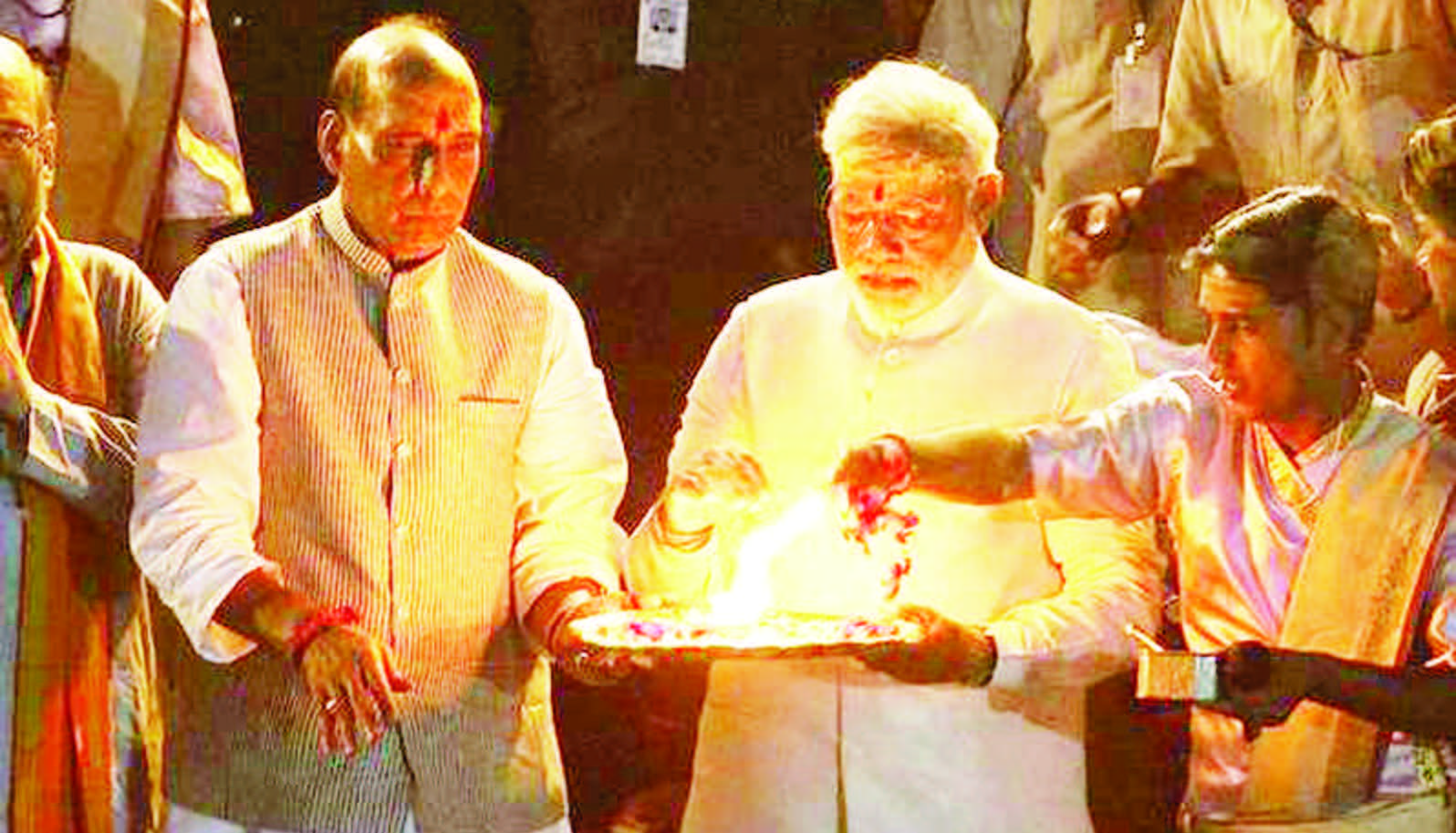
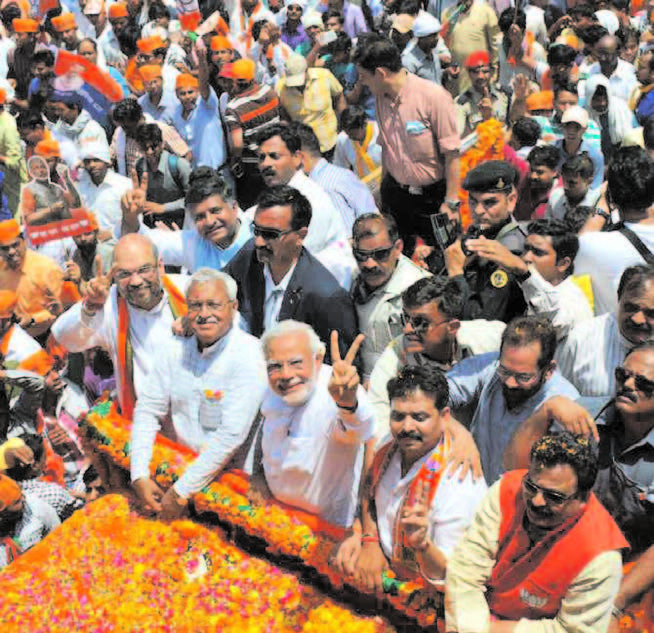
    If symbols speak, and in the layered culture deposits of the Gangetic plain they do speak loud, one of the most memorable spectacles was Prime Minister Narendra Modi’s visit to Kashi Vishwanath Temple on March 4, 2017.

    It was preceded by a roadshow in the narrow, winding streets of Varanasi all decked up for the grand effect, following the garlanding of the statue of Pandit Madan Mohan Malaviya at the Benares Hindu University. Within the temple precincts itself Mr. Modi appeared the great performer, oozing a burst of energy, while the archakas were transfixed in the archaic layout of the ancient temple complex. Place this spectacle alongside Mr. Modi’s salutation to ‘Ganga Ma’ at the Dashashwamedh Ghat of the river on May 17, 2014, a day after his victory from Varanasi Lok Sabha constituency, three years ago: and you have before you one of the most powerful symbols to reach out to the length and breadth of India, Shiva and Parvathi, alongside Ganga, and their complex personifications in myriad forms, the principles of dynamism and recreation, galore across India, in much more vivid forms than Ram lalan of Ayodhya.

    Yogi Adityanath, the new Chief Minister of Uttar Pradesh, himself heads a temple, the Gorakhnath temple, named after a representation of Lord Shiva, a representation that gathers in its fold elements of Buddhism, the tantra practices, the Nathpanthi traditions, and renouncer cults.

    Shiva in political pantheon

    While the Hindutva project is unlikely to shed Ram from its political pantheon, it would be worth watching the deployment of Shiva and Shakti sites spread across the length and breadth of the country, particularly in its peripheral regions. Lord Shiva is the lord of the dissenter, the renouncer, the wayward, the very captive of his devotee, the great patron of arts and crafts, the yogi par excellence, while he is at the same time the great destroyer, angry and disdainful of the social order. He inhabits the peripheries of the Brahmanical dispensation that stipulates a tightly ordered social universe. He is primarily the lord of the lower social orders, of the margins. He is the presiding deity across the vast expanses of the Himalayas, most of the southern part of India, and the hills and ghats where the Brahmanical order is precariously present.

    For the Hindutva ideologues, at least those who walk hand in hand with Mr. Modi, the conquest of Lord Ram’s place of birth at Ayodhya is over; what is important is to bind India together, its myriad differences and diversities through new bonds. Was the Prime Minister, who said little on the Ram Janmabhoomi issue during his numerous public meetings across the length and breadth of Uttar Pradesh, opening a new front for Hindutva? Are we, therefore, stepping into a religio-political project that was little seen as integral to Hindutva so far?

    Finger on the U.P. pulse

    The socio-political space that constitutes Uttar Pradesh today has always nurtured a complex internal debate with regard to the idea of India from the later part of 19th century. The great debate with regard to the future of Muslims in the subcontinent following the demise of the Mughal Empire was centred around this region in which the ulema of Deoband and Barelvi madrasas and later the Aligarh Movement played a decisive role.

    One always found in this region informal groupings of religious adherents, be they Hindus or Muslims, who did not toe the line of any one political party. Besides, after the abolition of the zamindari system this region, as a whole, was not much shaken up by the powerful agrarian and anti-caste movements that have had such powerful impact in the neighbouring region of Bihar.

    However, recent evidence suggests that a large number of traditional upper caste religious groupings in the region have been veering round to the Hindutva project, and orthodoxy has spread its appeal much wider among Muslims. The egalitarian social imaginary of the lower rungs among Hindus has thrown up new modes of religious gatherings, revitalised marginal deities, and much social effort has gone into the construction of shrines and temples and writing caste histories. The Hindutva expressions in this region have reached out to this imaginary while the other political formations in the region have had little say on it.

    The cryptic comment that Samajwadi Party leader Mulayam Singh Yadav made, that Chief Minister Akhilesh Yadav’s defeat is on account of his departure from Lohiawad, has a ring of truth about it, although the former himself reached out to this social imaginary very little. The secular hat that the Congress wears is totally disconnected from this groundswell. The Bahujan Samaj Party did little to disabuse the charge that the Prime Minister made in his election rallies that it serves the good of one against its claims to represent the many. Besides, the impermeable walls that the dominant discourse within this party erects across castes and communities makes it difficult for it to access complex modes of oppression and cultural nuances that play a decisive role in an electorally surcharged arena such as Uttar Pradesh.

    The strategy

    In sum, over the years there has been little attempt to make the deep diversities that crowd Uttar Pradesh speak to one another. The Hindutva project has succeeded in projecting itself as speaking to this diversity through a phalanx of organisations. Mr. Modi was only the presiding deity, the organising centre of this process. The Uttar Pradesh strategy also demonstrates that the Bharatiya Janata Party (BJP) will adopt very distinct strategies in different regions of India, with a few slogans such as ‘Sabka sath, sabka vikas’ as common.

    It is a pity to watch the plight of the Muslims in Uttar Pradesh if we ignore the local bravado on display in some places. The Hindutva project has been surreptitiously redefining the Muslim world in this region that has global ramifications. It has selectively extended support to the Sufi heritage, and Mr. Modi even addressed the World Sufi Forum in Delhi in March 2016. It has tried to win over a section of the Shias with an eye on Pakistan, Iran and West Asia, but also tapped the historic Shia-Sunni rivalry in the State to its advantage. It has not been sympathetic to the demand of Aligarh Muslim University for minority status and has expressed strong resentment against the relatively doctrinaire strand of Islam upheld by the Deoband madrasa. Organised Muslim political opinion has largely concentrated in carving out electoral strategies rather than propose ways by which people who subscribe to deep differences in beliefs and values but share much of everyday life in common can live together. The coexistence and toleration argument does not apply here because everyday life is deeply caught in conflicts and the language of sterile secularism does not offer a line of advance.

    The language of vikas that the BJP spoke during the electioneering, therefore, may have to be seen through the lens of this expansive Hindutva project. Everyone is welcome to participate in the common economic endeavour, but the normative and cultural codes of such an endeavour will be governed by this project. The invocation of Shiva and Shakti in this project that hitherto held firmly to a graded order and paternalism would have implications for Indian democracy that have been little envisaged so far.

    (The author is a former professor at the Centre for Political Studies, Jawaharlal Nehru University, and currently National Fellow, Indian Council of Social Science Research)

  • ASHOKA THE GREAT & PRINCIPLES OF CO-EXISTENCE

    ASHOKA THE GREAT & PRINCIPLES OF CO-EXISTENCE

    HG Wells, the British author, a contemporary of Bernard Shaw and GK Chesterton, wrote in his, Outline of History: “Amid tens of thousands of names of monarchs that crowd the columns of history – their majesties, and graciousness, and serenities and royal highnesses and the like – the name of Ashoka shines and shines almost alone, a star…”

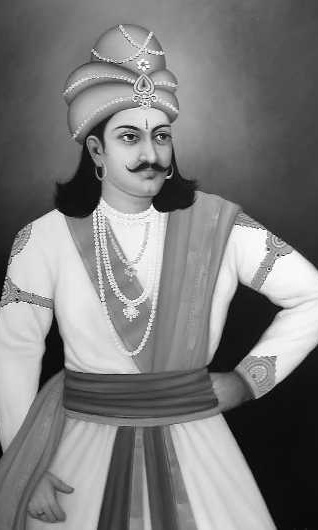
    He was Ashoka Devanampiya (beloved of the gods); ‘Piyadasi’ (pleasant to behold). He is the greatest ruler India has produced. He lived from 273 BC to 232 BC.

    Ashoka was the grandson of Chandragupta Maurya and the son of Bindusara. Ashoka’s empire extended from present-day Afghanistan to Madurai. The Dharama Chakra, incorporated into the flag of India, is taken from the Ashokan pillar at Sarnath.

    For almost two thousand years, Ashoka the Buddhist was all but forgotten. He himself left a detailed account of his reign on many pillars and edicts he built. Two pillars have survived in Delhi.

    Romila Thapar in her preface to her book, Ashoka and the Decline of the Mauryas writes: “The reign of Ashoka began to attract attention of historians well over a century ago. In 1837 James Prinsep came out with his work on Ashoka inscriptions in a series of papers. According to KM Panikkar, Ashok’s name was restored to honour as a “result not of Indian researchers but the work of European scholars.”

    I conclude this piece with two quotations from his edicts: “All sects deserve reverence for one reason or another. By thus acting a man exalts his own sect and at the same time does service to the sects of other people.” The second is: “All men are my children, and just as I desire my children that they should obtain welfare and happiness both in this world and the next, so do I desire the same for all men.”

    I have written this as I am reading Romila Thapar’s wonderful book, Ashoka and the Fall of the Mauryas.

    It gave me much pleasure when I read that the Nobel Prize citation and medallion (pure gold) which had been stolen by miscreants was recovered and returned to Kailash Satyarthi. I have so far not met him, but doubtlessly he is a noble and public spirited individual.

    It was in the early years of this century that Rabindranath Tagore’s Nobel medal was stolen from a room in which the poet lived. I was then External Affairs Minister. The Swedish government was gracious enough to send a replacement. This was handed over to me by the Swedish ambassador in New Delhi. I decided to take the medal to Shantiniketan to give it to the Vice Chancellor. From Kolkata Pranab Mukerjee and I flew by helicopter to Bolpur and then by car to Gurudev’s creation. There we were joined by Governor of West Bengal Gopal Krishna Gandhi, Lok Sabha Speaker Somnath Chatterjee and economist Amartya Sen. The ceremony was short and simple.

    I had first been to Santiniketan in December 1954 escorting a Chinese cultural delegation, led by Chen Tho, a great Tagore scholar. I remember his name because I saw much of him when I was posted in China 1956-58.

    One more significant memory of Santiniketan has stayed with me. The great Nandlal Bose (a pioneer of modern Indian art) showed me around Kala Bhawan, his creation.

    Here’s my list of the famous and the infamous politicians of the 20th century: Mahatma Gandhi (1869-1948), V. Lenin (1870-1924), Winston Churchill (1874-1965), M.A. Jinnah (1876-1948), Joseph Stalin (1879-1953), Franklin D Roosevelt (1883-1945), Adolf Hitler (1889-1945), Jawaharlal Nehru (1889-1964), Charles de Gaulle (1890-1970), Mao Tse Tung (1893-1976) & Nelson Mandela (1918-2013).

    Mahatma Gandhi is a class by himself. Lenin was a revolutionary, intellectual, founder of the Soviet Union, was ruthless. Winston Churchill arch-imperialist, racist, greatest Englishman and Nobel laureate. MA Jinnah was a brilliant lawyer, a clear-headed politician who knew what he wanted and got it (Pakistan). Joseph Stalin, founder of the USSR, killed millions of his own people. He led the Soviet Union to victory in 1945 World War-II.

    Franklin D Roosevelt was a great US President (four terms) except Lincoln. Adolf Hitler was a charismatic German leader and a brutal killer of millions of Jews. His autobiography Mein Kampf was a bestseller. He committed suicide. Jawaharlal Nehru was a noble humanist, a founder of modern India. Charles de Gaulle is the greatest Frenchman after Napoleon. He was an excellent writer in French and was President of France during 1958-1969.

    Mao Tse Tung was a revolutionary intellectual and the founder of the People’s Republic of China. He killed seventy millions of his people. Nelson Mandela is one of the great moral and political leaders of our time. He spent 27 years (1964-1991) in prison. A Nobel laureate, he was President of South Africa during 1994-1999. He died at the age of 95.

    (The author is an Indian politician, a former senior bureaucrat, a former Union cabinet minister, and a writer)

  • PREJUDICE MAKES NO DISTINCTION

    PREJUDICE MAKES NO DISTINCTION

    It’s time Indian-Americans in the U.S. involved themselves deeply in civic issues. Srinivas Kuchibhotla in Kansas, Harnish Patel in South Carolina, and Deep Rai in Washington, all well settled Indians in America, were shot at in a span of three weeks resulting in two deaths. The words repeatedly used by their assailants were, “go back where you came from.” While these are the most visible cases of attacks against Indian-Americans, the harassment of the community is far more pervasive since Donald Trump took office as U.S President.

    In my own family, spread throughout the U.S., we are hearing stories of insults and innuendoes. A niece in Maryland being told by a co-worker that she will have to go back where she came from, if she was not a citizen (she is); a friend in the DC suburb detained by the local police for ‘suspicious appearance’ and for not carrying an identification (she was simply taking a walk in her neighborhood as she has done for years). In our family WhatsApp group, we are constantly sharing stories we hear in our communities, reminding each other about carrying identification, staying away from bars in the Midwest, worrying that hate speeches about our ‘foreignness’ could easily end up in gunshots as it happened to the three victims of the crime. Needless to say, it has shaken the Indian-American community to its core.

    Faulty terms of engagement?

    For the longest time, we were proud to declare that Indian Americans were the true success story in the U.S. After all, even as a relatively young immigrant group (87.2%being foreign born) at 1% of the population (around 3 million), we could claim to have the highest per capita income ($88,000 median household income compared to all U.S. median at $49,800) and highest levels of education (70% of those age 25 and older with college degrees, two-and-a-half times the figure for overall population) of any ethnic group.

    We could boast that Indians had truly arrived in America, as prominent writers, business leaders, academics, and even policymakers. We lived and breathed the so-called American dream; we bought expensive homes in American suburbs, sent our children to the best universities and reaped the benefits of the American system. But, by and large, we didn’t engage in the messy issues of civil rights, political participation, or racism. We thought these were not our issues.

    We remained attached to our country of origin, going back and forth frequently, contributing to local causes (after all, our dollars could go much further in India, and India surely needed help). Some of us also got very active in the politics of our homeland, especially when it came to right-wing Hindu causes. Like other immigrants, we nostalgically longed to hold on to our sense of belonging in the old country while moving forward with our lives in our adopted country. Secure in our successful American experience, we took the American part of our hyphenated identity for granted.

    From my perch as a leader of an international organization, I often criticized my fellow Indian-Americans for not strengthening their roots in America, not getting involved enough in the civic organizations in America, and not engaging enough in the American issues of the day. In the age of Trump, this is no longer just a good idea. Now the stakes have become dangerously high and the need visibly urgent. While the White House, including the President, continues to deny any relationship between the rhetoric and policies of the new government and the unprecedented spike in hate speech and hate crimes against South Asian, Arab, Muslim and Jewish communities, the truth is that the Trump presidency has emboldened latent racist and ultra-right nativist elements to come out in the open. This has to be the real wake-up call for the Indian-American community.

    During the election, a group of Indians, calling themselves “Hindus for Trump,” tried to make a distinction between themselves and other Indians, especially Muslim Indian-Americans, and other brown-skinned people, suggesting that they were different, that they should not be confused with Muslims and, therefore, should not be targeted. As political scientist Sanjay Mishra has pointed out, such an approach shows real ignorance about the fundamental dynamics of racism – treating all people of a particular color or ethnicity as an undifferentiated mass, “erasing individuality, distinctiveness and humanity.”

    Now, it is time for this well-to-do community to recognize that criminals who commit hate crimes are indiscriminate. As we know from the assailants of the three Indian victims, they confused their target for Iranians and Arab Americans, or Muslims. It didn’t matter that all three of them were well-to-do, living in comfortably prosperous communities.

    It’s time Indian-Americans joined hands with all Americans who suffer from racial, ethnic or social prejudice, Muslims, Arabs, African-Americans, Latinos or the LGBT community, to fight for what makes America the great country that it is, welcoming new immigrants eager to make a new life here, and in the process, constantly renewing the very idea of America, always in the process of becoming, not so much looking in the rear view mirror as moving forward.

    (The author is president emerita of the Asia Society and a senior adviser to the President of Columbia University)

  • Trump-Russia investigation erodes the U.S. President’s credibility

    Trump-Russia investigation erodes the U.S. President’s credibility

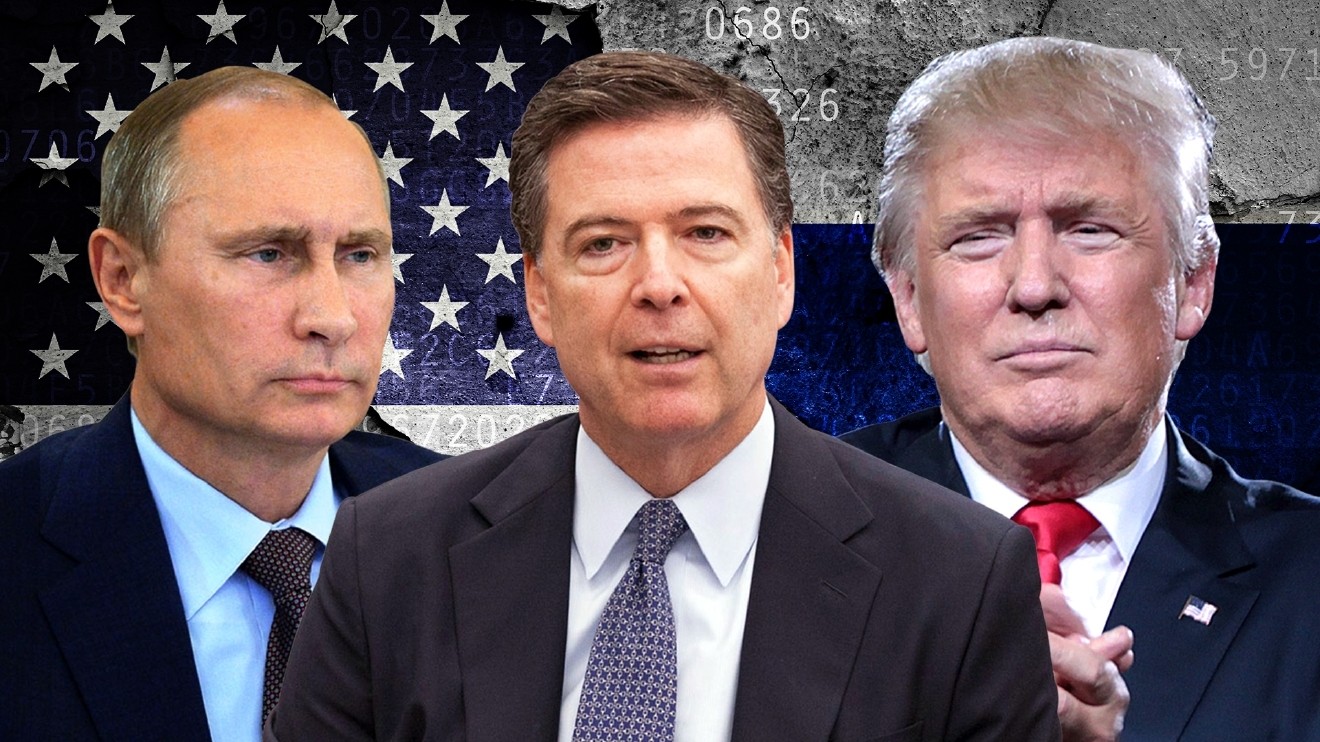
    The first open hearing into the alleged links between the campaign of Donald Trump and unnamed parties associated with the Russian government kicked off this week, even as the President put out a series of social media posts that seemed to mischaracterize statements coming out of that hearing.

    Ground-shaking revelations have come from the grilling of FBI Director James Comey and NSA Director Michael Rogers by the House of Representatives’ Intelligence Committee. The first was from Mr. Comey, who confirmed that the FBI was investigating Russia’s efforts to interfere in the presidential election, including links between specific individuals associated with the Trump campaign and the Russian government. Last month Mr. Trump’s nominee for National Security Adviser, Michael Flynn, resigned from his post after it emerged that he had withheld information about being in contact with Russia’s Ambassador in Washington prior to Mr. Trump’s inauguration. This month, Attorney General Jeff Sessions recused himself from the probe into alleged Russian meddling when it came to light that he had met the Ambassador prior to the election. Yet he continues to head the institution charged with the inquiry. Mr. Comey revealed that the FBI investigation began in July 2016, when evidence emerged that the Democratic National Committee had been hacked by Russia-related entities and emails handed over to WikiLeaks.

    Even as the U.S. intelligence community scrambles to put together the pieces of the Trump-Moscow puzzle, it has, ironically, found itself in the crosshairs of exposure. Earlier this month WikiLeaks released a trove of confidential CIA documents, a series labelled “Vault 7”, which showed the Agency’s penetration of the security systems of household electronic devices that could then be used for covert surveillance. While such timed “leaks” are meant to target his political opponents, Mr. Trump’s own tweets are at odds with revelations in the House hearing. In early March, he accused former President Barack Obama of ordering wiretaps on Trump Tower – yet Mr. Comey said neither the FBI nor the Department of Justice had any information to support that allegation. Mr. Rogers dismissed the White House suggestion that Mr. Obama had asked British intelligence to spy on Mr. Trump, a claim the U.K. has denied. The last straw came when the U.S. President’s account tweeted, as the hearing proceeded, “The NSA and FBI tell Congress that Russia did not influence electoral process,” only to have this statement debunked by Mr. Comey at the hearing, live on TV. Mr. Trump’s tendency to resort to unsubstantiated, even misleading, claims to stall a probe into alleged collaboration with a foreign power is not helping his credibility, which is already low in the eyes of so many Americans.

  • PUT FOREIGN POLICY IN PLACE:  ELECTIONS DONE, MODI MUST GET DOWN TO  SOME SERIOUS GOVERNING

    PUT FOREIGN POLICY IN PLACE: ELECTIONS DONE, MODI MUST GET DOWN TO SOME SERIOUS GOVERNING

    KC Singh

    Modi’s preoccupation with domestic politics may continue through the Delhi municipal elections or even till elections in Gujarat. But he must not let foreign policy issues adrift………The Prime Minister cannot alternate between a pugnacious fighter at home and occasionally a statesman abroad,” says the author – KC Singh.  

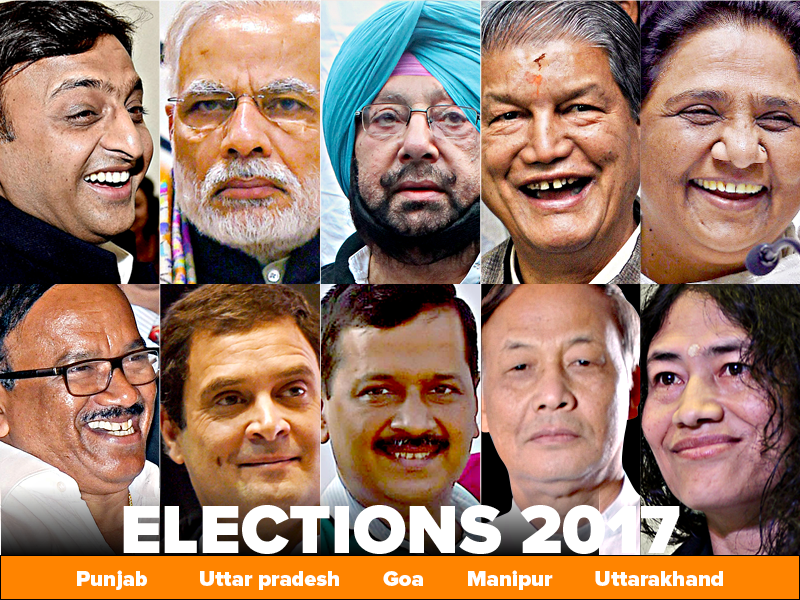
    March 11 marked a significant landmark for Modi’s evolution as a dominant national political force, the future of AAP and its leader Arvind Kejriwal and the fate of ‘young’ leaders, 43-year-old Akhilesh Yadav and 46-year-old Rahul Gandhi. The murmurs are the loudest in the Congress against leadership, particularly when despite winning more seats than the BJP in Goa and Manipur, the governments have been formed by the latter.

    After winning an unprecedented mandate in Uttar Pradesh, the most populous state of India, Modi could have shown humility in victory and espoused more collegial governance. Instead, he seems succumbing to hubris, as the BJP, particularly in Goa – despite their Chief Minister and six ministers being rejected by the electorate – have induced Independents, including those who campaigned on anti-BJP platform, with ministerial berths to devise an unethical coalition. The Supreme Court Bench of the Chief Justice disappointed in ignoring past guidelines in judgments and advice in commissions by worthy predecessors like Justices Sarkaria and Punchhi on how Governors should deal with split verdicts. Even if the swearing-in of Manohar Parrikar had to go ahead when the floor test was being advanced, how were all non-BJP supporters allowed to be sworn in as ministers?That clearly taints the process.

    The April-end municipal elections in Delhi are now critical for the Congress, and even more so for the AAP. Gujarat, where the Patel agitation and poor governance post-Modi has created political uncertainty, looms next and there is talk of election, due later this year, being advanced to keep opponents from regrouping. Gujarat is literally the last hurdle beyond which Modi’s path to re-election in 2019 should be clear.

    He is now like Indira Gandhi in her prime, the predominant figure to beat. But strange are the ways of the Indian masses as they both feed the rise of a strong leader and then resist power accumulation. The AAP in Delhi or the Janata Dal in Bihar benefited from this counter urge. Henry Kissinger in his book ‘On China’, comparing India and China, writes that the latter has continuously been a unitary state since 221 BC. India, contrariwise, only thrice: the Mauryas, Guptas and the British, as even the Mughals never controlled the entire south. Indira Gandhi realized after imposing the Emergency in 1975 that she now ruled over a sullen people waiting to punish her. Modi can ignore this lesson of history at his own peril.

    Meanwhile, the external Indian environment has evolved drastically while Modi has been in the domestic mode. Victory of Donald Trump and the coming elections in Europe, in the Netherlands on March 15 and then in France and later Germany, can rewrite the future of the European Union. President Xi Jinping of China, with greater power accretion than any leader since Mao, faces the quinquennial 19th party congress later this year when new faces that may lead China in future should emerge. While the fourth generation ruled from 2003 to 2012, it remains to be seen if Xi will pass the baton to a successor in 2022, accepting the 10-year leadership change principle, or will linger as China faces a slowing economy and a mutating and less benign global order. India-Pakistan relations continue to fester as Pakistan is far from isolated. They have just joined Saudi Arabia’s Sunni coalition by sending troops to defend their border with Yemen. Pakistani economy is also on the mend, returning to 5 per cent GDP growth.

    Modi’s preoccupation with domestic politics may continue through the Delhi municipal elections or even till elections in Gujarat. But he must not let foreign policy issues adrift. The first concern is to insulate gains in India-US relations over the last two US administrations from vagaries of Trump’s immigration policy, approach to Asia and global regimes. Second is India-Pakistan relations in state of persistent tension. That is hardly a strategy to deal with a nuclear weapon-possessing neighbor. Thirdly, relations with China are getting testier over India’s unwillingness to kowtow over the Dalai Lama while the Chinese become intransigent over Indian membership of the NSG and the listing of Pakistan-based terrorists by the UN Security Council sanctions committee.

    Pakistan policy has, time and again, been on hold while Modi fights domestic electoral battles, including subliminally using terror emanating from there as an electoral weapon. Starting with the Maharashtra and Jammu and Kashmir elections in 2014, it has been a recurring tactic. By what definition was the terror attack in Uri comparable to the 26/11 carnage or attack on Indian Parliament in 2001 or the 2006 Mumbai train bombings? When red-lines are shifted to the walls of Indian cantonments then peace is unattainable, as any two terrorists can disrupt it with, or without, Pakistani support.

    On the other hand, Pakistan in the last few months has been sending subtle signals. A new army chief, handpicked by PM Nawaz Sharif, appears in line with him. The detention of Hafiz Saeed and some associates may be a beginning that can be reversed or sharpened. Indian Punjab gets a new government with Capt Amarinder Singh, known to be sensitive to Punjabiyat, as a nebulous and diminishing link between the two divided Punjabs. Modi needs to test the window reopening for engagement and the calibrated resumption of normalization, or even talks.

    For a start, Indian NSA Ajit Doval needs to talk to his counterpart, who is a former general, with a line to army chief Gen Qamar Javed Bajwa. Signals at a recent India-Pakistan track II were that General Bajwa may indeed be the partner Nawaz has been seeking since 1998, when Vajpayee travelled by bus to Lahore. The cultural and ideological space needed for this can be created between the twin cities of Amritsar and Lahore.

    The Prime Minister cannot alternate between a pugnacious fighter at home and occasionally a statesman abroad. He has a limited opportunity to test Pakistani signals and build a consensus behind a new approach to Pakistan. Forcing Pakistan deeper into Chinese arms complicates dealing with both, particularly in an uncertain Trumpian world, when the need to defend Indian diaspora, whether holding Indian citizenship or not, can sour relations. The foreign policy ball has rolled back down the hill which Modi must, like Sisyphus, re-climb.

    (The author is a former Secretary, Ministry of External Affairs, Government of India)

  • Goa for BJP: Alchemy of making minority into a majority

    Goa for BJP: Alchemy of making minority into a majority

    As expected the Manohar Parrikar government in Goa was able to prove its majority on Thursday, March 16, following a Supreme Court directive. Once the Governor had decided to invite the former Defence Minister, Parrikar to form the government, even though the Congress had emerged as the largest party, the dice got loaded in favor of the BJP.

    In the end, the BJP with just 13 MLAs in a house of 40 managed to conjure up a slate of 22 legislators for voting in favor of chief minister Parrikar. The vote and the outcome are in perfect harmony with the Goan political culture of smaller parties and independents making themselves available for the highest bidder.

    As the BJP is politically ascendant nationally and is flush with resources and imbued with resourcefulness, there was little doubt about its ability to win this round in Goa. Even before the final vote on Thursday, the Congress was making allegations of money changing hands.

    It is the irony of our times that the winner not only gets to write the history but also re-writes the norms; it would be seen as cussedness to point out the ethical dimension of the denouement:  the BJP was in power and it lost the majority in the election, ending up with only 13 MLAs yet storming its way back into power.  Most curious and inexplicable is the case of all the three MLAs, belonging to the Goa Forward Party, siding with the BJP; in disgust, the GFP president, Professor Prabhakar Timble resigned from the party, accusing the BJP of inflicting a ‘political mafia raj’.  So be it. The BJP’s cocky leadership would have the satisfaction of having one more state government under its belt.  

    Within days all the righteous anger about a ‘stolen government’ would subside.  No one should be surprised if some of the Congress MLAs end up crossing over to the winning side.  Goa would return to its happy and carefree habits and preferences. Above all, Manohar Parrikar’s exile in Delhi ends. Goa gets a chief minister it deserves and the country will, hopefully, get a defence minister it badly deserves.


  • Case of the ‘stolen seat’: US Supreme Court Judge Gorsuch vs President Trump

    Case of the ‘stolen seat’: US Supreme Court Judge Gorsuch vs President Trump

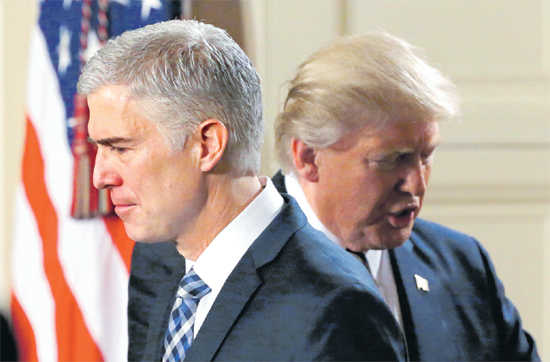
    One of the first acts of the new President Donald Trump was to announce the nomination of Judge Gorsuch, described by one columnist as ‘Scalia:2’

    Upendra Baxi
    Upendra Baxi

    While the description may not quite hold true (as many distinguished Justices of SCOTUS have shown that constitutional reason does not always follow political reason), the bargaining in nomination by the President and the ensuing process in the Senate confirmation proceedings shows the strength of the distinctive American political belief that what matters is judicial political ideology, or orientation, says the author – Upendra Baxi.

    Those made more anxious by the Supreme Court’s decision invalidating the constitutional amendment and the law in the NJAC (National Judicial Appointment Commission) case may find no solace in the American constitutional alternative of the Senate confirmation method. Last year, a Republican 54-46 seat majority refused to consider President Obama’s nomination (upon Justice Scalia’s death) of Judge Merrick Garland for 293 days, lest it may swing the delicate balance of judicial vote towards a liberal direction. Senator Merkley (Oregon) was to describe the vacant seat on the SCOTUS (Supreme Court of the United States) as a ‘stolen seat’! It was, however, insisted that the Senate was within its rights to refuse to consider a nominee until the inauguration of a new President.

    One of the first acts of the new President Donald Trump was to announce the nomination of Judge Gorsuch, described by one columnist as ‘Scalia:2’!  While the description may not quite hold true (as many distinguished Justices of SCOTUS have shown that constitutional reason does not always follow political reason), the bargaining in nomination by the President and the ensuing process in the Senate confirmation proceedings shows the strength of the distinctive American political belief that what matters is judicial political ideology, or orientation.

    The Senate Judiciary Committee decides after hearings to send nominations to the full Senate for a final confirmation vote. The 11 Republican and nine Democratic Senators chaired by Republican Chuck Grassley will decide on Judge Gorsuch’s confirmation (scheduled beginning March 20, 2017). At issue, more than ever before the full Senate, is the use of a filibuster — roughly, a form of prolonged speaking which obstructs progress in a legislative assembly but is not regarded as technically contravening the required procedures.

    Overcoming filibuster requires a 60-vote super-majority. Because the Republicans hold 52 seats in the 100-seat chamber (and a further potential tie-breaking vote in Vice-President Mike Pence), the use of filibuster means blockade of the nomination. President Trump has urged the use of the ‘nuclear option’ abolishing the filibuster altogether. However, informed opinion suggests this as an unlikely move and empirical estimates place Gorsuch’s confirmation potential vote between roughly April 17 and May 11, 2017. It remains to be seen whether the ‘nuclear option’ is still invoked.

    While in theory a filibuster move is possible, in practice the judicial confirmation is the most likely result. Of course, the hearings will intensely engage aspects of Gorsuch’s record: especially his perspectives on women’s rights, his apperceived anti-trade union decisions, and disinclination to promote campaign finance reform. But Opponents argue fiercely that the elevation will jeopardize the independence of judiciary.

    Neil Gorsuch, at 49, is no doubt a distinguished Justice of the United States Court of Appeals for the Tenth Circuit. But he is often compared with Justice Antonin Scalia, whose death caused the vacancy now being filled. Gorsuch was part of an appellate panel, in the Hobby Lobby case, that ruled in favor of the owners of a chain of craft stores who entertained a moral objection to providing an insurance plan that covered contraception. This was a decision that partially undermined the Affordable Care Act, an Obama flagship legislation. A wider implication of this decision may affect future laws under the banner of religious freedom. In his concurring opinion, Gorsuch defended religious freedom which ‘doesn’t just apply to protect popular religious beliefs’: rather, most importantly, the task lies in ‘protecting unpopular religious beliefs, vindicating this nation’s long-held aspiration’ to ‘serve as a refuge of religious tolerance’. He argued that the Act would force businesses ‘to underwrite payments for drugs or devices that can have the effect of destroying a fertilized human egg’.

    Gorsuch has not so far directly ruled on abortion rights, but some suggest that he would militate against Roe v. Wade. And his adherence of ‘originalism’ (looking only at the text of the Constitution), so favorite of Justice Scalia, raises a spectra of a conservative agenda.

    As a former clerk to the Justice Anthony Kennedy, traditionally a swing voter on the court, the governance hope is that Justice Gorsuch will be able to sway Justice Kennedy, and even persuade him to retire (he is already 80) thus causing another apex vacancy.

    No doubt, Justice Gorsuch would be questioned closely about his views at the Senate hearings, especially by the Democratic Senators. The questions will extend to his views on gun control, racial discrimination, torture, and even on military matters such as decisions to invade foreign lands in the name of preserving democracy or fighting terror (the so-called policies of putting ‘boots on the ground’). Such grilling may not affect the outcome, not just because of political arithmetic but because justices do not respond to hypothetical questions. And very often what Justices say during confirmation hearings is not necessarily what they will do at the apex court in adjudicating constitutional disputes.

    But the Senate hearings will witness deep controversy on the independence of the judiciary. President Trump did not do full justice to his exalted constitutional position when he, in an infamous tweet, describes the ‘opinion of this so-called judge, which essentially takes law-enforcement away from our country, is ridiculous and will be overturned!’ And he went further: ‘What is our country coming to when a judge can halt a Homeland Security travel ban and anyone, even with bad intentions, can come into US?’ He also told his almost 24 million Twitter followers that he, ‘Just cannot believe a judge would put our country in such peril. If something happens blame him and court system. People pouring in. Bad!’ Apparently, the President overlooked that Judge Robart (who stayed his order) was an appointee of Republican President George W Bush and won Senate confirmation in 2004 by a vote of 99 to zero!

    Incidentally, it must be said no Indian political incumbent has gone so far as Trump despite deep differences over the supremacy of adjudicative power. There is a grudging respect, even political grace, in the Indian acceptance of robust judicial independence as a constitutional virtue.

    Justice Gorsuch is reported to have critiqued the action of the President as ‘disheartening and demoralizing’. He will most certainly be probed to enunciate further his perspectives on judicial independence, so far taken for granted in the US. The majority NJAC discourse of the Supreme Court of India may well be meaningful for the Supreme Court of the US.

    (The author is a jurist and a legal luminary)

  • Robust turnouts in the Assembly elections defy anxieties about voter alienation

    Robust turnouts in the Assembly elections defy anxieties about voter alienation

    Voter turnout estimates are often revised for a final tally by the Election Commission, but by all accounts the current round of Assembly elections has witnessed deepened participation.

    In the final, and seventh, phase of the Uttar Pradesh elections on March 8, the turnout for the 40 seats was initially estimated to be 60.03%, an increase of more than 2% over 2012, and hovering near the average for all the seven phases.

    In the second phase of Manipur’s election the same day, for 22 of the total 60 constituencies, the turnout in three-quarters of the booths was reckoned to be more than 86%. In Punjab, which went to the polls on February 4, the turnout was 77.4%, marginally less than the 78.2%registered in 2012.

    In Goa, which also voted on February 4, it was about 83%, indicating a marginal increase since 2012. And in Uttarakhand, which voted on February 15, early estimates put the turnout at 65.64%, against the 2012 turnout of 67.22%.

    We must await the final estimates, though it is clear that none of these States has come close to matching Tripura’s Assembly election turnout of 90-plus. Even so, the voter participation in these elections has once again proved to be far-fetched the ever-hovering anxiety about voter fatigue, if not cynicism.

    Indeed, in comparison to other mature democracies with their problem of low voting by the young, the so-called millennials, in India voter enthusiasm cuts across class and age. And as the 2014 Lok Sabha election turnout indicated, it has also bridged the gender gap, with the EC reckoning it has come down to 1.46 percentage points, from 4.42 in 2009.

    At first glance, these figures are a repudiation of the worries about voter choice that keep afloat ideas such as deepening the None of the Above (NOTA) option on voting machines to include the right to reject.

    In fact, ethnographic studies suggest that the Indian voter perceives voting day to be a special one, with a celebratory camaraderie at the polling booth reflecting a determination to make her vote count. And with turnouts generally rising as one goes from parliamentary to State to local polls, it is clear that personally felt outcomes matter most to voters. Besides, as the higher turnout in the Malwa region compared to the rest of Punjab this year indicates, where the party competition is keenest, voting is higher.

    Nonetheless, the old thumb rule about higher turnout meaning an anti-incumbent vote is a thing of the past. Psephological data are rich with the reasons that motivate a vote, and each verdict must be read separately. The decreasing gender gap is one to particularly celebrate.

    From the first election in 1951-52, when millions of women did not figure in the electoral rolls as they would not share their names, to the conversations on the sidelines of these elections, with women asserting they’d vote differently from their husbands, India has come a long, though not long enough, way. (The Hindu)

  • The Rise and Fall of Globalization

    The Rise and Fall of Globalization

    Globalization is stuck between Labor markets /Tax havens and Terrorists

    The middle class in UK revolted against EU -seamless borders and trade and in US the victory of Trump is a big blow to Globalizers. He is unenthusiastic about Davos. The rise of Le Pen in France and Geert Wilders in Holland represent back to national sovereignty. Le Pen recently said in Koblenz “nation state” is back”, says the author.

    Throughout the seventies and eighties, it was globalization [The G word] of manufacturing facilities that is Product Markets. The anecdotal evidence often told in many a business school classrooms used to be like this. The doors of the Ford car are made in Barcelona and the seat cushions near Budapest and gearbox in the suburbs of Paris and music system in Osaka and the assembly is done at Shanghai and the car is sold in Thailand. So, what is American about it? It is transnational and the geographical boundaries are crumbling and think global and act local we were told, and the term “glocal” came into existence. This was the ultimate in the process of global integration of economic activities through integration of manufacturing facilities to reduce cost, take advantage of pool of skilled resources available in the emerging markets. It also argued about “standardization “of live styles -mostly the American standards- in terms of Jeans, processed food and cola drinks.

    Then the nineties saw the globalization of Financial Markets. You want to set up a facility in Chennai then you can think of raising funds from New York stock exchange or European Banks if the project is found to be attractive. Funds were looking for markets and “geographical diversification” became the buzzword. The pension funds were one of the largest investors running into nearly 18 trillion USD and at least 15 to 20 % of this was in non-domestic markets. The Funds started searching for markets instead of markets trying to attract funds. The life expectancy in the Europe and US increased significantly and the pension funds were to earn for longer period since old people have to be provided for. Then came the idea of consumption led growth and greed as the norm. On May 18, 1986 Ivan Boesky gave the commencement address at the University of California at Berkeley’s business school. “I think greed is healthy,” he told his wildly enthusiastic audience. “You can be greedy and still feel good about yourself.” A few months later Boesky was indicted on the charges that would land him in Southern California’s Lompoc Federal Prison, also known as Club Fed West.

    The melt down of 2008 has impacted the idea of globalization. Suddenly countries which are supposed to be de-coupled from the global markets are considered smart. Not only that -The US congress included a “buy American” clause in the USD 787 billion stimulus package-2009- particularly mandating the use of U.S funded projects, it was clear that protectionism has trumped globalization. As a response, China has a “buy Chinese” clause in its stimulus package. So, the whole game is unravelling on the G front.

    Interestingly, some US experts are suggesting a new grouping of G-2 to guide the world-This G-2 will have US and China as members. China has sold billions of Toxic Toys [chemical laced] to the USA and USA in turn has sold billions of its Toxic Treasury Bills to China. Hence there is a Mexican standoff between the two in Globalization sphere. Interestingly except India nobody is talking About the G-word in the Financial or Product sphere. Now Post-Trump victory Davos “Experts” wanting China to lead Globalization. Irony died multiple times!!

    But the third and most important dimension of globalization is in the context of the Labor Markets to allow free flow of human beings to carry out brown collar work in the west.

    There is aspecterhaunting the West. It is the specter of uncleared garbage, clogged drains and overflowing sewerages. It cannot be outsourced so easily as that of white collar work since the latter has significant content of software portion while as brown collar work still has requirements for human beings at locations. In the fifties and the sixties, millions of the Turks and Kurds and Iraqis went to Germany when that economy was booming and they were/ are called guest workers. The Algerians and Moroccans went to France and continue to be a significant minority in France and also active in their Soccer teams. More than a million Mexicans in USA are called “undocumented”-euphemism for “illegal”. These workers in France / Germany / USA etc. were mainly in the blue and brown collar jobs more so in the lower skill categories like cleaning restrooms and restaurants / meat cutting / grape picking/domestic help/ road laying/ garbage processing/plumbing/ handyman jobs; babysitting etc. The Demographic decline of Europe needed outside labor. Then came the economic slump in the early 2000 and these European countries have erected fences and reject visas etc. for third world labor.

    The mass migration due to civil war in Yemen and Syria has added to the issue. If financial markets want a borderless world so be it for the labor markets but it is not acceptable by the West since they treat G as a one way street. Hence the presence of the “minutemen” in Arizona who will shoot illegals and rhetoric by Obama about Bangalore taking away the jobs from Buffalo and Trump talking about a wall and Brexit to split EU.

    No truly global “world order’ has ever existed. What passes for order in our time was devised in Western Europe nearly four centuries ago, at a peace conference in the German region of Westphalia, conducted in 1648 after the thirty years’ war. Nearly a quarter of the population of Central Europe died from combat, disease, or starvation. The exhausted participants met to define a set of arrangements for the world. The principle of the sovereignty of states and the principle of non-intervention of one state in the internal affairs of another state

    Interesting, all these are questioned by contemporary leaders of West and radical Islam.

    Tony Blair the then Prime Minister of UK in his famous Chicago Address -1999-suggests”The most pressing foreign policy problem we face is to identify the circumstances in which we should get actively involved in other people’s conflicts. Non -interference has long been considered an important principle of international order….

    “But the principle of non-interference must be qualified in important respects”. The NATO intervention in Kosovo and Afghanistan as well as US intervention in Iraq provide recent examples of breakdown of idea of Westphalia.

    Interestingly, Radical Islam also consider that the world order based on Westphalian consensus will collapse. “In the aftermath of the 11 March 2004 Madrid attacks, Lewis ‘Atiyyatullah, who claims to represent the terrorist network Al-Qaeda, declared that “the international system built up by the West since the Treaty of Westphalia will collapse; and a new international system will rise under the leadership of a mighty Islamic state.”

    The spread of ISIS across countries and activities of Boko Haram based in Nigeria in Kenya and Chad re-emphasis this point. Radical Islam do not accept territorial boundaries since it works for a global regime for global Ummah. The talk about Caliphate indicates that they are trans-border organizations.

    On the other side, we find global corporations transcending sovereignty in search of global profits. For this they use tax havens as a tool. Tax havens-numbering more than 70 jurisdictions-facilitate bank facilities with zero taxes and no-disclosure of the names and in many cases anonymous trusts holding accounts on behalf of beneficiary. In the case of Bahamas one building seems to have had tens of thousands of companies registered there.

    USA is literally waging war with major Giants like Amazon/Google/Microsoft etc. for not paying adequate taxes in USA in spite of being US based companies. Most of these companies have moved their profits to other Tax Havens.

    A simple method of trade mis-invoicing by global companies using tax-havens have impacted developing countries nearly 730Billion USD in 2012 says Global Financial integrity. There is an increasing clamor in USA and EU about closing down these tax havens.

    So,Globalization is stuck between Labor markets /Tax havens and Terrorists.

    The middle class in UK revolted against EU -seamless borders and trade and in US the victory of Trump is a big blow to Globalizers. He is unenthusiastic about Davos. The rise of Le Pen in France and Geert Wilders in Holland represent back to national sovereignty. Le Pen recently said in Koblenz “nation state” is back.

    In this, the traditional division of Left and right have lost its meaning. In BREXIT, we saw left supporting EU and part of right opposing it. Now, the new divisions are Globalizers versus Nation states both from left and right.

    (The author is a professor of Finance at IIT, Bengaluru).

  • Turn focus on West Asia – Collectively, the Gulf countries constitute India’s largest trading partner

    Turn focus on West Asia – Collectively, the Gulf countries constitute India’s largest trading partner

    We have risen to the occasion to actively engage oil-rich neighbors to our west, where over six million Indians reside and remit back over $50 billion annually. We can also be proud that we have dexterously maneuvered to avoid being drawn into the sectarian Shia-Sunni, Arab-Persian and other rivalries in the region. PM Narendra Modi has skillfully established an Indian strategic profile with key players in the region by his visits to Saudi Arabia, the UAE and Qatar, while seeking to forge an energy and a connectivity partnership with Iran, based on shared interests in Afghanistan and Central Asia”, says the author – G Parthasarathy.

    Swallowing considerations of national pride, after inheriting a bankrupt economy with collapsing exchange reserves forcing India to mortgage its gold in 1991, PM Narasimha Rao undertook a policy of economic liberalization. These measures not only radically changed the contours of domestic economic policies, but also led to closer economic integration with our economically vibrant eastern neighborhood. Quite logically, this new dimension in our foreign policy was labelled as ‘Look East’. In our western neighborhood, we continued with ‘business as usual’. The only significant change was our long overdue establishment of diplomatic relations with Israel.

    India is now, a quarter-century later, seizing the opportunities provided by the geopolitical changes that have followed the worldwide discoveries of shale oil and gas. Till barely five years ago, the OPEC cartel of oil producing countries, virtually held us all hostage to their whims and fancy because of their ability to raise oil prices at will. The discovery of huge resources of shale oil and gas, particularly in North and South America, Australia and even in parts of West Asia, has sent global oil prices crashing. It has also given new leverage to large consumers like Japan, China and India to get the oil-producing countries in our immediate western neighborhood, to deal on more mutually beneficial terms, with large neighboring oil and gas consuming countries.

    We have risen to the occasion to actively engage oil-rich neighbors to our west, where over six million Indians reside and remit back over $50 billion annually. We can also be proud that we have dexterously maneuvered to avoid being drawn into the sectarian Shia-Sunni, Arab-Persian and other rivalries in the region. PM Narendra Modi has skillfully established an Indian strategic profile with key players in the region by his visits to Saudi Arabia, the UAE and Qatar, while seeking to forge an energy and a connectivity partnership with Iran, based on shared interests in Afghanistan and Central Asia.

    Following the American-led military interventions in Iraq and Libya and the suffering inflicted on the hapless people of Syria by meddling from external powers like the US and Russia and regional powers like Turkey, Saudi Arabia, Qatar and Iran, millions of Syrians have fled from their homes. This is a region where national borders drawn at the end of World War I are susceptible to being redrawn. India has avoided getting drawn into these rivalries, from which there will be no real winners, while people suffer misery in countries like Yemen. The Trump administration’s first military operation in Yemen, undertaken a few days after he assumed office, was a fiasco. Pakistan has undermined relations with its traditional friends like Saudi Arabia and the UAE, by making promises of military assistance and then backing off in Yemen. China has, however, played its cards skillfully by keeping out of sectarian and civilizational rivalries, while securing substantial investment opportunities.

    This year began with India hosting the ruler of the UAE, Sheikh Khalifa bin Zayed. PM Modi had earlier visited the UAE, Saudi Arabia, Iran and Qatar. The FDI from the UAE, which is India’s 10th biggest foreign investor, has been increasing. Collectively, the Gulf countries constitute our largest trading partner, accounting for 15 per cent of our global trade. The UAE and Saudi Arabia are individually our third and fourth largest global trading partners. Yet another country, with which we need to cultivate closer ties, is Iraq, whose oil exports to India are rapidly expanding, like exports of Iran after the end of UN sanctions. Iraq, with its immense oil production potential can also become a good investment partner, in the energy sector. We need to look at possibilities of linking oil purchases to investment in Iraq. Naval cooperation is also increasing with the Gulf countries, where proximity gives us some advantages over China. Following the visit of Sheikh Khalifa, the Naval Chief, Admiral Lanba, has scheduled visits to the UAE and Oman

    We cannot, however, be sanguine about these developments as we are still perceived as a country which takes an interminably long time in finalizing investment decisions. Iran has always been a difficult partner, when it comes to issues of investment. While we now use the western Iranian Port of Bandar Abbas for the transit of our goods to Afghanistan, Central Asia and Russia, we appear to be facing delays in finalizing the terms of participation in the construction of the Chabahar Port. This project, given Pakistan’s disinclination to give us transit facilities and its propensity to squeeze Afghanistan by delaying transit of its goods, is crucial for both Afghanistan and India. It needs careful follow-up and monitoring at the ministerial level to remove bottlenecks.

    The tie-up with Arab monarchies will be reinforced during the proposed visit of the King of Jordan to India. Given our wise decision to delink our relations with Israel and the Palestinians, Jordan could serve as a good connecting point for visits of Indians, to meet leaders of the Palestinian Authority. Moreover, the monarchy in Jordan has continuously maintained a personal rapport with Indian leaders. We also have a moral obligation to stand by our principled position of supporting a two-State solution to the Israel-Palestinian issue, which while guaranteeing Israel’s security, also leads to the establishment of a viable Palestinian State.

    India has come a long way from the days in the 1970s, when Saudi Arabia threatened to cut off oil supplies if we did not close down the Israeli Consulate in Mumbai. Not surprisingly, then PM Indira Gandhi flatly rejected the Saudi demand, despite our foreign exchange reserves being precariously low. It is heartening that Mr Modi is undertaking a standalone visit to Israel in coming months. It was shocking how our defense and other ties with Israel were undermined in the recent past by some of our senior ministers seeking to keep a distance from meeting their Israeli counterparts because of narrow, partisan, domestic political considerations. Israel has been a reliable friend of India and has stood by us in times of conflicts, including Kargil. There is no need for us to be apologetic about our relations with the Jewish State, especially at a time, when many of our Arab partners are finding Israel a useful ally, amidst the sectarian and civilizational rivalries and tensions prevalent in the Islamic world.

    (The author is an Indian  career diplomat)

  • Time for a frank debate on freedom of speech and nationalism

    Time for a frank debate on freedom of speech and nationalism

    Bundle of nerves: Are we getting paranoid about freedom of speech?

    KC Singh

    The rise of Modi and the continued Cabinet slots for those preaching sectarian hatred is not much different from President Trump listening to the whisperings of Rasputin-like Stephen Bannon, erstwhile publisher of Breitbart News – the mouthpiece of ‘alt-right’, who is White House chief strategist”, observes the author – KC Singh


    Two events over the last few days, on opposite continents of the world, raise questions about the future of democracy in the US, the world’s most powerful, and India, the world’s most populous. On February 22, Srinivas Kunchibhotla was gunned down in Kansas, sharing a drink with a friend after work, by a white US navy veteran, in patently a hate crime. In India, at Ramjas College, New Delhi, a fracas broke out when BJP-aligned students’ union, ABVP, disrupted a function organized by campus students not aligned to them and invitees from JNU. The passively observant police intervened, more to rough-up the organizers than restrain ABVP disruptors. The allegation is that anti-national slogans were in the air.

    The attention got diverted from the melee when a young student, Gurmehar Kaur posted on social media placards denouncing the ABVP high-handedness, arguing that like her father – martyred fighting militants in Kashmir when she was little – she was unafraid to confront intolerance. The battle lines got promptly drawn, with intemperate remarks or tweets by an actor, a cricketer, a Union minister of state, and so on. In Gurmehar’s defense rose up senior journalists, retired soldiers, television anchors, etc. By nightfall, BJP spokesmen began distancing themselves from Gurmehar’s tormentors as their standard dubbing of any critic as anti-national did not work against a martyr’s daughter. The elections in UP also made it unwise to offend serving and retired servicemen.

    The distraction aside, the issues in the US and India are not that apart. The rise of Modi and the continued Cabinet slots for those preaching sectarian hatred is not much different from President Trump listening to the whisperings of Rasputin-like Stephen Bannon, erstwhile publisher of Breitbart News -the mouthpiece of ‘alt-right’, who is White House chief strategist. Both leaders prefer political rallies and one-way communication with chosen media outlets than transparent and frank interaction with the media. If Modi has never contradicted ministerial colleagues tarring the media with the abusive phrase ‘presstitutes’, Trump does one better by directly and almost daily referring to ‘The Fake News’. At a Florida rally, he confidently advocated -uncaring that independent media strengthens democracy – that media ‘is not my enemy, it is the enemy of the American people’. A former President, George Bush, has been constrained to contradict Trump’s condemnation of the media, despite both being Republicans.

    Both the racist killing of an Indian techie in Kansas and the ABVP use of violence to drown alternative views spring from identical philosophies and narrow visions. In case of India, it brings up the freedom of speech, while in the US it raises the spectra of nativism fed by a mix of xenophobia and fear of Islam. It is thus supremely ironical that while the Indian Government sends Foreign Secretary S Jaishankar to intervene with the US on the rising danger to Indian diaspora from white vigilantism, when under their noses similar intolerance is being happily marketed daily from election platforms in UP.

    Illustratively, RL Stevenson related the story about George Meredith, author of the 19th century novel, The Egoist, written to purge Victorian England of this evil, that when a young friend of the writer complained that the protagonist ‘Willoughby is me’, the writer replied: ‘No, my dear fellow, he is all of us.’

    The issues arising need a closer analysis. At stake in India is the definition of freedom of speech. Having inherited the common law-based criminal justice system from the British, India clings to antiquated laws on sedition. In the US too, immediately after their independence they enacted a sedition Act, which was allowed to lapse in 1801 as the nation matured and gained self-confidence. Following the Bolshevik Revolution in Russia, the fear of Communism made the US pass the Federal Espionage Act in 1917. Thus, while the British Common Law treats freedom of speech as ‘residual freedom’, circumscribed by societal needs of morality and public order, the US Supreme Court started treating it as a ‘fundamental right’ flowing from the First Amendment from 1925. In 1969, it upheld the right of students to wear black bands to protest Vietnam War. Justice OW Holmes ruled that while a nation is at war, many things that can be said in time of peace are taboo, but the test has to be whether there is ‘clear and present danger’ of sedition, not merely the expression of an opinion or a thought. What a person, in the exercise of his freedom of expression, is doing must be more than public inconvenience or annoyance, or even unrest.

    India, with a concept of ‘Fundamental Rights’ borrowed from the US practice has to assess if what happened at JNU earlier, or now at Ramjas College, passes the Holmes test. The definition of nationalism cannot be crafted in Nagpur and implemented by an evangelical lynch mob. Is that not the same question that the US is today required to answer, whether ordinary whites carrying guns can ask any non-white to prove their immigration status, or why they are in the US at all. So, the diaspora that came to Madison Square Garden to chant ‘Bharat Mata ki Jai’, in response to Modi’s incantations, are being put to the kind of test of loyalty that misguided flag-carriers of the BJP, or fringe organizations of the Sangh Parivar, have been putting to their own countrymen. How does India ask Trump to be more considerate when President Obama reminded the Modi government before emplaning for the US in 2015, in his speech at Siri Fort, that Article 25 ensured freedom of conscience and it was the government’s responsibility to uphold it.

    While it is true that the Indian geo-political environment does compel the government to be ever-alert to forces endangering Indian territorial integrity or sovereignty, but surely campus students holding placards, or sloganeering do not compose such a threat. As Voltaire, some say wrongly quoted, said: ‘I disapprove of what you say, but I will defend to the death your right to say it.’ Perhaps like the US Supreme Court, India’s highest court needs to re-balance the fundamental rights and the State’s obligations, and in the process, re-educate the lawyer-ministers of the BJP.

    (The author, KC Singh, is a former Secretary, Ministry of External Affairs, Government of India)

  • Measured rhetoric: President Trump’s gaffe-less surprise

    Measured rhetoric: President Trump’s gaffe-less surprise

    US President Donald Trump sounded upbeat as he addressed a joint session of Congress for the first time. He condemned the murder of Srinivas Kuchibhotla, who was shot dead in Kansas by a white veteran, just as he deplored the vandalism of a Jewish cemetery. He spoke of a “new chapter of American greatness”, and said the country was seeing a “renewal of the American spirit”. In short, he sounded presidential-something not quite seen since he took over as the 45th President.

    Many of the campaign promises were, predictably, repeated. The rhetoric, too, was familiar. The speech was woefully devoid of specifics, but he did spell out his agenda in a gaffe-less and measured manner, without the shrillness that has often dominated his pronouncements. He managed to reassure NATO, even as he asked the member-countries to “meet financial obligations”. He promised a strengthened military. He spoke of his replacement for Obamacare and addressed concerns about coverage of pre-existing health conditions. Trump outlined a huge $1 trillion infrastructure package, and said that he would give “massive” tax relief to the middle class. As expected, he was tough on immigration, and promised to “demolish and destroy” the ISIS.

    It is clear that Trump’s mindset remains intact. Some details were fleshed out in the address; there was a wisp of nuance, on the immigration issue for instance; he refrained from attacking the Press this one time. However, what was most notable about President Trump’s address was not its content, but the moderate tone he adopted. It may be tempting to believe that the change in tone could be a case of the office asserting itself on the individual. Even if this is reading too much, in one performance, Trump’s address did manage to reassure the American people and the world at large that he was not a loony. A moment of relief.

    (Tribune, India)

  • IN PAKISTAN, IT’S MIDDLE CLASS RISING

    IN PAKISTAN, IT’S MIDDLE CLASS RISING

    The contradictions within this class will now set the future course for Pakistan’s economy and its politics

    S Akbar Zaidi
    S Akbar Zaidi

    Attempts to quantify Pakistan’s middle class, largely based on income and the purchase of consumption goods, show that as many as 42% of Pakistan’s population belong to the upper and middle classes, with 38% counted as “the middle class”, says the author – S Akbar Zaidi.


    The general perception still, and unfortunately, held by many people, foreigners and Pakistanis, is that Pakistan is largely an agricultural, rural economy, where “feudals” dominate the economic, social, and particularly political space. Nothing could be further from this outdated, false framing of Pakistan’s political economy. Perhaps the single most significant consequence of the social and structural transformation under way for the last two decades has been the rise and consolidation of a Pakistani middle class, both rural, but especially, urban.

    Class categories transformed

    As academics know, signifiers of social categories such as “class” are no longer fashionable and we work in an environment which no longer theorizes about classes of any kind. The political category of class has been replaced by numerous other categories such as “institutions” and other more generic and broader substitutes.

    This is particularly the case in Pakistan, where while there is much literature on Pakistan’s over-determined military, there is some on the judiciary, media, gender, but little research and academic engagement with the social and structural transformation which results in how the nature of class composition has changed over time. The previous, more simplistic and simplified class categories such as feudals, industrialists, and “the working class” have not only been transformed but are also now even more problematic. In this academic environment, where there is little research of core social categories, trying to identify and calculate the size of the middle class becomes particularly difficult.

    While a definition, and hence estimation of Pakistan’s middle class, or middle classes, has not been easy, the term has acquired much prominence in social and anecdotal references. Increasing references to the middle class – durmiana tubqa – both as a political category but also as an economic one, occur more regularly in the media. Often, Pakistan’s middle class is referred to by the consumer goods that it has increasingly been purchasing, from washing machines to motorcycles. But more importantly, the term is used for those having an active political constituency and presence. In many ways, the terms used in India after Narendra Modi’s 2014 election, of an “aspiring” or “aspirational” class – also somewhat vague but nevertheless signifying some political and developmentalist notion -have also found some currency in Pakistan.

    Attempts to quantify Pakistan’s middle class, largely based on income and the purchase of consumption goods, show that as many as 42% of Pakistan’s population belong to the upper and middle classes, with 38% counted as “the middle class”. If these numbers are correct, or even indicative in any broad sense, then 84 million Pakistanis belong to the middle and upper classes, a population size larger than that of Germany and Turkey. Anecdotal evidence and social observations, supplemented by estimates other than what people buy, would also support the claim that Pakistan’s middle class is indeed quite formidable.

    Girls shining

    Data based on social, economic and spatial categories all support this argument. While literacy rates in Pakistan have risen to around 60%, perhaps more important has been the significant rise in girls’ literacy and in their education. Their enrolment at the primary school level, while still less than it is for boys, is rising faster than it is for boys. What is even more surprising is that this pattern is reinforced even for middle level education where, between 2002-03 and 2012-13, there had been an increase by as much as 54% when compared to 26% for that of boys. At the secondary level, again unexpectedly, girls’ participation has increased by 53% over the decade, about the same as it has for boys. While boys outnumber girls in school, girls are catching up. In 2014-15, it was estimated that there were more girls enrolled in Pakistan’s universities than boys – 52% and 48%, respectively. Pakistan’s middle class has realized the significance of girls’ education, even up to the college and university level.

    In spatial terms, most social scientists would agree that Pakistan is almost all, or at least predominantly, urban rather than rural, even though such categories are difficult to concretize. Research in Pakistan has revealed that at least 70% of Pakistanis live in urban or urbanizing settlements, and not in rural settlements, whatever they are. Using data about access to urban facilities and services such as electricity, education, transport and communication connectivity, this is a low estimate. Moreover, even in so-called “rural” and agricultural settlements, data show that around 60% or more of incomes accrue from non-agricultural sources such as remittances and services. Clearly, whatever the rural is, it is no longer agricultural. Numerous other sets of statistics would enhance the middle class thesis in Pakistan.

    Rise of the ‘youthias’

    It is not only in economistic, or more specifically, consumerist, terms, that the middle class has made its presence felt, but also politically. The “naya Pakistan” of today is dominated by middle class voices and concerns. The “youthias”, as they are called, a political category of those who support Imran Khan and his style of politics, are one clear manifestation of this rise, as is the large support in the Punjab of Nawaz Sharif and his Punjab Chief Minister brother, Shahbaz Sharif. The developmentalist agenda and the social concerns of the Khyber Pakhtunkhwa government which is ruled by Imran Khan’s party, and those in the Punjab where the Sharif family dominates, are representative of this new politics. Free laptops, better governance, more information technology, better schooling, better urban health facilities, jobs for the educated youth, the right to information, and so on, represent government initiatives to appease this political category.

    Vague, expectational foundations from Europe and other western countries, that the middle class is necessarily democratic, tolerant and secular, have all come undone by events in recent years. The expectation that the middle class is necessarily “liberal” no longer stands.

    In the case of Pakistan, on account of many decades of a forced Siamization discourse, backed up by Saudi funding and growing jihadism, one might argue that Pakistan’s middle class is “Islamist”, very broadly defined, and also socially conservative and intolerant, pro-privatization and pro-capital. Yet, social and structural transformation, from Internet access to girls’ education and social media activism, also results in trends that counter such strict formulations. While still probably socially conservative, contradictory counter-narratives would suggest that there is a large noticeable tension which exists within this category of the middle class which questions a simple categorization of its ideological moorings.

    A politics hardly progressive

    It would be trite, though not incorrect, to argue that Pakistan’s middle class is in an ideological ferment and transition, but its aspirations do not extend to groups and social classes outside its own large category. They are not interested in the working classes or their issues, they are comfortable making economic and political alliances with large capitalist landowners and industrialists, many of whom have close links with the military. At present, the politics of this middle class is a far cry from even a soft version of the term “progressive”. It is the multiple fractions within the middle class which have been dominating the political and developmentalist agenda in Pakistan. It is going to be the contradictions within this middle class which will now set the future course for Pakistan’s economy and its politics. Perhaps from the fringes of this middle class, one could possibly expect the emergence even of progressive forms of politics.

    (The author, S Akbar Zaidi, is a political economist based in Karachi. He teaches at Columbia University in New York, and at the IBA in Karachi)

  • ‘Huge blessing in small virtues’

    ‘Huge blessing in small virtues’

    Sheila Chaman, the one time most admired newsreader on Doordarshan and now a Delhi based freelance journalist sent me, the other day, a piece ‘Huge blessing in small virtues’ by Maj Gen SPS Narang (Retd). She came across the article in The Tribune, liked it and forwarded it to me. Thank you, Sheila. The author’s forceful narrative of a moving incident carries an extremely tender, human message which I am sharing with the readers of The Indian Panorama.

    Like a large percentage of secular Indians, I have an incident to share which may awaken the conscience of some of my fellow men. The incident goes back to nearly a year, and even now evokes poignancy in my heart.

    Last November, I was driving back to Dehradun from Chandigarh – a fascinating four-hour journey, with the added attraction of visiting Paonta Sahib Gurdwara. I had to break on the way to give myself and my car some rest. And what better than entering the abode of the Guru. Besides the soothing kirtan, it is the langar that one savors, seated on the floor among a multitude of people from all walks of life. Some partake of all meals as they have no means to satiate their hunger.

    Breaking bread with them gives an indescribable spiritual high, and to experience this, one doesn’t have to belong to any one religion. I, too, enjoyed the langar and came out to get on with my journey.

    I stopped to buy some knick-knacks from a kiosk outside the gurdwara. Just then, I spotted a family of Gujjars (Muslims nomads who rear cattle in semi mountains and sell milk), in an intent discussion in front of a tea vendor. The family comprised an elderly couple, two middle-aged couples and four children. Three women were partially veiled. They seemed poor as the eldest gentleman (probably the father) counted coins and some crumpled notes.

    Undoubtedly, the issue was how much they could afford to buy. They asked for three cups of tea and four samosas (popular Indian snack).

    Gathering courage, I asked him, “Kya aap sab khana khayenge?” (would you all like to have food!!) They looked at one another with a mix of surprise, apprehension and a hurt self-respect.

    There was silence. Sometimes, silence can be loud. The innocent eyes of the kids were filled with hope. “Hum kha ke aaaye hain,” (we have eaten already) he responded.

    There was an instant retort, “Kahan khayaa hai subeh se kuch bhi, Abba?” (we have not eaten anything since morning, Papa!!)

    Hearing that, a dull ache in my chest caught me by surprise. The stern look in the eyes of the three men and the pleading moist eyes of the women said it all

    I insisted that they come with me. They agreed, reluctantly. We entered the gurdwara (Sikh Temple of God)

    A good feeling descended over me as I deposited their shoes at the jora ghar (Shoe deposit room in all Gurdwaras). The elders were awed by the architectural marvel.

    However, there was fear in their eyes, which was understandable. They were entering a non-Islamic place of worship for the first time.

    But the children couldn’t care less, their innocent faces single-mindedly focused on food. Some onlookers flashed strange looks from the corner of their eyes. But then I followed the children, adopting their easy attitude as they excitedly chose head wraps of different colors. (everyone is supposed to cover their heads inside a Gurdwara).

    Except for the eldest member, all accompanied me inside, and emulating me, bowed their heads and touched their forehead to the floor. Many others must have noticed, as I did, that these children went through this ritual with utmost reverence. They took Parshad (offering) from the Bhaiji (The Priest)) who asked them if they needed more. The children gladly nodded.

    We entered the Langar Hall and I took the kids along to collect thaalis (plates).

    They did it with joy, like only kids would. Seated opposite us was a newly-married couple. The bride, with red bangles accentuating her charm, asked the children to sit beside her, and two of them sat between them. The way she was looking after them, I could tell she would make a loving mother.

    Langar was served, and though I had already eaten, I ate a little to make my guests comfortable. One had to see to believe how they relished it. The initial apprehension had vanished and they ate to their fill. I have no words to describe the joy I experienced.

    We had nearly finished when an elderly Sikh and a youth with flowing beard (perhaps the head granthi and sewadar- helper) sought me out.

    I was overcome by fear, and more than me, my guests were scared. I walked up to them with folded hands.

    He enquired, “Inhaan nu tusi le ke aaye ho? (Have you brought them in?).” I nodded.

    The next question had me baffled, “Tusi har din path karde ho? (Do you say prayers every day?).” I almost blurted “yes”, but it would have been a lie. So, with utmost humility I said “no”.

    Expecting an admonishment, he surprised me, “Tuhaanu tha koi lorh hi nahin. Aj tuhaanu sab kuch mil gaya hai ji (You don’t need to. Today you have got everything).” I was flabbergasted. Was it advice or sarcasm? He added, “Inha nu Babbe de ghar lya ke te langar shaka ke tusi sab kuch paa laya. Tuhaada dhanwad. Assi dhan ho gaye (By bringing them to the Guru’s abode for langar, you’ve got everything from God. Thank you. We are blessed).”

    Then, with folded hands, he walked up to the elderly couple and requested them, “Aap jad bhi idhar aao to langar kha ke jaaiye. Yeh to uparwale da diya hai ji (Whenever you happen to pass through here, please come and have food. It is God’s gift).”

    I escorted my guests out of the Langar Hall. Just as we were about to pick our footwear, one of the children said, “Humme aur halwa do naa.” (Get us some more sweet offering). We five went in to get more parshad.

    Finally, as they were about to depart, the elderly lady whispered to her husband.

    I enquired, “Koi baat, Miyaji?” (is there any problem, Mian Ji!!

    Almost pleadingly, he said, “Yeh keh rahin ki, kya aap ke sar par haath rakh sakti hain? (She is saying, can she keep her hand on your head)!! I bowed as she blessed me with tears in her eyes.

    A wave of emotions swept over me.

    Is it my imagination, or for real, that I often feel the beautiful hand of a Muslim lady, wrapped in purity and love, on my head?

    This is the reason, we are secular.

  • The terror Frankenstein: ISI-nurtured terror groups have come to haunt Pakistan

    The terror Frankenstein: ISI-nurtured terror groups have come to haunt Pakistan

    With Pakistan on the back foot, the time has come for New Delhi to make use of the aversion for jihadi groups in Pakistan over the Sehwan outrage. A carefully crafted approach to relations with Pakistan needs to be adopted. New Delhi should remain firm on issues of terrorism by reiterating that there can be no question of reverting to business as usual till our concerns on Pakistan-sponsored terrorism in India and Afghanistan are addressed”, says the author – G Parthasarathy.

    Pakistan’s founder Muhammad Ali Jinnah, an Ismaili Shia by birth, proudly proclaimed, just prior to Pakistan’s independence, that the country he founded on the basis of religion would not discriminate against any of its citizens on the basis of religion. While the eastern half of his country was divided on the basis of ethnicity in 1971, what remains of what he initially called a “moth-eaten” Pakistan, is now finding that religion could indeed tear the country apart. Born into a Shia family, Jinnah could well be regarded as a “kaffir” by many in today’s Pakistan. Extremist Wahhabi-oriented groups, who since the days of Gen Zia-ul-Haq have received extensive support from the army, regularly target and kill those who are Shias, or even Sunnis, who are Sufi in orientation.

    The most revered Sufi shrine in Pakistan, where thousands of people of all sects and religions congregate and worship, is the shrine of Lal Shahbaz Qalandar at Sehwan, in northern Sindh. The shrine, built in 1356, was established in memory of the 13th century Sufi, Saint Syed Usman Marwandi, popularly known as Lal Shahbaz Qalandar, whose ancestors were devotees of the Imam Hussein, the Prophet’s grandson. Reza Shah Pahlavi, the last Shah of Iran, donated the shrine’s gold-plated main gate. For today’s jihadis in Pakistan, especially from groups like the Jaish-e-Mohammed, the Lashkar-e-Jhangvi and the Tehrik-e-Taliban Pakistan (TTP), that have received, or continue to receive ISI support, Sufi shrines are heretical, with its worshipers fit targets for elimination. This is precisely what happened on February 16, when a fanatical suicide bomber entered the shrine in the midst of prayers and triggered explosives, killing 88 devotees and wounding over 250.

    Not surprisingly, Pakistan reacted by passing the blame to others for its incredible follies in strengthening “militant Islam”, ever since the days of the anti-Soviet jihad. This policy was followed by its backing of the Taliban in Afghanistan and the use of its “non-state actors” for its jihad in J&K and elsewhere in India. The TTP was a tool of the ISI used to wage jihad against the Americans and pro-government forces in Afghanistan, post 9/11. The situation in Pakistan changed when the army, led by the ubiquitous Gen Raheel Sharif, saw the TTP establishing a presence over large areas beyond its traditional habitat and launched large-scale operations against it. This was done without General Sharif’s bothering to secure parliamentary approval. These operations led to escalating violence and displacement of nearly a million Pashtuns from their tribal homes, with many seeking refuge in Afghanistan. Thus, while the ISI continues to back the Afghan Taliban, the army is bogged down in a continuing conflict with the TTP, some of whose cadres operate across the disputed Durand Line, separating Pakistan and Afghanistan.

    The fact that Pakistan is still living in a world of delusion was evident from the reaction both by the government and the army chief, Gen Qamar Javed Bajwa, to the Sehwan attack. In an effort to establish that no Pakistani groups were involved, the ISIS and then an allegedly Afghanistan-based group – Jamat-ul-Ahrar – were blamed by Pakistan for the outrage. Indiscriminate attacks against alleged terrorist locations in Punjab, Sindh and Balochistan immediately followed the attack. Over 100 alleged “terrorists” were killed within hours, with the army also mounting attacks on alleged terrorist “hideouts” along the border. Officials from the Afghan embassy in Islamabad were summoned to the army’s GHQ and given a list of 76 “terrorists” said to be living in Afghanistan.

    General Bajwa also called the American commander in Afghanistan, Gen John Nicholson, warning that continuing attacks across the border were testing Pakistan’s policy of “cross-border restraint”. PM Nawaz Sharif’s adviser, Sartaj Aziz, spoke in similar terms to Afghanistan’s National Security Adviser Hanif Atmar. A logical question would be whether Pakistan has done anything to prevent its jihadis, including the Taliban, LeT and the Jaish-e-Mohammed, crossing the Durand Line, the LoC in Kashmir, or the International Border with India? Is it not a fact that groups once nurtured by the ISI are executing terrorist attacks within Pakistan?

    With Pakistan on the back foot, the time has come for New Delhi to make use of the aversion for jihadi groups in Pakistan over the Sehwan outrage. A carefully crafted approach to relations with Pakistan needs to be adopted. New Delhi should remain firm on issues of terrorism by reiterating that there can be no question of reverting to business as usual till our concerns on Pakistan-sponsored terrorism in India and Afghanistan are addressed. The cross-LoC strikes in September last year have set the precedent for India to appropriately respond to attacks on its soil by crossing established borders. Pakistan should be left in no doubt that it can no longer take Indian forbearance for granted.

    The recent invitations to India and Iran from Russia to attend talks in Moscow, along with China, Pakistan and Afghanistan, on promoting political reconciliation in Afghanistan suggest that there is growing realization that appeasing Pakistan on any proposed “Afghan led” peace process is counterproductive. India would do well to use these developments for stepping up economic and military assistance to Afghanistan and expediting the operationalization of the Chabahar Port. Moreover, it would only be logical for adequate time to be given to the Trump administration to evolve its policies on dealing with Pakistan-sponsored terrorism in Afghanistan and India.

    Pakistan should be reminded that it has not fulfilled its commitment made by PM Sharif at Ufa for talks between DGMOs of the two armies to address issues of cross-border terrorism. The growing sentiments in Pakistan against the attack on its most revered Sufi shrine should be taken note of. The existing agreements with Pakistan on group tourism and visits to shrines could be utilized to promote visits of Pakistani pilgrims to Sufi shrines in India, together with visits by musical troupes devoted to Sufi music. New Delhi has done well to facilitate participation by Indian writers in the Karachi Literary Festival. Reaching out to people getting disillusioned with Wahhabi extremism and violence in Pakistan, while standing firm on terrorism, enhances our credibility internationally.

    (The author is a career diplomat. He was High Commissioner of India to Pakistan in 1998-2000)

  • Mass deportations? The Trump Administration goes after immigrants

    Mass deportations? The Trump Administration goes after immigrants

    Despite judicial rebuffs on his ban on immigrants, President DonaldTrump appears to be intent on waging war on the American society’s most vibrant elements: the immigrants. The Department of Homeland Security is reported to have put in place plans “for aggressive enforcement of immigration laws.”

    The only saving grace is that the new administration has denied reports that it intended to deploy National Guards to round up the undocumented immigrants in the United States. And, though the Trump administration has emphasized that it will keep intact President Obama’s protection program for “dreamers”, the overall message the immigrants across the board have heard from the Trump White House is one of intimidation and fear. Also, the potential asylum seekers stand discouraged and forewarned. America will no longer be the first choice of the prosecuted.

    If President Trump has his way, the United States would be spending huge resources on making life simply difficult for the current and potential immigrants. The Trump White House wants to empower agencies like the Immigration and Customs Enforcement, Custom and Border Protection, as well as to build up a wall along the southern border.

    On their part the administration officials insist that President Trump is simply asking for a vigorous enforcement of the existing laws and that the law-enforcement agencies will be targeting mostly “criminals” among the immigrants.

    These caveats notwithstanding, President Trump has succeeded in making each and every immigrant edgy, nervous and fearful. The American law-enforcement agencies are neither known for their professional detachment nor for their racial broadmindedness. The leadership of the law-enforcing agencies remains with those who belong to “the Trump class”, mostly subscribing to the ugly notions of white supremacy.

    The rest of the world has reacted adversely to these signals. But the new American President has made it clear that he is not going to allow himself to be distracted from those loony ideas and prejudices that in the first instance propelled him to the White House. Nor does he appear bothered at playing the bull in America’s ethnic china shop.

  • Media and issues of responsibility

    Media and issues of responsibility

    The Indian media display certain defects. These should ideally be addressed and corrected in a democratic manner. But if the media prove incorrigible, harsh measures may be called for.

    The time has come when some introspection by the Indian media is required. Many people, not only those in authority but even ordinary people, have started saying that the media have become irresponsible and wayward, and need to be reined in.

    Only a couple of days back I read in the newspapers that the Union government has issued some regulations regarding licenses for news channels, to which there was a lot of reaction. Under the Constitution of India, freedom of the media is part of the freedom of speech guaranteed by Article 19 (1) (a). However, no freedom can be absolute, and reasonable restrictions can be placed on it. One of the basic tasks of the media is to provide truthful and objective information to the people that will enable them to form rational opinions, which is a sine qua non in a democracy. But are the Indian media performing this role properly?

    I may only mention certain defects in the functioning of the India media today.

    Twisting facts

    One of the defects is that the media often twist facts. I would like to give an example.

    One day, a leading English newspaper published on its front page a photograph of Justice Gyan Sudha Misra of the Supreme Court with the caption: “Supreme Court Judge says that her daughters are liabilities.” This was a distorted and fallacious item of news, published on the front page.

    Supreme Court Judges have to disclose their assets and liabilities. Against the liabilities column, Justice Misra had written: “two daughters to be married.” Strictly speaking, it was not necessary to mention this because liabilities mean legal liabilities, for example, housing loan, car loan, and so on. Justice Misra’s intention was obviously to say that she would have to spend on her daughters’ future marriage. She has three daughters (no son), only one of whom has been married. Justice Misra never said, nor intended to say, that her daughters were liabilities. The news was false and defamatory, with the obvious intention of creating a sensation.

    Paid news

    A second defect concerns the issue of paid news that has become prominent of late. In the 2009 elections, it was a scandal. How this vicious practice could be stopped needs to be discussed. Incidentally, in compliance with an order of the Chief Information Commissioner dated September 19, 2011, we have placed the 71-page report of the Committee consisting of Paranjoy Guha Thakurta and Sreenivas Reddy on our website, www.presscouncil.nic.in with the disclaimer that the Press Council had rejected this report at its meeting held on April 26, 2010.

    Non-issues as real issues

    A third defect is that the media often portray non-issues as real issues, while the real issues are sidelined. The real issues in India are economic, that is, the terrible economic conditions in which 80 per cent of our people are living, the poverty, unemployment, lack of housing and medical care and so on. Instead of addressing these real issues, the media often try to divert the attention of people to non-issues. Such as that the wife of a film actor has become pregnant, whether she will give birth to a single child or to twins, and so on. Are these the real issues facing the nation?

    At a Lakme India Fashion Week event, there were 512 accredited journalists covering the event in which models were displaying cotton garments, while the men and women who grew that cotton were killing themselves at a distance of an hour’s flight from Nagpur, in the Vidharbha region. Nobody told that story, except one or two journalists, locally.

    Is this a responsible way for the Indian media to function? Should the media turn a Nelson’s eye to the harsh economic realities facing over 75 per cent of our people, and concentrate on some ‘Potemkin villages’ where all is glamour and show biz? Are not the Indian media behaving much like Queen Marie Antoinette, who said that if the people had no bread, they should eat cake?

    No doubt, sometimes the media mention farmers’ suicides, the rise in the price of essential commodities, and so on, but such coverage is at most 5 per cent to 10 per cent of the total. The bulk of the coverage goes to showing the life of film stars, pop music, fashion parades, cricket and astrology.

    Tendency to brand

    Here is a fourth defect. Bomb blasts have taken place near the Delhi High Court, in Mumbai, Bangalore and so on. Within a few hours of such a bomb blast, many TV channels started showing news items that said that the Indian Mujahideen or the Jaish-e-Mohammed or the Harkatul-Jihad-e-Islam had sent e-mails or text messages claiming responsibility. The names of such alleged organizations will always be Muslim ones. Now, an e-mail can be sent by any mischievous person, but by showing this on TV channels and the next day in the newspapers, the tendency is to brand all Muslims as terrorists and bomb-throwers.

    The truth is that 99 per cent of the people of all communities, whether Hindu, Muslim, Christian or Sikh, and of whatever caste or region, are good. But the manner in which such news is shown on TV screens and published in newspapers tends to create the impression that all Muslims are terrorists, and evil – which is totally false. The person who sends such e-mails or text messages obviously wants to create hatred between Hindus and Muslims, which is the old British divide-and-rule policy continuing even today. Should the media, wittingly or unwittingly, become part of this policy of divide-and-rule?

    No doubt there are defects not only in the media but in other institutions also, for example, the judiciary, the bureaucracy, and so on.

    There are two ways to remove these defects in the media. One is the democratic way, that is, through discussions, consultations and persuasion – which is the method I prefer. The other way is by using harsh measures against the media, for example, by imposing heavy fines on defaulters, stopping government advertisements to them, suspending their licenses, and so on.

    In a democracy we should first try the first method to rectify the defects through the democratic method. For this purpose, I have decided to have regular get-togethers with the media, including the electronic media, so that we can all introspect and ourselves find out ways and means to rectify the defects in the media, rather than this being done by some government authority or external agency.

    I propose to have such get-togethers once every two or three months, at which we will discuss issues relating to the media and try to think of how we can improve the performance of the media so that it may win the respect and confidence of the people.

    If the media prove incorrigible, harsh measures may be required. But in my opinion, that should be done only as a last resort and in extreme situations. Ordinarily, we should first try to resolve issues through discussion, consultation and self-regulation. That is the approach which should be first tried in a democracy. I, therefore, request the Union government to defer the implementation of its recent decision regarding news channel licenses, so that we can ourselves discuss the issue thoroughly, and ourselves take corrective measures.

    Till now the function of the Press Council was only adjudication. I intend to make the Press Council an instrument of mediation in addition, which is in my opinion the democratic approach. For this purpose, I need help, cooperation and advice from the media.

    India is passing through a transitional period in its history, from a feudal agricultural society to a modern industrial society. This is a very painful and agonizing period. The media must help society in going through this transitional period as quickly as possible, and by reducing the pain involved. This they can do by attacking feudal ideas, for example, casteism and communalism, and promoting modern scientific ideas.

    (This is the edited text of a speech delivered by Justice (retired) Markandey Katju
    (Courtesy The Hindu)

  • THE SUM OF ALL FEARS – THE REAL DONALD TRUMP AND RUSSIA’s PUTIN

    THE SUM OF ALL FEARS – THE REAL DONALD TRUMP AND RUSSIA’s PUTIN

    The undeserving Donald Trump pretty just keeps on proving to America that his presidency was just going to be a pathetic continuation of his presidential campaign, squashing all hopes that he might suddenly come to his senses and start acting like a responsible adult who must now lead a country.

    Donald Trump’s weird relationship with Russia has been problematic and suspicious from the beginning of his presidential campaign.

    Read more about Trump’s Russia Ties

    Never before had we seen a President praising a leader of another country like the way Trump gushed about Russian leader Vladimir Putin or admitting that our country the United States of America is not no innocent.

    Trump continued effort to defend Russia as reports of the country’s interference in the U.S. election started to be released. There were red flags everywhere, and they continue to pop up again and again while Trump continuously tried to distract Americans from it with his Twitter temper tantrums about “fake news.”

    Another concerning report has just been released by CNN, and this makes Trump and his team look even more suspicious than before.

    Apparently, the White House has requested that the FBI “publicly knock down media reports about communications between Donald Trump’s associates and Russians known to US intelligence during the 2016 presidential campaign.”

    The report states: “White House officials had sought the help of the bureau and other agencies investigating the Russia matter to say that the reports were wrong and that there had been no contacts, the officials said. The reports of the contacts were first published by The New York Times and CNN on February 14.

    That certainly sounds shady – and the FBI knows it.

    According to the report, the FBI shot down the White House’s request and said no.

    For Trump’s team to be contacting the FBI directly is highly unusual due to “decade-old restrictions on such contacts”, according to CNN, and we should definitely be paying attention.

    Clearly, the Trump administration is extremely worried about what might be uncovered and wanted to take the focus off Trump’s ties with Russia by asking the FBI for this ridiculous favor.


    Read More

  • AMERICAN DEMOCRACY & CLASH OF CIVILIZATIONS

    AMERICAN DEMOCRACY & CLASH OF CIVILIZATIONS

    President Donald Trump’s executive orders are ill-conceived and deeply flawed. They speak volumes of the style of governing of a man who won his race to the White House more as a populist that as a Republican. We are unquestionably at the cusp of the most shockingly despotic Presidency the US has ever seen. – BY Shelley Walia.

    Shelley Walia
    Shelley Walia

    Even as the most developed countries take welfare steps to enhance the lives of the poorest citizens, we are experiencing a fascist movement towards rising demagoguery and populist nationalism. This promotes the restoration of a polity based on perceived assumptions of the superiority of race, ethnicity and culture resulting in hate-mongering. Broadly, the move towards a closed, inward-looking nationalist political mindset visible in the construction of the wall on the Mexican frontier and the ban on Muslims has sent shock waves through the international system.

    The common assessment of Trump’s executive orders suspending travel to the US by citizens of seven nations is that they are misguided and deeply flawed. Any law divorced from justice is not a law; it is an instrument of tyranny, and in this case of the white supremacists persecuting in the name of origins or nationality. However, it is also possible to consider a more sinister theory: Trump and his coterie of radical right wingers like Steve Bannon, the member of the National Security Council, whose agenda sets out to rock the very foundations of the polity, appealing to their base and further solidifying the “us-vs- them” narrative.

    In such a dismal scenario, Trump, the all-powerful bully firmly ensconced in the Oval Office, can dismiss the attorney general for insubordination, and take on the role of the messiah to the White masses in the inevitable clash of civilizations. The Press, which is the voice of reason and can speak truth to power, has been gradually and purposefully delegitimized in a post-truth world. Thus, in the absence of a powerful counterpoint in the Republican-controlled Legislature, even though the emperor has no clothes, what emanates from Trump is now the word of God. The executive order speaks volumes of his nativism and bellicosity, a style of governing by a man who won his race to the White House more as a populist that as a Republican. We are unquestionably at the cusp of the most shockingly despotic Presidency the US has ever seen.

    People on the margins who have always been an asset to the American economy now find themselves to be outsiders. Those who helped America to fight her wars against terrorism find themselves in an indeterminate state. The Silicon Valley has slammed the decision. As the history of the last few decades tells us, the 9/11 terrorists had origins in Egypt, Lebanon, UAE and Saudi Arabia, while the killings in Orlando, San Barnardino or Charleston were committed by either US citizens or white supremacists. Not a single American has been killed by terrorists from these seven nations (Iran, Iraq, Syria, Yemen, Libya, Somalia and Sudan) in the last four decades, while 2,369 American citizens have been killed by terrorists from Saudi Arabia, 314 from UAE and 162 from Egypt. Moreover, Iran or Iraq who stood up against the terrorist organizations should not have been banned. The most notable omission is perhaps Pakistan, the locus of a number of terrorist groups.

    Apparently, there is no rational basis for this provocative policy which in reality would further stimulate Islamophobia, a provocative western discourse that is a substantiation of the core narrative of the clash of civilizations and thus a victory for the terrorist agencies. It has been seen that the key ways in which power operates in societies is by setting up groups and versions of the “other” who can be both excluded from the opportunities of support and well-being that society may offer and scapegoated as the cause of social and political problems. The Western liberal discourse constructs the idea of the orthodox or superstitious East or a rabidly fundamental Islam, ignoring the overwhelming contributions of marginalized groups who over time establish themselves as integral components of a civil society.

    Donald J. Trump’s ban on immigrants is easily the most divisive, racist and authoritarian move, bitterly reviled by the liberals and ardently praised by the conservatives. His slogan to “Make America Great Again” is largely to take back America from the hands of the “vile” immigrants, who contaminate the White race with their peculiar identities, language and culture. Mexicans are rapists, Muslims are terrorists, and Blacks are self-destructing in a maelstrom of drugs and violence. Never mind the foundation of American democracy built on a non-discriminatory political system that permits millions to journey to its shores to seek a better life. Immigration, and with it, the healthy blend of diversity and multiethnic racial, religious and cultural identities is the cornerstone of any democracy.

    The eruption of protests against the desultory attitude of the state indicates the extent to which a multicultural society can be deemed to be morally and culturally pluralistic. Reactions from Paris, London and Berlin have come fast and furious. President Trudeau’s invitation to refugees to alternatively settle in Canada or the German Chancellor Angela Merkel’s elaboration of the essence of the Geneva Convention are open rebukes to Trump’s anti-liberal embargo. We see increasing disgust and despair as the public protests against the rise of ethnic nationalism and xenophobia. The American Civil Liberties Union (ACLU) has supported the protest against the ban on the grounds that it violates due process of law, the equal protection clauses of the constitution, the federal statutes, the Immigrant Nationality Act, and more than anything the 1st Amendment which prohibits discrimination on ethnic or religious grounds. The judicial review of the ban would hopefully work as a bulwark against unconstitutional acts of the state.

    In keeping with the exploitation of fear-mongering that underpins Trump’s entire political career, he has chosen to punish innocent people fleeing persecution and hardships. At the moment 60,000 refugees seeking asylum have undergone the tedious process of passing the rigorous immigration tests, including biometrics, but are now in a limbo. The ban is indeed an attack on the basic American values and its national policy of unequivocally allowing refugees into the country – a compelling testament of American democracy with its inherent vouchsafing of human rights and diversity. The robust backlash against the flurry of Trump’s injunctions signifies an act of resistance. It gives the people an opportunity to enter the field of hard politics and helps bolster the legitimacy of their stand. Behind the debate lies the hope for a meaningful change in racial attitudes, through an enraged fervor seen in progressive movements expressing existential anxieties and political responsibilities when a psycho-social distress overwhelms the land. Trump’s actions have indeed, generated an environment of overwhelming power and rancor threatening any meaningful dialogue between diverse religious and ethnic groups. Faith in reason seems to be at stake.

    Shelley Walia
    Shelley Walia

    (The author, Shelley Walia, is a Professor, Department of English and Cultural Studies, Panjab University, Chandigarh)

  • India-Pak amity is the only way to thrive

    India-Pak amity is the only way to thrive

    Mutual hostility between two nations that have in the past shared a common heritage, culture and history is self-defeating. A united subcontinent can be a formidable force. Can two poor nations so situated afford to be in perpetual conflict?”, says the author – GURBIR SINGH.
    The way forward is for the people of both Punjabs to rediscover their roots and common interests by free interaction as a first step towards reconciliation between the two nations.  Secondly, the RSS Chief has a choice between an “Akhand Bharat”: a confederation of India and Pakistan he advocates, or politics of division to win elections. As long as the Muslims feel insecure there can be no peace in the subcontinent. Thirdly, the Muslim clergy must rise above dogma and meet the concerns of their own and other communities”.

    The partition of Punjab between India and Pakistan in 1947 is perhaps the most important event in the history of modern India, second only to its Independence. We are reaping its consequences in terms of geopolitics, erosion of civil liberties, communalism of politics and poverty.

    The end of World War II marked the start of the cold war between the Soviet Union and the West. A Russian presence in the Indian Ocean was seen as a threat to the Middle East and its oil under western control. Therefore, the declared British policy was to transfer power to a strong united India to prevent a Russian entry therein. The failure of the Congress and the Muslim League to reach a settlement made Partition inevitable.

    The demand for Pakistan did not originate from the Muslim-majority provinces of Punjab, Bengal, Sind and the Frontier but from the United Provinces (UP). In UP, the Muslim minority feared an existential threat from Hindu organizations such as the RSS, the Hindu Mahasabha and the right wing of the Congress. Punjab was ruled by the Unionist Party, a coalition of Muslims, Sikhs and Hindus led by Sir Sikandar Hyat Tiwana, who dismissed the concept of Pakistan as “Jinnahstan”. His successor Khizr Hyat broke with Jinnah on this issue. In 1946, Jinnah and his Muslim League managed to communalize Punjab politics by painting a doomsday scenario where the Punjabi Muslims would be at the mercy of the Hindu majority in India once the British left. The same argument was used by the Hindu and Sikh leaders in reverse. Hence the Partition.

    The Governor of Punjab, Sir Evan Jenkins, repeatedly warned that the partition of Punjab as proposed would result in widespread massacre and damage to property. His warning went unheeded. A million Hindus, Sikhs and Muslims were brutally murdered and another 15 million forced to migrate from the land of their forefathers. Millions lost their properties and thousands of women were raped, abducted and forcibly converted to another faith.

    The damage of Partition is permanent. It altered the geopolitics of this region. China is strategically located as a Pacific Ocean power. It borders Russia, Central Asia, South Asia and South-eastern Asia. In contrast, India’s strategic location has been greatly reduced. Undivided India would have bordered the Islamic world and been an influential interlocutor on the world stage. This advantage shifted to Pakistan and China. Pakistan’s strategic alliance with China to balance India has allowed the Chinese armed forces to establish a strong military presence in the subcontinent for the first time in history.

    The Kashmir conflict which is directly related to the partition of Punjab has made the subcontinent amongst the most dangerous, bloodiest and costly places on earth. Pakistan inserted Pathan tribal insurgents and their copycats into India as an extension of its military strategy. The Pathans have since evolved into the Mujahideen, the Taliban, regional ISIS and Kashmir jihadis. Two armies who fought as one in the world wars face each other with hostility. Both are nuclear powers with the capacity for mutual destruction. The apprehension of a nuclear device falling into “Islamic jihadi” hands is real.

    The violence and chaos caused by the holocaust in Punjab influenced the Constituent Assembly into creating a strong executive armed with draconian powers and weak legislatures. Gurnam Singh, a retired High Court judge and Chief Minister, felt that India did not evolve into a traditional liberal democracy. It was a hybrid system, half-democratic and half-colonial where power was transferred from nominated British officials to an elected Indian executive without accountability. He cautioned Prime Minister Jawaharlal Nehru that the system was open to abuse of power, corruption and intimidation of opponents by implicating them in false cases or branding them as antinational. Little wonder that in a system with weak checks and balances, Prime Ministers can take major decisions like “notebandi” by an executive fiat, without reference to the public, legislature or even the Cabinet.

    In Pakistan, Jinnah promised a nation where all citizens were equal and there was “no discrimination, no distinction between one community and another”. Partition ended such sentiments. Inevitably, a state founded on sectarian violence and fear of a large Hindu neighbor turned to the military and the clergy for its identity and survival. This system has little space for non-Muslims, liberal democracy and social reform. India and Pakistan are a house divided against itself. They are an anomaly: Both are sovereign states and an integral part of each other by their origins, history and culture. Both states can pay heed to the three Franco-German Wars (1870-1945), which cost a hundred million lives. Today, the one-time enemies are close allies and economic partners to their mutual benefit. For the same reason, India and Pakistan need to be friends not enemies. Punjab was the cradle of Hinduism, Sikhism and the evolution of Islam in India. It had seen many invasions and religious conflicts. However, Muslim, Hindu and Sikh elites were integrated by a common language, culture and shared economic interests. The forced migration of Hindus and Sikhs radically changed the religious, social and intellectual structure of West Punjab. However, 70 years of separation and conflict cannot totally erase millenniums of shared bonds.

    [poll id=”2″] The way forward is for the people of both Punjabs to rediscover their roots and common interests by free interaction as a first step towards reconciliation between the two nations. Secondly, the RSS Chief has a choice between an “Akhand Bharat”: a confederation of India and Pakistan he advocates, or politics of division to win elections. As long as the Muslims feel insecure there can be no peace in the subcontinent. Thirdly, the Muslim clergy must rise above dogma and meet the concerns of their own and other communities. So far it has refused to come to terms with the damage it has caused. No doubt any radical departure from the status quo will meet with strong resistance and even violence on both sides. However, our politicians and opinion makers must appreciate that great issues are settled by statesmanship, courage and common sense in the face of seemingly insurmountable hurdles.

    (The author, an educationist, is the President of the Guru Nanak Education Trust, Ludhiana)