Tag: Perspective Opinion EDITORIAL

  • The message from two SC verdicts

    The message from two SC verdicts

    • The ruling party’s confidence should not prompt its supporters to shake foundations of Indian democracy

    “The Election Commission of India (ECI) was a fiercely independent institution when it was helmed by TN Seshan. Herein lies the sad story of Indian institutions. The character of most of these institutions changes with the person at the top. The court’s order on electoral bonds is a wake-up call for the ECI. Indian elections are free and fair. But the first-past-the-post system seeks its credibility entirely from the institution that conducts the polls. And if the conductor falters, the process gets easily accused of manipulation.”

    By Rajesh Ramachandran

    The Supreme Court’s judgments on the electoral bonds and the Chandigarh mayoral election are epoch-making. There cannot be a graver offence to democracy than anonymous election funding. Anonymity is synonymous with deception and corruption. While nameless funders possibly conceal their business and personal objectives, only transparency can help make the voter do a cost-benefit analysis between a funder and the funded political entity. So, it is imperative for the voter to know who is funding his or her chosen candidate.

    A local poll to elect a mayor became a test case, and the court has majestically ensured that the Indian system passes it to prove that it still works.

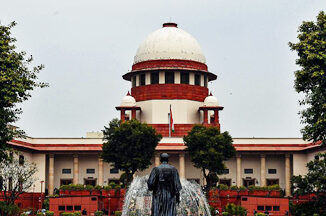
    By delivering a verdict annulling the electoral bond scheme, the apex court Bench headed by Chief Justice of India DY Chandrachud has saved the constitutional foundations of the Republic. This ruling, while enhancing the SC’s stature as the final institutional bulwark of constitutional morality, also points fingers at other constitutional bodies that have begun to behave like government appendages.

    The Election Commission of India (ECI) was a fiercely independent institution when it was helmed by TN Seshan. Herein lies the sad story of Indian institutions. The character of most of these institutions changes with the person at the top. The court’s order on electoral bonds is a wake-up call for the ECI. Indian elections are free and fair. But the first-past-the-post system seeks its credibility entirely from the institution that conducts the polls. And if the conductor falters, the process gets easily accused of manipulation.

    That is something the Indian democracy can ill afford, particularly in the context of all the barbs of it being an elected autocracy hurled by the Western academia and its media.

    Equally important is the SC verdict reversing the Chandigarh mayoral poll result. Presiding officer Anil Masih was caught on camera blatantly defacing ballot papers to make valid votes for the AAP-Congress candidate invalid. This was nothing short of ‘murder of democracy’, no doubt.

    A local poll to elect a mayor became a test case, and the court has majestically ensured that the Indian system passes it to prove that it still works. But how many such tests and shocks can the system withstand before it capitulates is a question that the votaries of the strong government need to ask themselves. A strong government derives its strength from the people’s conviction, not from arm-twisting tactics of its storm-troopers.

    Despite the two setbacks from the top court, the BJP is on an unassailable electoral upswing. The consecration of the Ram Temple in Ayodhya has created such a groundswell of religious goodwill for PM Modi among temple-going ordinary Hindus that it is now a mundane exercise for him to convert it into political capital for the polls. Then, of course, there is the added advantage of the Opposition remaining a house divided. Going by the last election’s schedule, there are less than 50 days left for the first phase of polling. Yet, the Opposition has not firmed up poll tie-ups.

    All those who may call the Indian democracy names after the elections should seriously look at the sorry state of the Opposition right now. As of today, it is not clear whether AAP and the Congress will have an alliance in Punjab. Even in Delhi, where a 4-3 formula of seat-sharing is being talked about, there is no official announcement so far. The Samajwadi-Congress alliance in Uttar Pradesh is the only one that has been sealed. Meanwhile, Rahul Gandhi has taken a break from his yatra to lecture at Cambridge, as if Oxbridge scholars’ votes count in Amethi or Wayanad.

    The urgency of a group preparing to take on a juggernaut is glaringly missing in the terribly slow pace at which Opposition parties move. Incidentally, the Left, which is the fulcrum on which the Opposition in Delhi turns, has announced its candidates, including the one who would take on Rahul, if he contests from Wayanad. But a political understanding with Mamata Banerjee that could have altered the scene in West Bengal is still eluding the Congress as the BJP tries to project itself as her biggest challenger in the state.

    Unless there is an unseen anti-incumbency storm gathering amongst the masses, there is no chance of a serious challenge to PM Modi’s electoral pole position in these circumstances. The possibility of a third term for Modi looks strong. However, that confidence should not prompt his followers to shake the foundations of Indian democracy — which is the message from the SC verdicts.

    A recent issue of The Economist magazine has a brilliant leader on the perils of national conservatism. In the context of the American elections, the magazine talks about Trump’s aides readying a programme “to capture the federal bureaucracy”. To eulogize Ronald Reagan and Margaret Thatcher as torchbearers of virtuous conservatism while condemning all newbie national conservatives as liberals opposed to multilateralism abroad and pluralism at home is obviously polemical. Reagan’s initiation into politics was as an FBI informer ratting out communists in Hollywood; but for the Falklands War, Thatcher would never have found her feet. Both appealed to fiercely nationalist sentiments.

    Nationalism is undeniably the core of conservatism. It suddenly cannot become dirty when bandied about by populists and anti-elites. But the difference now is the new attempt to subsume the entire system within the underbelly of the political executive. Indian bureaucracy has for some time now been caged parrots and pet falcons who sing and hunt for their political master. This situation cannot be blamed on any one party. A former bureaucrat, who had hunted down Subrata Roy for the UPA, was given cabinet rank long after retirement by a Left government this week.

    Well, the capture of the bureaucracy by the Indian political class predated the global trend of national conservatism. Nevertheless, the two SC verdicts point towards the slippery slope we have reached. All that is left between the pinnacle of proud national achievements and the abyss of complete systemic breakdown are a few constitutional bodies. Remember, there can be no Ram Rajya without strong democratic institutions!
    (The author is editor-in-chief of Tribune Group of Newspapers)

  • The Unyielding Spirit of Punjab Farmers

    The Unyielding Spirit of Punjab Farmers

    • Death of an Individual is not the end of an idea

    In the heartland of India, a battle is raging. The agrarian community of Punjab, resilient and united, is on a warpath, demanding fair prices for their produce and an end to oppressive government policies. The conflict has escalated as the government, seemingly serving the interests of capitalist cronies, remains adamant on enforcing controversial agricultural laws. This struggle, reminiscent of the past, echoes a powerful truth – the death of an individual does not extinguish the flame of an idea.

    A year ago, the farmers took to the streets, demanding the repeal of certain agricultural laws imposed by the Modi government. The initial response from the government was repression, attempting to stifle the movement. However, the farmers, standing united and supported by their counterparts from Uttar Pradesh and Haryana, refused to back down. Faced with the strength of this collective resolve, the government succumbed to pressure, promising to reevaluate and revise its agricultural policies.
    Despite assurances, the government failed to initiate substantial changes in agricultural policies. Disillusioned, the farmers resumed their struggle, realizing that the promises made were nothing more than empty words. The government’s lack of action fueled the flames of discontent, prompting the agricultural community to intensify their protests.

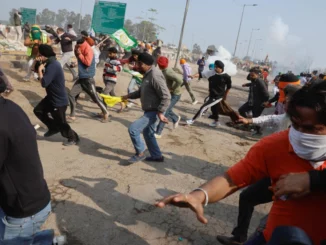
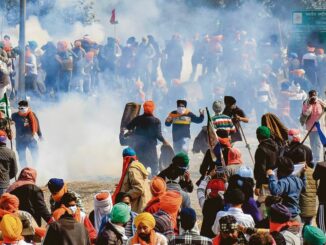
    In a disturbing turn of events, the BJP-led government, both at the central and state levels, unleashed repressive measures against the protesting farmers. Border points between Punjab and Haryana were barricaded to thwart the march to Delhi. The use of water cannons and, shockingly, reports of firing upon peaceful farmers became tools employed by the authorities to crush the dissent.

    The conflict reached a critical juncture when, as claimed by agitating farmers’ leaders, a 21-year-old award winning farmer Shubhkaran Singh was shot in the head by the Haryana police. Despite police denials of any firing, numerous farmers sustained injuries in the alleged incident. The agitating leaders also reported the disappearance of several farmers, accusing the government of using such tactics to instill fear among the protesting community.

    The government’s heavy-handed approach seems to be rooted in a short memory. A year ago, similar repressive measures failed to deter the farmers. The authorities forget that the death of an individual does not equate to the death of an idea. History is replete with examples of ideas that survived the demise of their proponents.

    Reflecting on history, we find poignant examples of individuals whose ideas endured despite their tragic deaths. Mahatma Gandhi, an apostle of non-violence, was assassinated by Nathuram Godse, who subscribed to the Hindutva ideology. Yet, Gandhism remains alive, shaping the moral fabric of societies worldwide. In the United States, Martin Luther King Jr., a champion of civil rights, was assassinated, but his vision persists, inspiring movements for civil liberties, justice and equality globally.The Punjab farmers’ struggle embodies the unbroken spirit of individuals united by a common cause. The government’s attempts to suppress dissent through repressive measures might temporarily subdue the protests, but history has shown that the death of an individual does not extinguish the flame of an idea. The farmers’ fight for fair prices and agricultural autonomy transcends individual tragedies, evolving into a movement that refuses to be silenced. As the echoes of protests reverberate, it serves as a stark reminder that ideas born from the collective consciousness of a determined community can withstand the harshest of challenges, ensuring that their voices are not easily silenced or forgotten.

  • Globalization has failed to spur cosmopolitanism

    Globalization has failed to spur cosmopolitanism

    Globalization has bred apprehension among self-appointed custodians of religion that their people are losing faith in old orthodoxies.

    “Analysts of early globalization told us that the unimpeded progress of a homogenizing juggernaut of culture would sweep everyone up in a common coil. But the process has also produced an intensified, even irrational, sense of a religious community and hostility towards others who are our fellow citizens, our neighbors, our friends, and our allies. The closing in of the Indian mind has pushed away syncretism and embraced tribalism around totems.”

    By Neera Chandhoke

    It  is, perhaps, the greatest paradox of our times that the advent of globalization in the 1980s and liberalization/privatization in India in the early 1990s has not been accompanied by the expansion of imagination and cosmopolitanism, but by the closing in of community boundaries. From the 1950s onwards, scholars and statesmen focused on ‘composite’ or ‘syncretic’ culture.

    In his 1987 essay, Prof Rasheeduddin Khan, who taught at the Centre for Political Studies, Jawaharlal Nehru University, had written that the Indian civilization was profoundly influenced by the Indo-Aryan stream, which provided the Vedic philosophy, and the Indo-Muslim strand, which was based on the intertwining of the Bhakti Movement and Islamic Sufism. He wrote: “It is not surprising… to realize that the composite culture in India originated in an environment of reconciliation rather than refutation, cooperation rather than confrontation, coexistence rather than mutual annihilation of the politically dominant Islamic strands.”

    Khan and other authors, including Aziz Ahmed, did not deny that there was violence between Hindus and Muslims in the medieval period. They creatively drew our attention to the fusion of two cultures in the creative field and in everyday life. The former was manifest in architecture and painting, the latter in shared worship at Sufi shrines and the increasing adoption of Urdu as the language of communication across vast swathes of India.

    Since the 1990s, the eruption of ethnic wars across the world and the rise of Hindutva in India have consigned this notion to the margins of history. No one wants to remember the syncretism that the postcolonial generations were brought up on. Religious communities have shut their doors and hatched them down against the Other — now defined as the enemy.

    This seems paradoxical in the context of the rapid transmission of the trans-border flow of information, new symbols, new ways of communication and new ways of producing and consuming things. We witness an immediacy to history. It brings wars in Ukraine and the Gaza strip right into our homes. We see the Oscars along with audiences in the west, read the same books, watch the same television series and movies and listen to the same music. Conflict zones in critical sites, as well as celebrations, are as real to us as our own sites of conflict, award ceremonies, sports, reading habits and music. We participate in political protests across the world; we follow the same fashion styles; we adhere to the same canon of aesthetics. There is no refuge, no safe haven against the violence we witness on our television screens.

    But globalization, which has produced its own discontent, has also intensified insecurity and anxieties about collective identity. We are back to the early decades of the 19th century, when Raja Ram Mohan Roy asked the question: Who are we? Roy used the wisdom of ancient sacred texts to critique extant practices, such as rituals, superstitions, fasts and belief in false prophets. He initiated a major movement of social reform against Brahmanical domination, gender discrimination and irrational customs.

    Today, we see the reinforcement of the same Brahmanical domination in the return of rituals, temple worship, fasts and the entry of saffron-clad ‘godmen’ in politics. The rediscovery of Hinduism in the 19th century brought social reform; the Hindutva campaign of the contemporary era has reinforced orthodoxy amidst globalizations.

    Analysts of early globalization told us that the unimpeded progress of a homogenizing juggernaut of culture would sweep everyone up in a common coil. But the process has also produced an intensified, even irrational, sense of a religious community and hostility towards others who are our fellow citizens, our neighbors, our friends, and our allies. The closing in of the Indian mind has pushed away syncretism and embraced tribalism around totems.

    Communities are, however, an invention. The hardening of boundaries is a reaction to factors that range from the insecurity that the community’s identity is in danger to the silver tongue of demagogues. This community rejects ‘strangers’. We have lost our syncretic culture and, alongside, we have lost our ability to be human: to suffer the pain of others, to shed tears with them, to rejoice in their victories, to be saddened by their defeats. We have, above all, lost the spirit of tolerance enunciated by Emperor Akbar.

    Akbar’s tolerance was described in the memoirs of his son and successor Jahangir: “Followers of various religions had a place in the broad scope of the peerless empire — unlike other countries of the world, like Iran, where there is room for only Shi’ites, and… Turan (Central Asia), where there is room for only Sunnis. Just as all groups and practitioners of all religions have a place within the spacious circle of God’s mercy, in accordance with the dictum that the shadow must follow its source, in my father’s realm, which ended at the salty sea, there was room for the practitioners of various sects and beliefs, both true and imperfect, and strife and altercation were not allowed. Sunni and Shiite worshipped in one mosque and Frank and Jew in one congregation. Utter peaceableness was his established way.” We ignore this message only at our own peril.

    Globalization has not spurred cosmopolitanism; it has bred apprehension among self-appointed custodians of religion that their people are losing faith in old orthodoxies, and that the radical project of challenging caste, class and patriarchal hierarchies in a global civil society will strip these ‘defenders of the faith’ of power.

    In the process, we have become lesser human beings.

    (The author is a Political Scientist)

  • Swimming against the current: How Suozzi won the special election

    Swimming against the current: How Suozzi won the special election

    The media is dumbfounded at how Suozzi won in an increasingly red district. The answer is simple: follow policies and programs that make common sense and benefit the people, and you will have their vote. Tom Suozzi has just proved that point to the nation!

    “There is little doubt that Suozzi won in a Republican majority district because of his sensible stand on several issues. He didn’t shy away from discussing the border crisis. For many of the residents in the Bellerose-Floral Park area, the migrant crisis is no longer an issue affecting Texas or Arizona. The migrants are at their doorstep as the city has housed hundreds of them on the grounds of the Creedmoor Psychiatric Center. It has unsettled many of the residents in the area, who are concerned about the safety and security of their families. The recent attack on NYPD cops has only heightened their apprehensions about the soundness of policy the Biden Administration is pursuing. The Eastern part of Queens is home to a large number of immigrants from around the world. Yet, they are not ready to endorse the current wave of illegal migration that is rocking many parts of the country and inflicting heavy financial burdens on taxpayers. Mr. Suozzi truly understood the pulse of the people in that regard and distanced himself from Biden’s policies.”

    By George Abraham

    Mr. Tom Suozzi, who recently won the special election to replace George Santos, the disgraced Congressman, stood at his campaign headquarters in Bayside Terrace, addressed his supporters last Friday, and urged them to go out and knock on doors. While speaking, he said, “There is said to be no Chinese dream or French dream or Russian dream but only American dream and let us keep that alive.” It is a slogan that we hardly hear from many of the progressive democrats who portray this country as inherently racist and beyond redemption. He also talked about finding solutions to the array of problems the country is facing rather than keeping bickering and engaging in a never-ending turf battle.

    Undoubtedly, Suozzi’s message resonated with the electorate in Long Island and the eastern part of Queens comprising the New York District 3, and he won a great victory. Pat Mathew, a resident of New Hyde Park, summed up the reason for his victory and said: “I am a registered Republican, and along with 3 of my friends, we cast a vote this time for Suozzi. He is a known quantity and not part of the extreme leftwing fringe of the Democratic Paty”.

    There is little doubt that Suozzi won in a Republican majority district because of his sensible stand on several issues. He didn’t shy away from discussing the border crisis. For many of the residents in the Bellerose-Floral Park area, the migrant crisis is no longer an issue affecting Texas or Arizona. The migrants are at their doorstep as the city has housed hundreds of them on the grounds of the Creedmoor Psychiatric Center. It has unsettled many of the residents in the area, who are concerned about the safety and security of their families. The recent attack on NYPD cops has only heightened their apprehensions about the soundness of policy the Biden Administration is pursuing. The Eastern part of Queens is home to a large number of immigrants from around the world. Yet, they are not ready to endorse the current wave of illegal migration that is rocking many parts of the country and inflicting heavy financial burdens on taxpayers. Mr. Suozzi truly understood the pulse of the people in that regard and distanced himself from Biden’s policies.

    The Asian Indian community, known for its hard work and disciplined living, is increasingly wary of the rising crime in their neighborhoods. Even riding the subway in New York has become a life-challenging experience as many people are pushed in front of the oncoming trains, and some have paid with their dear lives. Many immigrants who have come ashore have fled crime and violence in their own homelands. America was a breath of fresh air, a nation that respected individual liberty and freedom. The Constitution guaranteed protection for the lives and property of every citizen. However, the progressive policies of those governing us appear to be ripping apart that safety and security layer we took for granted. The defunding of the police movement and the cash bail reform in New York have all contributed directly or indirectly to the lawlessness that is taking place before our eyes. Suozzi once again rose to that challenge and positioned himself on the side of the citizens who were concerned about the rising crime in the neighborhoods.

    Moreover, the labor movement has also embraced him as someone who champions their cause. He supports a higher minimum wage, which could be a double-edged sword if that results in reduced labor participation or higher prices. Nevertheless, he argued that one may not be able to survive in New York with the current wages. He also agreed that higher taxes and rampant inflation are putting undue hardships on the middle class.

    Although the Asian Indian community is generally in agreement with most of the policy positions by Suozzi, there is a fringe group among the Hindu community from the North that posted negative comments across social media. One of them wrote, “No Indians should vote for Suozzi as he is anti-India and anti-Hindu. He wrote a letter against the revocation of the 370 article and refused to retract”. Their ire towards Suozzi is palpable because he stood for the human rights of all people in India, including the Christians and Muslims. Many of these Hindutva Vadis want it both ways: they want all the freedom and opportunities as minorities in the U.S. but are unwilling to grant the same rights to the minorities in India. They are mostly aligning themselves with the Christian nationalists in America while remaining silent on the onslaught of Hindu fundamentalists who are destroying churches and persecuting Christians. Their duplicity on this issue is hardly surprising! However, most South Asians sided with Suozzi because of his even-handed human rights and religious freedom policies.

    It is obvious that People want the gridlock in Washington to end, and towards finding effective solutions to improve the lives and safety of every citizen of this nation. The media is dumbfounded at how Suozzi won in an increasingly red district. The answer is simple: follow policies and programs that make common sense and benefit the people, and you will have their vote. Tom Suozzi has just proved that point to the nation!

    (The author is Vice Chair of IOC USA)

  • Make the farmer feel heard & honored

    Make the farmer feel heard & honored

    Let the ongoing protest not fester into a wound that becomes gangrenous

    “This protest could become a golden opportunity for PM Narendra Modi if he decides to turn the tables — offer ‘Modi ki guarantee’ to the farmers as well. Accept their demands; make them feel victorious. There is nothing that an Indian farmer won’t give when he feels heard and honored.”

    Rajesh Ramachandran

    It is the kinnow season, and the fruit is sold at the doorstep for Rs 50 a kilo. Well, nothing out of the ordinary for most of the readers who are consumers. But this year’s kinnow crop has a story of toil and tears. The fruit is selling at Rs 3-10 in the Abohar mandi, which is probably the biggest kinnow trading place in the world. What is being sold by the farmer for Rs 3 is being bought at Rs 50 by the consumer from the rehriwala in Chandigarh. If this anomaly does not call for a strident agitation, what does? And that’s what is happening at the Punjab-Haryana border.

    Verghese Kurien ensured that all that was sold by a farmer was bought by an organization that made profit and distributed it in terms of a better price for the farmer’s produce.

    Gurpreet Singh of Patti Sadiq village in Abohar tehsil of Fazilka district wants answers to this basic question. The Union Government had honored him with a national award for his successful farm diversification efforts. There cannot be a better example of a progressive and articulate farmer than Gurpreet, who has done his masters and then bachelors in education and yet chose to be a full-time farmer. He diversified into kinnow from the wheat-paddy cycle, keeping 20 of the 27 acres of his ancestral land just for the fruit crop. But he is thoroughly disappointed.

    All he has got is Rs 10.30 per kg of kinnow, which is just one-fifth of what the consumer pays the retailer. Punjab Agro, which entered the market in November-December, Gurpreet claims, has skipped his farm and bought the fruit from political influential people at the rate of Rs 12.60 per kg. His claims are unverified. But the fact is this year, the crop is good. And suddenly, all the buyers who had paid Rs 27/kg last year, encouraging the farmers to grow kinnow vigorously, have vanished. It could be because of higher import duty levied by a neighboring country. But these reasons are just excuses for the ears of the farmer, who is reduced to penury for the fault of having a bumper crop.

    The fact remains that what is bought at one end of the chain for Rs 3 is sold at the other at Rs 50 within a distance of 300 km. The Punjab farmers who are protesting at the Haryana border are seeking a correction to this fundamental flaw in the Indian agri-commodity market. The city slickers who incessantly attack Punjab’s farmers for demanding a legal guarantee for the minimum support price (MSP) and those who justify the abominable use of drones against protesters should pause and wonder: will they sell their products or services below the cost price? Will they suffer seeing their products being resold for 5-18 times the original price without an iota of value addition in their own neighborhood?

    Gurpreet, the progressive farmer who cares for his land, soil and water table and is concerned about the water-guzzling paddy crop, has a fairly simple solution — marketing and value addition through research and development. The Bharat Ratna for agriculture scientist Dr MS Swaminathan could not have come sooner (this time around, Gurpreet has not made money from his crop, going by the Swaminathan comprehensive cost formula). But there is another greater Ratna of Bharat, who needs to be talked about in the context of Gurpreet’s concerns about marketing — Verghese Kurien.

    He ensured that all that was sold by a farmer was bought by an organization that made profit and distributed this profit in terms of a better price for the farmer’s produce. Can there be a greater model for agricultural marketing than Amul? What Amul’s producer-shareholders have received is what every Indian farmer deserves. Unless the produce is bought at the farmgate at a profit, the Indian farmer will be reduced to begging for government intervention and legal guarantees.

    India is the biggest buyer of edible oil with an annual import bill pegged at $20 billion, yet sunflower seed farmers had to block roads at Shahabad near Kurukshetra in Haryana last year to get what is their due — the MSP of Rs 6,400 per quintal at which the government was supposed to buy the crucial commodity that burns a hole in the consumer’s pocket. That year, farmers sold their mustard crop to traders at Rs 4,400 per quintal when the MSP was supposed to be Rs 5,450 (Nous Indica: ‘Pamper the farmers, make them rich’)

    Every year, there are some farmers who dump their produce on the roads or run tractors over vegetables or fruits to make visuals that would pry open the eyes of the government. They obviously don’t find a way out other than the MSP backed by a legislation and assured procurement. The pro-government economists and commentators who talk about a fiscal disaster and throw numbers totaling many lakhs of crores of rupees do not even understand that the consumer is already paying those many lakhs of crores and much more without farmers getting any of it. If the market is playing foul, it’s the responsibility of the government to discipline it, offering sustainable profits to the producer. And if he does not get it, he will block the road at an opportune moment when the government is most vulnerable. It is obvious that the empowered farmers of Punjab are talking for all their brethren across the country and trying to corner the government, making it commit the blunder of tear-gassing them using drones and suffer a public relations disaster. This is legitimate oppositional politics. Sadly, a protester died of a heart attack at the Shambhu border on Friday, adding to the government’s discomfiture in the run-up to the polls.

    At the same time, this protest could become a golden opportunity for PM Narendra Modi if he decides to turn the tables — offer ‘Modi ki guarantee’ to the farmers as well. Accept their demands; make them feel victorious. There is nothing that an Indian farmer won’t give when he feels heard and honored. Let the protest not fester into a wound that becomes gangrenous.

    (The author is editor-in-chief of Tribune India)

  • “Citizens United” in USA vs India’s Supreme Court holding that anonymous electoral bonds scheme is violative of the right to information under Article 19(1)(a).

    By Ravi Batra

    It is said that my dear mentor, Tip O’Neill, the legendary Speaker of our House of Representatives, said “money is the mother’s milk of politics.”

    For democracy to function, we must have political parties to offer up their best candidates that can champion what their party’s platform is. Political parties to do their necessary work require money – from the rich to the poor – be it $5 or $5Billion.

    Integrity of the electoral politics is the business of every nation state, to make sure only a nation’s citizens are voting, and that the ballot box is not tampered with. This includes the necessity to block foreign money from playing in one’s political process – for to permit same would be to allow a nation to surrender its sovereignty at the ballot box.

    That said, our Supreme Court in “Citizens United” ruled that “independent expenditures, including those made by corporations, do not give rise to corruption or the appearance of corruption.” By so doing, it held that “Political Speech” is a core part of “Free Speech” of every American, and permitted non-candidate controlled entities to put their message out so long as it was not coordinated or controlled by the candidate running. This created “soft money,” which is undisclosed to the public, as opposed to “hard money,” which is disclosed, regulated and limited, but can be used by the candidate as she or he wishes. While Citizens United brought calls of “the sky is falling,” today after a decade, the proof is that money generally favors – albeit, not by much – the party in power. So, the sky did not fall.

    India’s Supreme Court’s holding, while altruistic, stands as a weak dam to hold back the citizenry of India’s powerful desire to do what they wish to do to support those they wish to support.”

    (Ravi Batra is an eminent attorney)

  • Electoral bonds: Apex court rightly annuls contentious scheme

    Mired  in controversy since its inception, the electoral bond scheme for political funding has been annulled by the Supreme Court. A five-judge Constitution Bench headed by Chief Justice DY Chandrachud said the scheme was violative of the right to freedom of speech and expression under Article 19(1)(a) of Constitution, adding that the fundamental right to privacy also included the citizens’ right to ‘political privacy and affiliation’. The court has directed the State Bank of India (SBI) to disclose the details of each electoral bond encashed by various parties over the years.

    The verdict is a big blow to the BJP-led NDA in the run-up to the Lok Sabha elections. Notifying the scheme in January 2018, the Modi government had touted it as a ‘transparent’ alternative to cash donations made to political outfits. Then Finance Minister Arun Jaitley had exuded confidence that the electoral bond scheme would considerably cleanse the political funding system. However, the initiative ran into rough weather over allegations of ‘selective confidentiality’ and denial of a level playing field.

    The government’s insistence on ensuring the anonymity of the donors and keeping the citizens in the dark struck at the heart of the scheme, whose avowed main objective was transparency. Paradoxically, the government itself was in a position to access the donors’ details by demanding their data from the SBI. The Opposition had every reason to tear into the scheme as the BJP grabbed the lion’s share of the bonds, even as the Election Commission of India (ECI) adopted an evasive approach. Last year, the apex court had rapped the ECI for not maintaining data on funding received through electoral bonds despite the interim order it had passed in April 2019. It is hoped that the poll panel and the SBI will finally lift the dubious veil of secrecy and make the details public.

    (Tribune, India)

  • Piety hostage to power politics

    Suddenly, Everyman becomes the Other and their common sentiment is fear

    “The Mehrauli and Haldwani incidents do not endorse Yogi’s statement asking for just three temples the way Krishna asked for five villages. Even the Indian Union Muslim League (IUML), the post-Independence remnant of Jinnah’s Muslim League and the biggest party of the Muslims, had officially welcomed the consecration of the Ram temple at Ayodhya built after the demolition of the Babri Masjid. Two days after the event, the Kerala unit president of the IUML, Sayyid Sadiq Ali Shihab Thangal, termed the Ram Temple a reality and said: “We cannot go back from that. There is no need to protest against it. The temple came up based on a court order and the Babri Masjid is about to be constructed. These two are now part of India. The Ram Temple and the proposed Babri Masjid are two best examples that strengthen secularism in our country.”

    By Rajesh Ramachandran

    The head of the powerful Gorakshapeeth denomination of the Nath tradition, who also happens to be the Chief Minister of Uttar Pradesh, seems to have taken liberties with the Mahabharata in the context of the dispute over the Gyanvapi and Shahi Idgah mosques in Varanasi and Mathura, respectively. CM Yogi Adityanath invoked Krishna, saying in the UP legislative assembly that he is seeking just three religious places, like the Lord who had sought only five villages for the Pandavas, adding that when these villages were denied, the Mahabharata war became inevitable.

    When two more mosques are being demanded, what is the guarantee that 20 more will not be demolished?

    Well, Krishna, as the Pandava emissary to the Kaurava court, first asked for half the kingdom, then five villages, then one village, then five houses, then one house; when he was told that the Pandavas would not be given a place even to put a needle and when the Kauravas tried to take Krishna a prisoner, his mission failed. The epic says he exhibited his vishwaroopam (the magnificent self) before exiting the court. These stories are played and replayed in classical culture across the east and south of India.

    In fact, despite demolishing the Kashi Vishwanath temple in Varanasi and the Krishna temple in Mathura, Aurangzeb could not do much to the native Indian culture. For instance, it was just the other day I was searching on YouTube the famous “yahi madhava yahi keshava” song from Jayadeva’s Gita Govindam when the search threw up many versions: As accompaniment for Kelucharan Mohapatra’s Odissi performance and a bharatanatyam recital, then as vocal rendition by Kishori Amonkar and then again in the sopana sangeetham tradition of Kerala, and even as film lyrics, the same Sanskrit song creates multiple worlds of musical brilliance.

    If Jayadeva, who lived in the 12th century in a village between Bhubaneswar and Puri, is celebrated every day in another remote corner of the country — once ravaged by Hyder Ali, Tipu Sultan, the Dutch, the Portuguese, the French and the British — Jayadeva’s Krishna does not really need another temple. For all its faults, it is piety that preserved the Indian classical culture, not power politics. It is this piety that bound India together as it expressed itself in Gandhian nationalism.

    Now, when the same traditions and symbols of piety and penance are used to seek political power, it evokes fear in the minds of those rendered as the Other. A madrasa was demolished in Haldwani, Uttarakhand, two days ago, leading to a riot that claimed six lives on Thursday. Earlier this week, a 600-year-old mosque was demolished at Mehrauli in Delhi. Some of these structures might have had encroachments, but then the due process of law would have made the local residents feel secure instead of turning them violently aggrieved.

    The Mehrauli and Haldwani incidents do not endorse Yogi’s statement asking for just three temples the way Krishna asked for five villages. Even the Indian Union Muslim League (IUML), the post-Independence remnant of Jinnah’s Muslim League and the biggest party of the Muslims, had officially welcomed the consecration of the Ram temple at Ayodhya built after the demolition of the Babri Masjid. Two days after the event, the Kerala unit president of the IUML, Sayyid Sadiq Ali Shihab Thangal, termed the Ram Temple a reality and said: “We cannot go back from that. There is no need to protest against it. The temple came up based on a court order and the Babri Masjid is about to be constructed. These two are now part of India. The Ram Temple and the proposed Babri Masjid are two best examples that strengthen secularism in our country.”

    There cannot be a more categorical acceptance of the ‘reality’ than this. Still, when Yogi asks for two more temples, how should the Muslim community respond? I know of three non-Hindu students of Delhi University who use Hindu names on their cab-hailing and food-delivery mobile apps because they are scared of a possible hate crime. Nothing has happened to them yet, but when the fringe elements are on the loose, trying to establish the primacy of their partisan banner over the national flag or when they do not lower their saffron banners even on Republic Day for the Tricolor to be unfurled in all its glory or when a saffron flag flies over the national flag in a group housing society of civil servants, fear envelops everyone who thinks and votes differently. Suddenly, Everyman becomes the Other and their common sentiment is fear — so fearful that nobody dare ask why the saffron flags cannot be removed long after the temple consecration.

    Like Thangal, everybody, every Muslim, wants to move on. But they cannot when they are asked to pay something akin to jaziya for Aurangzeb’s atrocities. When two more mosques are being demanded, what is the guarantee that 20 more will not be demolished? All those who were present at the consecration of the Ram temple — the Prime Minister, the RSS chief, the UP Governor and Chief Minister — can again sit together and offer a solemn, sacred guarantee to the Muslim community that but for Kashi and Mathura, no mosque will be surveyed or demanded. And drives against encroachments should no longer be ‘special’ or ‘targeted’.

    India is an overly religious country. Encroachments in the name of religion turn into extortionist enterprises and hence they ought to be cleared promptly, whenever and wherever they happen. At The Tribune Chowk, there is always a threat of a Shivling appearing miraculously. Whenever it does, we ring the alarm bells to get the encroachment cleared so that Lord Shiva is not demeaned by some roadside racketeer. Similarly, all illegal madrasas (actually, religious education should be actively discouraged) should be removed, but only after following the due process of law.

    One of the greatest aphorisms from the Mahabharata is “yato dharmas tato jaya”, uttered by a mother refusing to bless her son who wouldn’t give his cousins what is rightfully theirs.
    (The author is Editor-in-Chief of Tribune, India)

  • Fear of losing ground drives Nitish

    Fear of losing ground drives Nitish

    Kickerline: Bihar Chief Minister has survived despite being an overvalued political asset

    Nitish did not want to be number two in the Opposition ranks. In the NDA, his position is not in the front but he will continue to be the CM.

    “Nitish has literally returned to his den and there he has to remain, even as the BJP gains strength in the state and thinks of ways and means to replace him. But he has a fighting chance in Bihar and can hope to repel his opponents for the time being. INDIA is on a weak wicket for other reasons and this does not have much to do with Nitish leaving it. Nitish is not a strong and tall leader who can make a difference, and he knows it. He also remembers the outcome of the 2014 Lok Sabha elections in the state — the JD(U) fought against the BJP and won just two seats, while the saffron party bagged 22.”

    By Parsa Venkateshwar Rao Jr

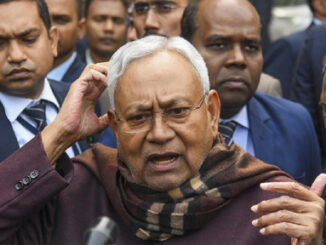
    Bihar Chief Minister Nitish Kumar is the proverbial cat with nine lives. He has remained at the helm in state politics for more than 20 years despite his shaky foundations. His party, the Janata Dal (United), is not formidable either in the state or at the national level. But he has tried to stay ahead of his competitors not through numbers but thanks to the fact that the BJP has not been too sure of itself in the state and has been willing to let him have the reins of power. This time, he has dumped the ruling Mahagathbandhan, which includes the Rashtriya Janata Dal (RJD), the Congress and Left parties.

    When Nitish senses that his plan to grow as a national leader does not seem to be working out, he wants to save his position as CM at whatever cost.

    The BJP and the JD(U) had together won 33 of the 40 Lok Sabha seats in Bihar in 2019; the former wants to do an encore in the upcoming General Election. It is for this reason that Nitish has snuggled back into the NDA’s fold. But how well is he placed on his home turf? It is the fear of losing ground that has been driving him hither and thither, first into the arms of the RJD and then the BJP.

    There is speculation that Nitish’s exit from INDIA would weaken Opposition unity so much that there would not be any contest in the parliamentary elections. It is presumed that Nitish was a sort of lynchpin for the bloc and his departure would leave it rudderless. Nitish has for long been an overvalued political asset. He has not stormed the national arena on his own, unlike George Fernandes, his old socialist comrade. Nitish, along with Lalu Yadav, Sharad Yadav and Ram Vilas Paswan, was a product of Jayaprakash Narayan’s protest movement of the early 1970s; they became recognizable faces of a new generation of leaders. But they remained where they were. They did not leverage their success to make an impact on the national stage. A similar thing happened with Jyotiraditya Scindia, Sachin Pilot and Milind Deora in the Congress; Scindia and Deora have since moved on.

    However, Lalu Yadav managed to consolidate his party (RJD) in Bihar, while Nitish’s JD(U) started lagging behind. And it is with the help of BJP that Nitish managed to stabilize his position in the JD(U) and lead it to victory. The JD(U) base in Bihar is not as wide as that of the RJD. In the 2020 Assembly election, the JD(U) had won only 43 seats, well behind the BJP (74) and the RJD (75).

    It is because of his long stay as chief minister that every once in a while, Nitish tries to break out of Bihar and look at the national scene. He thinks that his sobriety gives him an edge over Lalu Yadav’s image of a lovable maverick. But sobriety is not gravitas. Nitish has been overestimating his stature as a leader of national importance.

    And when he senses that his plan to grow as a national leader does not seem to be working out, he wants to save his position as chief minister at whatever cost. In 2013, he wanted to challenge Narendra Modi but soon realized that he was no match for him because the BJP had a larger footprint across the country and there was the RSS network of volunteers working quietly as foot soldiers of the party. The JD(U) could not match the BJP at the organizational level across the country. So, he went back to the NDA camp. When INDIA was being formed, he again sensed an opportunity and thought that he would be given due regard as the CM of Bihar, an important Hindi-speaking state. He expected to be given precedence over West Bengal CM Mamata Banerjee. He wanted to head INDIA, but the honor was denied to him because there was little doubt that the Congress had to be the spearhead, a fact that was realized even by Mamata. When Mamata mischievously proposed that Congress president Mallikarjun Kharge should be declared the prime ministerial candidate of the alliance, a JD(U) leader asked: ‘Who is Kharge?’ It was implied that being a politician from a non-Hindi-speaking state, Kharge could not stake claim to become a national leader, whereas Nitish was fit to play that role.

    Nitish did not want to be number two in the Opposition ranks. In the NDA, his position is not in the front but he will continue to be the CM.

    Notably, Nitish does not have much of a following in neighboring Uttar Pradesh, the hub of the Hindi heartland, and he can hardly hope that JD(U) will make inroads there. Modi made a superb move when he contested from UP in 2019, knowing very well the electoral importance of the state which sends 80 MPs to the Lok Sabha. Nitish and his supporters do not seem to realize that in the Hindi belt, a politician from Bihar does not stand much of a chance outside his state.

    Nitish has literally returned to his den and there he has to remain, even as the BJP gains strength in the state and thinks of ways and means to replace him. But he has a fighting chance in Bihar and can hope to repel his opponents for the time being. INDIA is on a weak wicket for other reasons and this does not have much to do with Nitish leaving it. Nitish is not a strong and tall leader who can make a difference, and he knows it. He also remembers the outcome of the 2014 Lok Sabha elections in the state — the JD(U) fought against the BJP and won just two seats, while the saffron party bagged 22.
    ( The author is a senior journalist)

  • Reforming UN for a rules-based order

    Reforming UN for a rules-based order

    Primary reason for the ongoing crises in Ukraine and Gaza is an ineffective Security Council

    The need to urgently reform the rules-based order has to be pursued through informal multiple-stakeholder consultations in the lead-up to the UN’s Summit of the Future, due in September. Using dialogue and diplomacy to convene a General Conference of the UN in 2025, the objective should be to give the ‘primary responsibility’ for peace, security and development to the equitable and representative UNGA.

    “The UNSC’s decisions since 1946 have been consistently taken in the light of geopolitical priorities of its P5 members and not any commitment to world peace. This was the pattern during the ideological confrontation of the Cold War (1946-1991). After the Cold War, the three NATO members of the P5 (France, the UK and US) acted to make the NATO supplant the UNSC, symbolized by their action in Libya in 2011. The UNSC subsequently proved helpless in preventing NATO’s weaponization of globalized economic linkages through unilateral sanctions, which have primarily affected developing countries. The outcome has been the intensification of armed conflicts, impacting not only the integrity of the UNSC but also more than two billion people mainly in the Global South, according to the UN.”

    By Asoke Mukerji

    The breakdown of the ‘rules-based order’ is evident from the spread of violent conflicts that are fracturing international relations. At the heart of this order is the United Nations Security Council (UNSC), which is mandated by the UN Charter with the ‘primary responsibility’ of maintaining international peace and security. The Charter stipulates that UNSC decisions are binding on all UN member-states. The widening gap between decision-making by the UNSC and the challenges to peace, security and development on the ground is directly responsible for the ongoing crises. The priority for the international community is to eliminate this gap through a review and reform of the rules-based order. This can only be done through the UN General Assembly (UNGA), in which all states, big and small, are represented on an equal basis.

    Now, 20 million Afghan women live under ‘gender apartheid’. The UNSC was unable to ensure compliance with its decision of 2015, guaranteeing Ukraine’s territorial integrity.

    The UNSC’s decision-making parameters were negotiated between August 1944 and February 1945 among the Council’s five ‘permanent’ members or the P5 (today’s Russia, China, France, the UK and the US). A key feature was the requirement for the ‘concurrence’ (popularly known as the veto) of the P5 to UNSC decisions. Both the composition of the P5 and their veto power were ‘parachuted’ into the UN Charter as non-negotiable pre-conditions in the invitation extended to countries for participating in the San Francisco conference (April-June 1945) to adopt the Charter. During the conference, some countries objected to the non-democratic veto provision. Addressing the first session of the UNGA on January 18, 1946, India said it had agreed to the consensus on the Charter on the basis of a compromise. The compromise, contained in Article 109 of the Charter, was to convene a UN General Conference to review the Charter’s provisions 10 years after it was adopted. So far, such a General Conference has not taken place.

    The UNSC’s decisions since 1946 have been consistently taken in the light of geopolitical priorities of its P5 members and not any commitment to world peace. This was the pattern during the ideological confrontation of the Cold War (1946-1991). After the Cold War, the three NATO members of the P5 (France, the UK and US) acted to make the NATO supplant the UNSC, symbolized by their action in Libya in 2011. The UNSC subsequently proved helpless in preventing NATO’s weaponization of globalized economic linkages through unilateral sanctions, which have primarily affected developing countries. The outcome has been the intensification of armed conflicts, impacting not only the integrity of the UNSC but also more than two billion people mainly in the Global South, according to the UN.

    The recent track record of the UNSC in failing to uphold a rules-based order illustrates the urgent need for reforming its mandated role. On August 15, 2021, the UNSC was unable to enforce compliance with its own unanimous decision of March 10, 2020, linking US/NATO troop withdrawal with a politically inclusive government in Afghanistan. Today, 20 million Afghan women live under ‘gender apartheid’. On February 22, 2022, the UNSC was unable to ensure compliance with its decision of February 17, 2015, guaranteeing Ukraine’s territorial integrity and sovereignty in return for the devolution of political power to its restive eastern regions under the Minsk Agreements. The resulting violent conflict between Russia and Ukraine (which is supported externally by NATO) has ruined millions of lives physically and socio-economically. On October 7, 2023, the UNSC was unable to make member-states comply with its numerous resolutions, including No. 2334 of December 23, 2016, on the Israel-Palestine issue. The conflict has led to the death of thousands of women and children.

    In an ideal rules-based order, the UNGA should be responsible under the Charter for maintaining international peace and security. Since 2015, all UN member-states, including the P5, have accepted the interlinkage between peace, security and development. However, the Charter was deliberately drafted to make UNGA decisions recommendatory and non-binding on UN member-states. It prevents the UNGA from considering issues that are on the agenda of the UNSC. Even a UNGA decision to amend the Charter (and reform the UNSC) is hostage to a P5 veto under Article 108 of the Charter. The cart is put before the horse.

    The UNGA has tried to overcome these handicaps by prioritizing its work mandating negotiations of treaties to create a rules-based order. Such treaties include the Convention on Genocide (1948); the Convention on outlawing Racial Discrimination (1965); the International Covenant on Civil and Political Rights (1966); the Convention on Elimination of All Forms of Discrimination against Women (1979); the Convention on the Law of the Sea (1982); and the Convention on the Rights of the Child (1989). Participating states are expected to uphold their treaty obligations to achieve the principles and objectives of the Charter.

    A similar approach marks UNGA decisions recommending norms for member-states to use in adopting national legislation. The first such document, adopted unanimously by the UNGA on December 10, 1948, was the Universal Declaration of Human Rights. On September 25, 2015, the UNGA adopted Agenda 2030 on Sustainable Development with its 17 SDGs (Sustainable Development Goals), the first universally applicable normative global policy framework interlinking peace, security, development and environmental protection.

    The assertion by world leaders at the UN SDG Summit on September 18-19, 2023, that numerous crises had put the implementation of the SDGs into peril deserves to be taken seriously. The primary reason for these crises is an ineffective UNSC, whose unanimously mandated reform has been assiduously blocked in informal UNGA negotiations by the P5 since 2008.

    The need to urgently reform the rules-based order has to be pursued through informal multiple-stakeholder consultations in the lead-up to the UN’s Summit of the Future, due in September. Using dialogue and diplomacy to convene a General Conference of the UN in 2025, the objective should be to give the ‘primary responsibility’ for peace, security and development to the equitable and representative UNGA.
    (The author is a former Permanent Representative of India to the United Nations)

  • New fault-lines to the fore in US presidential race

    New fault-lines to the fore in US presidential race

    A greater concern for the world is the impact of a changing of the guard on the US foreign policy
    “For the outside world, there will be two main consequential and immediate outcomes that are shaped by any change in the US administration, as evidenced during the Trump years. One is the impact on high-skilled immigration as US tech enterprises draw talent from across the world, particularly from India. At least 70 per cent of the H1-B visas are bagged by Indians every year, the bulk of them by software engineers and, now, artificial intelligence professionals. Little discussed is the perceived sense of insecurity amid heightened white nationalism that borders on racism, particularly for the high-skilled people from Asian countries. The Trump years demonstrated that safety as a factor to migrate or not became important for high-skilled migrants, particularly from non-European countries.”

    By Luv Puri

    The support for former President Donald Trump in the Iowa caucus and within the Republican Party establishment has created a buzz about a what-if scenario: the return of the Trump era and the concomitant unpredictability in the governance of a country that accounts for a quarter of the global economy.

    In the polarized US polity, the congressional districts in some of the swing/battleground states of the 2016 and 2020 elections, such as Arizona, Georgia, Michigan, Pennsylvania and Wisconsin, may decide the 2024 presidential contest. The suburban and rural parts remain conservative and racially homogenized — mostly white. New political, social and economic fault-lines are being drawn within the states, and this may fuel fresh social and ideological tensions, even as Florida has remained a battleground state since the 2000 elections.

    For the outside world, there will be two main consequential and immediate outcomes that are shaped by any change in the US administration, as evidenced during the Trump years. One is the impact on high-skilled immigration as US tech enterprises draw talent from across the world, particularly from India. At least 70 per cent of the H1-B visas are bagged by Indians every year, the bulk of them by software engineers and, now, artificial intelligence professionals. Little discussed is the perceived sense of insecurity amid heightened white nationalism that borders on racism, particularly for the high-skilled people from Asian countries. The Trump years demonstrated that safety as a factor to migrate or not became important for high-skilled migrants, particularly from non-European countries.

    Even in arguably the most cosmopolitan city in the world like New York, with nearly half of the population being foreign-born, the Police Benevolent Association, NYC’s largest police union, reportedly “broke with a longstanding tradition of not endorsing presidential candidates and had thrown its support behind President Trump in the 2020 elections, as many officers viewed him as more of an ally to their pro-police ‘Blue Lives Matter’ movement than Joe Biden.”

    A greater concern for the world is the impact of a changing of the guard on the US foreign policy. The US is the pre-eminent power in the international system as its support or withdrawal of support on global issues is consequential. Take, for instance, the challenge of climate change. In the 2017 book, Dark Money: The Hidden History of the Billionaires Behind the Rise of the Radical Right, Jane Mayer illustrates how Charles and David Koch, the enormously rich proprietors of an oil company based in Kansas, laid the foundations for conservative movements that were anti-government and opposed climate change. The funding of various movements, think tanks and newspapers inadvertently created a fertile landscape for Trump to exploit in the 2016 elections. It wasn’t a surprise when he decided to formally withdraw from the Paris climate agreement in June 2017.

    Also, there are peace and security issues that are shaped by the US directly or indirectly. There are three foreign policy domains that have dominated Biden’s presidency — Ukraine, West Asia and China. All three affect every corner of the world, including India, though the US-India bilateral engagement will essentially retain the momentum despite any change. Russia’s invasion of Ukraine has given the European Union (EU) a renewed sense of purpose. Russia’s perceived threat is now internalized by eastern European Baltic states, such as Estonia, Latvia and Lithuania, which were earlier part of the Soviet Union, and by other eastern European countries like Poland, Romania and Moldova. This has instilled a pan-continental unity that no event has catalyzed since 1993, the year of the EU’s foundation. Recent developments have also turned the spotlight within the US on European security. Since the February 2022 invasion, more than $75 billion in assistance to Ukraine, including humanitarian, financial and military support, has reportedly been given by the US. Trump’s current stance on the US financial support to Ukraine is not clear. In fact, during his presidency, he had angered EU allies with his repeated criticism of European countries for not commensurately funding the NATO.

    West Asia has witnessed greater instability after the Hamas attacks and the consequent Gaza assault by Israel. Among the 19 September 11 attackers, 15 were from the Kingdom of Saudi Arabia and they cited the purported partial US role in West Asia, including the Israel-Palestine conflict, as the reason for carrying out the suicide attacks. The US establishment doesn’t want to give fresh ammunition to the violent extremists working against it. This explains repeated words of caution by Biden to Israeli Prime Minister Benjamin Netanyahu, urging him not to be blinded by rage. In 2017, then President Trump had decided that the US would move its embassy from Tel Aviv to Jerusalem and this was seen as a reckless move as it may directly play into the hands of extremists who slam the US for being pro-Israel. Then, there are other tensions, such as with Iran and its alleged support to proxies like the Houthis in Yemen that are threatening Red Sea’s shipping lanes. This requires a calibrated and coordinated approach, with allies anchored in patience and wisdom that was clearly lacking in President Trump.

    Finally, another Trump term has the potential to reconfigure the Asia-Pacific security calculus. China’s multi-dimensional challenge had been at the heart of President Biden’s Asian engagement. Biden continued with Trump’s import tariffs on China. It is the US strategy to meet the challenge of China’s military projection that may have a greater impact with a change in the US administration. For instance, China has never given up the use of force as an option to bring Taiwan under its control. On the other hand, the US strategic ambivalence over defending the island if it were attacked has been its consistent position. In the recent Taiwanese presidential elections, the ruling Democratic Progressive Party, which invokes China’s ire for its nationalist stance, retained power. A Trump term may spur Beijing to invade Taiwan and exacerbate China’s perennial tensions with Japan, South Korea and even India.
    ( Luv Puri is a Journalist and Author)

  • Incorrigible Nitish switches allies yet again

    True to form, Bihar Chief Minister Nitish Kumar has dumped his Mahagathbandhan allies and returned to the NDA’s fold. The Janata Dal (United) chief has formed the government with the BJP, the very party he had snapped ties with just a year and a half ago. His latest U-turn has jolted not only the Mahagathbandhan — which includes the Rashtriya Janata Dal (RJD), the Congress and the Left Front — but also INDIA, the Opposition bloc that was formed last year to take on the BJP in the 2024 General Election. Nitish had projected himself as the face of the alliance, but suggestions about naming Congress president Mallikarjun Kharge as INDIA’s prime ministerial candidate left him fuming.

    It’s nothing new for Nitish to switch allies, but he has been doing it with increasing regularity over the past decade. Having once said ‘Mitti mein mil jaayenge magar BJP ke saath nahin jaaenge,’ Nitish has opportunistically patched up with the saffron party yet again in a bid to survive and thrive. His decision shows that he is anticipating the BJP’s victory and INDIA’s debacle in the General Election. This is also a desperate attempt by him to revitalize his party, which had ended up way behind the RJD and the BJP in the 2020 Assembly election. Though the BJP will be calling the shots in the new government in Bihar, it won’t be easy for the party to justify taking Nitish back on board after having ruled out his return to the NDA.

    Even as Nitish seems to have abandoned his prime ministerial ambitions, INDIA finds itself sinking deeper into the mire. Discord over seat-sharing in West Bengal and Punjab has exposed the alliance’s frailties. Nitish’s crossover indicates that more Opposition leaders might jump ship as the Lok Sabha elections draw nearer.
    (Tribune, India)

  • India’s Budget 2024: A Balancing Act for Inclusive Growth

    On February 1, India’s Finance Minister Nirmala Sitharaman presented the Union Budget for the fiscal year 2024-25 in the Parliament. The budget comes at a critical juncture for the nation, grappling with the economic aftermath of the global pandemic and the imperative to foster inclusive growth. Sitharaman’s budget attempts to strike a balance between various sectors, addressing the needs of the poor, and outlining a vision for India’s future. This analysis delves into the key aspects of the budget, evaluating its strengths and weaknesses.

    The budget reflects a delicate balancing act, navigating through economic challenges while aiming for inclusive growth. One notable aspect is the focus on capital expenditure, with a significant allocation to infrastructure development. This includes investments in roads, railways, and urban infrastructure, signaling the government’s commitment to boosting economic activity and creating job opportunities.

    Additionally, the budget emphasizes the importance of healthcare and education. Increased allocations for the health sector indicate a recognition of the need for a robust healthcare system, especially in the wake of the pandemic. Investments in education, including the proposed National Digital Education Architecture, aim to modernize and enhance the education system, potentially narrowing the digital divide.

    The budget puts a strong emphasis on empowering the poor and marginalized sections of society. The Mahatma Gandhi National Rural Employment Guarantee Act (MGNREGA) has received increased funding, providing a safety net for rural households and supporting livelihoods. Moreover, the Pradhan Mantri Awas Yojana (PMAY) continues to be a focal point, addressing the housing needs of the economically weaker sections.

    The expansion of the Pradhan Mantri Garib Kalyan Yojana (PMGKY) is a notable step, encompassing welfare measures and direct benefit transfers to vulnerable populations. This includes free food grains and cooking gas for identified beneficiaries, showcasing the government’s commitment to alleviating immediate hardships faced by the poor.

    The budget reflects a vision for a resilient and self-reliant India. The push for digital initiatives, including the proposed National Digital Education Architecture and the expansion of digital payments, aligns with the broader goal of harnessing technology for inclusive development. The focus on research and innovation, especially in the science and technology sector, aims to position India as a global leader in cutting-edge technologies.

    The emphasis on sustainable development is evident through allocations for renewable energy projects and the proposed ‘Blue Economy’ initiative, highlighting the government’s commitment to environmental conservation and economic sustainability. Additionally, the push for a ‘circular economy’ signals a shift towards responsible and sustainable consumption patterns.

    The increased focus on capital expenditure for infrastructure development can spur economic growth, create jobs, and enhance connectivity, laying the foundation for long-term prosperity.

    The heightened allocations for the health and education sectors indicate a commitment to building robust systems that are crucial for human capital development, a key driver of economic growth.

    The expansion of social welfare schemes like MGNREGA and PMGKY demonstrates the government’s dedication to addressing the immediate needs of the poor and vulnerable, providing a safety net during challenging times.

    Critics argue that the budget’s focus on capital expenditure may exacerbate the fiscal deficit, potentially leading to a strain on government finances. Balancing the need for economic stimulus with fiscal prudence is a challenging task.

    The increased spending in certain sectors may fuel inflationary pressures, impacting the purchasing power of citizens, especially those in the lower-income brackets.

    While the budget outlines ambitious plans, the successful execution of these initiatives may face challenges, including bureaucratic hurdles, policy implementation bottlenecks, and the need for efficient monitoring mechanisms.

    India’s budget for the fiscal year 2024-25 reflects a comprehensive attempt to address immediate challenges while laying the groundwork for a sustainable and inclusive future. The emphasis on infrastructure, healthcare, education, and social welfare schemes demonstrates a commitment to uplift the poor and marginalized sections of society. However, the success of these initiatives hinges on effective implementation and management of potential challenges. As India strives to navigate through economic uncertainties and build a resilient future, the budget serves as a roadmap with both promises and challenges.

  • Takeaways from the Ayodhya spectacle

    Takeaways from the Ayodhya spectacle

    Prime Minister should follow in Lord Rama’s footsteps to ensure justice for all

    “Ram Mandir has succeeded in restoring Hindus’ pride in their religion. That is a positive development. What’s left is for Modi to follow the principles of good governance associated with Lord Rama for dispensing justice to all. There were no Muslims and Christians in Bharat in those ancient times. But they are there now. Their only prayer to Modiji is that they be counted as equal citizens of Bharat, as Lord Rama, the epitome of justice and good governance, would have done.”

    By Julio Ribeiro

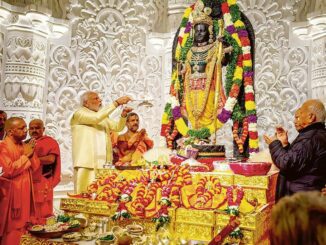
    It was awe-inspiring to watch the consecration of the Ram Janmabhoomi temple in Ayodhya. PM Narendra Modi stole the show with his march to the spot where the idol of Ram Lalla was installed and his unforgettable address to the 7,000-odd guests.

    I was moved to instruct my domestic help to light a diya, as our Prime Minister had requested. Even I, normally a critic of the government, was carried away by the moment!

    The sheer magic of the occasion, the unmistakable devotion on the faces of the invitees and the pride in being a Hindu that was reflected on the countenance of the diaspora worldwide lent a new dimension to the dharma of our people and our ancestors. I was moved to instruct my domestic help to light a diya, as our Prime Minister had requested. Even I, normally a critic of the government, was carried away by the moment!

    The temple will be completed in a year or so, but it has been consecrated ahead of the Lok Sabha elections. It is expected to play the role that the Balakot airstrikes did for the BJP in the 2019 Lok Sabha elections. PM Modi is expected to win a third term.

    If the INDIA bloc does not get its act together soon, the ‘mother of democracy’ (our PM’s words) will metamorphose into an autocracy. Even after Rahul Gandhi hinted that Congress chief Mallikarjun Kharge would lead the coalition, Mamata Banerjee announced that the Trinamool Congress would fight the Lok Sabha polls in West Bengal on its own.

    Nitish Kumar had expected himself to be anointed as ‘primus inter pares’ (first among equals). He is frustrated because he has to share the honor with Kharge. Arvind Kejriwal wants an all-India footprint for AAP. He demands seats in Gujarat, Haryana and Goa, where his party has a small presence.

    Even Akhilesh Yadav, who has been eclipsed by CM Yogi Adityanath in Uttar Pradesh, thought that his Samajwadi Party was entitled to representation in Madhya Pradesh. All in all, the INDIA bloc is hopelessly placed against the BJP’s juggernaut. And with the Ram Temple being projected as Modi’s baby instead of Lal Krishna Advani’s, to whom it legitimately belongs, the battle can be written off as far as INDIA is concerned.

    Yogi has captured the imagination of the residents of Uttar Pradesh (which has 80 Lok Sabha seats) with one major achievement — he has brought the state’s criminals to heel. In the beginning of his reign, he encouraged the use of unconventional, even illegal, methods to instill fear in the minds of the law-breakers. Wiser counsel later advised him to change tack. To all appearances, it seems that conventional methods (except the bulldozer) are currently at play.

    A newspaper article by a young IPS officer, Vrinda Shukla, currently SP of Bahraich (UP), quotes figures from the National Crime Records Bureau to show that because of “scaled-up monitoring at all levels”, conviction was obtained by the UP police in 71 per cent of the cases of crimes against women in which the trial was completed. The corresponding figures for Rajasthan and Maharashtra are 37.2 per cent and 11.2 per cent, respectively. Public prosecutors, who had stopped taking ownership of the cases and become unaccountable, have begun feeling the heat generated by Yogi, says Vrinda.

    Those who dream of forming a government in any state will need to adopt the UP CM’s attitude to corruption and the legal steps he has put in motion to control crime and criminals. More than ‘development’ that our Prime Minister harps on, citizens want security of life and property. He or she who can provide this will win.

    In the meantime, Modi will milk the devout Hindu’s devotion to Lord Rama for electoral gains. A politician can hardly be blamed for exploiting public sentiment to influence voters. The only regret a sensitive BJP follower can possibly have is that the originator of the Rath Yatra, Advani, was left out in the cold. But these are games ambitious politicians play. They dump their rivals in their own party when the opportunity beckons. Politics, after all, is a cut-throat enterprise. Only one who is adept at the game comes out on top.

    The media shows Modi feeding cows at his home and visiting temples in Kerala and Andhra Pradesh, both southern states where he is keen to open his party’s account. Public memory is notoriously short. The voter may forget our PM’s piety and opt for the communists or the Congress in Kerala and for CM Jagan Mohan Reddy or his sister YS Sharmila, who has taken on the responsibility of resuscitating the Congress in Andhra Pradesh.

    A group of 200-odd retired diplomats, civil servants and police officers, called the Constitutional Conduct Group (of which I am a part), had drafted an open letter to the PM, lamenting that he involved his high constitutional office and government agencies in the run-up to the idol’s installation in the Ayodhya temple. A secular country, constitutionally mandated to strictly separate religion from the State, had been subjected to the spectacle of its PM performing puja in South Indian temples and finally in Ram Mandir.

    There is no objection to the PM visiting and praying to his god as an individual. But to do so as the country’s pre-eminent elected leader and committing government resources to such an event is neither constitutionally acceptable nor ethical or moral. The Election Commission should decide whether this is permissible under the election laws on the use of religion for garnering votes.

    The founders of Pakistan used religion to secure for the Muslims a separate country. The military regime of Gen Zia-ul-Haq Islamized it to the hilt. The results of such religiosity are for all of us to see. Pakistan today needs the US and China to keep itself functioning. There are not many nations today that incorporate religion into governance. Those that follow this path have not prospered.

    Ram Mandir has succeeded in restoring Hindus’ pride in their religion. That is a positive development. What’s left is for Modi to follow the principles of good governance associated with Lord Rama for dispensing justice to all. There were no Muslims and Christians in Bharat in those ancient times. But they are there now. Their only prayer to Modiji is that they be counted as equal citizens of Bharat, as Lord Rama, the epitome of justice and good governance, would have done.

    (The author is a former governor and a highly decorated retired Indian Police Service (IPS) officer )

  • Lessons from a high-profile Harvard exit

    Lessons from a high-profile Harvard exit

    The hard-earned academic freedom and intellectual sovereign space in India must remain non-negotiable, having been shaped by the spirit of diversity, equity and inclusion

    “The resistance to this onslaught must be more prudent. If our adherence to political correctness crosses a threshold level, the liberal fabric would be pummeled by the social oligarchs. Let us be very clear that attempts to divinize a leader/scholar are indeed an anti-intellectual exercise. Any critical scrutiny or academic engagement per se of leaders’ scholarly contributions is not an insult to people who adulate them. Ideological commitment is different from academic pursuits as the commitment to unravelling the truth alone remains the nucleus of the latter’s mandate. When our ability to falsify our own propositions remains unassailable, the real cognitive contribution begins in academia. If replicating dogmatic narcissism is perceived as an intellectual enterprise, the day is not far off when our public academic institutions will collapse. More than the inflated strength of right-wing populism, unscrupulous political correctness would be singularly responsible for the denouement of our public academic institutions.”

    By Dr. R. Thirunavukkarasu

    On January 2, when Harvard University’s first African-American President, Claudine Gay, stepped down from her post, the high-decibel euphoria from the conservative cabal in the United States was along expected lines. Emboldened right-wing activists such as Christopher Rufo claimed that it was they who had got her out. In his verbal onslaught, Republican Vivek Ramaswamy said what Ms. Gay had published in her whole career was what a distinguished American academic published in just a few years. Further, he attributed the policy of affirmative action as the reason for scholars like her to ascend to the coveted position. Her reluctance to immediately condemn the Hamas attack on Israel on October 7 and her subsequent confession before a Congressional committee caused controversy, eventually leading to her resignation. There was also the issue of alleged plagiarism.

    When Ms. Gay was appointed as the 30th president of Harvard on July 1, 2023, it was widely believed that Harvard firmly believed in and adhered to the larger contours of diversity, equity and inclusion (DEI). The long-cherished legacy of DEI is deeply embedded in modern consciousness not only in American academia but also the globe. It is not very difficult to foresee the consequences of any explicit racial slur against a student or a faculty member. The political ascendency of Donald Trump was, no doubt, a turning point as the conservatives stepped up their attack on the ethics of DEI and its political manifestation. Today, Hamas’s attack on Israel and Tel Aviv’s brutal response in Gaza perhaps effortlessly became a lame excuse for right-wing political pundits and social conservatives to strike at the celebrated values of DEI.

    The threat in the background
    The rise of right-wing populism across the globe entails solid structural change, especially in academia. In their epistemic fabric, an academician’s political persuasion or ideological commitment is no longer an individual’s sovereign choice but ought to be subservient to their edict since their illiberal nationalism is equated with virulent patriotism. Hence, disputing or critiquing right-wing populism may spell deeper trouble for academics. The hideous campaign against Ms. Gay is a perfect example of this trend.

    Is the episode cause for alarm? Yes, to some extent. It has no doubt emboldened the conservative political class here in India. The right-wing politics in the U.S. has tacit endorsement from many scholars, whereas, here, the political right is deeply communal and deplorably divisive. Hence their didactic narratives on polity and society are either a harangue or quite pedestrian. Our academia have largely remained impervious to the nefarious designs of majoritarian communalists as the freedom struggle, with its solid secular orientation, shaped the post-colonial academic milieu.

    The founding fathers of our republic pledged to establish the country as a nation of/for all. Their social privilege and affluence did not deter them from speaking up for subaltern communities and the underprivileged. Their tenacious commitment to have a level-playing ground for all sections resulted in the introduction of a reservation policy and several welfare measures. Our academic atmosphere since the formation of the republic is largely shaped by this spirit of DEI.

    However, the insidious nature of right-wing populism sends out a distressing signal as its coercive tantrums may wreck the academic spirit over time. The hard-earned academic freedom and intellectual sovereign space must remain non-negotiable and cannot be in thrall of political parties. Today, when majoritarianism effortlessly becomes a text-book-like definition of patriotism, and caste hegemony camouflages itself into sacred antiquity, the task of academia is to resist this onslaught and preserve the spirit of DEI. Ms. Gay’s unceremonious exit seems to be an apt ingress for the cheerleaders of right-wing populism to ramp up their tirade against the spirit of DEI here too.

    Signals that cannot be missed
    Celebrating private academic institutions and foreign university campuses is actually disguised contempt for the spirit of DEI. The silence in the draft University Grants Commission (Setting up and Operation of Campuses of Foreign Higher Educational Institutions in India) Regulations, 2023, on reservation in students’ admission and faculty appointment is not inadvertent. The desperation of social conservatives to establish caste-class exclusivism in academic campuses will see fruition if right-wing populism remains at the helm.

    The resistance to this onslaught must be more prudent. If our adherence to political correctness crosses a threshold level, the liberal fabric would be pummeled by the social oligarchs. Let us be very clear that attempts to divinize a leader/scholar are indeed an anti-intellectual exercise. Any critical scrutiny or academic engagement per se of leaders’ scholarly contributions is not an insult to people who adulate them. Ideological commitment is different from academic pursuits as the commitment to unravelling the truth alone remains the nucleus of the latter’s mandate. When our ability to falsify our own propositions remains unassailable, the real cognitive contribution begins in academia. If replicating dogmatic narcissism is perceived as an intellectual enterprise, the day is not far off when our public academic institutions will collapse. More than the inflated strength of right-wing populism, unscrupulous political correctness would be singularly responsible for the denouement of our public academic institutions.

    (R. Thirunavukkarasu teaches sociology at the University of Hyderabad. The views expressed are personal. E-mail: rthirujnu@gmail.com)

  • Reclaiming the Republic, and the Constitution

    Reclaiming the Republic, and the Constitution

    There is an urgency now — Indians have a collective duty to reassert the values and central role the Constitution has played in determining the dreams and the vision of a united and plural India

    By Aruna Roy, Nikhil Dey

    On January 22, 1947, the “Objective resolution” of the Indian Constitution was unanimously adopted by the Constituent Committee. This became the inspiring and powerful Preamble to the Indian Constitution. And now, as the Indian Republic enters its 75th year, a mammoth state-sponsored spectacle has undermined the determined resolve of both the Preamble and the basic structure of the Indian Constitution for India to be a secular nation.

    The flattening of multidimensions
    However, the ruling Bharatiya Janata Party’s agenda being presented at this time, is not just making the state ‘theocratic’ and the majority religion ‘political’. It is part of an unprecedented effort to create a unidimensional culture in a nation that has been the home of a multitude of cultural practices. Indians will also have to decide whether to walk the path of a top down, politically imposed Hindutva; or respond culturally to ensure that the vibrant cultural landscape including a myriad of religious practices prevails , nurturing our diversity and building tolerance, rather than suspicion and hate for the ‘other’.

    The political nature of the Hindutva effort is to flatten our multidimensional imagination into a two-dimensional vision of “ourselves” and the rest of the world. Even the somewhat clichéd messages of “unity in diversity” have gone. It is now one nation, one market, one color, one language, one election, and, of course, one official religion. Even within the majority religion, which has never had one set of laws, or a high priest, we are witnessing a concerted, centralized effort to determine its “national norms”. Others will be allowed to exist, but either through official or unofficial fiat, the attempt is to make them all subservient to the dominant identity. Even religion is being centralized. Freedom of faith and worship is intrinsic to humanity, individually and in groups. Some of the most powerful manifestations of the diversity of faith have been continually played out in India.
    To be Indian was to be complex, to represent differences. There was anticipation about the context, cultural nuances and political alliances of every Indian you met. The person unraveled the nuances of language, food, clothes and cultural choices, weaving together a vibrant and colorful tapestry. Why, if we are proud of our heritage, do we rush to follow others who do not have the richness of diversity? It is perhaps because the ones driving this are attracted by the power and the control that centralization and identity politics helps exercise.

    Post-Independence, and Partition, we have grown up with the flavor of multiple choices including the liberty to opt-out of what we were born into. It was the freedom to choose. We defined choices as those that liberated us from the narrow definitions of stereotypes — including religious, caste and racial identities. Liberation included the right to step out of those two-dimensional definitions, to realize our potential, and have the freedom to eat, wear, sing, and think in multiple ways. For those of us living in cosmopolitan ‘Indian spaces’, it meant understanding the plural ways in which one celebrated even a ‘Hindu’ festival. Dusshera was celebrated in many ways — with a Durga pandal, a Tamil Navaratri with dolls, the north Indian Ram Lila, and the nuanced differences of every State and language group represented there. One looked with pity at cousins trapped in a single identity and who had to live in a single language zone.

    The Constitution’s space for diversities
    India’s Constitution adopted 75 years ago, recognized and incorporated space for these diversities and differences, not just in politics but also in culture, and how we led our lives. What we count as progress has been built on sanctified objectives of tolerance and solidarity even as we faced the seemingly insurmountable challenges of competing interests. This was a sophisticated perspective written into the Constitution, that knew that differences had to be tolerated, if not welcomed to make India something more than a collection of kingdoms or a “former colony”.

    The heroes of the nascent nation saw an India emerge with understanding the need to break caste, language and religious barriers. They celebrated cultural differences, and worked to overcome arrogance and prejudice. B.R. Ambedkar recognized the huge challenge presented in the search for economic and social equality. These values shaped and defined the Constitution. A document which is a democratic and ethical pledge, now critically important to India’s future. The Preamble resolves that we will practice fraternity “assuring the dignity of the individual, and the unity and integrity of the Nation”. To every Indian this document is a guarantee of our right to live with liberty, equality, and justice.

    The idea of a ‘Hindu Rashtra’ is in direct contradiction to the Indian Constitution, but its proponents have used the political and democratic freedom provided by the Republic to propagate their conception of Hindutva aggressively. January 22, 2024 saw a brazen crossing of many red lines of the Indian Constitution, with every arm of the state giving in, and even endorsing the violation and marginalization of secular principles.

    B.R. Ambedkar warned us with uncanny wisdom, “Will Indians place the country above their creed or will they place creed above country? I do not know. But this much is certain that if the parties place creed above country, our independence will be put in jeopardy a second time and probably be lost forever …This eventuality we must all resolutely guard against.”

    S. Radhakrishnan, the second President of India, was also wary of what could happen in a situation of majoritarian assertion and said: “our national faults of character, our domestic despotism, our intolerance which have assumed different forms of obscurantism, of narrow mindedness, of superstitious bigotry… Our opportunities are great, but let me tell you that when power outstrips ability, we will fall on evil days.”

    India faces stark choices
    With the state-driven consecration of the temple in Ayodhya sending reverberations through our polity, and the celebration of the 75th year of our Republic upon us, we are faced with stark choices. Our choice for a Constitutional republic over a Hindu Rashtra has to be reasserted. These assertions made now will enable or cripple our children from claiming their place in the Republic of India.

    The Indian Constitution has been conceived in a way that extends our rights and shared values far beyond the five-year cycle of elections and governments that come to power with an electoral majority. The Constitution sought to build a social democracy that protected the views and dignity of all — particularly if they were marginalized groups or communities, at all times. As we enter the 75th year of the Republic, perhaps more than ever before, we have a collective duty to reassert the values and central role the Constitution has played in determining the dreams and the vision of a united and plural India.

    The Constituent Assembly had the wisdom and the ability to understand that this subcontinent called India, will survive only if there is equal respect for all its citizens. It is the commitment to tolerance in its principles, and the grace inherent in its practice, that helps us overcome the challenge of bigoted religious expression and insecurities. It enables us to include and embrace religious differences and the vast and complex history, architecture and culture that makes India unique in the world. It will also help India retain its space in the globe, as a true ‘Vasudhaiva Kutumbakam’ rather than hurtle towards becoming a helpless particle in a fast-shrinking global economy and culture.

    (Aruna Roy and Nikhil Dey are social activists)

  • Narrowing field: On 2024 U.S. presidential election’s Republican primaries race

    Trump’s ad hoc policymaking has many takers among Republicans

    The 2024 U.S. presidential election’s Republican primaries race has already narrowed to two candidates, frontrunner and former President Donald Trump and former Governor of South Carolina, Indian-origin Nikki Haley. The latest twist in the election cycle saga, which kicked off last week with the Iowa caucuses, saw Florida Governor Ron DeSantis step off the contest after he admitted that he could not see a path to victory. Both he and Vivek Ramaswamy, a pharmaceuticals entrepreneur who exited the race earlier, have endorsed Mr. Trump, who leads by double digits, 50% to Ms. Haley’s 39% among likely Republican voters, in New Hampshire, the next Republican primary venue. In Iowa, he garnered 20 delegates to Ms. Haley’s eight, a wide margin, even if he has a long road ahead to acquire the 1,215 delegates necessary to capture the nomination. While there are no presidential debates on the cards at this time because Mr. Trump has refused to join them, the tenor of the remarks by the two candidates against their rival appeared to be getting sharper. Ms. Haley questioned Mr. Trump’s mental fitness to hold high office after he seemed to confuse her with former House of Representatives Speaker and Democrat Nancy Pelosi, in the context of the January 6, 2021 riots. Mr. Trump has mocked her first name Nimrata and, in an echo of the birther movement remarks he made against former President Barack Obama, implicitly questioned whether she was a natural-born U.S. citizen.

    Unlike previous U.S. elections, such as in 2016, where there were no fewer than 10 candidates in the fray during the presidential debates, this time a considerable skew in voter preferences towards Mr. Trump is evident, leading to a lopsided primaries season. Ms. Haley is only likely to remain in the race for as long as she is able to raise sufficient funds to keep her campaign going, and donors are notoriously quick to pull out when they see a dead end for a candidate, regardless of their political leanings. The wholesale rush towards the aura of Trumpism, now apparently an ever-growing force despite Mr. Trump facing serious criminal indictments and other legal challenges, has in fact fractured mainstream Republicanism as a bulwark of the U.S. conservative movement. Voters now appear to prefer Mr. Trump’s chaotic ad hocism in policymaking, his aggressive views on immigration and minorities of all hues, and his relentless eschewing of political propriety even when dealing with institutional issues. Unless there is an impulse for new leadership within the Grand Old Party to challenge the Trump “paradigm”, the sheer lack of alternative voices with populist appeal will lead to Trumpism deepening its hold on U.S. institutions, governance and socio-economic outcomes.
    (The Hindu)

  • India’s 75th Republic Day: Celebrating Achievements and Reflecting on Challenges

    As India commemorates its 75th Republic Day, it is a momentous occasion to reflect on the incredible journey the nation has undertaken since gaining independence in 1947. The last seven and a half decades have witnessed remarkable progress, from overcoming social and communal divisions to tackling issues of illiteracy and poverty. The country, once burdened with the legacies of foreign rule, has emerged as a global player on various fronts.

    In the initial years of the Republic, visionary leaders such as Jawaharlal Nehru played a pivotal role in steering the nation towards stability and growth. Nehru’s leadership during the first 15 years set the tone for India’s commitment to democracy and secularism. Despite facing internal socio-economic challenges and strained relations with neighboring Pakistan, and later, China, Nehru’s statesmanship laid the foundation for a resilient and united India.

    Fast forward to the present, and India finds itself at a critical juncture. Over the past decade, under the leadership of Prime Minister Narendra Modi, the country has experienced rapid economic growth, earning the distinction of having the fastest-growing economy globally. The nation is poised to become the third-largest economy in the world within the next two decades. While these economic strides are commendable, concerns linger regarding the equitable distribution of the benefits of this growth.

    Reports suggest that the economic boom has disproportionately favored the wealthy, leaving the vast majority of the population, especially in rural areas, mired in poverty. The current policies seem to shower privileges on the affluent while neglecting the needs of farmers, workers, and ordinary citizens. This growing economic divide threatens to undermine the social fabric of the nation.

    The communal politics employed by the ruling Bharatiya Janata Party (BJP) is another cause for concern. India, known for its diversity and pluralism, has witnessed a rise in tensions fueled by religious and communal divides. The emphasis on majoritarianism rather than inclusivity challenges the unity and brotherhood that have been the pillars of India’s strength. A nation with over a billion people, facing internal strife, could potentially become a destabilizing force with far-reaching implications for global peace.

    On this auspicious day of celebration, it becomes imperative to engage in introspection and address the challenges that threaten to hinder India’s progress. While economic growth is essential, it must be inclusive, reaching every stratum of society. The government’s policies should prioritize the upliftment of the rural masses, ensuring that the benefits of progress extend to the marginalized and vulnerable.

    Furthermore, the importance of secularism cannot be overstated. India’s history is replete with examples of harmonious coexistence among diverse communities. The shift towards divisive politics erodes the very essence of the nation and risks alienating sections of the population. A united India is not only crucial for its citizens but also for the stability of the global community.

    As we wish India a Happy Republic Day, it is essential to acknowledge the achievements and progress made over the past 75 years. Simultaneously, it is incumbent upon the nation’s leaders and citizens to address the existing challenges and work towards fostering a more inclusive, equitable, and harmonious society.

    The 75th Republic Day should serve as a catalyst for positive a change, inspiring a collective commitment to building a stronger, more united India that embraces its diversity and upholds the values of democracy and secularism. Only through such efforts can India continue to shine as a beacon of hope and progress on the global stage.

  • Iran-Pak clash adds to the chaos

    Iran-Pak clash adds to the chaos

    Kickerline: Tangled and multi-layered geopolitics of West Asia has entered the South Asian strategic calculus

    It may be inferred that both Iran and Pakistan have acted to establish the credibility of their deterrence posture. However, given the shadowy nature of terror-related intelligence inputs and the identity of the main state actors behind proxy groups, it is difficult to arrive at an objective and informed assessment on whether the actions by the two states were measured and appropriate, or impulsive.

    By C Uday Bhaskar

    In a couple of dramatic developments last week, Iran launched air attacks on its nuclear-armed neighbor Pakistan and was subjected to tit-for-tat strikes. Though billed as counter-terrorism operations, the use of missiles and fighter jets raised concerns that the conflict could escalate into a war. However, both nations have now agreed to defuse tensions. On January 19, Pakistan stated that it desired to work with Iran in “the spirit of mutual trust and cooperation” and would strengthen coordination on counter-terrorism.

    Whether China will use its leverage in the region to promote stability or discord, driven by Beijing’s penchant to fetter India, remains a moot point.

    There is an ironic twist in the way Iran and Pakistan are responding to perceived threats from terror groups across their border, given that both nations have honed the strategy of covert state support to non-state entities engaged in terror activities to advance their geopolitical objectives. The Iran-Pakistan border areas are largely inhabited by a restive Balochi population that has been ruthlessly oppressed by both states to quell separatist aspirations. Over the last few decades, the Shia-Sunni theological divide has fueled terror groups that are also influenced by religious fervor in the extended West Asian region, where the Iran-Saudi geopolitical and socio-religious competition has a long history. Another significant factor is the age-old Arab-versus-Persian ethnic fault lines and Iran’s distinctive strategic identity and aspirations in the Islamic world.

    In the current instance, despite the welcome turn of events wherein a potential Iran-Pakistan crisis was averted, it is evident that the tangled and multi-layered geopolitics of West Asia has entered the South Asian strategic calculus and this will pose many challenges to India in the near future. The extended region that encompasses South and West Asia was convulsed in recent decades by the tectonic events of 1979 — the overthrowing of the Shah of Iran and the emergence of political Shia-Islam; the Soviet invasion of Afghanistan that brought the Cold War to the region; and the rise of militancy-cum-terrorism symbolized by Kalashnikov-wielding mujahideen driven by religious zealotry.

    India felt the negative effects of the 1979 upheaval in the early 1990s. Following the Soviet withdrawal from Afghanistan, a triumphant Pakistan, which had supported the Afghan mujahideen, stepped up its anti-India terror activities and the erstwhile state of Jammu and Kashmir was badly scarred.

    More recently, the October 7, 2023, Hamas terror attack on Israel and the disproportionate reprisal that Tel Aviv is prosecuting have had a non-linear consequence that has adversely impacted the world at large. This is manifested in Houthi attacks on global merchant shipping, and once again, a non-state entity with state support (Iran) has posed an intractable challenge to the major powers and the safety of critical SLOCs (sea lines of communication).

    Iran’s locus in the larger southern Asian strategic template, Tehran’s nuclear aspirations and anxieties, its deeply ingrained anti-US/anti-Israel orientation and the proximity to both China and Russia will shape the regional strategic framework in the years ahead. This, in turn, will have acute relevance for India, given China’s ambitions related to Beijing’s Belt and Road Initiative (BRI) that has the Xi Jinping imprimatur. Both Iran and Pakistan have critical areas to advance BRI objectives.

    Thus, it is instructive that Beijing was seen as the preferred mediator for defusing the current Iran-Pakistan situation, and while there has been no official confirmation, the possibility that China had a quiet role in lowering the bilateral temperatures remains high. Whether China will use its leverage in the region to promote stability or discord, driven by Beijing’s penchant to fetter India, remains a moot point, but it will be a significant element in the affairs of the subcontinent.

    Iran’s mid-January counter-terror actions, which included strikes against Iraq, Syria and Pakistan, mark a departure from the norm that Tehran had followed until now. The use of air power and precision-guided weapons could become the new benchmark for such exigencies. While Tehran has claimed that it took action based on intelligence inputs in each case, domestic political compulsions are also significant drivers.

    Early in January, a terrorist attack in Kerman, southeast of Tehran, resulted in the death of nearly 100 people at a memorial for Iran’s top commander Qasem Soleimani. Subsequently, the ISIL/ISIS claimed responsibility for this dastardly attack, making it clear that Iran had to take action against ISIS to assuage the anger and grief of its citizens. In the case of Pakistan, the rationale offered by Iran is that it was targeting bases of the Jaish al-Adl, a Sunni Baloch armed group operating from Balochistan (formerly designated as Jundallah) that was involved in a mid-December attack in the Sistan province. The January 16 attack was purportedly carried out to pre-empt another strike.

    It may be inferred that both Iran and Pakistan have acted to establish the credibility of their deterrence posture. However, given the shadowy nature of terror-related intelligence inputs and the identity of the main state actors behind proxy groups, it is difficult to arrive at an objective and informed assessment on whether the actions by the two states were measured and appropriate, or impulsive.

    Dissuading non-state terror groups through resolute military action can be protracted and costly and yield negative returns, as demonstrated by the US-led ‘global war on terrorism’ in the wake of the 9/11 attacks.

    Jittery deterrence holds even greater significance in a troubled region armed with weapons of mass destruction, and the Iran-Pakistan tit-for-tat attacks provide valuable crisis management lessons for regional policymakers.
    (The author is Director, Society for Policy Studies)

  • Only Voters Can Truly Disqualify Trump

    Only Voters Can Truly Disqualify Trump

    I count myself among those who consider Mr. Trump to be manifestly unfit to serve in any office ever again because of his actions on that day, even if he is not held criminally liable. But being unfit is not the same thing as being ineligible. What makes the Colorado Supreme Court — or any court — believe that it has a privileged understanding of those events that is beyond the capacity of the public to discern?

    By Noah Millman

    Perhaps the public is misinformed, or refuses to let itself be accurately informed, even at this late date, about what happened. The need for expertise and deliberation is why we have a representative democracy; the people do not act directly to make laws, but act through their representatives.

    Intense debate has accompanied the decision by the Supreme Court to review the decision by Colorado’s highest court to bar Donald Trump from the state’s primary ballots based on Section 3 of the 14th Amendment — about the precise meaning of the word “insurrection,” the extent of Mr. Trump’s culpability for the events of Jan. 6 and other legal issues. I’m not going to predict how the Supreme Court will rule, or whether its ruling will be persuasive to those with a different view of the law. But there’s a critical philosophical question that lies beneath the legal questions in this case. In a representative democracy, the people are sovereign, and they express their sovereignty through representatives of their choice. If the courts presume to pre-emptively reject the people’s choice, then who is truly sovereign?

    The question of sovereignty was central to the purpose of the 14th Amendment in the first place. The Civil War — unquestionably an armed insurrection — was fought because of slavery. That was the reason for the war.

    But its justification was a dispute over sovereignty, whether it resided primarily with the people of the individual states or with the people of the United States, who had established the Constitution.

    The answer was settled on the battlefield, but it was ratified through the 14th Amendment, which defined who is a citizen of the United States and established that the “privileges or immunities” of same supersede any state laws that might abridge them. From now on, there would be no ambiguity: Under the Constitution, the people of the United States are sovereign, and this sovereignty supersedes the sovereignty of the people of the individual states whenever the privileges and immunities of the former are in conflict with the will of the latter.

    Section 3 of that amendment was similarly enacted in order to secure federal supremacy. Rebel officers might well have retained strong popular support in the former Confederate states, but Section 3 prevented the rebellion from being continued by electoral means. The people of South Carolina might prefer to be represented by former rebels, but the people of the United States, whose sovereignty trumps South Carolina’s, forbid it.

    Whose sovereignty, though, trumps the people as a whole?

    Donald Trump is the overwhelming favorite to win the Republican nomination for president and has a close to even-odds chance of winning the general election. That would seem to have no bearing on his eligibility to run. If a majority of the country wanted Barack Obama or Arnold Schwarzenegger or Selena Gomez to be president, it would be out of luck. The Constitution renders them ineligible: Mr. Obama has already been elected twice, Mr. Schwarzenegger was not born a U.S. citizen and Ms. Gomez is under 35 years old.

    For that very reason, though, those individuals aren’t likely to run — and if they did try to run, their ineligibility would be manifest, recognized by everyone. Similarly, former Confederate officers and officials, by serving in the Confederacy, had explicitly declared themselves insurrectionists. Congress passed a broad amnesty in 1872 to lift the penalties associated with the involvement of most in insurrection, including that imposed by Section 3 of the 14th Amendment; some individuals not covered by the amnesty petitioned successfully for the restoration of their civil rights, and in other cases the prohibition was simply not enforced. But the essential fact of participation in the insurrection was not in dispute.

    The situation with Mr. Trump could not be more different. An overwhelming majority of his party, and apparently about half of the country as a whole, considers him to be eligible to be president again. Moreover, these voters believe this even though, as President Biden said recently, “we saw with our own eyes” what happened on Jan. 6.

    I count myself among those who consider Mr. Trump to be manifestly unfit to serve in any office ever again because of his actions on that day, even if he is not held criminally liable. But being unfit is not the same thing as being ineligible. What makes the Colorado Supreme Court — or any court — believe that it has a privileged understanding of those events that is beyond the capacity of the public to discern?

    Perhaps the public is misinformed, or refuses to let itself be accurately informed, even at this late date, about what happened. The need for expertise and deliberation is why we have a representative democracy; the people do not act directly to make laws, but act through their representatives.

    It’s notable in that regard, then, that impeachment — the remedy the Constitution provides for a president who violates his oath of office — does not involve the courts but the people, acting through their representatives. And the court of the people already had the opportunity to weigh in on Mr. Trump’s culpability for the events of Jan. 6. He was impeached an unprecedented second time by the House of Representatives for his actions on that day. But in the trial that followed in the Senate, Mr. Trump was acquitted.

    That does not mean he is innocent. But it does mean that the Colorado Supreme Court has, in effect, declared that it outranks the Senate, and can overrule that body’s decision.

    Some Republican senators, including the minority leader, Mitch McConnell, effectively asked the courts to do just that during the impeachment debate. Arguing that they had no authority to try a president whose term had ended, they refused to consider the facts of the case. But this was not a principled view. The Senate had already voted separately on the question of jurisdiction, and a majority determined that they did have the ability to try a president whose term had ended. Once that question was settled by the Senate itself, senators who thought Mr. Trump was guilty, including those who voted the other way on the jurisdictional question, could vote their consciences on the matter at trial.

    Since the senators still voted to acquit, it must be because they did not think he was guilty, or did not deserve punishment for his guilt. Or, reflecting gross cowardice, perhaps they did not want the responsibility for convicting him, and preferred the courts to shoulder that responsibility instead.

    That’s precisely what the Colorado Supreme Court has decided to do. But in so doing, it has usurped the proper prerogative of the people. It is saying, in so many words, that the people’s representatives got it wrong in the impeachment trial, and the people themselves are incapable of seeing what is in front of their eyes. Therefore, the court must save the people from the possibility of making a catastrophically wrong decision.

    Democracy cannot be saved in this fashion, not even from the threat of a demagogue with contempt for the rule of law. It can be saved only by democratic means. If the people’s representatives failed to do their duty, as they did in Mr. Trump’s impeachment trial, the last line of democracy’s defense is the sovereign people themselves. At the point that we cannot trust them, democracy is dead already.
    (Mr. Millman has written extensively about politics, policy and culture, and is the author of the newsletter Gideon’s Substack)
    (Source: New York Times)

  • World Economic Forum: Annual Carnival at Davos For Rich & Powerful

    World Economic Forum: Annual Carnival at Davos For Rich & Powerful

    By Devendra Makkar

    Since 1971 “World Economic Forum”(WEF) has been holding an annual most expensive carnival at Davos, the super luxury ski resort in Switzerland. Here Billionaires talk to millionaires and pretend to discuss how to end inequality and other world problems in most luxurious settings with most lavish & expensive food, wines, champagne and hard liquor served for them! 2,500 participants from 90 countries, world’s richest, most powerful and downright famous about 0.00004% of the world’s 7.4 Billion population deciding the world’s fate behind a curtain of extremely tight security, secrecy and doublespeak. Since than these rich have become more rich and poor has become more poor. According to Oxfam in 2016, only world’s 8 richest headed by the Microsoft founder Bill Gates were worth $426bn (£350bn), equivalent to the wealth of 3.6 billion people. According to Credit Suisse’s global wealth report published in Nov. 2017, “The world’s richest people have seen their share of the globe’s total wealth increase from 42.5% at the height of the 2008 financial crisis to 50.1% in 2017, or $140 Trillion.”

    Jody Williams (the 1997 Nobel Peace Prize winner) said, “These guys just want to convince people that they care about others, which they don’t, and then get back to making money as fast as they can,”

    Larry Summers an economist & former Treasury Secretary under President Clinton once told a reporter that Davos is fundamentally an exercise in corporate speed-dating. “Everyone comes because everyone else comes.” A hedge-fund manager or a C.E.O. can pack into a few days the dozens of meetings—with other executives, with heads of state or their deputies, with non-governmental organizations whose phone calls might otherwise have been ignored—that it would normally take months to arrange and tens of thousands of Gulfstream miles to attend. They conduct these compressed and occasionally fruitful couplings, the so-called bilateral meetings, either in private rooms that the WEF has set aside for this purpose or in hotel rooms, restaurants, and hallways. All that’s missing is the hourly rate.

    This yeas the 4 day exclusive carnival for the world’s richest and most powerful was held from January 23rd to 26th 2018. Membership and partnership fees range from 60,000 Swiss francs ($62,243) to 600,000 Swiss francs (around $622,000) “depending on the level of engagement.” Every participant has to pay extra $27,000, a fee over and above the membership or partnership fees. That still does not include Hotel accommodation and air fare. On top of that Participant has to be only from the world’s top thousand companies.

    Every participant wears a color coded badge based on a series of closely guarded criteria. The color of the badge denotes a role and a degree of access for the participant. The holographic is the top badge for senior government policy makers and the coveted pass is the white one that grants delegates free rein. A Strategic Partner gets a blue dot on the white and has access to an exclusive lounge. The Green is for “Entourage” with very limited access and Media Reporters wear “Orange” and can’t get in a lot of places. Apart from fees, WEF also accepts grants, donations and legacies. They also subsidize the scores of academics, scientists, artists, journalists, and N.G.O. chiefs who attend for free. Everyone, whether he pays or not, has to be invited. WEF Founder Chairman Klaus Schwab says, “You cannot buy your way in, it’s a large club meeting and you do need an invitation!”

    The man behind this annual super luxury 4 days carnival with a fancy theme rather a fancy slogan for each year for billionaires and millionaires by invitation only; is an German academic Klaus Schwab. He is the founder and Executive Chairman of the World Economic Forum (WEF) that he started in 1971 as European Management Forum and in 1987 changed the name to ‘World Economic Forum”. His salary and benefits are undisclosed but average employee at WEF makes over 200,000 Swiss francs per year and operate from a swanky super luxurious Head Quarter in Geneva. Over the years WEF has also become a very successful money-making enterprise, with revenues of 280,000 Swiss francs and a surplus of 1.2 million Swiss francs in the financial year from July 2016 to June 2017.

    Klaus Schwab here and there do indulge in stage managed self-criticism. In 2012 when the theme of the WEF was “The Great Transformation” he said “Capitalism, in its current form, no longer fits the world around us.” “We have sinned.” He also spoke of the danger of “intergenerational conflict.” However, the benefits of economic growth remain elusive for many.

    For the 2018 WEF theme “Strengthening Cooperation in a Fractured World”  in Sep. 2017, he wrote in a WEF statement that “Our collective inability to secure inclusive growth and preserve our scarce resources puts multiple global systems at risk simultaneously.” “Our first response must be to develop new models for cooperation that are not based on narrow interests but on the destiny of humanity as a whole.”

    280 sessions many of them were closed door exclusive meetings, even the media is not allowed in them. As you can imagine, with that many meetings, surrounded by varying degrees of secrecy outsiders have no clue what is going on behind closed doors. The public ones, which anyone can attend are just for media hype. The closed ones; which only those participants with a white badge can attend and then the totally private ones that you don’t even know have happened. Those are where the big deals are discussed, behind closed doors.

    On top of that often, there are dozens of private parties by invitation from the host only, organized every day by big corporations for their clients or head of the state or its officials making a sales pitch to CEO’s of big corporations to come and set up their shops in their countries. Indeed these are the most lavish and the best dinner parties in the world with world renowned music bands or stars from the entertainment industry to entertain the guest. This years well-known participants include actors Cate Blanchett, Shah Rukh Khan and musician Paul Williams and singer Elton John and few well known music bands.

    WEF/Davos Effect on common Americans: USA is always represented at WEF carnival at Davos by the largest contingent of super rich and powerful. This year again USA ranked First with 840 participants! After 47 years of participation at WEF by the richest and most powerful of USA; 78% of the U.S. population now lives paycheck to paycheck, with essentially zero savings. CEOs, tech entrepreneurs, and other members of the “1%”—are doing exceptionally great. There has never been a better time for wealthy Americans! But the truth is, for majority of Americans, the situation is getting much, much worse every year. The middle class; the most politically and economically stable part of the American society is being pushed down into upper lower class by the rich and powerful.
    According to Productivity Pay tracker chart, Since 1973, pay and productivity have diverged.
    Productivity has grown 5.9x more than worker’s hourly pay

    Change 1948–1973: Productivity +96.7% Hourly pay +91.3%
    Change 1973–2016: Productivity +73.7% Hourly pay +12.5%

    The income, wages, and wealth generated over the last four decades have failed to “trickle down” to the vast majority largely because policy choices made on behalf of those with the most income, wealth, and power got the 90% share that has exacerbated inequality. In essence, rising inequality has prevented potential pay growth from translating into actual pay growth for most workers. The result has been wage stagnation.

    According to Economic Policy Institute, CEO compensation increased from $1.5 million in 1978 to $16.3 million in 2014, or 997 percent, a rise almost double stock market growth. Over the same time period, a typical worker’s wages grew very little: the annual compensation, adjusted for inflation, of the average private-sector production and nonsupervisory worker (comprising 82 percent of total payroll employment) rose from $48,000 in 1978 to just $53,200 in 2014, an increase of only 10.9 percent. Due to this unequal growth, average top CEOs now make over 300 times what typical workers earn.

    From East to West and from North to South at WEF, no one said any thing on the ongoing Israeli brutal occupation of Palestine, stealing of its land and human genocide of Palestinians since 1967. This is despite the fact that Israel is the only country in the world that is illegally occupying another country in the world. They did lip service to the rising global economic inequality, poverty and hunger, human rights and freedom of free speech violations, mistreatment of women, environmental degradation and widespread armed conflicts. No one from the elite club of the world’s richest & most powerful, called for the “Re-modelling of the Capitalism” to fight all these problems in the universe.

    All these years of WEF, if political leaders could not be persuaded to change their minds on basic human rights, freedom of speech, human and equal status for women, environment protection and stop to widespread armed conflicts And if billionaires could not be persuaded to pledge money to eradicate rising economic inequality, global poverty and hunger, with the conversations and meetings they have had there, the WEF have failed miserably. So it is safe to say that, in terms of the WEF’s stated commitment of “improving the state of the world,” is nothing but gross misrepresentation rather pure lie.

    On top of that the problem with WEF is; it is fundamentally illegitimate because it has no democratic basis whatsoever. It is not transparent because they do not open up their books to the public and they allow secret meetings that are not even open to some of the participants or televised for public or open to media scrutiny. On top of that the richest participants at the WEF have let down the humanity by allowing massive global economic inequality.

    “Davos Man” phrase was originally coined by the Political scientist Samuel P. Huntington because the vast majority of WEF members were originally men; the term later expanded to include the Davos woman. Davos man/Davos woman refers to the members of the WEF a collection of leaders from a variety of fields from around the world. Huntington argued in his 2004 article “Dead Souls” The Denationalization of the American Elite” that the Davos man’s view of a global identity is not shared by the majority of common citizens. He decried a post-national wealthy globe-trotting elite. “Davos Man” can be either a capitalist oppressor or a Commie conspirator. Either way, he is a windbag, a pedant, and a hypocrite.

    (Source: EPI analysis of Bureau of Labor Statistics and Bureau of Economic Analysis data https://www.epi.org/productivity-pay-gap/)

    New Jersey, US based Devendra Makkar is a social activist and author. He can be reached at davemakkar@yahoo.com

  • Iran-Pakistan faceoff : Both nations at fault for backing terrorists

    Iranian missile strikes on terror bases in Balochistan have triggered a fierce retaliation from Pakistan, which targeted purported terrorist hideouts in Iran’s Sistan-Baluchestan province on Thursday. The Inter-Services Public Relations, the Pakistan military’s media wing, stated that hideouts used by two Baloch terrorist organizations were ‘successfully struck in an intelligence-based operation’. It said Pakistan’s armed forces were in a perpetual state of readiness to ensure the safety of its citizens against acts of terrorism. According to Pakistan’s Foreign Office, Islamabad has been sharing its concerns with Tehran about the havens for Pakistan-origin terrorists in Iran, but to no avail.

    The tit-for-tat attacks are a new low in the relations between Iran and Pakistan. Ironically, both nations — notorious for harboring or supporting terrorists as well as militia groups — are playing the victim card. They are desperately trying to make the international community buy their argument that they are more sinned against than sinning. Undoubtedly, Iran and Pakistan have been scorched by terrorism at times, but the onus is on them to first set their own house in order. Collaborative efforts are needed to fight the ‘snakes in the backyard’, which have started biting the very hand that fed them.

    Terrorism is a global threat requiring a multilateral, multipronged strategy. Unilateral actions by Tehran and Islamabad are adding fuel to the raging fire in West Asia. The wider the conflagration spreads, the worse it will get for peace and economic progress in the region. Commenting on the Iranian strikes, India has said that it understands actions that countries take in self-defense, while reasserting its ‘uncompromising position of zero tolerance’ to terrorism. New Delhi should make it a point to condemn terrorism unequivocally, no matter which country sponsors it. At the same time, it is vital to emphasize the importance of diplomatic parleys for defusing tensions.
    (Tribune, India)

  • Guru Gobind Singh’s teachings are relevant to modern times

    Remembering the Saint-Soldier and Creator of Khalsa on his birth anniversary which is being celebrated on January 19

    Guru Gobind Singh, the tenth Sikh Guru, stands as a towering figure in Sikh history. Born on December 22, 1666, in Patna, India, he played a pivotal role in shaping Sikhism and reinforcing its principles. Guru Gobind Singh is renowned not only for his spiritual teachings but also for his unwavering commitment to justice and the defense of the oppressed. His legacy revolves around the creation of Khalsa, a community of saint-soldiers, embodying the harmonious balance between spirituality and martial prowess.

    Guru Gobind Singh was the son of Guru Tegh Bahadur, the ninth Sikh Guru, and Mata Gujri. Early in his life, he faced the harsh realities of religious persecution when his father sacrificed his life defending the rights of non-Muslims. This early exposure to adversity shaped Guru Gobind Singh’s worldview and set the stage for his future role as a leader and warrior.

    At the tender age of nine, Guru Gobind Singh assumed the mantle of Guruship after the martyrdom of his father. His leadership was marked by a determination to fortify the Sikh community against external threats and persecution. His teachings emphasized the equality of all humans, irrespective of caste or creed, and the need for Sikhs to stand up against injustice.

    One of Guru Gobind Singh’s most significant contributions was the establishment of the Khalsa in 1699. Recognizing the need for a community of warriors dedicated to defending justice, he called upon his followers to gather at Anandpur Sahib during the Baisakhi festival. There, he performed the Amrit Sanchar, a sacred ceremony that initiated the Sikhs into the Khalsa Brotherhood.

    During the ceremony, Guru Gobind Singh infused the Amrit (sacred nectar) with the Five Ks, which are the distinctive symbols of the Khalsa: Kesh (uncut hair), Kara (steel bracelet), Kanga (wooden comb), Kachera (cotton undergarments), and Kirpan (ceremonial sword). These symbols served as a constant reminder of the Khalsa’s commitment to Sikh values and the readiness to defend righteousness.

    Guru Gobind Singh’s teachings embodied a unique blend of spirituality and martial valor. He propagated the idea of the “Sant-Sipahi,” a saint-soldier who combines spiritual discipline with the readiness to take up arms when peaceful means fail. This philosophy emphasized the importance of selfless service, justice, and fearlessness in the face of oppression.

    The Guru himself led by example, actively participating in battles against tyranny. His military campaigns aimed not at conquest but at safeguarding the principles of righteousness and freedom. Guru Gobind Singh’s commitment to the defense of the oppressed set a precedent for Sikhs, inspiring them to resist injustice with courage and determination.

    Guru Gobind Singh’s legacy extends far beyond his lifetime. His creation of the Khalsa not only provided Sikhs with a distinct identity but also fostered a sense of community and shared purpose. The Khalsa became a symbol of resilience and strength, standing against injustice and promoting the values of equality and justice.

    The Guru’s poetic compositions, collected in the Guru Granth Sahib, continue to inspire millions of Sikhs around the world. His writings, including the Zafarnama (Letter of Victory) written to Emperor Aurangzeb, reflect his unyielding spirit and commitment to justice.

    Guru Gobind Singh, the saint-soldier and creator of Khalsa, left an indelible mark on Sikhism and the broader tapestry of Indian history. His life exemplified the harmonious coexistence of spirituality and martial prowess, and his teachings continue to guide Sikhs in navigating the challenges of the modern world. Guru Gobind Singh’s legacy is a testament to the enduring power of courage, justice, and the unwavering commitment to defending the oppressed.


  • More to marmalade than meets the eye

    More to marmalade than meets the eye

    The Congress needs a recipe to connect with the masses and revive its fortunes

    “Rahul’s Bharat Jodo Yatra has contributed to doing away with his ‘Pappu’ image. By any standards, it was an enormous feat of physical stamina and he stuck to his ideological message right through. It is difficult for his political rivals to call a person who has walked such a long distance as ‘Pappu.’ One can almost hear village elders and others who may be great admirers of Prime Minister Narendra Modi admit, “Chhora chala toh hai.” The fact that the Congress lost the Assembly elections in the Hindi heartland states has more to do with the great structural weaknesses in the party rather than Rahul’s image. Image matters in politics and, therefore, it is essential for Rahul not to convey that ultimately he is a ‘south Delhi’ boy — as the marmalade video does.”

    By Vivek Katju

    I begin  with an admission. I like orange marmalade a lot ever since I got used to its bittersweet flavor. The New Year’s Eve video of Sonia and Rahul Gandhi making marmalade in their kitchen, obviously from Chinese oranges from their garden, brought back memories of the marmalade made by my late mother-in-law from kinnows and oranges. Well-known foreign brands of Seville orange marmalade could never compare with those made by her. Since there is no possibility that I will ever have the opportunity to spread on a toast the marmalade whose recipe was given by Priyanka Gandhi, I will continue to consider my mother-in-law’s marmalade as the best. Just one more word on marmalade: Rahul calls it a jam. That is a sacrilege of sorts as marmalades are essentially jellies.

    Despite all the efforts being made by Opposition parties through the INDIA bloc, it is apparent that the BJP under Modi is ahead in the electoral race.

    But the Sonia-Rahul video was much more than mother and son bonding over making marmalade. Anything that they post on social media has a political purpose. Their political adversaries will use the video to emphasize the elitist nature of the family. This is because most Indians would never have heard about marmalade, leave alone tasting it. It is, therefore, intriguing that Sonia and Rahul did not take this into account before posting the video. The fact that Sonia said she could not wait to have ‘arhar ki daal and chawal’ on returning from abroad will not detract from the elitism evident in the video.

    It would have been a better communication strategy for the Gandhis to speak about marmalade in Hindi. Perhaps they could have said: “Yeh ek kism ka murabba hai jo ki narangi ya kinnow se banaya ja sakta hai.” And that farmers who grow oranges, kinnows and other suitable citrus fruit can try it out. That would have made the video less baffling to the ordinary Indian. However, there is a more fundamental issue.

    Just when it appears that Rahul is making efforts to ‘jodo’ (connect) himself and his ideology with the vast majority of the Indian people, he does something which, howsoever small and inconsequential it may be in the larger scheme of things, degrades his initiative. Thus, in this case, why couldn’t Sonia and Rahul think of making gajar ka halwa, which north Indians, at least, can readily relate to? The carrots may not have been from their garden; nevertheless, that would have sent out a mother-son bonding message. And, if they wanted to do something a little exotic with carrots, they could have made carrot murabba. Surely, Indira Gandhi would have initiated Sonia into the goodness of gajar ka murabba. And they could have also dwelt on the nutritional value of amle ka murabba, which is made in early summer. It would have been best if they had made besan ke laddoo.

    Rahul’s Bharat Jodo Yatra has contributed to doing away with his ‘Pappu’ image. By any standards, it was an enormous feat of physical stamina and he stuck to his ideological message right through. It is difficult for his political rivals to call a person who has walked such a long distance as ‘Pappu.’ One can almost hear village elders and others who may be great admirers of Prime Minister Narendra Modi admit, “Chhora chala toh hai.” The fact that the Congress lost the Assembly elections in the Hindi heartland states has more to do with the great structural weaknesses in the party rather than Rahul’s image. Image matters in politics and, therefore, it is essential for Rahul not to convey that ultimately he is a ‘south Delhi’ boy — as the marmalade video does.

    As of now, despite all the efforts being made by the Opposition parties through the INDIA bloc, it is apparent that the BJP under Modi is ahead in the electoral race. Modi towers over the entire Opposition’s leaders. Besides, in the Hindi-speaking states and western India, unless some entirely unforeseen development occurs, it is a near certainty that the BJP will be victorious in the Lok Sabha election. The question is whether it will do as well as it did in 2019. It is too early to make that assessment.

    The fact is that the fortunes of the Congress cannot be revived unless it is able to make headway in Uttar Pradesh. It lost influence in UP more than three decades ago when its traditional voter base of high-caste Hindus, Scheduled Castes and Muslims abandoned it. Over the years, the Congress organization has become ineffective in the state. The problem is that the Gandhis, in the past two decades, have not focused sufficiently on UP. These two decades have also seen changes in the thinking of the Hindus in the Hindi heartland, including UP. It has moved towards reviving past glory and doing away with what they consider historical injustices. The Congress simply does not know how to respond to these changes with sustained clarity.

    Meanwhile, it is clear that the international community anticipates a Modi victory in the General Election. Had that not been so, a major country like France would not have accepted the invite to its President to be the chief guest at the Republic Day event, especially as it was publicly known that India’s first choice was US President Joe Biden. Biden’s presence in India four days after the Ayodhya ceremony would have been a great communication coup for Modi. The BJP would have used it to project Modi’s international profile, in addition to his position as India’s tallest leader. While French President Macron is a significant global leader, he is obviously not in the same league as Biden.

    (The author is a former Secretary, Ministry of External Affairs, India) 

  • Simultaneous elections are a rarity around the world

    Simultaneous elections are a rarity around the world

    “Fixed dates for elections to assemblies and federal parliaments are a more common feature than simultaneous elections at different levels of the political structure in a country. Canada, a federal polity with a parliamentary form of government, has enacted legislation at both the federal level as well as in its provinces, providing for a fixed date for holding of elections, with the date now varying from province to province and following a different timetable for federal elections. In Australia, the terms of the federal Parliament and the state legislatures (most of them) are three and four years, respectively, thus ruling out simultaneous elections.”

    By Manjeev Singh Puri

    The high-level committee on ‘One nation, one election’ (ONOE) has sought public suggestions regarding constitutional amendments and other arrangements for giving effect to ONOE. The main rationale for suggesting ONOE are time and cost savings. Since these factors are applicable globally, it bears noting that almost nowhere among federal parliamentary democracies are simultaneous elections held at the federal and provincial (state) levels. Indeed, the 79th report of the Parliamentary Standing Committee on Personnel, Public Grievances, Law and Justice, which looked into the matter of simultaneous elections, could cite only two cases from across the globe — South Africa and Sweden.

    The South African elections, offering universal adult suffrage, began only in 1994 and the African National Congress, which led the freedom struggle, has continued to win throughout the country at both the federal and provincial levels (barring Western Cape). This is a situation not dissimilar to that of India during the first 25 years after Independence, when the Congress largely won across the country. The more competitive political scenario in India thereafter started showing up hung assembles (and even Parliament), floor-crossing, etc., resulting in dissolution and elections and at different times for Parliament and states as a gap of more than six months without a legislature in place, both at the Centre and in the states, is considered unacceptable for a democracy and not allowed in the Indian Constitution.

    Sweden has a unitary form of government with municipalities and regions, but the latter are not like provinces in a federal polity and don’t have a hierarchical relationship. Essentially, both are forms of local government undertaking different types of tasks. And the Swedish Constitution allows for early elections, but these are for the balance of the dissolved term.

    The Indian parliamentary panel’s report also refers to the UK’s decision in 2011 to have a fixed term for its Parliament. The report was submitted in 2015. Two years later, the UK Parliament, barely in its second cycle under the fixed-term enactment, overrode the Fixed Term Parliaments Act, which was repealed in 2022. The devolved assemblies in Scotland, Wales and Northern Ireland, in any case, follow their own timetable.

    Fixed dates for elections to assemblies and federal parliaments are a more common feature than simultaneous elections at different levels of the political structure in a country. Canada, a federal polity with a parliamentary form of government, has enacted legislation at both the federal level as well as in its provinces, providing for a fixed date for holding of elections, with the date now varying from province to province and following a different timetable for federal elections. In Australia, the terms of the federal Parliament and the state legislatures (most of them) are three and four years, respectively, thus ruling out simultaneous elections.

    The model for a ‘fixed date and tenure’ election that readily comes to mind is of the US, where presidential and gubernatorial elections are only held every four years and a system is in place for successors to take over if a President or Governor becomes non-functional. Lasting the full course through a succession process is possible, though it sometimes results in anomalies such as Gerald Ford becoming President in 1974 without having contested the election ‘at the level of the people’. It, moreover, bears noting that elections to the House of Representatives in the US Congress and state assemblies are held every two years. Given the US tradition of primaries, the country is practically in the election mode every other year. Interestingly, despite major efforts to build a consensus on simultaneous polls to the Lok Sabha and assemblies, the parliamentary committee’s best case was polls in two phases — for some states around the time of the middle of the Lok Sabha’s term and for others with the Lok Sabha elections.

    It is believed that a separation of federal and provincial elections ensures that voters are not cross-influenced by leaders or issues of the national election with the one in their state or province or vice-versa. Studies indicate that this is likely to happen when the regional party (or parties) in the fray doesn’t have a distinct identity and a cause that the voters can easily identify with and so differentiate between parliamentary and Assembly elections.

    Nevertheless, the idea that time and costs should not be unnecessarily incurred on repeated elections is a laudatory one. From experiences in Germany and, more recently, in Nepal, constitutional provisions that provide for greater political stability may be possible segues. For example, the German Basic Law and the 2015 Nepali Constitution only permit positive votes of no-confidence — such a motion must be accompanied by the naming of the next leader. Then there is the issue of setting the right precedent.

    In the UK, as also in Canada, attempts to fix the terms of Parliament were thwarted by the Commonwealth tradition of the Prime Minister having the right to dissolve the House and seek a fresh mandate. In Nepal, while the same tradition was sought to be invoked, its Supreme Court disallowed it on two occasions during 2021 and asked the House to elect a new leader. This ensured that the House elected in 2017 sat through its full five-year term with no additional expenditure on mid-term polls.

    (The author is a former Ambassador)