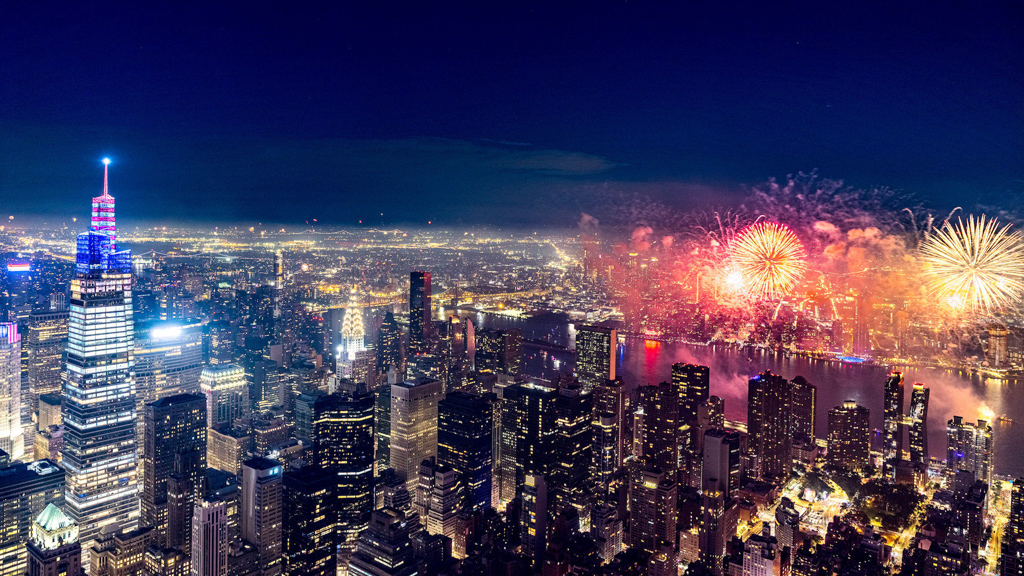
4th of July stirs mixed feelings, the dominant being a confidence that we can and shall overcome. 3 years ago, Covid struck down all traditional ceremonies, leaving Americans to celebrate the event in a shorter edition, with limited ceremonial celebration. The pomp, pageantry, parades, shows, games, sports, guns, bells, bonfires, and illuminations, from one end of America to another did not appear to be a possibility then. But Covid is gone, and we are back in 2023 to grand celebrations of a historic moment. This 4th of July is witnessing a new energy which is bound to add a new chapter to American history. Let us celebrate the new energy.
American history is full of struggles and challenges. We have always, as a nation, stood up to them. Remember what John F. Kennedy said: “The cost of freedom is always high, but Americans have always paid it. And one path we shall never choose, and that is the path of surrender, or submission.”
American history is replete with internal dissensions and conflicts. We overcame them and continued to grow stronger. We have been involved in conflicts abroad because we wanted to protect the weaker nations against the stronger and wily nations. We wanted to protect democracies. We fought wars for the idea of democracy and freedom. We lent strength to the democratic world. We paid a price, and a heavy one in losing our valiant men and women in the wars. Yet, we remained steadfast and strong, and continued to grow stronger.
This 4th of July reminds us of the commitment of America to protect others as well as we protect ourselves. That is why we have laws that allow people from all over the world to come to this country to escape tyranny in their lands or to live the American dream. We have welcomed them earlier, and we need to continue to welcome them. They come and depend on us, and then become great assets for America. They contribute to the growth and strength of America. Let us celebrate our diversity. Let us celebrate our unity. Let us celebrate our humanity. Let us celebrate our strength.
God bless America!
Dr. V.K . Raju President, Eye Foundation of America
America and India were both British colonies. America got its independence in 1776, and India got its 170+ years later. America the most powerful democracy and India the most populous democracy .
Both countries are continuously working towards keeping their widely varying citizenship, heading in the same direction successfully. Today conflicts are on the rise everywhere and nuclear arsenals are swelling
Millions are displaced, international law is disregarded with impunity , as criminal and terrorist networks profit from the division and violence. This is the situation the world finds itself in today .
The reason for these conflicts is territorial disputes . Regional tensions, high level corruption and dwindling resources due to climate change have also contributed to conflicts.
Dr Arnold Toynbee ‘s quote is very appropriate today.
“It is already becoming clear that a chapter which had a western beginning will have to have an Indian ending if it is not to end in the self-destruction of the human race… At this supremely dangerous moment in human history, the only way of salvation for mankind is the Indian way. Emperor Ashoka and Mahatma Gandhi’s principle of nonviolence and Shri Ramakrishna’s testimony to the harmony of religions ; here we have an attitude and spirit that can make it possible for the human race to grow together into a single family —and in atomic Age, this is the only alternative to destroying ourselves .
What we need is true friendship (MAITRI) between the most powerful democracy and the most populous democracy.
Both countries are continuously working towards keeping their widely varying citizenship, heading in the same direction successfully.
Thank you.
“America is undergoing serious soul wrenching changes at the same time soul searching. Recently, there have been shocking setbacks to long established order: Huge monetary contributions to elections that tilts the scales of justice; denying women the right to choose; reversing affirmative action in college admissions, thereby denying the opportunity to right the wrings of the past. It can be turbulent, seemingly disorderly and chaotic at times, viewed by Americans and the world alike, but Americans are resilient, persevere and strive for a better tomorrow. Eventually, the individual and national spirit prevail and society tries to right the wrongs.”
Despite its flaws, Americanism continues to be the envy of the world as it remains an unrivaled beacon of freedom, championing the cause of freedom, justice and liberty throughout the world, as well as the foundation of hope, aspirations, rewards and progress
By Ashook Ramsaran
Americanism is a unique historical, political and social phenomenon embedded in the founding principles of the Republic as duly recorded in its Declaration of Independence on July 4, 1776 and subsequently, in the US Constitution signed on September 17, 1787, with the underlying covenant: The land of liberty, equality, freedom from injustices, freedom of the press, separation of religion and government, good governance with transparency and accountability, and the pursuit of happiness with equal justice under the law.
Independence Day in America is a time of national celebration for becoming an independent nation, discarding the yoke of colonialism and foreign rule, forging a new nation of peoples from many countries, religious beliefs, cultures, languages and walks of life, all living together in peaceful coexistence, striving for success and happiness today and a better tomorrow, individually and collectively as a country. Americans share in this jubilation annually in a show of national pride, a deep sense of belonging.
The celebration of USA independence is also of historic significance to the rapidly growing Indian American community who have benefited enormously from the Luce-Celler Immigration Act of 1946 signed into law on 3rd July 1946 by President Harry Truman granting naturalization rights to Filipinos and Asian Indians. The Immigration Act of 1946 also “allowed Filipino Americans and Indian Americans to naturalize and become United States citizens”. Upon becoming US citizens, the new Americans could own homes and farmland, and petition for family unification. This reversed the Naturalization Act of 1870 which had denied Asians the right to gain US citizenship.Unmatched economic and military strength, technological prowess and national resiliency define the pre-eminent position of United States in the world, while the US engages in wars and conflicts at enormous human and financial costs, defending democracy, fledgling nations and its own economic interests, as well as exporting US technology, manufacturing expertise and US brand of music, foods and entertainment for economic gain. At times, economic interests dictate geo-political alliances, ignoring human rights and freedom of the press abuses. Despite its flaws, Americanism continues to be the envy of the world as it remains an unrivaled beacon of freedom, championing the cause of freedom, justice and liberty throughout the world, as well as the foundation of hope, aspirations, rewards and progress. National pride and optimism have always been, and continue to be, hallmarks of Americanism. The “can do” attitude is a reminder of the many accomplishments that dominate world economics, military position and high technology.
Americanism also pays homage and honors those Americans who have made the ultimate sacrifice in defending the United States during its many wars and conflicts. From Arlington National Cemetery (Virginia, USA) to Normandy American Cemetery and Memorial France), US Memorial Day is a national holiday, observed annually in somber remembrance with wreath laying ceremonies, nationwide parades, concerts and fireworks. The many cemeteries and unmarked tombs the world over are a reminder of the lengths to which the USA has gone to wage war and defend its interests.
America is a nation that is always adapting in innovating ways to sustain its democracy amidst ever changing demographics with new immigrants and their children taking their places in this amazing experiment of nation building and personal upliftment. There is outspoken and visible opposition to increased migration from many segments of American society, while not acknowledging that migration adds to the vitality and sustained advancement of the country. Example: There are over 30 major US companies whose CEOs are of Indian origin. Immigrants from other countries flourish and achieve significantly more than would have been possible in their countries of origin. Americanism provides a welcome environment for competitiveness, equal opportunity, meritorious rewards, and freedom to explore possibilities despite risks. Americanism also gradually acknowledges the positive influence of major cultural phenomena such as Lunar New Year, Eid-ul-Fitr, Yoga and Diwali, the latter celebrated in the White House and becoming a New York City school holiday. Notwithstanding, Americanism is replete with its own history of subjugating and depriving Native Americans (from inception at Plymouth and continuing) and Afro-Americans (as slaves from 1619 to 1865) in brutal and inhuman ways. It must be noted that indentured Chinese labor was used in inhuman ways to build the trans-continental railroads, while Japanese Americans were illegally placed in internment camps during World War II. Despite the Civil War and the 1865 end of slavery declaration and the Civil Rights Act of 1965, the struggle continues to bring about equality and social justice by stalwarts such as: The late Dr Martin Luther King Jr, the late John Lewis, President Barak Obama, Vice President Kamala Harris, Medgar Evers, Rosa Parks, W.E.B. Du Bois, George Mason, Julian Bond, Maya Angelou, Arthur Ashe, Thurgood Marshall, Supreme Court Justices Thurgood Marshall and Ketanji Brown Jackson, and many, many others.
This sad history has long lasting consequences because the wrongs inflicted on Native Americans and Afro-Americans continue to suppress and diminish the potentials, aspirations and progress among a significant population of Americans. While Americanism is strong and resilient, its democracy can also be put at risk (as exemplified on January 6, 2021) if resoluteness and constant vigilance are not in place. America is undergoing serious soul wrenching changes at the same time soul searching. Recently, there have been shocking setbacks to long established order: Huge monetary contributions to elections that tilts the scales of justice; denying women the right to choose; reversing affirmative action in college admissions, thereby denying the opportunity to right the wrings of the past. It can be turbulent, seemingly disorderly and chaotic at times, viewed by Americans and the world alike, but Americans are resilient, persevere and strive for a better tomorrow. Eventually, the individual and national spirit prevail and society tries to right the wrongs.
Americanism, now, continues its journey of a nation trying to find itself in a new world order, adapting and innovating, at times soul searching, yet strong and vigilant, amidst rapidly changing internal demographics, and a very different world than when America became a country.
( Author is President, Indian Diaspora Council Int’l and Exec Vice President of Queens Civic Congress)
Narendra Modi’s visit further strengthened ties between India and the United States
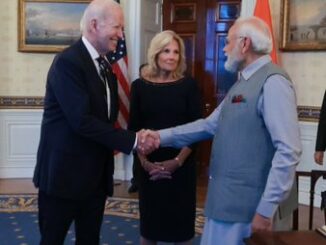
Rolling out the red carpet for Prime Minister Narendra Modi during his state visit to Washington, U.S. President Joseph Biden underlined his belief that the India-U.S. partnership will be one of the “defining relationships of the 21st century”, one that he has had a strong belief in as U.S. Vice-President in the Obama administration. The phrase mirrored the one used by U.S. President Barack Obama at the state banquet for former Prime Minister Manmohan Singh in 2009 — one of the “defining partnerships of the 21st century” — denoting the consistent strengthening of ties over the first two decades of the century. The visit by Mr. Modi, his first state visit to the U.S., has not disappointed votaries of the relationship. The two sides announced new deals involving high-end defense cooperation, semiconductor industry investments, and a partnership in quantum and advanced computing and AI. The deal for co-production of jet engines in India — White House called it “trailblazing” — will involve an unprecedented level of technology transfer. India’s decision to join the 11-nation mineral security partnership for critical minerals, where China has a global monopoly, and cooperation on critical and emerging technologies, particularly in clean energy, will strengthen future cooperation here. Finally, India’s move to sign on to the 27-nation Artemis Accords for cooperation in space exploration, and the NASA-ISRO partnerships for human spaceflight will also catapult India’s ambitions in the sphere.
It is significant that areas of discord, such as the differences in policies towards Russia’s war in Ukraine, and confrontation with China, where New Delhi has been more diffident, were sidestepped. Perhaps more difficult to sidestep were increasingly loud questions over the state of democracy and human rights in India, which 75 U.S. members of the Congress raised in a letter to Mr. Biden. While some uber-liberal Democrat lawmakers took the extreme step of boycotting Mr. Modi’s address to the joint session of Congress, it would be harder to ignore the pointed words from Mr. Obama in an interview the same day, on India’s minority rights. Eventually, Mr. Modi’s response, in a rare press availability with Mr. Biden, dismissed some misgivings over his administration — he denied alleged discrimination against minorities and a crackdown on dissent. Rights issues are not a bilateral concern, and with his warm welcome, Mr. Biden made it clear he did not share the concern. If Mr. Modi wishes to address public concerns, however, he may find it more effective to make the case in a press conference on his return, emphasizing his belief that “if there are no human values and there is no humanity, there are no human rights, then it cannot be called a democracy”.
As far as the State visit of Prime Minister Modi is concerned, I may be one of those who have mixed feelings about its timing. I am proud that India’s Prime Minister was honored at the highest level in the United States. India, which has the fifth-largest growing economy, is also being recognized in that regard. At the same time, America is also seen as a nation that can put its ideals and principles on the back burner when it is convenient to them. If Americans think that India could be an ally in case of a US-China conflict, they are sadly mistaken. For India also, America may not be a reliable ally as they continue to supply F-16 fighter jets to Pakistan, and their abrupt withdrawal from Afghanistan is still fresh in everyone’s memory. Therefore, what we have witnessed in the last few days was a marriage of convenience, and the US industry is looking for alternative space to replace China’s and having an eye toward the mushrooming middle class with enormous purchasing power. In between, they could also help Boeing and Raytheon with defense purchases, which would be a bonus, and replace Russia as their leading arms supplier. In the process, America has buried its idealism and concerns for Human rights to placate an authoritarian and religiously fundamentalist regime allowing Manipur to burn and become a killing field while raising a champagne toast welcoming Mr. Narendra Modi.
American chipmaker Micron Technology investing up to $825 million in a new assembly and test facility in Gujarat fits well into the plans of both India and the US. Support from the Central and state governments would take the total investment in the facility to $2.75 billion, as Prime Minister Modi pushes his ambitious $10-billion incentive plan for chip manufacturing. For Washington, Micron’s decision is in sync with its policy to decrease the risks of doing business in China while integrating the US economy with that of India. Last month, Beijing barred Micron products, saying it had failed a security review, angering the Biden administration.The construction of the new facility is expected to begin soon and the first phase will be operational in late 2024. The unit will test and pack semiconductor chips, but not manufacture them. Still, Micron’s plant is a boost to the vision of making India a semiconductor base. US semiconductor toolmaker Applied Materials will also invest $400 million in a new engineering center. Lam Research plans to train 60,000 engineers. For decades, India had a relentless focus on software-related knowhow. The results are visible in an array of digital technologies. Cracking the hardware puzzle is a different ballgame. Subsidies alone will not result in relocation of chip supply chains. Larger clusters that can support manufacturing and sustain long-term operations as well as transfer of technology are key.
The global chips market is expected to grow to $1 trillion by 2030. Resource-intensive, it requires highly-skilled workers and is already facing a competence gap. As India embarks on its silicon journey, semiconductor job openings are set to rise. With its talent pool, India needs to leverage the opportunity and find ways to provide hands-on and industry-relevant training to engineering students. Taiwan provides a cue. Its success is attributed to public-private partnerships that focus on training and certification.
(Tribune, India)
When it comes to foreign relations, America’s policy is never based on “Human Rights Abuse” or “Religious Persecution” in a country. When White House can host Taliban Leaders in the past it makes it less controversial if they host a known communal and a criminal PM of India, Narendra Modi. US Foreign Relations are purely based on “Economics” and dictated by America’s vast Military and Industrial complex and its MNC’s to profit from the sales of their merchandise. India with its border with 2 enemies; China and Pakistan and a middle class of 350-450 million out of 1.425 billion population is a cash cow to sell high profit margin American War Toys, selective technology, Aircrafts, and junk food like Beverages, Burgers, Fries, Shakes, Pizzas in India.
For America there are 2 Indias – one with the middle class that is bigger than its own total population of 330 million, and the other is that they don’t care, with almost 1 billion people. Out of that, according to PM Modi, his government is providing subsidized food to 800 million every month merely to stay alive. This India is living under the very dark and thick smog of hunger, poverty, unemployment, lack of housing, healthcare, education, basic hygiene, drinking water etc. Surprisingly, it is invisible to well to do rich Indians, Indians abroad as well as foreigners. American politicians and Media have never bothered to discuss this India with any Indian PM even if they have an opportunity when they are in America on an “Official State Visit”.
Since 2002 Modi has not held a Press Conference or an interview within or outside India with Indian or Foreign Media. His event managers know money is not an issue; so, they have to create a narrative that looks good to the foreigners and, after editing, it can also be used in election campaigns in India.
Modi is a phony Showman with unlimited funds that he spends lavishly on his personal grooming like customized clothing made of exotic fabrics with most expensive accessories, makeup artist etc. Then he can have well organized high tech public Rallies with hired crowds stretching up to 15-25 kilometers in India. The other trait that he has which no other world leader has, is to organize well attended public events in foreign countries with 20,000 to 50,000 attendees along with top local & national top-ranking politicians including the President or Prime Minister of that country.
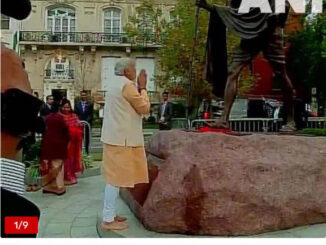
The first narrative specially created for American Public, Politicians and Media, after landing in America on 06-20-23, Modi went to pay homage to Mahatma Gandhi near the Indian Embassy i n Washington. For Modi it is a standard ritual; when in a foreign country, he must pretend to honor Mahatma Gandhi. While in India, the same Modi publicly worships Savarkar, a British stooge and his follower Nathuram Godse who killed Mahatma Gandhi!
Just on 06-09-23 in India, Modi’s Minister Giriraj Singh termed Nathuram Godse a ‘sapoot’ (worthy son) of India and said the assassin of Mahatma Gandhi was not an invader like Mughal rulers Babar and Aurangzeb as he was born in India. “If Godse was Gandhi’s assassin, he was also a worthy son of India.” And those who feel happy to call themselves children of Babar cannot be true worthy sons of India,”
But Modi, the man who turned Mahatma Gandhi’s spectacles into a logo for Swachh Bharat (Clean India Mission) by rebranding Nirmal Bharat Abhiyan (Total Sanitation Program started in 1999 by PM Atal Behari Vajpayee of Modi’s BJP), said nothing and takes no action to pull up his Minister Giriraj Singh for praising Mahatma Gandhi’s assassin Nathuram Godse.
Giriraj Singh is still a Minister in the Union Cabinet of Modi. In 2018 Singh was named in a case of grabbing land belonging to a Dalit in his native Bihar. When Modi never terminated him for this case; how you can expect Modi to terminate Singh for merely making a statement against Mahatm a Gandhi, who he also trashes and abuses in all his election rallies. Mahatma Gandhi’s name reminds me of an incident that happened in Howdy Modi, paid & managed by Modi in 2019 in Texas with almost 50,000 attendees. Modi who is used to bashing, rather abusing Father of the Nation Mahatma Gandhi and the first PM Jawahar Lal Nehru in his all-political rallies, was forced to learn history of India and how the foreigners look at India. US House Majority Leader Steny Hoyer said, “India, like America, is proud of its ancient traditions to secure a future according to Gandhi’s teaching and Nehru’s vision of India as a secular democracy where respect for pluralism and human rights safeguard every individual.” He also recalled that Nehru on the eve of Independence had spoken of Gandhi’s ambition “to wipe every tear from every eye” and that “as long as there are tears and suffering, so long our work will not be over.” “In that sense, the work of our country is not over.”
Still the shameless and self-praising Modi lied in 8-10 Indian languages, “All is well in India”. He is “Promoting Transparency, Public Participation , and is anti-corruption” by gutting the Right To Information, turning the CBI & ED into agencies that give Free Ride to the politicians & corporates that are on his side of the political divide and put anyone in jail who opposes Modi! Recently his government brought a Bill in Parliament that to be a Fact Checker you must have government approval. Bravo Modi Ji.
Then on June 21, 2023, Modi created a bigger extravaganza- a narrative – by promoting Yoga in USA to fool the American public. Modi will use this for his re-election campaign that he is the one who got Yoga international recognition and he is the only one who can promote Hindu ideology abroad and can protect Hindus in India.
Entire mainstream Indian Media owned by his billionaire friends who stole public wealth, since Ap ril 2023, is paddling Modi’s USA visit as if no other PM has ever been invited on a state visit to US, or to address the US Congress. PM Manmohan Singh was the first who visited USA on an “Official State Visit”, addressed US Congress and had dinner at the White House in 2009. Jawahar Lal Nehru, Rajiv Gandhi, PV Narasimha Rao, and Atal Behari Vajpayee of Modi’s BJP have also addressed US Congress before Singh & Modi.
It is customary for US President and the foreign leader on Official State Visit to have a joint press conference. First, Modi refused a press conference, and then agreed with a condition that only 2 reporters can ask questions. Modi’s aides insist that social media, which his party’s vast communications apparatus has mastered, has made news conferences redundant.
When questioned about India’s human rights record. Modi said, ‘I’m actually really surprised that people say so,’ he started his answer, then adding, ‘there’s absolutely no discrimination neither on the basis of caste, creed, or age’ or any kind of geographic location.’
Sabrina Siddiqui of the Wall Street asked both leaders about human rights, pointing to Modi that while India has ‘long prided itself as the world’s largest democracy’ a number of human rights groups have said ‘your government has discriminated against religious minorities and sought to silence its critics.’ Modi pushed back telling the journalist, ‘India is indeed a democracy.’
‘Democracy is in our DNA. Democracy is our spirit; democracy runs in our veins. We live democracy and our ancestors have actually put words to this concept and that is in the form of our Constitution,’ Modi continued.
‘Our constitution and our government have always proved that democracy can deliver. And when I say deliver, this is regardless of caste, creed, religion, gender, there’s absolutely no space for discrimination,’ Modi said.
Whereas the fact is under Modi since 2002 as CM of Gujarat and after becoming PM of India in 2014, minorities, namely Muslims, Christians, Sikhs, Buddhist, tribals and dissidents are undergoing intensely antidemocratic censorship, discrimination, and extrajudicial violence and long jail terms under repressive colonial British laws.
In India, Modi is not answerable to anyone including print and TV media on any matter related to the wellbeing of Indians or his anti-minorities policies or his party re-writing Indian history with false narratives. The Media’s job is only to praise Modi 24X7 in every Indian language, trash all the opposition leaders, Islam, Christianity, and other religious minorities including Tribals and Dalits. Neither Modi gives a chance to foreign media to ask him about minorities undergoing religious discrimination, public beatings, and lynchings, nor does he want to answer uncomfortable questions like India slipping to 107 out of 121 countries in UN’s Hunger Index or 132 in Human Development Index, or 135 out of 146 in Gender Gap Index of the World Economic Forum. Thomson Reuters Foundation calls India the world’s most dangerous country for women. Cato Institute, which measures human freedom, downgraded India between 2015 and 2022 from 75 to 112. India ranks 160 out of 180 countries in Press Freedom Index by Reporters Without Boarders in 2022. They cited violence against journalists with an average 3-4 journalists killed in connection with their work every year.
People should know that BJP and Modi’s own Cabinet of Ministers have the most criminals in the current Indian Parliament. Out of 303 BJP MP’s, 116 have criminal records, including one charged with bomb making, a terrorism accused, and 22 are in Modi Cabinet .Out of that number, 16 ministers have serious criminal cases registered against them. Serious criminal cases include terrorism, treason, arson, murder, rape, robbery, burglary, communal disharmony/hate speeches, electoral law violations, and kidnapping, among others.
Unfortunately, of the 539 winning candidates analyzed by the ADR, as many as 233 MPs or 43% have criminal charges. Nearly 29% of the cases are related to rape, murder, attempt to murder or crime against women. “There is an increase of 109% [in 2019] in the number of MPs with declared serious criminal cases since 2009,” it said. If that is the plight of India’s Parliament and government run by criminals; one can for sure say the states must be doing worse than that!
I leave it to the fellow Americans, especially the Indian Americans, to do some serious thinking why America under its morally and ethically corrupt politicians, is supporting foreign leaders who are communal and criminal, like Narendra Modi.
Comments are welcome.
(The author is a social activist, based in New Jersey. He can be reached at davemakkar@yahoo.com)
This week we are looking at Prime Minister Narendra Modi’s visit to Washington, which saw US President Joseph Biden roll out the red carpet for him. PM Modi’s visit included a private dinner at the White House, a ceremonial welcome, a state banquet, an address to the US Congress joint session and lunch at the State Department.
PM Modi is the third international leader, after French President Macron and South Korean President Yoon Suk Yeol to be invited as a State guest to the Biden White House. He is also the third Indian leader to be invited as a State visitor to Washington. In 2009, Prime Minister Manmohan Singh was invited by President Barack Obama, and in 1963, President Sarvepalli Radhakrishnan was invited by President John F Kennedy.
“Decades from now — decades from now, people will look back and say the Quad bent the arc of history toward “global good,” as the Prime Minister describes it. Together, India and the United States are working closely on everything from ending poverty and expanding access to healthcare to addressing climate change to tackling food and energy insecurity stoked by Russia’s unprovoked war on Ukraine,” U.S President Joe Biden said.
“We were strangers in defense cooperation at the turn of the century. Now, the United States has become one of our most important defense partners. Today India and the US are working together, in space and in the seas, in science and in semi-conductors, in start-ups and sustainability, in tech and in trade, in farming and finance, in art and artificial intelligence, in energy and education, in healthcare and humanitarian efforts, PM Narendra Modi said.
High-Tech partnership
The big deal announced during this visit was the MoU for a co-production deal between GE and HAL to manufacture GE-F414 jet engines in India for Tejas Light Combat Aircraft
Semiconductor supply chains: Micron Technology will invest $800 million toward a new $2.75 billion semiconductor assembly and test facility in Gujarat- the Indian Semiconductor mission will fund the rest of the project
Under the newly launched Initiative on Critical and Emerging Technology (iCET), a number of innovation partnerships, also on India and the United States have established a Joint Indo-U.S. Quantum Coordination Mechanism to facilitate joint research looking at Quantum, Advanced Computing, and Artificial Intelligence
India to join the 11-nation minerals security partnership (msp) meant to reduce dependence on China for critical minerals
Defense cooperation
India will buy 16 Drones- armed MQ-9B SeaGuardian UAVs.
The US Navy has concluded a Master Ship Repair Agreement (MSRA) with Larsen and Toubro Shipyard in Kattupalli (Chennai) and is finalizing agreements with Mazagon Dock Limited (Mumbai) and Goa Shipyard (Goa).
Placing Indian liaison officers at 3 US commands
Launch of India-U.S. Defense Acceleration Ecosystem (INDUS-X)— between private defense industries in US and India
Space cooperation:
India signed the Artemis Accords, joining 26 other countries working on exploration of the Moon, Mars, and beyond.
NASA will provide advanced training to Indian Space Research Organization (ISRO) astronauts with the goal of launching a joint effort to the International Space Station in 2024.
NASA and the ISRO are developing a strategic framework for human spaceflight cooperation by the end of 2023
Trade and Consular issues
Resolution of six of seven outstanding WTO disputes between the two countries through mutually agreed solutions, market access
India to set up consulate in Seattle, 2 other US cities. US to set up new consulates in Ahmedabad and Bengaluru
Relaxation in H1B visa norms for in country renewal and more availability of visas
The broad geopolitical takeaways of the Modi visit
Reaffirmation of India-US strategic ties, also within Quad and the Indo-Pacific, although no specific messaging on China.
High technology partnerships will drive the next phase of the relationship, just as the nuclear deal, or the defense agreements, or the search for an FTA once did. In particular, the Jet engine deal if it goes through could pave the way for more technology transfer that has thus far eluded the relationship
Leadership level summits and meetings continue to ensure India-US ties grow year on year as they have over the past two decades. Biden will visit India for the G20 summit in September, and there’s speculation PM Modi will be invited to California for the APEC summit in November, where leaders of 21 countries including US and China will meet.
Reading the fine print- the left-outs
The big-ticket item on this visit- for the GE F414 jet engines to be co-produced in India still has a long regulatory road ahead- a manufacturing license agreement has now been submitted for Congressional Notification. US Congress will need to clear the deal on two counts of Export Administration Regulations (EAR) and International Traffic in Arms Regulations (ITAR). Questions are still open on just how much technology will actually be transferred- and whether India will accept conditions attached to that….some of the reasons previous attempts on jet engine tech transfer, as the two countries attempted from 2010-2019 under DTTI, failed.
Indian regulations have similarly held up the Indo US nuclear deal between Nuclear Power Corporation of India Limited (NPCIL) and Westinghouse Electric Company (WEC) for the construction of six nuclear reactors in Kovvada, Andhra Pradesh. 8 years after Modi-Obama announced the nuclear deal is done, and worked a way around the CLNDA, there’s still no techno-commercial offer. ‘
The Biden administration has made it clear it has no interest in continuing the Trump-era FTA talks, and the Modi government has made it clear it still expects the Biden administration to restore India’s GSP status for exports. But no movement during this visit
The big ticket deal from 2019 on an Indian investment in a US LNG plant- specifically the $2.5 bn planned by Petronet in Tellurian’s Driftwood LNG project- has not been revived, nor was any announcement made on GAIL India’s plans to invest in US LNG plants.
India and US agreed to disagree, but differences over the Russian war in Ukraine remained- while Biden referred to what he called Russia’s brutal war on two occasions, PM Modi didn’t, nor did the Joint statement reflect it.
Human Rights-this remains as prickly an issue as it was in 2014, when PM Modi visited India for the first time after his visa was revoked in 2005. Ahead of this visit as many as 75 members of the US Congress wrote to President Biden demanding that he raise concerns over human rights and democracy in India publicly, which he did not.
And former President Obama said this in an interview that released the same day as the State visit:
“I think it is true that if the President meets with Prime Minister Modi, then the protection of the Muslim minority in a majority Hindu India, that’s something worth mentioning. Because, and by the way, if I had a conversation with Prime Minister Modi, who I know Well, part of my argument would be that if you do not protect the rights of ethnic minorities in India, then there is a strong possibility, and at some point, starts pulling apart. And we’ve seen what happens when you start getting those kinds of large internal conflicts”
When asked at a rare press event with – where he answered a few questions from the media, here’s what PM Modi said
“We have proven that democracy can deliver, and there is no discrimination in India on the issues of cast, creed, religion”
World View Take
Quite aside from the moment at hand, the underlying logic for India-US relations, especially between its people has always been strong- and is the reason relations remained close despite cold war tensions. PM Modi’s state visit to Washington is one more step in ties that have grown year on year over 2 decades and are poised to take the next leap on technology transfer. When it comes to questions over Indian democracy, that are internal to India, PM Modi made a rare exception in taking questions in the US, but it is the answers he gives to Indians in India on democratic freedoms that will actually count.
Modi confabulates with world leaders abroad while a part of India is burning
“Although the Biden Administration promised to put human rights, religious freedom, and press freedom at the forefront of foreign policy, they appear to be very selective in their approach to building relationships. If America should continue to be a shining city on a hill for all those who love freedom and liberty, President Biden should have a frank talk and sincere discussion with Prime Minister Modi urging him to uphold shared values, without which a stronger or more reliable friendship can never be achieved. Mr. President, please ask Mr. Modi why he didn’t utter a word until now on the continuing bloodshed and suffering of his own people in Manipur as he readies to raise his champagne glass in the White House.”
By George Abraham
Last month, in Hiroshima, Japan, Italian Prime Minister Giorgia Meloni announced in the middle of the Group of Seven (G-7) summit that she would leave the meeting a day earlier than scheduled to lead the response to floods which hit the north of her country very hard that week. Torrential rains devastated eastern parts of the Emilia-Romagna region, killing 14 people and causing enormous damage. Compare that to Mr. Modi, the Prime Minister of India, who is on a state visit to the United States when the state of Manipur is burning, hundreds of people are being killed, and thousands are made homeless by Hindu militants by burning the entire villages often with people inside as part of a broader agenda to ethnically cleanse the tribal people who are mostly Christians from the land they have inhabited for hundreds of years.
Mr. Modi also traveled to Australia after the Quad summit in Papua New Guinea while the Manipur mayhem was getting out of hand in the name of strengthening bilateral relations between the two countries. However, the primary discussion reported to the news media was the recent attacks on the Hindu temples in Australia. The foreign secretary Vinay Mohan Kwatra, responding to a question about the attacks, reiterated that the Indian government had made its case very clearly. “The attack on the temples and activities of the other separatist elements were also discussed by the two prime ministers earlier and today. From the discussions last time till this time, the progress is clearly reflected in the fact that PM Modi thanked PM Albanese for the action that the Govt of Australia has taken against these elements,” said Kwatra.
There is absolutely nothing improper about a leader concerned about his people in foreign lands, especially for their security and safety. However, it is ironic for a man to engage in primary discussion protecting the places of worship of his own faith on a foreign land while allowing 253 churches to be torched by his supporters back home. Christian organizations in the area have recorded the burning, damage, or destruction of those churches and six Christian Institutions amid the wave of violence. Significantly, these churches primarily served as places of worship for Meitei Christians. It is alleged that these structures were primarily targeted and destroyed by Meitei Hindus. The RSS, the militant Hindu Group, is believed to be behind these attacks. One also wonders that in the middle of the fight between Meiteis and Kukis over land rights, why did the mob burn down and destroy 249 churches in the Meitei heartland in the first wave of violence?
Mr. Joshua Hangshing, one of the victims of this dastardly attack, said, “Mobs shouted threatening at my wife, accusing her of converting to Christianity. Moments later, she and her son Joshua were burned alive while the perpetrators rejoiced in their macabre victory. The last words of my innocent son were Papa, Papa”. This ongoing violence could have been prevented within days if the government in Manipur and the Home Ministry in Delhi had acted responsibly.
In a parliamentary democracy, elections are competitive and often fought bitterly. However, once a party leader takes the oath of office, that person becomes the leader of the entire nation. However, what we are witnessing in India today contradicts that norm. Prime Minister Modi and the party he represents, BJP, may be interested only in one religious group’s welfare and appear unconcerned about its implications. The consequences are out in the open where minorities fall victim to his party’s nefarious agenda pressing ahead for a majoritarian rule.
For Indian Americans, a state visit by the leader of their motherland should be a heartwarming occasion. Undoubtedly, it signifies the importance the U.S. government attaches to this relationship. They would like to see a warm relationship built on shared values and shared interests. However, the Diaspora is polarized over this overture as numerous reports indicate how the Modi administration’s efforts to undermine its democratic institutions, including the judiciary, muzzling the media and driving the nation on a perilous path towards authoritarianism.
Although the Biden Administration promised to put human rights, religious freedom, and press freedom at the forefront of foreign policy, they appear to be very selective in their approach to building relationships. If America should continue to be a shining city on a hill for all those who love freedom and liberty, President Biden should have a frank talk and sincere discussion with Prime Minister Modi urging him to uphold shared values, without which a stronger or more reliable friendship can never be achieved. Mr. President, please ask Mr. Modi why he didn’t utter a word until now on the continuing bloodshed and suffering of his own people in Manipur as he readies to raise his champagne glass in the White House.
It is a sad spectacle that a good portion of the Indian Diaspora shows little or no compassion for the suffering people in Manipur. According to Arthur Schopenhauer, compassion is the basis for morality. When we restrain compassion, our moral identity is compromised. It is time to ponder that India’s success as a democracy is seriously compromised by a serious deficit of compassion and a pervasive absence of integrity. India’s own treatment of its vulnerable minorities is not a good indicator of the well-being of Non-resident Indians across the world, where they will not have a leg to stand on demanding fairness, equality, and justice.
(Author is a former Chief Technology Officer at the United Nations. He is Vice Chairman of IOC USA. He can be reached at gta777@gmail.com)
There needs to be an inspiring alternative agenda that enthuses India and which can move the silent majority away from the climate of hate
Today, more than ever, India needs an organised, programmatic and political counter to hate. We do not have the luxury to wait for an organic mass psychological realignment. The only question is: can we transcend narrow interests, and work collaboratively in the national interest?
By Pushparaj Deshpande
The communal disturbances in Maharashtra, the performative religiosity in the new Parliament’s inauguration and The Kerala Story are all intrinsic to the Rashtriya Swayamsevak Sangh-Bharatiya Janata Party (RSS-BJP)’s larger cultural war. Vitiating mass consciousness, such issues typically pit Hindus against Muslims, elite establishmentarians against grounded ‘nationalists’ and constitutional values against ‘traditional’ values. Despite this war’s profound impact on India’s social fabric, little attention has been devoted to analyzing why atavistic tendencies acquire a social base. If most Indians live by the Ganga-Jamuni tehzeeb, nothing could make them communal, xenophobic, casteist, patriarchal or racist. Yet, studies show that India has become radicalized and socially conservative. To reverse the flames engulfing India (and other nations, as reports suggest in the context of the Leicester riots), dissecting the black box of hate is critical.
The anatomy of organised hate
There are broadly three types of hatred today — organised, inherited and absorbed hate. The first is methodically spearheaded by organizations like the RSS-BJP, invariably for partisan ends. Inherited hate is generationally passed down (usually caste, communal and gender prejudices), which is fertile soil for the champions of organised hate. Finally, absorbed hate is a disease afflicting the silent majority. The Sangh Parivar systematically targets both these constituencies, for short-term goals (influencing voting behavior, consensus on key issues and fundraising) and to convert permanently.
Progressive forces invariably counter the visible champions of organised hate, including party spokespersons, aligned influencers and organizations, as well as troll armies. They also resort to debunking misinformation or cornering regressive stances/action. Unfortunately, the RSS-BJP cannot be shamed, for they are unhinged from constitutional or institutional norms. Furthermore, their propaganda is complemented by a vast network of socio-cultural and religious organizations that subterraneanly spearhead ideological projects. In stark contrast, by striving only to shape public discourse, progressives put the onus of psychological consonance on the people. They assume that people will organically be swayed to progressive positions. Both empirical and anecdotal evidence suggests that this tactic is failing. Moreover, this strategy inadvertently oxygenates those historical-cultural issues that the Sangh deploys to frame every state policy and election as an existential war.
Unfortunately, there is no organised programmatic counter to hatred today. Bulldozers raze brazenly, mobs lynch with impunity, processions/films disrupt harmony and economic boycotts are organised with tactical precision, while the State maintains a studied indifference. Sadly, progressive parties avoid interventions against the forces of hate, as Karnataka’s Bajrang Dal and Maharashtra’s Kolhapur episodes suggest. This is partly because the Sangh can easily instigate retaliatory conflagrations, that invariably benefit the BJP electorally. However, given the BJP’s insatiable electoral greed, it is near-impossible for progressive parties to limit the impact area of any disturbance. But there are also structural reasons for this programmatic inertia. Most parties do not plan and execute programs on ideological issues, remaining excessively dependent on the State. They have forgotten the Congress movement’s lessons, which functioned independently of state machineries.
Structurally combating hate
Whole communities have shriveled in the face of the hatred engulfing India. Given this, there are both moral and pragmatic considerations to frontally tackle the fear that breeds regressive attitudes. First, we progressives need to acknowledge pre-existing societal fears of losing out on economic and political opportunities, and redress them. Not doing so enables the BJP to exploit those fault lines. For example, even though unemployment is a national problem, in the absence of a comprehensive strategy from progressives, the BJP successfully spins mass unemployment as a consequence of Muslim over-population (that is, jobs meant for Hindus are being ‘stolen’ by Muslims). Similarly, shrinking public sector jobs and educational opportunities are cynically blamed on reservations (indirectly holding Dalits, Adivasis and backward communities responsible), and not on the fire sale of public sector assets or on policies that make education inaccessible. Given this, progressives need to carefully assuage such fears. A first step could be posing an inspiring alternative agenda that enthuses India. Only then can we wean away the silent majority from the claws of hatred.
But progressive parties also need to put boots on the ground. In that spirit, they must actively collaborate with civil society, which transcends electoral exigencies. Serving as a complementary system, this could become both a response mechanism to conflagrations, and a network of progressive ideological projects. This would facilitate the forging of fresh relationships with new constituencies. One such constituency must be religious leaders/organizations, which progressives inexplicably avoid (thereby giving the RSS-BJP a blank cheque to assert that they represent all Hindus). Such a system would undoubtedly delegitimize atavistic causes.
Furthermore, progressive parties can substantively constrict regressive activities when in office, as the recently elected Karnataka government is doing. Just to cite some obvious examples, organizations frequently showcase movies to vitiate public discourse, conduct processions and sansads to disrupt the peace. While states can ban such organizations, this is only a stopgap since they invariably remerge in a new avatar. A more sustainable solution would be to spearhead out-of-the-box solutions that include shanti senas inculcating societal harmony, promoting films that espouse liberal, secular and democratic values, aggressively disseminating a constitutional narrative through alternative media, and ideological projects.
Fourth, progressives also need to check benefactors of regressive causes. A conflagration is sometimes a smokescreen to promote narrow economic interests. For example, the attack on abattoirs was both ideologically motivated and backed by economic competitors. Similarly, select diaspora groups support regressive projects for preferential treatment in commercial ventures in India. Mapping this financial infrastructure of hate would enable targeted counters using state instruments. A body blow can be delivered if the taps that empower regressive organizations can be closed. But this would need to be complemented by also addressing the non-partisan concerns of interest groups, satyagrahas against benefactors (who can be shamed), ensuring foreign funding does not foment hatred in India (which the compliance rules of most nations prohibit), and organised legal retribution.
Ideological and political commitment
India does not deserve ideological malleability or unprincipled politics (as witnessed during the Delhi riots in 2020). In this context, Prime Minister Jawaharlal Nehru’s spirited fight against communalism offers a toolkit. Apart from making it a central theme in the 1951-52 general election, he tirelessly campaigned against hatred through public/parliamentary speeches, radio broadcasts, as well as letters to Chief Ministers and party units. Urging the Congress Party to “live up to our ideals and declarations” and “not let India be slaughtered at the altar of bigotry”, he ensured the party “(fought) it in houses, in fields and in marketplaces… (and) in the council chambers and the streets” (Letters to Chief Ministers, Volume 1, pp 479 and 487; and Jawaharlal Nehru’s speeches, Vol. 2, p.175). Today, more than ever, India needs an organized, programmatic and political counter to hate. We do not have the luxury to wait for an organic mass psychological realignment. The only question is: can we transcend narrow interests, and work collaboratively in the national interest?
(Pushparaj Deshpande is the Director of the Samruddha Bharat Foundation and the series editor of the Rethinking India series (Penguin)
The prime minister is naked, but DC still wants fashion tips
A4H founder Romesh Japra says it will be “the very first time we are doing a Hindu American summit for political engagement.” Yet he omits that the “political engagement” appears to be entirely on behalf of one particular Indian political party. Mentioning “20 organizations” involved in the summit, he fails to mention that the most established of these are all linked to the tight-knit “Sangh Parivar” (Family of Organizations) which spearheads India’s Hindu nationalist movement.
By Pieter Friedrich
When Prime Minister Narendra Modi arrives in Washington, DC on 21 June 2023, what those officials in the US government who invited him may not have accounted for is that his visit grants his ruling Hindu nationalist Bharatiya Janata Party (BJP) the benefit of propagandizing in America at a time when Modi’s regime is putting democracy under the knife at home in India.
From marches to political summits to diaspora events, Modi’s visit enables sympathizers of the BJP — and the fascist Rashtriya Swayamsevak Sangh (RSS) paramilitary which serves as its parent organization — to shore up his brand within the United States less than a year before India’s upcoming 2014 General Election. The only reason, however, that Modi and his international RSS-BJP backers are able to avail themselves of this golden opportunity for a US propaganda bonanza is thanks to his dual invitations to join a formal State Dinner with President Joe Biden at the White House as well as to address a Joint Session of Congress.
Modi will owe a debt of gratitude to the US officials who helped him obtain these platforms since, as he faces re-election to a third term, his American devotees are using his visit to his full political advantage.
A week-long series of events launched on 14 June, when Americans4Hindus (A4H) Political Action Committee hosted a so-called “Hindu American Summit” on Capitol Hill, with US House Speaker Kevin McCarthy allegedly in attendance. The A4H founder and many of its funders are deeply tied to various international affiliates of the RSS-BJP and the group, undoubtedly, used the summit to advocate for Modi’s Hindu nationalist policies.
A4H founder Romesh Japra says it will be “the very first time we are doing a Hindu American summit for political engagement.” Yet he omits that the “political engagement” appears to be entirely on behalf of one particular Indian political party. Mentioning “20 organizations” involved in the summit, he fails to mention that the most established of these are all linked to the tight-knit “Sangh Parivar” (Family of Organizations) which spearheads India’s Hindu nationalist movement.
Those groups are, namely: the Hindu Swayamsevak Sangh (HSS), the Vishwa Hindu Parishad of America (VHPA), SEWA International, and Ekal Vidyalaya. Not only are all of these groups linked to the RSS-BJP in one way or another, but many of their leaders have been directly involved in helping to get Modi elected.
Moreover, Japra himself is far from apolitical when it comes to Indian politics.
His documented relationship with the party traces at least as far back as 2013, when he hosted a top BJP executive in his California home and, joined by OFBJP leaders, applauded the “change” Modi, then a candidate for prime minister, could bring to India. In 2019, he donned a BJP scarf and spoke at an Overseas Friends of the BJP (OFBJP) event, demanding that Modi be brought “back to power.” Meanwhile, since A4H first began collecting funds in 2019, approximately 40 percent of its donations have come from just 12 individuals who have long track records as either leaders in American Sangh Parivar groups, campaigners for Modi’s election, or both. Those funds have apparently gone for purposes such as hosting events with infamous RSS-BJP leader Ram Madhav as well as various other Hindu nationalist commentators.
Not to let A4H get all the attention, another group will organize an 18 June march from the Washington Monument to the Lincoln Memorial. Although a flyer for the event claims it is organized by the “Indian American diaspora,” the only spokesperson quoted in media coverage is Adapa Prasad, President of the OFBJP.
Prasad is also pushing another event, this one a “cultural show” on 21 June in DC’s Freedom Plaza (just outside the White House). That same evening, the Biden family hosts Modi for an “intimate” supper. As Modi’s trip continues with the actual State Dinner on 22 June, the administration reportedly plans to turn it into a picnic extravaganza by holding it in a tent on the White House’s South Lawn.
That same day, before the dinner, Modi will address a Joint Session of Congress, making him — as has been made much of in the press — not only one of the few foreign leaders but the only Indian Prime Minister to have ever done so twice.
“As State Dinners have come to signify the President’s utmost respect for visiting heads of state, granting a joint address to Congress is a commensurate honor for the leader of the world’s largest democracy,” noted the letter from congressional representatives who initiated the demand that Modi be invited to give an address. In other words, it’s not just a routine laying out of the red carpet for a foreign leader, but rather the diplomatic equivalent of kissing their feet.
It’s also a way, by featuring Modi on the most prominent podium in the world, for the prime minister of a democratic country which has been downgraded to an “electoral autocracy” — and whose most strident critics accuse him of overseeing an impending genocide of religious minorities — to get, gratis, the most enviable and valuable publicity imaginable. Curiously, the propaganda value for Modi doesn’t seem to be a consideration to any major players in the US government.
Reportedly, Representatives Jamie Raskin (D-MD) and Ilhan Omar (D-MN) will both boycott the Joint Session, which is commendable but still leaves 533 members of the House and Senate in presumptive attendance. Meanwhile, human rights issues are just not on the agenda: rather, a White House spokesperson actively rebuffed a question about it by praising India’s “vibrant democracy.” Such claims starkly contradict even official US State Department reports, let alone the US Commission on International Religious Freedom, which has repeatedly flagged the precarious condition of the country’s religious minorities.
The most current example is India’s state of Manipur, which even now burns as Hindu mobs — with apparent silent sanction by the BJP — attack Christians; perhaps as many as 200 have been killed, hundreds of churches torched, and thousands of homes razed.
As Manipur is ablaze, Modi’s invite to DC enables his devotees to organize yet one more event in America’s capital: a 23 June, invitation-only diaspora event where he’ll talk about “The Role of Diaspora in India’s Growth.” A more accurate title might be “the role of the American Sangh Parivar in Modi’s success.” Bharat Barai, one of the lead organizers and the event’s sole spokesperson thus far, is a longtime VHPA executive who personally led a team of hundreds of Indian-Americans to India in 2014 to campaign for Modi’s election. From beginning to end, the packed schedule of events, while billed as “Indian diaspora” celebrations of India” are all, upon examination, nothing more than thinly-veiled partisan rallies organized by RSS-BJP linked activists to prop up and promote Modi himself. Coming just a year before India’s 2024 General Election, could the incumbent prime minister have asked for a better pre-election gift?
In 2022, raising concerns about the rapidly deteriorating human rights situation in India, Representative Omar asked: “What will it take for us to outwardly criticize the actions that the Modi administration is taking?” Certainly, no one could imagine Turkey’s Recep Tayyip Erdoğan, China’s Xi Jinping, or Russia’s Vladimir Putin being so feted and honored by the US government. Yet, no matter how bad the situation gets in Modi’s India, the vast majority of politicians on both sides of the political aisle in Washington, DC can’t stop stumbling over themselves to be the first ones to babble about the stunning suit of “democracy and shared values” worn by a man whom even the tiniest child can see is a stark-naked fascist.
What will it take for America to wake up and see that, indeed, Prime Minister Modi is wearing no clothes whatsoever and that our nation must stop providing him — and his zealots — platforms from which to claim otherwise? At this rate, one fears that even the outbreak of the impending anti-minority genocide about which experts are warning won’t do a thing to shake the American political establishment’s pig-headed commitment to “balancing” concerns about human rights with the supposed “need” to expand a “strategic partnership” with India.
Without a course correction, it won’t end well for either America or India, and years from now, the US government’s approach towards Modi will serve as yet another cautionary tale from which we will pray our descendants learn.
The hope, however, is the same as it has always been. With the establishment begs the naked ruler to put them in touch with his tailor, the common people in the street are the ones whose very separation from power permits them to speak the truth.
Truth topples regimes.
(Pieter Friedrich is a reader-supported publication. To receive new posts and support my work, consider becoming a free or paid subscriber)
It is nobody’s case that corruption and transgression in military contracts should, in any way, be overlooked and not probed. But the CBI’s overall track record in this regard is as disappointing as the MoD’s debatable decision-making in building India’s military capability.
Inquiries by the Central Bureau of Investigation (CBI) into innumerable cases of questionable Indian materiel purchases over the past four decades have largely failed not only in securing convictions or conclusively proving criminality, but conversely, they have impeded military modernization, in turn adversely impacting operational efficiency.
Beginning with the Bofors howitzer import scandal in the late 1980s, followed soon after by the interminably investigated purchase of German HDW Type 209/1500 diesel-electric conventional submarines (SSKs), anti-materiel rifles, air defense systems, surface-to-air missiles (SAMs), VVIP helicopters and other assorted equipment, the probe agency has come a cropper.
The latest such case it registered in late May was against Rolls-Royce, two London-based Indian expatriates — deemed ‘middlemen’ or agents — and ‘unnamed’ officials from Hindustan Aeronautics Limited and the Ministry of Defense (MoD) for supplying Adour Mk871 engines to power the license-built BAE Systems Hawk 132 advanced jet trainers for the Indian Navy and the Indian Air Force. The CBI registered this case a whopping 19 years after the deal was signed in 2004, and nearly a decade after launching its preliminary enquiry (PE) into the reportedly dubious purchase.
And while its outcome will only be known in due course, the CBI’s past record in conclusively proving anybody’s culpability in a raft of allegedly dodgy military deals inspires little confidence, as a cursory audit reveals, in its competence in probing suspect military acquisitions.
L’affaire Bofors, for instance, was largely responsible for Rajiv Gandhi-led Congress’ defeat in the 1989 General Election, lasted 25 years and cost the exchequer Rs 250 crore in investigations, but resulted in a nebulous outcome. It also led to the MoD deferring till 2012 the option to domestically license-build the Bofors FH-77B 155mm/39 caliber howitzers based on blueprints that were transferred to the then Ordnance Factory Board alongside the Swedish gun purchase.
This chronic delay exacerbated the Indian Army’s dire artillery shortfall during the 1999 Kargil war and an extended period thereafter, when it faced challenges from a recidivist Pakistan along the Line of Control in Jammu and Kashmir. Eventually, after the CBI came up with nothing, the MoD operationalized the howitzers’ drawings to develop the upgraded 155mm/45 caliber Dhanush howitzers that are presently being inducted into service to make up for enduring artillery shortfalls.
Similarly, CBI investigations into the HDW submarine contract, which included the outright purchase of two SSKs from Germany and the Mazagon Dock Limited (MDL) license-building the remaining two platforms via the transfer of technology, proved detrimental to the Navy’s underwater asset inventory. It spawned what the Navy even today distressingly refers to as the ‘lost decade’ between 1995 and 2005, when the MDL’s submarine construction facilities were rendered idle, predicated on the CBI’s inquiries which, after some two decades, were terminated without an outcome.
However, this hiatus in submarine building led to the MDL’s specialized submarine workforce, especially skilled underwater welders, seeking alternative employment abroad. And, in 2005, after India signed a deal with France to license-build six Scorpene SSKs, the MDL had to resurrect its submarine construction facilities and re-induct a specialized workforce at a great cost. This fiasco also ensued when the Navy’s depreciated conventional underwater fleet was ageing, and it remains woefully inadequate even today.
The CBI’s probe into the procurement of 12 AW-101 helicopters for the IAF from AgustaWestland in 2010 to ferry VVIPs — with regard to alleged contravention of the MoD’s Integrity Pact — led to the termination of all contracts with its parent company Finmeccanica (later, Leonardo) and all its other 38 subsidiaries. This latter proscription included Italy’s Whitehead Alenia Sistemi Subacquei that had been contracted to supply the Navy 98 Black Shark heavy weight torpedoes (HWTs) for its Scorpenes, of which five have already been commissioned. Terminating the HWT contract, however, resulted in the Scorpenes being armed with upgraded German-origin SUT torpedoes acquired in the mid-1980s that Navy officers themselves concede remain a ‘poor substitute’.
Earlier, in 2008, the CBI’s PE into the procurement of three Brazilian Embraer EMB-145 aircraft by the Defense Research and Development Organization (DRDO) for its indigenous aircraft early warning and control programme had revealed that $5.76 million was illegally paid as commission to an ‘overseas agent’ to facilitate the sale. The CBI, for its part, was reacting to a report by Brazilian newspaper Folha De S. Paulo, but then it seemed that the trail went cold. The CBI has now filed a chargesheet against arms dealer Arvind Khanna, advocate Gautam Khaitan and businessman Anup Gupta in the case.
In another case, in late 2013, the CBI filed a closure report on its eight-year-long inquiry into alleged wrongdoing by South Africa’s state-owned armaments maker Denel, to secure the contract to supply 1,000 NTW-20 anti-materiel rifles and 3,98,000 rounds of ammunition to the Army for an estimated $40 million. In its report filed before a special CBI court in New Delhi, the investigative agency claimed it had failed to uncover any ‘credible’ evidence of corruption in the rifle procurement. However, Denel, which produced a range of competitively priced weaponry which India needed and could have acquired, remained blacklisted for years.
Another case pertained to the contract with Israel Aerospace Industries to locally manufacture Barak-8 SAMs for all three services in conjunction with the DRDO. The CBI also investigated terminated tenders for air defense guns once, and twice for light utility helicopters, but failed to ascertain culpability.
It is nobody’s case that corruption and transgression in military contracts should, in any way, be overlooked and not probed. But the CBI’s overall track record in this regard is as disappointing as the MoD’s debatable decision-making in building India’s military capability.
The push for a uniform civil code should not become a divisive tool
The Law Commission’s decision to solicit views from the public on the idea of a uniform civil code appears to be a political initiative aimed at bringing the potentially divisive issue under focus in the run-up to next year’s general election. The Commission, the 22nd such panel, has claimed that years have elapsed since similar views were sought by the previous panel, and that a fresh effort was needed to garner varied opinions. The 21st Commission had released a consultation paper in 2018 that categorically said a uniform civil code was “neither necessary nor desirable” at that stage. In a well-reasoned document, it had then argued that the focus of initiatives to reform the various personal laws should be the elimination of all forms of discrimination rather than an attempt to bring about uniformity in the laws governing various religions. The document was progressive in nature, inasmuch as it emphasized non-discrimination over uniformity, and recognized that there could be diverse means of governing aspects of personal law such as marriage, divorce, inheritance and adoption instead of imposing a single set of rules on society. This would entail the removal of discriminatory provisions, especially those that affect women, and adoption of some overarching norms rooted in equality. Nothing significant has happened since to warrant a fresh look, except perhaps a political need for the current dispensation to bring the issue to the electoral arena.
A uniform civil code for the entire country is indeed a lofty goal, but the question whether introducing one for all aspects of personal law would impinge on the freedom of religion has been part of the debate. B.R. Ambedkar viewed it as desirable but favored its being voluntary. It is possible that a uniform code may be adopted without offending any religion, but the concept evokes fear among sections of the minorities that their religious beliefs, seen as the source of their personal laws, may be undermined. In fraught times such as the present, a common code will inevitably be seen as an imposition by the majority. Basic reforms can be given priority — such as having 18 as the marriageable age for all across communities and genders. Introducing a ‘no-fault’ divorce procedure and allowing dissolution of marriage on the ground of irretrievable breakdown, and having common norms for post-divorce division of assets were other matters the previous Commission threw up for a debate. Within each community’s laws, it will be desirable to first incorporate universal principles of equality and non-discrimination and eliminate practices based on taboos and stereotypes.
Criminal cases should not be allowed to take a communal color
Festering communal tensions in Purola in Uttarakhand, nearly 400 kilometers north of Delhi, have resulted in the fleeing of most of the town’s handful of Muslims. A clutch of self-styled protectors of Hindu interests had called for a congregation on June 15, which was cancelled at the eleventh hour, even as the Uttarakhand High Court asked the State government to ensure that law and order was maintained. Tensions arose from an alleged attempt by a Muslim man to kidnap a minor Hindu girl from the town, on May 26. The man and his Hindu friend were arrested, and the incident soon became the new war cry for outfits that have been peddling the notion of love jihad, an alleged Islamic scheme to entrap Hindu girls in liaisons. Muslims in Purola became the target of a social boycott, and Hindu landlords were reportedly forced to evict their Muslim tenants. Several such incidents of targeting interfaith relationships have been reported in Uttarakhand in recent months. In a rather bizarre case, an interfaith couple had to call off their marriage even after their families had agreed to their match. Individual rights and choices are being trampled upon by hooligans who claim to protect community interests, a trend that is a serious threat to the rule of law and social harmony.
The Chief Minister of Uttarakhand, Pushkar Singh Dhami, has amplified the hate rhetoric of love jihad in recent months even as these disturbances continue. He also ordered the demolition of over 600 tomb shrines associated largely with Muslims, on grounds of encroachment of public or forest land. He has promised strict action against the so-called love jihad and a vaguely framed ‘verification drive’ of people to keep the State free of disturbances. Meanwhile, random organizations that seek the cleansing of ‘devbhoomi’ — a reference to Hindu shrines in the Himalayan State — of other faiths, are finding the ruling party’s tacit or direct endorsement. A demand for excluding Muslims from the businesses associated with the Chardham pilgrimage circuit is also being given a sympathetic hearing by the administration. Since 2017, Uttarakhand has been in the news for campaigns and hate speeches against people from the minority community, which has been noted by both the Supreme Court of India and the High Court. The State should remain impartial in enforcing the law. The criminal case of attempted kidnapping in Purola should be investigated quickly, and nobody should be allowed to make use of it to propagate communal politics. The leaders should be fair and impartial and be seen so.
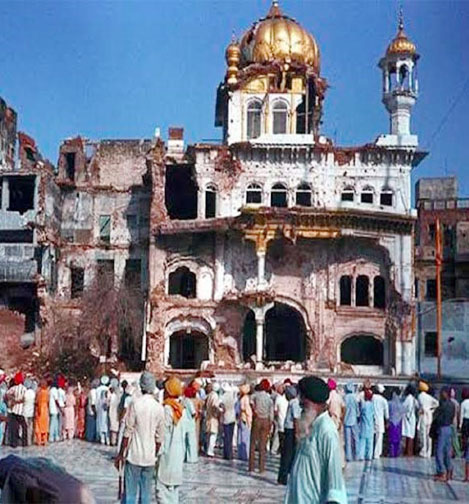
Thoughts on the 39th anniversary of Operation Blue star: The game is for power not for Punjab
By Prabhjot Singh
Thirty-nine years after the traumatic Operation Blue Star, Punjabis in general and Sikhs in particular, continue to ponder what makes all ruling parties at the Centre to betray
them. All agitations in this border State have ended in trading of power without anything being said about its long-standing demands, be it territorial rights, dams and water works, prime
institutions and its people. Sikhs have been in the habit of hawking newspaper headlines for reasons that extend beyond the geographic boundaries of their motherland for whose independence they made nearly 80 per cent of the total sacrifices. Of late some of the world leaders while eulogizing the contributions this minute minority community has made in the Corona pandemic went to the extent of saying that there should be a gurdwara – Sikh temple –everywhere to look after the suffering humanity.
It is that institution of gurdwara that has been making the Sikh community seek answers from the Central Government in India in general and the national political parties in particular.
Questions about the attack on their sancta sanctorum have either been ignored or they remained mired in controversies. The Sikhs, a global community, have every reason to nurse a grouse both against the Congress – for engineering attack on their sancta sanctorum besides depriving the State of its rightful territorial and rivers water rights – and the Bharatiya Janata Party (BJP) for not assuaging their hurt psyche without taking any action to mitigate it.
Wreaked by two politics-engineered partitions, this once affluent State continues to struggle to get its long-standing demands, including territorial sovereignty and rightful claim over its rivers waters, met. While the first partition in 1947 played havoc with the life and property of this border province, the second partition took away whatever little progress or gains it had made since independence. All major projects, including its capital, dams and water works and institutions, were taken away and brought under control of the Centre.
It is all the more agonizing for the Sikhs when they look back at the history. Before the 1947 partition, says historian Research Professor Rajmohan Gandhi, the then British rulers tried to appease all major communities of northern India – the majority Hindu community and the minorities Muslims and the Sikhs. Though he did not say in many words that while the Hindus got India and the Muslims Pakistan, the Sikhs had to swallow false promises.
After partition, their agitation for a Sikh Homeland ended in a truncated State they got which was without a capital, most of its dams and water works and many Punjabi speaking areas.
While they were still trying to come out of the trauma of the two partitions, came the Operation Blue star. Whatever are the causes or reasons behind the “Dharam Yudh” morcha that made the Sikhs launch a struggle to get autonomy for States after adopting the Sri Anandpur Sahib resolution of August 1977.
Agreed, violence has no place in any civilized society in general and liberal democracies in particular, Punjab has never been at peace with itself for a continuous period of 30 or more years. To be precise, Sikhs have always been at war, if not with the powers at the Centre then among themselves. And even in their struggle, political, religious or social, they have always pioneered a number of initiatives, both in and outside India. It is here where the role of journalists, as members of the fourth estate, becomes crucial in highlighting injustices done to the State or its people, Journalists are eyes and ears of a society as they play a critical role in preserving democracy. They are mandated to act as watchdogs in liberal democracies as while weaving their stories, they not only understand the importance or significance of Rule of Law but also keep the public good above everything else. While judging a journalist or his or her work, especially in the context of Punjab, it is important to understand the trying circumstances in which they worked. The State had the longest spell of President’s rule besides promulgation of draconian laws to contain militancy. A State that was once acknowledged as the sword arm or sports arm of the country besides serving as the food bowl of the country is now tottering at the brink.
Some experienced journalists, both from within and outside the country, would invariably use objectivity and verification combined with storytelling skills to make a subject both credible and newsworthy. But journalists from Punjab remain suspects in the eyes of the Centre. Punjab has had more spells of curfew than any other State in the country. It is not to suggest that what a journalist writes has general acceptance.
Objectivity itself is subjective. Like everything else, criticism of journalistic works often has political dividends. Increasing attacks by politicians on the credibility of a journalist or a media house have often been part of a conscious strategy to weaken both the accountability and credibility of journalism in general and a journalist in particular.
Of late, we all have been a witness to a collapse of the notion that politically relevant facts can be discerned by news professionals, reiterating the general belief that journalists are no more apolitical leaving their readers uncertain about ingesting the messages communicated to them as credible. These changing perceptions and thoughts apart, there are old timers who are continuing to discharge their role as torchbearers. They religiously follow professional ethics and discharge their duties as ears and eyes of the society they represent. A couple of years ago, I reviewed a book by one of my friends, Jagtar Singh, for The Tribune, an institution with which remained associated for 37 years.
As a veteran journalist and columnist, Jagtar Singh, remained an eyewitness from the very beginning of the fight for Sikh Homeland, to the present. His latest book “The Khalistan Struggle: Rivers on Fire” is the story of militant struggle in the border state of Punjab. It tells students of history as to what sparked this struggle, which were the people in the beginning and how this discourse shaped up as a fight for a separate Sikh state.
Not only this, several other books about the Sikh religio-political discourse in synergy of both the peaceful and militant struggle from the earlier days, have taken up only selective militant actions, as these were the incidents as these shaped the discourse at crucial moments.
For Sikhs, it is not only their emotive bondage with the institution of gurdwara in general and the sanctum sanctorum in particular but has acted as a catalyst to prove to the world that the Sikh gurdwara which the Indian defense forces attacked with mortar, grenades and guns in 1984, are the shelter homes for those in distress.
And these spiritual centers-cum-shelter homes do not discriminate with beneficiaries on the grounds of their ethnicity, color, creed, religion or language. No Sikh would ever take or accept any attack on its place of worship.
Most of those who have done work or written essays on developments in Punjab since 1947 have documented their works well. However, a few important revelations made in the book, including one about the assassination of the then Prime Minister Indira Gandhi, need corroboration. The author says that the names of all those who gunned down Indira Gandhi and those who were part of the design to kill her were in public domain. At least three more people besides all those known names were part of the plan to avenge Operation Bluster.
This revelation has not been substantiated as he mentions that one of the three names – Manbir Singh Chaheru – purchased a plot in Mohali for Bimal Kaur Khalsa, wife of Delhi Police Sub Inspector Beant Singh, one of the two assassins of Indira Gandhi. It appears to be a post-action (assassination) association that brought Bimal Khalsa in contact with Manbir Chaheru and Damdami Taksal. All said and done, it was the religious hurt that made Beant and Satwant kill Indira Gandhi. The revelation cannot be dismissed, as corroboratory evidence may have remained unexplored.
Incidentally, I covered most of the militant actions, including assassinations of Indira Gandhi and Beant Singh, besides Operation Bluestar, Kapuri Morcha and the Dharam Yudh morcha.
Coming to the emotive issue of rivers waters, it has been proved that the State Assembly never ratified none of these awards. The assembly took up the issue twice, first during the Akali Government of Surjit Singh Barnala that annulled the 1981 award, and the second by the Congress Government of Capt Amarinder Singh that set aside all water agreements. It may sound strange that none of these Legislative pronouncements could become effective. The issue has been once again thrown open by the Apex Court necessitating the Centre to get back to the rigmarole of holding meetings with the Chief Ministers of Punjab and Haryana. When the Barnala government annulled the 1981 award (Indira-Darbara award), the State Assembly simultaneously endorsed the Rajiv-Longowal accord that mandated the setting up of a Tribunal to resolve the water sharing problem. And the Tribunal so set up – Eradi Tribunal – after submitting its interim report in 1987, failed to give its final report even after
24 years costing the state exchequer several crores. When we talk of Punjab Rivers’ waters issue, reference to Riparian principle or law becomes imminent. Going by Encyclopaedia Britannica, “In property right doctrine pertaining to properties adjacent to a waterway that
(a) governs the use of surface water and
(b) gives all owners of land contiguous to streams, lakes, and ponds equal rights to the water, whether the right is exercised or not.
The riparian right is un-usufructuary, meaning that the landowner does not own the water itself but instead enjoys a right to use the water and its surface”.
Going by the basic philosophy of the Riparian Law or principle, the actual rights rest with the people who live adjacent to waterways. Intriguingly, in the case of Punjab, the actual beneficiaries were uprooted and the State or the center claimed ownership rights over the waters. And select powerful people, holding high positions both in the state and the center, forget about the water awards without ever getting to the beneficiaries, the people, for their endorsement.
Now coming back to the Operation Blue star, after 39 years, there is no credible or authentic version of the whole unfortunate episode that reveals actual drills of the operation, exact total casualties, the fate of the archives, artifacts, books and documents that were there in the SGPC museum damaged during the attack on Golden Temple as a part of Operation Blue star.
Complicity of other powers, including the British government, in the events leading to the Operation Blue star, is still to be told. The only conclusion that can be safely drawn is that the people of Punjab have suffered immensely. And their agony continues unabated.
(Prabhjot Singh is a veteran journalist with over three decades of experience of 14 years with Reuters News and 30 years with The Tribune Group, covering a wide spectrum of subjects and stories. He has covered Punjab and Sikh affairs for more than three decades besides covering seven Olympics and several major sporting events and hosting TV shows.)
Grammy award-winning violinist Joshua Bell returns to perform Bruch Violin Concerto No. 1 with the New Jersey Symphony led by Music Director Xian Zhang, June 9—11.
left to right: Xian Zhang (Music Director), Daniel Bernard Roumain (Resident Artistic Catalyst), Joshua Bell (Star Guest Performer).(Photo Credit/ njsymphony.org)
The program also features the world premiere of Daniel Bernard Roumain’s Farah (Joy) for Voice and Orchestra and Stravinsky’s ‘The Rite of Spring.’ Violinist and composer Daniel Bernard Roumain (DBR) is a musical polymath who has embraced electronica, jazz, R&B, pop, hip-hop, gospel and traditional African American music, in addition to classical. Farah (Joy) is Roumain’s second work commissioned by the New Jersey Symphony in his capacity as the orchestra’s first Resident Artistic Catalyst.
Scored for solo vocalist and orchestra, Farah (Joy) is in complete contrast to DBR’s commission last year, “Symphonic Scenes and Samples from We Shall Not Be Moved”, a work that centered on protest. Collaborating again with librettist Marc Bamuthi Joseph, DBR and Joseph chose to focus on joy.
Grammy-Award winning violinist Joshua Bell brings life to Bruch’s Violin Concerto No. 1. With a renowned career spanning decades, he has established himself as one of the most celebrated and influential musicians of our time, captivating audiences worldwide with his performances.
The program continues with The Rite of Spring, Stravinsky’s energetic and dark tale based on pagan rituals in Russia — a truly groundbreaking piece – became among the most important musical works of the 20th century.
PROGRAM
Season Finale with Joshua Bell
Friday, June 9, 8:00 pm | New Jersey Performing Arts Center in Newark
Saturday, June 10, 8 pm | Count Basie Center for the Arts in Red Bank
Sunday, June 11, 3 pm | New Jersey Performing Arts Center in Newark
Xian Zhang conductor
Joshua Bell violin
Becky Bass vocalist
New Jersey Symphony
New Century Gala
Sunday, June 11, at 1:30 pm
The New Jersey Symphony is excited to present the culminating event of its centennial season and launch of its next century in conjunction with the New Century Gala.
The event includes a pre-concert reception, premiere seating for the
Season Finale with Joshua Bell concert and a post-concert dinner. (For information about the Young Professionals After Party – contact Jesse!)
Classical Conversation
Friday, June 9, at 7 pm and Saturday, June 10, at 7 pm
Enjoy a lively Classical Conversation before the performance. Learn more about the music from New Jersey Symphony musicians, guest artists and other engaging insiders.
Xian Zhang
Grammy Awards-Winning Conductor Xian Zhang’s recording with Time for Three and The Philadelphia Orchestra, Letters for The Future (on Deutsche Grammophon), won awards in both the Best Contemporary Classical Composition (specifically Kevin Puts’ Contact), and Best Classical Instrumental Solo categories in 2023.
Xian Zhang is currently in her seventh season as Music Director of the New Jersey Symphony, which marks its 100th anniversary season in 2022–23. With New Jersey Symphony, Zhang has commissioned composers such as Wynton Marsalis, Jessie Montgomery, Qigang Chen, Chen Yi, Steven Mackey, Thomas Adès, Daniel Bernard Roumain, Christopher Rouse, Vivian Li, Gary Morgan, Christian McBride and Paquito D’Rivera. She is also responsible for introducing their annual Lunar New Year celebrations.
Zhang previously served as Principal Guest Conductor of the BBC National Orchestra’s Chorus of Wales, the first female conductor to hold a titled role with a BBC orchestra. In 2002, she won first prize in the Maazel-Vilar Conductor’s Competition. She was appointed New York Philharmonic’s Assistant Conductor in 2002, subsequently becoming their Associate Conductor and the first holder of the Arturo Toscanini Chair.
Daniel Bernard Roumain
Daniel Bernard Roumain’s acclaimed work as a composer, performer, educator and activist spans more than two decades, and he has been commissioned by venerable artists and institutions worldwide. “About as omnivorous as a contemporary artist gets” (New York Times), DBR is perhaps the only composer whose collaborations span Philip Glass, Bill T. Jones, Savion Glover and Lady Gaga.
Known for his signature violin sounds infused with myriad electronic, urban and African American music influences, DBR takes his genre-bending music beyond the proscenium. He is a composer of chamber, orchestral and operatic works; has won an Emmy for Outstanding Musical Composition for his collaborations with ESPN; has been featured as keynote performer at technology conferences; and created large-scale, site-specific musical events for public spaces. DBR earned his doctorate in Music Composition from the University of Michigan and is currently Institute Professor and Professor of Practice at Arizona State University. Learn more at dbrmusic.com.
Joshua Bell
With a career spanning almost four decades, Grammy award-winning violinist Joshua Bell is one of the most celebrated artists of his era. Having performed with virtually every major orchestra in the world, Bell continues to maintain engagements as soloist, recitalist, chamber musician, conductor and Music Director of the Academy of St Martin in the Fields.
Bell has been named 2010 “Instrumentalist of the Year” by Musical America, a 2007 “Young Global Leader” by the World Economic Forum, nominated for six Grammy awards, and received the 2007 Avery Fisher Prize. He has also received the 2003 Indiana Governor’s Arts Award and a Distinguished Alumni Service Award in 1991 from the Jacobs School of Music. In 2000, he was named an “Indiana Living Legend.”
Bell has performed for three American presidents and the justices of the Supreme Court of the United States. He participated in former president Barack Obama’s Committee on the Arts and Humanities’ first cultural mission to Cuba, joining Cuban and American musicians on a 2017 Live from Lincoln Center Emmy nominated PBS special, Joshua Bell: Seasons of Cuba, celebrating renewed cultural diplomacy between Cuba and the United States. Learn more at joshuabell.com
Becky Bass
Becky Bass is an award-winning vocalist, steel pannist and actor from St. Croix, US Virgin Islands, currently based in Providence, Rhode Island. A graduate of Brown University in 2013 in Theatre Arts & Performance Studies, Bass was awarded the prestigious Weston Award for Excellence in Musical Theatre upon graduation.
As a multi-award winner, Bass performs her Caribbean Soul music as a solo artist and with several bands including Zili Musik and Sidy Maiga & Afrimanding. She also lends her talents to RPM Voices, a cross-cultural multi-generational gospel choir.
Bass opened for and performed with international Grammy & Emmy-Award winning artists including Oumou Sangare, Daniel Bernard Roumain, Yellowman, Warrior King and Wyclef Jean. She also performed at the National Gallery of Art’s Jazz in the Garden concert series, Lincoln Center, Off-Broadway theater LaMaMa and numerous festivals. Learn more at beckybass.com.
TICKETS
Tickets are available at njsymphony.org or by phone at 1.800.ALLEGRO (255.3476). For more information, visit njsymphony.org/season-finale-with-joshua-bell.
The New Jersey Symphony
The Emmy and Grammy Award-winning New Jersey Symphony, celebrating its Centennial Season in 2022–23, is redefining what it means to be a nationally leading, relevant orchestra in the 21st century. Learn more at njsymphony.org.
(Mabel Pais writes on The Arts and Entertainment, Social Issues, Health & Wellness, Education, Cuisine, Spirituality, and Business)
Two weeks ahead of PM Narendra Modi’s visit to Washington, India and the US have finalized a roadmap for defense industrial cooperation to fast-track technology tie-ups and co-produce military platforms such as air combat and land systems. Both sides have agreed to initiate negotiations on the Security of Supply Arrangement and a reciprocal defense procurement pact to promote supply chain stability.
India-US defense ties have made big strides in the past decade or so, thanks to a series of pacts, including the Logistics Exchange Memorandum of Agreement (2016), which allows their militaries to use each other’s bases for repair and replenishment of supplies; the Communications Compatibility and Security Agreement (2018), which provides for interoperability between the two militaries and the sale of high-end technology from the US to India; and the Basic Exchange and Cooperation Agreement (2020), which provides for sharing of cutting-edge military technology, logistics and geospatial maps.
Notably, despite all these initiatives, the US is third on the list of India’s biggest arms suppliers with a share of 11 per cent, way behind Russia (45 per cent) and France (29 per cent). This indicates that the US has a long way to go to become a bigger stakeholder in India’s defense imports and a greater contributor to the ‘Make in India’ programme. India’s preference for Russian and French manufacturers can be attributed to factors such as reliability, quality control, cost-effectiveness and ease of doing business. Facilitating transfer of technology and spurring indigenous production capabilities in India hold the key to stronger strategic cooperation between India and the US. Amid aggressive posturing by China in the Indo-Pacific, it is hoped that both nations will work harder on removing all impediments to the growth of their defense relations.
(Tribune, India)
With Donald Trump’s indictment, the U.S. polity will see further polarization
The indictment of former U.S. President Donald Trump by a federal grand jury in the investigation by the Department of Justice (DoJ) into his alleged mishandling of hundreds of classified documents creates an unprecedented political situation ahead of the 2024 American presidential election. This is the first time in U.S. history that a federal government is bringing charges against a former President. According to Mr. Trump’s lawyers, the Republican party leader faces seven counts of charges, including violation of the Espionage Act and conspiracy to obstruct justice. Prosecutors say Mr. Trump deliberately withheld sensitive documents even after they demanded the return of such papers, which were recovered through a search warrant at his Mar-a-Lago residence in Florida. For Mr. Trump, who assailed Hillary Clinton in the 2016 presidential election campaign over her use of a private server, this is an embarrassing situation. He already faces criminal charges in investigations by the Manhattan District Attorney over the payment of hush money to an adult film actor in 2016. A prosecutor in Georgia is probing alleged attempts by Mr. Trump and his allies to topple the results of the 2020 presidential elections, with charges expected in August. Fresh charges pursued by the federal government will further deepen his legal troubles just when the election campaign is heating up.
If in New York the hush money investigation was initiated by a Democrat attorney, the classified documents probe was by a special counsel appointed by the DoJ, whose head, Attorney General Merrick B. Garland, is a Biden pick. Classified documents were found at the residences of Mr. Biden, former Vice President Mike Pence and Mr. Trump last year. While a separate special counsel probe into Mr. Biden’s handling of the classified papers at the time when he was the Vice President is yet to conclude, the DoJ has decided not to seek criminal charges against Mr. Pence, who is challenging Mr. Trump in the Republican primaries. As of now, Mr. Trump is the leading contender for the Republican presidential ticket. So, what makes the indictment politically complicated is that Mr. Trump is not only a former President but also the key potential rival of Mr. Biden, the incumbent, in 2024. Mr. Trump has already seized the political angle, calling the cases a Democratic witch hunt and asking his supporters “not to surrender” the country “to the radical Left”. As he seems determined to use the cases for political mobilization, America’s divided polity is set to see further polarization. Amid this chaos, the DoJ cannot afford to be seen as partisan. It should ensure transparent investigations and build watertight cases based on legal merits.
(The Hindu)
Canada is doing very little to address India’s concerns on Sikh extremism
A tableau, in Brampton, Canada, glorifying the assassination of former Prime Minister Indira Gandhi, has expectedly caused outrage across the polity in India. The tableau was part of an annual parade by Canadian Sikh separatist or “Khalistani” groups to mark their protest against Operation Bluestar, in 1984. An accompanying poster termed the killing as an act of “revenge”. Political leaders in India have called for Canada to apologize and to acknowledge the dangers of the rise of anti-Indian separatist and extremist forces. External Affairs Minister S. Jaishankar said the incident was part of a broader pattern, indicating that these forces pose a real challenge not only to the India-Canadian relationship but also to Canada itself. He suggested that the failure to act against these groups was due to a desire to cater to Canadian “vote-banks” that the much broader community of about 8,00,000 Sikhs constitute. He added that the culture of validating violence as an acceptable form of protest was one that should concern Canada’s leadership as well, given past incidents such as the bombing of an Air India flight in 1985. India-Canada relations have been fraught over similar issues, as India has been protesting incidents of vandalism and anti-India and anti-Modi graffiti on temples and community centers there, as well as over Canadian Prime Minister Justin Trudeau’s remarks criticizing the Narendra Modi government’s treatment of Punjab farmers who were protesting the 2020 agriculture Bill. As a result, India had called off high-level engagements and virtually snapped communications between New Delhi and Ottawa for several months before they were restored.
The latest provocation could well lead to another such spiral, and both governments need to resolve the issues diplomatically if they want to avoid another nadir in bilateral ties. While the Canadian government is within its rights to protect free speech and expression in its country, it must understand India’s concern that tableaus that glorify the assassination of a Prime Minister constitute inflammatory hate speech and could fuel radicalism. Meanwhile, instead of seeking to shut down protests which are legal, or issuing démarche over every act of vandalism, it would be more productive if New Delhi is able to cooperate and share evidence of the extremist activity and terrorist acts such groups are conspiring on. Given that Khalistani protests have been seen in Australia, the United Kingdom, the United States and parts of Europe, the Modi government must now chalk out a broader diplomatic strategy to ensure a more effective way of dealing with the problem, which could even be discussed with the leaders of all these countries, who are expected to visit India in September for the G-20 summit.
(The Hindu)
Neither Indira was India and India was Indira, nor will Modi be India and India be Modi. No individual is more than the nation. No party is more than the nation. No ideology is more than the nation.
It is pathetic to find that those who until yesterday were critical of the Congress slogan: Indira is India and India is Indira are vigorously marketing the idea of Modi being India and India being Modi. When Anurag Thakur the other day accused Rahul Gandhi of giving India a bad name because he was criticizing Prime Minister Modi, he only reinforced the synonymity of Modi and India.
It may not be forgotten that it is the job of a politician from the opposition to evaluate the government policies. In a democracy , one allows people the right to question government policies and actions. Rahul Gandhi, though no more a member of parliament, nevertheless is an Indian individual who has all the right to express his views on men and matters and demand course correction. It is interesting to see the reaction of the present rulers of India to any criticism of their policies and actions . For them all such people are anti-national. It is unfair on the part of the government to stifle the voice of the people who are their master, constitutionally. It is a violation of the oath of office of ministers , including the Prime Minister, to discriminate and deny justice. It is a shame that this government has failed to do justice to the women wrestlers who brought glory to the nation. They made India and Indians proud with their achievements . The rulers want to shield a criminal with a rather “brilliant “ record of crimes just because he is “their man”. And those in government who are given to reacting to the most harmless comment are dumb. Prime Minister Modi has once again proved that he is not to be trusted to live up to the oath of his office of not discriminating and doing justice to all. The agitating wrestlers surely deserve better standards of justice.
In 1970 when the newly set up Punjab School Education Board (PSEB) conducted its first ever Matriculation examination, Rajinder Singh Bhatia of Government Model High School, Cemetery Road, Ludhiana, stood first in the State. He scored 753 marks out of a maximum of 900.
Twenty-seven students, including nearly 50 percent boys of the same school, figured in the State Merit list. Lot of water has flown down the Sutlej since then. Number of boys, especially those from Government schools, on the merit list has since then been on the downslide.
How many times since 1970, a boy has topped the Matriculation examination in Punjab. The number may be close to reaching a double figure. In 53 years, the State has not produced even 10 boys as toppers in one of the prime examinations conducted by the State Board. Several hundred thousand students appear in the exam.
Recently, when the Central Civil Services examination results were announced, Punjab, once a front runner, drew a poor consolation. Representation of the State not only in Civil Services but other areas, including defense forces, Railways, and education is shrinking fast. It is why a section of eminent Punjabis, including politicians, bureaucrats, technocrats, writers and businessmen, have shown their serious concern at diminishing Punjab’s face from the national horizon. Who is responsible for this downslide?
Perhaps, we, the people.
Senior secondary education has come to such a pass that the State that once used to pride itself with institutions like SC Dhawan Government College (Ludhiana), Government Mahendra College (Patiala) and Government College (Hoshiarpur). They long ago lost their status as exclusive men or boys’ colleges. These institutions, that used to produce top bureaucrats, technocrats, doctors, academicians, writers and captains of trade and industry, would have closed down but for the change of their nomenclature. From exclusive men, they have conveniently become co-educational institutions.
Interestingly, there may be no example of any women college in the State becoming co-educational for want of students.
Where are Punjab boys going? What are they doing? These are some of the questions that are uppermost on the minds of parents of Punjab boys. Parents have been taking bank loans, selling their agricultural land and investing their lifetime savings only to make sure their son goes abroad and earns while he learns. It is a sad story that those entrusted with the governance and shaping the future of the youth of the State have “more important things to work on.” What are those important things that keep them overly occupied?
Controlling and combating the end results of this exodus of youth, shrinking job opportunities and deteriorating standard of education is what they collectively pretend to be doing. Drugs, domestic violence and pollution are the byproducts that have assumed dangerous proportions.
Yes, it is time to feel proud of the achievements of our girls as Chief Minister Bhagwant Mann said in his tweet. But at the same time boys, too, need attention and careful handling. Time is up for serious introspection. Otherwise, it will be too late.
(Prabhjot Singh is a senior journalist)
As suspicion and distrust in Manipur run deep, returning to the status quo ante is now widely seen as amounting to a Hobson’s choice
By Kham Khan Suan Hausing
In a press statement issued on May 12, 10 Kuki-Zo legislators of the Manipur Assembly, seven of whom belong to the ruling Bharatiya Janata Party (BJP), called for a “separate administration”. They said that the Government of Manipur tacitly supported the “unabated violence” by the majority Meiteis “against the Chin-Kuki-Mizo-Zomi hill tribals,” which has “already partitioned the State and effected a total separation from the State of Manipur.” Not surprisingly, in response, a new valley-based Meitei committee staged a rally in Thoubal on May 20 urging for protection of the State’s “territorial integrity”. Of late, media and public debates have centered around the “sacrosanctity” and “inviolability” of borders.
The demands for a separate administration and for the protection of the territorial integrity of Manipur override the differences within and across the segmented Kuki-Zo and Meitei societies. The road to a separate administration will naturally be a bumpy one. And despite the grandstanding of the Biren Singh-led BJP government and the position taken by Meitei frontal organizations on the “inviolability” of borders, effecting a change of Manipur’s border lies outside the exclusive preserve of the State. For, it is Article 3 of the Constitution that gives unilateral power to the Centre on a State’s border change.
A popular demand
The central question then is: how will this demand for a separate administration constitute a critical juncture in effecting or resisting border change? The answer is that this demand enjoys unprecedented popular support among the Kuki-Zo groups. Earlier demands by tribal communities for a separate administration in the form of a Union Territory or a Territorial Council or the Sixth Schedule were what the report of the National Commission to review the working of the Constitution, constituted by the BJP-led National Democratic Alliance government in 2000, called “non-serious” as they did not have popular support. Also given dissension within and across different segments of the Kuki-Zo groups in the past, a sustained mobilization for a separate administration remained elusive. Now, faced with a common antagonistic “other,” whose position on this demand is not likely to change in the short term, popular support for this edition of the demand for a separate administration is likely to be sustained and gain more political traction.
Thus, this moment may well constitute a critical juncture in the demand by Kuki-Zo groups for a separate administration. The extensive erasure of lives and land titles, destruction of property, and the unprecedented displacement of the population across the hills and the valley suggest that the Rubicon of living under one political roof has already been crossed. As suspicion and distrust in Manipur run deep, returning to the status quo ante is now widely seen as amounting to a Hobson’s choice. Given that the violence and ethnic cleansing unleashed against both sides of the divide since May 3 has resulted in complete “demographic” and “geographical separation,” to borrow from what W.L. Hangshing, the general secretary of the Kuki People’s Alliance, told The Wire, the demand for a separate administration has become a fait accompli.
Shifting of constitutional gears
This may require a radical shifting of constitutional gears. Three possible institutional architectures are plausible. The first is to grant a separate administration in the hill areas of Manipur for not only the Kuki-Zos, but also the Nagas. The roadblocks to this are the reluctance of some Naga groups to compromise on their expansive territorial project under the rubric of a sovereign ‘Nagalim’ and the staunch opposition by the State and Meitei groups.
The second is to grant a separate administration for the Kuki-Zo in districts where they are dominant, and resolve the Naga’s demand in due course. Invoking administrative convenience and economic viability, the two cardinal principles of State reorganization in India, as counterpoints against this demand may not work in this case. This is because the institutional and administrative blueprints for this have already been laid down by the extant sub-State constitutional arrangements under the Manipur (Hill Areas) District Councils Act, 1971, where the territorial boundaries of District Councils broadly overlap with ethnic boundaries. In 2016, seven new districts were created out of the existing nine districts in Manipur, which further sharpened this overlap.
Given that Pherzawl and Churachandpur, the two districts where the majority are Kuki-Zo, sit on a rich natural gas belt (the Assam-Arakan basin), effective exploration and harnessing of these resources may offset any counter argument about the economic non-viability of this demand for a separate administration. The Kuki-Zo-dominated districts have two important strategic gateways to Southeast Asia (Behiang and Moreh). This makes the demand for a separate administration a compelling economic proposition. The challenges to this blueprint are districts such as Chandel, Kamjong and Tengnoupal, which are marked by a mixture of populations and have seen long-standing territorial disputes between the Kukis and the Nagas. However, this may not be insurmountable if a combination of territorial and non-territorial autonomy is crafted in the future.
The third possibility is to maintain the status quo ante where the territorial integrity of Manipur is secured. Given the increasingly hardened integrationist position taken by the State and frontal Meitei groups, this may entail dissolution of extant sub-State constitutional asymmetrical arrangements under Article 371C, the district councils and tribal land rights. This will, of course, require not only amendment of the Constitution, but also a revisit to the normative and political foundations of Manipur. The position of the Kuki-Zo groups, to no longer accept the powerless sub-State constitutional asymmetrical arrangements or any political solution within the existing State of Manipur, suggests that this impasse is likely to continue.
This means that Manipur will remain a deeply divided society. If the experience of other such societies including Belgium, Canada, the Netherlands, and Switzerland are to be used as any guide, the holding together of federal polity or polities requires genuine recognition and accommodation of territorially mobilized groups — not as a matter of strategic convenience of the majority but as a matter of enduring value. The reluctance to do this and the lack of democracy and federalism in East European states in the 1990s had led to state break-ups which Manipur may not like to emulate.
The jury is out
The debates to protect the territorial integrity of Manipur are likely to lead to spawn a competing constellation of agendas, ideas and interests without any immediate resolution. Or these may align in complex ways to effect or resist change in the State’s border. This is likely to resuscitate the point that defenders of the rights of States and democracy, such as K.T. Shah, raised during the Constituent Assembly debates against Article 3, which B.R. Ambedkar envisaged as a flexible and democratic constitutional provision. Shah argued that to “place power and authority in the Centre” to effect a change of State boundaries without requiring the “consent” of the said States would amount to “the serious prejudice not only of the Units, but even of the very idea of democracy.” In their overweening ambition to protect the rights of States and democracy, Shah and others forgot what K. Santhanam, another influential member, cautioned, that mandating “consent” of the States would leverage “absolute autocracy of the majority in every province and State” when they vote down a minority’s demand for merger with an adjacent State or for formation of a separate State of their own.
This debate continues to remain unresolved. The jury is out on whether the constellation of agendas, ideas and interests of multiple actors across India’s multi-level federal polity and processes align to foster institutions which protect the “absolute autocracy of the majority” or promote and accommodate the rights of territorially mobilized minority groups within and across Indian States.
(The author is Professor and Head, Department of Political Science, University of Hyderabad, and Senior Fellow of the Centre for Multilevel Federalism, Institute of Social Sciences, New Delhi. Views are personal)
The country is appalled by the Centre’s response to the allegations made by sports celebrities
“Yet, the government of a party that swears by Hindu family values and traditions refuses to ask this alleged molester to even step down. Why? Custodial interrogation is a sign of an accused losing his immunity or political clout. Since he has not been taken into custody by the Delhi police, it can be safely assumed that he has not fallen from the government’s grace. So, those victims waiting to see what turn the case takes would obviously hesitate to come forward with their complaints. All this leads to the most obvious question: what is so special about Brij Bhushan?”
By Rajesh Ramachandran
When Cassius Marcellus Clay Jr threw his Olympic boxing light heavyweight gold medal into the Ohio river, it was an act of rebellion, followed by the rejection of his Christian identity, which did not guarantee him basic human dignity and equality. He embraced Islam and as Muhammad Ali, remained one of the greatest sporting icons; his 1960 Rome medal was restored and replaced in 1996 as a mark of universal respect. He achieved what he set out to do. When the protesting Indian wrestlers decided to throw their medals into the Ganga, they were upholding their Hindu identity against injustice. There is nothing more holy, sublime or revered than the Ganga for the average Indian. After a parent’s death, a handful of ashes is immersed into the river as a ritual of purification for the departed soul in its eternal journey. And of all places, Haridwar holds the utmost significance for this ritual.
The wrestlers’ protest is not a Jat issue, but a fight against naked patriarchy which will have resonance all over the country.
Agitating women wrestlers should not have dithered on the Haridwar ghats at the last minute. They should have hired a boat, gone into the river and reverentially ‘immersed’ their medals in an act of Gandhian satyagraha, symbolically purifying their sport of the grave sins of its administrators. According to the Hindu tradition, Mother Ganga purifies everything and hence the offering of the medals would have helped the wrestlers purify society of the evil deeds of a demon, who was once jailed for harboring Dawood Ibrahim’s sharpshooter. Such an act would have shaken the nation’s conscience, leaving a lasting impact on the politics of religious symbolism — victims of sexual harassment making a ritualistic offering of their most precious possessions to Ganga Ma.
Unfortunately, khap leaders intervened, thereby turning into a caste issue a non-denominational gender struggle for women’s rights against a sexual predator in a position of power. The khaps are caste-based organizations of the Jat community of Haryana and western Uttar Pradesh, often accused of extreme patriarchy and even supporting honor killings. They are not champions of women’s empowerment or modernity. In fact, all that these upholders of the old order could achieve was to proclaim to the world the caste of the women wrestlers and to reduce them to their Haryanvi Jat identity. These athletes — role models for the entire nation — have now been made part of a reductive, exclusionary cattiest performance by khap leaders, who after their intervention in Haridwar met at Muzaffarnagar and Kurukshetra, reinforcing their regional and caste identities.
The khap’s intervention has helped the government wriggle out of an extremely difficult situation by painting the protest as that of a single community which is angry with the ruling party, whereas the whole country is appalled by the Central government’s response to the allegations made by sports celebrities, including a minor. The practice in all such cases, particularly involving a minor, is to register a First Information Report and arrest the person immediately. However, all the norms have been violated to shield Wrestling Federation of India president Brij Bhushan Sharan Singh. Why? Obviously, this ruling party MP representing UP’s Kaiserganj constituency is more equal than other Indian citizens and the norms of custodial interrogation in cases registered under the Protection of Children against Sexual Offences (POCSO) Act do not apply to him.
In fact, investigators seem to be keen to recheck the minor complainant’s age. Such leeway is not normally offered to an accused whose defense lawyer can always take up discrepancies, if any, in the complainant’s age certificates during the trial. Then, Brij Bhushan is not a regular politician accused of a sexual offence, but the head of the country’s wrestling fraternity, expected to nurture, groom and inspire generations of athletes. A 66-year-old person holding such a position of guardianship of India’s wrestling fraternity has been accused of demanding sexual favors, stalking young women and touching them inappropriately. A criminal breach of trust has happened. This ought to be treated like an accusation of incest in a society that tries to bring in familial metaphors in all kinds of administrative situations. A man accused of incestuous advances loses his moral right to head the family.
Yet, the government of a party that swears by Hindu family values and traditions refuses to ask this alleged molester to even step down. Why? Custodial interrogation is a sign of an accused losing his immunity or political clout. Since he has not been taken into custody by the Delhi police, it can be safely assumed that he has not fallen from the government’s grace. So, those victims waiting to see what turn the case takes would obviously hesitate to come forward with their complaints. All this leads to the most obvious question: what is so special about Brij Bhushan? Politicos who perennially search for logic in illogical situations claim that the BJP central leadership is nurturing him as a counterpoise to UP Chief Minister Yogi Adityanath within the party in a possible power struggle as both belong to the same caste. But such a far-fetched reasoning only proves the utter lack of reason for anyone to protect Brij Bhushan’s interests.
The Central government has handed over an emotive gender issue on a platter to the Opposition in the run-up to the 2024 Lok Sabha polls. The government is badly mistaken if it thinks this is a mere Jat issue. It is not a Jat issue, but a fight against naked patriarchy which will have resonance all over the country. The wrestlers may well have political ambitions, may be supported by the Opposition, may even be motivated by the lure of high offices and post-retirement sinecures. But all that does not take anything away from their accusations that have been amplified by international wrestling bodies. It is India’s pride that is getting hurt; Indian womanhood that is getting demeaned. This could well become something akin to the then UPA government’s Commonwealth Games fiasco, which marked the beginning of its unravelling.
(The author is editor-in-chief of Tribune Group of Newspapers)
“Modi has his nose in front on these considerations and also because of his communication skills. But if he needles his political rivals to the point of desperation, like what he is doing with the AAP in Delhi, disparate forces will stack up against him for sheer survival. Misusing powers to deter critics, while going easy on supporters by releasing jailed convicts prematurely or allowing prolonged release on parole, will be noted by those voters who are wedded to the ideals of justice and equity. Reluctance to act against a party strongman accused by renowned women wrestlers of sexual harassment can influence female voters.”
By Julio Ribeiro
The controversy over the inauguration of the new building to house our Parliament was totally unnecessary. What is more relevant is whether the spanking new premises will be useful or not. The trend, of late, is to argue over issues outside Parliament on the streets, where the language used can be more colorful and lies can be bandied about without an instant challenge.
If Opposition politicians want to emulate Modi, they will first have to displace him from his pedestal in 2024.
What exactly did the Opposition gain by boycotting the inauguration by our nation’s most ‘Prominent Citizen’? It is true that our Prime Minister utilizes different vehicles to remind citizens of his omnipresence. What is wrong with that? He is a politician, extremely adept at popularizing himself. It will be difficult to compete with him as he occupies a commanding position on the popularity index. If Opposition politicians want to emulate him, they will first have to displace him from his pedestal in 2024, and that will not be easy.
The main Opposition parties agreed on which dignitary was appropriate for doing the honors on May 28 — the nation’s first tribal President. The selection of an Adivasi woman to occupy that exalted, albeit ceremonial, position was hailed as a coup of sorts when it was announced. But everyone in India, including the President herself, knew that whenever it would be politically expedient to showcase the Prime Minister instead of the President, the choice would be preordained.
The BJP has never made a secret of its wish for a unitary form of government. The Sangh Parivar, influenced strongly by the importance of discipline and obedience to the ruler or the presiding elder — as it was in the days of the Ramayana — is happy with Modi’s sole presence on the political stage. Droupadi Murmu would have understood this by now. She has not disputed her benefactor’s right to assert his popularity during inaugurations even where the President should have been showcased by right.
The BJP feels that the inauguration of the new Parliament building will contribute to its prospects in 2024. I do not think it will matter. The voter in 2024 will ponder more on his or her own well-being. Economic well-being will naturally be the top priority, followed by security of the homeland and security of life and property around his home.
Modi has his nose in front on these considerations and also because of his communication skills. But if he needles his political rivals to the point of desperation, like what he is doing with the AAP in Delhi, disparate forces will stack up against him for sheer survival. Misusing powers to deter critics, while going easy on supporters by releasing jailed convicts prematurely or allowing prolonged release on parole, will be noted by those voters who are wedded to the ideals of justice and equity. Reluctance to act against a party strongman accused by renowned women wrestlers of sexual harassment can influence female voters.
The inauguration of a highway, a fast train or a new Parliament building will not change the equation, even though such events are organized at the expense of the exchequer and not from the party’s coffers. Our peripatetic PM has been traipsing around the country throughout the year almost, inaugurating one construction or the other. The end result is that people have stopped looking at the remarkable progress in infrastructure development and, instead, started concentrating on the august persona of the Prime Minister himself. That does help the party.
Twenty-one Opposition parties boycotted the inauguration of the Parliament building. It made no difference. It cut no ice with the electorate, whose attention was turned to the Sengol, which is intended to signify the Speaker’s authority in the Lok Sabha. It was constructed by a jewelry firm in Tamil Nadu, which had also made the Sengol that was ceremonially handed over to Nehru by the last British Viceroy, Lord Louis Mountbatten, on August 14, 1947. The Opposition parties which came together to boycott the inauguration should unite to oppose the ordinance that the Central government has promulgated to nullify the Supreme Court’s judgment on the powers of the Delhi government over its bureaucrats. The ordinance attempts to overturn the mandate given by Delhi’s people to AAP. The ordinance vests authority to govern the National Capital Territory in bureaucrats despite the clear wishes of the people to the contrary.
If this move succeeds, the Central government could invent ingenious ways to negate the people’s mandate in other states where the double-engine government is not installed by popular will. And that is a disturbing thought. The Congress should beware of this possibility. Its dislike of Arvind Kejriwal should not come in the path of opposing the ordinance in the Rajya Sabha.
An ordinance has to be cleared by both Houses of Parliament within six months. The government faces no problem in the Lok Sabha, but there is one in the Rajya Sabha. If all Opposition parties unite, there is no way the BJP can push through an Act on the lines of the ordinance. The danger to state governments in non-BJP-ruled states is stark. It should be obvious to even the most trusting of the NDA’s allies that their installed governments will not be safe should this ordinance prevail. The headlong rush for a unitary, ‘Opposition-mukt’ government at the Centre as well as BJP governments in every state will turn this ‘mother of democracy’ (Modi’s term for our existing system of governance) into a ‘child of autocracy’.
From all indications at present, Modi will not find the going as easy in 2024 as it was in 2019 if the Opposition parties really unite. But I doubt if such unity is possible, considering the egos and aspirations of various leaders. I doubt if they will agree to put up a common candidate against a BJP nominee in every Lok Sabha constituency. If they agree to do so in a majority of the constituencies, they can expect to have a much stronger Opposition in the Lok Sabha than at present. That in itself should prevent this democracy from sliding into autocracy.
(The author is a retired Indian Police Officer and a former governor)
The upcoming inauguration of the new Parliament building by PM Narendra Modi has triggered an unsavory slugfest between the Centre and the Opposition. Nineteen parties have announced a boycott of the event, including the Congress, Trinamool Congress, DMK and Aam Aadmi Party. In a joint statement, they have described the PM’s decision to inaugurate the building by himself as ‘a direct assault on our democracy’. The parties have asserted that they ‘find no value in a new building’ when the ‘soul of democracy has been sucked out from Parliament’.
Citing the Constitution, the Congress has said that the President, being the ‘head of Parliament’, should be doing the honors, not the PM. The Centre, in turn, is accusing the Opposition of playing politics on a historic occasion. It claims that there is nothing unprecedented about the inauguration as the then PM Indira Gandhi had opened the Parliament House Annexe on October 24, 1975, while Rajiv Gandhi had laid the foundation stone for the Parliament Library on August 15, 1987, during his tenure as PM. It’s noteworthy that respective Presidents had laid the stone for the annexe and inaugurated the library. In the present case, the PM laid the stone for the new building on December 10, 2020, and is now set to inaugurate it too.
When PM Modi entered Parliament House for the first time in 2014, he knelt and bowed his head as a mark of respect for the ‘temple of democracy’. It’s due to his tireless efforts that this grand monument of 21st-century India has become ready less than a year after the nation celebrated 75 years of Independence. Now’s the time for him to step back and let this remarkable building — the embodiment of a vibrant democracy — hog all the limelight. Accepting the Opposition’s demand to invite the President to do the inauguration will only demonstrate his magnanimity. No controversy should be allowed to mar this momentous event.
(Tribune, India)
Signup to our Newsletter!
Don’t miss out on all the happenings around the world