Quad partners on the right track despite irritants
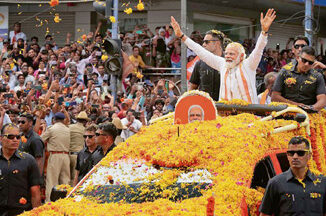
The relations between India and Australia are going from strength to strength. The two nations are getting closer not only bilaterally but also as Quad partners. Prime Ministers Narendra Modi and Anthony Albanese have already met each other six times in the past one year. PM Modi’s just-concluded visit to Australia ticked all the right boxes. Both countries decided to seal a comprehensive trade deal by the year-end. They also signed a migration and mobility partnership pact that is expected to open up opportunities for students, academic researchers and business people and curb illegal immigration. This agreement comes just two months after the Australia-India Education Qualification Recognition Mechanism was finalized during Albanese’s visit to India.
Considering the priority being given to strong ties in the education sector, India and Australia need to effectively tackle the menace of visa fraud. With some Australian universities refusing admission to Indian students, a large-scale clean-up is required to weed out unscrupulous immigration and education consultants.
Even as the talks focused on cooperation in a wide range of sectors — education, green hydrogen, defense and security, trade and investment, critical minerals — PM Modi raised India’s concerns over the attacks on temples and the activities of Khalistan sympathizers in Australia. The two governments decided to exchange information and coordinate with each other regarding action against separatists and vandals who have been defacing community centers and temples with anti-India graffiti. This is an area where Australia needs to be proactive to ensure that its territory is not misused by radical elements. Dealing firmly with such troublemakers can pave the way for a deeper engagement between New Delhi and Canberra.
(Tribune, India)
Russia and Ukraine seem determined to continue their high-cost war
In December last year, while speaking at the U.S. Congress, Ukraine President Volodymyr Zelenskyy compared the battle for Bakhmut to the Battle of Saratoga, in which the American revolutionaries clinched a decisive victory against the British in October 1777. “… the fight for Bakhmut will change the trajectory of our war for independence and our freedom,” he said. Five months later, Bakhmut is not in Ukraine’s hands. After 10 months of fighting, Russia’s Ministry of Defense announced last week the city’s capture in the eastern Donetsk region, its first major territorial gain since January when it took neighboring Soledar. Ukraine claims that its troops continue to defend a small area of Bakhmut and is advancing on its flanks, but has admitted that the eastern city “is effectively in Russian hands, for now”. For Vladimir Putin’s Russia, which invaded Ukraine on February 24, 2022, it was a much-needed victory after a series of setbacks late last year when Russian troops were beaten back by the Ukrainians from the Kharkiv Oblast in the northeast and Kherson city in the south. The Russians are already in control of the whole of Luhansk and getting Bakhmut would potentially allow them to target other major urban centers in Donetsk such as Kramatorsk and Sloviansk. For Ukraine, which was preparing for a major counteroffensive, the loss of Bakhmut is a setback, but not the end of the road.
Russia, whose initial thrust into Ukraine failed to meet its objectives, seems to be learning from its battlefield mistakes as its invasion has turned into a war of attrition. According to a recent report by the London-based Royal United Services Institute, Russia’s battlefield tactics, coordination, supplies, electronic warfare and air defense have improved. In Bakhmut, Russia suffered huge losses but the fighting was done by Wagner, a private military corporation, which provided much of the regular Russian troops, including the 300,000 freshly mobilized soldiers, time to build fortifications along the over 1,000-km frontline and undergo training. On the other side, Ukraine was supposed to launch its counteroffensive at the beginning of Spring, and the delay points to its battlefield problems, which were partially revealed by leaked U.S. intelligence documents earlier this year. But Ukrainian troops now have some of the most advanced weapons, thanks to the West. In recent months, Ukraine has also carried out attacks inside Russia, using drones and medium-range fire or saboteurs, bringing the war home for Mr. Putin. Now, with advanced weaponry, Ukraine is betting on its counteroffensive and ability to create disruptions inside Russia. To recover from its setbacks in Soledar and Bakhmut, Ukraine will have to regain territories quickly, while Russia tries to capitalize on the momentum created by taking Bakhmut. As both sides are determined to continue the war, there is no hope for peace or talks on the horizon.
(The Hindu)
The Union of India is unlikely to succeed in wresting power of ‘services in Delhi if the Government of National Capital Territory of Delhi (Amendment) Ordinance, 2023 is challenged
By Bishwajit Bhattacharyya
On May 19, 2023, the President of India exercised legislative power under Article 123 of the Constitution, during the period Parliament was in recess, to promulgate The Government of National Capital Territory of Delhi (Amendment) Ordinance, 2023 (Ordinance). The ordinance negates a Constitution Bench judgment of the Supreme Court of India, which was delivered on May 11, that brought “services” under the Government of National Capital Territory of Delhi (NCTD).
Key issues
There are two issues here that require analysis: first, the scope of the Court’s verdict. Second, the constitutionality of the ordinance.
While interpreting Article 239AA(3)(a), the Court ruled, inter alia, that these were the points: The Legislative Assembly of the NCTD has competence over entries in List II and List III, except for expressly excluded entries of List II (entries 1, 2, 18 are excluded); the executive power of NCTD is co-extensive with its legislative power, that is, it shall extend to all matters with respect to which it has power to legislate; the Union of India has executive power only over three entries in List II over which the NCTD does not have legislative competence (entries 1, 2, 18). Thus, essentially, the Court interpreted that out of the 66 entries in List II (the State list), while the executive power of the Government of NCTD covers 63 entries, that of the Union of India is restricted to the remaining three: public order (entry 1), police (entry 2) and land (entry 18).
Consequently, executive power over “services” (entry 41) can be exercised exclusively by the Government of the NCTD. This interpretation of the Court is consistent with the wordings in Article 239AA(3)(a). But, this interpretation was negated by the Union of India, acting through its Council of Ministers under Article 74, by triggering extraordinary legislative power of the President under Article 123 in the promulgation of an ordinance on May 19. What the ordinance did was to read/insert entry 41 of List II (State list) into Article 239AA(3)(a), thereby expanding the scope of excepted matter from three (1, 2, 18) to four (1, 2, 18, 41). This could not have been done without amending Article 239AA(3)(a) of the Constitution. The power conferred on Parliament under Article 239AA(3)(b) is to make fresh laws — not to amend Article 239AA(3)(a) of the Constitution.
Alteration needs an amendment
Similarly, power conferred on Parliament under Article 239AA(7)(a) is to make laws for giving effect to or supplementing the provisions contained in various clauses of Article 239AA and for all matters incidental or consequential thereto. Such a power cannot be pressed into action to amend Article 239AA(3)(a) of the Constitution. Significantly, Article 239AA(7)(b) stipulates that Parliament’s law making under Article 239AA(7)(a) shall not be deemed to be an amendment of the Constitution for the purposes of Article 368. No such clause has been stipulated in Article 239AA(3)(a). Therefore, altering the scope of Article 239AA(3)(a) requires constitutional amendment under Article 368; there is not an iota of doubt.
Consequently, the ordinance promulgated under Article 123 of the Constitution to expand the scope of excepted matters in Article 239AA(3)(a) is void ab initio and is liable to be struck down for bypassing constitutional amendment. It amounts to a colorable exercise of power. Article 123 is no substitute for Article 368 (amendment of the Constitution) in Part XX.
Besides, when a Constitution Bench (five judges) of the Supreme Court declares/interprets the law (Article 239AA(3)(a)), the same is binding on all courts and authorities in India in terms of Articles 141 and 144, respectively. Could Articles 141 and 144 have been negated by Article 123 without a constitutional amendment?
Articles 123, 141, 144 are in Part V (The Union) of the Constitution. None has a non-obstante clause. The aid and advice of the Union Council of Ministers to the President under Article 74 could not have overridden Article 144. The basis of the Court judgment is Article 239AA(3)(a). To alter this basis, a constitutional amendment is necessary.
A perspective
The Union of India’s decision to prefer review (Article 137) and promulgate an ordinance (Article 123) simultaneously is ill-conceived; if the ordinance is challenged, the Union of India is unlikely to succeed through either route to wrest power of “services” in Delhi.
In the landmark seven-judge Bench verdict of the Supreme Court in the matter of Krishna Kumar Singh vs State of Bihar (2017) 2 SCC 136, the Court held that the satisfaction of the President under Article 123 is not immune from judicial scrutiny; powers under Article 123 is not a parallel source of law making or an independent legislative authority. It was further held that the Court is empowered to look into the relevance of material placed before the President, but not its sufficiency or adequacy. The ordinance is likely to be struck down since it expands excepted matters in Article 239AA(3)(a). Parliament alone can do this under Article 368.
(The author is a senior advocate in the Supreme Court of India and a former Additional Solicitor General of India)
Courage has its complexities but has a certain level of power attached to it. Standing up for principles in today’s world is both challenging and often costly. But it can inspire a whole new generation to follow that example. Rahul Gandhi brings forth that image of a man who would not bow even to the most powerful for expediency or to fulfill his ambitions.
Undoubtedly, Rahul Gandhi may be the most vilified man in contemporary Indian politics. Over the years, he has been an object of sarcasm and constant attack by a paid social media gang. The BJP may have successfully painted Rahul Gandhi as “Pappu,” an entitled beneficiary of dynasty politics. The widespread anger against the entrenched elite, who are far removed from the realities of the ordinary people, may also have aided that campaign to demonize him. To err is human; he may have made his share of mistakes, but this level of hatred and cynicism directed at him by the governing party of India is quite inconceivable.
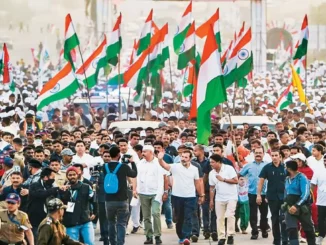
However, the Bharat Jodo Yatra (BJY), the 4080 kilometers march under the banner of ‘uniting India’ from Kanyakumari to Srinagar, proved to be a phenomenal one that is beginning to turn the heads of the public. The march took place at a time when the people of India are increasingly polarized over religion and the Modi administration’s failure in governance that resulted in the mishandling of the COVID-19 pandemic, high unemployment among the youth, rising inflation and marginalization of minorities.
India is no stranger to Padayatras, and from Mahatma Gandhi on, it has been an Indian institution that has produced major results for its stakeholders. Only time will tell whether BJY will translate into any electoral dividends for the Congress party in the upcoming national elections. Nevertheless, it appeared to have captured the imagination of the ordinary Indians and reflected their yearnings for a peaceful coexistence with everyone regardless of their faith, caste, language, or regional differences. One also wonders if Rahul Gandhi is such an ineffective and failed leader, why the BJP is so focused on targeting him. The truth is he is one of the few at the forefront to expose the duplicity and wrongdoings of this administration. He is totally unafraid to expose corruption at the highest levels and confront even the Prime Minister on issues like Rafael purchases or the Adani scam inside the parliament. In scanning today’s political arena, one might see other politicians struggling to put together a few words to express their outrage at the corruption or the ongoing anti-democratic measures employed by this government. The reason is simple: they know too well that they have many skeletons in their closets, or the government agencies are lurking around every corner. The very reason that people are awake and listening to the message of Rahul Gandhi during the Yatra has become such an unsettling or probably terrifying issue for the BJP government. Therefore, they have determined to silence the man by using any means. Even before the Gujarat verdict and further disqualification of Rahul Gandhi as a Lok Sabha member, wheels were in motion to expel him from the parliament based on his alleged ‘anti-nationalist statements’ made during a trip to Great Britain. He only spoke about the state of democracy, which is a global good.
Rahul Gandhi is indeed a brave person who is willing to face challenges. Despite two of his family members falling victim to the hatred and division in the country, he has shown the moral Courage to continue on their path to serving the nation. An essential aspect of being courageous is accepting yourself and life’s circumstances beyond one’s control. Watching his controlled emotions and measured reactions is astounding, considering his immediate disqualification from the Lok Sabha after the verdict and a quick eviction from his residence.
There is no doubt that Yatra has shown him as a man of empathy who understands the daily struggle of an ordinary citizen. It also allowed him to present an alternative vision to India that would unite people for a common purpose. That is in direct contrast to the current leadership that is increasingly distanced from the people it serves and pursuing policies that negatively impact their well-being.
As Martin Luther King said in one of the last sermons he gave before his death, “You don’t have to have a college degree to serve. You don’t have to make your subject and your verb agree to serve. You don’t have to know about Plato and Aristotle to serve. You don’t have to know Einstein’s theory of relativity to serve. You only need a heart full of grace—a soul generated by love. And you can be that servant”. Is Rahul on the verge of becoming that celebrated servant? During his padayatra, his often-repeated mantra was, “In the market of hatred, I am opening a counter for love.” Let that love spread across India, touch humanity, and bear the fruits of peace and harmony for its 1.4 billion people. It is time for the people of India to wake up and smell the roses!
Jai Hind.
(The author is a former chief technology officer of the United Nations, and vice chairman of IOCUSA)
Even as a Third Front idea has been dropped, efforts are on to push the electoral strategy of fielding a ‘single’ Opposition candidate against a BJP candidate in the 2024 Lok Sabha polls but it seems to be paved with tricky issues.
By Nilanjan Mukhopadhyay
If one is a detractor of the ruling Bharatiya Janata Party (BJP), it is easy to get euphoric after the Karnataka elections. Mechanical extrapolation of electoral data in state elections since 2019 can easily lead to arrogance and declaring that a victory in 2024, or defeat for the Narendra Modi led party, is imminent, whereas the possibility is yet to emerge as a realistic prospect. State assembly elections in a country of serial polls, if one believes that the trend will hold true during the subsequent parliamentary bout, provide misleading projections of the national hustings. After voters turned out to elect members of the Lok Sabha in the summer of 2019, they have since voted in state assembly elections in as many as 400 parliamentary constituencies, according to an analysis done by the Hindustan Times.
Of these 400 seats, the data sets further points, the BJP won 223 Lok Sabha (LS) seats in 2019. But, as per current Vidhan Sabha holdings, this number is down to 177 – a loss of 46 LS seats which means its tally in 2024, based on these projections, will be 257 – 15 short of a majority in the Lower House, unless this is made up by the remaining 143 seats. In seats where voters are yet to cast their lot in state elections since 2019 parliamentary elections, the BJP won 70 seats of which nearly 90 per cent or 62 seats were bagged in the bipolar states of Madhya Pradesh, Rajasthan and Chhattisgarh. However, the BJP’s notional loss till date has not triggered corresponding gains for the Congress in these states – its tally as per these projections, shall go up by just two to 46 (again from these 400 seats). But the biggest gainers are the Rashtriya Janata Dal, the Aam Aadmi Party, Samajwadi Party and the All India Anna Dravida Munnetra Kazhagam.
The poll math for Congress and BJP
For the Congress to enter the electoral joust in 2024 with a sense of accomplishment, it will have to do exceedingly well in the three aforesaid listed states where elections are due before the end of this year. These states collectively elect 65 LS members and in 2019, as previously mentioned, the BJP won 62 (including one seat won by a minor alliance partner in Rajasthan), leaving the Congress with just three seats – two from Chhattisgarh and one from MP. Significantly, the list of states where the BJP performed poorly in assembly elections in comparison to 2019 Lok Sabha polls, is headed by Karnataka where, if the performance in the recently concluded elections is repeated, the BJP’s tally will decline from 25 to 8 – effectively a loss of 17 LS seats.
Correspondingly, had it not been for gains made by the Congress from the state, its tally would have been even lower than what it secured in the 400 seats that have witnessed state polls post 2019.
State polls are poor reference points
State polls are poor reference points to draw projections for subsequent Lok Sabha elections and vice-versa. For instance, in 2013, the Congress secured 122 seats in Karnataka in a House of 224 but when it came to the 2014 LS polls, the Congress tally from the state was down to just nine, while the BJP’s figure soared to 17.
Furthermore, the Congress formed governments in MP, Rajasthan and Chhattisgarh in 2018. However, as previously noted, the party lost all but three PCs from these seats in 2019. As detailed in the HT data charts, 489 PCs witnessed assembly elections between 2014 and 2019 and based on the state figures, its score in these seats should have been 222, but the BJP won 291 of them. This demonstrates that in 2019, the BJP improved its performance during parliamentary polls when compared to the preceding assembly poll.This clearly underscores that multiple factors lead to different results in assembly and parliamentary elections, even if held in quick succession. Simplistically, for the former, people elect the chief minister or hand over reins to a party they wish to run the state government. But, when it comes to the parliamentary elections, it is more presidential in nature since 2014, as the vote is sought in the name of Modi – Abki Baar, Modi Sarkar or Ek Baar Phir, Modi Sarkar. However, while the state assembly elections do not, and are unlikely to again, have a direct bearing on seats won in LS elections, it does have an impact when Opposition parties, and even the ruling BJP, hold negotiations with other parties to firm up alliances and discuss seat distribution. Good performances in state elections indicate a party’s strengths and weaknesses in various states and seat allocation can be demanded or turned down accordingly.
On paper, the Congress is the largest Opposition party with the widest footprint. But this has to be demonstrated by good performances in a series of state assembly elections. But after the party’s improved performance in assembly polls in Maharashtra and Haryana in the autumn of 2019 within months of the parliamentary elections, it failed to improve upon the PCs it had won in parliamentary polls in other states.
An improvement on the 2019 verdict was finally notched in Himachal Pradesh later last year and now in Karnataka. But, HP is a small state to have widespread impact.
A ‘single’ Opposition candidate
In recent months, efforts have been initiated to forge a loose understanding among Opposition parties to ensure that in 2024 the seats with a ‘single’ (not joint) Opposition candidate against the BJP nominee are maximized. Opposition leaders during informal conversation have let it be known that efforts are underway to strike an understanding among various parties to ensure one-on-one contests are held in at least 400 parliamentary seats if not more.
The question is if this is doable among a motley cluster of non-BJP parties who in several states are also mutual rivals in the non-BJP space. This includes states where Bihar or Tamil Nadu style alliances do not exist. Most importantly however, these ‘troublesome’ states where striking an understanding is essential, includes states where the AAP has made its political presence felt.
Of these, the party is already in power in Punjab and Delhi while in Gujarat, it performed commendably and it would fancy its chances in the next assembly polls in 2027. When Opposition leaders start discussing seat adjustments, will either for instance, decide to leave a few seats for the other – AAP for the Congress in Delhi and the latter for the former in Gujarat?
In Punjab, there will be no need for an alliance, as the BJP is not a very significant force and as of now it appears that the Shiromani Akali Dal too is a receding force and the main contest in the majority of states may well be between the AAP and the Congress. Strong regional parties to take on BJP in their home turfs
West Bengal chief minister, Mamata Banerjee’s declaration at the conclusion of her meeting in Kolkata with her Bihar counterpart, Nitish Kumar and his deputy, Tejashwi Yadav, that strong regional parties should be left alone to take on the BJP in 2024 on their home turfs and in turn, they would back the Congress in the 200-odd seats where the two national parties are in direct contest.
This proposal has been backed by SP chief Akhilesh Yadav and he has joined the chorus for putting up a united Opposition. His move is a shift away from the earlier posture of having no truck with the Congress after the disastrous outing of the duo in 2017. Both Banerjee and Yadav have abandoned plans of pushing for a Third Front. The idea also appears to have the backing of Telangana chief minister, K Chandrashekhar Rao.
Banerjee in fact even displayed clarity about states where she wanted the Congress to yield ground; “in Bengal, we (Trinamool) should fight. In Delhi, AAP should fight. In Bihar, Nitish Ji, Tejashwi (Yadav) and Congress are together. They will decide. I cannot decide on their formula. In Chennai, they (MK Stalin’s DMK and the Congress) have a friendship and they can fight together. In Jharkhand also, they (JMM-Congress) are together and in other states also….” On paper, the plan appears tenable but there are several tricky matters that have to be resolved. To begin with, ambitions of Banerjee in states outside WB – she made a significant foray into Assam and other northeastern states.
Will the Congress and she be able to reach a pact for this region and will they be open to joining hands with other non-BJP parties? Furthermore, will she abandon plans of expanding outside eastern India – recall the over-ambitious move in Goa that did little but assist BJP?
But, more than individual states, it is important to assess if the Congress will risk more desertions from its ranks in states where the party ‘decides’ to give a free run to regional parties, for instance, TRS in Telangana.
There are also state units like Delhi where Ajay Maken, a one-time Union Minister and Lok Sabha member from Delhi and party general secretary, who see the AAP as the primary hurdle to the party’s return to, if not supremacy, at least being the main challenger to the BJP – or a return to the bipolar politics of the Indian capital before the advent of the Arvind Kejriwal led outfit in 2013. This question would get linked to the Congress’s status as a national party and not just from the PoV of the Election Commission of India’s ‘recognition’.
The figure of 200 Lok Sabha seats that according to Banerjee are those where the Congress is in a direct contest with the BJP has been arrived at by the non-Congress Opposition parties. There is no knowing that the Congress party would agree to this figure, or it would demand more seats in states dominated by regional parties. It could cite recent performances in isolated by-elections, like in WB to say that the party can legitimately attempt parliamentary presence from the state.
Quite obviously, the pathway to Opposition parties maximizing one-on-one contests against BJP’s candidates is paved with tricky issues. This is besides the other two troublesome matters – ideological or programmatic commonality and the issue of the Opposition’s ‘face’.
For the moment, it appears that this question is going to be kept open like in 2004. But this would leave the field wide open for the BJP, especially Modi to mount a searing campaign and ask people if they are willing to trust a bandwagon, which cannot decide either on a common minimum programme, or on who shall be its leader in case the BJP is rejected by the electorate.
It is not that Nitish Kumar’s initiative has no chances of succeeding, at least in putting up a single Opposition candidate from about 400 seats, as is the current thinking in some parties. But for that, a lot more backchannel discussions have to be conducted which although not impossible, is certainly not going to easy to negotiate.
(An NCR-based author and journalist, Nilanjan Mukhopadhyay’s latest book is The Demolition and the Verdict: Ayodhya and the Project to Reconfigure India. His other books include The RSS: Icons of the Indian Right and Narendra Modi: The Man, The Times. He tweets at @NilanjanUdwin)
Loss of legitimacy due to corruption taint proved to be the BJP’s undoing in Karnataka
Modi had won in 2019 on a pro-incumbency platform, which is getting frayed at the edges. Pomp and pageantry cannot replace political credibility. He has about 10 months to reclaim his legitimacy.
“But the Karnataka election proved that India is a functioning democracy that does not brook depravity in public life. PM Modi or the BJP cannot make Hindus vote in a particular manner when the ground situation does not merit so. Communal polarization or the politics of hatred for the “other” cannot override the people’s contempt for a candidate. And this local sentiment got reinforced with anti-incumbency against the Centre, which faces allegations of crony capitalism over Adani’s relationship with the Modi government following the release of US short-seller Hindenburg’s report. Probably more damaging than the Adani allegation are the tearful complaints made by India’s star athletes against one of the worst examples of goons in politics.”
By Rajesh Ramachandran
Anti- Incumbency is a loss of legitimacy — the cornerstone of all democratic enterprises. No amount of electoral engineering, caste and communal polarization, or media manipulation can reverse the process of loss of legitimacy. That remains the strength of a truly democratic exercise, which manifests the people’s will; and that was on grand display in Karnataka late last week. The people perceived the Karnataka government as corrupt; a government that demands an inconceivable amount of bribe — a cut of 40 per cent from all government contracts. This perception was not created by Opposition propaganda but was conveyed to the people by the Karnataka State Contractors’ Association in a letter to the Prime Minister. Modi had won the 2019 Lok Sabha polls on a pro-incumbency platform, which is getting frayed at the edges.
This is not to wish away caste and communal considerations, but to underscore the utter disgust the voters have for a rapacious government. When two parties put up candidates from the same community or caste, the choice is easier: why vote for a tainted person who represents a corrupt entity? It is a matter of immense reassurance that the small man/woman prevailed over crooked godmen and families that claim to represent a whole community. Any objective observer of politics ought to exult in the result as the Karnataka poll was a fine contest of people’s patience against political greed.
Then, this was not just the reflection of state-level anti-incumbency against the Basavaraj Bommai government, but also a vote against the Central government led by PM Narendra Modi. For, he had promised, “na khaoonga, na khane doonga (neither will I make money nor will I let others do it)” and the Karnataka situation was a breach of this promise. The entire BJP party edifice in Karnataka was complicit and the central leadership either winked at it or remained captive to the caste calculus. There are those who believed that even Bommai could have fared better had he got a freer hand. However, the BJP’s central leadership seems to have a strange belief in the supernatural powers of polarization. In fact, it tends to have bought into its Western detractors’ accusations of India being an elected autocracy or an ethnic democracy.
But the Karnataka election proved that India is a functioning democracy that does not brook depravity in public life. PM Modi or the BJP cannot make Hindus vote in a particular manner when the ground situation does not merit so. Communal polarization or the politics of hatred for the “other” cannot override the people’s contempt for a candidate. And this local sentiment got reinforced with anti-incumbency against the Centre, which faces allegations of crony capitalism over Adani’s relationship with the Modi government following the release of US short-seller Hindenburg’s report. Probably more damaging than the Adani allegation are the tearful complaints made by India’s star athletes against one of the worst examples of goons in politics.
Brij Bhushan Sharan Singh had spent time in jail in a case under TADA — Terrorist and Disruptive Activities (Prevention) Act — over charges of aiding India’s most-wanted criminal Dawood Ibrahim. What is this sort of a man doing in Parliament as a BJP member? Why is he heading the Wrestling Federation of India? Why are the police not arresting him and taking him into custody despite victims narrating instances of sexual harassment? If the BJP thinks that these questions did not exercise the minds of Karnataka voters, the party is living in a fool’s paradise. It is indeed a national issue and will continue to haunt the national conscience in every nook and corner of the country and not just the Jat land of Haryana or western UP. The question of Indian heroes’ izzat or honor cannot be reduced to the caste or political ambitions of the accusing wrestlers.
Then, the proposed ban on Bajrang Dal, promised by the Congress to consolidate Muslim votes, worked well for itself, with the BJP failing to link up Bajrang Dal with Bajrang Bali or Hanuman, one of the most important deities in the Hindu pantheon. The reason, in hindsight, is simple: goons calling themselves Bajrang Dal activists or by other similar-sounding names have been attacking farmers who want to sell cattle to make dairy farming economical. Cow vigilantes have been wreaking havoc on the rural economy, blackmailing and extorting money from those who can’t afford to worship their cattle, all in the name of cow protection. The anger against cow vigilantes is spilling on to the streets of Haryana, where most people abhor non-vegetarian food.
Along with the Karnataka polls, the Jalandhar by poll result too is heartening primarily because it proved there is no constituency for religious secessionism in Punjab and that the arrest of Khalistan activist (apparently someone’s stooge) Amritpal did not make any difference to the wise people of this state. And also, that last year’s Sangrur by poll result was just a flash of anger in the Malwa pan. People seem to have forgiven the AAP government for nominating Delhiites to the Rajya Sabha as its first big political decision and for foisting some of them on the state. A pro-incumbency mood seems to have set in with the slashing of the power bills. But it does not take too long for the tide of public opinion to turn, particularly when politicos get caught with their hands in the till. The BJP had lost the Assembly elections in Madhya Pradesh, Rajasthan and Chhattisgarh in 2018 before it went on to win the 2019 Lok Sabha polls by a bigger margin. So, the Karnataka result should not be given more importance than what it deserves while analyzing the national poll situation. But the question that remains is: will Adani, Brij Bhushan Sharan, cow vigilantes and other factors derail a repeat of 2019 or not? Modi had won in 2019 on a pro-incumbency platform, which is getting frayed at the edges. Pomp and pageantry cannot replace political credibility. He has about 10 months to reclaim his legitimacy.
(The author is editor-in-chief of the Tribune group of newspapers)
Of the Centre’s total budgetary expenditure, Karnataka’s share is now down to just 1.1 per cent
“What about the question of Karnataka’s fiscal health? Won’t the ‘five guarantees’ put an unviable burden on the exchequer? This question is based on the faulty assumption that the new Congress government must increase the budgetary expenditure to pay for the subsidies and income support it has promised. The new government has no reason to accept the interim budget passed by Karnataka’s outgoing BJP government. It can completely rejig all expenditure and make room for its own policies, which include paying for its poll promises. In other words, there is no reason to believe that the ‘five guarantees’ cannot be implemented without increasing the total expenditure of the state.”
By Aunindyo Chakravarty
The Congress’ ‘five guarantees’ in Karnataka —Rs 2,000 a month to the female head of a family, monthly ‘dole’ for the educated unemployed, 10 kg of free rice for every member of BPL (below poverty line) families, 200 units of free electricity to each home and free travel for women on state buses — have made the commentariat very angry. It says these vote-buying ‘freebies’ will send the state deeper into debt. We are told that these poll promises will cost the state an additional Rs 50,000 crore, which will nearly double Karnataka’s fiscal deficit. And ultimately, the burden will fall on the honest taxpayer. The pundits also say that this kind of freebie politics may make economic sense in poor states, but not in a rich one like Karnataka. Let us begin with the second objection first. On the face of it, Karnataka is indeed a rich state. On an average, a person living in the state earns about Rs 22,000 per month. That makes Karnataka the fourth-richest state in India, just a shade behind Telangana and Haryana. But the average hides the reality. The richest five districts, clustered around Bengaluru and Udupi, which are home to about a quarter of Karnataka’s population, have a monthly per capita income of nearly Rs 45,000. The richest 10 districts, home to slightly more than one-third of the state’s population, have a per capita monthly income of Rs 36,000. The bottom 20 districts, where nearly two-thirds of Karnataka’s people live, have a per capita income of just Rs 13,800 per month. This is slightly lower than the national average. Again, the district averages hide deep income disparities within them. That suggests that an overwhelming majority of people in Karnataka do need income support and subsidies.
What about the question of Karnataka’s fiscal health? Won’t the ‘five guarantees’ put an unviable burden on the exchequer? This question is based on the faulty assumption that the new Congress government must increase the budgetary expenditure to pay for the subsidies and income support it has promised. The new government has no reason to accept the interim budget passed by Karnataka’s outgoing BJP government. It can completely rejig all expenditure and make room for its own policies, which include paying for its poll promises. In other words, there is no reason to believe that the ‘five guarantees’ cannot be implemented without increasing the total expenditure of the state. There is a deeper issue here — that of state revenues. Like all state governments, Karnataka, too, has limited avenues to raise its revenues. It has to depend on transfers from the Centre, because it is the Central government which collects the bulk of direct taxes and has access to other non-tax revenues. The Centre shares a certain amount of its gross tax revenue with states, and also gives grants-in-aid to them.
Between 2016-17 and 2019-20, Karnataka used to get 4.7 per cent of the share of taxes which went to states, and 5.4 per cent of the grants-in-aid. Of the total transfers made by the Centre to states, Karnataka’s share stood at 4.9 per cent. If one compares it with the Centre’s total Budget in this period, then Karnataka’s share was 2.3 per cent.
This fell drastically after the 15th Finance Commission’s recommendations were implemented in 2020-21. In the latest Budget, Karnataka has been allocated only 3.6 per cent of the gross tax revenue going to states. Its share in total grants-in-aid is down to just 2.2 per cent. Its share in the total transfers to states has dropped to just 3.1 per cent. Of the Centre’s total budgetary expenditure, Karnataka’s share is now down to just 1.1 per cent — less than half of what it was before 2020-21. If Karnataka had received Central transfers at the same rate as it did before the 15th Finance Commission, the state would have got an additional Rs 53,000 crore. This would have been enough to pay for the Congress government’s ‘five guarantees’.
However, there is a justifiable reason for reducing Karnataka’s share in the transfers to states. It is one of the richest states in India, despite the high inequality, and, therefore, it needs less support than poorer states do. However, even if one were to accept the 15th Finance Commission’s logic, Karnataka deserves more funds from the Centre. Not just Karnataka, but every single state is getting less than what it deserves.
This is because the states are not getting their legitimate share of the total taxes being collected by the Centre. The 15th Finance Commission recommended that the Centre must share 41 per cent of the gross tax revenue with state governments. But the Centre has never really given that much. Between 2016-17 and 2019-20, the Centre transferred 35 per cent of its gross tax revenue. In the past two years, it has given just 31 per cent.
The Centre has managed this by taking advantage of a loophole — that it does not need to share the taxes it collects through cesses and surcharges. Between 2016-17 and 2019-20, cesses and surcharges accounted for 16.5 per cent of the gross tax revenue collected by the Centre. This has gone up to more than 25 per cent in this fiscal. Because of cesses and surcharges, states got an average of 20 per cent less than what they deserved between 2016-17 and 2019-20. Now they are getting a whopping 33 per cent less than their legitimate share of the gross tax revenue collected by the Centre. If the pre-2020-21 average had been retained, states would have got Rs 72,000 crore more than they are getting this fiscal.Not just tax revenues, the Centre has also reduced the total grants-in-aid that it was giving to states. Between 2016-17 and 2019-20, about 17 per cent of the Centre’s Budget was going to states as grants-in-aid. This has now dropped to just 13 per cent. If one looks at the total transfers to states as a proportion of the Centre’s total Budget, between 2016-17 and 2019-20, the states were getting 46 per cent; now they are getting 36 per cent. In terms of the latest Budget, there is a drop of
Rs 4.6 lakh crore. If states had got their legitimate dues, Karnataka, too, would have got a part of them. That would have gone a long way in paying for its five guarantees.
(The author is a senior economic analyst)
Walking the tightrope seems to have paid off for India, but the multilateral challenges it faces will multiply
“While India’s attempts at being a “balancing force” (as a senior official put it) are playing out much more visibly, it is also setting off a trend — many countries in South East Asia and the Global South, not to mention countries such as Saudi Arabia, the United Arab Emirates, Turkey and Israel, are managing their ties with the West without joining its stand on Ukraine or sanctions. France’s latest reiteration of “Strategic Autonomy” after French President Emmanuel Macron’s visit to Beijing indicates that even the western coalition has its fissures on this point. Clearly, autonomous strategy or multi-alignment has paid off for India in this critical year.”
By Suhasini Haidar
As Prime Minister Narendra Modi embarks on a week-long journey to Japan, Papua New Guinea and Australia from May 19, a number of substantive global issues are on the anvil in his discussions with leaders of the G-7 outreach in Hiroshima, Japan, as well as during his travels from there, with bilateral issues taking a back seat to India’s position in the multilateral sphere. These mandate a very careful balance between the two ends of an increasingly polarized world that has been blown apart after the Russian war in Ukraine. This is also a world that looks uneasily at facing the geopolitical challenge from China, worries over trade access, supply chain reliability, and food and energy security.
Although the Quad Summit (Australia, India, Japan, U.S.) due to be held in Sydney has been cancelled in the wake of U.S. President Joe Biden’s domestic troubles, all four Quad leaders will meet on the sidelines of the G-7. Following this foray with the Indo-Pacific “coalition of democracies”, Mr. Modi will be in Washington in June for a state visit — a rare honor accorded by the U.S. President, that has been reserved for only two Indian leaders in the past, President Sarvepalli Radhakrishnan (1963) and Prime Minister Manmohan Singh (2009). This visit will be marked by many strategic forays to bring India-U.S. ties closer.
Almost immediately after his return, Mr. Modi will need to pivot to the opposing coalition however, hosting the Shanghai Cooperation Organisation (SCO) Summit scheduled for July 3-4, where he is expected to receive China’s President Xi Jinping, Russia’s President Vladimir Putin, the Pakistan Prime Minister Shehbaz Sharif, leaders of central Asian states, the soon-to-be added SCO members, the President of Iran, Ebrahim Raisi, and the President of Belarus, Alexander Lukashenko, and other guests.
The world of the SCO
The composition of the SCO, which includes those being inducted as observers such as Myanmar, gives the impression of it being a largely anti-western grouping, with practically every country sanctioned by the West as a part of it. With the SCO, a grouping that represents most of the world’s population, GDP growth, and energy reserves, India has comfort in its common stand against unilateral sanctions such as those against Russia.
A lesson or two may also be learnt from the Shanghai Cooperation Organisation Council for Foreign Ministers (SCO-CFM) held in Goa earlier this month, where India’s bilateral relations with mainly Pakistan, but China and even Russia, were allowed to overshadow more substantive multilateral outcomes. This is of particular annoyance to Central Asian countries, that have always insisted that no bilateral issues are brought up at the SCO, lest it go the way of the other regional South Asian grouping, the South Asian Association for Regional Cooperation (SAARC). A week after the SCO summit, Mr. Modi will pivot back to the European Union, as chief guest at France’s national “Bastille day” parade; visits to other European capitals are likely. August will see yet another turn, with the BRICS summit in South Africa. Mr. Modi will engage with the leaders of Russia, China, Brazil and South Africa on an alternative BRICS payment mechanism to the dollar-dominated international system, along with other ideas on the agenda seeking to build a counter-narrative to the U.S.-European Union combine. In September, as Mr. Modi hosts every global leader at the G-20 summit in Delhi, his diplomatic skills will be tested again — not since 2010 have leaders of all permanent members of the UN Security Council visited Delhi in the same year, let alone at the same time.
Striking a balance
The timing of these engagements is no accident; nor is it explained by India’s traditional adherence to the principle of non-alignment. If anything, Mr. Modi has consistently refused to attend Non-Aligned Movement in-person summits thus far, and has preferred his own version of “multi-directional engagements”. In 2017, the same year that India took part in reviving the Quad in the face of overt belligerence from Beijing, India also joined the SCO as a full member, agreeing to host the summit this year. New Delhi also exchanged places with both Italy and Indonesia in order to host the G-20 in 2023. If it is hosting the two major summits in the same year, it is by choice, not coincidence.
It is to India’s credit that it continues to maintain this balance, and is being courted by countries across the global divide, even as it seeks to hold out against two nuclear-armed land neighbors at its frontiers. Mr. Modi has even managed to maintain India’s “sweet spot” without needing to follow Indonesian President Joko Widodo’s example in travelling to Kiev, or inviting Ukraine’s President Volodymyr Zelenskyy and its Foreign Minister Dmytro Kuleba to address the G-20, in order to strike a balance on the war.
While India’s attempts at being a “balancing force” (as a senior official put it) are playing out much more visibly, it is also setting off a trend — many countries in South East Asia and the Global South, not to mention countries such as Saudi Arabia, the United Arab Emirates, Turkey and Israel, are managing their ties with the West without joining its stand on Ukraine or sanctions. France’s latest reiteration of “Strategic Autonomy” after French President Emmanuel Macron’s visit to Beijing indicates that even the western coalition has its fissures on this point. Clearly, autonomous strategy or multi-alignment has paid off for India in this critical year.
Disturbing the balance
There are a few unlikely “black swan” events that could jolt India off its careful tightrope walk and force a rethink of its policies one way or the other. A sudden success for Ukraine in its much-delayed, upcoming spring offensive, for example, would require New Delhi to reconsider its unalloyed ties with Moscow. Any major aggression by China across any part of the Line of Actual Control would be another such event requiring a strategic overhaul. India may also be forced to rethink if Russia turns more belligerent over the payment problem or withhold supplies of defense hardware to India under pressure from China. Equally, any decision by the U.S. and Europe to “force a choice” on India: to go forward with unilateral sanctions for the increase in Russian oil inflows processed at the Rosneft-owned refinery in Gujarat, or through the old threat of Countering America’s Adversaries Through Sanctions Act-Related Sanctions (CAATSA) for India’s acquisition of the Russian S-400 missile systems. In the absence of these ‘at present unlikely’ scenarios, India is likely to continue to try to work its interests on both sides of the geopolitical fence.
India’s tasks ahead will be made more difficult if New Delhi fails to ensure at the SCO summit in July or during the BRICS summit in August, that Moscow and Beijing accede to a consensus on a joint communique at the G-20 summit in September. The U.S.-led G-7 bloc seems sanguine in allowing the differences in text to continue, suggesting that the “two outliers” can be ignored, or even omitted from the group. For India, tasked with forging a consensus, which has accompanied every G-20 summit in the past, the failure to issue a joint statement would be an ignoble distinction. Given the high stakes involved, the next 100 days will decide whether India can retain its reputation in forging a fair balance between its conflicting interests across the global divide, while remaining a gracious and successful host as the world comes home for the G-20.
(The author is an editor with The Hindu. She can be reached at suhasini.h@thehindu.co.in)
The charges against Indian Revenue Service officer Sameer Wankhede are piling up. According to the FIR registered by the CBI last week, Wankhede and his accomplices allegedly demanded Rs 25 crore as bribe for not framing Bollywood superstar Shah Rukh Khan’s son Aryan Khan in the 2021 drugs-on-cruise case. The FIR mentions that the Narcotics Control Bureau (NCB) team which raided the cruise ship allowed the supplier and the persons who were in possession of drugs to go scot-free. The tainted officer, who served as the NCB’s Zonal Director in Mumbai, is also on the probe agency’s radar for possessing assets disproportionate to his known sources of income, besides making a misleading declaration of expenditure incurred on his foreign visits.
The CBI booked Wankhede and the others following an investigation by a Special Enquiry Team (SET), headed by a Deputy Director General of the NCB. The SET report laid bare the officer’s brazen attempt to extort crores of rupees from Aryan’s family. The sordid saga has dented the credibility of the NCB, the nodal agency that enforces drug laws in India and works in coordination with international bodies such as the United Nations Office on Drugs and Crime. Several questions need to be answered: Did Wankhede’s superiors turn a blind eye to his excesses? Or were some of them in league with him? Who were the politicians whose patronage emboldened him to commit the offences?
The NCB, tasked with the ‘detection and disruption’ of organized drug trafficking groups, cannot do its job effectively if it shows laxity in weeding out erring officers. A deeper probe into the Wankhede case is a must so that course correction can be done. Sending a strong message of zero tolerance for corruption can deter domestic and international drug cartels. Also, the bureau must give precedence to catching the big fish. Getting its priorities right can help the NCB make a significant difference on the ground.
(Tribune India)
The suspense is finally over. Five days after recording a resounding victory in the Karnataka Assembly elections, the Congress has declared 75-year-old Siddaramaiah as the Chief Minister and state unit chief DK Shivakumar (61) as his deputy. Newly elected MLAs had authorized party chief Mallikarjun Kharge to choose their leader, but it was an unenviable task for him as both Siddaramaiah and Shivakumar aggressively staked their claims for the top post. Despite being the junior contender, Shivakumar had been in no mood to back down. However, the party seems to have amicably resolved the vexed issue, with Shivakumar claiming that ‘everything is well and will be well’. Having served a full term as CM (2013-18), Siddaramaiah is undoubtedly the right choice. He faces the challenge of living up to the expectations of Karnataka’s voters, who have given the Congress a decisive mandate. The taint of corruption, coupled with the anti-incumbency factor, proved to be the undoing of the BJP, which had come to power in 2019 after the fall of the Congress-Janata Dal (Secular) government. Hence, it is imperative for the Congress to ensure clean and transparent governance. The party is on a firm footing this time as it is unencumbered by coalition pressures.
The onus is on Siddaramaiah and Shivakumar to work in unison, while the high command needs to be proactive about addressing issues that might crop up between them. The Congress must avoid the own goals it has scored in Rajasthan, where CM Ashok Gehlot and former Deputy CM Sachin Pilot continue to be at loggerheads, months ahead of the Assembly elections. Also, there are rumblings of discontent in Chhattisgarh, another poll-bound state ruled by the party. The performance of its government in Karnataka will have a bearing on the Congress’ prospects of leading the Opposition in the 2024 General Election. A messy show in the southern state could hurt the grand old party at the national level, leaving the Opposition in no position to take on the BJP.
(Tribune, India)
The shifting of Kiren Rijiju from Law Ministry should end conflict with judiciary
It is difficult not to see the removal of Union Minister Kiren Rijiju from the Law and Justice Ministry as a move by Prime Minister Narendra Modi to avoid any escalation in his regime’s confrontations with the judiciary in the one year left in his current tenure. Other considerations may have been at work in the shifting of Mr. Rijiju to the Ministry of Earth Sciences and the appointment of Arjun Ram Meghwal as Minister of State, with independent charge, in the Law Ministry, but the marked decline in Mr. Rijiju’s frequent fulminations against the Supreme Court collegium do indicate a desire to tone down his penchant for confrontation. While there is inaction or delay on the part of the government on some recommendations, quite a few appointments, including in the Supreme Court, have been made since February, indicating a thaw in the frosty relations between the executive and the judiciary. Apart from his vocal criticism of the collegium system of appointments, which many others indeed see as flawed and in need of reform, Mr. Rijiju had tended to voice unusually trenchant opinions not befitting one holding a portfolio that involves dealing with members of the superior judiciary. He once accused a few retired judges of being “an anti-India gang” who were trying to make the judiciary play the role of an opposition party. On another instance, he voiced concern over the collegium making public some intelligence inputs on the basis of which candidates recommended for appointment were deemed unsuitable by the government.
In choosing Mr. Meghwal, who represents the reserved constituency of Bikaner in Rajasthan, Mr. Modi may have also been looking for a suitable opportunity to accommodate a Minister from Rajasthan in a portfolio with a higher profile. The Rajasthan Assembly elections are due around the end of the year. Mr. Meghwal has begun his stint with the observation that there is no confrontation with the judiciary and that his priority would be to ensure speedy justice for all. One issue that requires resolution is the finalization of a fresh Memorandum of Procedure for judicial appointments. Mr. Rijiju had said earlier this year that the government had emphasized to the Supreme Court the need for finalizing the procedure soon. He had also mooted the idea of a ‘search-cum-evaluation committee’, with a government representative on it, for the appointment of Supreme Court judges and Chief Justices. It is expected that the government will continue to accord great importance to these two issues. While pursuing such initiatives, the government should avoid giving the impression that it wants to gain absolute control over the appointment of judges.
(The Hindu )
Mistrust between communities accentuated by developmental disparities
“This demand is more than a decade old. Those seeking ST status say it is not only about reservation benefits but also protection of their land. This northeastern state is roughly divided into two regions — a central, fertile riverine valley constituting less than 10 per cent of the state’s land area, surrounded by hills which account for the remaining 90 per cent. This is a peculiarly skewed legacy of the British policy of separating ‘non-revenue hills’ from ‘revenue plains’ after they took control of Manipur in 1891. This was done on the pattern of the revenue administration mechanism they introduced in Assam through the Bengal Eastern Frontier Regulation, 1873. Hence, the Meiteis, who account for about 52 per cent of the state’s population, came to be restricted within the small valley.”
By Pradip Phanjoubam
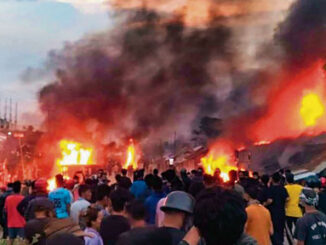
The crisis in Manipur following the outbreak of communal violence between two ethnic groups, Kukis and Meiteis, in several townships is now generally under control, but the situation remains volatile and tense as there are many people dislodged from their homes and taking shelter in relief camps on the campuses of police and paramilitary establishments. The Meiteis see themselves as getting marginalised and thus feel the need for protection through ST status.
Manipur has three major ethnic groups — Nagas, Kukis and Meiteis — the last being the largest. The former two are Scheduled Tribes (ST), and the cause of the present conflict is a demand by a growing section of the latter to also be included in the ST list.
This demand is more than a decade old. Those seeking ST status say it is not only about reservation benefits but also protection of their land. This northeastern state is roughly divided into two regions — a central, fertile riverine valley constituting less than 10 per cent of the state’s land area, surrounded by hills which account for the remaining 90 per cent.
This is a peculiarly skewed legacy of the British policy of separating ‘non-revenue hills’ from ‘revenue plains’ after they took control of Manipur in 1891. This was done on the pattern of the revenue administration mechanism they introduced in Assam through the Bengal Eastern Frontier Regulation, 1873. Hence, the Meiteis, who account for about 52 per cent of the state’s population, came to be restricted within the small valley.While the sparsely populated hills are out of bounds for them, their valley homeland follows the modern land revenue administration, and is open to settlement by any Indian. This being so, over 60 per cent of the state’s population now lives in the valley, while the hills, reserved for the Nagas and Kukis, remain sparsely populated.
In modern times, as their living space has got increasingly crowded, the Meiteis have come to be gripped by a peculiar sense of siege, especially because of layered relations with the hill tribes, which on the one hand are marked by fraternal feelings and on the other by deep mistrust. This mistrust is accentuated by the usual developmental disparities between the hills and the plains, which the residents of the hills see as the outcome of discriminatory policies.
If the Meiteis see themselves as getting marginalized in terms of land and jobs — and thus feel the need for protection through ST status — those who are already part of the ST list see this as a portent of their own slices of the reservation pie getting smaller. They also fear Meitei incursion into the hills if they too become STs. This latter apprehension is a fallacy, for even within existing ST communities, incursions into each other’s traditional territorial boundaries are forbidden, and if and when these happen, can result in violent conflicts, as evidenced by the bloody Naga-Kuki conflict in Manipur in the 1990s.A memorandum urging the state government to send a recommendation to the Centre regarding the Meiteis’ ST status was kept in cold storage for over a decade, probably in view of those within the Meitei community who did not want it, and also the opposition from Nagas and Kukis. Those demanding ST status eventually petitioned the Manipur High Court. On April 19, the court directed the state government to do the needful and forward its recommendation to the Union Government.
This was not taken kindly by the tribal groups and a series of condemnations and protests followed, earning even the ire of the HC. The May 3 rally was the climactic crescendo of these protests. The rally in Churachandpur turned violent when a rumor broke out that the Kuki war heroes’ memorial complex in a suburb bordering the valley district of Bisnupur had been burnt down by Meiteis. A mob went on the rampage, burning down several Meitei settlements around Torbung village. The memorial site was later found intact, but some say a small tyre was found burning outside the gate and this was read as a message of violent intent.There are reasons why the Kukis responded more aggressively than the Nagas. For some time now, a narrative that the Kukis are illegal migrants has been propagated by certain quarters. This is at best a half-truth. Rivals, however, took advantage of it to humiliate the Kukis by dubbing them as ‘refugees’ and it is imaginable how latent anger would have built up within the community.
Again, a peculiar landholding tradition among the Kukis, coupled with an instable subsistence farming which cannot support large populations, has meant a tendency of Kuki villages to periodically splinter and proliferate. Kuki villages are owned by chiefs. Since only one of the chief’s male children would inherit the chieftaincy of the village, other siblings and other capable villagers often part ways to establish their own villages. This has often brought them in conflict with their neighbors in the hills, the Nagas.
In recent times, even government institutions, by insinuation, have been using this tendency of the Kukis to humiliate them. Things came to such a pass that even normal government measures such as eviction drives from reserved forests or the fight against poppy plantations came to be seen as targeting the Kukis. Then, on March 10, in a very arbitrary move, the state Cabinet took the decision to pull out of a tripartite Suspension of Operations (SOO) agreement with two Kuki militant groups, the Kuki National Army and the Zomi Revolutionary Army, from among the 24 who had signed this agreement, again implying that they were party to encroachments in forests for poppy plantations and that they were of foreign origin. The SOO pact being a tripartite truce also including the Union Government, it is unlikely that this rash decision would be okayed, but the hurt the Kukis would have felt is obvious.
(The author is a senior journalist and author)
The Supreme Court Constitution Bench holds that the Governor erred in calling for a trust vote without ‘objective material’ to show Uddhav Thackeray government had lost support.
By Krishnadas Rajagopal
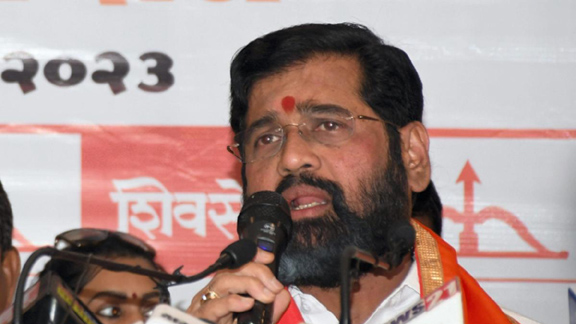
The Supreme Court, in a unanimous judgment, effectively opened the doors for disqualification proceedings against Maharashtra Chief Minister Eknath Shinde for defection from the Shiv Sena party, and held that the then-Governor Bhagat Singh Koshyari “erred” in calling for a trust vote which triggered the fall of the Uddhav Thackeray-led Maha Vikas Aghadi (MVA) government in mid-2022.
However, the court also said that Governor Koshyari was right in inviting Mr. Shinde to form the new government as Mr. Thackeray had resigned before the floor test. This means that the Shinde government will continue in power for now.
‘Floor test was error’
“The Governor had no objective material on the basis of which he could doubt the confidence of the incumbent government… Floor test cannot be used as a means to settle differences within a political party… The Governor erred in concluding that Mr. Thackeray had lost support… The discretion to call for a floor test is not an unfettered discretion,” a Constitution Bench led by Chief Justice of India D.Y. Chandrachud observed.
The court, however, said that it could not quash the voluntary resignation of Mr. Thackeray as Chief Minister a day ahead of the floor test on June 30, and thus reinstate his MVA government.
“This court cannot quash a resignation that has been submitted voluntarily. Had Mr. Thackeray refrained from resigning from the post of the Chief Minister, this court could have considered the grant of the remedy of reinstating the government headed by him,” it said.
‘Government formation justified’
Given the resignation, the court said that Governor Koshyari was right in then inviting Mr. Shinde to form the new government. “The post of the Chief Minister of the State of Maharashtra fell vacant after the resignation of Mr. Thackeray on June 29, 2022. The leader of the party that had returned the highest number of candidates to the State Assembly extended support on behalf of the party to Mr. Shinde. Thus, the decision of the Governor to invite Mr. Shinde to form the government was justified,” the Bench held.
The court refused to invalidate the election of Speaker Rahul Narwekar merely because some of the MLAs who participated in the election faced disqualification proceedings.
Ball in Speaker’s court
The court did not accept the plea made by the Thackeray faction to call for and decide the disqualification petitions pending before Speaker Rahul Narwekar.
Also Read | Sena vs Sena | Supreme Court is the ‘only ray of hope,’ says Uddhav Thackeray
“Absent exceptional circumstances, the Speaker is the appropriate authority to adjudicate petitions for disqualification under the Tenth Schedule [anti-defection law] … The Speaker embodies propriety and impartiality and that it was therefore inappropriate to express distrust in the office of the Speaker,” Chief Justice Chandrachud, who authored the unanimous verdict for the five-judge Bench, noted.
The Bench nevertheless noted that any decision taken by the Speaker, acting in the capacity of tribunal, on the disqualification petitions was subject to judicial review.
Split vs defection
Further, the court drew a map of factors for the Speaker to consider while deciding the disqualification petitions. First, the court said that the Speaker could not accept the Shinde group’s sole defense that they had merely “split” from the Shiv Sena party, and not defected. The court said that the defense of a “split” was no longer available to the Shinde group with the deletion of Paragraph 3 from the Tenth Schedule by the Constitution (Ninety-first Amendment) Act in 2003.
“The defense sought to be availed of must be found within the Tenth Schedule as it currently stands,” the Bench held. Second, the court said that the Speaker, while considering the question of which faction was the “real” Shiv Sena, must consider the version of the party constitution which was submitted to the Election Commission of India with the consent of both factions. This would be the 2018 party constitution in which Mr. Thackeray was elected party president.
‘Not a numbers game’
Third, the judgment said that the Speaker must not be swayed by the numbers in the House. “The Speaker must not base his decision as to which group constitutes the political party on a blind appreciation of which group possesses a majority in the Legislative Assembly. This is not a game of numbers, but of something more. The structure of leadership outside the Legislative Assembly is a consideration which is relevant to the determination of this issue,” Chief Justice Chandrachud said.
Finally, the court said, when there are two or more Whips appointed by two or more factions of a political party, the Speaker must go by which of the two Whips represented the political party.
‘Illegal decisions’
To make matters worse for the Shinde group, the court declared Mr. Narwekar’s decision recognizing Bharat Gogawale as Chief Whip of Shiv Sena as “illegal.” Again, the court found that the Speaker’s decision to recognize Mr. Shinde as the “Leader of the Shiv Sena Legislative Party” was “illegal” too. The court, in short, set aside Mr. Narwekar’s decision on July 3, 2022 to recognize Mr. Gogawale as the Chief Whip of the Shiv Sena in place of Sunil Prabhu, and Mr. Shinde as Leader in place of the Thackeray faction’s Ajay Choudhari.
“The Speaker, by recognizing the action of a faction of the Shiv Sena Legislative Party (SSLP) without determining whether they represented the will of the political party, acted contrary to the provisions of the Tenth Schedule… The Speaker must recognize the Whip and the Leader who are duly authorized by the political party with reference to the provisions of the party constitution,” the judgment said.
‘Can’t rely on ECI’
The Bench also found fault with Mr. Narwekar’s decision to stay the disqualification proceedings “in anticipation” of the decision of the Election Commission of India (ECI) on which of the two rival factions was the original political party of the Shiv Sena.
“The decision of the ECI cannot be relied upon by the Speaker for adjudicating disqualification proceedings. If the disqualification petitions are adjudicated based on the decision of the ECI in such cases, the decision of the ECI would have retrospective effect. This would be contrary to law,” the court said.
It said that the decision of the ECI recognizing the Shinde faction as the real Shiv Sena would take effect only “prospectively,” that is, after the Speaker takes a call on the pending disqualification petitions. “In the event that members of the faction which has been awarded the symbol are disqualified from the House by the Speaker, the members of the group which continues to be in the House will have to follow the procedure prescribed in the Symbols Order and in any other relevant law for the allotment of a fresh symbol to their group,” the court ruled.
The court further referred to a larger Bench of seven judges the question of whether a Speaker facing removal could decide disqualification petitions against MLAs under the Tenth Schedule.
The arrest of former Prime Minister Imran Khan in a corruption case has triggered widespread violence in Pakistan and plunged the economically beleaguered country into a political crisis, months before the national election scheduled for November. Imran’s irate supporters have upped the ante against the Pakistan Muslim League (Nawaz) government and the army leadership. A prolonged confrontation is expected, with a court on Wednesday indicting Imran in a separate case of corruption on the charge of illegally selling state gifts during his tenure as PM. His party, Pakistan Tehreek-e-Insaf, is accusing the powers that be of plotting to defame and defang him with the motive of derailing his electoral comeback. After being in power for four years, Imran stepped down as PM in April last year following a parliamentary no-confidence vote. He has repeatedly blamed the US for engineering his ouster in league with the Pakistan army.
It’s apparent that the drastic action of taking the popular leader into custody has been carried out at the behest of or with the consent of Pakistan’s military. It’s no coincidence that a day before the arrest, the Inter Services Public Relations — the media wing of the military — issued a statement accusing Imran of targeting officials of the military and intelligence agencies by making ‘fabricated and malicious allegations.’ However, the ploy might backfire in the long run if he effectively plays the ‘victim card’ and gains the sympathy of the masses.
The political uncertainty in Pakistan has grave implications for India, which has been grappling with cross-border terrorism for decades. With the recent killings of soldiers in Poonch and Rajouri indicating an escalation in terror activities, New Delhi must remain on guard in the coming weeks and months. There could be more trouble in store, especially if Pakistan’s civil-military establishment emerges stronger from the present upheaval.
(Tribune, India)
Supreme Court verdict is an indictment of how regime change in Maharashtra was achieved
It often happens in litigation around political developments that judgments underscore high principles but extend no relief to those impacted by breach of constitutional norms. The Supreme Court verdict on the political imbroglio in Maharashtra last year is one such. It is an indictment of the manner in which regime change was achieved, but it does not alter the status quo. A Constitution Bench has ruled that Governor Bhagat Singh Koshyari had no objective material to doubt the majority of the then Chief Minister, Uddhav Thackeray, but had nevertheless asked him to take a floor test, based on extraneous factors. As Mr. Thackeray had resigned without facing the floor test, the Court said it was unable to restore his government. It is true that it cannot quash a voluntary resignation, but the Court fails to acknowledge that his resignation was forced by circumstances to which the Court itself was a party. On the eve of the floor test, a Supreme Court Bench allowed it to go on. Earlier, by an interim order, the Court had extended the time given to the then rebel Shiv Sena MLAs led by Eknath Shinde from June 27 to July 12 to reply to applications seeking their disqualification for defection. The order gave ample time to the dissidents, along with the BJP, to execute political maneuvers without the threat of disqualification from the House. In effect, the two court orders helped in the toppling of the regime, a fact that the final verdict fails to acknowledge.
The Thackeray faction lost in the numbers game, a game in which time is of the essence for both rulers who need to protect their flock and dissidents who need to rope in enough defectors. Besides cautioning Governors against treating internal problems of a ruling party as a possible loss of majority, the Court has also clarified that whips and leaders of the party in the House ought to be appointed by the political party, and not the legislature party. This has a bearing on whose whip is binding on legislators in the event of a party splitting into two factions. It has also decided that the judgment in Nabam Rebia (2016), holding that a Speaker who is facing a notice for removal from office should not adjudicate a disqualification matter under the anti-defection law, should be reconsidered by a larger Bench. This is welcome, as legislators who have incurred disqualification should not be allowed to use a frivolous petition to remove the Speaker to ward off their own disqualification. Mr. Thackeray can now claim a moral victory, but in the domain of political coalitions, a legislative majority is seen as more important than morality.
Joint Statement issued at conclusion of the 6th Canada-India Ministerial Dialogue on Trade & Investment
By Prabhjot Singh
India and Canada have made some advances towards resolving some disputes delaying the signing of the Free Trade Agreement (FTA). The FTA has been pending for more than a decade as the bilateral trade, too, has failed to inch towards the targeted $15 billion.
One of the major hurdles in signing the FTA has been the Canadian demand for security of investments that has been discussed at different levels without being resolved.
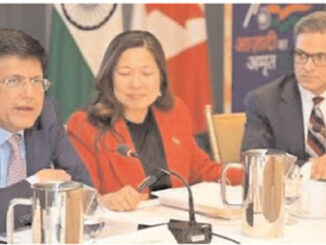
To continue the momentum of B2B engagement, both Canada and India will forward to the relaunch the Canada-India CEO Forum with renewed focus and a new set of priorities. Also, the CEO Forum could be announced at a mutually agreed early date. Further, Canadian Minister Mary Ng announced that she looks forward to leading a Team Canada trade mission to India in October 2023 which was welcomed by Indian Minister Piyush Goyal.
As a part of the continuing dialogue Canada and India held their sixth Ministerial Dialogue on Trade & Investment (MDTI) in Ottawa on May 8. It was co-chaired by Mary Ng, Minister of International Trade, Export Promotion, Small Business and Economic Development, Government of Canada and Piyush Goyal, Indian Minister of Commerce and Industry, Consumer Affairs and Food, and Public Distribution and Textiles. The Ministers emphasized the solid foundation of the trade and economic relationship between Canada and India and recognized the significant opportunity to deepen bilateral ties and economic partnership.
Among the most significant developments of this dialogue include In line with the announcement made in the National Education Policy 2020 of India for facilitating foreign universities and educational institutions, India has agreed in principle to invite top Canadian Universities to set up their campuses in India.
India and Canada have also agreed to an expanded air services agreement in 2022 which enhances people to people ties through enhanced commercial flights by carriers of both countries. Though no specifics were given out, Canada has been demanding improved connectivity with North, especially Amritsar and Chandigarh.
A joint statement issued after the dialogue said that the Ministers touched on the important discussions taking place at the various meetings of the G-20 being held in India this year under the Indian Presidency. In this context, Minister Ng noted India’s role as a global economy of the future and congratulated the Government of India and the Indian business organizations on the successes enjoyed so far at the G-20 events in India. She expressed her support for India as G20 Chair, and the priorities pursued by India in the G20 Trade and Investment Working Group. Minister Ng indicated that she is looking forward to participating in the upcoming G-20 Trade and Investment Ministerial meeting in India scheduled to take place in August 2023.
In recognition of the critical importance of the Indo-Pacific region for Canada’s prosperity, security, and its capacity to address environmental challenges, Minister Ng noted the rolling out of Canada’s Indo-Pacific Strategy and India’s importance in the region.
The Ministers also referred to the resilience of bilateral trade in 2022 following the challenges of the COVID-19 pandemic and the disruptions caused by the war in Ukraine. Canada-India bilateral trade in goods reached nearly C$12 billion in 2022, a substantial 57% increase over the previous year. (Target set was $ 15 billion by the end of 2010). The Ministers also underlined the contribution of the services sector in furthering the bilateral relationship and noted the significant potential for increasing bilateral services trade which stood at C$8.9 billion in 2022. Ministers recognized the significant growth of two-way investments and their contribution to deepening economic and trade ties, appreciative of the improvements made by both countries to facilitate business growth and attract investment.
The Ministers also noted that the trade-related strengths of Canada and India are complementary and real potential exists for trade in both goods and services to expand significantly in both traditional and emerging sectors. With that goal in mind, the Ministers called for boosting the commercial ties between the two countries through enhanced cooperation and by forging partnerships to take advantage of the complementarities in such sectors as agricultural goods, chemicals, green technologies, infrastructure, automotive, clean energy, electronics, and minerals and metals. The Ministers further asked their officials to discuss trade remedy issues of bilateral importance on a regular basis.
The Ministers emphasized the key institutional role that the MDTI can play to promote bilateral trade and investment ties and to strengthen economic cooperation between the two countries. Recognizing the need for a comprehensive trade agreement to create vast new opportunities for boosting trade and investment flows between Canada and India, in 2022 the Ministers formally re-launched the India-Canada Comprehensive Economic Partnership Agreement (CEPA) negotiations. In pursuit of that goal, negotiations towards an Early Progress Trade Agreement (EPTA), as a transitional step towards the CEPA, have been underway and several rounds of discussions have already taken place. The EPTA would cover, among others, high level commitments in goods, services, investment, rules of origin, sanitary and phytosanitary measures, technical barriers to trade, and dispute settlement, and may also cover other areas where mutual agreement is reached.
The two sides also agreed to explore enhanced cooperation through measures such as coordinated investment promotion, information exchange and mutual support between the two parties in the near future. This cooperation between Canada and India will be finalized by way of a Memorandum of Understanding (MoU) preferably in Fall 2023.
The Ministers noted that global supply chains remain under the threat of disruption from the fallout of the COVID-19 pandemic, as well as the effects of the ongoing war in Ukraine. In this context, they discussed the continued importance of working together to promote the international rules-based order and supply chain resiliency in critical sectors. They emphasized enhancing cooperation in sectors such as clean technologies for infrastructure development, critical minerals, electric vehicles and batteries, renewable energy/hydrogen, and AI.
Recognizing the importance of critical minerals for the future economy and green economy, the Ministers agreed on the importance of government coordination to promote critical mineral supply chain resiliency. Ministers also agreed to explore options for business-to-business engagement on critical minerals between the two countries, and have committed to an annual dialogue between the appropriate points of contact at the officials’ level on the margins of the Prospectors and Developers Association Conference in Toronto to discuss issues of mutual interest.
Both sides discussed the potential for strengthening the cooperation in the field of science, technology and innovation in priority areas by building on the ongoing work in the Joint Science and Technology Cooperation Committee (JSTCC) and seeking enhanced collaboration in the areas of start-ups and innovation partnerships. The Ministers agreed that there is significant potential to strengthen such cooperation and to enhance collaboration between their research and business communities in support of a sustainable economic recovery and the prosperity and wellbeing of their citizens.
The Ministers recognized the value of further deepening the Canada-India commercial relationship through initiatives such as organized fora for SMEs and women entrepreneurs.
Minister Mary Ng appreciated the visit of the Indian business delegation at the side-lines of the 6th MDTI which has enhanced B2B engagement. To continue the momentum of B2B engagement, both Ministers look forward to the relaunching the Canada-India CEO Forum with renewed focus and a new set of priorities. The CEO Forum could be announced at a mutually agreed early date. Further, Minister Mary Ng announced that she looks forward to leading a Team Canada trade mission to India in October 2023 which was welcomed by Minister Goyal.
The Ministers noted the significant movement of professionals and skilled workers, students, and business travelers between the two countries, and its immense contribution to enhancing the bilateral economic partnership and, in this context, noted the desire for enhanced discussions in the area of migration and mobility. Both sides agreed to continue to discuss ways to deepen and strengthen the bilateral innovation ecosystem through an appropriate mechanism to be determined. In addition, in accordance with Canada’s Indo-Pacific Strategy, further investments will be made to support industrial research and development partnerships.
In line with the announcement made in the National Education Policy 2020 of India for facilitating foreign universities and educational institutions, India also invited top Canadian Universities to set up their campuses in India. The Ministers noted that India and Canada have agreed to an expanded air services agreement in 2022 which enhances people to people ties through enhanced commercial flights by carriers of both countries.
The Ministers reaffirmed their commitment to the rules-based, transparent, non-discriminatory, open, and inclusive multilateral trading system embodied by the World Trade Organization and concurred to work together to further strengthen it.
The Ministers agreed to remain engaged to provide sustained momentum including having an annual work plan which is reported on a regular basis to build linkages and strengthen cooperation across sectors to harness the full potential of the trade and investment relationship between India and Canada.
Drug lords with influential backers are saved by shoddy probe and lack of political will
By Rajesh Ramachandran
“Big or small, all drug operators of Punjab have a police connection and in that sense, Punjab’s drug problem is, of course, a cop cancer. Take, for instance, Jagdish Singh ‘Bhola’, a DSP arrested in 2013 and convicted in 2019 for peddling synthetic drugs. His case had thrown open a drug empire worth thousands of crores of rupees, wherein it was proven that synthetic drugs were being manufactured, trafficked and exported to Canada and Europe. Bhola’s case unearthed a lot of possibilities for Punjab’s top cops and politicians to understand and fix the drug problem, but they did not — for the rot was allegedly at the very top. Bhola had named then revenue minister Bikram Singh Majithia as a co-accused.”
It is a cliché to say that Punjab has a drug problem or that it is reeling under an addiction menace. That, however, is not entirely true. In fact, Punjab actually has a politician problem and is suffering from a cop menace; and these two diseases manifest themselves in various ways, including drug trafficking and addiction. The Bhagwant Mann government has now acted against AIG Raj Jit Singh by dismissing him from service and also filing cases against him. A very welcome step indeed. But is that all? Does the people’s mandate to wage war against drug lords end with the arrest of one of the many minor cogs in the huge wheel of Punjab’s drug mafia facilitated by fraudster politicos and crooked cops?
Bhola’s case unearthed possibilities for Punjab’s top cops and politicians to understand and fix the drug problem, but they did not — for the rot was allegedly at the very top.
Big or small, all drug operators of Punjab have a police connection and in that sense, Punjab’s drug problem is, of course, a cop cancer. Take, for instance, Jagdish Singh ‘Bhola’, a DSP arrested in 2013 and convicted in 2019 for peddling synthetic drugs. His case had thrown open a drug empire worth thousands of crores of rupees, wherein it was proven that synthetic drugs were being manufactured, trafficked and exported to Canada and Europe. Bhola’s case unearthed a lot of possibilities for Punjab’s top cops and politicians to understand and fix the drug problem, but they did not — for the rot was allegedly at the very top. Bhola had named then revenue minister Bikram Singh Majithia as a co-accused.Like Inspector Inderjit Singh and Raj Jit getting sacked or punished now, Bhola was made the prime accused earlier and his political patrons were not even investigated. This time around, when the AAP government makes tall claims of tackling the drug menace in Punjab, it needs to closely read the High Court’s bail order to understand that it was shoddy investigation — first by the Congress government and then the AAP dispensation — that led to Majithia securing regular bail. The whole case seems to be hinging on a couple of statements made by the arrested accused, and also the findings of Special Task Force head Harpreet Singh Sidhu, which various governments consistently refused to pursue.
In a status report filed in 2018, Sidhu had told the court that Majithia had a close relationship with Satpreet Singh ‘Satta’, Parminder Singh ‘Pindi’, Jagjit Singh Chahal, Maninder Singh Aulakh and Amrinder Singh ‘Laddi’; Bhola was allegedly involved in the drug trade in association with Chahal, Aulakh, Laddi, Pindi and Satta; Majithia had a role in facilitating the supply of pseudoephedrine to Satta and Pindi; and the matter regarding money transactions of Majithia with Chahal and others needed to be investigated further, as also whether funds had been converted into assets abroad. Sidhu’s report referred to confession statements made to the Enforcement Directorate (ED) under the Prevention of Money Laundering Act by Bhola, Chahal and Aulakh.
But that was that — neither the ED nor Punjab Police made any further inquiry into the international drug trade originating in Punjab with obvious political patronage. Gradually, all talk of this flourishing multi-billion-rupee synthetic drug industry was drowned in the drone of seizures of a few grams of heroin here or some weed there. The real big fish were splashing in the pool while the Capt Amarinder Singh government looked askance. Shockingly, even the ED did not pursue its own case. Its former deputy director, Niranjan Singh, made a statement in December 2021 explaining that he had not disclosed any material in his possession about Majithia’s involvement in ‘financing’ of the narcotic drug-related activities either prior to 2004 or later. No wonder the ED is blamed for targeting only the Opposition. Till 2020, Majithia and his family were part of the ruling coalition at the Centre.
But why blame just Niranjan Singh, every bit of this case is outrageous. After the High Court constituted a Supervisory Investigating Team of three senior IPS officers, about 10 supplementary challans were filed on the original FIR against Bhola, but Majithia was never made an accused. It was only Harpreet Sidhu’s STF that took a bold stand against Majithia. And finally, when the Channi government did file an FIR against Majithia, it was based on Sidhu’s STF report. But again, the police never took Majithia into custody, making a mockery of the arrest. If the police did not want to interrogate him or take him to crime sites to collect evidence, or involve him in other means of establishing crime, why keep him in judicial custody? The FIR against Majithia and his arrest were, obviously, Channi’s election stunt. Once the election got over and as the case dragged on without a shred of material proof against Majithia, the High Court correctly ruled that the evidence was fragile and not credible. In fact, apart from Sidhu’s report, the prosecution had not made out a case.
But then, lack of evidence is no proof of innocence. Lack of evidence despite Sidhu’s statement — that there is sufficient evidence to investigate the role of Majithia in using government machinery, including vehicles, security personnel and other facilities for assisting, facilitating and abetting narcotic drug-related activities — only exposes bad policing. The investigators and the prosecution, which slept for over a decade, first during the Akali regime and then during Captain’s rule, have not yet woken up to file a challan in the Majithia case, making do with the dismissal of Raj Jit instead. Now, with PM Modi visiting the Akali Dal office to pay respects to Parkash Singh Badal, BJP president JP Nadda attending his funeral, and despite Union minister Hardeep Puri’s statement, there is speculation of a reunion of old partners. The people will get enraged if the political patrons of the drug trade don’t get caught by the Central and state governments, forcing them to look around for an alternative all over again.
(The author is editor-in-chief of The Tribune Group)
Sharad Pawar’s decision to step down as NCP chief is a strategic move to assert his authority over his party forever, analysts say, citing the example of Bal Thackeray who once pulled the same move to stem revolt.
Mr. Wagle claimed that the NCP supremo was playing pressure politics with his nephew, who was trying to join hands with BJP along with a chunk of the NCP, with the hope of becoming Chief Minister in case Eknath Shinde and his 15 rebel Shiv Sena MLAs get disqualified in the Sena vs Sena case pending with the Supreme Court.
By Abhinay Deshpande
Senior politician Sharad Pawar’s announcement of his decision to step down as president of the Nationalist Congress Party and not contest any future elections has sent shockwaves through the political landscape — not just in Maharashtra, but across the country.
The development should not be seen as a spur-of-the-moment move by the 82-year-old Mr. Pawar, as is reflected by his crafty and calculated approach to politics. It is likely part of a larger plan to assert his authority within the NCP, a party which was formed on June 10, 1999, after he — along with P.A. Sangma and Tariq Anwar — was expelled from the Congress for opposing the Italian-born Sonia Gandhi as the party’s Prime Ministerial candidate.
The Thackeray model
A similar move was pulled by Shiv Sena founder Bal Thackeray — Mr. Pawar’s close friend and political foe — almost three decades ago, when his party was stung by the revolt of Chhagan Bhujbal, now an NCP leader, and 17 other MLAs from rural Maharashtra, who objected to his ‘style of functioning’. However, after Shiv Sainiks begged their Wagh (tiger) to reconsider his decision, Mr. Thackeray agreed to their request and forever stamped his authority on his party.
However, close confidants of the NCP patriarch said that he would not step back but would continue to run the show from outside. Mr. Pawar’s nephew and senior NCP leader Ajit Pawar gained traction after he told party workers that there was no need to get emotional. “Pawar saheb will continue to guide the party even after resigning, like Sonia Gandhi who remains the supreme authority [in the Congress] in spite of relinquishing the top post,” he said.
Political analyst and senior journalist Nikhil Wagle, who has been observing the rise of the NCP for decades, says that the senior Mr. Pawar’s announcement of his intent to quit as party president can also be seen as a move to put pressure on his nephew and show him that he was the ‘boss’, especially given the speculations that Mr. Ajit Pawar is flirting with the BJP.
“It was indeed a shock to everyone, not just in Maharashtra, but across the country. Mr. [Sharad] Pawar is the tallest leader Maharashtra has ever seen after Mr. Thackeray, and we can say he is playing the ‘Pawar Game’ in his own style,” he told The Hindu.
Mr. Wagle claimed that the NCP supremo was playing pressure politics with his nephew, who was trying to join hands with BJP along with a chunk of the NCP, with the hope of becoming Chief Minister in case Eknath Shinde and his 15 rebel Shiv Sena MLAs get disqualified in the Sena vs Sena case pending with the Supreme Court.
“It is a perfect example of pressure politics, which Mr. [Sharad] Pawar had played emotionally to tackle the issue. In a way, the senior has left no room for Mr. Ajit Pawar to think of joining hands with BJP, which will be political suicide for him,” he said.
The four-time Maharashtra Chief Minister and former Union Minister also addressed the deeper internal power struggle within his family in a suave and sophisticated style by paving the way for his nephew to take over the leadership at the State level, as a means of maintaining unity within the NCP.
Coalition impact
However, one of the biggest concerns following Mr. Pawar’s announcement is the impact it will have on the tripartite Maha Vikas Aghadi, an unlikely coalition of the NCP, the Congress and their ideological opposite, the Shiv Sena led by Uddhav Thackeray.
With the senior statesman Mr. Pawar no longer party chief, there is no one person to keep the already crumbling MVA glued together ahead of the 2024 Lok Sabha and Assembly polls. The alliance has already been facing challenges from within, especially given the friction between the Congress and the Thackeray faction of the Sena (UBT), and Mr. Pawar’s absence could further weaken it.
However, political observers maintain that the MVA is Mr. Pawar’s pet child — which has emerged as one of the country’s most powerful political alliances despite the different interests and ideologies of his members — and insist that he would continue to protect it.
“He might not be the president of NCP on paper, but he will continue to be their leader and lead MVA. Until 2019, no one would have ever imagined Shiv Sena joining hands with Congress and NCP, but he had made it possible, and there is no doubt that he will continue to hold us together,” a senior NCP leader said.
Bigger role for Sule
Even if the party breaks ranks with the MVA and joins forces with the BJP despite Mr. Pawar’s attempts to keep the NCP family intact, the octogenarian leader does not want this to happen during his tenure and wants to avoid any association with such a move. It also allows him to take a ‘democratic stance’ by aligning himself with the party’s decision.
Moreover, Mr. Pawar’s daughter Supriya Sule, a member of the Lok Sabha from Baramati, will continue to play a major role in the party’s leadership at the national level. A senior NCP leader also suggested that Ms. Sule should become the national president of the party, while her cousin heads the State unit.
Even Mr. Bhujbal admitted that Ms. Sule was ideal for a national role as she had a good grasp of issues. “She has been doing well as a parliamentarian. So, there will be no problem in deciding the new president. Ajit Pawar should handle the responsibility of the State. The division of work is already there,” he said.
(The author
There is a redrawing of the political contours of the political parties in Karnataka — a shift that will have bearing on the future of electoral democracy in India
By Valerian Rodrigues
The electoral arena in Karnataka in the run-up to the State Assembly elections 2023, on May 10, has turned out to be a battleground that is outpacing any other in living memory. There are many reasons being advanced for this: Karnataka has been the steppingstone of the Bharatiya Janata Party (BJP) to South India and needs to be retained at all costs; the State is an economic powerhouse, particularly in new technologies; there are elections to important States as well as to Parliament in the offing.
The Congress Party has a well-tested and rooted leadership in the State apart from the fact that Mallikarjun Kharge, the recently elected all-India Congress President, hails from the State. The Congress’s electoral prospects, elsewhere and hereafter, may be crucially dependent on this election. The Gandhi family in general, and Rahul Gandhi in particular, enjoy great moral standing in the State, with Mr. Gandhi’s Bharat Jodo Yatra adding to this.
The Janata Dal (Secular) led by H.D. Deve Gowda, the former Prime Minister of India, is a local brew of a farming community, a dominant caste and with embedded memories of pluralism cohabiting a region. There is some truth in all these narratives. But there are also ideological contestations behind the escalating rhetorical flourish, biting satire, lampooning of opponents, and promises of freebies. These contestations are redrawing the political contours of the political parties in the fray, particularly the BJP and Congress, and this shift would have an important bearing on the future of electoral democracy in India, including the idea of progress.
Ideological overdrive
While the BJP has scored much success in Karnataka’s electoral politics in the last two decades, its Hindutva project has not advanced at the same pace. This is in spite of the sporadic spectacles on love-jihad, Tipu Sultan, the hijab issue, cow slaughter, and religious conversions.
As a strong avowal of common descent and cultural belonging (in Savarkar’s words, pitrabhu and punyabhu), Hindutva elicited some support in certain pockets of present-day Karnataka from early on. While a few in the Bombay-Karnataka region (now called Kittur Karnataka) too were attracted by it, most of the educated Lingayats of the region came to define themselves vis-à-vis Brahmins. A significant section of them were influenced by Jotirao Phule’s Satyasodak Sangh. With the collection and classification of the scattered Vachana literature in the 1920s and the 1930s and the maths as their institutional support base, the Lingayats had already begun to mount the demand of being a separate religious community in the 1940s.
However, with the founding of Karnataka as a separate State in 1956, they came to regard themselves as being foundational to it. There were deep internal cleavages of belief and social gradation within the community and being Lingayat meant different things to different groups within it. The relative political marginalization of this numerous community from the 1970s, and particularly from the late 1980s, the rise of new political players, contention with the Vokkaligas (a large farming community that rallied together under the leadership of H.D. Deve Gowda), the inept handling of the local leadership by the all India Congress leadership, persuaded its significant sections to shift their allegiance to the BJP in the 1990s. B.S. Yediyurappa and some other leaders such as Jagdish Shettar (who is now with the Congress) who were associated with the Rashtriya Swayamsevak Sangh played the mediating role.
This cooption of Lingayats into the Hindutva fold was not driven through an ideological grooming from below, and invariably involved drawing the Veerashaiva and Lingayat seers as community representatives into the political arena. Paradoxically, the Hindutva project in the State encountered a major roadblock in this community, internal to the project but also proud of its autonomy. Given this impasse, the Hindutva leadership chose to push to the margins those leaders who wielded clout and prestige within the community and brought to the fore others docile to it.
A recrafting
In southern Karnataka, where the Vokkaligas have a dominant political presence, Hindutva embraced a different strategy. In the last few decades, this region has witnessed a hastened pace of recrafting ‘Hinduism,’ shifting the emphasis from village and local deities to those with wider appeal, renaming and reconstructing temples and ritual sites, reordering sacral practices, and splitting apart syncretic spaces. At the same time, the prestige of the Adichunchanagiri Math, and its presiding deity Kalabhairav, as the premier seat of the religiosity of this community has also grown enormously. Proponents of Hindutva have attempted to shift this efflorescence to reinforce their ideology. They have argued that Hindutva and Hinduism are one and the same. There has been a vilification of Tipu Sultan while new Vokkaliga heroes such as Nanje Gowda and Uri Gowda are brought to the fore. The Adichunchanagiri Math, however, has been indisposed to such reconstruction without adequate evidence. The JD(S) has stood its ground against the polarization of the Vokkaliga habitat, and Hindutva usurping its cultural resources. It has also rallied in favor of a strong regional identity.
Moving in another direction
The Congress Party seems to be shifting gears in a different ideological direction: There is little stress in its rhetoric on secularism, socialism, and nationalism that dominated much of its discourse for decades. These lofty goals are now presumed as a given in the constitutional frame of India. All the early assurances of the party, before the loud rhetoric of election frenzy set in, such as an unemployment dole to the educated unemployed, a quantity of food-grains to poor households, certain units of free electricity to every household in the State, and free travel for women in public transport, had no caste and region-tag built into them. The emphasis has been on inclusiveness and equality. In fact, Mallikarjun Kharge said in an interview to a media channel (India Today) that the ideological plank of his party is woven around democracy, constitutionalism, and rights. It is important to reiterate that Rahul Gandhi has often held fort highlighting these three issues, particularly vis-à-vis the Hindutva project. The Left, still left over in Karnataka, seems to endorse this turn.
The BJP is aware that the ideological plank through which it proposes to recraft public life in Karnataka has led to much heartburn and has thrown up new fears and apprehensions. But it thinks that the charisma of Prime Minister Narendra Modi, the party’s organizational might and reach, and a rejuggling of the reservation code will enable it to wade through such opposition and covert resistance. It probably believes that this is the only course open to it to commandeer the other States of South India. The Congress has desisted from embracing the path of social polarization to counter Hindutva, although its local leadership has deep social moorings to pursue such an endeavor. The Congress could very well say that its ideological plank encompasses that of JD(S) as well. But it is not so much ideology, but a set of interests, that holds the latter together.
(Valerian Rodrigues was professor at Mangalore University and Jawaharlal Nehru University, New Delhi)
Irrespective of what the U.S. Commission on International Religious Freedom says, India must review its rights record
For the fourth consecutive year, the government has expressed outrage and rejected the recommendations of the U.S. Commission on International Religious Freedom’s (USCIRF) latest report, calling it “biased and motivated”. In its report released on Monday, the independent congressional body has called for India to be designated a “Country of Particular Concern” (CPC) for its “worsening” record on religious freedoms. The report has targeted the Indian government for “promoting and enforcing religiously discriminatory policies,” naming laws that deal with conversion, interfaith relationships, wearing the hijab and cow slaughter, as well as the Citizenship (Amendment) Act and the National Register of Citizens. All of these, it alleges, have impacted minorities including Muslims, Christians, Sikhs, Dalits, and Adivasis (indigenous peoples and Scheduled Tribes) negatively. The USCIRF has also catalogued acts of violence and the vilification of minorities and criticized the “suppression of critical voices” by intimidation that includes surveillance, demolition of property, detentions, and the targeting of NGOs through laws curtailing foreign donations. It has criticized the U.S. State Department for not having designated India as a CPC, and has called for sanctions on Indian government agencies and officials. In the only such sanction imposed on India, the U.S. had, in 2005, revoked Prime Minister Narendra Modi’s U.S. visa after a USCIRF recommendation on the 2002 Gujarat riots. In its response, the External Affairs Ministry has told the USCIRF to “desist” from such reports and to “develop a better understanding of India….”
The government’s stern reaction is understandable, and is in line with its response to such reports over the last two decades, since the USCIRF began to publish its findings. The process the USCIRF follows is non-inclusive, and the fact that it does not study the state of religious freedoms inside the U.S., suggests a double standard. Moreover, its recommendations hold no sway within India, and are meant only for the U.S. government to deliberate on and accept or dismiss. Either way, there is little need for or utility to New Delhi’s public responses, which make it sound defensive and do not actually repair the reputational damage to India as a secular, inclusive and pluralistic democracy. Given the detailed and pointed accusations, however, the Centre may well consider an internal review of its conduct and the direction it hopes to lead India in, on issues such as religious freedoms and rights. Eventually, any government’s duty is not in achieving a perfect score in a survey run abroad, but rather in burnishing its record of delivering justice, equality and security to its citizens back home.
(The Hindu)
The Supreme Court has rightly pulled up the Union Government for granting a third extension of service to Enforcement Directorate (ED) chief Sanjay Kumar Mishra. ‘Is there is no other person in the organization who can do his job? Can one person be so indispensable?’ —the court’s questions have cornered the Centre, which claims that Mishra’s extension was necessitated by administrative reasons and was vital for India’s evaluation by the Financial Action Task Force (FATF). The government’s contention — continuity of the ED’s leadership is crucial to ensure that India’s FATF rating does not go down — has cut no ice with the SC Bench. The government’s decision has laid bare its blatant disregard for orders of the apex court, which had stated in its 2021 judgment that any extension of tenure granted to officers holding the post of ED Director after attaining the age of superannuation should be for a short period and that no further extension should be given to Mishra.
Opposition parties have been accusing the Centre of misusing the ED — the country’s premier agency that investigates cases of money laundering and violation of foreign exchange laws — to settle political scores. Congress and TMC leaders are among the petitioners who have challenged the amended law that allowed extension to the ED chief, even as the Supreme Court had issued notices to the Centre and the directorate a month ago on a petition challenging the ‘unfettered’ powers the ED wields under the Prevention of Money Laundering Act for search, seizure, summons and arrest.The Mishra-led ED has also been under fire from the Aam Aadmi Party, which has alleged that the Central agency is trying to frame and defame its senior leaders, including Arvind Kejriwal and Sanjay Singh, in the Delhi excise policy case. Despite the Opposition’s allegations, the Centre has given another extension to Mishra, thereby giving it an opportunity to question the motives behind such a move. At stake here is the credibility of the government as well as the ED. With the matter being under judicial scrutiny, it is vital to prioritize transparency in the selection and functioning of the ED Director.
(Tribune, India)
Karnataka, which goes to the polls on May 10, is a high-stakes state for both the BJP and the Congress. It’s the first major Assembly battle of the year and the two parties are keen to win it with an eye on the 2024 General Election. The BJP, which came to power in Karnataka in 2019 after the collapse of the Congress-Janata Dal (Secular) government, has promised to implement the Uniform Civil Code (UCC) and the National Register of Citizens (NRC). The party claims that the UCC would ensure gender justice and equal rights for Muslim women. This is significant for a state where Muslims account for around 13 per cent of the electorate. Even as the BJP government’s decision to scrap 4 per cent OBC quota for Muslims has been challenged in the Supreme Court, the party is keen to split the community vote — to the detriment of its main rivals.
What’s common between the election manifestos of the BJP and the Congress is a slew of freebies. Notwithstanding PM Modi’s avowed disdain for the ‘revdi culture,’ the BJP has promised to provide three cooking gas cylinders free of cost to all BPL families — one each during the months of Yugadi, Ganesh Chaturthi and Diwali. The party has also announced that it will launch the ‘Poshane’ scheme under which each BPL household will get half a litre of Nandini milk every day and 5 kg of Sri Anna siri dhanya (millets) through monthly ration kits. The Congress’ promises include free of cost travel for women in government-run buses; monthly assistance of Rs 2,000 for each woman head of a family; 200 units of free of cost electricity to all households; and a dole for unemployed graduates and diploma holders in the age group of 18-25 years. The manifesto of the JD (Secular) caters primarily to the farming community and women self-help groups.
With religion being an emotive subject in Karnataka, the BJP has promised to create a state wing against religious fundamentalism and terror, while the Congress has named the Sangh Parivar organization Bajrang Dal vowing ‘firm and decisive action against individuals and organizations spreading hatred among communities.’ All in all, an intriguing contest is on the cards, with polarization and populism being the key factors.
To mingle with the Muslims today, you don’t have to wear a skull cap and sport Solzhenitsyn type of facial hair. Just get invited to an Iftar, the fast-breaking evening meal during the month of Ramadan! I did precisely that and attended four Iftar parties on Long Island in New York. As a bonus, I can tell a happy story of increasing communal amity.
My last Iftar on April 18 was hosted by the Town of Hempstead, presided by Supervisor Don Clavin. According to Zahid Syed, the Town’s Community Affairs Executive Director, as many as 800 people showed up. They included non-Muslims like me, a Hindu, and fellow editor Prof Indrajit Singh Saluja, a Sikh, all mainly hailing from the Indian subcontinent. Zahid claims that the first Iftar in New York held 25 years ago in City Hall was at his behest. This year, he has noticed quite a few first Iftars, including at the Town of North Hempstead, and the District Attorney’s office in Suffolk County.
Zahid Syed, who is organizing a Vaisakhi event next, is heartened to see people celebrating other communities’ festivals, signifying interfaith harmony. “The participation by politicians of all stripes is a recognition of the demographic changes,” he states
Before the Iftar meal, Imam Kashif Aziz, associated with the mosques in Valley Stream and Elmont, explained the significance of Ramadan, the holiest month in the Islamic calendar when the Quran began revealing to Prophet Muhammed (PBUH). Believers are told to do charity work and feed the hungry this month. Fasting is to practice self-control and earn taqwa (piety/God consciousness). My Iftar hopping started because having founded ALotusInTheMud.com a few months ago, I noticed that my Rolodex – even Facebook friends list – was not diverse enough. To make amends, I approached Arvind Vora who has been active in the interfaith movement for over 30 years. He took me along to many events and got me invited to Iftars.
My first Iftar was at the Amityville mosque of Ahmadiyyas, a sect of Islam. Rizwan Ahmad Alladin, its President, graciously invited me to introduce my Lotus magazine to the assembled men (women were in the partitioned section of the hall). The buffet was typical for South Asian gatherings (except for the alcohol, the prohibition of which is followed strictly by an overwhelming majority of Muslims till today). There was chicken biryani, goat meat, and even matter paneer, especially added to the menu for Mr Vora, a Jain.
The Iftar I enjoyed the most was hosted by Yavuz Girdap at his home in Saint James, NY. He is from Turkey and a franchisee of Moda Foods, importer of Turkish delicacies like baklava, which is going mainstream. The meal planned by his wife, Hafza, followed to the T what a doctor would have ordered. Lentil soup and salad, followed by brown rice, pasta, lean meat, and baklavas for dessert. All at a leisurely pace as conversation flowed and we had our laughter therapy thanks mainly to guest Nora Saleem’s cascade of cat stories.
A diverse group of guests at the Iftar hosted by Sadri Altinok (second from right), President of the Turkish Cultural Center Long Island. (Photo by Parveen Chopra)
One guest at Yavuz’s was Sadri Altinok, President of the Turkish Cultural Center in Ronkonkoma. So, I promptly got invited to their upcoming Iftar. No segregation of the sexes there. Sadri Altinok honored some of those who donated to Turkey earthquake relief and Suffolk County officers for their service. Mr Vora told me later that for decades the Turkish community in the US has been at the forefront of soft diplomacy of outreach to other communities and lawmakers.
A guest I met at the Turkish Cultural Center was Azra Dhar, President of Pacoli (Pakistani American Community of Long Island). She said that earlier when the Muslim community was smaller, people hosted Iftar parties at home with friends and family or went to the mosque. Now with a growing community and acceptance of diversity, you see Iftar gatherings at the official seats of government. “After years of tightness, I am happy to see this acceptance,” she commented.
While Azra Dhar attended over a dozen Iftars this Ramadan, Tahira Sharif, a fellow Pacolian who started Ali Hasnain Foundation for philanthropic work in Pakistan, has also attended as many. Feeding a fasting person brings Sadaqa from God, she says, and that is how arose the tradition of people, organizations, mosques, and the community holding Iftars. While Prophet Muhammed (PBUH) is said to break his fast only with a few dates and water, Tahira says it is difficult to resist good food after the rozas from dawn to dusk without even a drop of water.
My neighbor, Rehana Siddiqui, who recently went to do her first Umra pilgrimage in Mecca, has followed prayers more devoutly this Ramadan and watched what she was eating to break the fast. She reports losing six pounds – and looks it.
Religious fasting, however good for your spiritual well-being, should not turn into feasting in these times of sedentary lifestyles when we all have to watch our diet. Done right, Ramadan can detox your body as well, not just the mind and soul. Dr Irfan Ahmad Alladin, a pain management expert, quotes Prophet Muhammed (Peace Be Upon Him) no less: “We should consume only to the point that one-third of the stomach is occupied with solid, one-third is occupied with liquid, and one-third is left empty.” Link to his article: https://alotusinthemud.com/moderation-the-right-way-to-ramadan-fasting/
(Parveen Chopra is the founder and editor of ALotusInTheMud.com, a wellness and spirituality web magazine based in New York)
During the turbulent 1970s and 1980s in Punjab, Badal Sahab put ‘Punjab First’ and ‘India First’. He opposed any plan that would weaken India or compromise the interests of the people of Punjab, even if it meant loss of power. He was a man deeply committed to fulfilling the ideals of the great Gurus. He also made noteworthy efforts to preserve and celebrate Sikh heritage. Who can forget his role in ensuring justice for the riot victims of 1984?
On the evening of April 25, when I received the news of Sardar Parkash Singh Badal ji’s demise, I was filled with immense sadness. In his passing away, I have lost a father figure, someone who guided me for decades. In more ways than one, he shaped India’s and Punjab’s politics, and that can be described as unparalleled.
That Badal Sahab was a big leader is widely accepted. But, more importantly, he was a big-hearted human being. Being a big leader is easier but being a big-hearted person requires a lot more. People across Punjab say — there was something very different about Badal Sahab! (‘Badal Sahab ki baat alag thi’). It can be confidently said that Sardar Parkash Singh Badal was among the tallest kisan netas of our times. Agriculture was his real passion. Whenever he spoke on any occasion, his speeches were filled with facts, the latest information and a lot of insight.
I got to closely interact with Badal Sahab in the 1990s when I was involved in party work in North India. Badal Sahab’s reputation preceded him — he was a political stalwart who had been Punjab’s youngest Chief Minister, a Union Cabinet Minister and someone who held sway over the hearts of crores of Punjabis across the world. I, on the other hand, was an ordinary karyakarta. Yet, true to his nature, he never let this create a gap between us. He was filled with warmth and kindness. These were traits that remained with him till his last breath. Everyone who interacted closely with Badal Sahab would recall his wit and sense of humor.In the mid and late 1990s, the political climate in Punjab was very different. The state had seen much turmoil and elections were due in 1997. Our parties (SAD and BJP) went to the people together and Badal Sahab was our leader. His credibility was a key reason that the people blessed us with a resounding win. Not only that, our alliance successfully won the municipal elections in Chandigarh and also the Lok Sabha seat in the city. His persona was such that our alliance went on to serve the state for 15 years between 1997 and 2017!
There is an anecdote I can never forget. After taking oath as CM, Badal Sahab told me that we would go to Amritsar together, where we would halt at night and the next day we would pray and have langar. I was in my room at a guest house but, when he got to know of this, he came there and began to pick up my luggage. I asked him why he was doing this, to which he told me that I would have to come with him to the room meant for the CM and stay there only. I kept telling him that there was no need to do this, but he insisted. Eventually, this is exactly what happened and Badal Sahab stayed in another room. I will always cherish this gesture of his towards a very ordinary karyakarta like me.
Badal Sahab had a very special interest in gaushalas and kept cows of various breeds. During one of our meetings, he told me that he had a desire to breed cows from Gir. I arranged five cows for him and after that, when we would meet, he would talk to me about the cows and also joke that those cows are Gujaratis in every way — they never get angry, agitated or attack anyone, not even when children are playing around. He would also remark that no wonder the Gujaratis are so gentle… after all they drink the milk of the cows of Gir. After 2001, I got to interact with Badal Sahab in a different capacity — we were now Chief Ministers of our respective states.
I was blessed to receive Badal Sahab’s guidance on numerous issues, especially those related to agriculture, including water conservation, animal husbandry and dairy farming. He was also someone who believed in tapping the potential of the diaspora, considering that there are so many hardworking Punjabis settled overseas.
Once he told me that he wanted to understand what Alang Shipyard was about. Then he came there and spent the entire day at Alang Shipyard and understood how recycling took place. Punjab is not a coastal state; so, in a way, there was no direct relevance of a shipyard for him but such was his desire to learn new things that he spent the day there and understood different aspects of the sector.
I will always cherish his words of appreciation for the Gujarat Government’s repair and restoration efforts of the holy Lakhpat Gurdwara in Kutch, which was damaged during the 2001 earthquake.
After the NDA government came to power at the Centre in 2014, he once again provided valuable insights based on his rich governmental experience. He strongly supported several reforms, including the historic GST.
I have highlighted just a few aspects of our interaction. At a larger level, his contribution to our nation is indelible. He was among the bravest soldiers for the restoration of democracy during the dark days of the Emergency. He himself suffered the highhandedness of the imperious Congress culture when his governments were dismissed. And, these experiences only made his belief in democracy stronger.
During the turbulent period of the 1970s and 1980s in Punjab, Badal Sahab put ‘Punjab First’ and ‘India First’. He steadfastly opposed any plan that would weaken India or compromise the interests of the people of Punjab, even if it meant loss of power. He was a man deeply committed to fulfilling the ideals of the great Gurus. He also made noteworthy efforts to preserve and celebrate Sikh heritage. Who can forget his role in ensuring justice for the riot victims of 1984? Badal Sahab was a person who brought people together. He could work with leaders of all ideologies. He never associated any relationship with political gains or losses. This was particularly useful in furthering a spirit of national unity.
The void left by Badal Sahab’s demise will be tough to fill. Here was a statesman whose life witnessed many challenges but he overcame them and rose like a phoenix. He will be missed but he will live on in our hearts and he will also live on through the outstanding work he has done over the decades.
(The author is the Prime Minister of India)
“Since the BJP came to power in July 2019 (after the fragile Janata Dal Secular-Congress coalition sunk), the topmost question is, how much of Hindutva will actually shape the results of this poll? Truth be said, in the case of Karnataka, Hindutva has made more noise than actually polarize voters. The noise always emanates from the coastal districts of the state. However, the genie and genius from that laboratory have not spread so much to the plains or the mountains in the state. At best, they have offered an air cover in these regions but have not mingled too much in the soil. This has been true with the previous elections and is likely to be the case this time, too.”
By Sugata Srinivasaraju
What will the numbers be? That is the question thrown at you in an election season, and that is precisely what is being asked about the Karnataka Assembly polls slated to take place on May 10. The numbers will be clear on May 13. Anything said before that can either be a reasoned conjecture, an intelligent guess or an astrological prediction. But before the numbers come, there are narratives that will somewhat decide the numbers. Therefore, it may serve us well to look at the narratives that are shaping the Karnataka elections.
Hindutva has made more noise than actually polarize voters. This has been true with the previous elections and is likely to be the case this election, too.
Since the BJP came to power in July 2019 (after the fragile Janata Dal Secular-Congress coalition sunk), the topmost question is, how much of Hindutva will actually shape the results of this poll? Truth be said, in the case of Karnataka, Hindutva has made more noise than actually polarize voters. The noise always emanates from the coastal districts of the state. However, the genie and genius from that laboratory have not spread so much to the plains or the mountains in the state. At best, they have offered an air cover in these regions but have not mingled too much in the soil. This has been true with the previous elections and is likely to be the case this time, too.
A big reason for this seeming equilibrium is BS Yediyurappa, who has been largely responsible for the BJP’s success in the state. He has been more a Mandal politician than a Hindutva champion. This is probably because he picked up his political game in the midst of socialists and Lohiaites in Shimoga and Mysore districts. He came of age, electorally speaking, when the undivided Janata Dal was the real alternative to the smug Congress.
Even a fortnight ago, in an interview to a Delhi newspaper, Yediyurappa said: ‘Hijab, halal issues are not necessary. I will not support such things. Hindus and Muslims should live like brothers and sisters. From the beginning, I have taken this stand.’ Yediyurappa has been instinctually attuned to caste identity issues. He has skillfully and cunningly arranged the mix-and-match of castes to generate votes for the BJP over the decades.
But the BJP got rid of him in the middle of 2021. His age, other vulnerabilities and his family’s alleged corruption aside, the BJP wanted to change the narrative for the state. The caste game was getting too balkanized, and it, after all, did not yield a clear majority to the party in both 2008 and 2018. The majority to form a government, both times, was arranged later through defections that assumed a wry botanical imagery — Operation Lotus. Post-Yediyurappa, the BJP was in search of a more universal (read Hindu) electorate in the state instead of the one aggressively fenced by caste.
Basavaraj Bommai became Yediyurappa’s replacement. The BJP’s game plan, it appeared, was to get someone from a dominant Lingayat community (which has remained loyal to the BJP ever since Ramakrishna Hegde and JH Patel moved them to the ideological Right in 1999) to introduce aggressive Hindutva. That is when issues related to halal, hijab, Tipu Sultan’s barbarity, love jihad, Hanuman janmabhoomi, carbonization of history textbooks, etc., started making headlines every day in the state. The BJP wanted the coastal waves to inundate the rest of the land. But nine months before the polls, the BJP seemed to realize that none of this was getting enough traction. The big shifts were not happening. The status quo of vote shares that Karnataka had seen since the 1980s was not getting upset or upturned. On the other hand, Hindutva was impacting the revenue pocket of the state — the Bengaluru capital region, which contributes over 60 per cent of the state’s revenue. Development branding, something the BJP has always tried to juxtapose with its communal agenda, was getting dented. It tactfully withdrew and went back to the familiar game of caste identity politics.
That is when Yediyurappa was brought back to the center stage, not to lead the campaign from the front but as a patriarchal figure to manage caste complications. The Bommai government even urgently rejigged the caste quotas to cultivate a certain numerically dominant sub-sect among Lingayats, Dalits and the backward classes. The only communal signal it sent out there was to strip the Muslims of their 4 per cent backward class quota that HD Deve Gowda as chief minister had given them in 1995. This return to caste was a default safety measure for the BJP. When it comes to the Congress, its narrative is rather uncomplicated. It believes that the palpable anti-incumbency against the BJP will automatically put it in the driver’s seat. It has been advertising the BJP’s scams. It is also trying to snatch unhappy elements among Lingayats (Jagadish Shettar and Laxman Savadi) from the BJP and present a narrative that the Lingayats are moving out of the BJP. It has no clear outreach for minorities (read Muslims) or the more oppressed Dalits (Madigas who have voted for BJP) or the tribes (especially Valmikis). Its backward class messaging is largely confined to Kurubas and Idigas — two of the 100-odd communities on the list.
When it comes to Janata Dal Secular and the Vokkaligas who dominate southern Karnataka, HD Deve Gowda, the patriarch of the Cauvery basin, is guarding his terrain by campaigning at the age of 89. He may retain his 20 per cent vote share. His party has gone to the people with a well-structured development programme. He also sorted out family complications in time. His son HD Kumaraswamy has gone round the state more than any other leader this season. If saffron voters want to teach a lesson to the BJP, but their conscience wouldn’t permit them to go with the Congress, the surprise beneficiary may be Kumaraswamy.
( Sugata Srinivasaraju is a senior journalist and author)
Signup to our Newsletter!
Don’t miss out on all the happenings around the world