Tag: Egypt

  • State department official to lead US team to Sisi swearing-in

    State department official to lead US team to Sisi swearing-in

    WASHINGTON (TIP): A senior state department official will represent the United States at Sunday’s inauguration of the new Egyptian president, but in a sign of US unease, no cabinet-level ministers will attend. The US delegation to the swearing-in of president Abdel Fattah al-Sisi will be led by state department counselor Thomas Shannon, a senior adviser to secretary of state John Kerry, a US official said.

    “The United States looks forward to working with president-elect al-Sisi in Egypt and his government to advance our strategic partnership and many shared interests,” State department deputy spokeswoman Marie Harf said. But she acknowledged to reporters that the US administration was not yet “satisfied” with the progress made in returning to democracy in Egypt. A former general, Sisi won nearly 97% of the vote in last week’s polls, nearly a year after he toppled Egypt’s first freely elected leader, Islamist Morsi.

    “There’s more work to do,” Harf told reporters. “We believe Egypt needs to continue its transition toward a stable, inclusive and civilian-led democracy.” She stressed that elections were only part of the process to move the country toward democracy. “Democracy is about more than just a ballot box, it’s about how you govern, it’s about how inclusive you are,” Harf added.

    “So we’re going to be looking for all of those things going forward in terms of how this new government behaves.” The US has partially lifted a freeze on military aid to Egypt, and 10 Apache helicopters are due to be leaving storage to head to the country to help counterterrorism efforts in the Sinai. Harf confirmed that another chunk of US military aid, including Harpoon missiles and parts for Abram tanks, remained frozen.

  • Sisi’s Challenge

    Sisi’s Challenge

    Egyptians seek better lives, more security

    Egypt’s new President is now firmly ensconced as the leader of the mostpopulated Arab nation in the world. He won the elections with a percentage of votes that would have been impressive, had it been supported by an equally imposing turnout. According to official figures, less than half of the voters turned up at polling stations. This has taken away some sheen from the victory of Abdel Fatah al-Sisi, the former Defence Minister who led the coup that ousted Muhammad Morsi, Egypt’s last elected President.

    The flux that followed the ouster of President Hosni Mubarak in February 2011, including the period during which Muslim Brotherhood’s Morsi was elected and later deposed as President, led to a worsening socio-economic situation in Egypt. The stability that the new regime promises may well have got it many votes. An unprecedented extending of the voting period by a day certainly helped, even as it chipped away at the credibility of the electoral processes in which the only opponent who stood against Sisi, the labor activist Hamdeen Sabahi, got barely 3.5 per cent of the votes.

    The military which he once headed is firmly behind him. However, Sisi now has to move on the economic front. Foreign direct investment has fallen. The number of tourists has plummeted, amidst security concerns, and foreign reserves have come down to their lowest level yet. Indeed, even staples like bread are in short supply. However, the support that Sisi enjoys from the establishment, especially the military, and his recent electoral success have attracted some institutions and nations that have shown an interest in investing in Egypt again.

    Sisi, like many others who assume the mantle of leadership in trying times, may well find that getting to be President was the easy part, the tough test is now to come. It remains to be seen if he can provide the stability that the country needs, and the security that Egyptians seek, even as he jumpstarts a stalled economy, and fulfils the aspirations of the millions who want better living standards.

  • Egypt’s military chief Sissi quits to run for president

    Egypt’s military chief Sissi quits to run for president

    CAIRO (TIP): Abdel-Fattah el-Sissi, the Egyptian military chief who last summer removed the elected Islamist president, announced on March 26 that he has resigned from the military and will run for president in elections scheduled for next month. In a nationally televised speech, el-Sissi appeared in his military uniform, saying that it was the last time he would wear it because he was giving it up “to defend the nation” by running for president. He said he was “responding to a call from the people.” Egyptian law says only civilians can run for president, so his resignation from the military, as well as his posts of military chief and defense minister, was a required step.

    This is widely expected to win the vote, after months of nationalist fervor since he removed Mohammed Morsi, who in 2012 became Egypt’s first freely elected and civilian president. The ouster in July came after massive protests demanding Morsi go after only a year in office amid public resentment that his Muslim Brotherhood was monopolizing power. Since then, the military-backed interim government has waged a fierce crackdown on Morsi’s Muslim Brotherhood, arresting thousands of members and killing hundreds of protesters in clashes.

    At the same time, militants have waged a campaign of attacks on police and the military, and el-Sissi has repeatedly declared a war on terrorism. In his address Wednesday night, el-Sissi gave a campaignstyle speech, promising he intended to build a “modern and democratic Egypt.” He spoke of the challenges facing the country, including millions of unemployed and a “weak economy.” In an apparent goodwill gesture despite the crackdown, he promised “no exclusion. … I extend my hand to all at home and abroad — all those who have not been convicted.” “There will be no personal scoresettling,” he said. However, on the ground there have been no signs of any move toward reconciliation with Morsi’s supporters and the Brotherhood, once the country’s strongest political force.

    Authorities on Wednesday announced the latest in a series of mass trials of suspected Islamists, including the top leader of the Brotherhood Mohammed Badie, on murder and other charges in connection to violence the past months. Morsi supporters have continued near daily protests against el-Sissi and the interim government. On Wednesday, students in several universities, most of them Islamists, held protests that turned into clashes with security forces. An 18-yearold student was killed in the violence at Cairo University, the health ministry said.

  • Soldiers killed in Egypt shootout

    Soldiers killed in Egypt shootout

    CAIRO (TIP): A raid by Egyptian police, military and special forces on a suspected bomb factory outside of Cairo turned into an hourslong gun battle with insurgents who detonated car bombs, fighting that killed two military officers and five militants, the Interior Ministry said on March 19.

    The ministry, which is in charge of police, said an investigation showed that the al-Qaida-inspired militant group Ansar Beit al-Maqdis, or Champions of Jerusalem, used the timber workshop in Arab Sharkas village in Qalioubiya province to build and store bombs. During the raid on March 19 morning, militants opened fire on security forces and set off the car bombs, sparking a gun battle that lasted several hours, the ministry said.

    The fighting killed a brigadier general and a colonel, both explosive experts, military spokesman Col Ahmed Mohammed Ali said in a post on his Facebook page. Authorities arrested four suspected militants, the ministry said. In the eight months since the military removed Islamist President Mohamed Morsi, violence targeting police officers and soldiers has increased, moving from the restive northern Sinai Peninsula closer to the capital. Ansar Beit al-Maqdis, based in Sinai, has claimed responsibility for most of the major attacks in and near Cairo. The most recent attack came Saturday when gunmen stormed a military police checkpoint, killing six soldiers, in an area not far from the workshop raided on March 19.

  • Tunisia shines amid gloom

    Tunisia shines amid gloom

    Arab Spring protests not in vain
    After three years of turmoil and bloodshed in the Middle East and North Africa, where is the Arab Spring? Apart from the relatively tiny state of Tunisia, where it all started, the picture in the rest of the region that had been swept away by the storm looks bleak today. Egypt, the largest of the Arab world, seems to be retracing its steps to three decades of the Mubarak era, with the Army flexing its muscles.

    Libya, which never had recognized governing institutions during the long Gaddafi era, is seeking to emancipate itself from the unofficial rule of militias armed to the teeth. Nor is there encouraging news from elsewhere. Yemen has still a long way to go to achieve stability. Although the former ruler Saleh was pushed aside by a group of neighbors, he retains influence. And in Syria, in the throes of civil war, negotiations of a sort seem to be going nowhere. President Basher al-Assad is disinclined to give up power as his country is literally being destroyed.

    It is clear that he cannot remain the ruler of a united country, yet it is uncertain when circumstances will compel him to go. Obviously, he does not accept the agenda of Geneva I leading to an inauspicious start to Geneva II requiring an effective transitional authority to govern Syria by replacing the present leader. Amidst this deep gloom, it is instructive to examine the causes of the Tunisian success, tentative as it is. A key to the reconciliation in the country was the sagacity of the major Islamic party Ennahda and its leader Rached Ghannouchi, in recognizing the fact that although it was the dominant political force, it would have to meet the aspirations of others, particularly the secularists.

    In fact, it took the murder of two Socialist leaders to bring to the Islamists the truth that their philosophy must be brought into the national consensus. Going for Tunisia were its secular traditions and the freedoms women enjoyed. Significantly, the new constitution passed by Parliament as a technocratic government was formed is the most gender liberal in the Arab world. No wonder France’s President Francois Hollande graced the ceremony marking the birth of new Tunisia while the European Union gave its own blessings. Much work remains to be done, but Tunisia is showing the way to the future in the entire region. The starkly different picture in Egypt is more representative of the region.

    For a time after the Arab Spring, it seemed that the country was trying to break away from its military-dominated past. A president was freely elected for the first time in the country’s history, with the military allowing him to take office. But the task for Mohamed Morsi and his Muslim Brotherhood proved too arduous to manage. In short, he botched it, and as political dissent against Morsi and the Brotherhood mounted, a relieved Army under then General el-Sisi dethroned him. Although Sisi, now elevated to the rank of Field Marshal, is being coy in announcing his decision to contest the presidency, it is a matter of time before the announcement is made.

    The administration has taken draconian steps to try to crush the Brotherhood, calling it a terrorist organization and trying Mr. Morsi. The Brotherhood is no stranger to suppression in its 85-year history, but it has survived by its grassroots support through its long tradition of charity work in feeding and caring for the poor. And Egypt is in dire economic straits, thanks to the three years of political turmoil despite the attractive aid package the Gulf monarchies have given the military dispensation to express their relief at the end of the Brotherhood experiment.

    The Egyptian story is very much in the making because although the military will bask for a time in the popularity of Field Marshal Sisi, who is being presented as something of a new Nasser, the modern Arab hero, disillusionment will set in as he is crowned. Bred on military rule for more than half a century after the dethronement of Kung Farouq, there are few genuine democratic institutions for people to bank upon. Fattened on generous American military aid to further its own reasons and to protect Israel, the military has a vast economic empire. It is interesting that even during the yearlong Morsi presidency, the defense portfolio was given to Sisi and the defense budget was beyond prying civilian eyes.

    In short, the region of the Middle East and North Africa will remain turbulent for years and decades because the Arab Spring has broken the somnolence of at least half a century. It seems a matter of time before popular revolts will break out again. As it is, the continuing civil war in Syria is roiling the whole neighborhood as its neighbors and others are seeking to cope with more than two millions of Syrian refugees, and that weathervane of the Arab world, Lebanon, is increasingly being subjected to the storms raging all around it. The time frame for future events will be determined in part by how long it will take to douse the flames of war in Syria. The Basher al-Assad regime shows no inclination of leaving office, having bought time to accept the Russian-sponsored deal to divest itself of its deadly chemical arms.

    Russia has an obvious stake in retaining its foothold in Syria but there will come a time when Russian support for the Assad regime will prove too expensive. For the Tunisian street fruit seller who set off the Arab Spring by protesting against his suppression by the authorities through publicly ending his own life, it was a tragedy. But the larger tragedy has been the havoc and changes brought about by protestors leading thus far to a reassertion of the military in Egypt, thanks to the Muslim Brotherhood’s fumbling in seeking to buttress its own position, instead of giving good governance. But for the bright spot represented by Tunisia, the Middle East and North Africa will continue to roil until the US and Russia and the regional powers will make a genuine attempt to seek peace, instead of merely feathering their own nests.

    The Middle East and North Africa will remain turbulent for years and decades because the Arab Spring has broken the somnolence of at least half a century. It seems a matter of time before popular revolts will break out again. As it is, the continuing civil war in Syria is roiling the whole neighborhood as its neighbors and others are seeking to cope with more than two millions of Syrian refugees, and that weathervane of the Arab world, Lebanon, is increasingly being subjected to the storms raging all around it”, warns the author.

  • Polls in Egypt close after final day of voting on new constitution: State media

    Polls in Egypt close after final day of voting on new constitution: State media

    CAIRO (TIP): Polls across Egypt closed on Wednesday evening, state media reported, after a second and final day of voting on a draft constitution that could pave the way for a presidential bid by army chief General Abdel Fattah al- Sisi. Though voting passed off more peacefully than on Tuesday, when nine people were killed, officials said police arrested at least 79 people during protests by supporters of deposed President Mohamed Morsi, who was removed from power by Sisi in July.

  • JAISALMER

    JAISALMER

    The name Jaisalmer evokes utter magic and vibrancy of the desert. It’s straight out of an Arabian Nights fable. The hostile terrain notwithstanding the warmth and colour of people is simply overwhelming. One of the main draws is the daunting 12th century Jaisalmer Fort. The beautiful havelis which were built by wealthy merchants of Jaisalmer are yet another interesting aspect of the desert city. And you can let your eyes caress the sloping sand dunes while you ramble your way in a camel safari. The desert citadel is truly a golden fantasy in the Thar Desert. Bhati Rajput ruler Rawal Jaisal, after whom the city finds its name, founded Jaisalmer in 1156 AD. On advice of a local hermit Eesaal he chose the Tricut Hills as his new abode, abandoning his vulnerable old fort at Luderwa just 16 kilometres northwest.

    In Medieval times, its prosperity was due to its location on the main trade route linking India to Egypt and Arabia. The Bhati Rajput rulers lined their coffers with gains from traditional taxes levied on passing by caravans. They also amassed wealth through questionable means. Over the years the remote location of Jaisalmer kept it almost untouched by outside influences. In the 14th century AD. Ala-ud-din Khilji, the Sultan of Delhi besieged the fort for nine years in an effort to take back the treasure looted by the Bhatti Rajputs from his imperial caravan train. When the fall of the fort was imminent the women of the fort committed Jauhar, an act of mass self-immolation, while men donned saffron robes and rode to their certain death. Duda son of Jaitasimha, a Bhati hero also perished in the battle. Duda’s descendants continued to rule Jaisalmer.

    In 1541 AD they even fought Mughal Emperor Humayun, though their relations with the Mughals were not always hostile. Sabal Simha won the patronage of Mughal Emperor Shah Jahan for his distinctions in battlefield, in Peshawar and thus earned the right to rule Jaisalmer. In the days of the British rule, Jaisalmer was the last to sign the Instrument of Agreement with the British Government. Ages have gone by and the monuments of Jaisalmer have withstood the buffeting winds of the desert all through. Jaisalmer is a paragon of beautiful culture and harsh climatic conditions; these together leave a lasting impression on the visitors. The old city was completely encircled by a wall but much of it has crumbled sadly for want of building material in recent years. The massive golden fort, which is the essence of Jaisalmer, is entered through First Gate; is a burrow of narrow streets with Jain Temples and old palaces. The main market, the Sadar Bazar is right below the hill. The bank, offices and several shops are also located near the Amar Sagar Gate to the west.

    Jaisalmer Fort
    The Jaisalmer fort, known as Sonar Quila or the Golden fort, rises from the sand and merges with the golden hues of the desert ambience. The setting sun in its most colourful shades gives it a fairy tale appearance. It is simply magical – as the bastions envelop a whole township that consists of the palace complex, the intricately carved havelis of rich merchants, several temples and the residential complexes of the armies and traders placed strategically on the trade route. It was from this trade route that the ancient caravans passed, distributing the riches for the prosperity to an otherwise non resourceful kingdom.

    These merchants served and acquired a great deal of power and noble status in the royal courts of Bhatti Rajputs who founded the state in the 12th century AD and proceeded further. However, the rich merchants inspired by the classic style of the royals, constructed huge mansions (havelis) adjacent to each other in the nature of medieval culture and profusely decorated the walls and ceilings and intricately carved the outdoors and interiors. The colourful art forms had some how relegated the royal heritage to a position of secondary importance. The craftsmen were usually Muslims who were induced on their journey to exhibit their skills in art forms. The result was an architectural purity that cannot be seen elsewhere.

    Government Museum
    Established by the Department of Archeology and Museum. It is another prime attraction for the visitors to Jaisalmer. The trophy of the state bird Godawan – the great Indian bustard, is the most eye catching spot. Traditional house-hold items, rock-cut crockery and jewellery recreate the atmosphere of a by-gone era. A look at the statues of 7th-9th century AD creates a scenario of rich cultural heritage of the time.

    Deewan Nathmal Ji Ki Haveli
    Two architect brothers built it in the 19th century. Interestingly, while one concentrated on the right, the other concentrated on the left and the result is a symphony epitomizing the side-by-side symmetry during construction. Paintings in miniature style monopolize the walls in the interior. Mighty tuskers carved out of yellow sandstone stand guard to the haveli.

    Deewan Salim Singh Ki Haveli
    This haveli is actually worth seeing from outside only. It was built in the first half of the 18th century and a part of it is still occupied. Salim Singh was the prime minister of Jaisalmer a princely state in 19th century AD. The mansion has a beautifully arched roof with superb carved brackets in the form of peacocks. It is just below the hill near the fort. It is said that once it had two additional wooden storeys in an attempt to make it as high as the Maharaja’s palace, but the Maharaja had the upper storey demolished.


    6

    Patwon-Ki-Haveli
    A group of apartments, this is one of the largest and most elaborate of Havelis in Jaisalmer and stands in a narrow lane. It is five storeys high and is extensively carved. A part of this beautiful building is owned by the Department of Archaeology and Museum. There are remnants of some paintings on the walls inside as well as some mirror work. This has been the star attraction of Jaisalmer.

    Mandir Palace(Badal Mahal)
    The delicate pagoda like Tazia Tower rises from Badal Mahal (Cloud Palace). Rising in its five-tiered splendour, with each storey graced by a delicately carved balcony, the tower is of historical significance. Muslim craftsmen built it in the shape of a Tazia (A float taken in procession Muharram) as symbol of their religion in the town for royal patrons. Half portion of this palace is converted into a heritage hotel named Mandir Palace and another portion of the palace as Badal Vilas, the residence of the ex-ruler’s family.

    Desert National Park
    The Desert National Park is an excellent example of the eco-system of the Thar Desert and its rich fauna. The Sudashri forest post is the most ideal place for observing wildlife in the Desert National Park. Sand dunes form less than 20 per cent of the park, which consists of craggy rocks, pavements and compact salt lake bottoms, inter-medial areas and fixed dunes. Its inhabitants include the blackbuck, chinkara, wolf, Indian fox, desert fox, hare and desert cat. Flights of sand-grouse start coming to waterholes from sunrise onwards. One can also hear the morning call of the grey partridge. Blue tailed and green bee-eaters, common and bush quail and Indian rollers are birds, which are commonly found around waterholes. The park is also home to the great Indian bustard – the state bird of Rajasthan.

    Gadsisar Lake
    This is a rain water conservation lake built by Maharawal Gadsi in 14th century. It was once the main source of drinking water for the entire town of Jaisalmer. Now a tourist spot, there are many small temples and shrines around it. A wide variety of water birds can be seen here especially in winter. This is the most popular point to take photographs of Jaisalmer fort early in the morning when the fort looks golden with the first rays of the Sun. The beautiful gateway known as Tillon ki prol, which arches across the road down to the lake was built by a royal courtesan named Tillon at the end of 19th century. An idol of Lord Vishnu was installed in the year 1908 AD on the gate by a courtesan and declared Krishna Temple to save it from demolition by the then Maharawal.

  • ‘INDIA’S RAPE EPIDEMIC’ AMONG TIME MAGAZINE’S TOP TEN STORIES

    ‘INDIA’S RAPE EPIDEMIC’ AMONG TIME MAGAZINE’S TOP TEN STORIES

    NEW DELHI (TIP): Time magazine has listed “India’s Rape Epidemic”, about the nationwide uproar over a number of rape incidents, especially following a shocking gang rape in Delhi, as the ninth top world news story of 2013. Mass protests at the time over the shocking gang rape of a woman in a bus in Delhi at the end of 2012, the influential US news magazine noted “demanded greater protection for women and swift justice.” “The trial and sentencing of the culprits — four were given the death penalty — of the six suspects lasted through September,” it recalled.

    “Subsequent incidents, including the rape of another 23-year-old girl in Mumbai, also drew widespread attention nationally and abroad, and the uproar has shone a necessary spotlight on India’s notoriously patriarchal society.” “It has also placed renewed scrutiny on the state of women’s rights in the developing world where more than 2 million girls give birth before the age of 14,” Time said.

    “Bangladesh’s Factory Disaster” – “the worst industrial disaster in recent memory, killing over 1,100 workers” – about the April 24 collapse of the Rana Plaza building in the outskirts of Bangladesh’s capital Dhaka, is listed as the seventh top world news story. The top three slots are taken by “Syria’s Civil War — and the War That Didn’t Happen”; “Iran’s New Chapter” and “The End of Egypt’s Revolution?”

  • PM Manmohan Singh to address United Nations General Assembly on September 28

    PM Manmohan Singh to address United Nations General Assembly on September 28

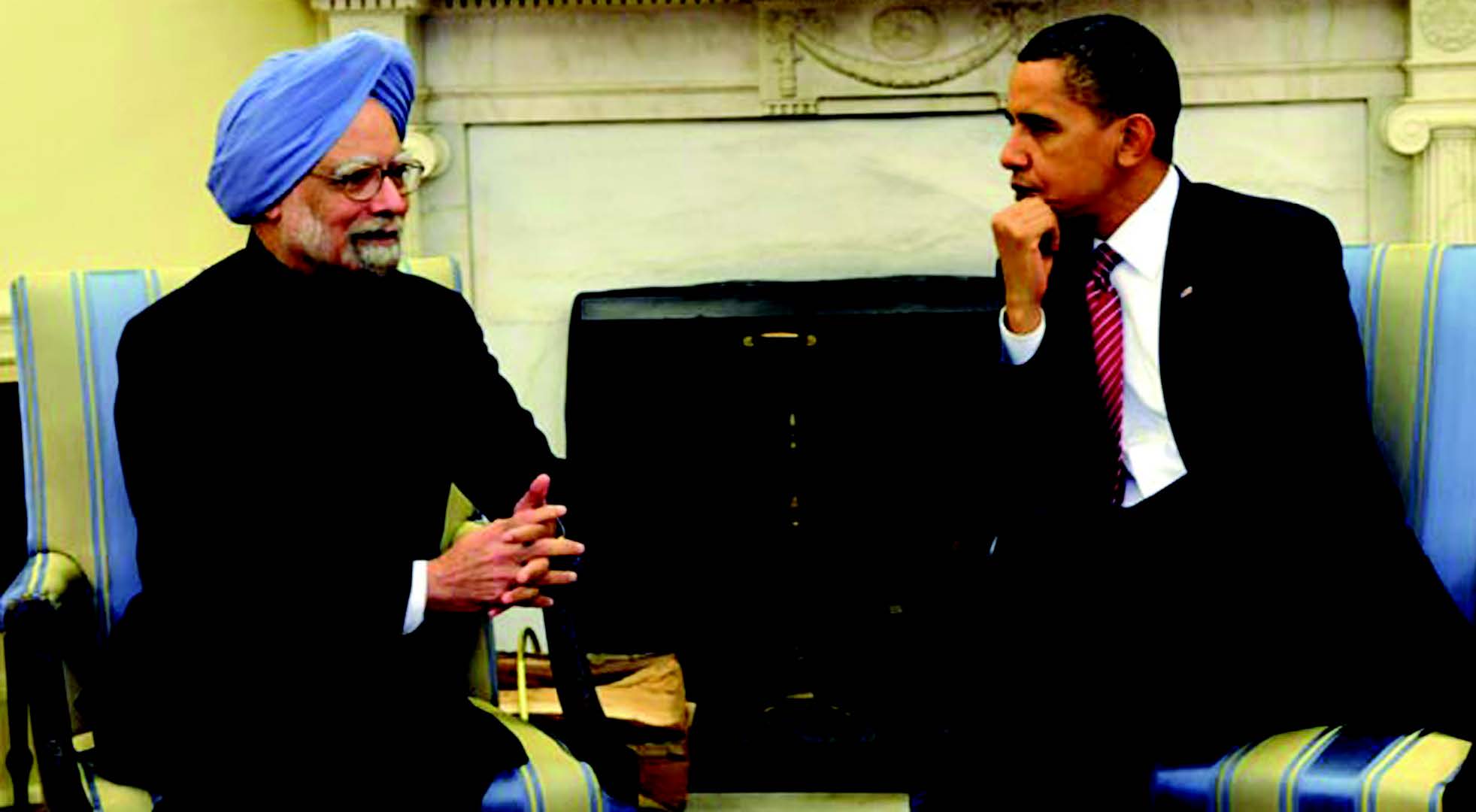
    NEW DELHI (TIP): India’s Prime Minister, Dr. Manmohan Singh, will address the 68th session of the United Nations General Assembly on September 28. During his visit to US, he will meet with President Obama in Washington on September 27. He is also likely to have a meeting with Pakistan Prime Minister Nawaz Sharif in New York, on the sidelines of United Nations General Assembly meeting. The UNGA, with the theme “Post-2015 Development Agenda: Setting the Stage!”- will be attended by nearly 193 member countries and is scheduled from September 17 to October 2. Dr Singh will address during the high-level meeting segment which will be from September 24 to October 1, Additional Secretary Navtej Singh Sarna (International Organizations) in Ministry of External Affairs said. Mr. Sarna also said the External Affairs Minister Salman Khurshid will hold bilateral talks with ministers of China, Egypt, Libya, Germany and UAE among others apart from attending ministerial meeting at the UN. Mr. Khurshid will also take part in G-77, NAM ministerial, BRICS, IBSA and G-4 meetings of Foreign Ministers.

  • America Abroad Media to honor Kathryn Bigelow, Aamir Khan and ICNC

    America Abroad Media to honor Kathryn Bigelow, Aamir Khan and ICNC

    WASHINGTON (TIP): America Abroad Media (AAM) will host its Inaugural Awards Dinner at the Andrew W. Mellon Auditorium in Washington, DC on October 28, honoring three outstanding leaders in television and film -Kathryn Bigelow, Aamir Khan and the International Center on Non-violent Conflict (ICNC), whose work exemplifies the power of media to inform, educate and empower citizens about the critical social and public policy issues of our time. Kathryn Bigelow is the director of Zero Dark Thirty and The Hurt Locker, which have received widespread acclaim for their honest portrayal of war and counterterrorism. In 2010, Ms. Bigelow became the first and only woman to date to win the Academy Award for Best Director. Aamir Khan is one of India’s most famous Bollywood stars. His new TV series, Satyamev Jayate, explores India’s biggest social challenges and has been seen by hundreds of millions of people in his country and across Asia. Mr. Khan was recently selected as one of TIME Magazine’s 100 most influential people. Founded by Peter Ackerman, the ICNC produces award-winning documentaries on the role of non-violent resistance in promoting democratic change. The ICNC – which was nominated for a Nobel Peace Prize in 2013 – will release a new documentary on the Arab Spring and uprising in Egypt later this year.

  • So-Called Spring; Su-Shi Strife and The South-West Asia

    So-Called Spring; Su-Shi Strife and The South-West Asia

    “The author foresees tremendous tectonic changes in the wake of Arab Spring et al. He says, “There will be following major discernible evolutionary geo-political trends underlying the so-called Arab spring. The despotic regimes headed by dictators, monarchs, military strongmen, presidents-for-life and supreme leaders-for-life would eventually be overthrown by the popular revolt. The middle-east is surely due for a major cartographic make-over in the next few decades. The fault-lines would be sectarian, ethnic and linguistic. The glue of Political Islam supported by embedded Jihadi elements would be torn asunder while facing the sectarian, ethnic and linguistic divide.”

    Arab Spring, Arab Winter, Arab Summer, Arab Renaissance, Arab Awakening, Islamic Awakening and Islamic Rise are just few of the epithets used to describe the complex and multidimensional geopolitical changes in the middle-east region that comprises of West Asia and Northern Africa. Depending upon one’s perspective, each of these adjectives is inadequate to describe the complex geopolitical phenomena that have engulfed the region. It is important to recapitulate that barring three nations, viz. Iran, Turkey an Israel all other countries in this region are Arab. Despite Francis Fukuyama’s puerile musings about the “end of history”, we are now witnessing tectonic changes of historic proportions.

    However, it will be a very slow and bloody change that would be unstoppable despite numerous western interventions. The genie of historic change had been unleashed much earlier in 2003 when the Baathist regime was toppled in Iraq ostensibly to chase the now non-existent “weapons of mass destruction”. The ten year anniversary of the US invasion of Iraq and “the ensuing mother of all battles” does not witness peace and tranquility in that nation, divided de facto, on sectarian and ethnic fault-lines. The Iraqi Kurdistan, nominally under the central government of Iraq is on a rapid trajectory to peace, prosperity and development while Baghdad continues to witness sectarian violence and bomb attacks. The Prime Minister Nouri al- Maliki is grabbing executive powers and has inadvertently encouraged sectarian divide and Shia identity politics. Besides the Iraqi Kurds, the real beneficiary of the US invasion worth $ 870 billion has been the Islamic Republic of Iran.

    If one chooses to be historically correct, the Islamic revolution of 1979 in Iran is the real harbinger of the so-called Arab spring. A US supported dictator was overthrown by popular revolt in Iran. The popular revolution was usurped and captured by Islamist Ayatollah Khomeini leading to a lot of blood-shed and massacre of democratic and liberal sections of the Iranian society in a targeted manner. A mini-version of this so-called (“Persian”) spring was again manifest in Iran, a non-Arab Shia theocracy in 2009 under the name of “green revolution”. However, the US administration led by Barak Hussain Obama “rightly” failed to capitalize on the situation leading to brutal suppression of young Iranians by the theocratic regime and its revolutionary guards. For the first time the US and its cronies missed an opportunity for externally driven regime change in Iran. Starting with Tunisia, the Arab Spring phenomena later on engulfed Egypt and Yemen. In Yemen, an extended “managed” political change was indeed brought in grudgingly under the patronage of Western imperialistic powers. Both Tunisia and Egypt saw subsequent takeover by Islamists in democratic elections. After over-throwing of Ben-Ali, the fundamentalist An-Nahda Islamists were the victors of the Tunisian democratic elections in October 2011.

    The Jihadists and the Salafists are now working in tandem with the conservative An-Nahda Islamists to infiltrate the previously secular Tunisian state from within. The story in Egypt is not very much different where the popular revolution against Hosni Mubarak and the Armed Forces has already been annexed by the Muslim Brotherhood (MB) and Mohammad Morsey. The Egyptian judiciary, especially the Supreme Court has resisted the Muslim Brotherhood and its attempts to foist an Islamist constitution. Furthermore, the Egyptian Supreme court has postponed yet again the parliamentary elections denying the MB an opportunity to control the entire state. Parts of the civil police force have already stopped obeying orders of the Islamist government to fight against fellow citizens forcing the MB to spare its cadre for law enforcement duties. Using the fig-leaf of so-called Arab Spring, the opportunistic Western powers militarily intervened in Libya, another socialist Baathist party ruled Arab dictatorship and brought out a regime change they had craved for long.

    The subsequent Islamist take-over of Libya, the barbaric treatment (victor’s justice) given to the quixotic dictator Col Mommar Gadaffi and killings of the US ambassador and other personnel by Al Qaeda in Ben Ghazi is illustrative of the nature of the beast. Interestingly, the Shah of Iran, Saddam Hussain and Col Mommar Gadaffi, all three had indeed served with great distinction as the “useful idiots” of the Western imperialism. The ideological hollowness of the West and the cheer-leaders of the socalled Arab Spring was noted again in Bahrain where popular and public demands for political change were exterminated brutally by foreign military intervention undertaken by the Kingdom of Saudi Arabia (KSA) and Pakistan in order to prevent take-over of the Sunni ruled nation by a Shia majority population. Syrian example shows the true colors of the cheer-leaders of the so-called Arab spring.

    Another socialist and secular Arab country ruled by the Baath party is being systematically destabilized from outsideintervention for the last two years and sacrificed at the altar of Sunni-Salafi- Jihadi-Wahabi (SSJW) geopolitical interests. Foreign Sunni fighters are leading the war against the Assad regime, fully supported by the regional Sunni monarchies. What we see now is essentially a Sunni-Shia (SU-SHI) sectarian power struggle in the Islamic nations of the West Asian region with Western imperialistic intervention in a systematic manner to defeat the secular and socialist Baath party regimes and of course to safeguard the interests of the Sunni-Salafi-Jihadi-Wahabi (SSJW) alliance. This bloody sectarian conflict will not be resolved in next few months or years.

    As the geopolitical events unfold, we will witness a quasi-permanent fratricidal intra-Islamic sectarian war for decades in the west Asian region culminating in major cartographic changes. There will be multiple incarnations of Arab & Islamist “Tianamen Squares” during which the despotic rulers will brutally suppress the revolting citizens. The US strategic retreat from the middle- east and pivot to Asia will finally allow the history to emerge in the middle-east uncontaminated by the hegemonic order imposed by the US hyper-power. Right now all the Arab monarchies have tried to buy out the demands for freedom and socio-political change by bribing their respective populations with yet more goodies financed by petro-dollars. This monetary intervention would at best delay the clamor for freedom and political change only by a few years in the oil-rich nations. There will be Islamist take-over of one-kind or other in all these countries. But political Islam would not be able to provide stability and strategic security to these nations.

    Just like in the communist countries as they vied with one another for title of the adherents of the true nature of communism practiced in the former communist countries, one would witness competitive claims of “true or genuine Islamism” by various ruling dispensations in this region. Fundamentalist competitive “political Islam” in alliance with Jihadis would hijack liberal and democratic popular uprisings. Indeed, there will be immense loss of human life and Jihadi terrorism will rule the roost. Transfer of power and change of regimes will be an inherently bloody process. There will be serious human rights violations and genocide by all the sides in the name of “true Islam”. Western apologists and backers for these despotic countries under severe financial crunch would no longer be interested in maintaining the geo-political status quo ante. geopolitical tectonic changes are likely to result in emergence of new nation states. Syria might be balkanized into multiple small entities or state-lets analogous to the former Republic of Yugoslavia.

    One would not be surprised if an Independent Kurdistan finally emerges as the 4th non- Arab country in the middle-east. Iraq, Iran, Syria and Turkey may lose their respective Kurdish populations to a newly independent and democratic Kurdistan. Since the fall of the Ottoman empire, the Western imperialistic powers while arbitrarily carving out state-lets to safeguard their own economic and hydrocarbon interests, chose to sacrifice the Kurdish national interests and denied them right to a state. West Asia has app 35 million Kurdish (non-Arab) people with app half (18 million) in Turkey, 8 million in Iran, 7 million in Iraq and 2 million in Syria. Unraveling of Syria will serve as a catalyst for Turkish Kurds to revolt against the increasingly Islamist Sunni dispensation of Turkish Prime Minister Recep Tayyip Erdogan in Ankara that has systematically deviated from the secular ideology of Kemal Ata-Turk, the founding father of modern Turkey.

    Both the PKK (Kurdistan Workers Party) and its imprisoned leader Abdullah Ocalan have successfully orchestrated staggered, coordinated hunger strikes for more than two months by thousands of Kurdish prisoners in Turkish jails. Turkey is going through a schizophrenic struggle between its European aspirations and Islamic moorings. However, political Islam will not be able to hold the Turks and the Kurds together. With increasing Sunniazation of the Turkish polity, this large ethnic and linguistic Kurdish minority will eventually assert itself in this chaotic geopolitical transition. Islamic glue will not be able to hold together Turkish and Kurdish ethnic identities and a volcanic eruption of nationalist fervor will unravel Turkey as we know it. If Turkish and Syrian Kurds turn more nationalistic and declare an independent Kurdistan, Iraqi and Iranian Kurds will be forced to follow suit. As a result of this, a truncated Iraq would eventually come out as a Shia-Arab theocracy with a Sunni minority supported by the neighboring Shia-Persian theocracy, Iran. Iran would not be insulated from demands of political freedom and change if there is no external intervention.

    Young, educated and emancipated Iranians will eventually overthrow the conservative Ayatollah-cracy leading to a more democratic and liberal regime change. A non-theocratic and more democratic and liberal Iran will re-emerge as a major regional power with friendly Shia majority governments in Iraq, Azerbaijan, Bahrain and elsewhere including in Lebanon. Iran will be a longterm winner in the despite losing some territory to Kurdistan and Baluchistan. A loose federation of Shia states may become a power grouping in the region. In such a geopolitical scenario, the territorial integrity and sovereignty of the Kingdom of Saudi Arabia (KSA) would no longer be safeguarded by a strategically retreating USA. By 2017, the USA will surpass the Saudis as the largest petroleum producing nation that will become a net exporter of hydro-carbons in 2020. Future US administrations will be forced by domestic isolationists to give up the stability mantra leaving the middle-east region to its own devices.

    The ultrageriatric conservative clan of Saudi princelings with all their extremities in the grave will not be able to hold the country together especially in the face of increasingly restive and un-employed young men. Increasing modernization and “secularization” of this tribal society will be resisted violently by the ruling political establishment. There have already been small demonstrations by Sunni Muslims calling for the release of people held on security charges. Saudi women will demand equal rights and driving privileges. The Saudi women would like to emulate their more emancipated Iranian counter-parts in public discourse. If Al Qaeda or its various mutants take-over the Saudi Arabia, the House of Saud will be brutally slaughtered in the name of “liberating Islam”. The internal strife in Saudi Arabia will manifest openly in an explosive manner when the oilfields dry up in few decades. The only unrest to hit Saudi Arabia during the so-called Arab Spring wave of popular uprisings was among its Shi’ite Muslim minority. The Shia populations in the Eastern region of Saudi Arabia will eventually revolt against a Sunni-Salafi- Jihadi-Wahabi (SSJW) complex leading to emergence of another Shia state-let.

    Bahraini Shia population is likely to overthrow the ruling Sunni dynasty, leading to emergence of another Shia nation. A Palestinian state-let may eventually be established as a joint protectorate of Egypt and Jordan. Egypt and Turkey will have much diminished geo-political influence. Egypt will have to deal with the issue of human rights of an increasingly vocal Coptic Christian minority. Some countries might eventually disappear by 2030. The most putative candidates are Lebanon, Kuwait and the Palestine. The impact of these geo-political changes will without doubt creep eastwards towards the Af-Pak region of the South-Asia leading to cartographic changes in national boundaries. Pakistanoccupied Baluch principalities, exploited by the Punjabi-dominated Pakistani army will successfully revolt for an independent Baluchistan as the Chinese footprint increases in the Gwadar port. After taking over the Gwadar port, China will seriously attempt to exploit the mineral and hydrocarbon wealth of Pakistan-occupied Baluch areas, thereby, increasing the sense of alienation and marginalization amongst the Baluch tribes.

    The separatist Baluchistan Liberation Army will target Chinese companies and personnel in the ensuing war of independence. The Sistan- Baluchistan province of Iran will take its own time joining an Independent Baluchistan. The consequent undoing of the artificial geographic boundaries arbitrarily determined by the British colonialists will lead to emergence of newer states carved out of the Af-Pak region. Another fall-out of these changes would be emergence of an independent and greater Pakhtoonistan comprising of the Khyber-Pakhtoonwah province of Pakistan and the Pakhtoon areas of the Afghanistan across the now defunct Durand line. The result would a truncated but more stable Afghanistan controlled by the northern alliance comprising of the Tajeks, Hazaras and Uzbeks. A truncated Pakistan will continue to remain as a rent-seeking failed state. It may implode eventually, leading to its fragmentation followed by multi-lateral external intervention under supervision of the UN and the IAEA to secure the nuclear weapons and the fissile materials.

    Further to north-east, a restive Uighurs’ population will force the emergence of Eastern Turkistan while throwing away the 300 years’ old occupation by the Han Chinese and subsequent annexation by the Communist China led by Comrade Mao. Will this tectonic change engulf the central Asian states or the “stans” is not clear at this time as the geopolitical dynamics are entirely different in the Central Asia in comparison to the South and West Asia. There will be following major discernible evolutionary geo-political trends underlying the so-called Arab spring. The despotic regimes headed by dictators, monarchs, military strongmen, presidents-for-life and supreme leaders-for-life would eventually be overthrown by the popular revolt. The middle-east is surely due for a major cartographic make-over in the next few decades. The fault-lines would be sectarian, ethnic and linguistic. The glue of Political Islam supported by embedded Jihadi elements would be torn asunder while facing the sectarian, ethnic and linguistic divide.

    Whether some kind of democracy will eventually prevail in this region in near future is doubtful, at best. Political Islam with its Jihadi mutant will be on the ascendance temporarily as an essential bloody interim phase in the long-term development of liberal democracy in the West Asia, North Africa and Af-Pak regions of South Asia. Increasing modernization, secularization and intellectual emancipation of the common masses will eventually defeat the Islamist counterreaction in each of these countries. Iran which is way ahead in the trajectory of civilizational change and democratic evolution will emerge as the most influential regional player while Egypt, Turkey and the KSA will eclipse relatively.

  • New timeline for origin of ancient Egypt

    New timeline for origin of ancient Egypt

    “Egypt was a state that emerged quickly – over that time one has immense social change.” Dr Michael Dee University of Oxford

    Anew timeline for the origin of ancient Egypt has been established by scientists. A team from the UK found that the transformation from a land of disparate farmers into a state ruled by a king was more rapid than previously thought. Using radiocarbon dating and computer models, they believe the civilization’s first ruler – King Aha – came to power in about 3100BC. Lead researcher Dr Michael Dee, from the Research Laboratory for Archaeology at the University of Oxford, said: “The formation of Egypt was unique in the ancient world. It was a territorial state; a state from which the moment it formed had established borders over a territory in much the same way we think of nations today. “Trying to understand what happened in human history to lead people to establish this sort of polity we felt was a gap in understanding that needed to be filled.”

    First dynasty Until now, the chronology of the earliest days of Egypt has been based on rough estimates. With no written records from this very early period, a timeline has been based on the evolving styles of ceramics unearthed from human burial sites. Now though, scientists have used radiocarbon dating of excavated hair, bones and plants,with established archaeological evidence and computer models to pinpoint when the ancient state came into existence. Previous records suggested the pre-Dynastic period, a time when early groups began to settle along the Nile and farm the land, began in 4000BC. But the new analysis revealed this process started later, between 3700 or 3600BC. The team found that just a few hundred years later, by about 3100BC, society had transformed to one ruled by a king. Dr Dee told the BBC World Service program Science in Action:”The time period is shorter than was previously thought – about 300 or 400 years shorter. Egypt was a state that emerged quickly – over that time one has immense social change.

    “This is interesting when one compares it with other places. In Mesopotamia, for example, you have agriculture for several thousand years before you have anything like a state.” Archaeologists believe Egypt’s first king, Aha, came to power after another prominent leader, Narmer, unified the land. The team was also able to date the reigns of the next seven kings and queens – Djer, Djet, Queen Merneith, Den, Anedjib, Semerkhet and Qa’a – who with Aha formed Egypt’s first dynasty. The model suggests that King Djer may have ruled for more than 50 years. This is such a long period, it raises the possibility that there may have been other kings or queens of Egypt that we do not know about or that the state may have collapsed and reformed. Commenting on the research, Prof Joann Fletcher from the department of archaeology at the University of York, said: “This is highly significant work,which pulls the beginnings of Egypt’s dynastic history into much sharper focus – it is tremendously valuable to have such a precise timeline for Egypt’s first rulers. “The study also has ramifications for the earlier pre-Dynastic period, allowing us to better understand these key periods of transition.”

  • International Raise the cost for Pakistan army’s proxy war order be damned

    International Raise the cost for Pakistan army’s proxy war order be damned

    The West’s attempt to ride roughshod over the United Nations Security Council with a hastily drafted proposal to authorize the use of force in Syria sets the stage for its second military intervention in West Asia and North Africa in as many years. The resolution, drafted by the United Kingdom and backed by the United States and France, seeks two things from the Council: one, a condemnation of President Bashar al-Assad for using chemical weapons on his people and two, its blessings to deploy “all necessary measures” to protect Syrians. If the first asks the U.N. for a leap of faith on a premature claim, the second requires it to turn a blind eye to history.

    While acknowledging there exists no “smoking gun” to establish Mr. Assad’s culpability, the West has tried its best to impede the working of the U.N.’s team in Syria investigating claims if chemical weapons were used at all. The charade now unfolding before the UNSC reflects the West’s desperation to have its way with a military intervention that has few takers. If the Arab League, including key members and U.S. allies like Egypt, has expressed its reluctance to support the imminent assault, public opinion in the U.S., Britain and France too is overwhelmingly opposed to a new war. After the disastrous 2011 NATO bombing of Libya, which began with the objective of protecting civilians but ended up being a full-blown attack on the Muammar Qadhafi regime, the Security Council is rightly wary of the Anglo-American plans for a “limited” intervention in Syria. Expecting the world to believe a military attack will destroy Mr. Assad’s chemical weapons arsenal without inflicting unacceptable civilian casualties is silly.

    If anything, a targeted attack is not so much a guarantee of minimal damage, but an attempt to fulfill President Barack Obama’s vain promise to punish the Assad regime if it used chemical weapons. After proffering sketchy evidence in support of this grave allegation, the President is now being forced to walk his talk by the liberal interventionists who populate his administration and by a trigger-happy British Prime Minister. One senior U.S. official let slip that the planned assault will be “just muscular enough not to get mocked,” revealing how this issue is now entirely about American “credibility,” as opposed to the humanitarian tragedy in Syria. The Council’s likely rejection of the draft resolution will be portrayed as Russian and Chinese intransigence. The fact remains, however, that influential powers like India, Brazil and South Africa too are against military intervention pending a complete investigation of WMD claims. The West’s failure to act through the U.N. not only betrays the Syrian people but also reflects its contempt for the international order.

  • Egypt Violence: World Leaders Concerned;UN Urges ‘Restraint’

    Egypt Violence: World Leaders Concerned;UN Urges ‘Restraint’

    NEW YORK (TIP): The ever increasing violence in Egypt which has claimed hundreds of lives and is threatening a bloody civil war in the country has shaken world leaders and the United Nations. The Argentine president of the United Nations Security Council urged all parties in the crisis in Egypt to exercise “maximum restraint” on Thursday, following an emergency meeting in New York.

    Argentine Ambassador Maria Cristina Perceval said that the Council’s 15 member states had regretted the loss of life in Cairo, called for an end to the violence and spoke of the need to advance “national reconciliation”. The meeting was requested by France, Britain and Australia a day after nearly 600 people were killed when security forces moved to clear camps of supporters of ousted Islamist president Mohamed Morsi.

    France and Britain are permanent members of the Security Council and Australia is one of the 15 countries currently represented. Argentina currently presides over the Council. Perceval said its members shared “a common desire” to stop the unrest. U.N. Secretary-General Ban Ki-moon condemned the violence and urged calm and restraint on both sides.

    He made no direct criticism of the military leadership or the protesters who had refused to disperse on their own but said he was “well aware that the vast majority of the Egyptian people, weary of disruptions to normal life caused by demonstrations and counterdemonstrations, want their country to go forward peacefully in an Egyptian-led process towards prosperity and democracy.” UN rights chief Navi Pillay has urged a wide-ranging probe.

    A disturbed President Obama announced that the United States had canceled longstanding joint military exercises with the Egyptian Army set for next month, using one of his few obvious forms of leverage to rebuke Egypt’s military-backed government for its brutal crackdown on supporters of the ousted president, Mohamed Morsi. Earlier, U.S. Secretary of State John Kerry termed Egypt violence as “deplorable”.

    “The United States strongly condemns the use of violence against protesters in Egypt,” White House spokesman Josh Earnest said in a statement. “We have repeatedly called on the Egyptian military and security forces to show restraint and for the government to respect the universal rights of its citizens, just as we have urged protesters to demonstrate peacefully.”

    The U.S. opposed the one-month state of emergency imposed by the Egyptian government, he added. Britain, Germany, France and Italy also criticized the use of force and called on both sides to stand down from their dangerous face-off and return to meaningful dialogue to defuse Egypt’s political stand-off.

  • Morsi Backers Plan Fresh Rallies, Defying Egypt’s Police

    Morsi Backers Plan Fresh Rallies, Defying Egypt’s Police

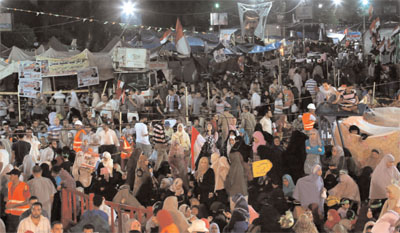
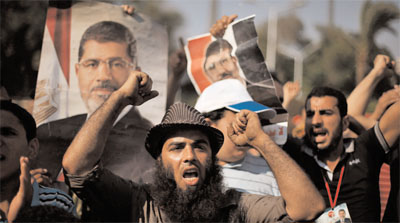
    CAIRO (TIP): Supporters of Egypt’s ousted president Mohamed Morsi urged fresh rallies on August 2, raising fears of renewed violence as police prepared to disperse them amid international appeals for restraint. The call came as US secretary of state John Kerry said the military’s removal in July of Morsi — Egypt’s first democratically elected president — had been requested by millions. In comments that will be seen in Egypt as supportive of the interim rulers, Kerry told Pakistan’s Geo television: “The military was asked to intervene by millions and millions of people, all of whom were afraid of a descendance into chaos, into violence.”

    “And the military did not take over, to the best of our judgement — so far. To run the country, there’s a civilian government. In effect, they were restoring democracy,” he added. Allaa Mostafa, a spokeswoman for the pro-Morsi Anti Coup Alliance, told AFP that demonstrators would “continue our sit-ins and our peaceful protests” against what she termed a “coup d’Etat”. Morsi backers rejected an earlier offer from Egypt’s interior ministry of a “safe exit” if they quickly left their Cairo protest camps, as police discussed how to carry out their orders from the military-installed interim government to end the protests.

    In a statement, the ministry called on those in Rabaa al-Adawiya and Nahda squares “to let reason and the national interest prevail, and to quickly leave”. The ministry pledged “a safe exit and full protection to whomever responds to this appeal”. Authorities had already warned that the demonstrations would be dispersed “soon”, but without saying when or how. The stand-off raised fears of new violence, less than a week after 82 people were killed in clashes at a pro- Morsi rally in Cairo.

    More than 250 people have been killed since the president’s ouster following nationwide protests against his single year in power. Meanwhile, diplomatic efforts to avoid further bloodshed gathered pace, with the European Union’s Middle East envoy Bernardino Leon and German foreign minister Guido Westerwelle both arriving in Cairo to urge the rival camps to find common ground. A senior member of the Freedom and Justice Party, the political arm of Morsi’s Muslim Brotherhood, said the European envoys asked them to end their sit-ins.

    “All the European delegates have the same message; they are pressuring the anti-coup protesters to disperse the sit-ins,” said the official. Following a meeting with Muslim Brotherhood representatives, Westerwelle warned that the situation was “very explosive”. “We have seriously and adamantly pressured for a peaceful solution. I hope that those concerned have gotten the message,” he said in a statement. “The international community has to keep up its diplomatic efforts, even though we don’t know today whether these will prove successful.”

    Kerry also warned against further violence, saying the US was “very, very concerned” about the killing of dozens of pro-Morsi protesters in clashes with security forces and warning such loss of life was “absolutely unacceptable”. British counterpart William Hague also called for “an urgent end to the current bloodshed” and Morsi’s release, in a phone call to interim vice-president Mohamed ElBaradei, the foreign office in London said.

    Amnesty International condemned the cabinet order as a “recipe for further bloodshed” but the mood was calm in Rabaa al-Adawiya square, where thousands of protesters have been camping out in a tent city, despite warnings from the authorities. Foreign trade minister Munir Fakhry Abdel Nur said Wednesday’s statement did not “give room for interpretation”. Accusing Morsi supporters of bearing arms, he told AFP, “It is clear the interior ministry has been given the green light to take the necessary measures within legal bounds.”

    Egypt’s interim government also faces an increase in militant attacks in the restive Sinai peninsula, where gunmen on Thursday shot dead a policeman in the northern town of El- Arish, security officials said. Much of the Egyptian media expressed support for the government’s decision, with some saying the interim administration had received “the people’s mandate” in demonstrations last Friday backing Morsi’s overthrow. Further raising tensions on Wednesday, judicial sources said three top Brotherhood leaders, including Supreme Guide Mohamed Badie, would be referred to trial for incitement to murder.

    Morsi himself has been formally remanded in custody on suspicion of offences when he broke out of prison during the 2011 revolt that toppled former president Hosni Mubarak. He was detained hours after the coup and is being held at an undisclosed location, where EU foreign policy chief Catherine Ashton met him on August 30, later telling reporters he was “well”.

  • US Officials Will Not Declare Whether Coup Occurred In Egypt

    US Officials Will Not Declare Whether Coup Occurred In Egypt

    WASHINGTON (TIP): The Obama administration told Congress on July 25 it does not plan to make a determination on whether a military coup occurred in Egypt, avoiding a decision that would force the cut off of most of the annual $1.55 billion in US aid. US Deputy Secretary of State William Burns delivered the message in separate briefings to senior members of the US Senate and the House of Representatives, several lawmakers told reporters after meeting the number two US diplomat.

    The question of whether a military coup took place has vexed the White House, which generally wants to be seen as supporting democratically elected leaders but which had no love lost for ousted Egyptian President Mohamed Mursi. Under US law, most aid must stop to “any country whose duly elected head of government is deposed by military coup d’etat or decree” or toppled in “a coup d’etat or decree in which the military plays a decisive role.” However, the law does not actually oblige the White House to make a decision.

    “The law does not require us to make a formal determination as to whether a coup took place, and it is not in our national interest to make such a determination,” said an Obama administration official who spoke on condition of anonymity. Speaking after the session with Burns, Senator Bob Corker, the top Republican on the Senate Foreign Relation Committee, said the Obama administration might never make a decision on the matter and suggested that U.S. law needed to be changed. “No determination has been made.

    It’s possible that no determination will ever be made,” Corker told reporters. The Egyptian armed forces deposed Morsi on July 3 after huge street protests against his rule, clearing the way for last week’s installment of an interim Cabinet charged with restoring civilian government and reviving the economy.

    Current and former officials have said the administration has no appetite for terminating aid, which runs at about $1.55 billion a year, $1.3 billion of which goes to the military, for fear of antagonizing one of Egypt’s most important institutions. Nor does it wish to increase instability in the most populous Arab nation, which is of strategic importance because of its peace treaty with close US ally Israel and its control of the Suez Canal, a vital waterway for the US military.

  • US Set To Deliver F-16s To Egypt: Officials

    US Set To Deliver F-16s To Egypt: Officials

    WASHINGTON (TIP): The United States is pressing ahead with plans to deliver four F-16 fighters to Egypt despite a military coup against President Mohammed Morsi, a US official said. “It’s still the status quo,” the official, who spoke on condition of anonymity, told mediapersons. There was no decision to halt the scheduled transfer of the warplanes or to cut off other security assistance to Egypt, the official said, even though the US government has announced a review of all aid to Cairo.

    President Barack Obama’s administration has said it is examining whether the military takeover constitutes a coup, which under US law would force Washington to freeze any aid to Egypt. The state department said previously planned assistance would continue to flow to Egypt. “We’re still paying our bills, of course, and all of the programs are still moving forward,” spokeswoman Jen Psaki told reporters.

    The Pentagon said it remains dedicated to maintaining longstanding military ties with Egypt and that the United States wants to see a prompt return to civilian, democratic rule. “Looking forward, we will work with the Egyptian people to support a quick and responsible return to a sustainable, democratically elected civilian government,” the Pentagon said in a statement.

    “Given the events of last week, the president has directed relevant departments and agencies to review our assistance to the government of Egypt.” The F-16s are part of an arms deal with Egypt approved in 2010 that calls for the supply of 20 of the fighter jets. Eight of the warplanes were delivered earlier this year and four more are scheduled to be delivered in August, with another eight due later in the year, officials said.

    Egypt has received more than 220 F-16 fighters since 1980 and has the world’s fourth largest F-16 fleet, behind the United States, Israel and Turkey. With Egypt gripped by intense political turmoil, the Obama administration has relied on the US military’s deep ties with the Egyptian armed forces as its main channel for diplomacy and communication. Since July 2, defense secretary Chuck Hagel has had eight phone conversations with Egyptian army chief General Abdel Fattah al-Sisi, including one that lasted 45 minutes, Pentagon spokesman George Little told reporters.

    “We believe that it’s appropriate to use this important channel we have with the Egyptians to convey our insights, thoughts and our views on the situation that’s occurring in Egypt,” Little said on july 10. The United States provides $1.5 billion of mostly military aid to Egypt every year.

  • RAMADAN

    RAMADAN

    RAMADAN IN 2013 WILL START ON TUESDAY, THE 9TH OF JULY, AND WILL CONTINUE FOR 30 DAYS UNTIL WEDNESDAY, THE 7TH OF AUGUST.

    RAMADAN is a month of celebration for Muslims around the world. Millions of Muslims around the world eagerly await the sighting of the new crescent and the dawn of the first day that mark the beginning of the holy month. This year Ramadan begins from July 9. Ramadan, one of the five pillars of Islam and the ninth month of the Islamic calendar, is observed with prayer, fasting, reading and reciting the Qur’an, and giving to charity.

    Ramadan, a month of unity and solidarity for Muslims across the continents, is observed in accordance with the historical and cultural traditions among Muslim societies. The spirit of Ramadan lies in fasting and praying, and togetherness. The social events, seasonal foods, recipes and ways of celebrating the days of Ramadan make the holy month a festive time among Muslims around the world. Muslims celebrate the beginning of Ramadan in different ways. Greetings of Ramadan Kareem (Glorious Ramadan), Ramadan Mubarak (Blessed Ramadan) and Kul Am Wa Antum Ba Khair (may every day of the year be packed with goodness) fill the atmosphere.

    Saudi Arabia comes alive reflecting the colors of Ramadan._Most of the street poles in major cities of the Kingdom are decorated with ornamental Ramadan lights, and light streamers lining the important historical structures around cities are a visual delight.Also, street vendors selling miswak (tooth cleaning stick) and charity organizations distributing dates at traffic intersections are a common sight welcoming the holy month. Similarly, in Palestine boys and girls set off fireworks to celebrate the beginning of the fasting month. In Indonesia, ceremonial musicians walk the streets beating drums and singing devotional songs. While in Turkey, the mosques are decorated with ‘mahya’ lights, suspended between their minarets to display devotional messages.

    In Egypt, traditional lanterns or ‘fanawee’ are the symbol of the beginning of Ramadan, and cannon shots are fired at iftar time. Kids carry colorful ‘fanoosh’ around streets while people decorate their houses with a holistic lantern to mark the celebration of Ramadan. Similarly, in Jordan and Palestine, people hang the ‘hilal’ (crescent) lamps at their windows symbolizing their holy sentiments. In India and Pakistan, it is interesting to see busy with festive decorations and celebrations.

    An eventful day during Ramadan is broadly observed within two spheres. First, the time of fasting from sunrise to sunset when a Muslim is expected to abstain from food , water, bad conduct and character and utilize the hours in prayers, reading and recitation of the Qur’an and helping the needy.

    The second circles around festive food rituals of the iftar after sunset till the sahoor before sunrise in addition to the prayers, including taraweeh (special night prayers) held after Isha prayers, unique to Ramadan. As the folklore has it, in most parts of the Muslim world a ‘mushaharati’ – drummer calling out to wake people up for sahoor before sunrise can still be witnessed, especially in Palestine, Jordan, Egypt and some cities of Indonesia, India, Pakistan and Bangladesh as well. All around the world, Muslims traditionally open their fast with dates according to the ‘sunnah’( practice) of the Prophet Muhammad (peace be upon him).

    Generous iftar parties known as azeema, in Saudi Arabia among families, relatives and friends are plentiful. Here in Saudi Arabia, some families observe iftar on the beaches in Jeddah and Dammam and around popular parks in Riyadh. “This is a time to show exceptional hospitality to our fasting friends. Sharing and caring are intertwined principles of this auspicious month” says Ghena Al- Barazi, owner of G.G. Pieces. Another distinctive sight in Ramadan is Maa’idatar-Rahman – the banquet of the Merciful God.

    It’s about tables serving iftar in the streets for free to poor people or people who happen to be still in the street and unable to get back home by iftar time. “Many persons take part in funding, preparing and serving those meals, and it’s one of the best things in Ramadan as charity, and helping the poor,” says Nasser Al-Sulaieman. Food served during the Islamic observance sees a similar variant around the Muslim world.

    Muslims enjoy the holy month with delicious recipes, menus and sweet treats to break the daily fast. General atmosphere is festive and celebratory. “A time to connect with families,” says Maha Al-Malik, executive director MIX, which organizes annual food festivals in Riyadh. “During Ramadan, families and friends get together over iftar and sahoor and share their dishes over long extended sufraas (dining mats). This inspires a sense of belonging among its members.” In Ramadan, tradition and food are almost similar around the Middle East-Gulf countries, including Syria, Lebanon, Jordan, Palestine, Qatar, the UAE, Kuwait and Bahrain.

    Muslims break their fasts with dates and drinks and offer the Maghreb salah and return to a sumptuous full course dinner. After Isha salaah and taraweeh (special prayers during Ramadan) awaits a treat with sweet dishes like kunafeh, qatayef and various others desserts. Ladies mostly enjoy their time visiting relatives and doing the necessary shopping beyond iftar and return for sahoor preparations for their families. Sahoor is a light preparation of food just before sunrise and the Fajr salaah. Ramadan has its own special food rituals presenting its notable dishes and delights from Muslim regions across the globe. Bandar Al-Mutairi said: “In Saudi Arabia, we break our fast with qahwa Arbi and tamar (dates). Shorba (soup of oats and wheat), samboosas and kabsa with leham (meat), macaroons, lasagna, lughemaat, soopia and khowaz are the common flavors.” With traditions from different cultures finding a place on the same table of Ramdan, it sets an inspiring ambiance of religious unity and brotherhood.

    In Egypt, sumptuous iftar parties are known as Ozoma. For Amani Mustafa Gamal, an Egyptian married to Nasser Hassan Abdel Samad, a Sudanese Doctor at KKIA, Riyadh, Ramadan means taking the traditional food and cultural favorites of both the countries. “Popular dishes like mahshy (rice cooked with wheat and green vegetables), lughmatal ghaazi (sweet dish), aafab-e-zainab (finger of Zainab) a sweet dish, make tasty ideas for iftar dinners,” she says. Drinks and juices like soopia, ersos, licorice, tamarind are common in Ramadan, adds Amani. “Customary Ramadan recipes and celebrations include a common national Baladi meals, lughumaat made from wheat and cereals served with special dried ladies finger sauce. Variety of bread from thick gurrafah to tissue thin khassrah are common. Halomore (a sweet and sour drink) serves for breaking the fast in Sudan, Nasser Hassan of Sudan says.

    Sweets are very popular during the holy month all over the Muslim world. Local bakers prepare breads, pancakes, patties and sweetmeats like Qatayef (a sort of sweet dumpling filled with cream or nuts), an Arab dessert commonly served during the month of Ramadan. During the holy month, women remain busy making pastries and special dishes for iftar displaying the richness of their traditional cuisines.

    Sweets have a special place in the Turkish Ramadan menu, especially gullac (a traditional Ramadan dessert of layers of thin cornstarch pastry soaked in rosewater-infused milk), kadayif dolma (shredded pastry filled with walnuts), revani (dense sponge cakes soaked with sugar syrup), helva (a confection made from farina and pine nuts), baklava and lokum (Turkish delight). In India and Pakistan, shops and local vendors sell fried samosas and varieties of pakoras (vegetable fritters) and jalebis, fruit chats and sweet cakes.

    The hustle around the busy markets with people flocking the fruit vendors and sweet shops just minutes before iftar, though quiet noisy, is still appealing considering the religious flavor and sentiment about Ramadan. One delights in the sheer chai (sweet tea) enriched with dry fruits cooked over night on low flame, haleem ( a porridge of meat, wheat, and lentils), pulao with mutton, biryanis, sewaii, kheer — a sweet dish made from rice cooked in milk and nuts – add to the festive celebrations. In Jordan and Palestine, families share and exchange dishes with neighbors and relatives. Qatayef sweet pancakes), warq dawalli (rice and meat wrapped in grapes leaves), makhubah, malfoof, mansaf a layered main course dish of bread rice and meat with black licorice drink – arq sous are common Ramadan recipes, updates Haula Umme Hamza from Jordan.

    Palestinian cheese Nablus, named after the west bank city of Nablus, is sought after by Jordanians. Muhammed Sameh from Kuwait celebrates Ramadan and Eid Al-Fitr here in the Kingdom but says he misses the celebrations back home as Ramadan is a good time for family get-together, and extending invitations to relatives and friends. The completion of the month long religious observations and celebrations extends to Eid Al-Fitr, celebrated on the first three days of the Islamic month of Shawwal throughout the Muslim world.

  • Egypt: The True Revolution has begun

    Egypt: The True Revolution has begun

    The fast developing situation in Egypt and the rapid ouster of President Mohamed Morsi has puzzled many and belied the expectation of those who thought that the revolution started two and a half years ago with the ouster of Hosni Mubarak. June 30, 2013 will be remembered as the day the true revolution began. Never before in the history of Egypt have there been such mammoth protests all over the country, sending a clear message that the people have rejected the Monolithic Islamic Nation that the Muslim Brotherhood tried to impose upon them. The people have declared that there is no place for political Islam in the ancient nation. The message was well received by the army which acted responsibly and in accord with the pulse of the masses; there was no choice but to respond and dismiss the Morsi government.

    As a precautionary measure, tanks were deployed in vital areas to prevent clashes between pro- and anti- Morsi demonstrators; the leaders of the Muslim Brotherhood were barred from leaving the country, and will face trial for their misdeeds. The deposed President is currently confined in army custody and many been detained and taken to custody to face trial. The one harsh year Egypt lived under the Muslim Brotherhood has made the public reject the MB ideology and their attempts to force changes and Islamize the State and education. Army chief Abdul Fattah Alsissi, while reading out his statement after the peaceful coup, was surrounded by all secular leaders, Coptic and Al Azhar religious leaders, youth movement representatives, and many liberal leaders.

    All this shows that the pulse of the revolution demanded change and a better government, with representatives from all strata of society with its colors, ethnic and religious affiliations. In other words, a true Egypt of its native rich heritage and cultured people. The Muslim Brotherhood’s short term in power has exposed them and their agenda. Their indulgence in assassination and violence was well known even prior to the 1952 revolution of Nasser. The funding from Saudi Arabia and Qatar did not help in making the radicals more dominant, but the 365 days of Morsi misrule made the people of Egypt understand their true colors and hidden plans to destroy Egypt.

    Other external forces tried to deal with Egypt as a project to change regime and destroy the social fabric by indulging in sedition and encouraging extremism in the region. Washington and the West woke up late to the dangers of these forces at their own doorsteps, and many believe that this prompted the Americans and the Russians to reach to an agreement to end terrorism in the region before it is too late. This understanding may yet bring about an end to the bloodshed in Syria, or else more stable Egypt and Tunisia and Turkey are next in the line for instability. The future of Egypt will be decided only by its own people.

    Though the challenges are horrendous, as the economy is in a shambles and inflation is high, the priority is to set the house in order and bring in a government that can deal with these issues in a pragmatic and transparent manner. It is the beginning of a new chapter, and if the army is able to contain the Muslim Brotherhood and its affiliated groups who may take to arms to settle scores, Egypt will be on the road to democracy. More importantly, it will regain its prestigious Pan- Arab status which has been lost for so long. (The author is a senior Arab International correspondent)

  • Egypt coup: the military has not just ousted Morsi; it has ousted democracy

    Egypt coup: the military has not just ousted Morsi; it has ousted democracy

    While millions of Mohamed Morsi’s opponents continue to celebrate his ousting, they ignore the long term fallout of the army’s intervention on state and society. The soft coup is fraught with risks and widens the ideological divide between Islamists and secularists. It does not resolve the fierce social and political struggles that have unfolded in Egypt in the two years since the removal of Mubarak. Instead, this latest turn is likely to further polarize Egyptians, already bitterly divided over the identity of the state and the role of the sacred in the political. And it undermines respect for both the peaceful transfer of power and for institutional procedures and rules.

    Trust among competing groups will be difficult to revive. Furthermore, the successful coup returns the military to centre stage in Egyptian politics and consolidates its role as a kingmaker and powerbroker. One of the major challenges that faced Egypt and other Arab countries in the wake of their popular uprisings was to subordinate the will of military leaders to civilian rule. This has now been undone. Future governments in Cairo will not dare to defy the military nor try to limit its authority, a serious handicap to democratization. Ironically, the same protesters who cheered Morsi’s ouster by force were often the same ones who opposed the ruling generals (Scaf – the Supreme Council of the Armed Forces) in the post-Mubarak transition period. The opposition asserts that the military had no choice but to respond to the popular will of millions of citizens, whose peaceful demands for Morsi to step down were met with defiance. The opposition ignores the fact, however, that there were other choices available to them.

    The military could have introduced political checks and balances that would have fettered Morsi’s hands, using its immense influence to force the secular-leaning opposition and the Islamistled administration to sit down and negotiate a peaceful compromise. This could have included appointing a new competent prime minister palatable to the opposition; an independent attorney general to replace Morsi’s loyalist; and redrafting the constitution to make it more inclusive and tolerant. In fact, these were the initial major demands of the opposition, which only later began to insist that Morsi had to go. There is no denying that Morsi was his own worst enemy, deaf and blind to the gathering storm that ultimately swept him away. He mastered the art of making enemies and blunders, and turned millions of ordinary Egyptians who voted for him into bitter enemies. He was the wrong man to lead Egypt, the most populous Arab state, at this critical revolutionary juncture. Morsi does not have the sensibility, the vision or the political acumen to tackle Egypt’s complex structural challenges.

    Instead of delivering on his promises, such as more jobs, greater inclusiveness and alnahda, or renaissance, he went to great lengths to monopolize power and to entrench his Islamist movement in state institutions. There exists a widespread belief among Egyptians of all walks of life that Morsi subordinated the presidency to the Muslim Brotherhood, a fatal error, to a proud nation that calls Egypt Umm al- Dunya (the mother of the world). More than a year after they won commanding parliamentary and presidential victories, the Islamists have proved to be as incompetent as the old secular regime at managing the economy and society. Morsi did indeed inherit a country that was politically polarized and financially bankrupt. These problems, however, grew under his watch; social and economic conditions worsened and political divisions deepened.

    Far from improving the economy, the Islamists’ muddled style of governance has exacerbated a structural crisis and caused more hardship and suffering among the poor and the dwindling middle class. What is unfolding in Egypt is a politicalideological struggle over the country’s future. It is not about good and evil, as some would have it. Morsi was too ambitious for his own good, and his movement incompetent, but not evilincarnate. There is a real danger though that the military’s ousting of Morsi will transform this political-ideological clash into a life-and-death struggle. The challenge now is to avoid a repeat of past errors, such as micromanaging the political process from the top down, or persecuting the Muslim Brothers and excluding them from the political arena. Such a course will only reinforce a longheld sense of injustice and victimhood among the Islamists, a recipe for further polarization, instability, and a potentially violent end to Egypt’s democratic experiment. Source: The Guardian

  • Egypt’s Morsi, Lincoln and Janis Joplin

    Egypt’s Morsi, Lincoln and Janis Joplin

    Agender-insulted Tunisian lit himself up and ignited the Arab Spring. Social media (SM) gave it wings. Egypt’s Morsi and the Brotherhood came to power in Tahrir q e and caused the unhappy ending of our stable relationship with Hosni Mubarak. But, Morsi gave not a thought to Lincoln’s Gettysburg Address, wherein he created a citizen’s right: that only a “government of the people, by the people, for the people, shall not perish from the earth.” The awesome self-selection power of “community” in SM, makes it the ultimate uncontrollable “genie out of the bottle,” for it aggregates each like-minded fellow citizen of the world, on like topics, and produces a tsunami of topical discontent. To paraphrase Janis Joplin, “Freedom is just another word for nothing left to lose, Nothing, that all that [Morsi] left me…”. Methinks, Lincoln could not have imagined that what he was unleashing was more powerful than the Magna Carta, for he gave every citizen the right to hold its leaders accountable as honest fiduciaries and deliver the most “common good.” With digital connectivity, the dangerous Wikileaks and Snowdens of the world expose every government’s good secrets and hidden mistakes to the harsh sunlight of a public unaware of the art of statecraft. History instructs that Rome’s “Bread and Circus” and Robespierre’s “Reign of Terror” cabins evil at various points of the governmental spectrum. Ravi Batra, Chair Nat’/ Advisory Council on South Asian Affairs

  • MORSI OUSTED, under house arrest

    MORSI OUSTED, under house arrest

    CAIRO (TIP): Mohammed Morsi, in office only a year as the first democratically elected leader of Egypt, was rousted from power by the military July 3 as a euphoric crowd in Tahrir Square cheered his exit. The former leader was placed under house arrest at the Republican Guard Club, a senior adviser to the Freedom and Justice Party and spokesman for the Muslim Brotherhood said. Most members of the presidential team have also been placed under house arrest. Egyptian security forces also arrested the head of the Muslim Brotherhood’s Freedom and Justice Party and another of the movement’s top leaders.

    The commanding general of the armed forces, Gen. Abdel Fattah al-Sisi, said on Egyptian television that the military was suspending the constitution, which Morsi pushed through and which many Egyptians saw as slanted toward Islamists. “The armed forces couldn’t plug its ears or close its eyes as the movement and demands of the masses calling for them to play a national role, not a political role as the armed forces themselves will be the first to proclaim that they will stay away from politics,” al-Sisi said.

    He added that the head of the constitutional court, Adli Mansour, would be the acting president, with new elections to be held later. The general said that the military did not have designs on controlling the country’s politics but would “never turn a blind eye to the aspirations of the Egyptian people.” He spoke alongside a leading Sunni Muslim cleric and the head of Egypt’s Coptic Christians, as well as a prominent political opponent of Morsi — Mohamed ElBaradei, the former head of the U.N. nuclear weapons agency. Armored vehicles, tanks and troops deployed throughout the Egyptian capital, including near the presidential palace. The army seized the headquarters of the state television and the state-run newspaper, which reported that Morsi had been told he was no longer president.

    A statement on Morsi’s Facebook page described the army’s move as a “military coup.” Mansour will be sworn in as interim head of state on July 4. The United States will continue to monitor the “very fluid situation” in Egypt, President Barack Obama said in a statement Wednesday night. “We are deeply concerned by the decision of the Egyptian Armed Forces to remove President Morsy and suspend the Egyptian constitution,” the statement read. “I now call on the Egyptian military to move quickly and responsibly to return full authority back to a democratically elected civilian government as soon as possible through an inclusive and transparent process, and to avoid any arbitrary arrests of President Morsy and hisU.N. Secretary-General Ban Ki-moon called for calm and restraint, as well as the preservation of rights such as freedom of expression and assembly. “Many Egyptians in their protests have voiced deep frustrations and legitimate concerns,” he said in a statement that did not condemn the Egyptian armed forces’ ouster of Morsi.

    “At the same time, military interference in the affairs of any state is of concern,” he added. “Therefore, it will be crucial to quickly reinforce civilian rule in accordance with principles of democracy.” Security forces, meanwhile, raided the Cairo offices of Al Jazeera’s Egyptian television channel and detained at least five staff members. Four were later released, the channel said. Karim El-Assiuti, a journalist at the station, told Reuters his colleagues at the Al Jazeera Mubasher Misr channel were arrested while working in the studio. The station was prevented from broadcasting from a pro-Morsi rally and its crew there was also detained, he said. Authorities also shut down three Islamistrun TV stations, including one operated by the Muslim Brotherhood. The State Department warned U.S. citizens to defer travel to Egypt and told Americans already living in Egypt to depart “because of the continuing political and social unrest.” Morsi was elected a year ago after Egyptians ousted Hosni Mubarak, the autocrat who had ruled for almost three decades. Egyptians hoped he would build a more pluralistic and tolerant country.

    Instead, Egyptians have been frustrated by a struggling economy and poor services and infuriated by what they see as power grabs by Morsi — stifling the judiciary and forcing through a constitution that favored Islamists and ignored minorities. “Now we want a president who would really be the president of all Egyptians and will work for the country,” Said Shahin, a 19- year-old protester in Tahrir Square, told The Associated Press. The ouster will remake the politics of the Middle East at a volatile time. Egypt is the most populous country in the region, has a peace treaty with Israel and is a partner of the United States. On july 2, Morsi gave a loud, passionate, 45- minute speech to the country, blaming loyalists of Mubarak for fighting against democracy and refusing to step down.

    He vowed to die for his cause. “I am prepared to sacrifice my blood for the sake of the security and stability of this homeland,” he said. On July 3, as the military appeared to be taking control of parts of Cairo, advisers to Morsi said the generals were staging a coup and subverting the will of the people. In Tahrir Square, however, the military announcement hours later was greeted with jubilation reminiscent of the first days of the Arab Spring two years ago. Tens of thousands of people shot fireworks, sang, danced, chanted and waved Egyptian flags. Before they deposed Morsi, Egyptian military officials assured the U.S. that the military would not assume long-term control of the government, and ensured the safety of the U.S. Embassy, personnel and all Americans in Egypt, U.S. officials told NBC News.

  • Offices Of Egypt Islamist Party Torched

    Offices Of Egypt Islamist Party Torched

    CAIRO (TIP): Two offices of the Freedom and Justice Party, the political arm of President Mohamed Mursi’s Muslim Brotherhood, were torched today as rival rallies were held across Egypt. FJP offices were set alight in the Mediterranean city of Alexandria and in Aga in the Nile Delta province of Daqahliya, security officials said.

    Television footage showed plumes of smoke rising from the building in Alexandria as pro- and anti- Mursi protesters clashed. The offices in Aga were ransacked and then burned, the officials said. A Muslim Brotherhood spokesman, Gehad al- Haddad, in a Twitter message accused remnants of ousted president Hosni Mubarak’s National Democratic Party of attacking the offices.

    Tens of thousands of Islamist protesters gathered in Cairo’s Nasr City neighbourhood to defend Mursi’s legitimacy, while thousands of his opponents took to the streets in several parts of the country. The unrest comes ahead of mass protests planned against Mursi on Sunday’s first anniversary of his becoming president.

  • The Golden Temple or Sri Darbar Sahib?

    The Golden Temple or Sri Darbar Sahib?

    Avast majority of the Sikh community is very progressive and forward looking. They have most admirably adopted new professions and cutting edge technologies. But there are some Sikhs, who want to generate controversies even on nonissues. Of late some Sikhs are advocating that we should call our most revered heritage shrine only as Sri Darbar Sahib. They contemplate a complete ban on the alternate name of this holy place “The Golden Temple”. I strongly contend that this is a non issue and we should concentrate our energies on some other real life issues. Most popular things are generally known by several names. Alexander the Great was called Sikandar in oriental civilizations. Egypt is known as “Misr” in the Arabic and Persian speaking countries. The West calls one of our neighbors Thailand, but its neighbors call it Siam.World’s most popular name is “God”. Millions of people all around the world question even the very existence of “God” and they are within their rights to believe so. The Hindus call “God” using several names like “Ishwar”, “Parmatma”, “Bhagwan”, “Vidhata” etc. The Mohammedans address “God” as “Allah” in the Arabic countries and as “Khuda” in Persian, Uzbek, Tajik, Dari, Pashton, Baloch, Sindhi and Punjabi speaking people. All these people believe that there is one God. All fathers and mothers love their daughters and they call them by several names. When Hazrat Mian Mir laid the foundation stone of “Sri Darbar Sahib”, it had, of course only one name. As the time passed, there came about a proliferation of names for it. Some people started calling it “Hari Mandir Sahib”. Some simplified it as “Harmander Sahib”. At one time the forces of Ahmed Shah Abdali not only ransacked the “Darbar Sahib”, they even damaged the shrine quite extensively.When the Sikh Misls became powerful in the second half of the eighteenth century, they rehabilitated the structure with the original materials- bricks and lime mortar. On annexation of Amritsar by the Sikh Emperor Maharaja Ranjit Singh in the first quarter of the nineteenth century, the emperor wanted to develop this home of “God” into a distinctly unique structure.

    Although the rules of historic preservation call for keeping the heritage structures in the same condition, in which those structures were originally constructed, but the Sikh custodians of religion believe in replacing the ancient structures with magnificent marble structures. Of course, Emperor Ranjit Singh also had the same beliefs as the other custodians of the Sikh heritage.

    He may not have altered the structure of the sanctum sanctorum in the “Darbar Sahib”, but he completely covered its interior and exterior with gold leaves. From the point of view of historic preservation, gold plating of the structure was wrong. But it has gone through two hundred years ago, under orders of the Sikh emperor Ranjit Singh.

    What the present Sikh generation inherited from Emperor Ranjit Singh was a beautiful shrine in white marble and gold. The Imperial British Indian Forces, after defeating the Imperial Sikh Army in 1949 occupied Amritsar along with Lahore. Those British officers, who actually visited “Sri Darbar Sahib” were dazzled by its ambience and the peace of mind that it gives. In order to acquaint the occidental world with the magnificence of this amazing place of worship, the British rulers of India gave it their own name “The Golden Temple”. It could also be called the “Gold and Marble Temple”, but that was too unwieldy name and the British were known to dislike long names. So the new name Golden Temple clicked with the world and it has become a shrine of the world. Some of our Sikh brethren want the world to know this place only as the “Darbar Sahib”. They want all the signs in Amritsar to change to reflect the old name.We sometimes forget that Guru Nanak was the social reformer for the entire world and not for a tiny community.

    This home of Guru Nanak is for the entire world and the world longs to pay their respect to this sacred place. Everyone is welcome and should be welcome in this home of God. It should not hurt any person’s sentiments, if this great place is known by more than one name. That is how I think, I may be wrong. In case you think, I am wrong, please forgive me for this transgression

  • The ‘Epidemic’ of Sexual Harassmentand Rape-in Morsi’s Egypt

    The ‘Epidemic’ of Sexual Harassmentand Rape-in Morsi’s Egypt

    Since the “Arab Spring” came to Egypt and the Muslim Brotherhood assumed power, sexual harassment, abuse, and rape of women has skyrocketed. This graph, which shows an enormous jump in sexual harassment beginning around January 2011, when the Tahrir revolts began, certainly demonstrates as much. Its findings are supported by any number of reports appearing in both Arabic and Western media, and from both Egyptian and foreign women. Hundreds of Egyptian women recently took to the streets of Tahrir Square to protest the nonstop harassment they must endure whenever they emerge from their homes and onto the streets. They held slogans like “Silence is unacceptable, my anger will be heard,” and “A safe square for all; Down with sexual harassment.” “Marchers also shouted chants against President Mohamed Morsi and the Muslim Brotherhood group from which he hails,” wrote Al Ahram Online.

    The response? More sexual harassment and rapes.
    One woman recently appeared on Egyptian TV recounting her horrific experiences. On the program, she appeared shaded, to conceal her identity-less because she felt personal shame or guilt at what happened and more to protect her and her family from further abuses. She recounted how she saw a Facebook notice that Egyptian women were going to protest the unsafe conditions for women on the Egyptian street and decided to join them on their scheduled march in Tahrir Square on January 25, the anniversary of the revolution. “I did not realize I would become the victim,” she lamented. When it started to get dark, her group heard that “strange looking men” were appearing and that it was best to leave the area. During some chaos she was lost from her group. One man told her “this way,” pretending to help her to safety-“I was so naïve to believe him!”-only to lead her to a large group of men, she estimated around 50, who proceeded to encircle and rape her. “This was the first time someone touched me” quietly recounted the former virgin: “Each one of them attacked a part of my body.” Several pinned her down while others pulled off her pants and stripped her naked, gang-raping her for approximately 20 minutes.

    She explained how she truly thought she was going to die, and kept screaming “I’m dying!” In response, one of her rapists whispered in her ears: “Don’t worry. Take it,” even as the rest called her derogatory names she would not recite on the air. Considering that in late November last year, when many Egyptians were protesting President Morsi’s Shariaheavy constitution and the Muslim Brotherhood responded by paying gangs and thugs to rape protesting women in the streets, anecdotes like the above are becoming commonplace. Indeed, to appreciate the regularization of sexual harassment and rape in Egypt, consider the words of popular Salafi preacher Abu Islam, who openly, and very sarcastically, blamed the victims: “They tell you women are a red line.

    They tell you that naked woman-who are going to Tahrir Square because they want to be raped-are a red line! And they ask Mursi and the Brotherhood to leave power!” Abu Islam added that these women activists are going to Tahrir Square not to protest but to be sexually abused because they had wanted to be raped. “They have no shame, no fear and not even feminism. Practice your feminism, sheikha! It is a legitimate right for you to be a woman,” he said. “And by the way, 90 percent of them are crusaders [i.e. Christian Copts] and the remaining 10 percent are widows who have no one to control them. You see women talking like monsters,” he added. No doubt some will argue that Abu Islam is just a “radical” who speaks for himself. Yet many more formal bodies made similar observations, including the new Egyptian parliament’s Shura Council’s “human rights committee,” whose members said that women taking part in protests bear the responsibility of being sexually harassed, describing what happens in some demonstrators’ tents as “prostitution.” Major General Adel Afify, member of the committee representing the Salafi Asala Party, criticized female protesters, saying that they “know they are among thugs.

    They should protect themselves before requesting that the Interior Ministry does so. By getting herself involved in such circumstances, the woman has 100 percent responsibility.” These sentiments are widely shared in Egypt. A study by the Egyptian Center for Women’s Rights said that 98% of foreign female visitors and 83% of Egyptian women have experienced sexual harassment. Sixty-two percent of men admitted to harassing women, while 53% blame women for “bringing it on.” Even non-Egyptian women are becoming increasingly familiar with this phenomenon. After describing her own personal experiences with sexual harassment in Egypt, Sarah A. Topol asserts that “Sexual harassment – actually, let’s call it what it is: assault – in Egypt is not just common. It’s an epidemic. It inhabits every space in this society, from back alleys to the birthplace of the newest chapter of Egyptian history.… For the 18 days of protest last year, for me, Tahrir Square was a harassment-free zone. I noticed it, everyone did. But as soon as President Hosni Mubarak stepped down, the unity ended and the harassment returned.”

    Journalists Sophia Jones and Erin Banco also elaborated on the epidemic of sexual harassment in Egypt:
    It’s difficult to write about sexual harassment and assault in Egypt without sounding like Angry White Girls. But as journalists, it is not merely our job to report in such an environment, it is an everyday psychological and sometimes even physical battle.We open our closets in the morning and debate what to wear to lessen the harassment-as if this would help. Even fully veiled women are harassed on Cairo’s streets. As one young Cairo-based female reporter recently remarked, “it’s a f-ked-up reality that we will be touched.”…. Like hundreds of other countries around the world, sexual harassment and assault happens every day in Egypt. It happens to both Egyptian women, and to foreign women. It happens at all times of the day, despite what some may think, at the hands of men-young boys, grown men, police officers, military officers, and almost everyone in between.

    The journalists then offer an all too familiar story:
    Nor is this merely limited to sexual harassment, but it often, under the right circumstances-few witnesses, the availability of dark allies-culminates into full-blown gang rape. For example, Natasha Smith a young British journalist covering Tahrir Square, was dragged from her male companion into a frenzied mob in the hundreds. “Men began to rip off my clothes,” she wrote on her blog. They “pulled my limbs apart and threw me around. They were scratching and clenching my breasts and forcing their fingers inside me in every possible way … All I could see was leering faces, more and more faces sneering and jeering as I was tossed around like fresh meat among starving lions.” All this is yet one more example of the true nature of the Obamasupported “Arab Spring.”