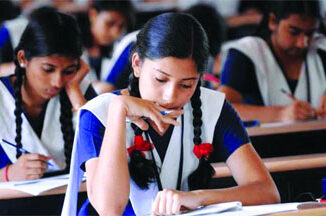
New Delhi (TIP)- In the highest-ever allocation for the Department of School Education and Literacy, the government has allotted more than Rs 73,000 crore for school education in the interim Budget for 2024-25 announced on Thursday. The allocation has increased to Rs 73,008.10 crore from Revised Estimates (RE) of Rs 72,473.80 crore in the previous fiscal. The government had allocated Rs 68,804.85 crore to the department last year. The budget for PM SHRI, a Ministry of Education (MoE) scheme which seeks to upgrade existing government schools to model schools, has risen from Rs 2,800 crore in 2023-24 (RE) to Rs 6,050 crore in 2024-25 — an increase of Rs 3,250 crore.
“The government is committed to empower Amrit Peedhi, the Yuva. Our prosperity depends on adequately equipping and empowering the youth. The National Education Policy 2020 is ushering in transformational reforms. PM Schools for Rising India (PM SHRI) are delivering quality teaching, and nurturing holistic and well-rounded individuals,” Union Finance Minister Nirmala Sitharaman said while presenting the interim Budget in the Lok Sabha. The outlay for all important schemes, such as the Samagra Shiksha Abhiyan, Kendriya Vidyalayas and Navodaya Vidyalayas has seen an increase this year.
According to the MoE, this is the highest-ever budget outlay for school education.
“The Budget allocation for the FY 2024-25 of Rs 73,498 crore is the highest-ever for the Department of School Education and Literacy,” the MoE said in a statement.
Tag: Facebook
-

School education gets record allocation of over Rs 73,000 crore
-

Big boost for auto sector PLI as FY25 allocation hiked to Rs 3,500 crore
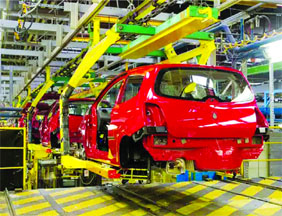
New Delhi (TIP)- The government on Thursday, Feb 1, announced an over seven-fold increase in allocation for the automotive industry’s production-linked incentive scheme for 2024-25 to Rs 3,500 crore, the interim budget documents showed. According to the Expenditure Budget, a sum of Rs 3,500 crore has been earmarked towards the Production Linked Incentive (PLI) scheme for automobiles and auto components in the financial year beginning March, up from a revised estimate of Rs 483.77 crore in the current fiscal. Additionally, the budget for the PLI scheme for advanced chemistry cell and battery storage has been hiked from Rs 12 crore to Rs 250 crore in 2024-25. The Ministry of Heavy Industries recently extended the tenure of the PLI scheme for automobile and auto components by one year, with incentives now applicable for five consecutive financial years starting 2023-24.
The Union Cabinet had approved the PLI-Auto scheme on September 15, 2021 with a budgetary outlay of Rs 25,938 crore for a period of 5 years (FY2022-23 to FY2026-27). The PLI-Auto scheme aims to boost manufacturing of Advanced Automotive Technology (AAT) products, help facilitate and promote deep localization for AAT products and enable creation of domestic as well as global supply chain. -

Agriculture ministry gets Rs 1.27 lakh cr
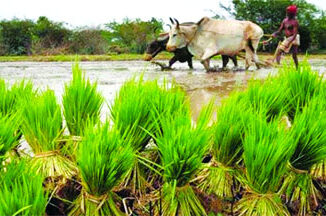
New Delhi (TIP) – The government has allocated Rs 1.27 lakh crore budget for the Ministry of Agriculture for 2024-25, marginally higher than the current fiscal.
According to the budget document, the agriculture ministry has been allocated Rs 1,27,469.88 crore for 2024-25 financial year, of which the Department of Agriculture will get Rs 1,17,528.79 crore while the Department of Agricultural Research and Education (DARE) Rs 9,941.09 crore.
As per the revised estimates of the current fiscal, the department of agriculture has been allocated Rs 1,16,788.96 crore while the DARE Rs 9,876.60 crore.
The allocation for flagship PM-KISAN scheme under the department of agriculture remains unchanged for next fiscal at Rs 60,000 crore. Under this scheme, the government provides Rs 6,000 per year to farmers in three equal instalments.
According to the budget papers, the Ministry of Consumer Affairs, Food & Public Distribution has been allocated Rs 2.13 lakh crore for the next fiscal year, lower than the 2023-24 allocation. Under this ministry, the allocation for the department of consumer affairs has been earmarked at Rs 303.62 crore for 2024-25 from Rs 309.26 crore in the current year.
The Department of Food and Public Distribution has been earmarked Rs 2,13,019.75 crore as against Rs 2,21,924.64 crore in the current 2023-24 fiscal. This department has been tasked to provide free foodgrains to over 80 crore people through ration shops. The Ministry of Chemicals and Fertilizers has been allocated Rs 1.68 lakh crore for 2024-25 fiscal.
Under this ministry, the allocation for the department of fertilisers has been reduced to Rs 1,64,150.81 crore for the upcoming financial year from Rs 1,88,947.29 crore in the current fiscal. The department of chemicals and petrochemicals has been earmarked Rs 139.05 crore next fiscal as against Rs 572.63 crore in the current financial year.
However, the allocation for the department of pharmaceuticals has been enhanced to Rs 4,089.95 crore from Rs 2,697.95 crore in the current fiscal.
The Ministry of Cooperation, headed by Home Minister Amit Shah, has been allocated Rs 1,183.39 crore for 2024-25 from Rs 747.84 crore in FY24.
As per the document, the Ministry of Fisheries, Animal Husbandry and Dairying has been earmarked Rs 7,105.74 crore for the next fiscal.
Out of this, the department of fisheries’ allocation has been increased to Rs 2,584.50 crore in the next fiscal from Rs 1,701 crore in the current 2023-24 fiscal. The department of animal husbandry and dairying has been allocated Rs 4,521.24 crore in 2024-25 from Rs 3,913.93 crore in the current fiscal. The allocation for the Ministry of Food Processing Industries has been slightly raised to Rs 3,290 crore next fiscal from Rs 2,911.95 crore in the current fiscal. -

INTERIM BUDGET 2024-25 : Rs 6.21 lakh cr set aside for defence budget for 2024-25; capital outlay pegged at Rs 1.72 lakh cr
New Delhi (TIP)- The defence budget was on Thursday, February 1, increased to Rs 6.21 lakh crore for 2024-25 in a modest hike of 4.72 per cent from last year’s allocation of Rs 5.25 lakh crore amid India’s continuing border row with China in eastern Ladakh as well as concerns over evolving security situation in the strategic waterways.
In the interim Union budget, Finance Minister Nirmala Sitharaman also announced plans to roll out an ambitious scheme for “deep-tech” technologies in the military domain.
A total of Rs 1.72 lakh crore was set aside to the military for capital expenditure that largely includes purchasing new weapons, aircraft, warships and other military hardware.
For 2023-24, the budgetary allocation for capital outlay was Rs 1.62 lakh crore while the revised estimates put the amount at Rs 1.57 lakh crore.
The defence ministry said, “the announcement regarding a rupees one lakh crore corpus for deep-tech for long term loan to tech-savvy youth/companies and the tax advantage to the start-ups will give further impetus to innovation in the defence sector.” The allocation for capital expenditure for 2024-25 in the defence budget is 20.33 per cent higher than the actual expenditure of 2022-23 and 9.40 per cent more than the revised estimate of 2023-24.
“In the current geopolitical scenario and with the twin objective of promoting self-reliance and exports, the defence budget has touched Rs 6,21,540 crore in the financial year 2024-25,” the defence ministry said.
“This comes out to be 13.04 per cent of the total Union budget,” it added.
The total revenue expenditure has been pegged at Rs 4,39,300 crore that included Rs 1,41,205 crore for defence pensions, Rs 2,82,772 crore for defence services and Rs 15,322 crore for the Ministry of Defence (Civil).
A total of Rs 6,500 crore has been earmarked to strengthen border infrastructure while Rs 7,651 crore was set aside for the Indian Coast Guard.
The allocation to the DRDO has been pegged at Rs 23,855 crore.
On the overall outlay, the ministry said the allocation is in line with the Long Term Integrated Perspective Plan (LTIPP) of the three services that aims to fill the critical capability gaps by implementing some big ticket acquisitions.
The enhanced budgetary allocation will facilitate in equipping the Armed Forces with state-of-the-art niche technology lethal weapons, fighter aircraft, ships, platforms, unmanned aerial vehicles and drones, it said.
It said the planned modernisation of the existing Su-30 fighter fleet along with additional procurement of aircraft, acquisition of advanced engines for existing MiG-29 jets, acquisition of transport aircraft C-295 and missile systems will be funded out of the budget.
Apart from this, to take the initiative of ‘Make in India’ further, the Light Combat Aircraft MK’“I IOC/FOC configuration will be additionally funded to ensure state-of-the-art technology in domestic production.
The Indian Navy’s major projects such as acquisition of deck-based fighter aircraft, submarines, next generation survey vessels will all materialise through this allocation, the ministry said.
Dr Laxman Kumar Behera, Associate Professor at Special Centre for National Security Studies at the Jawaharlal Nehru University described the overall allocation under the defence budget as modest which is reflective of the government’s priorities for the military.
“The allocations did not show any lack of commitment to the armed forces,” he told PTI.
Dr Behera also described as a “healthy sign” the increase of Rs 10,000 crore in the outlay under capital expenditure.
In the capital outlay for defence services, Rs 40,777 crore has been set aside for aircraft and aero engines while an amount of Rs 62,343 crore was allocated for “other equipment”.
An outlay of Rs 23,800 crore has been made for naval fleet and Rs 6,830 crore for naval dockyard projects.
The allocation on account of defence pensions is Rs 1,41,205 crore which is 2.17 per cent higher than the outlay made during 2023-24.
In the budget for 2023-24, the capital outlay for the Indian Air Force was the highest at Rs 57,137.09 crore that included Rs 15,721 crore for procurement of aircraft and aero engines and Rs 36,223.13 crore for other equipment.
The revenue expenditure for the Army has been pegged at Rs 1,92,680 crore for 2024-25 while the Navy and the Indian Air Force have been allocated Rs 32,778 crore and Rs 46,223 crore respectively.
On the allocation for infrastructure projects, the ministry said the projects such as development of Nyoma air field in Ladakh at an altitude of 13,700 feet, 4.1 km strategically important Shinku La tunnel in Himachal Pradesh, Nechiphu tunnel in Arunachal Pradesh and many other projects will be funded out of this allocation. Source: PTI -

Govt allocates Rs 1,300 cr to procure e-buses, Rs 24,931 cr for metro projects
New Delhi (TIP)- Prioritising the urban public transport, the government proposed to allocate Rs 1,300 crore to procure electric buses and Rs 24,931 crore in the interim Budget to fund various metro projects in the country.
There is a 7.57 per cent increase in funds for the mass rapid transit system and metro projects in comparison to the last year’s allocation of Rs 23,175 crore. In the interim Budget presented by Union Finance Minister Nirmala Sitharaman, Rs 26,170 crore has been set aside for the Pradhan Mantri Awas Yojana (Urban) — an increase of 4.3 per cent.
The Prime Minister Street Vendor’s AtmaNirbhar Nidhi (PM SVANidhi), a micro-credit scheme that provides collateral-free working capital loans of up to Rs 50,000 to street vendors, has been allocated Rs 326 crore against Rs 468 crore in the last Union Budget.
The Smart Cities Mission received Rs 2,400 crore in the interim Budget while it had been allocated Rs 8,000 crore in the 2023-24 General Budget. The period of the mission is scheduled to end in June this year.
The Swachh Bharat Mission, another flagship programme of the Modi government, has been given Rs 5,000 crore.
The government has proposed to allocate Rs 1,300 crore to procure electric buses under the PM-eBus Sewa scheme. Under the scheme, 10,000 electric buses will be provided to 169 cities under the public-private partnership model.
Last month, Union Housing and Urban Affairs Minister Hardeep Singh Puri had said the government has floated tenders for procuring e-buses under the scheme. The scheme, which will continue till 2037, will have an outlay of Rs 57,613 crore, of which Rs 20,000 crore will be provided by the Centre and the rest will be borne by the states.
While presenting the interim Budget, Sitharaman said that rapid urbanisation is taking place in the country, asserting that metro rail and NaMo Bharat trains can be catalysts for the required urban transformation.
She said expansion of these systems will be supported in large cities focusing on transit-oriented development.
In October last year, Prime Minister Narendra Modi flagged off the country’s first Regional Rapid Transit System (RRTS). It was named NaMo Bharat train. “We have a fast-expanding middle class and rapid urbanisation is taking place,” Sitharaman said.
According to the Union Ministry of Housing and Urban Affairs, one crore passengers ride metro systems per day in the country. -
At 56 minutes, Sitharaman’s shortest budget speech ever
New Delhi (TIP): Finance Minister Nirmala Sitharaman on Thursday, Feb 1, presented her sixth consecutive budget with a speech lasting 56 minutes, her shortest-ever.
Sitharaman, who holds the distinction of delivering the longest budget speech at 2.40 hours in 2020, was cheered at regular intervals by the treasury benches — her remarks on the presentation of the full budget by “our government” in July receiving the loudest applause.
Opposition members listened to Sitharaman’s budget speech with rapt attention, barring some voices of disapproval to the minister’s reference to her government returning to power after the Lok Sabha elections.
Earlier, BJP members raised slogans of Bharat Mata ki Jai, Jai Shri Ram, Jai Siya Ram as Prime Minister Narendra Modi entered the Lok Sabha chamber and took his seat a few minutes before 11 am. At 56 minutes, it was Sitharaman’s shortest budget speech. She also holds the distinction of delivering the longest budget speech at two hours and forty minutes in 2020.
In 2019, as India’s first full-time woman finance minister, Sitharaman’s budget speech had lasted for two hours and 17 minutes. In 2021, her speech lasted for one hour and 50 minutes, followed by 92 minutes in 2022 and 87 minutes in 2023.
Sitharaman’s budget speech found no mention of Tamil poets and thinkers unlike previous occasions, but she referred to Prime Minister Modi at least eight times and quoted from his speeches. The public galleries saw thin attendance with a few Rajya Sabha members occupying seats in Gallery 2, while relatives of Finance Minister Sitharaman – Krishnamurthy Lakshminarayan and Vidya Lakshminarayan – and her daughter Vangmayi Parakala were seated in the first row of Gallery 3. Sitharaman, who was dressed in a turquoise-coloured embroidered Kantha silk saree, Ministers of State for Finance Pankaj Chaudhary and Bhagwat Karad, and top officers from the Finance Ministry called on President Droupadi Murmu before presenting the Budget.
The President gave Sitharaman a spoonful of curd and sugar and extended her best wishes for the presentation of the Union Budget. -
Social Justice ministry allocated Rs 14,225 crore in interim Budget
New Delhi (TIP): The Social Justice and Empowerment Ministry has been allocated Rs 14,225.47 crore in the interim Budget for 2024-25, an increase of 28.4 per cent over Rs 11,078.33 crore in the Budget (revised estimates) for 2023-24. The Department of Social Justice and Empowerment has been allocated Rs 13,000 crore in 2024-25 while the Department of Empowerment of Persons with Disabilities got Rs 1,225.27 crore in the interim Budget presented by Finance Minister Nirmala Sitharaman in Parliament on Thursday, Feb 1.
In 2023-24, the revised estimate of the Department of Social Justice and Empowerment was Rs 9,853.32 crore and the Department of Empowerment of Persons with Disabilities was Rs 1,225.01 crore.
Under the Department of Empowerment of Persons with Disabilities, the National Program for the Welfare of Persons with Disabilities received an allocation of Rs 615 crore.Under the Department of Social Justice and Empowerment, the umbrella scheme for development of scheduled castes was allocated Rs 9,559.98 crore while the umbrella programme for development of other vulnerable groups was allocated Rs 2,150 crore.
The National Commission for Scheduled Castes, National Commission for Backward Classes and National Commission for Safai Karamcharis have been allocated a total of Rs 7,175 crore. -

Hospitality cos cheer focus on island tourism even as some ‘disappointed’ with no infra tag
New Delhi (TIP)- Hospitality industry cheered Finance Minister Nirmala Sitharaman’s focus on promoting island tourism in the interim budget, saying it reflects a strategic vision for the long-term growth of the travel and tourism sector, even as some players expressed disappointment over the sector not getting infrastructure status.
“Overall, a good nation-first budget. However, the hospitality industry is disappointed that infra status for the industry did not come through. A missed opportunity for an industry that can significantly grow contribution to the GDP and employment as well as the much needed foreign exchange for the country,” said Sanjay Sethi, CEO and Managing Director, Chalet Hotels Limited.
“We are optimistic about additional futuristic support from the government in granting infrastructure status to hospitality and tourism, which will help us achieve a long-awaited status. We foresee that this will have a multiplier impact and drive significant investment from the private sector,” said K B Kachru, Chairman Emeritus & Principal Advisor, Radisson Hotel Group, South Asia.
Rajesh Magow, Co-founder & Group CEO, MakeMyTrip, said the commitment to bolster domestic tourism through initiatives spanning rail and air travel, coupled with the ongoing emphasis on tourism-led destinations, particularly in the realm of island tourism and spiritual tourism, reflects a strategic vision for the long-term growth of the travel and tourism sector.
Pradeep Shetty, President, The Federation of Hotel & Restaurant Associations of India, said the enhanced focus of the government for promotion of MICE, religious tourism, iconic tourism centres and domestic tourism will lay the foundation of tourism development in the Amrit Kaal and equip the sector to achieve the ambitious target of welcoming 100 million tourists by 2047.
Finance Minister Nirmala Sitharaman on Thursday said projects for port connectivity, tourism infrastructure and amenities will be taken up “on our islands, including Lakshadweep” to address the “emerging fervour” for domestic tourism in the country. While presenting the interim Union Budget, she also said “our economic strength has made the country an attractive destination for business and conference tourism”. The mention of Lakshadweep by the finance minister is significant because Prime Minister Narendra Modi had visited the island on January 4. He had tried snorkelling and said Lakshadweep has to be on the list of visit for those who wish to embrace the adventurer in them.
A row erupted on social media when a minister and some other leaders in the Maldives used derogatory remarks against Prime Minister Modi after he posted a video of him on a pristine beach in Lakshadweep. -

Interim budget firmly conveys govt’s commitment to fiscal consolidation goals: Moody’s
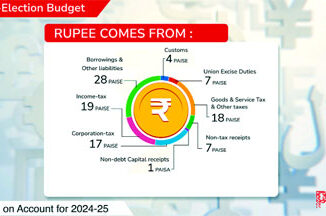
New Delhi (TIP)- Moody’s Investors Service on Thursday, Feb 1, said the interim budget for 2024-25 firmly conveys the government’s commitment to its fiscal consolidation goals, set against a backdrop of healthy economic growth. Moody’s Investors Service Senior Vice President Christian de Guzman said the government demonstrated fiscal restraint in not resorting to large handouts or increasing discretionary spending ahead of this year’s elections. “The government anticipates that reduced spending as a percentage of GDP will largely drive the reduction in the fiscal deficit, despite ongoing increases in planned infrastructure spending,” Guzman said. Given the challenging global environment and the potential for climate-related shocks, emerging spending needs not currently included in the budget could restrict the government’s ability to meet its deficit target, he added.Finance Minister Nirmala Sitharaman announced a Rs 11.11 lakh crore spending on infrastructure and vowed to continue reforms as she resisted resorting to populist measures in Modi government’s last Budget before general elections, instead choosing to stay on the path of cutting deficit while bolstering measures for focus groups. Fiscal deficit in next financial year is estimated at 5.1 per cent of GDP, lower than 5.8 per cent in current fiscal.
Budget focuses on making India USD 5 trn economy, developed nation: Assocham
The interim budget focuses on the government’s objective of making India a USD 5 trillion economy and a developed nation by 2047, Assocham President Ajay Singh said.
“It is an India-first budget. A confident budget of a confident government that focuses on the objective of ensuring that India becomes a 5 trillion-dollar economy by 2025 and a developed nation by 2047,” Singh told PTI in a post-budget interaction.
Speaking further, he said the government has focused on infrastructure, startups, and rail corridors in the Budget. The Finance Minister also announced a Rs 1 lakh crore fund for research and development and the startup sector which is a very significant move.
There is no question that the Budget will have a significant impact on the common man, Singh, who is also the CMD of airline company SpiecJet, said. -
“Nothing for poor, women and Youth”: Opposition on Interim Budget
New Delhi (TIP): Leaders of the Indian National Developmental Inclusive Alliance (INDIA) on Thursday said that there is “nothing” in the Union Interim Budget for the poor, women, and youth, while calling it a new “jumla.” Delhi Minister Atishi told ANI, “The budget proves that this is a ‘jumla’ government. Prime Minister Narendra Modi had said in 2014 that he would provide 2 crore jobs every year, but not even one crore people got jobs. Today they have given a new ‘jumla’ that they will give 55 lakh jobs…”
“No step has been taken to reduce the inflation…” she alleged.
Shiv Sena (UBT) MP Priyanka Chaturvedi told ANI that the budget has “poured cold water” on the expectations of the general public.
“There is a huge difference between saying and doing, this is what we have been seeing for the last 10 years… There is nothing in it for the poor, women and youth. This budget has poured cold water on the expectations of the general public” she said.
AAP MP Sushil Kumar Rinku told ANI, “The youth, Dalit and the people of the backward class had hopes that the budget will talk about them…BJP will have to face great loss in the 2024 elections due to this budget…”
Former Janata Dal (United) president Rajiv Ranjan (Lalan) said, “This is an interim budget, and it reflects on the work done by the government in various sectors in the last five years. It also talks about their goals for the years ahead…”
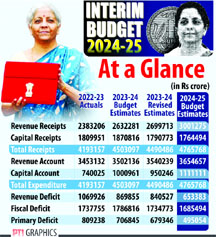
Meanwhile, Union Finance Minister Nirmala Sitharaman pegged the fiscal deficit target for 2024-25 at 5.1 percent of gross domestic product (GDP).
In 2023-24, the government pegged the fiscal deficit target for 2023-24 at 5.9 per cent of gross domestic product (GDP). Today, Sitharaman said that the fiscal deficit of 2023-24 was downwardly revised to 5.8 per cent. The difference between total revenue and total expenditure of the government is termed as fiscal deficit. It is an indication of the total borrowings that may be needed by the government. The government intends to bring the fiscal deficit below 4.5 per cent of GDP by the financial year 2025-26.
The government proposed to increase capital expenditure outlay by 11.1 per cent to Rs 11.11 lakh crore in 2024-25. A capital expenditure, or capex, is used to set up long-term physical or fixed assets. The Indian economy is projected to grow close to 7 per cent in the financial year 2024-25 which starts this April, said the Ministry of Finance in a review report.
India’s economy grew 7.2 per cent in 2022-23 and 8.7 per cent in 2021-22. The Indian economy is expected to grow 7.3 per cent in the current financial year 2023-24, remaining the fastest-growing major economy. -

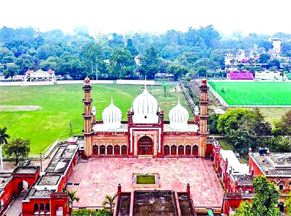
Parliament did ‘half-hearted’ job in amending AMU Act: SC
New Delhi (TIP)- The Parliament did a “half-hearted” job in amending the Aligarh Muslim University (AMU) Act in 1981, the Supreme Court remarked on Thursday, February 1, pointing out though the amendments sought to include the Muslim voice in the administration of the institution, it fell short of conferring the “complete minority character” on AMU.
As the seven-judge bench led by Chief Justice of India Dhananjaya Y Chandrachud reserved its judgment in the case relating to minority status of AMU, the court observed that the amendments made in 1981 changed the definition of the term “university” under the AMU Act to state that it was established by Muslims and made some other changes.
“So, it was really placating those sentiments. But when it actually came to the brass tacks, they did not go back to the position prior to 1951. And what they actually did was that it brought the Muslim voice into the AMU administration as we see it. But it still stopped short,” commented the bench, which also comprised justices Sanjiv Khanna, Surya Kant, JB Pardiwala, Dipankar Datta, Manoj Misra and Satish Chandra Sharma.
The court added that the 1981 amendments did not restore the position that existed prior to 1951. After the Constitution was enforced, the original AMU Act of 1920 was modified to remove provision for compulsory religious education; to provide for the University to be open to students of all caste, creed, sex, etc; remove the requirement of all the members of the Court (administrative body of the University) to be Muslims.
“In other words, 1981 amendment does a half-hearted job. We can understand if the 1981 amendments said, ‘Okay, we are going back to the position in 1920’, conferring a complete minority character. But they changed some definitions…Even the parliament, which had the power to do it, stopped short of taking us back to the 1920 Act. They made a few concessions, but they never took it back to 1920,” it observed.
Following wide-ranging arguments spanning eight day-long hearings, the Constitution bench on Thursday reserved its judgment in the matter. If declared a minority institution, AMU need not reserve seats for Scheduled Castes, Scheduled Tribes, Other Backward Classes (OBC) and Economically Weaker Sections (EWS).
On Thursday, Feb 1, senior counsel Rajeev Dhavan, Kapil Sibal, Salman Khurshid and advocate MR Shamshad made submissions on behalf of AMU and other petitioners that have pressed for a reconsideration of the Supreme Court’s five-judge bench judgment in the Azeez Basha case in 1967.
The 1967 judgment declared that AMU was not a minority institution and could not enjoy protection for minorities to administer educational institutions under Article 30(1) of the Constitution. In 1981, Parliament passed amendments to the AMU Act to change the definition of “university” in its endeavour to grant minority status to AMU.
The Allahabad high court, however, junked these amendments in 2006, leading to AMU and the then United Progressive Alliance (UPA) government to challenge it before the Supreme Court. But in 2016, in a reversal of the previous stand, the National Democratic Alliance (NDA) government sought to withdraw the Centre’s appeal, maintaining that AMU is not a minority institution and that the Basha judgment was correct. The Centre also said that it does not support the 1981 amendments in the AMU Act. Source: HT -

No Supreme Court reprieve for Hemant Soren on his arrest by ED
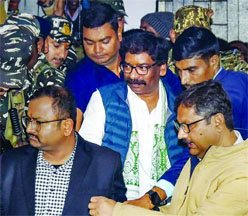
New Delhi (TIP)-The Supreme Court on Friday, February 2, refused to entertain a plea filed by Jharkhand Mukti Morcha (JMM) chief Hemant Soren, challenging his arrest by the Enforcement Directorate (ED) on money laundering allegations minutes after he resigned as chief minister of the state on January 31.
Asking Soren to rather approach the high court concerned, the top court also declined to set down a deadline for the Jharkhand high court to hear and decide his petition that seeks his arrest be declared unconstitutional.
“Why haven’t you gone to the high court? Why have you come here directly? If we permit in one case for somebody to come here directly, we will have to permit everyone. After all, a high court is also a constitutional court,” a bench, led by justice Sanjiv Khanna asked the lawyers representing Soren. Senior counsel Kapil Sibal and Abhishek Manu Singhvi, appearing for the JMM leader, pressed that the facts of the matter required the top court to step in.
“We are dealing with a chief minister who has been arrested in such a manner. Please, see the evidence. This is not fair,” submitted Sibal, adding it was an appropriate case for the Supreme Court to exercise its discretion.
But the bench, which also comprised justices MM Sundresh and Bela M Trivedi, replied that all courts are open to everybody and that the high court is equally competent to grant the relief Soren wanted.
“There is an earlier order of this court by a bench of which my sister (justice Trivedi) was a part, asking you to go to the high court. Move the high court… From your amendment application, it appears that he has been arrested… Move the high court because the issue is different now. You came here challenging the summons (by ED) but now you are challenging your arrest,” it said.
Responding, Sibal tried to distinguish between the two cases.
“In the other case, constitutionality of the PMLA provision was challenged. Here, it is not. Look at the order of arrest in this case. Such an order cannot be passed by any reasonable person,” he argued.
But the bench remained indisposed.
“The fact of the matter is that the high court is also a constitutional court. Please, go to the high court. We will have to follow it consistently. I have been following it consistently and my brother and sister have been following it consistently,” it emphasised.
At this point, Singhvi came in to persuade the bench that the Supreme Court has concurrent jurisdiction in these cases and that there was no legal necessity for his client to move the high court at first instance if the apex court deemed it a suitable case to exercise its discretion.
“Further, this case has laid down the law that there is a difference between power to arrest and necessity to do so. There has to be some concrete reasons to make arrest,” added the senior counsel.
The bench, however, said that Soren must approach the high court first. “We are not inclined to entertain this petition under Article 32 (writ jurisdiction of the Supreme Court) and leave it open to the petitioner to move the high court under Article 226 (writ jurisdiction of a high court. We have been informed that the petitioner has already preferred a writ petition before the Jharkhand high court where it is still pending,” the court recorded in its order.
The order further noted that an older petition by Soren was disposed off by the top court while granting him the same liberty of moving the high court.
“It will also be open to him to ask the high court for expeditious listing and disposal of the case,” recorded the bench. Source: HT -

Centre approves Bilateral Investment Treaty between India-UAE
New Delhi (TIP)- The Union Cabinet chaired by Prime Minister Narendra Modi on Thursday, Feb 1, approved the signing and ratification of the Bilateral Investment Treaty between India and UAE. The government said that the treaty is expected to improve investor confidence and increase foreign investments and Overseas Direct Investment (ODI) opportunities. “The approval is expected to increase investments in India and is likely to help in realizing the goal of Atmanirbhar Bharat by encouraging domestic manufacturing, reducing import dependence, increasing exports etc, ” an official statement by the Cabinet said. The approval for the signing and ratification of the ambitious investment treaty comes ahead of Prime Minister Narendra Modi’s likely visit to the UAE this month.
Other announcements
In the meeting, the Union Cabinet also extended the Animal Husbandry Infrastructure Development Fund (AHIDF) till 2025-26.
The fund, worth Rs 15,000 crore, was approved by the government in June 2020.
According to an official statement, the Cabinet approved the “continuation of Animal Husbandry Infrastructure Development Fund (AHIDF) to be implemented under Infrastructure Development Fund (IDF) with an outlay of ?29,610.25 crore for another three years up to 2025-26.”
The scheme will incentivise investments for dairy processing and product diversification, meat processing and product diversification, animal feed plant, breed multiplication farm, animal waste to wealth management (Agri-waste management) and veterinary vaccine and drug production facilities, according to PTI.
Besides this, the Cabinet also extended the scheme of sugar subsidy for Antyodya Anna Yojna (AAY) families distributed through the Public Distribution Scheme (PDS) for two more years.
It also approved the determination of the marketing margin for supply of Domestic gas to Fertiliser (Urea) between May 2009 and November 2015 and the continuation of the scheme for Rebate of State and Central Taxes and Levies for the export of garments and made ups. -

Kejriwal skips 5th summons in excise policy case
Delhi Chief Minister Arvind Kejriwal skipped the Enforcement Directorate’s summons for the fifth time in connection with the money-laundering probe related to irregularities in the Delhi excise policy case. The fresh summons to the Delhi CM followed the fourth summons, which he had skipped on January 18.
While skipping the fifth summons, the party called it “unlawful”.
“Delhi CM and AAP national convener Arvind Kejriwal will not appear before the ED today as well. We will comply with the lawful summons. Prime Minister Narendra Modi’s aim is to arrest Arvind Kejriwal and topple the Delhi government. We will not allow this to happen,” the Aam Aadmi Party (AAP) said.
Kejriwal earlier has skipped four previous summonses issued by the ED on January 18, January 3, November 2, and December 22, calling them “illegal and politically motivated”.
The ED wants to record Kejriwal’s statement in the case on issues like the formulation of policy, meetings held before it was finalised, and allegations of bribery.
While skipping the fourth summons issued by the ED, Kejriwal had termed it “illegal,” saying he was ready to cooperate, but the agency intended to arrest him and stop him from campaigning.
Source: ANI -

Hindus pray in Gyanvapi cellar, 30 years after Mulayam Yadav sealed it
Varanasi (TIP)- Members of a Hindu priests’ family started praying at a cellar in the basement of Varanasi’s Gyanvapi mosque after a district court February 1 ordered the administration to unseal the premises, 30 years after it was sealed on the orders of former Uttar Pradesh Chief Minister Mulayam Singh Yadav, shortly after the Babri Masjid demolition.
“Hindu side allowed to offer prayers… district administration will have to make arrangements in seven days. Everyone will have the right to pray there,” Vishnu Shankar Jain, lawyer for the Hindu side, told the media.
The area near the mosque, located right next to Kashi Vishwanath temple, witnessed frenetic activity late last night as Hindu devotees started reaching the mosque to pray in the cellar, named ‘Vyas ka tehkana’. Members of a Hindu outfit, Rashtriya Hindu Dal, were seen pasting the ‘mandir’ (temple) word on a signage near the mosque. The puja started around 3 am. Heavy force has been deployed to prevent any untoward incident.
The mosque has four cellars in its basement. One of them was in the possession of a family of priests that used to live there. Somnath Vyas, a member of Vyas family, offered prayers in the cellar before it was sealed in 1993, according to the petition by Shailendra Pathak, the petitioner and a member of the family. He had argued in court that as hereditary priests, they should be allowed to enter the structure and worship there. The court yesterday asked the district administration to ensure that prayers can be held inside the cellar within a week.
The mosque committee has said they would be challenging the court’s order in Allahabad High Court. “This is happening to get political advantage. The same approach is being adopted, which was done in the Babri Masjid case,” their counsel Merajuddin Siddiqui said.
The order is being seen as a major development in the Gyanvapi case, in which Hindu petitioners have sought permission to pray in the mosque complex. The Archaeological Survey of India, which conducted a survey of the premises, has shared its report with the petitioners and the mosque committee. The report concluded that a large Hindu temple existed on the site before the mosque was built. Four Hindu women have now moved the Supreme Court, seeking the excavation and scientific survey of a section that had been sealed by a court order.
Leader of the Opposition Akhilesh Yadav has stressed that due process must be followed while implementing the court order. “The Varanasi Court fixed a 7-day period for it. What we are seeing now is a concerted effort to go beyond the due process and prevent any legal recourse that can be taken,” he said.
The BJP has refrained from commenting on yesterday’s development, saying the matter is subjudice. Hindu outfits such as the Vishva Hindu Parishad have welcomed the ruling. “Today, a court in Kashi has given a very important decision, filling the hearts of every Hindu with joy,” VHP working president Alok Kumar said. -
SC agrees to consider AAP petition over chandigarh mayor polls
The Supreme Court on Friday, Feb 2, agreed to consider an AAP councillor’s request seeking urgent hearing of his plea challenging a Punjab and Haryana High Court order that refused to grant any interim relief to the party seeking fresh mayoral polls in Chandigarh.
The matter was mentioned before a bench headed by Chief Justice D Y Chandrachud by senior advocate Abhishek Singhvi, appearing for councillor Kuldeep Kumar, a candidate for the mayor’s post. Abhishek Singhvi submitted that the returning officer was caught on video smudging the ballots. “We will list it… we will look at it,” the bench, also comprising Justices J B Pardiwala and Manoj Misra, said.
The BJP swept the Chandigarh mayoral polls, retaining all three posts, a setback to the Congress-AAP alliance that alleged tampering with ballot papers by the presiding officer.
On Wednesday, January 31, division bench of Justices Sudhir Singh and Harsh Bunger of the high court denied interim relief the Aam Aadmi Party (AAP), which alleged that ballot papers had been tampered with and sought fresh polls under the supervision of a retired judge of the court. The high court issued notices to the Chandigarh administration, the municipal corporation, presiding officer Anil Masih and newly-elected mayor Manoj Sonkar, among others, asking then to file their replies within three weeks. -

The Indian Community embraces Tom Suozzi, a commonsense candidate for Congress
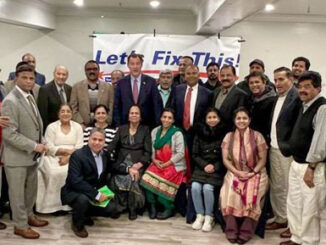
QUEENS, NY (TIP): It was pretty evident from the enthusiasm and energy exhibited at the recent gathering of the Indian Americans in the Santoor Restaurant in Floral Park, Queens, New York, that they are excited to have Tom Suozzi back in the political arena again. “The Indian Community has always admired Mr. Suozzi for standing up for issues that our community has cared for, and this gathering strongly reflects those feelings’ Said Mr. Koshy Thomas, one of the leading organizers of the event in Queens. The meeting brought together people from diverse backgrounds who have roots in South Asia.
In his address, Mr. Suozzi thanked the Indian community for their support and said, “The Indian American Community truly understood the importance of voting, particularly in this special election.” Mr. Suozzi assured the audience that he would continue his excellent work of bringing people together to resolve many thorny issues, including the border crisis”.
Mr. Suozzi has a reputation as a middle-of-the-road politician who is keenly aware of the issues an average citizen is concerned about, such as rising crime, inflation, the need for better schools for the next generation, and creating jobs for the new graduates. However, these issues often get marginalized by both far-left and far-right policies that are highlighted and garner the most attention. It is time for the nation to return to common sense policies that are beneficial to the majority of voters who are increasingly concerned about their lack of say in addressing these issues.
Raju Abraham, one of the event organizers, applauded Mr. Suozzi for his stand on principles and said, “Tom is a strong advocate for consensus building and who will be able to bring together various factions for necessary compromises that will end the paralysis in Washington and take the nation forward.”
George Abraham, one of the avid supporters of Mr. Suozzi, conveyed his message urging the community to come out and vote and send a message to Washington that Congress should make policies to improve people’s lives, not disrupt them. Whether dealing with increasing crime in the neighborhoods or fighting inflation at gas pumps, we need politicians who use common sense. That is where Tom Suozzi truly stands out from others. He truly believes that every American should have the same right to life, liberty, and pursuit of happiness. If someone is out there to destroy that American dream, they should be held accountable”. -

United States federal agency announces major overhaul of its annual lottery for H-1B visa
H-1B visa application submission process for fiscal year 2025 to begin from March 6
WASHINGTON, D.C. (TIP): The H-1B visa application submission process for the fiscal year 2025 would start from March 6, a US federal agency said on Tuesday, January 30, as it announced a major overhaul of its annual lottery for this specialty occupation visa.
The H-1B visa is a non-immigrant visa that allows US companies to employ foreign workers in specialty occupations that require theoretical or technical expertise. Technology companies depend on it to hire tens of thousands of employees each year from countries like India and China.
The new system, among other things, includes provision of a beneficiary-centric selection process for registrations by employers. As a result, unlike in the past of multiple applications by an individual that often resulted in abuse of the system, the H-1B visa applications would now be counted and accepted based on individual applicants. Even if one individual files multiple applications for various companies, they would be counted as one application based on their personal credentials like passport numbers. US Citizenship and Immigration Services (USCIS) also announced a set of new rules which are aimed at strengthening the integrity of and reducing the potential for fraud in the H-1B registration process. This includes reducing the potential for gaming the registration system and ensuring each beneficiary would have the same chance of being selected, regardless of the number of registrations submitted on their behalf, the federal agency said.
“We’re always looking for ways to bolster integrity and curtail the potential for fraud while improving and streamlining our application processes,” said USCIS Director Ur M Jaddou.
“The improvements in these areas should make H-1B selections more equitable for petitioners and beneficiaries and will allow for the H-1B process to be fully electronic from registration, if applicable, until final decision and transmission of approved petitions to the Department of State,” he said.
USCIS said the initial registration period for the fiscal 2025 H-1B cap will open at noon Eastern on March 6, and run through March 22. During this period, prospective petitioners and their representatives, if applicable, must use a USCIS online account to register each beneficiary electronically for the selection process and pay the associated registration fee for each beneficiary. Starting February 28, companies would be allowed to open their account which can be used to start and complete the registration process.
-

Canada Investigates India influencing Canadian Elections; The United States Needs to do the same
WASHINGTON, D.C. (TIP): On Wednesday, January 24th, 2024, Canada’s Foreign Interference Commission released the following statement, opening up inquiries concerning ways the Indian Government may have been tampering with Canadian elections:
“Pursuant to its Terms of Reference, the Foreign Interference Commission has requested that the Government of Canada’s collection and production of document relating to paragraphs clause (a)(i)(A) and (a)(i)(B) of its Terms of Reference include information and documents relating to alleged interference by India related to the 2019 and 2021 elections.” The FIC was formed in September 2023, and had announced at the time it would be investigating election interference from China and Russia, as well as any other “foreign actors” who may have interfered with elections. India has now been publicly implicated as one of those foreign actors.
This comes on the heels of Canadian officials accusing the Indian Government of orchestrating the assassination of Canadian Citizen Harpreet Singh Nijjar, a strong critic of the Indian Government who was killed in front of his Gurdwara in British Columbia last June. Clearly Canada’s government believes India has the ability to send covert operatives into foreign countries to illegally enforce their will on the world stage. They have also made it clear they will have zero tolerance for any kind of transnational repression like this within their borders.
We believe the same thing is occurring within the United States, and we call on our government officials to apply the same diligence our Canadian neighbors are doing to protect the rights of their citizens.
United States officials have already implicated Indian national Nikhil Gupta as a go-between, hired by the Indian Government to coordinate the assassination of Nijjar, as well as a New York lawyer, Gurpatwant Singh Pannun, the head of ‘Sikhs for Justice in the US. Thankfully, the plot to kill Pannun was thwarted by undercover officers. According to an October 19th article in the Sacramento Bee, many United States citizens who have been criticizing the Indian Government have had their lives threatened, and have been warned by the FBI that they are being watched by operatives of the Indian government on American soil.
Such operatives have also been extending their influence on US elections. For example, in 2010 and 2012, California Congressman Ami Bera’s father, Babula Bera, illegally siphoned funds into his son’s campaign, which contributed to Ami Bera winning an extremely close election in 2013. According to Fox 40 News, “The elder Bera was convicted of paying friends and strangers to make contributions to his son’s congressional campaign — more than 130 contributions to the tune of $260,000.” While Congressman Bera claimed to have no knowledge of his father’s actions, he never took responsibility for the fact that since more than ten percent of his campaign funds had been obtained by illegal means, he should have ceded his seat in congress.
The entire ordeal has been highly suspicious, especially since further investigation revealed that Babula Bera had been involved in an ongoing illegal “shell game” fundraising scheme, which including partnering with supporters of Louisiana Congressional candidate Ravi Sangisetty. Families of both candidates have strong ties to India’s ruling party, the Bharatiya Janata Party (BJP).
In 2020, Presidential Candidate Tulsi Gabbard, a practicing Hindu, was photographed wearing a BJP scarf, draped over her by a supporter. The image later drew much scrutiny, but she responded to concerned members of the public by stating “Sometimes, as we’re standing … people come up and they want to take a picture. Somebody put something around my neck and snapped a picture without my knowing what it was…That’s the reality of …what happened in the picture…Any implication or accusation or efforts to elicit some kind of suspicion about me or my motives can only be attributed to religious bigotry because I’m a practicing Hindu.” Such claims seem hollow in light of her documented attendance at multiple Overseas Friends of the BJP fundraising events. Further, she eventually dropped out of the election after credible evidence emerged that she was in fact a member of the RSS, the Hindu Nationalist organization behind India’s BJP. The BJP’s illegal involvement in her campaign is further backed by statements from Vijay Chauthaiwale, the head of the BJP’s foreign policy department.
In September, 2020, while Gabbard was running for President, Chauthaiwale bragged to Indian press about what he had accomplished through the Overseas Friends of the BJP in the United States, and then added instructions he gave its members on the need to be covert with respect to their relationship to the BJP. “The OFBJP-USA members can participate in the US election campaign and support any candidate or a party in their personal capacity but they have been instructed not to use BJP or OFBJP name during the campaign,” he said.
These are just some instances of ties between BJP money and American politicians. Many more exist. Many American agencies have uncovered and made public election tampering by Russia and China. Given that we now know a plethora of Indian government operatives have entrenched themselves on American soil with the specific intent of exerting Indian power and influence on American citizens, we strongly urge our leaders to follow the example of our Canadian neighbors, and investigate India’s interference in American elections. This degree of transnational repression should not be tolerated by any democracy, Organization of Minorities of India, said in a statement sent to The Indian Panorama.
-
Indian national sentenced for nearly $2.8mn healthcare fraud in US
Yogesh K Pancholi from Northville was also found guilty of wire fraud conspiracy, engaging in money laundering, aggravated identity theft, and witness tampering
MICHIGAN (TIP): A 43-year-old Indian national in the US state of Michigan has been sentenced to nine years in prison for orchestrating a nearly $2.8 million healthcare fraud.
Yogesh K Pancholi from Northville was also found guilty of wire fraud conspiracy, engaging in money laundering, aggravated identity theft, and witness tampering.
According to court documents and evidence presented at trial, Pancholi owned and operated Shring Home Care Inc, a home health company based in Livonia, Michigan, a Department of Justice release said.
Despite being excluded from billing Medicare, Pancholi purchased Shring using the names, signatures, and personal identifying information of others to conceal his ownership of the company.
In a two-month period, Pancholi and his co-conspirators billed and were paid nearly $2.8 million by Medicare for services that were never provided. Pancholi then transferred these funds through bank accounts belonging to shell corporations and eventually into his accounts in India.
After being indicted, and on the eve of trial, Pancholi, using a pseudonym, wrote false and malicious emails to various federal government agencies.
In those emails, he alleged a government witness had committed various crimes and should not be allowed to remain in the US in an attempt to keep the witness from testifying.
In September 2023, a federal jury in the Eastern District of Michigan convicted Pancholi of conspiracy to commit healthcare and wire fraud, two substantive counts of healthcare fraud, two counts of money laundering, two counts of aggravated identity theft, and one count of witness tampering.
Pacholi’s case was investigated by the FBI Detroit Field Office and the Department of Health and Human Services Office of the Inspector General (HHS-OIG).
The Justice Department’s Criminal Division has been making efforts to combat healthcare fraud through the Health Care Fraud Strike Force Program.
Since March 2007, this programme, currently comprised of nine strike forces operating in 27 federal districts, has charged more than 5,400 defendants who collectively have billed federal healthcare programs and private insurers more than $27 billion.
(Source: US Department of Justice) -

Three Punjabi-origin youths living in Brampton, Calgary to be extradited to US for drug trafficking
TORONTO (TIP): Three Indian-origin men have been arrested in Canada and will be extradited for trial in the US for their alleged links with a network trafficking drugs between Mexico and the North American nations.
A joint operation between the Federal Bureau of Investigation (FBI) and the Royal Canadian Mounted Police (RCMP) dubbed “Operation Dead Hand” saw 19 people charged in two US federal indictments for their alleged roles in the organized crime ring.
Ayush Sharma, 25, and Guramrit Sandhu, 60, both from Brampton, and Subham Kumar, 29, from Calgary, were arrested under an international arrest warrant, the RCMP said in a release on Tuesday.
“Drug trafficking is a global problem being driven by sophisticated, organized crime groups who put profits over people’s lives. Motivated by greed, these criminals destroy lives, devastate families, and wreak havoc in our community,” told US Attorney Martin Estrada for the Central District of California.
Investigators developed information indicating the organized crime group used Canadian “handlers’ and “dispatchers” who travelled from Canada to Los Angeles for short amounts of time, a Department of Justice release noted.
The handlers coordinated the pick-up and delivery of large shipments of cocaine and methamphetamine, which were loaded onto long-haul semi-trucks destined for Canada. Wholesale quantities of fentanyl were seized as a result of the investigation.
The transportation was coordinated by a network of drivers working with dozens of trucking companies who made numerous border crossings from the US to Canada via the Detroit Windsor Tunnel, the Buffalo Peace Bridge, and the Blue Water Bridge.
Sandhu, also known as King, is alleged to have orchestrated the trafficking and exportation of large-scale quantities of controlled substances to Canada working with several co-defendants described as suppliers.
According to the indictment, Sandhu occupied the position of an organizer, supervisor, and manager, and in this role obtained substantial income and resources.
He has been charged with one count of engaging in a continuing criminal enterprise, and if convicted, he faces a mandatory minimum penalty of 20 years in prison.
Sharma and Kumar were identified in the indictment as semi-truck drivers involved in exporting drugs to Canada.
Both the indictments allege illicit drug trafficking activity cumulatively involving approximately 845 kg of methamphetamine, 951 kg of cocaine, 20 kg of fentanyl, and 4 kg of heroin.
Over $900,000 in cash was seized during the investigation. The estimated wholesale value of the narcotics seized was between $16-28 million.
Arrest and search warrants were executed on Tuesday morning by a coalition of international law enforcement partners in various cities, including Los Angeles; Sacramento, California; Miami; Odessa, Texas; Montreal; Toronto; and Calgary, Canada. -

Two Indian Americans sentenced for conspiring & stealing sensitive government data
WASHINGTON, D.C. (TIP): Three former Department of Homeland Security (DHS) employees, including two Indian Americans, have been sentenced for a conspiracy to steal proprietary US government software and sensitive law-enforcement databases for use in a commercial venture.
Sonal Patel, 49, of Sterling, Virginia, was sentenced to two years of probation in a Washington, DC, court on January 26, according to a Justice Department press release. In April 2019, Patel pleaded guilty to conspiracy to commit theft of government property theft of government property.
Murali Y. Venkata, 58, of Aldie, Virginia, was sentenced to four months in prison. In April 2022, a jury convicted Venkata of conspiracy to commit theft of government property and to defraud the United States, theft of government property, wire fraud, and destruction of records.
The trio pleads not guilty and have been released on bail. Their next hearing is in May.
Charles K. Edwards, 63, of Sandy Spring, Maryland, was sentenced to one year and six months in prison. In January 2022, Edwards pleaded guilty to conspiracy to commit theft of government property and to defraud the United States and theft of government property.
According to court documents and evidence presented at trial, Edwards was the former Acting Inspector General of the DHS Office of Inspector General (DHS-OIG). Patel and Venkata were employed in DHS-OIG’s information technology department. Edwards, Patel, and Venkata were all previously employed at the US Postal Service Office of Inspector General (USPS-OIG). Edwards, Patel, and Venkata conspired to steal proprietary US software and databases containing sensitive law-enforcement information and the personally identifiable information (PII) of over 200,000 federal employees from DHS-OIG and USPS-OIG.
They planned to use the stolen software and databases to create a commercial software product to be offered for sale to government agencies. As part of the scheme, the co-conspirators disclosed the stolen software and databases containing PII to software developers located in India.
After Venkata learned of the investigation, he deleted incriminating text messages and other communications in an effort to obstruct the investigation, according to court documents. -

Indian-origin teen Preetpaul Singh arrested for death of compatriot in Canada’s Brampton
TORONTO (TIP): An Indian-origin teenager has been arrested in connection with the death of another Indian-origin youth in a Canadian city and the police are on the lookout for any information or video footage to support the active investigation.
Nishan Thind, 18, of Brampton, a city in the Canadian province of Ontario, was admitted to a local hospital there on December 19 last year. The police were notified that he died after reaching the hospital.
“It was determined he (Thind) had been shot at an unidentified location and time and dropped off at the hospital,” police from the Region of Peel said in a statement.
Following Thind’s death, detectives from the Peel Regional Police Homicide Bureau on January 9 executed a search warrant at a Brampton residence and subsequently arrested 18-year-old Preetpaul Singh.
“He has been charged with Accessory After the Fact to Commit an Indictable Offence. He was held in custody to appear before the Ontario Court of Justice in Brampton,” police added.
The suspected shooter is a 16-year-old male from Brampton and is wanted on a Canada-wide warrant for manslaughter.
Police said, “This remains an active investigation; anyone with information or video footage (dashcam or otherwise) is urged to contact Homicide detectives.” -

Indian-origin missing student Neel Acharya found dead
CHICAGO (TIP): Neel Acharya, an Indian student at Purdue University in West Lafayette, Indiana, who was reported missing on social media by his mother Sunday, January 28, has been confirmed dead.
In an email written to the university’s computer science department Monday, interim CS head Chris Clifton informed students and faculty of Acharya’s death, according to a local newspaper.
“It is with great sadness that I inform you that one of our students, Neel Acharya, has passed away,” Clifton wrote. “My condolences go out to his friends, family, and all affected.”
Clifton called Acharya a “driven individual and academically talented.” Acharya’s friend and roommate, Aryan Khanolkar, said he was a “loving, charismatic soul, and will be cherished by all of us.”
Acharya, who went to St. Mary’s School in Pune, was a double major in computer science and data science in the John Martinson Honors College. Clifton told the Exponent he received an email from the Office of the Dean of Students confirming Acharya’s death.
“A deceased person was found that matched Neel’s description and had Neel’s ID on (him),” he said.
On Sunday morning, a “college-aged” man was found dead near the Maurice J. Zucrow Laboratories about 10:30 am. According to social media posts by users claiming to be close to Acharya, the student’s last known location was pinned in the same area the body was found.
The coroner has not confirmed whether Acharya was the man found near Zucrow that morning, which Robert Wang, a research assistant working at the lab, said had been found by a graduate student.
“It’s a shock,” Clifton said of Acharya. “A real loss to our community.”
Earlier, in a desperate plea, Gaury Acharya, Neel’s mother, posted about his disappearance on X, “Our son Neel Acharya has been missing since yesterday Jan 28 (12:30 AM EST) He is studying in Purdue University in the US. He was last seen by the Uber driver who dropped him off in Purdue university. We are looking for any info on him. Please help us if you know anything.”
The Consulate General of India in Chicago responded with assurances of support. “Consulate is in touch with Purdue University authorities and with Neel’s family. Consulate will extend all possible support and help,” it wrote. -

Indian-origin student killed by homeless man in Georgia
ATLANTA (TIP): Vivek Saini, a 25-year-old Indian student from Haryana, who had come to the US to do his master’s in business administration was killed by a homeless man inside a store in Lithonia, Georgia.
The incident occurred on Jan 16, a local channel reported. Witnesses cited by the channel said Saini was brutally attacked with a hammer by the homeless man late at night after he asked him to leave the store.
Notably, employees at the food mart including Saini, had been feeding and sheltering the homeless man, identified as Julian Faulkner, for days.” He asked us for chips and coke. We gave him everything including the water,” one of the employees at the food mart, told media.
” He asked if I could get a blanket. I said we don’t have blankets, so I gave him a jacket. He was walking in and out asking him for cigarettes, water, and everything. He was sitting here all the time, and we never asked him to get out because we know that it’s cold.”
On Monday night, Saini told Faulkner that he needed to leave or else he would call the police. As the student was preparing to go home, Faulkner attacked him with a hammer and “kept on hitting for almost 50 times on the face on the head.” Saini suffered from ”severe head trauma” and was pronounced dead at the scene.
Officers got a call around 12:30 am about an assault at a Chevron gas station in Lithonia, according to DeKalb County police. When officers arrived, they found a man, identified as Julian Faulkner, standing over a store clerk and holding a hammer in his hand, according to a police report.
Officers ordered the man to put down the weapon, and he complied before being arrested and escorted outside to a patrol vehicle. Two knives and another hammer were seized from him, the media reported.
A” substantial amount of blood spatter” was found on the floor of the convenience store. Cops also found a store clerk, who was hiding in the back of the booth” visibly shaken and could hardly speak due to fear.”
Faulkner remains in jail on charges of malice murder, and interference with government property.
Meanwhile, Saini’s family in Barwala, Haryana, told local media he had gone to the US two years ago after completing his BTech in Computer Science from Chandigarh University. He had recently completed his master’s in business administration from Alabama University.
“He was a brilliant student who just wanted a decent job to support himself and his family,” Saini’s cousin Simran said. The entire family is still reeling from Vivek’s brutal death and his parents, Gurjeet Singh and Lalita Saini, were not in a condition to talk about what happened.