Tag: Facebook

  • Indian-origin couple convicted in UK of exporting over half ton cocaine to Australia

    Indian-origin couple convicted in UK of exporting over half ton cocaine to Australia

    LONDON (TIP): An Indian-origin couple in the UK, whose extradition was sought by India, has been convicted of exporting more than half a ton of cocaine to Australia after an investigation found that they were behind a front company that had sent the drugs by plane under a cover load of metal toolboxes.
    Arti Dhir, 59, and Kavaljitsinh Raijada, 35, from Hanwell in Ealing were identified by the National Crime Agency (NCA) investigators after Australian Border Force intercepted the cocaine worth 57 million pounds upon its arrival in Sydney in May 2021, the agency said in a statement on Monday.
    Dhir and Raijada denied exporting cocaine to Australia and money laundering. They were convicted of 12 counts of exportation and 18 counts of money laundering by a jury following a trial at Southwark Crown Court on Monday.
    They will be sentenced at the same court on Tuesday.
    The drugs had been shipped via a commercial flight from the UK and consisted of six metal toolboxes which, when opened, were found to contain 514 kilos of cocaine.
    The drugs would have been worth up to 57 million pounds when sold in Australia, where prices are significantly higher than in the UK.
    In the UK, a kilo of cocaine at wholesale is priced at around 26,000 pounds per kilo but in Australia, the same amount sells for 110,000 pounds.
    Officers traced the consignment back to Dhir and Raijada, who had set up a front company called Viefly Freight Services with the sole purpose of smuggling drugs.
    Both defendants had been directors of the company at different points since its incorporation in June 2015.
    Raijada’s fingerprints were found on the plastic wrappings of the metal toolboxes containing the seized drugs, while receipts for the order of the toolboxes, worth 2,855 pounds were discovered at the couple’s home.
    The NCA’s case was that there had been 37 consignments sent to Australia since June 2019, of which 22 were dummy runs and 15 contained cocaine.
    Dhir had been employed by a flight services company at Heathrow from March 2003 until October 2016.
    Raijada worked at the same company from March 2014 to December 2016.
    NCA investigators believe that their knowledge of the airport freight procedures was used to cover their criminal activities.
    Dhir and Raijada were arrested at their home in Hanwell on June 21, 2021, and officers seized 5,000 pounds worth of gold-plated silver bars, 13,000 pounds inside the home and found 60,000 pounds in cash in a safety deposit box.
    Following further investigations, the pair were arrested again in February 2023.
    NCA officers discovered almost 3 million pounds in cash hidden in boxes and suitcases at a storage unit in Hanwell, which Raijada had rented in his mother’s name.
    Financial inquiries found they had also purchased a flat in Ealing for 8,00,000 pounds and a Land Rover for 62,000 pounds, despite declaring profits of only a few thousand pounds.
    Investigations showed that both defendants held cash in bank accounts which far exceeded their declared income.
    They had deposited almost 7,40,000 pounds in cash into 22 different bank accounts since 2019 and were further charged with money laundering.
    The NCA will now start Proceeds of Crime proceedings against both defendants to strip them of their assets, it said.
    Piers Phillips, NCA Senior Investigating Officer, said: “Arti Dhir and Kavaljitsinh Raijada used their insider knowledge of the air freight industry to traffic cocaine worth tens of millions of pounds from the UK to Australia, where they knew they could maximize their revenue.
    “They kept their illicit profits in cash at their home and in storage units, as well as purchasing property, gold and silver to hide their wealth. These defendants may have thought they were removed from the misery caused by the drug trade, but their greed was fueling it.
    “The NCA worked closely with our partners in Australia and the UK Border Force to dismantle the supply chain created by Dhir and Raijada and bring them to justice. We will continue to target class A drugs supply and the criminals overseeing it, both in the UK and overseas.”
    Commander of the New South Wales Police Force Organized Crime Squad, Detective Superintendent Peter Faux, said the result was a great example of how law enforcement is working together to disrupt the international drug trade.
    Det Supt Faux said: “The partnership between both authorities in Australia, and abroad, was the reason police were able to stop a sophisticated attempt at importing drugs via air freight into Australia and hold those responsible accountable.
    “Serious and organized criminal networks often have no borders, which is why working collaboratively with our international counterparts is so important to tackle what is a global issue,” Faux said.
    The couple was earlier accused of arranging the murder of their 11-year-old adopted son Gopal Sejani for an insurance pay-out in 2017.
    The pair from Hanwell travelled to Gujarat to adopt Gopal in 2015, promising him a better life in London.

  • Indian American jurist Amrith Kaur Aakre to lead EEOC’s Chicago district

    Indian American jurist Amrith Kaur Aakre to lead EEOC’s Chicago district

    CHICAGO (TIP): Indian American jurist Amrith Kaur Aakre has become the new director of the US Equal Employment Opportunity Commission’s (EEOC) Chicago District, the federal agency announced, January 31.
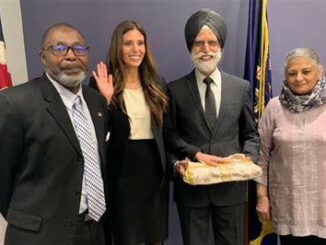
    Aakre, who most recently served as the legal director for the Sikh Coalition, began her new role on Jan 29, 2024. She took her oath on the Sikh holy book, the Guru Granth Sahib.
    “Ms. Aakre has a proven track record of creative problem solving, broad management experience, and a deep commitment to civil rights,” said EEOC Chair Charlotte A Burrows. “I am pleased that she will be joining the EEOC’s Chicago District.”
    Aakre said, “I have incredible respect for the EEOC and its mission to advance equal employment opportunities for all, and I’m grateful to be appointed Chicago District Director. I look forward to working together with the dedicated members of the Chicago District to create impactful change and combat unlawful employment discrimination across our region.
    “I am also excited to learn from the various stakeholder groups, civil rights and other professional organizations, and members of employee and employer communities how the Chicago District offices can best serve their needs,” she said. “I greatly appreciate the opportunity to continue engaging with civil rights work and am honored to lead the Chicago District moving forward.”
    Prior to joining the Commission, Aakre led a national civil rights practice focused on high impact, systemic litigation matters in areas such as workplace discrimination, hate crimes, school discrimination, racial profiling, and bias-based policy issues.
    Under her leadership, the Sikh Coalition drafted significant amicus briefs, including one cited by the Supreme Court in its most recent religious accommodation case, Groff v. DeJoy.
    She also previously served as a prosecutor in the Cook County State’s Attorney’s Office in Chicago for more than 11 years, during which time she directed efforts to expand access to restorative justice and rehabilitative courts.
    Aakre currently serves on the Board of Directors for the ACLU of Illinois and the South Asian Bar Association (SABA) of Chicago, and the leadership committee for the American Bar Association’s Religious Liberty Section.
    She is the 2022 recipient of SABA North America’s Public Interest Achievement Award, 2023 and 2021 recipient of SABA Chicago’s Public Interest Lawyer Award, and a 2017 recipient of the Asian American Coalition of Chicago’s Community Service award. She also has served as an Emerging Leaders Fellow for the Chicago Council on Global Affairs.
    Aakre earned dual bachelor’s degrees in applied science and technology engineering and English literature from The George Washington University, and her juris doctor from The University of Illinois at Chicago Law School.
    The EEOC’s Chicago District is responsible for processing charges of discrimination, administrative enforcement, and the conduct of agency litigation in Illinois, Wisconsin, Minnesota, Iowa and North and South Dakota, with area offices in Milwaukee and Minneapolis.
    Photo: Amrith Kaur Aakre (second from left) with Thomas Colclough, director of field management programs, and her parents Rajinder and Navinder Mago at her swearing-in ceremony.

  • The Indian Consulate is an extension of the government of India, and our job is to serve our people

    The Indian Consulate is an extension of the government of India, and our job is to serve our people

    Mr. Binaya Srikanta Pradhan took over as Consul General of India at New York on January 15, 2024. He  is a career diplomat of the 2002 batch of the Indian Foreign Service. He speaks English, Russian, Hindi, and Odiya languages. His diplomatic career includes senior roles in Indian Embassies in Moscow, Turkmenistan, and Pakistan from 2004 to 2012. During 2012-14, he managed India’s relations with Afghanistan and Iran at the Ministry of External Affairs, New Delhi.

    From 2014 to 2019, Mr. Pradhan served as the Chief of Staff to the Minister of Petroleum & Natural Gas, Government of India. His international engagements extended to being the Deputy Chief of Mission in the Embassy of India, Moscow, from June 2019 to July 2021.

    Prior to his current role as Consul General of India, New York, he held the position of High Commissioner of India to Tanzania and Permanent Representative to the East African Community (EAC) from August 2021 to January 2024. During this period India- Tanzania relationship was elevated to ‘Strategic Partnership’ and the first  overseas campus of the prestigious Indian Institute of Technology (IIT) Madras in Zanzibar, Tanzania was set up.

    Mr. Pradhan demonstrates a keen interest in economic and energy diplomacy. Beyond his diplomatic pursuits, he finds enjoyment in playing golf. Mr. Pradhan is married to Ms. Monalisa and they are proud parents of two daughters, Dibyanshi and Diya.

    Four days after joining the present position,  on the 19th January, 2024,  in an interview with the Editor of The Indian Panorama Prof. Indrajit S Saluja,  Consul General Pradhan spelt out  in brief  his  priorities which included nourishing and  strengthening the already strong bonds between India and the US, and exploring  new areas of cooperation and relationship in diverse fields of  economy, trade, technology, and   culture etc. Mr. Pradhan  added  that serving the Indian Diaspora remained the primary focused concern of  the Consulate. The strengthening of the multi-stake holders relationship will be another priority, he said.

    The long interview is being  released in two parts. The first one, being presented in this edition,  deals with Mr. Pradhan’s views on India’s foreign policy, situations in India’s  neighborhood,  and India’s relations with the neighboring countries.

    The second part,  dealing with the contribution of  the Indian American Diaspora in strengthening India-US relations and in promoting business and cultural relations between the two countries, and the consular services  will be published next week. Stay tuned.

    Here are excerpts from part one of the interview.

    Mr. Binaya Kumar Pradhan, Consul General of India at New York in conversation with Prof. Indrajit S Saluja, Editor of The Indian Panorama (Photo / Jay Mandal- on assignment)

    TIP: You’re welcome here to New York and this is our first meeting. And this is the time to know you, and what vision you have, what you would like to do here. As I said a little while ago, informally., there is a vast difference between your past experience and the experience that you would be having here. So, you might have thought of what exactly do you want to do here, and how you want to go about the whole thing?  So, with that, the ball is in your court.

    CG: Thank you, Professor Saluja. It’s a real pleasure to meet you and through you to talk to the readers of the Indian panorama. I’m familiar with your publication. I have heard good things, great things about your publication. So, it’s a real pleasure and honor to speak to you and to your readers through you. I would say you are right. The landscape is different. I was working in Tanzania, which is a big country in its own right. And you know, the relationship between India and Tanzania is quite spectacular, very good relationship. It’s a strategic partnership. We have a lot of history between our two countries but I entirely agree,  coming to this part of the world, it’s  a very different landscape. And as you mentioned during that informal conversation, it’s about 2.5 million Indian diaspora here and it’s a diaspora which is very well connected to India, both culturally, economically, and they have been very active. They have been playing a very critical role as a force multiplier to bring our two countries together. So, when I knew that I’m coming to this assignment, I understood the enormity of the task, I understood that  it’s a very well-developed relationship. And coming here, one is to be better prepared to contribute in this ever-growing relationship between India and the US. As you know, I look after 10 states, I represent India in the Northeastern 10 states. And when I was looking at the profile of these 10 States,  when I was looking at the profile of Indian diaspora,  profile of the Indian businesses  here in these 10 states, the economic linkages  between these 10 states with India, I found that  it’s a very active, very organic relationship. The India US trade is growing every year in double digits,  and this region, these 10 states,  are contributing in a larger way into that economic engagement. Even when you look at the profile of the  Indian diaspora here, very accomplished people, people who have contributed to economic sphere, cultural sphere, intellectual sphere. Look at any  aspect,  you find the Indian diaspora has contributed richly in that and the great thing is that they are not limited to the United States alone. Now, they are also,  you know, linked very well to India. And they are becoming the robust bridge, I would say, several bridges in different aspects,  between our two countries. In this backdrop, when I look at my job, I would say that my job would be to strengthen this existing relationship. When we say that  we are also working on KPIs -key performance indicators, and we are generally told that, no, we should work on trade;  we should work on tourism, we should work on talent, we should work on technology. So, we call these four  T’s. I would say they are going to remain pointers  for me to strengthen our relationship on the four T’s. The good work done by my predecessors, the good work done by the ambassador of India in Washington, DC, my job is to  continue that tradition,  to strengthen what has been done. So,  broadly speaking,  to answer your question, I would say, I would  continue the good work that has been done, but also to identify areas where we can strengthen our relationship,  areas where we can bring the Indian communities closer to what is happening in India, and the Indian, economic and business entities closer to what is happening over here. That will be my broad agenda. But I think, two or three months down the line, if we sit down again, I will have better statistics,  better understanding  to tell you exactly what I have understood by then. As you know, this is my first week, so, I’m kind of trying to come to grips with the  situation.

    TIP:  If I’m not mistaken, you have left a legacy in Tanzania. Probably,  you are the architect of a wonderful relationship between Tanzania and India, with  India having given Tanzania strategic partner status. That was during your time. Would you like to tell our readers how you managed the whole thing?

    CG: It’s less about me doing that. It’s more about the profile of the relationship between India and Tanzania. As you would see,  if you if you look at the geography,  India and Tanzania are connected by Indian Ocean, and the  Indian diaspora is present there for more than 200 years. They used to do trade 2000 years back. There is an archaeological finding on that. But we have a 200-year-old diaspora there, which is primarily from Gujarat and Punjab. So, the Sikh community, which is 150-year-old ,  went to do the railways projects in Kenya and Tanzania. There were others who went to do business. They did not only contribute to  economic building blocks of the country, rather they have contributed in a big way in the entire nation building, whether it comes to  institution building, building hospitals, roads,  schools.  Indian communities contributed in every way. But the other aspect is that Tanzania also  welcomed them with open  arms. They were always treated as part of Tanzania. So, there is a very nice symbiotic relationship between Indian diaspora and East Africa. And when I went there, I found that the  warmth and the depth of relationship is already there. And we are doing so good in political engagement. Tanzania was the fourth biggest trade partner of India. When it comes to development partnership, we are spending a billion dollar on water projects alone in Tanzania. We are giving the highest number of scholarships to Tanzanian students. So,  like I said the necessary condition was already there. And on top of that, we decided to set up the overseas IIT – Indian Institute of Technology outside India,  in Tanzania. And if you look at the context, this is the time when the Prime Minister is talking about global south. This is the time when the Prime Minister is leading  G-20. And he’s bringing the whole agenda of global south to the forefront of G- 20. So,  what better can be in terms of an example that you take the most premier Indian engineering institute IIT to a country in global south? And if you ask me why Tanzania in entire  Africa among the 54 countries, I will say Tanzania is the place which was the gateway for Indians for more than 200 years to reach out to Africa when Indians would go to Africa. They were actually entering  Zanzibar and that’s the reason why we chose Zanzibar  as the place for IIT. I will say, announcing India – Tanzania  relationship as strategic partnership was a very natural thing to do at that point of time, and it was fitting into the larger priority of the government and the Prime Minister to develop a closer relationship with global south.

    TIP:  Will  you allow me to jump from Tanzania to the two countries that are very much in the news today and about both the countries you have had probably a  great understanding?  One is Afghanistan, and the other is Iran.  Would you like to give an account of your experiences and  impressions of the political and economic aspects?

    CG: Thank you for asking something which is close to my heart, Afghanistan. I haven’t served in any of these two countries. But I was looking up to these two countries from the headquarters. And because of that, I have visited both the countries more than 10 times.  I have been to Afghanistan, maybe 15 times and Iran,  maybe 12 to 14 times and to different cities in both the countries. It’s unfortunate that Afghanistan had to go through those difficult years, for no fault of theirs. And we were part of the solution. We were  not part of the problem in Afghanistan. And when I was working on Afghanistan desk, our job was to provide the civilian support, to work with the communities there,  to work with Afghanistan Government, to deal with the different ministries, different communities, different societies. And you know, we were doing iconic projects in Afghanistan. We were  building their parliamentary building,  the Salma dam to provide water to people. t I only wish that the country comes back to normalcy. Iran is a very different place.   I used to deal with Iran. We have very strong ties with Iran. Our  strategic relationship and our energy relationship are  very deep and very old. And the cultural relationship is very strong. It’s a close partnership that we have.

    TIP: Any comment from you about the recent conflict between Pakistan and Iran?

    CG: You know, I’ve served in Pakistan. I spent two and a half years there, and the genesis of the problem between them goes a long, long time back, and , even at that point of time, you would hear about these problems. So, it’s just that the magnitude has gone up now,  with both countries having kind of resorted to direct action into each other’s territory. But let me not make a comment on that. I personally believe that our region deserves peace and deserves peaceful means of solutions for every conflict. Because at the end of the day, we are all part of the developing world. Resorting to armed conflict drains out your precious resources. Things which can be used for development get used into armed conflict or get used into nonproductive things.  I’m not being diplomatic here. I genuinely believe that, our region should focus more on development. And countries, the two countries that you mentioned,  it would be ideal that they find peaceful means to resolve their differences. But this is not new, by the way.  The basic thing is we all yearn for peace and development is possible only when there is peace,  and development alone can bring happiness to people because if the development is there, then people  have means to sustain themselves. So,  India that way is doing the right thing,  focusing on peace in the entire world. There may be problems with certain countries of course in the neighborhood, but hopefully, the policy that government of India is pursuing would probably result in lasting peace in at least in our area.

    Watch the Interview.

    https://www.youtube.com/watch?v=b1vUfJp_MfYHYPERLINK “https://www.youtube.com/watch?v=b1vUfJp_MfY&t=256s”&HYPERLINK “https://www.youtube.com/watch?v=b1vUfJp_MfY&t=256s”t=256s

    https://www.youtube.com/watch?v=JYOEUcsvpY0

                                                To be continued in Part 2 next week

  • Indian Americans participate enthusiastically in the Indian Consulate Republic Day Celebrations

    Indian Americans participate enthusiastically in the Indian Consulate Republic Day Celebrations

    A View of the gathering.

    NEW YORK CITY (TIP): The 75th Republic Day of India was celebrated in Consulate General of India, New York with a flag hoisting ceremony on Thursday, January 26th 2024.
    Consul General Mr. Binaya Srikanta Pradhan unfurled the national flag. Over 150 members of Indian American community and friends of India joined as the national anthem was sung. Consul General then read out the Address of the President of India which she had delivered on the eve of India’s Republic Day. A short cultural program of patriotic songs was presented by Bharatiya Vidya Bhavan, USA. A large number of members of Indian diaspora and friends of India participated in the celebration filling the hall with patriotic fervor. New Jersey State Senator, Mr. Raj Mukherji graced the occasion with his presence and spoke about the strong US-India partnership. Artists from Bharatiya Vidya bhavan presented Patriotic songs. The event was webcast live through the Consulate’s social media platforms. In the evening, Consul General hosted a reception which was attended by prominent members of the diaspora, elected officials, members of the diplomatic corps, friends from media and people from different walks of life.

    Among the esteemed guests were Congressman Michael Lawler, Mayor of Edison Township Mr. Sam Joshi, and senior diplomats and officers from NYC Mayor’s office and NY State Governor’s office.

    Video messages conveying congratulations on the 75th Republic Day were played from notable figures, including New York State Governor Ms. Kathy Hochul, Congressman Brian Fitzpatrick, etc. The program included a video showcasing the Consulate’s activities across the ten states in the northeast U.S. The event also saw vibrant cultural performances from young but very talented artist, Ms. Maheshwari Jagabattula and a captivating performance from Grammy award winner, Ms. Falu Shah. Guests were then treated to a delightful Indian dinner, featuring a diverse array of regional cuisines from various parts of India. The celebration embodied the spirit of unity, diversity, and shared heritage, marking a memorable Republic Day for all in attendance.

    Grammy award winner, Ms. Falu Shah sings a song.
    A dance performance by Ms. Maheshwari Jagabattula
  • Suozzi Says Pilip will make Nassau and Queens Less Safe

    Suozzi Says Pilip will make Nassau and Queens Less Safe

    Pilip offers up the same old NRA talking points and will stand in the way of preventing gun safety laws

    GLEN COVE, NY(TIP): Former Congressman Tom Suozzi held a press conference on February 1, highlighting his bipartisan record and platform to prevent crime and gun violence, which was first laid out in his 10-point plan.

    While Suozzi is putting forth common sense solutions to address tough problems impacting New York’s Third Congressional District, his opponent, Mazi Pilip, is not only hiding from the voters but even worse – she’s hiding where she stands on critical issues like gun safety and the need to keep Nassau County and Queens safe.

    On the campaign trail, Pilip offers up the same old NRA talking points – proving that she’ll stand in the way of preventing gun safety laws. In the few interviews she has granted, Pilip has willfully misled voters about where she stands on an assault weapons ban. She uses deceptive language to fool voters who aren’t familiar with the facts.

    When she was asked by Newsday if she supported an assault weapons ban, she refused to answer and instead said, “Law-abiding citizens should have a route to have access to guns, but not automatic assault weapons.” She repeated those talk points once again two nights ago on PIX 11.

    Here is the trick: the sale and possession of new automatic weapons have been banned since 1986. The ban on semi-automatic weapons expired – which includes weapons of war such as AR-15s.

    Pilip’s own stated position makes it easier for immigrant gang members to get semi-automatic machine guns, makes it easier for someone to shoot up a school with an AR-15, makes it easier for domestic abusers to get guns, and makes it easier for people with mental illness to get guns.

    Suozzi has a strong record of putting forth bipartisan solutions and working with anyone to get things done and make our communities safer.

    As Mayor of Glen Cove, he increased the police force and greatly reduced the crime rate to the lowest level of any community of over 25,000 people in New York. As County Executive, he oversaw the 12th largest police department in the country. When he was County Executive, Nassau County had its lowest crime rate in decades and was ranked as the safest community in the entire nation with a population over 500,000.

    Suozzi was also able to reduce crime while stabilizing costs by reforming procedures, deploying resources more wisely, and increasing the use of technology. As a Member of Congress, he honored local police officers as “Hometown Heroes” in 2020, 2021, and 2022 – and was inspired to give these awards to voice his support of law enforcement during the wave of “defund the police” support in 2020.

    Additionally, in Congress, Suozzi co-sponsored every major gun violence prevention bill, including legislation to require background checks that the vast majority of Americans support. In February 2018, in the aftermath of the Parkland shooting, he co-wrote an op-ed in Newsday with Rep. Peter King titled “Do the right thing on gun laws,” – which called for expanding background checks, providing federal funding to maintain proper record-sharing systems to help report criminals and people with mental illnesses, and restricting anyone on the terror watch list from buying a gun.

    In Congress, Suozzi will combat the extremists on both sides of the aisle and build a coalition to pass more effective gun violence prevention laws – just like I’ve done his entire career.

  • The Federation of Indian Associations, Chicago hosts USA’s Largest Republic Day Celebrations

    The Federation of Indian Associations, Chicago hosts USA’s Largest Republic Day Celebrations

    At the celebration of India’s Republic Day; Sunil Shah [Founder President and Chairman], Pratibha Jairath [President], Vinita Gulabani [Past President], Executive Board, Directors and Advisory Board
    CHICAGO, IL (TIP): The Federation of Indian Associations, Chicago (FIA), elevated the celebration of India’s Republic Day to new heights on January 28th, at the prestigious Matrix Club in Chicago. This momentous occasion, dedicated to honoring the adoption of the Constitution of India, transcended expectations through a symphony of grand celebrations, patriotic fervor, and a vibrant tapestry showcasing the rich cultural diversity of the nation. The 2024 Republic Day festivities orchestrated by FIA were a testament to the organization’s unwavering commitment to excellence, featuring a diverse array of events, impactful community service initiatives, and a spectacular grand show that unequivocally underscored India’s profound unity in diversity. A noteworthy highlight of the evening was a breathtaking performance by acclaimed artists from India, led by the talented Shahid Rafi, the son of the legendary Padmashree Mohammad Rafi, revered as the Greatest Voice in Indian Cinema. The evening not only celebrated the heritage of the Indian Republic but also served as a beacon of cultural brilliance and artistic prowess.

    The inaugural moments of the event unfolded in the timeless Indian tradition, symbolizing the illumination of knowledge and wisdom through the ceremonial lighting of the lamp. Standing as custodians of this symbolic act were luminaries of FIA: Founder and Chairman Sunil Shah, President Vinita Gulabani, President Pratibha Jairath, and esteemed past presidents, each contributing to the collective radiance. In keeping with FIA’s commitment to inclusivity, the stage beckoned all Advisory Board members, Directors, and Members, to partake in this auspicious initiation.

    The grandeur of the main event was ushered in by the dynamic presence of FIA’s General Secretary, Nilabh Dubey, seizing the stage to a resounding applause that echoed through the venue. Nilabh Dubey, set the tone by introducing the evening’s main MCs by his eloquent articulation that offered a glimpse into the diverse talents that define FIA, specifically that highlighted the professional achievements of the evening’s MCs. The spotlight of the evening shifted seamlessly to the captivating presence of the main MCs, Anu Malhotra and Suchitra Kukreja, who effortlessly took command of the stage, igniting the atmosphere with great excitement.

    Inviting Founder Chairman Sunil Shah to share his insights, Sunil Shah, in his smooth style, painted a vivid picture of FIA’s pivotal role in uniting the diaspora in and around Chicago land over the past several years, including expanding into neighboring states. Sunil Shah eloquently articulated the organization’s vision and mission, setting the stage for a night of celebration and reflection.

    Past President Vinita Gulabani, gracing the stage, highlighted the remarkable achievements of 2023, emphasizing the phenomenal growth from 58 to over 160 members—a testament to a staggering 300 percent increase in funding, event sizes, and the number of events hosted. Current President Pratibha Jairath, invited to the stage by Anu Malhotra, expressed gratitude to the Executive members and outlined her ambitious plan for 2024. In a groundbreaking move, she introduced an additional event focusing on Animal Medical Welfare and Care, reiterating FIA’s commitment to diverse and impactful community engagement.

    The stage then welcomed the esteemed Chief Guest for the evening, Consulate General Somnath Ghosh, who spoke passionately about the relevance of India’s Republic Day to the Indian Diaspora, conveying key messages from the President of India to the captivated audience. In a poignant moment, FIA’s Advisory Board members, instrumental in the organization’s decade-long growth, took center stage. Syed Hussaini, Manish Gandhi, Asha Oroskar, Pinky Thakkar, Lakhvir Sahota, Dr. Anuja Gupta, Dr. Bhupinder Beri, Dr. Suresh Reddy, Nimish Jani, Shrujal Patel, Sushma Bhanot, Shital Daftari, and Jasbir Suga shared their perspectives on FIA’s contributions to the community, underscoring the collective impact made month after month. The culmination of this segment gave way to an exhilarating and patriotic performance, as children from the Atharv Dance Academy, unleashing a foot-stomping patriotic dance that echoed the spirit of the evening.

    The festivities included bestowal of awards and honors upon exceptional individuals who have left an indelible mark on the community across diverse fields. Founder Chairman Sunil Shah, President Vinita Gulabani, President Pratibha Jairath, and Consulate General Somnath Ghosh, graced the occasion to present these accolades. The luminaries acknowledged for their unwavering generosity in both time and funding, breathing vitality into numerous remarkable FIA and community initiatives, were Sudhir and Archana Agarwal, Pinky & Dinesh Thakkar, Chintan & Digna Patel, Chirag Patel, Sunny Patel, Arjun Patel, Manish & Shailja Gandhi, Suketu Amin, Kunal Sarangi (ex-MLA), Naresh Shah, Dr. Bhupinder Beri, and Jayanti Oza. The dynamic duo MCs, Anu Malhotra and Suchitra Kukreja, brought their collective expertise to the forefront, turning the award ceremony into a flawless celebration of community service and contribution.

    Jaspreet Kharbanda, the CFO of Dabur USA, took us on a heartfelt journey to India, not just through geography but through the senses, creating an immersive experience. In a gesture that transcended the ordinary, he generously treated all attendees to the rich flavors of Badshah masala chai/tea and the delightful burst of aromatic richness of Pani Puri. Truly Jaspreet’s thoughtful gesture reinforced the simple act of breaking bread together.

    In a commitment to fostering community development, the FIA proudly extends its support through a commendable scholarship program presented annually on India’s Republic Day. This initiative, grounded in both financial need and academic excellence, attracted an impressive pool of more than 35 applications this year. Rigorous evaluation led to the shortlisting of 17 exceptional candidates, and we are thrilled to announce that, on this occasion, 6 remarkable individuals were honored with scholarships. The entire process was led by Vinita Gulabani and Kamlesh Kapoor from FIA. Consulate General Somnath Ghosh, Swapnil Shah, Sahaj Shah, Asha Oroskar, Lakhvir Sahota, Kamlesh Kapoor, graciously presided over the awards ceremony. Vice President of FIA and pro-MC Richa Chand, with an eloquent and inspirational delivery, announced the recipients of the scholarships, highlighting their remarkable achievements. Richa Chand infused the moment with a sense of pride and uplifting experience for the exceptional accomplishments of the scholarship winners. These scholarships, a testament to the collaborative spirit of various businesses and the visionary leadership within the FIA, symbolize our unwavering dedication to nurturing talent and empowering the aspirations of the deserving students in Chicago land.

    Chandini Duvvuri, Vice President of FIA, eloquently conveyed the Vote of Thanks, embodying gratitude and appreciation on behalf of the entire organization. In her heartfelt expression of thanks, Chandini extended sincere appreciation to Founder Chairman Sunil Shah, acknowledging the enduring legacy he has crafted and commending current and past presidents for consistently elevating the standards of FIA events to unprecedented heights. She expressed deep gratitude to Consulate General Somnath Ghosh, Linda Davenport, Court Judge, and other esteemed dignitaries whose presence added prestige to the occasion. Chandini offered a profound thank you to the altruistic individuals whose generous contributions made the event and scholarships possible. Recognizing the dedication and unwavering commitment of FIA Advisory Board members and Directors, she emphasized their pivotal role in shaping the organization’s collaborative spirit and serving as a continual source of inspiration.

    President Vinita Gulabani set the stage ablaze, ushering in the main cultural show with a magnetic presence that commanded attention. Her introduction of renowned artists from India and across the globe heightened anticipation, reaching a crescendo when the iconic Shaid Rafi was warmly welcomed on stage, earning a resounding standing ovation. Shahid Rafi, with grace and nostalgia, guided the audience through the corridors of memory, offering poignant insights into Mohammad Rafi’s personal life and his role as a father.

    The cultural extravaganza unfolded with a cascade of melodies that transported the audience through a time capsule of Bollywood’s golden era. Classics such as “Aajkal Tere Mera Pyar Kay Charche,” “Chaahe Koi Mujhe Junglee Kahe,” “Yeh Chand Sa Roshan Chehra,” “Gulabi Aankhen,” and “Parda Hai Parda” echoed through the venue, setting the stage on fire.

    During the electrifying rendition of ‘An Evening in Paris,’ Sunil Shah’s signature dance moves ignited the crowd, prompting an impromptu dance floor and stage invasion by the audience. The infectious energy made it a delightful challenge for our ace photographers—Suresh Bodiwala, Vivek Joshi, Nilabh Dubey, Ramesh Punetar, Jayanti Oza and Matt Chennoor—to capture the essence of the unbridled celebration.

    The crowd, carried away by the euphoria, chanted “Once more, once more” after each super-hit performance by Neelajan Ray, Priyanka Mittra, Sammy M., Gautami Roy, Prakhar Ghosh, and Mohammad Salamat. Even the Q&A session between Rizwan and Shahid Rafi added a touch of humor, leaving the audience clamoring for more on a night that seamlessly blended patriotism, nostalgia, entertainment, and sheer joy.

    As the resonant notes of Mohammad Rafi’s songs, sung by Shahid Rafi, patriotic melodies filled the air, a poignant scene unfolded among some of the senior citizens who had witnessed the trials and triumphs of India’s freedom struggle. The evocative strains of timeless classics like “Mera Rang De Basanti Chola,” “Karo Zindagi Ko Watan Ke Hawaale,” and “Nafrat Ki Laathi Todo” stirred deep emotions, bringing tears to the eyes of those who had personally lived through the historic era. In those heartfelt moments, the power of Rafi’s voice became a bridge, connecting the present to the indomitable spirit of the past. Songs such as “Naujawaanon Bharat Ki Taqdeer,” “Sarfaroshi Ki Tamanna,” and “Yeh Desh Hai Veer Jawaanon Ka” acted as an emotional time machine, transporting these seniors back to a time of sacrifice, unity, and an unyielding love for their motherland. The tears that welled up in their eyes were not just a response to music; they were a poignant tribute to the enduring legacy of India’s struggle for independence. The yearning for more was felt through the audience, an audible echo of their profound connection to the mesmerizing performance, many requests were made to Founder Chairman Sunil Shah to continue the program for some more time. Yet, as the clock struck twelve midnight, signaling the culmination of a spectacular show, a collective sigh of both satisfaction and reluctance filled the air. The lingering applause and non-stop dancing, though a token of appreciation, was also a wistful plea for the FIA’s Republic Day magic to continue.

    As Consulate General of India, Sonath Ghosh, truly remarked “This FIA, Chicago event was not merely a reflection, but a vivid manifestation of our love for India and profound pride in being part of the world’s largest democracy, India. The celebration left an indelible impression, cultivating a heightened sense of patriotism and national pride among the Non-Resident Indians (NRIs) connected to their roots and heritage”. FIA Chicago’s Republic Day festivities were not just a commemoration; they were a powerful testament to the enduring spirit of India and its diaspora.

    (Press release by Nilabh Dubey [FIA General Secretory] and Photographs by Asian Media USA)

    Consul General Somnath Ghosh, Sunil Shah [Founder President and Chairman], Pratibha Jairath [President], Vinita Gulabani [Past President] with Sponsors
  • Jharkhand Governor nominates Champai Soren as Chief Minister

    Jharkhand Governor nominates Champai Soren as Chief Minister

    RANCHI/NEW DELHI/NEW YORK (TIP): Jharkhand Governor C.P. Radhakrishnan invited Champai Soren to form the government late on February 1. Mr. Champai was elected as the new leader of the Jharkhand Mukti Morcha (JMM) Legislature Party following Hemant Soren’s arrest by the Enforcement Directorate on January 31 under the Prevention of Money Laundering Act (PMLA) after he met the Governor and submitted his resignation as Chief Minister.
    Earlier in the evening, Mr. Champai, accompanied by Congress leader Alamgir Alam, Rashtriya Janata Dal (RJD) MLA Satyanand Bhokta, Communist Party of India (Marxist-Leninist) MLA Vinod Singh and Congress MLA Pradeep Yadav went to Raj Bhavan and staked their claim to form the government.
    After meeting the Governor, Mr. Champai said, “We have staked claim to form the government. I urged the Governor to allow us to form the government. The Governor said that he will soon inform us.”
    While a delay on the part of Mr. Radhakrishnan in calling Mr. Champai to form the government sparked criticism from the ruling camp, the Governor gave his nod late in the day. Till 5 p.m., the MLAs were hoping that the Governor would invite them to form the government, Mr. Champai said.
    Meanwhile, a special PMLA court on February 1 sent Mr. Hemant Soren to judicial custody for a day. He was taken to Hotwar Central Jail in Ranchi after the court reserved its order for Friday.
    The ED had sought 10 days’ remand for the former CM. The 48-year-old executive president of the JMM will spend the night in the upper division cell of B-block in Central Jail.
    Mr. Hemant Soren, meanwhile, urged the Supreme Court to hear his plea against the arrest. Appearing before a Bench headed by Chief Justice of India D.Y. Chandrachud, senior advocates Kapil Sibal and A.M. Singhvi said such arrests of sitting Chief Ministers “affect the polity of the country”. Chief Justice Chandrachud agreed to consider listing the case before an appropriate Bench on February 2.
    Ruling coalition MLAs had been housed at the Ranchi Circuit House since February 1 morning, waiting for the Governor’s call. The JMM released a video ‘roll call’ on social media in which all the MLAs counted themselves — 43 in total — to prove that they have the required count to form the government in the 81-member Jharkhand Assembly. The JMM-led alliance claimed to have the support of 47 MLAs. It said only 43 of them were present at the ‘roll call’ as the rest of the MLAs were unwell.
    Soon after this development, one bus which was parked inside the circuit house took 38 MLAs, along with their luggage, to Ranchi airport where two chartered flights were waiting. However, the MLAs had to return to the Circuit House as the flights couldn’t take off due to poor visibility caused by fog.
    “We have never seen such a situation where the Governor is so adamant and not inviting the party with majority to form the government. We are sensing that something may happen with our legislators so we are taking them to a safer place. We will not allow democracy to be sold off,” Jharkhand Congress chief Rajesh Thakur had said earlier at the airport.
    Congress president Mallikarjun Kharge shared a video on X (formerly Twitter) of the ‘roll call’ of Congress and JMM MLAs. “In the House of 81 MLAs, only 41 form a majority. Despite having the support of 48 MLAs, not inviting Champai Soren ji to form the government is clearly contempt of the Constitution and denial of public mandate. Nails are being hammered in the coffin of Indian democracy by ‘His Excellencies’,” Mr. Kharge had said. BJP MP Nishikant Dubey took a jibe at the parading of the MLAs and said, “Split in Jharkhand Mukti Morcha, National President Shibu Soren ji, MLAs Sita Soren ji and Basant Soren ji were not seen in today’s parade.”
    (With input from PTI)

  • Gov. Kathy Hochul approves proposal allowing asylum seekers to get temporary state government jobs

    Gov. Kathy Hochul approves proposal allowing asylum seekers to get temporary state government jobs

    NEW YORK (TIP): Gov. Kathy Hochul has approved a proposal to reform New York’s workforce, including allowing asylum seekers to get temporary jobs in state government. The initiative is open to anyone in New York who has legal work authorization from the federal government, including American citizens, Green Card holders and migrants. It only applies to temporary positions. The governor says there are currently 40,000 jobs listed on New York state’s migrant work portal. The governor’s action is likely to invite criticism and opposition from Republicans.

  • India’s Budget 2024: A Balancing Act for Inclusive Growth

    India’s Budget 2024: A Balancing Act for Inclusive Growth

    On February 1, India’s Finance Minister Nirmala Sitharaman presented the Union Budget for the fiscal year 2024-25 in the Parliament. The budget comes at a critical juncture for the nation, grappling with the economic aftermath of the global pandemic and the imperative to foster inclusive growth. Sitharaman’s budget attempts to strike a balance between various sectors, addressing the needs of the poor, and outlining a vision for India’s future. This analysis delves into the key aspects of the budget, evaluating its strengths and weaknesses.

    The budget reflects a delicate balancing act, navigating through economic challenges while aiming for inclusive growth. One notable aspect is the focus on capital expenditure, with a significant allocation to infrastructure development. This includes investments in roads, railways, and urban infrastructure, signaling the government’s commitment to boosting economic activity and creating job opportunities.

    Additionally, the budget emphasizes the importance of healthcare and education. Increased allocations for the health sector indicate a recognition of the need for a robust healthcare system, especially in the wake of the pandemic. Investments in education, including the proposed National Digital Education Architecture, aim to modernize and enhance the education system, potentially narrowing the digital divide.

    The budget puts a strong emphasis on empowering the poor and marginalized sections of society. The Mahatma Gandhi National Rural Employment Guarantee Act (MGNREGA) has received increased funding, providing a safety net for rural households and supporting livelihoods. Moreover, the Pradhan Mantri Awas Yojana (PMAY) continues to be a focal point, addressing the housing needs of the economically weaker sections.

    The expansion of the Pradhan Mantri Garib Kalyan Yojana (PMGKY) is a notable step, encompassing welfare measures and direct benefit transfers to vulnerable populations. This includes free food grains and cooking gas for identified beneficiaries, showcasing the government’s commitment to alleviating immediate hardships faced by the poor.

    The budget reflects a vision for a resilient and self-reliant India. The push for digital initiatives, including the proposed National Digital Education Architecture and the expansion of digital payments, aligns with the broader goal of harnessing technology for inclusive development. The focus on research and innovation, especially in the science and technology sector, aims to position India as a global leader in cutting-edge technologies.

    The emphasis on sustainable development is evident through allocations for renewable energy projects and the proposed ‘Blue Economy’ initiative, highlighting the government’s commitment to environmental conservation and economic sustainability. Additionally, the push for a ‘circular economy’ signals a shift towards responsible and sustainable consumption patterns.

    The increased focus on capital expenditure for infrastructure development can spur economic growth, create jobs, and enhance connectivity, laying the foundation for long-term prosperity.

    The heightened allocations for the health and education sectors indicate a commitment to building robust systems that are crucial for human capital development, a key driver of economic growth.

    The expansion of social welfare schemes like MGNREGA and PMGKY demonstrates the government’s dedication to addressing the immediate needs of the poor and vulnerable, providing a safety net during challenging times.

    Critics argue that the budget’s focus on capital expenditure may exacerbate the fiscal deficit, potentially leading to a strain on government finances. Balancing the need for economic stimulus with fiscal prudence is a challenging task. The increased spending in certain sectors may fuel inflationary pressures, impacting the purchasing power of citizens, especially those in the lower-income brackets. While the budget outlines ambitious plans, the successful execution of these initiatives may face challenges, including bureaucratic hurdles, policy implementation bottlenecks, and the need for efficient monitoring mechanisms.

    India’s budget for the fiscal year 2024-25 reflects a comprehensive attempt to address immediate challenges while laying the groundwork for a sustainable and inclusive future. The emphasis on infrastructure, healthcare, education, and social welfare schemes demonstrates a commitment to uplift the poor and marginalized sections of society. However, the success of these initiatives hinges on effective implementation and management of potential challenges. As India strives to navigate through economic uncertainties and build a resilient future, the budget serves as a roadmap with both promises and challenges.

  • February 2 New York & Dallas E – Edition

    [vc_row][vc_column][vc_custom_heading text=”E-Edition” font_container=”tag:h2|text_align:center” google_fonts=”font_family:Istok%20Web%3Aregular%2Citalic%2C700%2C700italic|font_style:700%20bold%20regular%3A700%3Anormal” link=”url:https%3A%2F%2Fwww.theindianpanorama.news%2Fwp-content%2Fuploads%2F2024%2F02%2FTIP-February-2-E-Edition.pdf”][vc_single_image image=”158498″ img_size=”full” alignment=”center” onclick=”custom_link” link=”https://www.theindianpanorama.news/wp-content/uploads/2024/02/TIP-February-2-E-Edition.pdf”][/vc_column][/vc_row][vc_row][vc_column width=”2/3″][vc_custom_heading text=”Lead Stories This Week” google_fonts=”font_family:Istok%20Web%3Aregular%2Citalic%2C700%2C700italic|font_style:700%20bold%20regular%3A700%3Anormal” link=”url:https%3A%2F%2Fwww.theindianpanorama.news%2F”][vc_wp_posts number=”5″ show_date=”1″][/vc_column][vc_column width=”1/3″][vc_single_image image=”82828″ img_size=”medium” alignment=”center” onclick=”custom_link” link=”https://www.theindianpanorama.news/advertising-media-kit-portal-indian-panorama/ “][vc_single_image image=”82829″ img_size=”medium” alignment=”center” onclick=”custom_link” link=”https://www.theindianpanorama.news/advertising-media-kit-portal-indian-panorama/ “][/vc_column][/vc_row]

  • POETRY, A CATALYST FOR SOCIAL CHANGE?

    • By Mabel Pais

    The Geraldine R. Dodge Foundation (Dodge Foundation), the New Jersey Performing Arts Center (NJPAC) and Newark Mayor Ras J. Baraka on January 24, 2024 announced plans for the 2024 Dodge Poetry initiative – a new collaboration that celebrates poetry as a catalyst for communities to advance social change.

    Guest speakers featured John Schreiber, CEO of NJPAC; Tanuja Dehne, President and CEO of the Geraldine R. Dodge Foundation; Newark Mayor Ras J. Baraka; Ysabel Gonzalez, Poetry Creative Officer at the Geraldine R. Dodge Foundation.

    The event featured special poetry performances by Poet and Newark Mayor Ras J. Baraka, who recited his poem, ‘Digging Max,’ paying homage to his late father Amiri Baraka, a legendary poet and playwright who worked with Max Roach. Then, a surprise poetry performance by the legendary ‘The Last Poets,’ ABIODUN OYEWOLE, BABA DON and FELIPE LUCIANO, who continue the legacy of ‘The Last Poets’ who originally formed in 1968 in Harlem, New York.

    The event also included an exceptional performance by Poet and Pulitzer Prize Winner TYEHIMBA JESS, a champion for Black voices in the literary arts. He is the Board President of Cave Canem, an organization committed to cultivating Black poets’ artistic and professional growth. Tyehimba Jess performed his poem, ‘A Black Man’s Prayer,’ a profound poem about peace.

    Watch a surprise poetry performance by the legendary ‘The Last Poets,’ Umar Bin Hassan, Abiodun Oyewole, and Baba Don, who continue the legacy of ‘The Last Poets’ and who originally formed in 1968 in Harlem, New York – youtu.be/B3DY7ClAbQA

    For the first time, Dodge Poetry will expand beyond its biennial poetry festival (which has been headquartered at NJPAC since 2010) to include poetry programs in Newark throughout the year including NJPAC’s Horizon Sounds of The City.

    (left to right): The Dodge Foundation, New Jersey Performing Arts Center, Newark Mayor Ras J. Baraka announced major expansion of Dodge Poetry program that will take place throughout 2024 in Newark, New Jersey, L to R John Schreiber, CEO of NJPAC; Newark Mayor Ras J. Baraka; Dave Rodriguez, NJPAC’s Executive Producer; Last Poets, Umar Bin Hassan, Abiodun Oyewole, and Baba Don, Ysabel Gonzalez, Poetry Creative Officer at the Geraldine R. Dodge Foundation; Tanuja Dehne, President and CEO of the Geraldine R. Dodge Foundation; and Poet and Pulitzer Prize Winner Tyehimba Jess. (Photo : Courtesy NJPAC)

    These Dodge Poetry events will have three goals to: 1) mobilize communities and fuel movements for social change; 2) amplify poet activists who challenge and reframe existing narratives and norms; and 3) create spaces for empathy, healing, and repair for individuals who have experienced systemic racism.

    Newark Mayor Ras J. Baraka shared, “Because poetry impacts hearts so directly, it has great power to transform communities, and give rise to social change, hope, and healing. This year-round poetry program about to ripple through Newark will realize one of my greatest wishes for the city, and I thank the Dodge Foundation and NJPAC for making this happen.”

    Building on 40 years of poetry programming, the new collaboration between NJPAC and Dodge Foundation will extend the footprint of Dodge Poetry across the entire city of Newark. The events are designed to engage and activate residents, especially young people and community partners, and to highlight the intersection of poetry and social justice.

    The first initiative of this project happened on Friday, January 26th with ‘Max Roach’s Freedom Now Suite’ performance in NJPAC’s Prudential Hall at 8PM , a celebration of the centennial of Max Roach — drummer, bebop pioneer, and civil rights activist — who explored social justice issues and racial inequality through the lens of jazz and poetry.

    Performers included Newark Mayor Ras J. Baraka, who presented his poems by his father, Amiri Baraka (a long-time Max Roach collaborator) as well as his own writing; drummer Nasheet Waits (of Max’s percussion ensemble M’Boom); vocalist Cassandra Wilson; poets ‘The Last Poets,’ Sonia Sanchez and Saul Williams; saxophonist Ravi Coltrane; pianist Nduduzo Makhathini; and bassist Eric Revis. Advisory Committee member and past Festival Poet, Vincent Toro, opened the event.

    Dodge Poetry will culminate with the 20th celebration of the Dodge Poetry Festival, an event that has to-date engaged more than 150,000 people including 45,000 high school students, on Oct 17-19, 2024. The Festival will be hosted by the Dodge Foundation at NJPAC, which has welcomed poets and artists from across the United States to Newark every other year since 2010, and it will feature performances, readings, and special programs designed to build a community of poets and citizens mobilizing for racial and social justice, repair, and healing.

    “The Dodge Foundation has a long legacy of creating opportunities for people to explore and engage with poetry. Now, the reimagined Dodge Poetry will expand our ability to reach new places and people, and focus our programming on artists and activists who interrogate and address issues of social justice,” says Tanuja Dehne, President and CEO of the Dodge Foundation. “By holding these events and the festival across Newark, we will honor the city’s legacy and further amplify the voices and narratives of those who have been at the forefront of activism for racial justice.”

    “Ours is a city of the arts, a center of creativity where there are so many stories that need to be heard. Through this initiative, we look forward to sharing the aspirations and realities of all Newarkers” said John Schreiber, President and CEO of NJPAC. “All of us at the Arts Center are excited that the Dodge Foundation is collaborating with us on creating authentic, community-centric programs that spotlight poetry as a means to advocate for social justice and artistic expression.”

    To help shape and guide the events and strategy over the year, Dodge Poetry has convened an Advisory Committee of award-winning poets and activists: Sean Battle, CEO and Founder of EvoluCulture Ventures, a Newark-based integrated arts organization that holds space for artists and art lovers; Tamiko Beyer, a social justice communications writer and strategist with roots in radical queer organizing, racial justice organizing, and art activism; Naomi Extra, a poet, writer, cartoonist, and scholar with a PhD in American Studies from Rutgers Newark; Willie Perdomo, a two-time New York Foundation of the Arts Poetry Fellow and former NY state Poet Laureate;  and Vincent Toro, an award-winning Puerto Rican poet, playwright, stage performer, author of two poetry collections, and full time professor at Rider University.

    More information about Dodge Poetry, upcoming shows, and events can be found at njpac.org/dodgepoetry. The Dodge Poetry Festival does have an open submission process, and applications will be accepted for performance consideration beginning in mid-February.

    Mayor Baraka

    Ras J. Baraka is the 40th Mayor of the City of Newark.

    A native of Newark, whose family has lived in the City for more than 80 years, Mayor Baraka’s progressive approach to governing has won him accolades from grassroots organizations to the White House.

    Learn more at rasbaraka.com; #Believeinnewark; facebook.com/RasJBaraka

    The Last Poets

    The Last Poets was formed in 1968 in Harlem, New York. Before RAP knew its name, there was a group of ambitious young men who reflected the harsh spirit of their times and whose work remains prophetic and inspirational today. ‘The Last Poets’ started in the late sixties, speaking out as few other musical groups had, or have since, about racism, poverty, and other African American and societal concerns. Learn more at thelastpoets.com. 

    Tyehimba Jess

    Tyehimba Jess is a Pulitzer Prize winner and is a champion for Black voices in the literary arts and is the Board President of Cave Canem, an organization committed to cultivating the artistic and professional growth of Black poets. Learn more at tyehimbajess.net.

    The Geraldine R. Dodge Foundation

    Established in 1974, the Geraldine R. Dodge Foundation envisions a just and equitable New Jersey where people of all races and communities have equitable access to opportunities to thrive. Learn more at grdodge.org.

    The New Jersey Performing Arts Center (NJPAC)

    Learn more at www.njpac.org.

    (Mabel Pais writes on Social Issues, Spirituality, The Arts and Entertainment, Education, Cuisine, Health & Wellness, and Business)


  • BEAT THE WINTER BLUES WITH FUNTAINMENT

    • By Mabel Pais

    The Morristown Performing Arts Center (MPAC) this winter in February continues to offer a great lineup from comics to classic sounds to eye-popping, finger-popping shows.

    Ticketed MPAC events:

    Forever Motown

    Friday, February 2 at 8 pm

    All of your favorite Motown hits on one stage in one night! Featuring G.C. Cameron, former lead singer of The Spinners, Glenn Leonard, former lead singer of ‘The Temptations’ and Traci Robinson, former lead singer of ‘The Marvelettes.’

    Tracy Morgan

    Saturday, February 3 at 8 pm

    Tracy Morgan is one of the most well-respected comedians in his field, known for his award-winning role on ‘30 Rock,’ as well as ‘Saturday Night Live,’  Morgan presents a night of unfiltered comedy as only he can deliver!

    Mature Audiences only. LIMITED TICKETS

    Get the Led Out

    Friday, February 9 at 8 pm

    From the bombastic and epic, to the folky and mystical, ‘Get the Led Out’ recreates the music of legendary supergroup Led Zeppelin with attention to detail and nuance that captures the essence of the band’s hallowed discography.

    Anthony Rodia: Totally Relatable Tour

    Saturday, February 10 at 8 pm

    Anthony Rodia’s comedy is refreshingly genuine, quick witted and totally relatable! A first-generation Italian American from Westchester, Rodia has quickly gained a rabid following with over 900,000 social media followers and over 22 million views of his YouTube videos. Rodia’s comedy pulls from his razor-sharp observations on marriage, parenthood, road rage, and everything else worthy of a social media rant.

    LIMITED TICKETS

    Dionne Warwick

    Friday, February 16 at 8 pm

    Six-time Grammy Award-winning music legend Dionne Warwick has more than 75 hit songs and has sold over 100 million records. Warwick’s hits include ‘Don’t Make Me Over,’ ‘Walk on By,’ ‘Say a Little Prayer,’ ‘A House is Not a Home,’ ‘Alfie,’ ‘Heartbreaker’ and ‘Déjà Vu,’ among countless others.

    LIMITED TICKETS

    Dena Blizzard’s ‘I Love You,’ ‘Get Away From Me’

    Thursday, February 22 at 7:30 pm

    Dena Blizzard’s new show is a three-generation multi-media comedy show about finding the funny in life’s transitions, with Dena’s son, Dean, live on stage, and her mom, Diana, via Zoom.  Whether it’s becoming a widow at 75, empty nesting and divorcing at 50, or trying to act like a grown-up at 23….there’s plenty to laugh (or cry) about. ‘I Love You,’ ‘Get Away from Me’ is perfect for anyone starting over, going through some stuff or just wants everyone to GET AWAY FROM HER!

    The Simon & Garfunkel Story

    Friday, February 23 at 8 pm

    The Simon & Garfunkel Story is the critically acclaimed concert-style theatre show that tells the story of two young boys from Queens who went on to become the world’s most successful music duo. Using video projection and a full band, The Simon & Garfunkel Story is a moving and powerful event featuring all your favorite hits such as ‘Mrs. Robinson,’ ‘Bridge Over Troubled Water,’ ‘Homeward Bound,’ ‘The Boxer” and many more.

    LIMITED TICKETS

    The Gazillion Bubble Show (Credit / mayoarts.org)

    The Gazillion Bubble Show

    Sunday, February 25 at 11 am, 2 pm and 5 pm

    Prepare to be amazed by the world-famous Gazillion Bubble Show! This mind-blowing show combines the beauty of bubble artistry, the wonders of soapy science, and interactive fun for the whole family. With mesmerizing bubble magic, immersive lights and lasers and high-energy music, it’s a spellbinding experience for all ages. Debuting for the first time at MPAC, the show promises unimaginable fun for the whole family. Featuring the incredible award-winning artist Deni Yang, this unique blend of art, science, and entertainment has become an international phenomenon with a worldwide following. Don’t miss the spectacular celebration of bubbles, science, and family fun at the Gazillion Bubble Show!

    LIMITED TICKETS to 2 pm show

    —————————————————-

    CELEBRATING  BLACK HISTORY MONTH

    • By Mabel Pais
    ‘Art in the Atrium’ exhibit (Photo / Courtesy mayoarts.org)

    Honoring Black History Month, Art in the Atrium, Inc. (ATA), a non-profit volunteer arts organization founded in Morris County that champions Black art excellence, returns with its third major exhibition at the Mayo Performing Arts Center’s (MPAC) Art Upstairs and Starlight Galleries.

    In its continued partnership with MPAC, ATA presents ‘Traditions and Transitions: Historical to Contemporary Perspectives in Black Art.’  The exhibit which opened on January 17 runs until March 3.

    ‘Traditions and Transitions : Historical to Contemporary Perspectives in Black Art’ is an exhibit of art that reflects a traditional approach in genre and subject matter and also art that steps beyond prescribed media and representational styles of expression. A range which involves still life, portrait, landscape, and fiber art, as well as the optical art, abstract expressionistic and non-objective styles, among others.

    The exhibit features approximately 50 selected works of art by over 30 artists. The artists range from emerging new artists to well established and known artists.

    “Art in the Atrium brings to MPAC a refreshing exhibit of artists both locally and nationally known,” says curator Nette Forne Thomas, the exhibit’s curator. “The art in the exhibit, ‘Traditions and Transitions’ ranges from broad and diverse styles showcasing expressions from the learned academic approach to the more experimentally creative. This array of art provides a rewarding and eclectic experience in keeping with ATA functioning as a motivating source for artists and art patrons.“

    HOURS OPEN

    Artwork displayed at MPAC is available for purchase. The galleries are open prior to MPAC events, Tuesdays from 12 pm to 2 pm, and by appointment. Private group tours are also available. To make an appointment, call 973-539-0345, ext. 6587.

    Click here for additional information about Art in the Atrium.

    Click here for additional information on the MPAC exhibit.

    Art in the Atrium

    Art in the Atrium, Inc. (ATA) is a Black-led, non-profit, culture-keeping institution founded in Morristown, New Jersey in 1991, that is committed to the celebration and advancement of Black culture. ATA supports and invests in black fine art by established and emerging artists by giving them visibility and a creative space to breathe.

    Since its founding, in addition to its exhibits, ATA has provided unique arts education programming that includes The ATA STEAM Academy and a scholarship program for promising BIPOC arts students majoring in fine art.  For more information on the Art in the Atrium, visit artintheatrium.org, follow ATA on Instagram, Facebook, and Twitter @artintheatrium, or email hello@artintheatrium.org.

    The Mayo Arts Performing Center (MPAC)

    Learn more at mayoarts.org. 

    (Mabel Pais writes on The Arts and Entertainment, Social Issues, Spirituality, Education, Cuisine, Health & Wellness, and Business)

  • Weekly Horoscope- February 5, 2024 to February 11, 2024

    By Chirag Daruwalla – Son of Astrologer Bejan Daruwalla 

    Aries

    Ganesha says Aries sign people will get the fame and name they deserve this week. You have reached this level only because of your communication skills. So don’t let anything fall in your way, keep up your efforts, and don’t let your ego get in your way. This will keep people respecting you. You may get into an argument at home this week. So, you have to keep your words and anger under control. Decisions taken with a calm heart are never wrong. On the other hand, the haste and anger done at this time can cause domestic problems for you for a long time. Don’t let the troubles of your life become so heavy that they overwhelm you. Remember, this time too shall pass. If misunderstandings have created space between you and a friend, find a solution as soon as possible. Letting things drag on for too long can be bad for your relationship. On the contrary, you should make everything clear to your friend. This friendship is special for you too. This week you can expect someone to come into your life who will change a lot your life for good. You may unexpectedly meet someone who can give you some important advice related to your business or personal life.

    Taurus

    Ganesha says this week will be very auspicious for the family life of people with the Taurus zodiac sign. You will find him standing by your side in every trouble. Similarly, you should also be ready to help them when needed. Generally, the people of the Taurus zodiac are not afraid of taking risks. Keep going this week as well and you will find that those who were criticizing you are also with you now. You will remain happy regarding family matters. There are chances of some auspicious ceremony taking place in the house, and there is also a possibility of completion of some auspicious work or festival. Although the environment of your home will be satisfactory, due to work, distance from your family is possible at this time. Despite all this, any worry related to the family itself can be eating you inside. In such a situation, it is important that before taking any decision, you should think deeply about it and only then come to any conclusion. Otherwise, a wrong decision can land you in trouble and regret it for a long time.

    Gemini

    Ganesha says to control your speech otherwise, you may have to repent for your harsh words later. This week you will probably be very worried. You will get relief from this stress only along with your family and friends. These troubles are also guests, and you will soon get rid of them. This week you will want to spend time with your loved ones and feel comfortable with them. On the other hand, this will be a very auspicious time to think and make plans for your future. Gemini people who are going through some troubles now is the time to change your strategy to achieve your goals. This step will be auspicious for your future. This week’s festivities will serve an important purpose. It may be that an important deal is finalized or one of your projects may reach its final stage.

    Cancer

    Ganesha says cancer signs people may remain worried about many aspects of their life this week. You may feel that the goal you set for yourself is impossible to achieve. But this is not the time to lose courage but to increase our efforts. During this period, your family will be useful to you. They are ready to help you in every possible way, so ask them for advice. Whatever advice the elders of the house give you, they will give you keeping your interests in mind. So, if you are facing any problem in completing any task then you can depend on them. Being surrounded by so many worries, your happy nature will also fade a little. It is also possible that this may affect your friendship. So, if any kind of stress is troubling you then try to control your mind. Along with this, through introspection, you can come out of any worry. On the other hand, your ability to resolve a matter with confidence will help you to face tough situations with calmness. This week it is necessary for the people of the Cancer zodiac to have complete control over their resentment towards others.

    Leo

    Ganesha says this week has brought some struggles for people of the Leo zodiac sign. But you don’t need to panic as this is another step towards your success. Your friends and family members supported you a lot in the past. Now it’s your turn to show your gratitude to them and assure them that you too will be there for them in their time of need. Rather, this week the special advice for you is that whether it is your loved ones or any other person, you should always be ready to help them. Finally, the time has come when you must settle down. Pick the most difficult area of ​​your life—whether it’s money, home, or work—and start working on it. Leo people are inflexible about work, but this week you will feel a little more ruthless and ruthless in your struggle to get something.

    Virgo

    Ganesha says your family life will be good this week. If small disputes are left, then there will be an atmosphere of happiness and peace in the house. You will seem satisfied with your family life. There will be a feeling of togetherness and love in the family. There will also be harmony in the family towards each other. This week you can think of building a new house. Receiving some good news this week will brighten the happiness at home. There is a strong possibility of an increase in ancestral property at this time. Brothers and sisters can get some achievement. If any kind of trouble comes to the family, then the whole family will have to face that challenge together. Everyone will be involved not only in the troubles but also in the happiness of the family.

    Libra

    Ganesha says this week you will have to work hard to get success in your career. This week you will have to move forward with new ideas for success in your job and business. In this matter, advice from senior officials can prove beneficial for you. On the other hand, in financial matters, you can achieve a big achievement this week. You will be successful in accumulating money. There are chances of undertaking some journey in connection with work. You are likely to benefit from them. Adopting some new methods in business will be beneficial. This week will be special for your love life. You will enjoy time with your loved partner. At the beginning of this week, you will be looking for a chance to sit with your loved one and express your heart. Family life will be a little better than usual this week.

    Scorpio

    Ganesha says this week will bring new responsibilities for the people of the Scorpio zodiac. Everyone may depend on your skill and ability to solve any family problem. This may be new and unknown territory for you, but despite that, you should try your best to solve this problem. Planetary positions indicate some such incidents in which your loved ones will feel better safe and protected under the umbrella of your loving love. You will also find yourself happy and satisfied by helping others. Your efforts will be appreciated. Apart from this, people of the Scorpio zodiac sign may spend a lot of time on phones and social media this week. But keep in mind that in the process of talking to your loved ones, you should not forget your responsibilities. You are also likely to make unexpected financial gains. The reason for this will be the vital energy inside you, which will keep you energized this week.

    Sagittarius

    Ganesha says job professionals can get promotions this week, as well as some good news can be received in both job and business. This week your financial side is also going to be very strong. Because there are many chances of profit Your financial condition will be strengthened and your respect will increase in society due to an increase in income and gain of wealth. Make money and capital investment-related plans carefully till this week. If you talk about your love life and married life, then this week you will get happiness in both your love life and married life. The loving couple will go a step ahead and give new strength to their relationship. The love between you and your beloved will increase. At the same time, this week there will be peace and harmony in family life. Parents will be happy and their blessings will bring happiness and prosperity in the home.

    Capricorn

    Ganesha says misunderstandings may arise in your life this week, so be careful. Pay attention to your words, so that you do not say anything wrong to your friends. Don’t say anything that will hurt them. You will be able to make your relationships stronger by staying calm. This week you may feel a little tense at your office or home. Chances are that people around you may remain angry, which can affect your mood as well. But don’t worry because this time too will pass. You just focus on your work. You are full of extraordinary ideas but these thoughts will lose their importance if you are not able to express them properly.

    Aquarius

    Ganesha says this week, Aquarius people will have to use their cleverness and intelligence to resolve delicate issues at home and office. Make sure you don’t start by observing others arguing. If someone is behaving rudely or rudely with you then talk politely and go away from there, everything will be fine soon. You will be able to get your work done at the right time. But do not lose hope of achieving your target at any cost. This week you would like to give up your bad habits and adopt good habits. Use this week to know yourself better and set yourself up for success. Higher officials will help you this week.

    Pisces

    Ganesha says Pisces people may feel that time is running out for them, but the truth is that luck is with you this week. It is possible that you may not get any help from your friends and coworkers. But before making any opinion, remember that every coin has two sides. Every person has a different limit. Don’t be scared of any challenging situation, you will be able to face them easily. Just believe in yourself and move ahead with full confidence. The thing you have been searching for a long time can be found this week. Not only this, if you try you can find everything that you thought was lost for so long. Consider yourself fortunate this week. Your hard work and dedication will be widely acknowledged and appreciated. This will motivate you to continue your work. Generally, you are more dependent on your friends for emotional stability and happiness.

  • Birthday Horoscope- February 5 to February 11

    Birthday Horoscope- February 5 to February 11

    February 5

    Ganesha says because of the burst of energy and determination that characterizes this day, it is an excellent time to tackle any lingering projects or duties that you have been avoiding undertaking. Even though you have a high level of productivity, you also have a tendency to rush. Always keep in mind that precision is more important than speed. In things that are close to the heart, a simple expression of gratitude can go a long way. Are you single? It’s possible that an unexpected encounter will pique your curiosity, but patience is essential. For the sake of your health, you should make getting enough rest and staying hydrated a priority.

    February 6

    Ganesha says the day is centered around the concepts of introspection and reflection. This is the ideal opportunity to reevaluate your objectives and the strategies you are employing in order to accomplish them. It’s possible that you’ll discover that the things you’ve been working toward are no longer in line with what you truly want. This realization should be embraced; it is never too late to make a course correction. In a social setting, a friend can ask for your guidance or support. While listening with an open heart, it is important to have limits in order to safeguard your energy.

    February 7

    Ganesha says in professional situations, today presents you with the challenge of stepping outside of your comfort zone. Participate actively in meetings, provide unique suggestions, or take the initiative to lead a project. There will be recognition for your initiative. As a result of the possibility of unforeseen expenditures, it is prudent to examine and modify your budget in accordance with the circumstances. In your personal life, you might find that a quarrel puts your patience to the limit. You should approach it with compassion and a willingness to comprehend the viewpoint of the other party.

    February 8

    Ganesha says today is a day that is filled with creativity, making it an ideal day for engaging in artistic endeavors or coming up with inventive solutions to problems at work. Not only will your ideas garner good attention, but you should not be afraid to provide them. Whether you are single or in a relationship, you can feel the presence of romance in the air. In order to strengthen your connection, you should organize a memorable evening or a considerate surprise. When it comes to your health, you should think about including mindfulness or meditation into your routine so that you may completely harness this creative force.

    February 9

    Ganesha says there is a possibility that you are feeling a heavy burden of obligation and responsibility today. In spite of the fact that it is essential to fulfill your commitments, you must not allow them to eclipse your desire for personal time. Finding a happy medium is essential. There may be a member of your family or a close friend who needs your care. While providing support helps to enhance your connection, you should be careful not to overextend yourself in the process. In terms of one’s finances, today is an excellent day to make preparations for the future, potentially by way of investments or savings plans.

    February 10

    Ganesha says it is possible that a course, workshop, or seminar will present itself as a chance for personal or professional development. An opportunity like this could come about. Take full use of this opportunity to broaden your knowledge and abilities. There is also the possibility that your social circle will expand, allowing you to meet individuals who have similar interests or aspirations. Through the course of time, these ties might prove to be beneficial. As far as your health is concerned, engaging in physical activity not only gives you more energy but also helps you to clear your mind.

    February 11

    Ganesha says because of today’s heightened intuition, you are able to make better decisions and have more meaningful interactions with other people. You should put your faith in these instincts, particularly in circumstances where rationality alone cannot provide a definitive solution. Collaborating with others is essential in your working life. If you collaborate closely with your coworkers, you will be able to make significant progress on a project that has been stalled. Romance takes a playful turn; whether you are single or attached, inject some fun into your love life by going on an impromptu vacation or making a gesture.

  • Fear of losing ground drives Nitish

    Fear of losing ground drives Nitish

    Kickerline: Bihar Chief Minister has survived despite being an overvalued political asset

    Nitish did not want to be number two in the Opposition ranks. In the NDA, his position is not in the front but he will continue to be the CM.

    “Nitish has literally returned to his den and there he has to remain, even as the BJP gains strength in the state and thinks of ways and means to replace him. But he has a fighting chance in Bihar and can hope to repel his opponents for the time being. INDIA is on a weak wicket for other reasons and this does not have much to do with Nitish leaving it. Nitish is not a strong and tall leader who can make a difference, and he knows it. He also remembers the outcome of the 2014 Lok Sabha elections in the state — the JD(U) fought against the BJP and won just two seats, while the saffron party bagged 22.”

    By Parsa Venkateshwar Rao Jr

    Bihar Chief Minister Nitish Kumar is the proverbial cat with nine lives. He has remained at the helm in state politics for more than 20 years despite his shaky foundations. His party, the Janata Dal (United), is not formidable either in the state or at the national level. But he has tried to stay ahead of his competitors not through numbers but thanks to the fact that the BJP has not been too sure of itself in the state and has been willing to let him have the reins of power. This time, he has dumped the ruling Mahagathbandhan, which includes the Rashtriya Janata Dal (RJD), the Congress and Left parties.

    When Nitish senses that his plan to grow as a national leader does not seem to be working out, he wants to save his position as CM at whatever cost.

    The BJP and the JD(U) had together won 33 of the 40 Lok Sabha seats in Bihar in 2019; the former wants to do an encore in the upcoming General Election. It is for this reason that Nitish has snuggled back into the NDA’s fold. But how well is he placed on his home turf? It is the fear of losing ground that has been driving him hither and thither, first into the arms of the RJD and then the BJP.

    There is speculation that Nitish’s exit from INDIA would weaken Opposition unity so much that there would not be any contest in the parliamentary elections. It is presumed that Nitish was a sort of lynchpin for the bloc and his departure would leave it rudderless. Nitish has for long been an overvalued political asset. He has not stormed the national arena on his own, unlike George Fernandes, his old socialist comrade. Nitish, along with Lalu Yadav, Sharad Yadav and Ram Vilas Paswan, was a product of Jayaprakash Narayan’s protest movement of the early 1970s; they became recognizable faces of a new generation of leaders. But they remained where they were. They did not leverage their success to make an impact on the national stage. A similar thing happened with Jyotiraditya Scindia, Sachin Pilot and Milind Deora in the Congress; Scindia and Deora have since moved on.

    However, Lalu Yadav managed to consolidate his party (RJD) in Bihar, while Nitish’s JD(U) started lagging behind. And it is with the help of BJP that Nitish managed to stabilize his position in the JD(U) and lead it to victory. The JD(U) base in Bihar is not as wide as that of the RJD. In the 2020 Assembly election, the JD(U) had won only 43 seats, well behind the BJP (74) and the RJD (75).

    It is because of his long stay as chief minister that every once in a while, Nitish tries to break out of Bihar and look at the national scene. He thinks that his sobriety gives him an edge over Lalu Yadav’s image of a lovable maverick. But sobriety is not gravitas. Nitish has been overestimating his stature as a leader of national importance.

    And when he senses that his plan to grow as a national leader does not seem to be working out, he wants to save his position as chief minister at whatever cost. In 2013, he wanted to challenge Narendra Modi but soon realized that he was no match for him because the BJP had a larger footprint across the country and there was the RSS network of volunteers working quietly as foot soldiers of the party. The JD(U) could not match the BJP at the organizational level across the country. So, he went back to the NDA camp. When INDIA was being formed, he again sensed an opportunity and thought that he would be given due regard as the CM of Bihar, an important Hindi-speaking state. He expected to be given precedence over West Bengal CM Mamata Banerjee. He wanted to head INDIA, but the honor was denied to him because there was little doubt that the Congress had to be the spearhead, a fact that was realized even by Mamata. When Mamata mischievously proposed that Congress president Mallikarjun Kharge should be declared the prime ministerial candidate of the alliance, a JD(U) leader asked: ‘Who is Kharge?’ It was implied that being a politician from a non-Hindi-speaking state, Kharge could not stake claim to become a national leader, whereas Nitish was fit to play that role.

    Nitish did not want to be number two in the Opposition ranks. In the NDA, his position is not in the front but he will continue to be the CM.

    Notably, Nitish does not have much of a following in neighboring Uttar Pradesh, the hub of the Hindi heartland, and he can hardly hope that JD(U) will make inroads there. Modi made a superb move when he contested from UP in 2019, knowing very well the electoral importance of the state which sends 80 MPs to the Lok Sabha. Nitish and his supporters do not seem to realize that in the Hindi belt, a politician from Bihar does not stand much of a chance outside his state.

    Nitish has literally returned to his den and there he has to remain, even as the BJP gains strength in the state and thinks of ways and means to replace him. But he has a fighting chance in Bihar and can hope to repel his opponents for the time being. INDIA is on a weak wicket for other reasons and this does not have much to do with Nitish leaving it. Nitish is not a strong and tall leader who can make a difference, and he knows it. He also remembers the outcome of the 2014 Lok Sabha elections in the state — the JD(U) fought against the BJP and won just two seats, while the saffron party bagged 22.
    ( The author is a senior journalist)

  • Reforming UN for a rules-based order

    Reforming UN for a rules-based order

    Primary reason for the ongoing crises in Ukraine and Gaza is an ineffective Security Council

    The need to urgently reform the rules-based order has to be pursued through informal multiple-stakeholder consultations in the lead-up to the UN’s Summit of the Future, due in September. Using dialogue and diplomacy to convene a General Conference of the UN in 2025, the objective should be to give the ‘primary responsibility’ for peace, security and development to the equitable and representative UNGA.

    “The UNSC’s decisions since 1946 have been consistently taken in the light of geopolitical priorities of its P5 members and not any commitment to world peace. This was the pattern during the ideological confrontation of the Cold War (1946-1991). After the Cold War, the three NATO members of the P5 (France, the UK and US) acted to make the NATO supplant the UNSC, symbolized by their action in Libya in 2011. The UNSC subsequently proved helpless in preventing NATO’s weaponization of globalized economic linkages through unilateral sanctions, which have primarily affected developing countries. The outcome has been the intensification of armed conflicts, impacting not only the integrity of the UNSC but also more than two billion people mainly in the Global South, according to the UN.”

    By Asoke Mukerji

    The breakdown of the ‘rules-based order’ is evident from the spread of violent conflicts that are fracturing international relations. At the heart of this order is the United Nations Security Council (UNSC), which is mandated by the UN Charter with the ‘primary responsibility’ of maintaining international peace and security. The Charter stipulates that UNSC decisions are binding on all UN member-states. The widening gap between decision-making by the UNSC and the challenges to peace, security and development on the ground is directly responsible for the ongoing crises. The priority for the international community is to eliminate this gap through a review and reform of the rules-based order. This can only be done through the UN General Assembly (UNGA), in which all states, big and small, are represented on an equal basis.

    Now, 20 million Afghan women live under ‘gender apartheid’. The UNSC was unable to ensure compliance with its decision of 2015, guaranteeing Ukraine’s territorial integrity.

    The UNSC’s decision-making parameters were negotiated between August 1944 and February 1945 among the Council’s five ‘permanent’ members or the P5 (today’s Russia, China, France, the UK and the US). A key feature was the requirement for the ‘concurrence’ (popularly known as the veto) of the P5 to UNSC decisions. Both the composition of the P5 and their veto power were ‘parachuted’ into the UN Charter as non-negotiable pre-conditions in the invitation extended to countries for participating in the San Francisco conference (April-June 1945) to adopt the Charter. During the conference, some countries objected to the non-democratic veto provision. Addressing the first session of the UNGA on January 18, 1946, India said it had agreed to the consensus on the Charter on the basis of a compromise. The compromise, contained in Article 109 of the Charter, was to convene a UN General Conference to review the Charter’s provisions 10 years after it was adopted. So far, such a General Conference has not taken place.

    The UNSC’s decisions since 1946 have been consistently taken in the light of geopolitical priorities of its P5 members and not any commitment to world peace. This was the pattern during the ideological confrontation of the Cold War (1946-1991). After the Cold War, the three NATO members of the P5 (France, the UK and US) acted to make the NATO supplant the UNSC, symbolized by their action in Libya in 2011. The UNSC subsequently proved helpless in preventing NATO’s weaponization of globalized economic linkages through unilateral sanctions, which have primarily affected developing countries. The outcome has been the intensification of armed conflicts, impacting not only the integrity of the UNSC but also more than two billion people mainly in the Global South, according to the UN.

    The recent track record of the UNSC in failing to uphold a rules-based order illustrates the urgent need for reforming its mandated role. On August 15, 2021, the UNSC was unable to enforce compliance with its own unanimous decision of March 10, 2020, linking US/NATO troop withdrawal with a politically inclusive government in Afghanistan. Today, 20 million Afghan women live under ‘gender apartheid’. On February 22, 2022, the UNSC was unable to ensure compliance with its decision of February 17, 2015, guaranteeing Ukraine’s territorial integrity and sovereignty in return for the devolution of political power to its restive eastern regions under the Minsk Agreements. The resulting violent conflict between Russia and Ukraine (which is supported externally by NATO) has ruined millions of lives physically and socio-economically. On October 7, 2023, the UNSC was unable to make member-states comply with its numerous resolutions, including No. 2334 of December 23, 2016, on the Israel-Palestine issue. The conflict has led to the death of thousands of women and children.

    In an ideal rules-based order, the UNGA should be responsible under the Charter for maintaining international peace and security. Since 2015, all UN member-states, including the P5, have accepted the interlinkage between peace, security and development. However, the Charter was deliberately drafted to make UNGA decisions recommendatory and non-binding on UN member-states. It prevents the UNGA from considering issues that are on the agenda of the UNSC. Even a UNGA decision to amend the Charter (and reform the UNSC) is hostage to a P5 veto under Article 108 of the Charter. The cart is put before the horse.

    The UNGA has tried to overcome these handicaps by prioritizing its work mandating negotiations of treaties to create a rules-based order. Such treaties include the Convention on Genocide (1948); the Convention on outlawing Racial Discrimination (1965); the International Covenant on Civil and Political Rights (1966); the Convention on Elimination of All Forms of Discrimination against Women (1979); the Convention on the Law of the Sea (1982); and the Convention on the Rights of the Child (1989). Participating states are expected to uphold their treaty obligations to achieve the principles and objectives of the Charter.

    A similar approach marks UNGA decisions recommending norms for member-states to use in adopting national legislation. The first such document, adopted unanimously by the UNGA on December 10, 1948, was the Universal Declaration of Human Rights. On September 25, 2015, the UNGA adopted Agenda 2030 on Sustainable Development with its 17 SDGs (Sustainable Development Goals), the first universally applicable normative global policy framework interlinking peace, security, development and environmental protection.

    The assertion by world leaders at the UN SDG Summit on September 18-19, 2023, that numerous crises had put the implementation of the SDGs into peril deserves to be taken seriously. The primary reason for these crises is an ineffective UNSC, whose unanimously mandated reform has been assiduously blocked in informal UNGA negotiations by the P5 since 2008.

    The need to urgently reform the rules-based order has to be pursued through informal multiple-stakeholder consultations in the lead-up to the UN’s Summit of the Future, due in September. Using dialogue and diplomacy to convene a General Conference of the UN in 2025, the objective should be to give the ‘primary responsibility’ for peace, security and development to the equitable and representative UNGA.
    (The author is a former Permanent Representative of India to the United Nations)

  • New fault-lines to the fore in US presidential race

    New fault-lines to the fore in US presidential race

    A greater concern for the world is the impact of a changing of the guard on the US foreign policy
    “For the outside world, there will be two main consequential and immediate outcomes that are shaped by any change in the US administration, as evidenced during the Trump years. One is the impact on high-skilled immigration as US tech enterprises draw talent from across the world, particularly from India. At least 70 per cent of the H1-B visas are bagged by Indians every year, the bulk of them by software engineers and, now, artificial intelligence professionals. Little discussed is the perceived sense of insecurity amid heightened white nationalism that borders on racism, particularly for the high-skilled people from Asian countries. The Trump years demonstrated that safety as a factor to migrate or not became important for high-skilled migrants, particularly from non-European countries.”

    By Luv Puri

    The support for former President Donald Trump in the Iowa caucus and within the Republican Party establishment has created a buzz about a what-if scenario: the return of the Trump era and the concomitant unpredictability in the governance of a country that accounts for a quarter of the global economy.

    In the polarized US polity, the congressional districts in some of the swing/battleground states of the 2016 and 2020 elections, such as Arizona, Georgia, Michigan, Pennsylvania and Wisconsin, may decide the 2024 presidential contest. The suburban and rural parts remain conservative and racially homogenized — mostly white. New political, social and economic fault-lines are being drawn within the states, and this may fuel fresh social and ideological tensions, even as Florida has remained a battleground state since the 2000 elections.

    For the outside world, there will be two main consequential and immediate outcomes that are shaped by any change in the US administration, as evidenced during the Trump years. One is the impact on high-skilled immigration as US tech enterprises draw talent from across the world, particularly from India. At least 70 per cent of the H1-B visas are bagged by Indians every year, the bulk of them by software engineers and, now, artificial intelligence professionals. Little discussed is the perceived sense of insecurity amid heightened white nationalism that borders on racism, particularly for the high-skilled people from Asian countries. The Trump years demonstrated that safety as a factor to migrate or not became important for high-skilled migrants, particularly from non-European countries.

    Even in arguably the most cosmopolitan city in the world like New York, with nearly half of the population being foreign-born, the Police Benevolent Association, NYC’s largest police union, reportedly “broke with a longstanding tradition of not endorsing presidential candidates and had thrown its support behind President Trump in the 2020 elections, as many officers viewed him as more of an ally to their pro-police ‘Blue Lives Matter’ movement than Joe Biden.”

    A greater concern for the world is the impact of a changing of the guard on the US foreign policy. The US is the pre-eminent power in the international system as its support or withdrawal of support on global issues is consequential. Take, for instance, the challenge of climate change. In the 2017 book, Dark Money: The Hidden History of the Billionaires Behind the Rise of the Radical Right, Jane Mayer illustrates how Charles and David Koch, the enormously rich proprietors of an oil company based in Kansas, laid the foundations for conservative movements that were anti-government and opposed climate change. The funding of various movements, think tanks and newspapers inadvertently created a fertile landscape for Trump to exploit in the 2016 elections. It wasn’t a surprise when he decided to formally withdraw from the Paris climate agreement in June 2017.

    Also, there are peace and security issues that are shaped by the US directly or indirectly. There are three foreign policy domains that have dominated Biden’s presidency — Ukraine, West Asia and China. All three affect every corner of the world, including India, though the US-India bilateral engagement will essentially retain the momentum despite any change. Russia’s invasion of Ukraine has given the European Union (EU) a renewed sense of purpose. Russia’s perceived threat is now internalized by eastern European Baltic states, such as Estonia, Latvia and Lithuania, which were earlier part of the Soviet Union, and by other eastern European countries like Poland, Romania and Moldova. This has instilled a pan-continental unity that no event has catalyzed since 1993, the year of the EU’s foundation. Recent developments have also turned the spotlight within the US on European security. Since the February 2022 invasion, more than $75 billion in assistance to Ukraine, including humanitarian, financial and military support, has reportedly been given by the US. Trump’s current stance on the US financial support to Ukraine is not clear. In fact, during his presidency, he had angered EU allies with his repeated criticism of European countries for not commensurately funding the NATO.

    West Asia has witnessed greater instability after the Hamas attacks and the consequent Gaza assault by Israel. Among the 19 September 11 attackers, 15 were from the Kingdom of Saudi Arabia and they cited the purported partial US role in West Asia, including the Israel-Palestine conflict, as the reason for carrying out the suicide attacks. The US establishment doesn’t want to give fresh ammunition to the violent extremists working against it. This explains repeated words of caution by Biden to Israeli Prime Minister Benjamin Netanyahu, urging him not to be blinded by rage. In 2017, then President Trump had decided that the US would move its embassy from Tel Aviv to Jerusalem and this was seen as a reckless move as it may directly play into the hands of extremists who slam the US for being pro-Israel. Then, there are other tensions, such as with Iran and its alleged support to proxies like the Houthis in Yemen that are threatening Red Sea’s shipping lanes. This requires a calibrated and coordinated approach, with allies anchored in patience and wisdom that was clearly lacking in President Trump.

    Finally, another Trump term has the potential to reconfigure the Asia-Pacific security calculus. China’s multi-dimensional challenge had been at the heart of President Biden’s Asian engagement. Biden continued with Trump’s import tariffs on China. It is the US strategy to meet the challenge of China’s military projection that may have a greater impact with a change in the US administration. For instance, China has never given up the use of force as an option to bring Taiwan under its control. On the other hand, the US strategic ambivalence over defending the island if it were attacked has been its consistent position. In the recent Taiwanese presidential elections, the ruling Democratic Progressive Party, which invokes China’s ire for its nationalist stance, retained power. A Trump term may spur Beijing to invade Taiwan and exacerbate China’s perennial tensions with Japan, South Korea and even India.
    ( Luv Puri is a Journalist and Author)

  • Incorrigible Nitish switches allies yet again

    True to form, Bihar Chief Minister Nitish Kumar has dumped his Mahagathbandhan allies and returned to the NDA’s fold. The Janata Dal (United) chief has formed the government with the BJP, the very party he had snapped ties with just a year and a half ago. His latest U-turn has jolted not only the Mahagathbandhan — which includes the Rashtriya Janata Dal (RJD), the Congress and the Left Front — but also INDIA, the Opposition bloc that was formed last year to take on the BJP in the 2024 General Election. Nitish had projected himself as the face of the alliance, but suggestions about naming Congress president Mallikarjun Kharge as INDIA’s prime ministerial candidate left him fuming.

    It’s nothing new for Nitish to switch allies, but he has been doing it with increasing regularity over the past decade. Having once said ‘Mitti mein mil jaayenge magar BJP ke saath nahin jaaenge,’ Nitish has opportunistically patched up with the saffron party yet again in a bid to survive and thrive. His decision shows that he is anticipating the BJP’s victory and INDIA’s debacle in the General Election. This is also a desperate attempt by him to revitalize his party, which had ended up way behind the RJD and the BJP in the 2020 Assembly election. Though the BJP will be calling the shots in the new government in Bihar, it won’t be easy for the party to justify taking Nitish back on board after having ruled out his return to the NDA.

    Even as Nitish seems to have abandoned his prime ministerial ambitions, INDIA finds itself sinking deeper into the mire. Discord over seat-sharing in West Bengal and Punjab has exposed the alliance’s frailties. Nitish’s crossover indicates that more Opposition leaders might jump ship as the Lok Sabha elections draw nearer.
    (Tribune, India)

  • India’s Budget 2024: A Balancing Act for Inclusive Growth

    On February 1, India’s Finance Minister Nirmala Sitharaman presented the Union Budget for the fiscal year 2024-25 in the Parliament. The budget comes at a critical juncture for the nation, grappling with the economic aftermath of the global pandemic and the imperative to foster inclusive growth. Sitharaman’s budget attempts to strike a balance between various sectors, addressing the needs of the poor, and outlining a vision for India’s future. This analysis delves into the key aspects of the budget, evaluating its strengths and weaknesses.

    The budget reflects a delicate balancing act, navigating through economic challenges while aiming for inclusive growth. One notable aspect is the focus on capital expenditure, with a significant allocation to infrastructure development. This includes investments in roads, railways, and urban infrastructure, signaling the government’s commitment to boosting economic activity and creating job opportunities.

    Additionally, the budget emphasizes the importance of healthcare and education. Increased allocations for the health sector indicate a recognition of the need for a robust healthcare system, especially in the wake of the pandemic. Investments in education, including the proposed National Digital Education Architecture, aim to modernize and enhance the education system, potentially narrowing the digital divide.

    The budget puts a strong emphasis on empowering the poor and marginalized sections of society. The Mahatma Gandhi National Rural Employment Guarantee Act (MGNREGA) has received increased funding, providing a safety net for rural households and supporting livelihoods. Moreover, the Pradhan Mantri Awas Yojana (PMAY) continues to be a focal point, addressing the housing needs of the economically weaker sections.

    The expansion of the Pradhan Mantri Garib Kalyan Yojana (PMGKY) is a notable step, encompassing welfare measures and direct benefit transfers to vulnerable populations. This includes free food grains and cooking gas for identified beneficiaries, showcasing the government’s commitment to alleviating immediate hardships faced by the poor.

    The budget reflects a vision for a resilient and self-reliant India. The push for digital initiatives, including the proposed National Digital Education Architecture and the expansion of digital payments, aligns with the broader goal of harnessing technology for inclusive development. The focus on research and innovation, especially in the science and technology sector, aims to position India as a global leader in cutting-edge technologies.

    The emphasis on sustainable development is evident through allocations for renewable energy projects and the proposed ‘Blue Economy’ initiative, highlighting the government’s commitment to environmental conservation and economic sustainability. Additionally, the push for a ‘circular economy’ signals a shift towards responsible and sustainable consumption patterns.

    The increased focus on capital expenditure for infrastructure development can spur economic growth, create jobs, and enhance connectivity, laying the foundation for long-term prosperity.

    The heightened allocations for the health and education sectors indicate a commitment to building robust systems that are crucial for human capital development, a key driver of economic growth.

    The expansion of social welfare schemes like MGNREGA and PMGKY demonstrates the government’s dedication to addressing the immediate needs of the poor and vulnerable, providing a safety net during challenging times.

    Critics argue that the budget’s focus on capital expenditure may exacerbate the fiscal deficit, potentially leading to a strain on government finances. Balancing the need for economic stimulus with fiscal prudence is a challenging task.

    The increased spending in certain sectors may fuel inflationary pressures, impacting the purchasing power of citizens, especially those in the lower-income brackets.

    While the budget outlines ambitious plans, the successful execution of these initiatives may face challenges, including bureaucratic hurdles, policy implementation bottlenecks, and the need for efficient monitoring mechanisms.

    India’s budget for the fiscal year 2024-25 reflects a comprehensive attempt to address immediate challenges while laying the groundwork for a sustainable and inclusive future. The emphasis on infrastructure, healthcare, education, and social welfare schemes demonstrates a commitment to uplift the poor and marginalized sections of society. However, the success of these initiatives hinges on effective implementation and management of potential challenges. As India strives to navigate through economic uncertainties and build a resilient future, the budget serves as a roadmap with both promises and challenges.

  • CARDIOTHORACIC SURGEON-TURNED -PIONEER-COMEDIAN CATERS TO HEALTHY LIVING

    CARDIOTHORACIC SURGEON-TURNED -PIONEER-COMEDIAN CATERS TO HEALTHY LIVING

    By Mabel Pais

    Pioneering Egyptian comedian Bassem Youssef, is set to perform his English-language solo show, ‘The Middle Beast,’ at the New Jersey Performing Arts Center (NJPAC) on Friday, February 16th, at 7:00 p.m. & 9:30 p.m.

    You’re guaranteed to laugh all night long!

    Dubbed the Jon Stewart of the Arab World, cardiac surgeon Bassem Youssef hosted the popular TV show Al Bernameg – the first political satire show in the Middle East. Originally a 5-minute presentation on YouTube, Al Bernameg became the first online-to-TV conversion in the Middle East and the most-watched performance across the region, with 30 million viewers every week and over a million subscribers to its YouTube channel.

    In recognition of his success, Youssef was named among Time Magazine’s most influential list for 2013 – under the “Pioneers” category, was awarded the International Press Freedom Award by the Committee to Protect Journalists (CPJ), and was chosen by Foreign Policy magazine as one of the global thinkers during the same year.

    Youssef currently performs his one-person show, THE MIDDLE BEAST, around the globe. The first title in Bassem’s children’s book series, ‘The Magical Reality of Nadia,’ was published by Scholastic on February 2nd, 2021, and is currently being developed as an animated series. Bassem can be seen in MO (Netflix), RAMY (Hulu), LIONESS (Paramount+) and UPLOAD (Amazon). Learn more at bassemyoussef.xyz.

    TICKETS

    To see Bassem Youssef perform, visit njpac.org or the NJPAC Box Office or call 888. GO.NJPAC (888.466.5722).

    The New Jersey Performing Arts Center (NJPAC)

    Follow NJPAC Online:

    Website:     njpac.org

    Twitter:      @NJPAC

    Instagram:    @NJPAC

    Hashtag:     #NJPAC

    Facebook:     facebook.com/NJPAC

    YouTube:      NJPACtv

    Follow NJPAC’s Standing in Solidarity Series Online:

    Website: njpac.org/takeastand

    Hashtag: #NJPACTakeAStand

    Youtube: Standing in Solidarity playlist

    ———————————————-

    FAMILIES CELEBRATE LUNAR NEW YEAR MARKING REUNION AND REBIRTH

    Lunar Year at BCM (Photo / Courtesy brooklynkids.org)

    By Mabel Pais

    The Brooklyn Children’s Museum (BCM) invites families to celebrate the Year of the Dragon on Sunday, February 11. The museum is located at 145 Brooklyn Avenue, Brooklyn, NY 11213. The event takes place from 10 a.m. to 5 p.m.

    Visitors will learn about the traditions of Lunar New Year through live music, dance performances, and kung fu workshops with the New York Chinese Cultural Center, storytelling with authors Michele Wong McSween and Yobe Qiu, calligraphy workshops with artist Nelson Leung, and a lion dance parade led by the Chinatown Community Young Lions.

    “We look forward to our Lunar New Year celebration every year, as do our visitors,” says BCM President and CEO Atiba T. Edwards. “Lunar New Year is a time of joy and renewal, celebrated by diverse communities across Asia and by millions of Asian Americans here in our city. This year New York declared that Lunar New Year will become an official public school holiday, and we invite families and caregivers to bring their children to the Museum to experience the vibrant traditions of this holiday through incredible live performances and hands-on activities. The Year of the Dragon and the dragon are the embodiment of progress and success, which feels very fitting for the future we all want to create and be part of creating.”

    This year’s festival features programs that include: 

    Intro to Kung Fu

    Get an up-close demonstration of kung fu, presented by martial artists from the New York Chinese Cultural Center. Following the presentation visitors are invited to take part in a hands-on workshop that introduces kung fu and teaches basic stances, strikes, and other techniques.

    The Story of Lunar New Year

    Join the New York Chinese Cultural Center in BCM’s auditorium to discover the traditions of Lunar New Year. This 30-minute program features a variety of performances including a youth choir, Chinese folk music, and classical dance pieces.

    Traditional Lion Dance

    Gather in the BCM lobby to participate in a traditional lion dance to bring luck in the new year. Performers from the Chinatown Community Young Lions will lead this parade with full-scale, authentic lion dance costumes!

    Storytelling with author Yobe Qiu

    Meet author Yobe Qiu and participate in an interactive reading of Yobe’s book, ‘Our Lunar New Year.’ This program includes an introduction to Lunar New Year traditions and customs, followed by a 30-minute fan painting and lantern-making workshop.

    Storytelling with author Michele Wong McSween

    Hear stories read aloud by children’s book author Michele Wong McSween! This program will include a mini mandarin lesson and an interactive reading of Michele’s book ‘Gordon & Li Li: Celebrate Chinese New Year.’

    Calligraphy Workshop

    BCM invites visitors to its ColorLab Art Studio to learn about and create your own Chinese calligraphy using brush and ink. Artist Nelson Leung will share his work, guide the project, and explain the significance of Chinese calligraphy.

    Scales of a Dragon

    What’s your wish for the New Year? Contribute to a community art project by writing your hopes and goals down on a paper ‘scale,’ then adding it to BCM’s Big Dragon along the ColorLab Art Studio wall.

    Note: All programs are subject to change.

    TICKETS

    To purchase tickets, visit brooklynkids.org/programs/lunar-new-year.

    Lunar New Year

    Lunar New Year is a holiday that celebrates the beginning of the New Year on the traditional Chinese calendar. While based on the Chinese calendar, Lunar New Year is also celebrated in Korea, Singapore, Mongolia, Tibet, Vietnam, and in Asian communities worldwide.

    The Chinese calendar is on a 12-year cycle, with each year linked to one of a dozen animals — the rat, ox, tiger, rabbit, dragon, snake, horse, goat, monkey, rooster, dog and pig. Vietnam is the only country that celebrates the year of the cat. This year, BCM is excited to celebrate the Year of the Dragon.

    Lunar New Year is seen as a time of reunion and rebirth, marking the end of winter and the start of spring. Homes are thoroughly cleaned to sweep away old ill fortune to make room for coming good luck, and fireworks are set off to ward off evil monsters and bad luck. Celebrants decorate their homes and wear outfits using the colors red and gold, which symbolize good fortune.

    Brooklyn Children’s Museum

    For more information, visit brooklynkids.org.

    (Mabel Pais writes on Social Issues, Spirituality, The Arts and Entertainment, Education, Cuisine, Health & Wellness, and Business)

  • U.S. Justice Department finds that former New York Governor Cuomo sexually harassed employees

    U.S. Justice Department finds that former New York Governor Cuomo sexually harassed employees

    A probe launched in August 2021 found that Cuomo had illegally groped, kissed or made suggestive comments to 11 women

    WASHINGTON, D.C. (TIP): The U.S. Justice Department on January 26 agreed with a finding by the New York attorney general that the State’s former Governor, Andrew Cuomo, violated federal law by sexually harassing female employees and retaliating against those who spoke out.

    As a result of its findings, the federal agency signed a settlement with the New York Executive Chamber approving reforms that Cuomo’s successor, Kathy Hochul, had passed to prevent and address misconduct, and also added several more. Ms. Hochul’s reforms included firing employees who facilitated or helped retaliate against Cuomo’s accusers, opening a human resources department and creating new means for employees to report instances of sexual harassment. The Justice Department settlement announced on Friday calls for the State’s executive chamber to expand the human resources department, add new avenues for reporting and resolving complaints involving high-level officials, and implementing new training and anti-retaliation programs. In response to Friday’s announcement, an attorney for Cuomo, Rita Glavin, said the former governor “did not sexually harass anyone.” Glavin, in a statement, accused the Justice Department’s probe of being entirely based on the State Attorney General’s report, which she characterized as “deeply flawed, inaccurate, biased, and misleading.”

    Friday’s announcement concluded a probe launched in August 2021 after New York’s Democratic attorney general found that Cuomo, who is also a Democrat, had illegally groped, kissed or made suggestive comments to 11 women, and that his office had retaliated against the first accuser to go public.

    Cuomo, who had served since 2011 as governor of New York, the fourth-largest U.S. state, resigned a week later after pressure from President Joe Biden and others.

    In 2023, one of Cuomo’s aides filed a civil lawsuit against the former governor, saying she was “continuously subjected” to sexual harassment while working for Cuomo, beginning in December 2019, including sexual comments and unwanted touching.

    She previously filed a criminal complaint against Cuomo, the only one brought over the allegations against him, but it was dropped by a local prosecutor who said he could not prove a crime beyond reasonable doubt.

  • NYC HEALTH + HOSPITALS/HARLEM RECEIVES SCOPY AWARD FROM THE AMERICAN COLLEGE OF GASTROENTEROLOGY FOR COLON CANCER OUTREACH EFFORTS

    NYC HEALTH + HOSPITALS/HARLEM RECEIVES SCOPY AWARD FROM THE AMERICAN COLLEGE OF GASTROENTEROLOGY FOR COLON CANCER OUTREACH EFFORTS

    The video was meant to encourage New Yorkers ages 45 to 75 to get screened for the preventable cancer and to de-stigmatize the potentially life-saving procedure

    NEW YORK, NY (TIP): NYC Health + Hospitals/Harlem CEO Georges Leconte and Chief of Gastroenterology Joan Culpepper-Morgan, MD with a Scopy Award from the American College of Gastroenterology for a video produced last year where Mr. Leconte allowed cameras to follow him as he prepped and underwent a routine colonoscopy. The video was meant to encourage more New Yorkers aged 45 to 75 to get screened for preventable cancer and to de-stigmatize the potentially life-saving procedure. Colorectal cancer, also known as colon cancer, occurs in the colon or rectum and is the second-leading cause of cancer death in New York City. African Americans are about 20 percent more likely to get colon cancer and about 40 percent more likely to die from it than most other groups, according to the American Cancer Society. The NYC Health + Hospitals system offers colonoscopies and the at-home fecal immunochemical (FIT) test, which is easy and less invasive, to help prevent colon cancer or find it early when it is more treatable. To make an appointment, call 1-1-844 NYC-4NYC. View Mr. Leconte’s video here, and learn more here about the FIT test from NYC Health + Hospitals Vice President and Chief Population Health Officer Dr. Nichola Davis.

    In the video Dr. Culpepper-Morgan performed a live, routine colonoscopy for Mr. Georges Leconte to demonstrate the ease and safety of the procedure with hopes of dispelling stigma and reducing fear among patients. The video follows the journey of the patient, Mr. Leconte, beginning with a pre-op appointment where the patient engages in discussion with Dr. Culpepper-Morgan regarding family medical history, expectations for the procedure and some concerns. The next segment of the video shows how the patient prepares one day prior to the colonoscopy by adhering to a diet of light fare consisting of low-fiber food and clear liquids, followed by a prescription laxative. The final scene is the day of the procedure where viewers witness the full colonoscopy process beginning with the patient’s arrival, anesthesia, procedure and post op.

    “Colorectal cancer being the third leading cause of cancer-related deaths amongst both men and women in the United States, emphasizes the importance of colorectal cancer outreach and prevention in local communities. Consistent and intentional outreach coupled with comprehensive literature will encourage patients to schedule timely colorectal screening,” said NYC Health + Hospitals/Harlem CEO Georges Leconte, MPA, FAB, RRT.

    “With recent changes to the American Cancer Society’s age recommendation for colorectal cancer screening, it is imperative that outreach and prevention efforts are constantly in motion to support the health and wellness of underserved communities. Age 45 is the new 50 when planning for colonoscopy procedures. We want to save more lives and get ahead of potentially life-threating illness,” said NYC Health + Hospitals/Harlem Chief of Gastroenterology Dr. Joan Culpepper-Morgan.

    “According to the American Cancer Society, African Americans are 20% more likely to get colorectal cancer and 40% more likely to succumb to the illness. The Community Advisory Board applauds Mr. Leconte and Dr. Culpepper-Morgan for their outreach prevention efforts to increase awareness and timely colon screening for residents in the Harlem community,” said NYC Health + Hospitals/Harlem Community Advisory Board Chair Karen Dixon.

    “Congratulations to Harlem Hospital on their commitment to providing quality healthcare to the community. Colorectal screening is a crucial step in prioritizing the health of the black community. By raising awareness and promoting regular screenings, Harlem Hospital is saving lives and improving overall health outcomes. We appreciate their dedication to addressing the unique health needs of Black men and look forward to continued progress in improving health outcomes,” said One Hundred Black Men New York Health and Wellness Committee Co-Chair Dr. Maurice Franklin.

    Regular screenings can find colon cancer early, when it is easier to treat. When colon cancer is detected at an early stage, the 5-year relative survival rate is about 90 percent; however, only 4 out of 10 colon cancers are found this early. That is why it is so important to get screened!

    Often, colon cancer does not show signs or symptoms until it grows or spreads, which is why it is important to screen for it regularly. Symptoms of colon cancer can include blood in the stool or rectum, sudden weight loss, and diarrhea or constipation that doesn’t go away. New Yorkers should talk to their doctor if they experience any of these symptoms.

    New Yorkers are more likely to get colorectal cancer if they:

    Are older (the older you get, the higher your risk)
    Have a personal history of colon cancer or polyps
    Have a family history of colon cancer
    Have certain inherited risks, such as familial adenomatous polyposis or Lynch syndrome
    Have inflammatory bowel disease, like ulcerative colitis or Crohn’s disease
    Do not exercise regularly
    Have obesity
    Drink alcohol
    Smoke

    To lower your risk of colon cancer:

    Maintain a healthy weight
    Eat fewer processed meats, such as hot dogs and deli meats
    If you smoke, make a plan to quit
    Exercise regularly
    Reduce the amount and how often you drink alcohol

    ###

    MEDIA CONTACT: Philip D. Cooke (Philip.cooke@nychhc.org) and Jeanette N McGill (Jeanette.mcgill@nychhc.org), 212-939-1372

    #011-24

    About NYC Health + Hospitals/Harlem

    NYC Health + Hospitals/Harlem is a 303-bed hospital that provides a broad array of preventive, primary and acute care services including general medicine and medical subspecialties, general surgery and surgical subspecialties, infectious diseases, obstetrics and gynecology, pediatrics and neonatology, critical care, imaging, radiology and nuclear medicine, rehabilitation medicine, psychiatry and substance abuse services, dental and oral surgery, physical, speech and occupational therapies. They are an Area-Wide Burn Center and Level II Trauma, with Centers of Excellence for Bariatric Surgery, Breast Imaging and Sexual Assault Forensics, a designated Stroke and AIDS Center, a World Health Organization’s UNICEF Designated Baby Friendly. For more information, visit https://www.nychealthandhospitals.org/locations/harlem/

    About NYC Health + Hospitals

    NYC Health + Hospitals is the largest municipal health care system in the nation serving more than a million New Yorkers annually in more than 70 patient care locations across the city’s five boroughs. A robust network of outpatient, neighborhood-based primary and specialty care centers anchors care coordination with the system’s trauma centers, nursing homes, post-acute care centers, home care agency, and MetroPlus health plan—all supported by 11 essential hospitals. Its diverse workforce of more than 43,000 employees is uniquely focused on empowering New Yorkers, without exception, to live the healthiest life possible. For more information, visit www.nychealthandhospitals.org and stay connected on Facebook, Twitter, Instagram and LinkedIn.