Tag: Facebook

  • SALDEF Welcomes FBI’s Release of Punjabi PSA on Transnational Repression

    SALDEF Welcomes FBI’s Release of Punjabi PSA on Transnational Repression

    Building on SALDEF advocacy, the release is an acknowledgement of community concerns

    WASHINGTON D.C. (TIP) : The Sikh American Legal Defense and Education Fund (SALDEF) welcomes the Federal Bureau of Investigation (FBI) for releasing a public service announcement (PSA) in Punjabi, addressing transnational repression.

    “By releasing this announcement in Punjabi, the FBI is validating the ongoing and very real threat of transnational repression against Sikhs in America, ” said SALDEF Acting Executive Director, Kavneet Singh. “This release builds on months of discussions with the Administration on how to effectively ensure the safety of the community in light of deep concerns shared with us by the sangat and other minority communities. Issuing it in Punjabi means that this information will reach the most members of our community as possible. This public service announcement underscores how seriously the government is taking our concerns around the safety, security, and sovereignty of America and its residents.”

    The PSA highlights various forms of transnational repression such as surveillance, stalking, harassment, and cyberattacks. It underscores the FBI’s commitment to protecting individuals in the United States from foreign threats and ensures that reports of repression are taken seriously, without the fear of information being shared with foreign governments.

    This critical development is a direct result of SALDEF’s continuous advocacy and engagement with the FBI, Congress, and the Administration to protect the rights and freedoms of the Sikh American community.

    With detailed research reports in the past and a forthcoming report on transnational repression, SALDEF continues to lead the charge engaging with national leaders regarding the safety and advancement of Sikh American civil rights. SALDEF urges community members and the press to listen to and share the PSA, and to report any instances of transnational repression. The PSA is a crucial tool in our collective efforts to combat intimidation and threats from foreign entities.

  • Ambassador Sandhu has been one of the leading architects of India-US relationship: USISPF head

    Ambassador Sandhu has been one of the leading architects of India-US relationship: USISPF head

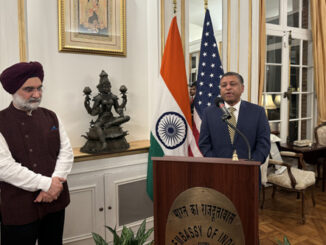
    WASHINGTON, D.C. (TIP): In his remarks at a farewell reception hosted in honor of the outgoing Indian envoy here on Thursday, January 25, Mukesh Aghi, the president and CEO of US-India Strategic and Partnership Forum (USISPF), said Sandhu’s resume of achievements remains long and impressive.

    “Ambassador Sandhu has been one of the leading architects of this relationship, which stands at its apex from the deep synergy in clean energy, education partnership, space collaboration, defense, and technology ties,” said at the farewell organized by the USISPF.

    Sandhu, 61, retires from the foreign service after 35 years of diplomatic career this month.

    However, when Ambassador Sandhu took the helm in Washington in February 2020, ominous times were about to upend the economies and suspend daily lives, Aghi said, adding that a cataclysmic pandemic meant new challenges even for a veteran diplomat.

    Sandhu steered through COVID-19, helping Indian students return home, working through visa backlogs for the diaspora, and strengthening vaccine diplomacy between the two countries.

    “A post-Covid-era saw the onset of Ambassador Sandhu helping lead the first in-principal Quad Summit in Washington, the restart of the Trade Policy Forum, and then the onset of the I2U2, IPEF, consolidating bilateral ties in multilateral settings,” he said.

    The I2U2 is a grouping of Israel, India, the United Arab Emirates and the United States to deepen technological and private sector collaboration in the region and tackle transnational challenges in six focus areas: water, energy, transportation, space, health and food security.

    The United States launched the Indo-Pacific Economic Framework for Prosperity (IPEF) along with countries like India, Australia, Indonesia, Japan, the Philippines, Singapore, Thailand, and Vietnam to advance resilience, sustainability, inclusiveness, economic growth, fairness, and competitiveness for participant economies.

    “Today, the Indo-Pacific is a priority as Ambassador Sandhu has overseen new defense partnerships, from iCET to INDUS-X, to drone transfers to jet engine manufacturing deals, from semiconductors to supply chains, ushering in a new chapter in critical technology,” Aghi said.

    The highlights of Sandhu’s tenure, he said, would be the historic state visit of Prime Minister Narendra Modi and President Joe Biden’s first visit to India as Commander-in-chief for a momentous G20 summit, and also organizing former president Donald Trump’s maiden visit to the country.

    However, one must remember that the relationship was not always smooth sailing, he noted.

    “Sandhu’s perspicacity was evinced early on, during his first Washington stint as the First Secretary (Political) as he formed crucial relations on Capitol Hill, with both Democrat and Republican lawmakers, during a time of sanctions from the Clinton Administration,” he said. “Today, the relationship is truly bipartisan, and the India Caucus and the Samosa Caucus, are in deep admiration of Ambassador Sandhu’s diplomatic efforts to steer the relationship from choppy waters then to the pristine seas now,” Aghi said.

    His second stint in Washington was as second in command to S Jaishankar, as then DCM Sandhu and Ambassador Jaishankar, wrote the beginning chapters of Prime Minister Modi’s engagement with the United States, he noted.

    “But more important than the dossiers, visits, and agreements, have been the intangible bonds of friendship that Ambassador Sandhu has forged with the diaspora. From young students to veteran business leaders, from entrepreneurs to titans, from cultural communities and caucuses, the diaspora across the US has at least one Ambassador Sandhu story,” he said.

    “Historians will note that he changed the nature of the relationship, forged new connections, strengthened the strategic partnership, and above all remained affable and humble in challenging and celebratory times,” Aghi said.

    Ashley Tellis, a top American expert on India, in his remarks, said that Sandhu has been an insidious contributor to this relationship because he understood right from the beginning how important this partnership is for the future of both countries.

    “In his last tenure here in Washington, he had to deal with a very complex environment in terms of our bilateral relationship. But the fact that we have still managed to stay the course and move this relationship ever upward is a great tribute to you, Taranjit,” Tellis said. Eminent Indian American defense expert Vikram Singh said Sandhu has been a steward of this relationship for an entire generation. “For those of us who have been involved, it’s been one of the best parts of our jobs trying to advance this relationship to have you as our partner. You are sought, kind of irreplaceable because you have this long span of history of the period of growth, dynamism, and transformation of the US-India partnership,” Singh said.

    In his remarks, Sandhu recollected the words of Prime Minister Modi at an event hosted by USISPF in the city in which he said that the US-India partnership is not just for convenience, but for conviction, compassion and of shared commitment for a better future. “So, our relationship touches the people. It is for development,” Sandhu said.
    (Source: PTI)

  • ICJ ruling vindicated us: South African President Ramaphosa after U.N. court’s decision in genocide case

    ICJ ruling vindicated us: South African President Ramaphosa after U.N. court’s decision in genocide case

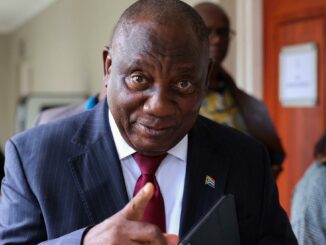
    JOHANNESBURG (TIP): South African President Cyril Ramaphosa has said the International Court of Justice has vindicated his country’s decision to charge Israel of genocide during its military offensive in Gaza. The top UN court on January 26 stopped short of ordering a ceasefire in Gaza but demanded that Israel try to contain death and damage in its military offensive. South Africa, which brought the case, had asked for the court to order Israel to halt its operation.

    The top U.N. Court decided not to throw out genocide charges against Israel for its military offensive in Gaza, as part of a preliminary decision in the case.

    In a national TV broadcast on Friday evening, Mr. Ramaphosa said the International Court of Justice on Friday issued a ruling that is “a victory for international law, for human rights, and above all, for justice”.

    “The court has concluded that pursuant to Article 9 of the (1948 Genocide) Convention, it has jurisdiction to adjudicate our application. The effect of the order that the ICJ has granted today is that there is a plausible case of genocide. This follows the unprecedented action taken by South Africa to take another country to the International Court of Justice,” he said.

    The President said the ICJ ruling marked an important first step in South Africa’s quest to secure justice for the people of Gaza.

    “Some have told us to mind our own business. Others have said it was not our place. And yet it is very much our place, as people who know too well the pain of dispossession, discrimination, and state-sponsored violence. “We are also a people who were the victims of the crime of apartheid. We know what apartheid looks like. We experienced and lived through it. Sadly, many people died and were exiled like our beloved leader Oliver Tambo and others, others were jailed, like the father of our democracy [Nelson Mandela] and others were maimed,” Mr. Ramaphosa said.

    He said, “We, as South Africans, will not be passive bystanders and watch the crimes that were visited upon us being perpetrated elsewhere. We stand on the side of freedom for all. We stand on the side of justice.” Paraphrasing a statement by Nelson Mandela made 30 years ago when he was elected South Africa’s first democratically elected President, Mr. Ramaphosa said, “We say again today, never, never and never again shall it be that acts of genocide are perpetrated with impunity as we, the international community look on.” The President said he firmly believed that following this judgment there should now be a more concerted effort towards a ceasefire.

    “Negotiations should commence on a permanent two-state solution, to enable Israel and Palestine to live side by side as independent states,” he said as he thanked those in the international community who had supported South Africa’s application to the ICJ.

    “We will not waver in our commitment to the Palestinian people and their quest for self-determination. Our own painful history obliges us to do no less. We thank the International Court of Justice for upholding its role of achieving justice, promoting peace, preventing genocide and holding those guilty of genocide accountable,” Mr. Ramaphosa said.

    South Africa filed the ICJ application on December 29 last year, arguing that Israel was in breach of its obligations under the 1948 Genocide Convention.

    The ICJ, as the principal judicial organ of the United Nations, handed down a ruling that Israel should immediately implement a set of provisional measures to prevent any further acts of genocide in Gaza, desist from such acts, and take effective measures to prevent the destruction and ensure the preservation of evidence relating to acts of genocide.

    “As the South African Government, we welcome the decision of the ICJ. We note the court’s statement that it is acutely aware of the extent of the human tragedy that is unfolding in the region and is deeply concerned about the continuing loss of life and human suffering and that the catastrophic humanitarian situation in the Gaza Strip is at serious risk of deteriorating further before the court renders its final judgement. “This order is binding on Israel, and must be respected by all states that are party to the Convention on the Prevention and Punishment of the Crime of Genocide,” Mr. Ramaphosa said in a veiled reference to the U.S., U.K. and other countries who are supporting Israel.

    “We expect Israel as a self-proclaimed democracy and a state that respects the rule of law to abide by the measures handed down by the International Court of Justice. After more than half a century of occupation, dispossession, oppression and apartheid, the Palestinian people’s cries for justice have been heeded by an eminent organ of the United Nations,” Mr. Ramaphosa concluded.
    (Source: PTI)

  • Mayor Eric Adams Unveils Gandhi Statue in Assemblywoman Jenifer Rajkumar’s Constituency

    Mayor Eric Adams Unveils Gandhi Statue in Assemblywoman Jenifer Rajkumar’s Constituency

    Mayor Eric Adams said the event “is not only a symbolic unveiling, it is a commitment that we have that we’ll continue in the footsteps of our great leader, our leader Gandhi.”

    RICHMOND HILL, NY (TIP): On Sunday, January 21, Assemblywoman Jenifer Rajkumar—the first Hindu-American elected official in New York State—brought Mayor Eric Adams and the community together to unveil the magnificent new Mahatma Gandhi statue at Shri Tulsi Mandir, a beloved Hindu temple in South Richmond Hill. The Gandhi statue replaces one destroyed as a result of two separate vandalism incidents in August 2022.

    When the statue was destroyed, Assemblywoman Rajkumar brought worldwide attention to the issue, gaining the support of the White House and drawing international news coverage. She brought together Mayor Adams and the community at the mandir, where they launched a worldwide movement for mutual understanding among all faiths and cultures. The Assemblywoman also convinced the NYPD to investigate the case as an anti-Hindu hate crime, one of the first ever classified as such in New York.

    This week, Assemblywoman Rajkumar again brought together a diverse coalition of elected officials, community leaders, and people of all faiths to celebrate the historic unveiling of a brand new Gandhi statue and the Gandhian values it embodies. Joining her and the Mayor were Assemblyman David Weprin, Councilwoman Lynn Schulman, Mayor Adams’ South Asian Community Liaison Sookranie Dhanpat, Tulsi Mandir founder Pandit Lakhram Maharaj, and Richmond Hill community leader Romeo Hitllal.

    At Sunday’s unveiling ceremony, Assemblywoman Rajkumar spoke about the Gandhian principles of ahimsa (nonviolence) and satyagraha (love), which inspired her commitment to public service. She spoke of honoring the Gandhi belief in not just respecting people of other backgrounds, but embracing them as if they are your own. Assemblywoman Rajkumar also spoke of Mahatma Gandhi’s influence on the American civil rights movement. Martin Luther King, Jr. famously spoke of how Gandhi’s nonviolent movement for social change his guiding light was. Assemblywoman Rajkumar spoke to the community about how achieving peace around the world, while not easy, is within our reach through love, hard work, and dedication.

    During the event, Assemblywoman Rajkumar said, “I am here to say that hate against any group will not be tolerated in my district, in Queens, or anywhere in New York City. Vandals may have destroyed the first statue, but nothing can destroy our belief in the Gandhian principles of love, unity, nonviolence, and peace. Today, as a symbol of our everlasting faith, we proudly unveil a brand new Gandhi statue.”

    She added, “Let us all, as Gandhi commands, be the change we wish to see in the world. Take a moment today to extend a hand and lay down the sword. Maybe even to embrace and show love to someone who does not do the same to you. It is the first step for a peaceful world.”

    Mayor Adams recounted the inspiration he continues to draw from Assemblywoman Rajkumar’s event uniting the community in 2022 in the wake of the initial hate crime, saying that the Assemblywoman truly embodies the idea of embracing other cultures as her own. He expressed his deep admiration for Gandhi, whose teachings inspire his work as Mayor. He vividly described visiting Gandhi’s home and the powerful image of his preserved footsteps, serving as a permanent reminder of the importance of nonviolence and understanding. The Mayor also praised the Richmond Hill community for their commitment to tolerance, faith, family, and hard work, which serves as a shining example for all New Yorkers.

    Mayor Adams said, “I thank you for allowing me to participate in this event. I often look at the photo we took together out front and how we all came together, and the diversity of those who were here because I agree with our Assemblywoman: our strength lies in our faith and, Assemblywoman, you personify that—your level of comfort of embracing all the different faiths in this City is what a true leader [is], not only in Albany but here in the beautiful rich neighborhood.”

    He added that the event “is not only a symbolic unveiling, it is a commitment that we have that we’ll continue in the footsteps of our great leader, our leader Gandhi.”

    Assemblywoman Rajkumar spoke about the Gandhian principles of ahimsa (nonviolence) and satyagraha (love), which inspired her commitment to public service.

    The event continued Assemblywoman Rajkumar’s extensive work to combat hate crimes and foster unity among diverse communities—a hallmark of her tenure in office. She recently passed groundbreaking legislation to address hate crimes through creation of the first ever State level Asian American and Pacific Islander Commission, which will develop policies to end anti-AAPI hate crimes. The Assemblywoman also regularly responds to hate crimes by bringing people of diverse backgrounds together in solidarity. She also led the historic movement establishing Diwali the South Asian “Festival of Lights” as a New York City public school holiday. Assemblywoman Rajkumar passed the historic Diwali bill in Albany this year to worldwide acclaim.

    Assemblywoman Rajkumar said afterward, “The unveiling of the new statue symbolizes our City’s resilience. As the statue rises, so too will love always rise above hate. A central tenet of Hinduism is inclusivity toward people of all faiths. Hindus believe not just in tolerance, but in one step more than tolerance—actively loving and welcoming people of different backgrounds and faiths. This was Mahatma Gandhi’s dream: a peaceful, loving world. We have achieved Gandhi’s dream in Richmond Hill, where Hindus, Muslims, Sikhs, Jews, and Christians live together in harmony, often on the same block. Together, we are a powerful force inspiring peace and understanding throughout the world.”

  • Top Ophthalmologists of India Discuss Important Issues in Rajahmundry Conference

    Padma Bhushan Dr K I Vara Prasad Reddy, Founder and Chairman of Shantha Biotechnics, Hyderabad, was the Chief guest.
    Dr. V.K. Raju, Clinical Professor of Ophthalmology at West Virginia University and founder and president of The Eye Foundation of America and Goutami Eye Institute welcomed the guests
    Dr R D Ravindran, Chairman of Aravind Eye Care System, Madurai delivered the ‘Dhanvantari Oration’
    Dr Jyotirmay Biswas, Director of Uveitis and Ocular Pathology Department of Sankara Nethralaya, Chennai delivered the
    Susrutha Oration’

    NEW YORK (TIP): Goutami Eye Institute and Eye Foundation of America in association with Young Ophthalmologists Society of India (YOSI) under the aegis of Indian Medical Association, Rajahmundry – Andhra Pradesh, India organized a conference on “Anybody Can Research and Innovate’ on January 7, 2024 at GSL Medical College, Rajahmundry.

    Dr. V.K. Raju, Clinical Professor of Ophthalmology at West Virginia University and founder and president of The Eye Foundation of America and Goutami Eye Institute welcomed the guests. Mr V V Kumar gave the welcome address. Padma Bhushan Dr K I Vara Prasad Reddy, Founder and Chairman of Shantha Biotechnics, Hyderabad, was the Chief guest. A record number of prominent ophthalmologists from all over India and delegates participated in the conference.

    There were three sessions in the daylong conference. The first session started with a panel discussion moderated by Dr Karan Bhatia. The panelists were Dr (Maj Gen) V S Gurunadh, Dr Y Srinivas Reddy, and Dr Kandula Satish. Some of the topics discussed were ‘How to plan a clinical trial’ by Dr Mithun Thulasidas and ‘How to write a case report’ by Dr Amanjot Kaur.

    After that, Dr R D Ravindran, Chairman of Aravind Eye Care System, Madurai delivered the ‘Dhanvantari Oration’ on ‘Epidemiology of Cataract and Cataract Surgery Trends in India.’

    Session 2 started with a free paper competitive session where each participant got 8 minutes for presentation and 7 minutes for discussion. Dr R D Ravindran, Dr Jyotirmay Biswas, Dr Y Srinivas Reddy, Dr A Prashanth Kumar, And Dr Sabyasachi Sengupta were the judges. Then there were discussions on various topics by Dr Akshay Wagh, Dr Anjali Maheshwari, Dr Ipsita Barman, among others.

    Then Dr Jyotirmay Biswas, Director of Uveitis and Ocular Pathology Department of Sankara Nethralaya, Chennai delivered the Susrutha Oration’ on ‘Polymerase Chain Reaction in Ocular Infection – Three decades of our Research.’

    The last session, which was chaired by Dr V K Raju, had a panel discussion with Dr R D Ravindran, Dr Jyotirmay Biswas, And Dr P Viswa Mithra and moderated by Dr Divyansh Mishra. The conference came to an end with vote of thanks from Dr Prashanth Kumar.


  • Indian community groups celebrate Ram Mandir opening with fervor at Times Square

    Hundreds joined in the puja and prayers even as the heart of New York City reverberated with the chants of Jai Shri Ram on January 21.

    (from left) Dr Sheetal Desai, Jagdish Sewhani and Sadhvi Bhagawati Saraswati of Parmarth Niketan, Rishikesh.

    Ardent devotees filled with joy and pride celebrating the Ram temple opening in Ayodhya.

    Parveen Chopra

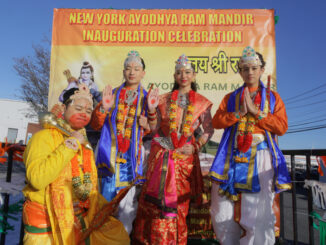
    NEW YORK CITY (TIP) : The momentous opening of Ram Mandir in Ayodhya was celebrated with full fervor at Times Square on the same day as its consecration led by Indian Prime Minister Narendra Modi.

    People from diverse Hindu communities based in the tristate area joined in as chants hailing Lord Ram reverberated in the heart of New York City.

    The event started with a havan (fire ritual) and prayers for Shri Ram, his consort Sita ji, and ardent devotee Hanuman ji. Cold weather on Sunday evening was overcome by heart-felt emotions of the people gathered, overwhelmed by the decades-long dream of the temple at Ram Janmabhoomi (birthplace) seeing the light of day.

    The event was attended by prominent community leaders including Master Chef Vikas Khanna who said he was there to pay homage to Bhagwan Ram and to be in the special moment.

    Sadhvi Bhagawati Saraswati from Parmarth Niketan, Rishikesh also joined the divine celebration, energizing the gathering. She said Ram is a messenger and embodiment of righteousness, peace, love, oneness, togetherness, and justice, which is what our world needs today. She added that the spirit, love, and message from Ayodhya not only have spread across India, but also to every corner of the world, so together we may move into a new era of oneness and goodness.

    Dr. Sheetal Desai, a community leader, said we should include qualities of Ram, Sita and Hanuman ji in our lives.

    Dinesh Chandra Mozumdar, Founder of Hindu Coalition of USA, said his Bangladeshi Hindu community is excited to celebrate this glorious event.

    Veteran Hindu community leader Jagdish Sewhani, Sridhar Shanmugam from Saneeswara temple and Rupa ji chanted Ram Stuti and all attendees started dancing with joy at the historic celebration at the iconic Time Square.

    The energy and positivity that permeated the atmosphere was heartwarming. Witnessing the unity of diverse communities to celebrate the consecration of the Ram Mandir in Ayodhya was a testament to the spirit of harmony and inclusivity that the event in India has inspired.

    May the blessings of Lord Ram continue to inspire us towards a path of righteousness, love, and unity, a press release from the organizers said.


    ( Parveen Chopra is the Founder and Editor of ALotusInTheMud.com, a wellness and spirituality web magazine)

  • New Yorkers celebrate Rama Mandir consecration with Car Rally

    New Yorkers celebrate Rama Mandir consecration with Car Rally

    Hundreds of devotees gathered to celebrate and show solidarity to Ram Mandir consecration in Ayodhya.

    LONG ISLAND, NY (TIP): The windy, freezing Sunday with sub-zero temperatures afternoon saw enthusiastic Indian Americans show their support for the Ram Lalla consecration in Ayodhya, thousands of miles away. A car rally was organized in Hicksville in Long Island, New York. Hicksville is a hamlet within the Town of Oyster Bay in Nassau County, on Long Island, in New York, with large Indian population.

    The rally started from Patel Brothers in Hicksville. 150 cars participated in this rally, which halted midway at a Gurudwara in Hicksville. Dr Raj Bhayani said, “The Hindu, Sikh, Jain and Buddha communities have all united to celebrate this historic moment.”

    The float had DJ which played Bhajan songs devoted to Rama.
    LED truck with three screens played videos on Ramayana. And images of Rama Mandir.
    Everyone was wearing the saffron scarf with Hanuman and Rama pictures in it.
    And cold conditions could not dampen the enthusiasm and the celebratory mood.
    In addition to cars, floats and LED truck there were children dressed as Ramayana characters Rama, Sita , Laxman, and Hanuman which really brought the experience and excitement to the rally.
    The organizers for the rally were Dr Raj Bhayani. Mukesh Modi and Dr Dipak Nandi, Mohan Wanchoo, Naveen Shah, Chintu Patel, Gary Sikka and Dr Neeta Jain. The committee comprised of Sunil Hali, Gobind Bathija, Pradeep Tandon, Dr Urmilesh Arya, Vimal Goyal, Eric Kumar, Kanak Golia, Kishore Malik, Harshad Bhai Patel, Vibhuti Jha, Mohinder Taneja, Dr Satish Anand, Dr Inderpal Chhabra, and Ajay Patel

    Each car was adorned with saffron-colored flags. The huge lineup of cars finally reached the beautiful Asa Mai temple in Hicksville. LED Truck displayed Ramayana and float carried the banners celebrating Ram Mandir.
    The devotees enjoyed an enchanting evening of bhajans and a Ramleela. The entire event was telecast live on AASTHA TV and Radio Zindagi

    The float had DJ which played Bhajan songs devoted to Rama
    Organizers. L to R : Indu Jaiswal, Gary Sikka, Dipak Nandi, Raj Bhayani, Pradeep Tandon, and a guest
  • Scrutiny Builds Over Mazi Pilip’s Personal Finances

    Scrutiny Builds Over Mazi Pilip’s Personal Finances

    GLEN COVE, NY (TIP): In the special election to replace George Santos, Conservative and Republican candidate Mazi Pilip is continuing to face questions and scrutiny around transparency regarding her personal finances.

    Newsday, on January 24, built on recent reporting from The New York Times and revealed that Pilip disclosed substantial discrepancies between her federal and local financial disclosures, including investments around her husband’s multiple medical start-ups, as well as the salary she made from her husband’s medical practice.

    Suozzi Senior Advisor Kim Devlin released the following statement in response:

    “This raises serious questions about the lack of vetting the Republican Party bosses conduct in naming their candidates. First George Santos and now Mazi Pilip with the murky personal finances. No wonder Mazi Pilip is refusing to meet with voters. The more we learn about her the more questions it raises.”

    “Pilip, in the county filing last May, detailed investments with her husband such as a co-op and medical startups. Her campaign said disclosure of the holdings was not required on the federal report Pilip submitted recently to the Clerk of the House of Representatives, disputing the opinion of an ethics watchdog.

    On both the county and federal disclosures, Pilip also reported income earned from her husband Dr. Adalbert Pilip’s medical practice, New York Comprehensive Medical Care, despite her campaign having said she stopped working there in 2021.

    Pilip initially had reported to the House clerk earnings of $50,000 in each of the last two years from the medical practice, where she said she worked as operations director. Pilip spokesman Brian Devine has said the House disclosure was a draft filed in error. In a revised version filed days later, Pilip reported no income from the practice in 2023 and $13,472 in 2022.

    The federal disclosures said Pilip and her husband owed the Internal Revenue Service between $100,000 and $250,000 in income tax as of April 2023. The campaign has said the debt has been paid.

    The May 2023 county disclosure also listed a debt to the IRS but didn’t specify an amount or date.

    In the Nassau disclosure, Pilip said her husband was an owner or partner in three businesses besides his main medical companies listed on the federal forms. The ventures include Infuse Chi, described in a 2022 news release as “an all-natural electrolyte hydration” powder.

    Devine said in a statement the businesses “have not taken off and have no value. As such, it is not appropriate for these entities to be reported in [the federal] disclosure.”

    The county form also listed Mazi and Adalbert Pilip as owners of a co-op in addition to their home in Great Neck. Devine said Mazi Pilip’s in laws reside at the co-op, it yielded no rental income and that lawyers with knowledge of federal reporting guidelines advised the campaign that it was not subject to disclosure.

    The property was listed on the county form under the investments category, and Kedric Payne, senior director of ethics at the Campaign Legal Center, a nonprofit watchdog in Washington, D.C., said “federal financial disclosure laws require disclosure of investment property even if it did not generate rental income.”

    What is Pilip hiding?

  • January 26, 2024, New York & Dallas E – Edition

    [vc_row][vc_column][vc_custom_heading text=”E-Edition” font_container=”tag:h2|text_align:center” google_fonts=”font_family:Istok%20Web%3Aregular%2Citalic%2C700%2C700italic|font_style:700%20bold%20regular%3A700%3Anormal” link=”url:https%3A%2F%2Fwww.theindianpanorama.news%2Fwp-content%2Fuploads%2F2024%2F01%2FTIP-January-26-E-Edition.pdf”][vc_single_image image=”158105″ img_size=”full” alignment=”center” onclick=”custom_link” link=”https://www.theindianpanorama.news/wp-content/uploads/2024/01/TIP-January-26-E-Edition.pdf”][/vc_column][/vc_row][vc_row][vc_column width=”2/3″][vc_custom_heading text=”Lead Stores This Week” google_fonts=”font_family:Istok%20Web%3Aregular%2Citalic%2C700%2C700italic|font_style:700%20bold%20regular%3A700%3Anormal” link=”url:https%3A%2F%2Fwww.theindianpanorama.news%2F”][vc_wp_posts number=”5″ show_date=”1″][/vc_column][vc_column width=”1/3″][vc_single_image image=”82828″ img_size=”medium” alignment=”center” onclick=”custom_link” link=”https://www.theindianpanorama.news/advertising-media-kit-portal-indian-panorama/ “][vc_single_image image=”82829″ img_size=”medium” alignment=”center” onclick=”custom_link” link=”https://www.theindianpanorama.news/advertising-media-kit-portal-indian-panorama/ “][/vc_column][/vc_row]

  • 2024 Is The Time To Address Nassau’s Most Pressing Issues

    By Siela A. BynoeSiela A. Bynoe

    As we embark upon 2024 and a new term of the Nassau County Legislature, we do so at a truly evolutionary time.

    During our organizational meeting on Jan. 8, we welcomed five new Legislators, as well as six new caucus leaders within our group of 19 elected representatives. As part of that transition, I have accepted Minority Leader Delia DeRiggi-Whitton’s appointment to serve as the Legislature’s Alternate Deputy Minority Leader. I am humbled and gratified by the decision and excited for this opportunity to be of greater service to my colleagues and the residents of Nassau County and our region.

    At a time of such profound change, there is value in pausing to review fundamentals of our legislative process, with the term of governing being key among them. Nassau’s Legislature operates in two-year cycles, and we have just started our 15th term. Any pending, unresolved legislative items from the prior term expired at the start of the year and must now be re-submitted as part of the new business before us.

    Among the items that were not acted upon were important legislative initiatives that would confront the maternal mortality crisis, add Juneteenth to the County’s list of paid holidays, safeguard our cybersecurity, and protect consumers in the marketplace. I plan to reintroduce these and other items, including the plan I discussed in a previous column for providing Project – Lifesaver technology to cognitively vulnerable, income-eligible individuals.

    As our neighbors in Suffolk County continue to grapple with the fallout from the crippling cyberattack that still reverberates through its daily operations, we are reminded that Nassau County is not immune from this ongoing threat, and I will be re-filing legislation to create an in-house cybersecurity team headed by a Deputy Commissioner of Cybersecurity. This individual and team would be directly accountable to the County Executive for protecting our systems from threats, maintaining the integrity of our IT infrastructure, bolstering resiliency and recovery strategies, and further augmenting the department’s expertise by retaining subject-expert consultants.

    We are also tasked with confronting maternal mortality – a crisis which has an especially disparate impact upon Nassau County’s communities of color. Recent data from the New York State Department of Health reveals the shocking fact that Nassau County’s Black infant mortality rate, recorded at 7.8 per 1,000 live births from 2018 to 2020, is in fact worse than the rates in Brooklyn (6.8), the Bronx (6.9), Manhattan (6.6) and Westchester (5.9) during the same period. I will resubmit legislation to establish a dedicated Nassau County task force consisting of department heads, medical experts and maternal health advocates who will be tasked with devising strategies for saving lives, preventing dangerous medical complications, and addressing the institutional healthcare disparities that have allowed this issue to persist for far too long.

    Our work for the New Year must also include the reevaluation of Nassau County’s approaches to protecting consumers from misinformation in the marketplace. Like many of you, I use non-cash forms of payment for many transactions. I enjoy the convenience of not carrying sums of cash with me, and I take comfort in negotiating transactions in the safest possible manner.

    While New York State law allows vendors to charge consumers for using credit cards, they must do so within very defined parameters. One of my biggest frustrations emerges when I see a price posted for a product or service – and then being told I will be charged an additional 3- or 4-percent fee to use a credit card. The correct way to comply with the law is to post the higher credit card price – preferably alongside the cash price – but the law is commonly misapplied.

    Faced with this landscape, I have reintroduced legislation that would direct Nassau’s Department of Consumer Affairs to create, plan, and oversee regular educational outreach to merchants and consumers – through direct mail, digital means such as websites and social media, and PSAs – on state laws governing cash discount policies. To aid Consumer Affairs in any necessary enforcement, a dedicated hotline and/or online portal for reporting possible violations would also be established.

    My goal is to educate business owners so that they self-correct their practices – accordingly, the law provides for a three-month grace period during which time a business will be given five business days to cure violations. However, enforcement is an essential arm of any consumer protection strategy. If a violation is not cured during the five-day window, or a violation occurs after the three-month grace period, the business owner in question will be fined up to $500 for each violation.

    I hope that this overview of my priorities for the initial stages of the new term underscores the important and diversified role of our Legislature in the daily lives of the people we are entrusted with serving. Your input is crucial for focusing and expanding the scope of our efforts, and I am looking forward to working with you to make Nassau County a more vibrant, inclusive, and prosperous place to live, work, and raise a family.

    (Siela A. Bynoe, of Westbury, is the Alternate Deputy Minority Leader of the Nassau County Legislature. She has represented the Second Legislative District since 2014)

  • Asia Society names South Korea’s ex-foreign minister as president & CEO

    Asia Society names South Korea’s ex-foreign minister as president & CEO

    NEW YORK (TIP): The Asia Society, a leading think-tank, on Wednesday, January 24, named as its president and Chief Executive Officer the former foreign minister of South Korea, Kyung-wha Kang, known for her ”deep relationships across Asia and with the US.” An accomplished diplomat who served as South Korea’s 38th Minister of Foreign Affairs from 2017 to 2021, Kang is the first woman to serve the role in the nation’s history.

    Headquartered in New York, the Asia Society was founded in 1956. It is a leading nonpartisan, nonprofit global organization that promotes mutual understanding and strengthens partnerships among people, leaders, and institutions across Asia and beyond.

    ”I am deeply honored and excited to be Asia Society’s next President and CEO,” Dr Kang said.

    ”Since its founding, Asia Society has been the world’s leading nonprofit organization to enhance knowledge and understanding about Asia and create bridges between the region and the rest of the world. Today, that mandate is more important than ever,” she said.

    “Asia Society, with a deep focus on policy, arts, culture, and education, is the pre-eminent global NGO to engage in both soft power and inclusive policy solutions—both sorely needed in a world of geopolitical tensions,” Kang said.

    “In selecting Kyung-wha Kang to be Asia Society’s next leader, we continue a tradition of bringing individuals with deep diplomatic experience to build bridges and foster greater understanding between nations in an uncertain world,” said John L Thornton, Co-Chair of the Asia Society Board of Trustees.

    “The need for this role and these skills has seldom been greater. We are confident that former Foreign Minister Kang will be a trusted voice on both sides of the Pacific and around the world,” he said.

    Stephen Biegun, the former US Deputy Secretary of State, said, “Former Foreign Minister Kang is a fantastic choice to lead the Asia Society. She was a great partner and courageous leader during the time that we served together in our respective governments.”

    ”Kyung-wha is a highly respected diplomat, and her deep relationships across Asia and with the United States will serve the Asia Society well,” he added.

    Ban Ki-moon, the former UN Secretary-General, said, “I am confident that her (Kang’s) intellect, vision, experience, and diplomatic and leadership skills will be of immense benefit to Asia Society, which is a storied global NGO that is well-positioned to leverage its expertise in both policy solutions and soft power to build bridges and deepen understanding.”
    (Based on a press release)

  • Jury order Donald Trump to pay $83 million to Jean Carroll in damages for defamation

    Jury order Donald Trump to pay $83 million to Jean Carroll in damages for defamation

    NEW YORK (TIP): A jury in New York ordered former U.S. President and 2024 candidate Donald Trump on Friday to pay $83.3 million to compensate the writer E. Jean Carroll whom he was found to have sexually assaulted and defamed. The civil order, which prompted an audible gasp in the federal court, far exceeds the more than $10 million in damages for defamation that Ms. Carroll had sought.

    Mr. Trump lashed out almost immediately calling the verdict “ridiculous” in a statement and promising to appeal.

    The jury reached its decision after slightly less than three hours of deliberations.

    Mr. Trump had been in court earlier, storming out at one point to subsequently return for closing arguments. He was not in court when the level of compensatory and punitive damages was read out by a court clerk.

    Following the verdict, Mr. Trump’s lawyer Alina Habba spoke only to thank court staff.
    “It’s clear to me… you paid attention,” Judge Lewis Kaplan told the jury following the verdict.

    The order was comprised of $65 million punitive damages after the jury found Mr. Trump acted maliciously in his many public comments about Ms. Carroll, $7.3 million in compensatory damages, and $11 million for a reputational repair program.

    Mr. Trump — whom a jury found liable for sexual assault of Ms. Carroll in a separate federal civil case in New York — used his Truth Social platform to fire off a spate of insulting messages attacking Ms. Carroll, the trial, and the judge, whom he called “an extremely abusive individual.” Mr. Trump, 77, briefly took the stand on Thursday, January 25 to deny he instructed anyone to harm Ms. Carroll with his statements.

    During Mr. Trump’s testimony, Judge Lewis Kaplan limited him to three questions from his lawyers, to which he could only answer yes or no — a precaution taken to prevent the Republican leader from returning to his custom of disparaging the court or Ms. Carroll in public.

    “This is not America,” Mr. Trump said as he left the courtroom following his short appearance.

    He was not required to attend the trial or to testify. However, he has used the case, as well as others he faces, to generate heated media coverage and to fuel his claims of being victimized as he campaigns for a return to the White House in November’s election.

    Mr. Trump separately faces multiple criminal cases, including his alleged attempt to overthrow the results of the 2020 Presidential election, which he lost to Joe Biden, and a civil business fraud case.

    Courtroom tension
    Ms. Habba sought to have the case thrown out Thursday on the grounds that threatening messages targeting Ms. Carroll, which have been aired in the case, began on social media before Mr. Trump’s 2019 comments. Her request was denied. Jurors were shown Mr. Trump’s October 2022 deposition during which he confused a picture of Ms. Carroll for his former wife Marla Maples, which threatened to cast doubt on his claim Ms. Carroll was not his “type.” Last year, another federal jury found Mr. Trump liable for sexually assaulting Ms. Carroll in a department store dressing room in 1996 and subsequently defaming her in 2022, when he called her a “complete con job.”

    Mr. Trump had been in court while he campaigned ahead of the New Hampshire primary, which he won handily over his only remaining challenger Nikki Haley, as he closes in on becoming the Republican candidate in the November election against Mr. Biden.

  • India-US relationship has deepened in intensity, matured in character, and expanded in scope: Ambassador Sandhu

    India-US relationship has deepened in intensity, matured in character, and expanded in scope: Ambassador Sandhu

    WASHINGTON, D.C. (TIP): “The relationship between the world’s two largest democracies has deepened in intensity, matured in character and expanded in scope”, India’s outgoing ambassador to the US Taranjit Singh Sandhu has said.

    Sandu, 61, who retires later this month from the foreign service after more than 35 years. on Wednesday, January 24, made these remarks at a farewell ceremony held in his honor with the community leaders at the India House here.

    “India, United States relationship has deepened in intensity, matured in character, and expanded in scope, as I say so many times that it touches almost all spheres of human activity: tech, trade, defense, space, healthcare, education, skilling, people to people, space ties,” Sandhu said in his address on Wednesday at a farewell ceremony held in his honor with the community leaders at the India House here.

    During his service, Sandhu has served in the US three times, the last being India’s Ambassador to the US for four years.

    “So much is happening in these areas. And this transformation, as most of you have seen, has happened in the last 10 years. In fact, some friends are here,… when we conducted the nuclear test in 1998, the sanctions were put on India. That was my first exposure and experience with challenging times,” he said.

    “I recall the late Ambassador Naresh Chandra, and I walked with him. I told him that there’s one setup, which I’m the liaison for, that is the US Congress. When there was difficulty in getting meetings outside, the US Congress will open its doors, and that’s why I say that the US Congress is the pioneer in creating the foundation of this relationship,” Sandhu said.

    During his term as India’s Ambassador to the US, he met more than 300 Congressmen and about 75 Senators.

    “I must say in each of those interactions, we found positivity. And that’s where my own positivity came out, that whatever crisis the United States, India partnership is there to remain and progress ahead,” Sandhu said.

    “I will say that we have still reached the tip of the iceberg. There is so much to be covered,” he said.

    Senator Mark Warner, Chairman of the Senate Intelligence Committee and Co-Chair of the Senate India Caucus applauded Sandhu for his service and building the bilateral ties.
    “I will make one prediction that while Ambassador Sandhu may be leaving this post, I believe and I hope with all my heart, that he has more public service in his future,” Warner said.

    John Podesta, senior advisor to the president for clean energy innovation and implementation praised the ambassador for his role in strengthening the India-U.S. relationship.

    “We’ve developed a great friendship and a great partnership and our government has done tremendous work together,” he said.

    Senator Jon Ossoff from Georgia said that the Ambassador helped in resolving several of the agricultural disputes and tariff issues between the two countries. Senator Amy Klobuchar said that this is a relationship between the countries that has always been strong but is on the move in the right direction.

    “We can’t wait to see what you’ll do next. But thank you for your incredible service,” she said.

    Nisha Desai Biswal, Deputy CEO of the US International Development Finance Corporation speaking at the farewell ceremony said that Ambassador Sandhu has been working on this relationship for over three decades.

    “In his many different tours of duty, he has been working to ensure that this relationship is not just government to government, that it is not just about ties between our parliaments, but that it reflects the really deep and rich relationship between our people,” she said.

    “He recognized very early on the importance of the diaspora community in elevating this relationship. In my very first work in Congress as a staffer, I will say Ambassador Sandhu in his role as the political officer of the embassy, was constantly exhorting all of us to say that there must be more ambition in the US-India relationship.

    You must think about ways to deepen that collaboration. And I just have to say that his instinct for this relationship as being foundational for not just our two governments, but our two societies, has been a really important aspect of how this partnership has developed over the decades,” she said.

    Bawa Jaswinder Singh, the US head of the Buddha Dal Sikh Organisation presented an award to Ambassador Sandhu in recognition of his contribution and the legacy of his family. (TIP photo)

    During the event, Sandhu was presented with an award on behalf of the Buddha Dal Sikh Organisation in recognition of his contribution towards Sikh and the legacy of his family.

    Sikh community leader Sukhpal Singh Dhanoa told the audience that it was decided at the time of 200 years of Baba Phoola Singh’s birth anniversary to present this award to the ambassador.

    Bawa Jaswinder Singh, the US head of the organization, presented the award on behalf of Baba Balbir Singh, its India head.

    A successor to Sandhu has not been announced, yet.
    (Source: PTI)

  • India’s Military Might, Woman Power on display at the 75th Republic Day Celebrations

    India’s Military Might, Woman Power on display at the 75th Republic Day Celebrations

    The twin themes of ‘Viksit Bharat’ and ‘Bharat – Loktantra Ki Matruka’ reflected throughout in this year’s parade which witnessed the participation of 13,000 special guests

    NEW DELHI (TIP): Despite the cold and thick layer of fog covering the national capital, lakhs of people reached the Kartavya Path as President Droupadi Murmu led the processions of India’s 75th Republic Day.

    A show of culture, diversity, military strength, women empowerment, and above all a show of ‘Viksit Bharat’ (developed India) and ‘Bharat – Loktantra ki Matruka,’ (India – mother of democracy) this diamond jubilee for India was led by the accomplished women of the nation.
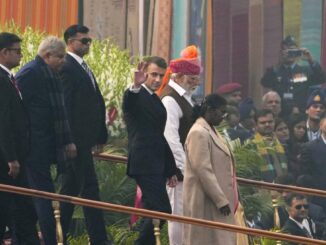
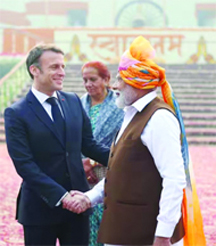
    The celebrations took place in New Delhi, with French President Emmanuel Macron as the Chief Guest.

    The cultural vibrance of India was on full display this year, with over 13,000 special guest – an initiative which provided an opportunity to people from all walks of life to take part in the celebrations and encourage ‘jan bhagidari’ (people’s participation).

    ALSO READ

    Republic Day parade to be women-centric, showcasing India as ‘mother of democracy’
    Throughout the parade, 13,000 women reached the centre stage in a display of national strength and vibrance.

    For the first time ever, the parade was heralded by over 100 women artists who played Indian musical instruments. The parade commenced with the music of Sankh, Naadswaram, Nagada, etc. which was played by women artists.

    It also witnessed the maiden participation of an all-women Tri-Service contingent marching down the Kartavya Path. Women pilots also enthralled the audience during the Fly-past, representing nari shakti (women’s power). The contingents of the Central Armed Police Forces also consisted of only women personnel.

    The parade began at 10.30 a.m., when Prime Minister Narendra Modi visited the National War Memorial, where he paid solemn tributes to the fallen heroes by laying a wreath.

    The President of India and her French counterpart were escorted by the President’s bodyguard – ‘Rashtrapati ke angrakshak’ which is the senior most Regiment of the Indian Army. This elite Regiment as the ‘angrakshak’ (bodyguard) have completed 250 years of service since its raising in 1773. The two Presidents arrived in the traditional buggy, the practice which is making a comeback after a gap of 40 years.

    As people patiently waited for the sun to shine, India’s National Flag was unfurled by Major Saumya Shukla ASC, which was followed by the National Anthem with a booming 21-gun salute given with indigenous gun system 105-mm Indian Field Guns. Four Mi-17 IV helicopters of 105 Helicopter Unit showered flower petals on the audience present at Kartavya Path.

    The parade then commenced with the President, who took the salute. The parade was commanded by Parade Commander, Lieutenant General Bhavnish Kumar, General Officer Commanding, Delhi Area, a second-generation Army officer. Major General Sumit Mehta, Chief of Staff, HQ Delhi Area was the Parade Second-in-Command.

    The highest gallantry awards this year included Param Vir Chakra winners — Subedar Major (Honorary Captain), Yogendra Singh Yadav (retd.) and Subedar Major Sanjay Kumar (retd.), and Ashok Chakra winners Major General CA Pithawalla (retd.), Colonel D. Sreeram Kumar and Lt. Col. Jas Ram Singh (retd.).

    The Param Vir Chakra is awarded for the most conspicuous act of bravery and self-sacrifice in the face of the enemy, while the Ashok Chakra is awarded for similar acts of valor and self-sacrifice but, other than, in the face of the enemy.

    For the first time ever, the French Air and space force joined the fly past over Kartavya Path with two French Rafales and one A330 MRTT. France is the first foreign country to join the fly past, similarly the French regiment was the first one to have marching contingent at the parade in 2016.

    The Air Force tableau showcased the idea of atma nirbharta (self-reliance), which depicted IAF C-295 transport aircraft being flown by two women aircrew.

    For the first time, Delhi police had its all women contingent participating in the parade. Over 15 State tableau and 8 Ministry, defense and other departments tableaus, all decorated also made their presence known.

    While Meghalaya and Council of Scientific and Industrial Research’s tableaus brought in rich flowery visuals of cherry blossoms and lilacs respectively, the Arunachal Pradesh tableau was focused on its “bugun community reserve” a biodiversity hotspot in the State.

    All tableaus put women in the front and centre of the show including the Indian Space Research Organisation which highlighted the landing of Chandrayan-3 and the women scientists who contributed to it.

    Among the grand showcase of mechanized columns and missile systems, were the march-past by marching contingents — the Madras Regiment, The Grenadiers, the Rajputana Rifles, the Sikh Regiment, and the Kumaon Regiment. To showcase the spirit of nari shakti, around 1,500 female dancers performed on 30 folk dances, including Kuchipudi, Kathak, Bharatnatyam, Satriya, Mohiniyattam, Manipuri and more. Out of 1,500, 199 were tribal dancers, 486 were folk artists, 399 dancers were trained in classical, and 56 were Bollywood.

    The parade ended with the fly-past in the sky, with different formations like — Arjan, Netra, Varuna, Bheem, Trishul and Vijay — which was formed by Rafale.

  • Indian Consulate in New York Celebrates Republic Day

    Indian Consulate in New York Celebrates Republic Day

    Consul General addresses the gathering

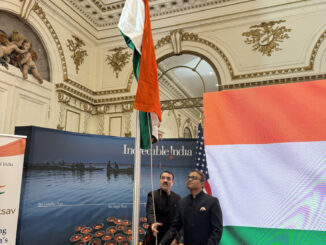
    NEW YORK CITY (TIP): 75th Republic Day of India was celebrated at the Indian Consulate here on Friday January 26th, which was attended by a large number of Indian Americans.

    New Jersey State Senator Raj Chatterjee addresses the gathering.

    Consul General of India Binaya S Pradhan unfurled the national flag of India. The unfurling was accompanied by the singing en mass of the Indian National Anthem. Ambassador Pradhan then addressed the gathering. He congratulated the gathered Indian American community on the 75th Republic Day of India and thanked them for the great contribution that they were making to India’s growth story and to the strengthening of relationship between India and the US. He then read out the President’s Address to the Nation.

    Governor of New York State Kathy Hochul, via video, congratulated the Indian American community on the Republic Day of India and spoke appreciatively of the contribution of the Indian American community.

    Also present on the occasion was Senator Raj Chatterjee from New Jersey State who addressed the gathering.

    A couple of patriotic songs were sung by three ladies from Bharatiya Vidya Bhavan.

    Dr. Varun Jeph, the deputy consul general thanked the gathering .

    Consul HOC & CPIO Vishal Jayeshbhai Harsh was the master of ceremonies .

    The celebrations ended with a sumptuous refreshment graciously hosted by the Consulate General of India.

    Ladies from the Bharatiya Vidya Bhavan rendering patriotic songs
    A view of the gathering.
    Deputy Consul General Varun Jeph thanks the gathering.
  • Maratha quota activist Manoj Jarange calls off protest over reservation issue

    Maratha quota activist Manoj Jarange calls off protest over reservation issue

    Maratha quota activist Manoj Jarange on Saturday, January 27, said he had called off his protest over the reservation issue, saying the Maharashtra government had accepted all the demands. He expressed satisfaction that the government had issued a notification to issue Kunbi caste certificates to all relatives of the Marathas whose records (linked to Kunbi caste) had been found. He made the announcement at Vashi in neighbouring Navi Mumbai, where he camped overnight with thousands of supporters after reaching the place on Friday morning.
    Chief Minister Eknath Shinde is set to meet Jarange. Both are likely to address the people present there. Jarange on Friday made a fresh demand that the government amend its free education policy to include all Marathas until the benefit of reservation becomes available to the entire community.
    He has sought data of the 37 lakh Kunbi certificates issued by the state government. Kunbi, an agrarian community, falls in the Other Backward Classes category, and Jarange has been demanding Kunbi certificates for all Marathas.

  • Boost for bilateral ties, India and France seal key deals

    Boost for bilateral ties, India and France seal key deals

    New Delhi (TIP) – India and France have agreed to a new road map for defence industrial cooperation to identify opportunities for partnership in the sector including co-designing, co-development and co-production of military hardware, the two countries will jointly produce a multi-mission helicopter in India, and French engine maker Safran is willing to transfer 100% technology to build fighter jet engines in the country, top officials said on Friday, January 26, a day after Prime Minister Narendra Modi and French President Emmanuel Macron held extensive talks to deepen strategic ties.
    The two counties have also reached agreements on defence space partnership, satellite launches, joint research in clean energy, health care cooperation, collaboration in the field of public administration, and activation of five-year validity of Schengen visas for Indian students pursuing their Master’s degree in France, foreign secretary Vinay Kwatra said, briefing the media on the outcome of the talks between the two leaders.
    Tata and Airbus Helicopters will partner to produce the H125 helicopters in India with a significant indigenous and localisation component, he said.
    This will be India’s first helicopter assembly line in the private sector under the government’s “Make in India” initiative. The production of the first made-in-India H125 helicopter is expected to commence in 2026, people aware of the matter said. The helicopter can carry up to six passengers.
    “The two countries have agreed to adopt the defence production road map. The priority of defence cooperation through this road map is to actually identify opportunities for partnership in the defence industrial sector that prioritise co-designing, co-development, co-production and also building the defence supply chains between the two countries so that they cannot only fulfil the defence needs of India and France but also can be a useful contributor to the security partnership with other countries who might be in use of similar products,” Kwatra said, in response to a question. Elaborating on the scope of the cooperation, he said it will encompass both air and space technologies, maritime technology including underwater domain awareness, equipment and systems related to land warfare, robotics, artificial intelligence, autonomous vehicles and platforms, and cyber defence.
    “This flows from what the two countries agreed to in the Horizon 2047 Roadmap last year…The focus is on defence production and manufacturing in a manner that you can harness the compatibilities and competencies which the two economies have and the two engineering systems have and then use it to further strengthen your defence cooperation.”
    Macron’s visit seeks to consolidate the ambitious renewal of the India-France strategic partnership that the two leaders decided on in Paris last July through the Horizon 2047 Roadmap. The French President’s visit has been very heavy in terms of its substantive outcome as well as the richness of discussions between the two leaders, he said.
    France could step in to help India design and develop fighter jet engines.
    On the Safran engine for India’s fighter jet programme, India’s ambassador to France Jawed Ashraf, who was present at the briefing, said, “The issue is really about arriving at a set of specifications that comply with our future fighter jet requirements. So this always features in the conversation between the President and the PM because what we are looking for is not just a manufacturing transfer of technology which essentially keeps you going with the same crutches that you have been going on for the last six decades.

  • 2024 Lok Sabha polls: 96 crore citizens, including 47 crore women, eligible to cast vote

    2024 Lok Sabha polls: 96 crore citizens, including 47 crore women, eligible to cast vote

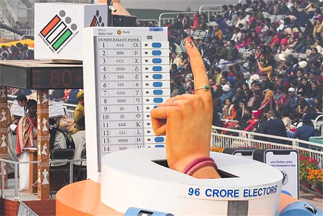
    Over 96 crore people, including 47 crore women, are eligible to cast vote in the upcoming Lok Sabha elections, for which more than 12 lakh polling booths would be set up across India. Over 1.73 crore of those eligible to vote are in the age group of 18 to 19 years, according to Election Commission (EC) data.
    As many as 1.5 crore polling personnel would be deployed to ensure smooth conduct of the parliamentary elections to elect members of the 18th Lok Sabha.
    According to a 2023 letter sent by the EC to political parties, India had 17.32 crore registered voters in 1951, which rose to 19.37 crore in 1957.
    There were 91.20 crore voters in the 2019 polls. Out of the total voters registered in the electoral rolls, nearly 18 lakh are persons with disabilities. In the first Lok Sabha elections, the voter turnout was recorded at 45 per cent. It was 67 per cent in the last parliamentary polls.

  • Temple existed at the site of Gyanvapi mosque: ASI report

    Temple existed at the site of Gyanvapi mosque: ASI report

    Varanasi (TIP)- In a significant development, Archaeological Survey of India (ASI) in its scientific survey report on the Gyanvapi mosque has concluded that there existed a Hindu temple at the site of the Gyanvapi mosque prior to the construction of the mosque. As per the report, the pre-existing structure was destroyed in the 17th century during the reign of Mughal emperor Aurangzeb.
    “The pre-existing structure appears to have been destroyed in the 17th century, during the reign of Aurangzeb, and part of it was modified and reused in the existing structure. Based on scientific studies/ survey carried out, study of architectural remains, exposed features and artefacts, inscriptions, art and sculptures, it can be said that there existed a Hindu temple prior to the construction of the existing structure,” the report, a copy of which is with Bar & Bench, said. Further, sculptures of Hindu deities and carved architectural members were found buried underneath, the report stated.
    The survey was done and the report was prepared after the Varanasi district court ordered the same while hearing suits filed by Hindu parties claiming that a temple existed at the spot prior to the mosque.
    In July last year, the court had ordered the Director of the ASI to conduct a scientific survey of the Gyanvapi mosque premises, excluding the area previously sealed by the Supreme Court (wuzukhana or an ablution pond). Pursuant to the same, the ASI had carried out the survey. The other relevant excerpts from the ASI report are:
    Pillars and Pilasters
    A total of 34 inscriptions were recorded during the present survey and 32 Estampages were taken. These are, in fact, inscriptions on the stones of the pre-existing Hindu temples, which have been re-used during the construction/ repair of the existing structure. They include inscriptions in Devanagari, Grantha, Telugu and Kannada scripts. Reuse of earlier inscriptions in the structure, suggest that the earlier structures were destroyed and their parts were reused in construction/repair of the existing structure. Three names of deities such as Janardhana, Rudra, and Umesvara are found in these inscriptions.
    Order to demolish the temple
    During the recent survey, a stone with inscription was recovered from a room in the mosque. However, the lines relating to construction of the mosque and its expansion have been scratched out. This is also brought out by the biography of Emperor Aurangzeb, Maasir-i-Alamgiri, which mentions that Aurangzeb “issued orders to the governors of all the provinces to demolish the schools and temples of the infidels” (Jadu-Nath Sarkar).
    Hindu deities sculptures found buried
    Sculptures of Hindu deities and carved architectural members were found buried under the dumped soil in a cellar. Existing architectural remains, decorated mouldings on the walls,kama-ratha and prati-ratha of central chamber, a large decorated entrance gate with torana on the eastern wall of the western chamber, a small entrance with mutilated image on lalat bimba, birds and animals carved for decoration in and outside suggest that the western wall is remaining part of a Hindu temple.

  • Nitish inches closer to alliance exit; BJP ready

    Nitish inches closer to alliance exit; BJP ready

    New Delhi/Patna (TIP)- Bihar’s ruling coalition appeared at breaking point on Friday, January 26, with the Janata Dal (United), its ally Rashtriya Janata Dal, and the opposition Bharatiya Janata Party all corralling their lawmakers and calling meetings over the weekend as speculation about chief minister Nitish Kumar’s joining the National Democratic Alliance (NDA) reached fever pitch. If Kumar makes the switch, as rumoured, it will be the fourth such move in the past decade and the second this term.
    Signs of plummeting ties in the ruling alliance were apparent after deputy CM Tejashwi Yadav skipped the Republic Day celebrations at Raj Bhavan, where Kumar was present. The two didn’t exchange a word in the parade held in Patna soon after. “Ask those who were not present why they skipped the function,” said Kumar to reporters. At Raj Bhavan, the CM was seen chatting with the leader of the Opposition Vijay Kumar Sinha, and JD(U) minister Ashok Choudhary was sitting on the chair allotted for the deputy CM. The RJD has called a meeting of its legislators on Saturday, while the JD(U) scheduled its meeting on Sunday even as the BJP indicated it was open to joining hands with its friend-turned-foe-turned-friend-turned-foe.
    “We are keeping an eye on all the developments and if needed an appropriate decision will be taken. No door is permanently closed in politics and the door can be opened if needed,” said BJP’s Rajya Sabha MP and former deputy CM Sushil Modi.
    If Kumar goes with the BJP, he is likely to remain CM till at least the Lok Sabha polls later this year, people aware of developments said. But disagreement is rife over who’d become his deputy — Kumar favours Sushil Modi, with whom he worked for a decade in the past, but the BJP might want to go with another face. “They may prefer someone from an extremely backward caste, or dominant OBC group such as Yadav or Kushwaha,” said a person aware of the negotiations.
    Hectic parleys were on in Delhi and Patna throughout the day as the BJP rushed key leaders to the state after a late-night meeting chaired by Union home minister Amit Shah. Sushil Modi flew to Patna on Friday and the state’s central in-charge Vinod Tawde is scheduled to hold a key meeting in Patna on Saturday. “The home minister’s direction to us is very clear,” said a BJP leader in Patna, on condition of anonymity. “We have to speak to everyone so that we are ready for all eventuality. We are waiting for Nitish Kumar to take the final call and resign. Everything will become clearer tomorrow.”
    In Patna, the leading constituents of the six-party ruling coalition exchanged barbs.
    “There is a lot of confusion which is not in the interest of the people of the state. Only the CM can put an end to the confusion,” said RJD MP Manoj Jha. JD(U) chief spokesperson Neeraj Kumar shot back. “Kumar plays politics from the front. He has no confusion.”
    The timing of these moves is crucial. On Monday, Jan 29, Rahul Gandhi’s Bharat Jodo Nyay Yatra enters Bihar and the Congress had planned a show of strength with all members of the ruling alliance. Source: HT

  • New politics of religion a challenge to secular character of Republic

    New politics of religion a challenge to secular character of Republic

    In the complex realm of Indian politics, the relentless surge of Hindutva under Prime Minister Narendra Modi’s leadership has triggered profound alarm among critics and concerned citizens. The concept of Hindutva, an ideology with historical roots dating back to the early 20th century and led by influential thinkers like V.D. Savarkar and M.S. Golwalkar, sought to uphold the significance of Hindu culture amidst India’s religious diversity. However, the forceful institutionalisation of this ideology has birthed an era where “cultural nationalism” takes precedence, even if it leads to ignoring the essential idea of treating everyone equally, regardless of their religion.
    The BJP’s unwavering pursuit of cultural nationalism has been nothing less than alarming and highly divisive. By placing the Hindu cultural identity on a pedestal and attempting to assimilate diverse communities into this narrow framework, the party has demonstrated a dangerous disregard for India’s pluralism and religious diversity. This analysis delves into the unsettling consequences of Hindutva evolving from an ideology to an imposing institution, making India’s diverse ways irrelevant and prompting debates about the nation’s cherished pluralism and democratic principles.
    Promised on its 2014 and 2019 manifestos, the BJP’s steadfast emphasis was on matters such as the construction of the Ram Mandir in Ayodhya (a pet project for the BJP, which has now become a reality) and the revocation of Article 370 in Jammu and Kashmir. These actions have played a significant role in worsening societal rifts and escalating communal strains. The party’s persistent emphasis on these matters, propelled by its Hindutva ideology, has deepened pre-existing fault lines and sowed discord among religious and regional communities. The construction of the Ram Mandir, though celebrated by Hindus, has been viewed as a symbol of exclusion and bias, leaving other religious groups feeling marginalised and disregarded.
    Similarly, the abrupt abrogation of Article 370 has stoked feelings of alienation and discontent among the Muslim-majority Kashmiri population, further distressing communal relations in the region. These actions, backed by various laws and measures, have engendered legitimate concerns regarding the potential dilution of India’s secular values and its commitment to fostering an inclusive and harmonious society. Moreover, such steps seem to prioritise divisive identity politics over the pursuit of genuine national unity.
    In the prevailing circumstances, the BJP’s steadfast emphasis on Hindutva principles and identity-based politics has faced substantial backlash. The rise of communal violence and the polarising impact of divisive rhetoric have deeply unsettled India’s social fabric, posing a grave threat to the state’s ethos of religious harmony and pluralism. The BJP’s focus on Hindutva politics has been a driving force behind communal disharmony, raising serious apprehensions about the party’s commitment to promoting a united and inclusive society for all citizens, regardless of their faith or ethnicity. The party leaders, through their controversial statements and actions, have played a significant role in cultivating an atmosphere of intolerance where minority groups feel increasingly excluded and targeted. This has been attributed to the escalation of communal tensions, evident in the surge of communal violence in places like Manipur. Additionally, this approach has been criticised for contributing to the marginalisation of religious and ethnic minorities, with particular attention to the Muslim community.
    Under the guise of promoting Indian culture, the BJP has marginalised religious and ethnic minorities, with a notable focus on Muslims, by stigmatising their customs and traditions. Modi’s policies towards Muslims are part of broader measures that may contribute to the discrimination of the Muslim population in India. For instance, the cow protection agenda has been wielded to target Muslims, leading to violence and instilling apprehension among those who do not align with Hindu convictions. Similarly, the BJP’s attempts to rewrite historical narratives and promote a skewed portrayal of Indian heritage can be characterised as a kind of propaganda. By engaging in the manipulation of school curricula and promoting a distorted narrative of ancient India, the party is attempting to erase the contributions and historical legacies of non-Hindu communities, thereby alienating them from the broader national narrative.
    As India approaches the impending 2024 general election, the BJP retains a formidable stance on its skewed perspective, with Prime Minister Modi’s widespread popularity and the party’s organisational strength and resources giving it a significant advantage. However, despite the apparent dominance, the BJP is not without its concerns. The party’s continued focus on institutionalising Hindutva ideology in Indian polity raises potential concerns of discrimination and racism, and it may exacerbate regional tensions and deepen social divisions. With Article 370 scrapped and the Ram temple in Ayodhya well on its course, a Uniform Civil Code (UCC) remains among the last unfulfilled items as part of the BJP’s manifesto promise in the upcoming elections. A UCC is conceptualised as a set of laws that govern personal matters, including marriage, divorce, adoption, inheritance, and succession, for all citizens regardless of their religion. It aims to replace the existing diverse personal laws that vary based on religious affiliations. The party’s push for UCC, despite India’s diverse population, could raise further alarm, potentially eroding the rights and freedoms of religious minorities and fueling apprehensions about India’s secular fabric. While the BJP’s base remains committed, there are signs of quiet worry within the party as it faces an unprecedented set of political dilemmas heading into the election. The next year holds uncertainties, and the political landscape could deteriorate dramatically, making the 2024 election a highly contested and controversial event in Indian politics.
    Source: CSCR.PK

  • REVEL IN THE MEMORY OF SONGS OF TWO ICONS

    REVEL IN THE MEMORY OF SONGS OF TWO ICONS

    • By Mabel Pais

    “If I’m the duke, man, Peggy Lee is the queen,” decreed Duke Ellington. “I consider her as great a musician as Frank Sinatra, who in that world is king.” – Duke Ellington

    “Peg is just about the best friend a song ever had.” – Frank Sinatra

    The New Jersey Performing Arts Center celebrates the songs of two of the 20th century’s most essential and influential singers. This pair of close friends and Capitol Records labelmates are Peggy Lee and Frank Sinatra. The musical tribute takes place on Thursday, February 8 at 7:30 p.m.

    This magical musical tribute in song features ALOE BLACC, DEE DEE BRIDGEWATER, PAULA COLE, BETTYE LAVETTE, CHRISTIAN MCBRIDE, RACHAEL PRICE, BRIAN STOKES MITCHELL and THE CHRISTIAN MCBRIDE BIG BAND & STRINGS. This one-night-only event features Christian McBride as Musical Director and the Christian McBride Big Band and Strings.

    This tribute is guaranteed to be a memorable performance. In addition to singing duets originally performed by Peggy Lee and Frank Sinatra like ‘Our Love is Here to Stay’ and ‘Nice Work If You Can Get It,’ these outstanding performers will share stories of the revered musical friendship between the great Peggy Lee and Frank Sinatra.

    Singers performing their (FS & PL) songs – left to right: ALOE BLACC, DEE DEE BRIDGEWATER, PAULA COLE, BETTYE LAVETTE, CHRISTIAN MCBRIDE, RACHAEL PRICE, BRIAN STOKES MITCHELL AND THE CHRISTIAN MCBRIDE BIG BAND & STRINGS (Photo / Courtesy NJPAC)

    Listen to these duets…..

    Our Love is Here to Stay

    youtube.com/watch?v=p2JR3ZYayw4

    Nice Work If You Can Get It

    youtube.com/watch?v=FB1MxIZrmCk

    You’ll hear all your favorite Peggy Lee songs (‘Fever,’ ‘Is That All There Is,’ ‘It’s a Good Day,’ ‘Let’s Love’), along with Sinatra’s classic tunes (‘Luck Be a Lady,’ ‘I’ve Got You Under My Skin,’ ‘One For My Baby,’ ‘Nice Work If You Can Get It’)…plus many more. Learn the story behind these two musical icons who were best friends and creative colleagues for over 50 years.

    PEGGY LEE

    PEGGY LEE is one of the most famous jazz singers of the significant band era, with a smoky subtlety that could stop the brashest band in its tracks, Peggy Lee – who sang her way to 13 Grammy nominations and two awards, including one for Lifetime Achievement, with her trademark voice. Not only did she bring a famously velvety tone to her work with Benny Goodman, scoring hits with ‘Somebody Else is Taking My Place’ and ‘Why Don’t You Do Right?’ as well as her own ‘Fever’ and ‘Is That All There Is?’ She was also an accomplished writer, with songs like ‘Mañana’ and ‘I Don’t Know Enough About You,’ earning her induction into the Songwriters Hall of Fame.

    Over her seven-decade career, Peggy Lee helped redefine what it meant to be a female singer, and her quietly captivating voice continues to resonate with audiences of all ages. Born in an era where women struggled for equality – a conversation that continues today – and carrying the burden of years of a traumatic childhood, she was a true pioneer and survivor to her core. What she accomplished as a woman and artist is nothing short of extraordinary. Learn more at peggylee.com.

    FRANK SINATRA

    FRANK SINATRA regarded as the greatest superstar of all time, was born to Sicilian parents in Hoboken, New Jersey. Throughout his seven-decade career, Frank Sinatra performed on over 1,400 recordings. The Recording Industry Association of America awarded him 31 gold, nine platinum, three double platinum, and one triple platinum album. The three-time Oscar® winner also appeared in over 60 films and produced eight motion pictures. Sinatra was awarded Lifetime Achievement Awards from The Recording Academy, The Screen Actors Guild, and the National Association for the Advancement of Colored People (NAACP), as well as the Kennedy Center Honors, the Presidential Medal of Freedom, and the Congressional Gold Medal.

    Frank Sinatra demonstrated a remarkable ability to appeal to every generation that continues; his artistry still influences many of today’s music superstars. He remains a legend and an inspiration worldwide for his cultural and artistic contributions. For more information about Frank Sinatra, visit sinatra.com.

    TICKETS

    For Tickets to honor these two extraordinary singers, visit njpac.org or the NJPAC Box Office or calling 888. GO.NJPAC (888.466.5722).

    The New Jersey Performing Arts Center (NJPAC)

    The New Jersey Performing Arts Center (NJPAC), located in downtown Newark, New Jersey, is among the largest performing arts centers in the United States. It is the artistic, cultural, educational and civic center of New Jersey — where great performances and events enhance and transform lives every day. As New Jersey’s anchor cultural institution, NJPAC brings diverse communities together, providing access to all and showcasing the State’s and the world’s best artists, while acting as a leading catalyst in the revitalization of its home city.

    Through its extensive Arts Education programs, NJPAC is shaping the next generation of artists and arts enthusiasts.  NJPAC has attracted more than 11 million visitors (including more than two million children) since opening its doors in 1997, and nurtures meaningful and lasting relationships with each of its constituents.  Visit njpac.org for more information. 

    NJPAC

    One Center Street

    Newark, New Jersey 07102

    njpac.org or 888.GO.NJPAC (888.466.5722)

    Follow NJPAC Online:

    Website:    njpac.org

    Twitter:     @NJPAC

    Instagram:   @NJPAC

    Hashtag:    #NJPAC

    Facebook:    facebook.com/NJPAC

    YouTube:     NJPACtv

    Follow NJPAC’s Standing in Solidarity Series Online:

    Website:     njpac.org/takeastand

    Hashtag:       #NJPACTakeAStand

    Youtube:        Standing in Solidarity playlist

    (Mabel Pais writes on The Arts and Entertainment, Social Issues, Spirituality, Education, Cuisine, Health & Wellness, and Business)


  • NAI NI CHEN PRESENTS SPECTACULAR PERFORMANCES AT NJ AND NYC

    NAI NI CHEN PRESENTS SPECTACULAR PERFORMANCES AT NJ AND NYC

    By Mabel Pais

    “An outburst of pure joy…nothing less than spectacular” wrote NJArts.net about Nai Ni Chen Dance Company.

    This year for the ‘Year of the Green Wood Dragon,’ the Nai-Ni Chen Dance Company celebrates the Lunar New Year with spectacular performances at the New Jersey Performing Arts Center (NJPAC) in New Jersey and the Kupferberg Center for the Arts at Queens College, New York City. Performances take place  at NJPAC on Saturday, February 10 @ 2 p.m. and Sunday, February 11 at 2 p.m. At Kupferberg Center performances take place on *January 27 at 3 pm & 7 pm and on *January 28 at *3 pm.

    (*The 3 PM performances are each 60-minute-long, while the 7 PM performance is an extended 90-minute program).

    AT THE NEW JERSEY PERFORMING ARTS CENTER (NJPAC)

    This year, at NJPAC, the dance company embraces the spirit of the dragon — a symbol of power, strength, good luck, prosperity and happiness. The whole family can enjoy this joyful display of Chinese dance, contemporary dance, acrobatics, vibrant costumes and live music. And of course, you’ll experience the dazzling Dragon Dance! After the show, patrons can stop at the lobby to shop for beautiful papercraft by traditional artists.

    A Newark tradition for over two decades, the Nai-Ni Chen Dance Company returns to NJPAC to welcome the coming of the Spring of 2024, the Year of the Green Wood Dragon. It is a spectacular experience for all ages, combining traditional Chinese celebration with modern flair. NJPAC hosts this fantastic Newark celebration of the Lunar New Year with performances and festivities by the Fort Lee-based company, Nai-Ni Chen Dance. The Company Dancers, acrobats and musicians perform in festive costumes in red, gold, blue and purple colors symbolizing their prayer for a peaceful and harmonious New Year with plenty of prosperity and good fortune for everyone to enjoy and share.

    This year’s program premieres a NJPAC-commissioned work: ‘Mongolian Festival’ by Mongolian dancer/choreographer Lawrence Jin. In this traditional Mongolian dance, he focuses on the generous spirit of the Mongolian people, the powerful Mongolian warriors and the respect they have for the great prairie that is essential for their nomadic life. The dance portrays aspects of Mongol herders’ daily activities, including milking cows, cooking, hunting, household labor, celebrations, and traditions. This culturally rich and dynamic performance will be accompanied by traditional Mongolian music, creating a captivating and immersive experience for the audience. 

    **TICKETS

    Tickets to the performances are available at njpac.org/event/nai-ni-chen-dance-company-year-of-the-green-wood-dragon

     AT KUPFERBERG CENTER FOR THE ARTS

    Ring in the Year of the Dragon with Nai-Ni Chen Dance Company with an unforgettable weekend at the Kupferberg Center for the Arts at Queens College, Flushing, NY. These joyous Lunar New Year events will be a cultural extravaganza filled with vibrant performances, traditional festivities, and immersive experiences.

    ‘The Year of the Dragon’ is considered one of the most auspicious and significant years in the Chinese zodiac, symbolizing strength, courage, and good fortune. To mark this special occasion, Kupferberg Center for the Arts has partnered with the renowned Nai-Ni Chen Dance Company to create a celebration like no other.

    Family-friendly performances will take place on Saturday, January 27, and Sunday, January 28 at 3pm, featuring majestic dragons, dancing lions, Mongolian dance, acrobats, and much more. On Saturday, January 27 at 7pm, the company will present a contemporary program combining modern and traditional dances. Be prepared to be enthralled by their mesmerizing choreography, combining contemporary and traditional elements in a breathtaking display of talent and culture.

    The program includes:

    ‘Lion in the City’ is a new collaborative work by Hip-Hop legend Rokafella and Kwikstep with Company’s Director of New and Contemporary Dance Peiju Chien-Pott. This new lion dance integrates Hip-Hop movement and beats with traditional Chinese Lion Dance.

    ‘Mongolian Festival’ is a new work commissioned by the New Jersey Performing Arts Center in 2024 for the year of the Dragon. The Mongolian people are one of the five major races that make up the Chinese people (Han, Mongolian, Manchurian, Muslim and Tibetan). Mongolian Dance movements originated from the nomadic life of the people.

    ‘Whirlwind’ is a phenomenon in the desert caused by the air coming from the mountains to the plain in different directions. This dance takes inspiration from the choreographer’s journey on the Silk Road which passes through Central Asia, connecting China to Europe and crossing many deserts and mountains.

    ‘Way of Fire’ is an exploration of the ancient Chinese theory that the cycles of creation and destruction correspond to the ever-changing phenomena of nature. The “Five” refers to the five elements: wood, water, fire, metal, and earth. The cycles are also used to mark the passage of time. With live music by Wei Sun on guzheng.

    Musician Wei Sun (孙薇) is a young guzheng artist from China and principal guzheng player with the Chinese Music Ensemble of New York (CMENY). She was born into a musical family and started her guzheng journey at the age of 6; and is now a certified senior teacher of guzheng, and member of the China National Instrumental Association and the International Guzheng Association.

    ‘Spear Dance’ is taken from the Chinese Peking Opera, which has over three hundred years of history and is considered the most well-preserved Chinese performing art in China. The dancer in this piece portrays a warrior who is preparing to go into the battlefield. His strength is shown through his acrobatic movements and dramatic poses.

    ‘Coinstick Dance’ originated with the Hans in Hubei province and is traditionally done by street performers. People drill holes in the sticks, which are made of bamboo, and fill the holes with coins. Dancers hit the sticks against their bodies and the ground to produce interesting rhythms as they move, and they often incorporate acrobatic skills.

    **TICKETS

    Tickets are available online at kupferbergcenter.org/lunar-new-year

     or by phone at (718)-793-8080.

    **Information & ticket-availability to all shows are subject to change.

    The New Jersey Performing Arts Center (NJPAC)

    The New Jersey Performing Arts Center (NJPAC), located in downtown Newark, New Jersey, is among the largest performing arts centers in the United States.  It is the artistic, cultural, educational and civic center of New Jersey — where great performances and events enhance and transform lives every day.  Learn more at njpac.org.

    The Kupferberg Center for the Arts

    The Kupferberg Center for the Arts located in Queens College, Flushing, NY, is one of the largest and most prestigious performing arts centers in the United States.

    Learn more at kupferbergcenter.org

    Nai-Ni Chen Dance Company

    “like endlessly proliferating forces of cosmic energy,” wrote ‘The New York Times.’

    Nai-Ni Chen (1959-2021), choreographer/dancer, was a unique artist whose work crosses cultural boundaries. Each of her dances reflect her personal vision as an immigrant and an American female artist with deep roots in Asian culture.

    From this perspective, she created new works that reflect current issues with global influences. Many of her works were developed in collaboration with renowned artists such as the Ahn Trio, Glen Velez, Joan La Barbara, Rokafella, The Chinese Music Ensemble and the New Asia Chamber Music Society.

    Bridging the grace of Asian elegance and American dynamism, the Nai-Ni Chen Dance Company is a premier provider of innovative cultural experiences that reflect the inspiring hope and energy of the immigrant’s journey. Learn more at nainichen.org.

    (Mabel Pais writes on The Arts and Entertainment, Social Issues, Spirituality, Education, Cuisine, Health & Wellness, and Business)


  • Takeaways from the Ayodhya spectacle

    Takeaways from the Ayodhya spectacle

    Prime Minister should follow in Lord Rama’s footsteps to ensure justice for all

    “Ram Mandir has succeeded in restoring Hindus’ pride in their religion. That is a positive development. What’s left is for Modi to follow the principles of good governance associated with Lord Rama for dispensing justice to all. There were no Muslims and Christians in Bharat in those ancient times. But they are there now. Their only prayer to Modiji is that they be counted as equal citizens of Bharat, as Lord Rama, the epitome of justice and good governance, would have done.”

    By Julio Ribeiro

    It was awe-inspiring to watch the consecration of the Ram Janmabhoomi temple in Ayodhya. PM Narendra Modi stole the show with his march to the spot where the idol of Ram Lalla was installed and his unforgettable address to the 7,000-odd guests.

    I was moved to instruct my domestic help to light a diya, as our Prime Minister had requested. Even I, normally a critic of the government, was carried away by the moment!

    The sheer magic of the occasion, the unmistakable devotion on the faces of the invitees and the pride in being a Hindu that was reflected on the countenance of the diaspora worldwide lent a new dimension to the dharma of our people and our ancestors. I was moved to instruct my domestic help to light a diya, as our Prime Minister had requested. Even I, normally a critic of the government, was carried away by the moment!

    The temple will be completed in a year or so, but it has been consecrated ahead of the Lok Sabha elections. It is expected to play the role that the Balakot airstrikes did for the BJP in the 2019 Lok Sabha elections. PM Modi is expected to win a third term.

    If the INDIA bloc does not get its act together soon, the ‘mother of democracy’ (our PM’s words) will metamorphose into an autocracy. Even after Rahul Gandhi hinted that Congress chief Mallikarjun Kharge would lead the coalition, Mamata Banerjee announced that the Trinamool Congress would fight the Lok Sabha polls in West Bengal on its own.

    Nitish Kumar had expected himself to be anointed as ‘primus inter pares’ (first among equals). He is frustrated because he has to share the honor with Kharge. Arvind Kejriwal wants an all-India footprint for AAP. He demands seats in Gujarat, Haryana and Goa, where his party has a small presence.

    Even Akhilesh Yadav, who has been eclipsed by CM Yogi Adityanath in Uttar Pradesh, thought that his Samajwadi Party was entitled to representation in Madhya Pradesh. All in all, the INDIA bloc is hopelessly placed against the BJP’s juggernaut. And with the Ram Temple being projected as Modi’s baby instead of Lal Krishna Advani’s, to whom it legitimately belongs, the battle can be written off as far as INDIA is concerned.

    Yogi has captured the imagination of the residents of Uttar Pradesh (which has 80 Lok Sabha seats) with one major achievement — he has brought the state’s criminals to heel. In the beginning of his reign, he encouraged the use of unconventional, even illegal, methods to instill fear in the minds of the law-breakers. Wiser counsel later advised him to change tack. To all appearances, it seems that conventional methods (except the bulldozer) are currently at play.

    A newspaper article by a young IPS officer, Vrinda Shukla, currently SP of Bahraich (UP), quotes figures from the National Crime Records Bureau to show that because of “scaled-up monitoring at all levels”, conviction was obtained by the UP police in 71 per cent of the cases of crimes against women in which the trial was completed. The corresponding figures for Rajasthan and Maharashtra are 37.2 per cent and 11.2 per cent, respectively. Public prosecutors, who had stopped taking ownership of the cases and become unaccountable, have begun feeling the heat generated by Yogi, says Vrinda.

    Those who dream of forming a government in any state will need to adopt the UP CM’s attitude to corruption and the legal steps he has put in motion to control crime and criminals. More than ‘development’ that our Prime Minister harps on, citizens want security of life and property. He or she who can provide this will win.

    In the meantime, Modi will milk the devout Hindu’s devotion to Lord Rama for electoral gains. A politician can hardly be blamed for exploiting public sentiment to influence voters. The only regret a sensitive BJP follower can possibly have is that the originator of the Rath Yatra, Advani, was left out in the cold. But these are games ambitious politicians play. They dump their rivals in their own party when the opportunity beckons. Politics, after all, is a cut-throat enterprise. Only one who is adept at the game comes out on top.

    The media shows Modi feeding cows at his home and visiting temples in Kerala and Andhra Pradesh, both southern states where he is keen to open his party’s account. Public memory is notoriously short. The voter may forget our PM’s piety and opt for the communists or the Congress in Kerala and for CM Jagan Mohan Reddy or his sister YS Sharmila, who has taken on the responsibility of resuscitating the Congress in Andhra Pradesh.

    A group of 200-odd retired diplomats, civil servants and police officers, called the Constitutional Conduct Group (of which I am a part), had drafted an open letter to the PM, lamenting that he involved his high constitutional office and government agencies in the run-up to the idol’s installation in the Ayodhya temple. A secular country, constitutionally mandated to strictly separate religion from the State, had been subjected to the spectacle of its PM performing puja in South Indian temples and finally in Ram Mandir.

    There is no objection to the PM visiting and praying to his god as an individual. But to do so as the country’s pre-eminent elected leader and committing government resources to such an event is neither constitutionally acceptable nor ethical or moral. The Election Commission should decide whether this is permissible under the election laws on the use of religion for garnering votes.

    The founders of Pakistan used religion to secure for the Muslims a separate country. The military regime of Gen Zia-ul-Haq Islamized it to the hilt. The results of such religiosity are for all of us to see. Pakistan today needs the US and China to keep itself functioning. There are not many nations today that incorporate religion into governance. Those that follow this path have not prospered.

    Ram Mandir has succeeded in restoring Hindus’ pride in their religion. That is a positive development. What’s left is for Modi to follow the principles of good governance associated with Lord Rama for dispensing justice to all. There were no Muslims and Christians in Bharat in those ancient times. But they are there now. Their only prayer to Modiji is that they be counted as equal citizens of Bharat, as Lord Rama, the epitome of justice and good governance, would have done.

    (The author is a former governor and a highly decorated retired Indian Police Service (IPS) officer )

  • Lessons from a high-profile Harvard exit

    Lessons from a high-profile Harvard exit

    The hard-earned academic freedom and intellectual sovereign space in India must remain non-negotiable, having been shaped by the spirit of diversity, equity and inclusion

    “The resistance to this onslaught must be more prudent. If our adherence to political correctness crosses a threshold level, the liberal fabric would be pummeled by the social oligarchs. Let us be very clear that attempts to divinize a leader/scholar are indeed an anti-intellectual exercise. Any critical scrutiny or academic engagement per se of leaders’ scholarly contributions is not an insult to people who adulate them. Ideological commitment is different from academic pursuits as the commitment to unravelling the truth alone remains the nucleus of the latter’s mandate. When our ability to falsify our own propositions remains unassailable, the real cognitive contribution begins in academia. If replicating dogmatic narcissism is perceived as an intellectual enterprise, the day is not far off when our public academic institutions will collapse. More than the inflated strength of right-wing populism, unscrupulous political correctness would be singularly responsible for the denouement of our public academic institutions.”

    By Dr. R. Thirunavukkarasu

    On January 2, when Harvard University’s first African-American President, Claudine Gay, stepped down from her post, the high-decibel euphoria from the conservative cabal in the United States was along expected lines. Emboldened right-wing activists such as Christopher Rufo claimed that it was they who had got her out. In his verbal onslaught, Republican Vivek Ramaswamy said what Ms. Gay had published in her whole career was what a distinguished American academic published in just a few years. Further, he attributed the policy of affirmative action as the reason for scholars like her to ascend to the coveted position. Her reluctance to immediately condemn the Hamas attack on Israel on October 7 and her subsequent confession before a Congressional committee caused controversy, eventually leading to her resignation. There was also the issue of alleged plagiarism.

    When Ms. Gay was appointed as the 30th president of Harvard on July 1, 2023, it was widely believed that Harvard firmly believed in and adhered to the larger contours of diversity, equity and inclusion (DEI). The long-cherished legacy of DEI is deeply embedded in modern consciousness not only in American academia but also the globe. It is not very difficult to foresee the consequences of any explicit racial slur against a student or a faculty member. The political ascendency of Donald Trump was, no doubt, a turning point as the conservatives stepped up their attack on the ethics of DEI and its political manifestation. Today, Hamas’s attack on Israel and Tel Aviv’s brutal response in Gaza perhaps effortlessly became a lame excuse for right-wing political pundits and social conservatives to strike at the celebrated values of DEI.

    The threat in the background
    The rise of right-wing populism across the globe entails solid structural change, especially in academia. In their epistemic fabric, an academician’s political persuasion or ideological commitment is no longer an individual’s sovereign choice but ought to be subservient to their edict since their illiberal nationalism is equated with virulent patriotism. Hence, disputing or critiquing right-wing populism may spell deeper trouble for academics. The hideous campaign against Ms. Gay is a perfect example of this trend.

    Is the episode cause for alarm? Yes, to some extent. It has no doubt emboldened the conservative political class here in India. The right-wing politics in the U.S. has tacit endorsement from many scholars, whereas, here, the political right is deeply communal and deplorably divisive. Hence their didactic narratives on polity and society are either a harangue or quite pedestrian. Our academia have largely remained impervious to the nefarious designs of majoritarian communalists as the freedom struggle, with its solid secular orientation, shaped the post-colonial academic milieu.

    The founding fathers of our republic pledged to establish the country as a nation of/for all. Their social privilege and affluence did not deter them from speaking up for subaltern communities and the underprivileged. Their tenacious commitment to have a level-playing ground for all sections resulted in the introduction of a reservation policy and several welfare measures. Our academic atmosphere since the formation of the republic is largely shaped by this spirit of DEI.

    However, the insidious nature of right-wing populism sends out a distressing signal as its coercive tantrums may wreck the academic spirit over time. The hard-earned academic freedom and intellectual sovereign space must remain non-negotiable and cannot be in thrall of political parties. Today, when majoritarianism effortlessly becomes a text-book-like definition of patriotism, and caste hegemony camouflages itself into sacred antiquity, the task of academia is to resist this onslaught and preserve the spirit of DEI. Ms. Gay’s unceremonious exit seems to be an apt ingress for the cheerleaders of right-wing populism to ramp up their tirade against the spirit of DEI here too.

    Signals that cannot be missed
    Celebrating private academic institutions and foreign university campuses is actually disguised contempt for the spirit of DEI. The silence in the draft University Grants Commission (Setting up and Operation of Campuses of Foreign Higher Educational Institutions in India) Regulations, 2023, on reservation in students’ admission and faculty appointment is not inadvertent. The desperation of social conservatives to establish caste-class exclusivism in academic campuses will see fruition if right-wing populism remains at the helm.

    The resistance to this onslaught must be more prudent. If our adherence to political correctness crosses a threshold level, the liberal fabric would be pummeled by the social oligarchs. Let us be very clear that attempts to divinize a leader/scholar are indeed an anti-intellectual exercise. Any critical scrutiny or academic engagement per se of leaders’ scholarly contributions is not an insult to people who adulate them. Ideological commitment is different from academic pursuits as the commitment to unravelling the truth alone remains the nucleus of the latter’s mandate. When our ability to falsify our own propositions remains unassailable, the real cognitive contribution begins in academia. If replicating dogmatic narcissism is perceived as an intellectual enterprise, the day is not far off when our public academic institutions will collapse. More than the inflated strength of right-wing populism, unscrupulous political correctness would be singularly responsible for the denouement of our public academic institutions.

    (R. Thirunavukkarasu teaches sociology at the University of Hyderabad. The views expressed are personal. E-mail: rthirujnu@gmail.com)