Happy Vaisakhi
Tag: Facebook
-
Happy Vaisakhi
Nothing could give us a greater pleasure than to present an edition with great reading. Here we are with Vaisakhi special edition which is dedicated to farmers in India who are protesting against the Farm Laws enacted by Modi government in June 2020 and demanding their repeal.
What is the issue? Well, it is a question of perception. The government claims the laws will protect the interests of the farmers, helping them to double their income, and also getting freedom from an exploitative system.
The farmers, on the other hand, see in the laws, an attempt to ultimately render them landless, turn them into laborers for the big businesses, and impoverish them.
Both sides have lined up economists and agricultural experts to support their claims. Government of India, with its vast resources to reach out to people have taken no chances in trying to convince Indians and the world of the utility of the enacted laws. The Indian media, believed to be pro-Modi, has been at pains to explain the laws to people. Indian missions abroad have been doing the same. They were tasked with reaching out to lawmakers in countries like the US, the UK and Canada, which have sizeable population of Indians, to reach out to lawmakers to convince them that the laws were in favor of the farmers, and that the protest of the farmers was unwarranted. They did it to prevent these lawmakersfrom taking up the cause of the farmers. But, in the process, it helped internationalize the issue, which has assumed enormous proportions now, being viewed as a movement to save democracy. Several lawmakers in the US, the UK, and Canada have expressed their concern at the violation of basic human rights of farmers in India.
We are carrying in this edition a few articles by eminent and well-informed people which analyze the various aspects of the issue. We hope, readers will have a clearer view of the laws and the protest, which, in fact, probably no side wants.
However, we cannot but express concern at the apathy of the Indian government to the bread givers of the nation. Without going into the facts and the figures here, which readers will find in plenty in the articles in this edition, it would do well to remind ourselves that a democratic government is for the people. And, here we are, stonewalled by a government which does not believe in listening to people. Farmers have been protesting against the government’s farm laws for around 10 months now, first, in their states, and, for the last around five months at Delhi borders, in Haryana and Uttar Pradesh, in inclement weathers and the severe cold winter season, during which more than 350 persons lost their lives.
The government barricaded the protest area at Singhu border, which restricted free movement of people and stopped movement of vehicles; hindered supplies of essential articles, cut off internet, water and electricity supply, and even allowed BJP cadres to attack the protesters in the makeshift camps. On top of it, the goons who attacked were never apprehended; rather, the victims were charged with criminal assault. Videos and photographs available reveal the true story, as against the narrative of the government and the authorities. What an abdication of government duty to protect people and do justice!
Well, all this happens in a conflict. But the question is: Is demanding justice a conflict with the elected, chosen government? Is asking for ones’ rights sedition?
No, my friends, we ought to respect the common man who, in fact, is the MASTER. A government is there to serve people who have elected them. People have chosen them to work for them, according to the Constitution. Because billions cannot be directly governing, the concept of democracy has a few chosen by billions managing the affairs of the nation for the good of the people.
We believe, Mr. Modi will find time from the unending election campaigns, to consider thereal vital issue of saving the country’s economy, agriculture, and the future of the farmers, and above all, ensuring the human rights of the people are not trampled underfoot.
There will be no better Vaisakhi gift for all Indians and friends of India than a resolution of the contentious issue, NOW.
Happy Vaisakhi!!
-

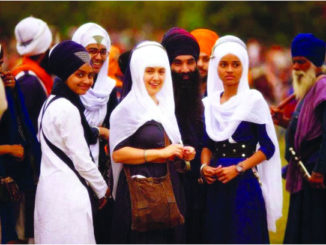
Rising trend of turban-tying among Sikh girls
By Dr. Assa Singh Ghuman
Turban perhaps is the only item of the human attire which has many folds of history and mystery underneath its layers. It had attained hundreds of connotations and interpretations as far as its styles, colours, names, shapes and sizes are concerned. It had acquired protective, decorative, cultural, religious, ethical, nationaland professional symbolism. It had “kingly” as well “raggly” status in different times of history in the different regions. In many cultures, it became symbolic of temporal authority while in some others it attained the spiritual aura, and thus signified power. From “murasa”(muVwsw) it progressed to be the base of kingly crown and empirical regalia in many cultures of Asia and Africa. It adorned the authoritative and spiritual heads with different namessuch as turban, turbante, dulband, pheta, pag, pagree, sapha, dastaar, cheera, dumala etc. etc. The nomenclature is basically embedded in Persian as it is considered that turban started from Arab countries.Clothing has always been the identifier of the different groups comprising any individual society, turban happened to be the prominent one. It has been a distinctive signifierin the sign systems of different societies from primitive to ultra-modern times. According to The Encyclopaedia of Sikhism, “As a form of head dress, it is of Semitic origin and was an essential part of the Israeli High Priest’s uniform in Moses’day,1300 BC, as stated in the Old Testament (Exodus,28:4). In India, it is to be seen as worn by men depicted in the Ajanta caves (200 B.C.) and on the Sanchi Gateway (150BC)”.
This happened in India duringthe Moghul period that the turban became a symbol of royalty and with that came the bigotry also to issue the dictates by the ruling class that Hindus were not allowed to wear turbans nor werethey allowed to ride the horses, which in fact was considered the privilege of the ruling class only. As a matter of tradition all the Sikh Gurus, like all the Pandits and other seers ofthe Hindu religion, used to adorn distinctive turbans. When this significant item of dress was banned in the later part of the 17th century along with the other draconian policies towards the mission of Sikhism, Guru Gobind Singh took the cudgels against this injustice and religious bigotry. In 1699, when he initiated the Sikhs into the new fold of Khalsa and brought about a great transformation, turban became an inseparable part of the Khalsa as it was ordained that the Sikhs must keep the Kes (hair) intact and unshorn. Turban became Dastar in Sikh language and literature. “Saabat surat dastaar sira” became the benchmark of the Khalsa. Though turban, basically symbolized masculinity and martiality, yet Khalsa never discouraged the women from being turbaned. Mai Bhago is a glaring example of the Dastaardhari Sighani, who had all the masculine propensities and Guru Ji showered all the blessings on her. Even some paintings painted by some Britishers in 17th and 18th century show Sikh women in traditional Nihang dastaars on their heads.
However, most of the Sikh women in Punjab and other states of India continued to observe their Sikh religion with their chunis or dupattas on their heads, even after being Amritdhari. It was Akhand Kirtani Jatha which started initiating the Sikh women in Khalsa fold,which emphasized the strict discipline of the Rehat and ordained the female Sikh initiates to have jura and turban. Both men and women started adorning dumalas over their heads to cover their unshorn hair, keski being the smaller turban under the bigger one. It is to be observed that Sikhs don’t just tie the turban or wear the turban, they adorn it or don it: auh dsqwr bMnHdy nhIN, dsqwr sjwauNdy hn[
Anyhow, many of the unmarried girls who used to get into such type of observances, have to face a peer pressure from the society as it was considered something queer for girls to wear the turban and lose the feminine look.It happened under the impact of the globality only that the Sikh girls started daring the peer and queer pressure. The 21st century has witnessed a rising graph as far as the trend of turban tying in Sikh girls and women is concerned. The graph is still going up. It has happened because of many factors happening around, among them the most important ones being sense of equality, individual identity, Sikh essentialism, post-colonial choice and being fashionable. In Europe and America, turban got very popular among women in the last two decades in fashion and modelling. Its position with the diasporic Sikh girls is altogether different who wear it for religious considerations.The girls who have started doning dastaars in daily routine prefer domalas which has almost become a distinguishable iconic mark of female Sikhism as no other community in the world other than Sikhs wear domalas. These girls with domalas have a strong will to have equality, feminine identity and women empowerment. There is a long list of such Amritdhari successful Sikh girls who have achieved the echelons of empowerment. Many of them had to fight with the law of those lands where they are living to get the turban allowed on official duties. Turban proved to be a challenge for them.
Palbinder Kaur, wearing a domala, has achieved the list of “first” by becoming the first Amritdhari turbaned Judge of a supreme court in Canada. Prior to that she was a human rights activist. Simerpal Kaur has become the first Amritdhari Sikh woman who serves in Australian police with her domala. Arpinder Kaur has registered her name as the first ever turbaned Sikh woman to be a pilot in United States. Similarly, Sukhdeep Kaur is the first female Sikh prison officer in Hong Kong. Twenty-two-year-old Gursoch Kaur has become the first turban-wearing Sikh woman in New York Police Department. All of them, including a number of others, scattered all over the globe, have been steadfast in performing their duties with turbanas their head gear because of their religiosity and spirituality. Yet it is not true of all the girls wearing turban in Punjab or even abroad. Many of the girls are adorning turban just as a matter of fashion. At global level, turban-tying is a trend among Muslim as well as European women. As turban has got respectability and acceptability, more girls in Indian Punjab now feel comfortable with this head dress. The concept of being beautiful has changed. Many girls with domala turban on their heads appear more beautiful and handsome with their cherubish cheeky faces. Media has also started encouraging them to wear turbans, as this progression from Phulkari to Domalla is very interesting, catchy and attractive. Suchgirls with turban on their heads have become smarter by not having chuni or dupatta which had been a big nuisance, particularly for the working women, managing its loose ends all the time. Nevertheless, the Amritdhari Sikh girls are seen having dupatta also alongwith the domala for keeping the modesty of covering their bust.
Turban is being used as accessory by the fashionable ones also to symbolize empowerment, equality and self-expression but it is primarily sartorial trend, not a religious practice. In India the girls have started donning the traditional safa alongwith other baratis in Rajasthan, Maharashtra etc. It is not now a symbol of religious integrity and “izat”, as the traditional male turban used to have. It is more a fashion, a fun or a fad to look different from others, to be photo genic. There is nothing new and unique in this trend. In fact, it is the revival of the earlier trends of wearing exotic head-dress by European women as evening dress or as party wear. The first documentation of the turban being worn as a fashion accessory was seen in the iconic Dutch painting “Girl with a Pearl Earring”, painted by Vermeer in 1665. There have been revivals of turban-trend time to time from 15 century to 19th century. It was revived in 1910s-20s by fashion designer Paul Poiret. In the last two decades of 21st century, turban has again gathered popularityin fashion prades on the ramps. However, the latest trends are being frowned at by the clergyand the elders because now the turbans being worn by the showbiz beauties (many of them are morally controversial), are more of religious styles rather than the traditional draped variations or head wraps. This mixing up of the religious symbolism to be sexy and seductive is being disliked by the Sikh elders also.
To conclude, we can safely observe that the girls or women who are donning turban might be doing it for hundreds of reasons, but one thing is crystal clear that the turban on the head of a Sikh female doesn’t always signify being fundamentalist or spiritualist or religious in Sikhism.
(The author is a retired college Principal. He has written hundreds of articles about Punjabi culture and Sikh history in Punjabi as well as in English. Out of 12 books published so far, Dastan-e-Dastar, Balhari Kudrat Wasiya and Katak Ke Vaisakh? Ke Dovein? have been well received by the Punjabi readers. The fourth edition of Dastan-e- Dastaar is being awaited. To pen down write-ups of Dastaardhari “firsts” at National and International level is his first love.
-

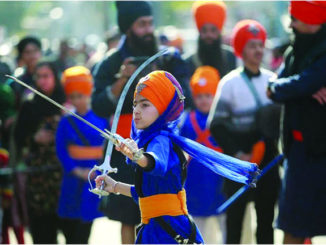
Vaisakhi: History and significance of harvest festival
Baisakhi (also called Vaisakhi) is a harvest festival which is celebrated on the thirteenth day of April according to the solar calendar. This day marks the beginning of the Hindu solar new year. In fact this day is celebrated all over the country as new year day under different names. It is celebrated in North India, particularly in Punjab and Haryana, when the rabi crop is ready for harvesting. It usually falls on April 13, falling on April 14 once every thirty-six years. It coincides with ‘Rongali Bihu’ in Assam, ‘Naba Barsha’ in Bengal, Puthandu in Tamil Nadu and ‘Pooram Vishu’ in Kerala.
Significance of Vaisakhi
Baisakhi has a special meaning for the Sikhs. Baisakhi Festival is celebrated as the Sikh New Year and the founding of the Khalsa Panth. On this day in 1699, their tenth Guru Gobind Singh organized the order of the Khalsa and administered amrit (nectar) to his first batch of five disciples making them Singhs, a martial community. Again, on this day in 1875, Swami Dayanand Saraswati founded the Arya Samaj-a reformed sect of Hindus who are devoted to the Vedas for spiritual guidance and have discarded idol worship. This day is once again of immense religious import to the Buddhists because Gautama Buddha attained enlightenment and Nirvana on this auspicious day.
Celebrations
Festival of Baisakhi is celebrated with lot of joy and enthusiasm in the northern state of Punjab and Haryana. The farmers perform their own prayers and rejoice. For on this day, they commence cutting their harvest. Dressed in their typical folk attire, both men and women, celebrate the day with Bhangra and Gidda. Sweets are distributed, old enmities are forgiven and life is full of joy, merriment and everyone seems to belong.
Fairs are organized at various places in Punjab, where besides other recreational activities, wrestling bouts are also held. The occasion is celebrated with great gusto at Talwandi Sabo, where Guru Gobind Singh stayed for nine months and completed the recompilation of the Guru Granth Sahib.
The Sikhs celebrate this day by visiting gurdwaras and distributing kada prasad. Processions led by the Panj Piaras or the five religious men are taken out. Kirtans and recital of passages from the Granth Sahib are also organized in gurdwaras, where people line up to receive the delicious prasad and perform kar sewa-that is, offering help in the daily chores of the gurdwara. \
The real celebrations are in the villages of Punjab when the crop is harvested. In Anandpur Sahib (the birth place of Khalsa) Baisakhi meals are organized in large numbers.
Legends of Vaisakhi
There are various legends associated with the colourful and vibrant festival of Vaisakhi. A study of these interesting legends of Vaisakhi reveal that the day of Vaisakhi is significant not just for Sikhs but also for Hindus and Buddhists alike. Besides, it is joyous to note that as a harvest festival, people of all communities in Punjab celebrate Vaisakhi in a harmonious manner.
Vaisakhi Fairs
Colouful Vaisakhi Fairs are organized at several places in Punjab to mark the harvest festival of Vaisakhi. Performance of bhangra and gidda dance besides other recreational activities make Vaisakhi melas a major crowd puller. People also indulge in shopping and eating spree in the numerous stalls set up in the fairs.
Day to receive Guru’s blessings
According to a popular legend in Sikhism, it was on the day of Vaisakhi in 1567 that Guru Amar Das had first institutionalized Vaisakhi as one of the special days when all Sikhs would gather to receive the guru’s blessings at Goindwal.
Regional celebrations
The auspicious day of Baisakhi is celebrated all over India though under different names and with different set of rituals. People of Assam celebrate it as Rongali Bihu. The Rongali Bihu marks the agricultural New Year at the advent of seeding time and is celebrated as the Festival of Merriment.
Bihar celebrates a festival in Vaishakha (April) and Kartika (November) in honour of the Sun God, Surya, at a place called Surajpur-Baragaon. This is essentially a village where, according to an ancient practice, people bathe in the temple tank and pay obeisance to the Sun God while offering flowers and water from the sacred river Ganga.
In West Bengal celebrate it as Naba Barsha. Naba Barsha is the celebration of Bengali New Year !! Naba Barsha in Bengal marks the first day of Baisakh. On this day people take a ritual bath in the Ganga and bedeck their houses with rangoli (floral patterns) drawn on the entrance of their homes with a paste made of rice powder.
Kerala celebrates it as Vishu. In Kerala, it’s New Year time too. The Kerala New Year is conspicuous for an exchange of gifts and for alms-giving, while Tamil Nadu celebrates it as Puthandu, the tamil new year ceremonial processions are taken out, with richly caparisoned elephants swinging along to the beat of drums.
While in Kashmir, a ceremonial bath and general festivity mark Baisakhi while in Himachal Pradesh devotees flock to the temple of Jwalamukhi and take a holy dip in the Hot Springs.
-

Chaitra Navratri: The first day of the Hindu New Year
Chaitra Navratri also known as Vasant Navratri is one of the most significant festivals and is observed on the first day of the Hindu New Year. Rama Navami, the birthday of Lord Rama usually falls on the ninth day during the Navratri festivity. Hence, Chaitra Navratri is also known as Rama Navratri.
Chaitra Navratri usually falls in the month of March or April. According to the Hindu calendar, it is observed during the Shukla Paksha in the month of Chaitra. As per the Gregorian calendar, Chaitra Navratri falls in March or April.
The celebration of Navratri begins with a ritual called Ghatasthapana or Kalash Sthapana and continues for nine days.
The Origin of Vasanta Navaratri
In days long gone by, King Dhruvasindu was killed by a lion when he went out hunting. Preparations were made to crown the prince Sudarsana.
But, King Yudhajit of Ujjain, the father of Queen Lilavati, and King Virasena of Kalinga, the father of Queen Manorama, were each desirous of securing the Kosala throne for their respective grandsons. They fought with each other. King Virasena was killed in the battle. Manorama fled to the forest with Prince Sudarsana and a eunuch. They took refuge in the hermitage of Rishi Bharadwaja.
The victor, King Yudhajit, thereupon crowned his grandson, Satrujit, at Ayodhya, the capital of Kosala. He then went out in search of Manorama and her son. The Rishi said that he would not give up those who had sought protection under him. Yudhajit became furious. He wanted to attack the Rishi. But, his minister told him about the truth of the Rishi’s statement.
Yudhajit returned to his capital
Fortune smiled on Prince Sudarsana. A hermit’s son came one day and called the eunuch by his Sanskrit name Kleeba. The prince caught the first syllable Kli and began to pronounce it as Kleem. This syllable happened to be a powerful, sacred Mantra. It is the Bija Akshara (root syllable) of the Divine Mother.
The Prince obtained peace of mind and the Grace of the Divine Mother by the repeated utterance of this syllable. Devi appeared to him, blessed him and granted him divine weapons and an inexhaustible quiver.
The emissaries of the king of Benares or Varanasi passed through the Ashram of the Rishi and, when they saw the noble prince Sudarsana, they recommended him to Princess Sashikala, the daughter of the king of Benares.
The ceremony at which the princess was to choose her spouse was arranged. Sashikala at once chose Sudarsana. They were duly wedded. King Yudhajit, who had been present at the function, began to fight with the king of Benares. Devi helped Sudarsana and his father-in-law. Yudhajit mocked Her, upon which Devi promptly reduced Yudhajit and his army to ashes.
Thus Sudarsana, with his wife and his father-in-law, praised Devi. She was highly pleased and ordered them to perform Her worship with havan and other means during the Vasanta Navaratri. Then She disappeared.
Prince Sudarsana and Sashikala returned to the Ashram of Rishi Bharadwaja. The great Rishi blessed them and crowned Sudarsana as the king of Kosala. Sudarsana and Sashikala and the king of Benares implicitly carried out the commands of the Divine Mother and performed worship in a splendid manner during the Vasanta Navaratri.
Sudarsana’s descendants, namely, Sri Rama and Lakshmana, also performed worship of Devi during the Vasanta Navaratri and were blessed with Her assistance in the recovery of Sita.
Why Celebrate Vasanta Navaratri?
It is the duty of the devout Hindus to worship the Devi (Mother Goddess) for both material and spiritual welfare during the Vasanta Navaratri and follow the noble example set by Sudarsana and Sri Rama. He cannot achieve anything without the Divine Mother’s blessings. So, sing Her praise and repeat Her Mantra and Name. Meditate on Her form. Pray and obtain Her eternal Grace and blessings. May the Divine Mother bless you with all divine wealth!”
What’s the Significance of Navratri?
During Navaratri, we invoke the energy aspect of God in the form of the universal mother, commonly referred to as “Durga,” which literally means the remover of miseries of life. She is also referred to as “Devi” (goddess) or “Shakti” (energy or power).
It is this energy, which helps God to proceed with the work of creation, preservation and destruction. In other words, you can say that God is motionless, absolutely changeless, and the Divine Mother Durga, does everything. Truly speaking, our worship of Shakti re-confirms the scientific theory that energy is imperishable.
It cannot be created or destroyed. It is always there.
Why Worship the Mother Goddess?
We think this energy is only a form of the Divine Mother, who is the mother of all, and all of us are her children. “Why mother; why not father?”, you may ask. Let me just say that we believe that God’s glory, his cosmic energy, his greatness and supremacy can best be depicted as the motherhood aspect of God. Just as a child finds all these qualities in his or her mother, similarly, all of us look upon God as mother. In fact, Hinduism is the only religion in the world, which gives so much importance to the mother aspect of God because we believe that mother is the creative aspect of the absolute.
Why Twice a Year?
Every year the beginning of summer and the beginning of winter are two very important junctures of climatic change and solar influence These two junctions have been chosen as the sacred opportunities for the worship of the divine power because:
– We believe that it is the divine power that provides energy for the earth to move around the sun, causing the changes in the outer nature and that this divine power must be thanked for maintaining the correct balance of the universe.
– Due to the changes in the nature, the bodies and minds of people undergo a considerable change, and hence, we worship the divine power to bestow upon all of us enough potent powers to maintain our physical and mental balance.
Why Nine Nights & Days?
Navaratri is divided into sets of three days to adore different aspects of the supreme goddess. On the first three days, the Mother is invoked as powerful force called Durga in order to destroy all our impurities, vices and defects. The next three days, the Mother is adored as a giver of spiritual wealth, Lakshmi, who is considered to have the power of bestowing on her devotees the inexhaustible wealth. The final set of three days is spent in worshipping the mother as the goddess of wisdom, Saraswati. In order have all-round success in life, we need the blessings of all three aspects of the divine mother; hence, the worship for nine nights.
-

Andaman & Nicobar Islands
One of the union territories of India, Andaman and Nicobar Islands is a breathtaking archipelago located in the Bay of Bengal. The exotic beaches blessed with coral reefs and amazing marine life making the landscape breathtakingly exquisite, cater a perfect beach holiday away from the hustle and bustle of the city life. This group of islands is an empyrean for both nature admirers and adrenaline junkies alike.
Andaman and Nicobar Islands is a group of 3000 islands, which includes chain of mountains and ridges with moderate heights and gradients that are indeed the major tourist attractions here. The geography at Andaman and Nicobar Islands states that the archipelago comprises of North Andaman, South Andaman, Middle Andaman, and Little Andaman in the Andaman group of islands, as well as Great Nicobar, Nancowry, Car Nicobar, Chowra and Katchal in the Nicobar group of islands. Amongst all the islands, Great Andaman and Ritchie Archipelago are the top tourist destinations with some surreal beaches for the holiday. Andaman features thrilling watersports like snorkeling, sea walks and scuba diving amongst several others in many of islands’ beaches, hence calling adventure junkies from far and wide. Visitors would also enjoy their time basking in the sun on the white sandy beaches overlooking the azure blue waters while sipping on a refreshing drink. Witnessing the sunrise and sunset is certainly an unbeatable experience, which indeed adds to a memorable beach holiday here. The tourism of Andaman is not only confined to a memorable beach holiday as the archipelago is also blessed with lush flora including evergreen tropical rainforest canopy making a holiday for nature lovers quite a memorable one too. These forests engross an assorted a jumble of Indian, Malaysian and indigenous floral stretches that attract a lot of wildlife lovers. There are more than 2000 varieties of plants found here. These islands are extremely profuse with fauna and around 50 species of forest mammals are found here among which 26 rat species and 14 bat species are primarily notable.
Tourist Attractions
The beautiful and pristine islands are home to number of gorgeous beaches, rich flora and fauna and underwater life. Amongst the top attractions of the islands are Barren Island, which is the only confirmed active volcano in South Asia; Neil Island, Havelock Island, Long Island, Cellular Jail, Mahatma Gandhi Marine National Park, Anthropological Museum, Indira Point, Car Nicobar, Katchal. The islands are perfect for a holiday and have stunning beaches like Radhanagar, which is amongst the top beach destination in Asia.
Cellular Jail
Cellular village has seen a lot of bloodsheds – it was made by the freedom fighters so that they can be tortured here. Even before the construction of the Jail, the island was a prison of India’s First War of Independence of 1857. This jail reflects one of the murkiest chapters of in the colonial rule’s history. It is a mute witness of many heinous acts that British soldiers put on the villagers. In 1906, the jail was completely constructed and was named as ‘Cellular’ because there cells made for each prison rather than accommodating them in one documentary. Originally, there were seven prolonged, puce-coloured building with a central tower. Later, the building was subsequently damaged, leaving behind three wings intact. In the daily life of prisoners, executions were frequent, and many were made to undergo hard labor. Each cell of the prison is 13.5 feet high 7 feet wide and housed one convict in solitary confinement. Without a doubt, this structure is one of the most historically prominent buildings in India. For this reason and intent, Cellular Jail is a must-visit spot while on the trip to Andaman.
Forest Museum
Located on the outskirts of Port Blair, Forest Museum is a famous attraction for its wide collection related to forest and the assortment of trees. This prominent museum is a must visit place in Port Blair and it is managed by the forest department of Andaman and Nicobar Islands. The major attractions that are set on display in this museum include the artefacts that are made from timber, gurjan, oak, satin wood and paduak. These displayed artefacts reflect the rich and dense flora found in the islands. The forest department also carries out researches and the outcomes of these research activities can be clearly seen in this museum. To add flavour for the tourists, the museum also incorporates a mini zoo and a small zoological garden inside the building.
Havelock Island
Among the islands of Andaman, the one that is most visited is the Havelock. Spread in an area of 113 sq. km. and located 39 km of north-east of Port Blair, Havelock Island offers a perfect beach vacation in Andaman. The white sand beaches of this congenial and imposing island are fringed with rain-fed forests making them quite a beautiful destinations to see in India. Famous Radhanagar Beach and Elephant Beach are also part of Havelock Island along with Kalapather and Vijaynagar Beach.
In addition to the extraordinary ambiance and hypnotizing tranquility, Havelock Island also proffers enthralling adventure activities such as scuba diving, snorkelling and trekking. Equipped with several recreational and other pleasant services for tourists, Havelock Island is a supreme destination for a vacation in nature’s lap.
Neil Island
On the Northeast side of Port Blair, Neil Island is the Vegetable bowl of Andaman, owing to the farming practices that take place here. A long and the immaculate island of Andaman, Neil Island is endowed with exquisite settings, which makes it just right the holiday. For tourists in quest of chilling out after the humdrum schedule, this island is no less than an empyrean. The azure sea and verdant foliage make it treat to the eyes. There are six beautiful beaches in Andaman like Sitapur, Lakshmanpur-I & II, SIR HUGH ROSE ISLAND and Bharatpur – each with the best view of the sun gliding below, and above the horizon. Also, the beaches of Andaman are quite famous for adventure activities like snorkeling and scuba diving. If the idea of adventure activity doesn’t sound exciting then do visit the beachside to soak in the cool breezy air, read a book and sip the natural coconut water. Do visit the spectacular corals and reefs in Neil Island.
Corbyn’s Cove Beach
Secluded, and unspoilt, the Corbyn’s Cove beach is just 8 kilometers from the City center, and a prominent sightseeing place in Andaman. With pleasant blue sea water and lush green coconut palms, the beach allows visitors to relax alongside and enjoy several water sports available on the shore of the beach. Some of the water activities that one can undertake and enjoy over a visit to Corbyn’s Cove Beach include scuba diving, surfing, and boating. Further, the beach is also a perfect location for taking pleasure of sunbathing, swimming and surfing. This coconut palm fringed beach is surrounded with a hotel and small offering refreshments and food. From here, tourists can also visit the Snake Island, which claims to have a lot of deadly snakes. The snake island is also known for colourful corals, mesmerizing fishes and rock faces. One can take a motorboat to land at this island.
-

Apple’s Find My app now lets third-party locate lost products
Apple has introduced the updated Find My app, allowing third-party products to use the private and secure finding capabilities of Apple’s Find My network.
The Find My network accessory programme enables users to keep track of their belongings in the new Items tab within the Find My app. The new products that work with the Find My app from VanMoof, Chipolo and Belkin will be available beginning next week. It will allow users to locate where they left their ride, their earbuds at the gym, their backpack, and so much more.
“For more than a decade, our customers have relied on Find My to locate their missing or stolen Apple devices, all while protecting their privacy,” Bob Borchers, vice president of Apple’s Worldwide Product Marketing, said in a blogpost on Wednesday.
“Now we’re bringing the powerful finding capabilities of Find My, one of our most popular services, to more people with the Find My network accessory programme,” Borchers added. Part of the Made for iPhone (MFi) Programme, the Find My network accessory programme is designed for any accessory developer looking to connect an existing or new product to the Find My network.
-

Facebook to add labels to satire pages in News Feed
Fighting fake news is a complex job as users sometimes might confuse satirical content of a social media post to be the reality. To make things clearer, Facebook now wants to label certain posts.
The social networking giant said it is already testing a way to give people more context about the Pages they see. The experiment has started for users in the US.
“We’ll gradually start applying labels including ‘public official,’ ‘fan page’ or ‘satire page’ to posts in News Feed, so people can better understand who they’re coming from,” Facebook said on Wednesday.
Facebook has not made official why it wants to apply the labels. However, it is not hard to understand why it wants to label satire pages.
According to a report in The Verge, Facebook made attempts to make the context of posts in the News Feed clearer even earlier too.
It started labelling media outlets which are “wholly or partially under the editorial control of their government” in June last year.
-

Mars did not dry up all at once, says study
Mars had drier and wetter eras before drying up completely about three billion years ago, says a new study which suggests that the Red Planet did not dry up all at once.
The findings are based on data from NASA’s Curiosity Mars rover which continues to explore the base of Mount Sharp on the Red Planet.
“A primary goal of the Curiosity mission was to study the transition between the habitable environment of the past, to the dry and cold climate that Mars has now,” said Roger Wiens, a coauthor on the paper and scientist at Los Alamos National Laboratory, where he is on the ChemCam team. “These rock layers recorded that change in great detail,” Wiens said.
ChemCam is the rock-vaporising laser that sits on the mast of the Curiosity rover and analyses the chemical composition of Martian rocks.
William Rapin, a researcher with the French National Centre for Scientific Research (CNRS), led the study published in the journal Geology. Using the long-range camera on ChemCam to make detailed observations of the steep terrain of Mount Sharp, a team including Wiens and other researchers at Los Alamos discovered that the Martian climate alternated between dry and wetter periods before it went completely dry.
Spacecraft in orbit around Mars had previously provided clues about the mineral composition of the slopes of Mount Sharp.
Now, ChemCam has successfully made detailed observations of the sedimentary beds from the planet’s surface, revealing the conditions under which they formed.
Moving up through the terrain, Curiosity observed that the types of bed change drastically.
-
A tiny particle’s wobble could upend the known laws of Physics
Evidence is mounting that a tiny subatomic particle seems to be disobeying the known laws of physics, scientists announced Wednesday, a finding that would open a vast and tantalizing hole in our understanding of the universe. The result, physicists say, suggests that there are forms of matter and energy vital to the nature and evolution of the cosmos that are not yet known to science. “This is our Mars rover landing moment,” said Chris Polly, a physicist at the Fermi National Accelerator Laboratory, or Fermilab, in Batavia, Illinois, who has been working toward this finding for most of his career. The particle célèbre is the muon, which is akin to an electron but far heavier and is an integral element of the cosmos. Polly and his colleagues — an international team of 200 physicists from seven countries — found that muons did not behave as predicted when shot through an intense magnetic field at Fermilab.
The aberrant behavior poses a firm challenge to the Standard Model, the suite of equations that enumerates the fundamental particles in the universe (17, at last count) and how they interact.
“This is strong evidence that the muon is sensitive to something that is not in our best theory,” said Renee Fatemi, a physicist at the University of Kentucky.
The results, the first from an experiment called Muon g-2, agreed with similar experiments at the Brookhaven National Laboratory in 2001 that have teased physicists ever since.
At a virtual seminar and news conference Wednesday, Polly pointed to a graph displaying white space where the Fermilab findings deviated from the theoretical prediction. “We can say with fairly high confidence, there must be something contributing to this white space,” he said. “What monsters might be lurking there?”
“Today is an extraordinary day, long awaited not only by us but by the whole international physics community,” Graziano Venanzoni, a spokesperson for the collaboration and a physicist at the Italian National Institute for Nuclear Physics, said in a statement issued by Fermilab. The results are also being published in a set of papers submitted to several peer-reviewed journals.
The measurements have about one chance in 40,000 of being a fluke, the scientists reported, well short of the gold standard needed to claim an official discovery by physics standards. Promising signals disappear all the time in science, but more data are on the way. Wednesday’s results represent only 6% of the total data the muon experiment is expected to garner in the coming years.
-

Abhishek recalls how he fell in love with Aishwarya during Umrao Jaan
Actor Abhishek Bachchan in a recent interview spoke about the beginnings of his romantic relationship with wife Aishwarya Rai. The couple tied the knot in 2007, and they have one daughter, Aaradhya. While promoting his new film The Big Bull, Abhishek was asked to label his some of his past films as either ‘bullish’ or ‘bearish’ career moves. When he was asked to slot Umrao Jaan, he said that it was definitely ‘bullish’, because ‘that’s where it all happened’.
Asked if ‘mohabbat (love)’ happened organically or if he made it happen, Abhishek told RJ Siddharth Kannan, “We’d been friends for a very long time. Aishwarya was one of the first co-stars I’d ever worked with. Our first movie together was called Dhai Akshar Prem Ke, which was technically the second film I started shooting, as soon as I finished Refugee.”
He continued, “So she’d been a dear, dear friend, and we’d worked in so many films together. It was a bit of both. The universe conspired to bring us together.” Abhishek’s new film, The Big Bull, was released on Thursday on Disney+ Hotstar. The actor played a character inspired by tainted stockbroker Harshad Mehta in the film, which was received poorly by critics.
Aishwarya, in the past, had spoken about how Abhishek proposed to her. In an interview with Filmfare, the actor said that the moment was ‘surreal’ for her as she was on the sets of her 2008 film, Jodhaa Akbar. “We’re doing Khawja Mere Khwaja, sitting as a bride, and I am like, oh my god this is surreal, all happening on-screen, off-screen, this is bizarre,” she said. Aishwarya and Abhishek have worked together on numerous films, such as Dhoom 2, Guru and Raavan.
-

Shahid Kapoor gets flirty with ‘Pretty’ wife Mira
Actor Shahid Kapoor never leaves an opportunity to shower love on his wife Mira Rajput. At various occasions, the Kabir Singh actor has lit up the social media space with his flirty and mushy posts for wife Mira that leave netizens gushing over this couple. Recently, once again, Shahid put his flirty side on display as he dropped a sweet comment on Mira’s latest skincare video and well, it has surely caught the attention of netizens. The sweet remark on his wife’s appearance has sent fans into a frenzy.
Recently, Mira shared a video on her Instagram handle about going on a fast for skincare and health benefits. Seeing his wife talk about skincare routine and more, the Kabir Singh actor could not resist from dropping a sweet comment on Mira’s post. Shahid wrote, “Why would someone that pretty even need a cleanse.” Along with it, he dropped a two hearts emoticon and a heart eyes emoji. Seeing his comment, fans were left in awe of his way of flirting with his wife.
This is not the first time that Shahid has gone all out to shower love on Mira. Previously too, he has reacted to her posts and left fans gushing. Mira too reciprocates the gesture and shares mushy posts for Shahid. Not just this, in a recent “Ask Me’ session on Instagram, Mira revealed several things she loves about Shahid and even picked between his characters from films Udta Punjab and Kabir Singh. Not just this, when the gorgeous star wife was recently missing Shahid as he was away, she shared a special musical cover of Lucky Ali’s song ‘O Sanam’ and wrote, “Missing you @shahidkapoor.”
Meanwhile, on the work front, Shahid will be seen in Jersey with Mrunal Thakur, Pankaj Kapur. The film is all set to release on November 5, 2021. Besides this, he is also working on a web show with directors Raj and DK. It also stars Raashi Khanna.
-
Akshaye Khanna to make his digital debut
Akshaye Khanna is all set to make his debut on OTT with the ZEE5 film titled State of Siege: Temple Attack. Produced by Contiloe Pictures, the film will be based on the 2002 attack at Akshardham temple in Gandhinagar, Gujarat. Over 30 people lost their lives in the attack and more than 80 were left injured. The National Security Guard (NSG) pinned down the terrorists and brought the situation under control. The film comes after the platform’s re-telling of the 26/11 Mumbai attacks in State of Siege: 26/11.
Akshaye will be seen playing the role of a special task force officer, who will be in charge of the mission. Excited about donning the uniform in the film, Khanna in a statement shared, “To be able to wear ‘the uniform’ without taking the oath of the ultimate sacrifice — this is a privilege that only an actor is afforded. My only focus during the making has been not to disrespect that privilege.”
-

Phoebe Waller-Bridge joins the cast of Indiana Jones
If adventure has a name…it must be Indiana Jones! Phoebe Waller-Bridge (Fleabag, Solo: A Star Wars Story) will star alongside Harrison Ford, who is returning to the role of the legendary hero archaeologist, for the fifth installment of the iconic franchise. In addition, the inimitable John Williams will return to score the film, continuing a musical journey which began 40 years ago with Raiders of the Lost Ark. Williams’ unforgettable Indy soundtracks, packed with all the epic thrills, suspense, romance and excitement that fans have come to expect from an Indiana Jones movie, have become as beloved and familiar as the adventurer-hero’s signature hat and whip.
“I`m thrilled to be starting a new adventure, collaborating with a dream team of all-time great filmmakers,” said the film`s director James Mangold. “Steven, Harrison, Kathy, Frank, and John are all artistic heroes of mine. When you add Phoebe, a dazzling actor, brilliant creative voice and the chemistry she will undoubtedly bring to our set, I can`t help but feel as lucky as Indiana Jones himself.” Kathleen Kennedy, Steven Spielberg, Frank Marshall and Simon Emanuel will serve as producers. Indy swings into theaters July 29, 2022.
-

Naomi Watts to lead remake of Austrian movie Goodnight Mommy
Hollywood star Naomi Watts will topline the remake of Austrian psychological thriller Goodnight Mommy for Amazon Studios. The English-language remake will be helmed by Take Me To The River director Matt Sobel, as per Variety. Kyle Warren penned the script for the film, which will be produced by David Kaplan, Joshua Astrachan, Valery Guibal and Nicolas Brigaud-Robert. The original movie had attained the status of cult classic when it released in 2014. It was later selected as the Austrian entry for best foreign language film at the Academy Awards. Starring Susanne Wuest in the lead, the story follows twin brothers who, when sent to stay with their mother, are surprised to find her swathed in bandages from a recent procedure. As her behaviour grows increasingly erratic and unusual, the twins become convinced she is an imposter. Their suspicion sets off a roller-coaster of emotional mind games and misunderstandings between mother and her children, that eventually explodes with irreparable and heartbreaking consequences.
-

Gal Gadot was threatened by director Joss Whedon on Justice League set: Report
Director Joss Whedon reportedly threatened Gal Gadot’s career while conducting reshoots on 2017’s superhero team-up film, Justice League. The Wonder Woman actor took the matter to the top, and said that it was addressed there and then. Whedon has been accused of ‘abusive’ behaviour on the sets of the film, by actor Ray Fisher, who appeared as Cyborg. His co-star Jason Momoa, who played Aquaman in the film, seemingly corroborated Fisher’s claims in an Instagram post. A new story on The Hollywood Reporter cited sources as saying that the actor and the filmmaker clashed when Whedon ‘pushed Gadot to record lines she didn’t like, threatened to harm Gadot’s career and disparaged Wonder Woman director Patty Jenkins’. She reportedly demanded a meeting with the studio’s then-chairman Kevin Tsujihara. “I had my issues with [Whedon] and Warner Bros handled it in a timely manner,” she said in a statement, reacting to the developments. Whedon was brought in as a replacement for original director Zack Snyder, after Snyder was forced to depart production because of a family tragedy. Whedon, known for directing Marvel’s The Avengers and Avengers: Age of Ultron, was tasked with reshooting several portions of the film.
-
Adarsh Gourav loses Best Actor honour to Anthony Hopkins
India’s Netflix film, The White Tiger, was nominated for two categories at the British Academy of Film and Television Arts (BAFTA) film awards – best actor and best adapted screenplay. However, neither actor Adarsh Gourav, nor Ramin Bahrani won the awards held late Sunday. Sir Anthony Hopkins won the best actor’s award for The Father, while Christopher Hampton and Florian Zeller bagged the award for best adapted screenplay for the same film.
The US road movie Nomadland won big, bagging four categories including best film, best actress and best director at the award night. The BAFTA ceremony was held virtually over two nights, with nominees joining in by video, due to the Covid-19 pandemic. Chinese director Chloe Zhao’s US recession drama Nomadland is about a community of van dwellers. Zhao welcomed stronger representation for women film-makers in comments to journalists afterwards, saying: “It’s about time, it’s great. I love doing what I do and if this means more people like me get to live their dreams, I’m very grateful”. Nomadland is one of the frontrunners for this month’s Oscar awards, with six nominations including for best picture, best director and best actress. Last month it won coveted Golden Globe awards for best drama film and best director.
Welsh actor Sir Anthony Hopkins won the best actor Bafta for The Father about a man suffering from dementia, directed by France’s Florian Zeller. The 83-year-old didn’t appear during the ceremony but spoke to journalists afterwards, explaining that he had not expected to win and had been holidaying in Wales and painting in his hotel room. “This is wonderful, I mean, this is the first time in my life when I never expected to get this,” he said, calling his fourth Bafta a “fun bonus”.
-

LAC: India, China share proposals, agree on need to resolve standoff
New Delhi (TIP): A day after India and China concluded their 11th round of discussions at the Corps Commander-level to try and end the nearly year-long military standoff along the Line of Actual Control, the Ministry of Defence said Saturday that “the two sides had a detailed exchange of views for the resolution of the remaining issues related to disengagement along the LAC in Eastern Ladakh”. The “remaining issues” reference was to the continuing standoff at the friction points in Hot Springs, Gogra Post and Depsang Plains – Indian and Chinese troops and armoured columns had disengaged on the north and south banks of Pangong Tso in February.
Unlike the last few rounds, there was no joint statement Saturday on the outcome of the talks. A senior military officer said “both sides shared their proposals” and “more talks will be required” since “there has been no agreement”. The officer said the Indian side raised the issue of all friction points in eastern Ladakh during the discussions.
The Ministry of Defence, in its statement, said: “The two sides agreed on the need to resolve the outstanding issues in an expeditious manner in accordance with the existing agreements and protocols. In this context, it was highlighted also that completion of disengagement in other areas would pave the way for two sides to consider de-escalation of forces and ensure full restoration of peace and tranquility and enable progress in bilateral relations.”
“The two sides agreed that it was important to take guidance from the consensus of their leaders, continue their communication and dialogue and work towards a mutually acceptable resolution of the remaining issues at the earliest. They also agreed to jointly maintain stability on the ground, avoid any new incidents and jointly maintain peace in the border areas,” it said.
The meeting, which started around 10.30 am Friday on the Indian side of the Chushul-Moldo Border Personnel Meeting (BPM) point, went on for nearly 12 hours. The military commanders, it is learnt, discussed the friction areas at the patrolling points in Hot Springs, Gogra Post and Depsang Plains.
The Depsang Plains situation pre-dates the current standoff. The area, also known as the bulge, is sensitive for India because of its proximity to the Daulat Beg Oldie post and advance landing ground, close to the Karakoram Pass in the north.
The Indian delegation at the talks was led by XIV Corps Commander Lt Gen PGK Menon. Also present was Naveen Srivastava, Additional Secretary in the Ministry of External Affairs, who has been leading the Indian side at the meetings of the Working Mechanism for Consultation & Coordination on India-China Border Affairs (WMCC). Major General Liu Lin, Commander of South Xinjiang Military District, led the Chinese team at the talks.
In February, Indian and Chinese troops disengaged on the north and south banks of Pangong Tso, and military sources said status quo ante had been achieved there – the standoff began in the first week of May last year.
On the north bank, China pulled its troops east of Finger 8 (which India says marks the LAC) and India went back to its position behind Finger 3 at the Dhan Singh Thapa post. All temporary structures, erected by China in the (temporary no-patrolling) stretch between, were also levelled. On the south bank and in the Chushul sub-sector, troops vacated the heights at Rechin La and Rezang La as per the agreement.
Source: Indian Express
-

Huge crowd gathers for Kumbh, police say difficult to ensure social distancing
At a time when the coronavirus disease (Covid-19) is again spreading fast across the country, events like the Kumbh Mela pose a particular concern for the authorities. There are big crowds near the river banks who wish to take a holy dip on the occasion, throwing social distancing for a toss. Such a thing is being witnessed in Uttarakhand’s Haridwar, where people have gathered for the second royal bath of the Kumbh early on Monday. The police said that it is very difficult for them to ensure social distancing or issue challans.
“We are continuously appealing to people to follow Covid appropriate behavior. But due to the huge crowd, it is practically not possible to issue challans today. It is very difficult to ensure social distancing at ghats,” said Inspector-general of Police, Haridwar Kumbh Mela, Sanjay Gunjyal, according to news agency ANI.
This comes when the country is trying to combat and control the spread of the second wave of Covid-19 that took the case tally to over 13 million. The Inspector-general warned that the enforcement of social distancing at ghats may lead to a stampede-like situation, reported ANI.
“A stampede-like situation may arise if we would try to enforce social distancing at ghats so we are unable to enforce social distancing here,” ANI quoted Gunjyal as saying.
-

India fastest to administer over 100 million Covid jabs in 85 days
New Delhi (TIP): As the total number of COVID-19 vaccine doses administered in the country crossed the 10 crore-mark, the Union Health Ministry on Saturday, April 10, said that India is the fastest nation to administer 100 million doses in 85 days.
The US took 89 days to administer 10 crore doses of COVID-19 vaccine, while China took 102 days to do the same, it said.
The Prime Minister’s Office also tweeted a chart showing India as the fastest country to reach this vaccination milestone, calling it “strengthening efforts to ensure a healthy and COVID-19 free India”. In terms of the number of daily doses administered globally, India continues to remain at the top with an average of 38,93,288 doses administered per day, the ministry said earlier during the day. The cumulative number of COVID-19 vaccine doses administered in the country stands at 10,12,84,282 as per the provisional report at 7.30 pm, it said.
The extension of vaccine coverage to those above 45 years of age along with recent provisions for them to get vaccinated at their workplaces — government and private — form a series of pro-active, collaborative and coordinated steps taken by the Centre and state governments for safety of people from the infectious coronavirus disease, the ministry said.
“This along with the efficient clinical management has thus far ensured that India has the lowest fatality rate in the world (1.28 per cent),” it highlighted.
On India being the fastest nation to administer 100 million doses, the ministry said, “The achievement is also a testimony of the ‘whole of society’ approach where individuals turned a deaf ear to rumours and propaganda of vested interests, shunned their vaccine hesitancy and strengthened the hand of the administration in curbing COVID-19.”
The vaccination exercise as a tool to protect the most vulnerable population groups in the country from COVID-19 continues to be regularly reviewed and monitored at the highest level, it said.
“A broader comparison with other countries on their achievements on the 85th day reaffirms the fact that India has the highest rate of vaccination per day,” the ministry underlined.
The US administered 92.09 million doses in 85 days and China’s vaccination coverage was 61.42 million in 85 days. The UK administered 21.32 million doses in 85 days, it said.
Eight states — Maharashtra, Rajasthan, Gujarat, Uttar Pradesh, West Bengal, Karnataka, Madhya Pradesh and Kerala — account for 60.62 per cent of the total doses given so far in the country, according to the ministry.
The countrywide vaccination drive was rolled out on January 16 with healthcare workers (HCWs) getting inoculated and vaccination of frontline workers (FLWs) started from February 2.
The next phase of COVID-19 vaccination commenced from March 1 for those over 60 years of age and for people aged 45 and above with specified co-morbid conditions.
India launched vaccination for all people aged more than 45 years from April 1.
The 10.12 crore figure achieved across 15,17,260 sessions includes 90,03,060 HCWs who have taken the first dose and 55,06,717 HCWs who have taken the second dose, 99,39,321 FLWs who have received the first dose and 47,28,966 FLWs who have taken the second dose, the ministry said.
Besides them, 3,01,14,957 and 6,37,768 beneficiaries in the over 45 years-59 years category have been administered the first and second dose respectively, while , 3,95,64,741 and 17,88,752 individuals aged above 60 have taken the first and second dose respectively.
“Total 29,65,886 vaccine doses were given till 8 pm on Saturday, the 85th day of the nationwide COVID-19 vaccination drive. Out of these, 26,31,119 beneficiaries were vaccinated for first dose and 3,34,767 beneficiaries received the second dose of the vaccine as per the provisional report,” the ministry said adding final reports would be completed for the day by late night.
-

India records highest single-day rise so far with over 1.68 lakh new Covid cases
New Delhi (TIP): India hit a new coronavirus infection record with 1,68,912 new cases, the highest single-day rise so far, taking the total tally of cases to 1,35,27,717, according to the Union Health Ministry data updated on Sunday, April 11. The national Covid recovery rate has fallen below 90 percent. The active cases have surpassed the 12-lakh mark, while the death toll increased to 1,70,179 with 904 new fatalities, the highest since October 18, the data updated at 8 am showed.
Registering a steady increase for the 33rd day in row, the active cases have increased to 12,01,009 comprising 8.88 per cent of the total infections, while the recovery rate has further dropped to 89.86 per cent. The active caseload was at its lowest at 1,35,926 on February 12 and it was at its highest at 10,17,754 on September 18, 2020.
The number of people who have recuperated from the disease surged to 1,21,56,529, while the case fatality rate has further dropped to 1.26 per cent, the data stated.
According to the ICMR, 25,78,06,986 samples have been tested up to April 11 with 11,80,136 samples being tested on Sunday.
The 904 new fatalities include 349 from Maharashtra, 122 from Chhattisgarh, 67 from Uttar Pradesh, 59 from Punjab, 54 from Gujarat, 48 from Delhi, 40 from Karnataka, 24 from Madhya Pradesh, 22 from Tamil Nadu, 21 from Jharkhand, 16 each from Kerala and Haryana and 10 each from Rajasthan and West Bengal.
A total of 1,70,179 deaths have been reported so far in the country, including 57,987 from Maharashtra, 12,908 from Tamil Nadu, 12,889 from Karnataka, 11,283 from Delhi, 10,400 from West Bengal, 9,152 from Uttar Pradesh, 7,507 from Punjab and 7,300 from Andhra Pradesh.
-
Staff members of Supreme Court test positive for Covid-19
New Delhi (TIP): Several staff members of the Supreme Court have tested positive for the coronavirus disease (Covid-19). As of Saturday, at least 44 members from judges’ offices and in the court registry are found to be infected with the viral disease.
Following this, sanitisation work is underway at the top court’s premises including courtrooms and the proceedings will begin an hour late than their scheduled time. The Supreme Court has a staff strength of 3,400. After conducting virtual hearings since April last year, the top court decided to hold hybrid hearings from March 15.
However, the order was challenged by Supreme Court Bar Association (SCBA) president Vikas Singh pressed the Chief Justice of India for resuming physical hearing, citing concerns regarding the financial burden on lawyers. “I don’t want lawyers to die of starvation.
-
India to get 5 more Covid-19 vaccines by October: Report
New Delhi (TIP): As more and more states flag shortage of Covid-19 vaccine doses, the Central government has pressed the accelerator to scale up vaccine production manifold.
Top government sources told ANI that by end of the third quarter of this year, India will be getting vaccines from five additional manufacturers. India currently manufactures Covishield and Covaxin.
Explaining the new strategy to manufacture additional vaccine doses, a source said “India currently has 2 Covid-19 vaccines being manufactured locally: Covishield and Covaxin, and we can expect five more vaccines by Q3 2021. These vaccines are Sputnik V vaccine (in collaboration with Dr. Reddy’s), Johnson & Johnson vaccine (in collaboration with Biological E), Novavax vaccine (in collaboration with Serum India), Zydus Cadila’s vaccine, and Bharat Biotech’s Intranasal Vaccine. Safety and efficacy are the Union government’s primary concerns while granting emergency use authorisation (EUA) to any Covid-19 vaccine in the country.”
Out of almost 20 Covid-19 vaccines in various clinical and pre-clinical stages, Sputnik V vaccine will get the nod first. It is expected that Sputnik is likely to get the EUA within the next ten days.
Russian Direct Investment Fund (RDIF) has tied up with a host of Indian pharmaceutical players such as Hyderabad based Dr Reddy’s Laboratories, Hetero Biopharma, Gland Pharma, Stelis Biopharma and Vichrow Biotech for the production of vaccine doses. With a production capacity of 850 million doses in the country, Sputnik V will provide a major shot in the arm in the fight against Covid-19.
-
Farmers ready to talk, but no change in demands: Rakesh Tikait
Farmers protesting the contentious new farm laws are ready to talk if the Centre invites them, BKU leader Rakesh Tikait said on Sunday, April 11, maintaining that the dialogue would resume where it had ended on January 22 and the demands remain unchanged.
He said for the talks to resume, the government should invite the Samyukta Kisan Morcha (SKM), an umbrella body representing the protestors who are camping at the three border points of Delhi at Singhu, Tikri and Ghazipur since November 2020.
“The talks with the government would resume from the same point where it had ended on January 22. The demands are also the same — all three ‘black’ farm laws should be repealed, a new law made to ensure MSP (minimum support price) for crops,” Tikait was quoted as saying in a statement issued by BKU media in-charge Dharmendra Malik.
The BKU national spokesperson’s remarks came in response to Haryana Home Minister Anil Vij urging Union Agriculture Minister Narendra Singh Tomar to resume talks with protesting farmers amid the coronavirus scare looming large.
Maintaining that a surge in the coronavirus cases is being seen across the country and the situation is turning bad in Haryana too, Vij said he is worried about the farmers protesting on the state borders with Delhi. The protesters and the government last had a formal dialogue over the contentious issue on January 22 but the impasse continued.