Tag: Facebook

  • One-fifth of candidates in poll-bound states have criminal cases against them

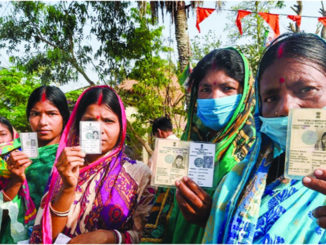
    New Delhi (TIP): Out of 6,318 candidates contesting in assembly elections in four states and a UT, 18 per cent have declared criminal cases against themselves, according to a report by poll rights group ADR (Association for Democratic Reforms). The National Election Watch and Association of Democratic Reforms (ADR) have analysed the self-sworn affidavits of 6,318 out of 6,792 candidates who contested in the Union Territory of Puducherry and the four states of Assam, Kerala, Tamil Nadu and West Bengal till Phase 3 of assembly polls. Out of 6,318 candidates analysed, 1,157 (18 per cent) have declared criminal cases against themselves in their affidavits and 632 (10 per cent) candidates have declared serious criminal cases against themselves. As many as 1,317 (21 per cent) are crorepatis. Of the 6,318 candidates, 567 were analysed from West Bengal (till phase 3) out of which 144 (25 per cent) declared criminal cases against themselves and 121 (21 per cent) declared serious criminal cases against themselves, the report said. Of the 3,559 candidates analysed from Tamil Nadu, 466 (13 per cent) declared criminal cases against themselves and 207 (6 per cent) declared serious criminal cases against themselves.

    Of the 928 candidates analysed from Kerala, 355 (38 per cent) declared criminal cases against themselves and 167 (18 per cent) declared serious criminal cases against themselves.

    Of the 941 candidates analysed from Assam, 138 (15 per cent) declared criminal cases against themselves and 109 (12 per cent) declared serious criminal cases against themselves.

    Of the 323 candidates analysed from Puducherry, 54 (17 per cent) declared criminal cases against themselves and 28 (9 per cent) declared serious criminal cases against themselves.

    Among major political parties, 143 of the 191 candidates (75 per cent) from DMK have declared criminal cases against them and 55 (29 per cent) declared serious criminal cases against themselves.               Source: PTI

  • Days ahead of Kerala polls, parties race to rake up Sabarimala

    With a few days left for the crucial assembly elections in Kerala (polling on April 6), the ruling Communist Party of India (Marxist) is busy with a house-to-house contact programme throughout the state to inform believers of the “real situation in Sabarimala” even as people living around the revered shrine are disillusioned with the politics over the issue. The contentious issue has returned to haunt the ruling party after its opponents invariably flaunted the temple card to woo believers. Having learnt a bitter lesson in the 2019 Lok Sabha elections, in which it lost all but one of 20 Lok Sabha seats, the ruling party is worried — unrest in Sabarimala was cited as the main reason for its defeat in the last general elections. The hill temple and surrounding areas had witnessed unrest in 2018 after the state government tried to implement the Supreme Court verdict that removed restrictions on visits of child-bearing women saying it was against gender equality. The state had witnessed five shutdowns and two people died in the violence that rocked the state. Chittar is a hilly village located in Pathanamthitta district; at least 22 km away from the Sabarimala temple base camp Pambha, where the unrest against the verdict first began in 2018. Locals say it was a spontaneous movement sans any political colour or flag and they agree even Communists participated in the voluntary movement. Many political parties including the Congress and BJP initially welcomed the verdict. Then Congress president Rahul Gandhi and senior leaders of BJP including O Rajagopal termed the verdict “historic”. But as the situation slowly changed after spontaneous protests broke out throughout the state, the political parties were forced to change their stand.    

    Source: HT

  • EC bars DMK leader A Raja from campaigning for 48 hrs

    Days after DMK leader A Raja issued an apology following a controversy over his derogatory remarks against Chief Minister Edappadi K Palaniswami, the Election Commission (EC) on Thursday, April 1, reprimanded him for violation of the model code of conduct, debarred him from the poll campaign for 48 hours, and removed his name from the list of star campaigners. Raja moved the Madras High Court against the EC order but his plea was dismissed. “The commission also advises you to be watchful and not to make intemperate, indecent, derogatory, obscene remarks and lower the dignity of women in future during the election campaign,” said an EC order, dated April 1, addressing Raja. The High Court dismissed Raja’s plea for urgent hearing of a writ petition challenging the EC order. A mention to this effect was made by Raja’s senior counsel V Shanmugasundaram before the first bench of Chief Justice Sanjib Banerjee and Justice Senthilkumar Ramamoorthy. He pleaded the request might be heard immediately considering the availability of a short period of just three days for canvassing. A categorical “no” was the reply of the CJ. Assembly polls will be held in Tamil Nadu on April 6 in a single phase for which campaigning would end on April 4 evening.

  • Assembly elections : 2nd Phase: Over 80% turnout in Bengal, 77% in Assam

    Assembly elections : 2nd Phase: Over 80% turnout in Bengal, 77% in Assam

    New Delhi (TIP): Sporadic violence was reported in West Bengal while Assam witnessed peaceful polling, barring a firing incident, as people exercised their franchise in large numbers in both states in the second phase of assembly elections on Thursday, April 1. Officials said that over 80.43% voter turnout was reported from 30 constituencies in West Bengal up to 5 pm, while Assam registered 77.21% voting in 39 seats.

    West Bengal chief minister Mamata Banerjee accused Central forces deployed in Nandigram constituency, where she is locked in a fight with her former lieutenant Suvendu Adhikari, of helping the saffron party under instructions from Union home minister Amit Shah. Allegations of booth capturing and partisan behaviour prompted the Election Commission to seek a report on an incident in Boyal village where the feisty Trinamool Congress boss stayed put for over two hours outside a polling booth following a siege of sorts by BJP supporters.

    Suvendu Adhikari’s car was pelted with stones at two places while he was visiting booths in the constituency. BJP candidate of the Keshpur seat, Tanmay Ghosh’s vehicle was also vandalised allegedly by TMC workers, officials said.

    Despite the violence and accusations of vote fraud in Nandigram, Banerjee said that she was confident of victory from the constituency where she had a decade-and-half ago led a farmers’ movement against a chemical hub planned by the then Left Front government. Though tight security measures have been taken in 30 assembly segments spread across Purba and Paschim Medinipur, Bankura and South 24 Parganas districts, workers of the TMC and the BJP fought pitched battles at several places in the four districts.

    In Assam, three persons were injured in firing by the bodyguards of deputy speaker Aminul Haque Laskar in the Sonai seat in Cachar district after clashes broke out between supporters of the ruling BJP and the All India United Democratic Front (AIUDF), which is a constituent of the Congress-led alliance, officials said.

    There are no other reports of violence from any of the 39 constituencies, where voting took place to decide the fate of 345 candidates, including five ministers, they said.   Source: PTI

  • Good Friday

    Good Friday

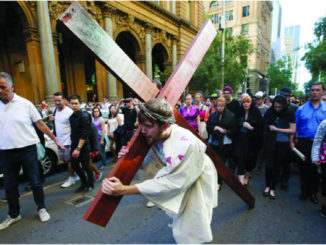
    Every year on the Friday before Easter, Good Friday is observed and this year it falls on April 2, 2021. Easter is observed on the first Sunday after the Paschal Full Moon which falls on April 4, 2021, according to the Church’s Lunar calendar. Christians commemorate the crucifixion of Jesus Christ on this day. For Christians all over the world, it is a day of mourning, penance, and fasting. For the same reason, the day is also known as Black Friday. Good Friday, also known as Holy Friday, marks the end of Lent, a 40-day period of fasting for Christians.

    Why is it called Good Friday?

    According to the Bible, the son of God was flogged, ordered to carry the cross on which he would be crucified and then put to death. It’s difficult to see what is “good” about it.

    Some sources suggest that the day is “good” in that it is holy, or that the phrase is a corruption of “God’s Friday”.

    However, the adjective good traditionally “designates a day on (or sometimes a season in) which religious observance is held”. The “good” in this context refers to “a day or season observed as holy by the church”, hence the greeting “good tide” at Christmas or on Shrove Tuesday. In addition to Good Friday, there is also a less well-known Good Wednesday, namely the Wednesday before Easter.

    The earliest known use of “guode friday” is found in The South English Legendary, a text from around 1290, according to the dictionary. According to the Baltimore Catechism – the standard US Catholic school text from 1885 to the 1960s, Good Friday is good because Christ “showed His great love for man, and purchased for him every blessing”.

    The Catholic Encyclopedia, first published in 1907, states that the term’s origins are not clear. It says some sources see its origins in the term “God’s Friday” or Gottes Freitag, while others maintain that it is from the German Gute Freitag. It notes that the day was called Long Friday by the Anglo-Saxons and is referred to as such in modern Danish.

    It also says that the day is known as “the Holy and Great Friday” in the Greek liturgy, “Holy Friday” in Roman Languages, and Karfreitag (Sorrowful Friday) in German.

    History

    The crucifixion and death of Jesus Christ are commemorated on Good Friday. According to many accounts, Christ was arrested and executed on this day. Good Friday is considered holy because it was on this day that Jesus Christ, out of love for all people, gave his life as a sacrifice while suffering for their sins. Humanity was given a new start as a result of this gesture, and all of their sins were forgiven. The above-mentioned crucifixion is also said to have occurred around AD 30 or AD 33.

    Now the question arises: why is the day known as Good Friday if it has such a sad history? The term is thought to have originated from the words “God’s Friday.” However, some people believe that the letter ‘Good’ stands for Holy, which is why the day is also known as Holy Friday.

    Significance

    Despite the fact that Jesus Christ was crucified on Good Friday, the Bible claims that the son of God was resurrected on Easter. It symbolizes that good always triumphs, and that Christ went through so much pain for humanity’s sins demonstrates how much he loved everyone.

    Importance of Easter

    Easter is, without a doubt, the most significant Christian holiday of the year. It is the day on which Christians commemorate Jesus Christ’s resurrection. According to the Bible, Jesus Christ was resurrected on Easter Sunday and came back to life. Easter has grown in importance in modern times, and markets, malls, and confectionary shops are flooded with Easter goodies. Easter, which commemorates Christ’s Resurrection, is derived from the old English ‘eastre’, which refers to a spring festival.

    The tradition of Good Friday

    On this day, believers traditionally gather to attend Church services. The service time on this day varies slightly, with services beginning around noon and lasting until 3 p.m. This is done because it is thought that Jesus suffered on the cross during these hours. On this day, many Christians all over the world fast. Processions commemorating Jesus’ death are held in some parts of the world, including the Philippines, Italy, and Spain.

    However, this year, because of the Covid-19 pandemic, safety precautions need to be followed, which might hinder some people from attending Church and its large gatherings.

  • Easter: The Resurrection of Jesus Christ

    Easter: The Resurrection of Jesus Christ

    Easter is a Christian holiday that celebrates the belief in the resurrection of Jesus Christ. In the New Testament of the Bible, the event is said to have occurred three days after Jesus was crucified by the Romans and died in roughly 30 A.D. The holiday concludes the “Passion of Christ,” a series of events and holidays that begins with Lent—a 40-day period of fasting, prayer and sacrifice—and ends with Holy Week, which includes Holy Thursday (the celebration of Jesus’ Last Supper with his 12 Apostles, also known as “Maundy Thursday”), Good Friday (on which Jesus’ crucifixion is observed) and Easter Sunday. Although a holiday of high religious significance in the Christian faith, many traditions associated with Easter date back to pre-Christian, pagan times.

    Easter will be celebrated on Sunday, April 4, 2021.

    The English word Easter, which parallels the German word Ostern, is of uncertain origin. One view, expounded by the Venerable Bede in the 8th century, was that it derived from Eostre, or Eostrae, the Anglo-Saxon goddess of spring and fertility. This view presumes—as does the view associating the origin of Christmas on December 25 with pagan celebrations of the winter solstice—that Christians appropriated pagan names and holidays for their highest festivals. Given the determination with which Christians combated all forms of paganism (the belief in multiple deities), this appears a rather dubious presumption. There is now widespread consensus that the word derives from the Christian designation of Easter week as in albis, a Latin phrase that was understood as the plural of alba (“dawn”) and became eostarum in Old High German, the precursor of the modern German and English term. The Latin and Greek Pascha (“Passover”) provides the root for Pâques, the French word for Easter.

    The Date Of Easter And

    Its Controversies

    Fixing the date on which the Resurrection of Jesus was to be observed and celebrated triggered a major controversy in early Christianity in which an Eastern and a Western position can be distinguished. The dispute, known as the Paschal controversies, was not definitively resolved until the 8th century. In Asia Minor, Christians observed the day of the Crucifixion on the same day that Jews celebrated the Passover offering—that is, on the 14th day of the first full moon of spring, 14 Nisan (see Jewish calendar). The Resurrection, then, was observed two days later, on 16 Nisan, regardless of the day of the week. In the West the Resurrection of Jesus was celebrated on the first day of the week, Sunday, when Jesus had risen from the dead. Consequently, Easter was always celebrated on the first Sunday after the 14th day of the month of Nisan. Increasingly, the churches opted for the Sunday celebration, and the Quartodecimans (“14th day” proponents) remained a minority. The Council of Nicaea in 325 decreed that Easter should be observed on the first Sunday following the first full moon after the spring equinox (March 21). Easter, therefore, can fall on any Sunday between March 22 and April 25.

    Eastern Orthodox churches use a slightly different calculation based on the Julian rather than the Gregorian calendar (which is 13 days ahead of the former), with the result that the Orthodox Easter celebration usually occurs later than that celebrated by Protestants and Roman Catholics. Moreover, the Orthodox tradition prohibits Easter from being celebrated before or at the same time as Passover.

    In the 20th century several attempts were made to arrive at a fixed date for Easter, with the Sunday following the second Saturday in April specifically proposed. While this proposal and others had many supporters, none came to fruition. Renewed interest in a fixed date arose in the early 21st century, resulting from discussions involving the leaders of Eastern Orthodox, Syriac Orthodox, Coptic, Anglican, and Roman Catholic churches, but formal agreement on such a date remained elusive.

    Liturgical Observances

    In the Christian calendar, Easter follows Lent, the period of 40 days (not counting Sundays) before Easter, which traditionally is observed by acts of penance and fasting. Easter is immediately preceded by Holy Week, which includes Maundy Thursday, the commemoration of Jesus’ Last Supper with his disciples; Good Friday, the day of his Crucifixion; and Holy Saturday, the transition between Crucifixion and Resurrection. Liturgically, Easter comes after the Great Vigil, which was originally observed sometime between sunset on Easter Saturday and sunrise on Easter Sunday. Later it would be celebrated in Western churches on Saturday evening, then on Saturday afternoon, and finally on Sunday morning. In 1955 the Roman Catholic Church set the time for the vigil at 10 PM, which allowed for the Easter mass to be celebrated after midnight. In the Orthodox traditions the vigil continues to be an important liturgical event, while in Protestant churches it is little known.

    By the 4th century the Easter vigil was well established in various liturgical expressions. It was characterized by a spirit of joyful anticipation of the Resurrection and—because of the belief that Jesus’ Second Coming would occur on Easter—the return of Jesus. In the Roman Catholic tradition the vigil has four parts: the celebration of lights focused on the Paschal candle; the service of lessons called the prophecies; the administration of the sacraments of baptism and confirmation to adult converts; and the Easter mass. The use of the Paschal candle, to denote the appearance of light out of darkness through the Resurrection, was first recorded in the year 384; by the 10th century it had gained general usage. The prominence of baptism at Easter goes back to early Christianity, probably the 4th century, when baptism was administered only once a year, at Easter. In the Roman Catholic service the priest blesses the water to be used in the forthcoming year for baptism, with the faithful taking some of that water with them to receive protection from vicissitudes. Lutheran and Anglican churches use variations of this vigil service.

    All Christian traditions have their own special liturgical emphases for Easter. The Easter sunrise service, for example, is a distinctive Protestant observance in North America. The practice may derive from the Gospel narrative of Jesus’ Resurrection, which states that Mary Magdalene went to the tomb “while it was still dark” (John 20:1) or as dawn was breaking (Matthew 28:1 and Luke 24:1). It is a service of jubilation that takes place as the sun rises to dispel the darkness.

    Easter Customs

    Easter, like Christmas, has accumulated a great many traditions, some of which have little to do with the Christian celebration of the Resurrection but derive from folk customs. The custom of the Easter lamb appropriates both the appellation used for Jesus in Scripture (“behold the lamb of God which takes away the sins of the world,” John 1:29) and the lamb’s role as a sacrificial animal in ancient Israel. In antiquity Christians placed lamb meat under the altar, had it blessed, and then ate it on Easter. Since the 12th century the Lenten fast has ended on Easter with meals including eggs, ham, cheeses, bread, and sweets that have been blessed for the occasion.

    The use of painted and decorated Easter eggs was first recorded in the 13th century. The church prohibited the eating of eggs during Holy Week, but chickens continued to lay eggs during that week, and the notion of specially identifying those as “Holy Week” eggs brought about their decoration. The egg itself became a symbol of the Resurrection. Just as Jesus rose from the tomb, the egg symbolizes new life emerging from the eggshell. In the Orthodox tradition eggs are painted red to symbolize the blood Jesus shed on the cross.

    Easter egg hunts are popular among children in the United States. First lady Lucy Hayes, the wife of Pres. Rutherford B. Hayes, is often credited with sponsoring the first annual Easter egg roll (an event where children and their parents were invited to roll their eggs on the Monday following Easter) on the White House lawn, in 1878. That year the event was moved to the White House from the grounds of the U.S. Capitol Building, where large numbers of children had gathered beginning in the early 1870s to roll their eggs and play on Easter Monday. Members of Congress were dismayed by the large crowds on Capitol Hill and feared that the foot traffic was damaging the grounds. By 1876 Congress and Pres. Ulysses S. Grant passed a law that forbade the practice of egg rolling on Capitol Hill. Some historical records note that the Hayes first opened the White House lawn to egg rolling festivities the following year, in 1877, after a young boy asked President Hayes directly for permission to use the space.

    The custom of associating a rabbit or bunny with Easter arose in Protestant areas in Europe in the 17th century but did not become common until the 19th century. The Easter rabbit is said to lay the eggs as well as decorate and hide them. In the United States the Easter rabbit also leaves children baskets with toys and candies on Easter morning. In a way, this was a manifestation of the Protestant rejection of Catholic Easter customs. In some European countries, however, other animals—in Switzerland the cuckoo, in Westphalia the fox—brought the Easter eggs.

  • Global Covid-19 caseload tops 129.4 mn

    Global Covid-19 caseload tops 129.4 mn

    Washington (TIP): The overall number of global Covid-19 cases has surpassed 129.4 million, while the deaths have surged to more than 2.82 million, according to the Johns Hopkins University. In its latest update on Friday morning, the University’s Center for Systems Science and Engineering (CSSE) revealed that the current global caseload and death toll stood at 129,475,545 and 2,826,018, respectively. The US is the worst-hit country with the world’s highest number of cases and deaths at 30,538,427 and 553,120, respectively, according to the CSSE. Brazil follows in the second place with 12,839,844 cases and 325,284 fatalities. The other countries with more than two million confirmed coronavirus cases are India (12,221,665), France (4,755,779), Russia (4,503,291), the UK (4,364,541), Italy (3,607,083), Turkey (3,357,988), Spain (3,291,394), Germany (2,853,331), Colombia (2,417,826), Argentina (2,363,251), Poland (2,356,970) and Mexico (2,238,887), the CSSE figures showed. In terms of deaths, Mexico comes in the third place with 203,210 fatalities. Nations with a death toll of over 50,000 are India (162,927), the UK (127,006), Italy (109,847), Russia (97,594), France (96,106), Germany (76,681), Spain (75,541), Colombia (63,614), Iran (62,759), Argentina (55,941), Poland (53,665), South Africa (52,897) and Peru (52,008).

                    Source: IANS

  • India records 81,466 fresh Covid-19 cases in biggest spike of 2021

    India has reported 81,466 fresh Covid-19 cases in the biggest spike of 2021. It also saw 50,356 discharges and 469 deaths in the last 24 hours, as per the Union Health Ministry. With this, the total number of cases in India has gone up to 1,23,03,131. Total recoveries are at 1,15,25,039 and the number of active cases is at 6,14,696. India’s Covid-19 death toll has reached 1,63,396.

    Maharashtra continued to report a massive rise in Covid-19 cases with 43,183 fresh cases detected in the last 24 hours. Mumbai was one of the highest contributors recording 8,646 new coronavirus cases within 24 hours, and 18 deaths. In light of the rising cases, Mumbai Mayor Kishori Pednekar on Thursday hinted at a likely restricted lockdown to be announced.

    Meanwhile, India launched COVID19 vaccination for all people aged 45 and above from April 1. Seeking to exponentially expand the countrywide anticoronavirus inoculation drive, the Centre has decided to keep all public and private sector COVID19 vaccination centres (CVCs) operational throughout April, including on gazetted holidays.

    1.1mn Britons reported having long Covid symptoms

    About 1.1 million Britons have reported having long Covid symptoms, figures from the UK’s Office for National Statistics (ONS) revealed.

    Of the 1.1 million people from private households, 674,000 were thought to have symptoms that affected their daily life, with 196,000 estimated to have their ability to undertake everyday tasks limited a lot, Xinhua news agency quoted the ONS as saying on Thursday, April 1.

    The ONS survey asked people if they had such symptoms as fatigue, muscle pain, and difficulty concentrating over a four-week period ending March 6.

    The latest data include those who were self-reported, rather than clinically diagnosed.

    Ben Humberstone, head of Health and Life Events at the ONS, told Sky News that the agency was “surprised” by the numbers, adding that “this isn’t like other diseases”.

    “Two thirds of those with self-reported long Covid told us it’s limiting their day-to-day activities so they’re not able to do the things they would’ve been able to do before,” Humberstone said.

    “And when you think this is most prevalent in people of working ages, that’s going to have a real impact on the world of work, childcare and things day to day we take for granted.”

  • South Korea ruling party faces local election losses, presaging rocky road for President Moon

    Seoul (TIP): Roiled by property scandals and economic failures, South Korea’s liberal ruling party looks set to lose the mayoral offices in the two largest cities, making it harder for President Moon Jae-in to achieve the policy goals of his last year in office. Tens of millions of South Koreans will begin early voting on Friday to elect mayors of the capital Seoul and the port city of Busan among other local offices up for grab in the April 7 election. The vote comes as Moon and his progressive Democratic Party grapple with plunging approval ratings over runaway home prices, deepening inequality and souring ties with North Korea, which could presage a broader political shift ahead of a presidential election in March. Latest polls predicted a landslide victory by the main opposition People Power Party in both Seoul and Busan. That would mean the ruling party will lose control over the government of the capital, home to nearly 20% of the country’s 52 million population, for the first time in a decade.

    A Realmeter survey released on Thursday showed voters in all age groups supported the opposition, with double digit leads among respondents in their 20s, 30s and 60s or older.

    “If Moon’s party loses, it would be a crushing defeat that would bring a political brain death for him and eliminate any momentum to push ahead with his policy agenda,” said Kim Hyung-joon, a political scientist at Myongji University in Seoul.

    “It doesn’t necessarily mean the opposition candidate will be the next president, but a new political force could emerge even within the ruling camp to keep Moon’s group in check and try to differentiate from it.”

    Moon came to power in 2017, promising to generate jobs and create a level playing field for all Koreans where hardworking people can afford a home and raise a family.

    But anger at the perceived failures of his economic policies has wiped out earlier surges in Moon’s approval ratings driven by the government’s handling of the coronavirus pandemic, dragging down the numbers to all-time lows in recent weeks. The median home price has soared more than 50% in Seoul since 2017, the fastest pace in the world, according to statistics site Numbeo, despite some 25 rounds of cooling measures. An ongoing investigation into accusations of insider land trading involving employees at a state housing developer, politicians and other officials has added fuel to the public uproar. Moon has also touted progress in inter-Korean relations as his major feat, but North Korea only continues to vent degrading criticism at him while refusing to restart denuclearisation talks with South Korea and the United States.  Reuters

  • New Zealand businessman guilty of having child abuse images

    New Zealand businessman guilty of having child abuse images

    Wellington (TIP): One of New Zealand’s most well-known businessmen pleaded guilty on Thursday to possessing child sex abuse images, including some of children as young as 2. Ron Brierley’s pleas on three charges in an Australian court have sparked a rarely invoked procedure to strip him of the knighthood he received more than 30 years ago. New Zealand Prime Minister Jacinda Ardern said she was initiating a forfeiture process for the honour, which requires approval from Britain’s Queen Elizabeth II. Brierley faces a maximum 10 years in prison when he is sentenced. He was caught with some images in his luggage at the Sydney International Airport in 2019 and authorities later found more at his Sydney home.

    One of his guilty pleas relates to photographs of girls as young as 2 in sexually suggestive poses. Another relates to a data storage device found at his home that allegedly contained more than 1,600 images of child abuse.

    Brierley’s lawyer has disputed the number of images in question, and the two sides have yet to file an agreed set of facts in the Sydney court. A police prosecutor dropped 14 other charges following Brierley’s guilty pleas.

    Now 83, Brierley in the 1970s and 80s executed a series of aggressive business maneuvers that grew Brierley Investments Ltd. into one of the nation’s largest corporations. His profile had faded somewhat following the 1987 stock market crash, but he continued to make business deals in New Zealand and in his new home of Australia.

    Business publication NBR lists Brierley as among New Zealand’s 100 wealthiest people, with an estimated fortune of 220 million New Zealand dollars ($153 million).

    He has donated an undisclosed amount of money to his former high school, Wellington College. The school said that following the guilty pleas, it has begun removing all signs with Brierley’s name on them, which includes a theater and sports field.

    The court has not yet set a sentencing date. Brierley’s bail conditions require him to live at his home in Sydney’s exclusive Point Piper. Upon sentencing, he will be added to the New South Wales state Child Protection Register for at least eight years.

    Brierley, who appeared frail at the court and walked with a cane, did not answer questions from reporters about his pleas and his lawyer could not immediately be reached for comment.

    Denise Ritchie, a long-time campaigner against sexual violence directed at women and children, said she welcomed Ardern’s move to strip Brierley of his knighthood.

    “Young lives have been irreparably damaged as a result of this predator’s behavior,” Ritchie said. “This is an abhorrent trade in the rape and molestation of children that is fueled by male demand.” — AP

  • Dutch couples mark 20th anniversary of world’s first same-sex marriages

    Dutch couples mark 20th anniversary of world’s first same-sex marriages

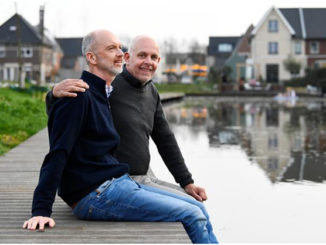
     Amsterdam (TIP): Twenty years ago, Dutch couple Gert Kasteel and Dolf Pasker made history when they tied the knot in the world’s first legally-recognised same-sex wedding in the Netherlands.

    They were among four gay couples—three male and one female—to be married shortly after midnight by the mayor of Amsterdam on April 1, 2001.

    On Thursday, they celebrated their 20th anniversaries in small groups or at home due to COVID-19 social distancing rules that prevented large gatherings. “It’s nicer to say to other people ‘he’s my husband, he’s my man’,” said Dolf, sitting next to Gert as they flipped through an album of photos and newspaper clippings of the wedding, which made headlines worldwide.

    “It has helped me to accept myself.” All four gay marriages have passed the test of time. One of the men, Frank Wittebrood, died of a heart attack in 2011 at 55.

    Those who participated looked back with pride at having made legal history.

    “People told me that the Netherlands would be the first and the last country (to pass same-sex marriages), the rest of the world won’t follow you,” said Henk Krol, a lawmaker who supported the bill when it passed the Dutch parliament in 2000. “Almost 30 countries in the world followed the Dutch example,” he said.

    Most European Union countries, Britain, the United States, Australia, Mexico and South Africa are among 29 nations to have legalised same-sex marriage since 2001.

    “I’m very proud that it’s possible,” said Gert, who before he could complete his sentence had Dolf jump in and finish it: “that we could play a little part of it. We made history.” Reuters

  • 7 convicted in Hong Kong over 2019 pro-democracy protests

    Hong Kong (TIP): Seven Hong Kong pro-democracy advocates were convicted on Thursday on charges of organising and participating in an unlawful assembly during massive anti-government protests in 2019 that triggered a crackdown on dissent. The seven include media tycoon and founder of the Apple Daily tabloid Jimmy Lai, as well as 82-year-old Martin Lee, a veteran of the city’s democracy movement. Lai had already been held without bail on other charges related to his pro-democracy activities. They were convicted for their involvement in a protest held on August 18, 2019. Organisers said that 1.7 million people marched that day in opposition to a proposed Bill that would have allowed suspects to be extradited to mainland China for trial. The activists, apart from those who have been remanded in custody on other charges, were granted bail on condition they do not leave Hong Kong and must hand in all their travel documents. AP

  • At least 36 dead in Taiwan train crash

    Taipei (TIP): A train derailed in a tunnel in eastern Taiwan on Friday after apparently hitting a truck, with at least 36 dead and 72 injured, as rescuers struggled to reach crushed carriages, the transport ministry said.

    The train, travelling to Taitung, came off the rails in a tunnel just north of Hualien causing some carriages to hit the wall of the tunnel, the fire department said in a statement.

    “Is everyone out in carriage four?” a lady is heard shouting from inside the tunnel, in images provided by the fire department. The official Central News Agency said a truck that was “not parked properly” was suspected of sliding into the path of the train. The fire department showed a picture of what appeared to be the truck’s wreckage lying next to part of the derailed train.

    The front part of the train was situated outside the tunnel, and those in carriages still in the tunnel were being led to safety, Taiwan’s railway administration said.

    Images of the crash scene show carriages inside the tunnel crumbled and ripped apart from the impact, passengers gathering suitcases and bags in a tilted, derailed carriage and others walking along the tracks littered with wreckage.

    The accident occurred at the start of a long weekend for the traditional Tomb Sweeping Day. Taiwan’s mountainous east coast is a popular tourist destination. In 2018, 18 people died and 175 were injured when a train derailed in northeastern Taiwan, in the island’s worst rail disaster in more than three decades. Reuters

  • Serbia’s firefighters auction Cristiano Ronaldo’s armband to help sick boy

    Serbia’s firefighters auction Cristiano Ronaldo’s armband to help sick boy

    Belgrade (TIP): The Portugal captain’s armband which Cristiano Ronaldo angrily threw on the ground after his goal was incorrectly disallowed in a soccer World Cup qualifier against Serbia at the weekend, was picked up by Djordje Vukicevic, a duty firefighter. The blue armband with a white letter C was then put up for a charity auction by Vukicevic and his colleagues from Belgrade’s firefighting brigade to collect money for the treatment of six-month-old Gavrilo Djurdjevic from Serbia who is suffering from spinal muscular atrophy. “Ronaldo was agitated (and) he threw the armband, it fell right next to me,” Vukicevic told Reuters on Thursday. On Saturday, the 36-year-old Ronaldo, who plays his club football for Italian champions Juventus, stormed off the pitch and threw down the captain’s armband when he was denied a clear stoppage-time winner in the 2-2 draw in Serbia.

    Many Serbians resort to fundraising and humanitarian auctions to collect money for medical treatments abroad when they cannot get adequate treatment at home.

    Vukicevic said he was ready to sell any memorabilia he could collect from players to help Gavrilo’s parents collect 2.5 million euros ($2.94 million) for his treatment, but that the armband was a score.

    “The entire crew agreed this (armband) will go for little Gavrilo,” he said. In the village of Cumic, just outside the city of Kragujevac in central Serbia, Gavrilo’s mother Nevena said the family had received donations of around 500,000 euros so far. She added that the proceeds from Ronaldo’s armband would be a significant contribution. “We could not believe that some people who do not even know us… would take the armband, auction it and help our child,’ she said. So far, bidders have offered around six million dinars ($60,042.03) during the auction on Serbia’s Limundo e-commerce platform. “This captain’s armband, which has attracted the most media attention of all armbands ever, can be yours if you join this charity auction and bid,” the advertisement says. Reuters

  • Boris Johnson’s senior black adviser resigns amid Downing Street tensions

    Boris Johnson’s senior black adviser resigns amid Downing Street tensions

    London (TIP): UK Prime Minister Boris Johnson’s senior-most black adviser, Samuel Kasumu, has stepped down from his post as Special Adviser for Civil Society and Communities, it emerged on Thursday, a day after the release of a controversial government-appointed race review.

    Kasumu’s resignation will come in effect from May 1 and Downing Street has dismissed as “completely inaccurate” reports that it is linked to the Commission on Race and Ethnic Disparities (CRED) report, which had concluded that Britain was not a structurally racist nation even though overt racism remained a reality in the country.

    It has been claimed that Kasumu’s exit was on the cards for some time due to tensions within Downing Street and is not directly linked to the much-criticised report.

    “Mr Kasumu has played an incredibly valuable role during his time at No 10,” a Downing Street spokesperson said.

    “As he previously set out, he will be leaving government in May – this has been his plan for several months and has not changed. Any suggestion that this decision has been made this week or that this is linked to the CRED report is completely inaccurate,” the spokesperson said.

    Kasumu had previously handed in his resignation in February but went on to retract it. At the time, he had said he wanted to continue work he had been doing fighting misinformation on COVID-19 vaccines with Britain’s black community, with “the view to leaving at the end of May”.

    However, according to ‘The Politico’, Kasumu confirmed his decision to leave Downing Street on Tuesday morning, just as the findings of the CRED report were released.

    It comes as racial equality campaigners criticised the findings, and the Opposition Labour Party accused the government of downplaying institutional racism.

    Labour’s shadow equalities secretary Marsha de Cordova called the report “divisive”, adding it was “no wonder” the government was “losing the expertise from their team”.

    “To have your most senior advisor on ethnic minorities quit as you publish a so-called landmark report on race in the UK is telling of how far removed the Tories are from the everyday lived experiences of Black, Asian and ethnic minority people,” she said.

    Former equality and human rights commissioner Lord Simon Woolley, who knows Kasumu, said he had been “disheartened” whilst at No 10 Downing Street.

    The House of Lords peer, who has also criticised the CRED findings, told the BBC there is a “crisis at No 10 when it comes to acknowledging and dealing with persistent race inequality”.

    The report has also attracted criticism from unions and charities – all of whom accuse the commission of downplaying the role of wider factors in racial inequalities.

    Dr Maggie Aderin-Pocock, a member of the commission, said the report was not denying institutional racism existed, but said they had not discovered evidence of it in the areas they had looked. PTI


  • Nepal allows internet, telecom services during international flights

    Kathmandu (TIP): Nepal has become the third country in South Asia after India and Afghanistan to allow international airlines to use the Nepali sky for providing internet and telecom services to their passengers.

    The Nepal Telecommunications Authority (NTA), an autonomous telecommunications regulatory body, in collaboration with the Civil Aviation Authority of Nepal took the decision after the Telecommunications Authority Board of Directors held a meeting on March 22.

    As per the decision, a company willing to provide the services to the passengers can use the frequencies above 10,000 feet from the surface.

    Those airlines receiving permission from the International Civil Aviation Organisation would be granted permission to avail internet and telecom services above 10,000 feet in the Nepali sky, said the NTA’s spokesperson Santosh Poudel. Granting permission to use the internet service below 10,000 feet could result in a disturbance in the service on the ground across the country, he said. To use the service, those willing to avail it should apply to the NTA.  PTI

  • Sri Lanka, Pak militaries conduct joint exercise

    Colombo (TIP): The militaries of Sri Lanka and Pakistan have conducted a 15-day joint exercise aimed at enhancing bilateral defence relations and sharing the rich experience of two armies against terrorism. Titled the ‘Ex-Shake Hands’, the exercise was conducted in Saliyapura in North Central Province of Sri Lanka.

    The exercise had the participation of six officers and 35 other ranks from the Pakistan Army and four officers and 40 other ranks from the Sri Lanka Army, the Pakistan High Commission here said in a release. It was aimed at enhancing the bilateral defence relations and mutually share the rich experience of two armies against terrorism, it said.

    Speaking on the occasion, General Shavendra Silva, Sri Lanka’s Army chief, said, “Pakistan has remained a true friend of Sri Lanka during all her critical endeavours and always stood with Sri Lanka. Especially, Pakistan supported Sri Lanka against UNHRC resolution recently”.

    Pakistan was among the nations which voted in favour of Sri Lanka at last week’s UNHRC resolution which called for the island’s human rights accountability and action for reconciliation.

    In February, Pakistan Prime Minister Imran Khan visited Sri Lanka. — PTI

  • Pak takes U-turn, rejects proposal to import cotton and sugar from India

    Pak takes U-turn, rejects proposal to import cotton and sugar from India

    Islamabad (TIP): In a volte-face, Pakistan’s Cabinet on Thursday rejected a proposal of its Economic Coordination Committee (ECC) to import cotton and sugar from India, according to a Cabinet minister.

    “Cabinet stated clearly NO trade with India,” Minister for Human Rights Shireen Mazari said in a tweet soon after a Cabinet meeting chaired by Prime Minister Imran Khan on Thursday.

    “PM made clear there can be no normalisation of relations with India until they reverse” their actions viz Kashmir of August 5 2019, tweeted Mazari, who is known for her hawkish stand on Kashmir.

    The Cabinet decision comes a day after Pakistan’s new Finance Minister Hammad Azhar on Wednesday announced that the country will lift a nearly two-year long ban on the import of cotton and sugar from India after a meeting of the ECC chaired by him. Ahead of the Cabinet meeting, Mazari had said that all ECC decisions have to be approved by Cabinet and only then can they be seen as “approved” by the government.

    “Just for the record – All ECC decisions have to be approved by Cabinet & only then they can be seen as “approved by govt”! So today in Cabinet there will be discussion on ECC decisions incl trade with India & then govt decision will be taken! Media shd be aware of this atleast!” Mazari tweeted.

    Azhar’s announcement on Wednesday to import cotton and sugar from India had raised hopes of a partial revival of bilateral trade relations, which were suspended after the August 5, 2019 decision of New Delhi to revoke the special status of Jammu and Kashmir.

    India is the world’s biggest producer of cotton and the second biggest sugar manufacturer.

    In May 2020, Pakistan had lifted the ban on import of medicines and raw material of essential drugs from India amid the Covid-19 pandemic.

    Ties between India and Pakistan nose-dived after a terror attack on the Pathankot Air Force base in 2016 by terror groups based in Pakistan. Subsequent attacks, including one on an Indian Army camp in Uri, further deteriorated the relationship. PTI

  • Myanmar protesters urge ‘guerrilla strikes’ as internet blackout widens

    Myanmar protesters urge ‘guerrilla strikes’ as internet blackout widens

    Myanmar (TIP): Myanmar activists held candle-lit protests overnight and scrambled to find workarounds for a new internet shut down on Friday, as opponents to the military’s bloody crackdown on dissent vowed no letup in efforts to unseat the ruling generals. Anti-coup groups shared radio frequencies, offline internet resources and providers of text message news alerts to try to circumvent new curbs on the internet, which now limit Web access to fixed-line services only. The military did not announce or explain its order to telecom firms to cut wireless broadband, which adds to a ban on mobile data through which a nationwide movement has mobilised on social media and spread images of the junta’s lethal suppression of mostly youth-led protests.

    Late on Thursday, protesters spread a call for a “flower strike” at bus stops where demonstrators killed by security forces had departed on their last journeys.

    “We will leave flowers at bus stops tomorrow … That’s what I want to tell you guys before the internet is down,” Khin Sadar, a protest leader, posted on Facebook.

    “In the following days, there were street protests. Do as many guerrilla strikes as you can. Please join.” “Let’s listen to the radio again. Let’s make phone calls to each other too.”

    The former British colony has been in chaos for two months following the military’s overthrow of Aung San Suu Kyi’s elected administration, which has sparked anger across towns and cities and reignited hostilities between the armed forces and ethnic minority insurgents in several different regions.

    New charges of violating the official secrets act were filed against the Nobel laureate, her chief lawyer said on Thursday, the most serious so far, on top of two comparatively minor offences. Breaches of the colonial-era law are punishable by 14 years in prison.

    The charges were filed against three of Suu Kyi’s deposed cabinet ministers and her Australian economic adviser Sean Turnell, who are among hundreds detained in the military’s sweeping crackdown on opponents since it took power, alleging fraud in an election swept by Suu Kyi’s party. Lawyer Min Min Soe said Suu Kyi looked in good health during a video hearing on Thursday but was unable to tell whether the ousted leader, the figurehead of Myanmar’s decades-long fight for democracy, was aware of the situation in her country.

    ‘WE WILL NOT SURRENDER’

    Protesters were in the streets in several urban centres day and night on Thursday, where some burned copies of the military-drafted 2008 constitution. The media reported two people were killed, including an 18-year-old man, as police opened fire to quell gatherings.

    Khit Thit Media reported shots were fired at a protest during the night, where 400 troops were present. The report could not immediately be verified.

    Some 543 people have been killed in the uprising, according to the Association for Political Prisoners (AAPP) advocacy group, which is tracking casualties and detentions. —Reuters

  • Some Positive Signs in India-Pakistan Relations?

    Some Positive Signs in India-Pakistan Relations?

    By Prabhu Dayal

     “Hoping for a quick turn-around in Indo-Pakistan relations may just be wishful thinking. Perhaps it is, but I must admit that I have secretly indulged in it since 1978 when I went to Egypt on my first diplomatic posting and witnessed Anwar Sadat and Menahem Begin burying the hatchet between their two countries. Egypt and Israel too had fought deadly wars in 1948, 1967 and 1973, but there is peace between them now, even though some people refer to it as ‘a cold peace’. 

    It is an axiomatic truth that our region needs development not conflict. To continue on our present path would be catastrophic. By working together, we can usher in a new age filled with hope not just for the two countries but for the whole of South Asia.

    On the occasion of Pakistan’s 70th National Day on 23rd March this year, Prime Minister Narendra Modi wrote a letter to Prime Minister Imran Khan, saying: “As a neighboring country, India desires cordial relations with the people of Pakistan. For this, an environment of trust, devoid of terror and hostility, is imperative.” He added: ” Excellency, at this difficult time for humanity, I would like to convey my best wishes to you and the people of Pakistan for dealing with the challenges of the COVID-19 pandemic.” Three days earlier, PM Modi had tweeted wishing PM Imran Khan a speedy recovery after he and his wife tested positive for the deadly virus. “Best wishes to Prime Minister @ImranKhanPTI for a speedy recovery from Covid-19,” he had said in his tweet.

    On 29th January, Imran Khan replied to Prime Minister Narendra Modi thanking him for his greetings on Pakistan Day. Khan also said: “The people of Pakistan also desire peaceful, cooperative relations with all neighbors including India. We are convinced that durable peace and stability in South Asia is contingent upon resolving all outstanding issues between India and Pakistan, in particular the Jammu and Kashmir dispute.” He added that the that creation of an enabling environment is imperative for a constructive and result-oriented dialogue. The Pakistani Prime Minister also conveyed his wishes for the people of India in the fight against the Covid pandemic.

    Other positive signs

    In this regard, there are some other positive developments which also need to be noted. Both the armies recommitted themselves to the 2003 ceasefires along the line of control in J&K in February. After about two-and-half years, a delegation of Pakistani officials arrived in India for a meeting of the permanent Indus commission this week. Last week, Foreign Secretary Harsh Vardhan Shringla said India wants good friendly ties with Pakistan provided there’s a conducive atmosphere for dialogue. Similar sentiments have been expressed across the border too.  Pakistan Army chief General Qamar Javed Bajwa said on March 18 that it was time for India and Pakistan to “bury the past and move forward.” He added that the peace between the two neighbors would help to “unlock” the potential of South and Central Asia.

    There are some hopeful signs in regard to trade also. Pakistan had suspended trade ties with India after New Delhi revoked the special status of Jammu and Kashmir in 2019. However, in May 2020, Pakistan lifted the ban on the import of medicines and raw material from India to ensure there is no shortage of essential drugs amid the COVID-19 pandemic. This was the first step of reversing the complete suspension of trade with India. Now, according to media reports, Pakistan’s textile ministry headed by Prime Minister Imran Khan has recommended the lifting of a ban on the import of cotton from India to bridge the raw material shortfall the country’s textile sector was facing. Currently, cotton and yarn imports are allowed from all countries except India. The textile sector in Pakistan strongly favors imports of cotton from India as they are much cheaper than imports from other countries. Pakistan Textile Exporters Association Chairman Khurram Mukhtar tweeted that the import of raw cotton, yarn and grey fabric from India will bridge the gap in demand and supply and will enable Pakistani exporters to continue the growth momentum.

    Two steps forward, two steps backwards

    The past has shown that Indo-Pak relations are a case of two steps forward followed by two steps backwards. However, it cannot be emphasized enough how important it is to end the deeply ingrained hostility unless we want to hurtle towards another conflict, one that will perhaps be more destructive than any in the past. We need bold and out-of-the-box thinking to chart out a new course. To use a cliché, the bull has to be taken by the horns.  Hoping for a quick turn-around in Indo-Pakistan relations may just be wishful thinking. Perhaps it is, but I must admit that I have secretly indulged in it since 1978 when I went to Egypt on my first diplomatic posting and witnessed Anwar Sadat and Menahem Begin burying the hatchet between their two countries. Egypt and Israel too had fought deadly wars in 1948, 1967 and 1973, but there is peace between them now, even though some people refer to it as ‘a cold peace’.

    Pakistan’s hostility

     Sadly, amidst all the turbulence which has marked Pakistan’s history, and which has seen civilian governments and military juntas play musical chairs with one another, one aspect which has retained the stamp of permanence has been its unremitting hostility towards India and its steadfast desire to foment trouble across its eastern border. The inevitable conclusion that is drawn in India is that the ill-will of the Pakistan establishment, especially that of the army cannot be transformed into goodwill; whenever Pakistan can create problems for us, it will always do so. In turn, this has given rise to anti-Pakistan sentiments across many sections of the Indian polity.

    Given the fact that Pakistan’s economic, industrial and military strength is considerably less than India’s, a fundamental plank of its policy continues to be built around the asymmetric or proxy war involving the sending of terrorists across the Line of Control.  Although the Line of Control is fenced, there are portions of it where rivers and rivulets make the fencing vulnerable and such sections are used by the infiltrators. The use of tunnels for sending across infiltrators has also been resorted to by the Pakistanis.


    Kashmir issue


    Will we ever be able to resolve what Pakistan regards as the core issue – the Kashmir dispute? It is very difficult, but I would not say that it is impossible.  It may be pertinent to note that according to the reputed journalist Kuldip Nayyar, Nawaz Sharif had himself admitted to him some years ago that neither can Pakistan take away Kashmir from India nor can India give it away.


    Some analysts have suggested that the only reasonable and workable solution would be to eschew jingoism and settle the Kashmir dispute by recognizing the Line of Control as an International Border. They feel that this is the only alternative to the endless hostility which only impoverishes both countries.

    In his treatise Securing India’s future in the new millennium, the well-known Indian strategic analyst Bramha Chellany has opined:

    “In the long run, the only possible solution to the Kashmir dispute is for the three countries (India, Pakistan and China) to let bygone be bygones and agree to be content with the J&K territories they control.”

    The undeniable fact is that India-Pakistan relations can only be set right through a spirit of give and take.  If the willingness to compromise is absent, then the conflict cannot end, and the hostility will keep increasing. It may take a very long time for everything to fall in place; there will be numerous setbacks. However, working towards this objective is preferable to just being reconciled to the war of attrition.

    It goes without saying that one issue on which India cannot compromise is the demand that the nurseries of terrorism in Pakistan must be closed down. Hopefully, Pakistan will begin to realize that its policy of sponsoring terrorism is causing great damage to itself, as thousands of Pakistanis have died in acts of terrorism committed by the very same outfits which have been trained by the ISI and the armed forces.


    ‘Sone ki chidiya’ versus today’s reality


    Many in India as well as in Pakistan hope that one day our countries could live together as prosperous, good neighbors, much as France and Germany do now after having endured centuries of mutual conflicts. They hark back to those days when the Indian sub-continent produced so much wealth that it was called sone ki chidiya or a bird made of gold.


    That bird is now malnourished, sick and weak. The IMF rankings of countries in terms of Per Capita Income (2020 estimates) place India at 140 in the list and Pakistan at 150 with figures of US$ 1,877 and $1,378, respectively. By comparison, Malaysia is ranked 60 with US$ 10,192, Thailand at 77 with US$ 7,295, Indonesia at 107 with US$ 4,038 and Sri Lanka at 112 with US $ 3,698. Even Bangladesh has overtaken India and Pakistan and ranks 139 with figures of $ 1,888. Only really underdeveloped countries rank behind the South Asian giants India and Pakistan. Despite the fact that the South Asian Association for Regional Cooperation (SAARC) has been in existence since December 1985, it has precious little to show by way of real cooperation unlike ASEAN, another regional cooperation organization in Asia.


    It is an axiomatic truth that our region needs development not conflict. To continue on our present path would be catastrophic. By working together, we can usher in a new age filled with hope not just for the two countries but for the whole of South Asia.

    (The author is a former career diplomat. He can be reached at prabhu_dayal70@hotmail.com)

    (Courtesy / OPOYI)


    ———————————————————

    For Jatinder


    Categories:Breaking News, Front Page, South Asia, India, Pakistan

    Tags#India #Pakistan #ImranKhan #NarendraModi #LoC

  • BAPS CHARITIES HOST 2nd POP COVID -!9 VACCINATION CLINIC

    BAPS CHARITIES HOST 2nd POP COVID -!9 VACCINATION CLINIC

    MELVILLE, NY (TIP): BAPS Charities had a very successful 2nd Covid Vaccination pop-up clinic on Friday, March 26th. 2021, at BAPS Hindu Temple in Melville, Long Island. A total of 550 people received the Pfizer vaccine, out of which 240 people received their 2nd dose. The vaccination and logistics were provided by NYS Covid Task force, in collaboration with Stony Brook University Hospital and its medical staff.

    Lisa Santeramo, assistant secretary for intergovernmental affairs, representing Gov. Andrew M.  Cuomo’s office participated in welcoming the clinic.

    The organizers were very happy and appreciative of the BAPS Charities volunteers for providing very valuable support to make this a successful event.

    NY State Senator James Gaughran visited the site and was very appreciative of the excellent services BAPS Charities is providing to our communities. BAPS Charities cherishes cooperation and support from all the stakeholders.

  • Village of Lincolnwood community comes out in support ofJesal Patel in the Mayoral Race

    Village of Lincolnwood community comes out in support ofJesal Patel in the Mayoral Race

    Lincolnwood Alliance Party: Jesal Patel for Mayor, Beryl Herman for Clerk, Jean Ikezoe, Grace Diaz Herrera and Mohammed Saleem.


    CAMU1291: Invited distinguished guests at the event were Minal Desai (Skokie Park District Commissioner), Susan Patel (President IADO (Indian American Democratic organization), Harendra Mangrola Past President IADO, Babu Patel (Marsha), Bhavesh Patel and Babu Patel (Saahil), Nick Patel (LA Tan), Kiraan Shah, Gautam Patel, Ashok Patel, Kishor Patel, J P Patel, PC Sha, Bharat Liwani and Karim and Hannah Lakhani.

    Punch # 13456 Jesal Patel for Lincolnwood Mayor

    LINCOLNWOOD, IL (TIP): A wave of excitement engulfed the Village of Lincolnwood since Jesal Patel declared his candidacy for the office of the Village Mayor. During the recent meet and greet held on March 25th, 2031at Holiday Inn, Skokie, IL 60077, many prominent members of Lincolnwood wholeheartedly expressed their support for Jesal Patel. Some of the distinguished guests invited at the event were Minal Desai (Skokie Park District Commissioner), Susan Patel (President IADO (Indian American Democratic organization), Harendra Mangrola Past President IADO, Babu Patel (Marsha), Bhavesh Patel and Babu Patel (Saahil), Nick Patel (LA Tan), Kiraan Shah, Gautam Patel, Ashok Patel, Kishor Patel, J P Patel, PC Sha, Bharat Liwani and Karim and Hannah Lakhani.

    Susan Patel steered the entire event and thanked everyone who came to support Jesal. Nick Patel talked about the great work that Jesal has done since 2007 and extended his support for him in the current election. The guests also talked about how, under the leadership of Jesal and the Lincolnwood Alliance Party, Lincolnwood has been better able to navigate the challenging times during covid-19 pandemic and has seen a robust economic period. A special mention was made about how Lincolnwood Alliance was able to secure the financing necessary to initiate the first phase of the 10-year infrastructure improvement program with zero property tax increases. It also supported public and private partnerships, and new TIF districts to help spur development in Lincolnwood.

    Jesal reminisced about spending his childhood in the Village of Lincolnwood and expressed his love for the village. Jesal’s father Babu Patel, who is a very well-known community leader, urged everyone to vote for Jesal to make Lincolnwood prosperous and a safe place to live. One of candidates for the office of trustee, Mohammed Saleem also addressed the guests at the event. Saleem, a civil engineer by profession, aims at building bridges that bring people and community together. Saleem mentioned how he could use his expertise as a civil engineer towards revamping the roads, buildings and the overall infrastructure of the Village of Lincolnwood.

    Lincolnwood Alliance candidates in the current elections are Jesal Patel for Mayor, Beryl Herman for Clerk, and three candidates Jean Ikezoe-Halevi, Grace Diaz Herrera, Mohammed Saleem for Trustees.

    Jesal, for over 14 years, has proven his honesty and integrity through his work and community service. Being a finance graduate, he envisions a thriving Lincolnwood through smart planning by creating new business opportunities as well as employment opportunities. He has many years of experience as a small business owner behind him. His firsthand knowledge and experience as an entrepreneur help him understand how important it is to support small businesses so they can expand, create new jobs, and thrive in our community.


    Jesal, during his address at the meet and greet, mentioned how his career has helped him understand the challenges faced by homeowners as well as business owners especially during the pandemic. Jesal’s business, Patel Realty, has been serving the Village of Lincolnwood with its specialization in residential and retail real estate sales and investment for many years. Jesal has been a Trustee in Lincolnwood since 2007 and has served as Board liaison to multiple Village committees and boards.


    The Lincolnwood Alliance team, under Jesal Patel’s proven leadership, promises to build an inclusive and welcoming village through transparent governance by involving the Lincolnwood residents in the decision-making process. One of the dreams of The Lincolnwood Alliance team is to create a welcoming and efficient atmosphere for all by providing first class customer service with its Service First Organization concept. Its emphasis on utilizing diversity on various committees and commissions aims to generate ideas and form visions for a prosperous village.


    Jesal requested everyone to go for early voting which is at Oakton Community College 7701 N Lincoln Mon-Fri 9am – 5pm and on weekends 10am – 4pm through April 5th,2021.  Election Day is April 6 and voters can find their polling place at https://www.cookcountyclerkil.gov/service/your-voter-information


    The numbers on the ballot for the Lincolnwood Alliance Party are Jesal Patel for Mayor – #1, Beryl Herman for Clerk – #3, Jean Ikezoe-Halevi – #4, Grace Diaz Herrera – #5 and Mohammed Saleem – #6

    (Photographs and Press release /Asian Media USA)


  • Indian American choreographer Vinita Hazari dances alongside Olaf the snowman

    Indian American choreographer Vinita Hazari dances alongside Olaf the snowman

    NEW YORK (TIP): Most little girls around the world grow up listening to fairy tales and often learn their first lessons on love and life inspired by the princesses in the stories. As questions about diversity and inclusivity gain mainstream attention, also has the scope of these fairy tales. In fact, there has been noise for some time about how often these Western fairy tales give a very white-washed view of the world. Stories of colored women of courage and brown princesses are still hard to come by in American popular culture. And an absence of an Indian American Disney princess has been debated about in the past few years.

    While we still await a brown princess in popular stories, a New York City-based dancer and choreographer has found a unique way to address the issue while giving young South Asian girls a chance to feel represented.

    Vinita Hazari, an emerging choreographer, has been creating innovative concept videos that talk about inclusion, diversity and stigmas within the South Asian community. A trained kathak dancer, Hazari recently created a video where she, dressed like an Indian princess, dances alongside the snowman character Olaf from the hit Disney film Frozen. Her video, which has been viewed more than 50,000 times, struck a chord with South Asian women who have often felt a lack of representation, especially in American culture and entertainment. Hazari reinforces her point by incorporating a kathak-based semi classical dancer in her video, as Olaf is seen synchronizing with her moves.

    Hazari, who has been dancing for over 14 years now, has also been gaining attention for her videos that target mental health stigmas in South Asian communities. She’s released a series of videos portraying the negative impact unwelcoming South Asian stigma can have on mental health. She conceptualizes, produces, choreographs and performs in dance videos. A trained kathak dancer she has also trained in hip-hop, jazz, and ballet.

  • Indian American Seema Nanda set to return to the Department of Labor

    Indian American Seema Nanda set to return to the Department of Labor

    WASHINGTON (TIP): Indian American Seema Nanda is set to return to the Department of Labor, where she served for 40 months as Chief of Staff, Deputy Chief of Staff and Deputy Solicitor during the Obama administration.

    President Joe Biden announced his intent to nominate her as the Solicitor of the Department of Labor on March 26, 2021. The Arlington, VA, resident is currently a Visiting Fellow at Harvard Law School Labor & Worklife Program.

    Nanda, who grew up in Connecticut, served as the CEO of the Democratic National Committee, an apex party body that coordinates strategy to elect its candidates various federal, state and local offices, from June 2018 to April last year. During her tenure as the DNC chief, the party captured the House of Representatives in the 2018 mid-term election, propelling Rep. Nancy Pelosi back to the House speaker position.

    As the DNC CEO, she worked closely with Chair Tom​ Perez, who was also her former boss at the Department of Labor, managing the group’s day-to-day operations.

    Prior to joining the DNC, she served as the Chief Operating Officer and Executive Vice President at the advocacy group Leadership Conference on Civil and Human Rights.

    During President Obama’s first term, Nanda served at the Civil Rights Division at the Department of Justice, initially as a Senior Trial Attorney and then as a Deputy Special Counsel.

    From 2007 to 2010, she served as a supervisor attorney in the Division of Advice at the National Labor Relations Board. Nanda earned her bachelor’s degree from Brown University and law degree from Boston College Law School.

    Nanda was one of the six nominees announced by Biden on Friday.


  • Indian American Couple DonatesUSD 150,000 for Bihar, Jharkhand Healthcare

    Indian American Couple DonatesUSD 150,000 for Bihar, Jharkhand Healthcare

    WASHINGTON (TIP): An Indian American couple has donated over ₹ 1 for crore healthcare works in Bihar and Jharkhand, the Bihar Jharkhand Association of North America (BJANA) announced on Monday, March 29.

    The generous donation of USD 150,000 by the Ramesh and Kalpana Bhatia Family Foundation to the BJANA would be used for healthcare efforts in the rural areas of the two states through the PRAN-BJANA clinic initiative.

    The Pravasi Alumni Nisshulk (PRAN) is an initiative by like-minded Indian-American physicians who are working to provide healthcare to the underprivileged and underserved in Bihar and Jharkhand.

    These doctors have set up a PRAN clinic in Ranchi, providing free healthcare services to the needy. Their endeavor is to provide free healthcare services across the states.

    “With the generous donation of Ramesh and Kalpana Bhatia, this became possible. BJANA getting a large donation is a testament to its ongoing philanthropic activities both here and back home,” BJANA president Avinash Gupta said.

    Alok Kumar, former FIA president, said this kind of donation would help the BJANA carry out its healthcare works in the region. Kalpana Bhatia came from NIT, Patna, and runs a successful business in Texas.