Tag: Fashion

  • Indian-origin scientist develops world’s first skin-like display

    Indian-origin scientist develops world’s first skin-like display

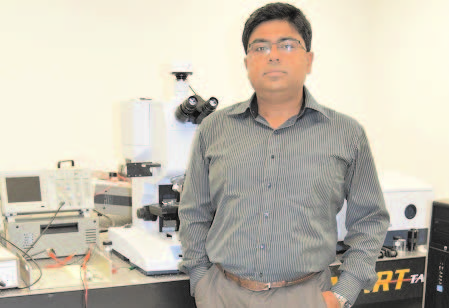
    WASHINGTON (TIP): Indian-American researcher Debashis Chanda from University of Central Florida (UCF) has developed a nature-inspired technique for creating the world’s first full-colour, flexible thin-film reflective display.

    Simply put, if someone at a wedding reception is wearing the same dress as you, the technology can help you switch yours to a different colour in the blink of an eye.

    “All manmade displays like LCD and LED are rigid, brittle and bulky. But you look at an octopus. He can create colour on the skin itself covering a complex body contour and it is stretchable and flexible,” said professor Chanda.

    That was the motivation: Can we take some inspiration from biology and create a skin-like display?

    Chanda was able to change the colour on an ultra-thin nano-structured surface by applying voltage.

    The new method does not need its own light source. Rather, it reflects the ambient light around it.

    “Your camouflage, your clothing, your fashion items – all of that could change,” he said.

    Traditional displays like those on a mobile phone require a light source, filters and a glass plates.

    But animals like chameleons, octopuses and squids are born with thin, flexible, colour-changing displays that do not need a light source – their skin.

    Chanda’s display is only about few microns thick, compared to a 100-micron-thick human hair.

    Such an ultra-thin display can be applied to flexible materials like plastics and synthetic fabrics.

    The research has major implications for existing electronics like televisions, computers and mobile devices that have displays considered thin by today’s standards but monstrously bulky in comparison.

    The potentially bigger impact could be whole new categories of displays that have never been thought of.

    “This is a cheap way of making displays on a flexible substrate with full-colour generation.”

    The research is detailed in the journal Nature Communications.

  • Luxury Fashion boutique Sitara opens doors

    Luxury Fashion boutique Sitara opens doors

    NEW YORK (TIP): At a standing room only, media event, marking the launch of the fashion boutique Sitara, owner Nitu Huda, spoke about the need for a luxury-shopping destination in New York. “We are always looking for quality western wear, but when it came to Indian, I couldn’t find anyplace where I could shop for good quality designer clothes,” she said, “and that’s why Sitara”

    Luxury Fashion boutique SitaraA Glamorous shop that houses collections from top rated Indian designers like Tarun Tahiliani, Anita Dongre, Mapxencars, Vikram Phadnis, Satya Paul, Priya Singh, Rohit Verma, and many others, Sitara is set up to be the shopping destination for those with exquisite taste.

    The boutique also houses an exclusive bridal collection along with eveningwear and casual outfits that fit every mood. At a glittering fashion show where the models walked the runway to show off some of the exquisite collection, one could hear cheers and applause as the models walked by.

    Having so many well known, authentic Indian designers labels under one roof is something new and fresh for the South Asian fashion scene.

    The exclusive bridal boutique will operate on an appointment only basis to give individual attention to each and every bride. Sitara is conveniently located on Roosevelt Avenue and 63rd Street in Woodside, NY, just a short walk or drive from Jackson Heights.

    For more information please visit www.sitaraonline.com

  • Hindu-American Tulsi Gabbard Gets Married in a Vedic Ceremony in Hawaii

    Hindu-American Tulsi Gabbard Gets Married in a Vedic Ceremony in Hawaii

    WASHINGTON (TIP): 33-year-old Indian_American member of the US Congress Tulsi Gabbard, tied the knot with 26-year-old cinematographer Abraham Williams in a Vedic ceremony in her home state of Hawaii.

    The marriage, which took place at the historic Kahaluu Fishpond , April 9, concluded with a traditional yoga ‘kirtan’ and was attended by a large number of US lawmakers besides Ms Gabbard’s friends and family.

    The marriage ceremony that was conducted in a Vedic fashion ended with song and dance, local media reported.

    In previous media interviews, Ms Gabbard said she will retain her last name.

    Hawaii will always be the couple’s primary home, local media reported.

    The Democratic Congresswoman from Hawaii, Ms Gabbard, had announced her engagement in January.

    “Both Abraham and I are generally kind of private people. He has nothing to do with politics. He’s a humble, great guy who doesn’t want to be in the limelight, so this is something new to the both of us,” she told the Honolulu Star Advertiser in an interview published in February.

    This is Ms Gabbard’s second marriage and the first for Mr Williams.

    The guest list included former U.S. Sen. Daniel Akaka, Former Gov. Neil Abercrombie, U.S. Rep. Mark Takai, Honolulu Mayor Kirk Caldwell and former U.S. Rep. Colleen Hanabusa.

  • Mumbai airport’s new luxury lounge

    Mumbai airport’s new luxury lounge

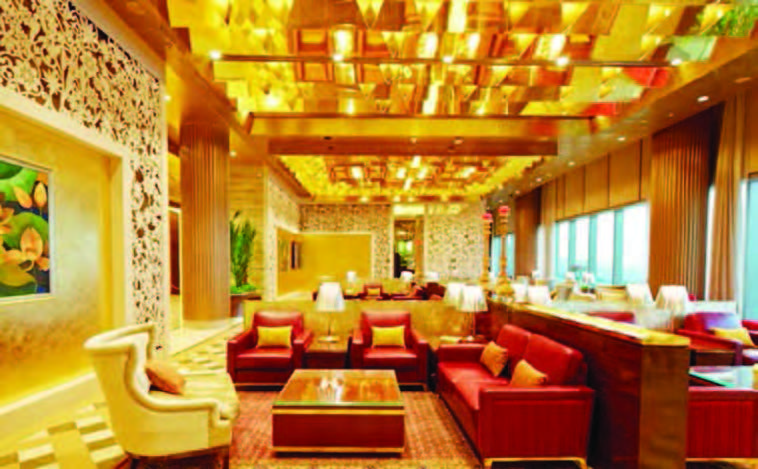
    Since it opened earlier this year, Terminal 2 at Mumbai’s Chhatrapati Shivaji International Airport has been getting a lot of love-it was chosen by travelers as their second most Favorite International Airport in the world. Now, it just got better with the opening of the GVK Lounge, the world’s first luxury airport lounge common to passengers of all airlines.

    [quote_box_center]Why you should check out Mumbai airport’s new luxury lounge [/quote_box_center]

    The look

    Spread across 30,000sqft over levels 3 and 4, the lounge can accommodate up to 440 passengers. Designed by celebrated fashion designer Sandeep Khosla and acclaimed architect Alfaz Miller, the lounge sports an Indian theme, accentuated through jali screens, contemporary chandeliers, a strategic lighting display and the signature glass peacock installation. While level 3 has silver theme, level 4 has been given a gold theme.

    What you get

    The lounge is divided into three categories: First, Business and Premium Class. Located on level 4, the First Class section offers personalized services, as well as amenities such as à la carte dining and individual spa treatments. The Premium Class section, also on level 4, comes with an opulent buffet area (connected to a live tandoori kitchen), a juice bar and a whiskey lounge, plus additional services such as foot massages. The maximum privacy is, however, assured to Business Class guests on level 3, who can also partake of a range of multi-cuisine dishes and barista offerings.

    Key facilities include:

    • Concierge services
    • A smoking zone
    • Food and beverages
    • Bar
    • A luxurious spa
    • Shower facilities
    • A relaxation area
    • Library
    • A business centre

    Who can use the lounge

    The lounge is available for First and Business Class passengers. Access is at the airline’s discretion.

    CREDIT CARD ACCESS PROGRAMMES

    (Please check if the credit card/s you hold permits use of the Mumbai lounge)

    Globally, credit card providers offer their premium customers access to lounges. Both MasterCard (for its World, Platinum and World Elite cardholders) and Visa (for its Signature and Infinite cardholders) provide lounge-access programs at major airports in cities such as New Delhi, Mumbai, Bengaluru, Chennai and Kolkata. But depending on the provider and the bank issuing the card, the number of visits may vary. For example, Visa limits free lounge access to two visits per quarter, while MasterCard (depending on the type of card) offers unlimited access. Check out premium cards from Axis Bank, Citibank, HDFC, HSBC, ICICI, IndusInd, Kotak Mahindra, SBI and Standard Chartered, which all give desirable privileges. Unlike most others, Citibank’s Premier Miles World MasterCard allows ‘add-on cardholders’ complimentary lounge access. American Express operates its own branded lounges at Mumbai (Domestic, T1C) and New Delhi (Domestic, T3) airports, and gives free access to Platinum cardholders.

    PAY-IN LOUNGES

    These are independently run lounges that a traveller can access for a fee.

    Priority Pass

    With more than 600 airport lounges in 100 cities, including London, Paris, Jeddah, Phuket and Goa, Priority Pass is one of the world’s largest pay-in lounge operators. To take advantage of it, you have to be a member. Standard Membership costs US$99 (Rs6,100) per year and comes with an additional per-visit fee of US$27 (Rs1,660), which can be redeemed against unlimited food and beverages as well as use of the wi-fi, conference rooms and, at some airports, showers. Priority Pass also has Standard Plus Membership for US$249 (Rs15,300) per year, which grants 10 complimentary visits, after which, he or she pays US$27 (Rs1,660) per visit. If you would rather make a one-time annual payment, opt for its Prestige Membership at US$399 (Rs22,500). Many credit cards (such as ICICI, HSBC and HDFC) offer free Standard Membership to Priority Pass on their premium-category cards.

    (www.prioritypass.com) 

    Plaza Premium Lounge

    Plaza has one of the largest pay-in lounge networks in Asia, with a strong presence in China (Beijing, Shanghai, Macau and Hong Kong), Malaysia, Singapore and the Middle East (Saudi Arabia, UAE and Oman). It’s ideal for infrequent travelers, as it does not require an annual membership; however, you will be charged per visit. Two hours in its New Delhi lounge in Terminal 1D costs Rs1,000-Rs1,500, while the Hong Kong lounge offers two-hour packages for HK$400 (Rs3,170). You gain access to food, drinks and showers. The Plaza network also offers VIP Meet and Greet services, as well as transit beds, concierge, baggage handling and delivery and limousine services.
    (www.plaza-network.com)

    AIRLINE LOUNGES

    If you’re spending a lot of time flying within or through America, consider buying an annual membership to a specific airline’s lounge. Or, if you’re using different airlines, opt for day passes. The Alaska Airlines Board Room, American Airlines’ Admirals Club, United’s Red Carpet Club, Delta’s Sky Club and the US Airways Club can be accessed with a day pass, (US$45-US$55 or Rs2,800-Rs3,400) per day, or about US$500 (Rs31,530) annually. Save money by buying a day pass in advance: US Airways almost halves its fee if you buy one along with your ticket. Remember that most of these airlines’ passes are limited to their US domestic lounges.

  • Asian American Coalition of Chicago honors Dr. Amarjit Singh

    Asian American Coalition of Chicago honors Dr. Amarjit Singh

    The Asian American Coalition of Chicago honored Indian Americans Dr. Amarjit Singh, and Anukool Vasudevan, at their 32nd Conference on Business And Networking and Annual Lunar New Year Celebration on Saturday, February 28, 2015, at the Hyatt Regency O’Hare Hotel in Rosemont Illinois. This year’s gala event themed “Unity in Diversity” was hosted by the Indonesian American community of Chicago, with Martino Tangkar serving as the event chairperson. More than 1300 attended the black-tie event.

    Amarjit Singh M.D, past president of Indian American medical Association of Illinois and also Past Chairman of Punjabi Cultural Society of Chicago, with a stellar record of community service won the Indian American Exemplary Community Service Award.

    Mr. Anukool Vasudevan a senior at Loyola University won the Indian American Youth Who Excel Award.

    The awards were distributed by the Ambassador of Republic of Indonesia to U.S.A. Honorable Budi Bowoleksono assisted by Martino Tangkar and George Mui.

    Mrs. Aurora Abella Austriaco a distinguished attorney, the first ever Asian American president of Chicago Bar Association, was honored with the Pan Asian American Award. Lisa Madigan, Attorney General State of Illinois received the Coalition’s GRAND ASIAN AWARD. This award is periodically presented to someone of non-Asian descent, who has made significant contributions to the Asian Pacific American community.

    U.S. Congresswoman IL-8 Tammy Duckworth was the keynote speaker. More than 1300 people attended this extravaganza evening dinner banquet. More than 500 attended the day time events health fair, business seminars and networking opportunities.

    The dignitaries who spoke included Jesse White Secretary of State of Illinois, Illinois Attorney General Lisa Madigan, State Treasurer Michael Frerichs, State Comptroller Leslie Munger, US Congressman Robert Dold, Cook County Board President Toni Preckwinkle, and Cook County State’s Attorney Anita Alvarez. Many other government officers, media outlets, local dignitaries, business and community leaders, and the counsel generals of many Asian countries were in the audience. Mr. O.P. Meena consul H.O.C. represented the India’s Consulate General in Chicago.

    The evening program was presented by Asian American celebrities, Joanie Lum, Billy Dec, Eric S. Horng, Judy Hsu, Nesita Kwan, Nancy Loo, Mai Martinez, Susanna Song, and Katie Kim. Linda Yu .

    During the pre-event cocktail hour reception a Fashion Show was presented by Akira and Lady Quaint.

    The entertainment program featured colorful costumes, Javanese and Balinese gamelan music performances, Holy Balinese “Barong” Lion Dance, Indonesian Cultural dance “Reog Ponorogo Singo Lodoyo” by a group of 40 Indonesian dancers from Wasington DC, performances from the 25 member Indonesian Consulate General in Chicago Dance Troupe; “Puspanjali” by the Indonesian Performing Arts of Chicago; and members of the Indonesian Dance of Illinois. “Journey to Harmony,” a Unity Dance choreographed by Liah Tehan, brought another interpretation of this year’s theme, and musical performance “Together, The World Can Count On Us,” by Keith, Betty & Kelly Uchima.

    The evening show was produced and directed by Irene Cualoping.

    “The purpose of this celebration is to showcase the culture, and contributions, of Asian Americans of Chicago on its road to empowerment,” said Rajinder Singh Mago Executive Secretary of Asian American Coalition of Chicago.

    An event held on this grand of a scale only once a year, Lunar New Year is traditionally the single largest organized annual event in Chicago’s Asian American community which takes turns to host the event.

    There were exhibition booths for businesses and community organizations in the foyer area during the whole day. The next year’s hosts are Chinese American community chaired by Dr. Karen Eng.

  • ALLEN SOLLY AIMS TO BECOME RS 1,000 CRORE BRAND BY FY16

    ALLEN SOLLY AIMS TO BECOME RS 1,000 CRORE BRAND BY FY16

    KOLKATA (TIP): Allen Solly, part of Aditya Birla Group’s Madura Fashions, aims to be a Rs 1,000 crore brand by FY16.

    “In FY15, we are looking at Rs 800 crore topline from Rs 550 crore in the previous year,” Allen Solly COO Sooraj Bhat said.

    Allen Solly ranks third in terms of revenue among the seven to eight brands that the company owns in fashion and lifestyle segment, he said.

    Bhat said the new sub-brand Solly Sport has partnered with Wimbledon for exclusive marketing casual-wear line.

    He added that in FY15 the brand is expected to generate Rs 40 crore revenue and over the next three years it will expand to touch Rs 200 crore.

    The company said it will not resort to discounts and bargains to push volumes, adding that online accounts for just 4 percent of topline.

    The company has 207 exclusive stores and it proposes to add 50-odd stores in the next year.

  • Indian-American Dhanurjay ‘DJ’ Patil named first US chief data scientist

    Indian-American Dhanurjay ‘DJ’ Patil named first US chief data scientist

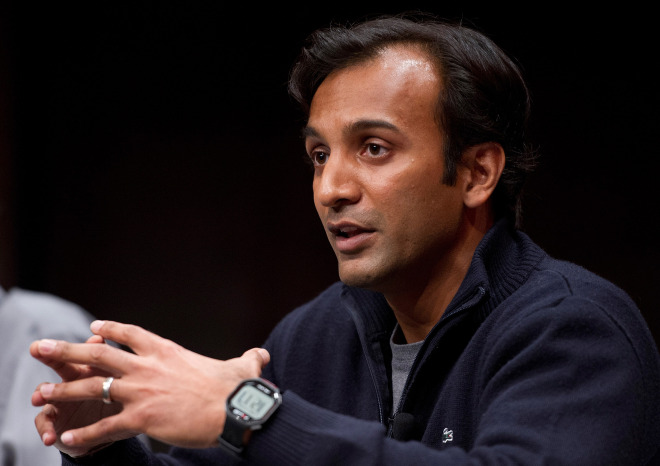
    A 45-year-old Indian-American Dhanurjay ‘DJ’ Patil has been named the first chief data scientist by the White House to shape policies and practices that will help the US remain a leader in technology and innovation.
     
    Patil— who has worked with several big-name Silicon Valley operations, including LinkedIn, eBay, PayPal, Skype, and venture capital firm Greylock Partners. Prior to his work in the private sector, Patil worked at Department of Defence, where he directed efforts to bridge computational and social sciences in fields like social network analysis to help anticipate new threats to the US. 


    Patil will now work as Deputy Chief Technology Officer in the Office of Science and Technology Policy, reporting to US Chief Technology Officer Megan Smith. He will also work on the Obama administration’s Precision Medicine Initiative, which focuses on utilising advances in data and healthcare to provide clinicians with new tools, knowledge, and therapies to select which treatments will work best for which patients, while protecting patient privacy. 

     
    Over the course of two decades of work in the private and public sectors and in academia, Patil has pioneered new ways for institutions to benefit from data. As a doctoral student and faculty member at the University of Maryland, Patil used open datasets to improve weather forecasting. He worked briefly for the Department of Defense, advising on efforts to use social network analysis, for example, to anticipate emerging threats to the United States. Most recently, he was the vice president of product at enterprise software company RelateIQ, which was acquired by Salesforce last July.

    Patil is moving his family to Washington where he’ll play a role in helping the United States government maximize its investments in big data and advise on policy issues and technology practices. And like his tech peers, he’ll be recruiting others to the cause. Patil will also be devoting time to the Administration’s Precision Medicine Initiative, which focuses on giving clinicians new tools, knowledge, and therapies to select which treatments will work best for which patients, while protecting patient privacy.

    In a memorandum to the American people, Patil said his role as chief data scientist will be to responsibly source, process, and leverage data in a timely fashion to enable transparency, provide security, and foster innovation for the benefit of the American public.

    “Data will continue to transform the way we live and work,” Patil said.

    He has authored a number of articles and books explaining the important current and potential applications of data science.

  • Kalashnikov rebrands AK- 47s as ‘weapons of peace’

    Kalashnikov rebrands AK- 47s as ‘weapons of peace’

    MOSCOW (TIP): Kalashnikov assault rifles, popular with terrorists and national armies in Asia and Africa, have been given a makeover and a new logo by its Russian manufacturer that has dubbed them as “weapons of peace”. Equipped with a shiny new logo, the Russian weapons manufacturer Kalashnikov launched a major rebranding drive here on Tuesday. The Siberian weapons maker paid more than $380,000 for the re-branding campaign, the Russia Today reported.

    The new Kalashnikov logo is a “CK” written in black and red and melded into a single block. The abbreviation stands for Kalashnikov Concern, as the producer now calls itself. The colours were borrowed from the flag of Udmurtia in western Siberia, the region hosting Kalashnikov’s main facilities, the company said in a statement. The logo is accompanied by the company’s name written in Russian. The firearms producer also has a new slogan, or rather two different slogans. In English, it is “Protecting Peace” but in Russian it translates as “Weapons of Peace” or “Weapons of the World,” depending on which meaning of the Russian word “mir” is used.

    The company is also branching out into fashion, launching a line of branded survival gear. The firm, which relies heavily on the export market, is among the targets of Western sanctions imposed over Russia’s role in the Ukraine conflict. The Kalashnikov, or AK-47, is one of the world’s most recognisable weapons. The gun is relatively cheap as well as easy to manufacture and maintain, contributing to its popularity with terrorists and national armies in Asia and Africa.

    The company unveiled new logos across its these three product lines — Kalashnikov for the Russian and foreign militaries; Baikal for civilian hunters; and Izhmash for sportsmen — and promised to target new markets, including South America, Asia-Pacific and Africa.

  • METROSEXUALS OUT, BEARD BACK IN STYLE

    METROSEXUALS OUT, BEARD BACK IN STYLE

    WARSAW: Jakub Marczewski grew a beard six years ago because he was too lazy to shave.Now he finds himself in the middle of a global trend. The 21-year-old got his hair and beard trimmed at a new shop with a hip retro vibe, the Barberian Academy & Barber Shop, which opened in Warsaw last month to serve the growing number of Polish men with facial hair. A revival in the culture of barbering in this Eastern European capital is just one sign of how popular beards have become, with actors, athletes and hipsters leading the way .

    Metrosexuals be gone: Europe is agog for beards. “Worldwide, we are at the height of facial hair,” said Al lan Peterkin, a Toronto psychiatrist and author of “One Thousand Beards: A Cultural History of Facial Hair.” “It’s a delightful expression of masculinity, but not a super-macho expression.” After World War II, men were mostly clean-shaven, reflecting a military ethos that came to dominate corporate life, Peterkin said. Over the next decades facial hair was adopted by outcast groups like beatniks and hippies. Since the mid-1990s, it has been slowly spreading to the point that now the mountain man beard is all the rage across North America.

    The 2008 financial crisis added to the beard momentum, with some men who lost their jobs ditching the conformist look as they reinvented themselves. “To grow a beard is to start a new life and to have more confidence in yourself. You look a little older, so people have more respect,” said Salvador Chanza, a 31-year-old master barber from Spain who trains professionals. Sporting both a handlebar moustache and a substantial beard, he said the embrace of facial hair reflected a rejection of the previous clean-shaven metrosexual ethos. Now facial hair is hugely popular across Western Europe, especially in fashion-conscious Paris. And in Britain and many other nations, it’s the month of “Movember” — when men are encouraged to grow a mustache to raise awareness and funds for men’s health issues.

  • Indian-American Ami Bera re-elected to US Congress

    Indian-American Ami Bera re-elected to US Congress

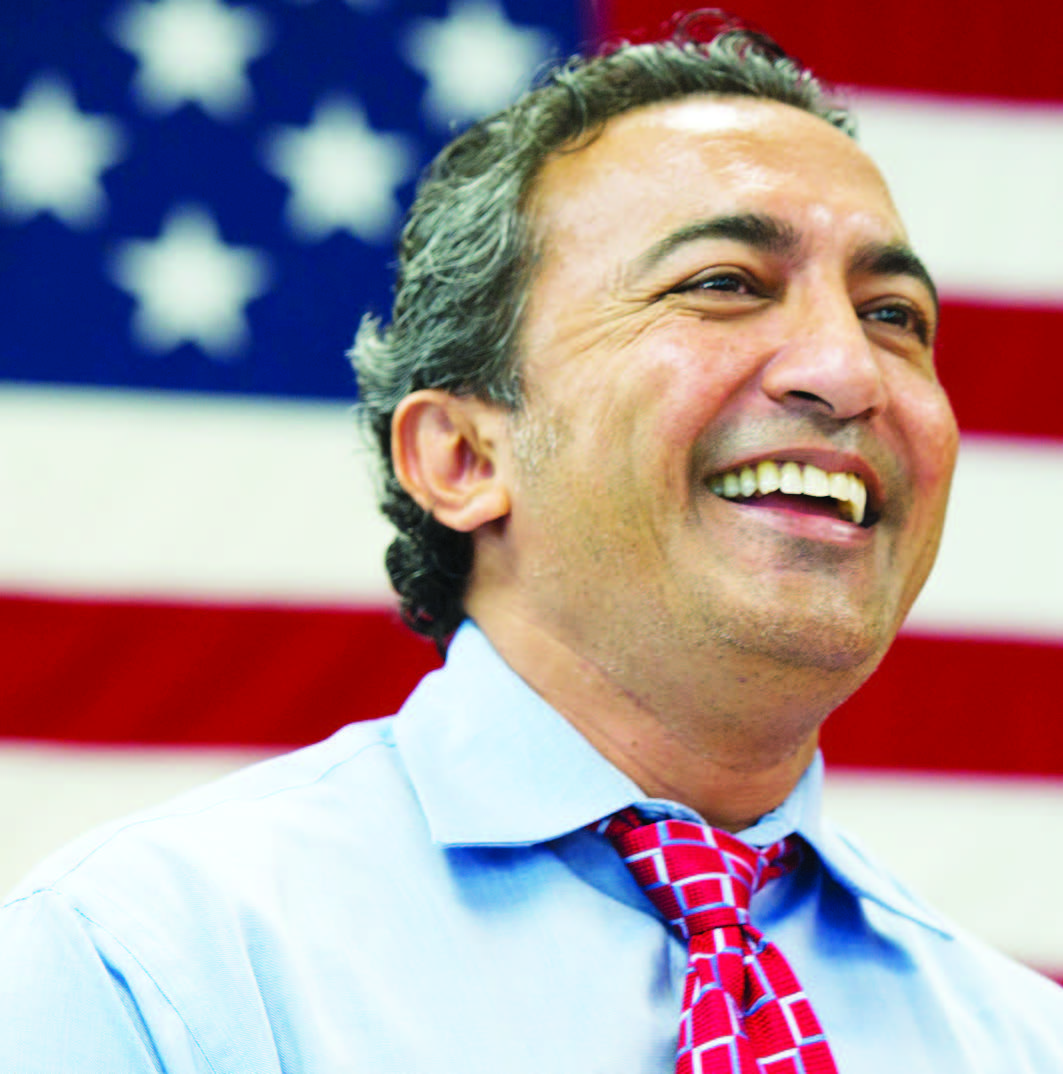
    SACRAMENTO (TIP): Amiresh ‘Ami’ Bera, the lone Indian American lawmaker in the US House of Representatives, managed to edge out his Republican opponent in a California race two weeks after the elections. Bera, who had won in a similar fashion in 2012, trailed Republican Doug Ose by more than 3,000 votes at the close of election night and steadily closed the gap as election officials tallied tens of thousands of remaining ballots. Bera, the third Indian American House member after Dalip Singh Saund and current Louisiana Governor Bobby Jindal, had ousted then sitting Republican House member Dan Lungren in 2012.

    “It’s been my honor serving this community as a doctor for the last 19 years and I am grateful I will have the opportunity to continue serving as the representative for California’s 7th Congressional District in Congress,” Bera said in a statement. “If you remember in the contest in 2012, we were tied and after the ballots were counted, we won by over 9,000 votes,” Bera said. Ose congratulated Bera on the hard fought win saying he “celebrates the fact that our institutions and our laws provide us a system whereby elections can be peacefully resolved”. The race was deemed the most expensive one with both candidates spending at least $19.6 million in the campaign, according to the Centre for Responsive Politics.

  • Xoom Announces Instant Deposit Service to Kotak Mahindra Bank Accounts in India

    Xoom Announces Instant Deposit Service to Kotak Mahindra Bank Accounts in India

    SAN FRANCISCO, CA (TIP): Xoom Corporation (NASDAQ: XOOM), a leading digital money transfer provider, is now offering instant deposits to Kotak Mahindra Bank accounts in India. This revolutionary service allows Xoom customers to instantly deposit money into their recipients’ Kotak Mahindra Bank accounts, 365 days a year, including bank holidays.

    Instant deposits to Kotak Mahindra Bank are processed through Xoom’s partnership with Punjab National Bank., a press release said. “Through our partnership with Punjab National Bank and the breakthrough IMPS technology, we are thrilled to expand our instant deposit service to Kotak Mahindra Bank,” said Julian King, Senior Vice President of Marketing and Business Development for Xoom. “Instant deposits are available 365 days, including bank holidays, so customers will never have to wait. Speed and convenience are what customers expect from Xoom’s service and we continue to do just that in our mission to provide instant deposit to even more banks in India.”

    In addition to Kotak Mahindra Bank, Xoom also offers instant deposits to ICICI Bank, HDFC Bank, Punjab National Bank, Bank of Baroda, Union Bank of India, Federal Bank and Yes Bank. Xoom provides great locked-in exchange rates for money transfers to India, and there is no fee when customers send more than $1,000 and pay with their U.S.-based bank account. Plus, Xoom continues to provide fast bank deposits within four hours to all other banks in India, including to NRE and NRO accounts, when sent during bank processing hours in India. Customers can also download the Xoom App for Android and iOS mobile devices for free. Visit https://www.xoom.com/india for more information.

    About Xoom

    Xoom is a leading digital money transfer provider that enables consumers to send money to 30 countries in a secure, fast and cost-effective way, using their mobile phone, tablet or computer. During the 12 months ended June 30, 2014, Xoom’s more than 1.1 million active customers sent approximately $6.3 billion to family and friends. The company is headquartered in San Francisco and can be found online at www.xoom.com.

    About Kotak Mahindra Bank

    Established in 1985, the Kotak Mahindra group is one of India’s leading financial services conglomerates. In February 2003, Kotak Mahindra Finance Ltd. (KMFL), the group’s flagship company, received banking license from the Reserve Bank of India (RBI). With this, KMFL became the first nonbanking finance company in India to become a bank – Kotak Mahindra Bank Ltd (KMBL).

    KMBL offers complete retail financial solutions for varied customer requirements. The Savings Bank Account goes beyond the traditional role of savings, and provides range of services through a comprehensive suite of investment services and other transactional conveniences like Online Shopping, Bill Payments, ASBA, Netc@rd, ActivMoney (Automatic TD sweep-in and Sweep-out) etc. Kotak’s Jifi, a first-of-its-kind fully integrated Social Bank Account, redefines digital banking by seamlessly incorporating social networking platforms like Twitter and Facebook with mainstream banking.

    KMBL also offers an Investment Account where Mutual Fund investments are recorded and can be viewed in a consolidated fashion across fund houses & schemes. Further, the Bank offers loan products such as Home Loans, Personal Loans, Commercial Vehicle Loans, etc. Keeping in mind the diverse needs of the business community, KMBL offers comprehensive business solutions that include Current Account, Trade Services, Cash Management Services and Credit facilities.

  • Virat Kohli confirms he is seeing Anushka Sharma, asks for privacy

    Virat Kohli confirms he is seeing Anushka Sharma, asks for privacy

    MUMBAI (TIP): India’s top batsman Virat Kohli has asked the public to use common sense on his much talked about relationship with actress Anushka Sharma, saying they indeed are seeing each other and their privacy should be respected. “It is out in the open (Jo hai sabke saamne hai abhi). We are not hiding anything, we are not trying to hide anything. I don’t want to hide anything. But if you get repeatedly asked on the same thing and if it is made a matter of debate then both the individuals don’t feel it is right,” said Kohli at the launch of his fashion line on Thursday. Kohli said it was already obvious that he and Anushka were in a relationship and people should not be curious about them anymore.

    “If you are seen together somewhere and still people ask ‘is it confirmed?’, then it is a matter of common sense. If you know then why ask the same question, that is our basic logic behind it. It is not something wrong apparently for people that we are doing. “We will not personally like to speak about it because it is something very personal for us and that should be respected by the media and everyone else as well,” Kohli said The 26-year old stand-in-skipper also batted for boxer Sarita Devi and felt that her decision to not accept the bronze medal at the Incheon Asian Games wasn’t against the rule. “I know about the incident. I think sportsmen need the support of its association and I personally don’t think her decision is against modern rules. She felt something and took that decision that could have been solved in a different way. I don’t know what happened there, what I have seen from outside this is my idea,” he said.

  • ‘FAME’ DOES NOT EXCITE ‘SHADOW-WHISPERER’ JESSICA CHASTAIN

    ‘FAME’ DOES NOT EXCITE ‘SHADOW-WHISPERER’ JESSICA CHASTAIN

    Admitting that she’s a “shadowwhisperer” who likes to hide in the shadows, Jessica Chastain said that “fame” does not excite her. The Interstellar actress, who shot to fame and received critical acclaim in the last few years, said that she avoids being photographed and does not think of herself as a movie star but an actress, reported US Magazine. The Oscar-nominated actor has largely been quiet about her private life and has chosen not to publicize her relationships. She said that she chooses to not date other celebrities because it puts a “magnifying glass” on you. Chastain is currently dating movie-star handsome Italian fashion exec Gian Luca Passi de Preposulo and said she is “very very happy” in her relationship. She added that she is not attracted to the fame surrounding male stars but would appreciate a man who “gets her business” and is comfortable with it.

  • After-effects of the US drawdown on India

    After-effects of the US drawdown on India

    New Delhi cannot remain sanguine. A priority of the Obama Administration will be to smoothly take out its military equipment from Afghanistan, through Pakistan. The Taliban will then be viewed more benignly

    By G Parthasarathy

    Even as Prime Minister Narendra Modi was cautioning Americans in New York against any precipitate withdrawal, Afghanistan was preparing for a momentous change in Kabul. Mr Ashraf Ghani Ahmadzai was taking over as Afghanistan’s President from Mr Hamid Karzai, who had ruled Afghanistan for 12 turbulent years. Despite efforts to malign him and destabilise his Government by worthy Americans like Peter Galbraith and Richard Holbrooke and a vicious propaganda barrage from Pakistan, President Karzai succeeded in establishing a measure of effective governance in Afghanistan. He also skilfully brought together the country’s fractious ethnic groups, to deal with the challenge posed by the Pakistani-backed Afghan Taliban and the Haqqani network, together with their Islamist allies, including the Al Qaeda. The change of guard from Mr Karzai to Mr Ghani has been anything but smooth. The first round of elections in April produced no clear winner. The second round in June, which was expected to be close, produced a stunning result. It gave an unexpectedly large victory margin to Mr Ghani, over his rival, Mr Abdullah Abdullah, a former Foreign Minister and close aide of the legendary Ahmed Shah Masood. Mr Abdullah had a substantial lead in the first round of elections, securing 46 per cent of the votes, against 32 per cent for Mr Ghani. A Report by the European Union declared the second round of voting as “massively rigged”. A US report held that it was mathematically impossible for Mr Ghani to have secured the margin of victory that he did. With controversy over the electoral result spiralling out of control and assuming volatile ethnic dimensions, the Americans stepped in to broker and virtually impose an uneasy and tenuous compromise between Mr Ghani and Mr Abdullah.

    Following the agreement between the rival candidates, Mr Ashraf Ghani was sworn in as President and Mr Abdullah as ‘Chief Executive’, a post which has no constitutional sanctity. The roadmap for this transition includes the convening of a Loya Jirga to convert the post of ‘Chief Executive’ into that of an ‘Executive Prime Minister’. It remains to be seen whether the contemplated changes, with two separate centres of executive authority, can provide stable and effective governance, in a country beset with the ethnic rivalries and tensions, which have long characterised its politics. Within 24 hours of the assumption of power by President Ashraf Ghani and Chief Executive Abdullah, Afghanistan and the US inked a security agreement, which will result in the US stationing 9,800 troops in a training and counter-insurgency role in Afghanistan, beyond 2014. A ‘status of forces agreement’, giving immunity to foreign forces against prosecution in Afghan courts, was also inked. The agreements will also allow the Americans to retain air bases across Afghanistan. Pakistan has welcomed these developments. Apart from formal statements by National Security Advisor Sartaj Aziz and the Foreign Office, a meeting of the top brass of the Pakistan Army also welcomed this development as a “good move for peace in Afghanistan”. This is an astonishing turnaround for the Pakistani establishment, which has all along made its unease with the American presence in Afghanistan known. It comes at a time when an estimated 80,000 Pakistani troops and paramilitary, backed by air power, are pounding positions of the Tehreek-e-Taliban in North Waziristan – an operation resulting in an estimated one million tribal Pashtuns fleeing their homes. At the same time, the Mullah Omar-led Afghan Taliban have been on the rampage this year across Afghanistan, prompting the soft-spoken President Ghani to say, “We ask the opponents of the Government, especially the Taliban and the Hizb-e-Islami, to enter political talks”. Pakistan’s massive military offensive in the tribal areas bordering Afghanistan has been selectively undertaken. Long-term ISI assets including the Haqqani Network, the Mullah Omar-led Afghan Taliban and even the Al Zawahiri-led Al Qaeda have been spared and obviously accommodated in ISI safe houses. They will be kept in readiness to move into Afghanistan at a time of Pakistan’s choosing. Afghanistan is going to remain dependent on Nato for military and economic funding, for the foreseeable future. Nato funding of Afghanistan’s military of $5.1 billion annually till 2017 has been agreed upon. A similar amount of external funding would be required for Afghanistan’s administrative and developmental needs. The Joint Declaration issued after the Obama-Modi Summit spoke of “dismantling of safe havens for terrorist and criminal networks, to disrupt all financial and tactical support for terrorist and criminal networks such as Al Qaeda, Lashkar-e-Tayyeba, Jaish-e- Mohammed, the D-Company, and the Haqqanis”. Significantly, there is no mention in the Joint Declaration of the Mullah Omarled Taliban, which has been primarily responsible for the killing of 2,229 American soldiers in Afghanistan, the training of terrorists for jihad in Jammu & Kashmir and for colluding with the hijackers of IC 814. It has been obvious for some time that the Americans are keen to do a deal with the Taliban. They may pay lip service to statements that any internal reconciliation process has to be ‘Afghan-led’. But, the reality is different, ever since the US encouraged Qatar to host a Taliban office in Doha. An enraged Mr Karzai had torpedoed that American effort (with obvious Pakistani support), to grant international legitimacy to the Taliban. President Ghani will, however, have to reluctantly accept Pakistan-brokered American-Taliban ‘contacts’, as a prelude to giving Taliban control in parts of southern Afghanistan. India cannot be sanguine about these developments. A priority of the Obama Administration will be to smoothly take out its military equipment from Afghanistan, through Pakistan. The Taliban will be looked at rather more benignly than in the past. Militarily, the ISI/Taliban effort will be to seize control of large swathes of territory in southern Afghanistan, compelling a reduction of India’s assistance in that part of the country. Differences in the priorities and compulsions of President Ghani and ‘Chief Executive Abdullah in Kabul appear inevitable. Our membership of the Shanghai Cooperation Organisation will have to be utilised to fashion a more coordinated approach with its members – Russia, China, Iran and the Central Asian Republics. A more intensive approach on developing the port in Chah Bahar in Iran and on meeting Afghan requirements of defence equipment will be imperative. The post-9/11 ‘end game’ for the Americans in Afghanistan is just beginning. The Americans will continue to predominantly and very significantly shape the course of developments in Afghanistan.

  • MARINE IS FIRST US DEATH IN OPERATIONS AGAINST ISLAMIC STATE

    MARINE IS FIRST US DEATH IN OPERATIONS AGAINST ISLAMIC STATE

    WASHINGTON (TIP): A US Marine who went into the sea from a V-22 Osprey during a flight mishap over the northern Gulf this week was the first American killed in US military operations against the Islamic State group in Iraq and Syria.

    Corporal Jordan Spears, 21, of Memphis, Indiana, was a crewman aboard a V-22 tilt-rotor aircraft flying off the USS Makin Island and went into the sea when the aircraft lost power shortly after takeoff, the Navy said on Friday.

    The V-22 descended to the surface of the ocean during the mishap on Wednesday. Spears and a second air crewmen went into the water when it appeared the tilt-rotor aircraft was about to crash, but the two pilots were able to regain control of the craft and landed it safely back on board the Makin Island.

    One air crewman was recovered and was in stable condition aboard the Makin Island. A search and rescue operation for the missing crewman was called off on Thursday and the Navy said he was presumed lost at sea.

    Rear Admiral John Kirby, the Pentagon press secretary, confirmed on Friday that the Marine’s unit had been supporting current operations in the Gulf, including the current battle against the Islamic State in Iraq and Syria.

    “That squadron and that ship were in the Gulf supporting Central Command operations,” Kirby said, referring to the combatant command responsible for U.S. forces in the Middle East region.

    “Some of those operations included operations in Iraq and Syria, at least tangentially,” he said. “So there’s no question that this Marine’s death is related to the operations that are going on in some form or fashion.”

    The Navy and Marine Corps are investigating the cause of the mishap.

    The V-22 takes off and lands vertically like a helicopter but the twin rotors at the end of its wings tilt after takeoff and allow it to fly like an airplane.

    The V-22 had a rocky start because of mishaps during development, but it has won kudos for performance since entering into service.

  • G-20 LEADERS SET TO CHECK TAX EVASION

    G-20 LEADERS SET TO CHECK TAX EVASION

    CAIRNS, AUSTRALIA (TIP): The world’s 20 largest economies are expected to signal a fresh push to check tax evasion by agreeing on deadlines for new measures and call for boosting global growth, through a quicker pace of reforms, when finance ministers and central bank governors from these countries meet here this weekend. “The base erosion (and profit sharing, or BEPS) work done by OECD will have a timetable out of Cairns.

    If not, then certainly by the leaders’ summit in November. As for the reporting standards, I hope it’s addressed this weekend. In fact, we will address it this weekend… we do want tax authorities to be able to exchange information more readily,” Australian treasurer Joe Hockey told reporters ahead of the meeting of the ministers from countries that account for 85% of the global economy.

    He, however, said India’s demand for sharing of tax- and bank-related information on a retrospective basis may not be feasible. “It is a big systemic change for banks. If Australia went hard and early, it would cost a quarter of a billion dollars ($250 million) to the banks, which ends up being passed on to customers. But, if we do it in a sensible and timely fashion, it will cost barely 20% of that. It’s very hard to have that information prepared in a format on a retrospective basis.

    It’s also hard to go back in time,” he said when asked specifically about India’s demand. Exchange of information and BEPS, which seeks to tax multinationals that avoid paying taxes anywhere, are of key importance to India as it seeks to widen its tax base. At the last meeting of the FMs and central bank governors in February, G20 members had agreed to work towards achieving both the goals. While adding 2% growth to the economies over the next five years was identified as a priority by Hockey, it is not clear how the G20 will push for it, given that every country is taking steps that suit its interests more.

    In fact, the US Federal Reserve’s decision on interest rates and further tapering of the stimulus induced to boost growth are being keenly watched. Asked about action by individual countries and its impact, Hockey acknowledged that G20 could do little.

  • Roger Federer escapes Gael Monfils to reach US Open semifinals

    Roger Federer escapes Gael Monfils to reach US Open semifinals

    NEW YORK (TIP): Roger Federer saved two match points to defeat Gael Monfils 4-6, 3-6, 6- 4, 7-5, 6-2 and reach his ninth US Open semifinal on September 5, keeping alive his dream of a sixth title. The 33-year-old Swiss second seed, bidding to become the oldest winner of a Grand Slam title in more than 40 years, was staring down the barrel of a demoralising exit when French 20th seed Monfils had two match points in the 10th game of the fourth set. But once they were saved, the lifeblood was suddenly sucked out of the flamboyant but unpredictable 28-year-old Frenchman whose notoriously fickle stamina failed him in a one-sided fifth set.

    Victory was Federer’s 26th in 27 night-time matches in New York and put him just one win away from a career 600 victories on hard courts, a landmark he can reach if he defeats Marin Cilic to make the final. Croatian 14th seed Cilic toppled sixthseeded Czech Tomas Berdych 6-2, 6-4, 7-6 (7/4) earlier Thursday to reach his first US Open semifinal. Federer’s win was his ninth from two sets to love down and first at a major since he had to engineer a similar Houdini act against another Frenchman, Julien Benneteau, at Wimbledon in 2012 on his way to his 17th and most recent major title.

    “Gael played great tennis but even when I was two sets down I knew the finish line was still far away for him,” said Federer, in his first semifinal since 2011. “I knew I could play better tennis but on match point I wasn’t feeling so great anymore.”I just thought this could be the last point, don’t give it away on an easy shot, make him work for it.” Federer was his usual composed self at the start with a service game to love but it was Monfils who carved out the first break for a 3- 2 lead off a skewed Swiss forehand. The set was the Frenchman’s at 6-4 as Federer pushed a tame backhand off a second serve wide.

    Monfils broke again for a 1-0 lead in the second as Federer continued to struggle with the humid, windy conditions as well as his own shortcomings. Uncharacteristically, the 17-time major winner lost his famed self-control in a testy exchange with umpire Carlos Ramos as he changed ends. Monfils then added to the drama by rolling his right ankle, collapsing the ground, calling the trainer but still going on to hold serve for 3-1. He then backed up the break by taking the set 6-3 as another Federer backhand crumbled into the net. Two sets had taken just 78 minutes with Federer unable to fashion a break.

    However, that changed as he grabbed his first break of the tie in the opening game of the third set, before it was retrieved in the fourth.Federer though hit back immediately for 3-2 and claimed the set in the 10th game, having committed just one unforced error compared to 26 in the first two. It was also the first set that Monfils, who put out seventh seed Grigor Dimitrov in the last round, had dropped in the tournament. A thrilling, contentious fourth set saw breaks exchanged to 2-2 with Federer smashing his racquet into the net and berating Ramos: “I don’t know what’s wrong with you”.

    In a tense set, Federer saved two match points in the 10th game before Monfils served up two successive double faults to hand his rival a lifeline of a 6-5 lead and a straightforward service game for 7-5 and two sets apiece.From there it was business as usual with a dispirited Monfils broken in the first and fifth games as Federer moved into his 36th Grand Slam semifinal.

  • Federer hopes to see off Monfils and reach US Open semifinals

    Federer hopes to see off Monfils and reach US Open semifinals

    NEW YORK (TIP): Roger Federer will have to forget his long-standing admiration for Gael Monfils on Thursday when the two go head-tohead with a berth in the US Open semifinals on the line. Federer owns a 6-2 lifetime record versus Monfils, most recently a three-set win at last month’s US Open tune-up event in Cincinnati, but is well aware of the Frenchman’s ability. “He’s got easy top-10 potential,” said Federer, who is bidding for his sixth US Open title and record 18th Grand Slam title overall. “He’s a great mover.

    He’s got a wonderful serve, really, which nobody really talks about because of his athletic movement which stands out so much. “I think I can speak on behalf of so many players: We love watching him play. It’s nice seeing him do well again.” For all his undoubted talent, Monfils is into the quarterfinals of a Grand Slam for only the sixth time and his only semifinal came at the French Open in 2008. Prone to losing his focus at crucial times during matches, Monfils, 28, has shown rare maturity so far in New York, beating Richard Gasquet and Grigor Dimitrov in impressive fashion.

    Monfils, who has not dropped a set in his four matches here, described Federer as a “legend” of the game but the 20th seed believes he is playing well enough to cause the 33-year-old Swiss problems. “Right now he’s the greatest tennis player we ever had, and for me it’s always challenging to play against him,” said Monfils, who faces Federer at 8 p.m. ET (0000 GMT) on Thursday. “I play tennis to play against a big legend, on a big court, show-time.

    That’s what I train for. For me the best thing that can happen is to play against that guy on that stage.” Czech sixth seed Tomas Berdych takes on Marin Cilic, the 14th seed from Croatia, in the day’s early quarterfinal.

  • ROBIN WILLIAMS: THE SADNESS OF A CLOWN THAT COULDN’T BE FIXED

    ROBIN WILLIAMS: THE SADNESS OF A CLOWN THAT COULDN’T BE FIXED

    Robin Williams, the versatile actor whose madcap comic style made him one of television and film’s biggest stars, was found dead on Monday from an apparent suicide at his home in Northern California. He was 63. Robin McLaurin Williams was born in Chicago. His father, Robert, was an executive for the Ford Motor Company, while his mother, Laurie, was a fashion model.

    The comedian and actor came into the world on 21 July 1951 in Chicago, Ilinois to former model Laura and Ford Motor executive Robert. Williams was bullied badly during childhood for being chubby and would often spend much of his time playing alone in the family’s large home to avoid his tormentors. Eventually, he conquered his overweight label though by joining the wrestling and tracks teams, and realised he could make the other children laugh as a way of gaining respect from them.

    Williams’ father took early retirement when he was 16 and they moved to California where he finished his education at Redwood High School. After graduation in 1969, Williams attended Claremont Men’s College, studying political science and playing soccer. He ended up taking lessons in improvisation, which perfectly suited his sharp wit and he was soon hooked.

    After leaving Claremont, Williams enrolled at the College of Marin to study acting and quickly won a full scholarship to the renowned Juilliard School in New York City where he studied with Christopher Reeve. The pair became great friends – a friendship that would last until Reeve’s death in 2004. He also met dancer Valerie Velardi while at Juilliard and the couple wed in 1978 and had a son, Zachary.

    Williams practiced stand-up in his spare time and he soon realised, after taking advice from a friend, that comedy rather than acting was his best way forward. He promptly left Juilliard for Los Angeles and ended up working his act on the West Coast comedy circuit. In 1977, Williams won a spot on ‘The Richard Pryor Show’ but his big break was just around the corner. Garry Marshall, creator of the hugely popular ‘Happy Days’ TV programme, was planning an ‘out-there’ episode where the Fonz would be abducted by aliens.

    At the auditions, Marshall asked Williams to sit down but he instead sat on his head and was instantly employed. Playing Mork from the planet Ork, Robin was a sensation so much so that a new show was created for him – ‘Mork And Mindy’. The show was a hit, earning Williams his first Golden Globe win in 1979 – Mork’s greeting, ‘Nanu-nanu’, became a worldwide catch-phrase. In 1980, Hollywood finally came knocking and Williams took the title role in Robert Altman’s ‘Popeye’.

    The critics and audience alike panned the film though and Williams was forced to seek solace in the comfort of Mork and Mindy for a further two years, until he starred in the film ‘The World According To Garp’. 1982 marked a downfall in Williams’ personal life as his battle with alcohol and drugs, specifically cocaine, had a destructive effect on his marriage, despite Valerie’s attempts to curb his addictions. 1983’s ‘The Survivors’ was another relative flop and it wasn’t until 1987 and five films later, that Williams finally hit the jackpot with ‘Good Morning Vietnam’.

    Playing real-life military DJ Adrian Cronauer, Williams earned himself his first Academy Award nomination and his second Golden Globe win. The following year, Valerie hired Marsha Garces to be nanny to Zachary. By 1987, Valerie and Williams had separated and Marsha became his assistant, travelling with him before the pair eventually fell in love and married in 1989, going on to have two children together – Zelda Rae and Cody Alan. Three films were released starring Williams in 1988, ‘The Adventures of Baron Munchausen’, ‘Rabbit Ears: Pecos Bill’ and ‘Portrait of a White Marriage’. However, it wasn’t until the following year that he would firmly grab the critic’s attention once more with his star turn as a maverick teacher in ‘Dead Poet’s Society’, a role which notched him his second Oscar nomination.

    1990 saw Williams star in ‘Cadillac Man’, ‘Back to Neverland’ and ‘Awakenings’ – his performance as doctor Oliver Sacks alongside Robert De Niro was celebrated as being one of his most moving and heartfelt to date. Terry Gilliam’s ‘The Fisher King’ (1991) is often classed as Williams’ best film and his role as a down-and-out who saves Jeff Bridges’ life saw him nominated for an Academy Award for the third time.

    Steven Spielberg’s ‘Hook’ in the same year was the total opposite theme of The Fisher King with its action-packed plot, yet despite breaking the $100 million barrier, the film was deemed to be overly sentimental and Spielberg’s first flop. Disney’s ‘Aladdin’ in 1992 was a landmark in establishing the talents of Williams as a voice actor in his role of the Genie, the majority of which he improvised and ad-libbed. His performance as one the film’s most notable A-list stars carried the box office receipts past $200 million.

    Following on from the less successful ‘Toys’ (1992) and ‘’Being Human’ (1993), it was Williams’ wife Marsha who stumbled upon the script for ‘Mrs Doubtfire’ in 1993 and in turn, she went on to produce the film. The film was a huge international hit and won Williams a Golden Globe, plus the achievement of once again making a $200 million taking. Williams was reunited with director Chris Columbus (Mrs Doubtfire) in the film ‘Nine Months’ (1995) which was far less of a success by comparison. He then received an Emmy nomination for a brief role in the TV programme ‘Homicide: Life On The Streets’, before returning to the children’s market with the fantasy film ‘Jumanji’. ‘The Birdcage’ (1996) saw Williams play the part of a gay club-owner whose son wants to bring his girlfriend (Calista Flockheart) and her strict conservative parents (Gene Hackman and Dianne Wiest) to stay and was yet another $100 million hit.

    Williams followed this flamboyant part with the lead in ‘Jack’, directed by Francis Ford Coppola. He played a child with an ageing disorder that saw him in a 40-year-old body at the age of 10 and while he gave an endearing performance, the premise of the film failed to attract a wide audience.

    Williams diversified his work throughout 1996 and 1997, taking small parts in ‘Hamlet’ (1996) and ‘The Secret Agent’ (1996) as well as Woody Allen’s ‘Deconstructing Harry’ (1997). 1997 was set to be a great year, first marking success with the release of Disney’s ‘Flubber’ – a box office triumph. Yet it was to be the collaboration with newcomers Matt Damon and Ben Affleck that would raise the stakes in Williams’ career. ‘Good Will Hunting’ saw Williams play Sean Maguire, psychiatrist to Damon’s troubled genius, and his performance earned him his first Academy Award for Best Actor in a Supporting Role.

    A series of less impacting films between 1999 and 2001 followed, until Williams played a ‘baddie’ for the first time in his career in the film ‘One Hour Photo’ (2002). He won rave reviews as a photo lab worker who becomes devoted to a young local family, but gradually starts to become more strange and sinister. ‘Death To Smoochy’ in 2002 failed to rake in the box office big bucks despite having a great script and cast including Ed Norton, with Danny De Vito in the director’s chair.

    That year, as ‘Death to Smoochy’ and ‘Insomnia’ were released, Williams returned to his roots, selling-out on Broadway with another impressive stand-up show. Despite not being seen on screen again for another two years, he was in fact extremely busy and his stock of alreadycomplete films were being released in slow droves. These included 2004 movies ‘Noel’, a Christmas-themed drama, David Duchovny’s directorial debut ‘House of D’ and ‘The Final Cut’, which also co-starred James Caviezel and Mira Sorvino. He went on to star in ‘The Aristocrats’ and ‘Robots’ in 2005 and picked up a nomination for a Blimp Award for Favourite Voice from an Animated Feature. Six movie releases in 2006 highlighted Williams’ versatility as an actor.

    In ‘Man of the Year’, he played the role of Tom Dobbs, the host of a comedy/political talk show. He then took on a different character in computer animated feature film ‘Everyone’s Hero’ in which he had a voice role. ‘Runaway Vacation’ saw him portray a California beverage company executive struggling with a dysfunctional family on a holiday full of mishaps. ‘The Night Listener’, based on the novel by Armistead Maupin, saw Williams as a gay radio show host who, on air, befriends a 14-year-old abuse victim – a role which he accepted for only $65,000. This was followed by the rather more cheerful animation ‘Happy Feet’, which was a global hit.

    ‘Night At The Museum’, with Ben Stiller, followed suit, with Williams playing a comic version of the former president Theodore Roosevelt. In 2007, Williams entertained fans in romantic comedy ‘License to Wed’ and drama ‘August Rush’, which were followed by roles in ‘Shrink’ and ‘World’s Greatest Dad’ in 2009. During this period his marital status changed again as Marsha filed for divorce citing irreconcilable differences in 2008. Reprising his role as President Roosevelt, Williams teamed up with Ben Stiller and Owen Wilson once more in ‘Night at the Museum: Battle of the Smithsonian’.

    Despite mixed reviews from critics, the movie was a commercial success like its predecessor. ‘Old Dogs’ (2009), a collaboration with John Travolta, Kelly Preston and Matt Dillon, also performed well at the box office. Since then he has reprised his voice roles in animated ‘Happy Feet Two’ in 2011, which was his only project that year. Williams married his third wife, graphic designer Susan Schneider, on 23 October 2011 in St Helena, California. In 2012, he appeared in the TV comedy ‘Wilfred’, which stars Elijah Wood who is the only man that can see his neighbour’s dog as a full-grown man.

    This was followed by an appearance in ‘The Big Wedding’, which was released in November 2012, as well as ‘The Face of Love’, ‘The Butler’ in 2013 and ‘The Angriest Man In Brooklyn’, in 2014. With a career spanning 30 years, during which he has received over 40 awards, including an Oscar, and been nominated nearly 50 times, Williams’ appeal will no doubt span many more generations to come. Robin died on 11 August 2014 at his home in California in an apparent suicide. His spokesperson released a statement stating that Robin had recently been struggling with depression.

  • 5 infants die after oxygen supply stops in Pakistan hospital

    5 infants die after oxygen supply stops in Pakistan hospital

    KARACHI (TIP): Five infants died in a hospital in Pakistan’s largest city allegedly due to medical negligence after a power cut stopped the oxygen supply to the incubators. According to sources, the five children were being treated for various ailments including breathing problems and were put on ventilators and incubators at the hospital in the Korangi area of Karachi.

    “The oxygen supply to the incubators ended and no one was there to refill or do something. Five infants died because of this,” said Manzoor Ahmed, the father of one of the infants.He claimed that two infants had died in a similar fashion at the same hospital a week ago and even though the parents protested and lodged complaints, nothing was done to redress them. “Now this has happened.

    What is gross negligence is that despite our pleas no doctors showed up and only the staff was present to handle the babies’ treatment,” he said.Sindh’s governor has set up a three-member inquiry committee of the health department to probe the matter. Pakistan has been plagued by a chronic power crisis in recent years.

  • CWG 2014: Lifters Sanjita, Sukhen bag gold medals for India on Day 1

    CWG 2014: Lifters Sanjita, Sukhen bag gold medals for India on Day 1

    GLASGOW (TIP): India ran away with opening day honours in the weightlifting competition of the 20th Commonwealth Games with Sukhen Dey and K Sanjita Chanu winning the gold medal in their respective events. The Indian team bagged four out of six medals on offer on Day one of the competition on Thursday.

    Sanjita and Saikhom Mirabai Chanu opened India’s campaign on a flying note by winning a gold and silver respectively in women’s 48kg before Dey and Ganesh Mali bagged with first and third position in men’s 56kg to cap a remarkable day for the Indians at the Clyde Auditorium.

    The 25-year-old Dey lifted a total of 248kg (109+139) after trailing at the halfway snatch stage, but came back strongly in clean and jerk to win the gold. He had also won a silver in the 2010 Delhi CWG besides bagging a gold in the 2013 Commonwealth Championships in November last year. 21-year-old Mali was leading after snatch but slipped behind in clean and jerk to settle for bronze with a total lift of 244kg (111+133).

    Malaysia’s Mohd Pisol Zulheimi was at fourth after snatch but recovered in fine fashion to bag the silver with a total lift of 245kg (108+137). Zulheimi and another Malaysian, Mohd Faizal Baharom, gave a tough competition to Dey and Mali from the beginning but the Indians had the support in their side with a seizable crowd rooting for them with the tricolour in their hands. Baharom set the ball rolling with a lift of 110kg in snatch and Dey failed to clear 111kg after lifting 109kg in his earlier attempt.

    Mali, however, did better than his compatriot to lift 111kg and occupy the top slot with Baharom on second with 110kg and Dey on 109kg at third after snatch event. Mali’s effort of 133kg in his second attempt in clean and jerk was adjudged no-lift by the jury, but he cleared the weight in his next attempt. Dey jumped to the top spot with a lift of 136kg but Zulmeihi came into the mix with a clean and jerk of 136kg to jump to joint second.

    He then lifted 137kg to equal Dey at the top, leaving Mali at third. Dey then went ahead by lifting 138kg and pumped in the air with delight after totalling 248kg. He tried 146kg in an attempt to break the Commonwealth Games record in clean and jerk but failed. Nonetheless, he ran away with the title. Dey said his gold medal win was the best achievement of his career. “I have won a bronze in junior World Championships, then a silver in 2010 CWG before today’s gold. I lost out on a gold in Delhi because of a technical mistake. I would say today’s gold is the best of my career.

    Now my target is to do well in the Asian Games,” Dey said. “I would like to dedicate my win to the nation, the federation officials and my coaches. The exposure we got before the Games has been of immense help.We have had a training camp in Birmingham since June and that has helped a lot,” he said. He conceded that he was “worried after missing two snatch attempts”. Dey, who is now a subedar naik at the Indian Air Force in Chandigarh, hoped that he would get promotion after this feat.

    “I hope to get promoted after my gold medal,” he said. Mali, on the other hand, said that the no-lift decision during his clean and jerk had led to a bit of distraction. “I cannot do anything about that decision but the no-lift had distracted a bit. Had it not been that way I would have won the silver,” he rued. Mali, with the Indian Air Force in Chandigarh, also hoped that his performance would get him a promotion. “I am in the Indian Air Force and winning the medal means I will be getting a promotion. The medal has really lifted my heart,” he said.

    On the crowd at the Clyde Auditorium, he said, “I have been really impressed with the crowd, but when they are cheering while we are lifting it can be off-putting.” On training in a small village with his brother Chandrakant Mali, who will take part in the 94kg category, he said, “My brother and I have had only one barbell between us for six years. It’ll be a big deal taking home the bronze medal.

  • Foreign funding and the Maharajas among NGOs

    Foreign funding and the Maharajas among NGOs

    It is speculated that a big portion of foreign funding goes to politicians and bureaucracy as a large number of institutes are owned, controlled and managed by politicians and business houses.

    India is a fascinating country. The number of stock exchanges we have, as per official records is 20, but the number of functioning exchanges is only two. The number of scrips listed on the Bombay Stock Exchanges [BSE] is nearly 9,000, only 3500 of these are traded at least once a year, and the top 50 securities constitute nearly two-third of the turnover. Actually only 250 to 300 are “active” traded scrips. Interestingly, the latest Handbook of Statistics on Indian Securities Market published by the Securities Exchange Board of India (SEBI) has dropped the column for number of scrips listed on the BSE! It is one way to solve the issue of numbers.

    In a similar fashion, we decided to probe the number of not-for-profit or nongovernmental organisations (NGO) in India. Being in the teaching line, we have the habit of probing issues that are otherwise not to be probed at all! Let sleeping dogs lie is the national dictum in such matters. NGOs are also known as Voluntary Organizations (VOs) or Voluntary Agencies (VAs) and more recently as Voluntary Development Organizations (VDOs), Non- Governmental Development Organizations (NGDOs) or Non-Profit Institutions (NPIs).

    There are equivalent names for NGOs available in different Indian languages. In Hindi NGOs are called Swayamsevi Sansthayen or Swayamsevi Sangathan. Prior to the enactment of the Societies Registration Act of 1860, voluntary action was guided mainly by religious and cultural ethos. Subsequently, a series of legislations addressing the non-profit sector were promulgated. The starting point in this respect was Article 19 of the Indian Constitution which recognized a number of civic rights including the right “….to form associations or unions”. It constitutes the legal basis of relevant legal provisions applicable to the non-profit sector.

    There are also non mandatory provisions that allow any group with the intention of starting a non-profit, voluntary or charitable work to organize itself into a legally registered entity. However, given the optional nature of these provisions, there is a large group of voluntary bodies that are not registered. The United Nations Development Programme (UNDP) India and the UN Volunteers(UNV) programme had organized a Forum in January 2006 at UNDP’s Delhi office to discuss the issues relating to implementation of the UN Handbook on Nonprofit Institutions (NPIs) in the System of National Accounts in India.

    The meeting was attended by representatives of the Planning Commission, Ministry of Statistics and Programme Implementation (MoSPI), NGOs, UNV Headquarters, and the Centre for Civil Society Studies of Johns Hopkins University, which is leading the effort to implement the UN NPI Handbook throughout the World. At this Forum, the UN Resident Coordinator and UNDP India Resident Representative stressed the need to implement the UN Handbook in order to capture the contribution of NPIs to the national economy. It was mentioned that the voluntary sector played a significant role in the economic and social change of the country and contributed significantly to the development in both rural and urban areas.

    The Forum therefore urged that India should take suitable steps to implement the UN Handbook on NPIs and compile accounts of NPIs functioning in the country. The National Policy on the Voluntary Sector, adopted in May 2007, presumably under the guidance of the National Advisory Council, pledges to encourage, enable and empower an independent, creative and effective voluntary sector, with diversity in form and function, so that it can contribute to the social, cultural and economic advancement of the people of India.

    It constitutes the beginning of a process to evolve a new working relationship between the government and the voluntary sector, without affecting the autonomy and identity of voluntary organizations (GoI/Planning Commission, 2007). Accordingly, it is expected that the enabling environment will be further enhanced to encourage the development and active engagement of the non-profit sector, including volunteerism, in the community’s affairs and developmental efforts. So we can conclude that at the beginning of the United Progressive Alliance (UPA)’s second term, the so called voluntary or NGO sector was fully ensconced in decision making and fund collecting activities. NGOs can be registered under several regulations or none-the latter is more common.

    The main statutory laws governing the various types of registered non-profit organizations are: The Societies Registration Act, 1860; The Indian Trusts Act, 1882; Public Trust Act, 1950; The Indian Companies Act (Section 25), 1956 Religious non-profit organizations can be registered under: the Religious Endowments Act, 1863; The Charitable and Religious Trust Act, 1920; Mussalman Wakf Act, 1923; Wakf Act, 1954 and the Public Wakfs (Extension of Limitation) Act, 1959 By 2009, a total of 33 lakh societies reported as “Societies registered under the Societies Registration Act/ Mumbai Public Trust Act”.

    Of these, the State Directorates of Economics and Statistics [DESs] were able to collect information for about 22.58 lakh units and computerize the information relating to about 21 lakh units. But when the Central Statistics Office (CSO) sent people searching for these NGOs in the states, it could not trace lakhs of them. Of the roughly 22 lakh NGOs it tried to verify, only 6.95 lakh could be traced. These figures did not include non-profit organizations registered under the Charitable and Religious Trust Act, 1920, which, if counted, would add a few thousands to the number. Then there are non-profit companies under the Indian Companies Act, 1956, and other laws that also help set up trusts.

    The numbers also did not include many groups and associations, which, in common parlance are referred to as mass-based groups, usually operating at block and village levels, at times federating into larger organizations for specific purposes or campaigns. A study by PRIA and Johns Hopkins University suggested, nearly 50% of the total voluntary organizations in India were not registered under any law. The antiquated societies registration law is blind when it comes to classifying these registered groups.

    It treats all registered societies the same way. These numbers include societies that run hugely profitable schools, colleges, hospitals and sports bodies in the country. Remember, the Board of Control for Cricket in India (BCCI) is also an NGO, registered under the Tamil Nadu Societies Registration Act. The Confederation of Indian Industries (CII) too is an NGO, under the law.

    The Major Findings from the CSO Survey are as follows:

    The CSO’s study covered only the societies registered under the Societies Registration Act 1860/Bombay Public Trusts Act, 1950 and companies Registered under section 25 of Indian Companies Act, 1956. Data available from the first phase shows that there are about 31.7 lakh NPIs registered in India and that 58.7% of these are located in rural areas. A majority of NPIs are involved in community, social and personal services, cultural services, education, and health services. The number of NPIs formed after 1990 has increased manifold. This is the post economic reform period when global powers began to show interest in India.

    There were only 1.44 lakh societies registered till the year 1970, followed by 1.79 lakh registrations in the period from 1971 to 1980, 5.52 lakh registrations in the period from 1981 to 1990, 11.22 lakh registrations in the period from 1991 to 2000, and as many as 11.35 lakh societies were registered after 2000. Since there is no clause in the Act for the de-registration of defunct societies, the first phase of the survey results give number of societies and their distribution on the basis of records available with the registering authorities. About 18 lakh societies have been visited during the second phase, i.e. 57.6% of the registered societies.

    Out of these, results are available for 4.65 lakh. The top three sectors where these societies were engaged is as follows: engaged in Social Services (35%), followed by Education Research (21%), and Culture Recreation (15%). The top three activities account for 71% of the registered societies. The data on total work force includes volunteers and paid workers. Out of the 144 lakh work force, only 11 lakh are paid workers. The CSO used the sum of their operational expenditures to come to a value of their economic output at a whopping Rs41,292 crore! Non Profit Institutions are also registered under the Indian Companies Act (Section 25), 1956.

    The financial data in respect of 2,595 companies listed with Ministry of Corporate Affairs has been obtained and analyzed. However, no information could be obtained in respect of the workforce of these companies and activities/purposes in which they are involved. CSO decided to limit the coverage to the Societies registered under Societies Registration Act 1860, Mumbai Trust Act and the Indian Companies Act (Section 25), 1956. This is because a majority of the NPIs are registered under Societies Registration Act 1860. This also means that NGOs under various religious non-profit organisations were excluded and they constitute a large number. The study found that in most States, the provision of submitting financial statements is not strictly enforced. Even if societies file financial statements with the registrar’s office, there is no mechanism to maintain this database.

    Maharajas among NGO’s:

    Maharajas among NGO’s: A category of NGOs are registered with Ministry of Home Affairs -under Foreign contributions regulations Act [ FCRA] -These can be called Euro or Dollar NGOs who get funds from private charities as well as Government organizations abroad. The salient features for 2011-2012 are as follows: I. A total of 43,527 Associations have been registered under the FCRA until 31 March 2012. During 2011-12, as many as 2001 associations were granted registration and 304 associations were given prior permission to receive foreign contributions. II. 22,702 Associations reported a total receipt of Rs11,546.29 crore as foreign contributions. [Under or non-reporting is common]

    TRENDS OVER LAST 10 YEARS

    Year No. of Registered Associations No.of Reporting Associations

    Amount of Foreign Contributions
    [Rs Crore]
    2002-2003
    26404
    165905046.51
    2003-2004
    2835117145
    5105.46
    2004-2005
    3032118540
    6256.68
    2005-2006
    3214418570
    7877.57
    2006-2007
    3393718996
    11007.43
    2007-2008
    3480318796
    9663.46
    2008-2009
    3641420088
    10802.67
    2009-2010
    38,43621,508
    10,337.59
    2010-201140,575
    22,735
    10,334.122011-2012
    43,527
    22,70211,546.29
    Total from 2002-2012
    97383.531. Source: Ministry of Home Affairs

    Foreigners Division, FCRA wing
    III. Delhi reported the highest receipt of foreign donations at Rs2,285.75 crore, followed by Tamil Nadu (Rs1,704.76 crore) and Andhra Pradesh (Rs1,258.52 crore).
    IV. Among districts, Chennai reported the highest foreign donations (Rs889.99 crore), followed by Mumbai (Rs825.40 crore) and Bangalore (Rs812.48 crore).
    V. The list of donor countries is headed by the US (Rs3,838.23crore), followed by UK (Rs1,219.02 crore), and Germany (Rs1,096.01 crore).
    VI. The list of foreign donors is topped by the Compassion International, US (Rs183.83 crore), followed by the Church of Jesus Christ of Latter day Saints, US (Rs130.77 crore), and the Kinder Not Hilfe (KNH), Germany (Rs51.76 crore).
    VII. World Vision of India, Chennai, Tamil Nadu (Rs233.38 crore) received the highest foreign donations among NGOs, followed by the Believers Church India Pathanamthitta, Kerala (Rs190.05 crore) and Rural Development Trust, Ananthapur, AP (Rs144.39 crore)
    VIII. The highest foreign contribution was received and utilized for–Rural Development (Rs945.77 crore), Welfare of Children (Rs929.22 crore), Construction and Maintenance of school/colleges (Rs824.11 crore) and Research (Rs539.14 crore). Activities other than those mentioned above received Rs2,253.61 crore. Interestingly establishment expenses [Building/ cars/ Jeeps/ Computers/Cameras etc.] constituted the bulk of expenditure in most of the NGOs.

    Need of the Hour:
    In the context of the Intelligence Bureau’s (IB) report on antidevelopment activities of many foreign funded NGOs, it may be time to constitute a commission of experts including those from the IB to comprehensively study this sector. Also, to use experiences of other countries like Russia, China and the US in dealing with NGOs and formulating regulation to govern them. Perhaps, it is also time to re-look the foreign funding of NGOs in the context of compulsory CSR contributions introduced in the Companies Act 2013-since we are no more the white man’s burden!

    (The author is Professor of Finance at IIM-Bangalore. He sits on the advisory boards of SEBI and the RBI.)

  • Now, Assange on a catwalk

    Now, Assange on a catwalk

    LONDON (TIP): WikiLeaks founder Julian Assange who has been holed up in the Ecuadorean Embassy for over two years is expected to make his London Fashion Week debut this September. Assange will model for Vivienne Westwood’s son Ben Westwood at a fashion show which will take place inside the Ecuadorean Embassy so that the Scotland Yard can’t arrest him. Ben said, “Julian’s been in the embassy for two years and it’s important that he doesn’t slip into obscurity. I want to highlight his plight. What happened to him is totally unfair.”

    “I’ve designed something for him along those lines and will be getting him to wear it,” he added. Scotland Yard has posted guards outside the embassy so that they can arrest Assange as soon as he steps out and puts his feet on British soil. Britain has spent nearly £6 million till now in guarding the Ecuadorean Embassy in London. Scotland Yard admitted it has spent £4.9 million of this total bill on diverting officers from normal duties to prevent the 42-year-old escaping his west London sanctuary.

    Around £1 million additionally was spent on overtime for officers guarding the building round the clock. According to figures obtained under the Freedom of Information Act, the daily cost of policing the building is over £9,000. Assange has been holed up in the embassy since June 2012 avoiding extradition to Sweden where he is wanted over sexual offence allegations. Ecuador has said it will continue to provide asylum to Assange even as Britain refused to give him safe passage to travel to the South American country.

  • GUJARATI SAMAJ of New York to hold CULTURAL FESTIVAL of Gujarat on August 8, 9, 10

    GUJARATI SAMAJ of New York to hold CULTURAL FESTIVAL of Gujarat on August 8, 9, 10

    NEW YORK (TIP): Gujarati Samaj of New York announced a CULTURAL FESTIVAL OF GUJARAT to mark the celebration of its 40th Anniversary. The festival will be held on August 8,9 & 10, 2014. Consul General Dyaneshwar Mulay inaugurated the kick off with traditional lighting of the lamp. Chamunda Swami chanted Shlokas from Hindu scripture to seek divine blessings for the success of the undertaking. Ambassador Mulay expressed the need to market India to the mainstream. He asked every member to invite friends from mainstream to events and educate them about richness of India and Indian culture. He wondered why India still does not have a permanent seat at the Security Council.

    He spoke of the Consulate’s initiative in hosting a series of events on India’s rich culture, lofty thought and diversity. He shared his conviction that India and USA are best partners to build the global economy. And every NRI should help make that happen. A spokesman for the Samaj said that Gujarati Samaj of New York was established in 1974, and has now a membership of more than 2400 families representing some of the most successful and affluent Gujarati Americans of Tri-state area. On the occasion of 40th Anniversary, Gujarati Samaj of New York is organizing a mega event for 3 days called “CULTURAL FESTIVAL OF GUJARAT” (CFG) showcasing the rich history, culture and heritage of State of Gujarat in India, the birth state of Global icon Mahatma Gandhi, Iron man Sardar Patel, religious Gurus including Pramukh Swami, business leaders Ratan Tata and Dhirubhai Ambani and the recently elected Prime Minister of India, Narendrabhai Modi among others. CULTURAL FESTIVAL OF GUJARAT (CFG) is to be held over three days in August on 8th, 9th and 10th in St. Anthony’s Conference Center in Melville, New York.

    The 3-day mega event will include programs such as Garbo from Gujarati Samaj, Bhavai by Shakuntal Arts, Kamlesh Patel Dance, Dayro by Sairam Dave & Group, Women Seminar by Kajal Oza, Group Bhajans by Hari Bharwad, comedy by Jagdish Trivedi, concert by Mauli Dave, Fashion Show by Sringar group, Archan Trivedi for drama, Bhanubhai Vora of Swarkinnary group from Bombay, Sanjay Oza and Party, Sahitya lecture, Auction of Arts and Award ceremony. R. D. Patel, Chairman of Board of Trustees said, “We are excited to present this mega event to the community to thank our predecessors who brought the Samaj reach this far. This institution has been the cornerstone for our community to continue to share our culture with generations over last 40 years and I promise to continue to build with help from each Trustee of the Board in coming years”.

    Harshad Patel, President of Gujarati Samaj of New York said, “I am fortunate to be the President in this historic year, and look forward to host an event of international standards with help from Dilip Chauhan, Minesh Patel and Bhupendra Patel, along with day to day contribution from my able committee members, Jatin Upadhyay, Chandrakant patel, Chimanbhai Patel, Anil Patel, Kiritbhai Patel and Divyesh Tripathi, to make this dream come true. I urge each of the community person of Indian origin to join us, and business community to help with support to make it a grand success”. Bharti Desai, Program manager and host of Gujarati Samaj of New York and launch event, said, “It has been a pleasant experience for me to host and organize multiple events at the Samaj in last few decades. It has helped me creatively to contribute in making each program a success. After having worked with several Presidents at the Samaj, now I look forward to handling this mega event and take the events presented by the Samaj to the next level in organizational excellence”. Samaj showcased “Garavi Gujarat” film on Gujarat’s riches and unfolded the video on CFG. The web site was inaugurated by Consul General. Attendees will enjoy traditional Gujarati food, enjoy very famous Gujarati movies like Jigaraneami, Akhand Saubhagyavati and Mahendi Rang Lagyo. Various booths will decorate the exhibition at the event with book stalls and handicrafts.

    Top Government officials, public persons, Business and community leaders, young professionals, achievers and VVIPs are expected to attend the mega event over 3-days to be attended by 5,000 on a day. Dr. Navin Mehta, Trustee and major supporter of Samaj thanked the attendees and community in helping Samaj in last 39 years. He was proud to see Narendrabhai Modi, a Gujarati lead the nation as PM. He saw a growing and prosperous India in the making. He fondly related his own association with Samaj since he was doing his residency in New York.

    Gujarati Samaj of New York which was established as non-profit organization by about one hundred first generation Gujarati families, today, has a life membership of over 2400. Over last 39 years the Samaj has conducted several activities to promote Gujarati and Indian religious and culture in New York area to community persons from all generations. In 1985, the Samaj acquired its own 12,000 sqft center located in Fresh Meadows, Queens, New York. The Center can accommodate up to 700 people.

    The center is used mainly for Samaj activities. In 2009-2010, the Center was refurbished. Several thousand members of the Tri-state area are now using the Center for family events. In addition several other ethnic organizations are taking benefit of the central location to conduct their events at the center. Today, Gujarati Samaj of New Yorkis one of the oldest and vibrant organization in the tri-state area serving the Gujarati and other communities with educational, religious, and social activities such as FOGANA, Health Awareness Expo, Medical and Yoga Camp, Holi Celebration, Navaratri Celebration, Diwali Celebration, Gujarati Dayro and Drama, Appreciation Dinner, Cultural Tours, Gujarat Day Celebration, Independence Day Celebration, Republican Day Celebration among others. Samaj of New York is planning to have blood bank and Matrimony section for community benefit. Samaj held 10th anniversary at Madison square Garden and 20th Anniversary at Jacob Javits Center.

    Gujarati Samaj of New York announced a raffle draw for a BMW car for the attendees. Earlier, before the formal program began, a minute’s silence was observed to pay homage to BJP leader Gopinath Munde who lost his life in an accident.

    9

    10

  • India-America Chamber of Commerce hosts roundtable on how to make India’s massive public sector productive and profitable

    India-America Chamber of Commerce hosts roundtable on how to make India’s massive public sector productive and profitable

    NEW YORK CITY (TIP): Mrs. Ranjana Kumar, former Chairperson and CEO of Indian Bank, and Ambassador Dnyaneshwar M. Mulay, Consul General of India, participated in an interactive discussion, June 12, on – “What Should India Do to Make Its Massive Public Sector Productive and Profitable.” “This is a very exciting time for those of us who work in the U.S.-India corridor,” said Rajiv Khanna in his opening remarks to the members of the Chamber. “According to a recent article in The Sunday Guardian, the Indian GDP is expected to grow from less than $2 trillion a year to $10 trillion a year in the next few years.

    During the same period, the U.S.-India trade is expected to grow from the current level of $100 billion per year to $500 billion per year. As many of you know, the India-America Chamber of Commerce was formed in 1932 and has since then, worked tirelessly to promote trade and investment between India and the United States,” said Rajiv. Ambassador Dnyaneshwar M. Mulay added by saying, “this is truly a turnaround moment for India, we have had a fascinating election and now it’s time for business of the nation, and business of the common man.

    Our Prime Minister Narendra Modi has a good record on the business side. We now have government in place, a government that delivers, as we look to build our nation and find its true role, which is to have a significant role to make not only India a better place, but also this planet. ” Rajiv welcomed Mrs. Ranjana Kumar and expressed his enthusiasm for having her speak to the members of the Chamber and for sharing her experience in the public sector and posed the question of how to make the public sector in India productive and profitable. Mrs. Kumar said, “the country has seen tremendous activity during the elections and the change in the government, and everything took place in the calmest fashion. Since the new government came to power, the rupee is stronger.

    So far in the public sector iron, steel, textile and cement have been growing but there are certain issues that need to be tackled. We have to analyze these issues in depth. The main point I want to draw on today is the human resource management in the public sector and how it should be handled.”

    Mrs. Kumar touched upon a few key points that play a vital role for success of a public sector enterprise:

    ● Clarity of vision, plan of action and execution of the plan
    ● Implementation of technology and utilizing great talent and potential
    ● Business environment needs and requires – objective, fair and a transparent model
    ● Distinguishing between performer and non-performer
    ● Taking initiatives and having good knowledge of the opportunities
    ● Promotion should be given to right people based on the outstanding annual reports
    ● Reasonable time to perform for performers; keeping the environment conducive for growth
    ● Companies have to keep restructuring and evolving with the evolution of markets

    In her interaction with the members, Mrs. Kumar added, “the private sector is changing and similarly, the public sector will have to change and adapt. I truly believe in delegation and being clear when delegating. When you delegate you need to empower people, when people are empowered they can possibly make mistakes and when mistakes are made be sure to check the changes that need to be made in policies for the solution. We still have enormous work to update our policies. The policies need to be reviewed annually to determine if they are practical to implement. Restructuring takes time, but it has to be consistent.” India- America Chamber of Commerce has recorded this discussion and will be sharing it with members of the Chamber and press.

    About India-America Chamber of Commerce

    IACC) provides members of the Chamber a vital platform to connect and build relationships with prominent speakers and attendees from India and the U.S. The roundtable was moderated by Rajiv Khanna, President of IACC and Equity Partner at Seyfarth Shaw LLP and the evening was hosted by Seyfarth Shaw LLP. The India-America Chamber of Commerce works to promotes business-to-business dialog between the business and policy leaders of India and the U.S. – the two largest democracies in the free world.

    The Chamber serves as a platform for open and spirited interaction among U.S. and Indian business leaders from private and public sectors. The Chambers’ monthly meetings include keynote presentations by visiting cabinet ministers, ambassadors and other prominent business leaders from the U.S. as well as India. For additional information check www.indiaamericachamber.com. The Chamber is now open for new members. For additional details on the membership applications, please contact the following members.