Tag: Fashion

  • Diwali at Times Square on September 20th, 2014

    Diwali at Times Square on September 20th, 2014

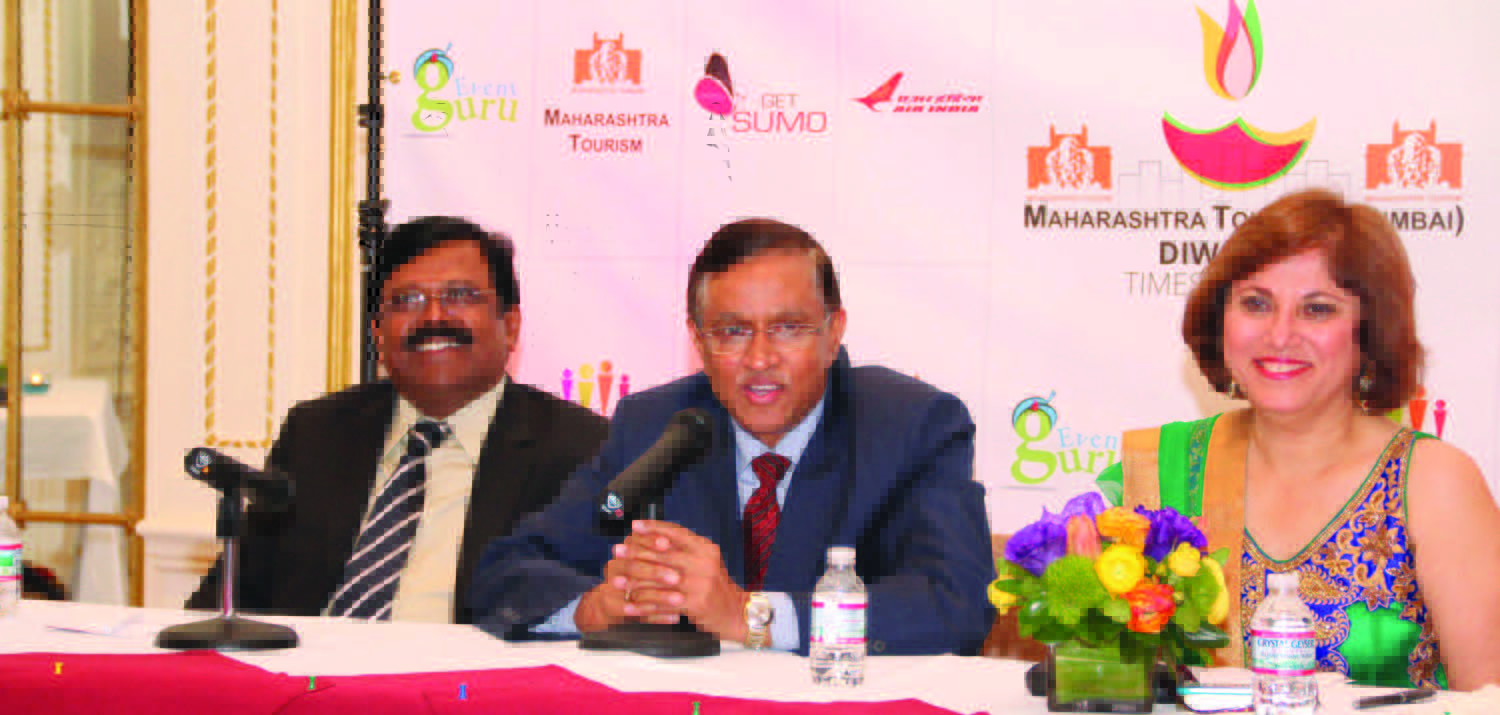
    NEW YORK (TIP): The Maharashtra Tourism sponsored Diwali will be celebrated at Times Square on September 20, 2014. This announcement was made at a press conference held at the Consulate General of India, May 22. Making the announcement, Consul General Mulay said, “It is wonderful to see this event come back to Times Square this year again.

    It’s a glimpse into India’s largest festival and we are going to celebrate it with the world right here in New York City!” Managing Director of Maharashtra Tourism Development Corporation (MTDC) Dr. Jagdish Patil stated “We are pleased to be back again to be part of this festival.


    11
    A view of the gathering

    This year Maharashtra Tourism Development Corporation will showcase to the world Maharashtra’s rich culture, cuisine, pristine beaches, historical and natural heritage preserved for thousands of years”. Mrs. Neeta Bhasin outlining the program said, “Diwali festivities will begin at noon and will include a wide variety of Indian food, dance classes, Indian arts and crafts, a fashion show, photo booths with ethnic outfits, celebrities and much more.

    In the evening, Event Guru will be bringing a “Light up Times Square” Concert”. Event Guru and ASB Communications, the masterminds behind “Diwali at Times Square”, are organizing and managing the event. Neeta Bhasin, President and CEO of Event Guru and ASB Communications, said “We want to show to the world how rich Indian culture and heritage are and how diversified India is.


    12
    Jackson Heights Indian Merchants’ Association Chairman Shiv Dass (extreme right), Mohinder Verma (second from right) and Subhash Kapadia (extreme left) presenting to Mrs. Neeta Bhasin a Congressional proclamation on behalf of Congressman Joseph Crowley.

    We couldn’t think of a better place than the center of the Universe – Times Square!” On the occasion, Mrs. Bhasin was honored with a Congressional proclamation from New York’s 14th Congressional District Congressman Joseph Crowley who also cochairs the Congressional Caucus on India and Indian-Americans.

    Neeta was recognized for her efforts and dedication to further the Asian Indian community in the United States as well as her invaluable contributions to the South Asian community in greater New York City.

    For more Information about Diwali at Times Square please visit:

    http://www.diwalitimessquare.com. For sponsorship or volunteer inquiries please email at info@diwalitimessquare.com (Based on a Press release)

  • Congressman Garamendi Selected as Co-Chair of Bipartisan American Sikh Congressional Caucus

    Congressman Garamendi Selected as Co-Chair of Bipartisan American Sikh Congressional Caucus

    WASHINGTON, DC (TIP): The bipartisan American Sikh Congressional Caucus announced, May 22, the appointment of Congressman John Garamendi (D-CA- 03) and Patrick Meehan (R-PA-07) as co-chairs of the Caucus. They will serve as leaders of the Caucus with the current co-chairs Congresswoman Judy Chu (D-CA-27) and Congressman David Valadao (R-CA-21). The selection of Garamendi and Meehan was made official through a letter to the House Committee on Administration. Garamendi has worked with the California Sikh community for decades.

    His Congressional District is home to tens of thousands of Sikhs and many Sikh run farms. “It is an honor to be selected as cochair of the bipartisan American Sikh Caucus. I am proud to take this next step in my work with Sikh-Americans to defend civil rights, fight discrimination, and educate Members of Congress and the public about the community,” said Garamendi. “I commend the community on their industriousness and entrepreneurship. I also want to thank them for their democratic civic engagement – for speaking up for their rights and beliefs.

    Regardless of background, we all want a good environment to raise a family. I will work in a bipartisan fashion to achieve this.” Last year, Congressman Garamendi joined a coalition that successfully persuaded the FBI to track hate crimes against Sikh, Hindu, and Arab- Americans through a letter signed by over 100 Members of Congress and by advocating for this cause through interviews with the press. Garamendi also introduced House Resolution 550 to wish the Sikh- American community a joyous spring festival of Vaisakhi.

  • FLIPKART BUYS OUT MYNTRA FOR $300 M

    FLIPKART BUYS OUT MYNTRA FOR $300 M

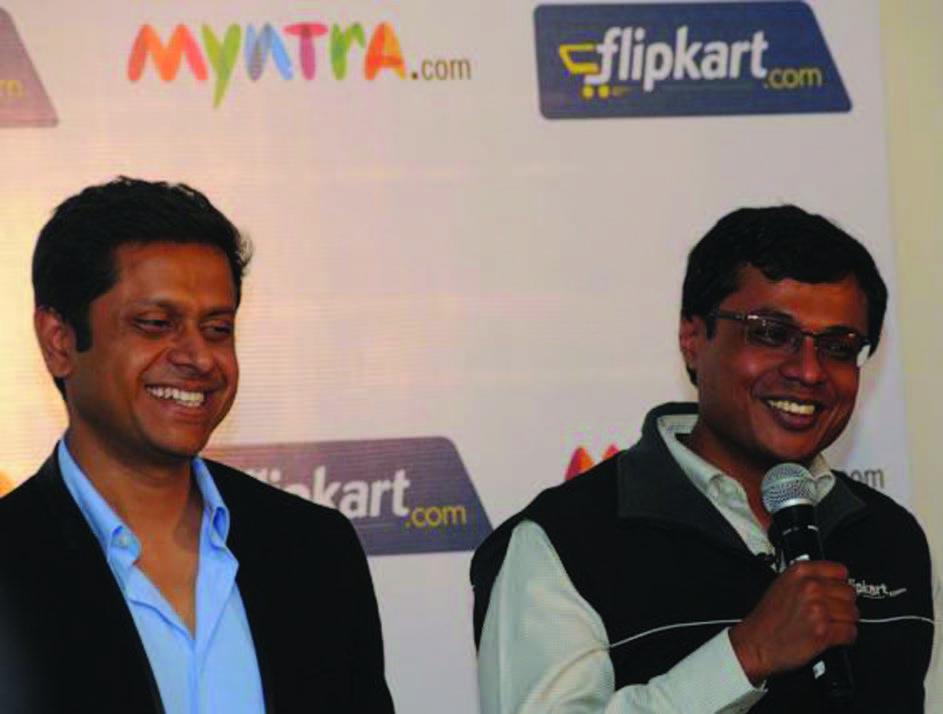
    BANGALORE (TIP): Putting an end to months of speculation about what is being termed as the biggest acquisition in the Indian e-commerce business, domestic e-retailer Flipkart announced that it has acquired rival and leading fashion e-tailer Myntra.com.

    The move is widely being read as a response to global e-commerce leader Amazon’s ramp up of its year-old India operations, and the narrowing gap between Flipkart’s sales and that of fast-growing rival Snapdeal. No details on the deal size or structure were shared, and analyst speculation pegging the buy out at over $300 million remained unconfirmed by both companies.

    Both companies will be run independently, with no immediate plans to merge the fashion business on the two portals or even join forces in terms of content or go-to market. Myntra CEO Mukesh Bansal joins Flipkart’s board, and will head the fashion vertical at Flipkart and Myntra. They also announced that while Myntra employees would “remain in current positions”, they would be offered stock options in Flipkart.

    Flipkart co-founder Sachin Bansal insisted that this was a “completely different acquisition story” as it was not “driven by distress”, alluding to a plethora of small e-commerce players either having wound up or been bought over in the past two years.

    Together, both company heads claimed, they were scripting “one of the largest ecommerce stories”. $100 m investment in fashion vertical Mukesh Bansal said that on its own Myntra.com held 30 per cent of the market share, but together the two companies would account for 50 per cent of the online fashion market. “We hope to take this figure to about 60-70 per cent in the long-term,” he said. Mr. Sachin Bansal added that Flipkart would invest $100 million in its own fashion vertical in the near-term.

    While the electronics vertical is the largest revenue generator at Flipkart (and will continue to be even after the acquisition), Mr. Bansal hoped that in the near-term fashion would be the “largest sales category for Flipkart”. Flipkart started fashion as a shopping category on its site two years ago.

  • IIFA Awards make glamorous US debut

    IIFA Awards make glamorous US debut

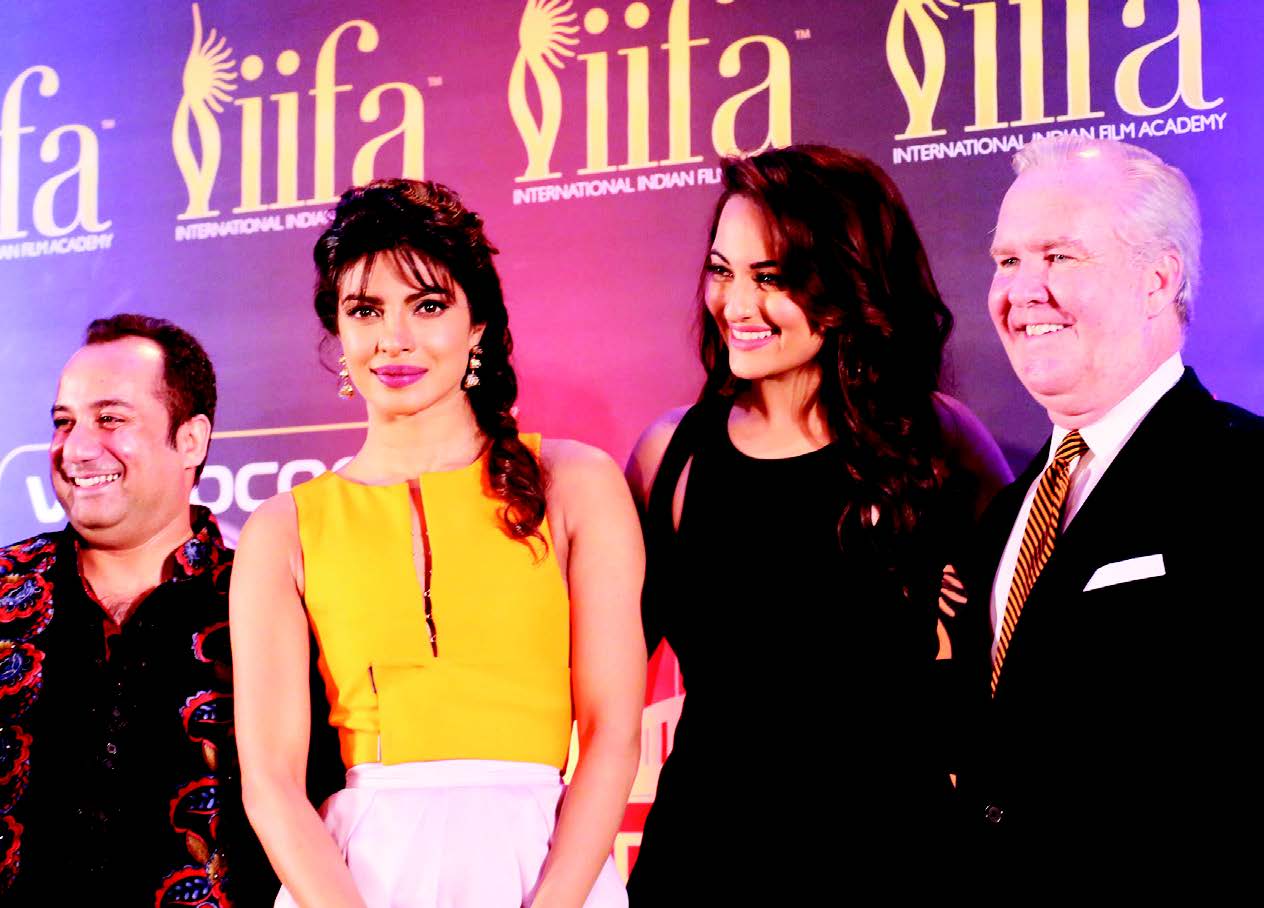
    TAMPA BAY, FL (TIP): International Film Academy Awards (IIFA Awards )made a glamorous and impressive debut in USA on April 23 in scenic Tampa Bay, Florida with IIFA Rocks and a fashion show by Vikram Phadnis.

    Priyanka Chopra, Sonakshi Sinha, Bipasha Basu and Anil Kapoor were seen having a blast. Our photo journalist Mohammed Jaffer was on location and has sent some lovely photographs of the event.

  • US navy to deploy electromagnetic railgun that fires at seven times the speed of sound

    US navy to deploy electromagnetic railgun that fires at seven times the speed of sound

    WASHINGTON (TIP):The US navy has announced plans to deploy its first ever electromagnetic railgun, a “game changing” device that fires projectiles without explosives over a distance of 100 miles and at seven times the speed of sound.

    Railguns use an electromagnetic force known as the Lorentz Force to rapidly accelerate projectiles between a pair of conductive rails, firing them at a velocity greater than can be achieved by traditional guns and artillery. This increased velocity means that projectiles do not need to have any explosive payload.

    Instead, the railgun simply fires a solid lump of metal, relying on the speed of its impact to transfer massive amounts of heat and kinetic energy to the target. The navy has said that weapon represents “the future of naval combat” with current prototypes capable of punching through the hull of ship “like a freight train” due to be installed and tested on ships by 2016. “The American public has never seen it,” said Rear Admiral Matthew Klunder, chief of naval research, in a telephone press conference. A still of the weapon test firing at the Naval Surface Warfare Center in Jaunary 2008.

    “Frankly, we think it might be the right time for them to know what we’ve been doing behind closed doors in a Star Wars fashion,” he said. “It’s now reality. It’s not science fiction. It’s real and you can look at it.” Because railguns do not require any explosive shells, the price of firing the weapon is massively reduced, with a 10kg projectile costing just $25,000 -1/100th the cost of a conventional missile.

    “I really think it will give our adversaries a huge moment of pause to go, ‘Do I even want to go engage a naval ship?’ Because you are going to lose. You can throw anything at us, and the fact that we can shoot a number of these rounds at very affordable costs — it’s my opinion that they don’t win,” said Klunder. The technology for railguns was first proposed in the early 20 century but until now the cost of supplying the necessary electrical power has stopped the weapon from becoming practical. The US navy has been developing the technology since 2005, with the team responsible adopting the latin motto of ‘Velocitas Eradico’, roughly translating as ‘I who am speed, eradicates’.

  • Death of L’Wren Scott, Mick Jagger’s girlfriend, is ruled a suicide

    Death of L’Wren Scott, Mick Jagger’s girlfriend, is ruled a suicide

    NEW YORK (TIP): The death of fashion designer L’Wren Scott, the longtime girlfriend of Rolling Stones frontman Mick Jagger, was suicide, the New York City medical examiner’s office said on Wednesday. An autopsy completed on the body of 49-year-old Scott found that she died of hanging, according to Julie Bolcer, a spokeswoman for the city medical examiner.

    Scott was found dead in her Manhattan apartment on Monday morning. Police said her assistant found her kneeling with a scarf wrapped around her neck that had been tied to the handle of a French door. There was no note. The Stones canceled their seven-date tour of Australia and New Zealand in the wake of Scott’s death. Jagger called Scott his “lover and best friend” in a Facebook tribute and said he was struggling to come to grips with her death.

    Jagger’s bandmates voiced their support for him amid a trying time. Keith Richards said in a statement on Wednesday that “no one saw this coming” and that Jagger has “always been my soul brother and we love him.” “We’re thick as thieves and we’re all feeling for the man,” he added. Charlie Watts said the band’s priority is the 70-year-old Jagger. “Needless to say we are all completely shocked but our first thought is to support Mick at this awful time,” he said.

    “We intend to come back to Australia and New Zealand as soon as it proves possible.” Ronnie Wood echoed Watts’ statement. “This is such terrible news and right now the important thing is that we are all pulling together to offer Mick our support and help him through this sad time,” Wood said. “Without a doubt we intend to be back out on that stage as soon as we can.” Scott had been Jagger’s companion since 2001.

    The Rolling Stones frontman paid tribute to his girlfriend Tuesday on his Facebook page writing, “I will never forget her.” “I am still struggling to understand how my lover and best friend could end her life in this tragic way. We spent many wonderful years together and had made a great life for ourselves. She had great presence and her talent was much admired, not least by me.” The fashion label founded by Scott had been heavily in debt and was reportedly about to fold. Former New York Times fashion writer Cathy Horyn said in an essay on the paper’s website that Scott had been planning to announce that she was closing her business. Scott canceled her London Fashion Week show last month, citing production delays.

    Scott launched her high-end fashion label in 2006. First lady Michelle Obama, Nicole Kidman and Penelope Cruz were among the big names to wear her designs. Accounts filed by Scott’s LS Fashion Ltd. in London show the company had liabilities that exceeded assets by 4.24 million euros ($5.9 million) as of Dec. 31, 2012. The company’s long- and short-term debts totaled 6.75 million euros against assets, capital and reserves of 2.51 million euros, according to the accounts, which were filed in October. Scott was adopted by a Mormon couple and grew up in small-town Utah. She made her way to Paris after high school where, aided by her 6-foot-3 height (some say 6-foot-4) and striking looks, she found work as a model for some prominent photographers.

  • HOLI AROUND THE WORLD

    HOLI AROUND THE WORLD

    Holi knows no bars, Holi knows no boundaries too. Across the world wherever Indians or people of Indian origin are present Holi is celebrated with gusto and bonhomie. People play with colours, light a bonfire called Holika and celebrate the victory of good over evil. Well, the essence of any festival is to take a break from the daily humdrum of life and make it interesting.

    The other major intention of celebrating festival is to bring people together and generate a feeling of brotherhood and spread harmony all around. Nobody realizes the importance of celebrating festivals than the Indians settled abroad away from their country and cultural roots. At times they are more eager to celebrate festivals than their Indian counterparts. For celebrating festivals is what binds the people of Indian origin together and also to their roots. Just as in India, people settled abroad meet their friends and exchange sweets and greetings. Of course, the revelry is no less when it comes to colours.

    Bangladesh
    Bengal region has a multifaceted culture due to the influence of Buddhist, Hindus and Muslim cultures. Though the country is Muslim dominated, Hindus too celebrate their festivals with gaiety. Of course, the pomp and show of Holi as witnessed in India is missing, nevertheless, celebrations do take place. Hindu community gather in temples and exchange greetings with each other and play with colours. Indian culture has influenced Bangladesh a lot as the country is nestled in the crook of the Bay of Bengal and is surrounded by India. It shares a border in the south-east with Myanmar and fronts onto the Bay of Bengal. The country is flat and dominated by the braided strands of the Ganges- Brahmaputra-Jamuna delta. Bangladesh’s Muslims and Hindus live in relative harmony.

    Guyana
    Located in the north-east coast of South America, Guyana celebrates Holi with great fan fair. Holi or Phagwa, as the Guyanese better know, is celebrated by the singing of special songs called Chowtaals and by the spraying of coloured powder (abrack) and water (abeer). Children take special delight in the festival and submerge any passerby with their colourful water jets called pichkaris. The season of Holi, starts a month before with the planting of the Holika, a castor oil plant.

    This plant is burnt one month later as Holika, commemorating Prahlad’s legendary devotion to Lord Shiva and also the triumph of good over evil. Holi happens to be a national holiday in Guyana as Hindus constitute about 33 per cent of the country’s population. Guyanese living overseas make special arrangement to be with the family at the time of Holi.


    11

    Mauritius
    Holi in MauritiusJust as the many other major Hindu festivals, the large Indian majority, (about 63 per cent) celebrate Holi with a lot of enthusiasm in the island of Mauritius. It is an official holiday in the country and therefore people get all the time to make merry and drench themselves in the spirit of Holi and of course, colour water. Hindus, here duly perform the tradition of Holika Dahan or lighting of bonfire on the eve of Holi and celebrate the victory of good over evil.

    Next day people revel and play with colours and drench everybody with water jets called pichkaris. While in the evening they greet each other with tilak and exchange sweets. Holi is also marked as a Spring Festival when the nature wears its best clothes and fields and flowers are in full bloom.

    Nepal
    Holi is celebrated with great pomp and show in Nepal. Celebrations lasts for a week in which the entire country gets drenched in the coloured water. Celebrations are of marked importance at Terai and also where Indian community mainly Marwaris have settled. Families and friends get together and celebrate the occasion with a lot of merry making. All over the streets people can be watched having fun, throwing colours and waterballoons, locally called ‘lolas’ on each other. Though play of colours takes place on the last day, a ceremonial pole called, ‘chir’ is installed on the first day.

    Chir is a bamboo pole fringed with strips of clothes representing good luck charms. As the pole is put up in the street at Basantapur, the festivities and worship commences for the week. At the end of the festivities chir is taken to a bonfire. There is a popular legend behind the installation of chir. The story is again about the mischievous nature of Krishna who just loved to pray pranks with the milkmaids or gopis. Playful as he was, it is said that once he seduced all the local girls with his dashing good looks. He then danced with them all and when they fully engrossed in him, then he thought they were ripe for a tease.

    He doused them in coloured water and stole all their clothes while they were bathing in the water of river Yamuna. Naughty Krishna then hung their clothes on a tree to bug them. Chir symbolizes that very tree. The other legends popular in India as that of Prahlad and his devilish father, Hiranyakashyap. Hiranyakashyap asked his sister, Holika to enter a blazing fire with Prahlad in her lap. However, Prahlad was saved for his extreme devotion by Lord Vishnu while Holika paid a price for her sinister desires.

    Every year just as in India people in Nepal light a bonfire- called Holika to mark the victory of good over evil. Also known is the legend of Pootana who tried to kill infant Krishna by feeding her poisonous milk on the direction of devil hearted uncle of Krishna called Kansa.

    Pakistan
    Hindus residing in Pakistan also celebrate holi, though, of course, in not as grand a fashion as seen in India. People celebrate the victory of good over evil forces by lighting bonfires called Holika. The tradition comes from the legend of Prahlad and Hiranyakashyap. In fact, people follow the same traditions and rituals as in India due to their roots in India. People clean their houses and prepare special delicacies like gujiyas, papri and dahi badas.

    They meet up with friends and play with the colours, dance and generally have good time. Hindus usually gather in temples and celebrate the Holi there. Much gaiety can be seen in temples located in cities which have a comparatively greater Hindu population. Such as in Lahore and Sindh region.

    United Kingdom
    Hindus settled in UK do not miss out the excitement of Holi celebrations and enjoy to the hilt. Zeal for the festival is particularly marked in this country as Indians constitute the second largest ethnic minority. Celebrating festivals help them to feel close to their families and cultural roots. The celebration of Holi is noticeable at places that witness a large congregation of Indians. The British city of Leicester is particularly known for its love for celebrating Indian festivals.

    Excitement reaches its peak when the occasion is that of celebrating a joyous festival like Holi. Children love to use their spray cans and colour each other. Holi parades are also carried and in the evening people visit their friends and relatives to exchange greetings and sweets. They hug each other and also apply the tilak as the meet Holi in a traditional manner.

    USA
    With a large population of Indians settled in the United States of America, Holi is celebrated with gaiety and lot of fanfare in this country. Different societies formed by the Indians and religious organisations help people to celebrate this joyous festival and feel close to their cultural roots. Music programmes and Holi Meets are also organised by them to mark the occasion. These meets help the new generation to identify with their cultural root.

    Children learn to understand the significance of celebrating festivals and know legends asociated with them. Great enthusiasm for the festival can be specially witnessed in cities where large number of Indians have settled. Holi celebrations are particularly marked in the city of New York.

  • Djokovic beats Murray at Madison Square Garden

    Djokovic beats Murray at Madison Square Garden

    NEW YORK (TIP):
    Novak Djokovic beat Andy Murray 6-3, 7-6 (2) in an oneoff match at Madison Square Garden on March 3, with the pair mixed the usual exhibition hijinks with some long rallies reminiscent of their epic Grand Slam meetings. A born showman, Djokovic always has fun with the New York crowd at the US Open. When on a game point Monday he shanked an overhead into the net, the Serb did push-ups in penance. It was the first time playing at the Garden for both.

    “I was amazed by the size of it,” Djokovic said. “With the history in the world of sports and entertainment and music, it’s probably the most impressive and most important indoor facility in the world.” Murray grimaced more than once after an unforced error as if he were a few miles away at Flushing Meadows. But he also high-fived a fan after hooking in a winner down the line. And the Brit provides plenty of entertainment value simply with his ability to run down nearly every ball. Chasing a drop shot in the first set, Murray wound up all the way on Djokovic’s side of the court, bumping into a TV camera along the way.

    Djokovic went over and jokingly massaged Murray’s quad, lest he need a medical timeout. During one changeover, they pulled their phones out of their bags and met at the net to take a couple of selfies. Both tweeted them during the next break. “We might never get the chance to play here again,” Murray said. “Wanted to enjoy it. Hope everyone who came along had a good time as well. That was the whole point today.” And he’s in a good mood after his surgically repaired back held up well following four matches in four days in Acapulco last week.

    There were the obligatory exhibition shenanigans: between-the-legs shots, pulling a kid from the crowd to play a point. In a bit of a twist, Djokovic invited reigning Wimbledon champion Marion Bartoli, who has since retired, from the stands to briefly take his place. Murray welcomed her by launching a serve as hard as he could that had the Frenchwoman ducking. Bartoli then ably exchanged groundstrokes with Murray in high-top canvas sneakers that were more fashion than function. The BNP Paribas Showdown opened with the Bryan brothers beating the McEnroe brothers 8-3 in doubles.

    John McEnroe added a little sizzle to the meeting a few months ago when he made some harsh comments about the current state of doubles, suggesting that top players today are the guys who weren’t athletic enough to make it in singles. While Bob and Mike Bryan insisted there were no hard feelings, they respectfully disagree with his opinion, and they played Monday with the seriousness of an ATP Tour match. There was no aiming any slams toward John’s head. Instead, they picked on Patrick McEnroe’s volleys – he doesn’t play as much these days as his more-successful older brother. The twins needed 44 minutes to win the single pro set.

  • Challenges in India-US ties

    Challenges in India-US ties

    Inconsistencies mark Obama Administration’s approach

    “… the US is becoming increasingly strident in its economic relations with India on issues ranging from sanctions on sections of our pharmaceutical industry and our civil aviation facilities, while demanding changes in our policies on solar panels and equipment and placing restrictions on the movement of IT personnel. It is, however, not India alone that is the recipient of such measures from the US!”, says the author

    Traveling across the US as the winter Olympics in Sochi commenced, one was saddened to witness how India’s international credibility had been shaken when television audiences across the world saw three forlorn Indian athletes marching without the national flag. India faced this disgrace, thanks to the avariciousness and nepotism of an internationally disgraced Indian Olympic Association.

    Sadly, this was accompanied by charges of corruption, nepotism, match fixing and worse involving the President of the BCCI. Many Indian friends in the US asked in anguish: “Is there no section of national life left in India which is free from corruption and venality?” The mood in Washington, where one had an occasion to meet a cross section of senior officials, business executives, analysts and scholars, was quite different.

    In marked contrast to the earlier years, I found widespread criticism of the conduct of foreign and security policies by President Obama. The Administration had not just botched up its healthcare program, but was seen as indecisive and weak in dealing with challenges in West Asia, Afghanistan and the provocations of a jingoistic and militaristic China. President Obama, in turn, is acutely conscious of the mood in the country which wants an end to foreign military entanglements. More significantly, as the US moves towards becoming a net exporter of energy, thanks to the expanding production of shale gas and oil, the country’s geopolitics are set for profound change.

    Using its leadership in areas of productivity and innovation, the US now appears set to the stage for increasing domination of the world economic order. From across its eastern shores, the US is negotiating comprehensive trade and investment partnerships with its European allies. Across its western shores in the Pacific, the Americans are negotiating transpacific partnerships with Australia, Brunei, Chile, Canada, Japan, Malaysia, Mexico, New Zealand, Peru, Singapore, South Korea and Vietnam as negotiating partners. While China has informally indicated an interest in joining this partnership, the US will use its influence to ensure that China is not admitted till American political and economic pre-conditions are met.

    There is naturally interest in Washington in the forthcoming general election in India. The assessment appears to be that the ruling Congress is headed for a drubbing in the polls. Not many tears will be shed in Washington or elsewhere about this inevitability as the only questions which well-wishers of India ask are how India landed itself in its present morass of corruption and whether a new dispensation, which may be fractious, will be able to restore India to a high growth path. Speaking informally, a senior official recalled that President Obama had described the US-India partnership as “one of the defining partnerships of the world”.

    The official noted that “every meaningful partnership between powerful nations encounters setbacks”, adding that such setbacks should be minor compared to the benefits of the relationship and the magnitude of what the two could accomplish together. The Khobragade episode was a defining event in India-US relations. The Americans found Indians across the political spectrum united in the view that insults to India’s national dignity would not be acceptable.

    It is important that in future negotiations by the Task Force set up to address such issues, India should make it clear that it will not tolerate events like Mrs. Sonia Gandhi being threatened with prosecution while undergoing medical treatment in New York, or the supercilious attitude adopted towards Mr. Narendra Modi, who is a constitutionally elected Chief Minister. We should not accept a situation where Americans believe that they can behave high-handedly towards our elected politicians because of their domestic lobbies. The US should also be left in no doubt that on such issues, including consular and diplomatic privileges, India will firmly adhere to a policy of strict reciprocity.

    The Obama Administration has messed up its relations with President Karzai in Afghanistan, dealing with him in a manner that showed scant regard for his position as the elected Head of State of Afghanistan. Worse still, by its actions, the US has clearly given the impression that despite its protestations it was clandestinely dealing, behind Mr. Karzai’s back, with the Taliban. While the US-Afghanistan Strategic Partnership speaks of joint determination in eliminating the “al- Qaida and its affiliates,” the US now speaks only of eliminating al-Qaida and not is affiliates like the Taliban, the Islamic Movement of Afghanistan, Lashkar-e-Taiba and Jaish-e- Mohammed.

    There are naturally concerns in Afghanistan that the US, which needs Pakistan’s assistance for withdrawing its military equipment from Afghanistan, will seek to appease the Pakistanis by giving them a lessthan- healthy role in determining the future dispensation in Afghanistan and the role of the Taliban in such a dispensation. While there is an evident congruence of interests in working with the US, Japan and others in the face of growing Chinese military assertiveness, New Delhi and Tokyo cannot ignore the reality that there have been many flipflops and inconsistencies in the approach of the Obama Administration to China.

    Moreover, the US is becoming increasingly strident in its economic relations with India on issues ranging from sanctions on sections of our pharmaceutical industry and our civil aviation facilities, while demanding changes in our policies on solar panels and equipment and placing restrictions on the movement of IT personnel. It is, however, not India alone that is the recipient of such measures from the US! Despite these challenges, India cannot ignore the reality that the US is the pre-eminent power in the world.

    Moreover, it will remain so in the coming years, primarily because its innovative and technological strengths are going to be reinforced by its energy surpluses, together with the energy potential of its neighbors like Canada, Mexico and Argentina. It will, moreover, remain the foremost power in the manufacture of high-tech equipment, particularly in defense and aerospace. It is for India to fashion industrial policies to leverage its strengths and potential to secure high levels of investment and partnership in crucial high-tech industries.

    I was advised in Washington that contracts currently secured with US companies enable us to import 5.8 million metric tons per annum of shale gas from the US annually. According to oil industry sources, these contracts alone provide us more gas than we could obtain from the controversial Iran-Pakistan-India pipeline. But, for all this to fructify, the new dispensation in New Delhi will have to replace economic populism and accompanying fiscal irresponsibility with a quest for accelerated growth.

  • 2013 — THE DEAR DEPARTED

    2013 — THE DEAR DEPARTED

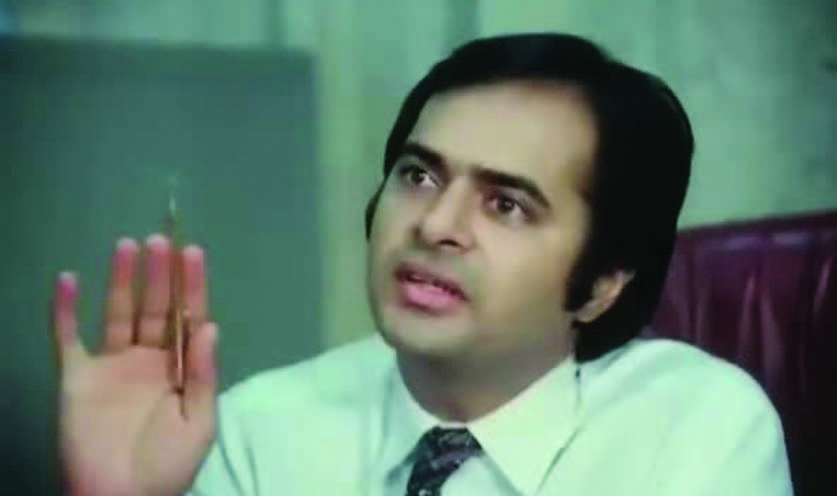
    Renowned film actor Farooq Sheikh passed away on December 28 following a massive heart attack in Dubai. The 64-year-old actor was last seen in Club 60, released earlier this month. Sheikh was best known for his roles in Satyajit Ray’s Shatranj Ke Khiladi, Sai Paranjpe’s Chashme Baddoor and Sagar Sarhadi’s Bazaar.


    6
    PETER O’TOOLE

    Peter O’Toole was an Irish actor. Often called the Hamlet of his generation. Nominated for eight Academy Awards for Best Actor in his lifetime. Some of his well-known works include ‘Lawrence of Arabia’, ‘Venus’ and ‘The Stunt Man’. Died on December 14.


    5
    VIDYA CHARAN SHUKLA

    Vidya Charan Shukla, Former Union Cabinet minister and Congress leader. Close aide of Indira Gandhi. Critically injured in Maoist attack in Chhattisgarh on May 25. Succumbed to his injuries on June 11.


    4
    TARLA DALAL

    Tarla Dalal, one of India’s most celebrated chefs and prolific cookbook writers. Died on November 6.


    3
    SYD FIELD

    Syd Field was an American screenwriting guru. Died on November 17.


    2
    SRIKANTA DATTA WODEYAR

    Scion of the erstwhile Mysore royal family, former Congress MP from the Mysore constituency and also a fashion designer. Died on December 10.

    SIR JOHN TAVENER
    Famous British composer. Some of his wellknown works include ‘Song for Athene’ and ‘The Whale’. Died on November 12.

    SIR ANTHONY CARO
    Widely regarded as the greatest British sculptor of his generation and worked as an assistant to Henry Moore in the 1950s. Died on October 23.


    1
    SHAMSHAD BEGUM

    She was one of the first playback singers in the Hindi film industry. Died on April 23.

    SHAKUNTALA DEVI
    Known for her mathematical prowess and the ability to compute complex equations mentally. Died on April 21.

    SEAMUS HEANEY
    One of the world’s best-known poets and winner of the 1995 Nobel Prize for literature. Died on August 30.


    5
    SANDEEP ACHARYA

    Winner of second season of Indian Idol. Died on December 15.


    14
    RITUPARNO GHOSH

    National Award winner filmmaker. His widely acclaimed films include ‘Unishe April’, ‘Dahan’, ‘Asukh’, ‘Chokher Bali’, ‘Raincoat’, ‘Bariwali’, ‘Antarmahal’ and ‘Noukadubi’. Died on May 30.

    RAY PRICE
    Famous American singer and guitarist. Some of his well-known works include ‘Night Life’, ‘Release Me’ and ‘Crazy Arms’. Died on December 16.

    RAJENDRA YADAV
    Noted Hindi author and a pioneer of the literary movement ‘Nayi Kahani’. Died on October 28.


    3
    PRAN

    Appeared in over 350 films. His widely acclaimed films include ‘Madhumati’, ‘Ram Aur Shyam’, ‘Don’, ‘Zanjeer’ and ‘Upkar’. Winner of Padma Bhushan and Dadasaheb Phalke Award. Died on July 12.

    Hugo Chavez (March 5)
    Venezuelan President Hugo Chavez died after a two-year battle with cancer, ending 14 years of tumultuous rule that made the socialist leader a hero for the poor but a hate figure to his opponents. The flamboyant 58-year-old had undergone four operations in Cuba for a cancer that was first detected in his pelvic region in mid-2011. His last surgery was on December 11, 2012 and he had not been seen in public since.


    2
    Margaret Thatcher (April 8)

    Britain’s first woman Prime Minister Margaret Thatcher, known as the Iron Lady, passed away in April this year following a stroke at the age of 87. Thatcher’s three terms as Prime Minister brought enormous change to the UK.

    ABIR GOSWAMI (MAY 30)
    Television actor Abir Goswami, who acted in Hindi films such as ‘Khakee, Lakshya’ and ‘Darna Mana Hai’, died at the age of 37 following a heart attack.. Abir Goswami had acted in TV serials like ‘Kkusum, Yahan Main Ghar Ghar Kheli, Hotel Kingston’ and ‘Pyar Ka Dard Hai’. Abir was diagnosed with lymphoma in May 2012 and had unndergone surgery.

    JIAH KHAN (JUNE 3)
    The 25-year-old actress, best remembered as the ‘Nishabd’ girl, was found hanging at her flat in suburban Mumbai this year. A six-page suicide note was discovered by Jiah Khan’s mother a few days after her death. In the note Jiah wrote about her relationship with Suraj Pancholi, that landed the budding actor in jail. After spending over 20 days in jail, Suraj was released on bail. While the police claimed it was a case of suicide, Jiah’s mother Rabiya Khan alleged that it was not suicide and sought police to probe the angle of murder.

    CORY MONTEITH (JULY 13)
    ‘Glee’ star Cory Monteith died of intravenous heroin use combined with the ingestion of alcohol in his hotel room in Vancouver. Monteith became famous as Finn Hudson with the success of Fox’s musical series since its launch in 2009. He was dating Lea Michele, who also played his onscreen love interest in the series and supported his decision to get into rehab.

    MANNA DEY (OCTOBER 24)
    Legendary playback singer Manna Dey died at a city hospital in October after prolonged illness. Manna Dey, 94, who was admitted to Narayana Hrudayalaya five months ago for respiratory problems, died of cardiac arrest. He was born as Prabodh Chandra Dey but was popularly known as Manna Dey. Manna Dey then began his journey in Bollywood as an assistant music director in 1942 when he accompanied Krishna Chandra Dey to Mumbai (then Bombay). During his lifespan, the legendary singer received Dadasaheb Phalke Award and National Film Award for Best Male Playback Singer.

    RESHMA (NOVEMBER 3)
    Legendary Pakistani folk singer Reshma, who mesmerised music lovers in the Indian subcontinent with soulful rendition of songs like ‘Lambi Judai’ and ‘Dama Dam Mast Kalandar’ in her trademark rustic voice, died in Lahore on after a prolonged battle with throat cancer.

    PAUL WALKER (NOVEMBER 30)
    The star of the ‘Fast & Furious’ movie series died in a tragic car crash this November. The horrifying car crash killed Walker and his friend in north of Los Angeles. Walker, 40, was working on ‘Fast & Furious 7’ at the time of his death. He also starred in the suspense drama, ‘Hours’, which is set for release this month.


    1
    NELSON MANDELA (DEC 5)

    Anti-Apartheid leader and former President of South Africa Nelson Mandela died at his Johannesburg home after a prolonged lung infection. He was born on 18th July 1918 in a small village of Mvezo which was then a part of South Africa’s Cape Town province. He was given the forename Rolihlahla which basically means ‘troublemaker’. Mandela’s name was going to have a huge effect on him in the future as he would go onto create enormous trouble for the ruling racist regime in South Africa.

    DAVID COLEMAN (DEC 21)
    British sports broadcaster David Coleman, who covered 11 Summer Olympics for the BBC and six football World Cups, died at the age of 87. Coleman retired from the BBC in 2000 after covering the Sydney Olympics. He became the first broadcaster to receive an Olympic Order medal to recognize his contribution to the Olympic movement.

    MIKHAIL KALASHNIKOV (DECEMBER 23)
    Mikhail Kalashnikov, the designer of famed Russian AK-47 assault rifle, passed away in his home city of Izhevsk, an industrial town. Kalashnikov was the carnage of World War II, when Nazi Germany overran much of the Soviet Union, which altered his course and made his name as well-known for bloodshed as Smith, Wesson and Colt. The distinctive shape of the gun, often called “a Kalashnikov,” appeared on revolutionary flags and adorns memorabilia

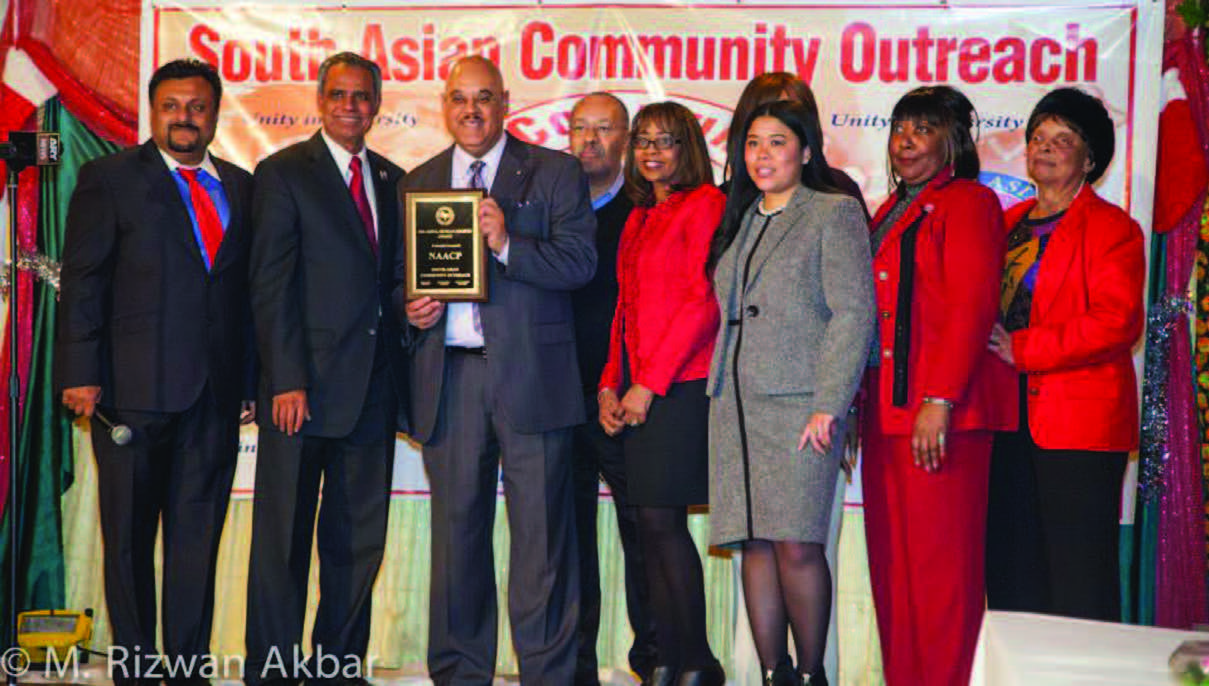
  • South Asian Community Outreach (SACO’S) Interfaith Holiday Celebration focuses on Unity

    South Asian Community Outreach (SACO’S) Interfaith Holiday Celebration focuses on Unity

    Kajol Bishnoi
    EDISON, NJ (TIP):
    South Asian Community Outreach (SACO) has a tradition of forging strong relations between the growing South Asian community and the community at large. And the organization’s recent interfaith holiday celebration on December 19th, honored the multicultural values that make United States a great nation. Founder of the organization, Sam Khan, said , “We were proud to have representatives from Christian, Jewish, Hindu, Muslim, Sikh and Jain faiths. At the same time we have also honored several individuals and organizations who shared the vision of SACO to foster unity within the community.

    Ultimately, we hope the efforts of SACO will promote greater understanding of multiple cultures and religions that form the mosaic of our society. Earlier this year SACO took the initiative to organize its own Independence Day program, the first one by South Asians, along with the Annual 9/11 vigil.”

    “The purpose of this Interfaith Holiday party is for our community to come together to honor those who share our values of community service and are working for the good of humanity”, said Sam. U.S. Rep. Frank Pallone, D-N.J., 6th District, Assemblyman Upendra Chivukula D-17th District, and township Chaplain Rabbi Bernhard Rosenberg were among those honored. Chivukula received the Leadership and Service Award because he holds the distinction of being the first-ever South Asian to serve in the State legislature.

    Pallone received the Mahatma Gandhi Peace Award for his work within the South Asian community since 1988. “I would like to extend my sincere appreciation for bestowing upon me the Mahatma Gandhi Peace Award,” Pallone said in a statement.


    8
    Saco Core Team

    “I am humbled to be the recipient of such an honor.” Spiritual leader of townshipbased Congregation Beth El, Rosenberg was honored for services in raising awareness about the Holocaust, genocide and racism. Other honorees included the local branch of the NAACP, which received the Martin Luther King Jr. Human Rights Award, and the Kiwanis Club of Edison, which took home the Service Impact Award. Tom Lankey, New Edison Mayor, was also honored at the Event. Community Service Awards went to Art Speaks for Autism, which raises funds and awareness to combat autism and support families affected by it.


    9
    Lions Club. (L to R): Sam Khan, Mahesh Chitnis, Raj Mukherji,
    Narayan Sreeniwas, Kajol Bishnoi

    TV Asia, the first South Asian television channel in North America, Sudhir Parikh, a renowned local medical practitioner and publisher of newspapers, Sharanjit Singh Thind, Nassau County Commissioner of Human Rights, Atma Singh & Satish Poondi, community leaders Mahesh Chitnis (DVG of Edison Visionary Lions Club) , Mukul Bishnoi (CEO & Founder of Rudraksham International) , Nilesh Dasondi of Sterling System, and Sneh & Satish Mehtani of Moghul Group were also honored..


    10
    Jewel of India Fashion show by Juhi Jagiasi

    Participating dignitaries included Assemblywoman-elect Nancy Pinkin, D-18th District, Assemblyman-elect Raj Mukherji, D-33rd District, Edison Mayor Antonia Ricigliano, Franklin Mayor Brian Levine and state Senator-elect Peter Barnes, D-18th District. Event highlights included “Jewel of India Fashion show” by Juhi Jagiasi and the musical performance of Saregama Champs Ali Sher and Asad Abbas. Nearly all-major religions were represented and more the 500 attendees took part in the celebration. SACO Announced the First South Asian Peace Conference 2014, which will be held in the United Nations Building. Delegations from South Asian communities will be attending the conference. The mission of the conference is to bring unity among South Asian Americans living in the United States and promote the idea of peace and sharing of culture and heritage.

  • M.A.D. Playhouse to stage Mohan Rakesh’s Half-Hearted

    M.A.D. Playhouse to stage Mohan Rakesh’s Half-Hearted

    NEW YORK (TIP): After a successful run of their first play this summer, M.A.D Playhouse brings us another South Asian family drama Half-Hearted written by Mohan Rakesh, and directed by Hafiz Karmali at The Cherry Lane Theater from December 19 through December 22. Set in 1969 India, Half-Hearted depicts the story of a family in crisis with the sharp, multi-layered subtext of a Chekhov play, the ease and naturalism of a great film script, moments of farce that recall traditional Commedia dell’Arte, and characters that feel equal parts original and universal. Bringing this beautiful story to a New York audience for the first time is M.A.D. (making a difference) Playhouse.

    Savitri, named after a mythical goddess who rescues her husband from death, is in this case doomed to a failing marriage and dysfunctional family. Of all her suitors, she happens to have married an unfortunate businessman. Her elder daughter eloped, and has returned disappointed; her son is an artistic soul trapped in domestic hell; the youngest daughter is a spoiled brat. Savitri longs to escape her halfhearted, unfulfilled, incomplete, regretful existence. She continues to receive gentleman callers as she attempts to balance the cultural needs of her family with her own desires for a better life. Her plight is the plight of all women at this time torn between tradition and modernity. The question remains: must one accept fate and shape desires to events, or can one fashion life’s events to suit one’s desires? Cast: Aizzah Fatima (Dirty Paki Lingerie, The Good Wife) as Savitri, Ashok Kumar Chaudhary(Parts and Parts of Stitches, Hot L Baltimore) as Mahendra, Dipti Mehta (Honour, Golden Boy) as Binni, Akshay Reddy (The Passport, Italian American Reconciliation), Prince Vaghani (Chaos in Gotham Part I), Robin Johnson (The Four Seasons, The Death of William Poole) & Yarin Brosh.

    Show times for this run are:
    Thursday, December 19
    @ 6:30pm
    Friday, December 20
    @ 6:30pm
    Saturday, December 21
    @ 6:30pm
    Sunday, December 22
    @ 6:30pm

    The creative team includes: Sets by Laura Greenfield, Costumes by Sherry Martinez, featuring Music by Ashique Khudabuksh.

  • OBITUARY

    OBITUARY

    Sureshchandra Bahadkar was born on May 28, 1940 in Mumbai, India and passed away on November 10, 2013 in Elmont, NY. Suresh was a pure and innocent soul and was the happiest when surrounded by family and friends. A businessman, Suresh was an exporter/importer of fashion textile until he retired in 2001. He was passionate about fashion and the performing arts. In fact, while in India, Suresh participated in numerous theatrical productions. Suresh lived an altruistic life. He received great joy and happiness by assisting not only his family, but also others in achieving great success. His concern for the welfare of others was a deep rooted part of what defined his character. Suresh was an active member of the Indian community. Specifically, he volunteered and assisted in the coordination of various events for The Indian Association of Long Island, India Home, and Indian American Forum, Inc. Suresh was recently honored by India Home for his outstanding volunteering efforts. Suresh is survived by his wife, Jaya Bahadkar, his two children: Rahul Bahadkar and Rakhi Bahadkar, his sister, Pratima Chowdhari, and brother, Mohan Bahadkar. He was also a proud grandfather of Asha Bahadkar. A puja will be held at the Arya Samaj in Hicksville on Friday, November 15, 2013 at 5:30pm.

  • IALI WOMEN’S FORUM CELEBRATES DIWALI

    IALI WOMEN’S FORUM CELEBRATES DIWALI

    India Association of Long Island (IALI) Women’s Forum recently celebrated the Festival of Lights – Deepavali – heartily and eloquently with a colorful and unique Fashion Show done by the women and geared for the women. Excitement was generated on account of the wide variety of stylish designs in traditional saree wear together with elegant embroidered and sequinned lenghas in a multitude of shades showcased with full printed heavy ghagras in ethnic designs and an ensemble of glittering jewelry with matching clutches and silken scarves making up the complete array of an entire wardrobe collection.

  • Nargis Dutt Memorial Foundation Crosses another Milestone

    Nargis Dutt Memorial Foundation Crosses another Milestone

    NEW YORK (TIP): The 32nd Gala dinner of Nargis Dutt Memorial Foundation was held on September 22 at Long Island Marriott Hotel & Convention Center. The event, as usual, attracted a large number of Indian Americans sympathetic to the cause the NDMF has espoused for the last 32 years-providing help to medical fraternity in India to fight the terrible menace of cancer. Ms Priya Dutt, Member of Parliament, and Patron of the Foundation, who had flown in to New York to be at the event, in her presidential remarks, appreciated the generous contributions of the Indian American community to the Foundation which has helped it to make available to hospitals in India the much needed equipment to cure patients of the dreaded disease of cancer. She exhorted them to come up with ideas and funds to help the Foundation to continue with greater vigor the good work it has been doing. She congratulated the honorees for the honor conferred on them and said that each honoree has made a singular contribution in life for which they have been honored. She had a word of appreciation for the Nargis Dutt Memorial Foundation Board of Directors, led by the President Sher Singh Madra. She said the hard work of the team is evident from the response of the community.

    The Foundation President Sher Singh Madra thanked the supporters of the Foundation “for helping us to give the impoverished communities within India a fighting chance against cancer.” He said, “India has the highest incidence of cancer in any country in the world. Yet, there are many without the resources available to fight the disease. Your support tonight helps us to give back to the home of our hearts and for that, I, again, thank you.” Mr. Madra recalled with obvious satisfaction that the Foundation which is 32 years old has made significant achievements. He said, “During its history, it has provided valuable cancer detection and treatment equipment. For example, a radiation field analyzer was procured by the organization and sent to the Indore Cancer Hospital. The organization has completed over 50 projects of this type. Additionally, it has provided training to Indian doctors so that they increase their expertise in fighting cancer.” Welcoming Ms Priya Dutt, Mr. Madra said, “I thank Priya Ji, daughter of Sunil Ji and Nargis Dutt Ji and Member of Parliament of India for her continued support, guidance and involvement with the Foundation. She is the bridge from the founders of this organization to this organization’s foreseeable future. We greatly appreciate that she took time from her busy schedule to fly from India to be here with us.” The honorees included Mr. Harendra H Singh (Lifetime Achievement), Mr. Saleem Iqbal (Excellence in Finance), Mr. Chintu Patel (Business Entrepreneur), Vaijinath M. Chakotem MD (Excellence in Healthcare), Vijaypal Arya, MD (Excellence in Healthcare), Mr. Manohar S. Toor (Business Entrepreneur), and Prem C. Goel, MD (Lifetime Achievement).

    Nassau County Chief Executive, Edward Mangano was the chief guest of the evening which witnessed the presence of a large number of who’s who of the Indian American community. A scintillating fashion show by Karamjit Singh Bhinder and a singing session provided an evening of entertainment. A profusely illustrated souvenir journal was brought out on the occasion. Mr. Peter Bheddah who was Chairman for the souvenir journal said it was “a great privilege and honor to be in charge of this year’s souvenir journal celebrating Nargis Dutt Memorial Foundation’s 32nd Annual Dinner”. Mr. Gurdip Singh Narula, who has been the Treasurer of the Foundation since 2006 said he had played his innings well and wanted to retire. It is believed he has already made a request to the Board of the Foundation to be relieved of his responsibility. One of the founders of the Foundation, Mr. Inder Bindra was full of praise for the NDMF team who, he said, worked in close cooperation with each other to ensure the Foundation goes from strength to strength. Dr. Shakir Mukhi, a friend to late Sunil Dutt, suggested involvement of younger people in the activities of the Foundation. He said young people are more idealistic and better suited for the vision of the Foundation.

  • History making Indian Diwali at Times Square mesmerizes visitors

    History making Indian Diwali at Times Square mesmerizes visitors

    NEW YORK (TIP): Diwali maybe a month away but for Indian Americans at Times Square, festivities started as early as September 22 when the entire cast of Besharam made a special appearance at the ‘Maharashtra Tourism Diwali at Times Square’. But Diwali at Times Square was much more than just the special performances from the Besharam team. Roughly about 30,000 people attended the Diwali event on Sunday at the busiest area for pedestrians in the world where 3,00,000 people visit every day. In a bid to tap major international source markets and increase tourist arrivals, the Maharashtra Tourism Development Corporation (MTDC) participated in the early Diwali celebrations. Speaking on the occasion Minister for Tourism, Government of Maharashtra, Chhagan Bhujbal said, “Due to this event, the image of Maharashtra is going to be boosted in all international markets, not just in the USA. We want foreign tourists to come to Maharashtra, explore its rich cultural heritage and UNESCO world heritage sites like Ajanta, Ellora and Elephanta caves.


    img010

    They should also visit Tadoba Tiger Sanctuary, near Nagpur, where any tourist would spot tigers. It is my pleasure to invite all international tourists to indulge in the luxurious Deccan Odyssey train which covers the beautiful Maharashtra.” Mr. Satish Soni, Director – Tourism, Government of Maharashtra said, ‘It’s an extravagant event for Maharashtra tourism in a foreign land. We are glad at its grand success as thousands of people visited and enjoyed the event at the magnificent Times Square. We appeal to the people of the world to come to Maharashtra for an unforgettable experience. “There were many enquiries for the Deccan Odyssey train followed by the wildlife reserves, mostly from foreigners and local Americans,” said one of the organizers at the tourism booth. The festivities showcased Indian music, cuisine and fashion. Times Square between 45th to 47th streets was bustling with tourists and visitors dressed in traditional attire as they lined up to get the saffron Kolhapuri turbans, pointed mustache masks, Gandhi caps and chudis (bangles). The cultural festival included dance, diya, rangoli painting, Indian arts and crafts, fashion show, photo booths with ethnic outfits, celebrity autograph/photo booth and much more. The event saw some famous dancers performing Lavani, and other well-known Marathi dances styles, Bhangra, fusion etc.


    img11

    Dhol – Tasha and Tutari enthralled the crowds eagerly waiting to catch a glimpse of their favorite Bollywood stars. Groups like Sangharsh and Sankalp promoted Govinda festival by forming human pyramids. Late in the evening at the Light Up Times Square concert had the music maestro Shankar Mahadevan also created a sensation through his voice and musical troupe. “Where in my dreams did I think that I will sing Ganpati bhajan at Times Square,” said Mahadevan. The concert also saw Canada based group Culture Shock perform live on a mix of songs. Although Indian Americans dominated the crowd many tourists as well as local Americans enjoyed the festivities. “This is my first ever encounter with India. I have heard a lot about the country that it is colorful and vibrant but experienced it for the first time. I loved the energy and the sense of community and also the samosas. My next holiday destination is India for sure,” said Suzan Lew. The festival encountered mixed reactions from the Indian Americans. “Diwali is a festival of lights and what better place to celebrate than Times Square. It is like a mela out here, I have never seen such a crowd in the US. Only Indians can party like this, I am proud to be an Indian,” said Pragya Mahajan who wore a saffron turban. “Celebrating Diwali at Times Square is celebrating the cultural capital of the world (India) at the cultural capital of the United States,” said Sunny Doshi, a new Jersey resident.

    While there were positive responses to the event, many Indian Americans were disappointed with the ‘westernized’ Diwali celebrations and poor management. “Speakers at the very end did not work. We tried to go forward but feared stampede and because there were no screens to look at we headed back,” said Reetu Kumar who had come with her 68 year old grandmother. The night culminated into the star studded performances from Bollywood actors Ranbir Kapoor, and debutant Pallavi Shardha who made a special appearance along with Rishi and Neetu Kapoor to promote their upcoming film Besharam. The crowd gathered at Times Square went ballistic on catching a glimpse of one of Bollywood’s most eligible bachelors. Dressed in a black ‘sherwani’, the young Kapoor danced and interacted with his fans as his father recalled visiting the city years ago and expressing gratitude for the adulation shown to him and his family. Congratulating Maharashtra Tourism for its achievement, Rishi Kapoor said, “I am proud to be a part of Maharashtra.” Complimenting ASB Communications and Event Guru, Shankar Mahadevan said, “Congratulations for pulling this off. To do this at Times Square was close to impossible. God bless”. “I came to the USA over 36 years ago and I still remember being awed by Times Square when I first saw it. I told myself even at that time that I will showcase the diversity and richness of India at this location. I am so thankful to all those who came here today. I am equally thankful to Maharashtra Tourism Development Corporation, Air India, MoneyGram, DishWorld, Wells Fargo, Bank of Baroda and all other sponsors without whose support this event would not have been possible”, said Neeta Bhasin, President, ASB Communications, the conceptualizer of the event.

  • Diwali, “the Timeless Festival of Lights” comes to Times Square

    Diwali, “the Timeless Festival of Lights” comes to Times Square

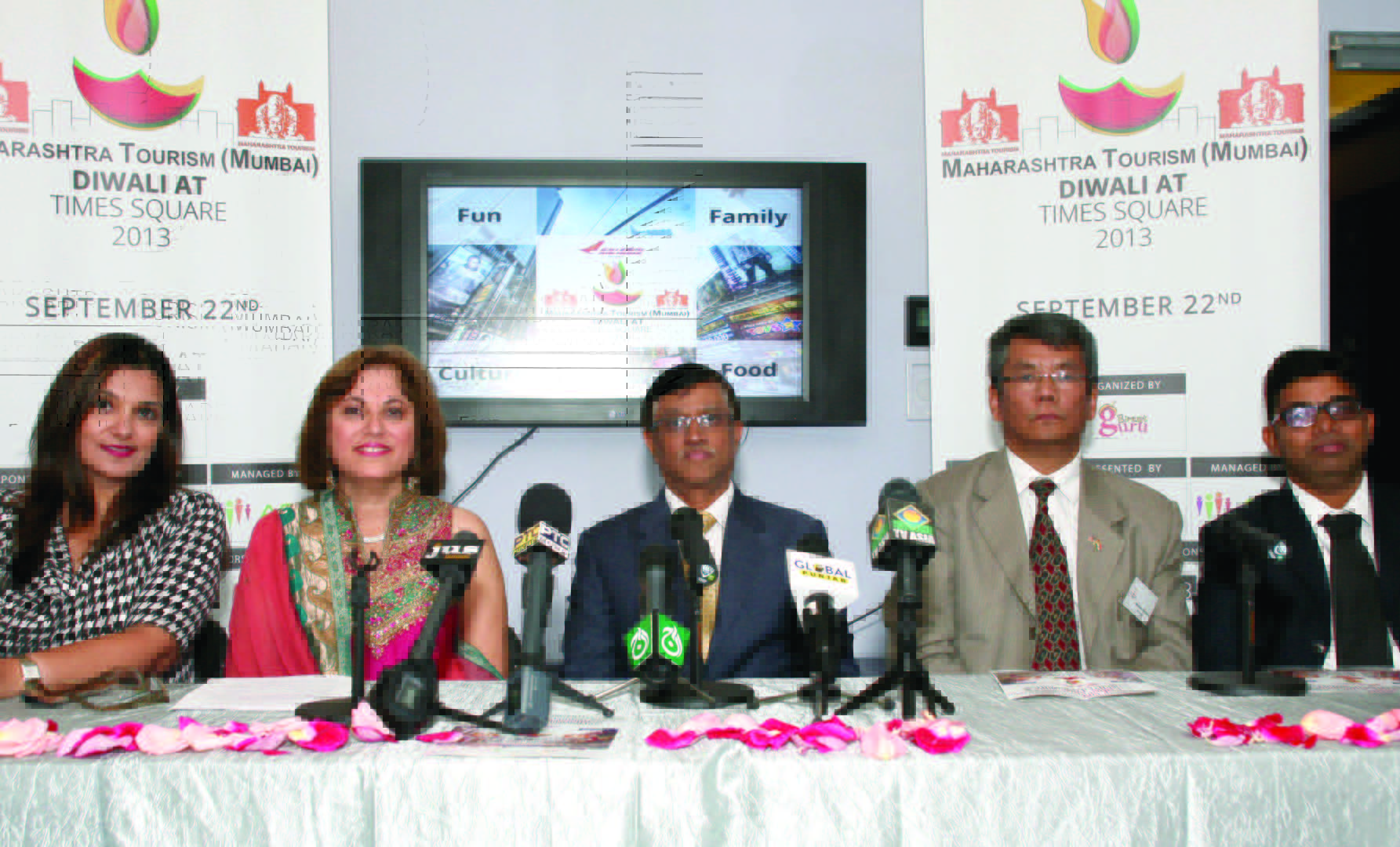
    NEW YORK, NY: Come September 22nd and “Celebrity appearances, musical performances, Asian Indian Cuisine, ethnic Indian dances, fashion show and a “Light Up Times Square” concert will be the highlights of the first ever Diwali at Times Square, New York”, said Ms Neeta Bhasin, President of ASB Communications who have conceptualized and are managing the mega event. She was speaking at a press conference organized by Event Guru and ASB Communications at the up end The Atelier- Sky Lounge August 29th.

    The Consul General of India in New York, Ambassador Dnyaneshwar Mulay and the principal sponsors of the Times Square Diwali, Air India Regional Manager for Americas, Mr. Riwo Norbhu, MoneyGram Senior Marketing Manager Ms Zainab Ali, and Mr. Dinesh Kamble, Senior Manager at Maharashtra Tourism joined Neeta Bhasin at the press conference which was attended by a large number of media persons from both the print and electronic media, and a select gathering of the Indian American community’s best faces. Welcoming them all and introducing the sponsors, Neeta said that she was greatly impressed by the Maharashtra Tourism department which took just seven days to agree to become the title partners.We have, therefore, christened the Times Square Diwali as “Maharashtra Tourism (Mumbai) Diwali at Times Square”. “Air India”, she said, “are our valuable presenting partners”.

    She introduced Zainab Ali of MoneyGram as “our constant partners in all ventures” and thanked all sponsors present and those who were not around, including Bank of Baroda, Wells Fargo and “many others”. The CE of Bank of Baroda, Mr. Dhimant P. Trivedi could not make it to the press conference but was mentioned by Neeta as one who has always been supportive of every community event. Speaking on why she chose to have Diwali at the Times Square, Neeta said that she was keen to showcase India’s rich heritage and culture to the mainstream in America. “And what other place better that the Center of the World-the Times Square!” she said. Times Square, she said, attracts on an average 350,000 pedestrians each day. Neeta said she felt the need and urge to organize an event that would make the mainstream take notice of the Indian American community which has given to America the second largest group of professionals. “Unfortunately, despite our strengths and contribution, we, the Indian Americans, have not received the kind of recognition from the mainstream as Indians in U.K. or Australia.

    Diwali at Times Square is an attempt at the legitimate recognition of the Indian American community.” Outlining details of the Diwali celebrations on September 22nd when “every Indian American will own Times Square for the day”, Neeta said the event will take place from 11 A.M. to 6 P.M., followed by the “Light Up Times Square” Concert which will showcase live performances from some of the biggest names in Bollywood. “The concert will also feature a breath-taking laser light show”, she disclosed. Inviting the Indian Americans to the history-making event, being the first ever Diwali at the Times Square, Neeta exhorted them to “come in traditional outfit and be the proud owners of Times Square for the day.” A message from Maharashtra Minister for Tourism, Mr. Bhujbal was screened at the press conference. The Minister welcomed all and said, “I thank everyone for being present here for the curtain raiser of Maharashtra Tourism (Mumbai) Diwali at Times Square.” He found many similarities between New York and Mumbai. He said if New York was America’s financial capital, Mumbai was India’s financial capital. Both cities are cradles of diverse cultures, he said. Speaking about the state of Maharashtra, Mr.

    Bhujbal described it as a large state with varied topography and enormous scenic beauty. He added that the state was rich in heritage and was a repository of age old culture. In fact, there were four world heritage sites in Maharashtra that included Ajanta, Ellora and Elephanta. One of the most favored tourist destinations, the state, he said is “one of the most developed states of India”. He extended invitation to the gathering to come and holiday in Maharashtra. He said he was happy to have a global platform in the shape of Times Square in New York to showcase the state of Maharashtra, its variety and richness of heritage and culture. Ambassador Mulay, a scholar, writer and poet, besides being an ace career diplomat, spoke of the 5000 years old civilization of India and how over the centuries India absorbed different cultures and grew richer and more diverse. He also spoke of the geographical diversity of India; The Himalayas in the North, the plains, and the seas to the East, the West and the South. Speaking about Diwali, Mr. Mulay said, “Diwali is the king of all festivals. Despite religious connotations, Diwali is a secular festival, the most representative festival of India”. He gave a great description of the event when he said it would be appropriate to say “the Timeless festival comes to Times Square”. Mr. Mulay had a word of appreciation, bordering admiration, for America and New York. ” The beauty of the US is that it is always able to institutionalize.

    New York is a place of meeting, meeting and greeting- a rendezvous. Diwali, too, is a festival of meeting and greeting”, Mr. Mulay said. Appreciating the organizers’ vision, Mr. Mulay said, “It is not only a good idea but a great idea” and added that the event will be “a great celebration of growth of India and growth of Indian American diaspora”. “1.2 billion hearts will throb to see Diwali being celebrated at the Times Square”, he said and called upon all Indian Americans to “participate in full vigor”. On the occasion, he also recalled how Ranju Batra, who was also present, has been making strenuous and constant effort to have a Diwali commemorative stamp issued by the US Postal department and hoped “we will see the Diwali stamp this Diwali”. Air India Regional Manager for Americas Mr. Riwo Norbhu who seemed to believe in the dictum “Brevity is the soul of wit” said, “At Air India we all are very proud to celebrate Diwali at Times Square”. MoneyGram Senior Marketing Manager Zainab Ali who was in a hurry to catch a flight to LA, made a brief remark. She said, “MoneyGram has been part of many community celebrations.When my friend Neeta broached the subject I felt it was a great idea. I have never seen a person who worked as hard as Neeta to see that the idea takes a shape. Her effort will see 1.2 billion Indians in India celebrating Diwali at Times Square. MoneyGram will be happy to support her now and always”. All eyes are now turned to September 22nd.

  • PepsiCo’s Indra Nooyi to be honored by Indian-American women

    PepsiCo’s Indra Nooyi to be honored by Indian-American women

    NEW YORK (TIP): A statement from the US-based NGO- Children’s Hope India (CHI) said Nooyi would be felicitated with the Special Impact Award at their annual gala to be held at Pier Sixty in Manhattan on October 13. Born in Chennai, Nooyi had studied business management from the premier Indian Institute of Management, Kolkata. Founded in 1992 by a group of Indian American women professionals, CHI sponsors health, education and vocational programs for thousands of children in India. They support over 20 projects reaching out to over 20,000 children per year in Delhi, Mumbai, Kolkata, Bangalore, Bhuj, Pune, Jabalpur and several villages in Rajasthan and Tamil Nadu. In addition to Nooyi’s award, CHI will also honor human rights activist Mallika Dutt, who founded the human rights group ‘Breakthrough’, with the ‘Making a Difference’ Award. Sundaram Tagore, noted gallerist and descendant of the Tagore family, Trinamool Congress MP Derek O’Brien and fashion designer Rachel Roy will receive ‘Spirit of Bengal’ Awards. Through this year’s theme ‘Viva Calcutta!’, the auditorium at Manhattan’s Pier Sixty would pay a sparkling tribute to the city of Kolkata and its riches of art, culture, fashion and cuisine. Over 500 guests from near and far, including Ambassador Dnyaneshwar M Mulay, Consul General of India, have been invited for the gala, the release said.

  • The Good Samaritans

    The Good Samaritans

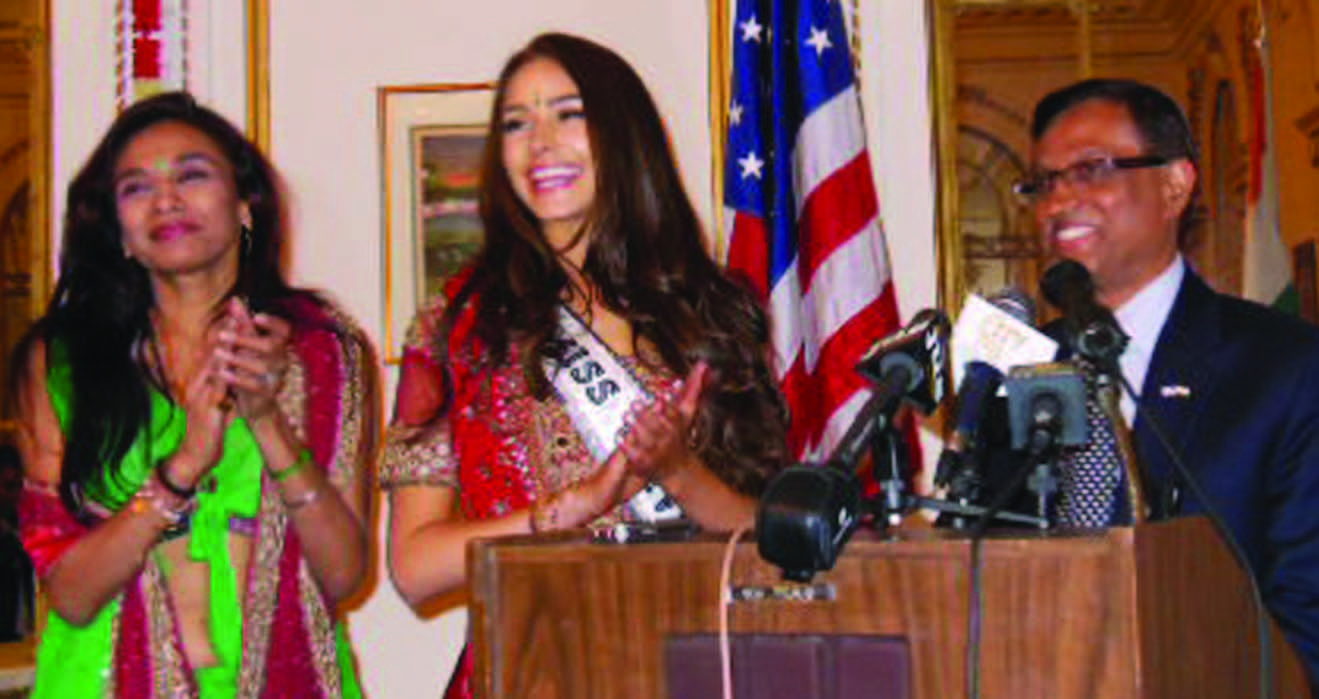
    NEW YORK, NY (TIP): Consul General of India, Ambassador Dnyaneshwar M. Mulay announced, August 21, the Sanjana Jon Tour to India with Olivia Culpo, the current Miss Universe from the 27th of September to the 6th of October. Mr. Mulay emphasized on the importance of cultural ambassadors and cultural tours to build closer ties between the two countries and globally The tour will be to the capital New Delhi, Mumbai, Agra and several key cities in India to promote and propagate “Celebrate the Girl Child”, Women Empowerment and AIDS Awareness. Actress Manisha Koirala joined and supported the initiative.

    The focus would be to eradicate female feticide especially in states like Punjab, Haryana, Rajasthan where the incidence is very high. The awareness tour initiated by Sanjana Jon in 2004 with the then Miss Universe Jennifer Hawkins has grown monumentally as an amazing positive movement and currently is the 6th Sanjana Jon Tour to India with Miss Universe for charity. The Tour has been supported by Salman Khan to highlight the different causes and several other celebrities like Sohail Khan, Sajid- Wajid Khan, Suhasini-ManiRatnam, Venkatesh, Padmabhushan Padmashri Dr KJ Yesudas, Padmashri Shobana, Usha Uthup, to name a few.

    “This time the tour will effectively reach out to the masses and try to bring more creative constructive support on the whole by creating “Community of Love n Light” a movement to ‘Share n Care’,” said Sanjana. Sanjana Jon started her career working with her brother Anand Jon in New York and they created a jewelry line together which was highly appreciated by Iman, David Bowie, Barbara Hershey while supporting AMFAR. Then they worked on the mens collection which was highlighted by Bruce Springsteen, Backstreet Boys, Prince, Collective Soul, Matchbox 20 to name a few. Her acclaimed debut was at Cannes for the Film Festival was supported by Prince Albert of Monaco, Princess Sorayya, Princess Sara Al Saud, Princess Olivia de Borbon and more. This led to the New York Fashion Week debut and Vancouver Fashion Week where she won International Rising Star award. Fashion with heart has been propagated by her where at every show or event she supports a charity or cause.

    Sanjana Jon has been a socially motivated person since her school and college days with her brother Anand Jon used to provide food and clothing to the underprivileged kids and read for the blind students. A special sanctuary was set for more than a 100 tigers in Florida and special campaign was organized with Anand Jon & Michelle Rodriegez to save tigers and animals globally. Paws for style where celebs walked with their pets was again highlighted and supported by Sanjana and Anand Jon to create love for animals. She has been creating awareness about various issues such as AIDS Awareness and HIV testing , Save the Girl Child ,Human and Animal Rights by involving celebrities like Bollywood stars, more than 10 Miss Universe over the years. She tied up with United Nations and held a press conference in the New York headquarters. In India, she worked with CARE International in hopes of a united front to combat the increasing pandemic of AIDS. Fashion to Sanjana is not the end but the means to the end which is to make the world a better place filled with love and light.

    The Sanjana Jon AIDS Awareness Tour toured most major Indian cities. She has also organized events to fight for Truth and Justice against racism with various models and celebrities and initiated several promotional campaigns in NY and LA against racism. She organized protests against racism in Bombay and Delhi and put together a show for Save the Girl Child against female infanticide with 16 celebrity siblings including Salman Khan, Sohail Khan, Sushmita Sen, Riya and Raima Sen, Sajid and Wajid Khan. Recently, she organized a Sanjana Jon Creative Tihar show and project in Tihar with inmates- for the inmates, by the inmates and of the inmates and tried to create a constructive creative training program to make the inmates a more resourceful progressive part of the community. Currently working on Pride of India Show by Sanjana Jon an attempt to break the Guinness Book of Work Records with more than 500 models in a show also promoting and highlighting traditional and cultural wear of every state in India and with celebrities representing the pride of every state and highlighting and propagating the Celebration of the Girl Child and in support of Global Human Rights. Winner of innumerable awards including Karamveer Puraskar, Paramveer Award, Indira Gandhi Award, Rajiv Gandhi Excellence awards to name a few, Sanjana has miles to go and not sleep.

  • India, the Land Columbus Set out to Find

    India, the Land Columbus Set out to Find

    What is it about India, that its tryst with destiny is still on-going? Why does India keep moving forward despite the doers and the naysayers, the empire builders and the colonized? The answer, I submit, lies in the glorious amalgam of history and hope, glory and defeat, education and renunciation, family and loneliness, accomplishment and worthlessness, ego and doubt, government and the governed, “East” and “West,” nuclear energy and organic linen; in short, India is a living contradiction – old and young, religious and secular, Eastern and Western, proud and humble, poor and rich, stranger and friend. On India’s Independence Day, one cannot but thank the British empire for all of its managerial excellence and vision, for it is they who did what no maharaja was able to do short of Ashoka the Great: create a Greater India, a unified India.


    img145

    That there was a Great Partition, with untold stories of misery and heroism, courage and slaughter, so that a few “Royals,” domestic and foreign, could uproot so much humanity for mapmakers’ joy rather than compel sovereign governments to give equal protection to the governed, remains an irksome lesson for would-be nation-makers. Arab Spring’s lessons are both forward-looking, as they are rear-view looking, and given the world being conquered, as a whole, by the unstoppable digital binary code, the great denominator, the world has indeed gone “flat,” and time “instantaneous”: lost are the curves of the globe and the hands of time on the alter of digital transparency – more controlled by multinational corporations than by analogue sovereign governments desperately seeking to harness the binary code to defend against “enemies, foreign and domestic.” What is to become of India, one may ask. Beware, I say to all who thought that China would counter-balance the Soviets.

    Like China’s core greatness lay sub-rosa unseen by the likes of Henry Kissinger, so, I fear is true of India, albeit, mercifully, only in part. In part, I say, because India’s investment in democracy’s warts is full-throttle and every citizen, poor and rich alike, sees themselves as the master of the public trust. Just ask The New York Times’ columnist Thomas Friedman as to why he is so in love with India, and why India, a Hindu-majority nation, effortlessly and confidently rests its position in the comity of nations in the gentle, strong and erudite hands of Salman Khurshid.


    img147

    It is as if Ashoka the Great, Akbar the Great, Guru Nanak, and Mother Teresa, not just Gandhi, Jinnah and Nehru, wrought this continuing tryst with destiny. For us in the United States, where each of the 50 states are a laboratory of policy for the nation to embrace or reject, India, I submit, given its diverse religious content and in the main peaceful co-existence, economic growth that defies the weight of regulations, may well be a laboratory to the world – for there, East and West, greed and charity, ambition and detachment live in substantial harmony. Since Secretary John Kerry is working overtime to seize the moment decreed by destiny, as he races to the Middle East to jumpstart the cob-webbed peace process between Israel and Palestine, no matter the profit of the status quoers, and harder yet, to re-order the Afgan-Subcontinent equation, each of the affected nations and citizenry, in the exercise of their enlightened selfinterest, owe a good faith response – for destiny awaits, in an infinite variety of shades and colors, the outstretched-hand’s state of loneliness or girth, given the many amalgamated hands reaching for the same sweet spot of history. Moreover, the dynamic of Israel’s meddlesome Thomas Dewey-like preference in last year’s presidential elections when Barack Obama won the “imperial term” in a resounding Harry Truman-like fashion, presents the Middle East a better shot than ever before.

    However, multi-lateral frustration infecting the Afgan- Subcontinent recalibrated process requires a critical mass of trilateral leadership, which ignores the interlopers’ inflammatory excesses, so as to bring the blessings of liberty and prosperity to their populace, unhappily aware of their common ancestry and uncommon present. For them I recall the example of the European Union’s birth, when jealous pride of many a nation, that claimed the world as its own, was overcome – surely those in the sub-continent can bequeath to their childrens’ children a gentle neighborhood where all are free to worship as they see fit and prosper per individual effort, as they have the benefit of cross-pride “across the border.” It may well be that the United Nations, created with the ink of World War II victory and a subsequent switcheroo a la ROC with PRC, needs the reforms that many have pushed for, including, Prime Minister Manmohan Singh, and his then-Permanent Representative Hardeep Singh Puri, after winning an unprecedented near-unanimous electoral victory to a rotational seat on the Security Council.

    It may well be that the “bubbling” South China Sea needs to bubble less, even as it starts the Kabuki dance of a future theater of avoid-able war and remilitarization. India’s attention, then, must be Eastward, Upward, and Westward. As an American, I can only hope that the land Columbus set out to find, India, and the nation he caused to be born, the United States, find in each other a common soul, aided by the rule of law and abetted by a democratic republic, such that Jefferson’s Declaration of Independence, “When in the Course of human events, it becomes necessary for one people to dissolve the political bands which have connected them with another, and to assume among the powers of the earth, the separate and equal station to which the Laws of Nature and of Nature’s God entitle them, a decent respect to the opinions of mankind requires that they should declare the causes which impel them to the separation. We hold these truths to be self-evident, that all men are created equal, that they are endowed by their Creator with certain unalienable Rights, that among these are Life, Liberty and the pursuit of Happiness.–

    That to secure these rights, Governments are instituted among Men, deriving their just powers from the consent of the governed, — That whenever any Form of Government becomes destructive of these ends, it is the Right of the People to alter or to abolish it, and to institute new Government, laying its foundation on such principles and organizing its powers in such form, as to them shall seem most likely to effect their Safety and Happiness. …” and Jawaharlal Nehru’s “Tryst with Destiny” speech loudly resonates to this day: “Long years ago we made a tryst with destiny, and now the time comes when we shall redeem our pledge, not wholly or in full measure, but very substantially. At the stroke of the midnight hour, when the world sleeps, India will awake to life and freedom. A moment comes, which comes but rarely in history, when we step out from the old to the new, when an age ends, and when the soul of a nation, long suppressed, finds utterance. It is fitting that at this solemn moment we take the pledge of dedication to the service of India and her people and to the still larger cause of humanity. At the dawn of history India started on her unending quest, and trackless centuries are filled with her striving and the grandeur of her success and her failures.

    Through good and ill fortune alike she has never lost sight of that quest or forgotten the ideals which gave her strength. We end today a period of ill fortune and India discovers herself again. The achievement we celebrate today is but a step, an opening of opportunity, to the greater triumphs and achievements that await us. Are we brave enough and wise enough to grasp this opportunity and accept the challenge of the future?” The world is better that Columbus lived, dreamed and strove. For we are here, dear Cristoforo Columbo, to prove you were never map-lost.

  • Yuva Hindi Sansthan’s Hindi summer program Concludes in Pennsylvania

    Yuva Hindi Sansthan’s Hindi summer program Concludes in Pennsylvania

    HATFIELD, PA (TIP): Yuva Hindi Sansthan, a New Jersey based educational organization concluded a two-week summer Hindi program in Hatfield, PA on August 16. The program designed under the strict guidelines of STARTALK, a United States funded Foreign Language initiative, targeted 60 elementary and Middle School students, most of whom, born and raised in USA, belonged to Indian American families. Dr. Devyani Khobragade, Deputy Consul- General of India in New York, who attended the camp as the chief guest on August 16, the concluding day of the program, distributed completion certificates to students. She extended her support to such efforts for promoting Hindi. Dr. Khobragade said that the Government of India was making all efforts to introduce Hindi as a working language of the United Nations. She assured that her office was willing to help Hindi programs.

    Upendra Chivukula, New Jersey Assemblyman was also present on the occasion. He congratulated Yuva Hindi Sansthan for its consistent effort to teach Hindi to youngsters. Chivukula said that US administration fully realized the importance of teaching American kids one more language other than English. “United States recognized Hindi as a critical language for American students and businesses which were an encouraging step for the Indian American community”, he said. “The participating 8 to 12 years old students were placed in five different classes where our team of STARTALK trained teachers engaged them in performances based activities on topics related with ‘A trip to India’. “We used a variety of real life activities to make sure children were comfortably conversing in Hindi in meaningful and unrehearsed fashion”, said Rashmi Sudhir, who served as the lead instructor at the camp.

    “It was an intensive program for which all instructors prepared for months planning their lessons”, said Rashmi. “A typical day at the camp started with a 30 minute Yoga session followed by classroom instructions for three hours before breaking for lunch. The students were immersed in a variety of activities in art, culture and technology classes during the post-lunch period of the day which continued until 4.30 pm.We screened interesting Hindi movies during the lunch hour while students enjoyed authentic Indian meal. Each and every minute of the camp was designed for learning Hindi and experiencing the product and practices of Indian culture”, said Rashmi. “The program was hosted by North Penn School District which provided classrooms, gym, cafeteria, computer labs and auditorium for facilitating the two week long activities during the program”, said Ashok Ojha, program director, YHS STARTALK Hindi 2013 program.

    “The school district fully cooperated with us for managing the camp style program while a number of parents volunteered their time to support the program.” The campers were taken on a field trip during the camp to Philly Museum of Art where they learned about various ancient mythological characters, statues and icons, instructed by well known art historian from University of Pennsylvania Dr. Pushkar Sohoni, who also took them around the UPenn library where they walked around the aisles displaying tens of thousands of books in Indian language.

  • MOVIE REVIEW – Chennai Express

    MOVIE REVIEW – Chennai Express

    Cast: Shah Rukh Khan, Deepika Padukone, Sathyaraj
    Direction: Rohit Shetty
    Genre: Action
    Duration: 2 hours 23 minutes

    STORY:
    A 40-year-old Punjabi man is on a mission to immerse his grandfather’s ashes down South. Enroute he meets a young Tamilian girl who has eloped. Their lives entwine and his journey takes an altogether different route. REVIEW: In an ode to his own cinema-read Golmaal series, Bol Bachchan, Rohit Shetty ishstyle, the director, who has grossers in Bollywood’s 100-crore club, ups the scale for his Eid offering. Chennai Express (CE) is a magnificently mounted film.

    Never having been strong in the story department, CE too has a guillible plot line. Rahul ( Shah Rukh Khan) is asked by his dadi (Kamini Kaushal) to drop his granddad’s ashes in Rameswaram, the southern-most tip of India. He boards the Chennai Express to hoodwink granny but has secretly planned a getaway with his guy friends to Goa. Alas, in Dilwale Dulhaniya Le Jayenge fashion, a damsel in distress, Meena ( Deepika Padukone) asks for his outstretched hand as he stands on the footboard.

    And his Samaritan act changes his destiny. He discovers she’s the daughter of a Don from a South-side village and her accompanying cousins (hulks in pony tails) want her to return home. Her father wants Meena to marry another hulk (Niketan Dheer) from a nearby village, so he can then rule two villages. Meena resists and insists to her father (Sathyaraj) that it is Rahul who has her fancy.

    The father relents but the other hulks resist. From here on, Rahul constantly tries to outsmart the South Indian mob. And as expected in Indian mainstream cinema, he breaks into song-and-dance, gets drunk, blows up jeeps and does a Jim Carryish over-thetop act to get guffaws from a captive audience. For what is primarily a Hindi film, there’s too much spoken Tamil.

    There are cleverly written lines that ask you not to underestimate the south because it even plays a crucial role in the coalition government, but for the rest of India, a lot of the dialogue is lost in translation. Subtitles would be in order. After Cocktail and Yeh Jaawani Hai Deeewani, Deepika is once again in superlative form. Shah Rukh’s attempts at comedy go from convincing to convoluted. But, for the most part, he lights up the screen with his effervescence.

  • Federation Of Indian Associations, Chicago Organizes INDIA’S 67TH INDEPENDENCE DAY Gala Banquet And Parade

    Federation Of Indian Associations, Chicago Organizes INDIA’S 67TH INDEPENDENCE DAY Gala Banquet And Parade

    SCHAUMBURG, IL (TIP): Federation of Indian Associations, Chicago, under the leadership of President Ms. Rita Singh, successfully hosted the 67th Independence Day Gala Banquet on August 9th at India House Banquet in Schaumburg and Independence Day Parade on August 11, 2013 at India House Plaza in Schaumburg.

    The colorful banquet dinner event was attended by Congresswoman Tammy Duckworth, Consul General of India Chicago Dr. Ausaf Sayeed, State Representatives Michelle Mussman, Marty Moylan, State Senator Michael Noland, Schaumburg Mayor Al Larson, Hanover Park Mayor Rodney Craig, Village of Oakbrook Mayor Mr. Gopal Lalmalani, Sohan Joshi NFIA President and Raja Krishnamurthy, among others.

    In fact, for Consul General of India Chicago Dr. Sayeed, it was the first public appearance in Chicago after he took charge of Chicago Consulate. All the dignitaries along with Banquet Chair Ms. Neelam Dwivedi addressed the audience on the occasion and wished everyone a very happy India’s 67th Independence Day. FIA President Rita Singh welcomed guests and participants on the occasion. She described how our forefathers had to fight against British Rule to get independence.

    But the Father of the Nation, Mahatma Gandhi taught us the path of non-violence to win our freedom. The occasion was celebrated with fanfare and enthusiasm. A cultural program was organized on the occasion. Bollywood actress Minisha Lamba was the Star attraction in the Independence Day Banquet and Parade. The banquet dinner evening was successfully conducted by two very articulate and entertaining emcees Ms. Sadhna Kumar and Tarun Mullick M.D.

    One of the key highlights of this evening was a Runway Fashion Show 2013 sponsored by Charisma Boutique, which was choreographed by Mika Chadha and coordinated by Sylvia Bhugra. Ms. Minissha Lamba, the popular Bollywood actress and chief guest at the banquet, in her address thanked FIA and specially FIA President Ms. Rita Singh for inviting her to the event. She was very pleased to see Indian Americans celebrating India’s Independence Day with such enthusiasm.

  • IAAC Celebrates 15 Years of Introducing NYC to Indian Performing, Visual, Folk and Literary Arts

    IAAC Celebrates 15 Years of Introducing NYC to Indian Performing, Visual, Folk and Literary Arts

    NEW YORK, NY (TIP): The Indo-American Arts Council (IAAC) turns 15 in the fall of 2013. This secular, non-profit, volunteer-driven arts organization has achieved scores of noteworthy milestones in the decade and a half of its existence. IAAC is the first and only Indian Arts Council in the United States representing all of the artistic disciplines, including theatre, dance,music, film, folk arts and literature.

    The IAAC pioneered the first annual Indian theatre, film, dance and playwright festivals in the country, as well as an annual travelling exhibition of contemporary Indian art. The IAAC’s programs attract packed audiences and amazing media coverage – ethnic,mainstream and international outlets such as The New York Times, The Wall Street Journal, BBC, Variety, New York Daily News, NY1, CNN IBN, and Huffington Post, just to name a few.

    “We are thrilled to contribute to the rich diversity of the New York cultural landscape,” said Aroon Shivdasani, IAAC Executive Director. “By showcasing and building an awareness of the artists and artistic disciplines from India’s sub continental heritage, we educate and entertain mainstream America about our culture, our traditions and our rich history, while simultaneously encouraging tolerance and greater understanding between cultures.” To commemorate its 15th anniversary, the IAAC will host a celebratory gala on Thursday, November 21, 2013 at the Angel Orensanz Foundation for Contemporary Art (172 Norfolk Street, NYC).

    Comedian and actor Aasif Mandvi (The Daily Show with Jon Stewart) will entertain guests as the Master of Ceremonies. Fresh off his debut at Lakme Fashion Week in India, designer Naeem Khan will showcase his latest collection in a specially-conceived fashion show. Mr. Khan and Dr. Manjula Bansal will also be honoured by the IAAC for their contribution to the arts. Musical entertainment will be provided by singer/songwriter/composer Paul Williams and pianist/composer Kenneth Lee “Kenny” Ascher, co-writers of the Oscar-nominated song “Rainbow Connection” from The Muppet Movie.

    Tables at the gala range in value from $5,000 to $25,000, and individual tickets are available for $500.For more information and to purchase your advance tickets, please visit www.iaac.us. Select media will be invited to cover the event. Interview requests and photo opportunities will be made available prior to and during the event. About The Indo-American Arts Council: The Indo-American Arts Council is a registered 501(c)3 not-for-profit, secular service and resource arts organization charged with the mission of promoting and building the awareness, creation, production, exhibition, publication and performance of Indian and cross-cultural art forms in North America.

    It is passionate about showcasing, celebrating and building an awareness of artists and artistic disciplines of Indian origin in the performing, literary, visual and folk arts. For further information please visitwww.iaac.us. Media Contact: JINGO Media/ Jitin Hingorani/ 512.773.6679/ Jitin@Jingomedia.com

  • ‘Progress Now, Environment Later’ Won’t Do

    ‘Progress Now, Environment Later’ Won’t Do

    With its disproportionate economic gains, the US model is not for India. Industrialization at the cost of environment is not sustainable. Inclusive social growth will be elusive if natural resources are viewed from the prism of short-term gain, opines the author.
    What must be done
    ● Enforce environmental laws to control pollution.
    ● Facilitate freedom of expression and assembly of people drawing attention to issues of environmental degradation.
    ● Empower local bodies to take decisions on environmental issues.
    ● Put in place biodiversity management committees (BMCs) in all local bodies, fully empowered under the Biological Diversity Act, to regulate the use of local biodiversity resources; to charge collection fee and receive appropriate incentives.
    ● Register crop cultivars as called for by the Protection of Plant Varieties and Farmers’ Rights Act, and give grants to panchayats to build capacity for conservation of crop genetic resources.
    ● Implement the Forest Rights Act; encourage empowered communities to adopt practices of sustainable resource use and to set apart areas dedicated to biodiversity conservation.
    ● Enhance the scope of regional development plans to include key environmental concerns and make mandatory the involvement of BMCs.
    ● Promote access to environmental information by making available the currently suppressed Zoning Atlases for Siting of Industries (ZASI), and opening up forest and wildlife areas to scientific data collection.
    ● Organize a biodiversity information system in line with proposals before the National Biodiversity Authority since 2004.
    ● Organize a transparent, participatory database on environment by drawing on student environmental education projects as recommended by the Curriculum Framework Review, 2005, of the NCERT.
    ● Carry out a radical reform of environmental clearance process by assigning the preparation of environmental impact assessment (EIA) statements to a body that does not depend on payment by project proponents; involving BMCs; and taking on board all information submitted and suggestions made during public hearings.

    Today’s environment-development debate is cast in inappropriate terms of just two choices. This is a false contradiction; the real issue is not whether India can afford the socalled luxury of worrying about environment, but whether it can afford to slide into a lawless, tyrannical society that abuses the liberating spirit of science. Economics, properly interpreted, tells us that any country should aim at ensuring a harmonious development of the sum total of a nation’s capital stocks of natural, manmade, human and social capitals.

    This calls for focusing on creating a law-abiding, genuinely democratic society that imbibes the scientific spirit. A well-informed citizenry able to exercise its democratic rights will automatically ensure that environment is cared for, as has happened in the highly industrialized Germany and Scandinavian countries. What we must do is concentrate on implementing what by all rights should be implemented: the many well-designed provisions of various Acts and schemes for protecting the environment, and for devolution of democratic powers, provisions that are being systematically sabotaged.

    False gods
    We live in a world in flux, a world that has been changing rapidly. Prior to the industrial revolution, the Indian society had possibly developed a relatively prosperous agrarian civilization with extensive handicraft-based industrial production and a rather stable social regime, albeit grounded in a highly inequitable caste society. But with the emergence of modern science and sciencebased technologies, Europeans came to dominate the world.

    The British systematically dismantled traditional Indian systems of resource management and destroyed the handicraft-based industrial production, draining away India’s resources and impoverishing it. Naturally Indians came to regard assimilation of European science and technology as critical to India’s progress. Mahatma Gandhi disagreed and advocated rejection of European science and technology, and revival of fully self-sufficient Indian villages as the basis of progress.

    While he successfully led the struggle for Independence, his many actions, such as his support of the Tatas in the context of peasant agitation against unjust takeover of their lands for setting up a hydel project, were quite inconsistent with this philosophy. So after Independence, his model was set aside, and India launched itself on a pursuit of industrialization on the western model. Meanwhile, the Marxist philosophy had emerged as a significant rival to the capitalist model.India adopted a curious mixture of the two, accepting Soviet ‘statism’ without the accompanying pursuit of economic equality through measures like land reform.

    Not ideal
    India soon came under a very strong influence of the US, and began to dream the American Dream with a large number of influential middle class families having many of their members settled in that country, and others educated in American universities. This has had serious negative implications that are perhaps best illustrated by Larry Summers’ notorious toxic memorandum.

    Summers is an influential economist, onetime Secretary for Treasury in the Clinton Administration and president of Harvard University. Perhaps ruminating on India’s weak-kneed response to the Bhopal gas disaster, Summers, then Chief Economist at the World Bank, wrote in 1991 a memorandum stating: “The measurement of the costs of health impairing pollution depends on the foregone earnings from increased morbidity and mortality. A given amount of health impairing pollution should be done in the country with the lowest cost, which will be the country with the lowest wages.

    I think the economic logic behind dumping a load of toxic waste in the lowest wage country is impeccable and we should face up to that.” India was the foremost among the low-wage countries he had in mind, and today, India is a favored destination of many of the world’s worst polluting enterprises that are no longer allowed to function in their own country. By 1990, the Marxist models were losing their sheen.

    The prescription of social ownership of production has not proven to be successful; the resulting dictatorships have concentrated power in the hands of a few and abused it roundly. These abuses have not only included abuses of rights, but those of environment as well, as happened in East Germany. Indians have come to view the US as the only model, even after the current economic difficulties. However, what drives the US economy today is “rent seeking”, such that economic gains of many agents are often excessive.

    Because of these disproportionately large economic gains, a small proportion of the US society has cornered the bulk of the wealth and political power. Its democracy has been perverted from a one person-one vote to a $1- one vote system, in which the powerful are engaged in distorting the economy to enhance unjustifiable gains. Joseph Stiglitz, the Nobel Prize winning economist who has pursued issues of inequality, says the resultant consequences include exhaustive use of natural resources, unacceptable pollution loads, failure to build human capital because of declining investments in education, science and technology, poor healthcare and high levels of unemployment, and erosion of social capital with increasing levels of social strife.

    Yet influential and learned Indians continue to argue that the US model should be our ideal, and we should ignore the endemic problems of social injustice, environmental degradation and large-scale corruption. The argument goes: The US once had high levels of pollution and got over those problems, what does it matter if we have high levels of pollution now? The wheels of history will turn, and we too will come to live in the paradise that the more fortunate US citizens inhabit today. There are several problems with this contention.

    We do not have the freedom and luxury of exploiting the resources of much of the rest of the world that the US has had for centuries and continues to enjoy today. Its bankers have robbed people in many ways and swallowed public funds to keep banks from sinking. A large proportion of US citizens are today wondering if they are indeed living in a paradise, and have been coming out on streets against the government of 1 per cent, by 1 per cent and for 1 per cent.

    Alternative models
    But there is another western model that accepts industrialization and is far more democratically oriented and caring of environment than the US.Germany has a strong environmental movement, with the Green Party constituting a significant political force. It is a state with major commitments to environmental protection, and its entrepreneurs are notable for restrained behavior and willingness to accept relatively low levels of returns, in stark contrast to the US bankers. Germany is also economically better than the US. Democracy, with all its shortcomings, is the best political system, as is capitalism the best economic system.

    But the market forces must be socially moderated to ensure environmental costs are borne by entrepreneurs, that common property is protected and concentration of wealth not allowed to pervert the democratic principle. This calls for citizen participation.

    Nurturing social capital
    Democratic values are at the heart of our Constitution, and we have progressively enacted a series of well-thought out laws for empowering people.We have also passed a series of well-thought out laws for protecting the environment. We have embraced the spirit of science, and continue to invest substantial resources in nurturing science and technology. The real issue is not inadequate laws, but deficit in governance.

    The laws protecting the environment are not implemented. The constitutional provisions for empowering the people are kept in suspension. Scientific activity that would contribute to protecting the environment and could engage the barefoot ecologists as partners in the scientific enterprise is discouraged, even suppressed.

    Since the political establishment and the bureaucracy malfunction, people see no recourse other than protests and court cases. This is an erosion of our social capital and goes against our social nature, for societies have evolved treasuring fair exchanges. Yet,we have done well to keep our democracy alive, and strengthen it through measures like the Right to Information Act. The currently prevalent rule has deteriorated into a government of contractors, by contractors and for contractors.

    We must focus on building our democracy bottom-up from the grass-roots level, an Endeavour in tune with the spirit of the Constitution. Hence, the ongoing protests and court cases must be complemented by organizing people down to the grass-roots level to exercise their democratic rights. This is the only way in which we can fashion a lawabiding, genuinely democratic society that imbibes the scientific spirit.