


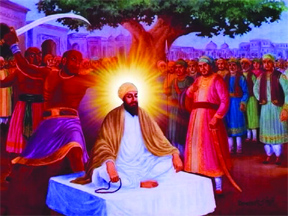
On 24 November 1675, in the bustling heart of Mughal Delhi, a moment unfolded that would permanently alter the moral and civilizational direction of India. Guru Tegh Bahadur, the Ninth Guru of the Sikh tradition, was publicly executed on the orders of Emperor Aurangzeb. To the Mughal court, it was punishment for “defying imperial authority” and “protecting the idolatrous Hindus.” To history, however, it was something far greater: a martyrdom for freedom of conscience, centuries before such concepts were formally articulated by modern democracies and international human-rights charters.
As India commemorates the 350th Martyrdom Anniversary of Guru Tegh Bahadur, it becomes essential to revisit not only the event but also the complex religious, political, and social forces that converged to make his sacrifice inevitable-and transformative.
Guru Tegh Bahadur did not die for Sikhs alone.
– He did not die for political power.
– He did not die for territorial gain.
– He died for a principle that forms the bedrock of civilisational India: the right of individuals and communities to live and worship without fear.
HISTORICAL BACKGROUND – THE ERA OF THE NINTH GURU
To understand why Guru Tegh Bahadur’s martyrdom holds such monumental significance, one must look closely at the world into which he stepped as Guru.
A Youth Tempered by Discipline and Reflection
Born in 1621 in Amritsar as Tyag Mal, the young Guru was trained in warfare by Guru Hargobind but drawn deeply toward contemplation. His childhood blended: the discipline of martial training, the silence of meditation, the values of humility and compassion, and the spiritual richness of the Guru household.
He earned the name Tegh Bahadur (Brave of the Sword) for his valour in the Battle of Kartarpur, yet the sword he ultimately wielded was the sword of spiritual courage, not violence.
By the time he became Guru in 1664, India was undergoing seismic changes:
Guru Tegh Bahadur’s predecessors had laid a strong ethical, spiritual, and community foundation. Sikh institutions-gurdwaras, sangats, humanitarian networks-were thriving across Punjab and beyond.
After Shah Jahan’s fall, Aurangzeb seized power through war and imprisonment. His ascension marked a shift from the culturally syncretic ethos of earlier Mughal rulers.
Sufi mystics, Bhakti poets, Hindu sanyasis, Jain monks, Sikh Gurus, and intellectuals across India challenged the rigidity of orthodoxy. Aurangzeb saw such movements as threats to imperial control.
Through extensive travels-from Bengal and Assam to Uttar Pradesh, Punjab, and Delhi-Guru Tegh Bahadur preached: equality, fearlessness, honest living, spiritual detachment, compassion respect for all faiths.
The popularity of his teachings across Hindu, Sikh, Muslim, and local tribal communities drew both admiration and suspicion from the Mughal state.
In simple terms:
Guru Tegh Bahadur had become the moral voice of a pluralistic India – exactly what Aurangzeb’s increasingly rigid empire sought to suppress.
THE CRISIS IN KASHMIR – A CIVILIZATIONAL APPEAL FOR HELP
To understand the magnitude of Guru Tegh Bahadur’s decision, one must grasp the intensity of the crisis unfolding in Kashmir during the mid-17th century. For centuries, Kashmir was celebrated as a cradle of Indian intellect-home to: towering Sanskrit scholars, centres of Shaivite and Vaishnavite philosophy, renowned Pandit families with unbroken lineages, poets, mystics, grammarians, mathematicians, a syncretic culture influenced by Shaivism, Buddhism, Sufism, and Bhakti, By 1670, this world stood on the brink of collapse.
Under Emperor Aurangzeb, Iftikhar Khan was appointed governor of Kashmir. His radical interpretation of the emperor’s religious agenda included: forced conversions at mass scale, orders to demolish temples, public humiliation of Pandits, bans on religious gatherings, heavy taxation on non-Muslims, pressure on families to surrender their cultural traditions.
The centuries-old Kashmiri Pandit community found itself facing an existential threat. Their physical safety, spiritual identity, and cultural continuity were all in jeopardy.
The Delegation of Pandits: A Historic Journey
Unable to resist militarily, the Pandits sought refuge not in armies but in spiritual and moral leadership. Led by Pandit Kirpa Ram Dutt, a group of nearly 500 Pandits travelled from the cold valleys of Kashmir to the plains of Anandpur Sahib.
Their journey was both an act of desperation and a testament to the Guru’s stature as a universal spiritual guardian.
The Appeal Before Guru Tegh Bahadur
Historical accounts describe the Pandits: with shaved heads forced by Mughal edicts, torn clothes symbolising humiliation, sacred threads removed by coercion, and eyes filled with fear yet carrying a last ember of hope.
When they narrated their suffering, Guru Tegh Bahadur listened in silence-absorbing the weight of their pain.
After a period of contemplation, the Guru uttered the words that echoed through history: “Go tell your Emperor:
If he can convert your Guru, you shall all willingly accept his command.”
This moment became the turning point of India’s civilizational story.
Why This Offer Was Extraordinary
It meant:
– The Guru placed his own life between tyranny and the oppressed.
– He accepted suffering not for Sikh rights, but for the religious freedom of another community.
– He transformed the struggle into a moral battle that no empire could justify.
The Kashmiri Pandits returned to Aurangzeb with the Guru’s message – and the Mughal emperor immediately recognised the implications.
Aurangzeb knew he was no longer confronting a group of defenceless Pandits; he was confronting the moral authority of a Guru whose influence transcended geography and faith.
This was the spark that set the next chapter in motion.
AURANGZEB’S INDIA – POLITICS OF ORTHODOXY, EMPIRE & CONTROL
Guru Tegh Bahadur’s martyrdom cannot be understood without analyzing the political atmosphere created by Aurangzeb-a ruler whose policies shaped the subcontinent’s destiny.
Before Aurangzeb:
– Akbar promoted Sulh-i-Kul (peace for all) and interfaith dialogues.
– Jahangir enjoyed the arts, supported Sufis, and maintained political pragmatism.
– Shah Jahan encouraged temple patronage and regional cultural expression.
– Aurangzeb reversed this trajectory.
– The empire moved from acceptance to uniformity, from engagement to imposition.
Policies That Redefined the Era
– Reimposition of Jizya
The tax on non-Muslims had been abolished by Akbar, but Aurangzeb reinstated it as a symbol of religious hierarchy.
– Temple Destruction and Conversion
Several major temples-including Kashi Vishwanath and Mathura’s Kesava Deo-were demolished or converted into mosques. Many others suffered desecration.
– State-Driven Conversions
Governors and qazis were encouraged to increase conversion numbers, leading to widespread coercion.
– Persecution of Intellectual Dissidents
Aurangzeb’s intolerance extended even to: Sufi mystics, unorthodox Muslim scholars, poets, critics of imperial policy, regional saints promoting pluralism, Many were imprisoned or executed.
– A Suspicious Eye Toward Popular Spiritual Leaders
– Figures like Guru Tegh Bahadur posed a different kind of threat:
– They did not seek political power, but they commanded moral authority – and that frightened an absolutist ruler more than any army.
Why Aurangzeb Saw the Guru as a Threat
Guru Tegh Bahadur advocated religious freedom, attracted diverse followers, challenged orthodoxy through philosophy, not war, travelled across Mughal territories spreading a message of liberation, commanded deep respect from ordinary people as well as intellectuals, was becoming a moral rallying point for the oppressed, To Aurangzeb, this was unacceptable.
A Guru who taught fearlessness (nirbhau) and non-discrimination (nirvair) was more dangerous to tyranny than any military commander.
In the emperor’s eyes, by siding with the Kashmiri Pandits, Guru Tegh Bahadur had openly challenged the ideological core of imperial power.
Thus, the Mughal court decided not simply to punish him – but to make an example of him. The stage was set for confrontation.
THE GURU’S DECISION – A SPIRITUAL STAND WITH CIVILIZATIONAL IMPACT
Guru Tegh Bahadur’s acceptance of the Kashmiris’ plea was not a spontaneous emotional response. It was a conclusion born from deep spiritual insight and historical responsibility.
After the Kashmiri Pandits narrated their suffering, the Guru withdrew into meditation. His quiet reflection was not a retreat from responsibility, but a profound evaluation of the stakes:
– An entire intellectual civilisation was endangered.
– A community vital to India’s philosophical and cultural memory faced erasure.
– Aurangzeb’s policies were quickly spreading to other regions-Punjab, Banaras, Bengal, and even Deccan.
– Silence from spiritual leaders could permanently distort India’s future.
He emerged from contemplation with clarity: To protect the freedom of another faith is the highest expression of one’s own.
The Role of the Young Gobind Rai
A pivotal moment occurred when Guru Tegh Bahadur asked his young son, Gobind Rai (the future Guru Gobind Singh):
“Who in this world could sacrifice their life to protect the right of people to practice their faith?”
Gobind Rai, merely a child but spiritually mature beyond his years, answered:
“None other than you, revered father.”
This statement did not influence the Guru’s decision-it affirmed it. The lineage of the Gurus was built on responsibility, sacrifice, and unwavering commitment to the oppressed.
A Sacrifice Rooted in Spiritual Philosophy
Guru Tegh Bahadur’s bani emphasised: renunciation of ego, detachment from worldly fears, confronting injustice, equality beyond religious identity, spiritual sovereignty.
These themes were not poetic expressions; they became the philosophical framework for his act.
He stood for:
– Hindus facing persecution,
– but equally for the idea that no empire may dictate human conscience.
– and for humanity’s inherent right to choose its spiritual path.
– His sacrifice was a spiritual declaration, not a political rebellion.
A Deliberate Acceptance of Martyrdom
Guru Tegh Bahadur did not prepare for war. He did not mobilize armies. He did not seek alliances.
Instead, he prepared himself and his companions for voluntary arrest.
This was a moral confrontation, not a military one.
A message to the empire:
– You may command swords, but not souls.
– The Political Shockwave of His Decision
When Aurangzeb received news that the Guru himself had stepped forward, the emperor was stunned. The Guru’s act undermined everything the Mughal state attempted to achieve:
– He raised the ethical stakes to a level where coercion looked barbaric.
– He transformed a local crisis into a pan-Indian moral reckoning.
– He made himself a symbol for every persecuted community.
– He exposed the empire’s fragility – for tyranny fears spiritual authority more than rebellion.
In this light, Guru Tegh Bahadur’s decision was nothing short of civilizational defiance – a stand that would reverberate for centuries.
THE ARREST – FROM ANANDPUR TO DELHI
Once Guru Tegh Bahadur decided to confront Aurangzeb directly, the path of martyrdom became inevitable.
In July 1675, Guru Tegh Bahadur, accompanied by three devoted Sikhs –
Bhai Mati Das, Bhai Dayala, and Bhai Sati Das – began his journey from Anandpur toward Delhi.
He was not fleeing; he was presenting himself.
This journey was symbolic:
– It represented the moral walk into the heart of tyranny.
– It echoed the ancient Indian tradition of sages facing emperors to defend dharma.
– It marked the beginning of the Guru’s personal sacrifice.
Along the way, countless villagers gathered for his blessings, unaware they were witnessing a moment that would reshape India’s moral foundations.
Arrest at Malikpur Ranghar
The Mughal forces, acting on Aurangzeb’s direct orders, intercepted the Guru near Malikpur Ranghar, close to Agra.
Accounts suggest the manner of arrest was intentionally humiliating:
– Soldiers surrounded the Guru.
– He and his companions were chained.
– They were paraded publicly to instill fear among the people.
– But the Guru walked with a calmness that unsettled even his captors.
– His serenity was his rebellion.
Imprisonment in Agra
Before being transferred to Delhi, Guru Tegh Bahadur was held briefly in Agra. This served two purposes:
– To assess his intentions – the Mughal court could not believe he had voluntarily come forward.
– To intimidate him – the empire hoped that confinement would break his resolve.
– But the Guru remained unmoved.
It is in Agra that the first reports reached Aurangzeb: the Guru is ready to die, but not convert.
This enraged the emperor, for it challenged his authority at its core.
The Long March to Delhi: A Parade of Intimidation
The transfer from Agra to Delhi was deliberately slow. Mughal officials hoped to use the journey as a psychological tactic:
– The Guru and his Sikhs were shackled and marched through towns.
– Crowds gathered, some horrified, some helpless, some silently praying.
– The Mughals intended to project their strength; instead, the Guru’s dignified composure inspired awe and devotion.
Many later chroniclers write that: The Guru walked like a king and the empire trembled like a prisoner.
Arrival at Delhi: A City Divided
Guru Tegh Bahadur’s arrival in Delhi created an emotional and political storm.
– Common people whispered that a holy man had been arrested unjustly.
– Hindu traders, Sufi faqirs, and ordinary Muslims feared the consequences of the empire’s actions.
– Even some nobles in the Mughal court were uneasy – many admired the Guru.
– Aurangzeb saw the Guru as a threat not because of arms, but because of the moral unity he created.
– The Guru was imprisoned in Kotwali Jail, a place where political prisoners and dissenters were kept.
Attempts to Break His Spirit
Over the next days, the Mughal officials attempted:
– persuasion
– philosophical debate
– pressure
– threats
– false promises
– humiliation
They failed at each attempt.
Guru Tegh Bahadur had embraced his destiny – martyrdom had already been accepted before the empire laid a hand on him.
The Tortures, the Trials, and the Unshaken Resolve
Guru Tegh Bahadur’s final journey stands as one of the most defining chapters in India’s civilisational memory-a moment when a single luminous soul confronted the might of an empire and, through an act of serene defiance, altered the trajectory of Indian history. The tortures, trials, and unbroken resolve of the Ninth Sikh Guru form a narrative that transcends religion and era. They speak to the eternal struggle between spiritual sovereignty and political absolutism, between the freedom of conscience and coercive power. When the Kashmiri Pandits approached the Guru at Anandpur Sahib, narrating the torment they faced under Governor Iftikhar Khan’s implementation of Aurangzeb’s policies, their plight became a defining moral moment. Guru Tegh Bahadur’s decision was immediate, courageous, and unparalleled; he declared that if the Emperor could convert him, all the Pandits would follow. It was a challenge that exposed the spiritual emptiness of tyranny and illuminated the Guru’s determination to stand as a shield for Dharma, not just for his community but for an entire civilization.
Delhi’s Fear of a Fearless Saint
The Mughal court viewed him as a threat-not because he commanded armies or ruled kingdoms, but because he possessed moral authority that could not be coerced, bribed, or intimidated. His arrest near Agra was therefore not a political necessity but a calculated attempt to silence a spiritual conscience that resonated across India. He was chained alongside his closest companions-Bhai Mati Das, Bhai Sati Das, and Bhai Dayala-and paraded toward Delhi as if he were a criminal. But the crowds who saw him pass by witnessed not a prisoner, but a radiant ascetic whose calm eyes reflected an inner sovereignty stronger than imperial power.
The Court of Coercion: Convert or Perish
In Delhi, he was offered the same choice repeatedly: convert to Islam or face death. The interrogators failed to grasp that a man who lived in union with the Divine could not be intimidated by mortality. Guru Tegh Bahadur responded with grace and clarity. He had embraced Dharma not as ritual but as righteous duty. To protect the weak was an act of truth, and to renounce this calling would be to betray the very essence of his existence. Aurangzeb, frustrated by the Guru’s serenity, orchestrated a series of tortures meant to break his spirit by breaking the bodies of those he loved.
Martyrs Who Stood Beside the Guru
Bhai Mati Das was tied between two pillars and sawn alive. Historical accounts describe that as the blade cut through his skull, he continued reciting sacred verses, his voice unshaken. Bhai Dayala was boiled alive in a cauldron of water and yet maintained constant meditation until his last breath. Bhai Sati Das was wrapped in cotton, drenched in oil, and set aflame, turning into a pillar of fire while chanting the Divine Name. These martyrdoms were intended to crush the Guru’s resistance, but instead they carved their place into the soul of the Sikh tradition. The Guru watched each execution in full awareness, his composure unbroken, his spirit only rising higher with each act of brutality. When the imperial judges again demanded conversion, the Guru sat unmoved, lost in meditation. No earthly authority could dictate his conscience.
The Martyrdom: 24 November 1675 – A Day That Altered India
Finally, on 24 November 1675, in Chandni Chowk, the sentence was carried out. A massive crowd gathered, their silence conveying grief, awe, and bewilderment. Guru Tegh Bahadur’s final moments were imbued with profound peace. He sat in stillness, as though offering his head in complete surrender to the Divine. The executioner hesitated before raising the sword. When the blow fell, it ended a life but ignited a legacy that would shape the destiny of India. He became not only the defender of Kashmiri Brahmins but the first martyr for religious freedom in recorded Indian history-a man who gave his life for the right of others to practise their faith.
The Storm, the Secrecy and the Sacred Rescue
A sudden storm swept Delhi after the execution, plunging the area into chaos. In the confusion, Bhai Jaita (Rangretta) carried the Guru’s severed head from Delhi to Anandpur Sahib, undertaking a journey that was both perilous and sacred. Meanwhile, Bhai Lakhi Shah Vanjara smuggled the Guru’s body away and cremated it by burning down his own house. These acts of supreme devotion ensured that the Guru’s remains would be honoured, and the sites of these events would later become Gurdwara Sis Ganj Sahib and Gurdwara Rakab Ganj Sahib-monuments not to death, but to the immortality of truth.
Impact on Sikh History, Indian Civilization & the Freedom Movement
The Seed of the Khalsa Consciousness
The martyrdom of Guru Tegh Bahadur fundamentally reshaped Sikh consciousness. His son, Guru Gobind Singh, drew from this moment of sacrifice the inspiration to forge the Khalsa-a community of saint-soldiers dedicated to protecting righteousness and resisting tyranny in all its forms. The Guru’s death transformed meditation into moral force, devotion into defiance, and spirituality into a living, protective power. It was this legacy that culminated in the doctrine of the Khalsa: fearlessness, moral clarity, and readiness to defend the oppressed.
A Civilisational Turning Point
Beyond Sikh history, the Guru’s sacrifice stands as a luminous milestone in India’s civilisational journey. He gave his life not for his own followers, nor for political gain, but for the protection of another faith entirely. This made him an unprecedented figure-a martyr for universal human rights centuries before such terms existed in political discourse. Had he not stood firm when he did, India’s cultural and religious landscape might have been drastically altered. His sacrifice restored the psychological confidence of a society under siege and renewed its belief that Dharma could still be defended through courage rooted in inner freedom.
Inspiration for India’s Freedom Struggle
This legacy extended into India’s modern freedom movement. Leaders such as Mahatma Gandhi, Subhas Chandra Bose, Rabindranath Tagore, and Bhai Vir Singh all invoked the Guru as a beacon of spiritual courage. Revolutionaries and reformers alike saw in him a symbol of resistance to authoritarianism. His words-“Nishchay kar apni jeet karo,” a call to resolute self-victory-became a mantra for generations seeking liberation, not only from colonial rule but from fear, injustice, and inner bondage.
The Eternal Lamp of Conscience
Guru Tegh Bahadur’s martyrdom was not merely a moment of tragic beauty. It was a civilisational turning point. It reaffirmed India’s commitment to pluralism and the sanctity of conscience. It taught that spiritual conviction can be stronger than empires, and that defending the faith of another can be the highest dharma. In a world still struggling with intolerance, forced identities, and religious conflict, the memory of the Ninth Guru stands tall-reminding humanity that true courage lies not in domination but in protection, not in coercion but in compassion.
The Sword That Awakened a Nation
On 24 November 1675, a sword tried to silence a sage. Instead, it awakened a nation. Guru Tegh Bahadur did not merely give his head; he gifted India its moral spine. His martyrdom continues to illuminate India’s civilisational path, a reminder that when conscience stands firm, tyranny trembles.