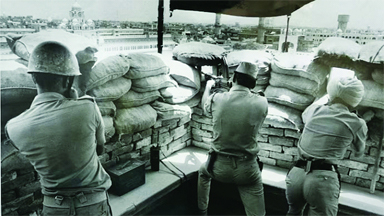
Operation Bluestar, executed in June 1984, was one of the most traumatic episodes in independent India‘s history. Conceived by the Indian government to flush out Sikh militants from the Golden Temple complex in Amritsar, Punjab, it became a military operation of immense scale — unprecedented in its political, religious, and human costs. It left a deep scar on the Sikh psyche, led to significant loss of life and heritage, and forever altered the course of Indian politics and Sikh-Centre relations.
Operation Bluestar, conducted between June 1 and June 10, 1984, was a military operation ordered by then-Prime Minister Indira Gandhi to remove Sikh militants, including the heavily armed followers of Jarnail Singh Bhindranwale, from the Harmandir Sahib (Golden Temple) complex in Amritsar, Punjab. The assault, carried out by the Indian Army, not only resulted in significant casualties and damage but also triggered a tragic chain of events including the assassination of Indira Gandhi and the genocidal violence against Sikhs in November 1984.
The Build-Up to the Operation
By the early 1980s, Punjab was in the grip of rising militancy, with radical Sikh groups demanding Khalistan-a separate Sikh homeland. The central figure of this movement was Sant Jarnail Singh Bhindranwale, a fiery preacher who positioned himself as a defender of Sikh rights and identity. He had taken up residence in the Akal Takht, one of the holiest Sikh sites within the Golden Temple complex, along with hundreds of armed followers.
Tensions escalated as violence spread across Punjab. Political deadlock between the Indian government and the Akali Dal deepened, and bombings, assassinations, and communal killings increased. By early 1984, the Golden Temple complex had become a fortress, and the government considered the situation untenable.
Operation Bluestar Begins
On June 1, 1984, the Indian Army began preliminary operations by surrounding the temple complex. Officially, the army claimed it was responding to provocation from inside the temple. On June 3, a full curfew was imposed in Punjab, communication lines were cut, and news media was barred-effectively sealing the region.
The main assault began on the night of June 5 and continued until June 6, involving elite army units including the Para Commandos and Sikh Regiment soldiers. Tanks and artillery were brought into the sacred complex, and the Akal Takht was fired upon with heavy ordnance.
Destruction of the Akal Takht
One of the most painful outcomes for the Sikh community was the near-total destruction of the Akal Takht, the highest seat of earthly authority for Sikhs, which had been converted by militants into a fortified bunker. The Indian Army used tank fire and shelling to neutralize resistance, reducing the historic building to rubble. Ancient manuscripts, relics, and scriptures were lost or destroyed.
Damage to the Golden Temple Complex
– Bullet marks pockmarked the marble walls of the Harmandir Sahib.
– Sacred pools turned red with blood.
– Libraries and the Sikh Reference Library were set ablaze; priceless historical texts were lost forever.
– More than 100 gurdwaras across Punjab were raided as part of related operations (Operations Woodrose and Trident).
Death Toll and Casualties
There is no consensus on the number of people killed during Operation Bluestar.
– Official government figures put the number of deaths at about 492 militants and civilians and 83 soldiers, with 249 injured.
– Independent sources and Sikh groups estimate 3,000-7,000 deaths, many of them civilians and innocent pilgrims caught in the crossfire during a sacred time (Guru Arjan Dev’s martyrdom anniversary), when the complex was crowded.
– Women, children, and elderly pilgrims were among those killed.
– Eyewitnesses and survivors spoke of wounded being denied medical help, and unarmed men being shot or dragged away.
The operation caused deep psychological trauma to survivors and thousands of families, many of whom never recovered the remains of their loved ones.
Aftermath & Wider Repercussions
Assassination of Indira Gandhi
On October 31, 1984, Indira Gandhi was assassinated by her two Sikh bodyguards in retaliation for Operation Bluestar. This led to anti-Sikh pogroms, especially in Delhi, where over 3,000 Sikhs were killed, women were raped, properties were destroyed, and entire neighborhoods burned down with police and political complicity.
Rise in Militancy
Operation Bluestar radicalized many Sikh youth. The sense of betrayal and desecration pushed many into the armed separatist movement. From 1984 to the early 1990s, Punjab saw intense insurgency, enforced disappearances, extrajudicial killings, and heavy militarization.
Army Mutinies
Several Sikh soldiers across regiments mutinied in response to the assault on the Golden Temple. Around 5,000 were arrested or dismissed. The army, one of the most respected institutions, faced internal rupture along communal lines.
4. Social and Political Fallout
The trust between the Indian state and the Sikh community was shattered. Many Sikhs felt alienated, fearful, and unsafe. Even moderate voices in the Sikh community were pushed to the margins, as polarizing forces gained ground. Politically, it laid the groundwork for the rise of Hindu nationalism in the 1990s and deepened communal cleavages.
Cultural and Religious Trauma
For Sikhs, Operation Bluestar was not just a political or military event-it was a spiritual wound. The Golden Temple is not merely a place of worship; it is the soul of the Sikh faith. To see tanks roll in, the Akal Takht bombed, pilgrims gunned down, and sacred texts destroyed was a trauma akin to sacrilege.
The operation is now remembered by Sikhs as the Teeja Ghallughara (Third Holocaust), following:
– The Chhota Ghallughara of 1746 (approx. 10,000 Sikhs killed),
– The Wadda Ghallughara of 1762 (approx. 30,000 Sikhs massacred).
Ardaas (Sikh prayers) in many gurdwaras now incorporate remembrance of this event, embedding it into Sikh collective memory.
Operation Bluestar left behind more than just rubble and blood-it tore through the fabric of India’s secular promise, fractured national unity, and deeply wounded the Sikh community’s psyche. The scars of June 1984 continue to shape Sikh identity, Indian politics, and public memory.
No official apology has ever been issued. No full reckoning of the deaths, disappearances, and destruction has occurred. And until the state addresses its moral responsibility-through truth, justice, and reconciliation-the ghosts of Operation Bluestar will not be laid to rest.
Operation Bluestar: The siege of Golden Temple and the tragedy that followed