Krishna Janmashtami, celebrated on the eighth day (Ashtami) of the dark fortnight in the month of Bhadrapada (August-September), commemorates the birth of Lord Krishna, the eighth avatar of Vishnu.
The legend revolves around Kansa, a tyrannical king and Krishna’s uncle, who was destined to be killed by Krishna. To avoid this fate, Kansa imprisoned Krishna’s parents, Devaki and Vasudeva, and attempted to kill all their newborn children.
Krishna was miraculously saved by Vasudeva, who carried him across the Yamuna River to Gokula, where he was raised by Nanda and Yashoda. Janmashtami celebrates Krishna’s birth, his triumph over evil, and the restoration of dharma.
Birth of Lord Krishna
It is believed that Krishna was born in a dungeon of Mathura, Uttar Pradesh, on this day at the clock struck midnight. Krishna is the god of love, tenderness and compassion. Hindu mythology portrays him as a prankster, a gentle lover, a universal supreme being and child-like God.
The narrative and stories of Lord Krishna’s life are referred to as Krishna Leela. According to the tale, Krishna was born in the Yadava clan of Mathura to Queen Devaki and her husband, King Vasudeva.
Devaki had a brother, Kansa, a tyrant, who along with some other demon kings was terrorising Mother Earth. Kansa had usurped the throne of Mathura from his father, the benevolent King Ugrasen. Mother Earth took the form of a cow and went to Lord Brahma, the creator God of Hinduism, with her plight. Lord Brahma then summoned Lord Vishnu, who assured Mother Earth that he would take birth as Lord Krishna to end this tyranny.
Kansa agreed to let Devaki get married to Yadava prince Vasudeva in the hopes of taking over the Yadava clan too. When Devaki was getting married, Kansa was told by fortune tellers that one of the offsprings of Devaki would bring his end. In his paranoia, Kansa brandished his sword and decided to kill Devaki right there and then. But after Vasudeva begged for his wife’s life and promised to hand each child to Kansa as soon as it was born, Kansa let go of his sister, and instead imprisoned Devaki and Vasudeva, and made sure that none of Devaki’s children survived. As soon as a child was born to Devaki, Kansa would smash the child’s head against the walls of the prison.
However, on the night of Krishna’s birth, as soon as Krishna was born, a bright light filled the prison and Vasudeva was woken up by a divine voice that guided him to take Krishna across the Yamuna and leave him with his dear friend Nandraja, the head of the Gopa tribe. Nandraja and his wife Yashoda had also given birth to a baby girl that night, so Vasudeva secretly carried baby Krishna across the Yamuna river, which was no longer in its calm state, but instead was raging as if it were the ocean. Just then Lord Vishnu’s Shesh Naag, the giant multi-headed snake came and helped Vasudeva carry Krishna safely across the river. Vasudeva went to Nandraja’s house and exchanged the babies. His heart was filled with a deep sadness, as if he had left a part of his soul behind. He headed back to the prison with the exchanged baby, who gave a loud cry as soon as she lay next to Devaki. The guards informed Kansa that Devaki’s eight child was finally born.
Devaki begged Kansa not to kill the baby, she pleaded that the prophecy must have been wrong as her son was meant to bring the end of Kansa but to no avail. When Kansa tried to kill the exchanged baby, it transformed into Goddess Durga and warned him that his death had arrived in his kingdom, and would come back to punish Kansa for his sins. That Kansa would find no peace and keep thinking about his end, she said that she could kill him then and there, but Kansa’s end had to be timely, and then the goddess vanished.
However, Kansa was certain that the prophecy may not be entirely true given that if his slayer was born inside the prison, he would have surely killed him. With a slight relief, Kansa finally freed Vasudeva and Devaki, and let them live in a separate palace. After some days, Vasudeva shared what happened on the night of Krishna’s birth, and though Devaki was sad, she was relieved to hear her son was safe.
Days later, news of Nandraja and Yashoda’s son’s birth reached the kingdom, people were gushing about the unique twinkle in the child’s eyes, about how he was always happy and how his mere presence spread joy and cheer all around. Krishna grew up unaware of his destiny, far away from all the chaos of Mathura, in Gokul, with Nanda Baba and his wife Yashoda, as his foster parents.
Lord Krishna’s childhood
Among the countless tales of Indian spirituality, few glow with as much tenderness, mischief, and cosmic wonder as the childhood of Lord Krishna. The eighth avatar of Lord Vishnu, Krishna is revered not only as the divine protector and philosopher of the Bhagavad Gita but also as the Makhan Chor (butter thief), the playful cowherd, and the darling of Gokul. His childhood stories-Bal Leelas-come primarily from sacred texts such as the Bhagavata Purana, Vishnu Purana, and Harivamsa Purana, where divine play (lila) becomes a window to profound spiritual truths.
Birth in Adversity: A Child Against a Tyrant
Krishna’s childhood is rooted in a tale of cosmic confrontation. His parents, Vasudeva and Devaki, were imprisoned by Devaki’s brother, King Kansa, after a divine prophecy foretold that Devaki’s eighth son would bring Kansa’s downfall. To thwart this destiny, Kansa cruelly slew each of Devaki’s first six infants, while the seventh-Balarama-was mystically transferred to the womb of Rohini by divine intervention.
On the night of Krishna’s birth, described vividly in Bhagavata Purana (10.3), the Yamuna River parted and prison doors unlocked miraculously as Vasudeva carried the newborn across to Gokul, placing him in the care of Nanda and Yashoda. The child was exchanged with Yashoda’s newborn daughter, who, when Kansa tried to kill her, transformed into Goddess Yogamaya and vanished into the sky, warning the tyrant of his imminent doom.
The Enchanting Child of Gokul
Raised as a humble cowherd’s son, Krishna grew up in idyllic Vrindavan, surrounded by love. Yashoda’s tender care and Nanda’s affection made him the darling of every household. Yet, this child was no ordinary infant-his divine aura shone even through his innocent mischief.
The Butter Thief (Makhan Chor): Krishna’s insatiable love for butter became the heart of Gokul’s laughter. He would crawl into kitchens, break pots, and share stolen butter with monkeys and friends. In Bhagavata Purana (10.9), Yashoda ties Krishna with a rope (Damodara Lila) when she catches him in the act. Astonishingly, no rope is long enough to bind him until she prays humbly, showing that only love, not force, can hold the Divine.
The Universal Vision to Mother Yashoda: Once, when Krishna mischievously ate mud, Yashoda scolded him. But when she asked him to open his mouth, she saw the entire universe-stars, planets, and cosmic deities-within him (Bhagavata Purana 10.8). This vision revealed the paradox of Krishna’s childhood: the Infinite dwelling in a child’s form.
Protecting Gokul from Peril
Kansa’s repeated attempts to eliminate Krishna through demonic emissaries only deepened his legend. Each episode was both thrilling and symbolic:
– Putana Vadh: The demoness Putana tried to poison Krishna by nursing him with her venomous milk. But the infant sucked out her life instead, purifying her soul. This story shows Krishna’s grace: even enemies are liberated by contact with him.
– Shakatasura and Trinavarta: As a toddler, Krishna kicked over a cart demon (Shakatasura) and vanquished a whirlwind demon (Trinavarta) who tried to carry him away-symbolizing his power over inert obstacles and delusive forces.
– Yamala-Arjuna Trees: Tied by Yashoda to a wooden mortar for mischief, Krishna dragged it between two trees, uprooting them and freeing the cursed demigods trapped within (Bhagavata Purana 10.10).
Govardhan Lifting and Early Boyhood
As Krishna grew, his playful charm deepened into heroic acts:
– Vanquishing Kaliya: The venomous serpent Kaliya poisoned the Yamuna River. Krishna leapt onto its heads, subduing it with a dance that symbolized the triumph of divine harmony over destructive forces.
– Govardhan Hill: When Indra, the rain god, angrily sent torrential storms, Krishna lifted the entire Govardhan Hill on his little finger, sheltering the villagers. This Govardhan Lila redefined worship-not appeasing gods out of fear, but serving nature and community with devotion.
Symbolism of Krishna’s Childhood
Krishna’s Bal Leelas are more than charming folktales:
– Butter theft represents the Lord’s love for the pure heart (makhan = churned essence of devotion).
– Yashoda’s rope shows that divine love is bound only by selfless surrender.
– Demon-slaying episodes signify the removal of ego, greed, and delusion from human life.
– Govardhan lifting teaches ecological reverence and courage to challenge hollow ritualism.
Cultural Celebrations
Across India, Krishna’s childhood is celebrated with unparalleled joy:
– Janmashtami: Marking Krishna’s birth, devotees fast, sing bhajans, and enact Raslilas and Dahi Handi-a symbolic breaking of butter pots.
– Vrindavan and Mathura: These sacred towns recreate every episode of Krishna’s youth through vibrant festivals.
– Puri and Dwarka: Temples emphasize his divine kingship but never forget his innocent days as Gopal, the cowherd boy.
Krishna’s victory over Kansa
The sun shone bright over Mathura as the grand wrestling arena filled with cheering crowds. King Kansa sat on his jeweled throne, masking his fear with forced arrogance. For years, he had tried to kill his sister Devaki’s eighth son, the child foretold to end his life. Yet here Krishna stood-no longer a child, but a radiant youth, calm and smiling beside his brother Balarama.
The trumpets blared. Two monstrous wrestlers, Chanura and Mushtika, stepped forward, their muscles rippling like coiled serpents.
“Fight them!” Kansa roared. “Show Mathura that prophecy means nothing!”
Krishna met Chanura’s gaze, unafraid. The bout began, shaking the ground with every blow. Balarama grappled Mushtika with the strength of a thousand elephants, while Krishna moved like lightning, dodging, striking, and finally lifting Chanura high into the air before hurling him to the ground. Within moments, both wrestlers lay lifeless.
The arena gasped. Citizens whispered, “This is no ordinary boy… this is divine!”
Seeing his plan fail, Kansa sprang from his throne in rage. “Guards! Seize these cowherd boys!” But before his soldiers could move, Krishna leapt onto the royal platform in a single bound. Grabbing the tyrant by his hair, he dragged him down, throwing him onto the ground. The earth trembled as Krishna placed his foot upon Kansa’s chest. With one decisive strike, the king’s reign of terror ended.
A strange peace spread through Kansa’s face in death, as though his soul recognized the divine hand that freed it from fear. The arena erupted with joy. Krishna walked calmly to the prison, breaking open the chains of Vasudeva and Devaki, bowing to them as his true parents. Then, instead of claiming the throne, he placed Kansa’s father, Ugrasena, back on it, restoring justice to Mathura. The prophecy was fulfilled, and the people knew: dharma had triumphed over adharma-righteousness over tyranny.
Celebrations
Janmashtami is celebrated all over India and abroad with great enthusiasm. The celebrations start from early morning and go past midnight, the time when Krishna is believed to have been born. The temples are decorated with flowers and lights. The idols of Krishna and other deities in the temple are bathed with a variety of auspicious liquids including yogurt, honey, ghee in a kind of ablution ceremony called abhisheka. After that they are decorated with new clothes and jewellery. Images and idols of Krishna’s infancy are placed in swings and cradles in temples and homes. Before midnight, devotees gather around in the temples and sing devotional songs and dance in the praise of Lord Krishna. At midnight devotees welcome the birth of Lord Krishna and exchange sweets and gifts. Children also enjoy dressing up as Radha, Krishna and their associates, and re-enacting Krishna’s pastimes and childhood events.
Dahi Handi Celebration
In Maharashtra and some other parts of India, young men form human pyramids to reach and break earthen pots filled with buttermilk, which is tied at a height. This event, known as “Dahi Handi,” reenacts Krishna’s playful nature as a child who loved stealing butter and curd.
Krishna Janmashtami is not only a religious celebration but also a cultural event that fosters a sense of unity and devotion among people. It is a time when families and communities come together to share joy and celebrate the divine presence of Lord Krishna. The festival also teaches important moral lessons from the life and teachings of Lord Krishna, such as righteousness, love, and the path of devotion.
Tag: Featured
-

Janmashtami: Celebrating the birth of Lord Krishna
-

Janmashtami: Celebrating the birth of Lord Krishna
Krishna Janmashtami, celebrated on the eighth day (Ashtami) of the dark fortnight in the month of Bhadrapada (August-September), commemorates the birth of Lord Krishna, the eighth avatar of Vishnu.
The legend revolves around Kansa, a tyrannical king and Krishna’s uncle, who was destined to be killed by Krishna. To avoid this fate, Kansa imprisoned Krishna’s parents, Devaki and Vasudeva, and attempted to kill all their newborn children.
Krishna was miraculously saved by Vasudeva, who carried him across the Yamuna River to Gokula, where he was raised by Nanda and Yashoda. Janmashtami celebrates Krishna’s birth, his triumph over evil, and the restoration of dharma.
Birth of Lord Krishna
It is believed that Krishna was born in a dungeon of Mathura, Uttar Pradesh, on this day at the clock struck midnight. Krishna is the god of love, tenderness and compassion. Hindu mythology portrays him as a prankster, a gentle lover, a universal supreme being and child-like God.
The narrative and stories of Lord Krishna’s life are referred to as Krishna Leela. According to the tale, Krishna was born in the Yadava clan of Mathura to Queen Devaki and her husband, King Vasudeva.
Devaki had a brother, Kansa, a tyrant, who along with some other demon kings was terrorising Mother Earth. Kansa had usurped the throne of Mathura from his father, the benevolent King Ugrasen. Mother Earth took the form of a cow and went to Lord Brahma, the creator God of Hinduism, with her plight. Lord Brahma then summoned Lord Vishnu, who assured Mother Earth that he would take birth as Lord Krishna to end this tyranny.
Kansa agreed to let Devaki get married to Yadava prince Vasudeva in the hopes of taking over the Yadava clan too. When Devaki was getting married, Kansa was told by fortune tellers that one of the offsprings of Devaki would bring his end. In his paranoia, Kansa brandished his sword and decided to kill Devaki right there and then. But after Vasudeva begged for his wife’s life and promised to hand each child to Kansa as soon as it was born, Kansa let go of his sister, and instead imprisoned Devaki and Vasudeva, and made sure that none of Devaki’s children survived. As soon as a child was born to Devaki, Kansa would smash the child’s head against the walls of the prison.
However, on the night of Krishna’s birth, as soon as Krishna was born, a bright light filled the prison and Vasudeva was woken up by a divine voice that guided him to take Krishna across the Yamuna and leave him with his dear friend Nandraja, the head of the Gopa tribe. Nandraja and his wife Yashoda had also given birth to a baby girl that night, so Vasudeva secretly carried baby Krishna across the Yamuna river, which was no longer in its calm state, but instead was raging as if it were the ocean. Just then Lord Vishnu’s Shesh Naag, the giant multi-headed snake came and helped Vasudeva carry Krishna safely across the river. Vasudeva went to Nandraja’s house and exchanged the babies. His heart was filled with a deep sadness, as if he had left a part of his soul behind. He headed back to the prison with the exchanged baby, who gave a loud cry as soon as she lay next to Devaki. The guards informed Kansa that Devaki’s eight child was finally born.
Devaki begged Kansa not to kill the baby, she pleaded that the prophecy must have been wrong as her son was meant to bring the end of Kansa but to no avail. When Kansa tried to kill the exchanged baby, it transformed into Goddess Durga and warned him that his death had arrived in his kingdom, and would come back to punish Kansa for his sins. That Kansa would find no peace and keep thinking about his end, she said that she could kill him then and there, but Kansa’s end had to be timely, and then the goddess vanished.
However, Kansa was certain that the prophecy may not be entirely true given that if his slayer was born inside the prison, he would have surely killed him. With a slight relief, Kansa finally freed Vasudeva and Devaki, and let them live in a separate palace. After some days, Vasudeva shared what happened on the night of Krishna’s birth, and though Devaki was sad, she was relieved to hear her son was safe.
Days later, news of Nandraja and Yashoda’s son’s birth reached the kingdom, people were gushing about the unique twinkle in the child’s eyes, about how he was always happy and how his mere presence spread joy and cheer all around. Krishna grew up unaware of his destiny, far away from all the chaos of Mathura, in Gokul, with Nanda Baba and his wife Yashoda, as his foster parents.
Lord Krishna’s childhood
Among the countless tales of Indian spirituality, few glow with as much tenderness, mischief, and cosmic wonder as the childhood of Lord Krishna. The eighth avatar of Lord Vishnu, Krishna is revered not only as the divine protector and philosopher of the Bhagavad Gita but also as the Makhan Chor (butter thief), the playful cowherd, and the darling of Gokul. His childhood stories-Bal Leelas-come primarily from sacred texts such as the Bhagavata Purana, Vishnu Purana, and Harivamsa Purana, where divine play (lila) becomes a window to profound spiritual truths.
Birth in Adversity: A Child Against a Tyrant
Krishna’s childhood is rooted in a tale of cosmic confrontation. His parents, Vasudeva and Devaki, were imprisoned by Devaki’s brother, King Kansa, after a divine prophecy foretold that Devaki’s eighth son would bring Kansa’s downfall. To thwart this destiny, Kansa cruelly slew each of Devaki’s first six infants, while the seventh-Balarama-was mystically transferred to the womb of Rohini by divine intervention.
On the night of Krishna’s birth, described vividly in Bhagavata Purana (10.3), the Yamuna River parted and prison doors unlocked miraculously as Vasudeva carried the newborn across to Gokul, placing him in the care of Nanda and Yashoda. The child was exchanged with Yashoda’s newborn daughter, who, when Kansa tried to kill her, transformed into Goddess Yogamaya and vanished into the sky, warning the tyrant of his imminent doom.
The Enchanting Child of Gokul
Raised as a humble cowherd’s son, Krishna grew up in idyllic Vrindavan, surrounded by love. Yashoda’s tender care and Nanda’s affection made him the darling of every household. Yet, this child was no ordinary infant-his divine aura shone even through his innocent mischief.
The Butter Thief (Makhan Chor): Krishna’s insatiable love for butter became the heart of Gokul’s laughter. He would crawl into kitchens, break pots, and share stolen butter with monkeys and friends. In Bhagavata Purana (10.9), Yashoda ties Krishna with a rope (Damodara Lila) when she catches him in the act. Astonishingly, no rope is long enough to bind him until she prays humbly, showing that only love, not force, can hold the Divine.
The Universal Vision to Mother Yashoda: Once, when Krishna mischievously ate mud, Yashoda scolded him. But when she asked him to open his mouth, she saw the entire universe-stars, planets, and cosmic deities-within him (Bhagavata Purana 10.8). This vision revealed the paradox of Krishna’s childhood: the Infinite dwelling in a child’s form.
Protecting Gokul from Peril
Kansa’s repeated attempts to eliminate Krishna through demonic emissaries only deepened his legend. Each episode was both thrilling and symbolic:
– Putana Vadh: The demoness Putana tried to poison Krishna by nursing him with her venomous milk. But the infant sucked out her life instead, purifying her soul. This story shows Krishna’s grace: even enemies are liberated by contact with him.
– Shakatasura and Trinavarta: As a toddler, Krishna kicked over a cart demon (Shakatasura) and vanquished a whirlwind demon (Trinavarta) who tried to carry him away-symbolizing his power over inert obstacles and delusive forces.
– Yamala-Arjuna Trees: Tied by Yashoda to a wooden mortar for mischief, Krishna dragged it between two trees, uprooting them and freeing the cursed demigods trapped within (Bhagavata Purana 10.10).
Govardhan Lifting and Early Boyhood
As Krishna grew, his playful charm deepened into heroic acts:
– Vanquishing Kaliya: The venomous serpent Kaliya poisoned the Yamuna River. Krishna leapt onto its heads, subduing it with a dance that symbolized the triumph of divine harmony over destructive forces.
– Govardhan Hill: When Indra, the rain god, angrily sent torrential storms, Krishna lifted the entire Govardhan Hill on his little finger, sheltering the villagers. This Govardhan Lila redefined worship-not appeasing gods out of fear, but serving nature and community with devotion.
Symbolism of Krishna’s Childhood
Krishna’s Bal Leelas are more than charming folktales:
– Butter theft represents the Lord’s love for the pure heart (makhan = churned essence of devotion).
– Yashoda’s rope shows that divine love is bound only by selfless surrender.
– Demon-slaying episodes signify the removal of ego, greed, and delusion from human life.
– Govardhan lifting teaches ecological reverence and courage to challenge hollow ritualism.
Cultural Celebrations
Across India, Krishna’s childhood is celebrated with unparalleled joy:
– Janmashtami: Marking Krishna’s birth, devotees fast, sing bhajans, and enact Raslilas and Dahi Handi-a symbolic breaking of butter pots.
– Vrindavan and Mathura: These sacred towns recreate every episode of Krishna’s youth through vibrant festivals.
– Puri and Dwarka: Temples emphasize his divine kingship but never forget his innocent days as Gopal, the cowherd boy.
Krishna’s victory over Kansa
The sun shone bright over Mathura as the grand wrestling arena filled with cheering crowds. King Kansa sat on his jeweled throne, masking his fear with forced arrogance. For years, he had tried to kill his sister Devaki’s eighth son, the child foretold to end his life. Yet here Krishna stood-no longer a child, but a radiant youth, calm and smiling beside his brother Balarama.
The trumpets blared. Two monstrous wrestlers, Chanura and Mushtika, stepped forward, their muscles rippling like coiled serpents.
“Fight them!” Kansa roared. “Show Mathura that prophecy means nothing!”
Krishna met Chanura’s gaze, unafraid. The bout began, shaking the ground with every blow. Balarama grappled Mushtika with the strength of a thousand elephants, while Krishna moved like lightning, dodging, striking, and finally lifting Chanura high into the air before hurling him to the ground. Within moments, both wrestlers lay lifeless.
The arena gasped. Citizens whispered, “This is no ordinary boy… this is divine!”
Seeing his plan fail, Kansa sprang from his throne in rage. “Guards! Seize these cowherd boys!” But before his soldiers could move, Krishna leapt onto the royal platform in a single bound. Grabbing the tyrant by his hair, he dragged him down, throwing him onto the ground. The earth trembled as Krishna placed his foot upon Kansa’s chest. With one decisive strike, the king’s reign of terror ended.
A strange peace spread through Kansa’s face in death, as though his soul recognized the divine hand that freed it from fear. The arena erupted with joy. Krishna walked calmly to the prison, breaking open the chains of Vasudeva and Devaki, bowing to them as his true parents. Then, instead of claiming the throne, he placed Kansa’s father, Ugrasena, back on it, restoring justice to Mathura. The prophecy was fulfilled, and the people knew: dharma had triumphed over adharma-righteousness over tyranny.
Celebrations
Janmashtami is celebrated all over India and abroad with great enthusiasm. The celebrations start from early morning and go past midnight, the time when Krishna is believed to have been born. The temples are decorated with flowers and lights. The idols of Krishna and other deities in the temple are bathed with a variety of auspicious liquids including yogurt, honey, ghee in a kind of ablution ceremony called abhisheka. After that they are decorated with new clothes and jewellery. Images and idols of Krishna’s infancy are placed in swings and cradles in temples and homes. Before midnight, devotees gather around in the temples and sing devotional songs and dance in the praise of Lord Krishna. At midnight devotees welcome the birth of Lord Krishna and exchange sweets and gifts. Children also enjoy dressing up as Radha, Krishna and their associates, and re-enacting Krishna’s pastimes and childhood events.
Dahi Handi Celebration
In Maharashtra and some other parts of India, young men form human pyramids to reach and break earthen pots filled with buttermilk, which is tied at a height. This event, known as “Dahi Handi,” reenacts Krishna’s playful nature as a child who loved stealing butter and curd.
Krishna Janmashtami is not only a religious celebration but also a cultural event that fosters a sense of unity and devotion among people. It is a time when families and communities come together to share joy and celebrate the divine presence of Lord Krishna. The festival also teaches important moral lessons from the life and teachings of Lord Krishna, such as righteousness, love, and the path of devotion. -

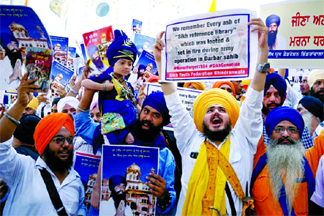
Operation Bluestar and its deep impact on the Sikh psyche: The third ghallughara
Operation Bluestar, executed by the Indian Army in June 1984 at the Golden Temple in Amritsar, was not merely a military offensive—it became a watershed moment in the history of Sikhism. For the Sikh community, it was not a battle against terrorism but an unforgivable desecration of their holiest shrine, an assault on their collective identity, and the beginning of a long era of emotional, political, and spiritual rupture.In Sikh history, the term Ghallughara, meaning “holocaust” or “massacre,” has been used to describe periods of mass violence inflicted upon the Sikh people. Operation Bluestar is remembered as the Teeja Ghallughara (Third Holocaust)—a modern-day catastrophe that left a deep scar on the Sikh psyche.

Historical Context: Sikh Ghallugharas
The Sikh community has endured repeated episodes of persecution and massacres known as Ghallugharas:
– Chhota Ghallughara (1746): A brutal massacre by Mughal forces in which thousands of Sikhs were killed.
– Wadda Ghallughara (1762): The Great Massacre where Afghan invader Ahmad Shah Abdali killed tens of thousands of Sikhs in one day.
– Teeja Ghallughara (1984): The storming of the Golden Temple by the Indian Army, followed by the anti-Sikh riots post-Indira Gandhi’s assassination.
These historical traumas are etched deeply into the Sikh collective consciousness as moments of suffering and sacrifice, but also resilience.
Devastation of the Golden Temple Complex
The Indian Army’s use of tanks, heavy artillery, and infantry inside the sacred Golden Temple complex caused massive physical destruction:
– Damage to the Akal Takht: The Akal Takht, the supreme temporal authority of Sikhism, was heavily damaged. It was reduced to rubble, which was an unimaginable blow to Sikh spiritual sovereignty.
– Destruction of the Sikh Reference Library: The library housed centuries-old scriptures, historical documents, handwritten manuscripts, and relics of the Gurus. Its burning was perceived as a deliberate attempt to erase Sikh history.
– Widespread Casualties: Estimates of deaths vary, but it is widely accepted that hundreds, possibly thousands, of militants, civilians, and pilgrims died during the assault. The presence of unarmed pilgrims and non-combatants inside the complex intensified the trauma.
Desecration and Violation
The Golden Temple is not only a place of worship but a sanctuary, a symbol of Sikh identity and spiritual refuge. The operation violated this sanctity, leaving many Sikhs feeling profoundly betrayed and humiliated. The act of soldiers entering the shrine with weapons and destroying sacred sites was seen as sacrilege.
Impact on the Sikh Psyche
Collective Trauma and Spiritual Wound: Operation Bluestar was not experienced as a simple military action but as an assault on Sikh identity and spirituality.
– The sense of violation was akin to a profound spiritual wound. The Guru Granth Sahib, the eternal Sikh scripture, and the sanctity of the Harmandir Sahib were perceived to be attacked.
– Many Sikhs described feelings of shock, disbelief, and grief, similar to collective mourning for a devastating loss.
– This trauma entered the cultural memory as a form of existential crisis, shaking the foundations of Sikh confidence in the Indian nation-state.
A Crisis of Faith and Identity
For many, Bluestar triggered a deep crisis of faith – not in Sikhism itself, but in the protection that the Indian state was supposed to offer its minorities. The event forced Sikhs to re-examine their place in India.
– Feelings of alienation and vulnerability intensified.
– The Sikh community felt targeted, marginalized, and feared further erosion of their political and cultural rights.
– Many Sikh youth turned towards assertive identities, including militancy, as a way of reclaiming dignity and protecting their heritage.
The Aftermath
The trauma of Bluestar was compounded by the horrific anti-Sikh riots that erupted in November 1984, after the assassination of Prime Minister Indira Gandhi by her Sikh bodyguards.
– Over 3,000 Sikhs were massacred in Delhi alone, with thousands more killed in other parts of India.
– The widespread nature of the violence, often with alleged complicity or passive support of political actors, deepened feelings of betrayal.
– This event reinforced the perception of systemic persecution, making the Sikh community feel under siege.
The combined effect of Operation Bluestar and the 1984 pogroms is often described as a modern Ghallughara, reshaping Sikh political and social consciousness.
Sociopolitical and Cultural Ramifications
Rise in Sikh Militancy and Calls for Khalistan
– Operation Bluestar galvanized militant groups advocating for a separate Sikh homeland, Khalistan.
– The event became a rallying cry for those who saw armed struggle as the only means to protect Sikh interests.
– While the majority of Sikhs did not support violence, the trauma legitimized radical political voices in many communities.
Diaspora Mobilization
– Sikh diaspora communities in Canada, the UK, and the US responded with protests, fundraisers, and political lobbying.
– Bluestar strengthened Sikh identity abroad and heightened advocacy for human rights and justice.
– The diaspora became crucial in keeping the memory alive and pushing for international awareness.
Memory, Mourning, and
Identity Preservation
Commemoration as a Collective Process
– Every year, Sikhs commemorate the anniversary of Operation Bluestar with memorial prayers (Ardas), candlelight vigils, and seminars.
– The event is remembered in literature, music, and art, serving both as a mourning and a form of resistance.
Passing Trauma Across Generations
– The trauma has been passed down through oral histories, storytelling, and family narratives.
– New generations understand Bluestar as part of their identity, often with strong feelings of justice, remembrance, and resilience.
Psychological Effects: Trauma and Healing
– Many Sikhs suffered from post-traumatic stress, depression, and a sense of helplessness.
– Counseling and support structures were limited, especially in the 1980s and 1990s.
– Over time, Sikh organizations and mental health professionals have worked to address this trauma through community healing initiatives.
An Unhealed Wound
Operation Bluestar was more than a military event-it was a collective trauma that profoundly altered Sikh consciousness. It was a moment when the sanctity of faith, the integrity of identity, and the sense of security for millions of Sikhs were violently shattered.The memory of the Teeja Ghallughara continues to influence Sikh politics, culture, and spiritual life. Until the wounds of 1984 are acknowledged and healed with justice and reconciliation, the pain and mistrust remain a defining feature of Sikh relations with the Indian state. -

Operation Bluestar: The siege of Golden Temple and the tragedy that followed
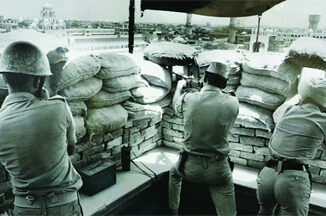
Operation Bluestar, executed in June 1984, was one of the most traumatic episodes in independent India’s history. Conceived by the Indian government to flush out Sikh militants from the Golden Temple complex in Amritsar, Punjab, it became a military operation of immense scale — unprecedented in its political, religious, and human costs. It left a deep scar on the Sikh psyche, led to significant loss of life and heritage, and forever altered the course of Indian politics and Sikh-Centre relations.
Operation Bluestar, conducted between June 1 and June 10, 1984, was a military operation ordered by then-Prime Minister Indira Gandhi to remove Sikh militants, including the heavily armed followers of Jarnail Singh Bhindranwale, from the Harmandir Sahib (Golden Temple) complex in Amritsar, Punjab. The assault, carried out by the Indian Army, not only resulted in significant casualties and damage but also triggered a tragic chain of events including the assassination of Indira Gandhi and the genocidal violence against Sikhs in November 1984.
The Build-Up to the Operation
By the early 1980s, Punjab was in the grip of rising militancy, with radical Sikh groups demanding Khalistan-a separate Sikh homeland. The central figure of this movement was Sant Jarnail Singh Bhindranwale, a fiery preacher who positioned himself as a defender of Sikh rights and identity. He had taken up residence in the Akal Takht, one of the holiest Sikh sites within the Golden Temple complex, along with hundreds of armed followers.
Tensions escalated as violence spread across Punjab. Political deadlock between the Indian government and the Akali Dal deepened, and bombings, assassinations, and communal killings increased. By early 1984, the Golden Temple complex had become a fortress, and the government considered the situation untenable.
Operation Bluestar Begins
On June 1, 1984, the Indian Army began preliminary operations by surrounding the temple complex. Officially, the army claimed it was responding to provocation from inside the temple. On June 3, a full curfew was imposed in Punjab, communication lines were cut, and news media was barred-effectively sealing the region.
The main assault began on the night of June 5 and continued until June 6, involving elite army units including the Para Commandos and Sikh Regiment soldiers. Tanks and artillery were brought into the sacred complex, and the Akal Takht was fired upon with heavy ordnance.
Destruction of the Akal Takht
One of the most painful outcomes for the Sikh community was the near-total destruction of the Akal Takht, the highest seat of earthly authority for Sikhs, which had been converted by militants into a fortified bunker. The Indian Army used tank fire and shelling to neutralize resistance, reducing the historic building to rubble. Ancient manuscripts, relics, and scriptures were lost or destroyed.
Damage to the Golden Temple Complex
– Bullet marks pockmarked the marble walls of the Harmandir Sahib.
– Sacred pools turned red with blood.
– Libraries and the Sikh Reference Library were set ablaze; priceless historical texts were lost forever.
– More than 100 gurdwaras across Punjab were raided as part of related operations (Operations Woodrose and Trident).
Death Toll and Casualties
There is no consensus on the number of people killed during Operation Bluestar.
– Official government figures put the number of deaths at about 492 militants and civilians and 83 soldiers, with 249 injured.
– Independent sources and Sikh groups estimate 3,000-7,000 deaths, many of them civilians and innocent pilgrims caught in the crossfire during a sacred time (Guru Arjan Dev’s martyrdom anniversary), when the complex was crowded.
– Women, children, and elderly pilgrims were among those killed.
– Eyewitnesses and survivors spoke of wounded being denied medical help, and unarmed men being shot or dragged away.
The operation caused deep psychological trauma to survivors and thousands of families, many of whom never recovered the remains of their loved ones.
Aftermath & Wider Repercussions
Assassination of Indira Gandhi
On October 31, 1984, Indira Gandhi was assassinated by her two Sikh bodyguards in retaliation for Operation Bluestar. This led to anti-Sikh pogroms, especially in Delhi, where over 3,000 Sikhs were killed, women were raped, properties were destroyed, and entire neighborhoods burned down with police and political complicity.
Rise in Militancy
Operation Bluestar radicalized many Sikh youth. The sense of betrayal and desecration pushed many into the armed separatist movement. From 1984 to the early 1990s, Punjab saw intense insurgency, enforced disappearances, extrajudicial killings, and heavy militarization.
Army Mutinies
Several Sikh soldiers across regiments mutinied in response to the assault on the Golden Temple. Around 5,000 were arrested or dismissed. The army, one of the most respected institutions, faced internal rupture along communal lines.
4. Social and Political Fallout
The trust between the Indian state and the Sikh community was shattered. Many Sikhs felt alienated, fearful, and unsafe. Even moderate voices in the Sikh community were pushed to the margins, as polarizing forces gained ground. Politically, it laid the groundwork for the rise of Hindu nationalism in the 1990s and deepened communal cleavages.
Cultural and Religious Trauma
For Sikhs, Operation Bluestar was not just a political or military event-it was a spiritual wound. The Golden Temple is not merely a place of worship; it is the soul of the Sikh faith. To see tanks roll in, the Akal Takht bombed, pilgrims gunned down, and sacred texts destroyed was a trauma akin to sacrilege.
The operation is now remembered by Sikhs as the Teeja Ghallughara (Third Holocaust), following:
– The Chhota Ghallughara of 1746 (approx. 10,000 Sikhs killed),
– The Wadda Ghallughara of 1762 (approx. 30,000 Sikhs massacred).
Ardaas (Sikh prayers) in many gurdwaras now incorporate remembrance of this event, embedding it into Sikh collective memory.
Operation Bluestar left behind more than just rubble and blood-it tore through the fabric of India’s secular promise, fractured national unity, and deeply wounded the Sikh community’s psyche. The scars of June 1984 continue to shape Sikh identity, Indian politics, and public memory.
No official apology has ever been issued. No full reckoning of the deaths, disappearances, and destruction has occurred. And until the state addresses its moral responsibility-through truth, justice, and reconciliation-the ghosts of Operation Bluestar will not be laid to rest. -

The road to Operation Bluestar: The tumultuous prelude in Punjab
“History does not occur in a vacuum- it accumulates, builds, and sometimes explodes.” Such was the case with Operation Bluestar, the Indian Army’s June 1984 military action inside the Golden Temple complex in Amritsar. The event shocked the nation, wounded the Sikh psyche, and catalyzed a decade of turmoil. But to truly understand why such an extreme step was taken, one must explore the complex mosaic of Punjab’s political, social, and religious landscape in the decades leading up to it.
Operation Bluestar did not emerge in isolation. It was the result of a turbulent and complex socio-political environment in Punjab in the late 20th century, marked by rising communal tensions, political miscalculations, and the growing assertiveness of Sikh identity politics. The operation, conducted by the Indian Army in June 1984 to remove Sikh militants from the Golden Temple in Amritsar, was the culmination of years of festering conflict, deep mistrust, and institutional failures. This article outlines the critical developments that led to this watershed moment in Indian history.
Historical and Political Background
Post-Independence Sikh Aspirations: After independence in 1947, the Sikhs, a prominent and influential community in Punjab, felt marginalized in the new Indian nation-state. Despite their significant contribution to the freedom struggle and sacrifices during the Partition, many Sikh leaders believed that their religious and cultural identity was not adequately recognized.
The Punjabi Suba movement (1955-1966), led by the Shiromani Akali Dal, aimed to create a separate Punjabi-speaking state. Though the movement was partially successful with the reorganization of Punjab in 1966, many Sikhs still felt that the political structure did not fully accommodate their aspirations.
The Anandpur Sahib Resolution (1973)
A major turning point was the adoption of the Anandpur Sahib Resolution by the Akali Dal in 1973. While its primary focus was to demand greater federal autonomy and assert Sikh identity, it was often misinterpreted by opponents as a secessionist document. Key demands included:
– Devolution of power to states (especially Punjab)
– Control over river waters
– Recognition of Sikhism as a distinct religion
– Protection of Sikh institutions and culture
The central government, under Indira Gandhi, viewed these demands with suspicion, fearing they might encourage separatist sentiments.
The Rise of Jarnail Singh Bhindranwale
Emergence as a Religious Leader: Jarnail Singh Bhindranwale, the head of the Damdami Taksal (a Sikh seminary), initially gained prominence as a preacher aiming to revive orthodox Sikh practices. His popularity surged among rural Sikhs due to his austere lifestyle and sharp critique of moral decline and drug abuse in Punjabi society.
Politicization of Bhindranwale
In the late 1970s, the Congress party under Indira Gandhi allegedly promoted Bhindranwale to weaken the Akali Dal and fragment Sikh politics. However, this move backfired as Bhindranwale grew increasingly independent and militant in his approach.
By the early 1980s, he was being seen as a spokesperson for Sikh grievances. His fiery speeches, demand for justice in cases of discrimination against Sikhs, and opposition to the central government attracted large followings-especially among the rural youth.
Rise of Militancy in Punjab
From 1978 onward, Punjab witnessed a series of violent events:
– 1978 Amritsar clash: Bhindranwale supporters clashed with the Nirankaris, a heterodox sect, leading to 13 Sikh deaths. This incident catalyzed a sense of injustice among Sikhs.
– 1981-1983: A wave of assassinations, including the killing of Lala Jagat Narain (editor of a prominent anti-Bhindranwale newspaper), and numerous targeted killings followed. Though Bhindranwale denied direct involvement, he was widely blamed.
– Law and order deteriorated rapidly. Civilians, police officers, and public officials were attacked, contributing to a climate of fear and chaos.
Occupation of the Golden Temple Complex
By late 1983, Bhindranwale and his armed followers took up residence inside the Akal Takht within the Golden Temple complex, turning it into a fortified base. This action was both symbolic and strategic-it reinforced his religious authority and gave him protection from police action.
The Role of the Central and
State Governments
Governor’s Rule in Punjab: In 1983, after the assassination of DIG A.S. Atwal (right at the Golden Temple’s steps), the Punjab government was dismissed, and President’s Rule was imposed. However, the breakdown of democratic processes further alienated the Sikh population.
Failure of Dialogue
Multiple attempts to open dialogue between the Akalis and the central government failed due to mutual distrust. Akali leaders feared backlash from radicals, while the central government remained convinced that strong-arm tactics were needed.
Indira Gandhi’s government oscillated between conciliatory gestures and coercive policies, failing to take decisive action in either direction.
Escalation and Final Crisis
Militarization of the Temple: Throughout early 1984, the Golden Temple complex became heavily militarized. Trenches were dug, weapons smuggled in, and defensive positions set up. Intelligence agencies noted a growing cache of arms and the presence of trained militants under Bhindranwale and retired army officer General Shabeg Singh, who organized the defense.
Nationwide Impact
The growing unrest in Punjab had national implications:
– The rail and road transport system was frequently disrupted.
– Hindu-Sikh communal relations deteriorated, especially with inflammatory media coverage.
– Rumors of foreign (particularly Pakistani) involvement in fomenting separatism spread.
– The demand for Khalistan, a separate Sikh homeland, though not universally supported by Sikhs, became a rallying cry for extremist elements.
Government’s Dilemma
Indira Gandhi faced a political and strategic crisis:
– Delay in action could lead to further strengthening of militants.
– Forceful action inside the Golden Temple-Sikhism’s holiest shrine-could provoke mass outrage.
Ultimately, after secret deliberations, the decision was made to launch Operation Bluestar in early June 1984, targeting Bhindranwale and his followers entrenched in the temple complex.
A Crisis of Governance and Identity
The situation in Punjab leading up to Operation Bluestar was the result of layered crises-historical grievances, political manipulation, religious assertion, and administrative paralysis. What began as a struggle for identity and federal rights became militarized under state negligence and communal polarization. The tragic events of June 1984 were not inevitable, but the product of a series of missteps, miscommunications, and a lack of visionary leadership on all sides.
Even today, the scars of this period remain fresh in the Sikh psyche, with the events of 1984 serving as a powerful reminder of how identity, politics, and religion can converge to cause national trauma. -

Martyrdom day of Guru Arjan Dev ji
Each year, millions of Sikhs around the world solemnly commemorate the Martyrdom Day of Guru Arjan Dev Ji, the fifth Guru of Sikhism and the first Sikh martyr, whose death in 1606 CE became a defining moment in the history of the Sikh faith. Observed during the summer month of Jeth (May–June), this day honors Guru Ji’s unwavering commitment to truth, religious freedom, and justice in the face of brutal persecution under the Mughal regime.
Guru Arjan (15 April 1563 – 30 May 1606) compiled the first official edition of the Sikh scripture called the Adi Granth, which later expanded into the Guru Granth Sahib.
Guru Arjan was born in Goindwal, in the Punjab, the youngest son of Bhai Jetha, who later became Guru Ram Das, and Mata Bhani, the daughter of Guru Amar Das. He completed the construction of the Darbar Sahib at Amritsar, after the fourth Sikh Guru founded the town and built a sarovar.Guru Arjan compiled the hymns of previous Gurus and of other saints into Adi Granth, the first edition of the Sikh scripture, and installed it in the Harimandir Sahib.
Guru Arjan reorganized the masand system initiated by Guru Ram Das, by suggesting that the Sikhs donate, if possible, one-tenth of their income, goods or service to the Sikh organization (dasvandh). The Masand not only collected these funds but also taught tenets of Sikhism and settled civil disputes in their region. The dasvand financed the building of gurdwaras and langars (shared communal kitchens).
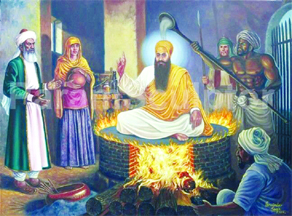
Guru Arjan was arrested under the orders of the Mughal Emperor Jahangir accusing him of supporting a rebellion under Khusrau Mirza. He was asked to convert himself to Islam. He refused and, as a result, was tortured and executed in 1606 CE. Historical records and the Sikh tradition are unclear as to whether Arjan was executed by drowning or died during torture. The Sikh tradition states the Guru’s execution was a part of the ongoing persecution of the Sikhs under the Mughal Empire. His martyrdom is considered a watershed event in the history of Sikhism.
Early life
Guru Arjan was born in Goindwal to Bibi Bhani and Jetha Sodhi. Bibi Bhani was the daughter of Guru Amar Das, and her husband Jetha Sodhi later came to be known as Guru Ram Das. Arjan’s birthplace site is now memorialized as the Gurdwara Chaubara Sahib. He had two brothers: Prithi Chand and Mahadev. Various Sikh chroniclers give his birth year as 1553 or 1563, the latter is accepted by scholarly consensus as the actual year of birth with 15 April as the accepted birth date.
Guru Arjan spent the first 11 years of his life in Goindwal and the next seven years with his father in Ramdaspur. Per Sikh tradition, he had stayed for two years in Lahore during his youth after being sent by his father to attend the wedding of his first cousin Sahari Mal’s son as well as to establish a Sikh congregation. He was appointed as the Sikh Guru in 1581 after the death of his father. Guru Ram Das was a Khatri of the Sodhi sub-caste. With Arjan’s succession, the Guruship remained in the Sodhi family of Guru Ram Das.
Succession and time as Guru
Guru Ram Das chose Arjan, the youngest, to succeed him as the fifth Sikh Guru. Mahadev, the middle brother chose the life of an ascetic. His choice of Guru Arjan as successor, as throughout most of the history of Sikh Guru successions, led to disputes and internal divisions among the Sikhs.
The succession dispute regarding Guru Arjan created a schism that yielded different narratives for the two factions. In the orthodox Sikh tradition, Prithi Chand is remembered as vehemently opposing Guru Arjan, creating a factional sect of the Sikh community. The Sikhs following Arjan referred to the breakaway faction as Minas (literally, “scoundrels”). Prithi Chand and his followers attempted to assassinate the young Hargobind thrice. Prithi Chand also befriended Mughal agents. Subsequent written competing texts written by the Minas, on the other hand, offered a different explanation for the attempt on Hargobind’s life, and present him as devoted to his younger brother Arjan. The eldest son of Prithi Chand, Miharvan, is mentioned in both traditions as having received tutelage from both Prithi Chand and Arjan as a child.
The competing texts acknowledge the disagreements. They state Prithi Chand left Amritsar, became the Sahib Guru after the martyrdom of Guru Arjan and one who disputed the succession of Hargobind as the next Guru. The followers of Prithi Chand considered themselves the true followers of Guru Nanak as they rejected the increasing emphasis on militarization of the panth under Hargobind to resist Mughal persecution in the wake of Arjan’s martyrdom, in favor of non-violent interiorization. In addition to Prithi Chand, a son of Guru Amar Das named Baba Mohan had also challenged the authority of Arjan. These challenging claims were asserted by the early Sikh sects in part by their manuscripts of Sikh hymns. Baba Mohan possessed the Goindval pothi containing the hymns of Nanak and other early Gurus, while Prithi Chand possessed the Guru Harsahai pothi then believed to have been the oldest scripture from the time of Nanak. This, state scholars, may have triggered Guru Arjan to create a much enlarged, official version of the Adi Granth.
Upon the first parkash of the Adi Granth according to Gurbilas, Guru Arjan said, “Listen you all to my directive. And believe it as ever true. Accept the Granth as equal with the Guru. And think no distinctions between the two.”
The mainstream Sikh tradition recognized Guru Arjan as the fifth Guru, and Hargobind as the sixth Guru. Arjan, at age 18, became the fifth Guru in 1581 inheriting the title from his father. After his execution by the Muslim officials of the Mughal Empire, his son Hargobind became the sixth Guru in 1606 CE.
Execution
Guru Arjan died in Mughal custody; this has been one of the defining, though controversial, issues in Sikh history.
Most Mughal historians considered Guru Arjan’s execution as a political event, stating that the Sikhs had become formidable as a social group, and Sikh Gurus became actively involved in the Punjabi political conflicts. A similar theory floated in the early 20th-century, asserts that this was just a politically-motivated single execution. According to this theory, there was an ongoing Mughal dynasty dispute between Jahangir and his son Khusrau suspected of rebellion by Jahangir, wherein Arjan blessed Khusrau and thus the losing side. Jahangir was jealous and outraged, and therefore he ordered the Guru’s execution. But according to Jahangir’s own autobiography, most probably he didn’t understand the importance of Sikh gurus. He referred to Arjan as a Hindu, who had “captured many of the simple-hearted of the Hindus and even of the ignorant and foolish followers of Islam, by his ways and manners…for the three or four generations (of spiritual successors) they had kept this shop warm.” The execution of Arjan marks a sharp contrast to Jahangir’s tolerant attitude towards other religions such as Hinduism and Christianity.
The Sikh tradition has a competing view. It states that the Guru’s execution was a part of the ongoing persecution of the Sikhs by Islamic authorities in the Mughal Empire, and that the Mughal rulers of Punjab were alarmed at the growth of the Panth. According to Jahangir’s autobiography Tuzk-e-Jahangiri (Jahangirnama) which discussed Arjan’s support for his rebellious son Khusrau, too many people were becoming persuaded by Arjan’s teachings and if Arjan did not become a Muslim, the Sikh Panth had to be extinguished.
In 1606 CE, the Guru was imprisoned in Lahore Fort, where by some accounts he was tortured and executed, and by other accounts, the method of his death remains unresolved. The traditional Sikh account states that the Mughal emperor Jahangir demanded a fine of 200,000 rupees and demanded that Arjan erase some of the hymns in the text that he found offensive. The Guru refused to remove the lines and pay the fine which, the Sikh accounts state, led to his execution. Some Muslim traditional accounts such as of Latif in 19th-century states that Arjan was dictatorial, someone who lived in splendour with “costly attire”, who had left aside the rosary and the clothes of a saint (fakir). Shaikh Ahmad Sirhindi cheered the punishment and execution of Arjun, calling the Sikh Guru an infidel. In contrast, Mian Mir – the Sufi friend of Guru Arjan, lobbied when Jehangir ordered the execution and the confiscation of Arjan’s property, then got the confiscation order deferred, according to Rishi Singh.
Some scholars state that the evidence is unclear whether his death was due to execution, torture or forced drowning in the Ravi river. J.S. Grewal notes that Sikh sources from the seventeenth and eighteenth-century contain contradictory reports of Arjan’s death.J. F. Richard states that Jahangir was persistently hostile to popularly venerated saints, not just Sikhism. Bhai Gurdas was a contemporary of Arjan and is a noted 17th-century Sikh chronicler. His eyewitness account recorded Arjan’s life, and the order by Emperor Jahangir to torture the Guru to death.
A contemporary Jesuit account, written by Spanish Jesuit missionary Jerome Xavier (1549-1617), who was in Lahore at the time, records that the Sikhs tried to get Jahangir to commute the torture and death sentence to a heavy fine, but this attempt failed. Dabistan-i Mazahib Mobad states Jahangir tortured Arjan in the hopes of extracting the money and public repudiation of his spiritual convictions, but the Guru refused and was executed. Jerome Xavier, in appreciation of the courage of Guru Arjun, wrote back to Lisbon, that Arjan suffered and was tormented.
According to the Sikh tradition, before his execution, Arjan instructed his son and successor Hargobind to take up arms, and resist tyranny. His execution led the Sikh Panth to become armed and pursue resistance to persecution under the Mughal rule. Michael Barnes states that the resolve and death of Arjun strengthened the conviction among Sikhs that, “personal piety must have a core of moral strength. A virtuous soul must be a courageous soul. Willingness to suffer trial for one’s convictions was a religious imperative”.
There are several stories and versions about how, where and why Arjan died. Recent scholarship have offered alternative analyses, wary of “exaggerating fragmentary traces of documentary evidence in historical analysis”. The alternate versions include stories about the role of Arjan in a conflict between the Mughal Emperor Jahangir and his son who Jahangir suspected of trying to organize a patricidal coup. An alternate version highlights the role of a Hindu minister of Jahangir named Chandu Shah. He, in one version, takes revenge on Arjan for not marrying his son Hargobind to Chandu Shah’s daughter. In another Lahore version, Chandu Shah actually prevents Arjan from suffering torture and death by Muslims by paying 200,000 rupees (100,000 crusados) to Jahangir, but then keeps him and emotionally torments him to death in his house. Several alternative versions of the story try to absolve Jahangir and the Mughal empire of any responsibility, but have no trace or support in the documentary evidence from early 17th century, such as the records of Jesuit priest Jerome Xavier and the memoirs of Jahangir.
Guru Arjan’s father Guru Ram Das founded the town named after him “Ramdaspur”, around a large man-made water pool called “Ramdas Sarovar”. Guru Arjan continued the infrastructure-building effort of his father. The town expanded during the time of guru Arjan, financed by donations and constructed by voluntary work. The pool area grew into a temple complex with the Gurdwara Harmandir Sahib near the pool. Guru Arjan installed the scripture of Sikhism inside the new temple in 1604. The city that emerged is now known as Amritsar, and is the holiest pilgrimage site in Sikhism.
Continuing the efforts of Ram Das, Guru Arjan established Amritsar as a primary Sikh pilgrimage destination. He wrote a voluminous amount of Sikh scripture including the popular Sukhmani Sahib. Guru Arjan is credited with completing many other infrastructure projects, such as water reservoirs called Santokhsar (Pond of Contentment) and Gongsar (Pond of Bells), founding the towns of Tarn Taran, Kartarpur and Hargobindpur.
Community expansion
While having completing the Harmandir Sahib with dasvand donations during the first decade of his guruship between 1581 and 1589, creating a rallying point for the community and a center for Sikh activity, and a place for the instalment of the Adi Granth, guru Arjan had also gone on a tour of Majha and Doaba in Punjab, where he would found the towns. Due to their central location in the Punjab heartland, the ranks of Sikhs would swell, especially among the Jat peasantry, and create a level of prosperity for them; Arjan would serve not only as a spiritual mentor but as a true emperor (sacch? p?dsh?h) for his followers in his own right.
Adi Granth
According to the Sikh tradition, Guru Arjan compiled the Adi Granth by collecting hymns of past Gurus from many places, then rejecting those that he considered as fakes or to be diverging from the teachings of the Gurus. His approved collection included hymns from the first four Gurus of Sikhism, those he composed, as well as 17 Hindu bards and 2 Muslim bards (Bhagats). The compilation was completed on 30 August 1604, according to the Sikh tradition and installed in the Harmandir Sahib temple on 1 September 1604.
Guru Arjan was a prolific poet who composed 2,218 hymns. More than half of the volume of Guru Granth Sahib and the largest collection of hymns has been composed by Arjan. According to Christopher Shackle and Arvind-Pal Singh Mandair, Guru Arjan’s compositions combined spiritual message in an “encyclopedic linguistic sophistication” with “Braj Bhasha forms and learned Sanskrit vocabulary”.
After Guru Arjan completed and installed the Adi Granth in the Harimandir Sahib, Mughal emperor Akbar was informed of the development with the allegation that it contained teachings hostile to Islam. He ordered a copy be brought to him. Arjan sent him a copy on a thali (plate), with the following message that was later added to the expanded text:
In this thali (dish) you will find three things – truth, peace and contemplation:
in this too the nectar Name which is the support of all humanity.
AG 1429, Translated by William Owen Cole and Piara Singh Sambh
The Akbarnama by Abu’l-Fazl Allami mentions that Arjan met the Mughal emperor Akbar and his cortege in 1598. According to Louis Fenech, this meeting likely influenced the development of Sikh manuscriptology and the later martial tradition.
One of the Sikh community disputes following Guru Ram Das was the emergence of new hymns claiming to have been composed by Nanak. According to the faction led by Arjan, these hymns were distorted and fake, with some blaming Prithi Chand and his Sikh faction for having composed and circulated them. The concern and the possibility of wrong propaganda, immoral teachings and inauthentic Gurbani led Arjan to initiate a major effort to collect, study, approve and compile a written official scripture, and this he called Adi Granth, the first edition of the Sikh scripture by 1604.
The composition of both Prithi Chand and his followers have been preserved in the Mina texts of Sikhism, while the mainstream and larger Sikh tradition adopted the Guru Granth Sahib scripture that ultimately emerged from the initiative of Arjan. -

Memorial Day: Honoring the Fallen Heroes of the United States
American people are grateful to the brave men and women who made the ultimate sacrifice for our freedom. Today, we remember and honor their selfless service. We remember on this day every hero who selflessly shed their patriot’s blood for our freedom. May their sacrifices be a constant reminder of the cost of liberty!
God bless our heroes! God bless America!Memorial Day, a federal holiday in the United States, is observed on the last Monday of May each year. It serves as a solemn occasion to honor and remember the men and women of the U.S. Armed Forces who died in military service to the nation. More than just a long weekend or the unofficial start of summer, Memorial Day is rooted in a deep sense of national gratitude and historical remembrance.
Memorial Day 2025 falls on Monday, May 26.
Originally known as Decoration Day, it originated in the years following the Civil War and became an official federal holiday in 1971. Many Americans observe Memorial Day by visiting cemeteries or memorials, holding family gatherings and participating in parades. Unofficially, it marks the beginning of the summer season.
The Birthplace of Memorial Day and Early ObservancesThe Civil War, which ended in the spring of 1865, claimed more lives than any conflict in U.S. history and required the establishment of the country’s first national cemeteries.
By the late 1860s, Americans in various towns and cities had begun holding springtime tributes to these countless fallen soldiers, decorating their graves with flowers and reciting prayers.
It is unclear where exactly this tradition originated; numerous different communities may have independently initiated the memorial gatherings. And some records show that one of the earliest Memorial Day commemorations was organized by a group of formerly enslaved people in Charleston, South Carolina less than a month after the Confederacy surrendered in 1865. Nevertheless, in 1966 the federal government declared Waterloo, New York, the official birthplace of Memorial Day.
Waterloo—which first celebrated the day on May 5, 1866—was chosen because it hosted an annual, community-wide event, during which businesses closed and residents decorated the graves of soldiers with flowers and flags.
Decoration Day
On May 5, 1868, General John A. Logan, leader of an organization for Northern Civil War veterans, called for a nationwide day of remembrance later that month. “The 30th of May, 1868, is designated for the purpose of strewing with flowers, or otherwise decorating the graves of comrades who died in defense of their country during the late rebellion, and whose bodies now lie in almost every city, village and hamlet churchyard in the land,” he proclaimed.
The date of Decoration Day, as he called it, was chosen because it wasn’t the anniversary of any particular battle.
On the first Decoration Day, General James Garfield made a speech at Arlington National Cemetery, and 5,000 participants decorated the graves of the 20,000 Civil War soldiers buried there.
Many Northern states held similar commemorative events and reprised the tradition in subsequent years; by 1890 each one had made Decoration Day an official state holiday. Southern states, on the other hand, continued to honor the dead on separate days until after World War I.
History of Memorial Day
Memorial Day, as Decoration Day gradually came to be known, originally honored only those lost while fighting in the Civil War. But during World War I the United States found itself embroiled in another major conflict, and the holiday evolved to commemorate American military personnel who died in all wars, including World War II, The Vietnam War, The Korean War and the wars in Iraq and Afghanistan.
For decades, Memorial Day continued to be observed on May 30, the date General Logan had selected for the first Decoration Day. But in 1968, Congress passed the Uniform Monday Holiday Act, which established Memorial Day as the last Monday in May in order to create a three-day weekend for federal employees. The change went into effect in 1971. The same law also declared Memorial Day a federal holiday.
Memorial Day Traditions
Cities and towns across the United States host Memorial Day parades each year, often incorporating military personnel and members of veterans’ organizations. Some of the largest parades take place in Chicago, New York and Washington, D.C.
Americans also observe Memorial Day by visiting cemeteries and memorials. Some people wear a red poppy in remembrance of those fallen in war—a tradition that began with a World War I poem. On a less somber note, many people take weekend trips or throw parties and barbecues on the holiday, perhaps because Memorial Day weekend—the long weekend comprising the Saturday and Sunday before Memorial Day and Memorial Day itself—unofficially marks the beginning of summer.
What Do People Do?
It is traditional to fly the flag of the United States at half staff from dawn until noon. Many people visit cemeteries and memorials, particularly to honor those who have died in military service. Many volunteers place an American flag on each grave in national cemeteries. Memorial Day is combined with Jefferson Davis’ Birthday in Mississippi.
Memorial Day has become less of an occasion of remembrance. Many people choose to hold picnics, sports events and family gatherings on this weekend. This day is traditionally seen as the start of the summer season for cultural events. For the fashion conscious, it is seen as acceptable to wear white clothing, particularly shoes from Memorial Day until Labor Day. However, fewer and fewer people follow this rule and many wear white clothing throughout the year.
Public Life
Memorial Day is a federal holiday. All non-essential Government offices are closed, as are schools, businesses and other organizations. Most public transit systems do not run on their regular schedule. Many people see Memorial Day weekend as an opportunity to go on a short vacation or visit family or friends. This can cause some congestion on highways and at airports.
Memorial Day and its traditions may have ancient roots
While the first commemorative Memorial Day events weren’t held in the United States until the late 19th century, the practice of honoring those who have fallen in battle dates back thousands of years. The ancient Greeks and Romans held annual days of remembrance for loved ones (including soldiers) each year, festooning their graves with flowers and holding public festivals and feasts in their honor. In Athens, public funerals for fallen soldiers were held after each battle, with the remains of the dead on display for public mourning before a funeral procession took them to their internment in the Kerameikos, one of the city’s most prestigious cemeteries. One of the first known public tributes to war dead was in 431 B.C., when the Athenian general and statesman Pericles delivered a funeral oration praising the sacrifice and valor of those killed in the Peloponnesian War—a speech that some have compared in tone to Abraham Lincoln’s Gettysburg Address.
One of the earliest commemorations was organized by recently freed African Americans.
As the Civil War neared its end, thousands of Union soldiers, held as prisoners of war, were herded into a series of hastily assembled camps in Charleston, South Carolina. Conditions at one camp, a former racetrack near the city’s Citadel, were so bad that more than 250 prisoners died from disease or exposure, and were buried in a mass grave behind the track’s grandstand.
Three weeks after the Confederate surrender, an unusual procession entered the former camp: On May 1, 1865, more than 1,000 people recently freed from enslavement, accompanied by regiments of the U.S. Colored Troops (including the Massachusetts 54th Infantry) and a handful of white Charlestonians, gathered in the camp to consecrate a new, proper burial site for the Union dead. The group sang hymns, gave readings and distributed flowers around the cemetery, which they dedicated to the “Martyrs of the Race Course.”
The holiday’s ‘founder’ had a long and distinguished career
In May 1868, General John A. Logan, the commander-in-chief of the Union veterans’ group known as the Grand Army of the Republic, issued a decree that May 30 should become a nationwide day of commemoration for the more than 620,000 soldiers killed in the recently ended Civil War. On Decoration Day, as Logan dubbed it, Americans should lay flowers and decorate the graves of the war dead “whose bodies now lie in almost every city, village and hamlet churchyard in the land.”
According to legend, Logan chose May 30 because it was a rare day that didn’t fall on the anniversary of a Civil War battle, though some historians believe the date was selected to ensure that flowers across the country would be in full bloom.
After the war Logan, who had served as a U.S. congressman before resigning to rejoin the army, returned to his political career, eventually serving in both the House and Senate and was the unsuccessful Republican candidate for vice president in 1884. When he died two years later, Logan’s body laid in state in the rotunda of the United States Capitol, making him one of just 33 people to have received the honor. Today, Washington, D.C.’s Logan Circle and several townships across the country are named in honor of this champion of veterans and those killed in battle.
Logan probably adapted the idea
from earlier events in the South
Even before the war ended, women’s groups across much of the South were gathering informally to decorate the graves of Confederate dead. In April 1886, the Ladies Memorial Association of Columbus, Georgia resolved to commemorate the fallen once a year—a decision that seems to have influenced John Logan to follow suit, according to his own wife. However, southern commemorations were rarely held on one standard day, with observations differing by state and spread out across much of the spring and early summer. It’s a tradition that continues today: Nine southern states officially recognize a Confederate Memorial Day, with events held on Confederate President Jefferson Davis’ birthday, the day on which General Thomas “Stonewall” Jackson was killed, or to commemorate other symbolic events.
It didn’t become a federal holiday until 1971
Americans embraced the notion of “Decoration Day” immediately. That first year, more than 27 states held some sort of ceremony, with more than 5,000 people in attendance at a ceremony at Arlington National Cemetery. By 1890, every former state of the Union had adopted it as an official holiday. But for more than 50 years, the holiday was used to commemorate those killed just in the Civil War, not in any other American conflict. It wasn’t until America’s entry into World War I that the tradition was expanded to include those killed in all wars, and Memorial Day was not officially recognized nationwide until the 1970s, with America deeply embroiled in the Vietnam War.
It was a long road from Decoration Day to an official Memorial Day
Although the term Memorial Day was used beginning in the 1880s, the holiday was officially known as Decoration Day for more than a century, when it was changed by federal law. Four years later, the Uniform Monday Holiday Act of 1968 finally went into effect, moving Memorial Day from its traditional observance on May 30 (regardless of the day of the week), to a set day—the last Monday in May. The move has not been without controversy, though. Veterans groups, concerned that more Americans associate the holiday with first long weekend of the summer and not its intended purpose to honor the nation’s war dead, continue to lobby for a return to the May 30 observances. For more than 20 years, their cause was championed by Hawaiian Senator—and decorated World War II veteran—Daniel Inouye, who until his 2012 death reintroduced legislation in support of the change at the start of every Congressional term.
More than 20 towns claim to be the holiday’s ‘birthplace’—but only one has federal recognition
For almost as long as there’s been a holiday, there’s been a rivalry about who celebrated it first. Boalsburg, Pennsylvania, bases its claim on an 1864 gathering of women to mourn those recently killed at Gettysburg. In Carbondale, Illinois, they’re certain that they were first, thanks to an 1866 parade led, in part, by John Logan who two years later would lead the charge for an official holiday. There are even two dueling Columbus challengers (one in Mississippi, the other in Georgia) who have battled it out for Memorial Day supremacy for decades. Only one town, however, has received the official seal of approval from the U.S. government. In 1966, 100 years after the town of Waterloo, New York, shuttered its businesses and took to the streets for the first of many continuous, community-wide celebrations, President Lyndon Johnson signed legislation, recently passed by the U.S. Congress, declaring the tiny upstate village the “official” birthplace of Memorial Day.
Wearing a red poppy on Memorial Day began with a World War I poem
In the spring of 1915, bright red flowers began poking through the battle-ravaged land across northern France and Flanders (northern Belgium). Canadian Lieutenant Colonel John McCrae, who served as a brigade surgeon for an Allied artillery unit, spotted a cluster of the poppies shortly after serving as a brigade surgeon during the bloody Second Battle of Ypres. The sight of the bright red flowers against the dreary backdrop of war inspired McCrae to pen the poem, “In Flanders Field,” in which he gives voice to the soldiers who had been killed in battle and lay buried beneath the poppy-covered grounds. Later that year, a Georgia teacher and volunteer war worker named Moina Michael read the poem in Ladies’ Home Journal and wrote her own poem, “We Shall Keep the Faith” to begin a campaign to make the poppy a symbol of tribute to all who died in war. The poppy remains a symbol of remembrance to this day. -

Mother’s Day: A celebration of maternal love and sacrifice
Mother’s Day is a holiday honoring motherhood that is observed in different forms throughout the world. In the United States, Mother’s Day 2025 falls on Sunday, May 11. The American incarnation of Mother’s Day was created by Anna Jarvis in 1908 and became an official U.S. holiday in 1914. Jarvis would later denounce the holiday’s commercialization and spent the latter part of her life trying to remove it from the calendar. While dates and celebrations vary, Mother’s Day traditionally involves presenting moms with flowers, cards and other gifts.
What Is Mother’s Day?
Celebrations of mothers and motherhood can be traced back to the ancient Greeks and Romans, who held festivals in honor of the mother goddesses Rhea and Cybele, but the clearest modern precedent for Mother’s Day is the early Christian festival known as “Mothering Sunday.”
Once a major tradition in the United Kingdom and parts of Europe, this celebration fell on the fourth Sunday in Lent and was originally seen as a time when the faithful would return to their “mother church”—the main church in the vicinity of their home—for a special service.
Over time the Mothering Sunday tradition shifted into a more secular holiday, and children would present their mothers with flowers and other tokens of appreciation. This custom eventually faded in popularity before merging with the American Mother’s Day in the 1930s and 1940s.
Ancient Civilizations, Mother Worship
A. Prehistoric Reverence
– Early societies, as far back as 30,000 BCE, crafted mother goddess figurines, such as the Venus of Willendorf, signifying fertility and the power of life-giving femininity.
– These symbols were associated not just with reproduction, but with sustenance, protection, and emotional well-being.
Ancient Egypt
– Isis, the Egyptian goddess, was considered the ideal mother. Myths described her as a devoted wife and a protective mother who resurrected her husband Osiris and raised her son Horus.
– Annual rituals and hymns praised her as a divine caregiver and queen of heaven.
Greek and Roman Civilizations
– In Greece, Rhea, mother of the Olympians, was honored in spring festivals. Offerings were made at altars, often in outdoor natural settings symbolizing fertility.
– Romans celebrated Hilaria around March 25, coinciding with the vernal equinox. People wore disguises, sang songs, and paraded to temples dedicated to Cybele, the “Great Mother.”
Christianity and the Emergence of Mothering Sunday
Mothering Sunday was originally a religious observance in parts of Europe during the 16th century.Celebrated on the fourth Sunday of Lent, it was when Christians returned to their “mother church” for worship.Over time, it evolved into a more secular tradition where children honored their biological mothers.The holiday became particularly popular among the working class, as it was often the only day domestic servants could reunite with family.
Mother’s Day Origins in the United States
The origins of Mother’s Day as celebrated in the United States date back to the 19th century. In the years before the Civil War, Ann Reeves Jarvis of West Virginia helped start “Mothers’ Day Work Clubs” to teach local women how to properly care for their children.
These clubs later became a unifying force in a region of the country still divided over the Civil War. In 1868 Jarvis organized “Mothers’ Friendship Day,” at which mothers gathered with former Union and Confederate soldiers to promote reconciliation.
Another precursor to Mother’s Day came from the abolitionist and suffragette Julia Ward Howe. In 1870 Howe wrote the “Mother’s Day Proclamation,” a call to action that asked mothers to unite in promoting world peace. In 1873 Howe campaigned for a “Mother’s Peace Day” to be celebrated every June 2.
Other early Mother’s Day pioneers include Juliet Calhoun Blakely, a temperance activist who inspired a local Mother’s Day in Albion, Michigan, in the 1870s. The duo of Mary Towles Sasseen and Frank Hering, meanwhile, both worked to organize a Mothers’ Day in the late 19th and early 20th centuries. Some have even called Hering “the father of Mothers’ Day.”
Anna Jarvis Turns Mother’s
Day Into a National Holiday
The official Mother’s Day holiday arose in the 1900s as a result of the efforts of Anna Jarvis, daughter of Ann Reeves Jarvis. Following her mother’s 1905 death, Anna Jarvis conceived of Mother’s Day as a way of honoring the sacrifices mothers made for their children.
After gaining financial backing from a Philadelphia department store owner named John Wanamaker, in May 1908 she organized the first official Mother’s Day celebration at a Methodist church in Grafton, West Virginia. That same day also saw thousands of people attend a Mother’s Day event at one of Wanamaker’s retail stores in Philadelphia.
Following the success of her first Mother’s Day, Jarvis—who remained unmarried and childless her whole life—resolved to see her holiday added to the national calendar.
Arguing that American holidays were biased toward male achievements, she started a massive letter writing campaign to newspapers and prominent politicians urging the adoption of a special day honoring motherhood.
By 1912 many states, towns and churches had adopted Mother’s Day as an annual holiday, and Jarvis had established the Mother’s Day International Association to help promote her cause. Her persistence paid off in 1914 when President Woodrow Wilson signed a measure officially establishing the second Sunday in May as Mother’s Day.
Jarvis Decries Commercialized
Mother’s Day
Anna Jarvis had originally conceived of Mother’s Day as a day of personal celebration between mothers and families. Her version of the day involved wearing a white carnation as a badge and visiting one’s mother or attending church services. But once Mother’s Day became a national holiday, it was not long before florists, card companies and other merchants capitalized on its popularity. While Jarvis had initially worked with the floral industry to help raise Mother’s Day’s profile, by 1920 she had become disgusted with how the holiday had been commercialized. She outwardly denounced the transformation and urged people to stop buying Mother’s Day flowers, cards and candies.
Jarvis eventually resorted to an open campaign against Mother’s Day profiteers, speaking out against confectioners, florists and even charities. She also launched countless lawsuits against groups that had used the name “Mother’s Day,” eventually spending most of her personal wealth in legal fees. By the time of her death in 1948 Jarvis had disowned the holiday altogether, and even actively lobbied the government to see it removed from the American calendar.
Mother’s Day Traditions and Celebrations Around the World
While versions of Mother’s Day are celebrated worldwide, traditions vary depending on the country. In Thailand, for example, Mother’s Day is always celebrated in August on the birthday of the current queen, Sirikit.
Another alternative observance of Mother’s Day can be found in Ethiopia, where families gather each fall to sing songs and eat a large feast as part of Antrosht, a multi-day celebration honoring motherhood.
In the United States, Mother’s Day continues to be celebrated by presenting mothers and other women with gifts and flowers, and it has become one of the biggest holidays for consumer spending. Families also celebrate by giving mothers a day off from activities like cooking or other household chores.
At times, Mother’s Day has also been a date for launching political or feminist causes. In 1968 Coretta Scott King, wife of Martin Luther King Jr., used Mother’s Day to host a march in support of underprivileged women and children. In the 1970s women’s groups also used the holiday as a time to highlight the need for equal rights and access to childcare.
In India, on Mother’s Day, families come together to honour the invaluable role that mothers play in their lives, celebrating the selfless love and sacrifices of mothers nationwide. Similarly, in the United Kingdom, children often present their mothers with flowers and cards as tokens of affection.
In Japan, the carnation gifted to mothers symbolises love and gratitude, while Ethiopian families gather for large celebratory feasts. Mexicans honour mothers through serenades and poetry readings, and in Nepal, a special religious festival called Mata Tirtha Aunsi is observed.
Regardless of the specific customs, the essence of Mother’s Day thus remains universal: it is a time to cherish and acknowledge the profound impact that mothers and maternal figures have on our lives.
Role mothers play in our lives
This Mother’s Day, the biggest tribute one can pay to their mother is to convey the heartiest thanks for everything they have done and have been doing for us.
Raising her kid
The first and foremost role a mother plays in this world is taking the responsibility of bearing her child. This is honestly an obligation that can never be repaid to her. It is said that it is easy to bear a child but it is extremely difficult to raise them well. But haven’t our mothers performed these tasks beautifully? It is certainly impossible to thank her enough.
Her love and care is completely irreplaceable
Nobody on this planet can match up to the love and care that a mother showers upon you. From being teary-eyed when we get hurt in childhood to waiting for us to eat food before her, a mother offers unconditional love and support. Be it any age and phase of your life, we all need mom’s words to overcome a bad situation.
Proper environment for the right development
There is no denying that a mother is responsible for what kind of environment her child is growing up in, since the very beginning. This has a direct or indirect impact on the kid’s mental health development. It is the mother, who needs to make sure that her child is getting an appropriate space for creativity, and studies.
Behavioural development
A mother has to make sure that her kid is getting the proper opportunity to explore his likeness and interests. It is only the mother who is very well versed with her child’s behaviour. She has to be all ears whenever her kid is speaking his heart out.
Imparting routine and discipline
Since day one of your school life, it is your mother who has told you to go to bed when it is bedtime. She has woken you up for school. These are very simple ways how a mother makes your routine. Once you are back from school, she tells you to sit for your homework before going out to play. These may seem like small things but they end up playing a big role instilling discipline. -

India–Pakistan standoff after Pahalgam attack
On 23 April 2025, a standoff emerged between India and Pakistan, which was sparked by the 2025 Pahalgam attack, a terrorist attack in the Baisaran Valley of Jammu and Kashmir, killing 27 people, including 25 Hindu tourists, a Christian tourist, and a local Muslim, as well as injuring more than 20 others. The Resistance Front (TRF) initially claimed responsibility for the attack.
Armed skirmishes between India and Pakistan were reported along the Line of Control (LoC) beginning on 24 April, raising fears of further escalation between the two nuclear-armed neighbors.
The standoffs were followed by a diplomatic crisis which emerged between the two countries, as India accused Pakistan of sponsoring the attack. India initiated the expulsion of Pakistani diplomats, recalled its own diplomatic staff, suspended visa services, closed its borders, and announced its withdrawal from the Indus Waters Treaty, while Pakistan denied the allegations and responded with trade restrictions, closure of airspace and border crossings, and suspension of the Simla Agreement. India’s Cabinet Committee on Security (CCS) also strongly urged Indian citizens to avoid travelling to Pakistan, and called on those currently in the country to return at the earliest opportunity.
Between 24 April and 6 May, Pakistan and India engaged in heavy skirmishes including cross-border firing and artillery shelling.
On 7 May 2025, India launched missile strikes on Pakistan, codenamed Operation Sindoor. According to India, the missile strikes targeted the militant groups Jaish-e-Mohammed and Lashkar-e-Taiba. According to Pakistan, the Indian strikes targeted civilian areas, including mosques, killing 31 Pakistani civilians. In retaliation to the strikes, Pakistan said they had downed a number of Indian jets and damaged Indian infrastructure.
On 8 May, India said that Pakistani army attempted a drone and missile strike across several Indian cities including Amritsar which were intercepted by the S-400 missile system. According to Indian authorities, the strike was negated. This claim was rejected by Pakistani governmental authorities and the Sikhs for Justice, both of whom stated that the Indian Army mistakenly struck itself in Amritsar and blamed it on Pakistan to fuel anti-Pakistan sentiment among Sikhs. The Indian Ministry of Defense said that it carried out SEAD/DEAD operations in response and claimed to have neutralized the air defense systems in Lahore.
There were a number of misinformation campaigns across both the countries’ media outlets following the strike.
Background
An Islamist armed insurgency broke out in Jammu and Kashmir in the late 1980s, which resulted in the exodus of Kashmiri Hindus from the region and the insurgency has been ongoing since.
On 22 April 2025, a terrorist attack at Baisaran Valley near Pahalgam in the Anantnag district of Indian-administered Jammu and Kashmir killed at least 26 tourists and injured more than 20 others. According to eyewitness testimonies provided to Indian media outlets, assailants reportedly questioned potential victims about their religious identity before opening fire, specifically targeting non-Muslims.
The attack became among the deadliest attacks against Indian civilians in the region since 2000. The Resistance Front (TRF), believed to be an offshoot of the Pakistan-based, UN-designated terrorist group Lashkar-e-Taiba, initially claimed responsibility. They stated that the attack was in opposition to Indian government policy allowing Indian citizens to live and work in Kashmir, that resulted in non-local settlement in the region. Four days later, they retracted their claim.
Diplomatic crisis
On the night of 23 April 2025, the Indian foreign secretary Vikram Misri held a special press briefing after a meeting with the CCS. He announced India’s decision to temporarily suspend the Indus Waters Treaty with Pakistan with immediate effect until Pakistan ceases its support for cross-border terrorism. He further announced the closure of the integrated check post at Attari-Wagah Border, a travel ban for all Pakistani nationals to India under the SAARC Visa Exemption Scheme, and cancellation of all previously issued visas. Additionally, Pakistani military advisers at the Pakistan High Commission in New Delhi were expelled, while their Indian counterparts in Islamabad were withdrawn, and the staff strength of the Indian High Commission in Islamabad was reduced from 55 to a minimum of 30. The posts of such military advisors were deemed abolished.
Pakistan’s Foreign Ministry expressed condolences to the families of the victims, and its defense minister Khawaja Asif dismissed the allegations of his country’s involvement in the attack and regarded such events as revolutions. However, in an interview with Sky News, while responding to allegations of terrorism, Asif said that Pakistan had backed terrorist activities at the direction of United States, Britain and the West going back three decades.
Pakistan responded to the suspension of the treaty by describing it as inappropriate and lacking seriousness. Pakistan also warned India of a comprehensive retaliation in response to the actions announced by the Indian government in the aftermath of the incident, further stating that any action affecting water resources would be considered an act of war. On 24 April, Pakistan suspended visas issued to Indian nationals and closed its airspace to Indian aircraft, expelled Indian diplomats and instructed Indian military advisers to depart the country no later than the 30 April.
Pakistan also cut off all trade with India. Pakistan also suspended the Simla Agreement, on 24 April 2025 in retaliation. The Attari-Wagah border ceremony was also reduced and the symbolic handshake did not take place. Cross-border families were affected where their visas revoked.
Initial standoff
A joint cordon and search operation was initiated by the Indian Army, paramilitary forces, and Jammu and Kashmir Police. A temporary lockdown was imposed in Pahalgam, and Indian Army helicopters were deployed to track down the militants, who reportedly fled to the upper reaches of the Pir Panjal range.
On 25 April, soldiers demolished the family residences of two individuals suspected of involvement in the Pahalgam attack. An Indian soldier was killed and two other soldiers wounded during a gunfight with insurgents in the Basantgarh region of Udhampur. Senior Lashkar-e-Taiba Commander Altaf Lalli was also killed in the gunfight.
Both Pakistani and Indian air forces conducted intensive flights near the LoC. An Indian Border Security Force soldier belonging to the 182nd battalion of the BSF was captured by Pakistan Rangers after he accidentally entered the Pakistani side of the Ferozepur border.
Also on 24 April, the Indian XV Corps reported that it had thwarted an infiltration attempt by insurgents near Uri and killed 2 insurgents.
Between 24 April and 5 May, Indian and Pakistani army engaged in skirmishes and exchanged small arms firing. Reportedly, Pakistan’s army initiated small arms firing across various sectors along the LoC, which was described as “unprovoked” by Indian media. The Pakistani army stated it shot down two Indian military quadcopter drones along the LoC in the Satwal sector and in the Manawar sector of Bhimber district.
On 28 April, Pakistani Defense Minister Asif stated that an attack from the Indian armed forces was “imminent”. On 30 April, Pakistan claimed it has “credible intelligence” that India is going to launch military action within several hours. On the night of 29 April, Pakistani forces opened fire on the international border along Kashmir. On 1 May, Indian Home Minister Amit Shah said that no terrorist involved in the attack would be spared by India.
On 3 May, a soldier from the Pakistan Rangers was captured by BSF after crossing the border to India.
On 5 May, the Indian Ministry of Home Affairs announced an “effective civil defense in the event of a hostile attack” on 7 May across 7 states. Such drills were last conducted by India during 1971. As per reports, the drill includes operationalisation of Air Raid Warning Sirens, crash blackout measures, training of civilians on civil defense and evacuation plans.
Release of river water
Following the suspension of the Indus Waters Treaty of 1960 on 23 April 2025, local media in Muzaffarabad, Pakistan, reported on 26 and 27 April that India had released water from the Uri Dam into the Jhelum River unannounced, resulting in flooding. Additional reports indicated a sharp decline in water levels of the Chenab River in Sialkot, Pakistan, with satellite imagery showing significant drying of the riverbed. On 4 May 2025, India had closed the Baglihar Dam on the Chenab River and was planning a similar move at the Kishanganga Dam on the Neelum River.
Operation Sindoor
7 May
On the night of 6/7 May, launched “Operation Sindoor” hitting “terrorist infrastructure” in Pakistan. The operation lasted 23 minutes and consisted of missile strikes carried out using combat jets. The Rafale fighter jet equipped with the SCALP cruise missile was used.
The targets include Bahawalpur, Muridke, Gulpur, Bhimber, Chak Amru, Bagh, Kotli, Sialkot and Muzaffarabad. Reportedly, the Bahawalpur strike killed close aides and family members of Jaish-e-Mohammed chief Masood Azhar. Indian Defence Minister Rajnath Singh said on 8 May that at least 100 militants had been killed in the missile strikes.
According to reports and witnesses, at least two aircraft were said to have gone down – one in India and another in Indian-administered Kashmir but analyzing witness photos from one wreckage site in the India-administered Kashmir, independent weapons researchers identified the debris as an external fuel tank for likely a Rafale or Mirage fighter jet. Pakistani sources later reported shooting down five Indian fighter jets over Indian airspace. The Pakistani Prime Minister Shehbaz Sharif called the attacks “cowardly” and vowed response.
Afterwards, the Pakistan Army began heavy mortar firing targeting the town of Poonch, killing 15 civilians. Among the dead were Mohd Zain Khan, aged 10, and Zoya Khan aged 12. The shelling mainly targeted civilian infrastructure, including homes, vehicles, and public infrastructure.
8 May
On the following night, Pakistani authorities said that several Indian drones intruded in Pakistani airspace, and 12 Indian drones were shot down. As per Pakistan, these drones were sent into nine different locations including the cities of Karachi and Lahore, and one of the drones struck a Pakistani military facility near Lahore.
Later, Pakistani army attempted a drone and missile strike across several Indian cities, including Amritsar which were intercepted by the S-400 missile system.
According to Indian authorities, the strike was negated. In response, Indian army carried out SEAD/DEAD operations and claimed to have neutralized the air defense systems in Lahore. Additionally, Indian Armed Forces were reportedly “compelled to respond to bring Mortar and Artillery fire from Pakistan to a halt”.
This was the first combat use of the Indian S-400 missile system or Sudarshan.
Which countries back India? Which nations stand with Pak?
UNITED STATES
US President Donald Trump said that India and Pakistan had “gone tit-for-tat” and hoped that the two nuclear-armed Asian neighbours would avoid any further escalation. US Secretary of State Marco Rubio also discussed ways to ease tensions between India and Pakistan during a call with his Saudi Arabian counterpart on Wednesday, May 7.
ISRAEL
Israel extended strong support for India just hours after the precision strike in Pakistan and Pakistan-occupied Kashmir (PoK). Israel’s Ambassador to India, Reuven Azar, posted on X, saying that Israel backs India’s right to defend itself. “Terrorists should know there’s no place to hide from their heinous crimes against the innocent,” he added.
UNITED KINGDOM
British Prime Minister Keir Starmer said the UK is speaking to both India and Pakistan to encourage dialogue and help reduce tensions. “Rising tensions between India and Pakistan will be of serious concern for many across Britain,” Starmer told Parliament.
TURKEY
Turkey has shown strong support for Pakistan. The Turkish Ambassador to Pakistan met with Foreign Minister Ishaq Dar to express his country’s backing following what he called “India’s unprovoked violation of Pakistan’s sovereignty”.
CHINA
China has called on both India and Pakistan to show restraint and avoid any moves that could make the situation worse. Responding to India’s strikes on terror camps in Pakistan and Pakistan-occupied Kashmir (PoK), a spokesperson from China’s Foreign Ministry said: “China finds India’s military operation early this morning regrettable. We are concerned about the ongoing situation. India and Pakistan are and will always be each other’s neighbours. They’re both China’s neighbours as well.”RUSSIA
Russian Foreign Minister Sergey Lavrov has urged both India and Pakistan to stay calm and avoid any steps that might make tensions worse. She said, “Russia resolutely condemns acts of terrorism as it opposes any manifestations of it and accentuates the need to join forces globally for an effective fight against this evil.”
UAE
UAE Deputy Prime Minister of Foreign Affairs Sheikh Abdullah bin Zayed Al Nahyan has called on India and Pakistan “to exercise restraint, de-escalate tensions, and avoid further escalation that could threaten regional and international peace.” -

Pope Francis leaves a legacy as a Catholic Church reformer
From working as a bouncer at a Buenos Aires nightclub to presiding over the Vatican, the path Pope Francis forged as the leader of the Roman Catholic Church was as unlikely as it was unprecedented.
Francis, who died Monday, April 22, at age 88, was keen to flex his muscles as supreme pontiff. He angered some Catholic Church traditionalists by reaching out to gay and marginalized people, demanding justice for the poor and the dispossessed and railing against unbridled capitalism and climate change.
As the first pope from the Americas, Francis was in many ways the ultimate Vatican outsider who charted a new and more liberal course as the leader of the world’s 1.4 billion Catholics.
“He embarked on a real reorganization of the church and a real reorientation of the church after four decades of conservative theologians’ leading the way,” said David Gibson, director of the Fordham Center on Religion and Culture.
Francis announced a radical change in Vatican policy in December 2023 by formally allowing priests to bless same-sex couples. Still, he continued to oppose gay marriage, to the dismay of more liberal Catholics.
Francis also ratcheted up action against the sexual abuse of children by Catholic Church clergy by issuing the most extensive revision to its law in four decades, calling it “our shame.”
And he steadfastly championed the plight of migrants when many countries, including the United States, were closing their borders and right-wing politicians were demonizing them.
“We cannot remain indifferent in the face of such human dramas,” the pope said in a “60 Minutes” interview in May 2024. “The globalization of indifference is a very ugly disease. Very ugly.”
Francis pointedly criticized President Donald Trump’s attempt, during his first term in office, to prevent migrants fleeing violence in Central America from getting into the United States by building a wall on the border with Mexico.
“I realize that with this problem, a government has a hot potato in its hands, but it must be resolved differently, humanely, not with razor wire,” Francis insisted.
But in doing so, Francis alienated many Catholics and Republicans in the United States who supported Trump and his border wall.
To be sure, Francis was also criticized by the church’s progressive wing. He refused to consider ordaining women. Victims of sexual abuse said his changes weren’t strong enough. And he was accused last year of using a highly offensive term to describe gay men in a closed-door meeting, two weeks after the Vatican apologized for his use of the same slur.
Francis faced the stiffest resistance from archconservative American clerics during the pandemic when he urged people to get vaccinated against Covid. He also found himself being accused of heresy for, among other things, softening the ban on giving Communion to divorced and civilly remarried Catholics.
Still, in many ways, Francis was cut from the same conservative clerical cloth as his predecessors Pope John Paul II and Pope Benedict. He was against abortion, in favor of clerical celibacy and opposed to ordaining women, although he was open to giving them a greater role in running the church.
It was Francis, after all, who gave final approval to make John Paul II, a religiously conservative Pole and another pontiff from “a faraway land,” a saint.
Despite Francis’ attempts to weed out sex abusers from the clerical ranks, many victims didn’t believe he went far enough to address the problem and punish offenders.
In 2018, Francis outraged abuse victims by accusing them of slandering Chilean Bishop Juan Barros with claims that he turned a blind eye to priestly predators. Francis later apologized for demanding that the victims show “proof” that Barros did anything wrong.
In a remarkable letter addressed to the bishops of Chile, Pope Francis admitted making “serious mistakes in the assessment and perception of the situation.”
But Francis, who as a young man worked as a bouncer before he found his calling, didn’t hesitate to denounce his conservative critics, openly accusing them of “gagging” the church’s attempts to modernize.
“Coming from the other side of the world, he brought a different way of seeing the world, and throughout his papacy that was a constant,” said Kathleen Cummings, director of the Cushwa Center for the Study of American Catholicism at the University of Notre Dame.
“To go from a church that was known for its rules and what it said no to, Pope Francis is a pope who has repeatedly said yes — yes to marginalized groups, yes to mercy — and that’s meant a lot to people.”
Born Jorge Mario Bergoglio on Dec. 17, 1936, in Buenos Aires, Argentina, Francis was the first pope from South America, and not just South America, but the Americas overall.
The son of Italian immigrant parents, his father, Mario Jose Bergoglio, was an accountant for the country’s railways, and his mother, Regina Maria Sivori, was a housewife. He studied chemistry before he entered the seminary, and he was 32 when he was ordained in 1969.
Four years later, Francis became head of the Jesuits in Argentina and was elevated to cardinal by John Paul II in 2001. Soon, Francis’ name was on the short list of possible successors to the Polish pope, who died in 2005.
But Francis was a runner-up that year in the conclave that elected German Cardinal Joseph Ratzinger to become Pope Benedict XVI. His turn came eight years later, after Benedict’s abrupt resignation.
Francis took the reins of a church that was tarnished by financial scandals and still reeling the first papal resignation in 600 years.
He moved quickly to re-establish order. He often likened the church to “a field hospital after battle,” where the first things priests need to do for their congregants is stop the bleeding.
“It is useless to ask a seriously injured person if he has high cholesterol and about the level of his blood sugars,” Francis said. “You have to heal his wounds. Then we can talk about everything else. Heal the wounds, heal the wounds. … And you have to start from the ground up.”
The first Jesuit to occupy the Chair of St. Peter, Francis took the name of St. Francis of Assisi, a 12th century figure who famously turned his back on family wealth in favor of a monastic life of service to the poor and the environment.
“Other popes have had the same message,” the Rev. Kevin O’Brien, then the vice president for mission and ministry at Georgetown University, was quoted as saying in a 2015 article about the pope’s leadership style. “But Francis has been very insistent in keeping this message at the forefront — servant leadership and caring for those most in need first.”
Francis cut a modest and almost deferential figure in his first hours as pope on March 13, 2013, when he greeted the crowd gathered below his balcony in St. Peter’s Square with a bow.
“You know that it was the duty of the conclave to give Rome a bishop,” he said. “It seems that my brother cardinals have gone to the ends of the Earth to get one … but here we are.”
The next morning, Francis returned to the boarding house where he had been staying to collect his belongings and settle the bill.
Instead of the traditional papal apartments at the Apostolic Palace, Francis chose to live at the Casa Santa Marta, a simple residence in the Vatican used by official visitors.
While Francis had little use for the trappings of the papacy, he understood the need for the pomp of the office. Like John Paul II, Francis was a skilled communicator who knew how to work a crowd. And unlike the more reserved Benedict, Francis was eager to embrace people, and not just fellow Catholics.
When he was introduced to Auschwitz-Birkenau concentration camp survivor Lidia Maksymowicz, he leaned over and kissed the number that the Nazis had tattooed on her arm.
While John Paul II used his papacy to take on communism and antisemitism, Francis spoke out against the “idolatry of money” and an unfair global economic system that forced millions to live in poverty. He stood up for the mostly Muslim migrants from poor and war-torn countries such as Libya and Syria who were seeking shelter in Europe.
In his first official trip outside Rome, he celebrated Mass on the tiny Mediterranean island of Lampedusa to commemorate migrants who drowned crossing the sea from North Africa.
“We have become used to other people’s suffering — it doesn’t concern us, it doesn’t interest us, it’s none of our business,” Francis said in his homily from an altar built from an old fishing boat to symbolize the migrants’ perilous crossing.
Determined to pastor to the global church, Francis traveled extensively, visiting South America, Asia, Africa, the Middle East and the United States.
In 2021, Francis made the first visit by a pope to Iraq, risking his own security (he later learned of foiled assassination attempts against him), and urged the country’s dwindling number of Christians to stay put and help rebuild the country after years of war.
More recently, Francis condemned the Russian invasion of Ukraine, calling it a “negation of God’s dream.”
“Let the desperate cry of the suffering people be heard,” Francis declared. “Have respect for human life and stop the macabre destruction of cities and villages in the east of Ukraine.”
Francis met three times with Ukrainian President Volodymyr Zelenskyy.
But in a rare misstep on the international stage, Francis angered Ukrainians and their allies when, in a radio interview with a Swiss broadcaster last year, he suggested that Ukraine should have the “courage of the white flag” and negotiate to end the war with Russia.
“Our flag is a yellow and blue one,” Ukraine’s foreign minister at the time, Dmytro Kuleba, responded online. “This is the flag by which we live, die, and prevail. We shall never raise any other flags.”
Duncan Dormor, an Anglican priest who co-wrote “Pope Francis, Evangelii Gaudium, and the Renewal of the Church,” said Francis believed in protecting people and used the Gospels as his guide.
“He’s interested in spirituality and how you really care for people,” Dormor said in an interview before Francis’ death. “That shapes who he is and how he is.”
“He takes the path of Jesus Christ and the Gospels deadly seriously, and he is seeking to follow in that pattern.”
In 2015, Francis became only the third pope to visit the White House and the first to address Congress, where he urged lawmakers to tackle climate change, a theme he returned to often over his tenure.
When President Joe Biden rejoined the Paris Agreement to limit global warming, the Vatican welcomed the move.
In 2020, Francis elevated 13 clergymen from around the world to the rank of cardinal. One of them was the archbishop of Washington, D.C., Wilton Gregory, the first African American appointed to the Catholic Church’s highest governing body.
Gregory’s appointment was significant for another reason — he was part of a select group of Catholic leaders who criticized Trump for staging a picture in front of St. John’s Episcopal Church near the White House during protests over the police killing of George Floyd.
Francis also helped broker a historic thaw between the United States and Cuba before he traveled to the communist country in 2015 and met with former leader Fidel Castro.
The apparent rapprochement between Francis and Castro also didn’t go over well with many Catholic conservatives in the United States.
But by that point, they had already soured on Francis, starting in 2013 when he spoke out against discrimination against gays and lesbians, unveiling a markedly more accepting attitude toward a long-ostracized community.
“If a person is gay and seeks God and has goodwill, who am I to judge him?” he told reporters in 2013.
In January 2021, Francis changed church law to formally allow women to serve as readers at liturgies and as altar servers, acknowledging in canon law what had already been taking place in many churches around the world and preventing more conservative leaders from blocking women from those roles.
Then, in May 2021, Francis launched an initiative to make Catholic institutions environmentally sustainable in seven years, saying a “predatory attitude” toward the planet must end.
In July of that year, Francis reimposed restrictions on the old-style Latin Masses. He said Latin-only Masses were being used to divide the church, even though his two predecessors, John Paul II and Benedict, had allowed them.
In addition, Francis faced open rebellion from high-ranking church leaders like Bishop Joseph E. Strickland of Tyler, Texas, one of his fiercest critics among U.S. Roman Catholic conservatives and an ardent Trump supporter.
When Strickland refused to step down following a Vatican investigation into the administration and finances of the Diocese of Tyler, Francis in November 2023 took the rare step of dismissing him from his post.
But Francis also, at times, disappointed more liberal-minded Catholics.
“He is always perceived as stirring up a discussion and not making it clear what he thinks,” said Lewis Ayres, a professor of Catholic and historical theology at Durham University in the United Kingdom.
He said Francis’ early comments about gays and lesbians weren’t followed up with any significant changes in church theology. “If you think about him as if he were the CEO of a big corporation, you would probably say he’s not very effective,” Ayres said. “He’s highly charismatic, but he’s not effective.
“There’s a big difference between the way he appears in the media and in popular discussion and how he will be viewed by people more internally in the church over time,” he added. “The more you know about the business of the church, the more people are less certain he’s doing it properly.”
The first signs that Francis’ health was deteriorating appeared when he started using a wheelchair after having suffered increased mobility problems.
Soon, the Catholic media and other news organizations began speculating about whether he would step down, as Benedict had done before him.
Francis fueled those rumors further when he announced plans for a visit in August 2022 to the Italian city of L’Aquila for a feast initiated by Pope Celestine V. That pope also resigned while he was still in office, albeit more than 700 years before Benedict.
With an eye on preserving his legacy, Francis in December elevated 21 new cardinals, all but one of whom were under age 80 and thus eligible to vote in a conclave to elect a new pope.
They included the 44-year-old head of the Ukrainian Greek Catholic Church in Melbourne, Australia, Mykola Bychok.
Meanwhile, Francis was hobbled by bouts of influenza and other related health issues. He underwent surgery in 2021 to address a painful condition called diverticulitis, and in 2023, he had another operation to repair a hernia.
In January 2024, Francis appeared in a sling after he injured his right forearm in a fall at his residence. The Vatican confirmed that no bones were broken, but the tumble came weeks after he bruised his face in another fall in December, Reuters reported.In February, Francis was admitted to the hospital for bronchitis treatment and canceled all scheduled events for the next three days. It turned out to be pneumonia. Cummings, of Notre Dame, said Francis may not have accomplished everything he hoped for, but he was a leader whose charisma and desire to connect with people will long be remembered.
“Has he managed to unite the church? No,” Cummings said. “But he’s managed to give many people who had little hope in their church renewed hope.”
Source: NBC News -
Vaisakhi celebrations around the world
Annual Vaisakhi parade draws thousands to Vancouver’s Punjabi Market

The streets of South Vancouver transformed into a lively, colourful celebration on Saturday as hundreds of thousands of people gathered for the city’s annual Vaisakhi parade, which organizers say is one of the largest of its kind in Canada.
The parade kicked off on Marine Drive at the Ross Street gurdwara, weaving its way through the heart of the Punjabi Market district at the intersection of Main Street and 49th Avenue, down Fraser Street and back to the temple.
Along the route, crowds were met with colourful floats playing hymns, energetic dancers, and free meals from dozens of volunteer-run food stalls — a tradition rooted in the Sikh practice of langar, or communal kitchen.
“Vaisakhi is always on [April 13], but we celebrate it on Saturday,” said Kashmir Singh Dhaliwal, general secretary of the society.
Hundreds of volunteers helped prepare the temple before the parade, with organizers saying that an estimated 250,000 to 300,000 people attended the festivities.
Jagdeep Sanghera, vice-president of the Khalsa Diwan Society, said that there was a flag-changing ceremony on Friday ahead of the celebration.
“We welcome everybody, all political, different views,” he said.
This year’s festivities were marked by a wave of patriotism, as attendees proudly waved Canadian flags.
B.C. Premier David Eby joined the celebrations and praised the community’s spirit of inclusion and resilience.
“The values of the Sikh religion is that we’re all human, we see each other’s humanity and we support each other,” Eby told CBC News. “I think that’s what you’re seeing, patriotism as well as the value is reflected in all of us coming together.”
Armor Valor Corrales, board director of Filipino B.C., who grew up in South Vancouver, says he has embraced the Vaisakhi parade as part of his own cultural fabric.
This year, he stepped further into the spirit of the celebration by tying a turban.In a first, Baisakhi celebrated at State Capitol in Olympia city

Vaisakhi was celebrated for the first time at the State Capitol in Olympia, the capital city of Washington state, with special proclamations being issued on the occasion to commemorate the Indian festival.
The consulate general of India in Seattle hosted the first celebration of Baisakhi at the State Capitol in Olympia on Monday. The special celebration was attended by Washington state governor Bob Ferguson, lieutenant governor Denny Heck, secretary of state Steve Hobbs as well as by state senators, legislators from the Washington state legislature, in addition to prominent members of the Sikh community residing in Washington.
The event marks the first such celebration of the festival of Baisakhi at the State Capitol, a press release issued by the Seattle consulate said.
Addressing the gathering, Ferguson welcomed the contributions of the Indian-American Sikh community in the state of Washington and appreciated the hosting of the Baisakhi celebrations at the State Capitol in Olympia.
In a special gesture, the governor of Washington also issued a special proclamation on the occasion of Baisakhi. In addition, King County – covering 39 cities of Greater Seattle area, along with Snohomish County, and cities of Kent, Auburn and Marysville also issued special proclamations declaring April 14 as the Baisakhi Day celebration across the Greater Seattle area.
A large number of Indian-American Sikh community members are resident in the State of Washington and engaged in small and medium enterprises and businesses. They also “actively contribute to public service enriching the State’s cultural and economic diversity”, the Consulate said adding that some of the eminent leaders of the community were recognised and felicitated on the occasion for their positive contributions to the Greater Seattle area.UK PM Starmer hails British Sikhs’ contribution in Baisakhi message

Sikh pilgrims gather to pay their respects at the Gurdwara Panja Sahib during ‘Baisakhi’, the annual spring harvest festival, in Hasan Abdal on April 16, 2025. (Photo: AFP) Prime Minister Keir Starmer hailed the contributions of British Sikhs across all walks of life in the UK in his Baisakhi greetings from 10 Downing Street on April 13.
Having hosted a special reception earlier this week to mark the festival symbolising the birth of the Khalsa, Starmer posted a video on social media showcasing the festivities along with his Baisakhi message. “It’s really fantastic to be able to come together and to celebrate the contribution of British Sikhs to our nation, and what a contribution that is and has been and will be into the future,” said Starmer. “From across our society, armed forces, those who contribute to our schools, NHS, charities, and businesses. If you think about it, throughout our history, from fighting for Britain in the World Wars and today the work supporting people struggling with the cost of living, or welcoming refugees from Ukraine, the generosity of gurdwaras across Britain,” he said. -

Vaisakhi: A festival of harvest, faith and heritage
Vaisakhi, also spelled Baisakhi, is one of the most vibrant and important festivals in northern India, especially in Punjab, and holds immense significance for the Sikh and Hindu communities. Celebrated every year on April 13 (and occasionally on April 14 due to leap years), Vaisakhi marks the Punjabi New Year, the harvest festival, and the foundation of the Khalsa Panth in Sikhism.Its uniqueness lies in the blend of agricultural celebration, spiritual awakening, and social unity, making it a multidimensional festival that resonates not only in India but across the world.
Historical Background
1. Agrarian Origins
Long before its religious transformation, Vaisakhi was observed as a seasonal harvest festival by rural communities in the Indus Valley. It coincided with the ripening of Rabi crops, especially wheat, and marked the end of the farming season. Farmers celebrated with songs, dance, food, and prayers to thank nature for its blessings and to ensure prosperity in the coming season.
2. The Birth of the Khalsa – 1699
The true transformation of Vaisakhi into a religious festival happened on March 30, 1699 (which corresponded with Vaisakhi that year), under the leadership of Guru Gobind Singh Ji, the tenth Guru of the Sikhs.
At Anandpur Sahib, he summoned thousands of Sikhs to gather. In a powerful and dramatic moment, he asked who among them was ready to give their head for the Guru and faith. One by one, five men came forward. To the awe of the crowd, he emerged with each one alive, dressed in saffron robes. These five became the Panj Pyare (Five Beloved Ones), the first members of the newly created Khalsa.
He performed a ritual of baptism (Amrit Sanchar), mixing water and sugar with a double-edged sword while reciting the five sacred banis. He gave them the surname “Singh” (lion), and later asked for baptism from them himself-symbolizing that all are equal in the eyes of God, regardless of caste or status.
This day marked the birth of the Khalsa Panth, a community of saint-soldiers dedicated to truth, justice, and protecting the weak. The Khalsa were bound by five articles of faith known as the Five Ks:
– Kesh – Uncut hair
– Kanga – Wooden comb
– Kara – Steel bracelet
– Kachera – Cotton undergarment
– Kirpan – Ceremonial sword
Religious Significance
For Sikhs:
– Founding of the Khalsa Panth: It is one of the holiest days in Sikhism, symbolizing rebirth, commitment to faith, and courage.
– Baptism Ceremonies (Amrit Sanchar): Many Sikhs choose Vaisakhi to formally be initiated into the Khalsa.
– Prayers and Hymns: Special Akhand Path (continuous reading of the Guru Granth Sahib) is held in Gurdwaras.
– Seva (Selfless Service): Langar (community kitchen) and acts of service are emphasized.
For Hindus:
In the Hindu tradition, Vaisakhi is tied to the solar calendar and marks the solar new year in several Indian regions. It often aligns with Surya Sankranti, a transition of the sun into the Aries zodiac sign. It is a time for ritual bathing, visiting temples, charity, and celebrating the beginning of a new financial year in many Hindu business communities.
How Vaisakhi is Celebrated
In Punjab:
– Morning Gurdwara Services: Devotees participate in special prayers and kirtans.
– Nagar Kirtans (Religious Processions):
– Led by Panj Pyare, these processions include the Guru Granth Sahib, devotional music, Gatka (Sikh martial arts), and decorated floats.
– Bhangra and Gidda: High-energy traditional dances are performed in villages and cities alike.
– Langar: Gurdwaras serve free community meals to people of all religions and castes.
– Fairs and Cultural Events: Local melas (fairs) with food, crafts, folk performances, and games.
Global Celebrations:
Vaisakhi is celebrated with equal devotion and grandeur by Sikh diaspora communities across the globe:
– United Kingdom: Large parades in London, Birmingham, and Leicester, attended by hundreds of thousands.
– Canada: Vancouver and Surrey host some of the biggest Vaisakhi parades in the world, reflecting the strength of the Punjabi-Sikh population.
– United States: Celebrated in cities like Fresno, New York, and Yuba City, with cultural events, processions, and interfaith gatherings.
– Australia and New Zealand: Growing celebrations, especially in Melbourne and Auckland, with Gurdwara events and community outreach.
Symbolism and Modern Relevance
Vaisakhi is more than a festival-it is a symbol of:
– Social Equality: The formation of the Khalsa rejected caste hierarchies and discrimination.
– Courage and Sacrifice: Reflects the warrior spirit of Sikhs who stood against oppression.
– Cultural Preservation: Promotes Punjabi music, language, dress, and traditions.
– Community Service: Embodies the spirit of “Sarbat da Bhala”-the welfare of all.
– Unity in Diversity: A festival celebrated differently across regions, yet united by themes of renewal and gratitude.
How Vaisakhi is Celebrated in India
Gurdwaras are decorated with lights of various colours while the Sikhs organise “Nagar Kirtan”—a procession led by five Khalsa. The procession is marked by people singing hymns from the Sikh texts. Some of the bigger processions keep a copy of the Guru Granth Sahib as a show of respect.
Events that depict the true culture of Punjab are organised. Traditional folk dance or Bhangra, essentially a harvest festival dance, is quite common in these cultural events. People flock to local fairs that form an integral part of the Punjabi culture.
In other parts of India, Hindus celebrate the day as the beginning of the new year. People take a dip in the holy Ganges and other holy rivers before starting the day. Dressing up in traditional attire, indulging in local delicacies, and visiting friends’ and relatives’ houses are quite common. Vaisakhi is also considered as an auspicious day to start a new venture.
Vaisakhi is celebrated across India, albeit the names being different in different states. The festival is seen as a symbol of prosperity for all.
People dance, sing and wear new clothes to celebrate the festival. They enjoy watching parades that shall take place during this time. Both men and women dance.
Men perform the Bangra form whereas women perform the Gidda form to celebrate the event. People prepare holiday meals and sweets and share among themselves. It has been a special day for Sikhs, who carry processions and celebrate the day with great fanaticism. Vaisakhi is grandly celebrated in Haryana and Punjab, the northern states of India. -

Khalsa Sajna Diwas: A defining moment in Sikh history
Khalsa Sajna Diwas, observed each year on Vaisakhi (13 or 14 April), marks one of the most significant events in Sikh history-the creation of the Khalsa Panth in 1699 CE by Guru Gobind Singh Ji, the tenth Sikh Guru. This day is not only a religious festival but also a sacred commemoration of identity, equality, valor, and spiritual discipline.
The founding of the Khalsa was a watershed moment-not just in the evolution of Sikhism, but also in the broader context of Indian resistance against tyranny, caste oppression, and religious intolerance.
Historical Background
In the late 17th century, India was witnessing intense social and religious turmoil. The Mughal Empire, under Emperor Aurangzeb, was expanding its control with aggressive enforcement of Islamic orthodoxy. Non-Muslims, particularly Hindus and Sikhs, were under growing pressure to convert. Temples were destroyed, religious taxes like jizya were imposed, and executions of dissenters became frequent.
Martyrdom of Guru Tegh Bahadur
The father of Guru Gobind Singh Ji, Guru Tegh Bahadur Ji, was executed in Delhi for refusing to convert to Islam and for standing up for the rights of Kashmiri Pandits. His public beheading was meant to instill fear-but it sparked a new era of spiritual and political resistance in Sikhism.
This incident deeply influenced the young Guru Gobind Rai, who was only 9 years old at the time. He grew up with a burning sense of mission-to ensure that his community would never bow to tyranny, and that faith would never be dictated by fear.
Vaisakhi of 1699: A Spiritual and Social Revolution
A Call to the Devout
Guru Gobind Singh Ji called for a grand gathering of Sikhs from across the Indian subcontinent at Anandpur Sahib on March 30, 1699, coinciding with Vaisakhi-a day already celebrated as a harvest festival in Punjab.
Thousands came, expecting a sermon or celebration. But what they witnessed was revolutionary.
The Test of Faith: Birth of the Panj Pyare
Standing before the crowd with a drawn sword, Guru Ji demanded a volunteer ready to sacrifice his head. After a tense silence, Bhai Daya Ram from Lahore stepped forward. Guru Ji took him inside a tent and returned alone-with a bloodied sword.
He repeated the request four more times. Four others stepped forward:
– Bhai Dharam Das of Hastinapur (UP)
– Bhai Himmat Rai of Jagannath Puri (Odisha)
– Bhai Mohkam Chand of Dwarka (Gujarat)
– Bhai Sahib Chand of Bidar (Karnataka)
To everyone’s astonishment, all five re-emerged alive, dressed in saffron robes, having passed the ultimate test of devotion and fearlessness.
These five were named the Panj Pyare (Five Beloved Ones)-representing the ideal Sikh who was ready to sacrifice everything for righteousness and truth, without regard to caste, region, or social background.
The Khalsa Initiation: A New
Spiritual Order
Guru Gobind Singh Ji created a new spiritual community, called the Khalsa, meaning “the pure”. He prepared Amrit (nectar of immortality) in an iron bowl, mixing water and sugar with a double-edged sword (Khanda), while reciting five sacred banis (prayers). He administered it to the Panj Pyare.
The Code of the Khalsa
The initiated Khalsa were given:
– A new surname: Singh for men (meaning lion), later Kaur for women (meaning princess)
– A distinct identity through the Five Ks:
– Kesh (uncut hair) – respect for God’s creation
– Kanga (wooden comb) – cleanliness and order
– Kara (steel bracelet) – eternal bond with God
– Kachera (cotton undergarment) – modesty and self-control
– Kirpan (ceremonial sword) – commitment to protect the weak and uphold justice
Guru Gobind Singh Ji then knelt before the Panj Pyare and asked to be initiated himself. This gesture made him the first among equals, reinforcing the idea that no one is above the community.
This was the first time in Indian history that caste hierarchy was publicly rejected in favor of complete spiritual and social equality.
Spiritual Meaning of Khalsa
“Deg Teg Fateh”
The Khalsa embodied a dual ideal:
– Deg: Providing food and service to the needy (langar and seva)
– Teg: Wielding the sword to defend the oppressed
The Khalsa was created to be a warrior-saint, devoted to God, but willing to fight against injustice, regardless of the enemy’s power.
The Khalsa Identity
The Khalsa was to be:
– Nirbhau (fearless)
– Nirvair (without enmity)
– Gurmukh (God-centered)
– A guardian of Dharam (righteousness) and freedom
Khalsa Sajna Diwas Celebrations
1. Gurdwara Services:
– Morning prayers, Akhand Path, and Kirtan
– Historical narrations and Katha (spiritual discourse)
2. Amrit Sanchar Ceremonies:
– Thousands take initiation into the Khalsa on this day
3. Nagar Kirtans (Processions):
– Led by Panj Pyare, featuring the Guru Granth Sahib, music, martial arts displays (Gatka), and decorated floats
4. Seva and Langar:
n Mass community kitchens serve free meals to people of all faiths
5. Decorated Gurdwaras:
– Illuminated buildings, flower garlands, and Nishan Sahib (Sikh flag) washing ceremonies
Global Celebrations
In the Diaspora (UK, Canada, US, Australia):
– Vaisakhi Parades attract hundreds of thousands
– Interfaith dialogues, blood donation camps, and cultural exhibitions are held
– Khalsa Sajna Diwas becomes a symbol of Sikh pride and heritage
Impact and Legacy of the Khalsa
1. Political and Military Strength
The Khalsa formed the backbone of Sikh resistance against Mughal tyranny and later British colonialism. Notable figures like Banda Singh Bahadur, Maharaja Ranjit Singh, and countless Sikh warriors were Khalsa initiates.
2. Religious and Social Revolution
Khalsa Panth was the first organized religious movement in India that:
– Eradicated caste distinctions
– Promoted gender equality
– Emphasized universal brotherhood and service
3. Modern Relevance
The Khalsa identity today is a source of:
– Strength for young Sikhs in the diaspora
– A reminder of spiritual duty and social justice
– A commitment to selfless service (seva) and community well-being -
Jallianwala Bagh, a conspiracy or a planned massacre?
Is it time for the British Empire to apologize for the worst massacre reported in recent times?
The Jallianwala Bagh massacre, also known as the Amritsar massacre, took place on 13 April 1919. A large crowd had gathered at the Jallianwala Bagh in Amritsar, Punjab, British India, during the annual Baisakhi fair to protest against the Rowlatt Act and the arrest of pro-Indian independence activists Saifuddin Kitchlew and Satyapal. In response to the public gathering, the temporary brigadier general R. E. H. Dyer surrounded the people with his Gurkha and Sikh infantry regiments of the British Indian Army. The Jallianwala Bagh could only be exited on one side, as its other three sides were enclosed by buildings. After blocking the exit with his troops, Dyer ordered them to shoot at the crowd, continuing to fire even as the protestors tried to flee. The troops kept on firing until their ammunition was low and they were ordered to stop. Estimates of those killed vary from 379 to 1,500 or more people; over 1,200 others were injured, of whom 192 sustained serious injury. Britain has never formally apologised for the massacre but expressed “deep regret” in 2019. (Wikipedia)

The Massacre. The Jallianwala Bagh massacre, also known as the Amritsar massacre, took place on 13 April 1919. Estimates of those killed vary from 379 to 1,500 or more people; over 1,200 others were injured, of whom 192 sustained serious injury. 
By Prabhjot Singh After Parliamentarian Bob Blackman asked the British Government to formally “apologize” for the Jallianwala Bagh massacre, former MP and Chairman of the National Minorities Commission, Mr Tarlochan Singh, has urged the first turbaned Sikh British MP, Tanmanjeet Singh Dhesi, to endorse his fellow MP’s demand.
In a letter to Mr Tanmanjeet Singh Dhesi, Mr Tarlochan Singh wants him to raise the issue in the British House of Commons to seek an “official apology” for one of the worst “massacres of innocents” in the last century.
Demanding the apology on the lines the Canadian Prime Minister Justin Trudeau tendered in the House of Commons for the Komagata Maru episode, Mr Tarlochan Singh said that “the gravity of the Jallianwala Bagh massacre was much more serious as innocents were greeted with cannon when they assembled for a peaceful congregation to demand independence.”
Justin Trudeau had tendered an unconditional apology for the Komagata Maru incident on May 18, 2016, in which hundreds of Sikhs, Muslim and Hindu passengers were denied entry to Canada and forced to return to an uncertain and ultimately violent fate in India.
The Then-Opposition Leader, Rona Ambrose, NDP Leader Tom Mulcair, BQ Leader Rheal Fortin, and Green Party Leader Elizabeth May also rose to add their voices and endorse the apology.
“Canada does not bear alone the responsibility for every tragic mistake that occurred with the Komagata Maru and its passengers, but Canada’s government was without question responsible for the laws that prevented these passengers from immigrating peacefully and securely. For that, and for every regrettable consequence that followed, we are sorry,” Trudeau said in his statement.
Though demand for a similar apology has been raised from time to time, including during the visit of the British Monarch and Prime Ministers to India, it has not progressed beyond “regrets” expressed by the British top elite.
As the worst massacre approaches its 106th anniversary, the demand has surfaced again, this time a British MP, Bob Blackman, raising it.
It is time to analyze the issue in perspective. It was not only the worst massacre in recent memory of mankind, but it also infringed upon various sensitive issues, including human rights and freedom of expression.
Let us have a look at the broader issues and sequence of events that led to this darkest phase of the Indian freedom struggle.
Issues
- Did it give birth to the concept of state terrorism
- Was it the handiwork of General Dwyer alone
- Has the country done justice to martyrs and their families
- Is it time to look beyond rituals
- Bagh’s epoch and media
- Punjab’s tryst with Censorship
- Should the British Government apologize for the Jallianwala Bagh massacre?
In a liberal democracy, the media have a vital role to play. Though acknowledged as the fourth Estate, freedom of the Press has become a mere bogey as it was during the Jallianwala Bagh epoch.
Not many would know that it was the Jallianwala Bagh epoch that saw the British using the draconian law to curb the freedom of the Press. They resorted to Censorship, not once, but twice, to gag the media. Still not satisfied, the then Editor of The Tribune, Mr Kalinath Ray, was taken into custody for opposing the Empire.
A section of media, including The Tribune, served its readers as a fearless voice of the people of Punjab. When one looks back at the Jallianwala Bagh massacre, one cannot overlook the role the media played.
Gruesome massacre
The Jallianwala Bagh massacre was a gruesome episode that changed the narrative of the freedom struggle. It not only symbolized the brute power that the British used to contain the growing demand of the populace for freedom, liberty and equality, but also exposed the desperation of the rulers in suppressing the growing revolt. This epochal event not only gave a new direction to the war for independence but also changed the course of sub-continental history. It paved the way for Mohan Dass Karam Chand Gandhi to become Mahatma.
Before the Vaisakhi 1919 massacre, Jallianwala Bagh was a dumping ground of no political significance. But things witnessed a massive change afterwards. It provided the much-needed launch pad that guided the destiny of the nation. Interestingly, many in the crowd had come to Amritsar to join Vaisakhi celebrations at the Golden Temple, and some others were there for the annual cattle fair. To kill time, they headed for Jallianwala Bagh without realizing what was in store for them. That day no leader in the Bagh could control or keep the gathering together.
Historian VN Dutta believed that the alleged culprit was Hans Raj, chief organizer of the rally. It was he who prevented people from dispersing. Rather, he asked everyone to sit down as the Government would not resort to feared fire.
“After a while, he waved his handkerchief, signaling to Dwyer and his Indian soldiers to open fire. Hans Raj had already left. He was an agent provocateur. He was later moved away to Mesopotamia, and his house in Amritsar was burnt,” V.N. Dutta had said in an interview. General Dwyer refused to believe that the crowd that had assembled at Jallianwala Bagh was innocent but hostile and had come prepared to defy authority.

The renovated Jallianwala Bagh , Amritsar. Has the nation given Jallianwala Bagh and its martyrs their due? The Bagh may have been renovated and given a facelift in recent years. But does that mitigate the anguish of the people who lost their near and dear ones or the countrymen who wanted freedom from the British empire? The British Government is still not ready to apologize for its action 106 years ago. It should have taken a lesson from the Canadian government that offered an unconditional apology for its comparatively lesser grave action in the Komagata Maru episode.
Six years ago, rituals were gone through meticulously as the events unfolded for observing the centenary of the epochal event. The country’s Vice-President came, laid a wreath, joined a ceremonial salute to the unknown martyrs, released a coin and a set of postage stamps to mark the historic event. Unfortunately, after 106 years, no one knows how many freedom seekers laid down their lives in a most controversial, barbaric action that in the present day would have put to shame the infamous 9/11 terrorist attack on the twin towers in New York.
At that time, there were no human rights activists, and not many would know what terrorism, including state terrorism, was all about.
Even after more than a century, the majority belief that the Jallianwala Bagh massacre was the result of a conspiracy that has not been satisfactorily countered. Was it a unilateral action on the part of then Lieutenant Governor Sir Michael O. Dwyer? Or was it the culmination of incidents, including the widespread violence following the arrest of some Punjab leaders, including Dr Saifuddin Kitchlew and Dr Satya Pal, besides the murder of five Europeans and the assault of missionary Miss Sherwood? Or was it because of the infamous Rowlett Bills?
Whatever be the background or provocation, it was one of the single largest instances of brutal misuse of state power against innocent, unarmed, and peaceful protestors. Was the punishment given to the victims proportionate to the violation of law committed by them, wittingly or unwittingly? Not many references were made in those days about terrorism, what to talk of State terrorism. Now, when the world has redefined terrorism and state terrorism, social scientists in general and those studying armed conflicts will have little or no hesitation to identify the Jallianwala Bagh massacre as probably the beginning of State terrorism of suppressing or silencing the voice of dissent with brute firepower. It was the worst or blatant violation of human rights.
While the demand for apology from the British for this unprecedented massacre has been growing louder year after year, many still see it as a major aberration or act of rashness on the part of General O’Dwyer. He believed that by killing innocent people in Jallianwala Bagh, he was sending a message to Punjab and the world that he would manage to put a finger in the dyke. Provoked by the Punjab rebellion, especially after incidents of April 10, 11 and 12, O Dwyer became furious and aggressive. With 25 Gurkhas and an equal number of Baluchis, he reached Jallianwala Bagh on the fateful day. The troops fired about 1650 bullets.
The number of people killed in the firing and those who jumped into the well could not be authenticated even after 106 years. Even today, no one has an authentic number of those who attained martyrdom that day. Many injured died due to a lack of medical attention.
The figures of 359 or 379 killed in firing were not working figures. Local newspapers, however, put the figure of those killed at over 1,000. Historian VN Dutta held that as many as 700 were killed in the firing. Besides, several thousand were injured who received treatment at non-official clinics or health centers. All O’Dwyer wanted was to send a strong message that Amritsar in Punjab could become a storm center of rebellion against the British Empire, and the evil had to be nipped in the bud.
Realizing that Vaisakhi was a big event and there could be massive turnouts for protests against Rowlett Bills, the British ordered prohibitory orders on April 12 and 13 that banned public rallies, taking out of processions or gathering of groups of people at a place. Without any warning to the crowd, he ordered fire. Havoc ensued. The gathering, terrorized by the firing, broke up. People ran for shelter, and the narrow passageways were all crammed. Some jumped into the well for safety. Those who tried to climb the walls were caught.
Killing armless innocent people in cold blood in Jallianwala Bagh probably gave birth to ruthless State Terrorism. For Punjab, it was nothing new except that the magnitude this time was enormous.
The Jallianwala Bagh massacre was also a litmus test for the media, which at that time was in its infancy and limited to a few newspapers. One of the newspapers that the British tried to dismiss as a small local newspaper was The Tribune.
Media coverage of the events became a subject of considerable comment and criticism. The State used law not only to prevent publication of what was called “: objectionable material”, but the publishers of several newspapers, including those who were opposed to the British Empire, were accused of “secessionist propaganda”. But it did not deter upright media. Punjab was the center point of growing turbulence. Intriguingly, the laws the British framed to curb freedom struggle have subsequently been used by Independent India. Not many would forget the days after the then Prime Minister Indira Gandhi tried to curb freedom of the Press during the draconian emergency days. Subsequently, Punjab, too, suffered its repeated doses of censorship both during and after Operation Bluestar.
In a liberal democracy, the media have a vital role to play. Though acknowledged as the fourth Estate, freedom of the Press has become a mere bogey as it was during the Jallianwala Bagh epoch. The concept of the notorious “Gaudi Media” has of late come to stay. The coverage of the farmers’ agitation in recent years has been an example. And the latest is the case of the stand-up comedian Kunal Kamra. Not many would know that it was the Jallianwala Bagh epoch that saw the beginning of censorship.
The British used the draconian law to curb the freedom of the Press. They resorted to Censorship, not once, but twice, to gag the media. Still not satisfied, the then Editor of The Tribune, Mr Kalinath Ray, was taken in custody for opposing the Empire.
In 1919, a section of media, including The Tribune, served its readers as a fearless voice of the people of Punjab. When one looks back at the Jallianwala Bagh massacre, one cannot overlook the role the media played.
It was repeated during the 1977 emergency when again Editor of The Tribune, Madhavan Nair, and senior journalists like Shyam Khosla and Makhan Lal Kak had to face the wrath of the black laws, including detention under the draconian National Security Act and Maintenance of Internal Security Act (MISA). In 1984 again, these draconian laws were frequently used by the State to gag Indian media in general and that of Punjab and Chandigarh in particular.
( Prabhjot Singh is a veteran journalist with five decades of experience covering a wide spectrum of subjects and stories. He has covered Punjab and Sikh affairs for more than four decades, besides covering 10 Olympics and several major sporting events and hosting TV shows. For more in-depth analysis, please visit probingeye.com or follow him on Twitter.com/probingeye)
-

Indian Filmmaker Jitendra Mishra Elected President of CIFEJ

By Murtaza Ali The noted Indian filmmaker Jitendra Mishra has been elected President of the International Centre of Films for Children and Young People (CIFEJ) for the 2025–2027 term. The election, held earlier this week, saw Mishra win unopposed with unanimous support from more than 50 active members across 40 countries.
CIFEJ, founded in 1955 under the auspices of UNESCO, is a global network dedicated to promoting quality, culturally relevant, and educational audio-visual content for children and youth. The organization is currently headquartered in Athens, Greece, and is hosted by the Hellenic Film and Audiovisual Centre – Creative Greece S.A., under Creative Hub GR.
Mishra, who has previously served on the CIFEJ board, is also the Festival Director of the Smile International Film Festival for Children and Youth (SIFFCY), an initiative of Smile Foundation. SIFFCY aims to use meaningful cinema as a tool to educate and inspire young audiences, with a focus on social impact and cultural engagement.
Reacting to the appointment, Mishra expressed gratitude to his colleagues and reiterated his commitment to youth-focused cinema. “This unanimous success is not just a personal milestone but a shared recognition of our vision to empower young minds through meaningful films,” he said.
The newly elected CIFEJ board includes representatives from several countries: Pamela Bisson (Canada), Doros Demetriou (Cyprus), Huang Jun (China), Anis Lassoued (Tunisia), Emma Pendiuc (Romania), Elham Shrivani (Iran), and Mitsuo Tahira (Japan). Vassilis Karamitsanis (Greece) has been appointed Secretary General, and Irene Andriopoulou (Greece) will serve as Executive Director.
Speaking on the occasion, Santanu Mishra, Chairman of SIFFCY and Co-Founder of Smile Foundation, said, “Cinema can play a significant role in shaping responsible and empathetic global citizens. We support CIFEJ in its efforts to drive positive societal change, beginning with young minds.”
Vassilis Karamitsanis added that the transition of CIFEJ’s headquarters to Athens marks a new era for the organization. “The newly elected board holds strong credentials to guide CIFEJ in promoting high-quality children’s content globally,” he said.
Jitendra Mishra is an established name in independent and socially driven cinema, with more than 100 films to his credit. His notable works include I Am Kalam, The Last Color, Buried Seeds, and Barefoot Empress. He has served as a jury member at over 50 international film festivals and is known for promoting innovative models in film production and distribution.
Mishra’s election is seen as a significant moment for Indian cinema on the international stage, particularly in the domain of youth and children’s content. -

Ambedkar Jayanti: Honoring the ‘Architect of Modern India’
Ambedkar Jayanti, observed annually on April 14th, commemorates the birth anniversary of Dr. Bhimrao Ramji Ambedkar, fondly known as Babasaheb. A social reformer, jurist, economist, educator, and political leader, Dr. Ambedkar is most renowned for his pivotal role as the principal architect of the Indian Constitution. Ambedkar Jayanti is not merely a celebration of a birth; it is a tribute to a visionary who dedicated his life to fighting social injustice and advocating for equality and human rights. As India continues to strive towards a more inclusive society, Dr. Ambedkar’s teachings and legacy remain more relevant than ever.
Early Life and Struggles
Dr. B.R. Ambedkar was born on April 14, 1891, in the town of Mhow in the Central Provinces of British India (now in Madhya Pradesh). He belonged to the Mahar caste, which was considered ‘untouchable’ in the traditional Hindu caste hierarchy. From an early age, Ambedkar experienced the sting of caste-based discrimination. Denied access to equal educational opportunities, public resources, and even drinking water, his early years were marked by severe social exclusion.
Despite these obstacles, Ambedkar’s determination and brilliance shone through. Encouraged by his father, who believed in the transformative power of education, Ambedkar pursued his studies with dedication. His early education was riddled with challenges, including being forced to sit separately in classrooms and facing widespread prejudice from both peers and teachers. These formative experiences would deeply influence his later activism and ideological commitments.
Academic Brilliance and Global Education
Ambedkar’s academic journey was nothing short of extraordinary. After completing his matriculation from Elphinstone High School, he pursued a degree in Economics and Political Science from the University of Bombay. Recognizing his potential, the Maharaja of Baroda sponsored him to study abroad.
Ambedkar earned a master’s degree and a Ph.D. in Economics from Columbia University in the United States. His thesis, “The Evolution of Provincial Finance in British India,” was groundbreaking. Later, he moved to the London School of Economics (LSE), where he further earned a D.Sc. in Economics. During this period, he also studied law at Gray’s Inn and was called to the Bar.
These academic achievements made Ambedkar one of the most educated Indians of his time. More importantly, his exposure to liberal democracies and modern philosophies profoundly shaped his vision for India. His time abroad gave him a comparative perspective on issues of social justice, governance, and human rights.
Social Reform and the Fight
Against Caste Discrimination
Upon returning to India, Ambedkar took up various teaching and administrative roles. However, his primary focus remained social reform. He launched numerous campaigns against caste discrimination and untouchability. In 1924, he founded the Bahishkrit Hitakarini Sabha (Outcastes Welfare Association) to promote education and socio-economic upliftment among the depressed classes.
Ambedkar’s activism took a more assertive turn in the 1920s and 1930s. The Mahad Satyagraha of 1927 was a watershed moment. Ambedkar led thousands of Dalits to drink water from a tank in Mahad, which was prohibited for them. This act of defiance was a direct challenge to the caste order. Later, in 1930, he led the Kalaram Temple entry movement, demanding the right for Dalits to enter Hindu temples.
Perhaps his most controversial act was the public burning of the Manusmriti, an ancient Hindu text that codified caste discrimination. Ambedkar saw this as a symbolic rejection of the religious and cultural basis of social inequality.
Political Journey and the Poona Pact
Ambedkar’s political journey was deeply intertwined with his social activism. In 1932, he engaged in intense negotiations with Mahatma Gandhi during the British-sponsored Round Table Conferences. The British had proposed separate electorates for Dalits, which Gandhi opposed. This led to a historic compromise known as the Poona Pact. Instead of separate electorates, the agreement provided reserved seats for Dalits within the general electorate.
While the Poona Pact was a political compromise, Ambedkar was dissatisfied. He believed separate electorates were essential for genuine political representation of the marginalized. Nevertheless, he continued his political work and founded the Independent Labour Party in 1936 and later the Scheduled Castes Federation.
Architect of the Indian Constitution
The most enduring aspect of Ambedkar’s legacy is his role as the Chairman of the Drafting Committee of the Indian Constitution. After India gained independence in 1947, the Constituent Assembly was tasked with framing a new constitution for the country. Ambedkar was appointed to head the committee due to his legal acumen, intellectual prowess, and deep understanding of Indian society.
Under his leadership, the Constitution of India was drafted with an emphasis on justice, liberty, equality, and fraternity. It abolished untouchability, guaranteed fundamental rights to all citizens, and established the framework for a secular, democratic republic.
Some of the key provisions influenced by Ambedkar include:
– Article 15: Prohibition of discrimination on grounds of religion, race, caste, sex, or place of birth.
– Article 17: Abolition of untouchability.
– Article 46: Promotion of educational and economic interests of Scheduled Castes, Scheduled Tribes, and other weaker sections.
– Provisions for affirmative action and reservations in education and public employment.
Ambedkar believed that political democracy must be accompanied by social and economic democracy. He warned that mere legal equality would not suffice if deep-rooted social hierarchies remained intact.
Conversion to Buddhism
In the later years of his life, Ambedkar grew increasingly disillusioned with the Hindu social order. He believed that the caste system was intrinsically linked to Hindu religious doctrine and that true liberation for Dalits was impossible within its framework.
On October 14, 1956, in a historic event at Nagpur, Ambedkar converted to Buddhism along with over half a million of his followers. This mass conversion marked the beginning of the Dalit Buddhist movement. Ambedkar embraced Buddhism for its emphasis on rationality, compassion, and egalitarianism. He authored “The Buddha and His Dhamma,” which remains a seminal text for modern Buddhist thought in India.
Legacy and Impact
Dr. Ambedkar passed away on December 6, 1956. However, his legacy has only grown stronger with time. He is remembered not only as the principal architect of the Indian Constitution but also as a symbol of resistance against oppression. His thoughts and writings continue to inspire generations of social reformers, academics, and political activists.
Ambedkar Jayanti is marked by processions, lectures, cultural events, and tributes across India. Statues of Ambedkar are garlanded, and his contributions are remembered with reverence. The day is particularly significant in states like Maharashtra, Uttar Pradesh, Madhya Pradesh, and Tamil Nadu, and among the Dalit Buddhist community.
Ambedkar’s Writings and Philosophical Contributions
Ambedkar was a prolific writer and thinker. His works covered a wide range of topics, including economics, law, religion, politics, and social theory. Some of his most important writings include:
– “Annihilation of Caste”: A scathing critique of the Hindu caste system, originally prepared as a speech but published after it was deemed too controversial.
– “The Problem of the Rupee”: His doctoral thesis that offered insights into monetary policy and financial stability in colonial India.
– “Who Were the Shudras?” and “The Untouchables”: Historical analyses that challenged orthodox interpretations of Indian social history.
– “The Buddha and His Dhamma”: A re-telling of Buddhist philosophy with a focus on social ethics and rational thought.
His philosophical outlook combined liberalism, pragmatism, and a deep commitment to social justice. He was influenced by Western thinkers like John Stuart Mill, Karl Marx, and the Buddha, among others.
Ambedkar and Modern India
In contemporary India, Ambedkar’s influence is visible in multiple spheres. From the legal framework to affirmative action policies, his ideas have shaped the country’s democratic ethos. Movements for social justice, anti-caste activism, and Dalit rights often draw upon Ambedkarite thought.
His image is ubiquitous – on posters, murals, academic syllabi, and even currency notes. Universities, public institutions, and even global bodies like the United Nations have acknowledged his contributions. In 2015, the Indian government launched the “Stand Up India” scheme inspired by Ambedkar’s vision of entrepreneurship and economic empowerment for marginalized communities.
Global Recognition
Dr. Ambedkar’s legacy is not confined to India. He is recognized globally as a champion of human rights and social justice. Statues and memorials dedicated to him exist in countries like the United States, United Kingdom, Canada, and Japan. His works are studied in international academic institutions, and his ideas resonate with movements against racial, ethnic, and social discrimination worldwide.
In 2016, the United Nations celebrated Ambedkar’s 125th birth anniversary, underlining his global relevance. His philosophy of peace, tolerance, and justice aligns with the core principles of the UN Charter.B.R. Ambedkar’s Contributions to Indian Society & Governance
1. Architect of the Indian Constitution
One of Ambedkar’s most significant contributions was his role as the Chairman of the Drafting Committee of the Indian Constitution. As the principal architect of the Constitution, he played a key role in framing laws that emphasized justice, liberty, equality, and fraternity.
Key constitutional provisions influenced by Ambedkar include:
– Abolition of untouchability (Article 17)
– Fundamental Rights ensuring equality and non-discrimination (Articles 14-16)
– Directive Principles of State Policy
– Affirmative action and reservation policies for Scheduled Castes and Scheduled Tribes
His vision laid the foundation for a democratic and inclusive India.
2. Champion of Social Justice
Ambedkar was a relentless crusader against the caste system and untouchability. He launched several movements and organizations to uplift the marginalized sections of society. Notable among them were:
– Mahad Satyagraha (1927) for access to public water resources
– Kalaram Temple Entry Movement (1930) demanding entry for Dalits
– Burning of Manusmriti to protest caste-based discrimination
He founded the Bahishkrit Hitakarini Sabha in 1924 to work for the education and economic improvement of the “Depressed Classes.”
3. Advocate for Women’s Rights
Ambedkar was ahead of his time in advocating gender equality. As the first Law Minister of independent India, he introduced the Hindu Code Bill, which aimed to grant women equal rights in marriage, inheritance, and property. Though the bill faced opposition and was not passed during his tenure, it laid the groundwork for future reforms in women’s rights legislation.
4. Economic Thought and Labor Reforms
Ambedkar was a trained economist and contributed significantly to economic thought in India. His doctoral thesis at Columbia University, “The Evolution of Provincial Finance in British India,” provided deep insights into fiscal decentralization.
As a member of the Viceroy’s Executive Council, he:
– Introduced labor reforms including an 8-hour workday and maternity benefits
– Advocated for state control of industries and social welfare policies
– Proposed the establishment of the Reserve Bank of India, which was later set up in 1935
5. Education and Institution Building
Ambedkar believed education was the key to empowerment. He founded several institutions and emphasized universal education for the marginalized. He established:
– People’s Education Society (1945)
– Siddharth College in Mumbai
– Milind College in Aurangabad
His efforts laid the foundation for educational reforms that aimed to bridge social disparities.
6. Political Leadership and Representation
Ambedkar worked tirelessly to ensure political representation for Dalits and other marginalized communities. He participated in the Round Table Conferences in London and advocated for separate electorates for Dalits. Though the Poona Pact altered this arrangement, it led to the reservation of seats for Dalits in legislatures.
He also founded:
– Independent Labour Party (1936)
– Scheduled Castes Federation (1942)
– Republican Party of India (posthumously based on his ideology)
7. Religious Philosophy
Disillusioned with caste-based discrimination in Hinduism, Ambedkar converted to Buddhism in 1956 along with over half a million followers. He embraced Buddhism as a rational and egalitarian faith and authored “The Buddha and His Dhamma,” a reinterpretation of Buddhist teachings focused on social ethics.
This marked the beginning of the Dalit Buddhist movement, which continues to influence Indian society.
8. Contributions to Law and Jurisprudence
Ambedkar’s legal scholarship contributed to the development of Indian jurisprudence. He emphasized the rule of law, the independence of the judiciary, and the importance of constitutional morality. His legal writings and speeches are widely studied in Indian law schools.
9. Global Recognition and Influence
Ambedkar’s contributions have received global acknowledgment. His thoughts on social justice resonate worldwide. Statues and memorials dedicated to him exist in the UK, USA, and Japan. In 2016, the United Nations commemorated his 125th birth anniversary, recognizing him as a global icon of equality and justice.
Dr. B.R. Ambedkar’s contributions to India are vast and enduring. As the principal architect of the Constitution, a champion of the oppressed, and a visionary leader, he reshaped Indian society. His work in law, economics, education, and social reform continues to inspire millions. Honoring his legacy means striving toward a more just, equal, and democratic India-an India that realizes the dreams of its greatest nation-builder, Babasaheb Ambedkar. -

Hanuman Jayanti: A celebration of devotion and strength
Hanuman Jayanti is one of the most celebrated festivals in the Hindu calendar, dedicated to the birth of Lord Hanuman-the ultimate symbol of strength (bala), unwavering devotion (bhakti), knowledge (gyan), and humility. A deeply spiritual occasion, it reflects the core values of courage, service, and spiritual discipline.
Hanuman is not only a central character in Hindu mythology but also a living presence in the daily spiritual practices of millions. Celebrating his birthday is both a devotional act and a reaffirmation of one’s faith in righteousness and moral strength.Hanuman the Chiranjeevi: The Immortal Devotee
In Hindu tradition, Chiranjeevi means an immortal being. Lord Hanuman is one of the seven legendary immortals (Chiranjeevis) who are destined to live until the end of the current age (Kali Yuga). He was blessed with immortality by Lord Rama for his unwavering devotion, courage, and service.
Hanuman’s immortality signifies his eternal presence on Earth. It is believed that he continues to live in a subtle form, aiding devotees, protecting the righteous, and responding to the sincere chanting of Rama’s name. He is called Sankat Mochan (remover of troubles) and is worshipped for strength, protection, wisdom, and inner peace.He plays an active role in the spiritual lives of millions even today, offering comfort and power to overcome challenges. His timeless presence reminds devotees that divine help is always near, especially in difficult times.
The Divine Birth of Hanuman
According to Hindu scriptures, Hanuman was born to Anjana, an apsara who was cursed to live on Earth, and Kesari, a monkey chief and a great warrior. Anjana prayed fervently to Lord Shiva for a child. Pleased with her devotion, Shiva granted her the boon of a powerful son.
At the same time, King Dasharatha of Ayodhya was performing a yagna to beget sons, and he received divine pudding (payasam) from the fire god Agni. As the story goes, a portion of this divine offering was carried by the Wind God (Vayu Dev) to Anjana, who consumed it and conceived Hanuman. Thus, Hanuman is also considered the spiritual son of Vayu, earning him the name Vayuputra.
Astrological Significance
Hanuman Jayanti is celebrated during the full moon (Purnima) of the Chaitra month (March-April), as per the Hindu lunar calendar. This day is astrologically significant because it’s believed that Hanuman was born during the Chitra Nakshatra, on a Tuesday, a day that remains sacred to him.
Legends and Heroic Feats
Hanuman’s life is a series of incredible episodes filled with miracles and service to dharma:
– Childhood Pranks and Powers: As a child, Hanuman mistook the sun for a ripe mango and flew up to swallow it, causing cosmic chaos. The gods had to intervene, and his powers were temporarily subdued to prevent misuse-restored only later when required in Rama’s service.
– Service to Lord Rama: Hanuman played a key role in the Ramayana. He leapt across the ocean to Lanka, found Sita, burned Lanka with his tail, and brought the Sanjeevani herb to save Lakshmana’s life.
– Symbol of Immortality: It is believed that Hanuman is Chiranjivi (immortal) and still roams the Earth, especially wherever Lord Rama’s name is chanted.
Devotional Practices
1. Fasting (Vrat)
Many devotees undertake a strict fast from sunrise to sunset, abstaining from grains and consuming only fruits and milk. The fast is a symbol of self-discipline and spiritual cleansing.
2. Mantra Chanting
Devotees recite:
– Hanuman Chalisa (composed by Tulsidas)
– Sundarakanda (from Ramayana)
– Bajrang Baan, Anjaneya Dandakam, and other stotras
These hymns are believed to remove obstacles, protect from evil, and bring inner peace.
3. Temple Worship
Special pujas are conducted at Hanuman temples. The idol is often smeared with sindoor (vermilion) mixed with ghee, a sacred offering representing purity and energy. Devotees offer flowers, bananas, sweets like boondi or laddus, and light diya (lamps).
4. Sankirtan and Bhajans
Devotional songs and group chanting (kirtans) are organized. Some temples hold Akhand Ramayana Path (non-stop recitation of the Ramayana) throughout the day and night.
Regional Celebrations
North India
– Celebrated on Chaitra Purnima with fasting, prayers, and large temple gatherings.
– Delhi’s Hanuman Mandir and Varanasi’s Sankat Mochan Temple see massive footfall.
Maharashtra
– Devotees perform 41-day Hanuman sadhana leading up to Jayanti.
– Applying sindoor to idols is highly popular, especially in Mumbai and Nashik.
Andhra Pradesh & Telangana
– Celebrated for 41 days starting from Chaitra Purnima to the 10th day of Krishna Paksha in Vaishakha.
– Known as Hanuman Deeksha.
Tamil Nadu & Kerala
– Observed in Margazhi month (Dec-Jan) as Hanumath Jayanthi.
– Devotees visit temples like Namakkal Anjaneyar Temple (Tamil Nadu) and Chowalloor Sri Hanuman Temple (Kerala).
Karnataka
– Celebrated on Shukla Paksha Trayodashi in Vaishakha month.
– Special prayers and processions are common.
Modern-Day Relevance
Hanuman’s popularity is timeless. In modern times, his image is associated with:
– Strength and Endurance: Athletes, bodybuilders, and martial artists look up to Hanuman as the original embodiment of physical prowess.
– Protection: Amulets, lockets, and even vehicle decals of Hanuman are believed to ward off evil.
– Mental Focus: Students and professionals invoke him for concentration and clarity.
– Social Inspiration: Hanuman inspires youth to engage in service, stand up for justice, and stay grounded in values.
Interesting Facts
– Hanuman is worshipped on Saturdays and Tuesdays, considered especially auspicious.
– He is also a master of the nine forms of devotion (Navadha Bhakti).
– Several martial arts schools in India, including Kalaripayattu, honor Hanuman as their patron deity.
– Hanuman Chalisa is among the most recited spiritual texts in the world. -

Gudi Padwa – The Celebration of Hindu New Year
Gudi Padwa is a vibrant festival celebrated predominantly in Maharashtra, marking the beginning of the Hindu New Year. It is observed on the first day of the Chaitra month according to the Hindu lunisolar calendar, which usually falls in March or April. This auspicious occasion is also known as Samvatsar Padvo in some regions and is celebrated with great enthusiasm and devotion.
Significance of Gudi Padwa
Gudi Padwa holds immense cultural and religious significance. It is believed to commemorate the day when Lord Brahma created the universe. According to Hindu mythology, this day also marks the victory of Lord Rama over Ravana, symbolizing the triumph of good over evil. The festival is considered highly auspicious for new beginnings, making it a popular time for starting new ventures and making important life decisions.
Traditional Celebrations
The festival is observed with various customs and traditions, including:
Raising the Gudi
A ‘Gudi’ is a decorated flag-like arrangement that consists of a bamboo stick adorned with a bright silk cloth, neem leaves, mango leaves, and a garland of flowers. A copper or silver pot is placed upside down on top of the stick, symbolizing victory and prosperity. This Gudi is hoisted outside homes, especially near the entrance, as a harbinger of good fortune and success.
Rangoli and Festive Decorations
Homes are thoroughly cleaned and beautifully decorated with intricate rangoli designs at the entrance. Mango leaves and marigold flowers are used to adorn doors and windows, creating a festive atmosphere.
Special Festive Foods
Traditional dishes play a crucial role in the Gudi Padwa celebrations. One of the most popular delicacies prepared on this occasion is Puran Poli, a sweet flatbread stuffed with a mixture of jaggery and lentils. Another special dish is Shrikhand with Puri, which adds sweetness to the celebrations. A unique part of the festival is consuming a mixture of neem leaves, jaggery, and tamarind, symbolizing the balance of life’s bitter and sweet experiences.
Prayers and Cultural Events
Devotees visit temples to offer prayers and seek blessings for prosperity and happiness. Many cultural programs, processions, and traditional dance performances are organized, showcasing the rich heritage of Maharashtra.
Gudi Padwa and Chaitra Navratri
Gudi Padwa also marks the beginning of Chaitra Navratri, a nine-day festival dedicated to the worship of Goddess Durga. This Navratri, also known as Vasant Navratri, is an important time for spiritual devotion and fasting. Devotees observe fasts, perform pujas, and recite scriptures such as the Durga Saptashati to seek divine blessings. Each day of Navratri is dedicated to a different form of Goddess Durga, culminating in Ram Navami, the birthday of Lord Rama. The connection between Gudi Padwa and Chaitra Navratri signifies the renewal of life, purity, and spiritual awakening.
Rituals of Chaitra Navratri
– Kalash Sthapana (Ghatasthapana): The festival begins with the installation of a sacred pot (kalash) filled with water and topped with mango leaves and a coconut, symbolizing prosperity and divine energy.
– Nine Days of Worship: Each of the nine days is dedicated to a different form of Goddess Durga, such as Shailaputri, Brahmacharini, Chandraghanta, Kushmanda, Skandamata, Katyayani, Kalaratri, Mahagauri, and Siddhidatri.
– Fasting and Devotion: Many devotees observe fasts, consuming only fruits and milk, while others follow a sattvic diet without onions, garlic, or non-vegetarian food.
– Kanya Pujan: On the eighth or ninth day, young girls, symbolizing the divine feminine energy, are worshiped and offered food and gifts as a mark of reverence.
– Ram Navami Celebrations: The ninth day coincides with Ram Navami, celebrating the birth of Lord Rama. Devotees chant hymns, read the Ramayana, and visit temples to offer prayers.
Regional Variations
While Gudi Padwa is widely celebrated in Maharashtra, other Indian states also observe the Hindu New Year in different ways:
– Ugadi in Karnataka, Telangana, and Andhra Pradesh
– Cheti Chand among the Sindhi community
– Navreh in Kashmir
– Puthandu in Tamil Nadu
– Vishu in Kerala
Gudi Padwa is a festival that brings together tradition, joy, and hope for a prosperous year ahead. It is a time to embrace new beginnings, cherish cultural heritage, and celebrate the spirit of victory and renewal. Whether through vibrant decorations, delicious food, or sacred rituals, the essence of Gudi Padwa remains a reminder of the cyclical nature of life and the promise of a bright future. With the festival also marking the beginning of Chaitra Navratri, it adds an extra layer of devotion and celebration, reinforcing spiritual significance and the power of new beginnings. The observance of Chaitra Navratri alongside Gudi Padwa amplifies the spiritual energy of this period, making it a truly auspicious time for prayers, reflection, and seeking divine blessings.
Importance of Gudi Padwa
Gudi Padwa marks the arrival of spring and the harvesting of Rabi crops. This festival is associated with the mythological day that Lord Brahma created the universe on this day. In this, not only Brahmaji and the main gods and goddesses of the creation created by him, Yaksha-demons, Gandharvas, sages, rivers, mountains, animals-birds and insects, diseases and their remedies are also worshiped. . New Samvatsara starts from this day. Hence this date is also called ‘Nav Samvatsara’.
In Andhra Pradesh, Karnataka and Maharashtra, all the houses are decorated with turbans from the leaves of the mango tree. Along with the desire for a happy life, this bandanavar is also a sign of prosperity, and a good harvest. Panchang is prepared on the day of ‘Ugadi’. The great mathematician Bhaskaracharya composed the ‘Panchang’, calculating the day, month and year from sunrise to sunset from this day.
Beliefs related to Gudi Padwa
A potter’s boy named Shalivahan created an army of clay soldiers and by sprinkling water on them breathed life into them and with the help of this army defeated the mighty enemies. Shalivahana Saka started as a symbol of this victory.
It is believed that on this day Lord Rama liberated the people of the south from the tyrannical rule of Vanaraja Bali. The people who were freed from the troubles of Bali hoisted the flag after celebrating from house to house. Even today the practice of erecting Gudi in the courtyard of the house is prevalent in Maharashtra. That is why this day was named as Gudipadwa. -

April Fool’s Day: Origins, traditions and impact
April Fool’s Day, observed on April 1st every year, is a day dedicated to pranks, hoaxes, and playful deception. People across the world indulge in lighthearted jokes, attempting to outwit their friends, family, colleagues, and even the media. Although its precise origins remain uncertain, April Fool’s Day has become a global phenomenon that transcends cultures and generations.
This article explores the historical background, customs, notable pranks, regional variations, and the impact of April Fool’s Day in the modern era. Additionally, we will examine how technology has influenced the way pranks are executed and how businesses and the media have capitalized on the tradition.
Origins of April Fool’s Day
The Gregorian Calendar Theory
One of the most widely accepted theories about the origins of April Fool’s Day stems from the adoption of the Gregorian calendar. In 1582, Pope Gregory XIII replaced the Julian calendar with the Gregorian calendar, shifting New Year’s Day from April 1st to January 1st. Some people, either out of ignorance or resistance to change, continued to celebrate New Year’s on April 1st and were mocked as “April fools.” They were often subjected to pranks and jokes, which may have contributed to the modern tradition of foolery on this day.
Roman and Medieval Festivals
Other theories suggest that April Fool’s Day has ties to ancient Roman and medieval traditions. The Roman festival of Hilaria, celebrated in late March, was a day of joy and mirth where people wore disguises and mocked one another. Similarly, the medieval Feast of Fools, held in early January, involved playful mischief and role reversals, reminiscent of modern April Fool’s customs. These celebrations emphasized inversion of social norms, which could have laid the foundation for the pranking culture seen today.
Chaucer’s Canterbury Tales
Some scholars point to Geoffrey Chaucer’s Canterbury Tales (1392) as a potential reference to April Fool’s Day. In “The Nun’s Priest’s Tale,” a passage suggests a connection between trickery and April 1st, though this may be due to a misinterpretation of the text. Some believe that Chaucer’s wording may have inadvertently led to the association between pranks and April 1st in later centuries.
Traditions and Customs
Personal Pranks
At its core, April Fool’s Day is about tricking people into believing something false, only to reveal the truth with an exclamation of “April Fool!” Common pranks include swapping sugar for salt, setting alarm clocks early, and taping signs to unsuspecting people’s backs. More elaborate pranks may involve fake lottery tickets, staged mishaps, or convincing someone of an outrageous but harmless lie.
Workplace and School Pranks
In professional and educational settings, April Fool’s Day often brings collective participation in pranks. Office workers may tape down a colleague’s mouse sensor, schedule fake meetings, or send humorous fake memos. In schools, teachers and students engage in lighthearted tricks, such as fake pop quizzes, surprise schedule changes, or pretend announcements over the intercom.
Media Hoaxes
Newspapers, radio stations, and television networks have a long history of publishing fake news stories to fool the public. One of the most famous media hoaxes occurred in 1957 when the BBC aired a segment about the Swiss spaghetti harvest, showing farmers picking spaghetti from trees. The prank was so convincing that many viewers called in, asking how they could grow their own spaghetti trees.
Corporate Pranks
Many companies join in on the fun by launching fake product announcements. For instance, Google has a tradition of elaborate pranks, such as announcing a fictional new service like “Google Nose” (a scent-based search engine). Other brands have promoted absurd fake products like self-driving bicycles, edible coffee cups, and even toothpaste with dessert flavors.
Notable April Fool’s Pranks
The Spaghetti Tree Hoax (1957)
The BBC aired a segment on Panorama showing Swiss farmers harvesting spaghetti from trees. Many viewers believed it and even called the station asking how they could grow their own spaghetti trees. This hoax remains one of the most famous media pranks of all time, illustrating the power of television in creating convincing hoaxes.
Taco Liberty Bell (1996)
Taco Bell ran a full-page ad in newspapers claiming it had purchased the Liberty Bell and renamed it the “Taco Liberty Bell.” Outraged citizens called the National Park Service until Taco Bell revealed it was a joke. The prank gained widespread media attention and served as a brilliant marketing strategy for the fast-food chain.
Google’s Many Pranks
Google has been a leader in April Fool’s jokes for years, unveiling absurd yet amusing fake products. In 2013, they introduced “Google Nose,” a service that purportedly allowed users to search for smells online. Other pranks included “Google Translate for Animals” and “Gmail Motion,” a feature that supposedly allowed users to compose emails using body movements.
Left-Handed Whopper (1998)
Burger King advertised a “Left-Handed Whopper,” claiming it was specially designed for left-handed customers. Thousands of people went to restaurants requesting it before realizing the joke. This prank demonstrated how branding and marketing could be seamlessly integrated into April Fool’s hoaxes.
Regional Variations
France and Italy: Poisson d’Avril
In France and Italy, April Fool’s Day is known as Poisson d’Avril (“April Fish”). Children tape paper fish to people’s backs and shout when the prank is discovered. This tradition dates back to the 16th century and is believed to have originated when France switched from the Julian to the Gregorian calendar, similar to the “April Fool” phenomenon elsewhere.
Scotland: Hunt-the-Gowk Day
In Scotland, the tradition extends over two days. The first day, Hunt-the-Gowk Day, involves sending people on pointless errands, while the second day, Taily Day, focuses on pranks related to the backside (e.g., pinning “Kick Me” signs). Scotland’s extended celebration reflects its deep-rooted love for humor and jesting.
India and Iran
In India, April Fool’s Day aligns with the festival of Holi, a time of playful mischief where people throw colored powders and drench each other with water. In Iran, a similar tradition known as Sizdah Bedar occurs on April 1st or 2nd, where people play tricks on each other. These traditions demonstrate that humor and practical jokes are a global phenomenon with diverse cultural expressions.
The Role of Social Media and Technology
In recent years, the internet has transformed April Fool’s Day. Viral memes, fake news articles, and elaborate digital hoaxes spread rapidly across social media platforms, sometimes fooling even the most skeptical users. Companies, influencers, and even governments have used April Fool’s Day as an opportunity to engage with audiences in creative and unexpected ways.
However, the rise of misinformation has also led to discussions about the ethical implications of deceptive content. Some hoaxes have sparked unnecessary panic, while others have led to widespread confusion. As a result, some organizations have opted out of April Fool’s pranks to avoid the risk of misinforming the public.
Ethical Considerations
While April Fool’s pranks are meant to be harmless, they can sometimes cross the line into cruelty or misinformation. Ethical pranking involves ensuring that the joke does not cause harm, embarrassment, or fear. Transparency and good intentions are key to maintaining the spirit of April Fool’s Day. Some organizations have also issued guidelines to ensure pranks remain fun and do not spread harmful false information. -

Shaheed Diwas: Remembering the Supreme Sacrifice of Bhagat Singh, Rajguru and Sukhdev
Shaheed Diwas, also known as Martyrs’ Day, is observed on March 23 every year in India to honor the sacrifices of Bhagat Singh, Sukhdev Thapar, and Shivaram Rajguru. These three young revolutionaries were executed by the British government on this day in 1931 for their relentless struggle against colonial rule. Their supreme sacrifice continues to inspire millions across the country and holds a significant place in India’s freedom movement.
The day serves as a solemn reminder of the indomitable spirit and bravery of these young freedom fighters. Their unwavering commitment to the nation and fearless resistance against oppression have left an indelible mark on Indian history. Shaheed Diwas is not only a day of remembrance but also a day to reignite patriotism and acknowledge the contributions of numerous other unsung heroes who laid down their lives for India’s independence.
Historical Background
The Role of Bhagat Singh, Sukhdev, and Rajguru
Bhagat Singh, Sukhdev Thapar, and Shivaram Rajguru were prominent members of the Hindustan Socialist Republican Association (HSRA), a revolutionary organization that sought to overthrow British rule through direct action and armed resistance. Their ideology was shaped by a deep sense of patriotism and a belief in socialism and equality.
One of the most significant events that led to their execution was the assassination of John Saunders, a British police officer, in 1928. This act was carried out in retaliation for the brutal lathi charge on Lala Lajpat Rai during a protest against the Simon Commission. The trio, along with other revolutionaries, sought justice for Lajpat Rai’s death and wanted to send a strong message to the British government.
In 1929, Bhagat Singh and Batukeshwar Dutt threw bombs in the Central Legislative Assembly in Delhi to protest against the oppressive laws of the British. They were arrested immediately, and Bhagat Singh used his trial as a platform to advocate for India’s independence, gaining massive public support. However, despite widespread protests and appeals, Bhagat Singh, Sukhdev, and Rajguru were sentenced to death and hanged in Lahore Central Jail on March 23, 1931.
The Impact of Their Execution
The execution of Bhagat Singh and his comrades sparked widespread outrage across India. They became martyrs in the eyes of the public, and their sacrifice fueled the nationalist movement. Their ideas and writings continued to inspire future generations, reinforcing the idea that independence was worth any price.
Significance of Shaheed Diwas
Shaheed Diwas is a day of reflection and inspiration. The sacrifices of Bhagat Singh, Sukhdev, and Rajguru remind the nation of the cost of freedom and the responsibilities that come with it. The day holds multiple dimensions of significance:
Remembering the Sacrifices of Freedom Fighters
The day honors not only Bhagat Singh, Sukhdev, and Rajguru but also countless other freedom fighters who gave their lives for India’s independence. It is an occasion to pay tribute to their courage, commitment, and patriotism.
Inspiring Patriotism in the Youth
Bhagat Singh and his comrades were young when they embraced the path of revolution. Their story serves as an inspiration to the younger generation, instilling in them the values of nationalism, courage, and selflessness.
Highlighting Revolutionary Ideologies
Shaheed Diwas also brings attention to the revolutionary ideologies of Bhagat Singh and his peers. Their belief in socialism, equality, and justice continues to be relevant in modern India, inspiring political and social movements.
Strengthening National Unity
By commemorating the sacrifices of these martyrs, Shaheed Diwas fosters a sense of unity and collective pride among Indians. It serves as a reminder that independence was achieved through the combined efforts of people from different regions and backgrounds.
Key Events and Observances
Tributes and Memorial Ceremonies
On Shaheed Diwas, various events are organized across the country to pay tribute to Bhagat Singh, Sukhdev, and Rajguru. Leaders, activists, and citizens gather at memorials such as the Hussainiwala National Martyrs Memorial in Punjab and the Shaheed Smarak in Delhi.
Educational Programs and Awareness Campaigns
Schools, colleges, and universities hold seminars, debates, and exhibitions to educate students about the sacrifices of freedom fighters. Documentaries and films on Bhagat Singh’s life are also screened to create awareness.
Processions and Public Gatherings
Several cities witness processions where people march with slogans, banners, and posters to honor the legacy of the martyrs. These gatherings reinforce the values of patriotism and national pride.
Social Media Tributes
In the digital era, Shaheed Diwas is widely observed on social media platforms. Citizens, celebrities, and political leaders share quotes, images, and messages to commemorate the day and spread awareness.
Lesser-Known Facts
– Bhagat Singh’s Love for Literature: Bhagat Singh was an avid reader and writer. While in jail, he read books on Marxism, Leninism, and revolutionary ideologies, which shaped his thoughts on socialism.
– No Last Wish: Unlike most prisoners sentenced to death, Bhagat Singh, Sukhdev, and Rajguru did not express any last wish. They faced their execution with a smile, singing patriotic songs till their last breath.
– Refused to Appeal for Mercy: Many political leaders and activists requested clemency for Bhagat Singh, but he refused to seek a pardon, believing that his death would inspire future generations.
– Faked Identity to Evade Arrest: Before becoming a prominent revolutionary, Bhagat Singh once shaved his beard and cut his hair to avoid being recognized by the British police after the assassination of John Saunders.
Influence of Bhagat Singh’s Ideology in Modern India
Even after more than 90 years, Bhagat Singh’s thoughts on freedom, equality, and social justice continue to resonate. His ideas have influenced various political and social movements, advocating for:
– Education for All: Bhagat Singh believed that ignorance and illiteracy were barriers to true freedom. His advocacy for education as a means to empowerment remains relevant.
– Elimination of Caste and Class Discrimination: He envisioned an India free from casteism and economic disparity, inspiring movements that fight for equality.
– Empowerment of Youth: His belief in the potential of young people encourages youth participation in politics, social change, and national development.Bhagat Singh: The Icon of revolution

Famous quotes of Bhagat Singh
– “Inquilab Zindabad!” (Long live the revolution!)
– “Revolution is an inalienable right of mankind. Freedom is an imperishable birthright of all.”
– “Merciless criticism and independent thinking are the two necessary traits of revolutionary thinking.”
– “The sword of revolution is sharpened on the whetting stone of ideas.”
– “They may kill me, but they cannot kill my ideas. They can crush my body, but they will not be able to crush my spirit.”
– “Lovers, lunatics, and poets are made of the same stuff.” (Implying that revolutionaries, like lovers and poets, are driven by deep passion.)
– “I am full of ambition and hope and charm of life. But I can renounce everything at the time of need.”
– “I am an atheist and I have my own ideology. The concept of God in itself is a product of human weakness.”
– “If there is an afterlife, I shall gladly accept all punishment for my sins. But till then, I shall live by reason.”
– “Any man who stands for progress has to criticize, disbelieve, and challenge every item of the old faith.”
– “I deny the very existence of that Almighty Supreme Being.” (From his famous essay, Why I Am an Atheist)
– “It is beyond the power of any man to kill ideas. Ideas do not perish.”
– “The sanctity of law can be maintained only so long as it is the expression of the will of the people.”Shivaram Rajguru: The Brave Marksman of India’s Freedom Struggle

Sukhdev Thapar: The Fearless Organizer
Sukhdev Thapar was a valiant revolutionary who played a crucial role in India’s struggle for independence. Born on May 15, 1907, in Ludhiana, Punjab, Sukhdev was an ardent nationalist who dedicated his life to the fight against British colonial rule. As a core member of the Hindustan Socialist Republican Association (HSRA), he worked tirelessly to mobilize young revolutionaries and orchestrate impactful resistance against British oppression. His fearless spirit, ideological commitment, and exceptional organizational acumen made him an indispensable part of India’s revolutionary movement.
Early Life and Path to Revolution
Sukhdev grew up in a politically charged environment that fueled his nationalist aspirations. His uncle, Lala Achintram, was actively involved in the freedom struggle, which had a profound impact on him from a young age. Sukhdev was an avid reader and was deeply influenced by the revolutionary thoughts of Bal Gangadhar Tilak, Bipin Chandra Pal, and Aurobindo Ghosh. While studying at National College in Lahore, he became deeply involved in revolutionary activities, eventually joining HSRA. His role within the organization was pivotal in mentoring young revolutionaries and expanding the movement’s reach.
Sukhdev played a key role in organizing the Nau Jawan Bharat Sabha, a youth organization aimed at instilling nationalist sentiments among Indian youth. He was also instrumental in promoting socialist ideologies among revolutionaries, believing that true independence could only be achieved through social and economic justice.
Role in the Freedom Struggle
Sukhdev was instrumental in planning and executing several key actions against British rule. He was a close associate of Bhagat Singh and Shivaram Rajguru, with whom he participated in the assassination of British police officer J.P. Saunders on December 17, 1928. This attack was in retaliation for the death of Lala Lajpat Rai, who was brutally assaulted by British police while protesting the Simon Commission.
Apart from his involvement in direct action, Sukhdev played a critical role behind the scenes. He was responsible for training new recruits in revolutionary ideologies, weapons handling, and strategic planning. He also managed HSRA’s secret printing press, which distributed nationalist literature to inspire the masses and propagate anti-colonial sentiments. His efforts helped strengthen the underground movement, ensuring a steady supply of trained revolutionaries dedicated to the cause of independence.
Arrest and Martyrdom
Following his active involvement in the freedom movement, Sukhdev was arrested in 1929 along with several other HSRA members. He was subjected to rigorous interrogation and torture but refused to betray his comrades or compromise his ideals. During his trial in the Lahore Conspiracy Case, he remained defiant and unrepentant, expressing his unwavering commitment to India’s independence.
After a prolonged trial, he, along with Bhagat Singh and Rajguru, was sentenced to death in what became known as the Lahore Conspiracy Case. The execution was initially scheduled for March 24, 1931, but the British authorities, fearing public outrage, carried it out a day earlier on March 23, 1931, in Lahore Central Jail. The hanging of the three young revolutionaries sent shockwaves across the nation and ignited widespread protests against British rule.
Legacy and Inspiration
Sukhdev Thapar’s sacrifice remains a powerful symbol of courage, determination, and unwavering patriotism. His fearless commitment to the cause of freedom continues to inspire generations of Indians. His legacy is honored across the country, with numerous educational institutions, roads, and memorials dedicated to his memory. -

International Women’s Day: Celebrating women’s strength and equality
International Women’s Day (IWD) is a globally recognized celebration of the social, economic, cultural, and political achievements of women. Observed annually on March 8, IWD is a significant occasion that highlights the progress made toward gender equality and also recognizes the challenges that remain. The day serves as a call to action for accelerating gender parity and fostering an inclusive society where women can thrive. Over the years, International Women’s Day has evolved into a global movement, supported by governments, organizations, and individuals who strive for gender justice and empowerment.
History of International Women’s Day
Origins in the Early 20th Century
International Women’s Day has its roots in the early labor movements of the 20th century. The concept emerged from the struggles of working-class women who were fighting for better wages, working conditions, and voting rights. The earliest Women’s Day observance took place on February 28, 1909, in the United States, organized by the Socialist Party of America to honor a 1908 garment workers’ strike in New York.
Role of Socialist and Feminist Movements
The idea of a dedicated International Women’s Day was first proposed by Clara Zetkin, a German feminist and socialist, at the 1910 International Socialist Women’s Conference in Copenhagen. Zetkin’s proposal was unanimously accepted, and the first official International Women’s Day was observed on March 19, 1911, in countries such as Austria, Denmark, Germany, and Switzerland.
A pivotal moment occurred in 1917 when Russian women went on strike for “Bread and Peace” in response to the hardships caused by World War I. Their protest led to significant political changes, including the granting of voting rights to women in Russia. The date of their strike, March 8, later became the globally recognized date for International Women’s Day.
Women’s rights movement
women’s rights movement, diverse social movement, largely based in the United States, that in the 1960s and ’70s sought equal rights and opportunities and greater personal freedom for women. It coincided with and is recognized as part of the “second wave” of feminism. While the first-wave feminism of the 19th and early 20th centuries focused on women’s legal rights, especially the right to vote (see women’s suffrage), the second-wave feminism of the women’s rights movement touched on every area of women’s experience—including politics, work, the family, and sexuality. Organized activism by and on behalf of women continued through the third and fourth waves of feminism from the mid-1990s and the early 2010s, respectively. For more discussion of historical and contemporary feminists and the women’s movements they inspired.
Prologue to a social movement
In the aftermath of World War II, the lives of women in developed countries changed dramatically. Household technology eased the burdens of homemaking, life expectancies increased dramatically, and the growth of the service sector opened up thousands of jobs not dependent on physical strength. Despite these socioeconomic transformations, cultural attitudes (especially concerning women’s work) and legal precedents still reinforced sexual inequalities. An articulate account of the oppressive effects of prevailing notions of femininity appeared in Le Deuxième Sexe (1949; The Second Sex), by the French writer and philosopher Simone de Beauvoir. It became a worldwide best seller and raised feminist consciousness by stressing that liberation for women was liberation for men too.
The first public indication that change was imminent came with women’s reaction to the 1963 publication of Betty Friedan’s The Feminine Mystique. Friedan spoke of the problem that “lay buried, unspoken” in the mind of the suburban housewife: utter boredom and lack of fulfillment. Women who had been told that they had it all—nice houses, lovely children, responsible husbands—were deadened by domesticity, she said, and they were too socially conditioned to recognize their own desperation. The Feminine Mystique was an immediate best seller. Friedan had struck a chord.Reformers and revolutionaries
Initially, women energized by Friedan’s book joined with government leaders and union representatives who had been lobbying the federal government for equal pay and for protection against employment discrimination. By June 1966 they had concluded that polite requests were insufficient. They would need their own national pressure group—a women’s equivalent of the National Association for the Advancement of Colored People (NAACP). With this, the National Organization for Women (NOW) was born.
The organization was not an instant success. By the end of its second year, NOW had just 1,035 members and was racked by ideological divisions. When the group tried to write a Bill of Rights for Women, it found consensus on six measures essential to ensuring women’s equality: enforcement of laws banning employment discrimination; maternity leave rights; child-care centres that could enable mothers to work; tax deductions for child-care expenses; equal and unsegregated education; and equal job-training opportunities for poor women.
Two other measures stirred enormous controversy: one demanded immediate passage of the Equal Rights Amendment (ERA) to the U.S. Constitution (to ensure equality of rights, regardless of sex), and the other demanded greater access to contraception and abortion. When NOW threw its support behind passage of the ERA, the United Auto Workers union—which had been providing NOW with office space—withdrew its support, because the ERA would effectively prohibit protective labour legislation for women. When some NOW members called for repeal of all abortion laws, other members left the fledgling organization, convinced that this latest action would undermine their struggles against economic and legal discrimination.
NOW’s membership was also siphoned off from the left. Impatient with a top-heavy traditional organization, activists in New York City, where half of NOW’s membership was located, walked out. Over the next two years, as NOW struggled to establish itself as a national organization, more radical women’s groups were formed by female antiwar, civil rights, and leftist activists who had grown disgusted by the New Left’s refusal to address women’s concerns. Ironically, sexist attitudes had pervaded 1960s radical politics, with some women being exploited or treated unequally within those movements. In 1964, for example, when a woman’s resolution was brought up at a Student Nonviolent Coordination Committee (SNCC) conference, Stokely Carmichael flippantly cut off all debate: “The only position for women in SNCC is prone.”
While NOW focused on issues of women’s rights, the more radical groups pursued the broader themes of women’s liberation. Although they lacked the kind of coherent national structure NOW had formed, liberation groups sprang up in Chicago, Toronto, Seattle, Detroit, and elsewhere. Suddenly, the women’s liberation movement was everywhere—and nowhere. It had no officers, no mailing address, no printed agenda. What it did have was attitude. In September 1968 activists converged on Atlantic City, New Jersey, to protest the image of womanhood conveyed by the Miss America Pageant. In February 1969 one of the most radical liberation groups, the Redstockings, published its principles as “The Bitch Manifesto.” Based in New York City, the Redstockings penned the movement’s first analysis of the politics of housework, held the first public speak-out on abortion, and helped to develop the concept of “consciousness-raising” groups—rap sessions to unravel how sexism might have coloured their lives. The Redstockings also held speak-outs on rape to focus national attention on the problem of violence against women, including domestic violence.
Responding to these diverse interests, NOW called the Congress to Unite Women, which drew more than 500 feminists to New York City in November 1969. The meeting was meant to establish common ground between the radical and moderate wings of the women’s rights movement, but it was an impossible task. Well-dressed professionals convinced that women needed to reason with men could not unite with wild-haired radicals whose New Left experience had soured them on polite discourse with “the enemy.” NOW’s leadership seemed more comfortable lobbying politicians in Washington or corresponding with NASA about the exclusion of women from the astronaut program, while the young upstarts preferred disrupting legislative committee hearings. NOW leaders were looking for reform. The more radical women were plotting a revolution.
Official Recognition by the United Nations
The United Nations (UN) officially recognized International Women’s Day in 1977, encouraging member states to observe the day in support of women’s rights and global peace. Since then, the UN has played a key role in promoting gender equality through themes, campaigns, and global initiatives aimed at empowering women.
Evolution Over the Decades
Since its inception, International Women’s Day has evolved from a socialist and labor movement event into a global day of recognition and advocacy. Over the decades, it has become a platform to address a wide range of gender issues, from education and employment to political participation and reproductive rights.
Objectives of International Women’s Day
1. Promoting Gender Equality
One of the primary goals of International Women’s Day is to promote gender equality in all spheres of life. Despite progress, women still face gender-based discrimination in many areas, including the workplace, politics, and education. IWD aims to create awareness and encourage action to bridge these gaps.
2. Advocating for Women’s Rights
IWD serves as a reminder of the importance of upholding women’s rights, including access to education, healthcare, and legal protection. It calls for an end to discrimination, workplace harassment, and gender-based violence.
3. Economic, Social, and Political Inclusion
Women’s economic empowerment is a critical objective of IWD. The day highlights the need for equal opportunities in leadership, business, and entrepreneurship. Political representation is also a key focus, as increased participation of women in decision-making processes leads to more inclusive policies.
4. Addressing Gender-Based Violence and Discrimination
One of the most pressing issues affecting women worldwide is gender-based violence. IWD campaigns often focus on raising awareness and advocating for policies to combat domestic violence, sexual harassment, and human trafficking.
Programs and Initiatives
1. UN and International Organizations’ Initiatives
Each year, the United Nations selects a theme for International Women’s Day, focusing on pressing gender issues. Past themes have included “DigitALL: Innovation and Technology for Gender Equality” (2023) and “Choose to Challenge” (2021). The UN Women organization actively engages in programs that support women’s empowerment worldwide.
2. Government-Led Programs
Governments around the world organize events and policy initiatives to commemorate IWD. Many countries introduce new gender-equality laws, host women’s rights conferences, and launch programs that provide support for women entrepreneurs and professionals.3. Corporate and Workplace Engagement
Corporations play a crucial role in supporting gender equality through workplace policies. Many companies use IWD to highlight initiatives such as equal pay, leadership development programs for women, and diversity and inclusion policies. Major corporations often hold panel discussions, mentorship programs, and employee engagement activities.
4. Grassroots and Local Community Movements
Local organizations and NGOs use IWD as an opportunity to engage with communities, advocating for change at the grassroots level. These efforts include educational workshops, health and wellness programs, and legal aid support for women facing discrimination or violence.
5. Role of Social Media and Digital Activism
In the digital age, social media campaigns have amplified the reach of International Women’s Day. Hashtags like #EachforEqual, #IWD2024, and #BreakTheBias have gone viral, encouraging conversations and activism on a global scale. Online petitions, webinars, and digital storytelling have become powerful tools for raising awareness and driving change.
Challenges and Future of
International Women’s Day
1. Persisting Gender Disparities
Despite progress, gender disparities remain in many parts of the world. Women continue to face challenges such as the gender pay gap, underrepresentation in leadership roles, and lack of access to education and healthcare.
2. Political and Cultural Resistance
In some regions, the fight for women’s rights faces strong political and cultural resistance. Traditional norms and legal barriers hinder progress, making advocacy efforts more challenging.
3. The Role of Men and Allies in Gender Equality
Achieving gender equality requires the involvement of men as allies. IWD encourages men to support gender-inclusive policies, challenge stereotypes, and advocate for equal opportunities.
4. The Future of Gender Rights Activism
Looking ahead, the future of International Women’s Day will be shaped by intersectional feminism, digital activism, and global collaboration. The rise of youth-led movements and increased corporate accountability will continue to drive progress toward a more equitable world. International Women’s Day is more than just a celebration-it is a movement that continues to shape the future of gender equality. By acknowledging the achievements of women, advocating for their rights, and addressing the challenges they face, IWD remains a powerful force for change. As societies progress, the collective efforts of governments, organizations, and individuals will play a vital role in ensuring that gender equality becomes a reality for all.
Each year, International Women’s Day serves as a reminder that the fight for gender equality is far from over, but with continued effort and commitment, a more inclusive and just world is within reach. -

Valentine’s Week Calendar
Valentine’s Week is just around the corner, bringing love and romance with it. The celebrations start on February 7 and continue until February 14, with each day symbolising a unique expression of love. It’s the perfect time to show your partner how much they mean to you, so make sure to cherish and appreciate them wholeheartedly.
From Rose Day 2025, which marks the beginning of Valentine’s Week to Valentine’s Day 2025 on February 14, the grand finale, where in couples express love and appreciation for each other, here’s the full list of Valentine’s Week days. Also read | Valentine’s Day: Who is St Valentine? Why is he associated with love?
Each day of Valentine’s Week holds significance for those who celebrate – the seven days of love are Rose Day (February 7), Propose Day (February 8), Chocolate Day (February 9), Teddy Day (February 10), Promise Day (February 11), Hug Day (February 12), and Kiss Day (February 13).
Rose Day 2025: February 7
Rose Day marks the beginning of Valentine’s Week, where lovers exchange roses as a symbol of their affection. Rose Day sets the tone for the rest of Valentine’s Week, filling the air with love, romance, and sweet gestures. Roses are a timeless symbol of love, passion, and romance. Gifting roses on Rose Day represents the deep feelings of love and affection. Roses come in various colours, each conveying a different emotion. For instance, red roses symbolise love and passion, pink roses represent appreciation and gratitude, white roses signify purity and innocence, yellow roses express friendship and joy. Rose Day is an opportunity to make a romantic gesture, surprise your loved one, and express your feelings in a beautiful and meaningful way.
Propose Day 2025: February 8
Propose Day is the second day of Valentine’s Week; it is the day to confess your love and propose to your significant other. Propose Day is a special day to express your love and commitment to your partner and create lifelong memories to take your relationship to new heights. It’s a day to tell them how much they mean to you and how you envision your future together. Propose Day is all about making romantic gestures. It’s a day to plan a surprise proposal, to make it a memorable moment for your partner. Plan a romantic candlelit dinner proposal, complete with flowers, soft music, and a delicious meal.
Chocolate Day 2025: February 9
Chocolate Day is the third day of Valentine’s Week, It celebrates the sweetness of love with the exchange of chocolates. Chocolate Day is a delicious way to celebrate love and romance during Valentine’s Week. Chocolates are a classic symbol of love and affection, making them the perfect treat for Valentine’s Week. Did you know chocolates contain phenylethylamine, a natural mood elevator that can help create a romantic atmosphere. So, go ahead and indulge in some sweet treats with your partner! Gift your partner their favorite chocolates or a box of assorted treats. Or surprise your partner with chocolate-covered strawberries, bananas, or other fruits.
Teddy Day 2025: February 10
Teddy Day is all about gifting cuddly teddy bears to show affection and care. It is the fourth day of Valentine’s Week, and a cuddly celebration of love and affection, where teddy bears take centerstage. Teddy bears are a classic symbol of cuddles and affection, making them the perfect gift for Teddy Day. Teddy bears evoke childhood memories and nostalgia, reminding us of the simple joys of life. Gift your partner a cuddly teddy bear, either in person or as a surprise. Or gift a pair of teddy bears, one for each partner, to symbolize your love and connection. Don’t forget to shower your partner with cuddly teddy bears and affection!
Promise Day 2025: February 11
Promise Day emphasises the importance of commitment and loyalty in relationships. Promise Day is the fifth day of Valentine’s Week. It’s a meaningful celebration of commitment and loyalty in relationships. Promise Day is all about making promises to your partner, reaffirming your commitment, and vowing to stand by each other through thick and thin. This day strengthens the bond between partners, encouraging them to make promises that foster trust, understanding, and loyalty. Write heartfelt letters or create handmade cards promising your love and commitment or simply take a trip down memory lane, revisiting special moments and promises made in the past. Promise Day is a beautiful celebration of love, commitment, and loyalty. It’s a reminder that relationships are built on promises, trust, and mutual support.
Hug Day 2025: February 12
Hug Day is the sixth day of Valentine’s Week. It’s a heartwarming celebration of physical affection and love. Hugs represent physical touch, which is essential for human connection and bonding; they provide emotional comfort, reassurance, and support, strengthening relationships. Hug Day celebrates the beauty of love and affection, encouraging people to express their feelings physically. Surprise your partner with warm hugs throughout the day! How bout you plan a cuddle day with your partner, watching movies, playing games, or just enjoying each other’s company?
Kiss Day 2025: February 13
Kiss Day is a time to celebrate passion and romance with kisses. Kiss Day is the seventh day of Valentine’s Week and a romantic celebration of love and affection, where couples express their feelings with a kiss. Kisses are a universal symbol of love, affection, and intimacy; they convey emotions and feelings that words often can’t express. Kiss Day encourages couples to be romantic, surprise each other with kisses, and rekindle their passion. So plan a romantic dinner with candles, flowers, and soft music, ending with a sweet kiss.
Valentine’s Day 2025: February 14
Valentine’s Day is, the grand finale, where couples express their love and appreciation for each other. Valentine’s Day, celebrated on February 14, is a day to honour love, romance, and relationships. Valentine’s Day originated from the Roman Catholic Church’s feast day for Saint Valentine, a martyr who symbolised love and devotion. It’s a day to express gratitude and appreciation for the loved ones in your life. To celebrate, exchange gifts, such as flowers, chocolates, or jewelry, to show your love and appreciation. Plan a surprise weekend getaway or a romantic vacation. You can also write heartfelt letters or create handmade cards to express your feelings.
Some people also celebrate an extended Valentine’s Week, which includes:
– Slap Day: February 15th, a humorous day to release pent-up frustrations.
– Kick Day: February 16th, continues the lighthearted theme by playfully symbolizing letting go of frustrations. -

Valentine’s Day
Valentine’s Day, celebrated annually on February 14th, is a day dedicated to love, romance, and affection. While it is widely known for the exchange of cards, flowers, and gifts between lovers, its origins are rooted in both ancient history and Christian tradition. Over time, Valentine’s Day has evolved into a global celebration that transcends romantic love, embracing expressions of affection among family members, friends, and even colleagues.
Historical Origins
The origins of Valentine’s Day can be traced back to the Roman festival of Lupercalia, which was celebrated in mid-February. This pagan festival was associated with fertility and the coming of spring. During Lupercalia, Roman priests, known as Luperci, would perform rituals to promote fertility and purify the city. One of the customs involved a lottery in which young men drew the names of women from a jar, pairing them for the duration of the festival, often resulting in romantic relationships. The festival also included the sacrifice of goats and dogs, with their hides used to gently slap women, believing this would make them more fertile in the coming year.
As Christianity spread across the Roman Empire, the church sought to replace pagan festivals with Christian holidays. Valentine’s Day is believed to have been established to honor Saint Valentine, a Christian martyr. However, there is some ambiguity about which Saint Valentine the day commemorates, as there were multiple martyrs by that name. The most popular legend suggests that Saint Valentine was a priest who defied Emperor Claudius II’s ban on marriages for young men-believing that single men made better soldiers-and secretly performed weddings. When his actions were discovered, Valentine was imprisoned and later executed on February 14th. It is also said that Saint Valentine wore a ring with a cupid symbol, a recognizable sign of love, which helped soldiers identify him.
Another legend claims that while in prison, Saint Valentine fell in love with the jailer’s daughter and sent her a note signed “from your Valentine,” a phrase that is still widely used today. Some versions of the story suggest that his miraculous healing of the jailer’s blind daughter contributed to his sainthood.
The Evolution of Valentine’s Day
Valentine’s Day began to take on a more romantic connotation during the Middle Ages, particularly in England and France. It was commonly believed that February 14th marked the beginning of birds’ mating season, adding to the idea that the day should be one of romance. The poet Geoffrey Chaucer is often credited with linking Valentine’s Day to romantic love in his 14th-century poem “Parliament of Fowls,” which describes a gathering of birds on Saint Valentine’s Day to choose their mates. This literary association helped cement the day’s connection to love and courtship.
By the 18th century, it had become customary in England for friends and lovers to exchange small tokens of affection or handwritten notes. The practice eventually spread to other parts of the world, and by the 19th century, printed Valentine’s cards became popular, thanks to advances in printing technology and the reduction of postal rates, known as the “Penny Post.” The commercialization of Valentine’s Day continued into the 20th and 21st centuries, with the holiday becoming a major economic event driven by the sale of cards, flowers, chocolates, and jewelry. Today, Valentine’s Day ranks as one of the most commercially successful holidays, with billions of dollars spent annually on gifts and celebrations.
Modern Celebrations Around the World
Today, Valentine’s Day is celebrated in various ways across the globe, reflecting different cultural traditions and customs:
– United States and Canada: Valentine’s Day is widely celebrated with the exchange of cards, flowers (especially red roses), chocolates, and romantic dinners. Schools often host classroom parties where children exchange Valentine’s cards and candies. In addition to romantic relationships, it is common for friends and family members to exchange tokens of appreciation.
– United Kingdom: Similar to North America, people in the UK exchange cards, flowers, and gifts. Some regions maintain unique traditions, such as “Jack Valentine,” a mysterious figure who leaves gifts for children. In Wales, people celebrate “Dydd Santes Dwynwen” on January 25th, honoring the Welsh patron saint of lovers.
– Japan: Valentine’s Day has a unique twist, with women giving chocolates to men. There are two types of chocolates: “giri-choco” (obligation chocolate) for colleagues and acquaintances, and “honmei-choco” (true feeling chocolate) for romantic interests. A month later, on March 14th, men reciprocate with gifts on White Day, often giving white chocolate, jewelry, or lingerie.
– South Korea: Similar to Japan, women give chocolates on Valentine’s Day, and men reciprocate on White Day. Additionally, South Koreans celebrate “Black Day” on April 14th, where singles gather to eat black noodles, known as “jajangmyeon,” and commiserate over their single status. The country also observes “Pepero Day” on November 11th, where people exchange cookie sticks as a token of affection.
– Italy: Traditionally, Valentine’s Day was celebrated as the Spring Festival, with couples gathering outdoors to enjoy poetry readings and music. Today, Italians exchange gifts, and “locks of love”-padlocks attached to bridges and railings-have become a popular symbol of enduring affection. The key is often thrown into the river below as a sign of unbreakable love.
– Brazil: Instead of February 14th, Brazilians celebrate “Dia dos Namorados” (Lovers’ Day) on June 12th, coinciding with Saint Anthony’s Day, the patron saint of marriage. The holiday is marked with festivals, music, and the exchange of gifts, including personalized items and handmade crafts.
– France: Known as one of the most romantic countries in the world, France celebrates Valentine’s Day with the exchange of cards and flowers. The village of Saint-Valentin, in particular, becomes a hub for romantic celebrations, hosting festivals, vow renewal ceremonies, and decorating the town with flowers and hearts.
Symbols and Traditions
Valentine’s Day is rich with symbols that have become synonymous with love and romance:
– Hearts: The heart, often depicted in red or pink, symbolizes love and affection. The shape is thought to have originated from the ivy leaf or the seed of the silphium plant, which was used as a contraceptive in ancient times.
– Cupid: The Roman god of love, Cupid is often illustrated as a cherubic figure with a bow and arrow, representing the idea of being struck by love. His Greek counterpart, Eros, was depicted as a handsome young man.
– Roses: Red roses, in particular, are associated with deep love and passion. The flower’s connection to love dates back to ancient Rome, where roses were linked to Venus, the goddess of love.
– Doves: Symbolizing peace and fidelity, doves are often linked to romantic love. They are known to mate for life, making them a fitting emblem of enduring affection.
– Valentine’s Cards: The tradition of sending Valentine’s cards dates back to the 15th century, with the oldest known Valentine’s message written by Charles, Duke of Orleans, to his wife while he was imprisoned in the Tower of London.