Tag: Gujarat

  • PRAVASI BHARATIYA DIVAS 2015

    PRAVASI BHARATIYA DIVAS 2015

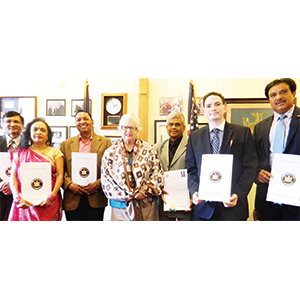
    The 13th edition of Pravasi Bharatiya Divas is being organized at Gandhinagar, Gujarat from January 7 to 9, 2015. It is the first time that PBD has gone to Gujarat.

    The PBD 2015 is dedicated to Mahatma Gandhi, the greatest non-resident Indian who on January 9, 1915 had come back to India from his pravas.

    To connect India to its vast overseas diaspora and bring their knowledge, expertise and skills on a common platform, the PBD Convention – the flagship event of Ministry of Overseas Indian Affairs (MOIA), Government of India is organized from 7th-9th January every year since 2003.

    Pravasi Bharatiya Divas (PBD) is celebrated on 9th January every year to mark the contribution of Overseas Indian community in the development of India. January 9 was chosen as the day to celebrate this occasion since it was on this day in 1915 that Mahatma Gandhi, the greatest Pravasi, returned to India from South Africa, led India’s freedom struggle and changed the lives of Indians forever.

    PBD conventions are being held every year since 2003. These conventions provide a platform to the overseas Indian community to engage with the government and people of the land of their ancestors for mutually beneficial activities. These conventions are also very useful in networking among the overseas Indian community residing in various parts of the world and enable them to share their experiences in various fields.

    During the event, individuals of exceptional merit are honored with the prestigious Pravasi Bharatiya Samman Award to appreciate their role in India’s growth. The event also provides a forum for discussing key issues concerning the Indian Diaspora.

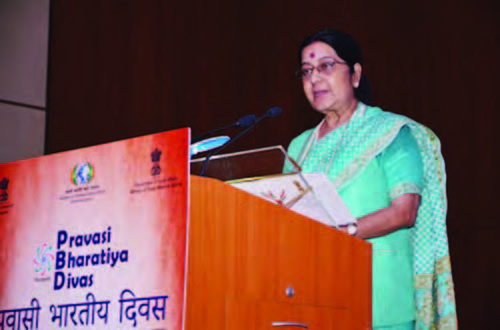
    Inaugurating the Youth Pravasi Bharatiya Divas (PBD) at Mahatma Mandir in Gandhinagar on January 7, Sushma Swaraj, Union Minister for External Affairs and Overseas Indian Affairs exhorted the Indian youth diaspora to ‘connect, celebrate and contribute’ to the transformational change being witnessed in India in the making of ‘Ek Bharat, Shreshth Bharat’.

    Sushma said, “The Indian youth diaspora can become ambassadors of the ‘new’ India as “you have retained a bit of India in your heart and each one of you have a bit of ‘Bharat’ in you.”

    PRAVASI BHARATIYA DIVAS 2015 1

    The Minister said that Youth PBD was not just about interacting with the young people of this country but has emerged as an important platform for the diaspora to discover and nurture their roots.

    She appealed to the youth to connect with the young generation of Indians – over 50% of the Indian people were under 25 years. Youth PBD, she said, was an occasion to celebrate India’s traditions, art and culture, even as the country strives to empower its youth with technology.

    “What excites the world today is India’s growth story,” Swaraj said and pointed to the government’s success in bringing about a complete transformation of the business sentiment in the country. This, she added, was the outcome of the numerous steps undertaken by the government to improve the ease of doing business.

    Swaraj said the diaspora could contribute significantly to the development of India through programs such as ‘Make in India’, ‘Digital India’, creation of smart cities and other physical infrastructure.

    Prime Minister Narendra Modi, on January 8, announced a string of facilities for expatriate Indians that seek to free them of regulations on their arrival to India and within the country.

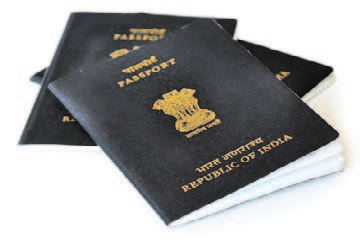
    Inaugurating the 13th Pravasi Bharatiya Divas (PBD), organized by the Ministry of Overseas Indian Affairs (MOIA) in partnership with the Ministry of Youth Affairs & Sports and the Government of Gujarat, the Prime Minister said life time visa will now be granted to PIO cardholders and as a mark of respect to them, the regulation requiring them to visit a police station to verify their credentials once every week, has been scrapped.

    Modi said while the PIO and OCI cards have been merged, allowing similar facilities to either cardholder, electronic authorization of visa has commenced, apart from extending the facility of visa on arrival from 43 countries. In addition, the Pravasi Bharatiya Centre will be operational in Delhi soon. The Prime Minister said engaging with the pravasis was not a one-way street; “not everything should be seen in terms of pounds or dollar” he said, adding that overseas Indians need to be given unstinted support so that they feel enthusiastic in contributing to India’s development.

    The Prime Minister suggested that an online quiz competition could be started from the PBD platform on ‘Bharat ko Jano’ for teams of young people worldwide. This would help project India’s development effort in the right perspective. The competition, he said, could be conducted round the year so that the campaign for knowing India becomes a global movement.

    Modi urged the pravasis to actively participate in the government’s ambitious ‘Clean Ganga’ initiative by sharing their expertise in technology, innovations, ideas and resources. “There are opportunities for all along the river – in agriculture, water transport, city development and village rejuvenation and even adventure sports,” the Prime Minister said.

    On the occasion of the centenary of Mahatma Gandhi’s return to India from South Africa, the Prime Minister released Rs 25 and Rs 5 commemorative stamps and Rs 100 and Rs 10 coins.

    The Chief Guest at the PBD, Donald R. Ramotar, President of the Republic of Guyana, said India’s has seen a transformational change in recent years. The time has come arrived for India to demonstrate its mature political leadership to guide other developing countries, participate more actively in internal forums, look outwards for channelizing investments to other countries and strengthen air and maritime links with the rest of the world.

    He assured Guyana’s commitment to India’s pursuit of reform of the UN Security Council and expressed total support for India’s candidature for a permanent seat in an expanded Security Council.

    Maite Nkoana-Mashabane, Minister of International Relations and Cooperation, Republic of South Africa, the Guest of Honour, pointed out that the political, economic and cultural bonds between South Africa and India were strong. These were cemented by the community of Indians in South Africa, the second largest outside India. The bonds must be further strengthened by addressing the triple challenges of poverty, unemployment and under-development.

    She stressed the need for closer cooperation between the two countries in the fields of IT, healthcare and renewable energy and expressed confidence that India would support South Africa in its development efforts. Sushma Swaraj, Union Minister for External Affairs and Overseas Indian Affairs, emphasized that successful and politically influential diaspora is an asset to India. She called upon the diaspora to pursue a mutually rewarding participation in developing India.

    Anandiben Patel, Chief Minister of Gujarat, said that the new economic and social initiatives launched by the Central Government have unleashed a new wave of enthusiasm among the people. The pravasis with the sincere hard work had raised India’s image internationally, while keeping the links with the land of their origin alive.

    The three- day kumbh of the NRIs has attracted NRIs from all parts of the world. For most Gujaratis abroad it is a welcome visit home.

  • Fifty Shades of Saffron

    Fifty Shades of Saffron

    On December 11, 2014, when the U.N. General Assembly adopted June 21 as the International Day of Yoga, as recommended by Prime Minister Narendra Modi, India rejoiced. Never mind that the day before was the first Human Rights Day under his watch; this crept by unnoticed.

    At the SAARC Summit, Mr. Modi declaimed, “As we seek to build bridges to prosperity, we must not lose sight of our responsibility to the millions living without hope.” He was, as always, matchless as a kathakar, an artiste whose fabulous retelling of fables reinforces them in the minds of the faithful as fact. But while his performances have zero defects, on the lives of the multitudes hanging on to his words, believing in them and daring to hope, they have had zero effect so far, because the responsibility of which the Prime Minister spoke is usually ignored.

    In 1990, the U.N. launched the Human Development Report based on the challenging predicate that “people are the real wealth of a nation.” How wealthy are we really? After two decades of rapid GDP growth, we bestride SAARC like a colossus doing the splits, one foot splayed eastward to keep China out, the other westward to keep Pakistan down. We loom like a giant among midgets, but on every parameter that measures equity in development, there is little to choose between us and our neighbors.

    The Human Development Index (HDI) for 2014 ranks us at 135 among 187 countries; Sri Lanka at 73 did way better than us, and we were shadowed by Bhutan at 136, Bangladesh at 142, Nepal at 145 and Pakistan at 146. The fact that India was a stable democracy, as the others were not, that our economy had galloped along, as theirs had not, had made very little difference to the lives of our citizens.

    Within the HDI, the Gender Inequality Index which measures three critical parameters – reproductive health, women’s empowerment and their participation in the labor market – is particularly important because it shows how a society treats its more vulnerable half. Sri Lanka at 75 is well ahead of us, but so is Nepal at 98, Bhutan at 102 and Bangladesh at 115. India is in lock-step with Pakistan, both ranked at 127. The Criminal Law Amendment Act, which brought in far-reaching measures to protect women, is now almost two years old; sadly, it has made little difference.

    Depth of deprivation

    My five years on the National Human Rights Commission were a humbling experience. In 2009, we had 82,000 complaints, in 2013, a lakh. A five-member Commission could not possibly do justice to more than a fraction of these. We dismissed 60 per cent of complaints in limine, or at the outset, 11 per cent with directions to officials to act (but never had the time to check if they did) and transferred 6 per cent to the State Human Rights Commissions, which were mostly ramshackle.

    Our investigative visits to rural India were dives into the darkness that contained the mass of the iceberg of which the complaints coming to us were only the tip. In a country still largely illiterate, a terrible violation of human rights in itself, very few knew the NHRC existed. Those who did wondered if it would be able to help; many thought it would not. For every complaint that came to us, a hundred did not, but since so many were on systemic problems affecting entire communities, they brought home to us the range, depth and persistence of discrimination and deprivation in India. The two are often linked, and that is the real cause of worry with our new dispensation. The poorest and the most vulnerable – women, Scheduled Tribes, Scheduled Castes and Muslims – suffer because the social bias against them is rooted in Hindu belief and practice, and still so strong that the laws meant to protect them are impotent. Even under a secular government, public servants would plead with the NHRC that there would be law and order problems if they tried to implement these. The danger now is that under a government so overtly Hindu, these practices will flourish even more. The hate speeches of Cabinet members signal where this could lead us.

    “Discrimination and deprivation are often linked to one another, and that is the real cause of worry with our new dispensation”

    Mr. Modi wants his party to be careful with their words, but there are fifty shades of saffron around, most of it strident. He wants civil servants to be sensitive, but they always are, to the wishes of the powers that be. He wants the police to be SMART, but they already are, reporting to the National Crime Records Bureau that in 2013 there were only two incidents of human rights violations by their personnel. The same year, 33,753 complaints to the NHRC, a third of the total received, were against the police, detailing how they preyed on those they should protect.

    In Mr. Modi’s defense, these are national problems he has inherited, not created, but Gujarat is the template he holds up to the rest of India, and there are a range of impartial reports that show how cavalier it has been about the lives of the State’s people. A 2013 Lancet study found that among the 11 rich States, Gujarat had done the worst in bringing down the mortality rate of children under five, one of the Millennium Development Goals. The Census established that the sex ratio in Gujarat has declined from 934 in 1991 to 920 in 2001 to 918 in 2011. Not surprisingly, the NCRB data shows a high incidence of crimes against women. So too, the data shows, are crimes against Scheduled Castes, at levels higher than in the other developed States: Maharashtra, Punjab and Tamil Nadu. The ASER/Pratham Reports on Education show low percentages of students in Standard V who could read a Standard II text, and could do divisions. That is not a model to copy.

    Dreadful cost

    Despite what he said in Kathmandu, Mr. Modi’s record as Gujarat Chief Minister shows that his sights are set on prosperity, not on “the millions living without hope.” ‘Make in India’ is his priority, and there the signs are ominous. A few weeks back, ASSOCHAM issued an advertisement which announced, “Repeal of archaic laws is the need of modern times…ASSOCHAM has identified 105 laws for review, which can promote a better regulatory framework for successfully actualizing Mr. Modi’s vision of ‘Make in India’.” These include 43 laws that protect human rights and safeguard labor welfare, including the Bonded Labor System (Abolition) Act, Protection of Forest Rights Act, Inter-State Migrant Workers Act, Child Labor (Prohibition and Regulation) Act, and the Minimum Wages Act. If these are the voices he listens to, development will come at a dreadful cost.

    India’s governments have so far pursued development with a human face. Vast social welfare programs protect those whom the market forces savage, but these are riddled with huge problems. For instance, hardly any materials go into the rural employment guarantee projects, but each year material costs claimed are well over 20 per cent of its budget. A survey done for the NHRC showed that 60 per cent of the allocation for the Integrated Child Development Services was being stolen. The list goes on. The answer does not lie in jettisoning these programs, but in making them work better. Without them, rural India will empty out.

    Our Prime Minister’s many admirers believe that Sardar Patel’s mantle has descended on him. Vallabhbhai Patel made India, Narendra Modi can unmake it. But with his extraordinary talents, integrity and ability, our Prime Minister can also be the making of India, and make India, all of India, proud. That should be his tribute to his idol, not the monstrous statue of the Sardar now rising in Gujarat like a prelapsarian Ozymandias.

    By Satyabrata Pal

  • GIR: THE LAND OF THE LION

    GIR: THE LAND OF THE LION

    In Gir you touch the history of India before humanity itself. Before monuments, temples, mosques and palaces. Or rather, a history as humanity was emerging, when humans coexisted with lions, before the former had overrun the continent (and the world) and pushed the latter to the brink of extinction. Many come to Gir because, outside of Africa, it is the only place with wild lions. But to truly experience Gir and the lions, you must explore their natural habitat, with everything from tiny wild birds, not easily seen, but heard singing in the forest canopy, to crocodiles floating in the marsh waters.

    Driving around, you are uncommonly aware you are in someone else’s territory. You stay in your vehicle because you are in the home of lions, leopards, hyenas, crocodiles; you remember that humans do not rule the world, and however “advanced” we think we are, most of us would not survive very long on our own in a place like Gir. That is not to say that all humans are out of place. The local Maldhari community has lived here for generations and coexists magnifcently with the wilderness. They sustain themselves by grazing their livestock and harvesting what they need from the forest. The sizeable portion of their herds lost to lions and other predators is considered prasad, offered in exchange for living in another’s homeland.

    Flora

    Most of the area is rugged hills, with high ridges and densely forested valleys, wide grassland plateaus, and isolated hilltops. Around half of the forested area of the park is teak forest, with other trees such as khair, dhavdo, timru, amla, and many others. The other half is non-teak forest, with samai, simal, khakhro and asundro jambu, umro, amli, vad and kalam; mostly broadleaf and evergreen trees. The river Hiran is the only one to flow year-round; the rest are seasonal. There are also areas of the park with open scrub and savannah-type grassland.

    Deer and Antelope

    This variety of vegetation provides for a huge array of animals. The most-sighted animal in the park, the chital, or Indian spotted deer, inhabits the dry and mixed deciduous forest, with a population of over 32,000. The more reclusive sambar, the largest of the Indian deer species, weighing 300-500 kg, lives in the wetter western part of the park. Both the sambar and the chausingha, the world’s only 4- horned antelope (chau= four, singha= horns), are very dependent on water, and rarely found far from a water source. Another one-of-a-kind is the chinkara, the only gazelle in the world with horns in both males and females. The fastest of the Indian antelopes, the blackbuck, also lives in Gir, but has a relatively small population here compared to Velavadar National Park (near Bhavnagar), as it prefers open grasslands to forests.

    Wild Cats

    Along with the famous lions, who number around 350, the park is also home to four other wild cats. There are around 300 leopards, though they are nocturnal and thus harder to spot. Of the three smaller wildcats, the jungle cat is the most widespread, and lives in deciduous scrub and riverine areas. The mysterious desert cat is almost never seen. The rusty spotted cat, previously thought to only live in the Dangs of southeast Gujarat, has only recently been found in Gir.

    Other animals and reptiles

    The top and middle canopies of the dry, mixed and riverine decidous forests are home to troops of hanuman langur monkeys. The striped hyena is usually seen scavenging alone in the grasslands and scrub forest, far more solitary than the African hyena.Wild boars rooting into the ground for tuber provide aeration of the soil. If you look closer, you may see smaller mammals like pangolins, pale hedgehogs, Indian hares, or grey musk shrews. The ratel or honey badger is renowned for its snake-killing exploits, earning it the “most fearless animal” title in the Guinness Book of World Records. Another snake-killer in Gir is the ruddy mongoose; the snakes they contend with include the common krait, russell’s viper, and the saw-scaled viper. The Kamaleshwar reservoir now houses the largest population of marsh crocodiles in the country. Other reptiles include the soft-shelled turtle, star tortoise, Indian rock python and monitor lizard (which grows to over 1.5 m long; don’t look for the lizards that live in your yard.)

    Birds

    Gir is also home to more kinds of birds than any other park in Gujarat, yet somehow is not known for its birdlife. While it may not have the half-million flamingoes found in Kutch during breeding season, Gir is home to over 300 species of birds, many of which can be seen yearround, from the Malabar whistling thrush to the Paradise flycatcher, from the crested serpent eagle to the king vulture, from pelicans to painted storks. The noted ornithologist Dr. Salim Ali said that if there were no lions here, Gir would be well-known as one of the best bird sanctuaries in western India.

    The Asiatic Lion

    Until the early 19th century, Asiatic lions roamed an immense area of South and Southwest Asia, as far east as Greece and as far west as modern Bangladesh. As humanity has lived in this region for millennia, people coexisted with lions for thousands of years, but in the last few centuries, the growth of the human population has come at the cost of the lions’ habitat. Like the Bengal Tiger and the Asiatic Cheetah, lions saw a dramatic decline in population as their preferred habitat of grasslands and semi-forested areas became overrun with humans. Beyond just habitat reduction, though, once guns arrived and became widespread, from 1800-1860, nearly all the lions remaining outside Gujarat were hunted and killed.

    The last Asiatic lions in India outside of Gir forest were killed in 1886 at Rewah, and the last wild lion sighted the world outside Gir was in Iran in 1941. In 1901, Lord Curzon was offered to be taken lion hunting while visiting Junagadh. Noting that these were the only lions left in Asia, he declined, and reportedly suggested to the Nawab of Junagadh that it would be better to conserve the lion population than to hunt it. The Nawab began what was probably the first institutional wildlife conservation effort in India and one of the earliest in the world (though various human societies have been operating in ways that conserve wildlife throughout the ages), banning all lion hunting entirely.

    From a population reported to be as low as 20 in 1913 (considered exaggerated by some wildlife experts, noting that the first official census in the 1930s found over 200 lions), the lions have rebounded to now number 359 in the most recent census of 2005. This is due almost entirely to the Nawab’s conservation efforts, and the Indian Government’s post-independence ban on lion killing in 1955. Though the lions have maintained a small healthy population, their habitat continues to shrink, and they remain a critically endangered species.

    The Gir forest area, which covered over 3000 square km in 1880, was reduced to just over 2500 square km by the mid-20th century, and only 1400 square km today. Of that, a mere 258 square km make up the National Park itself. While the population has grown due to successful conservation programs in the park, the park is too small for the number of lions it now houses, and lions are straying outside to seek further living space, often not surviving well in the other areas. Locally called sher or sinh, the Asiatic lion is over two and a half meters long, weighs 115 to 200 kg, and can run short distances at 65 km/h to chase down the sambar, chital, nilgai, and chinkara that are its preferred prey.

    However, when not hungry, it will never attack an animal; after a lion makes a kill, it will gorge itself on up to 75 kg of meat, and then not worry about eating for a few days, so it is not unusual to see a well-fed lion lounging calmly beside a herd of grazing deer. The lions prefer open scrub and deciduous forest areas, and are very bold, not shy around humans. So even if they seem tame or timid, do not approach them, they are still very powerful wild animals.

  • New Balance of Power in Asia? India is challenging China’s assertiveness

    New Balance of Power in Asia? India is challenging China’s assertiveness

    “India must increase investments in education and infrastructure, achieve more equitable economic development if it is to emerge as a major driver of the global economy. Only then will it be able to make a significant contribution to Asian and international security and contribute to a new peace-promoting balance of power in Asia”, says the author.

    By Anita Inder Singh

    India’s decision to help Vietnam boost its defense modernization – against China’s wishes – raises yet again the question whether a new balance of power is emerging in Asia. India, Vietnam and Japan will try to coordinate security and economic policies. That suggests India is challenging China’s assertiveness in the Asia-Pacific region and staking a claim to explore the energy-rich resources of the South China Sea. Economic and strategic diplomacy were intertwined when Prime Minister Modi visited Japan and the US – and when Chinese President Xi Jinping visited India in mid-September.

    India needs investment to improve its rickety infrastructure and Japan, China and the US have come forward with offers to help India renew it. Companies in all three countries seek new investment destinations and potentially India is one of the biggest. Mutual economic interests are not enough for India to increase its contribution to Asian and global security. The simultaneous interest of Japan and the US in India’s development and its greater role in Asian security only highlight India’s economic weakness and the blunt fact that its ability to enhance its regional role will hinge on its economic performance improving quickly and steadily.

    India has much to gain – and learn – from closer ties with Japan, which is Asia’s oldest democracy. Neither history, nor political/territorial disputes divide India and Japan. As Asia’s post-1945 economic wunderkind Japan had surpassed India, China and many west European countries by the early 1960s. India and Japan are already collaborating on maritime security, counter-terrorism, and energy security. At their summit talks, Modi and Prime Minister Shinzo Abe decided to strengthen defense ties and forge a special strategic global partnership, emphasizing that a developed India and a prosperous Japan were important for Asia and for global peace and security.

    Economics and strategy mixed again when Modi met Japanese business leaders. The 21st century, Modi asserted, would belong to Asia – exactly how would depend on “how deep and progressive” the Indo-Japanese relationship is. This is the immediate context in which he deplored the “expansionist” tendencies among countries, caught in an 18th-century time-warp, to “engage in encroachment” and “intrude” into the seas of others. Evidently Modi was not letting trading interests blur the real political differences with such countries. These comments, made before President Xi Li Ping visited India, were widely interpreted as anti-China. The state-steered Chinese Global Times has downplayed any idea that China counted less than Japan with India.

    “China’s GDP is five times that of India’s. Mutual trust between Beijing and New Delhi, facing strategic pressure from the north, is difficult to build as there is also an unresolved border conflict between the two,” its editorial said. That appeared more of a threat than an olive branch to India. Modi carefully avoided running China down. Before leaving for the US he stated that the world should trust China to observe international law. But Xi’s visit did not enhance trust between New Delhi and Beijing. Even as Xi assured Modi of $20 billion in investment in Gujarat Chinese troops made one of their frequent forays into north-eastern Indian territory, which Beijing claims belongs to China.

    Those forays followed a pattern. China unilaterally invokes “history” (its version) when referring to territorial conflicts with India – and other neighbors. China’s attitude to India echoes that with its Asian neighbors, including Japan, Vietnam and the Philippines. By claiming a territory in the name of history it creates a dispute, dispatches its ships or aircraft – (or in India’s case, troops) – to back up that claim. That is how it unilaterally outlined last November an “air-defense identification zone” over an area of the East China Sea covering Senkaku islands that are also claimed by Japan (and Taiwan). Strong trading ties have not stopped China from using history to make claims on neighboring territories.

    In fact Japan is the largest foreign investor in China. And China is ASEAN’s largest trading partner. In New Delhi Xi’s reference to historical ties between ancient civilizations was marred by the assertion that the Sino-Indian border dispute had historical roots. Such statements imply that the border disputes will remain unsettled; more importantly, that Beijing will continue to lay claim to the Arunachal Pradesh and Ladakh regions. In that case India – like Japan and Vietnam – may find itself simultaneously taking up the politicalstrategic gauntlet and engaging in much-needed trade with China.

    China does nothing to dispel the fears of its neighbors and insists on bilateral solutions. Its claims to un-demarcated maritime waters, including the East and South China Seas (Beijing defines the latter as a ‘core’ interest) are contested by its neighbors, who want the disputes those claims give rise to be settled through international arbitration. That explains why, without naming China, the Obama-Modi communiqué, called on all parties to avoid the use, or threat of use, of force in advancing their claims. It also urged a resolution of their territorial and maritime disputes through all peaceful means, in accordance with the international law, including the UN Convention on the Law of the Sea. At another level, China has taken advantage of America’s planned withdrawal from Afghanistan and is increasing investments there. It is also securing its energy supplies in the oil and gas fields of Central Asia. Moreover, it is India’s main competitor for influence in the Indian Ocean area, which is bounded by Asia on the north, on the west by Africa, on the east by Australia, and on the south by the Southern (Antartic) Ocean.

    There is nothing improper about these activities. But they alarm China’s neighbors and the US, none of whom wants China to gain primacy in Asia. Unsurprisingly, Obama and Modi stressed the need to accelerate infrastructure connectivity and economic development corridors for regional economic integration linking South, Southeast, and Central Asia. The US and India want to promote the India- Pacific Economic Corridor, which will link India to its neighbors and the wider Asia-Pacific region, with a view to facilitating the flow of commerce and energy. That will not be lost on China. Meanwhile uncertainty hovers over the nature of America’s rebalance or pivot to Asia since it has been announced at a time when Washington is cutting defense expenditure. India must increase investments in education and infrastructure, achieve more equitable economic development if it is to emerge as a major driver of the global economy. Only then will it be able to make a significant contribution to Asian and international security and contribute to a new peace-promoting balance of power in Asia.

    (The author is a visiting professor at the Centre for Peace and Conflict Resolution, New Delhi)

  • NEED FOR A LONG-TERM PLAN NOW

    NEED FOR A LONG-TERM PLAN NOW

    It can be considered the biggest strategic failure of Indian diplomacy that even after more than six decades, India has not found a way to neutralize the malevolence of a neighbor one-eighth its size”, says the London based author.

    Pakistan has a way of making its presence felt in India’s foreign policy and national security matrix that, much to New Delhi’s chagrin tends to steal India’s diplomatic thunder. At a time when Prime Minister Modi was trying to project himself as a global statesman with a successful visit to Japan, a visit to Gujarat and then Delhi by the Chinese President, and a ‘rock-star’ reception in the US, Pakistan decided it must get some attention.

    So the Pakistani Army did what it does best. It escalated tensions along the border in an attempt to ratchet up pressure on India. It started with unprovoked mortar shelling on forward Indian positions along the Line of Control (LoC) and over the next few days, the firing spread to the international border and intensified.

    Accusing India of “deliberate and unprovoked violations of the ceasefire agreement and cross-border firing,” Pakistan promptly shot off a letter to the UN Secretary General asking for an intervention by the United Nations Military Observer Group in India and Pakistan, a body for which India sees little role after the signing of the 1972 Simla Pact.

    The UN decided to ignore Pakistani shenanigans and has merely reiterated that India and Pakistan need to resolve all differences through dialogue to find a long-term solution to the dispute. Pakistan is facing multiple crises. Its global isolation is increasing by the day. US forces are withdrawing from Afghanistan starting December 2014 and Beijing is increasingly dissatisfied with Islamabad’s attempts at controlling the flow of Islamist extremists into its restless Xinjiang province.

    Tensions are rising also on Pakistan’s borders with Iran where Pakistani Sunni extremists are targeting Iranian border posts, forcing Iranian policymakers to suggest that if Pakistani authorities “cannot control the common border, they should tell us so that we ourselves can take action.” And the new government in Afghanistan under Ashraf Ghani is likely to go even further in developing close ties with New Delhi.

    Domestically, the Kashmir issue is once again becoming a political football with Bilawal Bhutto Zardari bombastically declaring that Pakistan People’s Party (PPP) would get back entire Kashmir from India. Imran Khan is breathing down Nawaz Sharif’s neck and the Pakistan Army’s struggle against domestic Taliban seems to be going nowhere. All this is happening at a time when there is renewed confidence in India about its future as a major global player under the Modi government and when the world is ready to look at the Indian story afresh.

    No wonder, the Pakistani security establishment is nervous about its growing irrelevance – and what better way to come into global prominence once again than to try to create a crisis in Kashmir! Despite the election season in India in the last fortnight, the Modi government’s reaction has been creditable so far. Rahul Gandhi came out of hibernation to attack the Prime Minister for ceasefire violations by Pakistan. The government, however, ignored the opposition’s many taunts and confidently made clear to Pakistan that Indian forces would “make the costs of this adventurism unaffordable.”

    This gave the Indian military much-needed operational space to carve out a response which was swift, sharp and effective. Together, the Indian government and the nation’s military have underlined the costs of Pakistan’s dangerous escalatory tactics by massive targeted attacks on Pakistani Ranger posts along the border. Now the Modi government needs a long-term plan to handle Pakistan. It can be considered the biggest strategic failure of Indian diplomacy that even after more than six decades, India has not found a way to neutralize the malevolence of a neighbor one-eighth its size.

    Business-as-usual has never been an option for India, and yet India’s Pakistan policy in recent years has struggled to move beyond cultural exchanges and cross-border trade. Pakistan has continued to train its guns at India and drain India’s diplomatic capital and military strength, while India has continued to debate whether Pakistani musicians should be allowed to enter India. This disconnect between Pakistan’s clear strategic priority and India’s magnificently shortsighted approach will continue to exact its toll on India unless Delhi makes it a priority to think outside the box on Pakistan.

    Pakistan has a revisionist agenda and would like to change the status quo in Kashmir while India would like the very opposite. India hopes that the negotiations with Pakistan would ratify the existing territorial status quo in Kashmir. At its foundation, these are irreconcilable differences and no confidencebuilding measure is likely to alter this situation. India’s premise largely has been that the peace process will persuade Pakistan to cease supporting and sending extremists into India and start building good neighborly ties. Pakistan, in contrast, has viewed the process as a means to nudge India to make progress on Kashmir, a euphemism for Indian concessions. The debate in India on Pakistan has long ceased to be substantive.

    The choice that India has is not between talking and sulking. Pakistan has continued to manage the façade of talks with India even as its support for separatism and extremism in India continues unabated. India should also continue to talk (there is nothing to lose in having a low-level diplomatic engagement after all) even as it needs to unleash other arrows in its quiver to manage Pakistan. Smart policy for India means not being stuck between the talking/not talking binary.

    It’s not talking that matters but under whose terms and after years of ceding the initiative to Pakistan, it is now for India to dictate the terms for negotiations. If Pakistan manages to put its own house in order and refrain from using terrorism as a policy instrument against India, then India should certainly show some magnanimity. Indian policy makers had long forgotten poet Dinkar’s immortal lines: kshama shobhti us bhujang ko, jiske paas garal hai, uska kya jo dantheen, vishrahit vineet saral hai. (When a serpent that has venom, teeth and strength forgives, there is grace and magnanimity in its forgiveness.

    But when a serpent that has no venom and no bite claims to forgive, it sounds like hypocrisy and amounts to hiding its defeat with noble words.) Modi has done well to remind Pakistan that India can impose serious costs in response to Pakistan’s irrational behavior and he should now build on that. Pakistan’s India obsession is not about Kashmir. The very manner in which Pakistan defines its identity makes it almost impossible that India will ever be able to find a modus vivendi with Islamabad. New Delhi should be ready to face this hard reality. The Modi government has made a good start and now it should follow through with a long-term strategy vis-à-vis its immediate neighbor.

    (The author teaches at King’s College London in the Department of Defence Studies. He is also an associate with the King’s Centre for Science and Security Studies and an affiliate with the King’s India Institute. His current research is focused on Asia-Pacific security and defence issues).

  • DHANTERAS

    DHANTERAS

    THE FESTIVAL OF WEALTH

    The festival of Dhanteras falls in the month of Kartik (Oct-Nov) on the thirteenth day of the dark fortnight. This auspicious day is celebrated two days before the festival of lights, Diwali.

    How to Celebrate Dhanteras

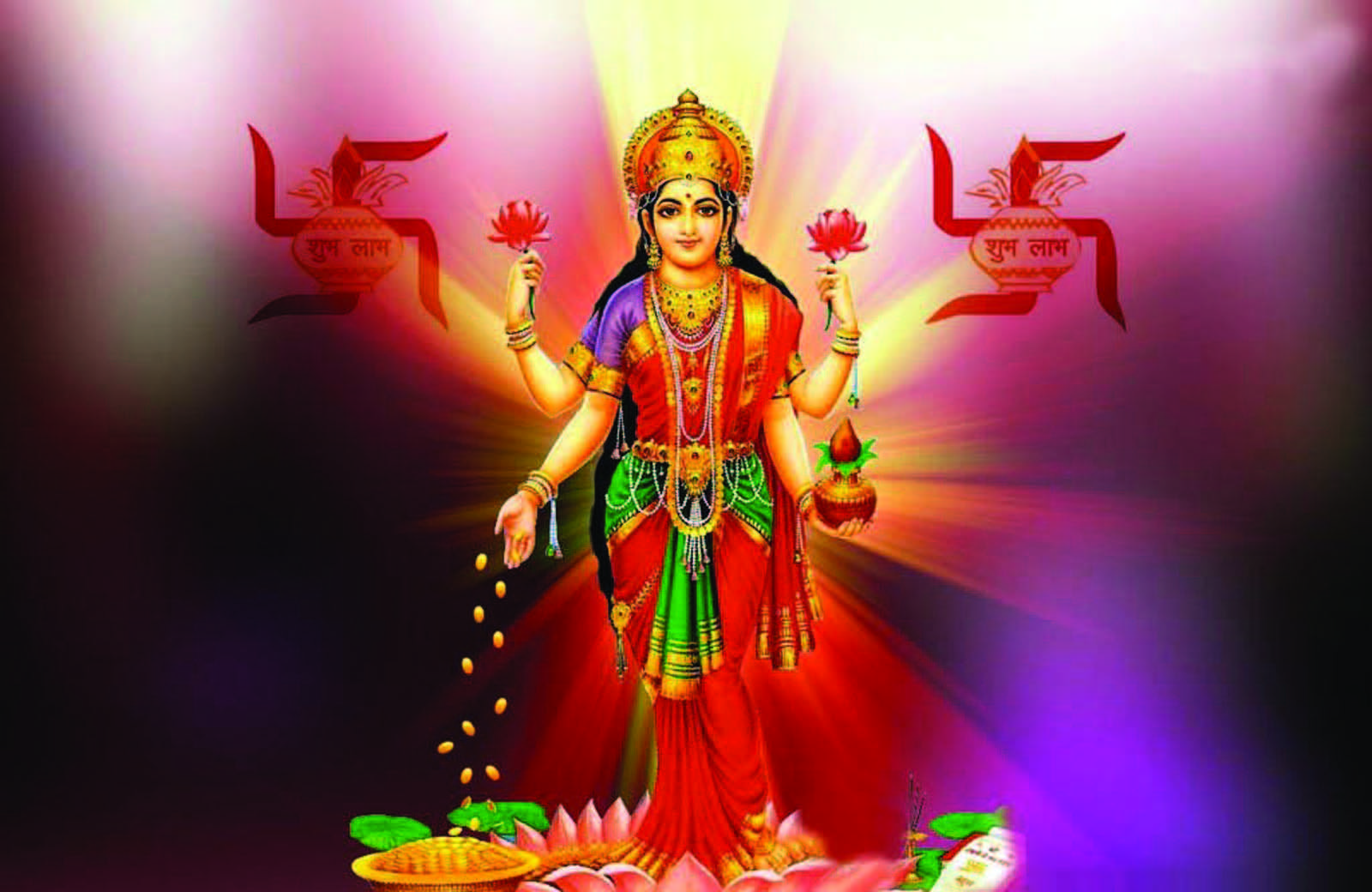
    On Dhanteras, Lakshmi – the Goddess of wealth – is worshiped to provide prosperity and well being. It is also the day for celebrating wealth, as the word ‘Dhan’ literally means wealth and ‘Tera’ comes from the date 13th. In the evening, the lamp is lit and Dhan-Lakshmi is welcomed into the house. Alpana or Rangoli designs are drawn on pathways including the goddess’ footprints to mark the arrival of Lakshmi. Aartis or devotional hymns are sung eulogizing Goddess Lakshmi and sweets and fruits are offered to her. Hindus also worship Lord Kuber as the treasurer of wealth and bestower of riches, along with Goddess Lakshmi on Dhanteras. This custom of worshiping Lakshmi and Kuber together is in prospect of doubling the benefits of such prayers. People flock to the jewelers and buy gold or silver jewelry or utensils to venerate the occasion of Dhanteras. Many wear new clothes and wear jewelry as they light the first lamp of Diwali while some engage in a game of gambling.

    Diwali Shopping is Completed

    Dhanteras is observed differently by different communities. It is considered to be highly auspicious day to do new purchases and investment. Most people complete the Diwali shopping on the day. The first lamps of Diwali are lit on the day. People hang up paper lanterns with festoons and sends out the message of the arrival of Diwali.

    Get-Together of All Family Members

    Dhanteras is not all about material wealth it is also a time to develop spiritual wealth and family bonding. All family members arrive at ancestral home on the day. Grand Parents and Parents wait for the day as sons, daughters and grand children arrive from distant places.


    25


    Welcoming Goddess Lakshmi

    Goddess Lakshmi is welcomed into the house on Dhanteras day in many regions in the evening. Rangoli is drawn on doorways and tiny footprints of Lakshmi are drawn in vermilion to symbolize her arrival. Devotional songs dedicated to Goddess Lakshmi are sung in the evening. Sweets are offered to the Goddess on the day.

    Goddess Lakshmi Puja for Three Days

    In some regions Goddess Lakshmi Puja is performed for three days – Dhanteras, Choti Diwali and Diwali. On the first day, Dhanteras day, all family members especially men and women bathe after applying fragrance, medicinal herbs or preparation and fragrant oils. Murti – painting or idol or picture – of Goddess Lakshmi is washed with water and worshipped for three days commencing from Dhanteras.

    Buying Gold – Silver or Utensil

    Dhanteras – Dhan means ‘wealth’ and theras indicates ‘the thirteenth day’. In most places in North India, Gujarat and Maharashtra, Dhanteras is an auspicious day to buy precious metals like gold, platinum and silver. Women shop for gold or silver or at least one or two new utensils on the day. Precious metal bought on the day is seen as a sign of good luck.

    Earthern Diyas in the Evening

    Earthern diyas are lit on Dhanteras day in the evening to banish the evil spirits.

    Legend behind the Dhanteras and Naraka Chaturdashi:

    An ancient legend ascribes the occasion to an interesting story about the 16 year old son of King Hima. His horoscope predicted his death by snake-bite on the fourth day of his marriage. On that particular day, his newly-wed wife did not allow him to sleep. She laid out all her ornaments and lots of gold and silver coins in a heap at the entrance of the sleeping chamber and lit lamps all over the place. Then she narrated stories and sang songs to keep her husband from falling asleep.

    The next day, when Yama, the god of Death, arrived at the prince’s doorstep in the guise of a Serpent, his eyes were dazzled and blinded by the brilliance of the lamps and the jewelry. Yam could not enter the Prince’s chamber, so he climbed on top of the heap of gold coins and sat there the entire night listening to the stories and songs. In the morning, he silently went away.

    Thus, the young prince was saved from the clutches of death by the cleverness of his new bride, and the day came to be celebrated as Dhanteras. And the following days came to be called Naraka Chaturdashi (‘Naraka’ means hell and Chaturdashi means 14th). It is also know as ‘Yamadeepdaan’ as the ladies of the house light earthen lamps or ‘deep’ and these are kept burning throughout the night glorifying Yama, the god of Death. Since this is the night before Diwali, it is also called ‘Chhhoti Diwali’ or Diwali minor.

  • BHAI DOOJ: THE BOND OF BROTHERLY-SISTERLY LOVE

    BHAI DOOJ: THE BOND OF BROTHERLY-SISTERLY LOVE

    Nowhere is the bond of brotherly-sisterly love glorified with such grandeur as in India. Hindus celebrate this special relationship twice every year, with the festivals of Raksha Bandhan and Bhai Dooj.

    What, When & How

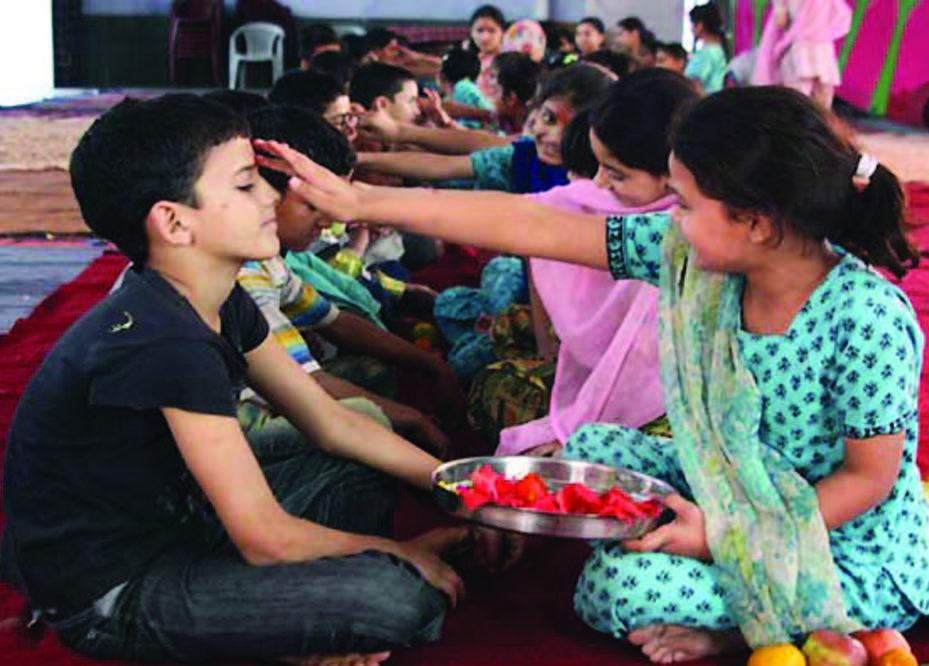
    After the high voltage celebrations of Diwali , the festival of lights and fire-crackers, sisters all over India get ready for ‘Bhai Dooj’ – when sisters ceremonize their love by putting an auspicious tilak or a vermilion mark on the forehead of their brothers and perform an aarti of him by showing him the light of the holy flame as a mark of love and protection from evil forces. Sisters are lavished with gifts, goodies and blessings from their brothers. Bhai Dooj comes every year on the fifth and last day of Diwali, which falls on a new moon night. The name ‘Dooj’ means the second day after the new moon, the day of the festival, and ‘Bhai’ means brother.

    Myths & Legends

    Bhai Dooj is also called ‘Yama Dwiteeya’ as it’s believed that on this day, Yamaraj, the Lord of Death and the Custodian of Hell, visits his sister Yami, who puts the auspicious mark on his forehead and prays for his well being. So it’s held that anyone who receives a tilak from his sister on this day would never be hurled into hell. According to one legend, on this day, Lord Krishna, after slaying the Narakasura demon, goes to his sister Subhadra who welcomes him the lamp, flowers and sweets, and puts the holy protective spot on her brother’s forehead. Yet another story behind the origin of Bhai Dooj says that when Mahavir, the founder of Jainism, attained nirvana, his brother King Nandivardhan was distressed because he missed him and was comforted by his sister Sudarshana. Since then, women have been revered during Bhai Dooj.


    22


    Bhai Phota

    In Bengal this event is called ‘Bhai Phota’, which is performed by the sister who religiously fasts until she applies a ‘phota’ or mark with sandal wood paste on her brother’s forehead, offers him sweets and gifts and prays for his long and healthy life. Every brother eagerly awaits this occasion that reinforces the bond between brothers and sisters and their affectionate relationship. It’s an opportunity for a good feast at the sister’s place, coupled with an enthusiastic exchange of gifts, and merriment amid the resounding of conch shells in every Bengali household.

    Underlying Significance

    Like all other Hindu festivals , Bhai Dooj too has got a lot to do with family ties and social attachments. It serves as a good time, especially for a married girl, to get together with her own family, and share the post- Diwali glee. Nowadays, sisters who are unable to meet their brothers send their tika – the spot of protection – in an envelope by post. Virtual tilaks and Bhai Dooj e-cards have made it even easier for brothers and sisters, who’re far away from each other, specially remember their siblings on this propitious occasion.

    Bhai Dooj In Uttar Pradesh

    In Uttar Pradesh, at first, sisters give a piece of cloth, knotted into a circular shape, full of batashas (sugar balls) to their brothers. This piece of cloth is called as ‘aabf’. For each brother, there are two aabf. After all the rituals, sisters apply a tika of roli and rice on the forehead of the brothers and then perform aarti, praying for the long and happy life of their brothers. At last, they offer sweets to them and then the story of Bhai Dooj is narrated.

    Bengal

    In Bengal this festival is called Bhai Phota. On this day, sisters observe fast till the time all the traditional customs have been performed. After this, they apply tika made of sandalwood paste, ghee and kohl (kajal) on their brothers’ forehead. Then the aarti is performed and sisters give sweets to their brothers to eat. Kheer and coconut laddus are the traditional sweets which are prepared on this day. At the time of applying tika, the sister chants the mantra which is as follows: “Bhratus tabaa grajaataaham Bhunksa bhaktamidam shuvam Preetaye yama raajasya Yamunaah Visheshatah.” This mantras means “I, your sister making you eat this holy rice for the pleasure of Yama and Yamuna”. In this way she prays God to bless her brother with the best in life.

    Bihar

    In the Bihar, the festival of Bhai Dooj is celebrated in the most unique way. The sisters curse their brothers in order to keep the evil spirits and dangers away from them. At first, they say very bad things to their brothers and then prick their own tongue with a wild prickly fruit as a punishment. By doing this, they ask their brothers to forgive them for the ill behaviour and mistakes which they have done till the date. Besides this, there is a unique custom in which brothers eat grains of bajri with water, from the hands of their sisters.

    Punjab

    In Punjab, the day after Diwali is celebrated as tika and on this day, sisters make a paste with saffron and rice and apply tika on their brothers’ forehead to keep away all the difficulties and dangers from them. After this, they exchange gifts and sweets among each other.

    Gujarat

    Bhai Dooj in Gujarat is known as Bhai Beej and on this auspicious occasion, sisters get up early in the morning and then the traditional tilak ceremony is held. After this, they perform aarti of their brothers and pray for their good fortune and life. Then they offer sweets to their brothers and in return the brothers bless them and exchange gifts.

    Maharashtra & Goa

    Marathi communities in Maharashtra and Goa called this festival as Bhav Bij. On this day, sisters draw a square on the floor in within the boundaries of which the brothers have to sit. After they are seated, it is a custom for to have a bitter fruit named Karith. After this, the rituals and applying the Tilak, traditional sweets such as Shrikhand Puri and Basundi Puri are served.

  • What Modi did not say on Oct 2

    What Modi did not say on Oct 2

    In the cleanliness drive Gandhi’s real message of communal harmony was missing

    “That communal harmony was his (Gandhi’s) foremost concern was emphasized again in 1921 and repeated on March 24, 1947, at a prayer meeting in Rajghat thus: “I would say that Hindus and Muslims are the two eyes of mother India – just as the trouble in one eye affects the other too, similarly the whole of India suffers when either a Hindu or a Muslim suffers”, says the author

    The Modi government has, by a not-so-clever sleight of hand, converted the most important day in India, October 2, Gandhi’s birthday, into a cleanliness day. Of course this was buttressed by a repeat of Gandhi’s exhortation of “cleanliness is next to godliness”. No one can be against spreading awareness about cleanliness. But when an attempt, and not so subtle one, is made by the RSSdominated Modi government to sidetrack the real message of Gandhi, one cannot ignore this mischievous move.

    Days before Modi was to do the cleaning act at the Valmiki quarters in New Delhi, the whole area was checked for security (right, no objection to the security angle). But what was hypocritical was the fact that the whole area was cleaned by the sanitation staff regularly for days earlier. Have we not seen in newspapers how ministers, in order to show their extra loyalty, had empty bottles thrown by the sanitary staff without any embarrassment and then made a mockery of the cleanliness drive by removing them while getting themselves photographed? My objection is not to the observance of the cleanliness day – do it by all means provided it is on another day. But I do have a serious objection to converting Gandhi’s birthday as the cleanliness day, as if that is the most important message of Mahatma Gandhi.

    If one watched TV channels, it was Modi and his cohorts waving the broom. Gandhi’s real message of communal harmony was totally missing. Gandhi’s stature of being the tallest Indian was reduced to a small mention and the whole focus was on Modi holding a broom. If the Modi government denies this, will it explain why it never mentioned the real message of Gandhi which he consistently emphasized? Let me reproduce the pledge which Mahatma Gandhi wanted Indians to take in 1919: “With God as a witness we Hindus and Mohamedans declare that we shall behave towards one another as children of the same parents, that we shall have no differences, that the sorrows of each will be the sorrows of the other and that each shall help the other in removing them. We shall respect each other’s religion and religious feelings, and shall not stand in the way of our respective religious practices.

    We shall always refrain from violence to each other in the name of religion.” That communal harmony was his foremost concern was emphasized again in 1921 and repeated on March 24, 1947, at a prayer meeting in Rajghat thus: “I would say that Hindus and Muslims are the two eyes of mother India – just as the trouble in one eye affects the other too, similarly the whole of India suffers when either a Hindu or a Muslim suffers.” Gandhi’s emphasis against communalism was again shown in the letter he wrote in Harijan in January 1948 in Gujarati (emphasis mine) where he specifically said: “I think it is proper to address a few words to the people of Gujarat. (Modi as a Gujarati should have in all propriety and claiming to be spreading the message of Gandhi reminded the nation of what Gandhi wrote in 1948) Delhi has always been the Capital.

    It would be the limit of foolishness to regard it as belonging only to the Hindus or the Sikhs. All Hindus, Muslims, Sikhs, Parsis, Christians and Jews who people this country from Kanyakumari to Kashmir and from Karachi to Dibrugarh in Assam and who have lovingly and in a spirit of service adopted it as their dear motherland, have an equal right to it. No one can say that it has a place only for the majority and the minority should be dishonoured” (emphasis mine). Modi went to pay homage at Rajghat on the 2nd October 2014 morning.

    Surprisingly, no one told him about this solemn pledge taken by Gandhi. But then Modi could not have taken this pledge with a clear conscience, considering the B.J.P. is shame-facedly busy in congratulating and felicitating party workers accused of violent crimes against Muslims in Muzaffarnagar (U.P.) even when they are being prosecuted in a court of law. Such open demonstration in favor of the accused is a clear case of contempt of the court.

    Also, how can Modi spread the message of Hindu-Muslim harmony when his mentor, RSS chief Bhagwat, was provided the services of Doordarshan to spread communal poison against the Muslims by falsely bringing up the question of Bangladeshi immigrants in Assam and West Bengal, Bihar and creating panic by a canard that it had the potential to endanger the life of Hindu society there – very mischievously ignoring the fact that hundreds of Muslims were killed in the recent flare-ups in Assam, Bodoland? Modi’s claim to be secular is unacceptable in the context of his silence at the crude thinking of some of the BJP diehards who are planning to celebrate the birthday of Hemu, employed as a General in the army of Afghan ruler Sher Shah – he vainly chose to describe himself as King Vikramaditya and challenged the King. Akbar’s army was defeated.

    The diehard in the RSS are so perverse that they are claiming it as a very big battle of a Hindu king against the great Akbar who has been praised in the U.N. Human Development Report 2004 for his pronouncements on religious tolerance such as “no one should be interfered with on account of religion, and any one is allowed to go over to a religion that pleases him”. Modi in his radio speech has rightly referred reverentially to Swami Vivekanand as one of the greatest Indians. But will Modi tell his RSS followers to remember and follow Swami Vivekanand, who believed in total Hindu-Muslim unity and profusely praised Islam?

    In a letter to his friend Mohammed Sarfraz Hussain (June 10, 1898 ) Vivekanand wrote without any hesitation: “Therefore I am firmly persuaded that without the help of practical Islam, theories of Vedantism, however fine and wonderful they maybe, are entirely valueless to the vast mass of mankind. For our own motherland a junction of the two great systems Hinduism and Islam – Vedanta brain and Islam body – is the only hope……” There thus can be no real progress in India which does not include the minorities such as Muslims and Christians as equal stakeholders. This is the real message which Modi should have spoken of on Gandhi’s birthday if he meant to pay a genuine respectful tribute to Mahatma Gandhi.

    (The author is an Indian lawyer and a former Chief Justice of the Delhi High Court. He was a member of United Nations Sub-Commission on the Promotion and Protection of Human Rights.)

  • U.S. CEOS AND CABINET OFFICIALS REINFORCE COMMITMENT TO INDIA TRADE AND INVESTMENT

    U.S. CEOS AND CABINET OFFICIALS REINFORCE COMMITMENT TO INDIA TRADE AND INVESTMENT

    USIBC Reaffirms $41 Billion Investment in India

    WASHINGTON DC (TIP): The U.S.-India Business Council (USIBC), on October 9, hosted its 39th Anniversary Leadership Summit in the wake of Prime Minster Narendra Modi’s historic visit to the United States. The summit, entitled “A New Chapter: Fast Tracking Growth,” brought together industry and government leaders from both India and the U.S. to continue the work of furthering economic ties between the two nations.

    Ambassador Dr. S. Jaishankar provided the opening address expressing gratitude to Modi for generating so much enthusiasm about U.S. and India during his recent visit. The summit’s closing keynotes came from State Bank of India Chairman Smt. Arundhati Bhattacharya and United States Trade Representative Michael Froman. Froman spoke at length about helping India become “a key part of global supply chains” in manufacturing and other arenas.

    USIBC Chairman Ajay Banga, president and CEO of MasterCard opened the evening with an affirmation of the renewed faith and hope in the future of the U.S.-India trade relationship.

    “That admiration for India is today being matched by a renewed optimism about India in the U.S. and around the world,” said Banga to a packed House in the Hall of Flags at the U.S. Chamber of Commerce.

    Banga closed his remarks by saying, “There’s never been a better nor a more vital time for the U.S. and India to work together – than right now. Let us seize a defining moment in a defining partnership.”

    The evening also featured special remarks by Under Secretary of Defense Frank Kendall on the U.S.-India Defense Trade & Technology Initiative as well as an armchair conversation between U.S. Secretary of Commerce Penny Pritzker and Mahindra CEO, Anand Mahindra. Pritzker noted, “Our leaders hope that our bilateral trade will grow five fold.”

    It will take “tough work,” Pritzker said, and a willingness to “get down to specifics, that’s how you make progress.”

    Also during the Summit, USIBC presented its prestigious Global Leadership Awards to Mr. Steven A. Kandarian, CEO – MetLife Inc. and to Mr. Kumar Mangalam Birla, Chairman Aditya Birla Group for their company’s outstanding contributions to the U.S.-India growth story.

    The events closing colloquy featured a discussion between U.S. Trade Ambassador Michael Froman and USIBC Chairman Ajay Banga. “One of the great strengths of this relationship is that you do have a very active business communities in both places” working to strengthen economic ties, Froman said.

    Summarizing the event USIBC Acting President Diane Farrell concluded, “In a few years’ time my hope is that people will say, yes, these two nations are the world’s oldest and largest democracies. They are also the world’s strongest partners in trade where they celebrate democracy.

    The USIBC now turns its attention to the U.S.-India Technology Summit in New Dehli. At the summit, the council will put together a “Smart Cities” conclave and USIBC ICT Mission. Joining USIBC will be senior executives from member companies including IBM, Cisco and others where they will have extensive discussions with the Ministry of Urban Development, Department of IT, DIPP, DOT, and other relevant government departments. And at the beginning of 2015 USIBC will lead a CEOs Mission to participate in Vibrant Gujarat.

    About USIBC
    Formed in 1975 at the request of the U.S. and Indian governments, the U.S.-India Business Council (USIBC) is the premier business advocacy organization advancing U.S.-India commercial ties. Today, USIBC is the largest bilateral trade association in the United States, with liaison presence in New York, Silicon Valley, and New Delhi, comprised of 310 of the top-tier U.S. and Indian companies. The Chairman of USIBC is Ajay Banga, President and CEO, MasterCard.

    Press Release

  • Featured: He CAME, he SPOKE, he CONQUERED

    Featured: He CAME, he SPOKE, he CONQUERED

    NEW YORK (TIP): Yes, it is Narendra Modi, Prime Minister of India. All Indian Americans are familiar with that name, for good or for bad, mostly for good, though.

    Modi was in New York from September 26 to 29th afternoon, before he left for Washington to enjoy the hospitality of US President Barack Obama in the evening and a bilateral talk the next day, before flying back to India.

    Much before he arrived in the US, Indian Americans had set out to give him a hero’s welcome. A trusted friend of Modi, Dr. Bharat Barai, was tasked with arranging a massive community reception to Modi which he did, with the help and cooperation of a devoted band of people. It was a colossal effort to have around 20,000 people come to Madison Square Garden to give a rousing reception to Modi, an icon for many, particularly from his community and place, Gujarat, a state which he governed with appreciable growth for around 12 years.

    And why not! Modi was coming as Prime Minister of India to a country which had denied him a Visa since 2005 for his alleged role in not preventing killings of people from a particular community in Gujarat when he was the chief minister of that state in 2002. His admirers here gloated that US had no option but to welcome him now that he was coming to the United Nations as India’s Prime Minister, whose party had got a massive support of the people of India and was catapulted in to power, with total command over government, without having to depend on allies’ support as was the case when Atal Behari Vajpayee formed a BJP led government in 1999 which lasted its full term of 5 years, to 2004.

    So, here was a man who represented a democratic country -the largest democracy in the world- with 1.25 billion people. How could the US ignore Modi whose country was poised to become an Asian giant and the second largest economic power in the world by 2050? No way! So, Obama invited Modi over to the White House for a private dinner. It was another matter that the invited dignitary was fasting on account of Hindu festival of Navratras and he would not eat. By the way, Modi has been observing Navratra fasts for the past 40 years, insiders said.

    So, Prime Minister Narendra Modi arrived on September 26. He was given a rousing welcome at the JFK airport in New York. My good friends, Narain Kataria, Arish Sahani and Jagdish Sewhani arranged to have a large number of people gather at the airport to give a warm welcome to Modi. So, we had the chant of “Modi, Modi” which surely pleased the man, given to showmanship, which explains his admiration for film actors, like Amitabh Bachchan, and of course, some others.

    And while in New York, Prime Minister of India, Narendra Modi left no one in doubt that he was a better performer than any in the world. A perfect juggler, a consummate magician, a pied piper of India.

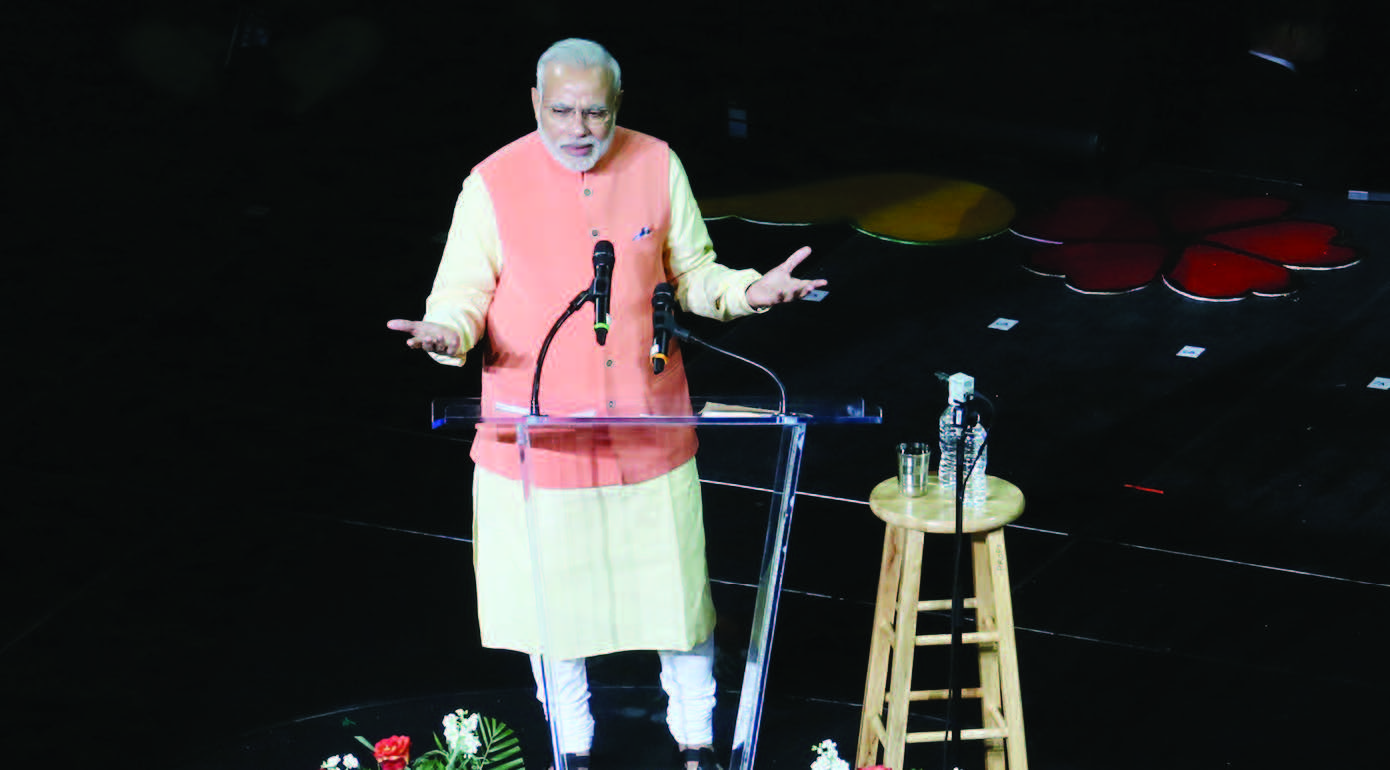
    I found many acknowledging Modi’s felicity of expression which allowed him to connect with people immediately. He speaks in the language and diction that people at all levels commonly understand. He relies on simple words and home truths to deliver his ideas home. Again, he has mastered the art of delivery. His body language is extremely expressive and impressive. During the more than 90 minutes speech he delivered at the Madison Square Garden on September 28th, not a soul could have looked at the watch. Not one could have yawned, out of boredom. None would have thought of anything but what Modi was saying. The eyes of all remained fixed on the man in the center of the arena. Such was the grip of the man. And whatever he said seemed to come straight out of his heart. He pumped into his speech his heart, his mind and his vocal cords-delivering the “very best”.

    Now see what he said. First, India can and will achieve the greatness that it once had. Second, we have a huge human resource capital in the form of a young India, with 60% of population under the age of 35. No other country in the world has such human resource. Third, we have brains. Example, our scientists succeeded in the Mars mission in the first attempt itself, a feat which even US could not perform. Modi took pride in mentioning that India’s Mars mission cost peanuts when compared with the money spent by countries like USA on similar missions.

    Yes, we can. But how can we do it? He did offer Namo Mantra for that. He spoke of the defects in the system in the country and said the system that stood in the way of quick progression had to be demolished. He spoke of the futile, cumbersome and irrelevant laws which needed to be consigned to dust bin. He spoke of the massive investment required for development. And he invited Indian Americans as also the whole world to come and invest in India. Also, he gave a call to “make in India”.

    Modi was particularly appreciative of the Sikhs, in his speech. He spoke of the great sacrifices the Sikh Gurus had made. He also recalled the sacrifices of the Sikhs in the freedom struggle of India. He spoke of the brave Sikh soldiers in the Indian armed forces and said the nation is proud of the Sikhs who have always stood by their motherland, come what may.

    Modi simply created a vision. He came up with ideas that won attention and admiration of many. He wove dreams that all would love to own. He assured the gathering of around 20,000 at the famous Madison Square Garden which somebody christened as “Modison” Square Garden that India was on a fast track to development. Then he made some announcements to please the locals, too. He told them he was taking care to ensure there is no harassment at the airports in India of Indian Americans visiting India. He also said he knew of problems with getting visas. He said there will be no delays any more in obtaining a visa. Also, he said the clubbing together of OCI and PIO was being worked out and soon the problems arising out of OIC/PIO will be over. He also announced visa on arrival for US nationals on the pattern of some 9 countries whose citizens are entitled to get tourist visa on arrival in India. Surely, the local crowd was pleased.

    The magician Modi wielded his wand for more than 90 minutes and left the gathering charmed and captivated. Yes, he came, he spoke , he conquered the hearts of Indian Americans who had come from far and near to have his darshan and hear him speak. But before he left, the gathering burst in to Modi chant, just as it had when he had arrived. And, believe me, Modi must have enjoyed the chant. The “Modi” chant must have been music to his years.

    During the course of his stay in New York from 26th September to 29th September afternoon, Modi attended a large number of events, met a number of people from all walks of life which included world leaders, his counterparts from neighboring countries Sri Lanka and Nepal, US lawmakers and officials, captains of business and industry, community leaders, religious leaders and eminent people- both Indian Americans and others, and discussed a variety of issues.

    We bring our readers here a few pictures of Modi’s New York visit. All pictures have been provided by The Indian Panorama special photo journalist Mohammed Jaffer.

    Modi pays homage to victims of 9:11 at the 9:11 memorial at ground zero on September 27th 2014.

    Prime Minister Modi speaking at Global Citizens Festival at Central Park in NYC on 27th September, 2014

    Modi addresses the 69th United Nations General Assembly. He called for a relentless fight against terrorism and the Security Council

    Madison Square Garden on September 28

  • BJP TO ROLL OUT BIG GUNS FOR ASSEMBLY POLLS

    BJP TO ROLL OUT BIG GUNS FOR ASSEMBLY POLLS

    NEW DELHI (TIP): With Dussehra over, BJP will get into campaign mode for the Haryana and Maharashtra assembly polls on a war footing.

    Prime Minister Narendra Modi and his senior ministers will have little time for anything else, criss-crossing the two states over the next two weeks, addressing rallies. BJP plans to hold at least four big rallies a day in each state till campaign ends for the October 15 polls.

    Modi will begin his charge on Saturday morning from Karnal in Haryana and move to Maharashtra to address three rallies in Beed, Aurangabad and Mahalakshmi (Mumbai). The PM will address 8-10 rallies in Haryana and around 22 in Maharashtra.

    Two senior ministers — home minister Rajnath Singh and external affairs minister Sushma Swaraj — will be all over Haryana on Saturday, holding four rallies each in the state. Singh will be at Radaur, Kalayat, Julana and Jakholi Rai while Swaraj will address rallies in Kalka, Thanachhapar, Shahbad and Gohana. Singh will address about 15 rallies in each state.

    The party has decided to have Swaraj, who belongs to Haryana, focus on the state where BJP is contesting on its own and is aiming to replace the Congress government. Similarly, road transport minister Nitin Gadkari has been asked to concentrate on Maharashtra, his home state, where BJP is contesting without its 25-year-old partner Shiv Sena this time.

    Swaraj is scheduled to address about 22 rallies in Haryana and will be in Maharashtra only for a day on October 6, attending three rallies. She will take a break from campaigning as she is travelling abroad between October 8 and 10. Gadkari is expected to address about 36 rallies in Maharashtra.

    Party veteran L K Advani will address six rallies in Maharashtra and two in Haryana, while Murli Manohar Joshi will address two rallies in Maharashtra and one in Haryana.

    Urban development minister M Venkaiah Naidu is slated to spend four days in Maharashtra and two in Haryana. Other ministers who will address a few rallies in both states are chemical and fertilizer minister Ananth Kumar, HRD minister Smriti Irani and social justice minister Thawar Chand Gehlot. Party chief Amit Shah will address about 15 rallies in each state.

    The party has roped in all its chief ministers to ensure its good governance campaign is showcased. Goa CM Manohar Parikkar will focus on Maharashtra while Madhya Pradesh CM Shivraj Singh Chouhan will spare three days for Maharashtra and one for Haryana. Rajasthan CM Vasundhara Raje has three days in Maharashtra and two days in Haryana, Chhattisgarh CM Raman Singh and Gujarat CM Anandiben Patel will each spend two days in Maharashtra. On an average, the chief ministers will address three rallies a day, party vice-president M A Naqvi said.

    Not to forget its star power, BJP has roped in actor-turned-MPs Hema Malini, Vinod Khanna and Shatrughan Sinha to campaign in both states.

  • The Making of NAMO

    The Making of NAMO

    A Hindu pracharak becomes Prime Minister of India. Here are milestones in his journey of ascension to the pinnacle of power through landslide election victory in the 16th General Election of the world’s largest democracy.


    arendra Modi was born on 17th Sept 1950 in a middle class family of grocers in the small town of Vadnagar- the Temple Town of ancient India which is Varanasi of Gujarat. The town has a long and varied history. Sharmistha Lake, Hatkeshvar Mahdev and artistic Toran Gate are hallmarks of the past glory of the capital of Anart Province. Chinese traveler Yuan Swang visited this town in the sixth century. Akbar’s music maestro Tansen came to normalcy after listening to perfect Meghmalhar singing of Naggar girls Tana and Riri. Poet Narsinh Mehta ‘s son got married to Vadnagar Naggar Community’s bride here. Small town boy Narendra Modi imbibed the past glory of his birth place in Mehsana district of Gayakwad princely state in Gujarat. Modi became a member of RSS in childhood and acquired deep understanding of Hinduism, reading Hindu Scriptures and literature of Swami Vivekananda. He left home with the consent of his parents at a young age of 17 in search of his life’s mission. He traveled extensively and spent some time in the Himalaya , meditating in the tradition of Buddha who has influenced his life and thought considerably. Returning home after some time, he became a PRACHARAK with Rashtriya Swayamsevak Sangh in 1972. He stayed with his maternal uncle in Ahmedabad and helped him selling common people’s popular drink, tea, a job which he had done before in his father’s tea stall at the Vadanagar Railway station. One astrologer who was dinner guest at their family house in Vadnagar predicted to his mother that some day her son Narendra will either be a great sage of Shankaracharya’s caliber or supreme commander of the nation if he enters politics. Jawaharlal Nehru was supreme commander in Prime Minister’s position in those days in India. Savarkar’s message to Hinduise politics and militarise Hinduism appealed to young Narendra. He worked underground during the emergency period 1975-1977 and went jail briefly.
     

    Then, Jan Sangh adopted a new name BJP after losing partnership in the government with the collapse of Prime Minister Morarji Desai’s government . Narendra Modi actively participated in all activities of BJP especially Advani’s Rath Yatra and Unity pilgrimage of Murli Manohar in 1989-90. He was assigned the responsibilities of General Secretary in Gujarat and subsequently at the national level. Modi acquired mastery in public relations and party organization. His contribution in the capacity of General Secretary was well noticed by party stalwarts Advani and Vajpayee. He did not contest any legislative election and had no experience in any capacity in government when one day in the first week of October, 2001, Prime Minister Vajpayee asked him to be the Chief Minister of Gujarat in replacement of Keshubhai Patel who had received more complaints than complements in his handling of problems in the aftermath of earthquake in Kutch -Bhuj area on the Republic Day in January, 2001.

    A Timeline : 
    October 7,2001 Modi takes oath of office of Chief Minister. He is not a member of the legislative body.
    ● Feb.24,2002 : He is elected from Rajkot constituency . Next day he is officially admitted into membership of Gujarat Assembly.
    ● Feb 27,2002 . At Godhara Station in South Gujarat 59 passengers including women and children are burned down by the terrorist group which praised Bin Laden and his methods of terrorism. Those killed were active members and volunteers of Hindu organizations .In retaliation riots spread in Ahmedabad and elsewhere in Gujarat. Both Hindus and Muslims became targets of each others’ wrath for weeks .Media all over the world gave coverage of these events in their own ways.
    ● April 12,2002 BJP High Command meeting in Goa where discussion on the riots remained major issue, some demanded removal of Modi . Narendra Modi offered his resignation . Prime Minister Vajpayee was not soft towards Modi but Advani was firm on not accepting Modi’s resignation.
    ● July 19, 2002 C.M. Modi dissolved assembly and opted to seek new mandate
    ● December 15, 2002 . Favorable election results: BJP won 127 seats out of 182 assembly seats. Modi took oath for the second time in the presence of the Prime Minister. First time in India, a Prime Minister attended oath ceremony of a state chief minister. The Modi Government received national and international praise for restoration programs of earthquake disaster. Seminars for continuing education for elected assembly members and EGovernance were Modi’s new initiatives. Prime Minister Vajpaiyee invited the dynamic C.M. Modi to be in his entourage of Russia visit. Modi observed keenly Russian growth model . He vowed to make Gujarat a shining super state in India . The first vibrant Gujarat festivity program in 2003 attracted attention of investors . Progress
    Person Modi visited China, Japan and other countries to promote investment in Gujarat.
    ● May 21,2005. Rajiv Gandhi Foundation awarded Modi Government for the most well managed State.
    ● December 25,2007: Modi takes oath for the 3rd time after election victory.

    2012: 

    Modi became Chief Minister of Gujarat for the fourth time. In a lighter vein, he stated: ‘ I will remain CM for ever’.
    But Modi was destined for a higher position, as the stranger had once predicted.
    In September, 2013, Bharatiya Janata Party named him the party’s candidate for prime
    Minister’s position. Modi had already nominated to lead the election campaign. With every passing day, it became clearer that Modi had succeeded in convincing voters of India that BJP could bring about a change to their advantage. Some doubted BJP could have the numbers to forma government with its allies, not to speak of forming a government on their own.
    Some simply could not bear to see BJP in power. Eminent Economist Nobel Laureate A.K. Sen wrote: “I do not want Modi to be my Prime Minister “.
    However, voters of the largest democracy in the world countered him : “WE WANT MODI TO BE
    OUR PRIME MINISTER.”
    And there he is. Let us wait and watch his work.

  • India, China Vow Cooperation: Sign 12 Agreements in Delhi

    India, China Vow Cooperation: Sign 12 Agreements in Delhi

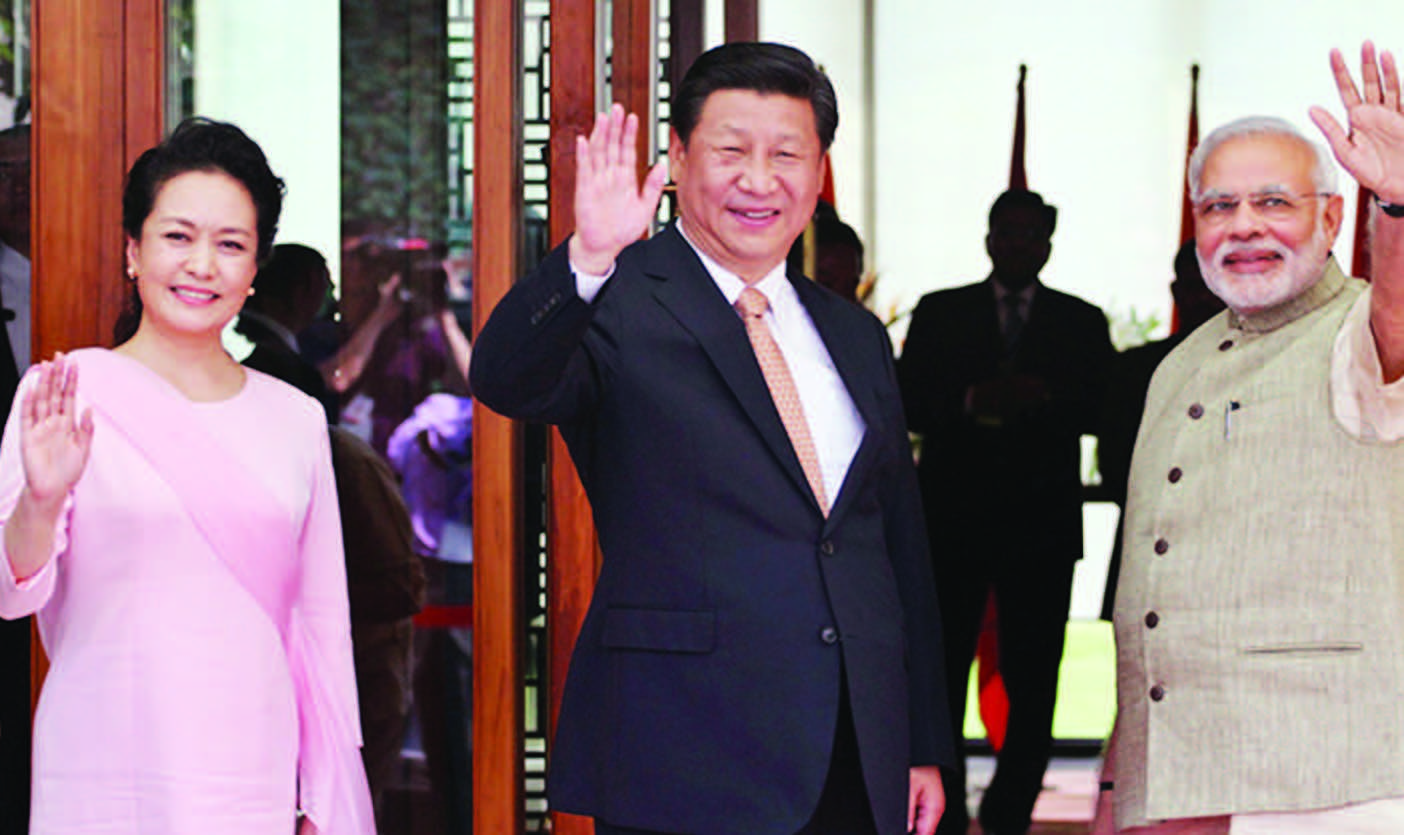
    NEW DELHI (TIP): India and China have signed 12 agreements in Delhi, one of which will see China investing $20bn in India’s infrastructure over five years. At a news conference with Chinese President Xi Jinping, India’s PM Narendra Modi said “peace on the border” was important for progress. Talks came as India accused China of fresh territorial incursions in Ladakh.

    China is one of India’s top trading partners but they vie for regional influence and dispute their border. Mr Modi and Mr Xi made separate statements at the end of their talks in Delhi on Thursday, September 18.

    Under the investment plans, China pledged to:
    ● Help bring India’s ageing railway system railway system up-to-date with high-speed links and upgraded railway stations.
    ● Set up industrial parks in Gujarat and Maharashtra.
    ● Give more market access to India to products, including pharmaceuticals and farm products. Both sides also focused on increasing cooperation in trade, space exploration and civil nuclear energy. Mr Modi called for an early settlement on the disputed common border between the two countries and said the “true potential of our relations” would be realized when there was “peace in our relations and in the borders”.

    There have been reports in the Indian media of Chinese troops trying to construct a temporary road into Indian territory across the Line of Actual Control (the de facto boundary) in the disputed Ladakh region over the past week. Mr Xi said he was committed to working with India to maintain “peace and tranquility” on the border. “China-India border issue is a problem which has troubled both sides for long… As the area is yet to be demarcated, there may be some incidents,” he said.

    The border dispute is an old one, dating back to 1914 when Britain, India’s former colonial power, signed an agreement with Tibet making the McMahon Line the de-facto border between the two countries. China has always rejected this. Both sides also claim each other’s territory – India, the Aksai Chin region of Kashmir and China refuses to recognize Ladakh and Arunachal Pradesh as part of India. There have been several incursions of Chinese troops across the border in these areas which have been highlighted by the Indian media. Diplomats from both sides, however, play down these transgressions.

    The simple fact is that there are differing perceptions on where the border lies – what India believes is Chinese troops crossing into their territory is seen by Beijing as the exact reverse: Indian troops occupying Chinese land. It is extremely unlikely that these confrontations will lead to an outright conflict or even sour ties between the two countries. But they do reflect the suspicion and distrust that exist on both sides of the border. Mr Xi began his visit in Gujarat, the homestate of Mr Modi, on Wednesday, before heading to Delhi.

    China has pledged to upgrade India’s ageing railway tracks On Wednesday, the two sides signed several agreements, including one to set up a Chinesebacked industrial park in Gujarat. Indian and Chinese companies have also signed preliminary deals worth more than $3bn (£1.8bn) in aircraft leasing and telecoms, among other sectors. Despite the continuing tensions, trade between India and China has risen to almost $70bn (£43bn) a year, although India’s trade deficit with China has climbed to more than $40bn from $1bn in 2001-2002.

  • By-poll results shock BJP

    By-poll results shock BJP

    New Delhi (TIP): The results of the Assembly byelections have come as a blow for the BJP in Uttar Pradesh, Rajasthan and Gujarat — the states it had swept in the Lok Sabha polls four months ago — losing 13 of the 24 seats held by it. Of the 32 Assembly seats across nine states for which counting of votes was held today, the BJP won 12, Congress seven and Samajwadi Party eight while TDP (Andhra), Trinamool Congress (West Bengal), AIUDF (Assam) and CPM bagged one each. One seat in Sikkim was won by an Independent.


    This is the third consecutive setback for the saffron party after its disappointing performance in Assembly byelections in Bihar, Uttarakhand, Karnataka and Madhya Pradesh in the past two months. All 11 seats in Uttar Pradesh, Gujarat (9) and Rajasthan (4) were held by the BJP and the bypolls were necessitated after the sitting MLAs were elected to the Lok Sabha. It was Uttar Pradesh — the party’s recently acquired stronghold where the BJP managed a near-total sweep in the LS elections — that delivered a humiliating blow to the saffron party as it lost seven of the 11 seats held by it, including the one held by its ally, the Apna Dal.


    The BSP’s absence in the byelections had made it a virtual straight fight between the SP and the BJP in the politically crucial state. BJP strongman Amit Shah was credited with crafting the spectacular win for his party in UP in the Lok Sabha polls. The party lost six out of 13 seats in Rajasthan and Gujarat, where it’s in power. Lost for words, BJP leaders could not even blame rival parties for playing foul in the elections. Senior BJP leader Rajiv Pratap Rudy said the results “deserve a small introspection”. “This is not a national mandate. It is a localised issue.


    Surely, it is a wake-up call for better planning in the upcoming Haryana and Maharashtra Assembly elections,” he said. Senior leader Uma Bharti dismissed questions about efficacy of the “Modi wave” saying “state leaders and workers need to introspect.” It was a significant comeback by the SP, which won eight out of 11 seats in Uttar Pradesh —and the Congress, which trounced BJP on three out of four seats in Rajasthan. “The people of the state have given a befitting reply to the communal forces and clearly expressed their desire for harmony and brotherhood,” said a beaming UP CM Akhilesh Yadav.


    Among BJP’s big losses is the Rohaniya seat, which falls within Modi’s parliamentary constituency Varanasi. The saffron party just about managed to hold to its own in Modi’s home state Gujarat, winning six out of nine seats. Rajasthan Chief Minister Vasundhara Raje was left re-faced as the Congress won three out of four seats. One of the seats — Surajgarh—was being contested by her close aide Digambar Singh who lost to Shravan Kumar of the Congress by 3270 votes.


    The BJP had swept the Lok Sabha and Assembly elections in the desert state earlier this year. High on the win, Rajasthan Congress chief Sachin Pilot advised the “BJP to take a lesson from these elections and introspect” The BJP retained Kota South, losing Surajgarh, Weir and Nasirabad to the Congress. The only silver lining for the BJP was the inroads into WB where it has won Basirhat Dakshin (South) seat.

  • BJP GETS THE JOLT IT DESERVED

    BJP GETS THE JOLT IT DESERVED

    The folly of polarization boomerangs

    Normally no great importance is attached to by-elections in this country which should explain why no Prime Minister has ever canvassed during them. Interestingly, Congress president Sonia Gandhi and her son and party vice-president Rahul Gandhi have stuck to this routine even after losing power. During the most recent by-elections to 33 assembly and three parliamentary seats, the Congress’ First Family chose to be abroad.


    38


    It must have regretted this because it lost the opportunity to celebrate the jolt the Bharatiya Janata Party has suffered exactly four months after its spectacular success in the parliamentary poll under Narendra Modi’s leadership. Particularly prominent is the saffron party’s overwhelming defeat in the politically key state of Uttar Pradesh where it had won 71 of the 80 Lok Sabha seats on May 16. This time around it has surrendered eight of 11 assembly seats to the Samajwadi Party that rules the state even though the latter’s own record is conspicuously poor.

    Even more hurtful to the BJP is that the Congress that was virtually wiped out in the Lok Sabha elections has wrested from it three assembly seats each in the BJP’s bastions, Rajasthan and Mr.Modi’s Gujarat. In UP, however, the Congress has drawn a complete blank. Having slid in nine of the 10 states where by-elections were held, the BJP has a cause for comfort only in West Bengal, where it has wrested a seat from Chief Minister Mamata Banerjee’s Trinamool Congress. From the day the Modi government came to power, there have been 50 by-elections across the country.


    39


    Of these the BJP and its allies have won only 18 and lost all others. The reason for this serious setback is crystal clear and it is writ large on the political landscape.Mr. Modi may have spoken about development and good governance in the past. Those in charge of the by-elections or chief campaigners in the by-elections never used these expressions. Arrogantly confident of coming to power in this most populous state in 1917, the BJP adopted the wrong, disruptive and dangerous strategy of polarization along religious lines. “Love jihad” was one of its favorite slogans.

    As time passed, the tone of the BJP’s UP leaders – such as the president of the party’s state unit, Lakshamikant Bajpai, and the saffron-clad Yogi Adityanath, a five-time MP and the principal campaigner in the state – became more provocative and indeed poisonous. It is noteworthy that neither Prime Minister Modi, nor party president Amit Shah, nor any other senior leader did anything to restrain the Hindutva hotheads. On the contrary, their silence greatly encouraged those spewing venom.

    The situation is not without irony. At a time when Bajpai and Yogi Adityanath were shouting hoarse about “love jihad”, an oxymoron that is supposed to mean that Muslims were busy luring Hindu women to marry them and then convert to Islam, the country’s Home Minister and a former president of the BJP, Rajnath Singh, told a press conference that he didn’t know what “love jihad” was. Exactly at that time, Sakshi Maharaj, another saffron-wearing BJP leader in UP, harangued his audience and the media not only about “love jihad” but also about “education in terrorism”.

    He thundered that madrasas were teaching “terrorism” to their pupils and “motivating” youth to lure women of other religions with “offers of cash awards – Rs 11 lakh for an affair with a Sikh girl, Rs 10 lakh with a Hindu girl and Rs 7 lakh for a Jain girl”. Not to be left behind, Usha Thakur, a BJP MLA in Madhya Pradesh who is also the vice-president of the party unit in the state, made another startling disclosure: At the prolonged Hindu festival of Garba, according to her, Muslims joined in large numbers. Consequently at the end of this festival every year, four and a half lakh Hindu women were converted to Islam.

    Yogi Adityanath reaffirmed that wherever in India the proportion of Muslims in the population was 35 per cent or more “non- Muslims could not be safe”. At this stage no less a person than Union Cabinet minister Maneka Gandhi intervened to declare that “profits made from the trade in slaughtered animals was financing terrorism” and to demand that the slaughter of all animals should be “banned completely”. If this strange and highly controversial statement went relatively unnoticed the reason is that by-election results had started coming and it was immediately obvious that the electorate in UP had rejected with contempt the BJP’s strategy to polarize and divide the country along religious lines.

    An accompanying development of significance is that the Election Commission took note of some of Yogi Adityanath’s “hate speeches” and “use of religion for electoral purposes”. He has been asked to explain why requisite action should not be taken against him. An earlier FIR against the BJP’s national president Amit Shah, issued by the UP police, was set aside by a district judge. The critically important need now is for the BJP to abandon its dangerously disastrous electoral strategy of polarization that has already boomeranged.

    So Mr. Modi must give priority to this for two reasons, and make up his mind on the subject because he alone can take crucial decisions. The first reason is that assembly elections are due in Maharashtra and Haryana very soon, and the saffron party would be courting huge trouble if it repeats in these two states what it did in UP. It should fully exploit the heavy anti-incumbency the Congress has piled up against itself in both these states. The second reason is that in view of the worsening of the overall situation, our duty is to promote communal harmony, not communal hatred.

    (The author is a senior journalist and editor.)

  • INDIA: THE ODD BRIC OUT

    INDIA: THE ODD BRIC OUT

    India must strike a balance between its new emerging partners and beneficial Western ties

    India would be foolish to join an anti-Western bloc as India’s rise is inherently tied to the West. Given the popular view that the BRICS are opposed to the West, India finds itself in the unique position of being a part of the BRICS collective as well as having overtly friendly relations with the U.S., a relationship that is likely to further improve in the future as Modi visits the U.S. and ties strengthen.

    By Stephen Junor The BRICS nations have rapidly evolved from a group of emerging economies into political contenders in a new world, driven by the search for an alternative to Western hegemony. Recent Western failures have also helped to launch the BRICS concept as an alternative, and have possibly pushed the countries closer together than they may have initially intended.

    There are also differences (the China-India border disputes for example) that would have seriously tested the relationship between other countries, but for now they are responsible for the multi-polar world that appears to be emerging. The Western approach toward BRICS has generally been one of skepticism, but when it comes to India there is a conspicuously different portrayal in the media compared to the rest of the countries. Although the recent U.S.-Africa summit suggests friendly relations, South Africa has always seen itself as a member of the global South and champions countries that don’t acquiesce to U.S. dominance. The conflict between the U.S. (somewhat supported by much of Europe) and Russia is well-known, and the media consistently highlights the conflict and difference between the U.S. and China.

    American interference in Latin America has made relations between Brazil and the U.S. touchy, and the rhetoric from Brazil in the wake of NSA spying last year was scathing. Despite relations taking a hit last year when Indian diplomat Devyani Khobragade was arrested in New York, U.S. and Western media have generally been friendly toward India, exemplified by President Barack Obama’s invitation to newly elected Prime Minister Narendra Modi to visit the U.S., despite Modi previously being blocked from the U.S. over his failure to stop sectarian violence as Gujarat’s chief minister in 2002, when more than 1,000 people were killed. It is likely that the U.S. views India as a potential foothold in Asia.

    India is often heralded in the Western media as the world’s largest democracy, in an attempt to provide common ground and a nod of disapproval to the likes of China and Russia. In contrast to the other BRICS members, Indian elites aspire to the wealth and influence of the U.S., and it is only natural that this aspiration would manifest itself in the politics of the country. Modi is a proponent of free market capitalism and this bodes well for relations with the U.S., which will see him as an accessible figure.

    There are further important differences between India and the rest of the BRICS nations.World Bank data shows that India’s GDP per capita severely lags behind the rest at around $1,500, four times less than China and South Africa, seven times less than Brazil and almost 10 times less than Russia. India hasn’t replicated the rapid growth of the other BRICS countries since the turn of the millennium, and this is also reflected in a slower reduction in the poverty gap. Just under 25 percent of the population still live on less than $2 a day, compared to 10 percent or less for the other countries. Such a severe development problem will hinder Indian growth in the near future and will see it fall further behind.

    Modi will be expected to implement reforms that improve growth and lift hundreds of millions out of crippling poverty. Growth alone will not solve the poverty problem in India however. When it comes to literacy rates in adults, the 2011 Indian census recorded a figure of 74 percent while the rest of the BRICS nations record over 90 percent. Literacy among women is even lower at 64 percent. Infrastructure in India is also sub-standard. An overburdened transport systems and insufficient electricity grids that are overly reliant on coal contribute to the poverty problem while hindering growth. Rapid urbanization is also putting pressure on these systems, making the problem more acute.

    India also has a digital problem as only 15 percent of the population uses the internet, compared to upwards of 40 percent for the other BRICS. Connectivity is important, particularly for those often marginalized in society, as evidence points towards benefits for education and health. India has a distinctive set of problems that the other BRICS countries have largely moved beyond. Given the political and economic clout of the BRICS collective, India could soon find itself left behind within the group. Indeed the statistics above and the obvious clout of China and Russia suggest that India may lack influence within the group already, despite efforts to spread power within the recently announced New Development Bank.

    This is where the U.S. could become more influential with India. In a recent interview with The Diplomat, Sadanand Dhume, a resident fellow at the American Enterprise Institute (AEI) and Wall Street Journal columnist, said that India would be foolish to join an anti-Western bloc as India’s rise is inherently tied to the West. Given the popular view that the BRICS are opposed to the West, India finds itself in the unique position of being a part of the BRICS collective as well as having overtly friendly relations with the U.S., a relationship that is likely to further improve in the future as Modi visits the U.S. and ties strengthen.

    India will need to manage its relationships carefully, as it will not want to find itself isolated from either the U.S. or the BRICS. It is also important that India doesn’t become geopolitically caught between the two sides: Any point of tension between the West and an individual BRICS country could reflect on the rest of the group. Indeed if India wants to achieve strong growth and solve its development crisis, then it will need to harness relationships with both sides. The next few years will be crucial for Indian development, and as the international political situation slowly evolves, it will be interesting to see how India locates itself in relation to the West and the other BRICS countries.

    (Stephen Junor writes on the rise of BRICS and geopolitics) (Source: The Diplomat)

  • Talks with Pak only if it responds properly: Rajnath

    Talks with Pak only if it responds properly: Rajnath

    NEW DELHI (TIP): Days after minister for external affairs Sushma Swaraj indicated that doors were not closed for India-Pak talks, home minister Rajnath Singh on September 11 said talks between India and Pakistan could be resumed if the neighbouring country “responds properly”. “If Pakistan responds properly, talks can be held,” he told media on his visit to the India-Pak border in Gujarat. Singh was asked whether there was any possibility of resuming the stalled dialogue between New Delhi and Islamabad. Singh said India wants to improve its relations with Pakistan. “Neighbour is a neighbour.

    Friend can be changed but neighbour cannot be changed. We also want that our relations with our neighbour improves,” he said. Meanwhile, Singh inaugurated the integration of Border Security Force (BSF) with Gujarat government’s Bhaskaracharya Institute for Space Applications and Geo informatics (BISAG) project on Saptember 11 at BSF Camp, Bhuj. The home minister was briefed about the details and utility of BISAG and need for dedicated, encrypted channel for Para Military Forces. Singh addressed BSF Jawans live through BISAG and interacted with them. Few of the jawans telephonically made requests regarding increase of Air Courier services in North East region and Jammu and Kashmir and regarding time bound promotions. One of the jawans also asked for giving one-rank-onepension to BSF also. The Union home minister assured them that he would look into the matter.

  • India’s Independence Movement – a Timeline

    India’s Independence Movement – a Timeline

    By Nitin Vora

    “At the stroke of midnight hour when the world sleeps, India will awake to life and freedom…are we brave
    enough and wise enough to grasp this opportunity and accept the challenge of future? “The great day” that
    millions of people have been dreaming about for years, at last materialised – a day of rapturous jubilation.”


    Friends, these are the words of India’s first Prime Minister Jawaharlal Nehru on the eve of August 15, 1947, first day of our freedom.


    25
    Mahatma Gandhi

    The British control of India began in the 1600′ with the East India Company as a commercial venture. However, over the decades Britain’s strong hold and political aspirations over the country became stronger. A growing sentiment to overthrow Britain’s domination culminated in the Indian mutiny of 1857. Some of you must have seen the movie “Mangal Pandey”, yes, I am talking about that young Mangal Pandey who gave a clarion call to all the Indian soldiers to revolt against Britain.


    26
    Jawaharlal Nehru

    This was known as “sepoy mutiny” he was sentenced to death and within 2 months the great war of Independence started on 29th March, 1857. Rani Laxmibai of Jhansi created history by fighting a great battle, she succumbed to her wounds in the battlefield. The Indian National Congress, the political party was founded and spearheaded the freedom struggle in 1885. Swami Vivekanands’s presentation of India’s religion and culture to the parliament of world religions in 1893 in Chicago (USA), made the whole world aware of India’s rich heritage.


    27
    Sardar Vallabhbhai Patel

    On his return, he electrified the whole nation with his clarion call “Arise, awake, and stop not till the goal is achieved”. Dadabhoy Navaroji’s “Poverty and un- British-rule in India” stimulated economic nationalism in 1901. The bifurcation of Bengal in 1905, which then comprised of Assam, Bihar, Orissa and Bengal sparked off yet another revolutionary movement with burning and boycotting of foreign goods. In 1906, Bal Gangadhar Tilak, the first nationalist leader voiced the idea of home rule,.


    28
    Subhash Chandra Bose

    Tilak gave us the mantra “Swaraj is my birth right”. In 1911, King George Vth annuls the partition of Bengal and Delhi is made the capital of India. Rabindranath Tagore, the author of our national anthem jan gan man…. becomes the first Indian to receive Nobel Prize in 1912. Mohandas Karamchand Gandhi returns to India in 1915 from South Africa, where he had led a successful peaceful-resistance movement against the British government. South Africa beautifully says : “You gave us Gandhi, we are giving back Mahatma” The Rowlett act was introduced in 1918 so that any political subject could be arrested and imprisoned. Both Gandhi and Tilak condemned this and the country rose, imbued with the spirit of rebellion.


    29
    Lala Lajpat Rai

    On 13th April 1919, General Dyer enters Jallianwala Bagh with armored cars and troops and orders fire on unarmed men, women and children. 3,000 + were massacred in Jallianwala Bagh. The carnage of such heinous magnitude awakened the whole country . In 1920, Congress led by Gandhiji proposed a non-violent, non-co operation movement. Countless gave up their career and joined the movement.


    30
    Bhagat Singh

    Jawaharlal Nehru and Subhash Chandra Bose, two radical nationalists emerge as important national leaders in 1928. Inquilab Zindabad was the mantra for three revolutionaries- Bhagat Singh, Sukhdev and Rajguru who were hanged to death in 1929. Gandhiji, along with colleagues embarked on a 60 mile march to the sea coast at Dandi in Gujarat, protesting against the excise tax on salt known as the famous Dandi March in December 1929 civil disobedience. Nehru becomes the Congress President at Lahore annual convention and declares nothing short of poorna swaraj. Nehru unfurls the first tricolor flag in Punjab.

    January 26, 1930 was declared as Independence Day. India’s Republic Day is also celebrated on 26th January for this reason. Louis Fischer wrote, “the British beat the Indians with batons and rifle butts but the Indians neither cringed nor complained nor retreated, that made England powerless and India invincible.” Netaji, in 1939 forms Forward Block party. He was the most fierce and visionary activist who shook the very foundation of the British empire.

    In 1940, Muslim League under Mohammad Ali Jinnah, demands separate state of Pakistan. Britain encouraged this in pursuance of their policy of divide and rule. Rasbehari Bose formed Azad Hind Fauj and handed it over to Netaji who said ” give me blood, I’ll give you freedom”. “Karenge ya marenge, do or die “quit India”, the national slogan given by Gandhiji was adopted on August 8th, 1942. British Prime Minister Atlee agrees to India’s Independence in 1945. Mohammad Ai Jinnah on August 16, 1946 gave a call for direct action day through countrywide demonstrations. This triggered Calcutta killing of 5000 people which also spread to other parts of the country.

    Britain agreed to Jinnah’s demand and Congress Party accepted the partition of the country into India and Pakistan. On June 3 , 1947, Lord Louis Mountbatten announced the partitin of India as Union of India and Islamic Pakistan. Sardar Vallabhbhai Patel, the iron man of India with great wisdom and political foresight consolidated about 600 princely states, scattered all over India, without any bloodshed. Pakistan was born on 14th August 1947 and India achieved her freedom on August 15, 1947.

    India became a Republic on January 26, 1950. Bankimchandra composed the song Vande Mataram in an inspired moment,. Rabindranath Tagore sang it by setting a glorius tune to it and it was left to the genius of Shri Aurobindo to interpret the deeper meaning of the song from which India received new nationalism. “We owe a lot to the Indians, who taught us how to count, without which no worthwhile scientific discovery could have been made”, this is India’s gift to the world”.

    Albert Einstein said, paying tribute to India. “India is the cradle of the human race, the birth place of human speech, the mother of history, the grandmother of legend and the great grandmother of tradition. our most valuable and most astrictive materials in the history of man are treasured up in India only” said the great American writer Mark Twain.

  • NOW, GET YOUR PASSPORT IN THREE DAYS

    NOW, GET YOUR PASSPORT IN THREE DAYS

    SURAT (TIP): This Independence Day, regional passport office (RPO) is set to win the hearts of tens of thousands of people in south Gujarat region who were waiting for the printing and dispatch of their passports for a long time. The passport office has cleared a printing backlog of more than 5,000 passports, which was stalled for one-and-a-half-month following a shortage of booklets that come from a press in Nashik.

    From the Independence Day, the passport office will print the passports on the same day for those who cleared the appointment interview at Passport Seva Kendra (PSK) and the applicants will get the passport delivered within three days. “We have been successful in clearing the pending print queue for the passport. The cases cleared by the PSK will get their passports printed on the same day and that it will be delivered within two days via postal department, provided how fast the police is able to verify the cases,” said passport officer Kumar Nityanand.

    Officials said that the huge backlog was because of India Security Press in Nashik that had suspended production of passport booklets owing to a shortage in import of laminated sheets required to make the 36-page booklets. The import shortfall, officials said, was a result of suppliers not being able to meet orders in time. This had left tens of thousands of applicants in a limbo.

    Apart from job-seekers, several applicants awaiting their passports need to go abroad for medical treatment, officials said. The Surat RPO and PSK at Udhna Darwaja receive around 700 applications each day from Bardoli, Bharuch, Dang, Narmada, Navsari, Surat, Tapi and Valsad. Officials said that many job seekers and those wanting to travel for business, tour and immigration purposes now have a reason to smile. Nityanand said, “Passport holders applying for reissue at PSK will get their new passport within three days.”

  • PLACES TO VISIT NEAR AHMEDABAD

    PLACES TO VISIT NEAR AHMEDABAD

    From glimpses of wildlife at Gir National Park to exploring the architectural marvels of Ajanta and Ellora to the charming hill town of Mount Abu, there are a range of places to visit near Ahmedabad. Offering a respite from the daily bustle of Gujarat’s commercial hub, these rejuvenating long weekend escapes will compel you to pack your bags and hit the road.

    SURAT

    From by-lanes lined with quaint eateries offering the most delectable Gujarati snacks to upscale markets housing massive jewellery showrooms, Surat is a city that offers almost everything you can ask for. One of the most rapidly growing cities in India, Surat is the second largest city in Gujarat and also known as the Diamond City. With the majestic Surat Fort and the Mughal-era monument Mughal Sarai for history buffs, the Lake Garden on the banks of Tapi River for those who want to take it easy, and a line-up of street markets for shoppers—Surat has a range of options for all kinds of travellers.


    25

    Baroda

    Formerly the seat of the Gaekwad dynasty, a Maratha clan which ruled over it from the mid-18th century till 1947, the erstwhile princely state of Baroda (also known as Vadodara), is today best known for its heritage and historic university. Often described as the cultural capital of Gujarat, much of modern Baroda was shaped by Sayajirao III, a far-sighted ruler in the late 19th century who patronised art and music, introduced free primary education, and established institutions such as the Bank of Baroda, a railway system and the university.

    The city’s beautiful old quarter filled with heritage buildings, and the historical city of Champaner – a UNESCO World Heritage Site – located an hour’s drive out of town, provide a fascinating insight into the past and will prove irresistible for history and culture buffs.

    Daman

    A short three-hour-long drive from Mumbai, the Union Territory of Daman (no, it’s not in Gujarat, which also means you’re good for a tipple) offers all the perks of a Goa vacation sans the teeming crowds. There are two beaches—Devka and Jampore—of which the latter is infinitely better for sun and sand.

    The Mirasol Lake Garden—replete with an artificial lake, swan boats and even a toy train chugging along the periphery—is a good spot if you’re travelling with kids in tow. For the more culturally inclined, this former Portuguese colony is dotted with architectural remains (Fort of Nani Daman, the lighthouse, Our Lady of Rosary Church) that speak of its bygone glory.

    Rann of Kutch

    Currently under consideration as a biosphere reserve, this salt wetland is abundant in biodiversity, and shrimp farming is one of the chief means of a livelihood in the area. With a host of wildlife sanctuaries, and rich presence of rare animals, this is one of Gujarat’s major tourist draws. Occupying about 4,953 square kilometres spread across the districts of Surendranagar, Banasakantha, Patan, Kutch and Rajkot, the topography of the Little Rann of Kutch features large marshlands interspersed with patches of soil supporting shrubbery. While you’re there, be sure to pay a visit to the Indian Wild Ass Sanctuary, which is one of the largest wildlife reserves in the country, and keep aside a morning to go bird spotting at Banjana Creek.

    Gir National Park

    No trip to Gujarat is complete without a visit to the Gir national Park. Sprawling across a vast expanse of 1412 square kilometres of dense forest, it is the natural abode of the lion – the only place outside of Africa where you get to experience the wild cats in their natural habitat. Take in the experience in its entirety by exploring everything, from the 250 species of chirping birds darting out of the thick canopy of trees overhead, to the crocs in the marsh waters.

    Spot the leopard, nilgai, hyenas, chinkara and antelopes, including the world’s only four-horned antelopes known as chousingha. Additionally, the Gir is the homeland of a tribe called the Maldharis, that thrives on pasturing and livestock. Spend a few days to really take it all in. We suggest a visit to the Crocodile Breeding Farm, and both the morning and evening safaris – the forest tells a different story after sundown.

    Ajanta and Ellora

    Ajanta and Ellora are two monumental rock-cut caves that define Indian art and architectural accomplishment. Though these two monuments are separated by a distance of approximately 100 km, they are often mentioned together since their aesthetics and importance are at par and the fact that both are situated in the Aurangabad district of Maharashtra.

    While Ajanta is mostly about beautiful paintings made on cave walls on the theme of Buddhism, Ellora is all about sculpture and architecture belonging to three different religions prevailing in the country during those times—Buddhism, Hinduism and Jainism. Ajanta is a cluster of 30 caves of different sizes excavated in a horseshoe shaped stretch of rock embedded in a hill facing a narrow stream called Waghora. Each cave was connected to the stream by a flight of steps, which are now demolished with few remnants left behind. These caves are named after a nearby village called Ajanta.

    It includes masterpiece paintings of Buddhist religious art, with figures of the Buddha and depictions of the stories that tell about the previous lives of Buddha. The caves were built in two phases— starting around the 2nd century BC, with the second group of caves built around 400- 650 AD. Buddhist monks used to retreat to this serene place during the monsoon, and as they had plenty of time during such retreats, they used it for deepening their religious quest through prayer and discussion.

    Jodhpur

    The second largest city (after Jaipur) in Rajasthan, Jodhpur is an architecturelover’s feast for sore eyes. The older historic section of the city of Jodhpur is located around the grand Mehrangarh Fort which is bounded by a wall and several gates. Winding streets and unending bazaars run throughout the city that are littered with shops and thronged by visitors throughout the year.

    Also referred to as the Blue City, Jodhpur is home to the magnificent Umaid Bhawan Palace. A fivehour- drive from the hill-station of Mount Abu, Jodhpur makes for a perfect getaway once the hill station’s charms stop making an impression on you.

  • ADANI BUYS LANCO PLANT IN RS 6,000 CRORE DEAL

    ADANI BUYS LANCO PLANT IN RS 6,000 CRORE DEAL

    NEW DELHI (TIP): Adani Power will buy Lanco Infratech’s 1,200-MW imported coal-fired power plant at Udupi in Karnataka in a deal valued at more than Rs 6,000 crore, marking the biggest acquisition in India’s thermal power industry. The acquisition, in a way, comes as redemption for the Adani group, which lost out to Anil Ambani’s Reliance Power for picking up hydel assets of the Jaypee Group.

    R-Power outbid the Adani group by offering Rs 12,000 crore for Jaypee’s hydel capacity aggregating 1,800 MW. For Lanco’s Udupi plant, Adani would pay Rs 2,000 crore in cash and take over the plant’s long-term debt of Rs 4,000 crore. The deal would bring down Lanco’s debt by Rs 4,000 crore. Lanco has a total debt of Rs 36,000 crore ($6 billion) and is reported to be examining options, including selling Griffin Coal in Australia it had bought for Australian $750 million ($665 million) in 2011, to retire outstandings.

    Lanco is seeking to sell Griffin Coal after reaching an agreement with banks to restructure debt. Coal acquisitions in Australia by foreign companies have soured as prices for the fuel fell for three straight years. The Udupi plant is the first imported coal-based unit set up by a private power producer in the country, Lanco said in a release. It comes with a captive jetty to handle import of four million tonnes of coal per year and an external coal handling system in the new Mangalore Port Trust. This capacity too can be doubled. The infrastructure would add to Adani’s coal import capacity.

    The company runs India’s largest coal handling port at its Mundra special economic zone in Gujarat. The Udupi power plant has an added advantage since its capacity can be raised by another 120 MW and the special purpose vehicle that operates the plant has an agreement with the Karnataka government. The plant supplies 90% of the power to the state and the rest goes to Punjab. Adani Power has an installed generation capacity of about 8,620 MW and is looking at the acquisition as one of the options to ramp up capacity to 20,000 MW by 2020.

    The company is in talks with several other players such as GMR, Indiabulls, Avantha Power and Athena, who want to sell their projects, with aggregate capacity estimated at 50,000 MW, in the face of coal and gas shortage and other problems. It has a presence in almost the entire value chain of the power industry and uses this strength to turn around stranded projects.

  • Attorney for Indian National Congress Party opposes appeal by the SFJ in 1984 riots case

    Attorney for Indian National Congress Party opposes appeal by the SFJ in 1984 riots case

    NEW YORK (TIP):
    Indian-American attorney Ravi Batra, on behalf of Indian National Congress party, filed opposition in federal court to the appeal by the Sikhs for Justice (SFJ). He has opposed an appeal filed by a Sikh group that challenged dismissal of the 1984 rights violation case against it, saying the group does not represent the victims and US courts cannot rule on cases involving an incident that took place in India 30 years ago. SFJ had in May challenged the dismissal of the 1984 rights violation case against the Congress party saying that the case “concerns” the US and it has “institutional standing” to seek judgment on behalf of the Sikh community.

    Batra said US federal judge Robert Sweet was right to dismiss SFJ’s case in April since the rights group is no victim and neither does it represents the victims of the 1984 anti-Sikh riots .He argued that US courts must “honor India’s sovereignty in a matter that arose 30 years ago in India by and between Indians,” and so it must be dealt with in India alone. Batra said that the Indian National Congress (INC), as a legal corporate entity and not a natural living breathing person, is incapable of extra-judicial killings or torture.

    “SFJ’s cases seek mere publicity and not justice, as SFJ cannot legally be a plaintiff, and a genuine victim, precious to the law, deserves a better champion,” Batra said. Batra also criticized SFJ for “making noises” against Prime Minister Narendra Modi’s upcoming visit to the US and said the group had improperly sued former Prime Minister Manmohan Singh also last year, “despite his head-of-state immunity.”

    SFJ has launched an online petition campaign urging President Barack Obama to cancel invitation to Modi for the 2002 communal riots in Gujarat. He said SFJ’s actions are “unbecoming, and at worst an exposure of SFJ’s unlimited hunger for publicity while it indiscriminately dishonors India and all Indians in these United States without cause.” The US Court of Appeals has granted SFJ time till August 22 to file its brief against Congress party’s arguments.

  • 308 communal incidents till June: Govt

    308 communal incidents till June: Govt

    NEW DELHI (TIP):
    Even as the Congress party tried to corner the BJP-led NDA government on communal riots, fresh data showed that the country witnessed 308 communal incidents this year until June, with Uttar Pradesh, Maharashtra and Karnataka topping the list. An analysis of two sets of statistics provided by the government over a period of one month also showed that there was a surge in communal incidents in the two months of May and June with 113 cases compared to the first four months of the year, which reported 195 incidents.

    The government placed the statistics in the Rajya Sabha through a written reply on Tuesday on a day when Congress forced the government to discuss the “need for more effective mechanisms to deal with communal violence”. The Congress has been alleging that there is an increase in communal riots in the country after the new government took over on May 26. Leader of Opposition Mallikarjun Kharge claimed that 600 communal incidents took place after the Modi government took over, an allegation vehemently contested by the BJP.

    Kharge’s claim could not be backed by any official data and when countered, he himself cited the figures for May and June. “Why are these incidents happening now? What is the reason? Who is behind these? These have increased in the last 2- 3 months since the new government came. This is not a good sign,” Kharge said in the Lok Sabha. As per the fresh figures, the Union Home Ministry said Uttar Pradesh recorded the highest number of communal incidents this year at 56 followed by Maharashtra at 51 and Karnataka 44.

    Telangana, which came into existence on June 2, has already registered one case of communal incident. Interestingly, almost half (27) of the communal incidents (56) in UP took place during May and June while the 20 in Maharashtra took place during the same period. In Karnataka, 11 incidents took place during these two months. Gujarat reported 26 incidents out of which 11 happened in May and June. In these two months alone, 15 people were killed and 318 injured. Last year, the communal incidents numbered 823 while in 2012 it was 668. In 2010, it was 580. Except for 2011, Uttar Pradesh topped the list.

  • GUJARATI SAMAJ OF NEW YORK LEADERS HONORED

    GUJARATI SAMAJ OF NEW YORK LEADERS HONORED

    Senator Toby Ann Stavisky (D-Flushing) honored the President and Board of Directors of the Gujarati Samaj of New York on the organization’s 40th anniversary, for their nearly half century of service to the community. Since 1974, the Gujarati Samaj has been dedicated to preserving and celebrating the traditions, language culture of the State of Gujarat in India, famous as the home of Mahatma Gandhi and India’s current Prime Minister Narendra Modi.

    The Samaj solidified their roots in the Queens community in 1985 when they opened a community center in Fresh Meadows, which has since been the meeting place for hundreds of community events, such as religious festivals and community healthcare programs.

    To commemorate the anniversary, Senator Stavisky presented Senate proclamation to President Harshad Patel, Program Manager Bharati Desai, Chair of the Board of Trustees Raman Patel, Vice Chair Khandu Patel, President of the Society of Indo American Engineers and Architects Mihir Patel, Community Advocate Jitu Mehta and Chairperson Dilip Chauhan. On the occasion, Senator Stavisky was honored with traditional shawl by the Gujarati Samaj of New York.

  • MR. MODI’S BAGGAGE IN OFFICE

    MR. MODI’S BAGGAGE IN OFFICE

    S Nihal Singh

    There are obvious contradictions between Mr. Modi’s concept of tapping the very best in technology for the greater good and obscurantist and ludicrous beliefs that defy logic. The great danger is that the very constituency – the urban aspirational middle class that brought Mr. Modi to power – will be increasingly disillusioned with a ruling party still living in an imaginary ancient world”, says the author

    With the Modi government settling down to its new responsibilities, it is becoming increasingly clear that it comes with its baggage. And each day brings a new gem of wisdom from the Bharatiya Janata Party’s (BJP’s) ranks and its allies to offer a concept of India and the world that is part medieval, part gauche. Judging by our six years of experience of the Vajpayee government, we had come to expect our education and allied ministries to be packed with Rashtriya Swayamsevak Sangh (RSS) ranks or sympathizers.

    We have seen an obscure historian with pronounced RSS sympathies take over the Indian Council of Historical Research. In the ministry dealing with education and allied subjects, instead of an ideologue, the Modi Government has done better: appointing a novice and school leaver to provide the RSS a sheet of blank paper to write on. Indeed, the oratory of BJP ranks and allies has been in full flow in welcoming a Hindu India of Mr. Modi’s concept and in dilating upon the evils of such peril as bikinis and bars in Goa. On the sensitive issue of rape, very much in the public eye, BJP party men’s views are as conservative and retrograde as those of many other parties such as the Samajwadi Party.

    The world’s gender revolution has still to catch up with the bulk of our male politicians who still live in a male-dominated society, with the country’s traditional and mythical tales reinforcing a chauvinist mindset. There are obvious contradictions between Mr. Modi’s concept of tapping the very best in technology for the greater good and obscurantist and ludicrous beliefs that defy logic. The great danger is that the very constituency – the urban aspirational middle class that brought Mr. Modi to power – will be increasingly disillusioned with a ruling party still living in an imaginary ancient world.

    The fact that the scale of the BJP’s victory in the Lok Sabha election that brought the party to power, much to its own surprise, meant that many candidates were given the ticket indiscriminately without proper scrutiny and comprise a large element of the lumpen class. Some of the BJP’s allies are, of course, a class by themselves. We are therefore treated to the dubious entertainment of honorable members of Parliament stuffing rotis into the unwilling mouths of the catering staff.

    Another aspect of Mr. Modi’s Gujarat model has made its appearance in Delhi. Indeed, the Prime Minister appears to be part sanitary inspector, part micromanager, part strict headmaster in running the national government. And such conduct must lead to serious doubt whether what would work in one state can be replicated nationally. If ministers cannot appoint their own private secretaries, it must leave question marks. Perhaps the quality most sought after by a majority of people who voted for him is the expectation of his decisiveness.

    After the United Progressive Alliance II experiment with a dual key arrangement kicking problems to a bewildering array of committees, the people took Mr. Modi as advertised and voted for him. Many problems are too complex to be resolved instantly, but those who voted the BJP expect those that can be promptly dealt with to be attended forthwith. Language has proved to be another deal breaker, with an ambiguous government note on compulsory noting in files in Hindi riling non-Hindi speakers.

    In any event, the missionary zeal with which the new government is promoting Hindi is counterproductive. One problem, of course, is that many of the BJP leaders are not fluent in English and choose to speak a Sanskrit’s Hindi hard to understand because it abandons commonly spoken Hindustani espoused by Mahatma Gandhi. The danger, of course, is that by using Hindi in their discourse, the BJP government is cutting out non-Hindi speakers from the South and the East in particular from the national dialogue.

    Indeed, one delegate made known his predicament after a Hindidominated conference because he simply could not comprehend what was being said. There was no translation offered, whether of simultaneous or subsequent variety. The Gujarat model of governance can therefore lead Mr. Modi to go off at a tangent. India is not peopled by one homogeneous people or language. Language, as preceding upheavals have shown, strikes at the heart of a people’s being and deeply affects their outlook.

    One hopes the brand new Modi government will learn its lesson in desisting from forcing Hindi on unwilling peoples. One conclusion one can draw from these early days of the Modi government is that scale makes an immense difference between how problems can be looked at and resolved. As Chief Minister, Mr. Modi was able to subdue the Opposition and largely govern the state as a single-party government, even worsting the Governor in diluting the Lokpal’s role.

    The Opposition, singly or collectively, cannot be thus subdued at the national level. And in conducting parliamentary or other business, there has to be an element of give and take. Whatever decision the Speaker of the Lok Sabha takes on giving the official status of Leader of the Opposition to the Congress, the BJP lost an opportunity in not being immediately generous, instead of hiding behind precedents. Mr. Modi demonstrated in Gujarat that he could keep fringe and extremist elements of the Sangh Parivar at bay in his state.

    His task is immensely more complicated at the national level because the RSS backed him to the hilt for leadership and will now demand its pound of flesh not only in appointing pliable or ideologues as ministers but also in doing its bidding on issues it considers important. Against Mr. Modi’s eloquence and vitriol on the election campaign, his silence on major issues of the day has been much commented upon.

    The tasks of governance are, of course, quite distinct. Responsibilities of government impose restrictions on the free flow of ideas, but interactions with media restricted to short tweets or terse official press notes will prove to be a handicap in running the country. Mr. Modi is a quick learner and one hopes he will change course in some areas as he moves forward.