AHMEDABAD (TIP):
The Gujarat high court on July 31 dismissed the plea of Supreme Court-appointed special investigation team (SIT) to stay the bail granted to Maya Kodnani. The former Gujarat minister who was convicted in the Naroda Patia rioting case was released on bail from Sabarmati prison in the afternoon. Later, she got herself readmitted in the Civil Hospital — this time not as a prisoner but as a regular patient suffering from multiple ailments. The SIT had filed a petition seeking a stay on the bail a day after the high court allowed it to go in appeal to the Supreme Court.
The delayed action on the SIT’s part rendered its petition infructuous and the high court turned it down. “The bail order has been executed and the convict released on bail. Therefore, the application has become infructuous,” said the bench of Justice V M Sahai and Justice R P Dholaria. In 2012, special SIT court judge Jyotsna Yagnik had found Kodnani guilty along with 31 others. Kodnani was sentenced to 28 years imprisonment in 2012 by the court which had named her as the ‘kingpin’ of the Naroda Patia massacre of 2002 in which 97 people were killed.
For the past three months, she was admitted in the Civil Hospital for treatment of serious illnesses including intestinal TB, sciatica and acute depression. On July 31 morning, she went from the hospital to the Sabarmati prison and around noon, she was formally released from the jail on regular bail. “Maya Kodnani’s husband, Dr Surendra Kodnani, had come to take her from the jail,” said jail superintendent RC Bhagoriya. CIvil Hospital officials said that Kodnani had told them that she would return to be re-admitted in the public hospital for treatment. “She is now in the special ward as a regular patient.
On July 31, changes would be made in her admission and she would be referred for medical and psychiatric treatment as well,” a top official of the Civil Hospital said. Doctors attending on Kodnani said she suffers from intestinal TB for which she will be on medicine for nine months. “For her severe depression, which borders on suicidal tendencies, she had to be given shock therapy twice.
However, her family did not agree to more shocks for her after she bit her tongue once. She has been put on strong anti-depressants. She also suffers from severe backache with radiating pain in the leg and she is being treated for that as well,” said one of the doctors. Regarding the delay by the SIT in filing a petition for stay on the bail granted to Kodnani, legal experts are of the opinion that a prosecuting agency or any litigant usually demands a stay on an order immediately after the order is pronounced.
The courts sometimes grants relief merely on oral submission by lawyers, but the SIT chose to raise this issue a day later, said the experts. On July 30 morning, SIT’s special prosecutor mentioned the case before the court which asked it to come up with an application. The SIT was not even prepared with papers in the morning.
Tag: Gujarat
-

Maya Kodnani walks free after HC rejects plea for stay on bail
-

UK fights for Britons killed in Gujarat riots
LONDON (TIP): Britain has asked India to speed up action against the killers of three Britons murdered during the 2002 anti-Muslim riots in Gujarat. Foreign secretary William Hague made the request while raising British concerns about the delay in justice for the three during his recently-concluded India visit. “The Foreign Secretary raised this case during his call on Foreign Minister Sushma Swaraj, the appropriate person to raise consular issues with,” said a foreign office spokesperson. “The foreign secretary raised our concern about the delays in taking forward these cases and undertook to follow up with more detail in writing. Mrs Swaraj took note of our concerns.” British brothers Saeed and Shakil Dawood were killed along with their friend, Mohammed Aswat. They were among over 1,000 people, mostly Muslims, killed in the riots.
The three men of Gujarati origin were visiting the state as tourists when they were killed. The remains of the three are yet to be returned even after 12 years. Six men were initially charged with the murders. But they were released on bail and a number of key witnesses turned hostile. The Dawood family is running a campaign to get justice for them. “Whilst returning from an excursion trip to see the Taj Mahal, their (the trio’s) adventure turned into a nightmare. Within hours of crossing the Gujarat border, a roadblock, manned by a well-organized mob fuelled by religious hatred, stopped the British tourists,” the family said in a statement.
The mob circled the jeep and asked the occupants their religious identity. “The tourists answered they were British citizens and were Muslims. The hired driver was then dragged out of the jeep and attacked with sticks and killed on the spot,” the statement said. “His body was then thrown back into the vehicle and set alight. In the meantime, the British tourists were chased to a nearby farm. Mohammed Aswat and Imran were stabbed and left to dead.
Imran miraculously survived and he recalls Saeed and Shakil pleading with the mob to spare all their lives.” The family said it has endured this terrible tragedy and their grief is compounded by the lack of serious Indian police investigation. “The family has had to visit the crime scene themselves, find vital clues and collate forensic evidence including the charred remains of bodies,” the statement said. -

Pravsi Bharatiya Divas 2015 to be held in Gandhinagar
NEW YORK (TIP): Pravasi Bharatiya Divas (PBD), the flagship convention of the Ministry of Overseas Indian Affairs (MOIA) will be held at Mahatma Mandir, Gandhinagar, Gujarat in January 2015.Since 2015 marks the hundredth anniversary of the return of the greatest ‘Pravasi’ of all, Mahatma Gandhi from South Africa, PBD-2015 would be celebrated in a grand way in Grandhi Nagar.
The efforts would be to have more meaningful and interactive sessions that would address the issues and concerns of the overseas Indian community effectively. 2014 PBD was held in Delhi; 2013 in Kochi and 2012 in Jaipur.For detailed program, please visit the PBD website (http://www.pbd-india.com/) in the coming days.
-

ATTACKING GOVT, GOPAL SUBRAMANIUM OPTS OUT OF JUDGESHIP
NEW DELHI (TIP): Accusing the government of ordering the CBI to dig up dirt on him and expressing disappointment with the judiciary for letting him down, former solicitor general Gopal Subramanium on JUne 25 withdrew his consent to be appointed as a judge of the Supreme Court. In a nine-page letter to Chief Justice R M Lodha, Subramanium said that his withdrawal followed media reports which made “malicious insinuations based on half-truths and appear to be a result of carefully planted leaks aimed at generating doubts in the minds of the collegium and of the public as to the suitability and propriety” of his appointment.
Slamming the Narendra Modi government for blocking his appointment, he said that his “independence as a lawyer is causing apprehensions that I will not toe the line of the government. This factor has been decisive in refusing to appoint me.” Protesting what he called “a very carefully orchestrated drama to overcome a recommendation”, Subramanium drew attention to his role in the Sohrabuddin fake encounter case in which he had, as the Supreme Court’s amicus curiae, made recommendations that proved embarrassing to the Gujarat government under Narendra Modi.
“It appears that I am now being targeted for this very independence and integrity,” he alleged. It was at his instance that the Gujarat police were forced to book a murder case in the matter and then when the prime witness, Tulsiram Prajapati, had been liquidated in suspicious circumstances, he had recommended the transfer of the case to the CBI. Significantly, Subramanium also admitted that it was on his suggestion that the Supreme Court, while granting bail to accused Amit Shah, had barred him from entering Gujarat.
During the hearing of the bail plea, “I had said that his liberty should not be infringed and he may be allowed to be enlarged on bail but remain outside the state of Gujarat,” Subramanium said, adding, “This is only to indicate that I had no personal vengeance or any kind of grudge against Amit Shah.” Asserting that he did not want his elevation to be “the subject matter of any kind of politicization”, Subramanium said that “the events of the past few weeks have raised serious doubts in my mind as to the ability of the executive government to appreciate and respect the independence, integrity and glory of the judicial institution.
” He added, “I do not expect this attitude to improve with time.” Given that the law ministry cleared the other three persons who had been recommended along with him by the Supreme Court collegium, Subramanium said that the segregation had been carried out without the file being sent back to the collegium for reconsideration. “If I continue to be a judge in waiting, the validity of these appointments is bound to come under a cloud,” he said.
Repudiating the allegations “inspired” by “constituents of high authority” from the side of the executive, Subramanium urged the chief justice to clear the air. “The court owes me in the very least, a clear statement of confidence, although my personal character is not dependent on the outcome of such willingness,” he said. “It is an act of closure, which a court of justice owes to its own members. By failing to do it, the court will sink into quicksand.” One of the allegations made against him is that, while he was dealing with the 2G scam as solicitor general, Subramanium had in his presence made CBI officers meet a lawyer representing accused minister A Raja.
Denying that such a meeting had ever taken place, Subramanium said that he had in fact recommended to Prime Minister Manmohan Singh in writing that the case against Raja should not be closed. As for the allegation based on Niira Radia tapes that he had accepted free membership of swimming pool in Taj Mansingh hotel, Subramanium said that he had never got around to taking membership there.
This was despite the fact that he had been offered paid membership there when he was looking for an alternative to Talkotara Stadium, which was under repair at the time. After sending his letter to the CJI, Subramanium appeared on TV channels to give his side of the story. “I am sorry that the Supreme Court did not stand up for me. Therefore, I have withdrawn and decided to fend for myself,” he said.
-

Credibility at stake
Politics must not decide judicial appointments
The BJP, which had often accused the UPA of weakening institutions like the CAG and the CBI, is doing exactly that being in power at the Centre. While its attempts to use the UGC to make Delhi University fall in line are a subject of media debate, former Solicitor General Gopal Subramanium has questioned the Modi government’s ability to “appreciate and respect the independence, integrity and glory of the judicial institution”. According to him, “a very carefully orchestrated drama” has been played and adverse reports have been planted in the media in recent weeks to scuttle his appointment as a Judge of the Supreme Court.
Media reports have questioned his role in the 2G scam and alleged his links with corporate lobbyist Niira Radia. The government has reportedly asked the Supreme Court collegium to reconsider his case, while clearing the three other names. This has prompted Subramanium to withdraw his consent to be a Judge, alleging “my independence as a lawyer is causing apprehensions that I will not toe the line of the government”. What lends weight to the charge is the fact that as an amicus curiae Subramanium had brought Gujarat encounters under the Supreme Court scrutiny and forced the state government to prosecute guilty police officers.
Secondly, had there been anything shady in Subramanimum’s past, why would the CBI engage him as its lead counsel in important cases for so many years? Let the government contest Subramanium’s charges and place in public domain reasons for stalling his appointment. There are two key takeaways from this unpleasant development. One, it is a dangerous trend to discredit public personalities by planting motivated stories in the media based on questionable IB/CBI reports.
Two, the Modi government has exposed itself to the charge of working towards a committed judiciary. Incidentally, a Mumbai CBI Judge, who had pulled up BJP leader Amit Shah for failing to appear in a case, has been transferred. While the judiciary has to be proactive in guarding its independence, the Modi government has a lot to explain.
-

NAMO VICTORY CELEBRATIONS GALORE IN NEW YORK
NEW YORK (TIP): Namo victory virus seems to have gripped a large number of Indian Americans in New York. Various groups claiming political affinity with BJP or a personal relationship with Narendra Modi , as also those who have had no truck with either BJP or Narendra Modi are found to be celebrating Modi’s victory.
There is a widespread feeling bordering belief that India will get a facelift under Modi. Having said that, let us see how Namo’s victory has been celebrated in New York. Of the many celebrations, one is particularly noteworthy.
It was held by the community at Hindu Temple in Flushing where a large number of people, around 1000 by liberal estimates, gathered on invitation from the Gujarat Foundation, India First Alliance, Friends of Namo New York, Gujarat Samaj of New York and the Jackson Heights Merchants’ Association.
Purshottam Rupala, BJP National Vice President and Member of Rajya Sabha, and Rameshwar Prasad Chaurasia, one of the national secretaries of the BJP, were the star speakers In their address, both Rupala and Chaurasia lauded Modi for his abilities and noted that India is moving forward in a positive direction under his leadership.
Organizers recognized prominent members of the community. Many community speakers were also invited to address the audience briefly. Chaurasia said Modi showed how a strong leader projects strength of a nation when he invited all SAARC heads to his swearing in and they fell over each other to attend. Other highlights included dance performances by Prashant Shah and a dinner.
Guests were also given a packet of Modi Magic, a special snack prepared by Rajbhog Sweets to celebrate Modi’s epic win, an organizer said.
-

GUJARATI SAMAJ of New York to hold CULTURAL FESTIVAL of Gujarat on August 8, 9, 10
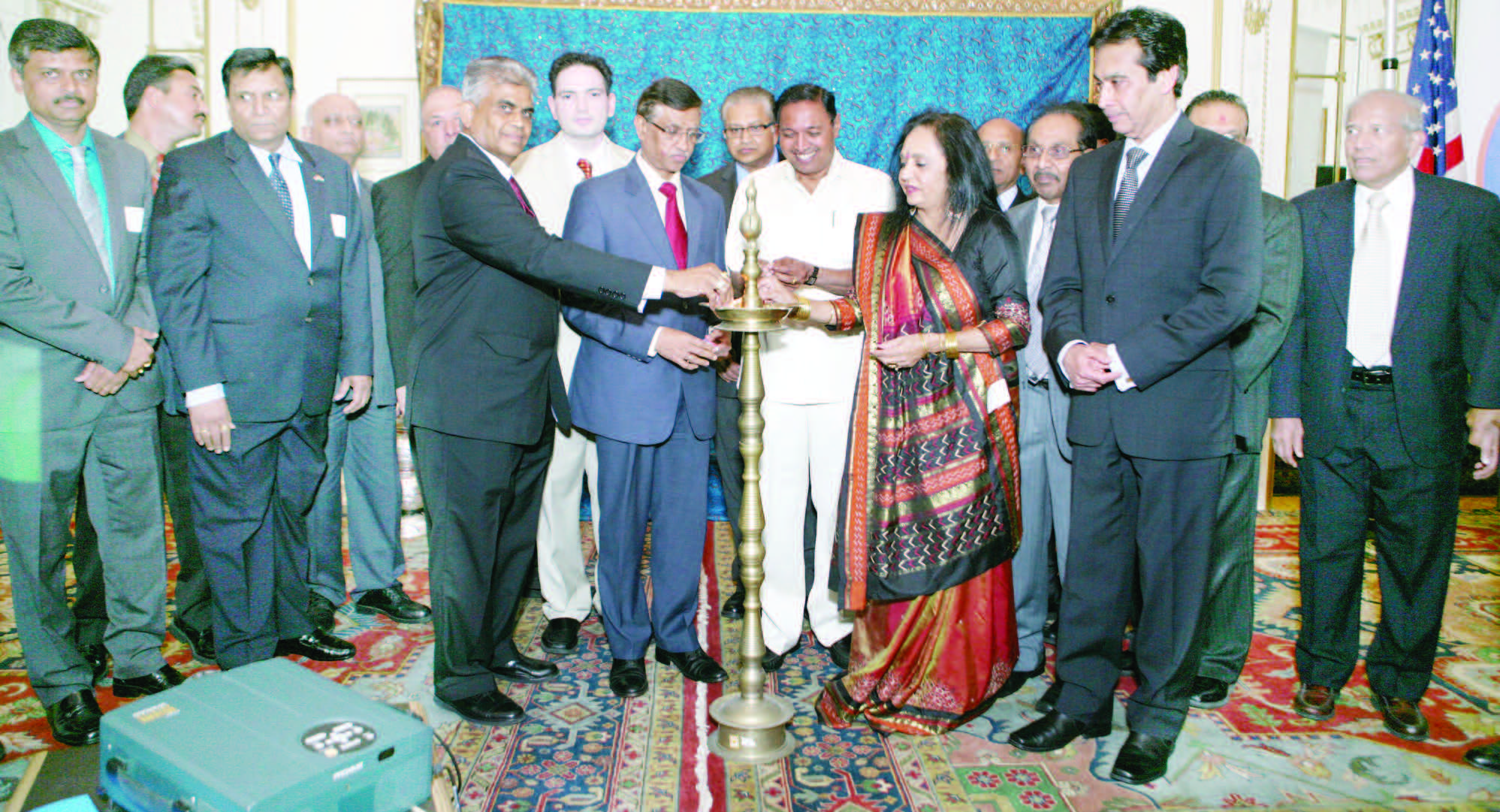
NEW YORK (TIP): Gujarati Samaj of New York announced a CULTURAL FESTIVAL OF GUJARAT to mark the celebration of its 40th Anniversary. The festival will be held on August 8,9 & 10, 2014. Consul General Dyaneshwar Mulay inaugurated the kick off with traditional lighting of the lamp. Chamunda Swami chanted Shlokas from Hindu scripture to seek divine blessings for the success of the undertaking. Ambassador Mulay expressed the need to market India to the mainstream. He asked every member to invite friends from mainstream to events and educate them about richness of India and Indian culture. He wondered why India still does not have a permanent seat at the Security Council.
He spoke of the Consulate’s initiative in hosting a series of events on India’s rich culture, lofty thought and diversity. He shared his conviction that India and USA are best partners to build the global economy. And every NRI should help make that happen. A spokesman for the Samaj said that Gujarati Samaj of New York was established in 1974, and has now a membership of more than 2400 families representing some of the most successful and affluent Gujarati Americans of Tri-state area. On the occasion of 40th Anniversary, Gujarati Samaj of New York is organizing a mega event for 3 days called “CULTURAL FESTIVAL OF GUJARAT” (CFG) showcasing the rich history, culture and heritage of State of Gujarat in India, the birth state of Global icon Mahatma Gandhi, Iron man Sardar Patel, religious Gurus including Pramukh Swami, business leaders Ratan Tata and Dhirubhai Ambani and the recently elected Prime Minister of India, Narendrabhai Modi among others. CULTURAL FESTIVAL OF GUJARAT (CFG) is to be held over three days in August on 8th, 9th and 10th in St. Anthony’s Conference Center in Melville, New York.
The 3-day mega event will include programs such as Garbo from Gujarati Samaj, Bhavai by Shakuntal Arts, Kamlesh Patel Dance, Dayro by Sairam Dave & Group, Women Seminar by Kajal Oza, Group Bhajans by Hari Bharwad, comedy by Jagdish Trivedi, concert by Mauli Dave, Fashion Show by Sringar group, Archan Trivedi for drama, Bhanubhai Vora of Swarkinnary group from Bombay, Sanjay Oza and Party, Sahitya lecture, Auction of Arts and Award ceremony. R. D. Patel, Chairman of Board of Trustees said, “We are excited to present this mega event to the community to thank our predecessors who brought the Samaj reach this far. This institution has been the cornerstone for our community to continue to share our culture with generations over last 40 years and I promise to continue to build with help from each Trustee of the Board in coming years”.
Harshad Patel, President of Gujarati Samaj of New York said, “I am fortunate to be the President in this historic year, and look forward to host an event of international standards with help from Dilip Chauhan, Minesh Patel and Bhupendra Patel, along with day to day contribution from my able committee members, Jatin Upadhyay, Chandrakant patel, Chimanbhai Patel, Anil Patel, Kiritbhai Patel and Divyesh Tripathi, to make this dream come true. I urge each of the community person of Indian origin to join us, and business community to help with support to make it a grand success”. Bharti Desai, Program manager and host of Gujarati Samaj of New York and launch event, said, “It has been a pleasant experience for me to host and organize multiple events at the Samaj in last few decades. It has helped me creatively to contribute in making each program a success. After having worked with several Presidents at the Samaj, now I look forward to handling this mega event and take the events presented by the Samaj to the next level in organizational excellence”. Samaj showcased “Garavi Gujarat” film on Gujarat’s riches and unfolded the video on CFG. The web site was inaugurated by Consul General. Attendees will enjoy traditional Gujarati food, enjoy very famous Gujarati movies like Jigaraneami, Akhand Saubhagyavati and Mahendi Rang Lagyo. Various booths will decorate the exhibition at the event with book stalls and handicrafts.
Top Government officials, public persons, Business and community leaders, young professionals, achievers and VVIPs are expected to attend the mega event over 3-days to be attended by 5,000 on a day. Dr. Navin Mehta, Trustee and major supporter of Samaj thanked the attendees and community in helping Samaj in last 39 years. He was proud to see Narendrabhai Modi, a Gujarati lead the nation as PM. He saw a growing and prosperous India in the making. He fondly related his own association with Samaj since he was doing his residency in New York.
Gujarati Samaj of New York which was established as non-profit organization by about one hundred first generation Gujarati families, today, has a life membership of over 2400. Over last 39 years the Samaj has conducted several activities to promote Gujarati and Indian religious and culture in New York area to community persons from all generations. In 1985, the Samaj acquired its own 12,000 sqft center located in Fresh Meadows, Queens, New York. The Center can accommodate up to 700 people.
The center is used mainly for Samaj activities. In 2009-2010, the Center was refurbished. Several thousand members of the Tri-state area are now using the Center for family events. In addition several other ethnic organizations are taking benefit of the central location to conduct their events at the center. Today, Gujarati Samaj of New Yorkis one of the oldest and vibrant organization in the tri-state area serving the Gujarati and other communities with educational, religious, and social activities such as FOGANA, Health Awareness Expo, Medical and Yoga Camp, Holi Celebration, Navaratri Celebration, Diwali Celebration, Gujarati Dayro and Drama, Appreciation Dinner, Cultural Tours, Gujarat Day Celebration, Independence Day Celebration, Republican Day Celebration among others. Samaj of New York is planning to have blood bank and Matrimony section for community benefit. Samaj held 10th anniversary at Madison square Garden and 20th Anniversary at Jacob Javits Center.
Gujarati Samaj of New York announced a raffle draw for a BMW car for the attendees. Earlier, before the formal program began, a minute’s silence was observed to pay homage to BJP leader Gopinath Munde who lost his life in an accident.
-

NO ROOM FOR LK ADVANI IN PARLIAMENT HOUSE
NEW DELHI (TIP): When former deputy prime minister LK Advani reached his office in Parliament during the lunch-break, he was confronted with a humiliating situation. The plaque with his name at the door of the room allotted to him in the 15th Lok Sabha – which said that he is acting chairman of the National Democratic Alliance or the NDA – had been removed.
The 86-year-old leader was forced to sit in the BJP’s parliamentary party office during the recess, in a room earmarked for the party’s deputy leader. Gopinath Munde, who was killed in an accident on Tuesday, held the post of deputy leader in the previous Lok Sabha, while his counterpart in the Rajya Sabha was Ravi Shankar Prasad, who is now a Cabinet Minister in the Narendra Modi government.
The room that Mr Advani sat in for the last five years is the NDA chairman’s room. Former prime minister Atal Bihari Vajpayee, who has been ill and out of politics for many years now, continues to remain NDA chairman. Mr Advani was designated acting chairman of the alliance in 2004, after the alliance conceded power to the UPA. Advani’s name-plate, said sources, was removed yesterday, a move which is being viewed as a sure-fire signal that he will no longer hold the post of acting chairman of the NDA.
The BJP leader had to shift to the room earmarked for Mr Vajpayee in 2009 after his party elevated Sushma Swaraj to the post of Leader of the Opposition in the Lok Sabha. Advani had also held that post since 2004. Advani was the BJP’s prime ministerial candidate in 2009. Last year, when the party decided to project Narendra Modi for PM, Mr Advani had staged public sulks in protest.
In March, he told his party colleagues that he wanted to contest the Lok Sabha polls from Bhopal, and not Gandhinagar, a seat held by him five times in the past. He feared that the BJP’s Gujarat unit would punish him for opposing Mr Modi’s elevation as the party’s prime ministerial face. He was eventually persuaded to contest from Gandhinagar. Advani won the seat by a whopping margin of 4.83 lakh votes.
LOK SABHA SETS RECORD AS 510 MEMBERS TAKE OATH ON A SINGLE DAY
This is the first time that so many members have taken oath on a single day.
Attired in spotless white kurta-pyjama, the Prime Minister was the first to take oath amid thumping of desks. He took the oath in Hindi in the name of God and he was followed by BJP veteran LK Advani and Congress president Sonia Gandhi.
Then came the turn of panel of Chairmen- PA Sangma, BS Engti and Arjun Charan Sethi – senior members so that they could sit in the Speaker’s chair to conduct proceedings by turn to assist the Protem Speaker Kamal Nath. This was followed by oath-taking by the members of the council of ministers.
The country’s unity in diversity was on full display as the House boasting of over 300 first timers, including Modi, saw a festive atmosphere. With many donning traditional dress and head gears, most members took oath in their mother tongue. Some ministers, including Sushma Swaraj, did it in Sanskrit.
On June 4, the only member who had taken oath was Protem Speaker Kamal Nath before President Pranab Mukherjee in Rashtrapati Bhavan. With the results of Lok Sabha elections bringing in a new political era, it was a scene different from the one witnessed by the House in the last ten years.
The BJP, which for the first time won a majority on its own with 282 members, occupied slightly more than half the House, accompanied by its allies which accounted for more than 50 members.
-

Israel, Denmark keen to partner in Ganga cleanup, water management
NEW DELHI (TIP): PM Narendra Modi’s pet Ganga cleanup programme and his mission for clean water has attracted interest from foreign nations. Israel and Denmark, global leaders in water technology and water management, say they can be part of this particular national mission. Israeli ambassador Alon Ushpiz said, “Think about the purification of the holy Ganges. I have a list of 200 Israeli companies that can do this.
” Already, a consortium of Danish water companies are operating in Gujarat, even conducting a pilot project for water management in Rajkot, Danish ambassador Freddy Svane said. “If you go from Gujarat down to Tamil Nadu and up to Hyderabad, you will come across more than two dozen Israeli desalination plants. Some huge, others not so big. There are places in some cities where you probably will drink water from Israeli desalination plants, joint projects with state governments. This is good water, very good water.
The plants are exactly the same as on the shores of the Mediterranean,” Ushpiz said. Svane said Copenhagen harbour was a perfect case study of implementation of new technologies for water management. Danish companies can undertake impact studies, cleaning up of water and even provide enzymatic solutions to reduce waste water in quantity and quality. Ushpiz said, “Israel loses just about 8% of what we put in the pipes, the best figure in the world. Indian figures are higher. The beauty of water management is that you simply enlarge your water collection by saving water. I come from a society that has put water on a pedestal. It’s not only a commodity, it’s a cultural value.”
-

PM moves to official Race Course Road residence
being sworn-in, Narendra Modi on May 30 moved to the Prime Minister’s official residence at the Race Course Road. Modi, who was staying temporarily at the nearby Gujarat Bhawan, went to the 5, Race Course Road this morning and a small pooja was performed there.
Most of his belongings have been shifted to the 5, Race Course Road– a bungalow which he will occupy as residence instead of bungalow number 7, which has been the residence of his predecessors. Manmohan Singh vacated the Race Course Road residence after Modi’s swearing-in on May 26 but the new Prime Minister did not shift as it was being refurbished. Modi will use the bungalow number 7, Race Course Road as his office
-

Meet the new Chief Minister of Gujarat
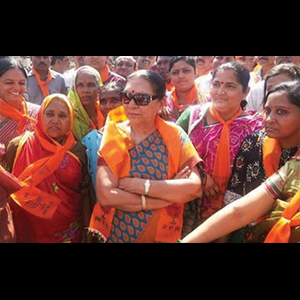
Anandiben Patel, the new Chief Minister of Gujarat, is a long-time confidante of her predecessor Narendra Modi, and is often described as Gujarat’s “Iron Lady”. The stern-faced Anandiben, regularly seen wearing colorful saris and a bindi (the dot many Hindu women wear as decoration on their forehead), has been a Gujarat government minister since 1998 and has built a reputation as a tough, no-nonsense taskmaster like Modi.
The septuagenarian is not seen as a mass leader and many say she lacks charisma. Rajiv Shah, the former political editor at the Times of India newspaper in Ahmedabad, Gujarat’s largest city, who has met her several times, described Patel as “extremely curt”. But many agree she has evolved into an effective administrator credited for improving the state’s schools and playing a key role in infrastructure development.
Patel first came to the attention of senior BJP party leaders in Gujarat in 1987 when she was given a bravery award for rescuing two female students from drowning. On her official website she described the episode as “a life changing event” which propelled her into the role of president of Gujarat BJP’s women’s wing. After three decades as a teacher, Patel was elected in 1994 as a member of the Rajya Sabha, the upper house of India’s parliament.
Close relationship
Four years later, she secured a seat in state assembly polls on a BJP ticket in her home state and was made minister of two departments – education and women and child welfare – by Gujarat’s former chief minister Keshubhai Patel. Under Modi, Patel’s responsibilities grew. Since 2001 when he became Gujarat’s Chief Minister, she has been in charge of a number of departments including revenue, roads and buildings, disaster management, and urban development and urban housing.For years now, she has been seen as the second in command. “When Modi is out of the state, she is the one virtually in charge,” The Indian Express newspaper wrote after featuring her for the first time this year in its annual list of the 100 most powerful Indians. The two leaders have a close relationship. “Those who cannot reach the CM [Modi], approach her for permissions and sanctions,” the Ahmedabad Mirror newspaper remarked in a 2012 article.
Patel’s estranged husband, Mafatlal Patel, a former BJP member with whom she has two grown-up children, once complained about Modi’s influence over his wife in letters to the former Prime Minister Atal Bihari Vajpayee. “When she entered politics, she severed all ties with the family for no fault of ours. Her behavior has become deformed and Narendra Modi is responsible for it,” Patel was quoted as saying in a 2009 news article. Possibly the only other individual to enjoy as close a connection with India’s next Prime Minister is Amit Shah, a former Home Minister of Gujarat, who led the BJP’s successful poll campaign in Uttar Pradesh state.

Shah is also an accused in the extrajudicial killing of Sohrabuddin Sheikh, a Muslim civilian, and is still on bail. Patel, who was odds-on favorite to take over in Gandhinagar, Gujarat’s capital, has long had differences with Shah. Siddharth Varadarajan from the Delhibased Centre for Public Affairs and Critical Theory, has described the pair as Modi’s “acolytes” and says that is why they have been able to flourish politically.?
Gender barriers
From a young age, Patel broke gender barriers. Her parents enrolled her into a primary school where she was the only female student and it was the same story years later in 1960 when she entered college, according to the biography on her official website.As a politician, she has championed women’s issues.But as Gujarat’s first female Chief Minister, political commentators say it is unlikely she will prioritize issues like maternal mortality and female literacy despite a human development index report released by a government-appointed panel last year categorizing the state as “less developed”. ?Instead, they say, she will govern like her predecessor and portray herself as a business-friendly leader to ensure rapid economic growth in the state of 60 million people.
-

THIS PM IS NOT ‘SAHEB’ FOR FRIENDS
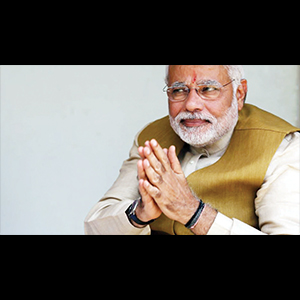
AHMEDABAD (TIP): “For you, I will always be Narendrabhai, not PM,” PM-designate Narendra Modi told a sea of BJP leaders and supporters who had gathered at the Ahmedabad airport to welcome him after he was appointed prime minister by the President. Modi’s childhood friends say that this humility was not for show -Modi in fact never liked them calling him ‘saheb’; he rather insists on being called Narendra by his buddies. Sudhir Joshi, 64, who studied with Modi from class 5 to class 11, says that Modi has prohibited him from calling him ‘saheb’.
“After he became the CM, I used to meet Narendrabhai for dinner at least once a year. Initially, I called him ‘saheb’ but he immediately corrected me: ‘Did you call me saheb when we were in school? Please call me Narendra’,” Joshi recalls. Joshi, who is the son of Modi’s family physician in Vadnagar, says that he is proud of his friend becoming the PM and that he had an inkling way back in 2010 that Modi would become the PM. “In 2010, Narendrabhai told me just like that, ‘Sudhir, your friend is marching towards Delhi.
I will not stay in Gujarat for long’,” says Joshi. Another childhood friend, Shyamal Modi (63), says Modi has remained humble with them and never made them feel about his growing stature in national politics. Shyamal who lives in Vadnagar was a businessman until recently . “When he was elected CM, I told him, ‘You have become Krishna and I am mere Sudama’. Then Modi told me never to say this again and said: ‘A friend is always a friend. He does not become big or small’,” recalls Shyamal, who had caught baby crocodiles with Narendra Modi and took them to Modi’s mother.
Nagji Desai, another childhood friend who studied with Modi in Vadnagar, recalls: “Once when I called him ‘saheb’, he asked, ‘Have you become so highly educated that you are addressing me as Sir?’” The childhood friends have remained close to Modi despite his meteoric rise in politics. They wish him well now that he has left for New Delhi. “We will go and meet Modi in New Delhi once a year, and keep our old ritual alive,” said Joshi.
-

Anandiben Patel is Gujarat’s first woman CM
AHMEDABAD (TIP): Anandiben Patel took over as Gujarat’s Chief Minister on May 22 afternoon. She was administered oath by the state’s Governor Kamla Beniwal. On stage, was her predecessor Narendra Modi, who will be the country’s next prime minister. The entire BJP top line of leaders like party president Rajnath Singh, LK Advani, MM Joshi and Arun Jaitley were also present as the 72-year-old Anandiben took oath at a packed Mahatma Mandir in Gandhinagar. She is Gujarat’s first woman Chief Minister.
CONTINED FROM PAGE 1 After Modi resigned as the Chief Minister, a position he had held for 13 years, his party’s legislators elected Patel to be their leader. Modi’s close aide Amit Shah, who does not share the warmest vibes with Ms Patel, was among those who endorsed her name for the chief minister’s post. In Gujarat, Shah and Patel have often been described as Modi’s “left and right arms.” Like Shah, Anandiben Patel is said to enjoy Modi’s complete trust.
During his long election campaign, while Amit Shah helped Mr Modi script his massive victory, Ms Patel, the revenue minister, held fort in Gujarat as the head of a group of ministers set up to run the state government. She is known to be a very able administrator and has a tough, nononsense image. Dabbing discreetly at her eyes yesterday, as she was elected, an emotional Patel said, “Today when our beloved leaders are going to Delhi, there are tears in one eye and happiness in the other.
Happiness because they are going to Delhi to wipe the tears of millions of Indians. I wish Narendra Modi all the best.” Handing over, Modi assured Patel that “no files in the chief minister’s office are pending”, and said, “she is a very hardworking minister and has been a performer and am sure Gujarat will continue to move forward on path of growth.”
Patel has stood by Modi for many years even before he took over as Gujarat chief minister, including when in the mid 1990s, he was banished from state politics after a confrontation with other state leaders. The senior BJP leader was elected to the state assembly in 2012 from Ghatlodiya in Ahmedabad by a margin of 1.10 lakh votes. Her biggest limitation, her colleagues say, is her lack of connect with the party’s grassroots level workers and her inaccessibility.
-

Canadian PM congratulates Modi, praises Indian democracy
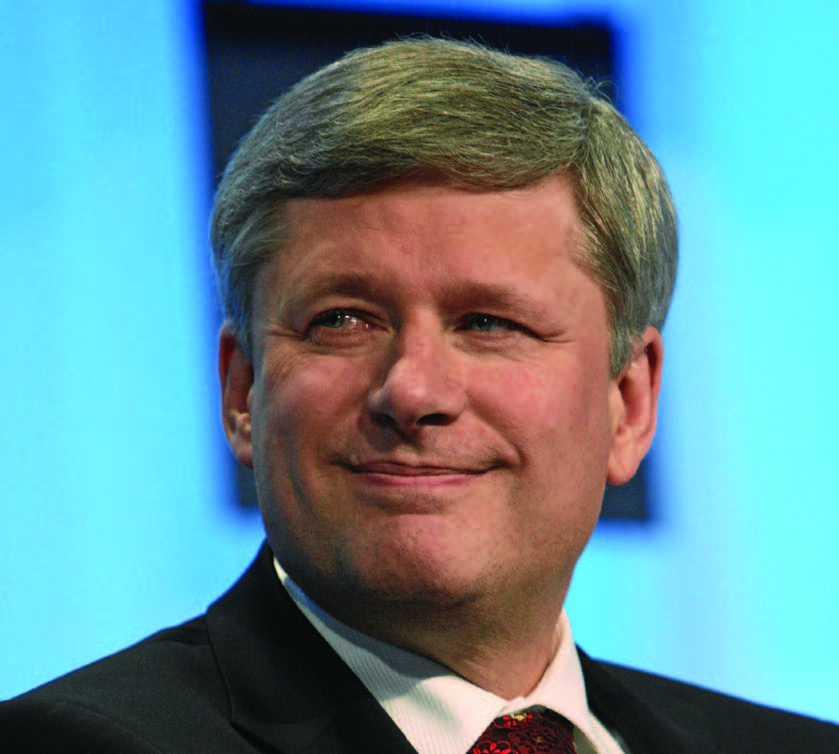
OTTAWA (TIP): Congratulating India’s prime ministerelect over his victory, Canadian Prime Minister Stephen Harper says he is looking forward “to working with Mr. Modi and the new government of India to further strengthen our social and economic partnership to the benefit of our citizens.” In an official statement, he commended “550 million Indian citizens who peacefully exercised their right to vote.
The unprecedented scale of these elections emphasizes both the vitality and strength of India’s democracy.” Canada, Harper emphasized, “is proud to share with India the values of freedom, democracy, human rights and the rule of law.” Deepak Obhrai, parliamentary secretary to the foreign minister and for international human rights, congratulated Modi and the BJP on their electoral success.
“These elections clearly illustrate that Mr. Modi’s message of economic revival resonated with the Indian electorate. Under the leadership of Mr. Modi, India is poised to reach greater heights.” “These elections highlight the maturity and strength of India’s democracy and I can say we rejoice with the people of India as they embark on a new direction under the leadership of Mr. Modi,” Conservative MP Kyle Seeback said in the House of Commons May 16.
He also referred to Modi’s achievements during his term as chief minister of Gujarat: “As Chief Minister of Gujarat, Mr. Modi made it (Gujarat) one of India’s bestperforming states economically.” Obhrai, an Indo-Canadian, said “our government congratulates Mr. Modi on his win. We look forward to working with Mr. Modi to strengthen the existing social and economic partnership that exists between Canada and India.”
“A clear majority for the BJP enables the new government to take measures aimed at boosting growth and investment, removing regulatory bottlenecks and restoring fiscal balance. If implemented, these will restore investor confidence and lead to a resurgence of growth creating new opportunities for Canadian business.” said Peter Sutherland, President & CEO of the Canada-India Business Council and former Canadian High Commissioner to India.
“One of the big criticisms of the Congress-led United Progressive Alliance (UPA) government was that it delayed the implementation of key reforms, seen by many as key to long-term growth,” this pre-eminent business organization stated. Modi, they noted, refocused the BJP party platform on a commitment to make India “globally competitive” and to reclaim India’s role as a global trading power.
-

BJP Victory- an Electorate Revolution
Prakash Waghmare, Community Leader and “OFBJP” PR-Coordinator, in a statement to The Indian Panorama wrote, “This absolute victory of BJP is not only a new dawn in Democratic history of India , but more importantly, an electorate revolution for the entire country.
There is no doubt in anybody’s mind that it was triggered by Modi’s personal charisma and his awe-inspiring developmental track record with uninterrupted peace and prosperity for his own state, Gujarat. He personified people’s aspirations, hopes and frustrations to have good governance and clean, scandal-free government. In every sense, this is a victory of the People, by the People for the People”
-

India Delivers Clear Mandate to Bhartiya Janta Party
Narendra Modi to be sworn in as Prime Minister on May 21
Manmohan resigns bringing to an end his 10-year tenureNEW DELHI (TIP): Addressing a euphoric crowd Friday, May 16 afternoon, Narendra Modi rallied the public to join him in taking on challenges of a vast scale. He has floated the idea of building “a hundred new cities,” of extending a high-speed rail network across the subcontinent and undertaking the herculean task of cleaning the Ganges River. He has been inspired by China’s model of high-growth, topdown development.
But the country he will govern is India: messy, diffuse, and democratic. Modi’s Hindu nationalist Bharatiya Janata Party won a historic mandate in the country’s general election Friday, emerging with 282 of 543 parliamentary seats, more than enough to form a government without having to broker a postelection coalition.
For months, Modi’s advisers had focused on crossing such a threshold, which they regarded as a signal that the country was behind an agenda of radical change. The nature of that change has never been clear, though. Voters are seeking immediate economic opportunities.
The party has proposed pro-business legislation like the easing of labor or landacquisition laws. Modi, 63, is drawn to largescale building and infrastructure projects, which he pursues with a single-minded – critics say dictatorial – style. “He has a fairly clear idea of what he wants to accomplish, and he does not look for ratification from the market,” said Eswar S. Prasad, a Cornell University economist who has consulted informally with Modi’s economic team.
“One could argue that in a country where there are far more words than actions thrown around, that this is far more preferable: a man who acts.” Modi’s planned economic reforms are certain to encounter obstacles once he takes power, among them a federal system that puts essential functions like land acquisition in the hands of state leaders. Entrenched national-level functionaries will resist efforts to strip their authority by eliminating red tape, a goal that was central to Modi’s plan to attract investors to the state of Gujarat.
Changing tax policy or labor and land laws would require the support of the upper house of Parliament, which the Bharatiya Janata Party does not control. Meanwhile, voters’ expectations of immediate economic improvement are perilously high, setting the stage for rapid disappointment if Modi is seen as not delivering. But Friday’s enormous victory will give Modi “a much freer hand than the typical leader of such a large democracy,” Prasad said.
The reasons Modi’s party succeeded in defeating the Indian National Congress, which has controlled India’s government for nearly all of its postcolonial history, will be studied for years. But they clearly reflect a rapid change in Indian society as urbanization and economic growth break down old voting patterns. For decades, the Congress party’s trademark initiatives have been redistributive, and the party introduced a package of major subsidies for the poor before the election.
Voters, however, proved to be more captivated by Modi’s promise to create manufacturing jobs, which he has done quite successfully in Gujarat, the state he has governed since 2001. Modi, the son of a provincial tea-seller, prides himself on being an outsider amid New Delhi’s elite, and he recently promised in an interview with Open magazine that he would “break the status quo.”
He was profoundly imprinted by his years as a full-time activist for the Rashtriya Swayamsevak Sangh, a right-wing Hindu organization, and his earliest and most frequent trips as an elected official were to other countries in Asia, which shaped his vision of India as a manufacturing power. A cultural conservative, he is no admirer of the liberal intellectuals who traditionally support the Congress party.
Swapan Dasgupta, a journalist who supports Modi, said Delhi elites were worried – justifiably – that the space for their work would shrink when the new government settles in. cannot say what the contours of the future political elite or political class will look like,” he said. “He has brought in lots of people who have risen from local politics, less of those people who are traditional dynasts. A new sort of people, perhaps a little technocratic. People not from the Anglophone elite, maybe.”
The mood at the Congress party’s headquarters on Friday was funereal. Top officials had prepared for a loss, but not for the crushing defeat they faced; according to final results from the Election Commission, the party had secured only 44 seats, a surprisingly low number for the party that was integral to India’s founding narrative. The president of the Congress party, Sonia Gandhi, and her son, Rahul, made a brief appearance at the headquarters late in the afternoon, when celebratory firecrackers could be heard from BJP headquarters nearby.
Rahul Gandhi, who has never appeared comfortable in his role as the party’s standard-bearer, kept an odd, fixed smile on his face, acknowledging that the party had “done pretty badly.” His mother, who reinvigorated the party after her husband, Rajiv, was killed by a suicide bomber in 1991, conceded defeat without mentioning Modi or the BJP. “We believe that in a democracy winning and losing is part of the game,” Sonia Gandhi said.
“This time the mandate is clearly against us. I accept the mandate with humility. I hope that the incoming government will not compromise with the interests of society.” A Congress-led coalition won a solid majority of seats in 2009 parliamentary elections, but the term was tarnished by corruption scandals and a slowing economy. Party workers, dully flipping through television news channels in a room with portraits of four generations of Nehru- Gandhi politicians on Friday, complained that the party’s grass-roots workers no longer had contact with Rahul Gandhi and his advisers, and had failed to identify shifts among young voters.
Rajendra Pal Singh, a clerk with the party for more than 30 years, sadly recalled a time when the party faithful streamed in and out of the party’s bungalow as if it were “a place of worship.” “Gone are the days of the Gandhis,” Singh said. “We have not seen people coming here to hug Rahul for the past decade on any of those festivals. That culture is dead and long gone, like the Congress party now.”
Addressing a euphoric throng in the city of Vadodara after votes were counted Friday, Modi was forced to pause repeatedly as he waited for the audience to stop chanting his name. Modi, normally an intensely solitary man, draws visible pleasure from his interactions with crowds, and he seemed Friday to enlist their support for vast undertakings. “Brothers and sisters, you have faith in me, and I have faith in you,” Modi said. “This is the strength of our confidence – that we have the capacity to fulfill the common man’s aspirations.
The citizens of this country have done three centuries of work today.” His supporters celebrated. Drummers, stilt-walkers and women in colorful saris converged at BJP headquarters in New Delhi, where party workers had laid out 100,000 laddoos, the ball-shaped sweets that are ubiquitous at Indian celebrations. Among the revelers was Surinder Singh Tiwana, 40, a lawyer. “I can equate my jubilation today, probably, to my mother’s on the day I was born,” Tiwana said. “This is a huge change for our country, a change of guard. A billion plus people have announced their mandate in no uncertain terms.”
-

OFFICIALS EYE FOREIGN POSTINGS POST-POLLS
NEW DELHI (TIP):With a week to go for election results to be declared and little chance of the ruling coalition getting a fresh term, UPA ministers and their staff have started winding up. Most offices wear a deserted look with ministerial staff either looking at foreign postings or starting to scout for their next assignment within the country.
The early birds have already taken up new assignments. For instance, Indu Shekhar Chaturvedi, who was private secretary to PM Manmohan Singh, has moved to Washington as a senior advisor in the International Monetary Fund. Similarly, Anjali Prasad, who was the additional secretary responsible for FDI policy, has joined as India’s ambassador to WTO in Geneva.
There are several others who are in contention for foreign assignments, starting with the government’s chief spokesperson Neelam Kapoor, who is said to be headed for Nehru Centre in London. Also in the race for a job at the Indian high commission in London is commerce and industry minister Anand Sharma’s private secretary Ashish Kundra, while the minister’s officer on special duty Ayush Mani Tiwari may move to the Indian mission in Brussels.
Even finance minister P Chidambaram’s OSD, Vijay Singh Chauhan, is a candidate to be an advisor to India’s executive director to the World Bank in Washington. Officials, however, say this is not a surprise given that bureaucrats often get prized postings after stints with ministers. Even in 2009, Pulok Chatterjee, who was then a secretary in the PMO, had moved to Washington as executive director to the World Bank. Similarly, DPS Sandhu, who was also part of the PMO, went to Washington.
Shakti Sinha, a trusted aide of former PM A B Vajpayee, sought and got a posting with the World Bank after the NDA government lost the trust vote by a single vote. Although outgoing regimes take care to ensure that choice foreign postings for their trusted officers are secured, the practice has over the years become so institutionalized that it is seen as a ‘given’, even an entitlement which succeeding governments will not like to interfere with for the risk of appearing mean-spirited.
The ministers themselves are bidding farewell, starting this weekend itself. Commerce and industry minister Anand Sharma, for instance, has invited senior officials for lunch at a kebab joint in a five-star hotel near the Delhi airport for what appears to be his last such meeting before election results are out. Finance minister P Chidambaram is scheduled to meet regulators and top North Block officials at the meeting of the Financial Sector Development Council, where the agenda, apart from the immediate issues facing banks, insurance companies and stock markets, will be to bid adieu after spending years with most of the regulators.
Later, he meets public sector bank chiefs. “Obviously, with just days to go with the result, he can’t be telling us what we should do during the financial year,” said a bank chairman who did not wish to be identified. In fact, the mood has already begun to change in the ministries and departments with information flow suddenly increasing, often causing embarrassment to the government (Doordarshan’s interview of Narendra Modi and the industry department report on Gujarat land intervention being cases in point).
Packing has already begun at 7 Race Course Road, the PM’s official residence, with books and others articles being carefully catalogued as Singh prepares to move into a new bungalow on Motilal Nehru Marg. An agency report said all gifts received by Singh or members of the PMO are being catalogued and handed over to the treasury.
-

INDIA’S ELECTION: Gujarat Model of Development Vs. Nation’s Conscience
The author is saddened at the turn of events in the 2014 elections. He fears the
heterogeneity of the nation will receive a hard kick if Narendra Modi led BJP came to power.“It is India’s heterogeneity that has earned the admiration of the world and has received the label “mother of all civilizations”. The existence of multiple religions, cultures, languages, social groups have enabled the country to enjoy the boons of “unity in diversity” making it intriguing to the outside world as well as conducive to an egalitarian society”, says the author.
Priyamvada Gopal, in the faculty of English at the University of Cambridge, writing in Independent stated that if Modi won the election, India would have crossed a moral Rubicon, a reference to the river Rubicon in north-eastern Italy, which means to pass a point of no return. It refers to Julius Caesar’s crossing of the river in 49 BC, which was considered an act of war, because crossing it with an army was forbidden by the Roman Senate.
The writer appears to give a stern warning that India is at the crossroads where the electorate may soon decide whether the country that has been a functioning democracy with pluralist and inclusive agenda will remain the same or give way to installing Narendra Modi, as prime minister, thereby “crossing a blood-soaked moral Rubicon”. Many also fear that this election could fundamentally transform India to the point of no return beyond an open society, where all citizens, regardless of whether they belong to a majority or minority community, are treated equally before the law.
While the BJP might have earned the right to pursue their agendas through the traditional process of democratic governance, do they need to radically alter the face of the nation? However, if they are to pursue the radical nature of their goals, there will be consequences, the first of which would be to divide the nation based on religion, caste and region. It is India’s heterogeneity that has earned the admiration of the world and has received the label “mother of all civilizations”. The existence of multiple religions, cultures, languages, social groups have enabled the country to enjoy the boons of “unity in diversity” making it intriguing to the outside world as well as conducive to an egalitarian society.
Moreover, India is known as the land of spirituality and philosophy. It was the birthplace of three world religions: Hinduism, Buddhism and Jainism. Our great sages attained extraordinary scholarship; mastered power of meditation; and lived simple and sacrificial lives advocating punishment for the wicked and protecting the poor and weak. Fast forward to 2014 and listen to an average Indian on the street or an NRI who is on an overseas assignment. They tend to make very similarsound bytes as this Indian woman from Detroit: “Even if Narendra Modi was involved in Gujarat riots, I don’t care. His economic work wins out.
I will vote for him.”One wonders as to what happened to our age old civilization that emphasized good over evil? As I was thinking of writing this article two images came to mind. One is that of Dr. Manmohan Singh, the current Prime Minister and the chief architect of India’s new economy. He has taken a centrally planned, inward looking, public-centered economy and reversed its direction. What he has accomplished is just phenomenal. Actually this dramatic change paints a picture of a man who is some sort of a revolutionary. If India entered the 21st century, the current Prime Minister has a lot to do with it. Take a look and see how fellow Indians perceive himnow and many of whom appear to be repeating every word ofthe western critics calling him an ‘under achiever’ or ‘a complacent leader’.
The opposition party leaders even label him as the ‘weakest Prime Minister ever’! It is quite astounding thatmany Indians look at this brilliantman of integrity and honorwith almost disdain. On the contrary, Mr. Narendra Modi, has presided over a pogrom in Gujarat; ran an autocratic administration that instilled fear in people for the past 13 years; silenced the opposition while putting potentialrivals in their place; and ran a propaganda campaign on Gujarat model of development based on falsehoods.
Yet, Indians appear to be in awe of this man who is being heralded as a Messiah of the nation! Are we missing something here? What happened to our value system that once promoted positive attributes in behavior and glorifiedcompassion and empathyfor fellow human beings? It is indeed a dramatic shift that is taking place in India though many are stillvery judgmental on the western materialism and its narcissist lifestyle. Modi’s campaign has been tremendously successful in creating a positive narrative and cultivatingthe mindset of the majority community. The campaign incites that the majority isincreasingly at a disadvantage in India, as minorities are raking in all the benefits and even occupying the higher echelons of power. This notion is sinking in and the Congress party, so far, has been unable to counter it.
As someone who has visited Gujarat right after the riots, my perspectives are shaped by what I have witnessed in many refugee camps and affected villages. I was part of a NRI Sadhbhavana Mission team headed by Mr. Shrikumar Poddar to promote peace and harmony in a state torn by religious and sectarian violence in 2002. We were accompanied by Nishrin Jafri Hussain, daughter of former Congress Member of Parliament Ehsan Jaffri who was killed during the riots. Gulbarg Society, a complex of 18 bungalows and two apartment blocks once occupied by upper-middle-class Muslims in the largely Hindu neighborhood of Chamanpura, is now a cluster of door-less burned shells where at least 35 Muslims were hacked and burned to death, including Nishrin’s father Ehsan Jafri.
In a recent New York Times report, Roopa Mody, who was a witness to this attack recalled the final minutes of the onslaught on this complex by the mob. “When the mob grew restive, attempting to knock down a wall of the compound, Mr. Jafri made a final call to Mr. Modi, the chief minister. “All he got in return were abuses,” Roopa said in an interview, reiterating what she said in deposition before the Supreme Court. “We prepared ourselves to die.Everyone says that Modi is a good leader who built roads and bridges, these roads are built on dead bodies.”
Thane Richard, founder of the Dabba, an independent digital radio station poses this poignant question “Has India become so desperate for rapid economic growth, so blinded by the promise of prosperity, that she has forgotten basic humanity? It seems that, in the race towards higher GDP, the majority of India is willing to inject itself with steroids of bigotry or ruthlessness. Ethics be damned.”
-

LOK SABHA POLLS: PHASE 7 SEES 66% VOTER TURNOUT
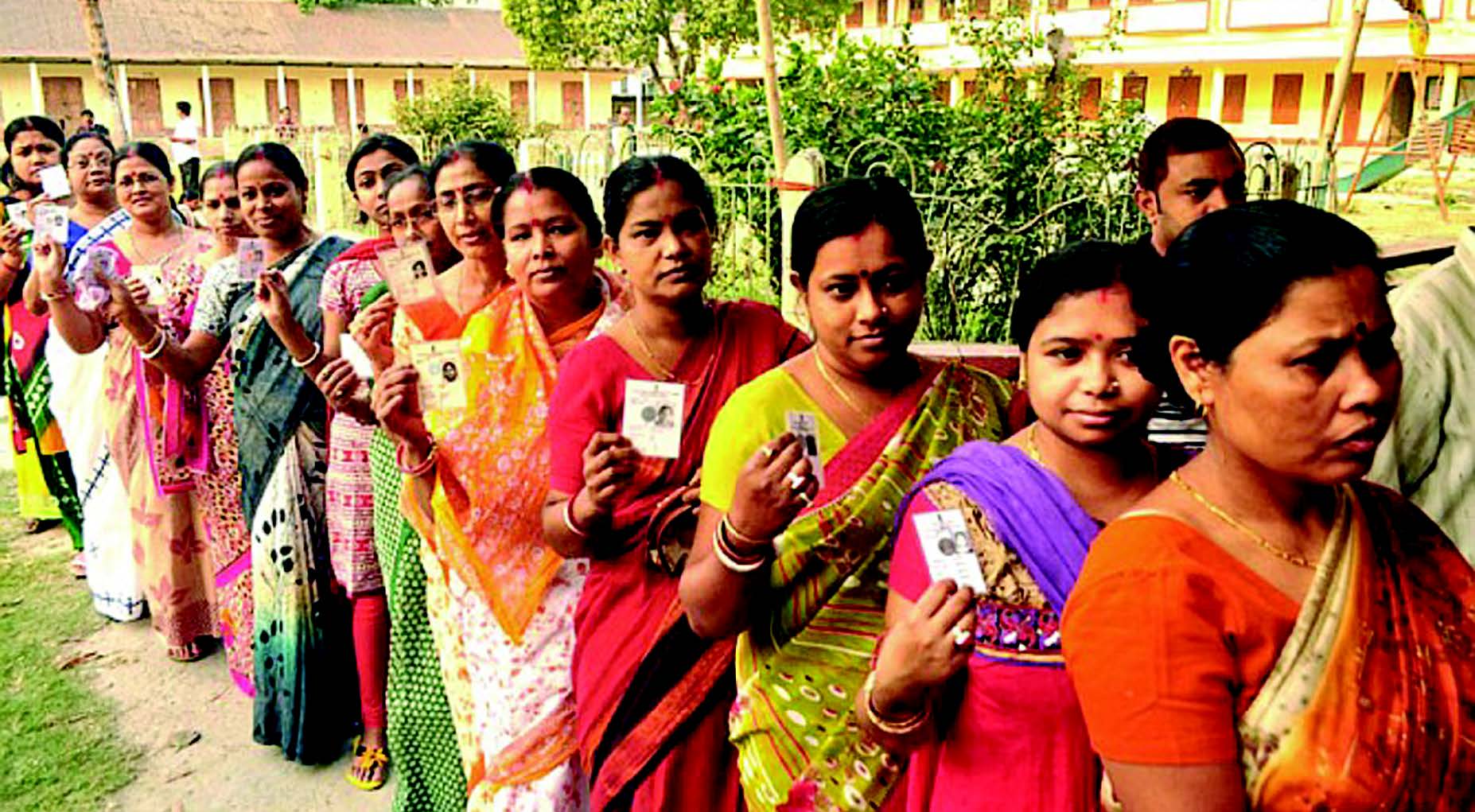
NEW DELHI (TIP): Nearly 66% of the electorate exercised its franchise on Wednesday in the seventh phase of the 16th general election, in line with the heavy turnout that marked the earlier rounds of voting. More than 139 million people were eligible to cast their votes in the phase that decided the electoral fortunes of political heavyweights including the Bharatiya Janata Party’s (BJP) prime ministerial candidate Narendra Modi and his senior colleagues Rajnath Singh, L.K. Advani, M.M. Joshi and Arun Jaitley, besides Congress party president Sonia Gandhi.
The day also marked what Modi claimed was the first police complaint registered against him in his life. The first-information report (FIR) was registered against him at the behest of the Election Commission. The BJP is eyeing at least 62 of the seats up for grabs in Wednesday’s voting, by the end of which elections were completed in 438 of the 543 Lok Sabha constituencies. Elections to the remaining 105 constituencies will he held on 7 May (64 seats) and 12 May (41). The results will be declared on 16 May.
The 438 Lok Sabha constituencies where voting has taken place so far have witnessed a 66.2% voter turnout, compared with 57.6% in 2009. Some 62.4% polling was recorded in Gujarat, where all 26 Lok Sabha constituencies in the state went to the polls on Wednesday. Vadodara, where Modi is in the electoral fray, had witnessed a high turnout of 70% well before polling ended. “There is a phenomenal increase in the voter turnout in Gujarat…,” said Akshay Rout, director general of the Election Commission. “The voter turnout for the state in the 2009 general election was 47.8%.” In the last five Lok Sabha elections, the average voter turnout in Gujarat was less than 50%.
The turnout is expected to be higher this time around following a voter awareness drive carried out by the Election Commission and with Modi being selected the BJP’s prime ministerial candidate, political experts said. After casting his vote in Gandhinagar constituency, Modi told reporters that this was the end of India’s “mother-son government”—a reference to Sonia Gandhi and her son, Congress vice-president Rahul Gandhi. Modi said the Congress appeared to have accepted defeat after signalling it may support a Third Front (non-Congress, non- BJP) government at the Centre to keep Modi out.
“The Congress has accepted defeat as it is now saying that it will support the Third Front to keep me out of the race. The Prime Minister, the finance minister and other senior ministers are not in the contest. Tall leaders of the Congress are running away from the elections,” Modi said. “Now, some are trying to save their chairs, some are trying to save themselves and some are trying to save prestige of the Congress party,” he added. Modi suffered a setback, with the Election Commission asking the Gujarat state authorities to register two first FIRs against him for holding a media briefing outside a polling station in Gandhinagar and also holding the BJP’s symbol, the lotus, while talking to reporters.
“Tone and tenor of the address made by Narendra Modi and the statements made by him, the manner in which the symbol lotus of the BJP was being displayed by him, it is evident that the address was in the nature of political speech intended and calculated to influence and affect the result of elections in the constituencies going to polls today, not only in Ahmedabad but also in all other constituencies in Gujarat and elsewhere in the country,” the poll watchdog said in a statement. Addressing a rally in Tirupati, Modi referred to the FIR. “I will never forget 30 April. Today was the first time an FIR was registered against me,” he said.

Modi claimed he had never violated the law hadn’t even got a parking ticket in his life. Gujarat is considered to be a bastion for the BJP and the party is looking to make a clean sweep in the state this time around. Modi is also contesting from Varanasi in Uttar Pradesh. In the 2009 Lok Sabha election, the BJP won 15 seats and the Congress 11. The BJP increased its tally in by-elections—in the outgoing Lok Sabha, the BJP has 17 seats while the Congress has nine. On Wednesday, Punjab also recorded its highest-ever turnout at 73%. The voter turnout was 76% in Daman and Diu, 81.35% in West Bengal, 73% in Punjab, 59% in Uttar Pradesh, 70% in the Telangana region of Andhra Pradesh, 60% in Bihar, 85% in Dadar and Nagar Haveli, and 25% in Jammu and Kashmir.
Telangana vote
Andhra Pradesh’s Telangana region, which will become India’s 29th and newest state on 2 June, also went to the polls on Wednesday. The region recorded a turnout of 59.3% as of 3pm. Medak (65%) had recorded the highest polling while Hyderabad district (51%) recorded the lowest, a bulletin by the state election commission showed. About 28.1 million voters in Telangana were registered to elect candidates to 17 Lok Sabha and 119 state assembly seats at 30,000 polling stations.While 265 candidates were in the fray for parliamentary constituencies, 1,669 candidates were in the race for the state assembly.Voters in Telangana are simultaneously electing representatives to the Lok Sabha and to what will become the Telangana state assembly. The other part of Andhra Pradesh will exercise its mandate a week later on 7 May. The 294-member Andhra Pradesh state assembly will be divided according to constituencies once Telangana becomes a state. The main parties and groupings in the race to form the first government of Telangana are the Telangana Rashtra Samithi (TRS), and two alliances—one between the Congress and the Communist Party of India and the other between the Telugu Desam Party (TDP) and the BJP. The winner in the 119-member Telangana assembly has to get a simple majority of at least 60 seats to form the new government in the would-be state.
Polling was not devoid of incidents. Actorpolitician K. Chiranjeevi landed himself in an embarrassing position when a youngster objected to him skipping the queue at a polling booth. Chiranjeevi, who is chairman of the Andhra Pradesh Congress Committee, then beat a hasty retreat and stood at the end of the queue. TDP chief N. Chandrababu Naidu, too, landed himself in an embarrassing position when he revealed who he cast his ballot for. “Due to our pre-poll arrangement, I cast both my votes for lotus symbol (of the BJP),” Naidu told waiting media.
The state election commission did not take kindly to this. “Secrecy of vote has to be maintained by every voter,” Andhra Pradesh chief electoral officer Bhanwar Lal said. As a result, the returning officer of the polling booth will declare Naidu’s vote ineligible. “He should act responsibly,” Lal said. “If we don’t delete that (ballot), action will be taken against us.”
-

How the lotus bloomed on this Congress turf
AHMEDABAD (TIP): Ahmed Patel, Sonia Gandhi’s political secretary, enjoys tremendous goodwill in Bharuch which sent him to the Lok Sabha in 1977, 1980 and 1984. That he last won 30 years ago hasn’t stopped people from talking about his good deeds.
The most interesting one relates to his helping trace the young son of a local businessman, Narendra Modi, who had been missing for three months. Known as ‘Babubhai’ locally, Patel, 65, was close to the late Sanjay Gandhi and has remained fiercely loyal to the family. He lost the elections in 1989 and 1991 and never contested after that, taking the Rajya Sabha route to the Parliament and becoming a powerful Congress leader from Gujarat.
He was the last Muslim leader to be elected to the Lok Sabha from Gujarat which turned into a laboratory for Hindutva and paid rich dividends for the BJP. For the past year or so, after being sidelined by Rahul Gandhi in party affairs, Patel has been talking of retirement and spending more time in Piraman, his village. Notwithstanding Patel’s popularity, the Congress stands little chance of winning Bharuch.
In 2012, Congress lost in all the seven assembly segments and has no control over any of the 11 taluk panchayats. The biggest electoral spoiler for Congress is the communal divide in a constituency which has 22% Muslims, next only to Ahmedabad (West) which has 23%. The key swing away from the Congress to the BJP has been that of tribals who match the Muslim population in Bharuch. The BJP’s candidate Mansukh Vasava is a tribal and seeking his fifth term in Parliament. It’s the only instance of any party giving the ticket to a tribal from a general seat in Gujarat. The tribal plus Hindu votes ensure his victory.
The Congress, which has fi elded a Patel candidate, is happy with the absence of Janata Dal (U) leader Chhotu Vasava from the electoral arena. Dubbed as a tribal Robin Hood, Vasava has a lot of muscle and holds sway over tribals in the Valia-Jhagadia region. Cricketer Munaf Patel, called the Ikhar Express, is a prominent face of Bharuch and has inspired many young cricketers from the district. Interestingly, Muslims have become prosperous over the years.
Like Mohammedbhai Gheewala, 69, whose packaged Sofey Tea is a huge hit in south Gujarat since 1996. A former Patel loyalist and now Modi admirer, Asifa Khan is confident that Muslims will vote for Modi in large numbers. “There is a positive socioeconomic change in the status of Muslims here,” she says. There’s been a spurt in investment and employment opportunities in the region.