Tag: ISIS

  • Spreading fear of ISIS

    Spreading fear of ISIS

    Post Paris, when the Union Home Ministry said that an “IS-backed attack is possible in India” and went on to talk of the Islamic State’s “success in radicalizing some youth and attracting some sections of the local population or the Indian diaspora to physically participate in its activities”, it indirectly magnified the threat perception of the IS among people. Terror is not an issue that Home Minister Rajnath Singh should be casually discussing with media persons on the sidelines of a function. He needlessly lauded the striking capacity of the IS when he said it posed “a threat for the entire world”.

    The fight against terror has to be a rigorous, quiet and coordinated effort aimed at plugging loopholes in the state of preparedness. Intelligence sharing with other countries makes little sense when the Centre and states fail to do so within the country. States are particularly vulnerable. Leave alone having a specialized trained force to combat terror, policing, intelligence gathering and the security apparatus at the state level are far from professional. Even the Centre, despite the NIA, is ill-equipped to handle Paris-type strikes at crowded places. Mocking the security setup, an NRI rammed his SUV into the Wagah border gate on Monday. That the intruder could reach the border gate unchallenged in itself is an unflattering reflection on a regime that takes considerable pride in its masochism.

    While hundred per cent security at every vulnerable spot may be difficult, states need to be constantly motivated in modernizing policing and strengthening intelligence. Regular preparedness drills can help locate cracks which terrorists can take advantage of. There is no need to broadcast to the nation that the IS has a limited presence in India and that it has appeal among certain youth. We have yet to learn the importance of quiet, skilled capacity-building. The need is to monitor social sites more closely and wean youth from interacting with IS cells through persuasion, preferably, and by force, if necessary. Politicians and media have to take care that they don’t end up playing into the hands of terrorists by spreading scare. The IS fear has been internationalized unconsciously.

  • Kurdish Iraqis enter Sinjar in push to oust IS fighters

    SINJAR(IRAQ) (TIP): Iraqi Kurdish militias battling to take back Sinjar from Islamic State militants raised a Kurdish flag and fired off celebratory gunfire in the center of town Nov 13, though US and Kurdish officials cautioned that it was too soon to declare victory in a major offensive to retake the strategic community.

    The Kurdish forces encountered little resistance, at least initially, suggesting that many of the IS fighters may have pulled back in anticipation of Friday’s advance. It was also possible that they could be biding their time before striking back.

    Kurdish militia fighters known as peshmerga launched a major offensive to retake Sinjar and succeeded in cutting a key nearby highway on Thursday. U.S.-led coalition airstrikes supported the offensive, dubbed Operation Free Sinjar.

    Peshmerga Maj. Ghazi Ali, who oversees one of the units involved in the offensive, said thousands of Kurdish fighters entered the town from three directions Friday morning. Associated Press journalists saw them raise a flag over a building in the center of the city.

    They encountered minimal resistance during Friday’s push, Ali said.

    “No one was fighting back. They placed some IEDs and had some snipers in position, but there were no clashes,” he said, using the abbreviation for improvised explosive devices, a military term for homemade roadside bombs.

    Gunfire fell silent as peshmerga fighters marched into the town. He described the situation in the city as still dangerous, however, and warned that it was too soon to declare victory.

    “I can’t say the operation is complete because there are still threats remaining inside Sinjar,” he said. The risks include ambushes from suicide bombers, roadside bombs and booby-trapped houses, he added.

    Iraq’s highest Shiite religious authority, Ayatollah Ali al-Sistani, praised peshmerga fighters in his Friday sermon for their efforts to capture Sinjar from the Sunni militant group.

    Col. Steven Warren, a spokesman for the U.S.-led coalition, confirmed only that peshmerga fighters raised their flag on grain silos in the eastern part of the town. He said they had not fully retaken Sinjar.

    There is reason for officials’ caution. An earlier attempt to wrest back control of the town, at the foot of Sinjar Mountain about 50 kilometers (30 miles) from the Syrian border, stalled in December. Militants have since been reinforcing their ranks.

    The fight to dislodge IS militants from the Kurdish town of Kobani in northern Syria, meanwhile, took about four months _ despite hundreds of U.S. airstrikes in support of the Kurdish fighters.

    Islamic State extremists overran Sinjar as they rampaged across Iraq in August 2014, leading to the killing, enslavement and flight of thousands of people from the minority Yazidi community. Its members follow an ancient faith that the Islamic State group considers heretical.

    The U.S. later launched an air campaign against the Islamic State militants, also known as ISIL, ISIS and, in Arabic, as Daesh.

    Hundreds of pickup trucks and sport-utility vehicles carrying Kurdish fighters were seen gathering at the entrance of Sinjar earlier Friday ahead of a planned push into the town center.

    Diar Namo, the 26-year-old deputy commander of the peshmerga unit stationed there, said the skies above Sinjar were largely quiet overnight following intense coalition airstrikes on Thursday.

    From his frontline observation post, he said he saw little movement inside the city before Kurdish forces moved in.

    “We saw more than 50 Daesh (fighters) flee overnight,” Namo said, using an Arabic acronym for the Islamic State group, “Before there were only 200 to 300 in the city.”

    Officials with the U.S.-led coalition estimated there were between 400 and 550 IS fighters inside Sinjar before the offensive began Thursday.

    Save taxes & make money. Get rich with tax-saving funds.

    Southeast of Sinjar, in the village of Soulag, four peshmerga fighters were killed when a homemade bomb targeting their truck exploded, according to fighters in their unit.

    Homemade roadside bombs and explosives-laden cars targeting peshmerga convoys significantly slowed Thursday’s advance through Sinjar’s eastern and western fringe.

    The blasts continued Friday. Just an hour after the first Kurdish forces entered Sinjar, an Associated Press team saw an explosion 700 meters (yards) from the northern edge of town.

    Ali said he will only consider the operation a success once Sinjar is completely free of land mines and homemade bombs.

    “We are waiting on the engineering team,” he said, referring to the teams of peshmerga who specialize in diffusing explosives. “Right now, it depends on them.”

  • Islamic State’s attacks in Saudi Arabia test security of haj

    Islamic State’s attacks in Saudi Arabia test security of haj

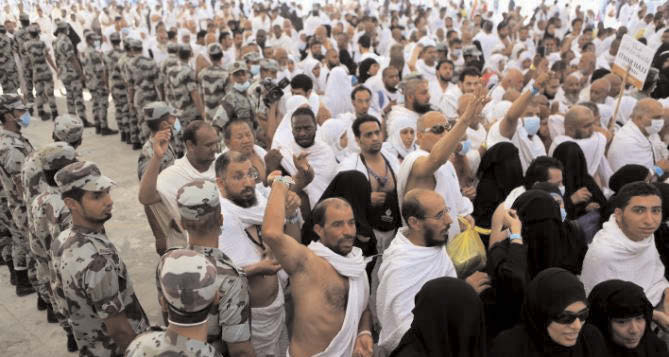
    DUBAI (TIP): The Islamic State group is extending its reach in Saudi Arabia, expanding the scope of its attacks and drawing in new recruits with its radical ideology.

    Its determination to bring down the US-allied royal family has raised concerns it could threaten the annual Muslim haj pilgrimage later this month.

    So far, the extremist group’s presence in the kingdom appears to be in a low-level stage, but it has claimed four significant bombings since May, one of them in neighbouring Kuwait.

    And it has rapidly ramped up its rhetoric, aiming to undermine the Al Saud royal family’s legitimacy, which is rooted in part in its claim to implement Islamic sharia law and to be the protectors of Islam’s most sacred sites in Mecca and Medina that are at the centre of haj.

    “Daesh and its followers have made it very clear that Saudi Arabia is their ultimate target,” Saudi analyst Fahad Nazer said, referring to the Islamic State group by its Arabic acronym. “Because of Mecca and Medina … That’s their ultimate prize.”

    An attack last month in which ISIS claimed responsibility appeared to mark a significant spread in the group’s reach.

    Jihadists claiming loyalty to the group had already carried out three major bombings —two in eastern Saudi Arabia in May and one in Kuwait City in June, all targeting Shia mosques and killing 53 people.

    But on August 6, a suicide bomber attacked in western Saudi Arabia, hitting a mosque inside a police compound in Abha, 350 miles south of Mecca, killing 15 people in the deadliest attack on the kingdom’s security forces in years.

    Eleven of the dead belonged to an elite counterterrorism unit whose tasks include protecting the haj pilgrimage.

    The alleged affiliate that claimed responsibility for the August attack called itself the “Hijaz Province” of the Islamic State, its first claim of a branch in the Hijaz, the traditional name for the eastern stretch of the Arabian Peninsula where the holy cities are located.

  • ISIS fighters flaunt American M16 rifles in new video

    ISIS fighters flaunt American M16 rifles in new video

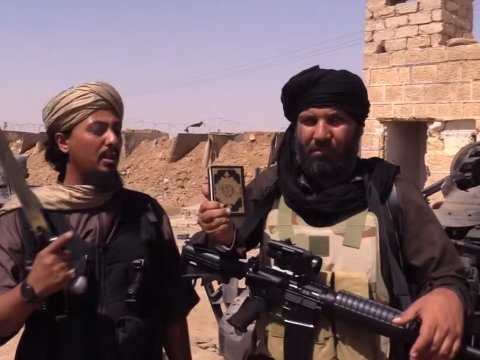
    WASHINGTON (TIP): In a new Islamic State video, jihadist fighters are shown flaunting the American M16 rifles that may have been seized by them from Iraqi soldiers or found in weapons caches dropped by the US.

    A video released by Islamic State of Iraq and Syria’s media arm in northern Iraq purportedly shows more than a dozen of the terror group’s fighters undergoing weapons training wielding American M16 rifles, according to Flashpoint Intelligence.

    “It is noteworthy that the use of American rifles by Islamic State fighters is rare and is only seen in Iraq,” Flashpoint said in a research note, using another name for the militant group.

    “These rifles were likely left by US forces or seized from Iraqi soldiers,” it said. Most jihadist fighters have been found to be using Russian AK-47 rifles and that the video’s release could suggest ISIS recently seized a cache of M16s, the NBC News reported. ISIS propaganda material in the past has shown fighters flaunting what appear to be US-made weapons, tanks and Humvees seized from retreating Iraqi forces.

    The United States has supplied Iraq with hundreds of millions of dollars in military hardware — including humvees. Iraq’s government said in June that it lost 2,300 Humvees to ISIS when the militants seized the city of Mosul. Last year, an ISIS video claimed that an airdrop of weapons intended for Kurdish fighters had ended up in the militants’ hands.

  • Breaking the India-Pak Logjam

    Breaking the India-Pak Logjam

    On both sides of the India-Pakistan border, columns were written after the aborted National Security Advisers’ meeting. Most retired Indian diplomats and analysts argued that flip-flops on Pakistan betrayed the absence of coherence and strategy. Journalist-apologists of the government dismissed these as laments of those without post-retirement sinecures – a familiar approach, commonly used by twitter “trolls”, to attack the person rather than his argument.

    In Pakistan, retired diplomats reflected known proclivities ranging from India-baiting by Munir Akram to balanced analysis by former high commissioner to India, Ashraf J Qazi, or rare brutal self-examination by Husain Haqqani, victimized by the Pakistan military when posted as the Pakistan ambassador to the US. Haqqani reminded Pakistan that the last resolution by the UN Security Council on Kashmir was in 1957 and that today it would be impossible to get any support for a fresh resolution for plebiscite in Kashmir. His sage advice is that Pakistan should stop living in the past, trapped in a Kashmir-is-ours narrative, while India too must not rub Pakistan’s “nose in the ground”.

    The Modi government has undertaken two cycles of PM-level India-Pakistan engagement culminating in bickering and last-minute cancellation of scheduled meetings, i.e. Foreign Secretary-level meeting in August last year and now those of the NSAs a year later. The government’s defenders aver that this is actually calculated relaying of new red-lines. This claim needs examination.

    The first red-line is strict bilateralism, implying Pakistan would not provocatively consult Hurriyat before high-level talks. The second one is that India-Pakistan parleys will first focus on terror. Once India is satisfied of Pakistani cooperation, the old composite dialogue, or any new variant, may be revived. Pakistan’s de facto foreign minister Sartaj Aziz told Indian television that as a politician, if he met Indian Prime Minister on the sidelines of his talks with NSA Ajit Doval, he could not be constrained to only discuss terror without enquiring about “modalities” to resume dispute resolution.

    Sartaj Aziz’s argument carries weight as such specificity can be prescribed if the meeting was of Additional Secretaries heading the Anti-Terror Mechanism, as the writer did in 2006-07. It could also be if the Home Secretaries of the two countries met. Once talks are ramped up to the political level, the discussions perforce will be wider. In the Ufa statement, the words that “all issues connected to terrorism” will be discussed left a loophole for Pakistan to introduce Kashmir, as according to them it is the root cause of terror.

    The two other operative parts of the Ufa joint statement relate to confidence-building measures for maintaining peace at the Line of Control/International Border and the release of fishermen. Regarding the first, progress depends on Pakistan army’s cooperation, which uses ceasefire violations to convey unhappiness over its own government’s India policy or to facilitate infiltration or simply defy perceived Indian dominance. The recurring fishermen issue is a factor of unresolved maritime boundary due to the non-settlement of the Sir Creek issue.

    The tripod on which the Pakistan polity rests is the army, political parties and radical Islamic groupings – political or jehadi. A decade of Pakistan playing the US counter-terrorism game in the Af-Pak area has complicated relationships amongst the three. Some former jehadi protégés have turned enemies of the Pakistan state while others have diversified their own lateral links to Afghan/Al-Qaeda groups. The Death of Taliban leader Mullah Omar will exacerbate the jostling for space amongst the entire jehadi fraternity, further complicated by the ISIS seeking adherents.

    What then should be the Indian strategy to deal with this complex and evolving situation?BJP/RSS spokesmen on television hint at a Doval doctrine of retribution. One even claimed that the Indian NSA has warned Pakistan that it would lose Baluchistan if there is another 26/11. Such rash statements are providing Pakistan ammunition to prove Indian meddling, which globally none has so far taken seriously. It also neutralizes Indian moral advantage built over decades, alleging Pakistan’s complicity in abetting terror in India.

    Contrariwise following can be the contours of India’s Pakistan policy. Firstly, India must not push Pakistan’s elected government, however ineffective in controlling their army, into the army-jehadi corner. It is in India’s long-term interest to have any elected government be less and not more dependent on that combine.

    Secondly, Pakistan’s Punjab is losing mental space to the trans-Indus jehadi/Wahhabi hybrid of Islam which is alien to centuries of diverse and inclusive Islamic precept and practice. De-radicalization in Pakistan would need the Punjabi heartland to rediscover its historic roots, which it shares with Indian Punjab. Bangladesh, under PM Sheikh Hasina, is combating radicalization by rooting itself in the composite Bengali culture and not by espousing an anti-India Islamic construct. For this, it is necessary to revive incrementally cultural, travel and youth links between the two Punjabs -through which ran ancient arteries linking Central and South Asia.

    Maharaja Ranjit Singh – first indigenous ruler since Rajput rule (647-1192) to govern Punjab (1799-1839) – wove a Muslim majority area with a significant Hindu and Sikh population into a Punjabi citadel of composite culture against Pashtun interference from trans-Indus regions. Sikh troops hunted down Syed Ahmad, self-proclaimed Amir ul-Momineen, a title that Taliban leader Mullah Omar assumed, in 1831 at the Battle of Balakot.

    Thirdly, the Composite Dialogue, conceived in 1997 in Male by Prime Ministers Nawaz Sharif and IK Gujral, is flawed as confidence-building measures (CBMs) and disputes are tackled simultaneously. Pakistan holds back progress on CBMs to force progress on Kashmir, Siachen, etc. This is absurd as CBMs are meant to create the environment for dispute resolution and must precede the latter. Special representatives must be appointed to deal with disputes, out of public view, via a back channel. Meanwhile, the Foreign Secretaries/Ministers can quickly finalize CBMs that are mature for delivery. Terror issues can be handed over to the intelligence chiefs of the two nations.

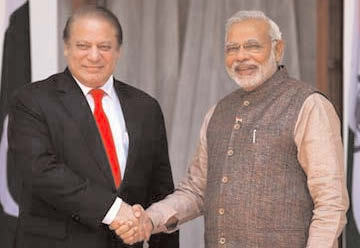
    September-end, the two PMs will be in New York. They have an opportunity to break the logjam. PM Nawaz Sharif must refrain from playing to the international gallery. PM Modi needs to retrieve his Pakistan policy from the intelligence-security lobby for a safer South Asia.

    (The author, a career diplomat is a former Secretary, Ministry of External Affairs, Government of India)

  • Transnationals | Tax Havens | Terrorism

    Transnationals | Tax Havens | Terrorism

    “Westphalian sovereignty is the principle of international law that each nation state has sovereignty over its territory and domestic affairs, to the exclusion of all external powers. The principle of non-interference in another country’s domestic affairs, and that each state (no matter how large or small) is equal in international law is recognized. This doctrine is named after the Peace of Westphalia, signed in 1648, which ended the Thirty Years’ War.” 

    “It is ironical that Terror organizations on one side and Tax havens on the other have completely undermined Westphalia consensus. In that context countries like India have every right to exercise its freedom to pursue terrorists who are undermining its existence whether sponsored by foreign countries or home grown. The concept of territorial jurisdictions and sovereignty are no more valid in the context of terror organizations since they damage both India and its own host countries over period of time. India must protect its national interests and institutions by challenging inimical forces wherever they are located without worrying about Westphalia consensus”.


    In the context of the strikes made against terror camps on the border of Manipur/Nagaland by the Indian Army; there has been number of discussions about national sovereignty and the role of individual States. Actually in the last few decades the activities of transnational corporations aided by tax havens on one side and terrorists on the other side have destroyed the concept of nation state and its sovereignty evolved after the 30 years’ war in 1648 in Westphalia. Westphalian sovereignty is the principle of international law that each nation state has sovereignty over its territory and domestic affairs, to the exclusion of all external powers. The principle of non-interference in another country’s domestic affairs, and that each state (no matter how large or small) is equal in international law is recognized. This doctrine is named after the Peace of Westphalia, signed in 1648, which ended the Thirty Years’ War .After that war major continental European states – the Holy Roman Empire, Spain, France, Sweden and the Dutch Republic – agreed to respect one another’s territorial integrity. As European influence spread across the globe, the Westphalian principles, especially the concept of sovereign states, became central to international law and to the prevailing world order.

    Scholars of international relations have identified the modern, Western-originated, international system of states, multinational corporations, and organizations, as having begun at the Peace of Westphalia. Henry Kissinger in his important book on “world Order” says:

    “No truly global “world order’ has ever existed. What passes for order in our time was devised in Western Europe nearly four centuries ago, at a peace conference in the German region of Westphalia, conducted without the involvement or even the awareness of most other continents or civilizations. A century of sectarian conflict and political upheaval across Central Europe had culminated in the Thirty Years’ war of 1618-48- a conflagration in which political and religious disputes commingled, combatants resorted to “total war” against population centers, and nearly a quarter of the population of Central Europe died from combat, disease, or starvation. The exhausted participants met to define a set of arrangements that world stanch the bloodletting. Religious unity had fractured with the survival and spread of Protestantism; Political diversity was inherent in the number of autonomous political units that had fought to a draw. So it was that in Europe the conditions of the contemporary world were approximated: a multiplicity of political units, none powerful enough to defeat all others, many adhering to contradictory philosophies and internal practices, in search of neutral rules to regulate their conduct and mitigate conflict.

    “The Westphalian peace reflected a practical accommodation to reality, not a unique moral insight. It relied on a system of independent states refraining from interference in each other’s domestic affairs and checking each other’s ambitions through a general equilibrium of power. No single claim to truth or universal rule had prevailed in Europe’s contests. Instead, each state was assigned the attribute of sovereign power over its territory. Each would acknowledge the domestic structures and religious vocations of its fellow states as realities and refrain from challenging their existence. With a balance of power now perceived as natural and desirable, the ambitions of rules would be set in counterpoise against each other, at least in theory curtailing the scope of conflicts. Division and multiplicity, an accident of Europe’s history, became the hallmarks of a new system of international order with its own distinct philosophical outlook. In this sense the European effort to end its conflagration shaped and prefigured the modern sensibility: it reserved judgment on the absolute in favor of the practical and ecumenical; it sought to distill order from multiplicity and restraint.

    “The seventeenth-century negotiators who crafted the peace of Westphalia did not think they were laying the foundation for a globally applicable system. They made no attempt to include neighboring Russia, which was then reconsolidating its own order after the nightmarish “Time of Troubles” by enshrining principles distinctly at odds with Westphalian balance; a single absolute ruler, a unified religious orthodoxy, and a program of territorial expansion in all directions. Nor did the other major power centers regard the Westphalian settlement (to the extent they learned of it at all) as relevant to their own regions.1

    The three core principles on which the consensus rested are:

    1. The principle of the sovereignty of states and the fundamental right of political self determination
    2. The principle of legal equality between states
    3. The principle of non-intervention of one state in the internal affairs of another state

    Interestingly, all three are questioned by contemporary leaders of West and radical Islam.

    Tony Blair the then Prime Minister of UK in his famous Chicago Address -1999-suggests

    “The most pressing foreign policy problem we face is to identify the circumstances in which we should get actively involved in other people’s conflicts. Non -interference has long been considered an important principle of international order….

    “But the principle of non-interference must be qualified in important respects. Acts of genocide can never be a purely internal matter. When oppression produces massive flows of refugees which unsettle neighboring countries then they can properly be described as “threats to international peace and security”.2

    The NATO intervention in Kosovo and Afghanistan as well as US intervention in Iraq provide recent examples of breakdown of idea of Westphalia. Similar is the humanitarian crisis faced by India regarding refugees from East Pakistan.

    Interestingly Radical Islam also considered that the world order based on Westphalian consensus will collapse. “In the aftermath of the 11 March 2004 Madrid attacks, Lewis ‘Atiyyatullah, who claims to represent the terrorist network al-Qaeda, declared that “the international system built up by the West since the Treaty of Westphalia will collapse; and a new international system will rise under the leadership of a mighty Islamic state.”3

    The spread of ISIS across countries and activities of Boko Haram based in Nigeria in Kenya and Chad re-emphasis this point. Radical Islam do not accept territorial boundaries since it works for a global regime for global Ummah.

    The recruitment by these terror organizations is also across continents and countries which does not respect territorial sovereignty. The talk about Caliphate indicates that they are trans-border organizations.

    On the other side we find global corporations transcending sovereignty in search of global profits. For this they use tax havens as a tool.

    Tax havens–numbering more than 70 jurisdictions–facilitate bank facilities with zero taxes and no-disclosure of the names and in many cases anonymous trusts holding accounts on behalf of beneficiary. Basically lawyers and Chartered accountants will deal with mattes. Sometimes a post box alone will be operative system. In the case of Bahamas one building seems to have had tens of thousands of companies registered there.

    Luxemburg (population half a million!) registered companies of various countries have evaded taxes significantly from their legal jurisdiction. The key findings of the activities of transnational companies cutting across territorial jurisdiction is given below.

    • Pepsi, IKEA, AIG, Coach, Deutsche Bank, Abbott Laboratories and nearly 340 other companies have secured secret deals from Luxembourg that allowed many of them to slash their global tax bills.
    • PricewaterhouseCoopers has helped multinational companies obtain at least 548 tax rulings in Luxembourg from 2002 to 2010. These legal secret deals feature complex financial structures designed to create drastic tax reductions. The rulings provide written assurance that companies’ tax-saving plans will be viewed favorably by Luxembourg authorities.
    • Companies have channeled hundreds of billions of dollars through Luxembourg and saved billions of dollars in taxes. Some firms have enjoyed effective tax rates of less than 1 percent on the profits they’ve shuffled into Luxembourg.
    • Many of the tax deals exploited international tax mismatches that allowed companies to avoid taxes both in Luxembourg and elsewhere through the use of so-called hybrid loans.
    • In many cases Luxembourg subsidiaries handling hundreds of millions of dollars in business maintain little presence and conduct little economic activity in Luxembourg. One popular address – 5, rue Guillaume Kroll – is home to more than 1,600 companies.
    • A separate set of documents reported on by ICIJ on Dec. 9 expanded the list of companies seeking tax rulings from Luxembourg to include American entertainment icon The Walt Disney Co., politically controversial Koch industries and 33 other firms. The new files revealed that alongside PwC tax rulings were also brokered by Ernst & Young, Deloitte and KPMG, among other accounting firms.4

    The big four accounting firms namely KPMG/E&Y/Deloitte and PwC have facilitated the movement of funds of clients across borders and territories to make tax “planning” easier for these companies. USA is literally waging war with major Giants like Amazon/Google/Microsoft etc. for not paying adequate taxes in USA in spite of being US based companies. Most of these companies have moved their profits to other Tax Havens.

    Global firms such as Starbucks, Google and Amazon have come under fire for avoiding paying tax on their British sales. There seems to be a growing culture of naming and shaming companies. But what impact does it have?5

    Royal Commission into tax loopholes a must—says a report in Australia.6

    There is an increasing clamor in USA about Congress Should Pass the Stop Tax Haven Abuse Act to Combat International Tax Avoidance. This has been highlighted by both TAX justice network as well as Global Financial Integrity.

    A simple method of trade mis-invoicing by global companies using tax-havens have impacted developing countries nearly 730Billion USD in 2012 says Global Financial integrity. Another interesting finding by GFI is about terror financing using Tax haven route.

    Because of the increasing wariness of MNCs using Tax havens for avoidance of taxes and the opaque ways of functioning of these off-shore structures, demands are growing about their activities and even closing down of these tax havens by European parliament etc.

    Due to relentless pressure from OECD as well as G20 many of these secretive jurisdictions are becoming more transparent.

    But the fact of the matter is these Trans National Companies and Tax Havens together have significantly undermined the concept of sovereignty and territorial jurisdictions.

    It is ironical that Terror organizations on one side and Tax havens on the other have completely undermined Westphalia consensus. In that context countries like India have every right to exercise its freedom to pursue terrorists who are undermining its existence whether sponsored by foreign countries or home grown. The concept of territorial jurisdictions and sovereignty are no more valid in the context of terror organizations since they damage both India and its own host countries over period of time. India must protect its national interests and institutions by challenging inimical forces wherever they are located without worrying about Westphalia consensus.

    (The author is Professor of Finance at IIM-Bangalore)

  • Greek Debt Mess: Uncertainty over Europe

    On Monday, June 29, global stock markets were reeling from the news out of Greece. Dow Jones was down by 350 points. With many global crises like Ukraine, ISIS, Syria, Iran nuclear deal already threatening to tip the world into chaos, the one crisis that could undermine not only the Eurozone itself but international financial structure is Greece and its monstrous debt crisis.

    While the Wall Street collapse of 2008 is supposed to have impacted many economies driving them into recession, the main reason for the Greece debt is the structural imbalance in the Greek economy in the form of high debt to GDP ratio.

    The implosion of the Greek economy in 2009 led to the fear that the Greek government would not be able to service its high debt obligations thus leading to sovereign debt crisis. As a result, Greece was unable to borrow on the international markets and had to turn to International Monetary Fund, European Central Bank and the European Commission to seek the bailout to avoid the impending financial crisis.

    But the bailouts did not come cheaply. Too many strings were attached to it. The Greek government was required to carry out numerous painful reforms: pensions were supposed to be reduced, tax receipts were to be streamlined by curbing tax evasions, steep tax hikes were required to be implemented to generate more revenue, and deep budget cuts were to be put in place.

    The result of all these attached conditions was the absolute impoverishment of the population which was already reeling under the hardships due to ongoing recession.

    This caused resentment among the population and resulted in the resounding victory of anti-austerity Syriza party in January which campaigned on the promise of ending painful bailout agreement.

    The two sides – EU and Syriza – are now at loggerheads. Syriza wants significant reduction in debt and more leeway in how it raises its tax revenues while protecting the pensions and other public obligations while EU is demanding significant reduction in pensions and steep VAT tax hike to increase the revenue. This has led to an impasse.

    The deadline for the loan repayment program that was extended in February has expired on June 30th, and given the fact that Greece is already on the verge of bankruptcy, missing the deadline means Greece would be held in default of IMF loan – a first developed nation to do so. How the dominoes would fall as a result of its default, nobody knows.

    And, this is driving the markets and the central banks all over the world nervous: How to prevent the contagion from spreading if Greek economy and banking system collapses?

    On top of it, Syriza has decided to seek referendum of the people – which will be held on July 5th – whether to accept the bailout agreement or leave euro. As of now, the mood of both Syriza and EU towards each other has become more hardened.

    Even though Greek Prime Minister Tsipras has now sent another letter to EU accepting lenders’ conditions but with modifications, given the fact that the deadline for agreeing to the new debt program has already expired, the letter seems to be too little, too late.

    Since there is no debt deal to talk about, July 5th’s referendum has become moot. It would be seen as nothing but a referendum on whether to stay in EU or not. EU has taken note of the letter submitted by the Greek government but has decided to stick to its guns and is waiting for the outcome of July 5th referendum before commenting on the contents of the letter.

    As of now, the “No” vote to the “troika” proposed bailout deal is in majority. And, if “No” vote wins in the referendum, then it would be anybody’s guess how the resulting scenario would unfold for Eurozone and its banking system.

    Quite a mess and a very big dark cloud over Eurozone and its economy.

  • 2 Indian-origin Youths from South Africa Die Fighting for ISIS

    2 Indian-origin Youths from South Africa Die Fighting for ISIS

    Two youths belonging to the Muslim community of a small Indian township south of Johannesburg have died allegedly fighting for the Islamic State, becoming one of the first South Africans to have died in Syria.

    Articles in media outlets today said a confidential report had indicated that Fayaaz Valli, 23, had gone to Syria claiming to be working for an orphanage but ended up being killed while fighting with Islamic State.

    Mr Valli’s father Riyad told the weekly Sunday Times that he was heartbroken by the death of his son but did not believe he had joined the IS.

    “I would never have allowed him to go if I knew,” the father said, but the report claims that two South Africans from Roshnee have already died while fighting alongside the IS, while several more were planning to enlist with the group.

    According to the report, the families of both men were advised that they had died in car accidents.

    The second man, whose identity has not been made public, allegedly settled all his debts and distributed his assets before travelling to Turkey to cross the border into Syria to join IS.

    Although government sources would not comment on it, the reports said the Muslim community of Roshnee have closed ranks to protect the families of the duo.

    This came amid concern that a number of young people from the town were being recruited to join the militant group which claims to act in the name of Islam but has been decried by Muslim organisations across the country.

    The weekly claimed to have knowledge of at least 22 South Africans who had flown on their own or with their families to Abu Dhabi in the Middle East and then to Turkey to try to join the IS. About half of them had been deported by authorities.

    The report said Roshnee residents had believed men collecting funds for humanitarian efforts on the Syrian border were actually doing so for IS.

    The Syrian Embassy in Pretoria has previously warned against organisations pretending to be engaged in humanitarian efforts in the Syrian war being a front for IS fundraising and recruitment.

  • Bobby Jindal slams Republican presidential opponent

    Bobby Jindal slams Republican presidential opponent

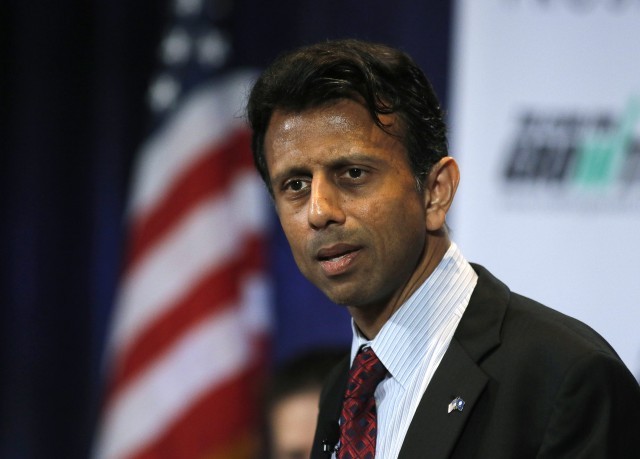
    WASHINGTON (TIP): Moving closer to a formal announcement of his US presidential bid, Indian-American Bobby Jindal has slammed his fellow Republican and presidential aspirant Rand Paul for being “unsuited to be the commander in chief.”

    In an unusually harsh language, the 43-year-old Louisiana Governor slammed Senator Paul as being
    “unsuited to be the commander in chief” after Paul in a TV interview said that “ISIS grew stronger because of the hawks” in the Republican party.

    “This is a perfect example of why Senator Paul is unsuited to be Commander-in-Chief,” said Jindal, who earlier this month formed an exploratory committee for his presidential bid.

    “We have men and women in the military who are in the field trying to fight ISIS right now, and Senator Paul is taking the weakest, most liberal Democrat position,” he said.

    Jindal, who is expected to join the GOP fray next month, said: “It’s one thing for Senator Paul to take an outlandish position as a Senator at Washington cocktail parties, but being Commander-in-Chief is an entirely different job.”

    “We should all be clear that evil and Radical Islam are at fault for the rise of ISIS, and people like President Obama and Hillary Clinton exacerbate it,” he said.

    “American weakness, not American strength, emboldens our enemies. Senator Paul’s illogical argument clouds a situation that should provide pure moral clarity. Islam has a problem. ISIS is its current manifestation,” he said.

    Jindal said that the next US President’s job is to have the “discipline and strength” to wipe out ISIS. “It has become impossible to imagine a President Paul defeating radical Islam and it’s time for the rest of us to say it.”

    Paul’s campaign fought back immediately, with Paul’s senior adviser Doug Stafford calling Jindal’s attack
    “ironic.”

    “It’s ironic Governor Jindal would level such a charge when he flip-flops on crucial issues like common core and national security, and he has cratered his own state’s economy and budget,” said Stafford.

    Jindal previously supported the federal Common Core educational standards, but has since become the anti-Common Core movement’s most vocal advocate.

    Jindal is a former congressman who started his career in public service as Louisiana’s health secretary. The war of words between Jindal and Paul has been widely reported in the US media on Wednesday.

  • ‘Draw Muhammad’ contest planned in Phoenix

    ‘Draw Muhammad’ contest planned in Phoenix

    PHOENIX (TIP): An anti-Muslim activist is planning a “Draw Muhammad” cartoon contest and rally Friday,  May 29 at a Phoenix mosque.

    The event is being dubbed a “Freedom of Speech Rally” and comes three weeks after a similar event in Garland, TX., that prompted violence by two alleged ISIS sympathizers who attended the mosque.

    The president of the Islamic Community Center of Phoenix said he has been notified by Phoenix police and the FBI about the event. Usama Shami said he respects the protesters’ right to free speech.

    “Everybody has a right to be a bigot. Everybody has a right to be a racist. Everybody has a right to be an idiot,” Shami said. He added that members of the mosque have been encouraged to attend prayer services Friday evening as scheduled.

    “It will be the same as every Friday evening and we’re going to tell our members what we’ve told them before: not to engage them,” said Shami. “They’re not looking for an intellectual conversation. They’re looking to stir up controversy and we’re not going to be a part of it.”

    The organizer of the event, Jon Ritzheimer, has held two protests in Phoenix since the Texas shootings. The chants and slogans at the protests are brash and hateful. Some supporters wear t-shirts that state, “(expletive) Islam.” Ritzheimer says he is using provocative methods to draw attention to a religion he believes at its core promotes violence.

    “I want this to be about pushing out the truth about Islam,” said Jon Ritzheimer. “I’ve read the Koran three times… the ones flying the planes into the tower, those are Muslims following the book as it is written.”

    A Facebook page dedicated to the event, titled “Freedom of Speech Rally Round II,” states: “This will be a PEACEFUL protest in front of the Islamic Community Center in Phoenix AZ… Everyone is encouraged to bring American flags and any message that you would like to send to the known acquaintances of the 2 gunmen.”

    Phoenix roommates Elton Simpson and Nadir Soofi drove to Texas and shot a security guard during the May 3 “Draw Muhammad” contest there. Police shot and killed the two men.

    Simpson and Soofi attended the Islamic Community Center of Phoenix until 2010 and, according to mosque leaders, never expressed extremist or violent views while attending during that time.

    The Facebook announcement for the rally also encourages participants to “utilize their second amendment right at this event just in case our first amendment right comes under the much anticipated attack.”

    As of Wednesday afternoon, the website showed 131 people confirming their attendance.

    One Facebook post on the page states, “Death to Islam! No coexistence!” Another comment states, “I am proud to be part of this rally and will continue to be a part of it until we have the freedom that all our vets and current military fight for!!! This is my way of joining their efforts!”

    Phoenix police declined to comment about security measures for the protest.

    Muslims consider images of the Prophet Muhammad offensive for various reasons. They compare drawn depictions of the religious figure to how Christians might view the burning of a cross.

  • Secrets of the bin Laden ‘treasure-trove’ – 106  documents released

    Secrets of the bin Laden ‘treasure-trove’ – 106 documents released

    In his final years hiding in a compound in Pakistan, Osama bin Laden was a man who at once showed great love and interest in his own family while he coldly drew up quixotic plans for mass casualty attacks on Americans, according to documents seized by Navy SEALs the night he was killed.

    On May 20th  morning, the U.S. Office of the Director of National Intelligence released an unprecedented number of documents from what U.S. officials have described as the treasure-trove picked up by the SEALs at bin Laden’s compound in Abbottabad, Pakistan, on May 2, 2011.

    Totaling 103 documents, they include the largest repository of correspondence ever released between members of bin Laden’s immediate family and significant communications between bin Laden and other leaders of al Qaeda as well as al Qaeda’s communications with terrorist groups around the Muslim world.

    Also released was a list of bin Laden’s massive digital collection of English-language books, think tank reports and U.S. government documents, numbering 266 in total.

    To the end bin Laden remained obsessed with attacking Americans. In an undated letter he told jihadist militants in North Africa that they should stop “insisting on the formation of an Islamic state” and instead attack U.S. embassies in Sierra Leone and Togo and American oil companies. Bin Laden offered similar advice to the al Qaeda affiliate in Yemen, telling it to avoid targeting Yemeni police and military targets and instead prioritize attacks on American targets.

    Much of bin Laden’s advice either didn’t make it to these groups or was simply ignored because al Qaeda affiliates in Yemen and North Africa continued to attack local targets.

    ISIS, of course, didn’t exist at the time bin Laden was writing. The group, which now controls a large swath of territory in the Middle East, grew out of al Qaeda in Iraq and has charted a different path, seeking to create an Islamic state and not prioritizing attacks on the United States and its citizens.

    Taken together, these documents and reading materials paint a complex, nuanced portrait of the world’s most wanted man in the years before he was killed in the raid on his compound.

    In the letters that bin Laden exchanged with his many sons and daughters, he emerges as a much-loved and admired father who doted on his children. And in a letter he sent to one of his wives, he even comes off as a lovelorn swain.

    That’s in sharp contrast to the letters bin Laden sent to al Qaeda leaders that demanded mass casualty attacks against American targets and insisted that al Qaeda affiliates in the Middle East stop wasting their time on attacks against local government targets. “The focus should be on killing and fighting the American people,” bin Laden emphasized.

    What bin Laden was reading

    Bin Laden’s digital library is that of an avid reader whose tastes ran from “Obama’s Wars,” Bob Woodward’s account of how the Obama administration surged U.S. troops in Afghanistan in 2009 and 2010, to Noam Chomsky as well as someone who had a pronounced interest in how Western think tanks and academic institutions were analyzing al Qaeda.

    Bin Laden was a meticulous editor, and some of the memos he wrote were revised as many as 50 times. Of the thousands of versions of documents recovered from computers and digital media that the SEALs retrieved at bin Laden’s compound, the final tally numbers several hundred documents.

    The new documents show how bin Laden reacted to the events of the Arab Spring, which was roiling the Middle East in the months before his death. While bin Laden had nothing to say publicly about the momentous events in the Middle East, privately he wrote lengthy memos analyzing what was happening, pointing to the “new factor” of “the information technology revolution” that had helped spur the revolutions and characterizing them as “the most important events” in the Muslim world “in centuries.”

    Some of the documents paint an organization that understood it was under significant pressure from U.S. counterterrorism operations. One undated document explained that CIA drone attacks “led to the killing of many jihadi cadres, leaders and others,” and noted, “(T)his is something that is concerning us and exhausting us.” Several documents mention the need to be careful with operational security and to encrypt communications and also the necessity of making trips around the Afghan-Pakistan border regions only on “cloudy days” when American drones were less effective.

    Al Qaeda members knew they were short on cash, with one writing to bin Laden, “Also, there is the financial problem.”

    Some of the documents have nothing to do with terrorism. One lengthy memo from bin Laden worried about the baleful effects of climate change on the Muslim world and advocated not depleting precious groundwater stocks. Sounding more like a World Bank official than the leader of a major terrorist organization, bin Laden fretted about “food security.” He also gave elaborate instructions to an aide about the most efficacious manner to store wheat.

    Family concerns

    Many of the documents concern bin Laden’s sprawling family, which included his four wives and 20 children. Bin Laden took a minute interest in the marriage plans of his son Khalid to the daughter of a “martyred” al Qaeda commander, and he exchanged a number of letters with the mother of the bride-to-be. Bin Laden excitedly described the impending nuptials, “which our hearts have been looking forward to.”

    Bin Laden corresponded at length with his son Hamza and also with Hamza’s mother, Khairiah, who had spent around a decade in Iran under a form of house arrest following the Taliban’s fall in neighboring Afghanistan during the winter of 2001.

    Hamza wrote a heartfelt letter to bin Laden in 2009 in which he recalled how he hadn’t seen his father since he was 13, eight years earlier: “My heart is sad from the long separation, yearning to meet with you. … My eyes still remember the last time I saw you when you were under the olive tree and you gave each one of us Muslim prayer beads.”

    In 2010 the Iranians started releasing members of the bin Laden family who had been living in Iran. Bin Laden spent many hours writing letters to them and to his associates in al Qaeda about how best he could reunite with them.

    In a letter to his wife Khairiah, he wrote tenderly, “(H)ow long have I waited for your departure from Iran.”

    Bin Laden was paranoid that the Iranians –who he said were “not to be trusted” — might insert electronic tracking devices into the belongings or even the bodies of his family as they departed Iran. He told Khairiah that if she had recently visited an “official dentist” in Iran for a filling that she would need to have the filling taken out before meeting with him as he worried a tracking device might have been inserted inside.

    U.S. intelligence officials have a theory that bin Laden might have been grooming Hamza eventually to succeed him at the helm of al Qaeda because the son’s relative youth would energize al Qaeda’s base. But Hamza never made it to his father’s hiding place in Abbottabad. When the SEALs raided bin Laden’s compound, they assumed Hamza would likely be one of the adult males living there, but he wasn’t.

    U.S. intelligence officials say they don’t know where Hamza, now in his late 20s, is today.

  • U.S. Special Forces kill top ISIS commander in secret raid

    U.S. Special Forces kill top ISIS commander in secret raid

    U.S. Special Forces have killed a top ISIS commander in charge of their lucrative oil business, and captured his slaver wife in a dramatic overnight raid.

    Elite forces stormed a residential building in the Syrian city of Deir Ezzor, killing 12 jihadists in hand-to-hand combat.

    The ISIS commander, Abu Sayyaf, was killed after he fought capture in the raid at al-Omar, U.S. Secretary of Defense Ash Carter said in a statement. Sayyaf’s wife, an Iraqi named Umm Sayyaf, was caught and is being held in Iraq.

    Terrified militants tried to use women and children as human shields as the American troops advanced, but Pentagon officials said the raid was pulled off with no harm to civilians.

    “Abu Sayyaf was a senior ISIL leader who, among other things, had a senior role in overseeing ISIL’s illicit oil and gas operations — a key source of revenue that enables the terrorist organization to carry out their brutal tactics and oppress thousands of innocent civilians,” she said in a statement.

    “He was also involved with the group’s military operations.”

    Abu Sayyaf was a Tunisian citizen, a senior administration official said.

    A U.S. official with direct knowledge of the intelligence and the ground operation described Sayyaf as “CFO of all of ISIS with expertise in oil and gas” who had an increasing role in operations, planning and communications.

    “We now have reams of data on how ISIS operates, communicates and earns its money,” the official told CNN, referring to some of the communications elements, such as computers, seized in the raid.

    Umm Sayyaf, his wife, is currently in military detention in Iraq. A young woman from the Yazidi religious minority was rescued.

    “We suspect that Umm Sayyaf is a member of ISIL, played an important role in ISIL’s terrorist activities, and may have been complicit in the enslavement of the young woman rescued last night,” said Meehan. ISIL is an alternative acronym for ISIS.

    Airdrop, firefight

    There is reason to believe that Abu Sayyaf may have been in contact with ISIS leader Abu Bakr al-Baghdadi, sources familiar with the operation told CNN.

    Although he was not taken alive, U.S. forces did capture some of his communications equipment, the sources said.

    More details are starting to emerge of how the overnight raid deep in ISIS-controlled territory was carried out.

    There was hand-to-hand combat during the operation, which was helicopter-borne, the sources told CNN.

  • ISIS chief Abu Bakr al-Baghdadi dead: Claims Radio Iran

    ISIS chief Abu Bakr al-Baghdadi dead: Claims Radio Iran

    NEW DELHI: The enigmatic chief of Islamic State jihadist group Abu Bakr al-Baghdadi is dead, Radio Iran has reported on Monday.

    Earlier, a Guardian report quoting sources with inside knowledge of the group reported that al-Baghdadi was severely injured in a US-led coalition air strike in March.

    According to that report, al-Baghdadi was inujred at al-Baaj district of Nineveh, close to the Syrian border. It also said he was making a slow recovery and was out of his day-to-day control of the jihadist group.

    Al-Baghdadi, believed to be in his 40s, had a $10 million US bounty on his head. Since taking the reins of the Islamic State in 2010, he had transformed it from a local branch of al-Qaida into an independent transnational military force, positioning himself as perhaps the pre-eminent figure in the global jihadist community.

    ISIS suffered a series of major setbacks in the recent months with many of its top commanders being killed or severely injured.

    Recently, a top Iraqi military commander Lieutenant General Abdul Amir al Shammari told Sky News that his forces had killed “more than 250 terrorists in the past few days”.

    He said this had been achieved with assistance from the Iraqi air force, military helicopters and coalition air strikes. “The coalition strikes provided cover for our troops to push forward.”

    Under the leadership of al-Baghdadi, the Islamic State, which called itself as the Islamic State of Iraq and Syria (ISIS) earlier, had gained ground across northern and western Iraq in a lightning advance in June and July last year, causing several of Iraq’s army and police divisions to fall into disarray.

    It had carried out thousands of public executions using brutal methods and implemented strict Islamic law in areas they captured, which sent shockwave across the global community.


  • Bringing Yemen’s tragedy to an end – Need for a fair Shia-Sunni deal

    The civil war in Yemen, exacerbated by the intervention of outside powers, is poised at a delicate stage which could impinge on the larger picture of the Middle East’s future trajectory. The truth is that the poorest country in the region lies along several fault lines.

    They are the Shia-Sunni schism in the Muslim world, the rivalry between Saudi Arabia and Iran, the interest of outside powers such as the United States and the major European trading nations and the broader state of US-Russian relations. Despite its appeals, the United Nations is, for the present, a spectator, rather than an effective actor.

    The military intervention of Saudi Arabia and its Gulf allies by launching air strikes on Houthi rebels in Yemen, who are aided by Iran and are in the process of capturing the better part of the country, has complicated the picture. In a sense, it was inevitable because Riyadh could hardly stand aside even as a Shia sect set about conquering a Sunni majority country. The Saudis are now demanding the surrender of the Houthis before stopping their bombing runs.

    The United States is helping the Saudis by providing logistical and other technical assistance, a delicate dance for US Secretary of State John Kerry. He decries Iranian help to the Houthis. Tehran denies even as he eyes a landmark deal with Iran on its nuclear program. Pakistan, on its part, is facing a cruel dilemma in accepting the Saudi demand to join the intervention against the backdrop of its substantial Shia population at home.

    For Pakistan, the dilemma is of a state beholden to Riyadh for its generous subsidies. A contingent of Pakistani troops is permanently stationed in Saudi Arabia in part payment for Saudi goodies. Prime Minister Nawaz Sharif himself is beholden to the Saudis for saving him from possible execution in the days of Gen Pervez Musharraf rule, first giving him refuge and then re-injecting him into the Pakistani political scene.

    Grave as the dilemmas for Pakistan are, the larger picture is more menacing because of the fault lines. The most salient is the Saudi-Iranian contest in the Middle East in which Tehran is seeking to spread its wings through fortuitous circumstances and its own activism. Thanks to the American invasion of Iraq, the latter, with its Shia majority, ultimately fell into its lap. Iran is well placed in Lebanon with its allied Hezbollah movement in a confessional division of political factions.

    Bahrain remains a tempting target because it is ruled by a Sunni monarch underpinned by Saudi power over a Shia majority. Saudi apprehension over the proposed nuclear deal with Iran, shared by Israel, is that it would give Tehran greater opportunities to strengthen its regional role.

    As if the picture were not complicated enough, the growth of Sunni extremists, first in the form of Al-Qaida and its affiliates, then their evolution into ISIS and ultimately into a caliphate holding territory in the shape of the Islamic State (IS), is a fact of life. Americans have reluctantly returned to the region by undertaking bombing runs on the IS and are ironically on the same side as Iran in trying to attain this goal.

    How then is the world, or the major powers, to unscramble the mess because of the very nature of the crises? If relations between the United States and Russia were not as frigid as they are over Ukraine and other issues, they could have joined hands to bring about at least a temporary ceasefire in Yemen. After all, in the five plus one (UN Security Council permanent members plus Germany) format of talks on Iran’s nuclear program, Russia was a participant. But the prevailing animosities in what was once the Big Two make the going tough.

    Individuals and circumstances have contributed to creating the Yemen crisis. Mr. Ali Abdullah Saleh, the long-time dictator, was eased out of office with the help of Gulf monarchies in the wake of the short-lived Arab Spring in 2011. He was nursing his wounds while keeping his powder dry and still had ambitions – for son, if not for himself. He chose to ally with the Houthis while still retaining the loyalty of sections of the country’s armed forces.

    Houthis, who traditionally control the north of the country, were ready to revolt against the Sanaa dispensation presided over by an unimpressive Sunni imposed by Saudis. They felt their interests were being sacrificed and, thanks to Saleh’s support, they had the strength to overrun the capital and even try to take over Aden, the principal city of South Sudan.

    The nature of the strikes being what it is, there are reports of increasing civilian casualties. Although some humanitarian aid has now got in and India, among other countries, has managed to evacuate most of its citizens, international demands are growing by the day to stop the bombing runs and seek a political solution.

    Houthis, being a minority, cannot hope to rule Yemen. Yet, given the military prowess they have demonstrated, they will insist on a fair share of the national cake in any future framework agreement. Saudi Arabia shares a long border with Yemen and will not tolerate a Shia-dominated dispensation despite the earlier long rule of Mr. Saleh, himself a Houthi.

    For its part, Iran has already suggested that the Saudi-led action is a “mistake” and the United States is seeking to maintain a balance between the hoped-for nuclear deal with Iran and warnings to Tehran to refrain from aiding the Houthis. Ultimately, the problem will land in the lap of the United Nations, but the question is how much longer the process will take and how long the regional contestants will drag their feet before a truce is called.

    The scale of the fighting and deaths is leading to growing demands for a ceasefire. The Saudis have made their point that there cannot be a Shia-dominated dispensation along its shared border. But a compromise must include a fair sharing of power with Houthis.

  • ISIS claims Tunisia attack that killed 23

    TUNIS (TIP): The Islamic State group issued a statement on March 19 claiming responsibility for the deadly attack on Tunisia’s national museum that killed 23 people, mostly tourists. The statement described on March 18 attack in Tunisia as a “blessed invasion of one of the dens of infidels and vice in Muslim Tunisia”, and appeared on a forum that carries messages from the group. The statement said there were two attackers and they weren’t killed until they ran out of ammunition and it promised further attacks.

    “Wait for the glad tidings of what will harm you, impure ones, for what you have seen today is the first drop of the rain,” the statement, which was also announced by US-based SITE Intelligence Group. The jihadist group (also known as ISIS), which is based in Syria and Iraq, has affiliates in neighboring Libya, where many Tunisians have gone to fight and train with extremist groups. Earlier this week, a prominent Tunisian field commander for IS was killed in fighting inside Libya. Tunisia’s government, meanwhile, announced the arrest of nine people — four of whom were connected directly to the attack and five others who supported them elsewhere in the country, authorities said.

  • Jihadi John aka Mohammed Emwazi – UNMASKED: ‘JIHADI JOHN’ IS  IT PROGRAMMER FROM LONDON

    Jihadi John aka Mohammed Emwazi – UNMASKED: ‘JIHADI JOHN’ IS IT PROGRAMMER FROM LONDON

    LONDON (TIP): One if the world’s most wanted terrorist, code named “Jihadi John”, has been identified as a British national, a resident of west London. The masked ISIS killer, who has featured in several beheading videos of Western hostages, is Mohammed Emwazi.

    A Washington Post report citing friends, a leading think tank researching foreign jihadists and a British security official quoted by the New York Times identified Emwazi as being the executioner. The Guardian and the BBC in Britain also named him without citing sources. The International Centre for the Study of Radicalisation at King’s College in London said it believed the identity “to be accurate and correct”. But London’s Metropolitan Police dismissed the reports as “speculation” and said it was “not going to confirm his identity”.

    In his mid-20s, Emwazi is of Kuwaiti decent, and is believed to have been known to the British security services. He was a student of computer programming at the University of Westminster and was revealed to have been a regular at a mosque in Greenwich. The university confirmed that Emwazi had left six years ago, adding, “If these allegations are true, we are shocked and sickened.”

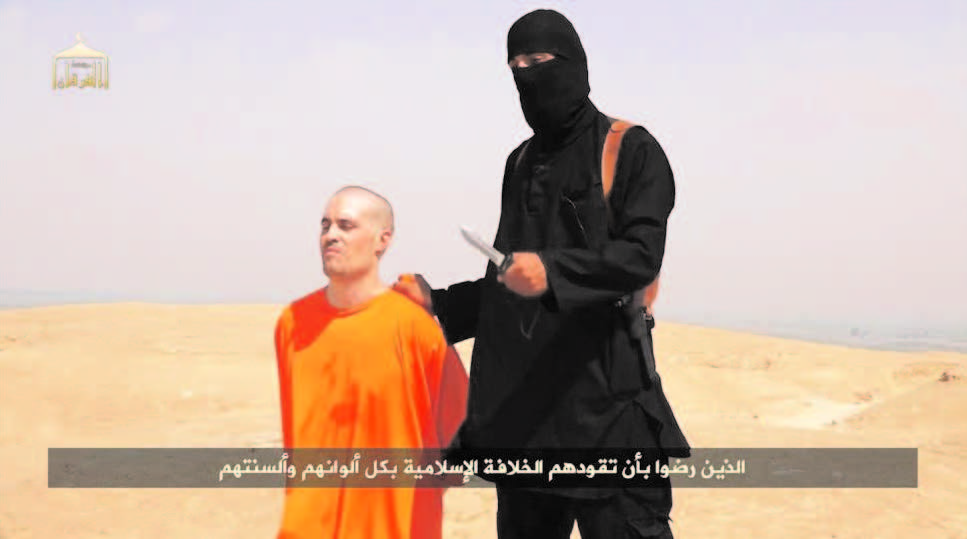
    He first appeared in a video in August 2014 when he beheaded American journalist James Foley. He was later thought to have played a major role in the beheadings of US journalist Steven Sotloff, British aid worker David Haines, British taxi driver Alan Henning and American aid worker Abdul-Rahman Kassig. He also appeared in a video with the Japanese hostages Haruna Yukawa and Kenji Goto, shortly before they were killed.

    In the videos posted online, he appears dressed all in black with only his eyes exposed, and wields a knife while launching tirades against the West.

    UK had earlier claimed that “Jihadi John” had been seriously injured in an air strike by US. He is named after Beatle John Lennon due to his British background.

    PM David Cameron had earlier said that he is keen to get his hands on “Jihadi John”. He said he wants “Jihadi John” alive, to “face justice for his crimes rather than be killed.”

    The Post quoted friends of Emwazi as saying they thought he had started to become radicalized after a planned safari in Tanzania following his graduation. They said Emwazi and two friends — a German convert to Islam named Omar and another man, Abu Talib — never made it to the safari.

    On landing in Dar es Salaam, in May 2009, they were detained by police and held overnight before eventually being deported, they said.

  • A BENEVOLENT LAW ABUSED – Racketeers use SIJS to make big money

    A BENEVOLENT LAW ABUSED – Racketeers use SIJS to make big money

    [vc_row][vc_column width=”2/3″][vc_column_text]

    It has been said the crooks will always find creeks to enter any system in the world. And when the system is welcoming and benevolent, the infiltration is much easier. Special Immigrant Juvenile Status law (Please read the article below by eminent attorney Anand Ahuja on page 6) was enacted with a humanitarian objective to provide protection to those minors who are victims of domestic abuse. Over the years, the law stands abused. It has become a booming business in many countries to push young boys and girls, mainly boys (77%), in to the United States territory and make them take advantage of SIJS.

    The Indian Panorama Investigative team came across quite a few people in Queens and Long Island in New York who are part of the thriving racket to smuggle in young boys and girls from India. The reports received by us indicate that it is a big business in many South Asian countries, in particular, India, Sri Lanka and Pakistan as also in many other countries across the world. We were taken for a shock to get to know how elaborate the racket’s dragnet is, which involves agents in countries from which the young people are sent, agents at the Mexican side of the US border who help them cross over in to the United States, agents in the US who manage a guardian for the boy/girl and so on so forth. All this involves huge money. In India, the price to send a young boy or a girl in to USA is anywhere between $80,000 to $100,000.

    Another shocking revelation was the involvement of church in this racket. During our talk with some who are involved in the racket told us, on condition of anonymity, that at least, one    priest from a Christian Church in New York and a Sikh priest from a Sikh Gurudwara in Arizona are actively involved in running the racket. The authorities do not suspect the priests of any wrong doing and the latter take advantage of it. Our source told us that the Christian Priest who is based in New York and comes from Punjab, India, visits his home state in India to “recruit” the youth who want to come to USA. It was pointed out to us that the pries has been making regular trips for the job. He arranges the incoming youth’s stay and finds him a guardian. Interestingly, all the young people who come here and come to have guardians, work and stay elsewhere, not necessarily with their guardians. The person agreeing to be a guardian to a youth is offered a payment of between $5000.00 to$10,000. The attorney’s fees is anywhere between $3000.00 and $5000.00. We were also told about two attorneys whose services the priest utilizes regularly. Also, there are some attorneys who specialize in such cases. The gentleman who offered to be guardian to a young man confided in us that the young man had disappeared and that he had to report the disappearance to the court.

    The malaise is much deeper and goes beyond simple monetary racket. It has serious implications for America’s security. With ISIS and Al Qaeda stepping up recruitment of young people from all over the world, USA is threatened as never before because of such soft laws  which allow easy infiltration in to the country. Our source, on condition of anonymity, told us that he had come to know that the enemies of USA are all set to push in young people in to USA to carry out their agenda in America, which is to harm the country in every way.

    A thorough investigation by the US administration  agencies concerned in to the racket and  the possible infiltration of enemies of USA in to the country, taking advantage of the benevolent soft humanitarian laws needs to be  done sooner than later. And the earlier, the better.

    [/vc_column_text][/vc_column][vc_column width=”1/3″][vc_column_text]

    (National Juvenile Justice Network)  (The Pew Charitable Trusts: May 9, 2013)

    Hundreds of thousands of youth (under age 18) attempt to enter the U.S. every year. Some come with their families, others alone, either of their own will seeking jobs, protection and family reunification or they are smuggled into the country for sweatshop labor or sexual exploitation. The exact number of children who attempt to enter the country is unknown. In 2005 granted legal permanent resident (LPR) status to 175,000 children under 14 years of age and to 196,000 youth ages 15 to 24. Twenty thousand youth ages 17 and under were accepted as refugees and 2,000 were granted asylum in the same year. Customs and Border Protection (CPB) apprehended almost 122,000 juveniles in the U.S. in 2004. Of this total, 84.6 percent were released back to Mexico, or in rare cases to Canada.

    [/vc_column_text][vc_column_text]

    (The Migrationist: August 8, 2013)

    Each year, thousands of unaccompanied alien children
    (UACs) risk harrowing journeys and travel alone to seek refuge in the United States. These children come from all over the world for many reasons, including to escape persecution in their home countries, to reunify with family members and to look for a better life. In recent years, the U.S. government has had roughly 6,000-8,000 of these children in its care and custody each year. While these children may be as young as infants, most (approximately 70 percent) have been between the ages of 15 and 17. -Women’s Refugee Commission

    [/vc_column_text][/vc_column][/vc_row]

  • ISIS EXPANDING ‘INTERNATIONAL FOOTPRINT’

    ISIS EXPANDING ‘INTERNATIONAL FOOTPRINT’

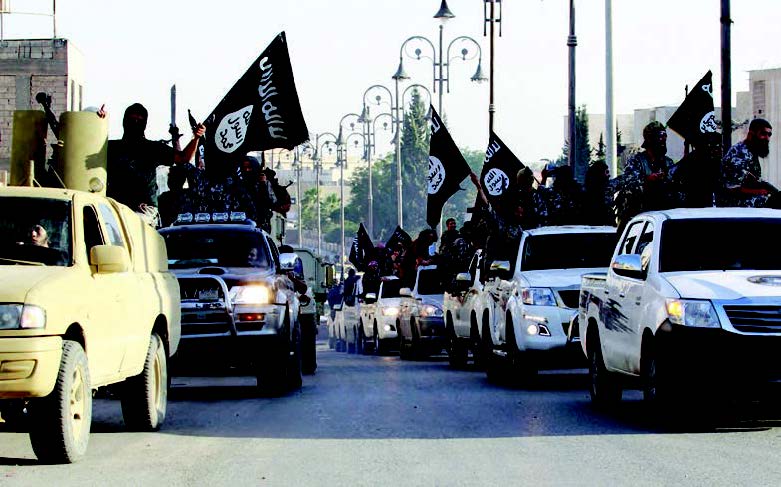
    The Islamic State, despite being driven by Kurdish fighters from its one-time Syrian stronghold in Kobani last week, nevertheless is extending its reach well beyond Iraq and Syria, military officials and analysts warn — represented, by some estimates, in nearly a dozen countries.

     ISIS History

    The Islamic State, despite being driven by Kurdish fighters from its one-time Syrian stronghold in Kobani last week, nevertheless is extending its reach well beyond Iraq and Syria, military officials and analysts warn — represented, by some estimates, in nearly a dozen countries.


    Lt. Gen. Vincent Stewart, director of the US Defense Intelligence Agency, delivered a grim assessment earlier this week in testimony to the House Armed Services Committee, as he described how the group was surfacing in North Africa.


    “With affiliates in Algeria, Egypt, Libya, the group is beginning to assemble a growing international footprint that includes ungoverned and under governed areas,” Stewart said.


    ISIS continues to hold a wide swath of territory, bigger than the state of Pennsylvania, in its home base spanning parts of Iraq and Syria, propped up by more than 20,000 foreign fighters from at least three dozen countries. But the terror network’s tentacles, as Stewart indicated, are creeping into other nations; largely those with fragile governments.


    “ISIS, like Al Qaeda, has thrived in the failed states where there is a vacuum of power,” said James Phillips, Middle East senior research fellow with the Heritage Foundation.


    A key worry is the group’s potential ambitions in Afghanistan, where the U.S. combat mission just ended and Afghan security forces are in control.


    Defense secretary nominee Ashton Carter, who had his confirmation hearing Wednesday, told Congress he is aware of reports that ISIS may try to expand into Afghanistan, and vowed to work with coalition partners to stop the group. He said he would consider changing plans for withdrawing the remaining 10,600 U.S. troops from Afghanistan by the end of 2016 if security conditions further deteriorate.


    The Islamic State’s ambitions do not stop at Afghanistan, the so-called Graveyard of Empires. Militant groups in Pakistan, the Philippines, Israel and the Gaza Strip, Lebanon, Indonesia and Jordan, among other areas, reportedly have pledged formal support for ISIS. New York Magazine, in a recent report, wrote, “Think of them as ISIS’s self-appointed foreign bases.”


    It’s impossible to know precisely how many members are involved in these groups, but analysts say the biggest groups generally are still affiliated with Al Qaeda, while others are starting to stand with ISIS – and execute attacks.


    An ISIS-tied group in Egypt, for instance, claimed responsibility for a series of coordinated attacks on Jan. 30 that killed at least two dozen security officers in restive Sinai.


    The Caliphate Soldiers Group in Algeria, which pledged loyalty to ISIS in September, kidnapped and beheaded a French tourist the same month. Terrorists posted a video of the beheading, saying it was in response to French airstrikes in Iraq. Algerian Special Forces killed the terror leader late last year, which analysts say dealt a morale blow to the small group.


    In Libya, the Islamic State’s Tripoli Province took credit for a hotel attack on Feb. 1 which killed nine people, including an American.


    Published reports tie other groups to ISIS including The Jundallah militant group and the Tehreek-e-Khilafat groups in Pakistan; the Philippines’ Abu Sayyaf group; Sinai Province in Egypt; Lebanon’s The Free Sunnis of Baalbek Brigade; Indonesia’s Jama’ah Ansharut Tauhid; and Sons of the Call for Tawhid and Jihad in Jordan.


    The Heritage Foundation’s Phillips said it’s not just groups like these that have declared loyalty. “There are an unknown number of self-radicalized militants in many different countries that may self-identify with ISIS and carry out ‘lone wolf ’ terrorist attacks in its name, without necessarily being members of the group,” he said. He cited the hostage crisis in Sydney, Australia, last December as an example.


    ISIS continues to get pounded by coalition airstrikes in Iraq and Syria, where Kurdish forces recently took back the vital city of Kobani. Those strikes are likely to increase following the brutal execution of a captured Jordanian pilot (though the coalition is down a member, with the United Arab Emirates having suspended airstrikes after the pilot’s capture in December.)


    Phillips said the purpose of the group’s grisly propaganda videos – including of the Jordanian pilot being burned alive in a cage — is to change the subject, from recent setbacks in Kobani as well as some areas in Iraq, through “jihadist pornography.” He said the point is to show the group as an
    “invincible army,” psychologically attractive to European teenagers who might join the fight.


    Raymond Stock, a Shillman-Ginsburg writing fellow at the Middle East Forum, argued the message carries more weight with Muslims worldwide than most realize. He told Fox News the propaganda videos are “so well-produced and so well-targeted –extremely effective. We have nothing counteracting that.”


    Stock, who spent 20 years living in Egypt, sees the group’s ambitions as limitless and argues it is a mistake to believe the Islamic State is an organization seeking to control limited territory.


    He also suggested Al Qaeda and ISIS are not necessarily direct competitors. He cited an Arabic proverb, which he translates as: “Me and my brother against my cousin; me and my cousin against the outsider.”


    In Senate Armed Services Committee confirmation hearing for defense secretary, Sen. John McCain, R-Ariz., pressed Carter on the need to have a strategy against ISIS.


    “I believe I understand our strategy at this time,” Carter explained. “I also have the intention, again if confirmed, to make it my first priority to go there, to talk to our military leaders there, to confer with you …I think a strategy connects ends and means, and our ends with respect to ISIL needs to be its lasting defeat.”


    McCain retorted: “Well, it doesn’t sound like a strategy to me, but maybe we can flesh out your goals.”


    (Source: AP)

  • AF TALIBAN NOT A TERROR GROUP: WHITE HOUSE

    AF TALIBAN NOT A TERROR GROUP: WHITE HOUSE

    WASHINGTON (TIP): The US does not consider the Afghan Taliban as a terrorist outfit, describing it as “an armed insurgency”. It called the Islamic State as a “terrorist” group, drawing a controversial distinction between the two outfits.


    “The Taliban is an armed insurgency. ISIL (Islamic State of Iraq and Levant) is a terrorist group. So we don’t make concessions to terrorist groups,” White House deputy press secretary Eric Schultz told reporters on January 28.


    When asked for a second time whether the Taliban is a terrorist group, he replied, “I don’t think that the Taliban, —the Taliban is an armed insurgency.” 


    Asked whether the Jordanian government’s decision to swap prisoner with the ISIL was similar to the US trading five Taliban members for Army Sgt. Bowe Bergdahl, he said, “As you know, this was highly discussed at the time and prisoner swaps are a traditional end-of-conflict interaction that happens.” 


    “As the war in Afghanistan wound down, we felt like it was the appropriate thing to do. The president’s bedrock commitment as commander in chief is to leave no man or woman behind. That is the principle he was operating under,” the White House press secretary said.


    “This was the winding down of the war in Afghanistan and that’s why this arrangement was dealt,” Schultz added, referring to the prisoner swap deal with the Taliban brokered through Qatar.


    Though the US state department has not designated the Afghan Taliban as a foreign terrorist organization, it has designated its two allies — the Tehreek-e-Taliban Pakistan and the Haqqani Network.


    The US is offering up to US $10 million for information leading to the capture of Afghan Taliban leader Mullah Omar. ISIL or ISIS (or IS) is an al-Qaida splinter group and it has seized hundreds of square miles in Iraq and Syria, declaring an Islamic caliphate.

  • US SAYS TALIBAN ‘ARMED INSURGENCY’, ISIS ‘TERRORIST’ GROUP

    US SAYS TALIBAN ‘ARMED INSURGENCY’, ISIS ‘TERRORIST’ GROUP

    WASHINGTON (TIP): The United States has described the Afghan Taliban as “an armed insurgency”, while the Islamic State as a “terrorist” group, drawing a controversial distinction between the two militant organizsations.


    “The Taliban is an armed insurgency. ISIS or ISIL (Islamic State of Iraq and Levant) is a terrorist group. So we don’t make concessions to terrorist groups,” White House deputy press secretary Eric Schultz told reporters in response to questions at the daily press briefing on January 28.


    Asked whether the Jordanian government’s decision to swap prisoner with the ISIS was similar to the US trading five Taliban members for Army Sgt. Bowe Bergdahl, he said, “As you know, this was highly discussed at the time and prisoner swaps are a traditional end-of-conflict interaction that happens.” 


    “As the war in Afghanistan wound down, we felt like it was the appropriate thing to do. The president’s bedrock commitment as commander in chief is to leave no man or woman behind. That s the principle he was operating under,” he said.


    When asked for a second time whether the Taliban is a terrorist group, Schultz replied, “I don’t think that the Taliban, – the Taliban is an armed insurgency.”


    “This was the winding down of the war in Afghanistan and that’s why this arrangement was dealt,” he added, referring to the prisoner swap deal with Taliban brokered through Qatar.


    Though the US State Department has not designated the Afghan Taliban as a Foreign Terrorist Organisation, it has designated its allies – the Tehreek-e-Taliban Pakistan and the Haqqani Network.


    The US is offering up to $10 million for information leading to the capture of Afghan Taliban leader Mullah Omar.


    ISIS is an al-Qaida splinter group and it has seized hundreds of square miles in Iraq and Syria, declaring an Islamic Caliphate.

  • ISIS-inspired plot to attack Capitol foiled, one held

    ISIS-inspired plot to attack Capitol foiled, one held

    WASHINGTON (TIP): A US man was arrested on Wednesday for allegedly plotting an attack on Congress inspired by the ISIS jihadis, according to the Justice department and the FBI.

    Christopher Cornell, 20, was taken into custody after he purchased two semi-automatic weapons and 600 rounds of ammunition in the US state of Ohio, according to a criminal complaint.

    The Justice department said he was charged “with attempting to kill officers and employees of the United States” and possession of a firearm to carry out violent acts. According to the complaint, Cornell had opened a Twitter account under the pseudonym Raheel Mahrus Ubaydah, where his posts supported ISIS. The Washington Post said he does not appear to have any formal backing from overseas.

    Rather, according to an affidavit in support of the criminal complaint, he indicated that by conducting an attack he would be “fulfilling the directives” of violent jihadis.

    He is accused of sending messages to an informant from the FBI outlining his plans. “I believe that we should just wage jihad under our own orders and plan attacks and everything,” he told the informant, according to the complaint. He also said he planned to launch several attacks and wanted to target US officials in Washington.

    In the fall of last year, an informant began cooperating with the FBI as a way to obtain favourable treatment in an unrelated criminal case and agreed to provide information about a person using the name Raheel Mahrus Ubaydah — Cornell’s alias on Twitter, the Post said.

    “He considered the members of Congress as enemies and that he intended to conduct an attack on the US Capitol,” the complaint said.

    According to the FBI document, he said he planned to “build, plant and detonate pipe bombs at and near the US Capitol, then use firearms to shoot and kill people.”

    Cornell had been under surveillance since August 2014. This week, he allegedly made final plans to go to Washington and set off bombs. The arrest comes in the wake of deadly attacks in Paris last week. Chairman of the House Committee on Homeland Security applauded the FBI and said it was launching investigations the wider scourge of homegrown terrorism.

  • MUMBAI: ANOTHER ISIS TERROR MESSAGE IN AIRPORT WASHROOM

    MUMBAI: ANOTHER ISIS TERROR MESSAGE IN AIRPORT WASHROOM

    MUMBAI (TIP): Security was stepped up at Mumbai’s Chhatrapati Shivaji International Airport on January 16 after another terror message was discovered by cleaning staff in a washroom in Terminal 1A.

    The message warned of an Islamic State (IS) attack on January 26th.The incident is being probed by the Central Industrial Security Force (CISF).

    A similar message was discovered on January 7 with the words, ‘ATTECK BY ISIS 10/01/15 (sic),’ scribbled by pen on a men’s washroom wall.

    According to a senior security official, “The terminal is already under watch after Air India received threat and hijack calls earlier this month. After the T2 message, security was beefed up and today’s messages will ensure that the security will be strengthened even further, especially on the city side.”

    With no CCTV cameras inside the washroom, the CISF is analysing footage from outside the washroom as well as getting experts to analyse the handwriting in both the notes.

  • 2014-THE YEAR THAT WAS

    2014-THE YEAR THAT WAS

    2014 has not been very different from its predecessors. It has been, like all other years preceding it, a year of mixed events of diverse hues.

    In India, on the political front, the year proved cruel for a 100 old Congress party. Also, it saw the emergence of a new political outfit-Aam Aadmi Party. More importantly, 2014 witnessed the emergence of a new national leader in Narendra Modi and found BJP being catapulted in to power as never before. It was after decades that a political party got a clear mandate to rule.

    On the economic front, the year has been troublesome for the common people of India. Inflation has been too much of a bother for them. However, because of falling prices of crude in international market, Indians were saved from rise in prices of gas, petrol and diesel. Also, it prevented price rise of commodities across the board.

    India did well in its space program. ISRO was successful in placing a low cost probe in to Mars’s orbit.

    India’s Kailash Satyarthi brought honor to the country by being awarded the Nobel Peace Prize.

    2014 saw India freeing itself from the scourge of Polio which had been devastating lives of hundreds of thousands of children every year.

    There was celebration for people of Telangana who got a new state carved for them in 2014.

    However, human tragedies, too, were around. The northern state of Jammu and Kashmir reeled under the worst floods ever. The September 2014 floods wreaked havoc in the State, snuffing out more than 250 lives, destroying more than 3.5 lakh structures, including 2.5 lakh residences, and rendering over 12 lakh families homeless.

    2014 has also been a year of social and communal tensions. The issues of Love Jehad and conversions or gharvapasi created an atmosphere of mistrust and, mutual hatred, to some extent among followers of different faiths. Obviously, it is not a good sign for the nation, prone to easy communal provocations.

    In the world theater, there has been more grief than joy. The Gaza massacre, the killing of school children in Peshawar, ISIS beheading of Western journalists, police killings of a young man in Ferguson and of another in New York, mounting tension between the people and the police in USA, the aviation tragedies involving two Malaysian aircrafts which left hundreds aboard dead, and the usual political rivalries of nations and internal disturbances and dissensions in countries of the world were enough to make people miserable.

    However, like in the past, we do not continue to look back for ever; we look ahead and move on.

    Good bye 2014!

  • Pope’s Christmas address focuses on Pakistani school attack victims

    Pope’s Christmas address focuses on Pakistani school attack victims

    VATICAN (TIP): A sombre Pope Francis steeped his Christmas message to the world in sadness for those with little cause for joy — abused children, refugees, hostages and others suffering from violence in the Middle East, Africa, Ukraine and elsewhere.

    Anguish for children who suffer maltreatment or violence, including in the recent attack on a Pakistani military school, tempered the pontiff’s traditional Christmas Day speech, which he delivered from the central balcony of St. Peter’s Basilica in Rome.

    “Truly there are so many tears this Christmas,” said Francis, looking solemn and smiling little, in contrast to his often jocular demeanour when addressing crowds.

    Francis decried the persecution of ancient Christian communities in Iraq and Syria, at the hands of ISIS militants, along with those from other ethnic and religious groups.

    “May Christmas bring them hope,” he said.

  • ‘300 Chinese fighting for ISIS in Mideast’

    ‘300 Chinese fighting for ISIS in Mideast’

    BAGHDAD (TIP): About 300 Chinese people are fighting alongside the ISIS in Iraq and Syria, a Chinese state-run newspaper said on Monday, December 15, a rare tally that is likely to fuel worry in China that militants pose a threat to security. China has expressed concern about the rise of ISIS in the Middle East, nervous about the effect it could have on its Xinjiang region. But it has also shown no sign of wanting to join US efforts to use military force against the group.


    Chinese members of the East Turkestan Islamic Movement are traveling to Syria via Turkey to join the ISIS, the Global Times, a tabloid run by China’s ruling Communist Party’s official newspaper, the People’s Daily, said.

    “According to information from sources, including security officers from Iraq’s Kurdish region, Syria and Lebanon, around 300 Chinese extremists are fighting with IS in Iraq and Syria,” the Global Times reported.

    Chinese officials blame the ETIM for carrying out attacks in Xinjiang, home to the Muslim Uighur people. But the government has been vague about how many people from China are fighting in the Middle East.

    In July, China’s envoy to the Middle East, Wu Sike, cited media reports when he said about 100 Chinese citizens, most of them from the ETIM, were in the Middle East fighting or being trained.

    China says ETIM militants are also holed up along the ungoverned Afghan-Pakistani border and want to create a separate state in Xinjiang, though many foreign experts doubt the group’s cohesiveness.

    Instead, human rights advocates argue that economic marginalization of Uighurs and curbs on their culture and religion are main causes of ethnic violence in Xinjiang that has killed hundreds of people in the past two years.

    China has criticized the Turkish government for offering shelter to Uighur refugees who have fled China through Southeast Asia and said such a channel creates security risks.