Tag: ISRAEL

  • The Urgent Need for a Ceasefire in the Israel-Hamas Conflict: A Call for Humanity and Justice

    Prof. Indrajit S. Saluja

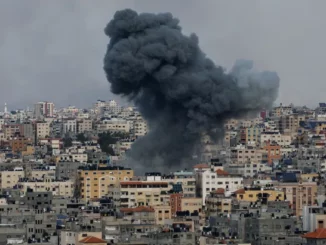
    In the midst of the ongoing conflict between Israel and Hamas, one thing becomes abundantly clear: the urgent necessity for a ceasefire. The relentless cycle of violence, fueled by political agendas and power struggles, has resulted in an appalling loss of human life and untold suffering for innocent civilians caught in the crossfire. As the world watches in horror, it is imperative that we raise our voices and demand an immediate end to this senseless bloodshed.

    It is deeply regrettable that, when it comes to taking a principled stance on this issue, the United States, a nation founded on the ideals of justice and freedom, has faltered. Our lawmakers, entrusted with representing the interests of the American people, have failed in their duty to uphold these core values. Instead of prioritizing humanitarian concerns and advocating for peace, many have chosen to blindly support Israeli Prime Minister Benjamin Netanyahu, turning a blind eye to the suffering of the Palestinian people.

    While President Joe Biden has shown a willingness to challenge Netanyahu’s policies and push for a ceasefire, he faces staunch opposition from a faction of pro-Netanyahu and pro-Israel congressmen. In their unwavering loyalty to a foreign leader, they have forgotten the fundamental principles upon which America was built. Human dignity, freedom, and justice are not mere slogans but the bedrock of our society. It is incumbent upon our elected representatives to uphold these principles, even in the face of political pressure and allegiance to foreign powers.

    The call for a ceasefire is not merely a moral imperative; it is a matter of life and death for thousands of innocent civilians trapped in the conflict zone. The recent resolution passed by the United Nations Security Council, calling for a cessation of hostilities during the holy month of Ramadan, underscores the global consensus on the need for peace. It is disheartening that the United States, the world’s leading superpower, chose to abstain from this resolution, signaling a failure of leadership and a disregard for the suffering of those affected by the violence.

    At the heart of this conflict lies the stubborn refusal of one man, Benjamin Netanyahu, to heed the calls for peace. As rockets rain down on civilian populations and the death toll continues to climb, Netanyahu clings to power at any cost, disregarding the wishes of both the Israeli people and the international community. His actions betray the very essence of democracy, transforming Israel into a de facto dictatorship where dissent is silenced and human rights are trampled upon.

    Those who continue to support Netanyahu and his policies must be held accountable for their complicity in the atrocities committed in the name of security. By turning a blind eye to the suffering of the Palestinian people, they become accomplices in the murder of democracy and the perpetuation of injustice. It is time for them to remember their allegiance not only to a foreign leader but also to the principles of justice and humanity that define America’s identity.

    To the congressmen who oppose President Biden’s efforts to address the root causes of this conflict, we say this: history will judge you harshly for your failure to stand on the right side of justice. The American people demand accountability from their elected representatives, and we will not forget those who prioritize political expediency over human life.

    In solidarity with the countless victims of this senseless violence, we urge all right-thinking individuals to support President Biden in his quest for peace. Let us raise our voices and demand an immediate ceasefire in the Israel-Hamas conflict. Let us remind the world that America stands for human dignity, freedom, and justice for all.


    It is time to bring an end to the carnage and usher in a new era of hope and reconciliation in the Middle East. The lives of countless innocent civilians depend on it, and history will remember our actions—or lack thereof—in this critical moment.


  • Israel working on national food security plan for first time

    Tel Aviv (Israel) (TIP): For the first time in its history, Israel is working to ensure food security in the country. As such, Israel’s Ministry of Agriculture said that it is “changing its face and focusing its mission” in a new way and, in cooperation with other ministries, is developing a proposal for a national plan to that end.
    To emphasise the importance of this, the ministry intends to change its name to “Ministry of Agriculture and Food Security”. The ministry said that in the coming days it will submit a decision-making proposal for the government’s approval to formulate a national plan for food security that will include the formulation of goals for the supply of food to the entire population until the year 2050, with intermediate goals for the years 2030 and 2040.
    For the purpose of formulating the plan, an inter-ministerial work team will be established, headed by the director general of the Ministry of Agriculture, with the participation of representatives of the relevant government ministries, including the National Security Headquarters, the Ministry of Health, the Ministry of Economy and Industry, the Ministry of Environmental Protection, the Ministry of Housing and Construction, the Ministry of Welfare and many other ministries. (ANI)

  • New Israeli settlements in West Bank are illegal and inconsistent with international law: Antony Blinken

    New Israeli settlements in West Bank are illegal and inconsistent with international law: Antony Blinken

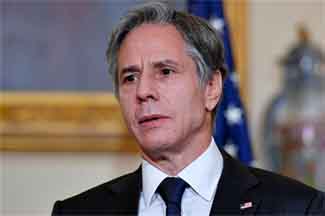
    Charleston (US) (TIP): The new Israeli settlements in the West Bank are illegal and inconsistent with international law, US Secretary of State Antony Blinken has said, reversing a Trump-era policy.
    Blinken, at a joint press conference with the Argentine Foreign Minister Diana Mondino in Buenos Aires, said he was disappointed with Israel’s latest plans for settlement expansion.
    “We have seen the reports, and I have to say we’re disappointed in the announcement. It’s been long-standing US policy under Republican and Democratic administrations alike that new settlements are counterproductive to reaching an enduring peace,” Blinken said in response to a question.
    “They’re also inconsistent with international law. Our administration maintains a firm opposition to settlement expansion. And in our judgement, this only weakens — it doesn’t strengthen — Israel’s security,” said the top American diplomat, a day after Israel’s far-right Finance Minister Bezalel Smotrich indicated that more than 3,000 new residences would be added to settlements. The statement comes as the Biden administration’s latest shift away from the pro-Israel policies pursued by former president Donald Trump.
    The Trump administration reversed the US policy to declare that settlements did not violate international law. In 2019, under Trump, then-Secretary of State Mike Pompeo claimed that “the establishment of Israeli civilian settlements in the West Bank is not, per se, inconsistent with international law”.
    Blinken’s statement was defended by the White House in Washington DC.
    “(We have) seen those reports and, frankly, disappointed in the announcement. It’s been long-standing US policy under both Republican and Democratic administrations that new settlements are counterproductive to the cause of peace. Frankly, they’re also inconsistent with international law. And this administration maintains our firm opposition to settlement expansion,” John Kirby, a White House spokesman, told reporters.
    The New York Times reported that in November 2019, the then Secretary of State, Mike Pompeo, under then-president Donald Trump reversed four decades of US policy by saying that settlements did not violate international law.
    “State Department lawyers never issued a new legal determination that buttressed that policy change and Blinken’s shift back to the old policy is consistent with a long-standing legal finding of the department,” the daily reported.
    “We are simply reaffirming the fundamental conclusion that these settlements are inconsistent with international law. This is a position that has been consistent over a range of Republican and Democratic administrations. If there’s an administration that is being inconsistent, it was the previous one,” Kirby told reporters.
    In Buenos Aires, Blinken said he had seen reports about the post-war Gaza plan.
    “I haven’t seen the plan, so I want to reserve judgment until we see the details. Having said that, you know that there are certain basic principles that we set out many months ago that we feel are very important when it comes to Gaza’s future, including that it cannot be a platform for terrorism,” he said.
    “There should be no Israeli reoccupation of Gaza. The size of Gaza’s territory should not be reduced. So, we want to make sure that any plan that emerges is consistent with those principles. There are other principles, but those are three of the most important ones,” Blinken said.
    “At the same time, we have many countries in the region that are working together on a plan for post-conflict Gaza. I think that’s very important, and I’ve spent some time with some of our Arab partners, including recently on the margins of the G20, talking about just as we did when we were at the Munich Security Conference together. So, it’s important that we have, again, a necessary plan, but one also that’s consistent with basic principles that I think many countries share about what has to be Gaza’s future,” said the Secretary of State. (PTI)

  • As Gaza deaths top 25,000, Hamas defends Oct 7 attacks that sparked current conflict with Israel

    As Gaza deaths top 25,000, Hamas defends Oct 7 attacks that sparked current conflict with Israel

    PALESTINIAN TERRITORIES (TIP): Palestinian militant group Hamas on January 21 defended its October 7 attacks on Israel but admitted to “faults” and called for an end to “Israeli aggression” in Gaza, where the health ministry said the death toll passed 25,000.
    Southern Gaza is the latest focus of Israel’s battle to destroy the Islamist group responsible for the deadliest attack in the country’s history. In its first public report on the attacks that began the war, Hamas said they were a “necessary step” against Israeli occupation of Palestinian territories, and a way to secure release of Palestinian prisoners. Israeli Prime Minister Benjamin Netanyahu later vowed “complete victory” and said his government would not accept Hamas’s conditions for releasing hostages still held in Gaza.
    Hamas’s 16-page report admitted “some faults happened… due to the rapid collapse of the Israeli security and military system, and the chaos caused along the border areas with Gaza”.
    The report did not make clear why it was issued now, more than three months into the war that began when militants broke through Gaza’s militarised border to attack Israelis and foreigners in the streets, in their homes and at an outdoor rave party. This resulted in the deaths of about 1,140 people, mostly civilians, according to an AFP tally based on official Israeli figures. With the border fence broken during the attacks, anybody could enter Israel.
    Accounts of sexual violence emerged but the scarcity of survivor testimonies and the lack of forensic evidence made it difficult to assess their scale.
    Naval bombardment : Militants seized about 250 hostages during the attacks, and Israel says around 132 remain in Gaza. At least 28 of them are believed to have been killed, according to an AFP tally based on Israeli figures.
    Hamas — considered a “terrorist” group by the United States and European Union — said in the report its fighters were committed to “Islamic values”, and if civilians were targeted “it happened accidently and in the course of the confrontation with the occupation forces.”
    In response to the attacks, Israel has launched a military offensive that has killed at least 25,105 people in Gaza, mostly women and children, according to the latest toll issued on Sunday by the health ministry in Hamas-run Gaza.
    In early January, Israel’s military said the Hamas command structure in northern Gaza had been dismantled, leaving only isolated fighters.
    But witnesses told AFP Israeli vessels were bombarding Gaza City and other areas in the north early Sunday. Hamas has also reported heavy combat in the north.
    The Israeli army said it “eliminated a number of terrorists” in the main southern city of Khan Yunis and killed 15 militants in northern Gaza over the past day. Netanyahu is under intense pressure to return the hostages and account for security failings surrounding the October attacks.
    In a video statement released after the Hamas report, he said that “in exchange for the release of our hostages, Hamas demands an end to the war, the withdrawal of our forces from Gaza”, the release of Palestinian prisoners and guarantees that Hamas would stay in power. “If we accept this, our soldiers have fallen in vain,” Netanyahu said. “If we accept this, we won’t be able to guarantee the safety of our citizens.”
    The United Nations says about 1.7 million people have been displaced in Gaza, with about one million crowded into the Rafah area of Gaza’s south near Egypt.
    (AFP)

  • An expanding Gaza war, with no endgame in sight

    An expanding Gaza war, with no endgame in sight

    As the Gaza conflict reverberates across the region, West Asia could sleepwalk into Armageddon

    “Targeted killings serve no useful purpose: while the deceased leaders are quickly replaced, the assassinations increase mutual hostility and escalate tensions. The worrying possibility is that Mr. Netanyahu might not be averse to a regional conflagration: following the political and military failures that facilitated Hamas’s October 7 attacks and with no military success to speak of so far, now, with the Supreme Court rejecting his judicial reforms proposals, the Prime Minister faces the imminent prospect of resignation, arrest and imprisonment. Could a desperate Netanyahu not wish to seize this opportunity to obliterate all Palestinian resistance, eliminate Hezbollah as a fighting force, and debilitate Iran as a threat?”

    By Talmiz Ahmad

    With the Gaza war having reached its three-month mark, it has spread dangerously to Lebanon, Iraq, Yemen and even Iran. On January 2, an Israeli drone strike on a Hamas office in Beirut, killed Saleh al-Arouri, the deputy head of the Hamas leadership located abroad. The next day, two explosions in Kerman, at the mausoleum of General Qassem Soleimani, former head of the Al Quds Force, killed 95 people who had gathered at the shrine to mourn on the fourth anniversary of his assassination. Though the Islamic State has claimed responsibility, many Iranians suspect it to be Israeli’s hand.

    And, on January 4, the United States announced the targeted killing of the head of an Iran-affiliated militia in Baghdad that has been attacking American targets since the beginning of the Gaza war. These attacks have occurred amidst the ongoing skirmishes in the Red Sea’s waters over the last several weeks, with the Houthis targeting commercial shipping with drones and missiles and inviting strong U.S. retaliation. The Houthis have demanded that humanitarian assistance be provided urgently to the beleaguered Palestinians in Gaza.

    These attacks have escalated tensions in the already volatile region that is reeling from the death and destruction wreaked by Israel in Gaza since early October. Over the last three months, over 22,000 Palestinians have been killed, most of them women and children, while nearly two million have been displaced, the largest displacement of Palestinians in history. An extraordinary humanitarian catastrophe faces the two-million strong Palestinian community in Gaza.

    Netanyahu could pursue escalation

    Israeli troops have also expanded their military operations to the West Bank: nearly 300 Palestinians have been killed, several thousand taken into detention, and numerous homes destroyed. Israeli cabinet Ministers have complemented the violence of their soldiers by calling for the cleansing of Gaza of Palestinians and the resettlement of the enclave with Jewish settlers.

    The major concern at present is that a desperate Israeli Prime Minister Benjamin Netanyahu might pursue the escalation trajectory as, despite the mass killings in Gaza, Israel has very little to show for its efforts: though committed to the destruction of the Hamas war machine and of the movement itself, no prominent Hamas leader has been apprehended in Gaza, while Hamas continues to inflict damage on Israeli soldiers in the ground fighting. A few thousand women and children have been detained by Israeli security to reveal the location of Hamas leaders, with no apparent success so far.

    There are concerns that al-Arouri’s killing was carried out to proclaim some success in the war on Hamas. Saleh al-Arouri, by all accounts, was a soft target. Though he has been a prominent presence in the Hamas leadership, in recent years he had been located in Beirut and was principally liaising with Hezbollah and Iran. Most reports suggest that he had no involvement with the planning or execution of the October 7, 2023 attacks.

    Peace is distant

    Targeted killings serve no useful purpose: while the deceased leaders are quickly replaced, the assassinations increase mutual hostility and escalate tensions. The worrying possibility is that Mr. Netanyahu might not be averse to a regional conflagration: following the political and military failures that facilitated Hamas’s October 7 attacks and with no military success to speak of so far, now, with the Supreme Court rejecting his judicial reforms proposals, the Prime Minister faces the imminent prospect of resignation, arrest and imprisonment. Could a desperate Netanyahu not wish to seize this opportunity to obliterate all Palestinian resistance, eliminate Hezbollah as a fighting force, and debilitate Iran as a threat?

    The reason why this prospect is even being raised is because, through the three-month war in Gaza, no major player has exhibited a vision or a strategy regarding the endgame and the “day after” the cessation of hostilities. Beyond bellicose claims relating to the extermination of Hamas and ethnic cleansing of the occupied territories, Israel has shown no clarity about its war aims or the management of Gaza after the war. Certainly, there is no mention of a longer-term peace process. Thus, mass killings in Gaza and provocative targeted assassinations in the neighborhood have become ends in themselves.

    A role for Saudi Arabia

    The U.S. has been in search of a policy from day one. Beyond its total political and military support for Israel, the Biden administration has shed crocodile tears over humanitarian concerns, but achieved nothing on the ground. The region’s already discredited hegemon appears incapable of insisting on a peace process — obviously, the clout of Israel’s right-wing supporters in Washington have paralyzed the government and lulled it into somnolence.

    The Arab states have exhibited neither voice nor leadership so far: beyond pointless conferences and resolutions, there is no sign of a consensual and forceful approach to the broader Palestine issue or even concerns about regional security.

    The principal responsibility for ushering in peace now rests on Saudi Arabia. It alone has the regional and global standing to insist that its views be deferred to. Having shrugged off its subordination to U.S. diktat, it has been confidently pursuing an independent foreign policy that resonates positively with the world’s leading powers. Palestinian interests and regional peace require robust and pro-active Saudi initiatives, which have been missing so far.

    This is the time when West Asian rulers and their people should be on the same side to serve the region’s interests. Failing that, they will be swept away in the tidal wave of regional conflict they have done nothing to prevent.

    (The author is a former Indian diplomat)

  • Former Secretary General Ban Ki-moon, three veteran diplomats honored with 2023 Diwali ‘Power of One’ Awards at UN

    Former Secretary General Ban Ki-moon, three veteran diplomats honored with 2023 Diwali ‘Power of One’ Awards at UN

    “The ideals of Diwali are the ideals of UN Charter” : Chair of Diwali Foundation USA Ranju Batra

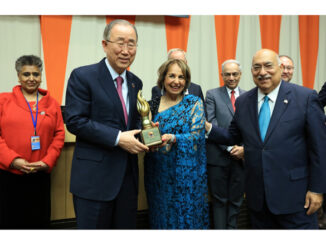
    UNITED NATIONS (TIP): Former UN Secretary General Ban Ki-moon and three veteran diplomats were honored with the annual ‘Diwali Power of One Awards’, hailed as the ‘Oscars of diplomacy’, for their selfless efforts to “help form a more perfect, peaceful, and secure world for all”. The former UN chief was honored with the Lifetime Achievement Award at the 2023 Diwali Stamp — The Power of One Award ceremony organized by the Diwali Foundation USA. The other awardees for the year 2023 are former permanent representative of Bosnia and Herzegovina to the UN Ambassador Mirsada Colakovic, former permanent representative of South Korea to the UN Ambassador Kim Sook and 72nd UN General Assembly president and EU Special Representative for the Belgrade-Pristina Dialogue Miroslav Lajcak. They were honored at a special ceremony held in the UN Headquarters on Monday, December 11.

    Former Secretary General Ban Ki-moon addressing the gathering after receiving the award. Seen, among others, are India’s Permanent Representative to the United Nations, Ambassador Ruchira Kamboj ( extreme left) , Ranju Batra (4th from left), and Ravi Batra (behind Mr. Ban Ki-moon) (Photo : Mohammed Jaffer / SnapsIndia)

    Ban commended the work and “forward-thinking vision” of the Diwali Foundation USA “for advancing vital light in a world of increasing darkness”.

    Ban said the world of today “seems fractured like never before” as he cited the COVID-19 pandemic, climate crisis and regional conflicts, particularly “regional crisis as we see today in the Middle East and Ukraine”.

    “But it is exactly at times such as these that the work of the United Nations is indispensable. The United Nations and its pursuit of peace, human rights and sustainable development exemplifies the values and principles that we should all espouse to replicate,” he said. Ban was the eighth Secretary-General of the United Nations, serving two terms as the world’s top diplomat from January 2007 to December 2016.

    He said that as the world moves into 2024 and beyond, “we share a common destiny illuminated by peace, sustainability and prosperity. Let us work together and expand our unified efforts to realize this shared destiny for all. This is your political responsibility and for me, my moral responsibility as a former Secretary General” and as an awardee of the Power of One honor.

    India’s Permanent Representative to the UN Ambassador Ruchira Kamboj, in her address to the event attended by UN diplomats, envoys, civil society members and policy experts, said that Diwali is a celebration that holds a very special place in the hearts of over a billion Indians across the globe.

    Diwali “is more than just a festival. It is a sentiment that embodies the triumph of light over darkness, knowledge over ignorance and hope over despair”, she said.

    Kamboj said, “as we light the lamps of Diwali, let us remember that every small light, no matter how small, can make a significant difference in dispelling the shadows”.

    Sri Lanka’s Permanent Representative to the UN Ambassador Mohan Pieris said “Deepawali has become truly a secular festival in the world, since its message is not exclusively restricted to any religious creed.

    “This festival has united the global community with the central message that we need more than ever the humanistic ideals to engage the inglorious wars, which are bleeding the innocence of humanity,” he said.

    Pieris underscored that for the world to have peace, it is important that the whole world must be united to save the higher ideals of humanity, which have evolved since the millennium in various religious traditions.

    Chair of Diwali Foundation USA Ranju Batra, who had spearheaded efforts for over seven years to get a commemorative ‘Forever Diwali’ stamp issued by the US Postal Service in 2016, said: “Diwali is a message of peace.” She said her journey for the Diwali stamp is seen as a “metaphor of peace and harnessing its power to promote excellence in diplomacy. The ideals of Diwali are the ideals of UN Charter”.

    She noted that the 2023 Power of One awardees have clearly demonstrated that “one person can make a difference”. The Diwali stamp celebration is not of a religion or nation but of the spirit of harmonious inclusiveness and cross-cultural understanding that all religions deserve, she said.

    Eminent Indian-American attorney and Chair of National Advisory Council South Asian Affairs and moderator of the award ceremony Ravi Batra said the UN transcends borders and boundaries.

    “The need to acknowledge excellence is critical, generally, but in diplomacy, which is on life support in today’s world, it is essential and that’s how these awards are – the Power of One,” he said, adding that they honor “world class diplomats who have changed the world by what they did”.

    Awardees and organizers of Power of One Awards (Photo : Mohammed Jaffer / SnapsIndia)

    Hailed as the ‘Oscars of Diplomacy’, the awards are presented to former Permanent Representatives or former high-level members of the UN Secretariat or member state, or soon to be “former”, who have “toiled selflessly to help form a more perfect, peaceful and secure world for all”.

    The 2023 Award ceremony was co-organized by the Diwali Foundation USA and Delegation of the European Union to the United Nations, and the Permanent Missions of Chile, Eritrea, Georgia, India, Kazakhstan, Kiribati, Morocco, Oman and Sri Lanka to the United Nations. The co-sponsors included the Permanent Mission to the United Nations of Albania, Armenia, Austria, Azerbaijan, Belarus, Bhutan, Cyprus, France, Germany, Ghana, Hungary, Iraq, Israel, Kuwait, Kyrgyzstan, Malaysia, Mexico, Nepal, Philippines, South Korea, South Africa, Spain, Tajikistan, Thailand, Turkiye, Turkmenistan, Ukraine, United Kingdom, United States, Uzbekistan, Vietnam and Palestine, and International Atomic Energy Agency (IAEA-NY) among others.

    Diwali Foundation USA was established in 2017 to promote a peaceful and consensus-based process to achieve societal “good, as befits the high hopes and ideals of humanity enshrined in the United Nations Charter”.

    The Foundation established ‘The Power of One’ awards to celebrate and highlight the important work done in a peaceful manner, especially at the United Nations.

    Previous honorees include former UN assistant secretary general and deputy executive director of UN Women, Lakshmi Puri, former UK Ambassador to the UN, Matthew Rycroft, former permanent representative of Georgia to the UN, Kaha Imnadze, and former permanent representative of Grenada to the UN Keisha McGuire.
    (Source: PTI)

    The traditional lamp lighting . Mr. & Mrs. Ban Ki-moon with organizers of Power of One Award lighted the lamp. (Photo : Mohammed Jaffer / SnapsIndia)
  • Israel successfully tests new laser missile defense system

    Israel successfully tests new laser missile defense system

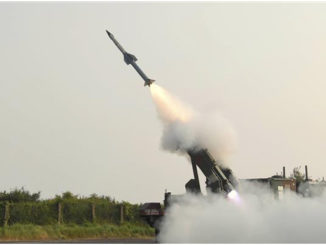
    Jerusalem (TIP): Israel’s new laser missile defense system has successfully intercepted mortars, rockets and anti-tank missiles in recent tests, Defense Minister Benny Gantz said April 14. The Israeli-made laser system, designed to complement a series of aerial defense systems such as the costly Iron Dome deployed by Israel, will be operational “as soon as possible,” Gantz said. The goal is to deploy the laser systems around Israel’s borders over the next decade, Gantz added.

    The tests took place last month in the Negev Desert. Prime Minister Naftali Bennett said in February that Israel would begin using the system within a year, sending a message to archenemy Iran.

    Gantz said the laser system would be part of “an efficient, inexpensive, and innovative protection umbrella.”    Israel has already developed or deployed a series of systems meant to intercept everything from long-range missiles to rockets launched from just a few kilometers (miles) away.

    It has also outfitted its tanks with a missile-defense system.

    Little is known about the laser system’s effectiveness, but it is expected to be deployed on land, in the air and at sea.

    The announcement came near the anniversary of the 11-day Israel-Gaza war, in which Gaza’s ruling Hamas militant group fired more than 4,000 rockets toward Israel. Israel said its Iron Dome defense system has been a great success, with a 90 per cent interception rate against incoming rocket fire.

    But officials say the system is expensive to deploy, and the new laser defense will be much more cost-effective.

    The Defense Ministry released a short video showing what it said were successful interceptions of rockets, mortars and an unmanned aerial vehicle. The video, which was highly edited and includes music, appeared to show a laser beam coming out of a ground station, hitting the targets and smashing them into small pieces.

    Thursday’s announcement came as talks on restoring Iran’s tattered nuclear deal with world powers have stalled.

    Israel opposes the deal, saying it does not do enough to curb Iran’s nuclear programme or its military activities across the region, and Israeli officials have said they will unilaterally do what’s necessary to protect the country. AP

  • The world in 2022: Another year of living dangerously

    The world in 2022: Another year of living dangerously

    On the brink of a new year, the world faces a daunting array of challenges: the resurgent Covid-19 pandemic, the climate emergency, the struggle between democracy and authoritarianism, humanitarian crises, mass migration, and trans-national terrorism. There is the risk of new inter-state conflicts, exacerbated by the breakdown of the rules-based international order, and the spread of lethal autonomous weapons. All in all, for most people on Earth – and a handful in space – 2022 will be another year of living dangerously.

    Middle East

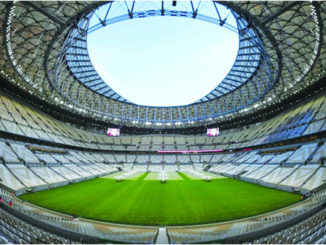
    Events in the Middle East will make global headlines again in 2022 – but for positive as well as negative reasons. A cause for optimism is football’s World Cup, which kicks off in Qatar in November. It’s the first time an Arab or a Muslim country has hosted the tournament. It is expected to provide a major fillip for the Gulf region in terms of future business and tourism – and, possibly, more open, progressive forms of governance.

    But the choice of Qatar, overshadowed by allegations of corruption, was controversial from the start. Its human rights record will come under increased scrutiny. Its treatment of low-paid migrant workers is another flashpoint. The Guardian revealed that at least 6,500 workers have died since Qatar got the nod from Fifa in 2010, killed while building seven new stadiums, roads and hotels, and a new airport.

    Concerns will also persist about Qatar’s illiberal attitude to free speech and women’s and LGBTQ+ rights in a country where it remains dangerous to openly criticise the government and where homosexuality is illegal. But analysts suggest most fans will not focus on these issues, which could make Qatar 2022 the most successful example of “sports-washing” to date.

    More familiar subjects will otherwise dominate the regional agenda. Foremost is the question of whether Israel and/or the US will take new military and/or economic steps to curb Iran’s attempts, which Tehran denies, to acquire capability to build nuclear weapons. Israel has been threatening air strikes if slow-moving talks to revive the 2015 nuclear deal fail. Even football fans could not ignore a war in the Gulf.

    Attention will focus on Turkey’s authoritarian president, Recep Tayyip Erdogan, whose neo-Islamist AKP party will mark 20 years in power in 2022. Erdogan’s rule has grown increasingly oppressive at home, while his aggressive foreign policy, rows with the EU and US, on-off collusion with Russia over Syria and chronic economic mismanagement could have unpredictable consequences.

    Other hotspots are likely to be Lebanon – tottering on the verge of becoming a failed state like war-torn Yemen – and ever-chaotic Libya. Close attention should also be paid to Palestine, where the unpopular president, Mahmoud Abbas’s postponement of elections, Israeli settler violence and West Bank land-grabs, and the lack of an active peace process all loom large.

    Asia Pacific

    The eyes of the world will be on China at the beginning and the end of the year, and quite possibly in the intervening period as well. The Winter Olympics open in Beijing in February. But the crucial question, for sports fans, of who tops the medals table may be overshadowed by diplomatic boycotts by the US, UK and other countries in protest at China’s serial human rights abuses. They fear the Games may become a Chinese Communist party propaganda exercise.

    The CCP’s 20th national congress, due towards the end of the year, will be the other headline-grabber. President Xi Jinping is hoping to secure an unprecedented third five-year term, which, if achieved, would confirm his position as China’s most powerful leader since Mao Zedong. There will also be jostling for senior positions in the Politburo and Politburo standing committee. It will not necessarily all go Xi’s way.

    Western analysts differ sharply over how secure Xi’s position truly is. A slowing economy, a debt crisis, an ageing population, huge environmental and climate-related challenges, and US-led attempts to “contain” China by signing up neighbouring countries are all putting pressure on Xi. Yet, as matters stand, 2022 is likely to see ongoing, bullish attempts to expand China’s global economic and geopolitical influence. A military attack on Taiwan, which Xi has vowed to re-conquer by any or all means, could change everything.

    India, China’s biggest regional competitor, may continue to punch below its weight on the world stage. In what could be a symbolically important moment, its total population could soon match or exceed China’s 1.41 billion, according to some estimates. Yet at the same time, Indian birth rates and average family sizes are falling. Not so symbolic, and more dangerous, are unresolved Himalayan border disputes between these two giant neighbours, which led to violence in 2020-21 and reflect a broader deterioration in bilateral relations.

    The popularity of Narendra Modi, India’s authoritarian prime minister, has taken a dive of late, due to the pandemic and a sluggish economy. He was forced into an embarrassing U-turn on farm “reform” and is accused of using terrorism laws to silence critics. His BJP party will try to regain lost ground in a string of state elections in 2022. Modi’s policy of stronger ties with the west, exemplified by the Quad alliance (India, the US, Japan, Australia), will likely be reinforced, adding to China’s discomfort.

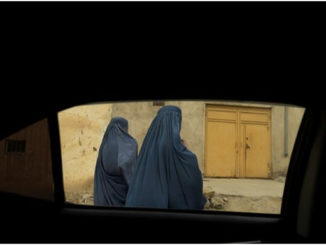
    Elsewhere in Asia, violent repression in Myanmar and the desperate plight of the Afghan people following the Taliban takeover will likely provoke more western hand-wringing than concrete action. Afghanistan totters on the brink of disaster. “We’re looking at 23 million people marching towards starvation,” says David Beasley of the World Food Programme. “The next six months are going to be catastrophic.”

    North Korea’s nuclear brinkmanship may bring a showdown as Kim Jong-un’s paranoid regime sends mixed signals about war and peace. The Philippines will elect a new president; the foul-mouthed incumbent, Rodrigo Duterte, is limited to a single term. Unfortunately this is not the case with Scott Morrison, who will seek re-election as Australia’s prime minister.

    Europe

    It will be a critical year for Europe as the EU and national leaders grapple with tense internal and external divisions, the social and economic impact of the unending pandemic, migration and the newly reinforced challenges, post-Cop26, posed by net zero emissions targets.

    More fundamentally, Europe must decide whether it wants to be taken seriously as a global actor, or will surrender its international influence to China, the US and malign regimes such as Vladimir Putin’s Russia.

    The tone may be set by spring elections in France and Hungary, where rightwing populist forces are again pushing divisive agendas. Viktor Orbán, the authoritarian Hungarian leader who has made a mockery of the EU over rule of law, democracy and free speech issues, will face a united opposition for the first time. His fate will be watched closely in Poland, the Czech Republic, Slovenia and other EU member states where reactionary far-right parties flourish.

    Emmanuel Macron, the neo-Gaullist centrist who came from nowhere in 2017, will ask French voters for a second term in preference to his avowedly racist, Islamophobic rivals, Marine Le Pen and Éric Zemmour. Polls put him ahead, although he also faces what could be a strong challenge from the centre-right Republicans, whose candidate, Valérie Pécresse, is the first woman to lead the conservatives. With the left in disarray, the election could radicalise France in reactionary ways. Elections are also due in Sweden, Serbia and Austria.

    Germany’s new SPD-led coalition government will come under close scrutiny as it attempts to do things differently after the long years of Angela Merkel’s reign. Despite some conciliatory pledges, friction will be hard to avoid with the European Commission, led by Merkel ally Ursula von der Leyen, and with France and other southern EU members over budgetary policy and debt. France assumes the EU presidency in January and Macron will try to advance his ideas about common defence and security policy – what he calls “strategic autonomy”.

    Macron’s belief that Europe must stand up for itself in a hostile world will be put to the test on a range of fronts, notably Ukraine. Analysts suggest rising Russian military pressure, including a large border troop build-up and a threat to deploy nuclear missiles, could lead to renewed conflict early in the year as Nato hangs back.

    Other trigger issues include Belarus’s weaponising of migration (and the continuing absence of a humane pan-European migration policy) and brewing separatist trouble in Bosnia-Herzegovina and the Balkans. The EU is planning a China summit, but there is no consensus over how to balance business and human rights. In isolated, increasingly impoverished Britain, Brexit buyers’ remorse looks certain to intensify.

    Relations with the US, which takes a dim view of European autonomy but appears ambivalent over Ukraine, may prove tense at times. Nato, its credibility damaged post-Afghanistan, faces a difficult year as it seeks a new secretary-general. Smart money says a woman could get the top job for the first time. The former UK prime minister Theresa May has been mentioned – but the French will not want a Brit.

    South America

    The struggle to defeat Jair Bolsonaro, Brazil’s notorious rightwing president, in national elections due in October looks set to produce an epic battle with international ramifications. Inside Brazil, Bolsonaro has been widely condemned for his lethally negligent handling of the Covid pandemic. Over half a million Brazilians have died, more than in any country bar the US. Beyond Brazil, Bolsonaro is reviled for his climate change denial and the accelerated destruction of the Amazon rainforest.

    Opinion polls show that, should he stand, Luiz Inácio Lula da Silva, the former president who was jailed and then cleared on corruption charges, would easily beat Bolsonaro. But that assumes a fair fight. Concern is growing that American supporters of Donald Trump are coaching the Bolsonaro camp on how to steal an election or mount a coup to overturn the result, as Trump tried and failed to do in Washington a year ago. Fears grow that Trump-style electoral subversion may find more emulators around the world.

    Surveys in Europe suggest support for rightwing populist-nationalist politicians is waning, but that may not be the case in South America, outside Brazil, and other parts of the developing world in 2022. Populism feeds off the gap between corrupt “elites” and so-called “ordinary people”, and in many poorer countries, that gap, measured in wealth and power, is growing. In Cuba, Nicaragua, Haiti and Venezuela, supposed champions of the people have become their oppressors, and this phenomenon looks set to continue. In Chile, the presidential election’s first round produced strong support for José Antonio Kast, a hard-right Pinochet apologist, though he was ultimately defeated by Gabriel Boric, a leftist former student leader, who will become the country’s youngest leader after storming to a resounding victory in a run-off.

    Argentina’s president, Alberto Fernández, faces a different kind of problem in what looks like a tough year ahead, after elections in which his Peronists, one of the world’s oldest populist parties, lost their majority in Congress for the first time in nearly 40 years. Mexico’s president, Andrés Manuel López Obrador, will face ongoing tensions with the US over trade, drugs and migration from Central America. But at least he no longer has to put up with Trump’s insults – for now.

    North America

    All eyes will be on the campaign for November’s mid-term elections when the Democrats will attempt to fend off a Republican bid to re-take control of the Senate and House of Representatives. The results will inevitably be viewed as a referendum on Joe Biden’s presidency. If the GOP does well in the battleground states, Donald Trump – who still falsely claims to have won the 2020 election – will almost certainly decide to run for a second term in 2024.

    Certain issues will have nationwide resonance: in particular, progress (or otherwise) in stemming the pandemic and ongoing anti-vax resistance; the economy, with prices and interest rates set to rise; and divisive social issues such as migration, race and abortion rights, with the supreme court predicted to overrule or seriously weaken provisions of the landmark 1973 Roe v Wade decision.

    The Democrats’ biggest problem in 2022 may be internal party divisions. The split between so-called progressives and moderates, especially in the Senate, undermined Biden’s signature social care and infrastructure spending bills, which were watered down. Some of the focus will be on Biden himself: whether he will run again in 2024, his age (he will be 80 in November), his mental agility and his ability to deliver his agenda. His mid-December minus-7 approval rating may prove hard to turn around.

    Also under the microscope is Kamala Harris, the vice-president, who is said to be unsettled and under-performing – at least by those with an interest is destabilising the White House. Pete Buttigieg, the transportation secretary who sought the Democratic nomination in 2020, is a man to watch, as a possible replacement for Harris or even for Biden, should the president settle for one term.

    Concern has grown, meanwhile, over whether the mid-terms will be free and fair, given extraordinary efforts by Republican state legislators to make it harder to vote and even harder for opponents to win gerrymandered congressional districts and precincts with in-built GOP majorities. One survey estimates Republicans will flip at least five House seats thanks to redrawn, absurdly distorted voting maps. This could be enough to assure a Republican House majority before voting even begins.

    Pressure from would-be Central American migrants on the southern US border will likely be a running story in 2022 – a problem Harris, who was tasked with dealing with it, has fumbled so far. She and Biden are accused of continuing Trump’s harsh policies. Belief in Biden’s competence has also been undermined by the chaotic Afghan withdrawal, which felt to many like a Vietnam-scale humiliation.

    Another big foreign policy setback or overseas conflagration – such as a Russian land-grab in Ukraine, direct Chinese aggression against Taiwan or an Israel-Iran conflict – has potential to suck in US forces and wreck Biden’s presidency.

    In Canada, Prime Minister Justin Trudeau is expected to push new policy initiatives on affordable childcare and housing after winning re-election in September. But in 2021’s snap election his Liberals attracted the smallest share of the popular vote of any winning party in history, suggesting the Trudeau magic is wearing thin. Disputes swirl over alleged corruption, pandemic management, trade with the US and carbon reduction policy.

    Africa

    As befits this giant continent, some of 2022’s biggest themes will play out across Africa. Among the most striking is the fraught question of whether Africans, still largely unvaccinated, will pay a huge, avoidable price for the developed world’s monopolising of vaccines, its reluctance to distribute surpluses and share patents – and from the pandemic’s myriad, knock-on health and economic impacts.

    This question in turn raises another: will such selfishness rebound on the wealthy north, as former UK prime minister Gordon Brown has repeatedly warned? The sudden spread of Omicron, first identified in South Africa, suggests more Covid variants could emerge in 2022. Yet once again, the response of developed countries may be to focus on domestic protection, not international cooperation. The course of the global pandemic in 2022 – both in terms of the threat to health and economic prosperity – is ultimately unknowable. But in many African countries, with relatively young populations less vulnerable to severe Covid harms, the bigger problem may be the negative impact on management of other diseases.

    It’s estimated 25 million people in Africa will live with HIV-Aids in 2022. Malaria claims almost 400,000 lives in a typical year. Treatment of these diseases, and others such as TB and diabetes, may deteriorate further as a result of Covid-related strains on healthcare systems.

    Replacing the Middle East, Africa has become the new ground zero for international terrorism, at least in the view of many analysts. This trend looks set to continue in 2022. The countries of the Sahel, in particular, have seen an upsurge of radical Islamist groups, mostly home-grown, yet often professing allegiance to global networks such as al-Qaida and Islamic State.

                    Source: Theguardian.com

  • India in history this Week-November 5 to November 11, 2021

    India in history this Week-November 5 to November 11, 2021

    05 NOVEMBER

    1556       In the second battle of Panipat, the Mughal ruler Akbar defeated Hemu.

    1920       Indian Red Cross Society was established.

    1961       India’s first Prime Minister Jawaharlal Nehru visited New York.

    2001       India and Russia rejected the Taliban’s participation in the Afghan government.

    1870       The great freedom fighter Chittaranjan Das was born.

    06 NOVEMBER

    1763       The British army defeated Meerkasim and captured Patna.

    1913       Mahatma Gandhi led ‘The Great March’ against apartheid policies in South Africa.

    1998       India’s proposal for ceasefire in Siachen rejected by Pakistan

    1943       During the Second World War, Japan handed over Netaji Subhash Chandra Bose to the Andaman and Nicobar Islands.

    1962       National Defense Council was established.

    2000       Jyoti Basu stepped down after being Chief Minister of West Bengal for 23 consecutive years.

    07 NOVEMBER

    1858       Bipin Chandra Pal, the great revolutionary who fought against the British, was born on 7 November.

    1862       Bahadur Shah II, the last ruler of the Mughal Sultanate, died in Rangoon.

    1876       Bankim Chandra Chattopadhyay composed the song Vande Mataram in a village called Kantal Pada in Bengal.

    1888       Renowned scientist Chandrashekhar Venkata Raman was born.

    2006       India and ASEAN agreed to create a fund for the development of science and technology.

    2008       The famous poet Rahman Rahi of Kashmir was conferred with the Jnanpith Award.

    1711       The ship of the Dutch East India Company sank all of the 300 crew.

    1978       Indira Gandhi was re-elected to the Indian Parliament.

    08 NOVEMBER

    1661       Sikh religious teacher Har Rai died.

    2008       India’s first unmanned space mission Chandrayaan-1 reached the lunar orbit.

    2016       Prime Minister Narendra Modi announced demonetisation and 500,1000 notes were discontinued. After that, new 2000 notes were issued.

    1999       Rahul Dravid and Sachin Tendulkar set a world record by sharing 331 runs in a one-day cricket match.

    2005       Criticized the terrorist actions of Palestinian organizations in India and the repression of Israel.

    1627       The Mughal ruler Jahangir died.

    1920       India’s famous Kathak dancer Sitara Devi was born.

    09 NOVEMBER

    1236       The Mughal ruler Ruknuddin Firoz Shah was assassinated.

    1270       The great saint Namdev was born.

    1947       Junagadh state merged into India.

    1960       First Indian Air Force Chief Subroto Mukherjee died.

    2000       Uttarakhand was carved out of Uttar Pradesh and made a new state.

    10 NOVEMBER

    2001       Indian Prime Minister Atal Bihari Vajpayee addressed the United Nations General Assembly.

    2013       The famous Rajasthani language litterateur Vijaydan Detha passed away.

    1978       Rohini Khandilkar became the first woman to win the National Chess Championship.

    2008       India won the Border-Gavaskar Trophy by defeating Australia 2–0.

    2008       Giving strategic depth to India-Qatar relations, the two countries signed the Defense and Security Agreement.

    11 NOVEMBER

    1888       Freedom fighter Maulana Abul Kalam Azad was born in Saudi Arabia.

    1973       The first international postage exhibition started in New Delhi.

    1889       Freedom fighter Jamnalal Bajaj was born in 1889.

    1943       Indian nuclear scientist Anil Kakodkar was born in 1943.

  • Woman now thought to be Afghanistan’s last Jew flees country

    Woman now thought to be Afghanistan’s last Jew flees country

    Jerusalem (TIP): For years, Zebulon Simentov branded himself as the “last Jew of Afghanistan,” the sole remnant of a centuries-old community. He charged reporters for interviews and held court in Kabul’s only remaining synagogue. He left the country last month for Istanbul after the Taliban seized power. Now, it appears he was not the last one. Simentov’s distant cousin, Tova Moradi, was born and raised in Kabul and lived there until last week, more than a month after Simentov departed in September. Fearing for their safety, Moradi, her children and nearly two dozen grandchildren fled the country in recent weeks in an escape orchestrated by an Israeli aid group, activists and prominent Jewish philanthropists. “I loved my country, loved it very much, but had to leave because my children were in danger,” Moradi told The Associated Press from her modest quarters in the Albanian town of Golem, whose beachside resorts have been converted to makeshift homes for some 2,000 Afghan refugees.

    Moradi, 83, was one of 10 children born to a Jewish family in Kabul. At age 16, she ran away from home and married a Muslim man.

    She never converted to Islam, maintained some Jewish traditions, and it was no secret in her neighbourhood that she was Jewish.

     “She never denied her Judaism, she just got married in order to save her life as you cannot be safe as a young girl in Afghanistan,” Moradi’s daughter, Khorshid, told the AP from her home in Canada, where she and three of her siblings moved after the Taliban first seized power in Afghanistan in the 1990s.

    Despite friction over her decision to marry outside the faith, Moradi said she stayed in touch with some of her family over the years.

    Her parents and siblings fled Afghanistan in the 1960s and 1980s. Her parents are buried at Jerusalem’s Har Menuhot cemetery, and many of her surviving siblings and their descendants live in Israel.

    But until this week, she had not spoken to some of her sisters in over half a century.

     “Yesterday, I saw my sisters, nieces and nephews after around 60 years through a video call. We spoke for hours,” Moradi said. “I was really happy, I saw their children and they met mine.”

    “They said it’s like she came back from the grave,’” Khorshid said.

    During the first period of Taliban rule, from 1996 until the 2001 US-led invasion, Moradi tried to maintain a low profile.

    But she risked her life by hiding Rabbi Isaak Levi, one of the few remaining Afghan Jews, from the Taliban.

    Levi and Simentov lived together for years in the decrepit synagogue in Kabul but famously despised one another and fought often.

    The Taliban usually left them alone, but intervened during one such dispute, arresting them, beating them and confiscating the synagogue’s ancient Torah scroll, which went missing after the Taliban were driven from power.

    . AP

  • Egypt-brokered Truce between Israel and Hamas comes into Effect

    Egypt-brokered Truce between Israel and Hamas comes into Effect

    Fears linger of a renewed flare up

    JERUSALEM / GAZA (TIP): An Egyptian-mediated truce between Israel and Hamas began on Friday, May 21, but Hamas warned it still had its “hands on the trigger” and demanded Israel end the violence in Jerusalem and address the damages in Gaza Strip after the worst fighting in years.

    US President Joe Biden pledged to salve the devastated Gaza. Aerial bombardment of the densely populated area killed 232 Palestinians, while rocket attacks killed 12 people in Israel during the conflict.

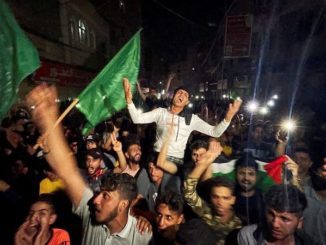
    Palestinians, many of whom had spent 11 days huddled in fear of Israeli shelling, poured into Gaza’s streets. Mosque loud-speakers feted “the victory of the resistance achieved over the Occupation (Israel).” Cars driving around East Jerusalem’s Sheikh Jarrah at dawn flew Palestinian flags and honked horns, echoing the celebratory scenes in Gaza. In the countdown to the 2 am ceasefire, Palestinian rocket salvoes continued and Israel carried out at least one air strike.

    Each side said it stood ready to retaliate for any truce violations by the other. Cairo said it would send two delegations to monitor the ceasefire.

    The violence erupted on May 10, triggered by Palestinians’ anger at what they saw as Israeli curbs on their rights in Jerusalem, including during police confrontations with protesters at Al- Aqsa mosque during the Ramadan fasting month. The fighting meant many Palestinians in Gaza could not mark the Eid al-Fitr festival at Ramadan’s conclusion. On Friday, throughout Gaza, postponed Eid al-Fitr meals were held instead.

    In Israel, radio stations that had carried around-the-clock news and commentary switched back to pop music and folk songs. Death toll Gaza health officials said 232 Palestinians, including 65 children, had been killed and more than 1,900 wounded in aerial bombardments. Israel said it had killed at least 160 combatants.

    Authorities put the death toll in Israel at 12, with hundreds of people treated for injuries in rocket attacks that caused panic and sent people rushing into shelters. Hamas, the Islamist militant group that rules Gaza, cast the fighting as successful resistance of a militarily and economically stronger foe.

    “It is true the battle ends today but (Israeli Prime Minister Benjamin) Netanyahu and the whole world should know that our hands are on the trigger and we will continue to grow the capabilities of this resistance,” said Ezzat El-Reshiq, a senior member of the Hamas political bureau.

    He told Reuters in Doha that the movement’s demands also include protecting Al-Aqsa mosque in Jerusalem and ending the eviction of several Palestinians from their home in East Jerusalem which Reshiq described as “a red line”. “What comes after the battle of ‘Sword of Jerusalem’ is not like what came before because the Palestinian people backed the resistance and know that the resistance is what will liberate their land and protect their holy sites,” Reshiq said.

    In Israel, relief was bittersweet. “It’s good that the conflict will end, but unfortunately I don’t feel like we have much time before the next escalation,” Eiv Izyaev, a 30-year-old software engineer, said in Tel Aviv. Amid growing global alarm, Biden had urged Israeli Prime Minister Benjamin Netanyahu to seek deescalation, while Egypt, Qatar and the United Nations sought to mediate.

    In a televised address on Thursday, Biden extended condolences to bereaved Israelis and Palestinians and said Washington would work with the United Nations “and other international stakeholders to provide rapid humanitarian assistance” for Gaza and its reconstruction. Biden said aid would be coordinated with the Palestinian Authority – run by Hamas’ rival, President Mahmoud Abbas, and based in the Israeli-occupied West Bank – “in a manner that does not permit Hamas to simply restock its military arsenal”.

    Hamas is deemed a terrorist group in the West and by Israel, which it refuses to recognize. Power struggle Analysts saw a key goal of Hamas’s rocket campaign as being to marginalize Abbas by presenting itself as the guardian of Palestinians in Jerusalem, whose eastern sector they seek for a future state. Making the link explicit, Hamas named the rocket operation “Sword of Jerusalem”.

    Abbas, 85, remained a marginal figure during the 11-day conflict. He secured a first telephone call with Biden during the crisis – four months after Biden took office – but his western-backed Palestinian Authority exerts little influence over Gaza, and he made no public comment after the truce was announced. Prime Minister Mohammad Shtayyeh, an Abbas appointee, said “We welcome the success of the international efforts led by Egypt to stop the Israeli aggression against our people in Gaza Strip,” in comments published by Palestinian media.

    In perhaps a worrying sign for Abbas in his West Bank heartland, some Palestinians waved green Hamas flags in Ramallah, the seat of his government. Hamas previously demanded that any halt to the Gaza fighting be accompanied by Israeli drawdowns in Jerusalem. An Israeli official told Reuters there was no such condition in the truce.

    The State Department said that Secretary of State Antony J. Blinken planned to travel to the Middle East, where he would meet with Israeli, Palestinian, and regional leaders to discuss recovery efforts. U.N. Secretary-General Antonio Guterres said Israeli and Palestinian leaders had a responsibility beyond the restoration of calm to address the root causes of the conflict,” he told reporters with serious dialogue.

    “Gaza is an integral part of the future Palestinian state and no effort should be spared to bring about real national reconciliation that ends the division,” he said. Reuters

  • Israel-Hamas violence fueled by emotive triggers

    Israel-Hamas violence fueled by emotive triggers

    By Lt Gen Sanjiv Langer (retd)
    Israel will have to introspect. Its hardline, extreme-right approach is pulling it into a black hole. The prospects of Hamas East and West, Hezbollah to the North and restive Palestinians within the country do not bode well for the long-term security and prosperity of its populace. When asymmetric entities engage in conflict, outcomes are unpredictable. Rocket salvo attacks by Hamas have broken through the Israeli Iron Dome, challenging its invincibility.

    Let there be no strife, I pray thee, between me and thee, and between my herdsmen and thy herdsmen; for we be brethren. — Abraham, Old Testament

     RAMZAN’S Laylat al Qadr, the Night of Destiny, catapulted Israel and Palestine to a crescendo of violence. With more than 200 killed in Gaza and at least 10 in Israel, the battle has entered its second week. Hamas, having fired about 3,000 rockets in salvos, and relentless Israeli air, land and sea bombardments on hundreds of targets are edging the protagonists towards an expanded conflict.

    The combat comes at a time when Israeli Premier Benjamin Netanyahu and Palestinian President Mahmoud Abbas are both in political quicksand. Netanyahu may gain a lifeline as his opponent Yair Lapid is unable to engineer support. President Abbas will, however, sink deeper, ceding vital space to Hamas. Al Fatah and Hamas took birth in the Palestinian Intifada of 1987. While Fatah and Arafat took center stage in the Palestine Liberation Organisation (PLO), Hamas unrelenting, fundamentally divergent, bided its time. Post elections in 2006, Hamas expelled Fatah from the Gaza Strip, resulting in a fractured Palestinian Authority: Hamas in Gaza and Fatah in Palestine territories, to the East of Israel.

    The conflict between Hamas and Israel is endemic, manifesting itself in the wars of 2009 and 2014. The present firestorm was preceded by a slow but definite burn. Stoking the fires of Palestinian resentment have been the US-supported declarations on Jerusalem, the Golan Heights and the ill-conceived Trump ‘Deal of the Century — Peace Plan’.

    The night of May 8 was nestled in an unfortunate convergence of emotive triggers: Heavy Israeli hand in crowd management for Ramzan; Israeli celebrations of their 1967 victory and capture of East Jerusalem; and Israeli Court permitting the eviction of four Palestinian families from Sheikh Jarrah (suburb of Jerusalem) for Jewish settlers.

    Consequently, this time, in an ominous departure, the Arab population within Israel has raised its hand. This explains the violence in the areas of Bat Yam, Lod, Sheikh Jarrah and the West Bank. While the move for eviction impacts 700 Palestinian families, the court order is seen as a precedent. The incendiary role and active precipitation by Hamas is, however, writ large in the fire. Hamas repeatedly threatened violence, treating Israeli actions in the vicinity of the Al-Aqsa Mosque as a Red Line.

    Hamas, equipped by Iran, modelling itself on the Lebanese Hezbollah, seeks supremacy in the Palestinian affairs. Its mass appeal is enhanced by its ability to confront the Israeli forces and take casualties. Civilian deaths are an unfortunate but necessary consequence of ‘The Struggle’. Violence works to its political advantage and diminishes the political signature of Fatah.

    Israel faces tough choices. Standoff attacks have a limited deterrence since Hamas cadres welcome death. Hamas has embedded its facilities deep into the civilian habitation. Enormous casualties are on show. The present targeting by Israel of the HQ, leaders and military facilities orchestrates casualties. Israeli polity is in turmoil. Sections of the resident 21 per cent Palestinian population are inflamed. They have challenges on both sides of the border. The Gaza Strip is one of the densest urban entities in the world. Concrete rises and spreads with little gaps. It is a nightmare for the land forces. Past land interventions have caused high casualties and had had no enduring gains.

    The Indian response has been nuanced. With a history of support to the Palestinian cause, a multi-dimensional robust, flourishing relationship with Israel since 1992, this is mandated. While Israeli centrality is unambiguous, India is autonomous on the larger issues. This has been echoed in the response of TS Tirumurti, Ambassador of India to the UN: deep concern over all clashes and violence, with specific reference to Hamas rocket attacks and violence on Temple Mount; concern over evictions in Sheikh Jarrah; insistence on maintaining status quo; adherence to UN Security Council Resolution 2334, which stigmatizes Israeli settlements, calls them flagrant violations; and commitment to the Two-State Solution.

    While India has stayed its hand on Hamas in the UN, the present specific reference to its rocket attacks is also due to the fact that Hamas initiated the violence as an act of war.

    Historic Indian commitment to the region also included a large presence in the UN Mission, UNEF I from 1956 to 1967. The mission had illustrious Indian Force Commanders — Generals PS Gyani and Inderjit Rikhye. While the mission was largely deployed in Gaza, Indians were a welcome presence in the region, as they continue to be today, in the UN Mission UNIFIL, Lebanon.

    It also bears mention that India’s support to the Palestinians has been unfailing and since 2018, the Indian contribution to them has been quadrupled to $5 million a year. The assistance has been sharpened with project-based interventions. Indian outreach is both in Gaza and the Eastern Palestinian territories.

    Hamas military spokesman Abu Ubaida has threatened: “…we have prepared for your kind of deaths that would make you curse yourselves…” Hamas may have chosen the moment well, but the Israelis will not oblige it. Israeli institutions are strong, their crisis response is outstanding and defense and security capabilities have a wide spectrum and bleeding edge.

    Hamas, undoubtedly, has an eye on the impending Palestinian elections, which President Abbas has postponed. This conflagration will possibly give electoral margins to Hamas for realizing its dream of control over all territories.

    Israel will have to introspect. Its hard-liner, extreme-right approach is pulling it into a black hole. The prospects of Hamas East and West, Hezbollah to the North and restive Palestinians within the country do not bode well for the long-term security and prosperity of its populace.

    When asymmetric entities engage in conflict, outcomes are unpredictable. Rocket salvo attacks by Hamas have broken through the Israeli Iron Dome, challenging its invincibility. There is a blurring of focus for Israel, with the incidence of domestic violence.

    Hamas is presently poised for political gains. Israeli military superiority will not transcend to assuage damaged psyche and heal emotional wounds. Hamas is on track, while Israel will have to review its existential challenges. We must pray for the innocent victims. We must also, in time, assist them to pick up the threads of their lives.

    (The author is a Former Deputy Chief, Defence Staff, India)


  • Balancing act: On India’s stand in Israel-Palestine conflict

    Balancing act: On India’s stand in Israel-Palestine conflict

    India should oppose indiscriminate attacks on Israel and disproportionate bombing on Gaza

    At the open UN Security Council session on Sunday, May 16, on the Gaza conflict, India, a non-permanent member, attempted a delicate balancing act by reaffirming its traditional support for the Palestine cause without abandoning its new friend Israel. T.S. Tirumurti, India’s Permanent Representative at the UN, expressed concern over the violence in Jerusalem and the “possible eviction process” of Palestinian families in Sheikh Jarrah and warned against “attempts to unilaterally change the status quo” in Jerusalem. He also reiterated India’s “strong support for the just Palestinian cause and its unwavering commitment to the two-state solution”. But India was careful not to upset Israel’s sensitivities. There is a direct condemnation of the rocket attacks from Gaza but no direct reference to the disproportionate bombing Israel has been carrying out on the impoverished Gaza Strip since May 10. India also did not make any reference to the status of Jerusalem or the future borders of the two states, in line with a recent change in its policy. Until 2017, the Indian position was that it supported the creation of an independent, sovereign Palestine state based on the 1967 border and with East Jerusalem as its capital that lives alongside Israel. The balancing did not appear to have gone down well with the Israeli side. When Prime Minister Benjamin Netanyahu, who has a good rapport with Narendra Modi, thanked 25 countries that he said stood with Israel, there was no reference to India.

    For India, which voted against the creation of Israel in historic Palestine in 1947 in the UN General Assembly, ties with Israel have transformed since the early 1990s. In 2017, Mr. Modi became the first Indian PM to visit Israel and Mr. Netanyahu travelled to India in 2018. While Israel ties are on a strong footing, India cannot ignore the Palestinians for historic, moral, legal and realist reasons. Historically, India, which went through the horrors of 1947, opposed the partition of Palestine. Throughout the Cold War, it remained a strong supporter of Palestinian freedom, taking a moral and legal position against the Israeli occupation, in line with international laws and norms. It established full diplomatic relations with Israel in 1992, in the context of improving Israel-Palestine ties after the Madrid Conference and the changes in the global order following the disintegration of the Soviet Union, but never abandoned the Palestinians. India’s Palestine policy had realist underpinnings too. India has been energy dependent on the Arab world. It cannot alienate the Arab voices or be isolated in the General Assembly, where most member-countries oppose the occupation. These factors should have driven India to take a more emphatic position against both the indiscriminate rocket attacks into Israel, in which 12 people were killed, and the disproportionate bombing of Gaza, which has claimed at least 230 lives, including over 60 children.

    (The Hindu)

  • The solution to fight Coronavirus is now becoming a reality

    The solution to fight Coronavirus is now becoming a reality


    The world is looking for a drug and a vaccine to overcome the deadly virus. Many countries and many research groups are working feverishly to find an effective remedy. Fortunately, there have been some breakthroughs which give hope that the pandemic will ultimately be controlled.

    H.S. Panaser

    The novel coronavirus is rapidly spreading its fang globally and has already led to more than 2,58,344 deaths and 3.66 million positive cases. Yes, that is a huge number and will most likely continue to rise in the coming days. Even though the countries across the globe have closed their borders and continue to take stringent measures (including a complete lockdown) to contain the spread of this highly infectious virus, the flattening of the curve is yet to be seen.

    In the United States, COVID-19 has caused more than 70,000 fatalities and the number of positive cases has touched almost 1.2 million. Italy, on the other hand, remains one of the worst-hit nations in the world with 2,13,013 positive cases.

    The world is looking for a drug and a vaccine to overcome the deadly virus. Many countries and many research groups are working feverishly to find an effective remedy. Fortunately, there have been some breakthroughs which give hope that the pandemic will ultimately be controlled.

    The ‘significant’ breakthrough of Israel

     Israeli Defense Minister Naftali Bennett announced the country had a remarkable breakthrough in the development of COVID-19 vaccine. He said that Israel’s Institute for Biological Research (IIBR) has developed a monoclonal neutralizing antibody, which will effectively neutralize novel coronavirus in the body of the carriers. Bennet stated that Italian researchers have made a ‘significant breakthrough’ in developing an antibody to combat novel coronavirus. He was quoted as saying, “I am proud of the institute staff for this terrific breakthrough.”

     Italy claims to develop first COVID-19 vaccine

    While multiple research groups are developing potential vaccines, Italian scientists have claimed to develop a vaccine that has successfully generated antibodies in mice that work on human cells. The vaccine has been tested in the Spallanzani Hospital  in Rome. It is said to be one of the most advanced stages of testing of a potential vaccine in the country as the vaccine neutralizes the SARS-CoV-2 in the human cells.

    After a single vaccination, the mice developed antibodies that can block the virus from infecting human cells. The researchers selected the two best candidates after observing that the five vaccine candidates generated a large number of antibodies

    The Oxford vaccine against COVID-19

    Oxford University initiated a phase-1 human clinical trial of its vaccine on April 23, where two volunteers were injected and Elisa Granato is one of the first ones to get injected with the vaccine. The vaccine -ChAdOx1 nCoV-19- was developed under three months by the University’s Jenner Institute. It uses a weakened strain of common cold virus (adenovirus) that causes infections in chimpanzees. For the vaccine to work, scientists have taken the genetic material of the novel coronavirus present on the surface of the virus and put it in the virus.

     The status of coronavirus vaccine in India

    Prime Minister Narendra Modi reviewed India’s status in developing a vaccine for the novel coronavirus, drug discovery, diagnosis, and testing on Tuesday. It was found that as of now more than 30 vaccines are in different stages of development while a few are ready to go to clinical trial stages. It is also important to note that the Pune-based Serum Institute of India is the world’s largest vaccine maker and India produces 60 per cent of the world’s vaccines.

    (The author is Chair, Global Indian Trade and Cultural Council, Director, International Affairs, C3 Summit LLC, Director, Empire Holdings (Acquisitions & Mergers), President, Global Haryana Chamber of Commerce  Chair, India USA Super PAC. He can be reached at  +1- 732-266-2027)


  • Israeli PM Netanyahu charged in corruption cases

    Israeli PM Netanyahu charged in corruption cases

    JERUSALEM(TIP): Israel’s attorney general, on November 21, formally charged Prime Minister Benjamin Netanyahu in a series of corruption cases, throwing the country’s paralyzed political system into further disarray and threatening the long-time leader’s grip on power.

    Attorney General Avichai Mandelblit charged Netanyahu with fraud, breach of trust and accepting bribes in three different scandals. It is the first time a sitting Israeli prime minister has been charged with a crime. Mandelblit was set to issue a formal statement later Thursday.

    Allegations against Netanyahu include suspicions he accepted hundreds of thousands of dollars of champagne and cigars from billionaire friends, offered to trade favors with a newspaper publisher and used his influence to help a wealthy telecom magnate in exchange for favorable coverage on a popular news site.

    The indictment does not require Netanyahu to resign but is expected to raise pressure on him to step down.

    Netanyahu has called the allegations part of a witch-hunt, lashing out at the media, police, prosecutors and the judicial system. Netanyahu was scheduled to issue a statement later.

    Netanyahu has been Prime Minister of Israel since 2009, having previously held the position from 1996 to 1999. Netanyahu is also the Chairman of the Likud – National Liberal Movement. He is the longest-serving Prime Minister in Israeli history, and the first to be born in Israel after the establishment of the state.

    (With inputs from agencies)


  • Hawkish  Netanyahu fails to win majority in Israeli Elections

    Hawkish Netanyahu fails to win majority in Israeli Elections

    Gantz rejects Netanyahu’s offer for unity govt

    JERUSALEM (TIP): Israeli Prime Minister Benjamin Netanyahu failed to win a ruling majority in an election that produced a virtual tie between his right-wing bloc and a center-left grouping that would be led by former military chief Benny Gantz.

    Netanyahu’s Likud party trailed its main rival Blue and White by 31 to 32 seats on Wednesday, September 18,  putting the country’s longest serving premier on a shaky ground and raising the possibility of a unity government.

    Israelis voted on Tuesday, September 17,  in their country’s second general election in five months after 69-year-old Netanyahu failed to form a governing coalition with a viable majority following April’s vote.

    The Central Election Committee (CEC) said Blue and White party seemed to be taking a lead over Likud after 91 per cent votes were counted.

    As per figures shared by the CEC, the center-left bloc now has 56 seats compared to Netanyahu-led bloc, comprised of right-wing and ultra-Orthodox parties, which is at 55 seats in the 120-member Parliament. The Joint List, an alliance of mostly Arab Israeli parties, also has gained a seat standing at 13. These numbers may change slightly when the votes of soldiers are counted later on Thursday.

    The secular Yisrael Beitenu party won nine seats, making its leader and former defense minister Avigdor Lieberman the kingmaker in the elections.

    Meanwhile, the Netanyahu’s office said the prime minister will not travel to New York next week for the UN General Assembly in the wake of the election results.

    Lieberman, an ally-turned-rival of Netanyahu, said, “The picture is clear…There is only one option and it’s a broad liberal unity government, comprising of Likud, Blue and White and his own Yisrael Beitenu.”

    (Source: PTI)

  • Why social media needs to be regulated

    Why social media needs to be regulated

    By Manish Tewari

    The big social media platforms are not only monopolies in themselves but also the equivalents of a public square, albeit a digital one. The big five of the virtual civilization are now akin to public utilities and must be regulated as such. The argument, therefore, that they do not bear responsibility for content on their platforms is both dubious and disingenuous.

    It has been almost a month since the results of the General Election 2019 were announced. The time has come to seriously evaluate the role played by social media in spreading disinformation and hate speech in the election season. To do so it is imperative to first understand the structure of the social media platforms and for that, it is necessary to go back to the invention of the telephone itself.

    The telephone was invented by Alexander Graham Bell in 1875. Using tuned metal reeds, wire and magnets, he and his colleagues were able to harmonize a sending telephone with a receiver and reproduce sound. On March 10, 1876, Bell transmitted the first sentence, “Watson, come here, I want you”, through his contrivance. And, the communications revolution has not looked back since then.

    The telephone essentially is a platform that people still use to communicate with each other. Every telephone user has a number that he or she uses — that number is supposed to be linked to an identity. If the telephone network is misused for the purposes of making crank, anonymous or abusive hatemongering calls, the same can be invariably tracked to the miscreants.

    However, with the advent of calling cards that could be used from landline phones and later mobile telephony — the ubiquitous SIM cards — these networks are also abused. But the problem is not insurmountable.

    Telephone companies do not take responsibility for content transmitted over their networks, claiming that they are primarily network providers and how the subscriber uses the system is not their responsibility. With various value-added services getting added to the original voice transmission capacity over the past three decades, this paradigm also requires a revisit. Telecom operators globally should be made vicariously liable in certain instances when their networks become catalysts of mass social and economic disruption.

    Now fast-forward to the 1960s. The first practical model of the Internet came with the conception of ARPANET or the Advanced Research Projects Agency Network. Funded by the US Department of Defense, ARPANET utilized packet switching to allow multiple computers to interconnect over one specific network.

    By the 1970s, scientists conceptualized the Transmission Control Protocol and Internet Protocol, or TCP/IP, a communications template that set benchmarks on how data could be conveyed between manifold networks. ARPANET embraced TCP/IP on January 1, 1983, and from thereon began the interlinking of networks that became the modern Internet.

    The online world then took on a more discernible shape in 1990, when computer scientists developed the World Wide Web. While frequently confused with the Internet itself, the Web is essentially the most conjoint ways of accessing data online in the shape of websites and hyperlinks. It is the web that aided the propagation of the Internet among the masses. It functions as a critical tread in assembling the titanic trove of information that most of us now use on a daily basis.  The social media platforms like Facebook, WhatsApp, Twitter, Tik-Tok and a multitude of others are the flora and fauna of this World Wide Web.

    These social media platforms allow people to register themselves for using their services bereft of any tangible verification. As a consequence a number of individuals, companies, political parties, intelligence structures, non-state actors, terrorist groups and even governments abuse this anonymity in order to spread disinformation, abuse hate and vitriol that has serious implications including and not limited to interference in the sovereign and even democratic functioning of states, causing conflagrations, cyber warfare and interdiction of critical infrastructure to name but a few of the nefarious uses of this framework in the ether. This does not include the vicious dark net that requires very specific browsers to access.

    Human beings now live in two parallel civilizations concurrently — a physical and a virtual civilization. Notwithstanding as to whether the content in question is positive or negative, social media platforms claim that they neither have control over it nor can they verify it. They take no responsibility for allowing dissemination of content, irrespective of its portentous repercussions.

    Their rationale is that they are platforms and not content providers; therefore, they cannot and should not be expected to regulate content governed as they are there by the principles of free speech. They are also incorporated in jurisdictions that have strong freedom of expression laws that they hide behind to insulate themselves from lawsuits that could make them liable for what gets transmitted over their platforms.

    However, the big social media platforms are not only monopolies in themselves but also the equivalents of a public square, albeit a digital one. The big five of the virtual civilization are now akin to public utilities and must be regulated as such. The argument, therefore, that they do not bear responsibility for content on their platforms is both dubious and disingenuous.

    Recently, Assistant Attorney-General Makan Delrahim of the US Department of Justice and its anti-trust chief in a speech in Israel even alluded to the historic anti-trust actions against Standard Oil, AT&T and Microsoft and stated that there is no need for new anti-trust laws. Those on the books suffice for the new digital arena also, thereby implying that there is a case to break up these humongous digital monopolies.

    India has over 34 crore users who consume social media in over a dozen languages. Facebook is the preferred vehicle of this consumption. It has a serious disinformation problem, particularly during elections and in disturbed geographies. During the election season and in turbulent regions, posts with incendiary consequences are routinely shared, especially through the encrypted WhatsApp platform.

    While social media platforms may remove certain pages and delete certain users in response to an outrage, it is at best selective and at worst glaringly deficient in dealing with hate speech as I experienced firsthand during the recent elections. Though social media platforms claim that they have editorial filters, at a practical level they are virtually redundant.

    The effects of such content, circulated by social media in India, cannot be downplayed nor dismissed arbitrarily. In a society as disparate as ours, the cohesion we enjoy cannot be taken for granted in the face of unregulated technologies that people are not trained to use.

    In the context of the human, political, economic and even existential threats that manifest, it is irresponsible for social media outfits to refrain from taking responsibility for their content, especially when their actions undermine the very principles they profess as sacrosanct. An appropriate legal architecture to counter the enormous socio-political problem with its attendant national security implications should be the single biggest national security priority for us as a country.

    (The author  is a lawyer and a Member of India’s Parliament)

  • Indian origin Sharma Creates History as First Indian-Origin Man to Win in Australian Election

    SYDNEY (TIP): Former Australian ambassador to Israel Dave Sharma – now a Liberal Party politician – created history by becoming the first Indian-origin lawmaker to win a seat in the country’s Parliament in the federal election.

    Sharma defeated independent candidate Kerryn Phelps in the heavily Jewish district of Wentworth in eastern Sydney, once held by former Prime Minister Malcolm Turnbull.

    “Down at Edgecliff Station this morning to thank the people of Wentworth for putting their faith in me. I’m committed to being a full-time local representative and I won’t let them down!” he tweeted.

    “Very humbled by the trust placed in me by the people of Wentworth. Look forward to being a voice for them in the parliament and the party room”, Sharma wrote earlier.

    Sharma held a number of senior positions in the Australian public service, including from 2010 to 2012 as the head of the International Division of the Department of the Prime Minister and Cabinet

  • World leaders Congratulate Modi: Great things are in store for US-India partnership, says Trump

    World leaders Congratulate Modi: Great things are in store for US-India partnership, says Trump

    World leaders on Thursday congratulated Prime Minister Narendra Modi for his landslide victory for a second term in office. Congratulatory messages from various parts of the world poured in. While most of them congratulated him over telephone, some leaders took it to social media to extend their greetings.

    US President Donald Trump – Congratulations to Prime Minister @NarendraModi and his BJP party on their BIG election victory! Great things are in store for the US-India partnership with the return of PM Modi at the helm. I look forward to continuing our important work together!

    Bangladesh PM Sheikh Hasina – The Prime Minister of Bangladesh had initiated the call to Modi to extend her congratulations on the clear mandate given by the people of India to the NDA Government. In doing so, PM Sheikh Hasina became one of the first foreign leaders to congratulate the Prime Minister, thus reflecting the extraordinarily close and cordial ties between India and Bangladesh, and the excellent rapport that the two leaders enjoy.

    President of the Russian Federation Vladimir V. Putin – Putin called Modi and congratulated him on his victory in the general elections. President Putin expressed his conviction that the Prime Minister would further strengthen the longstanding friendship between the peoples of both countries and enhance the Special and Privileged Strategic Partnership that bind the two countries together.

    French President Emmanuel Macron – President of France congratulated Prime Minister Narendra Modi over telephone, describing him as one of the foremost leaders of the democratic world. President Macron reiterated his invitation to Prime Minister Modi to visit France in August 2019 for a bilateral meeting and also to attend the G7 Summit at Biarritz.

    Prime Minister of Nepal, K.P. Sharma Oli  – K.P. Sharma Oli called Prime Minister Modi and congratulated him on the electoral victory in the Lok Sabha elections.

    Prime Minister of Japan, Shinzo Abe  – Shinzo Abe called Narendra Modi and congratulated him for the resounding victory of his party in the 2019 General Elections.

    Chinese President Xi Jinping – President of People’s Republic of China, Xi Jinping sent a letter to Prime Minister Modi congratulating him on the electoral victory of National Democratic Alliance under his leadership. In the letter, President Xi noted the great importance he attached to the development of India-China relations and his desire to work with Prime Minister Modi to take the Closer Development Partnership between the two countries to a new height. President Xi also expressed satisfaction at the strong momentum of development in India-China relations in recent years with the joint efforts of both sides.

    Israel Prime Minister Benjamin Netanyahu – Benjamin Netanyahu called his Indian counterpart Narendra Modi to personally congratulate him. “Narendra my friend, congratulation, what an enormous victory. I hope, Narendra, that we can see each other soon, as soon as you form a government and as soon as we form a government,” Netanyahu said in a short video clip of the phone call released by the Prime Minister’s Office. “Well, thank you for your congratulations on my victory, but there’s one difference: You don’t need a coalition, I do, and there’s a big difference.”

  • Along the Borders

    Along the Borders

    By Mini Kapoor

    Unmindful, or perhaps too mindful, of the date, the U.S. inaugurated its new embassy building in Jerusalem last week, on May 14. Proceeding ahead full steam to shift its diplomatic mission in Israel from Tel Aviv to the disputed city, Washington sent Ivanka Trump to point proudly to the shiny plaque that had her father, U.S. President Donald Trump’s name in inordinately large font. The timing was significant as it was the eve of Nakba Day, on which Palestinians mark the forced exodus 70 years ago of hundreds of thousands from their homes in what became the state of Israel in 1948. Just a few miles away, thousands of residents of Gaza had surged in protest towards the barrier that marks the border with Israel — Israeli forces fired at the crowd, killing at least 60 Palestinians.

    The way borders operate

    In that overlay of cheer at the new embassy in Jerusalem and the bloodshed in Gaza could be found the different ways in which borders are heeded. Jerusalem is not just a disputed city, it was divided by the Green Line till the Six-Day War of 1967, when Israeli forces occupied East Jerusalem, where crucially some of the holiest sites of Judaism, Islam and Christianity are. Palestinians are firm that East Jerusalem be the capital of their state in the much recommended two-state solution. Many Israelis make a distinction between the West Bank and Gaza territories on the one hand and East Jerusalem on the other, contending that the city is an organic whole. The inauguration was a challenge to that old border. In Gaza, the barrier put up by Israel with inhumanely stern procedures to get past the checkpoints, and with the supplies of essential commodities so easily blocked in difficult times, the violence highlighted that fact that borders operate to the dictate of the militarily stronger party.

    The Israeli wall — or security barrier or separation barrier as it’s variously called, depending on your politics — is among the most contentious and photographed physical demarcations of a boundary, whether imposed or mutually agreed upon. In a new book Divided, Tim Marshall, a British journalist and writer, explains the theme in the subtitle: Why We’re Living in an Age of Walls. The data bear him out: “At least sixty-five countries, more than a third of the world’s nation states, have built barriers along their borders; half of those erected since the Second World War sprang up between 2000 and now. Within a few years, the European nations could have more miles of walls, fences and barriers on their borders than they were at the height of the Cold War.”

    Marshall’s analysis

    His analysis is sometimes unsatisfying, as he tries to see each wall (though in most parts they are not concrete walls, but fences, concertina wire, etc.) from the viewpoint of those who erect it as well as those it seeks to keep out, and the space is too limited for local nuances to be explored enough in this around-the-world tour. That equation in itself is a comment on the 21st century world, but Marshall’s tour of the great man-made barriers of today is instructive. Of course, he lingers at the Israeli wall — though as he points out, just 3% of the separation barrier is concrete. Other numbers are startling too: if the line drawn by the wall becomes a new fact on the ground, in a two-state solution, Palestinians would lose “at least 10 per cent of the West Bank land, as the wall’s current position lies well inside Palestinian land”. He describes the disparity in the checks that, say, Israeli settlers and Palestinian residents undergo, or those at the Palestinian end of the checkpoint and the Israeli. He explores the security dividend that’s accrued to Israel on account of the wall, and he also visits British graffiti artist Banksy’s Walled Off Hotel in Bethlehem overlooking, well, the wall.

    Around the world

    Marshall roams the globe, looking at “the longest border fence in the world” on the India-Bangladesh border, and also the issues of ethnicity, religion and humanitarian plight around the flight of the Rohingya from Myanmar to Bangladesh in the most fraught conditions to cross international boundaries. He looks at the wall Iran has built along its border with Pakistan. He describes the 1,700-mile Moroccan wall through Western Sahara. There’s the wall Trump wants to build/reinforce on the U.S.-Mexico border, the walls Hungary started building on its border with Serbia and Croatia. And so on.

    And there is the memory of that wall in Berlin that came down. Marshall doesn’t see the probability of a border-less world any time soon. But for now, he sees an antidote in the “great halls” that have been and are being built “to meet, discuss and try to resolve our differences”. Call it the alphabet soup of our hopes: “The United Nations, the EU, the African Union, ASEAN, MERCOSUR, OPEC, NATO, the World Bank…” Keep adding.

    (The author is a columnist with The Hindu)

  • Air India announces flights to Israel over Saudi Arabia

    Air India announces flights to Israel over Saudi Arabia

    NEW YORK (TIP): Saudi Arabia has given Air India approval to fly through its airspace on flights between Israel and India, an airlines spokesperson tells The Times of Israel.

    The agreement would shorten the current flight path by some two hours and mark a significant achievement as Jerusalem attempts to upgrade its relationship with Riyadh.

    The 7-hour 10-minute flight between Tel Aviv and Mumbai will launch March 22.

    Air India says it will operate the flight three times a week.

  • Israel to partner DRDO for developing missile defence system for India

    Israel to partner DRDO for developing missile defence system for India

    NEW DELHI (TIP): In a major upgrade to its defences, the Indian Army has signed a MoU with the Defence Research and Development Organisation (DRDO) to raise one regiment of the advanced Medium Range Surface to Air Missiles (MRSAM). The army plans to have a total of five regiments of this air defence system, which will be deployed opposite to China and Pakistan.

    The MRSAM marks a paradigm shift in the capabilities of the Indian Army. The system can shoot down enemy ballistic missiles, aircraft, helicopters, drones, surveillance aircraft and Airborne Warning and Control System (AWACS) aircraft. Meant for the Army Air Defence, the MRSAM is an advanced, all weather, mobile, land-based air defence system.

    It is capable of engaging multiple aerial targets at ranges of more than 50 km. Each MRSAM system comprises a commandand- control system, a tracking radar, missiles, and mobile launchers.

    Each regiment consists of four launchers with three missiles each. So five regiments will have 60 missiles.

    A MOU has been signed between the army and the Defence Research and Development Organisation (DRDO) for one regiment.

    “The MOU marks the beginning of the development of the MRSAM in the configuration required by the army,” said a defence ministry official, adding that the entire project is worth Rs 17,000 cr.

    Earlier this year, the Cabinet Committee on Security headed by PM Narendra Modi approved a proposal for procuring the MRSAM system for the army. According to the proposal, the army will induct five regiments of the system.

    The system will be jointly developed by Israel Aerospace Industries (IAI) and DRDO with the involvement of private sectors and DPSUs. “The system will have majority indigenous content, giving boost to the Make-in-India initiative.

    The participation of Indian companies in producing MRSAM will empower them in the field of hightech weapon technology.

    Last July, the IAI and DRDO conducted three flight tests of the MRSAM at the integrated test range off the Odisha Coast.

    The missile successfully intercepted moving aerial targets in all three tests. The MRSAM is a land-based variant of the long-range surface-to-air missile (LRSAM) or Barak-8 naval air defence system, which is designed to operate from naval vessels.

    Source: TOI

  • Pakistan closely watching Modi’s trip to Israel

    Pakistan closely watching Modi’s trip to Israel

    ISLAMABAD (TIP): Pakistan is closely watching Prime Minister Narendra Modi’s historic trip to Israel as it can have serious implications on strategic stability in the region, a media report said on July 3.

    The Express Tribune reported that Pakistan officially does not comment on bilateral visits of other heads of governments and states, but it is closely following Modi’s trip since it can have serious implications on strategic stability in the region.

    “Israel has long been a major supplier of arms and other defence equipment to India and those deals have deliberately been kept secret by the two sides. However, the two countries are now more open and publicly talk about their deepening defence cooperation,” the daily said.

    India got access to some of the most modern defence technologies of America through Israel, defence analyst Lt-Gen (retd) Amjad Shoaib was quoted as saying by the daily. Gen Shoaib said India had greatly benefited from the defence and military ties with Israel.

    Dr Zafar Nawaz Jaspal, an international affairs expert, said growing defence cooperation between India and Israel would disturb strategic balance in the South Asian region.

    The Quaid-e-Azam University professor believes Israel assistance can propel India’s missile programme, something that would undermine Pakistan’s policy of maintaining credible deterrence, the daily reported.

    “One of the subjects on which the Indian media has created a lot of hype is the threat emanating from terrorism. It has worked hard to relate terrorism with Pakistan and blame it for virtually any terror incident occurring anywhere in India,” the daily said. PM Modi’s three-day visit to Israel is the first by an Indian Prime Minister to the Jewish nation. Israeli Prime Minister Benjamin Netanyahu along with his entire cabinet went to Tel Aviv’s Ben Gurion airport to receive Modi in a rare gesture.

    Modi, before leaving for Tel Aviv, told an Israeli newspaper that terrorism was a common challenge and said New Delhi and Tel Aviv “can cooperate even more closely” in battling it.

    Former ambassador Ali Sarwar Naqvi believes that the Indian media is too much obsessed with Pakistan, saying: “No matter where Modi goes, India always tries to drag Pakistan along.” However, Naqvi was sceptical if Israel would go too far to appease India.

    “Pakistan is not under the immediate radar of Israel. Their (Israel) priority at the moment is Middle East.” However, Naqvi said their defence and military cooperation was something that had direct bearing on Pakistan.

    For Gen Shoaib, there is a lesson for Pakistan in the ever-growing close relationship between Israel and India.

    “If India can cement ties with Israel while at the same time maintaining diplomatic ties with its enemy Iran, why can’t Pakistan also show flexibility in its foreign policy,” Gen argued.

    “Our foreign policy should not be merely aimed at appeasing any particular country. Rather we need to follow our own national interests,” he said.

    Some analysts have advocated maintaining working relationship with Israel, if not establishing full diplomatic ties, in order to further and protect Pakistan’s interests.

    In 2005, during former president Pervez Musharraf’s tenure, Pakistan and Israel established contacts and even foreign ministers of the two countries met in Turkey. However, things could not make headway further after that. (PTI)

  • PM Narendra Modi’s Israel Visit

    PM Narendra Modi’s Israel Visit

    PM Narendra Modi lays a wreath at the Indian cemetery in Haifa, Israel, on Thursday. Forty-four Indian soldiers laid down their lives during the liberation of Haifa in 1918.

  • Israel backs India’s fight on terror

    Israel backs India’s fight on terror

    CEOs hope to take bilateral trade to $20 billion in 5 years


    NEW DELHI (TIP): Prime Minister Narendra Modi wrapped up a three-day visit to Israel with a meeting with CEOs of various companies who reportedly signed agreements worth about $4.3 billion.

    Businessmen attending the first meeting of the “CEO forum” for India-Israel cooperation, which also met Mr. Modi and Israeli Prime Minister Netanyahu, said the focus was on building ties currently overshadowed by one-way defense trade between the countries. A document of “joint intentions” issued by the forum, organized by FICCI, said that it hoped to take current bilateral trade of about $4-5 billion to $20 billion in five years “if untapped potential is fully harnessed.” The document listed the biggest problems as restrictive “laws for investors” in India, and Indian business visas, which are only granted for one year presently. “The real potential is allowing Israeli technology to access the Indian market by manufacturing products for the world,” Shiv Khemka, Vice-Chairman of the Sun Group that partners with hi-tech Israeli companies like Eccopia that produces robotic non-water cleaners for solar panels at a factory in Haryana, and water purifiers told media.

    “We’ll share our technology with India & provide clean water for millions. I’m proud of Israel!” Mr. Netanyahu wrote in a tweet, adding to a photo of him and Mr. Modi standing in the shallows that there is “nothing like going to the beach with friends.”

    On Wednesday, India and Israel also launched a research and development fund for innovation worth $40 million contributing, $20 million each. While the figure is small, officials say they hope to kickstart the process of helping students to take their inventions to product lines, and that their success would spur more such innovations.

    Earlier, Israel supported India in its fight against terrorism. Israel believes that there is no difference between Pakistan based “Lashkar-e-Taiba” and the Hamas group operating in Israel and Palestine, senior officials in Jerusalem said, pointing out that the Israeli government has unequivocally supported India on the issue of terrorism.