Tag: ISRAEL

  • US set to release Jonathan Pollard, who spied for Israel

    US set to release Jonathan Pollard, who spied for Israel

    NEW YORK: Former spy Jonathan Pollard is set to be paroled from a federal prison in North Carolina on Friday, 30 years after he was caught selling American intelligence secrets to Israel.

    The 61-year-old will be on a short leash as he rebuilds his life as a free man.

    One supporter says Pollard will have to wear a GPS device to monitor his location. He’ll also have a curfew and be barred from using the internet.

    Pollard’s lawyers have said they have lined up housing and a job in the New York area.

    Pollard was arrested in 1985 and given a life sentence in 1987 in a case that still complicates diplomacy between the US and Israel.

  • What can you do for the Parisians?

    First light the candle on the hour at 10:00, 11:00 and 12:00, then say a prayer for the victims and their families as well as the perpetrators.

    We have to tackle this issue head on, and cut the roots of extremism, there is no doubt about it. While we are doing that, what gives us some coherence, some lowering of blood pressure, some relief and some hope is prayers. More than adults, the children need to be with us to reassure them that God is a higher power… it will ease them. That is the only thing that comforts them. Lighting a candle is telling ourselves that I have taken the smallest step I can, and hope and pray to find larger solutions. I am writing a few solutions by 10:00 PM tonite at www.TheGhouseDiary.com

    Mike Ghouse
    Email: mikeghouse@aol.com, Washington

    Mike GhouseMike Ghouse : The author is a community consultant, social scientist, thinker, writer, news maker, and a speaker on Pluralism, Interfaith, Islam, politics, terrorism, human rights, India, Israel-Palestine and foreign policy.

  • A US-Pak nuclear deal would be a threat to India’s security

    A US-Pak nuclear deal would be a threat to India’s security

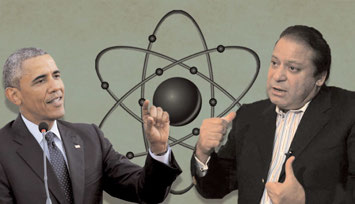
    If a report in a US newspaper is to be believed, a US-Pakistan nuclear deal might be on the cards. The report says that such a deal is being considered around Prime Minister Nawaz Sharif’s visit to Washington this month.

    The report would not have appeared credible but for the evasive comment of the State Department on the subject and the official reaction of the spokesperson of our Ministry of External Affairs cautioning the US authorities against any such decision.

    Ever since the India-US nuclear deal was signed, the Pakistanis, obsessed with the idea of parity with India, have been seeking a similar deal.

    Besides calling the India-US nuclear deal discriminatory, Pakistan has condemned it as threat to its security and warned that it would take all necessary steps to safeguard its interests. Pakistan’s Foreign Affairs Adviser Sartaj Aziz aggressively reiterated this on the occasion of President Barack Obama’s visit to India in January this year.

    By remaining silent, the US has only encouraged this absurd posturing by Pakistan.

    US soft on Pakistan

    Some western nonproliferation specialists have been advocating for some time a nuclear deal with Pakistan in order to remove its sense of grievance. They feel it would give Pakistan an incentive to limit the expansion of its nuclear arsenal and stabilize the nuclear situation in the sub-continent.

    Such advocacy is largely prompted by negative attitudes towards India which, with its historical opposition to the NPT, is seen as the one responsible for nuclearizing South Asia. In their eyes, this is one way of denying India any one-sided advantage in nuclear status.

    Until now, the US Administration has been differentiating India’s case from that of Pakistan and disclaiming any move to offer the latter a similar deal, thought the tenor of its statements has not been sufficiently convincing.

    In fact, both the US and China, to different degrees, have aided Pakistan in achieving its nuclear and missile ambitions.

    A US-Pak nuclear deal will erode the strategic importance of the Indo-US nuclear deal

    In the past, knowing the China-Pakistan nuclear and missile nexus, the US has waived the application of its laws for larger geopolitical reasons linked to the combat against the Soviets in Afghanistan. The Afghanistan factor has, unfortunately, continued to condition US thinking on Pakistan’s nuclear and other errant behavior.

    The US was remarkably soft with Pakistan on the AQ Khan case. It has tolerated Pakistan’s tactics to obstruct discussions on the FMCT at Geneva at a time when fissile material control was still on the US agenda.

    It has overlooked supplies of additional Chinese nuclear reactors to Pakistan in violation of China’s NSG commitments.

    One could speculate that having settled the nuclear question with India, this was one way for the US to allow Pakistan to be a beneficiary of external cooperation in its nuclear sector, as part of the traditional policy of “hyphenation”.

    US agencies and think tanks have been propagating information about the frenetic pace at which Pakistan has been expanding its nuclear arsenal, without any visible reaction from the US government.

    At one time, worried about the rise of radicalism in the country, the US was expressing concern about the security of Pakistan’s nuclear arsenal. But such fears are no longer being expressed.

    US conduct over the years suggests that it has favored the idea of a Pakistani nuclear capability to balance India’s. Remarkably, its complaisance towards the Pakistani nuclear program has continued long after the end of the Cold War.

    Adding to all this, US treatment of Iran’s nuclear ambitions contrasts strikingly with its handling of Pakistan’s nuclear transgressions. While draconian sanctions have been applied on Iran, in Pakistan’s case the US has argued that sanctions might hasten its slide towards failure as a state and increase the risk of its nuclear assets falling into the hands of religious extremists.

    This is specious logic as the US has not taken any precautionary step to curb the development of Pakistan’s nuclear assets, including its decision to introduce tactical nuclear weapons in the subcontinent. An expanded Pakistani nuclear arsenal is even more likely to fall into the wrong hands.

    US reaction to Pakistan’s loose talk about using nuclear weapons against India has been, moreover, notably mild. It could and should have been much stronger.

    The hesitation to impose sanctions on Pakistan contrasts also with the willingness to impose sanctions even on a powerful country like Russia, including its most senior leaders and functionaries.

    What inhibits the US to strong arm Pakistan despite its provocations remains unclear.

    The argument that for dealing with the situation in Afghanistan the US needs Pakistan’s assistance is not convincing. The US needs Russia even more for dealing with yet more complex and fraught problems as Iran and West Asia in general, including the rise of the Islamic State, not to mention the fall-out of mounting tensions in Russia-West relations.

    China-Pakistan axis

    It is mystifying why the US should want to politically legitimize Pakistan’s nuclear conduct through an India-like nuclear deal.

    In India’s case, the US wanted to make a geopolitical shift with the rise of China in mind. It saw India as a counterweight to China in Asia, but for this the nonproliferation issue which inhibited India’s international role had to be resolved.

    Pakistan is in fact China’s closest ally. The geopolitical purpose of a nuclear deal with Pakistan will only legitimize the China-Pakistan nuclear and security relationships and undermine India’s strategic interests vis-a-vis both these adversaries.

    The US has wanted to build a strategic relationship with India largely around shared interests in the Indian Ocean and Asia-Pacific regions in view of mounting signs of Chinese political and military assertiveness and its ambitious naval expansion program.

    Through the China-Pakistan Economic Corridor and the development of Gwadar, Pakistan is facilitating an increased Chinese strategic presence in the Indian Ocean, which contradicts this US strategy.

    Shocking rationale

    According to reports, the underlying reasoning offered by the US, if correctly reported, is almost shocking. In return for an NSG waiver, Pakistan will be asked to restrict its nuclear program to weapons and delivery systems that are appropriate to its actual defense needs against India’s nuclear threat, and not to deploy missiles beyond a certain range.

    This implies that the US accepts that India’s nuclear program is Pakistan-centric and that it poses a threat to Pakistan.

    The Chinese threat to India is being overlooked and the fact that India faces a double Pakistan-China nuclear threat – in view of the close nuclear collaboration between the two countries- is being ignored.

    The US, it appears, would be comfortable if only India would be exposed to the Pakistani nuclear threat, not others.

    US has been consistently soft on Pakistan’s errant behavior in matters like nuclear weapons

    But then, Pakistan’s nuclear arsenal, according to its own leaders, is India-centric. Pakistan is not threatening China, Iran or Saudi Arabia with its nuclear weapons. Which are the countries that the US wants to protect against the use of nuclear weapons by Pakistan?

    Pakistan is developing delivery systems to reach any point in India. The US would apparently be comfortable with that, but not if it developed missiles of longer range. But whose security is US worried about if Pakistan did that? US itself, Japan, Australia, Singapore, China, Iran, Saudi Arabia, Israel?

    China, we know, opposes India’s NSG entry without Pakistan. It would seem the US would be willing to accommodate both China and Pakistan if the latter limited its nuclear threat to India.

    By implication then, the US has no stakes in India’s security from an unstable and adventurous Pakistan, despite our so-called strategic partnership.

    A reward for Pakistan’s military

    The timing of a nuclear deal would be odd too. It is now universally recognized that it is General Raheel Sharif and not Nawaz Sharif who really hold the reins of power in the country. A nuclear deal will be a reward for the Pakistan military and not the civilian power, as Pakistan’s nuclear program is under military control.

    Does the US want to reward the Pakistan military for its operations in North Waziristan against the Pakistani Taliban and is this considered meritorious contribution to the fight against Al Qaeda and terrorism?

    One would have thought far more important for the US and the West is the rise of the Islamic State and its ideology. Compared to which North Waziristan is a side-show. In any case, the Pakistani military is not fighting the Haqqani group.

    Worse, while Pakistani is being accepted as an honest mediator in the Afghan reconciliation process, the Taliban showed its mounting force by occupying Kunduz.

    One hopes that the US report does not accurately reflect President Obama’s thinking.

    If it does, it will show how hollow is the strategic relationship between India and the US, and why it would not be wise to trust the US.

    The India-US nuclear deal will be eroded of much of its strategic importance bilaterally, as result. The US would have, in addition, administered a big political blow to Prime Minister Narendra Modi who has gone out of his way to improve strategic understanding with the US.

    But then, news reports are news reports, and they could merely be political kite-flying. In which case, the India-US relationship will not receive a big jolt for all the reasons mentioned in this article.

    (The author is a former foreign secretary of India. He has also served as India’s ambassador to Turkey, Egypt, France and Russia. He can be reached at sibalk@gmail.com)

  • John Kerry Peace Mission to Middle East ‘in Coming Days’

    John Kerry Peace Mission to Middle East ‘in Coming Days’

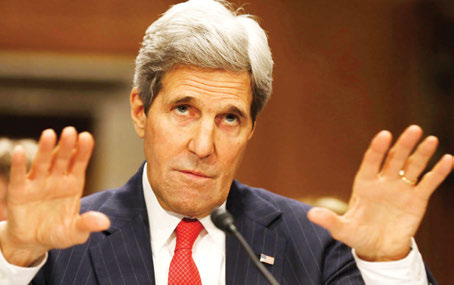
    WASHINGTON (TIP): US Secretary of State John Kerry denounced the recent spate of “terrorist attacks” against Israeli civilians and said he would head to the region to try to calm tempers.

    No timetable or itinerary has been released for the trip, but Kerry said: “I expect to be traveling to the region in the coming days and we will remain very closely engaged in order to support efforts to stabilize the situation.”

    Israeli security forces were deployed in force around Jerusalem today, with soldiers joining police after a spate of knife and gun attacks killed seven Israelis and wounded dozens.

    At least 30 Palestinians have also died, including alleged attackers, and hundreds more have been wounded in clashes with Israeli forces.

    “In recent days we have seen an eruption of tragic, outrageous and unjustified attacks on innocent civilians who were simply trying to go about their daily business in Israel, the West Bank, Gaza and Jerusalem,” Kerry said.

    “We strongly condemn the terrorist attacks against innocent civilians and there is absolutely no justification for these reprehensible attacks and we will continue to support Israel’s right to defend its existence,” he said in an address at Indiana University.

    “It is critically important that calm be restored as soon as possible and we the administration will continue to stress the importance politically and privately of preventing inflammatory rhetoric, accusations or actions that could lead to violence.”

    The recent eruption of unrest has raised fears of a third major Palestinian uprising or “intifada” against Israeli occupation.

    In the first two intifadas, between 1987 and 1993 and 2000 to 2005, hundreds of people were killed and many more hurt in near daily violence.

  • Intolerance in the Name of Tolerance | 13-year-old Palestinian boy struggling for last breath

    Intolerance in the Name of Tolerance | 13-year-old Palestinian boy struggling for last breath

    “Die you son of a bitch”: Israeli shouts at 13-year-old Palestinian boy struggling for last breath…

    12105413_994372807287210_1125129372_nThanks to mobile recording technology, Palestinian and Israeli leaders have lost control of the narrative—and of their own extremists. The recent wave of increased violence between Palestinians and Israeli settlers is quickly reaching a boiling point.

    In a mobile video capture, Ahmad Manasra, a 13-year-old Palestinian boy, is lying on the ground, bleeding and struggling to cry out for help while an Israeli settler shouts obscenities at him. Throughout the length of the video, none of the officers or bystanders attempt to give the dying boy first aid or comfort as he bled out on the sidewalk, his lungs audibly filling with blood as he tried to speak. “Die, you son of a whore!! Die!!” shouted Israeli men at a seriously wounded Palestinian child, who was left to die while police stood around him doing nothing. One of the officers repeatedly pushed the boy down with his foot, whenever he tried to sit up.

    manasra_ahmad13The officers did not shoot him, but left him bleeding with head injuries, broken legs and other serious injuries on the ground. The boy was able to raise his head a few times, but the police officers kicked him back down.

    According to Middleeastrising.com, Ahmad was being chased through the Pisgat Zeev neighborhood in Jerusalem by a mob of Israeli settlers alleging he stabbed two Israelis. The settler filming the video shouted “Die! Die, you mother fucker, die! Die, you faggot, die! Die, you son of a bitch!” The man shouted the slurs in both Hebrew and Arabic, to make sure Ahmad knew exactly what he was saying.

    Ahmad remained in critical condition for several hours, but is now in stable condition.

    ahmadhospitalAccording to the Times of Israel, Manasra is accused of carrying out a stabbing spree on Monday with his cousin Hassan Manasra, 15, seriously injuring a 13-year-old boy and 25-year-old man. Hassan Manasra was shot and killed after charging at police with a knife, while Ahmed Manasra was injured after being hit by a car while fleeing.

    The 25-year-old victim of the stabbing is in moderate condition. The 13-year-old is still unconscious. His condition was upgraded from critical, when he was stabbed, to serious but not life threatening.

    According to the Washington Post, 30 Palestinians have been killed by Israelis in recent weeks, while 8 Israelis have been killed in attacks by Palestinians.

  • Israel PM calls for peace talks with Palestinians

    Israel PM calls for peace talks with Palestinians

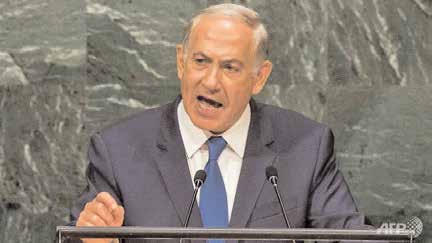
    UNITED NATIONS (TIP): Israel’s prime minister went to the United Nations on Oct 1 to call for an immediate resumption of peace talks with the Palestinians and to savage the international community’s nuclear deal with Iran.

    “I am prepared to immediately, immediately resume direct peace negotiations with the Palestinians without any conditions whatsoever,” Benjamin Netanyahu told the general assembly.

    Addressing Palestinian leader Mahmud Abbas directly, he said:

    “President Abbas, I know it’s not easy. I know it’s hard.”But we owe it to our peoples to try. To continue to try. Because together … if we actually sit down and try to resolve this conflict between us … we can do remarkable things for our people,” Netanyahu added.His remarks come with Netanyahu scheduled to speak with US President Barack Obama at the White House in November — their first meeting after a deep row about the Iranian nuclear row.Their frosty relations plummeted further during Netanyahu’s re-election campaign when he rejected a two-state solution for peace with the Palestinians.

    With the peace process in deep freeze, there are growing fears that tensions like those flaring at Jerusalem’s flashpoint Al-Aqsa mosque compound could spark a broader Palestinian uprising.Abbas told the United Nations on Wednesday that Israel’s refusal to release Palestinian prisoners and stop settlement activity, meant that Palestinians could no longer feel bound by past agreements.

    “They leave us no choice but to insist that we will not remain the only ones committed to the implementation of these agreements, while Israel continuously violates them,” he said.

    “We cannot continue to be bound by these signed agreements with Israel and Israel must assume fully all its responsibilities as an occupying power,” Abbas added, saying Palestinian patience “has come to an end.”

    Netanyahu used the first part of his speech to criticize the international community for reaching the nuclear deal with Iran.

    During his speech, he fell silent for 45 seconds after slamming the UN general assembly’s “deafening silence” in the face of repeated calls from Iran for the destruction of the Jewish state.

    “The response from this body,” he said, “has been absolutely nothing. Utter silence. Deafening silence.”

    Israel will do whatever it takes to defend itself and will not allow Iran to develop nuclear weapons, Netanyahu said.

    “Israel will not permit any force on earth to threaten its future,” he said. “Israel will do whatever it must do to defend our state and to defend our people.”

  • 14 YEARS LATER, US REMEMBERS THE TRAGIC EVENTS OF 9/11 ATTACKS

    14 YEARS LATER, US REMEMBERS THE TRAGIC EVENTS OF 9/11 ATTACKS

    The September 11 attacks (also referred to as 9/11) were a series of four coordinated terrorist attacks by the Islamic terrorist group al-Qaeda on the United States on the morning of Tuesday, September 11, 2001. The attacks consisted of suicide attacks used to target symbolic U.S. landmarks.

    Four passenger airliners—which all departed from airports on the U.S. East Coast bound for California—were hijacked by 19 al-Qaeda terrorists to be flown into buildings. Two of the planes, American Airlines Flight 11 and United Airlines Flight 175, were crashed into the North and South towers, respectively, of the World Trade Center complex in New York City. Within an hour and 42 minutes, both 110-story towers collapsed with debris and the resulting fires causing partial or complete collapse of all other buildings in the World Trade Center complex, including the 47-story 7 World Trade Center tower, as well as significant damage to ten other large surrounding structures. A third plane, American Airlines Flight 77, was crashed into the Pentagon (the headquarters of the United States Department of Defense) in Arlington County, Virginia, leading to a partial collapse in the Pentagon’s western side. The fourth plane, United Airlines Flight 93, initially was steered toward Washington, D.C., but crashed into a field near Shanksville, Pennsylvania, after its passengers tried to overcome the hijackers. In total, the attacks claimed the lives of 2,996 people (including the 19 hijackers) and caused at least $10 billion in property and infrastructure damage. It was the deadliest incident for firefighters and law enforcement officers[4] in the history of the United States, with 343 and 72 killed respectively.

    TRAGIC EVENTS OF 9:11 ATTACKSSuspicion for the attack quickly fell on al-Qaeda. The United States responded to the attacks by launching the War on Terror and invading Afghanistan to depose the Taliban, which had harbored al-Qaeda. Many countries strengthened their anti-terrorism legislation and expanded the powers of law enforcement and intelligence agencies to prevent terrorist attacks. Although al-Qaeda’s leader, Osama bin Laden, initially denied any involvement, in 2004, he claimed responsibility for the attacks. Al-Qaeda and bin Laden cited U.S. support of Israel, the presence of U.S. troops in Saudi Arabia, and sanctions against Iraq as motives. Having evaded capture for almost a decade, bin Laden was located and killed by members of the U.S. military in May 2011.

    The destruction of the World Trade Center and nearby infrastructure caused serious damage to the economy of Lower Manhattan and had a significant effect on global markets, closing Wall Street until September 17 and the civilian airspace in the U.S. and Canada until September 13. Many closings, evacuations, and cancellations followed, out of respect or fear of further attacks. Cleanup of the World Trade Center site was completed in May 2002, and the Pentagon was repaired within a year. On November 18, 2006, construction of One World Trade Center began at the World Trade Center site. The building was officially opened on November 3, 2014. Numerous memorials have been constructed, including the National September 11 Memorial & Museum in New York City, the Pentagon Memorial in Arlington County, and the Flight 93 National Memorial in a field near Shanksville.

    Casualties

    The attacks resulted in the deaths of 2,996 people, including the 19 hijackers. The 2,977 victims included 246 on the four planes (from which there were no survivors), 2,606 in the World Trade Center and in the surrounding area, and 125 at the Pentagon. Nearly all of those who perished were civilians with the exceptions of 72 law enforcement officers, 343 firefighters, and 55 military personnel who died in the attacks. After New York, New Jersey lost the most state citizens, with the city of Hoboken having the most citizens that died in the attacks. More than 90 countries lost citizens in the September 11 attacks. The attacks of September 11, 2001, marked it the worst terrorist attack in world history and the deadliest foreign act of destruction to life and property on American soil since the Japanese surprise attack on Pearl Harbor on December 7, 1941.

    In Arlington County, 125 Pentagon workers lost their lives when Flight 77 crashed into the western side of the building. Of these, 70 were civilians and 55 were military personnel, many of them who worked for the United States Army or the United States Navy. The Army lost 47 civilian employees, six civilian contractors, and 22 soldiers, while the Navy lost six civilian employees, three civilian contractors, and 33 sailors. Seven Defense Intelligence Agency (DIA) civilian employees were also among the dead in the attack, as well as an Office of the Secretary of Defense (OSD) contractor Lieutenant General Timothy Maude, an Army Deputy Chief of Staff, was the highest-ranking military official killed at the Pentagon.

    In New York City, more than 90% of the workers and visitors who died in the towers had been at or above the points of impact. In the North Tower, 1,355 people at or above the point of impact were trapped and died of smoke inhalation, fell or jumped from the tower to escape the smoke and flames, or were killed in the building’s eventual collapse. The destruction of all three staircases in the tower when Flight 11 hit made it impossible for anyone above the impact zone to escape. 107 people below the point of impact died as well.

    In the South Tower, one stairwell, Stairwell A, was left intact after Flight 175 hit, allowing 14 people located on the floors of impact (including one man who saw the plane coming at him) and four more from the floors above to escape. 911 operators who received calls from individuals inside the tower were not well informed of the situation as it rapidly unfolded and as a result, told callers not to descend the tower on their own. 630 people died in that tower, fewer than half the number killed in the North Tower.

    Casualties in the South Tower were significantly reduced by some occupants deciding to start evacuating as soon as the North Tower was struck.

    At least 200 people fell or jumped to their deaths from the burning towers (as exemplified in the photograph The Falling Man), landing on the streets and rooftops of adjacent buildings hundreds of feet below.[119] Some occupants of each tower above the point of impact made their way toward the roof in hope of helicopter rescue, but the roof access doors were locked. No plan existed for helicopter rescues, and the combination of roof equipment and thick smoke and intense heat prevented helicopters from approaching. A total of 411 emergency workers died as they tried to rescue people and fight fires. The New York City Fire Department (FDNY) lost 343 firefighters, including a chaplain, two paramedics, and a fire marshal. The New York City Police Department (NYPD) lost 23 officers. The Port Authority Police Department (PAPD) lost 37 officers. Eight emergency medical technicians (EMTs) and paramedics from private emergency medical services units were killed.

    Cantor Fitzgerald L.P., an investment bank on the 101st–105th floors of the North Tower, lost 658 employees, considerably more than any other employer. Marsh Inc., locatedimmediately below Cantor Fitzgerald on floors 93–100, lost 358 employees, and 175 employees of Aon Corporation were also killed. The National Institute of Standards and Technology (NIST) estimated that about 17,400 civilians were in the World Trade Center complex at the time of the attacks. Turnstile counts from the Port Authority suggest 14,154 people were typically in the Twin Towers by 8:45 a.m. The vast majority of people below the impact zone safely evacuated the buildings.

    Weeks after the attack, the death toll was estimated to be over 6,000, more than twice the number of deaths eventually confirmed.[138] The city was only able to identify remains for about 1,600 of the World Trade Center victims. The medical examiner’s office collected “about 10,000 unidentified bone and tissue fragments that cannot be matched to the list of the dead”. Bone fragments were still being found in 2006 by workers who were preparing to demolish the damaged Deutsche Bank Building. In 2010, a team of anthropologists and archaeologists searched for human remains and personal items at the Fresh Kills Landfill, where seventy-two more human remains were recovered, bringing the total found to 1,845. DNA profiling continues in an attempt to identify additional victims. The remains are being held in storage in Memorial Park, outside the New York City Medical Examiner’s facilities. It was expected that the remains would be moved in 2013 to a repository behind a wall at the 9/11 museum. In July 2011, a team of scientists at the Office of Chief Medical Examiner was still trying to identify remains, in the hope that improved technology will allow them to identify other victims. On March 20, 2015, the 1,640th victim was identified.

    There are still 1,113 victims who have not been identified.

    Damage

    Along with the 110-floor Twin Towers, numerous other buildings at the World Trade Center site were destroyed or badly damaged, including WTC buildings 3 through 7 and St. Nicholas Greek Orthodox Church. The North Tower, South Tower, the Marriott Hotel (3 WTC), and 7 WTC were completely destroyed. The U.S. Customs House (6 World Trade Center), 4 World Trade Center, 5 World Trade Center, and both pedestrian bridges connecting buildings were severely damaged. The Deutsche Bank Building on 130 Liberty Street was partially damaged and demolished some years later, starting in 2007. The two buildings of the World Financial Center also suffered damage.

    The Deutsche Bank Building across Liberty Street from the World Trade Center complex was later condemned as uninhabitable because of toxic conditions inside the office tower, and was deconstructed.The Borough of Manhattan Community College’s Fiterman Hall at 30 West Broadway was condemned due to extensive damage in the attacks, and is being rebuilt. Other neighboring buildings (including 90 West Street and the Verizon Building) suffered major damage but have been restored. World Financial Center buildings, One Liberty Plaza, the Millenium Hilton, and 90 Church Street had moderate damage and have since been restored. Communications equipment on top of the North Tower was also destroyed, but media stations were quickly able to reroute the signals and resume their broadcasts.

    The Pentagon was severely damaged by the impact of American Airlines Flight 77 and ensuing fires, causing one section of the building to collapse. As the airplane approached the Pentagon, its wings knocked down light poles and its right engine hit a power generator before crashing into the western side of the building. The plane hit the Pentagon at the first-floor level. The front part of the fuselage disintegrated on impact, while the mid and tail sections kept moving for another fraction of a second. Debris from the tail section penetrated furthest into the building, breaking through 310 feet (94 m) of the three outermost of the building’s five rings.

    TRAGIC EVENTS OF 9:11 ATTACKS Memorial 1

    National September 11 Memorial & Museum

    The National September 11 Memorial & Museum (known separately as the 9/11 Memorial and 9/11 Memorial Museum) is the principal memorial and museum, respectively, commemorating the September 11 attacks of 2001 and the World Trade Center bombing.

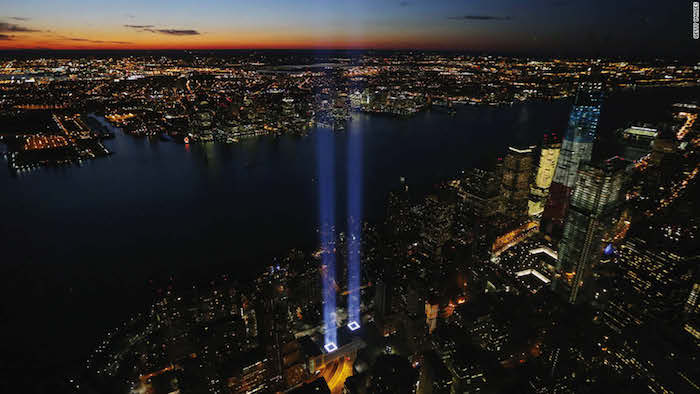
    The Tribute in Light is an art installation of 88 searchlights placed next to the site of the World Trade Center to create two vertical columns of light in remembrance of the September 11 attacks. It is produced annually by the Municipal Art Society of New York.
    The Tribute in Light is an art installation of 88 searchlights placed next to the site of the World Trade Center to create two vertical columns of light in remembrance of the September 11 attacks. It is produced annually by the Municipal Art Society of New York.

    The memorial is located at the World Trade Center site, the former location of the Twin Towers (which were destroyed during the September 11 attacks). It is operated by a non-profit corporation, headed by Joe Daniels, whose mission is to raise funds for, program, own and operate the memorial and museum at the World Trade Center site.

    TRAGIC EVENTS OF 9:11 ATTACKS MemorialA memorial was planned in the immediate aftermath of the attacks and destruction of the World Trade Center for the victims including those involved in rescue operations.The winner of the World Trade Center Site Memorial Competition was Israeli architect Michael Arad of Handel Architects, a New York- and San Francisco-based firm. Arad worked with landscape-architecture firm Peter Walker and Partners on the design, a forest of trees with two square pools in the center where the Twin Towers stood. In August 2006, the World Trade Center Memorial Foundation and the Port Authority of New York and New Jersey began heavy construction on the memorial and museum. The design is consistent with the original Daniel Libeskind master plan, which called for the memorial to be 30 feet (9.1 m) below street level—originally 70 feet (21 m)—in a plaza, and was the only finalist to disregard Libeskind’s requirement that the buildings overhang the footprints. The World Trade Center Memorial Foundation was renamed the National September 11 Memorial & Museum in 2007.

    On September 11, 2011, a dedication ceremony commemorating the tenth anniversary of the attacks was held at the memorial. It opened to the public the following day; the museum was dedicated on May 15, 2014 and opened on May 21. Three months after its opening, the memorial had been visited by over a million people.

    In 2012 Tuesday’s Children, a non-profit family-service organization dedicated to individuals directly impacted by 9/11 and those who have lost loved ones to terrorism worldwide, joined with the 9/11 Memorial to offer private tours to family members of
    9/11 victims and first responders.

  • 5 Indo-Canadians Bag Prestigious STEM Scholarships

    5 Indo-Canadians Bag Prestigious STEM Scholarships

    Five Indo-Canadian high school students have received this year’s prestigious Schulich Leader Scholarships.

    Nimra Dar, Manpreet Deol, Aditya Mohan, Aishwarya Roshan and Simranjeet Singh were among 50 high school graduates who were awarded the scholarship to enrol in science, technology, engineering or mathematics (STEM) undergraduate programmes at participating universities in Canada and Israel, reports schulichleaders.com.

    The scholarship is awarded to the “most promising students” in Canada and Israel to encourage them become pioneers in global scientific research and innovation, the undergraduate award programme’s website said in a statement.

    Of the 50 scholarships awarded each year, 25 scholarships worth $80,000 each are designated for students pursuing an engineering degree, while the rest — valued at $60,000 each — are designated for students studying science, technology or maths.

    According to the website, Mr Dar and Mr Deol will utilise their scholarships to pursue engineering programmes, while the other three students will use it to study science courses.

    Schulich Leader Scholarship, set up by Canadian businessman and philanthropist Seymour Schulich in 2012, is funded by the Schulich Foundation and co-administered by UJA Federation of Greater Toronto.

    Nominations for the scholarships are invited each year subject to the nominees meeting two of the three criteria — academic excellence, outstanding community, business or entrepreneurial leadership and financial need.

  • Nuclear deal not intended to ‘reform’ Iran regime: Kerry

    Nuclear deal not intended to ‘reform’ Iran regime: Kerry

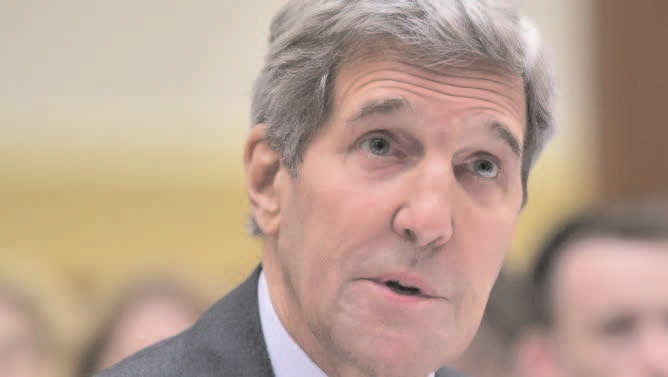
    WASHINGTON (TIP): The Iran nuclear deal is not intended to push Tehran’s regime to reform but to prevent it building a bomb, secretary of state John Kerry told skeptical US lawmakers on July 31.

    In his second appearance before Congress in a week, America’s top diplomat stressed that the plan reached this month with Tehran was the best deal achievable.

    The suggestion by his Republican critics that a tougher US negotiating stance could have forced a complete climb-down by the Iranians was, he argued, naive wishful thinking.

    “Let me underscore: the alternative to the deal that we have reached is not some kind of unicorn fantasy that contemplates Iran’s complete capitulation,” Kerry warned before the house foreign affairs committee.

    Rejecting the deal as Congress has the power to do would essentially give Iran a green light to return full-speed to its enrichment efforts.

    “It’s clear. If Congress rejects this, Iran goes back to its enrichment, the ayatollah (Iran’s supreme leader Ayatollah Ali Khamenei) will not come back to the table (and) Iran will say, ‘We’re free. We can go about, back to our program,’” Kerry said.

    Skepticism has soared among US lawmakers since Washington and five world powers reached a historic accord with Iran that would rein in the Islamic republic’s nuclear program in exchange for an easing of the sanctions that have crippled Iran’s economy.

    Last week, senior Republican senators accused Kerry of being “fleeced” by Tehran during hard-fought negotiations. Several Republicans, including many who are running for president in 2016, advocate walking away from the deal.

    Amid the debate, the American public has wavered. A CNN/ORC poll released Tuesday revealed that 52 percent of respondents say Congress should reject the deal, while 44 percent say it should be approved.

    That contrasts with some major polls in recent weeks that showed most Americans supportive of the agreement.

    With Congress having a crucial say, the White House has launched a full-court press to win over enough members to prevent the accord from collapsing.

    And while some have criticized the deal because it does not oblige Iran to recognize Israel or require Tehran to renounce support for terrorist activities, Kerry said it was vital that lawmakers recognize the deal focuses purely on nuclear weapons.

    “This plan was designed to address the nuclear issue alone, not to reform Iran’s regime, or end its support for terrorism, or its contributions to sectarian violence in the Middle East,” Kerry told the panel during a four-hour grilling.

  • Iran’s Nuclear Deal

    Iran’s Nuclear Deal

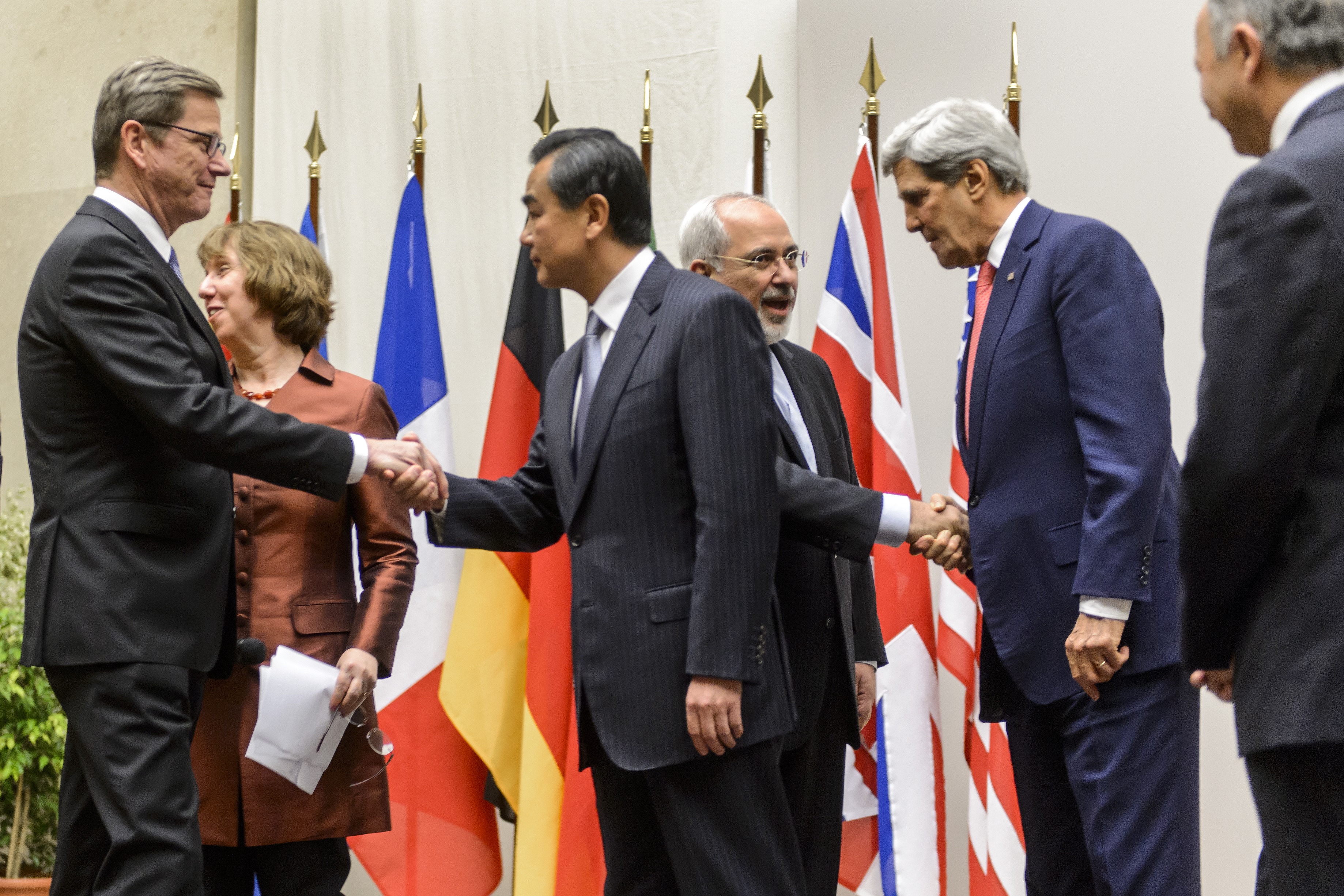
    Iran and six world powers sealed a historic accord to curb the Islamic Republic’s nuclear programme in return for ending sanctions, capping two years of tough diplomacy with the biggest breakthrough in decades.

    Diplomats reached the deal in Vienna on Tuesday, July 14, their 18th day of talks.

    US President Barack Obama said it blocks “every path to a nuclear weapon” for Iran, while Iranian foreign minister Mohammad Javad Zarif called it a “win-win”.

    Banks including Goldman Sachs Group Inc. and Barclays Plc say it would take 6-12 months for the holder of the world’s fourth largest crude reserves to revive production by about 500,000 barrels a day. Sanctions cut the country’s crude exports by more than half from a peak of more than six million barrels a day in the 1970s.

    With new oil flows expected to hit an oversupplied market, Brent, the global benchmark, fell as much as 2.1% to $56.63 a barrel in London and was trading $57.87 at 9.02pm India time. Iran’s benchmark TEDPIX Index, led by oil and gas companies, advanced 0.3% at the close, the highest since April.

    In China, Europe and Russia, the agreement will be welcomed by companies eager to access an untapped market of 77 million people. With an economy bigger than Thailand’s and oil reserves rivalling Canada’s, Iran is the most important market still closed to major equity investors, according to investment bank Renaissance Capital.

    Ending economic penalties could open Iran’s stock market to investors in early 2016, Renaissance’s Charles Robertson and Daniel Salter wrote in a report on Monday. Inflows could total $1 billion in the first year, they said.

    Oil-importing countries such as India should use the period of subdued oil prices to strengthen their monetary policy framework along with fuel pricing and taxation reforms, the International Monetary Fund (IMF) recommended in a report released, coincidentally, on Tuesday.

    Low oil prices could boost India’s gross domestic product (GDP) by 0.4-0.6 percentage point over this year and next.

    Boon for oil importers

    India follows the US, China and Russia in energy use, accounting for 4.4% of global energy consumption. Petroleum product consumption in India has been growing. According to the oil ministry, it grew 3.14% to around 163.17 million tonnes in 2014-15.

    In its report tiled Global Implications of Lower Oil Prices, IMF said: “Oil importers, in deciding how much of the windfall to save, should balance rebuilding policy space with managing domestic cyclical risks. Those with significant vulnerabilities should save much of the windfall, while those facing large output gaps should spend it.”

    It added that “countries should use this period as an opportunity to strengthen their monetary policy frameworks; evidence of second-round disinflationary effects could open space for reducing policy rates in some countries”.

    The fund said countries such as India will reap modest benefits from lower global oil prices as it does not fully pass on the benefits to consumers. While lower oil prices are expected to boost global growth by one percentage point in 2015 and 2016, the IMF said India’s GDP is expected to get a boost of between 0.4 and 0.6 percentage point in the same period.

    The multilateral agency is right to point out that governments like India may be absorbing the benefits of lower oil prices to meet their budget deficit targets and are not passing on the benefits to consumers, which could be less growth-inducing, said Madan Sabnavis, chief economist at CARE Ratings. “There is nothing wrong or correct about it. The Indian government has a huge subsidy burden and it is using the opportunity to correct it,” he said.

    Low international crude prices have helped the National Democratic Alliance (NDA) government bring retail inflation below 5%, better its fiscal deficit target of 4.1% of GDP for 2014-15, and bring the current account deficit to 1.6% of GDP in the January-March quarter, against 2% in the preceding three months.

    “Low oil prices provide a window of opportunity to undertake serious fuel pricing and taxation reform in both oil-importing and oil-exporting countries,” the report said.

    In October, the government freed diesel prices. When crude oil prices fell, it cut fuel prices but simultaneously raised excise duties. This way, the government garnered additional revenue, while resisting the temptation to fully pass on the benefit of lower crude oil prices.

    Crude oil prices in the Indian energy basket averaged at $61.75 per barrel in June, against $84.16, $105.52, $107.97 and $111.89 in 2014-15, 2013-14, 2012-13 and 2011-12, respectively.

    The fall in prices has also presented countries such as India an opportunity to revise terms of imports. India has made a pitch for price and terms correction with the Organization of the Petroleum Exporting Countries (Opec) and has asked for a concession rather than having to pay the so-called Asian premium.

    “India alone is not going to benefit. Japan, China, Korea are also going to benefit. We are talking together at many forums and will be raising it together as well. We are the largest buyers for the Opec, so we need a favourable treatment and things are on right track. There is a positive signal from the seller side also,” said oil minister Dharmendra Pradhan in a 16 June interview.

    India is one of the major consumers of Opec’s production, with the group accounting for 85% and 94% of India’s crude oil and gas imports, respectively.

    “This is a very good time to review this practice and to provide more fair conditions for all parties,” Fatih Birol, chief economist at Paris-based International Energy Agency (IEA), said in an interview published on 2 July.

    Bouyed by the subdued crude oil prices, the 2015-16 budget has estimated India’s subsidy bill at Rs.2.43 trillion, around 9% less than the revised estimate of Rs.2.66 trillion for 2014-15.

    The petroleum subsidy is estimated at Rs.30,000 crore for 2015-16, 50% less than the revised estimate of Rs.60,270 crore. The difference between market prices and retail fuel rates—to be borne by oil marketing firms this fiscal year—is estimated at Rs.42,500 crore.

    The budget has earmarked Rs.22,000 crore for subsidy on domestic cooking gas and Rs.8,000 crore for kerosene. While petrol and diesel prices are deregulated, the prices of domestic cooking gas and kerosene continue to be set by the government.

    The Iran deal

    Full implementation depends on Iran meeting obligations to curb its nuclear programme and address concerns about possible military dimensions of its work. Iran has until 15 December to answer 12-year-old questions about its weapons capabilities. Once inspectors verify compliance, the oil-rich nation will be allowed to ramp up energy exports, re-enter the global financial system, and access as much as $150 billion in frozen assets.

    “This is probably going to go down in history as one of the biggest diplomatic successes of the century,” Ellie Geranmayeh, a policy fellow at the European Council of Foreign Relations, said by phone from London.

    Congress has 60 days to review the document in Washington, where it will meet resistance from lawmakers who oppose making any nuclear compromises with Iran.

    Israel, which has threatened military action to prevent Iran from getting a nuclear bomb, said it will use “every means” possible to persuade Congress to reject it, though Obama vowed to veto such a move. The House and Senate would each need a two-thirds majority to override a veto.

    Israeli Prime Minister Benjamin Netanyahu denounced the deal as a “historic mistake”, saying in a statement that “sweeping concessions were made in all areas meant to block Iran from the ability to arm itself with nuclear weapons”.

    Should the agreement survive review, it would become one of the biggest foreign policy achievements for Obama, who kicked off the initiative with a call to Iranian President Hassan Rouhani nearly two years ago. The US cut diplomatic ties with Iran in 1980, after revolutionaries seized the American embassy in Tehran and held hostages for more than a year.

    Iran agreed to cut 98% of its stockpile of enriched uranium and eliminate two-thirds of its centrifuges, according to a copy of the accord obtained by Bloomberg.

    “This is a sign of hope for the entire world,” European Union (EU) foreign policy chief Federica Mogherini said in Vienna. “And we all know this is very much needed in these times.”

    Relief, including sales of aircraft by companies including Boeing Co., would be phased in after 15 December if Iran complies. The United Nation’s (UN) International Atomic Energy Agency will negotiate access to all suspect sites, including military bases such as Parchin.

    Once UN monitors verify Iran has taken all steps to curb its nuclear activities, the US and the EU will also lift restrictions on most of its financial institutions except those sanctioned for terrorism or human rights abuses. Iranian banks, including the central bank, will be able to process transactions once again through SWIFT, the leading global financial messaging system, US officials said.

    The US and the EU will also allow any nation to buy Iranian oil and ease curbs on trading refined products, chemicals and natural gas. Iran holds the second largest gas reserves in the world, after Russia.

    “If Iran violates the deal, all these sanctions will snap back into place,” Obama said at the White House.

    The UN ban on conventional weapons imports and exports by Iran will remain in place for five years, while the UN embargo on ballistic missiles will hold for eight years, according to the draft. The unilateral US arms embargo will stay in place.

    Utpal Bhaskar is with Mint. Bloomberg’s Stepan Kravchenko in Vienna, Nafeesa Syeed in Dubai, Gregory Viscusi in Vienna, Kambiz Foroohar in New York and Angela Greiling Keane in Washington and Mint’s Asit Ranjan Mishra in New Delhi contributed to this story.

  • Indian Americans Preet Bharara & Rakesh Khurana honored with Carnegie’s ‘Great Immigrant’ award

    Indian Americans Preet Bharara & Rakesh Khurana honored with Carnegie’s ‘Great Immigrant’ award

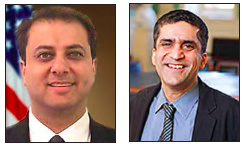
    NEW YORK (TIP): The Carnegie Corporation has announced the 2015 “Great Immigrant”: The Pride of America” awardees. These are the individuals who have helped advance and enlighten our society, culture, and economy. Preet Bharara, U.S. Attorney, Southern District of New York is among 38 eminent personalities selected as 2015 ‘Great Immigrant’ honorees, on the eve of the nation’s birthday on July 4th by Carnegie Corporation.

    The other Indian American awardee, Rakesh Khurana is the Marvin Bower Professor of Leadership Development at Harvard Business School (HBS), professor of sociology in the Faculty of Arts and Sciences (FAS), and co-master of Cabot House and dean of Harvard College.

    “Our founder, Andrew Carnegie, came to this country as the son of impoverished immigrants and grew up to become one of the greatest contributors to American industry and philanthropy,” said Vartan Gregorian, President of the Corporation. “His devotion to U.S. democracy stemmed from his conviction that the new infusion of talent that immigrants bring to our country keeps American society vibrant.”

    The 38 Great Immigrants honored this year come from more than 30 countries around the world and represent leadership in a wide range of professions.

    They include:

    • Preet Bharara S. Attorney, Southern District of New York (India)
    • Geraldine Brooks Pulitzer Prize-winning Author, Journalist (Australia)
    • Thomas Campbell Director and CEO, The Metropolitan Museum of Art (England)
    • Rabia Chaudry Attorney, Civil Rights Activist (Pakistan)
    • Mica Ertegun Interior Designer (Romania)
    • Stanley Fischer Economist; Vice Chair, Board of Governors, Federal Reserve System (Israel)
    • Jonathan Hunt Fox News, Chief Correspondent (Canada)
    • Malek Jandali Composer, Pianist (Syria)
    • Rakesh Khurana Professor, Dean, Harvard College (India)
    • Marie-Josée Kravis Economist, Philanthropist (Canada)
    • Nastia Liukin Olympic Medal-winning Gymnast (Russia)
    • Bette Bao Lord Author, Human Rights Advocate, Philanthropist (China)
    • Ali Malekzadeh President, Roosevelt University, Chicago (Iran)
    • Silvio Micali Turing Award-winning Professor of Computer Engineering (Italy)
    • Lorne Michaels Peabody Award-winning TV Producer (Canada)
    • Franziska Michor Vilcek Prize-winning Professor, Computational Biology (Austria)
    • Anchee Min Author (China)
    • Sharmin Mossavar-Rahmani Philanthropist; Chief Investment Officer, Private Wealth Management Group, Goldman Sachs (Iran)
    • Firouz Naderi Director, Solar System Exploration, NASA Jet Propulsion Laboratory (Iran)
    • Azar Nafisi Author, Scholar (Iran)
    • Craig Nevill-Manning Engineering Director, Google (New Zealand)
    • Maria Otero U.S. Under Secretary of State for Civilian Security, Democracy, and Human Rights (Bolivia)
    • Eddie Pérez Bullpen Coach, Atlanta Braves (Venezuela)
    • Ilana Rovner Judge, U.S. Court of Appeals, Seventh Circuit (Latvia)
    • Arturo Sandoval Grammy Award-winning Jazz Trumpeter (Cuba)
    • Madhulika Sikka Vice President, Executive Editor, .Mic (India)
    • Thomas C. Südhof Nobel Prize-winning Neuroscientist (Germany)
    • Antonio M. TagubaS. Army Major General, Retired (Philippines)
    • Ann Telnaes Pulitzer Prize-winning Political Cartoonist (Sweden)
    • Thalía Singer, Actress (Mexico)
    • Tuyen Tran Vilcek Prize-winning Fashion Designer (Vietnam)
    • Abraham Verghese Physician, Professor, Author (Ethiopia)
    • Eugene Volokh Professor, Legal Scholar, Blogger (Ukraine)
    • Arieh Warshel Nobel Prize-winning Biochemist (Israel)
    • Raffi Yessayan Judge, Massachusetts Superior Court (Lebanon)
  • Israel’s Netanyahu says better Iran deal still possible

    JERUSALEM (TIP): Israel’s prime minister says world powers can still insist on a better deal with Iran over its nuclear program as the negotiators’ self-imposed deadline rapidly approaches.

    Benjamin Netanyahu told a graduating class of pilots Thursday that “it is still not too late to insist on a good deal.”

    Iran and six world powers are racing to meet a June 30 deadline for a deal that would limit Tehran’s nuclear activities in exchange for lifting sanctions.

    Netanyahu has dubbed it a “bad deal,” saying it would leave Iran with the ability to rapidly obtain nuclear weapons. Israel views a nuclear-armed Iran as its greatest potential threat.

    Iran insists its nuclear program is for purely peaceful purposes.

  • US LAWMAKERS PRESS FOR CLOSER TIES WITH INDIA, ISRAEL

    WASHINGTON (TIP): American lawmakers cutting across party lines passed legislation on June 15 aimed in part at strengthening intelligence and security ties between India, Israel, and the US, ahead of PM Narendra Modi’s visit to Israel a few weeks from now.

    Seven Congressmen representing both Democrats and Republicans attached a bipartisan amendment to the FY2016 Intelligence Authorization Act calling for expansion of US-India-Israel national security. The amendment, which was passed by a voice vote, requires a twice-yearly report from the Director of National Intelligence on the possibilities for growing national security cooperation between the US, India, and Israel.

    “While the US already has robust national security partnerships with both India and Israel, there are many areas where opportunities exist to develop and further grow these critical relationships,” said Joseph Crowley, a Democratic lawmaker from New York, who piloted the amendment. “This amendment demonstrates the commitment of Congress to ensuring that our national security strategies include expanding our cooperation with India and Israel, two of our most important friends in their respective regions.”

    The move, an overt expression of what has largely been under the radar so far, was clearly linked to the Modi’s upcoming visit to Israel, something the lawmakers did not make a secret of.

    “With PM Modi’s upcoming visit to Israel — a first for an Indian PM — we should seize on the opportunity to expand trilateral cooperation even further,” said Eliot Engel, another lawmaker from New York, which is home to large Jewish and Indian populations. “This measure would make sure our intelligence community is taking a hard look at areas of potential collaboration so that we can continue to build on this important partnership.”

  • Three Indian Americans Finalists for White House Fellowship

    Three Indian Americans Finalists for White House Fellowship

    Three Indian Americans are among the national finalists for the 2015-16 White House Fellowship that offers exceptional Americans first-hand experience working at the highest levels of the federal government.


    Luxme Hariharan, Payal Patel and Anil Yallapragada are among those representing “an accomplished and diverse cross-section of professionals from the private sector, academia, medicine, and armed services”.


    The national finalists, selected through a highly competitive selection process, will be evaluated by the President’s Commission on White House Fellowships in Washington from June 11-14, according to a statement.

    Luxme Hariharan is a pediatric cataract, glaucoma, cornea and international health fellow, at the Children’s Hospital of Los Angeles, University of Southern California Eye Institute.

    Payal Patel is infectious diseases fellow, Beth Israel Deaconess Medical Center, Harvard Medical School, in Houston.

    Anil Yallapragada is Medical Director, South Carolina Stroke Institute, Grand Strand Medical Centre.

    There are more than 700 White House Fellow alumni, a distinguished group that includes former secretary of state Colin Powell, CNN chief medical correspondent Sanjay Gupta, and Pulitzer Prize-winning author and historian Doris Kearns Goodwin.

  • A way with the world

    A way with the world

    The Prime Minister, Narendra Modi, scored most in foreign policy in his first year in power. No one anticipated Modi’s natural flair for diplomacy, to which he has brought imagination and self-assurance. Modi has been more emphatic than his predecessors in giving improvement of relations with neighbors greater priority. He invited all the SAARC leaders to his swearing-in, to signal that the decisive election victory of a supposedly nationalist party did not denote a more muscular policy towards neighbors. On the contrary, India would take the lead in working for shared regional peace and prosperity.

    Bhutan, the only neighbor that has not politically resisted building ties of mutual benefit, was the first country he visited in June, 2014. He handled his August 2014 visit to Nepal with sensitivity and finesse, and followed it up with exceptional leadership in providing immediate earthquake relief to Nepal in May, 2015. In obtaining Parliament’s approval of the land boundary agreement with Bangladesh in May, 2015, Modi showed his determined leadership again.

    He did falter with Pakistan, seemingly unsure about whether he should wait for it to change its conduct before engaging it, or engage it nevertheless in the hope that its conduct will change for the better in future. He announced foreign-secretary-level talks during Nawaz Sharif’s visit to Delhi, but cancelled them precipitately. He ordered a robust response to Pakistan’s cease-fire violations, yet sent the foreign secretary to Islamabad in March, 2015, on an unproductive SAARC Yatra. Relations with Pakistan remain in flux. In Afghanistan, President Ashraf Ghani’s tilt towards Pakistan and China has challenged the viability of India’s Afghanistan policy. Ghani’s delayed visit to India in April 2015 did not materially alter the scenario for us, but India has kept its cool.

    Modi’s foreign policy premise, that countries give priority today to economics over politics, has been tested in his China policy, which received a course correction. After courting China economically, Modi had to establish a new balance between politics and economics. President Xi’s visit to India in September, 2014, was marred by the serious border incident in Ladakh. Modi showed a sterner side of his diplomacy by expressing serious concern over repeated border incidents and calling for resuming the stalled process of clarifying the Line of Actual Control. During his China visit in May, Modi was even more forthright by asking China to reconsider its policies, take a strategic and long-term view of our relations and address “the issues that lead to hesitation and doubts, even distrust, in our relationship”. He showed firmness in excluding from the joint statement any reference to China’s One Road One Belt initiative or to security in the Asia-Pacific region. The last minute decision to grant e-visas was puzzling, especially as the stapled visa issue remains unresolved. The economic results of his visit were less than expected, with no concrete progress on reducing the huge trade deficit and providing Indian products more market access in China. The 26 “agreements” signed in Shanghai were mostly non-binding MoUs involving the private sector and included the financing of private Indian companies by Chinese banks to facilitate orders for Chinese equipment.

    Modi’s visit to Seychelles, Mauritius and Sri Lanka in March, 2015, signified heightened attention to our critical interests in the Indian Ocean area. Modi was the first Indian prime minister to visit Seychelles in 33 years. His visit to countries in China’s periphery in May, 2015, was important for bilateral and geopolitical reasons. During his visit to South Korea the bilateral relationship was upgraded to a “special strategic partnership’, but Korea nevertheless did not support India’s permanent membership of the United Nations Security Council. Modi’s visit to Mongolia was the first by an Indian prime minister to a country whose position is geopolitically strategic from our point of view.

    Belying expectations, Modi moved decisively towards the United States of America on assuming office. He set an ambitious all-round agenda of boosting the relationship during his September, 2014, visit to Washington. In an imaginative move, he invited Obama to be the chief guest at our Republic Day on January 26, 2015. To boost the strategic partnership with the US, he forged a “breakthrough understanding” on the nuclear liability issue and for tracking arrangements for US-supplied nuclear material. Progress on the defense front was less than expected with four low-technology “pathfinder” projects agreed under the defense technology and trade initiative. The important US-India joint strategic vision for the Asia-Pacific and Indian Ocean region, issued as a stand-alone document, high-lighted the growing strategic convergences between the two countries, with China in view. A special feature of Modi’s September, 2014, US visit was his dramatic outreach to the Indian community, which has since then become a pattern in his visits abroad, whether in Australia, Canada or Beijing. No other prime minister has wooed the Indian communities abroad as Modi has done.

    President Putin’s visit to India in December, 2014, was used to underline politically that Russia remains India’s key strategic partner. Modi was effusive in stating that with Russia we have a “friendship of unmatched mutual confidence, trust and goodwill” and a “Strategic Partnership that is incomparable in content”. He was careful to convey the important message that even as India’s options for defense cooperation had widened today, “Russia will remain our most important defense partner”. Civilian nuclear cooperation with Russia got a boost with the agreement that Russia will build “at least” ten more reactors in India beyond the existing two at Kudankulam. All this was necessary to balance the strengthened strategic understanding with the US and its allies.

    Modi bolstered further our vital relations with Japan, which remains a partner of choice for India. Shinzo Abe announced $35 billion of public and private investment in India during Modi’s visit to Japan in September 2014, besides an agreement to upgrade defense relations.

    Modi’s visit to France and Germany in April, 2015, recognized Europe’s all-round importance to India and was timely. He rightly boosted the strategic partnership with France by ensuring concrete progress in the key areas of defense and nuclear cooperation by announcing the outright purchase of 36 Rafale jets and the MoU between AREVA and L&T for manufacturing high-technology reactor equipment in India. Modi’s bilateral visit to Canada in April, 2015, was the first by an Indian prime minister in 45 years. Bilateral relations were elevated to a strategic partnership and an important agreement signed for long-term supply of uranium to India.

    Relations with the Islamic world received less than required attention during the year, although the Qatar Emir visited India in March, 2015, and the political investment we made earlier in Saudi Arabia aided in obtaining its cooperation to extract our people from Yemen. Gadkari went to Iran in May, 2015, to sign the important agreement on Chabahar. Modi did well to avoid any entanglement in the Saudi-Iran and Shia-Sunni rivalry in West Asia. He met the prime minister of Israel, Benjamin Netanyahu, on the sidelines of the UN general assembly meeting in September, last year, to mark the strength of India-Israel ties. So, Modi’s handling of India’s foreign policy in his first year is impressive. He has put India on the map of the world with his self-confidence and his faith in the nation’s future.

  • FBI cracks down ‘Islamic State’ in Orange County, California

    FBI cracks down ‘Islamic State’ in Orange County, California

    Two men accused of plotting to provide material support to “Islamic State” (IS) appeared before a court in California on Friday. The prosecutors charged Anaheim residents Muhanad Badawi and Nader Elhuzayel, both 24, after investigators tracked their communications on social media and found messages claiming their support for IS.

    According to court documents, on May 7 Elhuzayel used Badawi’s credit card to purchase a ticket to Tel Aviv, Israel, via Istanbul, Turkey. Police arrested Elhuzayel at Los Angeles International Airport on May 21 as he prepared to depart and Badawi in Anaheim, the home to Disneyland, on the same day. Badawi suggested that he, too, eventually planned to go to the region to join the fight, the Justice Department reported.

    Elhuzayel told authorities that he had planned on getting off the plane in Turkey and traveling to fight with IS in Syria, according to the complaint. However, his father, Salem Elhuzayel, told the Orange County Register that he had dropped his son off for the Israel-bound flight so that he could visit Palestinian aunts and cousins.

    “I think they’re looking for a victim,” he said. “He’s an innocent human being.” Officials searched the motel room where the family has lived since their eviction from their home, Salem Elhuzayel said.

    On Friday, IS claimed responsibility for a deadly mosque attack in Saudi Arabia.
    mkg/rc (Reuters, AFP, AP,DW)

  • CHINA, INDIA LIKELY TO BE LARGEST SHAREHOLDERS OF AIIB

    NEW DELHI (TIP): China will likely take a 25-30 per cent stake in the Asian Infrastructure Investment Bank (AIIB) and India is likely to be the second-largest shareholder, delegates attending a meeting of the bank’s founding members said.

    China’s share in the USD 100 billion lender will be less than 30 per cent, an Asian delegate attending the meeting in Singapore said.

    A second delegate said India’s share will be between 10 to 15 per cent. Both spoke on condition of anonymity.

    In all, Asian countries will own between 72-75 per cent of the bank, while European and other nations will own the rest.

    The three-day meeting of the China-backed AIIB is aimed at finalising the draft of articles of agreement that would decide the share of member countries and the bank’s initial capital.

    A third delegate said the talks have ended and now each country representative would take the proposals back to their governments for a final decision.

    There was no immediate comment from the AIIB or Chinese officials on the discussions in Singapore.

    A total of 57 countries have joined AIIB as its prospective founding members, throwing together countries as diverse as Iran, Israel, Britain and Laos.

    The United States and Japan have stayed out of the China-led institution, seen as a rival to the US-dominated World Bank and Japan-led Asian Development Bank, citing concerns about transparency and governance -although Tokyo for one is keeping its options open.

    AIIB’s expected launch next year is coming at a time when the space for infrastructure lending is already crowded due to the presence of major multilateral lenders and Japan’s latest move to provide $110 billion for Asian infrastructure projects.

    The amount of Japanese funds, to be invested over 5 years, tops the expected USD 100 billion capitalisation of the AIIB.

  • Two Indian cities at high risk of terror strike

    Two Indian cities at high risk of terror strike

    LONDON (TIP): Two Indian cities -Imphal (ranked 32) and Srinagar (ranked 49) have been named to be at “extreme risk” of a terrorist attack, mainly aiming to cause mass casualty and destroy public transport networks.

    According to an analysis of the terror risk to 1,300 commercial hubs and urban centres around the world, populations and businesses in 113 Indian cities have been identified to be at some risk – high, medium or low risk of facing terrorist attacks.

    The next major Indian city after these two that faces a terrorist threat is Chennai even though the risk quotient has been marked as medium risk.

    Bangalore is the fourth most prone city even though it is placed at 204th in the global threat list followed by Pune and Hyderabad at 206th and 207th respectively

    Cities like Nagpur (ranked 2010) and Kolkata (2012) have been found to face a higher risk of a mass attack by terrorists that the usually expected targets like Delhi (447) and Mumbai (298).

    Around 64 cities around the world are at “extreme” risk, with most in the Middle East and Asia – and three in Europe.

    London ranked as low as at 400 due to the lack of a terror incident since the 7/7 bombings while Paris has soared into the top 100 cities following the Charlie Hebdo shooting, according to Verisk Maplecroft’s new Global Alerts Dashboard (GAD).

    Arvind Ramakrishnan, head of Maplecroft India said “When it comes to Imphal and Srinagar, terrorist attacks aren’t on commercial targets as much as against the security forces. However n most of the other metropolitan cities, the targets are both to cause mass casualty and cripple its commercial hubs. Public transport networks in India are also prime targets”.

    Ramakrishnan added “The Mumbai attack in 2008 was the turning point for India. But lack of intelligence sharing among states is a big worry. Law and order is still a state subject in India and political rivalries across states leads to state intelligence agencies not sharing actionable data. Virtually all police forces in India lack modern equipment and adequate manpower to counter a terrorist threat. This brings down the overall morale of the force. India does not face threats from cross border terror organisations but also from home grown ones like the Indian Mujahideen”.

    Charlotte Ingham, head of security analytics at Maplecroft UK said in total, 64 cities are categorised as
    ‘extreme risk’ in an online mapping and data portal that logged analysed every reported terrorism incident since 2009.

    Based on the intensity and frequency of attacks in the 12 months following February 2014, combined with the number and severity of incidents in the previous five years, six cities in Iraq top the ranking.

    Over this period, the country’s capital, Baghdad, suffered 380 terrorist attacks resulting in 1141 deaths and 3654 wounded, making it the world’s highest risk urban centre, followed by Mosul, Al Ramadi, Ba’qubah, Kirkuk and Al Hillah. Ingham said “just because a city in India hasn’t seen a terrorist attack in a while does not mean it isn’t potentially facing one. The rankings are based on the frequency and intensity of attacks.

    Belfast has been named as the most dangerous city in Europe while Baghdad topped the list worldwide.

    Outside of Iraq, other capital cities rated ‘extreme risk’ include Kabul (13th most at risk), Mogadishu in Somalia (14th), Sana’a in Yemen (19th) and Tripoli in Libya (48th).

    However, with investment limited in conflict and post-conflict locations, it is the risk posed by terrorism in the primary cities of strategic economies, such as Egypt, Israel, Kenya, Nigeria and Pakistan that has the potential to threaten business and supply chain continuity.

    “An estimated 80% of global GDP is generated from cities,” states Ingham. “Visibility of the sub-national differences in terrorism levels should be an imperative for multinational organisations looking to understand and price the risks to assets, employees and supply chains”.

    As Africa’s largest economy, Nigeria’s role as a commercial hub is central to economic growth across the region. Because of Boko Haram 13 out of the 24 Nigerian cities experienced a significant increase in the intensity and frequency of terrorist attacks compared to the previous quarter.

    Paris (97th and ‘high risk’) has experienced one of the steepest rises in the ranking, reflecting the severity of the terrorist attack in January 2015 that left 17 people dead. The risk level in Paris is representative of a wider trend for Western countries, including Belgium, Canada and Australia, where the level of risk in key urban centres is substantially higher than elsewhere in the country”.

  • Decline of American clout – Gulf countries ”loss of trust in the leadership and credibility of the US”

    Decline of American clout – Gulf countries ”loss of trust in the leadership and credibility of the US”

    A near unanimous decision by the six heads of state of the Gulf Cooperation Council not to personally attend the meeting convened by the American President is a most dramatic demonstration of the decline of American clout in a part of the West Asian region where it was the strongest. The meeting was called by the President to explain and reassure his Gulf allies about the Iran nuclear deal. The boycott is a measure of the extent of the loss of trust of the Gulf countries in the leadership and credibility of the United States. The American Administration has of course been aware of the widening gulf in mutual trust between the two sides but was probably not aware of its depth. It tried to assuage its erstwhile protégés’ sensibilities by vocally and strongly supporting the Saudi-led intervention against the Houthi-led insurrection in Yemen. It provided crucial logistic and intelligence support and deployed powerful naval armada in the Gulf of Aden, even ordering the hugely powerful   aircraft carrier USS Enterprise to those waters. Evidently, these efforts and gestures have not had the desired result.

    The causes of this disenchantment among the kingdom and its GCC allies are well known. It started with the phenomenon which prematurely came to be described as the Arab Spring. The Saudis were deeply disappointed with the American lack of decisiveness in standing behind President Mubarak and for eventually ditching him.

    They left the Americans in no doubt about their displeasure. When Morsy was overthrown, the Americans again were on the other side since they openly condemned what they called the coup against the ‘democratically elected’ leader, even though they knew that Saudi Arabia was firmly opposed to Moslem Brotherhood.

    The Saudi disillusionment with America became stronger with the developments in the Syrian civil war. The Saudis expected their American friends to be more forthright in joining the campaign to topple President Bashar Al Assad. The kingdom had never been happy with the unwillingness of the Syrian regime to align itself with them. Syria’s dominance of Lebanon, especially during the period when Rafiq Hariri was its Prime Minister, was intensely resented by the then King who considered Hariri as his protégé. (Hariri made his millions in Saudi Arabia.)

    President Obama had declared that if the Assad regime used chemical weapons, that would mean crossing a ‘red line’ for him and he would bomb the regime’s strongholds. Chemical weapons were used and Obama did nothing. The Saudis were furious at being let down. The concerted propaganda launched by them as well as Qatar had succeeded in creating a strong perception that it was the Assad government which had used the weapon of mass destruction. However, an internal investigation in Washington, at the least, found several holes in the story, compelling Mr. Obama not to carry out his threat or promise.

    The proverbial last straw which broke the camel’s back was the determined push   by the American President in the nuclear talks with Iran. Both Iran and Saudi Arabia have been polite in their public utterances and played down the intense mistrust and hostility which they entertain for each other. The fact remains that the two are rivals in the region for dominance. The sectarian divide is no doubt one important factor since the kingdom regards itself as the leader of all the Muslims in the world and the Islamic Republic considers itself as the defender of the Shia community. Shias and Sunnis deliberately downplay their differences in public discourse but the theological gap between them is unbridgeable. Worldwide, Shias are only 10 to 15 % of the Muslim Ummah and are in majority in only four countries – Iran, Iraq, Bahrain and Azerbaijan. Shia minorities have been persecuted in most Sunni majority     countries, and it is only in recent years that they have asserted themselves. Iran’s rise as the Islamic Republic has undoubtedly a lot to do with this assertiveness.

    Saudi Arabia has legitimate concerns at the rise of Iran, given the fact that its Shia population, about 10-12 %, is located in the eastern province where the kingdom’s oil resources are concentrated. If Iran comes to have an effective voice in Yemen, it might generate dissidence in the country. Sectarian considerations, while important, have been overplayed by the Saudis. Their principal concern is that if Iran succeeds in striking a deal with the US, which would permit it to retain its nuclear weapon capability, it would forever tilt the balance of power in favor of Iran. Consequently, when the talks between Iran and P-5 + 1 made progress, raising expectations about a successful conclusion by the end of June, the Saudi kingdom thought something had to be done.

    That something turned out to be the intervention in Yemen. In this adventure, they were actively encouraged and assisted by Israel whose Prime Minister has mounted a most effective campaign against the nuclear deal for his own reasons. The Saudis and Israelis are allies in this anti-Iran exercise. If the nuclear talks conclude in a mutually acceptable agreement, Iran will undoubtedly emerge as the dominant power in the region.

    Saudi Arabia has mounted a huge media blitz to convince the major powers of Iran’s active involvement on the side of the Houthis, alleging political, logistical and military support to the Houthi insurgency. Iran denies all such allegations. The U.S. has warned Iran against helping the Houthis, accusing it of everything that     the   Saudis accuse Iran of. But not all Western politicians subscribe to the claim of Iranian involvement. Even by the UN account, Yemen is flush with 40 to 60 million weapons of different sorts. Yemen’s deposed President has aligned himself with the Houthis, mainly to secure political future for his son, and he has strong following in the Yemeni army.

    If Iran miscalculates, it might force Mr. Obama to rethink the nuclear deal. He is already under tremendous pressure domestically. Mr. Netanyahu has mobilized the Republican Senators against the deal. It is to the President’s credit that he has withstood all the pressure and persevered in the negotiations. A misstep by Iran just might force Obama’s hand and call off the talks. Iran of course realizes this danger.

    Not everyone in Iran is in favor of the deal, but a huge majority is, especially the one person whose voice counts the most, namely, the Supreme Leader. It is perhaps more up to Iran to make sure that it exercises maximum restraint in the Yemeni affair. It is also Iran’s responsibility to reassure its smaller neighbors about its peaceful and good neighborly intentions towards them.

    The unprecedented public display of no-confidence by the Gulf countries in President Obama is equally a challenge for him as well as for Iran.

  • Mother’s Day – FEATURE Special – Mother is the Ultimate Definition of Selflessness

    [vc_row][vc_column width=”2/3″][vc_column_text]Every religious tradition has elevated mother to nearly the status of God, because she possess many a qualities of God; kind, merciful, beneficent and caring among thousand other qualities. Mother is the reason for our existence; sustenance, nurturance and shaping who we are. I dedicate this write-up to my Mother, and all the Mothers out there. There is a beautiful song in Urdu/Hindi language.

    [quote_center]

    Us ko nahin dekha hum ne kabhi, per us ki zaroorat kya hogi

    Ai maa teri soorat say alag bhagwan ki soorat kya hogi.

    [/quote_center]

    I have not seen him (God) ever, but what is the need for it?

    Dear Mother, your face cannot be different than God’s own face

    Video Link on Youtube Full translation by Rajiv Chakravarti at www.Urduhindi.net

    Mother is the ultimate definition of selflessness! No matter what happens to the world or even her, she is there for you in your need; she recognizes your need much before you know it. Of course every day is Mother’s day, and each one of us honors her in a variety of ways. From simple caring to doing things for her that makes her happy.

    Mothers don’t need a whole lot; they just need to know that you care. Remember you were showered by her attention when you needed it.

    Thanks to this beautiful tradition of America, a day to honor Mother. No mother should be alone today; some one or the other must give her a call.

    I appreciate all the mothers who have raised their kids well, particularly the single mothers, and it is not easy! Getting them ready, taking them to school, playground, tuition, and taking care of them, and going to work. There is a lot of sacrifice made by mothers and no amount of appreciation will be enough. Whatever you are today, it is because of your mother. If you have tensions with her, seek her forgiveness today, if she is not around, spend half an hour meditating about her and see the sense of completeness you feel within you.

    A majority of us are fortunate to have the love and affection of the mother to bless our lives. However, there are some mothers who have not been good to their kids and I feel your anguish if you are the one, but I assure you that, you are a blessed one to have made it in life without mothers love and it is time for you to give that love to others.

    It’s time to express gratitude to her; it restores the spiritual balance in each one of us. Life is about transactions, each time we received a “good” we become indebted to the giver, but when we give back to the giver or find alternate ways of giving back, then we regain our spiritual balance, bringing us nirvana, salvation, mukti, moksha, nijaat and freedom.[/vc_column_text][vc_column_text]Cont. After Messages below[/vc_column_text][/vc_column][vc_column width=”1/3″][vc_single_image border_color=”grey” img_link_target=”_self” image=”35314″ img_size=”medium” img_link_large=””][vc_column_text]Photo Caption : Prof. Indrajit S  Saluja’s mother Mohinder Kaur who passed away in 2009 at the age of  91, was  a  saintly person , created in God’s own Image.

    [quote_center]Remembering my mother on Mother’s Day, 2015[/quote_center]

    That’s my mother who gave me birth,
    Breastfed me to grow in to a healthy child,
    Trained me to walk , taught me to talk;
    I am her creation and gift to the world;
    Whoever and whatever I am , it’s because of her. I miss her and wish she were around
    To chide me for the mistakes I make ,
    And hug , pat and kiss me for the good I do;
    But she’s gone and left behind memories to haunt; I love you Mata Ji, I miss you, Mata Ji.

    I know she looks at me from her heavenly abode,

    She watches all my actions and doings;
    She guides my steps even now from afar,
    And exhorts me to justly and honestly play my part
    In the theatre of the world to which I am assigned.
    When I am done with my part that God has assigned me,

    I only long to go to my mother in heavens above, And be the child that I was , learning at her feet, And  be folded in to her protective arms for ever.

    – Prof. Indrajit S saluja


    [/vc_column_text][/vc_column][/vc_row][vc_row][vc_column width=”1/2″][vc_single_image image=”35311″ border_color=”grey” img_link_large=”” img_link_target=”_self” img_size=”medium”][vc_column_text][quote_center]My mother is the anchor of my life[/quote_center]

    This morning when you asked, “What does my Mother mean to me?”  I realized that this was one relationship that I have taken for granted since my childhood years. I wondered why I had not reflected on this statement and the answer was apparent. The selfless, untiring love that I have received from my Mom was the culprit. She never allowed me and my siblings to feel that she was giving us anything. We took her warmth, affection and love for granted !

    As I step back and reflect, I see my mother as a warm, generous, ever caring pious lady, someone who has stood by us through all our trials and tribulations, kept her needs away in front of the wants of the family. A gracious host to neighbors and visitors, ever ready to help. An excellent cook and a good seamstress. The best grandmother to her grandchildren… always ready to wipe that tear, always ready to pray for the success of her family. She joined to share others’ grief as willingly. Her indomitable spirit to Never Give up. All these and many more made her the anchor of my life and indeed of the whole family growing up, shaping our formative years. A mother is super special and a symbol of selfless love like none other.

    Happy Mother’s Day to all the Mamas of the world !!!

    – Rishikant Singh


    [/vc_column_text][vc_single_image image=”35310″ border_color=”grey” img_link_large=”” img_link_target=”_self” img_size=”medium”][vc_column_text]

    Photo Caption: Two and a half year old Ashishpal Saluja (now 37) with mom Gurdarshan Kaur who passed away in 2007.

    I realize that everything important that I know, I either learned from my mother, or my father probably before I was 15. Every child considers his or her mom and dad as the best parent in the world. And I believe that every child is right in doing so. Growing up as a child, I always looked up to my parents, especially to my mother. She was my greatest teacher and the source of inspiration for my many interests. Generous, kind, loving, sweet, caring, honest, elegant, brave, strong, bubbly, energetic, resilient, thoughtful, hopeful, selfless. My mother possessed all of these qualities for sure. Right now I’d probably have a million reasons to thank my mother for. Because she brought me to this world, because she made me all I am, for knowing me inside and out, for believing in me. But I do not need a reason. It matters the least. Whether she knew it or not, she was always, and forever will be the queen of my heart and my guiding light of life. Love you always MOM.

    – Ashishpal Saluja


    [/vc_column_text][vc_single_image image=”35304″ border_color=”grey” img_link_large=”” img_link_target=”_self” img_size=”medium”][vc_column_text]

    [quote_center]I just miss you![/quote_center]

    Growing up in a remote village in Kerala, I have fond memories of my mother who has nurtured, inspired and influenced my life through thick and thin. My only regret is that I couldn’t spend more time with her as I have come away from ‘God’s own country’ as Kerala is described, looking for better opportunities!

    This tribute by an unknown author summarizes my sentiment in its entirety:

    ‘Death changes everything! Time Changes nothing. I still miss the sound of your voice and wisdom of your advice and stories of your life and being in your presence. So No, time changes nothing, I miss you as much today as I did the day you died. I just miss you!’

    – George Abraham


    [/vc_column_text][vc_single_image image=”35305″ border_color=”grey” img_link_large=”” img_link_target=”_self” img_size=”medium”][vc_column_text][quote_center]A mother is the truest friend we have[/quote_center]

    Mom, Nani, Gail Mommy, Cathy Chachi & Sunil Aunty. “A mother is the truest friend we have.” Lucky for us, we have more than one individual whom we love and consider as our mother. Without the love and care from such selfless mothers and aunts, we would not be where  we are today.

    -Bobby, Jessica, Pavneet, Amy, Matthew & Rohan


    [/vc_column_text][vc_single_image image=”35306″ border_color=”grey” img_link_large=”” img_link_target=”_self” img_size=”medium”][vc_column_text]“Yaad na jaye beete dinon kee. Jaskiran (center) now 35,  with mom Gurdarshan Kaur and  brother Ashishpal (left), now 37.”

    [quote_center]You are the words inside my song[/quote_center]

    Dear mom, how do I explain the most sacred relationship on this earth in a few words. here are a few lines that can help let all know what you meant to me and how I survive without you. You are my friend, my heart, and my soul You are the greatest friend I know.
    You are the words inside my song,
    You are my love, my life, my Mom.
    You are the tree I lean upon,
    You make the troubles be gone.
    You are the one who taught me life,

    How not to fight, and what is right. You are the words inside my song, You are my love, my life, my mom. You are the one who cares for me, You are the eyes that help me see.

    You are the one who knows me best,
    When it’s time to have fun and time to rest.
    You are the one who has helped me to dream,
    You hear my heart and you hear my screams.
    Afraid of life but looking for love,
    I’m blessed for God sent you from above.
    Though you may be far but this heart has missed you all the time.

    – Jaskiran Saluja Beri


    [/vc_column_text][vc_column_text]Cont. From Top

    [quote_center]RELIGIONS ON MOTHERS: [/quote_center]

    In the native traditions, be it American, European, African, or Asian, Mother is creator in the form of mother Earth.

    Christianity and Judaism: “Honor your father and mother. Then you will live a long, full life in the land the LORD your God will give you.In Jewish tradition, your heritage is determined by your Mother, you are a Jew because of your mother.

    “Diverse images of what are believed to be Mother Goddesses also have been discovered that date from the Neolithic period, the New Stone Age, which ranges from approximately 10,000 BCE when the use of wild cereals led to the beginning of farming, and eventually, to agriculture.” Wikipedia

    The Baha’i faith, “For mothers are the first educators, the first mentors; and truly it is the mothers who determine the happiness, the future greatness, the courteous ways and learning and judgment, the understanding and the faith of their little ones.”

    In the Hindu tradition Mother is worshiped and is represented in many attributes like Ma Saraswati (source of knowledge), Ma Lakshmi (source of income) and the likes… Mother’s face is equated with God’s face, a song celebrates Mother by saying, if I have seen your face mother, and I have seen God.

    Sikh’s consider God as a parent, a mother and a father. Guru Granth Sahib advises “Always remember the boundless, limitless God, remembering whom all our sins are destroyed. My son, this is a mother’s prayer for you.”[/vc_column_text][vc_column_text]Prophet Muhammad was asked by his associates, who is the most important person in one’s life – he says, “Mother”; they ask again, the answer was “Mother again” and same response was given for the third time, such is the importance given to mother. He said, your heaven, your paradise and your peace of mind comes to you by serving your mother.

    You will find mother is placed at the highest spiritual level in all religions or non-religious traditions and life forms. Those who have a mother to see, you are the blessed one, those who don’t, you have her blessings.

    “Paradise is under the feet of your mother” is the mantra probably every Muslim recites and it is part of Hindu, Sikh, Jain and South Asian culture as well. The idea is of gratitude, if you are grateful to you mother, then you would be grateful to the creator and other benefactors around you.

    2001, my Mother passed away in one of the most beautiful manners one could embark on the eternal journey; a clean slate with no loose ends. She was incredible; she tied all the loose ends before she took her last breath, she called every one and cleared the air and said goodbye that was the biggest lesson of my life; to tie the loose ends. The Jain tradition calls it Michami Dukadam.

    I guess, all of us kids and her grand kids turned out that way; boundless. No barriers between us and another soul and our relationships have always been multi-cultural and multi-religious. Thanks Mom for pounding those values in our hearts and minds.[/vc_column_text][/vc_column][vc_column width=”1/2″][vc_single_image border_color=”grey” img_link_target=”_self” image=”35313″ img_link_large=”” img_size=”full”][vc_column_text]Photo caption: Reliving the  hapy moments. Ambassador Dnyaneshwar M Mulay with  his mother Akkatai Mulay (left) and her best friend Shara Kaku

    [quote_center] Happy Mother’s Day![/quote_center]

    It is obvious that on this day, I remember my mother. She stays in my village near Kolhapur. While I have been flying the flag of India all over the world, it is she who has sacrificed the most. right from my early education till now, she continues to work hard so that all of us lead a happy life. For me she is the source of inspiration.

    In modern times, mother’s role has undergone a huge change. She is a teacher too who actively shapes her children’s future. Unlike yester year mothers, she is educated, aware and helps in decision-making. the core of mother’s role vis-a-vis a child has not changed. Her caring, her attention and her love remain unchanged and civilization grows on those qualities!

    My mother did not go to school, worked from 4am to 10pm everyday and ingrained in us qualities like hardwork and dedication. I salute her on this day – likewise salute all mothers – past, future and present – for their gift to humanity.

    – Ambassador Dnyaneshwar M Mulay


    [/vc_column_text][vc_single_image border_color=”grey” img_link_target=”_self” image=”35312″ img_size=”medium” img_link_large=””][vc_column_text]Photo Caption: Ravi Batra’s mother Raj K Batra with husband Hon. Sada Nand Batra in a 1954 photograph

    [quote_center]I continue to adore my mother, and am proud to be her son too[/quote_center]

    While my late great Dad is known to be my greatest hero, it is my mother – who is the unsung hero I took and took from her well of unqualified love – and miss her always. A mother with ideal attributes of a giving love that never runs dry.

    Like every child, I was dependent upon my mother even before birth and without knowing so. Such remained throughout her life. She was born in what’s now Pakistan, got married at an early age – as was then the custom – started having kids and the country partitioned. Uprooted and on a refugee train, she was shot in her foot and lay bleeding until the 7th Calvary arrived – in the form of the Indian Forces -and saved the stopped-train from a certain massacre in the hot sectarian violence that engulfed the subcontinent in 1947.

    Taken to a refugee camp, she functioned as a mother would, with a bullet for 3 months, until her foot was gangrene and amputation was possible. My dad found in the Camp a general practitioner, not a surgeon, who operated upon her without any anesthesia with a barber’s straight edge razor and stitched her up with regular needle and thread. Miraculously, my mom healed. She went on to have 4 more babies, I being one of them.

    She went on to be the wife of an unusual man, driven to unusual achievements, and started to achieve in her own right. By 1960, she was a mother when the kids were home and a businesswoman employing dozens of mother-employees when kids were in school. The duality of a woman we now take for granted – was nearly unheard of then. And, then there was much more…

    I continue to adore my mother, and am proud to be her son too.

    Happy Mother’s Day to all.

    – Attorney Ravi Batra


    [/vc_column_text][vc_single_image image=”35309″ border_color=”grey” img_link_large=”” img_link_target=”_self” img_size=”medium”][vc_column_text]Photo Caption: Good old days! Bidisha with mom Tripti Roy, who passed away in 2014

    [quote_center]My mother is the epitome of humanity[/quote_center]

    My mother Tripti Roy was my best friend ever. I’ve never seen a simple, honest, affectionate person like her who dedicated her life for others. She was a renowned teacher and used to teach poor students. She used to help so many needy families without any publicity. For me she is the epitome of humanity. Miss you Maa!

    – Bidisha Roy


    [/vc_column_text][vc_single_image image=”35307″ border_color=”grey” img_link_large=”” img_link_target=”_self” img_size=”medium”][vc_column_text][quote_center]AYE MAA TERI SURAT SE ALAG BHAGWAN KI SURAT KYA HOGI[/quote_center]

    Mother’s love. Unconditional. Forever. Mother-child relationship is like no other. Mother’s love is a fuel that enables a normal human being to do the impossible. A mother is the truest friend we have

    We are always so grateful for the love you have  always shown  and guided us in each phase of our lives.

    Even if you are  far away, your blessings and love have always been unconditional

    USKO NAHIN DEKHA JISNE ABHI, AB ISKI JAROORAT KYA HOGI

    AYE MAA TERI SURAT SE ALAG BHAGWAN KI SURAT KYA HOGI

    HAPPY MOTHERS DAY TO ALL OUR FRIENDS AND FAMILY

    – Indu Jaiswal


    [/vc_column_text][vc_single_image image=”35308″ border_color=”grey” img_link_large=”” img_link_target=”_self” img_size=”medium”][vc_column_text]

    [quote_center]Everyday is Mother’s Day[/quote_center]

    Being born a Hindu is a privilege”. I was told this by a Christian who converted to Hinduism. This opened my mind and made me think about my life on earth. The only reason you and I and every one else on this planet have an existence is because of the great mothers who bear us. From the second we’re made till the time of our departure, the amount of attention and focus that is put on us is unbelievable. From the time of the mothers 9-10 month pregnancy, nourishing us while we’re in their bodies, from being born and helping us grow and develop as small individuals. From schooling, to kids, to adults, teaching us from right and wrong, preparing food and making us strong, day in and day out, every day of their of lives. Without any thought of a mother’s own, their vision is only on us.

    A selfless mother is a blessing and because of them we are enjoying good health and enjoying life.

    Hindu culture is a way of life, it’s a great culture with developed ideas and so many research and experiments that have been performed over so many years.

    There is no life without wife. Just like that, there is no child without mother. Hindus see females in everything. We see the beauty in everything. Mother earth. Goddess of wealth, Sri Laxmi Mata. Goddess of Knowledge, Shri Saraswati Mata. Goddess of Power, Shri Durga Mata. My mother. And your mother. These are the powerful women who make us.

    Everyday is Mother’s Day. Lets start the day by touching the feet of our mother and accepting her blessing. Lets care for her and protect her when she’s old, after all we are here because of her.

    Hindus are taught to treat all women as their own sister, aunt or mother. To respect them and help them when in need without any reservation.

    Our existence is because of our mothers. We exist because of their love and respect. I guarantee you, you’ll have a better and great life – just love and be there for your mom!

    -Arish Sahani


    [/vc_column_text][/vc_column][/vc_row][vc_row][vc_column width=”1/1″][/vc_column][/vc_row][vc_row][vc_column width=”1/2″][vc_column_text]Here is how Mom is called in different languages, please add yours….

    I called my mother, ” Amma” and at times “Ammi” while addressing her it was Ma. Languages Spoken in South Asia

    ● Arabic – umm

    ● Assamese – Aayi, mA, mAtri Aayi, mA,

    ● Baluchi – Ma

    ● Bengali – Mata or jononi,

    ● Bhojpuri – Mayee

    ● English- Mother, Mama, Mom

    ● French- Mère, Maman

    ● German – Mutter

    ● Gujurati – Ma

    ● Hindi – Ma, Maji, Mata

    ● Kannada -Amma

    ● Konkani – Amma

    ● Kashmiri – Muoj

    ● Latin – Mater

    ● Marathi – Aayi

    ● Malyalam – Amma

    ● Nepali – Aamaa

    ● Oriya – Bou

    ● Pashtu- Mor

    ● Persian- Madr, Maman

    ● Portugese- Mae

    ● Punjabi – Mai, Mataji, Pabo

    ● Sanskrit – Mata

    ● Sindhi – Mau

    ● Sinhalese- Amma

    ● Tamil – Amma

    ● Telegu- Amma

    ● Urdu -Ammee, Maa, Amma[/vc_column_text][/vc_column][vc_column width=”1/2″][vc_column_text]There are more languages out there…

    It’s time to express gratitude to her; it restores the spiritual balance in each one of us. Life is about transactions, each time we received a “good” we become indebted to the giver, but when we give back to the giver or find alternate ways of giving back, then we regain our spiritual balance, bringing us nirvana, salvation, mukti, moksha, nijaat and freedom.[/vc_column_text][vc_single_image image=”32953″ alignment=”center” border_color=”grey” img_link_large=”” img_link_target=”_self” img_size=”large”][vc_column_text]

    Main Article  – By Mike Ghouse

    [/vc_column_text][vc_column_text]

    (The author is a public speaker, thinker, writer and a commentator on Pluralism, Islam, India, Israel-Palestine, Politics and other issues of the day. He is committed to building cohesive societies and offers pluralistic solutions on issues of the day.

    [/vc_column_text][/vc_column][/vc_row]

  • Strategic Autonomy as an Indian Foreign Policy Option

    Strategic Autonomy as an Indian Foreign Policy Option

    [quote_right]For a large country like India, which has the potential of becoming a big power in the future, strategic autonomy is a compelling choice. By virtue of its demographic, geographic, economic and military size, India must lead, but does not have yet the comprehensive national power to do so. It cannot subordinate itself to the policies and interests of another country, however powerful, as its political tradition and the functioning of its democracy will not allow this. India may not be strong enough to lead, but it is sufficiently strong not to be led”, says the author.[/quote_right]

    In the joint statement issued during the Indian prime minister’s visit to France in April, the two sides reaffirmed “their independence and strategic autonomy” in joint efforts to tackle global challenges. In the French case, as a member of NATO it is not so clear what strategic autonomy might mean, but in our case it would essentially mean independence in making strategic foreign policy decisions, and, consequently, rejecting any alliance relationship. It would imply the freedom to choose partnerships as suits our national interest and be able to forge productive relationships with countries that may be strategic adversaries among themselves.

    In practical terms, this means that India can improve relations with the United States of America and China while maintaining close ties with Russia. It can forge stronger ties with Japan and still seek a more stable relationship with China. It can forge strong ties with Israel and maintain very productive ties with the Arab world, including backing the Palestinians in the United Nations. It means that India can have strategic partnerships with several countries, as is the case at present with the US, France, Germany, the United Kingdom, the European Union, Russia, China, Japan, Brazil, Saudi Arabia, Australia, Canada, Kazakhstan, Afghanistan, Vietnam, Iran and the like.

    It means that India can be a member of BRICS and the RIC dialogues, as well as IBSA, which exclude the West, and also forge closer political, economic and military ties with the Western countries. Our strategic autonomy is being expressed in other ways too. India is a democracy and believes that its spread favors its interests, but it is against the imposition of democracy by force on any country. If the spread of democracy is in India’s strategic interest, using force to spread it is against its strategic interest too, as is shown by the use of force to bring about democratic changes in West Asia by destroying secular authoritarian regimes and replacing them with Islamic authoritarian regimes. Likewise, India believes in respect for human rights, but is against the use of the human rights agenda to further the geo-political interests of particular countries, essentially Western, on a selective basis.

    For a large country like India, which has the potential of becoming a big power in the future, strategic autonomy is a compelling choice. By virtue of its demographic, geographic, economic and military size, India must lead, but does not have yet the comprehensive national power to do so. It cannot subordinate itself to the policies and interests of another country, however powerful, as its political tradition and the functioning of its democracy will not allow this. India may not be strong enough to lead, but it is sufficiently strong not to be led.

    India preserved its strategic autonomy even in the face of severe technology sanctions from the West on nuclear and missile issues. It preserved it by not signing the non-proliferation treaty and continuing its missile program. By going overtly nuclear in 1998, India once again exercised its strategic autonomy faced with attempts to close the doors permanently on its nuclear program by the permanent extension of the NPT and the comprehensive nuclear test ban treaty and fissile material cutoff treaty initiatives.

    In some quarters in India and abroad, the idea of strategic autonomy is contested as another manifestation of India’s non-aligned mindset, its propensity to sit on the fence, and avoid taking sides and assuming responsibility for upholding the present international order as a rising power should. These critics want India to join the US camp more firmly to realize its great power ambitions. These arguments ignore the reality that while the US has been crucial to China’s economic rise, China has been sitting on the fence for many years, even as a permanent member of the UN security council. Far from sacrificing its strategic autonomy, it has become a strategic challenger of the US.

    To be clear, the US government has officially stated its respect for India’s position on preserving its strategic autonomy, and denies any expectation that India would establish an alliance kind of relationship with it. It is looking for greater convergence in the foreign policies of the two countries, which is being realized.

    During Narendra Modi’s visit to the US in September, 2014, and Barack Obama’s visit to India in January this year, a strategic understanding on Asia Pacific and Indian Ocean issues, encapsulated in the January 2015 joint strategic vision for the Asia Pacific and the Indian Ocean has emerged. This document suggests a shift in India’s strategic thinking, with a more public position against Chinese maritime threat and a willingness to join the US in promoting partnerships in the region.

    Modi chose a striking formulation in his joint press conference with Obama in September when he said that the US was intrinsic to our Look East and Link West policies, which would suggest a growing role for the US in our foreign policy thinking. During Obama’s January visit, the joint statement noted that India’s Act East policy and the US rebalance to Asia provided opportunities for India, the US and other Asia-Pacific countries to work closely to strengthen regional ties. This was the first time that India implicitly endorsed the US rebalance towards Asia and connected our Act East policy to it.

    Rather than interpreting it as watering down our strategic autonomy, one can see it as strengthening it. So far, India has been hesitant to be seen drawing too close strategically to the US because of Chinese sensitivities. China watches closely what it sees are US efforts to rope India into its bid to contain China. At the same time, China continues its policies to strengthen its strategic posture in India’s neighborhood and in the Indian Ocean at India’s expense, besides aggressively claiming Indian territory.

    By strengthening relations with the US (which is strategically an Asian power), Japan and Vietnam, and, at the same time, seeking Chinese investments and maintaining a high-level dialogue with it, India is emulating what China does with India, which is to seek to build overall ties as much as possible on the economic front, disavow any negative anti-India element in its policies in our neighborhood, but pursue, simultaneously, strategic policies intended to contain India’s power in its neighborhood and delay its regional extension to Asia.

    In discussing the scope of our strategic autonomy, one should recognize that the strength of US-China ties, especially economic and financial, far exceeds that of India-US ties. India has to be careful, therefore, in how far it wants to go with the US with a view to improving its bargaining power with China. The other point to consider is the US-Pakistan equation. The US has just announced $1 billion of military aid to Pakistan; its position on the Taliban is against our strategic interests in Afghanistan; its stand on Pakistan’s sponsorship of terrorism against us is not robust enough.

    To conclude, strategic autonomy for India means that it would like to rely as far as possible on its own judgment on international issues, balance its relations with all major countries, forge partnerships with individual powers and take foreign-policy positions based on pragmatism and self-interest, and not any alliance or group compulsion.

    (The author is former foreign secretary of India. He can be reached at sibalkanwal@gmail.com)

  • Nepal a rubble house as the Worst earthquake in 80 years kills more than 5800

    Nepal a rubble house as the Worst earthquake in 80 years kills more than 5800

    KATHMANDU (TIP): The April 25  earthquake and its aftershocks have turned one of the world’s most scenic regions in the world  into a desolation and devastation.

    [quote_box_right]

    • More than 5,800 are confirmed dead as per the official death toll
    • Nepal’s PM says death toll could more than double
    • More than 14 international medical teams in search-and-rescue operations
    • India, US, Britain, UAE, Poland, France, Swiss, Israel, Italy, Canada & UN all providing support to Nepal

    [/quote_box_right]

    Thousands of people have lost their lives and thousands more have been injured in a 7.8-magnitude earthquake that hit Nepal’s capital Kathmandu and its surrounding areas. Mount Everest was also struck by deadly avalanches after the quake on Saturday.

    Rescue crews and residents in Nepal began the desperate search for survivors near the capital of Kathmandu. The devastation is massive with flattened homes, buildings and temples, causing widespread damage across the region and killing more than 5800 and rising.

    Whole streets and squares in the capital of more than 1 million people were covered in rubble. Stunned residents stared at temples that were once part of their daily lives and now were reduced to nothing.

    Locals and tourists ferreted through mounds of debris in search of survivors.

    Officials have warned that the number of casualties could rise as rescue teams reach remote mountainous areas of western Nepal.nepal

    “Our estimates are not looking good. We are thinking that 10,000 to 15,000 may be killed,” said Gen. Gaurav Rana, who is leading the nationwide rescue effort.

    Rana acknowledged that massive temblor left officials struggling to cope with the aftermath – including the risk of disease and growing public anger at the pace of the rescue effort.

    “There is unrest, and we are watching it. Yes, there is the threat of an epidemic, and we are watching it,” he said.

    Rana said he understood how many people “would be angry” about the government’s response, stressing that the army was working with the police to “identify local hot spots and control.”

    [quote_box_center]India gives massive help[/quote_box_center]

    A defense ministry handout shows teams from the National Disaster Relief Force (NDRF) and Indian Air Force material on their way to earthquake-hit Nepal. Indian planes were the first to land in Kathmandu with water, food, earthmoving equipment, tents, blankets, mobile hospitals, specialized rescue teams and specialized manpower to help restore electricity supply-a combination of rescue and relief.

    Indian planes were the first to land in Kathmandu with water, food, earthmoving equipment, tents, blankets, mobile hospitals, specialized rescue teams and specialized manpower to help restore electricity supply-a combination of rescue and relief. Increasingly, as Nepal’s only airport gets crowded with flights from other nations, India has been moving most of its material by road to Nepal.

    National Disaster Response Force (NDRF) teams, a home ministry force, have fanned out beyond Kathmandu to try and reach wrecked villages and hamlets lying in inaccessible and remote parts.

    Military helicopters have conducted reconnaissance flights, and what they report about the extent of the devastation is said to be pretty grim.

    Alongside, showing his personal involvement in the relief effort, Prime Minister Narendra Modi, in a series of tweets on 27 April, thanked the NDRF teams, armed forces, doctors, volunteers,
    “enthusiastic youngsters”, state governments that were helping out, the media (“they are bravely covering the disaster from the ground”), and saluted “the resilience of our sisters & brothers in Nepal & parts of India, for their courage in the face of disaster”.

  • Rocket from Gaza fired at Israel on its independence day: Army

    JERUSALEM (TIP): Militants in the Gaza Strip fired a rocket at Israel as it celebrated its independence day on April 23, the first such attack this year, causing no injuries or damage, Israeli authorities said.

    Air raid sirens sounded in the late evening in the southern border town of Sderot and surrounding communities after at least one rocket was fired, the military said.

    No group claimed responsibility for firing the rocket, which struck an open area.

    Israeli tanks fired back into the Hamas-ruled territory, striking what a military spokesman called “terrorist infrastructure”. Palestinian officials said no one was wounded.

    The Israel-Gaza border has been largely quiet since a 50-day conflict last summer.

    Israel marked its 67th independence day on April 23, Thursday.

  • Bringing Yemen’s tragedy to an end – Need for a fair Shia-Sunni deal

    The civil war in Yemen, exacerbated by the intervention of outside powers, is poised at a delicate stage which could impinge on the larger picture of the Middle East’s future trajectory. The truth is that the poorest country in the region lies along several fault lines.

    They are the Shia-Sunni schism in the Muslim world, the rivalry between Saudi Arabia and Iran, the interest of outside powers such as the United States and the major European trading nations and the broader state of US-Russian relations. Despite its appeals, the United Nations is, for the present, a spectator, rather than an effective actor.

    The military intervention of Saudi Arabia and its Gulf allies by launching air strikes on Houthi rebels in Yemen, who are aided by Iran and are in the process of capturing the better part of the country, has complicated the picture. In a sense, it was inevitable because Riyadh could hardly stand aside even as a Shia sect set about conquering a Sunni majority country. The Saudis are now demanding the surrender of the Houthis before stopping their bombing runs.

    The United States is helping the Saudis by providing logistical and other technical assistance, a delicate dance for US Secretary of State John Kerry. He decries Iranian help to the Houthis. Tehran denies even as he eyes a landmark deal with Iran on its nuclear program. Pakistan, on its part, is facing a cruel dilemma in accepting the Saudi demand to join the intervention against the backdrop of its substantial Shia population at home.

    For Pakistan, the dilemma is of a state beholden to Riyadh for its generous subsidies. A contingent of Pakistani troops is permanently stationed in Saudi Arabia in part payment for Saudi goodies. Prime Minister Nawaz Sharif himself is beholden to the Saudis for saving him from possible execution in the days of Gen Pervez Musharraf rule, first giving him refuge and then re-injecting him into the Pakistani political scene.

    Grave as the dilemmas for Pakistan are, the larger picture is more menacing because of the fault lines. The most salient is the Saudi-Iranian contest in the Middle East in which Tehran is seeking to spread its wings through fortuitous circumstances and its own activism. Thanks to the American invasion of Iraq, the latter, with its Shia majority, ultimately fell into its lap. Iran is well placed in Lebanon with its allied Hezbollah movement in a confessional division of political factions.

    Bahrain remains a tempting target because it is ruled by a Sunni monarch underpinned by Saudi power over a Shia majority. Saudi apprehension over the proposed nuclear deal with Iran, shared by Israel, is that it would give Tehran greater opportunities to strengthen its regional role.

    As if the picture were not complicated enough, the growth of Sunni extremists, first in the form of Al-Qaida and its affiliates, then their evolution into ISIS and ultimately into a caliphate holding territory in the shape of the Islamic State (IS), is a fact of life. Americans have reluctantly returned to the region by undertaking bombing runs on the IS and are ironically on the same side as Iran in trying to attain this goal.

    How then is the world, or the major powers, to unscramble the mess because of the very nature of the crises? If relations between the United States and Russia were not as frigid as they are over Ukraine and other issues, they could have joined hands to bring about at least a temporary ceasefire in Yemen. After all, in the five plus one (UN Security Council permanent members plus Germany) format of talks on Iran’s nuclear program, Russia was a participant. But the prevailing animosities in what was once the Big Two make the going tough.

    Individuals and circumstances have contributed to creating the Yemen crisis. Mr. Ali Abdullah Saleh, the long-time dictator, was eased out of office with the help of Gulf monarchies in the wake of the short-lived Arab Spring in 2011. He was nursing his wounds while keeping his powder dry and still had ambitions – for son, if not for himself. He chose to ally with the Houthis while still retaining the loyalty of sections of the country’s armed forces.

    Houthis, who traditionally control the north of the country, were ready to revolt against the Sanaa dispensation presided over by an unimpressive Sunni imposed by Saudis. They felt their interests were being sacrificed and, thanks to Saleh’s support, they had the strength to overrun the capital and even try to take over Aden, the principal city of South Sudan.

    The nature of the strikes being what it is, there are reports of increasing civilian casualties. Although some humanitarian aid has now got in and India, among other countries, has managed to evacuate most of its citizens, international demands are growing by the day to stop the bombing runs and seek a political solution.

    Houthis, being a minority, cannot hope to rule Yemen. Yet, given the military prowess they have demonstrated, they will insist on a fair share of the national cake in any future framework agreement. Saudi Arabia shares a long border with Yemen and will not tolerate a Shia-dominated dispensation despite the earlier long rule of Mr. Saleh, himself a Houthi.

    For its part, Iran has already suggested that the Saudi-led action is a “mistake” and the United States is seeking to maintain a balance between the hoped-for nuclear deal with Iran and warnings to Tehran to refrain from aiding the Houthis. Ultimately, the problem will land in the lap of the United Nations, but the question is how much longer the process will take and how long the regional contestants will drag their feet before a truce is called.

    The scale of the fighting and deaths is leading to growing demands for a ceasefire. The Saudis have made their point that there cannot be a Shia-dominated dispensation along its shared border. But a compromise must include a fair sharing of power with Houthis.

  • Israeli minister accuses Iran of Argentina terror attacks

    Israeli minister accuses Iran of Argentina terror attacks

    BUENOS AIRES (ARGENTINA) (TIP): Israel’s agricultural minister on Thursday accused Iran of orchestrating two terrorist attacks in Argentina in the 1990s and urged the world not to negotiate with the Middle Eastern country on the future of its nuclear program.

    Agricultural Minister Yair Shamir led a delegation to Buenos Aires to commemorate the 1992 attack on the Israeli Embassy that killed 29 people and wounded hundreds.

    ”Iran continues to sow destruction and horror in all the world, but the world continues on as if nothing was happening,”Shamir said, speaking in Hebrew and accompanied by a Spanish translator.

    Shamir, the son of former Prime Minister Yitzhak Shamir, said the world takes on a “hypocritical attitude” that ignores that Iran is aiming ”at the civilized world, including Israel.” 

    Israel and Argentina have long accused Iran of both the embassy bombing and a car bomb attack on a Jewish community center in 1994 that killed 85 people.

    Speaking to the US Congress earlier this month, Israeli Prime Minister Benjamin Netanyahu mentioned the attacks in Argentina, arguing the world would be better off without a nuclear deal with Iran.

    Iran has denied involvement in both attacks. Nobody has been convicted in either attack.

    The annual commemorative event took on extra meaning this year after the mysterious death of prosecutor Alberto Nisman, who had led the investigation into the Jewish center bombing for more than a decade.

    Four days before he was found shot dead Jan. 18, Nisman had accused Argentine President Cristina Fernandez and other top government officials of orchestrating a secret deal to cover up the alleged role of several Iranians in the 1994 attack.