Tag: ISRAEL

  • US Set To Deliver F-16s To Egypt: Officials

    US Set To Deliver F-16s To Egypt: Officials

    WASHINGTON (TIP): The United States is pressing ahead with plans to deliver four F-16 fighters to Egypt despite a military coup against President Mohammed Morsi, a US official said. “It’s still the status quo,” the official, who spoke on condition of anonymity, told mediapersons. There was no decision to halt the scheduled transfer of the warplanes or to cut off other security assistance to Egypt, the official said, even though the US government has announced a review of all aid to Cairo.

    President Barack Obama’s administration has said it is examining whether the military takeover constitutes a coup, which under US law would force Washington to freeze any aid to Egypt. The state department said previously planned assistance would continue to flow to Egypt. “We’re still paying our bills, of course, and all of the programs are still moving forward,” spokeswoman Jen Psaki told reporters.

    The Pentagon said it remains dedicated to maintaining longstanding military ties with Egypt and that the United States wants to see a prompt return to civilian, democratic rule. “Looking forward, we will work with the Egyptian people to support a quick and responsible return to a sustainable, democratically elected civilian government,” the Pentagon said in a statement.

    “Given the events of last week, the president has directed relevant departments and agencies to review our assistance to the government of Egypt.” The F-16s are part of an arms deal with Egypt approved in 2010 that calls for the supply of 20 of the fighter jets. Eight of the warplanes were delivered earlier this year and four more are scheduled to be delivered in August, with another eight due later in the year, officials said.

    Egypt has received more than 220 F-16 fighters since 1980 and has the world’s fourth largest F-16 fleet, behind the United States, Israel and Turkey. With Egypt gripped by intense political turmoil, the Obama administration has relied on the US military’s deep ties with the Egyptian armed forces as its main channel for diplomacy and communication. Since July 2, defense secretary Chuck Hagel has had eight phone conversations with Egyptian army chief General Abdel Fattah al-Sisi, including one that lasted 45 minutes, Pentagon spokesman George Little told reporters.

    “We believe that it’s appropriate to use this important channel we have with the Egyptians to convey our insights, thoughts and our views on the situation that’s occurring in Egypt,” Little said on july 10. The United States provides $1.5 billion of mostly military aid to Egypt every year.

  • Congresswoman Maloney Seeks A Diwali Stamp: CG Calls For Community Support

    Congresswoman Maloney Seeks A Diwali Stamp: CG Calls For Community Support

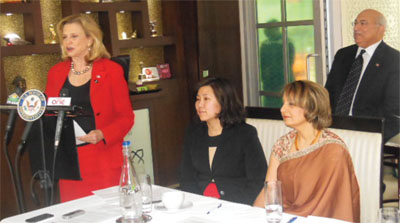
    NEW YORK (TIP): Congresswoman Carolyn Maloney spoke before the Consul General of India, in New York, July 8 to urge members and leaders in the Indian American communities to continue supporting an effort to get the Citizen’s Stamp Advisory Committee (CSAC) of the United States Postal Service (USPS) to issue a commemorative Diwali stamp. “It is high time the USPS issues a Diwali stamp.

    Diwali, also known as the Holiday of Lights, marks the triumph of good over evil, light over darkness and the beginning of the Hindu New Year. It is one of the oldest and most storied religious holidays in the world, and is celebrated by people of several faiths. There are commemorative stamps for Christmas, Hanukkah, Eid and more. Issuing a Diwali stamp would officially recognize the size and significance of the country’s Indian American population, which comprises over three million people, and would provide the USPS with sorely needed revenue,” Maloney said.

    For several years, Maloney has headed efforts in Congress to push the CSAC to consider issuing a commemorative Diwali stamp. In January, Maloney introduced H.Res. 47 that the CSAC should issue a Diwali stamp. She wrote letters to the CSAC in 2010 and 2012 requesting the same action. Ranju Batra, a former President of the Association of Indians in America – NY, who attended the event at the Indian Consulate, is a close friend of Congresswoman Maloney and was a major catalyst in the effort to get the Diwali stamp issued.

    She asked that Congresswoman Maloney provide national leadership on the effort, and Congresswoman Maloney obliged her request by remaining strongly dedicated to the issue. Aside from the cultural significance of the Diwali stamp, there are economic benefits associated with its issuance. There are over 3 million Indian Americans residing in the United States and over 1 billion Indians living in India.

    The sale of the Diwali stamp could provide the USPS with a much-needed revenue surge. The meeting was held to urge supporters and members of the Indian American communities to contact their members of Congress and the CSAC and express support for the issuance of a Diwali stamp. Speaking on the occasion, Ranju Batra said, “When I took over as president of AIANY, I set two goals: To make the 25th Silver Diwali celebrations history-making, and they were, and to laser-focus on getting the Diwali Stamp issued.

    I asked my dear friend Congresswoman Carolyn Maloney to take the lead in Congress. I am so delighted to have the support of Reps. Eliot Engel, Steve Israel, Greg Meeks, Yvette Clarke, Grace Meng, and others. Worthy of special note is the support from Reps. Ami Bera and Tulsi Gabbard. The time is now to get as much support as possible, as the USPS’ CASC will make its recommendations later this month.

    We need each of you and every media outlet to help get the word out: call your Congress member and ask them to sign on to H. Res. 47 now. If we do this, together, we have the chance to get the Diwali Stamp issued this year,” said Ranju Batra, Chair of the Diwali Stamp Project and immediate past President of the Association of Indians in America-NY.

    “The target audience of the Diwali stamp is over 5 million Americans of South Asian and Caribbean ancestry, along with over 1 billion Hindus across the world. The sale of Diwali Stamps would be a much-needed source of revenue for the US Postal Service in tough economic times. It will reduce the Postal Service’s need to always raises postage rates for everyone, while finally acknowledging Hindus here at home and abroad,” said Ravi Batra, an attorney and chair of the National Advisory Council on South Asian Affairs.

    “This laudable initiative by Ms. Ranju Batra seeks not only to embellish the great American democracy in its embrace of pluralism and diversity but also because Diwali commemorates civilizational values of respect for women’s rights and their empowerment which the United States also tries to advance everywhere. On the occasion of Diwali, Goddess Lakshmi — symbolizing prosperity and well-being of humanity — is worshiped, as is the triumph of good over evil and light over darkness, which she brings about, is celebrated.

    I wish Ranju and Congresswoman Carolyn Maloney every success in their endeavor, which will not only strengthen the cultural and people-to-people links between the democracies of India and United States, but also mark their dedication to the cause of gender equality and women’s empowerment,” said Lakshmi Puri, Acting Executive Director of UN Women.

    Mr. D. Mulay, the Consul General of India in New York lauded the efforts of Ranju Batra and Congresswoman Maloney and stated that Diwali is a secular festival celebrated by all Indians and it will be appropriate for the US Postal department to issue a Diwali commemorative stamp. He appealed to the Indian American community to support the Diwali stamp initiative of Ranju Batra and Maloney.

  • Groundswell Of Support For Tom Suozzi

    Groundswell Of Support For Tom Suozzi

    Democrats confident of regaining Nassau County Executive Position
    LONG ISLAND, NY (TIP): If Tom Suozzi wins in the race for the position of Nassau County Executive in November it will be the third time in the history of the County that a Democrat will be heading it. The County has been a bastion of Republicans ever since it was created in 1938.

    It was only in early seventies that Judge Nickerson, a democrat was elected the Executive and again in 2001 it was Tom who wrested it from the Republicans. It remains to be seen if Tom will be able to repeat the feat. However, there are quite a few pointers to suggest a democratic win in November elections. First, the number of registered Democrats has gone up in the last ten years.

    There are 83,000 more registered Democrats in Nassau County, while there are more than 16,000 fewer Republicans since the last elections. As of April, 2013, there were 371,557 registered Democrats in Nassau County and 332,036 registered Republicans, a clear yawning gap of 39,521. Two, the steadily increasing numbers of immigrants in to the County have created a larger support base for Democrats.

    Majority of immigrants have always been known to be pro Democrats, a fact explained by the dominance of Democrats in workers unions which have a large presence of immigrants. Three, while the present Executive Edward Mangano has been very active and very much in news too, he has been with only smaller groups of upper middle classes and upper classes. He has had hardly any contact with the majority of people below.

    True, he could raise a lot of money and believe me, it is a lot of money the accounts of which were published in an earlier issue of The Indian Panorama but he has not been able to pull voters. And it is the voters who will count not the fat purses when it comes to electing the next chief executive. The fundraiser for Tom Suozzi at Mint Restaurant, Garden City on July 11 was ample indication of his popularity with the South Asian community.

    The large numbers and the representation of diverse sections left no one in doubt that the challenger had arrived. There is a groundswell of support for Tom Suozzi. Amongst the gathering were the best known faces of South Asian community, politicians and officials. Supervisor Jon Kaiman, NYS Asst. Comptroller Joe Galante and Viviana Russell were present to lend their support.

    Tom said the enthusiasm of voters and the wide support of his friends and well wishers give him the confidence that he would win. He said earlier 3 I’s were important in American politics which stood for Israel, Italy and Ireland and now there were 4 R’s. The fourth I, he said stood for India.

    Speaking about the fundraiser, he said it was because of the populous support that he had raised more money than Mangano in the last four months. He thanked all for their commitment and support to him.

  • MORSI OUSTED, under house arrest

    MORSI OUSTED, under house arrest

    CAIRO (TIP): Mohammed Morsi, in office only a year as the first democratically elected leader of Egypt, was rousted from power by the military July 3 as a euphoric crowd in Tahrir Square cheered his exit. The former leader was placed under house arrest at the Republican Guard Club, a senior adviser to the Freedom and Justice Party and spokesman for the Muslim Brotherhood said. Most members of the presidential team have also been placed under house arrest. Egyptian security forces also arrested the head of the Muslim Brotherhood’s Freedom and Justice Party and another of the movement’s top leaders.

    The commanding general of the armed forces, Gen. Abdel Fattah al-Sisi, said on Egyptian television that the military was suspending the constitution, which Morsi pushed through and which many Egyptians saw as slanted toward Islamists. “The armed forces couldn’t plug its ears or close its eyes as the movement and demands of the masses calling for them to play a national role, not a political role as the armed forces themselves will be the first to proclaim that they will stay away from politics,” al-Sisi said.

    He added that the head of the constitutional court, Adli Mansour, would be the acting president, with new elections to be held later. The general said that the military did not have designs on controlling the country’s politics but would “never turn a blind eye to the aspirations of the Egyptian people.” He spoke alongside a leading Sunni Muslim cleric and the head of Egypt’s Coptic Christians, as well as a prominent political opponent of Morsi — Mohamed ElBaradei, the former head of the U.N. nuclear weapons agency. Armored vehicles, tanks and troops deployed throughout the Egyptian capital, including near the presidential palace. The army seized the headquarters of the state television and the state-run newspaper, which reported that Morsi had been told he was no longer president.

    A statement on Morsi’s Facebook page described the army’s move as a “military coup.” Mansour will be sworn in as interim head of state on July 4. The United States will continue to monitor the “very fluid situation” in Egypt, President Barack Obama said in a statement Wednesday night. “We are deeply concerned by the decision of the Egyptian Armed Forces to remove President Morsy and suspend the Egyptian constitution,” the statement read. “I now call on the Egyptian military to move quickly and responsibly to return full authority back to a democratically elected civilian government as soon as possible through an inclusive and transparent process, and to avoid any arbitrary arrests of President Morsy and hisU.N. Secretary-General Ban Ki-moon called for calm and restraint, as well as the preservation of rights such as freedom of expression and assembly. “Many Egyptians in their protests have voiced deep frustrations and legitimate concerns,” he said in a statement that did not condemn the Egyptian armed forces’ ouster of Morsi.

    “At the same time, military interference in the affairs of any state is of concern,” he added. “Therefore, it will be crucial to quickly reinforce civilian rule in accordance with principles of democracy.” Security forces, meanwhile, raided the Cairo offices of Al Jazeera’s Egyptian television channel and detained at least five staff members. Four were later released, the channel said. Karim El-Assiuti, a journalist at the station, told Reuters his colleagues at the Al Jazeera Mubasher Misr channel were arrested while working in the studio. The station was prevented from broadcasting from a pro-Morsi rally and its crew there was also detained, he said. Authorities also shut down three Islamistrun TV stations, including one operated by the Muslim Brotherhood. The State Department warned U.S. citizens to defer travel to Egypt and told Americans already living in Egypt to depart “because of the continuing political and social unrest.” Morsi was elected a year ago after Egyptians ousted Hosni Mubarak, the autocrat who had ruled for almost three decades. Egyptians hoped he would build a more pluralistic and tolerant country.

    Instead, Egyptians have been frustrated by a struggling economy and poor services and infuriated by what they see as power grabs by Morsi — stifling the judiciary and forcing through a constitution that favored Islamists and ignored minorities. “Now we want a president who would really be the president of all Egyptians and will work for the country,” Said Shahin, a 19- year-old protester in Tahrir Square, told The Associated Press. The ouster will remake the politics of the Middle East at a volatile time. Egypt is the most populous country in the region, has a peace treaty with Israel and is a partner of the United States. On july 2, Morsi gave a loud, passionate, 45- minute speech to the country, blaming loyalists of Mubarak for fighting against democracy and refusing to step down.

    He vowed to die for his cause. “I am prepared to sacrifice my blood for the sake of the security and stability of this homeland,” he said. On July 3, as the military appeared to be taking control of parts of Cairo, advisers to Morsi said the generals were staging a coup and subverting the will of the people. In Tahrir Square, however, the military announcement hours later was greeted with jubilation reminiscent of the first days of the Arab Spring two years ago. Tens of thousands of people shot fireworks, sang, danced, chanted and waved Egyptian flags. Before they deposed Morsi, Egyptian military officials assured the U.S. that the military would not assume long-term control of the government, and ensured the safety of the U.S. Embassy, personnel and all Americans in Egypt, U.S. officials told NBC News.

  • 2 Charged In US For Bid To Make Deadly X-Ray Weapon

    2 Charged In US For Bid To Make Deadly X-Ray Weapon

    In April 2012, the authorities said, an industrial mechanic walked into a synagogue in Albany and announced his intention to build a weapon that could help Israel kill its enemies while they slept. He wanted to know if anybody would provide financial backing. Turned away, prosecutors said, he sought money from another source: a leader in the Ku Klux Klan in North Carolina. Both the synagogue and the white supremacist group told the authorities about the man, Glendon Scott Crawford, who, until his arrest this week, devoted himself to building a weapon of the sort he had promised, the authorities said.

    The weapon was an X-ray-emitting device that could be activated by remote control, which he intended to use to kill Muslims, according to a criminal complaint unsealed in a court in Albany. Crawford, who the authorities say works for General Electric, believed the device would enable him to secretly poison people with lethal doses of radiation. Federal prosecutors charged Crawford and an engineer, Eric J Feight, who was described as a co-conspirator, with conspiring to provide support for the building of a weapon.

  • IALI Presents Pioneer Awards 2013

    IALI Presents Pioneer Awards 2013

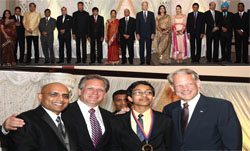
    LONG ISLAND, NY (TIP): The India Association of Long Island (IALI) held its 34th Annual Awards Dinner Gala on June 9th at the Hilton, Melville, NY. Dr. Kishore Kuncham, President of IALI, in his opening remarks said, “Tonight, we pay tribute to our global change-makers in the Indian-American community.

    We recognize them with the India Association of Long Island Pioneer Award to acknowledge their inspired leadership as they continue to enthuse others, deepen the meaningful work that is already in progress, and advance the common good with the vision of ‘one world family’- Vasudhaiva Kutumbakam to make the world an even better place. Let us celebrate life as we proudly honor our friends and families and esteemed honorees.”

    The 2013 Pioneer Awards were presented to nine most influential persons in the Indian American community. They included Purnachandra Aramalla, Pioneer Award 2013 for Excellence in Business Leadership; Gobind Bathija, Pioneer Award 2013 for Excellence in Community Service; Hussain Baqueri, Pioneer Award 2013 for Excellence in Aviation Leadership;. Pavankumar Darisi, Pioneer Award 2013 for Excellence in Community Service; Dr. Arti Datta, Pioneer Award 2013 for Excellence in Performing Arts; Mrs. Daman Dutt, Pioneer Award 2013 Young Entrepreneur; Dr. Madhu Korrapati, Pioneer Award 2013 for Excellence in Community Service; Kanwal Sra Pioneer Award 2013 for Excellence in Business Leadership and Sudhir Vaishnav, Pioneer Award 2013 for Excellence in Media & Entertainment.

    Dr. Kishore Kuncham, introduced each of the nine honorees highlighting their achievements and contributions to the Indian-American community and their global impact. Congressman Steve Israel and Nassau County Executive Ed Mangano graced the evening with their presence and each eloquently addressed the audience. Last, but not the least, there was a special recognition of Arvind Mahankali, the 13 year old Long Island native who recently won the 2013 Scripps National Spelling Bee Championship.

    Congressman Steve Israel congratulated all the honorees and spoke of his “first hand” experience with the critical relationship between the United States of America and India.. He said it was important to address any challenges and “deepen our ties.” Nassau County Executive Ed Mangano was warmly introduced by Dr. Kuncham who commended him for his support for many of the key intitatives of IALI.

    He thanked Mangano for the cricket pitch at the Cantiague Park and for agreeing to provide a bus to transport seniors to seniors programs. Most importantly, Dr. Kuncham thanked the County Executive for having his entire team meet with him and his committee to discuss the use of a county facility that could serve as “India House,” a permanent home and a cultural center County Executive Mangano in his remarks said, ” It is the greatest honor to partner with this organization.

    It is my hope that we do come together to get the “India House” done. We have made great progress along the way.” He congratulated all the honorees who have distinguished themselves and stated that it was his honor to join this ceremony to recognize them. On behalf of India Association of Long Island, President Kishore Kuncham presented “Lifetime Achievement” Awards to Congressman Israel and Nassau County Executive Mangano for their vision, outstanding leadership and extraordinary services to the people of Long Island and the Indian-American community.

    Dr. Kuncham thanked everyone for their support with special thanks to the Grand Sponsor of the Year, Salil Zaveri, Zaveri Insurance Co. and all other sponsors. He conveyed sincere appreciation to Gupta, Finance Chair, Mrs. Jharna Jaisinghani, Event Coordinator, and the members of the Executive Council of IALI. The event was emceed by Mrs. Mehar Bhasin and Vibhuti Jha. Mint Restaurant provided a spectacular array of exotic foods.

    A very lively entertainment was provided by Medley Entertainment. A $10,000 donation was announced to support the Interfaith Nutrition Network and Peter Bheddah was thanked for continuing to be a grand sponsor again. Other key partners including Patel Brothers, JHS Capital Advisors, Sagarsoft/Amicus Systems and Media were recognized from the podium. The gathering included people from various walks of life, including politicians and town and county officials.

  • China Emerging As New Force In Drone Warfare

    China Emerging As New Force In Drone Warfare

    BEIJING (TIP): Determined to kill or capture a murderous Mekong River drug lord, China’s security forces considered a tactic they’d never tried before: calling a drone strike on his remote hideaway deep in the hills of Myanmar. The attack didn’t happen — the man was later captured and brought to China for trial — but the fact that authorities were considering such an option cast new light on China’s unmanned aerial vehicle program, which has been quietly percolating for years and now appears to be moving into overdrive. Chinese aerospace firms have developed dozens of drones, known also as unmanned aerial vehicles, or UAVs. Many have appeared at air shows and military parades, including some that bear an uncanny resemblance to the Predator, Global Hawk and Reaper models used with deadly effect by the US Air Force and CIA.

    Analysts say that although China still trails the US and Israel, the industry leaders, its technology is maturing rapidly and on the cusp of widespread use for surveillance and combat strikes. “My sense is that China is moving into large-scale deployments of UAVs,” said Ian Easton, co-author of a recent report on Chinese drones for the Project 2049 Institute security think tank. China’s move into large-scale drone deployment displays its military’s growing sophistication and could challenge US military dominance in the Asia-Pacific. It also could elevate the threat to neighbors with territorial disputes with Beijing, including Vietnam, Japan, India and the Philippines. China says its drones are capable of carrying bombs and missiles as well as conducting reconnaissance, potentially turning them into offensive weapons in a border conflict. China’s increased use of drones also adds to concerns about the lack of internationally recognized standards for drone attacks.

    The United States has widely employed drones as a means of eliminating terror suspects in Pakistan and the Arabian Peninsula. “China is following the precedent set by the US The thinking is that, ‘If the US can do it, so can we. They’re a big country with security interests and so are we’,” said Siemon Wezeman, a senior fellow at the arms transfers program at the Stockholm International Peace Research Institute in Sweden, or SIPRI. “The justification for an attack would be that Beijing too has a responsibility for the safety of its citizens. There needs to be agreement on what the limits are,” he said. Though China claims its military posture is entirely defensive, its navy and civilian maritime services have engaged in repeated standoffs with ships from other nations in the South China and East China seas. India, meanwhile, says Chinese troops have set up camp almost 20 kilometers (12 miles) into Indian-claimed territory.

    It isn’t yet known exactly what China’s latest drones are capable of, because, like most Chinese equipment, they remain untested in battle. The military and associated aerospace firms have offered little information, although in an interview last month with the official Xinhua News Agency, Yang Baikui, chief designer at plane maker COSIC, said Chinese drones were closing the gap but still needed to progress in half a dozen major areas, from airframe design to digital linkups. Executives at COSIC and drone makers ASN, Avic, and the 611 Institute declined to be interviewed by The Associated Press, citing their military links. The Defense Ministry’s latest report on the status of the military released in mid-April made no mention of drones, and spokesman Yang Yujun made only the barest acknowledgement of their existence in response to a question.

  • Iran will ‘annihilate’ cities if Israel attacks: KHAMENEI

    Iran will ‘annihilate’ cities if Israel attacks: KHAMENEI

    TEHRAN (TIP): Iran will “annihilate” the Israeli cities of Tel Aviv and Haifa if it comes under attack by the Jewish state, supreme leader Ayatollah Ali Khamenei warned on March 21. “Every now and then the leaders of the Zionist regime threaten Iran with a military attack,” Khamenei said in a live televised speech from the northeastern holy city of Mashhad, referring to Israel. “They should know that if they commit such a blunder, the Islamic republic will annihilate Tel Aviv and Haifa,” he said. Iran is said to possess ballistic missiles capable of reaching Israel.

    It also has close relations with Israel’s foes in the region, including Lebanon’s Hezbollah and Palestinian militants in the Islamist-ruled Gaza Strip. Khamenei spoke with little sign of an easing in Tehran’s position in its confrontation with the West over its disputed nuclear programme of uranium enrichment.

    Israel, widely believed to be the Middle East’s sole but undeclared nuclear power, suspects that Tehran is seeking atomic arms, a fear shared by the United States and Western powers, and has not ruled out a military strike. Washington has also refused to rule out the military option, but insists it prefers a diplomatic solution to the nuclear stand-off. US President Barack Obama in Israel on Wednesday accepted that the Jewish state would not cede its right to confront Iran’s nuclear threat to the United States.

  • Palestinians deserve a  state: OBAMA

    Palestinians deserve a state: OBAMA

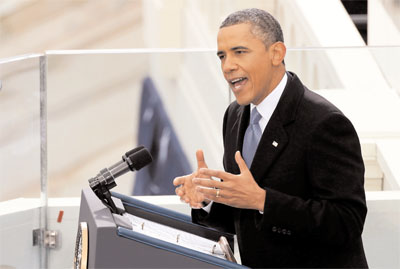
    RAMALLAH (TIP): Hours after Palestinian militants fired at least two rockets from the Hamas-controlled Gaza Strip that crashed into the Israeli border city of Sderot on Thursday, President Obama travelled to the West Bank city of Ramallah and renewed his call for a two-state solution between Israelis and Palestinians, saying that continued Israeli settlement-building did not advance the cause of peace. But, at a news conference with President Mahmoud Abbas, the leader of the Palestinian Authority and the secularist Fatah movement that rivals Hamas, Obama did not specifically call for a halt in settlement construction and urged both sides to press for a broad agreement that would meet two objectives: to provide sovereignty and a state for Palestinians and security for Israel. “The core issue right now is how do we get sovereignty for the Palestinian people and security for Israeli people,” he said after almost two hours of talks with Abbas.

    He added: “That’s not to say settlements aren’t important. That’s to say if we solve those two problems, the settlement issue will be resolved.” Obama travelled to Ramallah after talks on Wednesday with Prime Minister Benjamin Netanyahu of Israel on the first day of his visit. “I’ve been clear with Prime Minister Netanyahu and other Israeli leadership,” Obama said. “We do not consider continued settlement activity to be constructive, to be appropriate, to be something that can advance the cause of peace.” Obama said Palestinians deserved an end to occupation and to the “daily indignities that come with it,” and a “future of hope.” In short, he said, “Palestinians deserve a state of their own.” President Obama called for a twostate solution and said “the only way to achieve that is through direct negotiations” between Israelis and Palestinians. “There’s no shortcut to a sustainable solution. We cannot give up on the search for peace no matter how hard it is,” he said. He warned that a solution based on the creation of two states, side by side, for Israelis and Palestinians, was “still possible but very difficult”.

    Obama condemned the rocket barrage from Gaza. One of the rockets on Thursday landed in the courtyard of a house and another was discovered in an open area of the city, according to Micky Rosenfeld, a police spokesman. They did not cause injuries or damage, he said.

    An alert system had sounded as the rockets came in. Hamas won Palestinian elections in 2006 in Gaza and then seized control of the enclave a year later, routing Fatah forces. Though the two sides have signed several accords aimed at ending the Palestinian schism, Hamas remains entrenched in Gaza while Abbas’s authority is confined to parts of the West Bank. Netanyahu has been calling for a resumption of peace talks with Abbas, without preconditions, but has warned in the past that any reconciliation between Abbas and Hamas would stymie progress with Israel. Witnesses in Gaza said that militants had fired at least five rockets from the northern Gaza Strip town of Beit Hanoun at around 7.30am. Some apparently fell short or were not immediately located by the Israelis.

  • Obama To Israel  ‘You Are Not Alone’

    Obama To Israel ‘You Are Not Alone’

    JERUSALEM (TIP): President Obama’s whole visit to Israel can be summed up in one Hebrew phrase he uttered to a packed auditorium of Israeli students: You are not alone. Acknowledging the deep insecurity of a people that has experienced millenniums of persecution, not least of all Holocaust, Obama reassured them of America’s unwavering support as they grapple with a host of regional challenges, including Iranian nuclear development, civil war in Syria, the rise of Islamist powers, and ongoing tensions with their Palestinian neighbors. “Those who adhere to the ideology of rejecting Israel’s right to exist might as well reject the earth beneath them and the sky above, because Israel is not going anywhere,” he said, speaking to a select group in Jerusalem’s convention center. “Today, I want to tell you – particularly the young people – that so long as there is a United States of America, atem lo lavad.” Obama’s demeanor, words, and gestures on his first trip to Israel as president mark a decided departure from his 2009 Cairo speech to the Muslim world, in which he sought to show that the US took interest in regional affairs beyond their impact on Israel and thus rebuild credibility in a region roiled by the Iraq war and the larger war on terror.

    While not all Israelis have been impressed by the opening scene of Obama’s Act II in the Middle East, many are grateful for his unequivocal expression of support for Israel.

    Some suggest it reflects a maturing in his views, shaped in part by the turmoil of the Arab revolts of the past two years – although others see it as a preemptive charm offensive before asking the Israelis to make some tough compromises on Iran and the Palestinian issue. “In Cairo, he came to talk about peace, democracy, rights, new rules. And in a few days history changed in a scary way there. I think he understands things are different than what he thought,” says Tamar Asraf, who lives in the West Bank settlement of Eli. “And he’s coming not as the messiah, not as the sheriff; he’s coming as the president of the US, the best friend of Israel. I feel like he’s coming to support us, to help us.”

    CEMENTING THE FRIENDSHIP
    Indeed, from the moment Obama stepped off Air Force One yesterday, he exuded a spirit of friendship that carried with it both deep commitment and informal ease, shedding his suit coat barely half an hour into the visit. From an Israeli point of view, he has said all the right things and is visiting all the right places, acknowledging not only the modern state of Israel but also the Jewish people’s ancient claims to the land. But all he really had to do was land in the country for his first visit as president, a strong message of support no matter what he said or did. As Israel Hayom English editor Amir Mizroch put it, “Stop it, stop it.

    You had me at Shalom,” referring to Jerry McGuire winning his wife back with a simple “hello.” Obama, however, had much more to say than shalom. “My main goal on this trip has been to have an opportunity to speak directly to the Israeli people at a time when obviously what was already a pretty tough neighborhood has gotten tougher and let them know that they’ve got a friend in the US, that we have your back, that we consider Israel’s security of extraordinary importance to us,” he said last night at a press conference with Prime Minister Benjamin Netanyahu. “Not just because of the bonds between our peoples, but also because of our own national security interests.” Such assurances may give Obama political capital that he can cash in later, perhaps to rein in Israeli impulses to attack Iran or Syria, or to push them to make hard compromises on the Palestinian issue.

    After barely mentioning the Palestinians yesterday and spending only a few hours of his 48-hour visit in Ramallah with Palestinian Authority President Mahmoud Abbas today, Obama reaffirmed America’s commitment to a two-state solution in his Jerusalem speech.And the young Israelis in attendance were receptive, cheering loudly when he said “the Palestinian people’s right to self-determination and justice must also be recognized.” Among them was Rona Keha, an undergraduate studying political science at Ben Gurion University in Beersheva. Now, she says, “He needs to put some pressure on the Israeli government.

    He needs to start conversations and negotiate between Israel and the Palestinians. He needs to press on our government in order to start doing so,” says Ms. Keha, who spent three hours in line waiting to get into the speech. “I think this visit is one way to do it. And I hope that this visit will bring us some change.”

    BOOSTING PEACE, OR BOOTING IT DOWN THE LINE?
    Nadav Tamir, a policy advisor in Peres’s office who confessed to being emotional after Obama’s “amazing” speech, says Obama’s reassurances to the Israeli public would enable them to move forward more confidently toward peace. “I think it was the balance between showing very strong and deep care for Israel, for the history, for the future, for Zionism, but on the other hand, you know, that he told us you Israelis should feel safe enough to be proactive in terms of the peace process,” says Mr. Tamir. “When the Israeli public feel that they can trust [our] most important ally and the strongest superpower, I think it will help leaders to move the peace process forward….

    When President Obama is telling you, ‘I have your back,’ it’s very helpful.” But there is also a fair amount of skepticism that Obama will be able to follow up his eloquent words with concrete progress. “Israeli media talks about the fact that conflict in Middle East has become a kind of hobby for world leaders, and I tend to believe it is also true in the case of Obama,” says Hila Volpo, a graduate student studying political communication from Jerusalem. “I don’t think Obama believes within himself that it’s something he’s capable of doing.” Many American presidents have tried to solve the Israeli-Palestinian conflict, but even someone as engaged as former President Bill Clinton, who personally engaged in furious shuttle diplomacy, was unable to secure a deal.

    Obama, by contrast, got Israel to agree to a one-time settlement freeze but when talks stalled in September 2010, he was either unwilling or unable to pressure Israelis and Palestinians to resume talks.

    Obama also made clear in the Ramallah press conference today that he’s done an about-face on Israeli settlements, saying that a fresh freeze on Israeli settlement growth in the West Bank – a key Palestinian precondition for returning to the peace table – would just delay substantive peacemaking. That was deeply disappointing to Palestinians, but to Israelis it was a welcome change. “I heard he understood that it’s not the way [to press on settler issue], that he does not achieve anything.

    I think freezing or not freezing is not the question, the question is how does he see the future here and does he understand that he has to let Israel lead the process,” says Ms. Asraf of Eli. “I feel that he came with a lot of love, and a lot of respect, and it doesn’t seem like here is a sheriff to make everything peaceful back again … it seems like he comes as a friend

  • My Goal On This Trip Is To Listen: Obama On His Forthcoming Visit To Israel And Palestinian Territories

    My Goal On This Trip Is To Listen: Obama On His Forthcoming Visit To Israel And Palestinian Territories

    JERUSALEM (TIP): US President Barack Obama said on Thursday his forthcoming trip to Israel and the Palestinian territories was to “listen” to both sides and hear their views on how to move forward after over two years without peace talks. His remarks came in an exclusive interview with Israel’s Channel 2 television broadcast a week before the US leader starts his first visit to Jerusalem and the West Bank town of Ramallah since being elected president in 2008. During the visit, starting March 20, Obama will meet with Israeli Prime Minister Benjamin Netanyahu in Jerusalem and Palestinian president Mahmud Abbas and his premier Salam Fayyad in Ramallah to hear their perspective on how to resolve the decadeslong conflict. “My goal on this trip is to listen.

    I intend to meet with Bibi (Netanyahu) … I intend to meet with Fayyad and Abu Mazen (Abbas) and to hear from them what is their strategy, what is their vision, where do they think this should go?” With Israel in the throes of establishing a new coalition government, which is due to be sworn in just days before he flies in, it was “unlikely” there would be any breakthrough, Obama acknowledged. But he would press both sides “to recognise the legitimate interests” of the other. “To Abu Mazen, I will say that trying to unilaterally go to, for example, the United Nations, and do an end run around Israel, is not going to be successful,” he said, referring to Palestinian attempts to secure UN recognition as a state that have angered Israel. “To Bibi (Netanyahu) I would suggest to him that he should have an interest in strengthening the moderate leadership inside the Palestinian Authority…” “For example, making sure that issues like settlements are viewed through the lens of: Is this making it harder or easier for Palestinian moderates to sit down at the table,” he said. The Palestinians have said they will only return to peace talks if Israel halts its settlement activity and recognizes 1967 lines as the basis for negotiations. But Israel is insisting it will only return to the negotiations if there are no preconditions. “I think we’re past the point where we should be even talking about pre-conditions and steps and sequences.

    Everybody knows what’s going to be involved here in setting up two states, side by side, living in peace and security,” he said. “How we get into those conversations, whether they can happen soon or whether there needs to be some further work done on the ground, that’s part of what I’ll explore when I’ll get there,” he said.

    In Washington, senior Obama aides said that the president wanted to speak directly to young Israelis, so had chosen to deliver a speech at a Jerusalem conference center and not to the Israeli legislature, the Knesset. They billed the speech as a complement to an address he delivered to the Muslim world in Cairo in 2009. “We thought it was very important for him to speak directly to Israelis,” said Ben Rhodes, a deputy national security advisor. While it may lack diplomatic ‘deliverables,’ Obama’s visit will not be short in symbolism.

    As soon as he arrives at Tel Aviv airport on Wednesday, Obama will inspect a battery in the Iron Dome air defense system that was largely funded by the United States and credited with saving lives in Israel’s showdown with Hamas last year. On Thursday, he will inspect the Dead Sea Scrolls, biblical texts seen as a testament to an ancient Jewish connection to Israel.

    Before he leaves Israel on Friday, Obama will travel to Mount Herzl, where he will lay wreaths at the graves of assassinated Israeli prime minister Yitzhak Rabin and Theodor Herzl, the founder of modern Zionism. Also on the trip, Obama will be feted at a state dinner by Israeli President Shimon Peres, visit the Yad Vashem Holocaust memorial and tour the Church of the Nativity in Bethlehem. In Jordan on Friday, Obama will meet King Abdullah II and hold a press conference before visiting the ancient ruins of Petra a day later.

  • India Sixth Most Favourable Nation For Americans: Poll

    India Sixth Most Favourable Nation For Americans: Poll

    WASHINGTON (TIP): India is the sixth most favourable nation for Americans, while at least eight out of 10 do not like Pakistan, making it the third most unfavourable nation after Iran and Korea, according to a latest poll.

    According to the Gallup Polls, nearly seven (68 per cent) out of every 10 persons interviewed for the poll favoured India, thus ranking it sixth after Canada (91 per cent), Great Britain (88 per cent), Germany (85 per cent), Japan (81 per cent) and France (73 per cent).

    In fact Israel, the traditional American ally ranks seventh after India with 66 per cent while Mexico get only 47 per cent favourable votes. Opinion about Russia is equally divided among favourable and unfavourable rating while 52 per cent of the Americans put China in the unfavourable category. Nine out of 10 Americans have an unfavourable view of Iran, making it the worst rated country out of 22 surveyed. Seven other countries – Libya (72 per cent), Iraq (76 per cent), Afghanistan (80 per cent), the Palestinian Authority (77 per cent), Syria (75 per cent), Pakistan (81 per cent) and North Korea (84 per cent)– also receive unfavourable ratings of 70 per cent or more. “Eight countries with the most negative ratings are currently or over the past decade were involved in wars, disputes, or turmoil — in a number of instances, in ways that are hostile to the US,” Gallup said. It said the currently “hostile” category includes Iran and North Korea.

    Libya was hostile toward the US under the government of Muammar Gaddafi and more recently Ambassador Christopher Stevens and three other Americans were killed there. “The US-Pakistani relationship is beset with rockiness despite the strained cooperation between the two on military matters. Americans also strongly favour Israel’s enduring conflict with Palestinian Authority,” the survey said.

  • Hagel Committed To Ties With India, Says Pentagon

    Hagel Committed To Ties With India, Says Pentagon

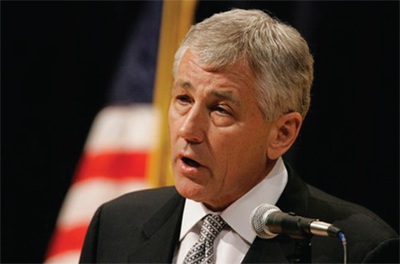
    WASHINGTON (TIP): As Chuck Hagel took over as Barack Obama’s new defense secretary amid a controversy over his comments on India’s role in Afghanistan, Pentagon – the US defense department headquarters – said that Hagel will work to strengthen ties to India. Hagel’s strong commitment to fostering a close defense relationship was reported Wednesday, February 27, by Washington Free Beacon, the rightwing online newspaper that had disclosed a video-recording of a speech Hagel made in 2011 about Indian aid to Afghanistan. “Secretary Hagel is strongly committed to the US strategic partnership with India and to fostering an even closer defense relationship with India that builds upon the work of Secretary (Leon) Panetta, Deputy Secretary (Ashton) Carter, and their Indian counterparts,” Free Beacon quoted Pentagon spokesperson George Little as saying. “Secretary Hagel looks forward to working closely with Indian national security and defense officials,” Little told the newspaper that had dug out the controversial comments during Hagel’s contentious confirmation hearings with his former Republicans attacking him for his positions on Israel and Iran.

    In his previously unreleased 2011speech, Hagel had said: “India for some time has always used Afghanistan as a second front, and India has over the years financed problems for Pakistan on that side of the border. “And you can carry that into many dimensions, the point being (that) the tense, fragmented relationship between Pakistan and Afghanistan has been there for many, many years.” The remarks raised a furor in New Delhi. However, in a calibrated response to the Free Beacon, the India Embassy said that Hagel’s 2011 remarks were not grounded in “reality.” “Such comments attributed to Sen.

    Hagel, who has been a long-standing friend of India and a prominent votary of close India-US relations, are contrary to the reality of India’s unbounded dedication to the welfare of the Afghan people,” the embassy spokesperson said in an email to the newspaper. “India’s commitment to a peaceful, stable, and prosperous Afghanistan is unwavering, and this is reflected in our significant assistance to Afghanistan in developing its economy, infrastructure, and institutional capacities,” the spokesperson said. “Our opposition to terrorism and its safe havens in our neighborhood is firm and unshakeable.” The existence of the video of Hagel’s speech at Cameron University in Oklahoma was disclosed by the online newspaper hours before the decorated Vietnam veteran was confirmed by the Senate after weeks of severe criticism from former Republican colleagues. The former Republican senator from Nebraska, who won two Purple Hearts for his bravery as a soldier during the Vietnam War, was accused of being critical of Israel and weak on Iran’s alleged nuclear weapon ambitions.

  • As I See It : The Origin Of Wars

    As I See It : The Origin Of Wars

    Just as Herodotus is the father ofhistory, Thucydides is the father ofrealism. To understand thegeopolitical conflict zones of the 21stcentury, you must begin with the ancientGreeks. Among the many importantlessons Thucydides teaches in his Historyof the Peloponnesian War is that whatstarts a war is different from what causesit.Thucydides chronicles how thePeloponnesian War began in the latterpart of the late fifth century B.C. withdisputes over the island of Corcyra innorthwestern Greece and Potidaea innortheastern Greece. These places werenot very strategically crucial in and ofthemselves. To think that wars must startover important places is to misreadThucydides.

    Corcyra and Potidaea, amongother locales, were only where thePeloponnesian War started; not whatcaused it. What caused it, he writes in thefirst book of his eight-book history, wasthe growth of perceived maritime powerin Athens and the alarm that it inspiredin Sparta and among Sparta’s allies.Places like Corcyra and Potidaea, and thecomplex alliance systems that theyrepresented, were in and of themselvesnot worth fighting a war over — a war thatwould last more than a quarter century,no less. That didn’t matter. They werepretexts.No one understood this distinction,which was perhaps made first inliterature by Thucydides, better thanThucydides’ most distinguishedtranslator, the 17th century Englishphilosopher Thomas Hobbes.

    Hobbeswrites that a pretext for war over someworthless place “is always an injuryreceived, or pretended to be received.”Whereas the “inward motive to hostility isbut conjectural; and not of the evidence.”In other words, the historian or journalistmight find it hard to find literaldocumentation for the real reasons statesgo to war; thus, he often must infer them.He often must tease them out of thepattern of events, and still in many casesbe forced to speculate.In applying the wisdom of Thucydidesand Hobbes to conflict zones across Asia,a number of insights may be obtained.The South China Sea conflict, forexample, becomes understandable.

    Hereare geographical features which, in theirown right, are valuable because of themeasurable energy deposits insurrounding waters. They also fall in thepath of sea lines of communications vitalfor access to the Indian Ocean in onedirection, and the East China Sea and Seaof Japan in the other, making the SouthChina Sea part of the word’s globalenergy interstate. Nevertheless, let’sassume one is somewhat dismissive ofthese facts and says such specks of dryland in the middle of a great sea are inany case not worth fighting a war over.Thucydides and Hobbes would pronouncehim wrong. They would say that it is theperceived rise of Chinese sea power — andthe alarm that it inspires amongAmerica’s formal allies and de facto allies– that, in turn, could be the real cause ofconflict sometime over the coming decade.

    Thus, the features in the South China Sea,as important as they might be, wouldmerely be the pretext.Indeed, nobody would prefer to say theyare provoking a conflict because of risingChinese sea power; rather, they would saythey are doing so because of this or thatinfringement of maritime sovereigntyover this or that islet. All the rest mighthave to be conjectured.The same is true with the conflictbetween China and Japan over theSenkaku/Diaoyu islands in the EastChina Sea. Even if one argues that theseislets are worthless, he or she would missthe point. Rather, the dispute over theseislets is a pretext for the rise of Chinesesea power and the fear that it inspires inJapan, helping to ease Japan out of itsquasi-pacifistic shell and rediscovernationalism and military power. (And bythe way, the rise of Chinese sea powerdoes not mean that China is able toengage the U.S. Navy in fleet-on-fleetbattle.

    It only means, for example, thatChina can use the placement of warshippatrols, along with economic anddiplomatic pressure and the staging ofprotests at home, all together in a seriesof “combination punches” to underminethe Japanese and other East Asian rivals.)Then there is North Korea. With a grossdomestic product of only that of Latvia orTurkmenistan, it might be assumed to beanother worthless piece of real estate.Geography tells a different story. Juttingout from Manchuria, the KoreanPeninsula commands all maritime trafficin northeastern China and traps in itsarmpit the Bohai Sea, home to China’slargest offshore oil reserve.

    China, as I’vepreviously written, favors an economictakeover of the Tumen River region –where China, North Korea and Russiaintersect, with good port facilitiesfronting Japan. The fate of the northernhalf of the Korean Peninsula will helpdetermine power relationshipsthroughout northeastern Asia, therefore.Of course, all of this, as Thucydides andHobbes would say, would have to beinferred, conjectured. North Korea’serratic behavior could start a conflict, butthe causes might also lie elsewhere.India and China have territorialtripwires in the Himalayan foothills, anarea which, again, might be judged bysome as worthless. But these tripwiresbecome more meaningful as Indiapartially shifts its defense procurementsaway from confronting Pakistan andtowards confronting China.

    It is doing sobecause the advance of technology hascreated a new and claustrophobicstrategic geography uniting India andChina, with warships, fighter jets andspace satellites allowing each country toinfringe on the other’s battle space. If aconflict ever does erupt between these twodemographic and economic behemoths, itprobably will not be because of thespecific reasons stated but because ofthese deeper geographical andtechnological causes.As for India and Pakistan, I rememberdecades ago sitting with a group ofjournalists in Peshawar, reading aboutPakistani and Indian troops confrontingeach other on the Siachen Glacier inKashmir, terrain so high the troops had towear oxygen masks.

    Could such territorybe worth fighting over? Again, theconflicting claims were merelysymptomatic of a deeper dispute over thevery legitimacy of these states arising outof the partition of the subcontinent in1947.Of course, Israel fears for its ownsurvival, were Iran to develop adeployable nuclear bomb. This is a casewhere the start of a conflict (by theUnited States, acting as Israel’s proxy)may largely overlap with its cause.Nevertheless, Israel has other fears thatare less frequently expressed.

    Forexample, a nuclear Iran would make everycrisis between Israel and Hezbollah,between Israel and Hamas, and betweenIsrael and the West Bank Palestiniansmore fraught with risk. Israel cannotaccept such augmentation of Iranianpower. That could signal the real cause ofa conflict, were Israel ever able to dragthe United States into a war with Iran.In all these cases, and others, the mostprofound lesson of Thucydides andHobbes is to concentrate on what goesunstated in crises, on what can only bededuced. For the genius of analysis lies inquiet deductions, not in the mereparroting of public statements. Whatstarts conflicts is public, and thereforemuch less interesting — and less crucial –than the causes of conflicts, which arenot often public.

    (The author is Chief GeopoliticalAnalyst for Stratfor, a private globalintelligence firm, and a non-residentsenior fellow at the Center for a NewAmerican Security in Washington. Hehas been a foreign correspondent forThe Atlantic for over a quartercentury. He is the author of 14 bookson foreign affairs and traveltranslated into many languages.)

  • As I See It : When The Us Fails, Others Suffer

    As I See It : When The Us Fails, Others Suffer

    Nuclear’ Iran is getting to be a bigger botherfor the US and the rest of the world thanmany had assumed in the earlier stages. It isfallacious to argue that Tehran will become a stablepartner in global peace by having a nuclear arsenal.Iran will either get ‘the’ bomb or get bombed. Whatthis means regionally is anyone’s guess since thereare too many variables surrounding these twopossibilities.

    One thing that is invariable though, isAmerica’s dogged adherence to icons and dogmaswhich ensures that only the extremes are possible.As the situation stands, no one, not even theRussians and the Chinese, doubt in private that Iranis accelerating its efforts to build a bomb. In public,though, there are two narratives – the first is of thecrazy suicidal mullahcracy so rabidly obsessed withkilling Jews that another holocaust is on the horizon.The other, less printed, argument is that a nuclearIran would actually bring a greater level of stabilityto what is a highly volatile region. Both of course arehyperbolic, but they dominate print and broadcastopinions in one variant or the other.

    The former needs no serious refutation. The latteris true to a certain extent in that it alleviates Iran’sacute conventional inferiority vis-à-vis its neighbors,but this is only half the story. As the experience ofPakistan and North Korea has shown, nuclearweapons provide revisionist states with a shield for awhole new paradigm of provocations like Mumbai26/11 or the sinking of the South Korean warship,The Cheonan. Nuclear weapons, therefore, provide acertain strategic stability in that it prevents all-outwar, but then introduce great levels of subconventionalinstability either by covert actions or bynon/sub/quasi state actors.

    The problem here is, the proponents of the theorythat a nuclear Iran will bring stability have veryfrequently lost credibility either because theymisdirect their fire, obfuscate the nuance or engagein hyperbole – all aimed at exculpating the UnitedStates. Take for example Kenneth Waltz arguing thatIran is attempting to balance the 40-year-old Israeliarsenal. This ignores the fact that the prime ‘sabrerattler’and major nuclear power in the Middle Eastis, in fact, the United States that has already regimechangedtwo of Iran’s neighbors – Afghanistan andIraq, has Iran completely encircled and has skewedthe conventional balance by reckless arms sales toIran’s arch rivals.

    To blame Israel for the situation isas incredulous as Iranian President MahmoudAhmadinejad holding the Elders of Zion responsiblefor Iran’s travails.The prime mover of a nuclear Iran was in fact theUnited States spearheaded by arch neo-cons DonaldRumsfeld, Dick Cheney and Paul Wolfowitz in the 70s -ostensibly to buttress Iran’s position vis-à-vis theUSSR. Though suitably couched in terms of energy,the deal would have ensured that Tehran receivedboth enriched uranium and plutonium – all butproviding for the existence of a latent arsenal. Iran’s’policies’ in those days, of course, were directed in thepursuit of US policy.

    William Blum, for example, inhis book, Killing Hope: US Military and CIAInterventions since World War II, lists howAfghanistan was deliberately destabilized by Iran todrag the Soviets in. Today Iran’s ‘mischief’ is directed- largely by default – against the Unites States’interests.It is of course quite natural for any country toadopt double standards; no country on earth has adouble standard-free foreign policy. But what isworrying about the United States is how theinformation and the intelligence loops form a closedcircuit that filters out any divergent opinion – wherethe Government actually starts believing its ownspin, and sadly the academia tends to buttress this.Take for example Saddam Hussein’s use of nerveagents in Halabja in the 80s.

    Till the invasion ofKuwait, most US experts were keen to emphasize that”doubts existed” over who had resorted to usingmustard gas and in some form or another and it wasimplied that Iran had done it. Similarly, in spite ofoverwhelming evidence that Georgia had disruptedthe status quo in South Ossetia and Abkhazia, mostUS ‘experts’ on television went out of their way toeither claim that the evidence wasn’t clear.This pattern of self-delusion continues to buttressUnited States rigidity on Iran and revolve around fivemain points.

    First, the United States actually seems tothink the sanctions on Iran are smart and shouldhumanitarian concerns arise, they will be suitablymodified.

    Second, that sanctions are still an effectivetool that will achieve results.

    Third, no geopoliticalconcessions need to be made to Iran – or as Americansclaim “the world has moved on from spheres ofinfluence driven politics”.

    Fourth, the only ‘carrots’Iran needs to be offered are economic – likemembership of the World Trade Organization at somedistant point in the future.

    And fifth, Mr.Ahmadinejad’s statement on wiping Israel off the mapis proof of Iran’s diabolical designs.

    As far as one can remember, images of horriblydeformed Iraqi children did nothing to change the UShard line on the causative sanctions for 13 long yearsafter which the Washington, DC solution was toinvade. That sanctions can be effective has beendiscounted time after time. Anybody who bothersstudying Myanmar and Libya knows that the former’scompliance had more to do with a series of complexissues and the latter’s compliance with Gaddafi’ssuccession plans. The notion that somehow Iran willsit pretty and accept the fall of its allies like SyrianPresident Bashar al-Assad, the crushing of the Shiasand its conventional inferiority is laughable at best.As for the world moving on from spheres of influenceone would like to see how the United States reacts to aChinese announcement of setting up a nuclearmissile base in Venezuela or Cuba.

    The naïveté in believing that a country that hasendured severe sanctions and embargos for the betterpart of the last 30 years will be tempted by WTOaccession boggles the mind. Finally, it is curious thatthe United States does not accept at face value theabsence of homosexuality in Iran given that PresidentAhmadinejad claims just this, but his pronouncementson wiping out Israel are of course gospel truth.Between rigid dogma and iconoclastic hyperbole, theonly thing that gets reinforced is the United States’sense of infallibility and the consequences foreverybody else – paying the price for America’s failures.

  • U.S. Reps. Maloney And Meng, Leaders Of South Asian Communities Rally Support

    U.S. Reps. Maloney And Meng, Leaders Of South Asian Communities Rally Support

    NEW YORK, NY (TIP): CongresswomanCarolyn Maloney (D-Manhattan andQueens) joined Congresswoman GraceMeng (D-Queens) and South Asiancommunity leaders led by Ranju Batra,President of the Association of Indians in America-NY to rally grass-roots supportto press the Citizens Stamp AdvisoryCommission of the U.S. Postal Service toissue a postage stamp to honor Diwali, the”festival of lights” observed by Hindus,Sikhs, Christians, Jains, and Buddhists inIndia, the United States, and around theworld.

    “Diwali is an important spiritual andcultural festival along with other majorreligious holidays for which stamps areissued, such as Christmas, Kwanzaa,Hanukkah, and Eid, and it merits similarrecognition,” said CongresswomanMaloney.”Diwali – which literally translatedmeans ‘row of lights’ – is a festive andimportant Indian holiday that also signalsthe start of the Hindu New Year. As one ofthe world’s oldest religious holidays, itserves not only as a time for celebration,but also as an occasion for communitiesand families to convene in spiritual enlightenment.

    The practice of Diwali hassurvived political, economic and socialchanges throughout history, while alwayscarrying the universal symbolism of thevictory of light, goodness, knowledge andtruth.” Congresswoman Maloney said.Ranju Batra said “When I took over aspresident of AIA-NY, I set two goals: Tomake the 25th Silver Diwali celebrationshistory-making, and they were, and tolaser-focus on getting the Diwali Stampissued. I asked my dear friend Rep. CarolynMaloney to take the lead in Congress. I amso delighted to see Congresswoman GraceMeng here in person, and to have thesupport of Steve Israel, Ami Bera and Tulsi Gabbard.

    We need everyone who supportsreligious freedom and mutual respectamongst neighbors to sign on. We nowfinally have a strong core group to make ithappen.”Ravi Batra, attorney and chair ofNational Advisory Council on South AsianAffairs who emceed the meeting, added,”The target audience of the Diwali stampisn’t just 3 million Indian-Americans butover 1 billion in India alone. The sale of aDiwali Stamp would be a much-neededsource of revenue for the US Postal Servicein tough economic times. It may reduceUSPS’ need to raise first class rates for all.”

    “The Postal Service has issued stamps forseveral major religious holidays and nowit’s time for them to do the same forDiwali,” said U.S. Rep. Grace Meng. “Creating a Diwali stamp would be anoutstanding way to recognize and celebratethe vibrancy of the Hindu American andIndian American communities, and salutethe traditions and tremendouscontributions that they’ve made to ournation. Diwali deserves its own stamp, andI’m pleased to join my Congressionalcolleagues in urging the Postal Service tocreate one.”Congressman Steve Israel echoed thesentiments of his fellow New Yorkers,saying “I am proud to cosponsor thisresolution urging the Postal Service toissue a stamp that would recognize thefestival of Diwali, commonly known as the’festival of lights.’

    The holiday embodies theessential lessons of good triumphing overevil and embracing one’s inner light. Today,I join my colleagues to call on the Citizens’Stamp Advisory Committee to give Diwalithe recognition it deserves and issue acommemorative stamp.”India’s Permanent Representative to theUnited Nations, Ambassador HardeepSingh Puri and Ambassador LakshamiPuri, Deputy Secretary General, Women atthe United Nations also spoke.Others who addressed the gatheringincluded Mayor Ernie Davis, KamleshArya, a former President of AIA, NY andNew York City Council Member LetitiaJames.

    Indian-American Congressman AmiBera, in his statement, said “Diwali is oneof the world’s oldest religious holidays. Itcelebrates goodness and truth and isobserved by people from differentbackgrounds all across the United Statesand around the world. We should honor itsplace in our country’s tradition of religiousdiversity with a postage stamp, as we havedone for many other religious holidays. “Co-host of the lunch meeting SudhirVaishnav, President and CE of GlobosatEntertainment proposed a vote of thanks.

    Background:Diwali traditionally marks the lastharvest of the year before winter and overtime has come to also mark the first day of the new financial year in India. This”festival of lights” marks the triumph ofgood over evil, light above darkness, andinsight and knowledge over ignorance anddisregard. Diwali is celebrated byadherents of many faiths across the world.Congresswoman Carolyn Maloneyintroduced House Resolution 47 on January25th of this year to urge the Citizens’ StampAdvisory Committee, an entity of theUnited States Postal Service, to issue acommemorative stamp in honor of thefestival of Diwali.

    The bi-partisan and bicoastalresolution is co-sponsored byIndian-American Congressman Ami Bera(CA-07), Hindu-American Tulsi Gabbard,(HI-02), and by several members of the NewYork Congressional Delegation includingRep. Grace Meng (NY-06), Rep. Joe Crowley(NY-14), Rep. Steve Israel (NY-03) and Rep.Peter King (NY-02).Founded in 1967, the Association ofIndians in America is the oldestorganization of Indians in the country. TheNew York chapter is a microcosm of theextraordinary diversity of the Indiancommunity in the New York area, withmembers of all regions and religions ofIndia represented across the tri-stateregion.

    AIA prides itself on its tradition ofopenness and respect for persons of allreligious faiths, with members, as well as awide range of professions, backgroundsand occupations. AIA’s New York chapterperforms countless acts of public serviceand philanthropy, reflecting its motto,”Indian Heritage and Americancommitment.” Indeed, AIA-NY celebratedits history-making 25th Silver Diwali with adinner at the Pierre and the festival at theSouth Street Seaport, the largest suchcelebration in North America.

  • US Muscling into Indian Defense Market

    US Muscling into Indian Defense Market

    NEW DELHI (TIP): The US is steadily muscling into the lucrative Indian defense market, giving jitters to traditional arms suppliers like Russia, Israel, France and the UK. Having already notched up arms sales worth $8 billion to India in the last few years, despite continuing problems over transfer of “sensitive” technology, it’s aiming to corner much more with the Obama-II administration now taking charge in Washington.

    The huge interest in India, which will spend over $100 billion in acquiring weapon systems over the next decade, is evident from the fact that as many as 67 American armament and aviation companies will be hawking their wares in the 9th edition of Aero-India to be held in Bangalore from February 6 to 10. Union defense production secretary R K Mathur on Monday, January 21, said 607 companies, including 352 foreign ones, and 78 official delegations from various countries have already confirmed their participation in the air-show that would be “bigger and better” than the previous editions.

    After the US companies, the largest participation will be from France with 49 firms, followed by the UK (33), Russia (29), Germany (22), Israel (18) and Belgium (16). True, the buzz generated in earlier editions, with global aviation majors jostling to grab the $20 billion MMRCA (medium multi-role combat aircraft) project to supply 126 fighters to IAF, will be missing after India down-selected the French Rafale jet for the final commercial negotiations. But many other mega deals from helicopters and drones to missiles and radars are up for grabs. The market for “rotary birds” is especially big. Indian armed forces want to induct as many as 900 helicopters over the next decade, including 440 light-utility and observation, naval multi-role (139), and light combat choppers (65).

    Despite losing out on the MMRCA project, the US would like to bag other deals through either direct commercial sales after vying in an open tender or the FMS (foreign military sales) route with a direct government-to-government agreement. India was the second largest FMS customer of the US in 2011 with imports worth $4.5 billion. With both the US defense industry and the Capitol Hill pushing for expanding the defense trade with India, often hemmed in by restrictive American laws on technology transfers, the Obama administration has anointed deputy defense secretary Ashton B Carter as the “point man” to cement defense sales as the cornerstone of the bilateral strategic relationship.

    The US now has even taken to indicating that India’s continuing refusal to ink the so-called “foundational” military pacts like the Logistics Support Agreement (LSA) and Communication Interoperability and Security Memorandum Agreement (CISMOA) – will not come in the way of it transferring highend defense technology. But for India, the proof of the pudding will be in the eating. Unlike Russia, Israel or France, India is still not fully convinced about the reliability of the US as a long-term supplier of top-notch military technology.

  • Rare Snowstorm Paralyses Jerusalem Area, North Israel

    Rare Snowstorm Paralyses Jerusalem Area, North Israel

    JERUSALEM (TIP): The worst snowstorm in 20 years shut government offices, public transport and schools in Jerusalem and along the northern Israeli region bordering on Lebanon on January 10. Many Palestinians in the hilly occupied West Bank were also snowed in and dozens were forced to flee flooded homes. Elisha Peleg, an official in charge of emergencies with Israel’s municipality for Jerusalem, urged residents to remain at home and stay off the streets, telling Israel Army Radio the area had overnight seen its greatest snowfall since 1992. He said 10 to 15 centimetres (4 to 6 inches) of snow had piled up in the city centre and more than that in outlying areas. “The downtown area is bathed in white,” Peleg said.

    “The elders of Jerusalem don’t remember such a snowstorm in years,” Peleg also said. Public transport ground to a halt for several hours. Many vehicles that ventured onto roads were stuck and citizens were urged to remain at home. Government offices also remained closed for the day. “Make it a family day. In the afternoon, the temperatures are supposed to rise and you will be able to head out for some shopping,” Peleg said. Israel Radio said a highway linking Jerusalem to Tel Aviv was blocked, and much of the northern Galilee region was paralysed by heavy snowfalls. Some traffic arteries opened later in the afternoon as temperatures rose and some snow melted. Public bus services partially resumed and were free of charge in Jerusalem, as an incentive to keep private vehicles off the slushy roads.

    In the occupied West Bank, city streets were largely abandoned, with few residents chancing the hilly and widely rutted roads and schools kept shut because of the weather. A general strike by government employees also kept Palestinians in their homes, as the Palestinian Authority has been unable to fully pay salaries following Israeli economic sanctions announced last month in anger at a campaign that won de facto United Nations recognition of Palestinian statehood. The Palestinian meteorological institute said that snow levels in the Ramallah, East Jerusalem and Bethlehem areas had reached 10-20cm and as much as 30cm in Hebron. Flooding was reported in the northern West Bank, where water “inundated dozens of houses and widely damaged agricultural areas local farmers depend on for their livelihoods,” Jenin governor Talal Dweikat told Palestinian Radio. “Dozens of families have been forced to flee their homes, but thank God there have been no deaths, and the Authority is dealing with the problem aggressively despite its financial problems,” Dweikat said.

  • Anti-Muslim Ads Go Up In New York City Subways

    Anti-Muslim Ads Go Up In New York City Subways

    NEW YORK (TIP): The group that equated Muslim radicals with savages in advertisements last year has put up another set of provocative ads in dozens of New York City subway stations. The American Freedom Defense Initiative purchased space next to 228 clocks in 39 stations for ads with an image of the burning World Trade Center and a quote attributed to the Quran saying: “Soon shall we cast terror into the hearts of the unbelievers.” The Metropolitan Transportation Authority said the ads went up on Monday and will run for a month. The same group paid for ads to be displayed in 10 stations in September. Those ads implied enemies of Israel are “savages.” The MTA also sold space last year to competing advertisements that urged tolerance.

  • Dr. Nori Gives Spiritual Touch To Professional Excellence

    Dr. Nori Gives Spiritual Touch To Professional Excellence

    Man does not liveby bread alone.What else doesone need depends on thethinking of the person. ToDr. Dattatreyudu Nori, it isa touch of spirituality thatlends strength to him as amedical professional. Aderivative of thespirituality that hepossesses and practices isthe desire to serve and helpthe less fortunate in society.In Dr. Nori one sees aglorious combination ofmaterial success andspiritual excellence.Dr. Dattatreyudu NoriM.D., FACR, FACRO, isProfessor and ExecutiveVice Chairman of theRadiation OncologyDepartment at TheNewYork-PresbyterianHospital/Weill CornellMedical College in NewYork City.

    In addition, Dr.Nori is Chairman ofRadiation Oncology at TheNew York Hospital MedicalCenter of Queens. He isalso the Director of theCancer Center at the NewYork Hospital Queens, inwhich capacity he headsthat organization’s cancerprogram. Dr. Noricompleted hisundergraduate training atKurnool Medical Collegeand received hispostgraduate medicaldegree from OsmaniaUniversity in India. Hethen joined the staff ofMemorial Sloan-KetteringCancer Center in New YorkCity, where he becameChief of the BrachytherapyService before acceptingthe current position asChairman of RadiationOncology at Cornell.Dr. Nori has aninternational reputation asa pioneer and authority inradiation oncology andbrachytherapy. He wasinstrumental inintroducing the currenttechniques and clinicalconcepts of High Dose RateBrachytherapy forgynecological,genitourinary, thoracic andhead and neck tumors.

    His research also included efforts to improve the outcome forpatients with prostate cancer,lung cancer, pancreas, breast andother cancers. Dr. Nori has servedas principal investigator fornumerous clinical trailssponsored by the National CancerInstitute and has received severalnational and internationalawards for his contributions tocancer research, including theDistinguished Alumnus Award ofthe Memorial Sloan-KetteringCancer Center Alumni Society. Hehas been called “a recognizedleader in his specialty” by theprestigious New England Journalof Medicine.Dr. Nori served in theAmerican Cancer Society invarious positions includingChairmanship of the ProfessionalEducation Committee. TheAmerican Cancer Societyhonored him with their highestprestigious award “Tribute toLife” for his accomplishments incancer research.

    Dr. Nori has trained more than150 residents and fellows, some ofwhom have become Chairman ofacademic departments in the U.S.Dr. Nori is a Fellow in theAmerican College of Radiology,Fellow in the American College ofRadiation Oncology, pastPresident of the AmericanBrachytherapy Society, and acurrent member of severalnational and internationaloncology societies. He is also anAssociate Editor of threeoncology journals as well as aVisiting Professor to manyuniversities in the U.S. andabroad. He has published threebooks and more than 200scientific articles. He has givenseveral prestigious lectureshipssuch as the Probstein Oncologylecture at Washington Universityin St. Louis.

    He received a GoldMedal from the Indian MedicalAssociation for his contributionsto cancer research and trainingIndian physicians in the U.S. Healso received the Excelsior Awardfrom the Network of IndianProfessionals in the United Statesand many Indian Organizationsin the U.S., such as the NargisDutt Cancer Foundation and theFederation of Indian Associationshave honored him for hiscontributions to cancer research.Dr. Nori has provided technicaland scientific help to manycancer centers in India, SouthAmerica and Israel, and he is alsothe Founding Member of theIndo-American Cancer Institutefor Women and Children, a stateof-the art 250 bed cancer andresearch institute located inHyderabad, A.P. which wasinaugurated by the PrimeMinister of India in 2001.

    In addition, Dr. Nori is a Consultantto the United NationsInternational Atomic EnergyAgency, advising on theformulation of guidelines for thetreatment of cancer in developingcountries. In a recent surveyconducted by the reputable CastleConnolly Medical Ltd andpublished in America’s TopDoctors, Dr. Nori has beenselected as one of the top doctorsin America. In this survey, morethan 250,000 leading doctors wereasked to name the nation’s bestphysicians in various specialties -those “to whom you would sendmembers of your family”. Themost important criterion forphysician selection wasexcellence in patient care,education, residency, boardcertification, fellowships,professional reputation, research,hospital affiliation, academicstature and medical schoolfaculty appointment andexperience.

    In a more recentsurvey done by the most popularwoman’s magazine in the U.S.,The Ladies’ Home Journal, Dr.Nori has also been named as oneof the top doctors in America forthe treatment of cancers inwomen. Dr. Nori was alsohonored by Senator Jon Corgine,Chairman of the DemocraticSenatorial Committee and byCouncil Speaker Gifford Milllerfor his contributions to cancerresearch.Dr. Nori continues to be activeas clinician, teacher, researcherand administrator of two largeRadiation Oncology Departmentsand the Cancer Center at NewYork Hospital Queens.As I write his profile here inNew York Dr. Nori is away toIndia where he is addressing aGlobal Health Summit in Kochifrom January 2 to 5. Dr. Nori isthere to talk about prevention ofCervical cancer in India.

    He isthere to give out the message thatit can be prevented in India justas well as it is prevented in USA.Dr. Nori is a visiting professor tomany universities across theglobe and is frequently traveling.In India, which is his countryof origin, he has helped set up anumber of hospitals. One suchhospital – Indo American CancerHospital with 500 beds is state ofthe art cancer hospital inHyderabad. It was founded in2002 and was inaugurated by thethen Prime Minister of India Mr.Atal Behari Vajpayee.Dr. Nori lives with his wifeSubhadra in Scarsdale, New York.His wife is a physician,academician and chairperson ofthe Department of Rehabilitationat Jacobi Medical Centeraffiliated with Albert EinsteinCollege of Medicine in New York.His son, Sateesh and daughterin-law Joy, are both attorneysand his daughter, Priya and sonin-law Himanshu, are bothphysicians.

  • Ban all AR-15 type Rapid Fire weapons

    Ban all AR-15 type Rapid Fire weapons

    In all the recent mass massacres including gunning down of 20 children & 6 adults in Newtown, the choice of weapon has been AR-15 Type rapid fire weapon. These weapons of mass destructions can fire 4-6 bullets per Second and around 100 in One Minute. President Clinton put a Ban on assault weapons & President Bush, the domestic pet of war industry, lifted it in 2004. Since then 5 mass murder incidents have happened; First, in March 2005 when 6 students and 2 school officials were shot dead at Red Lake High School in Minnesota and before that the 16yrs old gunman Jeff Weise shot dead his grand father and his girl friend. Second, in April, 2007 at Virginia Tech which left 32 dead and 17 wounded, making it the deadliest shooting incident by a single gunman in U.S. history.

    Third, in January, 2011. Congresswoman Gabby Giffards was critically injured by a gunshot wound in the head; thirteen people were injured and six others were killed in the shooting, among them federal judge John Roll by a lone gunman Jared Laughner. Fourth, Aurora Theater shooting in July 2012 in which 12 died and 58 were injured (11 critically). Fifth, on August 5, 2012 at a Sikh Temple in Wisconsin which left 6 dead in what was the first ever gun massacre in any Sikh Temple in US history. The sixth and the latest on December 7, 2012 in Newtown which left 20 kids in ages 6-7 and 6 adults dead due to the use of weapons of mass destruction.

    When are we going to wake up? How many more incidents of massacre by guns do we want to see? The British banned assault weapons right after the deadly shooting of 16 kindergarten-age children and their teachers in March 1996 by Thomas Hamilton. Australians banned assault weapons in 1996 within 12 days of the shooting spree in the southern state of Tasmania that killed 35 people. In all the 6 mass murders in America the killers used a similar AR-15 type rapid firing weapon. We have done nothing since 2005. We can learn from 1958 Gun Law of Japan. The only guns that Japanese citizens can legally buy and use are shotguns and air rifles, and it’s not easy to do that.

    Even Israel where citizens are prone to Terrorist attacks it is very difficult to get a gun. After 60 days’ training and mental health evaluation, one gets 50 bullets as life time supply. What is wrong with us the Americans that even after 5 mass killings, we are still having a debate whether to ban the weapons of mass destructions or not? Those who are hiding behind the 2ND Amendment should be ashamed of themselves. It is not only not being Americans; it is being unpatritic to support weapons of mass destruction. We must look at the death rate by Guns in UK that is 35 per year to our almost 12,000 gun related deaths per year. This has nothing to do with the 2ND Amendment or guns for sports. Even the 2ND Amendment is being misinterpreted. The word “State Militia” means “State Police” not the Lanza or Page or Holmes or Cho or Wiese.

    The Gun Lobby is free to keep their Air Rifles & Shot Guns minus the big magazines. We have became a Banana Republic with 300 milion weapons for 311 million Americans. This is despite the fact that United States has more Police Officers than anywhere else in the world. More than 30% US households have multiple guns including AR-15 type weapons of mass destruction. There are amost 140,000 GUN DEALERS as compared to 14,000 McDonalds & 56,000 Grocery stores in entire America. We must understand that the lives of our children and citizens are more precious and sacred than Guns. We must ban all kinds of weapons of mass destructions and big magazines NOW before another massacre takes place.

  • Iran Denies UN Experts Access To N-Site

    Iran Denies UN Experts Access To N-Site

    TEHERAN (TIP): Iran has again denied a request by the International Atomic Energy Agency (IAEA) to allow its experts to visit a suspected nuclear site in the country. Iranian nuclear officials and a team of IAEA experts met in Tehran Thursday, December 13 for talks on Iran’s controversial nuclear program for the first time since August. Press TV cited Iran’s envoy to the IAEA Ali Soltaniyeh as saying that the sides failed to reach an agreement Thursday over a visit by the experts from the UN nuclear watchdog to the Parchin military base, 30 km from the capital Tehran.

    The IAEA suspects Iran of having conducted nuclear tests at the Parchin site. Tehran has dismissed the allegations as “baseless propaganda”. Tehran insists that Parchin is a sensitive military, but non-nuclear, facility and cannot be subject of inspections by the UN nuclear watchdog. The sides agreed to hold a next round of talks in Tehran Jan 16, 2013. Western nations and Israel are seeking to persuade Iran to give up its uranium enrichment program, which they suspect is aimed at producing nuclear weapons. Iran says its nuclear program is merely designed to generate energy.

  • Hanukkah Celebrated at the Indian Consulate

    Hanukkah Celebrated at the Indian Consulate

    NEW YORK (TIP): The Indian Consulate held a reception to celebrate Hanukkah, the eight-day Jewish celebration. Hanukkah also known as Chanukah commemorates the rededication during the second century B.C. of the Second Temple in Jerusalem, where according to legend Jews had risen up against their Greek-Syrian oppressors in the Maccabean Revolt. Hanukkah, which means “dedication” in Hebrew, begins on the 25th of Kislev on the Hebrew calendar and usually falls in November or December. Often called the Festival of Lights, the holiday is celebrated with the lighting of the menorah, traditional foods, games and gifts.

    The American Jewish Committee put together the event which was supported by Foundation for Ethnic Understanding. Speaking on the occasion, Consul General of India in New York, Ambassador Prabhu Dayal spoke of his friendly relationship with Jewish community in New York said this relationship had “grown from strength to strength”. Ambassador Dayal said that it was 20 years ago, in 1992, that India and Israel had established diplomatic relationship and over the years the relationship has grown and today Israel happens to be a India’s major partner in trade and military supplies.

    In fact, Israel is India’s second biggest arms supplier after Russia. He wished the Jewish community all happiness and prosperity on the auspicious occasion, Rabbi Marc Schneier led the prayers and the lighting of the menorah. Others to join him were the Israeli Deputy Consul General Shlomi Kofman, AJC Directors Patty Friedman Marcus and Nissim B. Reuben. India’s Consul General Ambassador Prabhu Dayal and his wife Mrs. Chandini Dayal also lighted the Menorah. The Jewish community that had turned up in strength was joined by a couple of Indian Americans who conveyed their greetings to the Jewish community.

  • India: the warped history and geography of Non Alignment 2.0

    India: the warped history and geography of Non Alignment 2.0

    In the aftermath of the disintegration of the Soviet Union, the Narasimha Rao government reworked India’s dysfunctional economic and foreign policies to improve India’s abysmal terms of trade with the rest of the world. The latest global financial crisis seems to have shaken the United States’ global dominance and is forcing India to revisit its post-Soviet foreign policy.

    Choices Asian countries like India make in the near future will affect the chances of the emergence of an ‘Asian Concert’ that, in turn, will influence the United States’ ability to sustain its dominance by ‘rebalancing’ toward Asia. A second term for President Obama means that Asian countries may be compelled to respond to ‘rebalancing’ sooner rather than later. Obama’s first foreign tour since his re-election is a case in point. But as usual India is struggling to discover the right balance between strategic independence and alignment, and soft and hard powers. NonAlignment 2.0: A Foreign and Strategic Policy for India in the Twenty First Century, a document released in February 2012, is of interest in this context, as it is one of the most comprehensive contributions to the ongoing debate within India.

    It discusses India’s strategic opportunities and attempts to outline India’s foreign and strategic policy over the next decade. While the authors, including well-known academics, retired government officials, journalists and industry representatives, ‘were administratively supported by the National Defence College and Centre for Policy Research’, the usual disclaimers apply. Written over a year, the document’s release coincided with the Chinese foreign minister’s visit to India and was attended by the current and past National Security Advisors, who mostly disagreed with the document. The document indeed does not throw much light on India’s foreign policy conundrum – ‘to enhance India’s strategic space and capacity for independent agency’. It largely restricts itself to presenting a bulleted list of what ought to be done. The authors were ‘driven by a sense of urgency… that we have a limited window of opportunity in which to seize our chances’ and the belief that ‘internal development will depend decisively on how effectively we manage our global opportunities’.

    But they seem to be torn between nostalgia for India’s earlier non-alignment policy and the belief in India as a quintessentially nonaggressive country, and the reality of an emerging multipolar world, where hard choices are unavoidable and hard power counts. NonAlignment 2.0 then appears to be a convenient, if not ad hoc, solution to India’s foreign policy conundrum in the midst of the growing chances of confrontation between the US and China, as well as between Israel and Iran. Three aspects of this document – which limit its usefulness – are striking. First, the document is devoid of idealism, which, irrespective of its impracticality, could have helped build overarching structures to reconcile the otherwise irreconcilable claims upon foreign policy. Second, the discussion is not built upon any theoretical and strategic framework, given the ad hoc nature of the solutions presented in the document. Third, the document does not empirically substantiate the assumptions that inform the solutions.

    The discussion essentially happens in a vacuum without engaging in parallel or preceding debates. The document does not even refer to the Non-Alignment Movement. Unsurprisingly, the authors neither explain why and in what ways the earlier non-alignment policy needs to be changed, nor do they explain in what respects NonAlignment 2.0 is different. Moreover, the authors think in largely non-institutional terms, which is surprising given their commitment to nonalignment that ideally entails multilateralism. This is evident from the absence of references to key organizations and blocs such as ASEAN, the EU and SAARC. With the exception of the IMF, UN and the G20, other international organizations are rarely, if ever, mentioned. And there is hardly any discussion on potential alternatives to the existing international organizations. A narrow geographical focus compounds the historical and institutional vacuum at the heart of NonAlignment 2.0. Global pretensions notwithstanding, the document largely focuses on China and Pakistan – the only countries that have sub-chapters devoted to them. Most references to the US are related to Pakistan, Afghanistan and China. Even Pakistan is thought of ‘as a subset of the larger strategic challenges posed by China’. SAARC members, excluding Pakistan and Afghanistan, are referred to merely seven times, of which five references are to Bangladesh.

    And Indonesia, another important neighbor, and Japan, an important partner, attract less attention than Iran. In fact, Iran completely overshadows the Middle East in the document. Viewed alongside the lack of engagement with international institutions and India’s history, the skewed geographical focus of NonAlignment 2.0 suggests two things that should disturb those who, for some reasons, hope that India will step up and play a larger role in the emerging international order in Asia. Firstly, a significant section of the Indian strategic community continues to be obsessed with Pakistan and, increasingly, China and, hence, is oriented toward India’s northern land borders. Such an orientation is obsolete given India’s ever increasing marine footprint and growing economic and strategic engagement with countries across the world. Secondly, they also continue to be unable to imagine international institutional solutions to perennial regional military and diplomatic concerns.

    For instance, NonAlignment 2.0 informs us that in future, Chinese attempts to escalate the China-India border conflict ought to be countered through ‘effective insurgency in the areas occupied by Chinese forces’. This is a solution from another age. But as veteran journalist BG Verghese pointed out, this document is important insofar as it challenges others to think aloud.

  • Palestine Wins Historic UN Assembly Vote

    Palestine Wins Historic UN Assembly Vote

    Gets status of non-member observer state India votes for resolution; US, Israel oppose bid
    UNITED NATIONS (TIP): Palestine overwhelmingly won, November 30, a historic UN General Assembly vote which will upgrade its status to nonmember observer state at the world body, a stinging diplomatic setback to the US and Israel that had strongly opposed the bid. India was among the 138 nations in the 193-member body that voted in favor of the resolution, which accords Palestine recognition as observer state from its current entity status. The US and Israel were among the nine countries that opposed the resolution, while 41 countries abstained.

    The Palestinians, led by their President Mahmoud Abbas, cheered exuberantly when the results of the voting were announced. The delegation held up a Palestinian flag inside the General Assembly hall as members congratulated each other. Speaking to reporters after the vote, Palestine’s envoy to the UN Riyad Mansour said he hopes to soon see the Palestinian flag flying outside the UN building along with those of the other 193 nations once the opposition to their bid ended at the Security Council. He said Palestine has always been ready to engage in negotiations to achieve lasting peace.

    Addressing the General Assembly before the vote, Palestinian Authority President Mahmoud Abbas said his nation had come to the UN for the vote at a time when it was “still tending to its wounds” from the latest Israeli attacks in the Gaza Strip. The vote came on the same day that the UN observed the annual International Day of Solidarity with the Palestinians. Abbas said the UN now had a “moral and historic duty” to “salvage the chances for peace” and “issue a birth certificate of the reality of the State of Palestine” on an urgent basis. The vote could enable Palestine to access bodies like the International Criminal Court (ICC) in The Hague, which prosecutes people for genocide, war crimes and major human rights violations.

    Some nations like the UK have said Palestine could use access to the ICC to complain against Israel. UN Secretary General Ban Kimoon termed the vote “an important vote” in the General Assembly. “Today’s vote underscores the urgency of a resumption of meaningful negotiations. We must give new impetus to our collective efforts to ensure that an independent, sovereign, democratic, contiguous and viable State of Palestine lives side by side with a secure State of Israel,” Ban said in his remarks after the votes were cast. The US termed the resolution as “unfortunate and counterproductive” and said lasting peace between Israel and Palestine can only be achieved through direct negotiations and not by pressing a “green voting button here in this hall.