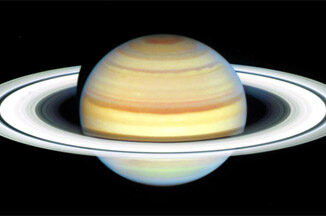
Out there, nearly 1.5 billion kilometers away from Earth, is a ringed world that has mesmerised astronomers with its beauty. Saturn is known for not just its humongous size, nine times wider than Earth, but also its iconic rings.
But those rings are in danger and are slowly disappearing.
Researchers have revealed that the rings of Saturn, which are made up of large chunks of ice are eroding, and we do not know how long they will stick around. The blocks of ice circling the planet are crashing into it leading to the thinning of the mysterious rings that have amazed astronomers.
“We’re still trying to figure out exactly how fast they are eroding,” Dr James O’Donoghue, who is leading the research into the Saturn’s disappearing rings said in a statement.
While it is mostly believed that the rings have always been a part of Saturn, it’s not correct. The rings of Saturn are just 100 million years old, which though seems like a long time on a cosmic scale is not that long. Scientists are now trying to figure out the future of these rings.
While research suggests that the rings could take another 100 million years to disappear completely, Dr. James O’Donoghue still calls it a “quick death.”
“Currently, research suggests the rings will only be part of Saturn for another few hundred million years. This may sound like a long time, but in the history of the universe, this is a relatively quick death. We could be very lucky to be around at a time when the rings exist,” O’Donoghue added.
The team is trying to get their hands on the James Webb Space Telescope to delve deeper into the physics of the rings of Saturn and what really is triggering these chunks of ice to fall on the planet they orbit.
According to Nasa, Saturn’s ring system extends up to 2,82,000 kilometers from the planet and is named alphabetically. The rings are relatively close to each other, with the exception of a gap measuring 4,700 kilometers in width called the Cassini Division that separates Rings A and B.
The system has a total of seven rings.
These rings are believed to be pieces of comets, asteroids, or shattered moons that broke up before they reached the planet as they were crushed by the planet’s strong gravity. “The ring particles mostly range from tiny, dust-sized icy grains to chunks as big as a house. A few particles are as large as mountains,” Nasa has said.
Sun approaching solar maximum earlier than
expected, more eruptions likely
The sun has been busy and as it approaches solar maximum as part of its ongoing cycle, the activity is set to further ramp up and there are going to be more hazardous eruptions.
The sun exploded with three major solar flares in April alongside 23 coronal mass ejections, and a massive geomagnetic storm that struck Earth and raged for over two days. April remained a busy month for the Sun as solar physicists charted 96 sunspots on the surface of the Sun.
The growing number of sunspots on the surface of the star in our Solar System indicates that the sun could be approaching a solar maximum earlier than expected.
The Sun undergoes a natural cycle of magnetic activity, known as the solar cycle, which repeats approximately every 11 years. This cycle has significant effects on space weather, including solar flares, coronal mass ejections, and other phenomena. Sun is currently undergoing the 25th solar cycle, which began in 2019.
The Sun’s magnetic field is generated by the movement of charged particles within the Sun’s interior, and it extends far beyond the Sun’s surface, creating a vast region of space called the heliosphere. As the Sun rotates, its magnetic field lines become twisted and tangled, leading to the formation of sunspots, which are dark, cooler regions on the Sun’s surface. Source: India Today
Tag: James Webb Space Telescope
-

Saturn’s iconic rings are disappearing
-

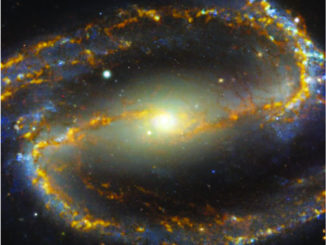
‘Cosmic caramel swirl’: ESO releases new image of NGC 1300 galaxy
The European Southern Observatory’s picture of this week looks like a mouthwatering caramel nest. The image is of the NGC 1300 spiral galaxy, located about 61 million light-years from Earth. It was created using data collected by the Atacama Large Millimeter/ submillimeter Array (ALMA) and the Very Large Telescope (VLT) located in Chile.
The image shows a bar of stars and gas along with a central ring which shows an intense star formation.
“The image is a combination of observations conducted at different colours — or wavelengths — of light. The golden caramel glow corresponds to clouds of molecular gas, the raw material out of which stars form,” said ESO in a release. The images were taken as a part of the Physics at High Angular resolution in Nearby GalaxieS (PHANGS) project. The project aims to make high-resolution observations of nearby galaxies using several telescopes, including the ALMA, VLT, Hubble and the newly-launched James Webb Space Telescope.
The different telescopes will help observe the nearby galaxies at different wavelengths. “Different wavelengths can reveal a multitude of secrets about a galaxy and by comparing them astronomers are able to study what activates, boosts, or hinders the birth of new stars,” adds the release.