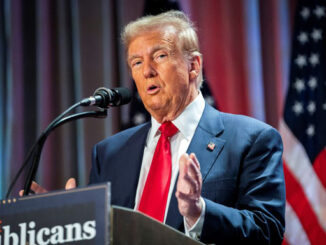
Tag: KP Nayar

  • Trump’s new term draws near amid skepticism

    Trump’s new term draws near amid skepticism

    If the most important day of a person’s life begins with a grievance against the institution of the Fourth Estate, he is likely to spend the rest of his public life undermining it.

    “But his next presidency may be different. The spate of resignations in the mainstream American media in recent weeks — including the dissolution and reconstitution of the Editorial Board of The Washington Post in October — are ominous. Partisan new owners of legacy media have chosen to kow-tow to Trump even before he has moved into the White House. Social media will mostly be the new President’s facilitator instead of an outlet for free expression. Meta’s latest decision to get rid of independent, third-party fact-checkers in the US is the latest assault on truth in that country.”

    By KP Nayar

    As the United States readies for the inauguration of Donald Trump as its 47th President, I have a sense of déjà vu. Trump’s swearing-in as the 45th President is the only presidential inauguration that I skipped since I was posted to Washington as a foreign correspondent in the final full year of the Bill Clinton presidency 26 years ago.

    I skipped the ceremonies on the advice of bipartisan political contacts and reliable security sources. Behind their well-meaning advice was the primary fact that I am a journalist. My badge at the inaugural ceremonies would identify me as one. Moreover, I would be in the media enclosure near the Reflecting Pool, which, on a clear day, will reflect the swearing-in of new presidents on the steps of Capitol Hill. During that poll season which saw Trump emerging victorious, the Republicans treated the media as an enemy. This was not entirely without reason. The bulk of the US media — especially the mass subscription liberal media on the east and west coasts — was unfair to Trump throughout the campaign. He did not have a level playing field in dealings with American journalists.

    I am brown in complexion. Black people are an inalienable part of the US social fabric. If they are trifled with by rednecks in a city like Washington, which is predominantly Black, there will be consequences for the perpetrators of white racism. Not so with the brown-skinned minuscule minority, who are also meek compared to African Americans. This also shows very visibly in the ongoing mudslinging against H-1B immigrants.

    The underlying anger which culminated in the January 6, 2021, riot on Capitol Hill was already there when Trump was being sworn in for the first time. Trump began his presidency with a peeve that the US media had deliberately under-reported the crowds at his inauguration. If the most important day of a person’s political life begins with a grievance against the institution of the Fourth Estate, he is likely to spend the rest of his public life undermining that institution. Never mind that the Fourth Estate is one of the pillars of democracy in the US. Trump did not succeed in this destructive mission as President. That was not for want of trying every day for four years from 2017.

    But his next presidency may be different. The spate of resignations in the mainstream American media in recent weeks — including the dissolution and reconstitution of the Editorial Board of The Washington Post in October — are ominous. Partisan new owners of legacy media have chosen to kow-tow to Trump even before he has moved into the White House. Social media will mostly be the new President’s facilitator instead of an outlet for free expression. Meta’s latest decision to get rid of independent, third-party fact-checkers in the US is the latest assault on truth in that country.

    A saving grace is that institutions in the US are strong. That is why they survived the tenure of the 45th President. Officers of the Metropolitan and Capitol Police paid with their lives to save the high-domed edifice, which is emblematic the world over, of the oldest democracy on earth. On January 20, they will once again be prepared to offer the ultimate sacrifice to protect those they may not personally like and whom they have voted against in Washington, Maryland and Virginia, the tripoints which are similar to the National Capital Territory (NCT) surrounding Delhi. In a tribute to the strength of America’s institutions, law enforcement agencies are allowing demonstrations against the incoming President. A major rally in Washington in support of Trump is also planned on the day before he takes office. It is praiseworthy that in a media briefing last week, US Secret Service spokesperson Anthony Guglielmi said such demonstrations are not being viewed as security threats and upheld the rights of people to protest. There are few other countries where this can happen. The Secret Service is the lead agency in charge of security at the presidential inauguration.

    Unlike the run-up to Trump’s first swearing-in and the start of Joe Biden’s presidency soon after the violent attack on the Capitol, fate ordained that there would be a dress rehearsal of safeguards on a presidential scale during all of last week. The 39th US President, Jimmy Carter, died on December 29. Mandatory events associated with his “lying in state,” and tributes before his funeral occasioned one such dress rehearsal. The other, of course, was the archaic certification by the US Congress of electoral college votes that Trump has, indeed, been elected President. It was such certification of Biden’s election four years ago that rioters tried to derail and physically harm then Vice-President Mike Pence and then Speaker of House of Representatives Nancy Pelosi. Because of all this, Washington has fortuitously been protection-ready since Christmas, unlike any previous presidential inauguration in recent memory.

    There is an eerie similarity between Narendra Modi’s first swearing-in as Prime Minister in 2014 and Trump’s second coming, as it were. Modi invited Pakistan’s then Prime Minister Nawaz Sharif — among other guests — and Trump has similarly invited China’s President Xi Jinping. Unlike Sharif, Xi is not going to Washington. The Foreign Ministry in Beijing is keeping everyone guessing on the level of China’s representation. No previous US president-elect has invited foreign leaders to his inauguration, and according to the US State Department, no Head of State has been in Washington during previous January 20 ceremonies. At the time of writing this piece, only Argentina’s President Javier Milei, who is looked upon as Washington’s poodle by some Latin American countries, is expected to attend.

    According to books written by people who were in the inner circle of Trump’s White House, the President is highly superstitious. Porn star Stormy Daniels said in a documentary released last year that Trump’s weird hairdo is because he believed he would be powerless if he lost or properly combed his hair. That superstitious trait may explain the vehemence with which Trump criticized Biden for ordering a 30-day state mourning for Carter. In a historic first, flags will fly at half-mast during Trump’s swearing-in as a result. Even for those who are not superstitious, it is not an auspicious way to start a new presidential tenure.
    (The author is a senior journalist)

  • India-US ties and the Soviet baggage

    India-US ties and the Soviet baggage

    By KP Nayar

    Till about a decade ago, India and the US were talking to each other on 38 platforms. Now they are talking at one another. Such difficulties have been compounded by a tendency in India to run down Trump and view him as a bull in the global diplomatic China shop. But there is hope as the new External Affairs Minister, S Jaishankar, does not believe in demonizing Trump.

    At the root of most of the gripe in recent weeks about the state of relations between New Delhi and Washington is a long-standing popular expectation since the demise of the Soviet Union that as India and the US got closer, the latter would become a substitute for Russia.

    It is an expectation that is shared in India not merely at the popular level, but in the media, sections of which plug this line as their wishful thinking. Because of the heavy American influence on the think tank community and non-governmental organisations (NGOs), the public discourse on Indo-US relations has also fostered such an expectation.

    Policymakers within successive Indian governments since then Prime Minister PV Narasimha Rao — during whose tenure the Soviet Union collapsed — have mostly had serious reservations about such a perception. Unfortunately, their American counterparts have both publicly and privately encouraged the policy line that with the fall of the Berlin Wall and with the East bloc gone, all that was needed was for India and America to consummate their marriage that was made in heaven and ordained by their horoscopes matched by the constellations of democracy, English language, the rule of law and so on.

    Additionally, after the George W Bush-Manmohan Singh nuclear deal, which ended India’s long nuclear winter, Americans at every level of strategic thought, both within their administrations and outside, nursed a sense of entitlement about India. When Sanjaya Baru, then PM’s Media Adviser, handed over the first consignment of Alphonso mangoes to then US Secretary of State Condoleezza Rice in June 2007 at the annual meeting of the US-India Business Council, a senior State Department official standing next to this writer loudly exclaimed: “We give India the nuclear bomb and all we get in return is a basket of mangoes.”

    This official’s reaction was patently an exaggeration, but it reflected the strong feelings within the Washington establishment then — as also now. His reference was to the historic nuclear deal which ended a three decade-old ban on India’s trade in nuclear material and technology, initially with the US and eventually with the rest of the world. Till 2007, mangoes — like many other Indian agricultural products — could not be exported to the US despite New Delhi’s strenuous efforts because of stringent US regulations.

    In May 2006, Boeing invited Indian journalists based in Washington to visit the company’s highly secure and heavily restricted Integrated Defense Systems headquarters in St Louis, Missouri, where its modern military aircraft were being designed and developed. Word had been out then that India was about to order 126 medium multi-role combat aircraft (MMRCA), the biggest military aviation deal in history. The invitation was meant to familiarize the Indian public with US defense capabilities. Indo-US defense trade had not picked up in 2006 to anywhere near what it is today.

    Pin-stripe-suited Boeing senior executives, who flew down to St Louis to smoke exquisite cigars and sip premium cognac with the journalists at the Ritz Carlton’s Cigar Club, were smug in their belief that the MMRCA deal would go to US companies which were preparing to bid as soon as the tendering process was set in motion by the Congress-led government. When this writer told an executive that a deal as big as the one for 126 planes would take at least five years to be negotiated, he dismissed that view with contempt. “We have been told that in six months everything would be completed once the process begins,” he said confidently.

    In the end, it took a decade to sign an agreement for partial purchase of the original 126 planes and the deal did not go to American companies. This anecdote is worth narrating because it is just one of the many examples of how companies in the US have little idea of how to do business in India and are ill-equipped to cope with the peculiarities of decision-making in the Indian government.

    Just as US administrations want to send Indian-Americans as Ambassadors to India in the belief that they can swing things for them in New Delhi, US companies and lobbying groups hire retired bureaucrats from Lutyens’ Delhi whose contacts are from a bygone era. Sadly for economic and trade relations between the two countries, there are many instances where these men and women have given wrong advice to their principals back in America. But when things go wrong, the blame is on India, as many Americans in the Donald Trump administration and outside are doing now.

    After the thick ice between Washington and New Delhi caused by the 1998 nuclear tests melted through the most comprehensive dialogue in their history between then PM Atal Bihari Vajpayee’s confidant Jaswant Singh and then President Bill Clinton’s troubleshooter Strobe Talbott and bilateral relations eventually took off, 38 working groups came into being to catalyze Indo-US relations across the board.

    But six months after Hillary Clinton became Secretary of State, she found these 38 groups to be mere talking shops. During a visit to New Delhi in July 2009, she persuaded her Indian counterpart SM Krishna to scrap these working groups. In their place, Clinton and Krishna created the lofty sounding ‘five principal pillars’ of their relationship: strategic cooperation; energy and climate change; education and development; economics, trade and agriculture; science, technology, health and innovation.

    In retrospect, this was a mistake. When there were 38 working groups, there was constant toing and froing between the two sides and they were in constant and unbroken dialogue offering numerous windows to understand differences and disputes. India and the US were talking to each other then on 38 platforms. Now they are talking at one another.

    Such difficulties have been compounded by a tendency in India to run down Trump and view him as a bull in the global diplomatic China shop. But there is hope because the new External Affairs Minister, S Jaishankar, does not believe in demonizing Trump. When he was Foreign Secretary, within a month of Trump’s inauguration as President, Jaishankar began advising those in India who practice diplomacy and engage in strategic thought. “Do not demonize Trump, analyses Trump. He represents a thought process. It is not a momentary expression” what Trump is saying, has been Jaishankar’s approach. If Trump is re-elected President next year, India will have to follow this advice in letter and spirit or give up on India’s most important foreign policy priority.

    (The author is a Strategic Analyst)