Tag: United Kingdom (UK)

  • Ex-Soldier Jailed For Racially Abusing Sikh Neighbours In UK

    Ex-Soldier Jailed For Racially Abusing Sikh Neighbours In UK

    A 51-year-old former British soldier has been jailed for 10 months for racially abusing his women Sikh neighbours by calling them “ISIS slags” and “dirty Pakis”.

    Christopher Blurton was found guilty at Derby Crown Court after he was charged with racially aggravated harassment against two women neighbours in Manchester Street, Derby. He has been jailed for 10 months, Derby Telegraph reported.

    The abusive man sent the two Sikh women a note whinging about the state of their garden, in which he claimed they were members of ISIS, it said.

    Blurton initially denied racially aggravated harassment between June 28 and August 19 last year but was found guilty on Friday.

    “You frightened these two young women. They felt that they needed to move out. Your criminal record shows that you have resorted to violence in the past and had committed offences when drunk,” Recorder Adrian Redgrave said while sentencing Blurton.

    Blurton acted in that way towards the women because they were Asian, he added.

    The court heard the victims moved into the home in 2014 but the problems began in June last year and lasted around two months.

    Blurton hurled abuse from his yard and his home, yelling “dirty Pakis”, “ISIS slags” and threatening to “slice them up”.

    “(It) will be quiet and then we would hear racist remarks such as hope the dirty Pakis die,” a neighbour said. But he claimed he was just shouting at his TV and a probation officer said he would drink five times a week.

  • British envoy to Saudi Arabia converts to Islam, performs Haj

    British envoy to Saudi Arabia converts to Islam, performs Haj

    RIYADH (TIP): Simon Collis, Britain’s ambassador to Saudi Arabia, has performed Haj after recently converting to Islam, it was reported on September 14.

    The diplomat was pictured with his wife in the traditional white garments of the annual pilgrimage, which is compulsory for Muslims to perform at least once in their lives.

    Collis has been posted in Riyadh, the capital of the Arab kingdom, since 2015. He is the first British ambassador to perform Haj, an online portal reported.

    Married to Huda al-Mujarkech, a Syrian Muslim, Collis has previously served as Britain’s ambassador to Iraq, Bahrain and Syria – where he was kicked out by President Bashar al-Assad in 2012 when diplomatic relations collapsed in the face of the growing Syrian civil war.

    He has also served in positions in Tunisia, India, Yemen and the UAE. He said that he had converted to Islam “after spending 30 years in Muslim societies”.

    Photographs of Collis and Mujarkech on Haj were posted on an Arabic-language Twitter account by the user Fawziah al-Bakr along with the comment: “The first British ambassador to the Kingdom performing Haj after converting to Islam: Simon Collis with his wife Huda in Makkah Mekkha.”

  • Prince Charles in car crash with deer on Queen’s estate

    Prince Charles in car crash with deer on Queen’s estate

    LONDON (TIP): Britain’s Prince Charles was reportedly involved in a car crash with a deer on his mother Queen Elizabeth II’s estate in Scotland, a media report said on September 156.

    The 67-year-old heir to the throne was unhurt in the Balmoral estate incident, which took place in recent days, ‘Daily Mirror’ reported.

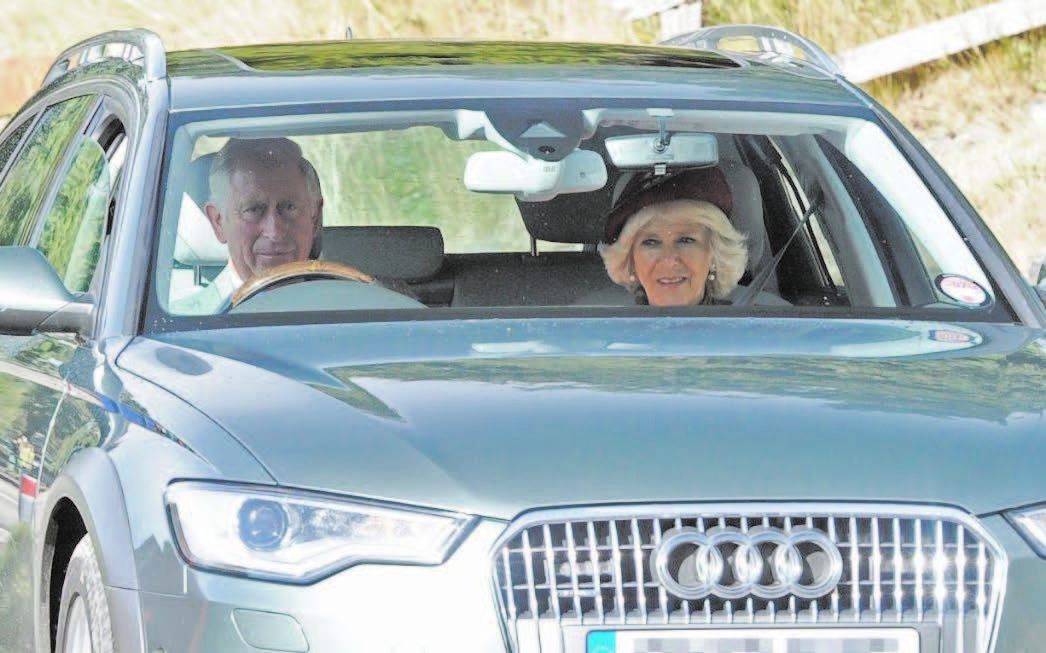
    While his Clarence House office has declined to comment on the incident, Charles is believed to have been driving an Audi A4 Allroad Estate when the accident happened.

    He wasn’t hurt but the vehicle was left so badly damaged that a specialist mechanic was despatched to the royal estate in the Highlands to repair it, the newspaper claims.

    “Red Deer are a hazard on the roads up here and most drivers have had a brush with them at some point. Charles is a careful driver but sometimes they dash out on the road and there’s little you can do. He’ll have got a hell of a fright,” the newspaper quoted a source as saying.

    Balmoral, the British monarch’s Scottish home where she usually spends the English summer, is playing host to a huge royal gathering this week.

    Charles was pictured recently enjoying a drive in his new Audi recently as well. His son, Prince William, and daughter-in-law Kate Middleton flew into Scotland last Thursday for a short holiday in the Scottish Highlands at the invitation of the Queen.

    They were accompanied by their two children, three-year-old Prince George and one-year-old Princess Charlotte, and followed a few hours later by Kate’s parents, Carole and Michael Middleton.

    On Saturday, Carole was spotted being driven around the estate by the Queen herself as the pair made their way back from a grouse shoot together.

    It came just a few hours after the Queen drove Kate to meet up with Prince William for a picnic lunch on the hills above Lake Muick.

  • Former British PM Cameron quits Politics, resigns from Parliament

    Former British PM Cameron quits Politics, resigns from Parliament

    Britain’s former Prime Minister David Cameron has resigned his seat in the House of Commons, he told in an interview earlier this week.

    Cameron stepped down as prime minister in June, hours after Britain voted to leave the European Union in a referendum in which he had campaigned to stay in the bloc.

    “The circumstances of my resignation as prime minister and the realities of modern politics make it very difficult to continue (in parliament)… without the risk of becoming a diversion,” Cameron said in a statement.

    “I fully support Theresa May and have every confidence that Britain will thrive under her strong leadership,” the 49-year-old added.

    The former premier was pilloried after the shock referendum defeat.

    “I think everything you do will become a big distraction and a big diversion from what the government needs to do for our country.”

    Cameron’s resignation from parliament is unusually quick — former prime ministers have typically retained their seats for a number of years after leaving the official Downing Street residence.

    May wished Cameron well for the future in a brief statement on Facebook.

    “I was proud to serve in David Cameron’s government — and under his leadership we achieved great things,” the former interior minister wrote.
    – ‘A life outside Westminster’

    The suave Eton-educated Cameron has been MP for Witney in the rural county of Oxfordshire, northwest of London, since 2001.< At the time of his resignation as premier, he insisted he was "keen to continue" as a constituency MP and intended to seek re-election at the next general election, due in 2020. He is not known to have taken on any other roles since stepping down. His media appearances since have been in pictures of him holidaying with his family.

  • Britain to build 13-foot high wall to stop migrants

    Britain to build 13-foot high wall to stop migrants

    LONDON (TIP): Britain is to start building a wall in the northern French port of Calais to stop migrants jumping on trucks, under a deal agreed earlier this year, the interior ministry said on sept 7.

    The four-metre (13-foot) high, one-kilometre long barrier will be built on a port approach road starting this month and should be completed by the end of this year, officials said.

    The wall, which will be funded by the British government under an agreement struck at a summit in March, will complement a security fence already put up around the port and entrance to the Channel Tunnel.

    “We are going to start building this big new wall very soon. We’ve done the fence, now we are doing a wall,” junior minister Robert Goodwill told a parliamentary committee on Tuesday.

    The wall, which is expected to cost 2.7 million euros ($3.0 million), will be the latest barrier to go up around Europe as the continent struggles with its biggest migrant influx in decades.

    Hungary has built a reinforced fence on its frontier with Serbia and Austria has announced plans for a massive new fence along its border with Hungary in a bid to shut down the Balkan migrant route.

    Republican White House hopeful Donald Trump has said he plans to build a wall along the border with Mexico funded by the Mexican government if he is elected.

    The wall in Calais was agreed following tens of thousands of attempted Channel crossings last year through trucks boarding ferries and the Eurotunnel. Angry French truckers and farmers blocked the main routes in and out of Calais on Monday to call for the closure of the sprawling “Jungle” migrant camp.

    The Jungle, a squalid camp of tents and makeshift shelters, is home to some 7,000 migrants but charities say the number might be as high as 10,000 after an influx this summer.

    Migrants from the camp sometimes use tree branches to create roadblocks to slow trucks heading for Britain, their destination of choice.

    When the trucks slow down, migrants try to clamber into the trailers to stow away aboard. Drivers say migrants and people trafficking gangs have attacked their vehicles with metal bars.

    The drivers say despite the deployment of 2,100 officers around the port, the police are overstretched and unable to secure the roads.

    French interior minister Bernard Cazeneuve promised during a visit to the Jungle last week to close the camp down “as quickly as possible” but said it would be done in stages.

    (PTI)

  • India on path of becoming pivot for hi-tech manufacturing: UN

    India on path of becoming pivot for hi-tech manufacturing: UN

    India is on the path of becoming a “pivot” for high-tech world manufacturing even as global manufacturing growth is expected to remain low in 2016 due to weakened financial support for productive activities, a new UN report said.

    The quarterly World Manufacturing Production report, published by the UN Industrial Development Organisation (UNIDO) said world manufacturing output is expected to increase by only 2.8 per cent in 2016.

    However, in contrast to recent years, there will be no breakout from the low-growth trap in 2016.

    Growth performance was much higher in Asian economies, where manufacturing output rose by 6.5 per cent in the second quarter of 2016.

    “Indias manufacturing output, which achieved impressive growth rates in the last quarters, experienced a second slight decline in a row but the prospects for Indias manufacturing are conclusive, since India is on the path to becoming a pivot for high-tech world manufacturing,” the report said.

    According to the latest GDP data released in India, the manufacturing sector grew 9.1 per cent during April-June 2016, a slight decline from the 9.3 per cent clocked in January to March.

    UNIDO also warned that lower industrial growth rates pose a challenge for the implementation of Sustainable Development Goal (SDG) on promoting inclusive and sustainable industrialisation and foster innovation, as encapsulated by Goal 9, which also aims to significantly raise the share of manufacturing in the economies of developing countries.

    It further stated that manufacturing production is likely to rise by only 1.3 per cent in industrialised countries and by 4.7 per cent in developing ones.

    In terms of growth rates for countries, the growth rate performance of China, the worlds largest manufacturer, is likely to further decline from last years 7.1 per cent to 6.5 per cent this year.

    Russia and the US recorded marginal rises of one per cent and 0.3 per cent, respectively.

    In Europe, the uncertainty following the Brexit affected the growth rate performance in manufacturing in the second quarter of 2016, below one per cent for the first time since 2013.

    Developing economies maintained higher growth in the production of textiles, chemical products and fabricated metal products, while the growth performance of industrialised economies was higher in the pharmaceutical industry and in production of motor vehicles.

  • Indian-Origin UK Lawmaker Keith Vaz Steps Down Over Gay Sex Scandal

    Indian-Origin UK Lawmaker Keith Vaz Steps Down Over Gay Sex Scandal

    LONDON: Keith Vaz, a well know Indian-origin lawmaker in Britain, was today embroiled in a sex scandal after a newspaper claimed he had paid for male sex workers.

    The Labour MP from Leicester since 1987, who is a married father of two, paid for men to visit him one evening last month at a flat he owns in London, the ‘Sunday Mirror’ claimed.

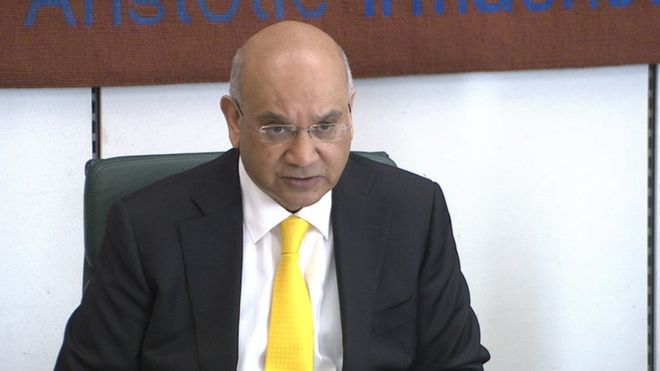
    The 59-year-old Goan-origin lawmaker has since announced he will be stepping aside as chair of the influential House of Commons Home Affairs Committee, which he has headed for the past 10 years.

    “I am genuinely sorry for the hurt and distress that has been caused by my actions, in particular to my wife and children. I will be informing the Committee on Tuesday of my intention to stand aside from chairing the sessions of the Committee with immediate effect,” he said in a statement reported by ‘Sky News’.

    It is understood that Mr Vaz has not resigned completely but temporarily as he speaks to his lawyer and other members of the committee.

    The committee is currently examining sex work in the UK and had issued a report recently saying that soliciting by sex workers should be decriminalised.

    Mr Vaz allegedly paid for sex with two male sex workers and offered to pay for a class A or banned drug, according to the newspaper report, which is accompanied by a video.

    It is alleged that the lawmaker had two meetings with Eastern European origin escorts, including a 90-minute meeting on August 27.

    One text, reportedly sent by Mr Vaz, said the men should arrive at “11 pm, nice and late”.

    He is said to have added: “I want a good time please.” Mr Vaz is accused of asking the young men to bring poppers to the flat, as well as allegedly joking about being a “pimp”. As the talk ranged from sex to pets, Mr Vaz eventually said: “We need to get this party started”.

    He also spoke about having had unprotected sex.

    And ahead of the meeting he had sent a series of texts in which he jokingly called himself one of the men’s “pimp” and “bank manager”.

    Mr Vaz paid the escorts in cash, the report claimed.

    “Money was also paid into a bank account used by one of them by a man linked to a charity set up by the MP,” it said.

    A Labour Party spokesperson said: “Keith Vaz has issued a statement on this matter. As with all departmental select committees, Keith was elected to the chair of the Home Affairs Select Committee by the House of Commons, and his position is a matter for him and the House.”

  • Indian-Origin Boy Devises Breast Cancer Treatment

    Indian-Origin Boy Devises Breast Cancer Treatment

    London:  A 16-year-old Indian-origin boy in the UK has claimed to have found a treatment for the most deadly form of breast cancer which is unresponsive to drugs.

    Krtin Nithiyanandam, who moved to the UK from India with his parents, hopes he has found a way to turn so-called triple negative breast cancer into a kind which responds to drugs.

    Many breast cancers are driven by oestrogen, progesterone or growth chemicals so drugs that can block those fuels, such as tamoxifen, make effective treatments.

    However, triple negative breast cancer does not have receptors and it can only be treated with a combination of surgery, radiation and chemotherapy which lowers the chance of survival. “I’ve been basically trying to work out a way to change difficult-to-treat cancers into something that responds well to treatment. Most cancers have receptors on their surface which bind to drugs like Tamoxifen but triple negative don’t have receptors so the drugs don’t work,” Krtin was quoted as saying by The Sunday Telegraph.

    “The prognosis for women with undifferentiated cancer isn’t very good so the goal is to turn the cancer back to a state where it can be treated. The ID4 protein actually stops undifferentiated stem cell cancers from differentiating so you have to block ID4 to allow the cancer to differentiate.”

    “I have found a way to silence the genes that produce ID4 which turns cancer back into a less dangerous state,” Krtin added.

    Some women with triple negative cancer respond very well to treatment while others quickly decline.

    The problem lies in whether the cancer cells are “differentiated” or not.

    Differentiated means they look more like healthy cells and they tend to grow and multiply quite slowly, and are less aggressive.

    However, when cancer cells are “undifferentiated” they get stuck in a dangerous primitive form, never turning into recognisable breast tissue, and spreading quickly, leading to high grade tumours.

    He has also discovered that upping the activity of a tumour suppressor gene called PTEN allows chemotherapy to work more effectively, so the dual treatment could prove far more effective than traditional drugs.

    The therapy idea saw him shortlisted for the final of the UK-based young scientists programme titled The Big Bang Fair.

    His efforts had hit the headlines last year when he won the Google Science Fair for creating a test which helps pick up the early signs of Alzheimer’s disease and potentially stop it spreading further.

  • BREXIT MAY BE DELAYED UNTIL 2019: REPORT

    BREXIT MAY BE DELAYED UNTIL 2019: REPORT

    LONDON (TIP): Britain may remain a member of the European Union (EU) until 2019, a year longer than previously estimated, a media report said on Sunday.

    Prime Minister Theresa May has been expected to enact Article 50 of the Lisbon Treaty in January 2017, setting in motion the formal two years of negotiations before Brexit.

    However, she may be forced to delay it because her new Brexit and international trade departments will not be ready, the Sunday Times quoted sources as saying.

    French and German elections are also being cited as a cause for delay.

    Britain might not invoke Article 50 until France has voted next May or until after the German poll in September.

    A UK cabinet minister has also reportedly confirmed to the Sunday Times that there were “some challenges” in the French and German electoral timetables.

    David Davis, secretary for Exiting the European Union, and Liam Fox, the international trade secretary, had indicated after May appointed them that they expected Britain to leave at the start of 2019.

    However, their new government departments are being set up from scratch and the situation is reportedly “chaotic”.

    Another senior government insider told the newspaper there was uncertainty about preparatory talks with EU leaders, in which Britain would try to reach understandings on key issues before triggering Article 50.

    “The prime minister has been clear that a top priority for this government is to deliver the decision of the British people to leave the EU and to make a success of Brexit. The PM has set out the government’s position on Article 50 and has established a new department dedicated to taking forward the negotiations,” said a Downing Street spokesperson.

    HIGHLIGHTS

    Britain may remain a member of the European Union until 2019
    The new Brexit and international trade departments will not be ready before then
    French and German elections are also being cited as a cause for delay

  • 10-Year-Old Indian-Origin Girl Named ‘Child Genius 2016’ In UK

    10-Year-Old Indian-Origin Girl Named ‘Child Genius 2016’ In UK

    A 10-year-old Indian-origin girl has been crowned as Britain’s brightest child after she won a popular television quiz competition in the UK.

    Rhea shot ahead in Tuesday’s final of ‘Child Genius 2016’ on Channel 4 with six correct answers and then drew equal with her opponent Saffy on nine points as they entered the final head-to-head question round.

    Rhea, who moved to the UK with her family from the US six years ago and now lives in west London, correctly spelled the word “eleemosynary”, meaning relating to charity, to claim the title at the end of four weeks of tough question rounds.

    “It’s meant getting up early, going to sleep late, studying. It just feels really, really great,” Rhea said after her win.

    Her mother Sonal, who gave up her job as an obstetrician to train Rhea, had stepped in to contest an incorrect answer that she had given during her specialist subject round on Florence Nightingale’s influence on military and healthcare reform.

    Independent adjudicator Olivia van der Werff agreed the question had been too general and accepted Rhea’s answer of Dr Duncan Menzies to the question: “To which medical officer did Florence Nightingale report to in the Crimea?” It meant that Rhea avoided a tie-break with Birmingham-born Stephen, who was ranked third, with Saffy and Rhea securing their place in the final.

    The move triggered some social media backlash against Sonal, who was branded as too “pushy”.

    One Twitter comment read: “Rhea is such a smart young lady but her mother is shocking! This isn’t about you…” “Rhea’s parents are ridiculously pushy, poor kid,” read another tweet.

    Earlier, Sonal had rejected concerns that programmes such as ‘Child Genius’ can put too much pressure on youngsters.

    “Rhea loved doing it. The show gives them a chance to be with kids like them, to be in that room and feel normal,” she said.

    The quiz show is hosted by Richard Osman, who described this year’s show as “the greatest final in the history of Child Genius”.

  • 15-hour mega jam in UK as France ups border checks

    15-hour mega jam in UK as France ups border checks

    DOVER (TIP): British holidaymakers spent hours sweating in their cars as 15-hour queues snaked back from the port of Dover on July 23 due to heightened entry checks by French border police.

    Stationary vehicles tailed back up to 12 miles (19 kilometres) inland from Dover, on England’s southeastern tip.

    The peak summer holiday getaway season and what Dover port officials said was a lack of French border control staff combined with the increased security to create the mammoth queues.

    Dover is Britain’s main ferry port to continental Europe, with Calais in northeastern France 21 miles (33 kilometres) away across the Channel.

    A multiple sclerosis sufferer travelling to Germany for stem cell treatment was among those forced to spend the night in their vehicles.

    What should have been a straightforward journey to Dover turned into a 20-hour ordeal for 50-year-old Tanya Cudworth, who was travelling to a Frankfurt clinic.

    She told the Press Association news agency that her experience was “absolutely horrendous”.

    “Nineteen hours in the car has obviously aggravated my symptoms,” she said.

    “During the day it was so hot and there was nowhere near enough water and at night… you couldn’t sleep because you had to keep moving forward.

    “We didn’t get any water until 3am and I saw women with babies, young families and people with pets with no water. It’s shocking that more wasn’t done to get it to people.”

    People were advised to bring food and drink supplies, while Sikh humanitarian organisation Khalsa Aid delivered bottles of water and snacks.

    “We met a lot of young families with children, mostly people going on holidays,” said founder Ravi Singh, 46.

    “People didn’t know what was going on. “People were very, very frustrated and pulling their hair out.

    “It was a very miserable day for many people.”

    Dover port authorities said French border control booths had been “seriously understaffed overnight”.

    British border officials were drafted in to help their French colleagues.

    “We recognise the security pressures that French law enforcement organisations are under at Dover,” said a British government spokeswoman.

    “There has been extraordinary disruption in the Dover area today but safety is paramount.”

    Highways England, which runs the road network, said the delays were due to “heightened security checks to keep the travelling public safe following the recent attacks in France”.

    By 5 pm (1600 GMT) Sunday, the local Kent Police force said traffic had returned to normal levels, with delays down to around 30 minutes.

    Xavier Czerwinski, a senior official from the Pas-de-Calais area, said: “The situation is exceptional because it’s the weekend when Britons make the great getaway to the continent.

    “Given the European context and the prolonged state of emergency, officers are obliged to check every vehicle rigorously.” (AP)

  • LLOYDS CUTS 3,000 JOBS AS BREXIT FEARS TAKE SHAPE

    LLOYDS CUTS 3,000 JOBS AS BREXIT FEARS TAKE SHAPE

    LONDON (TIP): Britain’s Lloyds Banking Group said it plans to eliminate 3,000 jobs and close 200 branches — the first big cuts announced since Britain voted to leave the European Union.

    Lloyds is expanding its cost-savings program because of changing consumer behavior and the expectation that interest rates will now remain lower for a longer period than previously expected as a result of the vote, the bank said. The cuts, which are equivalent to about 4 percent of Lloyds’ workforce and almost 10 percent of its branch network, come in addition to previously announced reductions and are expected to save an additional 400 million pounds ($528 million) annually.

    “Following the EU referendum, the outlook for the U.K. economy is uncertain and, while the precise impact is dependent upon a number of factors including EU negotiations and political and economic events, a deceleration in growth seems likely,” CEO Antonio Horta-Osorio said in a statement.

  • UK PM MAY VISITS GERMANY FOR BREXIT TALKS WITH MERKEL

    UK PM MAY VISITS GERMANY FOR BREXIT TALKS WITH MERKEL

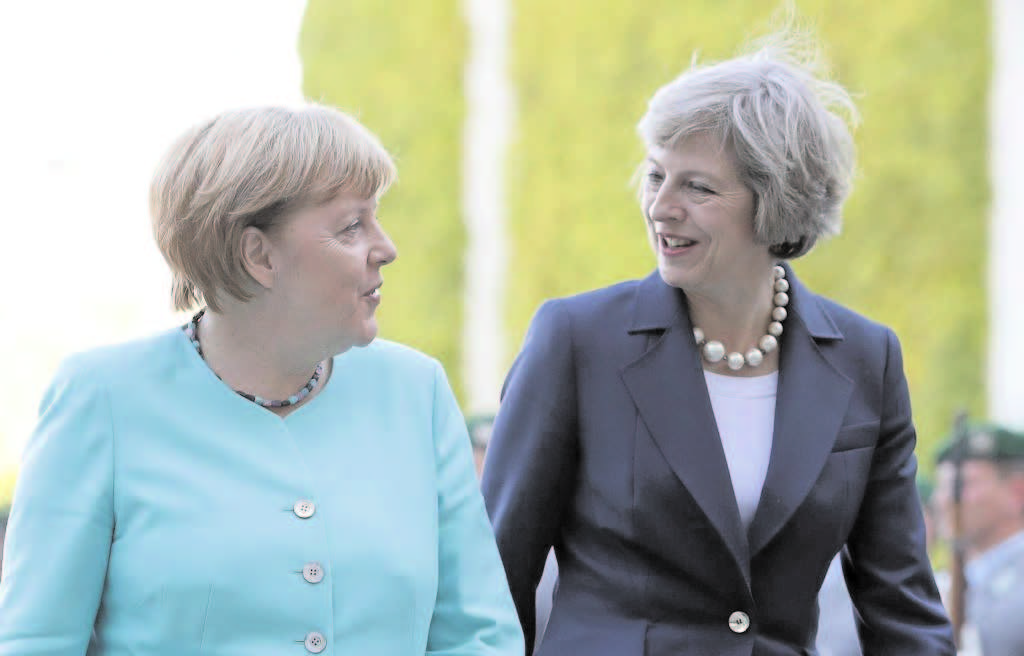
    BERLIN (TIP): Prime Minister Theresa May made her first overseas trip as Britain’s leader on July 20 to meet German Chancellor Angela Merkel, who will be a key figure in negotiating Britain’s exit from the European Union.

    May was greeted by a military band as she arrived at the Chancellery in Berlin for getting-to-know-you talks with the German leader.

    A week ago May replaced David Cameron, who resigned in the wake of Britain’s decision to leave the 28-nation bloc.

    May’s office says the trip, which also includes a visit to French President Francois Hollande, will help forge “the personal relations that will pave the way for open and frank discussions in the months ahead.”

    May is likely to be asked when she will invoke Article 50 of the EU’s constitution, which triggers a two-year process of quitting the bloc. She has said she does not plan to do that before the end of the year, but EU leaders say there can’t be any substantive talks about future relations until Britain does that.

    Merkel’s spokesman Steffen Seibert said talks with Britain over leaving the EU can only begin once Article 50 is activated, and there will be no “pre-negotiations” between Merkel and May.

    May said Wednesday that while she doesn’t underestimate the challenge of negotiating the British exit, she firmly believes “that being able to talk frankly and openly about the issues we face will be an important part of a successful negotiation.”

    The thorniest issue is likely to be the trade-off between access to Europe’s single market _ which the British economy relies on _ and control of immigration. EU leaders are unlikely to give Britain full access to the market unless it accepts the EU principle of free movement of people among member states.

    Facing her first weekly prime minister’s question session in the House of Commons Wednesday, May did not answer directly when asked if Britain would be willing to leave the single market in order to guarantee migration controls.

    She said the referendum result made clear that “people want control of free movement from the European Union.” But, she said, “we must also negotiate the right deal and the best deal on trade in goods and services for the British people.”

    May has also announced that Britain is relinquishing its turn at holding the EU presidency in the second half of 2017.

    May’s office said the prime minister spoke to European Council President Donald Tusk on Tuesday evening and told him Britain would give up the rotating six-month presidency _ held by EU member states in turn _ so it could prioritize exit negotiations.

    After a working dinner with Merkel in Berlin on Wednesday, May will travel to Paris on Thursday to meet Hollande in Paris. As well as talking about the EU, they will discuss counterterrorism cooperation in the wake of last week’s deadly truck attack in Nice.

    May said she wanted to send a message to Britain’s European allies that “these relationships have been vital in the past and they will be vital in the future.”

  • US BANKS GET BREXIT BOOST BUT FACE LONGTERM PAIN

    US BANKS GET BREXIT BOOST BUT FACE LONGTERM PAIN

    NEW YORK (TIP): Large US banks got a lift from the June “Brexit” vote in the second quarter, but could face long-term pain from a British retreat from the European Union.

    Earnings released by JPMorgan Chase, Citigroup and others over the last week showed a pickup in some key trading businesses in the days after the surprise June 23 vote by Britain to leave the EU.

    Banks attributed the bounce to a rise in market volatility after the British vote, resulting in double-digit revenue gains in some trading operations.

    “There was increased volatility around Brexit that I think we were probably positioned for, and importantly with that volatility, customers came to us with their issues,” said Citigroup chief financial officer John Gerspach.

    Morgan Stanley chief financial officer Jonathan Pruzan pointed to a “high level of activity at the very end of June, primarily due to Brexit as we supported our clients.”

    The higher trading revenues were a factor in earnings reports that generally bested market expectations.

    Some analysts say the US banks are also relatively well positioned compared with their European counterparts, which suffer from weaker economic growth in the EU and the prospect of low and negative interest rates.

    Yet bank executives also pointed to a host of unknowns after the British vote.

    US banks have their European headquarters in London, and the five largest US banks currently employ more than 40,000 people in the city.

    But that structure that will make less sense if London loses direct access to the 27 other members of the EU single market.

    If Britain withdraws from the European Union, banks based in London could no longer be allowed to freely market services to EU countries without a presence there.

    Relocating staff from London woold cost banks an average of £50,000
    ($66,000) per employee, said consultancy Synechron. Moving 1,000 jobs to hubs like Dublin, Frankfurt or Paris would then cost some £50 million.

    Banks have already begun informal discussions with regulators in other European countries on procedures for obtaining bank licenses and establishing compliance with local capital requirements, said one banking source who spoke on the condition of anonymity.

    Of the preferred cities, Frankfurt offers close access to the European Central Bank, as well as the custom of employing English in addition to German in business affairs.

  • Too early to sound all clear on Brexit: Fed official

    Too early to sound all clear on Brexit: Fed official

    Washington (TIP): Britain’s vote to exit the European Union has raised a cloud of uncertainty that could prove a headwind against the US economy, a senior Federal Reserve official said Thursday.

    Dennis Lockhart, president of the Atlanta Fed, noted the surprise Brexit decision initially roiled financial markets for a few days but they have mostly returned to conditions before the June 23 referendum.

    “It’s too early to sound the ‘all clear’ as regards financial market stability,” Lockhart told an economic summit in Idaho, according to his prepared remarks.

    “Fed and other policymakers will need to stay on alert for signs of instability severe enough to pose a threat to the broad economy.”

    Lockhart is not a voting member of the policy-setting Federal Open Market Committee this year. The next FOMC meeting is scheduled on July 26 and 27.

    He said he was “surprised” by the referendum outcome which has “raised the general uncertainty quotient at work in the world.” He stressed the difficulty of forecasting the impact Britain’s split with the EU will have on the US economy. “Negative effects could materialize through the trade channel if there is a sustained realignment of the dollar-pound exchange rate. We might also see similar effects in our trade with Europe and the euro area,” he said.

    Uncertainty that could reduce business investment in the US is “not helpful” for growth, he said.

    “To summarize my view of Brexit effects: negligible near-term effect; a risk factor over the medium term; higher uncertainty that could amount to a persistent economic headwind.”

  • Bank of England signals August rate cut on #Brexit

    Bank of England signals August rate cut on #Brexit

    LONDON (TIP): The Bank of England kept its interest rate at 0.50 percent on Thursday, but signalled a possible August cut in response to Britain’s vote to exit the EU.

    At its first monetary policy meeting since the June 23 referendum vote on Brexit, the BoE also maintained the amount of cash stimulus pumping around the economy at £375 billion ($497 billion, 448 billion euros), it said in a statement. The central bank added that the majority of its nine policymakers supported looser monetary policy in its next decision due August 4.

    “The precise size and nature of any stimulatory measures will be determined” next month, the statement said. BoE governor Mark Carney has warned that Britain could fall into recession as businesses delay new projects because of the shock referendum result.

    At July’s meeting on Wednesday, only one member of the Monetary Policy Committee (MPC), Gertjan Vlieghe, voted for a cut in the interest rate to a record-low 0.25 percent, while all members backed keeping quantitative easing (QE) stimulus at £375 billion.

  • Theresa May’s Challenges

    Theresa May’s Challenges

    Three weeks after a majority of Britons voted in a referendum to leave the European Union, the British political landscape looks entirely different.

    David Cameron, who called the referendum, is no more the Prime Minister. Boris Johnson, an exit campaigner who was widely expected to replace Mr. Cameron, backed off even before the contest for the new Prime Minister began. Michael Gove, another Brexiteer who entered the race, was rejected by Conservative MPs. Theresa May rose from this post-referendum chaos to become the second woman Prime Minister of the U.K. A seasoned politician with administrative experience, Ms. May’s style of working and policy preferences often invoke comparisons with Margaret Thatcher and Angela Merkel. As Home Secretary for six years, she oversaw Britain’s security services, borders and police forces. Despite her hard-line positions on immigration – at the Home Office she supported a net immigration cap – she chose to back the Remain camp, like Mr. Cameron, during the referendum campaign. This pragmatic Euroscepticism may have helped her win over both the doves and hawks within the Conservative Party.

    That the U.K. has put an end to political uncertainty quicker than expected is good news for both the country and Europe. But the challenges Ms. May faces are unprecedented. The Conservative Party is divided. Legislators and other party leaders may endorse her for now, but going forward she could find it tough to maintain the equilibrium between the centrists and right-wing conservatives. Mr. Cameron’s decision to call the referendum to appease the right-wingers shows how unstable that equilibrium can be. Secondly, the Tories were re-elected last year under Mr. Cameron’s leadership on promises of fixing the country’s economic worries. The Brexit vote has already done damage to the fragile economic recovery. Ms. May’s immediate task would be to restore investor confidence. Thirdly, there is an alarming rise of xenophobia in the U.K. which threatens its social cohesion, which no ruler can ignore. A yet larger challenge for Ms. May would be dealing with the Brexit referendum outcome. Mr. Cameron had promised to trigger Article 50 of the Lisbon treaty if there was a Leave vote. In the event, he did not. None of the Brexiteers managed to succeed him. Ms. May, herself a Remain supporter, faces a difficult situation. If she doesn’t begin the process of taking the U.K. out of the EU, she faces the wrath of Brexiteers within and outside her party. If she invokes Article 50, it could have immediate repercussions for the economy and London’s ties with Scotland. This is a tall order that even Ms. May’s idol, Margaret Thatcher, would have struggled with.

  • Theresa May succeeds David Cameron as British Prime Minister

    Theresa May succeeds David Cameron as British Prime Minister

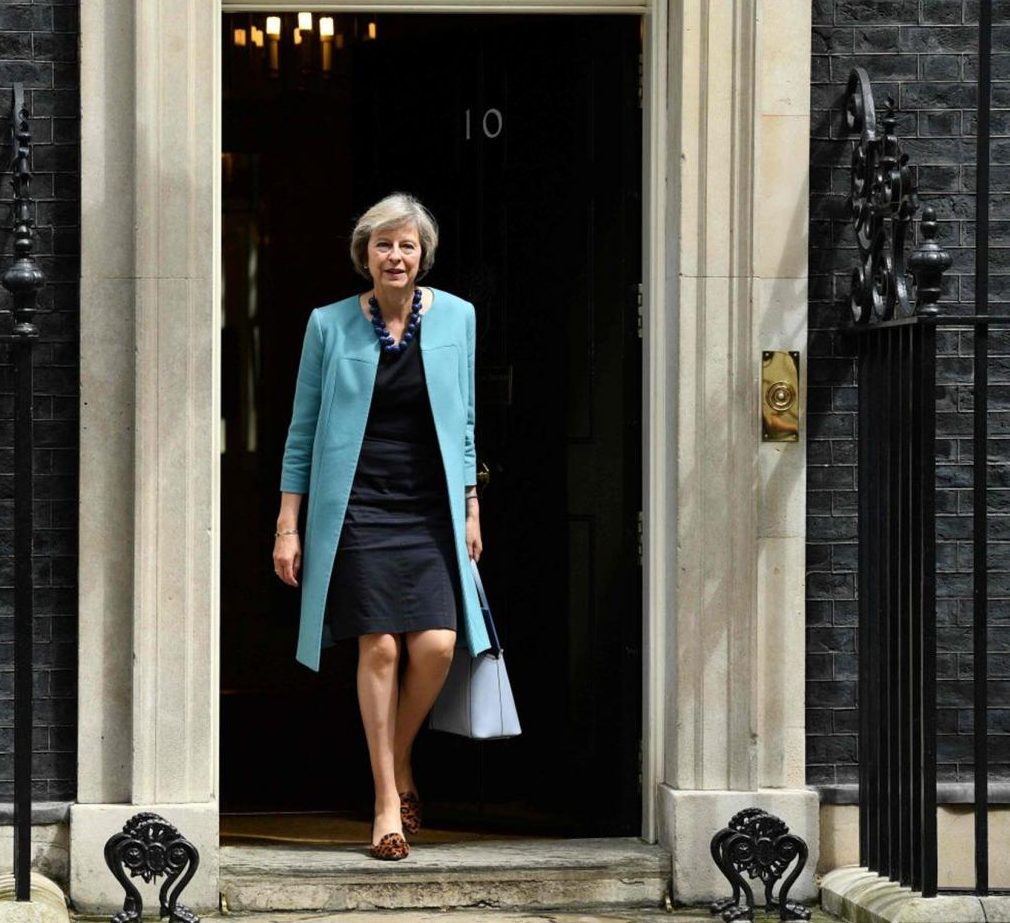
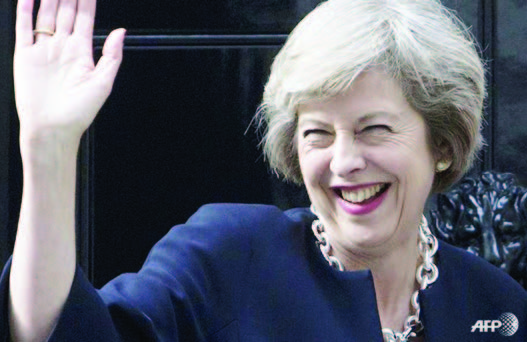
    LONDON (TIP): In her first public remarks, June 13, the new British Prime Minister Theresa May struck a populist tone, saying she planned to continue predecessor David Cameron’s “true legacy” of social justice.

    The Conservative Party leader spoke directly to the poor, black and white working-class residents as well as women, youth and those with mental health issues, saying, “The government I lead will be driven not by the interests of a privileged few, but by yours.”

    Her party prizes unionism, she said, and not just among England, Wales, Scotland and Northern Ireland, “but between all of our citizens, everyone, whoever we are and wherever we’re from.”

    Cameron has led a one-nation government, and it is in that spirit that I also plan to lead,” she said.

    May wasted no time getting to work, naming six Cabinet members shortly after taking the nation’s helm. Among them were two of her chief rivals in her bid to head the Conservative Party: members of Parliament Boris Johnson and Liam Fox.

    Here is the new Prime Minister’s cabinet 

    Theresa May succeeds David Cameron - listIn his final appearance in Parliament as Prime Minister, Cameron opened with the quip that “apart from one meeting in the afternoon with the Queen, my diary is remarkably light.”

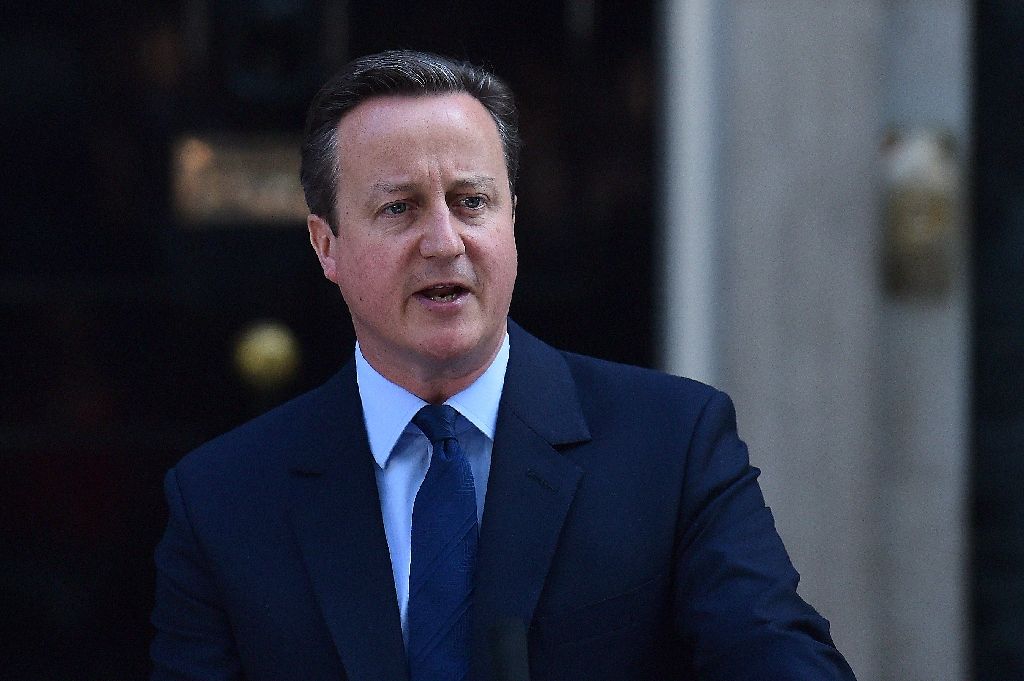
    Before resigning, Cameron delivered remarks outside 10 Downing Street, saying, “It’s not been an easy journey, and of course we’ve not got every decision right, but I do believe that today our country is much stronger.”

    He wished May the best, especially as she negotiates the country’s “Brexit” from the European Union. If he were granted one wish, he said, it would be the “continued success of this great country that I love so very much.” Cameron will continue on as a member of Parliament.

    David Cameron-Brexit forced his exit
    David Cameron-Brexit forced his exit

    Earlier Wednesday, Cameron appeared to be in a jovial mood as he told members of Parliament: “I have addressed 5,500 questions from this dispatch box — I’ll leave it to others to decide how many I’ve answered.”

    He held up a photo of himself with Larry the Downing Street cat, saying he loved the “chief mouser” and was sad to be leaving him behind.

    On a more serious note, Cameron said he cared passionately about the UK, adding that “we need to make sure as we leave the EU, how we keep the benefits of the common travel area.”

    Gesturing across the room and up to his wife, Samantha, watching from the gallery, he said: “I will miss the roar of the crowd, I will miss the barbs from the opposition, but I will be willing you on.

    “Nothing is really impossible if you put your mind to it. After all, as I once said, I was the future once.”

  • BREXIT FALLOUT – David Cameron to resign Wednesday as Theresa May takes over

    BREXIT FALLOUT – David Cameron to resign Wednesday as Theresa May takes over

    British Prime Minister David Cameron is expediting his departure from 10 Downing Street, paving the way for Home Secretary Theresa May to take the reins and steer the country out of EU.
    Theresa May promised to build a “better Britain” and to make the UK’s EU exit a “success” after she was announced as the new Tory leader and soon-to-be PM.

    Speaking outside Parliament, Mrs May said she was “honoured and humbled” to succeed David Cameron, after her only rival in the race withdrew on Monday.

    Mr Cameron will tender his resignation to the Queen after PMQs on Wednesday.

    May was officially named Conservative Party leader and successor to Cameron “with immediate effect” Monday, said Graham Brady, chair of the 1922 Committee, a collection of Conservative members of Parliament key to electing the party leader.

    Cameron had already announced he would step down by October after failing to convince the country to remain in the EU in the divisive June 23 referendum that sent shockwaves through Britain’s political establishment.

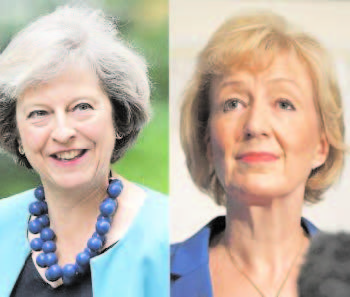
    But Monday, May’s only remaining rival to replace Cameron — Energy Minister Andrea Leadsom — pulled out of the race following controversy over comments she made about motherhood and leadership.

    Obviously, with these changes, we now don’t need to have a prolonged period of transition. And so tomorrow I will chair my last Cabinet meeting. On Wednesday I will attend the House of Commons for Prime Minister’s questions,” Cameron told reporters Monday outside 10 Downing Street.

    “And then after that I expect to go to the palace and offer my resignation. So we will have a new prime minister in that building behind me by Wednesday evening.”

    The vote between May and Leadsom was supposed to go to the wider Conservative Party of 150,000 people, but being the sole candidate, May sidestepped the party rule.

    Cameron welcomed Leadsom’s decision to drop out of the race and said he was confident May would steer the country in the right direction, calling her strong and competent, and offering her his full support.

  • US adds huge 287,000 jobs in June, giving markets boost

    US adds huge 287,000 jobs in June, giving markets boost

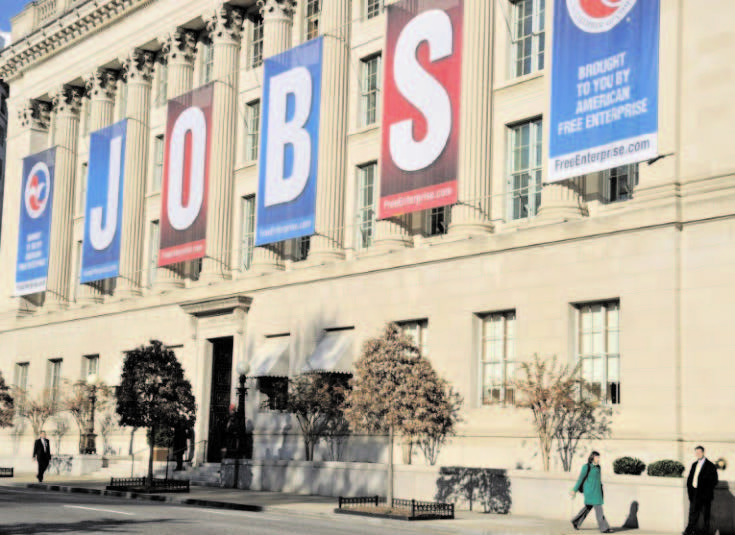
    WASHINGTON (TIP): US employers added new workers at a surprisingly strong rate in June after an unnerving stall in May, delivering a fresh sign of US economic strength, the Labor Department reported Friday.

    The much better-than-expected numbers gave a boost to markets in the US and Europe, battered down by worries that Britain’s vote to withdraw from the European Union will drag down economic growth.

    But analysts remained cautious, saying it still waits to be seen whether the rebound from May will be sustained.

    Private businesses and government authorities across the United States generated 287,000 new positions last month, 112,000 more than analysts had expected.

    The strongest hiring was in the health care, hospitality, information and retail sales sectors, while government hiring also picked up.

    That largely compensated for the poor numbers from May that had shocked policymakers and markets, sending the dollar lower and contributing to the Federal Reserve’s decision last month to put off an interest rate hike.

    The May job creation numbers in fact were revised downward in Friday’s data from the original 38,000 reported to just 11,000.

    – US, European markets surge –

    June’s hiring levels boosted the monthly average of the last three months to a solid 147,000, which economists say is adequate to keep bringing down unemployment overall.

    “This is a good trend but nothing spectacular. It suggests that hiring has taken a step down since late last year but that job growth is still strong enough to absorb slack in the labor market,” said analysts at Nomura Global Economics in a client note.

    “Most important, today’s report quells any concerns of a broader economic slowdown in the US.”

    Markets reacted positively, with the S&P 500 on Wall Street adding 1.1 percent, the London FTSE 100 barometer rising 1.0 percent and Frankfurt’s DAX index gaining 2.0 percent.

    With analysts saying the data increases the chances that the Federal Reserve will raise interest rates at least once before the end of the year, the dollar jumped to $1.1029 against the euro, compared with $1.1078 before the announcement.

    US bond yields, which had plunged in recent weeks with the 10-year Treasury hitting a record low, spiked higher in early trade.

    The jobs report was not unequivocally good news. Wage growth, another indicator of the strength of the employment market and the economy generally, slowed, bringing the annual pace for the last three months to 2.5 percent, compared with the 12-month rate of 2.6 percent.

    And the unemployment rate, which is based on a separate database from the job creation numbers, rose by 0.2 percentage points to 4.9 percent, though still near the lowest level in more than eight years. That rise was mainly due to a large jump in the number of people reported rejoining the workforce, diluting the impact of the hiring surge on the jobless rate.

    In May the unemployment rate had fallen from 5.0 percent to 4.7 percent after the volatile data showed a huge number of people had dropped out of the labor force.

    – Brexit remains a worry –

    Analysts remained cautious over what the hiring surge means for the economy going ahead, saying US businesses could remain cautious in the coming months, concerned about the possible economic drag from Britain’s vote to withdraw from the European Union, expected to hit economic growth in Britain and Europe.

    “We believe the trend remains more than strong enough to keep the unemployment rate declining over time, consistent with additional upward pressure on wage gains,” said Jim O’Sullivan, chief US economist at High Frequency Economics.

    But O’Sullivan expects the Federal Reserve will continue to keep US interest rates on hold at its end-July meeting.

  • Blair’s Iraq misadventure

    Blair’s Iraq misadventure

    The invasion was ostensibly on the specious ground of Saddam Hussein possessing weapons of mass destruction, based on conjectures and intelligent reports, in the face of men in the know pleading for patience. President Bush’s decision was part hubris, part spreading the credo of democracy, part a game changer in reordering the affairs of the Middle East.

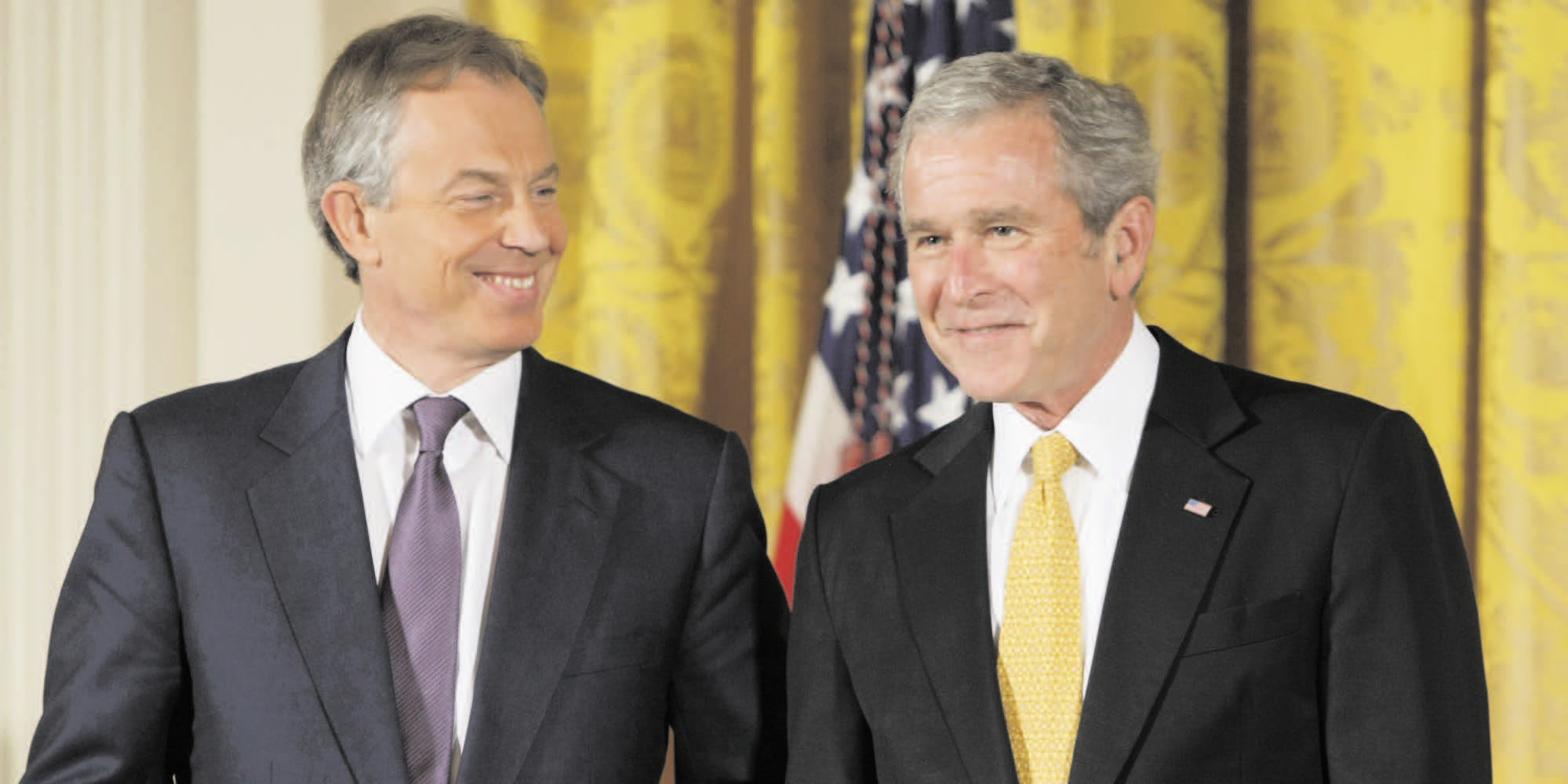
    Mr. Blair was the enthusiastic young subaltern willing to do the President’s bidding, best summed up in the secret memo he sent the White House, now made public, months before the invasion saying. “I’ll be with you, whatever”. After the UK lost its empire in the post-World War II era, she ruled the world by proxy for decades as the pundit of US administrations in their negotiating the hot spots. But never has this subservient relationship been so frankly acknowledged as in Mr. Blair’s memo.

    Britain, which has just made the fateful decision to leave the EU, is still searching for answers to its role in Europe and the world. In fact, the Brexit decision was born out of nostalgia for a lost empire, and in this contest between the heart and the head, the former won by a narrow margin.

    Sir John’s was an inquiry into the British conduct in the Iraq invasion and war and the exhaustive report, which runs into several volumes, raps Mr. Blair’s conduct hard. But in a sense it is an even greater indictment of the conduct of President Bush who went to war on scant pickings without preparing for administering post-Saddam Iraq substituting bravado for policies on the ground.

    Here lies the American tragedy on the use of unsurpassed power to remake the Middle East after a set of grandiose theories. The world knows how the crumbling Ottoman Empire was divided into spheres of influence between France and Britain 100 years ago in the shape of Sykes-Picot agreement. America entered the scene by appropriating the bulk of the rich oil flows and was happy to support monarchies and dictatorships.

    The US had another interest, to protect Israel. What became known as the Israeli-American lobby and Washington’s geopolitical interests in propping up Israel meant that the usurpers of Palestinian land would never get justice. The Israeli-Palestinian peace agreement celebrated on the lawns of the White House suited Washington’s interests and was a partial one. And Israeli victories in wars with Arabs meant that what the victors won, they would keep. The two-state solution was a sop to Palestinians in the form of a toothless state now superseded by Mr. Benjamin Netanhayu’s relentless march for a Greater Israel.

    To return to Iraq and Mr. Blair’s inglorious role in the invasion, the summary of the report presents a picture of his appropriating cabinet authority, declining to be bound by rigorous legal opinion and perhaps somewhat inebriated by his chummy relations with the occupant of the White House.

    President Bush for his part was riding on his hobbyhorse of going down in history as the maker of a new map of the Middle East. And Paul Bremer, the man he appointed as first Governor of a defeated Iraq, totally misread the situation by excommunicating Saddam’s mainly Sunni army. In combination with the sectarian policies of Iraq’s Nouri al-Maliki, it was a priceless gift of well-trained officers and soldiers thrown into the arms of what became an insurgent force coalescing around the opposition, later to become the Islamic State.

    Apart from the price Mr. Blair will have to pay for his role as Sancho Panza to Mr. Bush, the place Britain has come to occupy as America’s closest ally after the loss of empire needs re-examination. The British Parliament has learned to exercise some control over future military interventions by rejecting one of Prime Minister David Cameron’s military initiatives. But future policy makers must devise new trip wires before automatically following American military interventions. It would indeed appear that a redefinition of the responsibilities of ‘closest ally’ is called for.

    Where does Britain go from here? To begin with, she has to cope with choosing a new prime minister before starting divorce proceedings with the EU, a Herculean task because she does not want to pay the full price for remaining in the single market by allowing the free movement and residency of EU nationals. Immigration was the emotive issue that won the Brexiters their double-edged victory.

    Britons have been reluctant Europeans at the best of times. Now that they are in the process of reclaiming what they view as their full sovereignty, they need to carve out a new role in the new world order. The Japanese, for instance, are already worried that in their search for a role, they might indulge China in helping to rescind the embargo on high-technology arms exports.

    Suggestions that Britain should revive the Commonwealth, a lame horse, are tantamount to barking up the wrong tree. The post-colonial experiment of leading ex-colonies in a totally different age is a non-starter. Those from the colonies who chose to settle in the UK -for instance, the large Indian diaspora -have their links with their original homes but these cannot be translated into a new grouping of political weight in the world. If the Modi government is thinking of playing a leading role in a revived Commonwealth, it would be set on a foolish venture.

    The Chilcot report is a crunch moment for Britain because it illuminates the dilemmas of a once Great Britain that ruled the waves and countries far and wide. Having been reminded of the pitfalls of slavishly following the sole superpower, she has to begin to find a new direction.

  • Brexit fallout will shave growth in eurozone: IMF

    Brexit fallout will shave growth in eurozone: IMF

    WASHINGTON (TIP): Britain’s decision to leave the European Union (EU) will trim economic growth this year and next across the 19 countries that share the euro currency, the International Monetary Fund (IMF) says.

    The global lending agency expects the eurozone economy to grow 1.6 per cent this year and 1.4 per cent in 2017. Before the so-called Brexit vote, the IMF was projecting 1.7 per cent growth this year and next. The eurozone grew 1.7 per cent last year, fastest since 2010.

    The downgrade reflects rising uncertainty, volatility in financial markets and falling exports to Britain following the vote. The surprising June 23 decision means the United Kingdom must renegotiate its trade and immigration arrangements with the EU. Many businesses are likely to delay investments in Britain and Europe until they know what the new rules will be.

  • UK poised to have first woman PM since Margaret Thatcher

    UK poised to have first woman PM since Margaret Thatcher

    LONDON (TIP): Britain is poised to get its first woman Prime Minister in more than a quarter of a century since Margaret Thatcher as the race to succeed David Cameron after the Brexit vote narrowed down on July 7 to home secretary Theresa May and energy minister Andrea Leadsom.

    May will now go head to head with Leadsom in an all-woman contest after justice secretary Michael Gove was eliminated from the Conservative party leadership race with the least votes in the second round of voting today.

    “This vote proves the Conservative party can come together,” May said after she received the backing of 199 Tory MPs compared to Leadsom’s 84 and Gove’s 46.

    May and Leadsom will now begin their campaigns to convince the wider Conservative party membership around the country for a final round of voting with the winner set to be declared on September 9.

    It is now certain that the winner will go on to become Britain’s second female Prime Minister after Margaret Thatcher.

    Today’s results were announced at Westminster by Conservative MP Graham Brady, the chairman of the backbench 1922 Committee.

    There had originally been five contenders to succeed Cameron, who had announced his resignation after Britain voted to leave the European Union (EU) in June 23 referendum.

    The contest now moves to its final stage with the Conservative Party’s 150,000-strong membership deciding between May, a Remain campaigner with a long track record in government, and Leadsom, a strong Brexit campaigner with a background in business by postal ballot.

    The race had thrown up its share of controversies with Gove’s campaign chief, Nick Boles, allegedly texting MPs to vote tactically in favour of his candidate.

    His message read: “What if Theresa stumbles? Are we really confident that the membership won’t vote for a fresh face who shares their attitudes about much of modern life, like they did with IDS [Ian Duncan Smith]?” It triggered a backlash, forcing Boles to apologise and claiming that Gove had no knowledge of his message.

    It had led May to urge her supporters to not vote tactically as she once again called for a “proper contest”.

    The 59-year-old has gradually emerged as the candidate with the most backing among both remain and leave camps within the Tory party, despite having supported Cameron during the EU referendum campaign.

    “Under Theresa’s leadership, the motives of the Conservative Party will never be in any doubt,” said Indian-origin minister Priti Patel, a Brexit supporter who threw her support behind May earlier today.

    (AFP)

  • BREXIT–A “Leave” vote puts UK on the path of disintegration

    BREXIT–A “Leave” vote puts UK on the path of disintegration

    It was certainly a black Friday – not the kind that we are used to after thanksgiving holiday – for the stock markets.

    The reason for that was not some economic news but rather political one: Brexit. It was a vote on the referendum whether to remain in European Union or Leave.

    Right before the referendum vote, there was feeling that pro-EU forces would prevail but the result was quite opposite: the “leave” vote prevailed by 52-48 margin letting loose a political earthquake of magnitude 10.

    The result was clearly seen in the reaction of the stock markets which tumbled across the globe wiping out ‘trillions’ in wealth and investors rushing to the safety of US bonds (which Trump wants to negotiate in order to reduce US debt, if he becomes President, notwithstanding the fact that all US debt is constitutionally guaranteed) and gold.

    Before we delve into what happens next, here is a quick and interesting fact about the vote: those belonging to 18-24 age group voted overwhelmingly to remain in the EU but those in the 65+ age group – the older white generation -voted to leave the EU.

    This brings forth the glaring contrast between the viewpoints of two groups: The age group 18-24 years exhibited more tolerance, inclusiveness of all cultures and more progressive outlook towards the world – just like the view point held by the youth generation in US.

    But those who voted for leaving the EU – a majority of 65+ age group representing a dying generation – exhibited a mindset that is not able to come to terms with the changing society in modern times and wants to cling back to the old times which are crumbling due to technological advances, more tolerant younger generation and globalization of economy. A similar trait is exhibited by the whites in US who are feeling that “their way of life” is under assault.

    The foremost question is: now what happens?

    First possibility is that many nations in EU would also like to have the referendum like UK.

    Denmark had its own referendum last year but it was more towards deciding how much power to give to unelected officials in Brussels.

    Dutch leader Geert Wilders – a firebrand Islamophobe – has already called for having similar referendum to decide about Dutch member ship in EU.

    Then there is Marine Le Pen – a far right French leader – who is widely popular in France and if she becomes President then France could also see something along the lines of UK referendum. Hungary’s Victor Orban is no friend of EU and has also hinted at the referendum.

    If that happens then EU could find itself on the verge of disintegration.

    On the other hand, there is likelihood that UK would be just an anomaly. Other member nations would resolve to make EU a more cohesive force but with reforms that would lessen the authoritarian grip of Brussels on the member nations.

    David Cameron wanted to leave the painful matter of separation to his successor, but EU leaders like Jean-Claude Juncker, Angela Merkel, and Donald Tusk etc. have called for speedy divorce opining that there is no reason to wait for Cameron’s successor.

    Which means EU might decide to make separation for UK as painful as possible – in the areas of trade, immigration etc. – and as an example in order to deter other members who might harbor such notion of referendums.

    UK itself could face the negative reaction to the “leave” vote. There is a possibility that businesses could flee to Ireland or other EU countries triggering job losses and plunging the nation into recession causing untold economic damage.

    Besides that, the question of Scotland’s independence could again come up. Scotland has overwhelmingly voted to remain in the EU but England has opted to leave which would open up Scottish independence question.

    Scottish Minister Nicola Sturgeon has expressed no confidence in London’s government and hinted that Scottish independence referendum could be in the cards.

    If that happens – a very high probability – then by voting to leave the EU, UK may also have set itself up for disintegration.

    That would be quite ironic.

  • Rajan wants longer term for RBI governor, says 3 years too short: Report

    Rajan wants longer term for RBI governor, says 3 years too short: Report

    NEW DELHI (TIP): RBI governor Raghuram Rajan, whose three-year term comes to an end this September, pitched for a longer tenure for the central bank head, saying on June 30 that the global practice has to be emulated in India as well.

    Rajan, who briefed Parliament’s Standing Committee of Finance on various aspects of economy and NPA in banks, was asked by members on what should be the tenure of the RBI governor, sources said.

    He told the members that a three-year term was “short”.

    On whether it should be five years, Rajan was believed to have cited the case of US Federal Reserve.

    In the US Fed, in addition to serving as members of the board, the chairman and vice-chairman serve terms of four years and may be reappointed to those roles who in turn serve until their terms as Governors expire.

    Rajan, whose current three-year tenure ends on September 4, had said no to a second term.

    Sources further said that during the meeting that lasted for over three hours, the governor briefed the panel, headed by senior Congress leader M Veerappa Moily, on state of the economy, reforms and restructuring of RBI, challenges in the banking sector in India and the way forward.

    The committee was apprised by Rajan of the various steps taken to deal with the bad loan problem, said the sources.

    The Reserve Bank has said the gross non-performing assets of the banks can rise to as high as 9.3%?in 2016-17 after hitting 7.6%?in March 2016.

    Rajan, the sources added, also briefed MPs about the credit scenario of the banks. He is believed to have told the MPs that private lenders are more active on the lending front, but PSU banks are found to be reluctant even when there is no shortage of funds.

    The governor also explained to MPs the impact of Brexit on India and the global economy.

    Earlier in the day, Rajan called on finance minister Arun Jaitley as the central bank and the government seek to quickly put in place a new interest rate-setting mechanism.