Tag: Maryland

  • Anup Jalota Performs For Uttarakhand

    Anup Jalota Performs For Uttarakhand

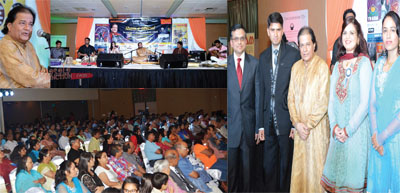
    EDISON, NJ (TIP): Ghazal singer Anup Jalota recently performed at Edison Hotel in Edison, NJ to help raise funds for the benefit of the victims of Uttarakhand Floods. An amount of $7,500 was raised during the show which was organized by Indian Events International in Association with Uttaranchal Association of North America and a number of New Jersey based businesses. Pritam Dimri and Bhupender Bohra briefed the audience about the tragedy in Uttarakhand hills through a video presentation.

    They along with Anup Uniyal & Nitin Bhatt represented UANA and received the service award presented to UANA by Indian Events LLC. They thanked Kajol Bishnoi and Mukul Bishnoi for coordinating the show with support from Surinder Kumar and Anu Kumari of Suhag Jewelers. Jalota mesmerized the audience with rendition of Ghazals and Bhajans, such as, ‘Chand Angadiyan le raha hai’ & ‘Tere shahar ka mausam’ and Bhajans like ‘Aisi Lagi Lagan’. The audience burst into laughter when Jalota diverted from singing to cracking a few jokes during the show.

    According to Kajol Bishnoi of Indian Events, the largest amount of contribution-$2500.00 came from B. B. Joshi, Chief Executive of Bank of India. Jalota presented a special recognition plaque to Joshi on the occasion. He also presented special achievement awards to Mukul Bishnoi of Rudraksham International and Surinder Kumar and Anu Kumari, owners of Suhag Jewelers. Rudraksham Intl specializes in authentic Rudraksha, Astrological Gems and Sphatik (Natural Crystal). Suhag Jewelers is well known for their 22K Gold Jewelry and Diamonds located on Oak Tree Road, Iselin, NJ.

    A member of the audience said, “Anup Jalota is a renowned singer and a very generous person. We are so happy to associate him with our fund raising effort.” Anup Jalota has been honored as the “Bhajan Samrat” of India and has wowed audiences in over 5,000 shows. He is known for his versatility and artistic talent. Very talented musicians, such as Bashir Khan playing Bulbul Tarang, Amjad Ali Kawa on Tabla, Bobby Rozario on Guitar and female vocalist Preeti Seth, accompanied him.

    The organizers and promoters of the show thanked Sanjiv Pandya of Radio Zindagi for anchoring the show along with sponsors Aman Tel, Mausam Restaurant for providing food at the show, Fern ‘N’ Décor for decorating the stage, MoneyDart, HAB, Volga, Apna Bazar, B4U Music, TV Asia and Rhythm Asia. 1. Ms. Kajol Bishnoi & Anup Uniyal presented the Checks to UANA President Ajay Adhikari during the annual Convention of UANA in Maryland (July 26th, 27th) in the presence of 350 people.

    As per Adhikari, funds collected will be utilized for a number of services in flood ravaged Uttarakhand. The UANA will distribute medicines and provide medical help, provide drinking water to remote and affected areas, buy and send blankets, send tents to the area where all the houses are destroyed, help re-build schools and local buildings, and send solar lanterns where electricity is not available.

    All this will be done with the help of direct contacts, local panchayats, school principals and local NGO’s. UANA team will also visit sites and affected areas from time to time to see the progress in the affected areas. UANA will not send cash or any form of money. It will buy whatever is required and pay for the materials.

  • 6 Indian-American kids’ culinary skills feted at White House

    6 Indian-American kids’ culinary skills feted at White House

    WASHINGTON (TIP): Six Indian-American kid chefs have been honored for their fabulous culinary skills by US First Lady Michelle Obama at the White House’s “Kids State Dinner” as part of her initiative to tackle obesity and promote healthy eating among American children.

    Anisha Patel from Ohio, Ganesh Selvakumar from Pennsylvania; Devanshi H Udeshi from Texas; Emma Scielzo from Maryland, Vijay I Dey from North Carolina and Shefali Singh from Massachusetts were among 54 children invited by the First Lady for the event at the White House yesterday where they also had a chance encounter with President Barack Obama. “Now, first of all, usually at a state dinner, I get invited.

    So I don’t know what happened on this one — somehow the invitation slipped through somewhere. But it looks like you guys are having fun,” the President said amid laughter. Selected from over 13,000 contestants nationwide, the six Indian Americans probably constituted the largest number of kids from any ethnic group. So far, Indian Americans have been known for winning various science and math competitions and those like Spelling Bee and Geography Bee.

    “And we’re really proud of you winning this challenge — because, frankly, I’m not a great cook and — I’m not bad, but I don’t do it that much. Its hard to find the time,” the President said. “But when I do cook, I’m following a recipe.

    And to think that all of you have invented all this fabulous food just shows how creative you are and it shows that food that tastes good can be healthy, too,” Obama said. 10-year old Emma Scielzo, a third generation Indian American who attributes her winning recipe of “Chicken Masala Wrap” to her Indian grandparents who immigrated to the US several decades ago from Punjab, was one of three children who were selected to shoot short cooking videos.

  • 6 Indian-American kids’ culinary skills feted at White House

    6 Indian-American kids’ culinary skills feted at White House

    WASHINGTON (TIP): Six Indian-American kid chefs have been honored for their fabulous culinary skills by US First Lady Michelle Obama at the White House’s “Kids State Dinner” as part of her initiative to tackle obesity and promote healthy eating among American children. Anisha Patel from Ohio, Ganesh Selvakumar from Pennsylvania; Devanshi H Udeshi from Texas; Emma Scielzo from Maryland, Vijay I Dey from North Carolina and Shefali Singh from Massachusetts were among 54 children invited by the First Lady for the event at the White House yesterday where they also had a chance encounter with President Barack Obama.

    “Now, first of all, usually at a state dinner, I get invited. So I don’t know what happened on this one — somehow the invitation slipped through somewhere. But it looks like you guys are having fun,” the President said amid laughter. Selected from over 13,000 contestants nationwide, the six Indian Americans probably constituted the largest number of kids from any ethnic group.

    So far, Indian Americans have been known for winning various science and math competitions and those like Spelling Bee and Geography Bee. “And we’re really proud of you winning this challenge — because, frankly, I’m not a great cook and — I’m not bad, but I don’t do it that much. Its hard to find the time,” the President said. “But when I do cook, I’m following a recipe.

    And to think that all of you have invented all this fabulous food just shows how creative you are and it shows that food that tastes good can be healthy, too,” Obama said. 10-year old Emma Scielzo, a third generation Indian American who attributes her winning recipe of “Chicken Masala Wrap” to her Indian grandparents who immigrated to the US several decades ago from Punjab, was one of three children who were selected to shoot short cooking videos.

  • HISTORY OF THE AMERICAN NATIONAL ANTHEM

    HISTORY OF THE AMERICAN NATIONAL ANTHEM

    The American National Anthem memorializes one of the key moments in American history which took place in Baltimore during the War of 1812. When Francis Scott Key saw the American flag flying above Fort McHenry amidst the cannon fire during the Battle of Baltimore, he was inspired to write the historic poem “Defence of Fort McHenry” that would be put to music to become “The Star-Spangled Banner”. The song would become the official American National Anthem on March 3, 1931.

    Fort McHenry and the War of 1812
    During one of the War of 1812’s most significant battles, the Battle of Baltimore, the British mounted land and sea attacks on Baltimore after the Burning of Washington in an attempt to capture the Port of Baltimore. Held at bay by militia on land at North Point, the British Navy then unleashed a barrage of cannons upon Fort McHenry for 25 hours straight through the night of September 13-14, 1814, with the goal of breaking through and taking Baltimore Harbor. The city of Baltimore was dark, with all of its lights put out for the battle, but for the lights of the cannon shells which were exploding in the darkness and casting a glow on the 30-foot flag with fifteen stars and fifteen stripes that was flying high above Fort McHenry, proving the fort was still standing. The flag was crafted by local Baltimore flag maker Mary Pickersgill and her 13-year-old daughter. After failing to seize the fort, the British retreated, marking a major turning point in the War of 1812.

    Francis Scott Key Writes “Defence of Fort McHenry”
    Positioned on a British truce ship, the HMS Tonnant, on the Patapsco River while the attack on Fort McHenry was waged, Francis Scott Key, a 35-year-old American lawyer and amateur poet, watched in awe as British cannons failed to do any significant damage to the fort. He was on the British ship to negotiate the release of one of its prisoners, Dr.William Beanes, a resident of Upper Marlboro, Maryland. Key’s roots in Maryland ran deep as the son of an officer in the Maryland Rifle Company (and later the Frederick County Company of Cavalry) of the Continental Army during the American Revolution. Francis Scott was born in Frederick County (the site of his birthplace is now within the borders of Carroll County), and he went to law school at St. John’s College in Annapolis, Maryland. His far-reaching impact on American history would begin to take shape as soon as the smoke cleared on the morning of September 14, 1814. He penned his experience of that fateful night on the back of a letter in the form of a poem he entitled “Defence of Fort McHenry,” which was published in the Patriot and then widely distributed in pamphlet and sheet music form.

    The Star-Spangled Banner becomes the American National Anthem
    The American National Anthem memorializes one of the key moments in American history which took place in Baltimore during the War of 1812. When Francis Scott Key saw the American flag flying above Fort McHenry amidst the cannon fire during the Battle of Baltimore, he was inspired to write the historic poem “Defence of Fort McHenry” that would be put to music to become “The Star-Spangled Banner”. The song would become the official American National Anthem on March 3, 1931.

    THE NATIONAL ANTHEM OF THE UNITED STATES
    O say can you see, by the dawn’s early light,
    What so proudly we hail’d at the twilight’s last gleaming,
    Whose broad stripes and bright stars through the perilous fight
    O’er the ramparts we watch’d were so gallantly streaming?
    And the rocket’s red glare, the bomb bursting in air,
    Gave proof through the night that our flag was still there,
    O say does that star-spangled banner yet wave
    O’er the land of the free and the home of the brave?
    On the shore dimly seen through the mists of the deep
    Where the foe’s haughty host in dread silence reposes,
    What is that which the breeze, o’er the towering steep,
    As it fitfully blows, half conceals, half discloses?
    Now it catches the gleam of the morning’s first beam,
    In full glory reflected now shines in the stream,
    ‘Tis the star-spangled banner – O long may it wave
    O’er the land of the free and the home of the brave!
    And where is that band who so vauntingly swore,
    That the havoc of war and the battle’s confusion
    A home and a Country should leave us no more?
    Their blood has wash’d out their foul footstep’s pollution.
    No refuge could save the hireling and slave
    From the terror of flight or the gloom of the grave,
    And the star-spangled banner in triumph doth wave
    O’er the land of the free and the home of the brave.
    O thus be it ever when freemen shall stand
    Between their lov’d home and the war’s desolation!
    Blest with vict’ry and peace may the heav’n rescued land
    Praise the power that hath made and preserv’d us a nation!
    Then conquer we must, when our cause it is just,
    And this be our motto – “In God is our trust,”
    And the star-spangled banner in triumph shall wave
    O’er the land of the free and the home of the brave.

  • LADY LIBERTY OPENS AGAIN TO CELEBRATE 4TH OF JULY

    LADY LIBERTY OPENS AGAIN TO CELEBRATE 4TH OF JULY

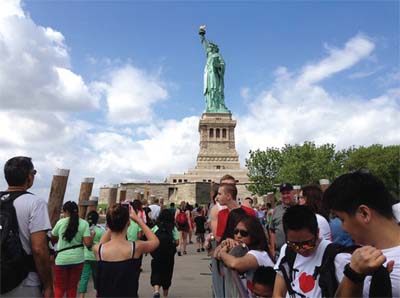
    NEW YORK (TIP): The Statue of Liberty, a beacon of hope for waves of immigrants at the turn of the century – and these days a destination for waves of tourists – reopened to the public Thursday, July 4th, almost nine months after the destruction caused by super storm Sandy. That October storm had left three quarters of Liberty Island underwater and destroyed electrical, phone, water and sewage systems. Sandy struck just a day after the statue had reopened following a yearlong renovation. And before that, there was the Sept. 11, 2001, terrorist attacks, which kept visitors from the inside of the statue for nearly 9 years. Officials said that they hoped that Thursday’s re-opening – the statue’s fourth since 1986 – would be its last for a while. The statue has drawn as many as 4 million visitors a year. And this time, the opening came with predictable patriotic fanfare, including a small marching band clad in Revolutionary War replica uniforms; members of Congress; Secretary of the Interior Sally Jewell; and, of course, New York Mayor Michael Bloomberg, whose pink-collared shirt was soaked through with sweat as he waited on the dais for his turn to speak.

    When he did, Bloomberg said that the statue was “at the heart of what America is really all about.” “Thank God we have people like the French,” Bloomberg added, nodding to the statue’s history, as a gift from France in the 1880s. Bloomberg also took the opportunity to make some pointed comments about climate change, which he said was at the root of increasingly volatile weather conditions across the country and, possibly, major events like Sandy. “Having an argument about climate change … is myopic,” Bloomberg said. “The bottom line is that we have to prepare for the future.” Liberty Island’s recovery, in which crews laid down 42,000 board-feet of new deck, 2,000 feet of hedging, and new electrical, heating, and cooling systems, stands in stark contrast to Ellis Island, which remains closed. Ellis Island was completely submerged after the storm, threatening the island’s archives, which were later removed by the National Park Service Museum Emergency Response Team and taken to a climate-controlled facility in Maryland, said Jonathan B. Jarvis, the director of the Park Service.

    And while work at Ellis Island continues, Jarvis declined to give an estimate, of a re-opening date for the island, saying that the challenges there were far greater. “Ellis is still a process,” he said. That hardly mattered to those on the ground Thursday at Liberty Island. Many visitors were ecstatic, some having come from halfway across the world to photograph and climb the stairs of the world’s most famous monuments.

  • PROMINENT LEGAL LUMINARIES OF INDIAN ORIGIN IN THE US

    PROMINENT LEGAL LUMINARIES OF INDIAN ORIGIN IN THE US

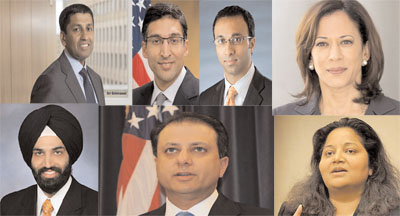
    WASHINGTON (TIP): Recently, Indian-American Srikanth Srinivasan scripted history after he was confirmed as the first South Asian judge to America’s second highest court. But Srinivasan is not the only famous person of Indian origin who has made it to the top ranks in US judicial system.
    Srikanth Srinivasan was appointed as a judge on the prestigious US Court of Appeals in Washington DC, the highest judicial appointment achieved by an Indian-American. Born in Chandigarh, Srinivasan spent nearly two decades as an extraordinary litigator before serving as Principal Deputy Solicitor General of the United States. Now he will serve with distinction on the federal bench. Srinivasan will be the first South Asian American to serve as a circuit court judge in US history.
    Preet Bharara, who was born in Punjab, is the US attorney for the Southern District of New York. In 2012, Bharara was named by Time magazine as one of ‘The 100 Most Influential People in the World’ and was also featured on a cover of Time Magazine. His office was responsible for the high-profile prosecutions of insider trading and other financial fraud on Wall Street including the investigation against the Galleon Group of Raj Rajaratnam and former McKinsey chief Rajat Gupta. Bharara graduated from Harvard College and Columbia Law School.

    Neal Katyal served as Acting Solicitor General of the United States from May 2010 until June 2011. A graduate of Dartmouth College and Yale Law School, Katyal currently runs the appellate practice at the law firm Hogan Lovells and teaches at the Georgetown University Law Center, where he was one of the youngest tenured professors in the university’s history. Katyal has served as counsel or co-counsel for numerous US Supreme Court cases.

    Amit Mehta, an Indian-origin lawyer, is a partner at Washington law firm Zuckerman Spaeder, and has been involved in many big cases, including helping former IMF president Dominique Strauss-Kahn successfully get criminal assault charges in New York state court dismissed. Mehta, 39, is also a board member of the Mid-Atlantic Innocence Project, which seeks to reverse and prevent wrongful convictions in DC, Maryland and Virginia.

    Preeta D. Bansal served as the General Counsel and Senior Policy Advisor to the US federal Office of Management and Budget from 2009 until 2011. Before her assignment in the Obama administration, she served as a law partner at Skadden, Arps, Slate, Meagher & Flom

    Amandeep Sidhu is a partner of law firm McDermott Will & Emery in Washington DC. He has built a reputation as a strong litigator with a solid commitment to pro bono cases. He is a founding member of The Sikh Coalition and has fought a pro bono battle on behalf of three Sikh men who wanted to serve in the US Army. He was able to successfully show that the men were able to meet uniform requirements by using Army-issued cloth for the turbans and that even with a beard, the men could not only use a gas mask effectively, but surpass their clean-shaven comrades in field tests. Eventually the men were allowed to join the service, but Sidhu said that he would settle for nothing less than a policy change.

    Kamala Devi Harris is the Attorney General of California following the 2010 California state elections. Earlier she had served as District Attorney of San Francisco from 2004 to 2011. Recently, US President Barack Obama apologized to Kamla Harris, for his comment in which he described the Indian-American as the best-looking attorney general of America – which many alleged was a sexist remark.

  • Maryland honors Bollywood director at Shortcut Romeo promo event

    Maryland honors Bollywood director at Shortcut Romeo promo event

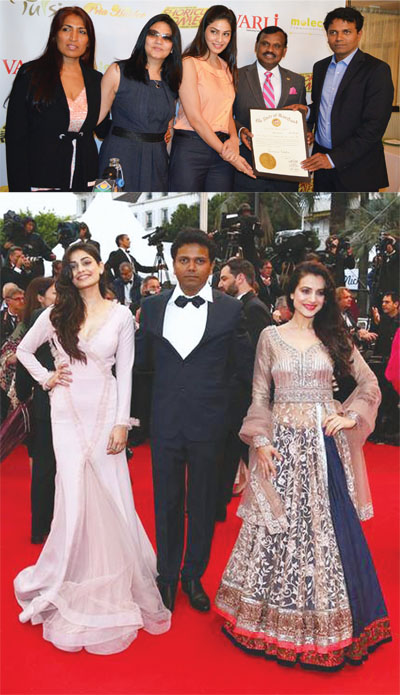
    NEW YORK (TIP): State of Maryland has honored Bollywood film director Susi Ganeshan with a citation for his contribution to Indian cinema. Recalling his 15 years of service and hard work to promote Indian movies, especially Tamil and now Hindi, Maryland Governor Martin O’Malley said in his citation that the State of Maryland is proud to bestow the honor for his contribution to the entertainment industry.

    Dr. Rajan Natarajan, Deputy Secretary of State of Maryland and one of the highranking Indian-American political appointees, presented the citation signed by Governor Martin O’Malley and the replica of great seal of the State of Maryland to Ganeshan at an event in New York attended also by Bollywood actress Puja Gupta, the heroine of his soon-to-be released movie Shortcut Romeo. Dr. Natarajan said Maryland is keen to support Bollywood and would provide all facilities to filmmakers keen to shoot movies in his picturesque state.

    The Governor led a delegation to India recently and is keen on doing business with India. Recently, during his trip to Chennai Dr. Natarajan met with Superstar Rajnikanth and bestowed on him special honor by Maryland Governor. Ganeshan and his team were in New York to promote their latest Bollywood movie Shortcut Romeo after screening the movie and doing red carpet at Cannes Film Festival along with Ameesha Patel and Puja Gupta. Addressing a press conference in Tulsi restaurant last week organized by Varli Media, Molecule Communications and Pria Haider, actress Puja Gupta said as an actress she doesn’t have any limitations.

    “I don’t have any limitations as an actor. As an actor you shouldn’t limit yourself. An actor should have the liberty to do whatever they want to and the director is the one who will decide.” The model-turned-actress has featured in two films F.A.L.T.U. and Go Goa Gone so far and said: “I love that I have become an actress. I never thought I will be an actress. I will try to do the best with the roles given to me…I will do bold roles if I am comfortable with it.

    “The 24-year-old describes Ameesha Patel, with whom she will share the screen space in Shortcut Romeo, as a “wonderful costar”. “She is so gorgeous. She is senior to me and has spent a decade in the industry. There is lot to learn from her.” This is Susi Ganeshan’s first Hindi movie and the remake of Tamil Nadu Government award winning Tamil movie Thiruttu Payale.

    Ganeshan addressed several differences between the two versions, starting with, Why a remake in the first place? Noting a current trend for remakes in Indian cinema, Ganeshan pointed to the vast Bollywood marketplace-and audience for Bolly films–compared with that of Tamil language films. He then related the challenges faced by a director who decides to remake one of his own films.

    To distinguish Shortcut Romeo from Thiruttu Payale, Ganeshan chose a different location, setting it in Kenya instead of India and Australia. He said Kenya provided a location unexposed to Indian film goers, who have now journeyed just about everywhere else in the world on screen. “I filmed in Melbourne for the previous film and don’t want to go to a place I previously used,” he explained.

    “As a creator, I get bored if I copy my own stuff.” When shooting the Hindi version he faced a dilemma in differentiating the camera shots from the Tamil original. “There must be a small change at least,” he said. On an even more fundamental plane, he noted that it was “tough learning Hindi,” as his “mother tongue” is Tamil. Hence, it was also tough “finding an exact match” in Hindi for the original Tamil title, with Shortcut Romeo serving to evoke the search among the generation represented by the film’s characters for shortcuts to money, fame and success.

    “The only barrier” he said, “is achieving the right performance, and feel. “Feel” was especially important when it came to the music for Shortcut Romeo, which was composed by hit Bollywood composer Himesh Reshammiya. “He’s a more popular music director than anyone in [Tamilspeaking] South India, and I needed the right music director for the different musical structure of Bollywood,” said Ganeshan. “I explained to him, ‘This is what I want,’ and he gave me a number of options to choose from.

    We came up with the correct mix of melody songs-which I always loveand fast-paced, peppy dance numbers.” He singled out the soundtrack’s “Khali Salam Dua,” a melodic romantic ballad sung by Mohit Chauhan, as did Bollywood newcomer Pooja Gupta, the 2007 Miss India Universe, who has a key role in Shortcut Romeo. “It’s very meaningful music, subtle and mellow, with the beat of the soul,” said Gupta.

    “It touches your heart.” Shortcut Romeo is an Indian romantic crime thriller film directed and produced by Susi Ganeshan under the banner of Susi Ganesh Productions. It is the Hindi remake of the director’s own Tamil film Thiuttu Payale (2006), starring Neil Nithin Mukesh in the title role with Puja Gupta as his love interest and Ameesha Patel in a negative character. The film was screened at Marche du Film at Cannes Film Festival.

    It is releasing on June 21 all over the world. Himesh Reshmmiya has scored the music and N K Ekambaram is the Director of Photography. Dilip Deo and Hardik Singh Reen have taken care or editing. Susi Ganeshan has directed some award winning movies in Tamil such as Virumbukiren, Five Star, Thiruttu Payale and Kanthaswamy.

  • US Boy Scouts to allow gay youths, not leaders

    US Boy Scouts to allow gay youths, not leaders

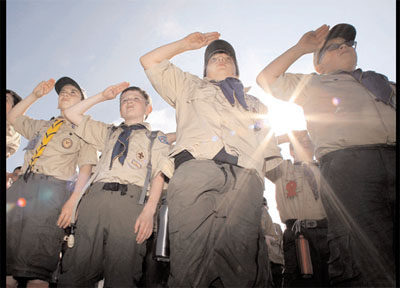
    GRAPEVINE, TEXAS (TIP): The Boy Scouts of America threw open its ranks on Thursday to gay Scouts but not gay Scout leaders – a fiercely contested compromise that some warned could fracture the organization and lead to mass defections of members and donors. Of the roughly 1,400 voting members of the BSA’s National Council who cast ballots, 61 percent supported the proposal drafted by the governing Executive Committee.

    The policy change takes effect on January 1. “This has been a challenging chapter in our history,” the BSA chief executive, Wayne Brock, said after the vote. “While people have differing opinions on this policy, kids are better off when they’re in Scouting.” However, the outcome will not end the bitter debate over the Scouts’ membership policy. Liberal Scout leaders – while supporting the proposal to accept gay youth – have made clear they want the ban on gay adults lifted as well.

    In contrast, conservatives with the Scouts – including some churches that sponsor Scout units – wanted to continue excluding gay youths, in some cases threatening to defect if the ban were lifted. “We are deeply saddened,” said Frank Page, president of the Southern Baptist Convention’s executive committee after learning of the result. “Homosexual behavior is incompatible with the principles enshrined in the Scout oath and Scout law.”

    The Assemblies of God, another conservative denomination, said the policy change “will lead to a mass exodus from the Boy Scout program.” It also warned that the change would make the BSA vulnerable to lawsuits seeking to end the ban on gay adults. Texas Gov. Rick Perry also expressed dismay. “While I will always cherish my time as a Scout and the life lessons I learned, I am greatly disappointed with this decision,” he said.

    The result was welcomed by many liberal members of the Scouting community and by gay-rights activists, though most of the praise was coupled with calls for ending the ban on gay adults. “I’m so proud of how far we’ve come, but until there’s a place for everyone in Scouting, my work will continue,” said Jennifer Tyrrell, whose ouster as a Cub Scout den leader in Ohio because she is lesbian launched a national protest movement. Pascal Tessier, a 16-year-old Boy Scout from Maryland, was elated by the outcome.

    Tessier, who is openly gay, is on track to earn his Eagle Scout award and was concerned that his goal would be thwarted if the proposed change had been rejected. “I was thinking that today could be my last day as a Boy Scout,” Tessier said. “Obviously, for gay Scouts like me, this vote is life-changing.” The vote followed what the BSA described as “the most comprehensive listening exercise in Scouting’s history” to gauge opinions. Back in January, the BSA executive committee had suggested a plan to give sponsors of local Scout units the option of admitting gays as both youth members and adult leaders or continuing to exclude them.

    However, the plan won little praise, and the BSA changed course after assessing responses to surveys sent out starting in February to members of the Scouting community. Of the more than 200,000 leaders, parents and youth members who responded, 61 percent supported the current policy of excluding gays, while 34 percent opposed it. Most parents of young Scouts, as well as youth members themselves, opposed the ban.

    The proposal approved Thursday was seen as a compromise, and the Scouts stressed that they would not condone sexual conduct by any Scout – gay or straight. “The Boy Scouts of America will not sacrifice its mission, or the youth served by the movement, by allowing the organization to be consumed by a single, divisive and unresolved societal issue,” the BSA said in a statement.

    Since the executive committee just completed a lengthy review process, there were “no plans for further review on this matter,” the group added, indicating it would not be revisiting the ban on gay adults anytime soon. Among those voting for the proposal to accept openly gay youth was Thomas Roberts, of Dawsonville, Ga., who serves on the board of a Scout council in northeast Georgia.

    “It was a very hard decision for this organization,” he said. “I think ultimately it will be viewed as the right thing.” The BSA’s overall “traditional youth membership” – Cub Scouts, Boy Scouts and Venturers – is now about 2.6 million, compared with more than 4 million in peak years of the past. It also has about 1 million adult leaders and volunteers. aThose include liberal churches opposed to any ban on gays, but some of the largest sponsors are relatively conservative denominations that have previously supported the broad ban – notably the Roman Catholic Church, the Church of Jesus Christ of Latter-day Saints and Southern Baptist churches.

    While the Southern Baptists were clearly upset by the vote to accept openly gay youth, the Mormon church reacted positively. “We trust that BSA will implement and administer the approved policy in an appropriate and effective manner,” an official LDS statement said. The National Catholic Committee on Scouting responded cautiously, saying it would assess the possible impact of the change on Catholicsponsored Scout units.

    The BSA, which celebrated its 100th anniversary in 2010, has long excluded both gays and atheists. Protests over the no-gays policy gained momentum in 2000, when the US Supreme Court upheld the BSA’s right to exclude gays. Scout units lost sponsorships by public schools and other entities that adhered to nondiscrimination policies, and several local Scout councils made public their displeasure with the policy.

  • Sikhs Take Out An Impressive Sikh Day Parade In New York

    Sikhs Take Out An Impressive Sikh Day Parade In New York

    NEW YORK, NY (TIP): Organized by the Sikh Cultural Society, Richmond Hill, New York, the Sikh Day Parade on April 27 in Manhattan, New York, attracted, as usual, large crowds of Sikh men, women and children from the Tri -States area of New York, New Jersey and Connecticut. Besides, contingents came from as far as Philadelphia and Maryland.

    An estimated 30,000 ( according to the organizers, 50, 000) Sikhs participated. The parade that started from 36th street and Madison Ave wound its way through the city and ended up at 26th Street and Madison Ave for the conference. The event is held annually to mark Vaisakhi, the harvest festival of Punjab that coincides with the day the Tenth Master of the Sikhs, Guru Gobind Singh, created the order of Khalsa in 1699. All along and at the conference, placards with Prof. Davinderpaul Singh Bhullar’s photograph were carried by the participants who raised slogans for freedom for Bhullar and denounced government of India for being unjust to the Sikhs. Pro Khalistan slogans were also raised. The parade was dedicated to Prof. Davinderpaul Singh Bhullar who is in death row in India. The Parade passed a resolution requesting President of USA to secure freedom for Prof. Bhullar. The memorandum to US President alleged atrocities on Sikhs in India in 1984 (Operation Blue Star in which “1600 innocent Sikhs were killed” and killing of Sikhs in the wake of Indira Gandhi’s assassination when “3000 innocent Sikhs were brutally murdered”) and continued injustice to the community in India. It said Prof. Bhullar is being unjustly put to death even though there is no evidence of the crime he is said to have committed.

    The resolution read, inter alia, ” Sikh Cultural Society on behalf of this 50,000 strong peaceful gathering of Sikhs from the Tri-State area, but in spirit of all the Sikh Americans pass the resolution to request Mr. Barack Obama, the President of USA, to use his good offices and ask Indian government to stop the execution of Prof. Bhullar” . The resolution was received by Harpreet Singh Sandhu, an official with the Director of Public Engagement, White House. The first to be asked to speak was the President of Sikh Youth of America, the most vocal Khalistani organization that was founded by Dr. Amarjit Singh of Washington. Gurvinder Singh Manna, in his 8 minute long speech called upon the Sikhs all over the world to raise their voice of protest against death to Prof. Bhullar. He said that Prof. Bhullar’s confessional statement was obtained under duress and there is no witness nor any other corroborative evidence to prove his guilt. Even the judgment of the three judge bench was a split judgment when the presiding judge Justice Shah did not find Prof. guilty. The President of India who rejected Prof. Bhullar’s mercy petition did so without following the proper process of consulting the presiding judge, since the law says in the case of a split judgment, President should confer with the presiding judge in deciding on a mercy petition. Manna called upon Sikhs to work tirelessly to have their homeland without which they will always be subjected to injustice.

    Another noteworthy speaker at the parade conference was Ganga Singh Dhillon, one of the front ranking fighters for Sikh homeland, who, in spite of his frail health, was present to read out the resolution and present his viewpoint. He said, “sloganeering only helps government of India to brand Sikhs as separatists.” He noted that nothing could be achieved by raising slogans. The only way was to fight for Sikh homeland. Obviously, he was repeating himself when he went to Pakistan and from there organized the militant movement for Khalistan. Others who spoke included Boota Singh Kharaund, President of Shiromani Akali Dal , Mann (Simranjit Singh Mann ), Attorney Jaspreet Singh, Baljinder Singh Brar from Gurdwara Dashmesh Darbar, Carterot, Gurmej Singh, President, Gurdwara Baba Makhan Shah Lobana, New York, and Hardev Singh Padda, President, Sikh Gurdwara, Flushing. Two former Khalistani leaders, Gurmit Singh Auluck and Paramjit Singh Ajarawat, from Washington appeared to be ignored by the organizers. Auluck used to be the principal voice of Khalistanis some 20 years ago. He held sway up to 2000 and then faded out. Paramjit Ajarawat also was a potent Khalistani voice but now seems to have lost esteem with the Sikh leaders.

    They were invited to speak at the end when the gathering had almost left. Their disappointment was writ large on their faces. Contrary to their fate, resurrection of octogenarian Ganga Singh Dhillon, who has links in Pakistan, is surprising and intriguing. Among the political leaders and law makers present were Congresswoman Grace Meng, Council Member Mark Weprin, and Reshma Saujani who is seeking election to the Public Advocate in September, 2013. Gurdev Singh Kang, President of the Sikh Cultural Society which organizes the parade every year, expressed his gratitude to the participants for turning out in large numbers and celebrating the event in a befitting manner. He thanked the guest speakers, including the local politicians and law makers, for their time and valuable views they expressed.

  • Toy-car remote used in Boston bombings

    Toy-car remote used in Boston bombings

    BOSTON (TIP): The Chechen-origin Boston bombings suspects used a remote-control device from a toy car to set off explosives and apparently learnt to build a bomb from an al-Qaida online magazine, a top American lawmaker has said. Maryland representative Dutch Ruppersberger, the top Democrat on the House Intelligence Committee, confirmed the details after a closed-door briefing with three senior national security officials on Capitol Hill.

    Two Chechen-origin brothers Tamerlan Tsarnaev, 26, and Dzhokhar Tsarvaev, 19, have been accused of carrying out the deadly Boston Marathon bombings at the finish line that claimed three lives and injured over 250. Ruppersberger said based on information from Dzhokhar it appears the brothers learned how to build the bomb from Inspire magazine, a publication founded by Anwar al-Awlaki, the now-deceased al-Qaida leader. “That has always been a concern of ours,” Ruppersberger said. “That magazine was put out to recruit more people for jihad.”Ruppersberger also gave more details on Russia’s contact with the United States regarding Tamerlan.Following Russia’s request to FBI regarding Tamerlan, Ruppersberger said US officials asked Russian authorities three times for more information, but never got a response.

  • US: Storm strikes mid-Atlantic; 250,000 lose power

    US: Storm strikes mid-Atlantic; 250,000 lose power

    WASHINGTON (TIP): A winter storm marched into the Mid-Atlantic region on Wednesday, dumping nearly two feet of snow in some places and knocking out power to about 250,000 homes and businesses. It largely spared the nation’s capital, which was expecting much worse and had all but shut down. Officials in Washington didn’t want a repeat of 2011, when a rush-hour snowstorm stranded commuters for hours, so they told people to stay off the roads and gave workers the day off. Dubbed the ” snowquester,” the storm closed federal government offices, just as the automatic budget cuts known as the sequester were expected to do. The storm pummeled the nation’s midsection on Tuesday, killing at least four people in weather-related traffic accidents.

    It was forecast to head to the northeast on Thursday, bringing strong winds, more snow and the possibility of coastal flooding to New England. The National Weather Service was predicting up to 7 inches of heavy, wet snow in southeastern Connecticut through Friday morning and wind gusts that could hit 50 mph, bringing possible power outages. A coastal flood warning was in effect starting Thursday morning for eastfacing shores in Massachusetts, with up to a 3-foot surge at high tide in some areas.

    Central Massachusetts was bracing for 4 to 8 inches of snow, while Boston was expected to get a little less. In Washington, where as much as 10 inches had been forecast, the storm did little but drop harmless snowflakes that rapidly melted amid warmer-than-expected temperatures. Federal offices in the region will be open Thursday. “They just say that it might snow and the whole city shuts down,” said Sheri Sable, who was out walking her two dogs in light rain and marveled at how even the dog park she frequents failed to open at 7am. There were bigger problems elsewhere in the region, though. On the Jersey Shore, still recovering from Superstorm Sandy, winds gusted past 60 mph in some parts.

    Winds raked the beachfront in Point Pleasant Beach, blowing drifts of sand onto Ocean Avenue, and shredding the decorative entrance canopy at a hotel across the street from the beach. Lashing winds also blew off part of the roof of a Stone Harbor, N.J., condominium complex and Ocean City officials advised residents to move their cars to higher ground in preparation of possible flooding. Maryland’s Bay Bridge, which connects Maryland’s Eastern shore with the Baltimore-Washington region, closed in both directions, because of wind gusts of up to 60 mph.

    A tractor-trailer overturned on the bridge and leaned against the guardrail. Kelly Kiley, an interior designer, was driving on the span soon after the accident. “The travel on the bridge was extremely scary,” Kiley said. “The crosswinds were terrible. Some of the taller box trucks were swaying.” The bridge reopened Wednesday evening. In North Carolina, state officials said high winds led to sound side flooding along N.C. 12 and brought the Hatteras-Ocracoke ferry run to a halt. In Virginia, governor Bob McDonnell declared a state of emergency and about 50 National Guard soldiers were sent out to help clear roads. Up to 20 inches of snow piled up in central and western parts of the state. More than 200,000 people in Virginia alone lost power and another 40,000 in New Jersey were left in the dark. Hundreds of wrecks were reported around the region. “Stay off the roads, stay inside, enjoy the day off,” McDonnell implored residents at an early-afternoon news briefing.

    In Richmond, most commuters appeared to be headed home by midday with the exception of Clint Davis, an attorney who was needed in US Bankruptcy Court. “Unless they canceled court, I had to be here,” said Davis, who was wearing a hooded slicker over his suit to shield himself from gobs of snow blown from trees. “I’ll be here for two or three hours and come out to a snow-covered car.” The storm dumped 2 feet of snow in parts of West Virginia, closing schools in more than half the state and leaving more than 20,000 customers without power. Some communities in Washington’s outer suburbs saw significant accumulation too, including in Loudoun County, which had 9 inches in some places.

    In Sterling, Va., a glaze of slush and snow coated major roads and side streets, but traffic was relatively light and plow trucks passed through repeatedly. Many retailers were closed. Only a handful of customers patronized the Glory Days Grill. Carolyn Donahue was working from home and trekked out with her husband, Tom, for a lunch break without any trouble on slushy but passable roads. “I don’t consider this a big storm,” he said. Downtown Washington was unusually quiet. Officials eager to avoid a repeat of 2011 pre-emptively shut down federal offices and canceled public schools. Nonemergency federal employees were treated to a paid snow day for the number of hours they were scheduled to work.

    Some congressional hearings were postponed, but the House of Representatives managed to approve legislation to prevent a government shutdown on March 27 and President Barack Obama was set to have dinner with GOP senators at a hotel on Wednesday night. “So far, knock on wood, we’ve dodged on this one,” said DC Homeland Security director Chris Geldart. “We’re keeping our fingers crossed that it remains the way it’s been.” The Baltimore-Washington area’s last major snowstorm struck Jan. 26, 2011. It hit Washington during the evening rush hour, causing some motorists to be stuck in traffic nearly overnight. It dropped 5 inches on Washington and 7.8 inches on Baltimore, knocked out power to about 320,000 homes and contributed to six deaths.

    The federal government later changed its policies to allow workers to leave their offices sooner or to work from home if major storms are expected. The current storm led to at least four deaths. A semi-trailer slid off a snowcovered interstate in western Wisconsin, killing two people. A central Indiana woman died when a semi-trailer plowed into her car after she lost control merging onto the highway, and a man from Columbia City in northeast Indiana was killed when his snowmobile left the road, headed across a field and crashed into a wire fence.

    The storm brought around 10 inches of snow to weather-hardened Chicago on Tuesday, prompting the closing of schools and the cancellation of more than 1,100 flights at the city’s two major airports. Hundreds more flights were canceled Wednesday at Dulles and Reagan National airports in the Washington area, according to FlightAware.com. In Pennsylvania and Ohio, many areas had 4 to 6 inches of snow. The weather service issued a winter storm warning for the Philadelphia area and parts of central Pennsylvania through morning.

  • President Obama Presents National Science & Technology Awards

    President Obama Presents National Science & Technology Awards

    WASHINGTON (TIP): PresidentBarack Obama, presented theprestigious National Medal ofTechnology and Innovation to eminentIndian American RangaswamySrinivasan for his groundbreakingwork with laser.Rangaswamy received the awardalong with Samuel Blum and JamesWynne, for the pioneering discovery ofexcimer laser ablativephotodecomposition of human andanimal tissue, laying the foundationfor PRK and LASIK laser refractivesurgical techniques, that haverevolutionized vision enhancement.

    At a glittering function heldFebruary 1 at the White House, Obamapresented National Medal of Scienceto 12 eminent scientists while 11extraordinary inventors receivedNational Medal of Technology andInnovation, the highest honorsbestowed by the United StatesGovernment upon scientists,engineers, and inventors.Established by statute in 1980, theNational Medal of Technology andInnovation was first awarded in 1985and is administered for the WhiteHouse by the US Department ofCommerce’s Patent and TrademarkOffice.

    Congratulating scientists andinventors Obama said if there is oneidea that sets this country apart, oneidea that makes it different from everyother nation on Earth, it’s that here inAmerica, success does not depend onwhere one is born or what his / herlast name is.”Success depends on the ideas thatyou can dream up, the possibilitiesthat you envision, and the hard work,the blood, sweat and tears you’rewilling to put in to make them real,”he said.”We have a map of the humangenome and new ways to producerenewable energy. We’re learning togrow organs in the lab and betterunderstand what’s happening in ourdeepest oceans.

    And if that’s not enough, the peopleon this stage are also going to beresponsible for devising a formula totame frizzy hair as well as inspiringthe game Tetris,” Obama said amidstlaughter.”It is a huge honor to receive thisaward for our research more thanthirty years after its initial discovery.This achievement is a reflection ofIBM’s culture of innovation, to thinkfar into the future, and a result ofenabling different disciplines to cometogether to tackle real-world challengeswith a broad domain of expertise,” saidDr Wynne of IBM Research.

    In 1981, Srinivasan discovered thatan ultraviolet excimer laser could etchliving tissue in a precise manner withno thermal damage to the surroundingarea. He named the phenomenonAblative Photodecomposition (APD),which later revolutionized eye surgery.Inducted into the US “Inventor Hallof Fame” in 2002, Srinivasan has spent30 years at IBM’s T J Watson ResearchCenter. He received both bachelor’sand master’s degrees in science fromthe University of Madras, in 1949 and1950. He earned doctorate in physicalchemistry at the University ofSouthern California in 1956. Hecurrently holds 21 US patents.

    The 12 winners of the NationalMedal of Science are:

  • Dr. Allen Bard, University ofTexas at Austin, Texaso
  • Dr. Sallie Chisholm,Massachusetts Institute ofTechnology, Massachusettso
  • Dr. Sidney Drell, StanfordUniversity, Californiao
  • Dr. Sandra Faber, University ofCalifornia, Santa Cruz,Californiao
  • Dr. Sylvester James Gates,University of Maryland,Marylando
  • Dr. Solomon Golomb, Universityof Southern California,Californiao
  • Dr. John Goodenough, Universityof Texas at Austin, Texaso
  • Dr. M. Frederick Hawthorne,University of Missouri, Missourio
  • Dr. Leroy Hood, Institute forSystems Biology, Washingtono
  • Dr. Barry Mazur, HarvardUniversity, Massachusettso
  • Dr. Lucy Shapiro, StanfordUniversity School of Medicine,Californiao
  • Dr. Anne Treisman, PrincetonUniversity, New Jersey
  • The 11 winners of the National Medal of Technology and Innovation are:

  • Dr. Frances Arnold, California Institute of Technology,California
  • Dr. George Carruthers, US Naval Research Lab, Washington, DC
  • Dr. Robert Langer, Massachusetts Institute of Technology,Massachusetts
  • Dr. Norman McCombs, AirSep Corporation, New York
  • Dr. Gholam Peyman, Arizona Retinal Specialists, Arizona
  • Dr. Art Rosenfeld, Lawrence Berkeley National Laboratory, California
  • Dr. Jan Vilcek,NYU Langone Medical Center, New York
  • The team of Dr. Samuel Blum,
  • Dr. Rangaswamy Srinivasan Dr. James Wynne, IBM Corporation, New York
  • The company of Raytheon BBN Technologies, Massachusetts,represented by CEO Edward Campbell.
  • President Obama Unveils Sweeping Plan to Curb Gun Violence

    President Obama Unveils Sweeping Plan to Curb Gun Violence

    WASHINGTON (TIP): President Obama’s January 16 plan to curb gun violence in America has met with a mixed reaction, from a cautious endorsement to an outright rejection. Obama is asking Congress to implement mandatory background checks for all gun purchases, including private sales; reinstate a ban on some assault-style weapons; ban high-capacity magazines holding more than 10 rounds; and crackdown on illicit weapons trafficking.The president’s proposal also includes new initiatives for school safety, including a call for more federal aid to states for hiring so-called school resource officers (police), counselors and psychologists, and improved access to mental health care.

    Obama also initiated 23 executive actions on gun violence, policy directives not needing congressional approval. Among them is a directive to federal agencies to beef up the national criminal backgroundcheck system and a memorandum lifting a freeze on gun violence research at the Centers for Disease Control and Prevention. “I intend to use whatever weight this office holds to make them a reality,” Obama said at a January 16 midday event in a White House auditorium. “If there’s even one thing that we can do to reduce this violence, if there’s even one life that can be saved, then we have an obligation to try. “And I’m going to do my part.”

    Here, from the Associated Press, is the full list of gun control proposals and actions: Items That Require Congressional Action

  • Requiring background checks on all gun sales. The Brady Campaign to Prevent Gun Violence says 40 percent of gun sales are conducted with no criminal background check, such as at gun shows and by private sellers over the Internet or through classified ads. Obama said there should be exceptions for cases like certain transfers among family members and temporary transfers for hunting purposes.
  • Reinstating the assault weapons ban. A 10-year ban on high-grade, military-style weapons expired in 2004. Senate Majority Leader Harry Reid, D-Nev., says such a ban might clear the Senate but doubts it could get through the House.
  • Renewing a 10-round limit on the size of ammunition magazines.
  • Prohibiting the possession, transfer, manufacture and import of dangerous armor-piercing bullets.
  • Senate confirmation of a director for the Bureau of Alcohol, Tobacco, Firearms and Explosives. The agency has been run by an acting director, Todd Jones, whom Obama will nominate to become director.
  • New gun trafficking laws penalizing people who help criminals get guns.
  • Items to Be Accomplished by Executive Order

  • Address legal barriers in health laws that bar some states from making available information about people who are prohibited from having guns.
  • Improve incentives for states to share information with the background check system. o Make sure that federal agencies share relevant information with the background check system.
  • Direct the attorney general to work with other agencies to review existing laws to make sure they can identify individuals who shouldn’t have access to guns.
  • Direct the Centers for Disease Control and Prevention and other research agencies to conduct research into the causes and prevention of gun violence.
  • Clarify that no federal law prohibits doctors or other health care providers from contacting authorities when patients threaten to use violence.
  • Give local communities the opportunity to hire up to 1,000 school resource officers and counselors. o Require federal law enforcement to trace all recovered guns.
  • Propose regulations that will enable law enforcement to run complete background checks before returning firearms that have been seized.
  • Direct the Justice Department to analyze information on lost and stolen guns and make that information available to law enforcement.
  • Provide training for state and local law enforcement, first responders and school officials on how to handle activeshooter situations.
  • Make sure every school has a comprehensive emergency management plan.
  • Help ensure that young people get needed mental health treatment.
  • Ensure that health insurance plans cover mental health benefits.
  • Encourage development of new technology to make it easier for gun owners to safely use and store their guns.
  • Have the Consumer Product Safety Commission assess the need for new safety standards for gun locks and gun safes.
  • Launch a national campaign about responsible gun ownership.
  • The announcement comes one month after a mass shooting at Sandy Hook Elementary School in Newtown, Conn., left 26 dead, including 20 children. Obama called it the worst moment of his presidency and promised “meaningful action” in response. The proposals were the work of an Obama-appointed task force, led by Vice President Joe Biden that held 22 meetings on gun violence in the past three weeks. The group received input from more than 220 organizations and dozens of elected officials, a senior administration official said. As part of the push, Obama nominated a new director for the Bureau of Alcohol, Tobacco and Firearms, which leads enforcement of federal gun laws and has been without a confirmed director for six years.

    The president appointed acting director Todd Jones, the U.S. attorney for Minnesota, to the post, if the Senate confirms him. The administration’s plan calls for aid to states for the hiring of more school resource officers, counselors and psychologists. Obama also directed the Department of Education to ensure all schools have improved emergency-response plans. He also called on Congress to make it illegal to possess or transfer armor-piercing bullets; it’s now only illegal to produce them. “To make a real and lasting difference, Congress must act,” Obama said. “And Congress must act soon.” Officials said some of the legislative measures Obama outlined could be introduced on Capitol Hill next week. The price tag for Obama’s entire package is $500 million, the White House said.

    “House committees of jurisdiction will review these recommendations,” a spokesman for House Speaker John Boehner said in response to Obama’s announcement. “And if the Senate passes a bill, we will also take a look at that.” The proposals are already being met with stiff opposition from gun rights advocates, led by the National Rifle Association, which overnight released a scathing ad attacking the president as an “elitist hypocrite.” “Are the president’s kids more important than yours?” the narrator of the NRA ad says. “Then why is he skeptical about putting armed security in our schools, when his kids are protected by armed guards at their school?” Obama has questioned the value of placing more armed guards at schools around the country, although his proposal does call for placement of more police officers at public schools.

    The NRA opposes most of the other gun restrictions Obama has proposed. “Keeping our children and society safe remains our top priority,” the NRA said in a statement after Obama’s announcement. “Attacking firearms and ignoring children is not a solution to the crisis we face as a nation,” the group said. “Only honest, law-abiding gun owners will be affected and our children will remain vulnerable to the inevitability of more tragedy.”

    Hurdles for Gun Laws in Congress
    Many members of Congress from both parties are also skeptical that some of the proposed new restrictions on gun sales can be effective, much less pass. “Nothing the president is proposing would have stopped the massacre at Sandy Hook,” Republican Sen. Marco Rubio of Florida said. “President Obama is targeting the 2nd Amendment rights of law-abiding citizens instead of seriously addressing the real underlying causes of such violence.” Senate Majority Leader Harry Reid, a Democrat and gun owner, told a Las Vegas TV station Friday, “Is [the assault weapons ban] something that can pass the Senate? Maybe. Is it something that can pass the House? I doubt it.

    So I think there are things that we know we can do.” Before the announcement, the White House downplayed challenges facing individual aspects of gun-control proposals — most notably the assault weapons ban — stressing that no single measure can solve the epidemic of gun violence sweeping the country. They also pointed to successful steps on guns already taken on the state level. New York State, for instance, approved the nation’s most stringent gun-control law Tuesday, tightening a ban on assault-style weapons and beefing up protections to keep guns from the mentally ill. Obama might travel the country seeking to leverage popular support for his proposals to urge action in Congress, officials said.

    He is also expected to mobilize his network of campaign supporters to participate in advocacy on guns. “This will not happen unless the American people demand it,” Obama said today of his plan. “If parents and teachers, police officers and pastors, if hunters and sportsmen, if responsible gun owners, if Americans of every background stand up and say, enough, we suffered too much pain and care too much about our children to allow this to continue, then change will come. That’s what it’s going to take.” Dozens of kids have written to the president about gun violence, officials said, including 8-year-old Grant Fritz of Maryland, who wrote in a letter released by the White House, “There should be some changes in the law with guns.

    It’s a free country, but I recommend there needs be [sic] a limit with guns.” “Their voices should compel us to change,” Obama said of the children. Obama was joined for his announcement by seven cabinet secretaries, including Attorney General Eric Holder, Education Secretary Arne Duncan and Homeland Security Secretary Janet Napolitano, other local law enforcement leaders and mayors, and the families of victims and survivors of the Newtown shooting.

    Popular Support for Gun Rules
    Many of Obama’s proposals have strong support in the latest ABC News-Washington Post poll released Monday, January 15. Eighty-eight percent of Americans favor expanding required background checks to buyers at gun shows; 76 percent favor checks on anyone buying ammunition. New restrictions on high-capacity magazines are backed by 65 percent of Americans in the poll, with 58 percent supporting a ban on the sale of assault-style weapons. Thirty-nine percent oppose such a ban. The NRA’s proposal to place an armed guard in every school received 55 percent support in the survey.

  • Dr. Prasad Bags Gia International Excellence Award

    Dr. Prasad Bags Gia International Excellence Award

    WASHINGTON (TIP): Dr C. Prasad, an eminent psychiatrist of Washington DC was conferred with the prestigious International Excellence Award 2013 by Global Indian Association (GIA) on the sidelines of Pravasi Bharatiya Divas in Kochi, Kerala for his contribution to the field of medicine by Andhra Pradesh Minister for Information Technology and Communications Ponnala Lakshmaiah at a grand function held at Hotel Crowne Plaza in Kochi last week. Global Indian Association (GIA) headquartered in New Delhi has been serving the Non- Resident Indians such as launching a campaign to legalize Postal Voting System for them around the world under the supervision of Indian Embassies / Consulates.

    Lakshmaiah in his address praised the services of Dr Prasad and said he was proud that the recipient of the award also hails from Andhra Pradesh. The Minister said Andhra Pradesh has been a forerunner in attracting NRI investments. One out of every three software professionals globally is from India and that one out of every three such Indians is from Andhra Pradesh. In fact, IT can be coined as Indian Talent. Andhra Pradesh continues to be a favorite destination for industrial investment from all over the world. Industrial investment in the state is consistently growing and the investments received during 2010-11 stands at Rs 29,995 crores recording a growth of 67 percent over 2009-10, he said.

    K. Babu, Kerala Minister for Fisheries said GIA has been working to extend legal and possible intervention besides bring up the matter to the Indian authorities and pressurize the Indian authorities leading to the release of hapless Indians languishing in jails in Gulf countries. Rajeev Joseph, founder-president of the Association said GIA will act as a pressure group to speed up the welfare activities for NRIs initiated by Government of India through Indian Embassies and Consulates in all countries. GIA will also open institutions of higher learning to help children of NRIs returning home with the help of GIA volunteers as stake holders. Indians around the world to be a part of a network extending help to Indians in distress at various countries GIA work for unity and amalgamation of Indian Associations around the globe to serve the Indian Diaspora in a multi-pronged way.

    Dr. Prasad did his MD and PhD and working as attending psychiatrist at Crossroads Professional Counseling Centers in Annandale, VA. Dr. Prasad was made Distinguished Fellow 0f the American Psychiatric Association (DFAPA) and also American Board of Psychiatry and Neurology in 2011, American Board of Addiction Medicine, American Board of Physician Specialists, American Board of Psychiatric Medicine, American Board of Pain Management, and National Association of Certified Hypnotherapists. In 2007, the Global Organization for People of Indian Origin (GOPIO) presented him with an award him for outstanding professional presentation on mental health issues facing India and unswerving and undaunted support for the vision and mission of GOPIO. In 2010, he received Maryland India Business Round Table award for excellence in Psychiatry and also Maryland Governor’s Citation 2011 in recognition of leadership in promoting business, trade and job growth in Maryland.

    Dr. Prasad contributed to a training DVD as an Examining Physician of a Patient Interview for the mock exam Vol. 3. This 75 minute DVD was prepared by American Physician Institute for Advanced Professional Studies (Beat the Boards!) which was distributed to over 3000 candidates taking Psychiatry Part II board exam in the United States. He was also given National leadership Award by National Republican Congressional Committee in recognition of outstanding service and commitment to Republican ideals and in particular for assistance and guidance administered to the Republican Leadership in the area of Health Care Reform. He is the member of American Psychiatric Association, Washington Psychiatric Society, American Association of Physicians of Indian origin (AAPI); Virginia Association of Physicians of Indian Origin; American Association of Addiction Medicine, American Association of Pain Management and International Society of Addiction Medicine.

  • INOC AP Chapter Accords Warm Reception To Visiting Andhra Pradesh Minister K. Lakshaminarayana

    INOC AP Chapter Accords Warm Reception To Visiting Andhra Pradesh Minister K. Lakshaminarayana

    NEW YORK (TIP): Farmers and farming policy makers in Andhra Pradesh will benefit from the expertise of American researchers and educators in near future. K. Lakshminarayana, AP’s Minister of Agriculture, recently signed memos of understanding with the universities of Maryland and Mississippi during his recent visit to the two universities, which will facilitate exchange of faculty members and academicians between USA and Andhra Pradesh. Lakshminarayana, stopped in New York City on his way home from the visit.

    He was accorded a warm welcome and reception by the Andhra Pradesh Chapter of Indian National Overseas Congress at Cotillion Restaurant in Long Island, New York. Lakshminarayana (52), who has been credited for winning all elections since 1991, complimented the people of Andhra Pradesh for playing a predominant role in the IT sector in Silicon Valley and other parts of USA. Lakshminarayana, who won the Assembly seat from Pedukurapadu, Guntur (West) constituency for the fourth term, outlined his government’s plans to help farmers in Andhra Pradesh and said that Congress party believed in a farmer friendly policy. He said that hundred of thousands of farmers were benefitted by government’s free electricity; crop insurance and the credit plan called Kissan Credit.

    The minister informed that his state will host the world Agricultural Summit in November 2013 for which Hyderabad was selected as the venue. He invited those whose primary interest was agricultural development. Andhra Pradesh chapter of INOC honored the minister by presenting him a shawl. A proclamation from the Chief Executive of Nassau County was also presented to him. Mahesh Saladi, AP chapter president of INOC, said that Congress party embarked on ambitious projects to help the poor in Andhra Pradesh. “Many of those programs were initiated by K. Lakshminarayana and were timely completed”, he said George Abraham, president of INOC said that his party was engaged in building public opinion on a variety of issues.

    “We are united over raising the issues concerning Non-Resident Indians”, he said adding that NRI Interface council was formed for the purpose of dealing with issues such as property protection in India. It was reported in the past that in India locals forcibly grabbed properties bought and owned by NRIs. Abraham said that he also initiated Business council for the purpose of promoting investment in India and discussing matters of trade and commerce with the Indian government. “We want the council to be thank tank for developmental issues”, he said. Others who spoke on the occasion included Dr. Neil Mandava, Dr. Gaddam Reddy, D. Dhasratharam Reddy, M. Nageshwar Rao and Mohinder Singh Gilzian.

  • Morgan State Professor Manoj Jha Accused of Stealing Grant Money

    Morgan State Professor Manoj Jha Accused of Stealing Grant Money

    WASHINGTON (TIP): A full-time engineering professor at Morgan State University was indicted by a federal grand jury Wednesday, November 14 in an alleged scheme to defraud the National Science Foundation of hundreds of thousands of dollars in grant funding. According to the seven count indictment, Jha fraudulently obtained $200,000 in grant funds from the NSF’s Small Business Technology Transfer (STTR) program to fund a highway project, and attempted to obtain another $500,000 though the same program.

    Manoj Kumar Jha, 45, who oversees the university’s transportation engineering graduate program, according to the university’s website, allegedly fabricated an elaborate research proposal on behalf of a private company he founded and then applied for funding through the NSF’s Small Business Technology Transfer program, according to the Maryland U.S. attorney’s office.

    According to prosecutors, “the stated purpose of Jha’s proposed project was to enhance current models used by highway planners to optimize horizontal and vertical highway routes, and ultimately, to commercialize the result.” Morgan State University, 1700 E Cold Spring Ln, Baltimore, MD 21251, USA Jha received $200,000 to conduct the research but instead allegedly made personal mortgage and credit card payments, paid his wife $11,000 for work she didn’t do and wrote himself a $6,000 check, prosecutors said.

    Jha, who is also the founding director of Morgan State’s Center of Advanced Transportation and Infrastructure Engineering Research, also applied for $500,000 more for the project but did not receive it, prosecutors said. Jha could not be reached for comment, and an attorney has not entered the case on his behalf. Phone calls to his home in Severn went unreturned. A university spokesman also did not return requests for comment. The alleged fraud occurred between January 2008 and July 2009, and involved Jha’s lying on grant applications about his intention to take leave from Morgan State to work on the proposed project and about the University of Maryland’s being a collaborating research institution.

    He also allegedly lied about another Morgan State professor’s serving as a scientific adviser on the project and about receiving $100,000 in matching funds from a third party, a requirement of NSF grants, prosecutors said. According to the university’s website, Jha was born in a village in India in 1967. After obtaining a bachelor’s degree in engineering, he immigrated to the United States in 1991, earned a master’s degree in mechanical engineering from Old Dominion University in 1993, became a registered professional engineer in Maryland in 1997 and earned a doctorate in civil engineering in 2000 from the University of Maryland.

    He worked for seven years at the Maryland State Highway Administration, where he served as the “Year 2000 Risk Manager,” according to his biography on the Morgan State website. “He received several awards by the Governor of the State of Maryland for his diligent work towards the Y2K risk management for the SHA,” the biography says. Jha has been published many times – “more than 160 peer-reviewed research articles, including two books and more than 50 journal papers,” the biography says – and has received funding from many organizations.

    In addition to the NSF, a federal agency created to fund and promote scientific progress, Jha’s biography says he has received grant funding from the SHA, the Federal Highway Administration, the Army Corps of Engineers, the Department of Homeland Security, the Army Research Laboratory and Baltimore City. In February 2011, an investigator with the NSF’s Office of Inspector General “sent Jha a letter requesting copies of various documents, including a list of all individuals who worked on the highway project and their time sheets, and the company’s expenditure ledger detailing all budget categories,” as part of a review of his company’s compliance with grant conditions, prosecutors said.

    Calls and emails to the NSF and the OIG requesting comment were not returned. In March 2011, Jha allegedly sent back faked time sheets for a purported research scientist as well as a copy of a faked expenditure ledger “in which he allegedly entered fictitious research expenses in order to conceal the fact that NSF funds had been converted to Jha’s personal use,” prosecutors said. Jha faces a maximum 20 years in prison for each of five wire fraud counts, a mail fraud count and a falsification of records, prosecutors said.

  • More than 110 Perish-NY hardest hit with 48 lives lost

    More than 110 Perish-NY hardest hit with 48 lives lost

    NEW YORK (TIP): Hurricane Sandy will be remembered as one of the biggest in the history of the states located North of Washington D.C. It was eight hundred miles long and four hundred miles wide. The winds were gusting at 90 to 115 miles per hour, which is equal to 150 to 190 kilometers. Unprecedented rainfall ranging from 8 inches upwards was wreaking havoc with the communities falling in its unexpected route. The winds shattered doors and windows of several homes and blew off many roofs.

    It originated in the warm Caribbean Islands (West Indies) and its cyclonic rains took 69 lives in the tropical archipelago. Such storms, of smaller proportions have been hitting the Caribbean Islands and America before too, but the dimensions have never been so massive and these storms have never made landfall as far North as New Jersey.was not so much in the area of its eye. The worst damage was within a radius of hundred to two hundred miles around the eye.

    This circular path of devastation included entire New Jersey and Long Island area of New York. Some areas of New York city, including Staten Island, Queens and Lower Manhattan were hit hard. The full moon high tides in the Hudson and the East River inundated the low lying areas. The hundred year tidal elevation in coastal New Jersey ranges between ten and twelve feet, but the tidal surges of this storm exceeded those figures by several feet. As a result, there were massive power outages and some fires in the flooded regions. Days after the storm, a lot of communities all over New York and New Jersey are still without electricity. More than a hundred deaths have been confirmed so far. Some fatalities are still being found in houses. The worst property and infrastructure damages occurred in New Jersey. But New York suffered the highest death toll, after 9/11.

    There are hundreds of barrier islands in New Jersey. These barrier islands are a natural protection for the hinterland of the state. There are small bushes, wild grass and dwarf trees on these islands. During the coastal storms and Nor-Easters, the vegetation gets destroyed, but roots stay and the lost vegetation comes back. Before the European immigrants arrived in this country, these islands were practically uninhabited. Some of the adventurous Red Indians used to fish on these beauties during the day, but used to return home by nightfall. But the modern days Americans built communities with all modern facilities on some of these islands. During this hurricane, these barrier islands suffered the brunt of the fury. Some were wiped out in entirety and some were badly obliterated. It will be a gigantic task to restore normalcy on these islands. Some may have to be abandoned.

    Hurricane Sandy has done extensive damage to vital installations and properties in all states. Most heavily impacted municipalities are in the coastal regions of Maryland, Delaware, Pennsylvania, New Jersey, Connecticut and New York. On the first day, the financial losses have been roughly assessed at thirty five billion dollars. By now the losses have been revised to put the final figure at well past one hundred billion dollar mark. When final figures are tallied, the figures may increase substantially. This impact of the unprecedented storm is going to be harsh on the insurance companies. Most of them will ask for increased home insurance costs from their customers, when the next premium paying time comes. The FEMA has been very helpful with its generous financial and logistics help and so was the U.S. Army. Eight thousand electric experts from other states, along with their massive equipment, were in New Jersey alone. They have been working day and night to restore power in all affected states. Giant C-130 cargo planes have transported heavy electrical equipment from far flung areas like California.

    Considering massive damage to the properties and installations, the restoration of all electricity and other services shall need billions of dollars of new expenditure. Damaged home appliances, furniture, carpets and fittings shall have to be replaced. Hundreds of thousands of permanent gas operated generators shall have to be installed. Indubitably, Sandy has not only been the biggest storm in tears but also one of the most expensive.

  • The United States and India: A Vital Partnership in a Changing World

    The United States and India: A Vital Partnership in a Changing World

    The issue that I’ve been asked to address today — India’s rise and the promise of U.S.-Indian partnership — is one of those rarest of Washington species, especially ten days before a Presidential election, a genuinely bipartisan policy priority. I have been fortunate to play a small role in building our relationship with India over the past five years, spanning two U.S. Administrations, including the completion of the historic civil nuclear agreement by then-President Bush and Prime Minister Singh in 2008, and the landmark visits of Prime Minister Singh to the U.S. in 2009 and President Obama to India in 2010. I just returned from another visit to New Delhi, at the end of a fascinating trip across Asia, surely the most consequential region of the world in the new century unfolding before us.

    I remember well all the questions that spun around our relationship four years ago, as the Bush Administration gave way to the Obama Administration. Would we “re-hyphenate” relations with India, and see India mainly through the prism of preoccupations in Afghanistan and Pakistan? Would we be tempted by visions of a “G-2” world, subordinating relations with India to the significance of a rising China? Would India see as clearly as others how important its role in the world was becoming, and see beyond its G-77 past to its G-20 future? Would Indians embrace the rising responsibilities that come with rising influence?

    Debates were held. Papers were written. Hands were wrung. But together we’ve largely moved beyond those honest questions and concerns. Of course some suspicions linger, and some differences persist, which is only natural. Of course we have a great deal more work to do. But there is growing confidence in both our countries about what my longtime colleague and friend, India’s National Security Advisor Shivshankar Menon, has recently described as a steady convergence of interests and values. Indians and Americans, it seems to me, understand that the only “hyphen” we will pursue with respect to our relationship is the one that links the United States and India.

    The essence of the vital partnership that we’re building lies in a simple truth. For the first time, for both of us, our individual success at home and abroad depends significantly on our cooperation.

    Progress between us won’t always be measured in dramatic breakthroughs, like President Bush’s civil-nuclear initiative, or dramatic moments, like President Obama’s declaration of support for India’s permanent membership in a reformed UN Security Council. It won’t be measured in diplomatic honeymoons which never end. It won’t be measured in some special alchemy that magically transforms strategic convergence and powerful aspirations into meaningful cooperation.

    The real measure of progress in our increasingly vital partnership will instead be steady focus, persistence, hard work, systematic habits of collaboration, and methodically widening the arc of common interests and complementary actions. With that in mind, let me highlight quickly three important dimensions of the work — and the promise — that lies ahead of us: strengthening strategic cooperation; building shared prosperity; and deepening people to people ties.

    I. Strategic Cooperation

    First, as India’s recent economic rise has expanded its role and deepened its stake in shaping the international system, we are counting on India’s rise as a truly global power — one that looks east and west, a strategic partner for economic growth, security, and the provision of public goods.

    Last December in Pune, I spoke to Indian international affairs students. I told them that the U.S.-India relationship must be a cornerstone of the Asia-Pacific century ahead. And as the world’s economic and strategic center of gravity shifts east, the United States is not the only nation emphasizing its role as a resident diplomatic, economic and military power in the Asia-Pacific. India’s distinguished former Foreign Secretary, Shyam Saran, has also observed that India’s own engagement in East Asia reflects “the concept of the Asia-Pacific, which hitherto excluded India, expanding westwards to encompass the subcontinent as its integral part.”

    India and the United States have a powerful and shared interest in an Asia-Pacific where economic interdependence drives growth and shared prosperity … where disputes are resolved peacefully… where rules are respected and patterns of political and economic behavior favor openness. So we are working to define a shared agenda to help achieve and assure those goals.

    India has shown increasing signs that it intends to build on its longstanding “Look East” policy. I came away from my recent visits to India and Burma with renewed admiration for the East-West connectivity agenda India’s leadership is advancing across Southeast Asia. India is revitalizing centuries-old commercial ties with countries to its east and making headway on an Indo-Pacific corridor through Bangladesh and Burma that connects South and Southeast Asia.
    India just hosted the Mekong-Ganga ministerial meeting and held 2+2 consultations with Japan, and next week will host the U.S. and Japan for trilateral consultations. The ASEAN-India Summit will come to New Delhi this winter. Some may dismiss India’s efforts to become more embedded in the regional diplomatic architecture of the East Asia Summit, ASEAN Regional Forum and APEC as maybe good for India’s hotel industry, but really just so many talk shops. But consider this: last week, India’s External Affairs Minister was in Brunei celebrating $80 billion in India-ASEAN trade this year — up 37% in the last year alone. We should all find talk shops as profitable as these.

    We all obviously also have to keep a very careful eye on less promising trends across the region, and the revival of old animosities that can quickly undermine the promise of economic interdependence and easy assumptions about shared prosperity. Recent frictions in both the East China Sea and the South China Sea are a sobering reminder of how fast nationalism and maximalism can rear their heads. All that should simply reinforce the interest of the U.S. and India in encouraging dialogue and diplomacy, instead of intimidation and coercion.

    Looking westward, both the United States and India have a strong interest in a peaceful, stable future for Afghanistan. The same week the U.S. and Afghanistan signed the Strategic Partnership Agreement in May, New Delhi hosted the inaugural meeting of the India-Afghanistan Partnership Council and in a few weeks President Karzai will pay a return visit to Delhi. India and the U.S. share a long-term commitment to pursue sustainable economic growth, strong democratic institutions and an Afghan-led process of peace and reconciliation — commitments reflected in the first United States-India-Afghanistan trilateral dialogue in September.

    For our part, the United States will lead a security transition in — not a departure from — Afghanistan. As Secretary Clinton has made clear, none of us can afford to repeat the mistakes that followed the Soviet exit from Afghanistan. With coalition forces drawing down, Afghanistan will need massive private investment and far greater economic linkages to its neighbors.

    India has committed more than $2 billion in development assistance to Afghanistan since 2001, building on ties that go back to the early Indus Valley civilizations. Even without direct access to India’s growing markets, Afghanistan already sends one quarter of its exports to India. Extending trade and transit agreements outward to India and Central Asia will allow Afghan traders to return to the marketplaces of Amritsar and Delhi. In June, when India hosted its own investment conference with Afghanistan, attendance far outstripped expectations, reminding us how organic these connections are. There has also been good progress on the proposed Turkmenistan-Afghanistan-Pakistan-India (TAPI) pipeline, though a great deal of work still lies ahead. The vision of a “New Silk Road” is not a single path, it is a long-term vision of economic, transit, infrastructure and human links across Asia. And India is its natural engine.

    Deeper defense and security ties have become another leading indicator of a burgeoning strategic partnership. As India’s military influence grows, our hope is that our partnership can become one of our closest in the region. We are united by our experience of tragedy and terror, shared threats in Afghanistan and a shared vision for a peaceful and open Asia-Pacific. We are proud of our robust counterterrorism cooperation, which simply didn’t exist until a few years ago — and now extends to all levels of policy and law enforcement.

    Since 2008, India has bought over $8 billion in U.S. defense equipment, up from effectively zero less than a decade ago. When we complete delivery of India’s $4 billion in C-17 aircraft, our combined fleet will represent the largest air lift capability in the world. These are indispensable assets for global response to crisis and disaster; last year’s delivery of the C-130J Hercules came just in time for rescue operations after the Sikkim earthquake. Our military services conduct some of their largest joint exercises with India, including over fifty formal engagements in the past year. As our defense relationship evolves from “buyer-seller” to co-production and joint research, we will be ambitious, and we ask India to be equally ambitious in sharing this vision of a new security partnership with the United States.

    As our partnership matures, we will continue to seek India’s help in building what Secretary Clinton has called “a global architecture of cooperation.” While it is true that the international architecture has sometimes struggled to keep up with the emergence of a rising India, it is equally true that India has sometimes bristled at the burdens of global leadership. Both need to change, and both, I would argue, are changing. As President Obama said in his 2010 address to the Indian Parliament, the United States looks forward to “a reformed UN Security Council that includes India as a permanent member.”

    But India is not waiting for a permanent seat to begin exercising leadership. The list of India’s global contributions is long and growing: deep engagement in the Global Counterterrorism Forum … tough votes at the IAEA against Iran’s failure to meet its international obligations, and a lowering of dependence on Iranian crude … election support in Egypt … and peacekeepers around the globe. In the UN Human Rights Council, India made a powerful call for enhanced efforts to achieve reconciliation and accountability in troubled Sri Lanka. While we certainly don’t agree on everything, or see eye-to-eye on every issue, what matters is that India is continuing to use its resources and standing to help others enjoy the peace, prosperity and freedom its own people have worked so hard to achieve for themselves.

    II. Shared Prosperity

    The second critical area of cooperation is economic, consistent with Secretary Clinton’s greater emphasis on economic statecraft in America’s relationships around the world. But in this case, it is also a reflection of India’s vast potential and the realization that America’s and India’s long-term economic interests are essentially congruent and mutually reinforcing.

    Each of us is eager to put to rest questions about our economic staying power. In America, we obviously have to continue to put our own economic house in order. India has seen currency devaluation and high inflation, and its economic growth has slipped. We can and must help each other grow, and prove our doubters wrong.

    India’s modernization and the lifting of hundreds of millions of its own citizens out of poverty rightly remains the focus of the Indian government. In this endeavor, India has no more important partner than the United States. Our total direct investment in India in 2000 was $2.4 billion. By 2010, it was $27 billion. By the way, over roughly the same time period, the stock of Indian direct investment in America grew from a little over $200 million to nearly $5 billion – more than a twenty-fold increase. So we have literally never been so invested in each other’s success.
    Our economic relationship is very much a two-way street. Both of us are focused on attracting growth and investment to our shores. An Indian-owned Tata factory in Ohio puts thousands of Americans to work, part of the over 50,000 jobs Indian firms have created in the United States. And the opportunities for small, medium and large American businesses in India are staggering. While it’s well-known that India is projected to be the world’s third-largest economy by 2025, what is less well-known is that 90% of India is still without broadband; that 80% of the India of 2030 hasn’t yet been built, according to McKinsey; that India plans to invest one trillion dollars on infrastructure in the next five years alone. That is why Maryland Governor Martin O’Malley visited India, and came back with $60 million in two-way business. That is why Kentucky Governor Steve Beshear visited India three times and helped bring about a $7 billion private sector energy deal. That is why Norfolk has a sister-city alliance with Kochi in Kerala that has helped Virginia export nearly $300 million in goods to India each year.

    Of course, for our companies to provide the technology and expertise to help India prosper, India’s government must create an environment that encourages growth. That is why India’s recent easing of some restrictions on Foreign Direct Investment are so promising. Indian multi-brand retail, aviation, power grid and broadcasting companies and markets will be more open to investment, technologies, and best practices from all around the world. It will be easier to bring food to market. India’s Commerce Ministry estimates these changes will create 10 million jobs for its young and growing population. As encouraging as these changes are, we all know there is more to do to bring predictability to the Indian market — for India’s sake and for the sake of our economic relations.

    Greater economic openness is not a concession to the United States. It is one of the most powerful tools India has to maintain and expand its growth. In New Delhi last week, I urged my Indian counterparts to address non-tariff barriers, favoritism for local companies, restrictions on foreign investment and intellectual property protection — because progress and predictability will only shore up India’s economic foundations.

    So will a U.S.-India Bilateral Investment Treaty. We are aiming for a high-quality agreement that expands on recent reforms to provide still greater openness to investment; strong rules to protect investors and guarantee transparency; and effective means for resolving disputes should they arise.

    So will the Infrastructure Debt Fund, a consortium of Indian and American corporations and banks — created by the U.S.-India CEO Forum to finance India’s massive investment in roads, grids, seaports, airports and all the necessary building blocks of a modern economy.

    And so will a steady supply of energy. The Civil-Nuclear Initiative still holds remarkable promise for the people of India and the United States. Without diminishing the very real and often frustrating challenges we have faced, both our governments are now engaged in realizing the practical benefits of the civil-nuclear agreement, especially reliable electricity for India’s homes and businesses. Our companies are making good headway in negotiations with their Indian counterpart to complete pre-early works agreements by the end of this year. In June, Westinghouse and India’s Nuclear Power Corporation took important early steps that will lead to Westinghouse nuclear reactors in Gujarat. We hope General Electric can follow suit. The Indian government has clearly indicated that nuclear energy will remain an important part of India’s energy equation, and we are equally committed to expanding cooperation in other areas, from wind and solar energy to natural gas and biofuels.

    Of course, there is still more we can do. If we do not seize these economic opportunities, others will, and we will fall behind. Japan, Canada and the European Union are all moving to open up trade with India. Our goal should be to think ambitiously about the opportunities we can offer our businesses — including our small business and globalized entrepreneurs — through deepened economic engagement with India.

    III. People-to-People

    As important as economic resources and capital are, India has no greater resource and no richer source of capital than its own people. That brings me to my third area of cooperation: people-to-people ties. Some might think this “soft” or besides the point with hard security issues at stake. Diplomatic and economic dialogues are critical, but they are not enough for a twenty-first century friendship like ours. As Secretary Clinton has said, our greatest friendships have never been confined to the halls of power. They live also in the aspirations and interactions of our people. The phrase “people to people” actually covers tremendous ground in our relationship: science and technology, educational exchange, civil society engagement and innovation. The organic growth of people-to-people ties is what has set the pace in our relationship for many years, and our governments are only now catching up.

    The talents of the Indian diaspora are creating wealth from Calcutta to California. At a time when Indian immigrants comprised less than 1% of America’s population, they founded more than six percent of America’s startups, and over thirteen percent of the startups in Silicon Valley that powered our economy through the 1990s. We can all be proud of the successes of Indian-Americans in the U.S. and their contributions in boardrooms, classrooms, laboratories and now in the governor’s offices of South Carolina and Louisiana.

    We support student exchanges because we know from experience that today’s participants become tomorrow’s constituents for a strong U.S.-India relationship — from business leaders like Ratan Tata, educated at Harvard and Cornell; to statesmen like India’s External Affairs Minister, SM Krishna, a Fulbright Scholar who studied at Southern Methodist University in Dallas and George Washington University just up the street.

    In 2011, we held a U.S.-India Higher Education summit to usher in a new era of government support for people-to-people ties. 100,000 Indian students study in the U.S. every year, and we created a program called “Passport to India” to increase the numbers of young people heading in the other direction to learn and serve. A common determination to educate our children is one more tie that binds America and India together.

    And when tragedy strikes, as it did last August at a Sikh Temple in Oak Creek, Wisconsin, we come together to mourn and to heal. American police officers risked their lives to stop the gunman before he could do any more harm. The President personally reached out to India and to Indian-Americans, calling the Sikh community, “a part of our broader American family” and ordered flags to be flown at half-staff at every U.S. federal building in America and every U.S. mission around the world. The First Lady went to Wisconsin to show her support in person. The powerful response to this tragedy showed the very values of tolerance that the gunman sought to threaten. These, too, are values that Indians and Americans share.

    Conclusion

    While the potential of our bilateral relationship is limitless, I want to assure you that my remarks this morning are not.

    Much is possible as we deepen strategic cooperation and strengthen our economic and people-to-people ties. But we have to tend carefully to our partnership. Further progress is neither automatic nor pre-ordained. Keeping a partnership on track between two proud, noisy democracies takes vision and steady commitment. It’s a little like riding a bike; either you keep peddling ahead, or you tend to fall over.

    I remain an optimist about what’s possible for Indians and Americans. The truth is that there has never been a moment when India and America mattered more to one another. And there has never been a moment when partnership between us mattered more to the rest of the globe. As two of the world’s leading-democracies and most influential powers, we can help build a new international order — in which other democracies can flourish, human dignity is advanced, poverty is reduced, trade is expanded, our environment is preserved, violent extremism is marginalized, the spread of weapons of mass destruction is curbed, and new frontiers in science and technology are explored. That is the moment, and the promise, which lies before us.

    (Speech delivered by US Deputy Secretary of State William J. Burns at Center for American Progress, Washington DC October 26, 2012)