By Alia El-Yassir, UN Women Regional Director for Europe and Central Asia
The military attack in Ukraine is undermining access to rights for all, and UN Women is deeply concerned about the rapidly mounting humanitarian crisis inside Ukraine and in the neighboring countries. We know that women and girls will be impacted differently and disproportionally, and we will seek to ensure that their specific needs are adequately met.
UN Women will use its expertise in Ukraine and neighboring countries to identify and respond to women and girls’ specific needs as they evolve. We will redirect our programming on the ground and share our gender expertise with the UN System and our humanitarian partners to help make humanitarian response plans and their implementation more gender responsive.
UN Women has been present in Ukraine since 2015, including with offices in the east. Even before the recent escalation, conflict raged in eastern Ukraine and women and girls were severely impacted. More than 1.5 million people – two-thirds women and children – were internally displaced and suffered from impeded access to healthcare, housing, and employment.
UN Women has been supporting social mobilization amongst women in the conflict-affected areas of eastern Ukraine, advancing their resilience, livelihoods and boosting their capacities and confidence, including by helping them to form self-help groups. We’ve also been working closely with civil society partners and women peacemakers, supporting them with their advocacy needs to ensure their voices are heard in decision-making on humanitarian aid provision, recovery, reconstruction and conflict resolution.
Since starting our work in Ukraine, the resilience of women and girls, as well as of other groups often left behind such as young people and members of the LGBTIQ community, have greatly impressed us and guided our efforts. We aim to continue to support the efforts of our partners, calling for their rights to be protected, including to benefit equally from aid and the allocation of resources, and to participate in decision making.
As the number of Ukrainians fleeing to neighboring countries rises, we will also engage in the refugee response there. With our field presence in Moldova, UN Women plans to conduct a rapid gender assessment. A similar needs assessment of Syrian women refugees in transit in the Western Balkans in 2015 laid bare the specific challenges facing women including, family separation, psychosocial stress and trauma, physical harm and injury, lack of access to sexual and reproductive health, exploitation and gender-based violence. Our work with Syrian refugees since 2015 and the internally displaced women of Ukraine has taught us good practices to help women and girls while they are in transit and as their displacement becomes more permanent. I join our Executive Director in her call to the international community “to keep women and girls at the center and to ensure that the humanitarian assistance planned and provided is gender-responsive.” I also echo statements by the UN SG and the High Commissioner for Human Rights who have called for an end to the military action which undermines human rights and humanitarian law. But no matter how the war evolves, we will continue to identify and respond to the needs of women and girls, ensuring their voices are heard, and work closely with our UN System and humanitarian partners, as well as women’s civil society organizations on the ground to help meet these needs.
(Originally published on UN Women’s Regional website for Europe and Central Asia)
India’s response to Russian invasion of Ukraine has surprise and shocked democracies and Indians living in democratic countries of the world. India’s abstention from UNSC and UNGA resolutions to condemn Russia for its invasion of Ukraine is being interpreted as legitimizing Russian rape of democratic Ukraine. The Hindu scriptures say that the person who does not object to a wrongdoing to another person is equally guilty as the person doing wrong. Going by that high moral standard, India in siding with the wrongdoer is guilty of being an accomplice of Russia in the genocidal act.
If one closely studied the mind of the present rulers in Delhi, one would clearly see that Modi government believes in choosing interests over principles, notwithstanding the declarations of high moral standards and “Ram Rajya” of Modi and his company.
Suddenly the age-old support to Palestinians disappeared and Israel became a darling of India. What was the motivation? One, Israel offered defense equipment and training to Indian commandos to fight insurgency in J & K. Two, Israel offered technology, including the spying equipment, and of course, technologies in other fields including agriculture. However, the most gluing factor between Modi and Netanyahu was the latter’s autocratic style of functioning. It was for the same reason that Modi felt drawn to Trump who he endorsed as India’s choice of the President of America in 2020 when at a rally of Indian Americans in Houston on September 22, 2019 he gave the slogan “Abki bar Trump Sarkar” (Next it is Trump administration), which was an utter violation of the US laws which prohibit a visitor to the US interfering in the internal political affairs of the country. But Modi, as Prime Minister of India, a country that the US considersits “strategic partner” committed the violation and got away with it.
India’s response to Russian invasion of Ukraine, some foreign policy experts will argue, is guided by the harsh geopolitical circumstances. India has to deal with China, a growing and ambitious power in India’s neighborhood. India needs the support of both the US and Russia. Hence, India treaded a path whereby it will not annoy either. However, by abstaining from the US vote to condemn Russia for aggression against Ukraine, India has clearly indicated its preference for now, whatever explanation the foreign ministry of India may give.
Once again, it has become clear to the world where the sympathies of the present government of India lie. Not with democracies. Surely not. The pattern we have seen of Modi’s preference for autocrats holds.
One of the reasons which most India watchers either deliberately keep quiet about or have failed to see is the history of the political party governing India. It is the party that admired Adolf Hitler. It is the party that considers Nathuram Godse, the assassin of Mahatma Gandhi as a patriot who rid India of a man who , according to the perception of this party, was pro-Muslim and responsible for the division of India in 1947. It is the party that wants a theocratic Hindu state by 2025 when the Rashtriya Swayamsevak Sangh ( the party’s volunteer corps) celebrates centenary of its foundation.
The government of India’s foreign policy is not only guided by the tough geopolitical conditions but also by the desire to have the nations on its side when it goes in for a declaration of a theocratic state. Democracies of the world, including the US are not going to be supportive of the anti-democratic move of the Indian rulers. In fact, they will oppose any such move. India will then need Russia, a country that has no qualms about democratic decencies or human rights.
Modi and his people have long been preparing to realize their dream of a Hindu Nation. They want to amend the constitution and act democratically, for now, but the way they are losing power in State after States , they may fail to have the required numbers in the Rajya Sabha (the upper house, much like the US Senate) to carry out the constitutional amendment and fail in their democratic bid. So, they have plan B to ensure they achieve their dream. And that will not be a democratic way. It is then that they will need Putins of the world.
Does the scenario frighten you? I wish the world is spared another genocide.
Negotiators also discussed maintaining a temporary ceasefire in areas where the humanitarian corridors will be located.
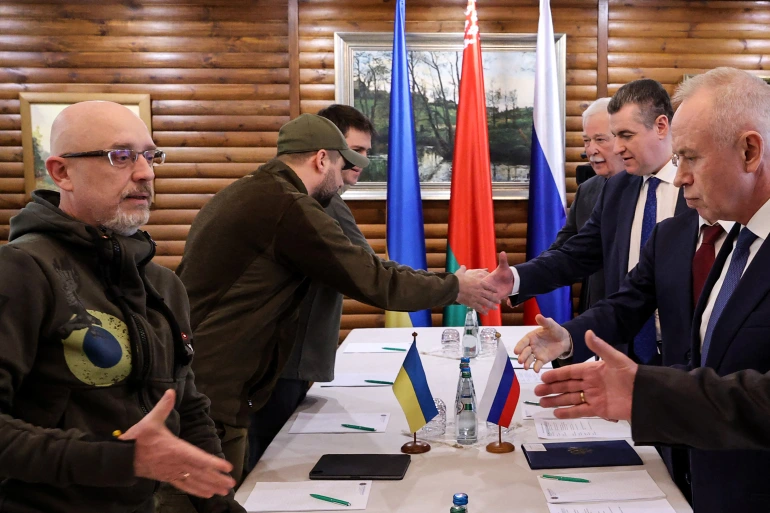
BREST, BELARUS (TIP): Russia and Ukraine have agreed on the need for humanitarian corridors to deliver aid and help civilians exit besieged Ukrainian cities, in the first apparent sign of progress in talks between the warring sides, according to an Al Jazeera report.
Russian negotiator Vladimir Medinsky reported “substantial progress” at Thursday’s talks – the second round of negotiations since Russia launched its invasion of Ukraine – saying the “main issue that we settled today is the salvation of people, civilians who have found themselves in a zone of military clashes”.
However, he did not indicate when the safe corridors may be established. The tentative agreement, reached in Belarus, came as Russian forces continued to surround and attack Ukrainian cities, including the capital, Kyiv, and the second-biggest city of Kharkiv.
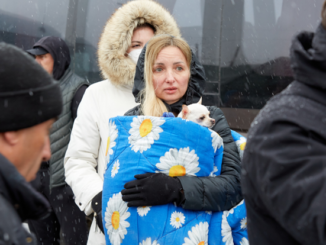
Thousands are thought to have died or been wounded in the eight-day conflict, while more than one million people have fled the fighting in what the United Nations has called the swiftest exodus of refugees this century.
Ukraine’s negotiator, Mykhailo Podolyak, said the two sides have agreed to set up “communication and cooperation lines” as soon as possible to facilitate the evacuation of civilians. A temporary halt to fighting in select locations was also possible, he said.
“That is, not everywhere, but only in those places where the humanitarian corridors themselves will be located, it will be possible to cease fire for the duration of the evacuation,” he said. The two sides also saw eye-to-eye on the delivery of medicines and food to the places where the fiercest fighting was taking place, Podolyak said, adding that the two sides will continue the work at “the third round at the earliest possible time”. The delegations also discussed “the military aspect” and “a future political settlement of the conflict”, according to the Russian negotiators. The third round will take place “in the coming days”, also in Belarus, they said. John Herbst, a former United States ambassador to Ukraine, called the agreement on humanitarian corridors a “positive sign”. “If the political will is there to make it happen, it could be a matter of one day or two days,” he told Al Jazeera. “It’s interesting that even as Moscow is dictating unconditional surrender terms to the conflict, they are willing to consider this. I think that may be because of the pounding they are receiving globally for their barbarous campaign,” he added.
The resolution was adopted with 32 votes in favor, two against (Russia and Eritrea) and 13 abstentions, including India, China, Pakistan, Sudan and Venezuela
GENEVA/ UNITED NATIONS (TIP): India on Friday, March 4, abstained in the UN Human Rights Council on a vote to urgently establish an independent international commission of inquiry to investigate alleged human rights violations and related crimes following Russia’s military operation in Ukraine. The 47-member Council voted on a draft resolution on the ‘Situation of human rights in Ukraine stemming from the Russian aggression.’ The resolution was adopted with 32 votes in favor, two against (Russia and Eritrea) and 13 abstentions, including India, China, Pakistan, Sudan and Venezuela.
The countries voting in favor included France, Germany, Japan, Nepal, UAE, UK and the US.
The resolution, which strongly condemned Russia’s aggression against Ukraine, decides to “urgently establish an independent international commission of inquiry” to “investigate all alleged violations and abuses of human rights and violations of international humanitarian law, and related crimes, in the context of the Russian Federation’s aggression against Ukraine, and to establish the facts, circumstances, and root causes of any such violations and abuses.”
A day before the resolution was adopted, India said at the Urgent Debate Thursday regarding the human rights situation in Ukraine at the 49th Human Rights Council Session in Geneva that it is greatly concerned over the steadily worsening humanitarian situation in Ukraine.
India urged for an immediate cessation of violence and an end to hostilities. “No solution can ever be arrived at the cost of human lives. Dialogue and diplomacy are the only solution for settling differences and disputes,” India said.
India called for respect and protection of human rights of people in Ukraine and safe humanitarian access to conflict zones.
“We are also deeply concerned over the safety and security of thousands of Indian nationals, including young Indian students, who are still stranded in Ukraine. We are working together with neighboring States for their evacuation,” it said.Three human rights experts will be appointed to the Commission of Inquiry by the President of the Human Rights Council for an initial duration of one year. The Commission will be mandated to “identify, where possible, those individuals and entities responsible for violations or abuses of human rights or violations of international humanitarian law, or other related crimes, in Ukraine, with a view to ensuring that those responsible are held accountable.’ The resolution expressed grave concern at the ongoing human rights and humanitarian crisis in Ukraine and calls on Russia to “immediately end its human rights violations and abuses and violations of international humanitarian law in Ukraine”.
It also calls for the “swift and verifiable” withdrawal of Russian troops and Russian-backed armed groups from the entire territory of Ukraine, within its internationally recognized borders. India has abstained on two resolutions on Ukraine in the 15-nation Security Council and one in the 193-member General Assembly in the last one week. The UN General Assembly this week overwhelmingly voted to condemn Russian aggression against Ukraine and demanded that Moscow “completely and unconditionally” withdraw all of its military forces from the territory of Ukraine. India abstained on the resolution, which received 141 votes in favor, five against and a total of 35 abstentions.
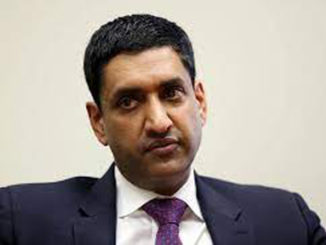
WASHINGTON, D.C. (TIP): Prominent Indian-American Congressman Ro Khanna has expressed disappointment over India’s decision to abstain from the UN Security Council resolution on Russia’s aggression against Ukraine, saying it is the US and not Russia that will stand with New Delhi against China’s current expansionist plans. India, China and the United Arab Emirates on Friday, February 25, abstained from the US-sponsored resolution against the Russian aggression which was vetoed by Moscow. As many as 11 of the 15 members of the UN Security Council voted in favor. Five countries—the US, the UK, Russia, China and France—are permanent members of the council and have veto powers. India is a non-permanent member and its current two-year term expires this year.
“In 1962, President (John F) Kennedy stood with India against China’s invasion. It is the US, not Russia, that will stand with India against China’s current expansionist plans,” Khanna tweeted on Friday, February 25. “This is the time for India to stand with the free word against Putin. Abstention is not acceptable,” said the three-term Democratic Congressman from California.
Echoing Khanna, Congressman Eric Swalwell also termed India’s move as “disappointing”.
“Rep Ro Khanna and I represent the largest Indian-American districts and this vote is contrary to what we hear from our constituents. Indian-Americans believe in territorial integrity and human rights,” said Swalwell, who is serving as representative for California’s 15th congressional district that covers most of eastern Alameda County and part of central Contra Costa County.
Abstaining from the UNSC resolution that “deplores in the strongest terms” Russia’s “aggression” against Ukraine, India on Friday said dialogue is the only answer to settle differences and disputes. In the country’s explanation of vote in the Council, India’s Permanent Representative to the UN Ambassador T S Tirumurti said New Delhi is “deeply disturbed by the recent turn of developments in Ukraine and urge that all efforts are made for the immediate cessation of violence and hostilities”.
He said that no solution can ever be arrived at, at the cost of human lives. “Dialogue is the only answer to settling differences and disputes, however daunting that may appear at this moment. It is a matter of regret that the path of diplomacy was given up. We must return to it. For all these reasons, India has chosen to abstain on this resolution,” Tirumurti said.
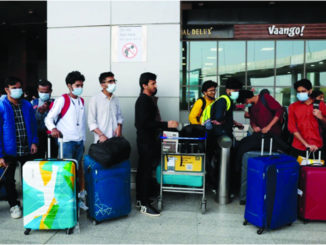
Family members of Indians trapped in Ukraine wait for their arrival at Delhi airport. (Photo: [Bilal Kuchay/Al Jazeera])
As soon as Chahat Yadav walked out of the airport and saw her family, she tossed away her luggage and ran towards them, crying inconsolably. Yadav’s father Narendra Kumar and other relatives had reached Delhi’s Indira Gandhi International Airport on Wednesday, March 2, to receive the second-year medical student studying in Ukraine’s Ternopil city. The relieved family could not hold back their emotions as they saw Yadav and huddled around her, hugging, kissing and in tears. Yadav was among nearly 200 Indian students who had just landed in New Delhi from Poland on Wednesday after trying for days to escape the Russian invasion of Ukraine that began last Thursday, forcing nearly 20,000 Indian students to flee the former Soviet nation. “The Ukraine military was only letting the Ukrainians and Europeans across the border,” Chahat told Al Jazeera as she held a bouquet of red flowers handed to those returning from Ukraine by Indian authorities at the airport. “But I don’t know why Indians were being stopped and pushed back,” the young student said, alleging many Indians were beaten by the Ukrainian forces as they tried to cross the border.
‘Sleepless nights’
When a Russian attack on Ukraine became imminent, Yadav’s father Kumar tried to book a ticket for her. But it was not easy with high demand and few flights. Kumar, who lives with his extended family in Gurugram on the outskirts of the Indian capital, bought an online ticket for Yadav for February 20 but the airline did not confirm the ticket. He later booked a transit flight to India via Qatar for February 23 at a steep cost of 50,000 rupees ($660). Yadav, who was double-vaccinated against coronavirus and was carrying her RT-PCR report along with her, was not allowed to board the flight to Qatar, Kumar said.
The problem: Yadav had taken an Indian-made Covaxin shot, which, Kumar said, was only “partially approved [by Qatar]”. “They refused to consider her RT-PCR report… A serology antibody test [was required] to board the flight,” he said.
When Russia invaded Ukraine the next day on February 24, Kumar said the thought of losing her daughter “gave him sleepless nights”.
“I would be lying if I said the thought of losing my daughter in Ukraine did not cross my mind. It happened several times and took away my sleep,” Kumar told Al Jazeera. “When I saw my daughter today, I couldn’t believe that she was finally back.”
Getting home was not easy for Yadav and other Indian students. On the evening of February 25, a day after Russian troops entered Ukraine, Chahat and her friends left Ternopil for Poland on a private bus they had hired for the trip.
They reached the Poland border around midnight, only to find a 35km line of vehicles desperate to leave the country. They had no choice but to cover the remaining distance on foot. Many students threw away some of their luggage to be able to make the journey.
They walked all night in bone-chilling cold and reached the border the next morning. But crossing into Poland was not easy, with thousands camped there. Yadav spent two nights at the border in sub-zero temperatures before she was allowed to cross.
‘Near-death experience’
Another medical student, Rajarshi Shyam, 21, reached Delhi on Wednesday. He had travelled from Ukraine’s Vinnytsia to Romania. “We faced problems at the border. It was very crowded. It was a near-death experience,” he told Al Jazeera.
Like Chahat, Rajarshi also had to walk for several kilometres on foot to reach the Romania border. He was also forced to dump some of his luggage, including his clothes, on the road.
Still, says Rajarshi, he was lucky to have crossed the border in his first attempt, unlike many of his friends who were either turned back or forced to spend days at the border.
Many Indian and African students have alleged facing racial discrimination and violence from Ukrainian officials at the borders.
Meanwhile, thousands of Indians remain stranded in Ukraine as Russia escalates its attack on cities such as Kharkiv, Ukraine’s second-largest, where many Indian students study medicine. -Source: Al Jazeera
No food, water: Over 600 students stranded in Ukraine city cry for help
Even as the Indian government has successfully evacuated thousands of citizens from war-torn Ukraine, over 600 students from the country stuck in the northeastern city of Sumy are crying for help. A student asserted that hope they will soon be evacuated as “continuous firing and bombing” by the Russian forces has left them completely terrified. They also complain of an acute shortage of food and water. Considering Sumy lies in the northeastern peninsula of Ukraine, it is difficult for the students to travel to the western border, from where they can reach neighbouring Poland, Hungary, Romania, Slovakia and Moldova, under the current circumstances.
Not a single Indian student has been evacuated from the Sumy State University, located close to the Russian border has been evacuated. “More than 600 Indian students are stuck here in Sumy university. The embassy has neither evacuated us nor given any assurance to that effect. Since the last five days, there has been continuous firing, shelling and bombing in the city,” Viraj Walde, who hails from Nagpur in Maharashtra, told news agency PTI.
“Before Russia’s invasion of Ukratine, temporary advisories were given to the students and the university informed us that those having exams can wait. Hence, we waited for the exams to start,” Walde added.
“But now, the students are terrified and their mental state is deteriorating. Food and drinking water supplies are depleting. Even the banks and ATMs are running out of cash,” he said.
Meanwhile, the Indian embassy has sent advisories asking them to use only the western border of Ukraine and reach the neighbouring countries of Poland, Hungary, Romania, Slovakia and Moldova. Since Sumy city is located in the north-eastern part of Ukraine, it is impossible for them to travel all the way to the western part of the country amidst the current situation.
“The border in Ukraine’s western part is located almost 1,500 kms away from Sumy, whereas the Russian border is just 50 kms away. The railway station in Sumy has also been closed due to bombing, and traveling via road is like committing suicide since Russian and Ukrainian forces are fighting against each other at such places,” he told PTI.
Jaipur Literature Festival to pick up topical issues of Ukraine-Russia Conflict, climate Change
Dr. Yashpal Goyal,
Special Correspondent
JAIPUR (TIP): After Pandemic Corona outbreak since 2020 in India, Jaipur Literature Festival’s 15th edition beginning in Pink City from March 5 will pick up a some of the topical issues of Ukraine-Russia Conflict, Geo-politics of war, Climate Change, new world order besides holding a whole range of literary sessions.
Sanjoy K Roy, Managing Director of Teamwork addresses the press conference in Jaipur on March 2.
Sanjoy K Roy, its Managing Director of Teamwork, told a press conference here on March 2 that finally the JLF organizer has chosen a five star hotel by leaving the old heritage ‘Diggi Palace’ due to traffic problems and other administrative regulations. It will be in a hybrid mode, March 5 to 9 on virtual mode, and from March 10 to 14 the sessions would be on ground and visitors would be allowed to witness the live discussions among noted writers, Roy added.Like the previous years’ edition, JLF will have 500 speakers, including four Nobel laureates and will have sessions covering art of fiction, poetic imagination, travel, science, history etc. The prestigious festival will showcase a variety of exhibiting numerous dialects of Rajasthan-Centric literature.
In a statement, Rajasthan Tourism Minister Vishvendra Singh said he was delighted to note that JLF was returning on-ground in the Pink City after two years. The festival will truly provide an exceptional platform for both Indian and global authors and thought leaders to engage and strengthen literary heritage and culture.
This time both the literary sessions as well as music in the evening will be held in the hotel campus, Apurav Kumar, MD of the Clarks Group, told the joint press conference. On a question on the impact of the Ukraine-Russia war, they said, “We may lose a few good speakers as two writers have already cancelled their visits to India”.
The rich programme will feature, among others, a session with Bruno Maçães, decorated author, international commentator and advisor to some of the world’s leading companies on geopolitics and technology, who will be exploring the study of an emerging world order that is competitive and driven by the need to adapt and survive in increasingly hostile natural environments. In conversation with former diplomat and author Navtej Sarna, Maçães will discuss book Geopolitics for the End Time: From the Pandemic to the Climate Crisis. On clean energy, Rahul Munjal, the Chairman & Managing Director at Hero Future Energies, one of India’s leading Independent Power Producer, is committed to positive environmental impact by increasing the share of renewables. Joining him will be, Amitabh Kant, the CEO of the National Institution for Transforming India (NITI Aayog) and a key driver of initiatives such as Make in India, Startup India, Incredible India and God’s Own Country and academician Siddharth Singh, author of The Great Smog of India. Munjal and Kant will discuss the future of clean energy and climate action. Simon Mundy, Financial Times journalist and author of Race for Tomorrow: Survival, Innovation and Profit on the Front Lines of the Climate Crisis, will speak on the question of what impact a single person can have in the face of the global climate crisis. The earth has witnessed five major mass extinction events over the last 500 million years – responsible for the erasure of nearly three-quarters of its species each time. A series called The Urgency of Borrowed Time will feature Pranay Lal, natural history writer, biochemist and public health advocate who is also author of the celebrated books Indica: A Deep Natural History of the Indian Subcontinent and Invisible Empire: The Natural History of Viruses. The session will explore the fate of dinosaurs and species sealed by extinction events, and the role of humankind in the surging climate crisis.
AMRITSAR/TORONTO (TIP): While the conflict between Russia and Ukraine has worried the families of those stranded in Ukraine, it has also troubled the NRIs ready to return to Canada after spending their winter in Punjab. The NRIs said flights, especially those connecting via Montreal and Toronto were getting delayed. They, however, said that flights going via Vancouver were comparatively less troublesome.
Kanwaljit Singh Sekhon of Wadala village, near Baba Bakala, who took the flight to Canada via Vancouver on Wednesday, March 2 morning, said he had to wait for six hours at the Delhi airport as the flight was late.” He said due to delay from Delhi, he would now have to spend eight hours extra at the Vancouver airport. Sekhon had to go to Edmonton, but now there was no flight available from Vancouver to Edmonton. So, he had booked a ticket for Calgary, from where he would take another flight. “Those travelling via Montreal and Toronto have to face delay of almost 25 to 26 hours,” said Gurjant Singh, who took a flight from Delhi on February 2 after a 24-hour delay. Gurjant said as the airlines did not provide boarding during the delay, they had to sleep at the airport itself. With such stories of hardships, those who had plans to return to Canada shortly are worried. Some are even planning to leave children and women behind.
“It is very difficult to travel in such crisis especially with small children,” said Gurpreet Singh, who was scheduled to travel next week. He said he was making calls to his travel agent and co-travelers, but nobody had any concrete information.
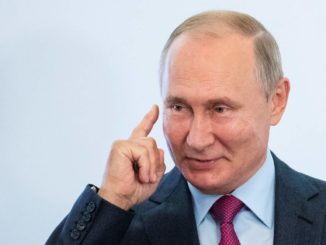
Nearly a week into the largest military campaign in Europe since World War Two, Russian forces have encountered fierce resistance from Ukraine while global condemnation has spurred sanctions that have roiled the Russian economy. Before the invasion, Putin humiliated his spy chief, Sergei Naryshkyn in a Russian Security Council meeting which showed the president relishing being in control. But now with the status of global pariah, Putin’s invoking of his country’s nuclear threat has raised alarm at what his actions might be if he felt cornered.
Newsweek spoke to a selection of experts about what they believed could be going through Putin’s mind. Their responses varied widely—from those who said his apparent erratic behavior was part of a calculated grand strategy, to others who believe his increased isolation since the COVID pandemic has made him more emotional and unstable.
Questions surround the state of mind of Russian president Vladimir Putin. After his invasion of Ukraine, there are concerns at how far he might go to secure victory.
Michael McFaul, former U.S. ambassador to Russia
“Putin listens to no one inside Russia. He’s been in power for over two decades, so does not take advice from anyone anymore. He also is very isolated. He is the only decision maker that matters. He alone can end this war.
“[Chinese President] Xi is the only leader in the world he respects.”
Rose Gottemoeller, ex-deputy Secretary General of NATO
“Vladimir Putin has always cultivated a cool and calculating demeanor, but now he is showing increasingly erratic and emotional behavior—so there is a shift. “From our perspective, it certainly looks irrational, but no doubt that is not how Putin sees it. He’s considering himself a figure of destiny, to bring the Russian-speaking peoples together again. For him, it seems, it is a vital historical objective.”
Steve Pifer, former U.S. ambassador to Ukraine
“We are seeing a different Vladimir Putin from 10 or 15 years ago. He now seems more emotional, particularly when it comes to Ukraine, and he is taking a much larger risk with the invasion than one would have expected from him earlier.
“One also has to wonder about the effect of the isolation in which he has lived and worked the past two years, apparently out of concern about COVID.”
Gustav Gressel, senior policy fellow, European Council on Foreign Relations (ECFR)
“He sees himself as the recreator of imperial Russia. The thing is with the ‘madman’ theory, he is playing a bit with that.
“He is rational if you know his mindset and that is a social Darwinian mindset, where military power and military strength form the core essence of the state and the core momentum of Russian identity. “If you know his mindset, what he does is perfectly rational. It is not mad, is just that you have to adopt to this mindset. “Everything he does today, at some point, he has written or said. It is just that we have continuously excused him for doing so, in saying, “that’s just basically rambling, he’s a hobby historian, he meant that as a joke,’ etc. No, he didn’t. He was serious and we are seeing it now. “
Douglas Page, assistant professor of political science at Gettysburg College, Pennsylvania
“While evidence may emerge about Putin’s mental instability, we also should consider the persona that Putin may be willingly crafting during this intense crisis, even when that persona reflects desperation. “The idea that one’s opponent is irrational and crazy is enticing, but this idea also can serve an important purpose for an opponent like Putin. An irrational opponent is more unpredictable and can be viewed as more willing to incur absurdly high costs in a conflict. “For example, nuclear war would doom Russia, but an irrational Putin could raise more questions in the West about his willingness to use nuclear weapons. This perception in the West may follow Putin’s objectives regarding nuclear deterrence and limiting Western involvement in Ukraine.
Ian Johnson, assistant professor of military history at the University of Notre Dame, South Bend, Indiana
“His historical rhetoric suggested aspirations beyond Ukraine, restoring Russian primacy over areas formerly in Russia’s orbit across Eastern Europe. “Putin is well-versed in history. He clearly believes that he has an opportunity for a historic legacy, one that puts him in line with those figures he cites so frequently in his speeches—Peter the Great and Stalin, among them — both of whom expanded the borders of the Russian or Soviet state at the expense of their neighbors.”
William Muck, political science professor, North Central College, Naperville, Illinois
“It does appear that Putin has shifted how he understands and engages with the international community. The tone and language from his recent speeches are particularly telling. Putin has been much more aggressive, provocative, and nationalistic. “One gets the sense that he now sees himself as a historic figure. That his war in Ukraine is about rewriting the end of the Cold War and making Russia great again. “People talk of Putin as this brilliant chess player who skillfully outplays his rivals in the international system. That may have been the case in the past, but I think the better current metaphor for his mindset is poker. Putin is a gambler, and his invasion of Ukraine suggests he is all-in on this hand.
“If he wins, it is possible he goes down in history as the figure who restored Russian greatness. However, if he loses, this may be the beginning of the end of the Putin regime in Russia.”
Matt Qvortrup, political science professor, Coventry University, U.K.
“He is very out of touch and that is why he expected things to go differently.” “Rationality means you get what you want and what is good for you. For Vladimir Putin, what is good for him is not good for Russia, it is not what is good for the world, it is what will keep him in power. “He does not want to suffer the fate of [Ex-Serbian leader] Slobodan Milosevic, or [Ex-President of Zimbabwe] Robert Mugabe, and for that reason, he would want to use any available means. “The shocking thing is that he will be willing to go all the way. It is conceivable that he will use nuclear weapons if he is desperate and for him that might be a rational thing because that might keep him in power.”
William Hague, former British Foreign Secretary
“While it is clear that a great many Russian diplomats and officials think he has made a terrible mistake, there will be nothing they can do now to restrain their isolated, paranoid, obsessive and increasingly angry president.
“Tragically for the people of Ukraine, he will have no doubts about what he must do. He will be telling his generals to go deeper, faster, more brutally and destructively if necessary.” — The Times of London
‘This Madness Must be Stopped’. – Lord Owen, former British Foreign Secretary
“He is a very able, intelligent person, never underestimate people who you are dealing with who you don’t agree with…it’s easy to dismiss them as being mad. I don’t believe that is a reasonable judgement of him. But he does seem to be more imperious.
“There is no check on this leader of Russia. In the old Communist days, there was a Politburo, in which you could see collective decision making. That’s all gone for Putin.
“He’s one single autocratic dictator and he’s isolated for the last two years under COVID…you get the feeling there’s nobody to even argue with him, let alone contradict him.”— Channel 4
Fiona Hill, former U.S. National Security Council advisor on Russia.
“I think a lot of people are noticing that something seems to have flipped somewhat with Putin almost as if he’s made a rather emotional and, on the surface, a somewhat unexpected decision.
“He’s usually pretty cynical and calculating and very calm. Always very sarcastic and kind of harsh in the way that he talks about things. But the announcement that he was basically going to invade Ukraine, he was viscerally emotional.
“This is what happens if you have got the same person in power for 22 years, he’s been in a bubble, especially over the last two and a half years.” — MLive
Tatiana Stanovaya, founder of analysis firm R.Politik firm.
“There are people who go crazy and believe that they serve some higher power, God, or something else, perceiving themselves only as a…tool in the hands of great forces. “Putin is not there yet, but there is something in common. For him, this higher power is the State, as it has been historically understood and he sees himself as its servant.
“The problem is that personal responsibility is diminished and you feel that you are acting on behalf of history.
“With such a vision you can go very far without remorse.”— Telegram
Foreign policy challenges and domestic hurdles confront U.S. President Biden in his quest for a policy legacy
By Narayan Lakshman
“At the end of the day the old adage of “It’s the economy, stupid”, continues to resonate deeply across the country as the tagline for the American Dream. The realization of this — the Biden administration appears to concede — will require the adoption of strong self-interest as a guiding value for policymaking even when it comes at the cost of a gradual erosion of the global rules-based order and the globalization consensus, and the repudiation of older, constitutional values such as equal protection of the laws.”
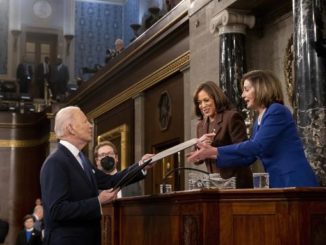
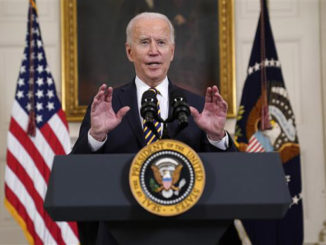
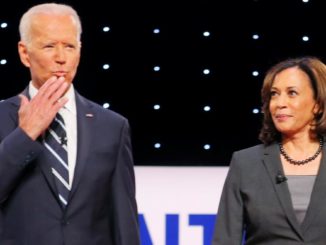
When U.S. President Joe Biden stepped up to the podium to deliver his first State of the Union address before both houses of Congress this week, it was a historic moment for several reasons. Not only have none of his successors since 1945 delivered this address during an ongoing ground war of a similar magnitude to Russia’s invasion of Ukraine, but the optics of his speech captured another rare event. The two top Congressional officials who stood behind Mr. Biden as he spoke, the Speaker of the House of Representatives and the Vice President, were both women for only the second time in the country’s history.
The hurdles, Ukraine too
Notwithstanding the epochal times marking this event, the reality is that Mr. Biden faces grim challenges on the foreign policy front and a steep upward climb to overcome domestic hurdles before he can claim credit for any policy legacy that purports to improve the lot of his fellow citizens. On the foreign policy side, Russian President Vladimir Putin’s move to call the West’s bluff and kick off a military assault of Ukraine has posed complex strategic questions to the Biden administration, which are difficult to explain away to a U.S. domestic audience. Why did Mr. Biden leave Kyiv hanging in the balance without North Atlantic Treaty Organization (NATO) membership and with a virtual target on its back vis-à-vis Moscow’s guns, when many among Ukraine’s neighbors are treaty allies of NATO? Why, despite so many explicit signs that Russia would invade Ukraine if NATO carried on expanding its footprint eastwards across Europe, did Mr. Biden’s administration not do more to either make it harder for Moscow to act in this regard or at least buy more time by persuading Mr. Putin to engage diplomatically?
Shadow of midterm elections
Now that the sweeping economic sanctions that Washington has slapped on Russian political elites and institutions associated with Kremlin have roiled the Russian economy and brought the rouble down to historic lows, how will the Biden administration contain the spill-over effects of economic collapse and prevent them from causing a broader global recession? With the conflict intensifying and the human toll rising fast as Russian troops march on Kyiv, the U.S.’s capabilities as a superpower nation will be scrutinized closely on the world stage in the days and weeks ahead. They will almost certainly be attacked by Republicans back home as the midterm election cycle gains momentum — former U.S. President Donald Trump has already set the tenor for the debate by describing Mr. Putin’s Ukraine invasion as “genius” and “savvy”.
At home, much depends on the outcome of the midterm elections, especially regarding the prospects for a Democratic White House to carry out any meaningful policy reform in the two years that the Biden administration will have from the time the midterms are complete. Democrats and Republicans are evenly split in the Senate with 50 seats each, while Democrats are clinging on to a narrow 221-212 margin in the House of Representatives, both of which advantages could be lost to Democrats if the 2022 midterm election results do not favor them.
Critical issues
The keystone issues that Mr. Biden needs to convince voters on, if he is to stave off a deleterious shift in the balance of power on Capitol Hill this November, include jobs and economic recovery in the post-COVID-19 climate of uncertainty, preventing the pandemic from wreaking further havoc in future waves, if any, inflation, and social security and education reforms to ease the financial burden on middle class budgets. Almost without exception, Mr. Biden will need the support of Congress to get the heavy lifting done in these policy areas, particularly where budgetary apportionments require lawmakers’ sign off. Certainly, it will matter in the foreign policy space. A recent example demonstrating the importance of Congress here is the fact that negotiations over a $6.4 billion security and humanitarian aid package for Ukraine hit a stalemate in the Senate over the source of these funds — military spending allocation already agreed, or emergency provisions above and beyond that level. Similarly, on the domestic front, Mr. Biden’s omnibus mega-bill in late 2021, seeking $1.85 trillion for social security and climate change, came to naught in the face of cohesive opposition from Senate Republicans and some rebel Democrats who voted across the line.
The Trump impact
At the heart of the Democratic conundrum is the fact that the Mr. Trump’s term in office unleashed forces that have tectonically shifted the ground under Washington politics. Whatever the charges of criminality or wrongdoing by the 45th President of the U.S., whether in terms of tax evasion or his role in spurring on the January 6, 2021 assault on the buildings of Capitol Hill, Mr. Trump’s nativist call to white America to reassert its purported supremacy has firmly embedded itself in the broader discourse and heralded a new era where political correctness is eschewed, and facts sometimes matter less than opinion.
Indeed, it is evident that Mr. Biden is seeking to walk a tightrope between traditional mainstream Democratic values and the new paradigm when he spoke at the State of the Union of “the rebirth of pride” and “the revitalization of American manufacturing”, which, if it materializes, could help his administration “Lower your cost, not your wages”, and ensure the U.S. builds “more cars and semiconductors in America. More infrastructure and innovation in America. More goods moving faster and cheaper in America. More jobs where you can earn a good living in America. Instead of relying on foreign supply chains, let’s make it in America”.
At the end of the day the old adage of “It’s the economy, stupid”, continues to resonate deeply across the country as the tagline for the American Dream. The realization of this — the Biden administration appears to concede — will require the adoption of strong self-interest as a guiding value for policymaking even when it comes at the cost of a gradual erosion of the global rules-based order and the globalization consensus, and the repudiation of older, constitutional values such as equal protection of the laws.
New Delhi has taken a subtle pro-Moscow position on the question of Russian attacks against Ukraine
By Happymon Jacob
“New Delhi has taken a subtle pro-Moscow position on the question of Russian attacks against Ukraine. This pro-Russia tilt is not just the position of the Indian government, but is something, somewhat surprisingly, shared by much of the Indian strategic community as well. More notably, one is increasingly hearing subtle, though indirect, justifications of the Russian military actions from the doyens of the Indian strategic community. India’s Russia tilt should be seen not just as a product of its time-tested friendship with Moscow but also as a geopolitical necessity.”
New Delhi’s response to the Russian aggression against Ukraine appears to have been shaped by harsh geopolitical circumstances, that it is in the middle of, than its normative beliefs or preferences. Late last week, India abstained from a United Nations Security Council (UNSC) resolution which called for condemning the Russian military action against Ukraine, but it went on to note its uneasiness of the Russian action in writing (a first).
Prime Minister Narendra Modi, who spoke to Russian President Vladimir Putin as the war broke out, called for an “immediate cessation of violence” and has so far refused to pay heed to Ukrainian Ambassador to India Igor Polikha’s impassioned pleas urging Mr. Modi to mediate with Mr. Putin to halt Russian military advances. With the UNSC deadlocked, friends with both the United States/West and Russia, and passionately urged by Ukraine, New Delhi is uniquely placed to undertake some much-needed mediation between the rival sides. But it has chosen to stay on the margins and do no more than the unavoidable minimum. New Delhi just wants this to be over with. Let us call it what it really is: New Delhi has taken a subtle pro-Moscow position on the question of Russian attacks against Ukraine. This pro-Russia tilt is not just the position of the Indian government, but is something, somewhat surprisingly, shared by much of the Indian strategic community as well. More notably, one is increasingly hearing subtle, though indirect, justifications of the Russian military actions from the doyens of the Indian strategic community. India’s Russia tilt should be seen not just as a product of its time-tested friendship with Moscow but also as a geopolitical necessity.
The Russia tilt
There are four potential options India can/could choose from: Condemn Russian aggression, support Russian aggression, stay silent on Russian aggression, or express displeasure (short of condemning) and call for diplomacy. The first option will pit India against Russia, the second will pit it against the U.S. and its allies, the third option will be read as pro-Russia, and the fourth option — which it has taken — is the least harmful. And yet, a position that does not condemn Russian aggression and one that abstains from voting on a UNSC resolution calling for “condemning Russian aggression and withdrawal of Russian forces from Ukraine” is indeed a pro-Russia position. There are understandable reasons for India’s (subtle) pro-Russia position. Let me put it this way: an aggressive Russia is a problem for the U.S. and the West, not for India. North Atlantic Treaty Organization (NATO) expansion is Russia’s problem, not India’s. India’s problem is China, and it needs both the U.S./the West and Russia to deal with the “China problem”. I would view India’s response to the crisis in Ukraine in the light of this rather simple logic.
Let us look at the big picture first. There is today a sobering recognition in New Delhi about the weakening of the U.S.-led global order and the rise of China as a counter-pole, geographically located right next to India. U.S. withdrawal from the region and its decline as the principal system shaper has complicated India’s place in regional geopolitics. Neighboring China as the rising superpower and Russia as its strategic ally challenging the U.S.-led global order at a time when China has time and again acted on its aggressive intentions vis-à-vis India, and when India is closest to the U.S. than ever before in its history, throws up a unique and unprecedented challenge for India. Therefore, having Russia on its side is crucial for India, more than ever. Moscow may or may not be able to moderate Chinese antagonism towards New Delhi, but an India-Russia strategic partnership may be able to temper New Delhi’s growing isolation in a rather friendless region. Second, there is an emerging dualism in contemporary Indian strategic Weltanschauung: the predicament of a continental space that is reeling under immense pressure from China, Pakistan and Taliban-led Afghanistan adding to its strategic claustrophobia; and, the emergence of a maritime sphere which presents an opportunity to break out of the same. Herein lies the dilemma for India. New Delhi needs Moscow’s assistance to manage its continental difficulties be it through defense supplies, helping it ‘return’ to central Asia, working together at the Shanghai Cooperation Organization (SCO) or exploring opportunities for collaboration in Afghanistan. Russia, to put it rather bluntly, is perhaps India’s only partner of consequence in the entire Asian continental stretch.
On the other hand, when it comes to the vast maritime sphere, the Indo-Pacific to be precise, Russia is not of great consequence to India. That is where its American and western partners come into play. India is simply not in a position to address the China challenge in the maritime space without the active support of American and western navies and, of course, the Quad. This unavoidable dualism in the contemporary Indian strategic landscape necessitates that India balances the two sides, but doing so without a subtle Russia tilt may not be feasible at this point of time.
That said, the war on Ukraine could have major implications for India’s strategic calculus. For one, Russian action in Ukraine dismissing the concerns of the rest of the international community including the U.S. will no doubt embolden China and its territorial ambitions. Second, the new sanctions regime may have implications for India’s defense cooperation with Moscow. Third, the longer the standoff lasts, the closer China and Russia could become, which certainly does not help India. Finally, the more severe the U.S.-Russia rivalry becomes, the less focus there would be on the Indo-Pacific and China, which is where India’s interests lie.
Impact on foreign policy
India’s responses to the Russian aggression on Ukraine underline the fact that India is operating from a position of geopolitical vulnerability. While the Indian stand does reek of realpolitik, it reeks more of strategic weakness. Here is a country located in a hostile neighborhood trying to make the best of a terrible situation it finds itself in. This then means that, going forward, India’s ability to be a “swing state”, “major power” or a “leading power” stands diminished. So, we must expect more middle-of-the-road behavior from New Delhi rather than resolute positions on global strategic developments. India’s position also shows the unmistakable indication that when it comes to geopolitics, New Delhi will choose interests over principles. This is nothing new: New Delhi has chosen interests over principles even in the past — for instance, India has violated the principle of non-intervention in the domestic affairs of neighbors. The difference this time may be that India is choosing interests over principles even though the issue at hand is not directly pertaining to India. And yet, a careful reading of India’s statements and positions taken over the past few days also demonstrates a certain amount of discomfort in having to choose interests over principles. There is perhaps a realization in New Delhi that a dog-eat-dog world, where rules and good behavior do not matter, does not help India in the long run either.
Going forward, if tensions between Russia and the West persist, balancing extremes will be a key feature of Indian diplomacy. India is perhaps already mastering the art. Consider India’s “explanation of vote” during the recent vote on Russia’s aggression against Ukraine: even though New Delhi abstained from voting on it (thereby siding with Moscow), it made its unhappiness about the Russian action clear in the written note.
On strategic autonomy
Finally, what does this mean for India’s ‘strategic autonomy’? For sure, India’s strategic autonomy has been under a lot of stress for some time now. However, New Delhi’s response to the recent crisis, especially its “explanation of vote” at the UNSC indicates a careful recourse to the principle of strategic autonomy: India will make caveated statements and will not be pressured by either party. In that sense, India’s indirect support to the Russian position is not a product of Russian pressure but the result of a desire to safeguard its own interests. Therefore, while we may witness a steady erosion of India’s strategic autonomy in the longer term – primarily as a function of the need to balance against China — we will continue to witness instances where Indian diplomacy will take recourse to the principle of strategic autonomy.
(The author teaches India’s Foreign Policy at the School of International Studies, Jawaharlal Nehru University, New Delhi)
An order that does not accommodate Russia’s concerns through genuine negotiation cannot be stable in the long term
By P.S. Raghavan
“It is too early to say what Mr. Putin’s endgame is, and how costly this adventure will be, in terms of lives and destruction, as well as in its political and economic impact. Without justifying the manner in which Russia has chosen to “right” the perceived “wrongs”, it has to be said that this crisis results from a broken security architecture in Europe. A sustainable security order has to reflect current realities: it cannot be simply an outgrowth of the Cold War order, and it has to be driven from within. Also, a European order that does not accommodate Russia’s concerns through genuine negotiation cannot be stable in the long term. France’s President Emmanuel Macron has been making this point forcefully, arguing for Europe to regain its strategic autonomy. He has called NATO “brain-dead” and said that Europe, as a “geopolitical power” should control its own destiny, regaining “military sovereignty” and re-opening a dialogue with Russia, managing the misgivings of post-Soviet countries.”
The commencement of Russian military action in Ukraine brings down the curtain on the first act of a bizarre drama that has been playing out over the past eight months. At the heart of it is the instability in the post-Cold War security order.
The first act began with a meeting between U.S. President Biden and Russia’s President Vladmir Putin in June last year, promising to reverse seven years of relentless U.S.-Russia acrimony. Mr. Biden’s decision to reach out to Mr. Putin signaled a U.S. geopolitical rebalancing, seeking a modus vivendi with Russia and disengagement from conflicts in Europe and West Asia, to enable a sharper U.S. focus on domestic challenges and the external challenge from its principal strategic adversary, China.
These were Putin’s terms: Mr. Putin saw this reengagement as an opportunity to revive Russia’s flagging economy and expand its freedom of political action globally. However, he wanted this engagement on equal terms. Russia would cooperate in this geopolitical rebalancing if its concerns are met, so that it does not constantly have to counter moves to probe its territorial integrity and constrain its external influence – which is how Russia sees the strategic posture of the North Atlantic Treaty Organization (NATO) and U.S. policies. Russia has repeatedly articulated its grievances: that NATO’s expansion violated promises made prior to the breakup of the Soviet Union; that Ukraine’s accession to NATO would cross Russia’s red lines; and that NATO’s strategic posture poses a continuing security threat to Russia. NATO’s expansion as a politico-military alliance, even after the dissolution of the Soviet Union and the Warsaw Pact, was at the U.S.’s initiative. It was intended to temper European ambitions for strategic autonomy from the sole superpower and to counter Russia’s resurgence. Recent experience shows it may not be succeeding in either goal.
NATO’s weakened glue: NATO countries today span a geography of uneven economic development and a diversity of political traditions and historical consciousness. Moreover, the original glue that held NATO together — ideological solidarity (free world against communist expansion) and an existential military threat — dissolved with the collapse of communism and the Warsaw Pact. There is no ideology to oppose and threat perceptions vary, depending on geographical location and historical experience. This heterogeneity means a diversity of interests. American leadership has normally succeeded in papering over differences, but the growing ambitions of countries is making this increasingly difficult. The current crisis in Ukraine has illustrated the divisions and exposed the limitations of the U.S.’s ability to bridge them. The irony is that the divisions are of the U.S.’s making. Its pressure on NATO in 2008 to recognize Ukraine’s membership aspirations and its encouragement for a change of government in Kyiv in 2014, provoked the Russian annexation of Crimea. The subsequent armed separatist movement in eastern Ukraine (Donbas) led to the Minsk accords of 2014-15, which provided for a special status for this region within Ukraine.
Ukraine considers this an unfair outcome, and the U.S. has supported its efforts to reinterpret the accords to its advantage. While some European countries supported this line, France and Germany — which brokered these agreements — have periodically tried to progress implementation, in the effort to break the impasse and resume normal engagement with Russia, which serves their economic interests.
In recent months, the U.S. signaled that it would support the full implementation of the Minsk accords, but apparently found it difficult to shake the entrenched interests sufficiently to make it happen. This may have finally convinced Mr. Putin that his concerns would not be met through negotiations.
Energy security: U.S. interests have also divided NATO on energy security. For Germany, the Nord Stream 2 (NS2) Russia-Germany gas pipeline is the cheapest source of gas for its industry. Others deem it a geopolitical project, increasing European dependence on Russian energy. This argument masks self-serving interests. Ukraine fears the diminution of gas transit revenues, and also that if its importance for gas transit declines, so will Europe’s support in its disputes with Russia. The U.S.’s “geopolitical” argument against NS2 dovetails neatly with its commercial interest in exporting LNG to Europe, reinforced by U.S. legislation for sanctions against companies building gas pipelines from Russia. Increasing LNG exports to Europe is explicitly stated as a motivation for the sanctions. European countries that oppose NS2 are ramping up their LNG import infrastructure to increase imports from the U.S.
The manner in which NATO countries implement the promised harsh sanctions against Russia will demonstrate whether, how much and for how long, this crisis will keep them united.
It is too early to say what Mr. Putin’s endgame is, and how costly this adventure will be, in terms of lives and destruction, as well as in its political and economic impact. Without justifying the manner in which Russia has chosen to “right” the perceived “wrongs”, it has to be said that this crisis results from a broken security architecture in Europe. A sustainable security order has to reflect current realities: it cannot be simply an outgrowth of the Cold War order, and it has to be driven from within. Also, a European order that does not accommodate Russia’s concerns through genuine negotiation cannot be stable in the long term. France’s President Emmanuel Macron has been making this point forcefully, arguing for Europe to regain its strategic autonomy. He has called NATO “brain-dead” and said that Europe, as a “geopolitical power” should control its own destiny, regaining “military sovereignty” and re-opening a dialogue with Russia, managing the misgivings of post-Soviet countries.
Outlook for India: India has to brace itself for some immediate challenges flowing from the Russian actions. It will have to balance the pressure from one strategic partner to condemn the violation of international law, with that from another to understand its legitimate concerns. We were there in 2014 and managed the pressures. As Russia-West confrontation sharpens further, the U.S. Administration’s intensified engagement in Europe will inevitably dilute its focus on the Indo-Pacific, causing India to make some tactical calibration of actions in its neighborhood. Geopolitics, however, is a long game, and the larger context of the U.S.-China rivalry could, at some point in the not-too-distant future, reopen the question of how Russia fits into the European security order.
(The author is a former Ambassador to Russia and former Chairman of the National Security Advisory Board)
Gallant attempts by the world of sports to wriggle out of the devastating impact of the Omicron pandemic may be severely hit by the Russia-Ukraine military conflict that threatens to divide the world again. Unfortunately, the timing of the Russian invasion of Ukraine coincides with the holding of a major International Olympic Committee event, the Paralympic Games, scheduled to start in Beijing on March 4. Twice before the Olympic movement had been hit hard by World War II. The 1940 and 1944 editions of the Olympic Games had to be cancelled during the global hostilities at that time.
Led by the United States, the NATO nations, in expression of their complete solidarity with Ukraine, have already heaped a series of sanctions on Russia in their valiant attempt to force cessation of hostilities.
It was for almost similar reasons that the 1980 Moscow Olympic Games were boycotted by a group led by the NATO leader, the United States. The boycotters had objected to the presence of the then Soviet Union forces in Afghanistan.
Interestingly, the Beijing Winter Olympic Games 2022, that witnessed a diplomatic boycott by most of the NATO nations, including the US and Canada, had the Russian President, V. Putin, as a guest of honor
Other than NATO, it is the International Olympic Committee (IOC) that has come hard on both Russia and its aide Byelorussia by urging all International Sports Federations (ISFs) to relocate or cancel their sports events currently planned in Russia or Belarus. The ISFs should take the breach of the Olympic Truce by the Russian and Belarussian governments into account and give the safety and security of the athletes absolute priority. The IOC itself has no events planned in Russia or Belarus.
The IOC Executive Board also wants that no Russian or Byelorussian national flag be displayed and no Russian or Byelorussian anthem be played in international sports events that are not already part of the respective World Anti-Doping Agency (WADA) sanctions for Russia. In the just concluded Beijing Winter Olympic Games, it was the Russian Olympic Committee (ROC) and not Russia that was allowed to send its contingent. Neither any Russian flag was flown, nor the Russian national anthem was played during the Games though the ROC athletes were placed at number two in the overall medals (32) tally with six gold. 12 silver and 14 bronze medals. Norway topped the tally with 37 medals, including 16 gold. Eight silver and 13 bronze medals while Germany took the third spot with 27 medals and Canada finished fourth with a tally of 24. Incidentally, Norway, Germany and Canada are now on the other side opposing the Russian action in Ukraine.
Though the IOC Executive Board has expressed its full support to the International Paralympic Committee (IPC) for the upcoming Paralympic Winter Games in Beijing from March 4, the shadow of the Russian action may impact the games in a big way.
Immediately after Russia launched its military operations, the International Olympic Committee (IOC) came out with a strong condemnation of the breach of the Olympic Truce by the Russian government by referring to the December 2, 2021 resolution of the UN General Assembly adopted by consensus of all 193 UN Member States. The Olympic Truce began seven days before the start of the Olympic Games, on February 4, 2022, and ends seven days after the closing of the Paralympic Games.
Earlier in a similar resolution passed by the General Assembly of the United Nations on 9 December 9, 2019, it was decided to include in the provisional agenda of its seventy-sixth session the sub-item entitled “Building a peaceful and better world through sport and the Olympic ideal” and also recalling its prior decision to consider the sub-item every two years, in advance of the Summer and Winter Olympic Games. The Olympic Truce was first taken up by the UN General Assembly on October 25, 1993, which, inter alia, revived the ancient Greek tradition of ekecheiria (“Olympic Truce”) calling for a truce during the Olympic Games to encourage a peaceful environment and ensure safe passage, access and participation for athletes and relevant persons at the Games, thereby mobilizing the youth of the world to the cause of peace.
The core concept of ekecheiria, historically, has been the cessation of hostilities from seven days before until seven days after the Olympic Games, which, according to the legendary oracle of Delphi, was to replace the cycle of conflict with a friendly athletic competition every four years. Other than the Paralympic Olympic Games starting in Beijing on March 4, where winter para athletes of both Russia and Ukraine are scheduled to participate, the first test for any International Sports Federation under the new IOC directive is for field hockey (International Hockey Federation – FIH).
An elite FIH event – Junior Women World Cup – will be organized at Potchefstroom in South Africa from April 1 where both Russia and Ukraine are among 16 nations confirmed to participate. Going by the hostilities back home, participation of both Russia and Ukraine in the Potchefstroom event looks doubtful, both the South African Hockey Federation and the FIH have a problem on hand.
The tournament had already been postponed once. The list of participants, too, has witnessed changes. For example, Japan had withdrawn at the last minute. It was replaced by Malaysia. Now the sword of uncertainty is hanging over the Potchefstroom event again following the Russia-Ukraine war.
(Prabhjot Singh is a veteran journalist with over three decades of experience covering a wide spectrum of subjects and stories. He has covered Punjab and Sikh affairs for more than three decades besides covering seven Olympics and several major sporting events and hosting TV shows. For more in-depth analysis please visit probingeye.com or follow him on Twitter.com/probingeye. He can be reached at prabhjot416@gmail.com)
The standoff between Russia and US-Europe over Ukraine has come at an inopportune time for India. As a UN Security Council (UNSC) member, India is contributing to ensuring peace, security and stability in the world. This role has opportunities for enhancement due to the inability of the permanent five (P5) to act in unison. In the case of Ukraine, the P5 are threatening to go to war with each other, with the UK, US, France on one side, and Russia supported by China on the other. This takes matters totally out of the hands of the UNSC, making it redundant. The Ukraine crisis is curtailing Indian role in the UNSC. New Delhi is doing its best to remain relevant. India is developing relations with the EU and other European countries. This initiative leads India to support the Normandy process and the Minsk agreement, which are European efforts to engage Russia on Ukraine. India would prefer the European way of dealing with Russia than the tough posture which the US wants NATO to adopt. European countries will toe the US line if war erupts. That reduces the efficacy of India’s European initiative presently. India is calling for diplomacy as that will defuse the tension and also give India more leeway.The Russian posture on Ukraine and the reaction to it, strengthened the Sino-Russian partnership. The Xi-Putin summit at the Beijing Winter Olympics lent firmness and robustness to that relationship. China is challenging India, has overthrown extant agreements and increased its military threat. This does not augur well. For long, India depended on Russia for strategic partnership. It still largely depends on Russia for military hardware. While the defense relationship is mutually beneficial, the Sino-Russian axis curtails the Russian ability and intent to support India as in the past.
Russia’s confrontation with NATO will lead to rigorously imposed sanctions. India has delicately negotiated to stay out of CAATSA (Countering America’s Adversaries Through Sanctions Act) with the purchase of S-400 Triumf missile systems which may not work when a war-like situation prevails. Countries like Germany have stark choices on economic issues, and India will be faced with similar choices on defense supplies from Russia with tougher sanctions that the US is ready to impose. India-Russia trade of about $9 billion annually is about 1% of India’s global trade. The significance is the impact on defense, energy, grain delivery and prices.
Curtailing of defense supplies will impact India’s ability to respond to China. The diversification of defense purchases that India achieved would come into play but without the competitive pricing and transfer of technology of Russian equipment.
Strategically, Russia will not attempt to restrain China. In exchange for Chinese support for Russian intent in Ukraine, they would concur with Chinese initiatives in the Indo-Pacific. Russia’s nuanced divergence on India could melt away if the Ukraine crises blows up as both NATO and Russia seek clear Indian support which India hesitates to provide.
The Ukraine crisis brings Russia and China closer and diverts the attention of Western powers towards Ukraine. The Europeans would have a lesser appetite for the Indo-Pacific once they are embroiled in European matters. France held its Indo-Pacific conference right after the Munich Security Conference this month. They wish to continue to deal with the region while engaged with Russia as well. However, the EU member countries do not have diverse abilities and their Indo-Pacific polices are likely to be on hold till the Russian challenge is settled. At present, US naval forces are at strength in the South China Sea and the broader Indo-Pacific as Taiwan is at stake. They will need allies Japan and AUKUS to play a role. They could well call upon India to act in the Indo-Pacific even if India is not directly involved in an operation around Taiwan.
This is not different from what India is doing in the Indo-Pacific at present, but India expects support for its position with China on the border issue, as was discussed at the Quad foreign ministers’ meeting in Australia recently. Indian activity, in the midst of the Ukraine crisis, may not be ignored by China and Russia.
India’s energy security is a matter of worry as there is already a $20 per barrel increase in the price of oil over the estimates used by the Economic Survey 2022. This impacts India’s growth story. Russia is a significant oil producer and the Ukraine crisis and sanctions on Russia would destabilize the oil market. This would gravely impact India’s development plans.
In 2021, India imported merely 1% of its oil and 0.2% of its gas from Russia. GAIL has a 20-year contract to import 2.5 million tons of LNG from Russia annually. It’s not the direct supply but the prices that will be impacted negatively. Thus, India’s repeated calls for peaceful resolution. The diversification of Indian energy supplies over time will perhaps protect supplies but not control prices.
Similarly, if the Ukraine crisis leads to Europe, particularly Germany, curtailing gas imports from Russia, it will bring other gas providers to strategically shift supplies to Europe impacting Asian economies. The gas prices nevertheless will rise. The pandemic has slowed down India’s investment in Mozambique in gas offtake and this needs to be hastened to diversify gas imports and stabilize gas pricing in India. There are nearly 25,000 Indians in Ukraine, mostly students. They have been advised to leave Ukraine as flights are still available. Indian mission families too are leaving. This is the correct advisory planned well ahead of a full-scale crisis. Students remain averse to depart when it is feasible, to avoid spending on high-priced tickets. They believe that the government will always step in to rescue them once a crisis unfolds. This attitude needs to change.
This is an inflection point for India as the Ukraine crisis challenges its ability to influence events in its favor, avoid an impact on its economy, without taking sides in a crisis of indirect interest to it. Such impacts of globalization need careful handling.
Giving paramount importance to its national interests, India has been sensibly walking a tightrope on the Ukraine crisis. Enjoying good relations with the US, Russia and the European Union (EU), New Delhi has done well to adopt a pragmatic approach that can stand it in good stead no matter how the situation develops from here on. India has been holding its ground despite relentless pressure to take sides. Rather than toeing the US line to hit out at Russia, India has been advocating ‘constructive diplomacy’ to resolve the imbroglio. External Affairs Minister S Jaishankar has rightly observed that the crisis has its roots in post-Soviet politics, the expansion of NATO and the dynamics between Russia and Europe.
Ukraine is banking on NATO membership and stronger ties with EU to stand up to its neighbor. Russian President Vladimir Putin wants Kyiv to recognize Russia’s sovereignty over Crimea, the Black Sea peninsula that Moscow annexed after seizing it from Ukraine in 2014, drop its bid to join NATO and partially demilitarize. However, these terms are not acceptable to Ukraine and the West, which considers the annexation of Crimea as a violation of international law.
Since 2014, around 14,000 people have been killed in fighting between Ukrainian forces and Russia-backed separatists in eastern Ukraine. Russia’s fears that it will be hemmed in by the US and its allies once Ukraine enters the NATO club, leading to greater instability in the region, are not unfounded. Though there is no dispute that Ukraine’s sovereignty and territorial integrity ought to be respected by one and all, Russia’s genuine apprehensions also must be allayed. Both nations, along with the international community, should go back to the Minsk Agreements of 2014-15 and give peace a chance by working out a mutually acceptable framework to end the hostilities. An immediate de-escalation of tensions, factoring in the security concerns of all countries concerned, is the need of the hour to prevent a war that can have far-reaching, disastrous consequences in geopolitical and geoeconomic terms.
Putin seems unwilling to engage diplomatically to address Russian security concerns
Russia’s unjustifiable incursion into Ukraine following weeks of military troop build-up on their shared border has drastically raised tensions in the region with broader ripple effects across the world, particularly for NATO countries and others with strategic connections to the two nations. Reports said that several Ukrainian cities, including capital Kyiv came under attack on Thursday morning, even as the UN Security Council held an emergency meeting to stop the invasion. U.S. President Joe Biden and the NATO and European Commission leadership vowed to impose “severe sanctions” on Russia. This round of sanctions will overlay prior economic penalties imposed on Russian entities and individuals close to the political leadership, and they are expected to include cutting off top Russian banks from the financial system, halting technology exports, and directly targeting the Russian President. Moscow can hardly be surprised at this backlash, for it has shown little sympathy toward the idea of engaging diplomatically on the Ukraine question to address Russian security concerns. Ever since Russia began amassing troops on the Ukrainian border, the U.S., NATO, and Europe have sought to press for diplomatic solutions. This includes direct U.S.-Russia negotiations, and French President Macron’s meeting with Mr. Putin.
While the sense of frustration in western capitals over Mr. Putin’s intractability and aggression are palpable, and the use of severe sanctions stemming from that is a strategic inevitability, it is unlikely that the prospect of escalating violence and a devastating toll on human life and property in Ukraine can be ruled out until Mr. Putin’s broader questions on NATO are answered. At the heart of his fears is the prospect of Ukraine joining NATO and NATO troops potentially stationed at the border with Russia. NATO’s historical record, of its penchant for expansionism, has likely fueled such insecurities. After the dissolution of the former Soviet Union, the Eastern European military alliance, NATO, and Russia in 1997 signed the “Founding Act” on mutual relations, cooperation, and security. Disregarding the spirit of this agreement, NATO quietly underwent five rounds of enlargement during the 1990s, pulling former Soviet Union countries into its orbit. Cooperative exchanges, communications hotlines, and Cold War fail-safes such as arms control verification have fallen by the wayside, even more since Russia’s annexation of Crimea in 2014. It may be the case that owing to Mr. Putin’s failure to develop Russia into an economic powerhouse that naturally attracted neighboring countries and international capital to itself partly explains Moscow’s deflection of attention to strategic questions relating to NATO and Russia’s territorial integrity. But unless western nations give assurances to Mr. Putin that NATO will not seek to relentlessly expand its footprint eastwards, Moscow will have little incentive to return to the negotiating table. But Russia and Mr. Putin must realize that war is not the means to peace and security.
New Delhi (TIP)-Investors bailed out of risky assets, sending stocks crashing after Russian President Vladimir Putin’s troops invaded Ukraine. On Thursday, the exodus from stocks wiped out Rs1.3 lakh crore in investor wealth on Indian stock markets. But the bad news for stocks was a boon for safer assets such as gold and government bonds. Crude oil surged past the $100 mark amid expectations of tighter supply. India’s benchmark indices Sensex and Nifty tumbled, ending 4.72% and 4.78% lower respectively, one of the sharpest daily declines in nearly two years. The declines put the indices in correction territory—defined as a drop of at least 10% from a recent peak. The Sensex hit a record high of 62,245.43 on October 19. A near-6% decline was recorded on 4 May 2020 after the government extended the nationwide lockdown and a flare-up in US-China tensions. The Russian invasion has triggered the worst security crisis in Europe since World War II. The attack on Ukraine heightens the pressure on the global economy already reeling from Covid and galloping inflation. Investors fear the unfolding crisis will further increase raw material and energy costs. Sanctions against Russia by Western powers are likely to isolate the erstwhile superpower, a major producer of oil and commodities.
Global markets, too, saw deep corrections. Among Asian markets, the Hang Seng, Taiwan, Nikkei, Shanghai Composite, Jakarta Composite ended the day 1.48-3.21% lower. “The world can ill-afford further disruption in trade and commodities when Covid has already weakened sovereign balance sheets,” said Amar Ambani, head of institutional equities, Yes Securities.
Brent crude hit $105 a barrel, a level not seen since August 2014, adding to the worries.
S&P Global Platts Analytics said $100 oil aggravates pain as Asia’s top oil importers are dependent on imports for 70-100% of their needs. “High oil prices will dampen demand and undermine the fragile economic recovery,” said Lim Jit Yang, adviser for oil markets at S&P Global Platts Analytics.
The concerns are likely to remain elevated. “Crude could stay over $100 a barrel in the medium term unless Opec hikes output,” said Hetal Gandhi, director, Crisil Research. Opec members have failed to meet targets over the past three months.
Gold hit highest level in over a year. As Russia invaded Ukraine, gold prices skyrocketed to their highest level in more than a year.
In India, the gold price surged by Rs 1,400 , hitting the peak of Rs 51,750 per 10 gms in the early morning trade. This comes amid steep fall in the stock market with Sensex down by 1432.50 points and Nifty reporting a slump of 410.70 points at the time of opening. Several Asian stock markets also plunged in the aftermath of the Russian invasion.
The bullion has witnessed a spike amid the increasing standoff between Russia and the West. Economic experts say gold is now being historically seen as a hedge against major economic and geopolitical ructions.
Spot gold jumped as much as 2.1% to $1,949.03 an ounce, the highest level since January 2021, and traded at $1,939.55 at 1:08 p.m. in Singapore, news website Bloomberg reported. Source: HT
“President Joe Biden almost hourly promises, “We are not going to war in Ukraine.” Why would he then not readily rule out NATO membership for Ukraine, which would require us to do something Biden himself says we Americans, for our own survival, should never do: go to war with Russia?”
“Whatever we may think of Putin, he is no Stalin. He has not murdered millions or created a gulag archipelago. Nor is he “irrational,” as some pundits rail. He does not want a war with us, which would be worse than ruinous to us both. Putin is a Russian nationalist, patriot, traditionalist and a cold and ruthless realist looking out to preserve Russia as the great and respected power it once was and he believes it can be again.”
When Russia’s Vladimir Putin demanded that the U.S. rule out Ukraine as a future member of the NATO alliance, the U.S. archly replied: NATO has an open-door policy. Any nation, including Ukraine, may apply for membership and be admitted. We’re not changing that. In the Bucharest declaration of 2008, NATO had put Ukraine and Georgia, ever farther east in the Caucasus, on a path to membership in NATO and coverage under Article 5 of the treaty, which declares that an attack on any one member is an attack on all. Unable to get a satisfactory answer to his demand, Putin invaded and settled the issue. Neither Ukraine nor Georgia will become members of NATO. To prevent that, Russia will go to war, as Russia did last night.
Putin did exactly what he had warned us he would do. Whatever the character of the Russian president, now being hotly debated here in the USA, he has established his credibility. When Putin warns that he will do something, he does it. Thirty-six hours into this Russia-Ukraine war, potentially the worst in Europe since 1945, two questions need to be answered:
How did we get here? And where do we go from here?
How did we get to where Russia — believing its back is against a wall and the United States, by moving NATO ever closer, put it there — reached a point where it chose war with Ukraine rather than accepting the fate and future it believes the West has in store for Mother Russia?
Consider. Between 1989 and 1991, Mikhail Gorbachev let the Berlin Wall be pulled down, Germany be reunited and all the “captive nations” of Eastern Europe go free. Having collapsed the Soviet empire, Gorbachev allowed the Soviet Union to dissolve itself into 15 independent nations. Communism was allowed to expire as the ruling ideology of Russia, the land where Leninism and Bolshevism first took root in 1917. Gorbachev called off the Cold War in Europe by removing all of the causes on Moscow’s side of the historic divide. Putin, a former KGB colonel, came to power in 1999 after the disastrous decadelong rule of Boris Yeltsin, who ran Russia into the ground. In that year, 1999, Putin watched as America conducted a 78-day bombing campaign on Serbia, the Balkan nation that had historically been a protectorate of Mother Russia.
That year, also, three former Warsaw Pact nations, the Czech Republic, Hungary and Poland, were brought into NATO.
Against whom were these countries to be protected by U.S. arms and the NATO alliance, the question was fairly asked.
The question seemed to be answered fully in 2004, when Slovenia, Slovakia, Lithuania, Latvia, Estonia, Romania and Bulgaria were admitted into NATO, a grouping that included three former republics of the USSR itself, as well as three more former Warsaw Pact nations. Then, in 2008, came the Bucharest declaration that put Georgia and Ukraine, both bordering on Russia, on a path to NATO membership. Georgia, the same year, attacked its seceded province of South Ossetia, where Russian troops were acting as peacekeepers, killing some.
This triggered a Putin counterattack through the Roki Tunnel in North Ossetia that liberated South Ossetia and moved into Georgia all the way to Gori, the birthplace of Stalin. George W. Bush, who had pledged “to end tyranny in our world,” did nothing. After briefly occupying part of Georgia, the Russians departed but stayed as protectors of the South Ossetians.
The U.S. establishment has declared this to have been a Russian war of aggression, but an EU investigation blamed Georgian President Mikheil Saakashvili for starting the war.
In 2014, a democratically elected pro-Russian president of Ukraine, Viktor Yanukovych, was overthrown in Kyiv and replaced by a pro-Western regime. Rather than lose Sevastopol, Russia’s historic naval base in Crimea, Putin seized the peninsula and declared it Russian territory. Teddy Roosevelt stole Panama with similar remorse.
Which brings us to today.
Whatever we may think of Putin, he is no Stalin. He has not murdered millions or created a gulag archipelago.
Nor is he “irrational,” as some pundits rail. He does not want a war with us, which would be worse than ruinous to us both. Putin is a Russian nationalist, patriot, traditionalist and a cold and ruthless realist looking out to preserve Russia as the great and respected power it once was and he believes it can be again.
But it cannot be that if NATO expansion does not stop or if its sister state of Ukraine becomes part of a military alliance whose proudest boast is that it won the Cold War against the nation Putin has served all his life.
President Joe Biden almost hourly promises, “We are not going to war in Ukraine.” Why would he then not readily rule out NATO membership for Ukraine, which would require us to do something Biden himself says we Americans, for our own survival, should never do: go to war with Russia?
(The author is a former White House Communications Director. Visit Buchanan.org to read his articles and books)
WASHINGTON, D.C. (TIP): Arguing that the Biden Administration should resist from any action that might drive New Delhi away from Quad, a top Republican senator supported waiving of CAATSA sanctions against India for purchase of S-400 missile systems from Russia. India, Senator Todd Young said, is currently taking delivery of the Russian S-400 system. The country is also in the process of acquiring new frigate ships from Russia. ”Both are important systems for the Indians,” he said on Wednesday, January 12, during a confirmation hearing for James O’Brien for the position of the State Department coordinator for Sanctions Policy.
”India is a vital ally in our competition against China, and thus, I believe we should resist taking any actions that might drive them away from us and the Quad. I am therefore strongly supportive of waiving CAATSA sanctions against India, given our shared foreign policy interests,” Senator Young said. ”As most here know, the Indians have a lot of legacy systems from previous decades, and they are interoperable with the Russians’ systems. And the Indians seek to defend their land border from Chinese incursions and defend the Indian Ocean from an increasingly adventurous and lawless blue ocean navy in the People’s Liberation Army,” he said. The Indiana senator asked O’Brien if the US experience with Turkey provided any warning or lessons on how to proceed with India.
”I believe they are very different circumstances, and, of course, different security partnerships — but how do you believe we should think about the possibility of sanctioning our friends and not just threats,” he asked.
In response, O’Brien said it is difficult to compare the two situations, with a NATO ally that is breaking with legacy defense procurement systems, and then with India, a partner of growing importance, but that has legacy relationships with Russia. ”The administration has made clear that it is discouraging India from proceeding with the acquisitions of Russian equipment, and there are important geostrategic considerations, particularly with (unintelligible) relationship to China. So, I think we have to look at what the balance is. And, of course, India’s got some decisions in front of it, so it would be premature to say more. But this is something I look forward to working with you and other interested members,” O’Brien said.
“Geopolitics abhors vacuum and that will be true of Afghanistan despite its hostile reputation and tough terrain. The US and the NATO countries have no direct interest in Afghanistan at this juncture having tasted defeat. However, others do. And that includes neighboring countries like Pakistan and China. Pakistan has always lusted for strategic depth by swallowing the Islamic neighbor Afghanistan from the time of the military dictator General Zia-ul-Haq. In Pakistan’s congenital hostility towards India, the ISI and the GHQ have yearned for strategic depth to balance India after having lost their Eastern wing in 1971 war with India leading to emergence of the independent Bangladesh.”
The allied NATO forces lost 1144 soldiers in this war. Afghanistan government may have lost 70,000 soldiers over the last two decades. By a conservative estimate by the Brown University, 48,000 Afghan civilians may have died due to the war. All this while, the Wiley neighbor and the fountain head of terrorism, Pakistan was milking the US as a cash cow.
Afghanistan has been aptly called the graveyard of empires. It is the theatre where the British Empire and the Czarist Russia played the great game! Czarist Russia pined for a warm water port in the Indian ocean. Control of Afghanistan was the primary means of getting that access to a warm water port in the Indian ocean. After the British and the Soviets, it is the turn of the US to realize that aphorism by learning a practical lesson. After a 20 years’ long occupation of Afghanistan in the name of eliminating terrorism, nation building and promoting democracy, the current US administration belatedly realized that US military engagement in Afghanistan was counterproductive. Having lost at least 2443 US soldiers, 21000 seriously war wounded, and an undeclared number (3800) of civilian-military-security contractors, having spent almost $ 2.3 trillion of money in the black hole of Afghanistan, war has been costly to the US.
The allied NATO forces lost 1144 soldiers in this war. Afghanistan government may have lost 70,000 soldiers over the last two decades. By a conservative estimate by the Brown University, 48,000 Afghan civilians may have died due to the war. All this while, the Wiley neighbor and the fountain head of terrorism, Pakistan was milking the US as a cash cow. The US Congress sanctioned $18 billion of US monies between 2001 and 2011 for Pakistan. The funds trickled down slowly afterwards as the Americans realized that they were being taken for a ride. The war forced 2.7 million Afghans to flee abroad; another 4 million were internally displaced people. We do not know the exact casualty figures for the Taliban. Having said that, the distinction between the Afghan civilians and Taliban fighters is very thin.
While the Woke of the World will blame the US for this carnage, equal responsibility lies on other states (Pakistan and Saudi Arabia) and non-state actors like Taliban and Al Qaeda. While the terror groups were sponsored and given safe haven sanctuaries by Pakistan; a major chunk of funding for these terror groups came from Saudi Arabia and UAE initially along with other petrodollar rich Gulf countries. Incidentally, Pakistan, Saudi Arabia, UAE and Turkmenistan were the only four countries that had recognized the Islamic Emirate of Afghanistan headed by Mullah Omar in the late 1990s. Granted that the US was successful in crushing the Al Qaeda during the last two decades, Pakistan’s duplicity and the US stupidity has resulted in the renewed resurgence of the Taliban. We are witnessing the prospect of the current Afghan government being routed in next few months as the Taliban consolidate their grip over the entire Afghanistan.
Geopolitics abhors vacuum and that will be true of Afghanistan despite its hostile reputation and tough terrain. The US and the NATO countries have no direct interest in Afghanistan at this juncture having tasted defeat. However, others do. And that includes neighboring countries like Pakistan and China. Pakistan has always lusted for strategic depth by swallowing the Islamic neighbor Afghanistan from the time of the military dictator General Zia-ul-Haq. In Pakistan’s congenital hostility towards India, the ISI and the GHQ have yearned for strategic depth to balance India after having lost their Eastern wing in 1971 war with India leading to emergence of the independent Bangladesh.
An expansionist China is gradually expanding its land borders after having swallowed Tibet and East Turkistan. In the recent years China has been lusting after the minerals and rare earths deposits of Afghanistan. It is true that China is wary of the Islamic terror threat from Afghanistan into its own Uighur population in Xinjiang region (former East Turkistan); however, there seems to be a lovefest going on between China and Taliban. Taliban leadership is assuring China that they will never be a party to spreading terrorism in any country especially China. The neighboring Islamic Republic of Iran is interested in its religious and cultural affinity with the mainly Shia population in Northern Afghanistan. Although Iran may have provided sanctuary to some of the Taliban leaders during the last two decades, its theocratic leadership is not in love with Saudi and Pak-sponsored Sunni fundamentalist terrorist group like Taliban. Iran’s tolerance for the Taliban in the last two decades was secondary to the Iran’s hostility towards the US rather than any genuine love for the Taliban.
That brings the issue of Russian interest in Afghanistan. One might think that Russia, once bitten by the Taliban and Al Qaeda, would be twice shy. Why is the current Russian government so favorably inclined towards the Taliban and the prospect of Taliban governed Afghanistan? The answer may be schadenfreude at the US plight and now its flight! However, the Russian leadership under Putin has become very pragmatic. They want to keep their enemies closer to their heart. Russia knows that an unrestrained Taliban pose a danger to Russian southern borders and would radicalize the Russian Islamic terrorist groups in Chechnya. In order to control the Taliban, Russia has no options but to engage the Taliban and try to moderate them in their outreach in Central Asia. Russia just signed a Karachi to Lahore pipeline deal with Pakistan. Despite India’s displeasure, Russia has started selling arms to Pakistan. Russia is reaching out to Pakistan as a counter-reaction to India’s burgeoning strategic relationship with the US. Russia should be wary of China’s demographic invasion of Russia’s north-east Siberian region. Ongoing Sinicization of Russian Siberia will eventually lead to China claiming sovereignty and annexing that region. Russia should understand its long-term strategic interests. Russia should refuse to sell S-500 ballistic missile defense system to China. Russia should not be satisfied with being a junior strategic partner to China.
It is, indeed, very likely that an Afghanistan over-run by the Taliban in the next few months may end up having four wives: mainly Pakistan, Russia, Iran and China. We have called this gang of four anti-Quad countries earlier by the acronym PRIC analogous to the acronym BRIC. It is an alternative quadrilateral group (anti-Quad quad) that is likely be sponsored by China to counterbalance the real Quad! Although, the motivations of the individual countries are uniquely selfish to each of them in engaging with Afghanistan, they might collectively fill the geo-political vacuum in Afghanistan left by the US withdrawal. The balance of power issues in Afghanistan, which is the gateway of the Central Asia, will entice China to assume a leadership role in forging the unholy alliance of the PRIC. China does have the option of using the Shanghai Cooperation Organization (SCO) mechanism in Afghanistan but for hard realpolitik, China will refrain from using the SCO as the primary tool of influence in Afghanistan. China’s strategic purpose in Afghanistan will be to keep India out, China in and Russia down. In order to achieve that geo-political goal, China will undercut its own SCO mechanism because it includes both Russia and India. Russia may favor involvement of the SCO in Afghanistan to counterbalance China. Keeping the SCO out of Afghanistan will definitely suit China’s ironclad friend Pakistan also. Along with China, Pakistan does not countenance a role for India in the Talibanized again Afghanistan! Pakistan might tolerate Iran’s involvement in a Talibanized Afghanistan as compared to India.
History teaches us that there cannot be geo-political vacuum. US and the NATO have lost any appetite for engagement in Afghanistan. China, aiming to be the sole superpower, will try to take the final step to humiliate America and contain India by fostering the cooperation and birthing of the PRIC group. Eight years ago, China had proposed a G-2 condominium to the US which US flatly rejected. Now, China is dreaming under Paramount Leader Xi Jinping to be the all-pervasive hegemon of the world relegating the US to number two position. Just like China worked from the theoretical economic construct of the BRIC, to launch the organization BRIC and later enlarge it into BRICS as means to exert geo-political influence, China will surely launch the PRIC quad in a major way.
The theater of a Talibanized Afghanistan gives the Communist China a readymade geopolitical opportunity to the launch the PRIC as a quadrilateral cooperation mechanism to balance the Quadrilateral Security Dialogue mechanism! It will depend upon the wisdom and sagacity of the Putin-led Russia and the foresight and astuteness of Indian diplomacy to prevent such an unholy alliance mechanism of the PRIC from taking birth! US can also contribute to the same goal by lifting sanctions on India for trading with Iran, even if the US is not on friendly terms with Iran. Let India engage Iran so as to prevent Iran from getting deeper into the Dragon’s embrace. Iran is a civilizational nation analogous to India and China which the US is not. US State department mandarins do not understand the importance of the concept of civilizational nations and history. Let India take the leadership in aborting the birth of the PRIC while the US provides support to India from behind.
“Riedel has reminded the US that it had made ‘many mistakes’ in Afghanistan by not paying attention after the Soviets left and allowing it to descend into a ‘failed’ state, permitting the Taliban and al-Qaeda to enter that vacuum. Riedel blamed former President George W Bush for taking his ‘eye off the ball’ in Afghanistan after the 2001 US invasion and letting Osama bin Laden escape into Pakistan.”
On July 17, Bruce Riedel, formerly of the CIA and now at Brookings, warned that the power vacuum in Afghanistan after the US troop withdrawal will adversely affect India by spawning terrorism. Similarly, The New York Times (July 15) reported Chinese fears of insecurity in the region after the killing of nine Chinese workers in a ‘Belt & Road’ hydroelectric project in Dasu, Pakistan’s Northwest, due to a suspected explosion.
Riedel had issued a similar warning on April 27, 2021, by reminding President Joe Biden of what President Barack Obama had said in his memoir A Promised Land: “The Riedel report made one thing clear: Unless Pakistan stopped sheltering the Taliban, our efforts at long-term stability in Afghanistan were bound to fail.”
What was this Riedel report? In February 2009, Obama chose Riedel to chair a White House Review to synthesize suggestions from heavyweights like Richard Holbrooke, special envoy to Afghanistan and Pakistan, Gen David H Petraeus, Central Command Chief, and Admiral Michael G Mullen, chairman of the Joint Chiefs of Staff, before the next NATO summit.
In a joint press conference at the White House on March 27, 2009, Riedel and Holbrooke outlined Obama’s strategy for NATO presence in Afghanistan: “To disrupt, dismantle and defeat al-Qaeda, and to ensure that their safe havens in Afghanistan and Pakistan cannot threaten the United States anymore.”
They added that the US exit strategy would depend on that.
Biden’s White House address on April 14, 2021, also claimed that they had achieved the “disrupt, dismantle and defeat al-Qaeda” strategy. However, Riedel did not agree. He said that Joe Biden, who inherited “a terrible deal from Trump’s feckless negotiators” had “failed to engage with Prime Minister Imran Khan”, which was a mistake. This is because Pakistani generals “will be more hubristic and dangerous than ever”, as Pakistan is the winner “again” in Afghanistan, by outlasting two superpowers.
Riedel reminded America that Washington DC had made ‘many mistakes’ in Afghanistan by not paying any attention after the Soviets left, allowing it to descend into a ‘failed’ state, permitting the Taliban and al-Qaeda to enter that vacuum. Riedel blamed former President George W Bush for taking his “eye off the ball” in Afghanistan after the 2001 US invasion and letting Osama bin Laden escape into Pakistan.
In my opinion, a bigger mistake was made in 1992. This was after the failed coup d’état in the Soviet Union in August 1991 and eventual disintegration. In September that year, three Baltic states seceded and declared their independence. A limited ‘Belovezha’ accord signed on December 8, 1991, was modified by the December 21 Alma Ata Protocol in Kazakhstan, creating the Commonwealth of Independent States (CIS) by Russia, Armenia, Azerbaijan, Belarus, Kazakhstan, Kyrgyzstan, Moldova, Tajikistan, Turkmenistan, Ukraine, and Uzbekistan. Western powers, including the United States, recognized these independent countries.
On March 9, 1992, President Mohammad Najibullah made a direct appeal to the United States through The New York Times to help him in maintaining stability in Afghanistan. This was after President Boris Yeltsin stopped all direct assistance to Afghanistan, which grounded the Afghan air force and encouraged defections, which affected the Afghan army too.
Senior journalist Edward A Gargan reproduced Najibullah’s text of appeal to the US in The New York Times. Najibullah’s tone was premonitory: “If fundamentalism comes to Afghanistan, war will continue for many more years… Afghanistan will turn into a center of world smuggling for narcotic drugs. Afghanistan will be turned into a center for terrorism.” However, none in Washington DC listened.
Najibullah also echoed the then Secretary of State James Baker’s statement that Islamic fundamentalism had posed a significant threat to regional stability: “You may think that the Central Asian republics are significant for the United States of America… That’s right. But I must say that the strategic and political significance of Afghanistan is much more than these republics. If Afghanistan is lost and is turned into a center of fundamentalism, you will lose the Central Asian republics.”
During this period, even King Zahir Shah’s US-based representatives had appealed to the State Department and the CIA that the retention of Najibullah in Afghanistan was very necessary as he was the only Afghan leader who would be able to hold the country together, obstruct the jihadis from coming into power and prevent Afghanistan’s splintering. They even conveyed that Najibullah should be accepted by the US, just as it had recognized the CIS leaders, who were mostly authoritarian. Unfortunately, the rivalry between the State Department and the CIA prevented this from happening.
Steve Coll, in his book The Ghost Wars, vividly records the clashes between the State Department and the CIA over Najibullah. Initially, the State Department’s special envoy to Afghanistan Edmund McWilliams had differed with CIA’s Station Chief Milton Bearden over Najibullah’s fate. The CIA wanted him to go, as desired by Pakistan’s ISI. Milton Bearden started resenting “interference” by the State Department over their turf.
In Washington DC, this rift between the CIA and the State Department was carried higher by the then CIA Deputy Director Thomas Twetten and Peter Tomsen, State Department’s new special envoy to the Afghan Resistance. Robert Kimmitt, Under Secretary for Political Affairs, told The New York Times (January 3, 1991) that Secretary of State Jim Baker had wanted to “coax the rebels and the Najibullah regime into democratic elections”, but that “they (meaning CIA) are just bucking policy.”
However, during that period, Texas Congressman Charlie Wilson, member, US House of Representatives’ Appropriations Sub-Committee for Defense, was exercising disproportionate influence over Afghan operations. It resulted in other voices being ignored.
Wilson regretted this later. An article in The World, a public radio and podcast programme, on February 11, 2010, said that Wilson, to the end of his life, regretted that “more wasn’t done to stabilize the country” and “the moderate, pro-Royalist factions in the resistance were ruthlessly suppressed by more extreme Islamic militants on our side.”
These ‘regrets’ of ‘mistakes’ are not going to help the hapless Afghans now who continue to be the victims of external interference.
“The US and Europe have fundamental contradictions with regard to China and Russia. While the US faces an immediate threat from China, many European countries have extensive economic ties with China and no security concerns. For Europe, the more immediate threat is from Russia, a perception not fully shared by the US. Several European countries weren’t happy that the US (and NATO) resources would be drawn away from Moscow to a more distant China.”
President Biden’s initiatives would strengthen transatlantic unity and build on resetting relations with Russia, isolating China. It may even embolden some of Xi’s critics at home to question whether his wolf warrior diplomacy had yielded any positive results for the country.
President Biden’s first foreign visit to Europe from June 9-16 will be remembered for how he tamed dissenting and doubting allies and rejuvenated the transatlantic alliance to convey a message of strong unity and resolve to an aggressive China (and a combative Russia), which is trying to challenge the international order for unilateral gains. China was the dominant theme during his discussions with G-7 leaders at Cornwall, UK (June 11-13) and EU and NATO leaders (June 14-16) at Brussels and Geneva and the underlying theme in his discussions with President Putin on July 16. The final G-7 communiqué is dominated by the US with several paras aimed directly and indirectly against China (and some against Russia), such as eradicating the use of forced labor in global supply chains (reference to Xinjiang and Tibet), collective approaches to challenge unfair trade policies, use of technologies to promote democratic values and fundamental freedoms. The G-7 supported President Biden’s initiative of “a timely, transparent, expert-led and science-based WHO-convened phase-2 Covid-19 origins study in China”. It is going to rile China as its senior diplomat Yang Jiechi had urged the US Secretary of State Anthony Blinken in his phone conversation on June 11 to “not politicize the source of the virus and focus on global cooperation in the fight against the disease”. The group’s formulation on China’s human rights abuse in Xinjiang, respect for fundamental freedoms and a high degree of autonomy for Hong Kong is a compromise as the mention of genocide which the US wanted was dropped to accommodate the concerns of Germany, France and Italy. The US and Europe have fundamental contradictions with regard to China and Russia. While the US faces an immediate threat from China, many European countries have extensive economic ties with Beijing and no security concerns. For Europe, the more immediate threat is from Russia, a perception not fully shared by the US. Several European countries were not happy that the resources of US (and NATO) would be drawn away from Moscow, their primary threat, to a more distant China. They were also worried that taking a hard line on China would make her less receptive to cooperate on more pressing multilateral issues such as climate change, control of pandemics and trade. For the first time, the G-7 took a united stand against China on an issue of core interest to her, i.e., Taiwan, and in support of the US by agreeing on the “importance of peace and stability across the Taiwan Strait and peaceful resolution of cross-strait disputes”. The G-7 unveiled a new initiative known as “Build Back Better World” (B3W) to give an alternative choice to the developing countries in building infrastructure to spare themselves from China’s debt trap projects. The group has agreed to provide one billion doses of coronavirus vaccines in 2021-22 and more later. At Cornwall G-7 meetings, India was more deeply engaged at the ministerial and PM’s level. PM Modi spoke of the need for democratic societies to strengthen each other’s hands to respond to new challenges, India’s efforts to share its development partnership with other developing countries, its readiness to work with B3W partners and its engagement with WHO, G-20 and G-7 countries for dealing with the current pandemic and preparing for future pandemics.
NATO leaders’ 79-point statement devoted three paragraphs with 10 mentions castigating China’s behavior. It said: “China’s stated ambitions and assertive behavior present systematic challenges to the rules-based international order”. China is investing heavily in new disruptive technologies such as autonomous systems, facial recognition and artificial intelligence and putting these into new weapon systems, which are changing the nature of warfare never seen before. China should act responsibly in the international system, including in space, cyber and maritime domains, in keeping with its role as a major power. President Biden’s meeting with President Putin at Geneva (June 16) was another high point of this visit. It reflected his desire to focus on the escalating rivalry between the US and China by reducing tensions with Moscow. He improved the atmospherics by calling Russia as one of the two Great Powers (other being the US and not China) and President Putin a worthy adversary, which would have been music to Putin’s ears. Though the results of the meeting were modest (establishment of bilateral strategic stability dialogue for control of new and dangerous weapons, limitation on the use of cyber weapons and return of Ambassadors) it is expected to promote a dialogue between the two countries on other issues of mutual concern, reducing current hostility and tensions.
China would be disappointed as it had always thought that the huge dependence of the US’s European and Asian allies on her would never allow emergence of a unified transatlantic bloc aimed against Beijing. Though some differences remain on the economic issues, President Biden has been able to rally his disparate allies together. The EU has frozen the Comprehensive Agreement on Investment hurriedly concluded by Beijing in December 2020 before President Biden’s takeover.
President Xi Jinping had tried to forge a united front with Russia by deputing his senior diplomat Yang Jiechi to Moscow but that ploy has not worked. Chinese official media has grudgingly admitted that the “Geneva meeting shows that both sides have the will to stop the worsening US-Russia relationship. President Biden wants to ease the tensions with Russia to focus on dealing with China now”.
President Biden’s initiatives would strengthen transatlantic unity and build on resetting relations with Russia, isolating China. It may even embolden some of Xi’s critics at home to question whether his wolf warrior diplomacy had yielded any positive results for the country. It would add increasing pressure on Xi to defend himself as he rallies the Chinese Communist Party to celebrate 100 years of its foundation in July 2021 and is likely to temper China’s aggressive behavior toward its neighbors.
From US perspective, the summit’s aim is to announce that ‘America is back’
By Shyam Saran
“From the US perspective, the objective of the summits is to announce that ‘America is back’ and ready to lead the world after the debilitating disruption of western alliances and partnerships and a retreat from global engagement during the Trump years. What Biden is signaling is that the revival of American leadership and diplomatic activism will be anchored in the web of its transatlantic relationships, even as the Indo-Pacific strategy will be its key preoccupation, given the acknowledged challenge posed by China. The emphasis on the transatlantic alliance and partnership is also important in countering the Russian threat.”
The three-day G7 summit concluded on June 13 and released an unusually long and detailed joint statement of 70 paragraphs and a separate Open Societies Statement. The latter statement was on behalf of the G7 and the four invitees to the summit, namely Australia, India, South Korea and South Africa. The summit is only the first of three key meetings involving western countries. This week includes a meeting of the EU and the US and a meeting of the NATO military alliance, both in Brussels. Fortified by the display of solidarity at these three summits, President Biden will have his first summit with Russian President Putin in Geneva on June 16.
From the US perspective, the objective of the summits is to announce that ‘America is back’ and ready to lead the world after the debilitating disruption of western alliances and partnerships and a retreat from global engagement during the Trump years. What Biden is signaling is that the revival of American leadership and diplomatic activism will be anchored in the web of its transatlantic relationships, even as the Indo-Pacific strategy will be its key preoccupation, given the acknowledged challenge posed by China. The emphasis on the transatlantic alliance and partnership is also important in countering the Russian threat. While Biden has described China as a competitor, Russia is the ‘enemy’, even though the US is prepared to work together with both on areas where there are convergent interests on global issues, such as climate change, cyber security and nuclear non-proliferation. Has Biden succeeded in convincing his western allies and partners and his adversaries that the US is back? The answer to that, as judged from the joint statement, should be a yes. But then, the Trump years were a low base to compare to.
Has Biden achieved a degree of western consensus in presenting a united front against Russia and China? Perhaps more against Russia and less against China. For example, the launch of the Build Back a Better World (B3W) partnership was launched as a ‘values driven, high standard and transparent infrastructure partnership led by major democracies’ but stopped short of explicitly posing it as an alternative to China’s Belt and Road Initiative. There are few details of how this partnership is going to be financed beyond saying that this will be private financed but with ‘catalytic investment’ from public and multilateral sources. We may conclude that there are simply not enough resources available to be deployed by the G7 which could match what China has been offering, despite concerns over lack of transparency and exacerbation of the debt overload on several developing countries.
There are several other references to Chinese misdemeanors which taken together do represent a broad western consensus on the need to confront China. These include the importance of maintaining peace and stability in the Taiwan Strait, ‘a free and open Indo-Pacific’, of avoiding ‘unilateral attempts to change the status quo and increase tensions in the East and South China Seas.’ In addition, there are references to human rights issues in Xinjiang and Hong Kong, both of which are regarded as ‘core issues’ by China. Overall, therefore, one could say that Biden has been able to fashion a consensus on acknowledging the Chinese security challenge and ideological challenge.
Will this impress China? Up to a point. The economic and commercial relationship between Europe and China is deep and broad ranging as is that between China and Japan. The EU and China have been working together, for example, for several years on developing benchmarks for climate finance, including green bonds, disclosure norms and the running of carbon markets. The area of climate finance will assume critical importance as climate change action gets into high gear after the Glasgow summit later this year. There is a limit to disengaging from the world’s second largest economy and the central node in global supply chains.
China has reacted by dismissing the G7, pointing out that a small group of countries cannot rule the world. There is another important shift the summit represents. After the global financial and economic crisis of 2007-8, it is the G20 which was established as the premier forum for international economic coordination. It worked very well in dealing with the immediate crisis, but its role has steadily diminished since then. With renewed tensions between the US and China and with Russia, the utility of the G20 is not so obvious currently. This adds to the significance of the revival of G7, even though its economic heft is much less than in its heyday. It constitutes only 30% of world GDP as against 60% at the end of the Cold War. However, the global trading system and its financial infrastructure continue to be dominated by the G7 so one should not underestimate its influence. It has the potential to emerge as a core of a broader coalition to achieve a degree of balance in the power equations that the emergence of China has upturned in the new millennium.
The adoption of the Statement on Open Societies reflects Biden’s renewed emphasis on the importance of preserving and promoting ‘open societies, democratic values and multilateralism as foundations for dignity, opportunity and prosperity for all.’ For all the cynicism that attends the expression of such lofty statements, they have value in contesting China’s confident belief in the efficacy of its authoritarian ideology and system of governance. Biden is taking head on the prevailing pessimism about democracy within democracies themselves. One should welcome PM Modi being honored as the lead speaker at the session on Open Societies. His remarks were unexceptionable and worthy of a leader of the world’s largest democracy. One hopes that this is followed by a renewed commitment to democratic values which are enshrined in the Indian Constitution, but also constitute, as PM Modi said, the civilizational values of India.
(The author is a former Foreign Secretary of India and senior fellow, Centre for Policy Research)
Expels 10 Russian diplomats, restricts trading and blacklists 32 individuals over ‘election meddling, cyberattack’
WASHINGTON(TIP): A reminder of the cold war period, the United States announced sanctions against Russia on Thursday, April 15, and the expulsion of 10 diplomats in retaliation for what Washington says is the Kremlin’s U.S. election interference, a massive cyberattack and other hostile activity. President Joe Biden ordered a widening of restrictions on U.S. banks trading in Russian government debt, expelled 10 diplomats who include alleged spies, and blacklists 32 individuals alleged to have tried to meddle in the 2020 presidential election, the White House said in a statement.
Mr. Biden’s executive order “sends a signal that the United States will impose costs in a strategic and economically impactful manner on Russia if it continues or escalates its destabilizing international action,” the White House said.
The U.S. barrage came the same week as Mr. Biden offered to meet President Vladimir Putin for their first face-to-face talks, suggesting that the summit could take place in a third country.
After the White House unveiled its measures, the Russian Foreign Ministry said a response was “inevitable.”
“The United States is not ready to come to terms with the objective reality that there is a multipolar world that excludes American hegemony,” spokeswoman Maria Zakharova said.
The latest tension comes amid worries both in the U.S. and its European allies over Russia’s recent troop buildup on the border of Ukraine.
The imprisonment of Alexei Navalny, who is effectively the last open political opponent to Mr. Putin, has further spiked concerns in the West.
The White House statement listed in first place Moscow’s “efforts to undermine the conduct of free and fair democratic elections and democratic institutions in the U.S. and its allies and partners.”
This referred to allegations that Russian intelligence agencies mounted disinformation and dirty tricks campaigns during the 2016 and 2020 presidential elections, in part to help Donald Trump’s candidacy.
The White House said the sanctions likewise respond to “malicious cyber activities against the U.S. and its allies and partners,” referring to the massive so-called SolarWinds hack of U.S. government computer systems last year.
The statement also called out Russia’s extraterritorial “targeting” of dissidents and journalists and undermining of security in countries important to U.S. national security.
In addition, the Department of Treasury, together with the EU, Australia, Britain and Canada, sanctioned eight individuals and entities associated with Russia’s occupation of Crimea in Ukraine.
In Brussels, the NATO military alliance said U.S. allies “support and stand in solidarity with the U.S., following its announcement of actions to respond to Russia’s destabilizing activities”.
I am assuming Mr. Biden has won the presidency. Mr. Biden may have to wait a little to be certified a winner; may have to wait a little longer in view of the lawsuits the Trump campaign has filed. But, unless there is a divine intervention on his behalf, Mr. Trump stands a loser.
America has demonstrated to the world that the election system of the greatest democracy in the world is strong and fair. It was indeed a mammoth task to be handling voting and counting of votes which have outnumbered any in the past – a whopping 160 million-, up from 138 million in 2016. My friend Ven Parameswaran who has lived in this country for more than 60 years now, and has been closely studying elections, tells me it is a record percentage since 1900. On top of the numbers handled, the elections have been conducted in all fairness. It speaks of the integrity and efficiency of the huge number of officials involved in the management of elections. They deserve gratitude of the whole nation.
However, there have ben some murmurs that all is not right with the election. Well, if at all there is something wrong, it is not with the system or the people working in that system. It is a section of people who, instead of lauding a dynamic system, berate it just because the fairness of system has denied them their cherished dream of winning the election by hook or by crook.
The cries of “stop counting” remind me of the cries of “stop testing” when the rising numbers of coronavirus became a subject of concern for health officials and Americans. Mr. Trump was anguished that tests resulted in throwing up more positive cases of the disease. Similarly, when Trump found the number of votes going up in favor of Biden, he demanded a halt to counting. Between the first shout from him to now, we have seen how the number of votes for Biden have gone up in major battleground States, particularly, Georgia and Pennsylvania, leaving a bewildered Trump wondering where his lead has evaporated. It is all the because of mail-in votes which were counted after November 3 in person voting. And, all know, it is the Democrats who preferred to send in their votes by mail. So., there should be no surprise that Joe Biden came from behind and overtook Trump in many States. While Trump vented his frustration with the system, and threatened to litigate, his rival on the ascendancy, Joe Biden advised calm and patience to Americans, asking them to let the democratic process play out. But we cannot expect such restraint and patience from Mr. Trump , who until the other day, demanded from his base that they chant, not just four years more, but “twelve years more”. The egotistical sublime in him is hurt and hurt beyond words. Not to give in easily, and he has suggested it so often, Mr. Trump must play out all cards available to him even at the cost of the great American nation, the great American people, the great American institutions, including the great American Justices of the Supreme Court who , erroneously he thinks, will do his bidding because they are there because of him. He forgets that God Himself resides within a Judge and guides his / her conscience. Unfortunately for America, there are always a few around Mr. Trump (many have since distanced themselves from him seeing his imminent defeat, and have been criticized also), who, like Iago in Shakespeare’s “OTHELLO” driven by “motiveless malignity” must goad Trump into more crimes, , to heap on himself greater insult and ignominy. The world knows them. Only Mr. Trump does not. Alas!
And these people, I am sure, readers know them, are telling Mr. Trump to fight back the “perceived injustice” of the election system, the imagined wrong that the election is being stolen from him, without any evidence, whatsoever. They are not Trump’s friends. They have their own agenda which they want to play out. I wish Mr. Trump could understand their designs, show maturity, accept there are always opportunities, and bide his time.
And now, I am assuming Mr. Biden has won the presidency. Mr. Biden may have to wait a little to be certified a winner; may have to wait a little longer in view of the lawsuits the Trump campaign has filed. But, unless there is a divine intervention on his behalf, Mr. Trump stands a loser.
Let Mr. Trump accept that Americans preferred Mr. Joe Biden to him. They probably were not satisfied with what he gave them. By the way, in the long history of American democracy, Mr. Trump probably is the 4th sitting president, not to be elected for a second term, according to my friend Ven Parameswaran. Ford who was VP with Nixon , took up presidency after Nixon resigned. Technically, Ford was not an elected President. However, let us count him in. He ran for president but was defeated. Jimmy Carter was not re-elected for a second term. And, then Bush was not elected for a second term, again, according to the information provided by my friend Ven Parameswaran. Mr. Trump has certainly become a part of history.
Mr. Trump should have shown the grace befitting the President of America, as did the Democratic Presidential candidate Al Gore in 2000. Though Al Gore was a clear winner, the Supreme Court accepted the claim of George W. Bush who became the 43rd President of the U.S. Al Gore congratulated Bush, and “offered to meet with him as soon as possible to heal the divisions of the campaign and the contest through which we have passed”.
Almost a century and a half ago, Senator Stephen Douglas told Abraham Lincoln, who had just defeated him for the presidency, “Partisan feeling must yield to patriotism. I’m with you, Mr. President, and God bless you”.
I am glad Joe Biden asked people to be “calm” and “patient” and let the “Democratic process play out”. That’s being a leader.
President Biden faces a daunting task. He is inheritor of a divided nation. The first task for him will be to unite the people of America. It will not be easy. It is heartening to find Joe Biden pledging to be the President of all Americans. But mere words will not heal and unite. The world will keenly watch how Biden restores the exceptional American spirit of unity and brotherhood which makes America great. The second important task for Biden is to free Americans of the deadly pandemic which has been raging for months now and has claimed 2.36K American lives. As at the time of writing this comment, America has recorded 9.76 million cases, with 100,000 new cases being reported on a daily basis. The new administration must ensure the virus is contained, and Americans get back to their normal life. Still another and immediate task before President Biden is to provide economic relief to millions of people across all walks of life who have been battered by the long spell of the pandemic, rendering them unemployed, and without adequate means to sustain themselves. They need to be rehabilitated. Their dignity needs to be restored, so they take , once again, pride in being Americans.
Yet another immediate issue of concern to President Biden should be providing jobs to millions who have during the months of pandemic lost jobs and have not had enough to support their families., with many benefits having been withdrawn by the Trump administration.
Related to job creation is the question of wages. Even though t is the States which decide on minimum wages to workers in their State, Federal government should take initiative to persuade States to agree on a fair minimum wage, which then should be applicable across the nation. The guarantee of a uniform minimum wage across the nation will allow people to freely migrate to the State of their choice, fulfilling a basic strength of American democracy. Business and industry are other areas which need immediate attention of the new administration. America must bring back manufacturing to its shores, which alone can create jobs, and give to the nation self-reliance which are the crying needs of the present times.
Nobody can deny that environment is an important part of our existence. Mr. Biden has rightly announced that America under him will immediately rejoin the Paris Climate Agreement, from which Trump had pulled out because he thinks climate change is “a hoax”, and may be, because it has President Obama’s stamp on it.
November 11 is Veterans Day. It makes me unhappy to think that we do not show the veneration the veterans deserve. They need not only veneration , but also better care. Hope, President Biden will come up with some idea to give the heroes their due. Related to Veterans are our brave soldiers. It is time to review US engagement in futile conflicts abroad. We must bring back our soldiers who have for long been involved in conflicts which are not ours in any way and serve no legitimate American interests. Let America initiate a new era of world peace and brotherhood of entire human world. In respect of friends and foes across the world which, in other words, means foreign policy, while there is need to further strengthen ties with friendly countries, including India, there is also an urgent need to have a fresh look at US alliances. The ruptured relationship with NATO countries must immediately be repaired.
In this context, the Trump administration’s failures in maintaining decent relationship with the United Nations and countries of the world should not be forgotten. All nations are equal partners in managing the world. They need to be treated with respect. It is the first requirement of civility. And America is a civilized nation.
It is my fervent hope that President Biden will keep his promise to be “the president of all America, and all Americans”, and as Senator Stephen Douglas , a century and a half ago said, “Partisan feeling must yield to patriotism”. Hope, the US Senate and the US House of Representatives will lend their bipartisan support to President Biden to restore the glory of America as the First and the Greatest Nation in the World.
God bless America!
(The author is Chief Editor of The Indian Panorama. He can be reached at salujaindra@gmail.com)
Signup to our Newsletter!
Don’t miss out on all the happenings around the world