KABUL (TIP): A Taliban suicide bomber killed 16 people, including 10 civilians and four Nato soldiers, in an attack in eastern Afghanistan on July 10, officials said, as foreign troops wind down their war against the insurgents. The Taliban claimed responsibility for the attack, saying one of its suicide bombers had blown himself up near a Nato patrol in the province of Parwan, north of the capital Kabul.
The attack comes as Afghanistan is mired in political crisis, with a bitter row raging over allegations of fraud in the presidential runoff election. “Four International Security Assistance Force service members died as a result of an enemy forces attack,” a statement from the Nato mission said. In line with coalition policy, it did not name the nationalities of the victims. Parwan governor spokesman Waheed Sediqqi told AFP that ten civilians and two policemen were killed in the attack.
The insurgents said 15 US special forces soldiers were killed. They routinely make exaggerated claims after such attacks. About 50,000 Nato troops are still deployed in Afghanistan, down from a peak of 150,000 in 2011. Nato’s combat mission will wrap up at the end of this year, with 10,000 US troops staying into next year if the new president signs a security deal with Washington. About 3,450 coalition troops have been killed in Afghanistan since operations began in 2001 when the Taliban regime was ousted from power.
US Secretary of State John Kerry warned Tuesday that any attempt to seize power in the election crisis would cost the country its international aid. Initial results released on Monday showed former World Bank economist Ashraf Ghani had won the election, but a spokesman for his poll rival Abdullah Abdullah rejected the outcome as “a coup against the will of the people”. Fraud allegations immediately stoked concerns of instability after the figures showed Ghani collected 56.4 per cent of the run-off vote against ex-foreign minister Abdullah’s 43.5 per cent.
Tag: NATO
-

Afghan suicide attack kills 16, including 4 Nato soldiers
-

Taliban rocket destroys Afghan president’s helicopter
KABUL (TIP): Taliban insurgents fired rockets into Kabul airport on Thursday, destroying the Afghan president’s parked helicopter and damaging three other choppers, officials said, in an attack that underlined security fears in the capital.
The two rockets caused no casualties at the airport, which includes a large NATO base as well as a terminal for civilian flights to cities such as Dubai, New Delhi and Istanbul. “Three helicopters were damaged and can be repaired, while President Hamid Karzai’s helicopter was destroyed,” Major General Afzal Aman, director general of military operations, told AFP.
Mohammad Yaqub Rassouli, head of the airport, said that firefighters rushed to put out a blaze in a hangar as some flights were halted. Taliban spokesman Zabihullah Mujahid claimed responsibility for the attack on the heavily-guarded site, which has been targeted several times in recent years, in an email sent to AFP. “There is loss of life and financial losses, and several planes were torched,” the Taliban said.
The insurgents often exaggerate the impact of their attacks. The strike came a day after a Taliban suicide bomber in Kabul killed eight military officers travelling on a military bus.The Afghan capital has been relatively peaceful since the presidential election on June 14, though there have been street demonstrations as politicians are locked in a dispute over vote fraud.All NATO combat troops will leave Afghanistan by December, with about 10,000 US troops staying into next year if the new president signs a security deal with Washington.
-

Taliban strike Nato trucks in east Afghanistan
KABUL (TIP): Afghan officials say three Taliban suicide bombers targeted Nato fuel trucks at the border with Pakistan, setting off a gunbattle with police guards. A spokesman for the border police in eastern Nangarhar province, Idris Momand, says the attack took place early on Thursday at the parking lot of the Nato outpost near the Torkham border crossing, a key supply route for the alliance.
Ahmad Zia Abdulzai, the spokesman for the provincial governor, says two of the attackers were killed by police while one blew himself up in the attack. Abdulzai says 37 Nato fuel trucks were destroyed by explosions set off during the gunbattle. Taliban spokesman Zabiullah Mujahid says his group was behind the attack. Most Nato cargo shipments go through the Torkham crossing, toward Pakistan’s port city of Karachi.
-

5 Nato soldiers killed in attack in Afghanistan
KABUL: Nato says five service members have been killed in attack in southern Afghanistan. A statement from the international alliance on Tuesday says that all five soldiers died on Monday. It did not give further details on where the attack happened nor the nationality of the soldiers killed in the attack. Coalition policy is for home countries to identify their military dead. The deaths bring to 36 the number of Nato soldiers killed so far this year in Afghanistan, with eight service members killed in June.
Casualties have been falling in the US-led military coalition as its forces pull back to allow the Afghan army and police to fight the Taliban insurgency. All combat troops are scheduled to be withdrawn from the country by the end of this year.
-

12 people, including 10 militants, killed in Afghanistan violence
KABUL (TIP): Twelve people, including 10 militants, were killed in separate incidents of violence in Afghanistan on May 29, authorities said. In one attack, a district intelligence chief was killed while three intelligence officials were wounded when a roadside bomb struck a vehicle in Aqcha district of northern Jawzjan province at noon, provincial police chief Faqir Mohammad Jawzjani told Xinhua.
Separately, police official Abdul Matin and a colleague were injured when a sticky bomb attached to a police jeep went off in Maehtarlam, the capital city of eastern Laghman province before noon. In northern Kunduz province, an Afghan Local Police (ALP) officer was killed and three ALP personnel were wounded when Taliban launched an attack in Ali Abad district around midday.
The ALP, or community police, was established in 2010 to protect villages and districts around the country where army and police have limited presence. In the neighbouring Dashti Archi district, one Taliban fighter was killed and six other militants were injured in an exchange of fire with security forces earlier Thursday. The Taliban-led insurgency has been rampant since the militant group launched an annual rebel offensive against security forces and more than 51,000 Nato-led troops stationed in the country earlier this month.
In southern Helmand province, a known Taliban stronghold, nine Taliban insurgents were killed when the roadside bombs they were planting exploded in three separate incidents Thursday morning, according to army spokesman Mohammad Rassoul Zazai. The Taliban have urged civilians to stay away from official gatherings, military convoys and centres regarded as legitimate targets by militants besides warning people not to support government and foreign troops.
-

11 Ukrainian troops dead, 33 wounded by rebels
BLAHODATNE, UKRAINE (TIP): Three days before Ukraine holds a presidential vote, pro-Russia insurgents attacked a military checkpoint on Thursday in eastern Ukraine, killing at least 11 troops and wounding at least 33 others in the deadliest raid yet in weeks of fighting. A rebel group who claimed responsibility for the attack said one of their own was also killed.
AP journalists saw 11 dead Ukrainian soldiers scattered around a checkpoint near the village of Blahodatne, 30 kilometers (20 miles) south of the major city of Donetsk. Witnesses including a medical worker said 33 Ukrainian troops were wounded in the attack and that some of them were in grave condition. All the wounded were being treated at nearby medical facilities. The Ukrainian defense ministry confirmed the attack but wouldn’t comment on casualties. Ukraine’s acting Prime Minister Arseniy Yatsenyuk in televised comments blamed Russia for backing the rebels in the Donetsk and Luhansk regions, which have declared independence from the government in Kiev.
Thursday’s carnage cast a shadow over Ukraine’s upcoming presidential vote on Sunday, which separatists in the east have pledged to derail. Authorities in Kiev see the vote as a chance to defuse tensions and stabilize the country. Even so, they have admitted it will be impossible to stage the vote in some eastern areas where election officials and voters have faced intimidation and sometimes death threats from the rebels.
Three charred Ukrainian armored infantry vehicles, their turrets blown away, and several burned trucks were seen at the site in the Donetsk region. A military helicopter landed, carrying officials who inspected the area. Residents said attackers used an armored bank truck, which the unsuspecting Ukrainian soldiers waved through, and then mowed them down at point-blank range. Their account couldn’t be independently confirmed.
In the town of Horlivka, a masked rebel commander claimed responsibility for the raid and showed an array of seized Ukrainian weapons. “We destroyed a checkpoint of the fascist Ukrainian army deployed on the land the Donetsk Republic,” said the commander, who wore a balaclava and identified himself by his nom de guerre, “Bes,” Russian for “demon.” He said one of his men also was killed.
“The weapons you see here have been taken from the dead, they are trophies,” the rebel commander said, showing automatic and sniper rifles, rocket grenade launchers and bulletproof vests in the courtyard of the occupied Horlivka police headquarters. “People living in western Ukraine: Think about where you are sending your brothers, fathers and sons, and why you need any of this,” he added. Many in the east resent the government in Kiev, which came to power after a pro-Russian president fled in February following months of protests, seeing it as nationalists bent on repressing Russian-speakers.
But many locals also have grown increasingly exasperated with the rebels, whom they blame for putting civilians in the crossfire. In the village of Semenovka on the outskirts of Slovyansk, artillery shelling badly damaged several houses on Thursday. Zinaida Patskan, 80, had her roof torn away by an explosion that also shattered a wall. She said she was hiding under a kitchen table with her cat, Timofey, when the shelling came.
“Why they are hitting us?” she said, bursting into tears. “We are peaceful people!” About 100 Semenovka residents later vented their anger against the central government, demanding that Ukrainian forces cease their offensive against the separatists and withdraw from the region. Speakers at the rally also urged residents to boycott the presidential vote. While fighting raged in Ukraine, Russia’s Defense Ministry said Thursday its forces were leaving the regions near Ukraine as part of a massive military pullout ordered by President Vladimir Putin.
It said four trainloads of weapons and 15 Il-76 heavy-lift transport planes had already left the Belgorod, Bryansk and Rostov regions. Nato had estimated Russia has 40,000 troops along the border with Ukraine. Gen. Philip Breedlove, Nato’s supreme commander in Europe, told reporters in Brussels that some Russian military movements had been detected but it was too early to assess their size or importance. He said a very large and capable Russian force still remained close to Ukraine.
-

Taliban suicide car bomber kills 5 in southern Afghanistan
KABUL (TIP): A suicide car bomber attacked an Afghan army vehicle Sunday in southern Afghanistan, killing five civilians and wounding 36, authorities said. The blast also wounded four Afghan army soldiers in the Maywand district of Kandahar province, local government spokesman Dawkhan Menapal said.
Taliban spokesman Qari Yousef Ahmadi claimed responsibility for the attack. Afghan security forces are frequently targeted by insurgents. Violence has intensified in the country as most international troops prepare to withdraw at the end of the year. Separately Sunday, Nato said one of its service members died as a result of a non-battle related injury in the country’s north. The NATO force said the death occurred Sunday but gave no other details. Coalition policy is for home countries to identify their military dead.
-

60 militants dead after major attack on Afghan army post
KABUL (TIP): Afghan forces repulsed an assault by hundreds of militants, many from across the border in Pakistan, officials said April 30, in the biggest clashes since the presidential election almost four weeks ago. Nato air support was called in to help beat back the attack that left 60 militants and at least five Afghan soldiers dead at an army base near the porous border on Monday night.
“A group of terrorists and foreign fighters numbering about 500… launched a big operation targeting army posts in Zirok district of Paktika province,” the Afghan defence ministry said in a statement. It said the militants were trying to score a high-profile victory after failing to mount a significant attack on polling day despite threatening to target voters, election officials and security forces.
The Afghan National Directorate of Security, the country’s intelligence agency, said 300 fighters from the Haqqani network, which is allied to the Taliban, and other insurgents were involved. “Haqqani and foreign fighters along with suicide attackers carried out an assault on the night of April 28 to capture a military base in Zirok district,” it said. “As a result of a counter-attack by government forces backed by coalition airforce, 60 members of Haqqani and other foreign fighters were killed and a large number injured.”
The Haqqani network is blamed for some of the deadliest attacks in Afghanistan, including bombings of the US and Indian embassies in Kabul. A Haqqani source in Pakistan confirmed Monday’s incident to AFP. “Allied forces and the Afghan army retaliated to the assault and killed 60 fighters,” he said. “The fighters left and took with them 40 bodies of their colleagues and 12 Afghan soldiers who were alive.” The Haqqani source said the bodies of 20 militants were with the Afghans and a message had been sent offering to exchange the captured soldiers for them. Afghan officials said only one soldier had been taken hostage.
US officials have in the past accused Pakistani intelligence agencies of links to the Haqqani network, which has bases in Pakistan’s tribal districts. Washington put the network on its terror blacklist in September 2012, and the Pentagon said the group represented a “significant threat” to national security. Afghanistan’s election is heading for a run-off on June 7 after former foreign minister Abdullah Abdullah and ex-World Bank economist Ashraf Ghani failed to secure the 50 percent vote needed for first-round victory. A second election in June – at the height of the traditional “fighting season” – will present another major challenge for Afghanistan’s stretched security forces.
-

Developing countries concerned about U.S.-EU economic treaty
WASHINGTON (TIP): Even as a fourth round of negotiations on the Transatlantic Trade and Investment Partnership between the U.S. and European Union was concluded recently, experts from developing countries as well as within the U.S. have underscored concerns emerging from the powerful trade bloc that this new treaty would represent, if successful.
Speaking at a roundtable event here organized by the Friedrich Ebert Foundation and Just Jobs Network, Bruce Stokes, Director of Global Economic Attitudes at the Pew Research Center and Pradeep Mehta, Secretary-General, CUTS International, India, said the TTIP was “creating a model of ‘mega-trade agreements’ [and] would encompass approximately a third of all international trade flows and establish new benchmarks for global trade regulations.”
Mr. Stokes argued that the US may use trade as a means of national security objectives, and in this context the TTIP “could be seen as a counter measure against increasing growth in Asia… a measure against China, [or, as] Secretary General of NATO, Anders Fogh Rasmussen, remarked recently [about] NATO, [it could be seen] as a strategic initiative, especially in light of the crisis in Ukraine. Mr. Stokes added that in terms of the U.S. public’s attitude toward the TTIP, the majority expressed support for it, even if they however have less understanding on the specifics of the agreement.
“Americans are more in favor of common standards promoted in the TTIP than Europeans,” he said, noting that although EU standards were typically higher than in the U.S., it is uncertain how common standards will impact business and labor for the negotiating parties. Commenting on the viewpoint of developing countries Mr. Mehta said preliminary research showed that in aggregate, a third of India’s exports go to the TTIPTrans- Pacific Partnership region and a fourth of India’s imports come from there.
“TTIP is likely to have a higher negative impact on India’s trade than TPP,” he cautioned. The forward momentum on the TTIP comes even as India and the U.S. find themselves enmeshed in an ever-deepening cycle of trade disputes, on everything from solar panel manufacturing to compulsory licensing in pharmaceuticals and telecommunications sectors.
-

US to commit more forces to Nato efforts
BRUSSELS (TIP): The United States plans to join with other Nato nations in increasing ground and naval forces in Eastern Europe as part of the military alliance’s response to Russia’s incursion in Ukraine, the White House said on Wednesday. The specifics of the Nato plan were still being finalized, including the size of the force increase.
Rather than significantly boosting U.S. military presence in the region, the move seemed aimed instead at showing symbolic support for Nato members near Russia’s borders. President Barack Obama’s deputy national security adviser, Ben Rhodes, said Nato was aiming to provide ”a continuous presence to reassure our allies.” While he would not detail specific countries where the additional resources would be sent, he noted that the U.S. was particularly focused on efforts to bolster Poland, Estonia, Lithuania and Latvia. Rhodes briefed reporters as Obama traveled to Rome from Brussels, where he met with Nato secretary general Anders Fogh Rasmussen, as well as European Union leaders.
In a speech from the heart of Europe, Obama declared the crisis in Ukraine a global ”moment of testing.” Obama appealed to Europeans to retrench behind the war-won ideals of freedom and human dignity, declaring that people voicing those values will ultimately triumph in Ukraine. Painting a historical arc across the major global clashes of the last century and beyond, he said young people born today come into a world more devoid of conflict and replete with freedom than at any time in history, even if that providence isn’t fully appreciated.
The president also urged the 28-nation Nato alliance to make good on its commitment to the collective security that has fostered prosperity in the decades since the Cold War concluded. ”We must never forget that we are heirs to a struggle for freedom,” Obama said, adding that the Ukraine crisis has neither easy answers nor a military solution. ”But at this moment, we must meet the challenge to our ideals, to our very international order with strength and conviction.” Calm in Europe has been upended by Russian President Vladimir Putin’s foray into the Ukrainian region of Crimea. Defying the global community, Moscow annexed that peninsula this month, stoking fears among Russia’s other neighbors as Europe was plunged back into an East-West mentality that many had thought was left behind at the end of the last century.
In response to the crisis, the U.S. already has taken some steps to bolster cooperation with Nato, including stepping up joint aviation training with Polish forces. The Pentagon also has increased American participation in Nato’s air policing mission in its Baltic countries. Obama came to Europe intent on shoring up commitments from allies, but also to make a larger point about European security a quarter-century after the fall of the Iron Curtain. In a nod to the U.S. perception that America has borne too much of the burden for Nato members’ security, Obama said he wanted to see every Nato partner ”chip in” for mutual defense. He said members should examine their defense plans to make sure they reflect current threats.
”I have had some concerns about a diminished level of defense spending by some of our partners in Nato,” Obama said. ”The situation in Ukraine reminds us that our freedom isn’t free.” Despite the focus on Nato resources, Obama and other alliance leaders have said they do not intend for the dispute with Russia to turn into a military conflict. Drawing on modern struggles, like gay rights, as well as the ethnic cleansing and world wars of a bygone era, Obama sought to draw a connection between the U.S. experiment in democracy and the blood spilled by Europeans seeking to solidify their own right to self-determination. ”I come here today to say we must never take for granted the progress than has been won here in Europe and advanced around the world,” Obama said.
Obama’s remarks came midway through a weeklong trip to Europe and Saudi Arabia that has been dominated by efforts to coordinate the European and American response to Putin and his government’s actions in Ukraine. In Italy, where he arrived late Wednesday, he planned to meet with Pope Francis and Italian political leaders. Another reminder of the cost of freedom came earlier Wednesday during a solemn pilgrimage to a World War I cemetery where hundreds of fallen U.S. troops are buried. Followed by the stirring sound of a bugler playing taps, Obama joined Belgian Prime Minister Elio Di Rupo and King Phillipe to lay wreaths at the memorial at Flanders Field American Cemetery and Memorial in northwest Belgium. ”To all who sleep here, we can say we caught the torch, we kept the faith,” Obama said, invoking language from ”In Flanders Fields,” the famous war poem.
-

SIKHS IN US ARMY
India welcomes lawmakers’ backing
WASHINGTON (TIP): Indian ambassador S. Jaishankar has welcomed US lawmakers plea to end US defence department’s presumptive ban on Sikh Americans serving in the US military with their beards and turbans. Over 100 members of Congress from both Democratic and Republican parties made the plea in a March 10 letter to the US defence secretary Chuck Hagel to promote inclusion of Sikhs in the US armed forces by updating their appearance regulations.
The major bipartisan push for change was led by Joe Crowley, democratic vice chair of the Democratic Caucus in the house, and Rodney Frelinghuysen Republican chairman of the House Defence Appropriations Subcommittee. In a statement on the letter’s release, Jaishankar said: “The Congressional initiative is an important step towards upholding the cultural rights of the Sikh community in the United States.”
“The large number of signatories to this letter testifies to the important role played by the Sikh community in the United States and its various walks of life.” “The Sikh community’s success in the United States is a source of pride for India and a pillar of the India-US partnership,” he said.
Speaking of the contributions of the Sikh community in India, Jaishankar noted, “India takes pride in being the cradle of Sikhism. The Sikh community is an intrinsic part of India’s multi-religious and pluralistic fabric.” “Sikhs have made India proud with their sacrifices, achievements and leadership,” he said.
“India’s Sikh sons and daughters have held the highest offices in the land and have served at the highest ranks including at four star ranks in the Indian military.” “The tremendous progress and prosperity they have achieved, and their enormous contribution to their motherland, speak volumes about their indefatigable spirit of enterprise and diligence,” Jaishankar said.
In the last 30 years, only three Sikh Americans – Major Kamaljeet Singh Kalsi, Captain Tejdeep Singh Rattan and Corporal Simran Preet Singh Lamba – have been granted an accommodation, or permission, to serve in the US Army while maintaining their articles of faith. Such accommodations are neither permanent nor guaranteed, and must be renewed after virtually every assignment, the lawmakers noted.
In their letter to Hagel, the lawmakers wrote: “Given the achievements of these soldiers and their demonstrated ability to comply with operational requirements while practicing their faith, we believe it is time for our military to make inclusion of practicing Sikh Americans the rule, not the exception.”
Sikhs have served in the US army since World War I, and they are presumptively permitted to serve in the armed forces of America’s Nato allies Canada and the United Kingdom, as well as key partner India. Notably, the current chief of army staff of the Indian Army is a turbaned and bearded Sikh, the lawmaker noted.
-

Suicide attack kills 16 in north Afghanistan
MAZAR-I-SHARIF (AFGHANISTAN) (TIP): A suicide bomber killed at least 16 people at a crowded market in northern Afghanistan on Tuesday, officials said, despite a tightening of security for presidential elections less than three weeks away.
There was no immediate claim of responsibility for the attack in Maimanah city, the capital of remote Faryab province which borders Turkmenistan and has a mixed population of Uzbek, Turkmen and Pashtun ethnic groups. A week ago Taliban insurgent leaders vowed to target the presidential election, urging their fighters to attack polling staff, voters and security forces before the April 5 vote to choose a successor to Hamid Karzai.
“It was a suicide bombing in the middle of Maimanah city during the Tuesday bazaar,” provincial governor Mohammadullah Batash told AFP. “The blast happened on the main roundabout, which was very crowded. The bomber used a three-wheeler packed with explosives,” he added. Abdul Ali Haleem, the provincial health director, said 16 people had died and 40 were treated for injuries, among them a pregnant woman and two children aged six and seven.
Northern Afghanistan is generally more peaceful than the south and east but Islamist insurgents, rival militias and criminal gangs are active in some districts. Six Afghan employees of the aid group ACTED working on rural development projects were shot dead in Faryab in December by suspected Taliban gunmen. The United Nations envoy to Kabul warned on Monday that election-related violence was on the rise in Afghanistan, where NATO combat troops are withdrawing after 13 years of fighting a fierce Islamist insurgency.
“Security will have a major impact on these polls,” Jan Kubis said in an address to the UN Security Council in New York, adding he was “gravely disturbed” by the Taliban threat to unleash “a campaign of terror”. Previous Afghan elections have been badly marred by violence, with 31 civilians and 26 soldiers and police killed on polling day alone in 2009 as the Islamist militants demonstrated their opposition to the US-backed polls.
-

Nato and Russia agree to meet as Ukraine tension eases
WASHINGTON (TIP):
Representatives of US-led Nato and Russia have agreed to meet to discuss the Ukraine issue in signs that the Cold War opponents are stepping back after drawing red lines on how far the other will tolerate intrusion into a rival’s sphere of influence. The Obama administration rolled out a raft of punitive measures, including suspending Pentagon’s military engagements and trade talks with Russia, but it stopped short of any provocative diplomatic or military response after Moscow signalled that it was only interested in protecting its people and equity, and reasserting its primacy in the region. Washington was appeared mollified if not relieved to a degree by Moscow indicating its forces, having taken control of the Crimean peninsula, will not advance further into the Ukraine, although President Putin asserted that Russia reserves the right to use all means to protect Russian in Ukraine.There were also signs that Russia may withdraw from Crimea once its mission of restoring its proxies in Kiev is accomplished. Secretary of State John Kerry arrived in Ukraine’s capital to show support to the troubled nation and announce a $ 1 billion aid to a country heavily dependent on Russia. But it was clear that Washington and Moscow will now have to engage on the “sphere of influence” issue once the heat over the Russian invasion cools off. Here;s how former U.S National Security Advisor Tom Donilon explained the crisis from the U.S perspective: “This is about Putin reacting to the loss of a sphere of influence, a loss of a proxy in Ukraine, the real blow to his plan to have some sort of counter organization to the European Union,” Donilon said. “… The loss of Ukraine in his view…is really a traumatic event.” But Moscow sees the US, some 7000 miles from Ukraine, increasingly pushing into its backyard.
Many analysts reckon that Moscow has recovered both it spunk and tis economy nearly two decades after it was worsted and weakened by the Cold War. The Russian leadership evidently saw an opportunity to reassert itself at a time when the U.S itself has been debilitated by two wars and a slowing economy. If the U.S and its allies back off from their growing clout — or growing their clout — in Kiev that resulted in the ouster of Russia-backed President Yanikovich, then Moscow has indicated that it will have no problem withdrawing from Crimea, which houses Russian military assets including a naval base.
The situation is complicated only by hardliners in both countries — those in Russia who want a not just a reassertive Russia protecting its interests in the region, but also regaining its lost pride and glory as a counterforce to the USA, and those in Washington thirsting for continued American dominance that has been unchallenged for the last two decades. There are many sober voices in Washington counseling the Obama administration not to push the envelope, but the the crisis is godsend for hardline conservatives and militarists intent on painting President Obama as a weak leader who is selling out U.S interests and presiding over the diminution of its power.
-

Afghanistan president Hamid Karzai’s elder brother Qayyum Karzai quits Afghan presidential race
KABUL (TIP): Afghan president’s elder brother is dropping out of the April 5 presidential race and throwing his support behind the country’s former foreign minister, a campaign official said march 5.
The official, who asked not to be named because he was not authorized to speak to the media, told The Associated Press that President Hamid Karzai’s brother, Qayyum Karzai, was dropping out of the race and will back Zalmai Rassoul. The decision came after days of speculation and backroom meetings, including some held at the presidential palace.
Although Hamid Karzai has not come out in support of any one candidate, he publicly declared he did not support his brother’s candidacy. He said he had urged his brother not to run. Hamid Karzai, who has served two terms, is not eligible to run under Afghanistan’s constitution. The elder Karzai’s decision to step out of the race leaves 10 hopefuls in the upcoming presidential elections.
Karzai’s campaign official, who participated in some of the meetings, said it was decided that Rassoul and Karzai shared similar visions for their country and their competing candidacy would split the vote, likely denying either one of them a win at the polls. The soft-spoken Rassoul served as Karzai’s foreign minister until announcing his intention to seek the presidency.
Known as a loyalist to former King Zahir Shah, Rassoul has come out in favor of Afghanistan signing a Bilateral Security Agreement with the United States, which would allow for a residual U.S. and NATO force of up to 15,000 soldiers to remain behind after the final withdrawal of international combat troops at the end of December. President Karzai has so far refused to sign the agreement.
-

A first for Nato: 5 female defense ministers
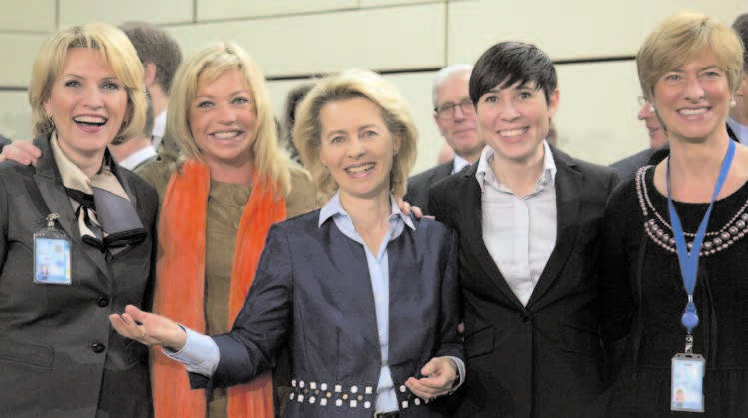
BRUSSELS (TIP): Nato has registered a first in its long history, with five women among the defense ministers who turned up on Wednesday to attend a policy—making meeting at the alliance’s headquarters.
The latest woman to join the ministerial ranks was Italy’s Roberta Pinotti, who was sworn in Saturday as her country’s first female defense minister. The 52— year—old served as an undersecretary for defense in the just—ended government of Enrico Letta. First elected to Parliament in 2001, she is now a senator.
She began her political career two decades ago as a lower—ranking official in what was then Italy’s Communist Party. Pinotti joined Albania’s Mimi Kodheli, Germany’s Ursula von der Leyen, Norway’s Ine Marie Eriksen Soreide and Jeanine Hennis—Plasshaert of the Netherlands.
A NATO official said the five constituted the largest number of women defense ministers to serve at one time since the 28—nation alliance was founded in 1949. Before getting down to business with US Defense Secretary Chuck Hagel and their other male colleagues Wednesday afternoon, the women posed together for news photographers. At first, there were just four of them — until Soreide of Norway realized the Albanian minister was missing. Kodheli was quickly called over, and the picture snapping resumed.
-

Afghanistan releases 65 ‘insurgents’ despite US protests: Officials
KABUL (TIP): Afghanistan released 65 alleged Taliban fighters from jail on Thursday despite condemnation from the United States, which says the men could return to the battlefield to launch strikes against NATO and Afghan forces.
The release of detainees from Bagram prison is set to worsen the increasingly-bitter relationship between Kabul and Washington as USled troops prepare to withdraw after 13 years fighting the Islamist militants. “The 65 prisoners were freed and walked out of the Bagram prison compound this morning,” Abdul Shukor Dadras, a member of the Afghan government review body, told AFP.
Ahead of the planned release, the US military said that the men were “dangerous individuals” directly linked to attacks killing or wounding 32 NATO personnel and 23 Afghans. But President Hamid Karzai has called the prison a “Taliban-producing factory” and alleged that some detainees were tortured into hating their country.
Lieutenant general Ghulam Farouq, head of the military police that runs the Bagram prison, confirmed that the men had been released. “They walked out of the facility and got into cars and headed off to their homes,” he told AFP. “We freed them and it’s up to them how they left. We didn’t prepare transport for them.”
-

Hamid Karzai will not sign security agreement: US spy chief
WASHINGTON (TIP): The US intelligence chief said on February 11 he does not expect Afghan President Hamid Karzai to sign a security agreement with the United States that would allow American troops to stay after 2014.
Washington has repeatedly appealed to Karzai to sign the bilateral security agreement (BSA) negotiated last year but James Clapper, director of national intelligence, said he had given up hope that the Afghan president would endorse the deal. “Well, obviously, it takes two to sign this,” Clapper told the Senate Armed Services Committee.
“And it’s my own view, not necessarily company policy, …I don’t believe President Karzai is going to sign it,” he said. His comments were the most explicit yet by a senior US official acknowledging the bleak prospects of Karzai backing the agreement. Senator Carl Levin, chairman of the committee, asked Clapper if it would be better for the US government to wait for the next Afghan president to sign the deal after the country’s April elections.
Clapper said that would be a policy decision and not up to him but he said such a move could “have a salutary effect.” The United States favors leaving about 10,000 troops in Afghanistan after this year to help train Afghan forces and counter al-Qaida militants and its allies.
The delay in signing the security agreement, which would set up a legal framework for foreign troops to stay post-2014, has created uncertainty and undermined confidence among Afghans, Clapper said. “The effect already of the delay has been negative in terms of the impact on the economy, not to mention I think the psychological impact,” he said. Worries about whether NATO-led forces will remain in the country have triggered negative trends in the economy,
-

US spied on Merke’s predecessor after he opposed the Iraq war, says report
Snowden’s leaked documents reveal that the US spied on Schroeder for his opposition to the Iraq war.
WASHINGTON (TIP): American intelligence services had not only spied on German Chancellor Angela Merkel, but also monitored her predecessor Gerhard Schroeder after he opposed the US plans to go to war in Iraq, suggest media reports.
The Sueddeutsche Zeitung newspaper and the TV channel NDR reported that their investigations based on documents leaked by former National Security Agency (NSA) contractor Edward Snowden showed that Social Democrat (SPD) Chancellor Schroeder was spied on by the NSA at least from 2002. Schroeder, who headed a coalition government with the Green party between 2001 and 2005, was listed under the number 388 in the “National Sigint Requirements List” of the NSA.
The list contained the names of persons and institutions to be monitored by the spy agency, the reports said. Since a document leaked by Snowden in October revealed that the NSA had eavesdropped on Chancellor Merkel’s mobile phone for several years, there have been speculations that she may not be the only German leader spied on by the NSA.
The Sueddeutsche Zeitung and NDR said their investigations showed that Schroeder’s phone may have been bugged by the NSA from 2002 and Merkel was spied on by the agency since she began her first term in 2005. US President Barack Obama assured the German chancellor recently that spying on her would not happen again during his presidency and he would not allow US intelligence operations to damage the close friendship and cooperation between the two countries.
Schroeder’s strong opposition to the Iraq war in 2003 could have made him a target of surveillance by the US intelligence agencies as the US feared a split in the North Atlantic Alliance (NATO), the reports said. Commenting on the revelations, Schroeder said in a statement that when he was in power he “would not have thought about being monitored by American intelligence agencies; now I will not be surprised,” according to the reports.
Green party parliament member Hans-Christian Stroebele, the only western politician to meet Snowden in Moscow since he was granted a one-year asylum by Russia in August, said he firmly believed that Schroeder and possibly other members of the SPD-Green government were spied on by the NSA. In a TV interview, Stroebele demanded a thorough clarification of the NSA surveillance operations at least since 2002 and an investigation by a German parliamentary inquiry committee, which he expects will be constituted shortly.
-

Dealing with a toxic legacy
President Barack Obama’s recent statement of his Afghanistan policy has again revealed the intractable situation the United States has faced since it led the invasion of that country in 2001.
In his State of the Union address to Congress on January 28, Mr. Obama said the mission there would be completed by the end of the year, and that thereafter the U.S. and its allies would support a “unified Afghanistan” as it took responsibility for itself. With the agreement of the Afghan government, a “small force” could remain to train and assist Afghan forces and carry out counterterrorism operations against any al- Qaeda remnants.
Washington has withdrawn 60,000 of its troops from Afghanistan since Mr. Obama took office in 2009, but 36,500 remain, with 19,000 from other countries in the NATO-ISAF coalition. Western plans are for a residual force of 8,000 to 12,000, two-thirds of them American, but sections of the U.S. military have suggested a U.S. strength of 10,000, with 5,000 from the rest of the coalition. Mr. Obama is discussing the options with senior officers.
The President wants to avoid a repeat of Iraq, which with the exception of Kurdistan has become a battleground between Sunni and Shia leaders, claiming over 7,000 lives in 2013 alone. But over Afghanistan he is caught in a cleft stick. Afghan President Hamid Karzai is yet to sign the deal for NATO-ISAF troops to stay; he would prefer his successor to sign the agreement after he leaves office in April 2014, but the successor will not take office until September.
Secondly, Mr. Karzai has infuriated Washington by planning to release 37 Taliban detainees, by blaming American forces for terrorist attacks on civilians, and by calling the U.S. a “colonial power.” Yet the Afghan National Security Forces, which include the police, number 334,000, or about 20,000 below the numbers envisaged for them, and the U.S. Department of Defense has reported to Congress that the ANSF cannot operate on their own.
The U.S. public have little wish to continue the war, but the military may have its own agenda. The September 2013 quarterly report by the Special Inspector General for Afghan Reconstruction shows that of nearly $100 billion in reconstruction aid, $97 billion went towards counter-narcotics, security, and other operations; only $3 billion was used for humanitarian aid. If the President feels hemmed in, it is because of the toxic legacy of his predecessor George W. Bush who went into the country in search of Osama bin Laden and al-Qaeda. At the end of 12 years of American occupation, Afghanistan has not emerged as a more secure place; nor has the U.S. had much of a success in nation-building.
-

Afghanistan to free 37 prisoners soon despite US protests
KABUL (TIP): Afghanistan said on January 28 it expects to release within two weeks a first batch of alleged Taliban prisoners, who the US says are responsible for dozens of NATO and Afghan deaths.
Kabul announced on January 9 that a total of 72 detainees held at Bagram jail near Kabul would be freed due to lack of evidence, and an official said today that 37 were to be released initially. The US military force in Afghanistan condemned the news of the releases, saying the prisoners were “dangerous insurgents” who had “Afghan blood on their hands”.
The issue threatens further to strain US-Afghan relations, amid pressure for the two countries to sign a long-delayed security deal allowing some American soldiers to stay in the country after 2014. Abdul Shukur Dadras from the government body reviewing detainees at Bagram, which was previously run by US forces, said 37 prisoners would be released soon.
“Their dossiers are reviewed, completed and we have ordered their release,” Dadras told AFP. “They will be released from the prison after the required technical and security procedures are completed. This will, I think, take more than one week and less than two weeks.” Dadras also said the review of the remaining prisoners was continuing.
Amid resurgent Taliban violence, US-Afghan relations are strained over a number of issues including President Hamid Karzai’s refusal to sign a pact governing Washington’s future military role in Afghanistan. “The ARB ( Afghan Review Board) is releasing back to society dangerous insurgents who have Afghan blood on their hands,” the US military in Afghanistan said in a statement. It said 17 of those about to be freed were linked to improvised explosive device attacks, the deadliest of the Taliban’s weapons, while others were connected to the deaths or wounding of 11 Afghan and 42 US or coalition soldiers.
-

Afghanistan accident kills 2 Nato troops, 1 civilian
KABUL, AFGHANISTAN (TIP): The US-led international coalition in Afghanistan says two of its service members and one civilian employee have died in an aircraft accident. A Nato statement says the “aircraft mishap” happened on Friday in eastern Afghanistan.
The alliance provided no details on the accident, and the names and nationalities of those killed were not released. Four Nato troops have been killed in Afghanistan so far this year. One service member was killed in a suicide attack on January 4, also in eastern Afghanistan, and another on January 1.
-

Taliban suicide attack on Nato convoy in Kabul: Officials
KABUL:
A Taliban suicide bomber detonated an explosives-packed vehicle next to a Nato military convoy in Kabul on Friday, officials said, though no details about casualties were immediately available. The attack occurred on a main road that passes by a series of government compounds and military facilities in the Afghan capital on the way to the eastern city of Jalalabad. “Around 1:00pm, a suicide bomber blew up a car targeting a convoy of foreign forces on the Kabul-Jalalabad road,” Hashmatullah Stanikzai, spokesman for the Kabul police, said. “Our security forces have rushed to the scene to investigate, and we don’t have any information on casualties yet.” An AFP reporter said that civilian ambulances and armoured vehicles from the US-led Nato mission in Afghanistan were at the blast site, which was quickly cordoned off by police. “Our mujahideen have detonated a car bomb attack on a convoy of foreign forces today afternoon,” Taliban spokesman Zabihullah Mujahid said. “As a result of the attack, several foreign forces were killed and a number of their vehicles were damaged.” The Taliban routinely exaggerate death tolls after attacks. A spokesman for Nato’s mission in Afghanistan, the International Security Assistance Force (ISAF), said the explosion was being investigated but gave no further details.