Tag: NATO

  • Not just Karzai can sign Afghan pact: Nato chief

    Not just Karzai can sign Afghan pact: Nato chief

    BRUSSELS (TIP): Nato’s chief says any Afghan government representative, not only President Hamid Karzai, could sign a security pact with the United States so that thousands of coalition troops could stay in Afghanistan after 2014. Karzai has balked at signing the bilateral security agreement with the United States that would allow Nato to follow suit.

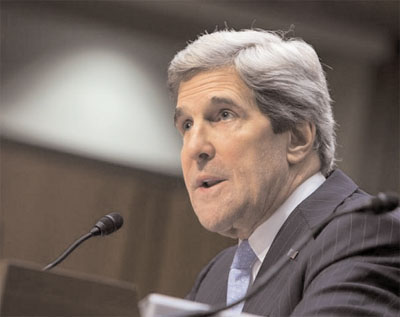
    His refusal has loomed large at a two-day meeting of alliance foreign ministers ending today. Nato secretary general Anders Fogh Rasmussen told reporters after a meeting with Afghan envoys that “everyone who is authorized to represent respective governments would be able to sign such an agreement.” US Secretary of State John Kerry suggested yesterday that Karzai’s “minister of defense can sign it, the government can sign it. Somebody can accept responsibility for this.”

  • Afghanistan-US reach draft security agreement

    Afghanistan-US reach draft security agreement

    KABUL/WASHINGTON (TIP): The United States and Afghanistan on November 20 reached a draft agreement on a crucial security pact, a day before thousands of Afghan elders are set to debate whether to allow US troops to stay in the country after 2014. Without the accord, the United States has warned it could withdraw its troops by the end of next year and leave Afghan forces to fight a Taliban-led insurgency without their help.

    Thousands of Afghan dignitaries and elders are due to convene in a giant tent in the capital Kabul on Thursday to debate the fate of US forces after a 2014 drawdown of a multinational Nato force. “We have reached an agreement as to the final language of the bilateral security agreement that will be placed before the Loya Jirga tomorrow,” Kerry told reporters. Intense negotiations between Kabul and Washington have provoked frustration among the Afghan tribal and political elders who made perilous journeys from all over the country to the capital Kabul for a grand assembly to debate the pact.

    Efforts to finalize the pact stalled on Tuesday amid disagreement over whether US President Barack Obama had agreed to issue a letter acknowledging mistakes made during the 12-year Afghan war. Kerry denied there had been any discussion about the possibility of a US apology to Afghanistan for US mistakes or Afghan civilian casualties during the 12-year US military presence in Afghanistan. Such an apology would draw widespread anger in the United States. “The important thing for people to understand is there has never been a discussion of or the word ‘apology’ used in our discussions whatsoever,” Kerry said, adding that Afghan President Hamid Karzai had also not asked for an apology.

    State Department spokeswoman Jen Psaki said the possibility of a letter, or some other kind of correspondence, would seek to reassure the Loya Jirga of the importance of the US-Afghan relationship and to address concerns over civilian casualties. The Afghan government said it had received assurances that an Obama letter would be provided this week to the grand council of Afghan elders, known as a Loya Jirga. But Susan Rice, Obama’s national security adviser, insisted on Tuesday that an apology was “not on the table.”

    NATIONAL INTERESTS

    The drawdown of Western troops has allowed tentative peace overtures between Kabul and the Taliban to gather pace, and Afghan officials arrived in Pakistan on Wednesday to initiate talks. The Taliban have nonetheless condemned the Loya Jirga as a farce, and security has been tight in Kabul following a suicide bomb attack near the assembly ground over the weekend. Insurgents fired two rockets at the tent where the last Loya Jirga was last held in 2011, but missed the delegates. If the two sides cannot agree on a pact, Karzai has suggested submitting different versions of the document for the Loya Jirga to decide on. That caused confusion among Jirga members.

    Khan Ali Rotman, who runs a Kabul youth organization, said if the pact was not in Afghanistan’s national interests, “we will raise our voice and not vote for it”. But a Kabul senator, Khan Mohammad Belaghi, said Afghanistan had no choice but to sign: “We have to have a partnership with a country like the United States and we will vote in favor of it because it can protect us from threats from neighboring countries, especially Pakistan, and the Taliban.” Violence spiraled on the eve of the meeting, with the Taliban attacking two high-ranking police officials.

    Gunmen ambushed and killed the police chief of Marja district in the southern province of Helmand on his way to work, said Omar Zwak, a spokesman for the provincial governor. Also in the south, guards shot dead a suicide bomber trying to force his way inside the house of the Kandahar provincial police chief, said Hamid Zia Durrani, a spokesman for the police. Later a bomb exploded at a hotel a few doors away, killing three and wounding 14, he said.

  • Afghanistan-US reach draft security agreement

    Afghanistan-US reach draft security agreement

    KABUL/WASHINGTON (TIP): The United States and Afghanistan on November 20 reached a draft agreement on a crucial security pact, a day before thousands of Afghan elders are set to debate whether to allow US troops to stay in the country after 2014. Without the accord, the United States has warned it could withdraw its troops by the end of next year and leave Afghan forces to fight a Taliban-led insurgency without their help.

    Thousands of Afghan dignitaries and elders are due to convene in a giant tent in the capital Kabul on Thursday to debate the fate of US forces after a 2014 drawdown of a multinational Nato force. “We have reached an agreement as to the final language of the bilateral security agreement that will be placed before the Loya Jirga tomorrow,” Kerry told reporters. Intense negotiations between Kabul and Washington have provoked frustration among the Afghan tribal and political elders who made perilous journeys from all over the country to the capital Kabul for a grand assembly to debate the pact. Efforts to finalize the pact stalled on Tuesday amid disagreement over whether US President Barack Obama had agreed to issue a letter acknowledging mistakes made during the 12-year Afghan war.

    Kerry denied there had been any discussion about the possibility of a US apology to Afghanistan for US mistakes or Afghan civilian casualties during the 12- year US military presence in Afghanistan. Such an apology would draw widespread anger in the United States. “The important thing for people to understand is there has never been a discussion of or the word ‘apology’ used in our discussions whatsoever,” Kerry said, adding that Afghan President Hamid Karzai had also not asked for an apology. State Department spokeswoman Jen Psaki said the possibility of a letter, or some other kind of correspondence, would seek to reassure the Loya Jirga of the importance of the US-Afghan relationship and to address concerns over civilian casualties.

    The Afghan government said it had received assurances that an Obama letter would be provided this week to the grand council of Afghan elders, known as a Loya Jirga. But Susan Rice, Obama’s national security adviser, insisted on Tuesday that an apology was “not on the table.”

    NATIONAL INTERESTS

    The drawdown of Western troops has allowed tentative peace overtures between Kabul and the Taliban to gather pace, and Afghan officials arrived in Pakistan on Wednesday to initiate talks. The Taliban have nonetheless condemned the Loya Jirga as a farce, and security has been tight in Kabul following a suicide bomb attack near the assembly ground over the weekend. Insurgents fired two rockets at the tent where the last Loya Jirga was last held in 2011, but missed the delegates. If the two sides cannot agree on a pact, Karzai has suggested submitting different versions of the document for the Loya Jirga to decide on.

    That caused confusion among Jirga members. Khan Ali Rotman, who runs a Kabul youth organization, said if the pact was not in Afghanistan’s national interests, “we will raise our voice and not vote for it”. But a Kabul senator, Khan Mohammad Belaghi, said Afghanistan had no choice but to sign: “We have to have a partnership with a country like the United States and we will vote in favor of it because it can protect us from threats from neighboring countries, especially Pakistan, and the Taliban.” Violence spiraled on the eve of the meeting, with the Taliban attacking two high-ranking police officials.

    Gunmen ambushed and killed the police chief of Marja district in the southern province of Helmand on his way to work, said Omar Zwak, a spokesman for the provincial governor. Also in the south, guards shot dead a suicide bomber trying to force his way inside the house of the Kandahar provincial police chief, said Hamid Zia Durrani, a spokesman for the police. Later a bomb exploded at a hotel a few doors away, killing three and wounding 14, he said.

  • US spy chief defends spying on allies

    US spy chief defends spying on allies

    WASHINGTON (TIP): Undeterred by the European backlash, US Director of National Intelligence James Clapper has stoutly defended America’s spying on world leaders, including close allies, commenting other nations are doing much the same. At a Congressional hearing on Tuesday, October 29, when asked whether allies also spied on the United States, Clapper asserted: “Absolutely.” Clapper also defended the domestic surveillance that has drawn flak for sweeping up phone records of millions of Americans, saying it was necessary to protect the country against terrorists. Gen. Keith Alexander, Director of the National Security Agency, which has been at the centre of a major international controversy ever since whistleblower Edward Snowden’s sensational revelations, strongly defended the agency’s far-reaching surveillance operations. But Alexander denied that his agency had swept up millions of phone records of French and Spanish citizens, whose Governments have complained over the issue to Washington. Instead, it was NATO which collected and shared the information with the United States. The Europeans have been unmoved with American explanations thus far. A delegation from European Parliament, currently in Washington, was slated to hold a meeting with a senior official of the National Security Council at the White House on later on Wednesday. Germany has sent a separate team of officials as well.

    European Parliament member Jan Philipp Albrecht told the Voice of America (VOA) that the reports about the eavesdropping Chancellor Merkel were the tipping point, commenting: “Now people are really concerned. They see that it is not any longer connected to a terrorist threat, because Angela Merkel is not a terrorist.” Albrecht held out the threat that unless US effected major changes with Congress passing legislation to balance national security needs with the responsibility to protect basic civil rights, Europe could suspend important trans-Atlantic trade talks. At the House Intelligence Committee hearing on Capitol Hill, Clapper sought to play down the complaints of European allies, suggesting that spying of each other’s leaders has been a long-time practice of intelligence agencies across the world. As one who has worked in intelligence for some 50 years, Clapper said it was “a basic tenet” to collect, whether by spying on communications or through other sources, confidential information about foreign leaders to find out “if what they’re saying gels with what’s actually going on”. Alexander, too, commented that one of the first things he learned in intelligence school was that it would be valuable to learn about the intentions of foreign leaders.

  • Australian PM Tony Abbott makes surprise visit to Afghanistan

    Australian PM Tony Abbott makes surprise visit to Afghanistan

    CANBERRA (TIP): Australian Prime Minister Tony Abbott made a surprise visit to Afghanistan on October 28 to mark the impending end of Australia’s military involvement in the conflict, his office said. Abbott arrived at the Australian headquarters at Tarin Kowt under tight security for a ceremony to mark the end of Australia’s involvement in the war that has cost the lives of 40 Australian soldiers over more than a decade, the Prime Minister’s office said in a statement. The headquarters will be given to the Afghan army and most of Australia’s 1,500 troops will be withdrawn by Christmas. “Australia’s longest war is ending not with victory, not with defeat, but with, we hope, an Afghanistan that is better for our presence here,” Abbott told a large crowd of Australian and international soldiers. Abbott said it the withdrawal was a “bitter-sweet” occasion, and that “Afghanistan remains a dangerous place despite all that has been done.” Australia is the largest provider of troops to the Afghanistan war outside NATO.

  • US-India Relations Hit a Rough Patch

    US-India Relations Hit a Rough Patch

    The author feels that there are a number of vital issues which are unlikely to be settled within the tenures of either Obama or Singh, leaving a lingering note of ambivalence in the US-India relationship even as it deepens outside of the high politics.

    When Indian Prime Minister Manmohan Singh visited Washington last month for the first time in four years, the mood was distinctly subdued. India’s once-stratospheric growth rate is stubbornly depressed. The Indian government is low on political capital and stuck in risk-averse mode until next year’s general elections, with a huge question mark over Singh’s personal future. Most Indians anyway focused on Singh’s New York meeting with his Pakistani counterpart Nawaz Sharif – underwhelming, as it turned out, and marred by a perceived slur – rather than his meetings with President Obama. More generally, the promise of USIndia relations remains far below the levels anticipated only a few years ago.

    Why the stasis?
    There are any number of reasons. Indian journalist Indrani Bagchi suggests that ‘there remains a strong lobby within this government starting with [ruling Congress Party chairwoman] Sonia Gandhi and [Defense Minister] AK Antony downwards, which retains an instinctive aversion to America’. That same government’s slow rate of economic reform irks American companies who want to invest in India. In particular, a strict nuclear liability law limits those companies’ ability to exploit a landmark civil nuclear cooperation agreement initiated by the Bush administration in 2005. Also, India’s Byzantine procurement rules madden the American defense companies eager to sell into what is one of the few growing arms markets in the world. A sense prevails that the low-hanging fruit in the bilateral relationship was picked some years ago. But one less-noticed problem is that the limited bandwidth of US foreign policy is presently occupied by issues in which India is either wary of US policy or simply apathetic.

    The Middle East
    In his speech to the United Nations General Assembly on 24 September, President Obama noted that ‘in the near term, America’s diplomatic efforts will focus on two particular issues: Iran’s pursuit of nuclear weapons and the Arab-Israeli conflict’. India has much to gain from a rapprochement between Iran and the United States, not least the ability to once again freely import Iranian oil. India was circumventing international sanctions by paying for a diminished flow of Iranian oil in rupees, but the new Iranian government is insisting that India can only pay for half this way. India is a bystander rather than active participant in the broader dispute, watching from the sidelines as the P5+1 bloc, which includes Russia and China, participates in negotiations. On Syria, India is sympathetic to the regime of President Bashar al-Assad. It views the issue through the lens of the Afghan jihad in the 1980s, which Indians see as indelibly associated with the subsequent uprising in Kashmir and the growth of anti- Indian militancy. When the Indian Government summoned the Syrian Ambassador in Delhi last month, it was not because of Syrian policies but because the ambassador had alleged that Indian jihadists were fighting with the rebels. The ambassador stated, tellingly, that ‘he was always deeply appreciative of India’s position on Syria’.

    India unsurprisingly opposes efforts to arm the Syrian rebels, tends to see the armed opposition as irredeemably compromised by jihadists and reflexively opposes US proposals for military action, particularly outside the ambit of the UN Security Council. India has already had to abandon several oil fields in Syria and, in September 2013, India’s foreign secretary even referred to an existing Indian line of credit to the Syrian government. Yet, despite these equities, India has no leverage over the parties to the conflict. In May, an Iranian suggestion of greater Indian involvement went nowhere. There is little that Singh would usefully have been able to say to Obama on the subject. At a broader level, the more the Middle East distracts from US attention to Asia- Pacific – including the so-called ‘pivot’ of American military forces eastwards – the less high-level attention India receives in Washington. India was not mentioned once in Obama’s UN address (to compare: China was mentioned once, Iran 26 times, and Syria 20).

    Afghanistan
    India’s attitude to US policy in Afghanistan is even more conflicted. India is ostensibly supportive of US policy, and has formally signed on to an Afghan-led peace process. But Indian officials and strategists scarcely disguise their discomfort towards what they see as undue American haste in withdrawing troops, an overeagerness to accommodate the Taliban as part of political reconciliation, and a continued indulgence of Pakistan despite its support for Afghan insurgents. India felt that its views were vindicated by the June debacle over the opening of a Taliban office in Doha, which deviated from the agreed protocol, handed a propaganda victory to the Taliban, and angered the Afghan government. Indian national security reporter Praveen Swami summed up many Indians’ views in complaining that the US was ‘subcontracting the task of keeping the peace in Afghanistan to the ISI’, Pakistan’s premier intelligence service.

    In recent months, Indians have taken offence at statements by James Dobbins, the US Special Representative for Afghanistan and Pakistan, echoing earlier Indian anger at the late Richard Holbrooke, and have chafed at what they see as a Western equivalence between Indian and Pakistani policy in Afghanistan. For their part, US and British officials have grown increasingly frustrated with India’s approach to the issue, arguing that India offers no plausible alternative to the policy of reconciliation given the long-term weakness of the Afghan state. Yet it is in Obama’s interests to assuage Indian concerns, emphasize that reconciliation with the Taliban will be constrained by the established ‘red lines’, that the US will not abandon counterterrorism efforts in Afghanistan after 2014, and that India’s role in Afghanistan is not only welcome, but also necessary to the strengthening of the Afghan state. India rebuffed Afghan President Hamid Karzai’s request for arms earlier this year, wary of provoking Pakistan. But one area that deserves more discussion is greater direct cooperation between India and the NATO-led coalition in Afghanistan to train and equip Afghan National Security Forces (ANSF).

    According to one report, Obama asked Singh last week for an ‘increased effort’ in Afghanistan, although it’s unclear whether this included an implied or explicit training dimension. India, entirely reasonably, sees a potential eastward flow of militants from Afghanistan and Pakistan as a major security threat, particularly with violent trends in Kashmir worsening this year. India would therefore be particularly receptive to a US commitment to monitor and disrupt militant movement in the years after 2014. In truth, it will be difficult to make progress on these issues until Washington settles its own internal debates over what its posture in Afghanistan will be after 2014 (for example, how many (if any) troops will remain in a training capacity?), which in turn will depend on the peace process itself, President Karzai’s domestic political calculations in the face of presidential elections next year, the integrity of that election, and trends in Afghanistan.

    Where next?
    The level of US-India tension should not be exaggerated. It is telling that recent revelations over US intelligence collection against Indian diplomatic targets have, unlike in the case of Brazil, had negligible impact on the relationship. Indian officials chose to brush the issue under the carpet, presumably hoping that the issue had little domestic salience and perhaps even tacitly acknowledging that the NSA’s activities against Indian internet traffic were indirectly beneficial to Indian policy objectives. Twenty years ago, the Indian response may have been very different. It is these changes in tone that convey strategic shifts as much as any large policy initiative. And although the two countries differ on the contentious big-picture issues outlined above, this has not prevented the relationship from advancing on other tracks. In September, US Deputy Secretary of Defense Ashton Carter visited India to push ahead with the bilateral Defense Trade Initiative (DTI), which Carter co-chairs with India’s National Security Advisor, Shivshankar Menon.

    Carter reiterated his suggestion, dating from last year, that US and Indian firms cooperate to produce military equipment – including helicopters, nextgeneration anti-tank missiles, mine systems, and naval guns – for both countries’ use. India has been bafflingly slow and reticent to respond to these overtures, despite the possibility of much-needed technology transfer to Indian industry (though many analysts are skeptical as to its capacity for technology absorption). The negotiations nevertheless reflect the US perception that the defense strand of its relationship with India are a priority. The road ahead is rocky. Over the next eighteen months, the US-India relationship will be severely buffeted by US policy towards Afghanistan. As the American drawdown accelerates, one possibility is that the US intensifies diplomatic efforts to peel away moderate factions within the Afghan Taliban, Whether that amounts to anything or not (and few are optimistic) the process is certain to involve at least a period of deeper USPakistan consultations, at the expense of India. Later this month, for instance, a fourth Afghanistan-Pakistan-UK trilateral summit will take place in London.

    India has quietly seethed at the previous three, viewing them as a coordinated effort to reduce Indian influence. Yet, for the United States at least, the centre of gravity of the US-India relationship is not Afghanistan, but China. The Middle East’s fast-moving and highly visible crises have briefly distracted from a slow-moving background trend: the political and economic rise of China. Yet this remains where Indian and American strategic interests are most collectively at stake, if not necessarily congruent. Following India’s most recent crisis with China, involving deep Chinese incursions into disputed territory a few months ago, New Delhi’s instinctive response was not to make a prominent feint towards Washington – something that might have been the natural response of other states eager to balance against Beijing – but to engage China more intensively, including on the border dispute itself. Indeed, Singh will make a trip to Beijing next month, with indications that he may sign an upgraded border agreement. Nothing better underscores how India’s internal debate over the desired scope of its relationship with the United States is unsettled, on-going, and erratic. More generally, much of India’s press and strategic community have accepted the popular narrative that American leadership, as well as American power, is in decline, and that US reliability is therefore in question. These issues are unlikely to be settled within the tenures of either Obama or Singh, leaving a lingering note of ambivalence in the USIndia relationship even as it deepens outside of the high politics.

  • UN extends Nato force in Afghanistan for last time

    UN extends Nato force in Afghanistan for last time

    UNITED NATIONS (TIP): The UN security council voted unanimously on October 10 to extend the mandate of the Nato-led force in Afghanistan for the last time before it hands over total responsibility for security to Afghan forces at the end of 2014. The resolution adopted by the council said the situation in Afghanistan “still constitutes a threat to international peace and security”. It expressed serious concern about security in the country, pointing to ongoing violence and terrorist activities by the Taliban, al-Qaida, and other illegal and extremist groups as well as by criminals and those involved in the illegal drug trade. The Taliban have escalated attacks in recent months as they try to take advantage of the withdrawal of foreign troops. In June, Afghan forces took the lead for security nationwide, leaving the Nato-led International Assistance Force known as ISAF entirely in a supporting, backseat role. ISAF has dropped dramatically in strength as it prepares to leave — down from 130,000 troops two years to just over 87,200 troops on August 1, including 60,000 Americans.

    The security council extended ISAF’s mandate until December 31, 2014 — the final day for transferring full security responsibility to the Afghan government. Its action followed an outburst on Monday from Afghan President Hamid Karzai who alleged that the US and Nato inflicted suffering on the Afghan people and repeatedly violated its sovereignty. Despite his critical remarks, the Obama administration is still optimistic that a US-Afghan agreement over the future role of American troops in the country can be finalized in the next few weeks. Karzai made the comments on the 12th anniversary of the start of the American campaign in Afghanistan against al-Qaida that ousted its Taliban allies from power. The invasion was in response to the September 11 attacks on the United States, which claimed nearly 3,000 lives. The security council welcomed a 2010 agreement between Nato and Afghanistan to provide practical support to improve Afghanistan’s “capacity and capability to tackle continued threats to its security, stability and integrity”. It encouraged ISAF and other partners to accelerate the training and mentoring of the Afghan National Security Forces, now numbering more than 350,000 men and women. The council said the goal is to have an Afghan force that is “self-sufficient, sustainable, accountable and ethnically balanced,” and is able to provide security and ensure the rule of law throughout the country.

  • INDIAN AUTHOR EXECUTED IN AFGHANISTAN BY TALIBAN

    INDIAN AUTHOR EXECUTED IN AFGHANISTAN BY TALIBAN

    KOLKATA/KABUL (TIP): Indian author Sushmita Banerjee was executed by the Taliban late on September 4. While the reason for the barbaric act was not given, Banerjee had possibly attracted the ire of the fundamentalist outfit for her ceaseless social work, especially for women’s healthcare and upliftment. Forty-nine-year-old Banerjee, according to reports, was dragged out of her house in Kharana in Paktita province before being shot dead by the turbaned militants. The execution signals the portent of things to come before the impending withdrawal of American forces from Afghanistan where deadly attacks and other forms of atrocities against women have spiralled in the past few months. Banerjee, who had converted to Islam and rechristened herself asSayeda Kamala, retained her Indian citizenship. Earlier too she had attracted the anger of the regressive Taliban. Her memoir about her dramatic escape from the clutches of the fundamentalist outfit inspired a movie in 2003, Escape from Taliban, starring Monisha Koirala.

    Last month, a female Afghan MP was abducted by suspected Taliban militants while she was travelling with her children. Another woman MP recently sought asylum in Britain after being abandoned by her relatives for seeking divorce from an abusive husband. In July, gunmen assassinated a high profile female police officer. These instances have occurred in the backdrop of orthodox Muslim groups renewing their call against women stepping out of their homes to work or seek independent careers. Indian officials in Kabul confirmed that Banerjee was shot around 11pm Wednesday and that her last rites were performed by her family Thursday morning. She had just returned to Afghanistan after celebrating Eid in West Bengal. Married to an Afghan businessman, Jaanbaz Khan, Banerjee had recently moved back to Afghanistan after spending a few years in India, especially Kolkata and Mumbai.

    Her best-selling book, Kababuliwalar Bangali Bou (A Kabuliwala’s Bengali Wife), was written in 1995 after she escaped from the clutches of the Taliban in the wake of the fall of Afghanistan to the marauding hordes. Although a report claimed the Taliban denied any involvement in the killing, Afghan police said militants belonging to the extreme Islamist outfit descended on her Kharana house, tied up her husband and other family members before dragging Sushmita out and pumping several bullets into her from close range. After the cold-blooded execution, the Talibs dumped her body near an Islamic seminary, the police added. Since returning to Afghanistan, Banerjee worked as a health worker in Paktita, recording on celluloid the lives of local women as part of her work. After her July 1988 marriage to Khan, who she had earlier met in Kolkata, Banerjee moved to Afghanistan when her parents tried to get her divorced. All of 27 at that time, Banerjee was shocked to learn that Khan was already married to another woman.

    She took pity on Khan’s first wife, Gulguti, and even reared her children besides adopting Tinni, daughter of her brother-in-law. “Her publisher Swapan Biswas said Banerjee had informed him about the plan to return to Afghanistan in February to start work on another book. “She was determined to go back for the book which she wanted me to publish,” Biswas said. Besides the first book, Banerjee has recounted her remarkable escape story in an article for an Indian news magazine in 1998. She wrote that “life was tolerable until the Taliban crackdown in 1993” when militants ordered her to shut down the dispensary she ran from her house and “branded” her as a woman of “poor morals.” In Banerjee’s words, she made an abortive bid to escape first in early 1994, but her brothers-in-law tracked her down to the Pakistani capital, Islamabad, where she had reached to seek assistance from the Indian embassy.

    They took her back to Afghanistan only to be confined by the Taliban in house arrest. The Taliban promised to send her back to India, which never happened. Instead, they heaped insults on her and threatened her daily. That is when she made up her mind to escape. The daring move bore fruit in 1995 when she was able to hoodwink her captors, fleeing her husband’s house which is three hours from Kabul. Banerjee’s execution does not bode well for Afghanistan’s women, especially when their empowerment under the Hamid Karzai regime was held up as one of the greatest successes of the Nato coalition forces. Human rights groups operating in Afghanistan and abroad say that a string of laws passed by the parliament will expose women to extreme forms of abuse. The Islamists have been demanding shutting down of women’s shelters which they describe as “dens of immorality”.

  • International Raise the cost for Pakistan army’s proxy war order be damned

    International Raise the cost for Pakistan army’s proxy war order be damned

    The West’s attempt to ride roughshod over the United Nations Security Council with a hastily drafted proposal to authorize the use of force in Syria sets the stage for its second military intervention in West Asia and North Africa in as many years. The resolution, drafted by the United Kingdom and backed by the United States and France, seeks two things from the Council: one, a condemnation of President Bashar al-Assad for using chemical weapons on his people and two, its blessings to deploy “all necessary measures” to protect Syrians. If the first asks the U.N. for a leap of faith on a premature claim, the second requires it to turn a blind eye to history.

    While acknowledging there exists no “smoking gun” to establish Mr. Assad’s culpability, the West has tried its best to impede the working of the U.N.’s team in Syria investigating claims if chemical weapons were used at all. The charade now unfolding before the UNSC reflects the West’s desperation to have its way with a military intervention that has few takers. If the Arab League, including key members and U.S. allies like Egypt, has expressed its reluctance to support the imminent assault, public opinion in the U.S., Britain and France too is overwhelmingly opposed to a new war. After the disastrous 2011 NATO bombing of Libya, which began with the objective of protecting civilians but ended up being a full-blown attack on the Muammar Qadhafi regime, the Security Council is rightly wary of the Anglo-American plans for a “limited” intervention in Syria. Expecting the world to believe a military attack will destroy Mr. Assad’s chemical weapons arsenal without inflicting unacceptable civilian casualties is silly.

    If anything, a targeted attack is not so much a guarantee of minimal damage, but an attempt to fulfill President Barack Obama’s vain promise to punish the Assad regime if it used chemical weapons. After proffering sketchy evidence in support of this grave allegation, the President is now being forced to walk his talk by the liberal interventionists who populate his administration and by a trigger-happy British Prime Minister. One senior U.S. official let slip that the planned assault will be “just muscular enough not to get mocked,” revealing how this issue is now entirely about American “credibility,” as opposed to the humanitarian tragedy in Syria. The Council’s likely rejection of the draft resolution will be portrayed as Russian and Chinese intransigence. The fact remains, however, that influential powers like India, Brazil and South Africa too are against military intervention pending a complete investigation of WMD claims. The West’s failure to act through the U.N. not only betrays the Syrian people but also reflects its contempt for the international order.

  • KABUL SEEKS ECONOMIC, MILITARY AID FROM INDIA

    KABUL SEEKS ECONOMIC, MILITARY AID FROM INDIA

    NEW DELHI (TIP): Afghanistan has sought India’s economic and military assistance to help the embattled nation stand on its own feet after the drawdown by NATO troops in 2014. Visiting Afghanistan Second Vice-President Mohammad Karim Khalili today held talks with Prime Minister Manmohan Singh and other Indian leaders on the unfolding scenario in Afghanistan. He is understood to have discussed the steps that could be taken by the two countries in the coming days under the Strategic Partnership Agreement signed between the two nations in October 2011. Along with commitment to help Afghanistan develop in the fields of education and infrastructure, the agreement entails military support from India in the form of capacity building and equipment for the Afghan National Police (ANP) and the Afghan National Army (ANA).

    India is hosting Khalili with an eye on the looming political transition that is expected to take place in Afghanistan next year after the withdrawal of foreign forces. Khalili is accompanied by Afghan Economic Minister Abdul Hadi Arghandiwal, Higher Education Minister Obaidullah Obaid and Afghan Army Chief of Staff Sher Mohammad Karimi. His visit assumes significance against the backdrop of Afghan President Hamid Karzai, during his visit to India in May, had handed over a military wish-list to Indian officials. A number of Indian officials have also visited Kabul in recent days to discuss the needs of the Afghan security forces. During his meeting with President Pranab Mukherjee, Khalili thanked India for the assistance extended to his country and invited Indian companies to invest in Afghanistan, especially in the mining sector. The Indian President assured the Afghan leader that India was committed to assist Afghanistan in the critical period of transition, development and nation-building. India was committed to Afghanistan at the political and strategic level well beyond 2014 when international forces are scheduled to depart.

  • Female Afghan MP Taken Hostage: Officials

    Female Afghan MP Taken Hostage: Officials

    GHAZNI, AFGHANISTAN (TIP): An unknown gang has kidnapped a female Afghan member of parliament, officials said August 14, in the latest example of prominent women being targeted in the country. Fariba Ahmadi Kakar and her three children were taken at gunpoint on August 10 in the central province of Ghazni on the main highway from Kandahar city to Kabul.

    “The security forces released her children (two girls, one boy) in an operation on Monday. But she has been kept in another location, we are still searching for her,” Mohammad Ali Ahmadi, deputy provincial governor of Ghazni, told AFP. “The town elders are also involved in talks with the kidnappers to secure her release,” he added, giving no further details about the identity of the kidnap gang. Several other officials in Ghazni and Kandahar confirmed the kidnapping, and dismissed interior ministry reports that Kakar was on a trip to Turkey.

    Kakar’s family earlier denied she had been taken hostage, with some relatives telling AFP she was in hospital. Taliban spokesman Zabihullah Mujahid told AFP that he was not aware of the kidnapping. Hostages in Afghanistan are often taken by local criminal gangs, and can be sold on to insurgent groups who then demand cash ransoms or prisoner exchanges for their release. Women who take on public roles in Afghanistan are constantly under threat, with many conservative Muslims against women working outside the home and building independent careers.

    Last month, gunmen shot dead one of the country’s most high-profile female police officers. Lieutenant Islam Bibi, a well-known face of female advancement, was killed by unknown assailants when she was being driven to work by her son in the southern province of Helmand. Women’s rights are a key focus of international efforts in Afghanistan, with foreign diplomats often pointing to more female school children and greater freedom for women as signs of progress. But donor nations have also raised fears that such advances are at risk as 87,000 Nato troops withdraw next year and Islamist groups lobby for more influence.

  • US Drone Strikes In Pakistan Will End ‘Very Soon’: JOHN KERRY

    US Drone Strikes In Pakistan Will End ‘Very Soon’: JOHN KERRY

    ISLAMABAD (TIP): US secretary of state John Kerry told Pakistanis on August 1 that Washington planned to end drone strikes in their country soon – a message aimed at removing a major source of anti-American resentment in the strategically important country. After meeting Prime Minister Nawaz Sharif, Kerry said they had agreed to reestablish a “full partnership”, hoping to end years of acrimony over the drone strikes and other grievances including the US raid that killed Osama bin Laden.

    In a television interview later, Kerry said of the drone strikes: “I think the program will end as we have eliminated most of the threat and continue to eliminate it.” “I think the president has a very real timeline and we hope it’s going to be very, very soon,” he told Pakistan Television, when asked whether the US had a timeline for ending drone strikes, aimed at militants in Pakistan. US drone missiles have targeted areas near the Afghan border including North Waziristan, the main stronghold for various militant groups aligned with al-Qaida and the Taliban, since 2004.

    Pakistanis have been angered by reports of civilian casualties and what they see as an abuse of their sovereignty. It is unclear if, in their face-to-face talks, Sharif asked Kerry to halt the drone attacks. But when asked at a news conference whether Pakistan wanted the US to curtail the strikes, his foreign affairs adviser, Sartaj Aziz, replied: “We are asking them to stop it, not just curtail it.”

    Besides the drones and the killing of bin Laden in 2011, relations have been strained by Pakistan’s support for Taliban insurgents fighting Western troops in Afghanistan as well as a NATO air attack in which 24 Pakistani soldiers were killed. “I want to emphasize the relationship is not defined simply by the threats we face, it is not only a relationship about combating terrorism, it is about supporting the people of Pakistan, particularly helping at this critical moment for Pakistan’s economic revival,” Kerry told reporters.

    A new government in Pakistan and a new secretary of state in Washington have increased hopes the two sides can settle their grievances – something both hope to gain from, with Pakistan’s economy badly needing support and the United States aiming to withdraw the bulk of its troops from Afghanistan next year. Speaking after talks with Sharif in Islamabad, Kerry – who as a senator sponsored legislation to provide $7 billion in assistance to Pakistan over 5 years – said he had invited Sharif to visit the United States, Pakistan’s biggest donor, for talks with President Barack Obama.

    “What was important today was that there was a determination … to move this relationship to the full partnership that it ought to be, and to find the ways to deal with individual issues that have been irritants over the course of the past years,” he said. “And I believe that the Prime Minister is serious about doing that. And I know that President Obama is also.”

  • Could Taliban Talks Lead To Partition Of Afghanistan?

    Could Taliban Talks Lead To Partition Of Afghanistan?

    The big question for the Afghans is: what happens in the long term? What will Kabul require to maintain the Afghan form of security and peace after the US/NATO troops leave, or will Afghanistan willy-nilly pitch itself right into yet another bloodletting civil war – like what followed the Soviet troop withdrawal in 1989? “, says the author.
    The much-expected talks between the Taliban and the United States in Doha have not yet begun, and there is no clear indication when the two parties, busy settling their list of pre-negotiation do’s and don’ts, will finally sit down to discuss the features of post-2014 Afghanistan and determine role of various parties in the future. Meanwhile, some within Afghanistan have expressed concern that if indeed talks progress between the Taliban and the Americans, it may lead to the partition of Afghanistan.

    As of now it seems that one important party, the Government of Afghanistan led by President Hamid Karzai, has suspicions that the Americans are working toward allowing the Taliban to carve out some territory of its own as part of the so-called solution to the Afghan imbroglio, and has remained unwilling to participate in these talks. President Karzai demands Afghan-to- Afghan talks unfettered by the presence of foreigners – particularly those who invaded, fought the Taliban unsuccessfully for more than a decade, and are now looking for a conditional getaway.

    President Karzai’s hard stance may change. After all, he also knows that he will have to depend on these foreigners’ money to keep Kabul secure after the 100,000-plus foreign troops leave Afghanistan by mid-2014. What happens next? However, these are short-term logistical problems. What is certain at this point is that the vast majority of foreign troops will leave Afghanistan according to the timetable set by US President Barack Obama.

    The big question for the Afghans is: what happens in the long term? What will Kabul require to maintain the Afghan form of security and peace after the US/NATO troops leave, or will Afghanistan willy-nilly pitch itself right into yet another bloodletting civil war – like what followed the Soviet troop withdrawal in 1989? At that time, the Afghan strongman Najibullah, a friend of the Soviets and a gritty Pushtun, had held on to power for almost five years fighting various Mujahideen groups.

    Most of those groups were propped up by the West, the Saudis and Pakistan in the 1980s using “Islamic Jihad” as the battle cry to fight the Soviet military. After the Soviets left, some of these groups continued to receive active Pakistani help to topple Najibullah, then the Afghan symbol of the godless Soviets. The question is: Will the withdrawal in 2014 usher in the same players that we saw in 1989, killing at random to get control of Kabul? Who knows? The current tiff between Kabul and Washington that is receiving attention in the mainstream media is part of a power play in progress between President Karzai and the United States.

    This, too, will pass. But what is not certain is what the talks will in fact bring in. Will they bear the fruit that the Obama administration is hoping for? Max Fisher of the New York Times noted that the so-called peace talks are already on shaky ground for three reasons. First, on the same day Washington announced the opening of “peace talks,” the Taliban claimed responsibility for an attack that killed four Americans.

    Second, Afghan President Hamid Karzai announced he was no longer planning to participate in either the talks or a separate troop-level negotiation with the United States. And, third, the Taliban’s new office in Doha flew a banner labeled “Islamic Emirate of Afghanistan” and a flag from its days of ruling the country. “All three are individually bad signs that represent much larger challenges for peace in Afghanistan,” said Fisher.

    “In some ways, though, it’s the flag that’s most serious” (“The ultimate symbol of why Afghan peace talks will be so difficult,” Max Fisher, New York Times, June 19, 2013). Maybe Fischer is overstating here. This little summer thunderstorm may pass in no time. But, the problem is that even if the talks turn out to be “successful,” will that be any good for the Afghans? There is no reason to believe that President Obama is losing sleep over that.

    As far as he is concerned, a peaceful withdrawal from Afghanistan – unlike the kind of withdrawal from Vietnam that resembled so starkly the fearful retreat of a defeated military – is all that he cares about, even if that means supping with the devil. All the rest of the verbiage that comes out of Washington is rhetoric.

    Appeasing the Taliban? That, however, also means that Washington needs to keep the Taliban in good humor, and that means allowing the group to have some sort of authority in Kabul when the foreigners are gone – or, most of them. There is a distinct possibility that the upcoming talks will include this as an important item. Some in Washington have long claimed that the Taliban is not really that bad.

    In a December 2011 interview with Newsweek/Daily Beast, US Vice President Joseph Biden said as much. “We are in a position where if Afghanistan ceased and desisted from being a haven for people who do damage and have as a target the United States of America and their allies, that’s good enough. That’s good enough. We’re not there yet,” said Biden. “Look, the Taliban per se is not our enemy. That’s critical,” he insisted.

    “There is not a single statement that the president has ever made in any of our policy assertions that the Taliban is our enemy because it threatens US interests…” What Biden says is clear. The United States has zero problem with the Taliban. But it has loads of problems with the al- Qaeda. In Afghanistan, however, those problems have been mostly resolved.

    In fact, Washington claims that it has virtually decimated al-Qaeda – the real bad guys – and the upcoming deal with the Taliban will include the condition that the Taliban cannot allow al-Qaeda to set up shop in Afghanistan once again. If all these negotiating points work out, the Taliban could have a legitimate presence in Kabul.

    Some in Afghanistan claim that long before that becomes a reality, talks with the Taliban – who have a put up a plaque in Doha claiming themselves to be the representatives of the “Islamic Emirate of Afghanistan,” as opposed to the citizens of the Islamic Republic of Afghanistan, the actual name of the Afghan Government – will pave the way for partition of Afghanistan.

    Afghanistan’s Weesa Daily, in its June 19 editorial referring to these developments, said attention should be paid to several major points: First, the opening of the office is an understanding between the Taliban and the United States, and the Taliban now think that US forces in Afghanistan have been defeated and are escaping while the US considers how to leave the ongoing war to Afghans so that it can merely watch.

    If there is no crisis following President Karzai’s term and if peace talks advance as planned, the Taliban, according to their recent statement, will hold talks with all involved sides. But, notes Weesa Daily, “these talks of the Taliban with all involved sides would resume based on the plans suggested by US Senator Dana Rohrabacher and US Vice- President Joe Biden, who have suggested Afghanistan’s division – which may result in civil war.”

    Partition of Afghanistan? Well, US Vice President Biden has talked about the “soft partition” of Iraq, but never about the partition of Afghanistan; while Congressman (not Senator) Rohrabacher has participated in deliberations where partition/decentralization of Afghanistan was addressed as an issue. But before Rohrabacher got into the act, former US Ambassador to India and US National Security Council Deputy for Iraq (2003-2004) Robert Blackwill, a neo-con, had identified the partition of Afghanistan as Plan B.

    In a July 2010 article in Politico, Blackwill was highly critical of the Karzai administration (“Afghan President Hamid Karzai’s deeply corrupt government – as unpopular as the Taliban – shows no sign of improvement”) and implied that the “corrupt governance” of Kabul was the prime reason behind US/NATO’s failure to “win” the war in Afghanistan. He called for a ‘de facto partition’ of Afghanistan and urged the Obama administration to “accept that the Taliban will inevitably control most of its historic stronghold in the Pashtun south.”

    But, Blackwill added, “Washington could ensure that north and west Afghanistan do not succumb to jihadi extremism, using US air power and special forces along with the Afghan army and likeminded nations.” Blackwill also stated: “Given the number of US combat forces now fighting, the Taliban cannot be sufficiently weakened in Pashtun Afghanistan to drive it to the negotiating table on any reasonable timeline. True, the Afghan Pashtun are not a unified group. But they do agree on opposing foreign occupation and wanting Pashtun supremacy.”

    In January 2012, Chairman of the Europe, Eurasia, and Emerging Threats Subcommittee of the US House Foreign Affairs Committee Dana Rohrabacher (RCalifornia) went to Berlin at the head of a bipartisan congressional group represented by Reps. Louie Gohmert (R-Texas), Steve King (R-Iowa) and Loretta Sanchez (DCalifornia).

    In Berlin, the delegation met with well-known National Front leaders such as Ahmed Zia Massoud, chairman of the National Front [Jebha-e-Melli]; General Abdul Rashid Dostum, leader of the National Islamic Movement of Afghanistan [Jumbesh-e-Milli]; Haji Mohammad Mohaqiq, leader of the People’s Unity Party of Afghanistan [Hezb-e Wahdat-e Mardom]; and Amrullah Saleh, former director of the Afghan National Security Directorate.

    Together, they had signed a document advocating major changes in the Afghan constitution, designed to create a federal system which would devolve power from the centre to the provinces. Of the existing governmental arrangements in Afghanistan they had the following to say: “The current system has fatally concentrated decision-making to whoever is president of the country. The Afghan president appoints the governors of each province and district, the mayor of every town, every provincial chief of police, one third of the entire Senate, and even every judge in Afghanistan.”

    “This centralized power has led to massive corruption, disenfranchisement of a large segment of the Afghan people, obstacles to economic development, massive abuses of power, increasing political instability, poor governance, and a vast undermining of law and order.” Almost instantly Kabul reacted sharply to the statement. In April 2012, Rep. Rohrabacher was stopped in Dubai as he was leading a delegation to Kabul.

    Officials say that while the other members of the delegation had visas for Afghanistan, Rohrabacher was denied a visa. Afghan officials had told the BBC that in addition to his criticisms of the president, Rohrabacher was being shunned because of meetings he had held in Berlin with Afghan politicians about the creation of a decentralized form of government.

    According to the BBC, Afghan officials viewed that as tantamount to interference in the country’s internal affairs. “Anyone who speaks against the good of Afghanistan and tries to interfere in our internal affairs is ineligible for an Afghan visa,” one official told the BBC. Though strong, President Karzai’s reaction was not impulsive. At the time of the Berlin meetings – in fact, two meetings took place over three days (Jan. 9-11) – he had made known his discontent.

    Given the lack of clarity in the US strategy on Afghanistan, Karzai had every reason to suspect that the Berlin outcome could become the official strategy one day, particularly since Blackwill had already called for a ‘de-facto partition’ of Afghanistan a few months before. According to available reports, there was also another reason why President Karzai reacted so sharply.

    Accompanying Rohrabacher and the three other representatives was an American confidant of Gen. Dostum, Charles Santos. Santos, who had been advocating the concept of federalism and the powerful role of democratically elected local and regional governments in Afghanistan through various articles, was not listed among the participants in Berlin.

    President Karzai might have wondered: what was that all about? Reports indicate that an angry President Karzai personally called the German Foreign Office, though the meeting was already over, and leaned on then US Ambassador Ryan Crocker to de-legitimize the Berlin proceedings. On Jan 10, Ambassador Crocker issued a short statement, titled “The United States Supports Afghan Unity.”

    The statement said: “In response to recent press [sic] reports, the US Embassy reaffirms the longstanding support of the United States for a unified Afghanistan based on the Afghan Constitution. Any assertions to the contrary are entirely without foundation. Reconciliation and the political process in Afghanistan are led by the elected government and the Afghan people.

    Any statement to the contrary is inaccurate.” Subsequently, at a Jan. 21 press conference in Kabul, then-US Af-Pak envoy Marc Grossman made efforts to cool down the Afghan president by reiterating that a peace deal could only be negotiated by Afghans and would not be hijacked by US officials, despite current appearances to the contrary. It is evident from many reactions within Afghanistan that the Afghans do not want partition of their country, and some news editorials express fear that the Taliban-US talks could lead to just that.

    Afghan analysts point out that the country suffered the pains of partition when the British Raj drew a border (known as the Durand Line) between Afghanistan and then British- India in 1893. The aim of that partition was to divide and weaken the Afghan tribes. More than a century later, the Durand Line remains one of the most disputed borders in the world. Further, Afghans rightly note that during the past three decades, Afghanistan has had no functioning government, yet nonetheless remained united against foreign invasions.

    Except for two or three of the country’s 33 provinces, each province has a distinct ethnic mix; and, perhaps because of this phenomenon, separatism has never raised its ugly head in Afghanistan. During Afghanistan’s civil war in the early 1990s, when a fierce internal competition for control of Kabul was raging, no ethnic group and no warlord ever called for partition. The anti-Soviet resistance in the north remained always as strong as in the south.

    “And let’s not forget that there are millions of Pushtun in the north as well,” as one analyst pointed out. In other words, should Washington try to partition Afghanistan to provide the Taliban a permanent home and hope that will prevent an all-out civil war, it might ensure US troops a peaceful retreat; but it could also lead to huge opposition within Afghanistan, triggering a civil war.

  • Taliban Gunmen Attack Presidential Palace In Afghanistan

    Taliban Gunmen Attack Presidential Palace In Afghanistan

    KABUL (TIP): An early morning insurgent attack on Afghanistan’s presidential palace on June 25 has been put down with all the assailants killed, Kabul’s police chief said. General Ayoub Salangi told Reuters the gunfight ended after about 90 minutes with all the attackers killed. Taliban gunmen attacked Afghanistan’s presidential palace and surrounding buildings, including the CIA’s Afghan headquarters, with explosions and gunfire shaking the city centre.

    A Reuters reporter at the palace said the attack began soon after 6.30am (0200 GMT), when at least one man opened fire with an automatic rifle at a gate to the palace in the central Shash Darak district. Karzai’s whereabouts were not immediately known, though he was due to attend a press event at the palace after 9am (0430 GMT). Reporters had been gathering at the palace when the attack began and dived for cover as government forces returned fire. Heavy explosions resounded and the gunfire intensified. Schoolchildren walking to classes nearby were also caught in the exchanges.

    The Taliban claimed responsibility the attack in a text message to Kabul reporters from spokesman Zabihullah Mujahid. “Today at 6.30am a number of suicide bombers attacked the presidential palace, defence ministry and the Ariana Hotel,” Mujahid said. The Ariana Hotel is known to house the headquarters of the US Central Intelligence Agency (CIA) in Afghanistan. A thick plume of smoke was seen rising from the building.

    An Afghan official told Reuters the attackers had made their way into a nearby building from which they fired. Shash Darak includes the most important buildings in Kabul, including the palace, the headquarters of NATO-led forces in Afghanistan, the Afghan Defence Ministry and the CIA’s Afghan station.

  • Pakistan, Afghanistan Trade Accusations At UN Over Extremist Havens

    Pakistan, Afghanistan Trade Accusations At UN Over Extremist Havens

    UNITED NATIONS (TIP): Afghanistan and Pakistan traded accusations in the UN Security Council on June 20 over the whereabouts of Islamist extremists on their porous border as the United Nations described increased tensions between the neighbors as “unfortunate and dangerous.” Afghanistan’s UN envoy, Zahir Tanin, told a council debate on the situation in Afghanistan that “terrorist sanctuaries continue to exist on Pakistan’s soil and some elements continue to use terrorism as an instrument of foreign policy.”

    Pakistan’s UN ambassador, Masood Khan, said “terrorists operate on both sides of the porous border” and many attacks against Pakistan were planned on Afghan soil. He said aggressive policing and border surveillance were needed. “I reject most emphatically Ambassador Tanin’s argument – root, trunk and branch – that terrorist sanctuaries exist in Pakistan and some elements continue to use terrorism as an instrument of foreign policy,” Khan told the council.

    He told Reuters in an interview afterward that Tanin had been “ill-advised” to raise the border issues at the Security Council as Kabul and Islamabad were already talking through other channels. Khan blamed Afghan President Hamid Karzai for stoking tensions. “When President Karzai meets our leadership, he’s most gracious, engaging, he’s a statesman. But when he talks to the media, he says things which inflame sentiment and that’s most unhelpful and destabilizing,” Khan said.

    “We have given very restrained responses.” Pakistan’s role in the 12-year-old war in Afghanistan has been ambiguous – it is a US ally but has a long history of supporting the Taliban in Afghanistan in a bid to counter the influence of its regional rival India. Pakistan’s military played a key role in convincing Afghan Taliban leaders to hold talks with the United States, US and Pakistani officials said, but Afghan anger at fanfare over the opening of the Taliban’s Qatar office this week has since delayed preliminary discussions.

    “We were talking to multiple interlocutors behind the scenes and we have been asking them to participate in these talks, (telling them) that we think the war should come to an end,” Khan told Reuters. ‘Succeed or fail together’ US-backed Afghan forces toppled the Taliban in late 2001 for refusing to hand over al-Qaida leader Osama bin Laden after the Sept. 11, 2001, attacks on the United States. Pakistan helped the Taliban take power in Afghanistan in the 1990s and is facing a Taliban insurgency itself.

    The Pakistani Taliban, known as the Tehreek-e-Taliban, is a separate entity from the Afghan Taliban, though allied with them. “Stability and sanctity of Pakistan- Afghanistan border is a shared responsibility. Robust deployment of Pakistani troops on our side is meant to interdict terrorists and criminals,” Khan told the council. “This must be matched from the other side.” A spate of cross-border shelling incidents by the Pakistani military, who said they were targeting Taliban insurgents, has killed dozens of Afghan civilians in the past couple of years.

    “We are very concerned with ongoing border shelling,” Tanin told the council. “This constitutes a serious threat to Afghan sovereignty and the prospect of friendly relations between the two countries.” UN special envoy to Afghanistan, Jan Kubis, told the Security Council that the heightened tensions between Afghanistan and Pakistan were a serious concern, especially at this stage of Afghanistan’s development.

    “Such tensions are unfortunate and dangerous,” he said. The NATO command in Kabul on Tuesday handed over lead security responsibility to Afghan government forces across the country and most foreign troops are due to withdraw from the country by the end of 2014.

  • Afghan Peace Bid Stumbles, Talks Delayed

    Afghan Peace Bid Stumbles, Talks Delayed

    DOHA (TIP): A fresh effort to end Afghanistan’s 12-year-old war was in limbo on Thursday after a diplomatic spat about the Taliban’s new Qatar office delayed preliminary discussions between the United States and the Islamist insurgents. A meeting between U.S. officials and representatives of the Taliban had been set for Thursday in Qatar but Afghan government anger at the fanfare surrounding the opening of a Taliban office in the Gulf state threw preparations into confusion.

    The squabble may set the tone for what could be arduous negotiations to end a conflict that has torn at Afghanistan’s stability since the U.S. invasion following the September 11, 2001 al Qaeda attacks on U.S. targets. Asked when the talks would now take place, a source in Doha said, “There is nothing scheduled that I am aware of.” But the U.S. government said it was confident the U.S.-Taliban talks would soon go forward.

    “We anticipate these talks happening in the coming days,” said State Department spokesman Jen Psaki, adding that she could not be more specific. James Dobbins, the U.S. special representative for Afghanistan and Pakistan “is packed and ready to go with his passport and suitcase,” she said. One logistical complication is a visit by U.S. Secretary of State John Kerry to Doha on Saturday and Sunday. Kerry will discuss the Afghan peace talks with the Qatari hosts, senior U.S. officials said, but does not plan to get immersed in any talks himself or meet with Taliban representatives.

    A major part of his meeting will be devoted to talks on the Syrian civil war. The opening of the Taliban office was a practical step paving the way for peace talks. But the official-looking protocol surrounding the event raised angry protests in Kabul that the office would develop into a Taliban government-in-exile. A diplomatic scramble ensued to allay the concerns. Kerry spoke with Afghan President Hamid Karzai on Tuesday and again on Wednesday in an effort to defuse the controversy.

    NATO chief Anders Fogh Rasmussen appeared to side with Karzai by pointing out that alliance leaders at NATO’s Chicago summit last year had made clear that the peace process in Afghanistan must be “Afghan-led and Afghan-owned”. “Reconciliation is never an easy process in any part of the world,” Rasmussen told reporters in Brussels. A Taliban flag that had been hoisted at the Taliban office in Qatar on Tuesday had been taken down and lay on the ground on Thursday, although it appeared still attached to a flagpole.

    A name plate, inscribed “Political Office of the Islamic Emirate of Afghanistan” had been removed from the outside of the building. But a similar plaque fixed onto a wall inside the building was still there on Thursday morning, witnesses said. Asked whether the Taliban office had created any optimism about peace efforts, the source replied: “Optimism and pessimism are irrelevant. The most important thing is that we now know the Taliban are ready to talk, and sometimes talk is expensive.”

    Word of the U.S.-Taliban talks had raised hopes that Karzai’s government and the Taliban might enter their first-ever direct negotiations on Afghanistan’s future, with Washington acting as a broker and Pakistan as a major outside player.Waging an insurgency to overthrow Karzai’s government and oust foreign troops, the Taliban has until now refused talks with Kabul, calling Karzai and his government puppets of the West.

    But a senior Afghan official said earlier the Taliban was now willing to consider talks with the government. “It’s hard to talk and fight at the same time,” said Marc Grossman, Dobbins’ predecessor as the U.S. envoy for Afghanistan and Pakistan. The talks will be “really” difficult, said Grossman, now vice chairman at The Cohen Group consulting firm. He added that he was heartened that the protocol dispute, which he called “the first bump” in the process, was being worked out.

  • Seven Georgian Troops Killed In Afghanistan Suicide Blast

    Seven Georgian Troops Killed In Afghanistan Suicide Blast

    TBILISI (TIP): Seven Georgian troops were killed and nine were wounded in a suicide attack in Afghanistan when insurgents attacked their base, the pro-Western Caucasus country’s army chief said on Thursday. “Seven military servicemen were killed” when a “suicide terrorist” blew up a truck loaded with explosives outside a Georgian military base in Afghanistan’s Helmand province, General Irakli Dzneladze, chief of the Georgian army joint staff, told a news conference.

    The incident brings to 30 the death toll of Georgian soldiers serving in the International Security Assistance Force in Afghanistan (ISAF). On May 13, three Georgian soldiers were killed in a similar suicide attack on their base in southern Afghanistan. “I offer my deepest condolences to the families of our fallen heroes and to all of Georgia,” Georgia’s staunchly pro-Western President Mikheil Saakashvili said in a televised address. “Our duty to their memory is to continue our path towards NATO membership,” he said.

    Georgia has 1,570 troops serving in Afghanistan’s Helmand province, making the small Caucasus country of 4.5 million the largest non-NATO contributor to ISAF, according to the defence ministry. Around 100,000 US-led NATO troops are fighting a Taliban-led insurgency in Afghanistan in a conflict that began a decade ago.

    Despite the stubborn insurgency, war-weary international forces are seeking to hand control of security to Afghan forces by withdrawing their combat troops by the end of 2014. Georgia has said it is willing to continue deploying troops to assist local security forces after the NATO-led combat mission formally ends. NATO has promised Georgia membership at an unspecified point in the future.

  • Transition in Afghanistan: A War of Perceptions

    Transition in Afghanistan: A War of Perceptions

    While the US and NATO and the Afghan security officials are willing to underline the latter’s ascending capacities, such views have been viewed with considerable skepticism among civil society and women groups, NGO’s and people in Afghanistan . The impressive performance of the ANSF during some of the high-profile and well coordinated insurgent attacks has been cited as evidence of its growing strength and capabilities. Analysts insist that they have come of age and no longer the ‘rag tag’ men in uniform they used to be.

    At the same time, concerns still exist on the ANSF capability to gather adequate intelligence on the planning and execution of well-coordinated multiple sieges, an insurgent tactic that has gained predominance. Example is cited of the multicity Taliban attack on 15 April 2012, when Taliban suicide attackers carried out attack on Kabul, and three other eastern provinces – Nangarhar, Logar and Paktia. The fact that the insurgents could slip into the protected capital evading several security check points with a huge stockpile of weapons and penetrate the most secure inner circle of Kabul’s ring of steel is a matter of deep worry. NATO commended the ANSF for effectively defending the city and ultimately quelling the attack. But observers are quick to point out that the operation appeared impossible to conclude without the back-up support from NATO helicopters and Special Forces.

    NATO’s praise for the ANSF is understandable, for it is on such success that the exit strategy is predicated. The ANA has been primarily employed to augment the international forces’ COIN campaign. In 2011, over 90 per cent of ISAF operations were conducted in conjunction with the ANA, an increase from 62 per cent of such operations in spring and summer of 2008. However, this projected conjunction could actually be a misnomer. According to a recent US Department of Defense report in 2012, only 13 out of the 156 Afghan Army battalions are classified as ‘independent with advisers’ and only 74 are seen as ‘effective with advisers’. In effect, there is very little to indicate that the ANA will be able to act autonomously over large swathes of the countryside in the next two or three years. Especially remote in the coming years is the possibility of transferring responsibility for the protection of the provinces bordering Pakistan to the Afghan army. Alongside the questions of capacities, maintaining a huge security force establishment is a financial impossibility for the resource-starved Afghan government.

    The total strength of the ANSF in October 2011 reached 306,903 (170,781 soldiers and 136,122 policemen). Future plans envisage an increase to 352,000 personnel (195,000 ANA and 157,000 ANP) by October 2012. Final ANSF end-strength post-2014, however, remains to be determined by prevailing security, political and financial conditions. The government in Kabul is bound to face the most formidable challenge of mentoring the forces and finding continuous funding for such a huge project.. These numbers would be highly unsustainable for an external aid dependent state whose core annual budget is barely US$2.685 billion for the 2012-13 financial year. It was after much deliberation, the US and its allies at the Chicago summit, envisaged a force of 228,500 with an estimated annual budget of $4.1 billion. This amounts to what the U.S. currently spends every 12 days in Afghanistan The greater worry, however, lies in the scenario of acceleration of training impinging on the quality of the forces. Analysts suggest that the ANSF is already ‘unmanageable’ and hence, the term ‘expansion’ is nothing but a paradox.

    While observers perceive some success in terms of raising a capable and independent ANA, serious concerns have been expressed about the capabilities of the ANP and the convoluted attempts in establishing rule of law. Analysts point out that while the ANA is seen as a relative success vis-a-vis the ANP, the chronic deficiencies and problems of funding, equipment, training, desertion, ethnic balancing and infiltration cannot be overlooked. There are serious concerns of creating a ‘hyper-militarized’ state. The feasibility of building a large army without addressing larger issues of civil-military relations has been questioned, particularly when the government in Kabul is perceived to be weak. The lingering concerns of ethnic balancing and representation combined with the challenges of building a national army on meritocratic lines remain.

    Despite major efforts by the NATO Training Mission in Afghanistan (NTM-A) in recent years, the development of the institutional capacity of the ANSF will take years. The ANSF’s quality, its professional and institutional capability and its capacity to function in an unstable and conflict-ridden environment are bound to be tested in the coming years. The rising incidence of ‘green on blue attacks’, i.e. rogue soldiers and police turning their weapons on their ISAF mentors, remains a serious concern. In 2011, 35 NATO soldiers and trainers were killed in 21 incidents of such ‘green on blue’ attacks by the Afghan soldiers. In the first half of 2012, there have been 32 such incidents, killing 40. The Taliban are quick to claim credit for such attacks, claiming infiltration of its cadres into the ANSF ranks. NATO commanders, on the other hand, argue that many such attacks are driven by personal grudges rather than loyalty to the Taliban or other groups.

    In addition to problems associated with inadequate vetting mechanisms and background checks due to the rush to recruit, the increased number of attacks has led to a ‘trust deficit’ between the Afghan soldiers and their mentors leading to scaling down of the NATO’s training and mentoring assistance. While the ANA is construed to be relatively successful, the Afghan National Police (ANP) is bedeviled with problems. The ANP is expected to perform law enforcement, border protection and counter-narcotics functions. However, the ANP is not only perceived to be ineffective, corrupt and illdisciplined, it faces the problems of funding, training, recruitment, equipment, infiltrations and desertions. ANP’s development has been hindered by lack of institutional reform, widespread corruption, insufficient international military trainers and advisors. As a result, ANP has minimal control over the urban centers, with almost no presence in Afghan villages where they are most needed.

    To address the inadequacies of the ANP, a stop-gap measure of recruiting tribal militias under the Afghan Local Police (ALP) has been initiated. In a spate of anti-Taliban uprisings, on the lines of the Anwar Awakening in Iraq, these forces have been successful in repelling the harsh Taliban edicts, school closings in Ghazni, music bans in Nuristan, beheadings in Paktia and murders in Laghman, among other causes. However, concerns remain of such independent and ‘well-stocked armoriesmilitias and they typically behave like the Taliban with a different name’. The project of replicating the Iraq model runs imminent danger of a contravention of the efforts of long-term institution-building and reforms in the security sector. These persisting weaknesses and ‘quick fixes’ are bound to affect the ANSF performance in the long term. Political Sector, Constitutional and Electoral Reform While most of the debate on transition has veered towards security sector, meaningful discussion on the transition in the political sector, particularly when the year of handover of responsibility coincides with the 2014 presidential elections in Afghanistan, seems to be missing. Analysts posit that ‘placing sole responsibility for Afghanistan’s future stability on the ANSF without making progress in creating a stronger political consensus among Afghanistan’s diverse factions, both armed and unarmed, is a highrisk gamble’.

    Over the past decade, the highly centralized executive form of political system has been constantly challenged, both by the insurgent campaign to discredit the present political system and also by the challenges from within the system. The constant bickering between the President and Parliament, deteriorating security, poor governance and the near-absence of rule of law have sparked debates inside and outside Afghanistan for the need for wide-ranging political sector reforms. The magnitude of the problem and simmering discontent has led observers to forewarn: ‘If in 2001 the West was afraid that the absence of a strong centralized government in Kabul would prompt Afghanistan’s dissolution, by 2011 the West has come to fear that a dysfunctional centralized government could cause this same outcome.’ In addition to the existing challenges in the political sector, the complexity of holding elections in the year of handover of authority is daunting. Analysts point out: ‘The Afghan presidential election slated for 2014 is an uninspiring prospect given the skyhigh levels of corruption, nepotism, and patronage that beleaguers the Afghan political system.

    To make things worse, President Hamid Karzai has suggested holding the elections in 2013 to avoid an overlap with the planned end of NATO’s combat mission. And there is still no functional plan in place for a smooth transfer of political power to a post-Karzai government.’ In the absence of large scale political sector and electoral reform, the danger of repeat of previous instances of electoral malpractices at a crucial time of transition is cause for widespread concern. The challenges associated with institutionbuilding in the political sector stem from inadequate steps taken by the international community to help build a robust political system based on a sound understanding of the nature of the Afghan state and the political processes, which shape the local preferences.

    Abstract

    A decade after the military intervention that dislodged the Taliban-Al Qaeda combine, peace and stability continues to elude Afghanistan. There is still no consensus in Western capitals on what constitutes the ‘end-state’ in Afghanistan. The Western public’s frustration with a long-drawn war has coalesced with the global economic slowdown, the Euro crisis and the pressures of electoral campaign politics in the United States – thereby complicating the efforts for the long-term stabilization of Afghanistan. Premature announcements of exit and dwindling financial assistance have added to the Afghan anxieties of being ‘abandoned’ once again. This paper brings to light the divergent perceptions among the key stakeholders in Afghanistan and in the international community (IC) on the trajectory of the ‘inteqal’ (transition) process. The paper argues that the war in Afghanistan is essentially a war of perceptions on progress made thus far. This widening gap in perceptions is bound to complicate the transition and long term stabilization process.

    To be continued next week

  • Transition in Afghanistan: A War of Perceptions

    Transition in Afghanistan: A War of Perceptions

    Abstract:
    A decade after the military intervention that dislodged the Taliban-Al Qaeda combine, peace and stability continues to elude Afghanistan. There is still no consensus in Western capitals on what constitutes the ‘end-state’ in Afghanistan. The Western public’s frustration with a long-drawn war has coalesced with the global economic slowdown, the Euro crisis and the pressures of electoral campaign politics in the United States – thereby complicating the efforts for the long-term stabilization of Afghanistan. Premature announcements of exit and dwindling financial assistance have added to the Afghan anxieties of being ‘abandoned’ once again. This paper brings to light the divergent perceptions among the key stakeholders in Afghanistan and in the international community (IC) on the trajectory of the ‘inteqal’ (transition) process. The paper argues that the war in Afghanistan is essentially a war of perceptions on progress made thus far. This widening gap in perceptions is bound to complicate the transition and long term stabilization process
    The Af-Pak Strategy, Surge & Exit
    President Barack Obama, in emphasizing on a renewed focus and more resources to the ‘good war’ in Afghanistan, announced a troop surge in his speech at West Point on 1 December 2009. Along with the surge, by setting the end of 2014 as the date for drawdown of forces, he ended speculations of the United States’ intent in that country and at the same time provided some clarity to his domestic constituency.

    It assuaged the concerns of the civilian team, led by Vice-President Joe Biden who had opposed the military commanders’ (General Stanley McChrystal and General David Petraeus) request of deploying additional troops for a population-centric counter-insurgency (COIN) campaign. However, the announcement of a date of drawdown sent a different message to the ‘friends and foes’ in the region. While it evoked concerns particularly among the Afghans, the message fed into the propaganda of the Taliban-led insurgency. The US Secretary of Defense Leon Panetta exacerbated the situation in early 2012 by stating that the transition process could be completed by 2013, a year earlier than 2014. Likewise, calls for early withdrawal by NATO allies have further added to the concerns inside Afghanistan and the region.

    Although the declaration arrived at the 2010 Lisbon summit had stated that the ‘transition will be conditions-based, not calendar-driven, and will not equate to withdrawal of ISAF-troops’, there was a perceived turn around at the Chicago Summit in May 2012. President Obama and the NATO leaders agreed to end their role in the Afghan war, stating it is time for the Afghan people to take responsibility for their own security and for the US-led international troops to go home. The Summit decision called for the beginning of full transition in all parts of Afghanistan by mid- 2013 and the Afghan forces taking the lead for security nation-wide.

    As per the plan, the ISAF will gradually draw down its forces to complete its mission by 31 December 2014. Such hasty announcements of early troop drawdown, largely perceived as ‘exit’, have been the source of obvious concerns inside Afghanistan, especially when the insurgency is perceived to be growing in strength and the capacity of the Afghan National Security Forces (ANSFs) to withstand the insurgent onslaught remains suspect. Analysts in the West posit that the withdrawal of Western forces, in such a situation, would lead to a collapse of the evolving security system. Others point out that transition will either fail or be determined by Afghanistan’s internal dynamics and the role of regional states, regardless of what the US, Europe, and other aid-donors do.

    Amid such pessimistic assessments, the talks and attempts of actualizing an effective transition and stabilization process appear to be a mere lip service. It is, thus not surprising that Afghans view the inteqal (transition) process as a last opportunity for the international community to set the course right in their country.

    The paper is an exercise at stock-taking of the ground realities vis-a-vis the varying perceptions among the Afghans and the international community on the progress and challenges for Afghanistan’s transition and long-term stabilization. While the West in its haste to ‘exit’ wants to demonstrate progress, there remain concerns on the ground on the fragility of these achievements. The Afghans, while acknowledging progress, seek longer international commitment to address the grey areas that could undermine gains achieved thus far. More importantly, ‘unity of effort’ and an appropriate strategic communications strategy is imperative to address this widening perception gap. Unlike pessimistic analyses that predict a return of the Taliban in post-2014 Afghanistan, the paper argues against such possibility.

    The paper highlights the tangible gains made in the security, political, governance and economic sectors during the decade-long international presence in the country and also, the areas where gains remain fragile and reversible. Unless unified effort is made to shore up the state and institution building processes before the drawdown date of 2014, the dangers of reversal are imminent resulting in a civil war (worse case scenario) or the continuation and intensification of chaos and instability (stalemate), with the external power interventions and the regional proxies further exacerbating the internal-external conflict dynamics (internecine warfare).

    The Evolving Security Situation and the Taliban led Insurgency Afghanistan continues to encounter a fragile security situation.
    While the 2010 troop surge achieved notable security gains on the ground, analysts argue that such gains are reversible and almost un-sustainable by the ANSFs alone. According to the drawdown plan, the additional troops of 33,000 have been withdrawn in September 2012 leaving behind 68,000 US troops in the country. As the debate on the usefulness of the surge continues, the US-Afghan Strategic Partnership Agreement signed on 1 May 2012 has ensured a minimal troop presence (20- 30,000) for limited counter-terrorism, train and assist mission. While the security situation is said to have improved in south-western Afghanistan, eastern Afghanistan, primarily provinces of Paktika, Paktia, and Khost (known as the P2K region), bordering Pakistan’s Federally Administered Tribal Areas (FATA), and area of operations of the Haqqani Network, remain deeply insurgency infested. The campaign of violence by the insurgents has been lethal and continues to sap the nascent institutions of the Afghan state.

    By employing asymmetric tactics with increasing use of improvised explosive devices (IEDs) and suicide bombers, the insurgents have managed to keep the levels of troop deaths high. High-profile attacks on symbolic targets like the Intercontinental hotel in Kabul (June 2011), British Council (August 2011), the American embassy (September 2011), Kabul Star Hotel (April 2012), Qargah attack (June 2012), Camp Bastion (September 2012) demonstrate their deep strike capability and intent to garner instant and worldwide media attention. The Taliban have adopted brutal tactics of violent retribution and intimidation of the population, targeting those deemed to be associated with, or sympathetic to, the government.

    This strategy witnessed rampant killing and abduction of government officials, aid workers, teachers, religious and tribal leaders. . Systematic targeting and elimination of power brokers, government officials and police chiefs in 2011 added new set of complexities and raised the specter of civil war in the north. Likewise, elimination of key government officials and power brokers in the South, has led to a power vacuum in the Pashtu areas. The Taliban have established shadow governments in areas where the writ of the Afghan government was limited or nonexistent. Much of the insurgent strength is derived from the sense of safety the insurgents are accorded across the Durand line, within Pakistan. Taliban recruits and enjoys safe havens in that country.

    The Pentagon’s April 2012 report to Congress on Security and Stability in Afghanistan stated that despite progress, international efforts to stabilize the country ‘continued to face both long-term and acute challenges’. ‘The Taliban-led insurgency and its Al Qaeda affiliates still operate with impunity from sanctuaries in Pakistan,’ the report said. ‘The insurgency’s safe haven in Pakistan, as well as the limited capacity of the Afghan Government, remain the biggest risks to the process of turning security gains into a durable and sustainable Afghanistan’, it added. The heightened tensions between Pakistan and the US over the assassination of Osama bin Laden by American Special Forces in the garrison town of Abbottabad in May 2011 and the subsequent accidental killing of 28 Pakistani security forces during a NATO air raid in Salala in November 2011, the increase in drone strikes inside Pakistani territory, have added complexities and limited the scope of the counter-terrorism cooperation with Pakistan. This has also resulted in Pakistan being at the ‘margins’ in the evolving end game in Afghanistan.

    Security Sector Reform (SSR) and Preparedness of ANSF

    At the 2010 Lisbon Summit, NATO provided a road map to transfer security responsibility to the Afghans. The first tranche of provinces, districts, and municipalities, which has 25 per cent of Afghanistan’s population, was handed over to the Afghans in July 2011. The second and third tranches were announced in November 2011 and March 2012 respectively.While the second tranche put the Afghans in the lead of providing security for more than 50 per cent of the country’s population, with the beginning of the third tranche, 75 per cent of the Afghan population will be living in areas where the ANSF have lead security responsibility.

    As per the decisions arrived at the May 2012 Chicago Summit, full transition in all parts of Afghanistan will begin by mid- 2013. The natural corollary of the ANSF taking charge of the security of Afghanistan is a change in NATO mission – from combat to an advisory role. The shift to ‘train and assist’ mode has further compounded the complexities and brought to sharp focus the levels of preparedness of the Afghan forces for independent action. The contours of post- 2014 security assistance to Afghanistan will be mentoring, training, and funding the ANSF. Although numerically, both the Afghan National Army (ANA) the Afghan National Police (ANP) are impressive, with 194,466 troops and 149,642 policemen respectively, widespread reservations have been expressed on their capacities.Will the ANSF, product of a rushed, under-resourced and frequently revamped recruitment and training procedure, be able to deliver, remains a critical question.

  • Afghanistan helicopter crash kills 2 US troops

    Afghanistan helicopter crash kills 2 US troops

    KABUL (TIP): A NATO helicopter crashed in a field in eastern Afghanistan on Tuesday, killing two American service members. The US-led International Security Assistance Force said the cause of the crash is under investigation but initial reporting indicates there was no enemy activity in the area at the time. It did not immediately identify the nationalities of those killed.

    But a senior US official confirmed they were Americans. The official spoke on condition of anonymity because he wasn’t authorized to release the information ahead of a formal announcement. The deaths raised to nine the number of Americans, including three civilians, killed in Afghanistan so far this month.

    A local official, Mir Baz Khan, said the helicopter crashed in an agricultural field in the Pachir Wagam district in Nangarhar province. Shir Azam, a teacher who lives in a village near the site, said he heard a loud explosion, then saw the helicopter in flames as it plunged to the ground. Then, he said, more helicopters came and American troops sealed off the site. He also said he heard nothing to indicate any shooting before the crash.

  • The Dragon Covets the Arctic

    The Dragon Covets the Arctic

    China’s lust for oil, minerals, rare earths, fish and desire for an alternative northern sea route boils the Arctic Geopolitics!
    Iceland is a small, sparsely populated island nation with a population of only 320,000 and area of 40,000 square miles. It is the only member of the NATO that does not have an army of its own. Icelandic banks were part of the 2008 global financial crisis and meltdown when they exposed the Icelandic government of huge financial risks by indulging in risky loans and speculative foreign currency transactions without having enough liquidity and capital reserves. The fiscal crisis led to a former Icelandic prime minister losing his job and being hauled to court of law for not supervising the banks enough. In an international capitalistic, mercantile system, if Iceland were a company, it was “sitting duck” for outright purchase and acquisition. Fortunately, foreigners are not allowed to buy any property or real estate in Iceland and need a special permit. And here comes the Peoples’ Republic of China, rich with $ 3.4 trillion in foreign exchange reserves in its kitty.

    It has built a palatial embassy in Reykjavik, Iceland worth $250 million with only 7 accredited diplomats. China is negotiating a free trade area with Iceland, the first with any European nation. Former Chinese Prime Minister Wen Jiabao even paid a state visit to Iceland for two full days in 2012. Other Chinese ministers and officials have also been very active in Iceland with bilateral visits and cultural events. In 2010, Huang Nubo, a “poetry loving” Chinese billionaire and former communist party official visited Iceland to meet his former classmate Hjorleifur Sveinbjornsson, a Chinese translator with whom he had shared a room in 1970s in the Peking University. He expressed his intense love for poetry and put up $ one million to finance Iceland-China Cultural Fund and organized two poetry summits, the first one in Reykjavik in 2010 and the second one in Beijing in 2011.

    Last year (2012), Huang Nubo and his Beijing based company, the Zhongkun group offered to buy 300 sq km of Icelandic land ostensibly to develop a holiday resort with a golf course. This Chinese billionaire wanted to pay $7million to an Icelandic sheep farmer to take over the land and build a $100 million 100-room five star resort hotel, luxury villas, an eco-golf course and an airstrip with 10 aircrafts.

    A state owned Chinese bank reportedly offered the Zhongkun group a soft loan of $ 800 million for this project. The deal was blocked by the Icelandic Interior Minister who asked many pertinent questions but reportedly got no answers. Huang would not take no for an answer and has submitted a revised bid for leasing the land for $ one million instead of outright purchase. He makes an unbelievable assertion that there is a market demand for peace and solitude: “Rich Chinese people are so fed up of pollution that they would like to enjoy the fresh air and solitude of the snowy Iceland”. The current Icelandic government, a leftof- center coalition has given this proposal a cold shoulder.

    But, with elections due in April 2013 in Iceland, China is hoping for a more sympathetic government to approve the project. Iceland looks like an easy bird of prey for the wily red Dragon with insatiable appetite. China is showing generosity to another poor and sparsely populated, self-governing island of Greenland by offering investments in mining industry with proposal to import Chinese crews for construction and mining operations. Greenland is rich in mineral deposits and rare earth metals. China wants Greenland to provide exclusive rights to its rare earth metals in lieu of the fiscal investments. Under one such proposal, China would invest $2.5 billion in an iron mine and would bring 5000 Chinese construction and mining workers whereas the population of the capital of Greenland, Nuuk is only 15000.

    Arctic Council Membership:
    There are eight members of the Arctic Council that includes Canada, Denmark (including Greenland), Finland, Iceland, Norway, Russia, Sweden and the USA. All these eight countries have geographic territories within the Arctic Circle. It was constituted in 1996 as an intergovernmental body but has evolved gradually from a dialogue forum to a geo-political club and a decision making body. There are continuing territorial disputes in Arctic Circle. Ownership of the Arctic is governed by the United Nations Convention of the Law of the Sea, which gives the Arctic nations an exclusive economic zone that extends 200 nautical miles from the land. Member countries signed their first treaty on joint search and rescue missions in 2011. A second treaty on cleaning up oil spills is being negotiated. The group established its permanent secretariat at Tromso, Norway in January 2013.

    Arctic Melting and Opening of Newer Sea Lanes:
    With global warming becoming a reality, the Arctic ice has started to melt rapidly opening the northern sea-lanes that were frozen earlier. In summer of 2012, 46 ships sailed through the Arctic Waters carrying 1.2 million tonnes of cargo. There are legal questions about the international status of the northern sea lanes.

    China’s Lust for Arctic Resources:
    The Arctic has 13% of the world’s undiscovered oil and 30% of gas according to the US Geological Survey. Greenland alone contains approximately one tenth of the world’s deposits of rare earth minerals. China which already has a monopoly on world’s rare earth metal trade wants to continue controlling this global trade. China piously claims that the Arctic resources are the heritage of the entire mankind while insisting that the South China sea is its exclusive sovereign territory. In 2004, China set up its first and the only Arctic scientific research station, curiously named “Yellow River Station” on the Svalbard Island of Norway.

    China, so far, has sent 6 arctic expeditions. China plans to build more research bases. In 2012, the 170- meters long ice-breaker “Snow Dragon” (MV Xue Long) became the first Chinese Arctic expedition to sail along the Northern Sea Route into the Barente Sea. Incidentally, as early as 1999, this 21000 metric ton research ice-breaker Xue Long had docked in the Canadian North-Western territory unexpectedly. China is building another 120-meter long ice-breaker with the help of Finland while the Polar Research institute in Shanghai trains scientists and other personnel for Arctic expeditions.

    China’s Previous Use of Deception:
    There is no mandarin character for word transparency. China has been known to use duplicity and deception since the Art of War was written by Sun Tzu. China’s rhetoric of “peaceful and harmonious rise” and hegemonic behavior are predictably diametrically opposite to each other. China’s use of deception to camouflage its intentions in geopolitical matters is not surprising. While China joined the NPT in 1991, it provided 50 kg of highly enriched uranium to Pakistan, provided that country with a nuclear weapon design and supervised Pakistan’s first nuclear test at the Chinese nuclear testing site of Lop Nur.

    China purchased in 1998 an unfinished aircraft carrier from Ukraine after the break-up of Soviet Union ostensibly for developing a floating casino. The same “floating casino” is now China’s first aircraft carrier projecting Chinese naval and maritime power in the South China Sea. China’s Application in Arctic Council Membership: China currently has an ad hoc observer status with Arctic Council. China’s application for permanent observer-ship was denied by Norway in 2012 owing to bilateral dispute over awarding of Nobel peace prize to China’s Liu Xiabo in 2010. China still has a pending application to be decided in May 2013 Arctic Council summit in Sweden when Canada takes over the chair for the next two years. With a permanent observer status, China would get full access to all Arctic Council meetings. Permanent observers do not have voting rights in the council but can participate in deliberations.

    China is trying to distinguish itself from the rest of the applicants as a “Near Arctic State” on the perniciously clever but fallacious grounds that the northernmost part of China in the province of Manchuria (the Amur river) is only one thousand miles south to the Arctic circle. The fallacy is that Manchuria was a separate, independent country that was annexed by China after the Communist take-over. Manchus had ruled over China for centuries during the reign of Manchu dynasty and last Chinese Emperor Pu Yi was actually the last Manchu emperor. Chinese ownership and annexation of Manchuria (Manchu-Kuo) is still not settled. A disputed territory cannot be used by China to make a geo-political claim for being a “Near Arctic State”.

    Other Pending Applications:
    Other countries or non-state actors with pending applications for permanent observer-ship status include Japan, South Korea, India, Singapore, European Union, and non-state actors like Greenpeace and the International Association of Oil and Gas Producers. All these applications will be decided one way or the other in May 2013. The vote has to be unanimous for acceptance and how the US and Russia will vote is the crucial issue. In the past, Norway had vetoed China’s membership application. Some of the Arctic Council members may not approve European Union’s application because of EU’s penchant for restrictive and narrow rulings. Whereas Sweden, Canada, Iceland and Denmark may support China’s application, there are doubts about Norway, Russia and the US. Russia is currently the most vociferous member of Arctic Council that has serious reservations in expanding the Arctic club.

    Strategic Issues:
    China has voracious appetite for new territories and has been seeking new frontiers for the last three hundred years with Inner Mongolia, Manchuria, Xinjiang and Tibet. China’s list of “core issues” is ever-expanding, starting with Taiwan and Tibet. China has included the whole the South China Sea and its islands as a core issue. China is aggressively claiming sovereignty on these islands based on historical maps and manufactured mythological evidence. China has now a license from the UN for deep sea bed mining for minerals in the Indian Ocean and has developed naval bases in Indian Ocean and Arabian Sea ports. If China manages to get a toehold in Arctic Circle, its behavior will become as belligerent in Arctic as it is in the South China Sea. It might claim sovereignty over the whole of the Northern route sea lanes based on “historical evidence”. If in 22nd century, China decides that the Arctic Circle is its core national issue, one would be seeing Chinese aircraft carriers in the Arctic Sea and Chinese nuclear powered submarines in the Barente Sea along with military bases with “Chinese characteristics” in the Iceland and Greenland.

  • NATO helicopter kills four Afghan police officers, police say

    NATO helicopter kills four Afghan police officers, police say

    GHAZNI, AFGHANISTAN (TIP): Gunfire from a helicopter operated by NATO forces killed four Afghan police officers in the eastern province of Ghazni, a district police chief said on Thursday. Civilian casualties are a source of friction between President Hamid Karzai and his international allies, and the mistaken killing of members of the Afghan security forces is likely to compound Afghan government anger. The four Afghan Local Police (ALP) officers were in a village in Deyak district when the helicopter fired on them on Wednesday, said district police chief Faiz Mohammad. “The gunship must have mistaken the policemen for insurgents,” police chief Faiz Mohammad told Reuters, adding that the four were not wearing uniforms. Two civilians who were nearby were wounded, he said. A spokesman for the NATO-led International Security Assistance Force said it was “assessing” the report. “We’re aware of local reports of an alleged air strike in Ghazni province yesterday in which several people were reportedly killed,” the spokesman said.

    In recent years, Deyak district has largely been under the control of the Taliban but the ALP, who are often recruited from militias, have pushed the militants out of the area. Last week, an air strike by NATO helicopter supporting Afghan security forces killed two children and nine suspected Taliban in a different area of Ghazni province.

  • Taliban kill 44 in attack on Afghan court: Officials

    Taliban kill 44 in attack on Afghan court: Officials

    HERAT (TIP): Taliban militants stormed an Afghan court on Wednesday, killing at least 44 people in a bid to free insurgents standing trial, officials said, in the deadliest attack for more than a year. It was not immediately clear whether the accused men had escaped the court complex in the western town of Farah, although a hospital doctor said one prisoner was among those being treated for injuries.

    The multiple bomb and gun assault will raise further questions about the Afghans’ ability to secure the country as Nato winds down its combat mission in the war-torn country by the end of next year. “I can confirm that 34 civilians, six army and four policemen have been killed and 91 people, the majority of them civilians, have been injured,” Najib Danish, interior ministry deputy spokesman, told AFP. “Nine attackers have also been killed.” The death toll was the highest in Afghanistan from a single attack since a Shiite Muslim shrine was bombed in Kabul in December 2011, killing 80 people. “The attack is over, but the casualties have unfortunately risen,” Farah provincial governor Mohammad Akram Khpalwak told AFP, putting the final death toll as high as 46. “In total, 34 civilians and 12 (Afghan) security forces have been killed in the attack.

    We have also discovered the bodies of eight attackers, more than 100 people have also been injured.” The governor added a group of Taliban had been brought for trial today, without giving further details. Taliban militants fighting the US-backed central government claimed responsibility. “Our fighters attacked several government buildings in Farah according to their planned tactic. They conducted the attack with small arms and grenades,” the group said on its website. “The fighting happened after information that (President Hamid) Karzai’s administration wanted to try several fighters in a cruel way in this court.”

  • The worries in Afghanistan

    The worries in Afghanistan

    In the days that have passed since American Defense Secretary Chuck Hagel visited Kabul and received a less than cordial welcome from President Hamid Karzai, there has been no visible improvement in relations between the Karzai administration and the International Security Assistance Force. The fact that two Americans and some others were killed in a “green-on-blue” attack the day after Karzai made his speech criticizing America and the Taliban was probably a coincidence. But the speech itself blaming the two for colluding to create security conditions to justify a continued American presence was deemed provocative. US and Nato commander Gen Joseph Dunford issued an advisory to his commanders in the field asking them to be extra alert after what he termed an inflammatory speech that could trigger insider attacks by Afghan forces against Westerners. He even went on to say that “he [Karzai] may issue orders that put our forces at risk”.

    It is difficult to think of anything else that could better describe how precarious the Afghan-American relationship has become. After a call from US Secretary of State John Kerry, Karzai did acknowledge the importance of working with America and maintained: “My recent comments were meant to help reform, not destroy the relationship.” He did not, however, retract his charges of Taliban-American collusion or change his adamant stand on the transfer of Bagram’s Parwan prison unconditionally to Afghan authorities.

    In subsequent conversations with Dunford, Karzai’s office claimed it had been agreed that the transfer would be completed within a week but the American statement on the subject went no further than stating that the next week would be used to work out the issues.

    It does not seem likely that the Americans will agree to the transfer unless they are given assurances that the three dozen or so prisoners the Americans regard as “enduring security threats” will not be released by the Afghan judicial system. And therein lies the rub. If one understands Karzai it would appear that beyond the publicly stated position of asserting Afghan sovereignty Karzai does want to release these mostly Pakhtun prisoners because of the influence they enjoy in the Pakhtun-dominated areas of south and east Afghanistan. Perhaps he believes that these prisoners will on release become the vehicle for dialogue with the Taliban leadership that Karzai says he desperately wants as a means of advancing reconciliation. More likely he hopes that they will galvanize support in the Pakhtun belt for the candidate he puts forward for next year’s presidential election. In the meanwhile, Karzai’s speech has provoked reactions both within Afghanistan and in the West.

    In Washington a senator, Lindsey Graham, involved in Afghan policy has been quoted as being ready to “pull the plug” on assistance to Afghanistan. The New York Times in an editorial has called Karzai’s behavior “appalling” and opined that “it will make it harder for Mr. Obama to argue compellingly to keep a smaller counterterrorism and training force in Afghanistan into 2015 and beyond”. In Kabul, a group of representatives from 14 political parties – most of them opposition groups but several with members in government – held a news conference to denounce the president’s stance.

    On the other hand, there have been demonstrations in Maidan Wardak and Kabul calling for the immediate implementation of the Karzai order to remove all American forces from Wardak. The Afghan Ulema Council, all government appointees, have made a similar demand in a statement which called the Americans “infidels” and threatened that if they [the Americans] did not “honor their commitments then this [their presence in Afghanistan] will be considered as an occupation, and they may expect to see a reaction to their action”.

    The Americans currently are adamant that this contretemps will not affect their military plans but the truth is that if there is an increase in “green-on-blue” attacks it is not only a residual presence but also an orderly American withdrawal that will become a nightmare. British commentators are grimly recalling the fate of British troops in the First and Second Afghan wars. The accepted axiom that “retreat is often the most dangerous part of a deployment especially when the military falls below the critical mass required to protect itself” will certainly apply if by April 2014, 34,000 troops are withdrawn. This would leave half the number to carry out their own withdrawal and that of the $48 billion worth of equipment currently in Afghanistan, which would require the movement of 95,000 containers and 35,000 vehicles. America will do what it can to avoid such a situation. One way is to pursue reconciliation with or without Karzai. The Afghan president’s opponents have now made public their efforts, undoubtedly with American support, to seek recon-ciliation with the “armed” opposition.

    An Associated Press story by Kathy Gannon, easily the Western correspondent with the best connections with Afghan politicians and knowledgeable Pakistanis, recently said that the 20-party Council of Cooperation of Political Parties which counts among its numbers some heavyweight Afghan politicians, many part of Karzai’s administration, is reaching out to both the Taliban and Gulbuddin Hekmatyar. And that two senior Taliban officials have indicated the group is willing to pursue talks.

    The problem is that, to my mind, these parties all have different agendas and while they could come together to frame a “charter of democracy” in September 2012 laying down reasonable conditions for Afghan elections, they will have very different views on how negotiations with the Taliban should be conducted and what the outcome of these negotiations should be. It is difficult to imagine that they can sink their differences and reach a solution. The outlook is bleak for Afghanistan and therefore for Pakistan. Can we do something about it? And if not, can we make whatever effort we can to insulate ourselves from the turbulence that is to begin in Afghanistan?

    It does not seem likely that the Americans will agree to the transfer unless they are given assurances that the three dozen or so prisoners the Americans regard as “enduring security threats” will not be released by the Afghan judicial system.

  • Five NATO troops die in Afghan chopper crash

    Five NATO troops die in Afghan chopper crash

    KABUL (TIP): Five members of the NATO-led international force fighting in Afghanistan were killed in a helicopter crash in bad weather in the country’s south, the coalition and provincial authorities said. Police in the southern province of Kandahar said the helicopter had come down on Monday evening during a heavy rain storm in Daman district.

    The NATO-led International Security Assistance Force (ISAF) does not release the nationality of casualties, but US, British and Australian soldiers operate in the south of Afghanistan, battling an Islamist insurgency. “The cause of the crash is under investigation. However, initial reporting indicates there was no enemy activity in the area at the time,” ISAF said following the incident. Helicopter crashes are fairly frequent in Afghanistan, where the 100,000-strong international mission relies heavily on air transport.