Tag: Nawaz Sharif

  • Imran calls for shutdown in Karachi today

    Imran calls for shutdown in Karachi today

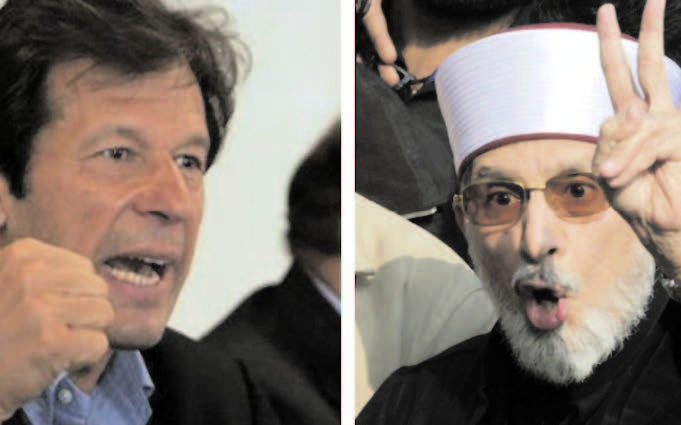
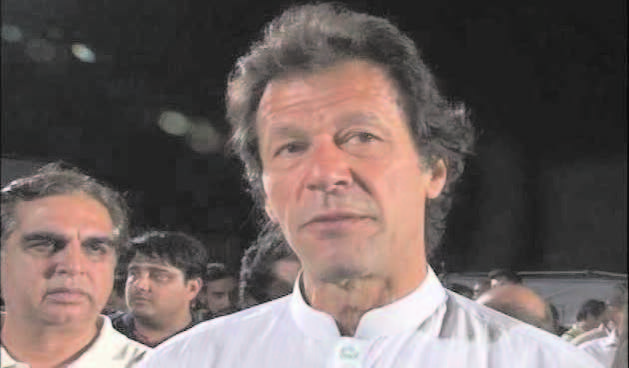
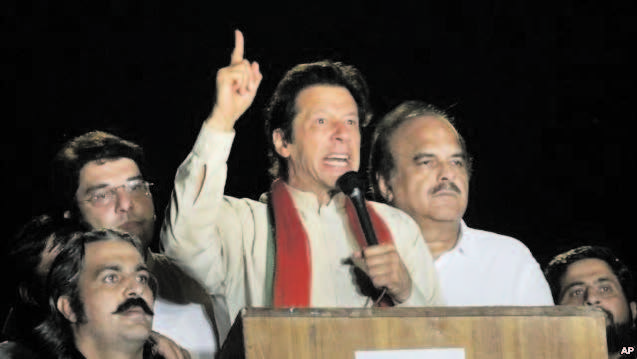
    KARACHI (TIP): Imran Khan led Pakistan Tehreek-e- Insaaf (PTI) has called for a complete shutdown of the port city on December 12 as part of its countrywide protests against the Nawaz Sharif government. Senior PTI leader and Member of the National Assembly (MNA) Dr Arif Alvi, who hails from Karachi tweeted that the shutdown would start from 6.00am (local time). “It will be a complete shutdown as the Transporters and Traders associations are supporting our plan C to shutdown Karachi on December 12,” he said. The attempted shutdown of Karachi, for long the stronghold of the Mutthaida Qaumi Movement (MQM) which represents the urdu speaking migrants from India, is PTI’s first major show of strength.

  • Citing trade, Beijing seeks bigger role

    Citing trade, Beijing seeks bigger role

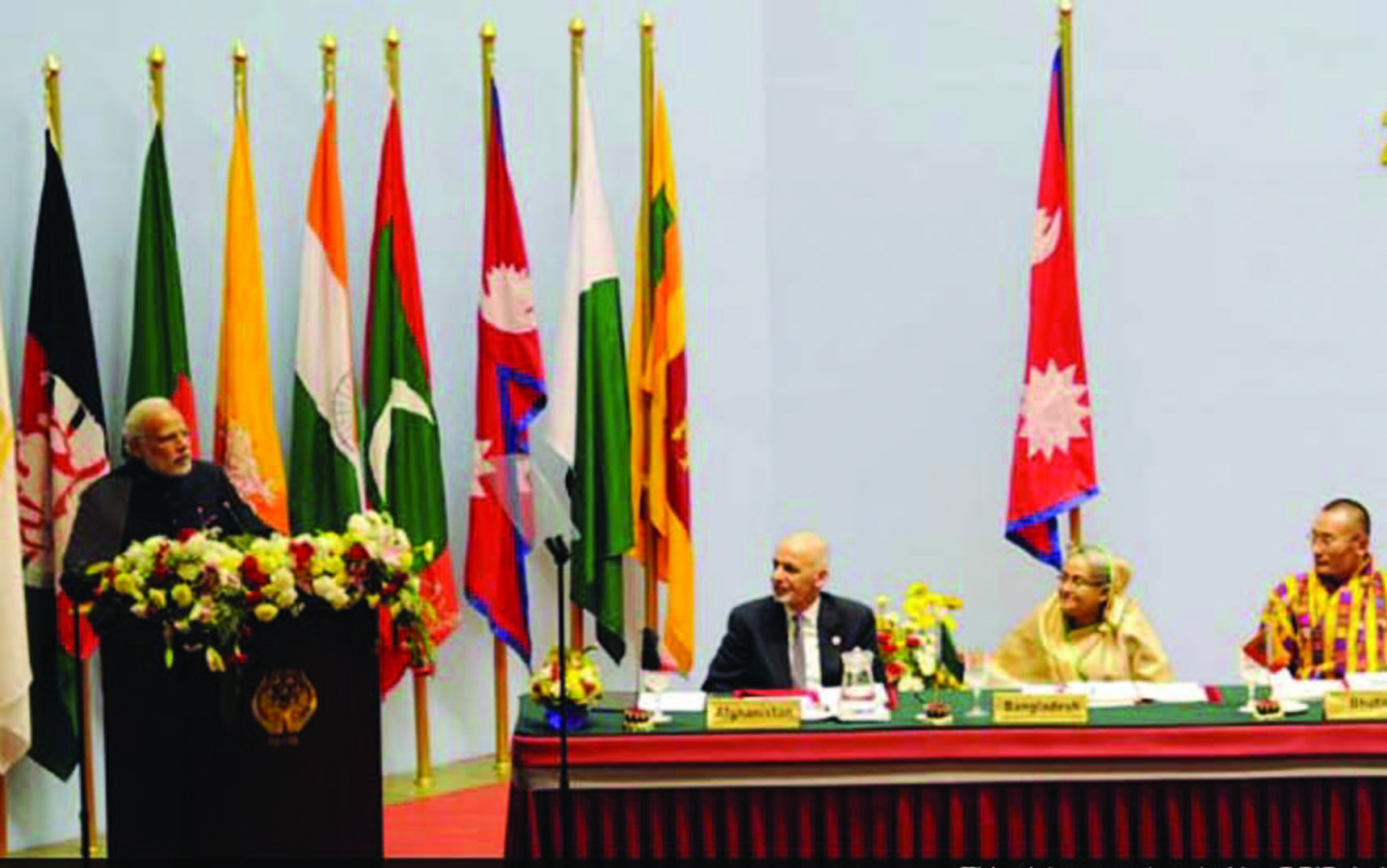
    KATHMANDU (TIP): The shadow of China seeking a greater role in the South Asian Association for Regional Cooperation (SAARC) and its presence in the eight-member grouping could not be missed here as the 18th Summit got underway. Over the past few days, reports emerged about Beijing pushing the envelope on the issue and today leaders from Bangladesh, Maldives, Pakistan and Sri Lanka advocating a greater role for observers in the regional grouping. SAARC has Australia, China, European Union, Japan, South Korea, Mauritius, Mynamar and the USA as observers and since 2007 have been invited to attend the summit meeting.

    Today as the summit opened, Pakistan Prime Minister Nawaz Sharif emphasised the importance of SAARC observers and the benefit the grouping can draw from its interactions with them. “We should build on convergences and minimise divergences and most of all seek to augment complimentaries for the greater good of the people of the region”, he said. Similar sentiments were expressed by leaders of Bangladesh, Maldives and Sri Lanka. While none of them mentioned China, on his part Deputy Foreign Minister of China Liu Zhenmin, who participated, underscored the role Beijing was playing in the region and prepared for a larger role.

    He mentioned that while China’s trade in the countries of the region stood at $150 billion, the country has $ 30 billion investments in the pipeline, clearly underscoring the economic muscle of Beijing. While New Delhi has not made any move to counter it, India maintained that the priority among member-countries of SAARC should be to ensure cooperation among the eight countries instead of seeking to expand the grouping in a horizontal direction.

  • SAARC SUMMIT: ENERGY PACT SEALED, ROAD AND RAIL PACTS ON ANVIL

    SAARC SUMMIT: ENERGY PACT SEALED, ROAD AND RAIL PACTS ON ANVIL

    KATHMANDU (TIP): The 18th SAARC Summit concluded on November 27 in this scenic Nepalese capital with the eight South Asian nations signing a pact on energy cooperation and adoption of the Kathmandu Declaration that called for deeper regional cooperation in core areas of trade, investment, finance, energy, infrastructure and connectivity.

    The two-day South Asian Association for Regional Cooperation summit started on a discordant note on November 26 with Pakistan blocking three proposed agreements. But it ended on a bright and positive note on Thursday with the eight countries signing the Saarc Framework Agreement on Energy Cooperation and promising to sign two other deals — the SAARC Motor Vehicles Agreement for the Regulation of Passenger and Cargo Vehicular Traffic, and the SAARC Regional Agreement on Railways — within three months. The energy agreement will enable greater cooperation in the power sector among South Asian countries.

    It is expected to improve power availability in the entire SAARC region and would facilitate integrated operation of the regional power grid. According to the Kathmandu Declaration adopted at the closing ceremony Thursday, the summit decided to accelerate the process of creating free trade in the region and formulation and implementation of projects, programmes and activities of SAARC in a prioritised, focused and result-oriented manner. Similarly, the summit also agreed to launch regional and sub-regional projects in the agreed areas of cooperation, especially in the area of poverty alleviation, infrastructure building, connectivity and energy.

    Strengthening the SAARC Development Fund, effective implementation of the SAARC Action Plan on Poverty Alleviation with a view to making South Asian free from poverty and hunger and enhancing regional connectivity through building and upgrading roads, railways, waterways infrastructure, energy grids, communications and air links, was also agreed on. The declaration called for combating terrorism in all its forms and manifestations and having effective cooperation among the member states for preventing the trafficking of people, arms and drugs and exploitation of children for forced labour.

    Increasing agricultural productivity and ensuring food and nutritional security is also the part of the Kathmandu Declaration. Providing quality education, eliminating illiteracy, providing vocational education and training, and making South Asia an attractive common tourist destination by promoting public-private partnership, are also mentioned in the declaration. In the opening ceremony on Wednesday, Indian Prime Minister Narendra Modi, who was the cynosure of all eyes, exhorted the eight SAARC member states nations to “walk in step” as he proposed a slew of measures, including ease for business travel, a level playing field in trade, and initiatives in healthcare and tourism.

    He referred to terrorism, especially the 26/11 Mumbai terror attack, in which 10 Pakistani terrorists unleashed mayhem in India’s commercial capital in 2008. “Today, as we remember the horror of the terror attack in Mumbai in 2008, we feel the endless pain of lost lives. Let us work together to fulfill the pledge we have taken to combat terrorism and trans-national crimes,” he said, without naming Pakistan. Urging for seamless connectivity in the region, Modi said “for India, our vision for the region rests on five pillars — trade, investment, assistance, cooperation in every area, and contacts between our people”. “There is a new awakening in South Asia; a new recognition of inter-linked destinies; and a new belief in shared opportunities,” he said. Host of the summit, Nepal Prime Minister Sushil Koirala, said that SAARC would focus on connectivity, security and eradicating extreme poverty.

    While Bangladesh Prime Minister Sheikh Hasina sought implementation of the SAARC free trade agreement (FTA) that was signed nearly a decade ago, Pakistan’s Nawaz Sharif called for a dispute-free South Asia. Afghan President Ashraf Ghani asserted that his country would not endanger regional security. While Maldivian President Abdulla Yameen sought a common SAARC platform on climate change, Bhutan’s Prime Minister Tshering Tobgay called for greater integration among South Asian countries to bolster growth. Sri Lanka President Mahinda Rajapaksa called for a common voice among South Asian nations on international issues and cooperation on eradicating terrorism. The heads of state and government also held bilateral meetings on the sidelines of the summit.

    After having met Nepal Prime Minister Koirala soon after his arrival here on Tuesday, Prime Minister Modi met his Bangladeshi and Bhutanese counterparts Hasina and Tobgay, and later the presidents of Afghanistan, Sri Lanka and Maldives — Ghani, Rajapaksa and Yameen. Though there was no meeting scheduled between the Indian Prime Minister and Pakistan’s Sharif, the two eventually greeted and informally spoke with each other at the retreat organised for the delegates at the Dhulikhel hill resort near Kathmandu on Thursday. Modi and Sharif shaking hands on the podium in the closing ceremony was the lasting image of the summit.

  • Qadri returns to Pakistan with ‘new strategy’ against govt

    Qadri returns to Pakistan with ‘new strategy’ against govt

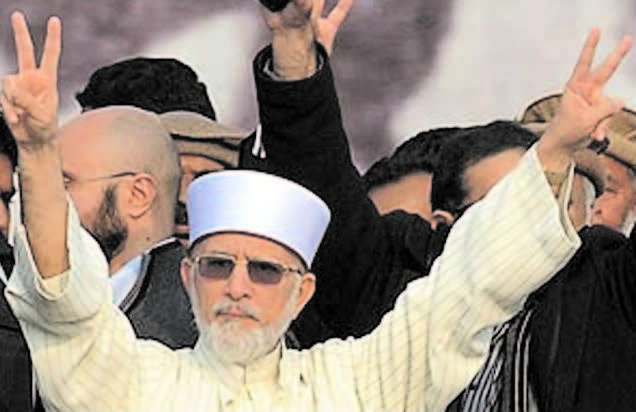
    ISLAMABAD (TIP): Pakistan’s fiery cleric Tahir-ul-Qadri on November 20 returned to the country with a “new strategy” against the government, nearly a month after he went abroad abruptly ending protest against Prime Minister Nawaz Sharif here. The Pakistan Awami Tehreek (PAT) chief arrived at the Allama Iqbal International Airport in Lahore this morning concluding his visit to the US, Canada and the UK. He reportedly visited these countries for medical check up as well as reorganising his party.

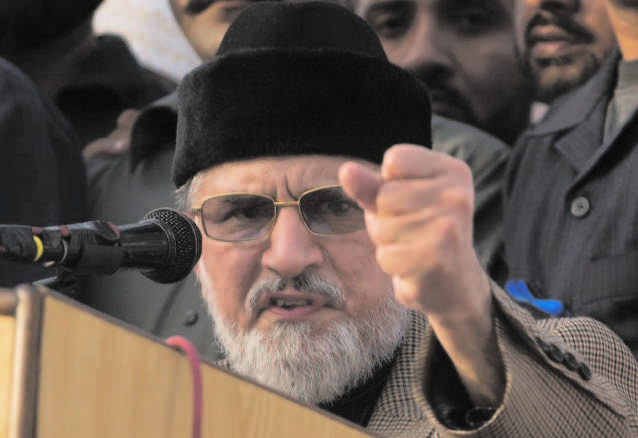
    Carrying balloons, flowers and party flags, hundreds of PAT supporters gathered to welcome him. Giving details of his “new strategy to frustrate the government”, the Canadabased cleric said he has now decided to take his sit-ins to other parts of the country. “Our struggle is no more confined to a single sit-in but will be transformed into a nationwide movement of sit-ins,” he was quoted as saying by Express Tribune. He announced to hold rallies in Bhakkar, Sargodha, Sialkot, Mansehra and Karachi on November 23, December 5, 14, 21 and 25 respectively.

    The cleric had left the country in October last week after abruptly ending his over two-month long antigovernment protest in the Pakistani capital leading to speculation that had struck a deal with Prime Minister Nawaz Sharif. The cleric, however, denied any deal with the government and announced to relaunch his country-wide protest demanding Sharif’s ouster. He also dismissed reports of a rift with Pakistan Tehreek-i-Insaf chairman Imran Khan, saying he has no differences with him and the leaders of their parties were in contact even when he was away from Pakistan.

  • Escalating tension is not good for either country

    Escalating tension is not good for either country

    While there will be no open war between India and Pakistan in the normally understood sense, this does not prevent Pakistan from activating its tools of terror

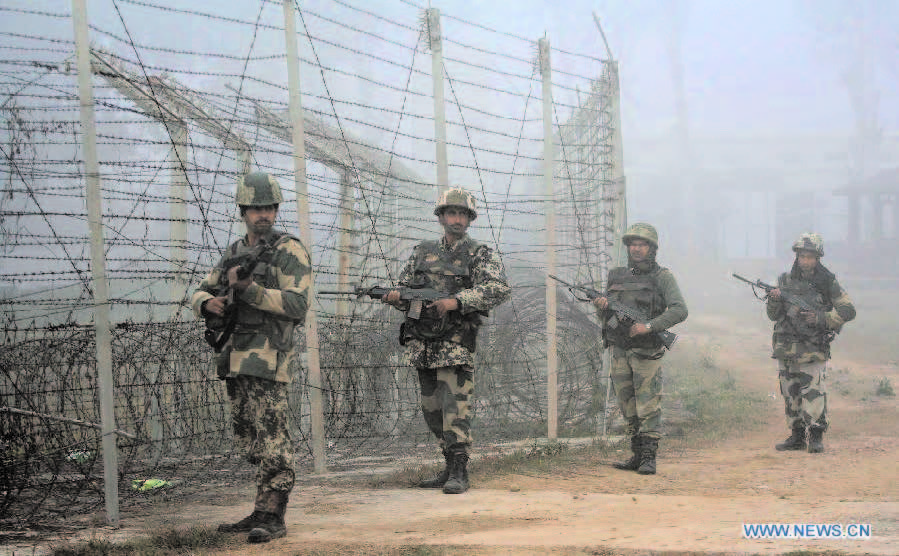
    There has been an escalation of tension between India and Pakistan in the recent few days. The Line of Control (LoC) has witnessed serious exchange of fire at the border for nearly a fortnight. Prime Minister Narendra Modi referred to the border firing in one of his election rallies in Maharashtra. Modi said that Pakistan was getting the befitting lesson and it would not dare to open fire on the border.

    It may be recalled that the cease-fire agreement between India and Pakistan came into effect in November 2003. Thereafter there had been periodic fire from Pakistan side, which had to be routinely returned by the Indian forces posted at the LoC. Union Home Minister, Rajnath Singh made a statement that Pakistan should understand that times have changed in India, an obvious reference to Bharatiya Janata Party under Narendra Modi coming to power at the centre with majority of its own.

    Reverting to the situation on the LoC, the Border Security Force (BSF) was handling the situation on the international border and it was BSF which was doing the firing across the LoC in Poonch, R.S. Pura and Arnia sectors. Reports say that instructions to Director General BSF, D.K. Pathak went out from the National Security Adviser Ajit Doval, who was in direct touch with DG, BSF over the period of 5 days in the first half of October 2014. The BSF reportedly fired more than 10,000 mortar shells, not to speak of countless ammunition, leading to an unprecedented situation in the border.

    Pakistan reported that 2 civilians were killed and about 100 injured on their side and also that scores of villages witnessed vacating of houses by the civilians moving away from the border. The former Chief of BSF E.N. Rammohan commented that earlier the exchange of fire was confined to LMGs and MMGs and now, mortars are being used which spelt danger to civilian lives who lived within 5000 meters range. He went on to comment, “civilians dying like this is absolutely absurd”.

    An analyst had written that the flare up on the border came at the height of campaigning for Assembly elections in Maharashtra and Haryana when Modi referred to Pakistan being taught lesson at a public rally in Maharashtra on October 9. A BSF Commandant said, “I am very proud, nobody, not even Indian Army has fired as much as we have into Pakistan since 1971 war. There were no restrictions this time and we kept on firing. Even the Army cannot boast of so much. At least no Army infantry battalion had fired mortars.”

    In Pakistan, Prime Minister, Nawaz Sharif was a worried man and he summoned all the senior army officers for taking stock of the situation. Nawaz Sharif also dispatched his trusted adviser Shahryar Khan to Delhi for back channel work and to bring out normalcy on the border. Khan is the President of the Pakistan Cricket Control Board and his visit to India was ostensibly to discuss cricket fixtures with India, did not go much beyond that level, since no senior Indian back channel representative met him during his stay in Delhi.

    Prime Minister Narendra Modi, meanwhile held a meeting attended by all senior Army commanders. Prime Minister Modi said that India had to be prepared for a changing world which demanded new thinking on economic, diplomatic and security policies. He asked them to be fully prepared for any eventuality. He also said that security challenges would be more unpredictable and invisible. On the Pakistan side, the Army Chief Gen. Raheel Sharif said at the Military Academy on October 18, that Pakistani forces are fully capable of meeting any external threat and that any aggression against Pakistan would get a befitting response.

    The Pakistani Army chief also digressed to the subject of Kashmir and said that the people of Kashmir should be allowed to decide their fate in the light of UN Resolutions. The growing tension between India and Pakistan had not escaped the attention of foreign observers. The Australian scholar Christopher Snedden, who has specialized on the subject of Kashmir and teaches at the Asia Pacific Centre for Security Studies, Honolulu, has commented that India’s new belligerence towards Pakistan is unhelpful and cited the cancellation of talks by the Indian Foreign Secretary with her counterpart in Pakistan over the Pakistan Ambassador’s meeting with Kashmiri separatists. Snedden went on to say that such meetings had routinely taken place in the past.

    Pakistan Prime Minister, Nawaz Sharif had attended Modi’s oath taking ceremony as the Prime Minister of India in New Delhi, on May 16, 2014, which he did ignoring the advice of the armed forces and hardliners, who were against his visiting India for the occasion. The border tensions and the disproportionate level of Indian reaction would lead to Pakistan analyzing and reviewing various options to retaliate against India. While there would not be any serious flare up between Indian and Pakistani forces in any sector. Pakistan Army Chief and the ISI Chief of Pakistan would be seriously exploring multiple ways of hurting India.

    At the diplomatic level, Pakistan had activated its diplomatic representative to brief UN members on the unfulfilled UN resolution for holding plebiscite in Kashmir for ascertaining views of the Kashmiri people regarding their options between India and Pakistan.

    While there will be no open war between India and Pakistan in the normally understood sense, that does not prevent Pakistan from activating its tools of terror like Lashkar-e-Toiba and Jaish-e-Mohammed in carrying out serious attacks within India. The National Security Guard (NSG) Chief J.N. Choudhury had warned on October 16 that the Al Qaeda and the ISIS may join hands with terror groups like Indian Mujahideen and carry out multicity multiple attacks in the country at the time of their choosing. Terror organizations like Lashkar-e- Toiba and Jaish-e- Muhammed will also be carried along in their dastardly scheme.

    The tensions between the two countries have to be seriously examined and ways and means to bring back normalcy should be worked out and implemented. India stands to lose much more if terrorist organizations are deployed in various cities in the country at a time of Pakistan’s choice. As this possibility is strong, this needs to be given serious consideration. Now that Prime Minister Narendra Modi has demonstrated his strength once again by decisively winning the elections in Maharashtra and Haryana, it is time for him to turn to the important issue of easing tensions between India and Pakistan.

    There was no meeting between Prime Ministers of India and Pakistan during the UN session in October as Modi was not interested in meeting with his Pakistani counterpart. The next opportunity comes up in November during the SAARC meeting in Nepal. It is hoped that the two Prime Ministers will have one to one meeting, with or without officials and work out a road map for future course of action.

  • Pak PM Nawaz Sharif to attend APEC, seek Chinese funds for projects

    Pak PM Nawaz Sharif to attend APEC, seek Chinese funds for projects

    BEIJING (TIP): Pakistani prime minister Nawaz Sharif will attend the annual Asia-Pacific Economic Cooperation (APEC) Leader’s Meeting in Beijing next week as an observer on the invitation of Chinese president Xi Jinping. Xi had also invited India to be an observer and requested Prime Minister Narendra Modi to attend it during his talks in New Delhi last September. But India has not taken up the offer. Sharif may have a difficult time convincing Chinese leaders that he was doing his best to check the influence of Pakistan based Taliban in China’s western province of Xinjiang, which is a hotbed of terrorism by Islamic groups.

    Violent incidents in Xinjiang, particularly the Kashgar area bordering Pakistan, has risen sharply in the past few months leading to suspicion that Islamabad is not keeping its promise on this count. “The visit will further strengthen the bilateral relations,” Radio Pakistan quoted Sharif as saying before leaving Islamabad for China on Friday. He expects to meet both Xi and Chinese premier Li Keqiang and sign agreements for investments, Sharif said. Chinese leaders would be busy meeting heads of state from at least 21 countries during the APEC summit. It is not clear how much time they can spare for the Pakistani president. Pakistan is seeking Chinese assistance for further development of the Gwadar Port in southwestern Balochistan province. Sharif will also seek Chinese funds and technical assistance for construction of Khuzdar- Gwadar road as part of planned economic corridor between the two countries.

  • Pakistan’s Military Adventurism

    Pakistan’s Military Adventurism

    Right environment to turn the heat on Islamabad

    Pakistan’s military adventurism on three fronts across its borders with India, Afghanistan and Iran has created just the right environment to turn the heat on Islamabad and Rawalpindi. Apart from mounting a media offensive, it is time for India to get world attention focused on Pakistan-sponsored terrorism and the plight of Baluchis, Shias and other minorities in that country”, says the author who was a career diplomat.

    Just over a year ago Mr. Nawaz Sharif was swept back to power, prompting expectations that he would tackle the country’s security and economic crises, and improve relations with India. But one year is an eternity in the politics of Pakistan. The US is refusing to pledge additional aid beyond what was promised earlier under the Kerry-Lugar legislation. Even “allweather friend” China has expressed disappointment that Sharif’s government has not done the requisite preparatory work for utilizing aid that Beijing had promised for the development of Pakistan’s ailing power sector.

    The only silver lining is the increased remittances from Pakistan’s workers in the Gulf despite calls by Imran Khan to workers to halt such inward remittances. Instead of acting circumspectly in such a situation, Pakistan has chosen to escalate tensions on its borders with Iran, Afghanistan and India. The tensions with these three neighbors with whom Pakistan shares land boundaries have arisen because of support to cross-border terrorism. This support is rendered by state agencies to extremist Sunni groups, ranging from Lashkar e taiba to the Afghan Taliban and Jaish e Adl.

    The tensions with Iran have risen because of the support that the extremist Sunni group Jaish ul Adl receives in Pakistan’s Baluchistan Province, where the Pakistan army is simultaneously engaged in a bloody conflict against Baluchi separatists. Tensions with Iran escalated last year when Jaish e Adl mounted cross-border ground and missile attacks in Iran, resulting in Iranian casualties.

    An Iranian spokesman warned that the Iranian forces would enter Pakistani territory if Pakistan “failed to act against terrorist groups operating on its soil”. Virtually coinciding with this was an incident when Jaish e Adl kidnapped five Iranian border guards and moved them into Pakistan. Iran not only warned Pakistan of cross-border retaliation, but also brought repeated incursions from Pakistan soil to the notice of the UN Security Council in writing. Ever since the pro-Saudi Nawaz Sharif, whose links with radical Sunni extremist groups are well documented, assumed power, Pakistan has moved towards rendering unstinted support to Saudi Arabia, even in the Syrian civil war.

    It has also unilaterally annulled the Pakistan-Iran oil pipeline project, prompting action by Iran, seeking compensation. While Nawaz Sharif was commencing negotiations for a peace deal with Tehriq e Taliban in the tribal areas of North Waziristan, bordering Afghanistan, the Army Chief, Gen Raheel Sharif, disregarded the views of the Prime Minister. He launched a massive military operation, involving over 50,000 military and paramilitary personnel, backed by artillery, tanks, helicopter gunships and fighter jets. An estimated one million Pashtun tribesmen have fled their homes.

    They are now homeless and facing barriers, preventing their entry into the neighboring provinces of Punjab and Sind. Not surprisingly, ISI “assets” like the Mullah Omar-led Afghan Taliban and the Haqqani network have been quietly moved out from the battle zone, quite obviously into ISI safe houses. Unrest is brewing amidst the displaced Pashtun tribals as the army is unwilling to coordinate its operations with civilian relief agencies. The displaced and homeless Pashtun tribals, will inevitably, in due course, resort to terrorist violence across Pakistan.

    The special treatment meted out to ISI assets like Mullah Omar and the Haqqani network would have been carefully noted by the new Ashraf Ghani dispensation in Afghanistan, as a prelude to more serious attacks by the Afghan Taliban acting out of the ISI and army protected safe havens in Pakistan. Pakistan’s western borders will be neither peaceful nor stable in the coming years. The escalating tensions with Iran, the partisan stance on Saudi Arabia-Iran rivalries and the military action in North Waziristan have invited criticism within Pakistan. The escalation of tension with India across the Line of Control and the international border has to be seen in this
    context.

    What better way for the army to divert attention from its misadventures in the west than to revive the “India bogey” in Pakistan? Such an action would also test the resolve of the Narendra Modi dispensation in India to deal with crossborder terrorism. Moreover, with state assembly elections due in J&K in December, the Pakistan army would strive to ensure that the credibility of these elections is questioned by ensuring a low turnout. Hurriyat leaders like Shabir Shah and Yasin Malik have already been commissioned to stir up discontent and discredit the Indian Army during the floods.

    What Pakistan had not bargained for, as it attempted to test India’s resolve from August onwards, was the robust response that it received not only from the Indian Army, but also from the Border Security Force. This was accompanied by an ill-advised diplomatic effort to seek UN intervention in Jammu and Kashmir. Both Nawaz Sharif and his otherwise realistic NSA Sartaj Aziz seem to forget that the world changed dramatically after 9/11. The Western world led by the United States has come to realize that Pakistan-backed terrorist groups are as much a threat to their security as to that of India.

    Pakistan also seemed to ignore Mr. Modi’s unambiguous stance that dialogue and terrorism cannot go hand in hand. They also evidently misread the significance of the Obama- Modi Joint Declaration averring action for “dismantling of safe havens for terrorist and criminal networks, to disrupt all financial and tactical support for terrorist and criminal networks such as Al Qaida, Lashkar e Taiba, Jaish e Mohammed, the DCompany, and the Haqqanis.”

    Pakistan’s military adventurism on three fronts across its borders with India, Afghanistan and Iran has created just the right environment to turn the heat on Islamabad and Rawalpindi. Apart from mounting a media offensive, it is time for India to get world attention focused on Pakistan-sponsored terrorism and the plight of Baluchis, Shias and other minorities in that country. In any case, there should be no question of a sustained dialogue process till Pakistan fulfils its January 2004 assurance that territory under its control will not be used for terrorism against India.

    (The author is a former diplomat.)

  • NEED FOR A LONG-TERM PLAN NOW

    NEED FOR A LONG-TERM PLAN NOW

    It can be considered the biggest strategic failure of Indian diplomacy that even after more than six decades, India has not found a way to neutralize the malevolence of a neighbor one-eighth its size”, says the London based author.

    Pakistan has a way of making its presence felt in India’s foreign policy and national security matrix that, much to New Delhi’s chagrin tends to steal India’s diplomatic thunder. At a time when Prime Minister Modi was trying to project himself as a global statesman with a successful visit to Japan, a visit to Gujarat and then Delhi by the Chinese President, and a ‘rock-star’ reception in the US, Pakistan decided it must get some attention.

    So the Pakistani Army did what it does best. It escalated tensions along the border in an attempt to ratchet up pressure on India. It started with unprovoked mortar shelling on forward Indian positions along the Line of Control (LoC) and over the next few days, the firing spread to the international border and intensified.

    Accusing India of “deliberate and unprovoked violations of the ceasefire agreement and cross-border firing,” Pakistan promptly shot off a letter to the UN Secretary General asking for an intervention by the United Nations Military Observer Group in India and Pakistan, a body for which India sees little role after the signing of the 1972 Simla Pact.

    The UN decided to ignore Pakistani shenanigans and has merely reiterated that India and Pakistan need to resolve all differences through dialogue to find a long-term solution to the dispute. Pakistan is facing multiple crises. Its global isolation is increasing by the day. US forces are withdrawing from Afghanistan starting December 2014 and Beijing is increasingly dissatisfied with Islamabad’s attempts at controlling the flow of Islamist extremists into its restless Xinjiang province.

    Tensions are rising also on Pakistan’s borders with Iran where Pakistani Sunni extremists are targeting Iranian border posts, forcing Iranian policymakers to suggest that if Pakistani authorities “cannot control the common border, they should tell us so that we ourselves can take action.” And the new government in Afghanistan under Ashraf Ghani is likely to go even further in developing close ties with New Delhi.

    Domestically, the Kashmir issue is once again becoming a political football with Bilawal Bhutto Zardari bombastically declaring that Pakistan People’s Party (PPP) would get back entire Kashmir from India. Imran Khan is breathing down Nawaz Sharif’s neck and the Pakistan Army’s struggle against domestic Taliban seems to be going nowhere. All this is happening at a time when there is renewed confidence in India about its future as a major global player under the Modi government and when the world is ready to look at the Indian story afresh.

    No wonder, the Pakistani security establishment is nervous about its growing irrelevance – and what better way to come into global prominence once again than to try to create a crisis in Kashmir! Despite the election season in India in the last fortnight, the Modi government’s reaction has been creditable so far. Rahul Gandhi came out of hibernation to attack the Prime Minister for ceasefire violations by Pakistan. The government, however, ignored the opposition’s many taunts and confidently made clear to Pakistan that Indian forces would “make the costs of this adventurism unaffordable.”

    This gave the Indian military much-needed operational space to carve out a response which was swift, sharp and effective. Together, the Indian government and the nation’s military have underlined the costs of Pakistan’s dangerous escalatory tactics by massive targeted attacks on Pakistani Ranger posts along the border. Now the Modi government needs a long-term plan to handle Pakistan. It can be considered the biggest strategic failure of Indian diplomacy that even after more than six decades, India has not found a way to neutralize the malevolence of a neighbor one-eighth its size.

    Business-as-usual has never been an option for India, and yet India’s Pakistan policy in recent years has struggled to move beyond cultural exchanges and cross-border trade. Pakistan has continued to train its guns at India and drain India’s diplomatic capital and military strength, while India has continued to debate whether Pakistani musicians should be allowed to enter India. This disconnect between Pakistan’s clear strategic priority and India’s magnificently shortsighted approach will continue to exact its toll on India unless Delhi makes it a priority to think outside the box on Pakistan.

    Pakistan has a revisionist agenda and would like to change the status quo in Kashmir while India would like the very opposite. India hopes that the negotiations with Pakistan would ratify the existing territorial status quo in Kashmir. At its foundation, these are irreconcilable differences and no confidencebuilding measure is likely to alter this situation. India’s premise largely has been that the peace process will persuade Pakistan to cease supporting and sending extremists into India and start building good neighborly ties. Pakistan, in contrast, has viewed the process as a means to nudge India to make progress on Kashmir, a euphemism for Indian concessions. The debate in India on Pakistan has long ceased to be substantive.

    The choice that India has is not between talking and sulking. Pakistan has continued to manage the façade of talks with India even as its support for separatism and extremism in India continues unabated. India should also continue to talk (there is nothing to lose in having a low-level diplomatic engagement after all) even as it needs to unleash other arrows in its quiver to manage Pakistan. Smart policy for India means not being stuck between the talking/not talking binary.

    It’s not talking that matters but under whose terms and after years of ceding the initiative to Pakistan, it is now for India to dictate the terms for negotiations. If Pakistan manages to put its own house in order and refrain from using terrorism as a policy instrument against India, then India should certainly show some magnanimity. Indian policy makers had long forgotten poet Dinkar’s immortal lines: kshama shobhti us bhujang ko, jiske paas garal hai, uska kya jo dantheen, vishrahit vineet saral hai. (When a serpent that has venom, teeth and strength forgives, there is grace and magnanimity in its forgiveness.

    But when a serpent that has no venom and no bite claims to forgive, it sounds like hypocrisy and amounts to hiding its defeat with noble words.) Modi has done well to remind Pakistan that India can impose serious costs in response to Pakistan’s irrational behavior and he should now build on that. Pakistan’s India obsession is not about Kashmir. The very manner in which Pakistan defines its identity makes it almost impossible that India will ever be able to find a modus vivendi with Islamabad. New Delhi should be ready to face this hard reality. The Modi government has made a good start and now it should follow through with a long-term strategy vis-à-vis its immediate neighbor.

    (The author teaches at King’s College London in the Department of Defence Studies. He is also an associate with the King’s Centre for Science and Security Studies and an affiliate with the King’s India Institute. His current research is focused on Asia-Pacific security and defence issues).

  • ‘Nuclear Pakistan capable of fitting reply to India’

    ‘Nuclear Pakistan capable of fitting reply to India’

    ISLAMABAD (TIP): Nuclear Pakistan was fully capable of responding “befittingly” to Indian aggression on the LoC and the international border, the country’s defence minister, Khwaja Muhammad Asif, said on October 9, responding to an earlier statement by Arun Jaitley.

    “We don’t want the situation on the borders of the two nuclear neighbours to escalate into a confrontation. India must demonstrate caution and behave with responsibility,” Asif said.

    Prime Minister Nawaz Sharif has called a meeting of the National Security Committee on Friday to discuss the tense situation at the LoC and the IB, with firing and shelling intensifying to dangerous levels amid accusations from both sides.

    The Pakistani state media reported that two Pakistanis were killed and 12 injured in firing by Indian troops along the working boundary on Wednesday, raising the death toll to 12 and injured to 43. Sources here said India has targeted 73 Pakistani border posts while Pakistan has targeted 47 Indian border posts.

    Pakistan’s military said its troops were responding to
    “unprovoked” Indian firing and only targeting military positions, not civilian population, as claimed by the Indian military.

    The recent escalation comes in the wake of political changes in Pakistan where the military has allegedly managed to get concessions from the beleaguered civilian government, including, reportedly, a change in policy towards India.

    Sharif has been severely criticized by the opposition parties for failing to issue any hard-hitting statement against India over the tense situation. Observers believe Sharif’s speech at UNGA, in which he urged the Kashmir issue should be resolved according to UN resolutions, was an attempt to win military’s support at home.

  • Murder case registered against Nawaz Sharif, ministers

    Murder case registered against Nawaz Sharif, ministers

    ISLAMABAD (TIP): A murder case has been registered against Pakistan Prime Minister Nawaz Sharif, his brother and Punjab chief minister Shahbaz Sharif, three federal ministers and top police officials over the alleged killing of two persons during last month’s clashes between the police and anti-government protesters, police officials said on Sep 17.

    The case was registered at Islamabad’s Secretariat police station under Anti-Terrorism Act and Pakistan Penal Code sections dealing with murder, attempted murder, attack and abetment of attack. On Monday, a court had ordered the Secretariat police to register the case after hearing a petition filed by the Pakistan Awami Tehreek (PAT) over the alleged killing of its workers. The deaths took place on night of August 30 when the police fired tear gas shells and rubber bullets on followers of cleric Tahirul Qadri-led PAT and Imran Khanled Pakistan Tehreek-e-Insaf (PTI) to stop them from marching on the PM’s house in Islamabad’s heavily fortified red-zone.

    Apart from the two victims, who died from rubber bullet injuries, another PAT worker died that night due to cardiac arrest. Over 500 people were injured. According to the FIR, the crackdown orders were given by Nawaz Sharif and interior minister Chaudhry Nisar Ali Khan. The other to be booked include defence minister Khwaja Muhammad Asif, railways minister Khwaja Saad Rafique, former IG Islamabad Khalid Khattak, IG Punjab Mushtaq Sukhera, the IG Railways and other top officials of the Islamabad police and administration.

    Addressing his supporters on Wednesday, Qadri said Nawaz Sharif had no right to stay in power after the registration of the FIR. “How can Sharif remain in power when two cases have been registered against him?” he said. He demanded the PM and all the others who had been booked should be immediately arrested. He expressed reservations over the investigation of the case by the Islamabad and Punjab police, and asked for the constitution of a joint investigation team comprising members of intelligence agencies and police officials from regions other than Punjab and Islamabad to probe the matter.

    Nawaz Sharif and other high-ranking figures have already been named in a murder case relating to the deaths of 14 supporters of Qadri when the police launched an operation against them in Lahore’s Model Town on June 17.

  • Political storm ebbs in Pakistan, ‘concrete solution’ in sight

    Political storm ebbs in Pakistan, ‘concrete solution’ in sight

    ISLAMABAD (TIP): After weeks of turmoil, the political storm that has engulfed Pakistan seemed to be ebbing on Wednesday as protesters returned to talks with the government and a mediator between the two warring sides said a “concrete solution” is in sight. The positive development came after a war of words in the Parliament between lawmakers of the Imran Khanled Pakistan Tehreek-I-Insaf (PTI), who had quit but their resignations have not been accepted by the speaker, and progovernment leaders.

    In a significant development, an opposition ‘jirga’, a committee of opposition politicians led by Jamaat-i- Islami (JI) chief Sirajul Haq, held talks with the leadership this evening. Both Khan and cleric Tahir-ul-Qadri of the Pakistan Awami Tehreek (PAT) agreed late last night to talk to the opposition ‘jirga’ that is mediating between the embattled Nawaz Sharif-led government and the protesters who have been demanding the Prime Minister’s resignation over alleged vote rigging in last year’s general election.

    Speaking to reporters after meeting the jirga which included Haq and Pakistan People’s Party leader Rehman Malik, senior leader Shah Mehmood Qureshi said his party is ready to move ahead and agreed to move forward in a democratic manner,” he said. In the joint media briefing, Haq said, “It has been a productive meeting. There is still a deadlock, but 70 per cent of the work has been done.

    We believe there will be a concrete solution soon.” “I would like to advise the government to refrain from issuing statements, which spread negativity. If both sides show patience, then we are not far in ending this crisis,” he said. Malik said, ” showed maturity and didn’t say anything negative. I request the Prime Minister’s team not to talk about any individual. We have also requested the PAT committee to resolve the issue through dialogue.” “Everyone wants a peaceful solution.

    I believe that in the next 24 yo 48 hours, things will normalize,” he said. in the day, a joint session of Parliament saw all parties except put aside their differences to stand against what they termed were attempts to derail the democratic process in the country prone to coups. Heated exchanges between opposing camps that have regularly figured in the political discourse during the threeweek impasse today moved inside the Parliament. Impassioned speeches continued to be made in the Parliament with leader Qureshi leading the party’s reply to countless accusations made by progovernment leaders.

  • Hazards of a poorly planned engagement with Pakistan

    Hazards of a poorly planned engagement with Pakistan

    “While a measured engagement with whoever rules Pakistan is necessary, it has to be complemented with measures to tighten internal security, enhance our military capabilities and raise the costs for Pakistan, if it pursues its present efforts to “weaken India from within”, says the author

    Adiplomatic engagement with a neighbour having territorial ambitions has to be carefully calibrated and executed. Apart from realistically assessing the balance of military and economic power, one has also to carefully assess the neighbour’s internal political imperatives and the readiness of its leadership to live at peace, without resort to terrorism.

    Sadly, there are vociferous sections in India which believe that dialogue with Pakistan is an end in itself, without carefully considering what the available options are. Moreover, has continuing dialogue produced better results than no dialogue at all? Pakistan lost its eastern half, 13,000 Sq. kms. of its territory in the west, one half of its navy, one-fourth of its air force and army, with India holding 90,368 prisoners of war, in the 1971 Bangladesh conflict.

    In negotiations in Simla with Zulfiqar Ali Bhutto, India’s most hard-headed Prime Minister was persuaded by some of her key officials that Bhutto would be devastated politically if he went back empty handed from Simla. While returning the 90,368 PoWs was inevitable, what was surprising was the decision to withdraw from 13,000 sq km of Pakistan territory captured by us on the basis of a mere verbal assurance from Bhutto that he would, in due course, settle the Kashmir issue on the basis of the territorial status quo.

    Bhutto had no intention of abiding by his verbal commitment. Just over a decade later, Pakistan commenced promoting a communal divide in Punjab. This was followed by the arming and training of disaffected Kashmiri youth to promote an armed insurgency in J&K. Pakistan also sought to exploit “fault lines” in India’s body politic. The Mumbai bomb blasts in 1993, where 250 Indians perished, were planned and executed by the ISI.

    The perpetrator of these blasts, Dawood Ibrahim, resides comfortably in Karachi. He even ventures abroad on a Pakistani passport. ISI-sponsored terrorism grew rapidly alongside continuing “dialogue” with Pakistan. The bilateral dialogue was called off by Prime Minister Benazir Bhutto in 1994 when she found that efforts to coerce India on J&K had not worked.

    Unlike in the past, Kashmiri youths were becoming increasingly wary of crossing the LoC. What followed was the induction of Pakistani nationals from the ISI-backed terrorist outfits like Jaish e Mohammed, Harkat ul Mujahideen and Lashkar e Taiba. This shift in Pakistani strategies from support for a “freedom struggle” of Kashmiris to a jihad by terrorists occurred, not because of any “composite dialogue,” but because of ground realities.

    Moreover, it was during this period that, thanks to imaginative political initiatives and effective policing, Pakistan-backed militancy in Punjab ended. Terrorists from Babbar Khalsa and the ISYF, however, still live across our borders. Prime Minister Inder Gujral initiated discussions with Nawaz Sharif on a “Composite Dialogue Process,” in which the centrality of terrorism was not emphasised. Terrorism was merely put on the same pedestal as drug smuggling! The first round of this dialogue was held in 1998, after the nuclear tests.

    Determined to ensure that India was seen as sincere in its quest for peace, Mr. Vajpayee visited Lahore, only to find that rather than promoting peace, the resumption of the dialogue was accompanied by Pakistani intrusions, leading to the Kargil conflict, amidst dire Pakistani threats of nuclear escalation. President Musharraf’s subsequent visit to Agra was followed by the attack on India’s Parliament in December 2001. Structured dialogue alone was clearly no recipe for peace and good neighbourly relations.

    The military standoff after the Parliament attack and the post 9/11 American invasion of Afghanistan, forced General Musharraf to think afresh. He proposed a ceasefire across the LoC and promised that “territory under Pakistan’s control” would not be used for terrorism against India. While Musharraf abided by his commitments, where the UPA government went horribly wrong was in presuming that a weak democratic government led by Mr. Asif Ali Zardari, a well-meaning Sindhi Shia, would be able to rein in the jihadi propensities of Gen Ashfaq Kayani, a hard line Islamist. New Delhi underestimated the significance of the deadly ISI-sponsored attack on our Embassy in Kabul in August 2008.

    What inevitably followed was the terror strike of 26/11 in Mumbai. The public outcry that followed the disastrous summit diplomacy in Sharm-el Sheikh forced the UPA government to tread warily thereafter. Given what followed the 2008 terrorist attack on our Embassy in Kabul, New Delhi should not underestimate the significance of the attack on our consulate in Herat, just on the eve of Prime Minister Nawaz Sharif’s visit to Delhi. The recent demonstrations led by Imran Khan and Tahir-ul-Qadri clearly enjoy the behind-the-scenes backing of the Pakistani military establishment.

    The army has indicated that it will assist Nawaz Sharif. But in return for this support it has demanded that Sharif “must share more space with the army”. To expect that in these circumstances, Nawaz Sharif can deliver India’s concerns on terrorism, or promote trade and energy cooperation significantly will be wishful thinking. The tough stance that India has taken on the links of the Pakistan establishment with Hurriyat at least conveys that it is not going to be “business as usual” with Pakistan, especially if it continues with ceasefire violations, while abetting terrorism in India and threatening our diplomatic missions and nationals in Afghanistan.

    In her meticulously researched book “The Pakistan Army’s Ways of War” American academic Christine Faire notes that in order to deal with Pakistani army policies which undermine US interests and seek to destabilise India, the US should consider means to “contain the threats that emanate from Pakistan, if not Pakistan itself”. This is the first time a reputed American academic has spoken of the need to “contain” Pakistan.

    Clearly, this cannot be done by merely chanting the mantra of “uninterrupted and uninterruptable dialogue” with Pakistan. While a measured engagement with whoever rules Pakistan is necessary, it has to be complemented with measures to tighten internal security, enhance our military capabilities and raise the costs for Pakistan, if it pursues its present efforts to “weaken India from within”.

    (The author is a former diplomat. He served as India’s High Commissioner to Pakistan and Myanmar, and was spokesperson of the Ministry of External Affairs and the Prime Minister’s office)

  • How to view the Tamasha in Islamabad

    How to view the Tamasha in Islamabad

    Imran Khan and Tahirul Qadri, according to their supporters, represent an aspiration for “commonsense” democracy which empowers and liberates the common man. Nawaz Sharif and his ilk represent the “traditional power structure” democracy or crony and phony democracy.


    37

    How should we view the goings-on in Islamabad? Low comedy and high farce? A national disgrace? A serious breakdown of governance? A critical opportunity? The start of a real transition towards better governance and more genuine democracy? Or preparing the ground for another decade of open or de facto military rule? Some analysts suggest all these views are valid to one degree or another, except that it is not clear what the outcome will be. Nawaz Sharif is seen by many as a three-time elected prime minister who must be allowed to complete his tenure if democracy in Pakistan is not to be derailed yet again.

    His record of governance may be patchy. But he has only completed 15 months of a five-year mandate. Moreover, governance is always a learning process and democracy is always a work in progress. As Bill Clinton said in his address to Pakistanis during his brief stopover in Islamabad in 2000, imperfect democracy needs to be addressed through better democracy, not the suspension of democracy. Gen Musharraf argued he was a better democrat than the politicians.

    The Constitution of Pakistan, however, explicitly excludes unconstitutional and undemocratic interventions to resolve political challenges facing the country. Those of this view might approvingly refer to Bertolt Brecht’s play The Life of Galileo in which Andrea says, “Unhappy the land that has no heroes,” to which Galileo replies, “Unhappy the land that needs heroes”. Nawaz Sharif supporters might also quote Aneurin Bevan’s description of a political opponent as “suffering from petrified adolescence”.

    According to this view, both Imran Khan and Allama Tahirul Qadri are endangering constitutional democracy and the economic development of Pakistan through their “antics”. They are also making a spectacle of themselves and of the country through their politics of anger and frustration. Their escalating and shifting demands, accompanied by a range of threats, only confirm their hunger for power at any cost to the nation. This is the essence of fascism rather than democracy.

    It represents an entire negation of the Quaid’s philosophy of political agitation which rested on an uncompromising respect for constitutional procedures and an emphatic rejection of Gandhi’s calls for civil disobedience. According to Noam Chomsky, there is a “commonsense” or dictionary meaning of democracy and a contrasting “doctrinal or real world” meaning of democracy. According to the commonsense or dictionary meaning, roughly speaking, a society is democratic to the extent that people in it have meaningful opportunities to take part in the formation of public policy. There are a lot of different ways in which that can be true.

    But insofar as it is true, the society is democratic.” The “real world,” (indeed we may say traditional Pakistani) meaning has been “a top-down democracy that leaves traditional structures of power in effective control”. Chomsky adds “if segments of the public depart from their apathy and begin to organise and enter the public arena that, according to those in control, is not democracy.

    Rather it is a ‘crisis’ of democracy”. Imran Khan and Tahirul Qadri, according to their supporters and sympathisers represent an aspiration for “commonsense” democracy which empowers and liberates the common man. Nawaz Sharif and his ilk, in this view, represent “traditional power structure” democracy; in other words, crony and phony democracy that has been manifest in the worst-ever governance in Pakistan’s history. This is rule by money and power, including the criminal abuse of constitutional authority. This excludes the prospect of real movement towards any kind of inclusive or “commonsense” democracy.

    According to this view, both protagonists of “commonsense democracy” (some would argue Imran more than Qadri) represent the only hope for Pakistan to avoid descending into the realm of state failure. Many who are deeply aware of Imran’s shortcomings as a political leader, including his exaggerated and empty posturing in recent days, see him as a vitally important transition figure. His contribution has been to make the people aware of their rights and their potential to organise and sustain a multi-layered struggle on behalf of “commonsense” democracy and inclusive and consultative governance.

    This is the only way to prioritise the agendas of the people rather than those of their exploiters who rule them in the name of “doctrinal” or “constitutional” democracy. Moreover, Imran’s supporters argue he has a “vision” for Pakistan for which he has stood up whereas Nawaz Sharif stands for no vision at all except power, pelf and privilege for himself and his family. They might approve of two Biblical sayings: “Where there is no vision, the people perish” and possibly also, “Great men are not always wise.” So where are we headed and what can we hope for? We need first to be clear.

    Nawaz Sharif would not accept that he represents “traditional power structure” democracy and that his governance is beyond redemption. Nor is it clear that Imran Khan has the leadership qualities embodied in the Arab proverb, “It is the tribe that tells the chief how to do his job”. He has to broaden his focus beyond Nawaz Sharif without compromising his core demands. He should avoid off-the-cuff public statements that embarrass his supporters.

    He should accept that a Supreme Courtappointed judicial commission will be able to act very independently of a battered and weakened Nawaz Sharif, especially if the FIRs concerning the Model Town massacre are registered against the accused. At a critical time before the elections of 2013, Imran Khan switched from leading a national movement for radical reform of the political system to leading a party for electoral success. He did very well in the elections. But not as well as he expected.

    Significant if not game-changing fraud may have been involved. We should soon find out. Even significant fraud, if established, will compel Nawaz Sharif’s resignation and a fresh poll. Whether Imran wins or loses a fresh poll, he can decide how to restore his national movement for commonsense democracy which he unwisely put on the backburner.

    (The author is a former Pak ambassador to the US, India and China. He can be reached at ashrafjqazi@yahoo.com)

  • TALKS TO RESOLVE PAK CRISIS STALLED OVER PM RESIGNATION DEMAND

    TALKS TO RESOLVE PAK CRISIS STALLED OVER PM RESIGNATION DEMAND

    ISLAMABAD (TIP): Confrontation between Pakistan government and the opposition escalated today with Prime Minister Nawaz Sharif rejecting demands for his resignation and Imran Khan calling off the dialogue with his regime until he quits. Addressing the Parliament for the first time on the ongoing political crisis, Sharif brushed aside the demand for his resignation saying the country has survived “difficult times” and the current political crisis too shall pass. “We are not going to be diverted by these things.

    The journey for the supremacy of Constitution and law in Pakistan will continue with full determination and God willing there will not be any interruption in it,” Sharif said. On the other side, Pakistan Tehreek-i- Insaf (PTI) chief Khan hardened his stand and called off the dialogue with the government saying that he will not be able to get justice as long as Sharif stays on as Prime Minister.

    The hardening of stance came after the failed fifth round of talks even as the Supreme Court ordered the demonstrators to clear the Constitution Avenue by tomorrow. Political stalemate has continued for the last two weeks with Khan-led PTI and cleric Tahir-ul-Qadri’s Pakistan Awami Tehreek (PAT) refusing to budge from their demand of the Prime Minister’s resignation over allegations of rigging in last year’s general election and killing of 14 PAT supporters in Lahore on June 17.

    Today’s developments came a day after Sharif and powerful Army Chief Gen Raheel Sharif agreed on the need to “expeditiously” resolve the political deadlock amid fears of instability in the coup-prone country. The talks between the PTI and the government ended in a stalemate with the sticking point being the protesters’ demand of Prime Minister’s resignation. “There will be no negotiations with your (Sharif) team now. No resignation, no negotiations,” Khan told a crowd of supporters outside the Parliament.

    “Nawaz Sharif is buying time. If we let him stay, he will buy officials and media houses,” Khan said. “We offered concessions, we agreed for the Prime Minister to resign only for 30 days, but they know what would happen if they allow investigations to proceed,” the cricketer-turned politician said. “If you pull back, there will be no independent inquiry under Nawaz Sharif,” Khan said. He claimed that the government offered to make him deputy prime minister. Meanwhile, Qadri’s 48-hour ultimatum to Sharif to step down expired today. Qadri announced the deadline for the government to quit on Monday after talks with the government failed to make any headway. Federal ministers Ishaq Dar and Zahid Hamid went to the protest site to engage Qadri in the ‘decisive phase’ of talks. Qadri said the talks with the government have entered a final phase.

    Punjab province chief minister Shahbaz Sharif could resign until the investigations into the Model Town tragedy is completed, Geo News reported quoting sources. The judicial commission investigating the June 17 Model Town incident, in which 14 of Qadri’s supporters were killed, has held the government responsible for it and said police acted on government orders which led to the bloodshed. The report said the affidavits of chief minister Shahbaz and former law minister Rana Sanaullah contained contradictions regarding the orders they reportedly issued to police to disengage, and declared that what happened on the ground did not match such claims.

    As protesters continued to insist on their demands, a five-judge bench of the Supreme Court, headed by Chief Justice Nasir-ul-Mulk, gave the order for PTI and PAT protesters to clear the Constitution Avenue, including a road in front of the apex court and the Parliament. The order was given during the hearing of identical petitions filed by bar associations across the country against the PAT and PTI sit-ins.

    According to petitioners, protesters are breaching the rights of the common citizen which ensure freedom of movement and right of assembly. Sharif has remained defiant in the face of protests by thousands of supporters of Khan and Qadri camping outside the Parliament demanding his resignation and re-elections to be held. “We have survived difficult times.

    In the 2008 elections, our hands were tied. But we campaigned and participated, we did not cry about rigging — and it would have been a legitimate cry,” Sharif said while addressing the National Assembly. “Because at that time there was a dictator that controlled the government. He held those elections…But we said if PPP has got more seats than us then we will accept that right of the PPP,” he said. Sharif said his PML-N for five years worked with the Pakistan People’s Party government and supported it to complete its term. “I visited him (Imran Khan) in the hospital when he was injured and he congratulated me on winning the polls and said he will play the role of a constructive opposition,” Sharif told the House.

    “Imran’s claims were published in the papers as well,” he said, adding that PTI had reservations but accepted the results of the elections. Days after its lawmakers resigned from the National Assembly, PTI’s Punjab Assembly members today submitted their resignations, stepping up pressure on the embattled government. Opposition Leader in the Punjab Assembly and PTI member Mehmoodur Rashid and 28 other party members handed their resignations from the house in the Punjab Assembly Secretariat.

  • Pak protests: Imran Khan’s party holds talks with government negotiators

    Pak protests: Imran Khan’s party holds talks with government negotiators

    ISLAMABAD (TIP):
    Pakistani ministers and opposition politicians met antigovernment protesters on August 20 but talks ended for the day with the sides appearing no closer to resolving a weeklong political crisis that has rattled the restive, nuclear-armed nation. Thousands of followers of cricketerturned- politician Imran Khan and populist cleric Tahir-ul-Qadri have been demonstrating outside the parliament building in Islamabad, trying to force Prime Minister Nawaz Sharif to resign from office. Khan and Qadri say last year’s general election that swept Sharif to power by a landslide was rigged and are demanding his resignation.

    Late on Wednesday Imran Khan’s team met with government negotiators in Islamabad to discuss his Pakistan Tehreeke- Insaf (PTI) party’s demands. “We put our demands before the government team and they promised to get back to us on Thursday after examining them,” PTI vice-chairman Shah Mehmood Qureshi told reporters after talks. Imran Khan had earlier struck a defiant note, insisting Sharif must resign before he would participate in negotiations.

    Chaudhry Muhammad Sarwar, a member of the government team and governor of Punjab province said the talks were cordial. “Whatever decision the two committees take will be in the best interest of Pakistan,” he said. Earlier on Wednesday evening, a crossparty delegation met members of Qadri’s team to try to resolve the standoff, but the session finished with no concrete result.

    Talks were dominated by the issue of the alleged murder by police of at least 10 of Qadri’s Pakistan Awami Tehreek (PAT) movement’s workers in Lahore in June, Rahiq Abbasi, a member of the cleric’s committee, told reporters afterwards. called for the immediate registration of a case and the arrest of all accused,” Abbasi said, reiterating his call for Prime Minister Sharif’s government to stand down. The government’s response was not immediately known.

    The showdown has added to instability in a country that has had three military coups since its creation in 1947 and which is struggling with a homegrown Taliban insurgency, a crippling power crisis and a sluggish economy. The two protest movements are not formally allied and have different goals, beyond toppling the government. But their combined pressure — and numbers — have given extra heft to the rallies.

    If PAT were to reach a settlement with the government and withdraw, PTI’s position would be significantly weakened, despite Imran Khan’s tough stance. Neither movement has mobilized mass support beyond their core followers and opposition parties have shunned Imran Khan’s call to unseat the government and begin a campaign of civil disobedience.

    The Supreme Court, which has played an influential role in Pakistani politics in recent years, has ordered Imran Khan and Qadri to appear on Thursday to explain their protests. The ruling came after petitions urging the court to restrain Khan and Qadri from “making illegal and unconstitutional demands”, Kamran Murtaza, a senior lawyer, told AFP. The protests have so far been peaceful but the crisis has raised fears that Pakistan’s fragile democracy could be under threat of another military intervention.

    Rumours have abounded that elements within the influential military have been behind Imran Khan and Qadri’s moves, though the cleric and the interior minister have adamantly denied this. The army’s chief spokesman General Asim Bajwa said via Twitter the situation required “patience, wisdom and sagacity” from all sides and could only be resolved through “meaningful dialogue”.

    Sharif has a history of testy relations with the military — his second term as prime minister ended abruptly in 1999 when then-army chief Pervez Musharraf seized power in a coup. His government is thought to have angered the military further by pursuing criminal cases against Musharraf dating back to his 1999-2008 rule, including treason charges. Military analyst Ayesha Siddiqui warned that the situation was precarious. “From the military perspective, they have tried and tested Nawaz Sharif a third time and they feel disappointed. Why would they let him be?” she told AFP.

  • Impasse in Islamabad: Imran Khan adamant on Sharif step down, Sharif stays put

    Impasse in Islamabad: Imran Khan adamant on Sharif step down, Sharif stays put

    ISLAMABAD (TIP):
    The protest in Pakistan appears to have reached a crossroads. Late August 20th evening, Pakistan Tehreek-e-Insaf (PTI) leader Imran Khan addressed his supporters at a massive rally in Islamabad, hours after his deadline for Prime Minister Nawaz Sharif’s resignation lapsed. While his stance remained unchanged, earlier in the evening, the other leader of the protest, populist cleric Tahir-ul-Qadri was engaged by negotiators from the government and the opposition.

    But Imran Khan wants no talks before Sharif steps down. “If Nawaz Sharif does not resign then we will enter into the PM house,” Khan said while addressing thousands of anti-government protesters who entered the heavily fortified ‘Red Zone’ and set up camp in front of Pakistan’s parliament house. Meanwhile, the military called for calm after protesters breached the Red Zone that houses important government buildings including the parliament house, prime minister house, president house, the supreme court besides embassies.

    “Situation requires patience, wisdom and sagacity from all stakeholders to resolve prevailing impasse through meaningful dialogue in larger national and public interest,” military spokesman Maj Gen Asim Saleem Bajwa tweeted.

  • PAKISTAN IMPASSE CONTINUES

    PAKISTAN IMPASSE CONTINUES

    ISLAMABAD (TIP): ‘I will free Pakistan from the dictatorship of Nawaz Sharif who is the fake prime minister,’ says Imran. And Sharif does not want to let go. With the result, there is terrible uneasiness and anxiety as to what lies in future for Pakistan. Less than half a day after meeting each other, the government and Pakistan Tehreeki- Insaf (PTI) on Thursday, August 21 suspended their committee-level talks and were back to exchanging barbs.

    While Imran Khan continued his tirade against Prime Minister Nawaz Sharif and others, the PTI negotiating team held a brief press conference to announce the suspension of talks. However, the PTI leaders left the door open by saying that if their two reservations were addressed (later the party increased them to four), the dialogue could be resumed.

    However, the government did not react nervously to the PTI’s announcement of suspension. Addressing the media outside the parliament house, Railways Minister Khawaja Saad Rafique said that Khan was simply looking for excuses and that his crowds on D-Chowk were thinning out. The government, the minister claimed, had from the first day shown flexibility, be it its willingness to talk or its decision to not use force but the other side kept changing its goal posts.

    It is not clear as to how and when a dialogue could be resumed and negotiations will head for a resolution of the situation. Pakistan is on tenterhooks until the thorny issue is resolved. Meanwhile, the military called for calm after protesters breached the Red Zone that houses important government buildings including the parliament house, prime minister house, president house, the supreme court besides embassies. “Situation requires patience, wisdom and sagacity from all stakeholders to resolve prevailing impasse through meaningful dialogue in larger national and public interest,” military spokesman Maj Gen Asim Saleem Bajwa tweeted.

  • Pakistan crisis puts army back in the driving seat

    Pakistan crisis puts army back in the driving seat

    ISLAMABAD (TIP): As tens of thousands of protesters advanced on the Pakistani capital last week to demand his resignation, Prime Minister Nawaz Sharif dispatched two emissaries to consult with the army chief. He wanted to know if the military was quietly engineering the twin protest movements by cricket star-turned-politician Imran Khan and activist cleric Tahir ul-Qadri, or if, perhaps, it was preparing to stage a coup.

    According to a government insider with a firsthand account of the meeting, Sharif’s envoys returned with good news and bad: there will be no coup, but if he wants his government to survive, from now on it will have to “share space with the army”. Even if, as seems likely, the Khan and Qadri protests eventually fizzle out due to a lack of overt support from the military, the prime minister will emerge weakened from the crisis.

    The army may have saved his skin, but its price will be subservience to the generals on issues he wanted to handle himself — from the fight against the Taliban to relations with arch foe India and Pakistan’s role in neighbouring, post-NATO Afghanistan. “The biggest loser will be Nawaz, cut down to size both by puny political rivals and the powerful army,” said a government minister who asked not to be named. “From this moment on, he’ll always be looking over his shoulder.” A year ago, few would have predicted that Sharif would be in such trouble: back then, he had just swept to power for a third time in a milestone poll that marked nuclear-armed Pakistan’s first transition from one elected government to another.

    But in the months that followed, Sharif — who had crossed swords with the army in the past — moved to enhance the clout of the civilian government in a country that has been ruled by the military for more than half of its turbulent history. He irked the generals by putting former military head Pervez Musharraf, who had abruptly ended his last stint as prime minister in a 1999 coup, on trial for treason. Sharif also opposed a military offensive to crush Taliban insurgents, sided with a media group that had accused the military of shooting one of its journalists and sought reconciliation with India, the perceived threat that the army uses to justify its huge budget and national importance.

  • Indo-Pak Talks: The problem is with the Pakistani mindset

    Indo-Pak Talks: The problem is with the Pakistani mindset

    Pakistan has made little effort to create the right atmosphere for the foreign secretary-level talks. Frequent cease-fire violations on the line of control have created a background of tension that erodes the seriousness of efforts to resume political level negotiations”, says the author

    By Kanwal Sibal

    Prime Minister Modi extended his hand of friendship to Pakistan immediately after his electoral triumph by inviting Nawaz Sharif to his swearing-in ceremony and agreeing to hold foreign secretary level talks. This despite the experience of a sterile dialogue with Pakistan all these years and the mixed messages from Nawaz Sharif himself who, while expressing his desire to normalise relations with India, has been emphasising his intention to escalate the Kashmir issue politically .

    Frequent cease-fire violations on the line of control have created a background of tension that erodes the seriousness of efforts to resume political level negotiations. How Nawaz Sharif reconciles these two contradictory strategies is unclear. Pakistan cannot say that it wants to turn a page with India while determined to read from the same wellworn text on Kashmir dating back several decades. If Nawaz Sharif as a Muslim Leaguer cannot disregard his family and party links with jihadi groups and this compels him to agitate the Kashmir issue, then Sharif the businessman, with Pakistan’s economic interests in mind, cannot move very far with India.

    In dealing with Pakistan we are always caught half-cock between rude reality and wishful thinking and hence the inconsistencies of our policies towards that country. Pakistan has made little effort to create the right atmosphere for the foreign secretary-level talks. Frequent cease-fire violations on the line of control have created a background of tension that erodes the seriousness of efforts to resume political level negotiations.

    Pakistan has refused to move forward on relatively doable trade issues by perversely linking MFN status for India to prior settlement of its complaints relating to non-tariff barriers (NTBs), customs procedures, business visas and trade imbalance. India itself has issues of NTBs, market access and business visas with many developed countries, and has a severe trade imbalance with China, although we have given each other MFN status decades ago.

    The problem is with the Pakistani mindset, not the merits of the issues involved. The Pakistan High Commissioner (HC), under instructions from his government, decided to poke us in the eye on the Hurriyat issue before the FSlevel talks. Nawaz Sharif had not met the separatists when he came to Delhi in May as the occasion did not lend itself to such a provocation. The HC was seeking to redress this omission. Pakistan is aware of our sensitivities on the issue as we have remonstrated with them publicly when its leaders have met the Kashmiri antinational elements in the past.

    It has disregarded our protests and the previous governments, wedded to a dialogue with Pakistan, have swallowed this affront. Pakistan has not taken into consideration that there is a new government in Delhi and the liberties it took with the previous one cannot be taken with the new one… Through this gesture of hobnobbing with the separatists Pakistan sends many signals: That Kashmir is not India’s internal matter, that these elements represent the true Kashmiri sentiments, that those who do not accept Indian sovereignty over Kashmir are the true representatives of the Kashmiri people and that Pakistan is willing to openly meet secessionists even in the Indian capital while, on its part, condemning imaginary Indian support for Baluchi separatists.

    Pakistan has not taken into consideration that there is a new government in Delhi and the liberties it took with the previous one cannot be taken with the new one, however much Shri Modi is keen to work with Pakistan on a different and more positive agenda. In any case, with the Nawaz Sharif government embattled in Islamabad by the dual-street challenge from Imran Khan and Tahirul-Qadri and fighting for its existence, it was pointless to hold these talks at this juncture. Pakistan could hardly give a positive direction to these talks when the government’s survival would be better served by a hard line with India. It is good that the talks have been called off.

  • Pakistan in turmoil: Thousands march to Islamabad in anti-government rally in Pakistan

    Pakistan in turmoil: Thousands march to Islamabad in anti-government rally in Pakistan

    LAHORE, PAKISTAN (TIP):
    Even as Pakistan celebrated 68th Independence Day, the political storm brewing in India’s neighboring country, threatens to engulf the Islamic nation in a civil war. Thousands of Pakistani opposition supporters on August 14, Pakistan’s Independence Day, joined a large convoy headed to the capital, Islamabad, for a key rally to demand the ouster of the Prime Minister over allegations of vote fraud.

    The rally is seen as the strongest challenge yet to the government of Pakistan Prime Minister Nawaz Sharif, just a year after he took office in the first democratic transfer of power in a country long plagued by military coups. The protesters set out on Thursday morning from the city of Lahore in cars, trucks and busses, while others walked or drove motorcycles as they embarked on the 300 kilometer-long journey to Islamabad.

    Police official Mohammad Mahmood said there were about 5,000 protesters on the march, and more were expected to join along the way. The convoy is led by Imran Khan, famous cricketer-turned-politician who heads the Tehrik-e-Insaf party, the third-largest in parliament. The demonstration was called to coincide with the country’s Independence Day. Thousands of policemen were deployed across Islamabad and along the convoy’s route while the capital’s entry points were blocked since earlier this week with large shipping containers.

    “We are taking measures to secure the capital from any violence,” said police official Jamil Hashmi. In Lahore, the convoy got off to a colorful start, with protesters dancing to the beat of the drums and singing patriotic songs. Many women had the green and white of the Pakistani national flag painted on their cheeks, along with the red and green of Khan’s party.

    “A fight has to be fought for securing independence,” Khan told supporters as the rally kicked off. Also at the march on Thursday was Tahirul- Qadri, a Pakistani cleric who is also a Canadian national and who commands a loyal following of thousands through his network of mosques and religious schools in Pakistan. He left Lahore with his followers and was expected to join Khan’s rally on the road or in Islamabad. Both the cleric and Khan contend that Sharif’s government must step down and have called for new elections.

    Khan alleges last year’s vote was invalid due to widespread rigging by government supporters. There was also concern that, once in Islamabad, the rally could descend into violence. “We are out on the streets to do our struggle for a change in the system,” said one of the protesters, Mohammad Faheem. Pakistan, a nuclear-armed country of 180 million people, has largely been ruled by military dictators since it was carved out of India in 1947.

    Sharif, himself overthrown in the 1999 coup that brought former army chief Pervez Musharraf to power, has met regularly with top advisers ahead of the rally. The government has also invoked a rarely-used article in the constitution allowing the military to step in to maintain law and order if needed. Speaking at an Independence Day ceremony in southwestern Pakistan, Sharif criticized the opposition rally, calling it “negative politics.” Sharif said Khan would be better advised to “work to alleviate poverty and improve law and order” in Pakistan.

  • Basics very much in Indian economy’s favor

    Basics very much in Indian economy’s favor

    INDIA’S JOURNEY TO DEVELOPMENT AND CHALLENGES

    The economy of India is the tenthlargest in the world by nominal GDP and the third-largest by purchasing power parity (PPP).The country is one of the G-20 major economies, a member of BRICS and a developing economy that is among the top 20 global traders according to the WTO.

    India was the 19th-largest merchandise and the 6th largest services exporter in the world in 2013. India’s economic growth slowed to 4.7% for the 2013-14 fiscal year, in contrast to higher economic growth rates in 2000s. However, India’s decisive election outcome has created the potential for further structural reform that could result in a near 7 per cent GDP growth rate over the coming decade, and bank capital injections could enable banks to facilitate funding for that growth.


    32


    This would have meaningful implications for India’s fixed income markets. It is believed that the next decade for India’s foreign exchange (FX) and fixed income markets will be marked by policy-driven reforms driving accelerated growth with increasing market liberalization. Recent figures already appear more encouraging than the dynamics that have been supporting stagflationary recession conditions: The country’s balance of payments has improved, spurred by FX depreciation and the Reserve Bank of India’s (RBI’s) non-conventional measures. The growth outlook has turned moderately positive, helped by a global recovery; and bad loan formation, even at state-owned banks, may now be moderating.


    33


    The narrative for Indian markets began to brighten even before the elections. Following the second stage of India’s economic liberalization and the foreign direct investment (FDI) reforms initiated in September 2012, foreign investment will likely be a major contributor to a jump in private investment. However, despite liberal FDI limits, it has remained moderate, constrained, in part, by administrative hurdles. As the obstacles are reduced, we expect FDI to lead an investment boom over the next decade, similar to China’s mid-1990s experience. We project FDI will rise to an average of 2.5 per cent of GDP (FY2014-24) from an average of 1.5 per cent of GDP (FY2008-14). We believe such foreign capital flow will lend significant support to India’s balance of payments trajectory.

    Improving public health

    Health care services in India have undergone a vast change over the past few decades and encompass the entire nation. The industry is expected to supersede China by 2030 in terms of population expansion. Hence, it becomes one of the essential duties of the state to raise the nutrition level, the standard of living of the people together with improving public health.

    Health care Industry of India The rapidly increasing health care industry of India is one of country’s largest sectors, both in terms of revenue and employment. It has been estimated that the healthcare industry of India is will grow by & 40 billion. The continuous increase in the population of India is considered one of the principal reasons for the growth in the healthcare industry of India. The rise in the infectious as well as chronic degenerative diseases has contributed to the rise in the healthcare sector of India. Additionally, because of diseases like AIDS and several lifestyle diseases of India, the healthcare sector of India will have a constant growth.

    In spite of the fact that the Indian healthcare industry is rapidly expanding, healthcare infrastructure in India is very poor. A noticeable percentage of India suffers from poor standard of healthcare services. Most of the healthcare facilities of India provided by the various healthcare services are limited and of low standard. In order to understand the current status of the healthcare services in India, it is important to know about the different healthcare services found in the country.

    Public health services, essential public health services, preventive health services, mental healthcare services, home health services, magellen health service and school health services are some of the healthcare services found in India. Companies providing Health Insurance in India The various companies providing health insurance policies in India can also be put under the healthcare services of India. Some of the companies that provide health insurance coverage in India are Appollo DKV Insurance Company Ltd., Bajaj Alliance General Insurance Co. Ltd., Birla Sun Life Insurance, Aviva Life Insurance and the like.

    Points to note

    1).It has been found out that while the private health services have been rising for meet the needs of the rich citizens and foreigners, public health services in India are lagging behind and suffering in a major way.

    2).It has also been found out that less than 1% of the GDP is spent on the public health care services in India.

    3).Surveys made throughout India points out that 65% of the Indian population cannot access to modern medicines.

    4).In addition, a number of drugs and even many diagnostic tests are still unavailable in the public health care sector of India.

    5).Most of the hospitals, one of the prime healthcare services in India, are located in the urban areas, thereby making it almost impossible for the rural people to access.

    Indian industry sees green shoots of manufacturing growth
    A green shoots of revival have started to appear in the manufacturing sector, which is critical for job creation, with a majority of segments likely to post higher output, according to industry bodies. The survey conducted by CII-Ascon for the April-June quarter indicates positive growth in important sectors like consumer durables including the vehicle industry and white goods industry, which recorded a growth of 5- 10 per cent, leading to improvement in the overall industry growth.

    The FICCI survey found that eleven out of fourteen sectors are likely to show improvement in production during the second quarter (Jul-Sept) of the current fiscal. Over 64 per cent respondents are not likely to hire additional workforce in the next three months, though this proportion is less than that of the previous quarter (75 per cent), indicating improvement in hiring outlook in coming months.

    The survey gauges the expectations of manufacturers for Q2 for fourteen major sectors namely textiles, capital goods, metals, chemicals, cement, electronics, automotive, leather and footwear, machine tools, FMCG, tyre, textile machinery and more. Responses have been drawn from 392 manufacturing units from both large and small and medium (SME) segments with a combined annual turnover of over Rs 4 lakh crore.

    An upturn in demand condition is also reflected in the improved order books of the manufacturers, said Ficci survey. While only 36 per cent respondents reported higher order books for the April-June quarter in the last survey, 43 per cent respondents reported higher order books for July-September quarter.

    Foreign relations
    Soon after the 2014 Lok Sabha election results declared a thumping victory for the BJP-led NDA government, Prime Minister Narendra Modi invited the heads of all the SAARC countries including Pakistan, Bangladesh, Sri Lanka, Nepal, Maldives, Bhutan and Afghanistan, for his oath-taking ceremony, sending a major diplomatic signal to the global community.

    Credited with being a focused administrator, Modi signalled that his decisive win would reshape India’s foreign relations and leverage the diaspora to increase investments, business opportunities and better relations. Modi went on to choose neighbouring country Bhutan over others for his first foreign visit.

    “I will follow the (foreign) policies of the Vajpayee-led NDA government, and that also applies to the relationship with the United States. I don’t think a decision taken by any individual or one event should impact the overall policy,” Modi said in an interview. The winds of change were clearly being felt at home and abroad.


    29


    SAARC: A refocus on the neighbourhood
    For the first time, leaders of all South Asian Association Regional Corporation (SAARC) countries were invited for the swearing-in ceremony of an Indian Prime Minister. The presence of all seven countries, Pakistan Prime Minister Nawaz Sharif, Afghanistan President Hamid Karzai, Sri Lanka President Mahinda Rajapaksa, Bhutan Prime Minister Tshering Tobgay, Maldives President Abdulla Yameen Abdul Gayoom, Nepal Prime Minister Sushil Koirala, Speaker of Jatiyo Sangshad in Bangladesh Shirin Sharmin Chaudhury, was a welcome step towards strengthening India’s relations with the SAARC countries. However, political parties in Tamil Nadu voiced their displeasure at Sri Lanka’s president Mahinda Rajapaksa attending the ceremony and held demonstrations against him.


    30


    Bhutan visit: Asserting influence in South Asia
    PM Narendra Modi’s maiden foreign trip to Bhutan was intended to show that in the new scheme of things, the neighbourhood enjoys high priority. Inaugurating Bhutan’s Supreme Court building that was built with India’s assistance, Modi also laid the foundation stone of the 600MW Kholongchu Hydro-electric project, a joint venture between the two countries.

    He also proposed to hold a joint sports festival between Bhutan and north-eastern states of India, doubling scholarships for Bhutanese students in India and establishing e-libraries in 20 districts in Bhutan Though his faux pas of referring to Bhutan as Nepal while addressing the Bhutan Parliament caused some embarrassment, Modi went ahead to say that “when Bhutan calculates its happiness quotient, having a friend in India is also a major factor.”

    Meet with Pakistan Prime Minister Nawaz Sharif: Picking up the threads
    Relations between India and Pakistan have always been tense, but differences between the two countries had escalated after the 26/11 Mumbai terror attack. Modi’s invitation to Pakistan’s Prime minister Nawaz Sharif for his oath ceremony was seen as an attempt at cooperation rather than confrontation, which was reciprocated by his Pakistani counterpart.

    In their first meeting, Modi pressed for confidence-building measures, peace and security as well as enhancing bilateral trade, sending a positive message among the people of both the countries. Modi struck a pragmatic note with Sharif, underlining India’s concerns on terrorism and urging his Pakistani counterpart to crack down on militants and speed up trial of the 2008 Mumbai attack suspects.

    Sharif also responded to the meeting positively, accepting the fact that the two countries must strive for better cooperation. In the interaction which was widely seen as an “icebreaker”, the leaders also decided that their foreign secretaries would be in touch and discuss a way forward on talks that had been suspended since January 2013.

    BRICS Summit: New inroads
    Pushing for better international governance, Narendra Modi said he favoured an open, rule-based, international trading regime which is critical for global economic growth. Modi’s first BRICS summit saw significant inroads towards the establishment of the New Development Bank and though the headquarters of the bank is slated to be in China, its first President will be from India.

    Addressing the BRICS leaders, Modi also pressed for zero tolerance towards terrorism. He also met Chinese President Xi Jinping and both addressed the need for a solution to the boundary question. Further, Modi also favoured broadening the strategic partnership with Russia in nuclear, defence and energy sectors and invited President Vladimir Putin to visit the Kudankulam atomic power project during his trip in December.

    India poised to make further progress on UN’s development goals
    India has made progress on different indicators such as health and nutrition under the UN’s Millennium Development Goals and is expected to improve further upon them. “There has been progress in all the indicators and further progress is expected to be made in the remaining period up to 2015,” Planning Minister Rao Inderjit Singh had said recently.

    Challenges
    As far as India is concerned, 8 MDGs with 12 targets are relevant which are sought to be achieved during the period 1990 to 2015, the minister said. MDGs are international development goals that UN member states and numerous international organizations, including India, have agreed to achieve by the year 2015.

    Eradicating poverty
    These include eradicating extreme poverty and hunger; achieving universal primary education; promoting gender equality; reducing the child mortality rate and ensuring environmental sustainability. The minister’s said India had achieved the MDG target regarding poverty eradication. India had to halve the proportion of people whose income is less than one dollar a day between 1990 and 2015.

    In 1990, India had 47.8 per cent such poor people and thus the proportion of this population is to be reduced to 23.9 per cent. However, India’s poverty ratio was 21.92 per cent for 2011-12. Similarly, India has to half the proportion of people who suffer from hunger by 2015 to 26 per cent. However, the latest figure for 2004-05 reveal that the percentage of such population was 40 per cent.

    Education: Improving enrolment ratio
    In the education sector, India has to improve the net enrolment ratio in primary schools to 100 per cent by 2015. The country achieved 99.89 per cent enrolment in primary education in 2011-12. The proportion of pupils starting grade 1 who reach grade 5 was 86.05 per cent in 2011- 12 against the target of 100 per cent. The literacy rate in India was 61 per cent in 1990. It went up to 86 per cent in 2017-08.

    The ratio of girls to boys in primary education was 0.73 in 1990 which went up to 1.01 in 2011-12. Similarly the ratio of literate women to men (15-25 years) was 0.67 in 1990, which was 0.88 in 2007-08. MDGs target for both ratios is 1. The mortality ratio among children under the five-year age was 126 per 1,000 live births in 1990 which was brought down to 52 in 2012. The MDGs target is 42 for that.

    Infant mortality ratio
    The infant mortality ratio was 80 per 1,000 live births in 1990 which was brought down to 42 in 2012 against the MDGs target of 27. The proportion of one year old children immunized against measles was 42.2 per cent in 1990 which was improved to 74.1 per cent against targeted 100 per cent coverage.

    Similarly, the maternal mortality ration per 1,00,000 live births was 437 in 1990 which was brought down to 178 by 2011-12 against targeted 109 by 2015.

  • Pakistani court bars Imran, Qadri from holding march

    Pakistani court bars Imran, Qadri from holding march

    LAHORE (PAKISTAN (TIP):
    A Pakistani court on August 13 restrained a cricketerturned politician and a Canada-based populist cleric from launching a march on Islamabad in an unconstitutional way, a lawyer said. The Lahore high court’s order came as authorities blocked almost every entry point to Islamabad on Wednesday, with more than 20,000 police and paramilitary forces deployed to try to thwart a major anti-government rally.

    “Pakistan Tehreek-e-Insaf (PTI) and Pakistan Awami Tehreek (PAT) are restrained from launching a march/sit-in in Islamabad in any unconstitutional way keeping in view sensitivity of independence day and current uncertain situation in the country,” PTI’s lawyer Ahmad Owais said in Lahore quoting from a short order by a three-judge panel headed by Justice Khalid Mehmood.

    Major roads were barricaded with shipping containers and police used excavators to dig up smaller roads in Islamabad, a day before two opposition protest marches are due to converge on the capital. Imran Khan and Canada-based preacher Tahir-ul-Qadri, who heads PAT, plan to march on the city on Thursday, Pakistan’s independence day, to demand Prime Minister Nawaz Sharif resign and call fresh elections. Both Khan and Qadri, who led mass demonstrations in Islamabad early last year to urge electoral reform, allege that the May 2013 general election was rigged.

    By late Wednesday afternoon only the highway to the airport remained open and even there shipping containers were on standby ready to be moved into place. The heavily-guarded “red zone”, home to parliament, the president and prime minister’s residences and foreign embassies, was already sealed with containers, barbed wire and concrete blocks. Mobile phone services were shut down in the red zone on Wednesday — a common practice on sensitive occasions in Pakistan aimed at stopping militants using cell phones to detonate bombs.

    In front of the five-star Serena hotel, the road was blocked with several containers guarded by around 50 to 60 policemen. The city streets were largely deserted on Wednesday, with almost all offices and shops closed. The government on Wednesday asked the Supreme Court to set up a panel of judges to investigate claims of rigging in last year’s general election — a move announced by Sharif late on Tuesday to try to ease political tension.

    The judicial probe was a key demand of Khan, who leads the country’s third largest party, but he rejected Sharif’s proposal and demanded he step down. Sharif’s landslide general election victory in May 2013 saw Pakistan’s first ever handover of power from one civilianled government to another after a full term, in polls that local and foreign observers called credible.

    In his television address on Tuesday, the 64-year-old prime minister said economic progress had been made under his government but the opposition groups’ protests would reverse the gains. and Qadri, who says he is struggling for an “interim national government” consisting of technocrats and experts, have announced they will merge their marches.

    Tension has gripped parts of the country since last week, with running clashes between police and supporters of Qadri in the eastern city of Lahore over several days leaving at least one protester dead.The government for its part has rejected the allegations of vote-rigging and accuses the opposition groups of attempting to obtain by force what they could not achieve through democratic means.Punjab provincial law minister Rana Mashhood told AFP that more than 1,000 Qadri and Khan activists had been detained in recent days on suspicion of inciting or perpetrating violence.

  • Pakistan seals capital ahead of protests

    Pakistan seals capital ahead of protests

    ISLAMABAD (TIP):
    Pakistan’s government has deployed thousands of security personnel and put up barricades to deny entry to protesters who want to march into Islamabad. Cricketer-turned-politician and Pakistan Tehreek-e-Insaf chief Imran Khan and Pakistan Awami Tehreek chief and Canada-based preacher Tahir-ul-Qadri plan to march on the city on Thursday, Pakistan’s independence day, to demand Prime Minister Nawaz Sharif’s resignation.

    Both leaders allege the government was formed as a result of rigged elections in May 2013. Khan has given the call for an ‘azadi’ (independence) march and Qadri for an ‘inqilab’ (revolution) march. On Wednesday, Islamabad’s inspector general of police told Khan that security for his long march won’t be assured due to the imposition of section 144 (restriction on gathering of more than four persons) in the capital city.

    He warned Khan about the possibility of a terror attack in the wake of military operations in the North Waziristan tribal region. Despite shipping containers having been placed on all roads in and outside Islamabad, ruling PMLN sources said the government was uncertain about the success of its efforts to stop the protesters on the periphery of the capital city

  • Pakistan Celebrates Independence Day amidst political protests & fears of coup

    Pakistan Celebrates Independence Day amidst political protests & fears of coup

    ISLAMABAD (TIP): Dark clouds of political unrest hung over the solemn celebrations of Independence of Pakistan on Thursday, August 14. President Mamnoon Hussain said the country was in a state of war and terrorism was being spread in the country under a conspiracy.

    There were rumors afloat that Pakistan might witness a coup on the independence day. However, nothing has gone amiss except that both Imran Khan and Qadri have determinedly voiced their opposition to Nawaz Sharif government which they want to be out. Khan and Qadri will hold the march today, which is Pakistan’s independence day, to demand Sharif’s resignation and seek fresh elections. Both Khan and Qadri, who led mass demonstrations in Islamabad early last year to urge electoral reform, allege that the May 2013 general election, which brought Sharif to power, was rigged.

    In his special message to the nation in a ceremony held at the President House, President Mamnoon Hussain emphasised the importance of harmony in order to resolve the political turmoil prevailing in the country. Mamnoon said the army was fighting for the stability and security of the country and its efforts were commendable, adding that the nation should provide support to the army in this hour of need. The president also referred to those displaced due to the military operation in North Waziristan and said the government was working to root out terrorism from the country.

    On the occasion of Independence Day, the president recalled the great sacrifices rendered by martyrs. The president hoisted the national flag at the ceremony. He was flanked by Prime Minister Nawaz and army chief Raheel Sharif. Earlier, at the Independence Day ceremony in the Parliament House, the prime minister congratulated the nation and said no harm should befall the continuation of democracy in the country.

    The premier also paid rich tribute to the martyrs of the independence movement. Meanwhile, Chief Minister Shahbaz Sharif visited Allama Iqbal’s tomb and hoisted the national flag. Sharif paid his respects to the martyrs of the independence movement and said the nation was still economically dependent. The Punjab chief minister said we had buried Allama Iqbal but had failed to carry his legacy forward.

  • Afghan terror allegations ‘baseless’, Pakistan says

    Afghan terror allegations ‘baseless’, Pakistan says

    ISLAMABAD: Pakistan on Thursday rejected allegations from Kabul that it was involved in terrorist attacks and insurgent activities on Afghan soil. Foreign office spokesperson Tasneem Aslam said in her weekly briefing that Afghanistan has been continuously maligning Pakistan’s national security institutions unabated.

    “We categorically reject Afghan allegations of involvement in terrorist attacks, insurgent activities or cross-border shelling. We also firmly reject any statements casting aspersions on Pakistan’s commitment to fight terrorism,” Aslam said. She said that terrorism is a common enemy afflicting the whole region and concerted efforts must be made by all sides for combating it effectively.

    “Levelling baseless allegations serves no useful purpose. It rather benefits the enemies of peace and undermines the prospects of a cordial relationship between peoples of Pakistan and Afghanistan,” she said. Aslam emphasized that the launch of Operation ‘Zarb-e-Azb’ in North Waziristan is the clearest reflection of Pakistan’s resolve to fight terrorism.

    She also said that Pakistan remains committed to building friendly and good-neighbourly relations with Afghanistan based on the principles of mutual respect for sovereignty and territorial integrity of both countries. She hoped that Kabul would reciprocate to Islamabad’s policy of restraint and responsibility and its continued efforts for constructive engagement.

    On the violence in Gaza, Aslam said that PM Nawaz Sharif has strongly condemned Israel’s actions and reiterated Pakistan’s long-standing support to the cause of Palestine. “He also announced US$ 1 million for emergency humanitarian assistance for the affected people of Gaza,” she said.